Reflection
Introduced| English |
|---|
| law of reflection/lɔː ɒv rɪˈflekʃn/ |
| normal/ˈnɔːml/ |
Light bounces off a mirror at a precise angle
- Shine a torch at a mirror and the beam bounces off — but not just anywhere.
- It leaves at exactly the same angle it arrived, mirror-flipped.
- This is the law of reflection 反射定律, obeyed by every mirror and shiny surface.
- Get this one rule and mirror images make perfect sense.
The law of reflection
- Angles are measured from the normal 法线 — the line perpendicular to the surface.
- The angle of incidence equals the angle of reflection: $\theta_i = \theta_r$.
- The incoming ray, the reflected ray and the normal all lie in one plane.
- This holds no matter what the angle — steep or shallow.
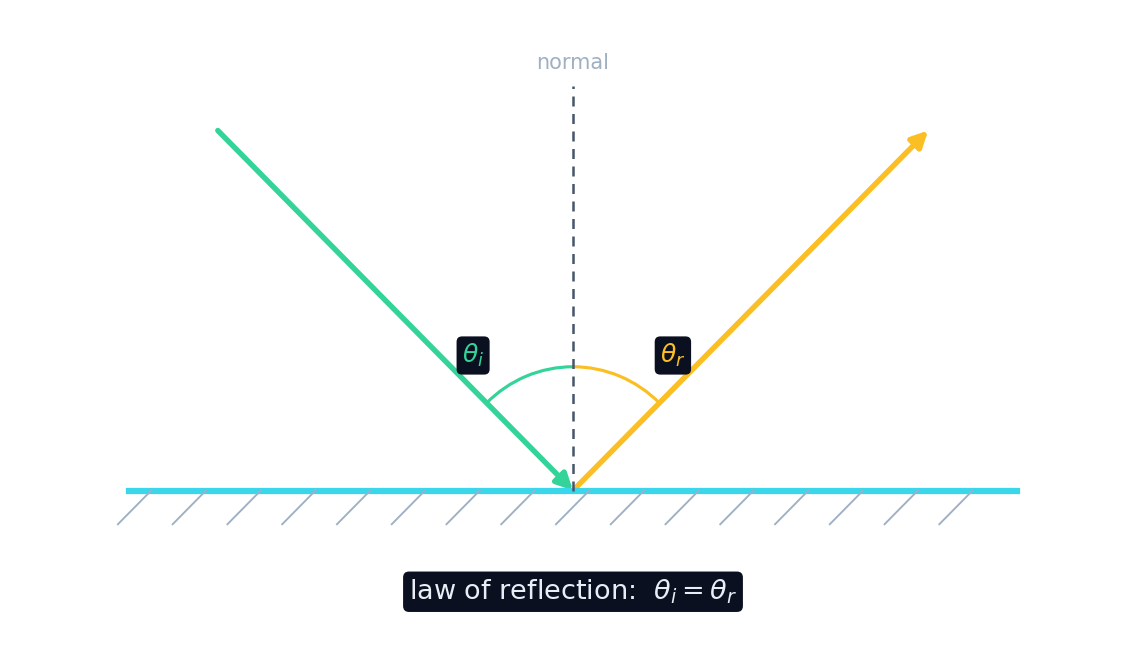
A ray strikes a mirror at $30^\circ$ to the normal. At what angle to the normal does it reflect, in degrees?
$\theta_r = \theta_i = 30^\circ$ by the law of reflection.
The law of reflection states that:
$\theta_i = \theta_r$, both measured from the normal.
Smooth vs rough surfaces
- A smooth surface (a mirror) reflects a beam neatly — specular reflection.
- A rough surface scatters light every which way — diffuse reflection.
- Both obey $\theta_i = \theta_r$ at each tiny point; the roughness just points the normals every way.
- Diffuse reflection is why you can see this page from any angle.
Why can you read this page from many angles?
The rough paper scatters light diffusely, so it reaches your eyes from any angle.
Select all true statements about reflection.
Reflection obeys $\theta_i = \theta_r$ from the normal, smooth = specular. Rough surfaces still obey it at each point.
Always measure from the normal
- The single most common slip is measuring the angle from the surface instead of the normal.
- The normal is the perpendicular line; angles in optics are always taken from it.
- A ray hitting a mirror "flat" ($\theta_i \approx 90^\circ$ from the normal) grazes off almost flat.
- A ray straight down the normal ($\theta_i = 0$) reflects straight back.
The law of reflection
For a mirror, the angle of reflection always equals the angle of incidence - a straight line through the origin.
In optics, angles are always measured from the ____ (the perpendicular line).
The normal is perpendicular to the surface; all optics angles use it.
A ray at $30^\circ$ to the mirror surface is at $60^\circ$ to the normal.
Surface and normal are perpendicular, so the two angles add to $90^\circ$.
Always measure the angles from the normal (the perpendicular), not from the mirror surface. A ray at $30^\circ$ to the surface is at $60^\circ$ to the normal — and $60^\circ$ is what goes into $\theta_i = \theta_r$.
A ray strikes a mirror at $30^\circ$ to the normal. At what angle does it reflect?
- By the law of reflection, $\theta_r = \theta_i = 30^\circ$ to the normal.
The total angle between the incoming and outgoing rays is $60^\circ$.
The law of reflection: the angle of incidence equals the angle of reflection ($\theta_i = \theta_r$), both measured from the normal. Smooth surfaces give clear specular reflection; rough ones give scattered diffuse reflection. Always measure from the normal.