Skip to content · ⁨Bỏ qua nội dung⁩
Subjects · ⁨Môn học⁩

AP Macroeconomics · ⁨AP Kinh tế vĩ mô⁩

Tips · ⁨Mẹo⁩

AP Macroeconomics covers economic indicators and the business cycle, national income and price determination, the financial sector, stabilisation policies, economic growth, and the open economy. It works at the level of a whole country rather than a single market.

Three model diagrams carry the course: AD–AS, the money market, and the loanable-funds market. Almost every free-response question moves between them, so knowing what shifts what, and in which order, is the core skill.

Chains of reasoning are graded. "Interest rates fall → investment rises → AD shifts right → real GDP and the price level rise" is the shape of a full-mark answer. Never skip a link.

The notes run unit by unit with the graphs drawn out — AD-AS, the money market, loanable funds — because most of the marks hang on them. Released FRQs are in the library, and the notes flag the places where a correctly labelled diagram earns the point by itself.

  • 1

    Basic Economic Concepts · ⁨Các khái niệm kinh tế cơ bản⁩

    Watch lesson · ⁨Xem bài học⁩
    1.1

    Scarcity · ⁨khan hiếm⁩

    Syllabus · ⁨Chương trình⁩
    English

    Enduring Understanding (MOD-1): The production possibilities curve (PPC) model is used to demonstrate the full employment level of output and to illustrate changes in full employment.

    Learning Objective MOD-1.A: Define scarcity and economic resources.

    • MOD-1.A.1 Individuals and societies are forced to make choices because most resources are scarce.
    Tiếng Việt

    Hiểu biết dai dẳng (MOD-1): Mô hình đường giới hạn khả năng sản xuất (PPC) được sử dụng để minh họa mức sản lượng đầy đủ việc làm và thể hiện các thay đổi về đầy đủ việc làm.

    Mục tiêu học tập MOD-1.A: Định nghĩa sự khan hiếm và các nguồn lực kinh tế.

    • MOD-1.A.1 Cá nhân và xã hội buộc phải đưa ra lựa chọn vì hầu hết các nguồn lực đều khan hiếm.
    Source: College Board AP Course and Exam Description · ⁨Nguồn: Mô tả Khóa học và Bài thi College Board AP⁩

    English

    Economics 经济学 begins with scarcity 稀缺性: people's wants are unlimited, but the resources 资源 to satisfy them are limited. The resources – the factors of production 生产要素 – are land, labor 劳动, capital 资本, and entrepreneurship 企业家才能. Scarcity forces every society to choose what, how, and for whom to produce, and it makes trade-offs 权衡 unavoidable.

    Tiếng Việt
    Mỏ hở: đất và khoáng sản là nguồn lực khan hiếm có chi phí cơ hội
    Mỏ hở: đất và khoáng sản là nguồn lực khan hiếm có chi phí cơ hội

    Kinh tế học bắt đầu từ khan hiếm: nhu cầu của con người là vô hạn, nhưng nguồn lực để thỏa mãn chúng là hữu hạn. Các nguồn lực – hay yếu tố sản xuất – bao gồm đất, lao động, vốn và doanh nhân. Sự khan hiếm buộc mọi xã hội phải lựa chọn what (gì), how (như thế nào) và for whom (cho ai) để sản xuất, và khiến việc hy sinh (trade-offs) trở nên không thể tránh khỏi.

    Vocabulary · ⁨Từ vựng⁩ Train · ⁨Luyện tập⁩
    English Tiếng Việt
    Economics/ˌiːkəˈnɒmɪks/ Kinh tế
    scarcity/ˈskeəsɪti/ sự khan hiếm
    resources/rɪˈzɔːsɪz/ tài nguyên
    factors of production/ˈfæktəz ɒv prəˈdʌkʃn/ yếu tố sản xuất
    labor/ˈleɪbə/ Lao động
    capital/ˈkæpɪtl/ vốn
    entrepreneurship/ˌɒntrɪprəˈnjʊəʃɪp/ tinh thần doanh nhân
    trade-offs/treɪd ɒfs/ sự đánh đổi
    1.2

    Opportunity Cost and the Production Possibilities Curve (PPC) · ⁨Chi phí cơ hội và Đường giới hạn khả năng sản xuất (PPC)⁩

    Syllabus · ⁨Chương trình⁩
    English

    Enduring Understanding (MOD-1): The production possibilities curve (PPC) model is used to demonstrate the full employment level of output and to illustrate changes in full employment.

    Learning Objective MOD-1.B: a. Define (using graphs as appropriate) the PPC and related terms. b. Explain (using graphs as appropriate) how the PPC illustrates opportunity costs, tradeoffs, inefficiency, efficiency, and economic growth or contraction under various conditions. c. Calculate (using data from PPCs or tables as appropriate) opportunity cost.

    • MOD-1.B.1 The PPC is a model used to show the tradeoffs associated with allocating resources.
    • MOD-1.B.2 The PPC can be used to illustrate the concepts of scarcity, opportunity cost, efficiency, underutilized resources, and economic growth or contraction.
    • MOD-1.B.3 The shape of the PPC depends on whether opportunity costs are constant, increasing, or decreasing.
    • MOD-1.B.4 The PPC can shift because of changes in factors of production as well as changes in productivity/technology.
    • MOD-1.B.5 Economic growth results in an outward shift of the PPC.
    Tiếng Việt

    Hiểu biết dai dẳng (MOD-1): Mô hình đường giới hạn khả năng sản xuất (PPC) được sử dụng để minh họa mức sản lượng đầy đủ việc làm và thể hiện các thay đổi về đầy đủ việc làm.
    Mục tiêu học tập MOD-1.B: a. Định nghĩa (sử dụng biểu đồ khi cần thiết) PPC và các thuật ngữ liên quan. b. Giải thích (sử dụng biểu đồ khi cần thiết) cách PPC minh họa chi phí cơ hội, sự đánh đổi, sự không hiệu quả, hiệu quả, và tăng trưởng hoặc suy thoái kinh tế trong các điều kiện khác nhau. c. Tính toán (sử dụng dữ liệu từ PPC hoặc bảng số liệu khi cần thiết) chi phí cơ hội.
    • MOD-1.B.1 PPC là một mô hình dùng để thể hiện sự đánh đổi liên quan đến việc phân bổ nguồn lực.
    • MOD-1.B.2 PPC có thể được sử dụng để minh họa các khái niệm về sự khan hiếm, chi phí cơ hội, hiệu quả, tài nguyên chưa được sử dụng hết, và tăng trưởng hoặc suy thoái kinh tế.
    • MOD-1.B.3 Hình dạng của PPC phụ thuộc vào việc chi phí cơ hội là không đổi, tăng dần hay giảm dần.
    • MOD-1.B.4 PPC có thể dịch chuyển do những thay đổi trong các yếu tố đầu vào cũng như thay đổi về năng suất/công nghệ.
    • MOD-1.B.5 Tăng trưởng kinh tế dẫn đến sự dịch chuyển của PPC ra phía ngoài.

    Source: College Board AP Course and Exam Description · ⁨Nguồn: Mô tả Khóa học và Bài thi College Board AP⁩

    English
    The production possibility frontier

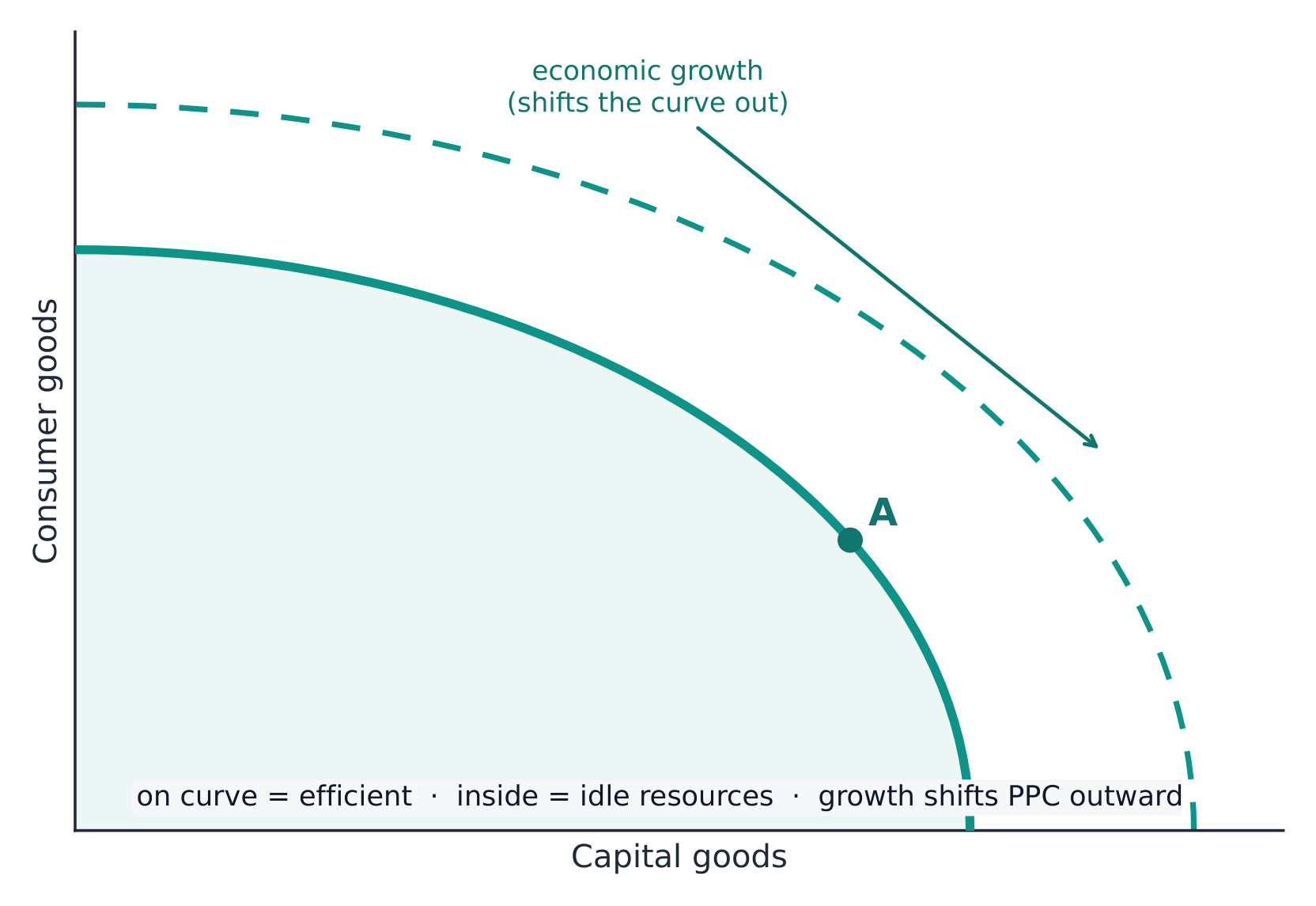
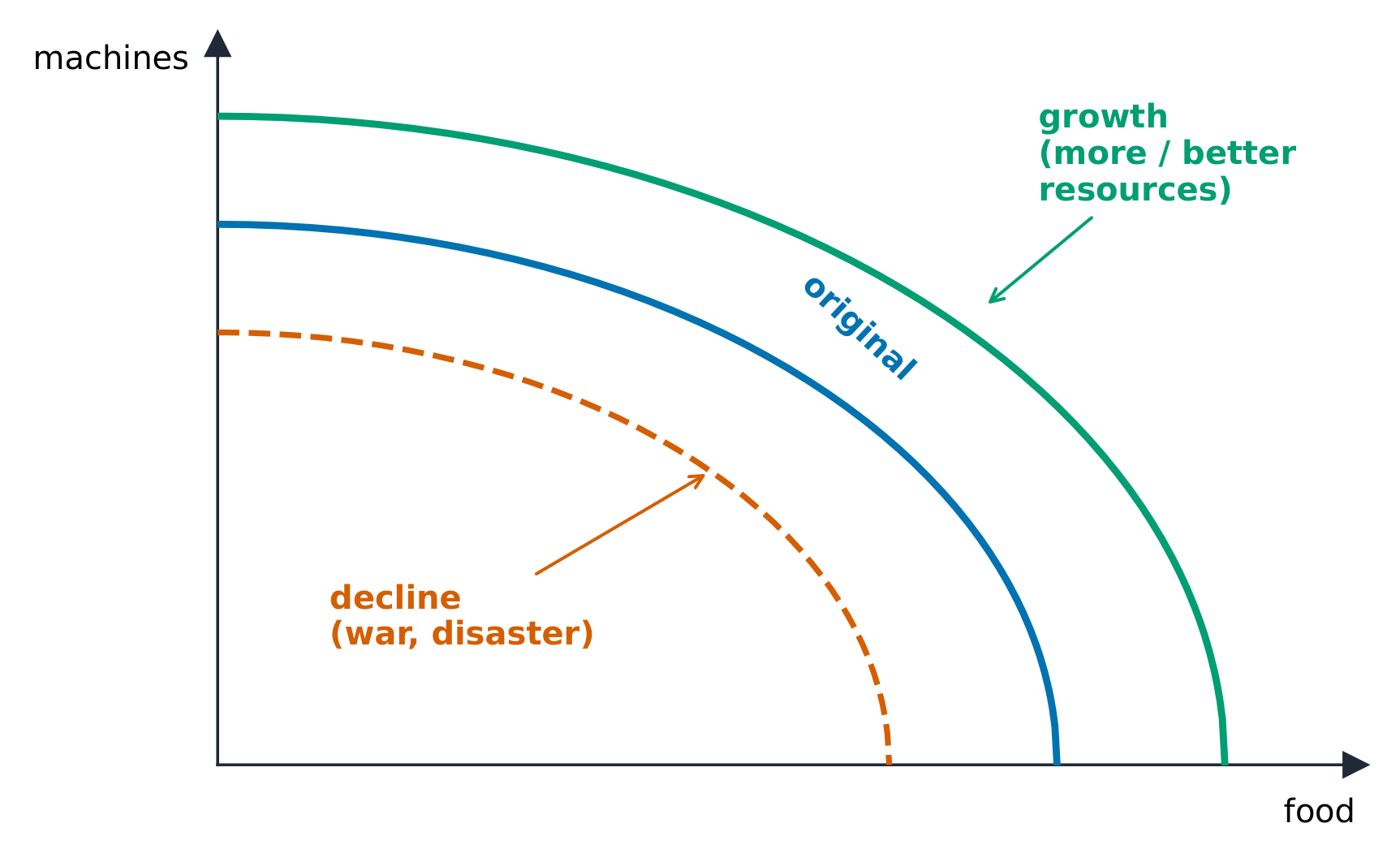
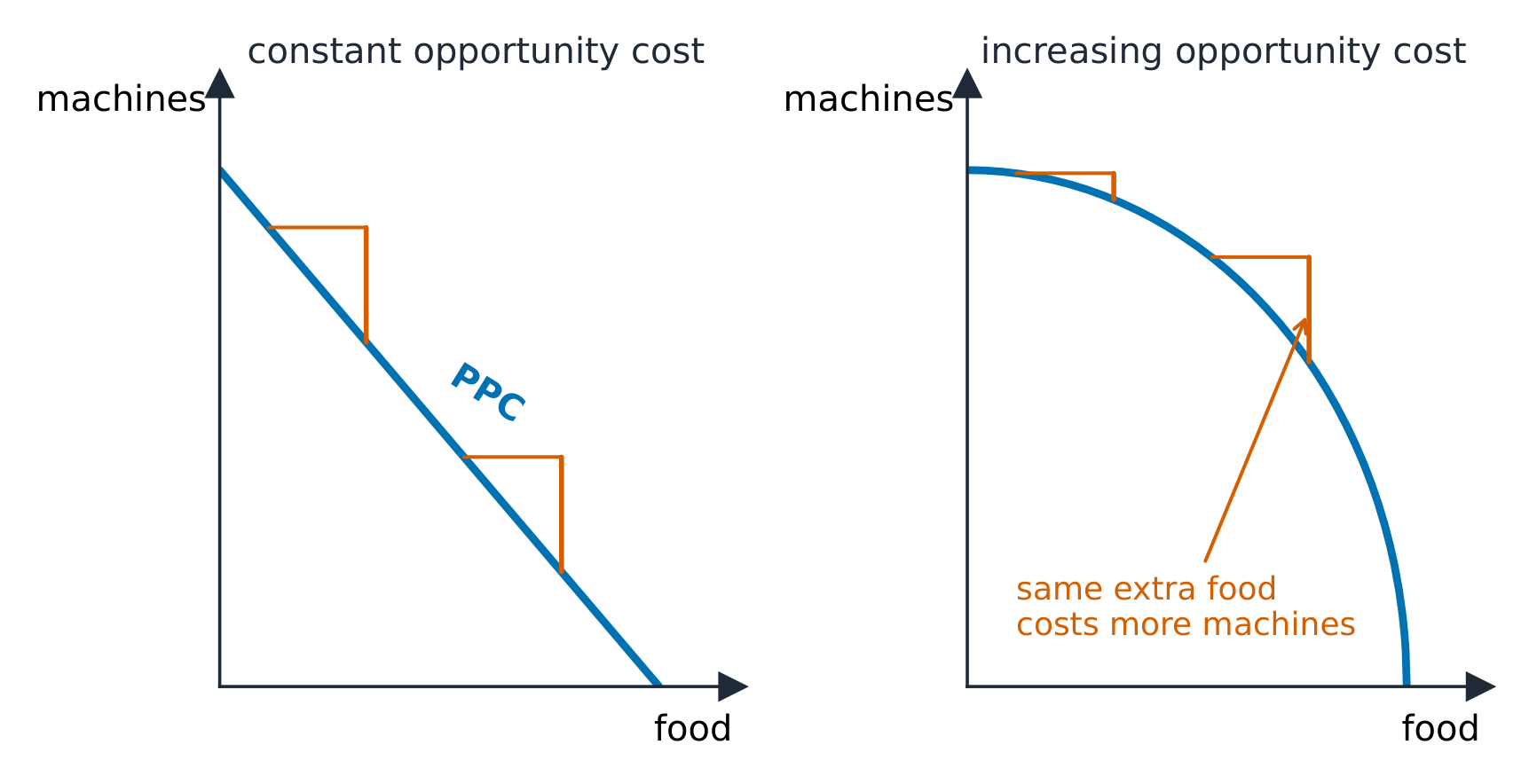
    Every choice has an opportunity cost 机会成本 – the value of the next-best alternative given up. The production possibilities curve (PPC) 生产可能性曲线 shows the maximum combinations of two goods an economy can make when resources are fully and efficiently used.

    • Points on the curve are efficient; inside, inefficient (unemployed resources); outside, unattainable.
    • The downward slope shows opportunity cost; a bowed-out curve shows increasing opportunity cost.
    • More resources or better technology cause economic growth 经济增长, shifting the PPC outward.
    Tiếng Việt
    Biên khả năng sản xuất

    Mọi lựa chọn đều có chi phí cơ hội – giá trị của phương án thay thế tốt nhất bị bỏ qua. Đường giới hạn khả năng sản xuất (PPC) hiển thị tổ hợp tối đa của hai loại hàng hóa mà nền kinh tế có thể sản xuất khi nguồn lực được sử dụng đầy đủ và hiệu quả.

    Một đường PPC thẳng thể hiện chi phí cơ hội không đổi; đường cong lồi thể hiện chi phí tăng dần
    Một đường PPC thẳng thể hiện chi phí cơ hội không đổi; đường cong lồi thể hiện chi phí tăng dần
    • Các điểm trên đường cong là hiệu quả; trong đường cong là kém hiệu quả (nguồn lực thất nghiệp); ngoài đường cong là không thể đạt được.
    • Độ dốc xuống thể hiện chi phí cơ hội; một đường cong cong ra ngoài thể hiện chi phí cơ hội tăng dần.
    • Nhiều nguồn lực hơn hoặc công nghệ tốt hơn gây ra tăng trưởng kinh tế, đẩy đường PPC ra ngoài.
    Đường giới hạn khả năng sản xuất; đầu tư vào hàng hóa tư bản sẽ đẩy nó ra ngoài
    Đường giới hạn khả năng sản xuất; đầu tư vào hàng hóa tư bản dịch chuyển nó ra ngoài
    Explore · ⁨Khám phá⁩

    Explore the production possibilities curve · ⁨Khám phá đường biên khả năng sản xuất⁩

    Move along the curve — making more capital goods means giving up consumer goods. That lost output is the opportunity cost, and the bowed shape shows it rising with each extra unit. · ⁨Di chuyển dọc theo đường cong — sản xuất thêm hàng hóa tư bản có nghĩa là phải hy sinh hàng hóa tiêu dùng. Sản lượng bị mất là chi phí cơ hội, và hình dạng cong cho thấy nó tăng với mỗi đơn vị tăng thêm.⁩

    Vocabulary · ⁨Từ vựng⁩ Train · ⁨Luyện tập⁩
    English Tiếng Việt
    opportunity cost/ɒpəˈtjuːnɪti kɒst/ chi phí cơ hội
    production possibilities curve (PPC)/prəˈdʌkʃn ˌpɒsəˈbɪlɪtiz kɜːv/ Đường giới hạn khả năng sản xuất (PPC)
    economic growth/ˌiːkəˈnɒmɪk ɡrəʊθ/ tăng trưởng kinh tế
    absolute advantage/ˈæbsəluːt ədˈvæntɪdʒ/ lợi thế tuyệt đối
    1.3

    Comparative Advantage and Gains from Trade · ⁨Lợi thế so sánh và Lợi ích từ Thương mại⁩

    Syllabus · ⁨Chương trình⁩
    English

    Enduring Understanding (MKT-1): Production and consumption increase by engaging in trade.

    Learning Objective MKT-1.A: a. Define absolute advantage and comparative advantage. b. Determine (using data from PPCs or tables as appropriate) absolute and comparative advantage.

    • MKT-1.A.1 Absolute advantage describes a situation in which an individual, business, or country can produce more of a good or service than any other producer with the same quantity of resources.
    • MKT-1.A.2 Comparative advantage describes a situation in which an individual, business, or country can produce a good or service at a lower opportunity cost than another producer.

    Learning Objective MKT-1.B: a. Explain (using data from PPCs or tables as appropriate) how specialization according to comparative advantage with appropriate terms of trade can lead to gains from trade. b. Calculate (using data from PPCs or tables as appropriate) mutually beneficial terms of trade.

    • MKT-1.B.1 Production specialization according to comparative advantage results in exchange opportunities that lead to consumption opportunities beyond the PPC.
    • MKT-1.B.2 Comparative advantage and opportunity costs determine the terms of trade for exchange under which mutually beneficial trade can occur.
    Tiếng Việt

    Hiểu biết dai dẳng (MKT-1): Sản xuất và tiêu dùng tăng lên thông qua việc tham gia thương mại.

    Mục tiêu học tập MKT-1.A: a. Định nghĩa lợi thế tuyệt đối và lợi thế so sánh. b. Xác định (sử dụng dữ liệu từ PPC hoặc bảng số liệu khi cần thiết) lợi thế tuyệt đối và lợi thế so sánh.

    • MKT-1.A.1 Lợi thế tuyệt đối mô tả tình huống mà một cá nhân, doanh nghiệp hoặc quốc gia có thể sản xuất nhiều hàng hóa hoặc dịch vụ hơn bất kỳ nhà sản xuất nào khác với cùng một lượng nguồn lực.
    • MKT-1.A.2 Lợi thế so sánh mô tả tình huống mà một cá nhân, doanh nghiệp hoặc quốc gia có thể sản xuất một hàng hóa hoặc dịch vụ với chi phí cơ hội thấp hơn so với nhà sản xuất khác.

    Mục tiêu học tập MKT-1.B: a. Giải thích (sử dụng dữ liệu từ PPC hoặc bảng số liệu khi cần thiết) cách chuyên môn hóa theo lợi thế so sánh với tỷ lệ trao đổi phù hợp có thể dẫn đến lợi ích từ thương mại. b. Tính toán (sử dụng dữ liệu từ PPC hoặc bảng số liệu khi cần thiết) tỷ lệ trao đổi có lợi cho cả hai bên.

    • MKT-1.B.1 Chuyên môn hóa sản xuất theo lợi thế so sánh tạo ra cơ hội trao đổi dẫn đến cơ hội tiêu dùng vượt ra ngoài PPC.
    • MKT-1.B.2 Lợi thế so sánh và chi phí cơ hội xác định tỷ lệ trao đổi dưới đó thương mại có lợi cho cả hai bên có thể diễn ra.

    Source: College Board AP Course and Exam Description · ⁨Nguồn: Mô tả Khóa học và Bài thi College Board AP⁩

    English

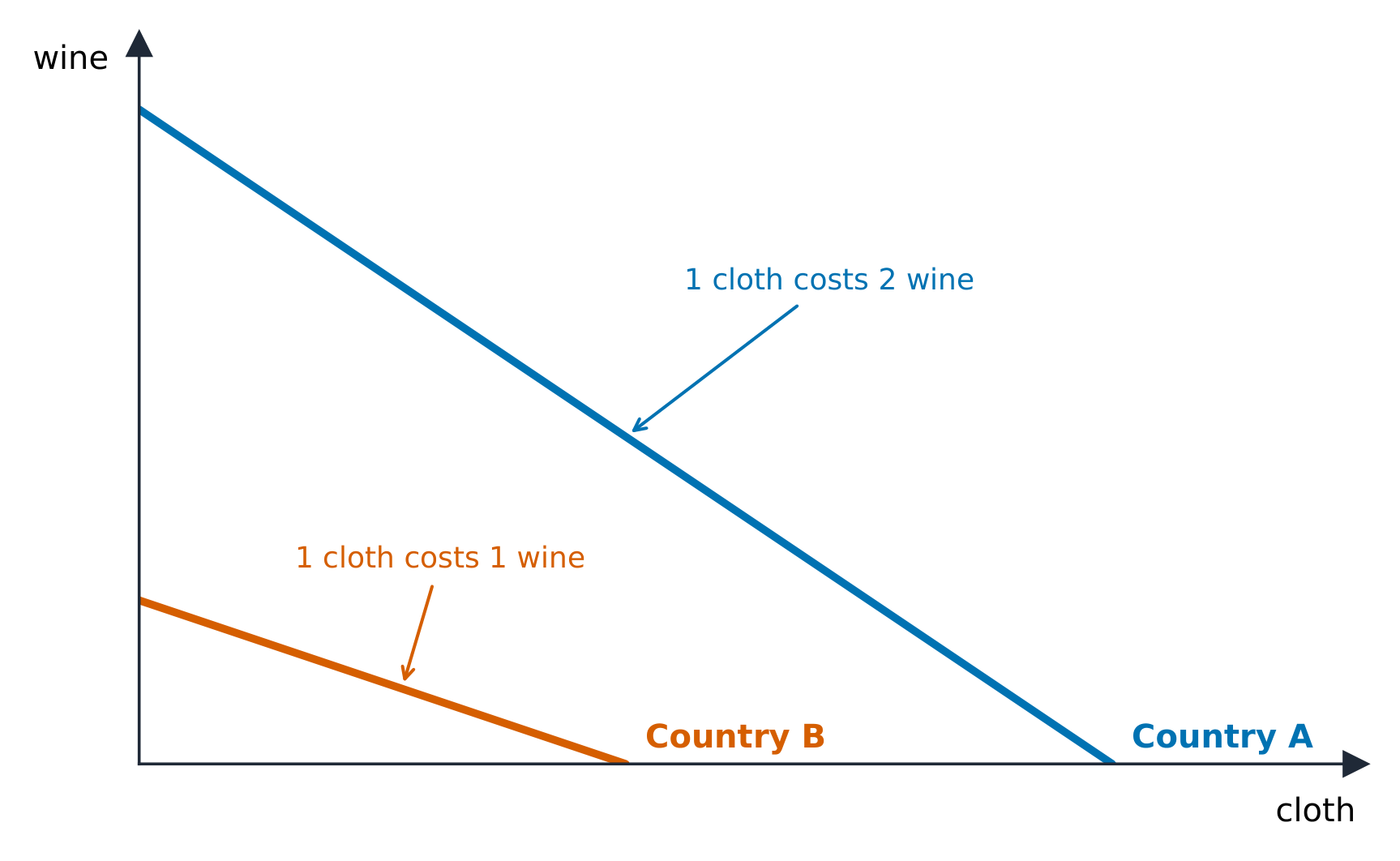
    A producer has an absolute advantage 绝对优势 in a good if it can make more of it. It has a comparative advantage 比较优势 if it has the lower opportunity cost. Nations should specialize in their comparative-advantage goods and trade – both gain if the terms of trade 贸易条件 lie between the two opportunity costs. Trade lets a country consume beyond its own PPC.

    Worked example. Country A can make $10$ wheat or $5$ cloth per day; Country B can make $8$ wheat or $8$ cloth. For A, one cloth costs $\tfrac{10}{5}=2$ wheat; for B it costs $\tfrac{8}{8}=1$ wheat. B's opportunity cost of cloth is lower, so B specializes in cloth. Checking wheat: A gives up $0.5$ cloth per wheat and B gives up $1$, so A specializes in wheat. Trading at any rate between the two costs, both consume beyond their own PPC.

    Tiếng Việt

    Một nhà sản xuất có lợi thế tuyệt đối trong một mặt hàng nếu họ có thể sản xuất nhiều hơn. Họ có lợi thế so sánh nếu có chi phí cơ hội thấp hơn. Các quốc gia nên chuyên môn hóa các mặt hàng có lợi thế so sánh và thương mại – cả hai đều được hưởng lợi nếu điều kiện thương mại nằm giữa hai mức chi phí cơ hội. Thương mại cho phép một quốc gia tiêu dùng vượt quá đường PPC của chính mình.

    Ví dụ hướng dẫn. Quốc gia A có thể sản xuất $10$ lúa mì hoặc $5$ vải mỗi ngày; Quốc gia B có thể sản xuất $8$ lúa mì hoặc $8$ vải. Đối với A, một đơn vị vải tốn $\tfrac{10}{5}=2$ lúa mì; đối với B là $\tfrac{8}{8}=1$ lúa mì. Chi phí cơ hội của vải ở B thấp hơn, vì vậy B chuyên sản xuất vải. Kiểm tra lại lúa mì: A phải hy sinh $0.5$ vải mỗi lúa mì và B hy sinh $1$, do đó A chuyên sản xuất lúa mì. Giao dịch ở bất kỳ tỷ lệ nào nằm giữa hai mức chi phí này, cả hai đều tiêu dùng vượt quá đường PPC riêng của mình.

    Lợi thế so sánh đến từ các đường giới hạn khả năng sản xuất có độ dốc khác nhau
    Lợi thế so sánh đến từ các đường giới hạn khả năng sản xuất có độ dốc khác nhau
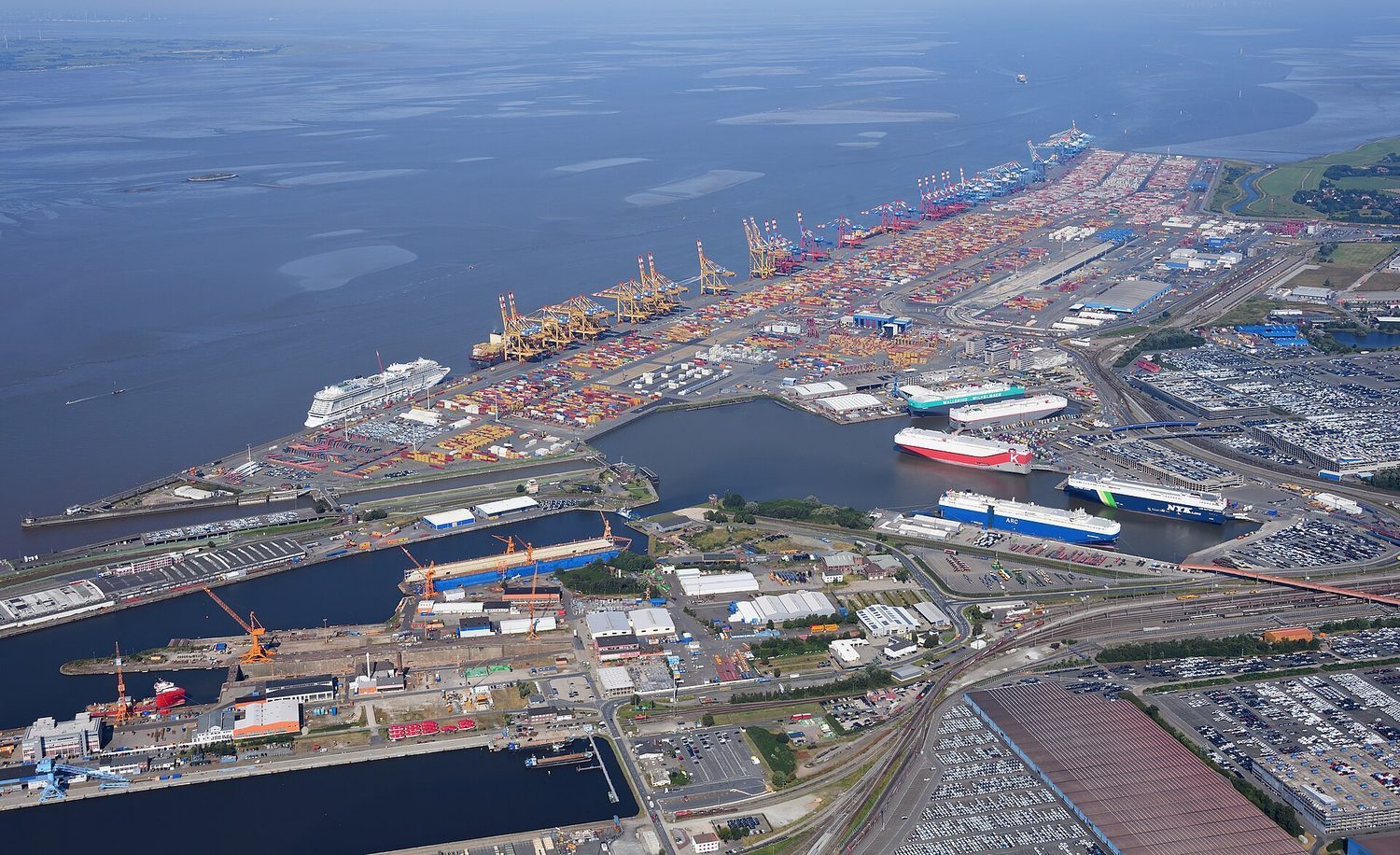
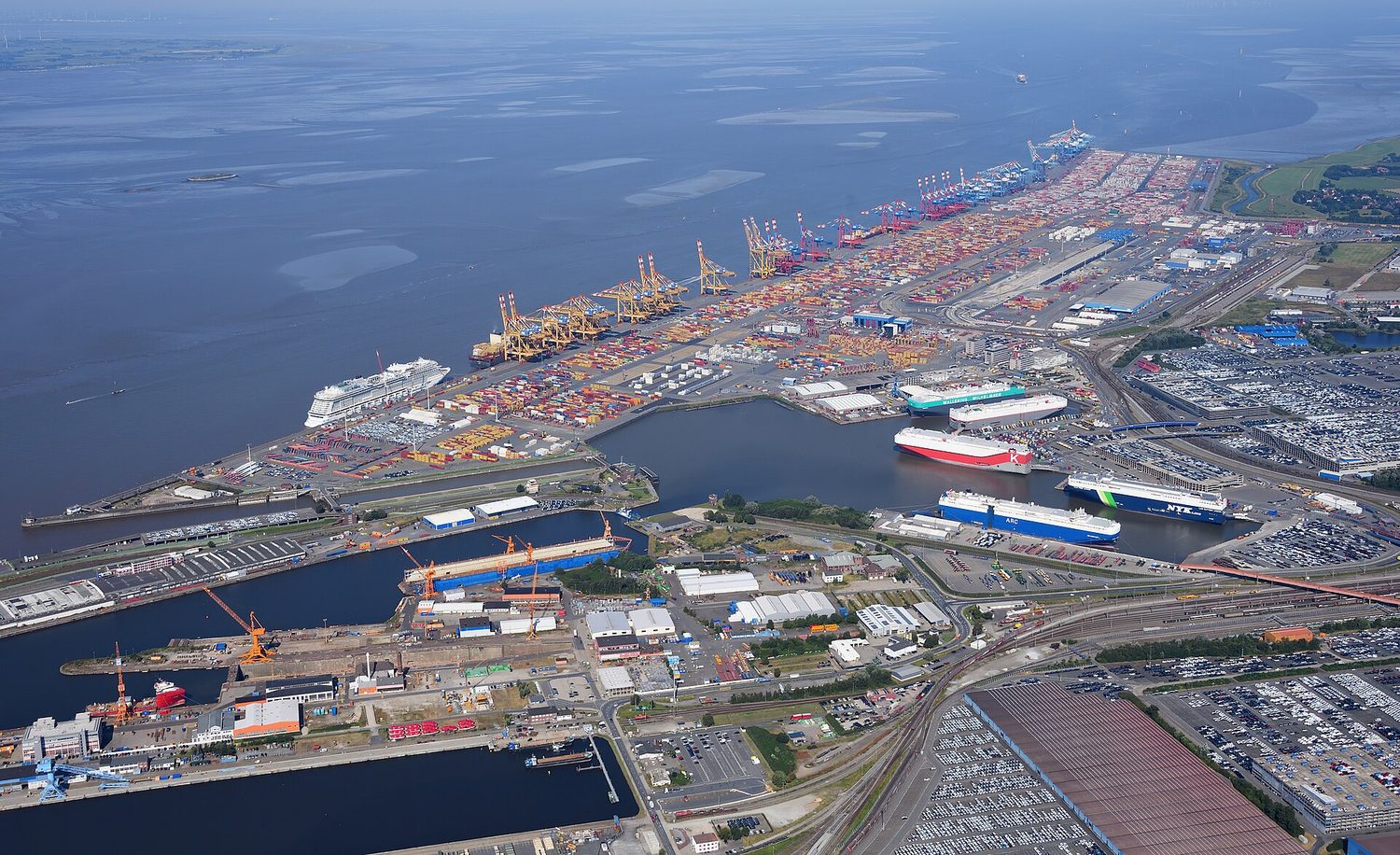
    Vận tải container: lợi thế so sánh và thương mại giúp các nước chuyên môn hóa và hưởng lợi
    Vận chuyển container: lợi thế so sánh và thương mại giúp các quốc gia chuyên môn hóa và hưởng lợi
    Explore · ⁨Khám phá⁩

    See the gains from specialization and trade · ⁨Xem lợi ích từ chuyên môn hóa và thương mại⁩

    A country should specialize where its opportunity cost is lowest, then trade for the rest. Because the terms of trade sit between the two countries' costs, each can consume beyond its own production frontier. · ⁨Một quốc gia nên chuyên môn hóa nơi chi phí cơ hội thấp nhất, sau đó trao đổi để lấy phần còn lại. Vì điều kiện thương mại nằm giữa chi phí của hai quốc gia, mỗi bên có thể tiêu thụ vượt quá biên giới sản xuất của chính mình.⁩

    Vocabulary · ⁨Từ vựng⁩ Train · ⁨Luyện tập⁩
    English Tiếng Việt
    comparative advantage/kəmˈpærətɪv ədˈvæntɪdʒ/ lợi thế so sánh
    terms of trade/tɜːmz ɒv treɪd/ tỷ lệ thương mại
    1.4

    Demand · ⁨Cầu⁩

    Syllabus · ⁨Chương trình⁩
    English

    Enduring Understanding (MKT-2): In a competitive market, demand for and supply of a good or service determine the equilibrium price.

    Learning Objective MKT-2.A: a. Define (using graphs as appropriate) the law of demand. b. Explain (using graphs as appropriate) the relationship between the price of a good or service and the quantity demanded.

    • MKT-2.A.1 The law of demand states there is an inverse relationship between price and quantity demanded, leading to a downward-sloping demand curve.

    Learning Objective MKT-2.B: Explain (using graphs as appropriate) the determinants of demand.

    • MKT-2.B.1 Factors that influence consumer demand, such as changes in consumer income, cause the market demand curve to shift.
    Tiếng Việt

    Hiểu biết dai dẳng (MKT-2): Trong thị trường cạnh tranh, cầu và cung của một hàng hóa hoặc dịch vụ xác định giá cân bằng.

    Mục tiêu học tập MKT-2.A: a. Định nghĩa (sử dụng biểu đồ khi cần thiết) luật cầu. b. Giải thích (sử dụng biểu đồ khi cần thiết) mối quan hệ giữa giá của một hàng hóa/dịch vụ và lượng cầu.

    • MKT-2.A.1 Luật cầu phát biểu rằng có mối quan hệ nghịch biến giữa giá và lượng cầu, dẫn đến đường cong cầu dốc xuống.

    Mục tiêu học tập MKT-2.B: Giải thích (sử dụng biểu đồ khi cần thiết) các nhân tố quyết định cầu.

    • MKT-2.B.1 Các yếu tố ảnh hưởng đến cầu người tiêu dùng, chẳng hạn như sự thay đổi thu nhập người tiêu dùng, khiến đường cong cầu thị trường dịch chuyển.

    Source: College Board AP Course and Exam Description · ⁨Nguồn: Mô tả Khóa học và Bài thi College Board AP⁩

    English

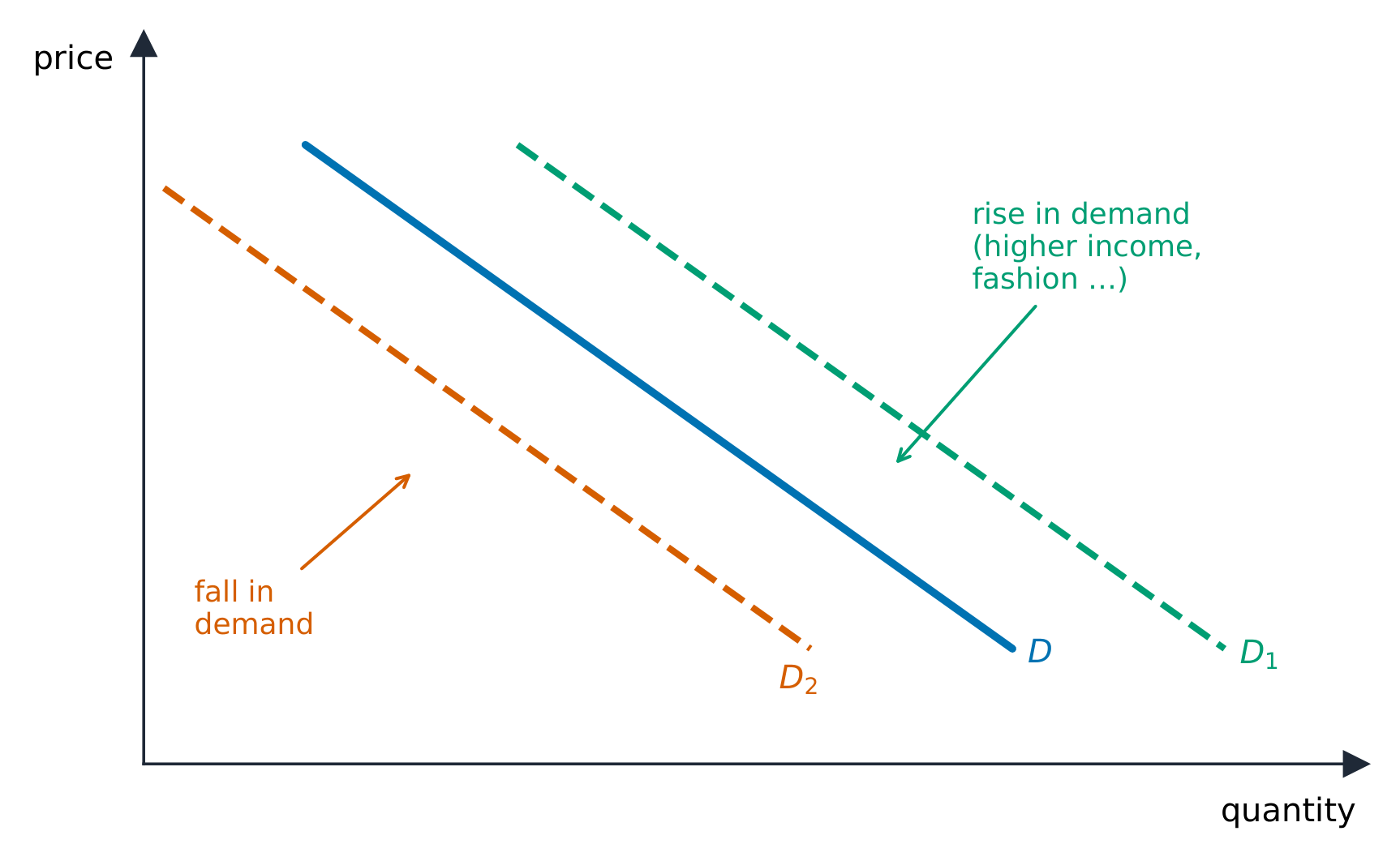
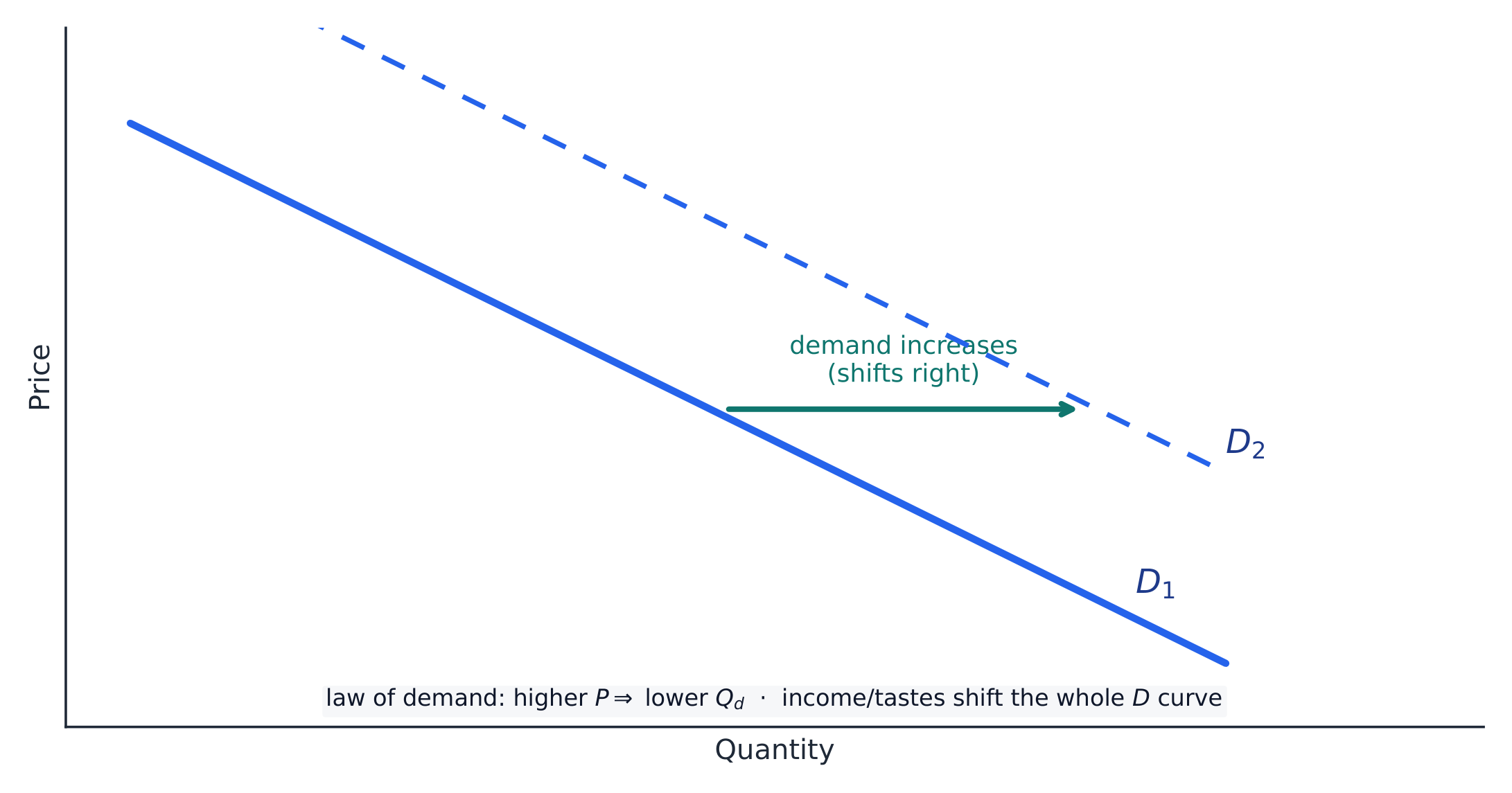
    Demand 需求 relates price to the quantity buyers will buy. The law of demand 需求定律 makes the curve slope downward. A change in the good's own price is a movement along the curve; the determinants (income, tastes, prices of substitutes 替代品 and complements 互补品, number of buyers, expectations) shift the whole curve.

    Tiếng Việt

    Nhu cầu liên kết giá với số lượng người mua sẵn sàng mua. Định luật nhu cầu khiến đường cong có độ dốc xuống. Sự thay đổi về giá của chính mặt hàng là sự di chuyển dọc theo đường cong; các yếu tố quyết định (thu nhập, sở thích, giá của hàng hóa thay thế và hàng hóa bổ sung, số lượng người mua, kỳ vọng) sẽ dịch chuyển toàn bộ đường cong.

    Đường cong nhu cầu dốc xuống; thu nhập, sở thích và giá liên quan làm dịch chuyển nó
    Đường cong nhu cầu dốc xuống; thu nhập, sở thích và giá liên quan làm dịch chuyển nó
    Định luật nhu cầu khiến đường cong dốc xuống; một yếu tố quyết định làm dịch chuyển toàn bộ đường cong
    Định luật nhu cầu khiến đường cong dốc xuống; một yếu tố quyết định làm dịch chuyển toàn bộ đường cong
    Explore · ⁨Khám phá⁩

    Explore demand — move along vs shift the curve · ⁨Khám phá nhu cầu — di chuyển dọc vs dịch chuyển đường cong⁩

    A change in the own price moves you along a fixed curve (a change in quantity demanded); a determinant like income or tastes shifts the whole curve ($D_1 \to D_2$) — a change in demand. · ⁨Sự thay đổi về giá cả nội tại di chuyển bạn dọc một đường cong cố định (sự thay đổi về lượng cầu); một yếu tố quyết định như thu nhập hoặc sở thích dịch chuyển toàn bộ đường cong ($D_1 \to D_2$) — sự thay đổi về cầu.⁩

    Vocabulary · ⁨Từ vựng⁩ Train · ⁨Luyện tập⁩
    English Tiếng Việt
    Demand/dɪˈmænd/ Nhu cầu
    law of demand/lɔː ɒv dɪˈmænd/ luật cầu
    substitutes/ˈsʌbstɪtjuːts/ hàng thay thế
    complements/ˈkɒmplɪmənts/ hàng bổ sung
    1.5

    Supply · ⁨Cung⁩

    Syllabus · ⁨Chương trình⁩
    English

    Enduring Understanding (MKT-2): In a competitive market, demand for and supply of a good or service determine the equilibrium price.

    Learning Objective MKT-2.C: a. Define (using graphs as appropriate) the law of supply. b. Explain (using graphs as appropriate) the relationship between the price of a good or service and the quantity supplied.

    • MKT-2.C.1 The law of supply states there is a positive relationship between price and quantity supplied, leading to an upward-sloping supply curve.

    Learning Objective MKT-2.D: Explain (using graphs as appropriate) the determinants of supply.

    • MKT-2.D.1 Factors that influence producer supply, such as changes in input prices, cause the market supply curve to shift.
    Tiếng Việt

    Hiểu biết dai dẳng (MKT-2): Trong thị trường cạnh tranh, cầu và cung của một hàng hóa hoặc dịch vụ xác định giá cân bằng.

    Mục tiêu học tập MKT-2.C: a. Định nghĩa (sử dụng biểu đồ khi cần thiết) luật cung. b. Giải thích (sử dụng biểu đồ khi cần thiết) mối quan hệ giữa giá của một hàng hóa/dịch vụ và lượng cung.

    • MKT-2.C.1 Luật cung phát biểu rằng có mối quan hệ đồng biến giữa giá và lượng cung, dẫn đến đường cong cung dốc lên.

    Mục tiêu học tập MKT-2.D: Giải thích (sử dụng biểu đồ khi cần thiết) các nhân tố quyết định cung.

    • MKT-2.D.1 Các yếu tố ảnh hưởng đến cung nhà sản xuất, chẳng hạn như sự thay đổi giá đầu vào, khiến đường cong cung thị trường dịch chuyển.

    Source: College Board AP Course and Exam Description · ⁨Nguồn: Mô tả Khóa học và Bài thi College Board AP⁩

    English

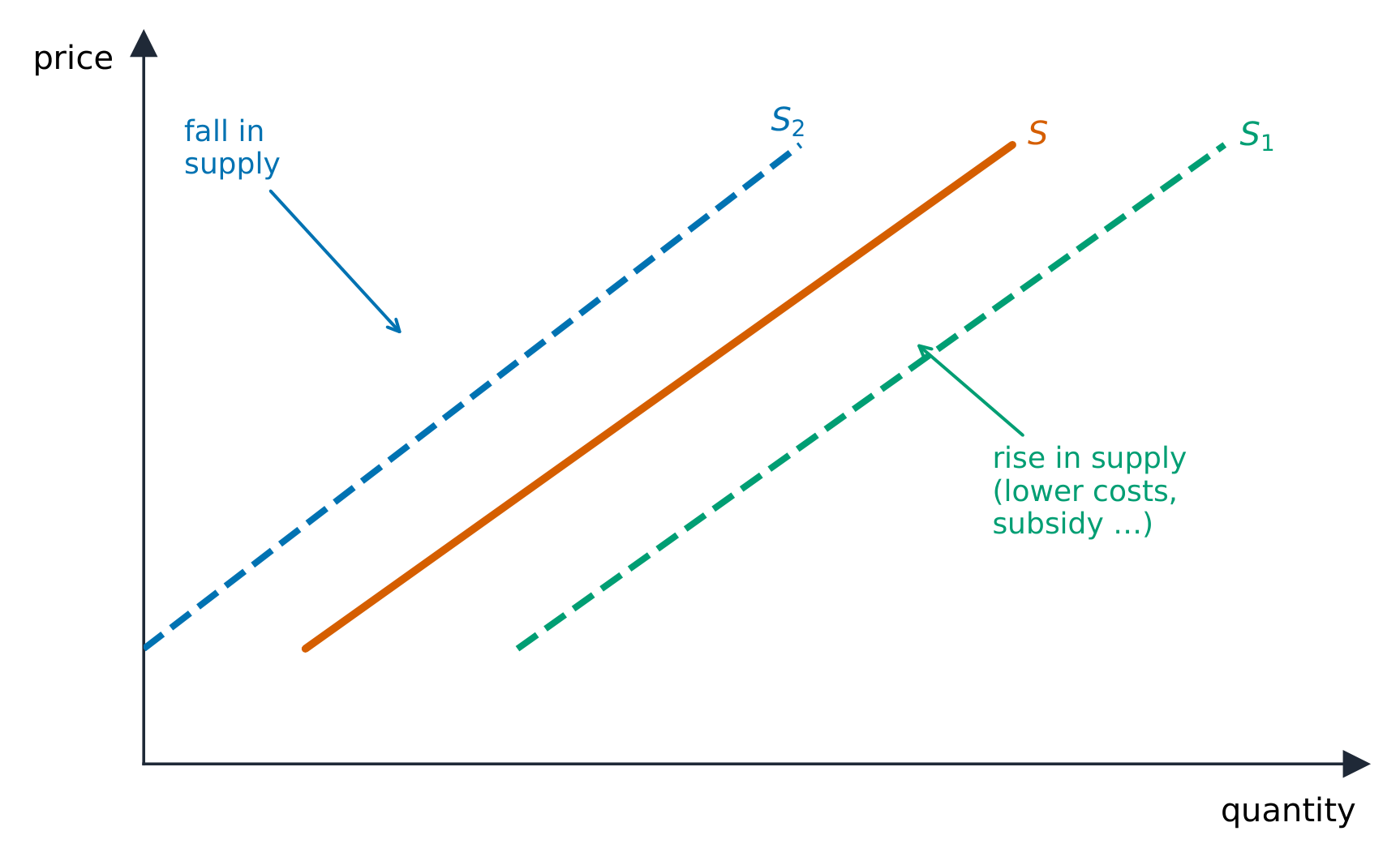
    Supply 供给 relates price to the quantity sellers will offer; the law of supply 供给定律 makes it slope upward. Its determinants – input prices, technology, taxes and subsidies 补贴, number of sellers, expectations – shift the curve, while the good's own price moves along it.

    Tiếng Việt

    Cung liên kết giá với số lượng người bán sẵn sàng cung cấp; định luật cung khiến nó có độ dốc lên. Các yếu tố quyết định của nó – giá đầu vào, công nghệ, thuế và trợ giá, số lượng người bán, kỳ vọng – làm dịch chuyển đường cong, trong khi giá của chính mặt hàng chỉ làm di chuyển dọc theo đường cong.

    Đường cong cung dốc lên; chi phí, công nghệ, thuế và trợ giá làm dịch chuyển nó
    Đường cong cung dốc lên; chi phí, công nghệ, thuế và trợ giá làm dịch chuyển nó
    Explore · ⁨Khám phá⁩

    Explore what moves the supply curve · ⁨Khám phá những yếu tố di chuyển đường cung⁩

    Supply slopes up: a higher price makes selling more worthwhile. A change in costs, technology or the number of sellers shifts the whole curve — not a move along it. Drag the supply line and watch price and quantity respond. · ⁨Cung dốc lên: giá cao hơn khiến bán nhiều hơn trở nên đáng giá. Sự thay đổi về chi phí, công nghệ hoặc số lượng người bán dịch chuyển toàn bộ đường cong — không phải di chuyển dọc theo nó. Kéo đường cung và xem giá cả và lượng phản hồi.⁩

    Vocabulary · ⁨Từ vựng⁩ Train · ⁨Luyện tập⁩
    English Tiếng Việt
    Supply/səˈplaɪ/ Cung
    law of supply/lɔː ɒv səˈplaɪ/ luật cung
    subsidies/ˈsʌbsɪdiz/ subsidies (trợ cấp)
    1.6

    Market Equilibrium, Disequilibrium, and Changes in Equilibrium · ⁨Cân bằng Thị trường, Mất cân bằng, và Sự thay đổi trong Cân bằng⁩

    Syllabus · ⁨Chương trình⁩
    English

    Enduring Understanding (MKT-2): In a competitive market, demand for and supply of a good or service determine the equilibrium price.

    Learning Objective MKT-2.E: Define (using graphs as appropriate) market equilibrium.

    • MKT-2.E.1 Equilibrium is achieved at the price at which quantities demanded and supplied are equal.

    Learning Objective MKT-2.F: a. Define a surplus and shortage. b. Explain (using graphs as appropriate) how prices adjust to restore equilibrium in markets that are experiencing imbalances. c. Calculate (using graphs as appropriate) the surplus or shortage in the market experience an imbalance.

    • MKT-2.F.1 Whenever markets experience imbalances—creating disequilibrium prices, surpluses, and shortages—market forces drive prices toward equilibrium.

    Learning Objective MKT-2.G: Explain (using graphs as appropriate) how changes in demand and supply affect equilibrium price and equilibrium quantity.

    • MKT-2.G.1 Changes in the determinants of supply and/or demand result in a new equilibrium price and quantity.
    Tiếng Việt

    Hiểu biết dai dẳng (MKT-2): Trong thị trường cạnh tranh, cầu và cung của một hàng hóa hoặc dịch vụ xác định giá cân bằng.

    Mục tiêu học tập MKT-2.E: Định nghĩa (sử dụng biểu đồ khi cần thiết) cân bằng thị trường.

    • MKT-2.E.1 Cân bằng đạt được ở mức giá tại đó lượng cầu và lượng cung bằng nhau.

    Mục tiêu học tập MKT-2.F: a. Định nghĩa thặng dư và thiếu hụt. b. Giải thích (sử dụng biểu đồ khi cần thiết) cách giá điều chỉnh để khôi phục cân bằng trong các thị trường đang gặp mất cân bằng. c. Tính toán (sử dụng biểu đồ khi cần thiết) thặng dư hoặc thiếu hụt trong thị trường đang trải nghiệm mất cân bằng.

    • MKT-2.F.1 Bất cứ khi nào thị trường gặp mất cân bằng—tạo ra các mức giá mất cân bằng, thặng dư và thiếu hụt—lực lượng thị trường đẩy giá tiến tới cân bằng.

    Mục tiêu học tập MKT-2.G: Giải thích (sử dụng biểu đồ khi cần thiết) cách thay đổi về cầu và cung ảnh hưởng đến giá cân bằng và lượng cân bằng.

    • MKT-2.G.1 Sự thay đổi trong các nhân tố quyết định cung và/hoặc cầu dẫn đến mức giá và lượng cân bằng mới.

    Source: College Board AP Course and Exam Description · ⁨Nguồn: Mô tả Khóa học và Bài thi College Board AP⁩

    English
    Supply & demand: a shift raises P and Q

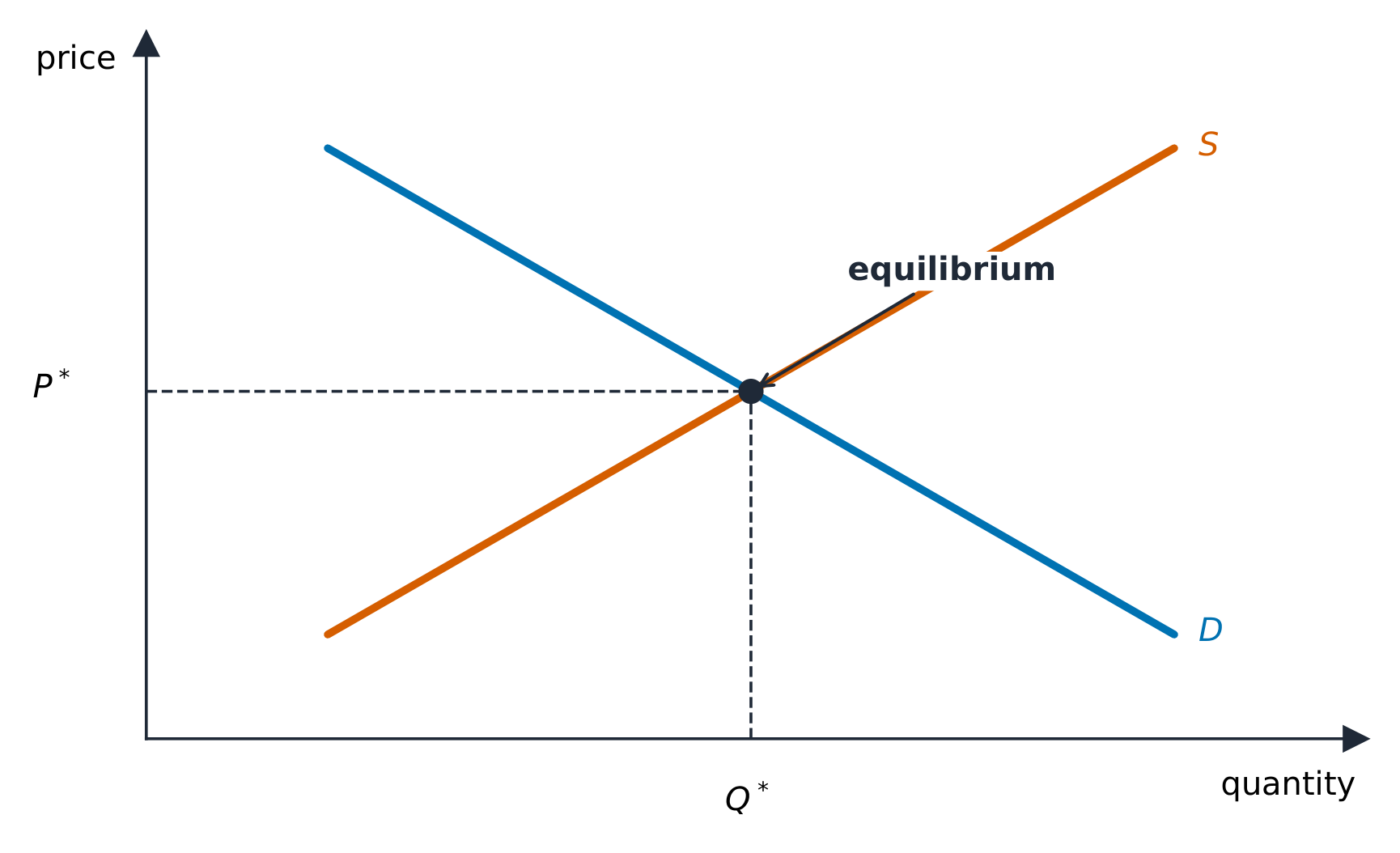
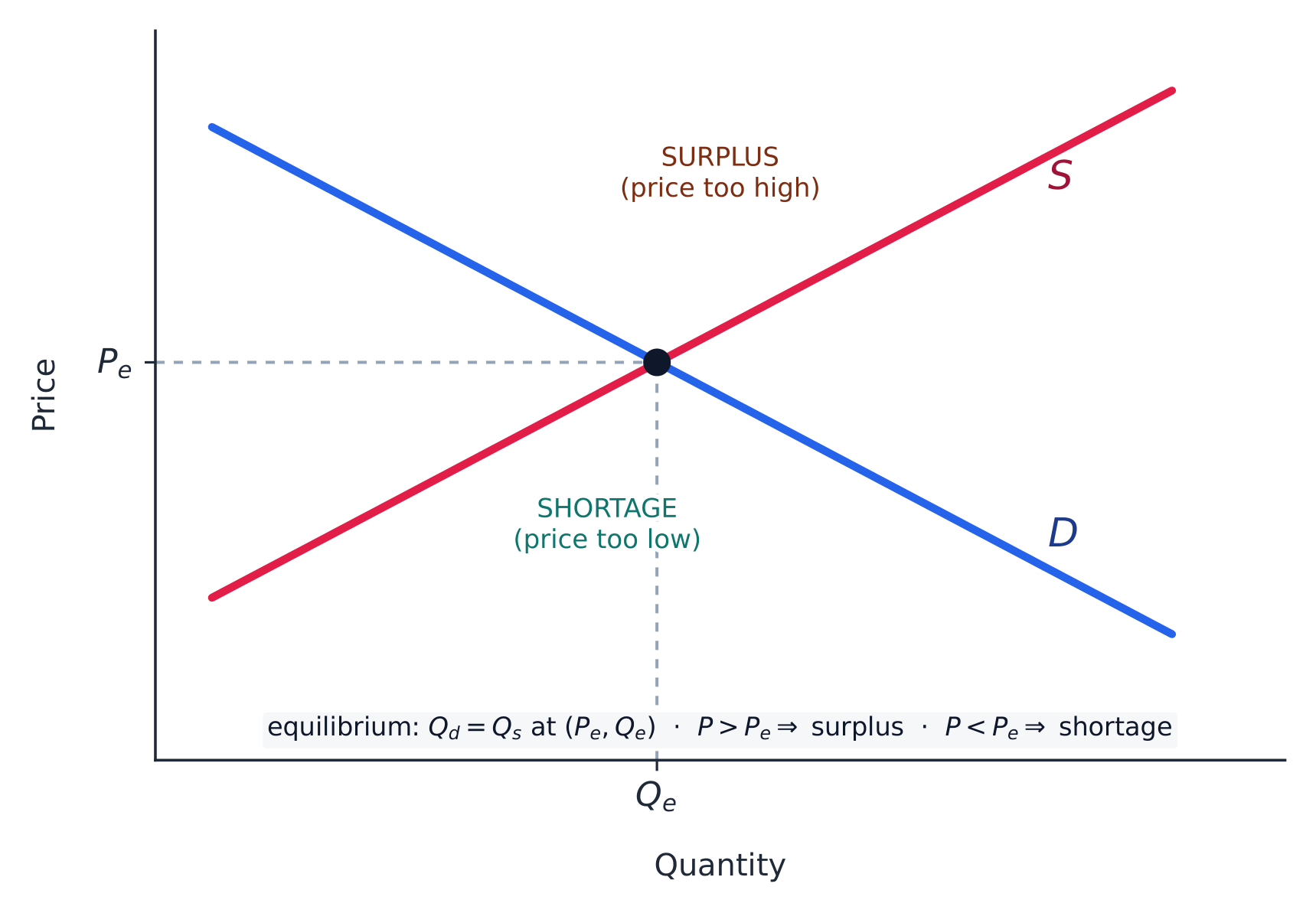
    Equilibrium 均衡 is where supply meets demand, clearing the market. Above the equilibrium price a surplus 过剩 pushes price down; below it a shortage 短缺 pushes price up. When a determinant shifts one curve, price and quantity move predictably; when both shift, one of them is indeterminate.

    Worked example. A new technology lowers producers' costs, shifting supply right. Along the unchanged demand curve, the equilibrium price falls and the equilibrium quantity rises. If instead a rise in incomes shifts demand right at the same time, quantity clearly rises but the effect on price depends on which shift is larger – the "both shift" indeterminate case.

    Exam skill: macro builds on these micro tools – you must draw and shift supply-and-demand and PPC graphs correctly, because the same shift logic drives the aggregate (whole-economy) models later in the course.

    Tiếng Việt
    Thị trường sầm uất: nhu cầu và cung gặp nhau tại nơi người mua và người bán thống nhất giá
    Thị trường sầm uất: nhu cầu và cung gặp nhau tại nơi người mua và người bán thống nhất giá
    Cung & nhu cầu: sự dịch chuyển làm tăng P và Q

    Cân bằng là nơi cung gặp nhu cầu, giải phóng thị trường. Trên mức giá cân bằng, thừa hàng đẩy giá xuống; dưới mức đó, thiếu hàng đẩy giá lên. Khi một yếu tố quyết định làm dịch chuyển một đường cong, giá và số lượng thay đổi có thể dự đoán được; khi cả hai dịch chuyển, một trong hai đại lượng sẽ không xác định được.

    Ví dụ hướng dẫn. Một công nghệ mới làm giảm chi phí của nhà sản xuất, làm cung dịch chuyển sang phải. Dọc theo đường cầu không đổi, giá cân bằng giảm và số lượng cân bằng tăng. Nếu thay vào đó, mức thu nhập tăng làm cầu dịch chuyển sang phải cùng lúc, số lượng rõ ràng tăng nhưng tác động lên giá phụ thuộc vào sự dịch chuyển nào lớn hơn – trường hợp "cả hai cùng dịch chuyển" là trường hợp không xác định được.

    Giá cân bằng và lượng cân bằng nơi cầu gặp cung
    Giá cân bằng và lượng cân bằng nơi cầu gặp cung

    Kỹ năng thi: kinh tế vĩ mô xây dựng trên những công cụ vi mô này – bạn phải vẽ và dịch chuyển đúng đồ thị cung-cầu và PPC, vì cùng logic dịch chuyển đó thúc đẩy các mô hình tổng hợp (toàn bộ nền kinh tế) sau này trong khóa học.

    Cân bằng thị trường nằm ở nơi cung gặp cầu; xa khỏi điểm cân bằng là thừa hàng và thiếu hàng
    Cân bằng thị trường nằm ở nơi cung gặp cầu; xa khỏi điểm cân bằng là thừa hàng và thiếu hàng
    Explore · ⁨Khám phá⁩

    Explore market equilibrium, surplus and shortage · ⁨Khám phá cân bằng thị trường, dư thừa và thiếu hụt⁩

    The market clears where supply meets demand. Shift a curve and watch the crossing move — a rightward demand shift raises both price and quantity; away from equilibrium a surplus or shortage pushes the price back. · ⁨Thị trường clearing nơi cung gặp cầu. Dịch chuyển một đường cong và xem điểm giao cắt di chuyển — sự dịch chuyển cầu sang phải làm tăng cả giá cả và lượng; xa khỏi cân bằng, dư thừa hoặc thiếu hụt đẩy giá trở lại.⁩

    Vocabulary · ⁨Từ vựng⁩ Train · ⁨Luyện tập⁩
    English Tiếng Việt
    Equilibrium/ˌiːkwɪˈlɪbrɪəm/ Cân bằng
    surplus/ˈsɜːpləs/ thặng dư
    shortage/ˈʃɔːtɪdʒ/ thiếu hụt
    1.6

    Exam tips · ⁨Mẹo làm bài thi⁩

    English
    • Opportunity cost is what you give up — read it off a PPC as the slope; a bowed-out PPC shows increasing opportunity cost.
    • Comparative advantage (lower opportunity cost), not absolute advantage, decides who should specialise and trade.
    • Points inside the PPC are inefficient, outside unattainable; more resources/technology shift it out (growth).
    • Distinguish a movement along a demand/supply curve (own price) from a shift (a determinant).
    • These micro tools drive the aggregate models later — draw and shift the correct curve in the correct direction.
    Tiếng Việt
    • Chi phí cơ hội là những gì bạn phải hy sinh — đọc nó trên PPC như là độ dốc; một đường PPC cong ra ngoài cho thấy chi phí cơ hội tăng dần.
    • Lợi thế so sánh (chi phí cơ hội thấp hơn), chứ không phải lợi thế tuyệt đối, mới quyết định ai nên chuyên sản xuất và thương mại.
    • Các điểm bên trong PPC là kém hiệu quả, bên ngoài là không đạt được; nhiều nguồn lực hơn/công nghệ tốt hơn sẽ dịch chuyển nó ra ngoài (tăng trưởng).
    • Phân biệt di chuyển dọc theo đường cầu/cung (do giá của chính mặt hàng) với dịch chuyển (do một yếu tố quyết định).
    • Những công cụ vi mô này thúc đẩy các mô hình tổng hợp sau – hãy vẽ và dịch chuyển đúng đường cong theo đúng hướng.
  • 2

    Economic Indicators and the Business Cycle · ⁨Chỉ báo kinh tế và chu kỳ kinh doanh⁩

    Watch lesson · ⁨Xem bài học⁩
    2.1

    The Circular Flow and GDP

    Syllabus · ⁨Chương trình⁩
    English

    Enduring Understanding (MEA-1): An economy's performance can be measured by different indicators such as gross domestic product (GDP), the inflation rate, and the unemployment rate.

    Learning Objective MEA-1.A: a. Define (using the circular flow diagram as appropriate) how GDP is measured and its components. b. Calculate nominal GDP.

    • MEA-1.A.1 GDP is a measure of final output of the economy.
    • MEA-1.A.2 GDP as a total flow of income and expenditure can be represented by the circular flow diagram.
    • MEA-1.A.3 There are three ways of measuring GDP: the expenditures approach, the income approach, and the value-added approach.
    Tiếng Việt

    Hiểu biết dai dẳng (MEA-1): Hiệu suất của nền kinh tế có thể được đo lường bằng các chỉ báo khác nhau như tổng sản phẩm quốc nội (GDP), tỷ lệ lạm phát và tỷ lệ thất nghiệp.

    Mục tiêu học tập MEA-1.A: a. Định nghĩa (sử dụng sơ đồ luồng tuần hoàn khi cần thiết) cách GDP được đo lường và các thành phần của nó. b. Tính toán GDP danh nghĩa.

    • MEA-1.A.1 GDP là thước đo tổng sản lượng cuối cùng của nền kinh tế.
    • MEA-1.A.2 GDP với tư cách là tổng dòng thu nhập và chi tiêu có thể được biểu diễn bằng sơ đồ lưu thông tròn.
    • MEA-1.A.3 Có ba cách đo lường GDP: phương pháp chi tiêu, phương pháp thu nhập và phương pháp giá trị gia tăng.

    Source: College Board AP Course and Exam Description · ⁨Nguồn: Mô tả Khóa học và Bài thi College Board AP⁩

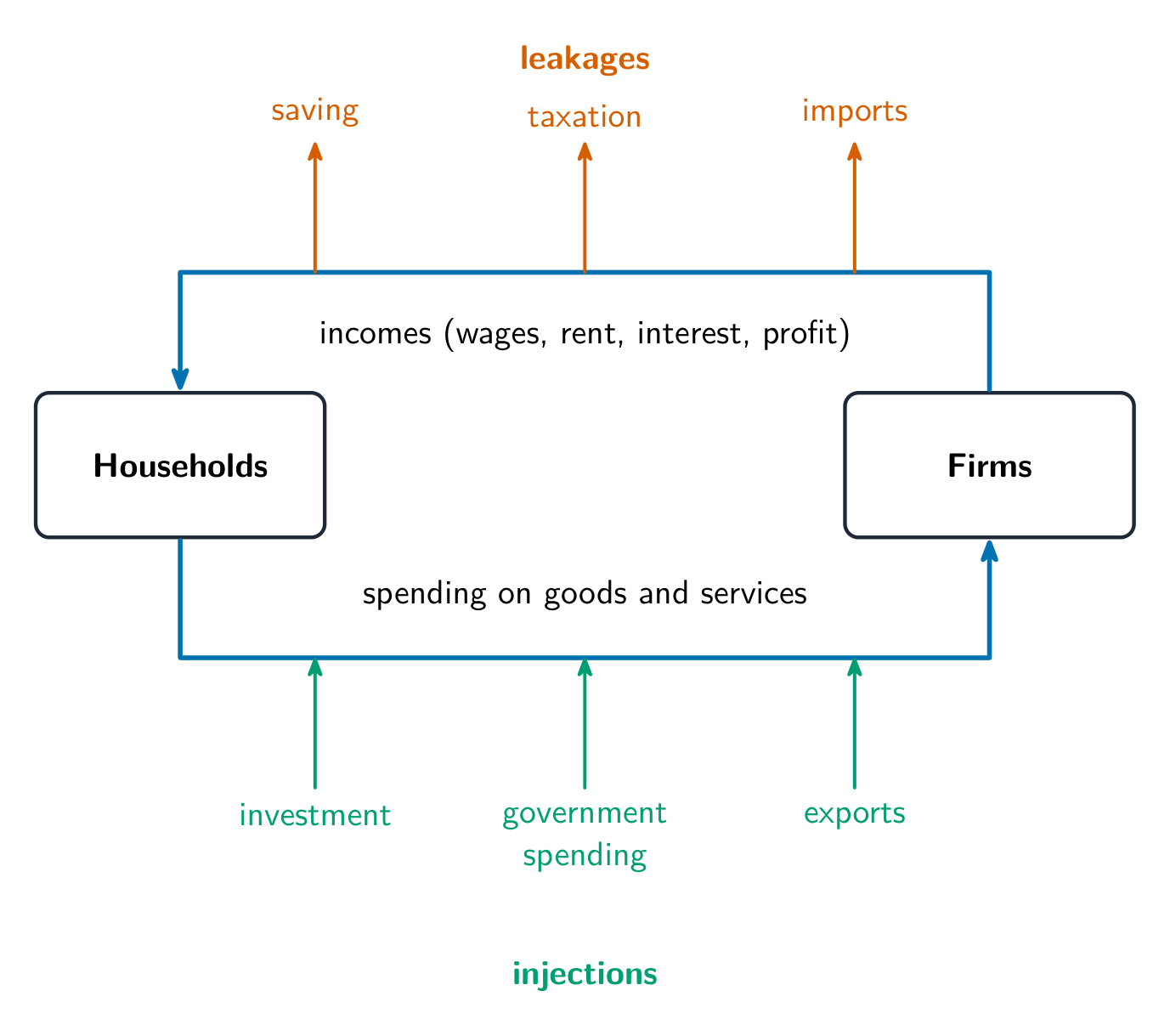
    The circular-flow model 循环流动模型 shows money moving between households and firms: households supply factors and earn income; firms sell goods and earn revenue. Every dollar of spending is someone's income, which is why output and income are two sides of the same total.

    The circular flow of income, with its leakages and injections
    The circular flow of income, with its leakages and injections

    Gross domestic product (GDP) 国内生产总值 is the market value of all final goods and services produced within a country in a year. Three ways to measure it give the same number:

    • Expenditure approach: $GDP = C + I + G + X_n$ – consumption 消费, investment 投资 (business spending on capital, plus new housing and inventory), government purchases 政府购买, and net exports 净出口 (exports minus imports).
    • Income approach: add up all wages, rent, interest, and profit.

    Exclude intermediate goods (avoid double counting), used goods, purely financial transactions, and transfer payments.

    Explore · ⁨Khám phá⁩

    Follow money around the circular flow · ⁨Theo dõi dòng tiền trong chu kỳ tròn⁩

    Money flows from households to firms (spending) and back (wages), while injections (investment, government, exports) and leakages (saving, taxes, imports) can grow or shrink the flow — the size of that flow is GDP. · ⁨Tiền chảy từ hộ gia đình đến doanh nghiệp (chi tiêu) và quay lại (lương), trong khi các khoản nạp (đầu tư, chính phủ, xuất khẩu) và rò rỉ (tiết kiệm, thuế, nhập khẩu) có thể làm tăng hoặc giảm dòng chảy — quy mô của dòng chảy đó là GDP.⁩

    Vocabulary · ⁨Từ vựng⁩ Train · ⁨Luyện tập⁩
    English Tiếng Việt
    circular-flow model/ˈsɜːkjʊlə fləʊ ˈmɒdl/ Mô hình dòng vòng
    Gross domestic product (GDP)/ɡrəʊs dəˈmestɪk ˈprɒdʌkt/ Tổng sản phẩm quốc nội (GDP)
    consumption/kənˈsʌmpʃn/ tiêu dùng
    investment/ɪnˈvestmənt/ đầu tư
    government purchases/ˈɡʌvənmənt ˈpɜːtʃɪsɪz/ Chi tiêu của chính phủ
    net exports/net ˈekspɔːts/ xuất khẩu ròng
    2.2

    Limitations of GDP

    Syllabus · ⁨Chương trình⁩
    English

    Enduring Understanding (MEA-1): An economy's performance can be measured by different indicators such as gross domestic product (GDP), the inflation rate, and the unemployment rate.

    Learning Objective MEA-1.B: Define the limitations of GDP.

    • MEA-1.B.1 GDP is a useful indicator of a nation's economic performance, but it has some limitations, such as failing to account for nonmarket transactions.
    Tiếng Việt

    Hiểu biết dai dẳng (MEA-1): Hiệu suất của nền kinh tế có thể được đo lường bằng các chỉ báo khác nhau như tổng sản phẩm quốc nội (GDP), tỷ lệ lạm phát và tỷ lệ thất nghiệp.

    Mục tiêu học tập MEA-1.B: Xác định những hạn chế của GDP.

    • MEA-1.B.1 GDP là một chỉ báo hữu ích về hiệu suất kinh tế của một quốc gia, nhưng nó có một số hạn chế, chẳng hạn như không tính đến các giao dịch ngoài thị trường.

    Source: College Board AP Course and Exam Description · ⁨Nguồn: Mô tả Khóa học và Bài thi College Board AP⁩

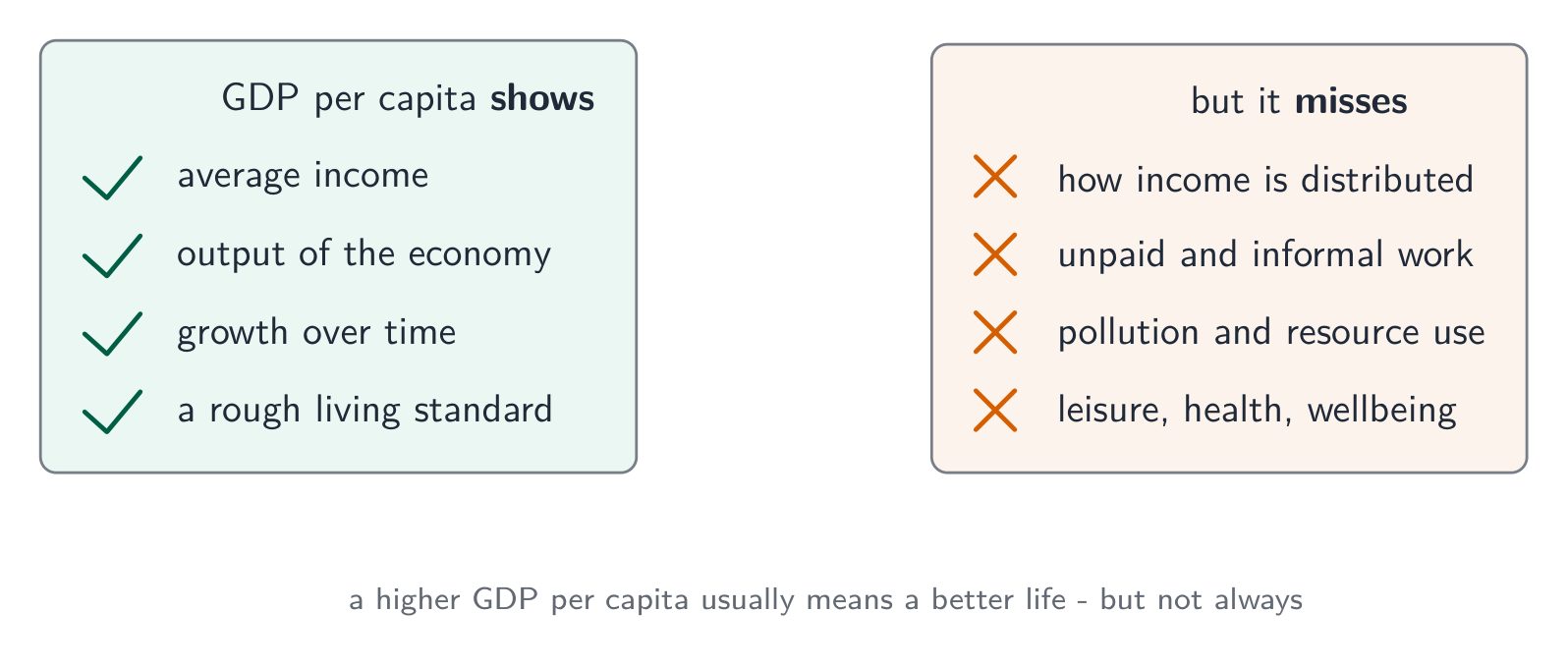
    GDP measures market output, not well-being. It omits non-market production (unpaid housework, volunteering), the underground economy 地下经济, leisure, and the distribution of income, and it ignores environmental damage and resource depletion. So a higher GDP does not automatically mean a better standard of living. GDP per capita (GDP $\div$ population) is a better welfare proxy than total GDP.

    GDP per capita shows average output but misses distribution, unpaid work, and more
    GDP per capita shows average output but misses distribution, unpaid work, and more
    Vocabulary · ⁨Từ vựng⁩ Train · ⁨Luyện tập⁩
    English Tiếng Việt
    underground economy/ˌʌndəˈɡraʊnd ɪˈkɒnəmi/ kinh tế ngầm
    2.3

    Unemployment

    Syllabus · ⁨Chương trình⁩
    English

    Enduring Understanding (MEA-1): An economy's performance can be measured by different indicators such as gross domestic product (GDP), the inflation rate, and the unemployment rate.

    Learning Objective MEA-1.C: a. Define the labor force, the unemployment rate, and the labor force participation rate. b. Explain how changes in employment and the labor market affect the unemployment rate and the labor force participation rate. c. Calculate the unemployment rate and the labor force participation rate.

    • MEA-1.C.1 The unemployment rate is the percentage of the labor force that is out of work.
    • MEA-1.C.2 The labor force participation rate is another measure of the labor market activity in an economy. The labor force participation rate is the percentage of the adult population that is in the labor force.

    Learning Objective MEA-1.D: Define the limitations of the unemployment rate.

    • MEA-1.D.1 The measured unemployment rate is often criticized for understating the level of joblessness because it excludes groups such as discouraged workers and part-time workers.

    Learning Objective MEA-1.E: a. Define the types of unemployment and the natural rate of unemployment. b. Explain changes in the types of unemployment.

    • MEA-1.E.1 Economists primarily focus on three types of unemployment: cyclical, frictional, and structural.
    • MEA-1.E.2 The natural rate of unemployment is the unemployment rate that would exist when the economy produces full-employment real output. It is equal to the sum of frictional and structural unemployment.
    • MEA-1.E.3 The deviation of the actual unemployment rate from the natural rate is cyclical unemployment.
    • MEA-1.E.4 The natural rate of unemployment can gradually change over time because of such things as changes in labor force characteristics.
    Tiếng Việt

    Hiểu biết dai dẳng (MEA-1): Hiệu suất của nền kinh tế có thể được đo lường bằng các chỉ báo khác nhau như tổng sản phẩm quốc nội (GDP), tỷ lệ lạm phát và tỷ lệ thất nghiệp.

    Mục tiêu học tập MEA-1.C: a. Định nghĩa lực lượng lao động, tỷ lệ thất nghiệp và tỷ lệ tham gia lực lượng lao động. b. Giải thích cách thay đổi trong việc làm và thị trường lao động ảnh hưởng đến tỷ lệ thất nghiệp và tỷ lệ tham gia lực lượng lao động. c. Tính toán tỷ lệ thất nghiệp và tỷ lệ tham gia lực lượng lao động.

    • MEA-1.C.1 Tỷ lệ thất nghiệp là phần trăm lực lượng lao động đang không có việc làm.
    • MEA-1.C.2 Tỷ lệ tham gia lực lượng lao động là một thước đo khác về hoạt động thị trường lao động trong nền kinh tế. Tỷ lệ tham gia lực lượng lao động là phần trăm dân số trưởng thành đang nằm trong lực lượng lao động.

    Mục tiêu học tập MEA-1.D: Xác định những hạn chế của tỷ lệ thất nghiệp.

    • MEA-1.D.1 Tỷ lệ thất nghiệp được đo lường thường bị chỉ trích vì đã đánh giá thấp mức độ mất việc làm do loại trừ các nhóm như người lao động nản lòng và người làm bán thời gian.

    Mục tiêu học tập MEA-1.E: a. Định nghĩa các loại hình thất nghiệp và tỷ lệ thất nghiệp tự nhiên. b. Giải thích sự thay đổi trong các loại hình thất nghiệp.

    • MEA-1.E.1 Các nhà kinh tế học chủ yếu tập trung vào ba loại hình thất nghiệp: chu kỳ, ma sát và cấu trúc.
    • MEA-1.E.2 Tỷ lệ thất nghiệp tự nhiên là tỷ lệ thất nghiệp sẽ tồn tại khi nền kinh tế sản xuất sản lượng thực đạt đầy đủ việc làm. Nó bằng tổng thất nghiệp ma sát và thất nghiệp cấu trúc.
    • MEA-1.E.3 Sự lệch pha giữa tỷ lệ thất nghiệp thực tế và tỷ lệ thất nghiệp tự nhiên là thất nghiệp chu kỳ.
    • MEA-1.E.4 Tỷ lệ thất nghiệp tự nhiên có thể thay đổi dần theo thời gian do những yếu tố như sự thay đổi trong đặc điểm của lực lượng lao động.

    Source: College Board AP Course and Exam Description · ⁨Nguồn: Mô tả Khóa học và Bài thi College Board AP⁩

    A long queue of people — unemployment is people willing and able to work who cannot find jobs
    A long queue of people — unemployment is people willing and able to work who cannot find jobs

    The labor force 劳动力 is the employed plus the unemployed (those without work who are actively looking). People not looking are not in the labor force.

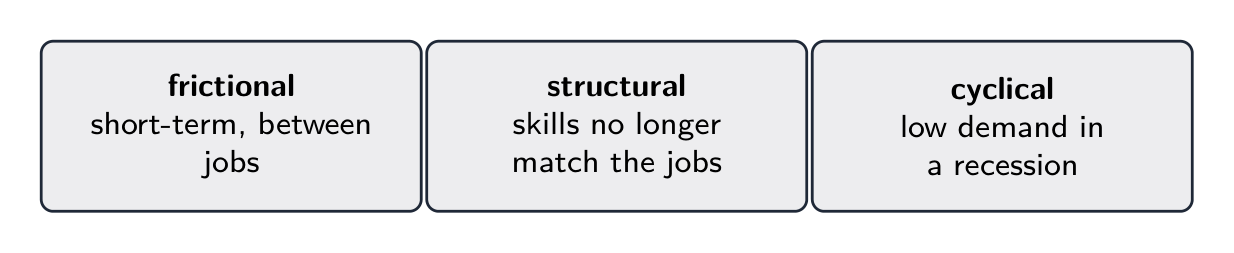
    Three types of unemployment: frictional, structural, and cyclical
    Three types of unemployment: frictional, structural, and cyclical
    $$\text{Unemployment rate}=\frac{\text{unemployed}}{\text{labor force}}\times 100\%,\qquad \text{Labor-force participation}=\frac{\text{labor force}}{\text{working-age population}}\times100\%.$$

    Worked example. A country has $150$ million employed and $10$ million unemployed (actively looking), with $40$ million working-age adults not looking. The labor force is $150+10=160$ million, so the unemployment rate is $\dfrac{10}{160}=6.25\%$ and the participation rate is $\dfrac{160}{200}=80\%$.

    Three types of unemployment:

    • Frictional 摩擦性失业: between jobs or searching for a first job (normal, short).
    • Structural 结构性失业: skills or location don't match available jobs (technology, trade).
    • Cyclical 周期性失业: caused by a recession (a downturn in the business cycle).

    Frictional + structural make up the natural rate of unemployment 自然失业率. At the natural rate cyclical unemployment is zero and the economy is at full employment 充分就业. The rate understates joblessness because it omits discouraged workers 灰心工人 and the underemployed.

    Vocabulary · ⁨Từ vựng⁩ Train · ⁨Luyện tập⁩
    English Tiếng Việt
    labor force/ˈleɪbə fɔːs/ lực lượng lao động
    Frictional/ˈfrɪkʃənl/ Ma sát
    Structural/ˈstrʌktʃərəl/ Cấu tạo
    Cyclical/ˈsaɪklɪkl/ Chu kỳ
    natural rate of unemployment/ˈnætʃərəl reɪt ɒv ʌnemˈplɔɪmənt/ mức失业率 tự nhiên
    full employment/fʊl emˈplɔɪmənt/ đầy đủ việc làm
    discouraged workers/dɪˈskʌrɪdʒd ˈwɜːkəz/ công nhân nản lòng
    2.4

    Price Indices and Inflation

    Syllabus · ⁨Chương trình⁩
    English

    Enduring Understanding (MEA-1): An economy's performance can be measured by different indicators such as gross domestic product (GDP), the inflation rate, and the unemployment rate.

    Learning Objective MEA-1.F: a. Define the consumer price index (CPI), inflation, deflation, disinflation, the inflation rate, and real variables. b. Explain how price indices can be used to calculate the inflation rate and to compare nominal variables over time periods. c. Calculate the CPI, the inflation rate, and changes in real variables.

    • MEA-1.F.1 The consumer price index (CPI) measures the change in income a consumer would need in order to maintain the same standard of living over time under a new set of prices as under the original set of prices.
    • MEA-1.F.2 The CPI measures the cost of a fixed basket of goods and services in a given year relative to the base year.
      • Exclusion statement: Calculating the producer price index (PPI) is beyond the scope of the course and AP Exam.
    • MEA-1.F.3 The inflation rate is determined by calculating the percentage change in a price index, such as CPI or the GDP deflator.
    • MEA-1.F.4 Real variables, such as real wages, are the nominal variables deflated by the price level.

    Learning Objective MEA-1.G: Define the shortcomings of the CPI as a true measure of inflation.

    • MEA-1.G.1 The CPI as a measure of inflation has some shortcomings, such as substitution bias, causing it to overstate the true inflation rate.
    Tiếng Việt

    Hiểu biết dai dẳng (MEA-1): Hiệu suất của nền kinh tế có thể được đo lường bằng các chỉ báo khác nhau như tổng sản phẩm quốc nội (GDP), tỷ lệ lạm phát và tỷ lệ thất nghiệp.

    Mục tiêu học tập MEA-1.F: a. Định nghĩa chỉ số giá tiêu dùng (CPI), lạm phát, giảm phát, giảm lạm phát, tỷ lệ lạm phát và các biến danh nghĩa. b. Giải thích cách sử dụng chỉ số giá để tính tỷ lệ lạm phát và so sánh các biến danh nghĩa qua các thời kỳ. c. Tính chỉ số CPI, tỷ lệ lạm phát và sự thay đổi của các biến thực.

    • MEA-1.F.1 Chỉ số giá tiêu dùng (CPI) đo lường sự thay đổi thu nhập mà người tiêu dùng cần thiết để duy trì cùng mức sống theo thời gian dưới một bộ giá mới so với bộ giá ban đầu.
    • MEA-1.F.2 CPI đo lường chi phí của một giỏ hàng hóa và dịch vụ cố định trong một năm nhất định so với năm gốc.
      • Lưu ý: Việc tính chỉ số giá sản xuất (PPI) nằm ngoài phạm vi của khóa học và kỳ thi AP.
    • MEA-1.F.3 Tỷ lệ lạm phát được xác định bằng cách tính phần trăm thay đổi của một chỉ số giá, chẳng hạn như CPI hoặc deflator GDP.
    • MEA-1.F.4 Các biến thực, chẳng hạn như tiền lương thực, là các biến danh nghĩa đã được điều chỉnh theo mức giá.

    Mục tiêu học tập MEA-1.G: Xác định những điểm yếu của CPI như một thước đo chính xác về lạm phát.

    • MEA-1.G.1 CPI với tư cách là thước đo lạm phát có một số điểm yếu, chẳng hạn như thiên lệch thay thế, khiến nó phóng đại tỷ lệ lạm phát thực tế.

    Source: College Board AP Course and Exam Description · ⁨Nguồn: Mô tả Khóa học và Bài thi College Board AP⁩

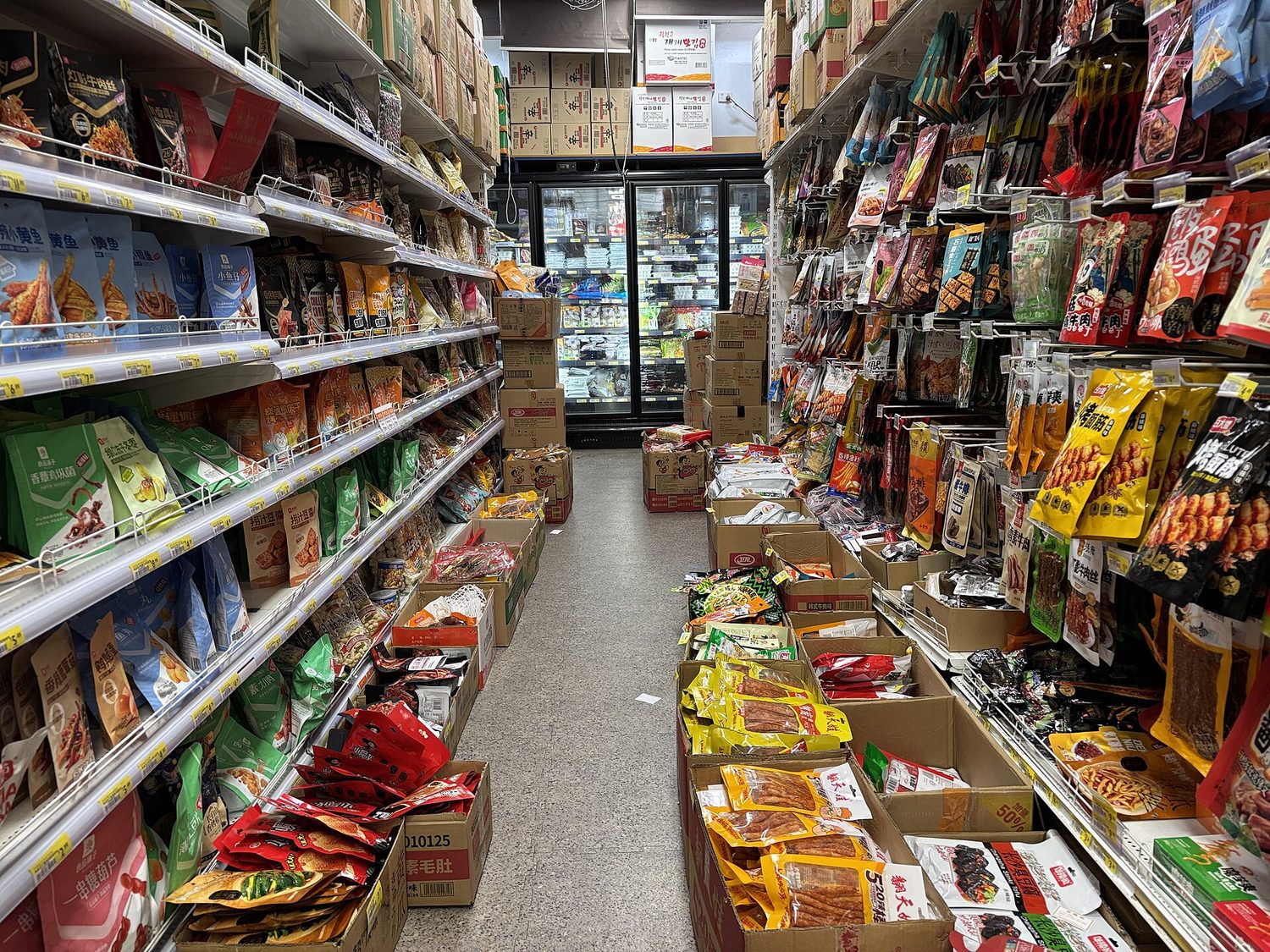
    A supermarket aisle: a fixed basket of goods measures inflation via a price index
    A supermarket aisle: a fixed basket of goods measures inflation via a price index

    Inflation 通货膨胀 is a sustained rise in the average price level. It is measured with a price index 价格指数, most often the consumer price index (CPI) 消费者价格指数, built from a fixed market basket of goods a typical household buys:

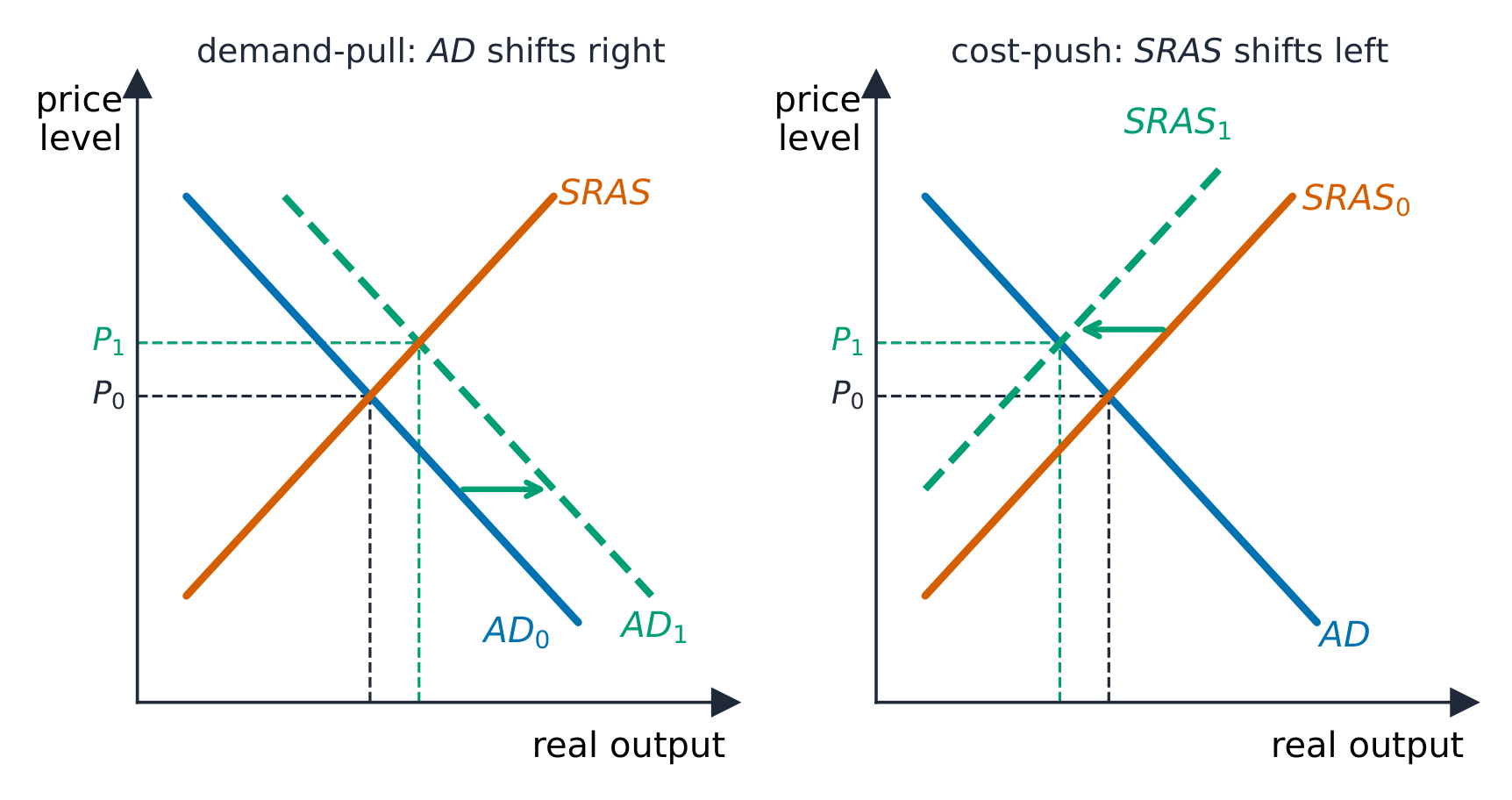
    Demand-pull and cost-push inflation on the AD-AS diagram
    Demand-pull and cost-push inflation on the AD-AS diagram
    $$CPI=\frac{\text{cost of basket this year}}{\text{cost of basket in base year}}\times100.$$

    The inflation rate is the percent change in the index between two years. Deflation 通货紧缩 is a falling price level; disinflation is a slowing of inflation.

    Worked example. If the CPI is $200$ this year and was $190$ last year, the inflation rate is $\dfrac{200-190}{190}\times100\%=5.3\%$. A basket that cost $\$190$ then costs $\$200$ – the same goods, more dollars.

    Vocabulary · ⁨Từ vựng⁩ Train · ⁨Luyện tập⁩
    English Tiếng Việt
    Inflation/ɪnˈfleɪʃn/ Lạm phát
    price index/praɪs ˈɪndeks/ chỉ số giá
    consumer price index (CPI)/kənˈsuːmə praɪs ˈɪndeks/ Chỉ số giá tiêu dùng (CPI)
    Deflation/diːˈfleɪʃn/ Deflation
    2.5

    Costs of Inflation

    Syllabus · ⁨Chương trình⁩
    English

    Enduring Understanding (MEA-1): An economy's performance can be measured by different indicators such as gross domestic product (GDP), the inflation rate, and the unemployment rate.

    Learning Objective MEA-1.H: Explain the costs that unexpected inflation (deflation) imposes on individuals and the economy.

    • MEA-1.H.1 Unexpected inflation arbitrarily redistributes wealth from one group of individuals to another group, such as lenders to borrowers.
    Tiếng Việt

    Hiểu biết dai dẳng (MEA-1): Hiệu suất của nền kinh tế có thể được đo lường bằng các chỉ báo khác nhau như tổng sản phẩm quốc nội (GDP), tỷ lệ lạm phát và tỷ lệ thất nghiệp.

    Mục tiêu học tập MEA-1.H: Giải thích những chi phí mà lạm phát bất ngờ (giảm phát) gây ra cho cá nhân và nền kinh tế.

    • MEA-1.H.1 Lạm phát bất ngờ phân phối lại tài sản tùy tiện từ một nhóm người này sang một nhóm người khác, chẳng hạn như từ người cho vay sang người đi vay.

    Source: College Board AP Course and Exam Description · ⁨Nguồn: Mô tả Khóa học và Bài thi College Board AP⁩

    Inflation redistributes and distorts:

    • It hurts lenders and savers and helps borrowers when it is unexpected, because loans are repaid in cheaper dollars. It erodes the value of money and fixed incomes.
    • Menu costs and uncertainty discourage investment.
    • Anticipated inflation is less harmful because contracts and interest rates adjust for it. This is why we separate nominal and real values.
    2.6

    Real v. Nominal GDP

    Syllabus · ⁨Chương trình⁩
    English

    Enduring Understanding (MEA-1): An economy's performance can be measured by different indicators such as gross domestic product (GDP), the inflation rate, and the unemployment rate.

    Learning Objective MEA-1.I: Define nominal GDP and real GDP.

    • MEA-1.I.1 Nominal GDP is a measure of how much is spent on output. Real GDP is a measure of how much is produced.
    • MEA-1.I.2 Nominal GDP measures aggregate output using current prices. Real GDP measures aggregate output using constant prices, thus removing the effect of changes in the overall price level.

    Learning Objective MEA-1.J: Calculate real GDP and the GDP deflator.

    • MEA-1.J.1 One way of measuring real GDP is to weigh final goods and services by their prices in a base year. Because this can lead to overstatement of real GDP growth, statistical agencies actually use different methods.
    • MEA-1.J.2 Nominal GDP can be converted to real GDP by using the GDP deflator.
    Tiếng Việt

    Hiểu biết dai dẳng (MEA-1): Hiệu suất của nền kinh tế có thể được đo lường bằng các chỉ báo khác nhau như tổng sản phẩm quốc nội (GDP), tỷ lệ lạm phát và tỷ lệ thất nghiệp.

    Mục tiêu học tập MEA-1.I: Định nghĩa GDP danh nghĩa và GDP thực.

    • MEA-1.I.1 GDP danh nghĩa là thước đo về số tiền được chi tiêu cho sản lượng. GDP thực là thước đo về số lượng sản lượng được sản xuất.
    • MEA-1.I.2 GDP danh nghĩa đo lường tổng sản lượng bằng cách sử dụng giá hiện hành. GDP thực đo lường tổng sản lượng bằng cách sử dụng giá cố định, do đó loại bỏ tác động của sự thay đổi trong mức giá chung.

    Mục tiêu học tập MEA-1.J: Tính GDP thực và Deflator GDP.

    • MEA-1.J.1 Một cách đo lường GDP thực là gán trọng số cho hàng hóa và dịch vụ cuối cùng theo giá của chúng trong một năm gốc. Vì điều này có thể dẫn đến việc phóng đại tăng trưởng GDP thực, các cơ quan thống kê thực tế sử dụng các phương pháp khác nhau.
    • MEA-1.J.2 GDP danh nghĩa có thể được chuyển đổi thành GDP thực bằng cách sử dụng deflator GDP.

    Source: College Board AP Course and Exam Description · ⁨Nguồn: Mô tả Khóa học và Bài thi College Board AP⁩

    • Nominal GDP 名义GDP is valued at current prices, so it rises with both output and prices.
    • Real GDP 实际GDP is valued at constant (base-year) prices, stripping out inflation, so it reflects true output. Real GDP is the honest measure of growth.
    $$\text{Real GDP}=\frac{\text{Nominal GDP}}{\text{price index}}\times100,\qquad \text{GDP deflator}=\frac{\text{Nominal GDP}}{\text{Real GDP}}\times100.$$

    Worked example. Nominal GDP is $\$22$ trillion and the GDP deflator is $110$. Real GDP is $\dfrac{22}{110}\times100=\$20$ trillion. The extra $\$2$ trillion of nominal GDP is pure price rise, not real output – which is why growth is always measured with real GDP.

    Exam skill: be fluent converting nominal to real using a price index, and computing an inflation rate or a growth rate as a percent change.

    Vocabulary · ⁨Từ vựng⁩ Train · ⁨Luyện tập⁩
    English Tiếng Việt
    Nominal GDP/ˈnɒmɪnl ˌdʒiː diː ˈpiː/ GDP danh nghĩa
    Real GDP/rɪəl ˌdʒiː diː ˈpiː/ GDP thực tế
    2.7

    Business Cycles

    Syllabus · ⁨Chương trình⁩
    English

    Enduring Understanding (MEA-2): The economy fluctuates between periods of expansion and contraction in the short run, but economic growth can occur in the long run.

    Learning Objective MEA-2.A: a. Define (using graphs and data as appropriate) turning points and phases of the business cycle. b. Explain (using graphs and data as appropriate) turning points and phases of the business cycle.

    • MEA-2.A.1 Business cycles are fluctuations in aggregate output and employment because of changes in aggregate supply and/or aggregate demand.
    • MEA-2.A.2 The phases of a business cycle are recession and expansion.
    • MEA-2.A.3 The turning points of a business cycle are peak and trough.
    • MEA-2.A.4 The difference between actual output and potential output is the output gap.
    • MEA-2.A.5 Potential output is also called full-employment output. It is the level of GDP where unemployment is equal to the natural rate of unemployment. [See EK MEA-1.E.2]
    Tiếng Việt

    Hiểu biết Bền vững (MEA-2): Nền kinh tế dao động giữa các giai đoạn mở rộng và co thắt trong ngắn hạn, nhưng tăng trưởng kinh tế có thể xảy ra trong dài hạn.

    Mục tiêu học tập MEA-2.A: a. Định nghĩa (sử dụng đồ thị và dữ liệu phù hợp) các điểm turning point và các giai đoạn của chu kỳ kinh doanh. b. Giải thích (sử dụng đồ thị và dữ liệu phù hợp) các điểm turning point và các giai đoạn của chu kỳ kinh doanh.

    • MEA-2.A.1 Chu kỳ kinh doanh là sự dao động của tổng sản lượng và việc làm do sự thay đổi của tổng cung và/hoặc tổng cầu.
    • MEA-2.A.2 Các giai đoạn của một chu kỳ kinh doanh bao gồm suy thoái và mở rộng.
    • MEA-2.A.3 Các điểm turning point của một chu kỳ kinh doanh là đỉnh cao và đáy thấp.
    • MEA-2.A.4 chênh lệch giữa sản lượng thực tế và sản lượng tiềm năng gọi là khoảng trống sản lượng.
    • MEA-2.A.5 Sản lượng tiềm năng còn được gọi là sản lượng đầy đủ việc làm. Đây là mức GDP mà tại đó tỷ lệ thất nghiệp bằng với tỷ lệ thất nghiệp tự nhiên. [Xem EK MEA-1.E.2]

    Source: College Board AP Course and Exam Description · ⁨Nguồn: Mô tả Khóa học và Bài thi College Board AP⁩

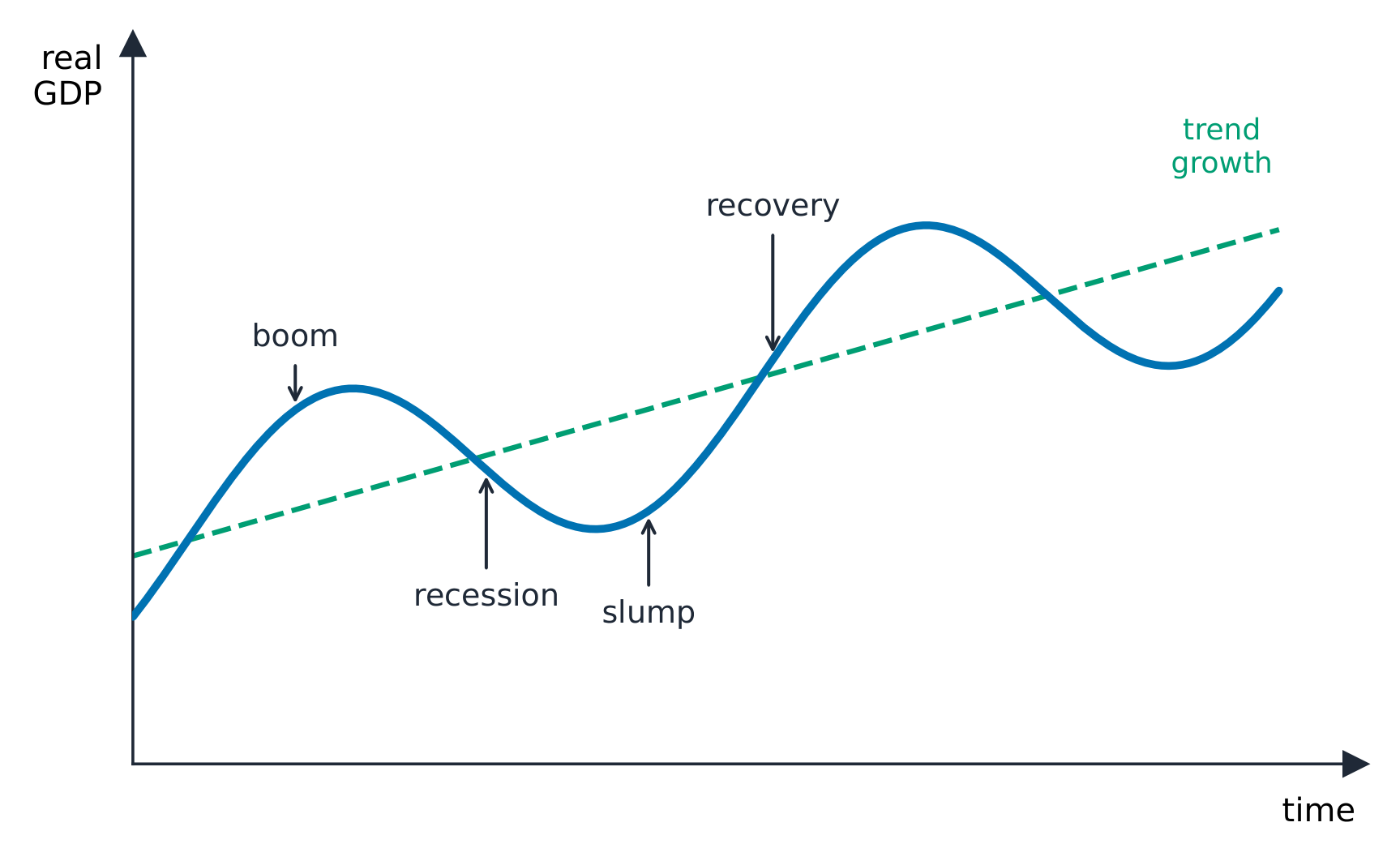
    The business cycle

    The business cycle 经济周期 is the economy's short-run ups and downs in real GDP around its long-run growth trend: expansion 扩张 (rising output, falling unemployment) up to a peak 顶峰, then contraction/recession 衰退 (falling output, rising cyclical unemployment) down to a trough 谷底, then recovery. A recession is commonly two consecutive quarters of falling real GDP. Unemployment and inflation move roughly opposite over the cycle – the tension the rest of the course tries to manage.

    Real GDP swinging around its long-run trend
    Real GDP swinging around its long-run trend
    Vocabulary · ⁨Từ vựng⁩ Train · ⁨Luyện tập⁩
    English Tiếng Việt
    business cycle/ˈbɪznəs ˈsaɪkl/ chu kỳ kinh doanh
    expansion/ekˈspænʃn/ mở rộng
    peak/piːk/ đỉnh
    contraction/recession/kənˈtrækʃn rɪˈseʃn/ Thu hẹp/Thất vọng
    trough/trɒf/ đáy
    2.7

    Exam tips

    • Compute GDP by the expenditure method $C+I+G+X_n$ and count only final goods (avoid double counting).
    • Unemployment rate = unemployed ÷ labor force; discouraged workers leave the labor force (so the rate can understate joblessness).
    • Know the three unemployment types (frictional, structural, cyclical) and that the natural rate excludes cyclical.
    • Inflation is the % change in the CPI; convert nominal to real with a price index and always use real GDP for growth.
    • Place events on the business cycle (expansion → peak → contraction → trough).
  • 3

    National Income and Price Determination · ⁨Thu nhập quốc gia và xác định giá cả⁩

    Watch lesson · ⁨Xem bài học⁩
    3.1

    Aggregate Demand · ⁨Tổng cầu⁩

    Syllabus · ⁨Chương trình⁩
    English

    Enduring Understanding (MOD-2): Economists use the aggregate demand–aggregate supply model to represent the relationship between the price level and aggregate output in an economy and to illustrate how output, employment, and the price level respond to macroeconomic shocks.

    Learning Objective MOD-2.A: a. Define (using graphs as appropriate) the aggregate demand (AD) curve. b. Explain (using graphs as appropriate) the slope of the AD curve and its determinants.

    • MOD-2.A.1 The aggregate demand (AD) curve describes the relationship between the price level and the quantity of goods and services demanded by households (consumption), firms (investment), government (government spending), and the rest of the world (net exports).
    • MOD-2.A.2 The negative slope of the AD curve is explained by the real wealth effect, the interest rate effect, and the exchange rate effect. [See EK MKT-3.A.1]
    • MOD-2.A.3 Any change in the components of aggregate demand (consumption, investment, government spending, or net exports) that is not due to changes in the price level leads to a shift of the AD curve.
    Tiếng Việt

    Hiểu biết bền vững (MOD-2): Các nhà kinh tế học sử dụng mô hình tổng cầu–tổng cung để biểu diễn mối quan hệ giữa mức giá chung và tổng sản lượng trong nền kinh tế, đồng thời minh họa cách sản lượng, việc làm và mức giá chung phản ứng với các cú sốc vĩ mô.

    Mục tiêu học tập MOD-2.A: a. Định nghĩa (sử dụng đồ thị khi cần thiết) đường cong tổng cầu (AD). b. Giải thích (sử dụng đồ thị khi cần thiết) độ dốc của đường cong AD và các nhân tố quyết định nó.

    • MOD-2.A.1 Đường cong tổng cầu (AD) mô tả mối quan hệ giữa mức giá chung và số lượng hàng hóa và dịch vụ mà hộ gia đình (tiêu dùng), doanh nghiệp (đầu tư), chính phủ (chi tiêu chính phủ) và phần còn lại của thế giới (xuất khẩu ròng) muốn mua.
    • MOD-2.A.2 Độ dốc âm của đường cong AD được giải thích bởi hiệu ứng tài sản thực tế, hiệu ứng lãi suất và hiệu ứng tỷ giá hối đoái. [Xem EK MKT-3.A.1]
    • MOD-2.A.3 Bất kỳ thay đổi nào trong các thành phần của tổng cầu (tiêu dùng, đầu tư, chi tiêu chính phủ hoặc xuất khẩu ròng) không phải do sự thay đổi về mức giá sẽ dẫn đến sự dịch chuyển của đường cong AD.

    Source: College Board AP Course and Exam Description · ⁨Nguồn: Mô tả Khóa học và Bài thi College Board AP⁩

    English
    The AD–AS model: a demand shock

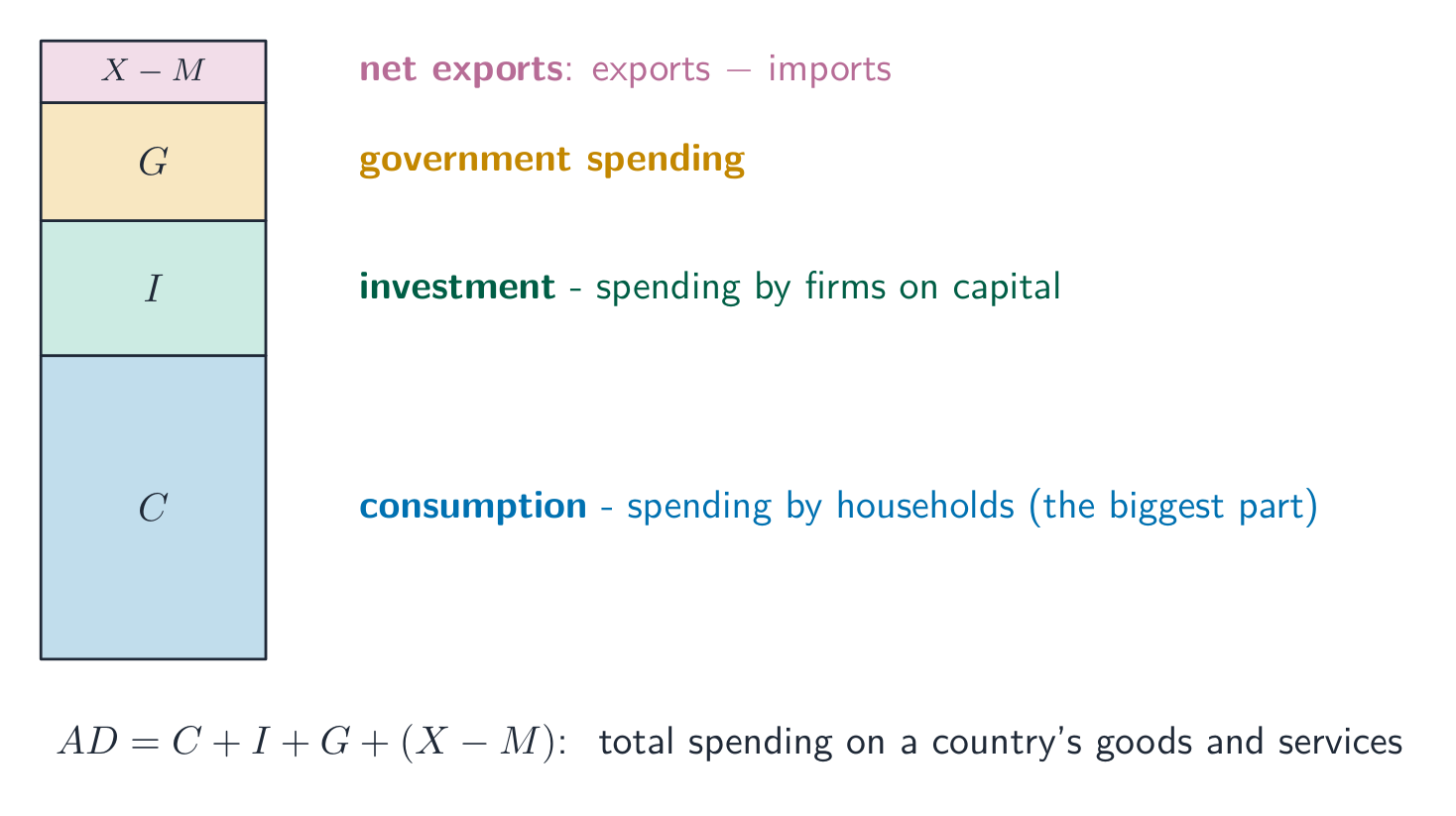
    Aggregate demand (AD) 总需求 shows the total quantity of real output ($C+I+G+X_n$) buyers want at each price level 价格水平. It slopes downward for three reasons special to the whole economy:

    • the wealth effect 财富效应 (a higher price level shrinks the real value of money, so people buy less),
    • the interest-rate effect 利率效应 (a higher price level raises money demand and interest rates, cutting investment),
    • the net-export effect (a higher domestic price level makes exports dearer and imports cheaper).

    A change in the price level is a movement along AD. AD shifts when any component of $C+I+G+X_n$ changes for another reason – consumer confidence, business expectations, government spending, taxes, or foreign incomes.

    Tiếng Việt
    Phố cảnh thành phố: sản lượng quốc gia và tổng cầu phản ánh chi tiêu trên toàn bộ nền kinh tế
    A city skyline: national output and aggregate demand reflect economy-wide spending
    Mô hình AD–AS: cú sốc cầu

    Tổng cầu (AD) cho thấy tổng lượng sản lượng thực tế ($C+I+G+X_n$) mà người mua muốn ở mỗi mức giá. Nó dốc xuống vì ba lý do đặc thù đối với toàn bộ nền kinh tế:

    Tổng cầu là tổng chi tiêu: tiêu dùng, đầu tư, chính phủ và xuất khẩu ròng
    Aggregate demand is total spending: consumption, investment, government, and net exports
    • hiệu ứng của tài sản (mức giá cao hơn làm giảm giá trị thực tế của tiền, khiến người dân mua ít đi),
    • hiệu ứng của lãi suất (mức giá cao hơn làm tăng nhu cầu tiền và lãi suất, dẫn đến giảm đầu tư),
    • hiệu ứng của xuất nhập khẩu ròng (mức giá trong nước cao hơn làm cho hàng xuất khẩu đắt hơn và hàng nhập khẩu rẻ hơn).

    Sự thay đổi về mức giá là một sự di chuyển dọc theo đường AD. Đường AD dịch chuyển khi bất kỳ thành phần nào của $C+I+G+X_n$ thay đổi do các nguyên nhân khác – niềm tin tiêu dùng, kỳ vọng doanh nghiệp, chi tiêu chính phủ, thuế, hoặc thu nhập từ nước ngoài.

    Vocabulary · ⁨Từ vựng⁩ Train · ⁨Luyện tập⁩
    English Tiếng Việt
    Aggregate demand (AD)/ˈæɡrɪɡeɪt dɪˈmænd/ Tổng cầu (AD)
    price level/praɪs ˈlevl/ mức giá
    wealth effect/welθ ɪˈfekt/ tài sản
    interest-rate effect/ˈɪntrest reɪt ɪˈfekt/ Hiệu ứng lãi suất
    multiplier effect/ˌmʌltɪˈplaɪə ɪˈfekt/ Hiệu ứng nhân
    marginal propensity to consume/ˈmɑːdʒɪnl prəˈpensɪti tə kənˈsjuːm/ xu hướng tiêu dùng biên
    marginal propensity to save/ˈmɑːdʒɪnl prəˈpensɪti tə seɪv/ xu hướng tiết kiệm cận biên
    3.2

    The Spending and Tax Multipliers · ⁨Các Bội số Chi Tiêu và Thuế⁩

    Syllabus · ⁨Chương trình⁩
    English

    Enduring Understanding (MOD-2): Economists use the aggregate demand–aggregate supply model to represent the relationship between the price level and aggregate output in an economy and to illustrate how output, employment, and the price level respond to macroeconomic shocks.

    Learning Objective MOD-2.B: a. Define the expenditure multiplier, the tax multiplier, the marginal propensity to consume, and the marginal propensity to save. b. Explain how changes in spending and taxes lead to changes in real GDP. c. Calculate how changes in spending and taxes lead to changes in real GDP.

    • MOD-2.B.1 A $\$1$ change to autonomous expenditures leads to further changes in total expenditures and total output.
    • MOD-2.B.2 The expenditure multiplier quantifies the size of the change in aggregate demand as a result of a change in any of the components of aggregate demand.
    • MOD-2.B.3 The tax multiplier quantifies the size of the change in aggregate demand as a result of a change in taxes.
    • MOD-2.B.4 The expenditure multiplier and tax multiplier depend on the marginal propensity to consume.
    • MOD-2.B.5 The marginal propensity to consume is the change in consumer spending divided by the change in disposable income. The sum of the marginal propensity to consume and marginal propensity to save is equal to one.
    Tiếng Việt

    Hiểu biết bền vững (MOD-2): Các nhà kinh tế học sử dụng mô hình tổng cầu–tổng cung để biểu diễn mối quan hệ giữa mức giá chung và tổng sản lượng trong nền kinh tế, đồng thời minh họa cách sản lượng, việc làm và mức giá chung phản ứng với các cú sốc vĩ mô.

    Mục tiêu học tập MOD-2.B: a. Định nghĩa bội số chi tiêu, bội số thuế, xu hướng tiêu dùng biên và xu hướng tiết kiệm biên. b. Giải thích (sử dụng đồ thị khi cần thiết) làm thế nào những thay đổi về chi tiêu và thuế dẫn đến sự thay đổi của GDP thực tế. c. Tính toán (sử dụng đồ thị khi cần thiết) làm thế nào những thay đổi về chi tiêu và thuế dẫn đến sự thay đổi của GDP thực tế.

    • MOD-2.B.1 Một $\$1$ thay đổi đối với các khoản chi tự chủ sẽ dẫn đến những thay đổi tiếp theo trong tổng chi tiêu và tổng sản lượng.
    • MOD-2.B.2 Bội số chi tiêu định lượng quy mô thay đổi của tổng cầu như một kết quả của sự thay đổi bất kỳ thành phần nào của tổng cầu.
    • MOD-2.B.3 Bội số thuế định lượng quy mô thay đổi của tổng cầu như một kết quả của sự thay đổi thuế.
    • MOD-2.B.4 Bội số chi tiêu và bội số thuế phụ thuộc vào xu hướng tiêu dùng biên.
    • MOD-2.B.5 Xu hướng tiêu dùng biên là sự thay đổi chi tiêu của người tiêu dùng chia cho sự thay đổi thu nhập khả dụng. Tổng của xu hướng tiêu dùng biên và xu hướng tiết kiệm biên bằng một.

    Source: College Board AP Course and Exam Description · ⁨Nguồn: Mô tả Khóa học và Bài thi College Board AP⁩

    English
    The spending multiplier

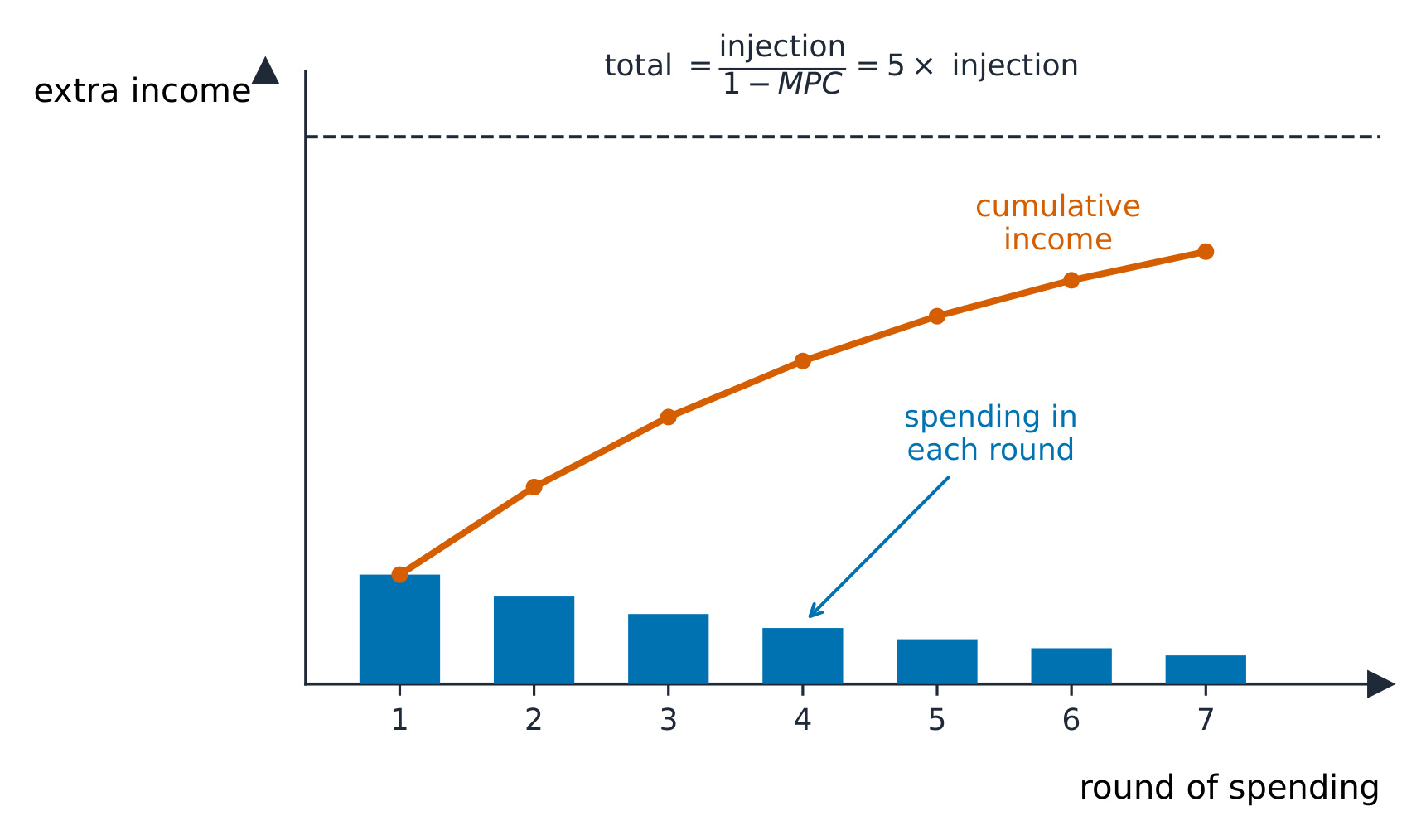
    A change in spending sets off further rounds of spending, so the final change in GDP is larger than the initial change – the multiplier effect 乘数效应. It depends on the marginal propensity to consume 边际消费倾向 (MPC), the fraction of extra income that is spent (the rest is the marginal propensity to save 边际储蓄倾向, MPS, with $MPC+MPS=1$):

    $$\text{spending multiplier}=\frac{1}{1-MPC}=\frac{1}{MPS}.$$

    A tax cut works through the multiplier too, but more weakly, because part of the tax cut is saved:

    $$\text{tax multiplier}=-\frac{MPC}{1-MPC}=-\frac{MPC}{MPS}.$$

    The tax multiplier is smaller in size and negative (a tax cut raises GDP; a tax rise lowers it). Total change in GDP $=$ (multiplier) $\times$ (initial change).

    Worked example. If $MPC=0.8$, the spending multiplier is $\dfrac{1}{1-0.8}=5$, so a $\$10$ billion rise in government spending lifts real GDP by $5\times\$10=\$50$ billion. The tax multiplier is $-\dfrac{0.8}{0.2}=-4$, so a $\$10$ billion tax cut raises GDP by only $\$40$ billion – weaker, because part of the tax cut is saved.

    Exam skill: compute both multipliers from the MPC and find the resulting change in real GDP – an almost-guaranteed calculation.

    Tiếng Việt
    Bội số chi tiêu

    Một sự thay đổi về chi tiêu sẽ kích hoạt thêm nhiều vòng chi tiêu nữa, do đó sự thay đổi cuối cùng của GDP lớn hơn sự thay đổi ban đầu – hiệu ứng bội số. Điều này phụ thuộc vào xu hướng tiêu dùng cận biên (MPC), tỷ lệ phần thu nhập gia tăng được chi tiêu (phần còn lại là xu hướng tiết kiệm cận biên, MPS, với $MPC+MPS=1$):

    One injection multiplies into a larger overall rise in income
    Một khoản đầu tư ban đầu tạo ra sự gia tăng thu nhập tổng thể lớn hơn
    $$\text{spending multiplier}=\frac{1}{1-MPC}=\frac{1}{MPS}.$$

    Việc cắt thuế cũng tác động thông qua bội số, nhưng yếu hơn, vì một phần khoản cắt thuế sẽ được tiết kiệm:

    $$\text{tax multiplier}=-\frac{MPC}{1-MPC}=-\frac{MPC}{MPS}.$$

    Bội số thuế có kích thước nhỏ hơn và mang dấu âm (cắt thuế làm tăng GDP; tăng thuế làm giảm nó). Sự thay đổi toàn bộ của GDP $=$ (bội số) $\times$ (sự thay đổi ban đầu).

    Ví dụ minh họa. Nếu $MPC=0.8$, bội số chi tiêu là $\dfrac{1}{1-0.8}=5$, nên một khoản cắt thuế $\$10$ billion rise in government spending lifts real GDP by $5\times\$10=\$50$ billion. The tax multiplier is $-\dfrac{0.8}{0.2}=-4$, so a $\$10$ tỷ cắt thuế chỉ làm tăng GDP lên $\$40$ tỷ – yếu hơn, vì một phần khoản cắt thuế được tiết kiệm.

    Kỹ năng thi: tính toán cả hai bội số từ MPC và tìm sự thay đổi tương ứng của GDP thực – đây gần như chắc chắn là dạng bài tập tính toán.

    Explore · ⁨Khám phá⁩

    See the spending multiplier ripple out · ⁨Xem hiệu ứng nhân chi tiêu lan tỏa⁩

    A dollar of new spending becomes someone's income, part of which they spend again — so the total effect is a multiple of the first injection, set by the marginal propensity to consume (MPC). · ⁨Một đô la chi tiêu mới trở thành thu nhập của ai đó, một phần trong đó họ chi tiêu lại — do đó tổng tác động là một bội số của khoản nạp ban đầu, phụ thuộc vào xu hướng tiêu dùng biên (MPC).⁩

    3.3

    Short-Run Aggregate Supply · ⁨Cung Tổng Dài Hạn⁩

    Syllabus · ⁨Chương trình⁩
    English

    Enduring Understanding (MOD-2): Economists use the aggregate demand–aggregate supply model to represent the relationship between the price level and aggregate output in an economy and to illustrate how output, employment, and the price level respond to macroeconomic shocks.

    Learning Objective MOD-2.C: a. Define (using graphs as appropriate) the short-run aggregate supply (SRAS) curve. b. Explain (using graphs as appropriate) the slope of the SRAS curve and its determinants.

    • MOD-2.C.1 The short-run aggregate supply (SRAS) curve describes the relationship between the price level and the quantity of goods and services supplied in an economy.
    • MOD-2.C.2 The SRAS curve is upward-sloping because of sticky wages and prices. [See EK MOD-2.E.1]
    • MOD-2.C.3 Any factor that causes production costs to change, such as a change in inflationary expectations, will cause the SRAS curve to shift.

    Learning Objective MOD-2.D: Explain (using graphs as appropriate) how movement along the SRAS curve implies a relationship between the price level (and inflation) and unemployment.

    • MOD-2.D.1 Moving along the SRAS curve, an increase in the price level is associated with an increase in output, which means employment must correspondingly rise. With the labor force held constant, unemployment will fall. So, there is a short-run trade-off between inflation and unemployment. [See EK MOD-3.A.1]
    Tiếng Việt

    Hiểu biết bền vững (MOD-2): Các nhà kinh tế học sử dụng mô hình tổng cầu–tổng cung để biểu diễn mối quan hệ giữa mức giá chung và tổng sản lượng trong nền kinh tế, đồng thời minh họa cách sản lượng, việc làm và mức giá chung phản ứng với các cú sốc vĩ mô.

    Mục tiêu học tập MOD-2.C: a. Định nghĩa (sử dụng đồ thị khi cần thiết) đường cong tổng cung ngắn hạn (SRAS). b. Giải thích (sử dụng đồ thị khi cần thiết) độ dốc của đường cong SRAS và các nhân tố quyết định nó.

    • MOD-2.C.1 Đường cong tổng cung ngắn hạn (SRAS) mô tả mối quan hệ giữa mức giá chung và số lượng hàng hóa và dịch vụ được cung cấp trong nền kinh tế.
    • MOD-2.C.2 Đường cong SRAS có độ dốc dương là do tiền lương và giá cả cứng. [Xem EK MOD-2.E.1]
    • MOD-2.C.3 Bất kỳ yếu tố nào khiến chi phí sản xuất thay đổi, chẳng hạn như sự thay đổi trong kỳ vọng lạm phát, sẽ khiến đường cong SRAS dịch chuyển.

    Mục tiêu học tập MOD-2.D: Giải thích (sử dụng đồ thị khi cần thiết) làm thế nào sự di chuyển dọc theo đường cong SRAS ngụ ý một mối quan hệ giữa mức giá chung (và lạm phát) và tỷ lệ thất nghiệp.

    • MOD-2.D.1 Di chuyển dọc theo đường cong SRAS, sự gia tăng mức giá chung đi kèm với sự gia tăng sản lượng, điều này có nghĩa là việc làm cũng phải tăng lên tương ứng. Với lực lượng lao động không đổi, tỷ lệ thất nghiệp sẽ giảm. Do đó, tồn tại một sự đánh đổi ngắn hạn giữa lạm phát và thất nghiệp. [Xem EK MOD-3.A.1]

    Source: College Board AP Course and Exam Description · ⁨Nguồn: Mô tả Khóa học và Bài thi College Board AP⁩

    English

    Short-run aggregate supply (SRAS) 短期总供给 slopes upward: in the short run some input prices (especially nominal wages 名义工资) are sticky 粘性, so a higher output price level widens profit margins and firms produce more. SRAS shifts with input prices, productivity, taxes/subsidies on producers, and supply shocks (e.g. an oil-price change). A rise in input costs shifts SRAS left.

    Tiếng Việt
    Nhà máy điện và khu công nghiệp: tổng cung ngắn hạn phụ thuộc vào chi phí sản xuất
    A power plant and industrial site: short-run aggregate supply depends on production costs

    Cung tổng ngắn hạn (SRAS) có hướng dốc lên: trong ngắn hạn, một số giá đầu vào (đặc biệt là lương danh nghĩa) khó linh hoạt, nên mức giá đầu ra cao hơn sẽ mở rộng biên lợi nhuận và các doanh nghiệp sản xuất nhiều hơn. SRAS dịch chuyển theo giá đầu vào, năng suất lao động, thuế/phí/sản xuất, và giáo shock cung cấp (ví dụ: thay đổi giá dầu). Sự gia tăng chi phí đầu vào sẽ dịch chuyển SRAS sang trái.

    Vocabulary · ⁨Từ vựng⁩ Train · ⁨Luyện tập⁩
    English Tiếng Việt
    Short-run aggregate supply (SRAS)/ʃɔːt rʌn ˈæɡrɪɡeɪt səˈplaɪ/ Tổng cung ngắn hạn (SRAS)
    nominal wages/ˈnɒmɪnl ˈweɪdʒɪz/ lương danh nghĩa
    sticky/ˈstɪki/ cứng
    3.4

    Long-Run Aggregate Supply · ⁨Cung Tổng Dài Hạn⁩

    Syllabus · ⁨Chương trình⁩
    English

    Enduring Understanding (MOD-2): Economists use the aggregate demand–aggregate supply model to represent the relationship between the price level and aggregate output in an economy and to illustrate how output, employment, and the price level respond to macroeconomic shocks.

    Learning Objective MOD-2.E: Define (using graphs as appropriate) the short run and the long run.

    • MOD-2.E.1 In the long run all prices and wages are fully flexible, while in the short run some input prices are fixed. A consequence of flexible long-run prices and wages is the lack of a long-run trade-off between inflation and unemployment.

    Learning Objective MOD-2.F: Define (using graphs as appropriate) the long-run aggregate supply (LRAS) curve.

    • MOD-2.F.1 The LRAS curve corresponds to the production possibilities curve (PPC) because they both represent maximum sustainable capacity. Maximum sustainable capacity is the total output an economic system will produce over a set period of time if all resources are fully employed. [See LO MOD-2.I]
    • MOD-2.F.2 The LRAS curve is vertical at the full-employment level of output because in the long run wages and prices fully adjust.
    Tiếng Việt

    Hiểu biết bền vững (MOD-2): Các nhà kinh tế học sử dụng mô hình tổng cầu–tổng cung để biểu diễn mối quan hệ giữa mức giá chung và tổng sản lượng trong nền kinh tế, đồng thời minh họa cách sản lượng, việc làm và mức giá chung phản ứng với các cú sốc vĩ mô.

    Mục tiêu học tập MOD-2.E: Định nghĩa (sử dụng đồ thị khi cần thiết) ngắn hạn và dài hạn.

    • MOD-2.E.1 Trong dài hạn, tất cả các mức giá và tiền lương đều linh hoạt hoàn toàn, trong khi ngắn hạn một số giá trị đầu vào bị cố định. Hệ quả của việc linh hoạt hóa giá và tiền lương dài hạn là không có sự đánh đổi dài hạn giữa lạm phát và thất nghiệp.

    Mục tiêu học tập MOD-2.F: Định nghĩa (sử dụng đồ thị khi cần thiết) đường cong tổng cung dài hạn (LRAS).

    • MOD-2.F.1 Đường cong LRAS tương ứng với đường giới hạn khả năng sản xuất (PPC) vì cả hai đều đại diện cho công suất tối đa bền vững. Công suất tối đa bền vững là tổng sản lượng mà một hệ thống kinh tế sẽ sản xuất trong một khoảng thời gian xác định nếu tất cả các nguồn lực được sử dụng fully. [Xem LO MOD-2.I]
    • MOD-2.F.2 Đường cong LRAS đứng thẳng ở mức sản lượng đầy đủ việc làm vì trong dài hạn tiền lương và giá cả điều chỉnh hoàn toàn.

    Source: College Board AP Course and Exam Description · ⁨Nguồn: Mô tả Khóa học và Bài thi College Board AP⁩

    English

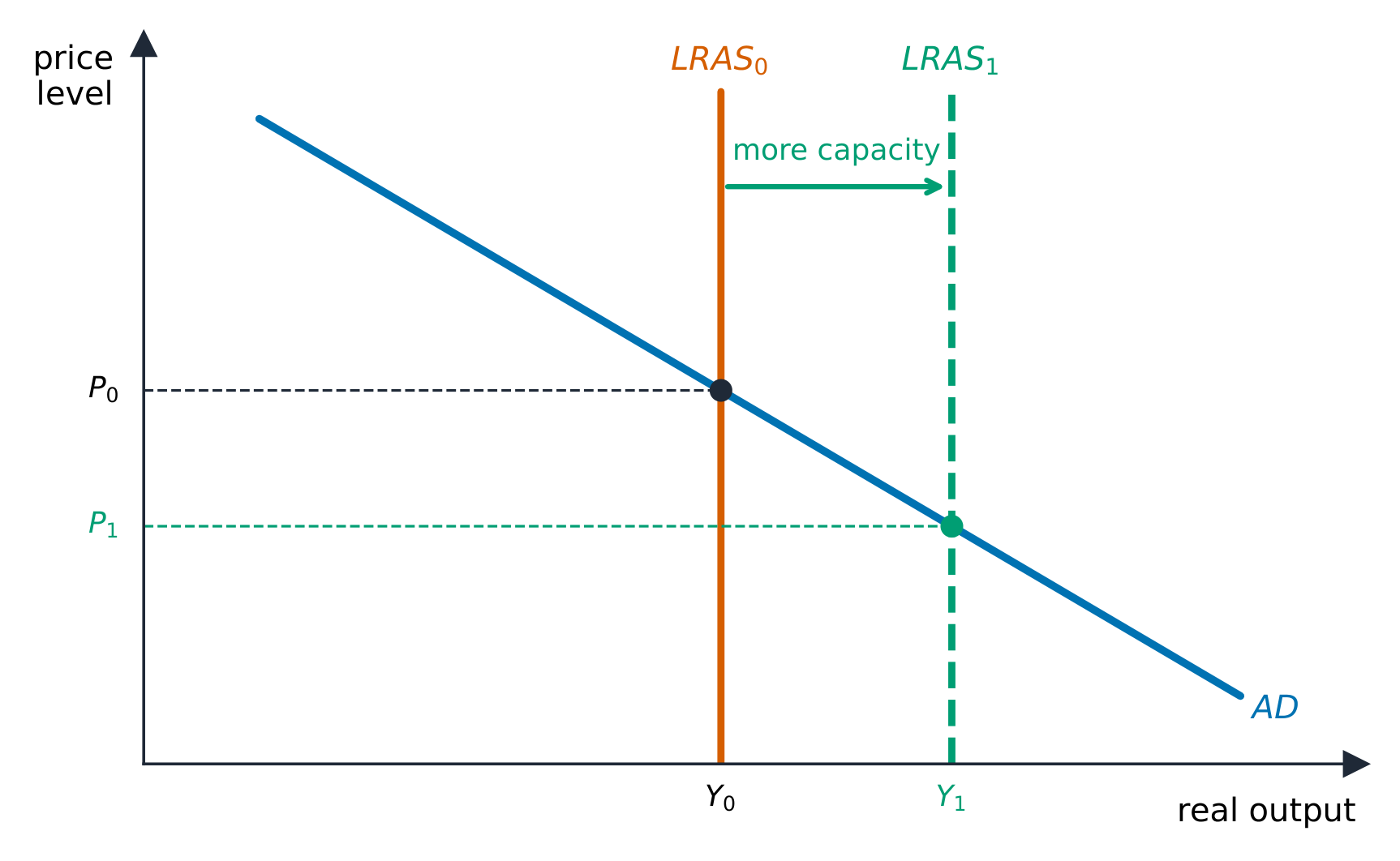
    Long-run aggregate supply (LRAS) 长期总供给 is vertical at the economy's full-employment (potential) output 潜在产出 $Y_f$. In the long run all prices and wages are fully flexible (only in the short run are some input prices fixed), so output depends only on real factors – resources, technology, institutions – not the price level. LRAS shifts only with economic growth (more or better resources). LRAS corresponds to the production possibilities curve (PPC) 生产可能性曲线: both mark the economy's maximum sustainable capacity, so an outward LRAS shift and an outward PPC shift are the same event drawn two ways. The vertical LRAS is why, in the long run, demand policy changes prices, not output.

    Tiếng Việt

    Cung tổng dài hạn (LRAS) là đường đứng tại mức sản lượng đầy đủ việc làm (tiềm năng) $Y_f$ của nền kinh tế. Trong dài hạn, tất cả giá cả và lương đều linh hoạt hoàn toàn (chỉ trong ngắn hạn một số giá đầu vào mới bị cố định), nên sản lượng chỉ phụ thuộc vào các yếu tố thực – tài nguyên, công nghệ, thể chế – không phụ thuộc vào mức giá. LRAS chỉ dịch chuyển khi có tăng trưởng kinh tế (có thêm hoặc tốt hơn các nguồn lực). LRAS tương ứng với đường giới hạn khả năng sản xuất (PPC): cả hai đều đánh dấu công suất tối đa bền vững của nền kinh tế, nên sự dịch chuyển LRAS ra ngoài và sự dịch chuyển PPC ra ngoài là cùng một sự kiện được vẽ theo hai cách khác nhau. Đường LRAS đứng thẳng là lý do mà, trong dài hạn, các chính sách cầu chỉ làm thay đổi giá cả chứ không phải sản lượng.

    Supply-side policy shifts long-run aggregate supply right: more output, lower prices
    Supply-side policy shifts long-run aggregate supply right: more output, lower prices
    Vocabulary · ⁨Từ vựng⁩ Train · ⁨Luyện tập⁩
    English Tiếng Việt
    Long-run aggregate supply (LRAS)/lɒŋ rʌn ˈæɡrɪɡeɪt səˈplaɪ/ Tổng cung dài hạn (LRAS)
    full-employment (potential) output/fʊl emˈplɔɪmənt ˈaʊtpʊt/ Sản lượng đầy đủ (tiềm năng)
    production possibilities curve (PPC)/prəˈdʌkʃn ˌpɒsəˈbɪlɪtiz kɜːv/ Đường giới hạn khả năng sản xuất (PPC)
    3.5

    Equilibrium in the AD-AS Model · ⁨Cân bằng trong Mô hình AD-AS⁩

    Syllabus · ⁨Chương trình⁩
    English

    Enduring Understanding (MOD-2): Economists use the aggregate demand–aggregate supply model to represent the relationship between the price level and aggregate output in an economy and to illustrate how output, employment, and the price level respond to macroeconomic shocks.

    Learning Objective MOD-2.G: Explain (using graphs as appropriate) the short-run and long-run equilibrium price level and output level.

    • MOD-2.G.1 Short-run equilibrium occurs when the aggregate quantity of output demanded and the aggregate quantity of output supplied are equal—i.e., at the intersection of the AD and SRAS curves.
    • MOD-2.G.2 Long-run equilibrium occurs when the AD and SRAS curves intersect on the LRAS—i.e., at the full-employment level of real output.
    • MOD-2.G.3 The short-run equilibrium output can be at the full-employment level of output, above it, or below it, creating positive (i.e., inflationary) or negative (i.e., recessionary) output gaps.
    Tiếng Việt

    Hiểu biết bền vững (MOD-2): Các nhà kinh tế học sử dụng mô hình tổng cầu–tổng cung để biểu diễn mối quan hệ giữa mức giá chung và tổng sản lượng trong nền kinh tế, đồng thời minh họa cách sản lượng, việc làm và mức giá chung phản ứng với các cú sốc vĩ mô.

    Mục tiêu học tập MOD-2.G: Giải thích (sử dụng đồ thị khi cần thiết) mức giá cân bằng và mức sản lượng cân bằng trong ngắn hạn và dài hạn.

    • MOD-2.G.1 Cân bằng ngắn hạn xảy ra khi tổng lượng sản lượng được cầu và tổng lượng sản lượng được cung bằng nhau—tức là tại giao điểm của đường cong AD và SRAS.
    • MOD-2.G.2 Cân bằng dài hạn xảy ra khi đường cong AD và SRAS cắt nhau trên đường cong LRAS—tức là ở mức sản lượng thực tế đầy đủ việc làm.
    • MOD-2.G.3 Sản lượng cân bằng ngắn hạn có thể nằm ở mức sản lượng đầy đủ việc làm, cao hơn hoặc thấp hơn mức đó, tạo ra các khoảng trống sản lượng dương (tức là lạm phát) hoặc âm (tức là suy thoái).

    Source: College Board AP Course and Exam Description · ⁨Nguồn: Mô tả Khóa học và Bài thi College Board AP⁩

    English

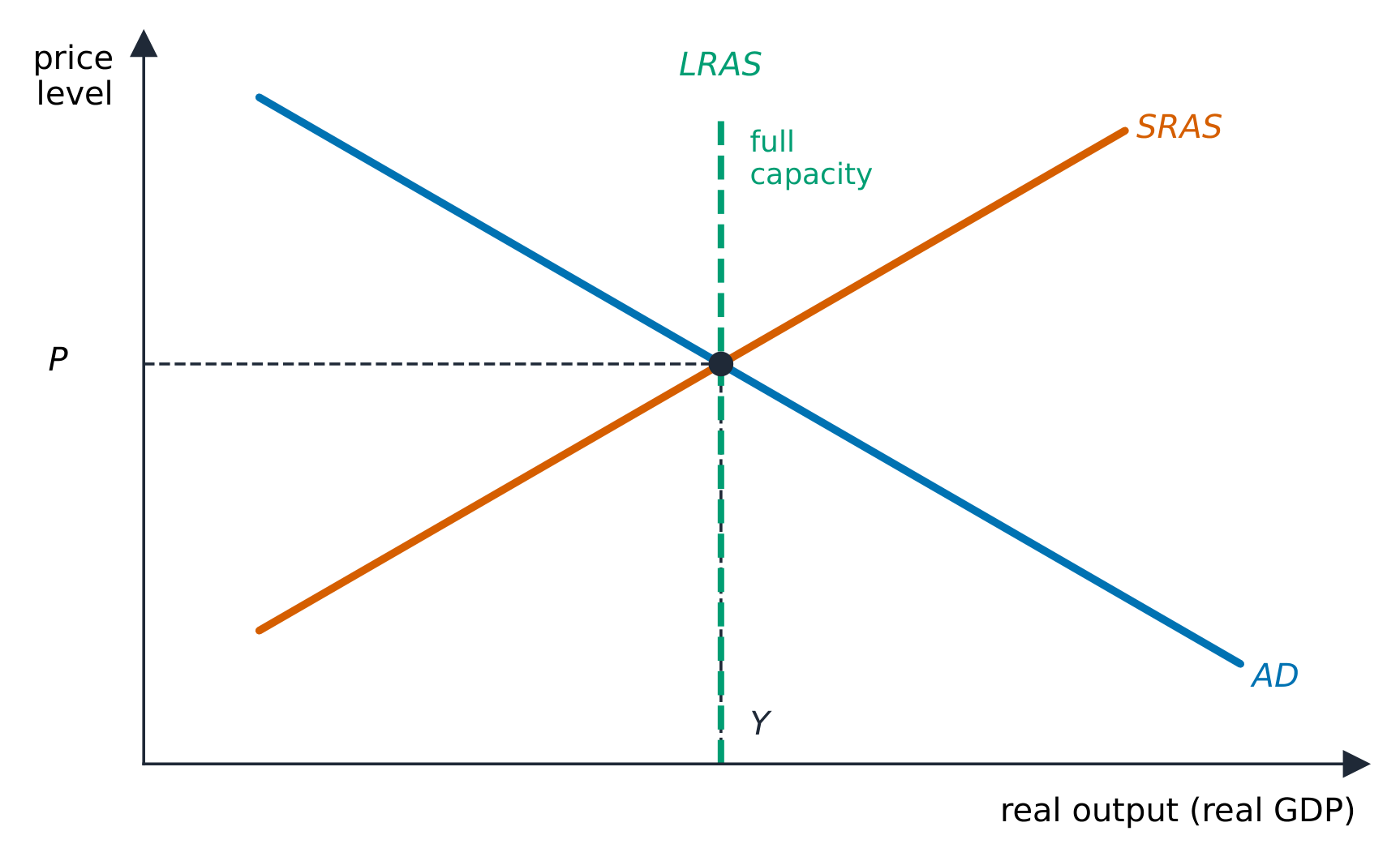
    The economy settles where AD meets SRAS, fixing the equilibrium price level and real GDP. Comparing that output to $Y_f$ (the LRAS line) gives the economy's state:

    • output $: a recessionary gap 衰退缺口 (cyclical unemployment),
    • output $>Y_f$: an inflationary gap 通胀缺口 (overheating),
    • output $=Y_f$: long-run equilibrium.
    Tiếng Việt

    Nền kinh tế đạt điểm cân bằng nơi AD giao với SRAS, xác định mức giá cân bằng và GDP thực. So sánh mức sản lượng này với $Y_f$ (đường LRAS) để biết trạng thái của nền kinh tế:

    Macroeconomic equilibrium where aggregate demand meets aggregate supply
    Macroeconomic equilibrium where aggregate demand meets aggregate supply
    • sản lượng $: khe hở suy thoái (thất nghiệp chu kỳ),
    • sản lượng $>Y_f$: khe hở lạm phát (quá nóng),
    • sản lượng $=Y_f$: cân bằng dài hạn.
    Explore · ⁨Khám phá⁩

    Find equilibrium in the AD-AS model · ⁨Tìm cân bằng trong mô hình AD-AS⁩

    Aggregate demand and aggregate supply cross at the economy's price level and real GDP. A demand or supply shock shifts a curve and moves the whole economy's output and prices. · ⁨Tổng cầu và tổng cung giao nhau tại mức giá và GDP thực tế của nền kinh tế. Một cú sốc cầu hoặc cung dịch chuyển một đường cong và di chuyển toàn bộ sản lượng và giá cả của nền kinh tế.⁩

    3.6

    Short-Run Changes: Demand and Supply Shocks · ⁨Những Thay Đổi Ngắn Hạn: Sốc Cầu và Sốc Cung⁩

    Syllabus · ⁨Chương trình⁩
    English

    Enduring Understanding (MOD-2): Economists use the aggregate demand–aggregate supply model to represent the relationship between the price level and aggregate output in an economy and to illustrate how output, employment, and the price level respond to macroeconomic shocks.

    Learning Objective MOD-2.H: Explain (using graphs as appropriate) the response of output, employment, and the price level to an aggregate demand or aggregate supply shock in the short run.

    • MOD-2.H.1 A positive (negative) shock in AD causes output, employment, and the price level to rise (fall) in the short run.
    • MOD-2.H.2 A positive (negative) shock in SRAS causes output and employment to rise (fall) and the price level to fall (rise) in the short run.
    • MOD-2.H.3 Inflation can be caused by changes in aggregate demand (demand-pull) or aggregate supply (cost-push).
    Tiếng Việt

    Hiểu biết bền vững (MOD-2): Các nhà kinh tế học sử dụng mô hình tổng cầu–tổng cung để biểu diễn mối quan hệ giữa mức giá chung và tổng sản lượng trong nền kinh tế, đồng thời minh họa cách sản lượng, việc làm và mức giá chung phản ứng với các cú sốc vĩ mô.

    Mục tiêu học tập MOD-2.H: Giải thích (sử dụng đồ thị khi cần thiết) sự phản ứng của sản lượng, việc làm và mức giá chung đối với cú sốc tổng cầu hoặc tổng cung trong ngắn hạn.

    • MOD-2.H.1 Một cú sốc tích cực (tiêu cực) trong AD khiến sản lượng, việc làm và mức giá tăng (giảm) trong ngắn hạn.
    • MOD-2.H.2 Một cú sốc tích cực (tiêu cực) trong SRAS khiến sản lượng và việc làm tăng (giảm) và mức giá giảm (tăng) trong ngắn hạn.
    • MOD-2.H.3 Lạm phát có thể do thay đổi trong tổng cầu (kéo lạm phát) hoặc tổng cung (đẩy lạm phát).

    Source: College Board AP Course and Exam Description · ⁨Nguồn: Mô tả Khóa học và Bài thi College Board AP⁩

    English
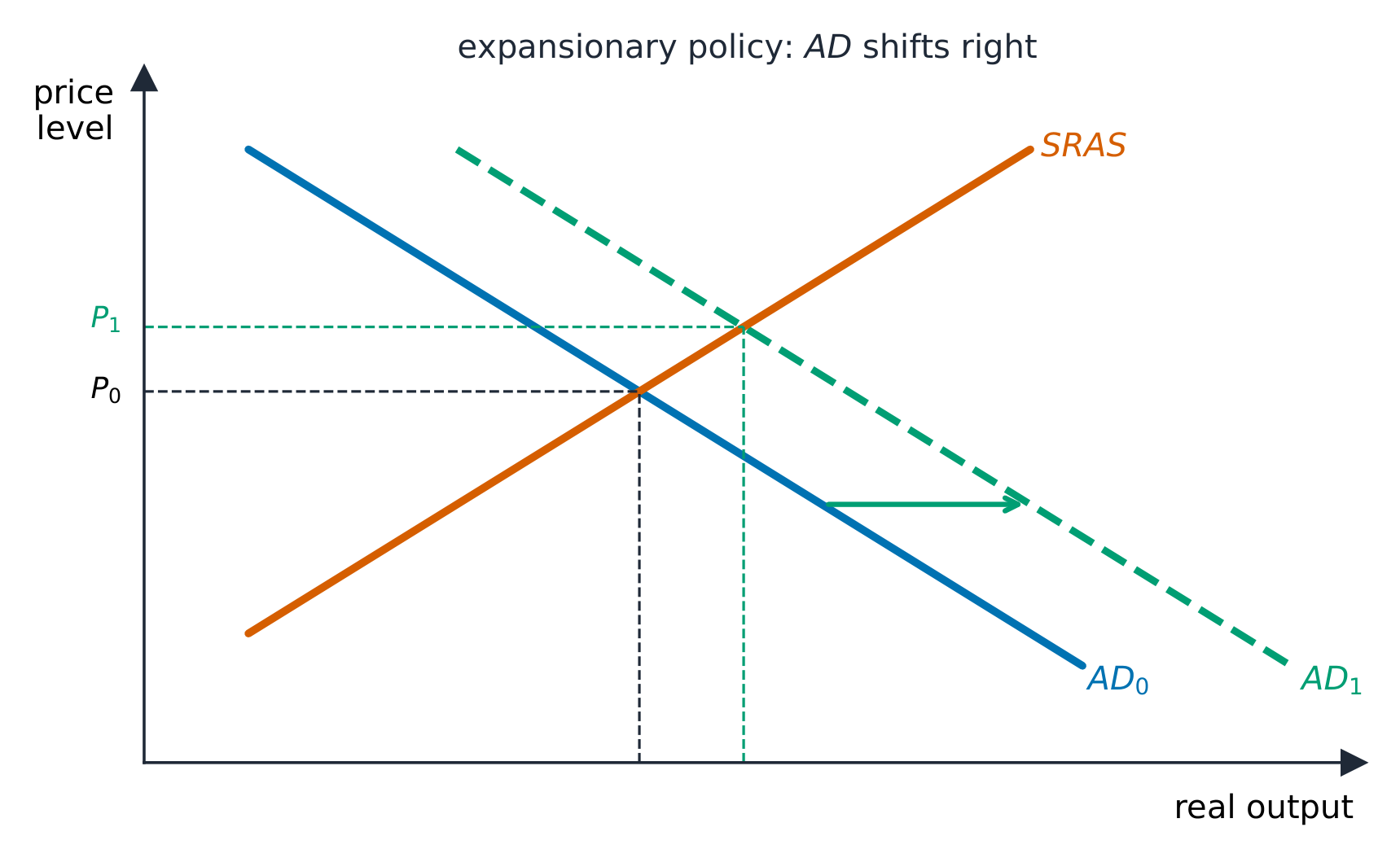
    • A demand shock shifts AD: a positive one (more spending) raises both price level and output (and lowers unemployment); a negative one lowers both.
    • A supply shock shifts SRAS: a negative one (higher input costs) raises the price level and lowers output at once – stagflation 滞胀 – the hardest case for policymakers, because fixing one worsens the other.
    Tiếng Việt
    • Một sốc cầu dịch chuyển đường AD: sốc tích cực (chi tiêu tăng) làm tăng cả mức giá và sản lượng (và giảm thất nghiệp); sốc tiêu cực làm giảm cả hai.
    • Một sốc cung dịch chuyển SRAS: sốc tiêu cực (chi phí đầu vào tăng) làm tăng mức giá và giảm sản lượng cùng lúc – tình trạng đình trệ lạm phát – trường hợp khó khăn nhất đối với các nhà hoạch định chính sách, vì giải quyết vấn đề này sẽ làm trầm trọng thêm vấn đề kia.
    3.7

    Long-Run Self-Adjustment · ⁨Tự Điều Chỉnh Dài Hạn⁩

    Syllabus · ⁨Chương trình⁩
    English

    Enduring Understanding (MOD-2): Economists use the aggregate demand–aggregate supply model to represent the relationship between the price level and aggregate output in an economy and to illustrate how output, employment, and the price level respond to macroeconomic shocks.

    Learning Objective MOD-2.I: Explain (using graphs as appropriate) the response of output, employment, and the price level to an aggregate demand or aggregate supply shock in the long run.

    • MOD-2.I.1 In the long run, in the absence of government policy actions, flexible wages and prices will adjust to restore full employment and unemployment will revert to its natural rate after a shock to aggregate demand or short-run aggregate supply. [See EK MEA-1.E.2]
    • MOD-2.I.2 Shifts in the long-run aggregate supply curve indicate changes in the full-employment level of output and economic growth.
    Tiếng Việt

    Hiểu biết bền vững (MOD-2): Các nhà kinh tế học sử dụng mô hình tổng cầu–tổng cung để biểu diễn mối quan hệ giữa mức giá chung và tổng sản lượng trong nền kinh tế, đồng thời minh họa cách sản lượng, việc làm và mức giá chung phản ứng với các cú sốc vĩ mô.

    Mục tiêu học tập MOD-2.I: Giải thích (dùng biểu đồ khi cần thiết) phản ứng của sản lượng, việc làm và mức giá trước một cú sốc tổng cầu hoặc tổng cung trong dài hạn.

    • MOD-2.I.1 Trong dài hạn, nếu không có hành động chính sách của chính phủ, lương và giá cả linh hoạt sẽ điều chỉnh để khôi phục mức việc làm đầy đủ và tỷ lệ thất nghiệp trở về mức tự nhiên sau một cú sốc đối với tổng cầu hoặc tổng cung ngắn hạn. [Xem EK MEA-1.E.2]
    • MOD-2.I.2 Sự dịch chuyển của đường tổng cung dài hạn cho thấy sự thay đổi trong mức sản lượng việc làm đầy đủ và tăng trưởng kinh tế.

    Source: College Board AP Course and Exam Description · ⁨Nguồn: Mô tả Khóa học và Bài thi College Board AP⁩

    English

    Left alone, the economy self-corrects through flexible wages:

    • In a recessionary gap, high unemployment eventually pushes nominal wages down, shifting SRAS right until output returns to $Y_f$ at a lower price level.
    • In an inflationary gap, labor shortages push wages up, shifting SRAS left back to $Y_f$ at a higher price level.

    The debate over how fast this happens is the case for (or against) active policy: self-adjustment is slow and painful, which is the argument for intervening.

    Tiếng Việt

    Để mặc tự nhiên, nền kinh tế tự điều chỉnh thông qua sự linh hoạt của lương:

    • Trong khe hở suy thoái, tình trạng thất nghiệp cao cuối cùng sẽ đẩy lương danh nghĩa xuống, dịch chuyển SRAS sang phải cho đến khi sản lượng quay trở lại $Y_f$ ở mức giá thấp hơn.
    • Trong khe hở lạm phát, thiếu hụt lao động đẩy lương lên, dịch chuyển SRAS sang trái trở lại $Y_f$ ở mức giá cao hơn.

    Cuộc tranh luận về việc tốc độ diễn ra quá trình này là cơ sở cho (hoặc chống lại) chính sách chủ động: tự điều chỉnh diễn ra chậm chạp và đau đớn, đó là lập luận để can thiệp.

    3.8

    Fiscal Policy · ⁨Chính Sách Tài Khố⁩

    Syllabus · ⁨Chương trình⁩
    English

    Enduring Understanding (POL-1): Fiscal and monetary policy have short-run effects on macroeconomic outcomes.

    Learning Objective POL-1.A: a. Define fiscal policy and related terms. b. Explain (using graphs as appropriate) the short-run effects of a fiscal policy action. c. Calculate the short-run effects of a fiscal policy action.

    • POL-1.A.1 Governments implement fiscal policies to achieve macroeconomic goals, such as full employment.
    • POL-1.A.2 The tools of fiscal policy are government spending and taxes/transfers.
    • POL-1.A.3 Changes in government spending affect aggregate demand directly, and changes in taxes/transfers affect aggregate demand indirectly.
    • POL-1.A.4 The government spending multiplier is greater than the tax multiplier.
    • POL-1.A.5 Expansionary or contractionary fiscal policies are used to restore full employment when the economy is in a negative (i.e., recessionary) or positive (i.e., inflationary) output gap.
    • POL-1.A.6 Fiscal policy can influence aggregate demand, real output, and the price level. [See also EK MKT-5.E.2 for the effect on exchange rates.]
    • POL-1.A.7 The AD–AS model is used to demonstrate the short-run effects of fiscal policy.

    Learning Objective POL-1.B: Define why there are lags to discretionary fiscal policy.

    • POL-1.B.1 In reality, there are lags to discretionary fiscal policy because of factors such as the time it takes to decide on and implement a policy action.
    Tiếng Việt

    Hiểu biết bền vững (POL-1): Chính sách tài khóa và tiền tệ có tác động ngắn hạn đến các kết quả vĩ mô.

    Mục tiêu học tập POL-1.A: a. Định nghĩa chính sách tài khóa và các thuật ngữ liên quan. b. Giải thích (dùng biểu đồ khi cần thiết) tác động ngắn hạn của một hành động chính sách tài khóa. c. Tính toán tác động ngắn hạn của một hành động chính sách tài khóa.

    • POL-1.A.1 Chính phủ thực hiện các chính sách tài khóa nhằm đạt được các mục tiêu vĩ mô, chẳng hạn như việc làm đầy đủ.
    • POL-1.A.2 Các công cụ của chính sách tài khóa bao gồm chi tiêu chính phủ và thuế/truyền tải.
    • POL-1.A.3 Thay đổi chi tiêu chính phủ ảnh hưởng trực tiếp đến tổng cầu, còn thay đổi thuế/truyền tải ảnh hưởng gián tiếp đến tổng cầu.
    • POL-1.A.4 Bội số chi tiêu chính phủ lớn hơn bội số thuế.
    • POL-1.A.5 Các chính sách tài khóa nới lỏng hoặc thắt chặt được sử dụng để khôi phục việc làm đầy đủ khi nền kinh tế đang ở trong khoảng cách sản lượng âm (tức là suy thoái) hoặc dương (tức là lạm phát).
    • POL-1.A.6 Chính sách tài khóa có thể ảnh hưởng đến tổng cầu, sản lượng thực tế và mức giá. [Xem thêm EK MKT-5.E.2 về tác động lên tỷ giá hối đoái.]
    • POL-1.A.7 Mô hình AD–AS được sử dụng để minh họa tác động ngắn hạn của chính sách tài khóa.

    Mục tiêu học tập POL-1.B: Giải thích tại sao chính sách tài khóa chủ động lại có độ trễ.

    • POL-1.B.1 Trong thực tế, chính sách tài khóa chủ động có độ trễ do các yếu tố như thời gian cần thiết để quyết định và triển khai một hành động chính sách.

    Source: College Board AP Course and Exam Description · ⁨Nguồn: Mô tả Khóa học và Bài thi College Board AP⁩

    English

    Fiscal policy 财政政策 is the government's use of spending and taxes to shift AD:

    • Expansionary 扩张性 (more spending or lower taxes) shifts AD right to close a recessionary gap.
    • Contractionary 紧缩性 (less spending or higher taxes) shifts AD left to close an inflationary gap.

    Size the policy with the multipliers: to close a gap of a given size, the required change in spending is (gap) $\div$ (spending multiplier). Limits include time lags, crowding out (below), and political difficulty.

    Worked example. An economy has a $\$100$ billion recessionary gap and $MPC=0.75$ (spending multiplier $=\dfrac{1}{0.25}=4$). To close it, the government must raise spending by $\dfrac{\$100\text{ billion}}{4}=\$25$ billion. Using a tax cut instead (tax multiplier $-3$) would require a larger $\dfrac{100}{3}\approx\$33$ billion cut.

    Exam skill: you must draw the correctly labeled AD-AS graph, identify the gap, prescribe the right fiscal action and its direction, and often calculate the exact spending or tax change needed.

    Tiếng Việt

    Chính sách tài khóa là việc chính phủ sử dụng chi tiêu và thuế để dịch chuyển AD:

    Expansionary fiscal policy shifts AD right, raising output and prices
    Expansionary fiscal policy shifts AD right, raising output and prices
    • Mở rộng (tăng chi tiêu hoặc giảm thuế) dịch chuyển AD sang phải để lấp đầy khe hở suy thoái.
    • Thu hẹp (giảm chi tiêu hoặc tăng thuế) dịch chuyển AD sang trái để lấp đầy khe hở lạm phát.

    Xác định quy mô chính sách dựa trên các bội số: để lấp đầy một khe hở có kích thước cho trước, sự thay đổi cần thiết về chi tiêu là (khe hở) $\div$ (bội số chi tiêu). Các hạn chế bao gồm thời gian trễ, hiệu ứng crowding out (xem bên dưới), và sự khó khăn về mặt chính trị.

    Ví dụ có lời giải. Một nền kinh tế có $\$100$ billion recessionary gap and $MPC=0.75$ (spending multiplier $=\dfrac{1}{0.25}=4$). To close it, the government must raise spending by $\dfrac{\$100\text{ billion}}{4}=\$25$ billion. Using a tax cut instead (tax multiplier $-3$) would require a larger $\dfrac{100}{3}\approx\$33$ tỷ đồng giảm.

    Kỹ năng làm bài thi: bạn phải vẽ đúng biểu đồ AD-AS kèm nhãn, xác định khoảng cách, đề xuất chính sách tài khóa phù hợp và chỉ ra hướng đi, thường là tính toán chính xác mức thay đổi chi tiêu hoặc thuế cần thiết.

    Vocabulary · ⁨Từ vựng⁩ Train · ⁨Luyện tập⁩
    English Tiếng Việt
    recessionary gap/rɪˈseʃənəri ɡæp/ khoảng trống suy thoái
    inflationary gap/ɪnˈfleɪʃənəri ɡæp/ khoảng trống lạm phát
    stagflation/stæɡˈfleɪʃn/ lạm phát đình trệ
    Fiscal policy/ˈfɪskl ˈpɒlɪsi/ Chính sách tài khóa
    Expansionary/ekˈspænʃənəri/ Mở rộng
    Contractionary/kənˈtrækʃənəri/ Thu hẹp
    Automatic stabilizers/ˌɔːtəˈmætɪk ˈsteɪbəlaɪzəz/ Cơ chế ổn định tự động
    discretionary/dɪˈskreʃənəri/ chính sách tùy biến
    3.9

    Automatic Stabilizers · ⁨Các Cơ chế Ổn định Tự động⁩

    Syllabus · ⁨Chương trình⁩
    English

    Enduring Understanding (POL-1): Fiscal and monetary policy have short-run effects on macroeconomic outcomes.

    Learning Objective POL-1.C: a. Define automatic stabilizers. b. Explain how automatic stabilizers moderate business cycles.

    • POL-1.C.1 Automatic stabilizers support the economy during recessions and help prevent the economy from being overheated during expansionary periods.
    • POL-1.C.2 Tax revenues decrease automatically as GDP falls, preventing consumption and the economy from falling further.
    • POL-1.C.3 Tax revenues increase automatically as GDP rises, slowing consumption and preventing the economy from overheating.
    • POL-1.C.4 Government policies, institutions, or agencies may also have social service programs whose transfer payments act as automatic stabilizers.
    Tiếng Việt

    Hiểu biết bền vững (POL-1): Chính sách tài khóa và tiền tệ có tác động ngắn hạn đến các kết quả vĩ mô.

    Mục tiêu học tập POL-1.C: a. Định nghĩa bộ ổn định tự động. b. Giải thích cách bộ ổn định tự động làm dịu chu kỳ kinh doanh.

    • POL-1.C.1 Bộ ổn định tự động hỗ trợ nền kinh tế trong giai đoạn suy thoái và giúp ngăn chặn nền kinh tế bị quá nóng trong các giai đoạn mở rộng.
    • POL-1.C.2 Thu nhập thuế giảm tự động khi GDP giảm, ngăn tiêu dùng và nền kinh tế fall sâu hơn.
    • POL-1.C.3 Thu nhập thuế tăng tự động khi GDP tăng, làm chậm tiêu dùng và ngăn nền kinh tế bị quá nóng.
    • POL-1.C.4 Chính sách, thể chế hoặc cơ quan nhà nước cũng có thể có các chương trình dịch vụ xã hội mà các khoản thanh toán truyền tải của chúng đóng vai trò như những bộ ổn định tự động.

    Source: College Board AP Course and Exam Description · ⁨Nguồn: Mô tả Khóa học và Bài thi College Board AP⁩

    English

    Automatic stabilizers 自动稳定器 are features that dampen the cycle without new legislation. In a downturn, progressive taxes collect less and transfer payments (unemployment benefits, welfare) rise automatically – cushioning incomes and spending; in a boom they do the reverse. They soften the cycle and act instantly, avoiding the lags of discretionary 相机抉择 policy.

    Tiếng Việt

    Các cơ chế ổn định tự động là những yếu tố giúp giảm bớt chu kỳ mà không cần luật mới. Trong giai đoạn suy thoái, thuế lũy tiến thu ít hơn và chi tiêu chuyển giao (bảo hiểm thất nghiệp, trợ cấp xã hội) tăng tự động – hỗ trợ thu nhập và chi tiêu; trong giai đoạn bùng nổ chúng hoạt động ngược lại. Chúng làm mềm các biến động của chu kỳ và tác động ngay lập tức, tránh độ trễ của chính sách tự chủ.

    3.9

    Exam tips · ⁨Mẹo làm bài thi⁩

    English
    • Aggregate demand slopes down for the wealth, interest-rate, and net-export effects; it shifts when $C$, $I$, $G$, or $X_n$ changes.
    • Compute the spending multiplier $\tfrac{1}{1-MPC}$ and the smaller, negative tax multiplier $-\tfrac{MPC}{1-MPC}$.
    • Draw a correctly labeled AD–AS graph, identify a recessionary or inflationary gap, and prescribe the right fiscal action.
    • Short-run AS slopes up (sticky wages); long-run AS is vertical at full-employment output.
    • Size a policy with the multipliers: required spending = gap ÷ spending multiplier.
    Tiếng Việt
    • Tổng cầu dốc xuống do hiệu ứng tài sản, lãi suất và xuất khẩu ròng; nó dịch chuyển khi $C$, $I$, $G$, hoặc $X_n$ thay đổi.
    • Tính bội số chi tiêu $\tfrac{1}{1-MPC}$ và bội số thuế nhỏ hơn, mang dấu âm $-\tfrac{MPC}{1-MPC}$.
    • Vẽ biểu đồ AD–AS có nhãn đúng, xác định khoảng cách suy thoái hoặc lạm phát, và đề xuất chính sách tài khóa phù hợp.
    • AS ngắn hạn dốc lên (lương cố định); AS dài hạn là đường đứng tại mức sản lượng đầy đủ việc làm.
    • Xác định quy mô chính sách thông qua các bội số: chi tiêu cần thiết = khoảng cách ÷ bội số chi tiêu.
  • 4

    Financial Sector · ⁨Khu vực tài chính⁩

    Watch lesson · ⁨Xem bài học⁩
    4.1

    Financial Assets · ⁨Tài sản Tài chính⁩

    Syllabus · ⁨Chương trình⁩
    English

    Enduring Understanding (MEA-3): Money makes it possible to compare the value of goods and services, and interest rates provide a measure of the price of money that is borrowed or saved.

    Learning Objective MEA-3.A: a. Define the principal attributes—liquidity, rate of return, and risk—associated with various classes of financial assets, including money. b. Explain the relationship between the price of previously issued bonds and interest rates.

    • MEA-3.A.1 The most liquid forms of money are cash and demand deposits.
    • MEA-3.A.2 Other financial assets people can hold in place of the most liquid forms of money include bonds (interest-bearing assets) and stocks (equity).
    • MEA-3.A.3 The price of previously issued bonds and interest rates on bonds are inversely related.
    • MEA-3.A.4 The opportunity cost of holding money is the interest that could have been earned from holding other financial assets such as bonds.
    Tiếng Việt

    Hiểu biết bền vững (MEA-3): Tiền tạo điều kiện để so sánh giá trị hàng hóa và dịch vụ, và lãi suất cung cấp một thước đo về giá của tiền vay hoặc tiết kiệm.

    Mục tiêu học tập MEA-3.A: a. Định nghĩa các thuộc tính chính—tính thanh khoản, tỷ suất sinh lời và rủi ro—liên quan đến các loại tài sản tài chính khác nhau, bao gồm tiền. b. Giải thích mối quan hệ giữa giá trái phiếu đã phát hành trước đó và lãi suất.

    • MEA-3.A.1 Các dạng tiền thanh khoản nhất là tiền mặt và tiền gửi không kỳ hạn.
    • MEA-3.A.2 Các tài sản tài chính khác mà người dân có thể nắm giữ thay thế cho các dạng tiền thanh khoản nhất bao gồm trái phiếu (tài sản sinh lời) và cổ phiếu (vốn chủ sở hữu).
    • MEA-3.A.3 Giá trái phiếu đã phát hành trước đó và lãi suất trái phiếu có mối quan hệ nghịch đảo.
    • MEA-3.A.4 Chi phí cơ hội của việc nắm giữ tiền là khoản lãi suất có thể được kiếm được từ việc nắm giữ các tài sản tài chính khác như trái phiếu.

    Source: College Board AP Course and Exam Description · ⁨Nguồn: Mô tả Khóa học và Bài thi College Board AP⁩

    English

    A financial asset 金融资产 is a claim that stores value: money, stocks 股票 (ownership shares), bonds 债券 (loans that pay interest), and bank deposits. Assets trade off liquidity 流动性 (how easily converted to cash), risk, and return. A key inverse relationship: bond prices and interest rates move in opposite directions – when market interest rates rise, existing bonds paying the old, lower rate are worth less, so their price falls.

    Tiếng Việt

    Một tài sản tài chính là một yêu cầu đối với giá trị được lưu trữ: tiền mặt, cổ phiếu (cổ phần sở hữu), trái phiếu (vốn vay trả lãi), và tiền gửi ngân hàng. Các tài sản đánh đổi giữa tính thanh khoản (khả năng chuyển đổi thành tiền mặt dễ dàng), rủi ro và lợi nhuận. Một mối quan hệ nghịch đảo quan trọng: giá trái phiếu và lãi suất di chuyển theo hướng ngược nhau – khi lãi suất thị trường tăng, các trái phiếu cũ trả mức thấp hơn sẽ kém giá trị hơn, khiến giá của chúng giảm.

    Sàn giao dịch sầm uất của Sở Giao dịch Chứng khoán New York
    Sở giao dịch chứng khoán là nơi mua và bán tài sản tài chính, định giá dựa trên cung và cầu
    4.2

    Nominal versus Real Interest Rates · ⁨Lãi Suất Danh Nghĩa so với Lãi Suất Thực⁩

    Syllabus · ⁨Chương trình⁩
    English

    Enduring Understanding (MEA-3): Money makes it possible to compare the value of goods and services, and interest rates provide a measure of the price of money that is borrowed or saved.

    Learning Objective MEA-3.B: a. Define the nominal and real interest rate. b. Explain the relationship between changes in nominal interest rates, expected inflation, and real interest rates. c. Calculate the nominal and real interest rate.

    • MEA-3.B.1 A nominal interest rate is the rate of interest paid for a loan, unadjusted for inflation.
    • MEA-3.B.2 Lenders and borrowers establish nominal interest rates as the sum of their expected real interest rate and expected inflation.
    • MEA-3.B.3 A real interest rate can be calculated in hindsight by subtracting the actual inflation rate from the nominal interest rate.
    Tiếng Việt

    Hiểu biết bền vững (MEA-3): Tiền tạo điều kiện để so sánh giá trị hàng hóa và dịch vụ, và lãi suất cung cấp một thước đo về giá của tiền vay hoặc tiết kiệm.

    Mục tiêu học tập MEA-3.B: a. Định nghĩa lãi suất danh nghĩa và lãi suất thực tế. b. Giải thích mối quan hệ giữa sự thay đổi của lãi suất danh nghĩa, lạm phát dự kiến và lãi suất thực tế. c. Tính toán lãi suất danh nghĩa và lãi suất thực tế.

    • MEA-3.B.1 Lãi suất danh nghĩa là lãi suất trả cho một khoản vay, chưa điều chỉnh theo lạm phát.
    • MEA-3.B.2 Người cho vay và người đi vay xác định lãi suất danh nghĩa là tổng của lãi suất thực tế dự kiến và lạm phát dự kiến của họ.
    • MEA-3.B.3 Lãi suất thực tế có thể được tính toán retrospectively bằng cách trừ tỷ lệ lạm phát thực tế khỏi lãi suất danh nghĩa.

    Source: College Board AP Course and Exam Description · ⁨Nguồn: Mô tả Khóa học và Bài thi College Board AP⁩

    English
    • The nominal interest rate 名义利率 is the stated rate, not adjusted for inflation.
    • The real interest rate 实际利率 is what you actually earn in purchasing power:
    $$\text{real rate}\approx\text{nominal rate}-\text{inflation rate}\quad(\text{Fisher equation}).$$

    Lenders and borrowers care about the real rate. If inflation turns out higher than expected, real rates fall – helping borrowers and hurting lenders.

    Worked example. A loan carries a nominal rate of $6\%$ while inflation runs at $2\%$. The real rate is $6\%-2\%=4\%$, so the lender's purchasing power grows by $4\%$. If inflation instead jumped to $7\%$, the real rate would be $-1\%$ – the lender would actually lose purchasing power.

    Tiếng Việt
    • Lãi suất danh nghĩa là mức lãi suất được công bố, chưa điều chỉnh theo lạm phát.
    • Lãi suất thực là gì mà bạn thực sự kiếm được về sức mua:
    $$\text{real rate}\approx\text{nominal rate}-\text{inflation rate}\quad(\text{Fisher equation}).$$

    Người cho vay và người đi vay quan tâm đến lãi suất thực. Nếu lạm phát cao hơn dự kiến, lãi suất thực sẽ giảm – giúp người đi vay nhưng bất lợi cho người cho vay.

    Ví dụ có lời giải. Một khoản vay có lãi suất danh nghĩa là $6\%$ trong khi lạm phát diễn ra ở mức $2\%$. Lãi suất thực là $6\%-2\%=4\%$, nên sức mua của người cho vay tăng thêm $4\%$. Nếu lạm phát tăng vọt lên $7\%$, lãi suất thực sẽ là $-1\%$ – người cho vay thực sự mất sức mua.

    4.3

    The Definition, Measurement, and Functions of Money · ⁨Định nghĩa, Đo lường và Vai trò của Tiền⁩

    Syllabus · ⁨Chương trình⁩
    English

    Enduring Understanding (MEA-3): Money makes it possible to compare the value of goods and services, and interest rates provide a measure of the price of money that is borrowed or saved.

    Learning Objective MEA-3.C: a. Define money and its functions. b. Calculate (using data as appropriate) measures of money.

    • MEA-3.C.1 Money is any asset that is accepted as a means of payment.
    • MEA-3.C.2 Money serves as a medium of exchange, unit of account, and store of value.
    • MEA-3.C.3 The money supply is measured using monetary aggregates designated as M1 and M2.
    • MEA-3.C.4 The monetary base (often labeled as M0 or MB) includes currency in circulation and bank reserves.
    Tiếng Việt

    Hiểu biết bền vững (MEA-3): Tiền tạo điều kiện để so sánh giá trị hàng hóa và dịch vụ, và lãi suất cung cấp một thước đo về giá của tiền vay hoặc tiết kiệm.

    Mục tiêu học tập MEA-3.C: a. Định nghĩa tiền và các chức năng của nó. b. Tính toán (dùng dữ liệu khi cần thiết) các chỉ số đo lường tiền.

    • MEA-3.C.1 Tiền là bất kỳ tài sản nào được chấp nhận như một phương thức thanh toán.
    • MEA-3.C.2 Tiền đóng vai trò là phương tiện trao đổi, đơn vị tính toán và phương tiện lưu giữ giá trị.
    • MEA-3.C.3 Cung tiền được đo lường bằng các tổng hợp tiền tệ được chỉ định là M1 và M2.
    • MEA-3.C.4 Cơ sở tiền tệ (thường được ký hiệu là M0 hoặc MB) bao gồm tiền lưu thông và dự trữ ngân hàng.

    Source: College Board AP Course and Exam Description · ⁨Nguồn: Mô tả Khóa học và Bài thi College Board AP⁩

    English

    Money 货币 is anything widely accepted in exchange. Its three functions: a medium of exchange 交换媒介 (avoids barter), a unit of account 记账单位 (a common measure of value), and a store of value 价值储藏 (holds value over time). Modern money is fiat money 法定货币 – valuable because the government declares it legal tender and people trust it, not because it is backed by gold.

    Money is measured in tiers by liquidity: M1 (currency plus checkable deposits – the most liquid) and the broader M2 (M1 plus savings deposits and other near-money). Below M1 is the monetary base 基础货币 (M0, or MB) – currency in circulation plus bank reserves. The money multiplier equals money supply ÷ monetary base, so a central-bank action that raises reserves expands the money supply by a larger amount through the multiplier.

    Tiếng Việt

    Tiền là bất cứ thứ gì được chấp nhận rộng rãi để trao đổi. Ba vai trò của nó: phương tiện trao đổi (tránh barter), đơn vị tính toán (thước đo giá trị chung), và công cụ giữ giá trị (giữ giá trị theo thời gian). Tiền hiện đại là tiền pháp định – có giá trị vì chính phủ tuyên bố là tiền hợp lệ và mọi người tin tưởng vào nó, chứ không phải vì nó được bảo đảm bằng vàng.

    Vai trò của tiền; đề thi AP kiểm tra ba vai trò đầu tiên
    Vai trò của tiền — đề thi AP kiểm tra ba vai trò đầu tiên (phương tiện trao đổi, đơn vị tính toán, công cụ giữ giá trị); tiêu chuẩn thanh toán deferred nằm ngoài CED

    Tiền được đo lường theo từng tầng dựa trên tính thanh khoản: M1 (tiền mặt cộng tiền gửi có thể viết séc – mức thanh khoản nhất) và M2 rộng hơn (M1 cộng tiền gửi tiết kiệm và các loại tiền gần tương đương khác). Dưới M1 là gốc tiền tệ (M0, hay MB) – tiền lưu thông cộng dự trữ ngân hàng. Bội số tiền tệ bằng tổng tiền供给 ÷ gốc tiền tệ, do đó hành động của ngân hàng trung ương làm tăng dự trữ sẽ mở rộng tổng tiền供给 một lượng lớn hơn thông qua bội số.

    Một bộ giấy tờ euro có mệnh giá khác nhau
    Tiền vận hành vì tất cả mọi người đều chấp nhận nó: một đơn vị tính toán chung, phương tiện trao đổi và công cụ giữ giá trị
    Vocabulary · ⁨Từ vựng⁩ Train · ⁨Luyện tập⁩
    English Tiếng Việt
    financial asset/faɪˈnænʃl ˈæset/ tài sản tài chính
    stocks/stɒks/ hàng tồn kho
    bonds/bɒndz/ Chứng khoán
    liquidity/lɪˈkwɪdɪti/ tính thanh khoản
    nominal interest rate/ˈnɒmɪnl ˈɪntrest reɪt/ lãi suất danh nghĩa
    real interest rate/rɪəl ˈɪntrest reɪt/ lãi suất thực
    Money/ˈmʌni/ Tiền bạc
    medium of exchange/ˈmiːdɪəm ɒv eksˈtʃeɪndʒ/ phương tiện trao đổi
    unit of account/ˈjuːnɪt ɒv əˈkaʊnt/ đơn vị kế toán
    store of value/stɔː ɒv ˈvæljuː/ nguồn lưu giữ giá trị
    fiat money/ˈfiːət ˈmʌni/ tiền pháp định
    monetary base/ˈmʌnɪtəri beɪs/ Nền tảng tiền tệ
    fractional reserve/ˈfrækʃənl rɪˈzɜːv/ Dự trữ phân bổ
    4.4

    Banking and the Expansion of the Money Supply · ⁨Ngân hàng và Sự Mở Rộng Tổng Tiền供给⁩

    Syllabus · ⁨Chương trình⁩
    English

    Enduring Understanding (POL-2): The banking system plays an important role in the expansion of the money supply.

    Learning Objective POL-2.A: a. Define key terms related to the banking system and the expansion of the money supply. b. Explain how the banking system creates and expands the money supply. c. Calculate (using data and balance sheets as appropriate) the effects of changes in the banking system.

    • POL-2.A.1 Depository institutions (such as commercial banks) organize their assets and liabilities on balance sheets.
    • POL-2.A.2 Depository institutions operate using fractional reserve banking.
    • POL-2.A.3 Banks' reserves are divided into required reserves and excess reserves.
    • POL-2.A.4 Excess reserves are the basis of expansion of the money supply by the banking system.
    • POL-2.A.5 The money multiplier is the ratio of the money supply to the monetary base.
    • POL-2.A.6 The size of expansion of the money supply depends on the money multiplier.
    • POL-2.A.7 The maximum value of the money multiplier can be calculated as the reciprocal of the required reserve ratio.
    • POL-2.A.8 The amount predicted by the simple money multiplier may be overstated because it does not take into account a bank's desire to hold excess reserves or the public holding more currency.
    Tiếng Việt

    Hiểu biết bền vững (POL-2): Hệ thống ngân hàng đóng vai trò quan trọng trong việc mở rộng cung tiền.

    Mục tiêu học tập POL-2.A: a. Định nghĩa các thuật ngữ chính liên quan đến hệ thống ngân hàng và sự mở rộng cung tiền. b. Giải thích cách hệ thống ngân hàng tạo ra và mở rộng cung tiền. c. Tính toán (sử dụng dữ liệu và bảng cân đối kế toán khi phù hợp) tác động của những thay đổi trong hệ thống ngân hàng.

    • POL-2.A.1 Các tổ chức gửi tiền (như ngân hàng thương mại) tổ chức tài sản và nợ phải trả trên bảng cân đối kế toán.
    • POL-2.A.2 Các tổ chức gửi tiền hoạt động theo chế độ dự trữ phân fraction.
    • POL-2.A.3 Dự trữ của ngân hàng được chia thành dự trữ bắt buộc và dự trữ dư thừa.
    • POL-2.A.4 Dự trữ dư thừa là cơ sở để hệ thống ngân hàng mở rộng cung tiền.
    • POL-2.A.5 Bội số tiền là tỷ lệ giữa cung tiền và nền tảng tiền tệ.
    • POL-2.A.6 Quy mô mở rộng cung tiền phụ thuộc vào bội số tiền.
    • POL-2.A.7 Giá trị tối đa của bội số tiền có thể được tính bằng nghịch đảo của tỷ lệ dự trữ bắt buộc.
    • POL-2.A.8 Số lượng dự đoán bởi bội số tiền đơn giản có thể bị đánh giá cao vì nó không tính đến mong muốn giữ dự trữ dư thừa của ngân hàng hoặc việc công chúng nắm giữ nhiều tiền mặt hơn.

    Source: College Board AP Course and Exam Description · ⁨Nguồn: Mô tả Khóa học và Bài thi College Board AP⁩

    English

    Banks operate on a fractional reserve 部分准备金 system: they keep a fraction of deposits as reserves 准备金 and lend the rest. The fraction they must keep is the required reserve ratio 法定准备金率 (rr). Lending creates new deposits, which are re-deposited and re-lent, expanding the money supply by the money multiplier:

    $$\text{money multiplier}=\frac{1}{rr}.$$

    A new $1000 deposit with$rr=0.1$leaves$$900$in excess reserves, so the banking system can expand the money supply by up to$900\times\frac{1}{0.1}=9,000$. Use a bank's T-account (assets = reserves + loans; liabilities = deposits) to track required reserves and excess reserves 超额准备金 (the amount available to lend).

    Worked example. A bank receives a $\$1000$ deposit with $rr=0.20$. It must hold $0.20\times1000=\$200$ as required reserves, leaving $\$800$ of excess reserves to lend. With a money multiplier of $\dfrac{1}{0.20}=5$, that $\$800$ of new lending can expand the money supply by up to $800\times5=\$4000$ across the banking system.

    Exam skill: given a required reserve ratio and a deposit, compute excess reserves, the money multiplier, and the maximum change in the money supply.

    Tiếng Việt

    Ngân hàng hoạt động theo hệ thống dự trữ phân fraction: họ giữ một phần tiền gửi làm dự trữ và cho vay phần còn lại. Tỷ lệ phần họ phải giữ là tỷ lệ dự trữ bắt buộc (rr). Cho vay tạo ra tiền gửi mới, được gửi lại và cho vay lại, mở rộng tổng tiền供给 theo bội số tiền tệ:

    $$\text{money multiplier}=\frac{1}{rr}.$$

    Một khoản $1000 deposit with$rr=0.1$leaves$$900$dư thừa, nên hệ thống ngân hàng có thể mở rộng tổng tiền供给 lên tới$900\times\frac{1}{0.1}=9,000$. Sử dụng bảng cân đối kế toán T của ngân hàng (tài sản = dự trữ + cho vay; nợ phải trả = tiền gửi) để theo dõi dự trữ bắt buộc và dư thừa (số tiền sẵn sàng cho vay).

    Ví dụ có lời giải. Một ngân hàng nhận được $\$1000$ deposit with $rr=0.20$. It must hold $0.20\times1000=\$200$ làm dự trữ bắt buộc, để lại $\$800$ of excess reserves to lend. With a money multiplier of $\dfrac{1}{0.20}=5$, that $\$800$ từ cho vay mới có thể mở rộng tổng tiền供给 lên tới $800\times5=\$4000$ trên toàn hệ thống ngân hàng.

    Kỹ năng làm bài thi: với tỷ lệ dự trữ bắt buộc và một khoản tiền gửi, hãy tính dự thừa, bội số tiền tệ và mức thay đổi tối đa của tổng tiền供给.

    Explore · ⁨Khám phá⁩

    See banks multiply deposits · ⁨Xem ngân hàng nhân đôi tiền gửi⁩

    Banks keep a fraction of deposits as reserves and lend the rest, which is redeposited and lent again — the money multiplier expands the money supply from the initial deposit. · ⁨Ngân hàng giữ một phần tiền gửi làm dự trữ và cho vay phần còn lại, thứ này được gửi lại và cho vay lần nữa — hệ số nhân tiền mở rộng cung tiền từ khoản tiền gửi ban đầu.⁩

    Vocabulary · ⁨Từ vựng⁩ Train · ⁨Luyện tập⁩
    English Tiếng Việt
    reserves/rɪˈzɜːvz/ Dự trữ
    required reserve ratio/rɪˈkwaɪəd rɪˈzɜːv ˈreɪʃɪəʊ/ Tỷ lệ dự trữ bắt buộc
    excess reserves/ekˈses rɪˈzɜːvz/ Dự trữ dư thừa
    4.5

    The Money Market · ⁨Thị trường Tiền⁩

    Syllabus · ⁨Chương trình⁩
    English

    Enduring Understanding (MKT-3): In the money market, demand for and supply of money determine the equilibrium nominal interest rate and influence the value of other financial assets.

    Learning Objective MKT-3.A: a. Define (using graphs as appropriate) the money market, money demand, and money supply. b. Explain (using graphs as appropriate) the relationship between the nominal interest rate and the quantity of money demanded (supplied).

    • MKT-3.A.1 The demand for money shows the inverse relationship between the nominal interest rate and the quantity of money people want to hold.
    • MKT-3.A.2 Given a monetary base determined by a country's central bank, money supply is independent of the nominal interest rate.

    Learning Objective MKT-3.B: Define (using graphs as appropriate) equilibrium in the money market.

    • MKT-3.B.1 In the money market, equilibrium is achieved when the nominal interest rate is such that the quantities demanded and supplied of money are equal.

    Learning Objective MKT-3.C: Explain (using graphs as appropriate) how nominal interest rates adjust to restore equilibrium in the money market.

    • MKT-3.C.1 Disequilibrium nominal interest rates create surpluses and shortages in the money market. Market forces drive nominal interest rates toward equilibrium.

    Learning Objective MKT-3.D: a. Explain (using graphs as appropriate) the determinants of demand and supply in the money market. b. Explain (using graphs as appropriate) how changes in demand and supply in the money market affect the equilibrium nominal interest rate.

    • MKT-3.D.1 Factors that shift the demand for money, such as changes in the price level, and supply of money, such as monetary policy, change the equilibrium nominal interest rate.
    Tiếng Việt

    Hiểu biết bền vững (MKT-3): Trong thị trường tiền tệ, nhu cầu và cung tiền xác định lãi suất danh nghĩa cân bằng và ảnh hưởng đến giá trị của các tài sản tài chính khác.

    Mục tiêu học tập MKT-3.A: a. Định nghĩa (dùng biểu đồ khi phù hợp) thị trường tiền tệ, nhu cầu tiền và cung tiền. b. Giải thích (dùng biểu đồ khi phù hợp) mối quan hệ giữa lãi suất danh nghĩa và lượng tiền demand (supplied).

    • MKT-3.A.1 Nhu cầu tiền thể hiện mối quan hệ nghịch biến giữa lãi suất danh nghĩa và lượng tiền mà mọi người muốn nắm giữ.
    • MKT-3.A.2 Với nền tảng tiền tệ do ngân hàng trung ương quốc gia xác định, cung tiền độc lập với lãi suất danh nghĩa.

    Mục tiêu học tập MKT-3.B: Định nghĩa (dùng biểu đồ khi phù hợp) trạng thái cân bằng trong thị trường tiền tệ.

    • MKT-3.B.1 Trong thị trường tiền tệ, cân bằng đạt được khi lãi suất danh nghĩa sao cho lượng tiền demand và supply bằng nhau.

    Mục tiêu học tập MKT-3.C: Giải thích (dùng biểu đồ khi phù hợp) cách lãi suất danh nghĩa điều chỉnh để khôi phục cân bằng trong thị trường tiền tệ.

    • MKT-3.C.1 Lãi suất danh nghĩa mất cân bằng tạo ra thặng dư và thiếu hụt trong thị trường tiền tệ. Lực lượng thị trường đẩy lãi suất danh nghĩa tiến gần đến mức cân bằng.

    Mục tiêu học tập MKT-3.D: a. Giải thích (dùng biểu đồ khi phù hợp) các nhân tố quyết định nhu cầu và cung trong thị trường tiền tệ. b. Giải thích (dùng biểu đồ khi phù hợp) cách thay đổi nhu cầu và cung trong thị trường tiền tệ ảnh hưởng đến lãi suất danh nghĩa cân bằng.

    • MKT-3.D.1 Các yếu tố làm dịch chuyển nhu cầu tiền, chẳng hạn như thay đổi mức giá, và cung tiền, chẳng hạn như chính sách tiền tệ, sẽ thay đổi lãi suất danh nghĩa cân bằng.

    Source: College Board AP Course and Exam Description · ⁨Nguồn: Mô tả Khóa học và Bài thi College Board AP⁩

    English
    The money market sets the interest rate

    The money market 货币市场 determines the nominal interest rate:

    • Money demand 货币需求 slopes downward against the interest rate – the rate is the opportunity cost of holding money instead of interest-bearing assets. It shifts right with a higher price level or more real GDP.
    • Money supply 货币供给 is vertical – set by the central bank, independent of the interest rate.

    Their intersection sets the equilibrium interest rate. If the central bank increases the money supply, the supply line shifts right and the interest rate falls.

    Tiếng Việt
    Thị trường tiền định ra lãi suất

    Thị trường tiền xác định lãi suất danh nghĩa:

    Lãi suất được xác định bởi nhu cầu và cung tiền tệ
    Lãi suất được định bởi nhu cầu và cung tiền
    • Nhu cầu tiền dốc xuống theo lãi suất – lãi suất là chi phí cơ hội của việc giữ tiền thay vì tài sản sinh lời. Nó dịch chuyển sang phải khi mức giá cao hơn hoặc GDP thực cao hơn.
    • Cung tiền là đường đứng – do ngân hàng trung ương quyết định, độc lập với lãi suất.

    Giao điểm của chúng xác định lãi suất cân bằng. Nếu ngân hàng trung ương tăng cung tiền, đường cung dịch chuyển sang phải và lãi suất giảm.

    Explore · ⁨Khám phá⁩

    Equilibrium in the money market · ⁨Cân bằng thị trường tiền tệ⁩

    The money market sets the interest rate where money demand meets the central bank's money supply. A change in the money supply moves the interest rate. · ⁨Thị trường tiền tệ xác định lãi suất nơi nhu cầu tiền gặp cung tiền của ngân hàng trung ương. Sự thay đổi về cung tiền di chuyển lãi suất.⁩

    Vocabulary · ⁨Từ vựng⁩ Train · ⁨Luyện tập⁩
    English Tiếng Việt
    money market/ˈmʌni ˈmɑːkɪt/ tiền tệ
    Money demand/ˈmʌni dɪˈmænd/ Nhu cầu tiền
    Money supply/ˈmʌni səˈplaɪ/ Cung tiền
    Monetary policy/ˈmʌnɪtəri ˈpɒlɪsi/ Chính sách tiền tệ
    Expansionary (easy)/ekˈspænʃənəri/ Mở rộng (nới lỏng)
    Contractionary (tight)/kənˈtrækʃənəri/ Thu hẹp (thắt chặt)
    open-market operations/ˈəʊpən ˈmɑːkɪt ˌɒpəˈreɪʃnz/ thao tác thị trường mở
    discount rate/ˈdɪskaʊnt reɪt/ lãi suất chiết khấu
    interest on reserves (IOR)/ˈɪntrest ɒn rɪˈzɜːvz/ Lãi suất trên dự trữ (IOR)
    policy rate/ˈpɒlɪsi reɪt/ Tỷ lệ chính sách
    loanable funds market/ˈləʊnəbl fʌndz ˈmɑːkɪt/ vốn cho vay
    national savings/ˈnæʃənl ˈseɪvɪŋz/ Tiết kiệm quốc gia
    4.6

    Monetary Policy · ⁨Chính sách Tiền tệ⁩

    Syllabus · ⁨Chương trình⁩
    English

    Enduring Understanding (POL-1): Fiscal and monetary policy have short-run effects on macroeconomic outcomes.

    Learning Objective POL-1.D: a. Define monetary policy and related terms. b. Explain (using graphs as appropriate) the short-run effects of a monetary policy action. c. Calculate (using data and balance sheets as appropriate) the effects of a monetary policy action.

    • POL-1.D.1 Central banks implement monetary policies to achieve macroeconomic goals, such as price stability.
    • POL-1.D.2 The tools of monetary policy may include the central bank's discount rate and other administered interest rates (e.g., interest on reserves), open market operations, and the required reserve ratio. The tools used and the way in which they are implemented differ between economies that have limited reserves in their banking system and economies that have ample reserves in their banking system. (The banking system in the United States has ample reserves, and the Federal Reserve's key policy tool is interest on reserves.)
    • POL-1.D.3 When the central bank conducts an open-market purchase (sale), reserves increase (decrease), thereby increasing (decreasing) the monetary base.
    • POL-1.D.4 When the central bank conducts an open-market purchase (sale) in an economy with limited reserves, the effect on the money supply is greater than the effect on the monetary base because of the money multiplier.
    • POL-1.D.5 Many central banks carry out policy to hit a target range for an overnight interbank lending rate, sometimes referred to as the central bank's policy rate. (In the United States, this is the federal funds rate.)
    • POL-1.D.6 Central banks can influence the nominal interest rate in the short run, which in turn will affect investment and consumption. [See also EK MKT-5.G.2 for the influence on net capital inflows.] In an economy with limited reserves, the central bank can influence the nominal interest rate by changing the money supply. In an economy with ample reserves, changes in the money supply do not effectively change the nominal interest rate; instead, the central bank can influence the nominal interest rate by changing its administered interest rates.
    • POL-1.D.7 Expansionary or contractionary monetary policies are used to restore full employment when the economy is in a negative (i.e., recessionary) or positive (i.e., inflationary) output gap.
    • POL-1.D.8 Monetary policy can influence interest rates, aggregate demand, real output, and the price level. [See also EK MKT-5.E.3 for the effect on exchange rates.]
    • POL-1.D.9 A money market model, a reserve market model, and/or the AD–AS model may be used to demonstrate the short-run effects of monetary policy.

    Learning Objective POL-1.E: Define why there are lags to monetary policy.

    • POL-1.E.1 In reality, there are lags to monetary policy caused by the time it takes to recognize a problem in the economy and the time it takes the economy to adjust to the policy action.
    Tiếng Việt

    Hiểu biết bền vững (POL-1): Chính sách tài khóa và tiền tệ có tác động ngắn hạn đến các kết quả vĩ mô.

    Mục tiêu học tập POL-1.D: a. Định nghĩa chính sách tiền tệ và các thuật ngữ liên quan. b. Giải thích (dùng biểu đồ khi phù hợp) tác động ngắn hạn của một hành động chính sách tiền tệ. c. Tính toán (sử dụng dữ liệu và bảng cân đối kế toán khi phù hợp) tác động của một hành động chính sách tiền tệ.

    • POL-1.D.1 Ngân hàng trung ương thực thi các chính sách tiền tệ để đạt được các mục tiêu vĩ mô, chẳng hạn như ổn định giá cả.
    • POL-1.D.2 Các công cụ của chính sách tiền tệ có thể bao gồm lãi suất chiết khấu của ngân hàng trung ương và các lãi suất được quản lý khác (ví dụ: lãi suất trên dự trữ), giao dịch trên thị trường mở, và tỷ lệ dự trữ bắt buộc. Các công cụ được sử dụng và cách thức triển khai khác nhau giữa các nền kinh tế có dự trữ hạn chế trong hệ thống ngân hàng và các nền kinh tế có dự trữ dồi dào trong hệ thống ngân hàng. (Hệ thống ngân hàng tại Hoa Kỳ có dự trữ dồi dào, và công cụ chính sách then chốt của Cục Dự trữ Liên bang là lãi suất trên dự trữ.)
    • POL-1.D.3 Khi ngân hàng trung ương thực hiện mua (bán) trên thị trường mở, dự trữ tăng (giảm), từ đó làm tăng (giảm) nền tảng tiền tệ.
    • POL-1.D.4 Khi ngân hàng trung ương thực hiện mua (bán) trên thị trường mở trong một nền kinh tế có dự trữ hạn chế, tác động lên cung tiền lớn hơn so với tác động lên nền tảng tiền tệ do bội số tiền.
    • POL-1.D.5 Nhiều ngân hàng trung ương thực thi chính sách để đạt được một phạm vi mục tiêu cho lãi suất vay qua đêm giữa các ngân hàng, đôi khi được gọi là lãi suất chính sách của ngân hàng trung ương. (Tại Hoa Kỳ, đây là lãi suất liên ngân hàng federal funds rate.)
    • POL-1.D.6 Ngân hàng trung ương có thể ảnh hưởng đến lãi suất danh nghĩa trong ngắn hạn, điều này sau đó sẽ ảnh hưởng đến đầu tư và tiêu dùng. [Xem thêm EK MKT-5.G.2 về ảnh hưởng đến dòng vốn净流入 ròng.] Trong một nền kinh tế có dự trữ hạn chế, ngân hàng trung ương có thể ảnh hưởng đến lãi suất danh nghĩa bằng cách thay đổi cung tiền. Trong một nền kinh tế có dự trữ dồi dào, những thay đổi trong cung tiền không hiệu quả trong việc thay đổi lãi suất danh nghĩa; thay vào đó, ngân hàng trung ương có thể ảnh hưởng đến lãi suất danh nghĩa bằng cách thay đổi các lãi suất được quản lý của mình.
    • POL-1.D.7 Các chính sách tiền tệ nới lỏng hoặc thắt chặt được sử dụng để khôi phục mức tuyển dụng đầy đủ khi nền kinh tế đang trong khoảng chênh lệch sản xuất âm (tức là suy thoái) hoặc dương (tức là lạm phát).
    • POL-1.D.8 Chính sách tiền tệ có thể ảnh hưởng đến lãi suất, tổng cầu, sản lượng thực và mức giá. [Xem thêm EK MKT-5.E.3 về tác động lên tỷ giá.]
    • POL-1.D.9 Mô hình thị trường tiền tệ, mô hình thị trường dự trữ và/hoặc mô hình AD–AS có thể được sử dụng để minh họa các tác động ngắn hạn của chính sách tiền tệ.

    Mục tiêu học tập POL-1.E: Giải thích tại sao chính sách tiền tệ có độ trễ.

    • POL-1.E.1 Trong thực tế, chính sách tiền tệ có độ trễ do thời gian nhận biết vấn đề trong nền kinh tế và thời gian nền kinh tế điều chỉnh đối với hành động chính sách.

    Source: College Board AP Course and Exam Description · ⁨Nguồn: Mô tả Khóa học và Bài thi College Board AP⁩

    English

    Monetary policy 货币政策 is the central bank's (the Federal Reserve's) use of the money supply to steer the economy, working through the interest rate:

    • Expansionary (easy) 扩张性: increase the money supply $\to$ interest rate falls $\to$ investment and consumption rise $\to$ AD shifts right (fights recession).
    • Contractionary (tight) 紧缩性: decrease the money supply $\to$ interest rate rises $\to$ AD shifts left (fights inflation).

    Tools: open-market operations 公开市场操作 (buying bonds injects money, selling bonds withdraws it – the main tool), changing the reserve requirement, and changing the discount rate 贴现率 (the rate banks pay to borrow from the central bank). Follow the full chain on the exam: money supply $\to$ interest rate $\to$ investment $\to$ AD $\to$ output, price level, unemployment.

    Modern central banks run an ample-reserves system. Rather than nudging the money supply, the Fed sets administered rates – chiefly the interest on reserves (IOR) 准备金利息 it pays banks – and this steers the policy rate 政策利率 (the federal funds rate, the overnight rate banks charge one another). In the reserve market, reserve demand slopes downward while the central bank supplies reserves at its chosen rate; raising IOR lifts the whole policy rate to fight inflation, lowering it eases to fight recession. (In the older limited-reserves system the Fed instead shifted the reserve supply through open-market operations.)

    Tiếng Việt

    Chính sách tiền tệ là việc ngân hàng trung ương (Fed) sử dụng cung tiền để điều tiết nền kinh tế, thông qua lãi suất:

    Cách một mức lãi suất cao hơn tác động đến nền kinh tế để làm chậm lạm phát
    Cách một mức lãi suất cao hơn tác động đến nền kinh tế để làm chậm lạm phát
    • Mở rộng (nới lỏng): tăng cung tiền $\to$ lãi suất giảm $\to$ đầu tư và tiêu dùng tăng $\to$ AD dịch chuyển sang phải (chống suy thoái).
    • Thu hẹp (siết chặt): giảm cung tiền $\to$ lãi suất tăng $\to$ AD dịch chuyển sang trái (chống lạm phát).

    Công cụ: thao tác thị trường mở (mua trái phiếu bơm tiền, bán trái phiếu rút tiền – công cụ chính), thay đổi y cầu dự trữ, và thay đổi tỷ lệ chiết khấu (tỷ lệ ngân hàng trả để vay từ ngân hàng trung ương). Theo dõi toàn bộ chuỗi trên đề thi: cung tiền $\to$ lãi suất $\to$ đầu tư $\to$ AD $\to$ sản lượng, mức giá, tỷ lệ thất nghiệp.

    Các ngân hàng trung ương hiện đại vận hành theo chế độ dự trữ dồi dào. Thay vì nudging cung tiền, Fed thiết lập các mức lãi suất được quản lý – chủ yếu là lãi suất trên dự trữ (IOR) mà nó trả cho các ngân hàng – và điều này dẫn dắt lãi suất chính sách (lãi suất liên ngân hàng liên bang, tức lãi suất qua đêm các ngân hàng tính phí lẫn nhau). Trong thị trường dự trữ, nhu cầu về dự trữ có xu hướng dốc xuống trong khi ngân hàng trung ương cung cấp dự trữ ở mức lãi suất đã chọn; tăng IOR sẽ nâng cao cả hệ thống lãi suất chính sách để chống lạm phát, giảm nó sẽ nới lỏng để chống suy thoái. (Trong chế độ dự trữ hạn chế cũ hơn, Fed thay vào đó di chuyển cung dự trữ thông qua thao tác thị trường mở.)

    Một tòa nhà ngân hàng trung ương: chính sách tiền tệ xác định lãi suất và cung tiền
    Một tòa nhà ngân hàng trung ương: chính sách tiền tệ xác định lãi suất và cung tiền
    4.7

    The Loanable Funds Market · ⁨Thị Trường Vốn Cho Vay⁩

    Syllabus · ⁨Chương trình⁩
    English

    Enduring Understanding (MKT-4): The interaction of borrowers, who demand loanable funds, and savers, who supply loanable funds, determines the equilibrium real interest rate.

    Learning Objective MKT-4.A: a. Define (using graphs as appropriate) the loanable funds market, demand for loanable funds, and supply of loanable funds. b. Explain (using graphs as appropriate) the relationship between the real interest rate and the quantity of loanable funds demanded (supplied).

    • MKT-4.A.1 The loanable funds market describes the behavior of savers and borrowers.
    • MKT-4.A.2 The demand for loanable funds shows the inverse relationship between real interest rates and the quantity demanded of loanable funds.
    • MKT-4.A.3 The supply of loanable funds shows the positive relationship between real interest rates and the quantity supplied of loanable funds.

    Learning Objective MKT-4.B: Define national savings in both a closed and an open economy.

    • MKT-4.B.1 In the absence of international borrowing and lending, national savings is the sum of public savings and private savings.
    • MKT-4.B.2 For an open economy, investment equals national savings plus net capital inflow.

    Learning Objective MKT-4.C: Define (using graphs as appropriate) equilibrium in the loanable funds market.

    • MKT-4.C.1 In the loanable funds market, equilibrium is achieved when the real interest rate is such that the quantities demanded and supplied of loanable funds are equal.

    Learning Objective MKT-4.D: Explain (using graphs as appropriate) how real interest rates adjust to restore equilibrium in the loanable funds market.

    • MKT-4.D.1 Disequilibrium real interest rates create surpluses and shortages in the loanable funds market. Market forces drive real interest rates toward equilibrium.

    Learning Objective MKT-4.E: a. Explain (using graphs as appropriate) the determinants of demand and supply in the loanable funds market. b. Explain (using graphs as appropriate) how changes in demand and supply in the loanable funds market affect the equilibrium real interest rate and equilibrium quantity of loanable funds.

    • MKT-4.E.1 The loanable funds market can be used to show the effects of government spending, taxes, and borrowing on interest rates.
    • MKT-4.E.2 Factors that shift the demand (such as an investment tax credit) and supply (such as changes in saving behavior) of loanable funds change the equilibrium interest rate and the equilibrium quantity of funds.
    Tiếng Việt

    Hiểu biết cốt lõi (MKT-4): Sự tương tác giữa người đi vay, những người cần vốn cho vay, và người tiết kiệm, những người cung cấp vốn cho vay, xác định lãi suất thực cân bằng.

    Mục tiêu học tập MKT-4.A: a. Định nghĩa (sử dụng biểu đồ nếu cần) thị trường vốn cho vay, nhu cầu vốn cho vay và cung vốn cho vay. b. Giải thích (sử dụng biểu đồ nếu cần) mối quan hệ giữa lãi suất thực và lượng vốn cho vay được demand (cung cấp).

    • MKT-4.A.1 Thị trường vốn cho vay mô tả hành vi của người tiết kiệm và người đi vay.
    • MKT-4.A.2 Nhu cầu vốn cho vay thể hiện mối quan hệ nghịch biến giữa lãi suất thực và lượng vốn cho vay được demand.
    • MKT-4.A.3 Cung vốn cho vay thể hiện mối quan hệ đồng biến giữa lãi suất thực và lượng vốn cho vay được cung cấp.

    Mục tiêu học tập MKT-4.B: Định nghĩa tiết kiệm quốc gia trong cả nền kinh tế đóng và mở.

    • MKT-4.B.1 Trong trường hợp không có vay mượn và cho vay quốc tế, tiết kiệm quốc gia là tổng của tiết kiệm công cộng và tiết kiệm tư nhân.
    • MKT-4.B.2 Đối với nền kinh tế mở, đầu tư bằng tiết kiệm quốc gia cộng với dòng vốn ròng vào nước ngoài.

    Mục tiêu học tập MKT-4.C: Định nghĩa (sử dụng biểu đồ nếu cần) cân bằng trong thị trường vốn cho vay.

    • MKT-4.C.1 Trong thị trường vốn cho vay, cân bằng đạt được khi lãi suất thực khiến lượng vốn cho vay được demand và cung cấp bằng nhau.

    Mục tiêu học tập MKT-4.D: Giải thích (sử dụng biểu đồ nếu cần) cách lãi suất thực điều chỉnh để khôi phục cân bằng trong thị trường vốn cho vay.

    • MKT-4.D.1 Lãi suất thực mất cân bằng tạo ra thặng dư và thiếu hụt trong thị trường vốn cho vay. Lực lượng thị trường đẩy lãi suất thực tiến tới cân bằng.

    Mục tiêu học tập MKT-4.E: a. Giải thích (sử dụng biểu đồ nếu cần) các yếu tố quyết định nhu cầu và cung trong thị trường vốn cho vay. b. Giải thích (sử dụng biểu đồ nếu cần) thay đổi trong nhu cầu và cung vốn cho vay ảnh hưởng như thế nào đến lãi suất thực cân bằng và lượng vốn cho vay cân bằng.

    • MKT-4.E.1 Thị trường vốn cho vay có thể được dùng để minh họa tác động của chi tiêu nhà nước, thuế và vay nợ lên lãi suất.
    • MKT-4.E.2 Các yếu tố làm dịch chuyển nhu cầu (như khoản tín thuế đầu tư) và cung (như thay đổi hành vi tiết kiệm) vốn cho vay sẽ thay đổi lãi suất cân bằng và lượng vốn cân bằng.

    Source: College Board AP Course and Exam Description · ⁨Nguồn: Mô tả Khóa học và Bài thi College Board AP⁩

    English
    The loanable funds market

    The loanable funds market 可贷资金市场 determines the real interest rate and connects saving to investment:

    • Supply of loanable funds comes from saving and slopes upward.
    • Demand for loanable funds comes from borrowers (firms investing, government borrowing) and slopes downward.

    That saving is the economy's national savings 国民储蓄 = private savings (households and firms) + public savings (the government's budget balance – a surplus adds to saving, a deficit subtracts from it). For an open economy, investment = national savings + net capital inflow from abroad. So a bigger budget deficit is negative public saving that shrinks the supply of loanable funds and crowds out investment.

    More saving shifts supply right and lowers the real rate; more government borrowing shifts demand right and raises the real rate – the mechanism behind crowding out. Distinguish the two graphs: the money market sets the nominal rate (vertical money supply), while loanable funds sets the real rate (upward-sloping saving supply).

    Exam skill: know which graph to draw – money market for monetary policy, loanable funds for saving, deficits, and crowding out – and trace how a shift in one feeds into AD-AS.

    Tiếng Việt
    Thị trường vốn cho vay

    Thị trường vốn cho vay xác định lãi suất thực và kết nối tiết kiệm với đầu tư:

    • Cung vốn cho vay đến từ tiết kiệm và có xu hướng dốc lên.
    • Nhu cầu vốn cho vay đến từ người đi vay (doanh nghiệp đầu tư, chính phủ vay) và có xu hướng dốc xuống.

    Tiết kiệm này chính là tiết kiệm quốc gia của nền kinh tế = tiết kiệm tư nhân (hộ gia đình và doanh nghiệp) + tiết kiệm công cộng (số dư ngân sách của chính phủ – thặng dư bổ sung vào tiết kiệm, thâm hụt trừ đi tiết kiệm). Đối với nền kinh tế mở, đầu tư = tiết kiệm quốc gia + dòng vốn ngoại net. Do đó, thâm hụt ngân sách lớn hơn là tiết kiệm công cộng âm, làm giảm cung vốn cho vay và đẩy lùi đầu tư.

    Tăng tiết kiệm dịch chuyển cung sang phải và làm giảm lãi suất thực; tăng vay của chính phủ dịch chuyển demand sang phải và tăng lãi suất thực – cơ chế đằng sau đẩy lùi. Phân biệt hai biểu đồ: thị trường tiền tệ xác định lãi suất danh nghĩa (cung tiền thẳng đứng), trong khi vốn cho vay xác định lãi suất thực (cung tiết kiệm dốc lên).

    Kỹ năng thi: biết nên vẽ biểu đồ nào – thị trường tiền tệ cho chính sách tiền tệ, vốn cho vay cho tiết kiệm, thâm hụt và đẩy lùi – và theo dõi sự dịch chuyển của một biểu đồ ảnh hưởng như thế nào đến AD-AS.

    4.7

    Exam tips · ⁨Mẹo làm bài thi⁩

    English
    • Know money's three functions and the M1/M2 measures.
    • The money market sets the nominal interest rate (vertical money supply); more money supply lowers the rate.
    • Compute the money multiplier $\tfrac{1}{rr}$ and the maximum change in the money supply from a new deposit.
    • Trace monetary policy: money supply → interest rate → investment → AD → output.
    • Distinguish the money market (nominal rate) from the loanable-funds market (real rate); use the real rate $=$ nominal $-$ inflation.
    Tiếng Việt
    • Biết ba chức năng của tiền và các chỉ số M1/M2.
    • Thị trường tiền tệ xác định lãi suất danh nghĩa (cung tiền thẳng đứng); tăng cung tiền làm giảm lãi suất.
    • Tính bội số tiền tệ $\tfrac{1}{rr}$ và mức thay đổi tối đa của cung tiền từ một khoản gửi mới.
    • Theo dõi chính sách tiền tệ: cung tiền → lãi suất → đầu tư → AD → sản lượng.
    • Phân biệt thị trường tiền tệ (lãi suất danh nghĩa) với thị trường vốn cho vay (lãi suất thực); sử dụng lãi suất thực $=$ danh nghĩa $-$ lạm phát.
  • 5

    Long-Run Consequences of Stabilization Policies · ⁨Hệ quả dài hạn của các chính sách ổn định⁩

    Watch lesson · ⁨Xem bài học⁩
    5.1

    Fiscal and Monetary Policy in the Short Run

    Syllabus · ⁨Chương trình⁩
    English

    Enduring Understanding (POL-1): Fiscal and monetary policy have short-run effects on macroeconomic outcomes.

    Learning Objective POL-1.F: Explain (using graphs as appropriate) the effects of combined fiscal and monetary policy actions.

    • POL-1.F.1 A combination of expansionary or contractionary fiscal and monetary policies may be used to restore full employment when the economy is in a negative (i.e., recessionary) or positive (i.e., inflationary) output gap.
    • POL-1.F.2 A combination of fiscal and monetary policies can influence aggregate demand, real output, the price level, and interest rates. [For additional details on fiscal and monetary policy actions and how to demonstrate their effects graphically, see LO POL-1.A and LO POL-1.D.]
    Tiếng Việt

    Hiểu biết bền vững (POL-1): Chính sách tài khóa và tiền tệ có tác động ngắn hạn đến các kết quả vĩ mô.

    Mục tiêu học tập POL-1.F: Giải thích (sử dụng biểu đồ nếu cần) tác động của sự kết hợp các hành động tài khóa và tiền tệ.

    • POL-1.F.1 Sự kết hợp các chính sách tài khóa hoặc tiền tệ nới lỏng hay thắt chặt có thể được sử dụng để khôi phục việc làm đầy đủ khi nền kinh tế đang ở trong khoảng cách sản phẩm âm (tức là suy thoái) hoặc dương (tức là lạm phát).
    • POL-1.F.2 Sự kết hợp các chính sách tài khóa và tiền tệ có thể ảnh hưởng đến tổng cầu, sản lượng thực, mức giá và lãi suất. [Để biết thêm chi tiết về các hành động tài khóa và tiền tệ cũng như cách minh họa tác động của chúng bằng biểu đồ, xem LO POL-1.A và LO POL-1.D.]

    Source: College Board AP Course and Exam Description · ⁨Nguồn: Mô tả Khóa học và Bài thi College Board AP⁩

    A parliament building: governments use spending and taxes as fiscal policy tools
    A parliament building: governments use spending and taxes as fiscal policy tools

    Both policies work by shifting AD in the short run. Fiscal policy 财政政策 changes government spending or taxes; monetary policy 货币政策 changes the money supply and thus the interest rate. They can work together (both expansionary to fight a deep recession) or be mixed (e.g. loose fiscal + tight monetary). In the short run, expansionary policy raises output and the price level and lowers unemployment; contractionary policy does the reverse.

    Explore · ⁨Khám phá⁩

    Use policy to shift aggregate demand · ⁨Sử dụng chính sách để dịch chuyển tổng cầu⁩

    In the short run, fiscal (spending/taxes) and monetary (interest-rate) policy shift aggregate demand, moving real GDP and the price level along short-run aggregate supply. · ⁨Trong ngắn hạn, chính sách tài khóa (chi tiêu/thuế) và chính sách tiền tệ (lãi suất) làm dịch chuyển tổng cầu, kéo theo sự thay đổi của GDP thực và mức giá dọc theo đường tổng cung ngắn hạn.⁩

    Vocabulary · ⁨Từ vựng⁩ Train · ⁨Luyện tập⁩
    English Tiếng Việt
    Fiscal policy/ˈfɪskl ˈpɒlɪsi/ Chính sách tài khóa
    monetary policy/ˈmʌnɪtəri ˈpɒlɪsi/ chính sách tiền tệ
    5.2

    The Phillips Curve

    Syllabus · ⁨Chương trình⁩
    English

    Enduring Understanding (MOD-3): The Phillips curve model is used to represent the relationship between inflation and unemployment and to illustrate how macroeconomic shocks affect inflation and unemployment.

    Learning Objective MOD-3.A: a. Define (using graphs as appropriate) the short-run Phillips curve and the long-run Phillips curve. b. Explain (using graphs as appropriate) short-run and long-run equilibrium in the Phillips curve model.

    • MOD-3.A.1 The short-run trade-off between inflation and unemployment can be illustrated by the downward-sloping short-run Phillips curve (SRPC).
    • MOD-3.A.2 An economy is always operating somewhere along the SRPC.
    • MOD-3.A.3 The long-run relationship between inflation and unemployment can be illustrated by the long-run Phillips curve (LRPC), which is vertical at the natural rate of unemployment.
    • MOD-3.A.4 Long-run equilibrium corresponds to the intersection of the SRPC and the LRPC.
    • MOD-3.A.5 Points to the left of long-run equilibrium represent inflationary gaps, while points to the right of long-run equilibrium represent recessionary gaps.

    Learning Objective MOD-3.B: Explain (using graphs as appropriate) the response of unemployment and inflation in the short run and in the long run.

    • MOD-3.B.1 Demand shocks correspond to movement along the SRPC.
    • MOD-3.B.2 Supply shocks correspond to shifts of the SRPC.
    • MOD-3.B.3 Factors that cause the natural rate of unemployment to change will cause the LRPC to shift.
    Tiếng Việt

    Hiểu biết cốt lõi (MOD-3): Mô hình đường cong Phillips được dùng để biểu diễn mối quan hệ giữa lạm phát và thất nghiệp và minh họa cách các cú sốc vĩ mô ảnh hưởng đến lạm phát và thất nghiệp.

    Mục tiêu học tập MOD-3.A: a. Định nghĩa (sử dụng biểu đồ nếu cần) đường cong Phillips ngắn hạn và đường cong Phillips dài hạn. b. Giải thích (sử dụng biểu đồ nếu cần) cân bằng ngắn hạn và dài hạn trong mô hình đường cong Phillips.

    • MOD-3.A.1 Sự đánh đổi ngắn hạn giữa lạm phát và thất nghiệp có thể được minh họa bởi đường cong Phillips ngắn hạn (SRPC) dốc xuống.
    • MOD-3.A.2 Một nền kinh tế luôn hoạt động ở bất kỳ đâu dọc theo SRPC.
    • MOD-3.A.3 Mối quan hệ dài hạn giữa lạm phát và thất nghiệp có thể được minh họa bởi đường cong Phillips dài hạn (LRPC), đứng thẳng tại tỷ lệ thất nghiệp tự nhiên.
    • MOD-3.A.4 Cân bằng dài hạn tương ứng với giao điểm của SRPC và LRPC.
    • MOD-3.A.5 Các điểm bên trái cân bằng dài hạn đại diện cho khoảng cách sản phẩm lạm phát, trong khi các điểm bên phải cân bằng dài hạn đại diện cho khoảng cách sản phẩm suy thoái.

    Mục tiêu học tập MOD-3.B: Giải thích (sử dụng biểu đồ nếu cần) phản ứng của thất nghiệp và lạm phát trong ngắn hạn và dài hạn.

    • MOD-3.B.1 Cú sốc về phía cầu tương ứng với sự di chuyển dọc theo SRPC.
    • MOD-3.B.2 Cú sốc về phía cung tương ứng với sự dịch chuyển của SRPC.
    • MOD-3.B.3 Các yếu tố gây ra sự thay đổi tỷ lệ thất nghiệp tự nhiên sẽ khiến LRPC dịch chuyển.

    Source: College Board AP Course and Exam Description · ⁨Nguồn: Mô tả Khóa học và Bài thi College Board AP⁩

    The short-run Phillips curve

    The Phillips curve 菲利普斯曲线 shows the short-run trade-off between inflation and unemployment:

    The short-run and long-run Phillips curves
    The short-run and long-run Phillips curves
    • The short-run Phillips curve (SRPC) 短期菲利普斯曲线 slopes downward – lower unemployment comes with higher inflation. It is the mirror image of AD-AS: a rightward AD shift moves the economy up-left along the SRPC (less unemployment, more inflation).
    • The long-run Phillips curve (LRPC) 长期菲利普斯曲线 is vertical at the natural rate of unemployment 自然失业率 – the counterpart of vertical LRAS. In the long run there is no trade-off: policy changes inflation, not unemployment.
    • A supply shock shifts the SRPC (a negative shock moves it right – worse inflation and unemployment, i.e. stagflation). A change in expected inflation also shifts the SRPC.

    Exam skill: link the AD-AS and Phillips graphs – a recessionary gap in AD-AS corresponds to a point on the SRPC to the right of the natural rate; know what shifts SRPC versus moves along it.

    Vocabulary · ⁨Từ vựng⁩ Train · ⁨Luyện tập⁩
    English Tiếng Việt
    Phillips curve/ˈfɪlɪps kɜːv/ đường cong Phillips
    short-run Phillips curve (SRPC)/ʃɔːt rʌn ˈfɪlɪps kɜːv/ Đường Phillips ngắn hạn (SRPC)
    long-run Phillips curve (LRPC)/lɒŋ rʌn ˈfɪlɪps kɜːv/ Đường Phillips dài hạn (LRPC)
    natural rate of unemployment/ˈnætʃərəl reɪt ɒv ʌnemˈplɔɪmənt/ mức失业率 tự nhiên
    5.3

    Money Growth and Inflation

    Syllabus · ⁨Chương trình⁩
    English

    Enduring Understanding (POL-3): There are long-run implications of monetary and fiscal policy.

    Learning Objective POL-3.A: a. Explain (using graphs as appropriate) how inflation is a monetary phenomenon. b. Define the quantity theory of money. c. Calculate the money supply, velocity, the price level, and real output using the quantity theory of money.

    • POL-3.A.1 Inflation (deflation) results from increasing (decreasing) the money supply at too rapid of a rate for a sustained period of time.
    • POL-3.A.2 When the economy is at full employment, changes in the money supply have no effect on real output in the long run.
    • POL-3.A.3 In the long run, the growth rate of the money supply determines the growth rate of the price level (inflation rate) according to the quantity theory of money.
    Tiếng Việt

    Hiểu biết cốt lõi (POL-3): Có những hệ quả dài hạn của chính sách tiền tệ và tài khóa.

    Mục tiêu học tập POL-3.A: a. Giải thích (sử dụng biểu đồ nếu cần thiết) tại sao lạm phát là một hiện tượng tiền tệ. b. Định nghĩa lý thuyết số lượng tiền tệ. c. Tính toán cung tiền, tốc độ lưu thông, mức giá tổng thể và sản lượng thực tế dựa trên lý thuyết số lượng tiền tệ.

    • POL-3.A.1 Lạm phát (thắt chặt tiền tệ) xảy ra khi tăng (giảm) cung tiền với tốc độ quá nhanh trong một khoảng thời gian dài.
    • POL-3.A.2 Khi nền kinh tế đạt đến mức việc làm đầy đủ, những thay đổi về cung tiền không có tác động đến sản lượng thực tế trong dài hạn.
    • POL-3.A.3 Trong dài hạn, theo lý thuyết số lượng tiền tệ, tốc độ tăng trưởng của cung tiền sẽ quyết định tốc độ tăng trưởng của mức giá tổng thể (tỷ lệ lạm phát).

    Source: College Board AP Course and Exam Description · ⁨Nguồn: Mô tả Khóa học và Bài thi College Board AP⁩

    In the long run, inflation is a monetary phenomenon. The quantity theory of money 货币数量论 states $M\times V = P\times Y$ (money supply $\times$ velocity $=$ price level $\times$ real output). With velocity $V$ and real output $Y$ roughly stable in the long run, growth in the money supply translates almost one-for-one into inflation. Printing money faster than the economy grows raises the price level, not real output – the root of high inflation and, in the extreme, hyperinflation 恶性通货膨胀.

    Worked example. Suppose the money supply grows $8\%$ per year while real output $Y$ grows $3\%$ and velocity $V$ is stable. Rearranging $M\times V=P\times Y$ into growth rates, inflation $\approx 8\%-3\%=5\%$. The $5\%$ of money growth not matched by extra output simply becomes higher prices.

    More money chasing goods: sustained money growth tends to raise the price level over time
    More money chasing goods: sustained money growth tends to raise the price level over time
    Explore · ⁨Khám phá⁩

    Link money growth to inflation · ⁨Liên kết tăng trưởng tiền tệ với lạm phát⁩

    The quantity theory $MV=PY$: with output and velocity roughly fixed, the price level moves in proportion to the money supply — too much money chasing the same goods is inflation. · ⁨Lý thuyết lượng tiền $MV=PY$: khi sản lượng và tốc độ lưu thông tương đối cố định, mức giá sẽ di chuyển tỷ lệ thuận với nguồn cung tiền — quá nhiều tiền chase cùng một lượng hàng hóa là nguyên nhân gây lạm phát.⁩

    Vocabulary · ⁨Từ vựng⁩ Train · ⁨Luyện tập⁩
    English Tiếng Việt
    quantity theory of money/ˈkwɒntɪti ˈθɪəri ɒv ˈmʌni/ thuyết lượng tiền tệ
    hyperinflation/ˌhaɪpərɪnˈfleɪʃn/ siêu lạm phát
    5.4

    Government Deficits and the National Debt

    Syllabus · ⁨Chương trình⁩
    English

    Enduring Understanding (POL-3): There are long-run implications of monetary and fiscal policy.

    Learning Objective POL-3.B: a. Define the government budget surplus (deficit) and national debt. b. Explain the issues involved with the burden of the national debt.

    • POL-3.B.1 The government budget surplus (deficit) is the difference between tax revenues and government purchases plus transfer payments in a given year.
    • POL-3.B.2 A government adds to the national debt when it runs a budget deficit.
    • POL-3.B.3 A government must pay interest on its accumulated debt, thus increasing the national debt and increasingly forgoing using those funds for alternative uses. [See also LO POL-3.C on crowding out.]
    Tiếng Việt

    Hiểu biết cốt lõi (POL-3): Có những hệ quả dài hạn của chính sách tiền tệ và tài khóa.

    Mục tiêu học tập POL-3.B: a. Định nghĩa thặng dư (thiếu hụt) ngân sách chính phủ và nợ công. b. Giải thích các vấn đề liên quan đến gánh nặng nợ công.

    • POL-3.B.1 Thặng dư (thiếu hụt) ngân sách chính phủ là chênh lệch giữa thu nhập thuế và chi tiêu mua sắm cùng thanh toán chuyển giao của chính phủ trong một năm cụ thể.
    • POL-3.B.2 Chính phủ gia tăng nợ công khi gặp phải thiếu hụt ngân sách.
    • POL-3.B.3 Chính phủ phải trả lãi suất cho khoản nợ tích lũy, do đó làm tăng nợ công và ngày càng bỏ lỡ cơ hội sử dụng nguồn lực này cho các mục đích thay thế khác. [Xem thêm LO POL-3.C về hiệu ứng đẩy ra.]

    Source: College Board AP Course and Exam Description · ⁨Nguồn: Mô tả Khóa học và Bài thi College Board AP⁩

    A budget deficit 预算赤字 occurs when government spending exceeds tax revenue in a year (a surplus 盈余 is the reverse). The accumulated total of past deficits is the national debt 国债. Deficits are financed by borrowing – selling government bonds – which adds to the debt and to future interest payments. Persistent deficits raise concerns about crowding out and the burden of servicing the debt.

    Bond and equity markets: government borrowing competes for loanable funds and can crowd out private investment
    Bond and equity markets: government borrowing competes for loanable funds and can crowd out private investment
    Vocabulary · ⁨Từ vựng⁩ Train · ⁨Luyện tập⁩
    English Tiếng Việt
    budget deficit/ˈbʌdʒɪt ˈdefɪsɪt/ thiếu hụt ngân sách
    surplus/ˈsɜːpləs/ thặng dư
    national debt/ˈnæʃənl det/ nợ quốc gia
    5.5

    Crowding Out

    Syllabus · ⁨Chương trình⁩
    English

    Enduring Understanding (POL-3): There are long-run implications of monetary and fiscal policy.

    Learning Objective POL-3.C: a. Define crowding out. b. Explain (using graphs as appropriate) how fiscal policy may cause crowding out.

    • POL-3.C.1 When a government is in budget deficit, it typically borrows to finance its spending.
    • POL-3.C.2 A loanable funds market model can be used to show the effect of government borrowing on the equilibrium real interest rate and the resulting crowding out of private investment. [See MKT-4]
    • POL-3.C.3 Crowding out refers to the adverse effect of increased government borrowing, which leads to decreased levels of interest-sensitive private sector spending in the short run.
    • POL-3.C.4 A potential long-run impact of crowding out is a lower rate of physical capital accumulation and less economic growth as a result.
    Tiếng Việt

    Hiểu biết cốt lõi (POL-3): Có những hệ quả dài hạn của chính sách tiền tệ và tài khóa.

    Mục tiêu học tập POL-3.C: a. Định nghĩa hiệu ứng đẩy ra. b. Giải thích (sử dụng biểu đồ nếu cần thiết) cách thức chính sách tài khóa có thể dẫn đến hiệu ứng đẩy ra.

    • POL-3.C.1 Khi chính phủ bị thiếu hụt ngân sách, họ thường vay vốn để tài trợ cho chi tiêu.
    • POL-3.C.2 Mô hình thị trường tiền cho thuê có thể được sử dụng để minh họa tác động của việc vay chính phủ lên lãi suất thực cân bằng và hệ quả là đẩy ra đầu tư tư nhân. [Xem MKT-4]
    • POL-3.C.3 Hiệu ứng đẩy ra đề cập đến tác động bất lợi từ việc tăng vay chính phủ, dẫn đến giảm mức chi tiêu của khu vực tư nhân nhạy cảm với lãi suất trong ngắn hạn.
    • POL-3.C.4 Một tác động tiềm ẩn trong dài hạn của hiệu ứng đẩy ra là tỷ lệ tích lũy vốn vật chất thấp hơn và ít tăng trưởng kinh tế hơn như một hệ quả.

    Source: College Board AP Course and Exam Description · ⁨Nguồn: Mô tả Khóa học và Bài thi College Board AP⁩

    Crowding out 挤出效应 is the main long-run cost of deficit-financed fiscal policy. When the government borrows heavily, it increases the demand for loanable funds, raising the real interest rate. Higher rates reduce private investment (and interest-sensitive consumption). So expansionary fiscal policy partly cancels itself: the AD boost is offset by weaker investment. Worse, less investment today means a smaller capital stock and slower long-run growth.

    Government borrowing raises interest rates and crowds out private investment
    Government borrowing raises interest rates and crowds out private investment

    Exam skill: show crowding out on the loanable funds graph – government borrowing shifts demand right, the real interest rate rises, and private investment falls.

    Worked example. A government borrows $\$500$ billion to finance a deficit. On the loanable funds market this shifts the demand for funds right, pushing the real interest rate up (say from $3\%$ to $4\%$). At the higher rate firms scale back investment – perhaps by $\$150$ billion – so the net boost to AD is smaller than the $\$500$ billion, and the lost investment slows long-run growth.

    Vocabulary · ⁨Từ vựng⁩ Train · ⁨Luyện tập⁩
    English Tiếng Việt
    Crowding out/ˈkraʊdɪŋ aʊt/ Hiện tượng đẩy ra ngoài
    5.6

    Economic Growth

    Syllabus · ⁨Chương trình⁩
    English

    Enduring Understanding (MEA-2): The economy fluctuates between periods of expansion and contraction in the short run, but economic growth can occur in the long run.

    Learning Objective MEA-2.B: a. Define measures and determinants of economic growth. b. Explain (using graphs and data as appropriate) the determinants of economic growth. c. Calculate (using graphs and data as appropriate) per capita GDP and economic growth.

    • MEA-2.B.1 Economic growth can be measured as the growth rate in real GDP per capita over time.
    • MEA-2.B.2 Aggregate employment and aggregate output are directly related because firms need to employ more workers in order to produce more output, holding other factors constant. This is captured by the aggregate production function.
    • MEA-2.B.3 Output per employed worker is a measure of average labor productivity.
    • MEA-2.B.4 Productivity is determined by the level of technology and physical and human capital per worker.
    • MEA-2.B.5 The aggregate production function shows that output per capita is positively related to both physical and human capital per capita.
    Tiếng Việt

    Hiểu biết Bền vững (MEA-2): Nền kinh tế dao động giữa các giai đoạn mở rộng và co thắt trong ngắn hạn, nhưng tăng trưởng kinh tế có thể xảy ra trong dài hạn.

    Mục tiêu học tập MEA-2.B: a. Định nghĩa các chỉ số đo lường và các nhân tố决定 tăng trưởng kinh tế. b. Giải thích (sử dụng biểu đồ và dữ liệu nếu cần thiết) các nhân tố决定 tăng trưởng kinh tế. c. Tính toán (sử dụng biểu đồ và dữ liệu nếu cần thiết) GDP bình quân đầu người và tăng trưởng kinh tế.

    • MEA-2.B.1 Tăng trưởng kinh tế có thể được đo lường là tốc độ tăng trưởng của GDP thực tế bình quân đầu người theo thời gian.
    • MEA-2.B.2 Tổng việc làm và tổng sản lượng có mối liên hệ trực tiếp vì các doanh nghiệp cần tuyển dụng nhiều lao động hơn để sản xuất ra nhiều sản lượng hơn, giữ nguyên các yếu tố khác. Điều này được phản ánh qua hàm sản xuất tổng hợp.
    • MEA-2.B.3 Sản lượng trên mỗi lao động được sử là một chỉ số đo lường năng suất lao động trung bình.
    • MEA-2.B.4 Năng suất được xác định bởi trình độ công nghệ và vốn vật chất cũng như vốn con người bình quân đầu người.
    • MEA-2.B.5 Hàm sản xuất tổng hợp cho thấy sản lượng bình quân đầu người có mối liên hệ dương với cả vốn vật chất và vốn con người bình quân đầu người.

    Source: College Board AP Course and Exam Description · ⁨Nguồn: Mô tả Khóa học và Bài thi College Board AP⁩

    Economic growth 经济增长 is a sustained rise in real GDP per capita – the true source of higher living standards. It comes from more or better resources and is shown as a rightward shift of LRAS (and an outward shift of the PPC). Its main drivers:

    Economic growth shifts the production possibilities curve outward
    Economic growth shifts the production possibilities curve outward
    • physical capital 实物资本 (more tools and machines per worker),
    • human capital 人力资本 (education, skills, health),
    • technology 技术 and innovation,
    • productivity 生产率 (output per worker) growth, the deepest driver.
    Explore · ⁨Khám phá⁩

    Economic growth pushes the frontier out · ⁨Tăng trưởng kinh tế đẩy biên giới ra ngoài⁩

    Economic growth — more resources, better technology — shifts the whole production possibilities frontier outward, letting the economy produce more of everything. · ⁨Tăng trưởng kinh tế — nhiều tài nguyên hơn, công nghệ tốt hơn — dịch chuyển toàn bộ biên khả năng sản xuất ra ngoài, cho phép nền kinh tế sản xuất nhiều hơn của mọi thứ.⁩

    Vocabulary · ⁨Từ vựng⁩ Train · ⁨Luyện tập⁩
    English Tiếng Việt
    Economic growth/ˌiːkəˈnɒmɪk ɡrəʊθ/ Tăng trưởng kinh tế
    physical capital/ˈfɪzɪkl ˈkæpɪtl/ Vốn vật chất
    human capital/ˈhjuːmən ˈkæpɪtl/ vốn nhân lực
    technology/tekˈnɒlədʒi/ công nghệ
    productivity/ˌprɒdəkˈtɪvɪti/ tính năng suất
    5.7

    Public Policy and Economic Growth

    Syllabus · ⁨Chương trình⁩
    English

    Enduring Understanding (POL-4): Authorities and organizations institute policies that affect economic growth.

    Learning Objective POL-4.A: a. Explain (using graphs as appropriate) public policies aimed at influencing long-run economic growth. b. Define supply-side fiscal policies.

    [For a description of economic growth and information about how to show it graphically, see LO MEA-2.B, LO MOD-1.B, and LO MOD-2.I]

    • POL-4.A.1 Public policies that impact productivity and labor force participation affect real GDP per capita and economic growth.
    • POL-4.A.2 Government policies that invest in infrastructure and technology affect growth.
    • POL-4.A.3 Supply-side fiscal policies affect aggregate demand, aggregate supply, and potential output in the short run and long run by influencing incentives that affect household and business economic behavior.
    Tiếng Việt

    Hiểu biết cốt lõi (POL-4): Các cơ quan và tổ chức ban hành các chính sách ảnh hưởng đến tăng trưởng kinh tế.

    Mục tiêu học tập POL-4.A: a. Giải thích (sử dụng biểu đồ nếu cần thiết) các chính sách công nhằm thúc đẩy tăng trưởng kinh tế dài hạn. b. Định nghĩa các chính sách tài khóa phía cung.

    [Để tìm hiểu mô tả về tăng trưởng kinh tế và thông tin về cách biểu diễn nó bằng đồ thị, xem LO MEA-2.B, LO MOD-1.B và LO MOD-2.I]

    • POL-4.A.1 Các chính sách công ảnh hưởng đến năng suất và sự tham gia của lực lượng lao động sẽ tác động đến GDP bình quân đầu người và tăng trưởng kinh tế.
    • POL-4.A.2 Chính phủ đầu tư vào cơ sở hạ tầng và công nghệ sẽ ảnh hưởng đến tăng trưởng.
    • POL-4.A.3 Các chính sách tài khóa phía cung tác động đến tổng cầu, tổng cung và sản lượng tiềm năng trong ngắn hạn và dài hạn bằng cách tác động đến các động lực ảnh hưởng đến hành vi kinh tế của hộ gia đình và doanh nghiệp.

    Source: College Board AP Course and Exam Description · ⁨Nguồn: Mô tả Khóa học và Bài thi College Board AP⁩

    A wind farm: public investment in capital can raise long-run economic growth
    A wind farm: public investment in capital can raise long-run economic growth

    Governments can raise long-run growth by policies that build capital and productivity: investment in infrastructure and education, research and development incentives, protecting property rights 产权 and the rule of law, encouraging saving and investment (which finances capital), and keeping inflation low and stable. The recurring long-run theme: policies that crowd out or discourage investment slow growth, while those that encourage capital formation speed it up.

    Vocabulary · ⁨Từ vựng⁩ Train · ⁨Luyện tập⁩
    English Tiếng Việt
    property rights/ˈprɒpəti raɪts/ quyền sở hữu
    5.7

    Exam tips

    • The short-run Phillips curve shows the inflation–unemployment trade-off; the long-run curve is vertical at the natural rate.
    • In the long run inflation is a monetary phenomenon (money growth beyond output growth → inflation).
    • Show crowding out on the loanable-funds graph: government borrowing raises the real rate and cuts private investment.
    • Growth comes from more/better resources — physical capital, human capital, technology — shifting LRAS right.
    • A supply shock moves inflation and unemployment the same way (stagflation), unlike a demand shock.
  • 6

    Open Economy—International Trade and Finance · ⁨Kinh tế mở — Thương mại quốc tế và Tài chính⁩

    Watch lesson · ⁨Xem bài học⁩
    6.1

    Balance of Payments Accounts · ⁨Tài khoản Thanh toán Quốc tế⁩

    Syllabus · ⁨Chương trình⁩
    English

    Enduring Understanding (MEA-4): Foreign trade accounting measures the flow of goods, services, and financial capital between countries.

    Learning Objective MEA-4.A: a. Define the current account (CA), the capital and financial account (CFA), and the balance of payments (BOP). b. Explain how changes in the components of the CA and CFA affect a country's BOP. c. Calculate the CA, the CFA, and the BOP.

    • MEA-4.A.1 The current account (CA) records net exports, net income from abroad, and net unilateral transfers.
    • MEA-4.A.2 The CA is not always balanced; it may show a surplus or a deficit. A nation's balance of trade (i.e., net exports) is part of the current account and may also show a surplus or a deficit.
    • MEA-4.A.3 The capital and financial account (CFA) records financial capital transfers and purchases and sales of assets between countries.
    • MEA-4.A.4 The CFA is not always balanced; it may show a surplus (financial capital inflow) or a deficit (financial capital outflow).
    • MEA-4.A.5 The balance of payments (BOP) is an accounting system that records a country's international transactions for a particular time period. It consists of the CA and the CFA.
    • MEA-4.A.6 Any transaction that causes money to flow into a country is a credit to its BOP account, and any transaction that causes money to flow out is a debit. The sum of all credit entries should match the sum of all debit entries ($CA + CFA = 0$).
    Tiếng Việt

    Hiểu biết cốt lõi (MEA-4): Kế toán thương mại quốc tế đo lường dòng chảy hàng hóa, dịch vụ và vốn tài chính giữa các quốc gia.

    Mục tiêu học tập MEA-4.A: a. Định nghĩa tài khoản vãng lai (CA), tài khoản vốn và tài chính (CFA), và bảng cân đối thanh toán (BOP). b. Giải thích cách các thay đổi trong các thành phần của CA và CFA ảnh hưởng đến BOP của một quốc gia. c. Tính toán CA, CFA và BOP.

    • MEA-4.A.1 Tài khoản vãng lai (CA) ghi nhận xuất khẩu ròng, thu nhập từ nước ngoài và các khoản chuyển giao đơn phương ròng.
    • MEA-4.A.2 CA không luôn cân bằng; nó có thể hiển thị thặng dư hoặc thiếu hụt. Cán cân thương mại của một quốc gia (tức là xuất khẩu ròng) là một phần của tài khoản vãng lai và cũng có thể hiển thị thặng dư hoặc thiếu hụt.
    • MEA-4.A.3 Tài khoản vốn và tài chính (CFA) ghi nhận các chuyển giao vốn tài chính và mua bán tài sản giữa các quốc gia.
    • MEA-4.A.4 CFA không luôn cân bằng; nó có thể hiển thị thặng dư (vốn tài chính流入) hoặc thiếu hụt (vốn tài chính流出).
    • MEA-4.A.5 Bảng cân đối thanh toán (BOP) là hệ thống kế toán ghi nhận các giao dịch quốc tế của một quốc gia trong một khoảng thời gian nhất định. Nó bao gồm CA và CFA.
    • MEA-4.A.6 Bất kỳ giao dịch nào khiến tiền chảy vào quốc gia sẽ được ghi có vào tài khoản BOP của nó, và bất kỳ giao dịch nào khiến tiền chảy ra sẽ được ghi nợ. Tổng các khoản ghi có phải khớp với tổng các khoản ghi nợ ($CA + CFA = 0$).

    Source: College Board AP Course and Exam Description · ⁨Nguồn: Mô tả Khóa học và Bài thi College Board AP⁩

    English

    The balance of payments 国际收支 records all transactions between a country and the rest of the world, in two main accounts:

    • The current account 经常账户 tracks trade in goods and services (exports minus imports), plus income and transfers. A trade deficit makes it negative.
    • The capital (financial) account 资本账户 tracks flows of financial assets – foreigners buying domestic assets, and residents buying foreign assets.

    The two are mirror images: a current-account deficit is matched by a capital-account surplus (a country that imports more than it exports pays with assets, so foreign investment flows in). They sum to zero.

    Tiếng Việt
    Cảng container: xuất khẩu và nhập khẩu xuất hiện trong cân thanh toán
    Một cảng container: xuất khẩu và nhập khẩu xuất hiện trong cân đối thanh toán

    Cân đối thanh toán ghi nhận tất cả các giao dịch giữa một quốc gia và còn lại thế giới, trong hai tài khoản chính:

    Bốn thành phần của tài khoản hiện hành
    Bốn phần của tài khoản thường xuyên
    • Tài khoản thường xuyên theo dõi thương mại hàng hóa và dịch vụ (xuất khẩu trừ nhập khẩu), plus thu nhập và chuyển tiền. Deficit thương mại khiến nó âm.
    • Tài khoản vốn (tài chính) theo dõi dòng chảy tài sản tài chính – người nước ngoài mua tài sản nội địa, và cư dân mua tài sản nước ngoài.

    Hai tài khoản này là ảnh phản chiếu: defit tài khoản thường xuyên được bù đắp bởi surplus tài khoản vốn (một quốc gia nhập khẩu nhiều hơn xuất khẩu thì thanh toán bằng tài sản, nên đầu tư nước ngoài chảy vào). Chúng cộng lại bằng không.

    Vocabulary · ⁨Từ vựng⁩ Train · ⁨Luyện tập⁩
    English Tiếng Việt
    balance of payments/ˈbæləns ɒv ˈpeɪmənts/ Cân đối thanh toán
    current account/ˈkʌrənt əˈkaʊnt/ tài khoản vãng lai
    capital (financial) account/ˈkæpɪtl əˈkaʊnt/ Tài khoản vốn (tài chính)
    6.2

    Exchange Rates · ⁨Tỷ giá hối đoái⁩

    Syllabus · ⁨Chương trình⁩
    English

    Enduring Understanding (MKT-5): The interaction of buyers and sellers exchanging the currency of one country for the currency of another determines the equilibrium exchange rate in a flexible exchange market and influences the flow of goods, services, and financial capital between countries.

    Learning Objective MKT-5.A: a. Define the exchange rate, currency appreciation, and currency depreciation. b. Explain how currencies are valued relative to one another. c. Calculate the value of one currency relative to another.

    • MKT-5.A.1 In the foreign exchange market, one currency is exchanged for another; the price of one currency in terms of the other is the exchange rate.
    • MKT-5.A.2 If one currency becomes more valuable in terms of the other, it is said to appreciate. If one currency becomes less valuable in terms of the other, it is said to depreciate.
    Tiếng Việt

    Hiểu biết bền vững (MKT-5): Sự tương tác giữa người mua và người bán trao đổi tiền tệ của một quốc gia để lấy tiền tệ của quốc gia khác xác định tỷ giá cân bằng trong thị trường hối đoái linh hoạt và ảnh hưởng đến dòng chảy hàng hóa, dịch vụ và vốn tài chính giữa các quốc gia.

    Mục tiêu học tập MKT-5.A: a. Định nghĩa tỷ giá hối đoái, sự tăng giá tiền tệ và sự giảm giá tiền tệ. b. Giải thích cách định giá tiền tệ so với nhau. c. Tính toán giá trị của một loại tiền tệ so với loại tiền tệ khác.

    • MKT-5.A.1 Trong thị trường ngoại hối, một loại tiền tệ được trao đổi lấy loại tiền tệ khác; giá của một loại tiền tệ tính theo loại tiền tệ kia là tỷ giá hối đoái.
    • MKT-5.A.2 Nếu một loại tiền tệ trở nên có giá trị hơn so với loại tiền tệ kia, nó được gọi là tăng giá. Nếu một loại tiền tệ trở nên kém giá trị hơn so với loại tiền tệ kia, nó được gọi là giảm giá.

    Source: College Board AP Course and Exam Description · ⁨Nguồn: Mô tả Khóa học và Bài thi College Board AP⁩

    English

    An exchange rate 汇率 is the price of one currency in terms of another. A currency appreciates 升值 when it gains value (buys more foreign currency) and depreciates 贬值 when it loses value. Always track which currency: if the US dollar appreciates against the euro, the euro depreciates against the dollar – the same event from two sides.

    Worked example. Suppose $\$1=\text{€}0.90$, so $\text{€}1=\dfrac{1}{0.90}\approx\$1.11$. If the dollar then appreciates to $\$1=\text{€}1.00$, each dollar now buys more euros, while the euro has depreciated – it now buys only $\$1.00$ instead of $\$1.11$. The single event is an appreciation of the dollar and a depreciation of the euro.

    Most currencies today are floating 浮动, set by supply and demand in the foreign-exchange market.

    Tiếng Việt
    Hội đồng tiền tệ: tỷ giá hối đoái là giá của một loại tiền tệ tính bằng loại tiền tệ khác
    Một bàn giao dịch tiền tệ: tỷ giá hối đoái là giá của một đồng tiền tính bằng đồng tiền khác

    Tỷ giá hối đoái là giá của một loại tiền tệ được tính bằng đơn vị của một loại tiền tệ khác. Một loại tiền tệ tăng giá trị khi nó có giá trị cao hơn (mua được nhiều ngoại tệ hơn) và giảm giá trị khi nó mất đi giá trị. Luôn luôn xác định loại tiền tệ nào: nếu đồng đô la Mỹ tăng giá trị so với euro, thì euro giảm giá trị so với đô la – đó là cùng một sự kiện nhưng nhìn từ hai góc độ khác nhau.

    Ví dụ minh họa. Giả sử $\$1=\text{€}0.90$, so $\text{€}1=\dfrac{1}{0.90}\approx\$1.11$. Nếu sau đó đồng đô la tăng giá trị lên $\$1=\text{€}1.00$, each dollar now buys more euros, while the euro has depreciated – it now buys only $\$1.00$ thay vì $\$1.11$. Sự kiện duy nhất này là sự tăng giá trị của đồng đô la và sự giảm giá trị của euro.

    Tỷ giá hối đoái linh hoạt do nhu cầu và cung cấp của một loại tiền tệ quyết định
    Tỷ giá hối đoái linh hoạt do nhu cầu và cung cấp của một loại tiền tệ quyết định

    Hầu hết các loại tiền tệ hiện nay đều linh hoạt, được xác định bởi lực cung và cầu trên thị trường ngoại hối.

    Vocabulary · ⁨Từ vựng⁩ Train · ⁨Luyện tập⁩
    English Tiếng Việt
    exchange rate/eksˈtʃeɪndʒ reɪt/ tỷ giá hối đoái
    appreciates/əˈpriːʃɪeɪts/ Tăng giá
    depreciates/dɪˈpriːʃɪeɪts/ Giảm giá
    floating/ˈfləʊtɪŋ/ tỷ giá thả nổi
    capital flows/ˈkæpɪtl fləʊz/ dòng vốn
    6.3

    The Foreign Exchange Market · ⁨Thị trường Ngoại hối⁩

    Syllabus · ⁨Chương trình⁩
    English

    Enduring Understanding (MKT-5): The interaction of buyers and sellers exchanging the currency of one country for the currency of another determines the equilibrium exchange rate in a flexible exchange market and influences the flow of goods, services, and financial capital between countries.

    Learning Objective MKT-5.B: a. Define the foreign exchange market, demand for currency, and supply of currency. b. Explain (using graphs as appropriate) the relationship between the exchange rate and the quantity of currency demanded (supplied).

    • MKT-5.B.1 The demand for a currency in a foreign exchange market arises from the demand for the country's goods, services, and financial assets and shows the inverse relationship between the exchange rate and the quantity demanded of a currency.
    • MKT-5.B.2 The supply of a currency in a foreign exchange market arises from making payments in other currencies and shows the positive relationship between the exchange rate and the quantity supplied of a currency.

    Learning Objective MKT-5.C: Define (using graphs as appropriate) the equilibrium exchange rate.

    • MKT-5.C.1 In the foreign exchange market, equilibrium is achieved when the exchange rate is such that the quantities demanded and supplied of the currency are equal.

    Learning Objective MKT-5.D: Explain (using graphs as appropriate) how exchange rates adjust to restore equilibrium in the foreign exchange market.

    • MKT-5.D.1 Disequilibrium exchange rates create surpluses and shortages in the foreign exchange market. Market forces drive exchange rates toward equilibrium.
    Tiếng Việt

    Hiểu biết bền vững (MKT-5): Sự tương tác giữa người mua và người bán trao đổi tiền tệ của một quốc gia để lấy tiền tệ của quốc gia khác xác định tỷ giá cân bằng trong thị trường hối đoái linh hoạt và ảnh hưởng đến dòng chảy hàng hóa, dịch vụ và vốn tài chính giữa các quốc gia.

    Mục tiêu học tập MKT-5.B: a. Định nghĩa thị trường ngoại hối, nhu cầu về tiền tệ và cung tiền tệ. b. Giải thích (sử dụng biểu đồ khi cần thiết) mối quan hệ giữa tỷ giá hối đoái và lượng tiền tệ được demand (cung).

    • MKT-5.B.1 Nhu cầu về một loại tiền tệ trong thị trường ngoại hối phát sinh từ nhu cầu về hàng hóa, dịch vụ và tài sản tài chính của quốc gia đó và thể hiện mối quan hệ nghịch biến giữa tỷ giá hối đoái và lượng tiền tệ được demand.
    • MKT-5.B.2 Cung của một loại tiền tệ trong thị trường ngoại hối phát sinh từ việc thực hiện thanh toán bằng các loại tiền tệ khác và thể hiện mối quan hệ thuận biến giữa tỷ giá hối đoái và lượng tiền tệ được cung.

    Mục tiêu học tập MKT-5.C: Định nghĩa (sử dụng biểu đồ khi cần thiết) tỷ giá hối đoái cân bằng.

    • MKT-5.C.1 Trong thị trường ngoại hối, cân bằng đạt được khi tỷ giá hối đoái sao cho lượng tiền tệ được demand và cung bằng nhau.

    Mục tiêu học tập MKT-5.D: Giải thích (sử dụng biểu đồ khi cần thiết) cách tỷ giá hối đoái điều chỉnh để khôi phục cân bằng trong thị trường ngoại hối.

    • MKT-5.D.1 Tỷ giá hối đoái mất cân bằng tạo ra thặng dư và thiếu hụt trong thị trường ngoại hối. Các lực lượng thị trường đẩy tỷ giá về phía cân bằng.

    Source: College Board AP Course and Exam Description · ⁨Nguồn: Mô tả Khóa học và Bài thi College Board AP⁩

    English
    The foreign exchange market

    Each currency has its own supply-and-demand graph (price $=$ the exchange rate, quantity $=$ amount of that currency).

    • Demand for a currency comes from foreigners wanting its goods, services, or assets.
    • Supply of a currency comes from its own residents wanting foreign goods, services, or assets.

    The equilibrium exchange rate is where they cross. A rightward shift in demand for a currency causes it to appreciate; a rightward shift in supply causes it to depreciate.

    Exam skill: always draw the graph for the currency named in the question, label the axis with that currency's price, and shift the correct curve – mixing up the two currencies' graphs is the most common error.

    Tiếng Việt
    Thị trường Ngoại hối

    Mỗi loại tiền tệ có đồ thị cung - cầu riêng (giá $=$ là tỷ giá hối đoái, lượng $=$ là số lượng của loại tiền tệ đó).

    • Nhu cầu đối với một loại tiền tệ đến từ người nước ngoài muốn mua hàng hóa, dịch vụ hoặc tài sản của quốc gia đó.
    • Cung của một loại tiền tệ đến từ cư dân trong nước muốn mua hàng hóa, dịch vụ hoặc tài sản nước ngoài.

    Tỷ giá cân bằng là nơi hai đường cong cắt nhau. Sự dịch chuyển sang phải của cầu đối với một loại tiền tệ khiến nó tăng giá trị; sự dịch chuyển sang phải của cung khiến nó giảm giá trị.

    Kỹ năng làm bài thi: luôn vẽ đồ thị cho loại tiền tệ được nêu trong đề bài, ghi nhãn trục tung theo giá của loại tiền tệ đó, và di chuyển đúng đường cong – việc nhầm lẫn đồ thị giữa hai loại tiền tệ là lỗi phổ biến nhất.

    Explore · ⁨Khám phá⁩

    The foreign-exchange market · ⁨Thị trường ngoại hối⁩

    A currency's exchange rate is set where demand for it meets supply. Higher demand for exports or higher interest rates appreciate the currency. · ⁨Tỷ giá của một loại tiền được xác định tại điểm nhu cầu về nó gặp cung. Nhu cầu xuất khẩu cao hơn hoặc lãi suất cao hơn sẽ làm tăng giá trị đồng tiền.⁩

    6.4

    Changes in Policies and Economic Conditions · ⁨Những Thay đổi về Chính sách và Điều kiện Kinh tế⁩

    Syllabus · ⁨Chương trình⁩
    English

    Enduring Understanding (MKT-5): The interaction of buyers and sellers exchanging the currency of one country for the currency of another determines the equilibrium exchange rate in a flexible exchange market and influences the flow of goods, services, and financial capital between countries.

    Learning Objective MKT-5.E: a. Explain (using graphs as appropriate) the determinants of currency demand and supply. b. Explain (using graphs as appropriate) how changes in demand and supply in the foreign exchange market affect the equilibrium exchange rate.

    • MKT-5.E.1 Factors that shift the demand for a currency (such as the demand for that country's goods, services, or assets) and the supply of a currency (such as tariffs or quotas on the other country's goods and services) change the equilibrium exchange rate.
    • MKT-5.E.2 Fiscal policy can influence aggregate demand, real output, the price level, and exchange rates.
    • MKT-5.E.3 Monetary policy can influence aggregate demand, real output, the price level, and interest rates, and thereby affect exchange rates.
    Tiếng Việt

    Hiểu biết bền vững (MKT-5): Sự tương tác giữa người mua và người bán trao đổi tiền tệ của một quốc gia để lấy tiền tệ của quốc gia khác xác định tỷ giá cân bằng trong thị trường hối đoái linh hoạt và ảnh hưởng đến dòng chảy hàng hóa, dịch vụ và vốn tài chính giữa các quốc gia.

    Mục tiêu học tập MKT-5.E: a. Giải thích (sử dụng biểu đồ khi cần thiết) các yếu tố quyết định nhu cầu và cung tiền tệ. b. Giải thích (sử dụng biểu đồ khi cần thiết) cách thay đổi nhu cầu và cung trong thị trường ngoại hối ảnh hưởng đến tỷ giá hối đoái cân bằng.

    • MKT-5.E.1 Các yếu tố làm dịch chuyển nhu cầu về một loại tiền tệ (như nhu cầu về hàng hóa, dịch vụ hoặc tài sản của quốc gia đó) và cung tiền tệ (như thuế quan hoặc hạn ngạch đối với hàng hóa và dịch vụ của quốc gia kia) làm thay đổi tỷ giá hối đoái cân bằng.
    • MKT-5.E.2 Chính sách tài khóa có thể ảnh hưởng đến tổng cầu, sản lượng thực, mức giá chung và tỷ giá hối đoái.
    • MKT-5.E.3 Chính sách tiền tệ có thể ảnh hưởng đến tổng cầu, sản lượng thực, mức giá chung và lãi suất, từ đó ảnh hưởng đến tỷ giá hối đoái.

    Source: College Board AP Course and Exam Description · ⁨Nguồn: Mô tả Khóa học và Bài thi College Board AP⁩

    English

    Exchange rates respond to:

    • Relative interest rates: a higher domestic real interest rate attracts foreign financial investment, raising demand for the currency and causing appreciation.
    • Relative price levels/inflation: higher domestic inflation makes goods less competitive, lowering demand for the currency (depreciation).
    • Relative incomes: higher domestic income raises imports, increasing the supply of domestic currency (depreciation).
    • Tastes and expectations about future value.

    Monetary policy has a strong link: expansionary monetary policy lowers interest rates, reduces demand for the currency, and causes depreciation (which then boosts net exports).

    Tiếng Việt

    Tỷ giá hối đoái phản ứng với:

    • Lãi suất tương đối: lãi suất thực nội địa cao hơn thu hút đầu tư tài chính nước ngoài, làm tăng cầu đối với tiền tệ và gây ra tăng giá trị.
    • Mức giá/lạm phát tương đối: lạm phát nội địa cao hơn làm giảm khả năng cạnh tranh của hàng hóa, làm giảm cầu đối với tiền tệ (giảm giá trị).
    • Thu nhập tương đối: thu nhập nội địa cao hơn làm tăng nhập khẩu, làm tăng cung tiền tệ nội địa (giảm giá trị).
    • Sở thích và kỳ vọng về giá trị trong tương lai.

    Chính sách tiền tệ có mối liên hệ chặt chẽ: chính sách tiền tệ nới lỏng làm giảm lãi suất, giảm cầu đối với tiền tệ và gây ra giảm giá trị (sau đó thúc đẩy xuất khẩu ròng).

    6.5

    Exchange Rates and Net Exports · ⁨Tỷ giá Hối đoái và Xuất khẩu Ròng⁩

    Syllabus · ⁨Chương trình⁩
    English

    Enduring Understanding (MKT-5): The interaction of buyers and sellers exchanging the currency of one country for the currency of another determines the equilibrium exchange rate in a flexible exchange market and influences the flow of goods, services, and financial capital between countries.

    Learning Objective MKT-5.F: Explain (using graphs as appropriate) how changes in the value of a currency can lead to changes in a country's net exports and aggregate demand.

    • MKT-5.F.1 Factors that cause a currency to appreciate cause that country's exports to decrease and its imports to increase. As a result, net exports will decrease.
    • MKT-5.F.2 Factors that cause a currency to depreciate cause that country's exports to increase and its imports to decrease. As a result, net exports will increase. [See EK MOD-2.A.3 and EK MOD-2.H.1 for explanations of the effect of changes in net exports on aggregate demand and the resulting effects on output, employment, and the price level.]
    Tiếng Việt

    Hiểu biết bền vững (MKT-5): Sự tương tác giữa người mua và người bán trao đổi tiền tệ của một quốc gia để lấy tiền tệ của quốc gia khác xác định tỷ giá cân bằng trong thị trường hối đoái linh hoạt và ảnh hưởng đến dòng chảy hàng hóa, dịch vụ và vốn tài chính giữa các quốc gia.

    Mục tiêu học tập MKT-5.F: Giải thích (sử dụng biểu đồ khi cần thiết) cách thay đổi giá trị của một loại tiền tệ có thể dẫn đến sự thay đổi trong xuất khẩu ròng và tổng cầu của một quốc gia.

    • MKT-5.F.1 Các yếu tố khiến một loại tiền tệ tăng giá khiến xuất khẩu của quốc gia đó giảm và nhập khẩu tăng. Do đó, xuất khẩu ròng sẽ giảm.
    • MKT-5.F.2 Các yếu tố khiến một loại tiền tệ giảm giá khiến xuất khẩu của quốc gia đó tăng và nhập khẩu giảm. Do đó, xuất khẩu ròng sẽ tăng. [Xem EK MOD-2.A.3 và EK MOD-2.H.1 để hiểu về ảnh hưởng của sự thay đổi xuất khẩu ròng lên tổng cầu và các hiệu ứng resulting lên sản lượng, việc làm và mức giá chung.]

    Source: College Board AP Course and Exam Description · ⁨Nguồn: Mô tả Khóa học và Bài thi College Board AP⁩

    English

    Exchange rates feed back into AD through net exports:

    • A depreciation makes exports cheaper for foreigners and imports dearer, so net exports rise and AD shifts right.
    • An appreciation makes exports dearer and imports cheaper, so net exports fall and AD shifts left.

    Worked example. A US car priced at $\$30{,}000$ costs a European buyer $\text{€}27{,}000$ when $\$1=\text{€}0.90$. If the dollar depreciates to $\$1=\text{€}0.80$, the same car now costs only $\text{€}24{,}000$ – cheaper for foreigners, so US exports rise while imports (now dearer in dollars) fall, lifting net exports and shifting AD right.

    This is how the foreign-exchange market and the AD-AS model connect – a currency change is a channel through which policy reaches output.

    Tiếng Việt

    Tỷ giá hối đoái tác động ngược lại vào Tổng cầu thông qua xuất khẩu ròng:

    Sự tăng giá làm cho xuất khẩu đắt hơn và nhập khẩu rẻ hơn; sự giảm giá có tác dụng ngược lại
    Tăng giá trị làm xuất khẩu đắt hơn và nhập khẩu rẻ hơn; giảm giá trị làm ngược lại
    • Giảm giá trị làm xuất khẩu rẻ hơn đối với người nước ngoài và nhập khẩu đắt hơn, nên xuất khẩu ròng tăng và đường AD dịch chuyển sang phải.
    • Tăng giá trị làm xuất khẩu đắt hơn và nhập khẩu rẻ hơn, nên xuất khẩu ròng giảm và đường AD dịch chuyển sang trái.

    Ví dụ minh họa. Một chiếc xe hơi Mỹ có giá $\$30{,}000$ costs a European buyer $\text{€}27{,}000$ when $\$1=\text{€}0.90$. Nếu đồng đô la giảm giá trị xuống $\$1=\text{€}0.80$, the same car now costs only $\text{€}24{,}000$ – rẻ hơn đối với người nước ngoài, nên xuất khẩu Mỹ tăng trong khi nhập khẩu (bây giờ đắt hơn tính bằng đô la) giảm, kéo theo xuất khẩu ròng tăng và đường AD dịch chuyển sang phải.

    Đây là cách thị trường ngoại hối và mô hình AD-AS kết nối với nhau – một sự thay đổi về tiền tệ là kênh mà chính sách tác động đến sản lượng.

    6.6

    Real Interest Rates and International Capital Flows · ⁨Lãi suất Thực và Dòng vốn Quốc tế⁩

    Syllabus · ⁨Chương trình⁩
    English

    Enduring Understanding (MKT-5): The interaction of buyers and sellers exchanging the currency of one country for the currency of another determines the equilibrium exchange rate in a flexible exchange market and influences the flow of goods, services, and financial capital between countries.

    Learning Objective MKT-5.G: Explain (using graphs as appropriate) how differences in real interest rates across countries affect financial capital flows, foreign exchange markets, and loanable funds markets.

    • MKT-5.G.1 In an open economy, differences in real interest rates across countries change the relative values of domestic and foreign assets. Financial capital will flow toward the country with the relatively higher interest rate. [See EK MKT-4.E.2 and EK MEA-4.A.6 for explanations of the impact on the loanable funds market and on net exports.]
    • MKT-5.G.2 Central banks can influence the domestic interest rate in the short run, which in turn will affect net capital inflows.
    Tiếng Việt

    Hiểu biết bền vững (MKT-5): Sự tương tác giữa người mua và người bán trao đổi tiền tệ của một quốc gia để lấy tiền tệ của quốc gia khác xác định tỷ giá cân bằng trong thị trường hối đoái linh hoạt và ảnh hưởng đến dòng chảy hàng hóa, dịch vụ và vốn tài chính giữa các quốc gia.

    Mục tiêu học tập MKT-5.G: Giải thích (sử dụng biểu đồ khi cần thiết) cách sự chênh lệch lãi suất thực giữa các quốc gia ảnh hưởng đến dòng vốn tài chính, thị trường ngoại hối và thị trường vốn tín dụng.

    • MKT-5.G.1 Trong nền kinh tế mở, sự chênh lệch lãi suất thực giữa các quốc gia làm thay đổi giá trị tương đối của tài sản nội địa và nước ngoài. Vốn tài chính sẽ di chuyển về phía quốc gia có lãi suất cao hơn tương đối. [Xem EK MKT-4.E.2 và EK MEA-4.A.6 để hiểu về tác động lên thị trường vốn tín dụng và xuất khẩu ròng.]
    • MKT-5.G.2 Ngân hàng trung ương có thể ảnh hưởng đến lãi suất nội địa trong ngắn hạn, điều này sau đó sẽ ảnh hưởng đến dòng vốn đầu tư ròng.

    Source: College Board AP Course and Exam Description · ⁨Nguồn: Mô tả Khóa học và Bài thi College Board AP⁩

    English

    Money chases the highest real return, so capital flows 资本流动 respond to real interest rates:

    • A higher domestic real interest rate attracts inflows of foreign financial capital – foreigners buy domestic bonds, raising currency demand and causing appreciation.
    • A lower real rate causes outflows and depreciation.

    This ties the whole course together: government borrowing raises the real interest rate (loanable funds), which attracts foreign capital, appreciates the currency, and reduces net exports – so a budget deficit can widen a trade deficit (the "twin deficits"). Tracing these linked effects across the loanable-funds, forex, and AD-AS graphs is the capstone skill of AP Macroeconomics.

    Tiếng Việt

    Tiền chạy theo lợi nhuận thực cao nhất, vì vậy dòng vốn phản ứng với lãi suất thực:

    • Lãi suất thực nội địa cao hơn thu hút dòng vốn流入 của vốn tài chính nước ngoài – người nước ngoài mua trái phiếu nội địa, làm tăng cầu tiền tệ và gây ra tăng giá trị.
    • Lãi suất thực thấp hơn gây ra dòng vốn流出 và giảm giá trị.

    Điều này liên kết toàn bộ khóa học: vay vốn của chính phủ làm tăng lãi suất thực (vốn có thể vay), thu hút vốn nước ngoài, làm tăng giá trị tiền tệ, và giảm xuất khẩu ròng – do đó thâm hụt ngân sách có thể làm mở rộng thâm hụt thương mại ("thâm hụt kép"). Theo dõi các hiệu ứng liên kết này trên các đồ thị vốn có thể vay, ngoại hối và AD-AS là kỹ năng cốt lõi của môn Kinh tế học Vĩ mô AP.

    6.6

    Exam tips · ⁨Mẹo làm bài thi⁩

    English
    • The current account and financial account are mirror images and sum to zero.
    • Always draw the forex graph for the currency named, and label its price with that currency; one currency appreciating is the other depreciating.
    • A depreciation raises net exports (exports cheaper); an appreciation lowers them.
    • Higher domestic real interest rates attract capital inflows → currency appreciates → net exports fall.
    • Link it all: a budget deficit raises the real rate, appreciates the currency, and can widen the trade deficit (twin deficits).
    Tiếng Việt
    • Tài khoản hiện hành và tài khoản tài chính là ảnh phản chiếu và tổng bằng không.
    • Luôn vẽ đồ thị ngoại hối cho loại tiền tệ được nêu, và ghi nhãn giá của nó bằng loại tiền tệ đó; một loại tiền tệ tăng giá trị là loại kia giảm giá trị.
    • Giảm giá trị làm tăng xuất khẩu ròng (xuất khẩu rẻ hơn); tăng giá trị làm giảm chúng.
    • Lãi suất thực nội địa cao hơn thu hút dòng vốn流入 → tiền tệ tăng giá trị → xuất khẩu ròng giảm.
    • Liên kết tất cả: thâm hụt ngân sách làm tăng lãi suất thực, làm tăng giá trị tiền tệ, và có thể làm mở rộng thâm hụt thương mại (thâm hụt kép).

Log in or create account · ⁨Đăng nhập hoặc tạo tài khoản⁩

IGCSE, A-Level & AP