A-Level Mathematics (9709) is built from components, not taught as one block: Pure 1, 2 and 3, Mechanics, and Probability & Statistics 1 and 2. Which you sit depends on your school's entry — check that before you plan revision. There is no point grinding Mechanics if you are entered for Statistics.
Pure is the spine. Everything else assumes you can differentiate, integrate and handle algebra without thinking. Weakness there shows up as lost marks in Mechanics and Statistics, not in Pure.
Method marks are generous, and they are awarded for what you wrote down. Showing every line is the highest-return habit in this subject.
This handout covers Topic 1: Pure Mathematics 纯数学 1. It is the algebra 代数 and calculus 微积分 core of the course. Each ## section is one syllabus subtopic.
Tiếng Việt
Tài liệu này bao gồm Chủ đề 1: Toán Thuần túy 1. Đây là phần đại số và giải tích cốt lõi của khóa học. Mỗi ## mục là một chủ đề con của chương trình.
1.1
Quadratics · Phương trình bậc hai
Syllabus · Chương trình
English
Candidates should be able to:
Notes and examples
carry out the process of completing the square for a quadratic polynomial $ax^2 + bx + c$ and use a completed square form
e.g. to locate the vertex of the graph of $y = ax^2 + bx + c$ or to sketch the graph
find the discriminant of a quadratic polynomial $ax^2 + bx + c$ and use the discriminant
e.g. to determine the number of real roots of the equation $ax^2 + bx + c = 0$. Knowledge of the term ‘repeated root’ is included.
solve quadratic equations, and quadratic inequalities, in one unknown
By factorising, completing the square and using the formula.
solve by substitution a pair of simultaneous equations of which one is linear and one is quadratic
e.g. $x + y + 1 = 0$ and $x^2 + y^2 = 25$, $2x + 3y = 7$ and $3x^2 = 4 + 4xy$.
recognise and solve equations in $x$ which are quadratic in some function of $x$.
Source: Cambridge International syllabus · Nguồn: Chương trình Cambridge International
English
Completing the square finds the vertex
A quadratic 二次式 is an expression of the form $ax^2 + bx + c$, where $a \neq 0$. The letters $a$, $b$, $c$ are the coefficients 系数 (the fixed numbers). Much of this section is about solving the equation$ax^2 + bx + c = 0$.
Completing the square
To complete the square 配方 means to write the quadratic in the form
$$a(x + p)^2 + q.$$
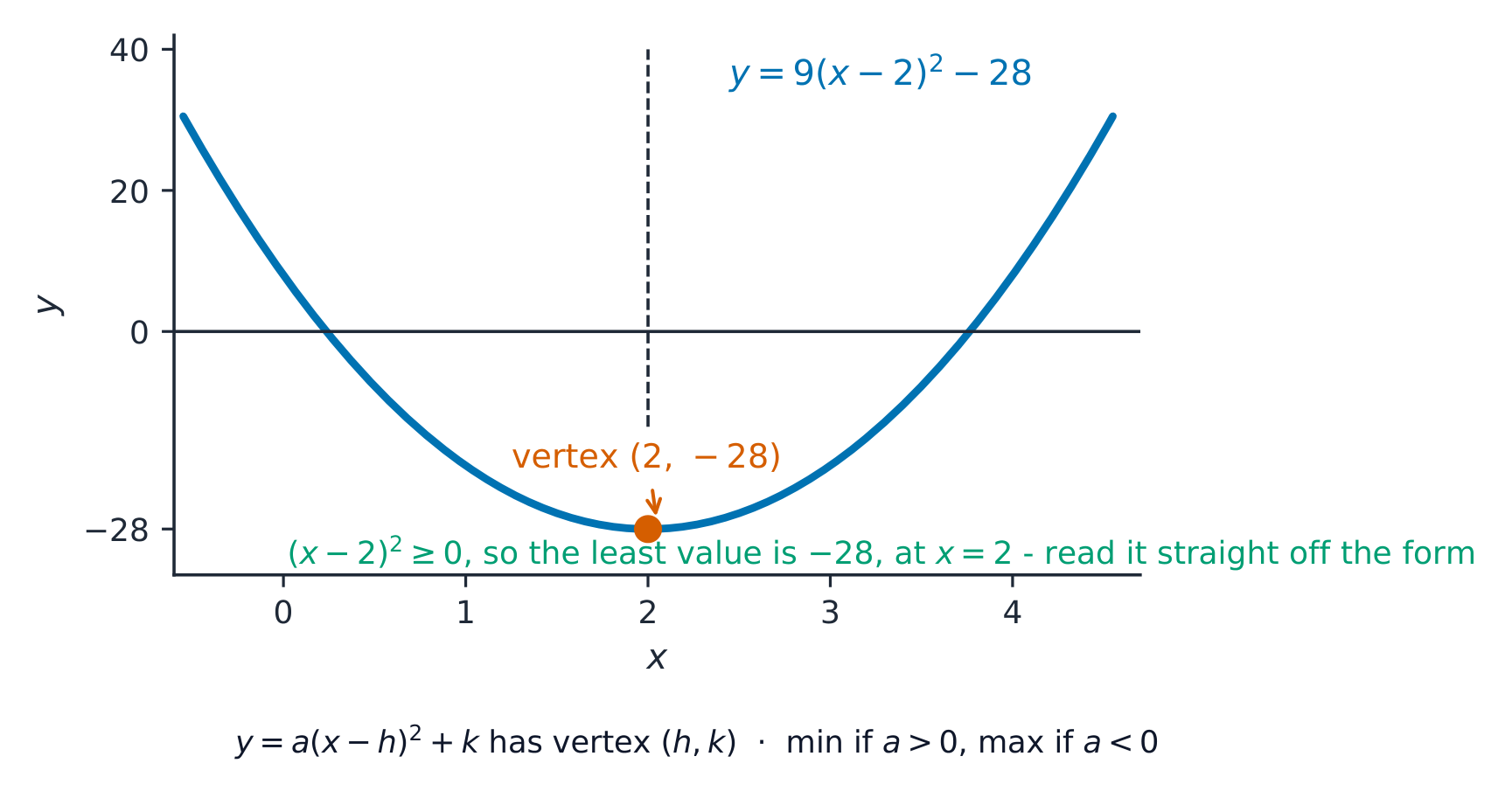
This form is useful: it shows the vertex 顶点 (turning point) of the curve at $(-p,\ q)$, and it gives a quick way to solve the equation.
Worked example. Write $9x^2 - 36x + 8$ in the form $p(x + q)^2 + r$.
Take the factor $9$ out of the first two terms, then complete the square inside:
Factorise: $(k - 4)(k - 16) > 0$, so $k < 4$ or $k > 16$. You also need $a \neq 0$, so $k \neq 0$.
Quadratic equations and inequalities
To solve a quadratic equation 二次方程, factorise, complete the square, or use the formula
$$x = \frac{-b \pm \sqrt{b^2 - 4ac}}{2a}.$$
To solve a quadratic inequality 二次不等式 such as $(k - 4)(k - 16) > 0$, find the two roots, then decide which side of each root makes the statement true. A sketch of the parabola 抛物线 helps: the curve is above the $x$-axis (positive) outside the roots and below it (negative) between them.
Simultaneous equations
To solve a pair of simultaneous equations 联立方程 where one is linear and one is quadratic, use substitution 代入: rearrange the linear equation for one letter, then put that into the quadratic. This gives a single quadratic to solve.
Equations that are quadratic in disguise
Some equations are quadratic in some function of$x$. For example $x^4 - 5x^2 + 4 = 0$ is quadratic in $x^2$: let $u = x^2$, solve $u^2 - 5u + 4 = 0$, then go back to $x$. You will use this idea again in trigonometry.
Tiếng Việt
Hoàn thành bình phương tìm đỉnhCầu treo: dây cáp chính treo xuống theo dạng parabol.
Một biểu thức bậc hai có dạng $ax^2 + bx + c$, trong đó $a \neq 0$. Các chữ cái $a$, $b$, $c$ là các hệ số (các hằng số cố định). Phần lớn nội dung mục này về việc giải phương trình$ax^2 + bx + c = 0$.
Hoàn thành bình phương
Để hoàn thành bình phương có nghĩa là viết biểu thức bậc hai dưới dạng
$$a(x + p)^2 + q.$$
Dạng này rất hữu ích: nó chỉ ra đỉnh (điểm quay chiều) của đồ thị tại $(-p,\ q)$, và cung cấp cách nhanh để giải phương trình.
Phân tích nhân tử: $(k - 4)(k - 16) > 0$, vì vậy $k < 4$ hoặc $k > 16$. Bạn cũng cần $a \neq 0$, nên $k \neq 0$.
Phương trình và bất phương trình bậc hai
Để giải phương trình bậc hai, phân tích nhân tử, hoàn thành bình phương, hoặc sử dụng công thức
$$x = \frac{-b \pm \sqrt{b^2 - 4ac}}{2a}.$$
Để giải bất phương trình bậc hai như $(k - 4)(k - 16) > 0$, tìm hai nghiệm, sau đó quyết định phía nào của mỗi nghiệm làm cho mệnh đề đúng. Một sơ đồ phác thảo của parabol giúp ích: đồ thị nằm trên trục $x$ (dương) ngoài khoảng giữa các nghiệm và nằm dưới trục (âm) giữa chúng.
Hệ phương trình đồng thời
Để giải một hệ phương trình đồng thời gồm một phương trình bậc nhất và một phương trình bậc hai, sử dụng thay thế: sắp xếp lại phương trình bậc nhất theo một ẩn, sau đó thay vào phương trình bậc hai. Điều này tạo ra một phương trình bậc hai đơn lẻ để giải.
Các phương trình ẩn chứa bậc hai
Một số phương trình là bậc hai đối với một hàm của$x$. Ví dụ, $x^4 - 5x^2 + 4 = 0$ là bậc hai theo $x^2$: đặt $u = x^2$, giải $u^2 - 5u + 4 = 0$, sau đó quay trở lại $x$. Bạn sẽ áp dụng ý tưởng này nữa trong lượng giác.
Explore · Khám phá
The shape of a quadratic · Hình dạng của hàm bậc hai
y = ax² + bx + c
Drag a, b and c. Watch the vertex, the line of symmetry and the roots (where it cuts the x-axis) move as the coefficients change. · Kéo a, b và c. Quan sát đỉnh, trục đối xứng và nghiệm (điểm cắt trục hoành) di chuyển khi các hệ số thay đổi.
understand the terms function, domain, range, one-one function, inverse function and composition of functions
identify the range of a given function in simple cases, and find the composition of two given functions
e.g. range of $f : x \mapsto \frac{1}{x}$ for $x \geqslant 1$ and range of $g : x \mapsto x^2 + 1$ for $x \in \mathbb{R}$. Including the condition that a composite function $gf$ can only be formed when the range of $f$ is within the domain of $g$.
determine whether or not a given function is one-one, and find the inverse of a one-one function in simple cases
e.g. finding the inverse of $h : x \mapsto (2x + 3)^2 - 4$ for $x < -\frac{3}{2}$.
illustrate in graphical terms the relation between a one-one function and its inverse
Sketches should include an indication of the mirror line $y = x$.
understand and use the transformations of the graph of $y = f(x)$ given by $y = f(x) + a$, $y = f(x + a)$, $y = af(x)$, $y = f(ax)$ and simple combinations of these.
Including use of the terms ‘translation’, ‘reflection’ and ‘stretch’ in describing transformations. Questions may involve algebraic or trigonometric functions, or other graphs with given features.
Tiếng Việt
thí sinh có khả năng:
Ghi chú và ví dụ
hiểu các thuật ngữ hàm số, miền xác định, miền giá trị, hàm một-một, hàm ngược và sự hợp thành hàm số
xác định miền giá trị của một hàm số đã cho trong các trường hợp đơn giản, và tìm sự hợp thành của hai hàm số đã cho
Ví dụ: miền giá trị của $f : x \mapsto \frac{1}{x}$ cho $x \geqslant 1$ và miền giá trị của $g : x \mapsto x^2 + 1$ cho $x \in \mathbb{R}$. Bao gồm điều kiện rằng hàm hợp thành $gf$ chỉ có thể được tạo thành khi miền giá trị của $f$ nằm trong miền xác định của $g$.
xác định xem một hàm số đã cho có phải là hàm một-một hay không, và tìm hàm ngược của một hàm một-một trong các trường hợp đơn giản
Ví dụ: tìm hàm ngược của $h : x \mapsto (2x + 3)^2 - 4$ cho $x < -\frac{3}{2}$.
minh họa bằng đồ thị mối quan hệ giữa một hàm một-một và hàm ngược của nó
Các bản vẽ sơ đồ nên bao gồm chỉ dẫn về đường đối xứng $y = x$.
hiểu và sử dụng các phép biến đổi của đồ thị $y = f(x)$ được cho bởi $y = f(x) + a$, $y = f(x + a)$, $y = af(x)$, $y = f(ax)$ và các tổ hợp đơn giản của chúng.
Bao gồm việc sử dụng các thuật ngữ 'dịch chuyển', 'phản xạ' và 'kéo dãn' để mô tả các phép biến đổi. Câu hỏi có thể liên quan đến hàm đại số hoặc lượng giác, hoặc các đồ thị khác có các đặc điểm đã cho.
Source: Cambridge International syllabus · Nguồn: Chương trình Cambridge International
English
Transforming graphs: shift and stretch
A function 函数 is a rule that sends each input to exactly one output. Write it as $f(x)$. The composition of functions 复合函数$fg(x)$ means apply $g$ first, then apply $f$ to the result.
The domain 定义域 is the set of allowed inputs $x$.
The range 值域 is the set of outputs the function actually produces.
A function is one-one 一一对应 if different inputs always give different outputs. (No output is repeated.) Only a one-one function has an inverse function 反函数$f^{-1}$, which reverses the rule.
The composition 复合 of two functions means doing one after the other. $fg(x)$ means "do $g$ first, then $f$": $fg(x) = f(g(x))$. The composite function $fg$ exists only when the range of $g$ lies inside the domain of $f$.
Finding an inverse
To find $f^{-1}$: write $y = f(x)$, make $x$ the subject, then swap letters.
Worked example. The function $f(x) = (x + 3)^2 - 12$ is defined for $x \geqslant 0$. Find $f^{-1}(x)$.
Write $y = (x + 3)^2 - 12$ and solve for $x$:
$$(x + 3)^2 = y + 12 \;\Rightarrow\; x + 3 = \sqrt{y + 12} \;\Rightarrow\; x = \sqrt{y + 12} - 3.$$
You take the positive square root because $x \geqslant 0$ means $x + 3 \geqslant 3 > 0$. So
$$f^{-1}(x) = \sqrt{x + 12} - 3.$$
Graphs of inverses and transformations
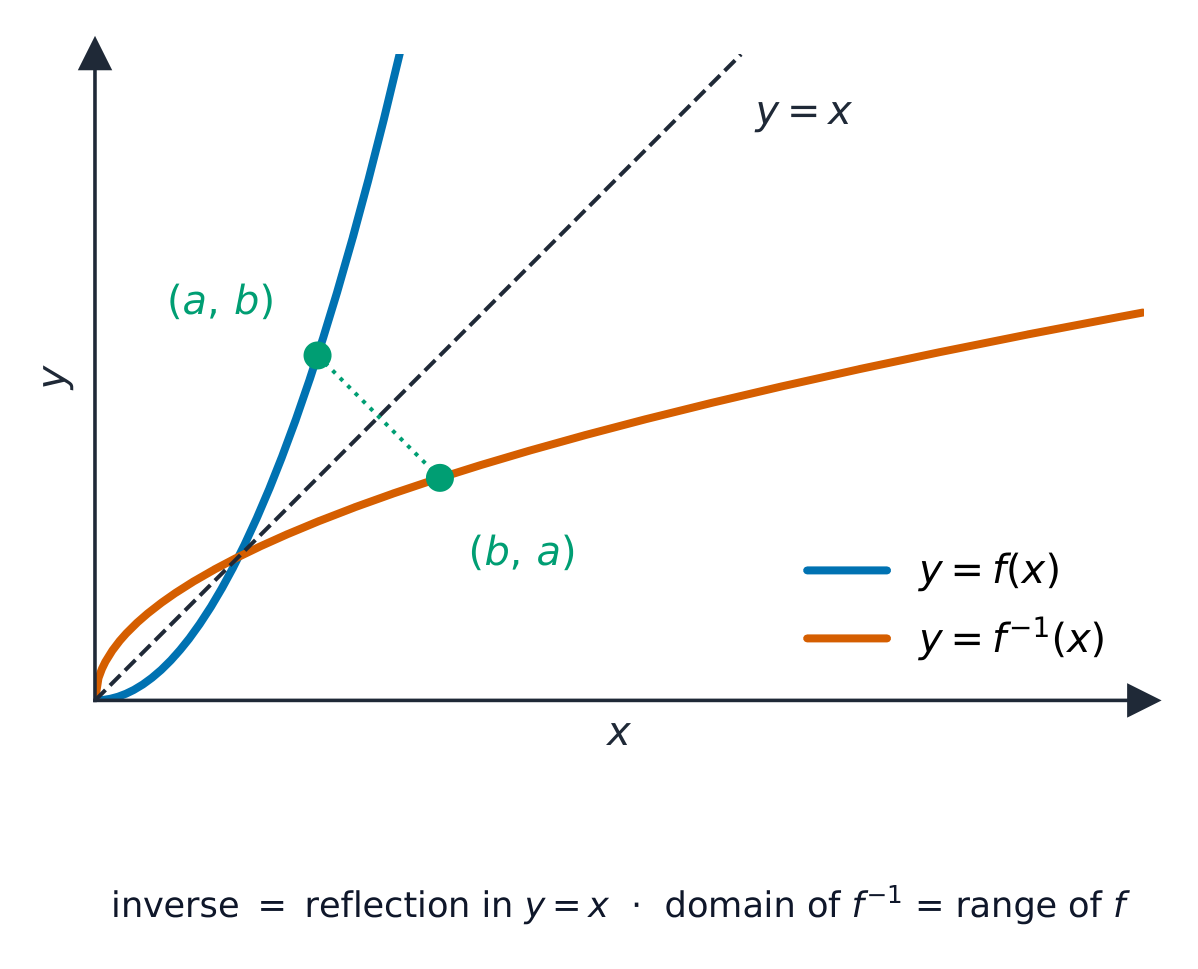
The graph of $y = f^{-1}(x)$ is the reflection 反射 of $y = f(x)$ in the line $y = x$.
You should know these transformations 变换 of $y = f(x)$:
New equation
Effect on the graph
$y = f(x) + a$
translation 平移 up by $a$
$y = f(x + a)$
translation left by $a$
$y = a\,f(x)$
stretch 伸缩 in the $y$-direction, scale factor $a$
$y = f(ax)$
stretch in the $x$-direction, scale factor $\tfrac{1}{a}$
When two transformations are combined, the order can matter. State each one fully (type, direction, and amount).
Tiếng Việt
Biến đổi đồ thị: dịch chuyển và co giãn
Một hàm số là quy tắc gán mỗi giá trị đầu vào với đúng một giá trị đầu ra. Viết nó dưới dạng $f(x)$. Hợp của hai hàm số$fg(x)$ có nghĩa là áp dụng $g$ trước, sau đó áp dụng $f$ lên kết quả.
Tập xác định là tập hợp các giá trị đầu vào được phép $x$.
Tập giá trị là tập hợp các giá trị đầu ra mà hàm số thực tế tạo ra.
Một hàm số được gọi là đồng nhất nếu các giá trị đầu vào khác nhau luôn cho ra các giá trị đầu ra khác nhau. (Không có giá trị đầu ra nào bị lặp lại.) Chỉ có hàm số đồng nhất mới có hàm số nghịch đảo$f^{-1}$, làm ngược lại quy tắc ban đầu.
Hợp của hai hàm số có nghĩa là thực hiện hàm này theo sau hàm kia. $fg(x)$ có nghĩa là "làm $g$ trước, sau đó làm $f$": $fg(x) = f(g(x))$. Hợp hàm $fg$ chỉ tồn tại khi tập giá trị của $g$ nằm trong tập xác định của $f$.
Tìm hàm số nghịch đảo
Để tìm $f^{-1}$: viết $y = f(x)$, biến $x$ thành chủ thể, sau đó hoán vị các ký tự.
Ví dụ có lời giải. Hàm số $f(x) = (x + 3)^2 - 12$ được xác định trên $x \geqslant 0$. Tìm $f^{-1}(x)$.
Viết $y = (x + 3)^2 - 12$ và giải phương trình theo $x$:
$$(x + 3)^2 = y + 12 \;\Rightarrow\; x + 3 = \sqrt{y + 12} \;\Rightarrow\; x = \sqrt{y + 12} - 3.$$
Bạn lấy căn bậc hai dương vì $x \geqslant 0$ có nghĩa là $x + 3 \geqslant 3 > 0$. Do đó
$$f^{-1}(x) = \sqrt{x + 12} - 3.$$
Đồ thị của hàm số nghịch đảo và các phép biến đổi
Đồ thị của $y = f^{-1}(x)$ là phản xạ của $y = f(x)$ qua đường thẳng $y = x$.
Phản xạ $y=f(x)$ qua đường thẳng $y=x$ sẽ thu được hàm nghịch đảo; một điểm $(a,b)$ trở thành $(b,a)$.
Bạn cần nhớ các biến đổi sau đây của $y = f(x)$:
Phương trình mới
Tác động lên đồ thị
$y = f(x) + a$
dịch chuyển lên trên $a$ đơn vị
$y = f(x + a)$
dịch chuyển sang trái $a$ đơn vị
$y = a\,f(x)$
co giãn theo phương $y$, hệ số co giãn $a$
$y = f(ax)$
co giãn theo phương $x$, hệ số co giãn $\tfrac{1}{a}$
Khi kết hợp hai phép biến đổi, thứ tự có thể quan trọng. Hãy mô tả đầy đủ từng phép biến đổi (loại, hướng và lượng).
Cộng thêm vào giá trị đầu ra hoặc đầu vào sẽ trượt đường cong; một thừa số sẽ kéo dãn nó.
Explore · Khám phá
Explore a function · Khám phá hàm số
y = ax³ + bx² + cx + d
A function turns each input into exactly one output — drag the coefficients and watch where the curve rises and falls. · Một hàm số biến mỗi input (đầu vào) thành đúng một output (đầu ra) — kéo các hệ số và xem đường cong tăng hay giảm ở đâu.
find the equation of a straight line given sufficient information
e.g. given two points, or one point and the gradient.
interpret and use any of the forms $y = mx + c$, $y - y_1 = m(x - x_1)$, $ax + by + c = 0$ in solving problems
Including calculations of distances, gradients, midpoints, points of intersection and use of the relationship between the gradients of parallel and perpendicular lines.
understand that the equation $(x - a)^2 + (y - b)^2 = r^2$ represents the circle with centre $(a, b)$ and radius $r$
Including use of the expanded form $x^2 + y^2 + 2gx + 2fy + c = 0$.
use algebraic methods to solve problems involving lines and circles
Including use of elementary geometrical properties of circles, e.g. tangent perpendicular to radius, angle in a semicircle, symmetry. Implicit differentiation is not included.
understand the relationship between a graph and its associated algebraic equation, and use the relationship between points of intersection of graphs and solutions of equations.
e.g. to determine the set of values of $k$ for which the line $y = x + k$ intersects, touches or does not meet a quadratic curve.
Tiếng Việt
thí sinh có khả năng:
Ghi chú và ví dụ
tìm phương trình của đường thẳng khi có đủ thông tin
Ví dụ: cho hai điểm, hoặc một điểm và hệ số góc.
diễn giải và sử dụng bất kỳ dạng nào $y = mx + c$, $y - y_1 = m(x - x_1)$, $ax + by + c = 0$ trong việc giải bài toán
Bao gồm tính toán khoảng cách, hệ số góc, trung điểm, giao điểm và sử dụng mối quan hệ giữa hệ số góc của các đường song song và vuông góc.
hiểu rằng phương trình $(x - a)^2 + (y - b)^2 = r^2$ biểu diễn đường tròn có tâm $(a, b)$ và bán kính $r$
Bao gồm cả việc sử dụng dạng khai triển $x^2 + y^2 + 2gx + 2fy + c = 0$.
sử dụng phương pháp đại số để giải các bài toán liên quan đến đường thẳng và đường tròn
Bao gồm việc sử dụng các tính chất hình học cơ bản của đường tròn, ví dụ: tiếp tuyến vuông góc với bán kính, góc nội tiếp nửa đường tròn, tính đối xứng. Vi phân ngầm định không được bao gồm.
hiểu mối quan hệ giữa một đồ thị và phương trình đại số tương ứng của nó, và sử dụng mối quan hệ giữa các điểm giao nhau của đồ thị và nghiệm của phương trình.
Ví dụ: để xác định tập giá trị của $k$ mà tại đó đường thẳng $y = x + k$ cắt, tiếp xúc hoặc không gặp đường cong bậc hai.
Source: Cambridge International syllabus · Nguồn: Chương trình Cambridge International
English
Coordinate geometry 坐标几何 studies lines and circles using their equations.
Straight lines
The gradient 斜率 (steepness) of the line joining $(x_1, y_1)$ and $(x_2, y_2)$ is
$$m = \frac{y_2 - y_1}{x_2 - x_1}.$$
You can write the equation of a straight line 直线方程 in any of these forms:
$$y = mx + c, \qquad y - y_1 = m(x - x_1), \qquad ax + by + c = 0.$$
Two lines are parallel 平行 when their gradients are equal, and perpendicular 垂直 (at right angles) when the product of their gradients is $-1$.
Circles
The circle 圆 with centre 圆心$(a, b)$ and radius 半径$r$ has equation
$$(x - a)^2 + (y - b)^2 = r^2.$$
An expanded form like $x^2 + y^2 - 6x + 10y - 27 = 0$ is the same circle: complete the square in $x$ and in $y$ to find the centre and radius.
A tangent 切线 to a circle touches it at one point and is perpendicular to the radius at that point. This right-angle fact solves most circle problems.
Worked example. The points $P(1, 1)$ and $Q(7, 11)$ are the ends of a diameter 直径 of a circle. Find the equation of the circle.
Hình học tọa độ nghiên cứu các đường thẳng và đường tròn thông qua phương trình của chúng.
Đường thẳng
Hệ số góc (độ dốc) của đường thẳng nối $(x_1, y_1)$ và $(x_2, y_2)$ là
$$m = \frac{y_2 - y_1}{x_2 - x_1}.$$
Bạn có thể viết phương trình đường thẳng theo bất kỳ dạng nào sau đây:
$$y = mx + c, \qquad y - y_1 = m(x - x_1), \qquad ax + by + c = 0.$$
Hai đường thẳng song song khi hệ số góc của chúng bằng nhau, và vuông góc (tạo góc vuông) khi tích các hệ số góc của chúng bằng $-1$.
Đường tròn
Đường tròn có tâm$(a, b)$ và bán kính$r$ có phương trình
$$(x - a)^2 + (y - b)^2 = r^2.$$
Dạng khai triển như $x^2 + y^2 - 6x + 10y - 27 = 0$ là cùng một đường tròn: hoàn thành bình phương trong $x$ và trong $y$ để tìm tâm và bán kính.
A tiếp tuyến của đường tròn chạm vào nó tại một điểm và vuông góc với bán kính tại điểm đó.事实 vuông góc này giải quyết hầu hết các bài toán về đường tròn.
Tiếp tuyến chạm vào đường tròn một lần và gặp bán kính tại góc vuông.
Ví dụ có lời giải. Các điểm $P(1, 1)$ và $Q(7, 11)$ là hai đầu của một đường kính của đường tròn. Tìm phương trình của đường tròn.
understand the definition of a radian, and use the relationship between radians and degrees
use the formulae $s = r\theta$ and $A = \frac{1}{2}r^2\theta$ in solving problems concerning the arc length and sector area of a circle.
Including calculation of lengths and angles in triangles and areas of triangles.
Tiếng Việt
thí sinh có khả năng:
Ghi chú và ví dụ
hiểu định nghĩa của radian, và sử dụng mối quan hệ giữa radian và độ
sử dụng các công thức $s = r\theta$ và $A = \frac{1}{2}r^2\theta$ trong việc giải các bài toán về độ dài cung tròn và diện tích hình quạt của đường tròn.
Bao gồm tính toán độ dài và góc trong tam giác, cũng như diện tích tam giác.
Source: Cambridge International syllabus · Nguồn: Chương trình Cambridge International
English
What is a radian?
Radians
A radian 弧度 is another way to measure angles. One radian is the angle at the centre of a circle that cuts off an arc 弧 equal in length to the radius. The link between radians and degrees 度 is
$$\pi \text{ radians} = 180^\circ.$$
So to change degrees to radians, multiply by $\dfrac{\pi}{180}$; to change radians to degrees, multiply by $\dfrac{180}{\pi}$.
Arc length and sector area
For a sector 扇形 with radius $r$ and angle $\theta$in radians:
$$\text{arc length} = s = r\theta, \qquad \text{sector area} = A = \tfrac12 r^2 \theta.$$
A chord 弦 cuts the sector into a triangle and a segment 弓形. The segment area is the sector minus the triangle:
Worked example. A sector has centre $O$ and the angle at $O$ is $\tfrac{2}{3}\pi$ radians. Show that the segment cut off by the chord has area about $0.614 r^2$.
Một radian là một cách đo góc khác. Một radian là góc ở tâm của đường tròn chắn một cung có độ dài bằng bán kính. Mối liên hệ giữa radian và độ là
$$\pi \text{ radians} = 180^\circ.$$
Vì vậy, để đổi từ độ sang radian, nhân với $\dfrac{\pi}{180}$; để đổi từ radian sang độ, nhân với $\dfrac{180}{\pi}$.
Một radian: góc có cung bằng bán kính
Độ dài cung và diện tích hình quạt
Đối với một hình quạt có bán kính $r$ và góc $\theta$tính bằng radian:
$$\text{arc length} = s = r\theta, \qquad \text{sector area} = A = \tfrac12 r^2 \theta.$$
Một đây cung chia hình quạt thành một tam giác và một thân cung. Diện tích thân cung là diện tích hình quạt trừ đi diện tích tam giác:
Thân cung được tô màu là phần của hình quạt nằm giữa dây cung và cung tròn.
Ví dụ có lời giải. Một hình quạt có tâm $O$ và góc tại $O$ là $\tfrac{2}{3}\pi$ radian. Chứng minh rằng thân cung bị chắn bởi dây cung có diện tích khoảng $0.614 r^2$.
Radians, arcs and sectors · Góc radian, cung tròn và hình quạt
Change the angle (in radians) and radius. See the arc length$s = r\theta$ and the sector area$\tfrac12 r^2\theta$ update. · Thay đổi góc (tính bằng radian) và bán kính. Xem chiều dài cung$s = r\theta$ và diện tích hình quạt$\tfrac12 r^2\theta$ cập nhật.
sử dụng ký hiệu $\sin^{-1} x$, $\cos^{-1} x$, $\tan^{-1} x$ để chỉ các giá trị chính của các hàm lượng giác ngược
Không yêu cầu kiến thức chuyên sâu về các hàm này, nhưng cần hiểu chúng là các ví dụ về hàm nghịch đảo.
sử dụng các đẳng thức $\frac{\sin \theta}{\cos \theta} \equiv \tan \theta$ và $\sin^2 \theta + \cos^2 \theta \equiv 1$
Ví dụ: trong chứng minh đẳng thức, rút gọn biểu thức và giải phương trình.
tìm tất cả các nghiệm của các phương trình lượng giác đơn giản nằm trong một khoảng cho trước (không bao gồm dạng nghiệm tổng quát).
Ví dụ: giải $3 \sin 2x + 1 = 0$ với $-\pi < x < \pi$, $3 \sin^2 \theta - 5 \cos \theta - 1 = 0$ với $0^\circ \leqslant \theta \leqslant 360^\circ$.
Source: Cambridge International syllabus · Nguồn: Chương trình Cambridge International
English
Amplitude, period and midline of a sine curveThe unit circle draws the sine curve
Graphs and exact values
You must know the shape of the graphs of the sine 正弦, cosine 余弦 and tangent function 正切 (written $\sin$, $\cos$, $\tan$). The sine and cosine graphs wave between $-1$ and $1$ and repeat every $360^\circ$ ($2\pi$). Learn these exact values:
$\theta$
$30^\circ$
$45^\circ$
$60^\circ$
$\sin\theta$
$\tfrac12$
$\tfrac{1}{\sqrt2}$
$\tfrac{\sqrt3}{2}$
$\cos\theta$
$\tfrac{\sqrt3}{2}$
$\tfrac{1}{\sqrt2}$
$\tfrac12$
$\tan\theta$
$\tfrac{1}{\sqrt3}$
$1$
$\sqrt3$
The notations $\sin^{-1}x$, $\cos^{-1}x$, $\tan^{-1}x$ mean the inverse angle (the principal value 主值).
Identities
An identity 恒等式 is true for every value of the angle. The two you must know are
$\sin\theta = -\tfrac12$: $\theta = -30^\circ$ or $\theta = -150^\circ$.
The four solutions are $\theta = -150^\circ,\ -30^\circ,\ 41.8^\circ,\ 138.2^\circ$.
Tiếng Việt
Biên độ, chu kỳ và đường trung bình của đường cong sinVòng tròn đơn vị vẽ nên đường cong sinMột bánh xe quan sát: một điểm trên vành quay lên và xuống giống như đường cong sin.
Đồ thị và giá trị chính xác
Bạn phải biết hình dạng của các đồ thị của hàm sin, hàm cosin và hàm tangent (viết là $\sin$, $\cos$, $\tan$). Đồ thị sin và cosin dao động giữa $-1$ và $1$ và lặp lại mỗi $360^\circ$ ($2\pi$). Học thuộc các giá trị chính xác này:
$\theta$
$30^\circ$
$45^\circ$
$60^\circ$
$\sin\theta$
$\tfrac12$
$\tfrac{1}{\sqrt2}$
$\tfrac{\sqrt3}{2}$
$\cos\theta$
$\tfrac{\sqrt3}{2}$
$\tfrac{1}{\sqrt2}$
$\tfrac12$
$\tan\theta$
$\tfrac{1}{\sqrt3}$
$1$
$\sqrt3$
Trong một vòng quay $\sin$ và $\cos$ vẫn nằm giữa $-1$ và $1$; $\tan$ bay vút lên tại $90^\circ$ và $270^\circ$.
Các ký hiệu $\sin^{-1}x$, $\cos^{-1}x$, $\tan^{-1}x$ biểu thị góc nghịch đảo (giá trị chính).
Các đẳng thức
Một đẳng thức đúng với mọi giá trị của góc. Hai đẳng thức bạn cần nhớ là
$\sin\theta = -\tfrac12$: $\theta = -30^\circ$ hoặc $\theta = -150^\circ$.
Bốn nghiệm là $\theta = -150^\circ,\ -30^\circ,\ 41.8^\circ,\ 138.2^\circ$.
Explore · Khám phá
Sine & cosine graphs · Đồ thị Sin & Cosin
Drag the amplitude, period and shifts of y = a·sin(bx + c) + d and watch the curve change against the base wave. · Kéo biên độ, chu kỳ và dịch chuyển của y = a·sin(bx + c) + d và xem đường cong thay đổi thế nào so với sóng cơ sở.
Explore · Khám phá
Sine and cosine on the unit circle · Hàm sin và cosin trên đường tròn đơn vị
Drag the angle round the unit circle. The height is $\sin\theta$, the across-distance is $\cos\theta$ — that's where the graphs come from. · Kéo góc quanh đường tròn đơn vị. Chiều cao là $\sin\theta$, chiều ngang là $\cos\theta$ — đó chính là nguồn gốc của các đồ thị.
use the expansion of $(a + b)^n$, where $n$ is a positive integer
Including the notations $\begin{pmatrix} n \\ r \end{pmatrix}$ and $n!$ Knowledge of the greatest term and properties of the coefficients are not required.
recognise arithmetic and geometric progressions
use the formulae for the $n$th term and for the sum of the first $n$ terms to solve problems involving arithmetic or geometric progressions
Including knowledge that numbers $a$, $b$, $c$ are 'in arithmetic progression' if $2b = a + c$ (or equivalent) and are 'in geometric progression' if $b^2 = ac$ (or equivalent). Questions may involve more than one progression.
use the condition for the convergence of a geometric progression, and the formula for the sum to infinity of a convergent geometric progression.
Tiếng Việt
thí sinh có khả năng:
Ghi chú và ví dụ
sử dụng khai triển của $(a + b)^n$, trong đó $n$ là số nguyên dương
Bao gồm cả ký hiệu $\begin{pmatrix} n \\ r \end{pmatrix}$ và $n!$. Không yêu cầu biết số hạng lớn nhất và tính chất của các hệ số.
nhận biết dãy cộng và dãy nhân
sử dụng công thức cho số hạng thứ $n$ và tổng $n$ số hạng đầu tiên để giải các bài toán liên quan đến dãy cộng hoặc dãy nhân
Bao gồm kiến thức rằng ba số $a$, $b$, $c$ 'thuộc dãy cộng' nếu $2b = a + c$ (hoặc tương đương) và 'thuộc dãy nhân' nếu $b^2 = ac$ (hoặc tương đương). Câu hỏi có thể涉及 nhiều hơn một dãy.
sử dụng điều kiện hội tụ của một dãy nhân, và công thức tổng vô hạn của một dãy hội tụ.
Source: Cambridge International syllabus · Nguồn: Chương trình Cambridge International
English
Pascal's triangle gives the coefficientsSum to infinity fills the square
The binomial expansion
For a positive integer $n$, the binomial expansion 二项展开式 is
A progression 数列 (sequence) is a list of terms following a rule.
An arithmetic progression 等差数列 (AP) adds a fixed common difference 公差$d$ each step. The $n$th term 项 is $u_n = a + (n - 1)d$, and the sum of the first $n$ terms is $S_n = \tfrac{n}{2}\big(2a + (n - 1)d\big)$.
A geometric progression 等比数列 (GP) multiplies by a fixed common ratio 公比$r$ each step. The $n$th term is $u_n = ar^{\,n-1}$, and $S_n = \dfrac{a(1 - r^n)}{1 - r}$.
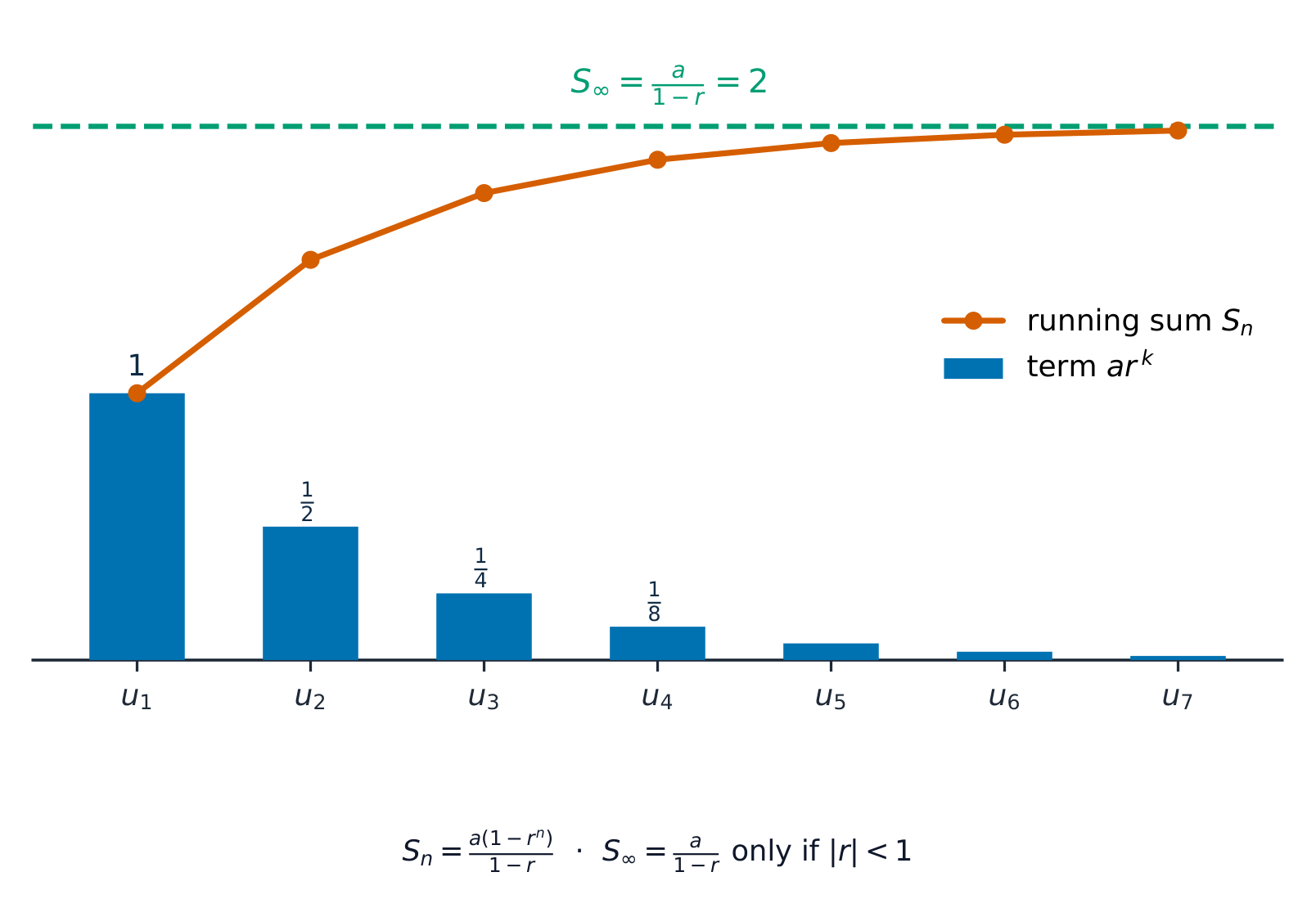
A GP is convergent — it converges 收敛 (settles to a limit) — when $|r| < 1$. Then it has a sum to infinity 无穷和
$$S_\infty = \frac{a}{1 - r}.$$
Worked example. The third term of a GP is $18$ and the sum of the first three terms is $26$. The common ratio is negative. Find the sum to infinity.
From $ar^2 = 18$ you get $a = \dfrac{18}{r^2}$. Put this into $a(1 + r + r^2) = 26$:
Một cấp số là danh sách các số hạng tuân theo một quy luật.
Một cấp số cộng (AP) cộng một bậc common difference cố định $d$ ở mỗi bước. Số hạng thứ $n$ là $u_n = a + (n - 1)d$, và tổng của $n$ số hạng đầu là $S_n = \tfrac{n}{2}\big(2a + (n - 1)d\big)$.
Một cấp số nhân (GP) nhân với một công bội cố định $r$ mỗi bước. Số hạng thứ $n$ là $u_n = ar^{\,n-1}$, và $S_n = \dfrac{a(1 - r^n)}{1 - r}$.
Cấp số cộng leo lên theo các bước bằng nhau; các bước của cấp số nhân tăng lên theo cùng một tỷ lệ
Cấp số nhân là hội tụ — nó hội tụ (tập trung về một giới hạn) — khi $|r| < 1$. Khi đó nó có một tổng vô hạn
$$S_\infty = \frac{a}{1 - r}.$$
Ví dụ có lời giải. Số hạng thứ ba của một GP là $18$ và tổng của ba số hạng đầu là $26$. Tỷ số là số âm. Tìm tổng vô hạn.
Từ $ar^2 = 18$ bạn thu được $a = \dfrac{18}{r^2}$. Thay điều này vào $a(1 + r + r^2) = 26$:
Cấp số nhân hội tụ: các thanh co lại tiến về phía zero trong khi tổng tích lũy tiến gần S vô hạn = a/(1-r)
Explore · Khám phá
Arithmetic and geometric sequences · Dãy số cộng và dãy số nhân
Switch between an arithmetic (add d) and a geometric (multiply by r) sequence and watch the terms and their sum build up. · Chuyển đổi giữa dãy số cộng (cộng d) và dãy số nhân (nhân r) và xem các số hạng cũng như tổng của chúng phát triển như thế nào.
understand the gradient of a curve at a point as the limit of the gradients of a suitable sequence of chords, and use the notations $f'(x)$, $f''(x)$, $\frac{\text{d}y}{\text{d}x}$, and $\frac{\text{d}^2y}{\text{d}x^2}$ for first and second derivatives
Only an informal understanding of the idea of a limit is expected. e.g. includes consideration of the gradient of the chord joining the points with $x$ coordinates $2$ and $(2 + h)$ on the curve $y = x^3$. Formal use of the general method of differentiation from first principles is not required.
use the derivative of $x^n$ (for any rational $n$), together with constant multiples, sums and differences of functions, and of composite functions using the chain rule
e.g. find $\frac{\text{d}y}{\text{d}x}$, given $y = \sqrt{2x^3 + 5}$.
apply differentiation to gradients, tangents and normals, increasing and decreasing functions and rates of change
Including connected rates of change, e.g. given the rate of increase of the radius of a circle, find the rate of increase of the area for a specific value of one of the variables.
locate stationary points and determine their nature, and use information about stationary points in sketching graphs.
Including use of the second derivative for identifying maxima and minima; alternatives may be used in questions where no method is specified. Knowledge of points of inflexion is not included.
Tiếng Việt
thí sinh có khả năng:
Ghi chú và ví dụ
hiểu hệ số góc của một đường cong tại một điểm là giới hạn của hệ số góc của một dãy dây cung thích hợp, và sử dụng các ký hiệu $f'(x)$, $f''(x)$, $\frac{\text{d}y}{\text{d}x}$, và $\frac{\text{d}^2y}{\text{d}x^2}$ cho đạo hàm cấp một và đạo hàm cấp hai
Chỉ yêu cầu hiểu khái niệm giới hạn ở mức phi chính thức. Ví dụ: bao gồm xem xét hệ số góc của dây cung nối hai điểm có $x$ tọa độ $2$ và $(2 + h)$ trên đường cong $y = x^3$. Không yêu cầu áp dụng chính thức phương pháp đạo hàm từ định nghĩa cơ bản.
sử dụng đạo hàm của $x^n$ (với mọi số hữu tỉ $n$), cùng với hằng số nhân, tổng, hiệu của các hàm, và của hàm hợp thông qua quy tắc chuỗi
Ví dụ: tìm $\frac{\text{d}y}{\text{d}x}$, biết $y = \sqrt{2x^3 + 5}$.
áp dụng đạo hàm vào hệ số góc, tiếp tuyến và pháp tuyến, hàm đồng biến/nghịch biến và tốc độ biến thiên
Bao gồm tốc độ biến thiên liên kết, ví dụ: biết tốc độ tăng của bán kính đường tròn, tìm tốc độ tăng của diện tích cho một giá trị cụ thể của một biến số.
xác định các điểm dừng và phân loại tính chất của chúng, và sử dụng thông tin về điểm dừng để vẽ sơ đồ đồ thị.
Bao gồm sử dụng đạo hàm cấp hai để xác định cực đại và cực tiểu; các phương pháp thay thế có thể được dùng trong câu hỏi khi không chỉ định phương pháp cụ thể. Không bao gồm kiến thức về điểm uốn.
Source: Cambridge International syllabus · Nguồn: Chương trình Cambridge International
English
Differentiation from first principles
Differentiation 微分 finds the gradient of a curve 曲线斜率 at each point. The gradient is the limit 极限 of the gradients of shorter and shorter chords, called the derivative 导数.
The rules
Write the derivative as $f'(x)$ or $\dfrac{dy}{dx}$. The basic rule is
$$\frac{d}{dx}\left(x^n\right) = n x^{n-1} \quad \text{for any rational } n.$$
Differentiate sums term by term, and use the chain rule 链式法则 for a function inside a function:
$$\frac{d}{dx}\,f(g(x)) = f'(g(x)) \cdot g'(x).$$
Differentiating again gives the second derivative 二阶导数$f''(x)$ or $\dfrac{d^2y}{dx^2}$.
Using the derivative
Tangent and normal. The gradient of the curve at a point is the gradient of the tangent there. The normal 法线 is perpendicular to the tangent, so its gradient is $-\dfrac{1}{\text{(tangent gradient)}}$.
Increasing or decreasing. The function is an increasing function 增函数 where $\dfrac{dy}{dx} > 0$, and a decreasing function 减函数 where $\dfrac{dy}{dx} < 0$.
Rate of change. A derivative is a rate of change 变化率. Linked rates use the chain rule, e.g. $\dfrac{dy}{dt} = \dfrac{dy}{dx}\cdot\dfrac{dx}{dt}$.
Stationary points
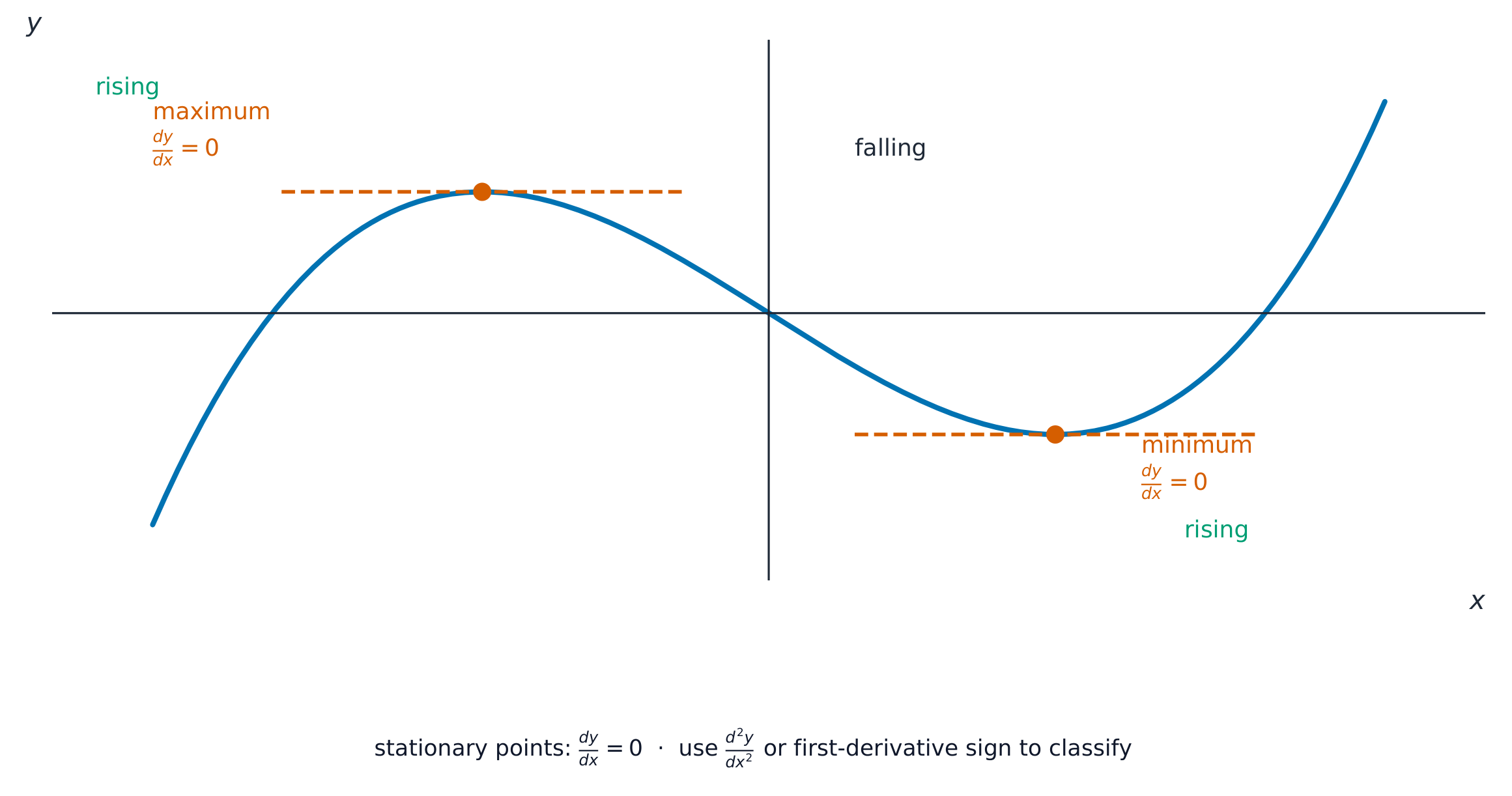
A stationary point 驻点 is where $\dfrac{dy}{dx} = 0$. Test its nature with the second derivative: $f''(x) > 0$ gives a minimum point 极小值点, and $f''(x) < 0$ gives a maximum point 极大值点. When $f''(x) = 0$ the test is inconclusive: the point may be a point of inflexion 拐点, where the curve changes concavity (the way it bends) – check the sign of $\dfrac{dy}{dx}$ just before and after to decide.
Worked example. The curve $y = 4x^{1/2} - x$ has a maximum point at $x = a$. Find $a$.
Vi phân tìm hệ số góc của đường cong tại mỗi điểm. Hệ số góc là giới hạn của các hệ số góc của những dây cung ngắn dần, gọi là đạo hàm.
Các quy tắc
Viết đạo hàm dưới dạng $f'(x)$ hoặc $\dfrac{dy}{dx}$. Quy tắc cơ bản là
$$\frac{d}{dx}\left(x^n\right) = n x^{n-1} \quad \text{for any rational } n.$$
Vi phân từng số hạng của tổng, và sử dụng quy tắc chuỗi cho một hàm số nằm trong một hàm số khác:
$$\frac{d}{dx}\,f(g(x)) = f'(g(x)) \cdot g'(x).$$
Vi phân thêm một lần nữa sẽ cho đạo hàm cấp hai$f''(x)$ hoặc $\dfrac{d^2y}{dx^2}$.
Sử dụng đạo hàm
Tiếp tuyến và pháp tuyến. Hệ số góc của đường cong tại một điểm là hệ số góc của tiếp tuyến tại đó. Pháp tuyến vuông góc với tiếp tuyến, do đó hệ số góc của nó là $-\dfrac{1}{\text{(tangent gradient)}}$.
Đồng biến hay nghịch biến. Hàm số là hàm đồng biến nơi $\dfrac{dy}{dx} > 0$, và là hàm nghịch biến nơi $\dfrac{dy}{dx} < 0$.
Tốc độ thay đổi. Đạo hàm là một tốc độ thay đổi. Các tốc độ liên kết sử dụng quy tắc chuỗi, ví dụ $\dfrac{dy}{dt} = \dfrac{dy}{dx}\cdot\dfrac{dx}{dt}$.
Điểm dừng
Một điểm dừng là nơi $\dfrac{dy}{dx} = 0$. Kiểm tra tính chất của nó bằng đạo hàm cấp hai: $f''(x) > 0$ cho thấy điểm cực tiểu, và $f''(x) < 0$ cho thấy điểm cực đại. Khi $f''(x) = 0$ phép kiểm tra không conclusiveness: điểm đó có thể là điểm uốn, nơi đường cong thay đổi độ lồi (cách nó bẻ cong) – hãy kiểm tra dấu của $\dfrac{dy}{dx}$ ngay trước và sau điểm đó để quyết định.
Tại điểm cực đại hoặc cực tiểu, tiếp tuyến nằm ngang, nên $\frac{dy}{dx}=0$.
Ví dụ có lời giải. Đường cong $y = 4x^{1/2} - x$ có điểm cực đại tại $x = a$. Tìm $a$.
Slide the point along the curve. The tangent shows the gradient $\frac{dy}{dx}$ there — steeper where the curve bends more. · Trượt điểm dọc theo đường cong. Tiếp tuyến cho thấy độ dốc $\frac{dy}{dx}$ tại đó — càng dốc nơi đường cong uốn cong nhiều hơn.
equation of a straight line/ɪˈkweɪʒn əvə streɪt laɪn/
phương trình đường thẳng
parallel/ˈpærəlel/
song song
perpendicular/ˌpɜːpənˈdɪkjʊlə/
vuông góc
stationary point/ˈsteɪʃənəri pɔɪnt/
điểm dừng
minimum point/ˈmɪnɪməm pɔɪnt/
điểm cực tiểu
maximum point/ˈmæksɪməm pɔɪnt/
điểm cực đại
point of inflexion/pɔɪnt ɒv ɪnˈflekʃn/
điểm uốn
Integration/ˌɪntɪˈɡreɪʃn/
Tích phân
constant of integration/ˈkɒnstənt ɒv ˌɪntɪˈɡreɪʃn/
hằng số tích phân
definite integral/ˈdefɪnət ˈɪntɪɡrəl/
tích phân xác định
region/ˈriːdʒn/
vùng lãnh thổ
improper integral/ɪmˈprɒpə ˈɪntɪɡrəl/
tích phân bất thường
volume of revolution/ˈvɒljuːm ɒv ˌrevəˈluːʃn/
thể tích vật thể tròn xoay
algebra/ˈældʒɪbrə/
đại số
calculus/ˈkælkjʊləs/
vi phân tích
coefficient/ˌkəʊɪˈfɪʃənt/
hệ số
1.8
Integration · Tích phân
Syllabus · Chương trình
English
Candidates should be able to:
Notes and examples
understand integration as the reverse process of differentiation, and integrate $(ax + b)^n$ (for any rational $n$ except $-1$), together with constant multiples, sums and differences
solve problems involving the evaluation of a constant of integration
e.g. to find the equation of the curve through $(1, -2)$ for which $\frac{\text{d}y}{\text{d}x} = \sqrt{2x + 1}$.
evaluate definite integrals
Including simple cases of 'improper' integrals, such as $\int_{0}^{1} x^{-\frac{1}{2}} \text{d}x$ and $\int_{1}^{\infty} x^{-2} \text{d}x$.
use definite integration to find: - the area of a region bounded by a curve and lines parallel to the axes, or between a curve and a line or between two curves - a volume of revolution about one of the axes.
A volume of revolution may involve a region not bounded by the axis of rotation, e.g. the region between $y = 9 - x^2$ and $y = 5$ rotated about the $x$-axis.
Tiếng Việt
thí sinh có khả năng:
Ghi chú và ví dụ
hiểu tích phân là quá trình ngược lại của đạo hàm, và tích phân $(ax + b)^n$ (với mọi số hữu tỉ $n$ ngoại trừ $-1$), cùng với hằng số nhân, tổng, hiệu
giải các bài toán liên quan đến việc xác định hằng số tích phân
Ví dụ: tìm phương trình đường cong đi qua $(1, -2)$ sao cho $\frac{\text{d}y}{\text{d}x} = \sqrt{2x + 1}$.
tính tích phân xác định
Bao gồm các trường hợp đơn giản của 'tích phân suy biến', chẳng hạn như $\int_{0}^{1} x^{-\frac{1}{2}} \text{d}x$ và $\int_{1}^{\infty} x^{-2} \text{d}x$.
sử dụng tích phân xác định để tìm: - diện tích của vùng giới hạn bởi một đường cong và các đường thẳng song song với trục tọa độ, hoặc giữa đường cong và một đường thẳng, hoặc giữa hai đường cong - thể tích khối xoay quanh một trong các trục.
Thể tích khối xoay có thể liên quan đến vùng không bị giới hạn bởi trục quay, ví dụ: vùng giữa $y = 9 - x^2$ và $y = 5$ quay quanh trục $x$.
Source: Cambridge International syllabus · Nguồn: Chương trình Cambridge International
English
Integration as area: Riemann rectangles
Integration 积分 is the reverse of differentiation. Reversing the power rule gives
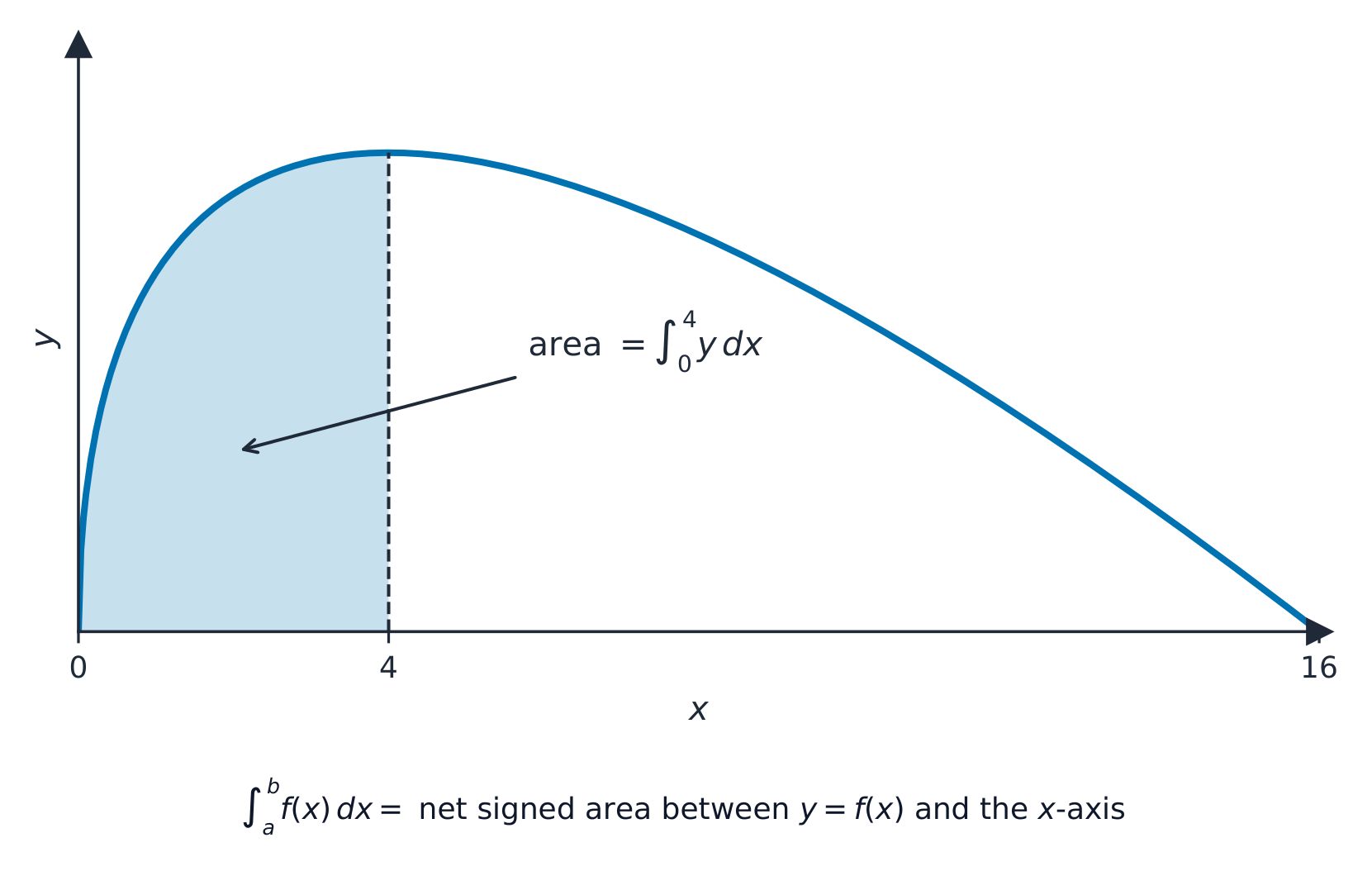
The area of the region 区域 between a curve and the $x$-axis, from $x = p$ to $x = q$, is $\displaystyle\int_p^q y \, dx$. For the area between two curves, integrate (top curve $-$ bottom curve).
Worked example. The curve $y = 4x^{1/2} - x$ meets the $x$-axis again at $x = 16$. Find the area between the curve and the $x$-axis from $x = 0$ to $x = 4$.
and $\displaystyle\int_0^{1}x^{-1/2}\, dx=\left[2x^{1/2}\right]_0^{1}=2$, which is finite even though the integrand blows up at $x=0$.
Volume of revolution
When a region is turned all the way around an axis it sweeps out a solid. The volume of revolution 旋转体体积 about the $x$-axis is
$$V = \pi \int_p^q y^2 \, dx,$$
and about the $y$-axis it is $V = \pi \displaystyle\int x^2 \, dy$. For example, the region under $y = \sqrt{x}$ from $x = 0$ to $x = 4$, turned about the $x$-axis, has volume $\pi\displaystyle\int_0^4 x\, dx = \pi\big[\tfrac{x^2}{2}\big]_0^4 = 8\pi$.
Tiếng Việt
Tích phân như diện tích: Các hình chữ nhật Riemann
Tích phân là quá trình ngược lại của vi phân. Đảo ngược quy tắc lũy thừa cho ra
Diện tích của vùng giữa đường cong và trục $x$, từ $x = p$ đến $x = q$, là $\displaystyle\int_p^q y \, dx$. Đối với diện tích giữa hai đường cong, hãy tích phân (đường cong trên $-$ đường cong dưới).
Tích phân xác định $\int_0^4 y\,dx$ là diện tích được tô màu dưới đường cong.
Ví dụ có lời giải. Đường cong $y = 4x^{1/2} - x$ cắt trục $x$ lần nữa tại $x = 16$. Tìm diện tích giữa đường cong và trục $x$ từ $x = 0$ đến $x = 4$.
và $\displaystyle\int_0^{1}x^{-1/2}\, dx=\left[2x^{1/2}\right]_0^{1}=2$, là giá trị hữu hạn mặc dù hàm dưới dấu tích phân tiến tới vô cùng tại $x=0$.
Thể tích của vật thể quay
Khi một vùng được quay trọn vẹn quanh một trục, nó tạo ra một khối. Thể tích quay quanh trục $x$ là
$$V = \pi \int_p^q y^2 \, dx,$$
và quanh trục $y$ thì là $V = \pi \displaystyle\int x^2 \, dy$. Ví dụ, vùng nằm dưới $y = \sqrt{x}$ từ $x = 0$ đến $x = 4$, khi quay quanh trục $x$, sẽ có thể tích là $\pi\displaystyle\int_0^4 x\, dx = \pi\big[\tfrac{x^2}{2}\big]_0^4 = 8\pi$.
Quay vùng nằm dưới đường cong quanh trục $x$ sẽ tạo ra một khối; mỗi lát cắt mỏng là một đĩa có diện tích $\pi y^2$, do đó $V = \pi\int y^2\,dx$
Explore · Khám phá
Area under a curve · Diện tích dưới đường cong
y = ax³ + bx² + cx + d
Drag the limits. The definite integral is the shaded area between the curve and the x-axis. · Kéo giới hạn. Tích phân xác định chính là diện tích được tô màu giữa đường cong và trục hoành.
1.8
Exam tips · Mẹo làm bài thi
English
Show every line of algebra — method marks are lost by jumping steps; use the discriminant$b^2 - 4ac$ to decide the number of real roots.
Work in radians for circular measure (arc $= r\theta$, sector area $= \frac{1}{2}r^2\theta$) and for calculus of trig functions.
For differentiation, set $\frac{dy}{dx} = 0$ for stationary points and use the second derivative to classify them.
For integration, add $+ c$ to an indefinite integral and use limits for area; an area below the axis gives a negative integral.
Tiếng Việt
Hiển thị mọi bước đại số — điểm phương pháp sẽ bị mất nếu bỏ qua các bước trung gian; sử dụng biệt thức$b^2 - 4ac$ để xác định số nghiệm thực.
Làm việc trong radian cho đo lường vòng tròn (cung $= r\theta$, diện tích phân đoạn $= \frac{1}{2}r^2\theta$) và cho vi phân của các hàm lượng giác.
Đối với đạo hàm, đặt $\frac{dy}{dx} = 0$ để tìm điểm dừng và sử dụng đạo hàm bậc hai để phân loại chúng.
Đối với tích phân, thêm $+ c$ vào tích phân chưa xác định và sử dụng giới hạn cho diện tích; một diện tích nằm dưới trục sẽ cho kết quả tích phân âm.
This handout covers Topic 2: Pure Mathematics 纯数学 2. It adds the modulus and polynomial algebra, logarithms 对数 and the exponential function 指数函数, more trigonometry, and new ways to differentiate and integrate.
Tiếng Việt
Tài liệu này bao gồm Chủ đề 2: Toán thuần túy 2. Nó bổ sung về mô-đun và đại số đa thức, logarit và hàm mũ, nhiều lượng giác hơn, và các cách mới để đạo hàm và tích phân.
2.1
Algebra · Đại số
Syllabus · Chương trình
Candidates should be able to:
Notes and examples
understand the meaning of $|x|$, sketch the graph of $y = |ax + b|$ and use relations such as $|a| = |b| \iff a^2 = b^2$ and $|x - a| < b \iff a - b < x < a + b$ when solving equations and inequalities
Graphs of $y = |f(x)|$ and $y = f(|x|)$ for non-linear functions $f$ are not included. e.g. $|3x - 2| = |2x + 7|$, $2x + 5 < |x + 1|$
divide a polynomial, of degree not exceeding 4, by a linear or quadratic polynomial, and identify the quotient and remainder (which may be zero)
use the factor theorem and the remainder theorem.
e.g. to find factors and remainders, solve polynomial equations or evaluate unknown coefficients. Including factors of the form $(ax + b)$ in which the coefficient of $x$ is not unity, and including calculation of remainders.
Source: Cambridge International syllabus · Nguồn: Chương trình Cambridge International
English
The modulus
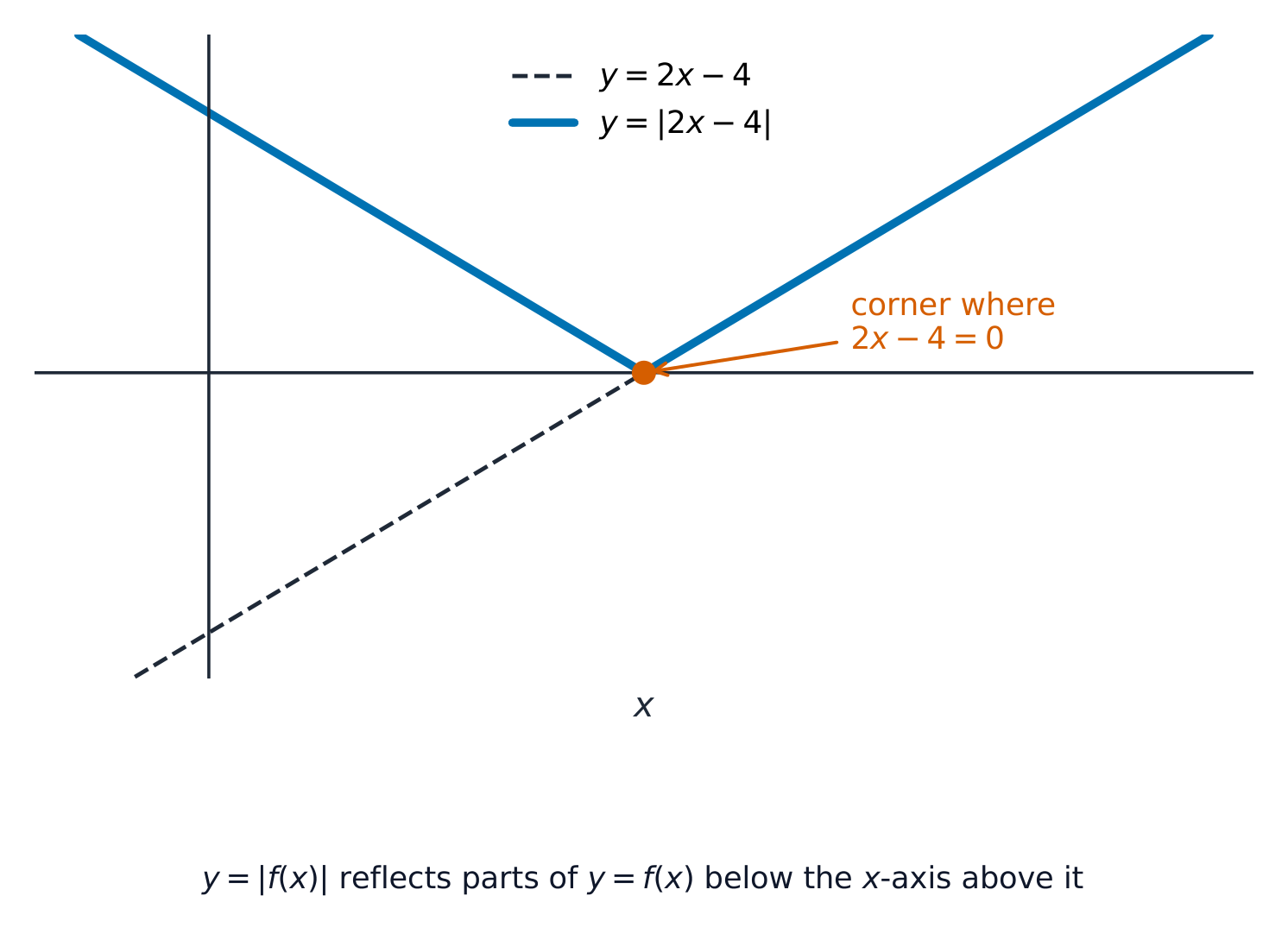
The modulus 绝对值$|x|$ is the size of a number with its sign removed, so $|x| \geqslant 0$ always. The graph of $y = |ax + b|$ is a "V" shape that bounces off the $x$-axis. Two useful rules for solving equations and inequalities are
$$|a| = |b| \;\Leftrightarrow\; a^2 = b^2, \qquad |x - a| < b \;\Leftrightarrow\; a - b < x < a + b.$$
Worked example. Solve $|3x + 8| < 9$.
Using the second rule with the inequality written as $-9 < 3x + 8 < 9$:
Polynomial division and the factor and remainder theorems
A polynomial 多项式 is a sum of powers of $x$, such as $2x^4 + 3x^2 - 5$. Its degree 次数 is the highest power. When you divide one polynomial by another you get a quotient 商 and a remainder 余数.
Remainder theorem 余数定理: the remainder when $p(x)$ is divided by $(x - a)$ is $p(a)$.
Factor theorem 因式定理: $(x - a)$ is a factor of $p(x)$ exactly when $p(a) = 0$.
Worked example. The polynomial $p(x) = 2x^4 + kx^3 + kx^2 + 17x + 18$ has factor $(x + 2)$. Find $k$.
Mô-đun$|x|$ là kích thước của một số khi đã loại bỏ dấu, vì vậy $|x| \geqslant 0$ luôn đúng. Đồ thị của $y = |ax + b|$ có dạng chữ "V" và phản xạ lại trục $x$. Hai quy tắc hữu ích để giải phương trình và bất phương trình là
$$|a| = |b| \;\Leftrightarrow\; a^2 = b^2, \qquad |x - a| < b \;\Leftrightarrow\; a - b < x < a + b.$$
Lấy mô-đun sẽ gập phần của đường thẳng nằm dưới trục lên trên tạo thành hình chữ V.
Ví dụ minh họa. Giải $|3x + 8| < 9$.
Sử dụng quy tắc thứ hai với bất phương trình viết dưới dạng $-9 < 3x + 8 < 9$:
Một đa thức là tổng của các lũy thừa của $x$, chẳng hạn như $2x^4 + 3x^2 - 5$. Bậc của nó là lũy thừa cao nhất. Khi bạn chia một đa thức cho một đa thức khác, bạn sẽ nhận được một thương và một dư.
Định lý dư: dư khi chia $p(x)$ cho $(x - a)$ là $p(a)$.
Định lý nhân tử: $(x - a)$ là nhân tử của $p(x)$ khi và chỉ khi $p(a) = 0$.
Ví dụ minh họa. Đa thức $p(x) = 2x^4 + kx^3 + kx^2 + 17x + 18$ có nhân tử là $(x + 2)$. Tìm $k$.
The modulus makes a V-shape. Move its vertex with b and c; change how steep the arms are with a. · Hàm giá trị tuyệt đối tạo thành hình chữ V. Di chuyển đỉnh bằng b và c; thay đổi độ dốc của cánh tay bằng a.
use logarithms to transform a given relationship to linear form, and hence determine unknown constants by considering the gradient and/or intercept.
e.g. $y = kx^n$ gives $\ln y = \ln k + n \ln x$ which is linear in $\ln x$ and $\ln y$$y = k(a^x)$ gives $\ln y = \ln k + x \ln a$ which is linear in $x$ and $\ln y$.
Tiếng Việt
thí sinh có khả năng:
Ghi chú và ví dụ
hiểu mối liên hệ giữa logarit và lũy thừa, và sử dụng các quy tắc logarit (trừ đổi cơ số)
hiểu định nghĩa và tính chất của $e^x$ và $\ln x$, bao gồm mối quan hệ của chúng như các hàm nghịch đảo và đồ thị của chúng
Bao gồm kiến thức về đồ thị của $y = e^{kx}$ cho cả giá trị dương và âm của $k$.
sử dụng logarit để giải các phương trình và bất phương trình mà trong đó ẩn số xuất hiện ở số mũ
sử dụng lôgarit để biến đổi một quan hệ đã cho về dạng tuyến tính, và từ đó xác định các hằng số chưa biết bằng cách xem xét độ dốc và/hoặc tung độ gốc.
Vd. $y = kx^n$ cho $\ln y = \ln k + n \ln x$ là tuyến tính theo $\ln x$ và $\ln y$$y = k(a^x)$ cho $\ln y = \ln k + x \ln a$ là tuyến tính theo $x$ và $\ln y$.
Source: Cambridge International syllabus · Nguồn: Chương trình Cambridge International
English
A logarithm answers the question "what power?". If $a^x = y$ then $x = \log_a y$. Logarithms and indices 指数 (powers) are reverse ideas. The laws of logarithms 对数定律 are
$$\log(mn) = \log m + \log n, \qquad \log\!\frac{m}{n} = \log m - \log n, \qquad \log(m^k) = k\log m.$$
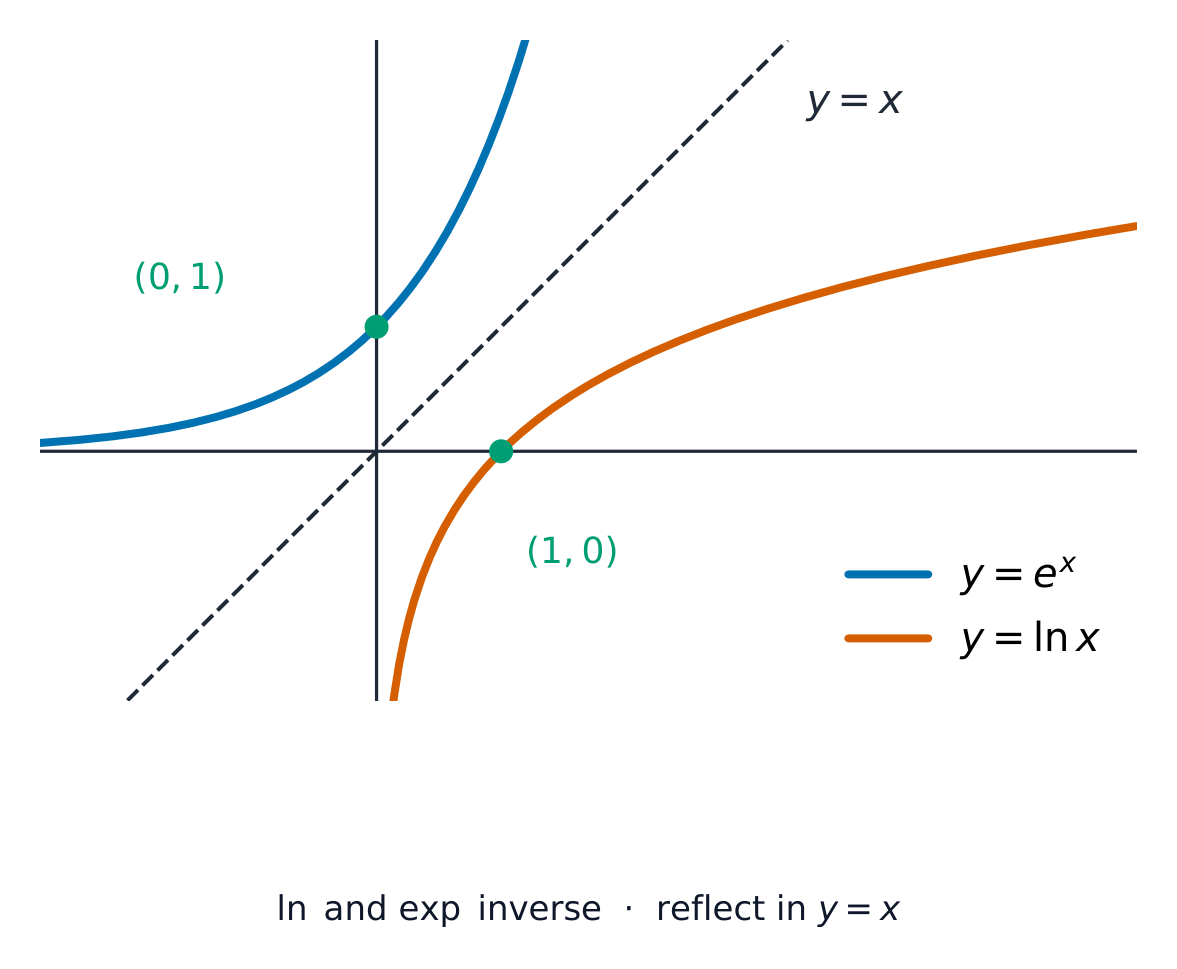
The exponential function $e^x$ and the natural logarithm 自然对数$\ln x$ are inverse functions, so $\ln(e^x) = x$ and $e^{\ln x} = x$. When the unknown is in the power, take logs of both sides.
Linear form 线性形式: a relationship like $y = Ax^n$ becomes a straight line if you take logs: $\ln y = \ln A + n\ln x$. Plotting $\ln y$ against $\ln x$ gives a line with gradient $n$ and intercept $\ln A$, so you can find the unknown constants.
Tiếng Việt
Cường độ động đất được đo trên thang đo logarit Richter.Dân số có thể tăng trưởng theo cấp số nhân khi tài nguyên dồi dào.
Một logarit trả lời câu hỏi "lũy thừa bao nhiêu?". Nếu $a^x = y$ thì $x = \log_a y$. Logarit và số mũ (lũy thừa) là các khái niệm ngược nhau. Các luật của logarit là
$$\log(mn) = \log m + \log n, \qquad \log\!\frac{m}{n} = \log m - \log n, \qquad \log(m^k) = k\log m.$$
Hàm mũ $e^x$ và logarit tự nhiên$\ln x$ là các hàm nghịch đảo, do đó $\ln(e^x) = x$ và $e^{\ln x} = x$. Khi ẩn số nằm ở số mũ, hãy lấy logarit của cả hai vế.
$e^x$ và $\ln x$ triệt tiêu lẫn nhau, nên mỗi cái là sự phản xạ của cái kia qua $y=x$.
Dạng tuyến tính: một mối quan hệ như $y = Ax^n$ sẽ trở thành đường thẳng nếu bạn lấy logarit: $\ln y = \ln A + n\ln x$. Vẽ đồ thị $\ln y$ theo $\ln x$ sẽ cho một đường thẳng có hệ số góc là $n$ và tung độ gốc là $\ln A$, từ đó bạn có thể tìm các hằng số chưa biết.
Explore · Khám phá
Exponential growth · Tăng trưởng lũy thừa
y = a·bˣ
Change the base b: when b > 1 the curve grows, when 0 < b < 1 it decays — and it always passes through (0, a). · Thay đổi cơ số b: khi b > 1 đường cong tăng, khi 0 < b < 1 nó giảm — và nó luôn đi qua (0, a).
2.3
Trigonometry · Lượng giác
Syllabus · Chương trình
English
Candidates should be able to:
Notes and examples
understand the relationship of the secant, cosecant and cotangent functions to cosine, sine and tangent, and use properties and graphs of all six trigonometric functions for angles of any magnitude
use trigonometrical identities for the simplification and exact evaluation of expressions, and in the course of solving equations, and select an identity or identities appropriate to the context, showing familiarity in particular with the use of: – $\sec^2 \theta \equiv 1 + \tan^2 \theta$ and $\csc^2 \theta \equiv 1 + \cot^2 \theta$ – the expansions of $\sin(A \pm B)$, $\cos(A \pm B)$ and $\tan(A \pm B)$ – the formulae for $\sin 2A$, $\cos 2A$ and $\tan 2A$ – the expression of $a \sin \theta + b \cos \theta$ in the forms $R \sin(\theta \pm \alpha)$ and $R \cos(\theta \pm \alpha)$.
hiểu mối liên hệ giữa hàm cosecant, secant và cotangent với cosine, sine và tangent, và sử dụng các tính chất cùng đồ thị của cả sáu hàm lượng giác cho góc có độ lớn bất kỳ
sử dụng các đẳng thức lượng giác để rút gọn và tính giá trị chính xác của biểu thức, cũng như trong quá trình giải phương trình; chọn một hoặc nhiều đẳng thức phù hợp với ngữ cảnh, thể hiện sự thành thạo đặc biệt trong việc sử dụng: – $\sec^2 \theta \equiv 1 + \tan^2 \theta$ và $\csc^2 \theta \equiv 1 + \cot^2 \theta$ – các khai triển của $\sin(A \pm B)$, $\cos(A \pm B)$ và $\tan(A \pm B)$ – các công thức cho $\sin 2A$, $\cos 2A$ và $\tan 2A$ – việc biểu diễn $a \sin \theta + b \cos \theta$ dưới các dạng $R \sin(\theta \pm \alpha)$ và $R \cos(\theta \pm \alpha)$.
Source: Cambridge International syllabus · Nguồn: Chương trình Cambridge International
English
There are three more functions, each the reciprocal of one you know: the secant 正割$\sec\theta = \dfrac{1}{\cos\theta}$, the cosecant 余割$\csc\theta = \dfrac{1}{\sin\theta}$, and the cotangent 余切$\cot\theta = \dfrac{1}{\tan\theta}$.
You must know these trigonometric identities 三角恒等式 and choose the right one for each problem:
So $\sec\theta = \tfrac52$ or $\sec\theta = -4$, giving $\cos\theta = \tfrac25$ or $\cos\theta = -\tfrac14$. The solutions are $\theta = \pm 66.4^\circ$ and $\theta = \pm 104.5^\circ$.
Tiếng Việt
Có ba hàm nữa, mỗi hàm là nghịch đảo reciprocal của một hàm bạn đã biết: secant$\sec\theta = \dfrac{1}{\cos\theta}$, cosecant$\csc\theta = \dfrac{1}{\sin\theta}$, và cotangent$\cot\theta = \dfrac{1}{\tan\theta}$.
$\sec\theta=1/\cos\theta$ tiến tới đường tiệm cận bất cứ nơi nào $\cos\theta=0$.
Bạn phải thuộc các hằng đẳng thức lượng giác này và chọn đúng cái cho từng bài toán:
Vì vậy $\sec\theta = \tfrac52$ hoặc $\sec\theta = -4$, dẫn đến $\cos\theta = \tfrac25$ hoặc $\cos\theta = -\tfrac14$. Các nghiệm là $\theta = \pm 66.4^\circ$ và $\theta = \pm 104.5^\circ$.
Explore · Khám phá
The unit circle · Đường tròn đơn vị
Drag the angle to see how $\sin$, $\cos$ and $\tan$ relate — the key to solving trig equations. · Kéo góc để xem $\sin$, $\cos$ và $\tan$ liên hệ với nhau thế nào — chìa khóa để giải phương trình lượng giác.
tìm và sử dụng đạo hàm cấp một của hàm được xác định tham số hoặc ngầm định.
Vd. $x = t - e^{2t}$, $y = t + e^{2t}$. Vd. $x^2 + y^2 = xy + 7$. Bao gồm cả ứng dụng trong các bài toán tiếp tuyến và pháp tuyến.
Source: Cambridge International syllabus · Nguồn: Chương trình Cambridge International
English
Learn these standard derivatives:
$$\frac{d}{dx}e^x = e^x, \quad \frac{d}{dx}\ln x = \frac{1}{x}, \quad \frac{d}{dx}\sin x = \cos x, \quad \frac{d}{dx}\cos x = -\sin x, \quad \frac{d}{dx}\tan x = \sec^2 x.$$
For a product or a quotient of two functions, use:
the product rule 乘积法则: $(uv)' = u'v + uv'$;
the quotient rule 商法则: $\left(\dfrac{u}{v}\right)' = \dfrac{u'v - uv'}{v^2}$.
When a curve is given by parametric equations 参数方程$x = x(t)$, $y = y(t)$, the gradient is $\dfrac{dy}{dx} = \dfrac{dy/dt}{dx/dt}$. When $y$ is defined implicitly 隐式 (not made the subject), differentiate every term with respect to $x$, using the chain rule on the $y$ terms, then solve for $\dfrac{dy}{dx}$.
Worked example. Given $y = 6x\cos(x^2 + 1)$, find $\dfrac{dy}{dx}$.
Use the product rule with $u = 6x$ and $v = \cos(x^2 + 1)$ (and the chain rule for $v$):
Khi một đường cong được cho bởi phương trình tham số$x = x(t)$, $y = y(t)$, thì hệ số góc là $\dfrac{dy}{dx} = \dfrac{dy/dt}{dx/dt}$. Khi $y$ được xác định ngầm (không làm chủ thể), hãy đạo hàm từng hạng tử theo $x$, áp dụng quy tắc chuỗi cho các hạng tử $y$, sau đó giải tìm $\dfrac{dy}{dx}$.
Move the point: the tangent line is the derivative at that x. Where the curve turns, the gradient is zero. · Di chuyển điểm: tiếp tuyến chính là đạo hàm tại x đó. Nơi đường cong quay đầu, độ dốc bằng không.
2.5
Integration · Tích phân
Syllabus · Chương trình
English
Candidates should be able to:
Notes and examples
• extend the idea of ‘reverse differentiation’ to include the integration of $e^{ax + b}$, $\frac{1}{ax + b}$, $\sin(ax + b)$, $\cos(ax + b)$ and $\sec^2(ax + b)$
Knowledge of the general method of integration by substitution is not required.
• use trigonometrical relationships in carrying out integration
e.g. use of double-angle formulae to integrate $\sin^2 x$ or $\cos^2(2x)$.
• understand and use the trapezium rule to estimate the value of a definite integral.
Including use of sketch graphs in simple cases to determine whether the trapezium rule gives an over-estimate or an under-estimate.
Tiếng Việt
thí sinh có khả năng:
Ghi chú và ví dụ
• mở rộng khái niệm 'đảo ngược đạo hàm' để bao gồm tích phân của $e^{ax + b}$, $\frac{1}{ax + b}$, $\sin(ax + b)$, $\cos(ax + b)$ và $\sec^2(ax + b)$
Không yêu cầu kiến thức về phương pháp chung của tích phân theo phép thế.
• sử dụng các quan hệ lượng giác trong việc thực hiện tích phân
Vd. sử dụng công thức nhân đôi để tích phân $\sin^2 x$ hoặc $\cos^2(2x)$.
• hiểu và sử dụng quy tắc hình thang để ước tính giá trị của tích phân xác định.
Bao gồm cả việc sử dụng đồ thị nháp trong các trường hợp đơn giản để xác định quy tắc hình thang cho kết quả ước lượng cao hay thấp hơn giá trị thực.
Source: Cambridge International syllabus · Nguồn: Chương trình Cambridge International
English
Integration is reverse differentiation — reverse each new derivative; harder integrals may need integration by substitution 换元积分 (developed in Pure 3). For a linear inside function $(ax + b)$:
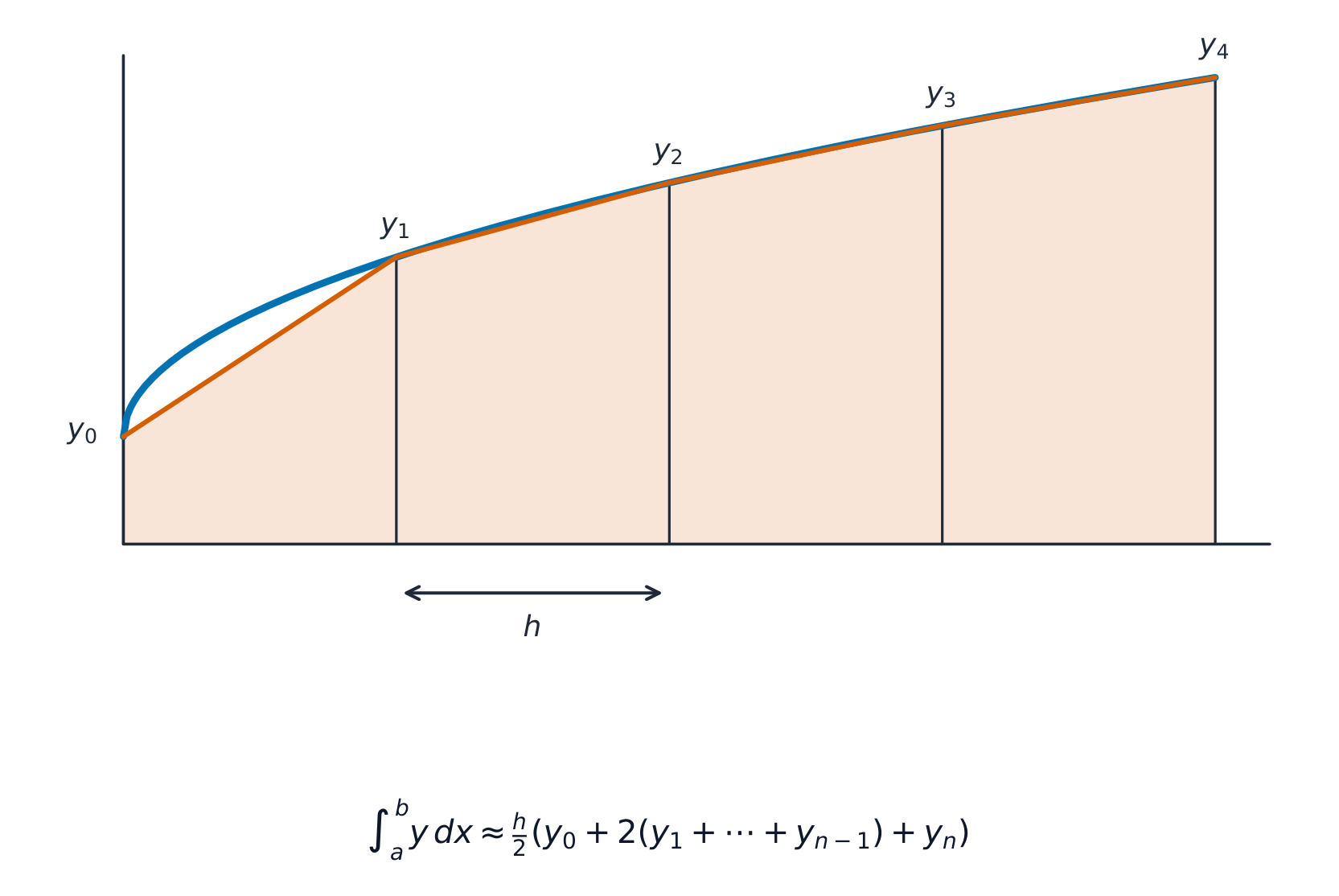
To integrate a power of $\sin$ or $\cos$, first use an identity to remove the power. When you cannot integrate exactly, the trapezium rule 梯形法则 estimates a definite integral:
Tích phân là đảo ngược của đạo hàm — đảo ngược mỗi đạo hàm mới; các tích phân khó hơn có thể cần tích phân theo biến phụ (được phát triển trong Toán thuần túy 3). Đối với một hàm bên trong dạng tuyến tính $(ax + b)$:
Để tích phân một lũy thừa của $\sin$ hoặc $\cos$, trước hết hãy sử dụng một đẳng thức để loại bỏ lũy thừa đó. Khi bạn không thể tích phân chính xác, quy tắc hình thang ước lượng một tích phân xác định:
The area under the curve · Diện tích dưới đường cong
area = ∫ f(x) dx
The integral still measures area — drag a and b to total the strip under the curve. · Tích phân vẫn đo diện tích — kéo a và b để tính tổng diện tích dải dưới đường cong.
Numerical solution of equations · Giải phương trình bằng phương pháp số
Syllabus · Chương trình
English
Candidates should be able to:
Notes and examples
• locate approximately a root of an equation, by means of graphical considerations and/or searching for a sign change
e.g. finding a pair of consecutive integers between which a root lies.
• understand the idea of, and use the notation for, a sequence of approximations which converges to a root of an equation
• understand how a given simple iterative formula of the form $x_{n + 1} = \text{F}(x_n)$ relates to the equation being solved, and use a given iteration, or an iteration based on a given rearrangement of an equation, to determine a root to a prescribed degree of accuracy.
Knowledge of the condition for convergence is not included, but an understanding that an iteration may fail to converge is expected.
Tiếng Việt
thí sinh có khả năng:
Ghi chú và ví dụ
• xác định xấp xỉ nghiệm của phương trình, thông qua các xét đồ thị và/hoặc tìm kiếm sự đổi dấu
Vd. tìm một cặp số nguyên liên tiếp mà nghiệm nằm giữa chúng.
• hiểu ý tưởng và sử dụng ký hiệu cho dãy xấp xỉ hội tụ đến nghiệm của một phương trình
• hiểu cách một công thức lặp đơn giản đã cho có dạng $x_{n + 1} = \text{F}(x_n)$ liên quan đến phương trình đang giải, và sử dụng một phép lặp đã cho, hoặc một phép lặp dựa trên việc biến đổi lại phương trình đã cho, để xác định nghiệm với độ chính xác quy định.
Không bao gồm điều kiện hội tụ, nhưng cần hiểu rằng một phép lặp có thể không hội tụ.
Source: Cambridge International syllabus · Nguồn: Chương trình Cambridge International
English
Iterating to a root: ride the tangent
Many equations cannot be solved exactly. Two ideas help you find a root 根 (a solution).
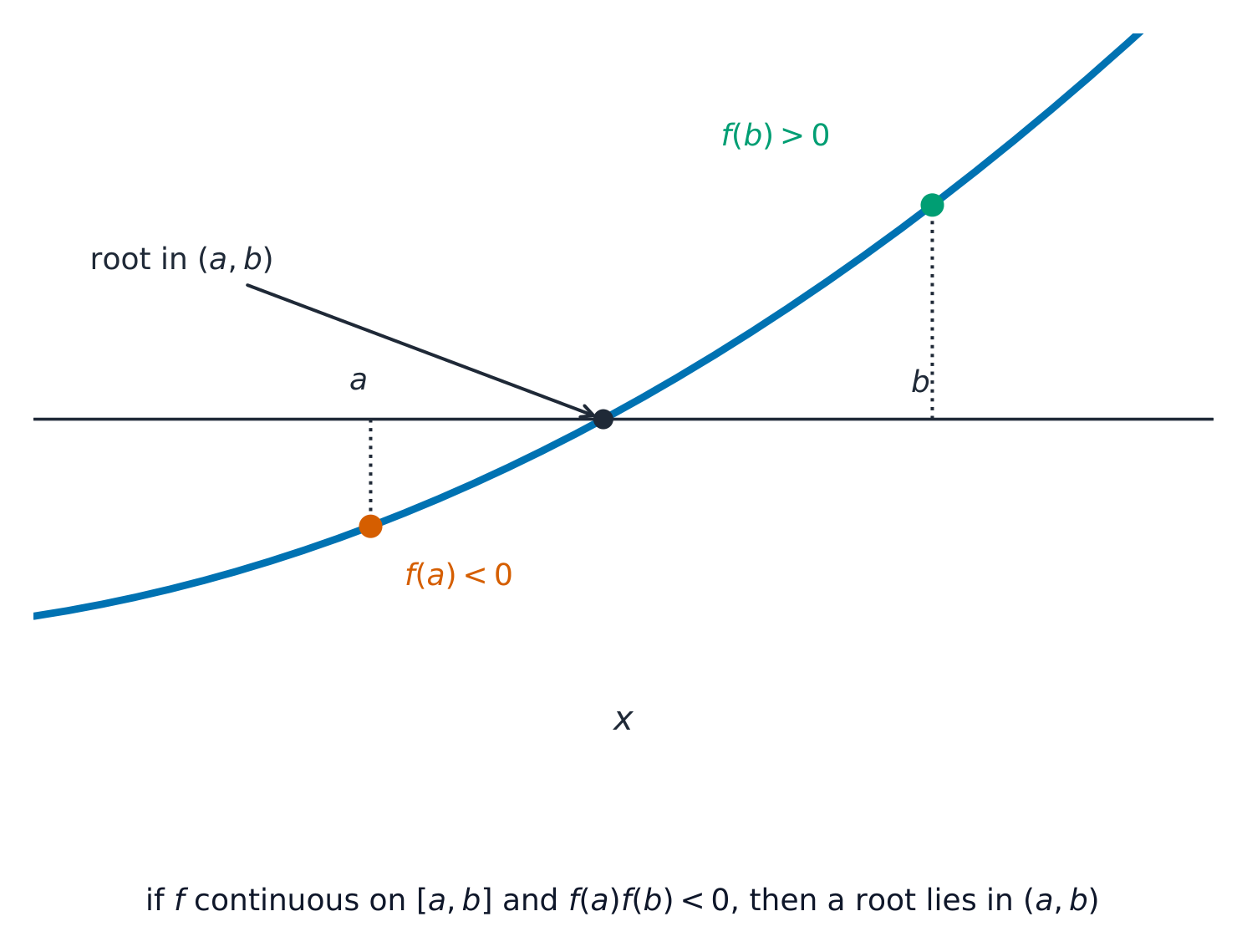
Sign change 变号: if $f(a)$ and $f(b)$ have opposite signs (and the graph has no break between them), a root lies between $a$ and $b$.
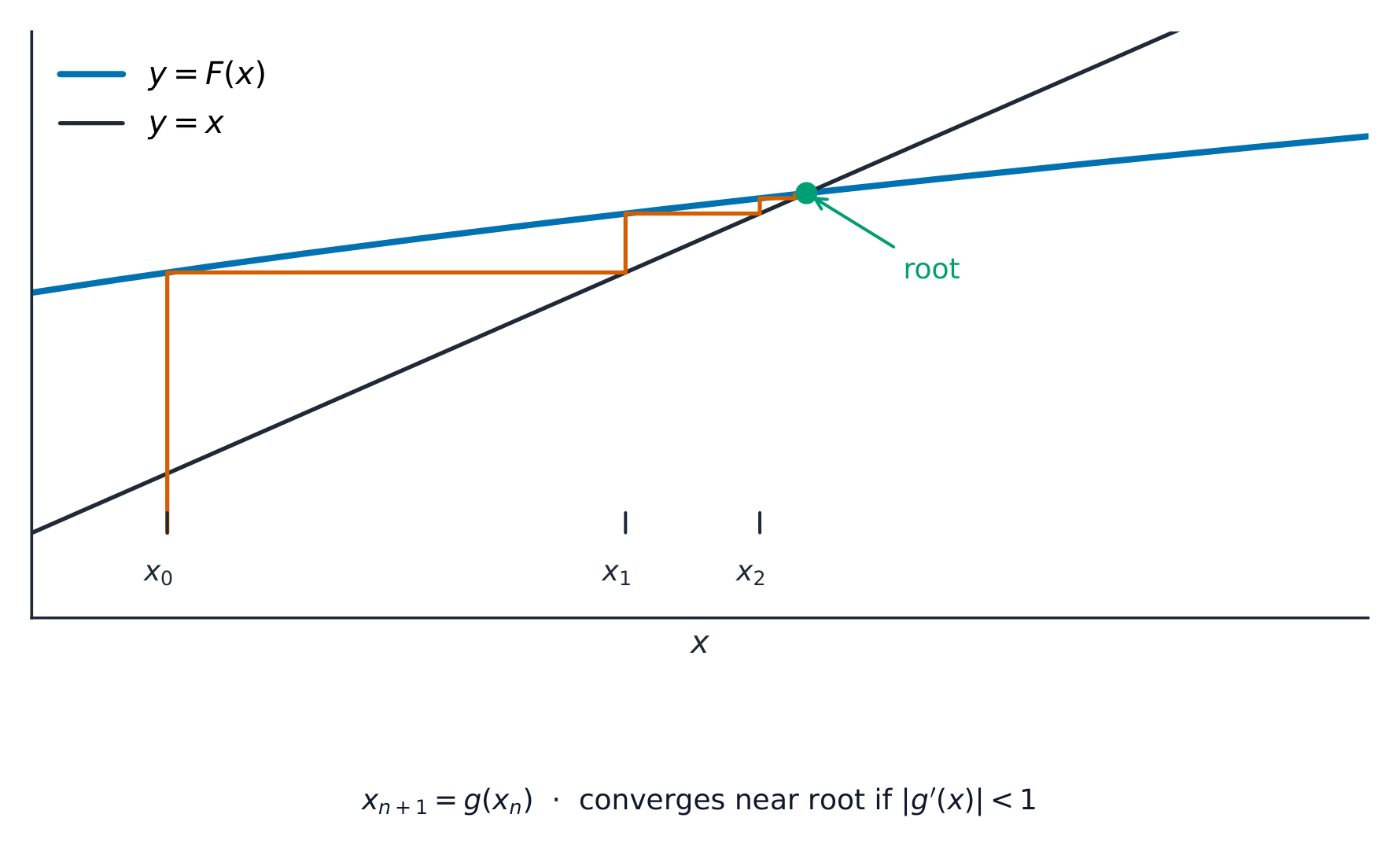
Iteration 迭代: rearrange the equation into the form $x = F(x)$, then use the iterative formula 迭代公式$x_{n+1} = F(x_n)$. Start from a first guess $x_0$ and repeat. If the values are convergent they settle down and converge 收敛 to a root. Keep going until the answer is steady to the accuracy asked for.
Worked example. A root $\beta$ of an equation satisfies $x = \sqrt[3]{-2x - 4.5}$, and $-1.4 < \beta < -1.0$. Use the iteration $x_{n+1} = \sqrt[3]{-2x_n - 4.5}$ with $x_0 = -1.2$.
The values settle near $-1.26$, so $\beta = -1.26$ (3 s.f.).
Tiếng Việt
Lặp lại để tìm nghiệm: đi theo tiếp tuyến
Nhiều phương trình không thể giải chính xác. Hai ý tưởng giúp bạn tìm được một nghiệm (một lời giải).
Thay đổi dấu: nếu $f(a)$ và $f(b)$ có dấu trái ngược nhau (và đồ thị không bị đứt đoạn giữa chúng), một nghiệm nằm giữa $a$ và $b$.
Lặp lại: biến đổi phương trình về dạng $x = F(x)$, sau đó sử dụng công thức lặp$x_{n+1} = F(x_n)$. Bắt đầu từ một giả thiết ban đầu $x_0$ và lặp lại. Nếu các giá trị hội tụ, chúng sẽ ổn định và hội tụ về một nghiệm. Tiếp tục cho đến khi câu trả lời ổn định ở mức độ chính xác yêu cầu.
$f(a)$ và $f(b)$ có dấu trái ngược, nên một nghiệm bị nhốt giữa $a$ và $b$.Mỗi bước đi lên $y=F(x)$ rồi sang ngang đến $y=x$; bậc thang đang thu hẹp về phía nghiệm.
Ví dụ minh họa. Một nghiệm $\beta$ của một phương trình thỏa mãn $x = \sqrt[3]{-2x - 4.5}$, và $-1.4 < \beta < -1.0$. Sử dụng phép lặp $x_{n+1} = \sqrt[3]{-2x_n - 4.5}$ với $x_0 = -1.2$.
Các giá trị ổn định gần $-1.26$, vì vậy $\beta = -1.26$ (3 chữ số có nghĩa).
Explore · Khám phá
Where is the root? · Nghiệm nằm ở đâu?
y = ax³ + bx² + cx + d
A root is where the curve crosses zero. A sign change in f(x) traps a root between two x-values. · Một nghiệm là nơi đường cong cắt trục hoành. Sự đổi dấu của f(x) nhốt nghiệm giữa hai giá trị x.
This handout covers Topic 3: Pure Mathematics 纯数学 3. Subtopics 3.1–3.6 build on the algebra, logarithms, trigonometry, differentiation, integration and numerical methods of Pure Mathematics 2, so this handout explains what is new in Pure 3 and then covers the three big new areas: vectors, differential equations and complex numbers.
3.1
Algebra
Syllabus · Chương trình
Candidates should be able to:
Notes and examples
• understand the meaning of $|x|$, sketch the graph of $y = |ax + b|$ and use relations such as $|a| = |b| \iff a^2 = b^2$ and $|x - a| < b \iff a - b < x < a + b$ when solving equations and inequalities
Graphs of $y = |\text{f}(x)|$ and $y = \text{f}(|x|)$ for non-linear functions $\text{f}$ are not included. e.g. $|3x - 2| = |2x + 7|$, $2x + 5 < |x + 1|$.
• divide a polynomial, of degree not exceeding 4, by a linear or quadratic polynomial, and identify the quotient and remainder (which may be zero)
• use the factor theorem and the remainder theorem
e.g. to find factors and remainders, solve polynomial equations or evaluate unknown coefficients. Including factors of the form $(ax + b)$ in which the coefficient of $x$ is not unity, and including calculation of remainders.
• recall an appropriate form for expressing rational functions in partial fractions, and carry out the decomposition, in cases where the denominator is no more complicated than – $(ax + b)(cx + d)(ex + f)$ – $(ax + b)(cx + d)^2$ – $(ax + b)(cx^2 + d)$
Excluding cases where the degree of the numerator exceeds that of the denominator
• use the expansion of $(1 + x)^n$, where $n$ is a rational number and $|x| < 1$.
Finding the general term in an expansion is not included. Adapting the standard series to expand e.g. $(2 - \frac{1}{2}x)^{-1}$ is included, and determining the set of values of $x$ for which the expansion is valid in such cases is also included.
Source: Cambridge International syllabus · Nguồn: Chương trình Cambridge International
Two new tools join the algebra from Pure 2.
Partial fractions
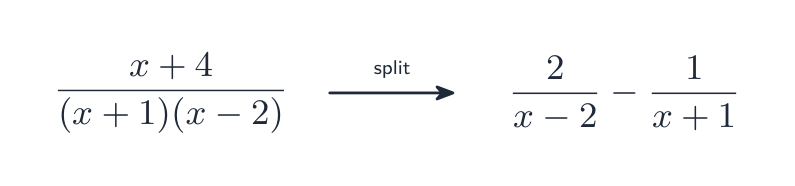
A single fraction with a factorised bottom can be split into a sum of simpler fractions. This is called writing it in partial fractions 部分分式, and it makes a rational function 有理函数 (a fraction of polynomials) easy to integrate or expand. Match the form to the bottom:
First check the top is lower degree than the bottom. If it is not ("top-heavy"), divide the polynomial first: dividing gives a quotient 商 plus a remainder 余数 over the original bottom, and you split only that remaining proper fraction.
One fraction with a factorised bottom splits into a sum of simpler fractions.
For example $(1 + x)^{1/2} = 1 + \tfrac12 x - \tfrac18 x^2 + \cdots$ for $|x| < 1$.
Explore · Khám phá
Reciprocal curves · Đường cong nghịch đảo
y = a/(x − b) + c
Partial fractions split a hard fraction into simple reciprocal pieces — each with a vertical and a horizontal asymptote. · Phân tích phân thức riêng biệt tách một phân thức phức tạp thành các phần nghịch đảo đơn giản — mỗi phần có tiếp cận đứng và tiếp cận ngang.
use logarithms to transform a given relationship to linear form, and hence determine unknown constants by considering the gradient and/or intercept.
e.g. $y = kx^n$ gives $\ln y = \ln k + n \ln x$ which is linear in $\ln x$ and $\ln y$. $y = k(a^x)$ gives $\ln y = \ln k + x \ln a$ which is linear in $x$ and $\ln y$.
Tiếng Việt
thí sinh có khả năng:
Ghi chú và ví dụ
hiểu mối liên hệ giữa lôgarit và số mũ, và sử dụng các luật của lôgarit (loại trừ đổi cơ số)
hiểu định nghĩa và tính chất của $e^x$ và $\ln x$, bao gồm mối quan hệ của chúng như các hàm nghịch đảo và đồ thị của chúng
Bao gồm kiến thức về đồ thị của $y = e^{kx}$ cho cả giá trị dương và âm của $k$.
sử dụng lôgarit để giải phương trình và bất phương trình trong đó ẩn số xuất hiện ở số mũ
sử dụng lôgarit để biến đổi một quan hệ đã cho về dạng tuyến tính, và từ đó xác định các hằng số chưa biết bằng cách xem xét độ dốc và/hoặc tung độ gốc.
Vd. $y = kx^n$ cho $\ln y = \ln k + n \ln x$ là tuyến tính theo $\ln x$ và $\ln y$. $y = k(a^x)$ cho $\ln y = \ln k + x \ln a$ là tuyến tính theo $x$ và $\ln y$.
English
Candidates should be able to:
Notes and examples
understand the relationship of the secant, cosecant and cotangent functions to cosine, sine and tangent, and use properties and graphs of all six trigonometric functions for angles of any magnitude
use trigonometrical identities for the simplification and exact evaluation of expressions, and in the course of solving equations, and select an identity or identities appropriate to the context, showing familiarity in particular with the use of: – $\sec^2 \theta \equiv 1 + \tan^2 \theta$ and $\cosec^2 \theta \equiv 1 + \cot^2 \theta$ – the expansions of $\sin(A \pm B)$, $\cos(A \pm B)$ and $\tan(A \pm B)$ – the formulae for $\sin 2A$, $\cos 2A$ and $\tan 2A$ – the expression of $a \sin \theta + b \cos \theta$ in the forms $R \sin(\theta \pm \alpha)$ and $R \cos(\theta \pm \alpha)$.
hiểu mối liên hệ giữa hàm cosecant, secant và cotangent với cosine, sine và tangent, và sử dụng các tính chất cùng đồ thị của cả sáu hàm lượng giác cho góc có độ lớn bất kỳ
sử dụng các đẳng thức lượng giác để rút gọn và tính giá trị chính xác của biểu thức, cũng như trong quá trình giải phương trình; chọn một hoặc nhiều đẳng thức phù hợp với ngữ cảnh, thể hiện sự thành thạo đặc biệt trong việc sử dụng: – $\sec^2 \theta \equiv 1 + \tan^2 \theta$ và $\cosec^2 \theta \equiv 1 + \cot^2 \theta$ – các khai triển của $\sin(A \pm B)$, $\cos(A \pm B)$ và $\tan(A \pm B)$ – các công thức cho $\sin 2A$, $\cos 2A$ và $\tan 2A$ – việc biểu diễn $a \sin \theta + b \cos \theta$ dưới các dạng $R \sin(\theta \pm \alpha)$ và $R \cos(\theta \pm \alpha)$.
• locate approximately a root of an equation, by means of graphical considerations and/or searching for a sign change
e.g. finding a pair of consecutive integers between which a root lies.
• understand the idea of, and use the notation for, a sequence of approximations which converges to a root of an equation
• understand how a given simple iterative formula of the form $x_{n+1} = \text{F}(x_n)$ relates to the equation being solved, and use a given iteration, or an iteration based on a given rearrangement of an equation, to determine a root to a prescribed degree of accuracy.
Knowledge of the condition for convergence is not included, but an understanding that an iteration may fail to converge is expected.
Tiếng Việt
thí sinh có khả năng:
Ghi chú và ví dụ
• ước lượng xấp xỉ một nghiệm của phương trình, thông qua xét đồ thị và/hoặc tìm kiếm sự đổi dấu
ví dụ: tìm cặp số nguyên liên tiếp mà nghiệm nằm giữa chúng.
• hiểu ý tưởng về, và sử dụng ký hiệu cho, một dãy xấp xỉ hội tụ đến nghiệm của một phương trình
• hiểu cách một công thức lặp đơn giản cho trước có dạng $x_{n+1} = \text{F}(x_n)$ liên quan đến phương trình đang giải, và sử dụng một phép lặp cho trước, hoặc một phép lặp dựa trên việc sắp xếp lại phương trình cho trước, để xác định nghiệm với độ chính xác quy định.
Kiến thức về điều kiện hội tụ không bao gồm, nhưng cần hiểu rằng một phép lặp có thể không hội tụ.
Source: Cambridge International syllabus · Nguồn: Chương trình Cambridge International
Iterating to a root: ride the tangent
Subtopics 3.2, 3.3 and 3.6 are the same skills you met in Pure 2: the laws of logarithms with $e^x$ and $\ln x$; the identities $\sec^2\theta \equiv 1 + \tan^2\theta$ and $\csc^2\theta \equiv 1 + \cot^2\theta$, the compound- and double-angle formulae, and the $R$-form of $a\sin\theta + b\cos\theta$; and solving an equation numerically by a sign change 变号 and an iterative formula 迭代公式$x_{n+1} = F(x_n)$. Use them exactly as before.
The three new trig functions are the reciprocals 倒数 of the familiar ones: the secant 正割$\sec\theta = \dfrac{1}{\cos\theta}$, the cosecant 余割$\csc\theta = \dfrac{1}{\sin\theta}$, and the cotangent 余切$\cot\theta = \dfrac{1}{\tan\theta} = \dfrac{\cos\theta}{\sin\theta}$. (Memory aid: match the third letter — sec goes with cosine.) The two Pythagorean identities above come straight from dividing $\sin^2\theta + \cos^2\theta \equiv 1$ by $\cos^2\theta$ or $\sin^2\theta$. For a numerical method, an iteration $x_{n+1}=F(x_n)$converges 收敛 to the root when successive values get closer together.
Explore · Khám phá
The unit circle · Đường tròn đơn vị
(cos θ, sin θ)
The R-formula rewrites a sin θ + b cos θ as one wave — and it all lives on this circle. · Công thức R viết lại a sin θ + b cos θ dưới dạng một sóng duy nhất — và tất cả đều nằm trên vòng tròn này.
tìm và sử dụng đạo hàm cấp một của hàm được xác định tham số hoặc ngầm định.
Vd. $x = t - e^{2t}$, $y = t + e^{2t}$. Vd. $x^2 + y^2 = xy + 7$. Bao gồm cả ứng dụng trong các bài toán tiếp tuyến và pháp tuyến.
Source: Cambridge International syllabus · Nguồn: Chương trình Cambridge International
The methods are those of Pure 2 (the product, quotient and chain rules, with parametric and implicit curves). One derivative is added — the inverse tangent 反正切:
$$\frac{d}{dx}\tan^{-1} x = \frac{1}{1 + x^2}.$$
Worked example. Differentiate $y = \tan^{-1}(3x)$.
Use the chain rule with the result above: $\dfrac{dy}{dx} = \dfrac{1}{1 + (3x)^2} \times 3 = \dfrac{3}{1 + 9x^2}.$
Explore · Khám phá
The gradient at a point · Độ dốc tại một điểm
gradient = dy/dx
Implicit or not, the derivative is still the slope of the tangent — slide the point to see it. · Dù ẩn hay rõ, đạo hàm vẫn là độ dốc của tiếp tuyến — trượt điểm để quan sát.
extend the idea of 'reverse differentiation' to include the integration of $e^{ax + b}$, $\frac{1}{ax + b}$, $\sin(ax + b)$, $\cos(ax + b)$, $\sec^2(ax + b)$ and $\frac{1}{x^2 + a^2}$
Including examples such as $\frac{1}{2 + 3x^2}$.
use trigonometrical relationships in carrying out integration
e.g. use of double-angle formulae to integrate $\sin^2 x$ or $\cos^2(2x)$.
integrate rational functions by means of decomposition into partial fractions
Restricted to types of partial fractions as specified in topic 3.1 above.
recognise an integrand of the form $\frac{k f'(x)}{f(x)}$, and integrate such functions
e.g. integration of $\frac{x}{x^2 + 1}$, $\tan x$.
recognise when an integrand can usefully be regarded as a product, and use integration by parts
e.g. integration of $x \sin 2x$, $x^2 e^{-x}$, $\ln x$, $x \tan^{-1} x$.
use a given substitution to simplify and evaluate either a definite or an indefinite integral.
e.g. to integrate $\sin^2 2x \cos x$ using the substitution $u = \sin x$.
Tiếng Việt
thí sinh có khả năng:
Ghi chú và ví dụ
mở rộng khái niệm 'đảo ngược đạo hàm' để bao gồm tích phân của $e^{ax + b}$, $\frac{1}{ax + b}$, $\sin(ax + b)$, $\cos(ax + b)$, $\sec^2(ax + b)$ và $\frac{1}{x^2 + a^2}$
Bao gồm các ví dụ như $\frac{1}{2 + 3x^2}$.
sử dụng các quan hệ lượng giác trong việc thực hiện tích phân
Vd. sử dụng công thức nhân đôi để tích phân $\sin^2 x$ hoặc $\cos^2(2x)$.
tích phân các hàm hữu tỉ bằng cách phân tích thành phân số đơn
Giới hạn ở các loại phân số đơn như đã nêu trong chủ đề 3.1 ở trên.
nhận diện một hàm dưới dấu tích phân có dạng $\frac{k f'(x)}{f(x)}$, và tính tích phân của các hàm như vậy
ví dụ: tích phân của $\frac{x}{x^2 + 1}$, $\tan x$.
nhận biết khi nào một hàm dưới dấu tích phân có thể được coi là một tích có ích, và sử dụng tích phân từng phần
ví dụ: tích phân của $x \sin 2x$, $x^2 e^{-x}$, $\ln x$, $x \tan^{-1} x$.
sử dụng phép đặt ẩn phụ cho trước để rút gọn và tính toán cả tích phân xác định hay bất định.
ví dụ: để tính tích phân $\sin^2 2x \cos x$ bằng phép đặt ẩn phụ $u = \sin x$.
Source: Cambridge International syllabus · Nguồn: Chương trình Cambridge International
Pure 3 adds several powerful methods.
A new standard integral: $\displaystyle\int \frac{1}{x^2 + a^2}\,dx = \frac{1}{a}\tan^{-1}\frac{x}{a} + C$.
Partial fractions: split a rational function first, then integrate each piece as a logarithm.
The pattern $\dfrac{k\,f'(x)}{f(x)}$: this integrates to $k\ln|f(x)| + C$. For example $\displaystyle\int \frac{2x}{x^2 + 1}\,dx = \ln(x^2 + 1) + C$.
Integration by parts 分部积分, used for a product: $\displaystyle\int u\,\frac{dv}{dx}\,dx = uv - \int v\,\frac{du}{dx}\,dx$.
Integration by substitution 换元积分: a given change of variable turns a hard integral into an easy one.
Worked example. Find $\displaystyle\int x\cos x\,dx$.
Use integration by parts with $u = x$ and $\dfrac{dv}{dx} = \cos x$, so $\dfrac{du}{dx} = 1$ and $v = \sin x$:
$$\int x\cos x\,dx = x\sin x - \int \sin x\,dx = x\sin x + \cos x + C.$$
Explore · Khám phá
The area under the curve · Diện tích dưới đường cong
area = ∫ f(x) dx
Every integration method just measures this area — drag the limits to total it. · Mọi phương pháp tích phân đều đo diện tích — kéo giới hạn để tính tổng.
Integration by substitution/ˌɪntɪˈɡreɪʃn baɪ ˌsʌbstɪˈtjuːʃn/
Tích phân theo phép thế
3.7
Vectors
Syllabus · Chương trình
English
Candidates should be able to:
Notes and examples
• use standard notations for vectors, i.e. $\begin{pmatrix} x \\ y \end{pmatrix}$, $x\mathbf{i} + y\mathbf{j}$, $\begin{pmatrix} x \\ y \\ z \end{pmatrix}$, $x\mathbf{i} + y\mathbf{j} + z\mathbf{k}$, $\overrightarrow{AB}$, $\mathbf{a}$
• carry out addition and subtraction of vectors and multiplication of a vector by a scalar, and interpret these operations in geometrical terms
e.g. ‘$OABC$ is a parallelogram’ is equivalent to $\overrightarrow{OB} = \overrightarrow{OA} + \overrightarrow{OC}$. The general form of the ratio theorem is not included, but understanding that the midpoint of $AB$ has position vector $\frac{1}{2}(\overrightarrow{OA} + \overrightarrow{OB})$ is expected.
• calculate the magnitude of a vector, and use unit vectors, displacement vectors and position vectors
In 2 or 3 dimensions.
• understand the significance of all the symbols used when the equation of a straight line is expressed in the form $\mathbf{r} = \mathbf{a} + t\mathbf{b}$, and find the equation of a line, given sufficient information
e.g. finding the equation of a line given the position vector of a point on the line and a direction vector, or the position vectors of two points on the line.
• determine whether two lines are parallel, intersect or are skew, and find the point of intersection of two lines when it exists
Calculation of the shortest distance between two skew lines is not required. Finding the equation of the common perpendicular to two skew lines is also not required.
• use formulae to calculate the scalar product of two vectors, and use scalar products in problems involving lines and points.
e.g. finding the angle between two lines, and finding the foot of the perpendicular from a point to a line; questions may involve 3D objects such as cuboids, tetrahedra (pyramids), etc. Knowledge of the vector product is not required.
Tiếng Việt
thí sinh có khả năng:
Ghi chú và ví dụ
• sử dụng các ký hiệu chuẩn cho vectơ, tức là $\begin{pmatrix} x \\ y \end{pmatrix}$, $x\mathbf{i} + y\mathbf{j}$, $\begin{pmatrix} x \\ y \\ z \end{pmatrix}$, $x\mathbf{i} + y\mathbf{j} + z\mathbf{k}$, $\overrightarrow{AB}$, $\mathbf{a}$
• thực hiện phép cộng và trừ vectơ và nhân một vectơ với một thực số, và giải thích các phép toán này theo nghĩa hình học
ví dụ: ‘$OABC$ là hình bình hành’ tương đương với $\overrightarrow{OB} = \overrightarrow{OA} + \overrightarrow{OC}$. Dạng tổng quát của định lý tỷ lệ không bao gồm, nhưng hiểu rằng trung điểm của $AB$ có vectơ vị trí là $\frac{1}{2}(\overrightarrow{OA} + \overrightarrow{OB})$ là yêu cầu.
• tính độ lớn của một vectơ, và sử dụng vectơ đơn vị, vectơ dịch chuyển và vectơ vị trí
Trong 2 hoặc 3 chiều.
• hiểu ý nghĩa của tất cả các ký hiệu được sử dụng khi phương trình đường thẳng được biểu diễn dưới dạng $\mathbf{r} = \mathbf{a} + t\mathbf{b}$, và tìm phương trình đường thẳng, khi có đủ thông tin
ví dụ: tìm phương trình đường thẳng khi biết vectơ vị trí của một điểm trên đường thẳng và một vectơ chỉ phương, hoặc vectơ vị trí của hai điểm trên đường thẳng.
• xác định xem hai đường thẳng có song song, cắt nhau hay là chéo nhau, và tìm điểm giao cut của hai đường thẳng khi nó tồn tại
Không yêu cầu tính khoảng cách ngắn nhất giữa hai đường thẳng chéo nhau. Không yêu cầu tìm phương trình đường vuông góc chung của hai đường thẳng chéo nhau.
• sử dụng công thức để tính tích vô hướng của hai vectơ, và sử dụng tích vô hướng trong các bài toán liên quan đến đường thẳng và điểm.
ví dụ: tìm góc giữa hai đường thẳng, và tìm chân đường vuông góc từ một điểm đến một đường thẳng; các câu hỏi có thể liên quan đến các vật thể 3D như khối hộp chữ nhật, tứ diện (lăng trụ), v.v. Không yêu cầu kiến thức về tích có hướng.
Source: Cambridge International syllabus · Nguồn: Chương trình Cambridge International
Forces like wind and water are vectors — they have both size and direction.
A vector 向量 has both size and direction. Write it as a column, or as $x\mathbf{i} + y\mathbf{j} + z\mathbf{k}$, or as $\overrightarrow{AB}$.
The magnitude 模长 (length) of $\mathbf{v} = x\mathbf{i} + y\mathbf{j} + z\mathbf{k}$ is $|\mathbf{v}| = \sqrt{x^2 + y^2 + z^2}$.
A unit vector 单位向量 has magnitude $1$; divide a vector by its magnitude to make one.
A position vector 位置向量 gives a point's place from the origin; a displacement vector 位移向量$\overrightarrow{AB} = \mathbf{b} - \mathbf{a}$ goes from one point to another. Multiplying by a scalar 标量 (a plain number) stretches a vector.
Lines and the scalar product
A straight line through point $\mathbf{a}$ in direction $\mathbf{b}$ has vector equation $\mathbf{r} = \mathbf{a} + t\mathbf{b}$. Two lines may be parallel 平行, may intersect 相交 at a point, or may be skew lines 异面直线 (not parallel and never meeting).
Start at the point $\mathbf{a}$, then add $t$ copies of the direction $\mathbf{b}$ to reach any point on the line.
The scalar product 数量积 (dot product) of $\mathbf{a}$ and $\mathbf{b}$ is
where $\theta$ is the angle between them. So $\mathbf{a}\cdot\mathbf{b} = 0$ means the vectors are perpendicular.
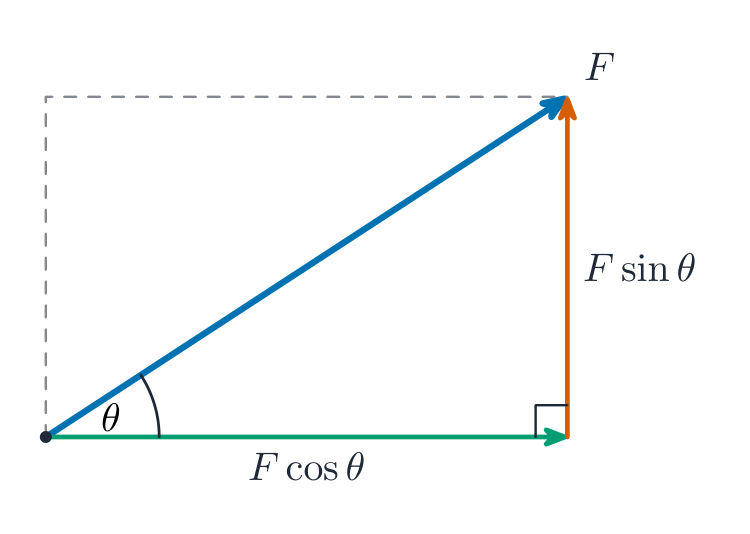
The scalar product picks out $|\mathbf{b}|\cos\theta$, how far $\mathbf{b}$ reaches along $\mathbf{a}$.
Worked example. Find the angle between $\mathbf{a} = \mathbf{i} + 2\mathbf{j} + 2\mathbf{k}$ and $\mathbf{b} = 2\mathbf{i} + 2\mathbf{j} + \mathbf{k}$.
Adding vectors and the dot product · Cộng véc-tơ và tích vô hướng
Drag the two vectors. See the resultant (tip-to-tail) and the dot product, which is zero when they are perpendicular. · Kéo hai véc-tơ. Xem véc-tơ hợp (đuôi nối đầu) và tích vô hướng, bằng không khi chúng vuông góc với nhau.
formulate a simple statement involving a rate of change as a differential equation
The introduction and evaluation of a constant of proportionality, where necessary, is included.
find by integration a general form of solution for a first order differential equation in which the variables are separable
Including any of the integration techniques from topic 3.5 above.
use an initial condition to find a particular solution
interpret the solution of a differential equation in the context of a problem being modelled by the equation.
Where a differential equation is used to model a 'real-life' situation, no specialised knowledge of the context will be required.
Tiếng Việt
thí sinh có khả năng:
Ghi chú và ví dụ
thiết lập một phát biểu đơn giản liên quan đến tốc độ biến thiên dưới dạng phương trình vi phân
Việc giới thiệu và đánh giá hằng số tỷ lệ, nếu cần, được bao gồm.
tìm bằng phương pháp tích phân dạng giải tổng quát cho một phương trình vi phân bậc nhất mà trong đó các biến số tách rời
Bao gồm bất kỳ kỹ thuật tích phân nào từ chủ đề 3.5 ở trên.
sử dụng điều kiện ban đầu để tìm giải riêng
giải thích ý nghĩa của giải phương trình vi phân trong bối cảnh của bài toán được mô hình hóa bởi phương trình đó.
Khi phương trình vi phân được dùng để mô hình hóa một tình huống 'thực tế', không yêu cầu kiến thức chuyên sâu về bối cảnh đó.
Source: Cambridge International syllabus · Nguồn: Chương trình Cambridge International
A differential equation 微分方程 links a quantity to its rate of change. To solve a first-order equation whose variables are separable 可分离变量, put all the $y$ terms on one side and all the $x$ terms on the other, then integrate both sides. This gives the general solution 通解, which contains a constant. An initial condition 初始条件 (a known value) fixes the constant and gives the particular solution 特解.
Worked example. Solve $\dfrac{dy}{dx} = xy$, given that $y = 1$ when $x = 0$.
Separate the variables and integrate:
$$\int \frac{1}{y}\,dy = \int x\,dx \;\Rightarrow\; \ln y = \tfrac12 x^2 + c \;\Rightarrow\; y = A e^{x^2/2}.$$
Using $y = 1$ at $x = 0$ gives $A = 1$, so $y = e^{x^2/2}$.
The constant $A$ gives a whole family of curves; the condition $y=1$ at $x=0$ selects $y=e^{x^2/2}$.
Explore · Khám phá
A slope field · Trường độ dốc
Each little line shows the gradient $\frac{dy}{dx}$ there. A solution curve follows the arrows — change the starting point to see a different one. · Mỗi đoạn thẳng nhỏ biểu thị độ dốc $\frac{dy}{dx}$ tại đó. Một đường nghiệm đi theo các mũi tên — thay đổi điểm bắt đầu để xem một đường khác.
understand the idea of a complex number, recall the meaning of the terms real part, imaginary part, modulus, argument, conjugate, and use the fact that two complex numbers are equal if and only if both real and imaginary parts are equal
Notations $\text{Re } z$, $\text{Im } z$, $|z|$, $\arg z$, $z^*$ should be known. The argument of a complex number will usually refer to an angle $\theta$ such that $-\pi < \theta \leqslant \pi$, but in some cases the interval $0 \leqslant \theta < 2\pi$ may be more convenient. Answers may use either interval unless the question specifies otherwise.
carry out operations of addition, subtraction, multiplication and division of two complex numbers expressed in Cartesian form$x + \text{i}y$
For calculations involving multiplication or division, full details of the working should be shown.
use the result that, for a polynomial equation with real coefficients, any non-real roots occur in conjugate pairs
e.g. in solving a cubic or quartic equation where one complex root is given.
represent complex numbers geometrically by means of an Argand diagram
carry out operations of multiplication and division of two complex numbers expressed in polar form$r(\cos \theta + \text{i}\sin \theta) \equiv r\text{e}^{\text{i}\theta}$
Including the results $|z_1 z_2| = |z_1||z_2|$ and $\arg(z_1 z_2) = \arg(z_1) + \arg(z_2)$, and corresponding results for division.
find the two square roots of a complex number
e.g. the square roots of $5 + 12\text{i}$ in exact Cartesian form. Full details of the working should be shown.
understand in simple terms the geometrical effects of conjugating a complex number and of adding, subtracting, multiplying and dividing two complex numbers
illustrate simple equations and inequalities involving complex numbers by means of loci in an Argand diagram
e.g. $|z - a| < k$, $|z - a| = |z - b|$, $\arg(z - a) = \alpha$.
Tiếng Việt
thí sinh có khả năng:
Ghi chú và ví dụ
hiểu ý tưởng về một số phức, nhớ lại ý nghĩa của các thuật ngữ phần thực, phần ảo, mô-đun, argument, số liên hợp, và sử dụng thực tế rằng hai số phức bằng nhau nếu và chỉ если cả phần thực và phần ảo đều bằng nhau
Các ký hiệu $\text{Re } z$, $\text{Im } z$, $|z|$, $\arg z$, $z^*$ nên được biết. Argument của một số phức thường sẽ đề cập đến một góc $\theta$ sao cho $-\pi < \theta \leqslant \pi$, nhưng trong một số trường hợp, khoảng $0 \leqslant \theta < 2\pi$ có thể thuận tiện hơn. Đáp án có thể sử dụng khoảng bất kỳ trừ khi đề bài yêu cầu khác.
thực hiện các phép toán cộng, trừ, nhân và chia hai số phức được biểu diễn dưới dạng tọa độ Descartes$x + \text{i}y$
Đối với các phép tính liên quan đến nhân hoặc chia, cần trình bày đầy đủ các bước tính toán.
sử dụng kết quả rằng, đối với phương trình đa thức có hệ số thực, bất kỳ nghiệm không thực nào xuất hiện theo cặp liên hợp
ví dụ: trong việc giải phương trình bậc ba hoặc bậc bốn nơi một nghiệm phức đã được cho.
biểu diễn số phức theo nghĩa hình học bằng cách sử dụng biểu đồ Argand
thực hiện các phép toán nhân và chia hai số phức được biểu diễn dưới dạng cực$r(\cos \theta + \text{i}\sin \theta) \equiv r\text{e}^{\text{i}\theta}$
Bao gồm các kết quả $|z_1 z_2| = |z_1||z_2|$ và $\arg(z_1 z_2) = \arg(z_1) + \arg(z_2)$, và các kết quả tương ứng cho phép chia.
tìm hai căn bậc hai của một số phức
ví dụ: căn bậc hai của $5 + 12\text{i}$ dưới dạng tọa độ Descartes chính xác. Cần trình bày đầy đủ các bước tính toán.
hiểu một cách đơn giản các hiệu ứng hình học của việc liên hợp hóa một số phức và việc cộng, trừ, nhân và chia hai số phức
minh họa các phương trình và bất phương trình đơn giản liên quan đến số phức bằng cách sử dụng vũ tuyến trong biểu đồ Argand
Source: Cambridge International syllabus · Nguồn: Chương trình Cambridge International
Multiplying complex numbers: lengths multiply, angles addMultiplying by i is a rotationSelf-similar patterns like Romanesco arise from iterating functions in the complex plane.
A complex number 复数 has the form $z = x + iy$, where $i^2 = -1$. Here $x$ is the real part 实部 and $y$ is the imaginary part 虚部. This $x + iy$ is the Cartesian form 直角坐标形式. Two complex numbers are equal only when their real parts match and their imaginary parts match.
The conjugate 共轭 of $z = x + iy$ is $z^* = x - iy$. For a polynomial with real coefficients, any non-real roots come in conjugate pairs.
The modulus 模 is $|z| = \sqrt{x^2 + y^2}$ (its distance from the origin) and the argument 辐角 is the angle the point makes, measured from the positive real axis.
You can plot $z$ as a point on an Argand diagram 阿干图 (the complex plane).
The polar form 极坐标形式 is $z = r(\cos\theta + i\sin\theta) = re^{i\theta}$, where $r = |z|$ and $\theta$ is the argument. Multiplying multiplies the moduli and adds the arguments.
The loci of points satisfying a condition on $z$ are drawn on the Argand diagram — e.g. $|z - a| = r$ is a circle, $|z - a| = |z - b|$ a perpendicular bisector, and $\arg(z - a) = \theta$ a half-line. The square roots of a complex number come from solving $w^2 = z$.
On the Argand diagram $|z|$ is the distance from $O$, $\arg z$ the angle, and $z^{*}$ the reflection in the real axis.
To divide, multiply top and bottom by the conjugate of the bottom.
Worked example. Write $\dfrac{3 + i}{1 - i}$ in the form $x + iy$.
An equation or inequality in $z$ describes a locus 轨迹 (a path or region) on the Argand diagram. For example $|z - a| = r$ is a circle of radius $r$ centred at $a$.
$|z-a|=r$ is the set of points a fixed distance $r$ from $a$ — a circle.
Explore · Khám phá
The Argand diagram · Sơ đồ Argand
Drag the point. A complex number $a + bi$ is a point on the plane; its modulus is the distance from the origin and its argument is the angle. · Kéo điểm. Một số phức $a + bi$ là một điểm trên mặt phẳng; mô-đun của nó là khoảng cách từ gốc tọa độ và argument là góc.
This handout covers Topic 4: Mechanics 力学. It studies how forces make objects move. Throughout this topic, take the acceleration of free fall as $g = 10\ \text{m s}^{-2}$.
Tiếng Việt
Tài liệu này bao gồm Chủ đề 4: Cơ học. Nó nghiên cứu cách lực làm vật chuyển động. Trong suốt chủ đề này, lấy gia tốc rơi tự do là $g = 10\ \text{m s}^{-2}$.
4.1
Forces and equilibrium · Lực và cân bằng
Syllabus · Chương trình
English
Candidates should be able to:
Notes and examples
identify the forces acting in a given situation
e.g. by drawing a force diagram.
understand the vector nature of force, and find and use components and resultants
Calculations are always required, not approximate solutions by scale drawing.
use the principle that, when a particle is in equilibrium, the vector sum of the forces acting is zero, or equivalently, that the sum of the components in any direction is zero
Solutions by resolving are usually expected, but equivalent methods (e.g. triangle of forces, Lami's Theorem, where suitable) are also acceptable; these other methods are not required knowledge, and will not be referred to in questions.
understand that a contact force between two surfaces can be represented by two components, the normal component and the frictional component
use the model of a 'smooth' contact, and understand the limitations of this model
understand the concepts of limiting friction and limiting equilibrium, recall the definition of coefficient of friction, and use the relationship $F = \mu R$ or $F \leqslant \mu R$, as appropriate
Terminology such as 'about to slip' may be used to mean 'in limiting equilibrium' in questions.
use Newton's third law.
e.g. the force exerted by a particle on the ground is equal and opposite to the force exerted by the ground on the particle.
Tiếng Việt
thí sinh có khả năng:
Ghi chú và ví dụ
• xác định các lực tác động trong một tình huống cho trước
ví dụ: bằng cách vẽ sơ đồ lực.
hiểu tính chất vector của lực, và tìm cũng như sử dụng các thành phần và hợp lực
Các phép tính luôn được yêu cầu, không phải là giải pháp xấp xỉ bằng cách vẽ tỷ lệ.
áp dụng nguyên tắc rằng, khi một hạt处于 cân bằng, tổng vector của các lực tác dụng lên nó bằng không, hoặc tương đương, tổng các thành phần theo bất kỳ hướng nào bằng không
Giải pháp bằng cách phân tích (resolving) thường được mong đợi, nhưng các phương pháp tương đương (ví dụ: tam giác lực, Định luật Lami, nếu phù hợp) cũng được chấp nhận; các phương pháp khác này không bắt buộc phải biết và sẽ không được đề cập trong các câu hỏi.
hiểu rằng lực tiếp xúc giữa hai bề mặt có thể được biểu diễn bởi hai thành phần, thành phần pháp tuyến và thành phần ma sát
sử dụng mô hình 'bề mặt nhẵn', và hiểu giới hạn của mô hình này
hiểu các khái niệm lực ma sát giới hạn và cân bằng giới hạn, nhớ lại định nghĩa của hệ số ma sát, và sử dụng mối quan hệ $F = \mu R$ hoặc $F \leqslant \mu R$, tùy thuộc vào trường hợp
Các thuật ngữ như 'sắp trượt' có thể được sử dụng để có nghĩa là 'trong trạng thái cân bằng giới hạn' trong các câu hỏi.
áp dụng định luật thứ ba của Newton.
Vd: lực mà hạt tác dụng lên mặt đất bằng độ lớn và ngược chiều với lực mà mặt đất tác dụng lên hạt.
Source: Cambridge International syllabus · Nguồn: Chương trình Cambridge International
English
A force 力 is a push or a pull. It is a vector, so it has size and direction. Because it is a vector, you can split a force into components 分量 (usually horizontal and vertical), and you can add several forces into one resultant 合力.
A particle is in equilibrium 平衡 when the forces are balanced: the vector sum of the forces is zero. In practice this means the components in any direction add to zero.
Friction
When two surfaces touch, the contact force 接触力 between them has two parts: the normal reaction 法向反作用力$R$, at right angles to the surface, and the friction 摩擦力$F$, along the surface, which opposes sliding. A "smooth" surface is a model with no friction.
Friction can only grow up to a maximum. At that maximum the body is in limiting equilibrium 极限平衡, about to slip, and the friction is limiting friction 最大静摩擦力. The maximum is set by the coefficient of friction 摩擦系数$\mu$:
$$F \leqslant \mu R, \qquad \text{with } F = \mu R \text{ at the point of slipping}.$$
By Newton's third law 牛顿第三定律, the two surfaces push on each other with equal and opposite forces.
Worked example. A block of weight $20\text{ N}$ rests on a rough horizontal table with coefficient of friction $\mu = 0.4$. Find the largest horizontal force that can be applied before the block slides.
The table's normal reaction balances the weight, so $R = 20\text{ N}$. The block is on the point of slipping when friction reaches its maximum $F = \mu R = 0.4 \times 20 = 8\text{ N}$. In equilibrium the applied force equals the friction, so the largest force it can resist is $8\text{ N}$.
Tiếng Việt
Một lực là sự đẩy hoặc kéo. Nó là một vector, nên có độ lớn và hướng. Vì là vector, bạn có thể phân tách lực thành các thành phần (thường là ngang và dọc), và có thể cộng nhiều lực lại thành một lực tổng hợp.
Một lực ở góc $\theta$ có thành phần ngang $F\cos\theta$ và thành phần dọc $F\sin\theta$.
Một hạt nằm trong trạng thái cân bằng khi các lực được cân bằng: tổng vector của các lực bằng không. Về mặt thực tiễn, điều này có nghĩa là tổng các thành phần theo bất kỳ hướng nào bằng không.
Mọi bài toán cơ học đều giống như một hình vẽ thế này. Ba lực tác dụng lên người leo trèo — trọng lượng thẳng đứng xuống dưới, lực căng dọc theo dây thừng, và lực đẩy từ tảng đá — và vì chúng cân bằng nhau, người leo trèo treo lơ lửng trong trạng thái cân bằng. Phân tích từng lực thành thành phần ngang và thành phần dọc sẽ biến hình vẽ thành các phương trình
Ma sát
Khi hai bề mặt tiếp xúc, lực tiếp xúc giữa chúng có hai phần: phản lực pháp tuyến$R$, vuông góc với bề mặt, và lực ma sát$F$, song song với bề mặt, ngăn cản chuyển động trượt. Một bề mặt "mịn" là mô hình không có ma sát.
Ma sát chỉ có thể tăng đến một giá trị tối đa. Tại giá trị tối đa đó, vật处于cân bằng giới hạn, sắp trượt, và lúc này ma sát được gọi là ma sát giới hạn. Giá trị tối đa phụ thuộc vào hệ số ma sát$\mu$:
$$F \leqslant \mu R, \qquad \text{with } F = \mu R \text{ at the point of slipping}.$$
Trên bề mặt nhám, lực tiếp xúc phân tách thành phản lực pháp tuyến $R$ và ma sát $F$ (tối đa là $\mu R$).
Theo Định luật III Newton, hai bề mặt đẩy lẫn nhau bằng các lực có độ lớn bằng nhau và chiều ngược nhau.
Ví dụ giải. Một khối có trọng lượng $20\text{ N}$ đặt trên bàn ngang nhám với hệ số ma sát $\mu = 0.4$. Tìm lực ngang lớn nhất có thể tác dụng trước khi khối bắt đầu trượt.
Phản lực pháp tuyến của bàn cân bằng với trọng lượng, nên $R = 20\text{ N}$. Khối sắp trượt khi lực ma sát đạt đến giá trị tối đa $F = \mu R = 0.4 \times 20 = 8\text{ N}$. Trong trạng thái cân bằng, lực tác dụng bằng ma sát, nên lực lớn nhất mà nó có thể chịu được là $8\text{ N}$.
Explore · Khám phá
Adding forces · Cộng lực
resultant = a + b · hợp lực = a + b
Forces add tip-to-tail. They are in equilibrium when the resultant is zero. · Các lực cộng đầu nối đuôi. Chúng ở trạng thái cân bằng khi hợp lực bằng 0.
Kinematics of motion in a straight line · Động học của chuyển động theo đường thẳng
Syllabus · Chương trình
English
Candidates should be able to:
Notes and examples
understand the concepts of distance and speed as scalar quantities, and of displacement, velocity and acceleration as vector quantities
Restricted to motion in one dimension only. The term 'deceleration' may sometimes be used in the context of decreasing speed.
sketch and interpret displacement–time graphs and velocity–time graphs, and in particular appreciate that – the area under a velocity–time graph represents displacement, – the gradient of a displacement–time graph represents velocity, – the gradient of a velocity–time graph represents acceleration
use differentiation and integration with respect to time to solve simple problems concerning displacement, velocity and acceleration
Calculus required is restricted to techniques from the content for Paper 1: Pure Mathematics 1.
use appropriate formulae for motion with constant acceleration in a straight line.
Questions may involve setting up more than one equation, using information about the motion of different particles.
Tiếng Việt
thí sinh có khả năng:
Ghi chú và ví dụ
hiểu các khái niệm quãng đường và tốc độ là đại lượng vô hướng, và tọa độ chuyển động, vận tốc và gia tốc là đại lượng vector
Giới hạn chỉ trong chuyển động một chiều. Thuật ngữ 'chuyển động chậm dần' đôi khi được sử dụng trong ngữ cảnh giảm tốc độ.
vẽ và giải thích đồ thị tọa độ – thời gian và đồ thị vận tốc – thời gian, và đặc biệt là hiểu rằng – diện tích dưới đồ thị vận tốc – thời gian biểu thị tọa độ chuyển động, – độ dốc của đồ thị tọa độ – thời gian biểu thị vận tốc, – độ dốc của đồ thị vận tốc – thời gian biểu thị gia tốc
sử dụng vi phân và tích phân theo thời gian để giải các bài toán đơn giản liên quan đến tọa độ chuyển động, vận tốc và gia tốc
Kiến thức vi tích phân yêu cầu bị giới hạn ở các kỹ thuật từ nội dung của Paper 1: Toán học thuần túy 1.
sử dụng các công thức phù hợp cho chuyển động với gia tốc không đổi trên đường thẳng.
Câu hỏi có thể bao gồm việc thiết lập hơn một phương trình, sử dụng thông tin về chuyển động của các hạt khác nhau.
Source: Cambridge International syllabus · Nguồn: Chương trình Cambridge International
English
Distance 距离 and speed 速率 are scalars (size only). Displacement 位移, velocity 速度 and acceleration 加速度 are vectors (size and direction).
On a velocity-time graph 速度时间图, the area under the graph is the displacement and the gradient is the acceleration (a negative acceleration is a deceleration 减速度). On a displacement-time graph, the gradient is the velocity. More generally, differentiate with respect to time to go from displacement to velocity to acceleration, and integrate to go back.
For motion with constant acceleration 匀加速, use these formulae (the "suvat" equations):
$$v = u + at, \qquad s = ut + \tfrac12 at^2, \qquad v^2 = u^2 + 2as, \qquad s = \tfrac12(u + v)t.$$
Worked example. A car starts from rest and accelerates at $2.5\ \text{m s}^{-2}$ for $4\ \text{s}$. Find its speed and the distance travelled.
Quãng đường và tốc độ là đại lượng vô hướng (chỉ có độ lớn). Độ dịch chuyển, vận tốc và gia tốc là đại lượng vectơ (có cả độ lớn và hướng).
Trên đồ thị vận tốc - thời gian, diện tích nằm dưới đồ thị biểu diễn độ dịch chuyển và độ dốc biểu diễn gia tốc (gia tốc âm là giảm tốc). Trên đồ thị độ dịch chuyển - thời gian, độ dốc biểu diễn vận tốc. Nói chung hơn, đạo hàm theo thời gian để đi từ độ dịch chuyển sang vận tốc rồi đến gia tốc, và tích phân để quay trở lại.
Diện tích được tô màu cho biết quãng đường đã đi; độ dốc của đường thẳng cho biết gia tốc.
Đối với chuyển động có gia tốc không đổi, sử dụng các công thức sau (các phương trình "suvat"):
$$v = u + at, \qquad s = ut + \tfrac12 at^2, \qquad v^2 = u^2 + 2as, \qquad s = \tfrac12(u + v)t.$$
Ví dụ giải. Một ô tô khởi hành từ trạng thái nghỉ và gia tốc ở $2.5\ \text{m s}^{-2}$ trong $4\ \text{s}$. Tìm vận tốc và quãng đường đã đi.
Velocity–time graph · Đồ thị vận tốc - thời gian
Change the start velocity and acceleration. The gradient is the acceleration; the area under the line is the displacement. · Thay đổi vận tốc ban đầu và gia tốc. Độ dốc chính là gia tốc; diện tích dưới đường kẻ là độ dịch chuyển.
use the definition of linear momentum and show understanding of its vector nature
For motion in one dimension only.
use conservation of linear momentum to solve problems that may be modelled as the direct impact of two bodies.
Including direct impact of two bodies where the bodies coalesce on impact. Knowledge of impulse and the coefficient of restitution is not required.
Tiếng Việt
thí sinh có khả năng:
Ghi chú và ví dụ
sử dụng định nghĩa động lượng tuyến tính và chứng minh sự hiểu biết về tính chất vector của nó
Chỉ dành cho chuyển động một chiều.
sử dụng định luật bảo toàn động lượng tuyến tính để giải các bài toán có thể được mô hình hóa như va chạm trực tiếp giữa hai vật.
Bao gồm cả va chạm trực tiếp giữa hai vật mà chúng dính vào nhau sau va chạm. Không yêu cầu kiến thức về xung lượng và hệ số đàn hồi.
Source: Cambridge International syllabus · Nguồn: Chương trình Cambridge International
English
The linear momentum 动量 of a body is $\text{mass} \times \text{velocity}$. It is a vector. In a direct collision of two bodies, the total momentum is unchanged. This is the conservation of linear momentum 动量守恒:
$$m_1 u_1 + m_2 u_2 = m_1 v_1 + m_2 v_2.$$
Worked example. A body of mass $2\ \text{kg}$ moving at $3\ \text{m s}^{-1}$ hits a stationary body of mass $1\ \text{kg}$, and they stick together. Find their common speed afterwards.
Một quả cầu Newton minh họa định luật bảo toàn động lượng trong va chạm.
Động lượng tuyến tính của một vật là $\text{mass} \times \text{velocity}$. Nó là một đại lượng vectơ. Trong va chạm trực tiếp giữa hai vật, tổng động lượng không thay đổi. Đây là định luật bảo toàn động lượng tuyến tính:
$$m_1 u_1 + m_2 u_2 = m_1 v_1 + m_2 v_2.$$
Tổng động lượng trước và sau va chạm là như nhau.
Ví dụ giải. Một vật có khối lượng $2\ \text{kg}$ đang di chuyển với vận tốc $3\ \text{m s}^{-1}$ va chạm vào một vật khác có khối lượng $1\ \text{kg}$ đang đứng yên, và chúng dính vào nhau. Tìm vận tốc chung của chúng sau va chạm.
Set each mass and speed and collide them. Total momentum stays the same before and after. · Đặt khối lượng và vận tốc cho từng vật và va chạm chúng. Tổng động lượng không đổi trước và sau va chạm.
conservation of momentum/ˌkɒnsəˈveɪʃn ɒv məʊˈmentəm/
bảo toàn động lượng
Newton's laws of motion/ˈnjuːtnz lɔːz ɒv ˈməʊʃn/
Các định luật Newton về chuyển động
mass/mæs/
khối lượng
weight/weɪt/
trọng lực
tension/ˈtenʃn/
lực căng
4.4
Newton's laws of motion · Các định luật Newton về chuyển động
Syllabus · Chương trình
English
Candidates should be able to:
Notes and examples
• apply Newton’s laws of motion to the linear motion of a particle of constant mass moving under the action of constant forces, which may include friction, tension in an inextensible string and thrust in a connecting rod
If any other forces resisting motion are to be considered (e.g. air resistance) this will be indicated in the question.
• use the relationship between mass and weight
$W = mg$. In this component, questions are mainly numerical, and use of the approximate numerical value $10\text{ (ms}^{-2}\text{)}$ for $g$ is expected.
• solve simple problems which may be modelled as the motion of a particle moving vertically or on an inclined plane with constant acceleration
Including, for example, motion of a particle on a rough plane where the acceleration while moving up the plane is different from the acceleration while moving down the plane.
• solve simple problems which may be modelled as the motion of connected particles.
e.g. particles connected by a light inextensible string passing over a smooth pulley, or a car towing a trailer by means of either a light rope or a light rigid tow-bar.
Tiếng Việt
thí sinh có khả năng:
Ghi chú và ví dụ
• áp dụng các định luật Newton về chuyển động đối với chuyển động tuyến tính của một hạt có khối lượng không đổi chuyển động dưới tác dụng của các lực không đổi, có thể bao gồm lực ma sát, lực căng của dây không dãn và lực đẩy của thanh nối
Nếu có bất kỳ lực nào cản trở chuyển động khác cần xem xét (ví dụ: lực cản không khí) thì điều này sẽ được chỉ rõ trong câu hỏi.
• sử dụng mối quan hệ giữa khối lượng và trọng lượng
$W = mg$. Trong thành phần này, các câu hỏi chủ yếu là số liệu, và việc sử dụng giá trị số xấp xỉ $10\text{ (ms}^{-2}\text{)}$ cho $g$ là được mong đợi.
• giải các bài toán đơn giản có thể được mô hình hóa như chuyển động của một hạt chuyển động dọc theo phương đứng hoặc trên mặt phẳng nghiêng với gia tốc không đổi
Bao gồm, ví dụ, chuyển động của một hạt trên mặt phẳng nhám mà gia tốc khi di chuyển lên phía trên khác với gia tốc khi di chuyển xuống phía dưới.
• giải các bài toán đơn giản có thể được mô hình hóa như chuyển động của các hạt liên kết.
Vd: các hạt được nối với nhau bằng một dây không dãn nhẹ đi qua ròng rọc nhẵn, hoặc một chiếc xe kéo trailer bằng cách sử dụng dây thừng nhẹ hoặc thanh kéo cứng nhẹ.
Source: Cambridge International syllabus · Nguồn: Chương trình Cambridge International
English
Newton's laws of motion 牛顿运动定律 connect force and acceleration. The key one is: resultant force $=$mass 质量$\times$ acceleration,
$$F = ma.$$
The weight 重力 of a body is the force of gravity on it: $W = mg$. Forces in a problem may include weight, friction, tension 张力 in a string, the thrust 推力 (push) in a rod, and air resistance 空气阻力.
For motion on an inclined plane 斜面, split each force into a part along the slope and a part at right angles to it, then apply $F = ma$ along the slope. For connected particles 连接质点 (joined by a string), apply $F = ma$ to each body, or to the whole system.
Worked example. A block of mass $12\ \text{kg}$ is pulled up a rough plane by a rope parallel to the slope. The plane is at $20^\circ$ to the horizontal, the coefficient of friction is $0.4$, and the acceleration is $2\ \text{m s}^{-2}$. Find the tension in the rope.
The normal reaction is $R = mg\cos 20^\circ = 120\cos 20^\circ = 112.8\ \text{N}$, so the friction is $F = \mu R = 0.4 \times 112.8 = 45.1\ \text{N}$. Along the slope, $T - mg\sin 20^\circ - F = ma$:
Các định luật Newton về chuyển động liên kết giữa lực và gia tốc. Định luật quan trọng nhất là: lực hợp $=$khối lượng$\times$gia tốc,
$$F = ma.$$
Trọng lượng của một vật là lực hấp dẫn tác dụng lên nó: $W = mg$. Các lực trong một bài toán có thể bao gồm trọng lượng, ma sát, lực căng trong dây, lực đẩy (thrust) trong thanh, và lực cản không khí.
Đối với chuyển động trên mặt phẳng nghiêng, phân tách mỗi lực thành một phần dọc theo sườn dốc và một phần vuông góc với nó, sau đó áp dụng $F = ma$ dọc theo sườn dốc. Đối với vật liên kết (nối với nhau bằng dây), áp dụng $F = ma$ cho từng vật hoặc cho cả hệ thống.
Trên sườn dốc, phân tích các lực dọc theo sườn dốc và vuông góc với nó.
Ví dụ minh họa. Một khối vật có khối lượng $12\ \text{kg}$ được kéo lên mặt phẳng nhám bằng dây cáp song song với dốc. Mặt phẳng nghiêng so với phương ngang góc $20^\circ$, hệ số ma sát là $0.4$, và gia tốc là $2\ \text{m s}^{-2}$. Tìm lực căng trong dây cáp.
Phản lực pháp tuyến là $R = mg\cos 20^\circ = 120\cos 20^\circ = 112.8\ \text{N}$, nên lực ma sát là $F = \mu R = 0.4 \times 112.8 = 45.1\ \text{N}$. Dọc theo sườn dốc, $T - mg\sin 20^\circ - F = ma$:
Energy, work and power · Năng lượng, công và công suất
Syllabus · Chương trình
English
Candidates should be able to:
Notes and examples
• understand the concept of the work done by a force, and calculate the work done by a constant force when its point of application undergoes a displacement not necessarily parallel to the force
$W = Fd \cos \theta$; Use of the scalar product is not required.
• understand the concepts of gravitational potential energy and kinetic energy, and use appropriate formulae
• understand and use the relationship between the change in energy of a system and the work done by the external forces, and use in appropriate cases the principle of conservation of energy
Including cases where the motion may not be linear (e.g. a child on a smooth curved ‘slide’), where only overall energy changes need to be considered.
• use the definition of power as the rate at which a force does work, and use the relationship between power, force and velocity for a force acting in the direction of motion
Including calculation of (average) power as
$$\frac{\text{Work done}}{\text{Time taken}}$$
$P = Fv$.
• solve problems involving, for example, the instantaneous acceleration of a car moving on a hill against a resistance.
Tiếng Việt
thí sinh có khả năng:
Ghi chú và ví dụ
• hiểu khái niệm công thực hiện của một lực, và tính công thực hiện bởi một lực không đổi khi điểm đặt của nó trải qua một tọa độ chuyển động không nhất thiết song song với lực
$W = Fd \cos \theta$; Không yêu cầu sử dụng tích vô hướng.
• hiểu các khái niệm thế năng trọng trường và động năng, và sử dụng các công thức phù hợp
• hiểu và sử dụng mối quan hệ giữa sự thay đổi năng lượng của một hệ thống và công thực hiện bởi các lực bên ngoài, và sử dụng trong các trường hợp phù hợp nguyên lý bảo toàn năng lượng
Bao gồm cả các trường hợp mà chuyển động có thể không theo đường thẳng (ví dụ: một đứa trẻ trên một 'cầu trượt' cong nhẵn), nơi chỉ cần xem xét sự thay đổi năng lượng tổng thể.
• sử dụng định nghĩa công suất là tốc độ mà một lực thực hiện công, và sử dụng mối quan hệ giữa công suất, lực và vận tốc cho một lực tác dụng theo hướng chuyển động
Bao gồm cả việc tính (công suất trung bình) là
$$\frac{\text{Work done}}{\text{Time taken}}$$
$P = Fv$.
• giải các bài toán liên quan đến, ví dụ, gia tốc tức thời của một chiếc xe đang di chuyển lên đồi chống lại lực cản.
Source: Cambridge International syllabus · Nguồn: Chương trình Cambridge International
English
The work done 功 by a constant force is the scalar product of force and displacement — the force times the distance moved in the direction of the force: $W = Fd\cos\theta$, where $\theta$ is the angle between the force and the motion. Work is measured in joules (J).
Energy comes in forms you can calculate:
Kinetic energy 动能 (energy of movement): $\text{KE} = \tfrac12 mv^2$.
Gravitational potential energy 重力势能 (energy of height): $\text{PE} = mgh$.
The work done by the outside forces equals the change in the total energy. When no friction acts, the total energy stays the same — the conservation of energy 能量守恒.
Power 功率 is the rate of doing work. For a force pulling in the direction of motion, $P = Fv$ (power $=$ force $\times$ velocity). Power is measured in watts (W).
Worked example. A car engine works at $12\ \text{kW}$ while the car moves at $20\ \text{m s}^{-1}$ on a level road. Find the driving force.
Xe lăn trao đổi năng lượng thế cho năng lượng động khi đi lên và đi xuống.
Công thực hiện bởi một lực không đổi là tích vô hướng của lực và độ dịch chuyển — tức là lực nhân với khoảng cách di chuyển theo hướng của lực: $W = Fd\cos\theta$, trong đó $\theta$ là góc giữa lực và chuyển động. Công được đo bằng joule (J).
Năng lượng tồn tại ở các dạng bạn có thể tính toán được:
Động năng (năng lượng của chuyển động): $\text{KE} = \tfrac12 mv^2$.
Thế năng hấp dẫn (năng lượng do độ cao): $\text{PE} = mgh$.
Công thực hiện bởi các lực bên ngoài bằng sự thay đổi của tổng năng lượng. Khi không có ma sát, tổng năng lượng được bảo toàn — đây là định luật bảo toàn năng lượng.
Công suất là tốc độ thực hiện công. Đối với lực kéo theo hướng chuyển động, $P = Fv$ (công suất $=$ = lực $\times$ × vận tốc). Công suất được đo bằng watt (W).
Ví dụ giải. Động cơ ô tô hoạt động ở công suất $12\ \text{kW}$ trong khi xe di chuyển với vận tốc $20\ \text{m s}^{-1}$ trên đường bằng. Tìm lực kéo.
Drop the object and watch energy change form. With no friction, GPE + KE stays constant the whole way down. · Rơi vật và quan sát sự biến đổi năng lượng. Không ma sát, NTH + ĐĐH giữ nguyên suốt quá trình rơi xuống.
4.5
Exam tips · Mẹo làm bài thi
English
Draw a clear force diagram and resolve into perpendicular components; for equilibrium, each direction sums to zero.
Use SUVAT only for constant acceleration and keep a consistent positive direction.
Apply $F = ma$ along the direction of motion, including friction ($F = \mu R$) on a rough surface.
State your assumptions (light inextensible string, smooth pulley, particle) — they are often worth a mark.
Tiếng Việt
Vẽ sơ đồ lực rõ ràng và phân tách thành các thành phần vuông góc; đối với cân bằng, tổng các lực theo mỗi hướng bằng không.
Chỉ sử dụng SUVAT cho trường hợp gia tốc không đổi và giữ một chiều dương nhất quán.
Áp dụng $F = ma$ dọc theo hướng chuyển động, bao gồm lực ma sát ($F = \mu R$) trên bề mặt nhám.
Nêu các giả thiết của bạn (dây nhẹ không dãn, pulley trơn, chất điểm) — chúng thường được chấm điểm.
5
Probability & Statistics 1 · Xác suất & Thống kê 1
This handout covers Topic 5: Probability & Statistics 概率统计 1. It is about describing data, counting choices, and working out the chance of events.
5.1
Representation of data
Syllabus · Chương trình
English
Candidates should be able to:
Notes and examples
• select a suitable way of presenting raw statistical data, and discuss advantages and/or disadvantages that particular representations may have
• draw and interpret stem-and-leaf diagrams, box-and-whisker plots, histograms and cumulative frequency graphs
Including back-to-back stem-and-leaf diagrams.
• understand and use different measures of central tendency (mean, median, mode) and variation (range, interquartile range, standard deviation)
e.g. in comparing and contrasting sets of data.
• use a cumulative frequency graph
e.g. to estimate medians, quartiles, percentiles, the proportion of a distribution above (or below) a given value, or between two values.
• calculate and use the mean and standard deviation of a set of data (including grouped data) either from the data itself or from given totals $\Sigma x$ and $\Sigma x^2$, or coded totals $\Sigma(x - a)$ and $\Sigma(x - a)^2$, and use such totals in solving problems which may involve up to two data sets.
Tiếng Việt
thí sinh có khả năng:
Ghi chú và ví dụ
• chọn một cách trình bày dữ liệu thống kê thô phù hợp, và thảo luận về ưu điểm và/hoặc nhược điểm mà các cách trình bày cụ thể có thể có
vẽ và giải thích biểu đồ lá - thân, đồ thị hộp - râu, histogram và đồ thị tần số tích lũy
Bao gồm cả biểu đồ lá - thân ngược nhau.
hiểu và sử dụng các thước đo khác nhau về tập trung (trung bình, trung vị, mốt) và phân tán (khoảng biến thiên, khoảng tứ phân vị, độ lệch chuẩn)
Vd: trong việc so sánh và đối chiếu các tập dữ liệu.
• sử dụng biểu đồ tần số lũy kế
ví dụ: để ước lượng trung vị, tứ phân vị, phần trăm位, tỷ lệ của phân phối nằm trên (hoặc dưới) một giá trị cho trước, hoặc giữa hai giá trị.
• tính toán và sử dụng trung bình cộng và độ lệch chuẩn của một tập dữ liệu (bao gồm cả dữ liệu phân nhóm) trực tiếp từ chính dữ liệu đó hoặc từ các tổng đã cho $\Sigma x$ và $\Sigma x^2$, hoặc các tổng mã hóa $\Sigma(x - a)$ và $\Sigma(x - a)^2$, và sử dụng các tổng này trong việc giải các bài toán có thể liên quan đến tối đa hai tập dữ liệu.
Source: Cambridge International syllabus · Nguồn: Chương trình Cambridge International
Choose a diagram that suits the data. You should be able to draw and read:
a stem-and-leaf diagram 茎叶图 (keeps the original values and shows the shape); two data sets are compared with a back-to-back 背靠背 version – a shared central stem, one set's leaves increasing to the left and the other's to the right, so you can compare their medians and spreads at a glance;
a box-and-whisker plot 箱线图 (shows the lowest value, the three quartiles, and the highest value);
a histogram 直方图 (for grouped data, where the area of each bar shows the frequency);
a cumulative frequency 累积频数 graph (running totals, used to estimate the median and quartiles).
A cumulative frequency curve is S-shaped; read the median across from half the total frequency, and the quartiles from one and three quartersThe box spans the quartiles $Q_1$ to $Q_3$; the whiskers reach the lowest and highest values.
Averages and spread
A measure of central tendency 集中趋势 is a single "middle" value:
the mean 平均数$\bar{x} = \dfrac{\sum x}{n}$ (the average);
the median 中位数 (the middle value when the data is in order);
the mode 众数 (the most common value).
A measure of variation 离散程度 shows how spread out the data is:
the range (of data) 极差 (highest $-$ lowest);
the interquartile range 四分位距 (upper quartile $-$ lower quartile);
the standard deviation 标准差$\sigma = \sqrt{\dfrac{\sum x^2}{n} - \bar{x}^2}$.
You often work from the totals $\sum x$ and $\sum x^2$. The square of the standard deviation is the variance 方差.
Worked example. For $10$ values, $\sum x = 50$ and $\sum x^2 = 300$. Find the mean and standard deviation.
Coding 编码 makes big numbers easier. Replace each value by $t=x-a$ for a convenient assumed mean 假定平均数$a$. Then $\bar{x}=a+\bar{t}$, while the standard deviation is unchanged (shifting every value does not spread the data). So from the coded totals $\sum(x-a)$ and $\sum(x-a)^2$ you get $\bar x$ and $\sigma$ directly, and two data sets can be compared through their coded totals.
Explore · Khám phá
Spread and the bell · Độ phân tán và hình chuông
P(−k < Z < k)
Spread is measured in standard deviations — about 68% of data lies within 1 sd, 95% within 2. · Độ phân tán được đo bằng độ lệch chuẩn — khoảng 68% dữ liệu nằm trong 1 sd, 95% nằm trong 2 sd.
measure of central tendency/ˈmeʒə ɒv ˈsentrəl ˈtendənsi/
đo lường xu hướng trung tâm
mean/miːn/
trung bình
median/ˈmiːdiːən/
trung vị
mode/məʊd/
mật độ
variation/ˌveərɪˈeɪʃn/
biến tấu
range (of data)/reɪndʒ/
phạm vi (dữ liệu)
interquartile range/ˌɪntəˈkwɔːtaɪl reɪndʒ/
khoảng tứ phân vị
standard deviation/ˈstændəd ˌdiːvɪˈeɪʃn/
độ lệch chuẩn
variance/ˈveərɪəns/
độ phân tán
Coding/ˈkəʊdɪŋ/
Viết mã
assumed mean/əˈsjuːmd miːn/
trung bình giả định
central tendency/ˈsentrəl ˈtendənsi/
xu hướng trung tâm
5.2
Permutations and combinations
Syllabus · Chương trình
English
Candidates should be able to:
Notes and examples
• understand the terms permutation and combination, and solve simple problems involving selections
• solve problems about arrangements of objects in a line, including those involving – repetition (e.g. the number of ways of arranging the letters of the word ‘NEEDLESS’) – restriction (e.g. the number of ways several people can stand in a line if two particular people must, or must not, stand next to each other).
Questions may include cases such as people sitting in two (or more) rows. Questions about objects arranged in a circle will not be included.
Tiếng Việt
thí sinh có khả năng:
Ghi chú và ví dụ
• hiểu các thuật ngữ hoán vị và tổ hợp, và giải quyết các bài toán đơn giản liên quan đến việc chọn lựa
• giải các bài toán về cách sắp xếp các đối tượng trên một đường thẳng, bao gồm cả những bài toán liên quan đến – sự lặp lại (ví dụ: số cách sắp xếp các chữ cái của từ ‘NEEDLESS’) – sự hạn chế (ví dụ: số cách một vài người đứng thành hàng nếu hai người cụ thể phải, hoặc không được, đứng cạnh nhau).
Câu hỏi có thể bao gồm các trường hợp như mọi người ngồi thành hai (hoặc nhiều hơn) hàng. Các câu hỏi về các đối tượng được sắp xếp theo hình tròn sẽ không được bao gồm.
Source: Cambridge International syllabus · Nguồn: Chương trình Cambridge International
A permutation 排列 is an arrangement where order matters; a combination 组合 is a selection where order does not matter. The numbers are
To arrange objects in a line when some are repeated, divide by the factorial of each repeat count.
Order matters for a permutation, but not for a combination
Worked example. How many different arrangements are there of the letters of the word NEEDLESS?
There are $8$ letters, with E repeated $3$ times and S repeated $2$ times:
evaluate probabilities in simple cases by means of enumeration of equiprobable elementary events, or by calculation using permutations or combinations
e.g. the total score when two fair dice are thrown. e.g. drawing balls at random from a bag containing balls of different colours.
use addition and multiplication of probabilities, as appropriate, in simple cases
Explicit use of the general formula $\text{P}(A \cup B) = \text{P}(A) + \text{P}(B) - \text{P}(A \cap B)$ is not required.
understand the meaning of exclusive and independent events, including determination of whether events $A$ and $B$ are independent by comparing the values of $\text{P}(A \cap B)$ and $\text{P}(A) \times \text{P}(B)$
calculate and use conditional probabilities in simple cases.
e.g. situations that can be represented by a sample space of equiprobable elementary events, or a tree diagram. The use of $\text{P}(A|B) = \frac{\text{P}(A \cap B)}{\text{P}(B)}$ may be required in simple cases.
Tiếng Việt
thí sinh có khả năng:
Ghi chú và ví dụ
đánh giá xác suất trong các trường hợp đơn giản bằng cách liệt kê các biến cố sơ cấp đồng khả năng, hoặc bằng cách tính toán sử dụng hoán vị hoặc tổ hợp
ví dụ: tổng điểm khi tung hai con xúc xắc công bằng. ví dụ: rút bóng ngẫu nhiên từ một túi chứa các quả bóng màu sắc khác nhau.
sử dụng phép cộng và nhân xác suất, tùy thuộc vào từng trường hợp, trong các tình huống đơn giản
Việc sử dụng rõ ràng công thức tổng quát $\text{P}(A \cup B) = \text{P}(A) + \text{P}(B) - \text{P}(A \cap B)$ là không yêu cầu.
hiểu ý nghĩa của các biến cố xung khắc và độc lập, bao gồm việc xác định xem hai biến cố $A$ và $B$ có độc lập hay không bằng cách so sánh giá trị của $\text{P}(A \cap B)$ và $\text{P}(A) \times \text{P}(B)$
tính toán và sử dụng xác suất có điều kiện trong các trường hợp đơn giản.
ví dụ: các tình huống có thể được biểu diễn bởi không gian mẫu của các biến cố sơ cấp đồng khả năng, hoặc bằng sơ đồ cây. Việc sử dụng $\text{P}(A|B) = \frac{\text{P}(A \cap B)}{\text{P}(B)}$ có thể cần thiết trong các trường hợp đơn giản.
Source: Cambridge International syllabus · Nguồn: Chương trình Cambridge International
Dice: a familiar starting point for probability.
Find a probability by counting equally likely outcomes, or by using permutations and combinations. Combine probabilities with these rules:
addition for "or": $P(A \cup B) = P(A) + P(B) - P(A \cap B)$;
multiplication for "and" when events are independent: $P(A \cap B) = P(A)\,P(B)$.
The overlap of the two circles is $A\cap B$; the addition rule subtracts it once so it is not counted twice.
Two events are mutually exclusive events 互斥事件 if they cannot both happen, and independent events 独立事件 if one happening does not change the chance of the other. To test independence, check whether $P(A \cap B) = P(A)\times P(B)$. A conditional probability 条件概率 is the chance of $A$ given that $B$ has happened: $P(A \mid B) = \dfrac{P(A \cap B)}{P(B)}$.
Worked example. Events have $P(A) = 0.5$, $P(B) = 0.4$ and $P(A \cap B) = 0.2$. Are $A$ and $B$ independent?
Test: $P(A)\times P(B) = 0.5 \times 0.4 = 0.2 = P(A \cap B)$. The values are equal, so $A$ and $B$ are independent.
Explore · Khám phá
Conditional probability · Xác suất có điều kiện
Change the probabilities and read the tree. This is how P(A and B) and conditional probability fit together. · Thay đổi xác suất và đọc cây phân nhánh. Đây là cách P(A và B) và xác suất có điều kiện kết hợp với nhau.
draw up a probability distribution table relating to a given situation involving a discrete random variable$X$, and calculate $\text{E}(X)$ and $\text{Var}(X)$
use formulae for probabilities for the binomial and geometric distributions, and recognise practical situations where these distributions are suitable models
Including the notations $\text{B}(n, p)$ and $\text{Geo}(p)$. $\text{Geo}(p)$ denotes the distribution in which $p_r = p(1 - p)^{r-1}$ for $r = 1, 2, 3, \dots$.
use formulae for the expectation and variance of the binomial distribution and for the expectation of the geometric distribution.
Proofs of formulae are not required.
Tiếng Việt
thí sinh có khả năng:
Ghi chú và ví dụ
lập bảng phân bố xác suất liên quan đến một tình huống cho trước involving một biến ngẫu nhiên rời rạc$X$, và tính $\text{E}(X)$ và $\text{Var}(X)$
sử dụng các công thức xác suất cho phân bố nhị thức và hình học, và nhận biết các tình huống thực tế mà các phân bố này phù hợp làm mô hình
Bao gồm cả ký hiệu $\text{B}(n, p)$ và $\text{Geo}(p)$. $\text{Geo}(p)$ chỉ phân bố mà $p_r = p(1 - p)^{r-1}$ cho $r = 1, 2, 3, \dots$.
sử dụng các công thức kỳ vọng và phương sai của phân bố nhị thức và công thức kỳ vọng của phân bố hình học.
Chứng minh các công thức không yêu cầu.
Source: Cambridge International syllabus · Nguồn: Chương trình Cambridge International
A discrete random variable 离散型随机变量$X$ takes separate values, each with a probability. List them in a probability distribution table 概率分布表; the probabilities must add to $1$. Then the expectation 期望 (mean) and variance are
the binomial distribution 二项分布$X \sim B(n, p)$, for the number of successes in $n$ independent trials: $P(X = r) = \binom{n}{r}p^r(1-p)^{n-r}$, with $E(X) = np$ and $\mathrm{Var}(X) = np(1-p)$;
the geometric distribution 几何分布, for the trial on which the first success happens: $P(X = r) = (1-p)^{r-1}p$, with $E(X) = \dfrac{1}{p}$.
Worked example.$X \sim B(10, 0.3)$. Find $P(X = 2)$ and $E(X)$.
The distribution $B(10,0.3)$: each bar is $P(X=r)$, clustered around the mean $np=3$.
Explore · Khám phá
A discrete distribution · Phân phối rời rạc
Change n and p for a binomial distribution and watch the bars — the probability of each number of successes. · Thay đổi n và p cho phân phối nhị thức và xem các thanh dữ liệu — xác suất của mỗi số lần thành công.
understand the use of a normal distribution to model a continuous random variable, and use normal distribution tables
Sketches of normal curves to illustrate distributions or probabilities may be required.
solve problems concerning a variable $X$, where $X \sim N(\mu, \sigma^2)$, including: – finding the value of $P(X > x_1)$, or a related probability, given the values of $x_1$, $\mu$, $\sigma$. – finding a relationship between $x_1$, $\mu$ and $\sigma$ given the value of $P(X > x_1)$ or a related probability
For calculations involving standardisation, full details of the working should be shown. e.g. $Z = \frac{(X - \mu)}{\sigma}$
recall conditions under which the normal distribution can be used as an approximation to the binomial distribution, and use this approximation, with a continuity correction, in solving problems.
$n$ sufficiently large to ensure that both $np > 5$ and $nq > 5$.
Tiếng Việt
thí sinh có khả năng:
Ghi chú và ví dụ
hiểu cách sử dụng phân bố chuẩn để mô hình hóa một biến ngẫu nhiên liên tục, và sử dụng bảng phân bố chuẩn
Các bản vẽ phác thảo đường cong chuẩn để minh họa cho phân bố hoặc xác suất có thể được yêu cầu.
giải quyết các bài toán liên quan đến một biến $X$, nơi $X \sim N(\mu, \sigma^2)$, bao gồm: – tìm giá trị của $P(X > x_1)$, hoặc một xác suất liên quan, khi đã biết các giá trị của $x_1$, $\mu$, $\sigma$. – tìm mối quan hệ giữa $x_1$, $\mu$ và $\sigma$ khi đã biết giá trị của $P(X > x_1)$ hoặc một xác suất liên quan
Đối với các phép tính涉及 chuẩn hóa, cần trình bày đầy đủ chi tiết các bước tính. Ví dụ: $Z = \frac{(X - \mu)}{\sigma}$
nhớ lại các điều kiện mà tại đó phân bố chuẩn có thể được sử dụng như một sự xấp xỉ đối với phân bố nhị thức, và sử dụng sự xấp xỉ này, kèm theo sửa chữa liên tục, trong việc giải quyết các bài toán.
$n$ đủ lớn để đảm bảo rằng cả $np > 5$ và $nq > 5$.
Source: Cambridge International syllabus · Nguồn: Chương trình Cambridge International
The 68-95-99.7 ruleA Galton board: balls falling through pins pile up into the bell-shaped normal distribution.
The normal distribution 正态分布 models a continuous random variable 连续型随机变量 with a symmetric bell shape. Write $X \sim N(\mu, \sigma^2)$, where $\mu$ is the mean and $\sigma$ is the standard deviation. To use the tables, by standardisation 标准化 convert to the variable $Z \sim N(0, 1)$:
$$Z = \frac{X - \mu}{\sigma}.$$
Then $P(X < x) = P\!\left(Z < \dfrac{x - \mu}{\sigma}\right)$, which you read from the normal table $\Phi$.
A normal probability is an area under the bell curve; standardizing rescales it to $Z\sim N(0,1)$.
The normal distribution is also a good approximation 近似 to the binomial when $n$ is large. Because you replace a discrete variable by a continuous one, apply a continuity correction 连续性校正 (adjust by $0.5$).
When $n$ is large the binomial bars follow a normal curve of the same mean and variance.
Worked example. Bags of rice have mass $X \sim N(\mu, 0.14^2)$. Given that $P(X < 1.48) = 0.22$, find $\mu$.
From the table, $P(Z < z) = 0.22$ gives $z = -0.772$. So
Shade the area to find a probability. A z-value measures how many standard deviations a point is from the mean. · Tô bóng diện tích để tìm xác suất. Một giá trị z đo lường số độ lệch chuẩn mà một điểm nằm cách trung bình bao nhiêu.
This handout covers Topic 6: Probability & Statistics 概率统计 2. It adds the Poisson model, combining random variables, continuous distributions, and the ideas of estimation and testing.
Tiếng Việt
Tài liệu này bao gồm Chủ đề 6: Xác suất & Thống kê 2. Nội dung bổ sung mô hình Poisson, tổ hợp biến ngẫu nhiên, phân phối liên tục, và các khái niệm ước lượng và kiểm định.
6.1
The Poisson distribution · Phân phối Poisson
Syllabus · Chương trình
English
Candidates should be able to:
Notes and examples
• use formulae to calculate probabilities for the distribution $\text{Po}(\lambda)$
• use the fact that if $X \sim \text{Po}(\lambda)$ then the mean and variance of $X$ are each equal to $\lambda$
Proofs are not required.
• understand the relevance of the Poisson distribution to the distribution of random events, and use the Poisson distribution as a model
• use the Poisson distribution as an approximation to the binomial distribution where appropriate
The conditions that $n$ is large and $p$ is small should be known; $n > 50$ and $np < 5$, approximately.
• use the normal distribution, with continuity correction, as an approximation to the Poisson distribution where appropriate.
The condition that $\lambda$ is large should be known; $\lambda > 15$, approximately.
Tiếng Việt
thí sinh có khả năng:
Ghi chú và ví dụ
• sử dụng các công thức để tính xác suất cho phân bố $\text{Po}(\lambda)$
• sử dụng事实 rằng nếu $X \sim \text{Po}(\lambda)$ thì trung bình cộng và phương sai của $X$ đều bằng $\lambda$
Chứng minh không yêu cầu.
• hiểu ý nghĩa của phân bố Poisson đối với sự phân bố của các biến cố ngẫu nhiên, và sử dụng phân bố Poisson như một mô hình
• sử dụng phân bố Poisson như một sự xấp xỉ cho phân bố nhị thức khi phù hợp
Các điều kiện rằng $n$ lớn và $p$ nhỏ cần được biết; $n > 50$ và $np < 5$, xấp xỉ.
• sử dụng phân bố chuẩn, với sửa chữa liên tục, như một sự xấp xỉ cho phân bố Poisson khi phù hợp.
Điều kiện rằng $\lambda$ lớn cần được biết; $\lambda > 15$, xấp xỉ.
Source: Cambridge International syllabus · Nguồn: Chương trình Cambridge International
English
The Poisson distribution 泊松分布$X \sim \mathrm{Po}(\lambda)$ models the number of random events in a fixed interval, when events happen at a steady average rate $\lambda$:
$$P(X = r) = e^{-\lambda}\frac{\lambda^r}{r!}.$$
For a Poisson variable the mean and the variance are both equal to $\lambda$. The Poisson distribution is a good approximation 近似 to the binomial distribution when $n$ is large and $p$ is small. The normal distribution (with continuity correction) approximates the Poisson when $\lambda$ is large.
Worked example.$X \sim \mathrm{Po}(3)$. Find $P(X = 2)$.
Người đến ngẫu nhiên trong hàng排队 tuân theo phân phối Poisson.
Phân phối Poisson$X \sim \mathrm{Po}(\lambda)$ mô tả số lượng sự kiện ngẫu nhiên trong một khoảng thời gian cố định, khi các sự kiện xảy ra với tốc độ trung bình ổn định $\lambda$:
$$P(X = r) = e^{-\lambda}\frac{\lambda^r}{r!}.$$
Đối với biến Poisson, cả kỳ vọng và phương sai đều bằng $\lambda$. Phân phối Poisson là một xấp xỉ tốt cho phân phối nhị thức khi $n$ lớn và $p$ nhỏ. Phân phối chuẩn (với hiệu chỉnh liên tục) xấp xỉ phân phối Poisson khi $\lambda$ lớn.
Phân phối Poisson $\mathrm{Po}(3)$: đối với biến Poisson, cả kỳ vọng và phương sai đều bằng $\lambda$.
Explore · Khám phá
The Poisson distribution · Phân phối Poisson
Change the mean λ. Poisson models the number of random events in a fixed interval — rare events give a skewed shape. · Thay đổi trung bình λ. Phân phối Poisson mô hình hóa số sự kiện ngẫu nhiên trong một khoảng cố định — các sự kiện hiếm tạo hình dạng lệch.
6.2
Linear combinations of random variables · Tổ hợp tuyến tính của các biến ngẫu nhiên
Syllabus · Chương trình
English
Candidates should be able to:
Notes and examples
• use, when solving problems, the results that – $\text{E}(aX + b) = a\text{E}(X) + b$ and $\text{Var}(aX + b) = a^2\text{Var}(X)$ – $\text{E}(aX + bY) = a\text{E}(X) + b\text{E}(Y)$ – $\text{Var}(aX + bY) = a^2\text{Var}(X) + b^2\text{Var}(Y)$ for independent $X$ and $Y$ – if $X$ has a normal distribution then so does $aX + b$ – if $X$ and $Y$ have independent normal distributions then $aX + bY$ has a normal distribution – if $X$ and $Y$ have independent Poisson distributions then $X + Y$ has a Poisson distribution.
Proofs of these results are not required.
Tiếng Việt
thí sinh có khả năng:
Ghi chú và ví dụ
• sử dụng, khi giải quyết bài toán, các kết quả sau – $\text{E}(aX + b) = a\text{E}(X) + b$ và $\text{Var}(aX + b) = a^2\text{Var}(X)$ – $\text{E}(aX + bY) = a\text{E}(X) + b\text{E}(Y)$ – $\text{Var}(aX + bY) = a^2\text{Var}(X) + b^2\text{Var}(Y)$ cho các $X$ và $Y$ độc lập – nếu $X$ có phân bố chuẩn thì $aX + b$ cũng có phân bố chuẩn – nếu $X$ và $Y$ có phân bố chuẩn độc lập thì $aX + bY$ có phân bố chuẩn – nếu $X$ và $Y$ có phân bố Poisson độc lập thì $X + Y$ có phân bố Poisson.
Chứng minh các kết quả này không yêu cầu.
Source: Cambridge International syllabus · Nguồn: Chương trình Cambridge International
English
When you change a variable by a linear rule, the expectation 期望 (mean) and variance 方差 follow these rules:
$$E(aX + b) = aE(X) + b, \qquad \mathrm{Var}(aX + b) = a^2\,\mathrm{Var}(X).$$
Continuous random variables · Biến ngẫu nhiên liên tục
Syllabus · Chương trình
English
Candidates should be able to:
Notes and examples
• understand the concept of a continuous random variable, and recall and use properties of a probability density function
For density functions defined over a single interval only; the domain may be infinite, e.g. $\frac{3}{x^4}$ for $x \geqslant 1$.
• use a probability density function to solve problems involving probabilities, and to calculate the mean and variance of a distribution.
Including location of the median or other percentiles of a distribution by direct consideration of an area using the density function. Explicit knowledge of the cumulative distribution function is not included.
Tiếng Việt
thí sinh có khả năng:
Ghi chú và ví dụ
• hiểu khái niệm về một biến ngẫu nhiên liên tục, và nhớ lại cùng với sử dụng các tính chất của hàm mật độ xác suất
Đối với các hàm mật độ chỉ được định nghĩa trên một khoảng duy nhất; miền xác định có thể vô hạn, ví dụ: $\frac{3}{x^4}$ cho $x \geqslant 1$.
• sử dụng hàm mật độ xác suất để giải quyết các bài toán involving xác suất, và để tính trung bình cộng và phương sai của một phân bố.
Bao gồm cả xác định vị trí của trung vị hoặc các phần trăm位 khác của phân bố bằng cách xét trực tiếp diện tích sử dụng hàm mật độ. Kiến thức rõ ràng về hàm phân bố lũy kế không được bao gồm.
Source: Cambridge International syllabus · Nguồn: Chương trình Cambridge International
English
A continuous random variable 连续型随机变量 can take any value in a range. Its probabilities come from a probability density function 概率密度函数$f(x)$, with two key properties:
A probability is the area under $f$, and the mean is found by integration:
$$P(a < X < b) = \int_a^b f(x)\,dx, \qquad E(X) = \int_{-\infty}^{\infty} x\,f(x)\,dx.$$
The cumulative distribution function 累积分布函数 is $F(x) = P(X \leqslant x) = \int_{-\infty}^{x} f(t)\,dt$; the median 中位数 solves $F(m) = 0.5$, and other percentiles 百分位数 solve $F(x) = p$.
Worked example. A continuous variable has $f(x) = \tfrac12 x$ for $0 \leqslant x \leqslant 2$ (and $0$ elsewhere). Find $E(X)$.
The variance uses the same idea, $\mathrm{Var}(X)=\displaystyle\int_{-\infty}^{\infty}x^2 f(x)\,dx-\big(E(X)\big)^2$. For the same $f(x)=\tfrac12 x$ on $[0,2]$: $\displaystyle\int_0^2 x^2\cdot\tfrac12 x\,dx=\left[\tfrac{x^4}{8}\right]_0^2=2$, so $\mathrm{Var}(X)=2-\left(\tfrac43\right)^2=2-\tfrac{16}{9}=\tfrac{2}{9}$.
Tiếng Việt
Một biến ngẫu nhiên liên tục có thể nhận bất kỳ giá trị nào trong một khoảng. Xác suất của nó đến từ hàm mật độ xác suất$f(x)$, với hai tính chất chính:
Một xác suất là diện tích dưới $f$, và kỳ vọng được tìm bằng tích phân:
$$P(a < X < b) = \int_a^b f(x)\,dx, \qquad E(X) = \int_{-\infty}^{\infty} x\,f(x)\,dx.$$
Hàm phân bố lũy tích là $F(x) = P(X \leqslant x) = \int_{-\infty}^{x} f(t)\,dt$; trung vị giải phương trình $F(m) = 0.5$, và các phần trăm khác giải $F(x) = p$.
Đối với biến liên tục, xác suất $P(a là diện tích dưới $f(x)$ giữa $a$ và $b$.
Ví dụ minh họa. Một biến liên tục có $f(x) = \tfrac12 x$ cho $0 \leqslant x \leqslant 2$ (và $0$ ở nơi khác). Tìm $E(X)$.
Phương sai sử dụng ý tưởng tương tự, $\mathrm{Var}(X)=\displaystyle\int_{-\infty}^{\infty}x^2 f(x)\,dx-\big(E(X)\big)^2$. Với cùng $f(x)=\tfrac12 x$ trên $[0,2]$: $\displaystyle\int_0^2 x^2\cdot\tfrac12 x\,dx=\left[\tfrac{x^4}{8}\right]_0^2=2$, do đó $\mathrm{Var}(X)=2-\left(\tfrac43\right)^2=2-\tfrac{16}{9}=\tfrac{2}{9}$.
Explore · Khám phá
Area = probability · Diện tích = xác suất
P(a < X < b) = ∫ f(x) dx
For a continuous variable, probability is the area under the density curve between two values. · Đối với biến liên tục, xác suất chính là diện tích dưới đường cong mật độ giữa hai giá trị.
• understand the distinction between a sample and a population, and appreciate the necessity for randomness in choosing samples
• explain in simple terms why a given sampling method may be unsatisfactory
Including an elementary understanding of the use of random numbers in producing random samples. Knowledge of particular sampling methods, such as quota or stratified sampling, is not required.
• recognise that a sample mean can be regarded as a random variable, and use the facts that $\text{E}(\overline{X}) = \mu$ and that $\text{Var}(\overline{X}) = \frac{\sigma^2}{n}$
• use the fact that $\overline{X}$ has a normal distribution if $X$ has a normal distribution
• use the Central Limit Theorem where appropriate
Only an informal understanding of the Central Limit Theorem (CLT) is required; for large sample sizes, the distribution of a sample mean is approximately normal.
• calculate unbiased estimates of the population mean and variance from a sample, using either raw or summarised data
Only a simple understanding of the term 'unbiased' is required, e.g. that although individual estimates will vary the process gives an accurate result 'on average'.
• determine and interpret a confidence interval for a population mean in cases where the population is normally distributed with known variance or where a large sample is used
• determine, from a large sample, an approximate confidence interval for a population proportion.
Tiếng Việt
thí sinh có khả năng:
Ghi chú và ví dụ
• hiểu sự phân biệt giữa mẫu và tổng thể, và nhận thức được sự cần thiết của tính ngẫu nhiên khi chọn mẫu
• giải thích bằng ngôn ngữ đơn giản tại sao một phương pháp lấy mẫu cụ thể có thể không thỏa đáng
Bao gồm sự hiểu biết sơ cấp về việc sử dụng số ngẫu nhiên để tạo ra mẫu ngẫu nhiên. Không yêu cầu kiến thức về các phương pháp lấy mẫu cụ thể như lấy mẫu theo quota hoặc lấy mẫu phân tầng.
• nhận thấy rằng trung bình mẫu có thể được coi là một biến ngẫu nhiên, và sử dụng các事实 rằng $\text{E}(\overline{X}) = \mu$ và rằng $\text{Var}(\overline{X}) = \frac{\sigma^2}{n}$
• sử dụng thực tế rằng $\overline{X}$ có phân phối chuẩn nếu $X$ có phân phối chuẩn
• áp dụng Định lý Giới hạn Trung tâm khi phù hợp
Chỉ yêu cầu sự hiểu biết phi chính thức về Định lý Giới hạn Trung tâm (CLT); với kích thước mẫu lớn, phân phối của trung bình mẫu xấp xỉ chuẩn.
• tính toán các ước lượng không thiên lệch của trung bình tổng thể và phương sai từ một mẫu, sử dụng dữ liệu thô hoặc dữ liệu đã tóm tắt
Chỉ yêu cầu sự hiểu biết đơn giản về thuật ngữ 'không thiên lệch', ví dụ: mặc dù các ước lượng cá nhân sẽ thay đổi nhưng quy trình này cho kết quả chính xác 'trung bình'.
• xác định và diễn giải khoảng tin cậy cho trung bình tổng thể trong các trường hợp mà tổng thể có phân phối chuẩn với phương sai đã biết hoặc khi sử dụng mẫu lớn
• xác định, từ một mẫu lớn, một khoảng tin cậy xấp xỉ cho tỷ lệ tổng thể.
Source: Cambridge International syllabus · Nguồn: Chương trình Cambridge International
English
A sample 样本 is a small group chosen from the whole population 总体. A random sample needs randomness 随机性, so that every member has a fair chance of being chosen.
Some methods are unsatisfactory because they are biased 有偏: sampling only volunteers, or the first 20 people to arrive, over-represents certain kinds of people. A genuinely random sample uses random numbers – number every member of the population, then draw numbers (from a table or a generator) to decide who is in the sample.
The sample mean $\bar{X}$ is itself a random variable, with
By the Central Limit Theorem 中心极限定理, for a large sample $\bar{X}$ is approximately normal, whatever the shape of the population.
From a sample you can find unbiased estimates 无偏估计 of the population mean and variance. A confidence interval 置信区间 gives a range that probably contains the true mean. When the population is normal with known $\sigma$ (or the sample is large), a $95\%$ interval is
$$\bar{x} \pm 1.96\,\frac{\sigma}{\sqrt{n}}.$$
You can also find a confidence interval for a population proportion 总体比例 from a large sample.
Worked example. A sample of $n = 64$ has mean $\bar{x} = 50$, from a population with $\sigma = 8$. Find a $95\%$ confidence interval for the population mean.
Thống kê nghiên cứu một mẫu để tìm hiểu về toàn bộ quần thể.
Một mẫu là một nhóm nhỏ được chọn từ quần thể. Một mẫu ngẫu nhiên cần có tính ngẫu nhiên, sao cho mỗi thành viên đều có cơ hội công bằng để được chọn.
Một số phương pháp không thỏa đáng vì chúng thiên lệch: chỉ lấy mẫu những người tình nguyện, hoặc 20 người đầu tiên đến, sẽ làm đại diện quá mức cho một loại người cụ thể. Một mẫu ngẫu nhiên thực sự sử dụng số ngẫu nhiên – đánh số mọi thành viên của quần thể, sau đó rút số (từ bảng số hoặc máy phát số) để quyết định ai nằm trong mẫu.
Trung bình mẫu $\bar{X}$ bản thân nó là một biến ngẫu nhiên, với
Theo Định lý Giới hạn Trung tâm, đối với mẫu lớn $\bar{X}$ xấp xỉ phân phối chuẩn, bất kể hình dạng của quần thể.
Bất kể hình dạng của quần thể, trung bình mẫu $\bar{X}$ có phân phối hẹp, gần chuẩn, tập trung quanh $\mu$.
Từ một mẫu, bạn có thể tìm được ước lượng không thiên lệch của trung bình và phương sai quần thể. Khoảng tin cậy cung cấp một phạm vi có khả năng chứa trung bình thực tế. Khi quần thể có phân phối chuẩn với $\sigma$ đã biết (hoặc mẫu lớn), một khoảng tin cậy $95\%$ là
$$\bar{x} \pm 1.96\,\frac{\sigma}{\sqrt{n}}.$$
Một khoảng tin cậy $95\%$ kéo dài $1.96$ sai số chuẩn mỗi bên so với trung bình mẫu.
Bạn cũng có thể tìm khoảng tin cậy cho tỷ lệ quần thể từ một mẫu lớn.
Ví dụ minh họa. Một mẫu $n = 64$ có trung bình $\bar{x} = 50$, từ một quần thể có $\sigma = 8$. Tìm khoảng tin cậy $95\%$ cho trung bình quần thể.
By the Central Limit Theorem, sample means follow a normal curve — narrower for bigger samples. · Theo Định lý Giới hạn Trung tâm, trung bình mẫu tuân theo đường cong chuẩn — hẹp hơn với mẫu lớn hơn.
• understand the nature of a hypothesis test, the difference between one-tailed and two-tailed tests, and the terms null hypothesis, alternative hypothesis, significance level, rejection region (or critical region), acceptance region and test statistic
Outcomes of hypothesis tests are expected to be interpreted in terms of the contexts in which questions are set.
• formulate hypotheses and carry out a hypothesis test in the context of a single observation from a population which has a binomial or Poisson distribution, using – direct evaluation of probabilities – a normal approximation to the binomial or the Poisson distribution, where appropriate
• formulate hypotheses and carry out a hypothesis test concerning the population mean in cases where the population is normally distributed with known variance or where a large sample is used
• understand the terms Type I error and Type II error in relation to hypothesis tests
• calculate the probabilities of making Type I and Type II errors in specific situations involving tests based on a normal distribution or direct evaluation of binomial or Poisson probabilities.
Tiếng Việt
thí sinh có khả năng:
Ghi chú và ví dụ
• hiểu bản chất của kiểm định giả thuyết, sự khác biệt giữa kiểm định một phía và hai phía, và các thuật ngữ giả thuyết không, giả thuyết đối, mức ý nghĩa, vùng bác bỏ (hoặc vùng tới hạn), vùng chấp nhận và thống kê kiểm định
Kết quả của kiểm định giả thuyết dự kiến sẽ được diễn giải dựa trên bối cảnh mà câu hỏi được đặt ra.
• xây dựng giả thuyết và thực hiện kiểm định giả thuyết trong bối cảnh một quan sát duy nhất từ một tổng thể có phân phối nhị thức hoặc phân phối Poisson, sử dụng – đánh giá trực tiếp xác suất – phép xấp xỉ chuẩn cho phân phối nhị thức hoặc phân phối Poisson, khi phù hợp
• xây dựng giả thuyết và thực hiện kiểm định giả thuyết liên quan đến trung bình tổng thể trong các trường hợp mà tổng thể có phân phối chuẩn với phương sai đã biết hoặc khi sử dụng mẫu lớn
• hiểu các thuật ngữ Lỗi loại I và Lỗi loại II liên quan đến kiểm định giả thuyết
• tính toán xác suất mắc Lỗi loại I và Lỗi loại II trong các tình huống cụ thể liên quan đến các kiểm định dựa trên phân phối chuẩn hoặc đánh giá trực tiếp xác suất nhị thức hoặc Poisson.
Source: Cambridge International syllabus · Nguồn: Chương trình Cambridge International
English
A hypothesis test 假设检验 uses sample data to judge a claim. You set up two statements: the null hypothesis 原假设$H_0$ (the claim being tested, usually "no change") and the alternative hypothesis 备择假设$H_1$ (what you suspect instead). The test is one-tailed 单尾 if $H_1$ points one way (e.g. $\mu > 50$) and two-tailed 双尾 if it allows both ways ($\mu \neq 50$).
You fix a significance level 显著性水平 (often $5\%$), work out a test statistic 检验统计量 from the data, and see whether it lands in the rejection region 拒绝域 (also called the critical region); if it does you reject $H_0$, otherwise the statistic is in the acceptance region.
Two mistakes are possible: a Type I error 第一类错误 is rejecting $H_0$ when it is actually true; a Type II error 第二类错误 is accepting $H_0$ when it is actually false. You can find their probabilities from the rejection region: $P(\text{Type I})=P(\text{statistic in the rejection region}\mid H_0)$ – this equals the significance level – and $P(\text{Type II})=P(\text{statistic in the acceptance region}\mid H_1$ true for a stated value$)$, computed from the binomial, Poisson, or normal distribution.
Worked example. A population is claimed to have mean $50$, with $\sigma = 8$. A sample of $n = 64$ gives $\bar{x} = 52$. Test at the $5\%$ level whether the mean has changed.
$H_0\!: \mu = 50$ and $H_1\!: \mu \neq 50$ (two-tailed). The test statistic is
The critical value at $5\%$ (two-tailed) is $1.96$. Since $2 > 1.96$, you reject $H_0$: there is evidence the mean has changed.
Worked example (a binomial test). A coin is claimed fair but suspected of landing heads too rarely: $H_0\!:p=0.5$, $H_1\!:p<0.5$. In $n=30$ tosses you see $X=9$ heads. Under $H_0$, $X\sim B(30,0.5)$, so the one-tailed tail probability is
Since $0.021<0.05$, reject $H_0$: the coin does seem biased against heads. (For large $n$ the binomial is approximated by a normal; a Poisson test works the same way for rare events. And here, if the rule is "reject when $X\leqslant 9$", then $P(\text{Type I})=P(X\leqslant 9\mid p=0.5)\approx0.021$.)
Tiếng Việt
Một kiểm định giả thuyết sử dụng dữ liệu mẫu để đánh giá một tuyên bố. Bạn thiết lập hai phát biểu: giả thuyết không$H_0$ (tuyên bố đang được kiểm tra, thường là "không có thay đổi") và giả thuyết đối$H_1$ (điều bạn nghi ngờ thay thế). Kiểm định là một phía nếu $H_1$ chỉ hướng về một phía (ví dụ: $\mu > 50$) và hai phía nếu nó cho phép cả hai hướng ($\mu \neq 50$).
Bạn cố định một mức ý nghĩa (thường là $5\%$), tính toán thống kê kiểm định từ dữ liệu, và xem liệu nó có rơi vào vùng bác bỏ (còn gọi là vùng tới hạn) hay không; nếu có, bạn bác bỏ $H_0$, ngược lại thống kê nằm trong vùng chấp nhận.
Một kiểm định hai phía ở $5\%$ bác bỏ $H_0$ chỉ khi thống kê kiểm định rơi vào một đuôi được tô đậm vượt qua $\pm1.96$.
Hai lỗi có thể xảy ra: Lỗi loại I là bác bỏ $H_0$ khi nó thực sự đúng; Lỗi loại II là chấp nhận $H_0$ khi nó thực sự sai. Bạn có thể tìm xác suất của chúng từ vùng bác bỏ: $P(\text{Type I})=P(\text{statistic in the rejection region}\mid H_0)$ – bằng mức ý nghĩa – và $P(\text{Type II})=P(\text{statistic in the acceptance region}\mid H_1$ đúng cho một giá trị đã cho$)$, tính toán từ phân phối nhị thức, Poisson hoặc chuẩn.
Ví dụ đã giải. Một quần thể được cho là có trung bình $50$, với $\sigma = 8$. Một mẫu $n = 64$ cho kết quả $\bar{x} = 52$. Kiểm tra ở mức ý nghĩa $5\%$ xem trung bình có thay đổi hay không.
$H_0\!: \mu = 50$ và $H_1\!: \mu \neq 50$ (hai phía). Thống kê kiểm định là
Giá trị tới hạn tại $5\%$ (hai phía) là $1.96$. Vì $2 > 1.96$, bạn bác bỏ $H_0$: có bằng chứng cho thấy trung bình đã thay đổi.
Ví dụ minh họa (kiểm định nhị thức). Một đồng xu được cho là cân bằng nhưng bị nghi ngờ xuất hiện mặt sải quá ít: $H_0\!:p=0.5$, $H_1\!:p<0.5$. Trong $n=30$ lần tung, bạn thấy $X=9$ mặt sải. Dưới $H_0$, $X\sim B(30,0.5)$, nên xác suất đuôi một phía là
Vì $0.021<0.05$, bác bỏ $H_0$: đồng xu dường như thiên về mặt ngửa. (Đối với $n$ lớn, phân phối nhị thức được xấp xỉ bằng phân phối chuẩn; một kiểm định Poisson hoạt động tương tự đối với các sự kiện hiếm. Và ở đây, nếu quy tắc là "bác bỏ khi $X\leqslant 9$", thì $P(\text{Type I})=P(X\leqslant 9\mid p=0.5)\approx0.021$.)
Explore · Khám phá
The rejection region · Vùng bác bỏ
reject H₀ if z < −z* · bác bỏ H₀ nếu z < −z*
The shaded tail is the rejection region — if the test statistic lands there, reject H₀. · Phần đuôi được tô màu là vùng bác bỏ — nếu thống kê kiểm định rơi vào đó, bác bỏ H₀.
Pick one and the site follows you — notes, papers, videos and practice all open on it. · Chọn một môn và trang sẽ điều hướng theo — ghi chú, tài liệu, video và bài tập đều mở ở đó.
Type to search notes, lessons, code, vocabulary and past-paper questions across every subject. · Nhập để tìm ghi chú, bài học, mã, từ vựng và câu hỏi đề thi cũ trên mọi môn học.