Hãy nhìn ba vật thể rất khác nhau. Một bó dây thừng nylon. Một chai nước uống bằng nhựa. Protein trong mái tóc của bạn. Chúng dường như không có gì chung. Thế nhưng cả ba…
English narration · English + 中文 subtitles burned in · Giọng đọc tiếng Anh · phụ đề tiếng Anh + 中文 được ghi trực tiếp
35.1
Condensation polymerisation · Polyme hóa condensation
Syllabus · Chương trình
English
describe the formation of polyesters: (a) the reaction between a diol and a dicarboxylic acid or dioyl chloride (b) the reaction of a hydroxycarboxylic acid
describe the formation of polyamides: (a) the reaction between a diamine and a dicarboxylic acid or dioyl chloride (b) the reaction of an aminocarboxylic acid (c) the reaction between amino acids
deduce the repeat unit of a condensation polymer obtained from a given monomer or pair of monomers
identify the monomer(s) present in a given section of a condensation polymer molecule
Tiếng Việt
mô tả sự hình thành polyester: (a) phản ứng giữa diol và axit dicarboxylic hoặc dioyl clorua (b) phản ứng của hydroxycarboxylic acid
mô tả sự hình thành polyamide: (a) phản ứng giữa diamine và axit dicarboxylic hoặc dioyl clorua (b) phản ứng của aminocarboxylic acid (c) phản ứng giữa các amino acid
suy ra đơn vị lặp lại của một polymer ngưng tụ từ monomer hoặc cặp monomer đã cho
xác định monomer có trong một đoạn phân tử polymer ngưng tụ đã cho
Source: Cambridge International syllabus · Nguồn: Chương trình Cambridge International
English
In condensation polymerisation 缩合聚合, monomers join into a long chain and a small molecule (such as water or $\text{HCl}$) is lost each time a new bond forms. Each monomer needs two reactive groups, so the chain can grow at both ends.
Polyesters
A polyester 聚酯 has many ester links along its chain. You can make one from:
a diol 二醇 (two $\text{–OH}$ groups) and a dicarboxylic acid 二羧酸 (two $\text{–COOH}$ groups), or a dioyl chloride.
a single hydroxycarboxylic acid, which has both an $\text{–OH}$ and a $\text{–COOH}$.
Polyamides
A polyamide 聚酰胺 has many amide links. You can make one from:
a diamine 二胺 (two $\text{–NH}_2$ groups) and a dicarboxylic acid or a dioyl chloride.
a single aminocarboxylic acid, or from amino acids 氨基酸 joining together (proteins are natural polyamides).
Repeat units and monomers
The repeat unit 重复单元 of a condensation polymer contains parts of both monomers, minus the atoms lost as the small molecule. To find the monomers 单体 from a section of polymer, break the chain at each ester or amide link, then add back $\text{–OH}$ and $\text{–H}$ (or $\text{–Cl}$).
Worked example. A polymer chain contains repeating $\text{–CONH–}$ links. Name the type of polymer, identify the monomers, and give the small molecule lost. A $\text{–CONH–}$ link is an amide, so this is a polyamide made by condensation polymerisation. To find the monomers, break the chain at each amide link and give the cut ends their atoms back: the carbon side takes $\text{–OH}$, making a dicarboxylic acid, and the nitrogen side takes $\text{–H}$, making a diamine. The small molecule lost at each link is water (or $\text{HCl}$, if an acyl dichloride was used in place of the acid). Each monomer must have two functional groups, or the chain could never keep growing - if the monomer you propose has only one, you have broken the chain in the wrong place.
Tiếng Việt
Trong polyme hóa condensation, các monomer liên kết lại thành chuỗi dài và một phân tử nhỏ (như nước hoặc $\text{HCl}$) bị mất đi mỗi khi liên kết mới hình thành. Mỗi monomer cần hai nhóm phản ứng, do đó chuỗi có thể phát triển ở cả hai đầu.
Liên kết ngưng tụ: một polyester tạo liên kết este và một polyamide tạo liên kết amid; mỗi liên kết mới giải phóng một phân tử nhỏ (ở đây là nước)
Polyester
Một polyester có nhiều liên kết dọc theo mạch của nó. Bạn có thể tổng hợp nó từ:
một diol (hai $\text{–OH}$) và một axit dicarboxylic (hai $\text{–COOH}$), hoặc một dioxy clorua.
một axit hydroxycarboxylic đơn lẻ, chứa cả một $\text{–OH}$ và một $\text{–COOH}$.
Chai nước uống PET được làm từ một polyester — một polymer ngưng tụ, được thu gom ở đây để tái chế
Polyamide
Một polyamide có nhiều liên kết amid. Bạn có thể tổng hợp nó từ:
một diamine (hai $\text{–NH}_2$) và một axit dicarboxylic hoặc một dioxy clorua.
một axit aminocarboxylic đơn lẻ, hoặc từ axit amin liên kết với nhau (protein là các polyamide tự nhiên).
"Thí nghiệm dây thừng nylon": nylon (một polyamide) hình thành nơi hai dung dịch tác dụng gặp nhau, vì vậy một sợi dài duy nhất có thể được kéo ra (nó có màu hồng ở đây do thêm chỉ thị)
Đơn vị lặp lại và monomer
Đơn vị lặp lại của một polymer ngưng tụ chứa các phần của cả hai monomer, trừ đi các nguyên tử bị mất dưới dạng phân tử nhỏ. Để tìm monomer từ một đoạn polymer, hãy cắt mạch tại mỗi liên kết este hoặc amid, sau đó thêm lại $\text{–OH}$ và $\text{–H}$ (hoặc $\text{–Cl}$).
Để tìm monomer, hãy cắt mạch tại mỗi liên kết và bổ sung –OH và –H vào các đầu cắt — ở đây tạo ra diol và axit dicarboxylic
Ví dụ đã giải. Một mạch polymer chứa các liên kết $\text{–CONH–}$ lặp lại. Hãy gọi tên loại polymer, xác định các monomer và cho biết phân tử nhỏ nào đã bị mất. Một liên kết $\text{–CONH–}$ là một amide, vì vậy đây là một polyamide được tạo thành bằng cách ngưng tụ polymer hóa. Để tìm monomer, hãy cắt mạch tại mỗi liên kết amid và hoàn trả các nguyên tử cho các đầu cắt: phía carbon nhận $\text{–OH}$, tạo thành một axit dicarboxylic, và phía nitơ nhận $\text{–H}$, tạo thành một diamine. Phân tử nhỏ bị mất tại mỗi liên kết là nước (hoặc $\text{HCl}$, nếu acyl dichloride được sử dụng thay cho axit). Mỗi monomer phải có hai nhóm chức, nếu không mạch sẽ không bao giờ tiếp tục phát triển - nếu monomer bạn đề xuất chỉ có một, bạn đã cắt mạch sai chỗ.
Explore · Khám phá
Condensation polymer route · Con đường polymer hóa ngưng tụ
Watch monomers join while a small molecule leaves each time. · Quan sát monomer liên kết trong khi mỗi lần có một phân tử nhỏ rời đi.
Predicting the type of polymerisation · Dự đoán loại polymer hóa
Syllabus · Chương trình
English
predict the type of polymerisation reaction for a given monomer or pair of monomers
deduce the type of polymerisation reaction which produces a given section of a polymer molecule
Tiếng Việt
dự đoán loại phản ứng polymer hóa cho một monomer hoặc cặp monomer đã cho
suy ra loại phản ứng polymer hóa tạo ra một đoạn phân tử polymer đã cho
Source: Cambridge International syllabus · Nguồn: Chương trình Cambridge International
English
Clue
Type
the monomer has a C=C double bond, and nothing else is lost
addition polymerisation 加成聚合
each monomer has two functional groups, and a small molecule is lost; the chain has ester or amide links
condensation polymerisation
Tiếng Việt
Manh mối
Loại
monomer có liên kết đôi C=C và không có gì khác bị mất
polymer hóa cộng
mỗi monomer có hai nhóm chức, và một phân tử nhỏ bị mất; mạch có liên kết este hoặc amid
polymer hóa ngưng tụ
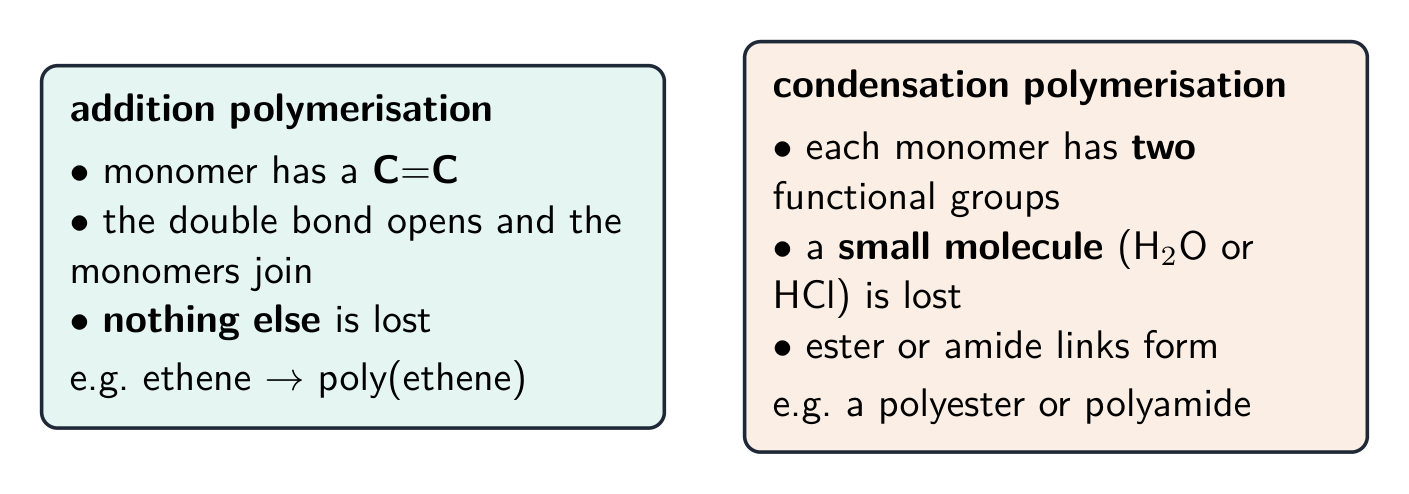
Hai loại polymer hóa: cộng mở C=C và không mất gì; ngưng tụ nối các monomer hai nhóm chức và mất một phân tử nhỏ
Explore · Khám phá
Polymerisation type lab · Phòng thí nghiệm loại trùng hợp
Classify monomers by whether they form addition or condensation polymers. · Phân loại monome dựa trên việc chúng tạo thành polymer cộng hay polymer ngưng tụ.
recognise that poly(alkenes) are chemically inert and can therefore be difficult to biodegrade
recognise that some polymers can be degraded by the action of light
recognise that polyesters and polyamides are biodegradable by acidic and alkaline hydrolysis
Tiếng Việt
nhận biết rằng poly(alken) có tính trơ về mặt hóa học và do đó khó bị phân hủy sinh học
nhận biết rằng một số polyme có thể bị phân hủy dưới tác dụng của ánh sáng
nhận biết rằng polyester và polyamide có thể phân hủy sinh học thông qua phản ứng thủy phân trong môi trường axit và kiềm
Source: Cambridge International syllabus · Nguồn: Chương trình Cambridge International
English
poly(alkene)s 聚烯烃 are chemically inert — they have only strong, non-polar C–C and C–H bonds, so they are hard to biodegrade 可生物降解 and last a long time.
some polymers are made so that light can break them down (they are photodegradable).
polyesters and polyamides are biodegradable, because their ester and amide links can be broken by acidic or alkaline hydrolysis 水解.
Tiếng Việt
poly(alkene) trơ về mặt hóa học — chúng chỉ có các liên kết C–C và C–H mạnh, không phân cực, nên khó phân hủy sinh học và tồn tại lâu dài.
một số polymer được thiết kế sao cho ánh sáng có thể phá vỡ chúng (chúng dễ phân hủy bởi ánh sáng).
polyester và polyamide có thể phân hủy sinh học, vì các liên kết este và amid của chúng có thể bị phá vỡ bởi quá trình thủy phân trong môi trường axit hoặc kiềm.
Explore · Khám phá
Degradable polymer route · Con đường polymer phân hủy sinh học
Follow how polymer structure controls breakdown. · Theo dõi cấu trúc polymer kiểm soát quá trình phân rã như thế nào.
Condensation polymers (polyesters, polyamides) form with loss of a small molecule ($\text{H}_2\text{O}$ or HCl) — draw the repeat unit and the lost molecule.
Identify the monomers from the polymer by breaking the ester or amide link — a common question.
Predict the type from the monomers: a $\text{C}=\text{C}$ gives addition; two functional groups give condensation.
Polyesters and polyamides are hydrolysable (more degradable); addition polymers are not.
Tiếng Việt
Polymer ngưng tụ (polyester, polyamide) hình thành kèm theo sự mất đi của một phân tử nhỏ ($\text{H}_2\text{O}$ hoặc HCl) — hãy vẽ đơn vị lặp lại và phân tử bị mất.
Xác định monomer từ polymer bằng cách cắt liên kết este hoặc amid — một câu hỏi thường gặp.
Dự đoán loại từ monomer: một $\text{C}=\text{C}$ cho cộng; hai nhóm chức cho ngưng tụ.
Polyester và polyamide có thể bị thủy phân (dễ phân hủy hơn); polymer cộng thì không.
Interactive lessons on this topic · Bài học tương tác về chủ đề này
Work through it step by step, with instant-check exercises. · Làm theo từng bước, kèm theo bài tập kiểm tra ngay lập tức.
Pick one and the site follows you — notes, papers, videos and practice all open on it. · Chọn một môn và trang sẽ điều hướng theo — ghi chú, tài liệu, video và bài tập đều mở ở đó.
Type to search notes, lessons, code, vocabulary and past-paper questions across every subject. · Nhập để tìm ghi chú, bài học, mã, từ vựng và câu hỏi đề thi cũ trên mọi môn học.