English
- understand and use the terms conjugate acid and conjugate base
- define conjugate acid–base pairs, identifying such pairs in reactions
- define mathematically the terms pH, $K_a$, $\text{p}K_a$ and $K_w$ and use them in calculations ($K_b$ and the equation $K_w = K_a \times K_b$ will not be tested)
- calculate $[\text{H}^+(\text{aq})]$ and pH values for: (a) strong acids (b) strong alkalis (c) weak acids
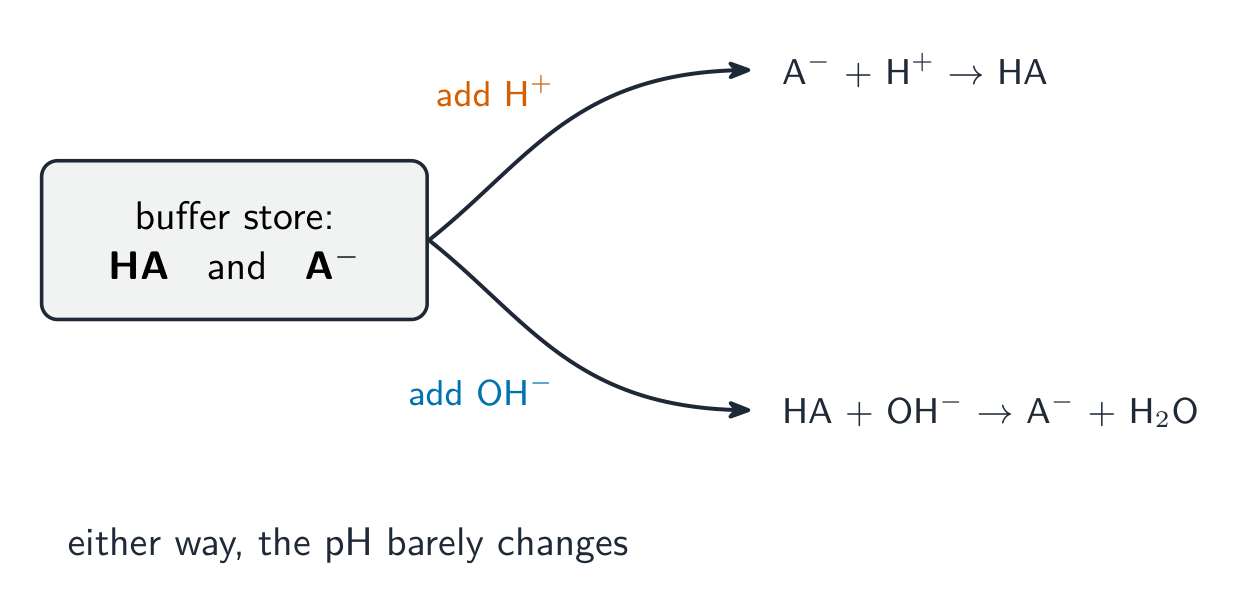
- (a) define a buffer solution (b) explain how a buffer solution can be made (c) explain how buffer solutions control pH; use chemical equations in these explanations (d) describe and explain the uses of buffer solutions, including the role of $\text{HCO}_3^-$ in controlling pH in blood
- calculate the pH of buffer solutions, given appropriate data
- understand and use the term solubility product, $K_{\text{sp}}$
- write an expression for $K_{\text{sp}}$
- calculate $K_{\text{sp}}$ from concentrations and vice versa
- (a) understand and use the common ion effect to explain the different solubility of a compound in a solution containing a common ion (b) perform calculations using $K_{\text{sp}}$ values and concentration of a common ion
Tiếng Việt
- hiểu và sử dụng các thuật ngữ axit liên hợp và bazơ liên hợp
- định nghĩa cặp axit – bazơ liên hợp, nhận diện các cặp như vậy trong các phản ứng
- định nghĩa toán học các thuật ngữ pH, $K_a$, $\text{p}K_a$ và $K_w$ và sử dụng chúng trong các phép tính ($K_b$ và phương trình $K_w = K_a \times K_b$ sẽ không được kiểm tra)
- tính $[\text{H}^+(\text{aq})]$ và giá trị pH cho: (a) axit mạnh (b) bazơ mạnh (c) axit yếu
- (a) định nghĩa dung dịch đệm (b) giải thích cách tạo dung dịch đệm (c) giải thích cách dung dịch đệm điều khiển pH; sử dụng phương trình hóa học trong các giải thích này (d) mô tả và giải thích các ứng dụng của dung dịch đệm, bao gồm vai trò của $\text{HCO}_3^-$ trong việc điều khiển pH trong máu
- tính pH của dung dịch đệm, khi có dữ liệu phù hợp
- hiểu và sử dụng thuật ngữ sản phẩm tan, $K_{\text{sp}}$
- viết biểu thức cho $K_{\text{sp}}$
- tính $K_{\text{sp}}$ từ nồng độ và ngược lại
- (a) hiểu và sử dụng hiệu ứng ion chung để giải thích độ tan khác nhau của một hợp chất trong dung dịch chứa ion chung (b) thực hiện các phép tính sử dụng các giá trị $K_{\text{sp}}$ và nồng độ của ion chung