Partition coefficients
Introduced| English | Meaning |
|---|---|
| solvent/ˈsɒlvənt/ | The substance in which a solute dissolves to form a solution. |
| solute/ˈsɒljuːt/ | A substance dissolved in a solvent to form a solution. |
| partition coefficient/pɑːˈtɪʃn ˌkəʊɪˈfɪʃənt/ | The ratio of a solute’s concentrations in two immiscible solvents at equilibrium. |
| non-polar/nɒn ˈpəʊlə/ | Having no significant separation of electric charge in a bond, or no overall permanent dipole in a molecule. |
| polar/ˈpəʊlə/ | Describing a molecule or bond with an uneven distribution of electric charge that creates partial positive and negative regions. |
| immiscible/ɪˈmɪsəbl/ | immiscible |
Splitting between two solvents 溶剂
- Shake a solute 溶质 with two solvents that don't mix — it spreads between them.
- The ratio of its concentrations is the partition coefficient 分配系数.
- Polarity decides which solvent it prefers.
Partition coefficient lab
Kpc = concentration organic / concentration aqueous
Change organic-layer concentration and see the partition ratio.
A partition coefficient describes how a solute distributes between two immiscible solvents.
Difficulty 1/5 · 100 coins + a small bonus on first completion today
It is the ratio of concentrations at equilibrium.
The partition coefficient
- It is constant at a fixed temperature.
- It only applies when the solute is in the same physical state in both solvents.
The partition coefficient is:
Difficulty 1/5 · 100 coins + a small bonus on first completion today
Kpc = [solute in solvent 1] / [solute in solvent 2], constant at a fixed temperature.
The partition coefficient applies only when the solute is:
Difficulty 1/5 · 100 coins + a small bonus on first completion today
Kpc is valid when the solute exists in the same physical state in each solvent.
Match each partition idea.
Difficulty 2/5 · 140 coins + a small bonus on first completion today
Each item links the term to its correct meaning.
Polarity decides
- The value depends on the polarity of the solute and each solvent.
- A non-polar 非极性 solute dissolves more in the non-polar 极性 solvent; a polar solute prefers the polar solvent.
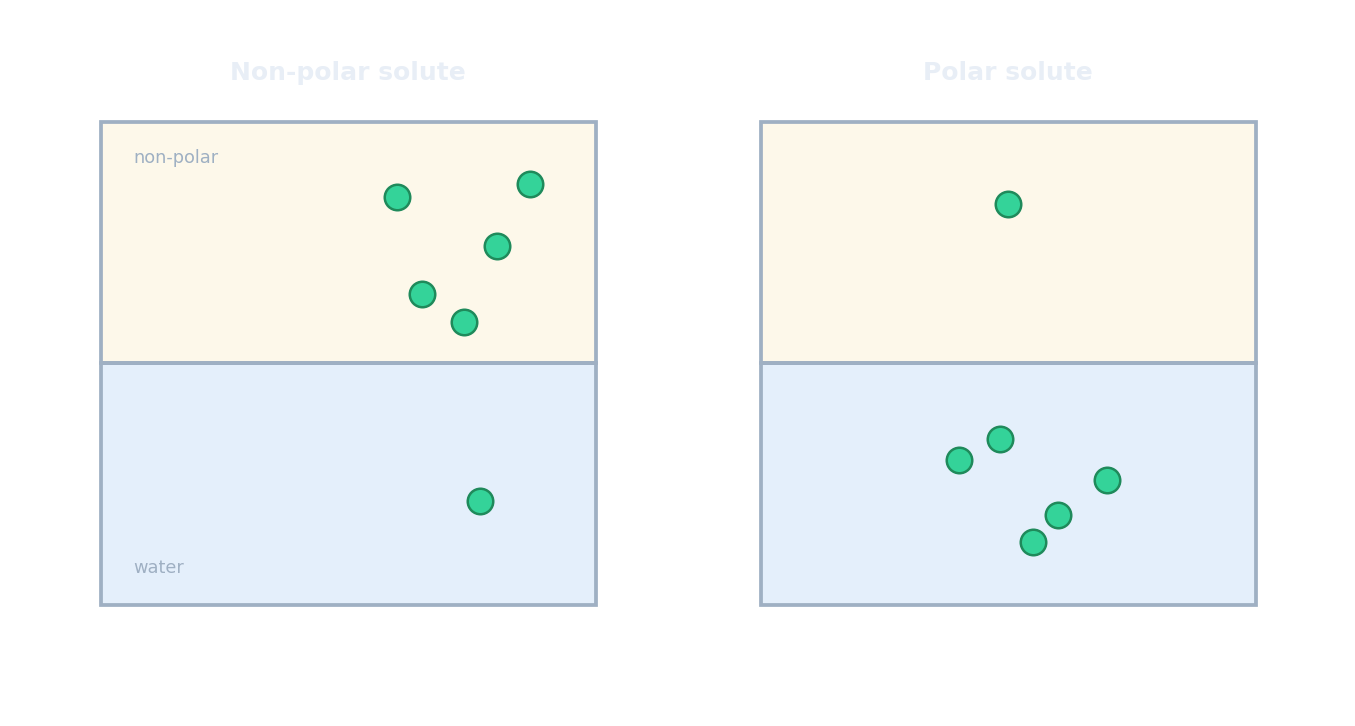
Polarity decides the split: a non-polar solute favours the non-polar layer, a polar solute the water layer.
A non-polar solute will dissolve more in:
Difficulty 1/5 · 100 coins + a small bonus on first completion today
"Like dissolves like": a non-polar solute prefers the non-polar solvent; a polar solute the polar one.
The value of the partition coefficient depends on the polarity of the solute and solvents.
Difficulty 1/5 · 100 coins + a small bonus on first completion today
Polarity governs how the solute distributes, so it sets the partition coefficient.
Using a partition coefficient
- The solute distributes between two immiscible 不混溶 solvents in a fixed ratio at equilibrium.
- This underlies solvent extraction and chromatography.
You've got it
- $K_{\text{pc}} = \dfrac{[\text{solute in solvent 1}]}{[\text{solute in solvent 2}]}$ (constant at fixed temperature)
- it applies when the solute is in the same physical state in both solvents
- non-polar solute → non-polar solvent; polar solute → polar solvent