Bạn vừa tạo ra một hợp chất mới. Nó là chất lỏng trong suốt trong bình phễu, không có nhãn mác, và bạn không thể nhìn thấy một phân tử nào. Làm thế nào để chứng minh đó là chất gì? Bạn hỏi…
English narration · English + 中文 subtitles burned in · Giọng đọc tiếng Anh · phụ đề tiếng Anh + 中文 được ghi trực tiếp
22.1
Infrared spectroscopy · 红外光谱法
Syllabus · Chương trình
English
analyse an infrared spectrum of a simple molecule to identify functional groups (see the Data section for the functional groups required)
Tiếng Việt
phân tích phổ hồng ngoại của một phân tử đơn giản để xác định nhóm chức (xem phần Dữ liệu để biết các nhóm chức bắt buộc)
Source: Cambridge International syllabus · Nguồn: Chương trình Cambridge International
English
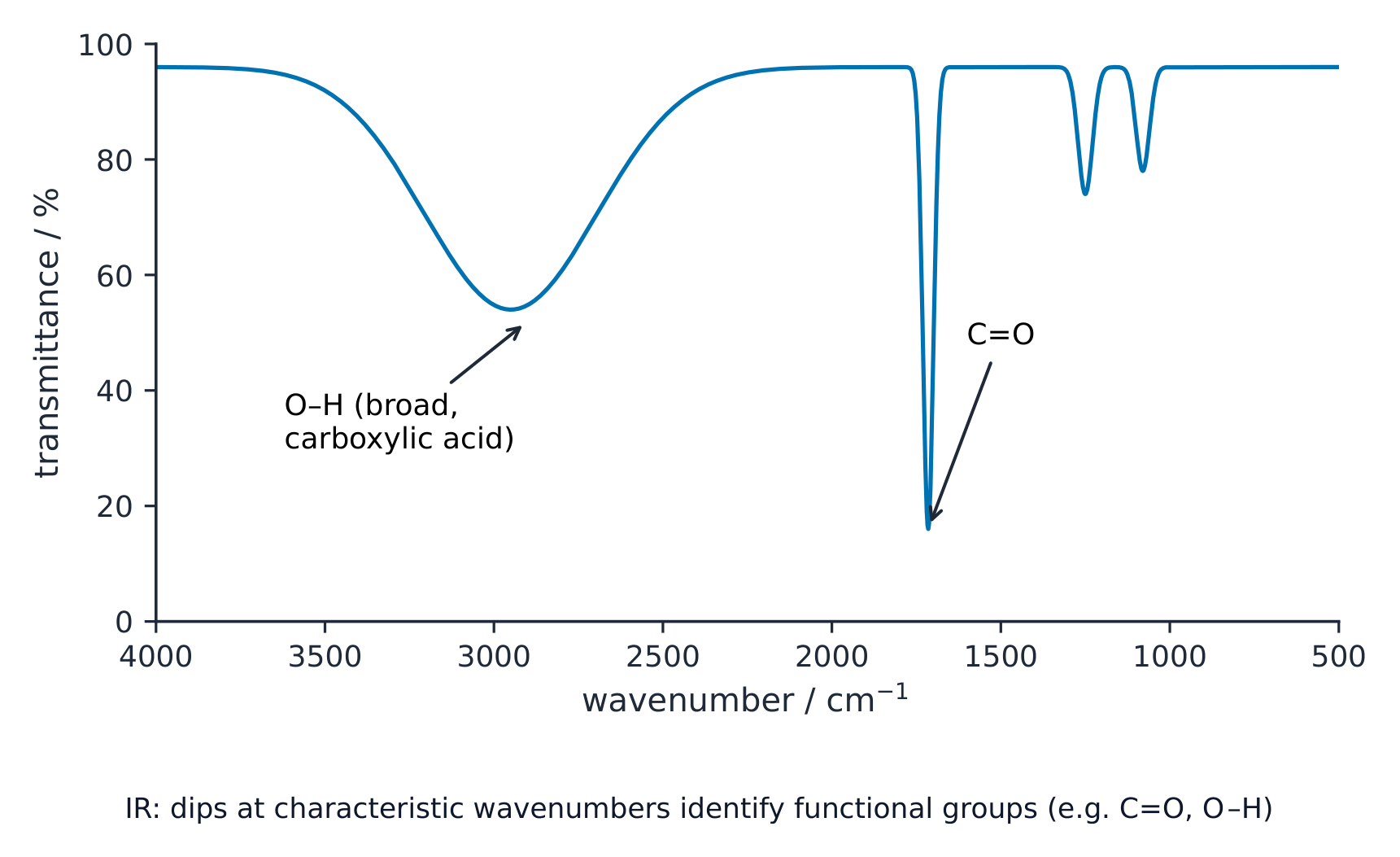
Infrared spectroscopy 红外光谱 helps you find the functional group 官能团 in a molecule. Each kind of bond soaks up (absorbs) infrared radiation at its own range of frequencies. Where the bond shows strong absorption 吸收, the spectrum has a dip.
The position is measured in wavenumber 波数 (in $\text{cm}^{-1}$). You are given a data table, so you do not memorise the numbers. You just match the dips to bonds:
a broad dip around $3200$–$3650\ \text{cm}^{-1}$ → an O–H bond in an alcohol.
a dip around $1700\ \text{cm}^{-1}$ → a C=O bond (aldehyde, ketone, acid or ester).
a broad dip $2500$–$3000\ \text{cm}^{-1}$ together with a C=O dip → a carboxylic acid.
This is useful for checking a reaction. For example, if propene has been turned into propan-2-ol, the C=C dip should be gone and an O–H dip should appear.
analyse mass spectra in terms of $m/e$ values and isotopic abundances (knowledge of the working of the mass spectrometer is not required)
calculate the relative atomic mass of an element given the relative abundances of its isotopes, or its mass spectrum
deduce the molecular mass of an organic molecule from the molecular ion peak in a mass spectrum
suggest the identity of molecules formed by simple fragmentation in a given mass spectrum
deduce the number of carbon atoms, $n$, in a compound using the $[M + 1]^+$ peak and the formula
$$n = \frac{100 \times \text{abundance of } [M + 1]^+ \text{ ion}}{1.1 \times \text{abundance of } M^+ \text{ ion}}$$
deduce the presence of bromine and chlorine atoms in a compound using the $[M + 2]^+$ peak
Tiếng Việt
phân tích phổ mass theo các giá trị $m/e$ và tỷ lệ đồng vị (không yêu cầu kiến thức về cơ chế hoạt động của máy phổ mass)
tính khối lượng nguyên tử tương đối của một nguyên tố khi biết tỷ lệ đồng vị tương đối hoặc phổ mass của nó
suy ra khối lượng phân tử của một phân tử hữu cơ từ đỉnh ion phân tử trong phổ mass
gợi ý danh tính của các phân tử được hình thành do phân mảnh đơn giản trong một phổ mass cho trước
suy ra số nguyên tử carbon, $n$, trong một hợp chất sử dụng đỉnh $[M + 1]^+$ và công thức
$$n = \frac{100 \times \text{abundance of } [M + 1]^+ \text{ ion}}{1.1 \times \text{abundance of } M^+ \text{ ion}}$$
suy ra sự tồn tại của nguyên tử brom và clo trong một hợp chất sử dụng đỉnh $[M + 2]^+$
Source: Cambridge International syllabus · Nguồn: Chương trình Cambridge International
English
In mass spectrometry 质谱, a molecule is turned into ions and sorted by its mass-to-charge ratio 质荷比 ($m/e$). The spectrum is a set of peaks at different $m/e$ values.
Relative atomic mass from isotopes
An element's isotope 同位素 mixture gives several peaks. From the isotopic abundance 同位素丰度 (how common each isotope is) you can find the relative atomic mass 相对原子质量 — a weighted average:
For example, chlorine is 75% $^{35}\text{Cl}$ and 25% $^{37}\text{Cl}$, giving $A_r = \dfrac{35 \times 75 + 37 \times 25}{100} = 35.5$.
The molecular ion and fragmentation
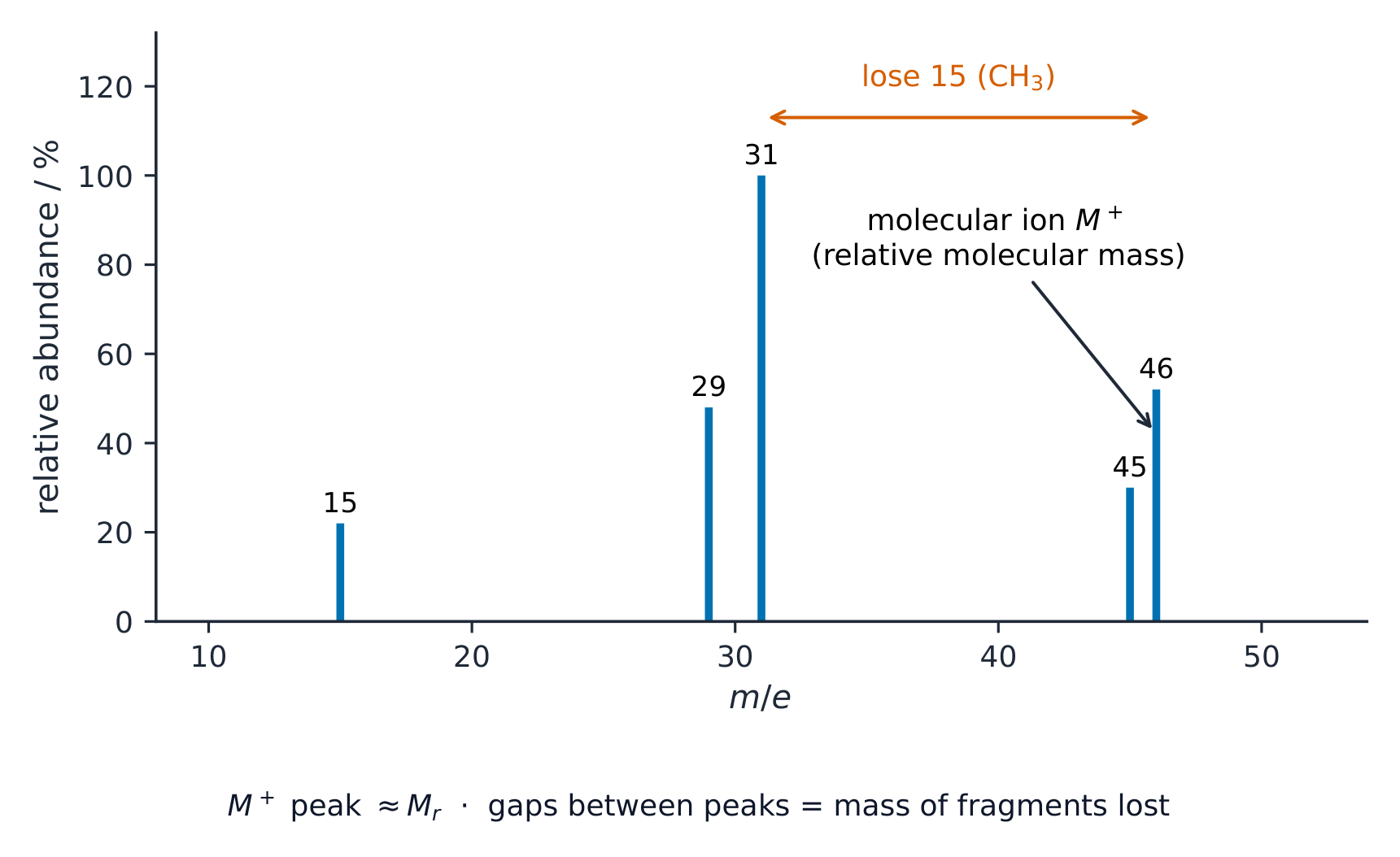
The peak at the highest $m/e$ (the molecular ion 分子离子 peak, or molecular ion peak 分子离子峰, $M^+$) gives the relative molecular mass of the whole molecule.
The molecule also breaks into smaller pieces — this is fragmentation 碎裂. The gap between two peaks tells you the mass of the lost piece, so you can suggest each fragment 碎片. For example, a loss of 15 means a $\text{CH}_3$ group was lost, and a loss of 29 means $\text{CHO}$ or $\text{C}_2\text{H}_5$.
The [M + 1] and [M + 2] peaks
a small [M + 1] peak comes from the $^{13}\text{C}$ isotope. The number of carbon atoms $n$ is:
$$n = \frac{100 \times \text{abundance of } [M + 1]^+}{1.1 \times \text{abundance of } M^+}$$
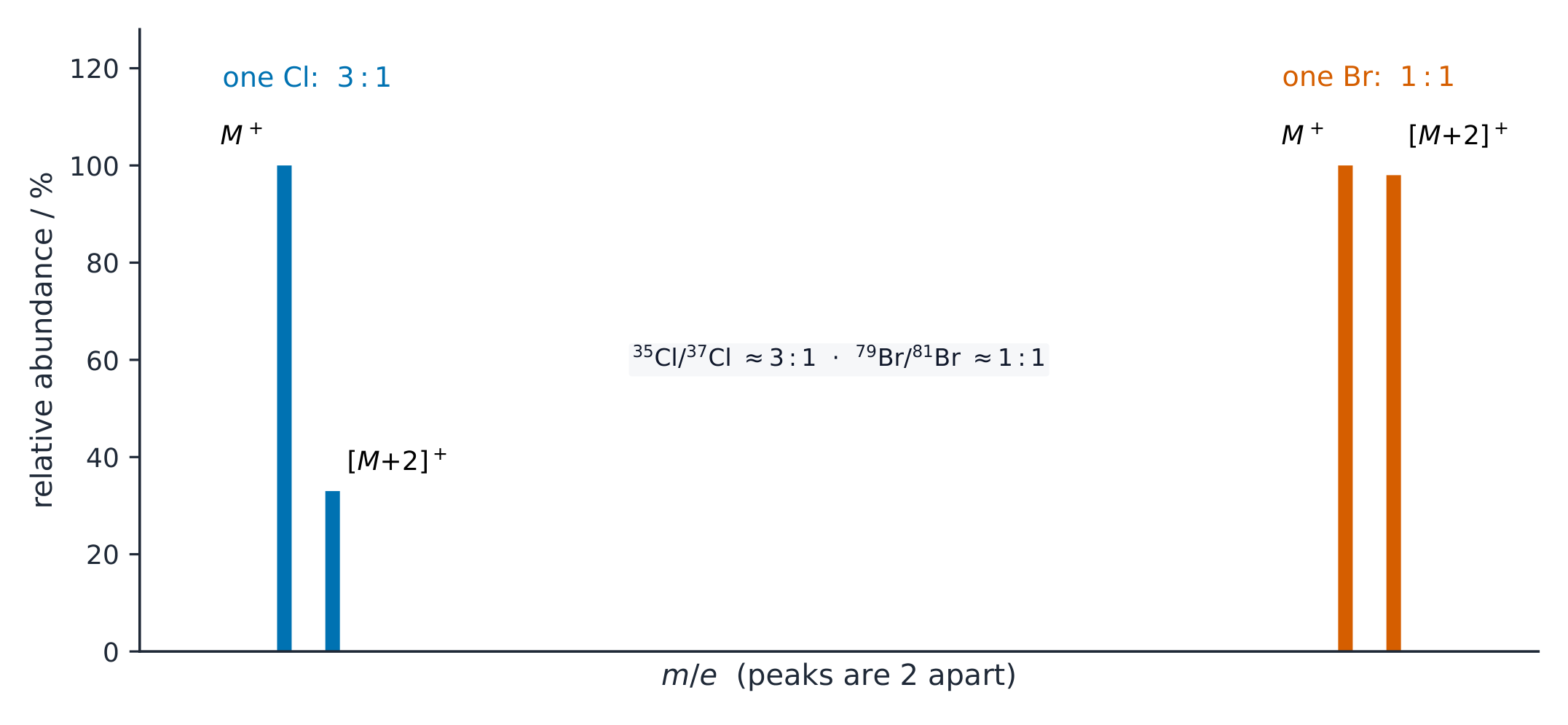
an [M + 2] peak shows chlorine or bromine. One chlorine gives an $[M + 2]$ peak about one third the height of $M^+$ (from $^{37}\text{Cl}$); one bromine gives an $[M + 2]$ peak about the same height as $M^+$ (from $^{81}\text{Br}$).
Worked example. A compound shows a molecular ion at $m/e = 108$ and a peak of almost equal height at $m/e = 110$. Its infrared spectrum shows no broad absorption near $3300\ \text{cm}^{-1}$. Deduce its identity. Two peaks two units apart with roughly equal heights are the $1:1$ signature of one bromine atom (from $^{79}\text{Br}$ and $^{81}\text{Br}$); one chlorine would have given a $3:1$ ratio instead. Take the bromine away from the molecular ion: $108 - 79 = 29$, which fits a $\text{C}_2\text{H}_5$ fragment. The absence of a broad peak near $3300\ \text{cm}^{-1}$ rules out an $\text{O-H}$, so there is no alcohol group. The compound is bromoethane, $\text{C}_2\text{H}_5\text{Br}$. Read the $[M+2]$ratio rather than merely noting the peak: $1:1$ means bromine, $3:1$ means chlorine.
Pick one and the site follows you — notes, papers, videos and practice all open on it. · Chọn một môn và trang sẽ điều hướng theo — ghi chú, tài liệu, video và bài tập đều mở ở đó.
Type to search notes, lessons, code, vocabulary and past-paper questions across every subject. · Nhập để tìm ghi chú, bài học, mã, từ vựng và câu hỏi đề thi cũ trên mọi môn học.