Skip to content · ⁨ข้ามไปยังเนื้อหา⁩
Subjects · ⁨รายวิชา⁩

IGCSE Physics · ⁨Physics IGCSE⁩

Tips · ⁨เคล็ดลับ⁩

ฟิสิกส์ IGCSE (0625) มีหกหัวข้อ: การเคลื่อนที่ แรงและพลังงาน; ฟิสิกส์ความร้อน; คลื่น; ไฟฟ้าและแม่เหล็ก; ฟิสิกส์นิวเคลียร์; ฟิสิกส์อวกาศ

ตรวจสอบระดับของคุณก่อน มีข้อสอบสำหรับหกส่วน และส่วนที่คุณเข้าสอบขึ้นอยู่กับว่าคุณสมัคร พื้นฐาน หรือ เพิ่มเติม เนื้อหาเฉพาะเพิ่มเติมเป็นส่วนสำคัญของหลักสูตรและเป็นการทบทวนที่ไร้ประโยชน์หากคุณอยู่ในระดับพื้นฐาน

ข้อหายอดนิยมคือ ที่แก้ได้ง่ายที่สุด: หน่วยที่ขาดหาย, จำนวน หลักสำคัญ ผิด และคำตอบที่ให้ตัวเลขโดยไม่ระบุ สูตร ที่สร้างมันขึ้น นิยามให้คะแนนตาม ถ้อยคำที่แม่นยำ — เรียนรู้ตามตัวอักษร ไม่ใช่ตามความทรงจำ

  • 1

    Motion, forces and energy · ⁨การเคลื่อนที่ แรง และพลังงาน⁩

    Watch lesson · ⁨ดูบทเรียน⁩
    1.1

    Measurement 测量

    Syllabus · ⁨หลักสูตร⁩
    English
    Core Supplement
    1 Describe the use of rulers and measuring cylinders to find a length or a volume
    2 Describe how to measure a variety of time intervals using clocks and digital timers
    3 Determine an average value for a small distance and for a short interval of time by measuring multiples (including the period of oscillation of a pendulum)
    4 Understand that a scalar quantity has magnitude (size) only and that a vector quantity has magnitude and direction
    5 Know that the following quantities are scalars: distance, speed, time, mass, energy and temperature
    6 Know that the following quantities are vectors: force, weight, velocity, acceleration, momentum, electric field strength and gravitational field strength
    7 Determine, by calculation or graphically, the resultant of two vectors at right angles, limited to forces or velocities only
    ไทย
    แก่น เพิ่มเติม
    1 อธิบายการใช้ไม้บรรทัดและกระบอกวัดเพื่อหาความยาวหรือปริมาตร
    2 อธิบายวิธีการวัดช่วงเวลาต่างๆ باستخدامนาฬิกาและจับเวลาดิจิทัล
    3 หาค่าเฉลี่ยสำหรับระยะสั้นและช่วงเวลาสั้นด้วยการวัดหลายครั้ง (รวมถึงคาบการสั่นของลูกตุ้มนาฬิกา)
    4 เข้าใจว่า ปริมาณสเกลาร์ มีเพียงขนาดเท่านั้น และ ปริมาณเวกเตอร์ มีทั้งขนาดและทิศทาง
    5 รู้ว่าปริมาณต่อไปนี้คือปริมาณสเกลาร์: ระยะทาง, อัตราเร็ว, เวลา, มวล, พลังงาน และอุณหภูมิ
    6 ทราบว่าปริมาณต่อไปนี้เป็นเวกเตอร์: แรง, น้ำหนัก, ความเร็วเชิงทิศทาง, ความเร่ง, โมเมนตัม, ความเข้มของสนามไฟฟ้า และ ความเข้มของสนามโน้มถ่วง
    7 หา ผลรวม ของเวกเตอร์สองตัวที่ตั้งฉากกัน โดยคำนวณหรือจากกราฟ ซึ่งจำกัดเฉพาะแรงหรือความเร็วเท่านั้น

    Source: Cambridge International syllabus · ⁨แหล่งที่มา: หลักสูตร Cambridge International⁩

    Resolving a vector into components

    Length and volume

    Use a ruler 直尺 to measure length. Read the scale with your eye straight in front of the mark to avoid a reading error.

    Lowering an irregular solid into a measuring cylinder; the rise in water level is its volume
    The water an irregular solid pushes up gives its volume
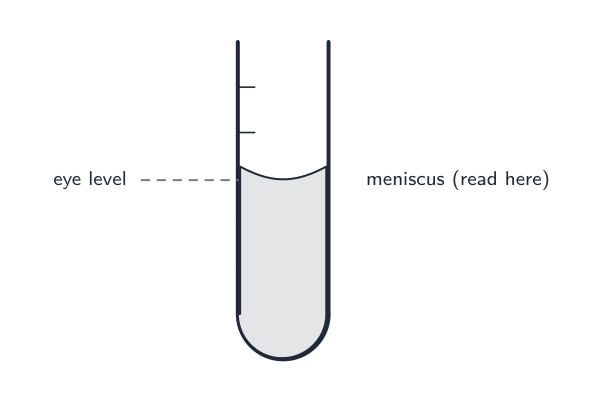
    Reading a measuring cylinder at the bottom of the meniscus, eye level with the mark
    Read a measuring cylinder at the bottom of the meniscus, with your eye level

    Use a measuring cylinder 量筒 to measure the volume of a liquid. Read the scale at the bottom of the curved surface (the meniscus 弯月面), with your eye level with it.

    Measuring time

    Use a stopwatch 秒表 or a digital timer 数字计时器 to measure a time interval. A clock is fine for long times (minutes or hours). A stopwatch is started and stopped by hand, so each reading has a reaction time 反应时间 error of about 0.2 s. To make this error matter less, time a long interval, or time many repeats and divide (see below).

    Measuring small amounts

    A single small length or a short time is hard to measure well. The trick is to measure many and divide 测多个再相除:

    • To find the thickness of one page, measure 100 pages and divide by 100.
    • To find the time for one swing of a pendulum 摆, measure the time for 20 swings and divide by 20. One full swing is called the period 周期.

    This makes the uncertainty 不确定度 (the size of the error) much smaller.

    Scalars and vectors

    A scalar quantity 标量 has size (magnitude 大小) only. A vector quantity 矢量 has size and direction.

    • Scalars: distance, speed, time, mass 质量, energy 能量, temperature 温度.
    • Vectors: force 力, weight 重力, velocity 速度, acceleration 加速度, momentum 动量, electric field strength 电场强度, gravitational field strength 重力场强度.

    To add two vectors at right angles (90°), draw them as two sides of a rectangle. The resultant 合矢量 is the diagonal. Find its size with Pythagoras and its direction with trigonometry.

    $$R = \sqrt{a^2 + b^2}$$
    Two perpendicular vectors drawn as the sides of a rectangle, with the resultant as the diagonal
    Two vectors at right angles add to a resultant $R$, the diagonal of the rectangle
    Explore · ⁨สำรวจ⁩

    Scalars & vectors · ⁨สเกลาร์ & เวกเตอร์⁩

    resultant = a + b

    Add two vectors tip-to-tail to find the resultant. · ⁨บวกเวกเตอร์สองตัวปลายติดปลายเพื่อหาผลลัพธ์ resultant⁩

    Vocabulary · ⁨คำศัพท์⁩ Train · ⁨ฝึกฝน⁩
    English ไทย
    ruler/ˈruːlə/ ผู้ปกครอง / พระเจ้า
    measuring cylinder/ˈmeʒərɪŋ ˈsɪlɪndə/ กระบอกตวง
    meniscus/ˈmenɪskəs/ ผิวโค้งของของเหลว
    stopwatch/ˈstɒpwɒtʃ/ นาฬิกาจับเวลา
    digital timer/ˈdɪdʒɪtl ˈtaɪmə/ ตัวจับเวลาดิจิตอล
    reaction time/rɪˈækʃn taɪm/ เวลาตอบสนอง
    measure many and divide/ˈmeʒə ˈmeni ænd dɪˈvaɪd/ วัดหลายครั้งแล้วหาร
    pendulum/ˈpendjʊləm/ ลูกตุ้ม
    period/ˈpɪərɪəd/ รอบ
    uncertainty/ʌnˈsɜːtənti/ ความไม่แน่นอน (uncertainty)
    scalar quantity/ˈskeɪlə ˈkwɒntɪti/ ปริมาณสเกลาร์
    magnitude/ˈmæɡnɪtjuːd/ ขนาด
    vector quantity/ˈvektə ˈkwɒntɪti/ ปริมาณเวกเตอร์
    mass/mæs/ มวล
    energy/ˈenədʒi/ พลังงาน
    temperature/ˈtemprɪtʃə/ อุณหภูมิ
    force/fɔːs/ แรง
    weight/weɪt/ น้ำหนัก
    velocity/vəˈlɒsɪti/ ความเร็ว
    acceleration/əkˌseləˈreɪʃn/ ความเร่ง
    momentum/məʊˈmentəm/ โมเมนตัม
    electric field strength/ɪˈlektrɪk fiːld streŋθ/ ความเข้มสนามไฟฟ้า
    gravitational field strength/ˌɡrævɪˈteɪʃənl fiːld streŋθ/ ความเข้มของสนามโน้มถ่วง
    resultant/rɪˈzʌltənt/ 合力
    1.2

    Motion 运动

    Syllabus · ⁨หลักสูตร⁩
    English
    Core Supplement
    1 Define speed as distance travelled per unit time; recall and use the equation
    $$v = \frac{s}{t}$$
    2 Define velocity as speed in a given direction
    3 Recall and use the equation
    $$\text{average speed} = \frac{\text{total distance travelled}}{\text{total time taken}}$$
    9 Define acceleration as change in velocity per unit time; recall and use the equation
    $$a = \frac{\Delta v}{\Delta t}$$
    4 Sketch, plot and interpret distance–time and speed–time graphs
    5 Determine, qualitatively, from given data or the shape of a distance–time graph or speed–time graph when an object is: (a) at rest (b) moving with constant speed (c) accelerating (d) decelerating 10 Determine from given data or the shape of a speed–time graph when an object is moving with: (a) constant acceleration (b) changing acceleration
    6 Calculate speed from the gradient of a straight-line section of a distance–time graph 11 Calculate acceleration from the gradient of a speed–time graph
    7 Calculate the area under a speed–time graph to determine the distance travelled for motion with constant speed or constant acceleration
    12 Know that a deceleration is a negative acceleration and use this in calculations
    8 State that the acceleration of free fall $g$ for an object near to the surface of the Earth is approximately constant and is approximately $9.8\text{ m/s}^2$ 13 Describe the motion of objects falling in a uniform gravitational field with and without air/ liquid resistance, including reference to terminal velocity
    ไทย
    แก่น เพิ่มเติม
    1 นิยาม ความเร็ว เป็นระยะทางที่เดินทางต่อหน่วยเวลา; จำและใช้สมการ
    $$v = \frac{s}{t}$$
    2 นิยาม ความเร็วเชิงทิศทาง เป็นความเร็วที่มีทิศทางที่กำหนดไว้
    3 จำและใช้สมการ
    $$\text{average speed} = \frac{\text{total distance travelled}}{\text{total time taken}}$$
    9 นิยาม ความเร่ง เป็นการเปลี่ยนแปลงของความเร็วต่อหน่วยเวลา; จำและใช้สมการ
    $$a = \frac{\Delta v}{\Delta t}$$
    4 วาดแผนภาพ กราฟ และตีความ กราฟระยะทาง–เวลา และ กราฟความเร็ว–เวลา
    5 วิเคราะห์เชิงคุณภาพ จากข้อมูลที่ให้มาหรือรูปร่างของกราฟระยะทาง–เวลา หรือกราฟความเร็ว–เวลา ว่าวัตถุมีลักษณะใด: (ก)处于静止状态 (ข) เคลื่อนที่ด้วยความเร็วคงที่ (ค) มีความเร่ง (ง) ลดความเร็ว 10 วิเคราะห์จากข้อมูลหรือรูปร่างของกราฟความเร็ว–เวลา ว่าวัตถุเคลื่อนที่ด้วย: (ก) ความเร่งคงที่ (ข) ความเร่งเปลี่ยนไป
    6 คำนวณความเร็วจากความชันของส่วนที่เป็นเส้นตรงในกราฟระยะทาง–เวลา 11 คำนวณความเร่งจากความชันของกราฟความเร็ว–เวลา
    7 คำนวณพื้นที่ใต้กราฟความเร็ว–เวลา เพื่อดูระยะทางที่เดินทาง สำหรับการเคลื่อนที่ด้วยความเร็วคงที่หรือความเร่งคงที่
    12 ทราบว่า การลดความเร็ว คือความเร่งลบ และนำสิ่งนี้ไปใช้ในคำคำนวณ
    8 ระบุว่าความเร่งจากการตกอย่างอิสระ $g$ สำหรับวัตถุใกล้ผิวดินโลกมีค่าประมาณคงที่ และมีค่าประมาณ $9.8\text{ m/s}^2$ 13 อธิบายการเคลื่อนที่ของวัตถุที่ตกใน สนามโน้มถ่วงสม่ำเสมอ ทั้งที่มีและไม่มีแรงต้านอากาศ/ของเหลว รวมถึงการกล่าวถึง ความเร็วสุดท้าย

    Source: Cambridge International syllabus · ⁨แหล่งที่มา: หลักสูตร Cambridge International⁩

    Speed and velocity

    Speed 速率 is the distance travelled per unit time.

    $$v = \frac{s}{t}$$

    Velocity is speed in a stated direction. So velocity is a vector but speed is a scalar.

    $$\text{average speed} = \frac{\text{total distance}}{\text{total time}}$$

    Acceleration

    Acceleration is the change in velocity per unit time.

    $$a = \frac{\Delta v}{\Delta t}$$

    Here $\Delta v$ means "the change in velocity". A deceleration 减速 (slowing down) is a negative acceleration.

    Worked example. A car speeds up from $8\ \text{m/s}$ to $20\ \text{m/s}$ in $4.0\ \text{s}$. Find its acceleration.

    $$a = \frac{\Delta v}{\Delta t} = \frac{20 - 8}{4.0} = 3.0\ \text{m/s}^2$$

    Motion graphs

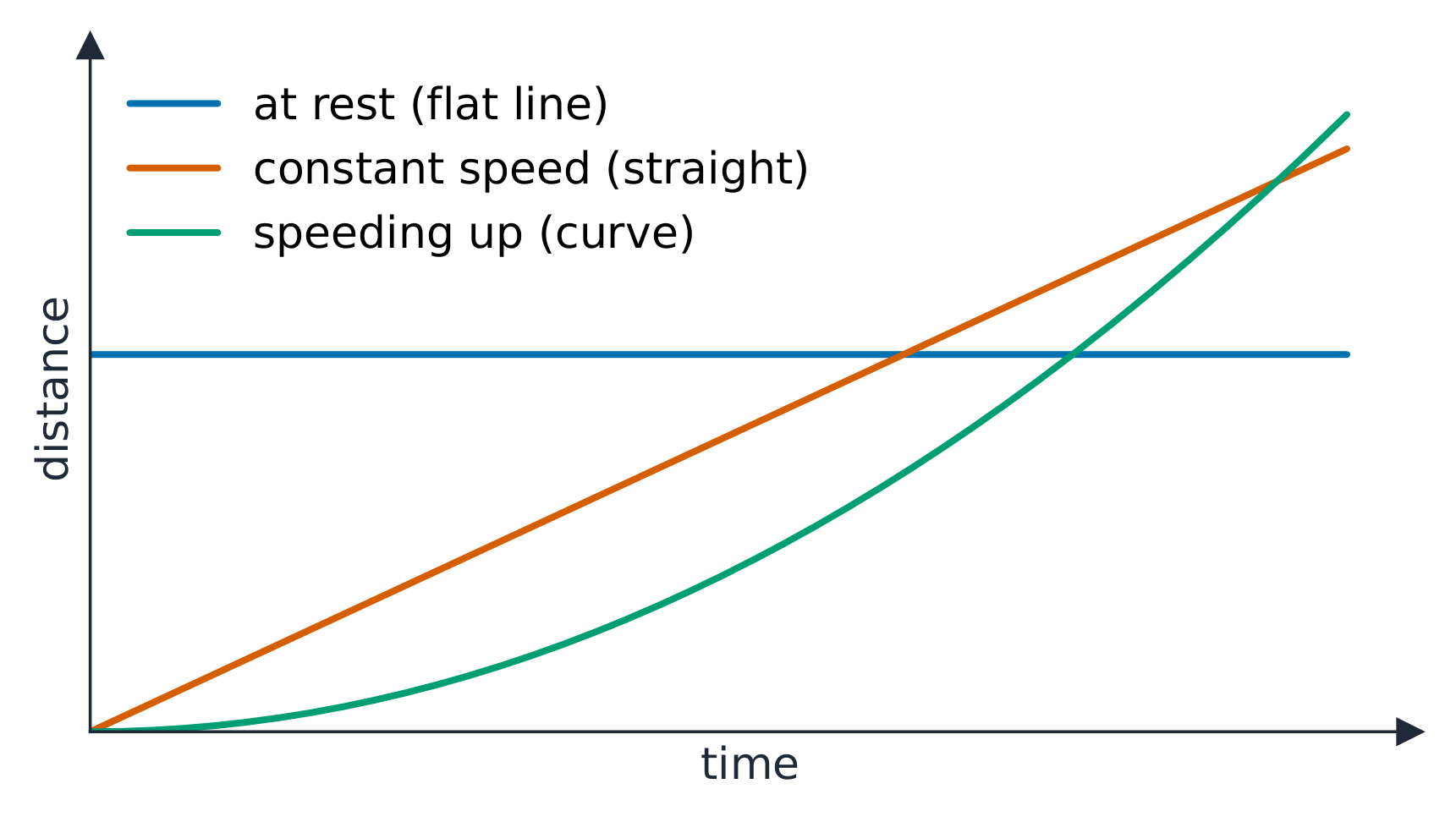
    A distance–time graph 距离-时间图 shows how far an object has gone:

    • A flat (horizontal) line means the object is at rest 静止.
    • A straight slope means constant speed. The gradient 斜率 (steepness) is the speed.
    • A curve that gets steeper means the object is speeding up.
    Three distance–time lines: a flat line, a straight slope, and a curve that gets steeper
    The shape of a distance–time line: flat is at rest, a straight slope is constant speed, a rising curve is speeding up

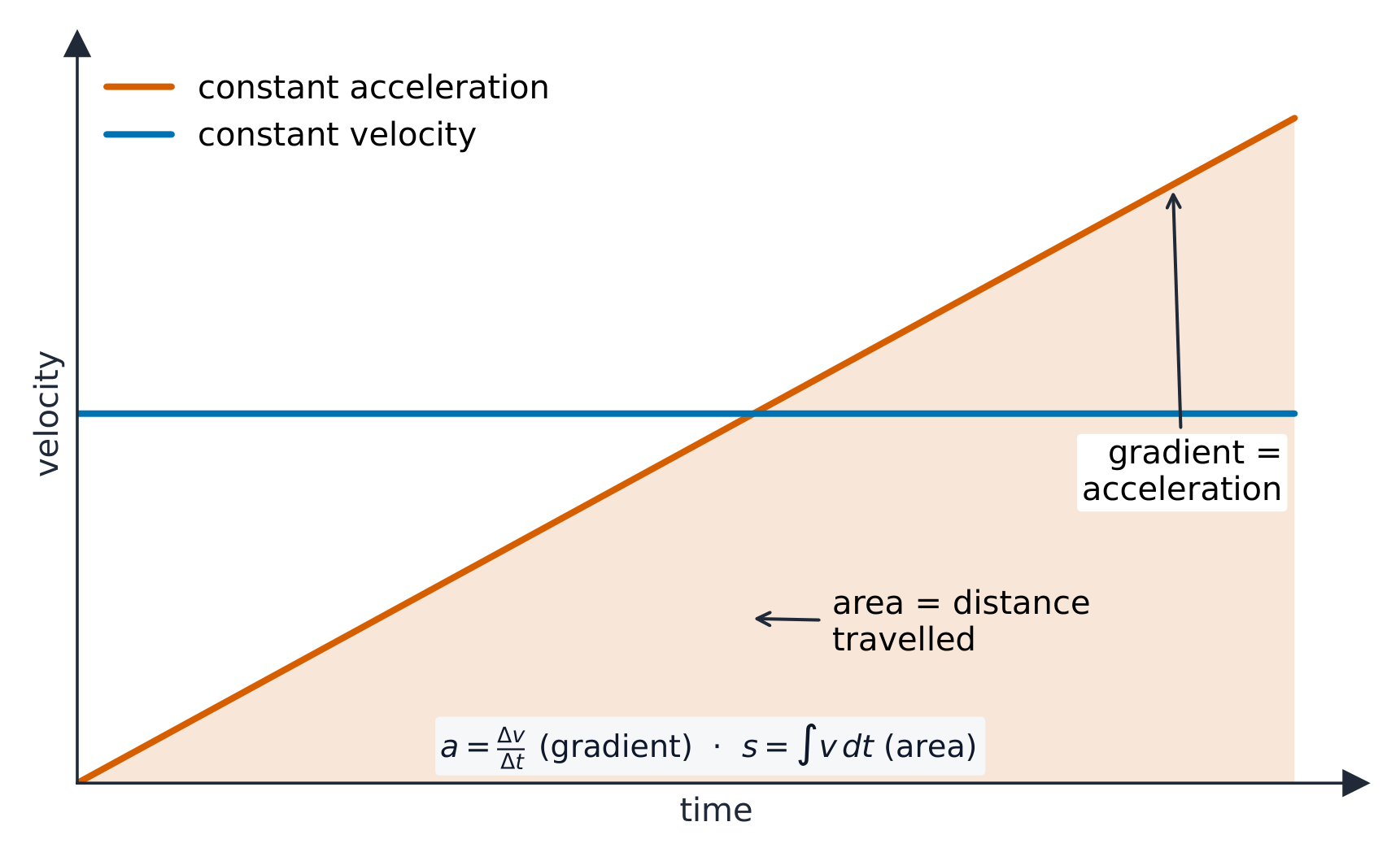
    A speed–time graph 速度-时间图 shows how fast an object is going:

    • A flat line means constant speed.
    • A straight slope means constant acceleration. The gradient is the acceleration.
    • The area under the line 线下面积 is the distance travelled.
    A velocity–time graph with a sloping line whose gradient is the acceleration and whose shaded area is the distance
    On a velocity–time graph the gradient is the acceleration and the area under the line is the distance travelled

    Falling objects

    Near the Earth the gravitational field is uniform 均匀 (the same strength everywhere), so all objects speed up as they fall at the same rate. This is the acceleration of free fall 自由落体加速度, $g \approx 9.8\ \text{m/s}^2$.

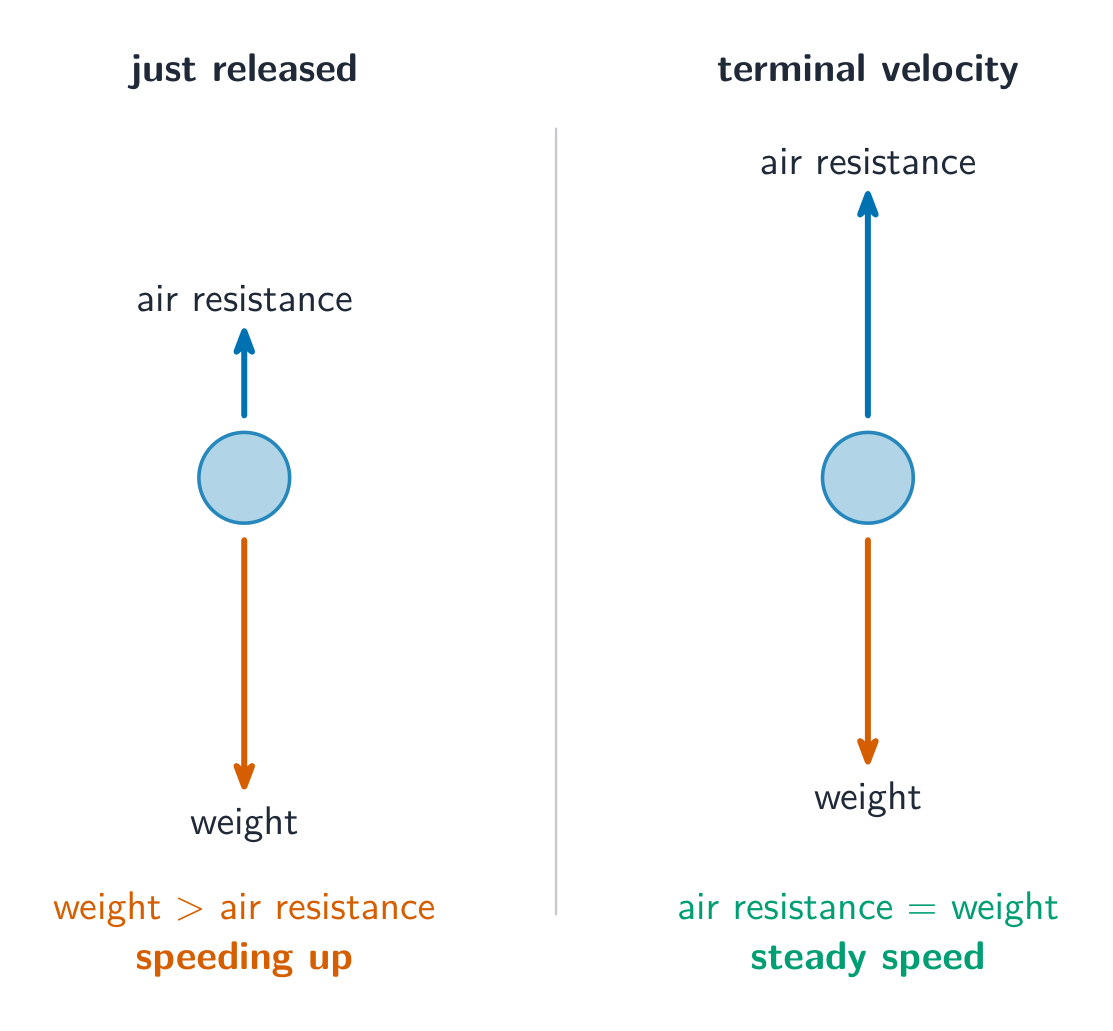
    When an object falls through air, air resistance 空气阻力 (a drag force) acts upward. As it speeds up, air resistance grows. When air resistance equals the weight, the resultant force is zero and the object stops speeding up. It then falls at a steady terminal velocity 收尾速度.

    A falling object with weight and air resistance arrows, shown just after release and at terminal velocity
    At first the weight is bigger than the air resistance, so the object speeds up; at terminal velocity the two are equal and the speed is steady
    Explore · ⁨สำรวจ⁩

    Velocity–time graph · ⁨กราฟความเร็ว-เวลา⁩

    Change u and a. The gradient is the acceleration; the area under the line is the distance travelled. · ⁨เปลี่ยน u และ a. ความชัน คือความเร่ง; พื้นที่ใต้เส้นคือระยะทางที่เดินทาง⁩

    Vocabulary · ⁨คำศัพท์⁩ Train · ⁨ฝึกฝน⁩
    English ไทย
    motion/ˈməʊʃn/ การเคลื่อนที่
    speed/spiːd/ ความเร็ว
    deceleration/dɪˌseləˈreɪʃn/ การลดความเร็ว
    distance–time graph/ˈdɪstəns taɪm ɡræf/ กราฟระยะ-เวลา
    at rest/æt rest/ หยุดนิ่ง
    gradient/ˈɡreɪdɪənt/ ความชัน
    speed–time graph/spiːd taɪm ɡræf/ กราฟความเร็ว-เวลา
    area under the line/ˈeərɪə ˈʌndə ðə laɪn/ พื้นที่ใต้เส้นกราฟ
    uniform/ˈjuːnɪfɔːm/ สม่ำเสมอ
    acceleration of free fall/əkˌseləˈreɪʃn ɒv friː fɔːl/ ความเร่งโน้มถ่วงอิสระ
    air resistance/eə rɪˈzɪstəns/ แรงต้านอากาศ
    terminal velocity/ˈtɜːmɪnl vəˈlɒsɪti/ ความเร็วสูงสุด
    1.3

    Mass and weight

    Syllabus · ⁨หลักสูตร⁩
    English
    Core Supplement
    1 State that mass is a measure of the quantity of matter in an object at rest relative to the observer
    2 State that weight is a gravitational force on an object that has mass 5 Describe, and use the concept of, weight as the effect of a gravitational field on a mass
    3 Define gravitational field strength as force per unit mass; recall and use the equation
    $$g = \frac{W}{m}$$
    and know that this is equivalent to the acceleration of free fall
    4 Know that weights (and masses) may be compared using a balance
    ไทย
    แก่น เพิ่มเติม
    1 ระบุว่า มวล เป็นตัวชี้วัดปริมาณสสารในวัตถุเมื่ออยู่นิ่งเทียบกับผู้สังเกต
    2 ระบุว่า น้ำหนัก เป็นแรงโน้มถ่วงที่กระทำต่อวัตถุซึ่งมีมวล 5 อธิบาย并使用概念关于,将重量视为引力场对质量的影响
    3 นิยาม ความเข้มของสนามโน้มถ่วง เป็นแรงต่อหน่วยมวล; จำและใช้สมการ
    $$g = \frac{W}{m}$$
    และรู้ว่าสิ่งนี้เทียบเท่ากับความเร่งจากการตกอย่างอิสระ
    4 ทราบว่าน้ำหนัก (และมวล) สามารถเปรียบเทียบกันได้โดยใช้เครื่องชั่ง

    Source: Cambridge International syllabus · ⁨แหล่งที่มา: หลักสูตร Cambridge International⁩

    Mass is the amount of matter 物质 in an object. It is measured in kilograms (kg) and does not change when you move the object.

    Weight is the force of gravity on a mass. It is measured in newtons (N). Weight can change: it is smaller on the Moon because the Moon's gravity is weaker.

    Gravitational field strength is the force per unit mass:

    $$g = \frac{W}{m}$$

    This $g$ has the same value as the acceleration of free fall ($\approx 9.8\ \text{N/kg}$). You can compare masses with a balance 天平.

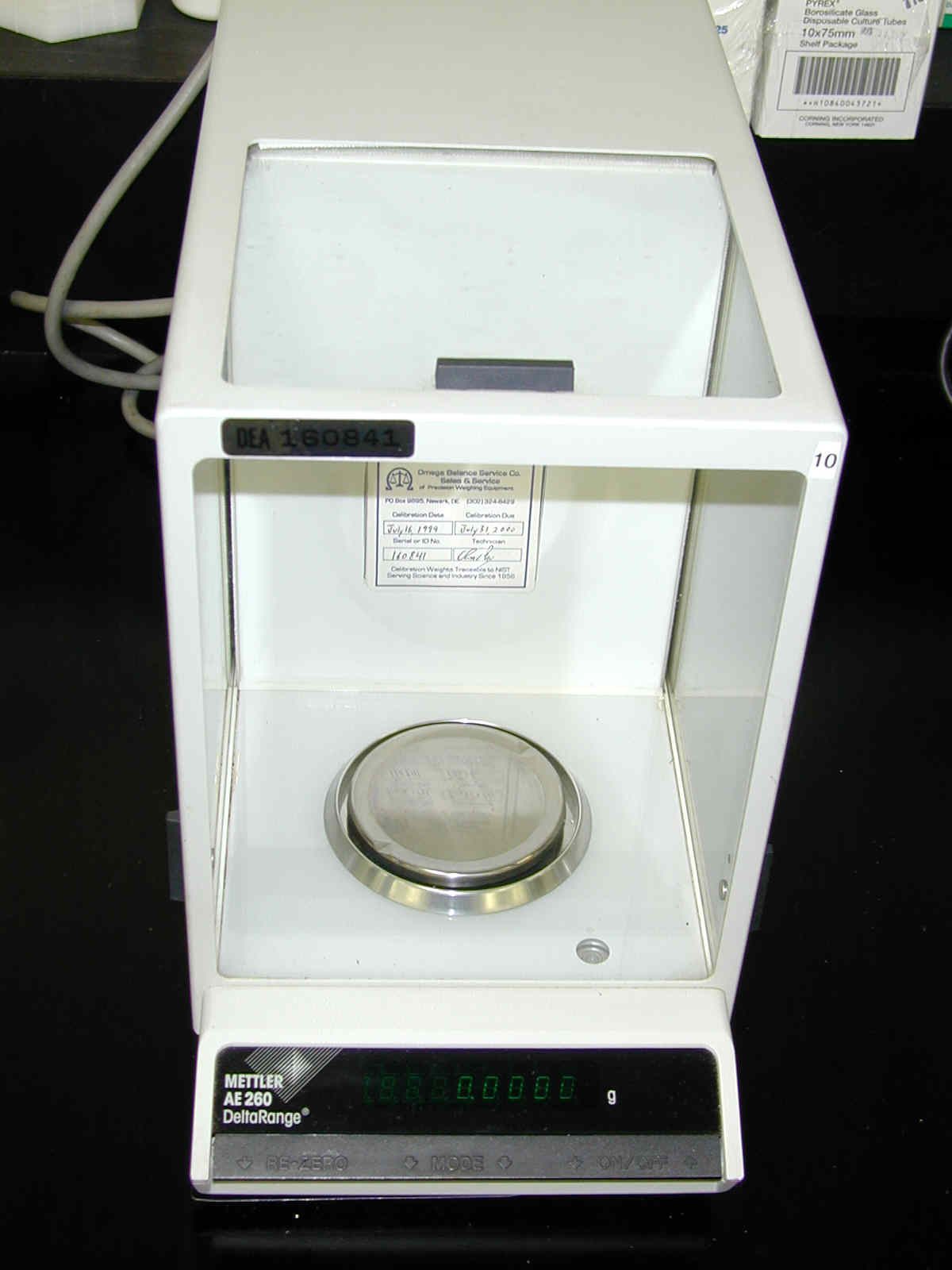
    A laboratory balance measures mass; weight is the gravitational force on that mass
    A laboratory balance measures mass; weight is the gravitational force on that mass
    Explore · ⁨สำรวจ⁩

    Weight and mass · ⁨น้ำหนักและมวล⁩

    W = mg

    Weight is proportional to mass — the gradient is the gravitational field strength g (about 10 N/kg on Earth). · ⁨น้ำหนัก แปรผันตรงกับมวล — ความชันคือความเข้มของสนามโน้มถ่วง g (ประมาณ 10 N/kg บนโลก)⁩

    Vocabulary · ⁨คำศัพท์⁩ Train · ⁨ฝึกฝน⁩
    English ไทย
    matter/ˈmætə/ สสาร
    balance/ˈbæləns/ สมดุล
    1.4

    Density 密度

    Syllabus · ⁨หลักสูตร⁩
    English
    Core Supplement
    1 Define density as mass per unit volume; recall and use the equation
    $$\rho = \frac{m}{V}$$
    2 Describe how to determine the density of a liquid, of a regularly shaped solid and of an irregularly shaped solid which sinks in a liquid (volume by displacement), including appropriate calculations
    3 Determine whether an object floats based on density data 4 Determine whether one liquid will float on another liquid based on density data given that the liquids do not mix
    ไทย
    แก่น เพิ่มเติม
    1 นิยาม ความหนาแน่น เป็นมวลต่อหน่วยปริมาตร; จำและใช้สมการ
    $$\rho = \frac{m}{V}$$
    2 อธิบายวิธีการหาความหนาแน่นของของเหลว, ของแข็งรูปทรงปกติ และของแข็งรูปทรงไม่ปกติที่จมในของเหลว (หาปริมาตรด้วยการแทนที่), รวมถึงคำคำนวณที่เหมาะสม
    3 ตัดสินใจว่าวัตถุลอยได้หรือไม่ จากข้อมูลความหนาแน่น 4 ตัดสินใจว่าของเหลวหนึ่งจะลอยอยู่บนของเหลวอีกชนิดหนึ่งได้หรือไม่ จากข้อมูลความหนาแน่น โดยกำหนดให้ของเหลวทั้งสองไม่ผสมกัน

    Source: Cambridge International syllabus · ⁨แหล่งที่มา: หลักสูตร Cambridge International⁩

    Density is the mass per unit volume.

    $$\rho = \frac{m}{V}$$

    The symbol $\rho$ is the Greek letter "rho". The unit is $\text{kg/m}^3$ or $\text{g/cm}^3$.

    To find density: measure the mass with a balance, find the volume, then divide.

    • Regular solid 规则固体 (like a box): measure the sides and calculate the volume.
    • Irregular solid 不规则固体 (a strange shape): lower it into water in a measuring cylinder. The rise in water level is its volume. This is the displacement method 排水法.
    • Liquid: put an empty measuring cylinder on the balance and read its mass. Pour in the liquid, read the volume on the cylinder, and read the mass again. The mass of the liquid is the difference between the two mass readings.

    An object floats 漂浮 if its density is less than the density of the liquid. It sinks if its density is greater. In the same way, one liquid floats on top of another (if the two do not mix) when its density is lower: oil floats on water.

    Worked example. A stone of mass $54\ \text{g}$ is lowered into a measuring cylinder. The water level rises from $20\ \text{cm}^3$ to $40\ \text{cm}^3$. Find the density of the stone.

    The volume of the stone is the rise in water level, $40 - 20 = 20\ \text{cm}^3$, so

    $$\rho = \frac{m}{V} = \frac{54}{20} = 2.7\ \text{g/cm}^3$$
    An iceberg floats with most of its volume hidden: ice is slightly less dense than water
    An iceberg floats with most of its volume hidden: ice is slightly less dense than water
    Explore · ⁨สำรวจ⁩

    Floating and density · ⁨การลอยตัวและความหนาแน่น⁩

    Change the object's density and the liquid: it floats if it's less dense, and the denser it is the more sits underwater. Iron sinks in water but floats on mercury. · ⁨เปลี่ยนความหนาแน่นของวัตถุและของเหลว: ถ้าวัตถุมีความหนาแน่นน้อยกว่าจะลอย และยิ่งหนาแน่นมากยิ่งจมน้ำมากขึ้น เหล็กจมในน้ำแต่ลอยบนสารปรอท⁩

    Vocabulary · ⁨คำศัพท์⁩ Train · ⁨ฝึกฝน⁩
    English ไทย
    density/ˈdensɪti/ ความหนาแน่น
    regular solid/ˈreɡjʊlə ˈsɒlɪd/ ทรงเรขาคณิตสม่ำเสมอ
    irregular solid/ɪˈreɡjʊlə ˈsɒlɪd/ ทรงไม่สม่ำเสมอ
    displacement method/dɪˈspleɪsmənt ˈmeθəd/ วิธีแทนที่น้ำ
    floats/fləʊts/ ลอย
    1.5

    Forces

    Syllabus · ⁨หลักสูตร⁩
    English

    1.5.1 Effects of forces

    Core Supplement
    1 Know that forces may produce changes in the size and shape of an object 9 Define the spring constant as force per unit extension; recall and use the equation
    $$k = \frac{F}{x}$$
    2 Sketch, plot and interpret load–extension graphs for an elastic solid and describe the associated experimental procedures 10 Define and use the term ‘limit of proportionality’ for a load–extension graph and identify this point on the graph (an understanding of the elastic limit is not required)
    3 Determine the resultant of two or more forces acting along the same straight line 11 Recall and use the equation $F = ma$ and know that the force and the acceleration are in the same direction
    4 Know that an object either remains at rest or continues in a straight line at constant speed unless acted on by a resultant force
    5 State that a resultant force may change the velocity of an object by changing its direction of motion or its speed 12 Describe, qualitatively, motion in a circular path due to a force perpendicular to the motion as: (a) speed increases if force increases, with mass and radius constant (b) radius decreases if force increases, with mass and speed constant (c) an increased mass requires an increased force to keep speed and radius constant ($F = \frac{mv^2}{r}$ is not required)
    6 Describe solid friction as the force between two surfaces that may impede motion and produce heating
    7 Know that friction (drag) acts on an object moving through a liquid
    8 Know that friction (drag) acts on an object moving through a gas (e.g. air resistance)

    1.5.2 Turning effect of forces

    Core Supplement
    1 Describe the moment of a force as a measure of its turning effect and give everyday examples
    2 Define the moment of a force as $\text{moment} = \text{force} \times \text{perpendicular distance from the pivot}$; recall and use this equation
    3 Apply the principle of moments to situations with one force each side of the pivot, including balancing of a beam 5 Apply the principle of moments to other situations, including those with more than one force each side of the pivot
    4 State that, when there is no resultant force and no resultant moment, an object is in equilibrium 6 Describe an experiment to demonstrate that there is no resultant moment on an object in equilibrium

    1.5.3 Centre of gravity

    Core Supplement
    1 State what is meant by centre of gravity
    2 Describe an experiment to determine the position of the centre of gravity of an irregularly shaped plane lamina
    3 Describe, qualitatively, the effect of the position of the centre of gravity on the stability of simple objects
    ไทย

    1.5.1 ผลกระทบของแรง

    แก่น เพิ่มเติม
    1 ทราบว่าแรงอาจทำให้เกิดการเปลี่ยนแปลงในขนาดและรูปร่างของวัตถุ 9 นิยาม ค่าคงที่สปริง เป็นแรงต่อหน่วยการยืด; จำและใช้สมการ
    $$k = \frac{F}{x}$$
    2 วาดแผนภาพ กราฟ และตีความกราฟแรง–การยืดสำหรับของแข็งยืดหยุ่น และอธิบายขั้นตอนการทดลองที่เกี่ยวข้อง 10 นิยามและใช้คำว่า ขีดจำกัดของความแปรผัน สำหรับกราฟแรง–การยืด และระบุจุดนี้บนกราฟ (ไม่จำเป็นต้องเข้าใจขีดจำกัดยืดหยุ่น)
    3 หา ผลรวม ของแรงสองตัวขึ้นไป که作用于同一直线上 11 จำและใช้สมการ $F = ma$ และรู้ว่าแรงและความเร่งมีทิศทางเดียวกัน
    4 ทราบว่าวัตถุจะ處於静止状态或 continue in a straight line at constant speed เว้นแต่จะมีแรงลัพธ์กระทำ
    5 ระบุว่าแรงลัพธ์อาจเปลี่ยนแปลงความเร็วของวัตถุโดยการเปลี่ยนทิศทางการเคลื่อนที่หรือความเร็ว 12 อธิบายเชิงคุณภาพ การเคลื่อนที่ในวงกลมเนื่องจากแรงตั้งฉากกับการเคลื่อนที่ว่าเป็น: (ก) ความเร็วเพิ่มขึ้นหากแรงเพิ่มขึ้น โดยมวลและรัศมีคงที่ (ข) รัศมีลดลงหากแรงเพิ่มขึ้น โดยมวลและความเร็วคงที่ (ค) มวลที่เพิ่มขึ้นต้องการแรงที่เพิ่มขึ้นเพื่อรักษาความเร็วและรัศมีให้คงที่ ( $F = \frac{mv^2}{r}$ ไม่จำเป็น )
    6 อธิบาย แรงเสียดทานของของแข็ง เป็นแรงระหว่างพื้นผิวสองผิวที่อาจขัดขวางการเคลื่อนที่และทำให้เกิดความร้อน
    7 ทราบว่าแรงเสียดทาน (แรงต้าน) กระทำต่อวัตถุที่เคลื่อนที่ผ่านของเหลว
    8 ทราบว่าแรงเสียดทาน (แรงต้าน) กระทำต่อวัตถุที่เคลื่อนที่ผ่านก๊าซ (เช่น แรงต้านอากาศ)

    1.5.2 ผลการบิดของแรง

    แก่น เพิ่มเติม
    1 อธิบาย โมเมนต์ของแรง เป็นตัวชี้วัดผลการบิดของมัน และยกตัวอย่างในชีวิตประจำวัน
    2 นิยามโมเมนต์ของแรงเป็น $\text{moment} = \text{force} \times \text{perpendicular distance from the pivot}$; จำและใช้สมการนี้
    3 ใช้ หลักการของโมเมนต์ กับสถานการณ์ที่มีแรงด้านละหนึ่งข้างจากจุดหมุน รวมถึงการปรับสมดุลของคาน 5 ใช้หลักการของโมเมนต์กับสถานการณ์อื่นๆ รวมถึงสถานการณ์ที่มีแรงมากกว่าหนึ่งด้านต่อจุดหมุน
    4 ระบุว่า เมื่อไม่มีแรงลัพธ์และไม่มีโมเมนต์ลัพธ์ วัตถุจะอยู่ในสภาวะ สมดุล 6 อธิบายการทดลองเพื่อพิสูจน์ว่าไม่มีโมเมนต์ลัพธ์กระทำต่อวัตถุที่อยู่ในสภาวะสมดุล

    1.5.3 ศูนย์กลางของแรงโน้มถ่วง

    แก่น เพิ่มเติม
    1 ระบุว่า ศูนย์กลางของแรงโน้มถ่วง หมายถึงอะไร
    2 อธิบายการทดลองเพื่อหาตำแหน่งของศูนย์กลางของแรงโน้มถ่วงของแผ่นบางรูปทรงไม่ปกติ
    3 อธิบายเชิง qualitative ผลกระทบของตำแหน่งของศูนย์กลางของแรงโน้มถ่วงต่อ ความมั่นคง ของวัตถุง่าย ๆ

    Source: Cambridge International syllabus · ⁨แหล่งที่มา: หลักสูตร Cambridge International⁩

    The principle of moments
    Hooke's law & the elastic limit

    A force is a push or a pull. A force can change the shape 形状, the speed, or the direction of an object.

    Stretching (Hooke's law)

    When you hang a load on a spring, it stretches. The stretch is called the extension 伸长量.

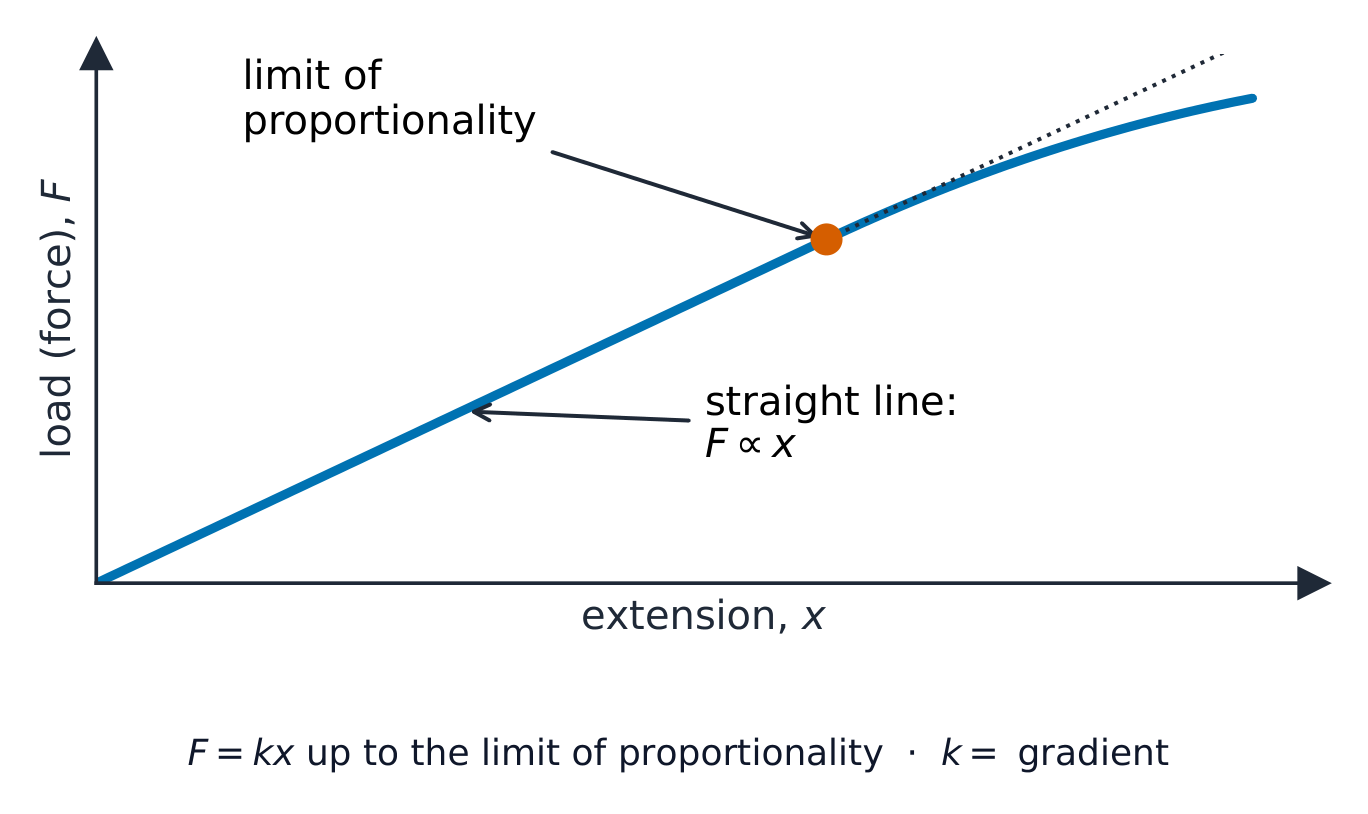
    On a load–extension graph 载荷-伸长图 the line is straight at first: extension is proportional to load. The point where the line stops being straight is the limit of proportionality 比例极限.

    A load–extension graph: a straight line through the origin that curves away past a marked point
    Load is proportional to extension until the limit of proportionality, then the line curves

    The experiment. Hang the spring from a clamp and stand a ruler beside it. Read the position of the bottom of the spring with no load: this is the original length. Add loads one at a time (for example 1 N each) and record the new length each time. The extension is the new length minus the original length. Plot load on the y-axis against extension on the x-axis.

    The spring constant 弹簧常数 is the force per unit extension:

    $$k = \frac{F}{x}$$

    A large $k$ means a stiff spring.

    Resultant force and Newton's laws

    Add forces on a straight line to get the resultant force 合力 (forces one way are positive, the other way negative).

    • If the resultant force is zero, the object stays at rest or keeps moving in a straight line at constant speed. (Newton's first law.)
    • If the resultant force is not zero, the object accelerates in the direction of the force:
    $$F = ma$$
    A box on the ground with four labelled force arrows: normal force up, weight down, push right, friction left
    A free-body diagram shows every force on the box as a labelled arrow

    Worked example. A $1200\ \text{kg}$ car has a $3000\ \text{N}$ driving force and $600\ \text{N}$ of friction. Find its acceleration.

    First find the resultant force: $3000 - 600 = 2400\ \text{N}$. Then

    $$a = \frac{F}{m} = \frac{2400}{1200} = 2.0\ \text{m/s}^2$$

    Motion in a circle

    A resultant force at right angles to the motion does not change the speed. It changes the direction, so the object moves in a circle at a steady speed. This is circular motion 圆周运动. The force always points towards the centre of the circle: the pull of the string on a whirling ball, or the gravity of the Sun on a planet.

    For an object moving in a circle:

    • a bigger force is needed to keep the same mass moving at a higher speed in a circle of the same radius 半径;
    • a bigger force makes the same mass at the same speed move in a smaller circle (a smaller radius);
    • a bigger mass needs a bigger force to keep the same speed and the same radius.

    Friction

    Friction 摩擦力 is the force between two surfaces that touch. It tries to stop motion and makes things heat up. Drag (friction in a liquid or gas, like air resistance) also slows objects down.

    Moments — the turning effect

    The moment 力矩 of a force is its turning effect about a pivot 支点.

    $$\text{moment} = \text{force} \times \text{perpendicular distance from the pivot}$$

    The unit is the newton metre (N m).

    Principle of moments 力矩原理: when an object is balanced (in equilibrium 平衡),

    $$\text{total clockwise moment} = \text{total anticlockwise moment}$$

    An object is in equilibrium when there is no resultant force and no resultant moment.

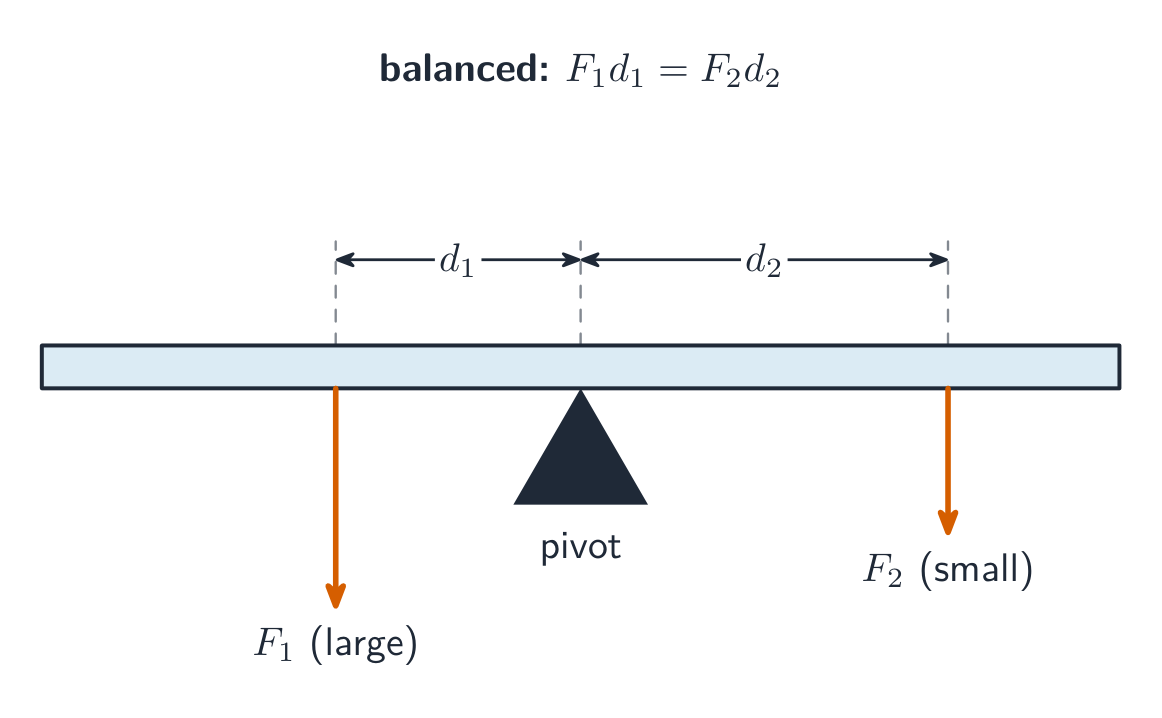
    A beam balanced on a central pivot with a force and distance on each side
    The beam balances when the clockwise moment equals the anticlockwise moment

    Worked example. A $30\ \text{N}$ weight sits $0.20\ \text{m}$ to the left of a pivot. How far to the right must a $20\ \text{N}$ weight sit to balance the beam?

    Balanced, so anticlockwise moment $=$ clockwise moment:

    $$30 \times 0.20 = 20 \times d \quad\Rightarrow\quad d = \frac{6.0}{20} = 0.30\ \text{m}$$

    Checking the principle by experiment. Balance a metre rule at its centre on a pivot. Hang a known weight on each side and move them until the rule balances again. Measure each distance from the pivot. Force × distance on the left equals force × distance on the right, within the small errors of measurement, so there is no resultant moment on a balanced object.

    Centre of gravity

    The centre of gravity 重心 is the single point where all the weight of an object seems to act.

    For a flat shape (lamina 薄片), hang it from a pin and let it settle; draw a vertical line down from the pin using a plumb line. Repeat from another point. The centre of gravity is where the lines cross.

    The stability 稳定性 of an object depends on where its centre of gravity is. An object is more stable 稳定 when its centre of gravity is low and its base is wide. It tips over when a vertical line down from the centre of gravity passes outside the base.

    Explore · ⁨สำรวจ⁩

    Forces & Newton's laws · ⁨แรง & กฎของนิวตัน⁩

    F = ma (resultant) · ⁨F = ma ( resultant )⁩

    The resultant force sets the acceleration; balanced forces ⇒ none. · ⁨แรงลัพธ์ กำหนดความเร่ง; แรงสมดุล ⇒ ไม่มีความเร่ง⁩

    Vocabulary · ⁨คำศัพท์⁩ Train · ⁨ฝึกฝน⁩
    English ไทย
    measurement/ˈmeʒəmənt/ การวัดค่า
    shape/ʃeɪp/ รูปร่าง
    extension/ekˈstenʃn/ 扩张
    load–extension graph/ləʊd ekˈstenʃn ɡræf/ กราฟแรง-การยืด
    limit of proportionality/ˈlɪmɪt ɒv prəˌpɔːʃəˈnælɪti/ ขีดจำกัดของสัดส่วน
    spring constant/sprɪŋ ˈkɒnstənt/ ค่าคงที่ของสปริง
    resultant force/rɪˈzʌltənt fɔːs/ แรงลัพธ์
    circular motion/ˈsɜːkjʊlə ˈməʊʃn/ การเคลื่อนที่วงกลม
    radius/ˈreɪdɪəs/ รัศมี
    friction/ˈfrɪkʃn/ แรงเสียดทาน
    moment/ˈməʊmənt/ ปัจจุบัน
    pivot/ˈpɪvət/ จุดหมุน
    principle of moments/ˈprɪnsɪpl ɒv ˈməʊmənts/ หลักการโมเมนต์
    equilibrium/ˌiːkwɪˈlɪbrɪəm/ จุดดุลยภาพ
    centre of gravity/ˈsentə ɒv ˈɡrævɪti/ ศูนย์ถ่วง
    lamina/ˈlæmɪnə/ แผ่นบาง
    stability/stəˈbɪlɪti/ ความเสถียร
    stable/ˈsteɪbl/ เสถียร
    1.6

    Momentum

    Syllabus · ⁨หลักสูตร⁩
    English
    Core Supplement
    1 Define momentum as mass $\times$ velocity; recall and use the equation $p = mv$
    2 Define impulse as force $\times$ time for which force acts; recall and use the equation $\text{impulse} = F\Delta t = \Delta(mv)$
    3 Apply the principle of the conservation of momentum to solve simple problems in one dimension
    4 Define resultant force as the change in momentum per unit time; recall and use the equation $F = \frac{\Delta p}{\Delta t}$
    ไทย
    แก่น เพิ่มเติม
    1 นิยาม โมเมนตัม เป็นมวล $\times$ ความเร็วเชิงทิศทาง; จำและใช้สมการ $p = mv$
    2 นิยาม แรงกระแทก (impulse) ว่าคือ แรง $\times$ เวลา ที่แรงกระทำ; จำและใช้สมการ $\text{impulse} = F\Delta t = \Delta(mv)$
    3 ใช้หลักการ การอนุรักษ์โมเมนตัม ในการแก้โจทย์ปัญหาเบื้องต้นในหนึ่งมิติ
    4 นิยาม แรงลัพธ์ ว่าคือการเปลี่ยนแปลงของโมเมนตัมต่อหน่วยเวลา; จำและใช้สมการ $F = \frac{\Delta p}{\Delta t}$

    Source: Cambridge International syllabus · ⁨แหล่งที่มา: หลักสูตร Cambridge International⁩

    Conservation of momentum in a collision

    Momentum is mass times velocity. It is a vector.

    $$p = mv$$

    Impulse 冲量 is the force times the time it acts, and it equals the change in momentum:

    $$\text{impulse} = F\,\Delta t = \Delta(mv)$$

    So the resultant force is the change in momentum per unit time:

    $$F = \frac{\Delta p}{\Delta t}$$

    Conservation of momentum 动量守恒: when objects collide and no outside force acts, the total momentum before equals the total momentum after.

    $$m_1 u_1 + m_2 u_2 = m_1 v_1 + m_2 v_2$$

    (Here $u$ is a velocity before and $v$ is a velocity after.)

    Worked example. A $2.0\ \text{kg}$ trolley moving at $3.0\ \text{m/s}$ hits a stationary $1.0\ \text{kg}$ trolley and they stick together. Find their common velocity afterwards.

    Total momentum is conserved, so

    $$(2.0 \times 3.0) + (1.0 \times 0) = (2.0 + 1.0)\,v \quad\Rightarrow\quad v = \frac{6.0}{3.0} = 2.0\ \text{m/s}$$
    Explore · ⁨สำรวจ⁩

    Momentum in a collision · ⁨โมเมนตัมในการชน⁩

    Set the masses and speeds and collide them. Total momentum is conserved. · ⁨ตั้งมวลและความเร็วแล้ว让它们ชนกัน. โมเมนตัมรวมถูกอนุรักษ์⁩

    Vocabulary · ⁨คำศัพท์⁩ Train · ⁨ฝึกฝน⁩
    English ไทย
    impulse/ˈɪmpʌls/ สัญญาณ
    conservation of momentum/ˌkɒnsəˈveɪʃn ɒv məʊˈmentəm/ การอนุรักษ์โมเมนตัม
    1.7

    Energy, work and power

    Syllabus · ⁨หลักสูตร⁩
    English

    1.7.1 Energy

    Core Supplement
    1 State that energy may be stored as kinetic, gravitational potential, chemical, elastic (strain), nuclear, electrostatic and internal (thermal)
    2 Describe how energy is transferred between stores during events and processes, including examples of transfer by forces (mechanical work done), electrical currents (electrical work done), heating, and by electromagnetic, sound and other waves
    4 Recall and use the equation for kinetic energy $E_k = \frac{1}{2}mv^2$
    5 Recall and use the equation for the change in gravitational potential energy $\Delta E_p = mg\Delta h$
    3 Know the principle of the conservation of energy and apply this principle to simple examples including the interpretation of simple flow diagrams 6 Know the principle of the conservation of energy and apply this principle to complex examples involving multiple stages, including the interpretation of Sankey diagrams

    1.7.2 Work

    Core Supplement
    1 Understand that mechanical or electrical work done is equal to the energy transferred
    2 Recall and use the equation for mechanical working $W = Fd = \Delta E$

    1.7.3 Energy resources

    Core Supplement
    1 Describe how useful energy may be obtained, or electrical power generated, from: (a) chemical energy stored in fossil fuels (b) chemical energy stored in biofuels (c) water, including the energy stored in waves, in tides and in water behind hydroelectric dams (d) geothermal resources (e) nuclear fuel (f) light from the Sun to generate electrical power (solar cells) (g) infrared and other electromagnetic waves from the Sun to heat water (solar panels) and be the source of wind energy including references to a boiler, turbine and generator where they are used 4 Know that radiation from the Sun is the main source of energy for all our energy resources except geothermal, nuclear and tidal
    2 Describe advantages and disadvantages of each method in terms of renewability, availability, reliability, scale and environmental impact 5 Know that energy is released by nuclear fusion in the Sun
    6 Know that research is being carried out to investigate how energy released by nuclear fusion can be used to produce electrical energy on a large scale
    3 Understand, qualitatively, the concept of efficiency of energy transfer 7 Define efficiency as: (a) $(\%) \text{ efficiency} = \frac{\text{(useful energy output)}}{\text{(total energy input)}} (\times 100\%)$ (b) $(\%) \text{ efficiency} = \frac{\text{(useful power output)}}{\text{(total power input)}} (\times 100\%)$ recall and use these equations

    1.7.4 Power

    Core Supplement
    1 Define power as work done per unit time and also as energy transferred per unit time; recall and use the equations (a) $P = \frac{W}{t}$ (b) $P = \frac{\Delta E}{t}$
    ไทย

    1.7.1 พลังงาน

    แก่น เพิ่มเติม
    1 ระบุได้ว่าพลังงานอาจถูกเก็บไว้ในรูปแบบของ จลน์, ศักย์โน้มถ่วง, เคมี, ยืดหยุ่น (ความเครียด), นิวเคลียร์, อิเล็กโทรสแตติก และ ภายใน (ความร้อน)
    2 อธิบายวิธีการถ่ายโอนพลังงานระหว่างแหล่งสะสมในช่วงเหตุการณ์และกระบวนการต่างๆ รวมถึงตัวอย่างของการถ่ายโอนโดยแรง (งานกล), กระแสไฟฟ้า (งานไฟฟ้า), การให้ความร้อน และการถ่ายโอนผ่านคลื่นแม่เหล็กไฟฟ้า คลื่นเสียง และคลื่นอื่นๆ
    4 จำและใช้สมการสำหรับพลังงานจลน์ $E_k = \frac{1}{2}mv^2$
    5 จำและใช้สมการสำหรับการเปลี่ยนแปลงของพลังงานศักย์โน้มถ่วง $\Delta E_p = mg\Delta h$
    3 รู้จักหลักการ การอนุรักษ์พลังงาน และนำไปใช้กับตัวอย่างง่ายๆ รวมถึงการตีความแผนภาพการไหลอย่างง่าย 6 รู้จักหลักการการอนุรักษ์พลังงานและนำไปใช้กับตัวอย่างที่ซับซ้อนซึ่งมีหลายขั้นตอน รวมถึงการตีความแผนภาพซานกี

    1.7.2 งาน

    แก่น เพิ่มเติม
    1 เข้าใจว่างานกลหรืองานไฟฟ้าที่กระทำ มีค่าเท่ากับพลังงานที่ถูกถ่ายโอน
    2 จำและใช้สมการสำหรับงานกล $W = Fd = \Delta E$

    1.7.3 แหล่งพลังงาน

    แก่น เพิ่มเติม
    1 อธิบายวิธีการได้รับพลังงานที่มีประโยชน์ หรือผลิตกำลังไฟฟ้า จาก: (ก) พลังงานเคมีที่เก็บไว้ในเชื้อเพลิงฟอสซิล (ข) พลังงานเคมีที่เก็บไว้ในชีว燃料 (ค) น้ำ بماทั้งพลังงานที่เก็บอยู่ในคลื่น, กระแสน้ำขึ้นน้ำลง และน้ำที่อยู่ پشتเขื่อนไฟฟ้าพลังน้ำ (ง) ทรัพยากรความร้อนใต้ดิน (จ) เชื้อเพลิงนิวเคลียร์ (ฉ) แสงจากดวงอาทิตย์เพื่อผลิตกำลังไฟฟ้า (เซลล์แสงอาทิตย์) (ช) คลื่นอินฟราเรดและคลื่นแม่เหล็กไฟฟ้าอื่นๆ จากดวงอาทิตย์เพื่อให้ความร้อนน้ำ (แผงโซลาร์เทอร์มอล) และเป็นแหล่งกำเนิดพลังงานลม รวมถึงการอ้างอิงถึงหม้อต้ม Turbine และเครื่องกำเนิดไฟฟ้าเมื่อมีการใช้งาน 4 รู้ว่ารังสีจากดวงอาทิตย์เป็นแหล่งพลังงานหลักของแหล่งพลังงานทั้งหมดของเรา ยกเว้นความร้อนใต้ดิน นิวเคลียร์ และกระแสน้ำขึ้นน้ำลง
    2 อธิบายข้อดีและข้อเสียของแต่ละวิธี ในแง่ของความใหม่/ใช้แล้วหมดไป ความพร้อมใช้งาน ความน่าเชื่อถือ ขนาด และผลกระทบต่อสิ่งแวดล้อม 5 รู้ว่าพลังงานถูกปลดปล่อยจากการหลอมนิวเคลียร์ในดวงอาทิตย์
    6 รู้ว่าการวิจัยกำลังดำเนินการเพื่อศึกษา如何使用 nuclear fusion energy เพื่อผลิตพลังงานไฟฟ้าในปริมาณมาก
    3 เข้าใจในเชิงคุณภาพเกี่ยวกับแนวคิดของ ประสิทธิภาพ ของการถ่ายโอนพลังงาน 7 นิยามประสิทธิภาพ sebagai: (ก) $(\%) \text{ efficiency} = \frac{\text{(useful energy output)}}{\text{(total energy input)}} (\times 100\%)$ (ข) $(\%) \text{ efficiency} = \frac{\text{(useful power output)}}{\text{(total power input)}} (\times 100\%)$ จำและใช้สมการเหล่านี้

    1.7.4 กำลัง

    แก่น เพิ่มเติม
    1 นิยาม กำลัง (power) ว่าคืองานที่ทำต่อหน่วยเวลา และหมายถึงการถ่ายโอนพลังงานต่อหน่วยเวลา; จำและใช้สมการ (ก) $P = \frac{W}{t}$ (ข) $P = \frac{\Delta E}{t}$

    Source: Cambridge International syllabus · ⁨แหล่งที่มา: หลักสูตร Cambridge International⁩

    Energy stores

    Energy can be stored 储存 in different ways: kinetic 动能, gravitational potential 重力势能, chemical 化学能, elastic (strain) 弹性势能, nuclear 核能, electrostatic 静电能, and internal (thermal) 内能.

    Energy is transferred 转移 between stores by forces (mechanical work), by electric currents, by heating, and by waves (such as light and sound).

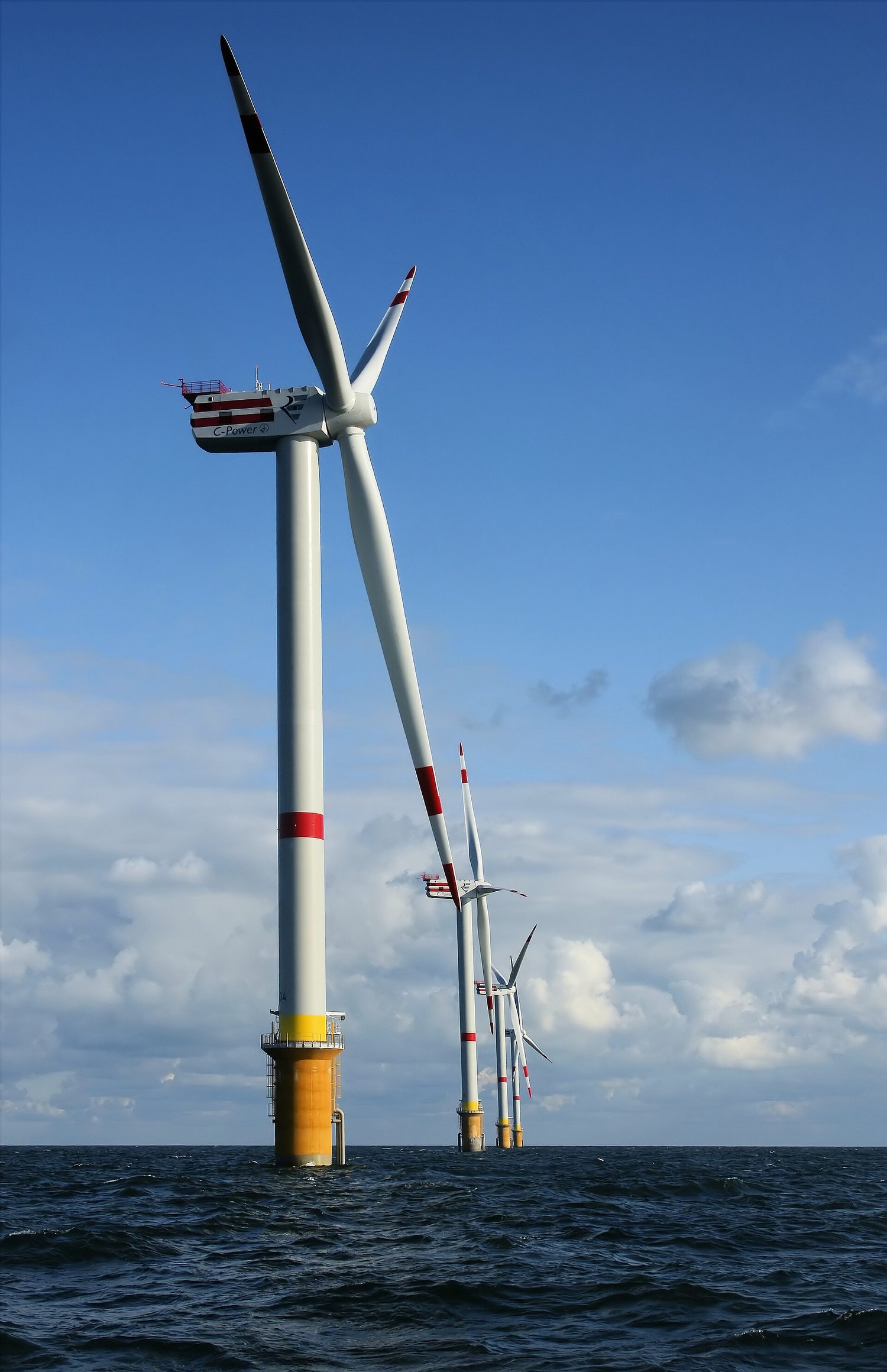
    A row of tall white wind turbines standing in the sea under a blue sky
    Wind turbines transfer energy from the kinetic store of the moving air to electricity

    Kinetic and potential energy

    Kinetic energy is the energy of a moving object:

    $$E_k = \frac{1}{2}mv^2$$

    The change in gravitational potential energy when an object goes up or down by a height $\Delta h$:

    $$\Delta E_p = mg\,\Delta h$$

    Conservation of energy

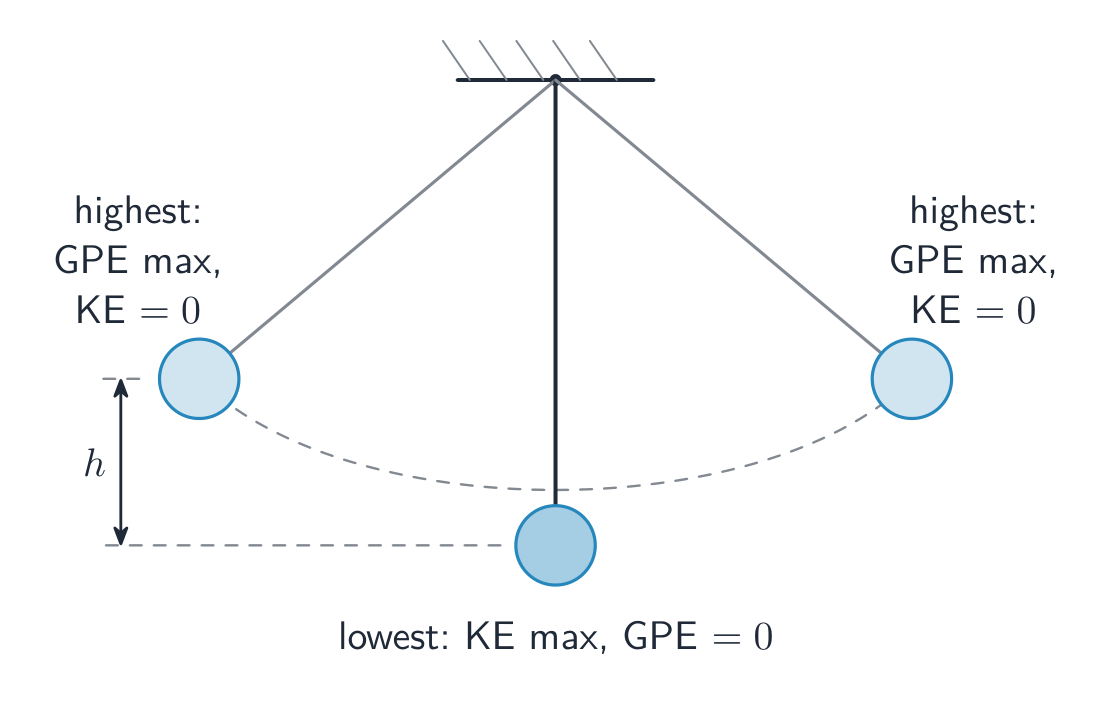
    The principle of conservation of energy 能量守恒定律 says energy is never made or destroyed; it only moves between stores. A falling object turns gravitational potential energy into kinetic energy. A Sankey diagram 桑基图 shows how the input energy splits into useful energy and wasted 浪费 energy.

    A pendulum shown at its two highest points and its lowest point, with the swing height marked
    Energy moves between gravitational potential energy (at the highest points) and kinetic energy (at the lowest point)
    Roller-coaster cars running down a curved track, with a tall hill behind
    On a roller-coaster, gravitational potential energy stored at the top of the hill becomes kinetic energy as the cars speed down

    Worked example. A $0.50\ \text{kg}$ ball is dropped from a height of $1.8\ \text{m}$. Ignoring air resistance, find its speed just before it lands. (Take $g = 10\ \text{m/s}^2$.)

    All the gravitational potential energy becomes kinetic energy, so $\tfrac{1}{2}mv^2 = mg\,\Delta h$. The mass cancels, leaving $v^2 = 2g\,\Delta h$:

    $$v = \sqrt{2 \times 10 \times 1.8} = \sqrt{36} = 6.0\ \text{m/s}$$

    Because the mass cancels, every object dropped from this height would land at the same speed.

    Work

    Work done 做功 equals the energy transferred. When a force moves an object:

    $$W = Fd = \Delta E$$

    The unit of work and energy is the joule 焦耳 (J).

    Power

    Power 功率 is the work done (or energy transferred) per unit time.

    $$P = \frac{W}{t} = \frac{\Delta E}{t}$$

    The unit is the watt 瓦特 (W). $1\ \text{W} = 1\ \text{J/s}$.

    Efficiency

    Efficiency 效率 tells you how much of the input energy becomes useful energy.

    $$\text{efficiency} = \frac{\text{useful energy output}}{\text{total energy input}} \times 100\%$$

    Efficiency is always less than 100% because some energy is always wasted (usually as heat). The same idea works with power:

    $$\text{efficiency} = \frac{\text{useful power output}}{\text{total power input}} \times 100\%$$

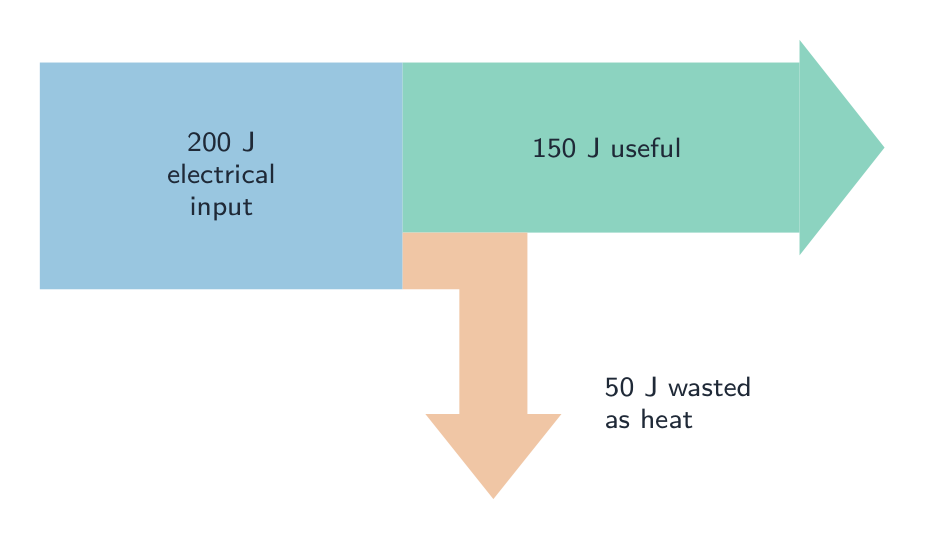
    Worked example. A motor is supplied with $200\ \text{J}$ of electrical energy and lifts a load, giving it $150\ \text{J}$ of gravitational potential energy. Find its efficiency.

    $$\text{efficiency} = \frac{150}{200} \times 100\% = 75\%$$
    A Sankey diagram with a wide input band splitting into a useful band and a wasted band
    A Sankey diagram for this motor: the band widths are proportional to the energy, so the 200 J input splits into 150 J useful and 50 J wasted as heat

    Energy resources

    We generate electricity from many energy resources. Most spin a turbine that drives a generator – often by boiling water to make steam (fossil fuels, nuclear fuel, geothermal, biofuels), or directly by moving water or air (hydroelectric, waves, tides, wind). Solar cells make electricity from sunlight directly; solar panels heat water.

    Resource Renewable? Notes
    fossil fuels (coal, oil, gas) no reliable, high output, but CO₂ and pollution
    nuclear fuel no huge output, no CO₂, but radioactive waste
    biofuels yes roughly carbon-neutral if replanted
    hydroelectric yes reliable, but a dam floods land
    wind yes clean, but intermittent
    solar yes clean, but only in daylight
    geothermal / tidal yes reliable but limited to certain places

    When you compare resources, use these five ideas: renewability 可再生性 (will it run out?), availability 可用性 (is it always there? the wind can drop and the Sun sets), reliability 可靠性 (does it give a steady output?), scale 规模 (how much energy can it supply?) and environmental impact 环境影响 (pollution, carbon dioxide, land flooded by a dam).

    Most of these trace back to the Sun (fossil fuels are ancient stored sunlight; wind and waves come from solar heating) – the exceptions are geothermal, nuclear, and tidal energy. The Sun itself is powered by nuclear fusion 核聚变, joining hydrogen nuclei into helium. Scientists are researching how to use fusion in power stations on Earth, but no fusion reactor yet gives out more electrical energy than it uses.

    Explore · ⁨สำรวจ⁩

    Energy flow & efficiency

    Input energy splits into useful output and wasted energy; efficiency is the useful fraction, and the total is always conserved. · ⁨พลังงานเข้าแบ่งออกเป็นพลังงาน有用และพลังงานสิ้นเปลือง ประสิทธิภาพคือส่วนที่เป็นประโยชน์ และรวมทั้งหมดจะถูกอนุรักษ์เสมอ⁩

    Explore · ⁨สำรวจ⁩

    Conservation of energy · ⁨การอนุรักษ์พลังงาน⁩

    Drop the object: GPE turns into KE, and the total stays the same when there's no friction. · ⁨ปล่อยวัตถุ: GPE เปลี่ยนเป็น KE และ รวมคงที่ เมื่อไม่มีแรงเสียดทาน⁩

    Vocabulary · ⁨คำศัพท์⁩ Train · ⁨ฝึกฝน⁩
    English ไทย
    stored/stɔːd/ stored ( ค่าที่เก็บ )
    kinetic/kɪˈnetɪk/ พลังงานจลน์
    gravitational potential/ˌɡrævɪˈteɪʃənl pəˈtenʃl/ ศักย์พลังงานแรงโน้มถ่วง
    chemical/ˈkemɪkl/ เคมี
    elastic (strain)/ɪˈlæstɪk/ ยืดหยุ่น (ความเครียด)
    nuclear/ˈnjuːklɪə/ นิวเคลียร์
    electrostatic/ɪˌlektrəʊˈstætɪk/ สถิตไฟฟ้า
    internal (thermal)/ɪnˈtɜːnl/ ภายใน (ความร้อน)
    transferred/trænsˈfɜːd/ ถ่ายโอน
    principle of conservation of energy/ˈprɪnsɪpl ɒv ˌkɒnsəˈveɪʃn ɒv ˈenədʒi/ หลักการอนุรักษ์พลังงาน
    Sankey diagram/ˈsæŋki ˈdaɪəɡræm/ แผนภาพซานกี
    wasted/ˈweɪstɪd/ wasted
    work done/wɜːk dʌn/ งานที่ทำ
    joule/dʒuːl/ จูล
    power/ˈpaʊə/ กำลัง
    watt/wɒt/ วัตต์
    efficiency/ɪˈfɪʃənsi/ ประสิทธิภาพ
    renewability/rɪˌnjuːəˈbɪlɪti/ ความสามารถในการฟื้นฟู
    availability/əˌveɪləˈbɪlɪti/ การเข้าถึงได้
    reliability/rɪˌlaɪəˈbɪlɪti/ ความน่าเชื่อถือ
    scale/skeɪl/ สเกล / ขอบเขต
    environmental impact/enˌvaɪrənˈmentl ˈɪmpækt/ ผลกระทบสิ่งแวดล้อม
    nuclear fusion/ˈnjuːklɪə ˈfjuːʒn/ การหลอมรวมนิวเคลียร์
    1.8

    Pressure 压强

    Syllabus · ⁨หลักสูตร⁩
    English
    Core Supplement
    1 Define pressure as force per unit area; recall and use the equation $p = \frac{F}{A}$
    2 Describe how pressure varies with force and area in the context of everyday examples
    3 Describe, qualitatively, how the pressure beneath the surface of a liquid changes with depth and density of the liquid 4 Recall and use the equation for the change in pressure beneath the surface of a liquid $\Delta p = \rho g \Delta h$
    ไทย
    แก่น เพิ่มเติม
    1 นิยาม ความดัน ว่าคือแรงต่อหน่วยพื้นที่; จำและใช้สมการ $p = \frac{F}{A}$
    2 อธิบายความแปรปรวนของความดันตามแรงและพื้นที่ในบริบทของตัวอย่างในชีวิตประจำวัน
    3 อธิบายในเชิงคุณภาพว่าความดันใต้ผิวน้ำเปลี่ยนไปตามความลึกและความหนาแน่นของน้ำอย่างไร 4 จำและใช้สมการสำหรับการเปลี่ยนแปลงของความดันใต้ผิวน้ำ $\Delta p = \rho g \Delta h$

    Source: Cambridge International syllabus · ⁨แหล่งที่มา: หลักสูตร Cambridge International⁩

    Pressure is the force per unit area.

    $$p = \frac{F}{A}$$

    The unit is the pascal 帕斯卡 (Pa). $1\ \text{Pa} = 1\ \text{N/m}^2$.

    A small area gives a large pressure (a sharp knife cuts well). A large area gives a small pressure (snowshoes stop you sinking).

    Pressure in a liquid

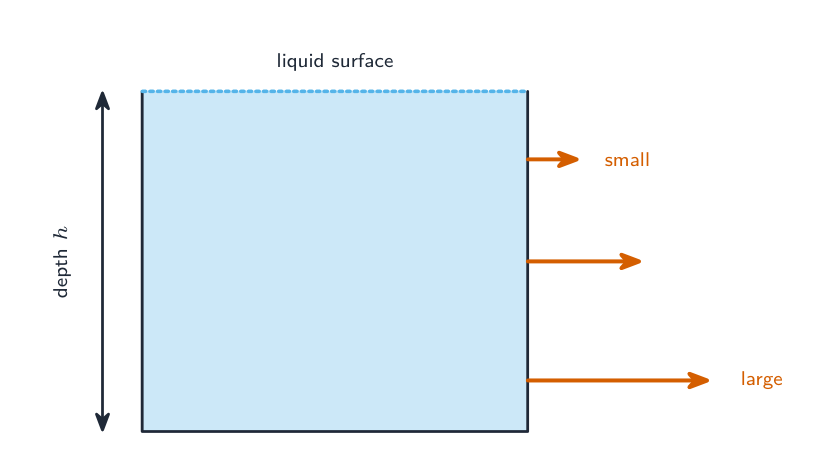
    In a liquid, pressure increases with depth 深度 and with the liquid's density:

    $$\Delta p = \rho g \,\Delta h$$

    This is why a dam is built thicker at the bottom, where the water pressure is greatest. Pressure in a liquid acts in all directions.

    A tank of liquid with arrows pushing outward on the side wall, longer the deeper they are
    The deeper the liquid, the greater the pressure, so the outward push on the wall grows with depth
    The huge curved concrete wall of the Hoover Dam holding back a reservoir
    A real dam is built much thicker at the bottom, because the water pushes hardest where it is deepest

    Worked example. Find the extra pressure at a depth of $2.0\ \text{m}$ in water (density $1000\ \text{kg/m}^3$, $g = 10\ \text{N/kg}$).

    $$\Delta p = \rho g\,\Delta h = 1000 \times 10 \times 2.0 = 20\,000\ \text{Pa}$$
    Explore · ⁨สำรวจ⁩

    Pressure · ⁨ความดัน⁩

    p = ρg·h

    Pressure in a liquid is proportional to depth. · ⁨ความดันในของเหลว แปรผันตรงกับ ความลึก⁩

    Vocabulary · ⁨คำศัพท์⁩ Train · ⁨ฝึกฝน⁩
    English ไทย
    pressure/ˈpreʃə/ ความดัน
    pascal/ˈpæskl/ ปาสคาล
    depth/depθ/ มิติลึก
    1.8

    Exam tips

    • On a distance–time graph the gradient is the speed; on a speed–time graph the gradient is the acceleration and the area under the line is the distance travelled. Never read one graph as if it were the other.
    • Mass (kg) is the amount of matter and is the same everywhere; weight (N) is the force of gravity, $W = mg$. On the Moon your mass is unchanged but your weight is smaller.
    • Speed is a scalar; velocity is a vector. Something moving at steady speed around a curve is still accelerating, because its direction keeps changing.
    • In Hooke's law, load is proportional to extension only up to the limit of proportionality. Use the extension (stretched length − original length), never the whole length.
    • Momentum $p = mv$ is conserved in a collision. Give each velocity a $+$ or $-$ sign for its direction before you add them.
    • Convert units first (cm → m, g → kg). Use $p = F/A$ for a solid pressing on a surface, but $p = \rho g h$ for the pressure inside a liquid — they are different formulas.
  • 2

    Thermal physics · ⁨ฟิสิกส์ความร้อน⁩

    Watch lesson · ⁨ดูบทเรียน⁩
    2.1

    States of matter 物态 · ⁨สถานะของสสาร⁩

    Syllabus · ⁨หลักสูตร⁩
    English

    2.1.1 States of matter

    Core Supplement
    1 Know the distinguishing properties of solids, liquids and gases
    2 Know the terms for the changes in state between solids, liquids and gases (gas to solid and solid to gas transfers are not required)

    2.1.2 Particle model

    Core Supplement
    1 Describe the particle structure of solids, liquids and gases in terms of the arrangement, separation and motion of the particles and represent these states using simple particle diagrams 6 Know that the forces and distances between particles (atoms, molecules, ions and electrons) and the motion of the particles affects the properties of solids, liquids and gases
    2 Describe the relationship between the motion of particles and temperature, including the idea that there is a lowest possible temperature ($-273\,{}^{\circ}\text{C}$), known as absolute zero, where the particles have least kinetic energy
    3 Describe the pressure and the changes in pressure of a gas in terms of the motion of its particles and their collisions with a surface 7 Describe the pressure and the changes in pressure of a gas in terms of the forces exerted by particles colliding with surfaces, creating a force per unit area
    4 Know that the random motion of microscopic particles in a suspension is evidence for the kinetic particle model of matter 8 Know that microscopic particles may be moved by collisions with light fast-moving molecules and correctly use the terms atoms or molecules as distinct from microscopic particles
    5 Describe and explain this motion (sometimes known as Brownian motion) in terms of random collisions between the microscopic particles in a suspension and the particles of the gas or liquid

    2.1.3 Gases and the absolute scale of temperature

    Core Supplement
    1 Describe qualitatively, in terms of particles, the effect on the pressure of a fixed mass of gas of: (a) a change of temperature at constant volume (b) a change of volume at constant temperature 3 Recall and use the equation $pV = \text{constant}$ for a fixed mass of gas at constant temperature, including a graphical representation of this relationship
    2 Convert temperatures between kelvin and degrees Celsius; recall and use the equation $T\text{ (in K)} = \theta\text{ (in }^{\circ}\text{C)} + 273$
    ไทย

    2.1.1 สภาวะของสสาร

    แก่น เพิ่มเติม
    1 รู้จักคุณสมบัติที่แตกต่างของ ของแข็ง, ของเหลว และ แก๊ส
    2 รู้จักคำศัพท์สำหรับการเปลี่ยนแปลงสถานะระหว่างของแข็ง ของเหลว และแก๊ส (ไม่จำเป็นต้องทราบการเปลี่ยนแปลงจากแก๊สเป็นของแข็งและจากของแข็งเป็นแก๊ส)

    2.1.2 โมเดลอนุภาค

    แก่น เพิ่มเติม
    1 อธิบายโครงสร้างอนุภาคของของแข็ง ของเหลว และแก๊ส โดยพิจารณาการจัดเรียง ระยะห่าง และการเคลื่อนที่ของอนุภาค และแสดงสถานะเหล่านี้โดยใช้แผนภาพอนุภาคอย่างง่าย 6 รู้ว่าแรงและระยะห่างระหว่างอนุภาค (อะตอม โมเลกุล ไอออน และอิเล็กตรอน) และการเคลื่อนที่ของอนุภาค ส่งผลต่อคุณสมบัติของของแข็ง ของเหลว และแก๊ส
    2 อธิบายความสัมพันธ์ระหว่างการเคลื่อนที่ของอนุภาคกับอุณหภูมิ รวมถึงแนวคิดที่ว่ามีความต่ำสุดที่เป็นไปได้ ($-273\,{}^{\circ}\text{C}$) ซึ่งเรียกว่า ศูนย์สัมบูรณ์ (absolute zero) ที่อนุภาคจะมีพลังงานจลน์น้อยที่สุด
    3 อธิบายความดันและการเปลี่ยนแปลงความดันของแก๊ส โดยพิจารณาจากการเคลื่อนที่ของอนุภาคและการชนกับพื้นผิว 7 อธิบายความดันและการเปลี่ยนแปลงความดันของแก๊ส โดยพิจารณาจากแรงที่อนุภาคกระทำเมื่อยึดติดกับพื้นผิว ซึ่งสร้างแรงต่อหน่วยพื้นที่
    4 รู้ว่าการเคลื่อนที่แบบสุ่มของอนุภาคขนาดเล็กในสารละลายเป็นหลักฐานของโมเดลอนุภาคจลน์ของสสาร 8 รู้ว่าอนุภาคขนาดเล็กอาจถูกเคลื่อนย้ายได้โดยการชนกับโมเลกุลที่มีขนาดเล็กและเคลื่อนที่เร็ว และใช้คำศัพท์ correctly ว่าอะตอมหรือโมเลกุลต่างจากอนุภาคขนาดเล็ก
    5 อธิบายและอธิบายการเคลื่อนที่นี้ (บางครั้งเรียกว่า การเคลื่อนที่แบบบราวเนียน) โดยพิจารณาจากการชนกันแบบสุ่มระหว่างอนุภาคขนาดเล็กในสารละลายและอนุภาคของแก๊สหรือของเหลว

    2.1.3 แก๊สและสเกลอุณหภูมิสัมบูรณ์

    แก่น เพิ่มเติม
    1 อธิบายในเชิงคุณภาพ (โดยพิจารณาจากอนุภาค) ผลกระทบต่อความดันของแก๊สที่มีมวลคงที่ของ: (ก) การเปลี่ยนแปลงอุณหภูมิที่ปริมาตรคงที่ (ข) การเปลี่ยนแปลงปริมาตรที่อุณหภูมิคงที่ 3 จำและใช้สมการ $pV = \text{constant}$ สำหรับแก๊สที่มีมวลคงที่ที่อุณหภูมิคงที่ รวมถึงการแสดงกราฟแสดงความสัมพันธ์นี้
    2 แปลงอุณหภูมิระหว่าง เคลวิน และ องศาเซลเซียส; จำและใช้สมการ $T\text{ (in K)} = \theta\text{ (in }^{\circ}\text{C)} + 273$

    Source: Cambridge International syllabus · ⁨แหล่งที่มา: หลักสูตร Cambridge International⁩

    English
    Kinetic theory: gas pressure

    Matter exists in three states: solid 固体, liquid 液体 and gas 气体.

    State Shape Volume Particles
    Solid fixed fixed close together, in a regular pattern, vibrating
    Liquid takes the shape of the container fixed close together, no pattern, can move past each other
    Gas fills the container changes far apart, fast, random motion

    The changes of state are: melting (solid → liquid), boiling/evaporating (liquid → gas), condensation 凝结 (gas → liquid) and solidification 凝固 (liquid → solid). In condensation the gas particles slow down and come close together to form a liquid. In solidification the liquid particles lose energy and settle into fixed positions.

    ไทย
    ทฤษฎีจลน์: ความดันก๊าซ

    สสารมีสามสถานะคือ ของแข็ง, ของเหลว และ แก๊ส

    สถานะ รูปร่าง ปริมาตร อนุภาค
    ของแข็ง คงที่ คงที่ อยู่ชิดกัน, เรียงรูปแบบเป็นระเบียบ, สั่นไหว
    ของเหลว ตามรูปร่างภาชนะ คงที่ อยู่ชิดกัน, ไม่มีรูปแบบ, เคลื่อนผ่านกันได้
    แก๊ส เติมเต็มภาชนะ เปลี่ยนแปลง ห่างกัน, เคลื่อนที่เร็ว, การเคลื่อนที่แบบสุ่ม

    การเปลี่ยนสถานะมีดังนี้: การหลอมเหลว (ของแข็ง → ของเหลว), การเดือด/การระเหย (ของเหลว → ก๊าซ), การควบแน่น (ก๊าซ → ของเหลว) และ การแข็งตัว (ของเหลว → ของแข็ง) ในการควบแน่นอนุภาคก๊าซจะเคลื่อนที่ช้าลงและเข้าใกล้กันเพื่อสร้างเป็นของเหลว ในการแข็งตัวอนุภาคของเหลวจะสูญเสียพลังงานและจัดเรียงอยู่ในตำแหน่งที่แน่นอน

    Vocabulary · ⁨คำศัพท์⁩ Train · ⁨ฝึกฝน⁩
    English ไทย
    states of matter/steɪts ɒv ˈmætə/ สถานะของสสาร
    solid/ˈsɒlɪd/ ของแข็ง
    liquid/ˈlɪkwɪd/ ของเหลว
    gas/ɡæs/ แก๊ส
    condensation/kɒndenˈseɪʃn/ การควบแน่น
    solidification/səˌlɪdɪfɪˈkeɪʃn/ การแข็งตัว
    kinetic particle model/kɪˈnetɪk ˈpɑːtɪkl ˈmɒdl/ แบบจำลองอนุภาคเชิงจลน์
    2.1

    The kinetic particle model 分子动理论 · ⁨โมเดลอนุภาคเชิงจลน์⁩

    English

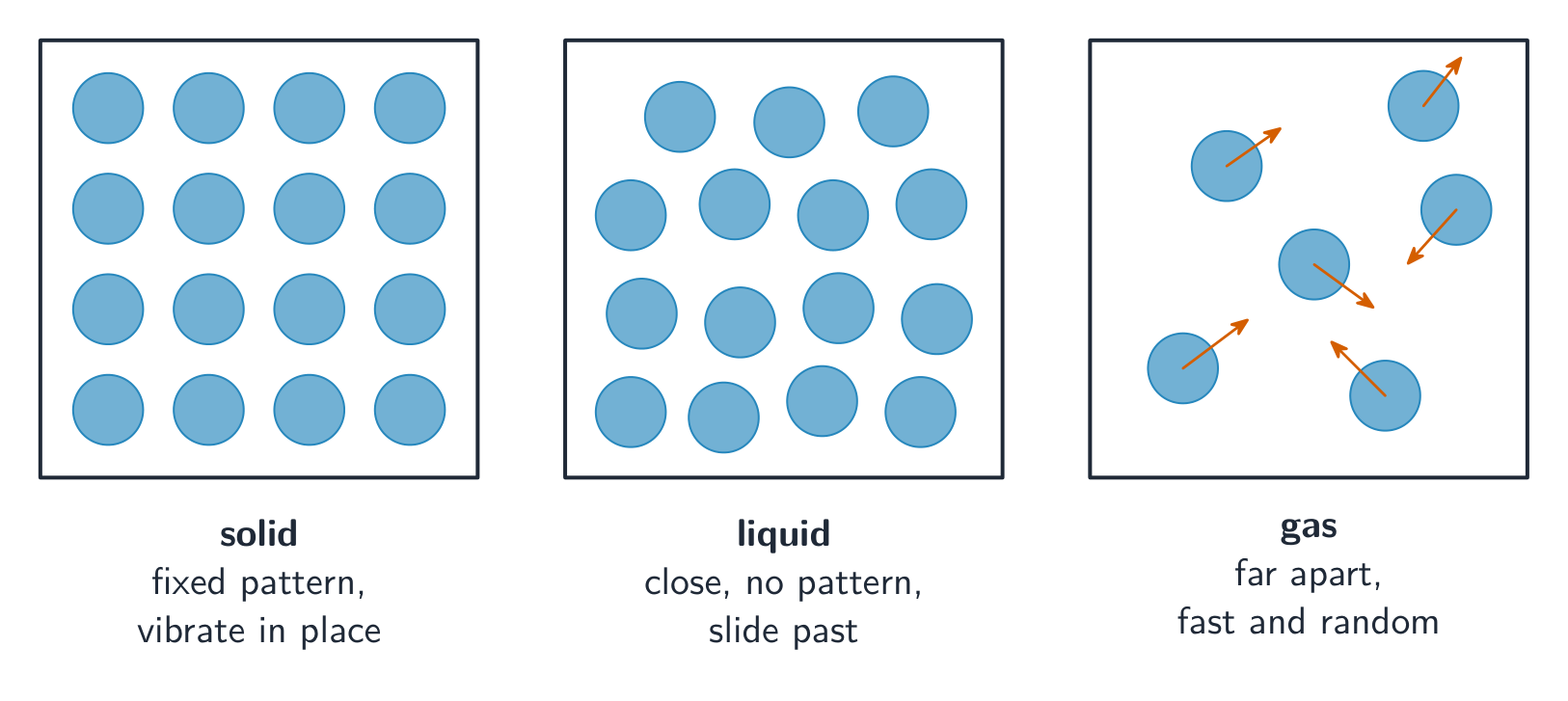
    All matter is made of tiny particles 粒子 that are always moving. This is the kinetic particle model.

    • In a solid the particles only vibrate 振动 about fixed positions.
    • In a liquid they are still close but can slide past each other.
    • In a gas they are far apart and move quickly in random directions.

    Temperature and particle energy

    When you heat a substance, its particles move faster, so they have more kinetic energy 动能. Temperature 温度 is a measure of the average kinetic energy of the particles.

    The lowest possible temperature is absolute zero 绝对零度, $-273\,{}^{\circ}\text{C}$. At this point the particles have the least possible energy.

    Gas pressure

    Gas particles hit the walls of their container. Each hit is a tiny push. The pressure 压强 of the gas is the total force of these hits per unit area.

    • Heating a gas (at constant volume) makes particles move faster and hit harder and more often, so the pressure rises.
    • Squeezing a gas into a smaller volume (at constant temperature) means more hits per second on each unit of area, so the pressure rises.

    For a fixed mass of gas at constant temperature:

    $$pV = \text{constant}$$

    So if the volume halves, the pressure doubles.

    Worked example. A gas has a volume of $200\ \text{cm}^3$ at a pressure of $100\ \text{kPa}$. It is squeezed to $50\ \text{cm}^3$ at constant temperature. Find the new pressure.

    Since $pV$ stays constant, $p_1 V_1 = p_2 V_2$:

    $$100 \times 200 = p_2 \times 50 \quad\Rightarrow\quad p_2 = \frac{20\,000}{50} = 400\ \text{kPa}$$

    Brownian motion

    If you look at smoke in air under a microscope, you see tiny specks moving in a jerky, random way. This is Brownian motion 布朗运动. The specks are pushed by fast, invisible air particles hitting them. It is strong evidence for the kinetic particle model.

    The kelvin scale

    Scientists often use the kelvin 开尔文 (K) temperature scale, which starts at absolute zero. To convert:

    $$T\text{ (in K)} = \theta\text{ (in }^{\circ}\text{C}) + 273$$

    So $0\,{}^{\circ}\text{C} = 273\ \text{K}$.

    Worked example. Convert $25\,{}^{\circ}\text{C}$ to kelvin, and $200\ \text{K}$ to degrees Celsius.

    $$25 + 273 = 298\ \text{K}, \qquad 200 - 273 = -73\,{}^{\circ}\text{C}$$
    ไทย

    สสารทั้งหมดประกอบด้วย อนุภาค ขนาดเล็กที่เคลื่อนที่ตลอดเวลา นี่คือโมเดลอนุภาคเชิงจลน์

    • ในของแข็ง อนุภาคจะ สั่น อยู่เฉพาะในตำแหน่งที่กำหนดไว้เท่านั้น
    • ในของเหลว อนุภาคยังคงอยู่ใกล้กันแต่สามารถเลื่อนผ่านกันได้
    • ในก๊าซ อนุภาคอยู่ห่างกันมากและเคลื่อนที่ด้วยความเร็วในทิศทางสุ่ม
    กล่องสามใบแสดงอนุภาค: ตารางที่มีระเบียบสำหรับของแข็ง, การรวมนานาชนิดที่แน่นหนาสำหรับของเหลว, และอนุภาคเคลื่อนที่เร็วจำนวนน้อยสำหรับก๊าซ
    อนุภาคเดียวกันในสามสถานะ:静止และมีระเบียบในของแข็ง, ใกล้เคียงแต่ไร้ระเบียบในของเหลว, ห่างกันและเคลื่อนที่เร็วในก๊าซ

    อุณหภูมิและพลังงานของอนุภาค

    เมื่อให้ความร้อนกับสาร อนุภาคของมันจะเคลื่อนที่เร็วขึ้น จึงมี พลังงานจลน์ มากขึ้น อุณหภูมิ เป็นค่าวัดพลังงานจลน์เฉลี่ยของอนุภาค

    อุณหภูมิต่ำสุดที่เป็นไปได้คือ ศูนย์สัมบูรณ์, $-273\,{}^{\circ}\text{C}$ ที่จุดนี้ อนุภาคจะมีพลังงานน้อยที่สุดเท่าที่จะเป็นได้

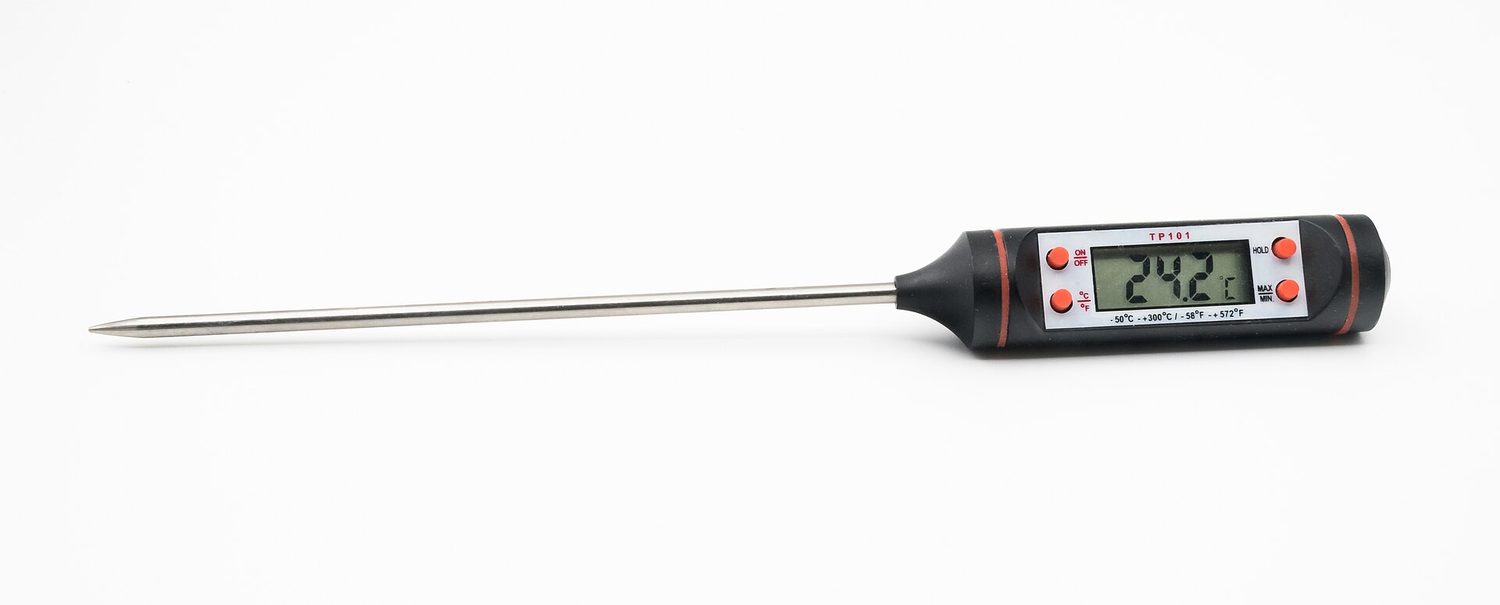
    เทอร์โมมิเตอร์ดิจิทัลสีขาวพร้อมหัววัดโลหะยาวและหน้าจอขนาดเล็ก วางอยู่ข้างเคสเก็บของ
    เทอร์โมมิเตอร์ดิจิทัลวัดอุณหภูมิโดยการตรวจจับพลังงานจลน์ของอนุภาคที่มันสัมผัส

    ความดันของก๊าซ

    อนุภาคของก๊าซชนกับผนังภาชนะของตน การชนแต่ละครั้งเป็นการผลักเล็กน้อย ความดัน ของก๊าซคือแรงรวมของการชนเหล่านี้ต่อหน่วยพื้นที่

    อนุภาคแก๊สเคลื่อนที่ไปทุกทิศทางภายในกล่องและชนกับผนัง
    ความดันของก๊าซคือแรงรวมจากการชนของอนุภาคจำนวนมหาศาลต่อหน่วยพื้นที่ของผนัง
    • การให้ความร้อนแก่ก๊าซ (ที่ปริมาตรคงที่) ทำให้อนุภาคเคลื่อนที่เร็วขึ้น ชนแรงขึ้นและบ่อยขึ้น ดังนั้นความดันจึงเพิ่มขึ้น
    • การบีบอัดก๊าซให้เข้าไปอยู่ในปริมาตรที่เล็กลง (ที่อุณหภูมิคงที่) หมายถึงมีการชนต่อวินาทีมากขึ้นต่อหน่วยพื้นที่ ดังนั้นความดันจึงเพิ่มขึ้น

    สำหรับมวลของก๊าซที่กำหนดที่อุณหภูมิคงที่:

    $$pV = \text{constant}$$

    ดังนั้นหากปริมาตรลดลงครึ่งหนึ่ง ความดันจะเพิ่มขึ้นสองเท่า

    กราฟความดันต่อปริมาตรที่ลดลงอย่างรวดเร็วแล้วค่อยๆ แบนลง พร้อมจุดที่แสดงว่าการลดปริมาตรลงครึ่งหนึ่งจะทำให้ความดันเพิ่มขึ้นสองเท่า
    ที่อุณหภูมิคงที่ กราฟความสัมพันธ์ระหว่างความดัน-ปริมาตรจะเป็นเส้นโค้ง: ลดปริมาตรลงครึ่งหนึ่งแล้วความดันจะเพิ่มขึ้นสองเท่า ดังนั้น $pV$ จึงคงที่

    ตัวอย่างวิธีทำ. ก๊าซมีปริมาตร $200\ \text{cm}^3$ ที่ความดัน $100\ \text{kPa}$ ถูกบีบอัดเหลือ $50\ \text{cm}^3$ ที่อุณหภูมิคงที่ จงหาความดันใหม่

    เนื่องจาก $pV$ คงที่ ดังนั้น $p_1 V_1 = p_2 V_2$:

    $$100 \times 200 = p_2 \times 50 \quad\Rightarrow\quad p_2 = \frac{20\,000}{50} = 400\ \text{kPa}$$

    การเคลื่อนที่แบบบราวเนียน

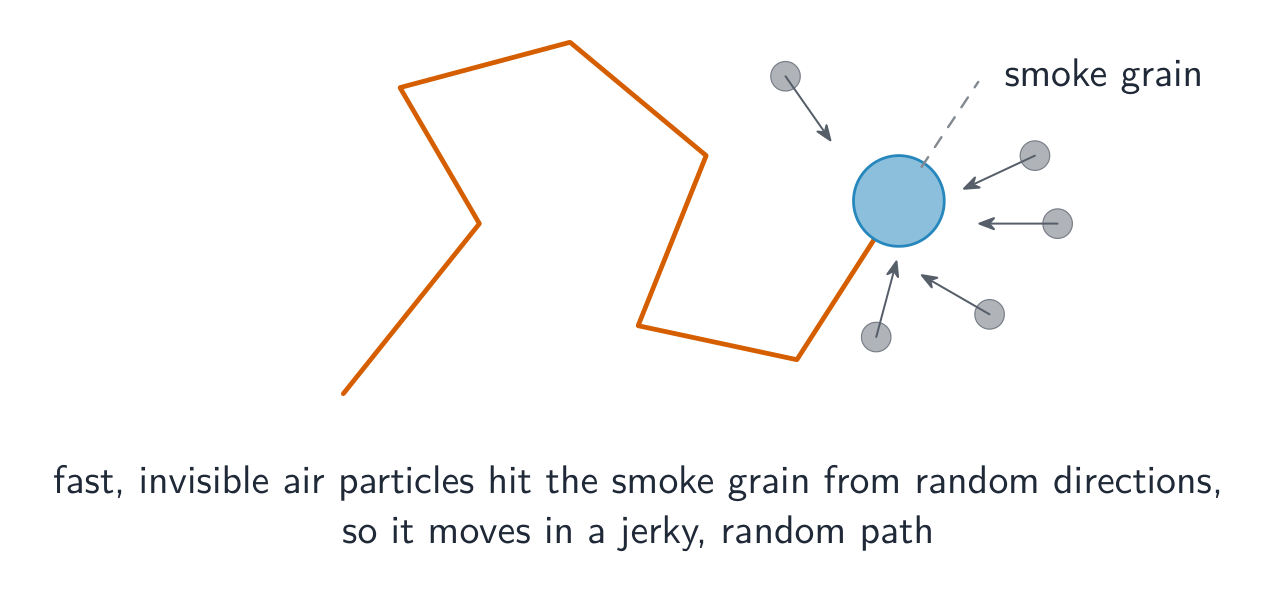
    หากคุณดูควันในอากาศภายใต้กล้องจุลทรรศน์ คุณจะเห็นจุดเล็กๆ เคลื่อนที่ในลักษณะกระตุกและสุ่ม นี่คือ การเคลื่อนที่แบบบราวียน จุดเล็กๆ เหล่านี้ถูกผลักโดยอนุภาคอากาศที่เร็วและไม่มองเห็นได้ซึ่งชนมัน เป็นหลักฐานที่แข็งแกร่งสำหรับโมเดลอนุภาคเชิงจลน์

    เม็ดควันขนาดใหญ่เคลื่อนที่ตามเส้นทางซิกซากัก ล้อมรอบด้วยอนุภาคอากาศขนาดเล็กที่เคลื่อนที่เร็วและชนมัน
    การชนจากอนุภาคอากาศที่เร็วในทิศทางสุ่มจะผลักเม็ดควันให้เคลื่อนที่ไปตามเส้นทางที่กระตุกและสุ่ม

    สเกลเคลวิน

    นักวิทยาศาสตร์มักใช้สเกลอุณหภูมิ เคลวิน (K) ซึ่งเริ่มต้นที่ศูนย์สัมบูรณ์ ในการแปลงค่า:

    $$T\text{ (in K)} = \theta\text{ (in }^{\circ}\text{C}) + 273$$

    ดังนั้น $0\,{}^{\circ}\text{C} = 273\ \text{K}$

    ตัวอย่างวิธีทำ แปลง $25\,{}^{\circ}\text{C}$ เป็นเคลวิน และ $200\ \text{K}$ เป็นองศาเซลเซียส

    $$25 + 273 = 298\ \text{K}, \qquad 200 - 273 = -73\,{}^{\circ}\text{C}$$
    Explore · ⁨สำรวจ⁩

    Squeeze a gas (Boyle's law) · ⁨บีบอัดแก๊ส (กฎของโบยล์)⁩

    Slide the piston in to shrink the volume. The same particles get crammed into less space, so they hit the walls more often and the pressure climbs — while pressure × volume stays constant. · ⁨เลื่อนลูกสูบเข้าไปเพื่อลดปริมาตร อนุภาคเดียวกันถูกบีบอัดให้อยู่ในพื้นที่เล็กลง ทำให้ชนกับผนังบ่อยขึ้นและความดันสูงขึ้น — ในขณะที่ความดัน × ปริมาตรคงที่⁩

    Vocabulary · ⁨คำศัพท์⁩ Train · ⁨ฝึกฝน⁩
    English ไทย
    particle/ˈpɑːtɪkl/ อนุภาค
    vibrate/vaɪˈbreɪt/ สั่นสะเทือน
    kinetic energy/kɪˈnetɪk ˈenədʒi/ พลังงานจลน์
    temperature/ˈtemprɪtʃə/ อุณหภูมิ
    absolute zero/ˈæbsəluːt ˈzɪərəʊ/ ศูนย์สัมบูรณ์
    pressure/ˈpreʃə/ ความดัน
    Brownian motion/ˈbraʊnɪən ˈməʊʃn/ การเคลื่อนที่แบบบราวนian
    kelvin/ˈkelvɪn/ เคลวิน
    thermometer/θɜːˈmɒmɪtə/ เทอร์โมมิเตอร์
    insulating material/ˈɪnsjuːleɪtɪŋ məˈtɪərɪəl/ วัสดุฉนวน
    melting/ˈmeltɪŋ/ การหลอมละลาย
    2.2

    Thermal expansion 热膨胀 · ⁨การขยายตัวด้วยความร้อน⁩

    Syllabus · ⁨หลักสูตร⁩
    English

    2.2.1 Thermal expansion of solids, liquids and gases

    Core Supplement
    1 Describe, qualitatively, the thermal expansion of solids, liquids and gases at constant pressure 3 Explain, in terms of the motion and arrangement of particles, the relative order of magnitudes of the expansion of solids, liquids and gases as their temperatures rise
    2 Describe some of the everyday applications and consequences of thermal expansion

    2.2.2 Specific heat capacity

    Core Supplement
    1 Know that a rise in the temperature of an object increases its internal energy 2 Describe an increase in temperature of an object in terms of an increase in the average kinetic energies of all of the particles in the object
    3 Define specific heat capacity as the energy required per unit mass per unit temperature increase; recall and use the equation
    $$c = \frac{\Delta E}{m\Delta\theta}$$
    4 Describe experiments to measure the specific heat capacity of a solid and a liquid

    2.2.3 Melting, boiling and evaporation

    Core Supplement
    1 Describe melting and boiling in terms of energy input without a change in temperature 6 Describe the differences between boiling and evaporation
    2 Know the melting and boiling temperatures for water at standard atmospheric pressure
    3 Describe condensation and solidification in terms of particles
    4 Describe evaporation in terms of the escape of more-energetic particles from the surface of a liquid 7 Describe how temperature, surface area and air movement over a surface affect evaporation
    5 Know that evaporation causes cooling of a liquid 8 Explain the cooling of an object in contact with an evaporating liquid
    ไทย

    2.2.1 การขยายตัวด้วยความร้อนของของแข็ง ของเหลว และแก๊ส

    แก่น เพิ่มเติม
    1 อธิบายโดยสังเขป关于 การขยายตัวด้วยความร้อน ของของแข็ง ของเหลว และแก๊ส ที่ความดันคงที่ 3 อธิบายในเชิงกลไกการเคลื่อนที่และจัดเรียงตัวของอนุภาค เกี่ยวกับลำดับขนาดของการขยายตัวของของแข็ง ของเหลว และแก๊ส เมื่ออุณหภูมิสูงขึ้น
    2 อธิบายการใช้งานและผลกระทบจากการขยายตัวด้วยความร้อนในชีวิตประจำวันบางประการ

    2.2.2 ความจุความร้อนจำเพาะ

    แก่น เพิ่มเติม
    1 รู้ว่าเมื่ออุณหภูมิของวัตถุเพิ่มขึ้น จะทำให้พลังงานภายในของวัตถุนั้นเพิ่มขึ้น 2 อธิบายการเพิ่มขึ้นของอุณหภูมิของวัตถุในเชิงการเพิ่มขึ้นของพลังงานจลน์เฉลี่ยของอนุภาคทั้งหมดในวัตถุนั้น
    3 นิยาม ความจุความร้อนจำเพาะ เป็นพลังงานที่ต้องการต่อหน่วยมวลต่อหน่วยการเพิ่มของอุณหภูมิ; จำและใช้สมการ
    $$c = \frac{\Delta E}{m\Delta\theta}$$
    4 อธิบายการทดลองเพื่อวัดความจุความร้อนจำเพาะของของแข็งและของเหลว

    2.2.3 การหลอมเหลว การเดือด และการระเหย

    แก่น เพิ่มเติม
    1 อธิบาย การหลอมเหลว และ การเดือด ในเชิงการรับพลังงานโดยไม่มีการเปลี่ยนแปลงอุณหภูมิ 6 อธิบายความแตกต่างระหว่างการเดือดและการระเหย
    2 รู้จุดหลอมเหลวและจุดเดือดของน้ำที่ความดันบรรยากาศมาตรฐาน
    3 อธิบายการควบแน่นและการแข็งตัวในเชิงอนุภาค
    4 อธิบาย การระเหย ในเชิงการหลุดออกจากพื้นผิวของของเหลวของอนุภาคที่มีพลังงานสูงกว่า 7 อธิบายว่าอุณหภูมิ พื้นที่ผิว และการเคลื่อนที่ของอากาศเหนือพื้นผิวมีผลต่อการระเหยอย่างไร
    5 รู้ว่าการระเหยทำให้ของเหลวเย็นลง 8 อธิบายการเย็นลงของวัตถุที่สัมผัสกับของเหลวที่กำลังระเหย

    Source: Cambridge International syllabus · ⁨แหล่งที่มา: หลักสูตร Cambridge International⁩

    English

    When matter is heated, its particles move more and take up more space, so the material expands. Gases expand the most, then liquids, then solids. This order comes from the forces between the particles: in a solid the particles are held tightly in a lattice 晶格 (a fixed pattern), so they can only vibrate a little more; in a liquid they are held less strongly; in a gas the forces are very weak, so the particles spread out much more.

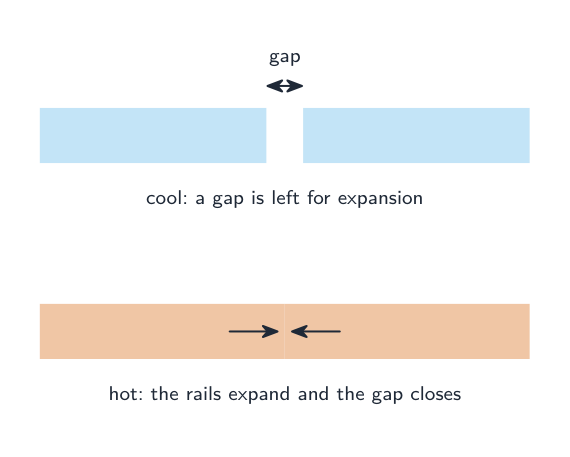
    Everyday examples: gaps are left between railway lines; bridges sit on rollers; a tight metal lid loosens when heated.

    ไทย

    เมื่อสสารได้รับความร้อน อนุภาคของมันจะเคลื่อนที่มากขึ้นและกินพื้นที่มากขึ้น ทำให้วัสดุขยายตัว ก๊าซขยายตัวมากที่สุด ตามด้วยของเหลว แล้วถึงของแข็ง ลำดับนี้เกิดจากแรงระหว่างอนุภาค: ในของแข็ง อนุภาคถูกยึดติดกันใน โครงผลึก (รูปแบบที่กำหนดไว้) ดังนั้นจึงสั่นได้เพียงเล็กน้อยเท่านั้น; ในของเหลวถูกยึดด้วยแรงน้อยกว่า; ในก๊าซแรงมีความอ่อนแอกว่ามาก ดังนั้นอนุภาคจึงกระจายออกได้มากกว่ามาก

    ตัวอย่างในชีวิตประจำวัน: ทิ้งช่องว่างระหว่างรางรถไฟ; สะพานวางอยู่บนลูกกลิ้ง; ฝาโลหะที่แน่นจะคลายออกเมื่อได้รับความร้อน

    รางรถไฟสองเส้นที่มีช่องว่างเล็กน้อยเมื่อเย็น แล้วขยายตัวและสัมผัสกันเมื่อร้อน
    ทิ้งช่องว่างเล็กน้อยระหว่างรางเมื่อเย็น เพื่อให้เมื่อบิดตัวด้วยความร้อน ช่องว่างนี้จะปิดลงแทนที่จะทำให้ทาง railway บิดเบี้ยว
    Explore · ⁨สำรวจ⁩

    Heating and specific heat capacity · ⁨การให้ความร้อนและความจุความร้อนจำเพาะ⁩

    Q = mcΔT

    The heat energy needed is proportional to the temperature rise for a given mass of material. · ⁨พลังงานความร้อนที่ต้องการ แปรผันตรงกับ การเพิ่มขึ้นของอุณหภูมิ สำหรับมวลวัสดุที่กำหนด⁩

    Vocabulary · ⁨คำศัพท์⁩ Train · ⁨ฝึกฝน⁩
    English ไทย
    thermal expansion/ˈθɜːml ekˈspænʃn/ การขยายตัวจากความร้อน
    lattice/ˈlætɪs/ ผลึก (lattice)
    Watch lesson · ⁨ดูบทเรียน⁩
    2.2

    Internal energy and specific heat capacity · ⁨พลังงานภายในและความจุความร้อนจำเพาะ⁩

    English

    The internal energy 内能 of an object is the total energy of all its particles. Heating an object raises its internal energy and usually its temperature.

    The specific heat capacity 比热容 is the energy needed to raise the temperature of 1 kg of a material by 1 °C.

    $$c = \frac{\Delta E}{m\,\Delta\theta}$$

    A material with a high specific heat capacity (like water) needs a lot of energy to warm up and cools down slowly.

    Worked example. How much energy is needed to heat $2.0\ \text{kg}$ of water from $20\,{}^{\circ}\text{C}$ to $70\,{}^{\circ}\text{C}$? The specific heat capacity of water is $4200\ \text{J/(kg}\,{}^{\circ}\text{C)}$.

    Rearranging $c = \frac{\Delta E}{m\,\Delta\theta}$ gives $\Delta E = mc\,\Delta\theta$, with $\Delta\theta = 70 - 20 = 50\,{}^{\circ}\text{C}$:

    $$\Delta E = 2.0 \times 4200 \times 50 = 420\,000\ \text{J} = 420\ \text{kJ}$$

    Measuring specific heat capacity. For a solid, use a metal block with two holes: one for an electric heater 加热器 and one for a thermometer 温度计. Measure the mass $m$ of the block. Switch on the heater for a measured time $t$ and record the current $I$ and the voltage $V$, so the energy supplied is $E = IVt$ (or read the energy from a joulemeter). Record the temperature rise $\Delta\theta$. Then $c = \dfrac{E}{m\,\Delta\theta}$. For a liquid, heat a measured mass of the liquid in a container and stir it, so the temperature is the same all through. Wrap the block or the container in insulating material 隔热材料, so less energy escapes to the air.

    ไทย

    พลังงานภายใน ของวัตถุคือพลังงานรวมของอนุภาคทั้งหมด ให้ความร้อนกับวัตถุจะเพิ่มพลังงานภายในของมันและมักจะทำให้สูงขึ้นอุณหภูมิ它也

    ความจุความร้อนจำเพาะ คือพลังงานที่ต้องการเพื่อ升高อุณหภูมิของวัสดุ 1 กิโลกรัม ขึ้น 1 °C

    $$c = \frac{\Delta E}{m\,\Delta\theta}$$

    วัสดุที่มีความจุความร้อนจำเพาะสูง (เช่น น้ำ) ต้องการพลังงานมากในการทำความร้อนและเย็นลงช้า

    ตัวอย่างวิธีทำ. ต้องใช้พลังงานเท่าไหร่ในการทำความร้อน $2.0\ \text{kg}$ ของน้ำจาก $20\,{}^{\circ}\text{C}$ ไปยัง $70\,{}^{\circ}\text{C}$? ความจุความร้อนจำเพาะของน้ำคือ $4200\ \text{J/(kg}\,{}^{\circ}\text{C)}$

    จัดรูป $c = \frac{\Delta E}{m\,\Delta\theta}$ ใหม่จะได้ $\Delta E = mc\,\Delta\theta$, โดยที่ $\Delta\theta = 70 - 20 = 50\,{}^{\circ}\text{C}$:

    $$\Delta E = 2.0 \times 4200 \times 50 = 420\,000\ \text{J} = 420\ \text{kJ}$$

    การวัดความจุความร้อนจำเพาะ. สำหรับของแข็ง ใช้บล็อกโลหะที่มีรูสองรู: รูหนึ่งสำหรับเครื่อง ให้ความร้อน ไฟฟ้า และอีก รูหนึ่งสำหรับ เทอร์โมมิเตอร์ วัดมวล $m$ ของบล็อก เปิดเครื่องให้ความร้อนเป็นเวลา $t$ ที่วัดได้ และบันทึกกระแสไฟ $I$ และแรงดันไฟฟ้า $V$, ดังนั้นพลังงานที่จ่ายเข้าไปคือ $E = IVt$ (หรืออ่านค่าพลังงานจากจูลมิเตอร์) บันทึกการ升高อุณหภูมิ $\Delta\theta$. จากนั้น $c = \dfrac{E}{m\,\Delta\theta}$. สำหรับของเหลว, ให้ความร้อนมวลของเหลวที่วัดได้ในภาชนะและคนให้混匀, เพื่อให้混匀อุณหภูมิเท่ากันทั่วทั้งภาชนะ ห่อブロックหรือภาชนะด้วย ฉนวน, เพื่อลดการรั่วไหลของพลังงานสู่บรรยากาศ

    น้ำเดือด: พลังงานภายในเพิ่มขึ้นตามอุณหภูมิ; ความจุความร้อนจำเพาะคือพลังงานต่อ kg ต่อ °C
    น้ำเดือด: พลังงานภายในเพิ่มขึ้นตามอุณหภูมิ; ความจุความร้อนจำเพาะคือพลังงานต่อกิโลกรัมต่อองศาเซลเซียส
    Vocabulary · ⁨คำศัพท์⁩ Train · ⁨ฝึกฝน⁩
    English ไทย
    internal energy/ɪnˈtɜːnl ˈenədʒi/ พลังงานภายใน
    specific heat capacity/spəˈsɪfɪk hiːt kəˈpæsɪti/ ความจุความร้อนจำเพาะ
    heater/ˈhiːtə/ เครื่องทำความร้อน
    2.2

    Melting, boiling and evaporation · ⁨การหลอมเหลว การเดือด และการระเหย⁩

    English

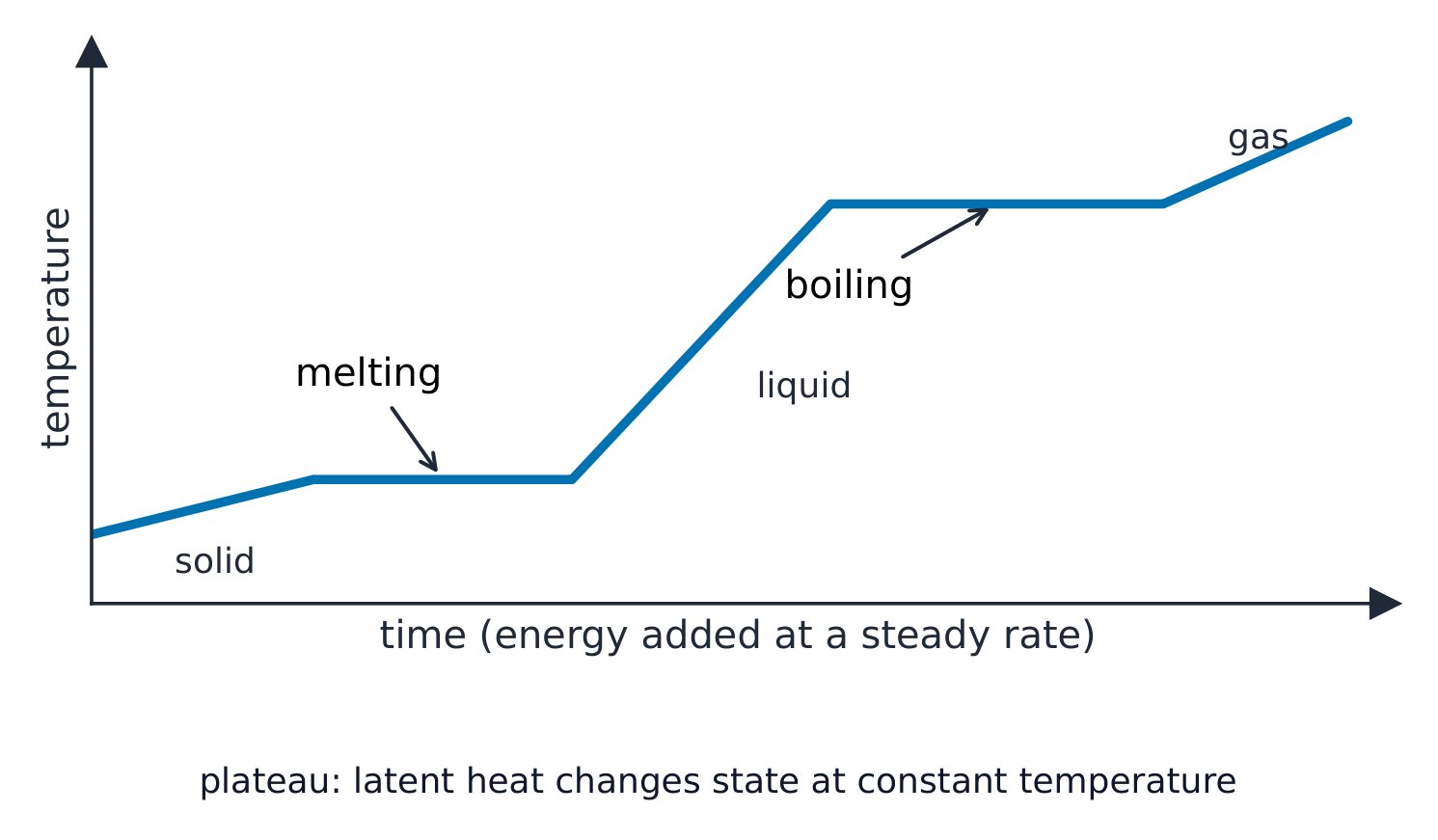
    Melting 熔化 and boiling 沸腾 need energy, but the temperature stays the same while the state changes. This energy breaks the forces between particles. For water at normal air pressure, melting is at $0\,{}^{\circ}\text{C}$ and boiling at $100\,{}^{\circ}\text{C}$.

    Evaporation 蒸发 is when a liquid changes to a gas at its surface, below the boiling point. The fastest particles escape from the surface. Because the fastest (most energetic) particles leave, the average energy of those left behind falls, so the liquid cools down 冷却. An object touching an evaporating liquid also cools, because the liquid takes energy from it: this is why sweat cools your skin.

    Evaporation is faster when the temperature is higher, the surface area is larger, and there is more air movement over the surface.

    ไทย

    การหลอมเหลว และ การเดือด ต้องใช้พลังงาน แต่อุณหภูมิจะคงที่ขณะเปลี่ยนสถานะ พลังงานนี้ใช้เพื่อทำลายแรงระหว่างอนุภาค สำหรับน้ำที่ความดันบรรยากาศปกติ การหลอมเหลวเกิดขึ้นที่ $0\,{}^{\circ}\text{C}$ และการเดือดเกิดขึ้นที่ $100\,{}^{\circ}\text{C}$

    กราฟแสดงอุณหภูมิเทียบกับเวลา มีช่วงราบเรียบระหว่างการหลอมเหลวและระหว่างการเดือด *ขณะที่สารละลายและ mientras它 boiling อุณหภูมิจะคงที่ แม้ว่าจะมีการเพิ่มพลังงานอย่างต่อเนื่องก็ตาม

    การระเหย คือกระบวนการที่ของเหลวเปลี่ยนเป็นแก๊สที่ผิวหน้า โดยต่ำกว่าจุดเดือด อนุภาคที่มีความเร็วที่สุดจะหลุดออกจากผิวหน้า เมื่ออนุภาคที่มีพลังงานสูง (เร็วที่สุด) ออกไป พลังงานเฉลี่ยของอนุภาคที่เหลืออยู่จึงลดลง ทำให้ของเหลว เย็นลง วัตถุที่สัมผัสกับของเหลวที่กำลังระ,evaporate ก็เย็นลงเช่นกัน เนื่องจากของเหลวดูดความร้อนจากวัตถุนั้น นี่คือเหตุผลที่เหงื่อทำให้ผิวหนังเย็นลง

    การระเหยเกิดขึ้นได้เร็วกว่าเมื่ออุณหภูมิสูงขึ้น พื้นที่ผิวกว้างขึ้น และมีกระแสอากาศไหลผ่านผิวหน้ามากขึ้น

    Explore · ⁨สำรวจ⁩

    The heating curve — watch the temperature pause · ⁨กราฟความร้อน — สังเกตว่าอุณหภูมิหยุดชะงัก⁩

    While the substance is melting or boiling the temperature stays flat, even though heat is still going in — the energy breaks bonds instead of warming it. · ⁨ในขณะที่สารกำลังหลอมเหลวหรือเดือด อุณหภูมิจะคงที่ แม้ว่าจะมีความร้อนใส่เข้าไป continuously — พลังงานUsed to break bonds แทนที่จะทำให้ร้อนขึ้น⁩

    Vocabulary · ⁨คำศัพท์⁩ Train · ⁨ฝึกฝน⁩
    English ไทย
    boiling/ˈbɔɪlɪŋ/ จุดเดือด
    evaporation/ɪˌvæpəˈreɪʃn/ การระเหย
    cools down/kuːlz daʊn/ เย็นลง
    transfer of thermal energy/ˈtrænsfɜː ɒv ˈθɜːml ˈenədʒi/ การถ่ายโอนพลังงานความร้อน
    2.3

    Transfer of thermal energy 热能传递 · ⁨การถ่ายโอนพลังงานความร้อน⁩

    Syllabus · ⁨หลักสูตร⁩
    English

    2.3.1 Conduction

    Core Supplement
    1 Describe experiments to demonstrate the properties of good thermal conductors and bad thermal conductors (thermal insulators) 2 Describe thermal conduction in all solids in terms of atomic or molecular lattice vibrations and also in terms of the movement of free (delocalised) electrons in metallic conductors
    3 Describe, in terms of particles, why thermal conduction is bad in gases and most liquids
    4 Know that there are many solids that conduct thermal energy better than thermal insulators but do so less well than good thermal conductors

    2.3.2 Convection

    Core Supplement
    1 Know that convection is an important method of thermal energy transfer in liquids and gases
    2 Explain convection in liquids and gases in terms of density changes and describe experiments to illustrate convection

    2.3.3 Radiation

    Core Supplement
    1 Know that thermal radiation is infrared radiation and that all objects emit this radiation
    2 Know that thermal energy transfer by thermal radiation does not require a medium 4 Know that for an object to be at a constant temperature it needs to transfer energy away from the object at the same rate that it receives energy
    3 Describe the effect of surface colour (black or white) and texture (dull or shiny) on the emission, absorption and reflection of infrared radiation 5 Know what happens to an object if the rate at which it receives energy is less or more than the rate at which it transfers energy away from the object
    6 Know how the temperature of the Earth is affected by factors controlling the balance between incoming radiation and radiation emitted from the Earth’s surface
    7 Describe experiments to distinguish between good and bad emitters of infrared radiation
    8 Describe experiments to distinguish between good and bad absorbers of infrared radiation
    9 Describe how the rate of emission of radiation depends on the surface temperature and surface area of an object

    2.3.4 Consequences of thermal energy transfer

    Core Supplement
    1 Explain some of the basic everyday applications and consequences of conduction, convection and radiation, including: (a) heating objects such as kitchen pans (b) heating a room by convection 2 Explain some of the complex applications and consequences of conduction, convection and radiation where more than one type of thermal energy transfer is significant, including: (a) a fire burning wood or coal (b) a radiator in a car
    ไทย

    2.3.1 การนำความร้อน

    แก่น เพิ่มเติม
    1 อธิบายการทดลองเพื่อแสดงคุณสมบัติของ ตัวนำความร้อนที่ดี และ ฉนวนความร้อน (ตัวนำความร้อนที่ไม่ดี) 2 อธิบายการนำความร้อนในของแข็งทุกชนิดในเชิงการสั่นสะเทือนของโครงตาข่ายอะตอมหรือโมเลกุล รวมถึงในเชิงการเคลื่อนที่ของอิเล็กตรอนอิสระ (delocalised electrons) ในตัวนำโลหะ
    3 อธิบายในเชิงอนุภาค ว่าทำไมการนำความร้อนจึงไม่ดีในแก๊สและของเหลวส่วนใหญ่
    4 รู้ว่ามีของแข็งจำนวนมากที่นำพลังงานความร้อนได้ดีกว่าฉนวนความร้อน แต่ไม่ดีเท่าตัวนำความร้อนที่ดี

    2.3.2 การพาความร้อน

    แก่น เพิ่มเติม
    1 รู้ว่า การพาความร้อน เป็นวิธีการสำคัญในการถ่ายโอนพลังงานความร้อนในของเหลวและแก๊ส
    2 อธิบายการพาความร้อนในของเหลวและแก๊สในเชิงการเปลี่ยนแปลงความหนาแน่น และอธิบายการทดลองเพื่อแสดงการพาความร้อน

    2.3.3รังสี

    แก่น เพิ่มเติม
    1 รู้ว่า รังสีความร้อน คือ รังสีอินฟราเรด และวัตถุทุกชนิดจะปล่อยรังสีนี้
    2 รู้ว่าการถ่ายโอนพลังงานความร้อน bằngรังสีความร้อน ไม่จำเป็นต้องอาศัยตัวกลาง 4 รู้ว่าสำหรับวัตถุที่จะมีอุณหภูมิคงที่ วัตถุต้องถ่ายโอนพลังงานออกไปจากตัวมันเองในอัตราเท่ากับที่มันได้รับพลังงาน
    3 อธิบายผลกระทบของสีพื้นผิว (ดำหรือขาว) และลักษณะพื้นผิว (ด้านหรือเงา) ต่อการปล่อย การดูดซับ และการสะท้อนรังสีอินฟราเรด 5 รู้ว่า会发生อะไรกับวัตถุหากอัตราการได้รับพลังงานน้อยกว่าหรือมากกว่าอัตราการถ่ายโอนพลังงานออกจากวัตถุ
    6 รู้ว่าอุณหภูมิของโลกได้รับผลกระทบจากปัจจัยควบคุมสมดุลระหว่างรังสีที่เข้ามาและรังสีที่ปล่อยออกจากพื้นผิวโลกอย่างไร
    7 อธิบายการทดลองเพื่อแยกแยะระหว่างตัวปล่อยรังสีอินฟราเรดที่ดีและไม่ดี
    8 อธิบายการทดลองเพื่อแยกแยะระหว่างตัวดูดรังสีอินฟราเรดที่ดีและไม่ดี
    9 อธิบายว่าอัตราการปล่อยรังสีขึ้นอยู่กับอุณหภูมิพื้นผิวและพื้นที่ผิวของวัตถุอย่างไร

    2.3.4 ผลกระทบของการถ่ายโอนพลังงานความร้อน

    แก่น เพิ่มเติม
    1 อธิบายการใช้งานและผลกระทบพื้นฐานในชีวิตประจำวันบางอย่างของการนำความร้อน การพาความร้อน และรังสี ได้แก่: (ก) การทำให้อุปกรณ์เช่นหม้อครัวร้อน (ข) การทำความร้อนห้องด้วยการพาความร้อน 2 อธิบายการใช้งานและผลกระทบที่ซับซ้อนบางอย่างของการนำความร้อน การพาความร้อน และรังสี ซึ่งมีการถ่ายโอนพลังงานความร้อนหลายประเภทที่สำคัญร่วมด้วย ได้แก่: (ก) ไฟไหม้ไม้หรือถ่าน (ข) รังไฮเดออร์ในรถยนต์

    Source: Cambridge International syllabus · ⁨แหล่งที่มา: หลักสูตร Cambridge International⁩

    English

    Thermal energy moves from hotter places to colder places in three ways.

    Conduction

    Conduction 热传导 is the transfer of thermal energy through a material without the material moving. The particles in a solid sit in a lattice. Heated particles vibrate more and pass the energy to their neighbours. In metals, free electrons (delocalised electrons 自由电子) carry energy quickly, so metals are good thermal conductors 热导体.

    Materials that conduct badly (like air, wood and plastic) are thermal insulators 热绝缘体.

    Testing conductors. Fix a drawing pin with a little wax to one end of rods of copper, iron, glass and wood, and heat the other ends equally. The pin drops first from the copper rod, then from the iron rod, and last (or never) from the glass and the wood: metals are the best conductors. A metal rod held in a flame soon feels hot; a wooden rod does not.

    Gases and most liquids are bad conductors because their particles are far apart and only pass on energy when they happen to collide. There is no lattice and there are no free electrons.

    Convection

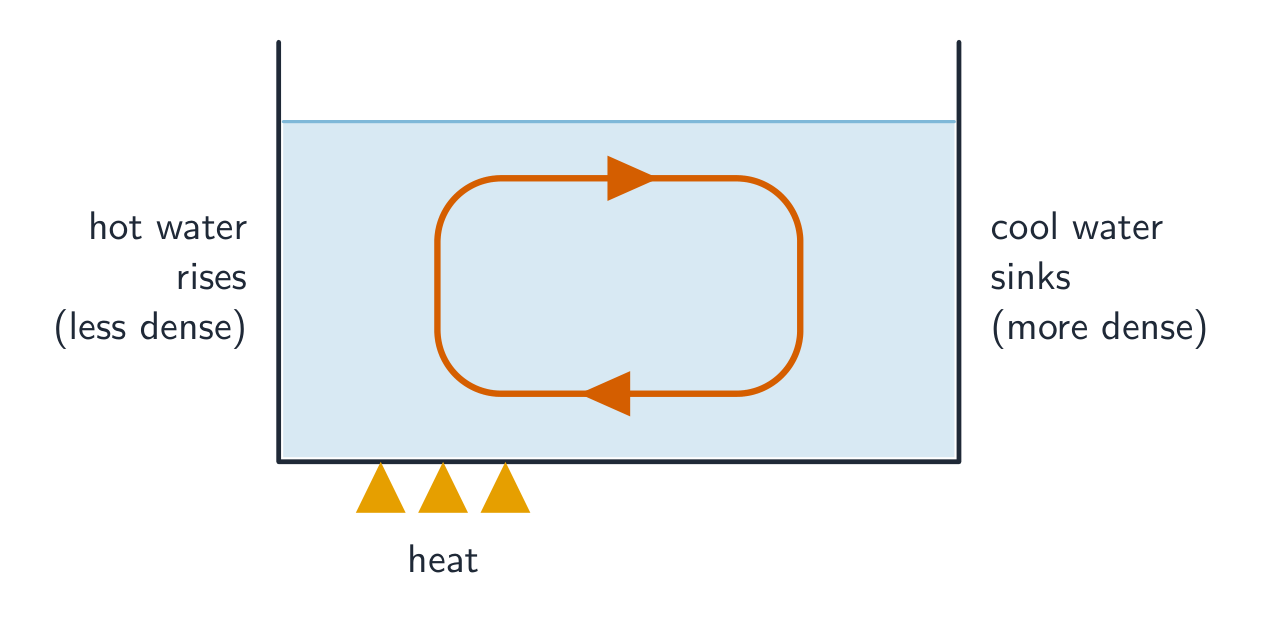
    Convection 对流 happens in liquids and gases. When a fluid is heated it expands, becomes less dense, and rises. Cooler, denser fluid sinks to take its place. This circle of moving fluid is a convection current.

    Showing convection. Drop a crystal of purple potassium permanganate 高锰酸钾 into a beaker of water and heat the beaker gently under the crystal. A coloured stream rises above the heat, spreads across the top and sinks at the sides. In air, a lit candle under one chimney of a smoke box pulls smoke down the other chimney and up above the flame.

    Convection cannot happen in a solid because the particles cannot move from place to place.

    Radiation

    Thermal radiation 热辐射 is energy carried by infrared 红外线 waves. All objects emit it, and it needs no material to travel through — it can cross empty space (this is how energy reaches us from the Sun).

    A surface that is dull 暗淡 and black is a good emitter 发射体 and a good absorber 吸收体 of infrared. A surface that is shiny and white is a poor emitter and a good reflector 反射体.

    Comparing surfaces. Fill two cans, one dull black and one shiny silver, with hot water at the same temperature, and put a thermometer in each. The black can cools faster, so it is the better emitter. Then put the same two cans, full of cold water, at equal distances from a heater. The black can warms faster, so it is the better absorber. A Leslie cube 莱斯利立方体 (a metal box with one side of each finish) shows the same thing.

    An object stays at a constant temperature when it emits energy at the same rate as it absorbs energy. The rate of emission is greater when the surface is hotter and larger. If an object absorbs energy faster than it emits it, its temperature rises; if it emits faster than it absorbs, its temperature falls.

    The Earth's temperature. The Earth absorbs radiation from the Sun and emits infrared radiation back into space. Its average temperature stays constant only when the two rates are equal. Anything that changes this balance changes the temperature. Gases in the atmosphere 大气 such as carbon dioxide absorb some of the emitted infrared and send part of it back down, so more of these gases warms the Earth. Clouds and ice reflect incoming sunlight, so less ice means more energy is absorbed, and the Earth warms further.

    Everyday examples

    • A kitchen pan has a metal base that conducts energy quickly to the food, and a plastic or wooden handle that is an insulator, so you can hold it.
    • A radiator 散热器 heats a room by convection: the air next to it warms, rises, and cooler air flows in to take its place, so the whole room warms.
    • Sitting near a fire you feel its radiation on your face at once; the air between you and the fire is a poor conductor.
    • A vacuum flask 保温瓶 keeps a drink hot by stopping all three transfers: the vacuum between its double walls stops conduction and convection, and its shiny silver surfaces stop radiation.
    ไทย

    พลังงานความร้อนเคลื่อนที่จากแหล่งที่มีอุณหภูมิสูงกว่าไปยังแหล่งที่มีอุณหภูมิต่ำกว่า ในสามรูปแบบ

    การนำความร้อน

    การนำความร้อน คือการถ่ายโอนพลังงานความร้อนผ่านวัสดุโดยไม่มีการเคลื่อนที่ของตัววัสดุนั้นเอง อนุภาคในของแข็งจัดเรียงอยู่ในโครงผลึก อนุภาคที่ถูกทำความร้อนจะสั่นสะเทือนมากขึ้นและส่งต่อพลังงานให้เพื่อนบ้าน ในโลหะ อิเล็กตรอนอิสระ (electrons ที่ไม่ติดกับอะตอม) จะพาพลังงานไปอย่างรวดเร็ว ดังนั้นโลหะจึงเป็น ตัวนำความร้อนที่ดี

    วัสดุที่นำความร้อนไม่ดี (เช่น อากาศ ไม้ และพลาสติก)被称为 ฉนวนกันความร้อน

    การทดสอบตัวนำความร้อน ยึดหมุดกระดาษด้วยขี้ผึ้งเล็กน้อยไว้ที่ปลายหนึ่งของแท่งทองแดง เหล็ก แก้ว และไม้ แล้วให้ความร้อนที่ปลายอีกด้านเท่าๆ กัน หมุดจะหลุดจากแท่งทองแดงก่อน ตามด้วยแท่งเหล็ก และสุดท้าย (หรืออาจไม่หลุดเลย) จากแก้วและไม้: โลหะคือตัวนำที่ดีที่สุด แท่งโลหะที่จับไว้ในเปลวไฟจะร้อนทันที ส่วนแท่งไม้จะไม่ร้อน

    แก๊สและของเหลวส่วนใหญ่เป็นตัวนำความร้อนไม่ดี เพราะอนุภาคอยู่ห่างกันมากและส่งต่อพลังงานกันได้ก็ต่อเมื่อเกิดการชนกันโดยบังเอิญ ไม่มีโครงผลึกและไม่อิเล็กตรอนอิสระ

    แท่งโลหะถูกทำความร้อนที่ปลายหนึ่ง อนุภาคสั่นสะเทือนและส่งต่อพลังงานไปยังปลายที่เย็น
    ในการนำความร้อน อนุภาคที่สั่นสะเทือนส่งต่อพลังงานให้เพื่อนบ้าน ทำให้พลังงานไหลจากปลายร้อนไปยังปลายเย็น

    การพาความร้อน

    การพาความร้อน เกิดขึ้นในของเหลวและแก๊ส เมื่อของไหลได้รับความร้อนจะขยายตัว ความหนาแน่นลดลง และลอยตัวขึ้น ของไหลที่เย็นกว่าและมีความหนาแน่นมากกว่าจะจมลงไปแทนที่ ลูปของการเคลื่อนที่ของของไหลนี้เรียกว่า กระแสการพาความร้อน

    ถ้วยวัดปริมาณน้ำถูกทำความร้อนจากด้านล่าง มีลูกศรวงกลมแสดงน้ำร้อนลอยขึ้นและน้ำเย็นจมลง
    ของไหลที่ถูกทำความร้อนลอยขึ้นและของไหลที่เย็นกว่าจมลง ก่อให้เกิดกระแสการพาความร้อน

    การสาธิตการพาความร้อน หยดผลึกสีม่วงของ โพแทสเซียมเพอร์แมงกาเนต ลงในถ้วยวัดปริมาณน้ำแล้วให้ความร้อนถ้วยเบาๆ ใต้ผลึก จะเห็นสายสีลอยขึ้นเหนือแหล่งความร้อน แพร่กระจายไปทั่วด้านบน และจมลงตามขอบด้านข้าง ในอากาศ เทียนที่จุดอยู่ใต้ปล่องควันด้านหนึ่งของกล่อง烟雾箱 ดึงควันลงปล่องควันอีกด้านและลอยขึ้นเหนือเปลวไฟ

    การพาความร้อนไม่สามารถเกิดขึ้นในของแข็งได้เพราะอนุภาคไม่สามารถเคลื่อนที่จากที่หนึ่งไปยังอีกที่หนึ่งได้

    การแผ่รังสี

    รังสีความร้อน คือพลังงานที่พาไปด้วยคลื่น อินฟราเรด วัตถุทุกชนิดปล่อยรังสีนี้ออกมา และไม่จำเป็นต้องมีสื่อกลางในการเดินทาง สามารถทะลุผ่านอวกาศว่างเปล่าได้ (นี่คือวิธีที่พลังงานจากดวงอาทิตย์มาถึงเรา)

    พื้นผิวที่เป็น ด้าน และสีดำ เป็น ผู้ปล่อย และ ผู้ดูดซับ อินฟราเรดได้ดี พื้นผิวที่เป็นมันเงาและสีขาว เป็นผู้ปล่อยที่ไม่ดีและเป็น ตัวสะท้อน ที่ดี

    พื้นผิวด้านสีดำกำลังปล่อยคลื่นอินฟราเรดจำนวนมาก อยู่ข้างเคียงกับพื้นผิวมันเงาที่กำลังปล่อยน้อย
    พื้นผิวด้านสีดำปล่อย (และดูดซับ) อินฟราเรดได้ดีกว่าพื้นผิวมันเงาและสีขาวมาก

    เปรียบเทียบพื้นผิว เติมกระป๋องสองใบ一个ด้านเป็นสีดำด้าน อีกด้านเป็นสีเงินมันเงา ด้วยน้ำร้อนที่มีอุณหภูมิเท่ากัน แล้วใส่เทอร์โมมิเตอร์ในทั้งสองใบ กระป๋องสีดำจะเย็นลงเร็วกว่า แสดงว่าเป็นผู้ปล่อยที่ดีกว่า จากนั้นนำกระป๋องทั้งสองใบที่เต็มไปด้วยน้ำเย็นวาง距热源เท่ากัน กระป๋องสีดำจะอุ่นขึ้นเร็วกว่า แสดงว่าเป็นผู้ดูดซับที่ดีกว่า ลูกบาศก์เลสลี (กล่องโลหะที่มีแต่ละด้านเป็นพื้นผิวที่แตกต่างกัน) แสดงผลลัพธ์เดียวกัน

    ภาพสามภาพของมือเดียวกัน: ในแสงธรรมดา warmth and glowing yellow in a thermal camera, then cooler and darker
    กล้องความร้อน (อินฟราเรด) แปลงรังสีอินฟราเรดที่ปล่อยออกมาจากมืออุ่นให้เป็นภาพ; brightness means hotter

    วัตถุจะคงอุณหภูมิไว้ได้เมื่อปล่อยพลังงานในอัตราเท่ากับที่ดูดซับพลังงาน อัตราการปล่อยจะเพิ่มขึ้นเมื่อพื้นผิวยิ่งร้อนและยิ่งใหญ่ หากวัตถุดูดซับพลังงานได้เร็วกว่าที่ปล่อย出来 อุณหภูมิจะเพิ่มขึ้น; ถ้าปล่อยออกได้เร็วกว่าที่ดูดซับ出来 อุณหภูมิจะลดลง

    อุณหภูมิของโลก โลกดูดกลืนรังสีจากดวงอาทิตย์และปล่อยรังสีอินฟราเรดกลับสู่อวกาศ อุณหภูมิเฉลี่ยของโลกจะคงที่ก็ต่อเมื่ออัตราการดูดกลืนและการปล่อยรังสีเท่ากัน สิ่งใดเปลี่ยนแปลงสมดุลนี้จะทำให้เปลี่ยนอุณหภูมิ ก๊าซใน บรรยากาศ เช่น คาร์บอนไดออกไซด์ดูดกลืนรังสีอินฟราเรดส่วนหนึ่งและส่งกลับมาบางส่วน ทำให้ก๊าซเหล่านี้มากขึ้นทำให้โลกอุ่นขึ้น เมฆและน้ำแข็งสะท้อนแสงอาทิตย์ที่เข้ามา ดังนั้นน้ำแข็งน้อยลงหมายถึงการดูดกลืนพลังงานมากขึ้น และโลกจะอุ่นขึ้นอีก

    ตัวอย่างในชีวิตประจำวัน

    • กระทะทำครัวมีฐานโลหะที่นำความร้อนไปยังอาหารได้อย่างรวดเร็ว และมีด้ามจับพลาสติกหรือไม้ซึ่งเป็นฉนวนกันความร้อน ทำให้คุณถือได้ปลอดภัย
    • เครื่องทำความร้อน อุ่นห้องด้วยการพาความร้อน: อากาศข้างๆ它อุ่นขึ้น ลอยขึ้น และอากาศเย็นไหลเข้ามาแทนที่ ทำให้ทั้งห้องอุ่นขึ้น
    • การนั่งใกล้กองไฟ คุณจะรู้สึกถึงความร้อนแบบรังสีบนใบหน้าทันที; อากาศระหว่างคุณกับกองไฟเป็นตัวนำความร้อนที่ไม่ดี
    • ขวดสุญญากาศ ช่วยรักษาอุณหภูมิของเครื่องดื่มให้ร้อนโดยขัดขวางการถ่ายโอนความร้อนทั้งสามแบบ: สุญญากาศระหว่างผนังสองชั้นช่วยหยุดการนำและความร้อนด้วยการพา และพื้นผิวสีเงินมันเงาช่วยหยุดการแผ่รังสี
    Explore · ⁨สำรวจ⁩

    Heat transfer lab · ⁨ห้องปฏิบัติการการถ่ายเทความร้อน⁩

    Compare the routes by which thermal energy moves. · ⁨เปรียบเทียบเส้นทางที่พลังงานความร้อนเคลื่อนที่⁩

    Vocabulary · ⁨คำศัพท์⁩ Train · ⁨ฝึกฝน⁩
    English ไทย
    conduction/kənˈdʌkʃn/ การนำความร้อน
    delocalised electrons/dɪˈlɒkəlaɪzd ɪˈlektrɒnz/ อิเล็กตรอนที่กระจายตัว
    thermal conductor/ˈθɜːml kənˈdʌktə/ ตัวนำความร้อน
    thermal insulator/ˈθɜːml ˈɪnsjuːleɪtə/ ฉนวนความร้อน
    convection/kənˈvekʃn/ การพาความร้อน
    potassium permanganate/pəˈtæsɪəm pəˈmæŋɡəneɪt/ โพแทสเซียมเพอร์แมงกาเนต
    thermal radiation/ˈθɜːml ˌreɪdɪˈeɪʃn/ รังสีความร้อน
    infrared/ˌɪnfrəˈred/ อินฟราเรด
    dull/dʌl/ ทึบแสง
    emitter/ɪˈmɪtə/ ตัวปล่อยรังสี
    absorber/əbˈsɔːbə/ ตัวดูดกลืน
    reflector/rɪˈflektə/ ตัวสะท้อน
    Leslie cube/ˈlesli kjuːb/ ลูกบาศก์เลสลี่
    atmosphere/ˈætməsfɪə/ ชั้นบรรยากาศ
    radiator/ˈreɪdɪeɪtə/ เครื่องทำความร้อน
    vacuum flask/ˈvækjuːm flæsk/ กระบอกสุญญากาศ
    Watch lesson · ⁨ดูบทเรียน⁩
    2.3

    Exam tips · ⁨ข้อแนะนำสำหรับการสอบ⁩

    English
    • In the kinetic particle model, heating a gas makes its particles move faster and hit the walls harder and more often, so the pressure rises. The particles themselves do not get bigger.
    • Evaporation happens only at the surface and at any temperature; boiling happens throughout the liquid at one fixed temperature. Evaporation cools the liquid left behind, because the fastest particles escape.
    • During melting and boiling the temperature stays constant even though energy is still being supplied — that energy breaks the forces between particles.
    • For specific heat capacity use $\Delta E = mc\,\Delta\theta$, where $\Delta\theta$ is the change in temperature, not the final temperature.
    • Dull black surfaces are the best emitters and absorbers of infrared; shiny, light surfaces are the best reflectors. Convection needs a fluid to flow, so it cannot happen in a solid.
    ไทย
    • ใน แบบจำลองอนุภาคจลน์ การให้ความร้อนแก๊สทำให้อนุภาคเคลื่อนที่เร็วขึ้นชนผนังแรงและบ่อยขึ้น ส่งผลให้ความดันเพิ่มขึ้น ส่วนตัวอนุภาคเองไม่ได้มีขนาดใหญ่ขึ้น
    • การระเหย เกิดขึ้นเฉพาะที่ผิวด้านบนและสามารถเกิดขึ้นได้ทุกอุณหภูมิ ในขณะที่ การเดือด เกิดขึ้นทั่วทั้งของเหลวที่อุณหภูมิคงที่หนึ่งเดียว การระเหยทำให้ของเหลวที่เหลืออยู่เย็นลง เนื่องจากอนุภาคที่มีพลังงานสูงที่สุดจะหลุดออกนอกของเหลว
    • ระหว่าง การหลอมละลาย และ การเดือด อุณหภูมิจะคงที่แม้ว่าจะมีการจ่ายพลังงานเข้ามาอย่างต่อเนื่อง — พลังงานนี้จะใช้เพื่อทำลายแรงยึดเหนี่ยวระหว่างอนุภาค
    • สำหรับ ความจุความร้อนจำเพาะ ให้ใช้ $\Delta E = mc\,\Delta\theta$ โดยที่ $\Delta\theta$ คือ การเปลี่ยนแปลง ของอุณหภูมิ ไม่ใช่ค่าอุณหภูมิสุดท้าย
    • พื้นสีดำด้านเป็น ตัวแผ่รังสีและตัวดูดกลืนรังสีอินฟราเรด ที่ดีที่สุด ส่วนพื้นผิวมันแสงสว่างจะเป็นตัวสะท้อนที่ดีที่สุด การพาความร้อน ต้องอาศัยของไหลในการไหลเวียน จึงไม่สามารถเกิดขึ้นในของแข็งได้
  • 3

    Waves · ⁨คลื่น⁩

    Watch lesson · ⁨ดูบทเรียน⁩
    3.1

    General properties of waves · ⁨คุณสมบัติทั่วไปของคลื่น⁩

    Syllabus · ⁨หลักสูตร⁩
    English
    Core Supplement
    1 Know that waves transfer energy without transferring matter
    2 Describe what is meant by wave motion as illustrated by vibrations in ropes and springs, and by experiments using water waves
    3 Describe the features of a wave in terms of wavefront, wavelength, frequency, crest (peak), trough, amplitude and wave speed
    4 Recall and use the equation for wave speed $v = f \lambda$
    5 Know that for a transverse wave, the direction of vibration is at right angles to the direction of propagation and understand that electromagnetic radiation, water waves and seismic S-waves (secondary) can be modelled as transverse
    6 Know that for a longitudinal wave, the direction of vibration is parallel to the direction of propagation and understand that sound waves and seismic P-waves (primary) can be modelled as longitudinal
    7 Describe how waves can undergo: (a) reflection at a plane surface (b) refraction due to a change of speed (c) diffraction through a narrow gap 9 Describe how wavelength and gap size affects diffraction through a gap
    8 Describe the use of a ripple tank to show: (a) reflection at a plane surface (b) refraction due to a change in speed caused by a change in depth (c) diffraction due to a gap (d) diffraction due to an edge 10 Describe how wavelength affects diffraction at an edge
    ไทย
    แก่น เพิ่มเติม
    1 รู้ว่าคลื่นถ่ายโอนพลังงานโดยไม่ถ่ายโอนสสาร
    2 อธิบายความหมายของการเคลื่อนที่ของคลื่น โดยอ้างอิงจากการสั่นในเชือกและสปริง และการทดลองที่ใช้คลื่นน้ำ
    3 อธิบายลักษณะของคลื่นในเชิง หน้าคลื่น, ความยาวคลื่น, ความถี่, ยอดคลื่น (crest/peak), ทรวงคลื่น (trough), แอมพลิจูด และ ความเร็วคลื่น
    4 จำและใช้สมการความเร็วคลื่น $v = f \lambda$
    5 รู้ว่าสำหรับ คลื่นตามขวาง ทิศทางการสั่นตั้งฉากกับทิศทางการแพร่กระจาย และเข้าใจ rằngรังสีแม่เหล็กไฟฟ้า คลื่นน้ำ และคลื่น S ของแผ่นดินไหว (secondary) สามารถจำลองเป็นคลื่นตามขวางได้
    6 รู้ว่าสำหรับ คลื่นตามยาว ทิศทางการสั่นขนานกับทิศทางการแพร่กระจาย และเข้าใจว่าคลื่นเสียงและคลื่น P ของแผ่นดินไหว (primary) สามารถจำลองเป็นคลื่นตามยาวได้
    7 อธิบายว่าคลื่นสามารถ undergo: (ก) การสะท้อน บนพื้นผิวเรียบ (ข) การหักเห เนื่องจากความเร็วเปลี่ยน (ค) การแทรกสอด ผ่านช่องแคบ 9 อธิบายว่าความยาวคลื่นและขนาดช่องมีผลต่อการแทรกสอดผ่านช่องอย่างไร
    8 อธิบายการใช้ ripple tank เพื่อแสดง: (ก) การสะท้อนบนพื้นผิวเรียบ (ข) การหักเหเนื่องจากความเร็วเปลี่ยนซึ่งเกิดจากความลึกเปลี่ยน (ค) การแทรกสอดเนื่องจากช่อง (ง) การแทรกสอดเนื่องจากขอบ 10 อธิบายว่าความยาวคลื่นมีผลต่อการแทรกสอดที่ขอบอย่างไร

    Source: Cambridge International syllabus · ⁨แหล่งที่มา: หลักสูตร Cambridge International⁩

    English
    Transverse vs longitudinal waves

    A wave 波 carries energy 能量 from place to place without carrying matter. For example, a water wave makes a floating cork bob up and down, but the cork does not travel along with the wave. You can make a wave on a rope by shaking one end up and down, or on a long spring by pushing one end back and forth. In a ripple tank 波纹水槽 (a shallow tray of water with a light above it) you can watch water waves on a screen below.

    Describing a wave

    • wavefront 波前: a line joining points on a wave that move together (for example, the top of one ripple)
    • wavelength 波长 ($\lambda$): the distance between two neighbouring wavefronts (one full wave)
    • frequency 频率 ($f$): the number of waves passing a point each second, measured in hertz (Hz)
    • crest 波峰 (also called the peak 峰, the top) and trough 波谷 (bottom)
    • amplitude 振幅: the largest distance a point moves from its rest position
    • wave speed 波速 ($v$): how fast a wavefront travels

    These are linked by the wave equation:

    $$v = f\lambda$$

    Worked example. A sound wave travels at $340\ \text{m/s}$ and has a frequency of $170\ \text{Hz}$. Find its wavelength.

    Rearranging $v = f\lambda$ gives $\lambda = \dfrac{v}{f}$:

    $$\lambda = \frac{340}{170} = 2.0\ \text{m}$$

    Two types of wave

    • In a transverse wave 横波 the particles vibrate at right angles (90°) to the direction the wave travels (its propagation 传播). Light, water waves and seismic S-waves (the sideways shaking in an earthquake) are transverse.
    • In a longitudinal wave 纵波 the particles vibrate along the same direction as the wave travels. Sound and seismic P-waves are longitudinal.

    Wave behaviour

    All waves can show three behaviours, which you can see in a ripple tank:

    • reflection 反射: the wave bounces off a surface.
    • refraction 折射: the wave changes speed (and usually direction) when it enters a different material or depth.
    • diffraction 衍射: the wave spreads out after passing through a gap or around an edge. The spreading is greatest when the gap is about the same size as the wavelength.
    ไทย
    คลื่นขวางเทียบกับคลื่นยาว

    คลื่น ทำหน้าที่ลำเลียง พลังงาน จากจุดหนึ่งไปยังอีกจุดหนึ่ง โดยไม่ ลำเลียงสสาร ตัวอย่างเช่น คลื่นน้ำทำให้ก้านคอร์กลอยน้ำเด้งขึ้นลง แต่ก้านคอร์กไม่เคลื่อนที่ตามคลื่น คุณสามารถสร้างคลื่นบนเชือกได้โดยการเขย่าปลายเชือกขึ้นลง หรือบนสปริงยาวด้วยการดันปลายสปริงไปมา ใน อ่างripple (ถาดน้ำตื้นที่มีไฟส่องด้านบน) คุณสามารถสังเกตคลื่นน้ำบนจอภาพด้านล่างได้

    การอธิบายลักษณะคลื่น

    • หน้าคลื่น: เส้นเชื่อมจุดต่างๆ บนคลื่นที่เคลื่อนที่ไปพร้อมกัน (ตัวอย่างเช่น ยอดของคลื่นลูกเล็กๆ)
    • ความยาวคลื่น ($\lambda$): ระยะห่างระหว่างหน้าคลื่นสองหน้าติดกัน (คลื่นเต็มรอบหนึ่ง)
    • ความถี่ ($f$): จำนวนคลื่นที่ผ่านจุดหนึ่งต่อวินาที วัดเป็นเฮิร์ตซ์ (Hz)
    • ยอดคลื่น (เรียกว่า ยอด, ด้านบน) และ ร่องคลื่น (ด้านล่าง)
    • แอมพลิจูด: ระยะทางสูงสุดที่จุดหนึ่งเคลื่อนที่ออกจากตำแหน่งสมดุล
    • ความเร็วคลื่น ($v$): ความเร็วที่หน้าคลื่นเคลื่อนที่ไป
    คลื่นที่มีความยาวคลื่น แอมพลิจูด ยอดคลื่น และร่องคลื่นระบุไว้
    ส่วนของคลื่น: ความยาวคลื่น, แอมพลิจูด, ยอดคลื่น และห้วงคลื่น

    สิ่งเหล่านี้เชื่อมโยงกันด้วย สมการคลื่น:

    $$v = f\lambda$$
    คลื่นขวางที่มีความยาวคลื่น แอมพลิจูด ยอดคลื่น ร่องคลื่น และทิศทางการเคลื่อนที่ระบุไว้
    ความยาวคลื่นคือระยะห่างระหว่างยอดคลื่นสองยอด; แอมพลิจูดคือความสูงจากตำแหน่งสมดุลถึงยอดคลื่น

    ตัวอย่างวิธีทำ. คลื่นเสียงมีความเร็ว $340\ \text{m/s}$ และมีความถี่ $170\ \text{Hz}$ จงหาความยาวคลื่นของมัน

    จัดรูป $v = f\lambda$ ใหม่จะได้ $\lambda = \dfrac{v}{f}$:

    $$\lambda = \frac{340}{170} = 2.0\ \text{m}$$

    ประเภทของคลื่นสองชนิด

    • ใน คลื่นขวาง อนุภาคสั่นตั้งฉาก (90°) กับทิศทางที่คลื่นเคลื่อนที่ (การแพร่กระจาย) แสง คลื่นน้ำ และคลื่น S จากแผ่นดินไหว (การสั่นสะเทือนด้านข้าง) เป็นคลื่นขวาง
    • ใน คลื่นยาว อนุภาคสั่นไปในทิศทางเดียวกับที่คลื่นเคลื่อนที่ เสียงและคลื่น P จากแผ่นดินไหวเป็นคลื่นยาว
    คลื่นขวางอยู่เหนือคลื่นยาว แสดงการเคลื่อนที่ของอนุภาคในแต่ละประเภท
    ในคลื่นขวาง อนุภาคสั่นข้ามทิศทางการเคลื่อนที่; ในคลื่นยาว ониสั่นไปตามทิศทางนั้น ทำให้เกิดบริเวณหนาแน่นและบาง

    พฤติกรรมของคลื่น

    คลื่นทุกชนิดสามารถแสดงพฤติกรรมได้สามอย่าง ซึ่งคุณสามารถสังเกตได้ในอ่าง ripple:

    • การสะท้อน: คลื่นดีดกลับออกจากพื้นผิว
    • การหักเห: คลื่นเปลี่ยนความเร็ว (และมักเปลี่ยนทิศทาง) เมื่อเข้าสู่วัสดุหรือความลึกที่ต่างกัน
    • การแทรกสอด: คลื่นกระจายออกหลังจากผ่านช่องว่างหรือรอบขอบ กระจายมากที่สุดในเมื่อช่องว่างมีขนาดประมาณเท่ากับความยาวคลื่น
    หน้าคลื่นตรงชนกำแพงที่มีช่องแคบแล้วแผ่ออกเป็นหน้าคลื่นโค้งด้านหลัง
    คลื่นระนาบที่ผ่านช่องแคบจะแผ่ออกเป็นคลื่นโค้ง — การกระจายจะแรงที่สุดเมื่อช่องกว้างประมาณหนึ่งความยาวคลื่น
    คลื่นน้ำระนาบในอ่างripple สะท้อนจากกำแพงตรง
    คลื่นระนาบในอ่างripple สะท้อนจากกำแพงตรง: หน้าคลื่นที่สะท้อนออกไปจะออกจากกำแพงในมุมเดียวกันกับที่เข้ามา
    Explore · ⁨สำรวจ⁩

    Properties of waves · ⁨Properties of waves (波的性质) ⁩

    y = a sin(bx + c)

    A wave: a is amplitude, b sets the wavelength. · ⁨คลื่น: a คือแอมพลิจูด, b กำหนดความยาวคลื่น⁩

    Explore · ⁨สำรวจ⁩

    Transverse & longitudinal waves · ⁨Transverse & longitudinal waves (横波与纵波) ⁩

    Flip between a transverse wave (particles bob up and down, like water and light) and a longitudinal one (particles slide back and forth, bunching into compressions, like sound). The wave moves; the particles stay put. · ⁨สลับระหว่างคลื่นขวาง (อนุภาคกระดกขึ้นลง เหมือนน้ำและแสง) กับคลื่นยาว (อนุภาคเลื่อนไปมา รวมตัวเป็นจุดอัดแน่น เหมือนเสียง) คลื่นเคลื่อนที่ แต่อนุภาคอยู่กับที่⁩

    Explore · ⁨สำรวจ⁩

    Two waves overlapping · ⁨คลื่นสองคลื่นซ้อนทับกัน⁩

    Change the second wave. Where waves meet they add — sometimes reinforcing, sometimes cancelling. · ⁨เปลี่ยนคลื่นที่สอง. ที่คลื่นพบกัน they บวก — บางครั้งเสริมกัน บางครั้งหักล้างกัน⁩

    Vocabulary · ⁨คำศัพท์⁩ Train · ⁨ฝึกฝน⁩
    English ไทย
    wave/weɪv/ คลื่น
    energy/ˈenədʒi/ พลังงาน
    ripple tank/ˈrɪpl tæŋk/ อ่างน้ำripple
    wavefront/ˈweɪvfrʌnt/ หน้าคลื่น
    wavelength/ˈweɪvleŋθ/ ความยาวคลื่น
    frequency/ˈfriːkwənsi/ ความถี่
    crest/krest/ ยอดcrest
    peak/piːk/ ยอดสูง
    trough/trɒf/ trough
    amplitude/ˈæmplɪtjuːd/ แอมพลิจูด
    wave speed/weɪv spiːd/ ความเร็วคลื่น
    transverse wave/trænsˈvɜːs weɪv/ คลื่นขวาง
    propagation/ˌprɒpəˈɡeɪʃn/ การ propagated (propagation)
    longitudinal wave/ˌlɒŋɡɪˈtjuːdɪnl weɪv/ คลื่นยาว
    diffraction/dɪˈfrækʃn/ 衍射
    light/laɪt/ เบา / แสง
    normal/ˈnɔːml/ เส้นปกติ
    angle of incidence/ˈæŋɡl ɒv ˈɪnsɪdəns/ มุมตกรับ
    angle of reflection/ˈæŋɡl ɒv rɪˈflekʃn/ มุมสะท้อน
    plane mirror/pleɪn ˈmɪrə/ กระจกเงาเรียบ
    angle of refraction/ˈæŋɡl ɒv rɪˈfrækʃn/ มุมหักเห
    ray box/reɪ bɒks/ กล่องลำแสง
    refractive index/rɪˈfræktɪv ˈɪndeks/ ดัชนีหักเห
    3.2

    Light 光 · ⁨แสง⁩

    Syllabus · ⁨หลักสูตร⁩
    English

    3.2.1 Reflection of light

    Core Supplement
    1 Define and use the terms normal, angle of incidence and angle of reflection
    2 Describe the formation of an optical image by a plane mirror and give its characteristics, i.e. same size, same distance from mirror, virtual
    3 State that for reflection, the angle of incidence is equal to the angle of reflection; recall and use this relationship 4 Use simple constructions, measurements and calculations for reflection by plane mirrors

    3.2.2 Refraction of light

    Core Supplement
    1 Define and use the terms normal, angle of incidence and angle of refraction
    2 Describe an experiment to show refraction of light by transparent blocks of different shapes 6 Define refractive index, $n$, as the ratio of the speeds of a wave in two different regions
    3 Describe the passage of light through a transparent material (limited to the boundaries between two mediums only) 7 Recall and use the equation
    $$n = \frac{\sin i}{\sin r}$$
    4 State the meaning of critical angle 8 Recall and use the equation
    $$n = \frac{1}{\sin c}$$
    5 Describe internal reflection and total internal reflection using both experimental and everyday examples 9 Describe the use of optical fibres, particularly in telecommunications

    3.2.3 Thin lenses

    Core Supplement
    1 Describe the action of thin converging and thin diverging lenses on a parallel beam of light
    2 Define and use the terms focal length, principal axis and principal focus (focal point)
    3 Draw and use ray diagrams for the formation of a real image by a converging lens 6 Draw and use ray diagrams for the formation of a virtual image by a converging lens
    4 Describe the characteristics of an image using the terms enlarged/same size/diminished, upright/inverted and real/virtual 7 Describe the use of a single lens as a magnifying glass
    5 Know that a virtual image is formed when diverging rays are extrapolated backwards and does not form a visible projection on a screen
    8 Describe the use of converging and diverging lenses to correct long-sightedness and short-sightedness

    3.2.4 Dispersion of light

    Core Supplement
    1 Describe the dispersion of light as illustrated by the refraction of white light by a glass prism
    2 Know the traditional seven colours of the visible spectrum in order of frequency and in order of wavelength 3 Recall that visible light of a single frequency is described as monochromatic
    ไทย

    3.2.1 การสะท้อนของแสง

    แก่น เพิ่มเติม
    1 นิยามและใช้ศัพท์ว่า แนวตั้งฉาก, มุมตกกระทบ และ มุมสะท้อน
    2 อธิบายการเกิดภาพทางแสงโดย กระจกเงาเรียบ และระบุลักษณะของภาพ ได้แก่ ขนาดเท่ากัน, ระยะห่างจากกระจกเท่ากัน, เป็นภาพเสมือน
    3 ระบุว่าสำหรับการสะท้อน มุมตกกระทบจะเท่ากับมุมสะท้อน; จำและใช้ความสัมพันธ์นี้ 4 ใช้การสร้างแบบจำลองอย่างง่าย การวัด และการคำนวณสำหรับการสะท้อนบนกระจกเงาเรียบ

    3.2.2 การหักเหของแสง

    แก่น เพิ่มเติม
    1 นิยามและใช้ศัพท์ว่า แนวตั้งฉาก, มุมตกกระทบ และ มุมหักเห
    2 อธิบายการทดลองเพื่อแสดงการหักเหของแสงผ่านบล็อคใสที่มีรูปทรงต่างๆ 6 นิยาม ดัชนีหักเห, $n$, sebagaiอัตราส่วนระหว่างความเร็วของคลื่นในสองบริเวณที่แตกต่างกัน
    3 อธิบายการเดินทางของแสงผ่านวัสดุโปร่งแสง (จำกัดอยู่แค่ขอบเขตระหว่างสสารสองชนิดเท่านั้น) 7 จำและใช้สมการ
    $$n = \frac{\sin i}{\sin r}$$
    4 ระบุความหมายของ มุมวิกฤต 8 จำและใช้สมการ
    $$n = \frac{1}{\sin c}$$
    5 อธิบายการสะท้อนภายในและการ สะท้อนภายในทั้งหมด โดยใช้ตัวอย่างจากการทดลองและในชีวิตประจำวัน 9 อธิบายการใช้งานใยแก้วนำแสง โดยเฉพาะในการสื่อสารโทรคมนาคม

    3.2.3 เลนส์บาง

    แก่น เพิ่มเติม
    1 อธิบายการทำงานของ เลนส์รวมแสง และ เลนส์กระจายแสง บางต่อลำแสงขนาน
    2 นิยามและใช้ศัพท์ว่า ระยะโฟกัส, แกนหลัก และ จุดโฟกัสหลัก (จุดรวมแสง)
    3 วาดและใช้แผนภาพรังสีสำหรับการเกิดภาพจริงโดยเลนส์รวมแสง 6 วาดและใช้แผนภาพรังสีสำหรับการเกิดภาพเสมือนโดยเลนส์รวมแสง
    4 อธิบายลักษณะของภาพโดยใช้ศัพท์ว่า ขยายใหญ่/ขนาดเท่าเดิม/เล็กลง, ตั้งตรง/คว่ำ และ จริง/เสมือน 7 อธิบายการใช้เลนส์เดี่ยวเป็นแว่นขยาย
    5 รู้ว่าภาพเสมือนเกิดขึ้นเมื่อรังสีที่กระจายถูกดึงย้อนกลับไป และไม่ได้สร้างภาพที่มองเห็นได้บนจอรับภาพ
    8 อธิบายการใช้เลนส์รวมแสงและเลนส์กระจายแสงเพื่อแก้ไขสายตายาวและสายตาสั้น

    3.2.4 การแยกสีของแสง

    แก่น เพิ่มเติม
    1 อธิบาย การแยกสี ของแสงที่แสดงด้วยการหักเหของแสงสีขาวผ่านปริซึมแก้ว
    2 รู้ถึงสีดั้งเดิมเจ็ดสีของสเปกตรัมที่มองเห็นได้ในลำดับของความถี่และในลำดับของความยาวคลื่น 3 จำได้ว่าแสงที่มองเห็นได้ด้วยความถี่เดียวเรียกว่า แสงโมโนโครมาติก

    Source: Cambridge International syllabus · ⁨แหล่งที่มา: หลักสูตร Cambridge International⁩

    English
    A converging lens forms an image
    Total internal reflection

    Reflection

    When light hits a mirror, it reflects. We measure angles from the normal 法线 (a line at 90° to the surface).

    The law of reflection: the angle of incidence 入射角 equals the angle of reflection 反射角.

    A plane mirror 平面镜 forms an image that is the same size as the object, the same distance behind the mirror, and virtual (it cannot be caught on a screen).

    Refraction

    When light passes from one material into another, it changes speed and bends. The angle in the second material is the angle of refraction 折射角.

    Seeing refraction. Shine a narrow ray from a ray box 光线盒 into a rectangular glass block standing on paper. Mark the ray going in and the ray coming out, remove the block, and join the marks to draw the ray inside the glass. Draw the normal where the ray enters and measure the angle of incidence and the angle of refraction with a protractor. Repeat with a semicircular block or a prism: the ray always bends towards the normal on entering the glass and away from the normal on leaving.

    The refractive index 折射率 $n$ compares the speed of light in the two materials:

    $$n = \frac{\sin i}{\sin r}$$

    Worked example. A ray of light passes from air into glass. The angle of incidence is 60° and the angle of refraction is 35°. Find the refractive index of the glass. (Take $\sin i = 0.87$ and $\sin r = 0.57$.)

    $$n = \frac{\sin i}{\sin r} = \frac{0.87}{0.57} = 1.5$$

    When light tries to leave glass or water and the angle is too large, it cannot get out and instead reflects completely. This is total internal reflection 全反射. It happens when the angle inside is bigger than the critical angle 临界角 $c$:

    $$n = \frac{1}{\sin c}$$

    This effect is used in optical fibres 光纤, thin glass threads that carry light signals for telephones and the internet.

    Lenses

    A converging lens 凸透镜 (fat in the middle) bends parallel rays inwards to a point called the principal focus 焦点. The principal axis 主光轴 is the straight line through the centre of the lens at right angles to it; the principal focus lies on this axis. The distance from the centre of the lens to the principal focus is the focal length 焦距. A diverging lens 凹透镜 (thin in the middle) spreads parallel rays out, as if they came from a focus on the incoming side.

    A converging lens can form a real image 实像 (rays really meet; can be shown on a screen) or, when the object is very close, a virtual image 虚像 (rays only seem to come from it). Used close to the eye, a converging lens is a magnifying glass 放大镜.

    Describe an image with three pairs of words: enlarged 放大的 or diminished 缩小的 (or the same size), upright 正立 or inverted 倒立 (upside down), and real or virtual. An object far beyond the focus gives a diminished, inverted, real image (as in a camera). An object between the focus and the lens gives an enlarged, upright, virtual image (a magnifying glass).

    Correcting sight. A person with short-sightedness 近视 sees near things clearly but distant things are blurred: the eye focuses the light in front of the retina 视网膜 (the back of the eye). A diverging lens in front of the eye spreads the rays out first, so they focus on the retina. A person with long-sightedness 远视 sees distant things clearly but near things are blurred: the eye focuses the light behind the retina. A converging lens brings the rays together a little before they enter the eye.

    Dispersion

    A glass prism 棱镜 splits white light into the colours of the spectrum 光谱. This splitting is called dispersion 色散.

    The order of colours is red, orange, yellow, green, blue, indigo, violet. Red light has the longest wavelength and the lowest frequency; violet is the opposite. Light of a single frequency (one pure colour) is monochromatic 单色.

    ไทย

    *เลนส์รวมภาพสร้างภาพ

    การสะท้อนภายในทั้งหมด

    การสะท้อน

    เมื่อแสงตกกระทบกระจกจะเกิดการสะท้อน เราวัดมุมจาก แนวตั้งฉาก (เส้นที่ทำมุม 90° กับพื้นผิว)

    กฎการสะท้อน: มุมตกกระทบ เท่ากับ มุมสะท้อน

    กระจกแบน สร้างภาพที่มีขนาดเท่ากับวัตถุ มีระยะห่างจากกระจกเท่ากัน และเป็น ภาพเสมือน (ไม่สามารถรับบนหน้าจอได้)

    รังสีตกกระทบและรังสีสะท้อนพบกันที่กระจก โดยมีมุมเท่ากันทั้งสองข้างของเส้นปกติ *ที่กระจกแบน มุมตกกระทบ $i$ เท่ากับมุมสะท้อน $r$ ทั้งคู่วัดจากเส้นปกติ

    การหักเห

    เมื่อแสงผ่านจากวัสดุหนึ่งไปยังอีกวัสดุหนึ่ง ความเร็วจะเปลี่ยนและเบี่ยงเบน มุมในวัสดุที่สองเรียกว่า มุมหักเห

    รังสีผ่านจากอากาศเข้าแก้ว เบี่ยงเบนเข้าหาเส้นปกติ *เมื่อจากอากาศเข้าแก้ว แสงช้าลงและเบี่ยงเบนเข้าหาเส้นปกติ ดังนั้น $i > r$

    การสังเกตการหักเห. ส่องรังสีแคบจาก กล่องรังสี เข้าブロックแก้วสี่เหลี่ยมผืนผ้าที่วางอยู่บนกระดาษ ทำเครื่องหมายรังสีที่เข้าและรังสีที่ออกมา ลบblock แล้วเชื่อมเครื่องหมายเพื่อวาดรังสีภายในแก้ว วาดเส้นปกติที่รังสีเข้า และวัดมุมตกกระทบและมุมหักเหด้วยโปรTRACTOR ทำซ้ำกับblockครึ่งวงกลมหรือปริซึม: รังสีจะเบี่ยงเบนเข้าหาเส้นปกติเมื่อเข้าสู่แก้ว และเบี่ยงเบนออกจากเส้นปกติเมื่อออกจาก

    ดัชนีหักเห $n$ เปรียบเทียบความเร็วของแสงในวัสดุทั้งสอง:

    $$n = \frac{\sin i}{\sin r}$$

    ตัวอย่างวิธีทำ. รังสีแสงผ่านจากอากาศเข้าแก้ว มุมตกกระทบคือ 60° และมุมหักเหคือ 35° จงหาดัชนีหักเหของแก้ว (ใช้ $\sin i = 0.87$ และ $\sin r = 0.57$.)

    $$n = \frac{\sin i}{\sin r} = \frac{0.87}{0.57} = 1.5$$

    เมื่อแสงพยายามออกจากแก้วหรือน้ำและมุมมีค่ามากเกินไป แสงจะไม่สามารถออกได้แต่จะสะท้อนกลับเข้าไปทั้งหมด นี่คือ การสะท้อนภายในรวม เกิดขึ้นเมื่อมุมภายในมีค่ามากกว่า มุมวิกฤต $c$:

    $$n = \frac{1}{\sin c}$$
    บล็อคแก้วสองก้อน: ในก้อนหนึ่งรังสีหักเหอ้ออกไป ในอีกก้อนหนึ่งเกิดการสะท้อนภายในรวม
    ต่ำกว่ามุมวิกฤตแสงจะหักเหอ้ออกไป; เหนือมันแสงจะเกิดการสะท้อนภายในรวม

    ปรากฏการณ์นี้ถูกนำไปใช้ใน เส้นใยนำแสง ซึ่งเป็นเส้นใยแก้วบางๆ ที่ส่งสัญญาณแสงสำหรับโทรศัพท์และอินเทอร์เน็ต

    กลุ่มเส้นใยบางๆ จับอยู่ในมือ แต่ละเส้นสว่างไสวที่ปลายในห้องมืด
    การสะท้อนภายในรวมทำให้แสงกระโดดไปมาตามเส้นใยจนส่องสว่างออกมาที่ปลาย

    เลนส์

    เลนส์รวมแสง (หนาตรงกลาง) จะหักเหรังสีขนานเข้าหาจุดหนึ่งเรียกว่า โฟกัสหลัก แกนหลัก คือเส้นตรงผ่านศูนย์กลางของเลนส์ในแนวตั้งฉากกับเลนส์; โฟกัสหลักจะอยู่บนแกนนี้ ระยะห่างจากศูนย์กลางของเลนส์ถึงโฟกัสหลักคือ ความยาวโฟกัส เลนส์กระจายแสง (บางตรงกลาง) จะกระจายรังสีขนานออก เหมือนว่ามาจากโฟกัสด้านฝั่งเข้ามา

    ลำแสงขนานผ่านเลนส์นูนและมาบรรจบกันที่โฟกัสหลัก
    เลนส์รวมแสงหักเหรังสีขนานให้บรรจบกันที่โฟกัสหลัก; ความยาวโฟกัส $f$ คือระยะจากเลนส์ถึงโฟกัส

    เลนส์รวมแสงสามารถสร้าง ภาพจริง (รังสีบรรจบกันจริงๆ; แสดงบนจอภาพได้) หรือ เมื่อวัตถุอยู่ใกล้มากจะเป็น ภาพลวงตา (รังสีดูเหมือนจะมา从那) ใช้ใกล้กับตา เลนส์รวมแสงคือ แว่นขยาย

    อธิบายภาพด้วยคำสามคู่: ขยายใหญ่ หรือ ลดทอน (หรือขนาดเท่าเดิม), ตั้งตรง หรือ คว่ำ (หัวลง), และจริงหรือลวงตา วัตถุที่อยู่ไกลเกินโฟกัสจะให้ภาพลดทอน คว่ำ จริง (เช่นในกล้องถ่ายรูป) วัตถุระหว่างโฟกัสกับเลนส์จะให้ภาพขยายใหญ่ ตั้งตรง ลวงตา (แว่นขยาย)

    การแก้ไขสายตา ผู้ที่มี สาย-myopia เห็นของใกล้ชัดเจนแต่ของไกลเบลอ: ตาจะโฟกัสแสงไว้หน้า จอประสาทตา (ด้านหลังตา) เลนส์กระจายแสงวางข้างหน้าตาจะช่วยกระจายรังสีออกก่อนเพื่อให้โฟกัสลงบนจอประสาทตา ผู้ที่มี สาย-hyperopia เห็นของไกลชัดเจนแต่ของใกล้เบลอ: ตาจะโฟกัสแสงไว้หลังจอประสาทตา เลนส์รวมแสงจะรวมรังสีเข้าด้วยกันเล็กน้อยก่อนเข้าสู่ตา

    มือถือเลนส์นูนกลม ซึ่งบ้านอยู่ด้านหลังปรากฏคว่ำผ่านเลนส์
    ถือห่างจากตา เลนส์รวมแสงจะสร้างภาพจริง – ที่นี่บ้านอยู่ด้านหลังเลนส์ปรากฏคว่ำ

    การกระจายแสง

    ปริซึมแก้วแยกแสงสีขาวออกเป็นสีต่างๆ ของ สเปกตรัม การแยกนี้เรียกว่า การกระจายแสง

     prism แยกลำแสงสีขาวออกเป็นสายรุ้งจากแดงไปม่วง
    ปริซึมหักเหแสงสีม่วงมากที่สุดและแสงสีแดงน้อยที่สุด ทำให้แสงสีขาวกระจายออกเป็นสเปกตรัม

    ลำดับสีคือ แดง ส้ม เหลือง เขียว น้ำเงิน ม่วง แดงมีความยาวคลื่นยาวนานที่สุดและความถี่ต่ำสุด; ม่วงเป็นตรงข้าม แสงที่มีความถี่เดียว (สีบริสุทธิ์หนึ่งสี) เรียกว่า แสงเดี่ยวความถี่

    ลำแสงแคบของแสงสีขาวเข้าสู่ปริซึมแก้วและกระจายออกเป็นแถบสีรุ้งสว่างบนพื้นหลังดำ
    แสงสีขาวเข้าสู่ปริซึมแก้วจริงจะกระจายออกเป็นสเปกตรัมสีเต็มรูปแบบ
    Explore · ⁨สำรวจ⁩

    Bend a light ray · ⁨Bend a light ray (弯曲光线) ⁩

    Shine light into water, glass or diamond and change the angle. The ray slows and bends toward the normal — the denser the material (higher n), the more it bends. That bending is why a straw looks broken in a glass, and why diamonds sparkle. · ⁨ส่องแสงเข้าไปในน้ำ的玻璃 หรือเพชรแล้วเปลี่ยนมุม แสงจะช้าลงและหักเหเข้าหาเส้นปกติ วัสดุยิ่งหนาแน่น (ค่า n สูงขึ้น) ยิ่งหักเหมาก การหักเห inilahสาเหตุที่ทำให้ไม้จิ้มฟันดูเหมือนหักในแก้ว และทำให้เพชรแวววาว⁩

    Explore · ⁨สำรวจ⁩

    Image formation by a converging lens · ⁨การสร้างภาพโดยเลนส์รวมแสง⁩

    Trace the three special rays from the object — where they meet is the image. Move the object closer than the focal point to flip it into a magnifying glass. · ⁨วาดเส้นแสงพิเศษสามเส้นจากวัตถุ — จุดที่ตัดกันคือภาพ เลื่อนวัตถุเข้าใกล้จุดโฟกัสจนเกินระยะเพื่อเปลี่ยนเป็นแว่นขยาย⁩

    Vocabulary · ⁨คำศัพท์⁩ Train · ⁨ฝึกฝน⁩
    English ไทย
    reflection/rɪˈflekʃn/ สะท้อน
    refraction/rɪˈfrækʃn/ หักเห
    total internal reflection/ˈtəʊtl ɪnˈtɜːnl rɪˈflekʃn/ การสะท้อนกลับทั้งหมด
    critical angle/ˈkrɪtɪkl ˈæŋɡl/ มุมวิกฤต
    optical fibre/ˈɒptɪkl ˈfaɪbə/ ใยแก้วนำแสง
    converging lens/kənˈvɜːdʒɪŋ lenz/ เลนส์แยกแสง (หรือเลนส์นูน)
    principal focus/ˈprɪnsɪpl ˈfəʊkəs/ จุดโฟกัสหลัก
    principal axis/ˈprɪnsɪpl ˈæksɪs/ แกนหลัก
    focal length/ˈfəʊkl leŋθ/ ความยาวโฟกัส
    diverging lens/daɪˈvɜːdʒɪŋ lenz/ เลนส์รวมแสง (หรือเลนส์เว้า)
    real image/rɪəl ˈɪmɪdʒ/ ภาพจริง
    virtual image/ˈvɜːtʃuːəl ˈɪmɪdʒ/ ภาพเสมือน
    magnifying glass/ˈmæɡnɪfaɪɪŋ ɡlæs/ แว่นขยาย
    enlarged/enˈlɑːdʒd/ ขยายใหญ่ขึ้น
    diminished/dɪˈmɪnɪʃt/ เล็กลง
    upright/ˈʌpraɪt/ ตั้งตรง
    inverted/ɪnˈvɜːtɪd/ กลับด้าน
    short-sightedness/ʃɔːt ˈsaɪtɪdnəs/ สายตาสั้น
    retina/ˈretɪnə/ retina
    long-sightedness/lɒŋ ˈsaɪtɪdnəs/ สายตาไกล
    prism/ˈprɪzəm/ ปริซึม
    dispersion/dɪˈspɜːʃn/ กระจายตัว
    monochromatic/ˌmɒnəʊkrəʊˈmætɪk/ สีโทนเดียว
    electromagnetic spectrum/ɪˌlektrəʊməɡˈnetɪk ˈspektrəm/ สเปกตรัมคลื่นแม่เหล็กไฟฟ้า
    vacuum/ˈvækjuːm/ สุญญากาศ
    radio waves/ˈreɪdɪəʊ weɪvz/ คลื่นวิทยุ
    microwave/ˈmaɪkrəʊweɪv/ ไมโครเวฟ
    infrared/ˌɪnfrəˈred/ อินฟราเรด
    ultraviolet/ˌʊltrəˈvaɪəlɪt/ อัลตราไวโอเลต
    X-rays/eks reɪz/ รังสีเอกซ์
    gamma rays/ˈɡæmə reɪz/ รังสีแกมมา
    artificial satellites/ˌɑːtɪˈfɪʃl ˈsætəlaɪts/ ดาวเทียมประดิษฐ์
    low orbit/ləʊ ˈɔːbɪt/ วงโคจรต่ำ
    geostationary orbit/ˌdʒiːəʊˈsteɪʃənəri ˈɔːbɪt/ วงโคจรจันทรา
    analogue/ˈænəlɒɡ/ อะนาล็อก
    digital/ˈdɪdʒɪtl/ ดิจิทัล
    3.3

    The electromagnetic spectrum 电磁波谱 · ⁨สเปกตรัมคลื่นแม่เหล็กไฟฟ้า⁩

    Syllabus · ⁨หลักสูตร⁩
    English
    Core Supplement
    1 Know the main regions of the electromagnetic spectrum in order of frequency and in order of wavelength
    2 Know that all electromagnetic waves travel at the same high speed in a vacuum 6 Know that the speed of electromagnetic waves in a vacuum is $3.0 \times 10^8\text{ m/s}$ and is approximately the same in air
    3 Describe typical uses of the different regions of the electromagnetic spectrum including: (a) radio waves; radio and television transmissions, astronomy, radio frequency identification (RFID) (b) microwaves; satellite television, mobile phones (cell phones), microwave ovens (c) infrared; electric grills, short range communications such as remote controllers for televisions, intruder alarms, thermal imaging, optical fibres (d) visible light; vision, photography, illumination (e) ultraviolet; security marking, detecting fake bank notes, sterilising water (f) X-rays; medical scanning, security scanners (g) gamma rays; sterilising food and medical equipment, detection of cancer and its treatment
    4 Describe the harmful effects on people of excessive exposure to electromagnetic radiation, including: (a) microwaves; internal heating of body cells (b) infrared; skin burns (c) ultraviolet; damage to surface cells and eyes, leading to skin cancer and eye conditions (d) X-rays and gamma rays; mutation or damage to cells in the body
    5 Know that communication with artificial satellites is mainly by microwaves: (a) some satellite phones use low orbit artificial satellites (b) some satellite phones and direct broadcast satellite television use geostationary satellites 7 Know that many important systems of communications rely on electromagnetic radiation including: (a) mobile phones (cell phones) and wireless internet use microwaves because microwaves can penetrate some walls and only require a short aerial for transmission and reception (b) Bluetooth uses radio waves because radio waves pass through walls but the signal is weakened on doing so (c) optical fibres (visible light or infrared) are used for cable television and high-speed broadband because glass is transparent to visible light and some infrared; visible light and short wavelength infrared can carry high rates of data
    8 Know the difference between a digital and analogue signal
    9 Know that a sound can be transmitted as a digital or analogue signal
    10 Explain the benefits of digital signalling including increased rate of transmission of data and increased range due to accurate signal regeneration
    ไทย
    แก่น เพิ่มเติม
    1 รู้ถึงภูมิภาคหลักของ สเปกตรัมแม่เหล็กไฟฟ้า ในลำดับของความถี่และในลำดับของความยาวคลื่น
    2 รู้ว่าคลื่นแม่เหล็กไฟฟ้าทั้งหมดเคลื่อนที่ด้วยความเร็วสูงเท่ากันในสุญญากาศ 6 รู้ว่าความเร็วของคลื่นแม่เหล็กไฟฟ้าในสุญญากาศคือ $3.0 \times 10^8\text{ m/s}$ และมีค่าใกล้เคียงกันมากในอากาศ
    3 อธิบายการใช้งานทั่วไปของแต่ละภูมิภาคของสเปกตรัมแม่เหล็กไฟฟ้า ได้แก่: (ก) คลื่นวิทยุ; การส่งสัญญาณวิทยุและโทรทัศน์, ดาราศาสตร์, ระบบระบุตัวตนด้วยคลื่นวิทยุ (RFID) (ข) คลื่นไมโครเวฟ; โทรทัศน์ดาวเทียม, โทรศัพท์มือถือ, เตาไมโครเวฟ (ค) อินฟราเรด; เตาย่างไฟฟ้า, การสื่อสารระยะสั้นเช่นรีโมทคอนโทรลสำหรับทีวี, ระบบเตือนภัยผู้บุกรุก, การถ่ายภาพความร้อน, ใยแก้วนำแสง (ง) แสงที่มองเห็นได้; การมองเห็น, การถ่ายภาพ, การส่องสว่าง (จ) รังสีอัลตราไวโอเลต; การทำเครื่องหมายความปลอดภัย, การตรวจหาธนบัตรปลอม, การฆ่าเชื้อน้ำ (ฉ) รังสีเอ็กซ์; การสแกนทางการแพทย์, เครื่องสแกนความปลอดภัย (ช) รังสีแกมมา; การฆ่าเชื้ออาหารและอุปกรณ์ทางการแพทย์, การตรวจหาและรักษาโรคมะเร็ง
    4 อธิบายผลเสียต่อสุขภาพจากการได้รับรังสีแม่เหล็กไฟฟ้าเกินปริมาณ รวมถึง: (ก) คลื่นไมโครเวฟ; ความร้อนภายในเซลล์ร่างกาย (ข) อินฟราเรด; การเผาไหม้ผิวหนัง (ค) อัลตราไวโอเลต; ความเสียหายต่อเซลล์ผิวและดวงตา นำไปสู่โรคมะเร็งผิวหนังและโรคทางสายตา (ง) รังสีเอ็กซ์และรังสีแกมมา; การกลายพันธุ์หรือความเสียหายต่อเซลล์ในร่างกาย
    5 รู้ว่าการสื่อสารกับดาวเทียมเทียมส่วนใหญ่ใช้คลื่นไมโครเวฟ: (ก) โทรศัพท์ดาวเทียมบางรุ่นใช้ดาวเทียมวงโคจรต่ำ (ข) โทรศัพท์ดาวเทียมและโทรทัศน์ดาวเทียมแบบส่งตรงใช้ดาวเทียมวงโคจรเชิงคงที่ 7 รู้ว่าระบบสื่อสารสำคัญหลายระบบขึ้นอยู่กับรังสีแม่เหล็กไฟฟ้า ได้แก่: (ก) โทรศัพท์มือถือและอินเทอร์เน็ตไร้สายใช้คลื่นไมโครเวฟเนื่องจากคลื่นไมโครเวฟสามารถทะลุกำแพงบางชนิดได้และต้องการเสาอากาศสั้นสำหรับการส่งและรับ (ข) บลูทูธใช้คลื่นวิทยุเนื่องจากคลื่นวิทยุสามารถผ่านกำแพงได้แต่สัญญาณจะอ่อนลงเมื่อผ่านกำแพง (ค) ใยแก้วนำแสง (แสงที่มองเห็นได้หรืออินฟราเรด) ใช้สำหรับ有线电视และ broadband ความเร็วสูงเนื่องจากแก้วโปร่งแสงต่อแสงที่มองเห็นได้และอินฟราเรดบางช่วง; แสงที่มองเห็นได้และอินฟราเรดความยาวคลื่นสั้นสามารถส่งข้อมูลได้ อัตราสูง
    8 รู้ถึงความแตกต่างระหว่างสัญญาณ ดิจิทัล และ อนาล็อก
    9 รู้ว่าเสียงสามารถส่งผ่านเป็นสัญญาณดิจิทัลหรืออนาล็อกได้
    10 อธิบายประโยชน์ของการส่งสัญญาณดิจิทัล รวมถึงอัตราการส่งข้อมูลที่สูงขึ้นและระยะทางที่เพิ่มขึ้นเนื่องจากการฟื้นฟูสัญญาณที่แม่นยำ

    Source: Cambridge International syllabus · ⁨แหล่งที่มา: หลักสูตร Cambridge International⁩

    English

    The electromagnetic spectrum is a family of waves that all travel at the same high speed in a vacuum 真空, $3.0 \times 10^8\ \text{m/s}$. In order from longest wavelength (lowest frequency) to shortest:

    Region A typical use Danger from too much
    radio waves 无线电波 radio and TV signals, astronomy, RFID tags —
    microwaves 微波 mobile phones, satellite TV, cooking heating of body cells
    infrared 红外线 remote controls, thermal imaging, grills, optical fibres skin burns
    visible light seeing, photography —
    ultraviolet 紫外线 sterilising water, checking bank notes skin cancer, eye damage
    X-rays X射线 medical and security scans damage to cells
    gamma rays 伽马射线 sterilising equipment, treating cancer mutation of cells

    As you go from radio waves to gamma rays, the frequency rises, the wavelength falls, and the energy (and danger) rises. The speed of electromagnetic waves in air is almost the same as in a vacuum.

    Satellites. Communication with artificial satellites 人造卫星 mainly uses microwaves, because they pass through the atmosphere. Some satellite phones use satellites in low orbit 低轨道, close to the Earth. Other satellite phones, and direct broadcast satellite television, use satellites in geostationary orbit 地球静止轨道, which stay above the same point on the Earth.

    Digital and analogue signals

    Radio waves and microwaves carry information as signals, and a signal is either analogue 模拟 or digital 数字. An analogue signal varies continuously and can take any value; a digital signal is a stream of just two values, on or off (1 or 0). Sound can be sent as either kind of signal: a microphone gives an analogue signal, which can be turned into a digital one.

    Modern communication prefers digital signalling for two reasons the exam asks for:

    • a higher rate of data transmission;
    • a greater range: a weak digital signal can be regenerated back to a clean 1/0 exactly, because only two levels have to be told apart, so noise picked up along the way is removed. An analogue signal cannot be cleaned up this way, so its noise builds up.
    ไทย

    สเปกตรัมคลื่นแม่เหล็กไฟฟ้า เป็นครอบครัวของคลื่นที่เดินทางด้วยความเร็วสูงเท่ากันใน สุญญากาศ, $3.0 \times 10^8\ \text{m/s}$. เรียงลำดับจากความยาวคลื่นยาวที่สุด (ความถี่ต่ำสุด) ไปสั้นที่สุด:

    พื้นที่ การใช้ทั่วไป อันตรายจากการได้รับมากเกินไป
    คลื่นวิทยุ สัญญาณวิทยุและทีวี,ดาราศาสตร์,แท็ก RFID —
    ไมโครเวฟ โทรศัพท์มือถือ, ทีวีดาวเทียม,การทำอาหาร การร้อนตัวของเซลล์ร่างกาย
    อินฟราเรด รีโมทคอนโทรล, การถ่ายภาพความร้อน,เตาย่างไฟ,เส้นใยนำแสง ผิวไหม้
    แสงที่มองเห็นได้ การมองเห็น, photographic —
    อัลตราไวโอเลต การฆ่าเชื้อน้ำ,ตรวจสอบธนบัตร มะเร็งผิวหนัง,ความเสียหายต่อดวงตา
    รังสีเอ็กซ์ X การตรวจทางการแพทย์และความปลอดภัย ความเสียหายต่อเซลล์
    รังสีแกมมา การฆ่าเชื้ออุปกรณ์,รักษาโรคมะเร็ง การกลายพันธุ์ของเซลล์

    เมื่อเราเคลื่อนจากคลื่นวิทยุไปยังรังสีแกมมา ความถี่จะเพิ่มขึ้น ความยาวคลื่นจะลดลง และพลังงาน (และความเสี่ยง) จะเพิ่มขึ้น ความเร็วของคลื่นแม่เหล็กไฟฟ้าในอากาศเกือบเท่ากันในสุญญากาศ

    ดาวเทียม การสื่อสารกับ ดาวเทียมประดิษฐ์ ส่วนใหญ่ใช้ไมโครเวฟเนื่องจากทะลุชั้นบรรยากาศได้ บางโทรศัพท์ดาวเทียมใช้ดาวเทียมใน วงโคจรต่ำ ใกล้โลก โทรศัพท์ดาวเทียมอื่นๆ และโทรทัศน์ดาวเทียมแบบส่งสัญญาณโดยตรง ใช้ดาวเทียมใน วงโคจรจลน์คงที่ ซึ่งคงที่เหนือจุดเดียวกันบนโลก

    แถบสีของสเปกตรัมแม่เหล็กไฟฟ้าจากคลื่นวิทยุถึงรังสีแกมมา
    จากคลื่นวิทยุไปยังรังสีแกมมา ความยาวคลื่นจะลดลงในขณะที่ความถี่และพลังงานเพิ่มขึ้น

    สัญญาณดิจิทัลและอะนาล็อก

    คลื่นวิทยุและไมโครเวฟส่งข้อมูลในรูปแบบสัญญาณ ซึ่งสัญญาณมีทั้งแบบ อนาล็อก และ ดิจิทัล สัญญาณอนาล็อก เปลี่ยนแปลง ต่อเนื่อง และสามารถรับค่าใดๆ ได้; สัญญาณดิจิทัล เป็นกระแสของค่าเพียงสองค่า คือเปิดหรือปิด (1 หรือ 0) เสียงสามารถส่งได้ในทั้งสองรูปแบบ: ไมโครโฟนให้สัญญาณอนาล็อก ซึ่งสามารถแปลงเป็นสัญญาณดิจิทัลได้

    การสื่อสารสมัยใหม่ชอบใช้การส่งสัญญาณ ดิจิทัล ด้วยเหตุผลสองประการที่ข้อสอบถามถึง:

    • อัตราการส่งข้อมูลที่สูงขึ้น;
    • ช่วงความกว้างที่มากขึ้น: สัญญาณดิจิทัลที่อ่อนสามารถถูก สร้างใหม่ ให้เป็น 1/0 ที่สะอาดสนิทได้ เพราะมีเพียงสองระดับที่ต้องแยกออกจากกัน ทำให้สัญญาณรบกวนที่รับมาตลอดทางถูกลบออก สัญญาณอะนาล็อกไม่สามารถทำความสะอาดได้แบบนี้ ดังนั้นสัญญาณรบกวนจึงสะสมเพิ่มขึ้น
    Explore · ⁨สำรวจ⁩

    Slide across the spectrum · ⁨เลื่อนผ่านสเปกตรัม⁩

    Radio waves, visible light and gamma rays are all the same wave — only the wavelength changes, and with it the frequency, photon energy and everyday use. · ⁨คลื่นวิทยุ แสงที่มองเห็นได้ และรังสีแกมมา ล้วนเป็นคลื่นชนิดเดียวกัน — เพียงความยาวคลื่นเปลี่ยนไป และตามด้วยการเปลี่ยนแปลงของความถี่ พลังงานโฟตอน และการใช้งานในชีวิตประจำวัน⁩

    Vocabulary · ⁨คำศัพท์⁩ Train · ⁨ฝึกฝน⁩
    English ไทย
    spectrum/ˈspektrəm/ สเปกตรัม
    3.4

    Sound 声音 · ⁨เสียง⁩

    Syllabus · ⁨หลักสูตร⁩
    English
    Core Supplement
    1 Describe the production of sound by vibrating sources
    2 Describe the longitudinal nature of sound waves 10 Describe compression and rarefaction
    3 State the approximate range of frequencies audible to humans as 20Hz to 20000Hz
    4 Know that a medium is needed to transmit sound waves
    5 Know that the speed of sound in air is approximately 330–350m/s 11 Know that, in general, sound travels faster in solids than in liquids and faster in liquids than in gases
    6 Describe a method involving a measurement of distance and time for determining the speed of sound in air
    7 Describe how changes in amplitude and frequency affect the loudness and pitch of sound waves
    8 Describe an echo as the reflection of sound waves
    9 Define ultrasound as sound with a frequency higher than 20kHz 12 Describe the uses of ultrasound in non-destructive testing of materials, medical scanning of soft tissue and sonar including calculation of depth or distance from time and wave speed
    ไทย
    แก่น เพิ่มเติม
    1 อธิบายการผลิตเสียงจากแหล่งกำเนิดที่สั่นสะเทือน
    2 อธิบายธรรมชาติแบบ ตามยาว ของคลื่นเสียง 10 อธิบาย การอัดตัว และ การขยายตัว
    3 ระบุว่าช่วงความถี่ที่มนุษย์ได้ยินโดยประมาณอยู่ที่ 20Hz ถึง 20000Hz
    4 รู้ว่าจำเป็นต้องมีสื่อกลางในการส่งผ่านคลื่นเสียง
    5 รู้ว่าความเร็วเสียงในอากาศมีค่าประมาณ 330–350m/s 11 รู้ว่าโดยทั่วไปแล้วเสียงเดินทางเร็วในของแข็งมากกว่าของเหลว และเร็วในของเหลวมากกว่าแก๊ส
    6 อธิบายวิธีการที่ใช้การวัดระยะทางและเวลาในการหาค่าความเร็วเสียงในอากาศ
    7 อธิบายว่าความเปลี่ยนแปลงของแอมพลิจูดและความถี่มีผลต่อ ความดัง และ ระดับเสียง ของคลื่นเสียงอย่างไร
    8 อธิบาย เสียงสะท้อน ว่าเป็นการสะท้อนของคลื่นเสียง
    9 นิยาม อัลตราซาวด์ ว่าคือเสียงที่มีความถี่สูงกว่า 20kHz 12 อธิบายการใช้งานอัลตราซาวด์ในการทดสอบวัสดุโดยไม่ทำลาย, การสแกนเนื้อเยื่ออ่อนทางการแพทย์ และโซนาร์ รวมถึงการคำนวณความลึกหรือระยะทางจากเวลาและความเร็วของคลื่น

    Source: Cambridge International syllabus · ⁨แหล่งที่มา: หลักสูตร Cambridge International⁩

    English

    Sound is made by a vibrating object. It is a longitudinal wave: the air is squeezed into a compression 压缩 (particles close together) and stretched into a rarefaction 稀疏 (particles far apart).

    • Sound needs a medium 介质 (a material) to travel through, so it cannot travel through a vacuum.
    • Humans can hear frequencies from about $20\ \text{Hz}$ to $20\,000\ \text{Hz}$.
    • Sound travels much slower than light (about $340\ \text{m/s}$ in air), and faster in liquids and solids than in gases.
    • A larger amplitude makes a louder sound (greater loudness 响度); a higher frequency makes a higher pitch 音调. So a dolphin's rapid clicks are high-pitched, and a hard drum-hit (big vibration) is loud.

    A reflected sound is an echo 回声.

    Measuring the speed of sound. Two students stand a known distance apart, for example 500 m, measured with a tape or a trundle wheel. One bangs two blocks of wood together. The other starts a stopwatch when they see the blocks hit and stops it when they hear the bang. Light arrives almost at once, so the time measured is the time the sound takes, and speed = distance ÷ time. Repeat and take an average to reduce the reaction-time error. The echo method needs one person: clap at a known distance from a large wall and time the reflected sound, remembering that the sound travels there and back.

    Worked example. A student stands 85 m from a large wall and claps once. The echo returns 0.50 s later. Find the speed of sound.

    The sound travels to the wall and back, a distance of $2 \times 85 = 170\ \text{m}$, in $0.50\ \text{s}$:

    $$v = \frac{s}{t} = \frac{170}{0.50} = 340\ \text{m/s}$$

    Ultrasound 超声波 is sound above $20\,000\ \text{Hz}$ – too high for humans to hear. Its uses rely on reflection: sonar measures water depth, medical scanning images a baby or soft tissue, and non-destructive testing finds cracks inside metal without cutting it open. Like an echo, an ultrasound pulse travels there and back, so halve the total distance to reach the object.

    Worked example. A sonar pulse returns from the seabed $0.10\ \text{s}$ after it is sent; sound travels at $1500\ \text{m/s}$ in water. The pulse covers $s = v\times t = 1500\times0.10 = 150\ \text{m}$ there and back, so the sea is $150/2 = 75\ \text{m}$ deep.

    ไทย

    เสียง เกิดจากวัตถุสั่นสะเทือน เป็น คลื่นตามยาว: อากาศถูกบีบอัดให้เป็น การอัดตัว (อนุภาคอยู่ใกล้กัน) และยืดออกให้เป็น การขยายตัว (อนุภาคอยู่ห่างกัน)

    • เสียงต้องการ ตัวกลาง (วัสดุ) ในการเดินทาง จึงไม่สามารถเดินทางผ่านสุญญากาศได้
    • มนุษย์สามารถได้ยินคลื่นความถี่ตั้งแต่ประมาณ $20\ \text{Hz}$ ถึง $20\,000\ \text{Hz}$
    • เสียงเดินทางช้ากว่าแสงมาก (ประมาณ $340\ \text{m/s}$ ในอากาศ), และเร็วในของเหลวและของแข็งมากกว่าในแก๊ส
    • แอมพลิจูดที่มากขึ้น ทำให้เกิดเสียงดัง (ความดัง มากขึ้น); ความถี่ที่สูงขึ้น ทำให้เกิด เสียงสูง ดังนั้นเสียงคลิกของโลมาที่รวดเร็วจึงเป็นเสียงสูง, และการตีกลองแรง (การสั่นสะเทือนใหญ่) ก็เป็นเสียงดัง

    เสียงสะท้อนคือ เสียงก้อง

    การวัดความเร็วของเสียง นักเรียนสองคนยืนห่างกันด้วยระยะที่ทราบ เช่น 500 เมตร วัดด้วยสายวัดหรือล้อวัดรอบหนึ่ง คนหนึ่งตบไม้两块เข้าด้วยกัน อีกคนเริ่มจับเวลาเมื่อเห็นไม้ชนกัน และหยุดเมื่อได้ยินเสียงตี แสงมาถึงเกือบทันที ดังนั้นเวลาที่วัดได้จึงเป็นเวลาที่ใช้ของเสียงและความเร็ว = ระยะ ÷ เวลา ทำซ้ำและหาค่าเฉลี่ยเพื่อลดข้อผิดพลาดในการตอบสนอง การวิธีเสียงก้องใช้คนเพียงคนเดียว: เปรียบมือในระยะที่ทราบจากกำแพงใหญ่ และจับเวลาเสียงสะท้อน โดยจำไว้ว่าเสียงเดินทางไปถึงและกลับมายังจุดเดิม

    ตัวอย่างทำ นักเรียนยืนห่างจากกำแพงใหญ่ 85 เมตร เปรียบมือครั้งเดียว เสียงก้องกลับมาหลังจาก 0.50 วินาที จงหาความเร็วของเสียง

    เสียงเดินทางไปยังกำแพงและกลับมา的距离 $2 \times 85 = 170\ \text{m}$, ใน $0.50\ \text{s}$:

    $$v = \frac{s}{t} = \frac{170}{0.50} = 340\ \text{m/s}$$

    อัลตราซาวด์ คือเสียงเหนือ $20\,000\ \text{Hz}$ – สูงเกินกว่าที่มนุษย์จะได้ยิน การใช้ประโยชน์ของมันขึ้นอยู่กับเสียงสะท้อน: โซนาร์ วัดความลึกของน้ำ, การสแกนทางการแพทย์ สร้างภาพทารกหรือเนื้อเยื่ออ่อน, และ การทดสอบโดยไม่ทำลาย พบรอยแตกภายในโลหะโดยไม่ต้องตัดเปิด เหมือนกับเสียงก้อง พัลส์อัลตราซาวด์เดินทาง ไปและกลับ, ดังนั้นแบ่งครึ่งระยะรวมเพื่อให้ได้ระยะถึงวัตถุ

    ตัวอย่างทำ พัลส์โซนาร์กลับมาจากรอยต่อทะเล $0.10\ \text{s}$ หลังส่งออกไป; เสียงเดินทางที่ $1500\ \text{m/s}$ ในน้ำ พัลส์ครอบคลุม $s = v\times t = 1500\times0.10 = 150\ \text{m}$ ไปและกลับ ดังนั้นทะเลมีความลึก $150/2 = 75\ \text{m}$

    ไมโครโฟนแปลงการสั่นสะเทือนของเสียงในอากาศให้เป็นสัญญาณไฟฟ้า
    ไมโครโฟนแปลงการสั่นสะเทือนของเสียงในอากาศให้เป็นสัญญาณไฟฟ้า
    Explore · ⁨สำรวจ⁩

    Sound · ⁨เสียง⁩

    y = a sin(bt + c)

    Louder = bigger amplitude; higher pitch = higher frequency. · ⁨เสียงดังขึ้น = แอมพลิจูด มากขึ้น; เสียงสูงขึ้น = ความถี่ สูงขึ้น⁩

    Vocabulary · ⁨คำศัพท์⁩ Train · ⁨ฝึกฝน⁩
    English ไทย
    sound/saʊnd/ เสียง
    compression/kəmˈpreʃn/ การอัดตัว
    rarefaction/ˌreərɪˈfækʃn/ การกระจายตัว
    medium/ˈmiːdɪəm/ ตัวกลาง
    loudness/ˈlaʊdnəs/ ระดับเสียงดัง
    pitch/pɪtʃ/ ระดับเสียง
    echo/ˈekəʊ/ echo
    Ultrasound/ˌʊltrəˈsaʊnd/ อัลตราซาวด์
    3.4

    Exam tips · ⁨ข้อแนะนำสำหรับการสอบ⁩

    English
    • Learn $v = f\lambda$ and be ready to rearrange it. Measure all angles of incidence, reflection and refraction from the normal (the line at 90° to the surface), never from the surface itself.
    • Transverse waves vibrate across the direction of travel (light, water); longitudinal waves vibrate along it (sound). Sound needs a medium, so it cannot cross a vacuum; light can.
    • Total internal reflection happens only when light travels from a denser material to a less dense one and the angle inside is bigger than the critical angle.
    • Know the electromagnetic spectrum in order — radio, microwave, infrared, visible, ultraviolet, X-ray, gamma. All travel at the same speed in a vacuum; frequency and energy rise from radio to gamma.
    • Going into a denser material (air → glass) light slows down and bends towards the normal; leaving it (glass → air) light speeds up and bends away.
    ไทย
    • เรียนรู้ $v = f\lambda$ และเตรียมพร้อมที่จะจัดรูปใหม่ วัดมุมตกกระทบ มุมสะท้อน และมุมหักเหทั้งหมดจาก เส้นฉาก (เส้นที่ตั้งฉากกับ 90° กับพื้นผิว) ห้ามวัดจากตัวพื้นผิวเอง
    • คลื่นตามขวาง สั่นสะเทือนข้ามทิศทางการเดินทาง (แสง, น้ำ); คลื่นตามยาว สั่นสะเทือนตามทิศทางนั้น (เสียง) เสียงต้องการ ตัวกลาง จึงไม่สามารถผ่านสุญญากาศได้; แสงสามารถทำได้
    • การสะท้อนกลับหมด เกิดขึ้นเฉพาะเมื่อแสงเดินทางจากวัสดุที่มีความหนาแน่นสูง到低密度 และ มุมภายในมีค่ามากกว่า มุมวิกฤต
    • รู้ลำดับของ สเปกตรัมแม่เหล็กไฟฟ้า อย่างถูกต้อง: วิทยุ, ไมโครเวฟ, อินฟราเรด, แสงที่มองเห็นได้, อัลตราไวโอเลต, รังสีเอ็กซ์, กามะชักรังสี ทั้งหมดเดินทางด้วยความเร็วเดียวกันในสุญญากาศ; ความถี่และพลังงานเพิ่มขึ้นจากวิทยุถึงกามะชักรังสี
    • เมื่อเข้าสู่วัสดุที่มีความหนาแน่นมากขึ้น (อากาศ → แก้ว) แสงช้าลงและเบี่ยงเบน เข้าหา เส้นปกติ; เมื่อออกจากมัน (แก้ว → อากาศ) แสงเร่งความเร็วและเบี่ยงเบน ออกจาก เส้นปกติ
  • 4

    Electricity and magnetism · ⁨ไฟฟ้าและแม่เหล็ก⁩

    Watch lesson · ⁨ดูบทเรียน⁩
    4.1

    Magnetism · ⁨แม่เหล็ก⁩

    Syllabus · ⁨หลักสูตร⁩
    English
    Core Supplement
    1 Describe the forces between magnetic poles and between magnets and magnetic materials, including the use of the terms north pole (N pole), south pole (S pole), attraction and repulsion, magnetised and unmagnetised 10 Explain that magnetic forces are due to interactions between magnetic fields
    2 Describe induced magnetism
    3 State the differences between the properties of temporary magnets (made of soft iron) and the properties of permanent magnets (made of steel
    4 State the difference between magnetic and non-magnetic materials
    5 Describe a magnetic field as a region in which a magnetic pole experiences a force
    6 Draw the pattern and direction of magnetic field lines around a bar magnet 11 Know that the relative strength of a magnetic field is represented by the spacing of the magnetic field lines
    7 State that the direction of a magnetic field at a point is the direction of the force on the N pole of a magnet at that point
    8 Describe the plotting of magnetic field lines with a compass or iron filings and the use of a compass to determine the direction of the magnetic field
    9 Describe the uses of permanent magnets and electromagnets
    ไทย
    แก่น เพิ่มเติม
    1 อธิบายแรงระหว่างขั้วแม่เหล็กและระหว่างแม่เหล็กกับวัสดุที่มีคุณสมบัติแม่เหล็ก รวมถึงการใช้คำศัพท์ ขั้วเหนือ (ขั้ว N), ขั้วใต้ (ขั้ว S), การดึงดูด และ การผลัก, การทำให้เป็นแม่เหล็กและไม่เป็นแม่เหล็ก 10 อธิบายว่าแรงแม่เหล็กเกิดจากการมีปฏิสัมพันธ์กันของสนามแม่เหล็ก
    2 อธิบาย การเหนี่ยวนำให้เป็นแม่เหล็ก
    3 บอกลักษณะแตกต่างของคุณสมบัติของ แม่เหล็กชั่วคราว (ทำจากเหล็กอ่อน) กับคุณสมบัติของ แม่เหล็กถาวร (ทำจากเหล็กกล้า
    4 บอกลักษณะแตกต่างระหว่างวัสดุที่มีคุณสมบัติแม่เหล็กและไม่มีคุณสมบัติแม่เหล็ก
    5 อธิบาย สนามแม่เหล็ก ว่าเป็นบริเวณที่ขั้วแม่เหล็กได้รับแรง
    6 วาดรูปแบบและทิศทางของ เส้นสนามแม่เหล็ก รอบแท่งแม่เหล็ก 11 ทราบว่าความเข้มสัมพัทธ์ของสนามแม่เหล็กแสดงด้วยระยะห่างของเส้นสนามแม่เหล็ก
    7 บอกลักษณะว่าทิศทางของสนามแม่เหล็กที่จุดหนึ่งคือทิศทางของแรงที่กระทำต่อขั้ว N ของแม่เหล็กที่จุดนั้น
    8 อธิบายการทำแผนภาพเส้นสนามแม่เหล็กโดยใช้อุปกรณ์วัดcompassหรือตะกั่วเหล็ก และการใช้ compass ในการกำหนดทิศทางของสนามแม่เหล็ก
    9 อธิบายการใช้งานของแม่เหล็กถาวรและแม่เหล็กไฟฟ้า

    Source: Cambridge International syllabus · ⁨แหล่งที่มา: หลักสูตร Cambridge International⁩

    English

    A magnet 磁体 can attract some metals. Every magnet has two ends, called poles 磁极: a north pole 北极 (N pole) and a south pole 南极 (S pole).

    The rule for two poles is like the rule for charges:

    • Poles that are the same (N and N, or S and S) repel 排斥 (push apart): this is repulsion 排斥力.
    • Poles that are different (N and S) attract 吸引 (pull together): this is attraction 吸引力.

    A magnet attracts a magnetic material 磁性材料, such as iron, steel, cobalt and nickel. Other materials (copper, plastic, wood) are non-magnetic and feel no force.

    Induced magnetism

    Put a piece of iron near or touching a magnet, and the iron becomes a magnet itself. This is induced magnetism 感应磁性. The end of the iron nearest the magnet gains the opposite pole, so the two then attract.

    Temporary and permanent magnets

    • Soft iron 软铁 is easy to magnetise 磁化 but loses its magnetism quickly. It is used for a temporary magnet 临时磁体.
    • Steel 钢 is harder to magnetise but keeps its magnetism. It is used for a permanent magnet 永磁体.

    So an unmagnetised 未磁化 piece of soft iron is the best core for an electromagnet, while steel is best for a bar magnet.

    Magnetic fields

    A magnetic field 磁场 is a region 区域 where a magnetic pole feels a force. We draw it with magnetic field lines 磁场线:

    • The lines come out of the N pole and go into the S pole.
    • The field direction at a point is the direction of the force on the N pole of a small test magnet placed there.
    • Where the lines are close together the field is strong; where they are far apart the field is weak.

    You can show the pattern by sprinkling iron filings 铁屑 on paper over a magnet, or by moving a small plotting compass 指南针 around it (the needle points along the field).

    Uses of magnets

    • Permanent magnets: fridge door catches, compass needles, loudspeakers.
    • Electromagnets 电磁铁 (magnetic only while a current flows): cranes that lift scrap iron, electric bells, relays. An electromagnet can be switched on and off and made stronger, which a permanent magnet cannot.

    Magnetic forces happen because the fields of the two magnets push and pull on each other.

    ไทย

    แม่เหล็ก สามารถดึงดูดโลหะบางชนิดได้ ทุกแม่เหล็กมีสองปลายเรียกว่า ขั้ว: ขั้วเหนือ (ขั้ว N) และ ขั้วใต้ (ขั้ว S)

    แม่เหล็กสองชิ้น: ขั้ว N ชนขั้ว S ดึงดูด; ขั้ว N ชนขั้ว N ผลักกัน
    ขั้วเหมือนกันผลักกัน; ขั้วต่างกันดูดกัน

    กฎสำหรับสองขั้วคล้ายกับกฎสำหรับประจุ:

    • ขั้วเหมือนกัน (N กับ N, หรือ S กับ S) ผลักกัน (ผลักออกจากกัน): นี่คือ การผลักกัน
    • ขั้วต่างกัน (N กับ S) ดึงดูด (ดึงเข้าหากัน): นี่คือ การดึงดูด

    แม่เหล็กดึงดูด วัสดุนำแม่เหล็ก เช่น เหล็ก เหล็กกล้า โคบอลต์ และนิกเกิล วัสดุอื่น ๆ (ทองแดง พลาสติก ไม้) เป็นวัสดุที่ไม่ใช่แม่เหล็กและไม่รู้สึกถึงแรงใด ๆ

    แม่เหล็กเหนี่ยวนำ

    วางชิ้นเหล็กใกล้หรือสัมผัสกับแม่เหล็ก แล้วเหล็กจะกลายเป็นแม่เหล็กเอง นี่คือ แม่เหล็กเหนี่ยวนำ ปลายของเหล็กที่อยู่ใกล้กับแม่เหล็กมากที่สุดจะได้รับขั้วตรงข้าม ทำให้ทั้งสองดึงดูดกัน

    แม่เหล็กชั่วคราวและถาวร

    • เหล็กอ่อน ทำให้ง่ายต่อการ ทำให้เป็นแม่เหล็ก แต่สูญเสียความเป็นแม่เหล็กอย่างรวดเร็ว ใช้สำหรับ แม่เหล็กชั่วคราว
    • เหล็กกล้า ทำให้ง่ายต่อการทำให้เป็นแม่เหล็กยากกว่าแต่คงความเป็นแม่เหล็กไว้ได้ ใช้สำหรับ แม่เหล็กถาวร

    ดังนั้น เหล็กอ่อนที่ไม่เป็นแม่เหล็ก เป็นแกนที่ดีที่สุดสำหรับแม่เหล็กไฟฟ้า ในขณะที่เหล็กกล้าดีที่สุดสำหรับแม่เหล็กแท่ง

    สนามแม่เหล็ก

    สนามแม่เหล็ก คือ พื้นที่ ที่ขั้วแม่เหล็กรู้สึกถึงแรง เราวาด它以 เส้นสนามแม่เหล็ก:

    • เส้นออกมา จาก ขั้ว N และเข้าไป ใน ขั้ว S
    • ทิศทางของสนาม ณ จุดหนึ่งคือทิศทางของแรงที่กระทำต่อขั้ว N ของแม่เหล็กทดสอบขนาดเล็กวางไว้ที่นั่น
    • เมื่อเส้นอยู่ชิดกันสนามแข็งแรง; เมื่อเส้นห่างกันสนามอ่อน
    แม่เหล็กแท่งที่มีเส้นสนามวนจากขั้วเหนือไปยังขั้วใต้
    เส้นสนามของแม่เหล็กแท่งออกมาจากขั้ว N และเข้าไปในขั้ว S

    คุณสามารถแสดงรูปแบบด้วยการโรย ผงเหล็ก บนกระดาษเหนือแม่เหล็ก, หรือโดยการเคลื่อน เข็มcompass ขนาดเล็กไปรอบๆ (เข็มชี้ไปตามสนาม)

    ผงเหล็กขนาดเล็กบนกระดาษสีขาวเรียงตัวเป็นเส้นโค้งรอบแม่เหล็กแท่งสีแดงและน้ำเงิน
    ผงเหล็กเรียงตัวตามเส้นสนาม แสดงรูปแบบสนามของแม่เหล็กแท่ง

    การใช้ประโยชน์จากแม่เหล็ก

    • แม่เหล็กถาวร: ตัวล็อคประตูตู้เย็น, เข็มทิศ, ลำโพง
    • แม่เหล็กไฟฟ้า (เกิดสนามแม่เหล็กเฉพาะเมื่อมีกระแสไหล): Crane ที่ยกเศษเหล็ก, กระดิ่งไฟฟ้า, รีเลย์ แม่เหล็กไฟฟ้าสามารถเปิด-ปิดได้และปรับความแรงเพิ่มได้ ซึ่งแม่เหล็กถาวรทำไม่ได้

    แรงแม่เหล็กเกิดขึ้นเนื่องจากสนามแม่เหล็กของแม่เหล็กทั้งสองไปผลักและดึงกันเอง

    Explore · ⁨สำรวจ⁩

    Make the magnetic field visible · ⁨ทำให้เห็นสนามแม่เหล็ก⁩

    Compass needles trace the field from N to S; switch between attract and repel and watch the whole pattern reorganise, with a neutral point appearing for like poles. · ⁨เข็มทิศแสดงเส้นทางสนามจาก N ไป S; สลับระหว่างดึงดูดและผลักดูรูปแบบทั้งหมดจัด ulangใหม่ พร้อมจุดกลางที่ปรากฏสำหรับขั้วเหมือนกัน⁩

    Vocabulary · ⁨คำศัพท์⁩ Train · ⁨ฝึกฝน⁩
    English ไทย
    magnet/ˈmæɡnɪt/ แม่เหล็ก
    poles/pəʊlz/ poles
    north pole/nɔːθ pəʊl/ ขั้วเหนือ
    south pole/saʊθ pəʊl/ ขั้วใต้
    repel/rɪˈpel/ ผลักกัน
    repulsion/rɪˈpʌlʃn/ แรงผลัก
    attract/əˈtrækt/ ดึงดูด
    attraction/əˈtrækʃn/ แรงดึงดูด
    magnetic material/mæɡˈnetɪk məˈtɪərɪəl/ วัสดุแม่เหล็ก
    induced magnetism/ɪnˈdjuːst ˈmæɡnɪtɪzəm/ การเหนี่ยวนำแม่เหล็ก
    soft iron/sɒft ˈaɪən/ เหล็กอ่อน
    magnetise/ˈmæɡnɪtaɪz/ ทำให้เป็นแม่เหล็ก
    temporary magnet/ˈtemprəri ˈmæɡnɪt/ แม่เหล็กชั่วคราว
    steel/stiːl/ เหล็กกล้า
    permanent magnet/ˈpɜːmənənt ˈmæɡnɪt/ แม่เหล็กถาวร
    unmagnetised/ʌnˈmæɡnɪtaɪzd/ ไม่มีสนามแม่เหล็ก
    magnetic field/mæɡˈnetɪk fiːld/ สนามแม่เหล็ก
    region/ˈriːdʒn/ ภูมิภาค (Region)
    magnetic field lines/mæɡˈnetɪk fiːld laɪnz/ เส้นสนามแม่เหล็ก
    iron filings/ˈaɪən ˈfaɪlɪŋz/ เศษเหล็ก
    compass/ˈkʌmpəs/ เข็มทิศ (compass)
    electromagnet/ɪˌlektrəʊˈmæɡnɪt/ แม่เหล็กไฟฟ้า
    electric charge/ɪˈlektrɪk tʃɑːdʒ/ ประจุไฟฟ้า
    positive charge/ˈpɒzɪtɪv tʃɑːdʒ/ ประจุบวก
    negative charge/ˈneɡətɪv tʃɑːdʒ/ ประจุลบ
    electron/ɪˈlektrɒn/ อิเล็กตรอน
    charging by friction/ˈtʃɑːdʒɪŋ baɪ ˈfrɪkʃn/ การชาร์จด้วยการเสียดสี
    conductor/kənˈdʌktə/ ตัวนำ
    insulator/ˈɪnsjuːleɪtə/ ฉนวน
    coulomb/ˈkuːlɒm/ คูลอมบ์
    4.2

    Static electricity · ⁨ไฟฟ้าสถิต⁩

    Syllabus · ⁨หลักสูตร⁩
    English

    4.2.1 Electric charge

    Core Supplement
    1 State that there are positive and negative charges 7 State that charge is measured in coulombs
    2 State that positive charges repel other positive charges, negative charges repel other negative charges, but positive charges attract negative charges 8 Describe an electric field as a region in which an electric charge experiences a force
    3 Describe simple experiments to show the production of electrostatic charges by friction and to show the detection of electrostatic charges 9 State that the direction of an electric field at a point is the direction of the force on a positive charge at that point
    4 Explain that charging of solids by friction involves only a transfer of negative charge (electrons) 10 Describe simple electric field patterns, including the direction of the field: (a) around a point charge (b) around a charged conducting sphere (c) between two oppositely charged parallel conducting plates (end effects will not be examined)
    5 Describe an experiment to distinguish between electrical conductors and insulators
    6 Recall and use a simple electron model to explain the difference between electrical conductors and insulators and give typical examples

    4.2.2 Electric current

    Core Supplement
    1 Know that electric current is related to the flow of charge 5 Define electric current as the charge passing a point per unit time; recall and use the equation $I = \frac{Q}{t}$
    2 Describe the use of ammeters (analogue and digital) with different ranges
    3 Describe electrical conduction in metals in terms of the movement of free electrons 6 State that conventional current is from positive to negative and that the flow of free electrons is from negative to positive
    4 Know the difference between direct current (d.c.) and alternating current (a.c.)

    4.2.3 Electromotive force and potential difference

    Core Supplement
    1 Define electromotive force (e.m.f.) as the electrical work done by a source in moving a unit charge around a complete circuit 6 Recall and use the equation for e.m.f. $E = \frac{W}{Q}$
    2 Know that e.m.f. is measured in volts (V)
    3 Define potential difference (p.d.) as the work done by a unit charge passing through a component 7 Recall and use the equation for p.d. $V = \frac{W}{Q}$
    4 Know that the p.d. between two points is measured in volts (V)
    5 Describe the use of voltmeters (analogue and digital) with different ranges

    4.2.4 Resistance

    Core Supplement
    1 Recall and use the equation for resistance $R = \frac{V}{I}$ 4 Sketch and explain the current–voltage graphs for a resistor of constant resistance, a filament lamp and a diode
    2 Describe an experiment to determine resistance using a voltmeter and an ammeter and do the appropriate calculations
    3 State, qualitatively, the relationship of the resistance of a metallic wire to its length and to its cross-sectional area 5 Recall and use the following relationship for a metallic electrical conductor: (a) resistance is directly proportional to length (b) resistance is inversely proportional to cross-sectional area

    4.2.5 Electrical energy and electrical power

    Core Supplement
    1 Understand that electric circuits transfer energy from a source of electrical energy, such as an electrical cell or mains supply, to the circuit components and then into the surroundings
    2 Recall and use the equation for electrical power $P = IV$
    3 Recall and use the equation for electrical energy $E = IVt$
    4 Define the kilowatt-hour (kWh) and calculate the cost of using electrical appliances where the energy unit is the kWh
    ไทย

    4.2.1 ไฟฟ้าสถิต

    แก่น เพิ่มเติม
    1 stating ว่ามีประจุบวกและประจุลบ 7 stating ว่าประจุวัดเป็นคูลอมบ์
    2 stating ว่าประจุบวกผลักประจุบวกอื่น ๆ, ประจุลบผลักประจุลบอื่น ๆ แต่ประจุบวกดูดประจุลบ 8 อธิบาย สนามไฟฟ้า ว่าเป็นบริเวณที่ประจุไฟฟ้าได้รับแรง
    3 อธิบายการทดลองอย่างง่ายเพื่อแสดงการผลิตประจุไฟฟ้าสถิตจากการเสียดสีและการตรวจสอบประจุไฟฟ้าสถิต 9 stating ว่าทิศทางของสนามไฟฟ้าที่จุดหนึ่งคือทิศทางของแรงที่กระทำต่อประจุบวกที่จุดนั้น
    4 อธิบายว่าการทำให้วัตถุแข็งเป็นไฟฟ้าจากการเสียดสีเกี่ยวข้องกับการถ่ายโอนเพียงประจุลบ (อิเล็กตรอน) เท่านั้น 10 อธิบายรูปแบบสนามไฟฟ้าอย่างง่าย รวมถึงทิศทางของสนาม: (a) รอบประจุจุด (b) รอบทรงกลมตัวนำที่มีประจุ (c) ระหว่างแผ่นตัวนำขนานที่มีประจุตรงข้าม (ไม่มีการสอบเรื่องผลที่ปลายแผ่น)
    5 อธิบายการทดลองเพื่อแยกแยะระหว่างตัวนำไฟฟ้าและฉนวนไฟฟ้า
    6 จำและใช้โมเดลอิเล็กตรอนอย่างง่ายเพื่ออธิบายความแตกต่างระหว่างตัวนำและฉนวนไฟฟ้า พร้อมยกตัวอย่างทั่วไป

    4.2.2 กระแสไฟฟ้า

    แก่น เพิ่มเติม
    1 ทราบว่า กระแสไฟฟ้า เกี่ยวข้องกับการไหลของประจุ 5 นิยามกระแสไฟฟ้าว่าเป็นปริมาณประจุที่ผ่านจุดหนึ่งต่อหน่วยเวลา; จำและใช้สมการ $I = \frac{Q}{t}$
    2 อธิบายการใช้ ammeters (แบบอะนาโล็กและดิจิทัล) ที่มีช่วงวัดต่างกัน
    3 อธิบายการนำไฟฟ้าในโลหะในแง่ของการเคลื่อนที่ของอิเล็กตรอนอิสระ 6 stating ว่ากระแสปกติไหลจากบวกไปลบ และการไหลของอิเล็กตรอนอิสระไหลจากลบไปบวก
    4 ทราบความแตกต่างระหว่าง กระแสตรง (d.c.) และ กระแสสลับ (a.c.)

    4.2.3 แรงดันไฟฟ้าและผลต่างศักย์

    แก่น เพิ่มเติม
    1 นิยาม แรงดันไฟฟ้า (e.m.f.) ว่าเป็นงานไฟฟ้าที่ทำโดยแหล่งกำเนิดในการเคลื่อนย้ายประจุหนึ่งหน่วยรอบวงจรสมบูรณ์ 6 จำและใช้สมการสำหรับ e.m.f. $E = \frac{W}{Q}$
    2 ทราบว่า e.m.f. วัดเป็นโวลต์ (V)
    3 นิยาม ผลต่างศักย์ (p.d.) ว่าเป็นงานที่ทำโดยประจุหนึ่งหน่วยเมื่อผ่านองค์ประกอบ 7 จำและใช้สมการสำหรับ p.d. $V = \frac{W}{Q}$
    4 ทราบว่า p.d. ระหว่างสองจุดวัดเป็นโวลต์ (V)
    5 อธิบายการใช้ voltmeters (แบบอะนาโล็กและดิจิทัล) ที่มีช่วงวัดต่างกัน

    4.2.4 ความต้านทาน

    แก่น เพิ่มเติม
    1 จำและใช้สมการสำหรับ ความต้านทาน $R = \frac{V}{I}$ 4 วาดกราฟและอธิบายกราฟกระแส–แรงดันสำหรับตัวต้านทานที่มีความต้านทานคงที่ หลอดไส้ และไดโอด
    2 อธิบายการทดลองเพื่อหาความต้านทานโดยใช้ voltmeter และ ammeter และทำการคำนวณที่เหมาะสม
    3 stating แบบคุณภาพถึงความสัมพันธ์ของความต้านทานของลวดโลหะกับความยาวและพื้นที่หน้าตัด 5 จำและใช้ความสัมพันธ์ต่อไปนี้สำหรับตัวนำไฟฟ้าโลหะ: (a) ความต้านทานแปรผันตรงกับความยาว (b) ความต้านทานแปรผกผันกับพื้นที่หน้าตัด

    4.2.5 พลังงานและกำลังไฟฟ้า

    แก่น เพิ่มเติม
    1 เข้าใจว่าวงจรไฟฟ้าถ่ายโอนพลังงานจากแหล่งพลังงานไฟฟ้า เช่น เซลล์ไฟฟ้าหรือแหล่งจ่ายไฟ mains ไปยังองค์ประกอบในวงจรแล้วเข้าสู่สิ่งแวดล้อม
    2 จำและใช้สมการสำหรับกำลังไฟฟ้า $P = IV$
    3 จำและใช้สมการสำหรับพลังงานไฟฟ้า $E = IVt$
    4 นิยาม กิโลวัตต์-ชั่วโมง (kWh) และคำนวณค่าใช้จ่ายในการใช้เครื่องใช้ไฟฟ้าโดยมีหน่วยพลังงานเป็น kWh

    Source: Cambridge International syllabus · ⁨แหล่งที่มา: หลักสูตร Cambridge International⁩

    English

    There are two kinds of electric charge 电荷: positive charge 正电荷 and negative charge 负电荷. The rule is like the rule for poles — same charges repel, different charges attract.

    Charging by friction

    When you rub two different materials together, electrons 电子 (tiny negative particles) move from one to the other. This is charging by friction 摩擦起电.

    • The material that gains electrons becomes negative.
    • The material that loses electrons becomes positive.

    Only the negative electrons move; the positive charge stays in place. For example, a plastic rod rubbed with a cloth becomes negative because electrons move from the cloth onto the rod, leaving the cloth positive.

    Detecting a charge. A charged rod picks up small pieces of paper, and it bends a thin stream of water from a tap. Hang one charged rod from a thread and bring another charged rod near it: if the two have the same kind of charge, the hanging rod swings away. Repulsion is the only sure test for a charge, because attraction also happens with uncharged objects.

    Conductors and insulators

    • A conductor 导体 (copper and other metals) lets charge flow through it easily, because it has free electrons that can move.
    • An insulator 绝缘体 (plastic, rubber, glass) does not let charge flow, because its electrons cannot move freely.

    To test a material, join it in a circuit with a lamp and a battery: the lamp lights only for a conductor.

    Electric fields and ions

    Charge is measured in coulombs 库仑 (C). An electric field 电场 is a region where an electric charge feels a force. Its direction at a point is the direction of the force on a positive charge. Simple field patterns (the arrows show the direction):

    • around a point charge 点电荷: straight lines, pointing away from a positive charge and towards a negative charge;
    • around a charged ball (sphere): the same, spreading out evenly all around;
    • between two parallel plates with opposite charges: straight, evenly spaced lines from the positive plate to the negative plate.

    An atom is normally neutral. If it loses electrons it becomes a positive ion 离子; if it gains electrons it becomes a negative ion.

    ไทย

    มีประจุไฟฟ้าสองชนิดคือ ประจุบวก และ ประจุลบ หลักการคล้ายกับขั้วแม่เหล็ก: ประจุเหมือนกันจะผลักกัน ประจุต่างชนิดกันจะดูดกัน

    เด็กหญิงสัมผัสโดมเครื่องกำเนิดไฟฟ้า Van de Graaff โดยเส้นผมตั้งตรงและแยกออกจากกัน
    เส้นผมแต่ละเส้นรับประจุชนิดเดียวกันจากโดม และประจุเหมือนกันจะผลักกัน ทำให้เส้นผมดัน彼此的ห่าง

    การทำให้วัตถุมีประจุด้วยการถู

    เมื่อถูวัสดุสองชนิดที่ต่างกันเข้าด้วยกัน อิเล็กตรอน (อนุภาคลบขนาดเล็ก) จะเคลื่อนที่จากตัวหนึ่งไปยังอีกตัวหนึ่ง นี่คือ การทำให้วัตถุมีประจุด้วยการถู

    • วัสดุที่รับอิเล็กตรอนจะมีประจุลบ
    • วัสดุที่สูญเสียอิเล็กตรอนจะมีประจุบวก

    เพียงอิเล็กตรอนลบเท่านั้นที่เคลื่อนที่ได้ ส่วนประจุบวกจะอยู่กับที่ ตัวอย่างเช่น ก้านพลาสติกที่ถูกถูด้วยผ้า จะมีประจุลบ เพราะอิเล็กตรอนเคลื่อนที่จากผ้าเข้าสู่ก้าน พลาสติก ทำให้ผ้าเหลือประจุบวก

    การตรวจหาประจุไฟฟ้า ก้านที่มีประจุสามารถดูดชิ้นกระดาษเล็กๆ ได้ และทำให้สายน้ำบางๆ จากก๊อกน้ำเบี่ยงเบน ตากก้านที่มีประจุด้วยด้าย แล้วนำก้านอีกชิ้นที่มีประจุเข้ามาใกล้: หากทั้งสองมีประจุชนิดเดียวกัน ก้านที่ตากอยู่จะเหวี่ยงหนี การผลักเป็นวิธีทดสอบที่เชื่อถือได้ที่สุดสำหรับประจุไฟฟ้า เพราะการดูดก็เกิดขึ้นได้กับวัตถุที่ไม่มีประจุเช่นกัน

    วัสดุนำไฟฟ้าและฉนวน

    • ตัวนำไฟฟ้า (ทองแดงและโลหะอื่นๆ) อนุญาตให้ประจุไหลผ่านได้ง่าย เนื่องจากมีอิเล็กตรอนอิสระที่สามารถเคลื่อนที่ได้
    • ฉนวน (พลาสติก ยาง กระจก) ไม่อนุญาตให้ประจุไหลผ่าน เนื่องจากอิเล็กตรอนไม่สามารถเคลื่อนที่ได้อิสระ

    เพื่อทดสอบวัสดุ ให้ต่อเข้ากับวงจรพร้อมหลอดไฟและแบตเตอรี่: หลอดไฟจะสว่างก็ต่อเมื่อเป็นวัสดุที่เป็นตัวนำไฟฟ้าเท่านั้น

    สนามไฟฟ้าและไอออน

    วัดประจุไฟฟ้าในหน่วย คูลอมบ์ (C) สนามไฟฟ้า คือบริเวณที่ประจุไฟฟ้า experiencing แรง ดิเรกชันของสนาม ณ จุดหนึ่งคือดิเรกชันของแรงที่กระทำต่อบรรจุบวก แบบแผนสนามไฟฟ้าอย่างง่าย (ลูกศรแสดงทิศทาง):

    • รอบ ประจุจุด: เป็นเส้นตรง ชี้ออกจากประจุบวกและชี้เข้าหาประจุลบ;
    • รอบลูกบอลที่มีประจุ (ทรงกลม): เหมือนกัน กระจายออกเท่าๆ กันรอบทิศทาง;
    • ระหว่างแผ่นขนานสองแผ่นที่มีประจุตรงข้ามกัน: เส้นตรง ระยะห่างเท่ากัน จากแผ่นประจุบวกไปยังแผ่นประจุลบ
    เส้นสนามชี้ออกจากประจุบวก เข้าหาประจุลบ และเป็นเส้นตรงระหว่างแผ่นที่มีประจุสองแผ่น
    เส้นสนามไฟฟ้าชี้ออกจากประจุบวกและชี้เข้าหาประจุลบ; ระหว่างแผ่นขนานสนามมีความสม่ำเสมอ

    อะตอมโดยปกติจะเป็นกลาง ถ้ามันสูญเสียอิเล็กตรอนจะกลายเป็น ไอออนบวก; ถ้ามันได้รับอิเล็กตรอนจะกลายเป็นไอออนลบ

    Explore · ⁨สำรวจ⁩

    Rub a balloon and watch it charge · ⁨ถูลูกโป่งแล้วดูมันมีประจุ⁩

    Rubbing moves electrons onto the balloon, making it negative — then it attracts a neutral wall or your hair, but repels another negative balloon. · ⁨การถูทำให้อิเล็กตรอนเคลื่อนที่ไปยังลูกโป่ง ทำให้ลูกโป่งมีประจุลบ — จากนั้นมันจะดึงดูดผนังหรือเส้นผมที่มีประจุเป็นกลาง แต่จะผลักกันกับลูกโป่งอีกใบที่มีประจุลบ⁩

    Vocabulary · ⁨คำศัพท์⁩ Train · ⁨ฝึกฝน⁩
    English ไทย
    electric field/ɪˈlektrɪk fiːld/ สนามไฟฟ้า
    point charge/pɔɪnt tʃɑːdʒ/ ประจุจุด
    Watch lesson · ⁨ดูบทเรียน⁩
    4.2

    Electric current · ⁨กระแสไฟฟ้า⁩

    English

    An electric current 电流 is a flow of electric charge. It is measured in amperes 安培 (A) with an ammeter 电流表, joined in series in the circuit.

    An analogue 模拟 ammeter has a needle that moves over a scale; a digital 数字 ammeter shows the reading as a number. Both come with different ranges 量程. Choose the range just above the biggest current you expect, so the reading is accurate: a 0–1 A range for a current of about 0.4 A, or a 0–100 mA range for a few milliamps.

    Current is the charge that passes a point each second:

    $$I = \frac{Q}{t}$$

    Here $I$ is current (A), $Q$ is charge (C) and $t$ is time (s). Rearranged, $Q = It$.

    Worked example. A current of $3.0\ \text{A}$ flows through a lamp for $20\ \text{s}$. How much charge passes through it?

    $$Q = It = 3.0 \times 20 = 60\ \text{C}$$

    In a metal the current is a flow of free electrons 自由电子. There are two "directions" to know:

    • Conventional current 常规电流 is taken to flow from + to − round the outside of the cell.
    • The free electrons really drift the other way, from − to +.

    A direct current 直流电 (d.c.) always flows one way, as from a battery. An alternating current 交流电 (a.c.) keeps swapping direction many times each second, as from the mains supply 市电.

    ไทย

    กระแสไฟฟ้า คือการไหลของประจุไฟฟ้า วัดในหน่วย แอมแปร์ (A) ด้วย แอมมิเตอร์ ต่อแบบอนุกรมในวงจร

    แอมมิเตอร์แบบ แอนาล็อก มีเข็มที่เลื่อนบนสเกล; แอมมิเตอร์แบบ ดิจิทัล แสดงค่าอ่านเป็นตัวเลข ทั้งสองมี ช่วงวัด ต่างกัน เลือกช่วงวัดที่สูงกว่ากระแสสูงสุดที่คุณคาดไว้เล็กน้อย เพื่อให้ค่าอ่านแม่นยำ: ช่วง 0–1 A สำหรับกระแสประมาณ 0.4 A, หรือช่วง 0–100 mA สำหรับกระแสหลาย miliampere

    กระแสคือปริมาณประจุที่ผ่านจุดใดจุดหนึ่งในแต่ละวินาที:

    $$I = \frac{Q}{t}$$

    ที่นี่ $I$ แทนกระแส (A), $Q$ แทนประจุ (C) และ $t$ แทนเวลา (s) จัดรูปใหม่ได้ $Q = It$

    ตัวอย่างคำนวณ กระแส $3.0\ \text{A}$ ไหลผ่านโคมไฟเป็นเวลา $20\ \text{s}$ มีประจุไฟฟ้ากี่คูลอมบ์ที่ไหลผ่าน?

    $$Q = It = 3.0 \times 20 = 60\ \text{C}$$

    ในโลหะ กระแสคือการไหลของ อิเล็กตรอนอิสระ มี "ทิศทาง" สองอย่างที่ต้องรู้:

    • กระแสตามแบบแผน ถือว่าไหลจาก + ไป − รอบด้านนอกของเซลล์
    • อิเล็กตรอนอิสระจริง ๆ ลอยตัวไปในทิศทางตรงกันข้าม จาก − ไป +

    กระแสตรง (d.c.) ไหลในทิศทางเดียวเสมอ เช่น จากแบตเตอรี่ กระแสสลับ (a.c.) เปลี่ยนทิศทางซ้ำแล้วซ้ำเล่าหลายครั้งต่อวินาที เช่น จาก แหล่งจ่ายไฟหลัก

    เส้นแนวนอนคงที่สำหรับกระแสตรงและคลื่นที่ตัดจุดศูนย์สำหรับกระแสสลับ
    กระแสตรงไหลในทิศทางเดียวอย่างคงที่; กระแสสลับเปลี่ยนทิศทางซ้ำๆ ตัดจุดศูนย์หลายครั้งต่อวินาที
    Vocabulary · ⁨คำศัพท์⁩ Train · ⁨ฝึกฝน⁩
    English ไทย
    ampere/ˈæmpeə/ แอมแปร์
    ammeter/ˈæmiːtə/ แอมมิเตอร์
    analogue/ˈænəlɒɡ/ อะนาล็อก
    digital/ˈdɪdʒɪtl/ ดิจิทัล
    ranges/ˈreɪndʒɪz/ ช่วง
    free electrons/friː ɪˈlektrɒnz/ อิเล็กตรอนอิสระ
    conventional current/kənˈvenʃənl ˈkʌrənt/ กระแสไฟฟ้าแบบปกติ
    direct current/daɪˈrekt ˈkʌrənt/ กระแสตรง
    alternating current/ˈɔːltəneɪtɪŋ ˈkʌrənt/ กระแสสลับ
    mains supply/meɪnz səˈplaɪ/ แหล่งจ่ายไฟหลัก
    4.2

    E.m.f. and potential difference · ⁨แรงดันไฟฟ้าและผลต่างศักย์⁩

    English

    A cell gives energy 能量 to the charges that move through it. Two quantities describe this, and both are measured in volts 伏特 (V).

    • The electromotive force 电动势 (e.m.f.) of a source is the electrical work it does to drive unit charge all the way round a complete circuit 电路.
    • The potential difference 电势差 (p.d.) across a component is the work done by unit charge as it passes through that component.

    A voltmeter 电压表 measures e.m.f. or p.d. It is joined in parallel (across the component). Like ammeters, voltmeters are analogue or digital and have different ranges: pick the range just above the largest voltage you expect.

    Both are work done per unit charge:

    $$E = \frac{W}{Q}, \qquad V = \frac{W}{Q}$$

    where $W$ is the energy transferred (J) and $Q$ is the charge (C). For example, if a cell does $120\ \text{J}$ of work moving $60\ \text{C}$ of charge round a circuit, its e.m.f. is $120 / 60 = 2\ \text{V}$.

    ไทย

    เซลล์ให้ พลังงาน แก่ประจุที่เคลื่อนที่ผ่านมัน มีสองปริมาณที่อธิบายสิ่งนี้ และวัดได้ในหน่วย โวลต์ (V)

    • แรงดันไฟฟ้า (e.m.f.) ของแหล่งจ่ายคืองานไฟฟ้าที่ทำเพื่อขับเคลื่อนประจุหนึ่งหน่วยให้วนครบทั้ง วงจร
    • ผลต่างศักย์ (p.d.) Across องค์ประกอบคืองานที่ทำโดยประจุหนึ่งหน่วยขณะไหล ผ่านองค์ประกอบนั้น

    โวลต์มิเตอร์ ใช้วัด e.m.f. หรือ p.d. ต่อแบบขนาน (Across องค์ประกอบ) เหมือนกับแอมมิเตอร์ โวลต์มิเตอร์มีแบบแอนาล็อกหรือดิจิทัลและมีช่วงวัดต่างๆ: เลือกช่วงวัดที่สูงกว่าแรงดันสูงสุดที่คุณคาดไว้เล็กน้อย

    วงจรที่มีโวลต์มิเตอร์ต่อ Across เซลล์เพื่อวัด e.m.f. และโวลต์มิเตอร์ต่อ Across โคมไฟเพื่อวัดผลต่างศักย์
    โวลต์มิเตอร์ต่อ Across เซลล์ อ่านค่า e.m.f. (พลังงานที่มอบให้ต่อหนึ่งคูลอมบ์); โวลต์มิเตอร์ต่อ Across โคมไฟ อ่านค่า p.d. (พลังงานที่สิ้นเปลืองต่อหนึ่งคูลอมบ์)

    ทั้งสองคืองาน就做ต่อหนึ่งหน่วยประจุ:

    $$E = \frac{W}{Q}, \qquad V = \frac{W}{Q}$$

    โดยที่ $W$ แทนพลังงานที่ถ่ายโอน (J) และ $Q$ แทนประจุ (C) ตัวอย่างเช่น ถ้าเซลล์ทำงาน $120\ \text{J}$ ในการเคลื่อนย้ายประจุ $60\ \text{C}$ รอบวงจร e.m.f. ของมันคือ $120 / 60 = 2\ \text{V}$

    4.2

    Resistance · ⁨การต่อต้าน⁩

    English

    Resistance 电阻 measures how hard it is for current to flow. A bigger resistance gives a smaller current. It is measured in ohms 欧姆 (Ω).

    $$R = \frac{V}{I}$$

    Measuring resistance. Connect the component in series with a cell, a switch, an ammeter and a variable resistor 可变电阻器, and connect a voltmeter across the component. Close the switch, read $I$ and $V$, then change the variable resistor to get several more pairs of readings. Either calculate $R = V/I$ for each pair and take the average, or plot $V$ against $I$: for a metal wire at constant temperature the graph is a straight line through the origin, and its gradient is $R$.

    Worked example. A $12\ \text{V}$ battery drives a current of $0.50\ \text{A}$ through a lamp. Find the lamp's resistance.

    $$R = \frac{V}{I} = \frac{12}{0.50} = 24\ \Omega$$

    For a metal wire at constant temperature:

    • a longer wire has a bigger resistance — resistance is directly proportional 成正比 to length, $R \propto l$;
    • a thicker wire has a smaller resistance — resistance is inversely proportional 成反比 to cross-sectional area 横截面积, $R \propto \dfrac{1}{A}$.

    So doubling the length doubles the resistance; doubling the area halves it. (Area depends on the diameter squared, so a small change in diameter changes the resistance a lot.)

    Current–voltage graphs show how three components behave:

    Component Shape of the I–V graph What it tells you
    resistor 电阻器 (fixed) straight line through the origin resistance is constant, so $I \propto V$
    filament lamp 灯丝灯泡 S-shaped, getting flatter as $V$ rises the wire heats up, so its resistance rises
    diode 二极管 current one way only very high resistance the "wrong" way
    ไทย

    ความต้านทาน วัดความยากในการไหลของกระแส ความต้านทานยิ่งมาก กระแสยิ่งน้อย วัดในหน่วย โอห์ม (Ω)

    $$R = \frac{V}{I}$$

    การวัดความต้านทาน เชื่อมต่อส่วนประกอบเข้ากับเซลล์ สวิตช์ แอมมิเตอร์ และ ตัวต้านทานแปรผัน แบบอนุกรม แล้วเชื่อมโวลต์มิเตอร์ข้ามส่วนประกอบนั้น ปิดสวิตช์ อ่านค่า $I$ และ $V$ จากนั้นปรับตัวต้านทานแปรผันเพื่อรับคู่读数เพิ่มเติมอีกหลายคู่ Either คำนวณ $R = V/I$ สำหรับแต่ละคู่แล้วหาค่าเฉลี่ย หรือกราฟ $V$ เทียบกับ $I$: สำหรับลวดโลหะที่อุณหภูมิคงที่ กราฟจะเป็นเส้นตรงผ่านจุดกำเนิด และความชันของกราฟคือ $R$.

    ตัวอย่างวิธีทำ แบตเตอรี่ขนาด $12\ \text{V}$ กระแสไฟฟ้าไหลผ่านหลอดไฟได้ $0.50\ \text{A}$ จงหาความต้านทานของหลอดไฟ

    $$R = \frac{V}{I} = \frac{12}{0.50} = 24\ \Omega$$

    สำหรับลวดโลหะที่อุณหภูมิคงที่:

    • ลวดยาวขึ้นจะมีความต้านทานมากขึ้น — ความต้านทานเป็น สัดส่วนโดยตรง กับความยาว, $R \propto l$;
    • ลวดหนาขึ้นจะมีความต้านทานน้อยลง — ความต้านทานเป็น สัดส่วน역 กับ พื้นที่หน้าตัด, $R \propto \dfrac{1}{A}$.

    ดังนั้น การเพิ่มความยาวเป็นสองเท่าจะทำให้ความต้านทานเพิ่มเป็นสองเท่า; การเพิ่มพื้นที่หน้าตัดเป็นสองเท่าจะทำให้ความต้านทานลดลงครึ่งหนึ่ง (พื้นที่ขึ้นอยู่กับเส้นผ่านศูนย์กลางกำลังสอง ดังนั้นการเปลี่ยนแปลงเส้นผ่านศูนย์กลางเล็กน้อยจะส่งผลให้ความต้านทานเปลี่ยนแปลงมาก)
    กราฟกระแส-แรงดันไฟฟ้าแสดงพฤติกรรมของส่วนประกอบสามชนิด:

    ส่วนประกอบ รูปร่างของกราฟ I–V สิ่งที่บอกให้คุณทราบ
    ตัวต้านทาน (คงที่) เส้นตรงผ่านจุดกำเนิด ความต้านทานคงที่ ดังนั้น $I \propto V$
    หลอดไส้ รูปทรงตัว S, ที่แบนลงเมื่อ $V$ เพิ่มขึ้น ลวดร้อนขึ้น ทำให้ความต้านทานเพิ่มขึ้น
    ไดโอด กระแสไหลได้ทางเดียวเท่านั้น มีความต้านทานสูงมากเมื่อต่อกลับด้าน
    กราฟกระแส-แรงดันไฟฟ้าสามแบบ: เส้นตรงสำหรับตัวต้านทาน, โคลนรูปตัว S สำหรับหลอดไส้, และโค้งทางเดียวสำหรับไดโอด
    ตัวต้านทานให้เส้นตรง; หลอดไส้โค้งเมื่อร้อนขึ้น; ไดโอดให้กระแสไหลได้ทางเดียวเท่านั้น
    Explore · ⁨สำรวจ⁩

    Ohm's law · ⁨กฎของโอห์ม⁩

    V = IR

    For an ohmic conductor the current is proportional to the voltage — the gradient is 1/resistance. · ⁨สำหรับตัวนำแบบโอห์ม กระแสแปรผันตรงกับแรงดัน — ความชันคือ 1/ความต้านทาน⁩

    Explore · ⁨สำรวจ⁩

    I–V characteristics · ⁨ลักษณะกราฟ I–V⁩

    A resistor gives a straight line; a filament lamp and a diode do not. Pick a component and read I and R off the curve. · ⁨ตัวต้านทานให้เส้นตรง; หลอดไส้และไดโอดไม่ demikian เลือกองค์ประกอบหนึ่งและอ่านค่า I และ R จากกราฟ⁩

    Explore · ⁨สำรวจ⁩

    Resistance · ⁨การต่อต้าน⁩

    V = R·I

    Ohm's law: voltage is proportional to current — the gradient is the resistance R. · ⁨กฎของโอห์ม: แรงดันไฟฟ้า แปรผันตรง กับกระแส — ความชันคือความต้านทาน R⁩

    4.2

    Electrical energy and power · ⁨พลังงานและกำลังไฟฟ้า⁩

    English

    A circuit transfers energy from a source (a cell or the mains) to the components, and then into the surroundings (often as heat, light or sound).

    Electrical power 电功率 is the energy transferred each second, measured in watts 瓦特 (W):

    $$P = IV$$

    The electrical energy 电能 transferred in a time $t$, measured in joules 焦耳 (J), is:

    $$E = IVt$$

    Worked example. A $12\ \text{V}$ motor draws a current of $2.0\ \text{A}$. Find its power, and the energy it transfers in $30\ \text{s}$.

    $$P = IV = 2.0 \times 12 = 24\ \text{W}$$
    $$E = Pt = 24 \times 30 = 720\ \text{J}$$

    The kilowatt-hour

    Home electricity bills use a bigger energy unit, the kilowatt-hour 千瓦时 (kWh). One kilowatt-hour is the energy used by a $1\ \text{kW}$ appliance 电器 in $1$ hour.

    $$\text{energy (kWh)} = \text{power (kW)} \times \text{time (h)}$$
    $$\text{cost} = \text{energy (kWh)} \times \text{price per kWh}$$

    For example, a $2\ \text{kW}$ heater 加热器 used for $3$ hours uses $2 \times 3 = 6\ \text{kWh}$. If one kWh costs $20$ cents, the cost is $6 \times 20 = 120$ cents.

    ไทย

    วงจรถ่ายโอนพลังงานจากแหล่งจ่าย (เซลล์หรือระบบไฟฟ้าหลัก) ไปยังส่วนประกอบ แล้วส่งต่อไปยังสิ่งแวดล้อม (มักเป็นความร้อน แสงหรือเสียง)

    กำลังไฟฟ้า คือพลังงานที่ถ่ายโอนทุกวินาที วัดในหน่วย วัตต์ (W):

    $$P = IV$$

    พลังงานไฟฟ้า ที่ถ่ายโอนในช่วงเวลา $t$ วัดในหน่วย จูล (J), คือ:

    $$E = IVt$$

    ตัวอย่างวิธีทำ มอเตอร์ขนาด $12\ \text{V}$ ดึงกระแส $2.0\ \text{A}$ จงหากำลังไฟฟ้าของมอเตอร์ และพลังงานที่ถ่ายโอนในช่วง $30\ \text{s}$

    $$P = IV = 2.0 \times 12 = 24\ \text{W}$$
    $$E = Pt = 24 \times 30 = 720\ \text{J}$$

    กิโลวัตต์-ชั่วโมง

    บิลค่าไฟในบ้านใช้หน่วยพลังงานที่ใหญ่กว่านั้น คือ กิโลวัตต์-ชั่วโมง (kWh). One kilowatt-hour คือพลังงานที่ใช้โดยเครื่องใช้ไฟฟ้าขนาด $1\ \text{kW}$ ในเวลา $1$ ชั่วโมง

    $$\text{energy (kWh)} = \text{power (kW)} \times \text{time (h)}$$
    $$\text{cost} = \text{energy (kWh)} \times \text{price per kWh}$$

    เช่น เครื่องทำความร้อนขนาด $2\ \text{kW}$ ที่ใช้งานเป็นเวลา $3$ ชั่วโมง ใช้พลังงาน $2 \times 3 = 6\ \text{kWh}$. หากหนึ่ง kWh มีราคา $20$ เซนต์ ค่าใช้จ่ายจะเท่ากับ $6 \times 20 = 120$ เซนต์

    มิเตอร์ไฟฟ้าบ้านสมัยใหม่ที่มีจอแสดงผลดิจิทัลอ่านค่าศูนย์กิโลวัตต์-ชั่วโมง
    มิเตอร์ไฟฟ้าบ้านนับพลังงานที่ใช้ไป เป็นกิโลวัตต์-ชั่วโมง (kWh) — จำนวนที่แสดงคือสิ่งที่คุณต้องชำระ
    Vocabulary · ⁨คำศัพท์⁩ Train · ⁨ฝึกฝน⁩
    English ไทย
    energy/ˈenədʒi/ พลังงาน
    volt/vəʊlt/ โวลต์
    electromotive force/ɪˌlektrəʊˈməʊtɪv fɔːs/ แรงขับเคลื่อนไฟฟ้า
    watt/wɒt/ วัตต์
    electrical energy/ɪˈlektrɪkl ˈenədʒi/ พลังงานไฟฟ้า
    joule/dʒuːl/ จูล
    kilowatt-hour/ˈkɪləwɒt ˈaʊə/ กิโลวัตต์-ชั่วโมง
    appliance/əˈplaɪəns/ อุปกรณ์ไฟฟ้า
    heater/ˈhiːtə/ เครื่องทำความร้อน
    cell/sel/ เซลล์
    battery/ˈbætəri/ 电池
    power supply/ˈpaʊə səˈplaɪ/ แหล่งจ่ายไฟ
    switch/swɪtʃ/ สวิตช์
    fuse/fjuːz/ ฟิวส์
    thermistor/ˈθɜːmɪstə/ เทอร์มิสเตอร์
    light-dependent resistor/laɪt dɪˈpendənt rɪˈzɪstə/ ตัวต้านทานแสง
    light-emitting diode/laɪt ɪˈmɪtɪŋ ˈdaɪəʊd/ ไดโอดเปล่งแสง (LED)
    relay/ˈriːleɪ/ รีเลย์
    4.3

    Circuits · ⁨วงจรไฟฟ้า⁩

    Syllabus · ⁨หลักสูตร⁩
    English

    4.3.1 Circuit diagrams and circuit components

    Core Supplement
    1 Draw and interpret circuit diagrams containing cells, batteries, power supplies, generators, potential dividers, switches, resistors (fixed and variable), heaters, thermistors (NTC only), light-dependent resistors (LDRs), lamps, motors, bells, ammeters, voltmeters, magnetising coils, transformers, fuses and relays and know how these components behave in the circuit 2 Draw and interpret circuit diagrams containing diodes and light-emitting diodes (LEDs) and know how these components behave in the circuit

    4.3.2 Series and parallel circuits

    Core Supplement
    1 Know that the current at every point in a series circuit is the same 8 Recall and use in calculations, the fact that: (a) the sum of the currents entering a junction in a parallel circuit is equal to the sum of the currents that leave the junction (b) the total p.d. across the components in a series circuit is equal to the sum of the individual p.d.s across each component (c) the p.d. across an arrangement of parallel resistances is the same as the p.d. across one branch in the arrangement of the parallel resistances
    2 Know how to construct and use series and parallel circuits
    3 Calculate the combined e.m.f. of several sources in series
    4 Calculate the combined resistance of two or more resistors in series
    5 State that, for a parallel circuit, the current from the source is larger than the current in each branch 9 Explain that the sum of the currents into a junction is the same as the sum of the currents out of the junction
    6 State that the combined resistance of two resistors in parallel is less than that of either resistor by itself 10 Calculate the combined resistance of two resistors in parallel
    7 State the advantages of connecting lamps in parallel in a lighting circuit

    4.3.3 Action and use of circuit components

    Core Supplement
    1 Know that the p.d. across an electrical conductor increases as its resistance increases for a constant current 2 Describe the action of a variable potential divider
    3 Recall and use the equation for two resistors used as a potential divider
    $$\frac{R_1}{R_2} = \frac{V_1}{V_2}$$
    ไทย

    4.3.1 แผนภาพวงจรและองค์ประกอบวงจร

    แก่น เพิ่มเติม
    1 วาดและตีความแผนภาพวงจรที่ประกอบด้วยเซลล์, แบตเตอรี่, แหล่งจ่ายไฟ, เครื่องกำเนิดไฟฟ้า, ตัวแบ่งแรงดัน, สวิตช์, ต้านทาน (คงที่และตัวแปร), heaters, เทอร์มิสเตอร์ (NTC เท่านั้น), แอลดีอาร์, หลอดไฟ, มอเตอร์, กระดิ่ง, อัมมิเตอร์, โวลต์มิเตอร์,คอยล์แม่เหล็กไฟฟ้า, หม้อแปลง, ฟิวส์ และรีเลย์ และรู้วิธีการทำงานของส่วนประกอบเหล่านี้ในวงจร 2 วาดและตีความแผนภาพวงจรที่ประกอบด้วยไดโอดและแอลอีดี และรู้วิธีการทำงานของส่วนประกอบเหล่านี้ในวงจร

    4.3.2 วงจรแบบอนุกรมและขนาน

    แก่น เพิ่มเติม
    1 รู้ว่ากระแสไฟฟ้า在每个จุดใน วงจรแบบอนุกรม มีค่าเท่ากัน 8 จำและใช้ในการคำนวณว่า: (ก) ผลรวมของกระแสที่ไหลเข้าจุดแยกในวงจรแบบขนานมีค่าเท่ากับผลรวมของกระแสที่ไหลออกจากจุดแยก (ข) แรงดันรวม across ส่วนประกอบในวงจรแบบอนุกรมมีค่าเท่ากับผลรวมของแรงดัน individual across ส่วนประกอบแต่ละชิ้น (ค) แรง跨过 arrangement ของตัวต้านทานแบบขนานมีค่าเท่ากับแรง跨过 one branch ใน arrangement ของตัวต้านทานแบบขนาน
    2 รู้วิธีการสร้างและใช้วงจรแบบอนุกรมและขนาน
    3 คำนวณ e.m.f. รวมของแหล่งกำเนิดหลายแหล่งที่ต่อแบบอนุกรม
    4 คำนวณความต้านทานรวมของตัวต้านทานสองตัวหรือมากกว่าที่ต่อแบบอนุกรม
    5 ระบุ ότιสำหรับ วงจรแบบขนาน, กระแสจากแหล่งจ่ายมีค่ามากกว่ากระแสในแต่ละ branch 9 อธิบายว่าผลรวมของกระแสที่ไหลเข้าจุดแยกมีค่าเท่ากับผลรวมของกระแสที่ไหลออกจากจุดแยก
    6 ระบุว่าความต้านทานรวมของตัวต้านทานสองตัวที่ต่อแบบขนานมีค่าน้อยกว่าความต้านทานของแต่ละตัวเอง 10 คำนวณความต้านทานรวมของตัวต้านทานสองตัวที่ต่อแบบขนาน
    7 ระบุข้อดีของการต่อหลอดไฟแบบขนานในวงจรแสงสว่าง

    4.3.3 การทำงานและการใช้งานของส่วนประกอบวงจร

    แก่น เพิ่มเติม
    1 รู้ว่าแรง跨过 electrical conductor จะเพิ่มขึ้นเมื่อความต้านทานเพิ่มขึ้นสำหรับกระแสคงที่ 2 อธิบายการทำงานของ variable potential divider
    3 จำและใช้สมการสำหรับตัวต้านทานสองตัวที่ใช้เป็น potential divider
    $$\frac{R_1}{R_2} = \frac{V_1}{V_2}$$

    Source: Cambridge International syllabus · ⁨แหล่งที่มา: หลักสูตร Cambridge International⁩

    English

    Circuit components

    You should know these components and how they behave:

    Component What it does
    cell 电池 / battery 电池组 drives current round the circuit (a battery is two or more cells)
    power supply 电源 a source of d.c. or a.c.
    switch 开关 breaks or completes the circuit
    resistor (fixed) gives a fixed resistance
    variable resistor a resistance you can change, to control the current
    fuse 保险丝 melts and breaks the circuit if the current is too big
    lamp / heater turns electrical energy into light / into heat
    thermistor 热敏电阻 its resistance falls as it gets hotter
    light-dependent resistor 光敏电阻 (LDR) its resistance falls as the light gets brighter
    diode / light-emitting diode 发光二极管 (LED) lets current one way only; an LED also gives out light
    relay 继电器 a switch worked by an electromagnet (small current controls a big one)
    motor 电动机 turns electrical energy into movement
    bell 电铃 makes a sound
    transformer 变压器 changes the size of an a.c. voltage

    Series and parallel

    In a series 串联 circuit the parts form one single loop:

    • the current is the same at every point;
    • the supply p.d. is shared between the components;
    • cells in series add their e.m.f.s (when they point the same way);
    • resistors in series add up: $R_{\text{total}} = R_1 + R_2 + \dots$

    In a parallel 并联 circuit the parts are on separate branches:

    • each branch gets the full supply p.d.;
    • the current splits, so the current from the source is bigger than the current in any one branch;
    • the total resistance 总电阻 is less than the smallest single resistance.

    Lamps in a home are wired in parallel: each gets the full voltage, and if one fails the others stay on.

    For calculations (with the rules above):

    • at a junction 节点, the total current flowing in equals the total current flowing out;
    • in series, the supply p.d. equals the sum of the p.d.s across the components;
    • in parallel, the p.d. across each branch is the same;
    • two resistors in parallel combine as
    $$\frac{1}{R_{\text{total}}} = \frac{1}{R_1} + \frac{1}{R_2}$$

    Worked example. A $6\ \Omega$ resistor and a $3\ \Omega$ resistor are connected in parallel. Find their combined resistance.

    $$\frac{1}{R_{\text{total}}} = \frac{1}{6} + \frac{1}{3} = \frac{1}{6} + \frac{2}{6} = \frac{3}{6} = \frac{1}{2} \quad\Rightarrow\quad R_{\text{total}} = 2\ \Omega$$

    Notice the combined resistance ($2\ \Omega$) is smaller than the smaller of the two resistors.

    Potential dividers

    Two resistors in series share the supply voltage. This is a potential divider 分压器. For the same current, a bigger resistance has a bigger p.d. across it, so the bigger resistor takes the bigger share:

    $$\frac{R_1}{R_2} = \frac{V_1}{V_2}$$

    A variable potential divider (or a variable resistor) lets you change the output voltage smoothly, for example from $0\ \text{V}$ up to the full supply. If you use a thermistor or an LDR as one of the resistors, the output voltage changes with temperature or light — handy for switching a heater or a lamp on and off automatically.

    ไทย

    ส่วนประกอบวงจร

    คุณควรรู้จักส่วนประกอบเหล่านี้และวิธีการทำงาน:

    ส่วนประกอบ การทำงาน
    เซลล์ / แบตเตอรี่ ผลักดันกระแสไฟฟ้ารอบวงจร (แบตเตอรี่คือเซลล์สองเซลล์ขึ้นไป)
    แหล่งจ่ายไฟ แหล่งจ่าย d.c. หรือ a.c.
    สวิตช์ เปิดหรือปิดวงจร
    ตัวต้านทาน (คงที่) ให้ค่าความต้านทานคงที่
    ตัวต้านทานแปรผัน ความต้านทานที่สามารถเปลี่ยนได้ เพื่อควบคุมกระแสไฟฟ้า
    ฟิวส์ หลอมละลายและตัดวงจรหากมีกระแสไฟฟ้ามากเกินไป
    หลอดไฟ / เครื่องทำความร้อน แปลงพลังงานไฟฟ้าเป็นแสง / เป็นความร้อน
    เทอร์มิสเตอร์ ความต้านทานลดลงเมื่อร้อนขึ้น
    ตัวต้านทานตามแสง (LDR) ความต้านทานลดลงเมื่อแสงสว่างขึ้น
    ไดโอด / ไดโอดปล่อยแสง (LED) ให้กระแสไหลได้ทางเดียว; LED ยัง emit แสงด้วย
    รีเลย์ สวิตช์ที่ขับเคลื่อนด้วยแม่เหล็กไฟฟ้า (กระแสเล็กควบคุมกระแสใหญ่)
    มอเตอร์ แปลงพลังงานไฟฟ้าเป็นการเคลื่อนไหว
    กระดิ่ง สร้างเสียง
    หม้อแปลง เปลี่ยนขนาดแรงดันไฟฟ้า a.c.
    แผนภูมิสัญลักษณ์วงจรมาตรฐาน: เซลล์, แบตเตอรี่, สวิตช์, หลอดไฟ, ตัวต้านทาน, ตัวต้านทานแปรผัน, ฟิวส์, อะมิเตอร์, โวลต์มิเตอร์, ไดโอด, เทอร์มิสเตอร์, LDR, LED, มอเตอร์, เจเนอเรเตอร์, แหล่งจ่าย a.c., ตัวแบ่งศักย์, รีเลย์, เทรนส์ฟอร์เมอร์ และคอยล์แม่เหล็ก
    สัญลักษณ์มาตรฐานที่ใช้วาดแผนภาพวงจร
    แถวของตัวต้านทานขนาดเล็กจัดเรียงบนเทปกระดาษ แต่ละตัวมีแถบสีและมีขดลวดสองเส้น
    ตัวต้านทานจริง: แถบสีบอกค่าความต้านทานเป็นโอห์มของแต่ละตัว

    แบบอนุกรมและแบบขนาน

    ในวงจร แบบอนุกรม ส่วนประกอบสร้างวงลูปเดียว:

    • กระแสไฟฟ้าเท่ากันทุกจุด;
    • แรงดันไฟฟ้าจากแหล่งจ่ายถูกแบ่งระหว่างส่วนประกอบ;
    • เซลล์ต่อแบบอนุกรมรวม e.m.f. ของกัน (เมื่อชี้ทิศทางเดียวกัน);
    • ตัวต้านทานต่อแบบอนุกรมรวมกัน: $R_{\text{total}} = R_1 + R_2 + \dots$

    ในวงจร แบบขนาน ส่วนประกอบอยู่บนสายแยกต่างหาก:

    • สายแยกแต่ละเส้นได้รับแรงดันไฟฟ้าจากแหล่งจ่ายเต็มจำนวน;
    • กระแสไฟฟ้าจะแยก分支, ดังนั้นกระแสจากแหล่งจ่ายจะมีมากกว่ากระแสในสายแยกใดสายแยกหนึ่ง;
    • ความต้านทานรวม น้อยกว่าความต้านทานเดี่ยวที่น้อยที่สุด

    หลอดไฟในบ้านต่อแบบขนาน: แต่ละหลอดได้รับแรงดันไฟฟ้าเต็มจำนวน และถ้าหลอดใดเสีย หลอดอื่นยังคงติดอยู่

    วงจรแบบอนุกรมที่มีหลอดไฟสองดวงอยู่ในวงเดียวกันข้างเคียงกับวงจรแบบขนานที่มีหลอดไฟสองดวงแยกอยู่ในสาขาต่างๆ
    ในวงจรแบบอนุกรม ส่วนประกอบแบ่งการใช้วงลูปเดียวกัน; ในวงจรแบบขนาน หลอดไฟแต่ละดวงมีสายแยกของตัวเอง

    สำหรับการคำนวณ (ตามกฎข้างต้น):

    • ที่ จุดแยก, กระแสไฟฟ้ารวมที่ไหลเข้าเท่ากับกระแสไฟฟ้ารวมที่ไหลออก;
    • ในแบบอนุกรม, แรงดันไฟฟ้าจากแหล่งจ่ายเท่ากับผลรวมของแรงดันไฟฟ้าข้ามส่วนประกอบ;
    • ในแบบขนาน, แรงดันไฟฟ้าข้ามสายแยกแต่ละเส้นเท่ากัน;
    • ตัวต้านทานสองตัวต่อแบบขนานรวมกันเป็น
    $$\frac{1}{R_{\text{total}}} = \frac{1}{R_1} + \frac{1}{R_2}$$

    ตัวอย่างวิธีทำ. ตัวต้านทาน $6\ \Omega$ และตัวต้านทาน $3\ \Omega$ เชื่อมต่อแบบขนาน. หาความต้านทานรวม

    $$\frac{1}{R_{\text{total}}} = \frac{1}{6} + \frac{1}{3} = \frac{1}{6} + \frac{2}{6} = \frac{3}{6} = \frac{1}{2} \quad\Rightarrow\quad R_{\text{total}} = 2\ \Omega$$

    สังเกตว่าความต้านทานรวม ($2\ \Omega$) มีค่าน้อยกว่าความต้านทานตัวใดตัวหนึ่งจากทั้งสองตัว

    ตัวหารศักย์ไฟฟ้า

    ตัวต้านทานสองตัวต่อแบบอนุกรมจะแบ่งแรงดันไฟจากแหล่งจ่าย นี่คือ ตัวหารศักย์ไฟฟ้า เมื่อกระแสไหลเท่ากัน ความต้านทานที่สูงกว่าจะมีค่า p.d. สูงกว่า ดังนั้นตัวต้านทานที่ใหญ่กว่าจึงได้รับส่วนแบ่งแรงดันที่มากกว่า:

    $$\frac{R_1}{R_2} = \frac{V_1}{V_2}$$

    ตัวหารศักย์ไฟฟ้าแบบปรับได้ (หรือตัวต้านทานปรับค่าได้) ช่วยให้คุณเปลี่ยนแรงดันไฟขาออกได้อย่างต่อเนื่อง ตัวอย่างเช่น จาก $0\ \text{V}$ ขึ้นไปจนถึงแรงดันไฟเต็มของแหล่งจ่าย หากใช้เทอร์มิสเตอร์หรือ LDR เป็นตัวต้านทานตัวหนึ่ง แรงดันไฟขาออกจะเปลี่ยนแปลงตามอุณหภูมิหรือแสง — มีประโยชน์สำหรับการเปิด-ปิดเครื่องทำความร้อนหรือโคมไฟอัตโนมัติ

    Explore · ⁨สำรวจ⁩

    Build the current with Ohm's law · ⁨สร้างกระแสด้วยกฎของโอห์ม⁩

    Turn up the voltage and the electrons speed up and the bulb glows brighter; add resistance and the current drops. I = V/R, brightness = power. · ⁨เพิ่มแรงดันแล้วอิเล็กตรอนจะเร็วขึ้นและหลอดไฟจะสว่างขึ้น; เพิ่มความต้านทานแล้วกระแสจะลดลง I = V/R, ความสว่าง = กำลังไฟฟ้า⁩

    Vocabulary · ⁨คำศัพท์⁩ Train · ⁨ฝึกฝน⁩
    English ไทย
    circuit/ˈsɜːkɪt/ วงจร
    potential difference/pəˈtenʃl ˈdɪfrəns/ ต่างศักย์
    voltmeter/ˈvəʊltmiːtə/ โวลต์มิเตอร์
    resistance/rɪˈzɪstəns/ ความต้านทาน
    ohm/əʊm/ โอห์ม
    variable resistor/ˈveərɪəbl rɪˈzɪstə/ ตัวต้านทานปรับค่าได้
    directly proportional/daɪˈrektli prəˈpɔːʃənl/ แปรผันตรง
    inversely proportional/ɪnˈvɜːsli prəˈpɔːʃənl/ แปรผกผัน
    cross-sectional area/krɒs ˈsekʃənl ˈeərɪə/ พื้นที่หน้าตัด
    resistor/rɪˈzɪstə/ ตัวต้านทาน
    filament lamp/ˈfɪləmənt læmp/ หลอดไฟไส้
    diode/ˈdaɪəʊd/ ไดโอด
    electrical power/ɪˈlektrɪkl ˈpaʊə/ กำลังไฟฟ้า
    series/ˈsɪəriːz/ 串联电路中
    parallel/ˈpærəlel/ 并联电路中
    total resistance/ˈtəʊtl rɪˈzɪstəns/ ความต้านทานรวม
    junction/ˈdʒʌŋkʃn/ จุดแยก
    potential divider/pəˈtenʃl dɪˈvaɪdə/ ตัวแบ่งศักย์
    hazard/ˈhæzəd/ อันตราย
    insulation/ˌɪnsjuːˈleɪʃn/ ฉนวนกันความร้อน (insulation)
    overheating/ˌəʊvəˈhiːtɪŋ/ ความร้อนสะสม
    damp/dæmp/ ชื้น / Damp
    overloading/ˌəʊvəˈləʊdɪŋ/ การโอเวอร์โหลด (Overloading)
    socket/ˈsɒkɪt/ ปลั๊กไฟ
    live wire/laɪv ˈwaɪə/ สายไฟ
    neutral wire/ˈnjuːtrəl ˈwaɪə/ สายกลาง
    earth wire/ɜːθ ˈwaɪə/ สายดิน
    fuse rating/fjuːz ˈreɪtɪŋ/ ค่าฟิวส์
    trip switch/trɪp swɪtʃ/ สวิตช์ตัดวงจรอัตโนมัติ
    casing/ˈkeɪsɪŋ/ โครง外壳
    earthed/ɜːθt/ ต่อดิน
    double-insulated/ˈdʌbl ˈɪnsjuːleɪtɪd/ ฉนวนสองชั้น
    Watch lesson · ⁨ดูบทเรียน⁩
    4.4

    Electrical safety · ⁨ความปลอดภัยทางไฟฟ้า⁩

    Syllabus · ⁨หลักสูตร⁩
    English
    Core Supplement
    1 State the hazards of: (a) damaged insulation (b) overheating cables (c) damp conditions (d) excess current from overloading of plugs, extension leads, single and multiple sockets when using a mains supply
    2 Know that a mains circuit consists of a live wire (line wire), a neutral wire and an earth wire and explain why a switch must be connected to the live wire for the circuit to be switched off safely
    3 Explain the use and operation of trip switches and fuses and choose appropriate fuse ratings and trip switch settings
    4 Explain why the outer casing of an electrical appliance must be either non-conducting (double-insulated) or earthed
    5 State that a fuse without an earth wire protects the circuit and the cabling for a double-insulated appliance
    ไทย
    แก่น เพิ่มเติม
    1 ระบุอันตรายของ: (ก) Isolator ที่เสียหาย (ข) สายเคเบิลร้อนเกินไป (ค) สภาพแวดล้อมที่ชื้น (ง) กระแสเกินจากการ overload ของปลั๊ก, สายต่อพ่วง, ปลั๊กไฟเดี่ยวและหลายช่องเมื่อใช้ mains supply
    2 รู้ว่าวงจร mains ประกอบด้วย สายไฟ (live wire), สายศูนย์ (neutral wire) และ สายดิน (earth wire) และอธิบายว่าทำไมสวิตช์ต้องต่อกับสายไฟเพื่อให้วงจรปิดได้อย่างปลอดภัย
    3 อธิบายการใช้งานและการทำงานของ trip switches และ fuses และเลือกค่า rating ของฟิวส์และการตั้งค่า trip switch ที่เหมาะสม
    4 อธิบายว่าทำไม外壳 ของอุปกรณ์ไฟฟ้าต้องเป็น non-conducting (double-insulated) หรือ earthed
    5 ระบุว่าฟิวส์ที่ไม่มีสายดินจะปกป้องวงจรและ cabling สำหรับอุปกรณ์ double-insulated

    Source: Cambridge International syllabus · ⁨แหล่งที่มา: หลักสูตร Cambridge International⁩

    English

    A home is fed by the mains. The mains is dangerous if it is used wrongly.

    Hazards

    These are hazards 危险 (dangers) with mains electricity:

    • damaged insulation 绝缘层 — bare wires can give a shock or start a fire;
    • overheating 过热 cables — too much current makes a cable hot, which can start a fire;
    • damp 潮湿 conditions — water lets current pass into a person, raising the risk of a shock;
    • overloading 过载 — plugging too many appliances into one socket 插座 draws too much current.

    Live, neutral and earth

    A mains cable has three wires:

    • the live wire 火线 carries the high voltage;
    • the neutral wire 零线 completes the circuit at about zero voltage;
    • the earth wire 地线 is a safety wire joined to the ground.

    A switch (and a fuse) must be fitted in the live wire. Then, when the switch is off, the appliance is cut off from the high voltage and is safe to touch.

    Fuses, trip switches and earthing

    A fuse is a thin wire that melts if the current gets too big, breaking the circuit before the cable overheats. Choose a fuse rating 额定值 just above the normal working current — for example a $13\ \text{A}$ fuse for an appliance that normally uses about $10\ \text{A}$.

    A trip switch 跳闸开关 (circuit breaker) does the same job but acts faster and can be reset instead of replaced.

    The metal casing 外壳 of an appliance must be made safe in one of two ways:

    • earthed 接地: the casing is joined to the earth wire. If a live wire touches the casing, a large current flows to earth and blows the fuse.
    • double-insulated 双重绝缘: the casing is plastic, so it can never become live. Such an appliance needs no earth wire; its fuse still protects the cable.
    ไทย

    บ้านเรือนได้รับพลังงานจากไฟฟ้ามAINS ไฟฟ้า Mains มีความเสี่ยงหากใช้งานไม่ถูกต้อง

    ความเสี่ยง

    นี่คือ ความเสี่ยง (อันตราย) จากไฟฟ้า Mains:

    • ฉนวนเสียหาย — สายไฟเปลือยอาจทำให้เกิดการช็อตไฟฟ้าหรือก่อให้เกิดไฟไหม้;
    • สายไฟร้อนเกินไป — กระแสไฟมากเกินไปทำให้สายไฟร้อน ซึ่งอาจก่อให้เกิดไฟไหม้;
    • สภาพแวดล้อมชื้น — น้ำช่วยให้กระแสไฟฟ้าไหลเข้าสู่ร่างกายมนุษย์ เพิ่มความเสี่ยงในการช็อตไฟฟ้า;
    • การรับโหลดเกิน — เสียบอุปกรณ์อิเล็กทรอนิกส์หลายชิ้นเข้ากับ ซ็อกเก็ต เดียวกัน ทำให้ดึงกระแสไฟมากเกินไป

    สายไฟฟ้ายก, สายไฟนอtral และสายดิน

    สายไฟ Mains มีสามเส้น:

    • สายไฟฟ้ายก ส่งผ่านแรงดันไฟสูง;
    • สายไฟนอtral ปิดวงจรที่ระดับแรงดันประมาณศูนย์;
    • สายดิน เป็นสายความปลอดภัยที่เชื่อมต่อกับพื้นดิน

    สวิตช์ (และฟิวส์) ต้องติดตั้งอยู่ใน สายไฟฟ้ายก เมื่อสวิตช์ปิด อุปกรณ์จะตัดการเชื่อมต่อจากแรงดันไฟสูงและปลอดภัยต่อการสัมผัส

    ปลั๊กสามขั้วที่มีสายไฟพร้อมสายดินสีเขียว/เหลืองด้านบน สายไฟนอtral สีน้ำเงินด้านซ้าย และสายไฟฟ้ายกสีน้ำตาลด้านขวา พร้อมติดตั้งฟิวส์ไว้ภายใน
    ในปลั๊กสามขั้ว สายไฟฟ้ายก (สีน้ำตาล) และ สายไฟนอtral (สีน้ำเงิน) จะส่งกระแสไฟฟ้า ส่วน สายดิน (สีเขียว/เหลือง) เป็นสายความปลอดภัย และ ฟิวส์ จะวางอยู่ในสายไฟฟ้ายกเสมอ

    ฟิวส์ สวิตช์ทริป และการต่อสายดิน

    ฟิวส์เป็นลวดบางที่จะหลอมเหลวเมื่อกระแสไฟฟ้ามีขนาดใหญ่เกินไป ทำให้อุปกรณ์ตัดวงจรก่อนที่สายไฟจะร้อนเกินไป เลือกใช้ ค่า argparse ของฟิวส์ ที่สูงกว่ากระแสการทำงานปกติเพียงเล็กน้อย — ตัวอย่างเช่น ฟิวส์ขนาด $13\ \text{A}$ สำหรับอุปกรณ์ที่ปกติใช้กระแสประมาณ $10\ \text{A}$

    สวิตช์ทริป (circuit breaker) ทำงานในลักษณะเดียวกันแต่ตอบสนองเร็วขึ้น และสามารถรีเซ็ตใหม่ได้โดยไม่ต้องเปลี่ยนใหม่

    โครงโลหะ เคส ของอุปกรณ์ต้องได้รับการป้องกันด้วยวิธีใดวิธีหนึ่ง:

    • ต่อสายดิน: เคสเชื่อมต่อกับสายดิน หากสายไฟฟ้ายกสัมผัสกับเคส กระแสไฟฟ้าขนาดใหญ่จะไหลลงสู่ดินและทำให้ฟิวส์ขาด
    • ฉนวนคู่: เคสทำจากพลาสติก จึงไม่สามารถกลายเป็นสายไฟฟ้ายกได้ อุปกรณ์ประเภทนี้ไม่จำเป็นต้องใช้สายดิน; ฟิวส์ยังคงปกป้องสายไฟอยู่
    ภายในกล่องควบคุมไฟฟ้าของบ้านแสดงแถวของ miniature circuit breakers และสวิตช์ทริป RCD สองตัว
    กล่องควบคุมไฟฟ้าในบ้าน: MCB แต่ละตัวเป็นสวิตช์ทริปที่ตัดวงจรของตนเมื่อกระแสไฟฟ้ามีขนาดใหญ่ขึ้น; RCD (80 A, 30 mA) ตัดวงจรเร็วขึ้นอีกหากตรวจพบความผิดปกติต่อสายดิน
    Explore · ⁨สำรวจ⁩

    Electrical safety route · ⁨เส้นทางความปลอดภัยทางไฟฟ้า⁩

    Follow fault current and see how safety devices protect people. · ⁨ติดตามกระแสไฟฟ้าที่ผิดปกติเพื่อดูว่าอุปกรณ์ป้องกันปกป้องผู้คนได้อย่างไร⁩

    4.5

    Electromagnetic effects · ⁨ผลกระทบทางแม่เหล็กไฟฟ้า⁩

    Syllabus · ⁨หลักสูตร⁩
    English

    4.5.1 Electromagnetic induction

    Core Supplement
    1 Know that a conductor moving across a magnetic field or a changing magnetic field linking with a conductor can induce an e.m.f. in the conductor 4 Know that the direction of an induced e.m.f. opposes the change causing it
    2 Describe an experiment to demonstrate electromagnetic induction 5 State and use the relative directions of force, field and induced current
    3 State the factors affecting the magnitude of an induced e.m.f.

    4.5.2 The a.c. generator

    Core Supplement
    1 Describe a simple form of a.c. generator (rotating coil or rotating magnet) and the use of slip rings and brushes where needed
    2 Sketch and interpret graphs of e.m.f. against time for simple a.c. generators and relate the position of the generator coil to the peaks, troughs and zeros of the e.m.f.

    4.5.3 Magnetic effect of a current

    Core Supplement
    1 Describe the pattern and direction of the magnetic field due to currents in straight wires and in solenoids 4 State the qualitative variation of the strength of the magnetic field around straight wires and solenoids
    2 Describe an experiment to identify the pattern of the magnetic field (including direction) due to currents in straight wires and in solenoids
    3 Describe how the magnetic effect of a current is used in relays and loudspeakers and give examples of their application 5 Describe the effect on the magnetic field around straight wires and solenoids of changing the magnitude and direction of the current

    4.5.4 Force on a current-carrying conductor

    Core Supplement
    1 Describe an experiment to show that a force acts on a current-carrying conductor in a magnetic field, including the effect of reversing: (a) the current (b) the direction of the field 2 Recall and use the relative directions of force, magnetic field and current
    3 Determine the direction of the force on beams of charged particles in a magnetic field

    4.5.5 The d.c. motor

    Core Supplement
    1 Know that a current-carrying coil in a magnetic field may experience a turning effect and that the turning effect is increased by increasing: (a) the number of turns on the coil (b) the current (c) the strength of the magnetic field 2 Describe the operation of an electric motor, including the action of a split-ring commutator and brushes

    4.5.6 The transformer

    Core Supplement
    1 Describe the construction of a simple transformer with a soft-iron core, as used for voltage transformations 6 Explain the principle of operation of a simple iron-cored transformer
    2 Use the terms primary, secondary, step-up and step-down
    3 Recall and use the equation
    $$\frac{V_p}{V_s} = \frac{N_p}{N_s}$$
    where p and s refer to primary and secondary
    7 Recall and use the equation for 100% efficiency in a transformer
    $$I_p V_p = I_s V_s$$
    where p and s refer to primary and secondary
    4 Describe the use of transformers in high-voltage transmission of electricity
    5 State the advantages of high-voltage transmission 8 Recall and use the equation
    $$P = I^2 R$$
    to explain why power losses in cables are smaller when the voltage is greater
    ไทย

    4.5.1 การเหนี่ยวนำแม่เหล็กไฟฟ้า

    แก่น เพิ่มเติม
    1 รู้ว่า导体เคลื่อนที่ข้ามสนามแม่เหล็กหรือสนามแม่เหล็กที่เปลี่ยนแปลงเชื่อมโยงกับ conductor สามารถ induce e.m.f. ใน conductor 4 รู้ว่าทิศทางของ induced e.m.f. ขัดแย้งกับการเปลี่ยนแปลงที่ทำให้เกิดมัน
    2 อธิบายการทดลองเพื่อแสดง electromagnetic induction 5 ระบุและใช้ relative directions ของแรง, สนามและกระแสเหนี่ยวนำ
    3 ระบุปัจจัยที่มีผลต่อขนาดของ induced e.m.f.

    4.5.2 เครื่องกำเนิดไฟฟ้า a.c.

    แก่น เพิ่มเติม
    1 อธิบายรูปแบบอย่างง่ายของ เครื่องกำเนิดไฟฟ้า a.c. (rotating coil หรือ rotating magnet) และการใช้ slip rings และ brushes เมื่อจำเป็น
    2 วาดสเก็ตและตีความกราฟของ e.m.f. เทียบกับเวลาสำหรับเครื่องกำเนิดไฟฟ้า a.c. อย่างง่ายและเชื่อมโยงตำแหน่งของcoil กับจุดสูงสุด จุดต่ำสุด และศูนย์ของ e.m.f.

    4.5.3 ผลของสนามแม่เหล็กจากกระแสไฟฟ้า

    แก่น เพิ่มเติม
    1 อธิบายรูปแบบและทิศทางของสนามแม่เหล็กจากกระแสในสายตรงและ solenoids 4 ระบุ qualitative variation ของความเข้มของสนามแม่เหล็กรอบๆ สายตรงและ solenoids
    2 อธิบายการทดลองเพื่อระบุรูปแบบของสนามแม่เหล็ก (รวมถึงทิศทาง) จากกระแสในสายตรงและ solenoids
    3 อธิบาย如何使用 magnetic effect of a current ใน relays และลำโพงและยกตัวอย่างการใช้งาน 5 อธิบายผลต่อการเปลี่ยนแปลงของสนามแม่เหล็กรอบๆ สายตรงและ solenoids จากการเปลี่ยนขนาดและทิศทางของกระแส

    4.5.4 แรงบนตัวนำที่มีกระแสไฟฟ้า

    แก่น เพิ่มเติม
    1 อธิบายการทดลองเพื่อแสดงว่าแรงกระทำต่อตัวนำที่มีกระแสไฟฟ้าในสนามแม่เหล็ก รวมถึงผลของการกลับ: (ก) กระแส (ข) ทิศทางของสนาม 2 จำและใช้ relative directions ของแรง, สนามแม่เหล็กและกระแส
    3 กำหนดทิศทางของแรงบน beams ของอนุภาคที่มีประจุในสนามแม่เหล็ก

    4.5.5 มอเตอร์ d.c.

    แก่น เพิ่มเติม
    1 รู้ว่า coil ที่มีกระแสไฟฟ้าในสนามแม่เหล็กอาจได้รับ turning effect และการเพิ่ม turning effectทำได้โดยการเพิ่ม: (ก) จำนวนรอบของ coil (ข) กระแส (ค) ความเข้มของสนามแม่เหล็ก 2 อธิบายการทำงานของมอเตอร์ไฟฟ้า รวมถึงการทำงานของ split-ring commutator และ brushes

    4.5.6 หม้อแปลง

    แก่น เพิ่มเติม
    1 อธิบายการก่อสร้างของ simple transformer ที่มี soft-iron core ซึ่งใช้สำหรับการแปลงแรงดัน 6 อธิบายหลักการทำงานของ simple iron-cored transformer
    2 ใช้คำว่า primary, secondary, step-up และ step-down
    3 จำและใช้สมการ
    $$\frac{V_p}{V_s} = \frac{N_p}{N_s}$$
    โดยที่ p และ s หมายถึง primary (ขดลวดแรก) และ secondary (ขดลวดที่สอง)
    7 จำและใช้สมการสำหรับประสิทธิภาพ 100% ในหม้อแปลง
    $$I_p V_p = I_s V_s$$
    โดยที่ p และ s หมายถึง primary และ secondary
    4 อธิบายการใช้หม้อแปลงในการส่งไฟฟ้าแรงสูง
    5 ระบุข้อดีของการส่งไฟฟ้าแรงสูง 8 จำและใช้สมการ
    $$P = I^2 R$$
    เพื่ออธิบายว่าทำไมการสูญเสียพลังงานในสายเคเบิลจึงน้อยกว่าเมื่อมีแรงดันไฟฟ้าสูงขึ้น

    Source: Cambridge International syllabus · ⁨แหล่งที่มา: หลักสูตร Cambridge International⁩

    English
    The transformer: turns ratio
    Electromagnetic induction

    The magnetic effect of a current

    A current in a wire makes a magnetic field around it.

    • Around a straight wire the field lines are circles around the wire; the field is stronger close to the wire. Reverse the current and the field reverses.
    • A solenoid 螺线管 (a long coil 线圈 of wire) makes a field just like a bar magnet, with a N pole at one end and a S pole at the other. The field inside is strong and even.

    You can show both patterns with iron filings or a plotting compass. The field gets stronger if you increase the current, add more turns, or place a soft-iron core inside.

    The magnetic effect is used in a relay and in a loudspeaker. In a relay, a small current in a coil magnetises a soft-iron core, which pulls a switch closed in a second circuit. The second circuit can carry a large current, so a small switch or a sensor can safely control a motor or a heater (for example, the ignition switch of a car starts its motor through a relay). In a loudspeaker 扬声器 a changing current in a coil makes the coil push and pull a paper cone, which moves the air and makes sound.

    Electromagnetic induction

    When a wire moves across a magnetic field, or the field through a coil changes, an e.m.f. is induced in the wire. If the wire is part of a complete circuit, this e.m.f. drives a current. This is electromagnetic induction 电磁感应.

    To show it: move a magnet in and out of a coil joined to a sensitive meter, and watch the needle flick. The induced e.m.f. is bigger when you use a stronger magnet, move faster, or use more turns on the coil. The induced e.m.f. always acts to oppose the change that causes it. The direction of the induced current is given by Fleming's right-hand rule 弗莱明右手定则: hold the thumb, first finger and second finger of the right hand at right angles to one another; the thumb points along the motion of the wire, the first finger along the field (N to S), and the second finger then gives the induced current.

    The a.c. generator

    An a.c. generator 交流发电机 turns movement into electricity. A coil is spun in a magnetic field (or a magnet is spun near a coil). As it turns, the field through the coil keeps changing, so an alternating e.m.f. is induced.

    • Slip rings 滑环 and carbon brushes 电刷 carry the current out to the circuit while the coil keeps turning.
    • The e.m.f. is largest when the coil is flat (moving fastest across the field) and zero when the coil is upright (moving along the field). So the e.m.f.–time graph is a wave: peak, zero, opposite peak, zero, for each turn.

    Force on a current-carrying conductor

    When a current-carrying wire lies in a magnetic field, the field of the wire and the field of the magnet push on each other, so the wire feels a force. This is the motor effect.

    • Reverse the current, or reverse the field, and the force reverses.
    • Make the current bigger or the field stronger, and the force is bigger.

    The force, the field and the current are at right angles to one another. You can find the force direction with Fleming's left-hand rule 弗莱明左手定则: thumb = force (motion), first finger = field (N to S), second finger = current.

    Showing the force. Lay a stiff copper wire (or a strip of aluminium foil) between the poles of a U-shaped magnet and connect it to a cell through a switch. When the current flows, the wire jumps up or down. Reverse the cell and the wire jumps the other way; turn the magnet over and it reverses again. A bigger current or a stronger magnet gives a bigger jump.

    A moving stream of charged particles is a current, so a magnetic field pushes it sideways too — it deflects 偏转 the beam. (Remember electrons flow opposite to the conventional current.)

    The d.c. motor

    A coil carrying a current in a magnetic field feels a turning effect 转动效应, because the forces on its two sides act in opposite directions. This is a d.c. motor 直流电动机. The turning effect is bigger with more turns on the coil, a bigger current, or a stronger field.

    A split-ring commutator 换向器 swaps the current direction in the coil every half-turn. This keeps the coil turning the same way instead of stopping after half a turn.

    The transformer

    A transformer changes the size of an a.c. voltage. It has two coils wound on a soft-iron core 软铁芯:

    • the primary coil 原线圈 takes in the a.c. voltage;
    • the secondary coil 副线圈 gives out the changed voltage.

    The a.c. in the primary makes a changing magnetic field in the core. The core carries this field to the secondary, where it induces an a.c. e.m.f. The voltages and the numbers of turns are linked by:

    $$\frac{V_p}{V_s} = \frac{N_p}{N_s}$$

    Worked example. A transformer has $1200$ turns on the primary coil and $100$ turns on the secondary coil. The primary is connected to a $240\ \text{V}$ a.c. supply. Find the secondary voltage.

    $$\frac{240}{V_s} = \frac{1200}{100} = 12 \quad\Rightarrow\quad V_s = \frac{240}{12} = 20\ \text{V}$$

    Fewer turns on the secondary, so this is a step-down transformer.

    If the secondary has more turns it is a step-up 升压 transformer (voltage rises); fewer turns make a step-down 降压 transformer (voltage falls). For example, a transformer changing $240\ \text{V}$ to $12\ \text{V}$ is a step-down type, and the primary has $20$ times as many turns as the secondary.

    If a transformer is 100% efficient, the power in equals the power out:

    $$I_p V_p = I_s V_s$$

    So a step-up transformer raises the voltage but lowers the current.

    Why we use high voltage to send power

    Electricity is sent across the country by high-voltage transmission 高压输电. The power lost as heat in the cables is

    $$P = I^2 R$$

    where $R$ is the resistance of the cables. A step-up transformer raises the voltage and so lowers the current for the same power ($P = IV$). A smaller current means much less power wasted in the cables. A step-down transformer then lowers the voltage again to a safe value before it reaches homes.

    ไทย
    หม้อแปลง: อัตราจำนวนขดลวด
    การเหนี่ยวนำแม่เหล็กไฟฟ้า

    ผลแม่เหล็กของกระแสไฟฟ้า

    กระแสไฟฟ้าในสายไฟจะสร้างสนามแม่เหล็กโดยรอบ

    • รอบๆ สายตรง เส้นสนามจะเป็นวงกลมรอบสายไฟ; สนามจะเข้มขึ้นใกล้กับสายไฟ หากกลับทิศทางกระแสไฟฟ้า สนามจะกลับทิศทางตามไปด้วย
    • โซเลนอยด์ (คอยล์ยาวของสายไฟ) สร้างสนามเหมือนแม่เหล็กแท่ง โดยมีขั้ว N ที่ปลายด้านหนึ่งและขั้ว S ที่อีกด้านหนึ่ง สนามภายในมีความเข้มและสม่ำเสมอ

    คุณสามารถแสดงรูปแบบทั้งสองได้ด้วยผงเหล็กหรือเข็มทิศวัดสนาม แม่เหล็กจะเข้มขึ้นหากคุณเพิ่มกระแสไฟฟ้า เพิ่มจำนวนเกลียว หรือใส่แกนเหล็กอ่อนเข้าไปภายใน

    สายตรงที่มีเส้นสนามวงกลมล้อมรอบ และโซเลนอยด์ที่มีสนามคล้ายแม่เหล็กแท่ง
    กระแสไฟฟ้าสร้างเส้นสนามวงกลมรอบสายตรง และสร้างสนามคล้ายแม่เหล็กแท่งสำหรับโซเลนอยด์

    ผลแม่เหล็กถูกนำไปใช้ในรีเลย์และลำโพง ในรีเลย์ กระแสไฟฟ้าขนาดเล็กในคอยล์จะทำให้แกนเหล็กอ่อนเกิดแม่เหล็กซึ่งดึงสวิตช์ให้ปิดในวงจรที่สอง วงจรที่สองสามารถส่งกระแสไฟฟ้าขนาดใหญ่ได้ ดังนั้นสวิตช์ขนาดเล็กหรือเซนเซอร์จึงสามารถควบคุมมอเตอร์หรือเครื่องทำความร้อนได้อย่างปลอดภัย (ตัวอย่างเช่น สวิตช์จุดระเบิดของรถยนต์เริ่มการทำงานของมอเตอร์ผ่านรีเลย์) ใน ลำโพง กระแสไฟฟ้าที่เปลี่ยนแปลงในคอยล์จะทำให้คอยล์ผลักและดึงกรวยกระดาษ ซึ่งเคลื่อนที่อากาศและสร้างเสียง

    การเหนี่ยวนำแม่เหล็กไฟฟ้า

    เมื่อสายไฟเคลื่อนที่ข้ามสนามแม่เหล็ก หรือสนามแม่เหล็กผ่านคอยล์มีการเปลี่ยนแปลง e.m.f. จะถูก เหนี่ยวนำ ในสายไฟ หากสายไฟเป็นส่วนหนึ่งของวงจรที่สมบูรณ์ e.m.f. นี้จะขับเคลื่อนให้เกิดกระแสไฟฟ้า นี่คือ การเหนี่ยวนำแม่เหล็กไฟฟ้า

    เพื่อสาธิต: ขยับแม่เหล็กเข้า-ออกในคอยล์ที่เชื่อมต่อกับมิเตอร์ที่ไวต่อสัญญาณ แล้วดูเข็มกระตุก e.m.f. ที่เหนี่ยวนำจะมากขึ้นหากคุณใช้แม่เหล็กที่แข็งแรงขึ้น เคลื่อนไหวเร็วขึ้น หรือใช้จำนวนเกลียวมากขึ้น e.m.f. ที่เหนี่ยวนำจะกระทำเพื่อ ขัดขวาง การเปลี่ยนแปลงที่ทำให้มันเกิดขึ้น ทิศทางของกระแสไฟฟ้าที่เหนี่ยวนำกำหนดโดย กฎมือขวาของเฟมมิ่ง: ยึดนิ้วโป้ง นิ้วชี้ และนิ้วกลางของมือขวาให้ตั้งฉากกัน; นิ้วโป้งชี้ไปตามทิศทางการเคลื่อนที่ของสายไฟ นิ้วชี้ชี้ไปตามทิศทางสนาม (N ไป S) และนิ้วกลางจะบ่งบอกทิศทางของกระแสไฟฟ้าที่เหนี่ยวนำ

    เครื่องกำเนิดไฟฟ้า a.c.

    เครื่องกำเนิดไฟฟ้า a.c. เปลี่ยนการเคลื่อนที่ให้เป็นไฟฟ้า คอยล์หมุนในสนามแม่เหล็ก (หรือแม่เหล็กหมุนใกล้คอยล์) เมื่อหมุน สนามแม่เหล็กผ่านคอยล์จะเปลี่ยนแปลงอย่างต่อเนื่อง sehingga เกิด e.m.f. แบบสลับ

    • แหวนลื่น และแปรงถ่านนำกระแสไฟฟ้าออกจากคอยล์ไปยังวงจรในขณะที่คอยล์ยังหมุนอยู่
    • ค่า e.m.f. มีค่ามากที่สุดในขณะขดลวดราบ (เคลื่อนที่เร็วที่สุดข้ามสนามแม่เหล็ก) และเป็นศูนย์เมื่อขดลวดตั้งฉาก (เคลื่อนที่ตามเส้นสนามแม่เหล็ก) ดังนั้นกราฟ e.m.f.–เวลา จึงเป็นคลื่น: ยอด, ศูนย์, ยอดตรงข้าม, ศูนย์ สำหรับหนึ่งรอบการหมุน
    ขดลวดหมุนระหว่างขั้วแม่เหล็ก เชื่อมต่อกันผ่านแหวนลื่นและแปรงถ่าน พร้อมเอาต์พุต a.c. แบบคลื่นไซน์
    การหมุนขดลวดจะเหนี่ยวนำให้เกิดขึ้น e.m.f. สลับทิศทาง; แหวนลื่นนำเอาต์พุต a.c. ไปยังวงจร

    แรงกระทำต่อตัวนำที่มีกระแสไหลผ่าน

    เมื่อสายไฟที่มีกระแสไหลผ่านวางอยู่ในสนามแม่เหล็ก สนามของสายไฟและสนามของแม่เหล็กจะผลักกัน ทำให้สายไฟรู้สึกถึงแรง นี่คือ ผลมอเตอร์

    • กลับทิศกระแส หรือ กลับทิศสนาม แล้วแรงจะกลับทิศด้วย
    • เพิ่มขนาดกระแสหรือทำให้สนามแรงขึ้น แรงก็จะมากขึ้น

    แรง สนาม และกระแส ตั้งฉากต่อกัน สามารถหาทิศของแรงได้ด้วย กฎมือซ้ายของเฟมมิ่ง: นิ้วโป้ง = แรง (การเคลื่อนที่), นิ้วชี้ = สนาม (N ไป S), นิ้วกลาง = กระแส

    แสดงถึงแรง วางสายทองแดงแข็ง (หรือแถบฟอยล์อลูมิเนียม) ระหว่างขั้วของแม่เหล็กรูป U และเชื่อมต่อกับแบตเตอรี่ผ่านสวิตช์ เมื่อมีกระแสไหล สายไฟจะกระโดดขึ้นหรือลง ถ้ากลับขั้วแบตเตอรี่ สายไฟจะกระโดดในอีกทางหนึ่ง; หมุนแม่เหล็กกลับด้านแล้วจะกลับทิศอีกครั้ง กระแสที่ใหญ่ขึ้นหรือแม่เหล็กที่แรงกว่าจะทำให้กระโดดได้สูงขึ้น

    สายไฟที่มีกระแสไหลอยู่ระหว่างขั้วแม่เหล็กสองขั้ว โดยแรงตั้งฉากกับทั้งสนามและกระแส
    สายไฟที่มีกระแสไหลอยู่ในสนามแม่เหล็กจะรู้สึกถึงแรงที่ตั้งฉากกับทั้งสนามและกระแส

    ลำอนุภาคที่มีประจุเคลื่อนที่คือกระแส ดังนั้นสนามแม่เหล็กจึงผลักมันข้างๆ — มัน เบี่ยงเบน รังสี (จำไว้ว่าอิเล็กตรอนไหลตรงข้ามกับกระแสไฟฟ้ามาตรฐาน)

    มอเตอร์ d.c.

    ขดลวดที่มีกระแสไหลอยู่ในสนามแม่เหล็กจะรู้สึกถึง แรงบิด เนื่องจากแรงที่กระทำต่อทั้งสองด้านของขดลวดมีทิศทางตรงกันข้าม นี่คือ มอเตอร์ d.c. แรงบิดจะมากขึ้นหากมีจำนวนรอบขดลวดมากขึ้น กระแสมากขึ้น หรือสนามแรงขึ้น

    คอมมิวเตเตอร์แหวนแยก เปลี่ยนทิศกระแสในขดลวดทุกครึ่งรอบ การนี้ช่วยให้ขดลวดหมุนไปในทิศทางเดิมไม่หยุดหลังจากครึ่งรอบ

    ขดลวดระหว่างขั้วแม่เหล็ก โดยมีแรงตรงข้ามกันสองด้าน คอมมิวเตเตอร์แหวนแยก แปรงถ่าน และแบตเตอรี่
    แรงสองด้านของขดลวดสร้างคู่แรง; คอมมิวเตเตอร์แหวนแยกช่วยให้หมุนไปทางเดียว
    ภาพระยะใกล้ของแปรงถ่านบนสปริงกดทับแท่งทองแดงของคอมมิวเตเตอร์เครื่องจักร d.c.
    ในเครื่องจักร d.c. จริง แปรงถ่านจะกดทับแท่งคอมมิวเตเตอร์ทองแดงเพื่อจ่ายกระแสให้กับขดลวดที่กำลังหมุน

    เทรนส์ฟอร์เมอร์

    เทรนส์ฟอร์เมอร์ เปลี่ยนขนาดของแรงดันไฟฟ้า a.c.它有สองขดลวดพันอยู่บน แกนเหล็กอ่อน:

    • ขดลวดปฐมภูมิ รับแรงดัน a.c.;
    • ขดลวดทุติยภูมิ จ่ายแรงดันที่เปลี่ยนไปแล้วออก

    a.c. ในขดลวดปฐมภูมิทำให้เกิดสนามแม่เหล็กเปลี่ยนแปลงในแกน แก่นนำสนามนี้ไปยังขดลวดทุติยภูมิ ซึ่งเหนี่ยวนำให้เกิด e.m.f. a.c. แรงดันและจำนวนรอบเชื่อมโยงกันโดย:

    $$\frac{V_p}{V_s} = \frac{N_p}{N_s}$$

    ตัวอย่างคำนวณ เทรนส์ฟอร์เมอร์มี $1200$ รอบในขดลวดปฐมภูมิและ $100$ รอบในขดลวดทุติยภูมิ ขดลวดปฐมภูมิเชื่อมต่อกับแหล่งจ่าย a.c. ขนาด $240\ \text{V}$ จงหาแรงดันขดลวดทุติยภูมิ

    $$\frac{240}{V_s} = \frac{1200}{100} = 12 \quad\Rightarrow\quad V_s = \frac{240}{12} = 20\ \text{V}$$

    จำนวนรอบในขดลวดทุติยภูมิน้อยกว่า ดังนั้นนี่คือเทรนส์ฟอร์เมอร์ลดแรงดัน (step-down transformer)

    เทรนส์ฟอร์เมอร์: ขดลวดปฐมภูมิและขดลวดทุติยภูมิพันอยู่บนแกนเหล็กอ่อน พร้อมแหล่งจ่าย a.c. ที่ขดลวดปฐมภูมิ
    สนามเปลี่ยนแปลงในแกนเชื่อมโยงขดลวดทั้งสอง; อัตราส่วนแรงดันเท่ากับอัตราส่วนจำนวนรอบ
    เทรนส์ฟอร์เมอร์โลหะสีเทาติดตั้งบนเสาไฟฟ้าไม้ พร้อมสายเคเบิลฉนวนหนาเชื่อมต่อเข้าหา
    เทรนส์ฟอร์เมอร์จริงบนเสาส่งกำลังลดแรงดันสูงในสายเคเบิลลงมาเป็นแรงดันที่ปลอดภัยสำหรับบ้าน

    หากขดลวดทุติยภูมิมีจำนวนรอบมากกว่าจะเป็น เทรนส์ฟอร์เมอร์เพิ่มแรงดัน (step-up transformer; แรงดันเพิ่มขึ้น); จำนวนรอบน้อยกว่าจะเป็น เทรนส์ฟอร์เมอร์ลดแรงดัน (step-down transformer; แรงดันลดลง) ตัวอย่างเช่น เทรนส์ฟอร์เมอร์ที่เปลี่ยนจาก $240\ \text{V}$ เป็น $12\ \text{V}$ เป็นประเภทลดแรงดัน และขดลวดปฐมภูมิมี $20$ เท่าของจำนวนรอบขดลวดทุติยภูมิ

    หากเทรนส์ฟอร์เมอร์มีประสิทธิภาพ 100% กำลังเข้าจะเท่ากับกำลังออก:

    $$I_p V_p = I_s V_s$$

    ดังนั้นเทรนส์ฟอร์เมอร์เพิ่มแรงดันจะยกแรงดันขึ้นแต่ลดกระแสลง

    เหตุผลที่เราใช้แรงดันสูงในการส่งกำลังไฟฟ้า

    ไฟฟ้าถูกส่งทั่วประเทศผ่าน ระบบส่งกำลังแรงดันสูง กำลังที่สูญเสียเป็นความร้อนในสายเคเบิลคือ

    $$P = I^2 R$$

    โดยที่ $R$ คือความต้านทานของสายเคเบิล เทรนส์ฟอร์เมอร์เพิ่มแรงดันจะยกแรงดันขึ้นและลดกระแสลงเพื่อให้ได้กำลังเท่าเดิม ($P = IV$) กระแสที่เล็กลงหมายถึงกำลังที่สูญหายในสายเคเบิลน้อยลงมาก จากนั้นเทรนส์ฟอร์เมอร์ลดแรงดันจะลดแรงดันลงให้เป็นค่าที่ปลอดภัยก่อนเข้าสู่บ้าน

    เสาโครงเหล็กสูงหลายเส้นพาดสายเคเบิลข้ามพื้นที่ชนบท
    เสาโครงยึดสายเคเบิลที่ส่งไฟฟ้าด้วยแรงดันสูงมาก ซึ่งช่วยรักษากระแส — และกำลังที่สูญเสีย — ให้ต่ำ
    Explore · ⁨สำรวจ⁩

    The force that spins a motor · ⁨แรงที่ทำให้มอเตอร์หมุน⁩

    A current in a magnetic field is pushed at right angles to both — reverse the current or flip the magnet and it pushes the other way. That is what turns a motor. · ⁨กระแสไฟฟ้าในสนามแม่เหล็กจะถูกผลักในแนวตั้งฉากกับทั้งสองด้าน — เปลี่ยนทิศทางกระแสหรือพลิกแม่เหล็กแล้วมันจะผลักไปอีกด้าน นั่นคือสิ่งที่ทำให้มอเตอร์หมุน⁩

    Explore · ⁨สำรวจ⁩

    The generator · ⁨เครื่องกำเนิดไฟฟ้า⁩

    V = a sin(bt)

    A spinning coil induces a sinusoidal voltage — the AC output. · ⁨คอยล์ที่หมุนจะเหนี่ยวนำแรงดันไฟฟ้าแบบ ไซน์ — ซึ่งเป็นเอาต์พุตกระแสสลับ⁩

    Explore · ⁨สำรวจ⁩

    Transformer · ⁨หม้อแปลง⁩

    Add turns to the secondary to step the voltage up, fewer to step it down — Vs/Vp = Ns/Np, exactly how the grid moves power efficiently. · ⁨เพิ่มจำนวนขดลวดในขดลวด sekunderเพื่อเพิ่มแรงดัน หรือลดจำนวนลงเพื่อลดแรงดัน — Vs/Vp = Ns/Np นี่คือหลักการที่ระบบส่งกำลังไฟฟ้าทำงานได้อย่างมีประสิทธิภาพ⁩

    Vocabulary · ⁨คำศัพท์⁩ Train · ⁨ฝึกฝน⁩
    English ไทย
    ion/ˈaɪɒn/ ไอออน
    electric current/ɪˈlektrɪk ˈkʌrənt/ กระแสไฟฟ้า
    motor/ˈməʊtə/ มอเตอร์
    bell/bel/ กระดิ่ง / Bell
    transformer/trænsˈfɔːmə/ หม้อแปลง
    solenoid/ˈsəʊlənɔɪd/ โซเลนอยด์
    coil/kɔɪl/ คอยล์
    loudspeaker/ˈlaʊdspiːkə/ ลำโพง
    electromagnetic induction/ɪˌlektrəʊməɡˈnetɪk ɪnˈdʌkʃn/ การเหนี่ยวนำแม่เหล็กไฟฟ้า
    Fleming's right-hand rule/ˈflemɪŋz raɪt hænd ruːl/ กฎมือขวาของเฟลมิ่ง
    a.c. generator/ˌeɪ ˈsiː ˈdʒenəreɪtə/ เครื่องกำเนิดไฟฟ้ากระแสสลับ (a.c. generator)
    slip rings/slɪp rɪŋz/ วงแหวนลื่น (slip rings)
    brushes/ˈbrʌʃɪz/ แปรงถ่าน
    Fleming's left-hand rule/ˈflemɪŋz left hænd ruːl/ กฎมือซ้ายของเฟมิ่ง
    deflect/dɪˈflekt/ เบี่ยงเบน
    turning effect/ˈtɜːnɪŋ ɪˈfekt/ ผลบิด
    d.c. motor/ˌdiː ˈsiː ˈməʊtə/ มอเตอร์กระแสตรง (d.c. motor)
    split-ring commutator/splɪt rɪŋ ˈkɒmjuːteɪtə/ คอมมิวเตเตอร์แหวนแยก
    soft-iron core/sɒft ˈaɪən kɔː/ แกนเหล็กอ่อน
    primary coil/ˈpraɪməri kɔɪl/ คอยล์ปฐมภูมิ
    secondary coil/ˈsekəndəri kɔɪl/ คอยล์ทุติยภูมิ
    step-up/step ʌp/ เพิ่มแรงดัน
    step-down/step daʊn/ ลดแรงดัน
    high-voltage transmission/haɪ ˈvəʊltɪdʒ trænˈsmɪʃn/ ส่งผ่านไฟฟ้าแรงสูง
    Watch lesson · ⁨ดูบทเรียน⁩
    4.5

    Exam tips · ⁨ข้อแนะนำสำหรับการสอบ⁩

    English
    • Current is the same everywhere in a series circuit; in a parallel circuit it splits between the branches. Voltage (p.d.) is shared out in series, but is the same across every parallel branch.
    • Adding resistors in series increases the total resistance ($R_1 + R_2$); adding them in parallel makes the total less than the smallest single resistor.
    • An ammeter goes in series and has very low resistance; a voltmeter goes in parallel across a component and has very high resistance.
    • In a transformer $\dfrac{V_p}{V_s} = \dfrac{N_p}{N_s}$: more turns on the secondary steps the voltage up, fewer steps it down. Transformers only work on a.c.
    • Power is sent across country at high voltage so the current — and the heat wasted in the cables, $P = I^2R$ — is small.
    • Fit the switch and the fuse in the live wire, and choose a fuse rating just above the appliance's normal working current.
    ไทย
    • กระแส มีค่าเท่ากันทุกจุดในวงจรแบบ อนุกรม; ในวงจรแบบ ขนาน กระแสจะแบ่งแยกไปตามกิ่งต่างๆ แรงดัน (p.d.) จะถูกแบ่งปันในวงจรอนุกรม แต่จะมีค่าเท่ากันตลอดทุกกิ่งขนาน
    • การต่อตัวต้านทานใน อนุกรม会增加ความต้านทานรวม ($R_1 + R_2$); การต่อ它们在 ขนาน ทำให้ความต้านทานรวม น้อยกว่า ตัวต้านทานเดี่ยวที่มีค่าน้อยที่สุด
    • แอมมิเตอร์ ต่อใน อนุกรม และมีค่าความต้านทานต่ำมาก; โวลต์มิเตอร์ ต่อใน ขนาน ข้ามองค์ประกอบและมีค่าความต้านทานสูงมาก
    • ใน เทรนส์ฟอร์เมอร์ $\dfrac{V_p}{V_s} = \dfrac{N_p}{N_s}$: จำนวนรอบขดลวดทุติยภูมิมากกว่าจะเพิ่มแรงดัน ขึ้น; จำนวนรอบน้อยกว่าจะลดแรงดัน ลง เทรนส์ฟอร์เมอร์ทำงานได้เฉพาะกับ a.c.
    • พลังงานถูกส่งผ่านประเทศด้วย แรงดันสูง เพื่อให้กระแสไฟฟ้า — และความร้อนที่สูญเสียในสายไฟ, $P = I^2R$ — มีค่าต่ำ
    • ติดตั้ง สวิตช์และฟิวส์ในสายไฟLive, และเลือกค่ากำลังของฟิวส์ให้สูงกว่ากระแสใช้งานปกติของอุปกรณ์เล็กน้อย
  • 5

    Nuclear physics · ⁨ฟิสิกส์นิวเคลียร์⁩

    Watch lesson · ⁨ดูบทเรียน⁩
    5.1

    The atom

    Syllabus · ⁨หลักสูตร⁩
    English

    5.1.1 The atom

    Core Supplement
    1 Describe the structure of an atom in terms of a positively charged nucleus and negatively charged electrons in orbit around the nucleus 3 Describe how the scattering of alpha ($\alpha$) particles by a sheet of thin metal supports the nuclear model of the atom, by providing evidence for: (a) a very small nucleus surrounded by mostly empty space (b) a nucleus containing most of the mass of the atom (c) a nucleus that is positively charged
    2 Know how atoms may form positive ions by losing electrons or form negative ions by gaining electrons

    5.1.2 The nucleus

    Core Supplement
    1 Describe the composition of the nucleus in terms of protons and neutrons
    6 Describe the processes of nuclear fission and nuclear fusion as the splitting or joining of nuclei, to include the nuclide equation and qualitative description of mass and energy changes without values
    2 State the relative charges of protons, neutrons and electrons as +1, 0 and –1 respectively
    3 Define the terms proton number (atomic number) $Z$ and nucleon number (mass number) $A$ and be able to calculate the number of neutrons in a nucleus 7 Know the relationship between the proton number and the relative charge on a nucleus
    8 Know the relationship between the nucleon number and the relative mass of a nucleus
    4 Use the nuclide notation $^{A}_{Z}\text{X}$
    5 Explain what is meant by an isotope and state that an element may have more than one isotope
    ไทย

    5.1.1 อะตอม

    แก่น เพิ่มเติม
    1 อธิบายโครงสร้างของอะตอมโดยอ้างอิงถึง นิวเคลียส ที่มีประจุบวก และ อิเล็กตรอน ที่มีประจุลบที่โคจรรอบนิวเคลียส 3 อธิบายว่าการกระจายตัวของอนุภาคอัลฟา ($\alpha$) จากแผ่นโลหะบางรองรับโมเดลนิวเคลียสของอะตอมได้อย่างไร โดยให้หลักฐานสำหรับ: (ก) นิวเคลียสที่มีขนาดเล็กมากล้อมรอบด้วยพื้นที่ว่างส่วนใหญ่ (ข) นิวเคลียสที่มีมวลส่วนใหญ่ของอะตอม (ค) นิวเคลียสที่มีประจุบวก
    2 รู้วิธีที่อะตอมอาจสร้างไอออนบวกโดยการสูญเสียอิเล็กตรอน หรือสร้างไอออนลบโดยการรับอิเล็กตรอน

    5.1.2 นิวเคลียส

    แก่น เพิ่มเติม
    1 อธิบายองค์ประกอบของนิวเคลียสโดยอ้างอิงถึง โปรตอน และ นิวตรอน
    6 อธิบายกระบวนการ การแตกตัวนิวเคลียส และ การหลอมรวมนิวเคลียส ว่าเป็นการแยกหรือการรวมกันของนิวเคลียส โดยรวมถึงสมการนิวคลีไดด์และการอธิบายเชิงคุณภาพเกี่ยวกับการเปลี่ยนแปลงมวลและพลังงานโดยไม่ระบุค่าตัวเลข
    2 ระบุประจุสัมพัทธ์ของโปรตอน นิวตรอน และอิเล็กตรอน ตามลำดับคือ +1, 0 และ –1
    3 นิยามคำว่า เลขอะตอม (proton number) $Z$ และ เลขมวล (nucleon number) $A$ และสามารถคำนวณจำนวนนิวตรอนในนิวเคลียสได้ 7 รู้ความสัมพันธ์ระหว่างเลขอะตอมกับประจุสัมพัทธ์ของนิวเคลียส
    8 รู้ความสัมพันธ์ระหว่างเลขมวลกับมวลสัมพัทธ์ของนิวเคลียส
    4 ใช้สัญลักษณ์นิวคลีไดด์ $^{A}_{Z}\text{X}$
    5 อธิบายความหมายของ ไอโซโทป และระบุว่าธาตุหนึ่งอาจมีไอโซโทปมากกว่าหนึ่งชนิด

    Source: Cambridge International syllabus · ⁨แหล่งที่มา: หลักสูตร Cambridge International⁩

    An atom 原子 is made of a tiny central nucleus 原子核 with electrons 电子 moving around it (in orbit 轨道, like planets around the Sun).

    • The nucleus has a positive charge 电荷.
    • The electrons have a negative charge.
    • The atom as a whole is neutral, because the positive and negative charges are equal.

    Almost all the mass 质量 is in the nucleus, but the nucleus is very small compared with the whole atom. So an atom is mostly empty space.

    A central nucleus of protons and neutrons with electrons moving in circular orbits around it
    The nuclear atom: a tiny dense nucleus of protons and neutrons, with electrons in orbits around it

    Ions

    An atom is neutral, but it can gain or lose electrons to become an ion 离子.

    • Lose one or more electrons → a positive ion (now there are more protons than electrons).
    • Gain one or more electrons → a negative ion.

    The alpha-scattering experiment

    This experiment gave the evidence for the nuclear model. Alpha particles α粒子 (small, fast, positive) were fired at a very thin gold foil 金箔, and the scattering 散射 (the way they bounced off) was watched.

    The results and what they tell us:

    • Almost all the alpha particles went straight through. → The atom is mostly empty space.
    • A few were deflected 偏转 (bent) through small angles. → The nucleus has a positive charge, which pushes the positive alpha particles away.
    • A very few bounced almost straight back. → The nucleus is very small and very heavy, and holds most of the mass of the atom.
    Alpha particles fired at a gold foil: most pass straight through, a few deflect, a very few bounce back
    Most alpha particles pass straight through; a few are deflected and a very few bounce back off the tiny dense nucleus
    Explore · ⁨สำรวจ⁩

    Inside the atom · ⁨ภายในอะตอม⁩

    A tiny dense nucleus sits at the centre with electrons in shells around it — drag the proton number and watch the shells fill outward. · ⁨นิวเคลียสเล็กหนาแน่นอยู่ตรงกลางและมีอิเล็กตรอนโคจรรอบๆ — ลากตัวเลขโปรตอนเพื่อดูชั้นโคจรเติมเต็มออกด้านนอก⁩

    Vocabulary · ⁨คำศัพท์⁩ Train · ⁨ฝึกฝน⁩
    English ไทย
    atom/ˈætəm/ อะตอม
    nucleus/ˈnjuːklɪəs/ นิวเคลียส
    electron/ɪˈlektrɒn/ อิเล็กตรอน
    orbit/ˈɔːbɪt/ วงโคจร
    charge/tʃɑːdʒ/ ประจุไฟฟ้า
    mass/mæs/ มวล
    ion/ˈaɪɒn/ ไอออน
    alpha particle/ˈælfə ˈpɑːtɪkl/ อนุภาคอัลฟา
    gold foil/ɡəʊld fɔɪl/ แผ่นทองคำ
    scattering/ˈskætərɪŋ/ การกระจาย
    deflected/dɪˈflektɪd/ เบี่ยงเบน
    5.1

    Inside the nucleus

    The nucleus is made of two kinds of particle, together called nucleons 核子:

    • protons 质子, which have a relative 相对 charge of $+1$;
    • neutrons 中子, which have a relative charge of $0$ (they are neutral).

    An electron has a relative charge of $-1$. A proton and a neutron each have a relative mass of about $1$; an electron is almost massless in comparison.

    Two numbers describe a nucleus:

    • the proton number 质子数 $Z$ (also called the atomic number) — the number of protons;
    • the nucleon number 核子数 $A$ (also called the mass number) — the number of protons plus neutrons.

    So the number of neutrons is $A - Z$.

    We write a nucleus in nuclide 核素 notation:

    $$^{A}_{Z}\text{X}$$

    where X is the chemical symbol. For example, $^{197}_{\ 79}\text{Au}$ has $79$ protons and $197 - 79 = 118$ neutrons. The relative charge of the whole nucleus is just $+Z$ (here $+79$), and its relative mass is about $A$.

    Isotopes

    Isotopes 同位素 are atoms of the same element (the same $Z$) but with different numbers of neutrons (different $A$). They behave the same in chemistry but differently in the nucleus. For example, $^{12}_{\ 6}\text{C}$ and $^{14}_{\ 6}\text{C}$ are both carbon.

    Two carbon nuclei: carbon-12 with six protons and six neutrons, carbon-14 with six protons and eight neutrons
    Isotopes of carbon have the same six protons but different numbers of neutrons, so they are the same element with a different mass

    Nuclear fission and fusion

    In nuclear fission 核裂变, a heavy nucleus absorbs a neutron and then splits into two smaller nuclei, giving out two or three neutrons and a lot of energy 能量:

    $$^{235}_{\ 92}\text{U} + ^{1}_{0}\text{n} \rightarrow\ ^{141}_{\ 56}\text{Ba} + ^{92}_{36}\text{Kr} + 3\,{}^{1}_{0}\text{n}$$
    A neutron hitting a U-235 nucleus, which splits into Ba and Kr plus more neutrons and energy
    A neutron splits a U-235 nucleus into two smaller nuclei, releasing more neutrons and energy

    The top numbers (nucleon numbers) balance on both sides, and so do the bottom numbers (proton numbers). You can use this to find a missing number — for example, how many neutrons are released.

    In nuclear fusion 核聚变, two light nuclei join to make a heavier one, also giving out energy. This is how the Sun makes its energy, joining hydrogen 氢 nuclei to make helium 氦. The reaction below — two heavy forms of hydrogen (deuterium and tritium) joining into helium — is the one used in fusion reactors on Earth:

    $$^{2}_{1}\text{H} + ^{3}_{1}\text{H} \rightarrow\ ^{4}_{2}\text{He} + ^{1}_{0}\text{n}$$
    Two small hydrogen nuclei joining to form a helium nucleus plus a neutron and energy
    In fusion two light nuclei join into a heavier one, releasing a neutron and energy — the deuterium–tritium reaction used in fusion reactors

    In both fission and fusion, a small amount of mass is lost and turned into energy.

    Two large cooling towers of a nuclear power station beside a river, giving off white clouds of steam
    A nuclear power station uses the energy from fission to make electricity; the towers release waste heat as steam
    Explore · ⁨สำรวจ⁩

    The fission chain reaction · ⁨ปฏิกิริยาลูกโซ่จากการแตกตัว⁩

    A neutron splits a uranium nucleus, which releases energy AND more neutrons — those split more nuclei, and so on. · ⁨นิวตรอนทำให้นิวเคลียสยูเรเนียมแตกตัว ปล่อยพลังงาน AND นิวตรอนเพิ่มเติม — นิวตรอนเหล่านั้นจะไปทำให้นิวเคลียสอื่นแตกตัวต่อไป และ seterusไป⁩

    Vocabulary · ⁨คำศัพท์⁩ Train · ⁨ฝึกฝน⁩
    English ไทย
    nucleon/ˈnjuːklɪən/ นิวคลีออน (nucleon)
    proton/ˈprəʊtɒn/ โปรตอน
    relative/ˈrelətɪv/ ความสัมพันธ์
    neutron/ˈnjuːtrɒn/ นิวตรอน
    proton number/ˈprəʊtɒn ˈnʌmbə/ เลขอะตอม
    nucleon number/ˈnjuːklɪən ˈnʌmbə/ เลขนิวคลีออน
    nuclide/ˈnjuːklaɪd/ นิวไคลด์
    isotope/ˈaɪsətəʊp/ ไอโซโทป
    nuclear fission/ˈnjuːklɪə ˈfɪʃn/ การแตกตัวของนิวเคลียร์
    energy/ˈenədʒi/ พลังงาน
    nuclear fusion/ˈnjuːklɪə ˈfjuːʒn/ การหลอมรวมนิวเคลียร์
    hydrogen/ˈhaɪdrədʒn/ ไฮโดรเจน
    helium/ˈhiːlɪəm/ ฮีเลียม
    5.2

    Radioactivity

    Syllabus · ⁨หลักสูตร⁩

    5.2.1 Detection of radioactivity

    Core Supplement
    1 Know what is meant by background radiation
    2 Know the sources that make a significant contribution to background radiation including: (a) radon gas (in the air) (b) rocks and buildings (c) food and drink (d) cosmic rays
    3 Know that ionising nuclear radiation can be measured using a detector connected to a counter
    4 Use count rate measured in counts / s or counts / minute 5 Use measurements of background radiation to determine a corrected count rate

    5.2.2 The three types of nuclear emission

    Core Supplement
    1 Describe the emission of radiation from a nucleus as spontaneous and random in direction
    2 Identify alpha ($\alpha$), beta ($\beta$) and gamma ($\gamma$) emissions from the nucleus by recalling: (a) their nature (b) their relative ionising effects (c) their relative penetrating abilities ($\beta^+$ are not included, $\beta$-particles will be taken to refer to $\beta^-$) 3 Describe the deflection of $\alpha$-particles, $\beta$-particles and $\gamma$-radiation in electric fields and magnetic fields
    4 Explain their relative ionising effects with reference to: (a) kinetic energy (b) electric charge

    5.2.3 Radioactive decay

    Core Supplement
    1 Know that radioactive decay is a change in an unstable nucleus that can result in the emission of $\alpha$-particles or $\beta$-particles and/or $\gamma$-radiation and know that these changes are spontaneous and random 3 Know that isotopes of an element may be radioactive due to an excess of neutrons in the nucleus and/or the nucleus being too heavy
    2 State that during $\alpha$-decay or $\beta$-decay, the nucleus changes to that of a different element 4 Describe the effect of $\alpha$-decay, $\beta$-decay and $\gamma$-emissions on the nucleus, including an increase in stability and a reduction in the number of excess neutrons; the following change in the nucleus occurs during $\beta$-emission neutron $\rightarrow$ proton + electron
    5 Use decay equations, using nuclide notation, to show the emission of $\alpha$-particles, $\beta$-particles and $\gamma$-radiation

    5.2.4 Half-life

    Core Supplement
    1 Define the half-life of a particular isotope as the time taken for half the nuclei of that isotope in any sample to decay; recall and use this definition in simple calculations, which might involve information in tables or decay curves (calculations will not include background radiation) 2 Calculate half-life from data or decay curves from which background radiation has not been subtracted
    3 Explain how the type of radiation emitted and the half-life of an isotope determine which isotope is used for applications including: (a) household fire (smoke) alarms (b) irradiating food to kill bacteria (c) sterilisation of equipment using gamma rays (d) measuring and controlling thicknesses of materials with the choice of radiations used linked to penetration and absorption (e) diagnosis and treatment of cancer using gamma rays

    5.2.5 Safety precautions

    Core Supplement
    1 State the effects of ionising nuclear radiations on living things, including cell death, mutations and cancer
    2 Describe how radioactive materials are moved, used and stored in a safe way 3 Explain safety precautions for all ionising radiation in terms of reducing exposure time, increasing distance between source and living tissue and using shielding to absorb radiation

    Source: Cambridge International syllabus · ⁨แหล่งที่มา: หลักสูตร Cambridge International⁩

    Radioactive decay & half-life

    A nucleus that is unstable 不稳定 will sooner or later break down and give out radiation 辐射. This is radioactive 放射性 decay 衰变. A nucleus may be unstable because it has too many neutrons, or because it is too heavy.

    Decay is spontaneous 自发 (it happens on its own, and you cannot speed it up or slow it down) and random 随机 (you cannot say which nucleus will decay next, or exactly when).

    Background radiation

    Some radiation is around us all the time. This is background radiation 背景辐射. Its main sources are:

    • radon 氡 gas in the air (usually the biggest source);
    • rocks and buildings;
    • food and drink;
    • cosmic rays 宇宙射线 from space.

    Measuring radiation

    Radiation can be measured with a detector 探测器 joined to a counter 计数器. The count rate 计数率 is the number of counts each second (or each minute).

    To find the true count rate from a source, first measure the background count rate on its own, then subtract it. The answer is the corrected 修正 count rate:

    $$\text{corrected count rate} = \text{measured count rate} - \text{background count rate}$$

    Worked example. A detector placed next to a source reads $250$ counts/min. With the source taken away, the background count rate is $30$ counts/min. Find the corrected count rate.

    $$250 - 30 = 220\ \text{counts/min}$$
    A portable Geiger counter with a detector tube and a small screen that shows the count rate
    A portable Geiger counter detects ionising radiation and shows the count rate on its screen
    Explore · ⁨สำรวจ⁩

    Radioactive decay · ⁨การสลายตัวของสารกัมมันตรังสี⁩

    N = N₀·bᵗ

    The number of unstable nuclei decays exponentially. · ⁨จำนวนนิวเคลียสที่ไม่เสถียร สลายตัว อย่างเอกซ์โพเนนเชียล⁩

    Vocabulary · ⁨คำศัพท์⁩ Train · ⁨ฝึกฝน⁩
    English ไทย
    unstable/ʌnˈsteɪbl/ ไม่เสถียร
    radiation/ˌreɪdɪˈeɪʃn/ รังสี
    radioactive/ˌreɪdɪəʊˈæktɪv/ กัมมันตรังสี
    decay/dɪˈkeɪ/ การสลายตัว
    spontaneous/spɒnˈteɪnɪəs/ เกิดขึ้นเอง
    random/ˈrændəm/ สุ่ม (random)
    background radiation/ˈbækɡraʊnd ˌreɪdɪˈeɪʃn/ รังสีพื้นหลัง
    radon/ˈreɪdɒn/ แก๊skr radon
    cosmic rays/ˈkɒzmɪk reɪz/ รังสีคอสมิก
    detector/dɪˈtektə/ เครื่องตรวจจับ
    counter/ˈkaʊntə/ ตัวอย่าง反驳
    count rate/kaʊnt reɪt/ อัตรานับ
    corrected/kəˈrektɪd/ แก้ไขแล้ว
    Watch lesson · ⁨ดูบทเรียน⁩
    5.2

    The three types of radiation

    The radiation can be one of three types. Each type is ionising 电离, which means it can knock electrons off atoms in its path.

    Type What it is Ionising effect Stopped by
    alpha (α) a helium nucleus: 2 protons + 2 neutrons, charge $+2$ strongest a sheet of paper, or a few cm of air
    beta (β) a fast-moving electron, charge $-1$ medium a few mm of aluminium 铝
    gamma (γ) a high-energy electromagnetic wave 电磁波, no charge weakest thick lead 铅 or concrete (only reduced, never fully stopped)

    So an alpha particle is the most ionising but the least penetrating 穿透 (it is easily absorbed 吸收). A beta particle β粒子 is in the middle. Gamma radiation γ射线 is the least ionising but the most penetrating.

    Alpha stopped by paper, beta stopped by aluminium, gamma only reduced by lead
    Paper stops alpha, a few millimetres of aluminium stops beta, and thick lead only reduces gamma

    We can explain the ionising effects from charge and kinetic energy 动能: an alpha particle has a large charge ($+2$) and is slow and heavy, so it pulls strongly on the electrons it passes and ionises a lot. A beta particle has a smaller charge and moves faster, so it ionises less.

    Deflection in fields

    Because alpha and beta particles are charged, they are deflected by an electric field 电场 and by a magnetic field 磁场. They bend in opposite directions, because their charges have opposite signs, and the lighter beta particle bends more. Gamma rays have no charge, so they are not deflected at all.

    Alpha bending one way, beta bending the other way and more, gamma going straight between two charged plates
    Alpha and beta bend in opposite directions; the lighter beta bends more, and uncharged gamma is not deflected
    Vocabulary · ⁨คำศัพท์⁩ Train · ⁨ฝึกฝน⁩
    English ไทย
    ionising/ˈaɪənaɪzɪŋ/ การไอออไนซ์
    aluminium/ˌæljʊˈmɪnɪəm/ อลูมิเนียม
    electromagnetic wave/ɪˌlektrəʊməɡˈnetɪk weɪv/ คลื่นแม่เหล็กไฟฟ้า
    lead/liːd/ นำ / Lead
    penetrating/ˈpenɪtreɪtɪŋ/ ทะลุทะลวง
    absorbed/əbˈsɔːbd/ ดูดซับ (absorbed)
    beta particle/ˈbiːtə ˈpɑːtɪkl/ อนุภาคเบตา
    gamma radiation/ˈɡæmə ˌreɪdɪˈeɪʃn/ รังสีแกมมา
    kinetic energy/kɪˈnetɪk ˈenədʒi/ พลังงานจลน์
    electric field/ɪˈlektrɪk fiːld/ สนามไฟฟ้า
    magnetic field/mæɡˈnetɪk fiːld/ สนามแม่เหล็ก
    5.2

    Decay equations

    When a nucleus decays, the nucleon and proton numbers must balance on both sides.

    Alpha decay — the nucleus loses 2 protons and 2 neutrons, so $A$ falls by $4$ and $Z$ falls by $2$. It becomes a different element:

    $$^{A}_{Z}\text{X} \rightarrow\ ^{A-4}_{Z-2}\text{Y} + ^{4}_{2}\alpha$$

    Worked example. A radium nucleus $^{226}_{\ 88}\text{Ra}$ emits an alpha particle. Find the nucleon number and proton number of the new nucleus.

    Alpha decay lowers $A$ by $4$ and $Z$ by $2$:

    $$^{226}_{\ 88}\text{Ra} \rightarrow\ ^{222}_{\ 86}\text{Rn} + ^{4}_{2}\alpha$$

    So the new nucleus (radon) has nucleon number $222$ and proton number $86$.

    Beta decay — inside the nucleus a neutron changes into a proton plus an electron:

    $$\text{neutron} \rightarrow \text{proton} + \text{electron}$$

    The fast electron leaves as the beta particle. So $A$ stays the same but $Z$ rises by $1$, giving a different element:

    $$^{24}_{11}\text{Na} \rightarrow\ ^{24}_{12}\text{Mg} + ^{\ \ 0}_{-1}\beta$$

    Gamma emission — the nucleus loses only energy, so $A$ and $Z$ do not change. Alpha and beta decay leave the nucleus more stable 稳定; gamma is often given out at the same time to carry away spare energy.

    Vocabulary · ⁨คำศัพท์⁩ Train · ⁨ฝึกฝน⁩
    English ไทย
    stable/ˈsteɪbl/ เสถียร
    5.2

    Half-life

    Because decay is random, we cannot follow one nucleus. Instead we describe a large sample 样品 using its half-life.

    The half-life 半衰期 of an isotope is the time taken for half the unstable nuclei in a sample to decay. After each half-life, the count rate (or the number of unstable nuclei left) falls to half.

    For example, if a source has a count rate of $800$ counts/min and a half-life of $3$ hours:

    Time / hours 0 3 6 9
    Count rate / (counts/min) 800 400 200 100

    After $6$ hours (two half-lives) the count rate has halved twice: $800 \to 400 \to 200$. You can read a half-life off a decay graph by finding the time for the count rate to drop from any value to half of it. If the readings include background radiation, subtract the background count rate from every reading first, then find the half-life from the corrected values.

    Worked example. The activity of a source falls from $800$ counts/min to $100$ counts/min. Its half-life is $5$ days. How long did this take?

    Count the halvings: $800 \to 400 \to 200 \to 100$ is three half-lives, so the time is $3 \times 5 = 15\ \text{days}$.

    A decay curve of count rate against time, halving at each half-life
    Each half-life $T$ the count rate halves: $N_0 \to N_0/2 \to N_0/4 \to N_0/8$
    Explore · ⁨สำรวจ⁩

    Half-life — watch the nuclei decay · ⁨ครึ่งชีวิต — สังเกตการสลายตัวของนิวเคลียส⁩

    Each nucleus has a fixed chance of decaying, at random. Move time forward: about half the remaining nuclei decay every half-life — so the count halves, then halves again. · ⁨นิวเคลียสแต่ละตัวมีโอกาสสลายตัวที่คงที่และสุ่ม เมื่อเวลาผ่านไป ประมาณครึ่งหนึ่งของนิวเคลียสที่เหลืออยู่จะสลายตัวในแต่ละครึ่งชีวิต — ทำให้การนับลดลงเหลือครึ่งหนึ่ง แล้วลดลงอีกครึ่งหนึ่ง⁩

    Vocabulary · ⁨คำศัพท์⁩ Train · ⁨ฝึกฝน⁩
    English ไทย
    sample/ˈsæmpl/ ตัวอย่าง
    half-life/hɑːf laɪf/ ครึ่งอายุ (half-life)
    5.2

    Uses of radioactivity

    The isotope chosen for a job depends on its type of radiation and its half-life:

    • smoke alarms 烟雾报警器 use an alpha source (alpha is easily blocked, so it is safe outside the alarm, and a long half-life means it lasts for years);
    • using radiation on food, or on equipment, kills bacteria 细菌 and germs — this needs penetrating gamma rays to sterilise 消毒 the sealed item;
    • measuring and controlling the thickness of paper or metal sheets uses a beta source (the amount that passes through changes with the thickness);
    • a medical tracer 医用示踪剂 is a small amount of a gamma-emitting isotope with a short half-life, injected into the body: a detector outside the body follows where it goes, gamma rays escape from the body easily, and the activity soon falls to a safe level;
    • gamma rays are used to find and to treat cancer 癌症 inside the body, because they can pass out of (or into) the body.
    A patient held still by a mesh mask under a radiotherapy machine, with green alignment lasers crossing the mask
    Radiotherapy: a mesh mask holds the patient still while alignment lasers aim gamma rays precisely at a tumour to treat cancer
    Vocabulary · ⁨คำศัพท์⁩ Train · ⁨ฝึกฝน⁩
    English ไทย
    smoke alarm/sməʊk əˈlɑːm/ เครื่องเตือนควัน
    bacteria/bækˈtɪərɪə/ แบคทีเรีย
    sterilise/ˈsterəlaɪz/ sterilise
    medical tracer/ˈmedɪkl ˈtreɪsə/ ตัวติดตามทางการแพทย์
    cancer/ˈkænsə/ cancer
    5.2

    Safety

    Ionising radiation harms living cells 细胞. It can cause cell death, mutations 突变 (changes to the genes) and cancer.

    When working with radioactive sources, keep the dose 剂量 (the amount of radiation received) low by:

    • reducing the exposure 照射 time — spend as little time near the source as possible;
    • increasing the distance between you and the source;
    • using shielding 屏蔽, such as lead, between the source and your body.

    Radioactive sources should be handled with tongs (not bare hands), kept pointing away from people, and stored in a lead-lined box.

    Vocabulary · ⁨คำศัพท์⁩ Train · ⁨ฝึกฝน⁩
    English ไทย
    living cells/ˈlɪvɪŋ selz/ เซลล์มีชีวิต
    mutation/mjuːˈteɪʃn/ mutation
    dose/dəʊs/ ปริมาณ (dose)
    exposure/ekˈspəʊʒə/ exposure
    shielding/ˈʃiːldɪŋ/ การป้องกันประจุ
    5.2

    Exam tips

    • The nucleon number (top) is protons + neutrons; the proton number (bottom) is protons only. Number of neutrons = nucleon number − proton number.
    • Isotopes have the same proton number but different nucleon numbers — the same element with a different number of neutrons.
    • Rank the radiations two ways: alpha is the most ionising but least penetrating (stopped by paper); gamma is the least ionising but most penetrating (needs thick lead). Beta is in between (stopped by a few mm of aluminium).
    • In every decay equation the top numbers must balance and the bottom numbers must balance. Alpha decay: $A-4$, $Z-2$. Beta decay: $A$ unchanged, $Z+1$.
    • Always subtract the background count rate before using a source's readings. After $n$ half-lives the count rate has halved $n$ times — count the halvings rather than guessing from the total time.
  • 6

    Space physics · ⁨ฟิสิกส์อวกาศ⁩

    Watch lesson · ⁨ดูบทเรียน⁩
    6.1

    The Earth, the Sun and the Moon · ⁨โลก ดวงอาทิตย์ และดวงจันทร์⁩

    Syllabus · ⁨หลักสูตร⁩
    English

    6.1.1 The Earth

    Core Supplement
    1 Know that the Earth is a planet that rotates on its axis, which is tilted, once in approximately 24 hours, and use this to explain observations of the apparent daily motion of the Sun and the periodic cycle of day and night
    2 Know that the Earth orbits the Sun once in approximately 365 days and use this to explain the periodic nature of the seasons 4 Define average orbital speed from the equation $v = \frac{2\pi r}{T}$ where $r$ is the average radius of the orbit and $T$ is the orbital period; recall and use this equation
    3 Know that it takes approximately one month for the Moon to orbit the Earth and use this to explain the periodic nature of the Moon’s cycle of phases

    6.1.2 The Solar System

    Core Supplement
    1 Describe the Solar System as containing: (a) one star, the Sun (b) the eight named planets and know their order from the Sun (c) minor planets that orbit the Sun, including dwarf planets such as Pluto and asteroids in the asteroid belt (d) moons, that orbit the planets (e) smaller Solar System bodies, including comets and natural satellites 7 Know that planets, minor planets and comets have elliptical orbits, and recall that the Sun is not at the centre of the elliptical orbit, except when the orbit is approximately circular
    8 Analyse and interpret planetary data about orbital distance, orbital duration, density, surface temperature and uniform gravitational field strength at the planet’s surface
    2 Know that, in comparison to each other, the four planets nearest the Sun are rocky and small and the four planets furthest from the Sun are gaseous and large, and explain this difference by referring to an accretion model for Solar System formation, to include: (a) the model’s dependence on gravity (b) the presence of many elements in interstellar clouds of gas and dust (c) the rotation of material in the cloud and the formation of an accretion disc
    3 Know that the strength of the gravitational field (a) at the surface of a planet depends on the mass of the planet (b) around a planet decreases as the distance from the planet increases
    4 Calculate the time it takes light to travel a significant distance such as between objects in the Solar System
    5 Know that the Sun contains most of the mass of the Solar System and this explains why the planets orbit the Sun
    6 Know that the force that keeps an object in orbit around the Sun is the gravitational attraction of the Sun 9 Know that the strength of the Sun’s gravitational field decreases and that the orbital speeds of the planets decrease as the distance from the Sun increases
    10 Know that an object in an elliptical orbit travels faster when closer to the Sun and explain this using the conservation of energy
    ไทย

    6.1.1 โลก

    แก่น เพิ่มเติม
    1 รู้ว่าโลกเป็นดาวเคราะห์ที่หมุนรอบแกนตัวเองซึ่งมีมุมเอียง เสร็จสิ้นหนึ่งรอบในประมาณ 24 ชั่วโมง และใช้ความรู้นี้เพื่ออธิบายการสังเกตการณ์การเคลื่อนที่ apparent ของดวงอาทิตย์รายวันและวัฏจักรของกลางวันและกลางคืน
    2 รู้ว่าโลกโคจรรอบดวงอาทิตย์หนึ่งรอบในประมาณ 365 วัน และใช้ความรู้นี้เพื่ออธิบายลักษณะเป็นวัฏจักรของฤดูกาล 4 นิยามความเร็ววงโคจรเฉลี่ยจากสมการ $v = \frac{2\pi r}{T}$ โดยที่ $r$ คือรัศมีวงโคจรเฉลี่ยและ $T$ คือช่วงเวลาในการโคจรรอบ; จำและใช้สมการนี้
    3 รู้ว่าใช้เวลาประมาณหนึ่งเดือนสำหรับดวงจันทร์ที่จะโคจรรอบโลกและใช้ความรู้นี้เพื่ออธิบายลักษณะเป็นวัฏจักรของรอบเฟสของดวงจันทร์

    6.1.2 ระบบสุริยะ

    แก่น เพิ่มเติม
    1 อธิบาย ระบบสุริยะ ว่าประกอบด้วย: (ก) ดาวหนึ่งดวงคือดวงอาทิตย์ (ข) ดาวเคราะห์ที่มีชื่อทั้งแปดและรู้ลำดับจากดวงอาทิตย์ (ค) ดาวเคราะห์น้อยที่โคจรรอบดวงอาทิตย์ รวมถึงดาวเคราะห์แคระอย่างพลูโตและTraffic asteroid ในเข็มขัดTraffic asteroid (ง) ดวงจันทร์ которыеโคจรรอบดาวเคราะห์ (จ) ร่างกายขนาดเล็กในระบบสุริยะอื่น ๆ รวมถึงดาวหางและดาวเทียมธรรมชาติ 7 รู้ว่าดาวเคราะห์ ดาวเคราะห์น้อย และดาวหางมี วงโคจรแบบวงรี และจำได้ว่าดวงอาทิตย์ไม่ได้อยู่ตรงกลางวงโคจรแบบวงรี เว้นแต่วงโคจรนั้นจะเป็นรูปทรงกลมโดยประมาณ
    8 วิเคราะห์และตีความข้อมูลดาวเคราะห์เกี่ยวกับระยะทางวงโคจร ระยะเวลาการโคจรรอบ ความหนาแน่น อุณหภูมิพื้นผิว และความแรงของสนามโน้มถ่วงสม่ำเสมอที่พื้นผิวดาวเคราะห์
    2 รู้ว่าเมื่อเทียบกับกันเอง ดาวเคราะห์สี่ดวงที่อยู่ใกล้ดวงอาทิตย์ที่สุดมีลักษณะเป็นหินและมีขนาดเล็ก ในขณะที่ดาวเคราะห์สี่ดวงที่อยู่ไกลจากดวงอาทิตย์ที่สุดมีลักษณะเป็นแก๊สและมีขนาดใหญ่ และอธิบายความแตกต่างนี้โดยการอ้างอิงถึงโมเดลการสะสมตัวสำหรับการเกิดระบบสุริยะ ซึ่งรวมถึง: (ก) การพึ่งพามุมมองของโมเดลต่อแรงโน้มถ่วง (ข) การมีอยู่ของธาตุจำนวนมากในเมฆแก๊สและฝุ่นระหว่างดาว (ค) การหมุนของวัสดุในเมฆและการเกิดแผ่นสะสมตัว
    3 รู้ว่าความแรงของสนามโน้มถ่วง (ก) ที่พื้นผิวดาวเคราะห์ขึ้นอยู่กับมวลของดาวเคราะห์ (ข) รอบๆดาวเคราะห์จะลดลงเมื่อระยะห่างจากดาวเคราะห์เพิ่มขึ้น
    4 คำนวณเวลาที่ใช้แสงเดินทางในระยะทางที่สำคัญเช่นระหว่างวัตถุในระบบสุริยะ
    5 รู้ว่าดวงอาทิตย์มีมวลส่วนใหญ่ของระบบสุริยะและสิ่งนี้อธิบายได้ว่าทำไมดาวเคราะห์จึงโคจรรอบดวงอาทิตย์
    6 รู้ว่าแรงที่รักษาสภาพวงโคจรของวัตถุให้โคจรรอบดวงอาทิตย์คือแรงดึงดูดทางโน้มถ่วงของดวงอาทิตย์ 9 รู้ว่าความแรงของสนามโน้มถ่วงของดวงอาทิตย์ลดลงและความเร็ววงโคจรของดาวเคราะห์ลดลงเมื่อระยะห่างจากดวงอาทิตย์เพิ่มขึ้น
    10 รู้ว่าวัตถุในวงโคจรแบบวงรีจะเคลื่อนที่เร็วขึ้นเมื่ออยู่ใกล้กับดวงอาทิตย์และอธิบายปรากฏการณ์นี้โดยใช้กฎการอนุรักษ์พลังงาน

    Source: Cambridge International syllabus · ⁨แหล่งที่มา: หลักสูตร Cambridge International⁩

    English

    The Earth spins (rotates 自转) on its axis 轴 once in about $24$ hours. The axis is tilted 倾斜 (not straight up). This spin gives us day and night, and makes the Sun 太阳 appear to move across the sky each day.

    The Earth also moves around the Sun in an orbit 轨道, once in about $365$ days (one year). Because the axis is tilted, different parts of the Earth lean towards the Sun at different times of the year. This gives the seasons 季节: it is summer in the half of the Earth that leans towards the Sun.

    The Moon 月球 orbits the Earth once in about one month. As it goes round, we see different amounts of its lit side, which gives the phases 月相 of the Moon (new moon, half moon, full moon).

    So, from shortest to longest: one day (Earth's spin) < one month (Moon's orbit) < one year (Earth's orbit).

    ไทย

    โลกหมุน (หมุนรอบตัวเอง) บน แกน ของตัวเองครั้งละประมาณ $24$ ชั่วโมง แกนมีความ เอียง (ไม่ตั้งฉาก) การหมุนนี้ทำให้เราได้รับกลางวันและกลางคืน และทำให้ ดวงอาทิตย์ ดูเหมือนเคลื่อนที่ข้ามฟ้าทุกวัน

    โลกยังโคจรรอบดวงอาทิตย์เป็น วงโคจร ครั้งละประมาณ $365$ วัน (หนึ่งปี) เนื่องจากแกนเอียง ส่วนต่างๆ ของโลกจึงเอียงเข้าหาหรือห่างจากดวงอาทิตย์ในช่วงเวลา的不同ของปี สิ่งนี้ก่อให้เกิด ฤดูกาล: เป็นฤดูร้อนในครึ่งหนึ่งของโลกที่เอียงเข้าหาดวงอาทิตย์

    โลกที่เอียงในสองจุดของวงโคจร: ขั้วเหนือเอียงเข้าหาดวงอาทิตย์ และครึ่งปีต่อมาเอียงออก
    แกนคงความเอียงเดิมตลอดทั้งปี ดังนั้นแต่ละซีกโลกจึงเอียงเข้าหาดวงอาทิตย์ครึ่งหนึ่งของวงโคจร และเอียงออกอีกครึ่ง

    ดวงจันทร์โคจรรอบโลกครั้งละประมาณหนึ่งเดือน เมื่อโคจรรอบ เราจะเห็นปริมาณด้านสว่างที่แตกต่างกัน ซึ่งสร้าง เฟสของดวงจันทร์ (ดวงจันทร์ใหม่, ดวงจันทร์ครึ่งดวง, ดวงจันทร์เต็มดวง)

    ดวงจันทร์ในสี่ตำแหน่งรอบวงโคจรของโลก โดยแต่ละตำแหน่งจะมีครึ่งที่หันเข้าหาดวงอาทิตย์ถูกแสงส่องสว่าง
    ครึ่งดวงจันทร์ที่สว่างแสงจะหันเข้าหาดวงอาทิตย์เสมอ ดังนั้นเมื่อโคจรรอบ เราจึงเห็นปริมาณที่แตกต่างกัน: ดวงจันทร์ใหม่อยู่ระหว่างเรากับดวงอาทิตย์, ดวงจันทร์เต็มดวงอยู่ตรงข้ามดวงอาทิตย์, และดวงจันทร์ครึ่งดวงอยู่ระหว่างนั้น

    ดังนั้น จากสั้นไปยาว: หนึ่งวัน (การหมุนของโลก) < หนึ่งเดือน (วงโคจรของดวงจันทร์) < หนึ่งปี (วงโคจรของโลก)

    ดิสก์สีเทาเต็มดวงของดวงจันทร์ ปกคลุมด้วยจุดมืดและหลุมอุกกาบาตสว่าง ตัดกับอวกาศสีดำ
    ดวงจันทร์เต็มดวง ดาวเทียมธรรมชาติของโลก
    Explore · ⁨สำรวจ⁩

    Why the Moon changes shape · ⁨สาเหตุที่ดวงจันทร์เปลี่ยนรูปร่าง⁩

    The Sun always lights half the Moon; the phase is simply how much of that lit half faces us as the Moon orbits — it is not Earth's shadow. · ⁨ดวงอาทิตย์ส่องสว่างครึ่งหนึ่งของดวงจันทร์เสมอ; ระยะphase คือปริมาณของครึ่งที่ถูกแสงที่หันหน้าหาเราขณะดวงจันทร์โคจรรอบโลก — ไม่ใช่เงาของโลก⁩

    Vocabulary · ⁨คำศัพท์⁩ Train · ⁨ฝึกฝน⁩
    English ไทย
    seasons/ˈsiːznz/ ฤดูกาล
    Moon/muːn/ Moon
    phases/ˈfeɪzɪz/ เฟสของดวงจันทร์
    circumference/sɜːˈkʌmfrəns/ เส้นรอบวง
    orbital speed/ˈɔːbɪtl spiːd/ ความเร็ววงโคจร
    period/ˈpɪərɪəd/ รอบ
    6.1

    Orbital speed · ⁨ความเร็ววงโคจร⁩

    English

    For an object going round a circle, the distance for one full orbit is the circumference 周长 $2\pi r$, where $r$ is the radius of the orbit. The orbital speed 轨道速率 is this distance divided by the period 周期 $T$ (the time for one orbit):

    $$v = \frac{2\pi r}{T}$$

    The same equation works for planets, moons and satellites.

    Worked example. A space station orbits the Earth at a radius of $r = 7000\ \text{km}$ and takes $T = 5800\ \text{s}$ for one orbit. Find its orbital speed.

    First convert the radius to metres: $7000\ \text{km} = 7.0 \times 10^6\ \text{m}$. Then

    $$v = \frac{2\pi r}{T} = \frac{2\pi \times 7.0 \times 10^6}{5800} \approx 7600\ \text{m/s}$$
    ไทย

    สำหรับวัตถุที่เคลื่อนที่เป็นวงกลม ระยะทางสำหรับการโคจรรอบหนึ่งครั้งคือ เส้นรอบวง $2\pi r$, โดยที่ $r$ คือรัศมีของวงโคจร ความเร็ววงโคจร คือระยะทางนี้หารด้วย คาบ $T$ (เวลาในการโคจรรอบหนึ่งครั้ง):

    $$v = \frac{2\pi r}{T}$$

    สมการเดียวกันใช้ได้กับดาวเคราะห์ ดวงจันทร์ และดาวเทียม

    ตัวอย่างวิธีทำ. สถานีอวกาศโคจรรอบโลกที่รัศมี $r = 7000\ \text{km}$ และใช้เวลา $T = 5800\ \text{s}$ ในการโคจรรอบหนึ่งครั้ง จงหาความเร็ววงโคจรของมัน

    แปลงรัศมีเป็นเมตรก่อน: $7000\ \text{km} = 7.0 \times 10^6\ \text{m}$. แล้ว

    $$v = \frac{2\pi r}{T} = \frac{2\pi \times 7.0 \times 10^6}{5800} \approx 7600\ \text{m/s}$$
    ISS ในวงโคจร: ความเร็ววงโคจรคือความเร็วที่ทำให้ดาวเทียมอยู่ในภาวะตกอย่างอิสระเป็นการเคลื่อนที่วงกลม
    ISS ในวงโคจร: ความเร็ววงโคจรคือความเร็วที่ทำให้ดาวเทียมอยู่ในภาวะตกอย่างอิสระเป็นการเคลื่อนที่วงกลม
    Vocabulary · ⁨คำศัพท์⁩ Train · ⁨ฝึกฝน⁩
    English ไทย
    orbit/ˈɔːbɪt/ วงโคจร
    6.1

    The Solar System · ⁨ระบบสุริยะ⁩

    English

    The Solar System 太阳系 has one star, the Sun, at its centre. Around it move the eight planets 行星. In order from the Sun they are: Mercury, Venus, Earth, Mars, Jupiter, Saturn, Uranus and Neptune.

    • The four planets nearest the Sun are small and rocky 岩石.
    • The four planets furthest from the Sun are large and gaseous 气态 — they are made mostly of gas 气体, with no solid surface to stand on.
    • The two nearer giants, Jupiter and Saturn, are gas giants 气态巨行星. The two outer giants, Uranus and Neptune, are ice giants 冰巨行星: they hold much more ice, so they are not true gas giants.

    The Solar System also contains:

    • minor planets, such as dwarf planets 矮行星 like Pluto, and asteroids 小行星 (most lie in the asteroid belt between Mars and Jupiter);
    • moons (natural satellites 卫星) that orbit the planets;
    • comets 彗星 and other small bodies.

    Orbits and gravity

    The Sun holds most of the mass of the Solar System. Its gravity 引力 (gravitational pull) reaches out and keeps the planets in their orbits. This force is the gravitational attraction of the Sun.

    The gravitational field strength 重力场强度 tells you how strong gravity is:

    • at the surface of a planet it is bigger for a planet with more mass;
    • around a planet it gets weaker as you move further away.

    In the same way, the Sun's gravity gets weaker further out, so the outer planets move more slowly (smaller orbital speed) than the inner ones.

    Planetary data

    Exam questions often give a table like this one and ask you to read a pattern from it.

    Planet Distance from Sun / million km Orbital period Density / g/cm³ Surface temperature / °C Surface $g$ / N/kg
    Mercury 58 88 days 5.4 170 3.7
    Venus 108 225 days 5.2 460 8.9
    Earth 150 365 days 5.5 15 9.8
    Mars 228 687 days 3.9 −60 3.7
    Jupiter 779 11.9 years 1.3 −110 23
    Saturn 1430 29.5 years 0.7 −140 9.0
    Uranus 2870 84 years 1.3 −195 8.7
    Neptune 4500 165 years 1.6 −200 11

    Patterns to notice: the further a planet is from the Sun, the longer its orbital period and the lower its surface temperature. The four inner planets are dense (rock and metal), while the four outer planets have low densities (gas and ice). The gravitational field strength at the surface depends on the planet's mass and size, not on its distance from the Sun.

    Elliptical orbits

    Most orbits are not perfect circles but ellipses 椭圆 (a stretched circle), and the Sun is not at the centre of the ellipse. A comet has a very stretched orbit. An object in an elliptical orbit moves faster when it is closer to the Sun. We explain this with the conservation of energy 能量守恒 — the total energy 能量 stays the same, so as the object's gravitational potential energy 重力势能 falls (coming closer), its kinetic energy 动能 rises (it speeds up).

    Light travel time

    Distances in space are huge, so we often work out how long light takes to cross them. Light travels at $3.0 \times 10^8\ \text{m/s}$. Using $\text{time} = \dfrac{\text{distance}}{\text{speed}}$, light from the Sun (about $1.5 \times 10^{11}\ \text{m}$ away) takes about $500\ \text{s}$, which is roughly $8$ minutes, to reach the Earth.

    ไทย

    ระบบสุริยะ มีดาวฤกษ์หนึ่งดวงคือดวงอาทิตย์อยู่ที่ศูนย์กลาง รอบๆ它有 eight ดาวเคราะห์ เรียงลำดับจากดวงอาทิตย์คือ: พฤหัส, ศุภ, โลก,อังคาร, Jupiter, Saturn, Uranus and Neptune.

    • ดาวเคราะห์สี่ดวงใกล้ดวงอาทิตย์ที่สุดมีขนาดเล็กและ เป็นหิน
    • ดาวเคราะห์สี่ดวงไกลจากดวงอาทิตย์ที่สุดมีขนาดใหญ่และ เป็นก๊าซ — ประกอบด้วยก๊าซเป็นหลัก ไม่มีพื้นผิวแข็งให้ยืน
    • TWO giants ที่ใกล้กว่า Jupiter and Saturn are dwarf planets. The two outer giants, Uranus and Neptune, are ice giants: they hold much more ice, so they are not true gas giants.
    ดวงอาทิตย์พร้อม Mercury, Venus, Earth and Mars, ตามด้วยแถบittle belt, แล้วตามด้วย Jupiter, Saturn, Uranus and Neptune
    ดวงอาทิตย์และดาวเคราะห์แปดดวงเรียงลำดับ: ดาวเคราะห์หินเล็กสี่ดวง, แถบittle belt, แล้วดาวเคราะห์ก๊าซใหญ่สี่ดวง — Gas giants Jupiter and Saturn และ Ice giants Uranus and Neptune (ไม่ตามขนาดจริง)
    ดิสก์สีแดงเต็มดวงของ Mars ตัดกับอวกาศสีดำ พร้อมลักษณะพื้นผิวดำและหมอกขั้วบางๆ
    ดาวอังคาร ดาวแดง หนึ่งในดาวเคราะห์หินชั้นใน
    ดิสก์เต็มดวงของ Jupiter แสดงแถบนิวเมียมสีน้ำตาลและขาว รวมถึงจุดแดงใหญ่สีส้ม
    จúpιter ดาวเคราะห์ที่ใหญ่ที่สุดพร้อมแถบแก๊สหมุนวน
    Saturn กับระบบวงแหวนกว้างและแบน ถ่ายจากด้านข้างโดยยาน Cassini
    ดาวเสาร์และวงแหวน ถ่ายภาพโดยยานอวกาศแคสชินี

    ระบบสุริยะยังมี:

    • ดาวเคราะห์minor เช่น ดาวแคระ อย่าง Pluto และ ittle asteroids (ส่วนใหญ่อยู่ในlittle asteroid belt ระหว่าง Mars and Jupiter);
    • ดวงจันทร์ (ดาวเทียมธรรมชาติ) ที่โคจรรอบดาวเคราะห์;
    • Comets และวัตถุขนาดเล็กอื่นๆ

    วงโคจรและแรงโน้มถ่วง

    ดวงอาทิตย์มีมวลส่วนใหญ่ของระบบสุริยะ แรงโน้มถ่วง ของมันแผ่ขยายออกมาและยึดดาวเคราะห์ไว้บนวงโคจร แรงนี้คือแรงดึงดูดระหว่างดวงอาทิตย์

    ความเข้มสนามโน้มถ่วง บอกถึงระดับความแรงของแรงโน้มถ่วง:

    • ที่พื้นผิวของดาวเคราะห์ จะสูงกว่าหากดาวเคราะห์มีมวลมากขึ้น;
    • รอบๆดาวเคราะห์ จะอ่อนลงเมื่อคุณเคลื่อนที่ออกไปไกลขึ้น

    ในทำนองเดียวกัน แรงโน้มถ่วงของดวงอาทิตย์จะอ่อนลงเมื่ออยู่ไกลออกไป ดังนั้นดาวเคราะห์ชั้นนอกจึงเคลื่อนที่ช้ากว่า (มีความเร็ววงโคจรน้อยกว่า) ดาวเคราะห์ชั้นใน

    ข้อมูลดาวเคราะห์

    ข้อสอบมักให้ตารางเช่นนี้และถามให้คุณอ่านรูปแบบจากตารางนั้น
    ดาวเคราะห์ ระยะห่างจากดวงอาทิตย์ / ล้านกิโลเมตร ระยะเวลาโคจร ความหนาแน่น / g/cm³ อุณหภูมิพื้นผิว / °C ความเร็วที่พื้นผิว $g$ / N/kg
    nama Mercury 58 88 วัน 5.4 170 3.7
    Venus 108 225 วัน 5.2 460 8.9
    Earth 150 365 วัน 5.5 15 9.8
    Mars 228 687 วัน 3.9 −60 3.7
    Jupiter 779 11.9 ปี 1.3 −110 23
    Saturn 1430 29.5 ปี 0.7 −140 9.0
    Uranus 2870 84 ปี 1.3 −195 8.7
    Neptune 4500 165 ปี 1.6 −200 11

    รูปแบบที่ต้องสังเกต: ยิ่งดาวเคราะห์อยู่ห่างจากดวงอาทิตย์มากเท่าไร ระยะเวลาโคจรยิ่งยาวนานขึ้น และอุณหภูมิพื้นผิวยิ่งต่ำลง ดาวเคราะห์ชั้นในสี่ดวงมีความหนาแน่นสูง (หินและโลหะ) ในขณะที่ดาวเคราะห์ชั้นนอกสี่ดวงมีความหนาแน่นต่ำ (แก๊สและน้ำแข็ง) ความแรงสนาม gravitation ที่พื้นผิวขึ้นอยู่กับมวลและขนาดของดาวเคราะห์ ไม่ใช่ระยะห่างจากดวงอาทิตย์

    วงโคจรรูปวงรี

    วงโคจรส่วนใหญ่ไม่ใช่วงกลมสมบูรณ์แต่เป็น วงรี (วงกลมที่ถูกยืดออก) และดวงอาทิตย์ไม่ได้อยู่ตรงกลางวงรี ดาวยาวมีวงโคจรที่ยืดออกมาก วัตถุในวงโคจรรูปวงรีจะเคลื่อนที่ เร็วขึ้น เมื่ออยู่ใกล้ดวงอาทิตย์ เราอธิบายสิ่งนี้ได้ด้วย กฎการอนุรักษ์พลังงาน — พลังงานรวมคงที่ ดังนั้นเมื่อ พลังงานศักย์โน้มถ่วง ของวัตถุลดลง (เข้าใกล้ดวงอาทิตย์) พลังงานจลน์ จะเพิ่มขึ้น (ความเร็วเพิ่ม)

    วงโคจรรูปวงรีที่มีดวงอาทิตย์อยู่ที่จุดโฟกัสหนึ่ง จุดที่ดาวเคลื่อนที่เร็วเมื่อใกล้และช้าเมื่อไกล
    ดวงอาทิตย์อยู่ที่จุดโฟกัสหนึ่งของวงรี; ดาวเคลื่อนที่เร็วขึ้นเมื่อเข้าใกล้และช้าลงเมื่อเคลื่อนที่ห่าง

    เวลาเดินทางของแสง

    ระยะทางในอวกาศมีขนาดใหญ่มาก เราจึงมักคำนวณว่าแสงใช้เวลาข้ามระยะทางเหล่านั้นนานแค่ไหน แสงเดินทางด้วยความเร็ว $3.0 \times 10^8\ \text{m/s}$ โดยอาศัย $\text{time} = \dfrac{\text{distance}}{\text{speed}}$ แสงจากดวงอาทิตย์ (ซึ่งอยู่ห่างประมาณ $1.5 \times 10^{11}\ \text{m}$) ใช้เวลาประมาณ $500\ \text{s}$ ซึ่งเทียบเท่ากับ $8$ นาที ที่จะมาถึงโลก

    Explore · ⁨สำรวจ⁩

    Watch the planets race · ⁨ดูการแข่งขันของดาวเคราะห์⁩

    The closer a planet is to the Sun, the faster it orbits — Mercury in 88 days, Jupiter in 12 years — because the Sun's gravity is stronger close in. · ⁨ดาวเคราะห์ยิ่งใกล้ดวงอาทิตย์ยิ่งโคจรเร็ว — MERCURY ใน 88 วัน, JUPITER ใน 12 ปี — เพราะแรงโน้มถ่วงของดวงอาทิตย์แรงขึ้นเมื่ออยู่ใกล้⁩

    Vocabulary · ⁨คำศัพท์⁩ Train · ⁨ฝึกฝน⁩
    English ไทย
    Solar System/ˈsəʊlə ˈsɪstəm/ ระบบสุริยะ
    planet/ˈplænɪt/ ดาวเคราะห์
    rocky/ˈrɒki/ หิน
    gaseous/ˈɡeɪsɪəs/ สถานะแก๊ส
    gas/ɡæs/ แก๊ส
    gas giant/ɡæs ˈdʒaɪənt/ ดาวยักษ์แก๊ส
    ice giant/aɪs ˈdʒaɪənt/ ดาวยักษ์น้ำแข็ง
    dwarf planet/dwɔːf ˈplænɪt/ ดาวแคระ
    asteroid/ˈæstərɔɪd/ Traffic asteroid
    satellite/ˈsætəlaɪt/ ดาวเทียม
    comet/ˈkɒmɪt/ ดาวหาง
    gravity/ˈɡrævɪti/ แรงโน้มถ่วง
    gravitational field strength/ˌɡrævɪˈteɪʃənl fiːld streŋθ/ ความเข้มของสนามโน้มถ่วง
    ellipse/ɪˈlɪps/ วงรี
    conservation of energy/ˌkɒnsəˈveɪʃn ɒv ˈenədʒi/ กฎการอนุรักษ์พลังงาน
    energy/ˈenədʒi/ พลังงาน
    gravitational potential energy/ˌɡrævɪˈteɪʃənl pəˈtenʃl ˈenədʒi/ พลังงานศักย์โน้มถ่วง
    kinetic energy/kɪˈnetɪk ˈenədʒi/ พลังงานจลน์
    dust/dʌst/ ฝุ่น
    element/ˈelɪmənt/ ธาตุ
    6.1

    How the Solar System formed · ⁨การก่อตัวของระบบสุริยะ⁩

    English

    The planets formed from a giant cloud of gas and dust 尘埃 in space, which contained many chemical elements 元素. This is the accretion 吸积 model:

    • gravity pulled the cloud together;
    • the cloud was spinning, so it flattened into a spinning accretion disc 吸积盘;
    • most of the matter fell to the centre and became the Sun, while the planets grew from the leftover material in the disc.

    Near the hot young Sun, only rock and metal could stay solid, so the inner planets are rocky. Far out, where it was cold, gases could also collect, so the outer planets grew large and gaseous.

    ไทย

    ดาวเคราะห์ก่อตัวจากเมฆยักษ์ของ แก๊ส และ ฝุ่น ในอวกาศ ซึ่งมี ธาตุ ทางเคมีจำนวนมาก นี่คือแบบจำลอง การสะสมมวล (accretion):

    • แรงโน้มถ่วงดึงเมฆรวมกัน;
    • เมฆหมุนอยู่ จึงแบนลงกลายเป็น แผ่นสะสมมวลหมุนวน (accretion disc) ที่หมุนอยู่;
    • วัสดุส่วนใหญ่ตกลงสู่ศูนย์กลางและกลายเป็นดวงอาทิตย์ ในขณะที่ดาวเคราะห์เติบโตจากวัสดุที่เหลืออยู่ในแผ่น acumulate

    ใกล้กับดวงอาทิตย์ที่ร้อนจัดใหม่ ๆ มีเพียงหินและโลหะเท่านั้นที่สามารถคงสภาพเป็นของแข็งได้ ดังนั้นดาวเคราะห์ชั้นในจึงเป็นหิน jauhออกไป的地方ที่หนาวเย็น แก๊สสามารถสะสมตัวได้เช่นกัน ดังนั้นดาวเคราะห์ชั้นนอกจึงมีขนาดใหญ่และเป็นแก๊ส

    แผ่นฝุ่นสีส้มเรืองแสงรอบดาวฤกษ์วัยเยาว์ ตัดขวางด้วยวงแหวนมืดซึ่งดาวเคราะห์กำลังกวาดเก็บวัสดุ
    แผ่นสะสมมวลจริงรอบดาว HL Tauri: ช่องว่างสีดำคือสถานที่ที่ดาวรุ่นใหม่กำลังรวบรวมฝุ่น — ระบบสุริยะของเราเริ่มต้นมาในรูปแบบเดียวกัน
    Vocabulary · ⁨คำศัพท์⁩ Train · ⁨ฝึกฝน⁩
    English ไทย
    accretion/əˈkreʃn/ การรวมมวล
    accretion disc/əˈkreʃn dɪsk/ จานการสะสม
    6.2

    The Sun as a star · ⁨ดวงอาทิตย์ในฐานะดาวฤกษ์⁩

    Syllabus · ⁨หลักสูตร⁩
    English

    6.2.1 The Sun as a star

    Core Supplement
    1 Know that the Sun is a star of medium size, consisting mostly of hydrogen and helium, and that it radiates most of its energy in the infrared, visible light and ultraviolet regions of the electromagnetic spectrum 2 Know that stars are powered by nuclear reactions that release energy and that in stable stars the nuclear reactions involve the fusion of hydrogen into helium

    6.2.2 Stars

    Core Supplement
    1 State that: (a) galaxies are each made up of many billions of stars (b) the Sun is a star in the galaxy known as the Milky Way (c) other stars that make up the Milky Way are much further away from the Earth than the Sun is from the Earth (d) astronomical distances can be measured in light-years, where one light-year is the distance travelled in (the vacuum of) space by light in one year
    2 Know that one light-year is equal to $9.5 \times 10^{15}$ m
    3 Describe the life cycle of a star: (a) a star is formed from interstellar clouds of gas and dust that contain hydrogen (b) a protostar is an interstellar cloud collapsing and increasing in temperature as a result of its internal gravitational attraction (c) a protostar becomes a stable star when the inward force of gravitational attraction is balanced by an outward force due to the high temperature in the centre of the star (d) all stars eventually run out of hydrogen as fuel for the nuclear reaction (e) most stars expand to form red giants and more massive stars expand to form red supergiants when most of the hydrogen in the centre of the star has been converted to helium (f) a red giant from a less massive star forms a planetary nebula with a white dwarf star at its centre (g) a red supergiant explodes as a supernova, forming a nebula containing hydrogen and new heavier elements, leaving behind a neutron star or a black hole at its centre (h) the nebula from a supernova may form new stars with orbiting planets

    6.2.3 The Universe

    Core Supplement
    1 Know that the Milky Way is one of many billions of galaxies making up the Universe and that the diameter of the Milky Way is approximately 100 000 light-years
    2 Describe redshift as an increase in the observed wavelength of electromagnetic radiation emitted from receding stars and galaxies
    3 Know that the light emitted from distant galaxies appears redshifted in comparison with light emitted on the Earth
    4 Know that redshift in the light from distant galaxies is evidence that the Universe is expanding and supports the Big Bang Theory
    5 Know that microwave radiation of a specific frequency is observed at all points in space around us and is known as cosmic microwave background radiation (CMBR)
    6 Explain that the CMBR was produced shortly after the Universe was formed and that this radiation has been expanded into the microwave region of the electromagnetic spectrum as the Universe expanded
    7 Know that the speed $v$ at which a galaxy is moving away from the Earth can be found from the change in wavelength of the galaxy’s starlight due to redshift
    8 Know that the distance $d$ of a far galaxy can be determined using the brightness of a supernova in that galaxy
    9 Define the Hubble constant $H_0$ as the ratio of the speed at which the galaxy is moving away from the Earth to its distance from the Earth; recall and use the equation
    $$H_0 = \frac{v}{d}$$
    10 Know that the current estimate for $H_0$ is $2.2 \times 10^{-18}$ per second
    11 Know that the equation
    $$\frac{d}{v} = \frac{1}{H_0}$$
    represents an estimate for the age of the Universe and that this is evidence for the idea that all the matter in the Universe was present at a single point
    ไทย

    6.2.1 ดวงอาทิตย์ในฐานะดาว

    แก่น เพิ่มเติม
    1 รู้ว่าดวงอาทิตย์เป็นดาวขนาดกลาง ประกอบด้วยไฮโดรเจนและฮีเลียมเป็นหลัก และแผ่รังสีพลังงานส่วนใหญ่ในช่วงอินฟราเรด แสงที่มองเห็นได้และอัลตราไวโอเลตของสเปกตรัมคลื่นแม่เหล็กไฟฟ้า 2 รู้ว่าดาวถูกขับเคลื่อนด้วยปฏิกิริยานิวเคลียร์ที่ปล่อยพลังงานและในดาวที่เสถียร ปฏิกิริยานิวเคลียร์เกี่ยวข้องกับการหลอมรวมไฮโดรเจนให้เป็นฮีเลียม

    6.2.2 ดาว

    แก่น เพิ่มเติม
    1 stating ว่า: (ก) กาแล็กซี แต่ละแห่งประกอบด้วยดาวหลายพันล้านดวง (ข) ดวงอาทิตย์เป็นดาวหนึ่งในกาแล็กซีที่เรียกว่า ทางช้างเผือก (ค) ดาวอื่นๆ ที่ประกอบทางช้างเผือกอยู่ห่างจากโลกมากกว่าดวงอาทิตย์อยู่จากโลกมาก (ง) ระยะทางทางดาราศาสตร์สามารถวัดได้ในหน่วย ปีแสง โดยที่หนึ่งปีแสงคือระยะทางที่แสงเดินทางใน (สุญญากาศของ) อวกาศภายในหนึ่งปี
    2 รู้ว่าหนึ่งปีแสงเท่ากับ $9.5 \times 10^{15}$ เมตร
    3 อธิบาย วงจรชีวิตของดาว: (ก) ดาวเกิดขึ้นจากเมฆระหว่างดาวของแก๊สและฝุ่นซึ่งมีไฮโดรเจน (ข) ดาวแรกเริ่มคือเมฆระหว่างดาวที่กำลังยุบตัวและเพิ่มอุณหภูมิเนื่องจากแรงดึงดูดภายในของตัวเอง (ค) ดาวแรกเริ่มจะกลายเป็นดาวที่เสถียรเมื่อแรงดึงเข้าจากแรงดึงดูดทางโน้มถ่วงสมดุลกับแรงผลักออกเนื่องจากอุณหภูมิสูงตรงกลางดาว (ง) ดาวทั้งหมดจะหมดไฮโดรเจนไป eventualy เป็นเชื้อเพลิงสำหรับปฏิกิริยานิวเคลียร์ (จ) ดาวส่วนใหญ่จะขยายตัวเป็นดาวยักษ์แดงและดาวที่มีมวลมากจะขยายตัวเป็นดาวยักษ์แดงมโหฬารเมื่อไฮโดรเจนส่วนใหญ่ในใจกลางดาวถูกเปลี่ยนเป็นฮีเลียม (ฉ) ดาวยักษ์แดงจากดาวที่มีมวลน้อยกว่าจะสร้างเนบิวลาดาวเคราะห์พร้อมดาวแคระขาวอยู่ที่ศูนย์กลาง (ช) ดาวยักษ์แดงมโหฬารระเบิดเป็นซูเปอร์โนวา สร้างเนบิวลาที่มีไฮโดรเจนและธาตุหนักใหม่เหลือไว้ข้างหลังเป็นดาวนิวตรอนหรือหลุมดำที่ศูนย์กลาง (ซ) เนบิวลาจากซูเปอร์โนวาอาจสร้างดาวใหม่ที่มีดาวเคราะห์โคจรรอบ

    6.2.3 จักรวาล

    แก่น เพิ่มเติม
    1 รู้ว่าดาราจักรทางubberway เป็นหนึ่งในหลายพันล้านดาราจักรที่ประกอบเป็นเอกภพ และมีเส้นผ่านศูนย์กลางประมาณ 100 000 ปีแสง
    2 อธิบาย การเลื่อนไปทางแดง ว่าเป็นการเพิ่มขึ้นของความยาวคลื่นที่สังเกตได้จากรังสีคลื่นแม่เหล็กไฟฟ้าที่ปล่อยออกมาจากดาวและกาแล็กซีที่ถอยห่าง
    3 รู้ว่าแสงที่ปล่อยออกจากกาแล็กซีไกลๆ ดูมีการเลื่อนไปทางแดงเมื่อเทียบกับแสงที่ปล่อยมาจากบนโลก
    4 รู้ว่าการเลื่อนไปทางแดงในแสงจากกาแล็กซีไกลๆ เป็นหลักฐานว่าจักรวาลกำลังขยายตัวและสนับสนุน ทฤษฎีบิกแบง
    5 รู้ว่ารังสีไมโครเวฟที่มีความถี่เฉพาะถูกสังเกต thấy在每个จุดอวกาศรอบตัวเราและเรียกว่า รังสีไมโครเวฟจากพื้นหลังของจักรวาล (CMBR)
    6 อธิบายว่า CMBR เกิดขึ้นไม่นานหลังจากเอกภพถูกสร้างขึ้น และรังสีนี้ telahขยายตัวเข้าสู่ย่านไมโครเวฟของสเปกตรัมคลื่นแม่เหล็กไฟฟ้า เมื่อเอกภพขยายตัว
    7 รู้ว่าความเร็ว $v$ ที่ดาราจักรเคลื่อนที่ออกจากโลกสามารถหาได้จากค่าการเปลี่ยนแปลงความยาวคลื่นของแสงดาวจากดาราจักรอันเกิดจากการเลื่อนไปทางแดง (redshift)
    8 รู้ว่าระยะ $d$ ของดาราจักรที่อยู่ไกลสามารถกำหนดได้โดยใช้ความสว่างของซูเปอร์โนวาในดาราจักรนั้น
    9 นิยาม ค่าคงที่ฮับเบิล $H_0$ เป็นอัตราส่วนระหว่างความเร็วที่ดาราจักรเคลื่อนที่ออกจากโลกต่อระยะห่างจากโลก; จำและใช้สมการ
    $$H_0 = \frac{v}{d}$$
    10 รู้ว่าค่าประมาณปัจจุบันสำหรับ $H_0$ คือ $2.2 \times 10^{-18}$ ต่อวินาที
    11 รู้ว่าสมการ
    $$\frac{d}{v} = \frac{1}{H_0}$$
    แสดงถึงค่าประมาณอายุของเอกภพ และนี่เป็นหลักฐานสนับสนุนแนวคิดที่ว่าสสารทั้งหมดในเอกภพมีอยู่รวมกันอยู่ที่จุดเดียว

    Source: Cambridge International syllabus · ⁨แหล่งที่มา: หลักสูตร Cambridge International⁩

    English

    The Sun is a star 恒星 of medium size, made mostly of hydrogen 氢 and helium 氦. It radiates most of its energy in the infrared, visible light and ultraviolet 紫外线 parts of the electromagnetic spectrum 电磁波谱.

    A star is powered by nuclear reactions 核反应 in its core. In a stable star, the reaction is nuclear fusion 核聚变: hydrogen nuclei join to make helium, releasing huge amounts of energy.

    ไทย

    ดวงอาทิตย์เป็น ดาวฤกษ์ ขนาดกลาง ทำจาก ไฮโดรเจน และ ฮีเลียม เป็นส่วนใหญ่ มันแผ่รังสี พลังงาน ส่วนใหญ่ในช่วงอินฟราเรด แสงที่มองเห็นได้ และ อัลตราไวโอเลต ของ สเปกตรัมคลื่นแม่เหล็กไฟฟ้า

    ดาวฤกษ์ได้รับพลังงานจาก ปฏิกิริยานิวเคลียร์ ในแกนกลางของมัน ในดาวที่เสถียร ปฏิกิริยานี้คือ การหลอมรวมนิวเคลียร์: นิวเคลียสไฮโดรเจนรวมกันเพื่อสร้างฮีเลียม ปล่อยพลังงานมหาศาลออกมา

    ดวงอาทิตย์แสดงเป็นแผ่นวงกลมสีส้มเรืองแสงพร้อม prominences สว่างที่ขอบ ถ่ายภาพด้วยแสงอัลตราไวโอเลตโดย Solar Dynamics Observatory ของ NASA
    ดวงอาทิตย์ ดาว closest กับเรา เห็นผ่านแสงยูวี
    Vocabulary · ⁨คำศัพท์⁩ Train · ⁨ฝึกฝน⁩
    English ไทย
    rotate/rəʊˈteɪt/ หมุน
    axis/ˈæksɪs/ แกน
    tilted/ˈtɪltɪd/ เอียง
    Sun/sʌn/ ดวงอาทิตย์
    Watch lesson · ⁨ดูบทเรียน⁩
    6.2

    Stars, galaxies and the Universe · ⁨ดาวICES, กาแล็กซี และจักรวาล⁩

    English

    A galaxy 星系 is a group of many billions of stars held together by gravity. Our Sun is one star in the galaxy called the Milky Way 银河系. All the other stars in the Milky Way are very much further from the Earth than the Sun is.

    Distances between stars are so big that we measure them in light-years 光年. One light-year is the distance light travels in one year (in the vacuum of space), which is about $9.5 \times 10^{15}\ \text{m}$.

    The Milky Way is about $100\,000$ light-years across (its diameter 直径). It is just one of many billions of galaxies. All of these galaxies together make up the Universe 宇宙.

    ไทย

    กาแล็กซี คือกลุ่มของดาวฤกษ์หลายพันล้านดวงที่จับกันไว้ด้วยแรงโน้มถ่วง ดวงอาทิตย์ของเรามีเป็นดาวหนึ่งในกาแล็กซีที่เรียกว่า ทางช้างเผือก ดาวฤกษ์ทั้งหมดในทางช้างเผือกอยู่ห่างจากโลกมากกว่าดวงอาทิตย์มาก

    กาแล็กซีแบบเกลียว viewed จากด้านหน้า พร้อมแขนโค้งของดาว winding ออกจากศูนย์กลางสว่าง และมีกาแล็กซีเพื่อนบ้านขนาดเล็กที่ขอบ
    โลกกาแล็กซีรูปทรงเกลียว: ดาวฤกษ์นับพันล้านดวงถูกยึดติดกันด้วยแรงโน้มถ่วง

    ระยะทางระหว่างดาวมีขนาดใหญ่มาก เราจึงวัด它们在ด้วย ปีแสง หนึ่งปีแสงคือระยะทางที่แสงเดินทางได้ในหนึ่งปี (ในสุญญากาศของอวกาศ) ซึ่งมีค่าประมาณ $9.5 \times 10^{15}\ \text{m}$

    ทางช้างเผือกมีขนาดกว้างประมาณ $100\,000$ ปีแสง (เส้นผ่านศูนย์กลาง) มันเป็นเพียงหนึ่งในหลายพันล้านกาแล็กซี ทุกกาแล็กซีเหล่านี้รวมกันทำให้เกิด จักรวาล

    กล้องโทรทรรศน์ขนาดใหญ่บนภูเขาตอนกลางคืน ยิงลำแสงเลเซอร์สีเหลืองบางๆ ตรงขึ้นไปยังแถบเรืองแสงของทางช้างเผือก
    กล้องโทรทรรศน์ยักษ์ศึกษาม่านฟ้า; ลำแสงเลเซอร์ช่วย让它สร้างภาพที่คมชัดของดาว distant
    Vocabulary · ⁨คำศัพท์⁩ Train · ⁨ฝึกฝน⁩
    English ไทย
    galaxy/ˈɡæləksi/ กาแล็กซี
    Milky Way/ˈmɪlki weɪ/ ทางช้างเผือก
    light-year/laɪt jɪə/ ปีแสง
    diameter/daɪˈæmɪtə/ เส้นผ่านศูนย์กลาง
    6.2

    The life cycle of a star · ⁨วงจรชีวิตของดาว⁩

    English

    A star is born, lives and dies over a very long time:

    1. A star forms from an interstellar cloud 星际云 of gas and dust that contains hydrogen.
    2. Gravity pulls the cloud inwards, and it heats up. This collapsing, heating cloud is a protostar 原恒星.
    3. The protostar becomes a stable 稳定 star when the inward pull of gravity is balanced by an outward push caused by the very high temperature in its centre.
    4. In time, every star runs out of hydrogen fuel 燃料 for fusion.

    What happens next depends on the mass of the star:

    • A medium star (like the Sun) swells into a red giant 红巨星. It then throws off its outer layers as a glowing cloud called a planetary nebula 星云, leaving a small, hot white dwarf 白矮星 at the centre.
    • A much heavier star swells into a red supergiant 红超巨星 and then explodes as a supernova 超新星. This blast spreads out a nebula containing hydrogen and new, heavier elements, and leaves behind a neutron star 中子星 or a black hole 黑洞.

    The nebula from a supernova can later form new stars, with planets orbiting them — so our own Solar System came from earlier stars.

    ไทย

    ดาวฤกษ์เกิด เติบโต และตายไปตลอดช่วงเวลาที่ยาวนานมาก:

    1. ดาวฤกษ์ก่อตัวจาก เมฆระหว่างดาว ของแก๊สและฝุ่นที่มีไฮโดรเจน
    2. แรงโน้มถ่วงดึงเมฆเข้าหากัน และมันร้อนขึ้น เมฆที่กำลังยุบตัวและร้อนขึ้นนี้คือ ดาวก่อนลำดับหลัก (protostar)
    3. ดาวก่อนลำดับหลักจะกลายเป็นดาว เสถียร เมื่อแรงดึงเข้าหากันของแรงโน้มถ่วงถูกสมดุลด้วยแรงดันออกที่เกิดจากอุณหภูมิสูงมากในแกนกลางของมัน
    4. ในที่สุดแล้ว ดาวทุกดวงจะหมด เชื้อเพลิง ไฮโดรเจนสำหรับการหลอมรวม

    สิ่งที่เกิดขึ้นต่อไปขึ้นอยู่กับมวลของดาว:

    • ดาวขนาดกลาง (เช่น ดวงอาทิตย์) จะขยายตัวเป็น ดาวดแดงยักษ์ จากนั้นจะปลดชั้นนอกออกเป็นเมฆเรืองแสงที่เรียกว่า เนบิวลา ทิ้งให้เหลือ ดาวแคระขาว ขนาดเล็กและร้อนแรงอยู่ตรงกลาง
    • ดาวที่มีมวลหนักมากจะขยายตัวเป็น ดาสดแดงยักษ์超大 แล้วระเบิดเป็น ซูเปอร์โนวา การระเบิดนี้จะกระจายเนบิวลาที่มีไฮโดรเจนและธาตุหนักใหม่ๆ ออกไป และทิ้งไว้ข้างหลังเป็น ดาวนิวตรอน หรือ 黑洞
    แผนภูมิการไหลของการเกิดชีวิตของดาวฤกษ์ โดยแยกตามมวลไปสู่เส้นทางดาวยักษ์แดงและดาวซุปเปอร์ไจアント
    ทุกดวงดาวเริ่มต้นจากเนบิวลา; วิธีการสิ้นสุดขึ้นอยู่กับมวลของมัน

    เนบิวลาจากซูเปอร์โนวาสามารถก่อตัวเป็นดาวฤกษ์ใหม่ในภายหลัง พร้อมกับดาวเคราะห์ที่โคจรรอบมัน — ดังนั้นระบบสุริยะของเราจึงมาจากดาวฤกษ์ยุคก่อนหน้า

    Explore · ⁨สำรวจ⁩

    The life cycle of a star · ⁨วัฏจักรชีวิตของดาว⁩

    Gravity pulls a gas cloud together; fusion lights the star; when its fuel runs low it swells and finally fades. · ⁨แรงโน้มถ่วงดึงเมฆแก๊สมารวมกัน; การหลอมรวมทำให้ดาวส่องสว่าง; เมื่อเชื้อเพลิงหมด ดาวจะขยายตัว并最终 faded⁩

    Explore · ⁨สำรวจ⁩

    The life cycle of a Sun-like star · ⁨วงจรชีวิตของดาวคล้ายดวงอาทิตย์⁩

    Step through how a star like our Sun is born, lives and dies. · ⁨เดินผ่านวิธีที่ดาวคล้ายดวงอาทิตย์เกิด มีชีวิต และตาย⁩

    Vocabulary · ⁨คำศัพท์⁩ Train · ⁨ฝึกฝน⁩
    English ไทย
    star/stɑː/ ดาว
    hydrogen/ˈhaɪdrədʒn/ ไฮโดรเจน
    helium/ˈhiːlɪəm/ ฮีเลียม
    ultraviolet/ˌʊltrəˈvaɪəlɪt/ อัลตราไวโอเลต
    electromagnetic spectrum/ɪˌlektrəʊməɡˈnetɪk ˈspektrəm/ สเปกตรัมคลื่นแม่เหล็กไฟฟ้า
    nuclear reaction/ˈnjuːklɪə rɪˈækʃn/ ปฏิกิริยานิวเคลียร์
    nuclear fusion/ˈnjuːklɪə ˈfjuːʒn/ การหลอมรวมนิวเคลียร์
    protostar/ˈprəʊtəʊstɑː/ ดาวก่อนลำดับหลัก
    stable/ˈsteɪbl/ เสถียร
    6.2

    The expanding Universe · ⁨จักรวาลที่กำลังขยายตัว⁩

    English

    When a star or galaxy moves away from us (it is receding 退行), the light we receive from it has a longer wavelength 波长 than normal — it is shifted towards the red end of the spectrum. This is redshift 红移.

    The light from distant galaxies is redshifted, and the further away a galaxy is, the bigger its redshift. This tells us that the galaxies are moving apart: the Universe is expanding 膨胀. Running this backwards, everything was once together at a single point — this is the evidence for the Big Bang 大爆炸 theory.

    More evidence and the age of the Universe

    Faint microwave 微波 radiation 辐射 is found coming from every direction in space. This is the cosmic microwave background radiation 宇宙微波背景辐射 (CMBR). It was made as high-energy radiation soon after the Big Bang, and has been stretched out into the microwave part of the spectrum as the Universe expanded.

    For a distant galaxy:

    • its speed $v$ of moving away can be found from the redshift of its starlight;
    • its distance $d$ can be found from the brightness of a supernova seen in it.

    The Hubble constant 哈勃常数 $H_0$ links these two:

    $$H_0 = \frac{v}{d}$$

    Its value today is about $2.2 \times 10^{-18}$ per second. Turning this around gives an estimate for the age of the Universe:

    $$\frac{d}{v} = \frac{1}{H_0}$$

    Worked example. The Hubble constant is about $H_0 = 2.2 \times 10^{-18}$ per second. Estimate the age of the Universe.

    $$\frac{1}{H_0} = \frac{1}{2.2 \times 10^{-18}} \approx 4.5 \times 10^{17}\ \text{s}$$

    That is roughly $14$ billion years.

    This works because every galaxy seems to have started from the same single point at the same time — more support for the Big Bang.

    ไทย

    เมื่อดาวหรือกาแล็กซีเคลื่อนที่ห่างจากเรา (กำลัง ถอยห่าง), แสงที่เราได้รับจาก它有มี ความยาวคลื่น ที่ยาวกว่าปกติ — มันถูกเลื่อน haciaปลายสีแดงของสเปกตรัม สิ่งนี้เรียกว่า การเลื่อนไปทางแดง (redshift).

    สองสเปกตรัม: เส้นของกาแล็กซีที่อยู่ไกลถูกเลื่อน haciaปลายสีแดงเมื่อเทียบกับเส้นใกล้
    เส้นมืดในสเปกตรัมของกาแล็กซีที่อยู่ไกลถูกเลื่อน haciaปลายสีแดง — นี่คือ redshift

    แสงจากกาแล็กซีที่อยู่ไกลมีการเลื่อนไปทางแดง และยิ่งกาแล็กซีอยู่ไกลมากเท่าไหร่ การเลื่อนไปทางแดงก็ยิ่งมากเท่านั้น สิ่งนี้บ่งบอกว่ากาแล็กซีกำลังเคลื่อนที่ออกจากกัน: จักรวาลกำลัง ขยายตัว เมื่อพิจารณาย้อนกลับ ทุกอย่างเคยอยู่รวมกันเป็นจุดเดียว — นี่คือหลักฐานของทฤษฎี บิgz Bang

    กาแล็กซีรอบๆ ตัวเราแต่ละดวงมีลูกศรชี้ออกไปด้านนอก ลูกศรที่ยาวขึ้นสำหรับกาแล็กซีที่อยู่ไกลกว่า
    ทุกโลกกาแล็กซีเคลื่อนที่ออกห่างจากเรา และดวงที่อยู่ไกล越远เคลื่อนที่ออกห่าง越快 — จักรวาลกำลังขยายตัว

    หลักฐานเพิ่มเติมและอายุของจักรวาล

    รังสี ไมโครเวฟ ที่อ่อนแอพบได้มาจากทุกทิศทางในอวกาศ นี่คือ รังสีพื้นหลังไมโครเวฟจากจักรวาล (CMBR)它ถูกผลิตขึ้นในฐานะรังสีพลังงานสูง shortly after บิgz Bang, และถูกยืดออกสู่ส่วนไมโครเวฟของสเปกตรัมขณะจักรวาลขยายตัว

    แผนที่ท้องฟ้าทั้งดวงรูปวงรีกระจายจุดสีน้ำเงินและแดง แสดงความแตกต่างของอุณหภูมิเล็กน้อยในพื้นหลังไมโครเวฟ *ท้องฟ้าทั้งหมดถูกทำแผนที่ด้วยไมโครเวฟ: แสงเรืองรองอันอ่อนยานี้มาถึงเราจากทุกทิศทางเป็นความร้อนตกค้างจากจักรวาลวัยเยาว์ — หลักฐานอันแข็งแกร่งสำหรับทฤษฎีบิgz Bang

    สำหรับกาแล็กซีที่อยู่ไกล:

    • ความเร็ว $v$ ที่เคลื่อนที่หนีออกจากเรา สามารถหาได้จากค่าการเลื่อนไปทางแดงของแสงดาว;
    • ระยะทาง $d$ ของมัน สามารถหาได้จากความสว่างของ ซูเปอร์โนวา ที่สังเกตได้ในดาราจักรนั้น

    นั่นคือประมาณ $H_0$ พันล้านปี

    $$H_0 = \frac{v}{d}$$

    ค่าปัจจุบันอยู่ที่ประมาณ $2.2 \times 10^{-18}$ ต่อวินาที เมื่อกลับด้านจะได้การประมาณอายุของจักรวาล:

    $$\frac{d}{v} = \frac{1}{H_0}$$

    ตัวอย่างวิธีทำ ค่าคงที่ฮับเบิลอยู่ที่ประมาณ $H_0 = 2.2 \times 10^{-18}$ ต่อวินาที ให้ประมาณอายุของจักรวาล

    $$\frac{1}{H_0} = \frac{1}{2.2 \times 10^{-18}} \approx 4.5 \times 10^{17}\ \text{s}$$

    นั่นคือประมาณ $14$ พันล้านปี

    สิ่งนี้เกิดขึ้นได้เพราะทุกกาแล็กซีดูเหมือนจะเริ่มจากจุดเดียวเดียวกันในเวลาเดียวกัน — เป็นหลักฐานเพิ่มเติมสนับสนุนทฤษฎีบิกแบง

    Explore · ⁨สำรวจ⁩

    The expanding Universe · ⁨เอกภพที่กำลังขยายตัว⁩

    v = H₀·d

    Galaxies recede faster the farther they are — speed is proportional to distance. · ⁨กาแล็กซีที่ห่างออกไปยิ่งจะเคลื่อนที่หนีเราเร็วขึ้น — ความเร็วแปรผันตรงกับระยะทาง⁩

    Vocabulary · ⁨คำศัพท์⁩ Train · ⁨ฝึกฝน⁩
    English ไทย
    Universe/ˈjuːnɪvɜːs/ จักรวาล
    interstellar cloud/ˌɪntəˈstelə klaʊd/ เมฆระหว่างดาว
    redshift/ˈredʃɪft/ redshift (การ-shift ไปทางสีแดง)
    expanding/ekˈspændɪŋ/ กำลังขยายตัว
    Big Bang/bɪɡ bæŋ/ บิกแบง
    microwave/ˈmaɪkrəʊweɪv/ ไมโครเวฟ
    radiation/ˌreɪdɪˈeɪʃn/ รังสี
    cosmic microwave background radiation/ˈkɒzmɪk ˈmaɪkrəʊweɪv ˈbækɡraʊnd ˌreɪdɪˈeɪʃn/ รังสีไมโครเวฟจากเอกภพ (cosmic microwave background radiation)
    Hubble constant/ˈhʌbl ˈkɒnstənt/ ค่าคงที่ฮับเบิล
    6.2

    Exam tips · ⁨ข้อแนะนำสำหรับการสอบ⁩

    English
    • In $v = \dfrac{2\pi r}{T}$, $r$ is the orbit radius and $T$ is the time for one full orbit in seconds — convert km to m and hours to seconds first.
    • Planets closer to the Sun feel stronger gravity, so they orbit faster and take less time. In an elliptical orbit a body speeds up as it nears the Sun (gravitational potential energy turns into kinetic energy).
    • A light-year is a distance, not a time — how far light travels in one year.
    • A star is stable when the inward pull of gravity is balanced by the outward push from the energy released by fusion in its core. What it becomes when its fuel runs out depends on its mass.
    • Redshift — light from distant galaxies shifted to longer (redder) wavelengths, with a bigger shift the further away — is the evidence that the Universe is expanding, which supports the Big Bang.
    ไทย
    • ใน $v = \dfrac{2\pi r}{T}$, $r$ คือรัศมีวงโคจร และ $T$ คือเวลาสำหรับหนึ่งรอบเต็มเป็นวินาที — ต้องแปลงกิโลเมตรเป็นเมตรและชั่วโมงเป็นวินาทีก่อน
    • Redshift — แสงจากกาแล็กซีที่อยู่ไกลเลื่อน towards ความยาวคลื่นที่ยาวกว่า (สีแดงกว่า),越遠越大的 shift — เป็นหลักฐานว่าจักรวาลกำลัง ขยายตัว, ซึ่งสนับสนุนทฤษฎีบิgz Bang
    • แสง-ปี เป็น ระยะทาง ไม่ใช่เวลา — ระยะที่แสงเดินทางได้ในหนึ่งปี
    • ดาวจะ เสถียร เมื่อแรงดึงดูดที่ดึงเข้าหาศูนย์กลางถูกสมดุลด้วยแรงผลักจากพลังงานที่ถูกปล่อยออกมาจากการ ฟิวชัน ในแก่นกลาง ของมัน เมื่อเชื้อเพลิงหมดลง它将取决于其 mass (มวล). What it becomes when its fuel runs out depends on its mass.
    • การเลื่อนไปทางแดง — แสงจากกาแล็กซีไกลๆ ที่มีการเลื่อน hacia波长ที่ยาวกว่า (สีแดงขึ้น) โดยยิ่งเลื่อนมากยิ่งแสดงว่าอยู่ไกล — เป็นหลักฐานว่าจักรวาลกำลัง ขยายตัว ซึ่งสนับสนุนทฤษฎีบิกแบง
    Vocabulary · ⁨คำศัพท์⁩ Train · ⁨ฝึกฝน⁩
    English ไทย
    fuel/ˈfjuːəl/ เชื้อเพลิง
    red giant/red ˈdʒaɪənt/ ดาวยักษ์แดง
    nebula/ˈnebjʊlə/ เนบิวลา
    white dwarf/waɪt dwɔːf/ ดาวแคระขาว
    red supergiant/red ˈsuːpədʒaɪənt/ ดาวยักษ์แดง
    supernova/ˌsuːpəˈnəʊvə/ ซูเปอร์โนวา
    neutron star/ˈnjuːtrɒn stɑː/ ดาวนิวตรอน
    black hole/blæk həʊl/ หลุมดำ
    receding/rɪˈsiːdɪŋ/ ถอยห่าง
    wavelength/ˈweɪvleŋθ/ ความยาวคลื่น

Log in or create account · ⁨เข้าสู่ระบบหรือสร้างบัญชี⁩

IGCSE, A-Level & AP