Skip to content · ⁨ข้ามไปยังเนื้อหา⁩

Plant nutrition · ⁨โภชนาการพืช⁩

IGCSE Biology · ⁨Biology IGCSE⁩ · Topic 6 · ⁨หัวข้อ 6⁩

Video lesson for this topic · ⁨บทเรียนวิดีโอสำหรับหัวข้อนี้⁩ Open the video page · ⁨เปิดหน้าวิดีโอ⁩
7:36

การสังเคราะห์ด้วยแสง

พืชไม่สามารถล่าเหยื่อและไม่สามารถเคลื่อนที่ได้ ดังนั้นมันจึงสร้างอาหารของตัวเองจากแทบไม่มีอะไรเลย: ก๊าซจากอากาศ, น้ำจากดิน, และแสงแดด มื้ออาหารทุกมื้อที่คุณ…

English narration · English + 中文 subtitles burned in · ⁨การบรรยายภาษาอังกฤษ · คำบรรยายภาษาอังกฤษ + 中文 ลอยตัวบนภาพ⁩

6.1

Photosynthesis · ⁨การสังเคราะห์ด้วยแสง⁩

Syllabus · ⁨หลักสูตร⁩
English
Core Supplement
1 Describe photosynthesis as the process by which plants synthesise carbohydrates from raw materials using energy from light
2 State the word equation for photosynthesis as: carbon dioxide + water $\rightarrow$ glucose + oxygen in the presence of light and chlorophyll 10 State the balanced chemical equation for photosynthesis as: $6\text{CO}_2 + 6\text{H}_2\text{O} \rightarrow \text{C}_6\text{H}_{12}\text{O}_6 + 6\text{O}_2$
3 State that chlorophyll is a green pigment that is found in chloroplasts
4 State that chlorophyll transfers energy from light into energy in chemicals, for the synthesis of carbohydrates
5 Outline the subsequent use and storage of the carbohydrates made in photosynthesis, limited to: (a) starch as an energy store (b) cellulose to build cell walls (c) glucose used in respiration to provide energy (d) sucrose for transport in the phloem (e) nectar to attract insects for pollination
6 Explain the importance of: (a) nitrate ions for making amino acids (b) magnesium ions for making chlorophyll
7 Investigate the need for chlorophyll, light and carbon dioxide for photosynthesis, using appropriate controls
8 Investigate and describe the effects of varying light intensity, carbon dioxide concentration and temperature on the rate of photosynthesis
9 Investigate and describe the effect of light and dark conditions on gas exchange in an aquatic plant using hydrogencarbonate indicator solution
11 Identify and explain the limiting factors of photosynthesis in different environmental conditions
ไทย
แก่น เพิ่มเติม
1 อธิบายการสังเคราะห์ด้วยแสงว่าเป็นกระบวนการที่พืชสร้างคาร์โบไฮเดรตจากวัตถุดิบโดยใช้พลังงานจากแสง
2 State the word equation for photosynthesis as: carbon dioxide + water $\rightarrow$ glucose + oxygen in the presence of light and chlorophyll 10 State the balanced chemical equation for photosynthesis as: $6\text{CO}_2 + 6\text{H}_2\text{O} \rightarrow \text{C}_6\text{H}_{12}\text{O}_6 + 6\text{O}_2$
3 State that chlorophyll is a green pigment that is found in chloroplasts
4 State that chlorophyll transfers energy from light into energy in chemicals, for the synthesis of carbohydrates
5 Outline the subsequent use and storage of the carbohydrates made in photosynthesis, limited to: (a) starch as an energy store (b) cellulose to build cell walls (c) glucose used in respiration to provide energy (d) sucrose for transport in the phloem (e) nectar to attract insects for pollination
6 อธิบายความสำคัญของ: (a) ไอออนไนเตรตในการสร้างกรดอะมิโน (b) ไอออนแมกนีเซียมในการสร้างคลอโรฟิลล์
7 Investigate the need for chlorophyll, light and carbon dioxide for photosynthesis, using appropriate controls
8 Investigate and describe the effects of varying light intensity, carbon dioxide concentration and temperature on the rate of photosynthesis
9 Investigate and describe the effect of light and dark conditions on gas exchange in an aquatic plant using hydrogencarbonate indicator solution
11 ระบุและอธิบายปัจจัยจำกัดของการสังเคราะห์ด้วยแสงในสภาวะแวดล้อมที่แตกต่างกัน

Source: Cambridge International syllabus · ⁨แหล่งที่มา: หลักสูตร Cambridge International⁩

English
Photosynthesis: inputs and outputs

Photosynthesis 光合作用 is the process by which plants make carbohydrates 碳水化合物 from simple raw materials 原料, using energy 能量 from light. It is how plants feed themselves.

The word equation

$$\text{carbon dioxide} + \text{water} \rightarrow \text{glucose} + \text{oxygen}$$

In words: plants take in carbon dioxide 二氧化碳 and water, and make glucose 葡萄糖 and oxygen 氧气. This reaction can only happen in the light, and only where there is chlorophyll 叶绿素.

(Supplement) The balanced chemical equation is:

$$6\text{CO}_2 + 6\text{H}_2\text{O} \rightarrow \text{C}_6\text{H}_{12}\text{O}_6 + 6\text{O}_2$$

What chlorophyll does

Chlorophyll is a green pigment 色素 found in the chloroplasts 叶绿体. It traps light and transfers the energy from light into energy stored in chemicals. That chemical energy is then used to build carbohydrates.

What the plant does with the glucose

Use What happens
store changed to starch 淀粉, an energy store that does not dissolve
build made into cellulose 纤维素 to build cell walls 细胞壁
release energy broken down in respiration 呼吸作用 to release energy
transport changed to sucrose 蔗糖 and moved around the plant in the phloem 韧皮部
attract animals made into nectar 花蜜 to attract insects 昆虫 for pollination 传粉

Minerals from the soil

Plants also take up mineral ions 离子 from the soil through their roots:

  • nitrate ions 硝酸根离子 — needed to make amino acids 氨基酸 (and so proteins).
  • magnesium ions 镁离子 — needed to make chlorophyll.

A plant short of nitrate grows poorly with weak stems; a plant short of magnesium has yellow leaves (it cannot make enough chlorophyll).

The rate of photosynthesis

The rate 速率 of photosynthesis depends on three things:

  • light intensity 光照强度 — more light gives a faster rate, up to a point.
  • carbon dioxide concentration 浓度 — more carbon dioxide gives a faster rate.
  • temperature 温度 — a warmer temperature is faster, until it gets so hot that the enzymes are denatured.

(Supplement) At any moment, the one factor that is in shortest supply holds back the rate. This is called the limiting factor 限制因素. For example, on a dull day light intensity is usually the limiting factor; on a bright day carbon dioxide may be.

Worked example. On a graph of rate against light intensity, the line rises steeply at first and then levels off flat. Which factor is limiting on each part? On the rising part, adding light raises the rate, so light intensity is the limiting factor there. On the flat part, adding more light changes nothing, so light is no longer limiting - something else is, usually carbon dioxide concentration or temperature. The test is always the same: if adding more of a factor speeds the reaction up, that factor was the one holding it back.

Investigating photosynthesis

To show that a plant needs light, chlorophyll and carbon dioxide, you test a leaf for starch after taking one of them away. A control 对照 keeps every other condition the same, so the test is fair. (First leave the plant in the dark to use up its starch.) A leaf with green and white parts shows starch only in the green parts, which have chlorophyll.

You can also watch gas exchange 气体交换 in a water plant using hydrogencarbonate indicator 指示剂, which changes colour as the carbon dioxide level changes. In the light the plant takes in carbon dioxide for photosynthesis; in the dark it gives out carbon dioxide from respiration.

ไทย
กระบวนการสังเคราะห์ด้วยแสง: ปัจจัยนำเข้าและผลผลิต
ใบไม้สีเขียวที่ถูกแสงอาทิตย์ส่องจากด้านหลัง
ใบไม้สีเขียวจับแสงอาทิตย์เพื่อใช้ในการสังเคราะห์ด้วยแสง

การสังเคราะห์ด้วยแสง เป็นกระบวนการที่พืชสร้าง คาร์โบไฮเดรต จาก วัตถุดิบ แบบง่าย โดยใช้ พลังงาน จากแสง นี่คือวิธีที่พืชเลี้ยงตัวเอง

สมการคำ

$$\text{carbon dioxide} + \text{water} \rightarrow \text{glucose} + \text{oxygen}$$

ด้วยคำพูด: พืชดูดซับ คาร์บอนไดออกไซด์ และน้ำ เข้ามา และสร้าง กลูโคส และ ออกซิเจน ออกมา ปฏิกิริยานี้สามารถเกิดขึ้นได้เฉพาะในที่ที่มีแสง และเฉพาะในพื้นที่ที่มี คลอโรฟิลล์ เท่านั้น

(ส่วนเสริม) สมการเคมีที่สมดุลคือ:

$$6\text{CO}_2 + 6\text{H}_2\text{O} \rightarrow \text{C}_6\text{H}_{12}\text{O}_6 + 6\text{O}_2$$
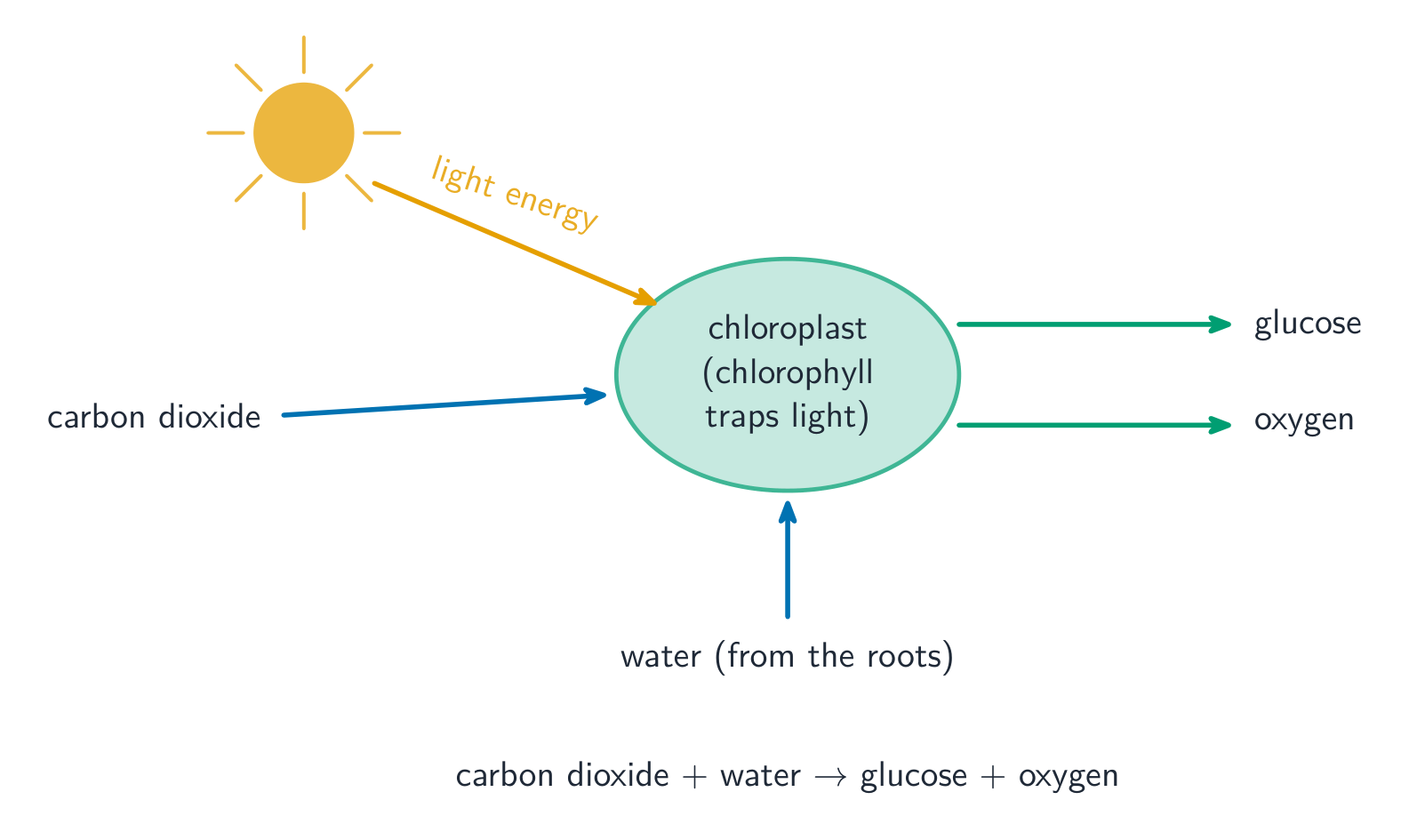
คลอโรพลาสต์ที่มีพลังงานแสงจากดวงอาทิตย์เข้ามา คาร์บอนไดออกไซด์และน้ำเข้าไป และกลูโคสและออกซิเจนออกมา พร้อมสมการคำอยู่ด้านล่าง
การสังเคราะห์ด้วยแสงรับคาร์บอนไดออกไซด์และน้ำ และผลิตกลูโคสและออกซิเจน โดยใช้แสง
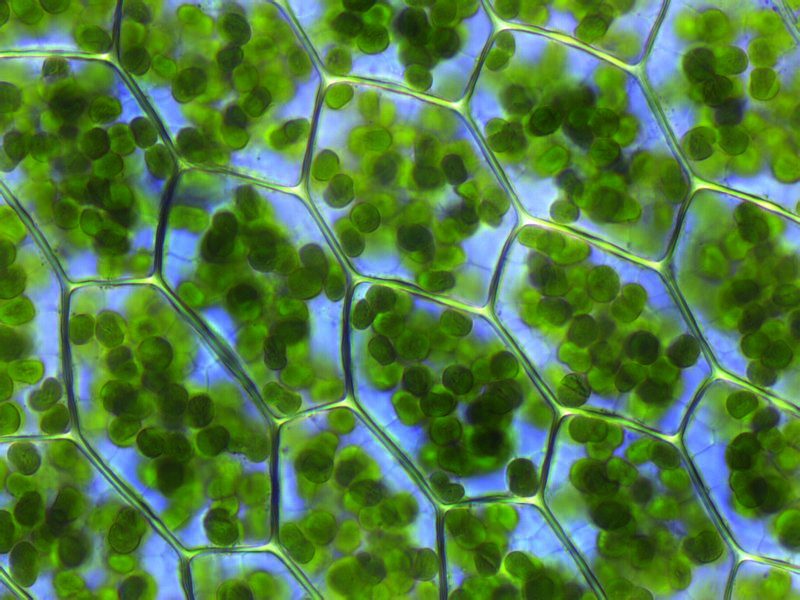
ภาพจุลทรรศน์แสงของเซลล์ใบตะไคร้: แต่ละเซลล์สี่เหลี่ยมผืนผ้าเต็มไปด้วยคลอโรพลาสต์รูปวงรีสีเขียวขนาดเล็ก
คลอโรพลาสต์เดียวกันภายใต้กล้องจุลทรรศน์ ซึ่งบรรจุอยู่ในเซลล์ใบตะไคร้ — สีเขียวคือคลอโรฟิลล์

คลอโรฟิลล์ทำหน้าที่อย่างไร

คลอโรฟิลล์เป็น สี สีเขียวที่พบใน คลอโรพลาสต์ มันดักจับแสงและส่งต่อพลังงานจากแสงไปเป็นพลังงานที่เก็บไว้ในสารเคมี พลังงานทางเคมีนี้จะถูกนำไปสร้างคาร์โบไฮเดรตต่อไป

พืชนำกลูโคสไปทำอะไร

การใช้ สิ่งที่เกิดขึ้น
เก็บสะสม เปลี่ยนเป็น แป้ง ซึ่งเป็นแหล่งเก็บพลังงานที่ไม่ละลายน้ำ
สร้างโครงสร้าง ทำเป็น เซลลูโลส เพื่อสร้าง ผนังเซลล์
ปล่อยพลังงาน สลายตัวใน การหายใจระดับเซลล์ เพื่อปล่อยพลังงาน
运输 เปลี่ยนเป็น ซูโครส และเคลื่อนที่ไปตามพืชผ่าน เนื้อเยื่อลำเลียงอาหาร
ดึงดูดสัตว์ ทำเป็น น้ำหวาน เพื่อดึงดูด แมลง เพื่อ การผสมเกสร
กลูโคสถูกนำไปใช้สร้างแป้ง เซลลูโลส การหายใจ และการขนส่ง
สิ่งที่พืชทำกับกลูโคสที่มันผลิตได้

แร่ธาตุจากดิน

พืชยังดูดซึม ไอออน ของแร่ธาตุจากดินผ่านรากด้วย:

  • ไอออนไนเตรต — จำเป็นสำหรับการสร้าง กรดอะมิโน (และดังนั้นจึงเป็นโปรตีน)
  • ไอออนแมกนีเซียม — จำเป็นสำหรับการสร้างคลอโรฟิลล์

พืชขาดไนเตรตจะเจริญเติบโตไม่ดี ลำต้นอ่อนแอ; พืชขาดแมกนีเซียมจะมีใบสีเหลือง (เพราะสร้างคลอโรฟิลล์ไม่เพียงพอ)

บัตรสองใบ: ไอออนไนเตรตจำเป็นสำหรับกรดอะมิโนดังนั้นพืชที่ขาดไนเตรตจะเจริญเติบโตไม่ดีและลำต้นอ่อนแอ; ไอออนแมกนีเซียมจำเป็นสำหรับคลอโรฟิลล์ดังนั้นพืชที่ขาดแมกนีเซียมจะมีใบสีเหลือง
พืชที่ขาดไนเตรตจะเจริญเติบโตไม่ดี; พืชที่ขาดแมกนีเซียมจะมีใบสีเหลือง

อัตราการสังเคราะห์ด้วยแสง

อัตรา ของการสังเคราะห์ด้วยแสงขึ้นอยู่กับสามปัจจัย:

  • ความเข้มของแสง — แสง越多 ให้อัตราที่เร็วขึ้น จนถึงจุดหนึ่ง
  • ความเข้มข้นของคาร์บอนไดออกไซด์ — คาร์บอนไดออกไซด์越多 ให้อัตราที่เร็วขึ้น
  • อุณหภูมิ — อุณหภูมิที่สูงขึ้นจะเร็วขึ้น จนกว่าจะร้อนมากจนเอนไซม์เสียสภาพ

(ส่วนเสริม) ในขณะใดขณะหนึ่ง ปัจจัยที่มีปริมาณน้อยที่สุดจะเป็นตัวจำกัดอัตรา การนี้เรียกว่า ปัจจัยจำกัด ตัวอย่างเช่น ในวันที่มีเมฆมาก ความเข้มของแสงมักจะเป็นปัจจัยจำกัด; ในวันที่แดดจัด คาร์บอนไดออกไซด์อาจจะเป็น

กราฟแสดงอัตราการสังเคราะห์ด้วยแสงเทียบกับความเข้มของแสง: อัตราเพิ่มขึ้นเมื่อมีแสงมากขึ้น แล้วคงที่เมื่อปัจจัยอื่นกลายเป็นตัวจำกัด
แสงมากขึ้นเร่งการสังเคราะห์ด้วยแสงจนกว่าปัจจัยอื่นจะมาจำกัด

ตัวอย่างแบบฝึกหัด. บนกราฟแสดงความสัมพันธ์ระหว่างอัตราและความเข้มของแสง เส้นจะชันขึ้นอย่างรวดเร็วในช่วงแรก แล้วจึงราบเรียบในภายหลัง ปัจจัยใดเป็นตัวจำกัดในแต่ละส่วน? ในส่วนที่ ชันขึ้น การเพิ่มแสงทำให้ tỷ lệสูงขึ้น ดังนั้น ความเข้มของแสง จึงเป็นตัวจำกัดในส่วนนั้น ในส่วนที่ ราบเรียบ การเพิ่มแสงไม่มีการเปลี่ยนแปลงใดๆ ดังนั้นแสงไม่ใช่ตัวจำกัดอีกต่อไป มีปัจจัยอื่นเข้ามาแทนที่ ซึ่งมักจะเป็นความเข้มข้นของคาร์บอนไดออกไซด์หรืออุณหภูมิ การทดสอบคือสิ่งเดิมเสมอ: หากการเพิ่มปัจจัยหนึ่งช่วยให้ปฏิกิริยาเร็วขึ้น แสดงว่าปัจจัยนั้นเคยเป็นตัวจำกัด originally

การศึกษาการสังเคราะห์ด้วยแสง

เพื่อพิสูจน์ว่าพืชต้องการแสง คลอโรฟิลล์ และคาร์บอนไดออกไซด์ คุณต้องทดสอบใบไม้เพื่อหาแป้งหลังจากกำจัด salah satuออกไป一个 ควบคุม จะรักษาสภาพอื่นๆ ให้เหมือนกันทั้งหมด เพื่อให้การทดสอบเป็นธรรม (เริ่มจากวางพืชในที่มืดก่อนเพื่อให้แป้งหมดไป) ใบที่มีสีเขียวและสีขาวจะพบแป้งเฉพาะในส่วนสีเขียวเท่านั้น ซึ่งเป็นส่วนที่มีคลอโรฟิลล์

คุณสามารถสังเกต การแลกเปลี่ยนก๊าซ ในพืชน้ำโดยใช้ สารชี้วัดไฮโดรเจนคาร์บอเนต ซึ่งเปลี่ยนสีตามระดับคาร์บอนไดออกไซด์ ในแสง พืชจะดูดซับคาร์บอนไดออกไซด์สำหรับการสังเคราะห์ด้วยแสง; ในความมืด พืชจะปล่อยคาร์บอนไดออกไซด์ออกมาจากการหายใจ

Explore · ⁨สำรวจ⁩

What limits photosynthesis · ⁨限制光合作用的因素⁩

Change light and CO₂. The slowest factor — the limiting factor — sets the rate. · ⁨เปลี่ยนแสงและ CO₂ ปัจจัยที่ช้าที่สุด — ปัจจัยจำกัด — กำหนดอัตรา⁩

Vocabulary · ⁨คำศัพท์⁩ Train · ⁨ฝึกฝน⁩
English ไทย
photosynthesis/ˌfəʊtəʊˈsɪnθəsɪs/ การสังเคราะห์ด้วยแสง
carbohydrates/ˌkɑːbəʊˈhaɪdreɪts/ คาร์โบไฮเดรต
raw materials/rɔː məˈtɪərɪəlz/ วัตถุดิบ
energy/ˈenədʒi/ พลังงาน
carbon dioxide/ˈkɑːbən daɪˈɒksaɪd/ คาร์บอนไดออกไซด์
glucose/ˈɡluːkəʊs/ กลูโคส
oxygen/ˈɒksɪdʒn/ ออกซิเจน
chlorophyll/ˌklɔːrəʊˈfɪl/ chlorophyll
pigment/ˈpɪɡmənt/ pigment
chloroplasts/ˈklɔːrəʊplæsts/ คลอโรพลาสต์
starch/stɑːtʃ/ แป้งข้าวโพด
cellulose/ˈseljuːləʊs/ เซลลูโลส
cell walls/sel wɔːlz/ ผนังเซลล์
respiration/ˌrespɪˈreɪʃn/ การหายใจ
sucrose/ˈsuːkrəʊs/ ซูโครส
limiting factor/ˈlɪmɪtɪŋ ˈfæktə/ ปัจจัยจำกัด (limiting factor)
control/kənˈtrəʊl/ การควบคุม
gas exchange/ɡæs eksˈtʃeɪndʒ/ การแลกเปลี่ยนก๊าซ
indicator/ˈɪndɪkeɪtə/ อินดิเคเตอร์
adapted/əˈdæptɪd/ ปรับตัว
surface area/ˈsɜːfɪs ˈeərɪə/ พื้นที่ผิว
Watch lesson · ⁨ดูบทเรียน⁩
6.2

Leaf structure · ⁨โครงสร้างใบไม้⁩

Syllabus · ⁨หลักสูตร⁩
English
Core Supplement
1 State that most leaves have a large surface area and are thin, and explain how these features are adaptations for photosynthesis
2 Identify in diagrams and images the following structures in the leaf of a dicotyledonous plant: chloroplasts, cuticle, guard cells and stomata, upper and lower epidermis, palisade mesophyll, spongy mesophyll, air spaces, vascular bundles, xylem and phloem
3 Explain how the structures listed in 6.2.2 adapt leaves for photosynthesis
ไทย
แก่น เพิ่มเติม
1 State that most leaves have a large surface area and are thin, and explain how these features are adaptations for photosynthesis
2 Identify in diagrams and images the following structures in the leaf of a dicotyledonous plant: chloroplasts, cuticle, guard cells and stomata, upper and lower epidermis, palisade mesophyll, spongy mesophyll, air spaces, vascular bundles, xylem and phloem
3 อธิบายว่าโครงสร้างที่กล่าวถึงใน 6.2.2 ปรับใบให้เหมาะสมกับการสังเคราะห์ด้วยแสงอย่างไร

Source: Cambridge International syllabus · ⁨แหล่งที่มา: หลักสูตร Cambridge International⁩

English

A leaf is well adapted 适应 for photosynthesis. Most leaves are broad, with a large surface area 表面积 to catch plenty of light, and thin, so that gases and light quickly reach all the cells.

The middle of the leaf, the mesophyll 叶肉, is where most photosynthesis happens. These are the main parts of a leaf:

Structure Job / how it helps photosynthesis
cuticle 角质层 a clear waxy layer on top; it reduces water loss but still lets light through
upper epidermis 表皮 a clear layer of cells with no chloroplasts; it lets light pass to the cells below
palisade mesophyll 栅栏叶肉 tall, column-shaped cells packed with chloroplasts, near the top; they do most of the photosynthesis
spongy mesophyll 海绵叶肉 rounded cells with air spaces 气腔 between them, so gases can move easily
stomata 气孔 tiny holes, mostly on the lower surface, that let carbon dioxide in and oxygen out
guard cells 保卫细胞 a pair of cells around each stoma; they open and close it
lower epidermis a thin layer that holds the stomata
vascular bundles 维管束 contain xylem 木质部 (brings water to the leaf) and phloem (carries sugars away)
ไทย

ใบไม้ถูก ปรับตัว อย่างดีสำหรับการสังเคราะห์ด้วยแสง ส่วนใหญ่ใบกว้าง มี พื้นที่ผิว มากเพื่อดูดแสงได้มาก และบาง ทำให้ก๊าซและแสงเข้าถึงเซลล์ทุกส่วนได้อย่างรวดเร็ว

กลางของใบ คือ เมโซฟิลล์ เป็นสถานที่发生的ส่วนใหญ่ของการสังเคราะห์ด้วยแสง นี่คือส่วนหลักๆ ของใบ:

โครงสร้าง หน้าที่ / วิธีช่วยในการสังเคราะห์ด้วยแสง
เคลือบขี้ผึ้ง (cuticle) ชั้นขี้ผึ้งใสด้านบน; ลดการสูญเสียแต่ยังให้แสงผ่านได้
表皮บน (upper epidermis) ชั้นเซลล์ใสที่ไม่มีคลอโรพลาสต์; อนุญาตให้แสงผ่านไปยังเซลล์ด้านล่าง
เมโซฟิลล์แบบก้านยาว (palisade mesophyll) เซลล์สูงรูปทรงแท่งที่อัดแน่นด้วยคลอโรพลาสต์ อยู่ใกล้ด้านบน; ทำการสังเคราะห์ด้วยแสงส่วนใหญ่
เมโซฟิลล์แบบฟองน้ำ (spongy mesophyll) เซลล์กลมมี ช่องอากาศ ระหว่างกัน ทำให้ก๊าซเคลื่อนที่ได้ง่าย
ปากใบ (stomata) รูเล็กๆ ส่วนใหญ่อยู่ใต้พื้นผิว ที่这让คาร์บอนไดออกไซด์เข้าและออกซิเจนออก
เซลล์พิทักษ์ (guard cells) เซลล์คู่รอบปากใบแต่ละรู; เปิดและปิดมัน
表皮ล่าง (lower epidermis) ชั้นบางที่ยึดปากใบไว้
** bundles หลอดเลือด (vascular bundles)** содержит xylem (นำน้ำไปหาใบ) และ phloem (พาน้ำตาลออกไป)
ภาพตัดขวางของใบไม้ที่มีฉลากแสดงเคลือบขี้ผึ้ง表皮บนメゾฟิลล์แบบก้านยาวและแบบฟองน้ำbundle หลอดเลือด表皮ล่างและปากใบพร้อมเซลล์พิทักษ์สองเซลล์
ใบไม้ในแนวขวาง: เนื้อเยื่อแต่ละชนิดถูกปรับให้เหมาะกับการสังเคราะห์ด้วยแสงและการแลกเปลี่ยนแก๊ส
มุมมองภายใต้กล้องจุลทรรศน์แสงของพื้นผิวด้านล่างของใบไม้ แสดงปากใบรูปเลนส์หลายรู แต่ละรูมีเซลล์พิทักษ์สองเซลล์อยู่ท่ามกลางเซลล์表皮รูปจิ๊กซอว์
ปากใบจริงบนพื้นผิวด้านล่างของใบ — รูแต่ละรูมีเซลล์พิทักษ์สองเซลล์ (สเกล bar 20 μm)
Explore · ⁨สำรวจ⁩

Inside a leaf · ⁨ภายในใบ⁩

Tap each layer of a leaf cross-section to see how its structure is built for photosynthesis and gas exchange. · ⁨แตะแต่ละชั้นของหน้าตัดใบเพื่อดูว่าโครงสร้างสร้างขึ้นเพื่อรองรับการสังเคราะห์แสงและการแลกเปลี่ยนแก๊سอย่างไร⁩

Vocabulary · ⁨คำศัพท์⁩ Train · ⁨ฝึกฝน⁩
English ไทย
phloem/ˈfləʊɪm/ ท่อท่อบำรุง
nectar/ˈnektə/ น้ำหวาน
insects/ˈɪnsekts/ แมลง
pollination/ˌpɒlɪˈneɪʃn/ การผสมเกสร
ions/ˈaɪɒnz/ ไอออน
nitrate ions/ˈnaɪtreɪt ˈaɪɒnz/ ไอออนไนเตรต
amino acids/əˈmiːnəʊ ˈæsɪdz/ กรดอะมิโน
magnesium ions/mæɡˈniːzɪəm ˈaɪɒnz/ ไอออนแมกนีเซียม
rate/reɪt/ อัตราส่วน
light intensity/laɪt ɪnˈtensɪti/ ความเข้มของแสง
concentration/ˌkɒnsənˈtreɪʃn/ ความเข้มข้น
temperature/ˈtemprɪtʃə/ อุณหภูมิ
cuticle/ˈkjuːtɪkl/ cuticle
epidermis/ˌepɪˈdɜːmɪs/ ชั้นผิวหนัง
mesophyll/ˈmesəfɪl/ เนื้อเยื่อเมโซฟิลล์
palisade mesophyll/ˈpælɪseɪd ˈmesəfɪl/ เนื้อเยื่อพาไลเซด
spongy mesophyll/ˈspʌndʒi ˈmesəfɪl/ เนื้อเยื่อสPONGY
air spaces/eə ˈspeɪsɪz/ ช่องว่างอากาศ
stomata/ˈstəʊmətə/ ปอดใบ
guard cells/ɡɑːd selz/ เซลล์ปากใบ
vascular bundles/ˈvæskjʊlə ˈbʌndlz/ ลำเลียง
xylem/ˈzaɪləm/ เนื้อเยื่อท่อน้ำ
6.2

Exam tips · ⁨ข้อแนะนำสำหรับการสอบ⁩

English
  • Learn the word equation exactly: carbon dioxide + water → glucose + oxygen (in light, with chlorophyll).
  • Chlorophyll is in the chloroplasts; it does not get used up — it transfers light energy.
  • Link each factor to the rate: more light, more carbon dioxide, warmer (but not too hot) → faster, until a limiting factor stops further increase.
  • For leaf structure, always link the part to its job: broad and thin to catch light; palisade cells full of chloroplasts; stomata and air spaces for gas exchange.
  • Nitrate ions → amino acids; magnesium ions → chlorophyll.
ไทย
  • จำสมการคำศัพท์ให้ถูกต้อง: คาร์บอนไดออกไซด์ + น้ำ → กลูโคส + ออกซิเจน (ในแสง, พร้อมคลอโรฟิลล์).
  • คลอโรฟิลล์อยู่ในคลอโรพลาสต์; ไม่ถูกใช้ไป — มันถ่ายโอนพลังงานแสง.
  • เชื่อมโยงปัจจัยแต่ละอย่างกับอัตรา: แสงมากขึ้น คาร์บอนไดออกไซด์มากขึ้น อุ่นขึ้น (แต่ไม่ร้อนเกินไป) → เร็วขึ้น จนกว่า ปัจจัยจำกัด จะหยุดการเพิ่มขึ้นเพิ่มเติม
  • สำหรับโครงสร้างใบ ให้เชื่อมโยงส่วนเข้ากับหน้าที่เสมอ: กว้างและบางเพื่อดูดแสง; เซลล์เมโซฟิลล์แบบก้านยาวเต็มไปด้วยคลอโรพลาสต์; ปากใบและช่องอากาศสำหรับการแลกเปลี่ยนก๊าซ.
  • ไอออนไนเตรต → กรดอะมิโน; ไอออนแมกนีเซียม → คลอโรฟิลล์.

Interactive lessons on this topic · ⁨บทเรียนเชิงโต้ตอบสำหรับหัวข้อนี้⁩

Work through it step by step, with instant-check exercises. · ⁨ทำทีละขั้นตอน พร้อมแบบฝึกหัดตรวจสอบผลทันที⁩

Past Papers · ⁨ข้อสอบย้อนหลัง⁩

More topics in IGCSE Biology · ⁨Biology IGCSE⁩ · ⁨หัวข้อเพิ่มเติมใน IGCSE Biology · ⁨Biology IGCSE⁩⁩

Log in or create account · ⁨เข้าสู่ระบบหรือสร้างบัญชี⁩

IGCSE, A-Level & AP