Photosynthesis
Introduced| English | Meaning |
|---|---|
| photosynthesis/ˌfəʊtəʊˈsɪnθəsɪs/ | The process by which plants and other organisms use light energy to make organic substances from carbon dioxide and water. |
| glucose/ˈɡluːkəʊs/ | A simple sugar with molecular formula C6H12O6, used by cells as a source of energy. |
| chlorophyll/ˌklɔːrəʊˈfɪl/ | A green pigment that absorbs light energy for photosynthesis. |
| starch/stɑːtʃ/ | A storage polysaccharide in plants, made from glucose units. |
| limiting factor/ˈlɪmɪtɪŋ ˈfæktə/ | A factor whose availability restricts the rate or extent of a process. |
How plants feed themselves
- Plants don't eat — they make their own food from sunlight, water and air.
- This remarkable process, photosynthesis 光合作用, feeds almost every living thing on Earth.
The products of photosynthesis are:
Difficulty 1/5 · 100 coins + a small bonus on first completion today
CO₂ + water → glucose + oxygen.
The photosynthesis equation
- Plants turn carbon dioxide and water into glucose 葡萄糖 and oxygen, using light energy trapped by chlorophyll 叶绿素.
- In words: carbon dioxide + water → glucose + oxygen (with light and chlorophyll).

Green leaves capture sunlight for photosynthesis
Photosynthesis
rate rises, then plateaus
More light means faster photosynthesis — until CO₂ or temperature becomes limiting.
The green pigment that absorbs light for photosynthesis is:
Difficulty 1/5 · 100 coins + a small bonus on first completion today
Chlorophyll in chloroplasts traps light energy.
Which does a plant need for photosynthesis? (Select all that apply.)
Difficulty 2/5 · 140 coins + a small bonus on first completion today
Light, CO₂ and water (plus chlorophyll) are needed; protein is not a raw material.
Glucose made in photosynthesis is often stored as ______.
Difficulty 1/5 · 100 coins + a small bonus on first completion today
Starch is the plant's storage carbohydrate.
What plants need
- Light (energy), carbon dioxide (from the air), water (from the soil), and chlorophyll (to absorb light).
- The glucose made is used for energy, or stored as starch 淀粉.
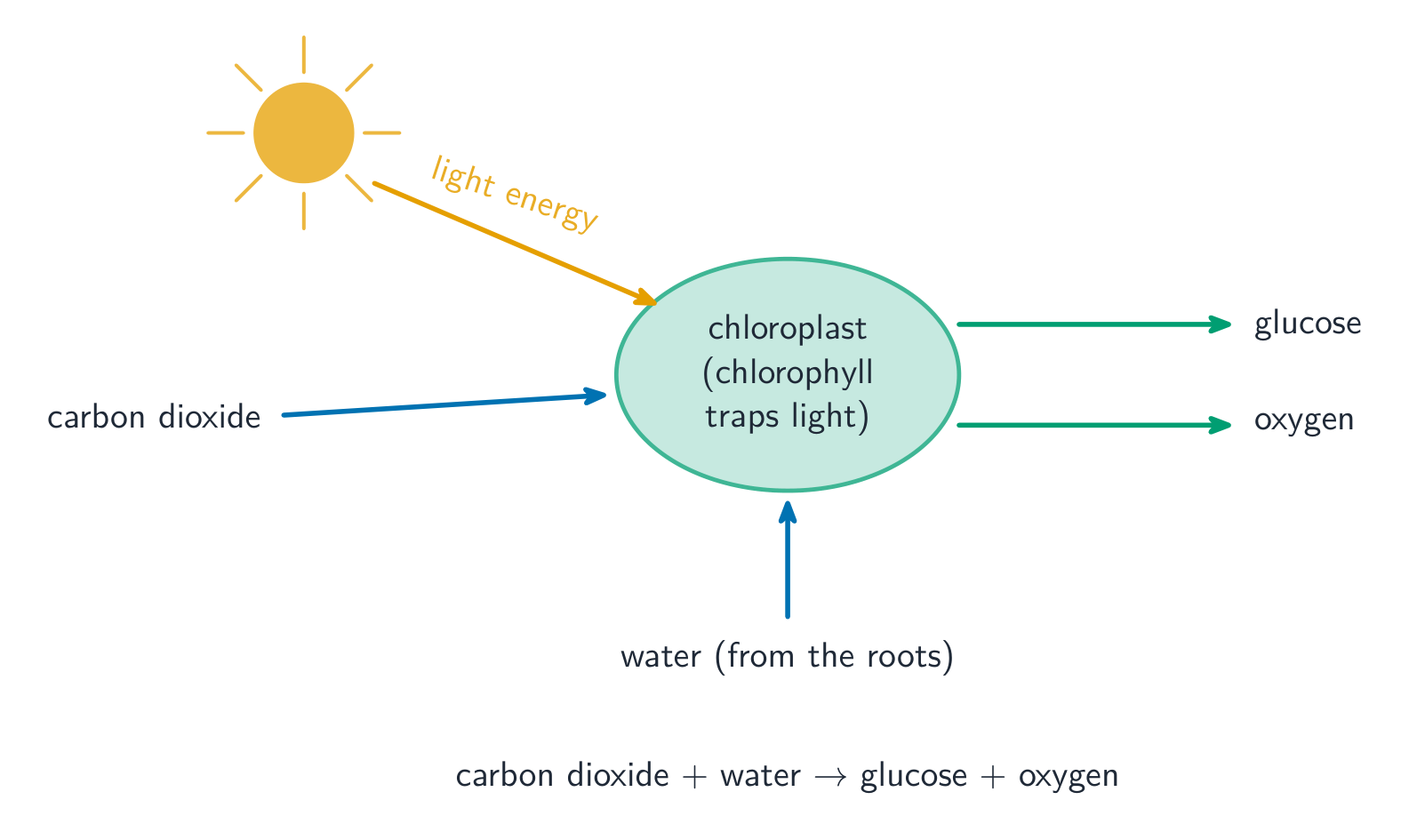
Photosynthesis takes in carbon dioxide and water and makes glucose and oxygen, using light
A limiting factor is one that:
Difficulty 1/5 · 100 coins + a small bonus on first completion today
The scarcest factor limits the rate.
Limiting factors 限制因素
- The rate of photosynthesis is limited by whatever is in shortest supply: light, carbon dioxide or temperature.
- Increase a limiting factor and the rate rises — until another factor becomes limiting.
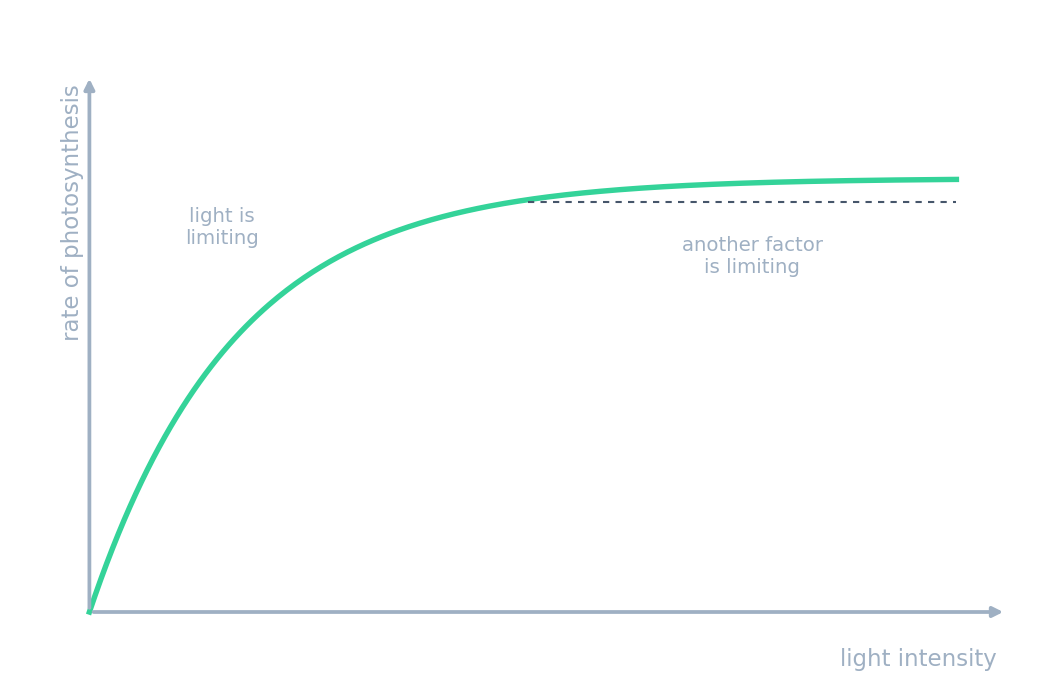
Rate rises with light, then plateaus when another factor (CO₂ or temperature) limits it.
Only the factor in shortest supply limits the rate. Adding more light won't help if carbon dioxide is the limiting factor. Find what's scarce and increase that.

More light speeds up photosynthesis until another factor becomes limiting
You've got it
- carbon dioxide + water → glucose + oxygen (using light and chlorophyll)
- plants need light, CO₂, water and chlorophyll; glucose is stored as starch
- the rate is set by the limiting factor — whatever is in shortest supply