Skip to content · ⁨ข้ามไปยังเนื้อหา⁩

Probability, Random Variables, and Probability Distributions · ⁨ความน่าจะเป็น ตัวแปรสุ่ม และการแจกแจงความน่าจะเป็น⁩

AP Statistics · Topic 4 · ⁨หัวข้อ 4⁩

Video lesson for this topic · ⁨บทเรียนวิดีโอสำหรับหัวข้อนี้⁩ Open the video page · ⁨เปิดหน้าวิดีโอ⁩
8:39

ความน่าจะเป็น ตัวแปรสุ่ม และการแจกแจงความน่าจะเป็น

นักบาสเกตบอลยิงเข้า gawangได้ห้าครั้งติดกัน คนดูมั่นใจว่าคืนนี้เธอมีฟอร์มดี แต่ลองดูว่าโอกาสเพียงอย่างเดียวสามารถทำอะไรได้ ลองโยนเหรียญทองคำบริสุทธิ์สองสิบครั้ง มี…

English narration · English + 中文 subtitles burned in · ⁨การบรรยายภาษาอังกฤษ · คำบรรยายภาษาอังกฤษ + 中文 ลอยตัวบนภาพ⁩

4.1

Random and Non-Random Patterns · ⁨รูปแบบแบบสุ่มและไม่สุ่ม⁩

Syllabus · ⁨หลักสูตร⁩
English
Enduring UnderstandingLearning ObjectiveEssential Knowledge

VAR-1
Given that variation may be random or not, conclusions are uncertain.

VAR-1.F
Identify questions suggested by patterns in data. [Skill 1.A]

  • VAR-1.F.1 Patterns in data do not necessarily mean that variation is not random.
ไทย

ความเข้าใจที่ยั่งยืน (VAR-1): เนื่องจากความแปรปรวนอาจเป็นแบบสุ่มหรือไม่ ดังนั้นข้อสรุปจึงมีความไม่แน่นอน

Learning ObjectiveEssential Knowledge

VAR-1.F
ระบุคำถามที่ลวดลายในข้อมูลชี้แนะ [Skill 1.A]

  • VAR-1.F.1 ลวดลายในข้อมูลไม่จำเป็นต้องหมายความว่า variation ไม่เป็นแบบสุ่ม

Source: College Board AP Course and Exam Description · ⁨แหล่งที่มา: คำอธิบายหลักสูตรและข้อสอบ College Board AP⁩

English

Something is random 随机 if individual outcomes are uncertain but a regular pattern emerges over many repetitions. Short-run results look erratic; long-run relative frequencies settle down. This long-run stability is what makes probability useful.

ไทย

某物เป็น แบบสุ่ม หากผลลัพธ์แต่ละครั้งไม่แน่นอนแต่มีรูปแบบที่สม่ำเสมอเกิดขึ้นใน หลาย ครั้ง ผลลัพธ์ระยะสั้นดูผันผวน; ความถี่สัมพัทธ์ ระยะยาวจะคงที่ ความเสถียรในระยะยาวนี้คือสิ่งที่ทำให้ความน่าจะเป็นมีประโยชน์

4.2

Estimating Probabilities Using Simulation · ⁨การประมาณความน่าจะเป็นโดยใช้การจำลอง⁩

Syllabus · ⁨หลักสูตร⁩
English
Enduring UnderstandingLearning ObjectiveEssential Knowledge

UNC-2
Simulation allows us to anticipate patterns in data.

UNC-2.A
Estimate probabilities using simulation. [Skill 3.A]

  • UNC-2.A.1 A random process generates results that are determined by chance.
  • UNC-2.A.2 An outcome is the result of a trial of a random process.
  • UNC-2.A.3 An event is a collection of outcomes.
  • UNC-2.A.4 Simulation is a way to model random events, such that simulated outcomes closely match real-world outcomes. All possible outcomes are associated with a value to be determined by chance. Record the counts of simulated outcomes and the count total.
  • UNC-2.A.5 The relative frequency of an outcome or event in simulated or empirical data can be used to estimate the probability of that outcome or event.
  • UNC-2.A.6 The law of large numbers states that simulated (empirical) probabilities tend to get closer to the true probability as the number of trials increases.
    • Illustrative examples for UNC-2.A:
      • An outcome: Rolling a particular value on a six-sided number cube is one of six possible outcomes.
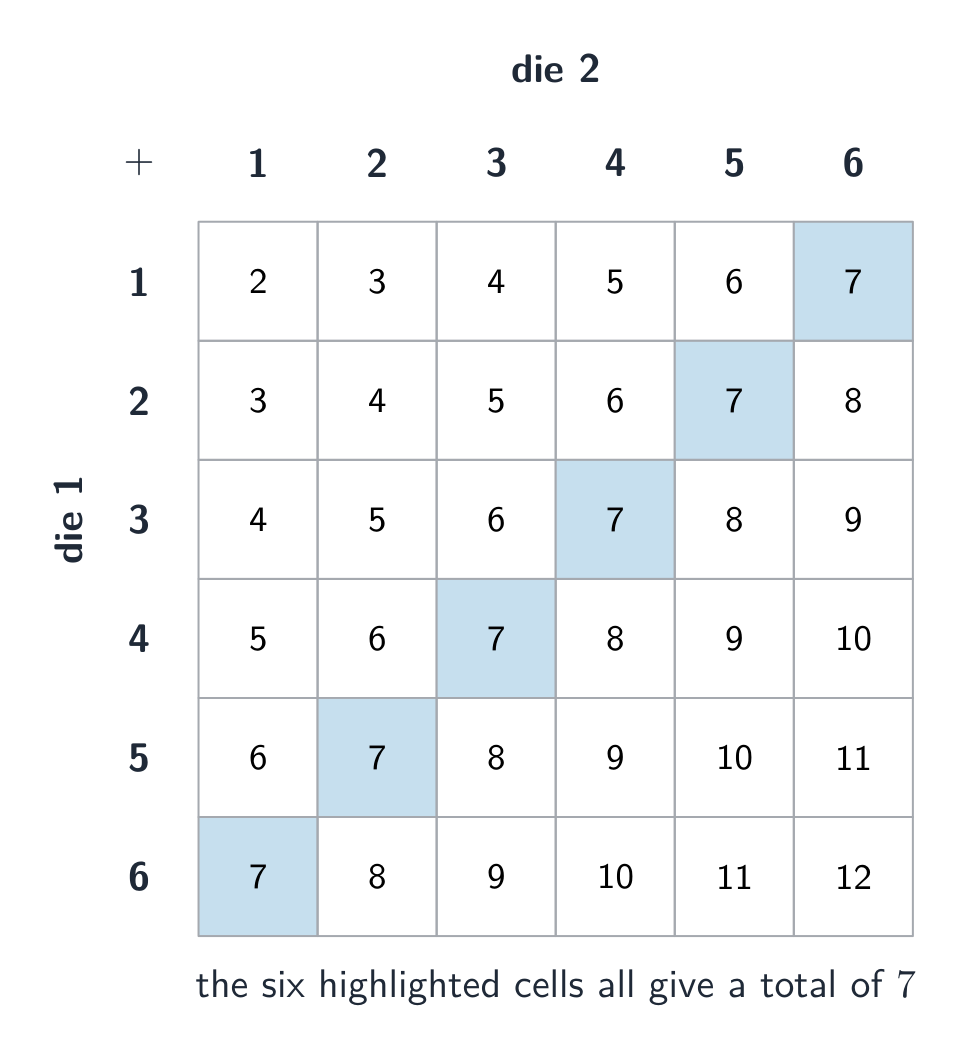
      • An event: When rolling two six-sided number cubes, an event would be a sum of seven. The corresponding collection of outcomes would be $(1, 6)$, $(2, 5)$, $(3, 4)$, $(4, 3)$, $(5, 2)$, and $(6, 1)$, where the ordered pairs indicate (face value on one cube, face value on the other cube).
ไทย
Enduring UnderstandingLearning ObjectiveEssential Knowledge

UNC-2
การจำลองช่วยให้เราคาดการณ์ลวดลายในข้อมูล

UNC-2.A
ประมาณค่าความน่าจะเป็นโดยใช้การจำลอง [Skill 3.A]

  • UNC-2.A.1 กระบวนการสุ่ม (random process) สร้างผลลัพธ์ที่กำหนดโดยบังเอิญ
  • UNC-2.A.2 ผลลัพธ์ (outcome) คือผลของการทดลอง (trial) ของกระบวนการสุ่ม
  • UNC-2.A.3 เหตุการณ์ (event) คือชุดรวมของผลลัพธ์
  • UNC-2.A.4 การจำลองเป็นวิธีจำลองเหตุการณ์สุ่ม使得 simulated outcomes ตรงกับ real-world outcomes อย่างใกล้ชิด Possible outcomes ทั้งหมดเชื่อมโยงกับค่าที่จะถูกกำหนดโดยบังเอิญ บันทึกจำนวนของ simulated outcomes และจำนวนรวมทั้งหมด
  • UNC-2.A.5 ความถี่สัมพัทธ์ของผลลัพธ์หรือเหตุการณ์ในข้อมูลจำลองหรือเชิงประจักษ์ สามารถใช้เพื่อประมาณความน่าจะเป็นของผลลัพธ์หรือเหตุการณ์นั้นได้
  • UNC-2.A.6 กฎของจำนวนใหญ่ระบุว่า ความน่าจะเป็นที่จำลองขึ้น (หรือเชิงประจักษ์) มีแนวโน้มจะเข้าใกล้ความน่าจะเป็นจริงเมื่อจำนวนการทดลองเพิ่มขึ้น
    • ตัวอย่างประกอบสำหรับ UNC-2.A:
      • ผลลัพธ์: การทอยลูกเต๋าหกหน้าแล้วได้อะไรสักค่าหนึ่ง เป็นหนึ่งในหกผลลัพธ์ที่เป็นไปได้
      • เหตุการณ์: เมื่อทอยลูกเต๋าหกหน้าสองลูก เหตุการณ์หนึ่งอาจเป็นผลรวมได้เจ็ด ชุดผลลัพธ์ที่เกี่ยวข้องจะคือ $(1, 6)$, $(2, 5)$, $(3, 4)$, $(4, 3)$, $(5, 2)$ และ $(6, 1)$ โดยคู่เลขเรียงลำดับบ่งชี้ว่า (ค่าบนหน้าลูกเต๋าลูกแรก, ค่าบนหน้าลูกเต๋าลูกที่สอง)

Source: College Board AP Course and Exam Description · ⁨แหล่งที่มา: คำอธิบายหลักสูตรและข้อสอบ College Board AP⁩

English

A simulation 模拟 imitates a chance process using random digits or technology. Steps: state the model, assign digits to outcomes, run many trials, and record the proportion of trials meeting the condition. The resulting proportion estimates the probability – more trials give a better estimate.

ไทย

การจำลอง จำลองกระบวนการChance โดยใช้ตัวเลขสุ่มหรือเทคโนโลยี ขั้นตอน: ระบุโมเดล, กำหนดตัวเลขสำหรับผลลัพธ์, ทำหลายรอบ, และบันทึกสัดส่วนของรอบที่ตรงตามเงื่อนไข สัดส่วนที่ได้ ประมาณ ความน่าจะเป็น – จำนวนรอบ越多越准确地

4.3

Introduction to Probability · ⁨บทนำเกี่ยวกับความน่าจะเป็น⁩

Syllabus · ⁨หลักสูตร⁩
English

Enduring Understanding (VAR-4): The likelihood of a random event can be quantified.

Learning Objective VAR-4.A: Calculate probabilities for events and their complements. [Skill 3.A]

  • VAR-4.A.1 The sample space of a random process is the set of all possible non-overlapping outcomes.
  • VAR-4.A.2 If all outcomes in the sample space are equally likely, then the probability an event E will occur is defined as the fraction: $\dfrac{\text{number of outcomes in event E}}{\text{total number of outcomes in sample space}}$
  • VAR-4.A.3 The probability of an event is a number between 0 and 1, inclusive.
  • VAR-4.A.4 The probability of the complement of an event E, $E'$ or $E^{C}$, (i.e., not E) is equal to $1 - P(E)$.

Learning Objective VAR-4.B: Interpret probabilities for events. [Skill 4.B]

  • VAR-4.B.1 Probabilities of events in repeatable situations can be interpreted as the relative frequency with which the event will occur in the long run.
ไทย

ความเข้าใจที่ยั่งยืน (VAR-4): ความน่าจะเป็นของเหตุการณ์สุ่มสามารถวัดค่าได้

วัตถุประสงค์การเรียนรู้ VAR-4.A: คำนวณความน่าจะเป็นของเหตุการณ์และส่วนเสริมของมัน [ทักษะ 3.A]

  • VAR-4.A.1 พื้นที่ตัวอย่างของกระบวนการสุ่มคือชุดของผลลัพธ์ที่เป็นไปได้ทั้งหมดที่ไม่ทับซ้อนกัน
  • VAR-4.A.2 หากทุกผลลัพธ์ในพื้นที่ตัวอย่างมีความน่าจะเป็นเท่ากัน แล้วความน่าจะเป็นที่เหตุการณ์ E จะเกิดขึ้นจะนิยามด้วยอัตราส่วน: $\dfrac{\text{number of outcomes in event E}}{\text{total number of outcomes in sample space}}$
  • VAR-4.A.3 ความน่าจะเป็นของเหตุการณ์มีค่าอยู่ระหว่าง 0 ถึง 1 รวมทั้งขอบเขตทั้งสอง
  • VAR-4.A.4 ความน่าจะเป็นของส่วนเสริมของเหตุการณ์ E, $E'$ หรือ $E^{C}$ (นั่นคือ ไม่เกิด E) เท่ากับ $1 - P(E)$

วัตถุประสงค์การเรียนรู้ VAR-4.B: ตีความความน่าจะเป็นของเหตุการณ์ [ทักษะ 4.B]

  • VAR-4.B.1 ความน่าจะเป็นของเหตุการณ์ในสถานการณ์ที่ทำได้ซ้ำๆ สามารถตีความได้ว่าคือความถี่สัมพัทธ์ที่เหตุการณ์นั้นจะเกิดขึ้นในระยะยาว

Source: College Board AP Course and Exam Description · ⁨แหล่งที่มา: คำอธิบายหลักสูตรและข้อสอบ College Board AP⁩

English

The probability 概率 of an event is a number from $0$ to $1$ giving its long-run relative frequency. The sample space 样本空间 is the set of all outcomes. For an event $A$, the complement 补 rule: $P(A^c)=1-P(A)$. Probabilities of all outcomes sum to $1$.

ไทย

ความน่าจะเป็น ของเหตุการณ์คือจำนวนตั้งแต่ $0$ ถึง $1$ ที่ให้ความถี่สัมพัทธ์ในระยะยาว的事件 $A$, กฎส่วนเสริม: $P(A^c)=1-P(A)$. ความน่าจะเป็นของผลลัพธ์ทั้งหมดรวมกันได้ $1$.

ความน่าจะเป็นวิ่งจาก 0 (เป็นไปได้ยาก) ถึง 1 (แน่นอน)
เอซทั้งสี่จากชุดไพ่
ชุดไพ่เป็นแหล่งที่มาคลาสสิกของความน่าจะเป็น: 52 ผลลัพธ์ที่เท่ากันทำให้โอกาสนับได้ง่าย
Explore · ⁨สำรวจ⁩

Explore probability with dice · ⁨สำรวจความน่าจะเป็นด้วยลูกเต๋า⁩

Probability is the long-run fraction of times an outcome happens. Roll the dice many times and watch the experimental proportions settle toward the theoretical values. · ⁨ความน่าจะเป็น คือสัดส่วนในระยะยาวของการเกิดผลลัพธ์ tertentu ทิ้งลูกเต๋ามากหลายครั้งและดูสัดส่วนจากการทดลองที่จะนิ่งเข้าหาค่าทฤษฎี⁩

Vocabulary · ⁨คำศัพท์⁩ Train · ⁨ฝึกฝน⁩
English ไทย
random/ˈrændəm/ สุ่ม (random)
simulation/ˌsɪmjʊˈleɪʃn/ การจำลอง
probability/ˌprɒbəˈbɪlɪti/ ความน่าจะเป็น
4.4

Mutually Exclusive Events · ⁨เหตุการณ์ที่ขัดแย้งกัน⁩

Syllabus · ⁨หลักสูตร⁩
English

Enduring Understanding (VAR-4): The likelihood of a random event can be quantified.

Learning Objective VAR-4.C: Explain why two events are (or are not) mutually exclusive. [Skill 4.B]

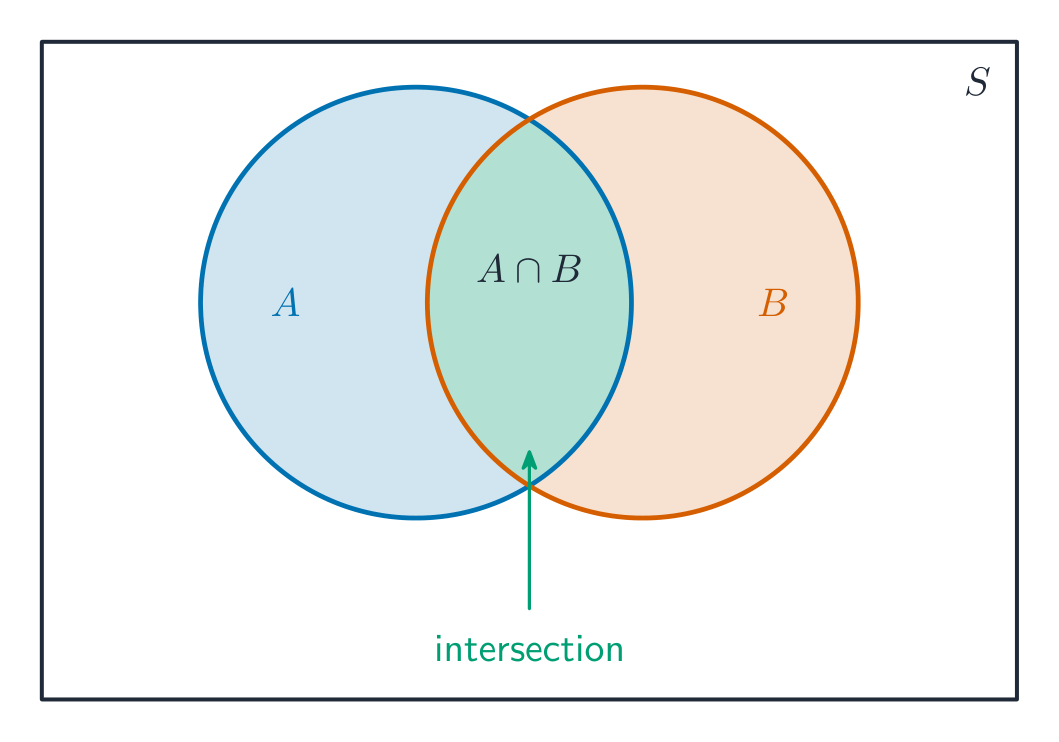
  • VAR-4.C.1 The probability that events $A$ and $B$ both will occur, sometimes called the joint probability, is the probability of the intersection of $A$ and $B$, denoted $P(A \cap B)$.
  • VAR-4.C.2 Two events are mutually exclusive or disjoint if they cannot occur at the same time. So $P(A \cap B) = 0$.
ไทย

ความเข้าใจที่ยั่งยืน (VAR-4): ความน่าจะเป็นของเหตุการณ์สุ่มสามารถวัดค่าได้

วัตถุประสงค์การเรียนรู้ VAR-4.C: อธิบายเหตุผลว่าทำไมเหตุการณ์สองเหตุการณ์จึงเป็น (หรือไม่เป็น) แยกจากกัน [ทักษะ 4.B]

  • VAR-4.C.1 ความน่าจะเป็นที่เหตุการณ์ $A$ และ $B$ จะเกิดขึ้นพร้อมกัน บางครั้งเรียกว่าความน่าจะเป็นร่วม คือความน่าจะเป็นของส่วนตัดของ $A$ และ $B$ ซึ่งเขียนแทนด้วย $P(A \cap B)$
  • VAR-4.C.2 เหตุการณ์สองเหตุการณ์จะแยกจากกันหรือไม่ทับซ้อนกันหากไม่สามารถเกิดขึ้นพร้อมกันได้ ดังนั้น $P(A \cap B) = 0$

Source: College Board AP Course and Exam Description · ⁨แหล่งที่มา: คำอธิบายหลักสูตรและข้อสอบ College Board AP⁩

English

Two events are mutually exclusive 互斥 (disjoint) if they cannot both happen. Then the addition rule simplifies:

$$P(A\text{ or }B)=P(A)+P(B)\quad(\text{if mutually exclusive}).$$
In general, $P(A\text{ or }B)=P(A)+P(B)-P(A\text{ and }B)$ – subtract the overlap so it is not counted twice.

ไทย

สองเหตุการณ์เป็น ขัดแย้งกัน (ไม่ซ้อนทับ) หากไม่สามารถเกิดขึ้นพร้อมกันได้ แล้วกฎการบวกจะลดรูปได้:

$$P(A\text{ or }B)=P(A)+P(B)\quad(\text{if mutually exclusive}).$$
ในกรณีทั่วไป, $P(A\text{ or }B)=P(A)+P(B)-P(A\text{ and }B)$ – ลบส่วนทับซ้อนออกเพื่อให้ไม่ถูกนับสองครั้ง

แผนภูมิเวนน์: พื้นที่ซ้อนทับคือการตัดกันของเหตุการณ์สองอย่าง
Vocabulary · ⁨คำศัพท์⁩ Train · ⁨ฝึกฝน⁩
English ไทย
mutually exclusive/ˈmjuːtʃuːəli eksˈkluːsɪv/ ไม่อาจเกิดขึ้นพร้อมกัน
4.5

Conditional Probability · ⁨ความน่าจะเป็นแบบมีเงื่อนไข⁩

Syllabus · ⁨หลักสูตร⁩
English

Enduring Understanding (VAR-4): The likelihood of a random event can be quantified.

Learning Objective VAR-4.D: Calculate conditional probabilities. [Skill 3.A]

  • VAR-4.D.1 The probability that event $A$ will occur given that event $B$ has occurred is called a conditional probability and denoted $P(A \mid B) = \dfrac{P(A \cap B)}{P(B)}$.
  • VAR-4.D.2 The multiplication rule states that the probability that events $A$ and $B$ both will occur is equal to the probability that event $A$ will occur multiplied by the probability that event $B$ will occur, given that $A$ has occurred. This is denoted $P(A \cap B) = P(A) \cdot P(B \mid A)$.
ไทย

ความเข้าใจที่ยั่งยืน (VAR-4): ความน่าจะเป็นของเหตุการณ์สุ่มสามารถวัดค่าได้

วัตถุประสงค์การเรียนรู้ VAR-4.D: คำนวณความน่าจะเป็นแบบเงื่อนไข [ทักษะ 3.A]

  • VAR-4.D.1 ความน่าจะเป็นที่เหตุการณ์ $A$ จะเกิดขึ้น โดยกำหนดให้เหตุการณ์ $B$ เกิดขึ้นแล้ว เรียกว่าความน่าจะเป็นแบบเงื่อนไขและเขียนแทนด้วย $P(A \mid B) = \dfrac{P(A \cap B)}{P(B)}$
  • VAR-4.D.2 กฎการคูณระบุว่า ความน่าจะเป็นที่เหตุการณ์ $A$ และ $B$ จะเกิดขึ้นพร้อมกัน เท่ากับความน่าจะเป็นที่เหตุการณ์ $A$ จะเกิดขึ้น คูณด้วยความน่าจะเป็นที่เหตุการณ์ $B$ จะเกิดขึ้น โดยกำหนดให้ $A$ เกิดขึ้นแล้ว เขียนแทนด้วย $P(A \cap B) = P(A) \cdot P(B \mid A)$

Source: College Board AP Course and Exam Description · ⁨แหล่งที่มา: คำอธิบายหลักสูตรและข้อสอบ College Board AP⁩

English
Conditional probability

The conditional probability 条件概率 of $A$ given $B$ is

$$P(A\mid B)=\frac{P(A\text{ and }B)}{P(B)}.$$
It is the chance of $A$ once you know $B$ happened. Two-way tables make these easy: restrict to the row/column for $B$, then find $A$'s share.

ไทย
ความน่าจะเป็นแบบมีเงื่อนไข

ความน่าจะเป็นแบบมีเงื่อนไข ของ $A$ เมื่อทราบ $B$ คือ

$$P(A\mid B)=\frac{P(A\text{ and }B)}{P(B)}.$$
นั่นคือโอกาสที่จะเกิด $A$ เมื่อคุณรู้ว่า $B$ เกิดขึ้นแล้ว ตารางสองทางทำให้สิ่งนี้ง่ายขึ้น: จำกัดอยู่ที่แถว/คอลัมน์ของ $B$ แล้วหาสัดส่วนของ $A$

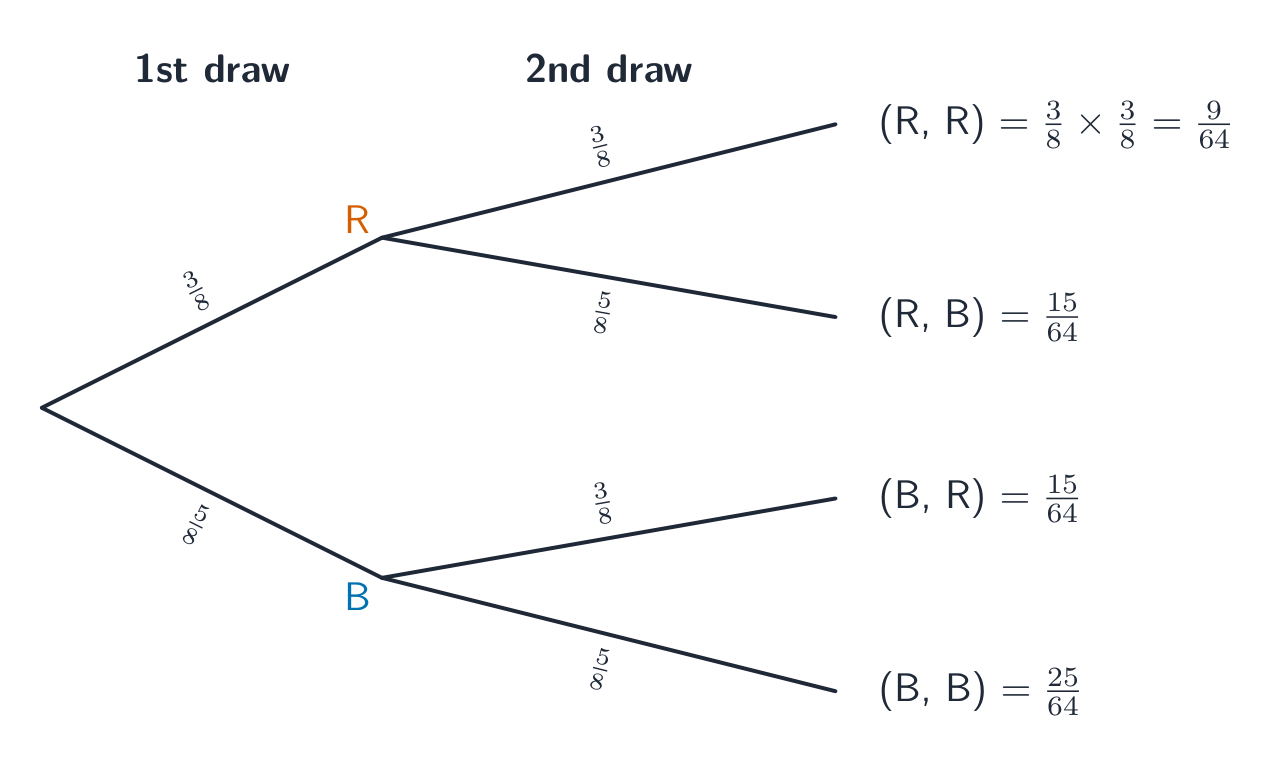
บนแผนภูมิต้นไม้, คัดลอก probabilities ตาม branches
บนแผนภาพต้นไม้ ให้คูณความน่าจะเป็นตามกิ่งก้าน
Explore · ⁨สำรวจ⁩

Update a probability on new information · ⁨อัปเดตความน่าจะเป็นด้วยข้อมูลใหม่⁩

Conditional probability $P(B\mid A)$ is the chance of $B$ once you know $A$ happened. Change the branch probabilities and watch how conditioning reshapes the outcome. · ⁨ความน่าจะเป็นแบบเงื่อนไข $P(B\mid A)$ คือโอกาสของ $B$ เมื่อคุณรู้ว่า $A$ เกิดขึ้นแล้ว เปลี่ยนความน่าจะเป็นกิ่งและดูว่าการมีเงื่อนไข reshapes ผลลัพธ์อย่างไร⁩

Vocabulary · ⁨คำศัพท์⁩ Train · ⁨ฝึกฝน⁩
English ไทย
conditional probability/kənˈdɪʃənl ˌprɒbəˈbɪlɪti/ ความน่าจะเป็นแบบมีเงื่อนไข
4.6

Independent Events and Unions of Events · ⁨เหตุการณ์ที่เป็นอิสระและการรวมเหตุการณ์⁩

Syllabus · ⁨หลักสูตร⁩
English

Enduring Understanding (VAR-4): The likelihood of a random event can be quantified.

Learning Objective VAR-4.E: Calculate probabilities for independent events and for the union of two events. [Skill 3.A]

  • VAR-4.E.1 Events $A$ and $B$ are independent if, and only if, knowing whether event $A$ has occurred (or will occur) does not change the probability that event $B$ will occur.
  • VAR-4.E.2 If, and only if, events $A$ and $B$ are independent, then $P(A \mid B) = P(A)$, $P(B \mid A) = P(B)$, and $P(A \cap B) = P(A) \cdot P(B)$.
  • VAR-4.E.3 The probability that event $A$ or event $B$ (or both) will occur is the probability of the union of $A$ and $B$, denoted $P(A \cup B)$.
  • VAR-4.E.4 The addition rule states that the probability that event $A$ or event $B$ or both will occur is equal to the probability that event $A$ will occur plus the probability that event $B$ will occur minus the probability that both events $A$ and $B$ will occur. This is denoted $P(A \cup B) = P(A) + P(B) - P(A \cap B)$.
ไทย

ความเข้าใจที่ยั่งยืน (VAR-4): ความน่าจะเป็นของเหตุการณ์สุ่มสามารถวัดค่าได้

วัตถุประสงค์การเรียนรู้ VAR-4.E: คำนวณความน่าจะเป็นของเหตุการณ์อิสระและความน่าจะเป็นของการรวมของเหตุการณ์สองเหตุการณ์ [ทักษะ 3.A]

  • VAR-4.E.1 เหตุการณ์ $A$ และ $B$ เป็นอิสระกัน ก็ต่อเมื่อการรู้ว่าเหตุการณ์ $A$ เกิดขึ้น (หรือจะเกิดขึ้น) ไม่ได้ทำให้ความน่าจะเป็นที่เหตุการณ์ $B$ จะ发生改变
  • VAR-4.E.2 ก็ต่อเมื่อเหตุการณ์ $A$ และ $B$ เป็นอิสระกัน เท่านั้น entonces $P(A \mid B) = P(A)$, $P(B \mid A) = P(B)$ และ $P(A \cap B) = P(A) \cdot P(B)$
  • VAR-4.E.3 ความน่าจะเป็นที่เหตุการณ์ $A$ หรือเหตุการณ์ $B$ (หรือทั้งสองอย่าง) จะเกิดขึ้น คือความน่าจะเป็นของการรวมของ $A$ และ $B$ ซึ่งเขียนแทนด้วย $P(A \cup B)$
  • VAR-4.E.4 กฎการบวกระบุว่า ความน่าจะเป็นที่เหตุการณ์ $A$ หรือเหตุการณ์ $B$ หรือทั้งสองอย่างจะเกิดขึ้น เท่ากับความน่าจะเป็นที่เหตุการณ์ $A$ จะเกิดขึ้น บวกกับความน่าจะเป็นที่เหตุการณ์ $B$ จะเกิดขึ้น ลบด้วยความน่าจะเป็นที่เหตุการณ์ทั้งสอง $A$ และ $B$ จะเกิดขึ้นพร้อมกัน เขียนแทนด้วย $P(A \cup B) = P(A) + P(B) - P(A \cap B)$

Source: College Board AP Course and Exam Description · ⁨แหล่งที่มา: คำอธิบายหลักสูตรและข้อสอบ College Board AP⁩

English

Events are independent 独立 if knowing one does not change the other's probability: $P(A\mid B)=P(A)$. Then the multiplication rule simplifies:

$$P(A\text{ and }B)=P(A)\,P(B)\quad(\text{if independent}).$$
Independent is not the same as mutually exclusive – mutually exclusive events with nonzero probability are actually dependent (if one happens, the other cannot).

ไทย

เหตุการณ์เป็น อิสระ หากการรู้ข้อมูลหนึ่งไม่เปลี่ยนความน่าจะเป็นของอีกเหตุการณ์หนึ่ง: $P(A\mid B)=P(A)$. จากนั้น กฎการคูณ จะลดรูปเหลือ:

$$P(A\text{ and }B)=P(A)\,P(B)\quad(\text{if independent}).$$
ความเป็นอิสระไม่ใช่สิ่งเดียวกับเหตุการณ์ที่ไม่สามารถเกิดขึ้นร่วมกันได้ – เหตุการณ์ที่ไม่สามารถเกิดขึ้นร่วมกันที่มีค่าความน่าจะเป็นมากกว่าศูนย์ที่แท้จริงแล้วเป็น ขึ้นอยู่กับกัน (หากเหตุการณ์หนึ่งเกิดขึ้น อีกเหตุการณ์ไม่สามารถเกิดขึ้นได้)

แผนภูมิพื้นที่ตัวอย่างแสดง every equally likely outcome
แผนภาพพื้นที่ตัวอย่างแสดงผลลัพธ์ที่เป็นไปได้ทุกแบบเท่าๆ กัน
Explore · ⁨สำรวจ⁩

Combine events with a Venn diagram · ⁨รวมเหตุการณ์ด้วยแผนภาพเวนน์⁩

For a union $P(A\cup B)=P(A)+P(B)-P(A\cap B)$ — you subtract the overlap so it isn't counted twice. Switch the operation to see each region light up. · ⁨สำหรับ _union $P(A\cup B)=P(A)+P(B)-P(A\cap B)$ — คุณลบส่วนทับซ้อนออกเพื่อให้ไม่ถูกนับสองครั้ง สลับการดำเนินการเพื่อดูแต่ละพื้นที่สว่างขึ้น⁩

Vocabulary · ⁨คำศัพท์⁩ Train · ⁨ฝึกฝน⁩
English ไทย
sample space/ˈsæmpl speɪs/ พื้นที่ตัวอย่าง (sample space)
complement/ˈkɒmplɪmənt/ คอมพลีเมนต์
independent/ˌɪndɪˈpendənt/ เป็นอิสระต่อกัน
random variable/ˈrændəm ˈveərɪəbl/ ตัวแปรสุ่ม
probability distribution/ˌprɒbəˈbɪlɪti ˌdɪstrɪˈbjuːʃn/ การแจกแจงความน่าจะเป็น
4.7

Random Variables and Probability Distributions · ⁨ตัวแปรสุ่มและการแจกแจงความน่าจะเป็น⁩

Syllabus · ⁨หลักสูตร⁩
English

Enduring Understanding (VAR-5): Probability distributions may be used to model variation in populations.

Learning Objective VAR-5.A: Represent the probability distribution for a discrete random variable. [Skill 2.B]

  • VAR-5.A.1 The values of a random variable are the numerical outcomes of random behavior.
  • VAR-5.A.2 A discrete random variable is a variable that can only take a countable number of values. Each value has a probability associated with it. The sum of the probabilities over all of the possible values must be 1.
  • VAR-5.A.3 A probability distribution can be represented as a graph, table, or function showing the probabilities associated with values of a random variable.
  • VAR-5.A.4 A cumulative probability distribution can be represented as a table or function showing the probability of being less than or equal to each value of the random variable.
    • Illustrative examples for VAR-5.A: Outcomes of trials of a random process:
      • The sum of the outcomes for rolling two dice
      • The number of puppies in a randomly selected litter for a certain breed of dog

Learning Objective VAR-5.B: Interpret a probability distribution. [Skill 4.B]

  • VAR-5.B.1 An interpretation of a probability distribution provides information about the shape, center, and spread of a population and allows one to make conclusions about the population of interest.
ไทย

ความเข้าใจที่ยั่งยืน (VAR-5): การแจกแจงความน่าจะเป็นสามารถใช้สร้างโมเดลความแปรปรวนในประชากรได้

วัตถุประสงค์การเรียนรู้ VAR-5.A: แสดงการแจกแจงความน่าจะเป็นสำหรับตัวแปรสุ่มแบบไม่ต่อเนื่อง [ทักษะ 2.B]

  • VAR-5.A.1 ค่าของตัวแปรสุ่มคือผลลัพธ์ทางตัวเลขของความประพฤติแบบสุ่ม
  • VAR-5.A.2 ตัวแปรสุ่มแบบไม่ต่อเนื่องคือตัวแปรที่รับค่าได้เพียงจำนวนนับได้เท่านั้น แต่ละค่ามีค่าความน่าจะเป็นที่เกี่ยวข้องกับมัน ผลรวมของความน่าจะเป็นเหนือทุกค่าที่เป็นไปได้ต้องเท่ากับ 1
  • VAR-5.A.3 การแจกแจงความน่าจะเป็นสามารถแสดงในรูปแบบกราฟ ตาราง หรือฟังก์ชันที่แสดงความน่าจะเป็นที่สัมพันธ์กับค่าต่างๆ ของตัวแปรสุ่ม
  • VAR-5.A.4 การแจกแจงความน่าจะเป็นสะสมสามารถแสดงในรูปแบบตารางหรือฟังก์ชันที่แสดงความน่าจะเป็นที่จะมีค่าน้อยกว่าหรือเท่ากับแต่ละค่าของตัวแปรสุ่ม
    • ตัวอย่างประกอบสำหรับ VAR-5.A: ผลลัพธ์จากการทดลองของกระบวนการสุ่ม:
      • ผลรวมของผลลัพธ์จากการทอยลูกเต๋าสองลูก
      • จำนวนลูกสุนัขใน.keySet ที่ถูกเลือกมาโดยสุ่มสำหรับสายพันธุ์สุนัขบางชนิด

วัตถุประสงค์การเรียนรู้ VAR-5.B: ตีความการแจกแจงความน่าจะเป็น [ทักษะ 4.B]

  • VAR-5.B.1 การตีความการแจกแจงความน่าจะเป็นให้ข้อมูลเกี่ยวกับรูปร่าง จุดกึ่งกลาง และการกระจายตัวของประชากร และช่วยให้สามารถสรุปผลเกี่ยวกับประชากรที่สนใจได้

Source: College Board AP Course and Exam Description · ⁨แหล่งที่มา: คำอธิบายหลักสูตรและข้อสอบ College Board AP⁩

English

A random variable 随机变量 assigns a number to each outcome of a chance process. A probability distribution 概率分布 lists each possible value with its probability (they sum to $1$). A distribution can be discrete (a table of values) or continuous (an area-under-a-curve model like the normal).

ไทย

ตัวแปรสุ่ม asigns ค่าตัวเลขให้กับผลลัพธ์ของแต่ละกระบวนการสุ่ม การแจกแจงความน่าจะเป็น แสดงค่าที่เป็นไปได้ทั้งหมดพร้อมกับความน่าจะเป็นของค่าเหล่านั้น (ซึ่งผลรวมเท่ากับ $1$) การแจกแจงอาจเป็นแบบ ไม่ต่อเนื่อง (ตารางของค่า) หรือแบบ ต่อเนื่อง (โมเดลใต้เส้นโค้งเช่นแบบปกติ)

4.8

Mean and Standard Deviation of Random Variables · ⁨ค่าเฉลี่ยและส่วนเบี่ยงเบนมาตรฐานของตัวแปรสุ่ม⁩

Syllabus · ⁨หลักสูตร⁩
English

Enduring Understanding (VAR-5): Probability distributions may be used to model variation in populations.

Learning Objective VAR-5.C: Calculate parameters for a discrete random variable. [Skill 3.B]

  • VAR-5.C.1 A numerical value measuring a characteristic of a population or the distribution of a random variable is known as a parameter, which is a single, fixed value.
  • VAR-5.C.2 The mean, or expected value, for a discrete random variable $X$ is $\mu_X = \sum x_i \cdot P(x_i)$.
  • VAR-5.C.3 The standard deviation for a discrete random variable $X$ is $\sigma_X = \sqrt{\sum (x_i - \mu_x)^2 \cdot P(x_i)}$.

Learning Objective VAR-5.D: Interpret parameters for a discrete random variable. [Skill 4.B]

  • VAR-5.D.1 Parameters for a discrete random variable should be interpreted using appropriate units and within the context of a specific population.
ไทย

ความเข้าใจที่ยั่งยืน (VAR-5): การแจกแจงความน่าจะเป็นสามารถใช้สร้างโมเดลความแปรปรวนในประชากรได้

วัตถุประสงค์การเรียนรู้ VAR-5.C: คำนวณพารามิเตอร์สำหรับตัวแปรสุ่มแบบไม่ต่อเนื่อง [ทักษะ 3.B]

  • VAR-5.C.1 ค่าทางตัวเลขที่ใช้วัดลักษณะเฉพาะของประชากรหรือการแจกแจงของตัวแปรสุ่มเรียกว่า พารามิเตอร์ ซึ่งเป็นค่าเดียวที่มีค่าคงที่
  • VAR-5.C.2 ค่าเฉลี่ย หรือค่าคาดหวัง สำหรับตัวแปรสุ่มแบบไม่ต่อเนื่อง $X$ คือ $\mu_X = \sum x_i \cdot P(x_i)$
  • VAR-5.C.3 ส่วนเบี่ยงเบนมาตรฐานของตัวแปรสุ่มแบบไม่ต่อเนื่อง $X$ คือ $\sigma_X = \sqrt{\sum (x_i - \mu_x)^2 \cdot P(x_i)}$

วัตถุประสงค์การเรียนรู้ VAR-5.D: ตีความพารามิเตอร์สำหรับตัวแปรสุ่มแบบไม่ต่อเนื่อง [ทักษะ 4.B]

  • VAR-5.D.1 พารามิเตอร์สำหรับตัวแปรสุ่มแบบไม่ต่อเนื่องควรตีความโดยใช้หน่วยที่เหมาะสมและอยู่ในบริบทของประชากรเฉพาะ

Source: College Board AP Course and Exam Description · ⁨แหล่งที่มา: คำอธิบายหลักสูตรและข้อสอบ College Board AP⁩

English

The mean (expected value) 期望值 of a discrete random variable is the probability-weighted average:

$$\mu_X=E(X)=\sum x_i\,P(x_i).$$
The standard deviation $\sigma_X=\sqrt{\sum (x_i-\mu_X)^2\,P(x_i)}$ measures typical spread from the mean. The expected value is the long-run average outcome, not a value you expect on any single trial.

Worked example. A game pays $\$5$ with probability $0.2$ and costs you $\$1$ (a $-1$ outcome) with probability $0.8$. The expected value is

$$E(X)=5(0.2)+(-1)(0.8)=1-0.8=\$0.20,$$
so over many plays you gain about $20$ cents per play on average, even though no single play gives exactly that.

ไทย

ค่าเฉลี่ย (ค่าคาดหวัง) ของตัวแปรสุ่มแบบไม่ต่อเนื่องคือน้ำหนักความน่าจะเป็นเฉลี่ย:

$$\mu_X=E(X)=\sum x_i\,P(x_i).$$
ส่วนเบี่ยงเบนมาตรฐาน $\sigma_X=\sqrt{\sum (x_i-\mu_X)^2\,P(x_i)}$ วัดการกระจายตัวโดยทั่วไปจากค่าเฉลี่ย ค่าคาดหวังคือค่าเฉลี่ยในระยะยาว ไม่ใช่ค่าที่คุณคาดว่าจะได้รับในการทดลองครั้งใดครั้งหนึ่ง

ตัวอย่างวิธีทำ. เกมนี้จ่าย $\$5$ with probability $0.2$ and costs you $\$1$ (ผลลัพธ์ $-1$) ด้วยความน่าจะเป็น $0.8$. ค่าคาดหวังคือ

$$E(X)=5(0.2)+(-1)(0.8)=1-0.8=\$0.20,$$
ดังนั้นเมื่อเล่นหลายครั้ง คุณจะได้กำไรประมาณ $20$ เซนต์ต่อเกมโดยเฉลี่ย แม้ว่าจะไม่มีเกมใดให้ผลลัพธ์นั้นเป๊ะๆ

4.9

Combining Random Variables · ⁨การรวมตัวแปรสุ่ม⁩

Syllabus · ⁨หลักสูตร⁩
English

Enduring Understanding (VAR-5): Probability distributions may be used to model variation in populations.

Learning Objective VAR-5.E: Calculate parameters for linear combinations of random variables. [Skill 3.B]

  • VAR-5.E.1 For random variables $X$ and $Y$ and real numbers $a$ and $b$, the mean of $aX + bY$ is $a\mu_x + b\mu_y$.
  • VAR-5.E.2 Two random variables are independent if knowing information about one of them does not change the probability distribution of the other.
  • VAR-5.E.3 For independent random variables $X$ and $Y$ and real numbers $a$ and $b$, the mean of $aX + bY$ is $a\mu_x + b\mu_y$, and the variance of $aX + bY$ is $a^2\sigma^2_x + b^2\sigma^2_y$.

Learning Objective VAR-5.F: Describe the effects of linear transformations of parameters of random variables. [Skill 3.C]

  • VAR-5.F.1 For $Y = a + bX$, the probability distribution of the transformed random variable, $Y$, has the same shape as the probability distribution for $X$, so long as $a > 0$ and $b > 0$. The mean of $Y$ is $\mu_y = a + b\mu_x$. The standard deviation of $Y$ is $\sigma_y = |b|\sigma_x$.
ไทย

ความเข้าใจที่ยั่งยืน (VAR-5): การแจกแจงความน่าจะเป็นสามารถใช้สร้างโมเดลความแปรปรวนในประชากรได้

วัตถุประสงค์การเรียนรู้ VAR-5.E: คำนวณพารามิเตอร์สำหรับการรวมเชิงเส้นของตัวแปรสุ่ม [ทักษะ 3.B]

  • VAR-5.E.1 สำหรับตัวแปรสุ่ม $X$ และ $Y$ และจำนวนจริง $a$ และ $b$, ค่าเฉลี่ยของ $aX + bY$ คือ $a\mu_x + b\mu_y$
  • VAR-5.E.2 ตัวแปรสุ่มสองตัวเป็นอิสระหากการทราบข้อมูลเกี่ยวกับตัวแปรหนึ่งไม่ทำให้การแจกแจงความน่าจะเป็นของอีกตัวแปรหนึ่งเปลี่ยนแปลง
  • VAR-5.E.3 สำหรับตัวแปรสุ่มที่เป็นอิสระ $X$ และ $Y$ และจำนวนจริง $a$ และ $b$, ค่าเฉลี่ยของ $aX + bY$ คือ $a\mu_x + b\mu_y$ และความแปรปรวนของ $aX + bY$ คือ $a^2\sigma^2_x + b^2\sigma^2_y$

วัตถุประสงค์การเรียนรู้ VAR-5.F: อธิบายผลกระทบของการแปลงเชิงเส้นต่อพารามิเตอร์ของตัวแปรสุ่ม [ทักษะ 3.C]

  • VAR-5.F.1 สำหรับ $Y = a + bX$, การแจกแจงความน่าจะเป็นของตัวแปรสุ่มที่แปลงแล้ว, $Y$, มีรูปร่างเดียวกับการแจกแจงความน่าจะเป็นสำหรับ $X$ ตราบใดที่ $a > 0$ และ $b > 0$ ค่าเฉลี่ยของ $Y$ คือ $\mu_y = a + b\mu_x$ ส่วนเบี่ยงเบนมาตรฐานของ $Y$ คือ $\sigma_y = |b|\sigma_x$

Source: College Board AP Course and Exam Description · ⁨แหล่งที่มา: คำอธิบายหลักสูตรและข้อสอบ College Board AP⁩

English

When you add or subtract random variables, means add: $\mu_{X\pm Y}=\mu_X\pm\mu_Y$. If $X$ and $Y$ are independent, variances add (even when subtracting):

$$\sigma^2_{X\pm Y}=\sigma^2_X+\sigma^2_Y.$$
Take the square root for the standard deviation. Also, scaling: $\mu_{aX+b}=a\mu_X+b$ and $\sigma_{aX+b}=|a|\sigma_X$.

ไทย

เมื่อเราบวกหรือลบตัวแปรสุ่ม ค่าเฉลี่ยจะบวกเข้าด้วยกัน: $\mu_{X\pm Y}=\mu_X\pm\mu_Y$. ถ้า $X$ และ $Y$ เป็น อิสระ ความแปรปรวนจะบวกเข้าด้วยกัน (แม้ในกรณีการลบ):
$$\sigma^2_{X\pm Y}=\sigma^2_X+\sigma^2_Y.$$
ใช้รากที่สองเพื่อหาค่าส่วนเบี่ยงเบนมาตรฐาน นอกจากนี้ การปรับสเกล: $\mu_{aX+b}=a\mu_X+b$ และ $\sigma_{aX+b}=|a|\sigma_X$.

4.10

Introduction to the Binomial Distribution · ⁨บทนำสู่การแจกแจงบิโนมิאל⁩

Syllabus · ⁨หลักสูตร⁩
English
Enduring UnderstandingLearning ObjectiveEssential Knowledge

UNC-3
Probabilistic reasoning allows us to anticipate patterns in data.

UNC-3.A
Estimate probabilities of binomial random variables using data from a simulation. [Skill 3.A]

  • UNC-3.A.1 A probability distribution can be constructed using the rules of probability or estimated with a simulation using random number generators.
  • UNC-3.A.2 A binomial random variable, $X$, counts the number of successes in $n$ repeated independent trials, each trial having two possible outcomes (success or failure), with the probability of success $p$ and the probability of failure $1 - p$.

UNC-3.B
Calculate probabilities for a binomial distribution. [Skill 3.A]

  • UNC-3.B.1 The probability that a binomial random variable, $X$, has exactly $x$ successes for $n$ independent trials, when the probability of success is $p$, is calculated as $P(X = x) = \binom{n}{x} p^x (1 - p)^{n-x}, x = 0, 1, 2, \ldots, n$. This is the binomial probability function.
ไทย
Enduring UnderstandingLearning ObjectiveEssential Knowledge

UNC-3
การคิดแบบความน่าจะเป็นช่วยให้เราคาดการณ์ลวดลายในข้อมูล

UNC-3.A
ประมาณค่าความน่าจะเป็นของตัวแปรสุ่มแบบไบนอมิอัลโดยใช้ข้อมูลจากการจำลอง [Skill 3.A]

  • UNC-3.A.1 สามารถสร้าง probability distribution ได้โดยใช้กฎของความน่าจะเป็น หรือประมาณด้วย simulation โดยใช้ random number generators
  • UNC-3.A.2 ตัวแปรสุ่มแบบไบนอมิאל, $X$, นับจำนวนความสำเร็จใน $n$ การทดลองอิสระซ้ำ Each trial มีสองผลลัพธ์ที่เป็นไปได้ (สำเร็จหรือล้มเหลว) ด้วยความน่าจะเป็นสำเร็จ $p$ และความน่าล้มเหลว $1 - p$

UNC-3.B
คำนวณความน่าจะเป็นสำหรับการแจกแจงแบบไบนอมิอัล [Skill 3.A]

  • UNC-3.B.1 ความน่าจะเป็นที่ตัวแปรสุ่มแบบไบนอมิאל, $X$, จะมีสำเร็จ exactly $x$ ครั้งสำหรับ $n$ การทดลองอิสระ เมื่อความน่าจะเป็นสำเร็จคือ $p$, คำนวณได้เป็น $P(X = x) = \binom{n}{x} p^x (1 - p)^{n-x}, x = 0, 1, 2, \ldots, n$ นี่คือฟังก์ชันความน่าจะเป็นแบบไบนอมิอัล

Source: College Board AP Course and Exam Description · ⁨แหล่งที่มา: คำอธิบายหลักสูตรและข้อสอบ College Board AP⁩

English
The binomial distribution

A binomial 二项 setting (BINS): a fixed number $n$ of Independent trials, each with two outcomes (success/failure) and the same success probability $p$. The random variable $X=$ number of successes. Its probability:

$$P(X=k)=\binom{n}{k}p^k(1-p)^{n-k}.$$

ไทย
การแจกแจงแบบไบนอมิئل

สถานการณ์ บิโนมิאל (BINS): จำนวน $n$ ที่ คงที่ ของการทดลองที่เป็น อิสระ แต่ละครั้งมีผลลัพธ์สองอย่าง (สำเร็จ/ล้มเหลว) และความน่าจะเป็นสำเร็จที่ เท่ากัน $p$. ตัวแปรสุ่ม $X=$ คือจำนวนความสำเร็จ. ความน่าจะเป็นของมันคือ:

$$P(X=k)=\binom{n}{k}p^k(1-p)^{n-k}.$$

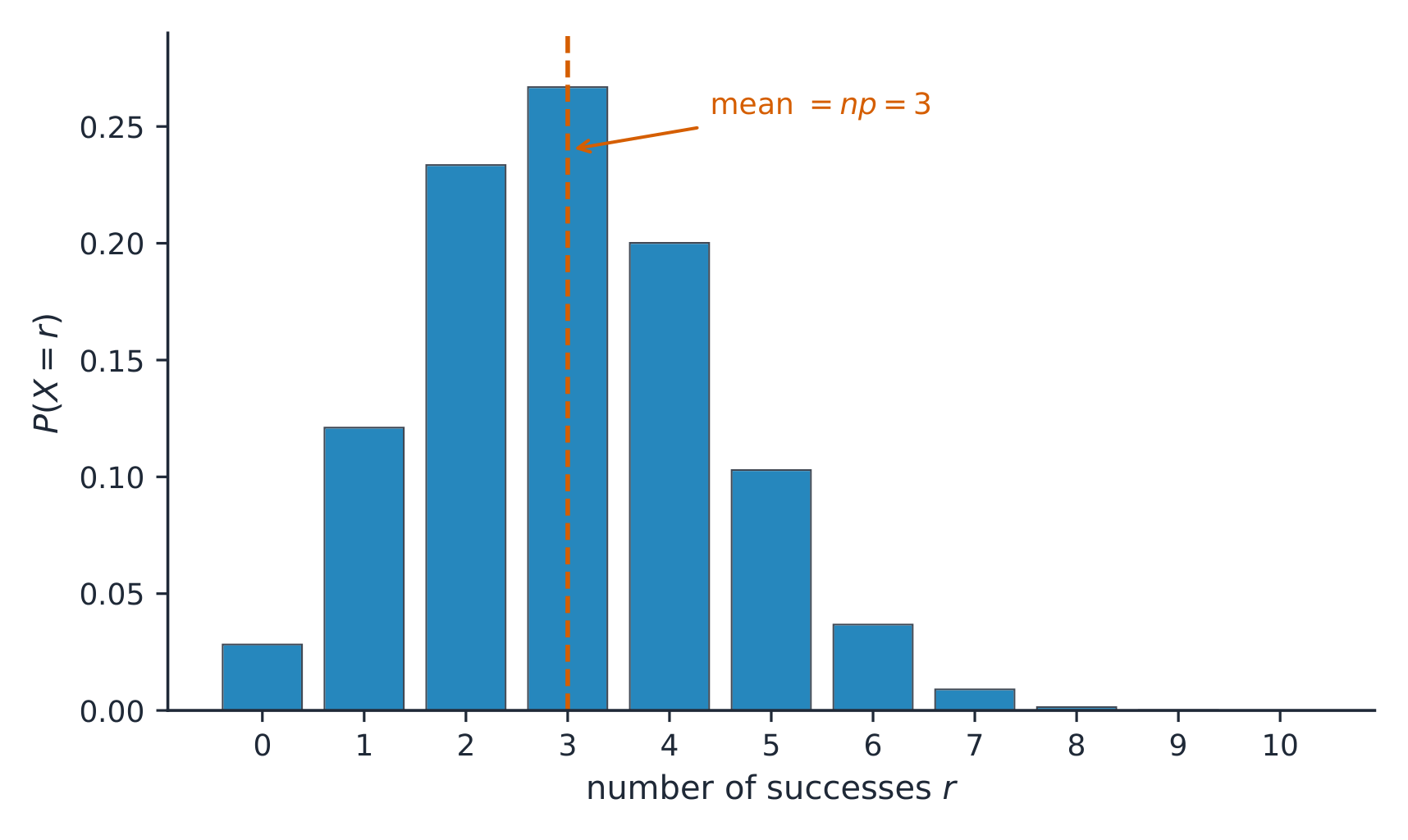
การแจกแจงแบบทวินomial, mean = n × p
การแจกแจงบิโนมิאל โดยมีค่าเฉลี่ย n เท่ากับ p
Explore · ⁨สำรวจ⁩

Shape a binomial distribution · ⁨สร้างการกระจายแบบทวินาม⁩

A binomial distribution counts successes in $n$ independent trials each with probability $p$. Change $n$ and $p$ and watch the bars shift and spread. · ⁨การแจกแจงแบบทวินาม นับจำนวนความสำเร็จใน $n$ การทดลองที่เป็นอิสระแต่ละครั้งซึ่งมีความน่าจะเป็น $p$ เปลี่ยน $n$ และ $p$ แล้วดูแท่งกราฟเคลื่อนที่และกระจายตัว⁩

Vocabulary · ⁨คำศัพท์⁩ Train · ⁨ฝึกฝน⁩
English ไทย
mean (expected value)/miːn/ ค่าเฉลี่ย (ค่าคาดหวัง)
binomial/baɪˈnəʊmɪəl/ แบบไบนอมิאל
geometric/ˌdʒiːəʊˈmetrɪk/ อนุกรมเรขาคณิต
4.11

Parameters for a Binomial Distribution · ⁨พารามิเตอร์สำหรับการแจกแจงบิโนมิאל⁩

Syllabus · ⁨หลักสูตร⁩
English
Enduring UnderstandingLearning ObjectiveEssential Knowledge

UNC-3
Probabilistic reasoning allows us to anticipate patterns in data.

UNC-3.C
Calculate parameters for a binomial distribution. [Skill 3.B]

  • UNC-3.C.1 If a random variable is binomial, its mean, $\mu_x$, is $np$ and its standard deviation, $\sigma_x$, is $\sqrt{np(1 - p)}$.

UNC-3.D
Interpret probabilities and parameters for a binomial distribution. [Skill 4.B]

  • UNC-3.D.1 Probabilities and parameters for a binomial distribution should be interpreted using appropriate units and within the context of a specific population or situation.
ไทย
Enduring UnderstandingLearning ObjectiveEssential Knowledge

UNC-3
การคิดแบบความน่าจะเป็นช่วยให้เราคาดการณ์ลวดลายในข้อมูล

UNC-3.C
คำนวณพารามิเตอร์ของการแจกแจงแบบไบนอมิอัล [Skill 3.B]

  • UNC-3.C.1 ถ้าตัวแปรสุ่มเป็นแบบไบนอมิอัล ค่าเฉลี่ย, $\mu_x$, คือ $np$ และส่วนเบี่ยงเบนมาตรฐาน, $\sigma_x$, คือ $\sqrt{np(1 - p)}$

UNC-3.D
ตีความความน่าจะเป็นและพารามิเตอร์ของการแจกแจงแบบไบนอมิอัล [Skill 4.B]

  • UNC-3.D.1 ความน่าจะเป็นและพารามิเตอร์ของการแจกแจงแบบไบนอมิอัลควรตีความโดยใช้หน่วยที่เหมาะสมและอยู่ในบริบทของประชากรหรือสถานการณ์เฉพาะ

Source: College Board AP Course and Exam Description · ⁨แหล่งที่มา: คำอธิบายหลักสูตรและข้อสอบ College Board AP⁩

English

For a binomial $X$ with $n$ trials and success probability $p$:

$$\mu_X=np,\qquad \sigma_X=\sqrt{np(1-p)}.$$
Use these for "how many successes do we expect, and how much do they vary" questions.

Worked example. A player makes $70\%$ of free throws. In $n=10$ shots, the probability of exactly $8$ makes is

$$P(X=8)=\binom{10}{8}(0.7)^8(0.3)^2=45\times0.0576\times0.09\approx0.23,$$
and the expected number of makes is $\mu=np=10(0.7)=7$, with $\sigma=\sqrt{10(0.7)(0.3)}\approx1.45$.

ไทย

สำหรับการแจกแจงบิโนมิאל $X$ ที่มี $n$ การทดลองและความน่าจะเป็นสำเร็จ $p$:

$$\mu_X=np,\qquad \sigma_X=\sqrt{np(1-p)}.$$
ใช้สิ่งเหล่านี้สำหรับคำถามประเภท "เราคาดว่าจะประสบความสำเร็จกี่ครั้ง และการเปลี่ยนแปลงอยู่เท่าไหร่"

ตัวอย่างวิธีทำ. ผู้เล่นยิงฟรีเทร์ $70\%$ ครั้ง ใน $n=10$ โอกาส ยิงเข้าได้พอดี $8$ ครั้ง มีความน่าจะเป็น

$$P(X=8)=\binom{10}{8}(0.7)^8(0.3)^2=45\times0.0576\times0.09\approx0.23,$$
และจำนวนครั้งที่คาดว่าจะยิงเข้าได้คือ $\mu=np=10(0.7)=7$, ด้วย $\sigma=\sqrt{10(0.7)(0.3)}\approx1.45$.

4.12

The Geometric Distribution · ⁨การแจกแจงเรขาคณิต⁩

Syllabus · ⁨หลักสูตร⁩
English
Enduring UnderstandingLearning ObjectiveEssential Knowledge

UNC-3
Probabilistic reasoning allows us to anticipate patterns in data.

UNC-3.E
Calculate probabilities for geometric random variables. [Skill 3.A]

  • UNC-3.E.1 For a sequence of independent trials, a geometric random variable, $X$, gives the number of the trial on which the first success occurs. Each trial has two possible outcomes (success or failure) with the probability of success $p$ and the probability of failure $1 - p$.
  • UNC-3.E.2 The probability that the first success for repeated independent trials with probability of success $p$ occurs on trial $x$ is calculated as $P(X = x) = (1 - p)^{x-1} p, x = 1, 2, 3, \ldots$. This is the geometric probability function.

UNC-3.F
Calculate parameters of a geometric distribution. [Skill 3.B]

  • UNC-3.F.1 If a random variable is geometric, its mean, $\mu_x$, is $\dfrac{1}{p}$ and its standard deviation, $\sigma_x$, is $\dfrac{\sqrt{(1 - p)}}{p}$.

UNC-3.G
Interpret probabilities and parameters for a geometric distribution. [Skill 4.B]

  • UNC-3.G.1 Probabilities and parameters for a geometric distribution should be interpreted using appropriate units and within the context of a specific population or situation.
ไทย
Enduring UnderstandingLearning ObjectiveEssential Knowledge

UNC-3
การคิดแบบความน่าจะเป็นช่วยให้เราคาดการณ์ลวดลายในข้อมูล

UNC-3.E
คำนวณความน่าจะเป็นของตัวแปรสุ่มแบบเรขาคณิต [Skill 3.A]

  • UNC-3.E.1 สำหรับลำดับการทดลองอิสระ ตัวแปรสุ่มแบบเรขาคณิต, $X$, ให้จำนวนการทดลองที่ความสำเร็จครั้งแรกเกิดขึ้น Each trial มีสองผลลัพธ์ที่เป็นไปได้ (สำเร็จหรือล้มเหลว) ด้วยความน่าจะเป็นสำเร็จ $p$ และความน่าล้มเหลว $1 - p$
  • UNC-3.E.2 ความน่าจะเป็นที่ความสำเร็จครั้งแรกสำหรับการทดลองอิสระซ้ำที่มีความน่าจะเป็นสำเร็จ $p$ เกิดขึ้นในการทดลอง $x$ คำนวณได้เป็น $P(X = x) = (1 - p)^{x-1} p, x = 1, 2, 3, \ldots$ นี่คือฟังก์ชันความน่าจะเป็นแบบเรขาคณิต

UNC-3.F
คำนวณพารามิเตอร์ของการแจกแจงแบบเรขาคณิต [Skill 3.B]

  • UNC-3.F.1 ถ้าตัวแปรสุ่มเป็นแบบเรขาคณิต ค่าเฉลี่ย, $\mu_x$, คือ $\dfrac{1}{p}$ และส่วนเบี่ยงเบนมาตรฐาน, $\sigma_x$, คือ $\dfrac{\sqrt{(1 - p)}}{p}$

UNC-3.G
ตีความความน่าจะเป็นและพารามิเตอร์ของการแจกแจงแบบเรขาคณิต [Skill 4.B]

  • UNC-3.G.1 ความน่าจะเป็นและพารามิเตอร์ของการแจกแจงแบบเรขาคณิตควรตีความโดยใช้หน่วยที่เหมาะสมและอยู่ในบริบทของประชากรหรือสถานการณ์เฉพาะ

Source: College Board AP Course and Exam Description · ⁨แหล่งที่มา: คำอธิบายหลักสูตรและข้อสอบ College Board AP⁩

English

A geometric 几何 setting is the same as binomial but with no fixed $n$: you keep trying until the first success. The random variable $Y=$ the trial of the first success:

$$P(Y=k)=(1-p)^{k-1}\,p,\qquad \mu_Y=\frac{1}{p}.$$
So the expected number of trials until the first success is $1/p$.

ไทย

สถานการณ์ เรขาคณิต เหมือนกับการแจกแจงบิโนมิאלแต่ ไม่มี $n$ ที่กำหนดไว้: คุณพยายามต่อไปจนกว่าจะ สำเร็จครั้งแรก ตัวแปรสุ่ม $Y=$ คือการทดลองครั้งที่สำเร็จครั้งแรก:

$$P(Y=k)=(1-p)^{k-1}\,p,\qquad \mu_Y=\frac{1}{p}.$$
ดังนั้นจำนวนการทดลองที่คาดว่าจะต้องใช้จนกว่าจะสำเร็จครั้งแรกคือ $1/p$.

4.12

Exam tips · ⁨ข้อแนะนำสำหรับการสอบ⁩

English
  • A probability lies in $[0,1]$; use the complement ($1-P$) and add mutually exclusive events.
  • For independent events multiply; for "and/or" use the general addition and conditional rules.
  • Expected value = $\sum(\text{value}\times\text{probability})$.
  • Recognise binomial (fixed $n$, two outcomes, constant $p$) and geometric settings.
  • Draw a tree or table for multi-stage problems and multiply along branches.
ไทย
  • ความน่าจะเป็นอยู่ในช่วง $[0,1]$; ใช้ ส่วนเสริม ($1-P$) และบวกเหตุการณ์ที่ไม่สามารถเกิดขึ้นร่วมกัน
  • สำหรับเหตุการณ์ที่เป็นอิสระให้คูณ; สำหรับ "และ/หรือ" ใช้กฎการบวกทั่วไปและความน่าจะเป็นแบบมีเงื่อนไข
  • ค่าคาดหวัง (Expected value) = $\sum(\text{value}\times\text{probability})$.
  • จำแนกสถานการณ์ บิโนมิאל ($n$ คงที่, ผลลัพธ์สองแบบ, $p$ คงที่) และสถานการณ์ เรขาคณิต
  • วาดแผนภาพต้นไม้หรือตารางสำหรับปัญหาหลายขั้นตอนและคูณตามกิ่งก้าน

Interactive lessons on this topic · ⁨บทเรียนเชิงโต้ตอบสำหรับหัวข้อนี้⁩

Work through it step by step, with instant-check exercises. · ⁨ทำทีละขั้นตอน พร้อมแบบฝึกหัดตรวจสอบผลทันที⁩

Past Papers · ⁨ข้อสอบย้อนหลัง⁩

More topics in AP Statistics · ⁨หัวข้อเพิ่มเติมใน AP Statistics⁩

Log in or create account · ⁨เข้าสู่ระบบหรือสร้างบัญชี⁩

IGCSE, A-Level & AP