Skip to content · ⁨ข้ามไปยังเนื้อหา⁩

Electromagnetic Induction · ⁨การเหนี่ยวนำแม่เหล็กไฟฟ้า⁩

AP Physics C: Electricity and Magnetism · Topic 13 · ⁨หัวข้อ 13⁩

Video lesson for this topic · ⁨บทเรียนวิดีโอสำหรับหัวข้อนี้⁩ Open the video page · ⁨เปิดหน้าวิดีโอ⁩
9:11

การเหนี่ยวนำแม่เหล็กไฟฟ้า

ทุกวัตต์ของไฟฟ้าที่คุณเคยใช้ เริ่มต้นด้วยวิธีเดียวกัน คือแม่เหล็กและขดลวดลวดที่เคลื่อนผ่านกัน ไม่มีเชื้อเพลิง ไม่มีการเผาไหม้: มีเพียง...

English narration · English + 中文 subtitles burned in · ⁨การบรรยายภาษาอังกฤษ · คำบรรยายภาษาอังกฤษ + 中文 ลอยตัวบนภาพ⁩

13.1

Magnetic Flux · ⁨การไหลผ่านแม่เหล็ก⁩

Syllabus · ⁨หลักสูตร⁩
English

Learning Objective 13.1.A: Describe the magnetic flux through an arbitrary area or geometric shape.

  • 13.1.A.1 For a magnetic field $\vec{B}$ that is constant across an area $\vec{A}$, the magnetic flux through the area is defined as $\Phi_B = \vec{B} \cdot \vec{A}$ .
    • 13.1.A.1.i The area vector is defined as perpendicular to the plane of the surface and outward from a closed surface.
    • 13.1.A.1.ii The sign of flux is given by the dot product of the magnetic field vector and the area vector.
  • 13.1.A.2 The total magnetic flux passing through a surface is defined by the surface integral of the magnetic field over the surface area.
    • Equation: $\Phi_B = \displaystyle\int \vec{B} \cdot d\vec{A}$
ไทย

จุดประสงค์การเรียนรู้ 13.1.A: อธิบายฟลักซ์แม่เหล็กผ่านพื้นผิวหรือรูปร่างเรขาคณิตใดๆ

  • 13.1.A.1 สำหรับสนามแม่เหล็ก $\vec{B}$ ที่มีค่าคงที่ทั่วทั้งพื้นที่ $\vec{A}$ ฟลักซ์แม่เหล็กผ่านพื้นที่นี้ถูกกำหนดให้เท่ากับ $\Phi_B = \vec{B} \cdot \vec{A}$ .
    • 13.1.A.1.i เวกเตอร์พื้นที่ถูกกำหนดให้เป็นตั้งฉากกับระนาบของพื้นผิวและชี้ออกด้านนอกจากพื้นผิวปิด
    • 13.1.A.1.ii สัญญาณของฟลักซ์กำหนดโดยผลคูณสเกลาร์ของเวกเตอร์สนามแม่เหล็กและเวกเตอร์พื้นที่
  • 13.1.A.2 ฟลักซ์แม่เล็กรวมที่ไหลผ่านพื้นผิวนั้นถูกกำหนดโดยอินทิกรัลพื้นผิวของสนามแม่เหล็กทั่วพื้นที่พื้นผิว
    • สมการ: $\Phi_B = \displaystyle\int \vec{B} \cdot d\vec{A}$

Source: College Board AP Course and Exam Description · ⁨แหล่งที่มา: คำอธิบายหลักสูตรและข้อสอบ College Board AP⁩

English

Magnetic flux 磁通量 measures how much magnetic field passes through a surface. For a uniform field through a flat loop it is the dot product $\Phi_B=\vec{B}\cdot\vec{A}=BA\cos\theta$; in general it is the surface integral 面积分

$$\Phi_B=\int \vec{B}\cdot d\vec{A}.$$

The area vector 面积矢量 is perpendicular to the surface (outward from a closed one), and the sign of the flux comes from the dot product. Flux changes if $B$ changes, the area changes, or the loop turns – keep all three routes in mind, because each one is an exam question.

ไทย

การไหลผ่านแม่เหล็ก วัดปริมาณสนามแม่เหล็กที่ทะลุผ่านพื้นผิว สำหรับสนามสม่ำเสมอที่ทะลุผ่านวงลูปแบน ค่า它是一个 dot product $\Phi_B=\vec{B}\cdot\vec{A}=BA\cos\theta$; โดยทั่วไปคือ อินทิกรัลพื้นผิว

$$\Phi_B=\int \vec{B}\cdot d\vec{A}.$$

เวกเตอร์พื้นที่ เป็นฉากกับพื้นผิว (ออกด้านนอกสำหรับรูปปิด), และเครื่องหมายของการไหลผ่านมาจาก dot product การไหลผ่านเปลี่ยนได้เมื่อ $B$ เปลี่ยน, พื้นที่เปลี่ยน, หรือวงลูปหมุน — จงจำเส้นทางทั้งสามนี้ไว้ เพราะแต่ละอย่างคือข้อสอบ

13.2

Electromagnetic Induction · ⁨การเหนี่ยวนำแม่เหล็กไฟฟ้า⁩

Syllabus · ⁨หลักสูตร⁩
Learning ObjectiveEssential Knowledge

13.2.A
Describe the induced electric potential difference resulting from a change in magnetic flux.

  • 13.2.A.1 Faraday's law describes the relationship between changing magnetic flux and the resulting induced emf in a system.
    • Equation: $\mathcal{E} = -\dfrac{d\Phi_B}{dt} = -\dfrac{d\left(\vec{B} \cdot \vec{A}\right)}{dt}$
    • 13.2.A.1.i When the area of the surface being considered is constant, the induced emf is equal to the area multiplied by the rate of change in the component of the magnetic field perpendicular to the surface.
    • 13.2.A.1.ii When the magnetic field is constant, the induced emf is equal to the magnetic field multiplied by the rate of change in area perpendicular to the magnetic field.
    • 13.2.A.1.iii When an emf is induced in a long solenoid, the total induced emf is equal to the induced emf in a single loop multiplied by the number of loops in the solenoid.
      • Equation: $\left|\mathcal{E}_{\text{sol}}\right| = N\left|\dfrac{d\Phi_B}{dt}\right|$
  • 13.2.A.2 Lenz's law is used to determine the direction of an induced emf resulting from a changing magnetic flux.
    • 13.2.A.2.i An induced emf generates a current that creates a magnetic field that opposes the change in magnetic flux.
    • 13.2.A.2.ii The right-hand rule is used to determine the relationships between current, emf, and magnetic flux.
  • 13.2.A.3 Maxwell's equations are the collection of equations that fully describe electromagnetism. Maxwell's third equation is Faraday's law of induction, which describes the relationship between a changing magnetic flux and an induced electric field.
    • Equation: $\mathcal{E} = \oint \vec{E} \cdot d\vec{\ell} = -\dfrac{d\Phi_B}{dt}$
  • 13.2.A.4 Maxwell's equations can be used to show that electric and magnetic fields obey wave equations and that electromagnetic waves travel at a constant speed in free space.
    • Equation (derived): $c = \dfrac{1}{\sqrt{\varepsilon_0 \mu_0}}$

Boundary statement: AP Physics C: Electricity & Magnetism does not expect students to mathematically derive the speed of light in free space from Maxwell's equations. This relationship is included above solely as an indication of the further applications, implications, and connections to physical phenomena that students may study in more advanced physics courses.

Source: College Board AP Course and Exam Description · ⁨แหล่งที่มา: คำอธิบายหลักสูตรและข้อสอบ College Board AP⁩

English
Electromagnetic induction

A changing flux induces an emf 电动势 – Faraday's law 法拉第定律:

$$\varepsilon=-\frac{d\Phi_B}{dt}.$$

With constant area, $\varepsilon=-A\,\dfrac{dB_\perp}{dt}$; with constant field, $\varepsilon=-B\,\dfrac{dA_\perp}{dt}$. A coil of $N$ turns multiplies the single-loop emf: $|\varepsilon_{\text{sol}}|=N\left|\dfrac{d\Phi_B}{dt}\right|$.

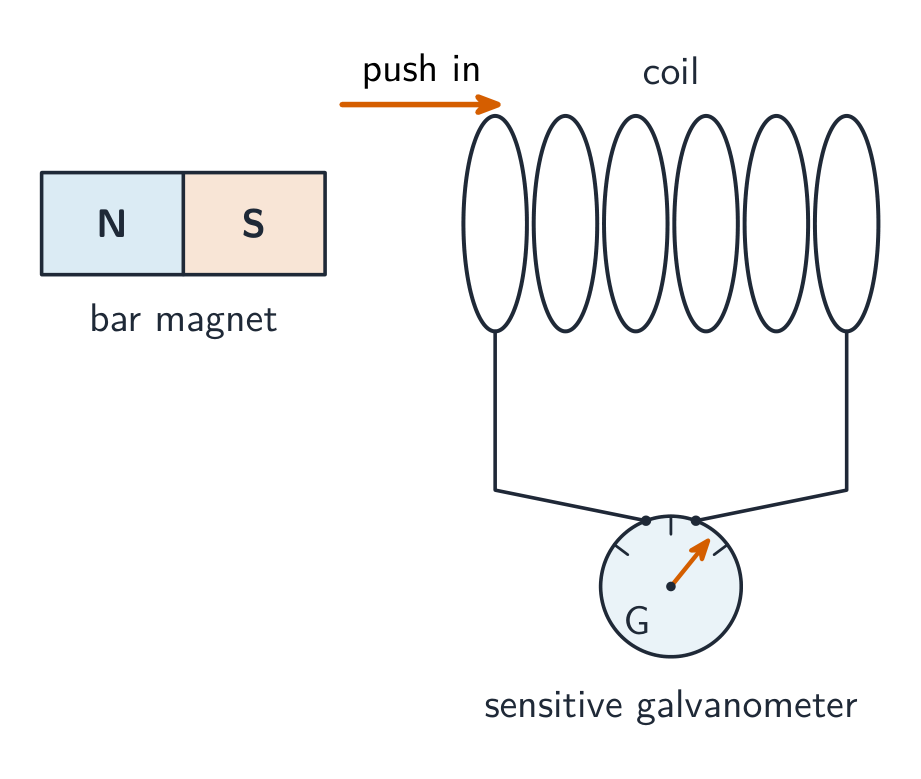
Lenz's law 楞次定律 is the minus sign: the induced current 感应电流 flows so that its own magnetic field opposes the change in flux that created it. Push a magnet toward a loop and the loop pushes back; pull it away and the loop pulls it in. Use the right-hand rule 右手定则 to turn "oppose the change" into a current direction.

A rod of length $L$ sliding at speed $v$ across a field is the special case worth memorising – the motional emf 动生电动势 $\varepsilon=BLv$.

Worked example. A $0.20\ \text{m}$ rod slides at $3.0\ \text{m/s}$ across a $0.50\ \text{T}$ field: $\varepsilon=BLv=0.50(0.20)(3.0)=0.30\ \text{V}$. Equivalently, if a single loop's flux drops from $0.020\ \text{Wb}$ to $0.008\ \text{Wb}$ in $0.030\ \text{s}$, the average emf is $\varepsilon=\dfrac{0.012}{0.030}=0.40\ \text{V}$.

Faraday's law is also the third of Maxwell's equations 麦克斯韦方程组, in a deeper form: a changing magnetic flux creates a circulating electric field, $\oint\vec{E}\cdot d\vec{l}=-\dfrac{d\Phi_B}{dt}$ – that field is what pushes the charges around the loop. Together, Maxwell's equations predict electromagnetic waves 电磁波 travelling at $c=1/\sqrt{\varepsilon_0\mu_0}$ (you should know this connection, but AP will not ask you to derive it).

ไทย
การเหนี่ยวนำแม่เหล็กไฟฟ้า

การเปลี่ยนแปลง ของการไหลผ่านเหนี่ยวนำ emf – กฎของฟาราเดย์:

$$\varepsilon=-\frac{d\Phi_B}{dt}.$$

ด้วยพื้นที่คงที่, $\varepsilon=-A\,\dfrac{dB_\perp}{dt}$; ด้วยสนามคงที่, $\varepsilon=-B\,\dfrac{dA_\perp}{dt}$. ขดลวด $N$ รอบ เพิ่มผลคูณ emf ของวงลูปเดียว: $|\varepsilon_{\text{sol}}|=N\left|\dfrac{d\Phi_B}{dt}\right|$.

กฎของเลนซ์ คือเครื่องหมายลบ: กระแสเหนี่ยวนำ ไหลในทิศทางที่ทำให้สนามแม่เหล็กของตัวเอง ต้านทานการเปลี่ยนแปลง ของการไหลผ่านที่ก่อให้เกิดมัน ดันแม่เหล็กเข้าหาวงลูปแล้ววงลูปดันกลับ; ดึงออกจากวงลูปแล้ววงลูปดึงเข้าหา ใช้ กฎมือขวา เพื่อแปลง "ต้านทานการเปลี่ยนแปลง" เป็นทิศทางกระแส

การนำแม่เหล็กเข้าไปในคอยล์จะเหนี่ยวนำ e.m.f. ที่กระตุ้นให้กระแสไหล

แท่งยาว $L$ ลื่นด้วยความเร็ว $v$ ตัดผ่านสนาม เป็นกรณีพิเศษที่ควรจดจำ – motional emf $\varepsilon=BLv$

ตัวอย่างที่คำนวณแล้ว. ก้าน $0.20\ \text{m}$ ลื่นเคลื่อนที่ด้วยความเร็ว $3.0\ \text{m/s}$ ผ่านสนามแม่เหล็ก $0.50\ \text{T}$: $\varepsilon=BLv=0.50(0.20)(3.0)=0.30\ \text{V}$. ในทางเทียบเท่า หากฟลักซ์แม่เหล็กของลูปเดียวลดลงจาก $0.020\ \text{Wb}$ เป็น $0.008\ \text{Wb}$ ภายในเวลา $0.030\ \text{s}$ แรงดันไฟฟ้าเหนี่ยวนำเฉลี่ยจะมีค่าเท่ากับ $\varepsilon=\dfrac{0.012}{0.030}=0.40\ \text{V}$.

กฎของ فارาเดย์ยังเป็นสมการแม็กซ์เวลล์ข้อที่สามในรูปที่ลึกซึ้งกว่านั้นด้วย: การเปลี่ยนแปลงของฟลักซ์แม่เหล็กจะสร้าง สนามไฟฟ้า ที่หมุนวน $\oint\vec{E}\cdot d\vec{l}=-\dfrac{d\Phi_B}{dt}$ – สนามนี้เองที่เป็นตัวผลักให้ประจุเคลื่อนที่ไปตามลูป สมการแม็กซ์เวลล์รวมกันนี้ทำนาย คลื่นแม่เหล็กไฟฟ้า ที่เดินทางด้วยความเร็ว $c=1/\sqrt{\varepsilon_0\mu_0}$ (คุณควรทราบถึงความเชื่อมโยงนี้ แต่ข้อสอบ AP จะไม่ถามให้คุณพิสูจน์สมการนี้)

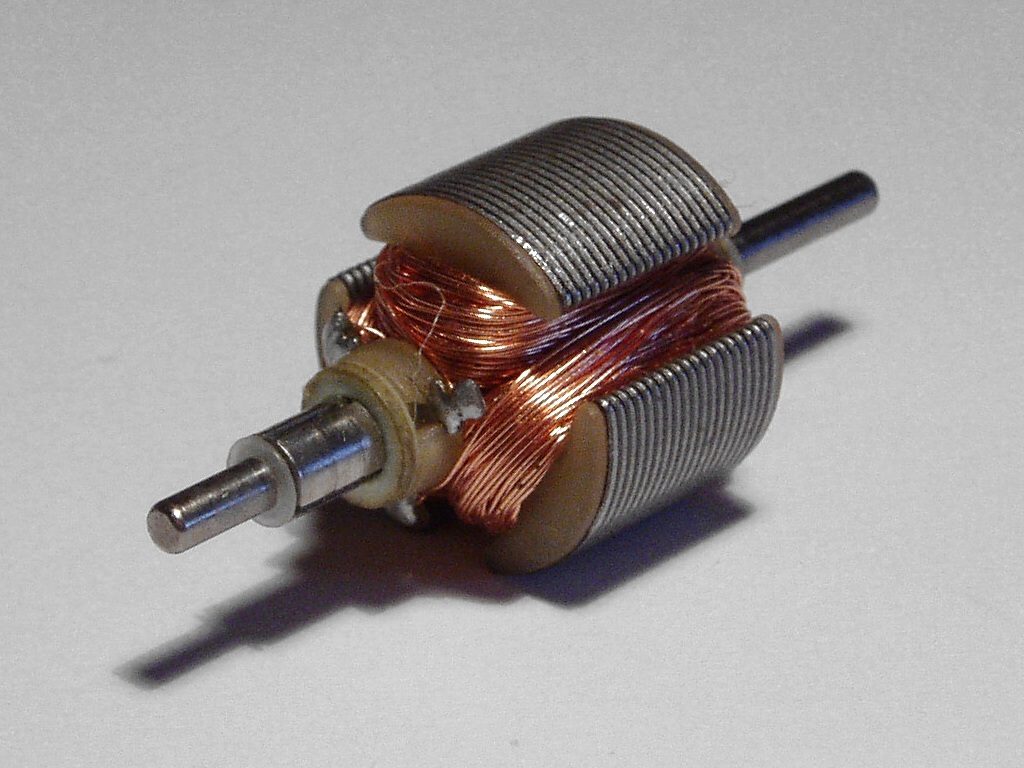
โรเตอร์พันลวดของมอเตอร์ไฟฟ้า
ขดลวดลวดหมุนในสนามแม่เหล็ก: เคลื่อน它们在สนามเหนี่ยวนำกระแส, เป็นพื้นฐานของเครื่องกำเนิดไฟฟ้า
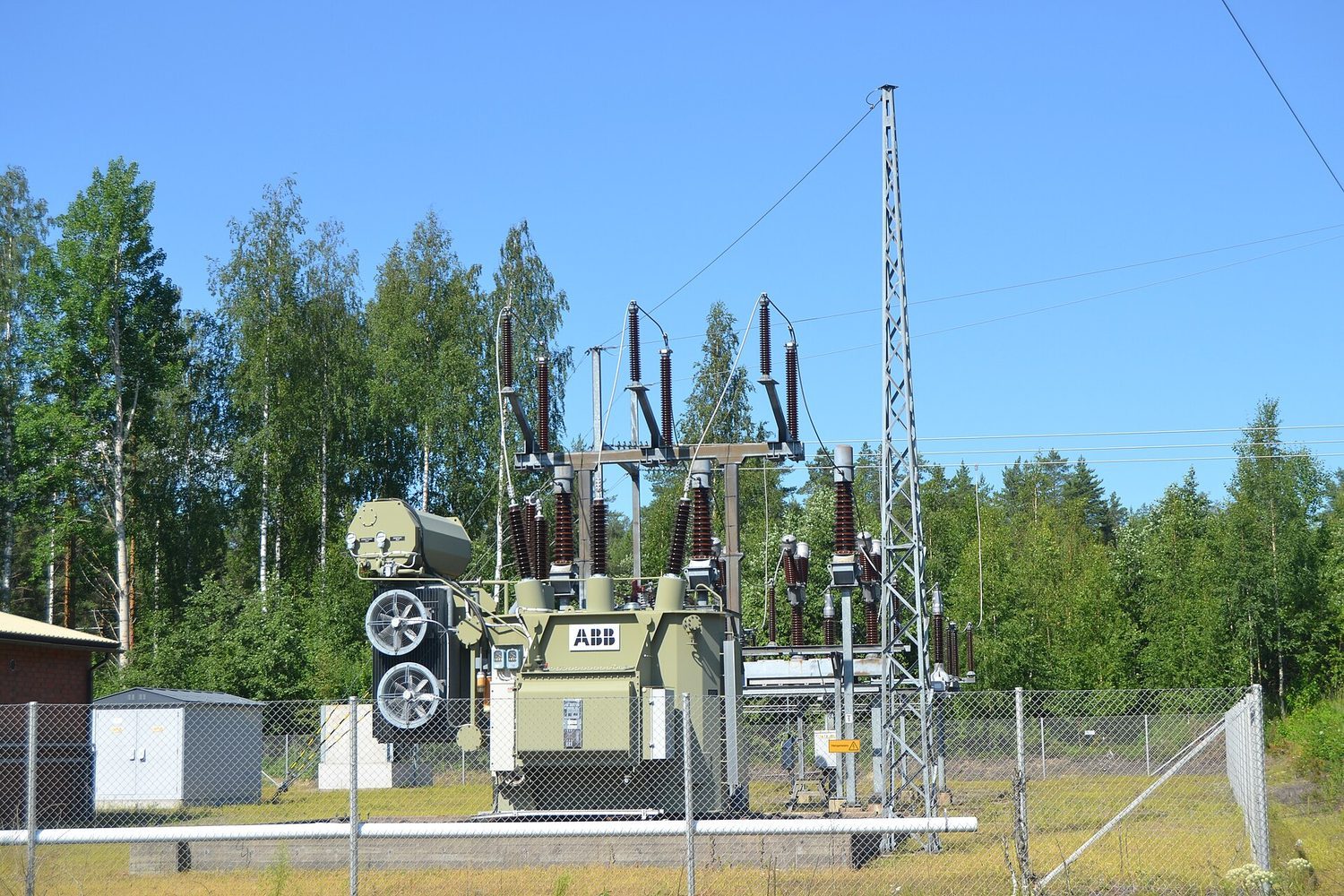
หม้อแปลงสถานีไฟฟ้า: ฟลักซ์แม่เหล็กที่เปลี่ยนแปลงในคอยล์เหนี่ยวนำโวลเทจที่ใช้จ่ายไฟสู่ระบบโครงข่าย
Explore · ⁨สำรวจ⁩

Induce a current by moving a magnet · ⁨เหนี่ยวนำกระแสไฟ bằngการขยับแม่เหล็ก⁩

A changing magnetic flux through a coil induces an EMF (Faraday's law); its direction opposes the change (Lenz's law). Move the magnet faster for a bigger EMF. · ⁨การไหลของสนามแม่เหล็ก ที่เปลี่ยนผ่านคอยล์เหนี่ยวนำ EMF (กฎของฟาราเดย์); ทิศทางของมันต้านทานการเปลี่ยนแปลง (กฎของเลนซ์) ขยับแม่เหล็กเร็วขึ้นจะได้ EMF มากขึ้น⁩

Vocabulary · ⁨คำศัพท์⁩ Train · ⁨ฝึกฝน⁩
English ไทย
Magnetic flux/mæɡˈnetɪk flʌks/ ฟลักซ์แม่เหล็ก
surface integral/ˈsɜːfɪs ˈɪntɪɡrəl/ อินทิกรัลพื้นผิว
area vector/ˈeərɪə ˈvektə/ เวกเตอร์พื้นที่
emf/emf/ EMF emf
Faraday's law/ˈfærədeɪz lɔː/ กฎของ فارาเดย์
Lenz's law/ˈlentsɪz lɔː/ กฎของเลนซ์
induced current/ɪnˈdjuːst ˈkʌrənt/ induced current
right-hand rule/raɪt hænd ruːl/ กฎมือขวา
motional emf/ˈməʊʃənl emf/ EMF การเคลื่อนที่ motional emf
Maxwell's equations/ˈmækswelz ɪˈkweɪʒnz/ สมการของ แมกซ์เวลล์
electromagnetic waves/ɪˌlektrəʊməɡˈnetɪk weɪvz/ คลื่นแม่เหล็กไฟฟ้า
eddy currents/ˈedi ˈkʌrənts/ กระแส渦流
generator/ˈdʒenəreɪtə/ เครื่องกำเนิดไฟฟ้า
inductance/ɪnˈdʌktəns/ inductance
13.3

Induced Currents and Magnetic Forces · ⁨กระแสเหนี่ยวนำและแรงแม่เหล็ก⁩

Syllabus · ⁨หลักสูตร⁩
English

Learning Objective 13.3.A: Describe the force exerted on a conductor due to the interaction between an external magnetic field and an induced current within that conductor.

  • 13.3.A.1 When an induced current is created in a conductive loop, the already-present magnetic field will exert a magnetic force on the moving charge carriers within the loop.
    • Equation: $\vec{F}_B = \displaystyle\int I\left(d\vec{\ell} \times \vec{B}\right)$
  • 13.3.A.2 When current is induced in a conducting loop, magnetic forces are only exerted on the segments of the loop that are within the external magnetic field. These magnetic forces may cause translational or rotational acceleration.
  • 13.3.A.3 The force on a conducting loop is proportional to the induced current in the loop, which depends on the rate of change of magnetic flux, the resistance of the loop, and the velocity of the loop.
  • 13.3.A.4 Newton's second law can be applied to a conducting loop moving in a magnetic field as it experiences an induced emf.
ไทย

วัตถุประสงค์การเรียนรู้ 13.3.A: อธิบายแรงที่กระทำต่อตัวนำอันเนื่องจากการมีปฏิสัมพันธ์ระหว่างสนามแม่เหล็กภายนอกและกระแสไฟฟ้านำภายในตัวนำนั้น

  • 13.3.A.1 เมื่อเกิดกระแสไฟฟ้านำในวงลูปนำ สนามแม่เหล็กที่มีอยู่แล้วจะกระทำแรงแม่เหล็กต่อบรรจากรถเคลื่อนที่ภายในวงลูปนั้น
    • สมการ: $\vec{F}_B = \displaystyle\int I\left(d\vec{\ell} \times \vec{B}\right)$
  • 13.3.A.2 เมื่อเกิดกระแสไฟฟ้าในวงลูปนำ แรงแม่เหล็กจะถูกกระทำเฉพาะบนส่วนประกอบของวงลูปที่อยู่ภายในสนามแม่เหล็กภายนอกเท่านั้น แรงเหล่านี้สามารถก่อให้เกิดความเร่งแบบเลื่อนหรือแบบหมุนได้
  • 13.3.A.3 แรงที่ทำต่อวงลูปนำแปรผันตามกระแสไฟฟ้านำในวงลูป ซึ่งขึ้นอยู่กับอัตราการเปลี่ยนแปลงของฟลักส์แม่เหล็ก ความต้านทานของวงลูป และความเร็วของวงลูป
  • 13.3.A.4 กฎข้อที่สองของนิวตันสามารถนำไปใช้กับวงลูปนำที่กำลังเคลื่อนที่ในสนามแม่เหล็กซึ่งกำลัง experiencing induced emf ได้

Source: College Board AP Course and Exam Description · ⁨แหล่งที่มา: คำอธิบายหลักสูตรและข้อสอบ College Board AP⁩

English

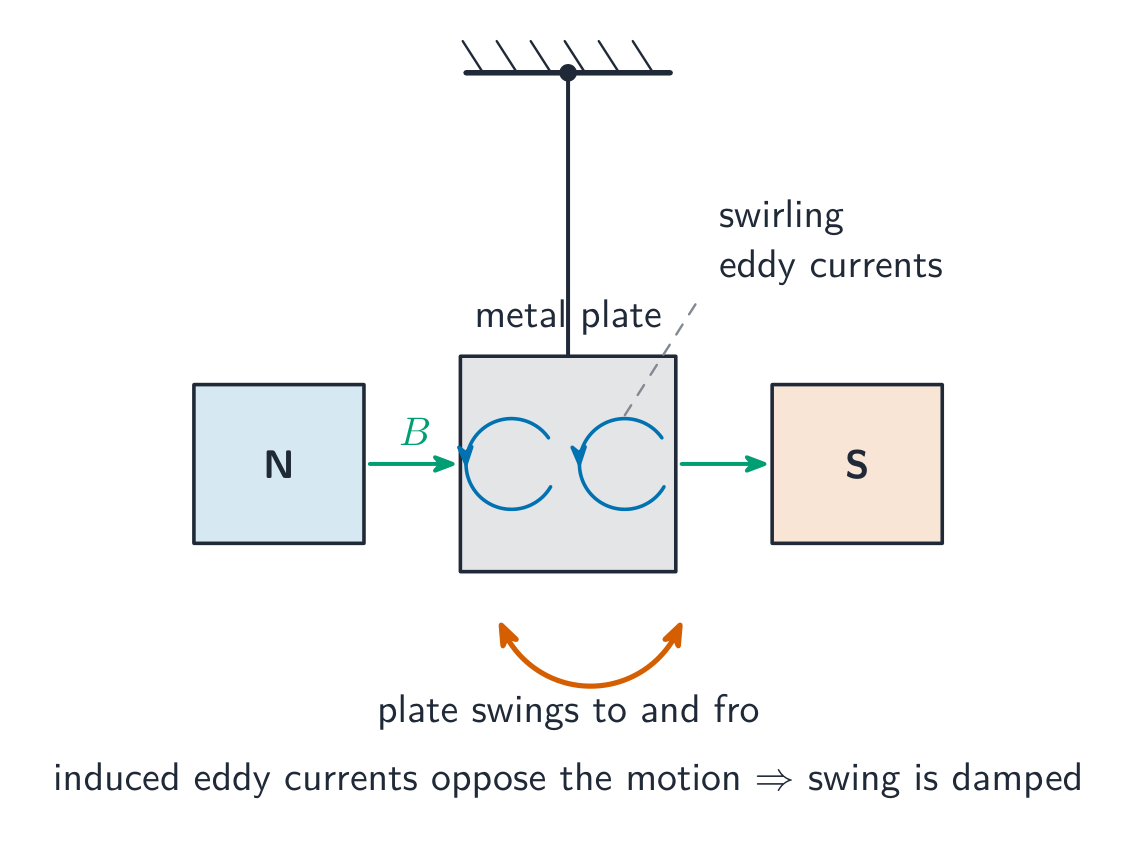
Once an induced current flows, the external field exerts forces on it ($\vec{F}=\int I\,d\vec{l}\times\vec{B}$) – and by Lenz's law those forces always resist the motion that causes the induction. Only the segments of the loop actually inside the field feel a force, which can make a loop accelerate, rotate, or brake. This is the origin of eddy currents 涡电流 braking, and you can apply Newton's second law to a moving loop or rod like any other mechanics problem.

The classic setup is a rod sliding on conducting rails connected by a resistor:

Worked example (the full chain). Rails $L=0.20\ \text{m}$ apart with resistance $R=0.60\ \Omega$ sit in a $0.50\ \text{T}$ field into the page. The rod is pushed at a constant $3.0\ \text{m/s}$. Then: $\varepsilon=BLv=0.30\ \text{V}$; $I=\varepsilon/R=0.50\ \text{A}$; the field pushes back on the rod with $F=BIL=0.50(0.50)(0.20)=0.050\ \text{N}$. The pushing force does work at $P=Fv=0.15\ \text{W}$ – exactly the $P=I^2R=0.15\ \text{W}$ dissipated in the resistor. Mechanical work becomes electrical energy: that is a generator 发电机, and energy is conserved. Released with no push, the rod slows exponentially: $ma=-\dfrac{B^2L^2}{R}v$.

Exam skill. FRQs walk this exact chain: flux $\to$ emf $\to$ current $\to$ force $\to$ Newton's second law. Write each link separately and check the direction with Lenz's law at the end.

ไทย

เมื่อกระแสเหนี่ยวนำไหล, สนามภายนอกกระทำแรง对它们 ($\vec{F}=\int I\,d\vec{l}\times\vec{B}$) – และโดยกฎของเลนซ์, แรงเหล่านั้นจะ ต้านทานการเคลื่อนที่ ที่ทำให้เกิดการเหนี่ยวนำเสมอ เพียงส่วนหนึ่งของวงลูปที่อยู่จริงในสนามเท่านั้นที่รู้สึกถึงแรง, ซึ่งอาจทำให้วงลูปเร่ง, หมุน, หรือเบรก นี่คือต้นกำเนิดของ กระแส渦流 เบรก, คุณสามารถใช้กฎข้อที่สองของนิวตันกับวงลูปหรือแท่งที่เคลื่อนที่เหมือนปัญหากลศาสตร์อื่นๆ

กระแส涡流เหนี่ยวนำต้านทานการเคลื่อนที่, ลดการแกว่งของแผ่นโลหะในสนามอย่างรวดเร็ว

setup คลาสสิกคือแท่งลื่นบนรางนำไฟฟ้าที่ต่อกันด้วยตัวต้านทาน:

แท่งลื่นบนราง: กระแสเหนี่ยวนำรู้สึกถึงแรงต้านทานการเคลื่อนที่

ตัวอย่างวิธีทำ (ห่วงโซ่เต็ม) ราง $L=0.20\ \text{m}$ ห่างกัน มีตัวต้านทาน $R=0.60\ \Omega$ อยู่ในสนาม $0.50\ \text{T}$ เข้าหน้ากระดาษ แท่งถูกดันด้วย $3.0\ \text{m/s}$ แบบคงที่. แล้ว: $\varepsilon=BLv=0.30\ \text{V}$; $I=\varepsilon/R=0.50\ \text{A}$; สนามดันกลับที่แท่งด้วย $F=BIL=0.50(0.50)(0.20)=0.050\ \text{N}$. แรงดันทำงานที่ $P=Fv=0.15\ \text{W}$ – พอดีกับ $P=I^2R=0.15\ \text{W}$ ที่สูญเสียในตัวต้านทาน. งานกลกลายเป็นพลังงานไฟฟ้า: นั่นคือ เครื่องกำเนิดไฟฟ้า, และพลังงาน守恒 Released with no push, the rod slows exponentially: $ma=-\dfrac{B^2L^2}{R}v$.

ทักษะสำหรับการทำข้อสอบ. ข้อ FRQ จะแสดงลำดับเหตุผลนี้โดยตรง: ฟลักซ์ $\to$ → แรงดันไฟฟ้าเหนี่ยวนำ $\to$ → กระแสไฟ $\to$ → แรง Lorentz $\to$ → กฎข้อที่สองของนิวตัน เขียนแต่ละขั้นตอนแยกต่างหากและตรวจสอบทิศทางด้วยกฎของเลนซ์ในขั้นสุดท้าย

13.4

Inductance · ⁨ความเหนี่ยวนำ⁩

Syllabus · ⁨หลักสูตร⁩
English

Learning Objective 13.4.A: Describe the physical and electrical properties of an inductor.

  • 13.4.A.1 Inductance is the tendency of a conductor to oppose a change in electrical current.
    • 13.4.A.1.i Inductance of a conductor depends on the physical properties of the conductor. Straight wires are typically modeled as having zero inductance.
    • 13.4.A.1.ii An inductor, such as a solenoid, is a circuit element that has significant inductance.
    • 13.4.A.1.iii The inductance of a solenoid is dependent on the total number of turns, the length of the solenoid, the cross-sectional area of the solenoid, and magnetic permeability of the solenoid's core.
      • Equation: $L_{\text{sol}} = \dfrac{\mu_{\text{core}} N^2 A}{\ell}$
  • 13.4.A.2 Inductors store energy in the magnetic field that is generated by current in the inductor.
    • Equation: $U_L = \dfrac{1}{2} L I^2$
    • 13.4.A.2.i The energy stored in the magnetic field generated by an inductor in which current is flowing can be dissipated through a resistor or used to charge a capacitor.
    • 13.4.A.2.ii The transfer of energy generated in an inductor to other forms of energy obeys conservation laws.
  • 13.4.A.3 By applying Faraday's law to an inductor and using the definition of inductance, induced emf can be related to inductance and the rate of change of current.
    • Equation: $\mathcal{E}_i = -L\dfrac{dI}{dt}$
ไทย

วัตถุประสงค์การเรียนรู้ 13.4.A: อธิบายคุณสมบัติทางกายภาพและทางไฟฟ้าของตัวเหนี่ยวนำ (inductor)

  • 13.4.A.1 ความเหนี่ยวนำคือแนวโน้มของตัวนำในการต้านทานการเปลี่ยนแปลงของกระแสไฟฟ้า
    • 13.4.A.1.i ความเหนี่ยวนำของตัวนำขึ้นอยู่กับคุณสมบัติทางกายภาพของตัวนำ Those straight wires are typically modeled as having zero inductance
    • 13.4.A.1.ii ตัวเหนี่ยวนำ เช่น โซเลนอยด์ เป็นองค์ประกอบวงจรที่มีค่าความเหนี่ยวนำอย่างมีนัยสำคัญ
    • 13.4.A.1.iii ความเหนี่ยวนำของโซเลนอยด์ขึ้นอยู่กับจำนวนรอบทั้งหมด ความยาวของโซเลนอยด์ พื้นที่หน้าตัดของโซเลนอยด์ และสัมประสิทธิ์การทะลุผ่านของสนามแม่เหล็ก (magnetic permeability) ของแกนโซเลนอยด์
      • สมการ: $L_{\text{sol}} = \dfrac{\mu_{\text{core}} N^2 A}{\ell}$
  • 13.4.A.2 ตัวเหนี่ยวนำเก็บพลังงานไว้ในสนามแม่เหล็กที่ถูกสร้างโดยกระแสไฟฟ้าในตัวเหนี่ยวนำ
    • สมการ: $U_L = \dfrac{1}{2} L I^2$
    • 13.4.A.2.i พลังงานที่เก็บไว้ในสนามแม่เหล็กที่ถูกสร้างโดยตัวเหนี่ยวนำซึ่งมีกระแสไหลผ่าน สามารถกระจาย出去 through a resistor หรือใช้ charge a capacitor ได้
    • 13.4.A.2.ii การถ่ายโอนพลังงานที่ถูกสร้างในตัวเหนี่ยวนำไปยังรูปพลังงานอื่นๆ เป็นไปตามกฎการอนุรักษ์พลังงาน
  • 13.4.A.3 โดยการประยุกต์ใช้กฎของฟาราเดย์กับตัวเหนี่ยวนำและใช้คำจำกัดความของความเหนี่ยวนำ แรงดันไฟฟ้าเหนี่ยวนำสามารถเชื่อมโยงกับความเหนี่ยวนำและอัตราการเปลี่ยนแปลงของกระแสไฟฟ้าได้
    • สมการ: $\mathcal{E}_i = -L\dfrac{dI}{dt}$

Source: College Board AP Course and Exam Description · ⁨แหล่งที่มา: คำอธิบายหลักสูตรและข้อสอบ College Board AP⁩

English

Inductance 电感 is a conductor's tendency to oppose a change in its own current: changing current changes its own flux, which self-induces an emf. From Faraday's law,

$$\varepsilon=-L\frac{dI}{dt}.$$

An inductor 电感器 is a circuit element built to have large inductance – usually a solenoid 螺线管, where geometry gives

$$L_{\text{sol}}=\frac{\mu_{\text{core}}N^2A}{\ell},$$

with $N$ total turns, area $A$, length $\ell$, and the magnetic permeability 磁导率 of the core. (Straight wires are modelled as having zero inductance.) An inductor carrying current $I$ stores energy in its magnetic field:

$$U_L=\tfrac{1}{2}LI^2,$$

which can later be dissipated in a resistor or moved into a capacitor – conservation of energy applies as usual.

ไทย

ความเหนี่ยวนำ เป็นแนวโน้มของตัวนำในการต้านทานการเปลี่ยนแปลงของกระแสตัวเอง: กระแสที่เปลี่ยนแปลงเปลี่ยนแปลงการไหลผ่านของตัวเอง, ซึ่งเหนี่ยวนำ emf ด้วยตัวเอง จากกฎของฟาราเดย์,

$$\varepsilon=-L\frac{dI}{dt}.$$

ตัวเหนี่ยวนำ (inductor) คือองค์ประกอบวงจรที่ออกแบบให้มีค่าความเหนี่ยวนำสูง – โดยทั่วไปเป็น คอยล์โซเลนอยด์ ซึ่งเรขาคณิตของคอยล์ทำให้มี

$$L_{\text{sol}}=\frac{\mu_{\text{core}}N^2A}{\ell},$$

จำนวนรอบทั้งหมด $N$, พื้นที่หน้าตัด $A$, ความยาว $\ell$ และ ค่าการนำแม่เหล็ก ของแกนกลาง (straight wires ถูกจำลองให้มีความเหนี่ยวนำเป็นศูนย์) ตัวเหนี่ยวนำที่มีกระแสไฟฟ้า $I$ ไหลผ่านจะเก็บพลังงานไว้ในสนามแม่เหล็กของมัน:

$$U_L=\tfrac{1}{2}LI^2,$$

ซึ่งสามารถปลดปล่อยในภายหลังผ่านตัวต้านทาน หรือถ่ายโอนเข้าไปในตัวเก็บประจุ – กฎการอนุรักษ์พลังงานใช้ได้เหมือนปกติ

Vocabulary · ⁨คำศัพท์⁩ Train · ⁨ฝึกฝน⁩
English ไทย
inductor/ɪnˈdʌktə/ inductor
solenoid/ˈsəʊlənɔɪd/ โซเลนอยด์
magnetic permeability/mæɡˈnetɪk ˌpɜːməˈbɪlɪti/ การซึมผ่านแม่เหล็ก
RL circuit/ˌɑː ˈel ˈsɜːkɪt/ วงจร RL
differential equation/ˌdɪfəˈrenʃl ɪˈkweɪʒn/ สมการเชิงอนุพันธ์
time constant/taɪm ˈkɒnstənt/ ค่าคงที่เวลา
LC circuit/ˌel ˈsiː ˈsɜːkɪt/ วงจร LC
oscillates/ˈɒsɪleɪts/ แกว่งไปมา
simple harmonic motion/ˈsɪmpl hɑːˈmɒnɪk ˈməʊʃn/ การเคลื่อนที่แบบฮาร์มอนิกอย่างง่าย
conservation of energy/ˌkɒnsəˈveɪʃn ɒv ˈenədʒi/ กฎการอนุรักษ์พลังงาน
13.5

Circuits with Resistors and Inductors · ⁨วงจรที่มีตัวต้านทานและตัวเหนี่ยวนำ⁩

Syllabus · ⁨หลักสูตร⁩
English

Learning Objective 13.5.A: Describe the physical and electrical properties of a circuit containing a combination of resistors and a single inductor.

  • 13.5.A.1 A resistor will dissipate energy that was stored in an inductor as the current changes.
  • 13.5.A.2 Kirchhoff's loop rule can be applied to a series LR circuit with a battery of emf $\mathcal{E}$, resulting in a differential equation that describes the current in the loop.
    • Equation (derived): $\mathcal{E} = IR + L\dfrac{dI}{dt}$
  • 13.5.A.3 The time constant is a significant feature of the behavior of an LR circuit.
    • 13.5.A.3.i The time constant of a circuit is a measure of how quickly an LR circuit will reach a steady state and is described with the equation $\tau = \dfrac{L}{R_{\text{eq}}}$ .
    • 13.5.A.3.ii The time constant represents the time an LR circuit would take to reach a steady state if the system continued to change at the initial rate of change.
    • 13.5.A.3.iii For an inductor that has zero initial current, the time constant represents the time required for the current in the inductor to reach approximately 63 percent of its final asymptotic value.
    • 13.5.A.3.iv For an inductor with an initial current, the time constant represents the time required for the current in the inductor to reach approximately 37 percent of its initial value.
  • 13.5.A.4 The electric properties of inductors change during the time interval in which the current in the inductor changes, but will exhibit steady state behavior after a long time interval.
    • 13.5.A.4.i When a switch is initially closed or opened in a circuit containing an inductor, the induced emf will be equal in magnitude and opposite in direction to the applied potential difference across the branch containing the inductor.
    • 13.5.A.4.ii The potential difference across an inductor, the current in the inductor, and the energy stored in the inductor are exponential with respect to time and have asymptotes that are determined by the initial conditions of the circuit.
    • 13.5.A.4.iii After a time much greater than the time constant of the circuit, an inductor will behave as a conducting wire with zero resistance.
ไทย

วัตถุประสงค์การเรียนรู้ 13.5.A: อธิบายคุณสมบัติทางกายภาพและทางไฟฟ้าของวงจรที่ประกอบด้วยตัวต้านทานและตัวเหนี่ยวนำหนึ่งตัว

  • 13.5.A.1 ตัวต้านทานจะกระจายพลังงานที่ถูกเก็บไว้ในตัวเหนี่ยวนำเมื่อกระแสไฟฟ้าเปลี่ยนแปลง
  • 13.5.A.2 กฎวงจอกีร์ชอฟฟ์ (Kirchhoff's loop rule) สามารถนำไปใช้กับวงจร LR แบบอนุกรมที่มีแบตเตอรี่แรงดันไฟฟ้า $\mathcal{E}$ เพื่อให้เกิดสมการเชิงอนุพันธ์ที่อธิบายกระแสไฟฟ้าในวงลูป
    • สมการ (ที่หาได้): $\mathcal{E} = IR + L\dfrac{dI}{dt}$
  • 13.5.A.3 ค่าคงที่เวลา (time constant) เป็นลักษณะสำคัญของการพฤติกรรมของวงจร LR
    • 13.5.A.3.i ค่าคงที่เวลาของวงจรเป็นเกณฑ์วัดว่าวงจร LR จะเข้าสู่สภาวะคงตัว (steady state) ได้รวดเร็วเพียงใด และอธิบายได้ด้วยสมการ $\tau = \dfrac{L}{R_{\text{eq}}}$
    • 13.5.A.3.ii ค่าคงที่เวลาแทนถึงระยะเวลาที่วงจร LR จะต้องใช้เพื่อให้เข้าสู่สภาวะคงตัว หากระบบยังคงมีการเปลี่ยนแปลงด้วยอัตราการเปลี่ยนแปลงเริ่มต้น
    • 13.5.A.3.iii สำหรับตัวเหนี่ยวนำที่มีค่าเริ่มต้นเป็นศูนย์ ค่าคงที่เวลาแทนถึงระยะเวลาที่ต้องใช้เพื่อให้กระแสไฟฟ้าในตัวเหนี่ยวนำเข้าใกล้ 63 เปอร์เซ็นต์ของค่า asymptotic สุดท้าย
    • 13.5.A.3.iv สำหรับตัวเหนี่ยวนำที่มีกระแสเริ่มต้น ค่าคงที่เวลาแทนถึงระยะเวลาที่ต้องใช้เพื่อให้กระแสไฟฟ้าในตัวเหนี่ยวนำลดลงเหลือประมาณ 37 เปอร์เซ็นต์ของค่าเริ่มต้น
  • 13.5.A.4 คุณสมบัติทางไฟฟ้าของตัวเหนี่ยวนำจะเปลี่ยนแปลงในช่วงเวลาที่กระแสไฟฟ้าในตัวเหนี่ยวนำเปลี่ยนแปลง แต่จะแสดงพฤติกรรมแบบ steady state หลังจากช่วงเวลาที่ยาวนาน
    • 13.5.A.4.i เมื่อสวิตช์ถูกปิดหรือเปิดครั้งแรกในวงจรที่มีตัวเหนี่ยวนำ แรงดันไฟฟ้าเหนี่ยวนำจะมีขนาดเท่ากันแต่มีทิศทางตรงข้ามกับความต่างศักย์ที่ใส่เข้าไป across the branch containing the inductor
    • 13.5.A.4.ii ความต่างศักย์Across coils, current in the coil, and energy stored in the coil are exponential with respect to time and have asymptotes that are determined by the initial conditions of the circuit.
    • 13.5.A.4.iii หลังผ่านเวลาที่ยาวนานกว่าค่าคงที่เวลาของวงจรมาก Inductor will behave as a conducting wire with zero resistance.

Source: College Board AP Course and Exam Description · ⁨แหล่งที่มา: คำอธิบายหลักสูตรและข้อสอบ College Board AP⁩

English

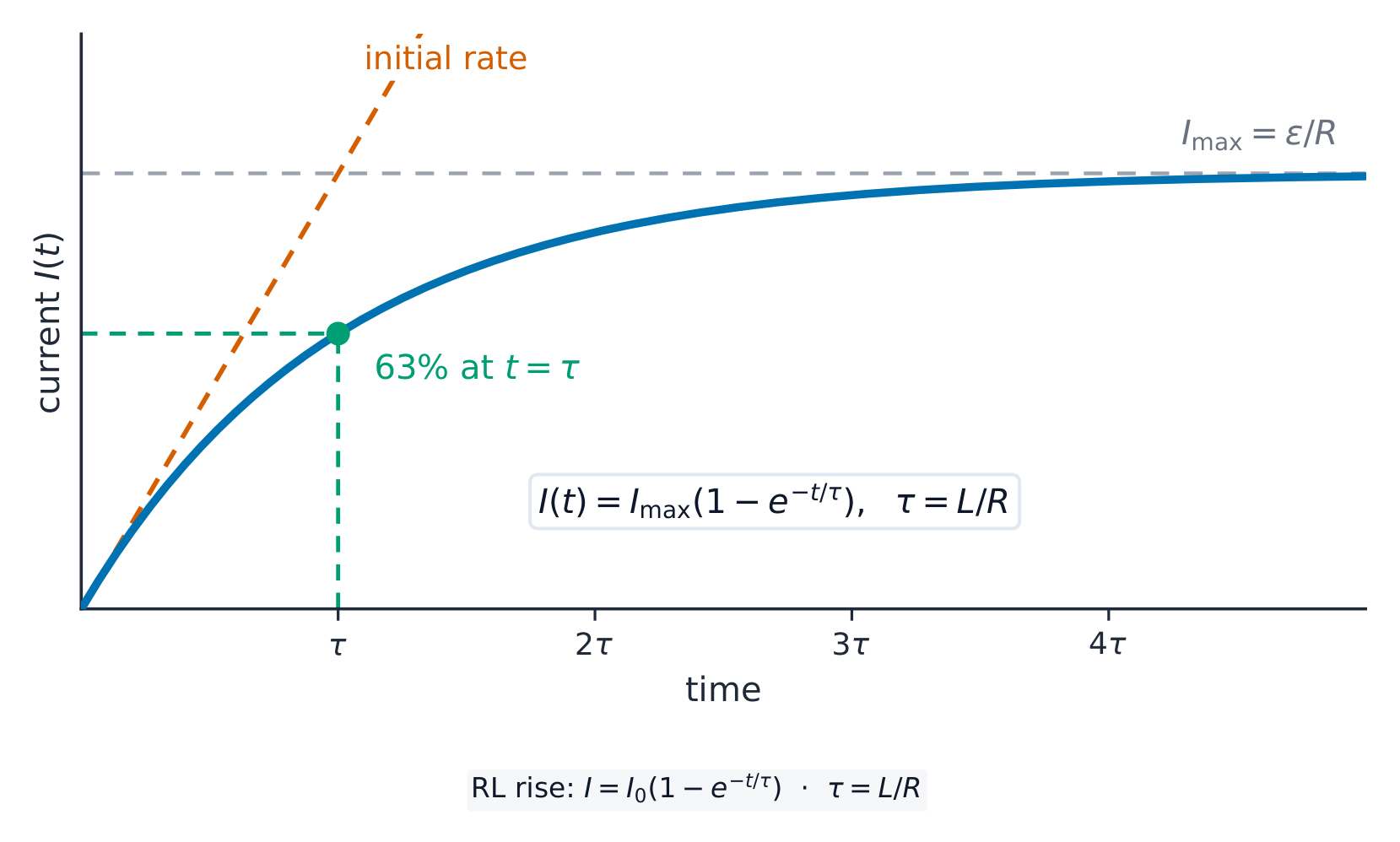
In an RL circuit RL电路, Kirchhoff's loop rule for a battery $\varepsilon$, resistor $R$, and inductor $L$ in series gives a differential equation 微分方程:

$$\varepsilon=IR+L\frac{dI}{dt}\quad\Rightarrow\quad I(t)=\frac{\varepsilon}{R}\big(1-e^{-t/\tau}\big),\qquad \tau=\frac{L}{R}.$$

The time constant 时间常数 $\tau$ sets the pace: after one $\tau$ a rising current reaches about $63\%$ of its final value (a decaying one falls to $37\%$); it is also how long the change would take at the initial rate. Learn the two limits – they answer most conceptual questions:

  • Just after the switch closes ($t=0$): current cannot jump, so the inductor momentarily blocks it, self-inducing an emf equal and opposite to the applied potential difference.
  • Long after ($t\gg\tau$): the current is steady, $dI/dt=0$, and the inductor behaves as a plain wire – the exact opposite of a capacitor.

Worked example. $\varepsilon=12\ \text{V}$, $R=6.0\ \Omega$, $L=3.0\ \text{H}$: final current $\varepsilon/R=2.0\ \text{A}$, $\tau=L/R=0.50\ \text{s}$. At $t=0.50\ \text{s}$ the current is $2.0(1-e^{-1})\approx1.3\ \text{A}$. At $t=0$ the inductor's potential difference is the full $12\ \text{V}$; as $t\to\infty$ it falls to zero. Current, inductor voltage, and stored energy are all exponential in time.

ไทย

ใน วงจร RL Kirchhoff’s loop rule สำหรับแบตเตอรี่ $\varepsilon$, ตัวต้านทาน $R$ และตัวเหนี่ยวนำ $L$ ที่ต่อแบบอนุกรม จะได้สมการเชิงอนุพันธ์:

$$\varepsilon=IR+L\frac{dI}{dt}\quad\Rightarrow\quad I(t)=\frac{\varepsilon}{R}\big(1-e^{-t/\tau}\big),\qquad \tau=\frac{L}{R}.$$

ค่าคงที่เวลา $\tau$ กำหนดอัตราความเร็ว: หลังผ่านไปหนึ่ง $\tau$ กระแสไฟฟ้าที่กำลังเพิ่มขึ้นจะถึงประมาณ $63\%$ ของค่าสุดท้าย (หรือกระแสที่ลดทอนลงจะเหลือ $37\%$);它还代表了如果以初始速率变化所需的时间。เรียนรู้สองกรณีสุดขั้วเหล่านี้ – พวกเขาตอบคำถามเชิงแนวคิดส่วนใหญ่ได้:

  • ทันทีหลังจากสวิตช์เปิด ($t=0$): กระแสไม่สามารถกระโดดได้ ดังนั้นตัวเหนี่ยวนำจะขัดขวางกระแสชั่วคราวโดยเหนี่ยวนำ EMF ในตัวเองที่มีขนาดเท่ากันแต่ทิศทางตรงข้ามกับแรงดันไฟฟ้าที่จ่ายเข้ามา
  • นานหลังจากนั้น ($t\gg\tau$): กระแสคงที่ $dI/dt=0$ และตัวเหนี่ยวนำทำหน้าที่เสมือนสายไฟธรรมดา – ขัดแย้งอย่างสมบูรณ์กับตัวเก็บประจุ
กระแสในวงจร RL เพิ่มแบบเอ็กซ์โพเนนเชียล ถึง 63% ที่หนึ่งค่าคงที่เวลา

ตัวอย่างวิธีทำ. $\varepsilon=12\ \text{V}$, $R=6.0\ \Omega$, $L=3.0\ \text{H}$: กระแสสุดท้าย $\varepsilon/R=2.0\ \text{A}$, $\tau=L/R=0.50\ \text{s}$. ที่ $t=0.50\ \text{s}$ กระแสคือ $2.0(1-e^{-1})\approx1.3\ \text{A}$. ที่ $t=0$ แรงดันไฟฟ้าของตัวเหนี่ยวนำเท่ากับ $12\ \text{V}$ ทั้งหมด; เมื่อ $t\to\infty$它会ลดลงเป็นศูนย์. กระแส, แรงดันไฟฟ้าของตัวเหนี่ยวนำ และพลังงานที่เก็บไว้ ล้วนแปรผันตามเวลาแบบเอ็กซ์โพเนนเชียล

13.6

Circuits with Capacitors and Inductors · ⁨วงจรที่มีตัวเก็บประจุและตัวเหนี่ยวนำ⁩

Syllabus · ⁨หลักสูตร⁩
English

Learning Objective 13.6.A: Describe the physical and electrical properties of a circuit containing a combination of capacitors and a single inductor.

  • 13.6.A.1 In circuits containing only a charged capacitor and an inductor (LC circuits), the maximum current in the inductor can be determined using conservation of energy within the circuit.
  • 13.6.A.2 In LC circuits, the time dependence of the charge stored in the capacitor can be modeled as simple harmonic motion.
    • Equation (derived): $\dfrac{d^2 q}{dt^2} = -\dfrac{1}{LC} q$
  • 13.6.A.3 The angular frequency of an oscillating LC circuit can be derived from the differential equation that describes an LC circuit.
    • Equation (derived): $\omega = \dfrac{1}{\sqrt{LC}}$
ไทย

วัตถุประสงค์การเรียนรู้ 13.6.A: อธิบายคุณสมบัติทางกายภาพและทางไฟฟ้าของวงจรที่ประกอบด้วยตัวเก็บประจุและตัวเหนี่ยวนำหนึ่งตัว

  • 13.6.A.1 ในวงจรที่มีเฉพาะตัวเก็บประจุที่ถูกชาร์จแล้วกับตัวเหนี่ยวนำ (วงจร LC) ค่ากระแสสูงสุดที่ไหลผ่านตัวเหนี่ยวนำสามารถหาได้จากการใช้กฎการอนุรักษ์พลังงานภายในวงจร
  • 13.6.A.2 ในวงจร LC การแปรผันตามเวลาของประจุที่สะสมในตัวเก็บประจุสามารถจำลองได้ด้วยการเคลื่อนที่แบบฮาร์มอนิกอย่างง่าย
    • สมการ (ที่หาได้): $\dfrac{d^2 q}{dt^2} = -\dfrac{1}{LC} q$
  • 13.6.A.3 ความถี่เชิงมุมของการสั่นของวงจร LC สามารถหาได้จากสมการเชิงอนุพันธ์ที่อธิบายวงจร LC
    • สมการ (ที่หาได้): $\omega = \dfrac{1}{\sqrt{LC}}$

Source: College Board AP Course and Exam Description · ⁨แหล่งที่มา: คำอธิบายหลักสูตรและข้อสอบ College Board AP⁩

English
LC circuit: energy sloshes like a spring

An LC circuit LC电路 has no resistance, so nothing dissipates energy: it oscillates 振荡, sloshing energy between the capacitor's electric field and the inductor's magnetic field. The loop rule gives

$$\frac{d^2q}{dt^2}=-\frac{1}{LC}\,q,$$

the same equation as a mass on a spring – simple harmonic motion 简谐运动 with charge playing the role of displacement and

$$\omega=\frac{1}{\sqrt{LC}}.$$

The total energy $\dfrac{q^2}{2C}+\tfrac12LI^2$ stays constant: all in the capacitor at maximum charge, all in the inductor at maximum current.

Worked example. $L=2.0\ \text{H}$, $C=8.0\ \mu\text{F}$: $\omega=\dfrac{1}{\sqrt{2.0(8.0\times10^{-6})}}=250\ \text{rad/s}$, period $T=2\pi/\omega\approx0.025\ \text{s}$. If the capacitor starts charged to $12\ \text{V}$, then $U=\tfrac12CV^2=5.8\times10^{-4}\ \text{J}$, and the maximum current follows from $\tfrac12LI_{\max}^2=U$: $I_{\max}=\sqrt{2U/L}=0.024\ \text{A}$ – conservation of energy 能量守恒, no calculus needed.

ไทย
วงจร LC: พลังงานส่ายไปมาเหมือนสปริง

วงจร LC ไม่มีตัวต้านทาน จึงไม่มีการสูญเสียพลังงาน: มัน แกว่ง ส่ายพลังงานระหว่างสนามไฟฟ้าของตัวเก็บประจุกับสนามแม่เหล็กของตัวเหนี่ยวนำกฎลูปให้

$$\frac{d^2q}{dt^2}=-\frac{1}{LC}\,q,$$

สมการเดียวกันกับมวลบนสปริง – การเคลื่อนที่แบบฮาร์มอนิกง่าย โดยประจุทำหน้าที่แทนการกระจัดและ

$$\omega=\frac{1}{\sqrt{LC}}.$$

พลังงานรวม $\dfrac{q^2}{2C}+\tfrac12LI^2$ คงที่: ทั้งหมดอยู่ในตัวเก็บประจุที่ประจุสูงสุด หรือทั้งหมดอยู่ในตัวเหนี่ยวนำที่กระแสสูงสุด

ตัวอย่างวิธีทำ. $L=2.0\ \text{H}$, $C=8.0\ \mu\text{F}$: $\omega=\dfrac{1}{\sqrt{2.0(8.0\times10^{-6})}}=250\ \text{rad/s}$, ช่วงเวลา $T=2\pi/\omega\approx0.025\ \text{s}$. ถ้าตัวเก็บประจุเริ่มมีประจุ $12\ \text{V}$, แล้ว $U=\tfrac12CV^2=5.8\times10^{-4}\ \text{J}$, และกระแสสูงสุดหาได้จาก $\tfrac12LI_{\max}^2=U$: $I_{\max}=\sqrt{2U/L}=0.024\ \text{A}$ – การอนุรักษ์พลังงาน, ไม่ต้องใช้แคลคูลัส

13.6

Exam tips · ⁨ข้อแนะนำสำหรับการสอบ⁩

English
  • Compute flux $\Phi_B=\int \vec B\cdot d\vec A$ and get the induced EMF from Faraday's law $\varepsilon=-\tfrac{d\Phi_B}{dt}$.
  • Use Lenz's law (the minus sign) to fix the direction: the induced current opposes the change in flux.
  • Flux changes three ways — changing $B$, changing area, or changing angle — identify which and differentiate.
  • For a rod of length $L$ moving at speed $v$, the motional EMF is $BLv$.
  • An inductor stores energy $\tfrac12 LI^2$ and resists changes in current (RL time constant $\tau=L/R$).
ไทย
  • คำนวณ ฟลักซ์ $\Phi_B=\int \vec B\cdot d\vec A$ และหา EMF ที่เหนี่ยวนำจาก กฎของ فارาเดย์ $\varepsilon=-\tfrac{d\Phi_B}{dt}$.
  • ใช้ กฎของ เลนซ์ (เครื่องหมายลบ) เพื่อระบุทิศทาง: กระแสเหนี่ยวนำจะต้านทานการเปลี่ยนแปลงของฟลักซ์
  • ฟลักซ์เปลี่ยนแปลงได้สามแบบ – เปลี่ยน $B$, เปลี่ยนพื้นที่, หรือเปลี่ยนมุม – ระบุ哪种แล้วทำ differentiation
  • สำหรับแท่งยาว $L$ เคลื่อนที่ด้วยความเร็ว $v$, EMF ที่เกิดจากการเคลื่อนที่จะเป็น $BLv$.
  • ตัวเหนี่ยวนำเก็บพลังงาน $\tfrac12 LI^2$ และต้านทาน การเปลี่ยนแปลง ของกระแส (ค่าคงที่เวลา RL $\tau=L/R$).

Interactive lessons on this topic · ⁨บทเรียนเชิงโต้ตอบสำหรับหัวข้อนี้⁩

Work through it step by step, with instant-check exercises. · ⁨ทำทีละขั้นตอน พร้อมแบบฝึกหัดตรวจสอบผลทันที⁩

Past Papers · ⁨ข้อสอบย้อนหลัง⁩

More topics in AP Physics C: Electricity and Magnetism · ⁨หัวข้อเพิ่มเติมใน AP Physics C: Electricity and Magnetism⁩

Log in or create account · ⁨เข้าสู่ระบบหรือสร้างบัญชี⁩

IGCSE, A-Level & AP