| Learning Objective | Essential Knowledge |
|---|---|
8.1.A |
|
8.1.B |
|
8.1.C |
Boundary statement: AP Physics C: Electricity & Magnetism only expects students to make calculations of the electric force between four or fewer interacting charged objects or systems. The analysis of the resulting electric force from more charges is allowed in situations of high symmetry. Note that students are expected to calculate the electric fields of charge distributions, as described in Topics 8.4 and 8.6. |
Tips
AP Physics C: Electricity and Magnetism is the calculus-based electromagnetism course: charges, fields and Gauss's law; electric potential; conductors and capacitors; circuits; magnetic fields; and electromagnetic induction. It is usually taken after Mechanics and assumes that level of calculus.
Gauss's law and Ampère's law decide how this course feels. Both are really about choosing a surface or loop that makes the integral trivial — a skill you build by doing many, not by reading the law. Symmetry is the whole game.
Induction questions punish sign errors more than anything else, so fix one convention for flux direction and use it every time.
Notes cover Gauss's law through to Maxwell's equations, unit by unit, with the vector calculus written out. The library carries the released FRQs; the hardest marks in E&M go to choosing the right symmetry before integrating, so the examples start there.
-
8
Electric Charges, Fields, and Gauss's Law
Watch lesson8.1
Electric Charge and Electric Force
Syllabus
Source: College Board AP Course and Exam Description
Electric charge 电荷 comes in positive and negative; like charges repel, opposites attract. Charge is quantized 量子化 – every charge is a whole-number multiple of the elementary charge 基本电荷 $e=1.6\times10^{-19}\ \text{C}$ – and obeys conservation of charge 电荷守恒: charge is never created or destroyed, only moved. The force between two point charges 点电荷 is Coulomb's law 库仑定律:
$$\vec{F}=\frac{1}{4\pi\varepsilon_0}\frac{q_1 q_2}{r^2}\,\hat{r},$$an inverse-square 平方反比 force along the line joining them, with $\dfrac{1}{4\pi\varepsilon_0}=k=9.0\times10^{9}\ \text{N}\cdot\text{m}^2/\text{C}^2$. For several charges (AP uses four or fewer, unless symmetry helps), add the force vectors on the charge you care about – superposition 叠加.
Charge is a fundamental property 基本属性 of matter, and a point charge is a model that ignores the size of a charged object. The constant $\varepsilon_0$ is the permittivity of free space 真空介电常数 – a material property of the vacuum. The permittivity of matter differs from $\varepsilon_0$, set by how easily the material polarizes, which is why a dielectric between charges weakens the force. Note too that although the electric force is far stronger than gravity, gravity dominates at astronomical scales because large bodies are nearly neutral.
Worked example. Two $+2.0\ \mu\text{C}$ charges sit $0.30\ \text{m}$ apart: $F=\dfrac{kq_1q_2}{r^2}=\dfrac{9.0\times10^{9}(2.0\times10^{-6})^2}{(0.30)^2}=0.40\ \text{N}$, repulsive.
Worked example (vectors). Charges $+3.0\ \mu\text{C}$ and $-3.0\ \mu\text{C}$ sit at two corners of a right angle, each $0.30\ \text{m}$ from a $+1.0\ \mu\text{C}$ charge at the corner. Each exerts $F=\dfrac{(9.0\times10^{9})(3.0\times10^{-6})(1.0\times10^{-6})}{0.09}=0.30\ \text{N}$ – one a push, one a pull, at right angles to each other. The net force is $F_{\text{net}}=\sqrt{0.30^2+0.30^2}=0.42\ \text{N}$, pointing between them. Never add magnitudes blindly: components first.
ExploreExplore the field of a source charge
Change the charge's sign and size. Lines point away from positive and toward negative, and their $1/r^2$ crowding near the charge mirrors why Coulomb's force $F = k\,|q_1 q_2|/r^2$ weakens with distance.
Vocabulary TrainEnglish Electric charge/ɪˈlektrɪk tʃɑːdʒ/ quantized/ˈkwɒntaɪzd/ elementary charge/ˌelɪˈmentəri tʃɑːdʒ/ conservation of charge/ˌkɒnsəˈveɪʃn ɒv tʃɑːdʒ/ point charges/pɔɪnt ˈtʃɑːdʒɪz/ Coulomb's law/ˈkuːlɒmz lɔː/ inverse-square/ɪnˈvɜːs skweə/ superposition/ˌsuːpəpəˈzɪʃn/ fundamental property/ˌfʌndəˈmentl ˈprɒpəti/ permittivity of free space/ˌpɜːmɪˈtɪvəti ɒv friː speɪs/ 8.2
Electric Charge and the Process of Charging
Syllabus
Learning Objective Essential Knowledge 8.2.A
Describe the behavior of a system using conservation of charge.- 8.2.A.1 The net charge or charge distribution of a system can change in response to the presence of, or changes in, the net charge or charge distribution of other systems.
- 8.2.A.1.i The net charge of a system can change due to friction or contact between systems.
- 8.2.A.1.ii Induced charge separation occurs when the electrostatic force between two systems alters the distribution of charges within the systems, resulting in the polarization of one or both systems.
- 8.2.A.1.iii Induced charge separation can occur in neutral systems.
- 8.2.A.2 Any change to a system's net charge is due to a transfer of charge between the system and its surroundings.
- 8.2.A.2.i The charging of a system typically involves the transfer of electrons to and from the system.
- 8.2.A.2.ii The net charge of a system will be constant unless there is a transfer of charge to or from the system.
- 8.2.A.3 Grounding involves electrically connecting a charged object to a much larger and approximately neutral system (e.g., Earth).
Source: College Board AP Course and Exam Description
A conductor 导体 lets charge move freely; an insulator 绝缘体 holds it in place. Objects gain net charge three ways:
- Charging by friction 摩擦起电: rubbing transfers electrons from one surface to the other.
- Charging by conduction 传导起电: touching a charged object shares charge of the same sign.
- Charging by induction 感应起电: a nearby charge pushes the conductor's charge apart; ground 接地 the far side, remove the ground wire first, and the conductor is left with the opposite sign – all without contact.
An insulator cannot pass charge, but it can develop polarization 极化: its molecules stretch or turn so one face is slightly positive and the other slightly negative. That is why a charged comb picks up neutral paper scraps. An electroscope 验电器 shows net charge by its leaves repelling; on any isolated conductor the excess charge sits entirely on the outer surface.
ExploreExplore charging by rubbing
Rubbing transfers electrons onto the object, leaving it negative. A charged object then attracts a neutral wall or hair (by polarization) but repels another like-charged object — the same electron transfer behind friction, conduction, and induction.
Vocabulary TrainEnglish conductor/kənˈdʌktə/ insulator/ˈɪnsjuːleɪtə/ Charging by friction/ˈtʃɑːdʒɪŋ baɪ ˈfrɪkʃn/ Charging by conduction/ˈtʃɑːdʒɪŋ baɪ kənˈdʌkʃn/ Charging by induction/ˈtʃɑːdʒɪŋ baɪ ɪnˈdʌkʃn/ ground/ɡraʊnd/ polarization/ˌpəʊləraɪˈzeɪʃn/ electroscope/ɪˌlektrəʊˈskəʊp/ 8.3
Electric Fields
Syllabus
Learning Objective Essential Knowledge 8.3.A
Describe the electric field produced by a charged object or configuration of point charges.- 8.3.A.1 Electric fields may originate from charged objects.
- 8.3.A.2 The electric field at a given point is the ratio of the electric force exerted on a test charge at the point to the charge of the test charge.
- Relevant equation: $\vec{E} = \dfrac{\vec{F}_E}{q}$
- 8.3.A.2.i A test charge is a point charge of small enough magnitude such that its presence does not significantly affect an electric field in its vicinity.
- 8.3.A.2.ii An electric field points away from isolated positive charges and toward isolated negative charges.
- 8.3.A.2.iii The electric force exerted on a positive test charge by an electric field is in the same direction as the electric field.
- 8.3.A.3 The electric field is a vector quantity and can be represented in space using vector field maps.
- 8.3.A.3.i The net electric field at a given location is the vector sum of individual electric fields created by nearby charged objects.
- 8.3.A.3.ii Electric field maps use vectors to depict the magnitude and direction of the electric field at many locations within a given region.
- 8.3.A.3.iii Electric field line diagrams are simplified models of electric field maps and can be used to determine the relative magnitude and direction of the electric field at any position in the diagram.
8.3.B
Describe the electric field generated by charged conductors or insulators.- 8.3.B.1 While in electrostatic equilibrium, the excess charge of a conductor is distributed on the surface of the conductor, and the electric field within the conductor is zero.
- 8.3.B.1.i At the surface of a charged conductor, the electric field is perpendicular to the surface.
- 8.3.B.1.ii The electric field outside an isolated sphere with spherically symmetric charge distribution is the same as the electric field due to a point charge with the same net charge as the sphere located at the center of the sphere.
- 8.3.B.2 While in electrostatic equilibrium, the excess charge of an insulator is distributed throughout the interior of the insulator as well as at the surface, and the electric field within the insulator may have a nonzero value.
Source: College Board AP Course and Exam Description
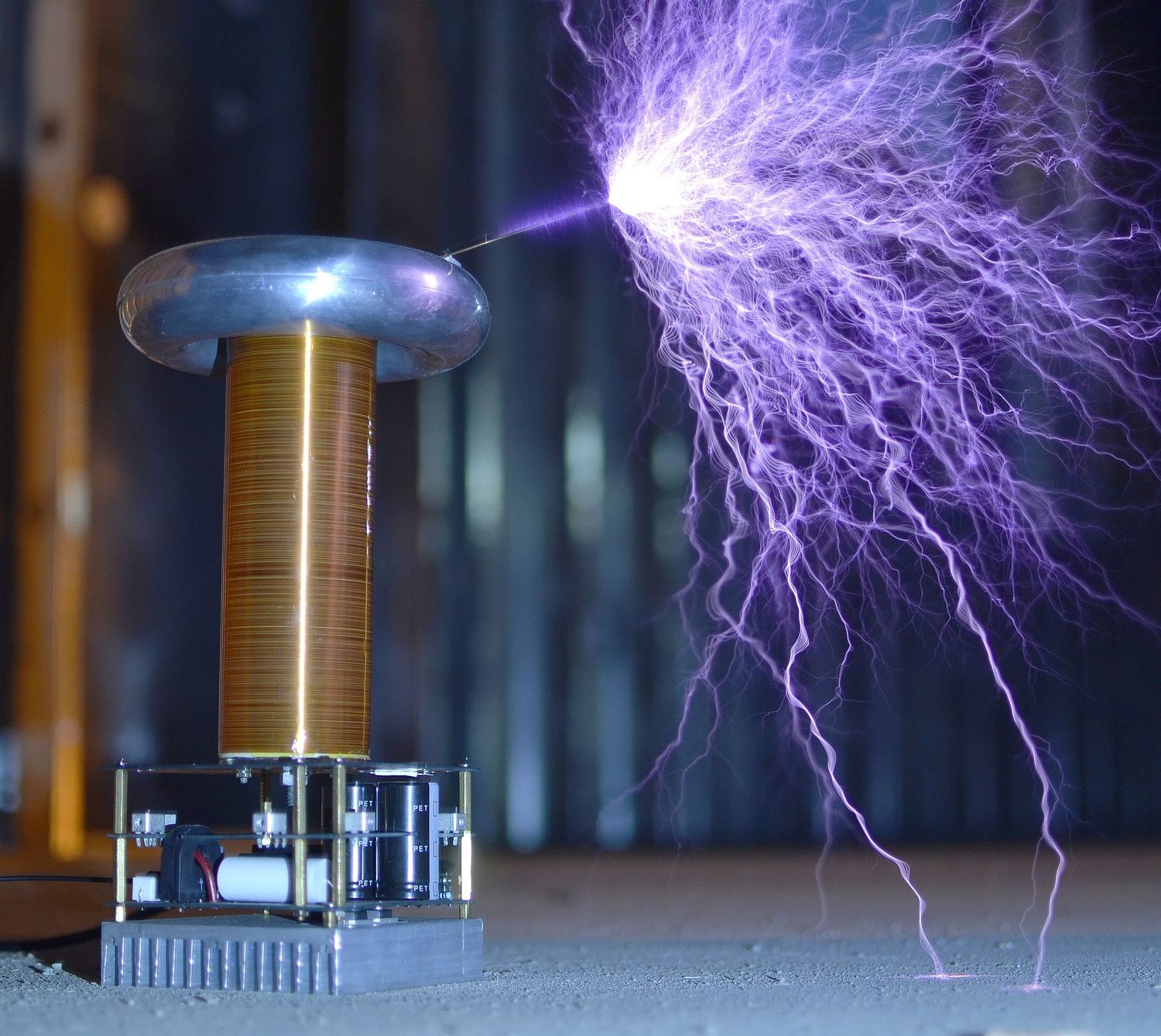
The electric field of a dipole A Tesla coil throws sparks: it raises the voltage so high that the electric field ionizes the surrounding air, and charge leaps across as a visible discharge The electric field 电场 at a point is the force per unit charge that a small positive test charge 检验电荷 would feel there:
$$\vec{E}=\frac{\vec{F}}{q},\qquad \vec{E}=\frac{1}{4\pi\varepsilon_0}\frac{q}{r^2}\,\hat{r}\ \text{(point charge)}.$$A charge placed in a field feels $\vec{F}=q\vec{E}$ – positive charges along the field, negative charges against it. Fields from several sources add as vectors (superposition again). Field lines 电场线 make the field visible: they point away from positive charge and toward negative, their density shows the strength, and they never cross.
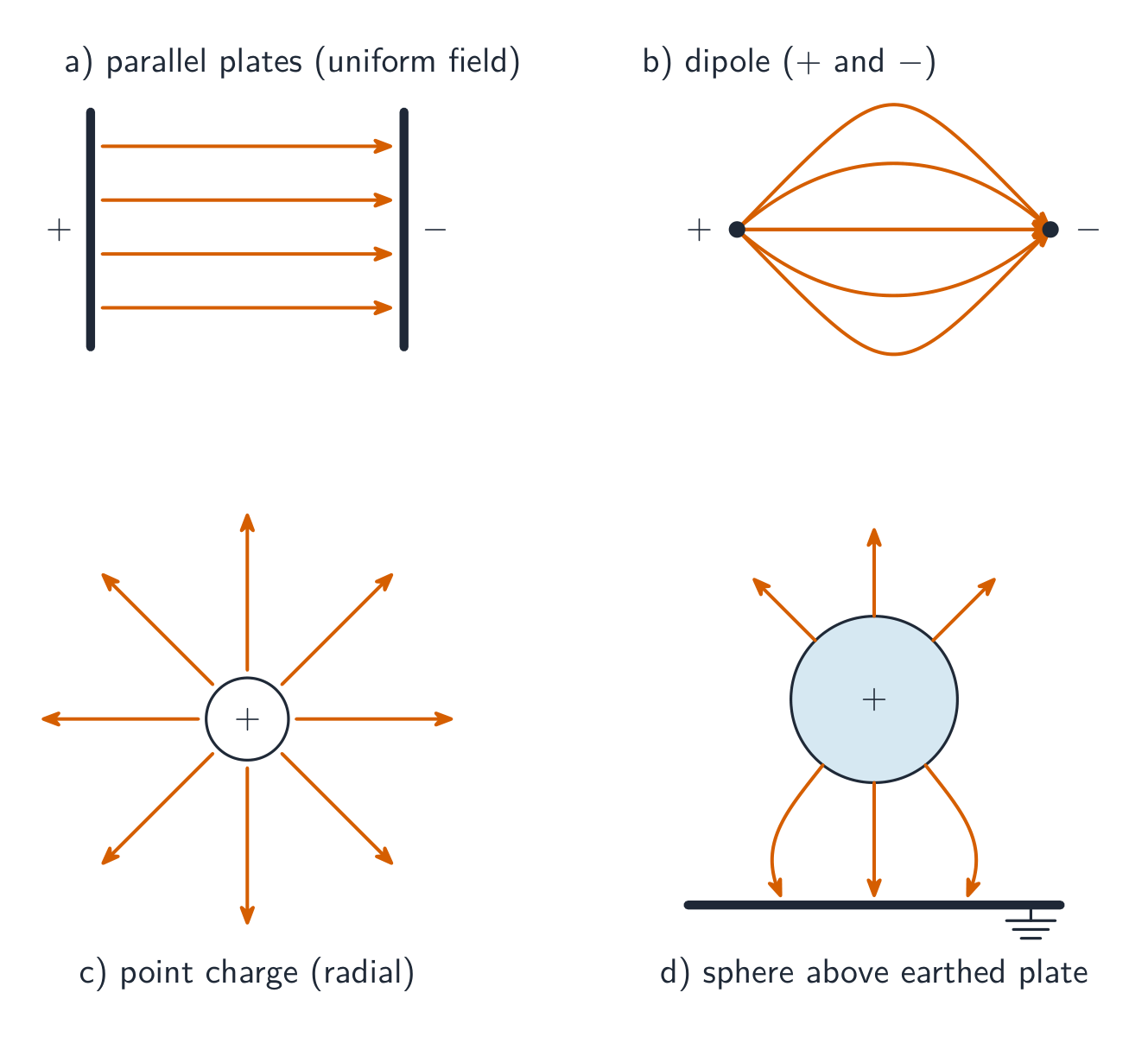
Electric field-line patterns for parallel plates, a dipole, and a point charge 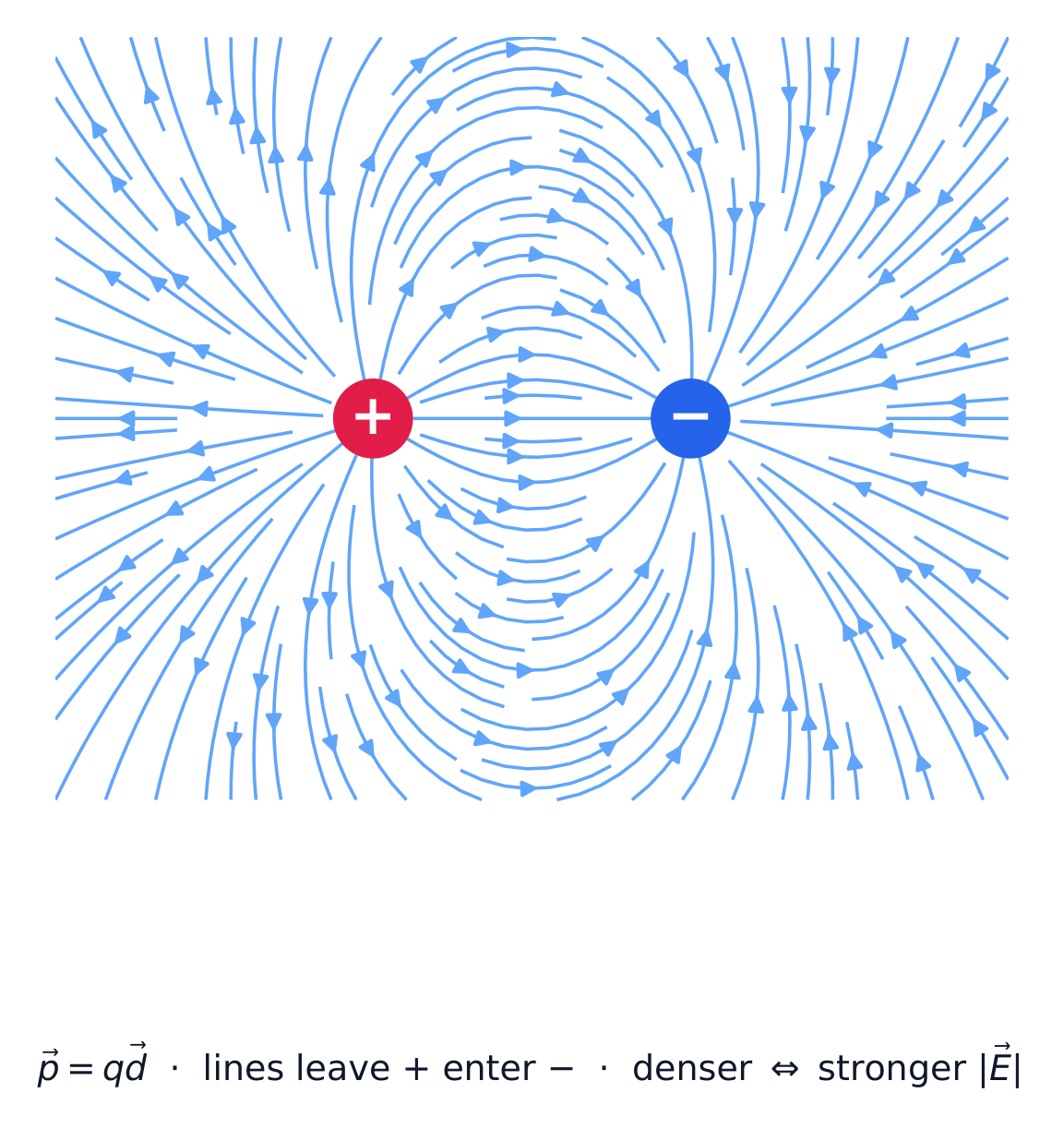
Electric field lines of a dipole point from the positive to the negative charge In a uniform 均匀 field a charge feels a constant force, so it accelerates uniformly – launched sideways, it follows a parabola, just like a projectile in gravity.
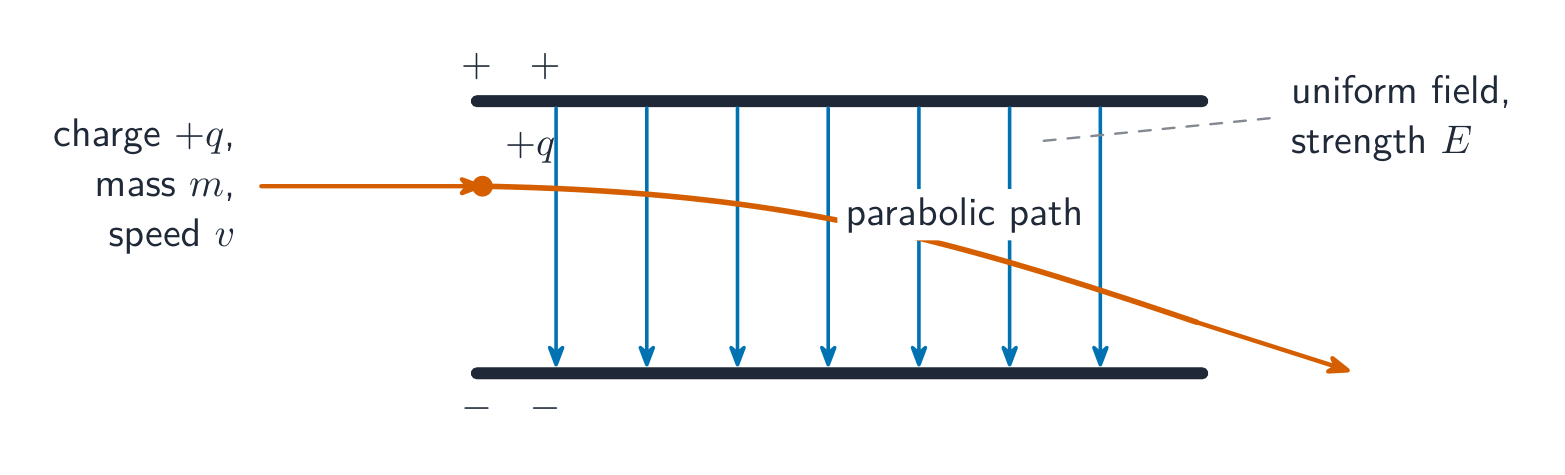
A charge crossing a uniform field follows a parabolic path 
Charge spreads over the dome and onto the hair; like charges repel, so the strands push apart ExploreExplore field lines of a point charge
Set the charge positive or negative. Field lines start on positive and end on negative charge, never cross, and crowd together where $\vec{E}$ is strongest — the line density is proportional to the field magnitude.
Vocabulary TrainEnglish electric field/ɪˈlektrɪk fiːld/ test charge/test tʃɑːdʒ/ Field lines/fiːld laɪnz/ uniform/ˈjuːnɪfɔːm/ 8.4
Electric Fields of Charge Distributions
Syllabus
Learning Objective Essential Knowledge 8.4.A
Describe the electric field resulting from a given charge distribution.- 8.4.A.1 Expressions for the electric field of specified charge distributions can be found using integration and the principle of superposition.
- Relevant equation: $\vec{E} = \dfrac{1}{4\pi\varepsilon_0} \displaystyle\int \dfrac{dq}{r^2} \hat{r}$
- 8.4.A.2 Symmetry considerations of certain charge distributions can simplify analysis of the electric field resulting from those charge distributions.
Boundary statement: AP Physics C: Electricity & Magnetism only expects students to use calculus to find the electric field resulting from the following charge distributions and locations: an infinitely long, uniformly charged wire or cylinder at a distance from its central axis, a thin ring of charge at a location along the axis of the ring, a semicircular arc or part of a semicircular arc at its center, and a finite wire or line charge at a point collinear with the line charge or at a location along its perpendicular bisector.
Source: College Board AP Course and Exam Description
For a continuous charge distribution 连续电荷分布, cut the object into pieces $dq$ and integrate their point-charge fields:
$$\vec{E}=\frac{1}{4\pi\varepsilon_0}\int \frac{dq}{r^2}\,\hat{r}.$$Write $dq$ using the right density: $\lambda\,dl$ with the linear charge density 线电荷密度 (a line or ring), $\sigma\,dA$ with the surface charge density 面电荷密度, or $\rho\,dV$ with the volume charge density 体电荷密度. Then use symmetry 对称性 to cancel components before integrating – that sentence is usually a scored step. AP's calculus cases: a finite line (collinear point or perpendicular bisector), an infinite wire or cylinder, a ring on its axis, and an arc at its centre.
Worked example (ring, on axis). A ring of radius $R$ carries charge $Q$. At a point $z$ along the axis, each element is a distance $\sqrt{R^2+z^2}$ away, and by symmetry the sideways components cancel, leaving only the axial part ($\cos\alpha=z/\sqrt{R^2+z^2}$):
$$E_z=\frac{1}{4\pi\varepsilon_0}\int\frac{dq}{R^2+z^2}\cdot\frac{z}{\sqrt{R^2+z^2}}=\frac{1}{4\pi\varepsilon_0}\frac{Qz}{(R^2+z^2)^{3/2}}.$$Check the limits: $E=0$ at the centre ($z=0$), and far away ($z\gg R$) it becomes $kQ/z^2$ – a point charge, as it must.
Vocabulary TrainEnglish continuous charge distribution/kənˈtɪnjuːəs tʃɑːdʒ ˌdɪstrɪˈbjuːʃn/ linear charge density/ˈlɪnɪə tʃɑːdʒ ˈdensɪti/ surface charge density/ˈsɜːfɪs tʃɑːdʒ ˈdensɪti/ volume charge density/ˈvɒljuːm tʃɑːdʒ ˈdensɪti/ symmetry/ˈsɪmətri/ 8.5
Electric Flux
Syllabus
Learning Objective Essential Knowledge 8.5.A
Describe the electric flux through an arbitrary area or geometric shape.- 8.5.A.1 Flux describes the amount of a given quantity that passes through a given area.
- 8.5.A.2 For an electric field $\vec{E}$ that is constant across an area $\vec{A}$, the electric flux through the area is defined as $\Phi_E = \vec{E} \bullet \vec{A}$.
- 8.5.A.2.i The direction of the area vector is defined as perpendicular to the plane of the surface and outward from a closed surface.
- 8.5.A.2.ii The sign of flux is given by the dot product of the electric field vector and the area vector.
- 8.5.A.3 The total electric flux passing through a surface is defined by the surface integral of the electric field over the surface.
- Relevant equation: $\Phi_E = \displaystyle\int \vec{E} \cdot d\vec{A}$
Source: College Board AP Course and Exam Description
Electric flux & Gauss's law Electric flux 电通量 measures how much field passes through a surface:
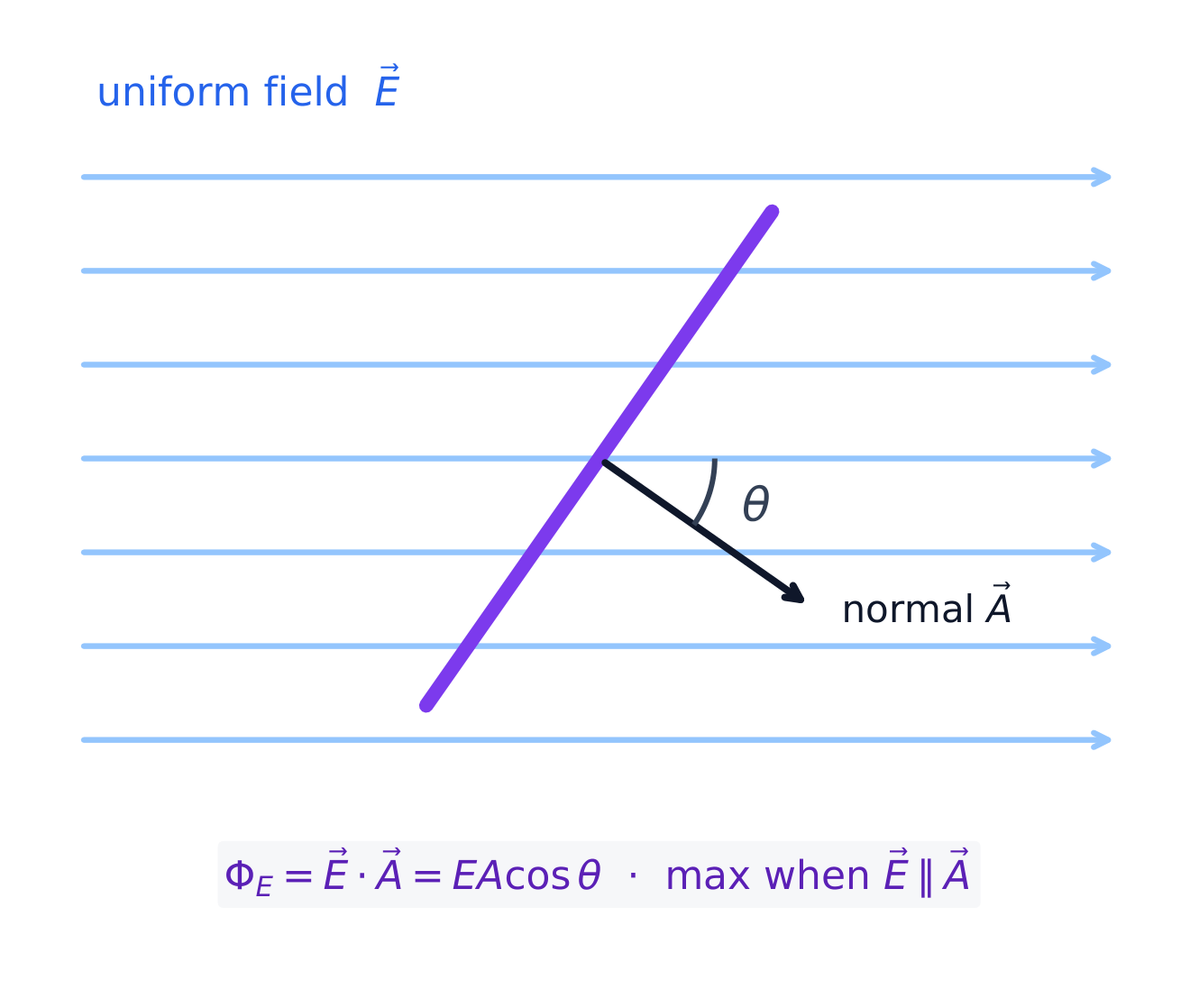
$$\Phi_E=\int \vec{E}\cdot d\vec{A}.$$For a uniform field through a flat area, $\Phi_E=EA\cos\theta$, where the area vector 面积矢量 is perpendicular to the surface. Flux is positive where field lines exit a closed surface and negative where they enter – only the perpendicular component of $\vec{E}$ counts.
Electric flux through a surface depends on the angle between the field and the surface normal Vocabulary TrainEnglish Electric flux/ɪˈlektrɪk flʌks/ area vector/ˈeərɪə ˈvektə/ 8.6
Gauss's Law
Syllabus
Learning Objective Essential Knowledge 8.6.A
Describe the properties of a charge distribution by applying Gauss's law.- 8.6.A.1 Gauss's law relates electric flux through a Gaussian surface to the charge enclosed by that surface.
- Relevant equations: $\Phi_E = \dfrac{q_{\text{enc}}}{\varepsilon_0}$ and $\displaystyle\oint \vec{E} \cdot d\vec{A} = \dfrac{q_{\text{enc}}}{\varepsilon_0}$
- 8.6.A.2 A Gaussian surface is a three-dimensional, closed surface.
- 8.6.A.3 The total electric flux through a Gaussian surface is independent of the size of the Gaussian surface if the amount of enclosed charge remains constant.
- 8.6.A.4 Gaussian surfaces are typically constructed such that the electric field generated by the enclosed charge is either perpendicular or parallel to different regions of the Gaussian surface, resulting in a simplified surface integral.
- 8.6.A.5 If a function of charge density is given for a charge distribution, the total charge can be determined by integrating the charge density over the length (one dimension), area (two dimensions), or volume (three dimensions) of the charge distribution. For example: $Q_{\text{total}} = \displaystyle\int \rho(\vec{r})\, dV$
- 8.6.A.6 Maxwell's equations are the collection of equations that fully describe electromagnetism. Gauss's law is Maxwell's first equation.
- Relevant equation: $\displaystyle\oint \vec{E} \cdot d\vec{A} = \dfrac{q_{\text{enc}}}{\varepsilon_0}$
Boundary statement: AP Physics C: Electricity & Magnetism only expects students to quantitatively apply Gauss's law to point charges and charge distributions that have spherical, cylindrical, or planar symmetry.
Source: College Board AP Course and Exam Description
Gauss's law 高斯定律 – the first of Maxwell's equations – relates the flux through any closed surface to the charge inside it:
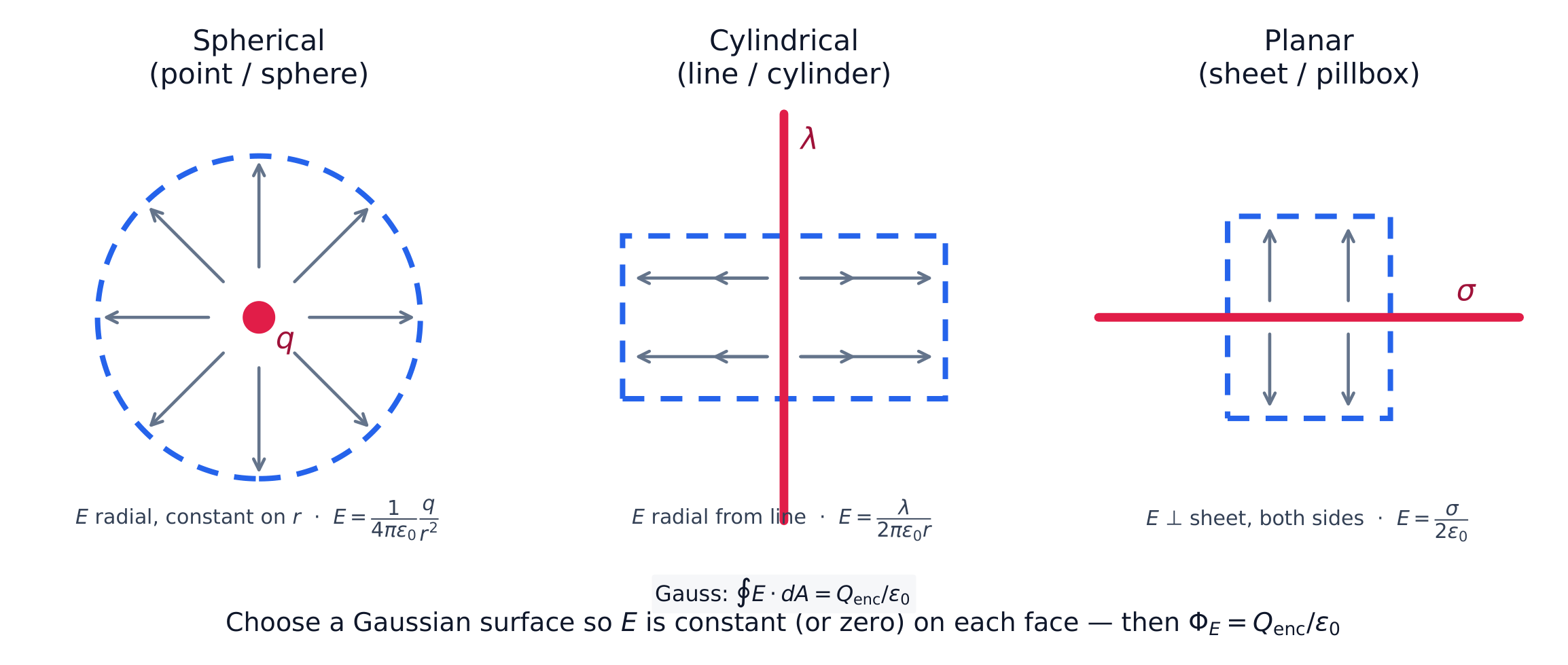
$$\oint \vec{E}\cdot d\vec{A}=\frac{Q_{\text{enc}}}{\varepsilon_0}.$$It is true for any closed surface, but it solves for $E$ only when symmetry lets you choose a Gaussian surface 高斯面 on which $E$ is constant and perpendicular (or parallel, contributing zero). The three symmetries AP tests: spherical symmetry 球对称 (concentric sphere), cylindrical symmetry 柱对称 (coaxial cylinder), and planar symmetry 平面对称 (a straddling "pillbox").
A Gaussian surface is chosen to match the symmetry of the charge Worked example (sphere). Outside a sphere of total charge $Q$, a spherical Gaussian surface of radius $r$ gives $E(4\pi r^2)=Q/\varepsilon_0$, so $E=\dfrac{kQ}{r^2}$ – identical to a point charge at the centre. Inside a uniformly charged solid sphere of radius $R$, the surface encloses only $Q_{\text{enc}}=Q\,r^3/R^3$, so $E=\dfrac{kQr}{R^3}$: zero at the centre, growing linearly to the surface.
Worked example (wire). For an infinite wire with charge per length $\lambda$, take a coaxial cylinder of radius $r$ and length $L$. The ends contribute nothing ($\vec{E}\perp d\vec{A}$), so $E(2\pi rL)=\dfrac{\lambda L}{\varepsilon_0}$ and $E=\dfrac{\lambda}{2\pi\varepsilon_0 r}$. The same pillbox method gives an infinite sheet's field, $E=\dfrac{\sigma}{2\varepsilon_0}$, uniform on both sides.
Exam skill. A full-credit Gauss's-law answer has four parts: name the surface, state the symmetry argument (why $E$ is constant and perpendicular on it), count $Q_{\text{enc}}$, then solve. Skipping the symmetry sentence loses the reasoning point – and remember Gauss's law also explains why $E=0$ inside any conductor in equilibrium.
Vocabulary TrainEnglish Gauss's law/ˈɡaʊsɪz lɔː/ Gaussian surface/ˈɡaʊʃn ˈsɜːfɪs/ spherical symmetry/sˈferɪkl ˈsɪmətri/ cylindrical symmetry/sɪˈlɪndrɪkl ˈsɪmətri/ planar symmetry/ˈpleɪnə ˈsɪmətri/ 8.6
Exam tips
- Use Coulomb's law $F=\tfrac{1}{4\pi\varepsilon_0}\tfrac{q_1 q_2}{r^2}$ and superpose forces as vectors (components, not magnitudes).
- For a continuous charge, integrate $d\vec E$ over $dq=\lambda\,dl,\ \sigma\,dA,\ \rho\,dV$; use symmetry to cancel components.
- The field points away from positive and toward negative charge; draw field lines correctly.
- Distinguish the force on a charge ($\vec F=q\vec E$) from the field the charge creates.
- Keep the constant $k=\tfrac{1}{4\pi\varepsilon_0}$ straight and check units.
- 8.2.A.1 The net charge or charge distribution of a system can change in response to the presence of, or changes in, the net charge or charge distribution of other systems.
-
9
Electric Potential
Watch lesson9.1
Electric Potential Energy
Syllabus
Learning Objective Essential Knowledge 9.1.A
Describe the electric potential energy of a system.- 9.1.A.1 The electric potential energy of a system of two point charges equals the amount of work required for an external force to bring the point charges to their current positions from infinitely far away.
- 9.1.A.2 The general form for the electric potential energy between two charged objects is given by the equation
- Equation: $U_E = \dfrac{1}{4\pi\varepsilon_0}\dfrac{q_1 q_2}{r} = k\dfrac{q_1 q_2}{r}$.
- 9.1.A.3 The total electric potential energy of a system can be determined by finding the sum of the electric potential energies of the individual interactions between each pair of charged objects in the system.
Source: College Board AP Course and Exam Description
When you push two like charges together, you do work 功 against the electric force. That work is stored by the pair as electric potential energy 电势能:
$$U_E=\frac{1}{4\pi\varepsilon_0}\frac{q_1 q_2}{r}=k\frac{q_1 q_2}{r}.$$$U_E$ is defined as the work an external force must do to bring the charges from infinitely far away to a distance $r$ apart. The signs carry the physics:
- Like charges: $U_E>0$. An outside push was needed to bring them together. If released, they fly apart, and the stored energy becomes kinetic energy 动能.
- Opposite charges: $U_E<0$. The pair is bound. You must supply $|U_E|$ of work to pull them apart to infinity.
The electric force is a conservative force 保守力: the work it does depends only on the start and end points, not the path, and equals $-\Delta U_E$.
For a system 系统 of several charges, add the potential energy of every distinct pair:
$$U_{\text{total}}=k\!\left(\frac{q_1q_2}{r_{12}}+\frac{q_1q_3}{r_{13}}+\frac{q_2q_3}{r_{23}}\right).$$Worked example. Three $+2.0\ \mu\text{C}$ charges sit at the corners of an equilateral triangle with sides $0.30\ \text{m}$. Each pair stores $U=\dfrac{kq^2}{r}=\dfrac{(9.0\times10^{9})(2.0\times10^{-6})^2}{0.30}=0.12\ \text{J}$. There are three pairs, so $U_{\text{total}}=3\times0.12\ \text{J}=0.36\ \text{J}$. This is the work needed to assemble the triangle from infinity – and the kinetic energy the charges would share if all three were released.
Vocabulary TrainEnglish work/wɜːk/ electric potential energy/ɪˈlektrɪk pəˈtenʃl ˈenədʒi/ kinetic energy/kɪˈnetɪk ˈenədʒi/ conservative force/kənˈsɜːvətɪv fɔːs/ system/ˈsɪstəm/ 9.2
Electric Potential
Syllabus
Learning Objective Essential Knowledge 9.2.A
Describe the electric potential due to a configuration of charged objects.- 9.2.A.1 Electric potential describes the electric potential energy per unit charge at a point in space.
- 9.2.A.2 Expressions for the electric potential of charge distributions can be found using integration and the principle of superposition.
- Equation: $V = \dfrac{1}{4\pi\varepsilon_0}\displaystyle\int \dfrac{dq}{r}$
- 9.2.A.2.i The electric potential for single point charge is
- Equation: $V = \dfrac{q}{4\pi\varepsilon_0 r}$.
- 9.2.A.2.ii The electric potential due to multiple point charges can be determined by the principle of scalar superposition of the electric potential due to each of the point charges.
- Equation: $V = \dfrac{1}{4\pi\varepsilon_0}\displaystyle\sum_i \dfrac{q_i}{r_i}$
- 9.2.A.3 The electric potential difference between two points is the change in electric potential energy per unit charge when a test charge is moved between the two points.
- Equation: $\Delta V = \dfrac{\Delta U_E}{q}$
- 9.2.A.4 Electric potential difference may also result from chemical processes that cause positive and negative charges to separate, such as in a battery.
Boundary statement: AP Physics C: Electricity & Magnetism only expects students to use calculus to find the electric potential resulting from the following charge distributions and locations: an infinitely long, uniformly charged wire or cylinder at a distance from its central axis, a thin ring of charge at a location along the axis of the ring, a semicircular arc or part of a semicircular arc at its center, and a finite wire or line charge at a point collinear with the line charge or at a location along its perpendicular bisector.
9.2.B
Describe the relationship between electric potential and electric field.- 9.2.B.1 The value of an electric field component in any direction at a given location is equal to the negative of the spatial rate of change in electric potential at that location.
- Equation: $E_x = -\dfrac{dV}{dx}$
- 9.2.B.2 The change in electric potential between two points can be determined by integrating the dot product of the electric field and the displacement along the path connecting the points.
- Equation: $\Delta V = V_b - V_a = -\displaystyle\int_a^b \vec{E}\cdot d\vec{r}$
- 9.2.B.3 Electric field vector maps and equipotential lines are tools to describe the field produced by a charge or configuration of charges and can be used to predict the motion of charged objects in the field.
- 9.2.B.3.i Equipotential lines represent lines of equal electric potential. These lines are also referred to as isolines of electric potential.
- 9.2.B.3.ii Isolines are perpendicular to electric field vectors. An isoline map of electric potential can be constructed from an electric field vector map, and an electric field map may be constructed from an isoline map.
- 9.2.B.3.iii An electric field vector points in the direction of decreasing potential.
- 9.2.B.3.iv There is no component of an electric field along an isoline.
Source: College Board AP Course and Exam Description
Electric potential 电势 is electric potential energy per unit charge at a point in space. It is measured in volts ($1\ \text{V}=1\ \text{J/C}$):
$$V=\frac{U_E}{q},\qquad V=\frac{1}{4\pi\varepsilon_0}\frac{q}{r}\ \text{(point charge)}.$$Potential is a scalar 标量: it has a sign but no direction. This makes $V$ far easier to work with than the field $\vec{E}$. For several point charges 点电荷, use scalar superposition 叠加 – add the potentials with their signs:
$$V=\frac{1}{4\pi\varepsilon_0}\sum_i \frac{q_i}{r_i}.$$Worked example. The potential $0.10\ \text{m}$ from a $+3.0\ \text{nC}$ point charge is $V=\dfrac{kq}{r}=\dfrac{9.0\times10^{9}(3.0\times10^{-9})}{0.10}=270\ \text{V}$. Now add a $-3.0\ \text{nC}$ charge $0.30\ \text{m}$ from the same point: it contributes $\dfrac{9.0\times10^{9}(-3.0\times10^{-9})}{0.30}=-90\ \text{V}$, so the total is $270-90=180\ \text{V}$. Just a signed sum – no vector components to resolve.
Continuous charge distributions
For a continuous charge distribution 连续电荷分布, cut it into small pieces $dq$, treat each piece as a point charge, and integrate 积分:
$$V=\frac{1}{4\pi\varepsilon_0}\int\frac{dq}{r}.$$This is a scalar integral, so it is usually much easier than the field integral. AP expects you to handle four shapes with calculus: a thin ring (at a point on its axis), an arc (at its centre), a finite line or wire (collinear, or on its perpendicular bisector), and an infinitely long wire or cylinder (at a distance from its axis).
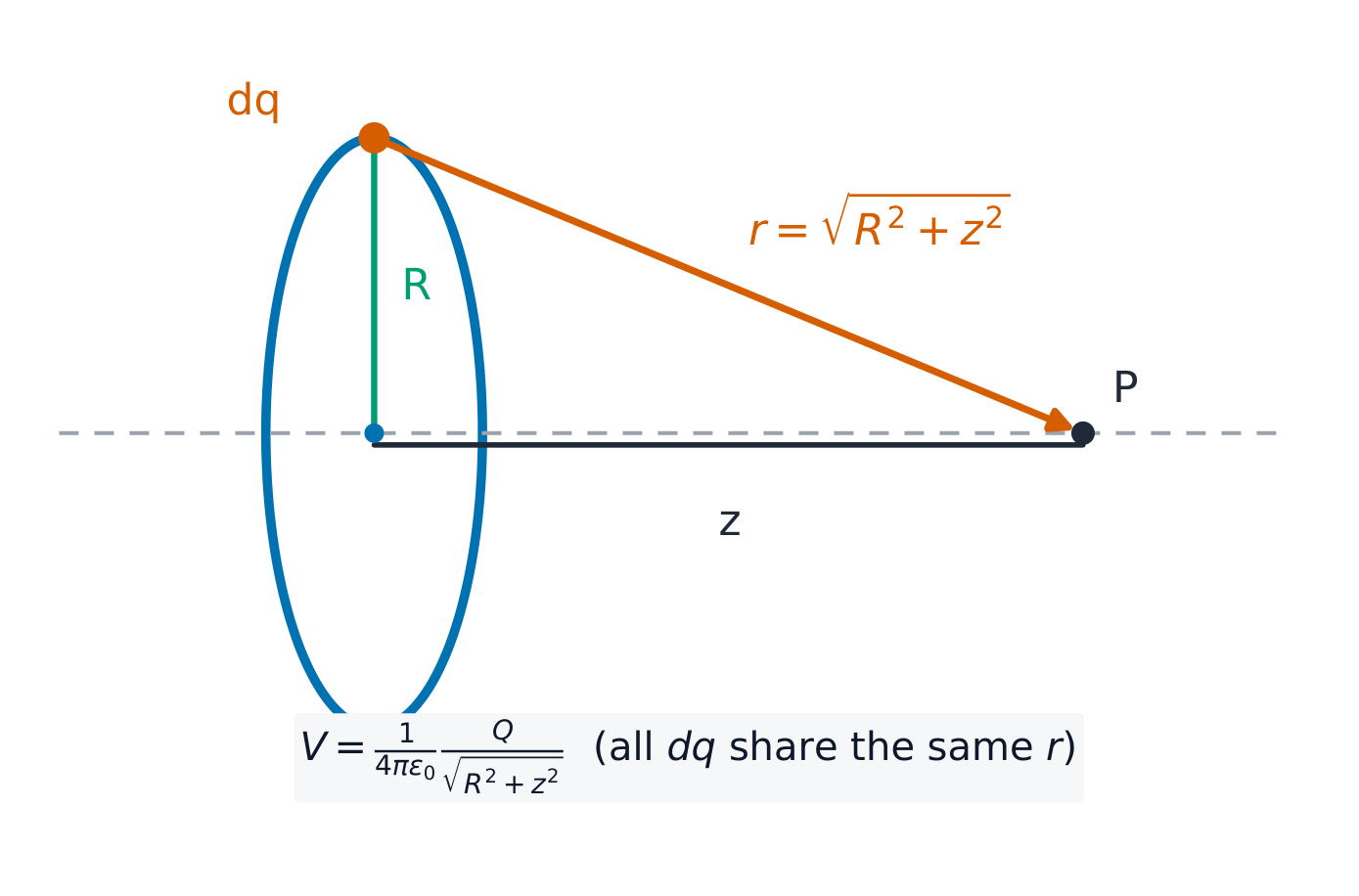
A ring of charge: every element dq is the same distance from an axis point Worked example (ring of charge). A thin ring of radius $R$ carries total charge $Q$. For a point $P$ on the axis a distance $z$ from the centre, every element $dq$ sits at the same distance $r=\sqrt{R^2+z^2}$ from $P$. The distance is constant, so it comes out of the integral:
$$V=\frac{1}{4\pi\varepsilon_0}\int\frac{dq}{\sqrt{R^2+z^2}}=\frac{1}{4\pi\varepsilon_0}\frac{Q}{\sqrt{R^2+z^2}}.$$On an FRQ, say that $r$ is the same for every element – that statement is the marked step. The same idea gives $V=kQ/R$ at the centre of any arc, whatever its angle.
From potential to field
Potential and field contain the same information, linked by a derivative in each direction and by a path integral:
$$E_x=-\frac{dV}{dx},\qquad \Delta V=V_b-V_a=-\int_a^b \vec{E}\cdot d\vec{r}.$$The field is the negative gradient 梯度 of the potential: $\vec{E}$ points from high potential to low potential, "downhill". Where $V$ changes quickly, the field is strong.
Worked example. Along the $x$-axis, $V(x)=3x^{2}-2x$ (volts, with $x$ in metres). Then $E_x=-\dfrac{dV}{dx}=2-6x\ \text{V/m}$. At $x=0.50\ \text{m}$, $E_x=-1.0\ \text{V/m}$: the field there points in the $-x$ direction.
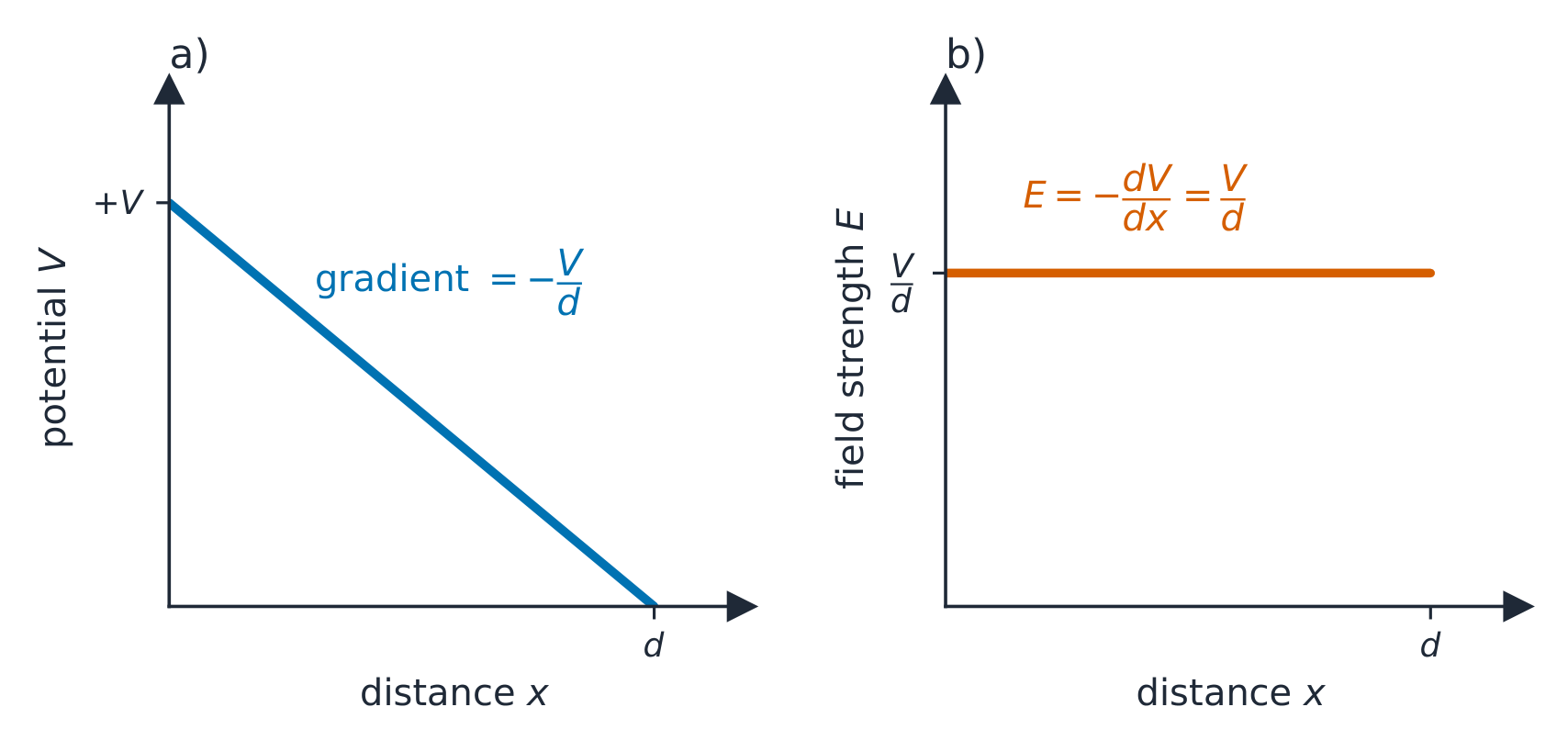
In a uniform field the potential falls steadily with distance The potential difference 电势差 between two points is the change in potential energy per unit charge moved between them: $\Delta V=\Delta U_E/q$. A battery makes a potential difference chemically: reactions inside separate positive from negative charge and hold the terminals a fixed $\Delta V$ apart.
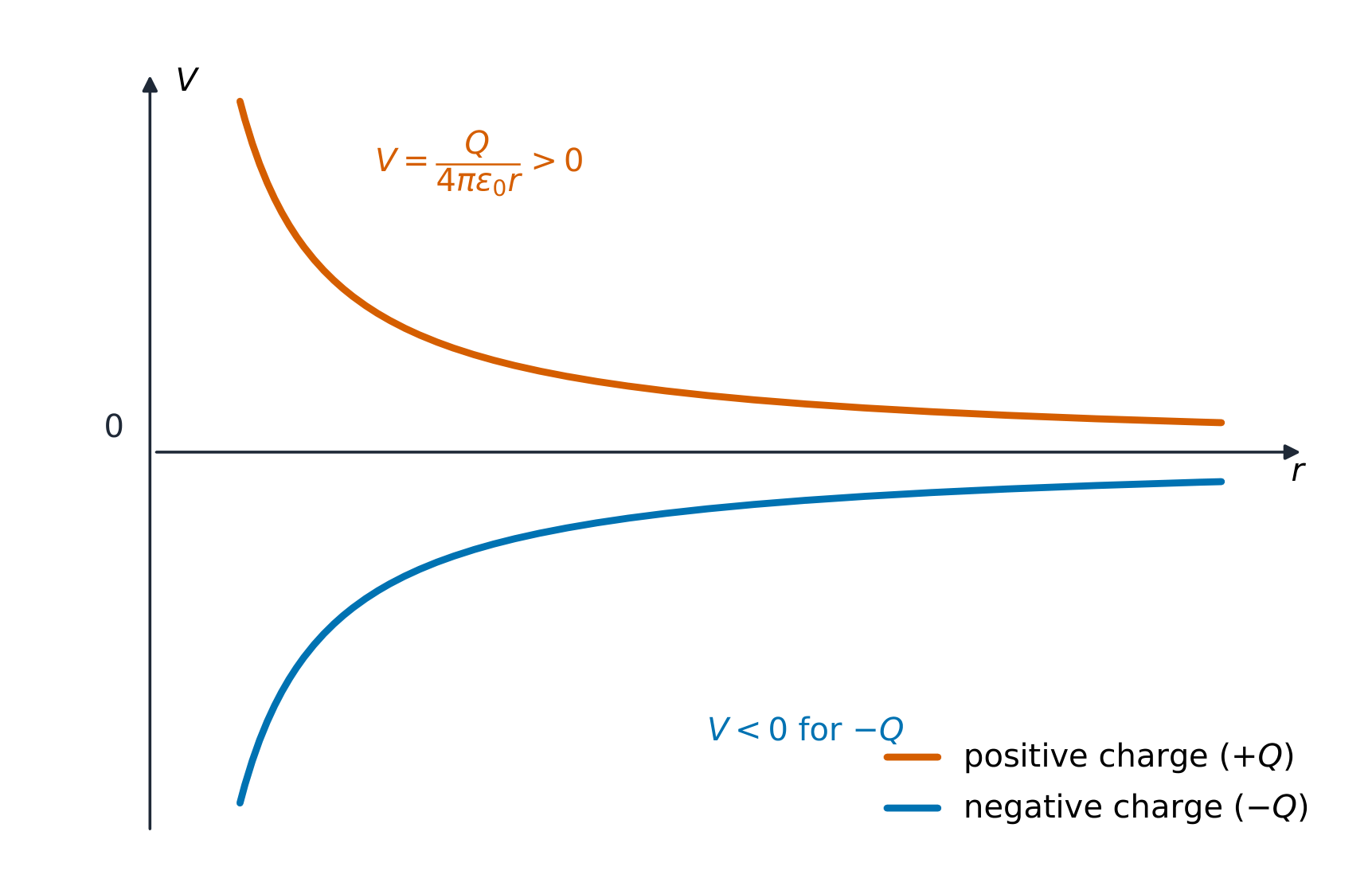
The potential near a point charge varies as 1/r Equipotential maps
An equipotential 等势面 line (also called an isoline 等值线) joins points that share the same potential. Four rules let you read any map:
- Isolines are perpendicular 垂直 to field lines 电场线 everywhere they cross.
- $\vec{E}$ points from high $V$ to low $V$ – never along an isoline. Moving a charge along an isoline takes no work.
- Closely spaced isolines mean a strong field: $E\approx-\Delta V/\Delta x$.
- You can sketch the field map from an isoline map, and the isoline map from a field map.
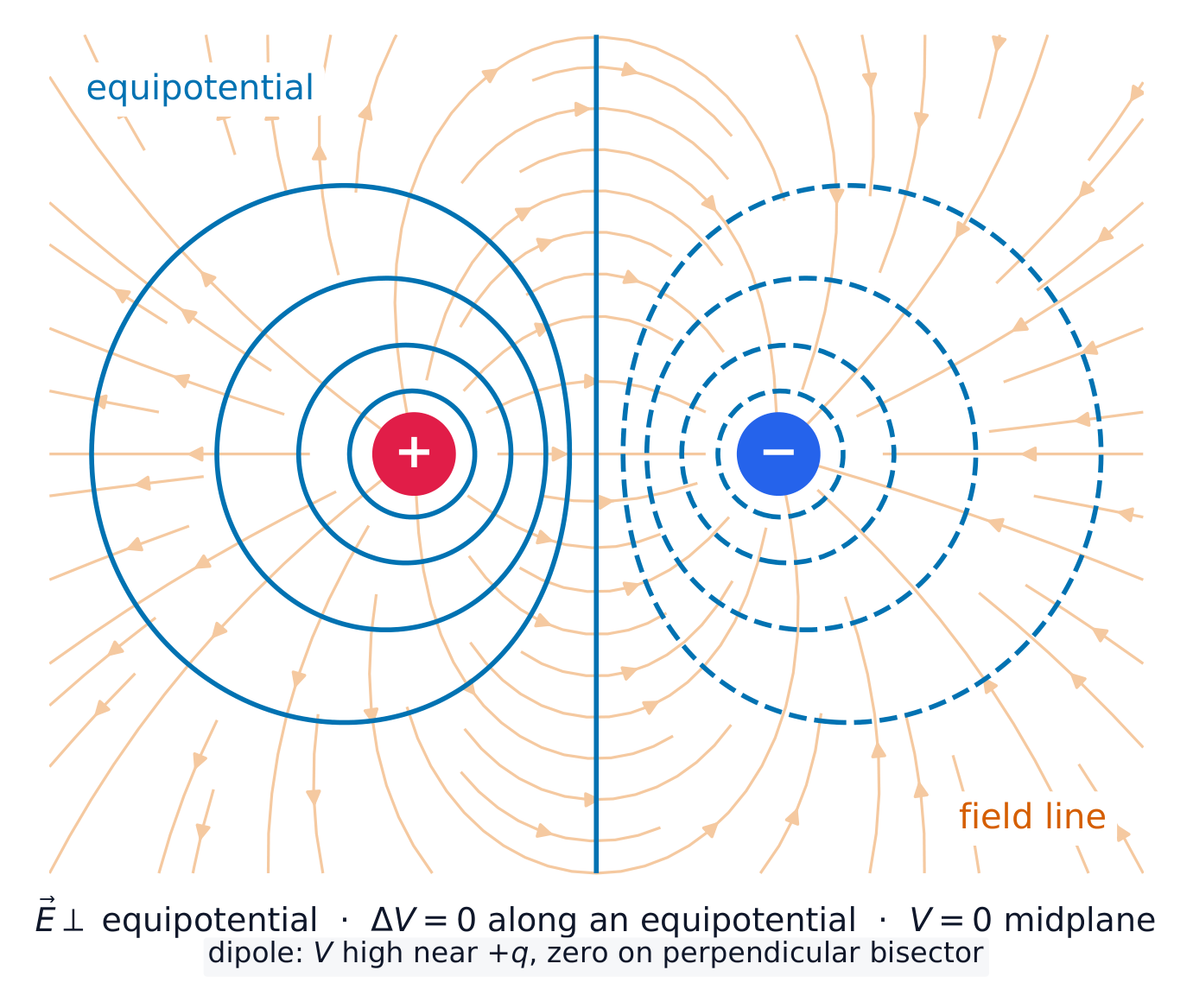
Equipotential lines around a dipole cross the field lines at right angles Exam skill. Given a map with isolines every $10\ \text{V}$ spaced about $2\ \text{cm}$ apart, estimate $E\approx\dfrac{10}{0.02}=500\ \text{V/m}$, pointing from the higher-value line to the lower one. The work an external agent does moving a charge $q$ slowly from $A$ to $B$ is $W=q(V_B-V_A)$ – the path taken does not matter.
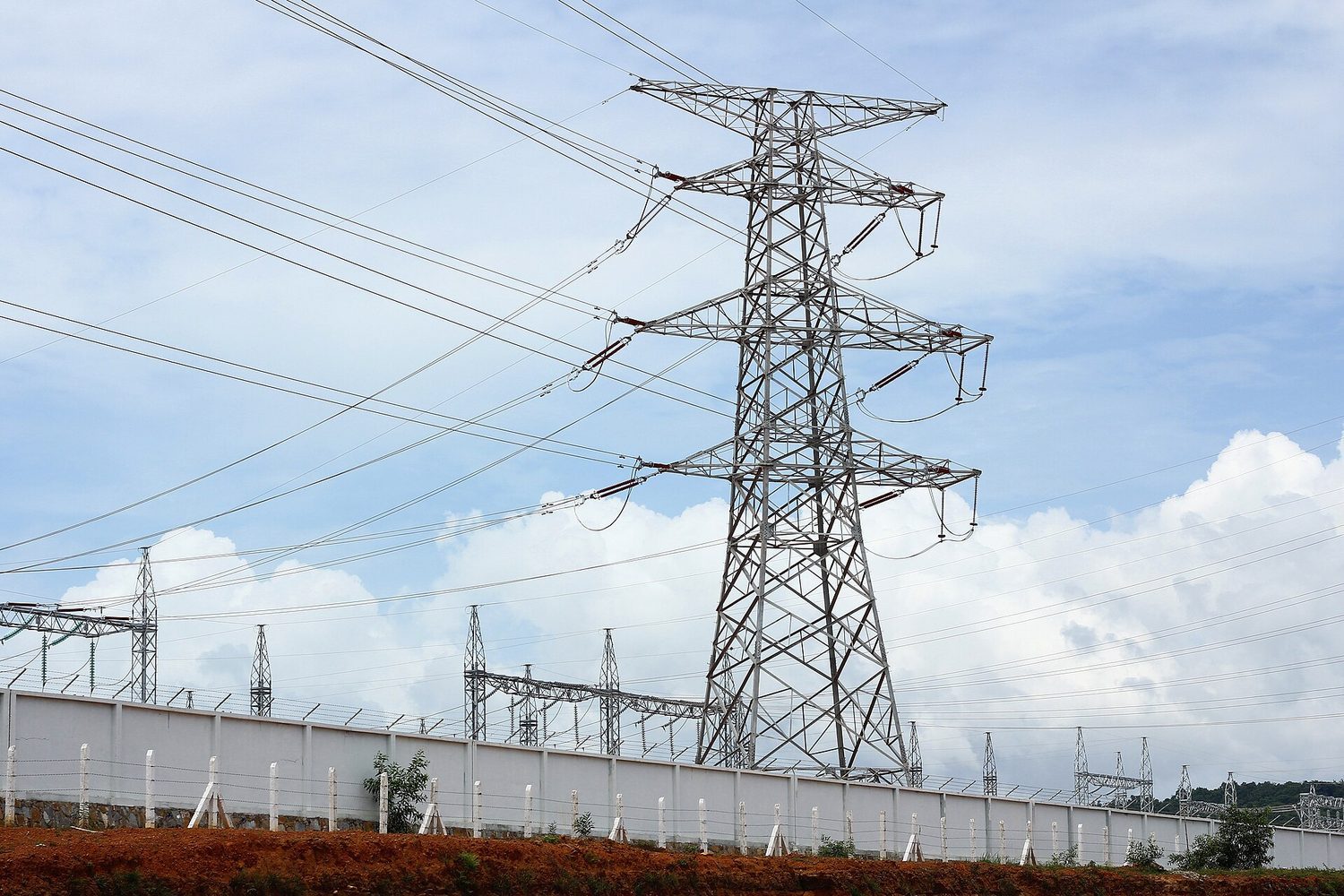
High-voltage power lines: electric potential energy is converted and transmitted as current at high voltage ExploreField lines and the potential around a charge
Electric potential is the energy per unit charge. It falls off with distance from a positive charge; the field lines point from high potential to low.
Vocabulary TrainEnglish Electric potential/ɪˈlektrɪk pəˈtenʃl/ scalar/ˈskeɪlə/ point charges/pɔɪnt ˈtʃɑːdʒɪz/ superposition/ˌsuːpəpəˈzɪʃn/ continuous charge distribution/kənˈtɪnjuːəs tʃɑːdʒ ˌdɪstrɪˈbjuːʃn/ integrate/ˈɪntɪɡreɪt/ gradient/ˈɡreɪdɪənt/ potential difference/pəˈtenʃl ˈdɪfrəns/ equipotential/ˌiːkwɪpəˈtenʃl/ isoline/ˈaɪsəliːn/ perpendicular/ˌpɜːpənˈdɪkjʊlə/ field lines/fiːld laɪnz/ 9.3
Conservation of Electric Energy
Syllabus
Learning Objective Essential Knowledge 9.3.A
Describe changes in a system due to a difference in electric potential between two locations.- 9.3.A.1 When a charged object moves between two locations with different electric potentials, the resulting change in the electric potential energy of the object-field system is given by the following equation.
- Equation: $\Delta U_E = q\Delta V$
- 9.3.A.2 The movement of a charged object between two points with different electric potentials results in a change in kinetic energy of the object consistent with the conservation of energy.
Source: College Board AP Course and Exam Description
When a charge $q$ moves between two points that differ in potential by $\Delta V$, the potential energy of the charge–field system changes by
$$\Delta U_E=q\,\Delta V.$$If only the electric force acts, total energy is conserved, so the kinetic energy changes by the opposite amount:
$$\Delta K=-\Delta U_E=-q\,\Delta V.$$Watch the two signs together: a positive charge speeds up when it moves to lower potential, while a negative charge speeds up when it moves to higher potential. Both are just the system trading potential energy for kinetic energy. This is how particle accelerators give charged particles their energy, and it underlies energy analysis in circuits.
Worked example. A proton ($q=1.6\times10^{-19}\ \text{C}$, $m=1.67\times10^{-27}\ \text{kg}$) starts at rest and is accelerated through a potential drop of $500\ \text{V}$ (it moves to lower potential, so $\Delta V=-500\ \text{V}$ and $\Delta K=-q\,\Delta V=+8.0\times10^{-17}\ \text{J}$). Setting $\Delta K=\tfrac12 mv^2$:
$$v=\sqrt{\frac{2(8.0\times10^{-17})}{1.67\times10^{-27}}}=3.1\times10^{5}\ \text{m/s}.$$Exam skill. Choose energy methods, not kinematics, whenever the field is non-uniform or the path curves: only the end-point potentials matter. A typical FRQ chain is $q\,\Delta V \to \Delta K \to v$, with one line of justification: "the electric force is conservative, so energy is conserved."
9.3
Exam tips
- Relate field and potential by $V=-\int \vec E\cdot d\vec l$ and $\vec E=-\nabla V$ (in 1-D, $E_x=-\tfrac{dV}{dx}$).
- Potential is a scalar — add contributions with signs, no vector components needed.
- Potential energy of a pair is $U=\tfrac{1}{4\pi\varepsilon_0}\tfrac{q_1 q_2}{r}$; use energy conservation for a charge's speed.
- Know that no work is done moving along an equipotential, which is perpendicular to $\vec E$.
- Choose the zero of potential (usually infinity) and state it.
-
10
Conductors and Capacitors
Watch lesson10.1
Electrostatics with Conductors
Syllabus
Learning Objective Essential Knowledge 10.1.A
Describe the charge distribution within a conductor.- 10.1.A.1 An ideal conductor is a material in which electrons are able to move freely.
- 10.1.A.2 When a conductor is in electrostatic equilibrium, mutual repulsion of excess charge carriers results in those charge carriers residing entirely on the surface of the conductor.
- 10.1.A.2.i In a conductor with a negative net charge, excess electrons reside on the surface of the conductor.
- 10.1.A.2.ii In a conductor with a positive net charge, the surface becomes deficient in electrons, and can be modeled as if positive charge carriers reside on the surface of the conductor.
- 10.1.A.3 Excess charges will move to the surface of a conductor to create a state of electrostatic equilibrium within the conductor.
- 10.1.A.3.i The time interval over which charges reach electrostatic equilibrium within a conductor is so short as to be negligible.
- 10.1.A.3.ii When a conductor reaches electrostatic equilibrium, all points on the surface of the conductor have the same electric potential, and the conductor becomes an equipotential surface.
- 10.1.A.3.iii The charge density on the surface of a conductor will be greater where there are points or edges compared to planar areas.
- 10.1.A.4 All excess charges reside on the surface of a conductor, which means there is no net charge in the interior of the conductor, and the electric field is zero within the conductor.
- 10.1.A.5 The electric field is perpendicular to the outer surface of a conductor.
- 10.1.A.6 A conductor can be polarized in the presence of an external electric field. This is a consequence of the conductor remaining an equipotential surface.
- 10.1.A.7 Electrostatic shielding is the process of surrounding an area with a closed, conducting shell to create a region inside the conductor that is free from external electric fields.
Source: College Board AP Course and Exam Description
In an ideal conductor 导体, electrons move freely. Put extra charge on one and the charges repel each other until, almost instantly, they settle into electrostatic equilibrium 静电平衡. In that state the conductor has four properties you must be able to state and use:
- The electric field inside the conductor is zero. If it were not, free electrons would still be moving.
- All excess charge sits on the surface. (Negative net charge = extra electrons on the surface; positive = a shortage of electrons there.)
- The field just outside is perpendicular 垂直 to the surface, with magnitude $E=\sigma/\varepsilon_0$. Any parallel component would push charge sideways along the surface.
- The whole conductor is one equipotential surface 等势面: every point, inside and on the surface, is at the same potential.
Charge density is largest where the surface curves sharply – at points and edges – so the outside field is strongest there. In an external field a conductor polarizes: charge shifts on its surface so that the interior stays field-free and the body stays an equipotential. Surrounding a region with a closed conducting shell keeps outside fields out entirely – electrostatic shielding 静电屏蔽, the idea behind the Faraday cage 法拉第笼.
Vocabulary TrainEnglish conductor/kənˈdʌktə/ electrostatic equilibrium/ɪˌlektrəʊˈstætɪk ˌiːkwɪˈlɪbrɪəm/ perpendicular/ˌpɜːpənˈdɪkjʊlə/ equipotential surface/ˌiːkwɪpəˈtenʃl ˈsɜːfɪs/ electrostatic shielding/ɪˌlektrəʊˈstætɪk ˈʃiːldɪŋ/ Faraday cage/ˈfærədeɪ keɪdʒ/ 10.2
Redistribution of Charge Between Conductors
Syllabus
Learning Objective Essential Knowledge 10.2.A
Describe the movement of charge and the resulting interactions when conductors physically contact each other.- 10.2.A.1 When conductors are in electrical contact, charges will be redistributed such that the surfaces of each conductor are at the same electric potential.
- 10.2.A.2 Ground is an idealized reference point that has zero electric potential and can absorb or provide an infinite amount of charge without changing its electric potential.
- 10.2.A.3 Charge can be induced on a conductor by grounding the conductor in the presence of an external electric field.
Source: College Board AP Course and Exam Description
When two conductors touch (or are wired together), charge flows between them until both surfaces reach the same potential – that is the stopping condition, not "equal charges". A larger sphere holds more charge at the same potential ($V=kQ/R$), so it takes the larger share.
Worked example. A small sphere of radius $R$ carrying $+6.0\ \mu\text{C}$ touches a distant sphere of radius $2R$, then they separate. Equal potentials require $\dfrac{kq_1}{R}=\dfrac{kq_2}{2R}$, so $q_2=2q_1$. With $q_1+q_2=6.0\ \mu\text{C}$: $q_1=2.0\ \mu\text{C}$ and $q_2=4.0\ \mu\text{C}$.
Ground 接地 is an idealized reference at zero potential that can absorb or supply any amount of charge. Grounding a conductor while an external charge is nearby leaves the conductor with a net induced charge 感应电荷: the external field pushes charge of one sign to ground, and cutting the ground wire before removing the external charge traps the rest.
Vocabulary TrainEnglish ground/ɡraʊnd/ induced charge/ɪnˈdjuːst tʃɑːdʒ/ 10.3
Capacitors
Syllabus
Learning Objective Essential Knowledge 10.3.A
Describe the physical properties of a parallel-plate capacitor.- 10.3.A.1 A parallel-plate capacitor consists of two separated parallel conducting surfaces that can hold equal amounts of charge with opposite signs.
- 10.3.A.2 Capacitance relates the magnitude of the charge stored on each plate to the electric potential difference created by the separation of those charges.
- Equation: $C = \dfrac{Q}{\Delta V}$
- 10.3.A.2.i The capacitance of a capacitor depends only on the physical properties of the capacitor, such as the capacitor's shape and the material used to separate the plates.
- 10.3.A.2.ii The capacitance of a parallel-plate capacitor is proportional to the area of one of its plates and inversely proportional to the distance between its plates. The constant of proportionality is the product of the dielectric constant, $\kappa$, of the material between the plates and the electric permittivity of free space, $\varepsilon_0$.
- Equation: $C = \dfrac{\kappa \varepsilon_0 A}{d}$
- 10.3.A.3 The electric field between two charged parallel plates with uniformly distributed electric charge, such as in a parallel-plate capacitor, is constant in both magnitude and direction, except near the edges of the plates.
- 10.3.A.3.i The magnitude of the electric field between two charged parallel plates, where the plate separation is much smaller than the dimensions of the plates, can be determined by applying Gauss's law and the principle of superposition.
- Equation: $E = \dfrac{Q}{\varepsilon_0 A}$
- 10.3.A.3.ii The electric field is proportional to the surface charge density on either plate of the capacitor.
- 10.3.A.3.iii A charged particle between two oppositely charged parallel plates undergoes constant acceleration, and therefore its motion shares characteristics with the projectile motion of an object with mass in the gravitational field near Earth's surface.
- 10.3.A.3.i The magnitude of the electric field between two charged parallel plates, where the plate separation is much smaller than the dimensions of the plates, can be determined by applying Gauss's law and the principle of superposition.
- 10.3.A.4 The electric potential energy stored in a capacitor is equal to the work done by an external force to separate that amount of charge on the capacitor.
- 10.3.A.5 The electric potential energy stored in a capacitor is described by the equation $U_C = \dfrac{1}{2} Q \Delta V$.
Boundary statement: While other shapes are also able to separate charges, AP Physics C: Electricity & Magnetism only expects the quantitative analysis and description of parallel-plate capacitors, concentric spherical capacitors, and coaxial cylindrical capacitors.
Source: College Board AP Course and Exam Description
Charging a capacitor (RC) A capacitor 电容器 stores charge on two conductors separated by a gap: $+Q$ on one plate, $-Q$ on the other. Its capacitance 电容 relates the stored charge to the potential difference between the plates:
$$C=\frac{Q}{\Delta V}.$$Capacitance depends only on geometry and the material in the gap – never on $Q$ or $\Delta V$ themselves.
Worked derivation (parallel plates). For a parallel-plate capacitor 平行板电容器 with plate area $A$ and small gap $d$: Gauss's law plus superposition 叠加 gives a uniform 均匀 field between the plates, $E=\dfrac{\sigma}{\varepsilon_0}=\dfrac{Q}{\varepsilon_0 A}$ (each plate alone contributes $\sigma/2\varepsilon_0$; between the plates the two add, outside they cancel). A uniform field means $\Delta V=Ed=\dfrac{Qd}{\varepsilon_0 A}$, so
$$C=\frac{Q}{\Delta V}=\frac{\varepsilon_0 A}{d}.$$This $E\to\Delta V\to C$ chain is a standard FRQ derivation – learn it as three steps, and quote each one. The same method handles the other two shapes AP expects: concentric spheres ($C=4\pi\varepsilon_0\dfrac{ab}{b-a}$) and a coaxial cylinder of length $L$, where $E=\dfrac{\lambda}{2\pi\varepsilon_0 r}$ gives $\Delta V=\dfrac{\lambda}{2\pi\varepsilon_0}\ln\dfrac{b}{a}$ and so $C=\dfrac{2\pi\varepsilon_0 L}{\ln(b/a)}$.
Worked example. Plates of area $A=0.020\ \text{m}^2$ and gap $d=1.0\ \text{mm}$: $C=\dfrac{8.85\times10^{-12}(0.020)}{1.0\times10^{-3}}=1.8\times10^{-10}\ \text{F}$. Charged to $100\ \text{V}$ it holds $Q=CV=1.8\times10^{-8}\ \text{C}$.
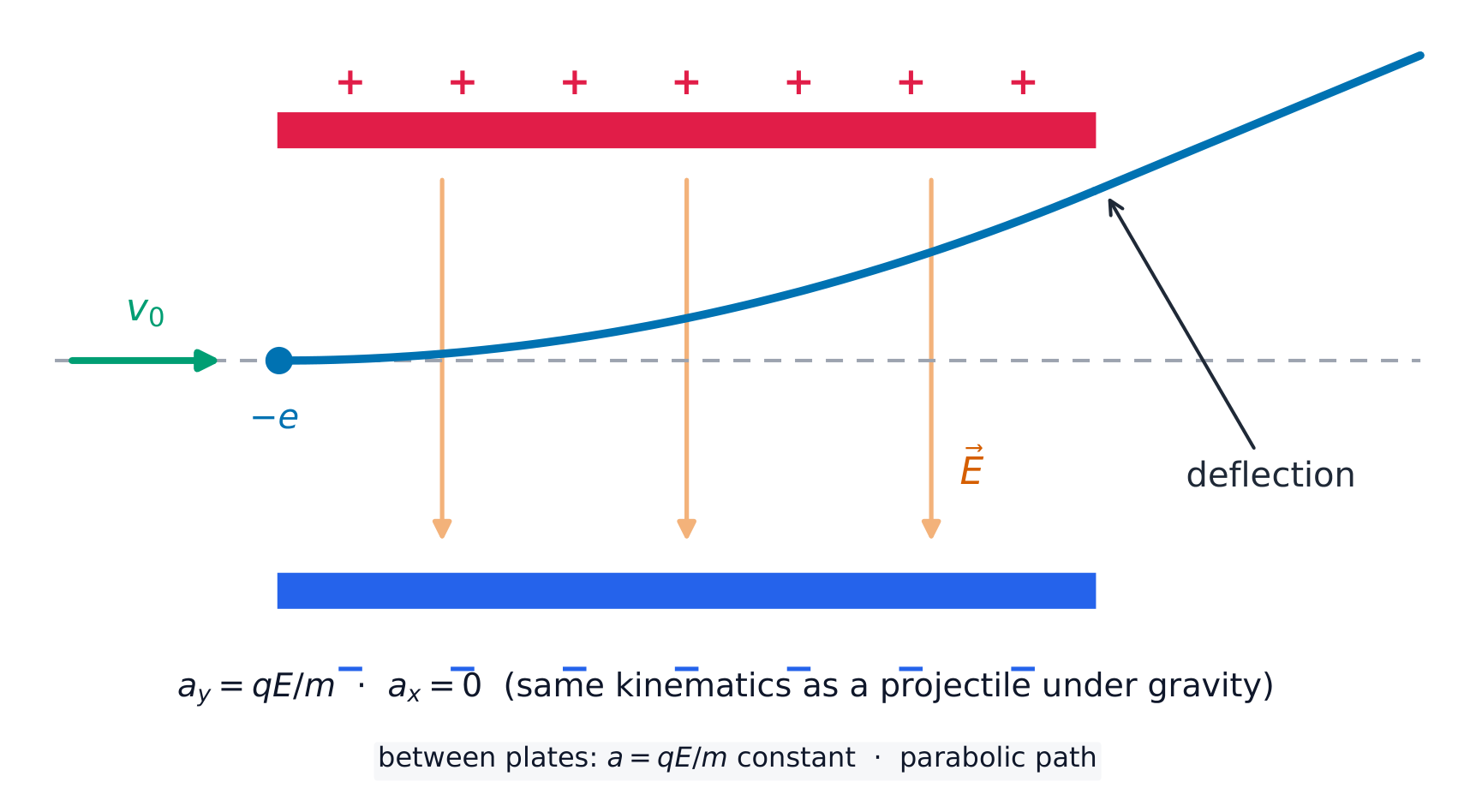
Because the field between the plates is uniform, a charged particle there feels a constant force, so it moves with constant acceleration – exactly like projectile motion 抛体运动 in gravity: constant speed across, uniform acceleration towards a plate.
A charged particle between the plates follows a parabola, like a projectile Worked example. An electron enters midway between plates at $v_0=2.0\times10^{7}\ \text{m/s}$, parallel to them. The field is $E=1.0\times10^{3}\ \text{N/C}$ and the plates are $4.0\ \text{cm}$ long. Acceleration: $a=\dfrac{eE}{m}=\dfrac{(1.6\times10^{-19})(1.0\times10^{3})}{9.11\times10^{-31}}=1.8\times10^{14}\ \text{m/s}^2$. Time between the plates: $t=\dfrac{0.040}{2.0\times10^{7}}=2.0\times10^{-9}\ \text{s}$. Deflection: $y=\tfrac12at^{2}=\tfrac12(1.8\times10^{14})(2.0\times10^{-9})^{2}\approx3.5\times10^{-4}\ \text{m}$ – about $0.35\ \text{mm}$ towards the positive plate.
Storing charge takes work 功: an external force must move each bit of charge against the field of the charge already there. The total work ends up as stored potential energy,
$$U_C=\tfrac12\,Q\,\Delta V=\tfrac12 C(\Delta V)^2=\frac{Q^2}{2C}.$$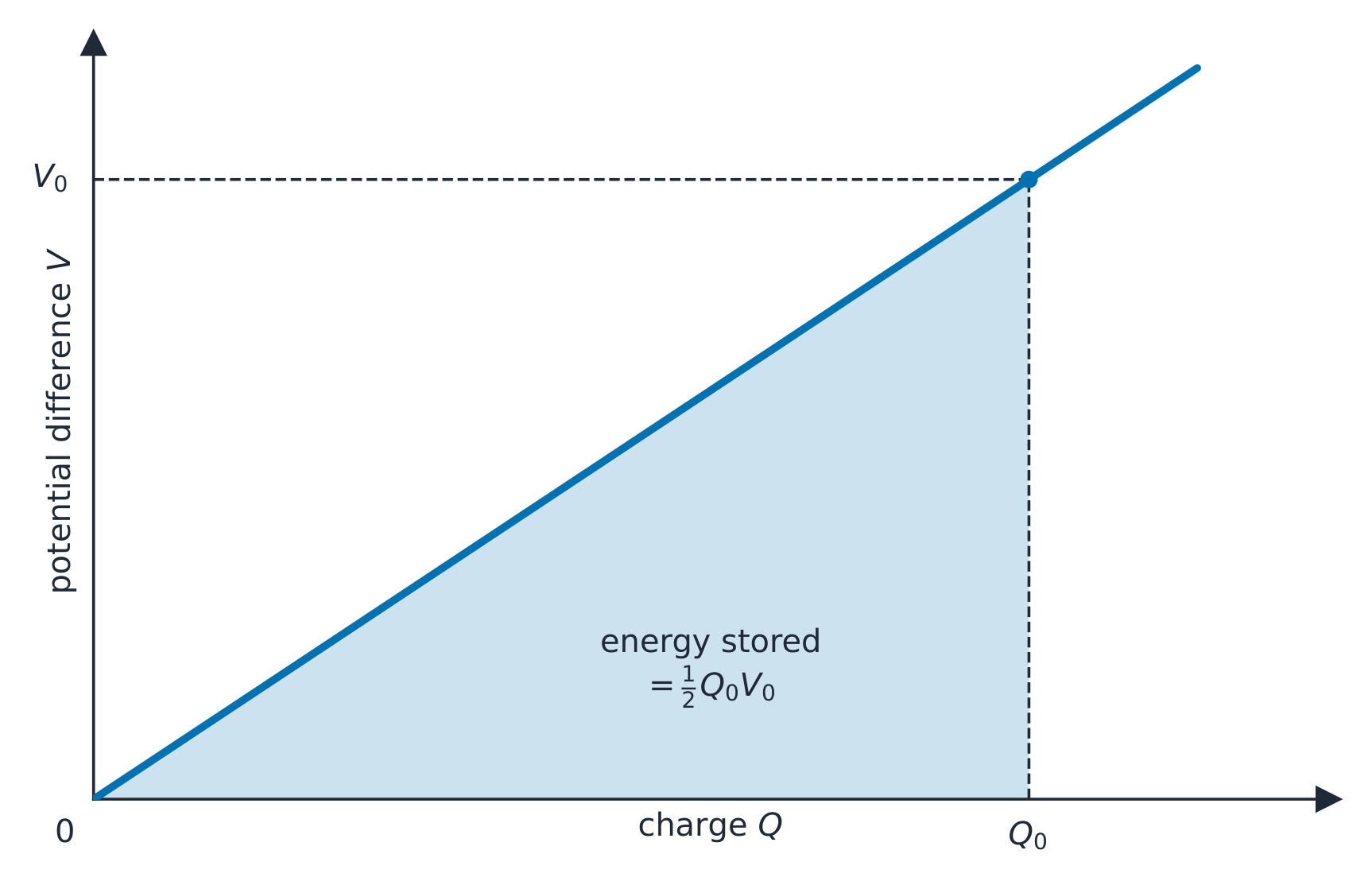
The energy stored in a capacitor is the area under its charge-voltage line The factor $\tfrac12$ is the area of the triangle under the $Q$–$\Delta V$ line: the first charge moved across costs almost nothing, the last costs the full $\Delta V$.
Capacitors combine oppositely to resistors: in parallel 并联 the capacitances add ($C_{\text{eq}}=C_1+C_2$, same $\Delta V$, charges add), while in series 串联 the reciprocals add ($\tfrac{1}{C_{\text{eq}}}=\tfrac{1}{C_1}+\tfrac{1}{C_2}$, same $Q$, voltages add).
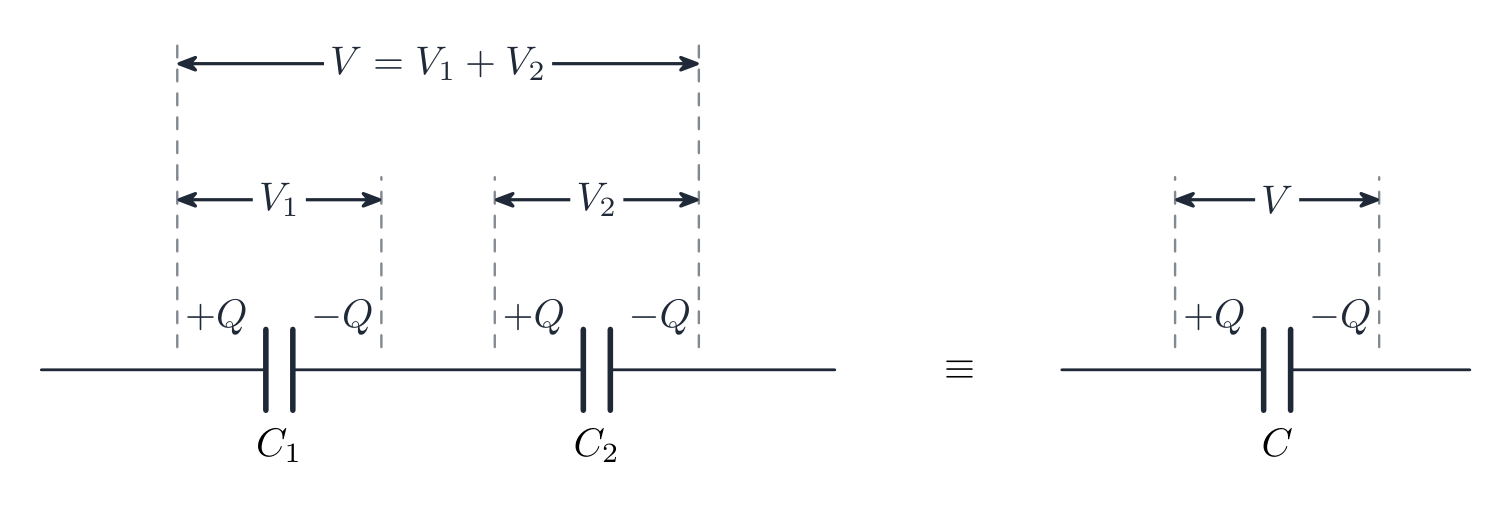
Capacitors in series carry the same charge, and their p.d.s add Worked example. A $2\ \mu\text{F}$ and a $4\ \mu\text{F}$ capacitor in series: $\tfrac{1}{C}=\tfrac12+\tfrac14$, so $C=\tfrac43\ \mu\text{F}$. The same pair in parallel: $6\ \mu\text{F}$.
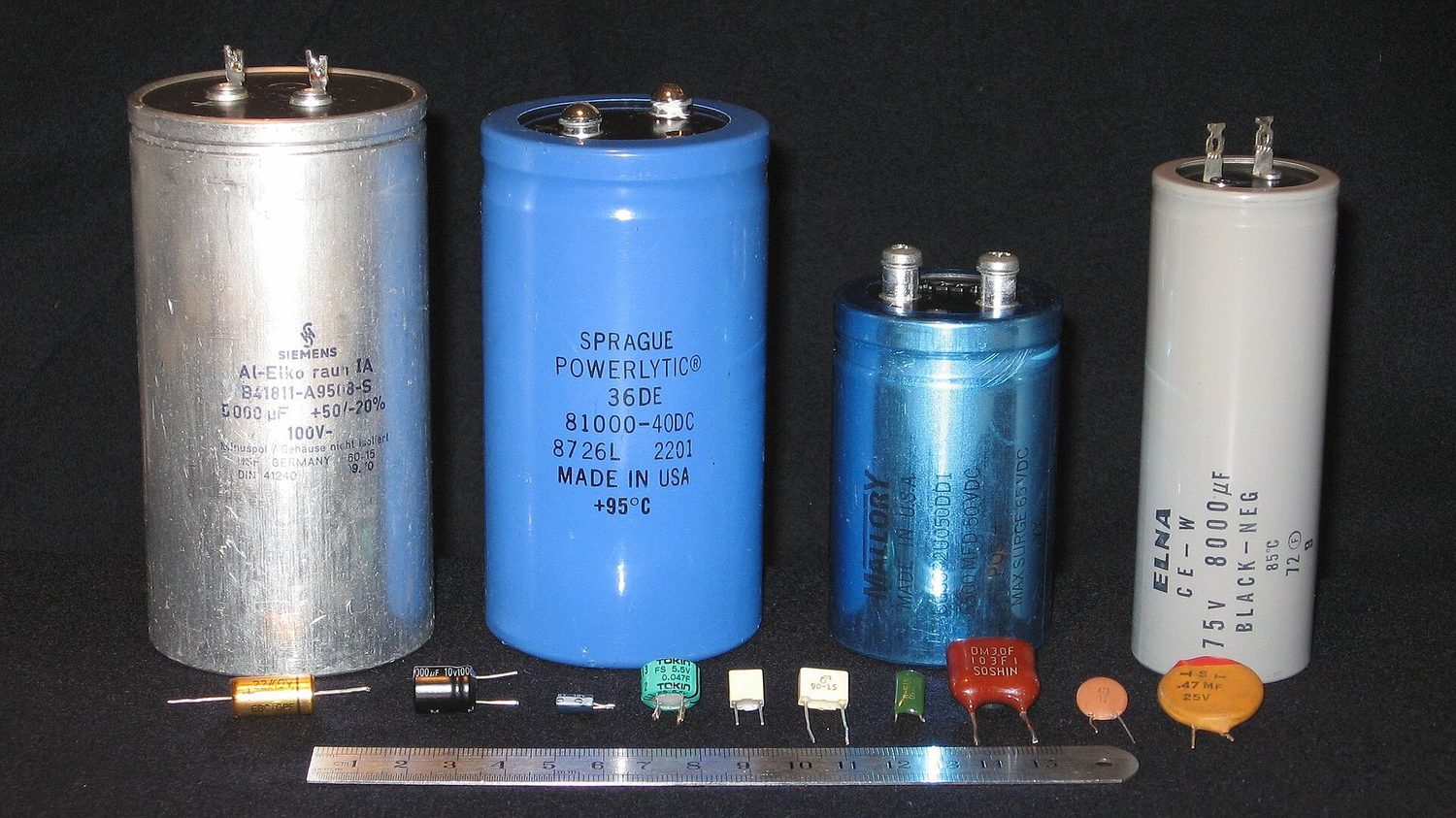
Assorted capacitors: devices that store charge and energy in an electric field between conductors 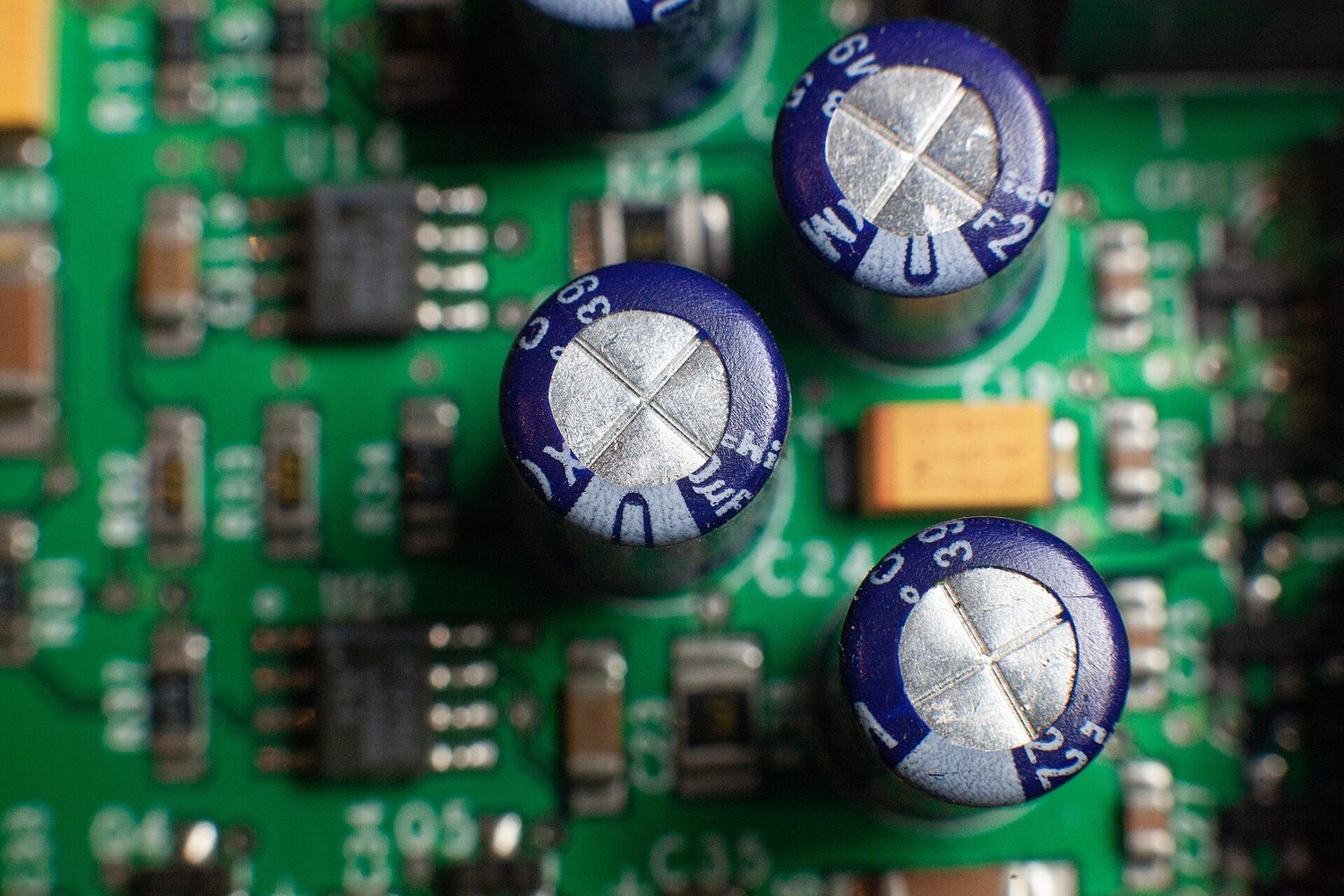
Electrolytic capacitors on a circuit board: capacitance stores energy as U = ½CV² ExploreCharge and discharge a capacitor
A capacitor stores charge on two plates, filling and emptying exponentially with time constant $\tau=RC$. Bigger $R$ or $C$ slows it down.
Vocabulary TrainEnglish capacitor/kəˈpæsɪtə/ capacitance/kəˈpæsɪtəns/ parallel-plate capacitor/ˈpærəlel pleɪt kəˈpæsɪtə/ superposition/ˌsuːpəpəˈzɪʃn/ uniform/ˈjuːnɪfɔːm/ projectile motion/prəˈdʒektaɪl ˈməʊʃn/ work/wɜːk/ parallel/ˈpærəlel/ series/ˈsɪəriːz/ 10.4
Dielectrics

Syllabus
Learning Objective Essential Knowledge 10.4.A
Describe how a dielectric inserted between the plates of a capacitor changes the properties of the capacitor.- 10.4.A.1 In a dielectric material, electric charges are not as free to move as they are in a conductor. Instead, the material becomes polarized in the presence of an external electric field.
- 10.4.A.2 The dielectric constant of a material relates the electric permittivity of that material to the permittivity of free space.
- Equation: $\kappa = \dfrac{\varepsilon}{\varepsilon_0}$
- 10.4.A.3 The electric field created by a polarized dielectric is opposite in direction to the external field.
- 10.4.A.4 The electric field between the plates of an isolated parallel-plate capacitor decreases when a dielectric is placed between the plates.
- Equation: $\kappa = \dfrac{E_0}{E}$
- 10.4.A.5 The insertion of a dielectric into a capacitor may change the capacitance of the capacitor.
- Equation: $C = \kappa C_0$
Source: College Board AP Course and Exam Description
A dielectric 电介质 is an insulating material. Its charges cannot travel, but in an external field each molecule stretches or turns slightly – the material becomes polarized 极化. The lined-up molecules create their own small field opposite to the applied one, so the net field inside the material drops:
$$E=\frac{E_0}{\kappa},\qquad \kappa=\frac{\varepsilon}{\varepsilon_0}\ \ (\kappa>1),$$where $\kappa$ is the dielectric constant 介电常数, the ratio of the material's permittivity to the permittivity of free space 真空介电常数.
A polarized dielectric creates an internal field opposing the applied field Filling a capacitor with dielectric multiplies its capacitance:
$$C=\kappa\,C_0\qquad\left(\text{parallel plates: } C=\frac{\kappa\varepsilon_0 A}{d}\right).$$What happens next depends on what stays fixed – a favourite exam trap:
battery stays connected ($\Delta V$ fixed) battery removed first ($Q$ fixed) charge $Q$ rises to $\kappa Q_0$ unchanged voltage $\Delta V$ unchanged drops to $\Delta V_0/\kappa$ field $E$ unchanged drops to $E_0/\kappa$ energy $U$ rises to $\kappa U_0$ drops to $U_0/\kappa$ Worked example. A $100\ \text{pF}$ capacitor is charged to $12\ \text{V}$, disconnected, then filled with a $\kappa=3$ dielectric. $Q$ is trapped, so $\Delta V$ falls to $4\ \text{V}$ and the stored energy falls to one-third – the missing energy went into pulling the dielectric in. Reconnected to the $12\ \text{V}$ battery instead, the capacitor would hold three times the charge and three times the energy.
Exam skill. Always begin dielectric questions by writing down which quantity is held fixed ($Q$ or $\Delta V$), then let $C=\kappa C_0$ drive everything else through $Q=C\Delta V$ and $U=\tfrac12 C(\Delta V)^2$.
ExploreAdd a dielectric
A dielectric between the plates raises the capacitance, so the capacitor holds more charge at the same voltage. Watch the charge build faster.
Vocabulary TrainEnglish dielectric/ˌdaɪɪˈlektrɪk/ polarized/ˈpəʊləraɪzd/ dielectric constant/ˌdaɪɪˈlektrɪk ˈkɒnstənt/ permittivity of free space/ˌpɜːmɪˈtɪvəti ɒv friː speɪs/ 10.4
Exam tips
- In electrostatic equilibrium a conductor has $\vec E=0$ inside and all excess charge on the surface.
- Apply Gauss's law $\oint \vec E\cdot d\vec A=\tfrac{q_{enc}}{\varepsilon_0}$ with a symmetry-matched Gaussian surface (sphere, cylinder, pillbox).
- The whole conductor is one equipotential, and the surface field is perpendicular to it.
- For a capacitor use $C=\tfrac{Q}{V}$, energy $U=\tfrac12 CV^2$, and how a dielectric raises $C$.
- Pick the Gaussian surface so $\vec E$ is constant and parallel (or zero) on each part.
-
11
Electric Circuits
Watch lesson11.1
Electric Current
Syllabus
Learning Objective Essential Knowledge 11.1.A
Describe the movement of electric charges through a medium.- 11.1.A.1 Current is the rate at which charge passes through a cross-sectional area of a wire.
- Equation: $I = \dfrac{dq}{dt}$
- 11.1.A.1.i Current within a conductor consists of charge carriers traveling through the conductor with an average drift velocity.
- Equation: $I = nqv_d A$
- 11.1.A.1.ii Electric charge moves in a circuit in response to an electric potential difference, sometimes referred to as electromotive force, or $\mathrm{emf}$ ($\mathcal{E}$).
- 11.1.A.1.iii If the current is zero in a section of wire, the net motion of charge carriers in the wire is also zero, although individual charge carriers will not have zero speed.
- 11.1.A.2 Current density is the flow of charge per unit area.
- Equation: $I = \int \vec{J} \cdot d\vec{A}$
- 11.1.A.2.i Current density is related to the motion of the charge carriers within a conductor.
- Equation: $\vec{J} = nq\vec{v}_d$
- 11.1.A.2.ii Current density is a vector quantity.
- 11.1.A.2.iii A potential difference across a conductor creates an electric field within the conductor that is proportional to the resistivity of the conductor and the current density.
- Equation: $\vec{E} = \rho\vec{J}$
- 11.1.A.3 If a function of current density is given, the total current can be determined by integrating the current density over the area.
- Equation: $I_{\text{tot}} = \int \vec{J}(r) \cdot d\vec{A}$
- 11.1.A.4 Although current is a scalar quantity, it does have a direction. Because its direction is relative to the current carrier and not space, current does not obey the laws of vector addition and has no vector components.
- 11.1.A.4.i The direction of conventional current is chosen to be the direction in which positive charge would move.
- 11.1.A.4.ii In common circuits, the current is actually due to the movement of electrons (negative charge carriers).
Source: College Board AP Course and Exam Description
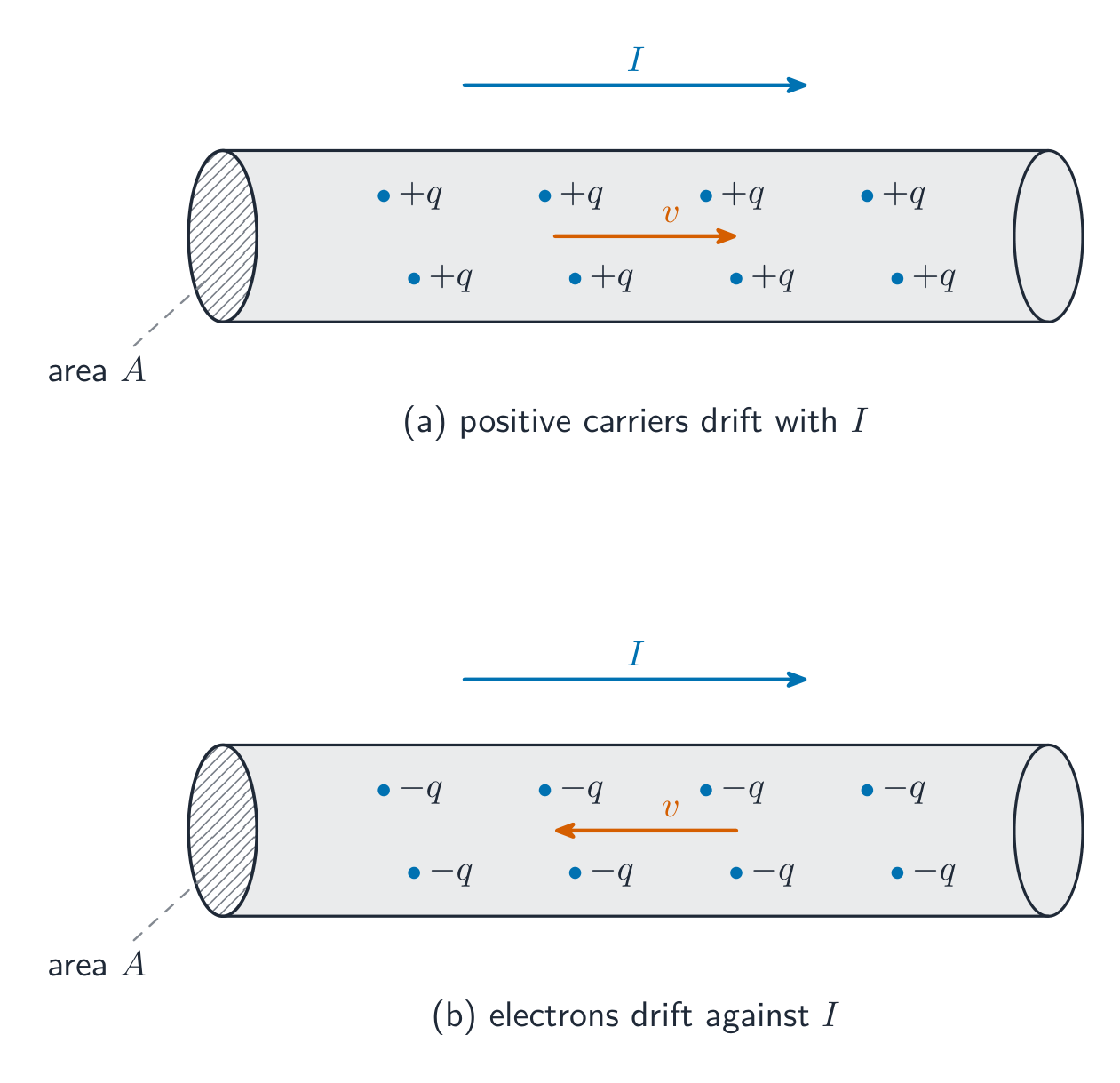
Electric current 电流 is the rate at which charge passes a cross-section of wire, $I=\dfrac{dq}{dt}$, measured in amperes 安培. Conventional current points the way positive charge would move. Microscopically, a current is a slow drift of many carriers:
$$I=nqv_dA,$$with $n$ the number of carriers per volume, $q$ the charge each carries, $v_d$ the drift velocity 漂移速度, and $A$ the cross-sectional area 横截面积.
Charge carriers drift slowly through a conductor to make a current Worked example. A copper wire with $A=1.0\times10^{-6}\ \text{m}^2$ and $n=8.5\times10^{28}\ \text{m}^{-3}$ carries $1.7\ \text{A}$. Then $v_d=\dfrac{I}{nqA}=\dfrac{1.7}{(8.5\times10^{28})(1.6\times10^{-19})(1.0\times10^{-6})}\approx1.3\times10^{-4}\ \text{m/s}$ – the carriers drift slower than a snail, even though the signal travels near light speed.
Current density 电流密度 is charge flow per unit area, $\vec{J}=nq\vec{v}_d$, linked to the field driving it by $\vec{E}=\rho\vec{J}$. In general $I=\int\vec{J}\cdot d\vec{A}$; if $J(r)$ varies across the wire, integrate it over the cross-section to get the total current. One care point: current has a direction along its wire, but it is a scalar 标量 – currents do not add as vectors, and there are no "components of current".
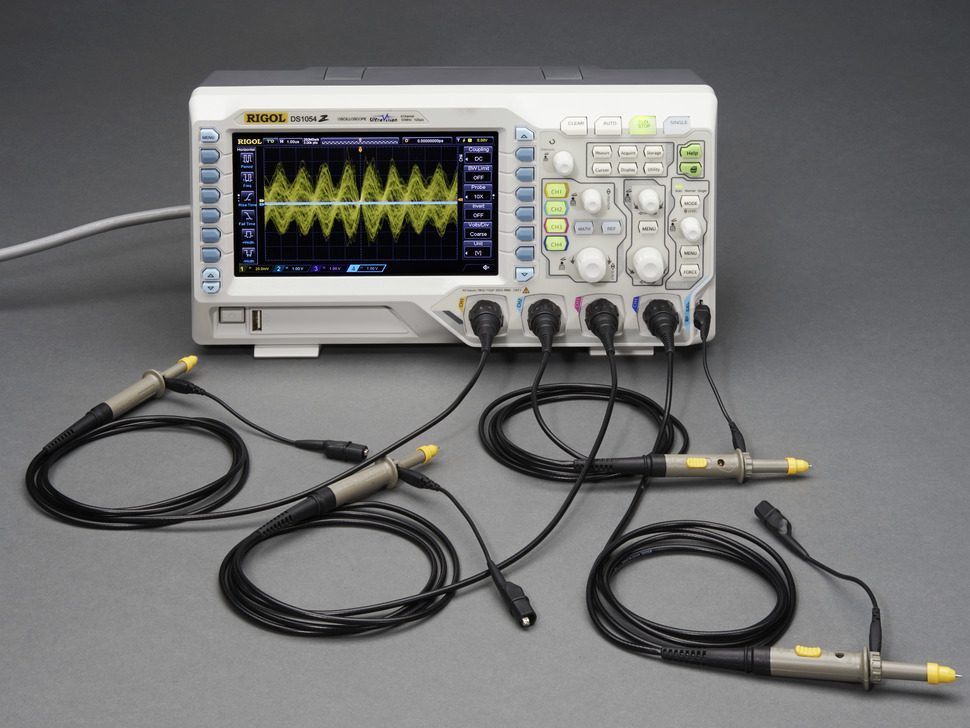
An oscilloscope: voltage against time reveals how current and charge evolve in a circuit Vocabulary TrainEnglish Electric current/ɪˈlektrɪk ˈkʌrənt/ amperes/ˈæmpeəz/ drift velocity/drɪft vəˈlɒsɪti/ cross-sectional area/krɒs ˈsekʃənl ˈeərɪə/ Current density/ˈkʌrənt ˈdensɪti/ scalar/ˈskeɪlə/ 11.2
Electric Circuits
Syllabus
Learning Objective Essential Knowledge 11.2.A
Describe the behavior of a circuit.- 11.2.A.1 A circuit is composed of electrical loops, which can include wires, batteries, resistors, lightbulbs, capacitors, inductors, switches, ammeters, and voltmeters.
- 11.2.A.2 A closed electrical loop is a closed path through which charges may flow.
- 11.2.A.2.i A closed circuit is one in which charges would be able to flow.
- 11.2.A.2.ii An open circuit is one in which charges would not be able to flow.
- 11.2.A.2.iii A short circuit is one in which charges would be able to flow with no change in potential difference.
- 11.2.A.3 A single circuit element may be part of multiple electrical loops.
- 11.2.A.4 Circuit schematics are representations used to describe and analyze electric circuits.
- 11.2.A.4.i The properties of an electric circuit are dependent on the physical arrangement of its constituent elements.
- 11.2.A.4.ii Circuit elements have common symbols that are used to create schematic diagrams. Variable elements are indicated by a diagonal strikethrough arrow across the standard symbol for that element. (Symbols: Battery, Bulb, Switch, Capacitor, Resistor, Ammeter, Voltmeter, Inductor.)
Boundary statement: Unless otherwise specified, all circuit schematic diagrams will be drawn using conventional current.
Source: College Board AP Course and Exam Description
A circuit is a set of closed loops built from wires, batteries, resistors, lightbulbs, capacitors, inductors, switches, and meters; charge can flow only around a closed path. One element can belong to several loops at once – that is what makes multi-loop problems interesting. Every analysis starts by reading the circuit diagram 电路图: trace each loop and identify which elements share the same current (series 串联) and which share the same potential difference (parallel 并联).
ExploreBuild series and parallel circuits
In series the same current flows through every bulb and voltage divides; in parallel each branch gets the full voltage. Switch mode to see the bulbs' brightness change.
Vocabulary TrainEnglish circuit diagram/ˈsɜːkɪt ˈdaɪəɡræm/ series/ˈsɪəriːz/ parallel/ˈpærəlel/ 11.3
Resistance, Resistivity, and Ohm's Law
Syllabus
Learning Objective Essential Knowledge 11.3.A
Describe the resistance of an object using physical properties of that object.- 11.3.A.1 Resistance is a measure of the degree to which an object opposes the movement of electric charge.
- 11.3.A.2 The resistance of a resistor with uniform geometry is proportional to its resistivity and length and is inversely proportional to its cross-sectional area.
- Equation: $R = \dfrac{\rho\ell}{A}$
- 11.3.A.2.i Resistivity is a fundamental property of a material that depends on its atomic and molecular structure and quantifies how strongly the material opposes the motion of electric charge.
- 11.3.A.2.ii The resistivity of a conductor typically increases with temperature.
- 11.3.A.2.iii The total resistance of a resistor with uniform geometry, but that is made of a material whose resistivity varies along the length of the resistor, is given by $R = \int \dfrac{\rho(\ell)\,d\ell}{A}$.
11.3.B
Describe the electrical characteristics of elements of a circuit.- 11.3.B.1 Ohm's law relates current, resistance, and potential difference across a conductive element of a circuit.
- Equation: $I = \dfrac{\Delta V}{R}$
- 11.3.B.1.i Materials that obey Ohm's law have constant resistance for all currents and are called ohmic materials.
- 11.3.B.1.ii The resistivity of an ohmic material is constant regardless of temperature.
- 11.3.B.1.iii Resistors can also convert electrical energy to thermal energy, which may change the temperature of both the resistor and the resistor's environment.
- 11.3.B.1.iv The resistance of an ohmic circuit element can be determined from the slope of a graph of the current in the element as a function of the potential difference across the element.
Source: College Board AP Course and Exam Description
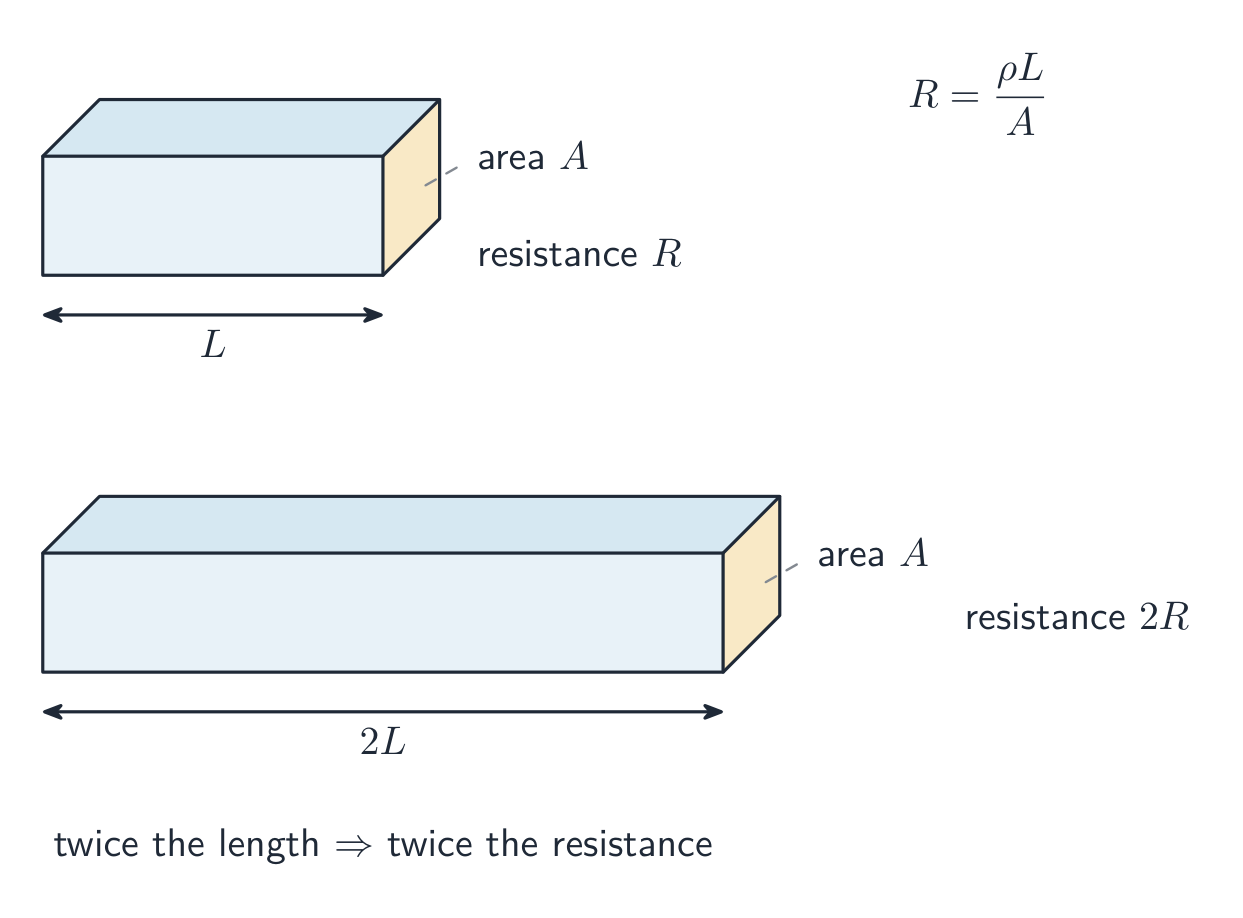
Resistance 电阻 measures how strongly an object opposes charge flow. It grows with the material's resistivity 电阻率 and the conductor's length, and shrinks with its area:
$$R=\frac{\rho\,\ell}{A}.$$Ohm's law 欧姆定律 relates the current through an element to the potential difference across it:
$$I=\frac{\Delta V}{R}.$$A longer conductor has more resistance; a wider one has less Worked example. Stretch a wire to double its length: the volume is fixed, so the area halves, and $R=\rho\ell/A$ becomes $\rho(2\ell)/(A/2)=4R$ – four times the resistance. An element is ohmic 欧姆性 if $R$ stays constant (a straight line through the origin on an $I$–$\Delta V$ graph); a lightbulb filament, which heats up, is not.
ExploreApply Ohm's law
Ohm's law $V=IR$: for a fixed resistance, current is proportional to voltage. Raise the resistance and the same voltage pushes less current.
Vocabulary TrainEnglish Resistance/rɪˈzɪstəns/ resistivity/ˌriːzɪˈstɪvəti/ Ohm's law/əʊmz lɔː/ ohmic/ˈəʊmɪk/ 11.4
Electric Power
Syllabus
Learning Objective Essential Knowledge 11.4.A
Describe the transfer of energy into, out of, or within an electric circuit, in terms of power.- 11.4.A.1 The rate at which energy is transferred, converted, or dissipated by a circuit element depends on the current in the element and the electric potential difference across it.
- Equation: $P = I\Delta V$
- Equation: $P = I^2 R = \dfrac{\Delta V^2}{R}$
- 11.4.A.2 The brightness of a lightbulb increases with power, so power can be used to qualitatively predict the brightness of lightbulbs in a circuit.
Boundary statement: AP Physics C: Electricity & Magnetism only expects students to analyze the transfer of mechanical and electrical energy, although students should be aware that electrical energy can also be dissipated in the form of thermal energy.
Source: College Board AP Course and Exam Description
A charge $q$ falling through a potential difference $\Delta V$ gives up energy $q\Delta V$, so the rate of energy transfer in an element is
$$P=I\,\Delta V=I^2R=\frac{(\Delta V)^2}{R}.$$In a resistor all of it becomes heat. Use the form whose quantities you actually know – and use power to rank lightbulb brightness: brighter = more power, not necessarily more resistance. In series, the larger resistance is brighter ($P=I^2R$, same $I$); in parallel, the smaller one is ($P=\Delta V^2/R$, same $\Delta V$).
ExploreRead an I-V characteristic
Power is $P=IV$. A resistor's I-V line is straight, but a lamp curves as it heats and its resistance rises. The area under I-V relates to the energy delivered.
11.5
Compound Direct Current Circuits
Syllabus
Learning Objective Essential Knowledge 11.5.A
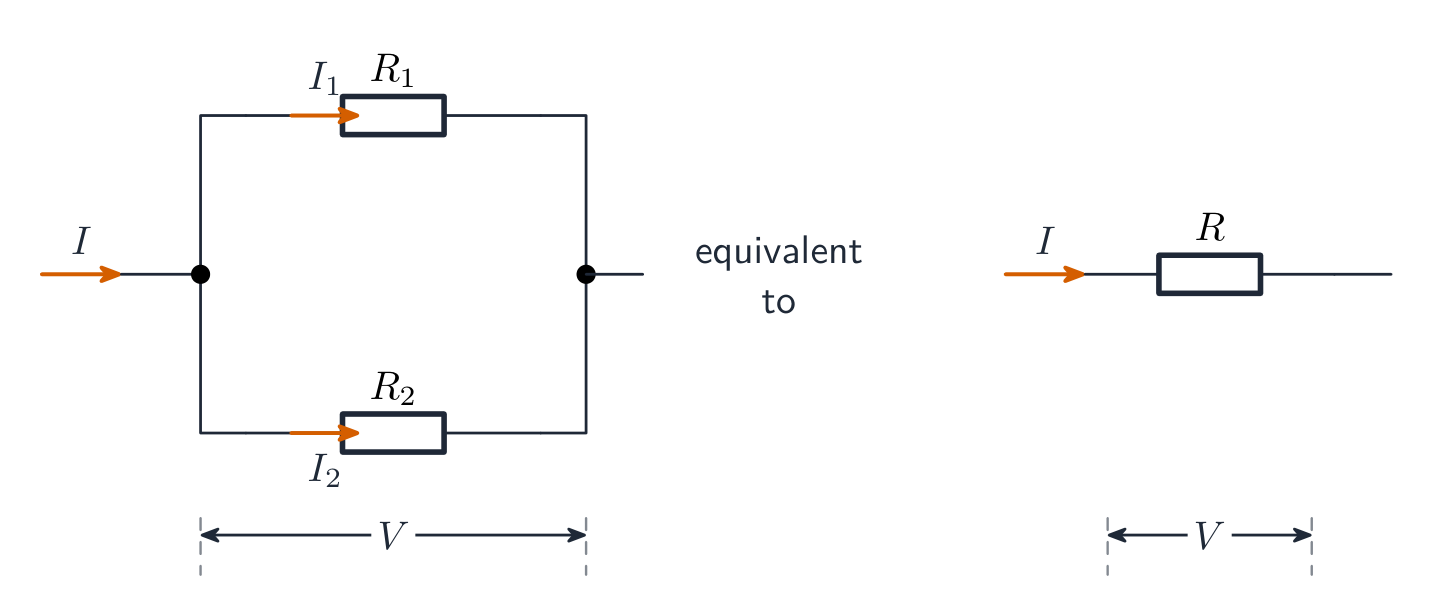
Describe the equivalent resistance of multiple resistors connected in a circuit.- 11.5.A.1 Circuit elements may be connected in series and/or in parallel.
- 11.5.A.1.i A series connection is one in which any charge passing through one circuit element must proceed through all elements in that connection and has no other path available. The current in each element in series must be the same.
- 11.5.A.1.ii A parallel connection is one in which charges may pass through one of two or more paths. Across each path, the potential difference is the same.
- 11.5.A.2 A collection of resistors in a circuit may be analyzed as though it were a single resistor with an equivalent resistance $R_{\text{eq}}$.
- 11.5.A.2.i The equivalent resistance of a set of resistors in series is the sum of the individual resistances.
- Equation: $R_{\text{eq},s} = \sum_{i} R_i$
- 11.5.A.2.ii The inverse of the equivalent resistance of a set of resistors connected in parallel is equal to the sum of the inverses of the individual resistances.
- Equation: $\dfrac{1}{R_{\text{eq},p}} = \sum_{i} \dfrac{1}{R_i}$
- 11.5.A.2.iii When resistors are connected in parallel, the number of paths available to charges increases, and the equivalent resistance of the group of resistors decreases.
- 11.5.A.2.i The equivalent resistance of a set of resistors in series is the sum of the individual resistances.
11.5.B
Describe a circuit with resistive wires and a battery with internal resistance.- 11.5.B.1 Ideal batteries have negligible internal resistance. Ideal wires have negligible resistance.
- 11.5.B.1.i The resistance of wires that are good conductors may normally be neglected, because their resistance is much smaller than that of other elements of a circuit.
- 11.5.B.1.ii The resistance of wires may only be neglected if the circuit contains other elements that do have resistance.
- 11.5.B.1.iii The potential difference a battery would supply if it were ideal is the potential difference measured across the terminals when there is no current in the battery and is sometimes referred to as its $\mathrm{emf}$ ($\mathcal{E}$).
- 11.5.B.2 The internal resistance of a nonideal battery may be treated as the resistance of a resistor in series with an ideal battery and the remainder of the circuit.
- 11.5.B.3 When there is current in a nonideal battery with internal resistance $r$, the potential difference across the terminals of the battery is reduced relative to the potential difference when there is no current in the battery.
- Equation: $\Delta V_{\text{terminal}} = \mathcal{E} - Ir$
11.5.C
Describe the measurement of current and potential difference in a circuit.- 11.5.C.1 Ammeters are used to measure current at a specific point in a circuit.
- 11.5.C.1.i Ammeters must be connected in series with the element in which current is being measured.
- 11.5.C.1.ii Ideal ammeters have zero resistance so that they do not affect the current in the element that they are in series with.
- 11.5.C.2 Voltmeters are used to measure electric potential difference between two points in a circuit.
- 11.5.C.2.i Voltmeters must be connected in parallel with the element across which potential difference is being measured.
- 11.5.C.2.ii Ideal voltmeters have infinite resistance so that no charge flows through them.
- 11.5.C.3 Nonideal ammeters and voltmeters will change the properties of the circuit being measured.
Boundary statement: Unless otherwise stated, all batteries, wires, and meters are assumed to be ideal. Circuits with batteries of different potential differences connected in parallel will not be assessed.
Source: College Board AP Course and Exam Description
Reduce resistor networks to an equivalent resistance 等效电阻: series resistances add ($R_{\text{eq}}=R_1+R_2+\cdots$), while parallel resistances add as reciprocals ($\tfrac{1}{R_{\text{eq}}}=\tfrac{1}{R_1}+\tfrac{1}{R_2}+\cdots$ – always less than the smallest branch). Collapse the network step by step to find the battery current, then expand back out to find each element's current and voltage.
Worked example. A $12\ \text{V}$ battery drives a $4.0\ \Omega$ and a $2.0\ \Omega$ resistor in series: $R_{\text{eq}}=6.0\ \Omega$, $I=2.0\ \text{A}$, the voltages split $8.0\ \text{V}$ and $4.0\ \text{V}$, and the $4.0\ \Omega$ resistor dissipates $P=I^2R=16\ \text{W}$.
Resistors in parallel combine to a smaller equivalent resistance Real batteries are not ideal. Model a battery as an ideal battery 理想电池 of emf $\varepsilon$ in series with its own internal resistance 内阻 $r$. When current flows, some emf is used up inside, so the terminal voltage 端电压 – what a voltmeter across the battery actually reads – drops:
$$\Delta V_{\text{terminal}}=\varepsilon-Ir.$$Worked example. A battery with $\varepsilon=12\ \text{V}$ and $r=0.50\ \Omega$ supplies $2.0\ \text{A}$: the terminals sit at $\Delta V=12-2.0(0.50)=11\ \text{V}$. With no current, a voltmeter reads the full $12\ \text{V}$.
Meters: an ammeter 电流表 goes in series at the point whose current you want (ideal ammeter: zero resistance); a voltmeter 电压表 goes in parallel across the element (ideal voltmeter: infinite resistance). Non-ideal meters disturb the circuit they measure – a real ammeter adds series resistance, a real voltmeter steals current.
Vocabulary TrainEnglish equivalent resistance/ɪˈkwɪvələnt rɪˈzɪstəns/ ideal battery/aɪˈdɪəl ˈbætəri/ internal resistance/ɪnˈtɜːnl rɪˈzɪstəns/ terminal voltage/ˈtɜːmɪnl ˈvəʊltɪdʒ/ ammeter/ˈæmiːtə/ voltmeter/ˈvəʊltmiːtə/ 11.6
Kirchhoff's Loop Rule
Syllabus
Learning Objective Essential Knowledge 11.6.A
Describe a circuit or elements of a circuit by applying Kirchhoff's loop rule.- 11.6.A.1 Energy changes in simple electrical circuits may be represented in terms of charges moving through electric potential differences within circuit elements.
- Equation: $\Delta U_E = q\Delta V$
- 11.6.A.2 Kirchhoff's loop rule is a consequence of the conservation of energy.
- 11.6.A.2.i Kirchhoff's loop rule states that the sum of potential differences across all circuit elements in a single closed loop must equal zero.
- Equation: $\sum \Delta V = 0$
- 11.6.A.2.ii The values of electric potential at points in a circuit can be represented by a graph of electric potential as a function of position within a loop.
- 11.6.A.2.i Kirchhoff's loop rule states that the sum of potential differences across all circuit elements in a single closed loop must equal zero.
Source: College Board AP Course and Exam Description
Charges moving through potential differences exchange energy ($\Delta U_E=q\Delta V$), and energy must balance around any closed path. That is Kirchhoff's loop rule 基尔霍夫回路定则:
$$\sum\Delta V=0\ \text{around any closed loop}.$$Sign discipline wins these problems: crossing a battery from $-$ to $+$ is $+\varepsilon$; crossing a resistor with the assumed current is $-IR$ (against it, $+IR$). Write one equation per independent loop.
Vocabulary TrainEnglish Kirchhoff's loop rule/ˈkɜːkhɒfs luːp ruːl/ 11.7
Kirchhoff's Junction Rule
Syllabus
Learning Objective Essential Knowledge 11.7.A
Describe a circuit or elements of a circuit by applying Kirchhoff's junction rule.- 11.7.A.1 Kirchhoff's junction rule is a consequence of the conservation of electric charge.
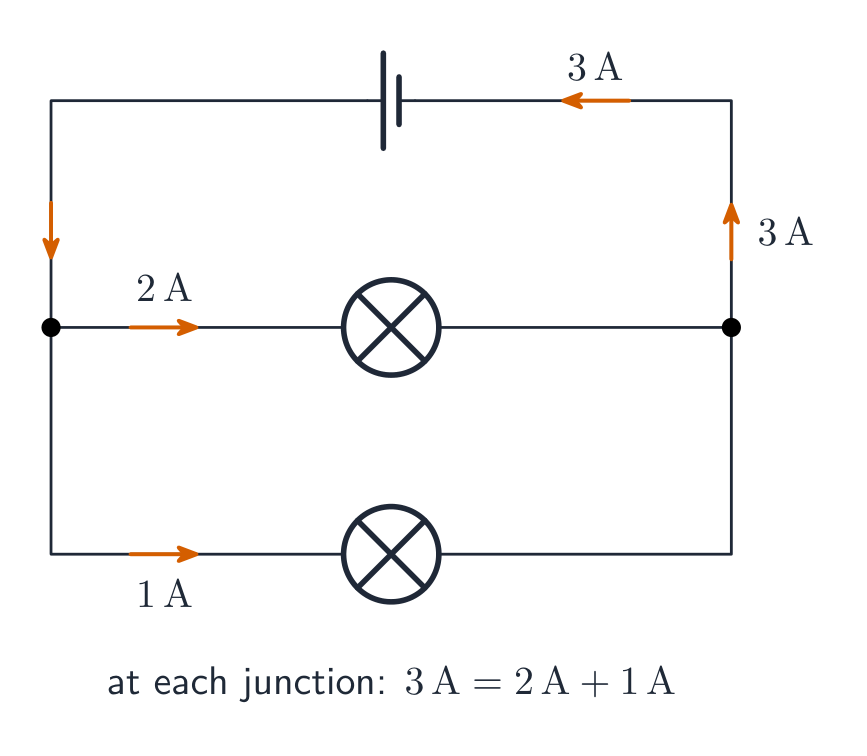
- 11.7.A.2 Kirchhoff's junction rule states that the total amount of charge entering a junction per unit time must equal the total amount of charge exiting that junction per unit time.
- Equation: $\sum I_{\text{in}} = \sum I_{\text{out}}$
Source: College Board AP Course and Exam Description
Kirchhoff's junction rule 基尔霍夫节点定则 is conservation of charge at a junction 节点:
$$\sum I_{\text{in}}=\sum I_{\text{out}}.$$Current divides at a junction: what flows in equals what flows out Together the two rules solve any multi-loop circuit: assign a current to each branch, write junction equations, then loop equations, and solve. A negative answer just means that current flows opposite to your assumed direction.
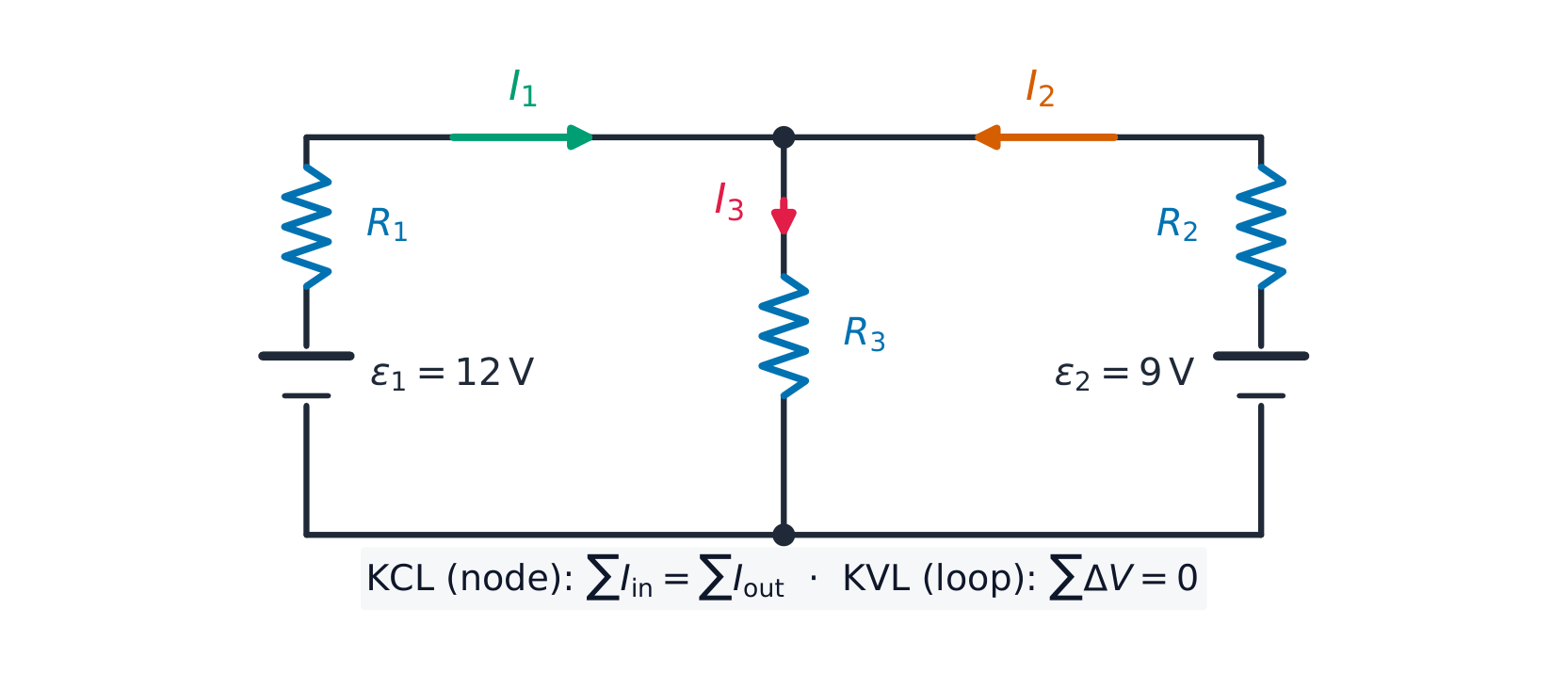
Two loop equations and one junction equation solve this two-battery circuit Worked example. In the circuit above, $\varepsilon_1=12\ \text{V}$ with $R_1=1.0\ \Omega$ on the left, $\varepsilon_2=9.0\ \text{V}$ with $R_2=1.0\ \Omega$ on the right, and a shared middle resistor $R_3=2.0\ \Omega$ carrying $I_3=I_1+I_2$ (junction rule). The two loop equations are
$$12=I_1+2(I_1+I_2)=3I_1+2I_2,\qquad 9=I_2+2(I_1+I_2)=2I_1+3I_2.$$Solving: $I_1=3.6\ \text{A}$, $I_2=0.60\ \text{A}$, so $I_3=4.2\ \text{A}$ through the middle. Check with the second loop: $2(3.6)+3(0.60)=9.0$ ✓.
Vocabulary TrainEnglish Kirchhoff's junction rule/ˈkɜːkhɒfs ˈdʒʌŋkʃn ruːl/ junction/ˈdʒʌŋkʃn/ 11.8
Resistor-Capacitor (RC) Circuits
Syllabus
Learning Objective Essential Knowledge 11.8.A
Describe the equivalent capacitance of multiple capacitors.- 11.8.A.1 A collection of capacitors in a circuit may be analyzed as though it was a single capacitor with an equivalent capacitance $C_{\text{eq}}$.
- 11.8.A.1.i The inverse of the equivalent capacitance of a set of capacitors connected in series is equal to the sum of the inverses of the individual capacitances.
- Equation: $\dfrac{1}{C_{\text{eq},s}} = \sum_{i} \dfrac{1}{C_i}$
- 11.8.A.1.ii The equivalent capacitance of a set of capacitors in series is less than the capacitance of the smallest capacitor.
- 11.8.A.1.iii The equivalent capacitance of a set of capacitors in parallel is the sum of the individual capacitances.
- Equation: $C_{\text{eq},p} = \sum_{i} C_i$
- 11.8.A.1.i The inverse of the equivalent capacitance of a set of capacitors connected in series is equal to the sum of the inverses of the individual capacitances.
- 11.8.A.2 As a result of conservation of charge, each of the capacitors in series must have the same magnitude of charge on each plate.
11.8.B
Describe the behavior of a circuit containing combinations of resistors and capacitors.- 11.8.B.1 The charge on a capacitor or the current in a resistor in an RC circuit can be described by a fundamental differential equation derived from Kirchhoff's loop rule.
- Equation: $\mathcal{E} = \dfrac{dq}{dt}R + \dfrac{q}{C}$
- 11.8.B.2 The time constant ($\tau$) is a significant feature of an RC circuit.
- 11.8.B.2.i The time constant of an RC circuit is a measure of how quickly the capacitor will charge or discharge and is defined as $\tau = R_{\text{eq}}C_{\text{eq}}$.
- 11.8.B.2.ii For a charging capacitor, the time constant represents the time required for the capacitor's charge to increase from zero to approximately 63 percent of its final asymptotic value.
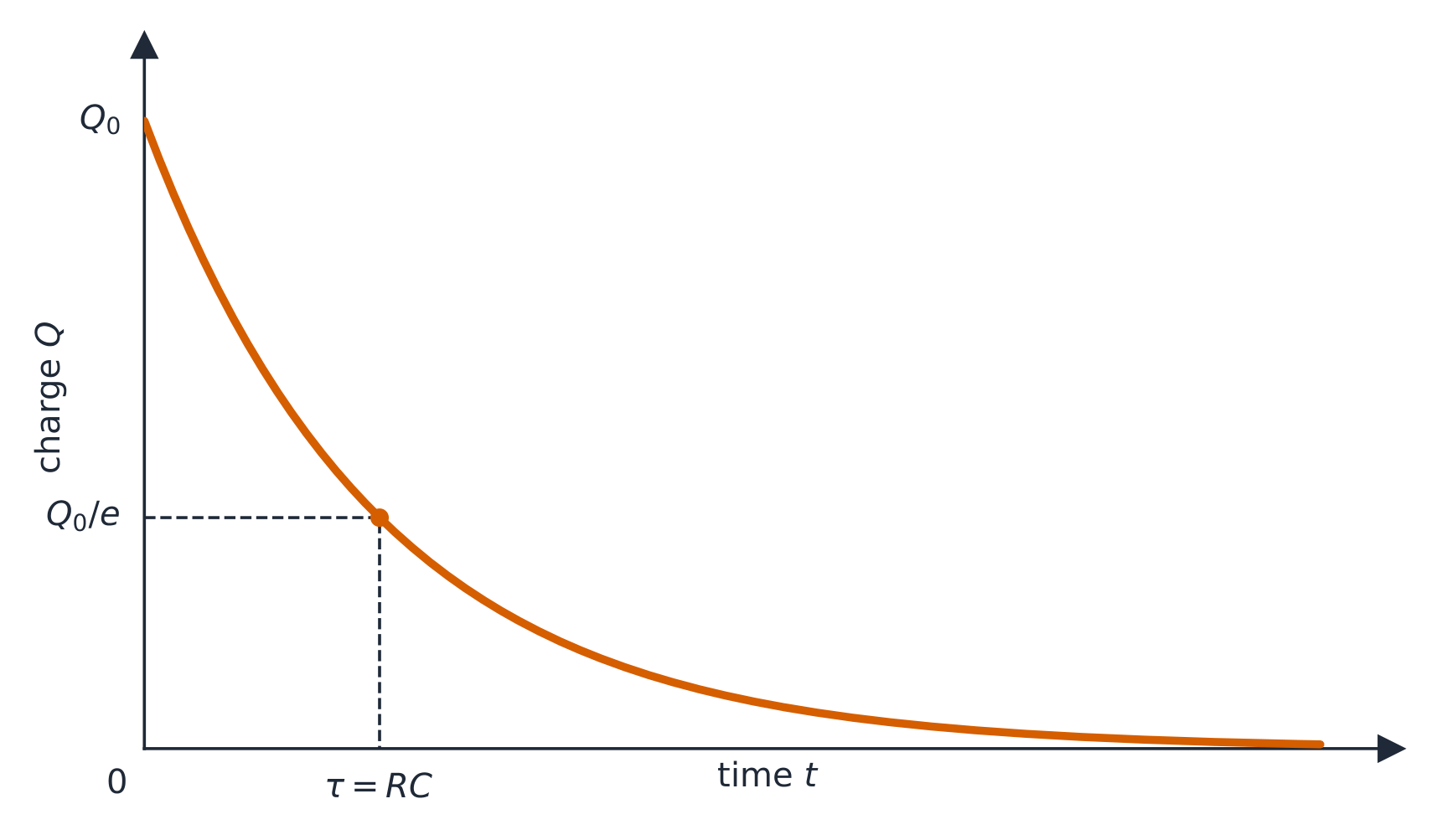
- 11.8.B.2.iii For a discharging capacitor, the time constant represents the time required for the capacitor's charge to decrease from fully charged to approximately 37 percent of its initial value.
- 11.8.B.3 The potential difference across a capacitor and the current in the branch of the circuit containing the capacitor each change over time as the capacitor charges and discharges, but both will reach a steady state after a long time interval.
- 11.8.B.3.i Immediately after being placed in a circuit, an uncharged capacitor acts like a wire, and charge can easily flow to or from the plates of the capacitor.
- 11.8.B.3.ii As a capacitor charges, changes to the potential difference across the capacitor affect the charge on the plates of the capacitor, the current in the circuit branch in which the capacitor is located, and the electric potential energy stored in the capacitor.
- 11.8.B.3.iii The potential difference across a capacitor, the current in the circuit branch in which the capacitor is located, and the electric potential energy stored in the capacitor all change with respect to time and asymptotically approach steady state conditions.
- 11.8.B.3.iv After a long time, a charging capacitor approaches a state of being fully charged, reaching a maximum potential difference at which there is zero current in the circuit branch in which the capacitor is located.
- 11.8.B.3.v Immediately after a charged capacitor begins discharging, the amount of charge on the capacitor and the energy stored in the capacitor begin to decrease.
- 11.8.B.3.vi As a capacitor discharges, the amount of charge on the capacitor, the potential difference across the capacitor, and the current in the circuit branch in which the capacitor is located all decrease until a steady state is reached.
- 11.8.B.3.vii After either charging or discharging for times much greater than the time constant, the capacitor and the relevant circuit branch may be modeled using steady-state conditions.
Source: College Board AP Course and Exam Description
Discharging a capacitor: τ = RC Charging a capacitor (RC) Capacitor networks reduce like resistors but with the rules swapped: parallel capacitances add ($C_{\text{eq}}=C_1+C_2$), series add as reciprocals – and capacitors in series must carry the same charge on each plate, by conservation of charge. Use the equivalent capacitance 等效电容 to analyse the network, then expand back.
In an RC circuit RC电路, Kirchhoff's loop rule gives the differential equation
$$\varepsilon=R\frac{dq}{dt}+\frac{q}{C},$$whose solutions are exponentials with time constant 时间常数 $\tau=RC$:
$$q(t)=Q\big(1-e^{-t/RC}\big)\ \text{(charging)},\qquad q(t)=Q\,e^{-t/RC}\ \text{(discharging)},\qquad i(t)=\frac{\varepsilon}{R}e^{-t/RC}.$$The current is largest at the first instant and decays – it never "waits" for the capacitor. Learn the two limits: at $t=0$ an uncharged capacitor acts like a plain wire (maximum current); after a long time it is fully charged, no current flows in its branch, and it acts like a break. In any steady state 稳态, cover the capacitor branch with your finger, solve the resistor circuit, then read the capacitor's voltage from the element it sits across.
The charge on a capacitor decays exponentially as it discharges Worked example. With $R=5.0\ \text{k}\Omega$, $C=200\ \mu\text{F}$, and a $10\ \text{V}$ battery: $\tau=RC=1.0\ \text{s}$; initial current $\dfrac{\varepsilon}{R}=2.0\ \text{mA}$; after one time constant the charge is $q=CV(1-e^{-1})\approx1.3\times10^{-3}\ \text{C}$, about $63\%$ of full charge, and the current has fallen to $37\%$ of its initial value.
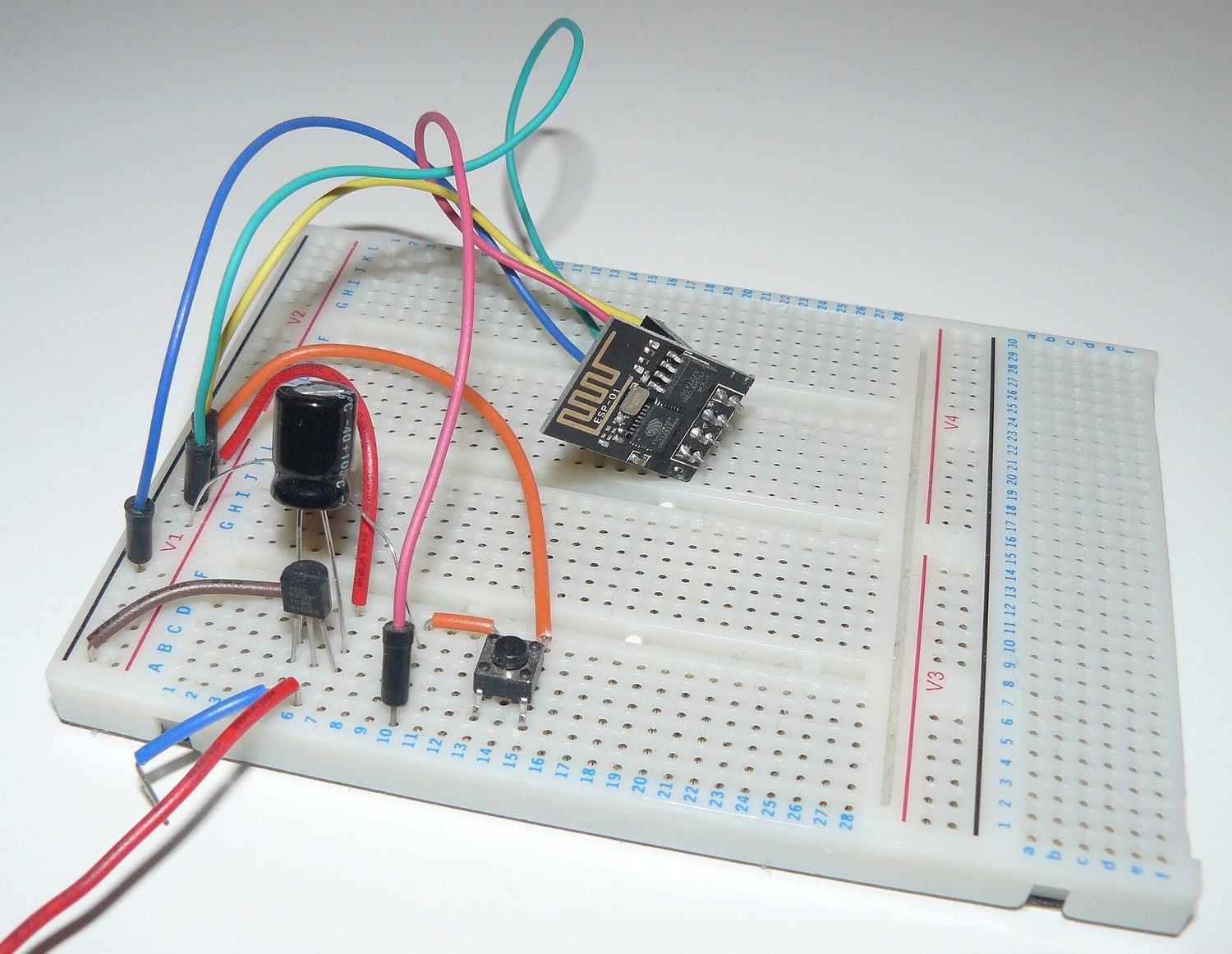
A real circuit on a breadboard: a resistor and capacitor together set how fast the voltage rises and falls Vocabulary TrainEnglish equivalent capacitance/ɪˈkwɪvələnt kəˈpæsɪtəns/ RC circuit/ˌɑː ˈsiː ˈsɜːkɪt/ time constant/taɪm ˈkɒnstənt/ steady state/ˈstedi steɪt/ 11.8
Exam tips
- Relate current to charge flow $I=\tfrac{dQ}{dt}$ and use $J=\sigma E$, $R=\tfrac{\rho L}{A}$ for resistance.
- Apply Kirchhoff's laws (junction: charge; loop: energy) with consistent sign conventions.
- Analyse RC circuits with calculus: charging/discharging give exponentials with time constant $\tau=RC$.
- Combine resistors (series add, parallel reciprocal) and track power $P=IV=I^2R$.
- At $t=0$ a capacitor acts like a wire; after a long time ($t\to\infty$) it acts like an open branch.
- 11.1.A.1 Current is the rate at which charge passes through a cross-sectional area of a wire.
-
12
Magnetic Fields and Electromagnetism
Watch lesson12.1
Magnetic Fields
Syllabus
Learning Objective Essential Knowledge 12.1.A
Describe the properties of a magnetic field.- 12.1.A.1 A magnetic field is a vector field that can be used to determine the magnetic force exerted on moving electric charges, electric currents, or magnetic materials.
- 12.1.A.1.i Magnetic fields can be produced by magnetic dipoles or combinations of dipoles, but never by monopoles.
- 12.1.A.1.ii Magnetic dipoles have north and south polarity.
- 12.1.A.2 A magnetic field is a vector quantity and can be represented using vector field maps.
- 12.1.A.3 Magnetic field lines must form closed loops, as described by Gauss's law for magnetism.
- 12.1.A.3.i Maxwell's equations are the collection of equations that fully describe electromagnetism. Gauss's law for magnetism is Maxwell's second equation.
- Equation: $\oint \vec{B} \cdot d\vec{A} = 0$
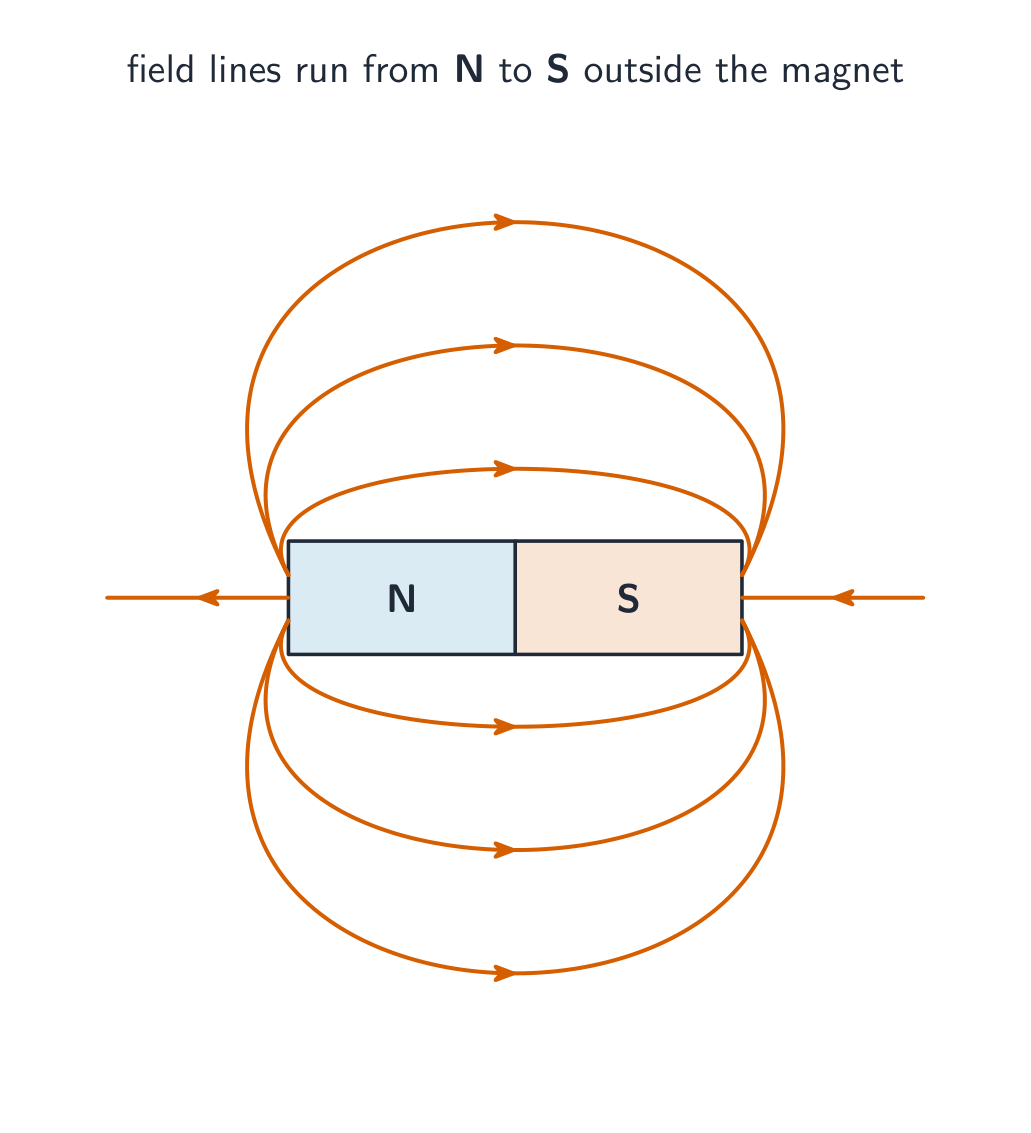
- 12.1.A.3.ii Magnetic fields in a bar magnet form closed loops, with the external magnetic field pointing away from one end (defined as the north pole) and returning to the other end (defined as the south pole).
- 12.1.A.3.i Maxwell's equations are the collection of equations that fully describe electromagnetism. Gauss's law for magnetism is Maxwell's second equation.
12.1.B
Describe the magnetic behavior of a material as a result of the configuration of magnetic dipoles in the material.- 12.1.B.1 Magnetic dipoles result from the circular or rotational motion of electric charges. In magnetic materials, this can be the motion of electrons.
- 12.1.B.1.i Permanent magnetism and induced magnetism are system properties that both result from the alignment of magnetic dipoles within a system.
- 12.1.B.1.ii No magnetic north pole is ever found in isolation from a south pole. For example, if a bar magnet is broken in half, both halves are magnetic dipoles.
- 12.1.B.1.iii Magnetic poles of the same polarity will repel; magnetic poles of opposite polarity will attract.
- 12.1.B.1.iv The magnitude of the magnetic field from a magnetic dipole decreases with increasing distance from the dipole.
- 12.1.B.2 A magnetic dipole, such as a magnetic compass, placed in a magnetic field will tend to align with the magnetic field.
- 12.1.B.3 A material's composition influences its magnetic behavior in the presence of an external magnetic field.
- 12.1.B.3.i Ferromagnetic materials such as iron, nickel, and cobalt can be permanently magnetized by an external field that causes the alignment of magnetic domains or atomic magnetic dipoles.
- 12.1.B.3.ii Paramagnetic materials such as aluminum, titanium, and magnesium interact weakly with an external magnetic field, in that the magnetic dipoles of the material do not remain aligned after the external field is removed.
- 12.1.B.3.iii All materials have the property of diamagnetism, in that their electronic structure creates a usually weak alignment of the dipole moments of the material opposite the external magnetic field.
- 12.1.B.4 Earth's magnetic field may be approximated as a magnetic dipole.
12.1.C
Describe the magnetic permeability of a material.- 12.1.C.1 Magnetic permeability is a measurement of the amount of magnetization in a material in response to an external magnetic field.
- 12.1.C.2 Free space has a constant value of magnetic permeability, known as the vacuum permeability $\mu_0$, that appears in equations representing physical relationships.
- 12.1.C.3 The permeability of matter has values different from that of free space and arises from the matter's composition and arrangement. It is not a constant for a material and varies based on many factors, including temperature, orientation, and strength of the external field.
Source: College Board AP Course and Exam Description
A magnetic field 磁场 $\vec{B}$ is a vector field 矢量场 that surrounds magnets, moving charges, and currents; it determines the magnetic force on any moving charge placed in it. Magnetic field lines 磁感线 must form closed loops: they leave the north pole, return to the south pole, and continue through the magnet. Denser lines mean a stronger field.
Field lines run from N to S outside a bar magnet Closed loops are the content of Gauss's law for magnetism, the second of Maxwell's equations 麦克斯韦方程组:
$$\oint \vec{B}\cdot d\vec{A}=0.$$The net magnetic flux through any closed surface is zero – as many field lines leave as enter. That is exactly the statement that isolated magnetic monopoles 磁单极子 do not exist. Every source of magnetism is a magnetic dipole 磁偶极子 (a north–south pair), made by circulating charge – in materials, the motion of electrons. Break a bar magnet in half and you get two smaller dipoles, never a lone pole. Like poles repel, opposite poles attract, and a free dipole – a compass 指南针 – rotates to line up with the local field. Earth's own field is approximately a dipole, which is why a compass works. Dipole fields weaken with distance.
How a material responds to an external field depends on how its internal dipoles behave:
- Ferromagnetic 铁磁性 (iron, nickel, cobalt): an external field aligns whole magnetic domains 磁畴, and the alignment survives after the field is removed – a permanent magnet.
- Paramagnetic 顺磁性 (aluminum, titanium): dipoles align weakly with the field but relax when it is removed.
- Diamagnetic 抗磁性 (all materials): the electronic structure produces a usually weak alignment opposite to the field.
The strength of a material's response is its magnetic permeability 磁导率. Free space has the constant value $\mu_0$ (the vacuum permeability); the permeability of matter differs from $\mu_0$ and is not even constant – it varies with temperature, orientation, and field strength.

An aurora: charged particles from the Sun are steered by Earth's magnetic field toward the poles ExploreSee a magnet's field lines
Magnetic field lines run from north to south outside a magnet; where they crowd together the field is strongest.
Vocabulary TrainEnglish magnetic field/mæɡˈnetɪk fiːld/ vector field/ˈvektə fiːld/ magnetic field lines/mæɡˈnetɪk fiːld laɪnz/ Maxwell's equations/ˈmækswelz ɪˈkweɪʒnz/ magnetic monopoles/mæɡˈnetɪk ˈmɒnəʊpəʊlz/ magnetic dipole/mæɡˈnetɪk ˈdaɪpəʊl/ compass/ˈkʌmpəs/ Ferromagnetic/ˌferəməɡˈnetɪk/ magnetic domains/mæɡˈnetɪk dəˈmeɪnz/ Paramagnetic/ˌpærəməɡˈnetɪk/ Diamagnetic/ˌdaɪəməɡˈnetɪk/ magnetic permeability/mæɡˈnetɪk ˌpɜːməˈbɪlɪti/ 12.2
Magnetism and Moving Charges
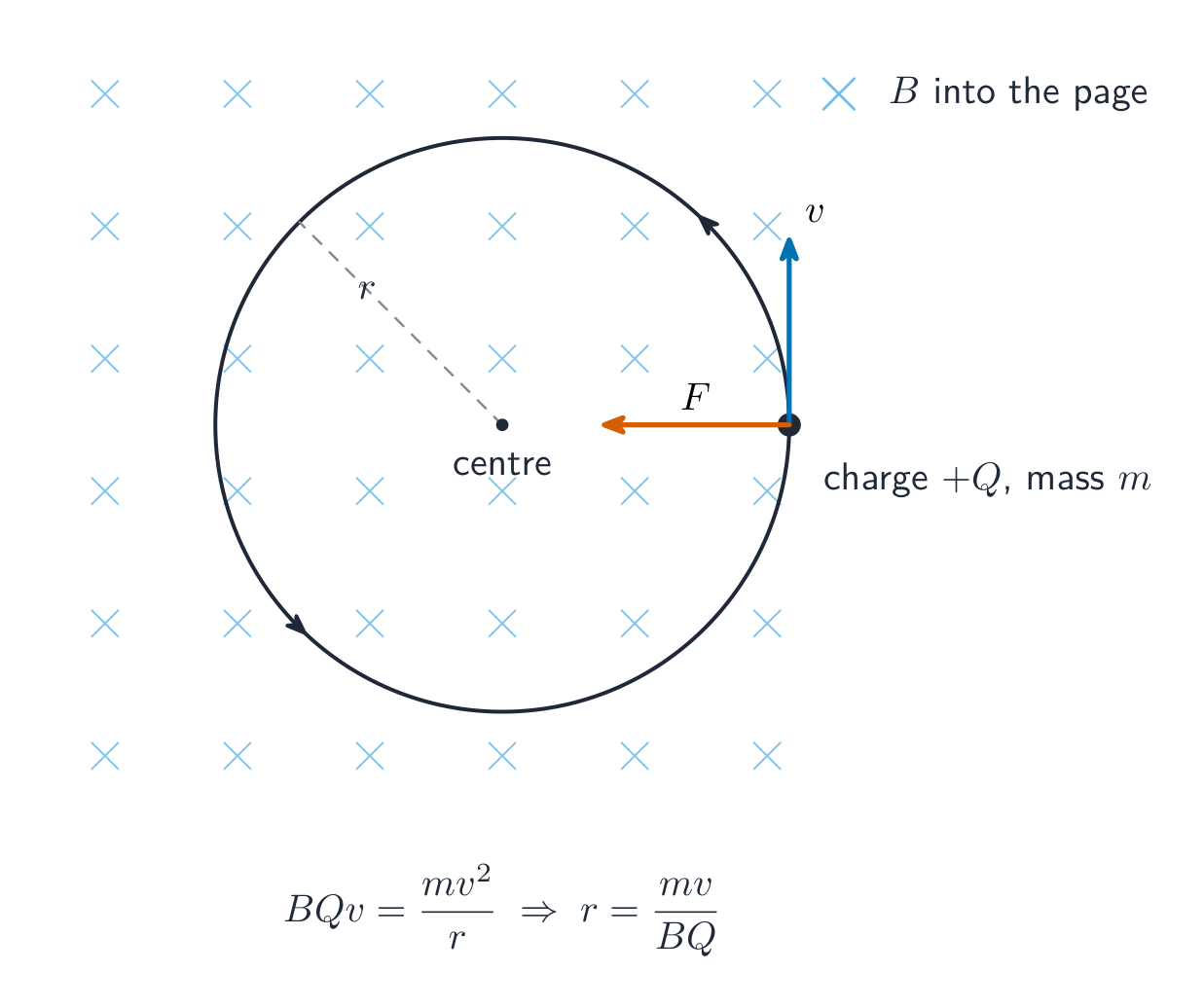
Syllabus
Learning Objective Essential Knowledge 12.2.A
Describe the magnetic field produced by moving charged objects.- 12.2.A.1 A single moving charged object produces a magnetic field.
- 12.2.A.1.i The magnetic field at a particular point produced by a moving charged object depends on the object's velocity and the distance between the point and the object.
- 12.2.A.1.ii At a point in space, the direction of the magnetic field produced by a moving charged object is perpendicular to both the velocity of the object and the position vector from the object to that point in space and can be determined using the right-hand rule.
- 12.2.A.1.iii The magnitude of the magnetic field is a maximum when the velocity vector and the position vector from the object to that point in space are perpendicular.
12.2.B
Describe the force exerted on moving charged objects by a magnetic field.- 12.2.B.1 A magnetic field will exert a force on a charged object moving within that field, with magnitude and direction that depend on the cross-product of the charge's velocity and the magnetic field.
- Equation: $\vec{F}_B = q\left(\vec{v} \times \vec{B}\right)$
- 12.2.B.2 In a region containing both a magnetic field and an electric field, a moving charged object will experience independent forces from each field.
- 12.2.B.3 The Hall effect describes the potential difference created in a conductor by an external magnetic field that has a component perpendicular to the direction of charges moving in the conductor.
Source: College Board AP Course and Exam Description
A moving charge in a magnetic field A moving charge does two things: it creates a magnetic field, and it feels a force in an external one. The field it creates at a point is perpendicular 垂直 to both its velocity and the position vector from charge to point (right-hand rule again), and is largest where those two are perpendicular – zero directly ahead of or behind the motion.
The force on a charge moving in a field $\vec{B}$ is the cross product
$$\vec{F}_B=q\,\vec{v}\times\vec{B},\qquad F=qvB\sin\theta,$$perpendicular to both $\vec{v}$ and $\vec{B}$ – point the fingers of your right hand along $\vec{v}$, curl toward $\vec{B}$, and the thumb gives the force on a positive charge (reverse it for negative). Because $\vec{F}_B\perp\vec{v}$, the magnetic force does no work on the charge: it changes direction, never speed.
A charge moving perpendicular to a uniform field therefore travels in a circle, the magnetic force supplying the centripetal force 向心力:
$$qvB=\frac{mv^2}{r}\quad\Rightarrow\quad r=\frac{mv}{qB},\qquad T=\frac{2\pi m}{qB}.$$Notice the period $T$ does not depend on the speed – faster particles ride larger circles in the same time.
A charged particle moving across a magnetic field follows a circular path Worked example. A proton ($q=1.6\times10^{-19}\ \text{C}$, $m=1.67\times10^{-27}\ \text{kg}$) enters a $0.50\ \text{T}$ field at $2.0\times10^{5}\ \text{m/s}$, perpendicular to it. The magnetic force $F=qvB=1.6\times10^{-14}\ \text{N}$ bends it into a circle of radius $r=\dfrac{mv}{qB}=\dfrac{1.67\times10^{-27}(2.0\times10^{5})}{1.6\times10^{-19}(0.50)}=4.2\times10^{-3}\ \text{m}$.
In a region with both an electric and a magnetic field, the two forces act independently and add as vectors. Balancing them makes a velocity selector 速度选择器: with $\vec{E}$ and $\vec{B}$ crossed, only charges with $qE=qvB$, i.e. $v=E/B$, pass straight through. The Hall effect 霍尔效应 is the same physics inside a conductor: a field with a component perpendicular to the current pushes the moving carriers sideways, charge builds up on one face, and a measurable potential difference appears across the conductor – its sign reveals whether the carriers are positive or negative.
ExploreForce on a moving charge
A charge moving through a magnetic field feels a force $F=qvB$ at right angles to both its velocity and the field — the basis of the motor effect. Reverse either and the force flips.
Vocabulary TrainEnglish perpendicular/ˌpɜːpənˈdɪkjʊlə/ centripetal force/senˈtrɪpɪtl fɔːs/ velocity selector/vəˈlɒsɪti sɪˈlektə/ Hall effect/hɔːl ɪˈfekt/ 12.3
Magnetic Fields of Current-Carrying Wires
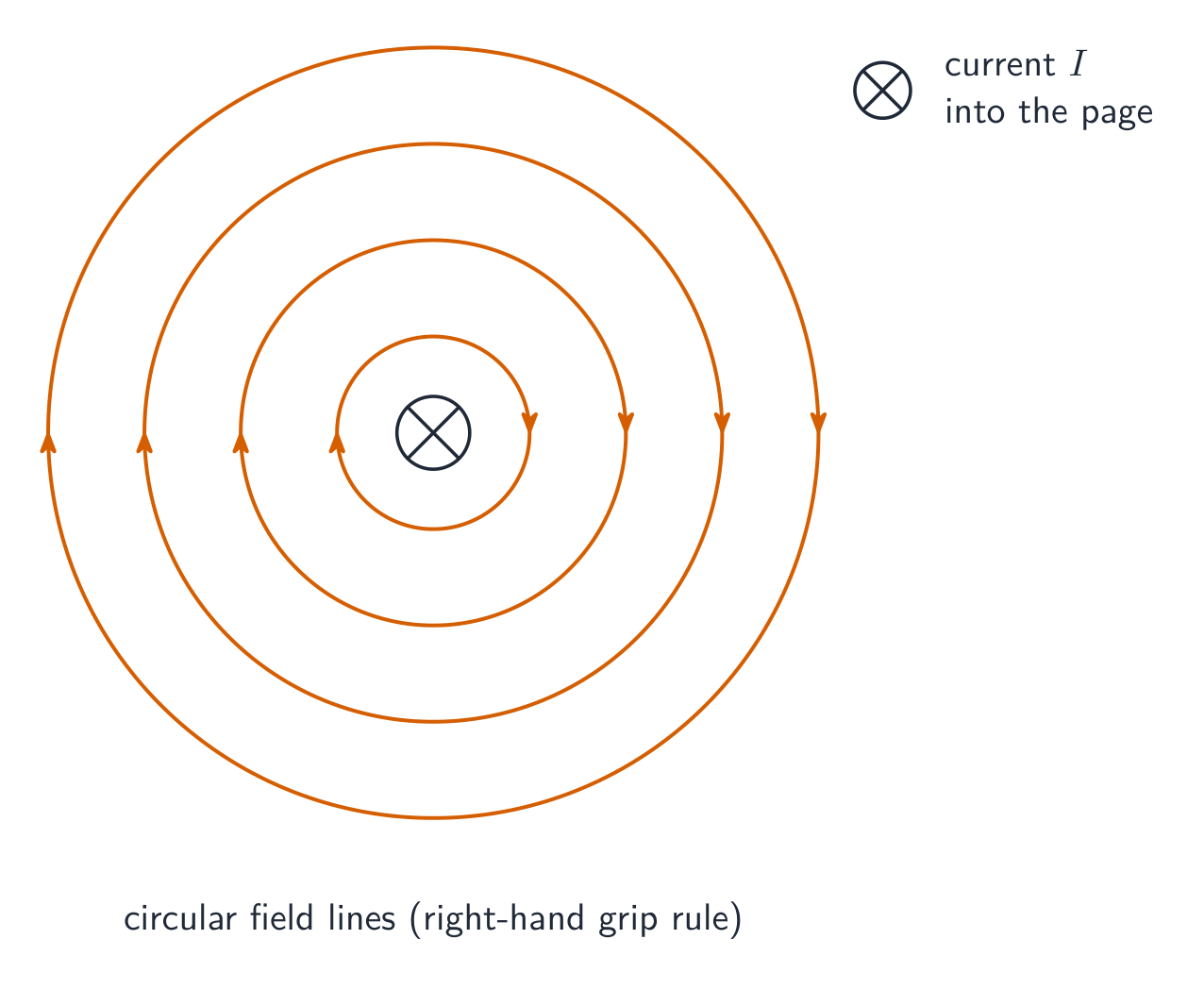
Syllabus
Learning Objective Essential Knowledge 12.3.A
Describe the magnetic field produced by a current-carrying wire.- 12.3.A.1 The Biot-Savart law defines the magnitude and direction of a magnetic field created by an electrical current.
- Equation: $d\vec{B} = \dfrac{\mu_0}{4\pi} \dfrac{I(d\vec{\ell} \times \hat{r})}{r^2}$
- 12.3.A.2 The magnetic field vectors around a small segment of a current-carrying wire are tangent to concentric circles centered on that wire. The field has no component toward, away from, or parallel to the segment of the current-carrying wire.
- 12.3.A.3 The Biot-Savart law can be used to derive the magnitudes and directions of magnetic fields around segments of current-carrying wires, for example at the center of a circular loop of wire.
- Equation: $B_{\text{center of loop}} = \dfrac{\mu_0 I}{2R}$
12.3.B
Describe the force exerted on current-carrying wires by a magnetic field.- 12.3.B.1 A magnetic field will exert a force on a current-carrying wire.
- Equation: $\vec{F}_B = \int I\left(d\vec{\ell} \times \vec{B}\right)$
Boundary statement: AP Physics C: Electricity & Magnetism only expects students to perform quantitative analysis of certain cases of current-carrying conductors using the Biot-Savart law, such as at a location along the perpendicular bisector of a straight conductor, at a location along the central axis of a circular loop, or at the center of a segment of a circular loop.
Source: College Board AP Course and Exam Description
The magnetic field around a current A current is a stream of moving charges, so it creates a magnetic field. The Biot–Savart law 毕奥-萨伐尔定律 adds up the field of each current element:
$$d\vec{B}=\frac{\mu_0}{4\pi}\frac{I\,d\vec{l}\times\hat{r}}{r^2}.$$Around any straight segment the field vectors are tangent 相切 to concentric circles 同心圆 centred on the wire – no component toward, away from, or along the wire. Curl your right hand around the wire with the thumb along the current: your fingers give the field direction.
Concentric circular field lines surround a straight current-carrying wire The Biot–Savart integrals AP expects: a long straight wire ($B=\dfrac{\mu_0 I}{2\pi r}$, or a point on the perpendicular bisector of a finite wire), and the centre of a circular loop,
$$B_{\text{centre of loop}}=\frac{\mu_0 I}{2R},$$where every element $d\vec{l}$ is perpendicular to $\hat{r}$ and equally distant $R$ – say that in an FRQ derivation. An arc that is a fraction of a full circle contributes that same fraction of $\mu_0 I/2R$ at its centre.
A field also pushes on a current-carrying wire, element by element:
$$\vec{F}_B=\int I\,d\vec{l}\times\vec{B}\qquad(\vec{F}=I\vec{L}\times\vec{B}\ \text{for a straight wire in a uniform field}).$$Worked example. Two long parallel wires a distance $d=0.10\ \text{m}$ apart each carry $5.0\ \text{A}$ in the same direction. Wire 1's field at wire 2 is $B=\dfrac{\mu_0 I}{2\pi d}=1.0\times10^{-5}\ \text{T}$, so wire 2 feels $\dfrac{F}{L}=I B=5.0\times10^{-5}\ \text{N/m}$, pulled toward wire 1. Same-direction currents attract; opposite currents repel.
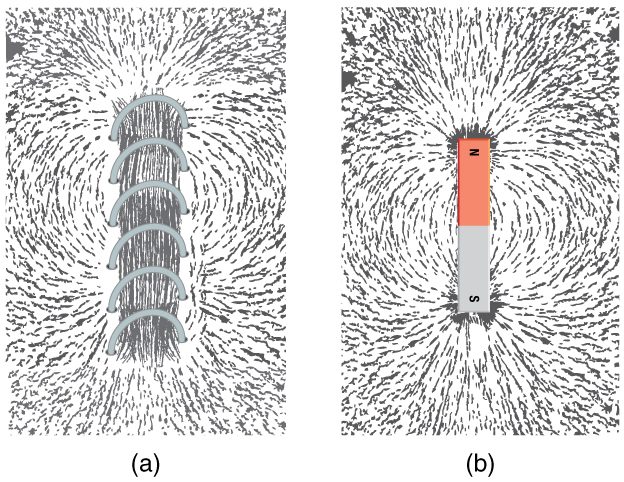
A current-carrying coil (solenoid) makes a magnetic field shaped just like a bar magnet's Vocabulary TrainEnglish Biot–Savart law/ˈbɪɒt ˈsævɑːt lɔː/ tangent/ˈtændʒənt/ concentric circles/kənˈsentrɪk ˈsɜːklz/ 12.4
Ampère's Law
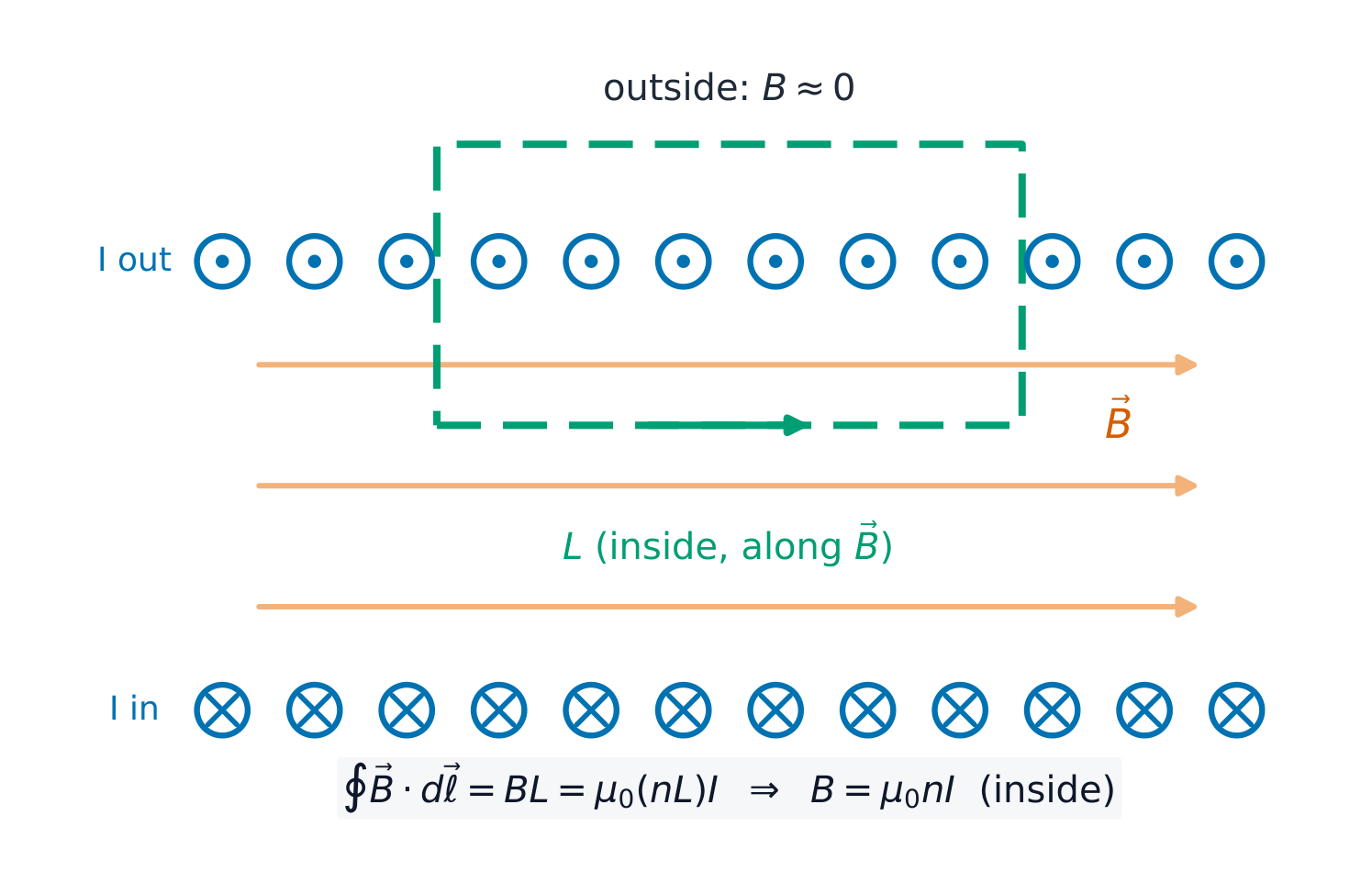
Syllabus
Learning Objective Essential Knowledge 12.4.A
Use Ampère's law to describe the magnetic field created by a moving charge carrier.- 12.4.A.1 Ampère's law relates the magnitude of the magnetic field to the current enclosed by a closed imaginary path called an Amperian loop.
- Equation: $\oint \vec{B} \cdot d\vec{\ell} = \mu_0 I_{\text{enc}}$
- 12.4.A.1.i Ampère's law can be used to determine the magnetic field near a long, straight current-carrying wire.
- Equation: $B_{\text{wire}} = \dfrac{\mu_0}{2\pi} \dfrac{I}{r}$
- 12.4.A.1.ii Unless otherwise stated, all solenoids are assumed to be very long, with uniform magnetic fields inside the solenoids and negligible magnetic fields outside the solenoids.
- 12.4.A.1.iii Ampère's law can be used to determine the magnetic field inside of a long solenoid.
- Equation: $B_{\text{sol}} = \mu_0 n I$
- 12.4.A.2 An Amperian loop is a closed path around a current-carrying conductor.
- 12.4.A.3 The principle of superposition can be used to determine the net magnetic field at a point in space created by various combinations of current-carrying conductors, or conducting loops, segments, or cylinders.
- 12.4.A.4 Maxwell's equations are the collection of equations that fully describe electromagnetism. Maxwell's fourth equation is Ampère's law with Maxwell's addition; it states that magnetic fields can be generated by electric current (Ampère's law) and that a changing electric field creates a magnetic field, similar to the way a moving charge creates a magnetic field (Maxwell's addition).
- Equation: $\oint \vec{B} \cdot d\vec{\ell} = \mu_0 I + \mu_0 \varepsilon_0 \dfrac{d\Phi_E}{dt}$
Boundary statement: AP Physics C: Electricity & Magnetism only expects quantitative application of Ampère's law limited to situations involving symmetrical magnetic fields. Long straight wires, long solenoids carrying currents, as well as conductive slabs or cylindrical conductors carrying a current density, are the types of shapes to which Ampère's law will be applied on the AP Physics C: Electricity & Magnetism Exam.
Boundary statement: AP Physics C: Electricity & Magnetism does not expect students to use Maxwell's fourth equation with a changing electric field. However, students should understand that a changing electric field generates a magnetic field.
Source: College Board AP Course and Exam Description
For symmetric current distributions, Ampère's law 安培定律 finds the field far faster than Biot–Savart:
$$\oint \vec{B}\cdot d\vec{l}=\mu_0 I_{\text{enc}}.$$Choose an Amperian loop 安培环路 that matches the symmetry, so that $B$ is constant along the loop (and parallel to it) and comes out of the integral. AP applies it to long straight wires, long solenoids, and conductors carrying a current density 电流密度 (slabs and cylinders); combinations are handled by superposition 叠加.
Worked example. Find the field $0.10\ \text{m}$ from a long wire carrying $5.0\ \text{A}$. A circular loop of radius $r$ shares the field's symmetry, so $B(2\pi r)=\mu_0 I$ and
$$B=\frac{\mu_0 I}{2\pi r}=\frac{(4\pi\times10^{-7})(5.0)}{2\pi(0.10)}=1.0\times10^{-5}\ \text{T}.$$A long solenoid 螺线管 (assumed: uniform field inside, negligible field outside) is the other classic. Take a rectangular loop with one side of length $L$ inside, parallel to the axis: only that side contributes to the integral, so $BL=\mu_0 (nL) I$ and
$$B_{\text{sol}}=\mu_0 n I,$$with $n$ the turns per metre.
A rectangular Amperian loop derives the uniform field inside a solenoid Worked example (cylinder). A solid cylindrical conductor of radius $R$ carries current $I$ spread uniformly over its cross-section. Inside ($r
Exam skill. Every Ampère's-law answer earns its marks in the setup: name the loop, state why $B$ is constant and parallel to it (symmetry), and count $I_{\text{enc}}$ carefully before you solve. Maxwell's fourth equation adds one more idea you should know qualitatively: a changing electric field also creates a magnetic field – but AP will not ask you to compute with that term.
Vocabulary TrainEnglish Ampère's law/ˈæmpeəz lɔː/ Amperian loop/æmˈpɪərɪən luːp/ current density/ˈkʌrənt ˈdensɪti/ superposition/ˌsuːpəpəˈzɪʃn/ solenoid/ˈsəʊlənɔɪd/ 12.4
Exam tips
- The magnetic force $\vec F=q\vec v\times\vec B$ is perpendicular to velocity — use the right-hand rule and note it does no work.
- A charge in a uniform field moves in a circle with $r=\tfrac{mv}{qB}$.
- Find the field of currents with Biot–Savart $d\vec B=\tfrac{\mu_0}{4\pi}\tfrac{I\,d\vec l\times\hat r}{r^2}$ or Ampère's law $\oint \vec B\cdot d\vec l=\mu_0 I_{enc}$ when there is symmetry.
- Force on a wire is $\vec F=I\vec L\times\vec B$; keep the cross-product direction straight.
- Distinguish the force on a charge from the field the current creates.
- 12.1.A.1 A magnetic field is a vector field that can be used to determine the magnetic force exerted on moving electric charges, electric currents, or magnetic materials.
-
13
Electromagnetic Induction
Watch lesson13.1
Magnetic Flux
Syllabus
Learning Objective Essential Knowledge 13.1.A
Describe the magnetic flux through an arbitrary area or geometric shape.- 13.1.A.1 For a magnetic field $\vec{B}$ that is constant across an area $\vec{A}$, the magnetic flux through the area is defined as $\Phi_B = \vec{B} \cdot \vec{A}$ .
- 13.1.A.1.i The area vector is defined as perpendicular to the plane of the surface and outward from a closed surface.
- 13.1.A.1.ii The sign of flux is given by the dot product of the magnetic field vector and the area vector.
- 13.1.A.2 The total magnetic flux passing through a surface is defined by the surface integral of the magnetic field over the surface area.
- Equation: $\Phi_B = \displaystyle\int \vec{B} \cdot d\vec{A}$
Source: College Board AP Course and Exam Description
Magnetic flux 磁通量 measures how much magnetic field passes through a surface. For a uniform field through a flat loop it is the dot product $\Phi_B=\vec{B}\cdot\vec{A}=BA\cos\theta$; in general it is the surface integral 面积分
$$\Phi_B=\int \vec{B}\cdot d\vec{A}.$$The area vector 面积矢量 is perpendicular to the surface (outward from a closed one), and the sign of the flux comes from the dot product. Flux changes if $B$ changes, the area changes, or the loop turns – keep all three routes in mind, because each one is an exam question.
Vocabulary TrainEnglish Magnetic flux/mæɡˈnetɪk flʌks/ surface integral/ˈsɜːfɪs ˈɪntɪɡrəl/ area vector/ˈeərɪə ˈvektə/ 13.2
Electromagnetic Induction
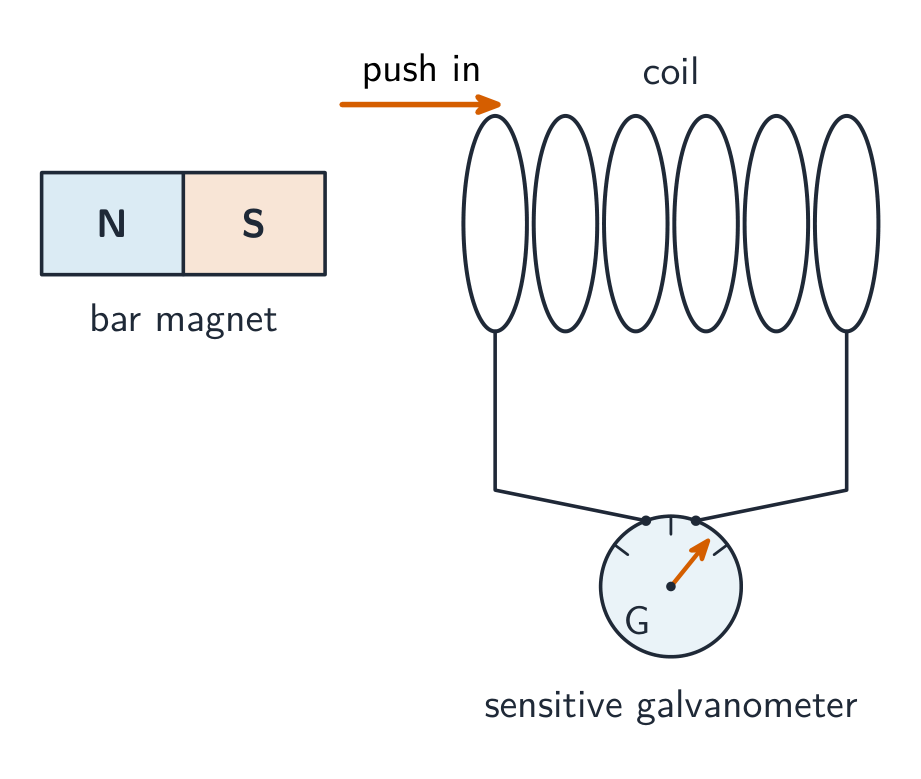
Syllabus
Learning Objective Essential Knowledge 13.2.A
Describe the induced electric potential difference resulting from a change in magnetic flux.- 13.2.A.1 Faraday's law describes the relationship between changing magnetic flux and the resulting induced emf in a system.
- Equation: $\mathcal{E} = -\dfrac{d\Phi_B}{dt} = -\dfrac{d\left(\vec{B} \cdot \vec{A}\right)}{dt}$
- 13.2.A.1.i When the area of the surface being considered is constant, the induced emf is equal to the area multiplied by the rate of change in the component of the magnetic field perpendicular to the surface.
- 13.2.A.1.ii When the magnetic field is constant, the induced emf is equal to the magnetic field multiplied by the rate of change in area perpendicular to the magnetic field.
- 13.2.A.1.iii When an emf is induced in a long solenoid, the total induced emf is equal to the induced emf in a single loop multiplied by the number of loops in the solenoid.
- Equation: $\left|\mathcal{E}_{\text{sol}}\right| = N\left|\dfrac{d\Phi_B}{dt}\right|$
- 13.2.A.2 Lenz's law is used to determine the direction of an induced emf resulting from a changing magnetic flux.
- 13.2.A.2.i An induced emf generates a current that creates a magnetic field that opposes the change in magnetic flux.
- 13.2.A.2.ii The right-hand rule is used to determine the relationships between current, emf, and magnetic flux.
- 13.2.A.3 Maxwell's equations are the collection of equations that fully describe electromagnetism. Maxwell's third equation is Faraday's law of induction, which describes the relationship between a changing magnetic flux and an induced electric field.
- Equation: $\mathcal{E} = \oint \vec{E} \cdot d\vec{\ell} = -\dfrac{d\Phi_B}{dt}$
- 13.2.A.4 Maxwell's equations can be used to show that electric and magnetic fields obey wave equations and that electromagnetic waves travel at a constant speed in free space.
- Equation (derived): $c = \dfrac{1}{\sqrt{\varepsilon_0 \mu_0}}$
Boundary statement: AP Physics C: Electricity & Magnetism does not expect students to mathematically derive the speed of light in free space from Maxwell's equations. This relationship is included above solely as an indication of the further applications, implications, and connections to physical phenomena that students may study in more advanced physics courses.
Source: College Board AP Course and Exam Description
Electromagnetic induction A changing flux induces an emf 电动势 – Faraday's law 法拉第定律:
$$\varepsilon=-\frac{d\Phi_B}{dt}.$$With constant area, $\varepsilon=-A\,\dfrac{dB_\perp}{dt}$; with constant field, $\varepsilon=-B\,\dfrac{dA_\perp}{dt}$. A coil of $N$ turns multiplies the single-loop emf: $|\varepsilon_{\text{sol}}|=N\left|\dfrac{d\Phi_B}{dt}\right|$.
Lenz's law 楞次定律 is the minus sign: the induced current 感应电流 flows so that its own magnetic field opposes the change in flux that created it. Push a magnet toward a loop and the loop pushes back; pull it away and the loop pulls it in. Use the right-hand rule 右手定则 to turn "oppose the change" into a current direction.
Moving a magnet into a coil induces an e.m.f. that drives a current A rod of length $L$ sliding at speed $v$ across a field is the special case worth memorising – the motional emf 动生电动势 $\varepsilon=BLv$.
Worked example. A $0.20\ \text{m}$ rod slides at $3.0\ \text{m/s}$ across a $0.50\ \text{T}$ field: $\varepsilon=BLv=0.50(0.20)(3.0)=0.30\ \text{V}$. Equivalently, if a single loop's flux drops from $0.020\ \text{Wb}$ to $0.008\ \text{Wb}$ in $0.030\ \text{s}$, the average emf is $\varepsilon=\dfrac{0.012}{0.030}=0.40\ \text{V}$.
Faraday's law is also the third of Maxwell's equations 麦克斯韦方程组, in a deeper form: a changing magnetic flux creates a circulating electric field, $\oint\vec{E}\cdot d\vec{l}=-\dfrac{d\Phi_B}{dt}$ – that field is what pushes the charges around the loop. Together, Maxwell's equations predict electromagnetic waves 电磁波 travelling at $c=1/\sqrt{\varepsilon_0\mu_0}$ (you should know this connection, but AP will not ask you to derive it).
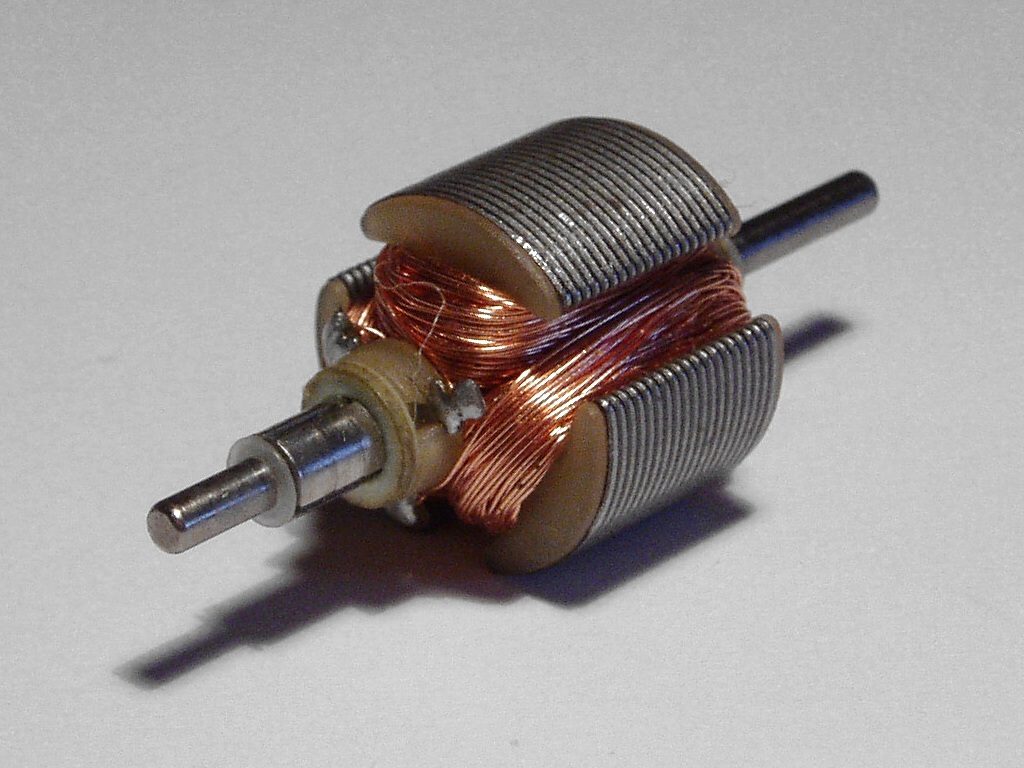
Coils of wire spinning in a magnetic field: moving them past the field induces a current, the basis of a generator 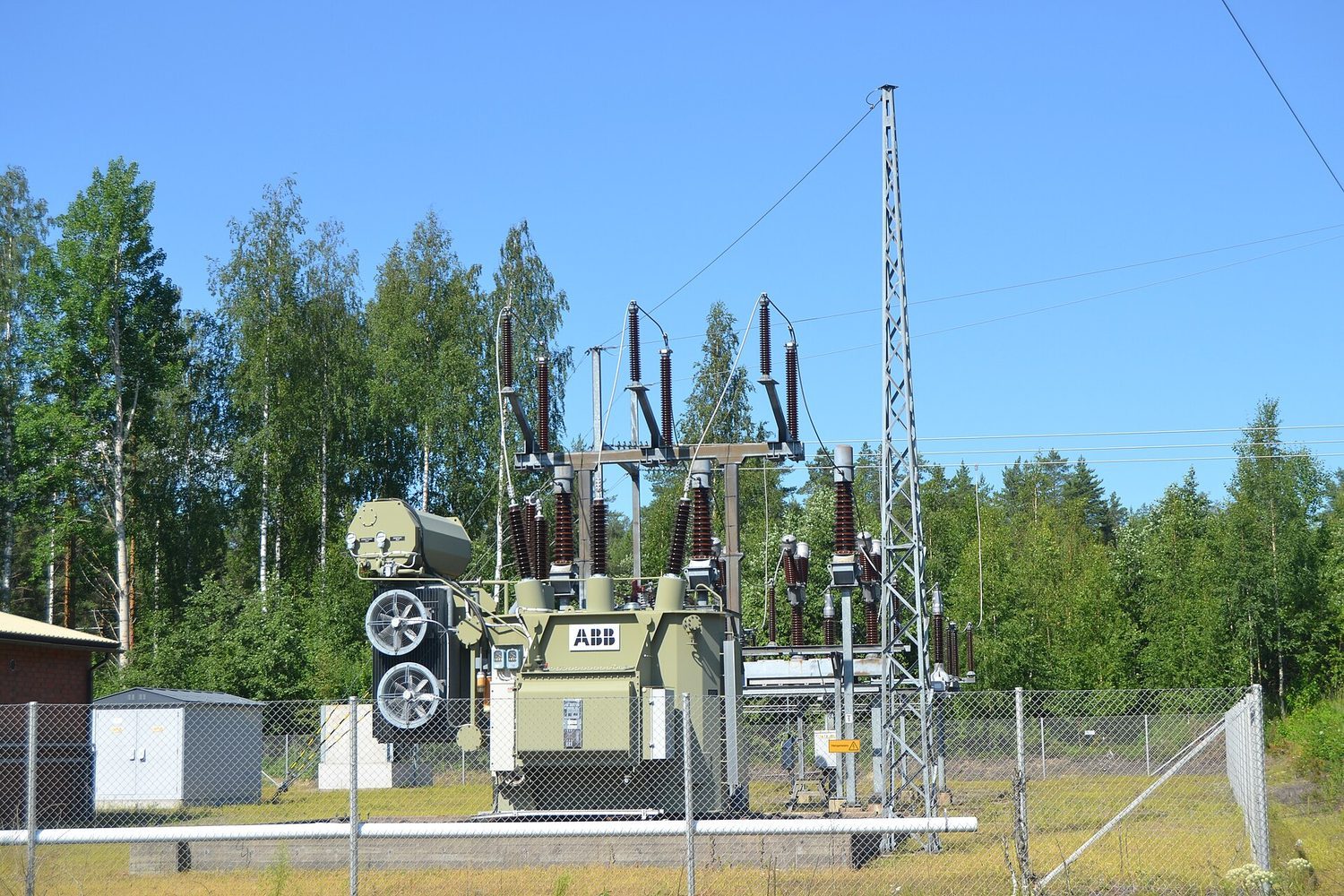
A substation transformer: changing magnetic flux in coils induces the voltages that power the grid ExploreInduce a current by moving a magnet
A changing magnetic flux through a coil induces an EMF (Faraday's law); its direction opposes the change (Lenz's law). Move the magnet faster for a bigger EMF.
Vocabulary TrainEnglish emf/emf/ Faraday's law/ˈfærədeɪz lɔː/ Lenz's law/ˈlentsɪz lɔː/ induced current/ɪnˈdjuːst ˈkʌrənt/ right-hand rule/raɪt hænd ruːl/ motional emf/ˈməʊʃənl emf/ Maxwell's equations/ˈmækswelz ɪˈkweɪʒnz/ electromagnetic waves/ɪˌlektrəʊməɡˈnetɪk weɪvz/ 13.3
Induced Currents and Magnetic Forces
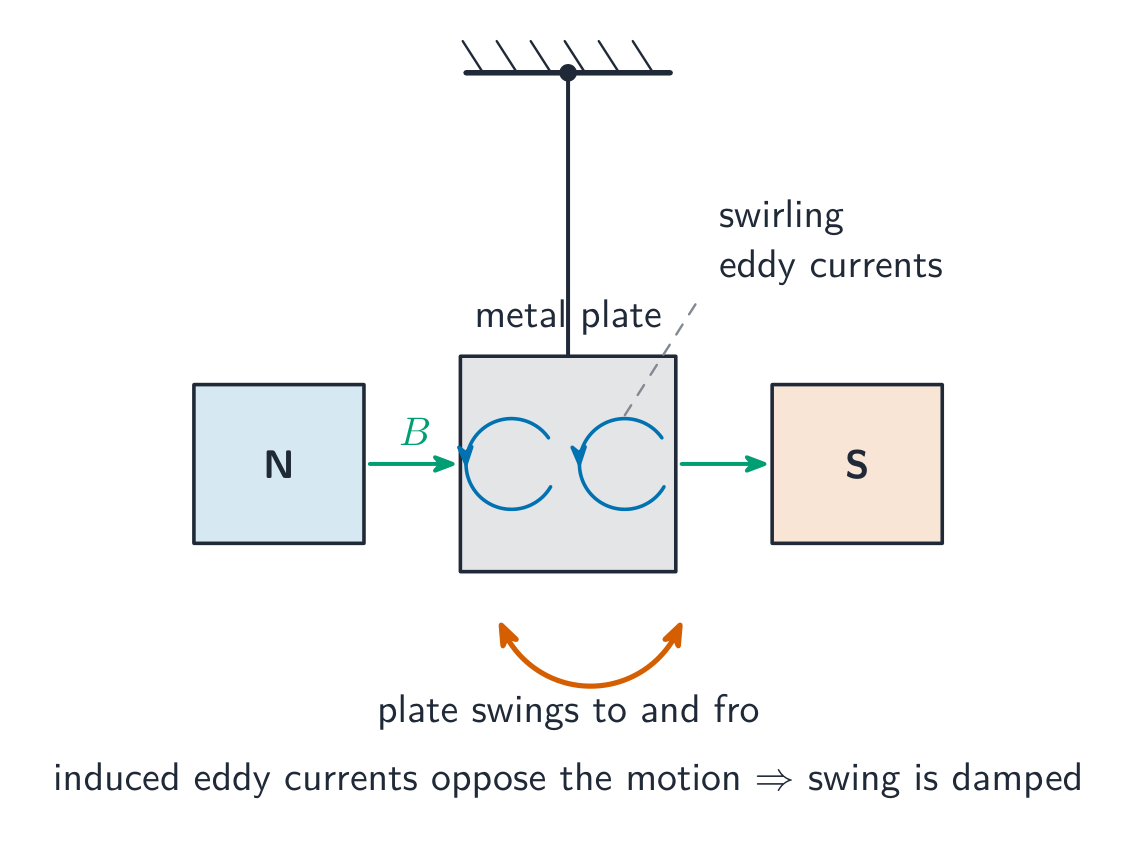
Syllabus
Learning Objective Essential Knowledge 13.3.A
Describe the force exerted on a conductor due to the interaction between an external magnetic field and an induced current within that conductor.- 13.3.A.1 When an induced current is created in a conductive loop, the already-present magnetic field will exert a magnetic force on the moving charge carriers within the loop.
- Equation: $\vec{F}_B = \displaystyle\int I\left(d\vec{\ell} \times \vec{B}\right)$
- 13.3.A.2 When current is induced in a conducting loop, magnetic forces are only exerted on the segments of the loop that are within the external magnetic field. These magnetic forces may cause translational or rotational acceleration.
- 13.3.A.3 The force on a conducting loop is proportional to the induced current in the loop, which depends on the rate of change of magnetic flux, the resistance of the loop, and the velocity of the loop.
- 13.3.A.4 Newton's second law can be applied to a conducting loop moving in a magnetic field as it experiences an induced emf.
Source: College Board AP Course and Exam Description
Once an induced current flows, the external field exerts forces on it ($\vec{F}=\int I\,d\vec{l}\times\vec{B}$) – and by Lenz's law those forces always resist the motion that causes the induction. Only the segments of the loop actually inside the field feel a force, which can make a loop accelerate, rotate, or brake. This is the origin of eddy currents 涡电流 braking, and you can apply Newton's second law to a moving loop or rod like any other mechanics problem.
Induced eddy currents oppose motion, quickly damping a metal plate swinging in a field The classic setup is a rod sliding on conducting rails connected by a resistor:

A rod sliding on rails: the induced current feels a force opposing the motion Worked example (the full chain). Rails $L=0.20\ \text{m}$ apart with resistance $R=0.60\ \Omega$ sit in a $0.50\ \text{T}$ field into the page. The rod is pushed at a constant $3.0\ \text{m/s}$. Then: $\varepsilon=BLv=0.30\ \text{V}$; $I=\varepsilon/R=0.50\ \text{A}$; the field pushes back on the rod with $F=BIL=0.50(0.50)(0.20)=0.050\ \text{N}$. The pushing force does work at $P=Fv=0.15\ \text{W}$ – exactly the $P=I^2R=0.15\ \text{W}$ dissipated in the resistor. Mechanical work becomes electrical energy: that is a generator 发电机, and energy is conserved. Released with no push, the rod slows exponentially: $ma=-\dfrac{B^2L^2}{R}v$.
Exam skill. FRQs walk this exact chain: flux $\to$ emf $\to$ current $\to$ force $\to$ Newton's second law. Write each link separately and check the direction with Lenz's law at the end.
Vocabulary TrainEnglish eddy currents/ˈedi ˈkʌrənts/ generator/ˈdʒenəreɪtə/ 13.4
Inductance
Syllabus
Learning Objective Essential Knowledge 13.4.A
Describe the physical and electrical properties of an inductor.- 13.4.A.1 Inductance is the tendency of a conductor to oppose a change in electrical current.
- 13.4.A.1.i Inductance of a conductor depends on the physical properties of the conductor. Straight wires are typically modeled as having zero inductance.
- 13.4.A.1.ii An inductor, such as a solenoid, is a circuit element that has significant inductance.
- 13.4.A.1.iii The inductance of a solenoid is dependent on the total number of turns, the length of the solenoid, the cross-sectional area of the solenoid, and magnetic permeability of the solenoid's core.
- Equation: $L_{\text{sol}} = \dfrac{\mu_{\text{core}} N^2 A}{\ell}$
- 13.4.A.2 Inductors store energy in the magnetic field that is generated by current in the inductor.
- Equation: $U_L = \dfrac{1}{2} L I^2$
- 13.4.A.2.i The energy stored in the magnetic field generated by an inductor in which current is flowing can be dissipated through a resistor or used to charge a capacitor.
- 13.4.A.2.ii The transfer of energy generated in an inductor to other forms of energy obeys conservation laws.
- 13.4.A.3 By applying Faraday's law to an inductor and using the definition of inductance, induced emf can be related to inductance and the rate of change of current.
- Equation: $\mathcal{E}_i = -L\dfrac{dI}{dt}$
Source: College Board AP Course and Exam Description
Inductance 电感 is a conductor's tendency to oppose a change in its own current: changing current changes its own flux, which self-induces an emf. From Faraday's law,
$$\varepsilon=-L\frac{dI}{dt}.$$An inductor 电感器 is a circuit element built to have large inductance – usually a solenoid 螺线管, where geometry gives
$$L_{\text{sol}}=\frac{\mu_{\text{core}}N^2A}{\ell},$$with $N$ total turns, area $A$, length $\ell$, and the magnetic permeability 磁导率 of the core. (Straight wires are modelled as having zero inductance.) An inductor carrying current $I$ stores energy in its magnetic field:
$$U_L=\tfrac{1}{2}LI^2,$$which can later be dissipated in a resistor or moved into a capacitor – conservation of energy applies as usual.
Vocabulary TrainEnglish inductance/ɪnˈdʌktəns/ inductor/ɪnˈdʌktə/ solenoid/ˈsəʊlənɔɪd/ magnetic permeability/mæɡˈnetɪk ˌpɜːməˈbɪlɪti/ 13.5
Circuits with Resistors and Inductors
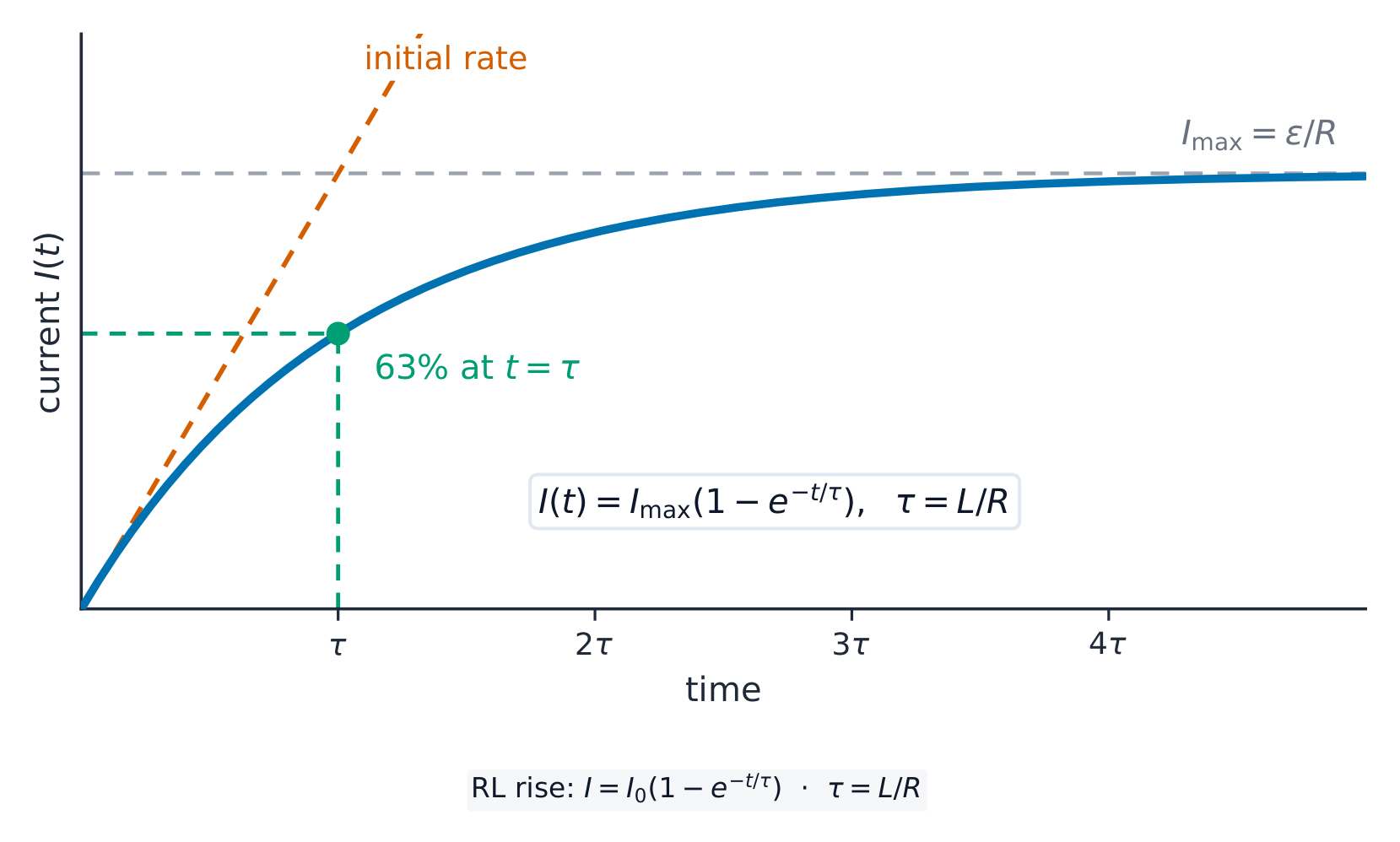
Syllabus
Learning Objective Essential Knowledge 13.5.A
Describe the physical and electrical properties of a circuit containing a combination of resistors and a single inductor.- 13.5.A.1 A resistor will dissipate energy that was stored in an inductor as the current changes.
- 13.5.A.2 Kirchhoff's loop rule can be applied to a series LR circuit with a battery of emf $\mathcal{E}$, resulting in a differential equation that describes the current in the loop.
- Equation (derived): $\mathcal{E} = IR + L\dfrac{dI}{dt}$
- 13.5.A.3 The time constant is a significant feature of the behavior of an LR circuit.
- 13.5.A.3.i The time constant of a circuit is a measure of how quickly an LR circuit will reach a steady state and is described with the equation $\tau = \dfrac{L}{R_{\text{eq}}}$ .
- 13.5.A.3.ii The time constant represents the time an LR circuit would take to reach a steady state if the system continued to change at the initial rate of change.
- 13.5.A.3.iii For an inductor that has zero initial current, the time constant represents the time required for the current in the inductor to reach approximately 63 percent of its final asymptotic value.
- 13.5.A.3.iv For an inductor with an initial current, the time constant represents the time required for the current in the inductor to reach approximately 37 percent of its initial value.
- 13.5.A.4 The electric properties of inductors change during the time interval in which the current in the inductor changes, but will exhibit steady state behavior after a long time interval.
- 13.5.A.4.i When a switch is initially closed or opened in a circuit containing an inductor, the induced emf will be equal in magnitude and opposite in direction to the applied potential difference across the branch containing the inductor.
- 13.5.A.4.ii The potential difference across an inductor, the current in the inductor, and the energy stored in the inductor are exponential with respect to time and have asymptotes that are determined by the initial conditions of the circuit.
- 13.5.A.4.iii After a time much greater than the time constant of the circuit, an inductor will behave as a conducting wire with zero resistance.
Source: College Board AP Course and Exam Description
In an RL circuit RL电路, Kirchhoff's loop rule for a battery $\varepsilon$, resistor $R$, and inductor $L$ in series gives a differential equation 微分方程:
$$\varepsilon=IR+L\frac{dI}{dt}\quad\Rightarrow\quad I(t)=\frac{\varepsilon}{R}\big(1-e^{-t/\tau}\big),\qquad \tau=\frac{L}{R}.$$The time constant 时间常数 $\tau$ sets the pace: after one $\tau$ a rising current reaches about $63\%$ of its final value (a decaying one falls to $37\%$); it is also how long the change would take at the initial rate. Learn the two limits – they answer most conceptual questions:
- Just after the switch closes ($t=0$): current cannot jump, so the inductor momentarily blocks it, self-inducing an emf equal and opposite to the applied potential difference.
- Long after ($t\gg\tau$): the current is steady, $dI/dt=0$, and the inductor behaves as a plain wire – the exact opposite of a capacitor.
The current in an RL circuit rises exponentially, reaching 63% at one time constant Worked example. $\varepsilon=12\ \text{V}$, $R=6.0\ \Omega$, $L=3.0\ \text{H}$: final current $\varepsilon/R=2.0\ \text{A}$, $\tau=L/R=0.50\ \text{s}$. At $t=0.50\ \text{s}$ the current is $2.0(1-e^{-1})\approx1.3\ \text{A}$. At $t=0$ the inductor's potential difference is the full $12\ \text{V}$; as $t\to\infty$ it falls to zero. Current, inductor voltage, and stored energy are all exponential in time.
Vocabulary TrainEnglish RL circuit/ˌɑː ˈel ˈsɜːkɪt/ differential equation/ˌdɪfəˈrenʃl ɪˈkweɪʒn/ time constant/taɪm ˈkɒnstənt/ 13.6
Circuits with Capacitors and Inductors
Syllabus
Learning Objective Essential Knowledge 13.6.A
Describe the physical and electrical properties of a circuit containing a combination of capacitors and a single inductor.- 13.6.A.1 In circuits containing only a charged capacitor and an inductor (LC circuits), the maximum current in the inductor can be determined using conservation of energy within the circuit.
- 13.6.A.2 In LC circuits, the time dependence of the charge stored in the capacitor can be modeled as simple harmonic motion.
- Equation (derived): $\dfrac{d^2 q}{dt^2} = -\dfrac{1}{LC} q$
- 13.6.A.3 The angular frequency of an oscillating LC circuit can be derived from the differential equation that describes an LC circuit.
- Equation (derived): $\omega = \dfrac{1}{\sqrt{LC}}$
Source: College Board AP Course and Exam Description
LC circuit: energy sloshes like a spring An LC circuit LC电路 has no resistance, so nothing dissipates energy: it oscillates 振荡, sloshing energy between the capacitor's electric field and the inductor's magnetic field. The loop rule gives
$$\frac{d^2q}{dt^2}=-\frac{1}{LC}\,q,$$the same equation as a mass on a spring – simple harmonic motion 简谐运动 with charge playing the role of displacement and
$$\omega=\frac{1}{\sqrt{LC}}.$$The total energy $\dfrac{q^2}{2C}+\tfrac12LI^2$ stays constant: all in the capacitor at maximum charge, all in the inductor at maximum current.
Worked example. $L=2.0\ \text{H}$, $C=8.0\ \mu\text{F}$: $\omega=\dfrac{1}{\sqrt{2.0(8.0\times10^{-6})}}=250\ \text{rad/s}$, period $T=2\pi/\omega\approx0.025\ \text{s}$. If the capacitor starts charged to $12\ \text{V}$, then $U=\tfrac12CV^2=5.8\times10^{-4}\ \text{J}$, and the maximum current follows from $\tfrac12LI_{\max}^2=U$: $I_{\max}=\sqrt{2U/L}=0.024\ \text{A}$ – conservation of energy 能量守恒, no calculus needed.
Vocabulary TrainEnglish LC circuit/ˌel ˈsiː ˈsɜːkɪt/ oscillates/ˈɒsɪleɪts/ simple harmonic motion/ˈsɪmpl hɑːˈmɒnɪk ˈməʊʃn/ conservation of energy/ˌkɒnsəˈveɪʃn ɒv ˈenədʒi/ 13.6
Exam tips
- Compute flux $\Phi_B=\int \vec B\cdot d\vec A$ and get the induced EMF from Faraday's law $\varepsilon=-\tfrac{d\Phi_B}{dt}$.
- Use Lenz's law (the minus sign) to fix the direction: the induced current opposes the change in flux.
- Flux changes three ways — changing $B$, changing area, or changing angle — identify which and differentiate.
- For a rod of length $L$ moving at speed $v$, the motional EMF is $BLv$.
- An inductor stores energy $\tfrac12 LI^2$ and resists changes in current (RL time constant $\tau=L/R$).
- 13.1.A.1 For a magnetic field $\vec{B}$ that is constant across an area $\vec{A}$, the magnetic flux through the area is defined as $\Phi_B = \vec{B} \cdot \vec{A}$ .