| Learning Objective | Essential Knowledge |
|---|---|
8.1.A |
|
8.1.B |
|
8.1.C |
Boundary statement: AP Physics C: Electricity & Magnetism only expects students to make calculations of the electric force between four or fewer interacting charged objects or systems. The analysis of the resulting electric force from more charges is allowed in situations of high symmetry. Note that students are expected to calculate the electric fields of charge distributions, as described in Topics 8.4 and 8.6. |
Electric Charges, Fields, and Gauss's Law
AP Physics C: Electricity and Magnetism · Topic 8
 9:52
9:52
Electric Charges, Fields, and Gauss's Law
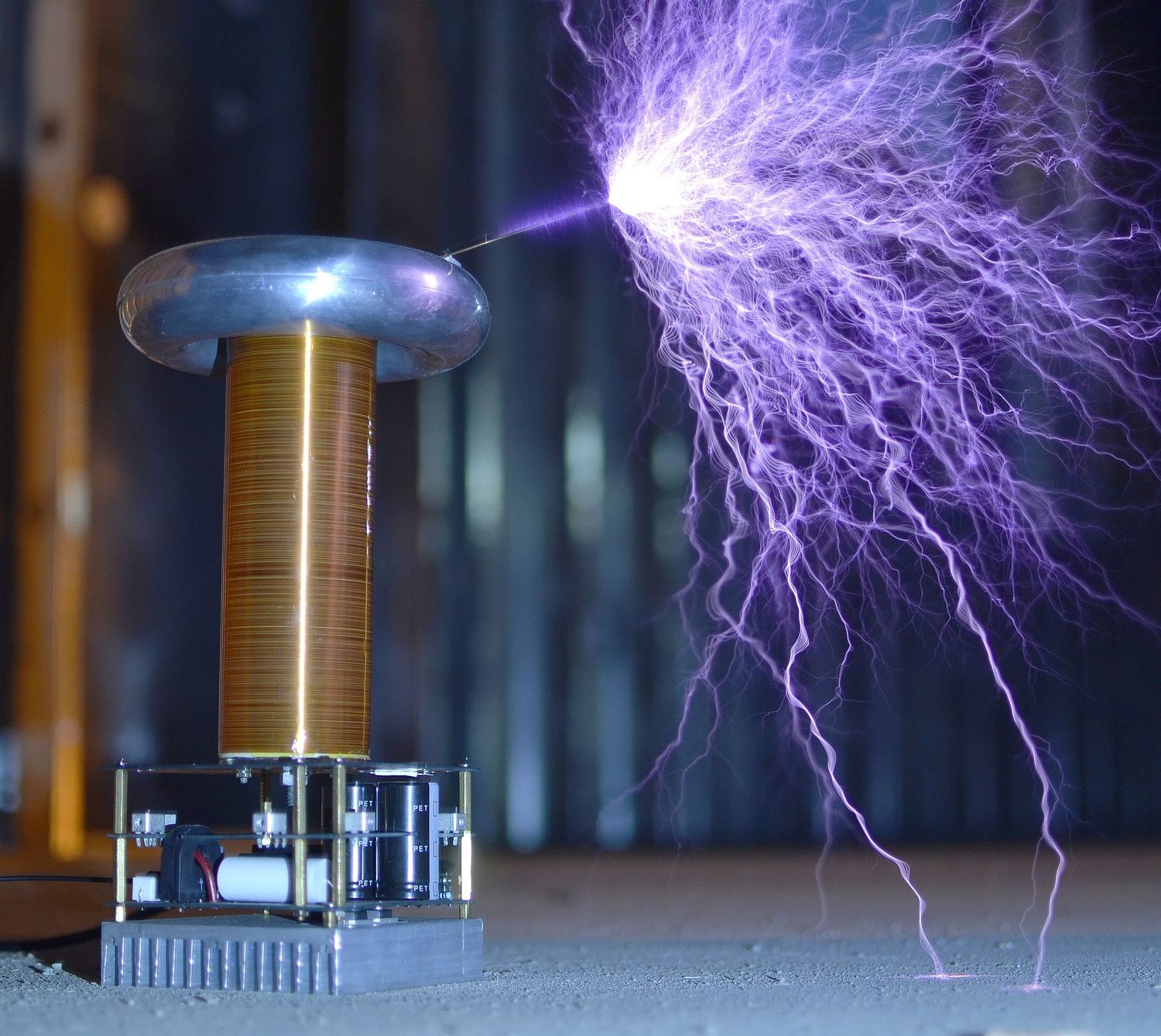
A lightning bolt hits a car. Inside, the people feel nothing at all. Why? The metal shell around them is a conductor. Charge races over its outside surface…
English narration · English + 中文 subtitles burned in
8.1
Electric Charge and Electric Force
Syllabus
Source: College Board AP Course and Exam Description
Electric charge 电荷 comes in positive and negative; like charges repel, opposites attract. Charge is quantized 量子化 – every charge is a whole-number multiple of the elementary charge 基本电荷 $e=1.6\times10^{-19}\ \text{C}$ – and obeys conservation of charge 电荷守恒: charge is never created or destroyed, only moved. The force between two point charges 点电荷 is Coulomb's law 库仑定律:
$$\vec{F}=\frac{1}{4\pi\varepsilon_0}\frac{q_1 q_2}{r^2}\,\hat{r},$$
an inverse-square 平方反比 force along the line joining them, with $\dfrac{1}{4\pi\varepsilon_0}=k=9.0\times10^{9}\ \text{N}\cdot\text{m}^2/\text{C}^2$. For several charges (AP uses four or fewer, unless symmetry helps), add the force vectors on the charge you care about – superposition 叠加.
Charge is a fundamental property 基本属性 of matter, and a point charge is a model that ignores the size of a charged object. The constant $\varepsilon_0$ is the permittivity of free space 真空介电常数 – a material property of the vacuum. The permittivity of matter differs from $\varepsilon_0$, set by how easily the material polarizes, which is why a dielectric between charges weakens the force. Note too that although the electric force is far stronger than gravity, gravity dominates at astronomical scales because large bodies are nearly neutral.
Worked example. Two $+2.0\ \mu\text{C}$ charges sit $0.30\ \text{m}$ apart: $F=\dfrac{kq_1q_2}{r^2}=\dfrac{9.0\times10^{9}(2.0\times10^{-6})^2}{(0.30)^2}=0.40\ \text{N}$, repulsive.
Worked example (vectors). Charges $+3.0\ \mu\text{C}$ and $-3.0\ \mu\text{C}$ sit at two corners of a right angle, each $0.30\ \text{m}$ from a $+1.0\ \mu\text{C}$ charge at the corner. Each exerts $F=\dfrac{(9.0\times10^{9})(3.0\times10^{-6})(1.0\times10^{-6})}{0.09}=0.30\ \text{N}$ – one a push, one a pull, at right angles to each other. The net force is $F_{\text{net}}=\sqrt{0.30^2+0.30^2}=0.42\ \text{N}$, pointing between them. Never add magnitudes blindly: components first.
Explore
Explore the field of a source charge
Change the charge's sign and size. Lines point away from positive and toward negative, and their $1/r^2$ crowding near the charge mirrors why Coulomb's force $F = k\,|q_1 q_2|/r^2$ weakens with distance.
Vocabulary
Train
| English |
|---|
| Electric charge/ɪˈlektrɪk tʃɑːdʒ/ |
| quantized/ˈkwɒntaɪzd/ |
| elementary charge/ˌelɪˈmentəri tʃɑːdʒ/ |
| conservation of charge/ˌkɒnsəˈveɪʃn ɒv tʃɑːdʒ/ |
| point charges/pɔɪnt ˈtʃɑːdʒɪz/ |
| Coulomb's law/ˈkuːlɒmz lɔː/ |
| inverse-square/ɪnˈvɜːs skweə/ |
| superposition/ˌsuːpəpəˈzɪʃn/ |
| fundamental property/ˌfʌndəˈmentl ˈprɒpəti/ |
| permittivity of free space/ˌpɜːmɪˈtɪvəti ɒv friː speɪs/ |
8.2
Electric Charge and the Process of Charging
Syllabus
| Learning Objective | Essential Knowledge |
|---|---|
8.2.A |
|
Source: College Board AP Course and Exam Description
A conductor 导体 lets charge move freely; an insulator 绝缘体 holds it in place. Objects gain net charge three ways:
- Charging by friction 摩擦起电: rubbing transfers electrons from one surface to the other.
- Charging by conduction 传导起电: touching a charged object shares charge of the same sign.
- Charging by induction 感应起电: a nearby charge pushes the conductor's charge apart; ground 接地 the far side, remove the ground wire first, and the conductor is left with the opposite sign – all without contact.
An insulator cannot pass charge, but it can develop polarization 极化: its molecules stretch or turn so one face is slightly positive and the other slightly negative. That is why a charged comb picks up neutral paper scraps. An electroscope 验电器 shows net charge by its leaves repelling; on any isolated conductor the excess charge sits entirely on the outer surface.
Explore
Explore charging by rubbing
Rubbing transfers electrons onto the object, leaving it negative. A charged object then attracts a neutral wall or hair (by polarization) but repels another like-charged object — the same electron transfer behind friction, conduction, and induction.
Vocabulary
Train
| English |
|---|
| conductor/kənˈdʌktə/ |
| insulator/ˈɪnsjuːleɪtə/ |
| Charging by friction/ˈtʃɑːdʒɪŋ baɪ ˈfrɪkʃn/ |
| Charging by conduction/ˈtʃɑːdʒɪŋ baɪ kənˈdʌkʃn/ |
| Charging by induction/ˈtʃɑːdʒɪŋ baɪ ɪnˈdʌkʃn/ |
| ground/ɡraʊnd/ |
| polarization/ˌpəʊləraɪˈzeɪʃn/ |
| electroscope/ɪˌlektrəʊˈskəʊp/ |
8.3
Electric Fields
Syllabus
| Learning Objective | Essential Knowledge |
|---|---|
8.3.A |
|
8.3.B |
|
Source: College Board AP Course and Exam Description
The electric field 电场 at a point is the force per unit charge that a small positive test charge 检验电荷 would feel there:
$$\vec{E}=\frac{\vec{F}}{q},\qquad \vec{E}=\frac{1}{4\pi\varepsilon_0}\frac{q}{r^2}\,\hat{r}\ \text{(point charge)}.$$
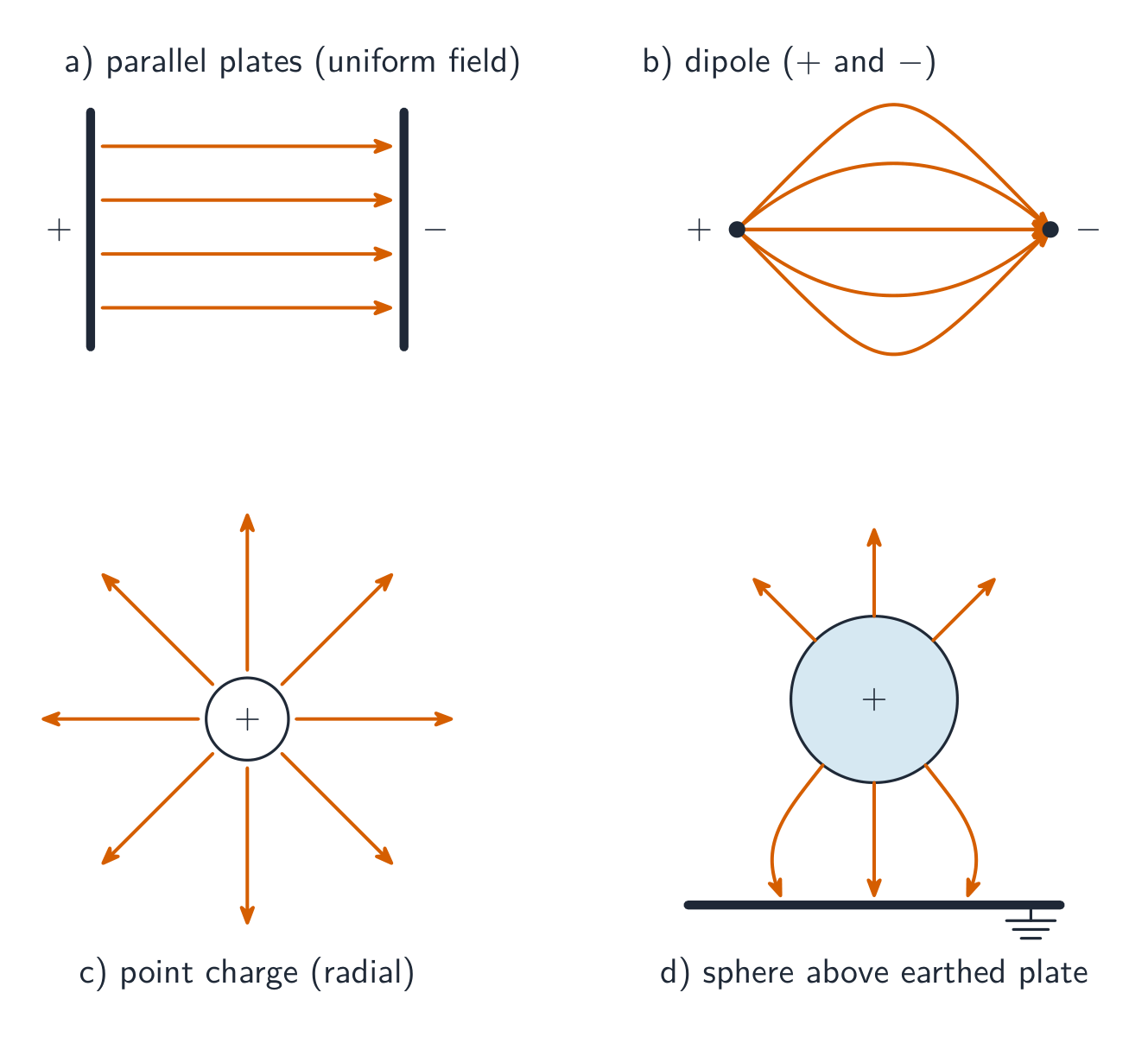
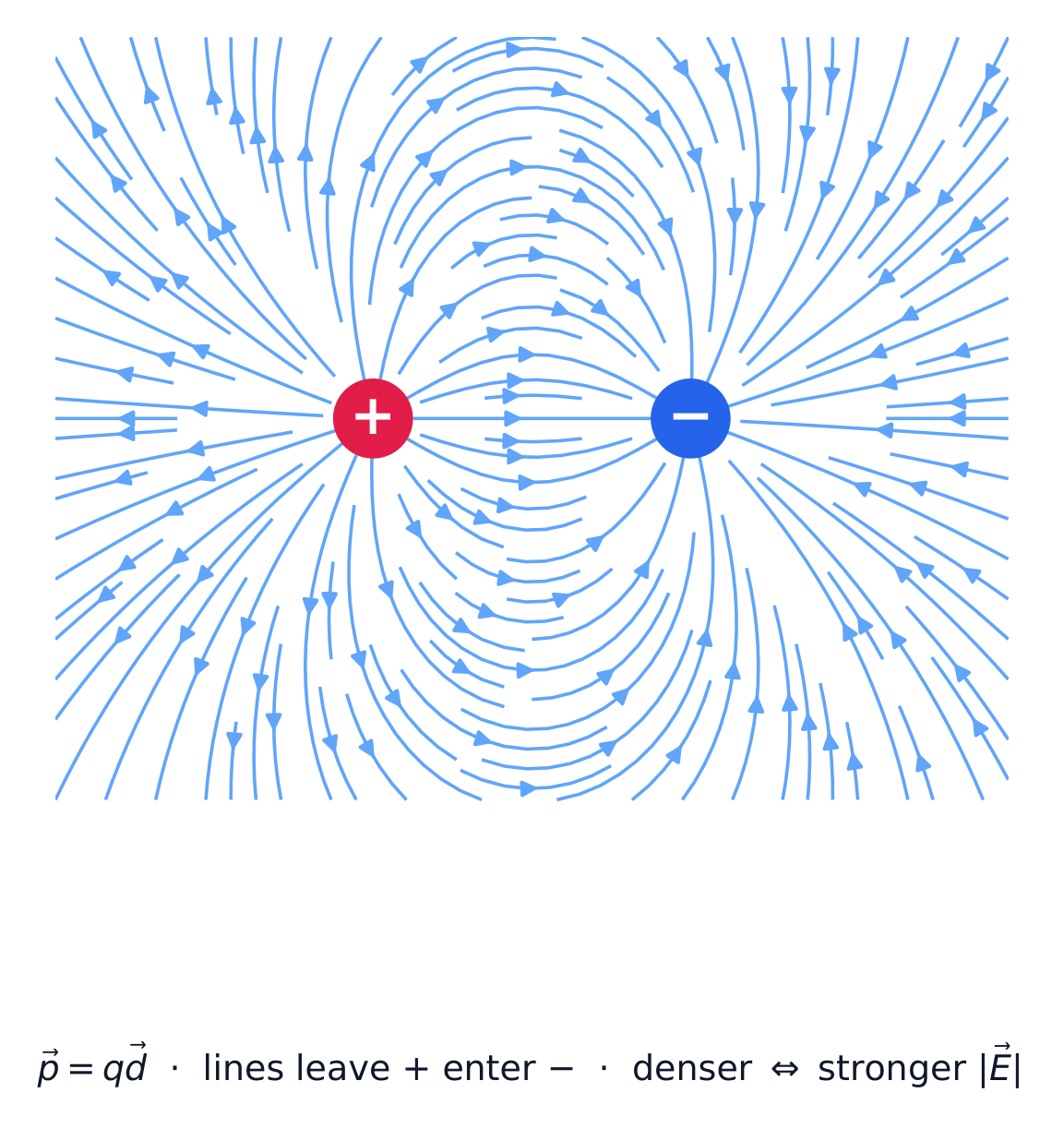
A charge placed in a field feels $\vec{F}=q\vec{E}$ – positive charges along the field, negative charges against it. Fields from several sources add as vectors (superposition again). Field lines 电场线 make the field visible: they point away from positive charge and toward negative, their density shows the strength, and they never cross.
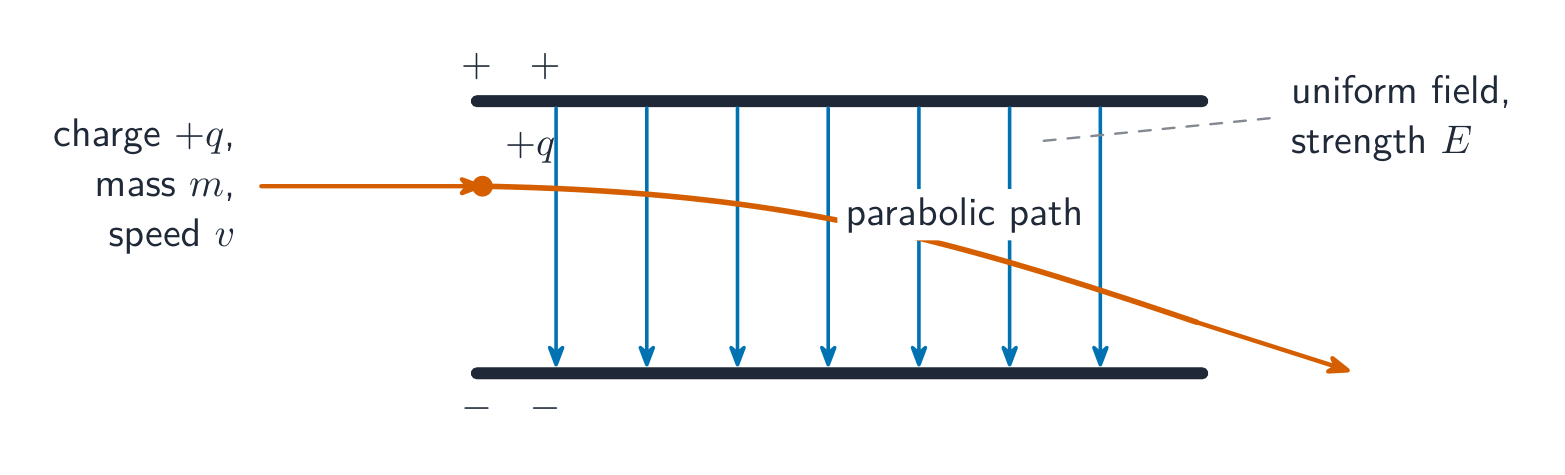
In a uniform 均匀 field a charge feels a constant force, so it accelerates uniformly – launched sideways, it follows a parabola, just like a projectile in gravity.
Explore
Explore field lines of a point charge
Set the charge positive or negative. Field lines start on positive and end on negative charge, never cross, and crowd together where $\vec{E}$ is strongest — the line density is proportional to the field magnitude.
Vocabulary
Train
| English |
|---|
| electric field/ɪˈlektrɪk fiːld/ |
| test charge/test tʃɑːdʒ/ |
| Field lines/fiːld laɪnz/ |
| uniform/ˈjuːnɪfɔːm/ |
8.4
Electric Fields of Charge Distributions
Syllabus
| Learning Objective | Essential Knowledge |
|---|---|
8.4.A |
Boundary statement: AP Physics C: Electricity & Magnetism only expects students to use calculus to find the electric field resulting from the following charge distributions and locations: an infinitely long, uniformly charged wire or cylinder at a distance from its central axis, a thin ring of charge at a location along the axis of the ring, a semicircular arc or part of a semicircular arc at its center, and a finite wire or line charge at a point collinear with the line charge or at a location along its perpendicular bisector. |
Source: College Board AP Course and Exam Description
For a continuous charge distribution 连续电荷分布, cut the object into pieces $dq$ and integrate their point-charge fields:
$$\vec{E}=\frac{1}{4\pi\varepsilon_0}\int \frac{dq}{r^2}\,\hat{r}.$$
Write $dq$ using the right density: $\lambda\,dl$ with the linear charge density 线电荷密度 (a line or ring), $\sigma\,dA$ with the surface charge density 面电荷密度, or $\rho\,dV$ with the volume charge density 体电荷密度. Then use symmetry 对称性 to cancel components before integrating – that sentence is usually a scored step. AP's calculus cases: a finite line (collinear point or perpendicular bisector), an infinite wire or cylinder, a ring on its axis, and an arc at its centre.
Worked example (ring, on axis). A ring of radius $R$ carries charge $Q$. At a point $z$ along the axis, each element is a distance $\sqrt{R^2+z^2}$ away, and by symmetry the sideways components cancel, leaving only the axial part ($\cos\alpha=z/\sqrt{R^2+z^2}$):
$$E_z=\frac{1}{4\pi\varepsilon_0}\int\frac{dq}{R^2+z^2}\cdot\frac{z}{\sqrt{R^2+z^2}}=\frac{1}{4\pi\varepsilon_0}\frac{Qz}{(R^2+z^2)^{3/2}}.$$
Check the limits: $E=0$ at the centre ($z=0$), and far away ($z\gg R$) it becomes $kQ/z^2$ – a point charge, as it must.
Vocabulary
Train
| English |
|---|
| continuous charge distribution/kənˈtɪnjuːəs tʃɑːdʒ ˌdɪstrɪˈbjuːʃn/ |
| linear charge density/ˈlɪnɪə tʃɑːdʒ ˈdensɪti/ |
| surface charge density/ˈsɜːfɪs tʃɑːdʒ ˈdensɪti/ |
| volume charge density/ˈvɒljuːm tʃɑːdʒ ˈdensɪti/ |
| symmetry/ˈsɪmətri/ |
8.5
Electric Flux
Syllabus
| Learning Objective | Essential Knowledge |
|---|---|
8.5.A |
|
Source: College Board AP Course and Exam Description
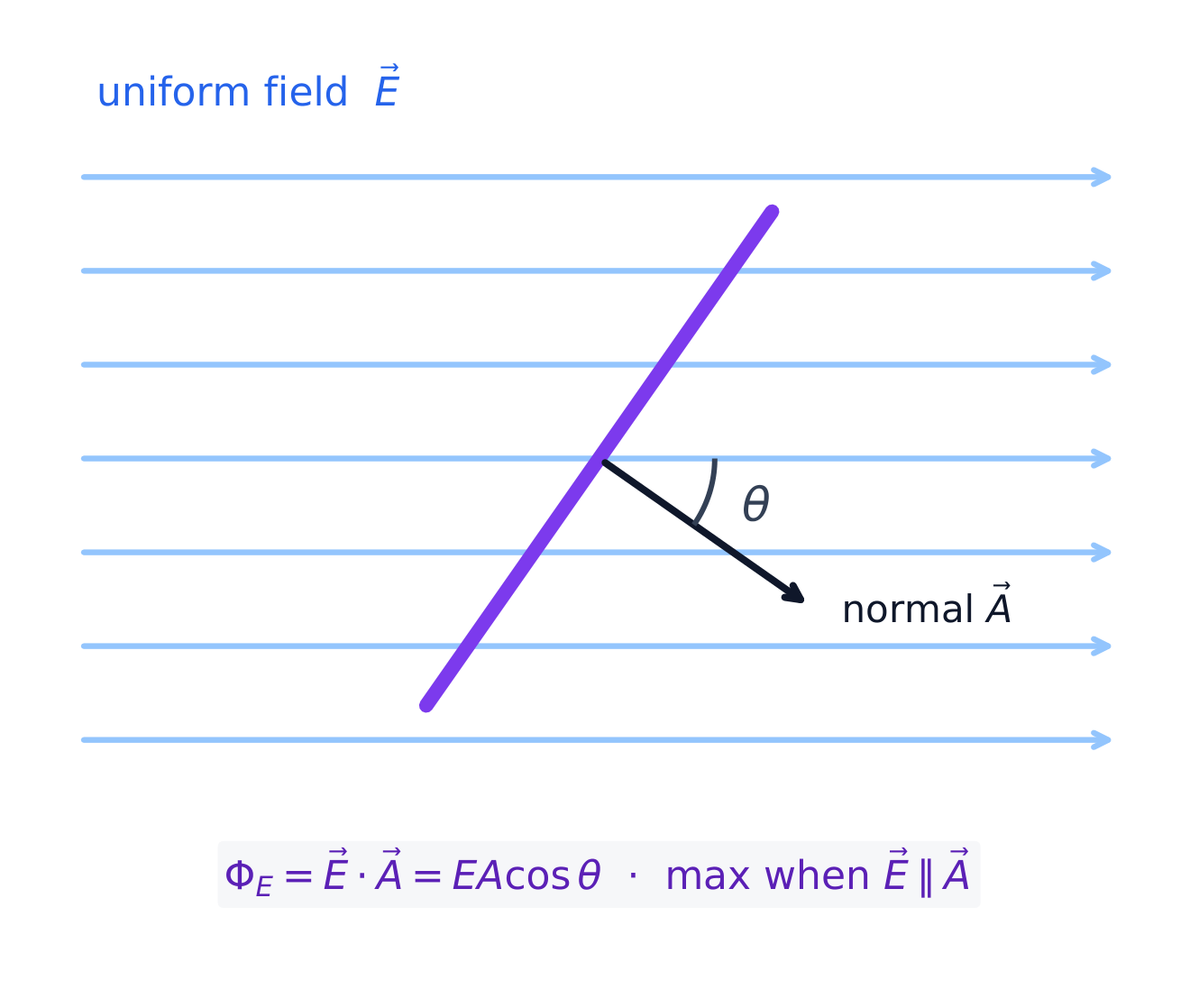
Electric flux 电通量 measures how much field passes through a surface:
$$\Phi_E=\int \vec{E}\cdot d\vec{A}.$$
For a uniform field through a flat area, $\Phi_E=EA\cos\theta$, where the area vector 面积矢量 is perpendicular to the surface. Flux is positive where field lines exit a closed surface and negative where they enter – only the perpendicular component of $\vec{E}$ counts.
Vocabulary
Train
| English |
|---|
| Electric flux/ɪˈlektrɪk flʌks/ |
| area vector/ˈeərɪə ˈvektə/ |
8.6
Gauss's Law
Syllabus
| Learning Objective | Essential Knowledge |
|---|---|
8.6.A |
Boundary statement: AP Physics C: Electricity & Magnetism only expects students to quantitatively apply Gauss's law to point charges and charge distributions that have spherical, cylindrical, or planar symmetry. |
Source: College Board AP Course and Exam Description
Gauss's law 高斯定律 – the first of Maxwell's equations – relates the flux through any closed surface to the charge inside it:
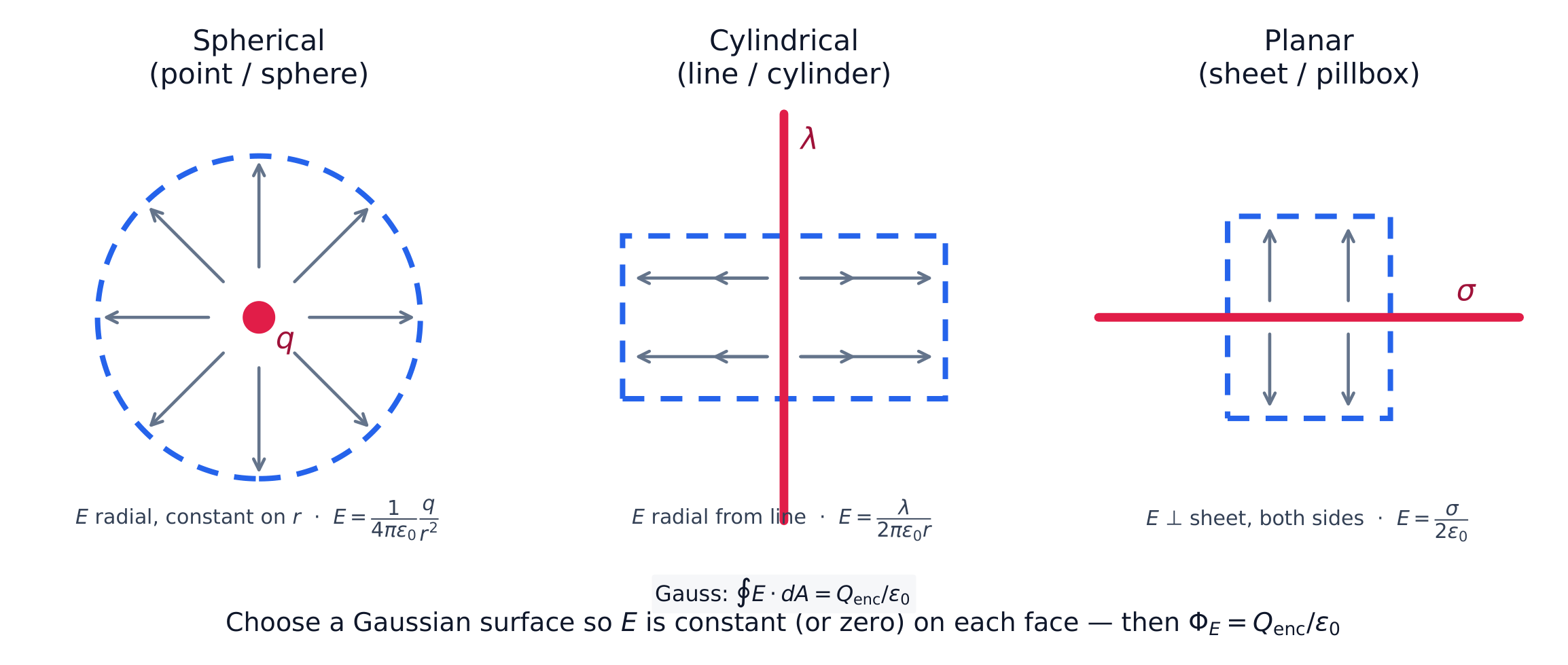
$$\oint \vec{E}\cdot d\vec{A}=\frac{Q_{\text{enc}}}{\varepsilon_0}.$$
It is true for any closed surface, but it solves for $E$ only when symmetry lets you choose a Gaussian surface 高斯面 on which $E$ is constant and perpendicular (or parallel, contributing zero). The three symmetries AP tests: spherical symmetry 球对称 (concentric sphere), cylindrical symmetry 柱对称 (coaxial cylinder), and planar symmetry 平面对称 (a straddling "pillbox").
Worked example (sphere). Outside a sphere of total charge $Q$, a spherical Gaussian surface of radius $r$ gives $E(4\pi r^2)=Q/\varepsilon_0$, so $E=\dfrac{kQ}{r^2}$ – identical to a point charge at the centre. Inside a uniformly charged solid sphere of radius $R$, the surface encloses only $Q_{\text{enc}}=Q\,r^3/R^3$, so $E=\dfrac{kQr}{R^3}$: zero at the centre, growing linearly to the surface.
Worked example (wire). For an infinite wire with charge per length $\lambda$, take a coaxial cylinder of radius $r$ and length $L$. The ends contribute nothing ($\vec{E}\perp d\vec{A}$), so $E(2\pi rL)=\dfrac{\lambda L}{\varepsilon_0}$ and $E=\dfrac{\lambda}{2\pi\varepsilon_0 r}$. The same pillbox method gives an infinite sheet's field, $E=\dfrac{\sigma}{2\varepsilon_0}$, uniform on both sides.
Exam skill. A full-credit Gauss's-law answer has four parts: name the surface, state the symmetry argument (why $E$ is constant and perpendicular on it), count $Q_{\text{enc}}$, then solve. Skipping the symmetry sentence loses the reasoning point – and remember Gauss's law also explains why $E=0$ inside any conductor in equilibrium.
Vocabulary
Train
| English |
|---|
| Gauss's law/ˈɡaʊsɪz lɔː/ |
| Gaussian surface/ˈɡaʊʃn ˈsɜːfɪs/ |
| spherical symmetry/sˈferɪkl ˈsɪmətri/ |
| cylindrical symmetry/sɪˈlɪndrɪkl ˈsɪmətri/ |
| planar symmetry/ˈpleɪnə ˈsɪmətri/ |
8.6
Exam tips
- Use Coulomb's law $F=\tfrac{1}{4\pi\varepsilon_0}\tfrac{q_1 q_2}{r^2}$ and superpose forces as vectors (components, not magnitudes).
- For a continuous charge, integrate $d\vec E$ over $dq=\lambda\,dl,\ \sigma\,dA,\ \rho\,dV$; use symmetry to cancel components.
- The field points away from positive and toward negative charge; draw field lines correctly.
- Distinguish the force on a charge ($\vec F=q\vec E$) from the field the charge creates.
- Keep the constant $k=\tfrac{1}{4\pi\varepsilon_0}$ straight and check units.
Interactive lessons on this topic
Work through it step by step, with instant-check exercises.