| Learning Objective | Essential Knowledge |
|---|---|
10.1.A |
|
Conductors and Capacitors
AP Physics C: Electricity and Magnetism · Topic 10
 8:28
8:28
Conductors and Capacitors
A plane is struck by lightning about once a year, and the people inside feel almost nothing. A car in a thunderstorm is one of the safest places to sit. Why?…
English narration · English + 中文 subtitles burned in
10.1
Electrostatics with Conductors
Syllabus
Source: College Board AP Course and Exam Description
In an ideal conductor 导体, electrons move freely. Put extra charge on one and the charges repel each other until, almost instantly, they settle into electrostatic equilibrium 静电平衡. In that state the conductor has four properties you must be able to state and use:
- The electric field inside the conductor is zero. If it were not, free electrons would still be moving.
- All excess charge sits on the surface. (Negative net charge = extra electrons on the surface; positive = a shortage of electrons there.)
- The field just outside is perpendicular 垂直 to the surface, with magnitude $E=\sigma/\varepsilon_0$. Any parallel component would push charge sideways along the surface.
- The whole conductor is one equipotential surface 等势面: every point, inside and on the surface, is at the same potential.
Charge density is largest where the surface curves sharply – at points and edges – so the outside field is strongest there. In an external field a conductor polarizes: charge shifts on its surface so that the interior stays field-free and the body stays an equipotential. Surrounding a region with a closed conducting shell keeps outside fields out entirely – electrostatic shielding 静电屏蔽, the idea behind the Faraday cage 法拉第笼.
Vocabulary
Train
| English |
|---|
| conductor/kənˈdʌktə/ |
| electrostatic equilibrium/ɪˌlektrəʊˈstætɪk ˌiːkwɪˈlɪbrɪəm/ |
| perpendicular/ˌpɜːpənˈdɪkjʊlə/ |
| equipotential surface/ˌiːkwɪpəˈtenʃl ˈsɜːfɪs/ |
| electrostatic shielding/ɪˌlektrəʊˈstætɪk ˈʃiːldɪŋ/ |
| Faraday cage/ˈfærədeɪ keɪdʒ/ |
10.2
Redistribution of Charge Between Conductors
Syllabus
| Learning Objective | Essential Knowledge |
|---|---|
10.2.A |
|
Source: College Board AP Course and Exam Description
When two conductors touch (or are wired together), charge flows between them until both surfaces reach the same potential – that is the stopping condition, not "equal charges". A larger sphere holds more charge at the same potential ($V=kQ/R$), so it takes the larger share.
Worked example. A small sphere of radius $R$ carrying $+6.0\ \mu\text{C}$ touches a distant sphere of radius $2R$, then they separate. Equal potentials require $\dfrac{kq_1}{R}=\dfrac{kq_2}{2R}$, so $q_2=2q_1$. With $q_1+q_2=6.0\ \mu\text{C}$: $q_1=2.0\ \mu\text{C}$ and $q_2=4.0\ \mu\text{C}$.
Ground 接地 is an idealized reference at zero potential that can absorb or supply any amount of charge. Grounding a conductor while an external charge is nearby leaves the conductor with a net induced charge 感应电荷: the external field pushes charge of one sign to ground, and cutting the ground wire before removing the external charge traps the rest.
Vocabulary
Train
| English |
|---|
| ground/ɡraʊnd/ |
| induced charge/ɪnˈdjuːst tʃɑːdʒ/ |
10.3
Capacitors
Syllabus
| Learning Objective | Essential Knowledge |
|---|---|
10.3.A |
Boundary statement: While other shapes are also able to separate charges, AP Physics C: Electricity & Magnetism only expects the quantitative analysis and description of parallel-plate capacitors, concentric spherical capacitors, and coaxial cylindrical capacitors. |
Source: College Board AP Course and Exam Description
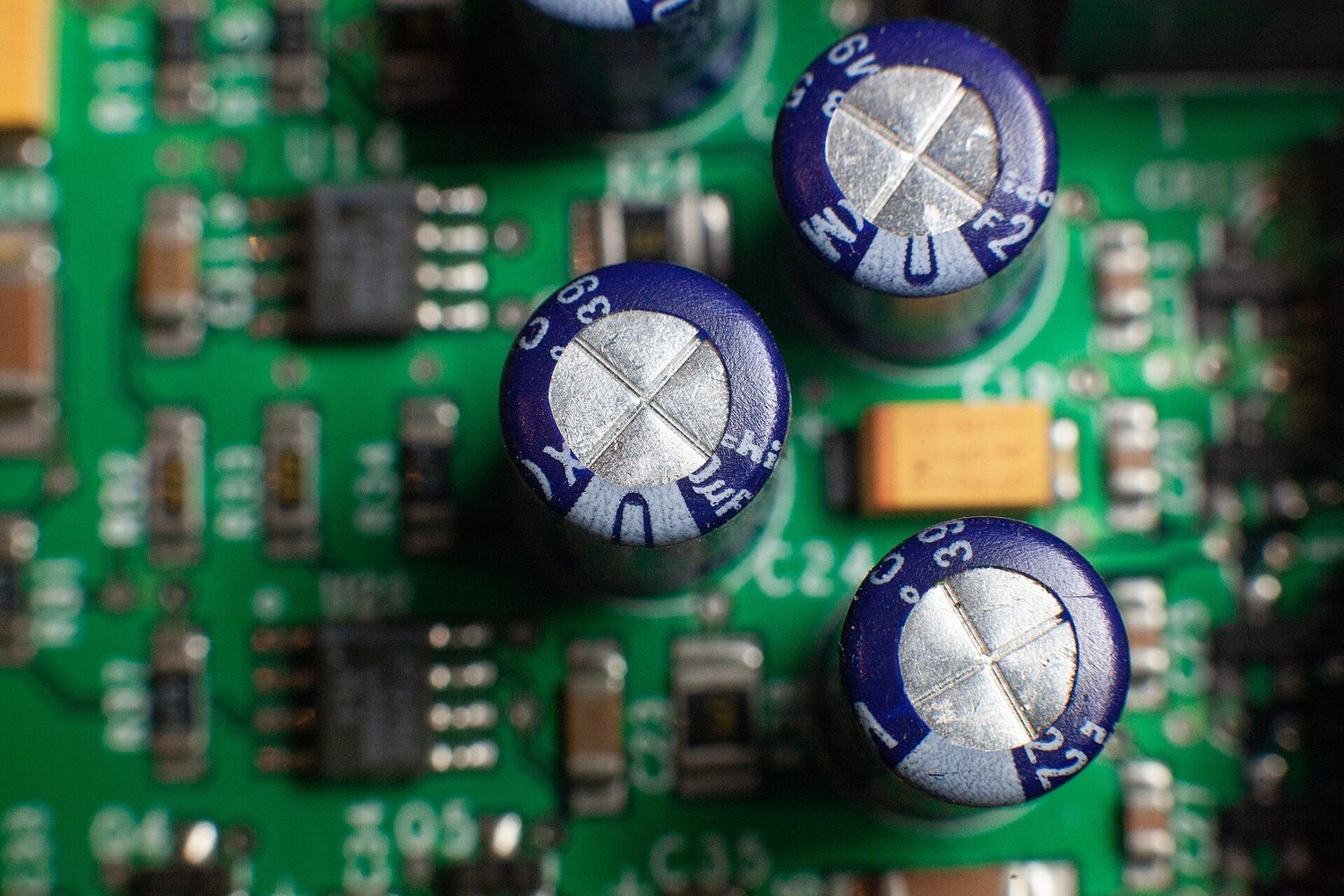
A capacitor 电容器 stores charge on two conductors separated by a gap: $+Q$ on one plate, $-Q$ on the other. Its capacitance 电容 relates the stored charge to the potential difference between the plates:
$$C=\frac{Q}{\Delta V}.$$
Capacitance depends only on geometry and the material in the gap – never on $Q$ or $\Delta V$ themselves.
Worked derivation (parallel plates). For a parallel-plate capacitor 平行板电容器 with plate area $A$ and small gap $d$: Gauss's law plus superposition 叠加 gives a uniform 均匀 field between the plates, $E=\dfrac{\sigma}{\varepsilon_0}=\dfrac{Q}{\varepsilon_0 A}$ (each plate alone contributes $\sigma/2\varepsilon_0$; between the plates the two add, outside they cancel). A uniform field means $\Delta V=Ed=\dfrac{Qd}{\varepsilon_0 A}$, so
$$C=\frac{Q}{\Delta V}=\frac{\varepsilon_0 A}{d}.$$
This $E\to\Delta V\to C$ chain is a standard FRQ derivation – learn it as three steps, and quote each one. The same method handles the other two shapes AP expects: concentric spheres ($C=4\pi\varepsilon_0\dfrac{ab}{b-a}$) and a coaxial cylinder of length $L$, where $E=\dfrac{\lambda}{2\pi\varepsilon_0 r}$ gives $\Delta V=\dfrac{\lambda}{2\pi\varepsilon_0}\ln\dfrac{b}{a}$ and so $C=\dfrac{2\pi\varepsilon_0 L}{\ln(b/a)}$.
Worked example. Plates of area $A=0.020\ \text{m}^2$ and gap $d=1.0\ \text{mm}$: $C=\dfrac{8.85\times10^{-12}(0.020)}{1.0\times10^{-3}}=1.8\times10^{-10}\ \text{F}$. Charged to $100\ \text{V}$ it holds $Q=CV=1.8\times10^{-8}\ \text{C}$.
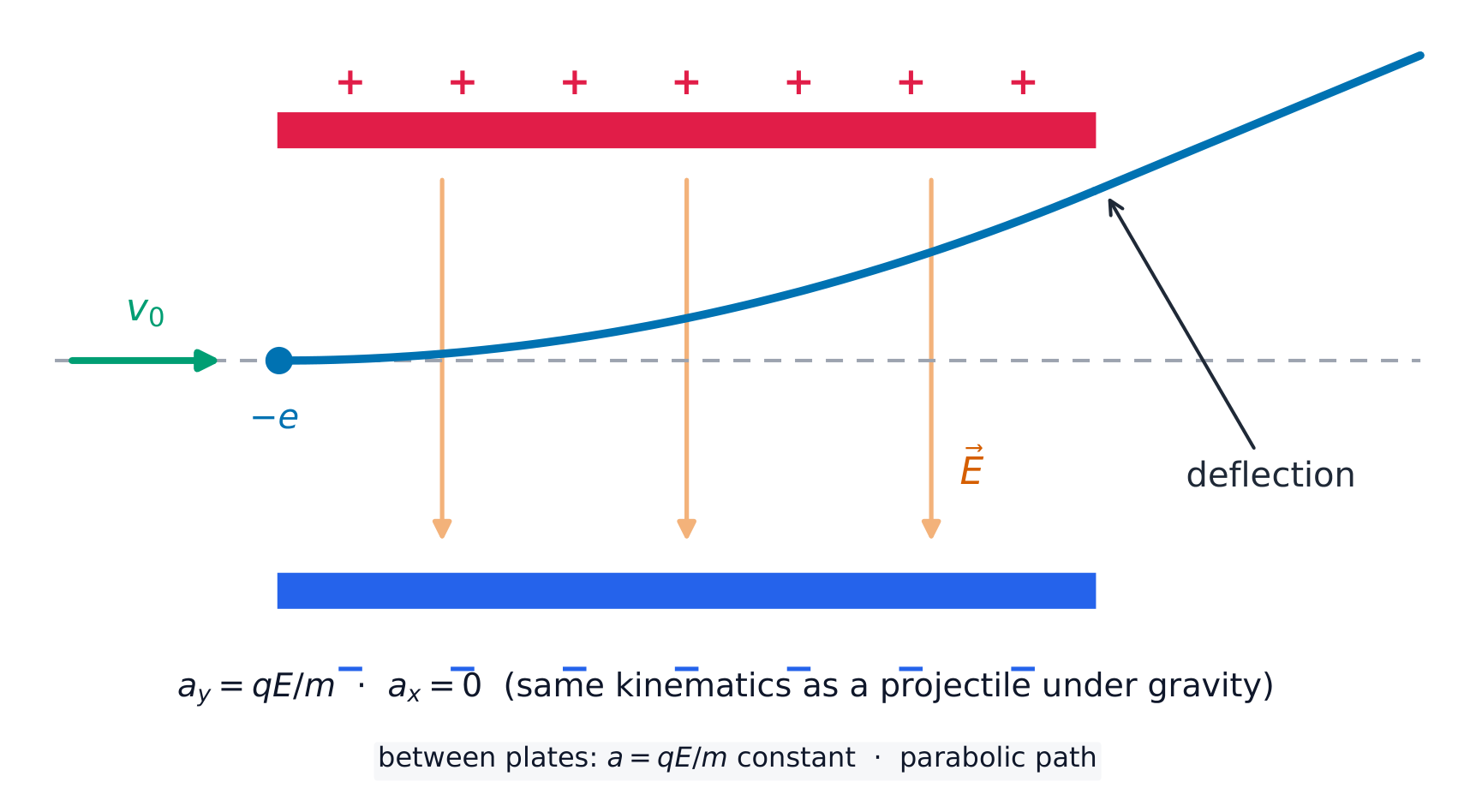
Because the field between the plates is uniform, a charged particle there feels a constant force, so it moves with constant acceleration – exactly like projectile motion 抛体运动 in gravity: constant speed across, uniform acceleration towards a plate.
Worked example. An electron enters midway between plates at $v_0=2.0\times10^{7}\ \text{m/s}$, parallel to them. The field is $E=1.0\times10^{3}\ \text{N/C}$ and the plates are $4.0\ \text{cm}$ long. Acceleration: $a=\dfrac{eE}{m}=\dfrac{(1.6\times10^{-19})(1.0\times10^{3})}{9.11\times10^{-31}}=1.8\times10^{14}\ \text{m/s}^2$. Time between the plates: $t=\dfrac{0.040}{2.0\times10^{7}}=2.0\times10^{-9}\ \text{s}$. Deflection: $y=\tfrac12at^{2}=\tfrac12(1.8\times10^{14})(2.0\times10^{-9})^{2}\approx3.5\times10^{-4}\ \text{m}$ – about $0.35\ \text{mm}$ towards the positive plate.
Storing charge takes work 功: an external force must move each bit of charge against the field of the charge already there. The total work ends up as stored potential energy,
$$U_C=\tfrac12\,Q\,\Delta V=\tfrac12 C(\Delta V)^2=\frac{Q^2}{2C}.$$
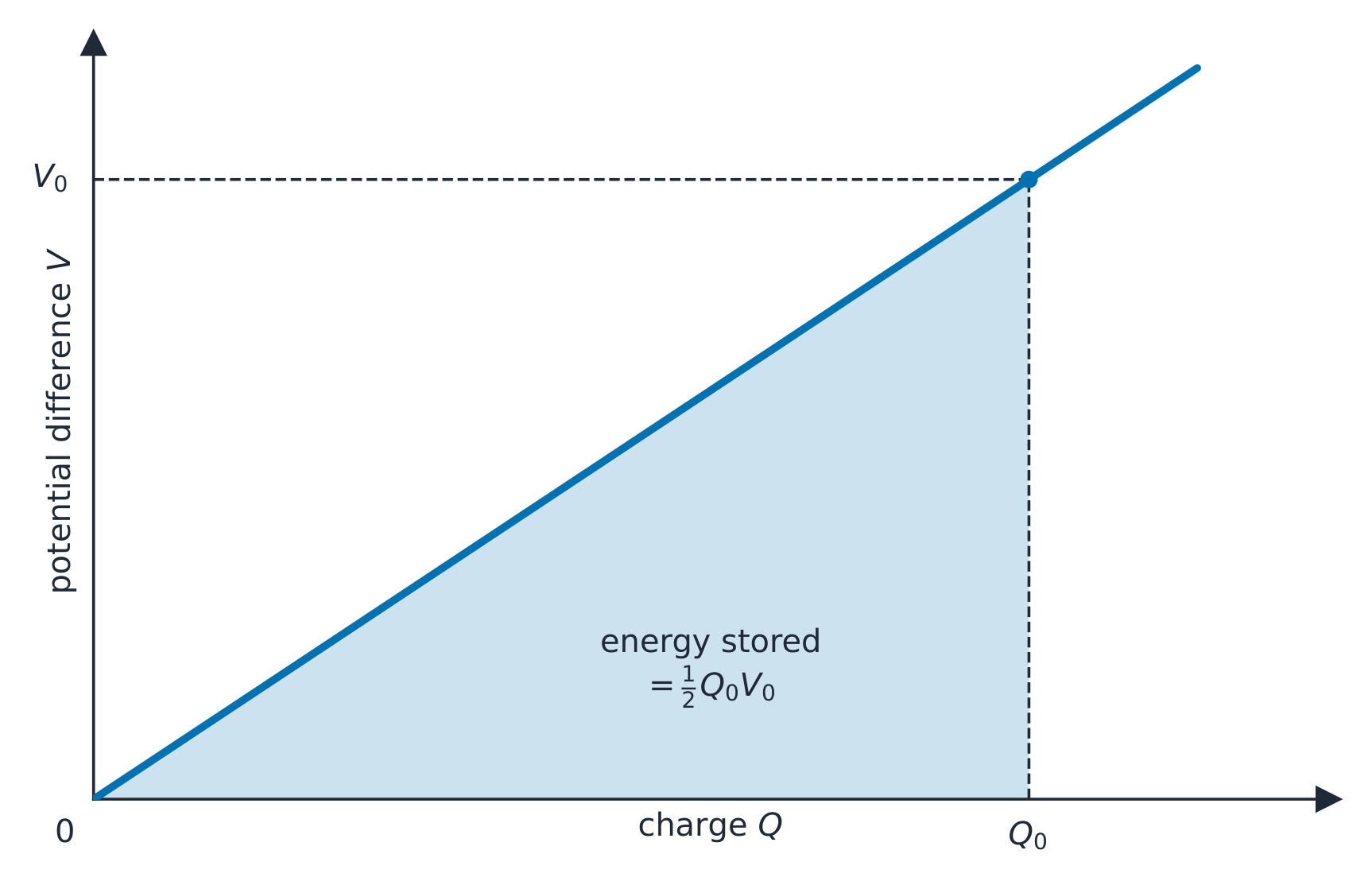
The factor $\tfrac12$ is the area of the triangle under the $Q$–$\Delta V$ line: the first charge moved across costs almost nothing, the last costs the full $\Delta V$.
Capacitors combine oppositely to resistors: in parallel 并联 the capacitances add ($C_{\text{eq}}=C_1+C_2$, same $\Delta V$, charges add), while in series 串联 the reciprocals add ($\tfrac{1}{C_{\text{eq}}}=\tfrac{1}{C_1}+\tfrac{1}{C_2}$, same $Q$, voltages add).
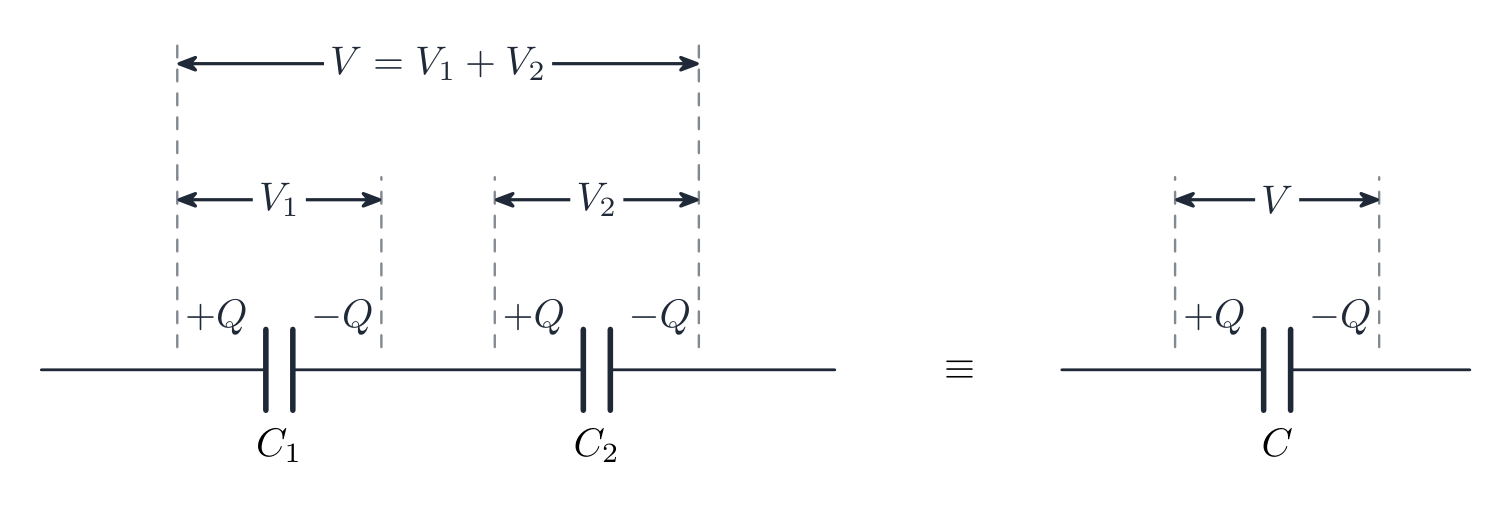
Worked example. A $2\ \mu\text{F}$ and a $4\ \mu\text{F}$ capacitor in series: $\tfrac{1}{C}=\tfrac12+\tfrac14$, so $C=\tfrac43\ \mu\text{F}$. The same pair in parallel: $6\ \mu\text{F}$.
Explore
Charge and discharge a capacitor
A capacitor stores charge on two plates, filling and emptying exponentially with time constant $\tau=RC$. Bigger $R$ or $C$ slows it down.
Vocabulary
Train
| English |
|---|
| capacitor/kəˈpæsɪtə/ |
| capacitance/kəˈpæsɪtəns/ |
| parallel-plate capacitor/ˈpærəlel pleɪt kəˈpæsɪtə/ |
| superposition/ˌsuːpəpəˈzɪʃn/ |
| uniform/ˈjuːnɪfɔːm/ |
| projectile motion/prəˈdʒektaɪl ˈməʊʃn/ |
| work/wɜːk/ |
| parallel/ˈpærəlel/ |
| series/ˈsɪəriːz/ |
10.4
Dielectrics

Syllabus
| Learning Objective | Essential Knowledge |
|---|---|
10.4.A |
|
Source: College Board AP Course and Exam Description
A dielectric 电介质 is an insulating material. Its charges cannot travel, but in an external field each molecule stretches or turns slightly – the material becomes polarized 极化. The lined-up molecules create their own small field opposite to the applied one, so the net field inside the material drops:
$$E=\frac{E_0}{\kappa},\qquad \kappa=\frac{\varepsilon}{\varepsilon_0}\ \ (\kappa>1),$$
where $\kappa$ is the dielectric constant 介电常数, the ratio of the material's permittivity to the permittivity of free space 真空介电常数.
Filling a capacitor with dielectric multiplies its capacitance:
$$C=\kappa\,C_0\qquad\left(\text{parallel plates: } C=\frac{\kappa\varepsilon_0 A}{d}\right).$$
What happens next depends on what stays fixed – a favourite exam trap:
| battery stays connected ($\Delta V$ fixed) | battery removed first ($Q$ fixed) | |
|---|---|---|
| charge $Q$ | rises to $\kappa Q_0$ | unchanged |
| voltage $\Delta V$ | unchanged | drops to $\Delta V_0/\kappa$ |
| field $E$ | unchanged | drops to $E_0/\kappa$ |
| energy $U$ | rises to $\kappa U_0$ | drops to $U_0/\kappa$ |
Worked example. A $100\ \text{pF}$ capacitor is charged to $12\ \text{V}$, disconnected, then filled with a $\kappa=3$ dielectric. $Q$ is trapped, so $\Delta V$ falls to $4\ \text{V}$ and the stored energy falls to one-third – the missing energy went into pulling the dielectric in. Reconnected to the $12\ \text{V}$ battery instead, the capacitor would hold three times the charge and three times the energy.
Exam skill. Always begin dielectric questions by writing down which quantity is held fixed ($Q$ or $\Delta V$), then let $C=\kappa C_0$ drive everything else through $Q=C\Delta V$ and $U=\tfrac12 C(\Delta V)^2$.
Explore
Add a dielectric
A dielectric between the plates raises the capacitance, so the capacitor holds more charge at the same voltage. Watch the charge build faster.
Vocabulary
Train
| English |
|---|
| dielectric/ˌdaɪɪˈlektrɪk/ |
| polarized/ˈpəʊləraɪzd/ |
| dielectric constant/ˌdaɪɪˈlektrɪk ˈkɒnstənt/ |
| permittivity of free space/ˌpɜːmɪˈtɪvəti ɒv friː speɪs/ |
10.4
Exam tips
- In electrostatic equilibrium a conductor has $\vec E=0$ inside and all excess charge on the surface.
- Apply Gauss's law $\oint \vec E\cdot d\vec A=\tfrac{q_{enc}}{\varepsilon_0}$ with a symmetry-matched Gaussian surface (sphere, cylinder, pillbox).
- The whole conductor is one equipotential, and the surface field is perpendicular to it.
- For a capacitor use $C=\tfrac{Q}{V}$, energy $U=\tfrac12 CV^2$, and how a dielectric raises $C$.
- Pick the Gaussian surface so $\vec E$ is constant and parallel (or zero) on each part.
Interactive lessons on this topic
Work through it step by step, with instant-check exercises.