| Learning Objective | Essential Knowledge |
|---|---|
12.1.A |
|
12.1.B |
|
12.1.C |
|
Magnetic Fields and Electromagnetism
AP Physics C: Electricity and Magnetism · Topic 12
 12:45
12:45
Magnetic Fields and Electromagnetism
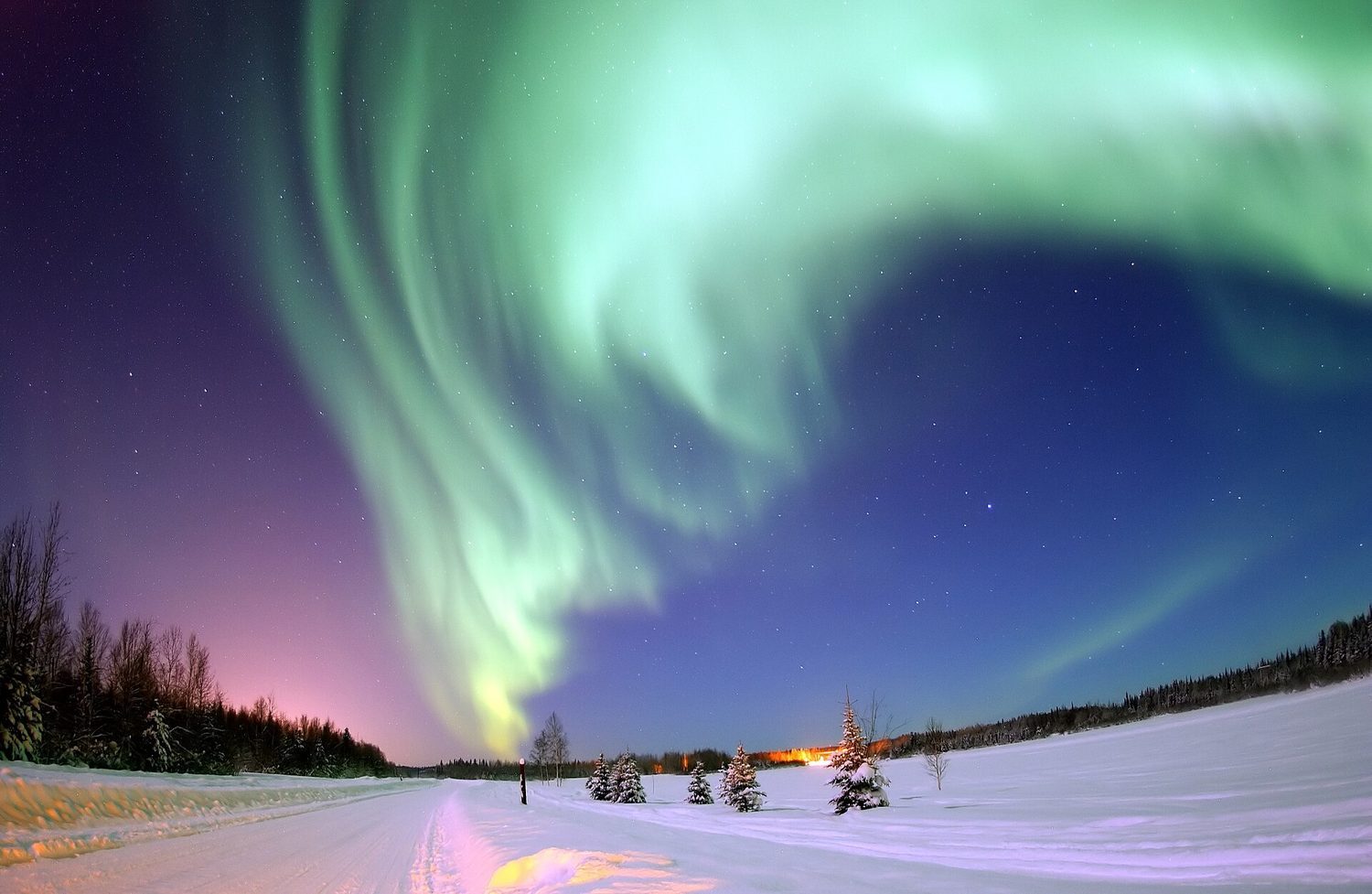
Look north on a clear winter night, far enough north, and the sky glows green. Those lights are switched on by a magnetic field. The Sun throws charged…
English narration · English + 中文 subtitles burned in
12.1
Magnetic Fields
Syllabus
Source: College Board AP Course and Exam Description
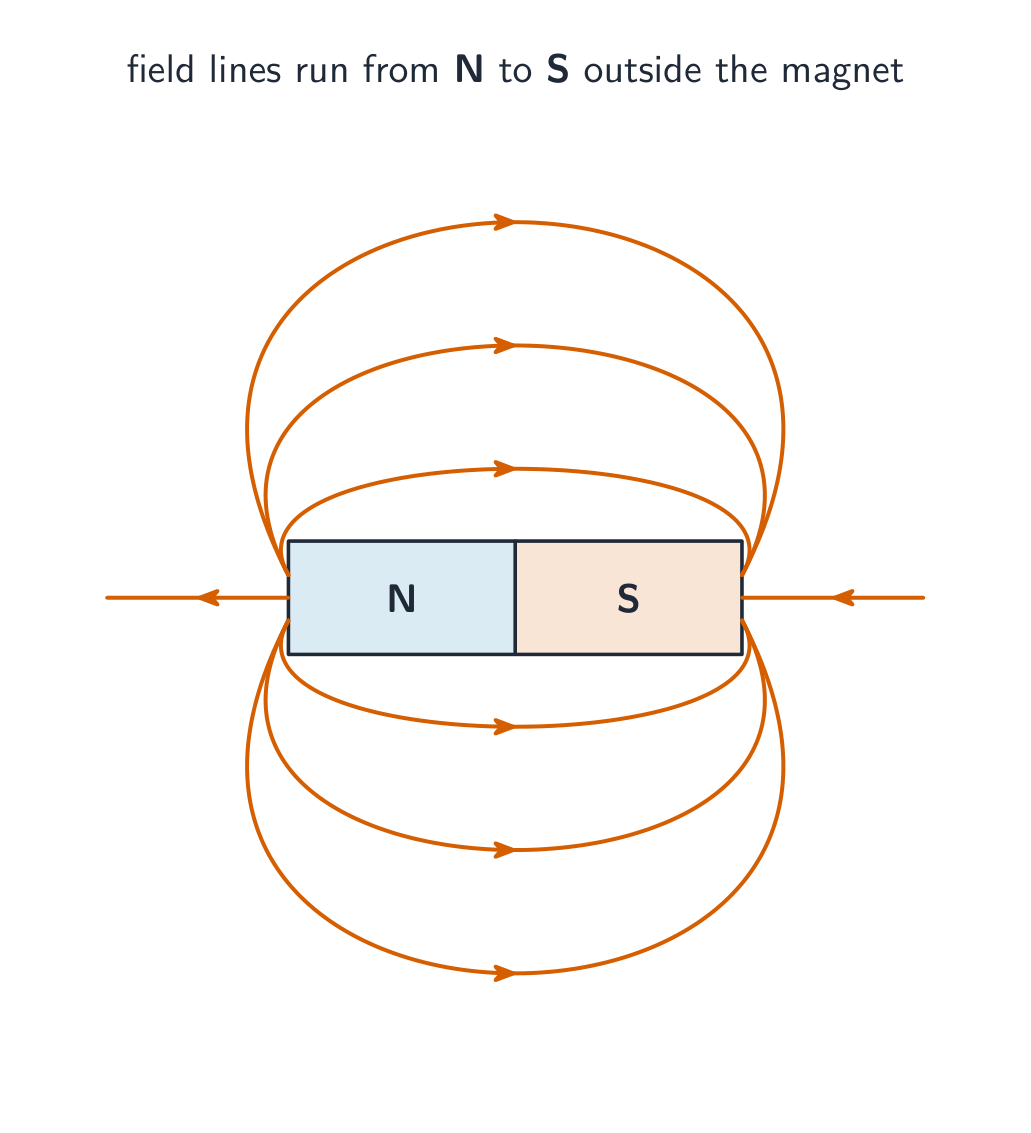
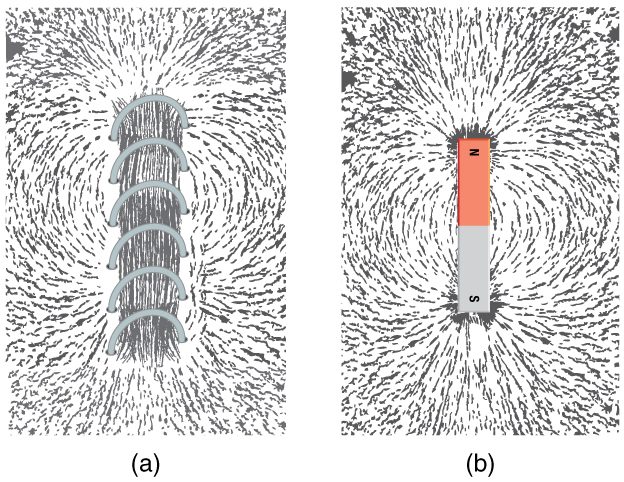
A magnetic field 磁场 $\vec{B}$ is a vector field 矢量场 that surrounds magnets, moving charges, and currents; it determines the magnetic force on any moving charge placed in it. Magnetic field lines 磁感线 must form closed loops: they leave the north pole, return to the south pole, and continue through the magnet. Denser lines mean a stronger field.
Closed loops are the content of Gauss's law for magnetism, the second of Maxwell's equations 麦克斯韦方程组:
$$\oint \vec{B}\cdot d\vec{A}=0.$$
The net magnetic flux through any closed surface is zero – as many field lines leave as enter. That is exactly the statement that isolated magnetic monopoles 磁单极子 do not exist. Every source of magnetism is a magnetic dipole 磁偶极子 (a north–south pair), made by circulating charge – in materials, the motion of electrons. Break a bar magnet in half and you get two smaller dipoles, never a lone pole. Like poles repel, opposite poles attract, and a free dipole – a compass 指南针 – rotates to line up with the local field. Earth's own field is approximately a dipole, which is why a compass works. Dipole fields weaken with distance.
How a material responds to an external field depends on how its internal dipoles behave:
- Ferromagnetic 铁磁性 (iron, nickel, cobalt): an external field aligns whole magnetic domains 磁畴, and the alignment survives after the field is removed – a permanent magnet.
- Paramagnetic 顺磁性 (aluminum, titanium): dipoles align weakly with the field but relax when it is removed.
- Diamagnetic 抗磁性 (all materials): the electronic structure produces a usually weak alignment opposite to the field.
The strength of a material's response is its magnetic permeability 磁导率. Free space has the constant value $\mu_0$ (the vacuum permeability); the permeability of matter differs from $\mu_0$ and is not even constant – it varies with temperature, orientation, and field strength.
Explore
See a magnet's field lines
Magnetic field lines run from north to south outside a magnet; where they crowd together the field is strongest.
Vocabulary
Train
| English |
|---|
| magnetic field/mæɡˈnetɪk fiːld/ |
| vector field/ˈvektə fiːld/ |
| magnetic field lines/mæɡˈnetɪk fiːld laɪnz/ |
| Maxwell's equations/ˈmækswelz ɪˈkweɪʒnz/ |
| magnetic monopoles/mæɡˈnetɪk ˈmɒnəʊpəʊlz/ |
| magnetic dipole/mæɡˈnetɪk ˈdaɪpəʊl/ |
| compass/ˈkʌmpəs/ |
| Ferromagnetic/ˌferəməɡˈnetɪk/ |
| magnetic domains/mæɡˈnetɪk dəˈmeɪnz/ |
| Paramagnetic/ˌpærəməɡˈnetɪk/ |
| Diamagnetic/ˌdaɪəməɡˈnetɪk/ |
| magnetic permeability/mæɡˈnetɪk ˌpɜːməˈbɪlɪti/ |
12.2
Magnetism and Moving Charges
Syllabus
| Learning Objective | Essential Knowledge |
|---|---|
12.2.A |
|
12.2.B |
|
Source: College Board AP Course and Exam Description
A moving charge does two things: it creates a magnetic field, and it feels a force in an external one. The field it creates at a point is perpendicular 垂直 to both its velocity and the position vector from charge to point (right-hand rule again), and is largest where those two are perpendicular – zero directly ahead of or behind the motion.
The force on a charge moving in a field $\vec{B}$ is the cross product
$$\vec{F}_B=q\,\vec{v}\times\vec{B},\qquad F=qvB\sin\theta,$$
perpendicular to both $\vec{v}$ and $\vec{B}$ – point the fingers of your right hand along $\vec{v}$, curl toward $\vec{B}$, and the thumb gives the force on a positive charge (reverse it for negative). Because $\vec{F}_B\perp\vec{v}$, the magnetic force does no work on the charge: it changes direction, never speed.
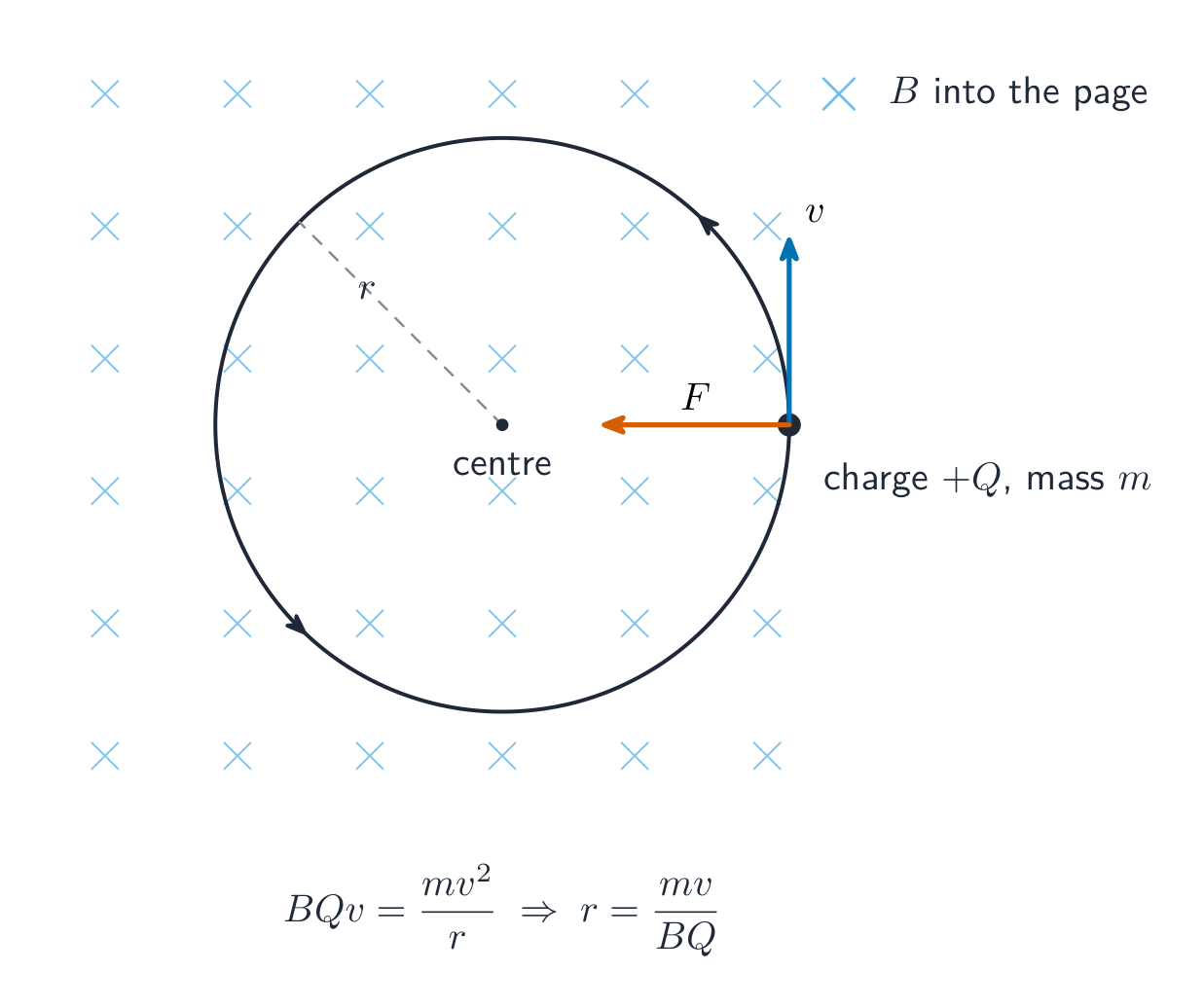
A charge moving perpendicular to a uniform field therefore travels in a circle, the magnetic force supplying the centripetal force 向心力:
$$qvB=\frac{mv^2}{r}\quad\Rightarrow\quad r=\frac{mv}{qB},\qquad T=\frac{2\pi m}{qB}.$$
Notice the period $T$ does not depend on the speed – faster particles ride larger circles in the same time.
Worked example. A proton ($q=1.6\times10^{-19}\ \text{C}$, $m=1.67\times10^{-27}\ \text{kg}$) enters a $0.50\ \text{T}$ field at $2.0\times10^{5}\ \text{m/s}$, perpendicular to it. The magnetic force $F=qvB=1.6\times10^{-14}\ \text{N}$ bends it into a circle of radius $r=\dfrac{mv}{qB}=\dfrac{1.67\times10^{-27}(2.0\times10^{5})}{1.6\times10^{-19}(0.50)}=4.2\times10^{-3}\ \text{m}$.
In a region with both an electric and a magnetic field, the two forces act independently and add as vectors. Balancing them makes a velocity selector 速度选择器: with $\vec{E}$ and $\vec{B}$ crossed, only charges with $qE=qvB$, i.e. $v=E/B$, pass straight through. The Hall effect 霍尔效应 is the same physics inside a conductor: a field with a component perpendicular to the current pushes the moving carriers sideways, charge builds up on one face, and a measurable potential difference appears across the conductor – its sign reveals whether the carriers are positive or negative.
Explore
Force on a moving charge
A charge moving through a magnetic field feels a force $F=qvB$ at right angles to both its velocity and the field — the basis of the motor effect. Reverse either and the force flips.
Vocabulary
Train
| English |
|---|
| perpendicular/ˌpɜːpənˈdɪkjʊlə/ |
| centripetal force/senˈtrɪpɪtl fɔːs/ |
| velocity selector/vəˈlɒsɪti sɪˈlektə/ |
| Hall effect/hɔːl ɪˈfekt/ |
12.3
Magnetic Fields of Current-Carrying Wires
Syllabus
| Learning Objective | Essential Knowledge |
|---|---|
12.3.A |
|
12.3.B |
Boundary statement: AP Physics C: Electricity & Magnetism only expects students to perform quantitative analysis of certain cases of current-carrying conductors using the Biot-Savart law, such as at a location along the perpendicular bisector of a straight conductor, at a location along the central axis of a circular loop, or at the center of a segment of a circular loop. |
Source: College Board AP Course and Exam Description
A current is a stream of moving charges, so it creates a magnetic field. The Biot–Savart law 毕奥-萨伐尔定律 adds up the field of each current element:
$$d\vec{B}=\frac{\mu_0}{4\pi}\frac{I\,d\vec{l}\times\hat{r}}{r^2}.$$
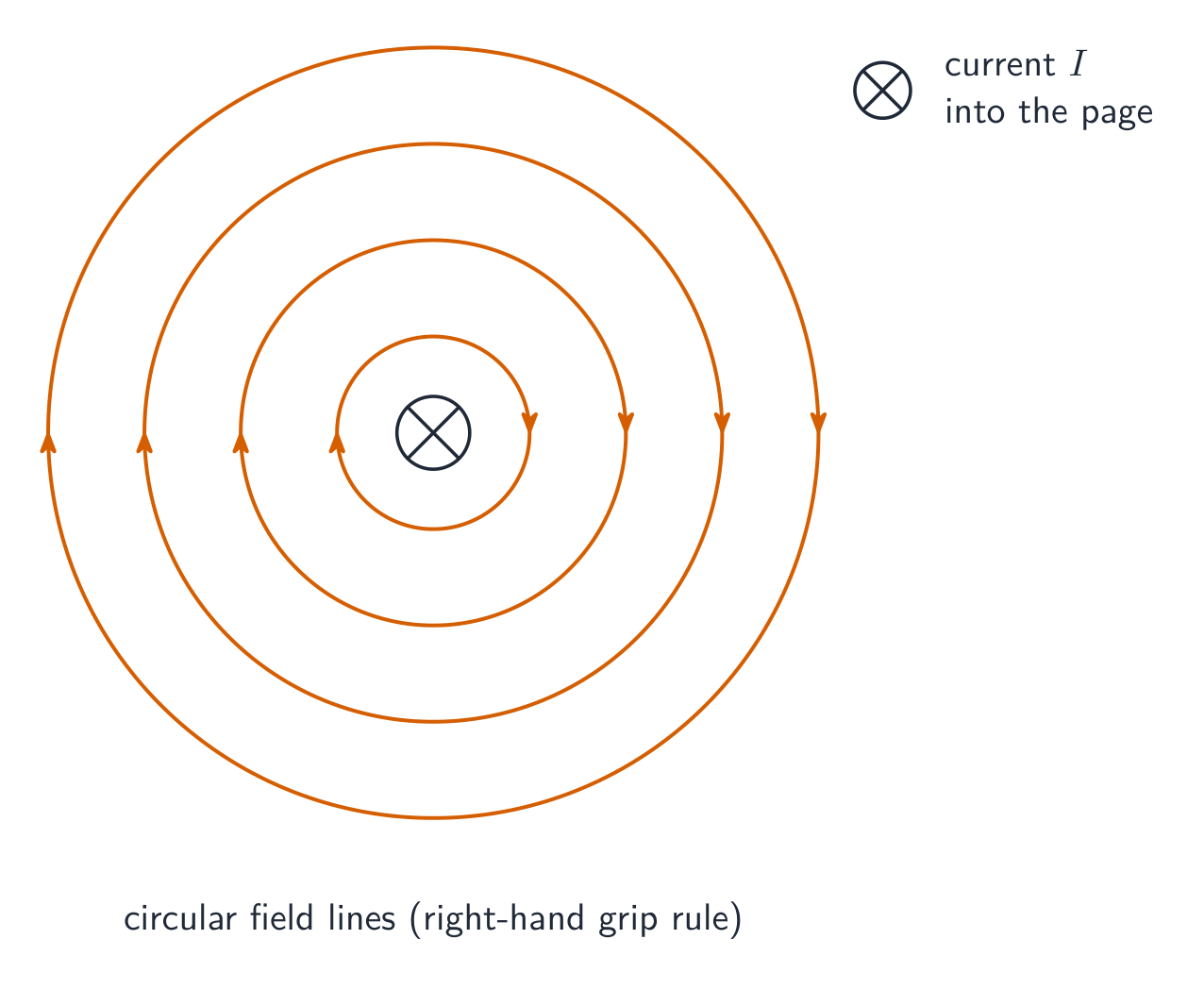
Around any straight segment the field vectors are tangent 相切 to concentric circles 同心圆 centred on the wire – no component toward, away from, or along the wire. Curl your right hand around the wire with the thumb along the current: your fingers give the field direction.
The Biot–Savart integrals AP expects: a long straight wire ($B=\dfrac{\mu_0 I}{2\pi r}$, or a point on the perpendicular bisector of a finite wire), and the centre of a circular loop,
$$B_{\text{centre of loop}}=\frac{\mu_0 I}{2R},$$
where every element $d\vec{l}$ is perpendicular to $\hat{r}$ and equally distant $R$ – say that in an FRQ derivation. An arc that is a fraction of a full circle contributes that same fraction of $\mu_0 I/2R$ at its centre.
A field also pushes on a current-carrying wire, element by element:
$$\vec{F}_B=\int I\,d\vec{l}\times\vec{B}\qquad(\vec{F}=I\vec{L}\times\vec{B}\ \text{for a straight wire in a uniform field}).$$
Worked example. Two long parallel wires a distance $d=0.10\ \text{m}$ apart each carry $5.0\ \text{A}$ in the same direction. Wire 1's field at wire 2 is $B=\dfrac{\mu_0 I}{2\pi d}=1.0\times10^{-5}\ \text{T}$, so wire 2 feels $\dfrac{F}{L}=I B=5.0\times10^{-5}\ \text{N/m}$, pulled toward wire 1. Same-direction currents attract; opposite currents repel.
Vocabulary
Train
| English |
|---|
| Biot–Savart law/ˈbɪɒt ˈsævɑːt lɔː/ |
| tangent/ˈtændʒənt/ |
| concentric circles/kənˈsentrɪk ˈsɜːklz/ |
12.4
Ampère's Law
Syllabus
| Learning Objective | Essential Knowledge |
|---|---|
12.4.A |
Boundary statement: AP Physics C: Electricity & Magnetism only expects quantitative application of Ampère's law limited to situations involving symmetrical magnetic fields. Long straight wires, long solenoids carrying currents, as well as conductive slabs or cylindrical conductors carrying a current density, are the types of shapes to which Ampère's law will be applied on the AP Physics C: Electricity & Magnetism Exam. Boundary statement: AP Physics C: Electricity & Magnetism does not expect students to use Maxwell's fourth equation with a changing electric field. However, students should understand that a changing electric field generates a magnetic field. |
Source: College Board AP Course and Exam Description
For symmetric current distributions, Ampère's law 安培定律 finds the field far faster than Biot–Savart:
$$\oint \vec{B}\cdot d\vec{l}=\mu_0 I_{\text{enc}}.$$
Choose an Amperian loop 安培环路 that matches the symmetry, so that $B$ is constant along the loop (and parallel to it) and comes out of the integral. AP applies it to long straight wires, long solenoids, and conductors carrying a current density 电流密度 (slabs and cylinders); combinations are handled by superposition 叠加.
Worked example. Find the field $0.10\ \text{m}$ from a long wire carrying $5.0\ \text{A}$. A circular loop of radius $r$ shares the field's symmetry, so $B(2\pi r)=\mu_0 I$ and
$$B=\frac{\mu_0 I}{2\pi r}=\frac{(4\pi\times10^{-7})(5.0)}{2\pi(0.10)}=1.0\times10^{-5}\ \text{T}.$$
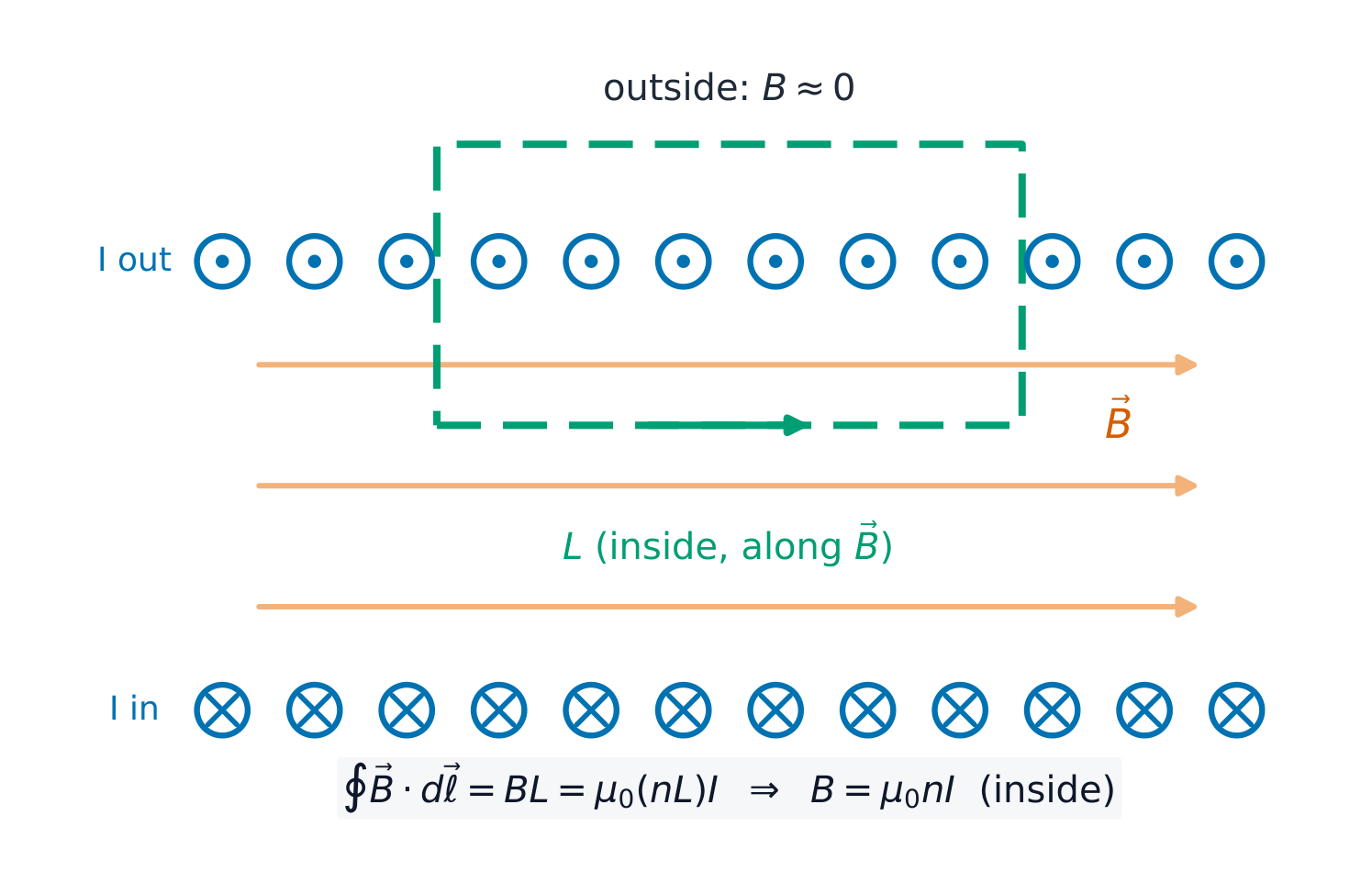
A long solenoid 螺线管 (assumed: uniform field inside, negligible field outside) is the other classic. Take a rectangular loop with one side of length $L$ inside, parallel to the axis: only that side contributes to the integral, so $BL=\mu_0 (nL) I$ and
$$B_{\text{sol}}=\mu_0 n I,$$
with $n$ the turns per metre.
Worked example (cylinder). A solid cylindrical conductor of radius $R$ carries current $I$ spread uniformly over its cross-section. Inside ($r
Exam skill. Every Ampère's-law answer earns its marks in the setup: name the loop, state why $B$ is constant and parallel to it (symmetry), and count $I_{\text{enc}}$ carefully before you solve. Maxwell's fourth equation adds one more idea you should know qualitatively: a changing electric field also creates a magnetic field – but AP will not ask you to compute with that term.
Vocabulary
Train
| English |
|---|
| Ampère's law/ˈæmpeəz lɔː/ |
| Amperian loop/æmˈpɪərɪən luːp/ |
| current density/ˈkʌrənt ˈdensɪti/ |
| superposition/ˌsuːpəpəˈzɪʃn/ |
| solenoid/ˈsəʊlənɔɪd/ |
12.4
Exam tips
- The magnetic force $\vec F=q\vec v\times\vec B$ is perpendicular to velocity — use the right-hand rule and note it does no work.
- A charge in a uniform field moves in a circle with $r=\tfrac{mv}{qB}$.
- Find the field of currents with Biot–Savart $d\vec B=\tfrac{\mu_0}{4\pi}\tfrac{I\,d\vec l\times\hat r}{r^2}$ or Ampère's law $\oint \vec B\cdot d\vec l=\mu_0 I_{enc}$ when there is symmetry.
- Force on a wire is $\vec F=I\vec L\times\vec B$; keep the cross-product direction straight.
- Distinguish the force on a charge from the field the current creates.
Interactive lessons on this topic
Work through it step by step, with instant-check exercises.