| Learning Objective | Essential Knowledge |
|---|---|
9.1.A |
|
9.1.B |
Boundary statement: AP Physics 2 only expects students to perform qualitative and quantitative analysis of collisions in one and two dimensions. Students are not expected to know the functional form of the Maxwell-Boltzmann distribution but are expected to be familiar with how features of the distribution are related to the temperature of the gas. |
Thermodynamics · อุณหพลศาสตร์
AP Physics 2 · Topic 9 · หัวข้อ 9
 8:56
8:56
Thermodynamics · อุณหพลศาสตร์
Put a hot cup of coffee on a table. It always cools down. It never warms back up by taking heat out of the cool room. Both directions would balance the energy…
English narration · English + 中文 subtitles burned in · การบรรยายภาษาอังกฤษ · คำบรรยายภาษาอังกฤษ + 中文 ลอยตัวบนภาพ
9.1
Kinetic Theory of Temperature and Pressure · ทฤษฎีจลน์ของอุณหภูมิและความดัน
Syllabus · หลักสูตร
Source: College Board AP Course and Exam Description · แหล่งที่มา: คำอธิบายหลักสูตรและข้อสอบ College Board AP
English
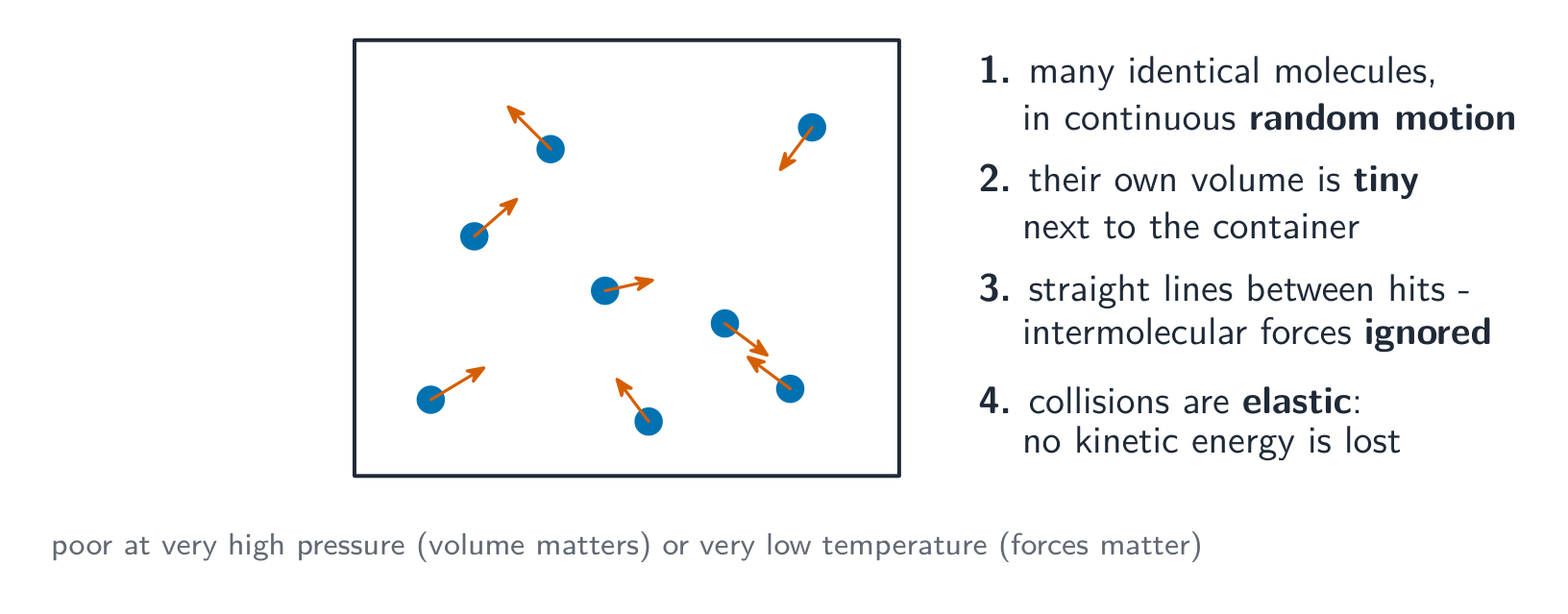
Thermodynamics 热力学 studies heat and energy in large collections of particles. The kinetic theory 分子运动论 explains gas behavior from the random motion of its molecules:
- Temperature 温度 is a measure of the average kinetic energy of the molecules: $K_{\text{avg}}=\tfrac{3}{2}k_B T$ (with $T$ in kelvin). Hotter means faster-moving molecules.
- Pressure 压强 comes from molecules colliding with the container walls – more frequent or harder collisions give more pressure.
Worked example. Find the average kinetic energy of a gas molecule at $300\ \text{K}$, using $k_B=1.38\times10^{-23}\ \text{J/K}$:
$$K_{\text{avg}}=\tfrac32 k_B T=1.5\times1.38\times10^{-23}\times300=6.2\times10^{-21}\ \text{J}.$$
It depends only on temperature, not on the type of gas – at the same $T$, light and heavy molecules share the same average kinetic energy (so the light ones move faster).
ไทย
อุณหพลศาสตร์ ศึกษาความร้อนและพลังงานในกลุ่มอนุภาคจำนวนมาก ทฤษฎีจลน์ อธิบายพฤติกรรมของแก๊สจากการเคลื่อนที่แบบสุ่มของโมเลกุล:
- อุณหภูมิ เป็นตัววัด พลังงานจลน์เฉลี่ย ของโมเลกุล: $K_{\text{avg}}=\tfrac{3}{2}k_B T$ (โดยมี $T$ เป็น kelvin). ร้อนขึ้นหมายความว่าโมเลกุลเคลื่อนที่เร็วขึ้น
- ความดัน มาจากการชนของโมเลกุลกับผนังภาชนะ – การชนบ่อยครั้งหรือรุนแรงมากขึ้นทำให้มีความดันมากขึ้น
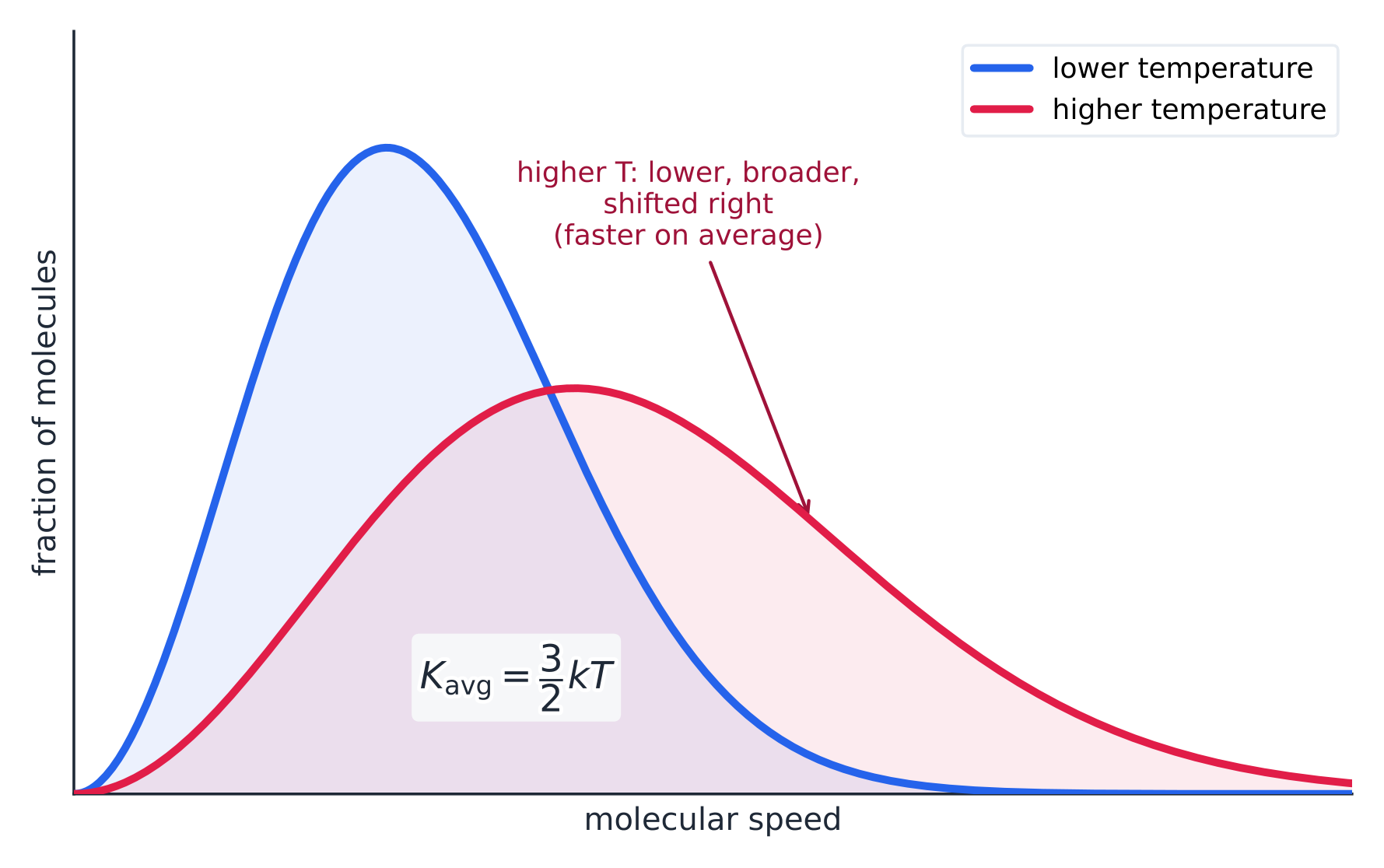 *การกระจายความเร็วของ Maxwell-Boltzmann เลื่อนไปทางขวาและแบนลงที่อุณหภูมิสูงขึ้น
ตัวอย่างที่คำนวณแล้ว. หาพลังงานจลน์เฉลี่ยของโมเลกุลแก๊สที่ $300\ \text{K}$, โดยใช้ $k_B=1.38\times10^{-23}\ \text{J/K}$:
$$K_{\text{avg}}=\tfrac32 k_B T=1.5\times1.38\times10^{-23}\times300=6.2\times10^{-21}\ \text{J}.$$
มันขึ้นอยู่กับอุณหภูมิเท่านั้น ไม่ใช่ชนิดของแก๊ส – ที่ $T$ เดียวกัน โมเลกุลเบาและหนักมีพลังงานจลน์เฉลี่ยเท่ากัน (ดังนั้นโมเลกุลเบาก็เคลื่อนที่เร็วขึ้น)
Explore · สำรวจ
Explore the spread of molecular speeds · สำรวจการกระจายตัวของความเร็วโมเลกุล
Raise the temperature and watch the whole speed distribution shift right and flatten — the particles move faster on average, which is exactly what $\bar K = \tfrac{3}{2} k_B T$ means. · เพิ่มอุณหภูมิและดูว่าการกระจายตัวความเร็วทั้งหมดเลื่อนไปทางขวาและแบนลง —อนุภาคเคลื่อนที่ เร็วขึ้นโดยเฉลี่ย ซึ่งเป็นสิ่งที่ $\bar K = \tfrac{3}{2} k_B T$ หมายถึงพอดี
9.2
The Ideal Gas Law · กฎแก๊สอุดมคติ
Syllabus · หลักสูตร
English
Learning Objective 9.2.A: Describe the properties of an ideal gas.
- 9.2.A.1 The classical model of an ideal gas assumes that the instantaneous velocities of atoms are random, the volumes of the atoms are negligible compared to the total volume occupied by the gas, the atoms collide elastically, and the only appreciable forces on the atoms are those that occur during collisions.
- 9.2.A.2 An ideal gas is one in which the relationships between pressure, volume, the number of moles or number of atoms, and temperature of a gas can be modeled using the equation
- Equation: $PV = nRT = N k_B T$
- 9.2.A.3 Graphs modeling the pressure, temperature, and volume of gases can be used to describe or determine properties of that gas.
- 9.2.A.4 A temperature at which an ideal gas has zero pressure can be extrapolated from a graph of pressure as a function of temperature.
ไทย
วัตถุประสงค์การเรียนรู้ 9.2.A: อธิบายคุณสมบัติของแก๊สในอุดมคติ
- 9.2.A.1 Classical model of an ideal gas assumes that the instantaneous velocities of atoms are random, the volumes of the atoms are negligible compared to the total volume occupied by the gas, the atoms collide elastically, and the only appreciable forces on the atoms are those that occur during collisions.
- 9.2.A.2 An ideal gas is one in which the relationships between pressure, volume, the number of moles or number of atoms, and temperature of a gas can be modeled using the equation
- สมการ: $PV = nRT = N k_B T$
- 9.2.A.3 Graphs modeling the pressure, temperature, and volume of gases can be used to describe or determine properties of that gas.
- 9.2.A.4 A temperature at which an ideal gas has zero pressure can be extrapolated from a graph of pressure as a function of temperature.
Source: College Board AP Course and Exam Description · แหล่งที่มา: คำอธิบายหลักสูตรและข้อสอบ College Board AP
English
An ideal gas 理想气体 obeys
$$PV=nRT \qquad(\text{or } PV=Nk_B T),$$
linking pressure $P$, volume $V$, amount ($n$ moles or $N$ molecules), and absolute temperature $T$. Use it to predict how a gas responds when you change one quantity and hold others fixed (e.g. heating at constant volume raises pressure).
Worked example. A sealed rigid container of gas is at $1.0\times10^{5}\ \text{Pa}$ and $300\ \text{K}$. It is heated to $450\ \text{K}$. Because the volume and amount are fixed, $P/T$ is constant:
$$P_2=P_1\frac{T_2}{T_1}=1.0\times10^{5}\times\frac{450}{300}=1.5\times10^{5}\ \text{Pa}.$$
Always convert temperatures to kelvin before using a gas law – using Celsius here would give nonsense.
ไทย
แก๊สอุดมคติ สอดคล้องกับ
$$PV=nRT \qquad(\text{or } PV=Nk_B T),$$
เชื่อมต่อกับความดัน $P$, ปริมาตร $V$, ปริมาณ ($n$ mol หรือ $N$ молекулы), และอุณหภูมิสัมบูรณ์ $T$. ใช้มันเพื่อทำนายว่าแก๊สจะตอบสนองอย่างไรเมื่อคุณเปลี่ยนปริมาณหนึ่งและคงปริมาณอื่นไว้ (เช่น การให้ความร้อนที่ปริมาตรคงที่จะทำให้ความดันเพิ่มขึ้น)
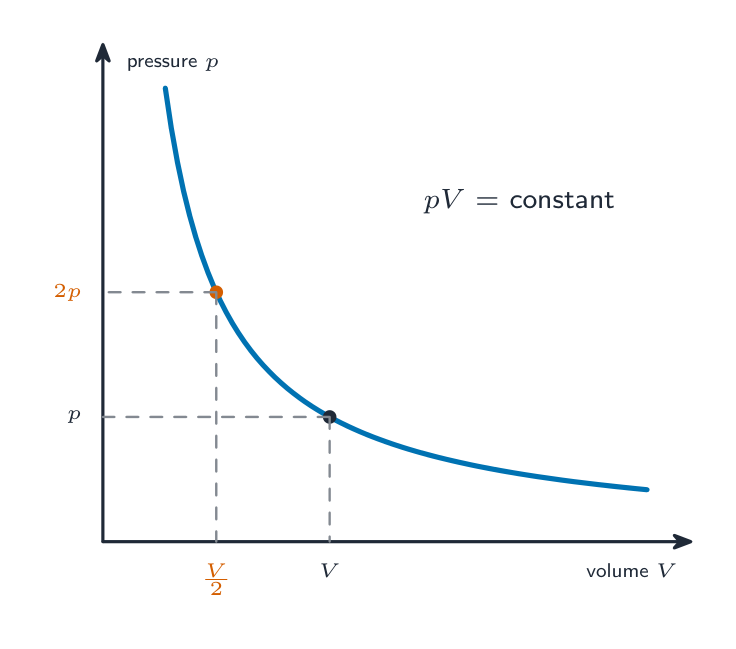 *กฎของ Boyle: ที่อุณหภูมิคงที่, ความดันคูณปริมาตรเป็นค่าคงที่
ตัวอย่างที่คำนวณแล้ว. กล่องแก๊สแข็งที่ปิดสนิทอยู่ที่ $1.0\times10^{5}\ \text{Pa}$ และ $300\ \text{K}$. ถูกทำให้ร้อนถึง $450\ \text{K}$. เนื่องจากปริมาตรและปริมาณคงที่, $P/T$ เป็นค่าคงที่:
$$P_2=P_1\frac{T_2}{T_1}=1.0\times10^{5}\times\frac{450}{300}=1.5\times10^{5}\ \text{Pa}.$$
แปลงอุณหภูมิเป็น kelvin เสมอก่อนใช้กฎแก๊ส – การใช้ Celsius ที่นี่จะให้ผลลัพธ์ที่ไม่สมเหตุสมผล
 *การให้ความร้อนแก๊สภายในลูกโป่งทำให้ความหนาแน่นลดลง, ดังนั้นลูกโป่งจะลอยขึ้น – กฎแก๊สอุดมคติทำงานอยู่
Explore · สำรวจ
Explore squeezing a gas · สำรวจการบีบอัดก๊าซ
Slide the piston in to shrink the volume. The same particles are crammed into less space, so they hit the walls more often and the pressure climbs — while $PV$ stays constant at fixed temperature. · เลื่อนลูกสูบเข้าไปเพื่อลดปริมาตร อนุภาคจำนวนเท่าเดิมถูกอัดอยู่ในพื้นที่น้อยลง ทำให้ชนผนังบ่อยขึ้นและ ความดันเพิ่มขึ้น —ในขณะที่ $PV$ คงที่ที่อุณหภูมิคงที่
9.3
Thermal Energy Transfer and Equilibrium · การถ่ายโอนพลังงานความร้อนและสมดุล
Syllabus · หลักสูตร
| Learning Objective | Essential Knowledge |
|---|---|
9.3.A |
|
Source: College Board AP Course and Exam Description · แหล่งที่มา: คำอธิบายหลักสูตรและข้อสอบ College Board AP
English
Heat 热量 $Q$ is energy transferred because of a temperature difference; it flows from hot to cold. Two objects in contact reach thermal equilibrium 热平衡 when they share the same temperature, and net heat flow stops. The three transfer methods are conduction 传导, convection 对流, and radiation 辐射.
ไทย
ความร้อน $Q$ คือพลังงานที่ถ่ายโอนเนื่องจากความต่างของอุณหภูมิ; มันไหลจากร้อนไปเย็น วัตถุสองชิ้นที่สัมผัสกันจะบรรลุ สมดุลความร้อน เมื่อมีอุณหภูมิเท่ากัน และการไหลของความร้อนสุทธิหยุดลง วิธีถ่ายโอนสามอย่างคือ การนำความร้อน, การพาความร้อน, และ การแผ่รังสี
Explore · สำรวจ
Add heat and watch the temperature · เพิ่มความร้อนและดูอุณหภูมิ
Adding heat usually raises temperature, but during a phase change the temperature holds flat while the energy breaks bonds. Two bodies in contact settle at one temperature — thermal equilibrium. · การเพิ่มความร้อนมักทำให้อุณหภูมิสูงขึ้น แต่ในช่วง การเปลี่ยนสถานะ อุณหภูมิจะคงที่ขณะที่พลังงานทำลายพันธะ วัตถุสองชิ้นที่สัมผัสกันจะ/settle ที่อุณหภูมิเดียว — สมดุลความร้อน
9.4
The First Law of Thermodynamics · กฎข้อที่หนึ่งของอุณหพลศาสตร์
Syllabus · หลักสูตร
English
Learning Objective 9.4.A: Describe the internal energy of a system.
- 9.4.A.1 The internal energy of a system is the sum of the kinetic energy of the objects that make up the system and the potential energy of the configuration of those objects.
- 9.4.A.1.i The atoms in an ideal gas do not interact with each other via conservative forces, and the internal structure is not considered. Therefore, an ideal gas does not have internal potential energy.
- 9.4.A.1.ii The internal energy of an ideal monatomic gas is the sum of the kinetic energies of the constituent atoms in the gas.
- Equation: $U = \dfrac{3}{2} nRT = \dfrac{3}{2} N k_B T$
- 9.4.A.2 Changes to a system's internal energy can result in changes to the internal structure and internal behavior of that system without changing the motion of the system's center of mass.
Learning Objective 9.4.B: Describe the behavior of a system using thermodynamic processes.
- 9.4.B.1 The first law of thermodynamics is a restatement of conservation of energy that accounts for energy transferred into or out of a system by work, heating, or cooling.
- 9.4.B.1.i For an isolated system, the total energy is constant.
- 9.4.B.1.ii For a closed system, the change in internal energy is the sum of energy transferred to or from the system by heating, or work done on the system.
- Equation: $\Delta U = Q + W$
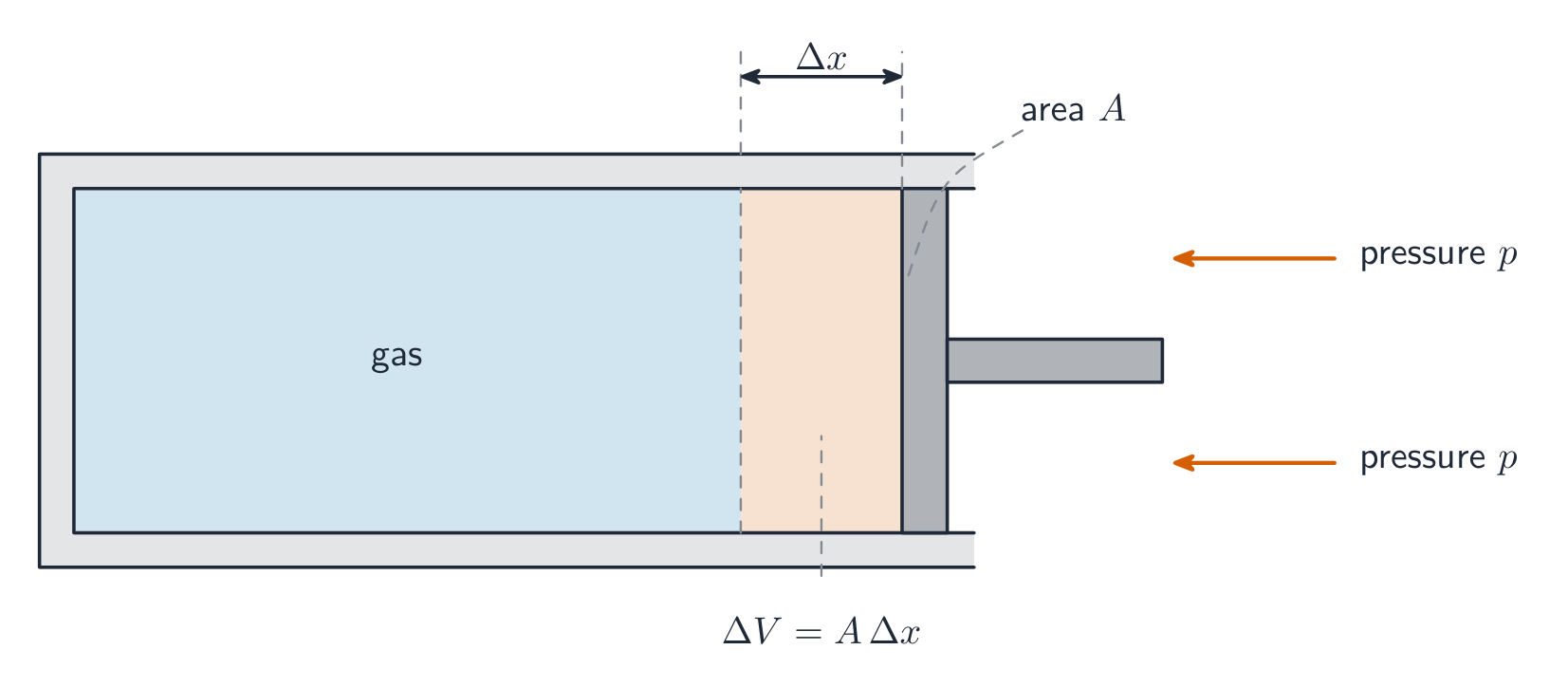
- 9.4.B.1.iii The work done on a system by a constant or average external pressure that changes the volume of that system (for example, a piston compressing a gas in a container) is defined as
- Equation: $W = -P \Delta V$
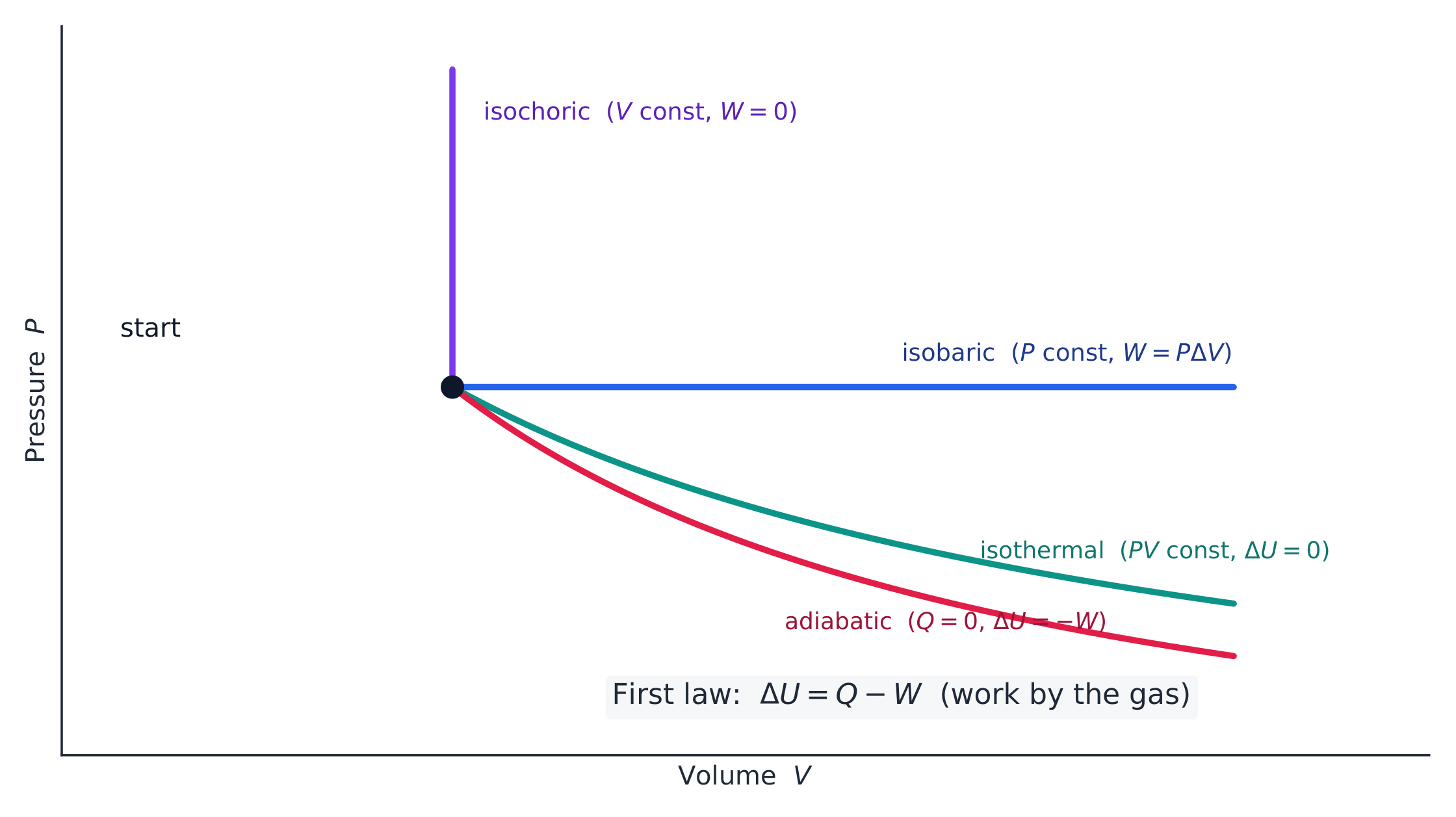
- 9.4.B.2 Pressure-volume graphs (also known as PV diagrams) are representations used to represent thermodynamic processes.
- 9.4.B.2.i Lines of constant temperature on a PV diagram are called isotherms.
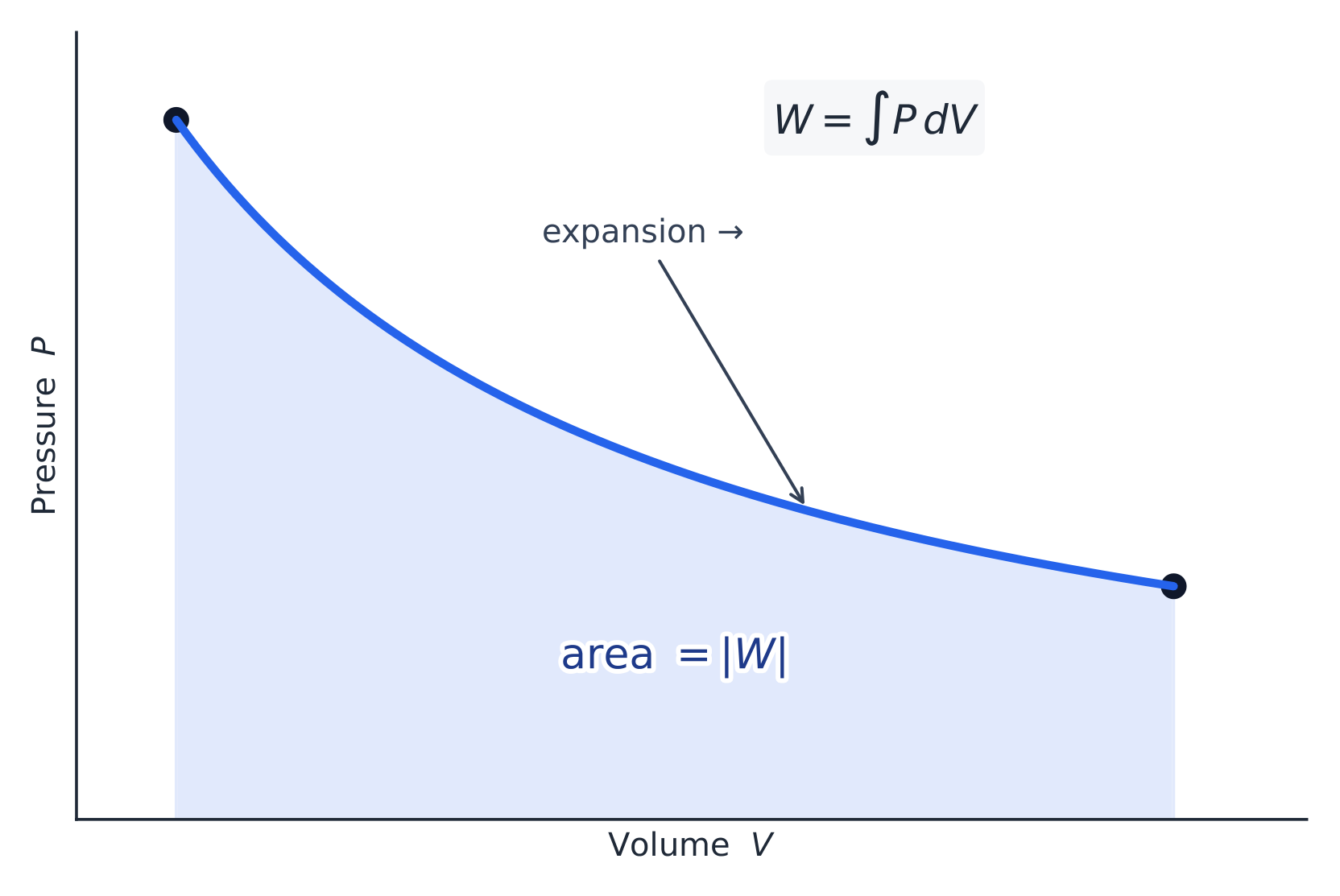
- 9.4.B.2.ii The absolute value of the work done on a gas when the gas expands or compresses is equal to the area underneath the curve of a plot of pressure vs. volume for the gas.
- 9.4.B.3 Special cases of thermal processes depend on the relationship between the configuration of the system, the nature of the work done on the system, and the system's surroundings. These include constant volume (isovolumetric), constant temperature (isothermal), and constant pressure (isobaric), as well as processes where no energy is transferred to or from the system through thermal processes (adiabatic).
ไทย
วัตถุประสงค์การเรียนรู้ 9.4.A: อธิบายพลังงานภายในของระบบ
- 9.4.A.1 พลังงานภายในของระบบคือผลรวมของพลังงานจลน์ของวัตถุที่ประกอบขึ้นเป็นระบบและพลังงานศักย์ของการจัดวางตำแหน่งของวัตถุเหล่านั้น
- 9.4.A.1.i อะตอมในแก๊สอุดมคติไม่มีการกระทำต่อกันด้วยแรงอนุรักษ์ และโครงสร้างภายในไม่ได้ถูกพิจารณา ดังนั้นแก๊สอุดมคติจึงไม่มีพลังงานศักย์ภายใน
- 9.4.A.1.ii พลังงานภายในของแก๊สอะตอมเดี่ยวอุดมคติคือผลรวมของพลังงานจลน์ของอะตอมส่วนประกอบในแก๊สนั้น
- สมการ: $U = \dfrac{3}{2} nRT = \dfrac{3}{2} N k_B T$
- 9.4.A.2 การเปลี่ยนแปลงพลังงานภายในของระบบอาจส่งผลให้เกิดการเปลี่ยนแปลงต่อโครงสร้างภายในและพฤติกรรมภายในของระบบโดยไม่ทำให้การเคลื่อนที่ของจุดศูนย์กลางมวลของระบบเปลี่ยนแปลงไป
วัตถุประสงค์การเรียนรู้ 9.4.B: อธิบายพฤติกรรมของระบบโดยใช้กระบวนการทางอุณหพลศาสตร์
- 9.4.B.1 กฎข้อที่หนึ่งแห่งอุณหพลศาสตร์เป็นการ表述ซ้ำของการอนุรักษ์พลังงานซึ่งคำนึงถึงพลังงานที่ถ่ายโอนเข้าสู่หรือออกจากระบบผ่านงาน, ความร้อน หรือการทำความเย็น
- 9.4.B.1.i สำหรับระบบแยก孤立, พลังงานทั้งหมดจะคงที่
- 9.4.B.1.ii สำหรับระบบปิด, การเปลี่ยนแปลงพลังงานภายในคือผลรวมของพลังงานที่ถ่ายโอนเข้าสู่หรือออกจากระบบด้วยความร้อน หรืองานที่ทำต่อระบบ
- สมการ: $\Delta U = Q + W$
- 9.4.B.1.iii งานที่ทำต่อระบบโดยความดันภายนอกคงที่หรือค่าเฉลี่ยที่ทำให้ปริมาตรของระบบเปลี่ยนไป (เช่น กระบอกสูบกดอัดแก๊สในภาชนะ) นิยามไว้ว่า
- สมการ: $W = -P \Delta V$
- 9.4.B.2 กราฟความดัน-ปริมาตร (หรือที่เรียกว่าแผนภูมิ PV) เป็นสื่อการแสดงที่ใช้เพื่อแสดงกระบวนการทางอุณหพลศาสตร์
- 9.4.B.2.i เส้นที่มีอุณหภูมิคงที่บนแผนภูมิ PV เรียกว่าไอโซเทอร์ม
- 9.4.B.2.ii ค่าสัมบูรณ์ของงานที่ทำต่อแก๊สเมื่อแก๊สดำเนินการขยายตัวหรือบีบอัดมีค่าเท่ากับพื้นที่ใต้เส้นโค้งของกราฟแสดงความดันเทียบกับปริมาตรของแก๊สนั้น
- 9.4.B.3 กรณีพิเศษของกระบวนการความร้อนขึ้นอยู่กับความสัมพันธ์ระหว่างการจัดวางตำแหน่งของระบบ,的性质ของงานที่ทำต่อระบบ และสภาพแวดล้อมรอบข้าง รวมถึงปริมาตรคงที่ (ไอโซวอลุ่มétric), อุณหภูมิคงที่ (ไอโซเทอร์ม) และความดันคงที่ (ไอโซบาร์ิก) รวมถึงกระบวนการที่ไม่มีการถ่ายโอนพลังงานเข้าสู่หรือออกจากระบบผ่านกระบวนการความร้อน (อะไดอะเบติก)
Source: College Board AP Course and Exam Description · แหล่งที่มา: คำอธิบายหลักสูตรและข้อสอบ College Board AP
English
The first law 热力学第一定律 is conservation of energy for a gas:
$$\Delta U = Q + W,$$
where $\Delta U$ is the change in internal energy 内能 (tied to temperature), $Q$ is heat added to the gas, and $W$ is work done on the gas. On a pressure–volume diagram, the work done by the gas is the area under the process curve. Watch signs: compressing a gas does positive work on it.
Worked example. A gas absorbs $500\ \text{J}$ of heat and, as it expands, does $200\ \text{J}$ of work on its surroundings. Find the change in its internal energy. Work done on the gas is $W=-200\ \text{J}$ (it does work, so it loses that energy):
$$\Delta U=Q+W=500+(-200)=300\ \text{J}.$$
The internal energy rises by $300\ \text{J}$, so the gas ends up hotter. Getting the sign of $W$ right is the whole game in first-law problems.
ไทย
กฎข้อที่หนึ่งคือกฎการอนุรักษ์พลังงานสำหรับแก๊ส:
$$\Delta U = Q + W,$$
โดยที่ $\Delta U$ คือการเปลี่ยนแปลงของ พลังงานภายใน (สัมพันธ์กับอุณหภูมิ), $Q$ คือความร้อนที่ถูกเพิ่ม เข้าไปใน แก๊ส, และ $W$ คืองานที่ทำ ต่อ แก๊ส ในแผนภูมิความดัน-ปริมาตร งานที่ทำ โดย แก๊สคือพื้นที่ใต้เส้นโค้งกระบวนการ ระวังเครื่องหมาย: การบีบอัดแก๊สจะทำ功บวกต่อมัน
ตัวอย่างฝึกหัด. แก๊สดูดกลืน $500\ \text{J}$ ของความร้อนและเมื่อมันขยายตัว จะทำ $200\ \text{J}$ ของงาน ต่อสิ่งแวดล้อม จงหาการเปลี่ยนแปลงของพลังงานภายใน งานที่ทำ ต่อ แก๊สคือ $W=-200\ \text{J}$ (เพราะแก๊สทำงาน มันจึงสูญเสียพลังงานส่วนนั้น):
$$\Delta U=Q+W=500+(-200)=300\ \text{J}.$$
พลังงานภายในเพิ่มขึ้น $300\ \text{J}$ ดังนั้นแก๊สจึงมีอุณหภูมิสูงขึ้น การระบุเครื่องหมายของ $W$ ให้ถูกต้องคือหัวใจสำคัญในโจทย์กฎข้อที่หนึ่ง
9.5
Specific Heat and Thermal Conductivity · ความจุความร้อนจำเพาะและการนำความร้อน
Syllabus · หลักสูตร
English
Learning Objective 9.5.A: Describe the energy required to change the temperature of an object by a certain amount.
- 9.5.A.1 The amount of energy required to change the temperature of a material is related to the material's specific heat.
- Equation: $Q = mc\Delta T$
- 9.5.A.2 The specific heat of a material is an intrinsic property of that material that depends on the arrangement and interactions of the atoms that make up the material.
Learning Objective 9.5.B: Describe the rate at which energy is transferred by conduction through a given material.
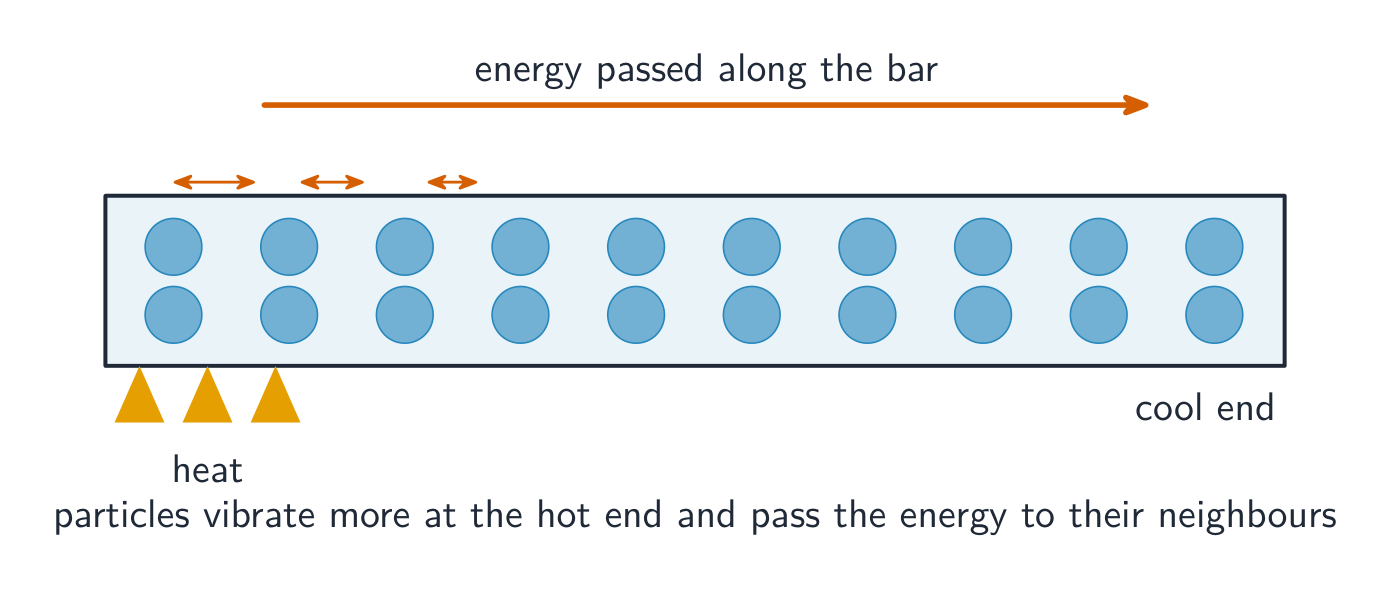
- 9.5.B.1 The rate at which energy is transferred by conduction through a given material is related to the thermal conductivity, the physical dimensions of the material, and the temperature difference across the material.
- Equation: $\dfrac{Q}{\Delta t} = \dfrac{kA\Delta T}{L}$
- 9.5.B.2 The thermal conductivity of a material is an intrinsic property of that material that depends on the arrangement and interactions of the atoms that make up the material.
Boundary statement: AP Physics 2 will model specific heat as independent of temperature.
ไทย
วัตถุประสงค์การเรียนรู้ 9.5.A: อธิบายพลังงานที่ต้องการในการเปลี่ยนอุณหภูมิของวัตถุจำนวนหนึ่ง
- 9.5.A.1 ปริมาณพลังงานที่ต้องการในการเปลี่ยนอุณหภูมิของวัสดุมีความสัมพันธ์กับความจุความร้อนจำเพาะของวัสดุนั้น
- สมการ: $Q = mc\Delta T$
- 9.5.A.2 ความจุความร้อนจำเพาะของวัสดุเป็นคุณสมบัติภายในของวัสดุนั้นซึ่งขึ้นอยู่กับการจัดเรียงและอันตรกิริยาของอะตอมที่ประกอบขึ้นเป็นวัสดุ
วัตถุประสงค์การเรียนรู้ 9.5.B: อธิบายอัตราการถ่ายโอนพลังงานด้วยการนำผ่านวัสดุที่กำหนด
- 9.5.B.1 อัตราการถ่ายโอนพลังงานด้วยการนำผ่านวัสดุที่กำหนดมีความสัมพันธ์กับการนำความร้อน, มิติทางกายภาพของวัสดุ และความแตกต่างของอุณหภูมิข้ามวัสดุ
- สมการ: $\dfrac{Q}{\Delta t} = \dfrac{kA\Delta T}{L}$
- 9.5.B.2 การนำความร้อนของวัสดุเป็นคุณสมบัติภายในของวัสดุนั้นซึ่งขึ้นอยู่กับการจัดเรียงและอันตรกิริยาของอะตอมที่ประกอบขึ้นเป็นวัสดุ
คำจำกัดขอบเขต: AP Physics 2 จะจำลองความจุความร้อนจำเพาะให้เป็นอิสระจากอุณหภูมิ
Source: College Board AP Course and Exam Description · แหล่งที่มา: คำอธิบายหลักสูตรและข้อสอบ College Board AP
English
- Specific heat 比热容 $c$ is the heat needed to raise one kilogram by one degree: $Q=mc\,\Delta T$. A high specific heat (like water's) means a substance resists temperature change.
- Thermal conductivity 热导率 measures how fast heat conducts through a material; the rate of conduction rises with area and temperature difference and falls with thickness.
Worked example. How much heat raises the temperature of $2.0\ \text{kg}$ of water from $20\,{}^{\circ}\text{C}$ to $80\,{}^{\circ}\text{C}$? Water's specific heat is $c=4200\ \text{J/(kg}\,{}^{\circ}\text{C)}$:
$$Q=mc\,\Delta T=2.0\times4200\times(80-20)=5.0\times10^{5}\ \text{J}.$$
Water's large specific heat is why it is used as a coolant and why coastal climates are mild.
ไทย
- ความจุความร้อนจำเพาะ $c$ คือปริมาณความร้อนที่ต้องการเพื่อ升高อุณหภูมิหนึ่งกิโลกรัมหนึ่งองศา: $Q=mc\,\Delta T$. ความจุความร้อนจำเพาะสูง (เช่น น้ำ) หมายความว่าสารนั้นต้านทานการเปลี่ยนแปลงอุณหภูมิ
- การนำความร้อน วัดความเร็วในการนำความร้อนผ่านวัสดุ; อัตราการนำความร้อนเพิ่มขึ้นตามพื้นที่และความต่างของอุณหภูมิ และลดลงตามความหนา
ตัวอย่างฝึกหัด. ต้องใช้ความร้อนเท่าไหร่เพื่อ升高อุณหภูมิ $2.0\ \text{kg}$ ของน้ำจาก $20\,{}^{\circ}\text{C}$ ไปยัง $80\,{}^{\circ}\text{C}$? ความจุความร้อนจำเพาะของน้ำคือ $c=4200\ \text{J/(kg}\,{}^{\circ}\text{C)}$:
$$Q=mc\,\Delta T=2.0\times4200\times(80-20)=5.0\times10^{5}\ \text{J}.$$
ความจุความร้อนจำเพาะที่สูงของน้ำเป็นเหตุผลที่ใช้เป็นสารทำความเย็นและเป็นเหตุให้ภูมิอากาศชายฝั่งมีอุณหภูมิไม่รุนแรง
Explore · สำรวจ
Explore how much energy heats a material · สำรวจปริมาณพลังงานที่ใช้ทำความร้อนวัสดุ
Pick a material, set the mass and temperature rise, and read the energy from $Q = mc\,\Delta T$. Water needs far more energy than the metals to warm by the same amount. · เลือกวัสดุ ตั้งค่ามวลและอุณหภูมิที่เพิ่มขึ้น แล้วอ่านค่าพลังงานจาก $Q = mc\,\Delta T$. น้ำ ต้องใช้พลังงานมากกว่าโลหะมากเพื่อให้ร้อนขึ้นในระดับเดียวกัน
Vocabulary · คำศัพท์
Train · ฝึกฝน
| English | ไทย |
|---|---|
| Thermodynamics/ˌθɜːməʊdaɪˈnæmɪks/ | อุณหพลศาสตร์ |
| kinetic theory/kɪˈnetɪk ˈθɪəri/ | ทฤษฎีจลน์ |
| Temperature/ˈtemprɪtʃə/ | อุณหภูมิ |
| Pressure/ˈpreʃə/ | ความดัน |
| ideal gas/aɪˈdɪəl ɡæs/ | แก๊สอุดมคติ |
| Heat/hiːt/ | ความร้อน |
| thermal equilibrium/ˈθɜːml ˌiːkwɪˈlɪbrɪəm/ | สมดุลความร้อน |
| conduction/kənˈdʌkʃn/ | การนำความร้อน |
| convection/kənˈvekʃn/ | การพาความร้อน |
| radiation/ˌreɪdɪˈeɪʃn/ | รังสี |
| first law/fɜːst lɔː/ | กฎข้อแรก |
| internal energy/ɪnˈtɜːnl ˈenədʒi/ | พลังงานภายใน |
| Specific heat/spəˈsɪfɪk hiːt/ | ความร้อนจำเพาะ |
| Thermal conductivity/ˈθɜːml kɒndəkˈtɪvɪti/ | ค่าการนำความร้อน |
| Entropy/ˈentrəpi/ | เอนโทรปี |
| second law/ˈsekənd lɔː/ | กฎข้อที่สอง |
9.6
Entropy and the Second Law of Thermodynamics · เอนโทรปีและกฎข้อที่สองของเทอร์โมไดนามิกส์
Syllabus · หลักสูตร
English
Learning Objective 9.6.A: Describe the change in entropy for a given system over time.
- 9.6.A.1 The second law of thermodynamics states that the total entropy of an isolated system can never decrease and is constant only when all processes the system undergoes are reversible.
- 9.6.A.2 Entropy can be qualitatively described as the tendency of energy to spread or the unavailability of some of the system's energy to do work.
- 9.6.A.2.i Localized energy will tend to disperse and spread out.
- 9.6.A.2.ii Entropy is a state function and therefore only depends on the current state or configuration of a system, not how the system reached that state.
- 9.6.A.2.iii Maximum entropy occurs when a system is in thermodynamic equilibrium.
- 9.6.A.3 The change in a system's entropy is determined by the system's interactions with its surroundings.
- 9.6.A.3.i Isolated systems spontaneously move toward thermodynamic equilibrium.
- 9.6.A.3.ii The entropy of an isolated system never decreases, but the entropy of a closed system can decrease because energy can be transferred into or out of the system.
Boundary statement: Only qualitative treatment of the second law of thermodynamics is within the scope of AP Physics 2.
ไทย
วัตถุประสงค์การเรียนรู้ 9.6.A: อธิบายการเปลี่ยนแปลงเอนโทรปีของระบบที่กำหนดตามเวลา
- 9.6.A.1 กฎข้อที่สองแห่งอุณหพลศาสตร์ระบุว่าเอนโทรปีรวมของระบบแยกisolated ไม่สามารถลดลงได้ และเป็นค่าคงที่ก็ต่อเมื่อกระบวนการทั้งหมดที่ระบบดำเนินไปนั้นเป็นแบบผันกลับได้เท่านั้น
- 9.6.A.2 เอนโทรปีสามารถอธิบายเชิงคุณภาพได้ว่าคือแนวโน้มของพลังงานที่จะกระจายออกหรือไม่สามารถเข้าถึงพลังงานบางส่วนในระบบเพื่อทำงานได้
- 9.6.A.2.i พลังงานที่กระจุกตัวจะมีความ tendency ที่จะกระจายและแผ่ขยายออกไป
- 9.6.A.2.ii เอนโทรปีเป็นฟังก์ชันสถานะดังนั้นจึงขึ้นอยู่กับสถานะปัจจุบันหรือการจัดวางตำแหน่งของระบบเท่านั้น ไม่ใช่วิธีการที่ระบบไปถึงสถานะนั้น
- 9.6.A.2.iii เอนโทรปีสูงสุดเกิดขึ้นเมื่อระบบอยู่ในสมดุลทางอุณหพลศาสตร์
- 9.6.A.3 การเปลี่ยนแปลงเอนโทรปีของระบบกำหนดโดยอันตรกิริยาของระบบกับสภาพแวดล้อมรอบข้าง
- 9.6.A.3.i ระบบแยกisolated จะเคลื่อนที่ไปสู่สมดุลทางอุณหพลศาสตร์โดยธรรมชาติ
- 9.6.A.3.ii เอนโทรปีของระบบแยกisolated ไม่สามารถลดลงได้ แต่เอนโทรปีของระบบปิดสามารถลดลงได้เนื่องจากพลังงานสามารถถ่ายโอนเข้าสู่หรือออกจากระบบได้
คำจำกัดขอบเขต: การจัดการเรื่องกฎข้อที่สองแห่งอุณหพลศาสตร์เพียงเชิงคุณภาพเท่านั้นที่อยู่ในขอบเขตของ AP Physics 2
Source: College Board AP Course and Exam Description · แหล่งที่มา: คำอธิบายหลักสูตรและข้อสอบ College Board AP
English
Entropy 熵 measures the disorder, or the number of ways to arrange, a system. The second law 热力学第二定律: the total entropy of an isolated system never decreases – energy naturally spreads out. This sets the direction of processes: heat flows hot→cold on its own, never the reverse, and no engine can convert heat entirely into work.
ไทย
เอนโทรปี วัดความวุ่นวาย หรือจำนวนวิธีในการจัดเรียงระบบ กฎข้อที่สอง: เอนโทรปีรวมของระบบปิดไม่ pernahลดลง – พลังงานกระจายตัวตามธรรมชาติ สิ่งนี้กำหนด ทิศทาง ของกระบวนการ: ความร้อนไหลจากร้อน→เย็น โดยอัตโนมัติ ไม่เคยในทางตรงกันข้าม และเครื่องยนต์ไม่สามารถแปลงความร้อนให้เป็นงานได้อย่างสมบูรณ์
9.6
Exam tips · ข้อแนะนำสำหรับการสอบ
English
- Always convert temperatures to kelvin ($T_{\text{K}}=T_{\text{C}}+273$) before using any gas law.
- In the first law $\Delta U = Q + W$, get the sign of $W$ right: work done on the gas is positive; when the gas expands and does work on its surroundings, $W$ is negative.
- Temperature measures the average kinetic energy of particles, so at the same $T$ lighter molecules move faster.
- On a PV diagram the work done by the gas is the area under the process curve.
- Use $Q=mc\,\Delta T$ for temperature change; the second law fixes the direction — heat flows hot→cold and total entropy never decreases.
ไทย
- ต้องแปลงอุณหภูมิเป็น เคลวิน ($T_{\text{K}}=T_{\text{C}}+273$) ก่อนใช้กฎแก๊สใดๆ
- ในกฎข้อที่หนึ่ง $\Delta U = Q + W$ ให้ได้ เครื่องหมายของ $W$ ให้ถูกต้อง: งานที่ทำ ต่อ แก๊สเป็นบวก; เมื่อแก๊สขยายตัวและทำงานต่อสิ่งแวดล้อม $W$ จะเป็นลบ
- อุณหภูมิ วัดพลังงานจลน์เฉลี่ยของอนุภาค ดังนั้นที่ $T$ เท่ากัน โมเลกุลที่มีมวลเบาจะเคลื่อนที่เร็วขึ้น
- บน แผนภูมิ PV งานที่ทำโดยแก๊สคือ พื้นที่ใต้เส้นโค้งกระบวนการ
- ใช้ $Q=mc\,\Delta T$สำหรับการเปลี่ยนแปลงอุณหภูมิ; กฎข้อที่สอง กำหนดทิศทาง – ความร้อนไหลจากร้อน→เย็น และเอนโทรปีรวมไม่ pernahลดลง
Interactive lessons on this topic · บทเรียนเชิงโต้ตอบสำหรับหัวข้อนี้
Work through it step by step, with instant-check exercises. · ทำทีละขั้นตอน พร้อมแบบฝึกหัดตรวจสอบผลทันที
- Kinetic Theory of Temperature and Pressure · ทฤษฎีจลน์ของอุณหภูมิและความดัน
- The Ideal Gas Law · กฎแก๊สอุดมคติ
- Thermal Energy Transfer and Equilibrium · การถ่ายโอนพลังงานความร้อนและสมดุล
- The First Law of Thermodynamics · กฎข้อที่หนึ่งแห่งอุณหพลศาสตร์
- Specific Heat and Thermal Conductivity · ความร้อนจำเพาะและการนำความร้อน
- Entropy and the Second Law of Thermodynamics · เอนโทรปีและกฎข้อที่สองแห่งอุณหพลศาสตร์
Past Papers · ข้อสอบย้อนหลัง