English
Learning Objective 13.1.A: Describe light as a ray.
- 13.1.A.1 A light ray is a straight line that is perpendicular to the wavefront of a light wave and points in the direction of travel of the wave.
- 13.1.A.1.i Light rays can be used to determine the behavior of light in geometric optics, where the wave nature of light can be neglected.
- 13.1.A.1.ii Rays are not sufficient to understand the spreading of light. In interference and diffraction, the wave nature of the light is important.
- 13.1.A.1.iii A laser is a common source of a single coherent, monochromatic beam of light that can be modeled as a ray. The wave nature of lasers will be considered in Unit 14.
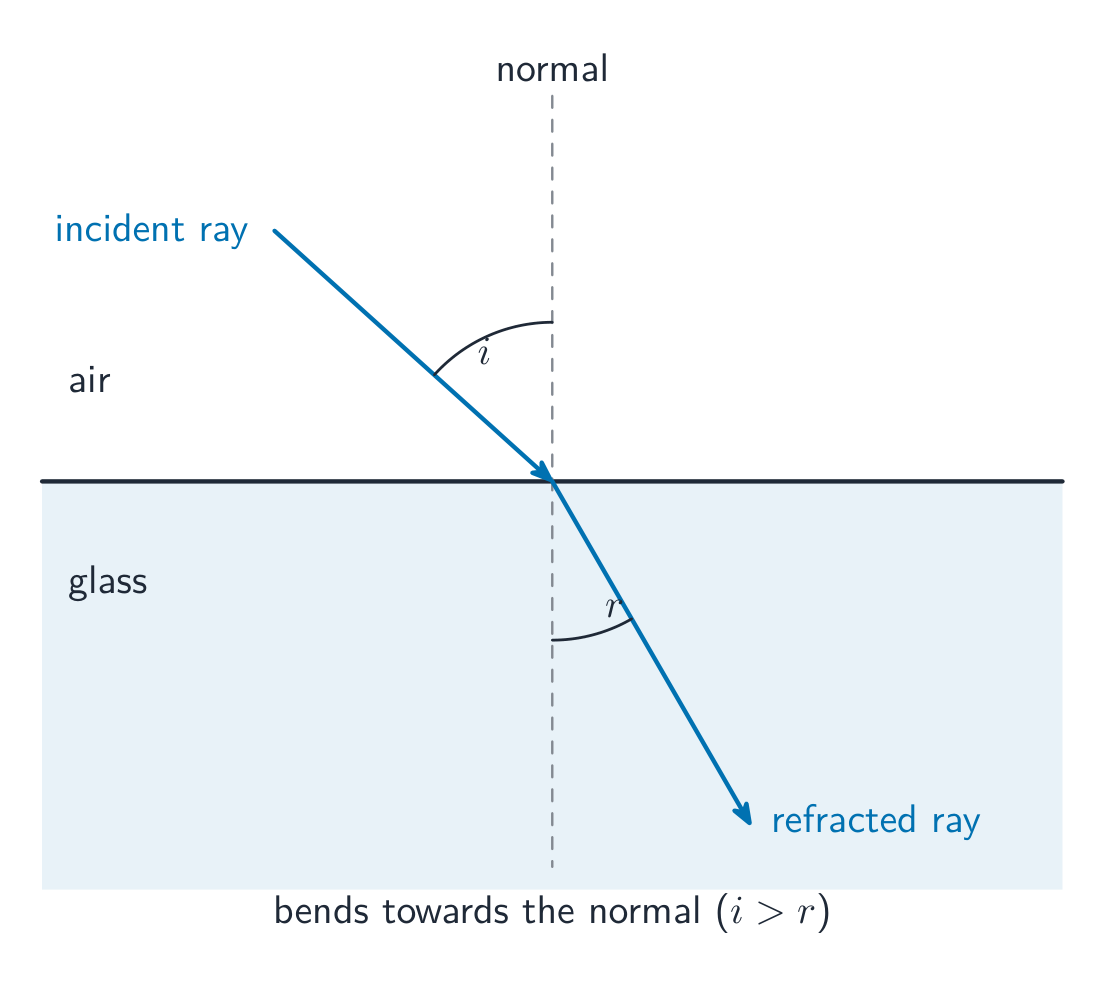
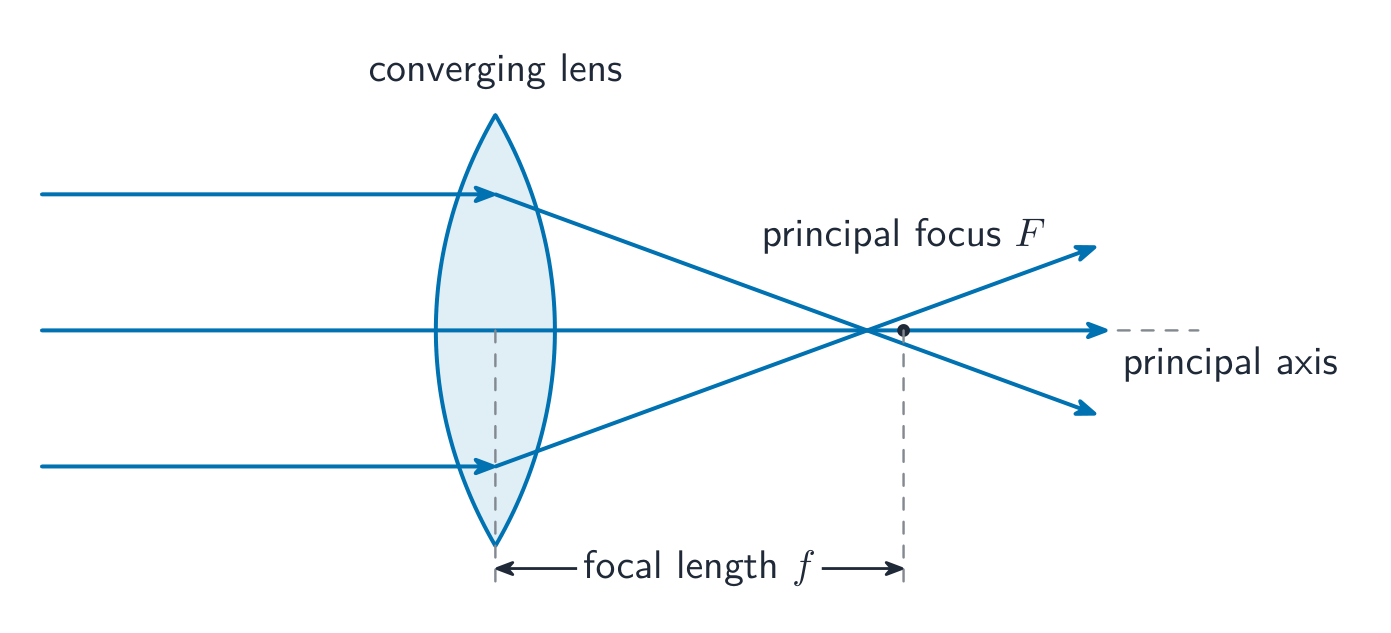
- 13.1.A.2 Ray diagrams depict the path of light before and after an interaction with matter.
Learning Objective 13.1.B: Describe the reflection of light from a surface.
- 13.1.B.1 Light that is incident on a surface can be reflected.
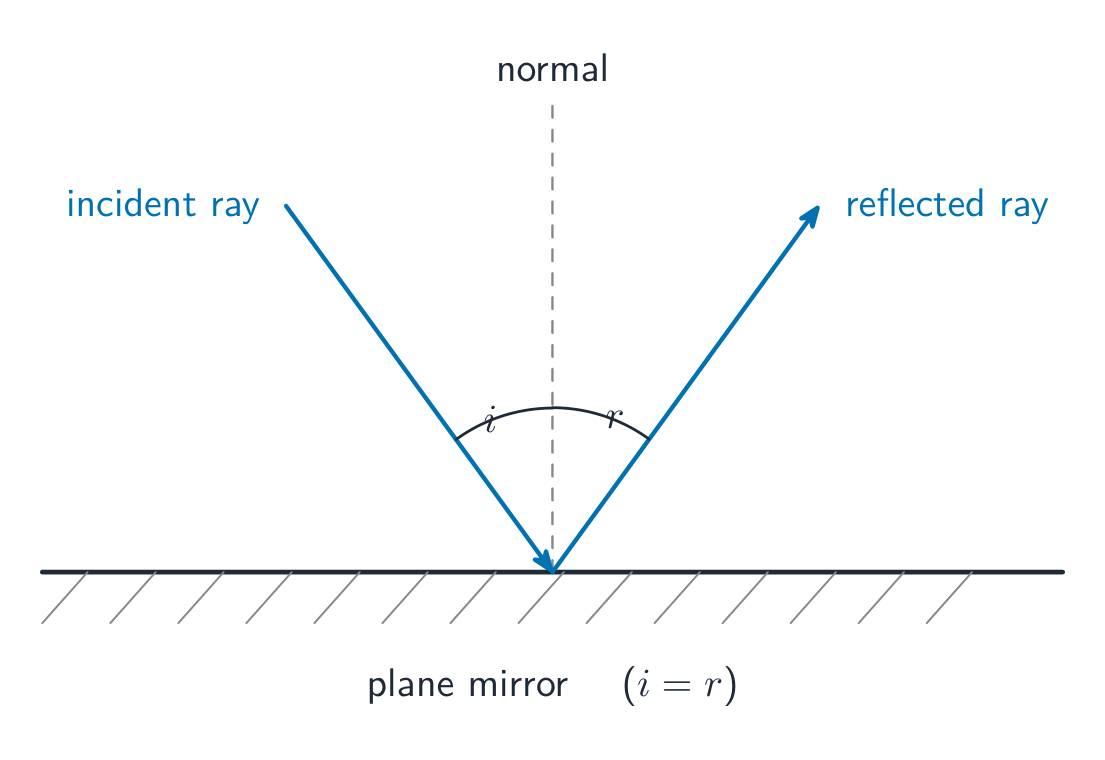
- 13.1.B.2 The law of reflection states that the angle between the incident ray and the normal (the line perpendicular to the surface) is equal to the angle between the reflected ray and the normal.
- Equation: $\theta_i = \theta_r$
- 13.1.B.3 Diffuse reflection is the reflection of light from a rough surface and results in light reflected in many different directions, because the line normal to the surface varies over the area over which the light is incident.
- 13.1.B.4 Specular reflection is the reflection of light from a smooth surface and results in light uniformly reflected from the surface, because the line normal to the surface has an approximately constant direction over the area the light strikes.
ไทย
วัตถุประสงค์การเรียนรู้ 13.1.A: อธิบายแสงในฐานะรังสี
- 13.1.A.1 รังสีแสงคือเส้นตรงที่ตั้งฉากกับหน้าคลื่นของคลื่นแสงและชี้ไปในทิศทางการเคลื่อนที่ของคลื่น
- 13.1.A.1.i รังสีแสงสามารถใช้เพื่อศึกษาพฤติกรรมของแสงในทางทัศนศาสตร์เรขาคณิต ซึ่งสามารถละเลยลักษณะคลื่นของแสงได้
- 13.1.A.1.ii รังสีแสงไม่เพียงพอต่อการเข้าใจการกระจายตัวของแสง ในกรณีของการแทรกสอดและการหักเห ลักษณะคลื่นของแสงมีความสำคัญ
- 13.1.A.1.iii เลเซอร์เป็นแหล่งกำเนิดรังสีแสงแบบ cohorent เดียวและความยาวคลื่นเดียวที่พบได้ทั่วไป และสามารถจำลองเป็นรังสีแสงได้ ลักษณะคลื่นของเลเซอร์จะได้รับการพิจารณาในหน่วยที่ 14
- 13.1.A.2 แผนภาพรังสีแสดงเส้นทางของแสงก่อนและหลังเกิดปฏิกิริยากับสสาร
วัตถุประสงค์การเรียนรู้ 13.1.B: อธิบายการสะท้อนแสงจากพื้นผิว
- 13.1.B.1 แสงที่ตกกระทบพื้นผิวสามารถสะท้อนได้
- 13.1.B.2 กฏการสะท้อนระบุว่ามุมระหว่างรังสีตกกับแนวตั้งฉาก (เส้นที่ตั้งฉากกับพื้นผิว) มีค่าเท่ากับมุมระหว่างรังสีสะท้อนกับแนวตั้งฉาก
- สมการ: $\theta_i = \theta_r$
- 13.1.B.3 การสะท้อนแบบกระจายคือการสะท้อนแสงจากพื้นผิวหยาบ ทำให้แสงสะท้อนออกไปในหลายทิศทางต่างๆ เนื่องจากแนวตั้งฉากกับพื้นผิวมีการเปลี่ยนแปลงไปทั่วพื้นที่ที่แสงตกกระทบ
- 13.1.B.4 การสะท้อนแบบ specular คือการสะท้อนแสงจากพื้นผิวเรียบ ทำให้แสงสะท้อนออกจากพื้นผิวอย่างสม่ำเสมอ เนื่องจากแนวตั้งฉากกับพื้นผิวมีทิศทางคงที่โดยประมาณตลอดพื้นที่ที่แสงตกกระทบ