| Learning Objective | Essential Knowledge |
|---|---|
9.1.A |
|
9.1.B |
Boundary statement: AP Physics 2 only expects students to perform qualitative and quantitative analysis of collisions in one and two dimensions. Students are not expected to know the functional form of the Maxwell-Boltzmann distribution but are expected to be familiar with how features of the distribution are related to the temperature of the gas. |
Tips · เคล็ดลับ
AP Physics 2 ขยายเนื้อหาฟิสิกส์ที่ใช้พีชคณิตไปสู่ อุณหพลศาสตร์, แรงไฟฟ้า สนามและศักย์ไฟฟ้า, วงจรไฟฟ้า, แม่เหล็ก, ทัศนศาสตร์เรขาคณิต, คลื่นและทัศนศาสตร์ทางกายภาพ และ ฟิสิกส์สมัยใหม่ โดยสมมติว่าคุณมีความรู้ด้านกลศาสตร์จาก Physics 1 แล้ว ไม่ต้องทบทวนใหม่
สนามเป็นสิ่งที่มองไม่เห็น และการสอบก็ทราบถึงเรื่องนี้ โจทย์ถามว่าปริมาณหนึ่งจะเป็นอย่างไรเมื่ออีกสิ่งหนึ่งเปลี่ยนแปลง — เช่น เพิ่มระยะห่างเป็นสองเท่า, ใส่ไดอิเล็กทริก, สลับทิศทางกระแส และต้อง ให้เหตุผลโดยไม่คำนวณตัวเลข
เรียนรู้ความสัมพันธ์ของแต่ละเรื่องในฐานะความแปรผัน ไม่ใช่แค่สูตร นี่คือสิ่งที่ทำให้คำถามเหล่านี้แก้ได้ง่ายขึ้น
หมายเหตุแบบรายหน่วยครอบคลุมของไหล อุณหพลศาสตร์ ไฟฟ้าสถิต วงจรไฟฟ้า แม่เหล็ก ทัศนศาสตร์ และฟิสิกส์สมัยใหม่ พร้อมแผนภาพสำหรับส่วนที่ยากจะจินตนาการ ห้องสมุดมีข้อสอบเก่าที่ออกจริง; Physics 2 เน้น การอธิบายเป็นเหตุผลว่าทำไม สิ่งนั้นจึงเกิดขึ้น ดังนั้นควรฝึกเขียนเหตุผล ไม่ใช่แค่เขียนตัวเลข
-
9
Thermodynamics · อุณหพลศาสตร์
Watch lesson · ดูบทเรียน9.1
Kinetic Theory of Temperature and Pressure · ทฤษฎีจลน์ของอุณหภูมิและความดัน
Syllabus · หลักสูตร
Source: College Board AP Course and Exam Description · แหล่งที่มา: คำอธิบายหลักสูตรและข้อสอบ College Board AP
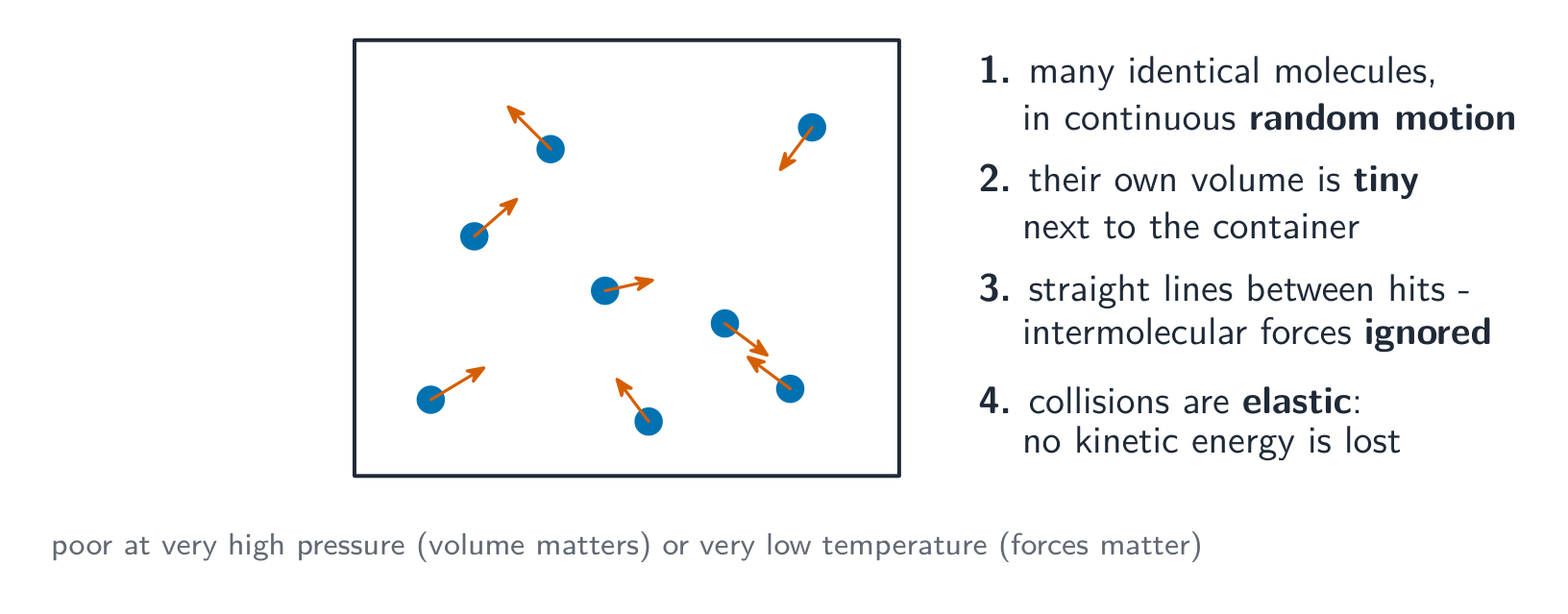
EnglishKinetic theory: gas pressure Thermodynamics 热力学 studies heat and energy in large collections of particles. The kinetic theory 分子运动论 explains gas behavior from the random motion of its molecules:
- Temperature 温度 is a measure of the average kinetic energy of the molecules: $K_{\text{avg}}=\tfrac{3}{2}k_B T$ (with $T$ in kelvin). Hotter means faster-moving molecules.
- Pressure 压强 comes from molecules colliding with the container walls – more frequent or harder collisions give more pressure.
Worked example. Find the average kinetic energy of a gas molecule at $300\ \text{K}$, using $k_B=1.38\times10^{-23}\ \text{J/K}$:
$$K_{\text{avg}}=\tfrac32 k_B T=1.5\times1.38\times10^{-23}\times300=6.2\times10^{-21}\ \text{J}.$$It depends only on temperature, not on the type of gas – at the same $T$, light and heavy molecules share the same average kinetic energy (so the light ones move faster).ไทยทฤษฎีจลน์: ความดันก๊าซ อุณหพลศาสตร์ ศึกษาความร้อนและพลังงานในกลุ่มอนุภาคจำนวนมาก ทฤษฎีจลน์ อธิบายพฤติกรรมของแก๊สจากการเคลื่อนที่แบบสุ่มของโมเลกุล:
สมมติฐานสำคัญของทฤษฎีจลน์ของก๊าซอุดมคติ - อุณหภูมิ เป็นตัววัด พลังงานจลน์เฉลี่ย ของโมเลกุล: $K_{\text{avg}}=\tfrac{3}{2}k_B T$ (โดยมี $T$ เป็น kelvin). ร้อนขึ้นหมายความว่าโมเลกุลเคลื่อนที่เร็วขึ้น
- ความดัน มาจากการชนของโมเลกุลกับผนังภาชนะ – การชนบ่อยครั้งหรือรุนแรงมากขึ้นทำให้มีความดันมากขึ้น
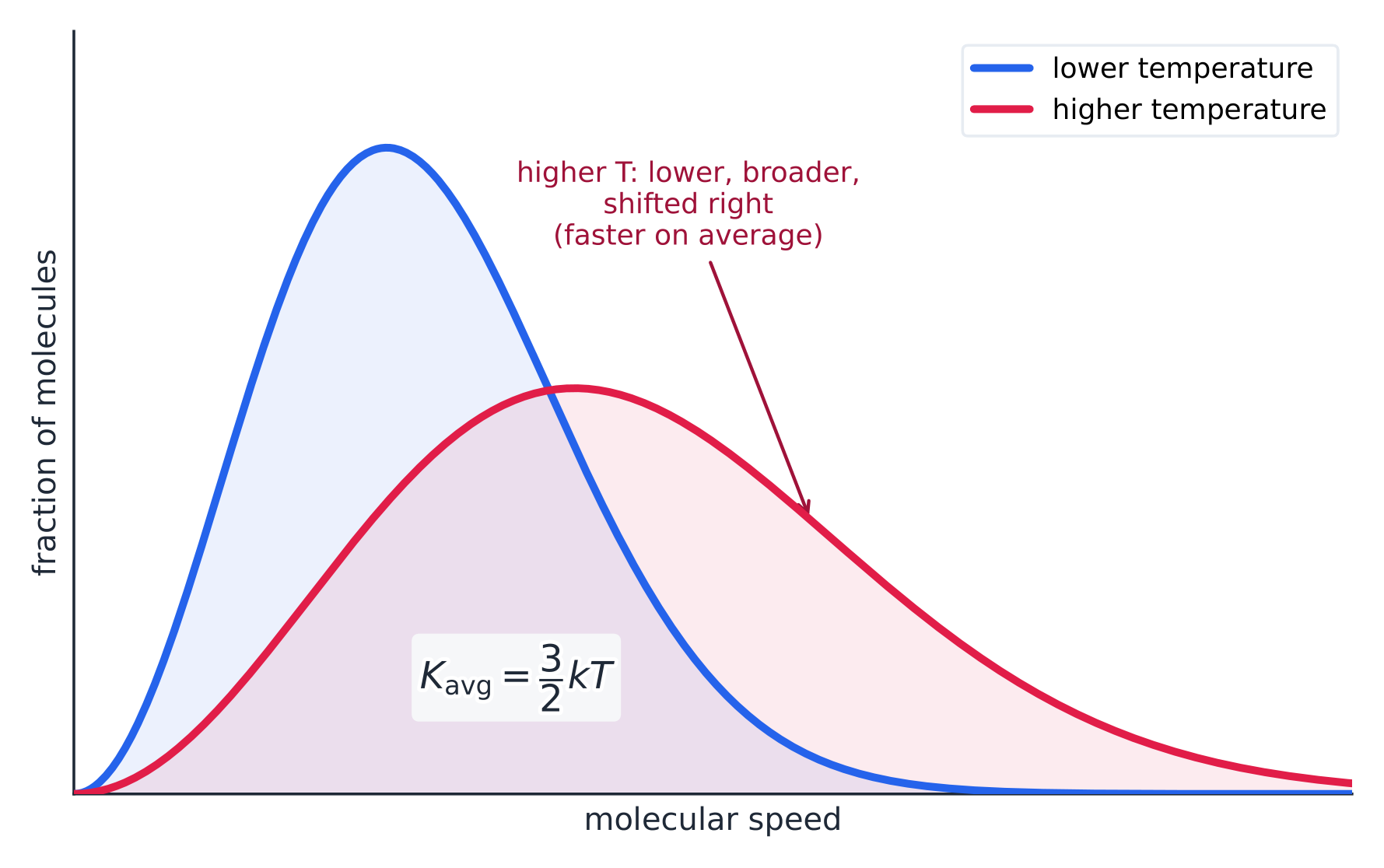 *การกระจายความเร็วของ Maxwell-Boltzmann เลื่อนไปทางขวาและแบนลงที่อุณหภูมิสูงขึ้น
ตัวอย่างที่คำนวณแล้ว. หาพลังงานจลน์เฉลี่ยของโมเลกุลแก๊สที่ $300\ \text{K}$, โดยใช้ $k_B=1.38\times10^{-23}\ \text{J/K}$:
$$K_{\text{avg}}=\tfrac32 k_B T=1.5\times1.38\times10^{-23}\times300=6.2\times10^{-21}\ \text{J}.$$มันขึ้นอยู่กับอุณหภูมิเท่านั้น ไม่ใช่ชนิดของแก๊ส – ที่ $T$ เดียวกัน โมเลกุลเบาและหนักมีพลังงานจลน์เฉลี่ยเท่ากัน (ดังนั้นโมเลกุลเบาก็เคลื่อนที่เร็วขึ้น)Explore · สำรวจExplore the spread of molecular speeds · สำรวจการกระจายตัวของความเร็วโมเลกุล
Raise the temperature and watch the whole speed distribution shift right and flatten — the particles move faster on average, which is exactly what $\bar K = \tfrac{3}{2} k_B T$ means. · เพิ่มอุณหภูมิและดูว่าการกระจายตัวความเร็วทั้งหมดเลื่อนไปทางขวาและแบนลง —อนุภาคเคลื่อนที่ เร็วขึ้นโดยเฉลี่ย ซึ่งเป็นสิ่งที่ $\bar K = \tfrac{3}{2} k_B T$ หมายถึงพอดี
9.2
The Ideal Gas Law · กฎแก๊สอุดมคติ
Syllabus · หลักสูตร
EnglishLearning Objective 9.2.A: Describe the properties of an ideal gas.
- 9.2.A.1 The classical model of an ideal gas assumes that the instantaneous velocities of atoms are random, the volumes of the atoms are negligible compared to the total volume occupied by the gas, the atoms collide elastically, and the only appreciable forces on the atoms are those that occur during collisions.
- 9.2.A.2 An ideal gas is one in which the relationships between pressure, volume, the number of moles or number of atoms, and temperature of a gas can be modeled using the equation
- Equation: $PV = nRT = N k_B T$
- 9.2.A.3 Graphs modeling the pressure, temperature, and volume of gases can be used to describe or determine properties of that gas.
- 9.2.A.4 A temperature at which an ideal gas has zero pressure can be extrapolated from a graph of pressure as a function of temperature.
ไทยวัตถุประสงค์การเรียนรู้ 9.2.A: อธิบายคุณสมบัติของแก๊สในอุดมคติ
- 9.2.A.1 Classical model of an ideal gas assumes that the instantaneous velocities of atoms are random, the volumes of the atoms are negligible compared to the total volume occupied by the gas, the atoms collide elastically, and the only appreciable forces on the atoms are those that occur during collisions.
- 9.2.A.2 An ideal gas is one in which the relationships between pressure, volume, the number of moles or number of atoms, and temperature of a gas can be modeled using the equation
- สมการ: $PV = nRT = N k_B T$
- 9.2.A.3 Graphs modeling the pressure, temperature, and volume of gases can be used to describe or determine properties of that gas.
- 9.2.A.4 A temperature at which an ideal gas has zero pressure can be extrapolated from a graph of pressure as a function of temperature.
Source: College Board AP Course and Exam Description · แหล่งที่มา: คำอธิบายหลักสูตรและข้อสอบ College Board AP
EnglishAn ideal gas 理想气体 obeys
$$PV=nRT \qquad(\text{or } PV=Nk_B T),$$linking pressure $P$, volume $V$, amount ($n$ moles or $N$ molecules), and absolute temperature $T$. Use it to predict how a gas responds when you change one quantity and hold others fixed (e.g. heating at constant volume raises pressure).Worked example. A sealed rigid container of gas is at $1.0\times10^{5}\ \text{Pa}$ and $300\ \text{K}$. It is heated to $450\ \text{K}$. Because the volume and amount are fixed, $P/T$ is constant:
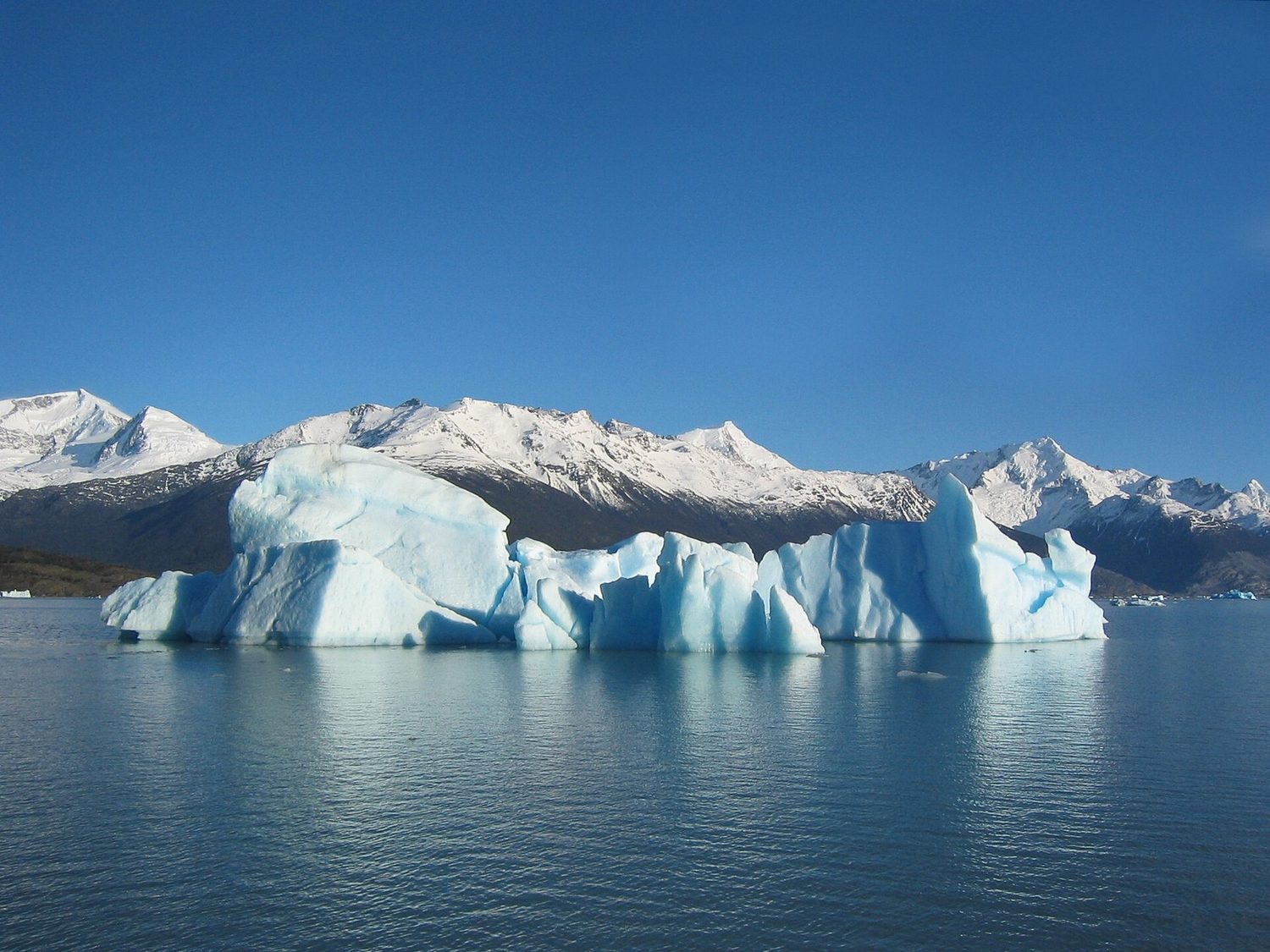
$$P_2=P_1\frac{T_2}{T_1}=1.0\times10^{5}\times\frac{450}{300}=1.5\times10^{5}\ \text{Pa}.$$Always convert temperatures to kelvin before using a gas law – using Celsius here would give nonsense.ไทยหิมะ冰山: พลังงานความร้อน ความหนาแน่น และการเปลี่ยนเฟส เชื่อมโยงอุณหพลศาสตร์เข้ากับของเหลวและแรงลอยตัว แก๊สอุดมคติ สอดคล้องกับ
$$PV=nRT \qquad(\text{or } PV=Nk_B T),$$เชื่อมต่อกับความดัน $P$, ปริมาตร $V$, ปริมาณ ($n$ mol หรือ $N$ молекулы), และอุณหภูมิสัมบูรณ์ $T$. ใช้มันเพื่อทำนายว่าแก๊สจะตอบสนองอย่างไรเมื่อคุณเปลี่ยนปริมาณหนึ่งและคงปริมาณอื่นไว้ (เช่น การให้ความร้อนที่ปริมาตรคงที่จะทำให้ความดันเพิ่มขึ้น)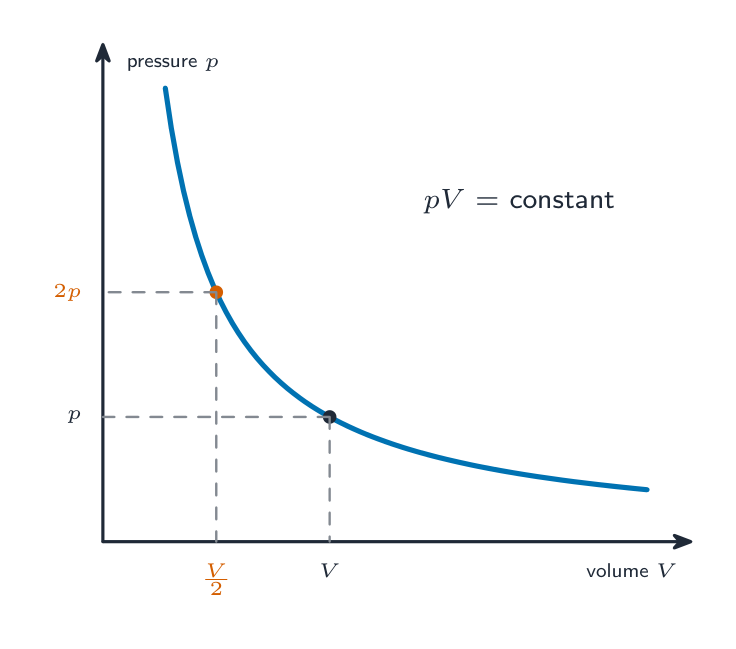 *กฎของ Boyle: ที่อุณหภูมิคงที่, ความดันคูณปริมาตรเป็นค่าคงที่
ตัวอย่างที่คำนวณแล้ว. กล่องแก๊สแข็งที่ปิดสนิทอยู่ที่ $1.0\times10^{5}\ \text{Pa}$ และ $300\ \text{K}$. ถูกทำให้ร้อนถึง $450\ \text{K}$. เนื่องจากปริมาตรและปริมาณคงที่, $P/T$ เป็นค่าคงที่:
$$P_2=P_1\frac{T_2}{T_1}=1.0\times10^{5}\times\frac{450}{300}=1.5\times10^{5}\ \text{Pa}.$$แปลงอุณหภูมิเป็น kelvin เสมอก่อนใช้กฎแก๊ส – การใช้ Celsius ที่นี่จะให้ผลลัพธ์ที่ไม่สมเหตุสมผล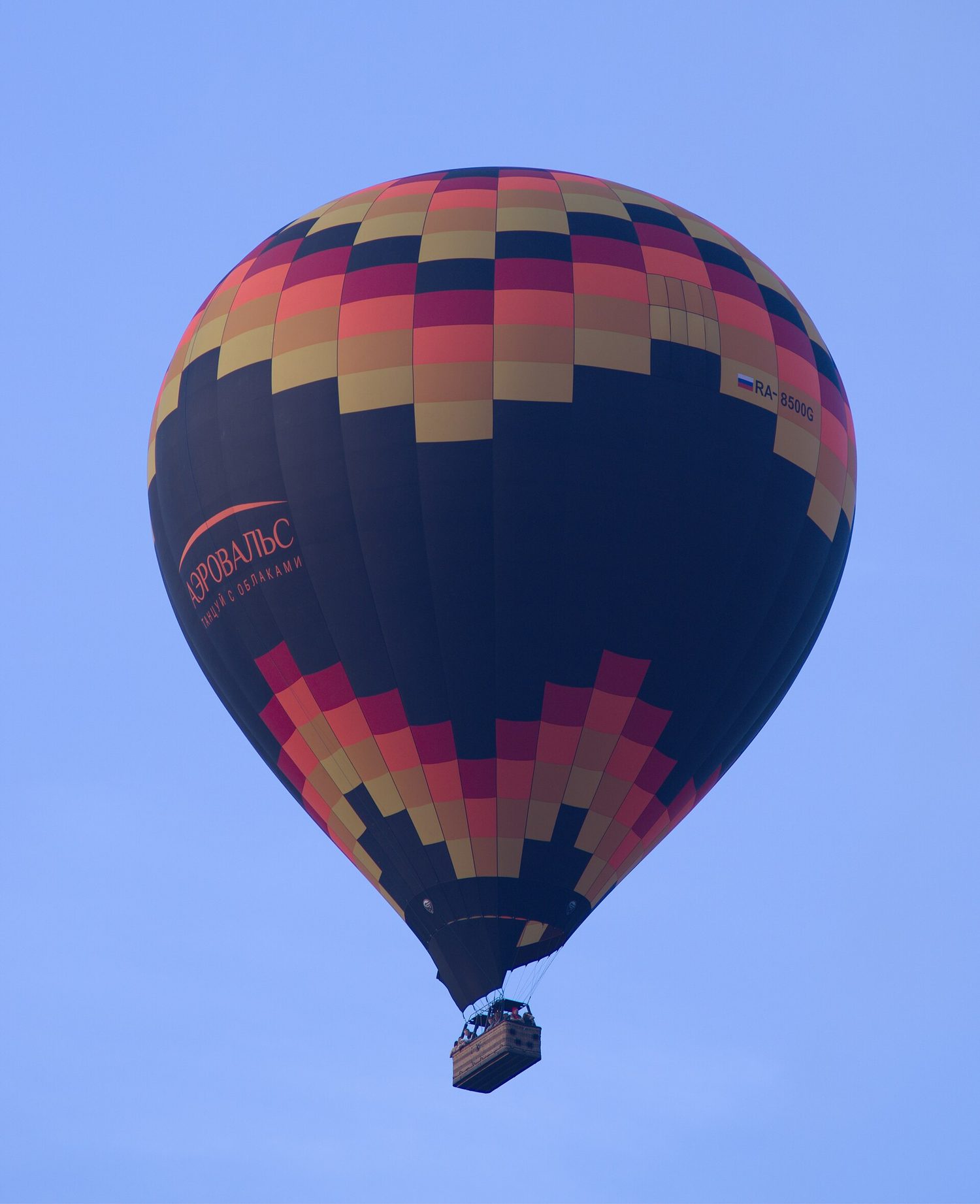 *การให้ความร้อนแก๊สภายในลูกโป่งทำให้ความหนาแน่นลดลง, ดังนั้นลูกโป่งจะลอยขึ้น – กฎแก๊สอุดมคติทำงานอยู่Explore · สำรวจ
Explore squeezing a gas · สำรวจการบีบอัดก๊าซ
Slide the piston in to shrink the volume. The same particles are crammed into less space, so they hit the walls more often and the pressure climbs — while $PV$ stays constant at fixed temperature. · เลื่อนลูกสูบเข้าไปเพื่อลดปริมาตร อนุภาคจำนวนเท่าเดิมถูกอัดอยู่ในพื้นที่น้อยลง ทำให้ชนผนังบ่อยขึ้นและ ความดันเพิ่มขึ้น —ในขณะที่ $PV$ คงที่ที่อุณหภูมิคงที่
9.3
Thermal Energy Transfer and Equilibrium · การถ่ายโอนพลังงานความร้อนและสมดุล
Syllabus · หลักสูตร
Learning Objective Essential Knowledge 9.3.A
Describe the transfer of energy between two systems in thermal contact due to temperature differences of those two systems.- 9.3.A.1 Two systems are in thermal contact if the systems may transfer energy by thermal processes.
- 9.3.A.1.i Heating is the transfer of energy into a system by thermal processes.
- 9.3.A.1.ii Cooling is the transfer of energy out of a system by thermal processes.
- 9.3.A.2 The thermal processes by which energy may be transferred between systems at different temperatures are conduction, convection, and radiation.
- 9.3.A.3 Energy is transferred through thermal processes spontaneously from a higher-temperature system to a lower-temperature system.
- 9.3.A.3.i In collisions between atoms from different systems, energy is most likely to be transferred from higher-energy atoms to lower-energy atoms.
- 9.3.A.3.ii After many collisions of atoms from different systems, the most probable state is one in which both systems have the same temperature.
- 9.3.A.4 Thermal equilibrium results when no net energy is transferred by thermal processes between two systems in thermal contact with each other.
Source: College Board AP Course and Exam Description · แหล่งที่มา: คำอธิบายหลักสูตรและข้อสอบ College Board AP
EnglishHeat 热量 $Q$ is energy transferred because of a temperature difference; it flows from hot to cold. Two objects in contact reach thermal equilibrium 热平衡 when they share the same temperature, and net heat flow stops. The three transfer methods are conduction 传导, convection 对流, and radiation 辐射.
ไทยความร้อน $Q$ คือพลังงานที่ถ่ายโอนเนื่องจากความต่างของอุณหภูมิ; มันไหลจากร้อนไปเย็น วัตถุสองชิ้นที่สัมผัสกันจะบรรลุ สมดุลความร้อน เมื่อมีอุณหภูมิเท่ากัน และการไหลของความร้อนสุทธิหยุดลง วิธีถ่ายโอนสามอย่างคือ การนำความร้อน, การพาความร้อน, และ การแผ่รังสี
Explore · สำรวจAdd heat and watch the temperature · เพิ่มความร้อนและดูอุณหภูมิ
Adding heat usually raises temperature, but during a phase change the temperature holds flat while the energy breaks bonds. Two bodies in contact settle at one temperature — thermal equilibrium. · การเพิ่มความร้อนมักทำให้อุณหภูมิสูงขึ้น แต่ในช่วง การเปลี่ยนสถานะ อุณหภูมิจะคงที่ขณะที่พลังงานทำลายพันธะ วัตถุสองชิ้นที่สัมผัสกันจะ/settle ที่อุณหภูมิเดียว — สมดุลความร้อน
9.4
The First Law of Thermodynamics · กฎข้อที่หนึ่งของอุณหพลศาสตร์
Syllabus · หลักสูตร
EnglishLearning Objective 9.4.A: Describe the internal energy of a system.
- 9.4.A.1 The internal energy of a system is the sum of the kinetic energy of the objects that make up the system and the potential energy of the configuration of those objects.
- 9.4.A.1.i The atoms in an ideal gas do not interact with each other via conservative forces, and the internal structure is not considered. Therefore, an ideal gas does not have internal potential energy.
- 9.4.A.1.ii The internal energy of an ideal monatomic gas is the sum of the kinetic energies of the constituent atoms in the gas.
- Equation: $U = \dfrac{3}{2} nRT = \dfrac{3}{2} N k_B T$
- 9.4.A.2 Changes to a system's internal energy can result in changes to the internal structure and internal behavior of that system without changing the motion of the system's center of mass.
Learning Objective 9.4.B: Describe the behavior of a system using thermodynamic processes.
- 9.4.B.1 The first law of thermodynamics is a restatement of conservation of energy that accounts for energy transferred into or out of a system by work, heating, or cooling.
- 9.4.B.1.i For an isolated system, the total energy is constant.
- 9.4.B.1.ii For a closed system, the change in internal energy is the sum of energy transferred to or from the system by heating, or work done on the system.
- Equation: $\Delta U = Q + W$
- 9.4.B.1.iii The work done on a system by a constant or average external pressure that changes the volume of that system (for example, a piston compressing a gas in a container) is defined as
- Equation: $W = -P \Delta V$
- 9.4.B.2 Pressure-volume graphs (also known as PV diagrams) are representations used to represent thermodynamic processes.
- 9.4.B.2.i Lines of constant temperature on a PV diagram are called isotherms.
- 9.4.B.2.ii The absolute value of the work done on a gas when the gas expands or compresses is equal to the area underneath the curve of a plot of pressure vs. volume for the gas.
- 9.4.B.3 Special cases of thermal processes depend on the relationship between the configuration of the system, the nature of the work done on the system, and the system's surroundings. These include constant volume (isovolumetric), constant temperature (isothermal), and constant pressure (isobaric), as well as processes where no energy is transferred to or from the system through thermal processes (adiabatic).
ไทยวัตถุประสงค์การเรียนรู้ 9.4.A: อธิบายพลังงานภายในของระบบ
- 9.4.A.1 พลังงานภายในของระบบคือผลรวมของพลังงานจลน์ของวัตถุที่ประกอบขึ้นเป็นระบบและพลังงานศักย์ของการจัดวางตำแหน่งของวัตถุเหล่านั้น
- 9.4.A.1.i อะตอมในแก๊สอุดมคติไม่มีการกระทำต่อกันด้วยแรงอนุรักษ์ และโครงสร้างภายในไม่ได้ถูกพิจารณา ดังนั้นแก๊สอุดมคติจึงไม่มีพลังงานศักย์ภายใน
- 9.4.A.1.ii พลังงานภายในของแก๊สอะตอมเดี่ยวอุดมคติคือผลรวมของพลังงานจลน์ของอะตอมส่วนประกอบในแก๊สนั้น
- สมการ: $U = \dfrac{3}{2} nRT = \dfrac{3}{2} N k_B T$
- 9.4.A.2 การเปลี่ยนแปลงพลังงานภายในของระบบอาจส่งผลให้เกิดการเปลี่ยนแปลงต่อโครงสร้างภายในและพฤติกรรมภายในของระบบโดยไม่ทำให้การเคลื่อนที่ของจุดศูนย์กลางมวลของระบบเปลี่ยนแปลงไป
วัตถุประสงค์การเรียนรู้ 9.4.B: อธิบายพฤติกรรมของระบบโดยใช้กระบวนการทางอุณหพลศาสตร์
- 9.4.B.1 กฎข้อที่หนึ่งแห่งอุณหพลศาสตร์เป็นการ表述ซ้ำของการอนุรักษ์พลังงานซึ่งคำนึงถึงพลังงานที่ถ่ายโอนเข้าสู่หรือออกจากระบบผ่านงาน, ความร้อน หรือการทำความเย็น
- 9.4.B.1.i สำหรับระบบแยก孤立, พลังงานทั้งหมดจะคงที่
- 9.4.B.1.ii สำหรับระบบปิด, การเปลี่ยนแปลงพลังงานภายในคือผลรวมของพลังงานที่ถ่ายโอนเข้าสู่หรือออกจากระบบด้วยความร้อน หรืองานที่ทำต่อระบบ
- สมการ: $\Delta U = Q + W$
- 9.4.B.1.iii งานที่ทำต่อระบบโดยความดันภายนอกคงที่หรือค่าเฉลี่ยที่ทำให้ปริมาตรของระบบเปลี่ยนไป (เช่น กระบอกสูบกดอัดแก๊สในภาชนะ) นิยามไว้ว่า
- สมการ: $W = -P \Delta V$
- 9.4.B.2 กราฟความดัน-ปริมาตร (หรือที่เรียกว่าแผนภูมิ PV) เป็นสื่อการแสดงที่ใช้เพื่อแสดงกระบวนการทางอุณหพลศาสตร์
- 9.4.B.2.i เส้นที่มีอุณหภูมิคงที่บนแผนภูมิ PV เรียกว่าไอโซเทอร์ม
- 9.4.B.2.ii ค่าสัมบูรณ์ของงานที่ทำต่อแก๊สเมื่อแก๊สดำเนินการขยายตัวหรือบีบอัดมีค่าเท่ากับพื้นที่ใต้เส้นโค้งของกราฟแสดงความดันเทียบกับปริมาตรของแก๊สนั้น
- 9.4.B.3 กรณีพิเศษของกระบวนการความร้อนขึ้นอยู่กับความสัมพันธ์ระหว่างการจัดวางตำแหน่งของระบบ,的性质ของงานที่ทำต่อระบบ และสภาพแวดล้อมรอบข้าง รวมถึงปริมาตรคงที่ (ไอโซวอลุ่มétric), อุณหภูมิคงที่ (ไอโซเทอร์ม) และความดันคงที่ (ไอโซบาร์ิก) รวมถึงกระบวนการที่ไม่มีการถ่ายโอนพลังงานเข้าสู่หรือออกจากระบบผ่านกระบวนการความร้อน (อะไดอะเบติก)
Source: College Board AP Course and Exam Description · แหล่งที่มา: คำอธิบายหลักสูตรและข้อสอบ College Board AP
EnglishThe first law 热力学第一定律 is conservation of energy for a gas:
$$\Delta U = Q + W,$$where $\Delta U$ is the change in internal energy 内能 (tied to temperature), $Q$ is heat added to the gas, and $W$ is work done on the gas. On a pressure–volume diagram, the work done by the gas is the area under the process curve. Watch signs: compressing a gas does positive work on it.Worked example. A gas absorbs $500\ \text{J}$ of heat and, as it expands, does $200\ \text{J}$ of work on its surroundings. Find the change in its internal energy. Work done on the gas is $W=-200\ \text{J}$ (it does work, so it loses that energy):
$$\Delta U=Q+W=500+(-200)=300\ \text{J}.$$The internal energy rises by $300\ \text{J}$, so the gas ends up hotter. Getting the sign of $W$ right is the whole game in first-law problems.ไทยกฎข้อที่หนึ่งคือกฎการอนุรักษ์พลังงานสำหรับแก๊ส:
$$\Delta U = Q + W,$$โดยที่ $\Delta U$ คือการเปลี่ยนแปลงของ พลังงานภายใน (สัมพันธ์กับอุณหภูมิ), $Q$ คือความร้อนที่ถูกเพิ่ม เข้าไปใน แก๊ส, และ $W$ คืองานที่ทำ ต่อ แก๊ส ในแผนภูมิความดัน-ปริมาตร งานที่ทำ โดย แก๊สคือพื้นที่ใต้เส้นโค้งกระบวนการ ระวังเครื่องหมาย: การบีบอัดแก๊สจะทำ功บวกต่อมันแก๊สดันลูกสูบออกไปด้วยระยะทางเล็กน้อย ทำงานเท่ากับ p คูณด้วยการเปลี่ยนแปลงปริมาตร 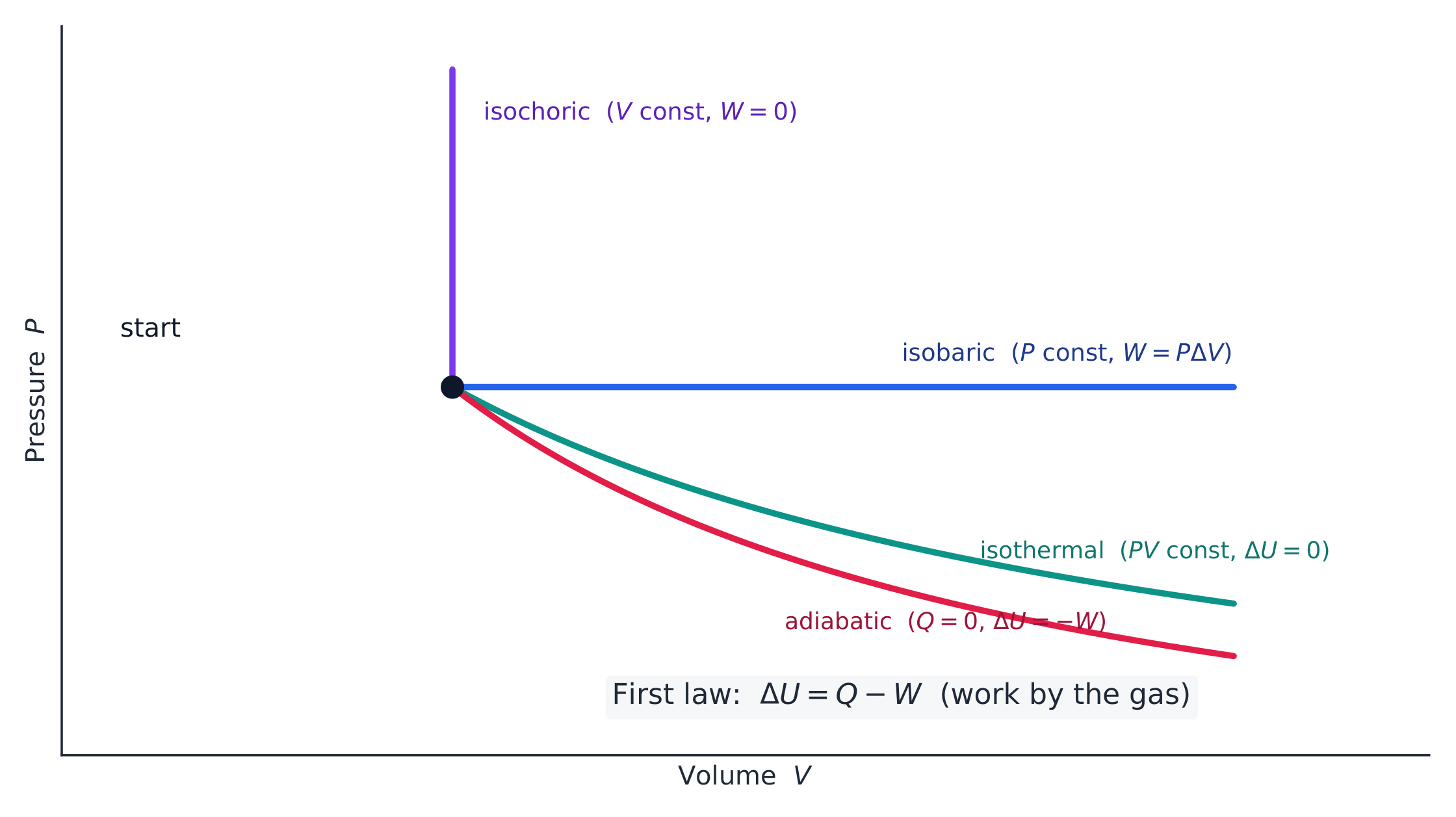
กระบวนการเทอร์โมไดนามิกสี่ชนิดวาดจากจุดเริ่มต้นเดียวกันบนแผนภูมิ PV 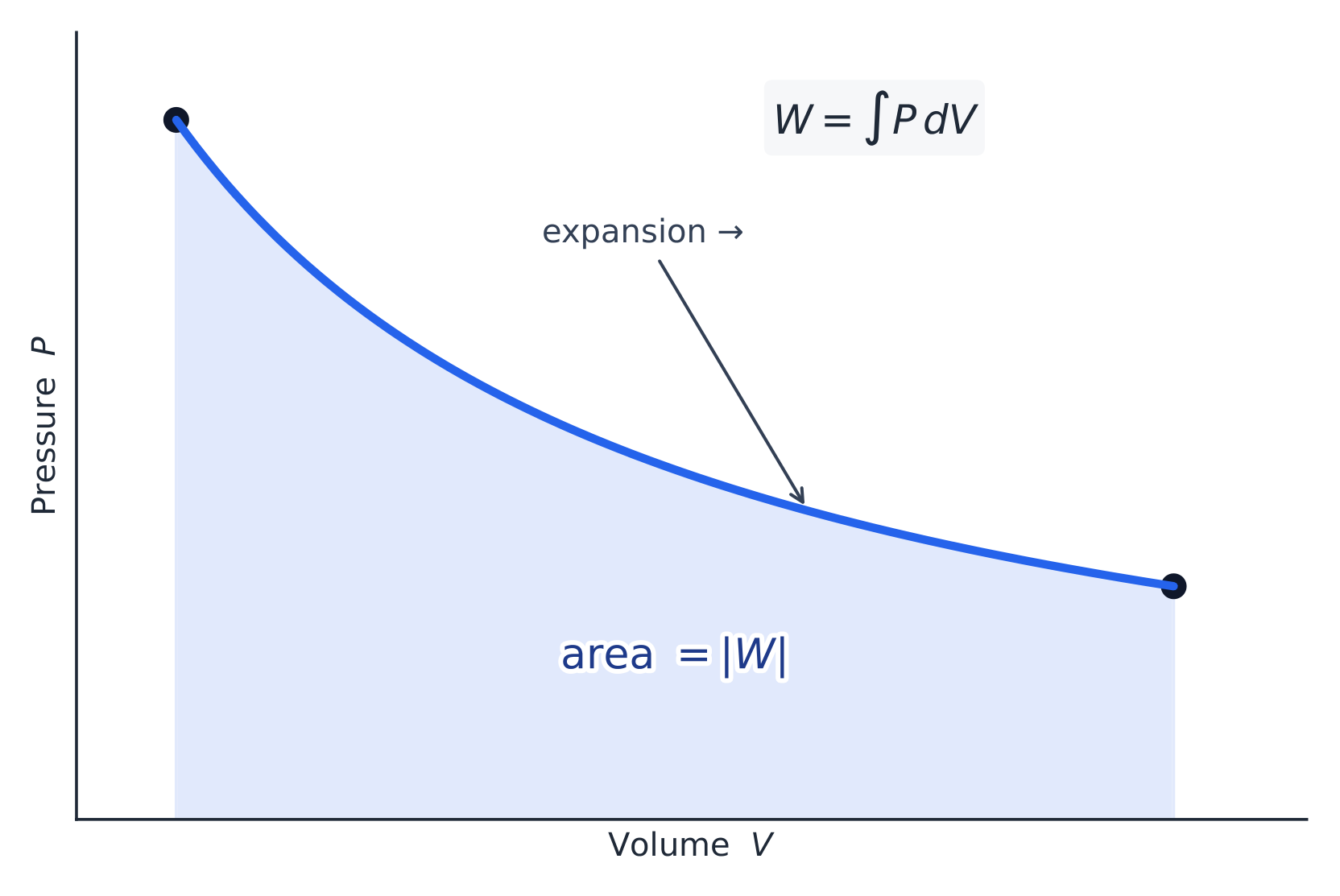
งาน所做ระหว่างการเปลี่ยนแปลงปริมาตรเท่ากับพื้นที่ใต้กราฟ P-V ตัวอย่างฝึกหัด. แก๊สดูดกลืน $500\ \text{J}$ ของความร้อนและเมื่อมันขยายตัว จะทำ $200\ \text{J}$ ของงาน ต่อสิ่งแวดล้อม จงหาการเปลี่ยนแปลงของพลังงานภายใน งานที่ทำ ต่อ แก๊สคือ $W=-200\ \text{J}$ (เพราะแก๊สทำงาน มันจึงสูญเสียพลังงานส่วนนั้น):
$$\Delta U=Q+W=500+(-200)=300\ \text{J}.$$พลังงานภายในเพิ่มขึ้น $300\ \text{J}$ ดังนั้นแก๊สจึงมีอุณหภูมิสูงขึ้น การระบุเครื่องหมายของ $W$ ให้ถูกต้องคือหัวใจสำคัญในโจทย์กฎข้อที่หนึ่ง9.5
Specific Heat and Thermal Conductivity · ความจุความร้อนจำเพาะและการนำความร้อน
Syllabus · หลักสูตร
EnglishLearning Objective 9.5.A: Describe the energy required to change the temperature of an object by a certain amount.
- 9.5.A.1 The amount of energy required to change the temperature of a material is related to the material's specific heat.
- Equation: $Q = mc\Delta T$
- 9.5.A.2 The specific heat of a material is an intrinsic property of that material that depends on the arrangement and interactions of the atoms that make up the material.
Learning Objective 9.5.B: Describe the rate at which energy is transferred by conduction through a given material.
- 9.5.B.1 The rate at which energy is transferred by conduction through a given material is related to the thermal conductivity, the physical dimensions of the material, and the temperature difference across the material.
- Equation: $\dfrac{Q}{\Delta t} = \dfrac{kA\Delta T}{L}$
- 9.5.B.2 The thermal conductivity of a material is an intrinsic property of that material that depends on the arrangement and interactions of the atoms that make up the material.
Boundary statement: AP Physics 2 will model specific heat as independent of temperature.
ไทยวัตถุประสงค์การเรียนรู้ 9.5.A: อธิบายพลังงานที่ต้องการในการเปลี่ยนอุณหภูมิของวัตถุจำนวนหนึ่ง
- 9.5.A.1 ปริมาณพลังงานที่ต้องการในการเปลี่ยนอุณหภูมิของวัสดุมีความสัมพันธ์กับความจุความร้อนจำเพาะของวัสดุนั้น
- สมการ: $Q = mc\Delta T$
- 9.5.A.2 ความจุความร้อนจำเพาะของวัสดุเป็นคุณสมบัติภายในของวัสดุนั้นซึ่งขึ้นอยู่กับการจัดเรียงและอันตรกิริยาของอะตอมที่ประกอบขึ้นเป็นวัสดุ
วัตถุประสงค์การเรียนรู้ 9.5.B: อธิบายอัตราการถ่ายโอนพลังงานด้วยการนำผ่านวัสดุที่กำหนด
- 9.5.B.1 อัตราการถ่ายโอนพลังงานด้วยการนำผ่านวัสดุที่กำหนดมีความสัมพันธ์กับการนำความร้อน, มิติทางกายภาพของวัสดุ และความแตกต่างของอุณหภูมิข้ามวัสดุ
- สมการ: $\dfrac{Q}{\Delta t} = \dfrac{kA\Delta T}{L}$
- 9.5.B.2 การนำความร้อนของวัสดุเป็นคุณสมบัติภายในของวัสดุนั้นซึ่งขึ้นอยู่กับการจัดเรียงและอันตรกิริยาของอะตอมที่ประกอบขึ้นเป็นวัสดุ
คำจำกัดขอบเขต: AP Physics 2 จะจำลองความจุความร้อนจำเพาะให้เป็นอิสระจากอุณหภูมิ
Source: College Board AP Course and Exam Description · แหล่งที่มา: คำอธิบายหลักสูตรและข้อสอบ College Board AP
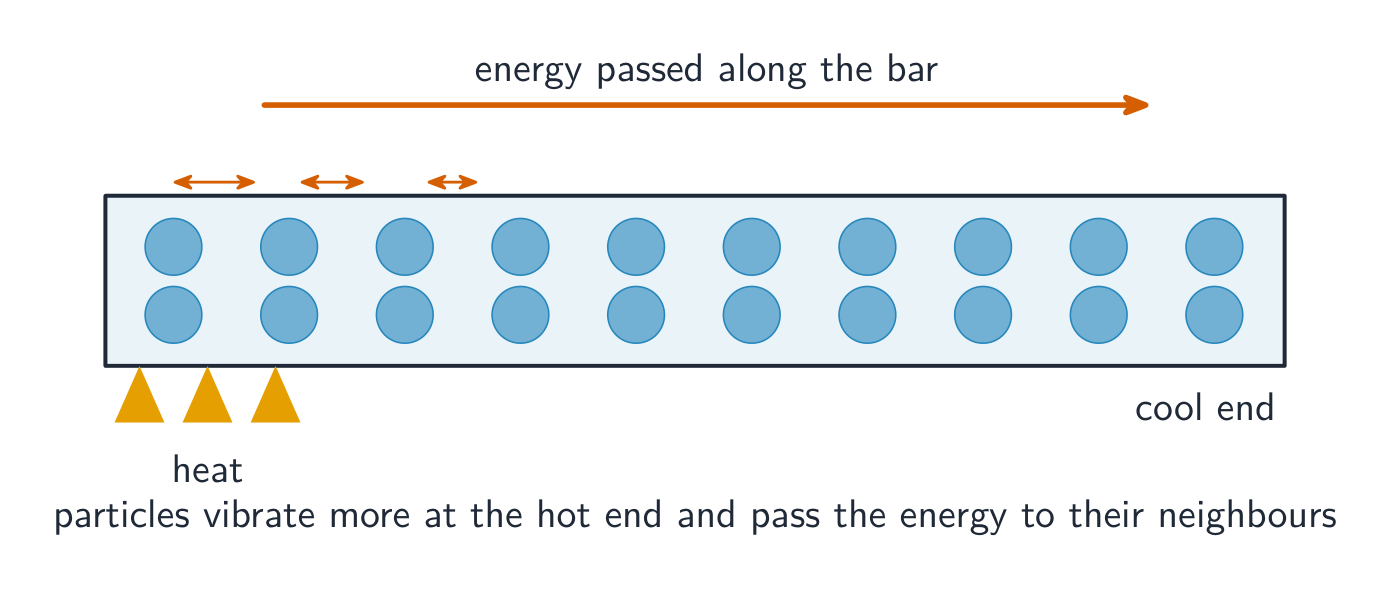
English- Specific heat 比热容 $c$ is the heat needed to raise one kilogram by one degree: $Q=mc\,\Delta T$. A high specific heat (like water's) means a substance resists temperature change.
- Thermal conductivity 热导率 measures how fast heat conducts through a material; the rate of conduction rises with area and temperature difference and falls with thickness.
Worked example. How much heat raises the temperature of $2.0\ \text{kg}$ of water from $20\,{}^{\circ}\text{C}$ to $80\,{}^{\circ}\text{C}$? Water's specific heat is $c=4200\ \text{J/(kg}\,{}^{\circ}\text{C)}$:
$$Q=mc\,\Delta T=2.0\times4200\times(80-20)=5.0\times10^{5}\ \text{J}.$$Water's large specific heat is why it is used as a coolant and why coastal climates are mild.ไทย- ความจุความร้อนจำเพาะ $c$ คือปริมาณความร้อนที่ต้องการเพื่อ升高อุณหภูมิหนึ่งกิโลกรัมหนึ่งองศา: $Q=mc\,\Delta T$. ความจุความร้อนจำเพาะสูง (เช่น น้ำ) หมายความว่าสารนั้นต้านทานการเปลี่ยนแปลงอุณหภูมิ
- การนำความร้อน วัดความเร็วในการนำความร้อนผ่านวัสดุ; อัตราการนำความร้อนเพิ่มขึ้นตามพื้นที่และความต่างของอุณหภูมิ และลดลงตามความหนา
การนำความร้อน: อนุภาคสั่นไหวส่งต่อพลังงานตามแท่งโลหะ ตัวอย่างฝึกหัด. ต้องใช้ความร้อนเท่าไหร่เพื่อ升高อุณหภูมิ $2.0\ \text{kg}$ ของน้ำจาก $20\,{}^{\circ}\text{C}$ ไปยัง $80\,{}^{\circ}\text{C}$? ความจุความร้อนจำเพาะของน้ำคือ $c=4200\ \text{J/(kg}\,{}^{\circ}\text{C)}$:
$$Q=mc\,\Delta T=2.0\times4200\times(80-20)=5.0\times10^{5}\ \text{J}.$$ความจุความร้อนจำเพาะที่สูงของน้ำเป็นเหตุผลที่ใช้เป็นสารทำความเย็นและเป็นเหตุให้ภูมิอากาศชายฝั่งมีอุณหภูมิไม่รุนแรงExplore · สำรวจExplore how much energy heats a material · สำรวจปริมาณพลังงานที่ใช้ทำความร้อนวัสดุ
Pick a material, set the mass and temperature rise, and read the energy from $Q = mc\,\Delta T$. Water needs far more energy than the metals to warm by the same amount. · เลือกวัสดุ ตั้งค่ามวลและอุณหภูมิที่เพิ่มขึ้น แล้วอ่านค่าพลังงานจาก $Q = mc\,\Delta T$. น้ำ ต้องใช้พลังงานมากกว่าโลหะมากเพื่อให้ร้อนขึ้นในระดับเดียวกัน
Vocabulary · คำศัพท์ Train · ฝึกฝนEnglish ไทย Thermodynamics/ˌθɜːməʊdaɪˈnæmɪks/ อุณหพลศาสตร์ kinetic theory/kɪˈnetɪk ˈθɪəri/ ทฤษฎีจลน์ Temperature/ˈtemprɪtʃə/ อุณหภูมิ Pressure/ˈpreʃə/ ความดัน ideal gas/aɪˈdɪəl ɡæs/ แก๊สอุดมคติ Heat/hiːt/ ความร้อน thermal equilibrium/ˈθɜːml ˌiːkwɪˈlɪbrɪəm/ สมดุลความร้อน conduction/kənˈdʌkʃn/ การนำความร้อน convection/kənˈvekʃn/ การพาความร้อน radiation/ˌreɪdɪˈeɪʃn/ รังสี first law/fɜːst lɔː/ กฎข้อแรก internal energy/ɪnˈtɜːnl ˈenədʒi/ พลังงานภายใน Specific heat/spəˈsɪfɪk hiːt/ ความร้อนจำเพาะ Thermal conductivity/ˈθɜːml kɒndəkˈtɪvɪti/ ค่าการนำความร้อน Entropy/ˈentrəpi/ เอนโทรปี second law/ˈsekənd lɔː/ กฎข้อที่สอง 9.6
Entropy and the Second Law of Thermodynamics · เอนโทรปีและกฎข้อที่สองของเทอร์โมไดนามิกส์
Syllabus · หลักสูตร
EnglishLearning Objective 9.6.A: Describe the change in entropy for a given system over time.
- 9.6.A.1 The second law of thermodynamics states that the total entropy of an isolated system can never decrease and is constant only when all processes the system undergoes are reversible.
- 9.6.A.2 Entropy can be qualitatively described as the tendency of energy to spread or the unavailability of some of the system's energy to do work.
- 9.6.A.2.i Localized energy will tend to disperse and spread out.
- 9.6.A.2.ii Entropy is a state function and therefore only depends on the current state or configuration of a system, not how the system reached that state.
- 9.6.A.2.iii Maximum entropy occurs when a system is in thermodynamic equilibrium.
- 9.6.A.3 The change in a system's entropy is determined by the system's interactions with its surroundings.
- 9.6.A.3.i Isolated systems spontaneously move toward thermodynamic equilibrium.
- 9.6.A.3.ii The entropy of an isolated system never decreases, but the entropy of a closed system can decrease because energy can be transferred into or out of the system.
Boundary statement: Only qualitative treatment of the second law of thermodynamics is within the scope of AP Physics 2.
ไทยวัตถุประสงค์การเรียนรู้ 9.6.A: อธิบายการเปลี่ยนแปลงเอนโทรปีของระบบที่กำหนดตามเวลา
- 9.6.A.1 กฎข้อที่สองแห่งอุณหพลศาสตร์ระบุว่าเอนโทรปีรวมของระบบแยกisolated ไม่สามารถลดลงได้ และเป็นค่าคงที่ก็ต่อเมื่อกระบวนการทั้งหมดที่ระบบดำเนินไปนั้นเป็นแบบผันกลับได้เท่านั้น
- 9.6.A.2 เอนโทรปีสามารถอธิบายเชิงคุณภาพได้ว่าคือแนวโน้มของพลังงานที่จะกระจายออกหรือไม่สามารถเข้าถึงพลังงานบางส่วนในระบบเพื่อทำงานได้
- 9.6.A.2.i พลังงานที่กระจุกตัวจะมีความ tendency ที่จะกระจายและแผ่ขยายออกไป
- 9.6.A.2.ii เอนโทรปีเป็นฟังก์ชันสถานะดังนั้นจึงขึ้นอยู่กับสถานะปัจจุบันหรือการจัดวางตำแหน่งของระบบเท่านั้น ไม่ใช่วิธีการที่ระบบไปถึงสถานะนั้น
- 9.6.A.2.iii เอนโทรปีสูงสุดเกิดขึ้นเมื่อระบบอยู่ในสมดุลทางอุณหพลศาสตร์
- 9.6.A.3 การเปลี่ยนแปลงเอนโทรปีของระบบกำหนดโดยอันตรกิริยาของระบบกับสภาพแวดล้อมรอบข้าง
- 9.6.A.3.i ระบบแยกisolated จะเคลื่อนที่ไปสู่สมดุลทางอุณหพลศาสตร์โดยธรรมชาติ
- 9.6.A.3.ii เอนโทรปีของระบบแยกisolated ไม่สามารถลดลงได้ แต่เอนโทรปีของระบบปิดสามารถลดลงได้เนื่องจากพลังงานสามารถถ่ายโอนเข้าสู่หรือออกจากระบบได้
คำจำกัดขอบเขต: การจัดการเรื่องกฎข้อที่สองแห่งอุณหพลศาสตร์เพียงเชิงคุณภาพเท่านั้นที่อยู่ในขอบเขตของ AP Physics 2
Source: College Board AP Course and Exam Description · แหล่งที่มา: คำอธิบายหลักสูตรและข้อสอบ College Board AP
EnglishEntropy 熵 measures the disorder, or the number of ways to arrange, a system. The second law 热力学第二定律: the total entropy of an isolated system never decreases – energy naturally spreads out. This sets the direction of processes: heat flows hot→cold on its own, never the reverse, and no engine can convert heat entirely into work.
ไทยเอนโทรปี วัดความวุ่นวาย หรือจำนวนวิธีในการจัดเรียงระบบ กฎข้อที่สอง: เอนโทรปีรวมของระบบปิดไม่ pernahลดลง – พลังงานกระจายตัวตามธรรมชาติ สิ่งนี้กำหนด ทิศทาง ของกระบวนการ: ความร้อนไหลจากร้อน→เย็น โดยอัตโนมัติ ไม่เคยในทางตรงกันข้าม และเครื่องยนต์ไม่สามารถแปลงความร้อนให้เป็นงานได้อย่างสมบูรณ์
9.6
Exam tips · ข้อแนะนำสำหรับการสอบ
English- Always convert temperatures to kelvin ($T_{\text{K}}=T_{\text{C}}+273$) before using any gas law.
- In the first law $\Delta U = Q + W$, get the sign of $W$ right: work done on the gas is positive; when the gas expands and does work on its surroundings, $W$ is negative.
- Temperature measures the average kinetic energy of particles, so at the same $T$ lighter molecules move faster.
- On a PV diagram the work done by the gas is the area under the process curve.
- Use $Q=mc\,\Delta T$ for temperature change; the second law fixes the direction — heat flows hot→cold and total entropy never decreases.
ไทย- ต้องแปลงอุณหภูมิเป็น เคลวิน ($T_{\text{K}}=T_{\text{C}}+273$) ก่อนใช้กฎแก๊สใดๆ
- ในกฎข้อที่หนึ่ง $\Delta U = Q + W$ ให้ได้ เครื่องหมายของ $W$ ให้ถูกต้อง: งานที่ทำ ต่อ แก๊สเป็นบวก; เมื่อแก๊สขยายตัวและทำงานต่อสิ่งแวดล้อม $W$ จะเป็นลบ
- อุณหภูมิ วัดพลังงานจลน์เฉลี่ยของอนุภาค ดังนั้นที่ $T$ เท่ากัน โมเลกุลที่มีมวลเบาจะเคลื่อนที่เร็วขึ้น
- บน แผนภูมิ PV งานที่ทำโดยแก๊สคือ พื้นที่ใต้เส้นโค้งกระบวนการ
- ใช้ $Q=mc\,\Delta T$สำหรับการเปลี่ยนแปลงอุณหภูมิ; กฎข้อที่สอง กำหนดทิศทาง – ความร้อนไหลจากร้อน→เย็น และเอนโทรปีรวมไม่ pernahลดลง
-
10
Electric Force, Field, and Potential · แรงไฟฟ้า สนาม และศักย์ไฟฟ้า
Watch lesson · ดูบทเรียน10.1
Electric Charge and Electric Force · ประจุไฟฟ้าและแรงไฟฟ้า
Syllabus · หลักสูตร
EnglishLearning Objective 10.1.A: Describe the electric force that results from the interactions between charged objects or systems.
- 10.1.A.1 Charge is a fundamental property of all matter.
- 10.1.A.1.i Charge is described as positive or negative.
- 10.1.A.1.ii The magnitude of the charge of a single electron or proton, the elementary charge $e$, can be considered to be the smallest indivisible amount of charge.
- 10.1.A.1.iii The charge of an electron is $-e$, the charge of a proton is $+e$, and a neutron has no electric charge.
- 10.1.A.1.iv A point charge is a model in which the physical size of a charged object or system is negligible in the context of the situation being analyzed.
- 10.1.A.2 Coulomb's law describes the electrostatic force between two charged objects as directly proportional to the magnitude of each of the charges and inversely proportional to the square of the distance between the objects.
- Equation: $\left|\vec{F}_E\right| = \dfrac{1}{4\pi\varepsilon_0}\dfrac{\left|q_1 q_2\right|}{r^2} = k\dfrac{\left|q_1 q_2\right|}{r^2}$
- 10.1.A.3 The direction of the electrostatic force depends on the signs of the charges of the interacting objects and is parallel to the line of separation between the objects.
- 10.1.A.3.i Two objects with charges of the same sign exert repulsive forces on each other.
- 10.1.A.3.ii Two objects with charges of opposite signs exert attractive forces on each other.
- 10.1.A.4 Electric forces are responsible for some of the macroscopic properties of objects in everyday experiences. However, the large number of particle interactions that occur make it more convenient to treat everyday forces in terms of nonfundamental forces called contact forces, such as normal force, friction, and tension.
Learning Objective 10.1.B: Describe the electric and gravitational forces that result from interactions between charged objects with mass.
- 10.1.B.1 Electrostatic forces can be attractive or repulsive, while gravitational forces are always attractive.
- 10.1.B.2 For any two objects that have mass and electric charge, the magnitude of the gravitational force is usually much smaller than the magnitude of the electrostatic force.
- 10.1.B.3 Gravitational forces dominate at larger scales even though they are weaker than electrostatic forces, because systems at large scales tend to be electrically neutral.
Learning Objective 10.1.C: Describe the electric permittivity of a material or medium.
- 10.1.C.1 Electric permittivity is a measurement of the degree to which a material or medium is polarized in the presence of an electric field.
- 10.1.C.2 Electric polarization can be modeled as the induced rearrangement of electrons by an external electric field, resulting in a separation of positive and negative charges within a material or medium.
- 10.1.C.3 Free space has a constant value of electric permittivity, $\varepsilon_0$, that appears in physical relationships.
- 10.1.C.4 The permittivity of matter has a value different from that of free space that arises from the matter's composition and arrangement.
- 10.1.C.4.i In a given material, electric permittivity is determined by the ease with which electrons can change configurations within the material.
- 10.1.C.4.ii Conductors are made from electrically conducting materials in which charge carriers move easily; insulators are made from electrically nonconducting materials in which charge carriers cannot move easily.
Boundary statement: AP Physics 2 only expects students to make calculations of the electric force between four or fewer interacting charged objects or systems. The analysis of the resulting electric force from more charges is allowed in situations of high symmetry.
ไทยจุดประสงค์การเรียนรู้ 10.1.A: อธิบายแรงไฟฟ้าที่เกิดจากปฏิสัมพันธ์ระหว่างวัตถุหรือระบบที่มีประจุ
- 10.1.A.1 ประจุเป็นคุณสมบัติพื้นฐานของสสารทุกชนิด
- 10.1.A.1.i ประจุถูกอธิบายว่าเป็นบวกหรือลบ
- 10.1.A.1.ii ขนาดของประจุของอิเล็กตรอนหรือโปรตอนหนึ่งตัว ซึ่งเรียกว่าประจุพื้นฐาน $e$ สามารถพิจารณาได้ว่าเป็นหน่วยของประจุที่เล็กที่สุดและไม่แบ่งแยกได้อีก
- 10.1.A.1.iii ประจุของอิเล็กตรอนคือ $-e$ ประจุของโปรตอนคือ $+e$ และนิวตรอนไม่มีประจุไฟฟ้า
- 10.1.A.1.iv จุดประจุคือแบบจำลองที่ขนาดทางกายภาพของวัตถุหรือระบบที่มีประจุมีนัยสำคัญน้อยมากเมื่อเทียบกับบริบทที่กำลังวิเคราะห์อยู่
- 10.1.A.2 กฎของคูลอมบ์อธิบายแรงอิเล็กโทรสแตติกระหว่างวัตถุที่มีประจุสองชนิดว่าแปรผันตรงกับขนาดของประจุแต่ละชนิดและแปรผกผันกับกำลังสองของระยะห่างระหว่างวัตถุ
- สมการ: $\left|\vec{F}_E\right| = \dfrac{1}{4\pi\varepsilon_0}\dfrac{\left|q_1 q_2\right|}{r^2} = k\dfrac{\left|q_1 q_2\right|}{r^2}$
- 10.1.A.3 ทิศทางของแรงอิเล็กโทรสแตติกขึ้นอยู่กับสัญญาณของประจุของวัตถุที่มีปฏิสัมพันธ์กัน และเป็นขนานกับเส้นที่เชื่อมระหว่างวัตถุทั้งสอง
- 10.1.A.3.i วัตถุสองชนิดที่มีประจุชนิดเดียวกันจะ exert แรงผลักกันเอง
- 10.1.A.3.ii วัตถุสองชนิดที่มีประจุต่างชนิดกันจะ exert แรงดูดกันเอง
- 10.1.A.4 แรงไฟฟ้าเป็นสาเหตุของคุณสมบัติระดับมหภาคบางอย่างของวัตถุในประสบการณ์ประจำวัน อย่างไรก็ตาม จำนวนมากของปฏิสัมพันธ์ระหว่างอนุภาคที่เกิดขึ้นทำให้สะดวกกว่าที่จะพิจารณาแรงในชีวิตประจำวันใน terms of แรงที่ไม่ใช่พื้นฐานซึ่งเรียกว่าแรงสัมผัส เช่น แรงปกติ แรงเสียดทาน และแรงตึง
จุดประสงค์การเรียนรู้ 10.1.B: อธิบายแรงไฟฟ้าและแรงโน้มถ่วงที่เกิดจากปฏิสัมพันธ์ระหว่างวัตถุที่มีประจุและมีมวล
- 10.1.B.1 แรงอิเล็กโทรสแตติกอาจเป็นแรงดึงดูดหรือแรงผลัก ในขณะที่แรงโน้มถ่วงจะเป็นแรงดึงดูดเสมอ
- 10.1.B.2 สำหรับวัตถุสองวัตถุที่มีมวลและประจุไฟฟ้า แรงโน้มถ่วงจะมีขนาดน้อยกว่าแรงไฟฟ้าสถิตอย่างมีนัยสำคัญโดยทั่วไป
- 10.1.B.3 แรงโน้มถ่วงมีอิทธิพลเหนือกว่าในระดับขนาดใหญ่แม้ว่าจะอ่อนกว่าแรงไฟฟ้าสถิต เนื่องจากระบบในระดับใหญ่มักจะเป็นกลางทางไฟฟ้า
จุดประสงค์การเรียนรู้ 10.1.C: อธิบายค่าความอนุจุนไฟฟ้า (electric permittivity) ของวัสดุหรือสื่อ
- 10.1.C.1 ค่าความอนุจุนไฟฟ้าเป็นการวัดระดับการเกิดขั้วไฟฟ้าของวัสดุหรือสื่อเมื่ออยู่ในสนามไฟฟ้า
- 10.1.C.2 การเกิดขั้วไฟฟ้าสามารถจำลองได้ด้วยการจัดเรียงตัวใหม่ของอิเล็กตรอนภายใต้สนามไฟฟ้าภายนอก ส่งผลให้เกิดการแยกตัวของประจุบวกและประจุลบภายในวัสดุหรือสื่อ
- 10.1.C.3的空间มีค่าคงที่ของความอนุจุนไฟฟ้า $\varepsilon_0$ ซึ่งปรากฏในความสัมพันธ์ทางฟิสิกส์
- 10.1.C.4 ความอนุจุนไฟฟ้าของสสารมีค่าแตกต่างจากค่าของพื้นที่ว่าง ซึ่งเกิดจากองค์ประกอบและการจัดเรียงตัวของสสารนั้นๆ
- 10.1.C.4.i ในวัสดุที่กำหนด ค่าความอนุจุนไฟฟ้าถูกกำหนดโดยความสะดวกที่อิเล็กตรอนจะเปลี่ยนการจัดวางภายในวัสดุนั้น
- 10.1.C.4.ii ตัวนำทำจากวัสดุที่นำไฟฟ้าซึ่งพาประจุเคลื่อนที่ได้ง่าย ส่วนฉนวนทำจากวัสดุที่ไม่สามารถนำไฟฟ้าซึ่งพาประจุเคลื่อนที่ได้ยาก
คำจำกัดขอบเขต: AP Physics 2 คาดหวังให้นักเรียนคำนวณแรงไฟฟ้าระหว่างวัตถุหรือระบบที่มีประจุสี่ตัวหรือน้อยกว่าเท่านั้น การวิเคราะห์แรงไฟฟ้าที่เกิดจากประจุมากกว่านี้อนุญาตได้ในสถานการณ์ที่มีความสมมาตรสูง
Source: College Board AP Course and Exam Description · แหล่งที่มา: คำอธิบายหลักสูตรและข้อสอบ College Board AP
EnglishElectric charge 电荷 is a fundamental property of matter, and it comes in two kinds, positive and negative; like charges repel and opposite charges attract. Charge is conserved and quantized (a multiple of the elementary charge $e$). The force between two point charges is Coulomb's law 库仑定律:
$$F=\frac{k q_1 q_2}{r^2},$$directed along the line joining them – an inverse-square law like gravity, but it can push or pull.The constant $k$ hides a property of the medium: the permittivity 介电常数. Free space has a fixed permittivity of free space $\varepsilon_0$ (with $k = 1/4\pi\varepsilon_0$), while the permittivity of matter differs from $\varepsilon_0$, depending on the material's composition and arrangement - which is why a material between two charges changes the force. Note also that although the electric force is vastly stronger than gravity, gravity dominates at large scales, because large objects are usually electrically neutral (equal + and −), leaving only gravity to act.
Worked example. Two point charges, $+3.0\ \mu\text{C}$ and $-2.0\ \mu\text{C}$, sit $0.10\ \text{m}$ apart ($k=9.0\times10^{9}$). The force between them is
$$F=\frac{k q_1 q_2}{r^2}=\frac{9.0\times10^{9}\times(3.0\times10^{-6})(2.0\times10^{-6})}{(0.10)^2}=5.4\ \text{N},$$attractive, because the charges have opposite signs. (Use the magnitudes for the size and decide the direction from the signs.)ไทยประจุไฟฟ้า เป็น คุณสมบัติพื้นฐาน ของสสาร และมีสองชนิด คือ บวก และ ลบ; ประจุเหมือนกันจะผลักกัน และประจุต่างกันจะดึงดูดกัน ประจุถูก อนุรักษ์ และ ควอนไทซ์ (เป็นพหุคูณของประจุพื้นฐาน $e$). แรงระหว่างประจุจุดสองจุดคือ กฎของคูลอมบ์:
$$F=\frac{k q_1 q_2}{r^2},$$ชี้ไปตามเส้นเชื่อมระหว่างมัน – เป็นกฎกำลังสองผกผันเหมือนแรงโน้มถ่วง แต่สามารถผลักหรือดึงได้ค่าคงที่ $k$ ซ่อนคุณสมบัติของสื่อ: ค่าการยอมให้ไฟฟ้า.空间中มีค่าการยอมให้ไฟฟ้าของสุญญากาศคงที่ $\varepsilon_0$ (พร้อม $k = 1/4\pi\varepsilon_0$), ในขณะที่ค่าการยอมให้ไฟฟ้าของ สสาร แตกต่างจาก $\varepsilon_0$ ขึ้นอยู่กับองค์ประกอบและการจัดเรียงของวัสดุนั้น – นี่คือเหตุผลที่วัสดุระหว่างประจุสองจุดเปลี่ยนแรง需要注意的是,虽然电力远强于重力,但在大尺度上重力占主导,因为大物体通常是电中性的(正负电荷相等),只剩下重力作用。
ตัวอย่างฝึกหัด. ประจุจุดสองจุด มีขนาด $+3.0\ \mu\text{C}$ และ $-2.0\ \mu\text{C}$ วางห่างกัน $0.10\ \text{m}$ ($k=9.0\times10^{9}$). แรงระหว่าง нихคือ
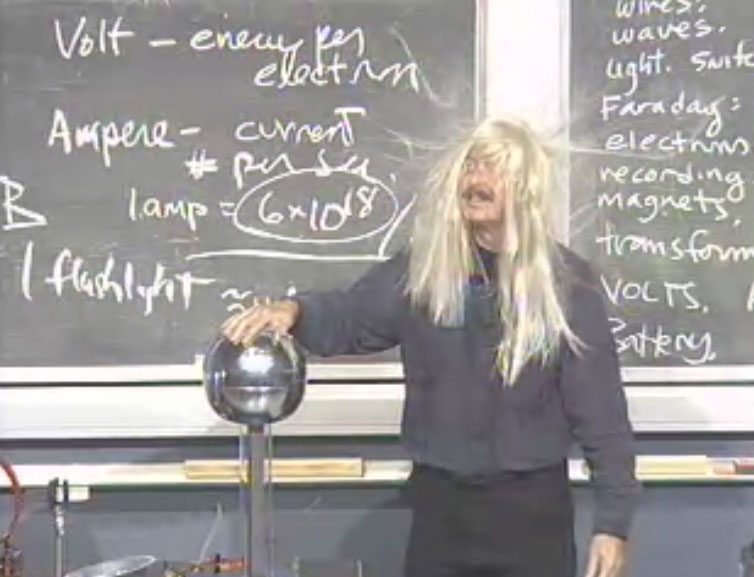
$$F=\frac{k q_1 q_2}{r^2}=\frac{9.0\times10^{9}\times(3.0\times10^{-6})(2.0\times10^{-6})}{(0.10)^2}=5.4\ \text{N},$$เป็นแรงดึงดูด เพราะประจุมีเครื่องหมายต่างกัน (ใช้ขนาดเพื่อหาขนาดแรง และใช้เครื่องหมายเพื่อกำหนดทิศทาง)ประจุเหมือนกันผลักกัน: ผมแต่ละเส้นมีประจุเดียวกันมาจากเครื่อง Van de Graaff จึงผลักกัน 10.2
The Process of Charging · กระบวนการการทำให้มีประจุ
Syllabus · หลักสูตร
EnglishLearning Objective 10.2.A: Describe the behavior of a system using conservation of charge.
- 10.2.A.1 The net charge or charge distribution of a system can change in response to the presence of, or changes in, the net charge or charge distribution of other systems.
- 10.2.A.1.i The net charge of a system can change due to friction or contact between systems.
- 10.2.A.1.ii Induced charge separation occurs when the electrostatic force between two systems alters the distribution of charges within the systems, resulting in the polarization of one or both systems.
- 10.2.A.1.iii Induced charge separation can occur in neutral systems.
- 10.2.A.2 Any change to a system's net charge is due to a transfer of charge between the system and its surroundings.
- 10.2.A.2.i The charging of a system typically involves the transfer of electrons to and from the system.
- 10.2.A.2.ii The net charge of a system will be constant unless there is a transfer of charge to or from the system.
- 10.2.A.3 Grounding involves electrically connecting a charged system to a much larger and approximately neutral system (e.g., Earth).
ไทยจุดประสงค์การเรียนรู้ 10.2.A: อธิบายพฤติกรรมของระบบโดยใช้หลักการอนุรักษ์ประจุ
- 10.2.A.1 ประจุสุทธิหรือการกระจายตัวของประจุของระบบสามารถเปลี่ยนแปลงได้ตามการมีอยู่หรือการเปลี่ยนแปลงของประจุสุทธิหรือการกระจายตัวของประจุของระบบอื่น
- 10.2.A.1.i ประจุสุทธิของระบบสามารถเปลี่ยนแปลงได้จากการเสียดสีหรือการสัมผัสระหว่างระบบ
- 10.2.A.1.ii การแยกตัวของประจุด้วยวิธีเหนี่ยวนำเกิดขึ้นเมื่อแรงไฟฟ้าสถิตระหว่างระบบสองระบบ alters การกระจายตัวของประจุภายในระบบ ส่งผลให้เกิดการเกิดขั้วไฟฟ้าของระบบหนึ่งหรือทั้งสองระบบ
- 10.2.A.1.iii การแยกตัวของประจุด้วยวิธีเหนี่ยวนำสามารถเกิดขึ้นในระบบที่เป็นกลางได้
- 10.2.A.2 การเปลี่ยนแปลงใดๆ ของประจุสุทธิของระบบเกิดจากการถ่ายโอนประจุระหว่างระบบกับสิ่งแวดล้อมรอบข้าง
- 10.2.A.2.i การทำให้ระบบเป็นไฟฟ้ามักเกี่ยวข้องกับการถ่ายโอนอิเล็กตรอนเข้าสู่และออกจากระบบ
- 10.2.A.2.ii ประจุสุทธิของระบบจะคงที่เว้นแต่จะมีการถ่ายโอนประจุเข้าสู่หรือออกจากระบบ
- 10.2.A.3 การต่อพื้น (grounding) เกี่ยวข้องกับการเชื่อมต่อระบบที่มีประจุเข้ากับระบบที่ใหญ่กว่ามากและเป็นกลางทางไฟฟ้าโดยประมาณ (เช่น โลก)
Source: College Board AP Course and Exam Description · แหล่งที่มา: คำอธิบายหลักสูตรและข้อสอบ College Board AP
EnglishObjects charge by moving electrons. A conductor 导体 lets charge move freely; an insulator 绝缘体 holds it in place. Three methods:
- Friction: rubbing transfers electrons.
- Conduction 接触起电: touching shares charge.
- Induction 感应起电: a nearby charge rearranges charge in a neutral object, which can then be grounded to leave it charged.
ไทยวัตถุมีประจุโดยการเคลื่อนย้ายอิเล็กตรอน ตัวนำ อนุญาตให้ประจุเคลื่อนที่อิสระ; ฉนวน ยึดประจุไว้ที่เดิม มีสามวิธีการ:
- การเสียดสี: การถูถ่ายโอนอิเล็กตรอน
- การนำไฟฟ้า: การสัมผัสแบ่งปันประจุ
- การเหนี่ยวนำ: ประจุใกล้เคียงจัดเรียง ulangประจุในวัตถุที่เป็นกลาง ซึ่งสามารถทำให้เป็นดินได้เพื่อให้มีประจุตกค้าง
Explore · สำรวจCharge an object by rubbing · ทำให้วัตถุมีประจุด้วยการถู
Rubbing transfers electrons from one surface to another, leaving one positively and one negatively charged. Like charges repel, opposite charges attract. · การถูถ่ายโอน อิเล็กตรอน จากพื้นผิวหนึ่งไปยังอีกพื้นผิวหนึ่ง ทำให้หนึ่งด้านมีประจุบวกและอีกด้านมีประจุลบ ประจุชนิดเดียวกันผลักกัน ประจุต่างชนิดกันดึงดูดกัน
10.3
Electric Fields · สนามไฟฟ้า
Syllabus · หลักสูตร
EnglishLearning Objective 10.3.A: Describe the electric field produced by a charged object or configuration of point charges.
- 10.3.A.1 Electric fields may originate from charged objects.
- 10.3.A.2 The electric field at a given point is the ratio of the electric force exerted on a test charge at that point to the charge of the test charge.
- Equation: $\vec{E} = \dfrac{\vec{F}_E}{q}$
- 10.3.A.2.i A test charge is a point charge of small enough magnitude such that its presence does not significantly affect an electric field in its vicinity.
- 10.3.A.2.ii An electric field points away from isolated positive charges and toward isolated negative charges.
- 10.3.A.2.iii The electric force exerted on a positive test charge by an electric field is in the same direction as the electric field.
- 10.3.A.3 The electric field is a vector quantity and can be represented in space using vector field maps.
- 10.3.A.3.i The net electric field at a given location is the vector sum of individual electric fields created by nearby charged objects.
- 10.3.A.3.ii Electric field maps use vectors to depict the magnitude and direction of the electric field at many locations within a given region.
- 10.3.A.3.iii Electric field line diagrams are simplified models of electric field maps and can be used to determine the relative magnitude and direction of the electric field at any position in the diagram.
Learning Objective 10.3.B: Describe the electric field generated by charged conductors or insulators.
- 10.3.B.1 While in electrostatic equilibrium, the excess charge of a solid conductor is distributed on the surface of the conductor, and the electric field within the conductor is zero.
- 10.3.B.1.i At the surface of a charged conductor, the electric field is perpendicular to the surface.
- 10.3.B.1.ii The electric field outside an isolated sphere with spherically symmetric charge distribution is the same as the electric field due to a point charge with the same net charge as the sphere located at the center of the sphere.
- 10.3.B.2 While in electrostatic equilibrium, the excess charge of an insulator is distributed throughout the interior of the insulator as well as at the surface, and the electric field within the insulator may have a nonzero value.
Boundary statement: AP Physics 2 only expects students to make calculations of the electric field resulting from four or fewer charged objects or systems. Analysis of the electric field resulting from more charges is allowed in situations of high symmetry. Students will only be expected to perform qualitative analysis of electric fields within insulators.
ไทยจุดประสงค์การเรียนรู้ 10.3.A: อธิบายสนามไฟฟ้าที่เกิดจากวัตถุที่มีประจุหรือการจัดวางของประจุจุด
- 10.3.A.1 สนามไฟฟ้าอาจเกิดจากวัตถุที่มีประจุ
- 10.3.A.2 สนามไฟฟ้าที่จุดใดจุดหนึ่งคืออัตราส่วนระหว่างแรงไฟฟ้าที่กระทำต่อบรรจุทดสอบที่จุดนั้นต่อประจุของบรรจุทดสอบ
- สมการ: $\vec{E} = \dfrac{\vec{F}_E}{q}$
- 10.3.A.2.i บรรจุภัณฑ์ทดสอบคือประจุจุดที่มีขนาดเล็กพอจนไม่ส่งผลกระทบอย่างมากต่อสนามไฟฟ้าบริเวณใกล้เคียง
- 10.3.A.2.ii สนามไฟฟ้าชี้ออกจากประจุบวกแบบโดดเดี่ยวและชี้เข้าหาประจุลบแบบโดดเดี่ยว
- 10.3.A.2.iii แรงไฟฟ้าที่กระทำต่อบรรจุทดสอบบวกโดยสนามไฟฟ้ามีทิศทางเดียวกับทิศทางของสนามไฟฟ้า
- 10.3.A.3 สนามไฟฟ้าเป็นปริมาณเวกเตอร์และสามารถแสดงในพื้นที่ได้โดยใช้แผนที่สนามเวกเตอร์
- 10.3.A.3.i สนามไฟฟ้าสุทธิที่ตำแหน่งใดตำแหน่งหนึ่งคือผลรวมเชิงเวกเตอร์ของสนามไฟฟ้า individuais ที่เกิดจากวัตถุที่มีประจุใกล้เคียง
- 10.3.A.3.ii แผนที่สนามไฟฟ้าใช้เวกเตอร์เพื่อแสดงขนาดและทิศทางของสนามไฟฟ้า ณ หลายตำแหน่งภายในบริเวณที่กำหนด
- 10.3.A.3.iii แผนภาพเส้นสนามไฟฟ้าเป็นโมเดลที่ลดทอนของแผนที่สนามไฟฟ้าและสามารถใช้เพื่อบ่งบอกขนาดสัมพัทธ์และทิศทางของสนามไฟฟ้าได้ทุกตำแหน่งในแผนภาพ
จุดประสงค์การเรียนรู้ 10.3.B: อธิบายสนามไฟฟ้าที่สร้างโดยตัวนำหรือฉนวนที่มีประจุ
- 10.3.B.1 ในขณะที่อยู่ในสมดุลไฟฟ้าสถิต ประจุเกินของตัวนำแข็งจะกระจายอยู่บนพื้นผิวของตัวนำ และสนามไฟฟ้าภายในตัวนำจะมีค่าเป็นศูนย์
- 10.3.B.1.i ที่พื้นผิวของตัวนำที่มีประจุ สนามไฟฟ้าจะตั้งฉากกับพื้นผิว
- 10.3.B.1.ii สนามไฟฟ้าภายนอกทรงกลมแบบโดดเดี่ยวที่มีการกระจายตัวของประจุตามความสมมาตรทรงกลม จะมีค่าเท่ากับสนามไฟฟ้าเนื่องจากประจุจุดที่มีประจุสุทธิเท่ากันกับทรงกลม โดยตั้งอยู่ที่ศูนย์กลางของทรงกลม
- 10.3.B.2 ในขณะที่อยู่ในสมดุลไฟฟ้าสถิต ประจุเกินของฉนวนจะกระจายอยู่ทั่วทั้งภายในของฉนวนรวมทั้งบนพื้นผิว และสนามไฟฟ้าภายในฉนวนอาจมีค่าไม่เท่ากับศูนย์
คำจำกัดขอบเขต: AP Physics 2 คาดหวังให้นักเรียนคำนวณสนามไฟฟ้าที่เกิดจากวัตถุหรือระบบที่มีประจุสี่ตัวหรือน้อยกว่าเท่านั้น การวิเคราะห์สนามไฟฟ้าที่เกิดจากประจุมากกว่านี้อนุญาตได้ในสถานการณ์ที่มีความสมมาตรสูง นักเรียนจะถูกคาดหวังให้ทำการวิเคราะห์เชิงคุณภาพของสนามไฟฟ้าภายในฉนวนเท่านั้น
Source: College Board AP Course and Exam Description · แหล่งที่มา: คำอธิบายหลักสูตรและข้อสอบ College Board AP
EnglishThe electric field of a dipole An electric field 电场 $\vec{E}$ is the force per unit charge that a small positive test charge would feel:
$$\vec{E}=\frac{\vec{F}}{q},\qquad E=\frac{kQ}{r^2}\ \text{for a point charge}.$$Field lines point away from positive charges and toward negative ones; where they are denser, the field is stronger. A charge in a field feels $\vec{F}=q\vec{E}$.Worked example. Find the electric field $0.20\ \text{m}$ from a $+5.0\ \mu\text{C}$ point charge: $E=\dfrac{kQ}{r^2}=\dfrac{9.0\times10^{9}\times5.0\times10^{-6}}{(0.20)^2}=1.1\times10^{6}\ \text{N/C}$, pointing away from the charge. A $+2\ \text{nC}$ charge placed there would feel $F=qE=2\times10^{-9}\times1.1\times10^{6}=2.2\times10^{-3}\ \text{N}$.
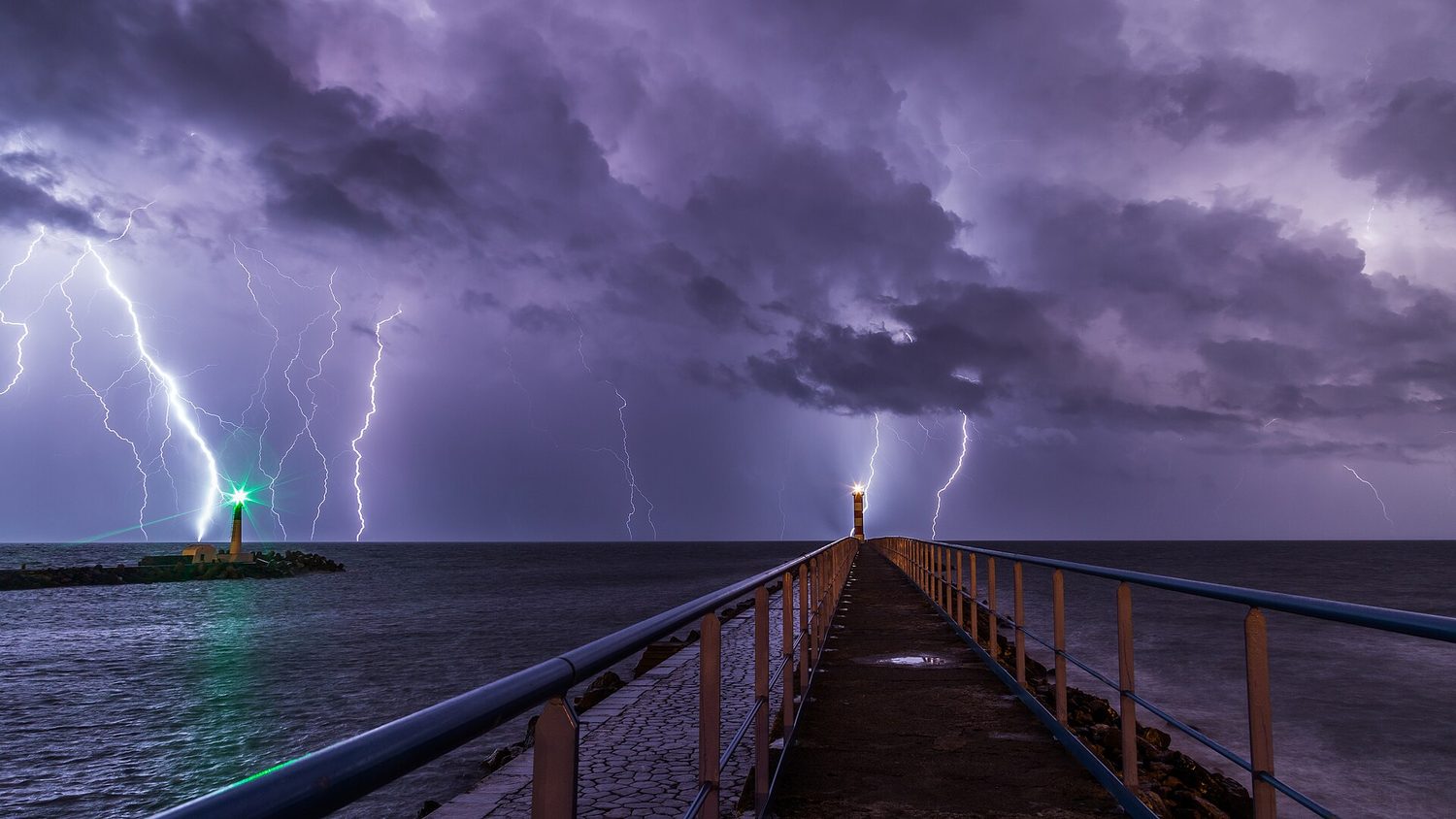
ไทยสนามไฟฟ้าของไดโพล สายฟ้า: ประจุสะสมจนสนามไฟฟ้าระหว่างเมฆและพื้นดินแข็งแกร่งพอที่จะดึงอิเล็กตรอนออกจากโมเลกุลอากาศ และมีกระแสไฟฟ้าขนาดใหญ่ไหลผ่าน สนามไฟฟ้า $\vec{E}$ คือแรงต่อหน่วยประจุที่ประจุทดสอบบวกขนาดเล็กจะรู้สึกได้:
$$\vec{E}=\frac{\vec{F}}{q},\qquad E=\frac{kQ}{r^2}\ \text{for a point charge}.$$เส้นสนามชี้ออกจากประจุบวกและเข้าสู่ประจุลบ;的地方越密,场越强。ประจุในสนามจะรู้สึกถึง $\vec{F}=q\vec{E}$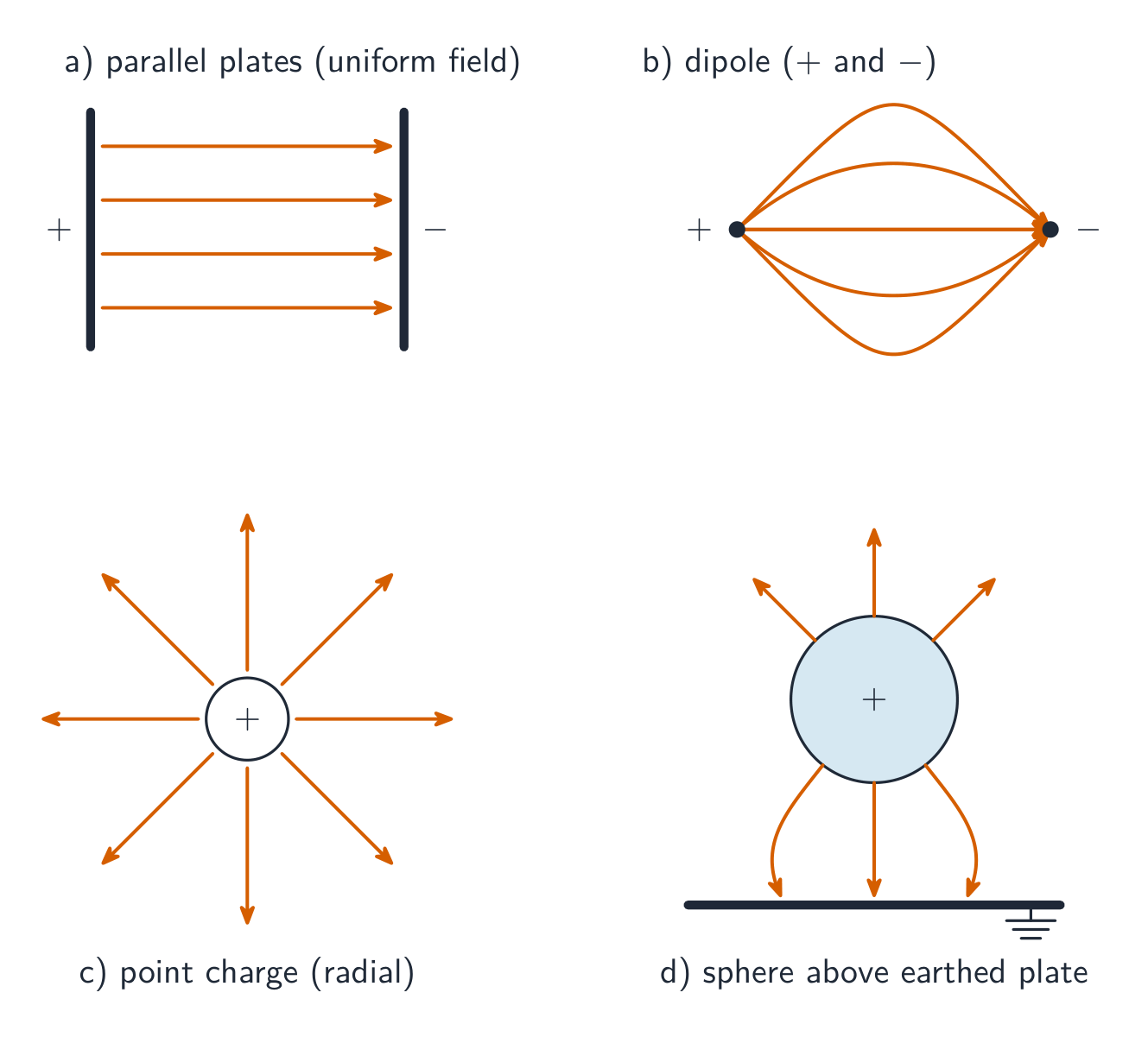
รูปแบบเส้นสนามไฟฟ้าสำหรับแผ่นขนาน Dipole และประจุจุด ตัวอย่างฝึกหัด. หาสนามไฟฟ้า $0.20\ \text{m}$ จากประจุจุด $+5.0\ \mu\text{C}$: $E=\dfrac{kQ}{r^2}=\dfrac{9.0\times10^{9}\times5.0\times10^{-6}}{(0.20)^2}=1.1\times10^{6}\ \text{N/C}$ ชี้ออกจากประจุ. หากวางประจุ $+2\ \text{nC}$ ที่那儿จะรู้สึกถึง $F=qE=2\times10^{-9}\times1.1\times10^{6}=2.2\times10^{-3}\ \text{N}$
Explore · สำรวจMap the field around a charge · แผนที่สนามรอบประจุ
An electric field points the way a positive test charge would be pushed: away from a positive charge, toward a negative one. Closer lines mean a stronger field. · สนามไฟฟ้า ชี้ไปในทิศทางที่ประจุทดสอบบวกจะถูกผลัก: ออกจากประจุบวก เข้าหาประจุลบ เส้นที่ใกล้กันหมายถึงสนามที่แข็งแรงกว่า
Vocabulary · คำศัพท์ Train · ฝึกฝนEnglish ไทย Electric charge/ɪˈlektrɪk tʃɑːdʒ/ ประจุไฟฟ้า Coulomb's law/ˈkuːlɒmz lɔː/ กฎของคูลอม permittivity/ˌpɜːmɪˈtɪvəti/ permittivity conductor/kənˈdʌktə/ ตัวนำ insulator/ˈɪnsjuːleɪtə/ ฉนวน Conduction/kənˈdʌkʃn/ การนำความร้อน Induction/ɪnˈdʌkʃn/ การแนะนำตัว electric field/ɪˈlektrɪk fiːld/ สนามไฟฟ้า electric potential energy/ɪˈlektrɪk pəˈtenʃl ˈenədʒi/ พลังงานศักย์ไฟฟ้า Electric potential/ɪˈlektrɪk pəˈtenʃl/ ศักย์ไฟฟ้า 10.4
Electric Potential Energy · พลังงานศักย์ไฟฟ้า
Syllabus · หลักสูตร
EnglishLearning Objective 10.4.A: Describe the electric potential energy of a system.
- 10.4.A.1 The electric potential energy of a system of two point charges equals the amount of work required for an external force to bring the point charges to their current positions from infinitely far away.
- 10.4.A.2 The general form for the electric potential energy of two charged objects is given by the equation
- Equation: $U_E = \dfrac{1}{4\pi\varepsilon_0}\dfrac{q_1 q_2}{r} = k\dfrac{q_1 q_2}{r}$
- 10.4.A.3 The total electric potential energy of a system can be determined by finding the sum of the electric potential energies of the individual interactions between each pair of charged objects in the system.
Boundary statement: As the methods to calculate the electric potential energy due to extended charge distributions exceed the scope of the course, AP Physics 2 only requires that students calculate the electric potential energy of configurations of four or fewer point charges.
ไทยจุดประสงค์การเรียนรู้ 10.4.A: อธิบายพลังงานศักย์ไฟฟ้าของระบบ
- 10.4.A.1 พลังงานศักย์ไฟฟ้าของระบบประจุจุดสองตัวเท่ากับปริมาณงานที่แรงภายนอกต้องทำเพื่อเคลื่อนย้ายประจุจุดเหล่านั้นจากระยะไกลไม่จำกัดมาสู่ตำแหน่งปัจจุบัน
- 10.4.A.2 รูปแบบทั่วไปของพลังงานศักย์ไฟฟ้าของวัตถุที่มีประจุสองชิ้นถูกกำหนดโดยสมการ
- สมการ: $U_E = \dfrac{1}{4\pi\varepsilon_0}\dfrac{q_1 q_2}{r} = k\dfrac{q_1 q_2}{r}$
- 10.4.A.3 พลังงานศักย์ไฟฟ้ารวมของระบบสามารถหาได้จากการหาผลรวมของพลังงานศักย์ไฟฟ้าของการมีปฏิสัมพันธ์ระหว่างแต่ละคู่ของวัตถุที่มีประจุในระบบ
คำชี้ขอบเขต: เนื่องจากวิธีการคำนวณพลังงานศักย์ไฟฟ้าจากกระจายตัวของประจุขนาดใหญ่เกินขอบเขตของรายวิชา AP Physics 2 จึงกำหนดให้เพียงให้นักเรียนคำนวณพลังงานศักย์ไฟฟ้าของการจัดเรียงประจุจุดสี่ตัวหรือน้อยกว่าเท่านั้น
Source: College Board AP Course and Exam Description · แหล่งที่มา: คำอธิบายหลักสูตรและข้อสอบ College Board AP
EnglishTwo charges have electric potential energy 电势能 stored in their arrangement:
$$U=\frac{k q_1 q_2}{r}.$$Like charges pushed together store positive energy; opposite charges have negative energy (bound). Moving a charge changes $U$, and the electric force does work equal to $-\Delta U$.ไทยประจุสองชนิดมี พลังงานศักย์ไฟฟ้า เก็บอยู่ในการจัดวาง:
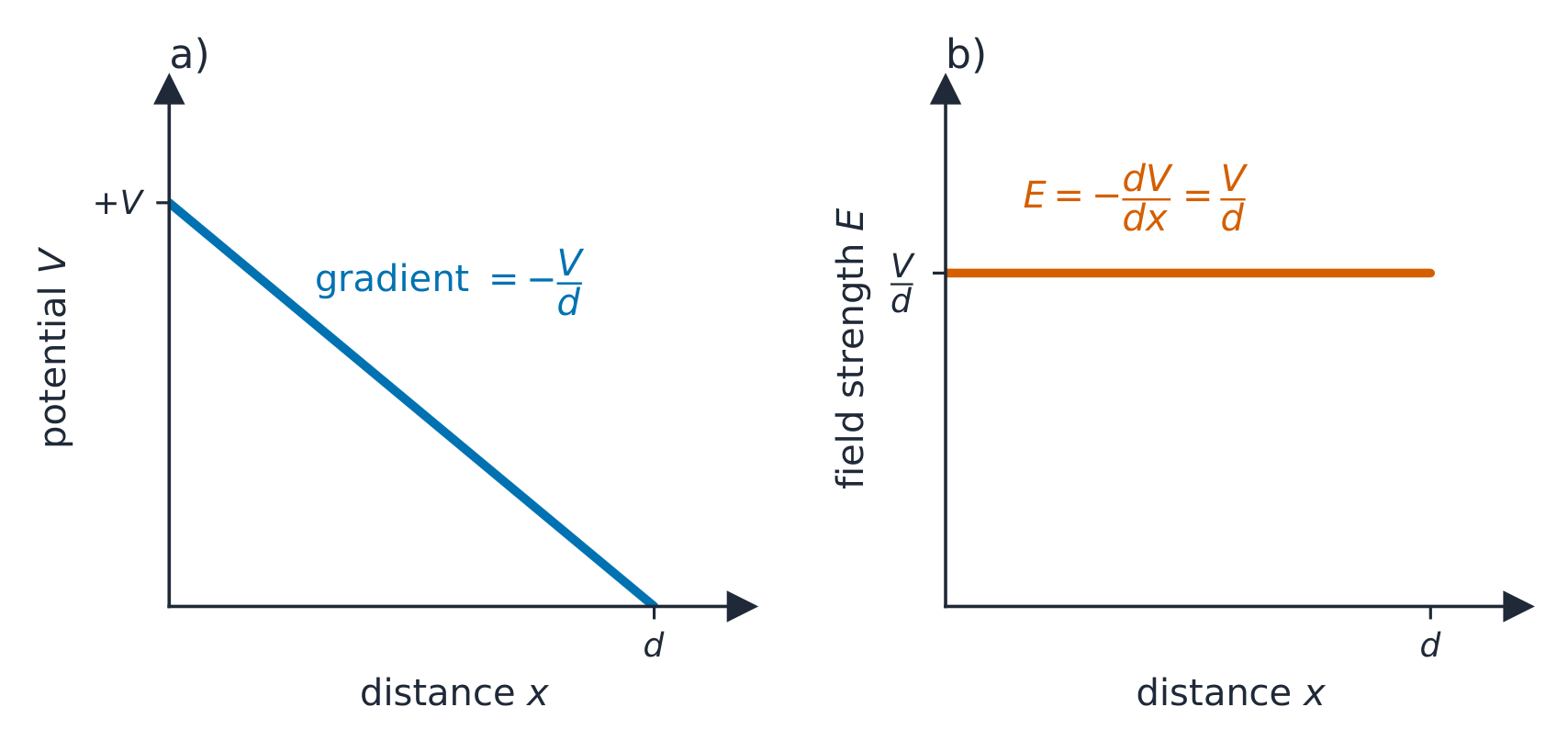
$$U=\frac{k q_1 q_2}{r}.$$ประจุเหมือนกันที่ผลักกันจะเก็บพลังงานบวก; ประจุตรงข้ามจะมีพลังงานลบ (ถูกผูกมัด) การเคลื่อนย้ายประจุจะเปลี่ยน $U$, และแรงไฟฟ้าจะทำ功เท่ากับ $-\Delta U$.ในสนามสม่ำเสมอ ศักย์จะลดลงอย่างต่อเนื่องตามระยะทาง ดังนั้น E จึงสัมพันธ์กับ V 10.5
Electric Potential · ศักย์ไฟฟ้า
Syllabus · หลักสูตร
EnglishLearning Objective 10.5.A: Describe the electric potential due to a configuration of charged objects.
- 10.5.A.1 Electric potential describes the electric potential energy per unit charge at a point in space.
- 10.5.A.2 The electric potential due to multiple point charges can be determined by the principle of scalar superposition of the electric potential due to each of the point charges.
- Equation: $V = \dfrac{1}{4\pi\varepsilon_0}\sum_{i}\dfrac{q_i}{r_i}$
- 10.5.A.3 The electric potential difference between two points is the change in electric potential energy per unit charge when a test charge is moved between the two points.
- Equation: $\Delta V = \dfrac{\Delta U_E}{q}$
- 10.5.A.3.i Electric potential difference may also result from chemical processes that cause positive and negative charges to separate, such as in a battery.
- 10.5.A.4 When conductors are in electrical contact, electrons will be redistributed such that the surfaces of the conductors are at the same electric potential.
Learning Objective 10.5.B: Describe the relationship between electric potential and electric field.
- 10.5.B.1 The average electric field between two points in space is equal to the electric potential difference between the two points divided by the distance between the two points.
- Equation: $\left|\vec{E}\right| = \left|\dfrac{\Delta V}{\Delta r}\right|$
- 10.5.B.2 Electric field vector maps and equipotential lines are tools to describe the field produced by a charge or configuration of charges and can be used to predict the motion of charged objects in the field.
- 10.5.B.2.i Equipotential lines represent lines of equal electric potential in space. These lines are also referred to as isolines of electric potential.
- 10.5.B.2.ii Isolines are perpendicular to electric field vectors. An isoline map of electric potential can be constructed from an electric field vector map, and an electric field map may be constructed from an isoline map.
- 10.5.B.2.iii An electric field vector points in the direction of decreasing potential.
- 10.5.B.2.iv There is no component of an electric field along an isoline.
Boundary statement: As the methods to calculate the electric potential due to extended charges exceed the scope of the course, AP Physics 2 only expects that students calculate the electric potential of configurations of four or fewer particles (or more in situations of high symmetry).
ไทยจุดประสงค์การเรียนรู้ 10.5.A: อธิบายศักย์ไฟฟ้าที่เกิดจากการจัดเรียงวัตถุที่มีประจุ
- 10.5.A.1 ศักย์ไฟฟ้าอธิบายถึงพลังงานศักย์ไฟฟ้าต่อหน่วยประจุ ณ จุดหนึ่งในอวกาศ
- 10.5.A.2 ศักย์ไฟฟ้าจากประจุจุดหลายตัวสามารถหาได้จากหลักการซ้อนทับสเกลาร์ (scalar superposition) ของศักย์ไฟฟ้าจากประจุจุดแต่ละตัว
- สมการ: $V = \dfrac{1}{4\pi\varepsilon_0}\sum_{i}\dfrac{q_i}{r_i}$
- 10.5.A.3 ความต่างศักย์ไฟฟ้าระหว่างสองจุดคือการเปลี่ยนแปลงของพลังงานศักย์ไฟฟ้าต่อหน่วยประจุเมื่อเคลื่อนย้ายประจุทดสอบระหว่างสองจุดนั้น
- สมการ: $\Delta V = \dfrac{\Delta U_E}{q}$
- 10.5.A.3.i ความต่างศักย์ไฟฟ้าอาจเกิดจากกระบวนการทางเคมีที่ทำให้ประจุบวกและประจุลบแยกออกจากกัน เช่น ในแบตเตอรี่
- 10.5.A.4 เมื่อตัวนำอยู่ในสภาพสัมผัสทางไฟฟ้า อิเล็กตรอนจะมีการจัดเรียงใหม่จนผิวด้านบนของตัวนำเหล่านี้มีศักย์ไฟฟ้าเท่ากัน
จุดประสงค์การเรียนรู้ 10.5.B: อธิบายความสัมพันธ์ระหว่างศักย์ไฟฟ้ากับสนามไฟฟ้า
- 10.5.B.1 สนามไฟฟ้าเฉลี่ยระหว่างสองจุดในอวกาศเท่ากับความต่างศักย์ไฟฟ้าระหว่างสองจุดนั้นหารด้วยระยะห่างระหว่างสองจุดนั้น
- สมการ: $\left|\vec{E}\right| = \left|\dfrac{\Delta V}{\Delta r}\right|$
- 10.5.B.2 แผนที่เวกเตอร์สนามไฟฟ้าและเส้น equipotential เป็นเครื่องมือในการอธิบายสนามที่เกิดจากประจุหรือการจัดเรียงของประจุ และสามารถใช้ทำนายการเคลื่อนที่ของวัตถุที่มีประจุในสนามนั้นได้
- 10.5.B.2.i เส้น equipotential แทนเส้นที่มีค่าศักย์ไฟฟ้าเท่ากันในอวกาศ เส้นเหล่านี้ยังเรียกว่า isolines ของศักย์ไฟฟ้า
- 10.5.B.2.ii Isolines ตั้งฉากกับเวกเตอร์สนามไฟฟ้า สามารถสร้างแผนที่ isolines ของศักย์ไฟฟ้าจากแผนที่เวกเตอร์สนามไฟฟ้าได้ และสามารถสร้างแผนที่สนามไฟฟ้าจากแผนที่ isolines ได้เช่นกัน
- 10.5.B.2.iii เวกเตอร์สนามไฟฟ้าชี้ไปในทิศทางที่ศักย์ไฟฟ้าลดลง
- 10.5.B.2.iv ไม่มีองค์ประกอบของสนามไฟฟ้าตามแนวเส้น isoline
คำชี้ขอบเขต: เนื่องจากวิธีการคำนวณศักย์ไฟฟ้าจากประจุขนาดใหญ่เกินขอบเขตของรายวิชา AP Physics 2 จึงคาดหวังว่านักเรียนจะคำนวณศักย์ไฟฟ้าของการจัดเรียงอนุภาคสี่ตัวหรือน้อยกว่าเท่านั้น (หรือมากกว่าในสถานการณ์ที่มีความสมมาตรสูง)
Source: College Board AP Course and Exam Description · แหล่งที่มา: คำอธิบายหลักสูตรและข้อสอบ College Board AP
EnglishElectric potential 电势 $V$ is the potential energy per unit charge – a scalar field, measured in volts:
$$V=\frac{U}{q}=\frac{kQ}{r}.$$The potential difference (voltage) 电压 between two points is the work per unit charge to move between them: $\Delta V=\dfrac{\Delta U}{q}$, and $U=qV$. Positive charges move from high to low potential on their own. Because potential is a scalar, adding the potentials from several charges is much easier than adding field vectors.ไทยศักย์ไฟฟ้า $V$ คือพลังงานศักย์ต่อหน่วยประจุ – เป็นสเกลาร์ฟังก์ชัน, วัดเป็นโวลต์:
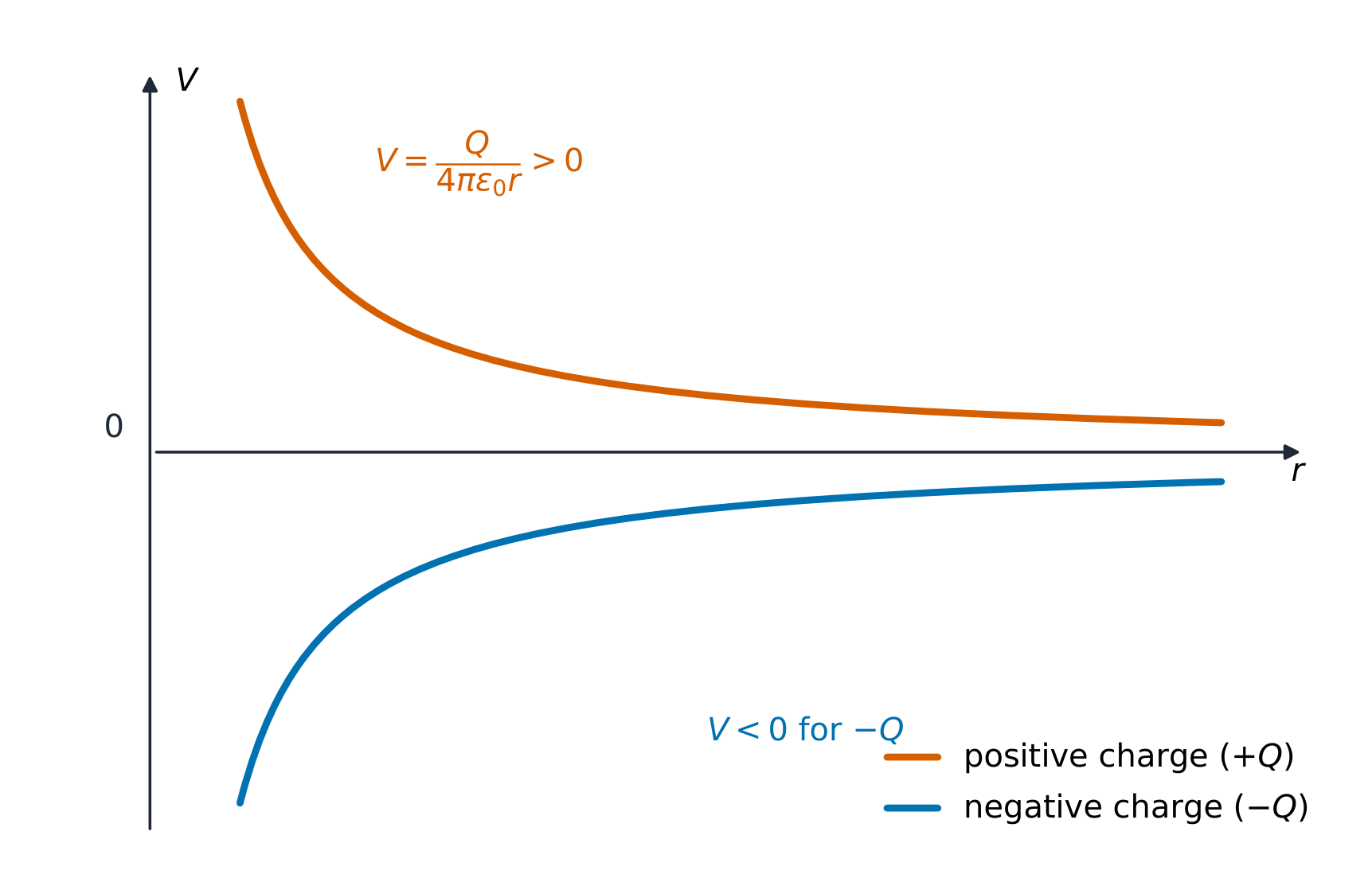
$$V=\frac{U}{q}=\frac{kQ}{r}.$$ผลต่างศักย์ (แรงดันไฟฟ้า) ระหว่างจุดสองจุดคืองานต่อหน่วยประจุในการเคลื่อนระหว่างจุดนั้น: $\Delta V=\dfrac{\Delta U}{q}$, และ $U=qV$. ประจุบวกจะเคลื่อนจากศักย์สูงไปต่ำโดยธรรมชาติ เนื่องจากศักย์เป็น สเกลาร์, การรวมศักย์จากหลายประจุจึงง่ายกว่าการบวกเวกเตอร์สนามมาก.ศักย์ใกล้ประจุจุดแปรผันตาม 1/r 10.6
Capacitors · ตัวเก็บประจุ
Syllabus · หลักสูตร
EnglishLearning Objective 10.6.A: Describe the physical properties of a parallel-plate capacitor.
- 10.6.A.1 A parallel-plate capacitor consists of two separated parallel conducting surfaces that can hold equal amounts of charge with opposite signs.
- 10.6.A.2 Capacitance relates the magnitude of the charge stored on each plate to the electric potential difference created by the separation of those charges.
- Equation: $C = \dfrac{Q}{\Delta V}$
- 10.6.A.2.i The capacitance of a capacitor depends only on the physical properties of the capacitor, such as the capacitor's shape and the material used to separate the plates.
- 10.6.A.2.ii The capacitance of a parallel-plate capacitor is proportional to the area of one of its plates and inversely proportional to the distance between its plates. The constant of proportionality is the product of the dielectric constant, $\kappa$, of the material between the plates and the electric permittivity of free space, $\varepsilon_0$.
- Equation: $C = \kappa\varepsilon_0\dfrac{A}{d}$
- 10.6.A.3 The electric field between two charged parallel plates with uniformly distributed electric charge, such as in a parallel-plate capacitor, is constant in both magnitude and direction, except near the edges of the plates.
- 10.6.A.3.i The magnitude of the electric field between two charged parallel plates, where the plate separation is much smaller than the dimensions of the plates, can be described with the equation
- Equation: $E_C = \dfrac{Q}{\kappa\varepsilon_0 A}$
- 10.6.A.3.ii A charged particle between two oppositely charged parallel plates undergoes constant acceleration and therefore its motion shares characteristics with the projectile motion of an object with mass in the gravitational field near Earth's surface.
- 10.6.A.3.i The magnitude of the electric field between two charged parallel plates, where the plate separation is much smaller than the dimensions of the plates, can be described with the equation
- 10.6.A.4 The electric potential energy stored in a capacitor is equal to the work done by an external force to separate that amount of charge on the capacitor.
- 10.6.A.5 The electric potential energy stored in a capacitor is described by the equation
- Equation: $U_C = \dfrac{1}{2}Q\Delta V$
- 10.6.A.6 Adding a dielectric between two plates of a capacitor changes the capacitance of the capacitor and induces an electric field in the dielectric in the opposite direction to the field between the plates.
Boundary statement: While other shapes are also able to separate charges, only the analysis and descriptions of parallel-plate capacitors are required for AP Physics 2. Edge effects will be ignored unless explicitly stated otherwise.
ไทยจุดประสงค์การเรียนรู้ 10.6.A: อธิบายคุณสมบัติทางกายภาพของตัวเก็บประจุแบบแผ่นขนาน
- 10.6.A.1 ตัวเก็บประจุแบบแผ่นขนานประกอบด้วยพื้นผิวตัวนำขนานสองชั้นที่แยกออกจากกัน ซึ่งสามารถเก็บประจุได้ในปริมาณเท่ากันแต่มีสัญญาณตรงข้ามกัน
- 10.6.A.2 ความจุไฟฟ้าเชื่อมโยงขนาดของประจุที่เก็บไว้บนแผ่นแต่ละด้านกับความต่างศักย์ไฟฟ้าที่เกิดจากการแยกประจุเหล่านั้น
- สมการ: $C = \dfrac{Q}{\Delta V}$
- 10.6.A.2.i ความจุไฟฟ้าของตัวเก็บประจุขึ้นอยู่กับคุณสมบัติทางกายภาพของตัวเก็บประจุเท่านั้น เช่น รูปร่างของตัวเก็บประจุและวัสดุที่ใช้แยกแผ่นทั้งสอง
- 10.6.A.2.ii ความจุไฟฟ้าของตัวเก็บประจุแบบแผ่นขนานแปรผันตรงกับพื้นที่ของแผ่นด้านหนึ่ง และแปรผกผันกับระยะห่างระหว่างแผ่น ค่าคงที่แปรผันคือผลคูณของค่าคงที่ไดอิเล็กทริก $\kappa$ ของวัสดุระหว่างแผ่นและความจุนำไฟฟ้าของสุญญากาศ $\varepsilon_0$
- สมการ: $C = \kappa\varepsilon_0\dfrac{A}{d}$
- 10.6.A.3 สนามไฟฟ้าระหว่างแผ่นตัวนำขนานที่มีประจุสองด้านซึ่งมีการกระจายตัวของประจุไฟฟ้าสม่ำเสมอ (เช่น ในตัวเก็บประจุแบบแผ่นขนาน) จะมีทั้งขนาดและทิศทางคงที่ ยกเว้นบริเวณใกล้ขอบแผ่น
- 10.6.A.3.i ขนาดของความเข้มสนามไฟฟ้าระหว่างแผ่นขนานที่มีประจุ ซึ่งระยะห่างระหว่างแผ่นน้อยกว่าขนาดของแผ่นมาก สามารถอธิบายได้ด้วยสมการ
- สมการ: $E_C = \dfrac{Q}{\kappa\varepsilon_0 A}$
- 10.6.A.3.ii อนุภาคที่มีประจุระหว่างแผ่นตัวนำขนานที่มีประจุตรงข้ามกันจะมีความเร่งคงที่ ดังนั้นการเคลื่อนที่ของมันจึงมีลักษณะคล้ายกับการเคลื่อนที่แบบโปรเจกไทล์ของวัตถุที่มีมวลในสนามโน้มถ่วงใกล้พื้นผิวโลก
- 10.6.A.3.i ขนาดของความเข้มสนามไฟฟ้าระหว่างแผ่นขนานที่มีประจุ ซึ่งระยะห่างระหว่างแผ่นน้อยกว่าขนาดของแผ่นมาก สามารถอธิบายได้ด้วยสมการ
- 10.6.A.4 พลังงานศักย์ไฟฟ้าที่เก็บไว้ในตัวเก็บประจุเท่ากับงานที่ทำโดยแรงภายนอกเพื่อแยกประจุจำนวนนั้นออกจากตัวเก็บประจุ
- 10.6.A.5 พลังงานศักย์ไฟฟ้าที่เก็บไว้ในตัวเก็บประจุถูกอธิบายด้วยสมการ
- สมการ: $U_C = \dfrac{1}{2}Q\Delta V$
- 10.6.A.6 การใส่ไดอิเล็กทริกระหว่างแผ่นของตัวเก็บประจุจะเปลี่ยนความจุไฟฟ้าของตัวเก็บประจุและเหนี่ยวนำให้เกิดสนามไฟฟ้าในไดอิเล็กทริกซึ่งมีทิศทางตรงข้ามกับสนามไฟฟ้าระหว่างแผ่น
คำชี้ขอบเขต: แม้รูปร่างอื่น ๆ ก็สามารถแยกประจุได้เช่นกัน แต่สำหรับการเรียน AP Physics 2 กำหนดให้วิเคราะห์และอธิบายเฉพาะตัวเก็บประจุแบบแผ่นขนานเท่านั้น ผลกระทบจากขอบแผ่นจะถูกละเว้นเว้นแต่จะระบุไว้เป็นลายลักษณ์อักษร
Source: College Board AP Course and Exam Description · แหล่งที่มา: คำอธิบายหลักสูตรและข้อสอบ College Board AP
EnglishDischarging a capacitor: τ = RC Charging a capacitor (RC) A capacitor 电容器 stores charge and energy on two conductors separated by a gap. Its capacitance 电容 relates charge to voltage:
$$C=\frac{Q}{V},$$and the stored energy is $U=\tfrac{1}{2}CV^2$. Capacitance depends on the plates' geometry and the material between them, not on the charge placed on it.Worked example. A $100\ \mu\text{F}$ capacitor is charged to $12\ \text{V}$. It holds $Q=CV=100\times10^{-6}\times12=1.2\times10^{-3}\ \text{C}$ of charge and stores $U=\tfrac12 CV^2=\tfrac12\times100\times10^{-6}\times12^2=7.2\times10^{-3}\ \text{J}$ of energy.
ไทยการคายประจุของตัวเก็บประจุ: τ = RC การชาร์จตัวเก็บประจุ (RC) ตัวเก็บประจุ เก็บประจุและพลังงานบนตัวนำสองชนิดที่แยกด้วยช่องว่าง ความจุไฟฟ้า ของมันเชื่อมโยงประจุกับแรงดันไฟฟ้า:
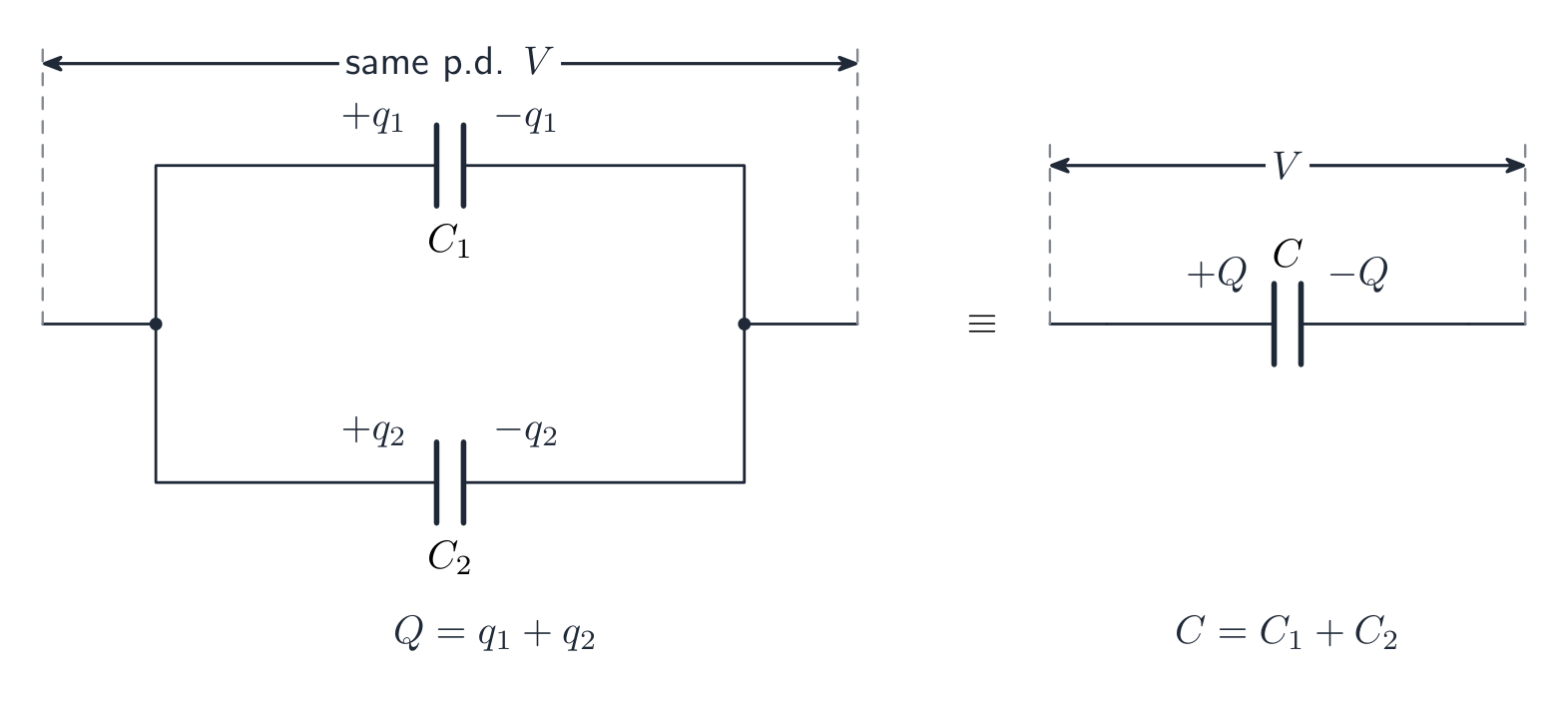
$$C=\frac{Q}{V},$$และพลังงานที่เก็บไว้คือ $U=\tfrac{1}{2}CV^2$. ความจุไฟฟ้าขึ้นอยู่กับเรขาคณิตของแผ่นและวัสดุระหว่างมัน ไม่ใช่ขึ้นกับประจุที่ถูกใส่เข้าไป.ตัวเก็บประจุแบบขนานแบ่งปัน p.d. เหมือนกัน และประจุของพวกมันรวมกัน ตัวอย่างวิธีทำ. ตัวเก็บประจุ $100\ \mu\text{F}$ ถูกชาร์จถึง $12\ \text{V}$. มันมี $Q=CV=100\times10^{-6}\times12=1.2\times10^{-3}\ \text{C}$ ของประจุและเก็บ $U=\tfrac12 CV^2=\tfrac12\times100\times10^{-6}\times12^2=7.2\times10^{-3}\ \text{J}$ ของพลังงาน.
Explore · สำรวจCharge and discharge a capacitor · ชาร์จและคายประจุตัวเก็บประจุ
A capacitor stores charge on two plates. It fills and empties exponentially, set by the time constant $\tau = RC$ — bigger $R$ or $C$ means slower charging. · ตัวเก็บประจุ เก็บประจุไว้บนแผ่นทองแดงสองแผ่น มันจะชาร์จและคายประจุแบบเอ็กซ์โพเนนเชียล ซึ่งกำหนดโดย ค่าคงที่เวลา $\tau = RC$ — ค่า $R$ หรือ $C$ ที่ใหญ่ขึ้นหมายถึงการชาร์จที่ช้าลง
Vocabulary · คำศัพท์ Train · ฝึกฝนEnglish ไทย capacitor/kəˈpæsɪtə/ ตัวเก็บประจุ capacitance/kəˈpæsɪtəns/ ความจุไฟฟ้า 10.7
Conservation of Electric Energy · การอนุรักษ์พลังงานไฟฟ้า
Syllabus · หลักสูตร
EnglishLearning Objective 10.7.A: Describe changes in energy in a system due to a difference in electric potential between two locations.
- 10.7.A.1 When a charged object moves between two locations with different electric potentials, the resulting change in the electric potential energy of the object-field system is given by the following equation.
- Equation: $\Delta U_E = q\Delta V$
- 10.7.A.2 The movement of a charged object between two points with different electric potentials results in a change in kinetic energy of the object consistent with the conservation of energy.
ไทยจุดประสงค์การเรียนรู้ 10.7.A: อธิบายการเปลี่ยนแปลงของพลังงานในระบบอันเนื่องมาจากความต่างศักย์ไฟฟ้าระหว่างสองตำแหน่ง
- 10.7.A.1 เมื่อวัตถุที่มีประจุเคลื่อนที่ระหว่างสองตำแหน่งที่มีความต่างศักย์ไฟฟ้าต่างกัน การเปลี่ยนแปลงพลังงานศักย์ไฟฟ้าของระบบวัตถุ-สนามจะกำหนดโดยสมการดังนี้
- สมการ: $\Delta U_E = q\Delta V$
- 10.7.A.2 การเคลื่อนที่ของวัตถุที่มีประจุระหว่างสองจุดที่มีความต่างศักย์ไฟฟ้าต่างกัน จะส่งผลให้เกิดการเปลี่ยนแปลงพลังงานจลน์ของวัตถุนั้นสอดคล้องกับกฎการอนุรักษ์พลังงาน
Source: College Board AP Course and Exam Description · แหล่งที่มา: คำอธิบายหลักสูตรและข้อสอบ College Board AP
EnglishEnergy is conserved for charges just as for masses. A charge released in a field converts electric potential energy into kinetic energy:
$$q\,\Delta V=\tfrac{1}{2}mv^2 \quad(\text{gaining speed as it "falls" through a potential difference}).$$Worked example. An electron ($q=1.6\times10^{-19}\ \text{C}$, $m=9.1\times10^{-31}\ \text{kg}$) is accelerated from rest through a potential difference of $100\ \text{V}$. Its final speed is
$$v=\sqrt{\frac{2q\,\Delta V}{m}}=\sqrt{\frac{2\times1.6\times10^{-19}\times100}{9.1\times10^{-31}}}=5.9\times10^{6}\ \text{m/s}.$$This is exactly how the electron gun in an old television or an electron microscope works.ไทยพลังงานถูกอนุรักษ์สำหรับประจุเช่นเดียวกับมวล ประจุที่ปล่อยในสนามจะแปลงพลังงานศักย์ไฟฟ้าเป็นพลังงานจลน์:
$$q\,\Delta V=\tfrac{1}{2}mv^2 \quad(\text{gaining speed as it "falls" through a potential difference}).$$ตัวอย่างวิธีทำ. อิเล็กตรอน ($q=1.6\times10^{-19}\ \text{C}$, $m=9.1\times10^{-31}\ \text{kg}$) เร่งความเร็วจากหยุดนิ่งผ่านผลต่างศักย์ $100\ \text{V}$. ความเร็วสุดท้ายของมันคือ
$$v=\sqrt{\frac{2q\,\Delta V}{m}}=\sqrt{\frac{2\times1.6\times10^{-19}\times100}{9.1\times10^{-31}}}=5.9\times10^{6}\ \text{m/s}.$$นี่คือวิธีทำงานของปืนอิเล็กตรอนในโทรทัศน์เก่าหรือกล้องจุลทรรศน์อิเล็กตรอนVocabulary · คำศัพท์ Train · ฝึกฝนEnglish ไทย potential difference/pəˈtenʃl ˈdɪfrəns/ ต่างศักย์ 10.7
Exam tips · ข้อแนะนำสำหรับการสอบ
English- Coulomb's law and the point-charge field are inverse-square — doubling the separation makes the force (or field) four times smaller.
- Use magnitudes for the size of a force and decide direction from the signs; the field points the way a positive test charge would move.
- Potential ($V$) is a scalar so potentials from several charges simply add; the field ($E$) is a vector and must be added by direction.
- For a charge accelerated through a voltage use energy conservation $qV=\tfrac12 mv^2$.
- Capacitor relations: $C=Q/V$ (capacitance is fixed by geometry) and energy $U=\tfrac12 CV^2$.
ไทย- กฎของคูลอมบ์ และสนามประจุ点是 กำลังสองผกผัน – การเพิ่มระยะห่างเป็นสองเท่าจะทำให้แรง (หรือสนาม) น้อยลงสี่เท่า.
- ใช้ขนาดเพื่อหาขนาดของแรงและตัดสินใจทิศทางจาก เครื่องหมาย; สนามชี้ไปในทิศทางที่ประจุทดสอบ บวก จะเคลื่อน
- ศักย์ ($V$) เป็นสเกลาร์ ดังนั้นศักย์จากหลายประจุจึงรวมกันได้โดยตรง; สนาม ($E$) เป็นเวกเตอร์ ต้องบวกตามทิศทาง.
- สำหรับประจุที่เร่งผ่านแรงดันไฟฟ้า ให้ใช้การอนุรักษ์พลังงาน $qV=\tfrac12 mv^2$.
- ความสัมพันธ์ของตัวเก็บประจุ: $C=Q/V$ (ความจุไฟฟ้ากำหนดโดยเรขาคณิต) และพลังงาน $U=\tfrac12 CV^2$.
- 10.1.A.1 Charge is a fundamental property of all matter.
-
11
Electric Circuits · วงจรไฟฟ้า
Watch lesson · ดูบทเรียน11.1
Electric Current · กระแสไฟฟ้า
Syllabus · หลักสูตร
EnglishLearning Objective 11.1.A: Describe the movement of electric charges through a medium.
- 11.1.A.1 Current is the rate at which charge passes through a cross-sectional area of a wire.
- Equation: $I = \dfrac{\Delta q}{\Delta t}$
- 11.1.A.1.i Electric charge moves in a circuit in response to an electric potential difference, sometimes referred to as electromotive force, or $\mathrm{emf}$ ($\varepsilon$).
- 11.1.A.1.ii If the current is zero in a section of wire, the net motion of charge carriers in the wire is also zero, although individual charge carriers will not have zero speed.
- 11.1.A.2 Although current is not a vector quantity, it does have a direction. The direction of current is associated with what the motion of positive charge would be but not with any coordinate system in space.
- 11.1.A.2.i The direction of conventional current is chosen to be the direction in which positive charge would move.
- 11.1.A.2.ii In common circuits, current is actually due to the movement of electrons (negative charge carriers).
ไทยจุดประสงค์การเรียนรู้ 11.1.A: อธิบายการเคลื่อนที่ของประจุไฟฟ้าผ่านตัวกลาง
- 11.1.A.1 กระแสไฟฟ้าคืออัตราการไหลของประจุไฟฟ้าที่ผ่านพื้นที่หน้าตัดของสายไฟ
- สมการ: $I = \dfrac{\Delta q}{\Delta t}$
- 11.1.A.1.i ประจุไฟฟ้าเคลื่อนที่ในวงจรตามความต่างศักย์ไฟฟ้า ซึ่งบางครั้งเรียกว่า แรงดันไฟฟ้า หรือ $\mathrm{emf}$ ($\varepsilon$)
- 11.1.A.1.ii หากกระแสไฟฟ้าเป็นศูนย์ในส่วนหนึ่งของสายไฟ การเคลื่อนที่สุทธิของตัวพาประจุในสายไฟจะเป็นศูนย์เช่นกัน แม้ rằngตัวพาประจุแต่ละตัวจะมีไม่มีความเร็วเป็นศูนย์
- 11.1.A.2 แม้ว่ากระแสไฟฟ้าจะไม่ใช่ปริมาณเวกเตอร์ แต่ก็มีทิศทาง ทิศทางของกระแสไฟฟ้าสัมพันธ์กับการเคลื่อนที่ของประจุบวก แต่ไม่สัมพันธ์กับระบบพิกัดใดๆ ในอวกาศ
- 11.1.A.2.i ทิศทางของกระแสไฟฟ้าแบบดั้งเดิมถูกกำหนดให้เป็นทิศทางการเคลื่อนที่ของประจุบวก
- 11.1.A.2.ii ในวงจรทั่วไป กระแสไฟฟ้าเกิดจากการเคลื่อนที่ของอิเล็กตรอน (ตัวพาประจุลบ) จริงๆ
Source: College Board AP Course and Exam Description · แหล่งที่มา: คำอธิบายหลักสูตรและข้อสอบ College Board AP
EnglishElectric current 电流 is the rate at which charge flows past a point, measured in amperes 安培 (A):
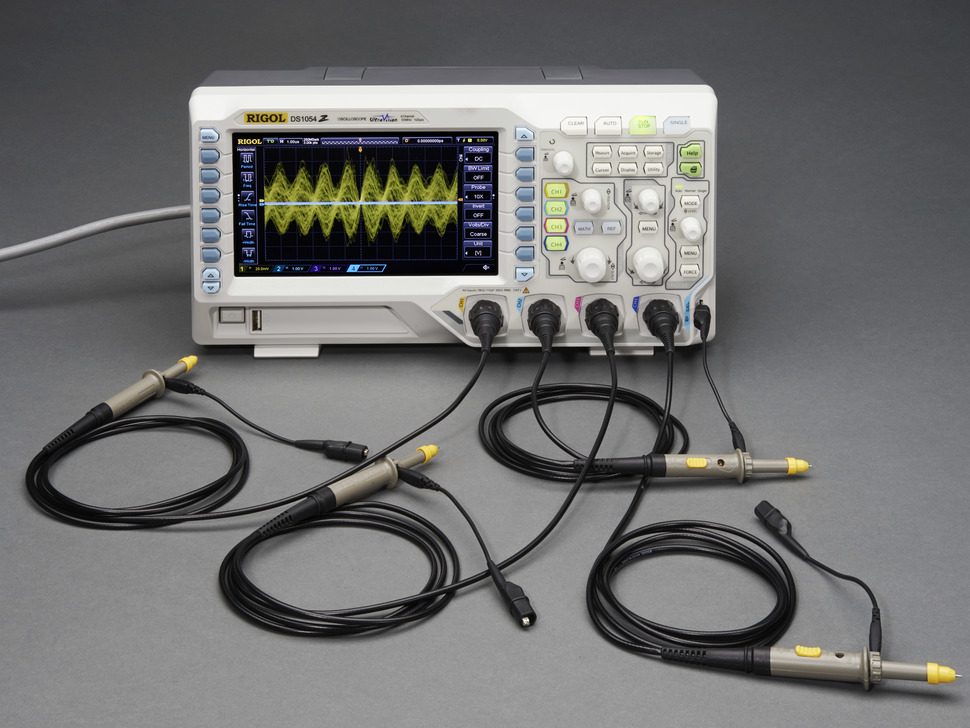
$$I=\frac{\Delta q}{\Delta t}.$$By convention, current points the way positive charge would move (opposite to the electrons in a wire). A steady current needs a complete loop and an energy source (a battery's electromotive force, or emf).ไทยออสซิลโลสโคป: พฤติกรรมของวงจรเมื่อเวลาผ่านไปวัดเป็นแรงดันเทียบกับเวลา กระแสไฟฟ้า คืออัตราที่ประจุไหลผ่านจุดหนึ่ง, วัดเป็น แอมแปร์ (A):
$$I=\frac{\Delta q}{\Delta t}.$$ตามธรรมเนียม กระแสชี้ไปในทิศทางที่ประจุ บวก จะเคลื่อน (ตรงข้ามกับอิเล็กตรอนในสายไฟ) กระแสคงที่ต้องมีวงปิดและแหล่งพลังงาน (แรงดันไฟฟ้าของแบตเตอรี่ หรือ emf).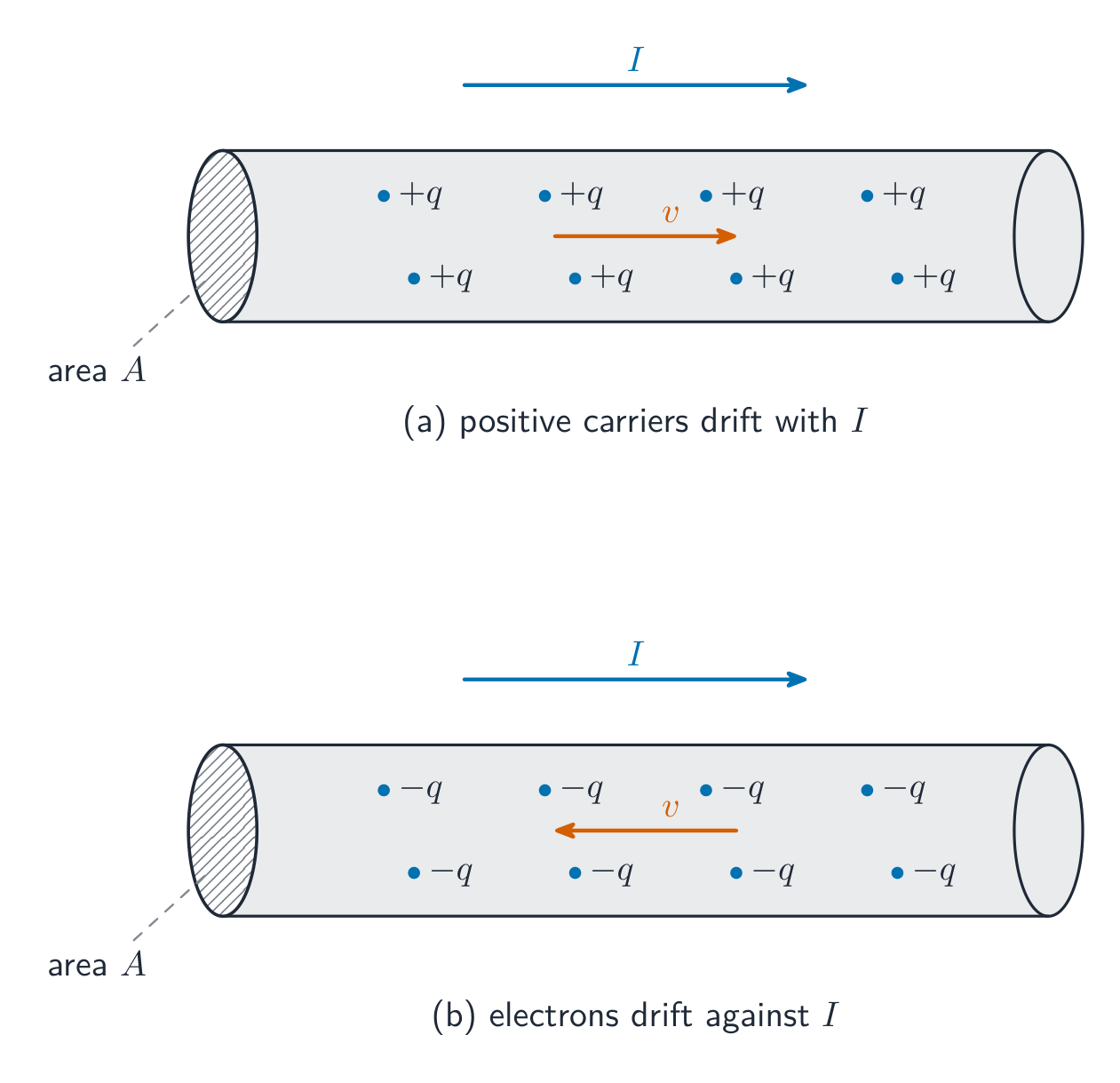
ตัวพาประจุลอยตัวช้าๆ ผ่านตัวนำเพื่อสร้างกระแส 11.2
Simple Circuits · วงจรอย่างง่าย
Syllabus · หลักสูตร
EnglishLearning Objective 11.2.A: Describe the behavior of a circuit.
- 11.2.A.1 A circuit is composed of electrical loops, which may include circuit elements such as wires, batteries, resistors, lightbulbs, capacitors, switches, ammeters, and voltmeters.
- 11.2.A.2 A closed electrical loop is a closed path through which charges may flow.
- 11.2.A.2.i A closed circuit is one in which charges would be able to flow.
- 11.2.A.2.ii An open circuit is one in which charges would not be able to flow.
- 11.2.A.2.iii A short circuit is one in which charges would be able to flow with no change in potential difference.
- 11.2.A.3 A single circuit element may be part of multiple electrical loops.
- 11.2.A.4 Circuit schematics are representations used to describe and analyze electric circuits.
- 11.2.A.4.i The properties of an electric circuit are dependent on the physical arrangement of its constituent elements.
- 11.2.A.4.ii Circuit elements have common symbols that are used to create schematic diagrams. Variable elements are indicated by a diagonal strikethrough arrow across the standard symbol for that element. (Standard symbols: Battery, Bulb, Switch, Capacitor, Resistor, Ammeter, Voltmeter.)
Boundary statement: Unless otherwise specified, all circuit schematic diagrams will be drawn using conventional current.
ไทยจุดประสงค์การเรียนรู้ 11.2.A: อธิบายพฤติกรรมของวงจรไฟฟ้า
- 11.2.A.1 วงจรประกอบด้วยวงจรรอบไฟฟ้า ซึ่งอาจประกอบด้วยองค์ประกอบวงจร เช่น สายไฟ แบตเตอรี่ ตัวต้านทาน หลอดไฟ แคลปซิเตอร์ สวิตช์ แอมมิเตอร์ และโวลต์มิเตอร์
- 11.2.A.2 วงจรรอบไฟฟ้าปิดคือเส้นทางปิดที่ประจุสามารถไหลผ่านได้
- 11.2.A.2.i วงจรปิดคือวงจรที่ประจุจะสามารถไหลผ่านได้
- 11.2.A.2.ii วงจรเปิดคือวงจรที่ประจุไม่สามารถไหลผ่านได้
- 11.2.A.2.iii วงจรลัดคือวงจรที่ประจุจะสามารถไหลผ่านได้โดยไม่มีการเปลี่ยนแปลงของความต่างศักย์
- 11.2.A.3 องค์ประกอบวงจรหนึ่งอาจเป็นส่วนหนึ่งของวงจรรอบไฟฟ้าหลายวง
- 11.2.A.4 แผนภาพวงจรใช้เพื่ออธิบายและวิเคราะห์วงจรไฟฟ้า
- 11.2.A.4.i คุณสมบัติของวงจรไฟฟ้าขึ้นอยู่กับการจัดวางทางกายภาพขององค์ประกอบต่างๆ ที่ประกอบกัน
- 11.2.A.4.ii องค์ประกอบวงจรมีสัญลักษณ์มาตรฐานที่ใช้ในการสร้างแผนภาพวงจร องค์ประกอบแปรผันจะแสดงด้วยลูกศรขีดฆ่าทแยงมุมบนสัญลักษณ์มาตรฐานขององค์ประกอบนั้น (สัญลักษณ์มาตรฐาน: แบตเตอรี่, หลอดไฟ, สวิตช์, แคลปซิเตอร์, ตัวต้านทาน, แอมมิเตอร์, โวลต์มิเตอร์)
คำประกาศขอบเขต: เว้นแต่จะระบุไว้เป็นพิเศษ แผนภาพวงจรทั้งหมดจะถูกวาดโดยใช้กระแสไฟฟ้าแบบดั้งเดิม
Source: College Board AP Course and Exam Description · แหล่งที่มา: คำอธิบายหลักสูตรและข้อสอบ College Board AP
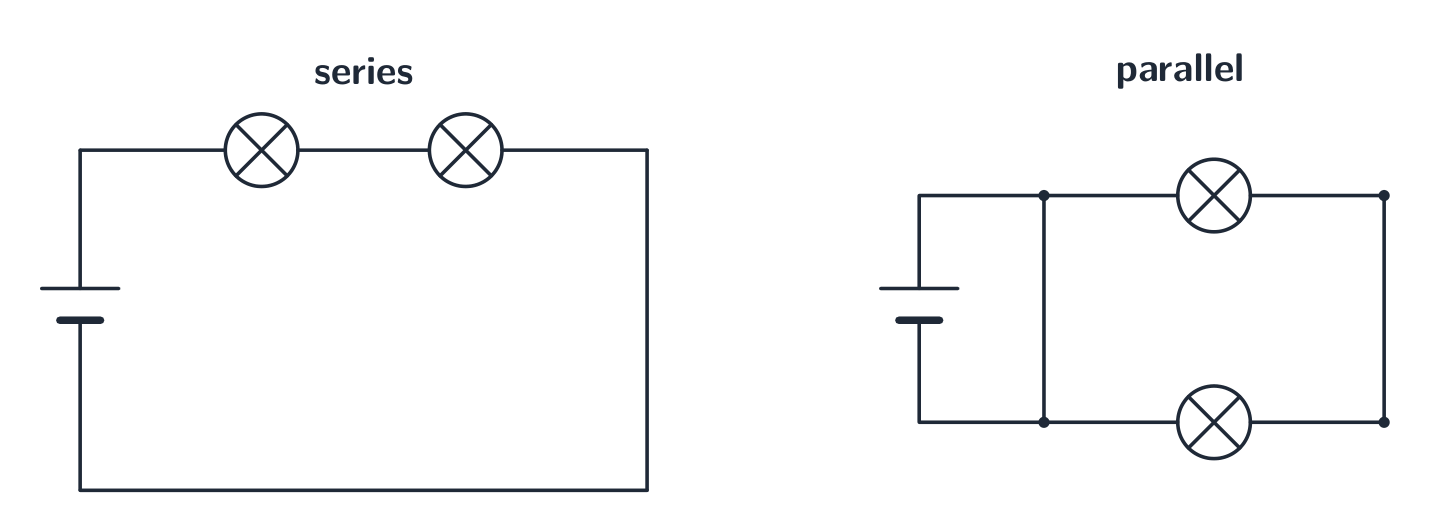
EnglishA circuit is a closed loop of conductors, a source (battery), and components. In a series 串联 path the same current flows through each element; in a parallel 并联 path the same voltage is across each branch. A circuit diagram uses standard symbols; reading it correctly is the first step of any circuit problem.
ไทยวงจร คือวงปิดของตัวนำ แหล่ง (แบตเตอรี่) และส่วนประกอบ ในเส้นทาง อนุกรม กระแสเดียวกันไหลผ่านแต่ละองค์ประกอบ; ในเส้นทาง ขนาน แรงดันเดียวกันอยู่ข้ามแต่ละสาขา แผนภาพวงจรใช้สัญลักษณ์มาตรฐาน; การอ่านมันได้ถูกต้องเป็นขั้นตอนแรกของการแก้ปัญหาวงจรใดๆ
ส่วนประกอบสามารถเชื่อมต่อกันแบบอนุกรมหรือแบบขนาน 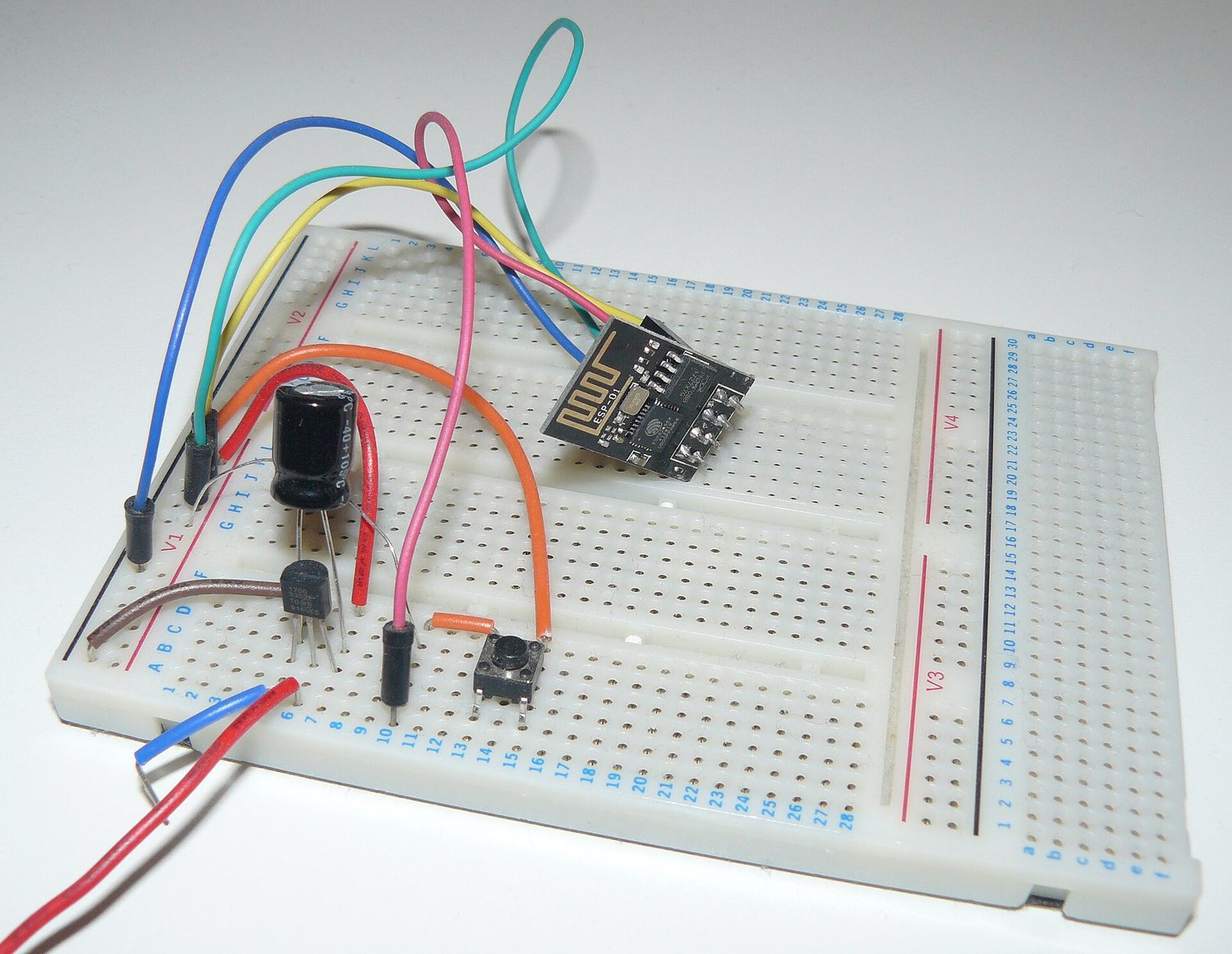
วงจรจริง: ส่วนประกอบเสียบเข้ากับบอร์ดทดลองและเชื่อมต่อด้วยสายเพื่อให้กระแสมีเส้นทางสมบูรณ์ Explore · สำรวจBuild series and parallel circuits · สร้างวงจรแบบอนุกรมและขนาน
In series the same current flows through every bulb and voltage divides; in parallel each branch gets the full voltage. Switch mode to see the bulbs' brightness change. · ใน แบบอนุกรม กระแสไฟเท่ากันไหลผ่านหลอดไฟทุกดวงและแรงดันไฟฟ้าแบ่งกัน; ใน แบบขนาน แต่ละสาขาได้รับแรงดันไฟฟ้าเต็ม สลับโหมดเพื่อดูความสว่างของหลอดไฟเปลี่ยนไป
Vocabulary · คำศัพท์ Train · ฝึกฝนEnglish ไทย Electric current/ɪˈlektrɪk ˈkʌrənt/ กระแสไฟฟ้า amperes/ˈæmpeəz/ แอมแปร์ (amperes) series/ˈsɪəriːz/ 串联电路中 parallel/ˈpærəlel/ 并联电路中 11.3
Resistance, Resistivity, and Ohm's Law · ความต้านทาน, ความต้านทานจำเพาะ, และกฎของโอห์ม
Syllabus · หลักสูตร
EnglishLearning Objective 11.3.A: Describe the resistance of an object using physical properties of that object.
- 11.3.A.1 Resistance is a measure of the degree to which an object opposes the movement of electric charge.
- 11.3.A.2 The resistance of a resistor with uniform geometry is proportional to its resistivity and length and is inversely proportional to its cross-sectional area.
- Equation: $R = \dfrac{\rho \ell}{A}$
- 11.3.A.2.i Resistivity is a fundamental property of a material that depends on its atomic and molecular structure and quantifies how strongly the material opposes the motion of electric charge.
- 11.3.A.2.ii The resistivity of a conductor typically increases with temperature.
Learning Objective 11.3.B: Describe the electrical characteristics of elements of a circuit.
- 11.3.B.1 Ohm's law relates current, resistance, and potential difference across a conductive element of a circuit.
- Equation: $I = \dfrac{\Delta V}{R}$
- 11.3.B.1.i Materials that obey Ohm's law have constant resistance for all currents and are called ohmic materials.
- 11.3.B.1.ii The resistivity of an ohmic material is constant regardless of temperature.
- 11.3.B.1.iii Resistors can also convert electrical energy to thermal energy, which may change the temperature of both the resistor and the resistor's environment.
- 11.3.B.1.iv The resistance of an ohmic circuit element can be determined from the slope of a graph of the current in the element as a function of the potential difference across the element.
ไทยจุดประสงค์การเรียนรู้ 11.3.A: อธิบายความต้านทานของวัตถุโดยใช้คุณสมบัติทางกายภาพของวัตถุนั้น
- 11.3.A.1 ความต้านทานคือตัวบ่งชี้ถึงระดับที่วัตถุขัดขวางการเคลื่อนที่ของประจุไฟฟ้า
- 11.3.A.2 ความต้านทานของตัวต้านทานที่มีรูปทรงสม่ำเสมอจะแปรผันตรงกับค่าความต้านทานจำเพาะและความยาวของมัน และแปรผกผันกับพื้นที่หน้าตัดของมัน
- สมการ: $R = \dfrac{\rho \ell}{A}$
- 11.3.A.2.i ความต้านทานจำเพาะเป็นคุณสมบัติพื้นฐานของวัสดุที่ขึ้นอยู่กับโครงสร้างอะตอมและโมเลกุลของวัสดุนั้น และวัดระดับที่วัสดุนั้นขัดขวางการเคลื่อนที่ของประจุไฟฟ้า
- 11.3.A.2.ii ความต้านทานจำเพาะของตัวนำมักเพิ่มขึ้นเมื่ออุณหภูมิสูงขึ้น
จุดประสงค์การเรียนรู้ 11.3.B: อธิบายลักษณะทางไฟฟ้าขององค์ประกอบในวงจร
- 11.3.B.1 กฎของโอห์มเชื่อมโยงความสัมพันธ์ระหว่างกระแสไฟฟ้า ความต้านทาน และความต่างศักย์ข้ามองค์ประกอบนำไฟฟ้าในวงจร
- สมการ: $I = \dfrac{\Delta V}{R}$
- 11.3.B.1.i วัสดุที่ปฏิบัติตามกฎของโอห์มมีความต้านทานคงที่สำหรับทุกกระแสและเรียกว่า วัสดุแบบโอห์มิก
- 11.3.B.1.ii ความต้านทานจำเพาะของวัสดุแบบโอห์มิกจะคงที่ไม่ว่าอุณหภูมิจะเปลี่ยนแปลงหรือไม่
- 11.3.B.1.iii ตัวต้านทานยังสามารถแปลงพลังงานไฟฟ้าเป็นพลังงานความร้อนได้ ซึ่งอาจทำให้ทั้งตัวต้านทานและสภาพแวดล้อมรอบตัวมันมีอุณหภูมิเปลี่ยนแปลงไป
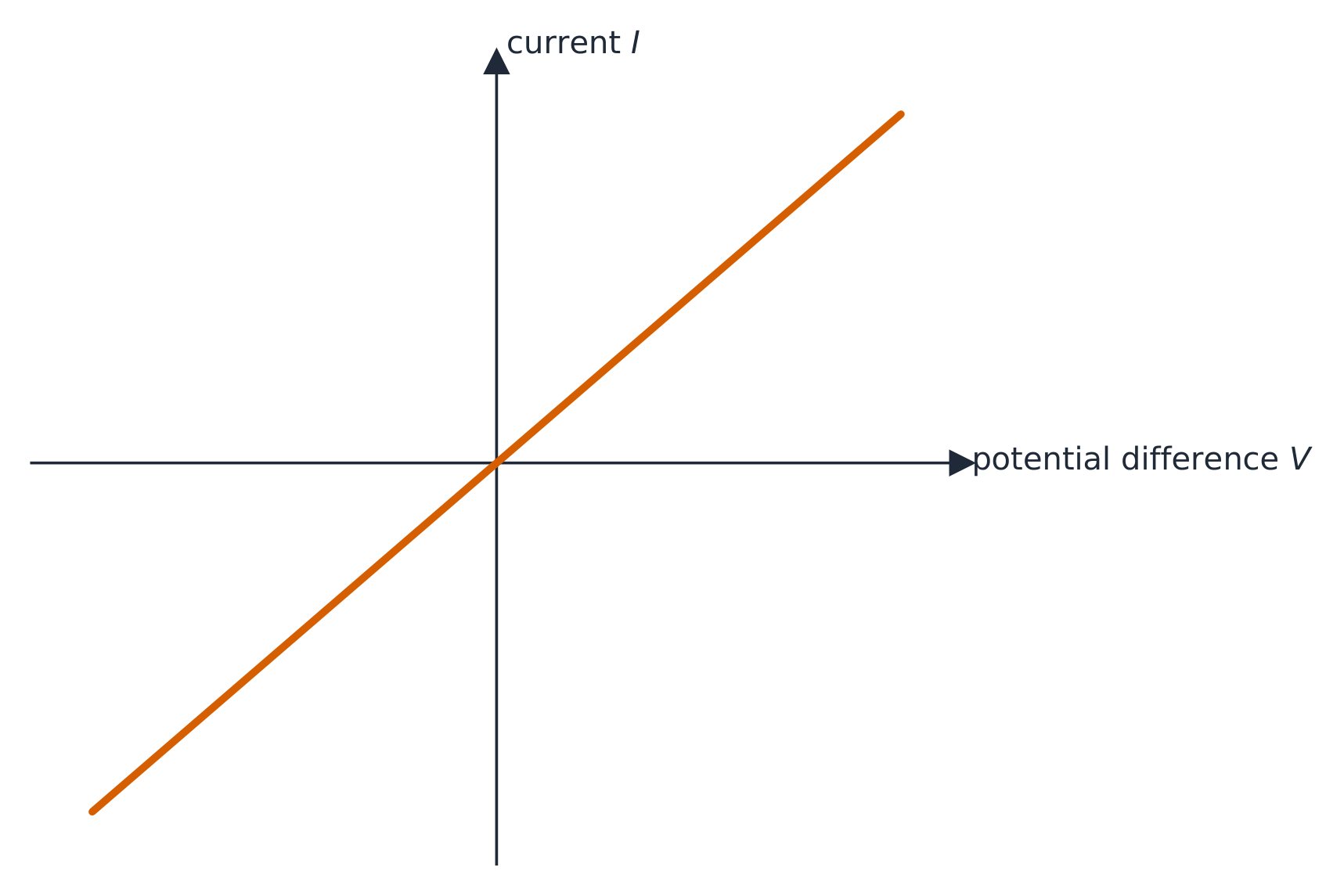
- 11.3.B.1.iv ความต้านทานขององค์ประกอบวงจรแบบโอห์มิกสามารถหาได้จากความชันของกราฟที่แสดงความสัมพันธ์ระหว่างกระแสในองค์ประกอบกับความต่างศักย์ข้ามองค์ประกอบนั้น
Source: College Board AP Course and Exam Description · แหล่งที่มา: คำอธิบายหลักสูตรและข้อสอบ College Board AP
EnglishResistance 电阻 $R$ opposes current, measured in ohms. Ohm's law 欧姆定律 links the three key quantities:
$$V=IR.$$A component's resistance depends on the material's resistivity 电阻率 $\rho$, its length, and its cross-sectional area: $R=\dfrac{\rho L}{A}$ – longer and thinner means more resistance.Worked example. A $2.0\ \text{A}$ current flows through a $6.0\ \Omega$ resistor. The voltage across it is $V=IR=2.0\times6.0=12\ \text{V}$.
ไทยความต้านทาน $R$ ต้านทานกระแส, วัดเป็นโอห์ม. กฎของโอห์ม เชื่อมโยงสามปริมาณหลัก:
$$V=IR.$$ความต้านทานของส่วนประกอบขึ้นอยู่กับ ค่าความต้านทาน $\rho$ ของวัสดุ ความยาว และพื้นที่หน้าตัด: $R=\dfrac{\rho L}{A}$ – ยาวและบาง越多意味着更多的 resistance。เส้น I-V ของตัวนำตามกฎของโอห์มเป็นเส้นตรงผ่านจุดกำเนิด ตัวอย่างวิธีทำ. กระแส $2.0\ \text{A}$ ไหลผ่านตัวต้านทาน $6.0\ \Omega$. แรงดันข้ามมันคือ $V=IR=2.0\times6.0=12\ \text{V}$.
Explore · สำรวจApply Ohm's law · ใช้กฎของโอห์ม
Ohm's law $V=IR$: for a fixed resistance, current is proportional to voltage. Raise the resistance and the same voltage pushes less current. · กฎของโอห์ม $V=IR$: สำหรับความต้านทานคงที่ กระแสไฟแปรผันตรงกับแรงดันไฟฟ้า เพิ่มความต้านทานแล้วแรงดันไฟฟ้าเท่าเดิมจะดันกระแสไฟได้น้อยลง
Vocabulary · คำศัพท์ Train · ฝึกฝนEnglish ไทย Resistance/rɪˈzɪstəns/ การต่อต้าน Ohm's law/əʊmz lɔː/ กฎของโอห์ม resistivity/ˌriːzɪˈstɪvəti/ ความต้านทานจำเพาะ Electric power/ɪˈlektrɪk ˈpaʊə/ กำลังไฟฟ้า light bulb/laɪt bʌlb/ หลอดไฟ brightness/ˈbraɪtnəs/ ความสว่าง equivalent resistance/ɪˈkwɪvələnt rɪˈzɪstəns/ ความต้านทานเทียบเท่า ammeter/ˈæmiːtə/ แอมมิเตอร์ voltmeter/ˈvəʊltmiːtə/ โวลต์มิเตอร์ nonideal/ˌnɒnaɪˈdɪəl/ ที่ไม่ใช่ในอุดมคติ Kirchhoff's loop rule/ˈkɜːkhɒfs luːp ruːl/ กฎวงจรของเคิร์ชโฮฟฟ์ Kirchhoff's junction rule/ˈkɜːkhɒfs ˈdʒʌŋkʃn ruːl/ กฎโหนดของเคิร์ชโฮฟฟ์ RC circuit/ˌɑː ˈsiː ˈsɜːkɪt/ วงจร RC 11.4
Electric Power · กำลังไฟฟ้า
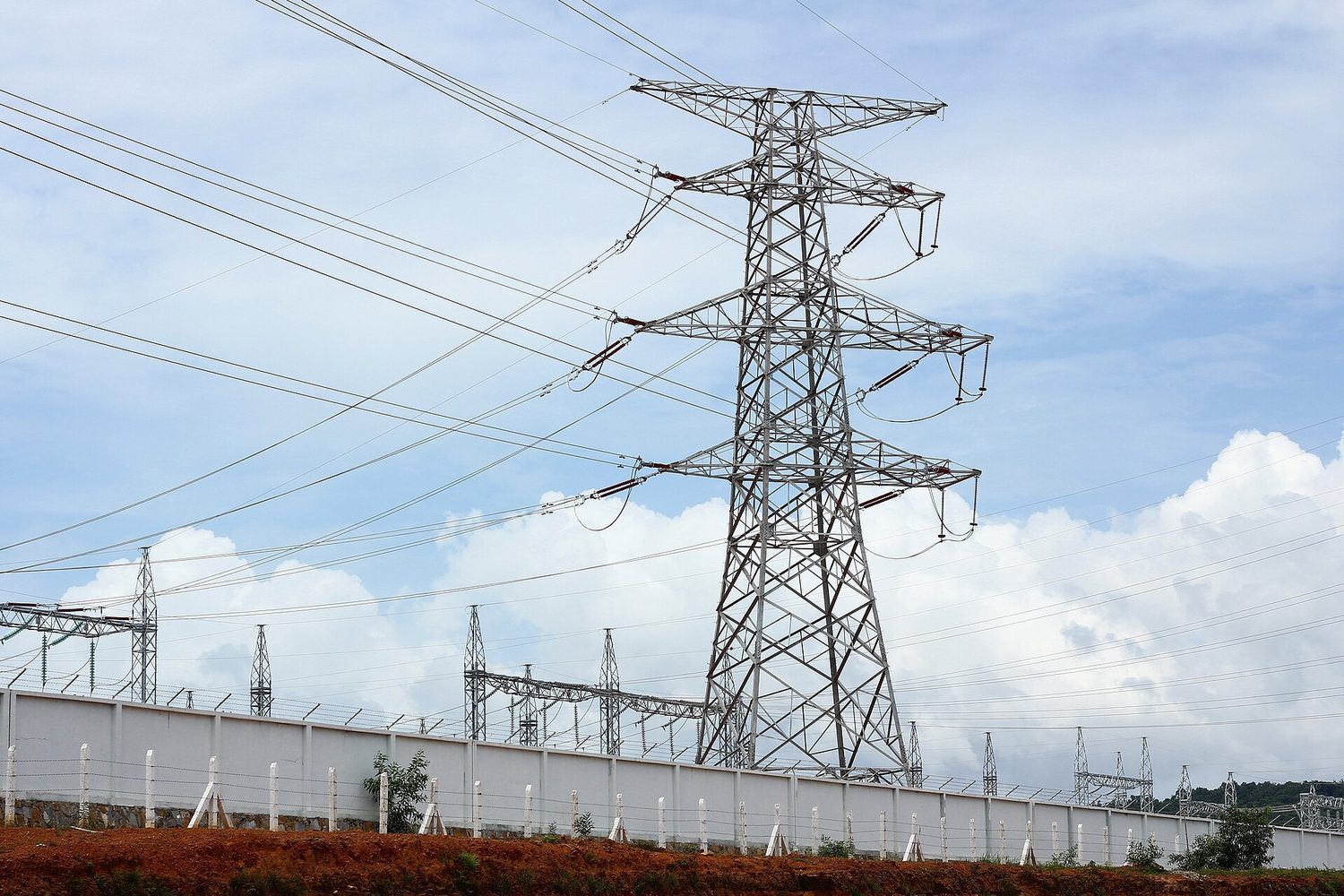
Syllabus · หลักสูตร
EnglishLearning Objective 11.4.A: Describe the transfer of energy into, out of, or within an electric circuit, in terms of power.
- 11.4.A.1 The rate at which energy is transferred, converted, or dissipated by a circuit element depends on the current in the element and the electric potential difference across it.
- Equation: $P = I \Delta V$
- Equation (derived): $P = I^2 R = \dfrac{(\Delta V)^2}{R}$
- 11.4.A.2 The brightness of a bulb increases with power, so power can be used to qualitatively predict the brightness of bulbs in a circuit.
ไทยจุดประสงค์การเรียนรู้ 11.4.A: อธิบายการถ่ายโอนพลังงานเข้าสู่ ออก หรือภายในวงจรไฟฟ้า โดยใช้หน่วยกำลังไฟฟ้า
- 11.4.A.1 อัตราที่พลังงานถูกถ่ายโอน แปลงสภาพ หรือสูญเสียโดยองค์ประกอบวงจรขึ้นอยู่กับกระแสไฟฟ้าในองค์ประกอบและความต่างศักย์ไฟฟ้าข้ามองค์ประกอบนั้น
- สมการ: $P = I \Delta V$
- สมการ (ที่หาได้): $P = I^2 R = \dfrac{(\Delta V)^2}{R}$
- 11.4.A.2 ความสว่างของหลอดไฟเพิ่มขึ้นตามกำลังไฟฟ้า ดังนั้นจึงสามารถใช้กำลังไฟฟ้าเพื่อทำนายความสว่างของหลอดไฟในวงจรได้อย่างเชิงคุณภาพ
Source: College Board AP Course and Exam Description · แหล่งที่มา: คำอธิบายหลักสูตรและข้อสอบ College Board AP
EnglishElectric power 电功率 is the rate a component converts electrical energy (to heat, light, motion):
$$P=IV=I^2R=\frac{V^2}{R}.$$Pick the form that uses the quantities you know. A resistor's power all becomes heat.Worked example. The $6.0\ \Omega$ resistor above, carrying $2.0\ \text{A}$, dissipates $P=I^2R=2.0^2\times6.0=24\ \text{W}$ – equivalently $P=IV=2.0\times12=24\ \text{W}$.
A light bulb 灯泡 is just a resistor that glows, and its brightness 亮度 rises with the power it dissipates. So to rank bulbs, compare their power. In a series string every bulb carries the same current, so by $P=I^2R$ the bulb with the largest resistance is brightest; wired in parallel every bulb gets the full battery voltage, so by $P=V^2/R$ the bulb with the smallest resistance is brightest.
ไทยกำลังไฟฟ้า คืออัตราที่ส่วนประกอบแปลงพลังงานไฟฟ้า (เป็นความร้อน, แสง, การเคลื่อนที่):
$$P=IV=I^2R=\frac{V^2}{R}.$$เลือกรูปแบบที่ใช้ปริมาณที่คุณทราบ กำลังของตัวต้านทานทั้งหมดจะกลายเป็นความร้อนตัวอย่างวิธีทำ. ตัวต้านทาน $6.0\ \Omega$ ข้างต้น, ที่รับ $2.0\ \text{A}$, กระจาย $P=I^2R=2.0^2\times6.0=24\ \text{W}$ – เทียบเท่ากับ $P=IV=2.0\times12=24\ \text{W}$.
หลอดไฟ ก็คือตัวต้านทานที่เรืองแสง, และ ความสว่าง ของมันเพิ่มขึ้นตาม กำลัง ที่มันกระจาย. ดังนั้นเพื่อจัดลำดับหลอดไฟ ให้เปรียบเทียบกำลัง它们在它们串联电路中每个灯泡承载相同的电流,因此根据 $P=I^2R$,电阻最大的灯泡最亮;并联时每个灯泡获得完整的电池电压,因此根据 $P=V^2/R$,电阻最小的灯泡最亮。
สายส่งไฟฟ้าแรงสูง: กำลังไฟฟ้าส่งผ่านแรงดันสูงเพื่อให้กระแส (และความสูญเสีย I²R) ต่ำ Explore · สำรวจRead an I-V characteristic · อ่านกราฟลักษณะ I-V
Power is $P=IV$. A resistor's I-V line is straight, but a lamp curves as it heats and its resistance rises. The area under I-V relates to the energy delivered. · กำลังคือ $P=IV$. กราฟ I-V ของตัวต้านทานเป็นเส้นตรง แต่ โคมไฟ มีเส้นโค้งเมื่อร้อนขึ้นและความต้านทานเพิ่มขึ้น พื้นที่ใต้กราฟ I-Vสัมพันธ์กับพลังงานที่ส่งมอบ
11.5
Compound DC Circuits · วงจร DC แบบผสม

Syllabus · หลักสูตร
EnglishLearning Objective 11.5.A: Describe the equivalent resistance of multiple resistors connected in a circuit.
- 11.5.A.1 Circuit elements may be connected in series and/or in parallel.
- 11.5.A.1.i A series connection is one in which any charge passing through one circuit element must proceed through all elements in that connection and has no other path available. The current in each element in series must be the same.
- 11.5.A.1.ii A parallel connection is one in which charges may flow through one of two or more paths. Across each path, the potential difference is the same.
- 11.5.A.2 A collection of resistors in a circuit may be analyzed as though it were a single resistor with an equivalent resistance $R_{\text{eq}}$.
- 11.5.A.2.i The equivalent resistance of a set of resistors in series is the sum of the individual resistances.
- Equation: $R_{\text{eq},s} = \sum_i R_i$
- 11.5.A.2.ii The inverse of the equivalent resistance of a set of resistors connected in parallel is equal to the sum of the inverses of the individual resistances.
- Equation: $\dfrac{1}{R_{\text{eq},p}} = \sum_i \dfrac{1}{R_i}$
- 11.5.A.2.iii When resistors are connected in parallel, the number of paths available to charges increases, and the equivalent resistance of the group of resistors decreases.
- 11.5.A.2.i The equivalent resistance of a set of resistors in series is the sum of the individual resistances.
Learning Objective 11.5.B: Describe a circuit with resistive wires and a battery with internal resistance.
- 11.5.B.1 Ideal batteries have negligible internal resistance. Ideal wires have negligible resistance.
- 11.5.B.1.i The resistance of wires that are good conductors may normally be neglected, because their resistance is much smaller than that of other elements of a circuit.
- 11.5.B.1.ii The resistance of wires may only be neglected if the circuit contains other elements that do have resistance.
- 11.5.B.1.iii The potential difference a battery would supply if it were ideal is the potential difference measured across the terminals when there is no current in the battery and is sometimes referred to as its $\mathrm{emf}$ ($\varepsilon$).
- 11.5.B.2 The internal resistance of a nonideal battery may be treated as the resistance of a resistor in series with an ideal battery and the remainder of the circuit.
- 11.5.B.3 When there is current in a nonideal battery with internal resistance $r$, the potential difference across the terminals of the battery is reduced relative to the potential difference when there is no current in the battery.
- Equation (derived): $\Delta V_{\text{terminal}} = \varepsilon - Ir$
Learning Objective 11.5.C: Describe the measurement of current and potential difference in a circuit.
- 11.5.C.1 Ammeters are used to measure current at a specific point in a circuit.
- 11.5.C.1.i Ammeters must be connected in series with the element in which current is being measured.
- 11.5.C.1.ii Ideal ammeters have zero resistance so that they do not affect the current in the element that they are in series with.
- 11.5.C.2 Voltmeters are used to measure electric potential difference between two points in a circuit.
- 11.5.C.2.i Voltmeters must be connected in parallel with the element across which potential difference is being measured.
- 11.5.C.2.ii Ideal voltmeters have an infinite resistance so that no charge flows through them.
- 11.5.C.3 Nonideal ammeters and voltmeters will change the properties of the circuit being measured.
Boundary statement: AP Physics 2 only expects students to qualitatively discuss how a nonideal ammeter or voltmeter will affect the results of measurements. Unless otherwise stated, all batteries, wires, and meters are assumed to be ideal.
Boundary statement: Circuits with batteries of different potential differences connected in parallel will not be assessed.
ไทยจุดประสงค์การเรียนรู้ 11.5.A: อธิบายความต้านทานเทียบเท่าของตัวต้านทานหลายตัวที่ต่ออยู่ในวงจร
- 11.5.A.1 องค์ประกอบวงจรอาจต่อกันแบบอนุกรมและ/หรือแบบขนาน
- 11.5.A.1.i การต่อแบบอนุกรมคือการเชื่อมต่อที่ประจุใดๆ ที่ไหลผ่านองค์ประกอบวงจรหนึ่งจะต้องไหลผ่านองค์ประกอบทั้งหมดในการต่อนั้นและไม่ไม่มีเส้นทางอื่นให้เลือก กระแสไฟฟ้าในแต่ละองค์ประกอบที่ต่อกันแบบอนุกรมต้องมีค่าเท่ากัน
- 11.5.A.1.ii การต่อแบบขนานคือการที่ประจุสามารถไหลผ่านเส้นทางใดเส้นทางหนึ่งจากสองหรือมากกว่า这条路 Across each path, the potential difference is the same.
- 11.5.A.2 ชุดตัวต้านทานในวงจรอาจวิเคราะห์เสมือนว่าเป็นตัวต้านทานเดี่ยวที่มีค่าความต้านทานสมมูล $R_{\text{eq}}$
- 11.5.A.2.i ความต้านทานสมมูลของชุดตัวต้านทานที่ต่อกันแบบอนุกรมคือผลบวกของความต้านทานแต่ละตัว
- สมการ: $R_{\text{eq},s} = \sum_i R_i$
- 11.5.A.2.ii ค่าผกผันของความต้านทานสมมูลของชุดตัวต้านทานที่ต่อกันแบบขนานเท่ากับผลบวกของค่าผกผันของความต้านทานแต่ละตัว
- สมการ: $\dfrac{1}{R_{\text{eq},p}} = \sum_i \dfrac{1}{R_i}$
- 11.5.A.2.iii เมื่อตัวต้านทานต่อแบบขนาน จำนวนเส้นทางที่ประจุไฟฟ้าสามารถไหลผ่านจะเพิ่มขึ้น และค่าความต้านทานเทียบเท่าของชุดตัวต้านทานจะลดลง
- 11.5.A.2.i ความต้านทานสมมูลของชุดตัวต้านทานที่ต่อกันแบบอนุกรมคือผลบวกของความต้านทานแต่ละตัว
วัตถุประสงค์การเรียนรู้ 11.5.B: อธิบายวงจรที่มีสายไฟที่มีความต้านทานและแบตเตอรี่ที่มีความต้านทานภายใน
- 11.5.B.1 แบตเตอรี่ในอุดมคติมีความต้านทานภายในน้อยมากจนละเลยได้ สายไฟในอุดมียก็มีความต้านทานต่ำมากจนละเลยได้
- 11.5.B.1.i ความต้านทานของสายไฟที่เป็นตัวนำที่ดีมักถูกมองข้ามได้ เนื่องจากมีความต้านทานน้อยกว่าองค์ประกอบอื่นๆ ในวงจรอย่างมาก
- 11.5.B.1.ii สามารถมองข้ามความต้านทานของสายไฟได้ก็ต่อเมื่อวงจรมีองค์ประกอบอื่นที่มีค่าความต้านทานอยู่ด้วย
- 11.5.B.1.iii แรงดันไฟฟ้าที่แบตเตอรี่จะจ่ายออกมาหากเป็นแบตเตอรี่ในอุดมคติ คือแรงดันไฟฟ้าที่วัดได้ระหว่างขั้วแบตเตอรี่เมื่อไม่มีกระแสไฟฟ้าไหลผ่าน และบางครั้งเรียกว่า $\mathrm{emf}$ ($\varepsilon$)
- 11.5.B.2 ความต้านทานภายในของแบตเตอรี่ที่ไม่ใช่ในอุดมียสามารถพิจารณา等效เป็นความต้านทานของตัวต้านทานที่ต่อกับแบตเตอรี่ในอุดมียและส่วนที่เหลือของวงจรแบบอนุกรม
- 11.5.B.3 เมื่อมีกระแสไหลผ่านแบตเตอรี่ที่ไม่ใช่ในอุดมียที่มีความต้านทานภายใน $r$ ความต่างศักย์ระหว่างขั้วทั้งสองของแบตเตอรี่จะลดลงเมื่อเทียบกับความต่างศักย์เมื่อไม่มีกระแสไหลผ่านแบตเตอรี่
- สมการ (ที่หาได้): $\Delta V_{\text{terminal}} = \varepsilon - Ir$
วัตถุประสงค์การเรียนรู้ 11.5.C: อธิบายการวัดกระแสและความต่างศักย์ในวงจร
- 11.5.C.1 อะมมิเตอร์ใช้เพื่อวัดกระแสที่จุดเฉพาะในวงจร
- 11.5.C.1.i อะมมิเตอร์ต้องต่อแบบอนุกรมกับองค์ประกอบที่ต้องการวัดกระแสไฟฟ้า
- 11.5.C.1.ii อะมมิเตอร์ในอุดมคติมีความต้านทานเป็นศูนย์เพื่อให้ไม่รบกวนกระแสไฟฟ้าในองค์ประกอบที่ต่อแบบอนุกรมด้วยกัน
- 11.5.C.2 โวลต์มิเตอร์ใช้เพื่อวัดความต่างศักย์ไฟฟ้าระหว่างสองจุดในวงจร
- 11.5.C.2.i โวลต์มิเตอร์ต้องต่อแบบขนานกับองค์ประกอบที่ต้องการวัดแรงดันไฟฟ้าตกคร่อม
- 11.5.C.2.ii โวลต์มิเตอร์ในอุดมคติมีความต้านทานเป็นอนันต์เพื่อไม่ให้มีประจุไฟฟ้าไหลผ่าน
- 11.5.C.3 อะมมิเตอร์และโวลต์มิเตอร์ที่ไม่ใช่ในอุดมียจะทำให้คุณสมบัติของวงจรที่ต้องการวัดเปลี่ยนแปลงไป
ข้อจำกัด: AP Physics 2 จะ要求学生เพียงการอธิบายเชิงคุณภาพว่าอะมมิเตอร์หรือโวลต์มิเตอร์ที่ไม่ใช่ในอุดมียจะมีผลต่อการวัดอย่างไร เว้นแต่จะระบุไว้เป็นอย่างอื่น แบตเตอรี่ สายไฟ และเครื่องวัดทั้งหมดถูกสมมติให้เป็นในอุดมีย
ข้อจำกัด: วงจรที่มีแบตเตอรี่ที่มีความต่างศักย์ต่างกันต่อกันแบบขนานจะไม่ถูกประเมิน
Source: College Board AP Course and Exam Description · แหล่งที่มา: คำอธิบายหลักสูตรและข้อสอบ College Board AP
EnglishCombine resistors to find an equivalent resistance 等效电阻:
- Series: $R_{\text{eq}}=R_1+R_2+\cdots$ (resistances add).
- Parallel: $\dfrac{1}{R_{\text{eq}}}=\dfrac{1}{R_1}+\dfrac{1}{R_2}+\cdots$ (the total is less than the smallest).
Reduce the network step by step to find the total current from the battery, then work back to each element.
Worked example. A $12\ \text{V}$ battery drives a $4.0\ \Omega$ and a $12\ \Omega$ resistor in parallel. First combine them: $\dfrac{1}{R_{\text{eq}}}=\dfrac14+\dfrac{1}{12}=\dfrac{4}{12}\Rightarrow R_{\text{eq}}=3.0\ \Omega$. The total current from the battery is $I=\dfrac{V}{R_{\text{eq}}}=\dfrac{12}{3.0}=4.0\ \text{A}$, which splits so that the smaller resistor carries the larger share ($3.0\ \text{A}$ through the $4\ \Omega$, $1.0\ \text{A}$ through the $12\ \Omega$).
ไทยรวมตัวต้านทานเพื่อหา ความต้านทานเทียบเท่า:
ตัวต้านทานต่อแบบอนุกรมรวมเป็นความต้านทานสมมูลเดียว - แบบอนุกรม: $R_{\text{eq}}=R_1+R_2+\cdots$ (ความต้านทานบวกกัน).
- แบบขนาน: $\dfrac{1}{R_{\text{eq}}}=\dfrac{1}{R_1}+\dfrac{1}{R_2}+\cdots$ (ค่ารวมมีค่าน้อยกว่าค่าที่น้อยที่สุด).
ลดวงจรทีละขั้นเพื่อหาค่ากระแสรวมจากแบตเตอรี่ แล้วคำนวณย้อนกลับไปยังองค์ประกอบแต่ละตัว
ตัวอย่างการคำนวณ. แบตเตอรี่ $12\ \text{V}$ ขับเคลื่อนตัวต้านทาน $4.0\ \Omega$ และ $12\ \Omega$ ต่อแบบ ขนาน. รวมค่าเข้าด้วยกัน: $\dfrac{1}{R_{\text{eq}}}=\dfrac14+\dfrac{1}{12}=\dfrac{4}{12}\Rightarrow R_{\text{eq}}=3.0\ \Omega$. กระแสรวมจากแบตเตอรี่คือ $I=\dfrac{V}{R_{\text{eq}}}=\dfrac{12}{3.0}=4.0\ \text{A}$ ซึ่งจะแยกไป так ที่ตัวต้านทานที่มีค่าน้อยจะรับกระแสส่วนมาก ($3.0\ \text{A}$ ผ่าน $4\ \Omega$, $1.0\ \text{A}$ ผ่าน $12\ \Omega$).
11.5
Measuring Current and Voltage · การวัดกระแสและแรงดันไฟฟ้า
Syllabus · หลักสูตร
EnglishLearning Objective 11.5.A: Describe the equivalent resistance of multiple resistors connected in a circuit.
- 11.5.A.1 Circuit elements may be connected in series and/or in parallel.
- 11.5.A.1.i A series connection is one in which any charge passing through one circuit element must proceed through all elements in that connection and has no other path available. The current in each element in series must be the same.
- 11.5.A.1.ii A parallel connection is one in which charges may flow through one of two or more paths. Across each path, the potential difference is the same.
- 11.5.A.2 A collection of resistors in a circuit may be analyzed as though it were a single resistor with an equivalent resistance $R_{\text{eq}}$.
- 11.5.A.2.i The equivalent resistance of a set of resistors in series is the sum of the individual resistances.
- Equation: $R_{\text{eq},s} = \sum_i R_i$
- 11.5.A.2.ii The inverse of the equivalent resistance of a set of resistors connected in parallel is equal to the sum of the inverses of the individual resistances.
- Equation: $\dfrac{1}{R_{\text{eq},p}} = \sum_i \dfrac{1}{R_i}$
- 11.5.A.2.iii When resistors are connected in parallel, the number of paths available to charges increases, and the equivalent resistance of the group of resistors decreases.
- 11.5.A.2.i The equivalent resistance of a set of resistors in series is the sum of the individual resistances.
Learning Objective 11.5.B: Describe a circuit with resistive wires and a battery with internal resistance.
- 11.5.B.1 Ideal batteries have negligible internal resistance. Ideal wires have negligible resistance.
- 11.5.B.1.i The resistance of wires that are good conductors may normally be neglected, because their resistance is much smaller than that of other elements of a circuit.
- 11.5.B.1.ii The resistance of wires may only be neglected if the circuit contains other elements that do have resistance.
- 11.5.B.1.iii The potential difference a battery would supply if it were ideal is the potential difference measured across the terminals when there is no current in the battery and is sometimes referred to as its $\mathrm{emf}$ ($\varepsilon$).
- 11.5.B.2 The internal resistance of a nonideal battery may be treated as the resistance of a resistor in series with an ideal battery and the remainder of the circuit.
- 11.5.B.3 When there is current in a nonideal battery with internal resistance $r$, the potential difference across the terminals of the battery is reduced relative to the potential difference when there is no current in the battery.
- Equation (derived): $\Delta V_{\text{terminal}} = \varepsilon - Ir$
Learning Objective 11.5.C: Describe the measurement of current and potential difference in a circuit.
- 11.5.C.1 Ammeters are used to measure current at a specific point in a circuit.
- 11.5.C.1.i Ammeters must be connected in series with the element in which current is being measured.
- 11.5.C.1.ii Ideal ammeters have zero resistance so that they do not affect the current in the element that they are in series with.
- 11.5.C.2 Voltmeters are used to measure electric potential difference between two points in a circuit.
- 11.5.C.2.i Voltmeters must be connected in parallel with the element across which potential difference is being measured.
- 11.5.C.2.ii Ideal voltmeters have an infinite resistance so that no charge flows through them.
- 11.5.C.3 Nonideal ammeters and voltmeters will change the properties of the circuit being measured.
Boundary statement: AP Physics 2 only expects students to qualitatively discuss how a nonideal ammeter or voltmeter will affect the results of measurements. Unless otherwise stated, all batteries, wires, and meters are assumed to be ideal.
Boundary statement: Circuits with batteries of different potential differences connected in parallel will not be assessed.
ไทยจุดประสงค์การเรียนรู้ 11.5.A: อธิบายความต้านทานเทียบเท่าของตัวต้านทานหลายตัวที่ต่ออยู่ในวงจร
- 11.5.A.1 องค์ประกอบวงจรอาจต่อกันแบบอนุกรมและ/หรือแบบขนาน
- 11.5.A.1.i การต่อแบบอนุกรมคือการเชื่อมต่อที่ประจุใดๆ ที่ไหลผ่านองค์ประกอบวงจรหนึ่งจะต้องไหลผ่านองค์ประกอบทั้งหมดในการต่อนั้นและไม่ไม่มีเส้นทางอื่นให้เลือก กระแสไฟฟ้าในแต่ละองค์ประกอบที่ต่อกันแบบอนุกรมต้องมีค่าเท่ากัน
- 11.5.A.1.ii การต่อแบบขนานคือการที่ประจุสามารถไหลผ่านเส้นทางใดเส้นทางหนึ่งจากสองหรือมากกว่า这条路 Across each path, the potential difference is the same.
- 11.5.A.2 ชุดตัวต้านทานในวงจรอาจวิเคราะห์เสมือนว่าเป็นตัวต้านทานเดี่ยวที่มีค่าความต้านทานสมมูล $R_{\text{eq}}$
- 11.5.A.2.i ความต้านทานสมมูลของชุดตัวต้านทานที่ต่อกันแบบอนุกรมคือผลบวกของความต้านทานแต่ละตัว
- สมการ: $R_{\text{eq},s} = \sum_i R_i$
- 11.5.A.2.ii ค่าผกผันของความต้านทานสมมูลของชุดตัวต้านทานที่ต่อกันแบบขนานเท่ากับผลบวกของค่าผกผันของความต้านทานแต่ละตัว
- สมการ: $\dfrac{1}{R_{\text{eq},p}} = \sum_i \dfrac{1}{R_i}$
- 11.5.A.2.iii เมื่อตัวต้านทานต่อแบบขนาน จำนวนเส้นทางที่ประจุไฟฟ้าสามารถไหลผ่านจะเพิ่มขึ้น และค่าความต้านทานเทียบเท่าของชุดตัวต้านทานจะลดลง
- 11.5.A.2.i ความต้านทานสมมูลของชุดตัวต้านทานที่ต่อกันแบบอนุกรมคือผลบวกของความต้านทานแต่ละตัว
วัตถุประสงค์การเรียนรู้ 11.5.B: อธิบายวงจรที่มีสายไฟที่มีความต้านทานและแบตเตอรี่ที่มีความต้านทานภายใน
- 11.5.B.1 แบตเตอรี่ในอุดมคติมีความต้านทานภายในน้อยมากจนละเลยได้ สายไฟในอุดมียก็มีความต้านทานต่ำมากจนละเลยได้
- 11.5.B.1.i ความต้านทานของสายไฟที่เป็นตัวนำที่ดีมักถูกมองข้ามได้ เนื่องจากมีความต้านทานน้อยกว่าองค์ประกอบอื่นๆ ในวงจรอย่างมาก
- 11.5.B.1.ii สามารถมองข้ามความต้านทานของสายไฟได้ก็ต่อเมื่อวงจรมีองค์ประกอบอื่นที่มีค่าความต้านทานอยู่ด้วย
- 11.5.B.1.iii แรงดันไฟฟ้าที่แบตเตอรี่จะจ่ายออกมาหากเป็นแบตเตอรี่ในอุดมคติ คือแรงดันไฟฟ้าที่วัดได้ระหว่างขั้วแบตเตอรี่เมื่อไม่มีกระแสไฟฟ้าไหลผ่าน และบางครั้งเรียกว่า $\mathrm{emf}$ ($\varepsilon$)
- 11.5.B.2 ความต้านทานภายในของแบตเตอรี่ที่ไม่ใช่ในอุดมียสามารถพิจารณา等效เป็นความต้านทานของตัวต้านทานที่ต่อกับแบตเตอรี่ในอุดมียและส่วนที่เหลือของวงจรแบบอนุกรม
- 11.5.B.3 เมื่อมีกระแสไหลผ่านแบตเตอรี่ที่ไม่ใช่ในอุดมียที่มีความต้านทานภายใน $r$ ความต่างศักย์ระหว่างขั้วทั้งสองของแบตเตอรี่จะลดลงเมื่อเทียบกับความต่างศักย์เมื่อไม่มีกระแสไหลผ่านแบตเตอรี่
- สมการ (ที่หาได้): $\Delta V_{\text{terminal}} = \varepsilon - Ir$
วัตถุประสงค์การเรียนรู้ 11.5.C: อธิบายการวัดกระแสและความต่างศักย์ในวงจร
- 11.5.C.1 อะมมิเตอร์ใช้เพื่อวัดกระแสที่จุดเฉพาะในวงจร
- 11.5.C.1.i อะมมิเตอร์ต้องต่อแบบอนุกรมกับองค์ประกอบที่ต้องการวัดกระแสไฟฟ้า
- 11.5.C.1.ii อะมมิเตอร์ในอุดมคติมีความต้านทานเป็นศูนย์เพื่อให้ไม่รบกวนกระแสไฟฟ้าในองค์ประกอบที่ต่อแบบอนุกรมด้วยกัน
- 11.5.C.2 โวลต์มิเตอร์ใช้เพื่อวัดความต่างศักย์ไฟฟ้าระหว่างสองจุดในวงจร
- 11.5.C.2.i โวลต์มิเตอร์ต้องต่อแบบขนานกับองค์ประกอบที่ต้องการวัดแรงดันไฟฟ้าตกคร่อม
- 11.5.C.2.ii โวลต์มิเตอร์ในอุดมคติมีความต้านทานเป็นอนันต์เพื่อไม่ให้มีประจุไฟฟ้าไหลผ่าน
- 11.5.C.3 อะมมิเตอร์และโวลต์มิเตอร์ที่ไม่ใช่ในอุดมียจะทำให้คุณสมบัติของวงจรที่ต้องการวัดเปลี่ยนแปลงไป
ข้อจำกัด: AP Physics 2 จะ要求学生เพียงการอธิบายเชิงคุณภาพว่าอะมมิเตอร์หรือโวลต์มิเตอร์ที่ไม่ใช่ในอุดมียจะมีผลต่อการวัดอย่างไร เว้นแต่จะระบุไว้เป็นอย่างอื่น แบตเตอรี่ สายไฟ และเครื่องวัดทั้งหมดถูกสมมติให้เป็นในอุดมีย
ข้อจำกัด: วงจรที่มีแบตเตอรี่ที่มีความต่างศักย์ต่างกันต่อกันแบบขนานจะไม่ถูกประเมิน
Source: College Board AP Course and Exam Description · แหล่งที่มา: คำอธิบายหลักสูตรและข้อสอบ College Board AP
EnglishTwo meters read a circuit. An ammeter 电流表 measures the current at a point, so it must be wired in series – the current you want to measure has to flow through it. A voltmeter 电压表 measures the potential difference between two points, so it is wired in parallel, bridging across the component whose voltage you want.
For a meter to read the true value it must barely disturb the circuit:
- an ideal ammeter has zero resistance, so putting it in series does not reduce the current it reads;
- an ideal voltmeter has infinite resistance, so almost no current is diverted through it.
A real, nonideal 非理想 meter is imperfect: a real ammeter has a small resistance (it slightly lowers the current), and a real voltmeter lets a little current leak through (it slightly lowers the voltage it reads). So connecting any meter changes, a little, the very quantity it is measuring.
ไทยเครื่องวัดสองชนิดอ่านค่าวงจร. แอมมิเตอร์ วัดกระแส ณ จุดหนึ่ง จึงต้องต่อแบบ อนุกรม – กระแสที่ต้องการวัดต้องไหล ผ่าน ตัวมัน. โวลต์มิเตอร์ วัดผลต่างศักย์ระหว่างสองจุด จึงต่อแบบ ขนาน ข้ามข้ามองค์ประกอบ whose voltage คุณต้องการวัด.
เพื่อให้เครื่องวัดอ่านค่าจริงได้ มันต้องรบกวนวงจรน้อยที่สุด:
- แอมมิเตอร์ในอุดมคติ มี ความต้านทานเป็นศูนย์, การต่อแบบอนุกรมจึงไม่ทำให้กระแสที่อ่านได้น้อยลง;
- โวลต์มิเตอร์ในอุดมคติ มี ความต้านทานเป็นอนันต์, กระแสแทบจะไม่เบี่ยงเบนไหลผ่านมันเลย.
เครื่องวัดจริงที่ไม่ใช่อุดมคติมีความไม่สมบูรณ์แบบ: แอมมิเตอร์จริงมีความต้านทานเล็กน้อย (ลดกระแสลงเล็กน้อย), และโวลต์มิเตอร์จริงให้กระแสรั่วไหลผ่านบ้าง (ลดแรงดันที่อ่านได้น้อยลง). ดังนั้น การเชื่อมต่อเครื่องวัดใดๆ ก็ตาม จะเปลี่ยนแปลงปริมาณที่มันกำลังวัดไปเพียงเล็กน้อยเท่านั้น
11.6
Kirchhoff's Loop Rule · กฎวงจรรอบของเคอร์ชอฟฟ์
Syllabus · หลักสูตร
EnglishLearning Objective 11.6.A: Describe a circuit or elements of a circuit by applying Kirchhoff's loop rule.
- 11.6.A.1 Energy changes in simple electrical circuits may be represented in terms of charges moving through electric potential differences within circuit elements.
- Equation: $\Delta U_E = q \Delta V$
- 11.6.A.2 Kirchhoff's loop rule is a consequence of the conservation of energy.
- 11.6.A.3 Kirchhoff's loop rule states that the sum of potential differences across all circuit elements in a single closed loop must equal zero.
- Equation: $\sum \Delta V = 0$
- 11.6.A.4 The values of electric potential at points in a circuit can be represented by a graph of electric potential as a function of position within a loop.
ไทยวัตถุประสงค์การเรียนรู้ 11.6.A: อธิบายวงจรหรือองค์ประกอบของวงจรโดยใช้กฎลูปของคีร์ชฮอฟฟ์
- 11.6.A.1 การเปลี่ยนแปลงพลังงานในวงจรรวมไฟฟ้าอย่างง่ายสามารถแสดงได้ในรูปของประจุที่เคลื่อนที่ผ่านความต่างศักย์ไฟฟ้าภายในองค์ประกอบของวงจร
- สมการ: $\Delta U_E = q \Delta V$
- 11.6.A.2 กฎลูปของคีร์ชฮอฟฟ์เป็นผลมาจากการอนุรักษ์พลังงาน
- 11.6.A.3 กฎลูปของคีร์ชฮอฟฟ์ระบุว่าผลรวมของความต่างศักย์ตลอดองค์ประกอบทั้งหมดในลูปปิดเดียวต้องเท่ากับศูนย์
- สมการ: $\sum \Delta V = 0$
- 11.6.A.4 ค่าความต่างศักย์ไฟฟ้าที่จุดต่างๆ ในวงจรสามารถแสดงได้ด้วยกราฟของความต่างศักย์ไฟฟ้าในฟังก์ชันของตำแหน่งภายในลูป
Source: College Board AP Course and Exam Description · แหล่งที่มา: คำอธิบายหลักสูตรและข้อสอบ College Board AP
EnglishKirchhoff's loop rule 基尔霍夫电压定律 (energy conservation): around any closed loop, the voltage gains and drops sum to zero. Add the battery's emf and subtract each $IR$ drop as you go around. This gives one equation per independent loop.
ไทยกฎวงจรรอบของเคอร์ชอฟฟ์ (การอนุรักษ์พลังงาน): รอบวงจรรูปปิดใดๆ ผลรวมของการเพิ่มและลดลงของแรงดันไฟฟ้าจะเป็น ศูนย์. บวก emf ของแบตเตอรี่และลบการลดลงของ $IR$ แต่ละค่าเมื่อวนรอบ. สิ่งนี้ให้สมการหนึ่งสมการต่อวงจรรูปอิสระหนึ่งรูป
11.7
Kirchhoff's Junction Rule · กฎจุดต่อของเคอร์ชอฟฟ์
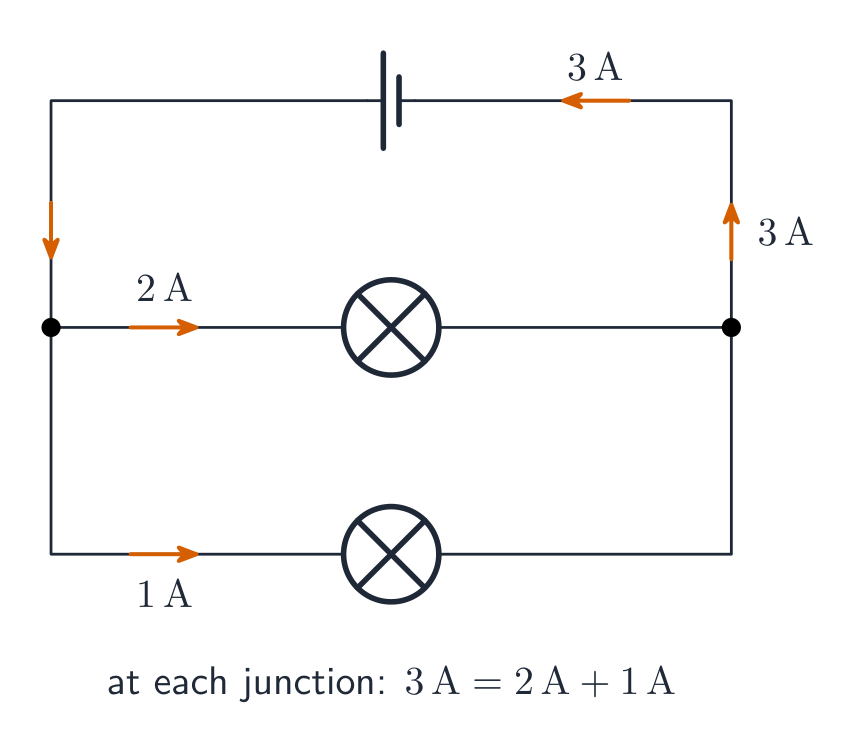
Syllabus · หลักสูตร
EnglishLearning Objective 11.7.A: Describe a circuit or elements of a circuit by applying Kirchhoff's junction rule.
- 11.7.A.1 Kirchhoff's junction rule is a consequence of the conservation of electric charge.
- 11.7.A.2 Kirchhoff's junction rule states that the total amount of charge entering a junction per unit time must equal the total amount of charge exiting that junction per unit time.
- Equation: $\sum I_{\text{in}} = \sum I_{\text{out}}$
ไทยวัตถุประสงค์การเรียนรู้ 11.7.A: อธิบายวงจรหรือองค์ประกอบของวงจรโดยใช้กฎจุดต่อของคีร์ชฮอฟฟ์
- 11.7.A.1 กฎจุดต่อของคีร์ชฮอฟฟ์เป็นผลมาจากการอนุรักษ์ประจุไฟฟ้า
- 11.7.A.2 กฎจุดต่อของคีร์ชฮอฟฟ์ระบุว่าปริมาณประจุทั้งหมดที่เข้าสู่จุดต่อต่อหน่วยเวลาต้องเท่ากับปริมาณประจุทั้งหมดที่ออกจากจุดต่อนั้นต่อหน่วยเวลา
- สมการ: $\sum I_{\text{in}} = \sum I_{\text{out}}$
Source: College Board AP Course and Exam Description · แหล่งที่มา: คำอธิบายหลักสูตรและข้อสอบ College Board AP
EnglishKirchhoff's junction rule 基尔霍夫电流定律 (charge conservation): the total current into any junction equals the total current out. Together with the loop rule, it lets you solve any multi-loop circuit for its unknown currents.
ไทยกฎจุดต่อของเคอร์ชอฟฟ์ (การอนุรักษ์ประจุ): กระแสรวมที่ เข้าสู่ จุดต่อใดจุดหนึ่งเท่ากับกระแสรวมที่ ออก. ร่วมกับกฎวงจรรอบ ทำให้คุณสามารถแก้วงจรหลายวงจรรูปเพื่อหาค่ากระแสที่ไม่ทราบค่าได้
กระแสแยกที่จุดต่อ:สิ่งที่ไหลเข้าเท่ากับสิ่งที่ไหลออก 11.8
RC Circuits · วงจร RC
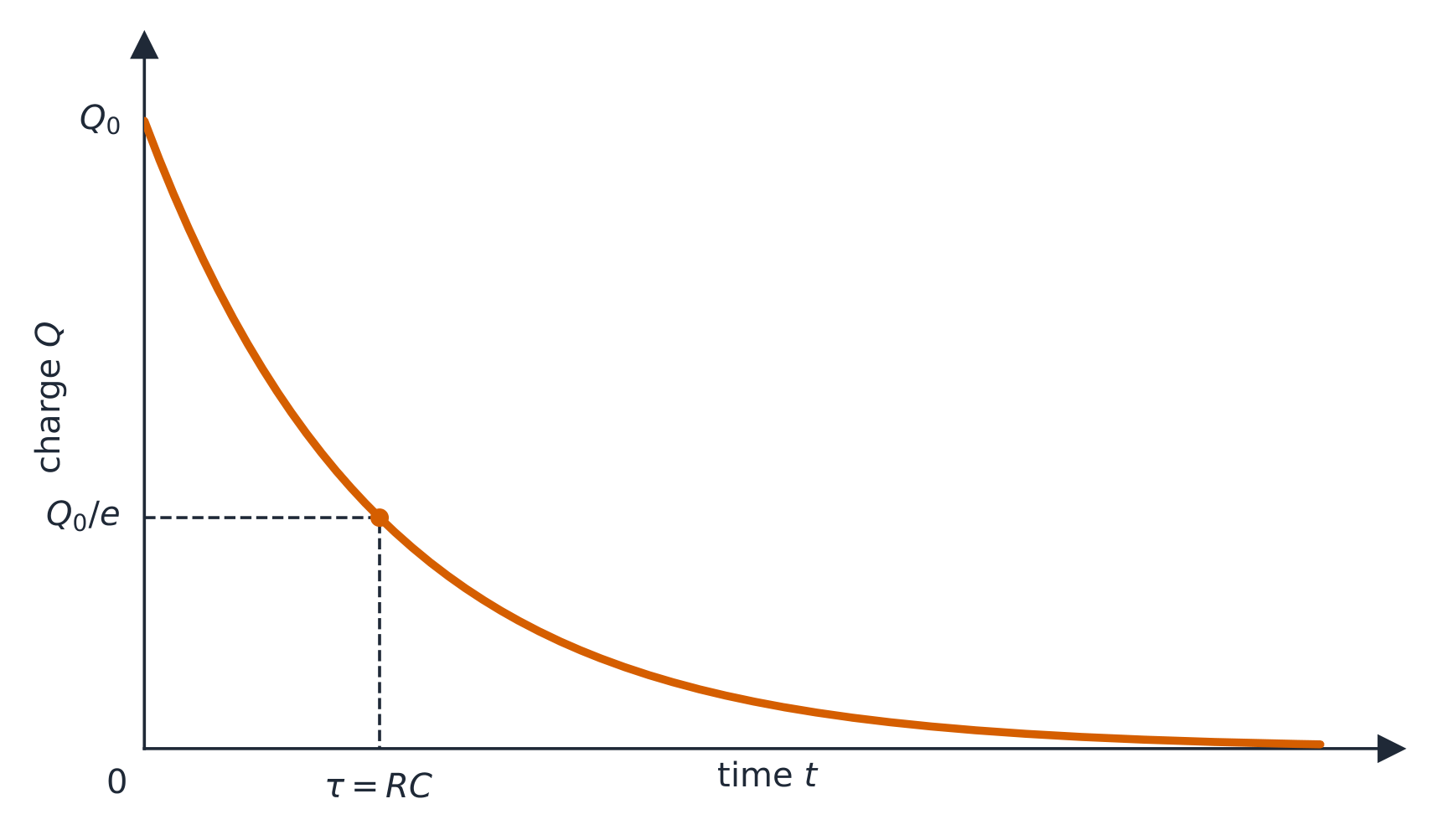
Syllabus · หลักสูตร
EnglishLearning Objective 11.8.A: Describe the equivalent capacitance of multiple capacitors.
- 11.8.A.1 A collection of capacitors in a circuit may be analyzed as though it were a single capacitor with an equivalent capacitance $C_{\text{eq}}$.
- 11.8.A.1.i The inverse of the equivalent capacitance of a set of capacitors connected in series is equal to the sum of the inverses of the individual capacitances.
- Equation: $\dfrac{1}{C_{\text{eq},s}} = \sum_i \dfrac{1}{C_i}$
- 11.8.A.1.ii The equivalent capacitance of a set of capacitors in series is less than the capacitance of the smallest capacitor.
- 11.8.A.1.iii The equivalent capacitance of a set of capacitors in parallel is the sum of the individual capacitances.
- Equation: $C_{\text{eq},p} = \sum_i C_i$
- 11.8.A.1.i The inverse of the equivalent capacitance of a set of capacitors connected in series is equal to the sum of the inverses of the individual capacitances.
- 11.8.A.2 As a result of conservation of charge, each of the capacitors in series must have the same magnitude of charge on each plate.
Learning Objective 11.8.B: Describe the behavior of a circuit containing combinations of resistors and capacitors.
- 11.8.B.1 The time constant $\tau$ is a significant feature of an RC circuit.
- 11.8.B.1.i The time constant of an RC circuit is a measure of how quickly the capacitor will charge or discharge and is defined as $\tau = R_{\text{eq}} C_{\text{eq}}$.
- 11.8.B.1.ii For a charging capacitor, the time constant represents the time required for the capacitor's charge to increase from zero to approximately 63 percent of its final asymptotic value.
- 11.8.B.1.iii For a discharging capacitor, the time constant represents the time required for the capacitor's charge to decrease from fully charged to approximately 37 percent of its initial value.
- 11.8.B.2 The potential difference across a capacitor and the current in the branch of the circuit containing the capacitor each change over time as the capacitor charges and discharges, but both will reach a steady state after a long time interval.
- 11.8.B.2.i Immediately after being placed in a circuit, an uncharged capacitor acts like a wire, and charge can easily flow to or from the plates of the capacitor.
- 11.8.B.2.ii As a capacitor charges, changes to the potential difference across the capacitor affect the charge on the plates of the capacitor, the current circuit branch in which the capacitor is located, and the electric potential energy stored in the capacitor.
- 11.8.B.2.iii The potential difference across a capacitor, the current in the circuit branch in which the capacitor is located, and the electric potential energy stored in the capacitor all change with respect to time and asymptotically approach steady state conditions.
- 11.8.B.2.iv After a long time, a charging capacitor approaches a state of being fully charged, reaching a maximum potential difference at which there is zero current in the circuit branch in which the capacitor is located.
- 11.8.B.2.v Immediately after a charged capacitor begins discharging, the amount of charge on the capacitor plates and the energy stored in the capacitor begin to decrease.
- 11.8.B.2.vi As a capacitor discharges, the amount of charge on the capacitor, the potential difference across the capacitor, and the current in the circuit branch in which the capacitor is located all decrease until a steady state is reached.
- 11.8.B.2.vii After either charging or discharging for times much greater than the time constant, the capacitor and the relevant circuit branch may be modeled using steady-state conditions.
Boundary statement: Descriptions of charging/discharging RC circuits in AP Physics 2 are limited to qualitative descriptions and representations. While students should be able to mathematically describe initial and final states of RC circuits, students are not expected to mathematically model these behaviors with respect to time.
ไทยวัตถุประสงค์การเรียนรู้ 11.8.A: อธิบายความจุสมมูลของตัวเก็บประจุหลายตัว
- 11.8.A.1 ชุดตัวเก็บประจุในวงจรอาจวิเคราะห์เสมือนว่าเป็นตัวเก็บประจุเดี่ยวที่มีความจุสมมูล $C_{\text{eq}}$
- 11.8.A.1.i ส่วนกลับของความจุเทียบเท่าของชุดตัวเก็บประจุที่ต่อแบบอนุกรม มีค่าเท่ากับผลรวมของส่วนกลับของความจุของแต่ละตัว
- สมการ: $\dfrac{1}{C_{\text{eq},s}} = \sum_i \dfrac{1}{C_i}$
- 11.8.A.1.ii ค่าความจุเทียบเท่าของชุดตัวเก็บประจุที่ต่อแบบอนุกรม จะมีค่าน้อยกว่าความจุของตัวเก็บประจุที่มีค่าน้อยที่สุด
- 11.8.A.1.iii ค่าความจุเทียบเท่าของชุดตัวเก็บประจุที่ต่อแบบขนาน เป็นผลรวมของความจุของแต่ละตัว
- สมการ: $C_{\text{eq},p} = \sum_i C_i$
- 11.8.A.1.i ส่วนกลับของความจุเทียบเท่าของชุดตัวเก็บประจุที่ต่อแบบอนุกรม มีค่าเท่ากับผลรวมของส่วนกลับของความจุของแต่ละตัว
- 11.8.A.2 เนื่องจากหลักการอนุรักษ์ประจุ ตัวเก็บประจุแต่ละตัวในชุดที่ต่อกันแบบอนุกรมต้องมีขนาดของประจุเท่ากันบนแผ่นแต่ละแผ่น
วัตถุประสงค์การเรียนรู้ 11.8.B: อธิบายพฤติกรรมของวงจรที่ประกอบด้วยชุดผสมของตัวต้านทานและตัวเก็บประจุ
- 11.8.B.1 ค่าคงที่เวลา $\tau$ เป็นคุณลักษณะสำคัญของวงจร RC
- 11.8.B.1.i ค่าคงที่เวลาของ RC วงจรคือตัวชี้วัดความเร็วในการชาร์จหรือการคายประจุของตัวเก็บประจุ และนิยามไว้ว่า $\tau = R_{\text{eq}} C_{\text{eq}}$
- 11.8.B.1.ii สำหรับตัวเก็บประจุที่กำลังชาร์จ ค่าคงที่เวลาแทนถึงระยะเวลาที่ต้องใช้เพื่อให้ประจุของตัวเก็บประจุเพิ่มขึ้นจากศูนย์ไปประมาณ 63 เปอร์เซ็นต์ของค่าสูงสุดตามทฤษฎี
- 11.8.B.1.iii สำหรับตัวเก็บประจุที่กำลังคายประจุ ค่าคงที่เวลาแทนถึงระยะเวลาที่ต้องใช้เพื่อให้ประจุของตัวเก็บประจุลดลงจากสถานะเต็มไปประมาณ 37 เปอร์เซ็นต์ของค่าเริ่มต้น
- 11.8.B.2 ความต่างศักย์ข้ามตัวเก็บประจุและกระแสไฟฟ้าในสายวงจรที่มีตัวเก็บประจุจะเปลี่ยนแปลงไปตามเวลาเมื่อตัวเก็บประจุชาร์จและคายประจุ แต่ทั้งสองจะเข้าสู่สภาวะคงตัวหลังจากช่วงเวลาที่ยาวนาน
- 11.8.B.2.i ทันทีหลังจากวางตัวเก็บประจุที่ไม่มีประจุลงในวงจร มันจะทำหน้าที่เหมือนสายไฟ และมีประจุไฟฟ้าไหลเข้าหรือออกจากแผ่นตัวเก็บประจุได้ง่าย
- 11.8.B.2.ii ขณะตัวเก็บประจุกำลังชาร์จ การเปลี่ยนแปลงของแรงดันไฟฟ้าตกคร่อมตัวเก็บประจุจะมีผลต่อประจุบนแผ่นตัวเก็บประจุ กระแสไฟฟ้าในสาขาของวงจรที่ตัวเก็บประจุอยู่ และพลังงานศักย์ไฟฟ้าที่สะสมอยู่ในตัวเก็บประจุ
- 11.8.B.2.iii แรงดันไฟฟ้าตกคร่อมตัวเก็บประจุ กระแสไฟฟ้าในสาขาของวงจรที่ตัวเก็บประจุอยู่ และพลังงานศักย์ไฟฟ้าที่สะสมอยู่ในตัวเก็บประจุ ทั้งหมดมีการเปลี่ยนแปลงตามเวลาและเข้าใกล้สภาวะเสถียรแบบอสมптอทิก
- 11.8.B.2.iv หลังผ่านไปนานๆ ตัวเก็บประจุที่กำลังชาร์จจะเข้าสู่สภาวะที่ชาร์จเต็ม โดยมีความต่างศักย์สูงสุดซึ่งกระแสไฟฟ้าในสาขาของวงจรที่ตัวเก็บประจุอยู่จะเป็นศูนย์
- 11.8.B.2.v ทันทีหลังจากตัวเก็บประจุที่มีประจุเริ่มคายประจุ ปริมาณประจุบนแผ่นตัวเก็บประจุและพลังงานที่สะสมอยู่ในตัวเก็บประจุจะเริ่มลดลง
- 11.8.B.2.vi ขณะตัวเก็บประจุกำลังคายประจุ ปริมาณประจุของตัวเก็บประจุ แรงดันไฟฟ้าตกคร่อมตัวเก็บประจุ และกระแสไฟฟ้าในสาขาของวงจรที่ตัวเก็บประจุอยู่ จะลดลงจนกระทั่งถึงสภาวะเสถียร
- 11.8.B.2.vii After either charging or discharging for times much greater than the time constant, the capacitor and the relevant circuit branchmay be modeled using steady-state conditions.
คำนิยามขอบเขต: คำอธิบายวงจร RC ที่ชาร์จ/คายประจุใน AP Physics 2 จะจำกัดอยู่ที่คำอธิบายเชิงคุณภาพและการแสดงภาพเท่านั้น ในขณะที่ผู้เรียนควรจะสามารถใช้คณิตศาสตร์เพื่ออธิบายสถานะเริ่มต้นและสถานะสุดท้ายของวงจร RC ได้ แต่ไม่จำเป็นต้องใช้แบบจำลองทางคณิตศาสตร์เพื่ออธิบายพฤติกรรมเหล่านี้ตามเวลา
Source: College Board AP Course and Exam Description · แหล่งที่มา: คำอธิบายหลักสูตรและข้อสอบ College Board AP
EnglishCharging a capacitor (RC) An RC circuit RC电路 contains a resistor and a capacitor. When charging, the capacitor's voltage rises and the current falls, both exponentially, over a characteristic time $\tau=RC$. Key limits: at the first instant the uncharged capacitor acts like a plain wire (maximum current); after a long time it is fully charged and blocks current (acts like a break).
Worked example. For $R=10\ \text{k}\Omega$ and $C=100\ \mu\text{F}$, the time constant is $\tau=RC=(10\times10^{3})(100\times10^{-6})=1.0\ \text{s}$. After one time constant the capacitor reaches about $63\%$ of the supply voltage; after about $5\tau$ it is essentially fully charged.
ไทยการชาร์จตัวเก็บประจุ (RC) วงจร RC RC ประกอบด้วยตัวต้านทานและตัวเก็บประจุ. ขณะชาร์จ แรงดันไฟฟ้าของตัวเก็บประจุเพิ่มขึ้นและกระแสนี้ลดลง ทั้งคู่แบบ เอ็กซ์โพเนนเชียล ตามเวลาเฉพาะ $\tau=RC$. ขีดจำกัดสำคัญ: ในทันทีแรก ตัวเก็บประจุที่ยังไม่ได้ชาร์จ behaving เหมือนสายธรรมดา (กระแสสูงสุด); หลังผ่านไปนานๆ มันจะชาร์จเต็มและกั้นกระแส ( behaves เหมือนการขาดตอน).
ประจุบนตัวเก็บประจุลดลงแบบเอ็กซ์โพเนนเชียลขณะคายประจุ ตัวอย่างการคำนวณ. สำหรับ $R=10\ \text{k}\Omega$ และ $C=100\ \mu\text{F}$, เวลาคงตัวคือ $\tau=RC=(10\times10^{3})(100\times10^{-6})=1.0\ \text{s}$. หลังจากเวลาคงตัวหนึ่ง ตัวเก็บประจุจะถึงประมาณ $63\%$ ของแรงดันจ่าย; หลังประมาณ $5\tau$ มันจะชาร์จเต็มเกือบสมบูรณ์แล้ว
11.8
Exam tips · ข้อแนะนำสำหรับการสอบ
English- In series the current is the same throughout; in parallel the voltage is the same across each branch — never mix these up.
- Combine resistors: series add; parallel $1/R_{\text{eq}}=\sum 1/R_i$ (the total is less than the smallest).
- Apply Kirchhoff's rules: junction (current in = current out, charge conserved) and loop (voltages sum to zero, energy conserved).
- Pick the power form that fits your knowns: $P=IV=I^2R=V^2/R$.
- An ammeter goes in series (ideal: zero resistance); a voltmeter goes in parallel (ideal: infinite resistance). A real meter slightly disturbs the circuit it measures.
- A bulb is brighter when it dissipates more power – in series the biggest resistance ($I^2R$) glows brightest; in parallel the smallest ($V^2/R$) does.
- In an RC circuit the capacitor acts like a plain wire the instant it starts charging and like a break once fully charged.
ไทย- ใน แบบอนุกรม กระแสเท่ากันตลอดทั้งวงจร; ใน แบบขนาน แรงดันไฟฟ้าเท่ากันทุกสาขา — อย่าสับสนสิ่งเหล่านี้
- รวมตัวต้านทาน: แบบอนุกรม บวก; แบบขนาน $1/R_{\text{eq}}=\sum 1/R_i$ (ค่ารวมมีค่าน้อยกว่าค่าที่น้อยที่สุด).
- ใช้ กฎของเคอร์ชอฟฟ์: จุดต่อ (กระแสเข้า = กระแสออก, ประจุอนุรักษ์) และวงจรรอบ (แรงดันรวมเป็นศูนย์, พลังงานอนุรักษ์).
- เลือกสูตรกำลังที่เหมาะสมกับข้อมูลที่คุณรู้: $P=IV=I^2R=V^2/R$.
- แอมมิเตอร์ ต่อใน แบบอนุกรม (ในอุดมคติ: ความต้านทานเป็นศูนย์); โวลต์มิเตอร์ ต่อใน แบบขนาน (ในอุดมคติ: ความต้านทานเป็นอนันต์). เครื่องวัดจริงรบกวนวงจรที่มันวัดไปเพียงเล็กน้อย
- หลอดไฟจะสว่างขึ้นเมื่อมันกระจาย กำลัง มากขึ้น – ในแบบอนุกรม ความต้านทานสูงสุด ($I^2R$) จะสว่างที่สุด; ในแบบขนาน ค่าที่น้อยสุด ($V^2/R$) จะทำเช่นนั้น
- ใน วงจร RC ตัวเก็บประจุ behaves เหมือนสายธรรมดาในทันทีที่เริ่มชาร์จ และ behavesule การขาดตอนเมื่อชาร์จเต็มแล้ว
- 11.1.A.1 Current is the rate at which charge passes through a cross-sectional area of a wire.
-
12
Magnetism and Electromagnetism · แม่เหล็กและแม่เหล็กไฟฟ้า
Watch lesson · ดูบทเรียน12.1
Magnetic Fields · สนามแม่เหล็ก
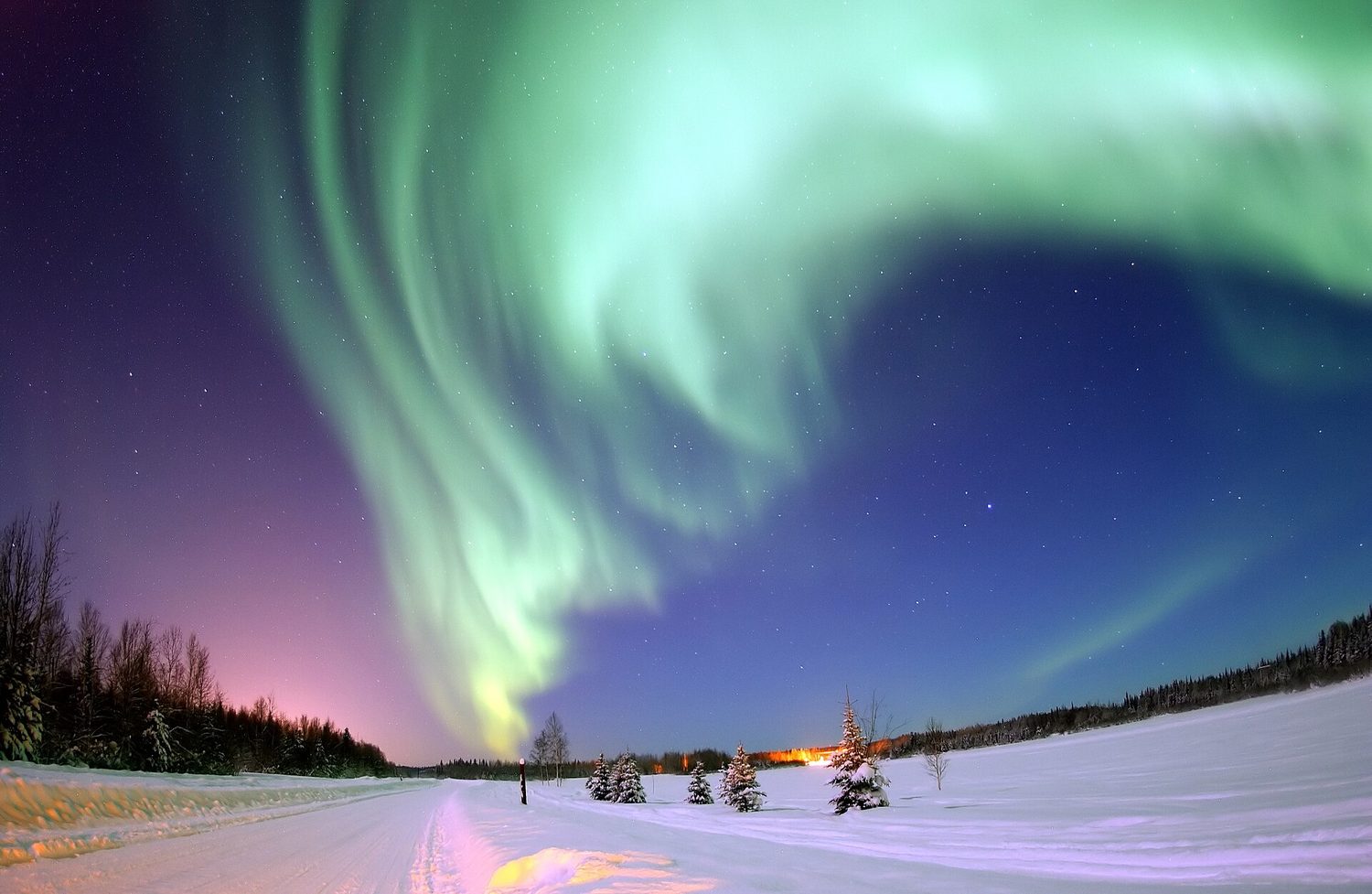
Syllabus · หลักสูตร
EnglishLearning Objective 12.1.A: Describe the properties of a magnetic field.
- 12.1.A.1 A magnetic field is a vector field that can be used to determine the magnetic force exerted on moving electric charges, electric currents, or magnetic materials.
- 12.1.A.1.i Magnetic fields can be produced by magnetic dipoles or combinations of dipoles, but never by monopoles.
- 12.1.A.1.ii Magnetic dipoles have north and south polarity.
- 12.1.A.2 A magnetic field is a vector quantity and can be represented using vector field maps.
- 12.1.A.2.i Magnetic field lines form closed loops.
- 12.1.A.2.ii Magnetic fields in a bar magnet form closed loops, with the external magnetic field pointing away from one end (defined as the north pole) and returning to the other end (defined as the south pole).
Learning Objective 12.1.B: Describe the magnetic behavior of a material as a result of the configuration of magnetic dipoles in the material.
- 12.1.B.1 Magnetic dipoles result from the circular or rotational motion of electric charges. In magnetic materials, this can be the motion of electrons.
- 12.1.B.1.i Permanent magnetism and induced magnetism are system properties that both result from the alignment of magnetic dipoles within a system.
- 12.1.B.1.ii No magnetic north pole is ever found in isolation from a south pole. For example, if a bar magnet is broken in half, both halves are magnetic dipoles.
- 12.1.B.1.iii Magnetic poles of the same polarity will repel; magnetic poles of opposite polarity will attract.
- 12.1.B.1.iv The magnitude of the magnetic field from a magnetic dipole decreases with increasing distance from the dipole.
- 12.1.B.2 A magnetic dipole, such as a magnetic compass, placed in a magnetic field will tend to align with the magnetic field.
- 12.1.B.3 A material's composition influences its magnetic behavior in the presence of an external magnetic field.
- 12.1.B.3.i Ferromagnetic materials such as iron, nickel, and cobalt can be permanently magnetized by an external field that causes the alignment of magnetic domains or atomic magnetic dipoles.
- 12.1.B.3.ii Paramagnetic materials such as aluminum, titanium, and magnesium interact weakly with an external magnetic field, in that the magnetic dipoles of the material do not remain aligned after the external field is removed.
- 12.1.B.3.iii All materials have the property of diamagnetism, in that their electronic structure creates a usually weak alignment of the dipole moments of the material opposite the external magnetic field.
- 12.1.B4 Earth's magnetic field may be approximated as a magnetic dipole.
Learning Objective 12.1.C: Describe the magnetic permeability of a material.
- 12.1.C.1 Magnetic permeability is a measurement of the amount of magnetization in a material in response to an external magnetic field.
- 12.1.C.2 Free space has a constant value of magnetic permeability, known as the vacuum permeability $\mu_0$, that appears in equations representing physical relationships.
- 12.1.C.3 The permeability of matter has values different from that of free space and arises from the matter's composition and arrangement. It is not a constant for a material and varies based on many factors, including temperature, orientation, and strength of the external field.
ไทยวัตถุประสงค์การเรียนรู้ 12.1.A: อธิบายคุณสมบัติของสนามแม่เหล็ก
- 12.1.A.1 สนามแม่เหล็กเป็นฟิสิกส์เวกเตอร์ที่สามารถใช้เพื่อกำหนดแรงแม่เหล็กที่กระทำต่อบรรจบประจุไฟฟ้าเคลื่อนที่ กระแสไฟฟ้า หรือวัสดุแม่เหล็ก
- 12.1.A.1.i Magnetic fields can be produced by magnetic dipoles or combinations of dipoles, but never by monopoles.
- 12.1.A.1.ii dipoleแม่เหล็กมีขั้วเหนือและขั้วใต้
- 12.1.A.2 สนามแม่เหล็กเป็นปริมาณเวกเตอร์และสามารถแสดงด้วยแผนที่สนามเวกเตอร์
- 12.1.A.2.i เส้นสนามแม่เหล็กเป็นวงปิด
- 12.1.A.2.ii สนามแม่เหล็กในแท่งแม่เหล็กเป็นวงปิด โดยสนามแม่เหล็กภายนอกชี้ออกจากปลายหนึ่ง (กำหนดให้เป็นขั้วเหนือ) และกลับไปยังอีกปลายหนึ่ง (กำหนดให้เป็นขั้วใต้)
วัตถุประสงค์การเรียนรู้ 12.1.B: อธิบายพฤติกรรมแม่เหล็กของวัสดุอันเป็นผลมาจากการจัดเรียงของคู่ขั้วแม่เหล็กภายในวัสดุนั้น
- 12.1.B.1 คู่ขั้วแม่เหล็กเกิดจากการเคลื่อนที่แบบวงกลมหรือหมุนของประจุไฟฟ้า ในวัสดุแม่เหล็กสิ่งนี้อาจเป็นการเคลื่อนที่ของอิเล็กตรอน
- 12.1.B.1.i แม่เหล็กถาวรและแม่เหล็กเหนี่ยวนำเป็นคุณสมบัติของระบบที่ทั้งสองเกิดจากการเรียงตัวของ dipoleแม่เหล็กภายในระบบ
- 12.1.B.1.ii ไม่มีขั้วเหนือแม่เหล็กใดถูกพบแยกจากขั้วใต้ ตัวอย่างเช่น หากหักแท่งแม่เหล็กออกเป็นสองส่วน ทั้งสองครึ่งจะเป็น dipoleแม่เหล็ก
- 12.1.B.1.iii ขั้วแม่เหล็กที่มีขั้วเดียวกันจะผลักกัน; ขั้วแม่เหล็กที่มีขั้วตรงข้ามจะดึงดูดกัน
- 12.1.B.1.iv ขนาดของสนามแม่เหล็กจาก dipoleแม่เหล็กจะลดลงเมื่อระยะห่างจาก dipoleเพิ่มขึ้น
- 12.1.B.2 คู่ขั้วแม่เหล็ก เช่น เข็มทิศแม่เหล็ก เมื่อวางในสนามแม่เหล็กจะมีแนวโน้มจัดตัวให้ขนานกับสนามแม่เหล็กนั้น
- 12.1.B.3 องค์ประกอบของวัสดุมีผลต่อพฤติกรรมแม่เหล็กเมื่ออยู่ในสนามแม่เหล็กภายนอก
- 12.1.B.3.i วัสดุERENCEMAGNETIC เช่น เหล็ก นิกเกิล และโคบอลต์ สามารถทำให้เป็นแม่เหล็กถาวรได้ด้วยสนามภายนอกที่ทำให้เกิดการจัดเรียงของโดเมนแม่เหล็กหรือ dipoleแม่เหล็กอะตอม
- 12.1.B.3.ii วัสดุPARAMAGNETIC เช่น อะลูมิเนียม ไทเทเนียม และแมกนีเซียม มีปฏิสัมพันธ์กับสนามแม่เหล็กภายนอกอย่างอ่อน weakly โดยที่ dipoleแม่เหล็กของวัสดุจะไม่คงการเรียงตัวหลังจากที่สนามภายนอกหายไป
- 12.1.B.3.iii วัสดุทุกชนิดมีคุณสมบัติDiamagnetism โดยโครงสร้างอิเล็กตรอน将它们สร้างการจัดเรียงของโมเมนต์dipole ของวัสดุซึ่งมักจะเป็นไปทางตรงข้ามกับสนามแม่เหล็กภายนอก
- 12.1.B4 สนามแม่เหล็กของโลกสามารถประมาณได้ว่าเป็นคู่ขั้วแม่เหล็ก
วัตถุประสงค์การเรียนรู้ 12.1.C: อธิบายความไวต่อสนามแม่เหล็กของวัสดุ
- 12.1.C.1 ความไวต่อสนามแม่เหล็กคือการวัดปริมาณการแม่เหล็กในวัสดุเมื่อตอบสนองต่อสนามแม่เหล็กภายนอก
- 12.1.C.2空间中มีค่าคงที่ของความไวต่อสนามแม่เหล็ก Known as the vacuum permeability $\mu_0$, which appears in equations representing physical relationships.
- 12.1.C.3 ความสามารถในการผ่านของสนามแม่เหล็ก (Permeability) ของสสารมีค่าแตกต่างจากในสุญญากาศ และเกิดขึ้นจากองค์ประกอบและการจัดเรียงตัวของสสารนั้นๆ ไม่ใช่ค่าคงที่สำหรับวัสดุหนึ่งๆ แต่จะแปรผันตามปัจจัยหลายอย่าง รวมถึงอุณหภูมิ ทิศทาง และความเข้มของสนามภายนอก
Source: College Board AP Course and Exam Description · แหล่งที่มา: คำอธิบายหลักสูตรและข้อสอบ College Board AP
EnglishThe magnetic field around a current Different materials respond very differently to a magnetic field, and the course names three. Ferromagnetic 铁磁性 materials (iron, nickel, cobalt) have dipoles that align strongly and stay aligned, so they can be permanent magnets. Paramagnetic 顺磁性 materials (aluminium, titanium) align only weakly and do not stay aligned. Diamagnetic 抗磁性 materials - in fact all materials have some diamagnetism - align weakly opposite the field. This behaviour comes from a material property, the permeability 磁导率: free space has a fixed permeability of free space $\mu_0$, while the permeability of matter differs from it and is not even constant for a given material.
A magnetic field 磁场 $\vec{B}$ surrounds magnets and moving charges. Field lines run from a magnet's north pole to its south pole outside the magnet, and denser lines mean a stronger field. Magnetic poles always come in pairs – cutting a magnet in half makes two smaller magnets, never an isolated pole.
ไทยสนามแม่เหล็กรอบกระแสไฟฟ้า ออรора:อนุภาคที่มีประจุจากดวงอาทิตย์ถูก引导โดยสนามแม่เหล็กของโลกสู่ขั้วโลก, ที่ซึ่งพวกมันชนอากาศและทำให้มันเรืองแสง วัสดุต่างๆ ตอบสนองต่อสนามแม่เหล็กแตกต่างกันอย่างมาก, และรายวิชาตั้งชื่อสามชนิด. วัสดุ เฟโรแม่เหล็ก (เหล็ก, นิกเกิล, คอปเปอร์) มีไดโพลที่จัดเรียงตัวแน่นหนาและ คง การจัดเรียงไว้, ดังนั้นจึงสามารถเป็นแม่เหล็กถาวรได้. วัสดุ พาราแม่เหล็ก (อะลูมิเนียม, ไทเทเนียม) จัดเรียงตัวได้เพียงเล็กน้อยและไม่คงการจัดเรียงไว้. วัสดุ ไดอะแม่เหล็ก - จริงๆ แล้ว ทุก วัสดุมีไดอะแม่เหล็กบางอย่าง - จัดเรียงตัวอ่อน ตรงข้าม กับสนาม. พฤติกรรมนี้เกิดจากคุณสมบัติของวัสดุ, ความไวต่อแม่เหล็ก: อากาศว่างเปล่ามีความไวต่อแม่เหล็กคงที่ $\mu_0$, ในขณะที่ความไวต่อแม่เหล็กของสสารแตกต่างจากมันและไม่แม้กระทั่งคงที่สำหรับวัสดุที่กำหนด
สนามแม่เหล็ก $\vec{B}$ ล้อมรอบแม่เหล็กและประจุที่เคลื่อนที่. เส้นสนามวิ่งจากขั้วเหนือไปขั้วใต้ของแม่เหล็กภายนอกแม่เหล็ก, และเส้นที่หนาแน่นกว่าหมายถึงสนามที่แรงขึ้น. ขั้วแม่เหล็กมาพร้อมกันเสมอเป็น คู่ – ตัดแม่เหล็กครึ่งหนึ่งจะได้แม่เหล็กเล็กสองชิ้น, ไม่เคยเป็นขั้วเดี่ยว
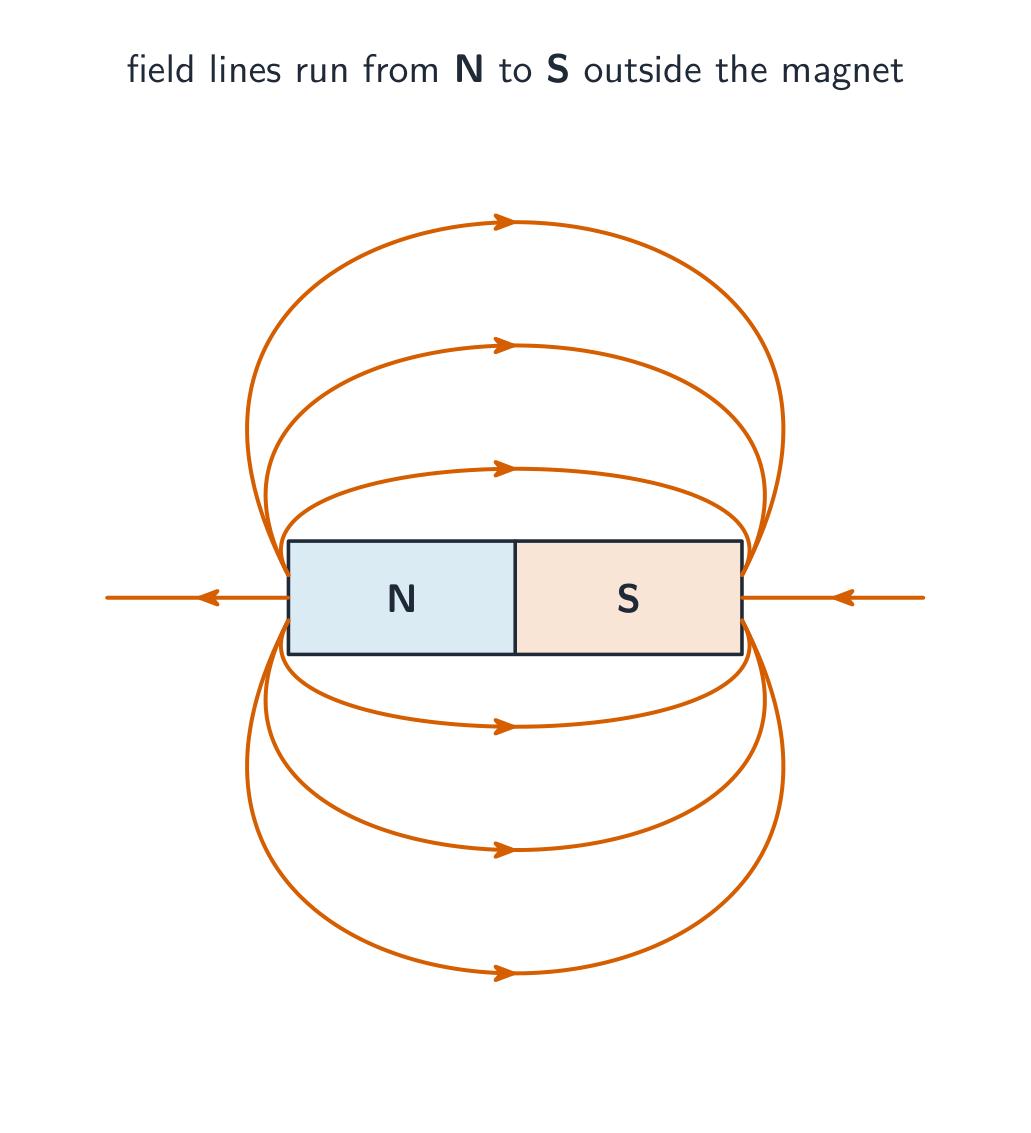
เส้นสนามวิ่งจาก N ไป S ภายนอกแม่เหล็กแท่ง, ใกล้เคียงกันเมื่อสนามแรงขึ้น 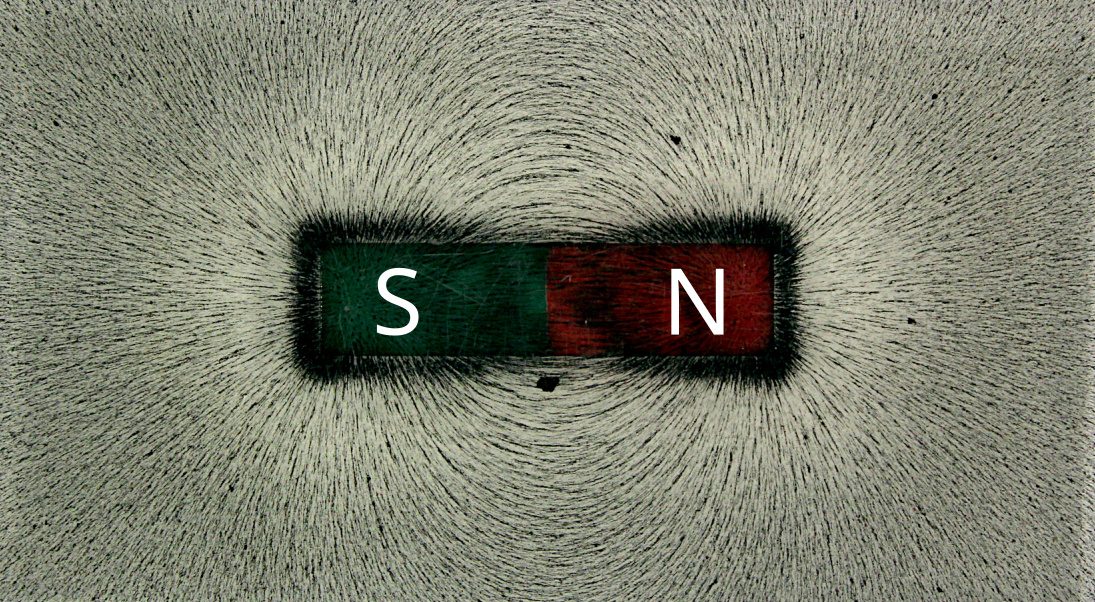
เกล็ดเหล็กเรียงตัวตามสนามแม่เหล็ก, ทำให้เส้นสนามที่มองไม่เห็นของแม่เหล็กแท่งมองเห็นได้ Explore · สำรวจSee a magnet's field lines · เห็นเส้นสนามแม่เหล็กของแม่เหล็ก
Magnetic field lines run from the north pole to the south pole outside the magnet. Where the lines crowd together the field is strongest. · เส้นสนามแม่เหล็ก วิ่งจากขั้วเหนือไปยังขั้วใต้ภายนอกแม่เหล็ก的地方ที่เส้น場的线หนาแน่นขึ้น意味着磁场最强。
Vocabulary · คำศัพท์ Train · ฝึกฝนEnglish ไทย Ferromagnetic/ˌferəməɡˈnetɪk/ ERENCE Ferromagnetic Paramagnetic/ˌpærəməɡˈnetɪk/ PARAMAGNETIC Paramagnetic Diamagnetic/ˌdaɪəməɡˈnetɪk/ Diamagnetic permeability/ˌpɜːməˈbɪlɪti/ permeability magnetic field/mæɡˈnetɪk fiːld/ สนามแม่เหล็ก 12.2
Magnetism and Moving Charges · แม่เหล็กและประจุที่เคลื่อนที่
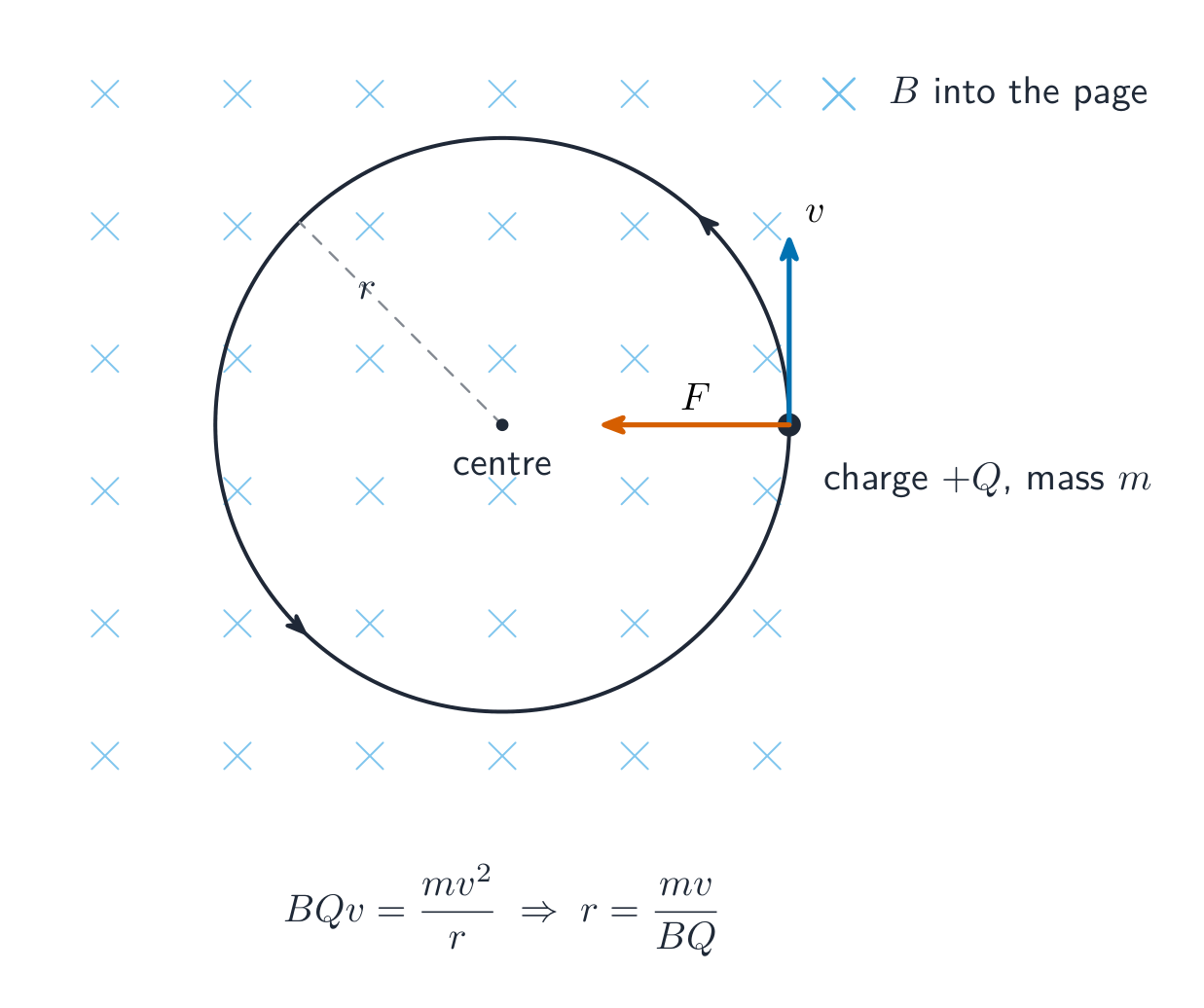
Syllabus · หลักสูตร
EnglishLearning Objective 12.2.A: Describe the magnetic field produced by moving charged objects.
- 12.2.A.1 A single moving charged object produces a magnetic field.
- 12.2.A.1.i The magnetic field at a particular point produced by a moving charged object depends on the object's velocity and the distance between the point and the object.
- 12.2.A.1.ii At a point in space, the direction of the magnetic field produced by a moving charged object is perpendicular to both the velocity of the object and the position vector from the object to that point in space and can be determined using the right-hand rule.
- 12.2.A.1.iii The magnitude of the magnetic field is a maximum when the velocity vector and the position vector from the object to that point in space are perpendicular.
Learning Objective 12.2.B: Describe the force exerted on moving charged objects by a magnetic field.
- 12.2.B.1 Magnetic forces describe interactions between moving charged objects.
- 12.2.B.2 A magnetic field may exert a force on a charged object moving in that field.
- 12.2.B.2.i The magnitude of the force exerted by a magnetic field on a moving charged object is proportional to the magnitude of the charge, the magnitude of the charged object's velocity, and the magnitude of the magnetic field and also depends on the angle between the velocity and magnetic field vectors.
- Equation: $F_B = qvB\sin\theta$
- 12.2.B.2.ii The direction of the force exerted by a magnetic field on a moving charged object is perpendicular to both the direction of the magnetic field and the velocity of the charge, as defined by the right-hand rule.
- 12.2.B.2.i The magnitude of the force exerted by a magnetic field on a moving charged object is proportional to the magnitude of the charge, the magnitude of the charged object's velocity, and the magnitude of the magnetic field and also depends on the angle between the velocity and magnetic field vectors.
- 12.2.B.3 In a region containing both a magnetic field and an electric field, a moving charged object will experience independent forces from each field.
- 12.2.B.4 The Hall effect describes the potential difference created in a conductor by an external magnetic field that has a component perpendicular to the direction of charges moving in the conductor.
Boundary statement: Quantitative treatment of the magnitude of the magnetic force exerted by a magnetic field on a moving charge is limited to angles of 0, 90, and 180 degrees between the velocity and the magnetic field. Qualitative analysis of other angles is permitted.
ไทยวัตถุประสงค์การเรียนรู้ 12.2.A: อธิบายสนามแม่เหล็กที่เกิดจากวัตถุที่มีประจุไฟฟ้าเคลื่อนที่
- 12.2.A.1 วัตถุเดียวที่มีประจุไฟฟ้าเคลื่อนที่จะสร้างสนามแม่เหล็กได้
- 12.2.A.1.i สนามแม่เหล็ก ณ จุดใดจุดหนึ่งซึ่งเกิดจากวัตถุที่มีประจุไฟฟ้าเคลื่อนที่ ขึ้นอยู่กับความเร็วของวัตถุนั้นและความห่างระหว่างจุดกับวัตถุ
- 12.2.A.1.ii ณ จุดใดๆ ในอวกาศ ทิศทางของสนามแม่เหล็กที่เกิดจากวัตถุที่มีประจุไฟฟ้าเคลื่อนที่จะตั้งฉากกับทั้งความเร็วของวัตถุและเวกเตอร์ตำแหน่งจากวัตถุไปยังจุดนั้นในอวกาศ และสามารถหาได้โดยใช้กฎมือขวา
- 12.2.A.1.iii ขนาดของสนามแม่เหล็กจะมีค่าสูงสุดเมื่อเวกเตอร์ความเร็วและเวกเตอร์ตำแหน่งจากวัตถุไปยังจุดนั้นในอวกาศตั้งฉากกัน
วัตถุประสงค์การเรียนรู้ 12.2.B: อธิบายแรงที่กระทำต่อวัตถุที่มีประจุไฟฟ้าเคลื่อนที่โดยสนามแม่เหล็ก
- 12.2.B.1 แรงแม่เหล็กอธิบายถึงปฏิสัมพันธ์ระหว่างวัตถุที่มีประจุไฟฟ้าเคลื่อนที่
- 12.2.B.2 สนามแม่เหล็กอาจ exert แรงต่อวัตถุที่มีประจุไฟฟ้าเคลื่อนที่ผ่านสนามนั้น
- 12.2.B.2.i ขนาดของแรงที่กระทำโดยสนามแม่เหล็กต่อวัตถุที่มีประจุไฟฟ้าเคลื่อนที่ เป็นสัดส่วนกับขนาดของประจุไฟฟ้า, ขนาดของความเร็วของวัตถุที่มีประจุ, และขนาดของสนามแม่เหล็ก และยังขึ้นอยู่กับมุมระหว่างเวกเตอร์ความเร็วกับเวกเตอร์สนามแม่เหล็ก
- สมการ: $F_B = qvB\sin\theta$
- 12.2.B.2.ii ทิศทางของแรงที่กระทำโดยสนามแม่เหล็กต่อวัตถุที่มีประจุไฟฟ้าเคลื่อนที่จะตั้งฉากกับทั้งทิศทางของสนามแม่เหล็กและความเร็วของประจุ ตามที่กำหนดโดยกฎมือขวา
- 12.2.B.2.i ขนาดของแรงที่กระทำโดยสนามแม่เหล็กต่อวัตถุที่มีประจุไฟฟ้าเคลื่อนที่ เป็นสัดส่วนกับขนาดของประจุไฟฟ้า, ขนาดของความเร็วของวัตถุที่มีประจุ, และขนาดของสนามแม่เหล็ก และยังขึ้นอยู่กับมุมระหว่างเวกเตอร์ความเร็วกับเวกเตอร์สนามแม่เหล็ก
- 12.2.B.3 ในบริเวณที่มีทั้งสนามแม่เหล็กและสนามไฟฟ้า วัตถุที่มีประจุไฟฟ้าเคลื่อนที่จะได้รับแรง分别从แต่ละสนามอย่างอิสระต่อกัน
- 12.2.B.4 ผล Hall (Hall effect) อธิบายถึงความต่างศักย์ที่เกิดขึ้นในตัวนำเนื่องจากสนามแม่เหล็กภายนอกที่มีส่วนประกอบตั้งฉากกับทิศทางการเคลื่อนที่ของประจุไฟฟ้าในตัวนำ
คำจำกัดขอบเขต: การคำนวณเชิงปริมาณของขนาดแรงแม่เหล็กที่กระทำต่อประจุไฟฟ้าเคลื่อนที่จำกัดอยู่ที่มุม 0, 90 และ 180 องศา ระหว่างความเร็วและสนามแม่เหล็ก การวิเคราะห์เชิงคุณภาพสำหรับมุมอื่นๆ อนุญาตให้ทำได้
Source: College Board AP Course and Exam Description · แหล่งที่มา: คำอธิบายหลักสูตรและข้อสอบ College Board AP
EnglishA moving charge in a magnetic field A charge moving through a magnetic field feels a magnetic force 磁力:
$$F=qvB\sin\theta,$$where $\theta$ is the angle between the velocity and the field. The force is perpendicular to both $\vec{v}$ and $\vec{B}$ (use the right-hand rule), so it changes direction but not speed – a charge moving perpendicular to a uniform field travels in a circle. A stationary charge, or one moving parallel to the field, feels no magnetic force.Worked example. A proton ($q=1.6\times10^{-19}\ \text{C}$, $m=1.67\times10^{-27}\ \text{kg}$) enters a $0.50\ \text{T}$ field at $2.0\times10^{5}\ \text{m/s}$, at right angles to the field. The magnetic force is
$$F=qvB=1.6\times10^{-19}\times2.0\times10^{5}\times0.50=1.6\times10^{-14}\ \text{N}.$$This force is the centripetal force, so it bends the proton into a circle of radius$$r=\frac{mv}{qB}=\frac{1.67\times10^{-27}\times2.0\times10^{5}}{1.6\times10^{-19}\times0.50}=4.2\times10^{-3}\ \text{m}.$$Setting $qvB=\dfrac{mv^2}{r}$ and cancelling gives that neat $r=mv/(qB)$ – the principle behind mass spectrometers.ไทยประจุที่เคลื่อนที่ในสนามแม่เหล็ก ประจุที่เคลื่อนที่ผ่านสนามแม่เหล็กจะสัมผัสกับ แรงแม่เหล็ก:
$$F=qvB\sin\theta,$$โดยที่ $\theta$ คือมุมระหว่างความเร็วและสนาม แรงนี้ ตั้งฉาก กับทั้ง $\vec{v}$ และ $\vec{B}$ (ใช้กฎมือขวา) ดังนั้นจึงเปลี่ยนทิศทางแต่ไม่เปลี่ยนความเร็ว – ประจุที่เคลื่อนที่ตั้งฉากกับสนามสม่ำเสมอจะเคลื่อนที่ตาม วงกลม ประจุที่หยุดนิ่งหรือเคลื่อนที่ขนานกับสนามจะไม่สัมผัสแรงแม่เหล็กอนุภาคที่มีประจุเคลื่อนที่ผ่านสนามแม่เหล็กจะเคลื่อนที่ตามเส้นทางวงกลม ตัวอย่างโจทย์พร้อมวิธีทำ. โปรตอน ($q=1.6\times10^{-19}\ \text{C}$, $m=1.67\times10^{-27}\ \text{kg}$) เข้าสู่สนาม $0.50\ \text{T}$ ที่ $2.0\times10^{5}\ \text{m/s}$ โดยตั้งฉากกับสนาม แรงแม่เหล็กคือ
$$F=qvB=1.6\times10^{-19}\times2.0\times10^{5}\times0.50=1.6\times10^{-14}\ \text{N}.$$แรงนี้เป็นแรงเข้าศูนย์กลาง จึงทำให้โปรตอนโค้งเป็นวงกลมที่มีรัศมี$$r=\frac{mv}{qB}=\frac{1.67\times10^{-27}\times2.0\times10^{5}}{1.6\times10^{-19}\times0.50}=4.2\times10^{-3}\ \text{m}.$$เมื่อแทนค่า $qvB=\dfrac{mv^2}{r}$ และตัดตัวประกอบจะได้ $r=mv/(qB)$ ที่สวยงาม – ซึ่งเป็นหลักการของสเปกโตรมิเตอร์มวลVocabulary · คำศัพท์ Train · ฝึกฝนEnglish ไทย magnetic force/mæɡˈnetɪk fɔːs/ แรงแม่เหล็ก 12.3
Magnetism and Current-Carrying Wires · แม่เหล็กไฟฟ้าและสายไฟที่ไหลผ่านกระแสไฟฟ้า
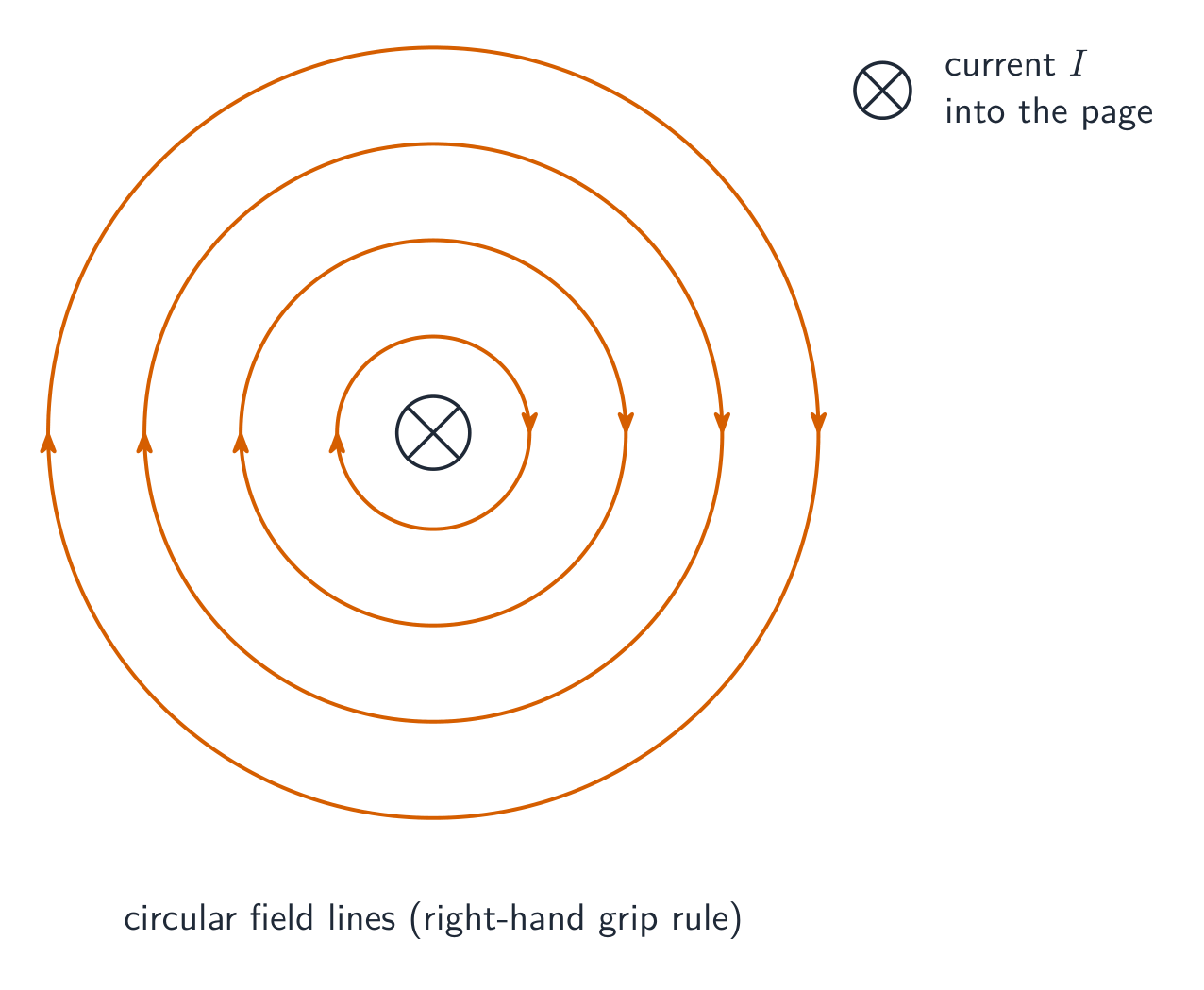
Syllabus · หลักสูตร
EnglishLearning Objective 12.3.A: Describe the magnetic field produced by a current-carrying wire.
- 12.3.A.1 A current-carrying wire produces a magnetic field.
- 12.3.A.1.i The magnetic field vectors around a long, straight, current-carrying wire are tangent to concentric circles centered on that wire. The field has no component toward, away from, or parallel to the long, straight, current-carrying wire.
- 12.3.A.1.ii At a point in space, the magnitude of the magnetic field due to a long, straight, current-carrying wire is proportional to the magnitude of the current in the wire and inversely proportional to the perpendicular distance from the central axis of the wire to the point.
- Equation: $B = \dfrac{\mu_0}{2\pi}\dfrac{I}{r}$
- 12.3.A.1.iii The direction of the magnetic field created by a current-carrying wire is determined with the right-hand rule.
- 12.3.A.1.iv The direction of the magnetic field at the center of a current-carrying loop is directed along the axis of the loop and can be found using the right-hand rule.
- 12.3.A.1.v The magnetic field at a location near two or more current-carrying wires can be determined using vector addition principles.
Learning Objective 12.3.B: Describe the force exerted on a current-carrying wire by a magnetic field.
- 12.3.B.1 A magnetic field may exert a force on a current-carrying wire.
- 12.3.B.1.i The magnitude of the force exerted by a magnetic field on a current-carrying wire is proportional to the current, the length of the portion of the wire within the magnetic field, and the magnitude of the magnetic field, and also depends on the angle between the direction of the current in the wire and the direction of the magnetic field.
- Equation: $F_B = I\ell B\sin\theta$
- 12.3.B.1.ii The direction of the force exerted by the magnetic field on a current-carrying wire is determined by the right-hand rule.
- 12.3.B.1.i The magnitude of the force exerted by a magnetic field on a current-carrying wire is proportional to the current, the length of the portion of the wire within the magnetic field, and the magnitude of the magnetic field, and also depends on the angle between the direction of the current in the wire and the direction of the magnetic field.
ไทยวัตถุประสงค์การเรียนรู้ 12.3.A: อธิบายสนามแม่เหล็กที่เกิดจากสายไฟที่มีกระแสไหลผ่าน
- 12.3.A.1 สายไฟที่มีกระแสไหลผ่านจะสร้างสนามแม่เหล็กได้
- 12.3.A.1.i เวกเตอร์สนามแม่เหล็กรอบๆ สายไฟตรงยาวที่มีกระแสไหลผ่านจะเป็นเส้นสัมผัสกับวงกลมร่วมศูนย์ที่มีศูนย์กลางอยู่ที่สายฟ้านั้น สนามไม่มีส่วนประกอบชี้เข้าหา ชี้ห่างออก หรือขนานกับสายไฟตรงยาวที่มีกระแสไหลผ่าน
- 12.3.A.1.ii ณ จุดใดจุดหนึ่งในอวกาศ ขนาดของสนามแม่เหล็กเนื่องจากสายไฟตรงยาวที่มีกระแสไหลผ่าน เป็นสัดส่วนกับขนาดของกระแสในสายไฟและผกผันกับความห่างตั้งฉากจากแกนกลางของสายไฟไปยังจุดนั้น
- สมการ: $B = \dfrac{\mu_0}{2\pi}\dfrac{I}{r}$
- 12.3.A.1.iii ทิศทางของสนามแม่เหล็กที่เกิดจากสายไฟที่มีกระแสไหลผ่าน สามารถกำหนดได้ด้วยกฎมือขวา
- 12.3.A.1.iv ทิศทางของสนามแม่เหล็กที่ศูนย์กลางของวงลูปที่มีกระแสไหลผ่าน จะชี้ไปตามแกนของวงลูป และสามารถหาได้โดยใช้กฎมือขวา
- 12.3.A.1.v สนามแม่เหล็ก ณ ตำแหน่งใกล้สายไฟที่มีกระแสไหลผ่านสองเส้นขึ้นไป สามารถหาได้โดยใช้หลักการบวกเวกเตอร์
วัตถุประสงค์การเรียนรู้ 12.3.B: อธิบายแรงที่กระทำต่อสายไฟที่มีกระแสไหลผ่านโดยสนามแม่เหล็ก
- 12.3.B.1 สนามแม่เหล็กอาจ exert แรงต่อสายไฟที่มีกระแสไหลผ่าน
- 12.3.B.1.i ขนาดของแรงที่กระทำโดยสนามแม่เหล็กต่อสายไฟที่มีกระแสไหลผ่าน เป็นสัดส่วนกับกระแส, ความยาวของส่วนสายไฟที่อยู่ในสนามแม่เหล็ก, และขนาดของสนามแม่เหล็ก และยังขึ้นอยู่กับมุมระหว่างทิศทางการไหลของกระแสในสายไฟกับทิศทางของสนามแม่เหล็ก
- สมการ: $F_B = I\ell B\sin\theta$
- 12.3.B.1.ii ทิศทางของแรงที่กระทำโดยสนามแม่เหล็กต่อสายไฟที่มีกระแสไหลผ่าน สามารถกำหนดได้ด้วยกฎมือขวา
- 12.3.B.1.i ขนาดของแรงที่กระทำโดยสนามแม่เหล็กต่อสายไฟที่มีกระแสไหลผ่าน เป็นสัดส่วนกับกระแส, ความยาวของส่วนสายไฟที่อยู่ในสนามแม่เหล็ก, และขนาดของสนามแม่เหล็ก และยังขึ้นอยู่กับมุมระหว่างทิศทางการไหลของกระแสในสายไฟกับทิศทางของสนามแม่เหล็ก
Source: College Board AP Course and Exam Description · แหล่งที่มา: คำอธิบายหลักสูตรและข้อสอบ College Board AP
EnglishBecause a current is moving charge, a magnetic field pushes on a current-carrying wire:
$$F=BIL\sin\theta.$$A current also creates its own magnetic field: circular field lines wrap around a straight wire (right-hand rule), and a coil (solenoid) makes a field like a bar magnet. This is how electromagnets and motors work.Worked example. A $0.30\ \text{m}$ length of wire carries $4.0\ \text{A}$ at right angles to a $0.20\ \text{T}$ field. The force on it is $F=BIL=0.20\times4.0\times0.30=0.24\ \text{N}$ – the push that turns a motor's coil.
ไทยเนื่องจากกระแสไฟฟ้าคือประจุที่เคลื่อนที่ สนามแม่เหล็กจึงกระทำต่อ สายไฟที่ไหลผ่านกระแสไฟฟ้า:
$$F=BIL\sin\theta.$$กระแสไฟฟ้ายัง สร้าง สนามแม่เหล็กของตนเอง: เส้นสนามวงกลมพันรอบสายตรง (กฎมือขวา) และคอยล์ (โซเลนอยด์) สร้างสนามคล้ายแท่งแม่เหล็ก นี่คือวิธีการทำงานของแม่เหล็กไฟฟ้าและมอเตอร์เส้นสนามวงกลมซ้อนกันล้อมรอบสายไฟที่ไหลผ่านกระแสไฟฟ้าตรง ตัวอย่างโจทย์พร้อมวิธีทำ. สายยาว $0.30\ \text{m}$ ไหลผ่านกระแส $4.0\ \text{A}$ ตั้งฉากกับสนาม $0.20\ \text{T}$ แรงที่เกิดขึ้นคือ $F=BIL=0.20\times4.0\times0.30=0.24\ \text{N}$ – وهيแรงดันที่ทำให้คอยล์ของมอเตอร์หมุน
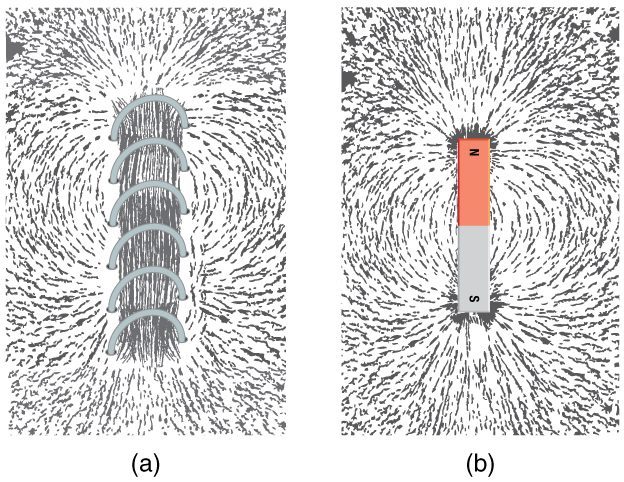
คอยล์ที่ไหลผ่านกระแสไฟฟ้า (โซเลนอยด์) สร้างสนามแม่เหล็กที่มีรูปทรงเหมือนแท่งแม่เหล็ก Explore · สำรวจFind the force on a current in a field · หาแรงที่กระทำต่อกระแสไฟในสนาม
A current in a magnetic field feels a force $F = BIL$, at right angles to both. Use the left-hand rule; reverse the current or field and the force flips. · กระแสไฟในสนามแม่เหล็กจะได้รับแรง $F = BIL$, ตั้งฉากกับทั้งสองอย่าง ใช้กฎมือซ้าย; กลับด้านกระแสไฟหรือสนามแล้วแรงจะกลับทิศทาง
12.4
Electromagnetic Induction and Faraday's Law · การเหนี่ยวนำแม่เหล็กไฟฟ้าและกฎของฟาราเดย์
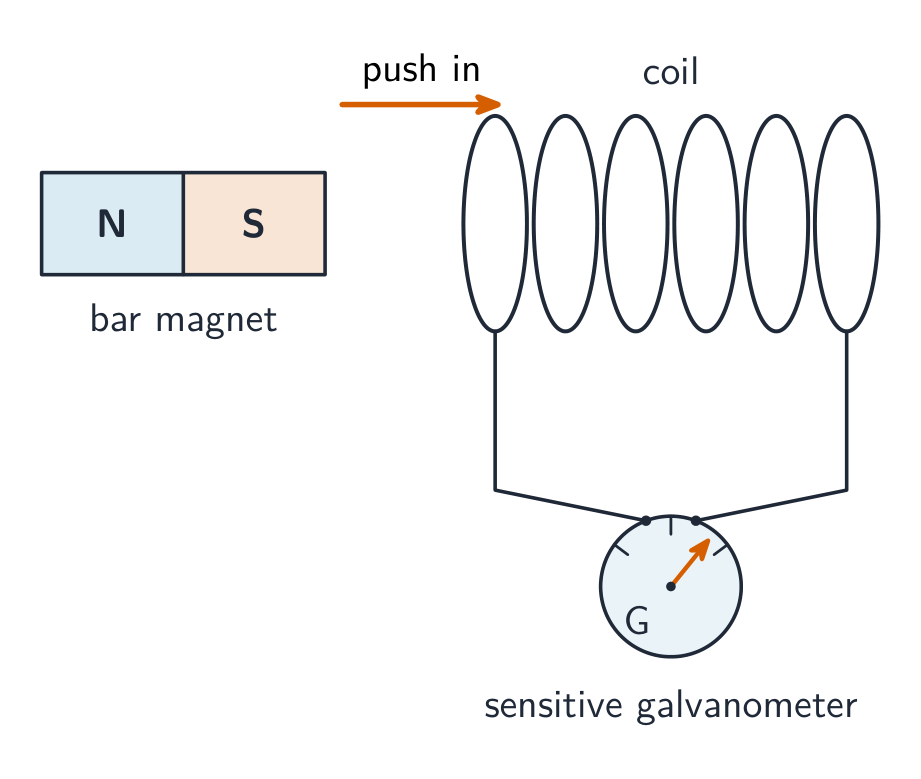
Syllabus · หลักสูตร
EnglishLearning Objective 12.4.A: Describe the induced electric potential difference resulting from a change in magnetic flux.
- 12.4.A.1 Magnetic flux is a description of the amount of the component of a magnetic field that is perpendicular to a cross-sectional area.
- 12.4.A.2 Magnetic flux through a surface is proportional to the magnitude of the component of the magnetic field perpendicular to the surface and to the cross-sectional area of the surface.
- Equation: $\Phi_B = BA\cos\theta$
- 12.4.A.2.i The area vector is defined to be perpendicular to the plane of the surface and directed outward from a closed surface.
- 12.4.A.2.ii The sign of the magnetic flux indicates whether the magnetic field is parallel to or antiparallel to the area vector.
- 12.4.A.3 Faraday’s law describes the relationship between changing magnetic flux and the resulting induced emf in a system.
- Equation: $|\mathcal{E}| = \left|\dfrac{\Delta\Phi_B}{\Delta t}\right|$
- 12.4.A.4 Lenz’s law is used to determine the direction of an induced emf resulting from a changing magnetic flux.
- Equation: $\mathcal{E} = -\dfrac{\Delta\Phi_B}{\Delta t} = -\dfrac{\Delta(BA\cos\theta)}{\Delta t}$
- 12.4.A.4.i An induced emf generates a current that creates a magnetic field that opposes the change in magnetic flux.
- 12.4.A.4.ii The right-hand rule is used to determine the relationships between current, emf, and magnetic flux.
- 12.4.A.5 A common example of electromagnetic induction is a conducting rod on conducting rails in a region with a uniform magnetic field.
- Derived equation: $\mathcal{E} = B\ell v$
ไทยวัตถุประสงค์การเรียนรู้ 12.4.A: อธิบายความต่างศักย์ไฟฟ้าเหนี่ยวนำที่เกิดจากการเปลี่ยนแปลงของฟลักซ์แม่เหล็ก
- 12.4.A.1 ฟลักซ์แม่เหล็กคือคำอธิบายถึงปริมาณของส่วนประกอบของสนามแม่เหล็กที่ตั้งฉากกับพื้นที่หน้าตัด
- 12.4.A.2 ฟลักซ์แม่เหล็กผ่านพื้นผิวเป็นสัดส่วนกับขนาดของส่วนประกอบของสนามแม่เหล็กที่ตั้งฉากกับพื้นผิวและกับพื้นที่หน้าตัดของพื้นผิวนั้น
- สมการ: $\Phi_B = BA\cos\theta$
- 12.4.A.2.i เวกเตอร์พื้นที่ถูกกำหนดให้เป็นตั้งฉากกับระนาบของพื้นผิวและชี้ออกจากพื้นผิวปิด
- 12.4.A.2.ii สัญญาณของฟลักซ์แม่เหล็กบ่งบอก whether สนามแม่เหล็กขนานหรือตรงข้ามกับเวกเตอร์พื้นที่
- 12.4.A.3 กฎของفارาเดย์อธิบายความสัมพันธ์ระหว่างการเปลี่ยนแปลงของฟลักซ์แม่เหล็กและ EMF ที่เหนี่ยวนำขึ้นในระบบ
- สมการ: $|\mathcal{E}| = \left|\dfrac{\Delta\Phi_B}{\Delta t}\right|$
- 12.4.A.4 กฎของเลนซ์ (Lenz’s law) ใช้เพื่อบังคับทิศทางของ EMF ที่เหนี่ยวนำขึ้นจากการเปลี่ยนแปลงของฟลักซ์แม่เหล็ก
- สมการ: $\mathcal{E} = -\dfrac{\Delta\Phi_B}{\Delta t} = -\dfrac{\Delta(BA\cos\theta)}{\Delta t}$
- 12.4.A.4.i EMF ที่เหนี่ยวนำจะเกิดกระแสไฟฟ้าซึ่งสร้างสนามแม่เหล็กที่ต้านทานการเปลี่ยนแปลงของฟลักซ์แม่เหล็ก
- 12.4.A.4.ii กฎมือขวาใช้เพื่อกำหนดความสัมพันธ์ระหว่างกระแสไฟฟ้า EMF และฟลักซ์แม่เหล็ก
- 12.4.A.5 ตัวอย่างที่พบบ่อยของการเหนี่ยวนำแม่เหล็กไฟฟ้าคือแท่งนำไฟฟ้าบนรางนำไฟฟ้าในบริเวณที่มีสนามแม่เหล็กสม่ำเสมอ
- สมการที่ได้มา: $\mathcal{E} = B\ell v$
Source: College Board AP Course and Exam Description · แหล่งที่มา: คำอธิบายหลักสูตรและข้อสอบ College Board AP
EnglishElectromagnetic induction A changing magnetic field through a loop drives a current – electromagnetic induction 电磁感应. The magnetic flux 磁通量 $\Phi=BA\cos\theta$ measures how much field passes through the loop. Faraday's law 法拉第定律 gives the induced emf:
$$\varepsilon=-\frac{\Delta\Phi}{\Delta t}.$$The flux changes if the field, the area, or the loop's orientation changes. Lenz's law 楞次定律 (the minus sign) says the induced current flows so as to oppose the change that caused it – the basis of generators.Worked example. The magnetic flux through a single loop drops from $0.020\ \text{Wb}$ to $0.008\ \text{Wb}$ in $0.030\ \text{s}$. The average induced emf is
$$\varepsilon=\left|\frac{\Delta\Phi}{\Delta t}\right|=\frac{0.020-0.008}{0.030}=0.40\ \text{V}.$$A coil of $N$ turns would give $N$ times this – which is why generators and transformers use many-turn coils.ไทยการเหนี่ยวนำแม่เหล็กไฟฟ้า สนามแม่เหล็กที่เปลี่ยนแปลงผ่านวงลวดจะเกิดกระแสไฟฟ้า – การเหนี่ยวนำแม่เหล็กไฟฟ้า ฟลักซ์แม่เหล็ก $\Phi=BA\cos\theta$ วัดปริมาณสนามที่ผ่านวงลวด กฎของฟาราเดย์ ให้ค่า emf ที่เหนี่ยวนำ:
$$\varepsilon=-\frac{\Delta\Phi}{\Delta t}.$$ฟลักซ์จะเปลี่ยนแปลงหากสนาม พื้นที่ หรือทิศทางของลูปเปลี่ยนไป กฎของเลนซ์ (เครื่องหมายลบ) บอกว่ากระแสที่ถูกเหนี่ยวนำจะไหลในทิศทางที่ ต้านทาน การเปลี่ยนแปลงที่ทำให้เกิดมัน – เป็นพื้นฐานของเครื่องกำเนิดไฟฟ้าการนำแม่เหล็กเข้าไปในคอยล์จะเหนี่ยวนำ e.m.f. ที่กระตุ้นให้กระแสไหล ตัวอย่างฝึกหัด. ฟลักซ์แม่เหล็กผ่านวงลวดเดียวลดลงจาก $0.020\ \text{Wb}$ เป็น $0.008\ \text{Wb}$ ในเวลา $0.030\ \text{s}$ ค่า emf ที่เหนี่ยวนำเฉลี่ยคือ
$$\varepsilon=\left|\frac{\Delta\Phi}{\Delta t}\right|=\frac{0.020-0.008}{0.030}=0.40\ \text{V}.$$คอยล์จำนวน $N$ เสน่ จะให้ค่า × $N$ เท่า – นี่คือเหตุผลที่เครื่องกำเนิดไฟฟ้าและหม้อแปลงใช้คอยล์หลายชั้น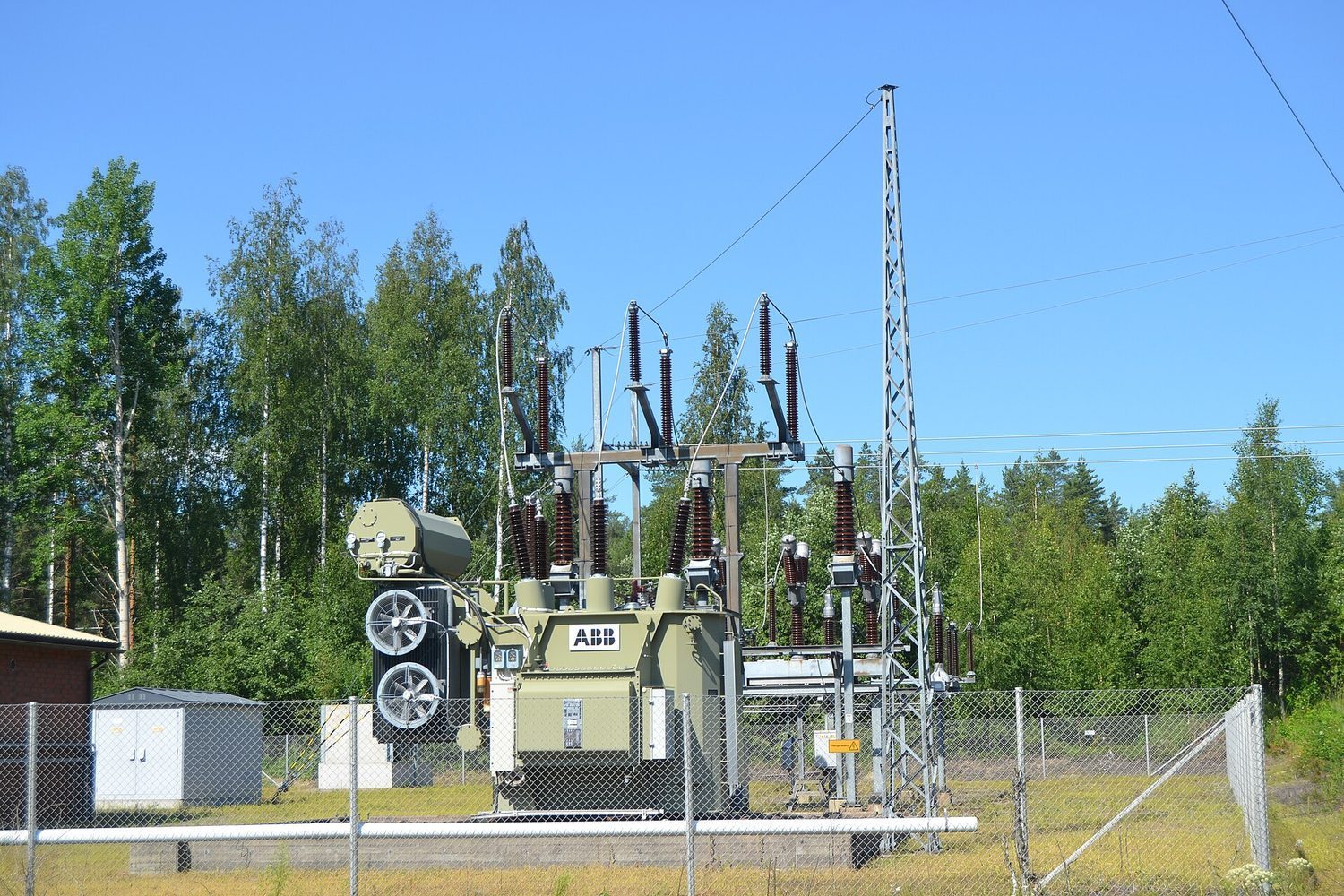
หม้อแปลงสถานีไฟฟ้า: ฟลักซ์แม่เหล็กที่เปลี่ยนแปลงในคอยล์เหนี่ยวนำโวลเทจที่ใช้จ่ายไฟสู่ระบบโครงข่าย Explore · สำรวจInduce a voltage by moving a magnet · เหนี่ยวนำแรงดันไฟฟ้าโดยการเคลื่อนย้ายแม่เหล็ก
Faraday's law: a changing magnetic flux through a coil induces a voltage. Move the magnet faster and the induced EMF grows; Lenz's law sets its direction to oppose the change. · กฎของฟาราเดย์: การเปลี่ยนแปลงของฟลักซ์แม่เหล็กผ่านคอยล์จะเหนี่ยวนำแรงดันไฟฟ้า เคลื่อนย้ายแม่เหล็กเร็วขึ้นแล้ว EMF ที่เหนี่ยวนำจะเพิ่มขึ้น; กฎของเลนซ์ กำหนดทิศทางของมันเพื่อต่อต้านการเปลี่ยนแปลง
Vocabulary · คำศัพท์ Train · ฝึกฝนEnglish ไทย electromagnetic induction/ɪˌlektrəʊməɡˈnetɪk ɪnˈdʌkʃn/ การเหนี่ยวนำแม่เหล็กไฟฟ้า magnetic flux/mæɡˈnetɪk flʌks/ ฟลักซ์แม่เหล็ก Faraday's law/ˈfærədeɪz lɔː/ กฎของ فارาเดย์ Lenz's law/ˈlentsɪz lɔː/ กฎของเลนซ์ 12.4
Exam tips · ข้อแนะนำสำหรับการสอบ
English- The magnetic force $F=qvB\sin\theta$ is perpendicular to the velocity, so it changes direction (a circle) but not speed; a stationary charge or one moving along the field feels no force.
- Use $F=BIL$ for the force on a current-carrying wire (the motor effect).
- A current creates a magnetic field (circles around a wire; a solenoid acts like a bar magnet).
- Induction needs a changing flux $\Phi=BA$ — a stationary magnet in a coil induces nothing.
- Faraday: $\varepsilon=\Delta\Phi/\Delta t$ (times $N$ turns); Lenz: the induced current opposes the change (energy conservation).
ไทย- แรงแม่เหล็ก $F=qvB\sin\theta$ ตั้งฉาก กับความเร็ว จึงเปลี่ยนทิศทาง (เป็นวงกลม) แต่ไม่เปลี่ยนความเร็ว; ประจุที่หยุดนิ่งหรือเคลื่อนที่ ตาม ทิศทางของสนามจะไม่สัมผัสแรง
- ใช้ $F=BIL$ สำหรับแรงกระทำต่อสายไฟที่ไหลผ่านกระแสไฟฟ้า (ผลของมอเตอร์)
- กระแสไฟฟ้า สร้าง สนามแม่เหล็ก (วงกลมรอบสาย; โซเลนอยด์ทำหน้าที่เหมือนแท่งแม่เหล็ก)
- การเหนี่ยวนำ ต้องอาศัยฟลักซ์ เปลี่ยนแปลง $\Phi=BA$ – แม่เหล็กที่หยุดนิ่งอยู่ในคอยล์จะไม่เหนี่ยวนำอะไร
- ฟาราเดย์: $\varepsilon=\Delta\Phi/\Delta t$ (× $N$ ชั้น); เลนซ์: กระแสที่ถูกเหนี่ยวนำต้านทานการเปลี่ยนแปลง (การอนุรักษ์พลังงาน)
- 12.1.A.1 A magnetic field is a vector field that can be used to determine the magnetic force exerted on moving electric charges, electric currents, or magnetic materials.
-
13
Geometric Optics · ทัศนศาสตร์เชิงเรขาคณิต
Watch lesson · ดูบทเรียน13.1
Reflection · การสะท้อนคิด
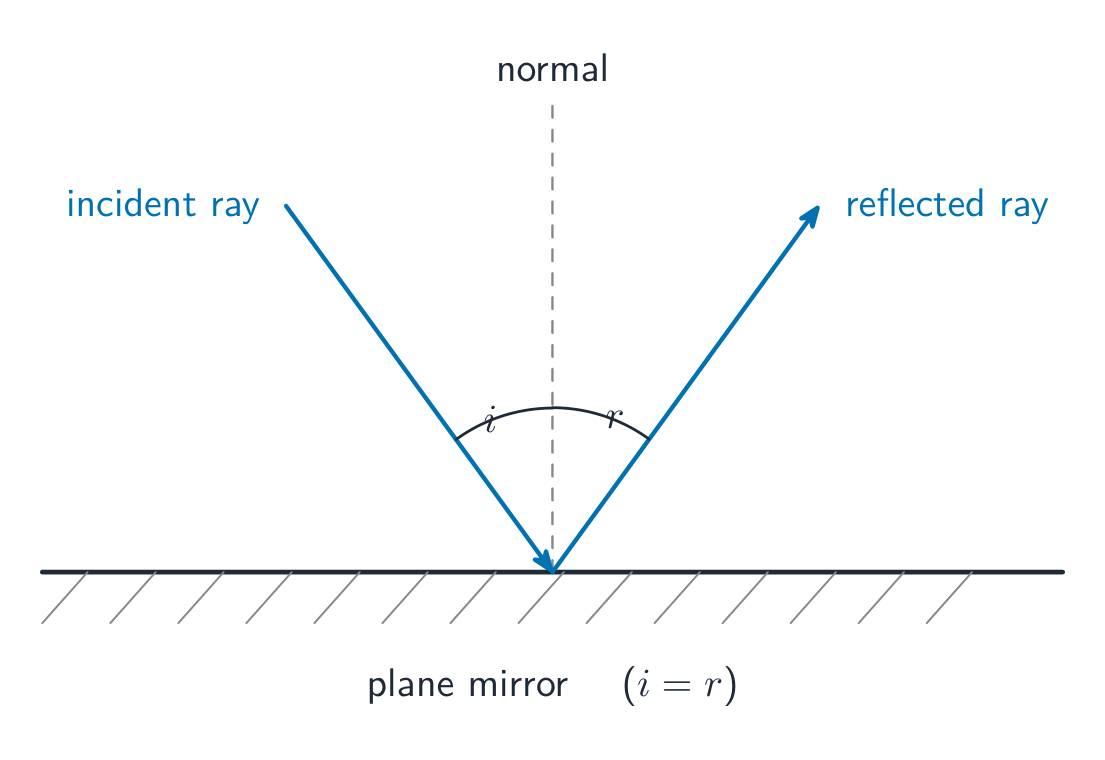
Syllabus · หลักสูตร
EnglishLearning Objective 13.1.A: Describe light as a ray.
- 13.1.A.1 A light ray is a straight line that is perpendicular to the wavefront of a light wave and points in the direction of travel of the wave.
- 13.1.A.1.i Light rays can be used to determine the behavior of light in geometric optics, where the wave nature of light can be neglected.
- 13.1.A.1.ii Rays are not sufficient to understand the spreading of light. In interference and diffraction, the wave nature of the light is important.
- 13.1.A.1.iii A laser is a common source of a single coherent, monochromatic beam of light that can be modeled as a ray. The wave nature of lasers will be considered in Unit 14.
- 13.1.A.2 Ray diagrams depict the path of light before and after an interaction with matter.
Learning Objective 13.1.B: Describe the reflection of light from a surface.
- 13.1.B.1 Light that is incident on a surface can be reflected.
- 13.1.B.2 The law of reflection states that the angle between the incident ray and the normal (the line perpendicular to the surface) is equal to the angle between the reflected ray and the normal.
- Equation: $\theta_i = \theta_r$
- 13.1.B.3 Diffuse reflection is the reflection of light from a rough surface and results in light reflected in many different directions, because the line normal to the surface varies over the area over which the light is incident.
- 13.1.B.4 Specular reflection is the reflection of light from a smooth surface and results in light uniformly reflected from the surface, because the line normal to the surface has an approximately constant direction over the area the light strikes.
ไทยวัตถุประสงค์การเรียนรู้ 13.1.A: อธิบายแสงในฐานะรังสี
- 13.1.A.1 รังสีแสงคือเส้นตรงที่ตั้งฉากกับหน้าคลื่นของคลื่นแสงและชี้ไปในทิศทางการเคลื่อนที่ของคลื่น
- 13.1.A.1.i รังสีแสงสามารถใช้เพื่อศึกษาพฤติกรรมของแสงในทางทัศนศาสตร์เรขาคณิต ซึ่งสามารถละเลยลักษณะคลื่นของแสงได้
- 13.1.A.1.ii รังสีแสงไม่เพียงพอต่อการเข้าใจการกระจายตัวของแสง ในกรณีของการแทรกสอดและการหักเห ลักษณะคลื่นของแสงมีความสำคัญ
- 13.1.A.1.iii เลเซอร์เป็นแหล่งกำเนิดรังสีแสงแบบ cohorent เดียวและความยาวคลื่นเดียวที่พบได้ทั่วไป และสามารถจำลองเป็นรังสีแสงได้ ลักษณะคลื่นของเลเซอร์จะได้รับการพิจารณาในหน่วยที่ 14
- 13.1.A.2 แผนภาพรังสีแสดงเส้นทางของแสงก่อนและหลังเกิดปฏิกิริยากับสสาร
วัตถุประสงค์การเรียนรู้ 13.1.B: อธิบายการสะท้อนแสงจากพื้นผิว
- 13.1.B.1 แสงที่ตกกระทบพื้นผิวสามารถสะท้อนได้
- 13.1.B.2 กฏการสะท้อนระบุว่ามุมระหว่างรังสีตกกับแนวตั้งฉาก (เส้นที่ตั้งฉากกับพื้นผิว) มีค่าเท่ากับมุมระหว่างรังสีสะท้อนกับแนวตั้งฉาก
- สมการ: $\theta_i = \theta_r$
- 13.1.B.3 การสะท้อนแบบกระจายคือการสะท้อนแสงจากพื้นผิวหยาบ ทำให้แสงสะท้อนออกไปในหลายทิศทางต่างๆ เนื่องจากแนวตั้งฉากกับพื้นผิวมีการเปลี่ยนแปลงไปทั่วพื้นที่ที่แสงตกกระทบ
- 13.1.B.4 การสะท้อนแบบ specular คือการสะท้อนแสงจากพื้นผิวเรียบ ทำให้แสงสะท้อนออกจากพื้นผิวอย่างสม่ำเสมอ เนื่องจากแนวตั้งฉากกับพื้นผิวมีทิศทางคงที่โดยประมาณตลอดพื้นที่ที่แสงตกกระทบ
Source: College Board AP Course and Exam Description · แหล่งที่มา: คำอธิบายหลักสูตรและข้อสอบ College Board AP
EnglishGeometric optics 几何光学 treats light as straight-line rays. The law of reflection 反射定律: when light bounces off a surface, the angle of incidence 入射角 equals the angle of reflection 反射角, both measured from the normal (the line perpendicular to the surface). Smooth surfaces reflect a clear image; rough surfaces scatter the rays.
ไทยเรขาคณิตแสง พิจารณาแสงเป็นรังสีแบบเส้นตรง กฎของการสะท้อน: เมื่อแสงกระดอนออกจากพื้นผิว มุมตกกระทบ เท่ากับ มุมสะท้อน ทั้งสองวัดจาก แนวปกติ (เส้นตั้งฉากกับพื้นผิว) พื้นผิวเรียบสะท้อนภาพชัดเจน; พื้นผิวหยาบกระจายรังสี
กฎของการสะท้อน: มุมตกกระทบเท่ากับมุมสะท้อน 13.2
Images Formed by Mirrors · ภาพที่เกิดจากกระจก
Syllabus · หลักสูตร
EnglishLearning Objective 13.2.A: Describe the image formed by a mirror.
- 13.2.A.1 Incident light rays parallel to the principal axis of a concave (converging) mirror will be reflected toward a common location, called the focal point.
- 13.2.A.2 Incident light rays parallel to the principal axis of a convex (diverging) mirror will be reflected such that they appear to have originated from a common location behind the mirror, called the focal point.
- 13.2.A.3 The focal point of a plane mirror is an infinite distance from the mirror.
- 13.2.A.4 The focal point of a spherical mirror may be approximated as a point located on the principal axis of the mirror halfway between the surface of the mirror and the center of the mirror's radius of curvature.
- 13.2.A.5 A real image is formed by a mirror when light rays emanating from a common point are reflected and then intersect at a common point.
- 13.2.A.6 A virtual image is formed by a mirror when reflected light rays diverge such that they appear to have originated from a common point.
- 13.2.A.7 The location of an image depends on the focal length of the mirror and the distance between the object and the surface of the mirror.
- Equation: $\dfrac{1}{s_i} + \dfrac{1}{s_o} = \dfrac{1}{f}$
- 13.2.A.7.i The locations of a mirror's focal point, an object near the mirror, and the image of the object formed by the mirror follow sign conventions that are used to determine those locations relative to the mirror itself.
- 13.2.A.7.ii The distance between the image formed and a plane mirror is equal to the distance between the object and the plane mirror.
- 13.2.A.8 The magnification of an image formed by a mirror is the ratio of the size of the image produced to the size of the object itself and depends on the locations of the object and image relative to the mirror.
- Equation: $|M| = \left| \dfrac{h_i}{h_o} \right| = \left| \dfrac{s_i}{s_o} \right|$
- 13.2.A.9 Ray diagrams can be used to determine the location, type, size, and orientation of images formed by mirrors.
- 13.2.A.9.i The three principal rays are typically used to find the images formed by mirrors. The principal rays are 1) the ray parallel to the principal axis, 2) the ray that reflects at the center of the mirror where the principal axis intersects the mirror, and 3) the ray that passes through the focal point of the mirror.
- 13.2.A.9.ii Images formed by a mirror can be upright or inverted, virtual or real, and reduced, enlarged, or the same size as the object.
Boundary statement: AP Physics 2 limits the study of mirrors to plane mirrors, convex spherical mirrors, and concave spherical mirrors.
ไทยวัตถุประสงค์การเรียนรู้ 13.2.A: อธิบายภาพที่เกิดจากกระจก
- 13.2.A.1 รังสีแสงที่ตกกระทบขนานกับแกนหลักของกระจกเว้า (กระจกรวมแสง) จะถูกสะท้อนเข้าสู่จุดเดียวกัน ซึ่งเรียกว่า จุดโฟกัส
- 13.2.A.2 รังสีแสงที่ตกกระทบขนานกับแกนหลักของกระจกนูน (กระจกแยกแสง) จะถูกสะท้อนจนดูเหมือนว่ามาจากจุดเดียวกันอยู่ด้านหลังกระจก ซึ่งเรียกว่า จุดโฟกัส
- 13.2.A.3 จุดโฟกัสของกระจกแบนอยู่ที่ระยะอนันต์จากกระจก
- 13.2.A.4 จุดโฟกัสของกระจกทรงกลมสามารถประมาณได้ว่าอยู่ในตำแหน่งบนแกนหลักของกระจก ที่กึ่งกลางระหว่างพื้นผิวของกระจกกับศูนย์กลางรัศมีโค้งของกระจก
- 13.2.A.5 ภาพจริงเกิดจากกระจกเมื่อรังสีแสงที่แผ่ออกมาจากจุดเดียวกันถูกสะท้อนแล้วตัดกันที่จุดเดียวกัน
- 13.2.A.6 ภาพลวงตาเกิดจากกระจกเมื่อรังสีแสงที่สะท้อนออกมีการกระจายตัวจนดูเหมือนว่ามาจากจุดเดียวกัน
- 13.2.A.7 ตำแหน่งของภาพขึ้นอยู่กับความยาวโฟกัสของกระจกและระยะห่างระหว่างวัตถุกับพื้นผิวของกระจก
- สมการ: $\dfrac{1}{s_i} + \dfrac{1}{s_o} = \dfrac{1}{f}$
- 13.2.A.7.i ตำแหน่งของจุดโฟกัสของกระจก วัตถุใกล้กระจก และภาพของวัตถุที่เกิดจากกระจก เป็นไปตามกฎเครื่องหมายที่ใช้กำหนดตำแหน่งเหล่านั้นเทียบกับตัวกระจกเอง
- 13.2.A.7.ii ระยะห่างระหว่างภาพที่เกิดกับกระจกแบนมีค่าเท่ากับระยะห่างระหว่างวัตถุกับกระจกแบน
- 13.2.A.8 ความขยายของภาพที่เกิดจากกระจกคืออัตราส่วนระหว่างขนาดของภาพที่เกิดขึ้นต่อขนาดของวัตถุเอง และขึ้นอยู่กับตำแหน่งของวัตถุและภาพเทียบกับกระจก
- สมการ: $|M| = \left| \dfrac{h_i}{h_o} \right| = \left| \dfrac{s_i}{s_o} \right|$
- 13.2.A.9 แผนภาพรังสีสามารถใช้以确定ตำแหน่ง ประเภท ขนาด และการวางตัวของภาพที่เกิดจากกระจก
- 13.2.A.9.i รังสีหลักสามชนิดมักใช้ในการหาภาพที่เกิดจากกระจก รังสีหลักเหล่านี้ ได้แก่ 1) รังสีขนานกับแกนหลัก 2) รังสีที่สะท้อนที่ศูนย์กลางของกระจกซึ่งแกนหลักตัดกับกระจก และ 3) รังสีที่ผ่านจุดโฟกัสของกระจก
- 13.2.A.9.ii ภาพที่เกิดจากกระจกสามารถตั้งตรงหรือคว่ำ ลวงตาหรือจริง และอาจมีขนาดเล็กกว่า ใหญ่กว่า หรือเท่าเดิมกับวัตถุ
คำประกาศขอบเขต: AP Physics 2จำกัดการศึกษาเรื่องกระจกไว้เฉพาะกระจกแบน กระจกทรงกลมนูน และกระจกทรงกลมนูน
Source: College Board AP Course and Exam Description · แหล่งที่มา: คำอธิบายหลักสูตรและข้อสอบ College Board AP
EnglishA curved mirror focuses parallel rays at its focal point, a distance $f$ from the mirror. The mirror equation relates object and image distances:
$$\frac{1}{d_o}+\frac{1}{d_i}=\frac{1}{f},\qquad m=-\frac{d_i}{d_o}.$$A concave mirror 凹面镜 (converging) can form a real image 实像 (rays actually meet, projectable, inverted); a convex mirror 凸面镜 always forms a virtual image 虚像 (rays only appear to meet, upright, reduced). The magnification $m$ gives the image's size and orientation. Sign convention matters: a negative image distance means a virtual image behind the mirror or lens.ไทยกระจกโค้งรวมรังสีขนานที่ จุดโฟกัส ซึ่งอยู่ห่างจากกระจก $f$ สมการกระจก เชื่อมโยงระยะวัตถุและระยะภาพ:
$$\frac{1}{d_o}+\frac{1}{d_i}=\frac{1}{f},\qquad m=-\frac{d_i}{d_o}.$$กระจก เว้า (รวมแสง) สามารถสร้าง ภาพจริง (รังสีพบกันจริง นำไปฉายได้ หงายหัว); กระจก นูน เสมอสร้าง ภาพเสมือน (รังสีดูเหมือนพบกัน ตั้งตรง เล็กกว่า) การขยายภาพ $m$ บอกขนาดและทิศทางของภาพ กฎหมายเครื่องหมายสำคัญ: ระยะภาพ ติดลบ หมายถึงภาพเสมือนอยู่ด้านหลังกระจกหรือเลนส์Explore · สำรวจForm an image with a curved mirror · สร้างภาพด้วยกระจกโค้ง
A concave mirror reflects rays through its focus. The object's distance relative to the focal length decides whether the image is real or virtual, enlarged or reduced. · กระจกเว้า สะท้อนรังสีผ่านจุดโฟกัส ระยะของวัตถุเทียบกับระยะโฟกัส决定了 whether the image is real or virtual, enlarged or reduced.
13.3
Refraction · การหักเห
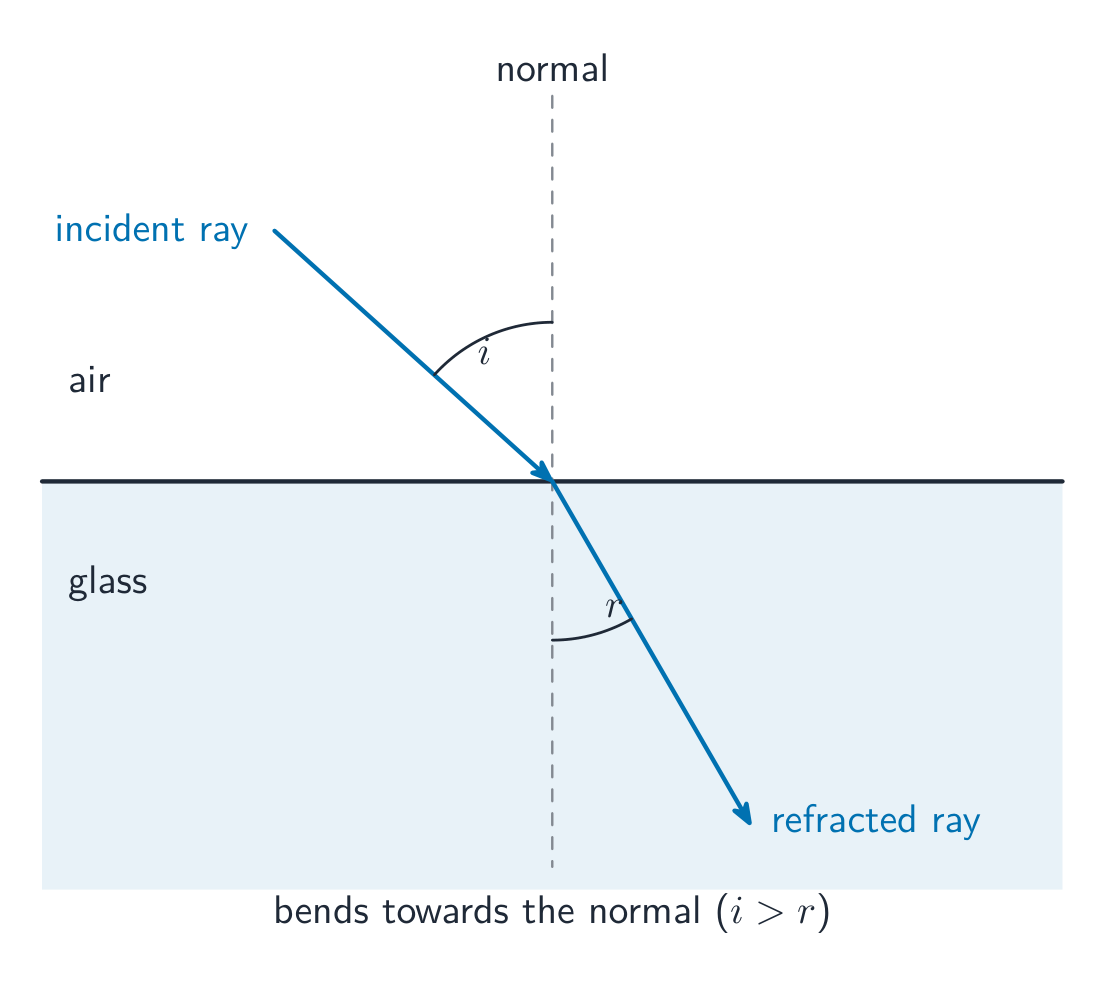
Syllabus · หลักสูตร
EnglishLearning Objective 13.3.A: Describe the refraction of light between two media.
- 13.3.A.1 Refraction is the change in direction of a light ray as the ray passes from one medium into another.
- 13.3.A.2 Refraction is a result of the speed of light changing when light enters a new medium.
- 13.3.A.3 The index of refraction of a given medium is inversely proportional to the speed of light in the medium.
- Equation: $n = \dfrac{c}{v}$
- 13.3.A.4 Snell's law relates the angles of incidence and refraction of a light ray passing from one medium into another to the indices of refraction of the two media.
- Equation: $n_1 \sin\theta_1 = n_2 \sin\theta_2$
- 13.3.A.4.i When a light ray travels from a medium with a higher index of refraction into a medium with a lower index of refraction, the ray refracts away from the normal.
- 13.3.A.4.ii When a light ray travels from a medium with a lower index of refraction into a medium with a higher index of refraction, the ray refracts toward the normal.
- 13.3.A.4.iii When a light ray is incident along the normal to a surface, the transmitted ray is not refracted.
- 13.3.A.5 Total internal reflection may occur when light passes from one medium into another medium with a lower index of refraction.
- 13.3.A.5.i Total internal reflection of light occurs beyond a critical angle of incidence.
- Derived equation: $\theta_{\text{critical}} = \sin^{-1}\left( \dfrac{n_2}{n_1} \right)$
- 13.3.A.5.ii For incident rays at the critical angle, the ray refracts at 90 degrees and travels along the surface of the material.
- 13.3.A.5.iii For incident rays beyond the critical angle, all light is reflected (no light is transmitted into the other medium).
- 13.3.A.5.i Total internal reflection of light occurs beyond a critical angle of incidence.
ไทยวัตถุประสงค์การเรียนรู้ 13.3.A: อธิบายการหักเหของแสงระหว่างสองสสาร
- 13.3.A.1 การหักเหคือการเปลี่ยนทิศทางของรังสีแสงขณะที่รังสีนั้นผ่านจากสสารหนึ่งไปยังอีกสสารหนึ่ง
- 13.3.A.2 การหักเหเป็นผลมาจากการเปลี่ยนแปลงความเร็วของแสงเมื่อแสงเข้าสู่สสารใหม่
- 13.3.A.3 ดัชนีหักเหของสสารที่กำหนดให้แปรผกผันกับความเร็วของแสงในสสารนั้น
- สมการ: $n = \dfrac{c}{v}$
- 13.3.A.4 กฎของSnell เชื่อมโยงมุมตกและมุมหักเหของรังสีแสงที่ผ่านจากสสารหนึ่งไปยังอีกสสารหนึ่ง กับดัชนีหักเหของทั้งสองสสาร
- สมการ: $n_1 \sin\theta_1 = n_2 \sin\theta_2$
- 13.3.A.4.i เมื่อรังสีแสงเดินทางจากสสารที่มีดัชนีหักเหสูงกว่าไปยังสสารที่มีดัชนีหักเหต่ำกว่า รังสีจะหักเหออกจากแนวตั้งฉาก
- 13.3.A.4.ii เมื่อรังสีแสงเดินทางจากสสารที่มีดัชนีหักเหต่ำกว่าไปยังสสารที่มีดัชนีหักเหสูงกว่า รังสีจะหักเหเข้าหาแนวตั้งฉาก
- 13.3.A.4.iii เมื่อรังสีแสงตกกระทบตามแนวตั้งฉากกับพื้นผิว รังสีที่ส่งผ่านจะไม่เกิดการหักเห
- 13.3.A.5 การสะท้อนกลับทั้งหมดอาจเกิดขึ้นเมื่อแสงผ่านจากสสารหนึ่งไปยังอีกสสารหนึ่งซึ่งมีค่าดัดหักเหต่ำกว่า
- 13.3.A.5.i การสะท้อนกลับทั้งหมดของแสงจะเกิดขึ้นเมื่อมุมตกกระทบเกินกว่ามุมวิกฤต
- สมการที่ได้จาก: $\theta_{\text{critical}} = \sin^{-1}\left( \dfrac{n_2}{n_1} \right)$
- 13.3.A.5.ii สำหรับรังสีที่ตกกระทบที่มุมวิกฤตรังสีจะหักเหที่ 90 องศาและเคลื่อนที่ไปตามพื้นผิวของวัสดุ
- 13.3.A.5.iii สำหรับรังสีที่ตกกระทบเกินกว่ามุมวิกฤต แสงทั้งหมดจะถูกสะท้อน (ไม่มีแสงที่ส่งผ่านไปยังสสารอื่น)
- 13.3.A.5.i การสะท้อนกลับทั้งหมดของแสงจะเกิดขึ้นเมื่อมุมตกกระทบเกินกว่ามุมวิกฤต
Source: College Board AP Course and Exam Description · แหล่งที่มา: คำอธิบายหลักสูตรและข้อสอบ College Board AP
EnglishLight bends when it passes between materials because its speed changes – refraction 折射. Each material has an index of refraction 折射率 $n=\dfrac{c}{v}$ (how much it slows light). Snell's law 斯涅尔定律:
$$n_1\sin\theta_1=n_2\sin\theta_2.$$Light entering a denser medium (larger $n$) bends toward the normal. Beyond a critical angle, light going to a less-dense medium reflects entirely – total internal reflection 全反射, used in fibre optics.Worked example. A ray in air ($n_1=1.00$) strikes water ($n_2=1.33$) at $40^{\circ}$ to the normal. By Snell's law,
$$\sin\theta_2=\frac{n_1}{n_2}\sin\theta_1=\frac{1.00}{1.33}\sin 40^{\circ}=0.483\;\Rightarrow\;\theta_2=29^{\circ}.$$The ray bends toward the normal, as expected going into the denser medium.Worked example (critical angle). For light trying to leave glass ($n=1.50$) for air, total internal reflection begins at the critical angle $\theta_c$ where the refracted ray grazes the surface:
$$\sin\theta_c=\frac{1}{n}=\frac{1}{1.50}=0.667\;\Rightarrow\;\theta_c=42^{\circ}.$$Any ray hitting the inside surface more steeply than $42^{\circ}$ is trapped – the reason optical fibres carry light for kilometres.ไทยแสงเบี่ยงเบนเมื่อผ่านระหว่างวัสดุเนื่องจากความเร็วเปลี่ยนไป – การหักเห วัสดุแต่ละชนิดมี ดรรชนีหักเห $n=\dfrac{c}{v}$ (ว่าช้าลงเท่าไร) กฎของسنেলล์:
$$n_1\sin\theta_1=n_2\sin\theta_2.$$แสงเข้าสู่สื่อที่หนาแน่นกว่า ($n$ มากขึ้น) จะเบี่ยงเบน เข้าหา แนวปกติ เมื่อเกินมุมวิกฤต แสงที่ส่งไปยังสื่อที่บางกว่าจะถูกสะท้อนทั้งหมด – การสะท้อนภายในทั้งหมด ใช้ในไฟเบอร์ออปติกแสงหักเห เบี่ยงเบนเข้าหาแนวปกติเมื่อเข้าสู่แก้ว ตัวอย่างโจทย์พร้อมวิธีทำ. รังสีในอากาศ ($n_1=1.00$) ชนน้ำ ($n_2=1.33$) ที่มุม $40^{\circ}$ จากแนวปกติ ตามกฎของسنেলล์,
$$\sin\theta_2=\frac{n_1}{n_2}\sin\theta_1=\frac{1.00}{1.33}\sin 40^{\circ}=0.483\;\Rightarrow\;\theta_2=29^{\circ}.$$รังสีเบี่ยงเบนเข้าหาแนวปกติ ตามที่คาดไว้เมื่อเข้าสู่สื่อที่หนาแน่นกว่าตัวอย่างโจทย์พร้อมวิธีทำ (มุมวิกฤต). สำหรับแสงพยายามออกจากแก้ว ($n=1.50$) สู่อากาศ การสะท้อนภายในทั้งหมดจะเริ่มที่มุมวิกฤต $\theta_c$ ที่รังสีหักเหเสียดกับพื้นผิว:
$$\sin\theta_c=\frac{1}{n}=\frac{1}{1.50}=0.667\;\Rightarrow\;\theta_c=42^{\circ}.$$รังสีใดๆ ที่ตกกระทบพื้นผิวด้านภายในด้วยมุมมากกว่า $42^{\circ}$ จะถูกกักไว้ – นี่คือเหตุผลที่ใยแก้วนำแสงสามารถส่งแสงไปได้ไกลหลายกิโลเมตร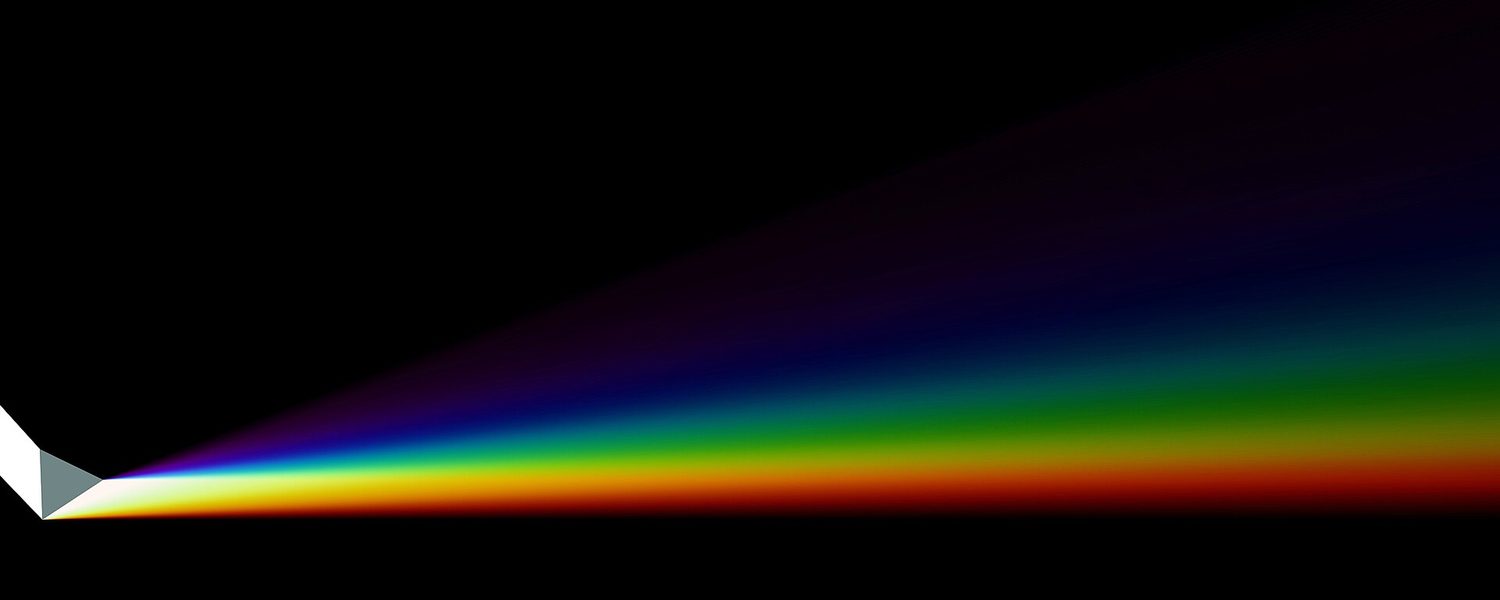
การหักเหอบิดแต่ละสีในปริมาณต่างกัน ทำให้ปริซึมกระจายแสงขาวออกเป็นรุ้ง Explore · สำรวจBend light as it enters glass · หักเหแสงเมื่อเข้าสู่แก้ว
Light refracts (bends) when it changes speed between media, following Snell's law. The denser the medium, the more it bends toward the normal. · แสง หักเห (เบี่ยงเบน) เมื่อเปลี่ยนความเร็วระหว่างสื่อ ตามกฎของสเนล สื่อที่มีความหนาแน่นยิ่งมากยิ่งเบี่ยงเบนเข้าหาแนวปกติมากขึ้น
Vocabulary · คำศัพท์ Train · ฝึกฝนEnglish ไทย Geometric optics/ˌdʒiːəʊˈmetrɪk ˈɒptɪks/ ทัศนศาสตร์เรขาคณิต law of reflection/lɔː ɒv rɪˈflekʃn/ กฎการสะท้อนแสง angle of incidence/ˈæŋɡl ɒv ˈɪnsɪdəns/ มุมตกรับ angle of reflection/ˈæŋɡl ɒv rɪˈflekʃn/ มุมสะท้อน concave mirror/kɒnˈkeɪv ˈmɪrə/ กระจกเว้า real image/rɪəl ˈɪmɪdʒ/ ภาพจริง convex mirror/kɒnˈveks ˈmɪrə/ กระจกนูน virtual image/ˈvɜːtʃuːəl ˈɪmɪdʒ/ ภาพเสมือน refraction/rɪˈfrækʃn/ หักเห index of refraction/ˈɪndeks ɒv rɪˈfrækʃn/ ดัชนีหักเห Snell's law/snelz lɔː/ กฎ Snell total internal reflection/ˈtəʊtl ɪnˈtɜːnl rɪˈflekʃn/ การสะท้อนกลับทั้งหมด 13.4
Images Formed by Lenses · ภาพที่เกิดจากเลนส์
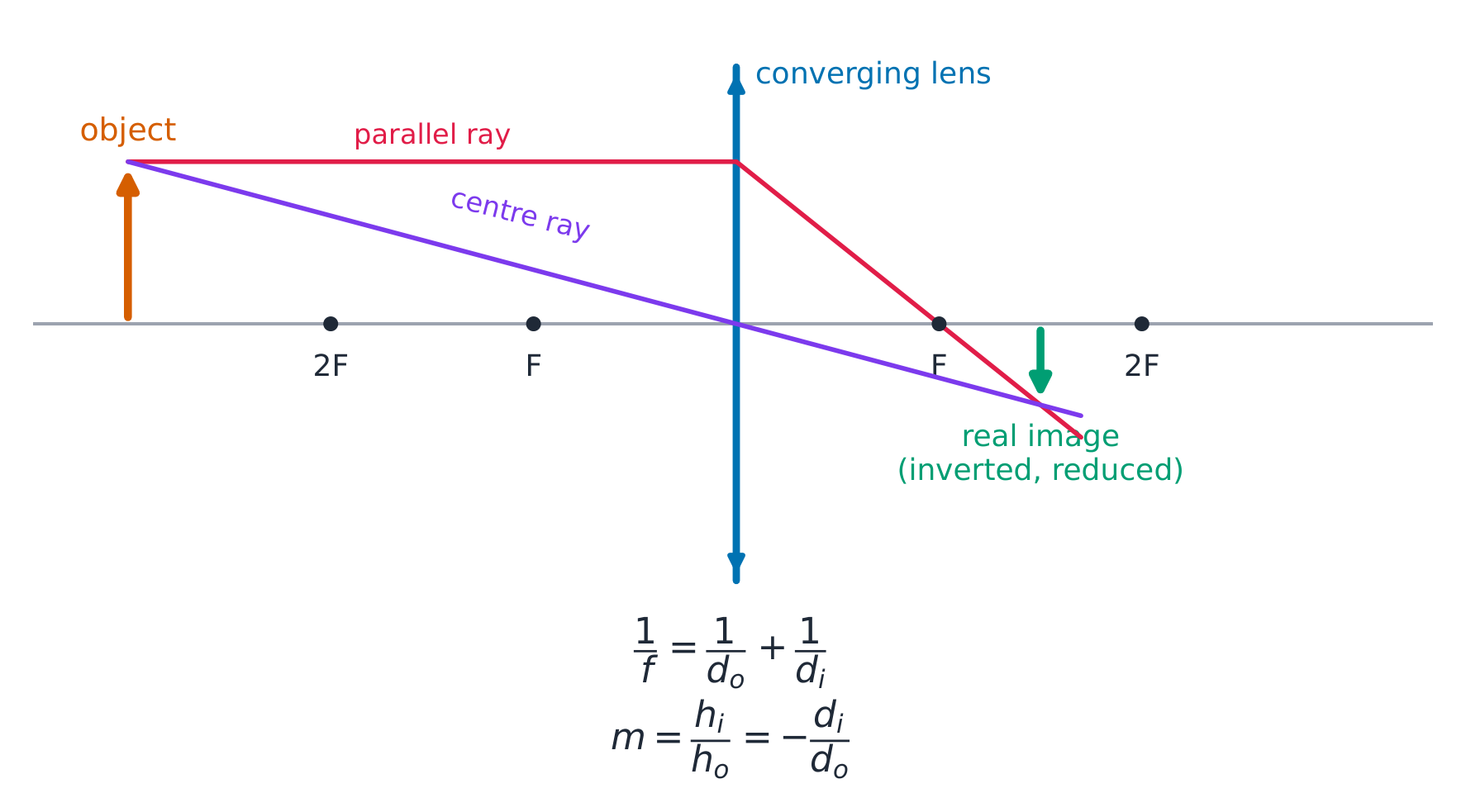
Syllabus · หลักสูตร
EnglishLearning Objective 13.4.A: Describe the image formed by a lens.
- 13.4.A.1 Incident light rays parallel to the principal axis of a thin convex (converging) lens will be refracted and converge toward a common location on the transmitted side of the lens, called the focal point.
- 13.4.A.2 Incident light rays parallel to the principal axis of a thin concave (diverging) lens will be refracted and diverge as if they originated from a focal point on the incident side of the lens.
- 13.4.A.3 A real image is formed by a lens when light rays originating from a common point are refracted such that they intersect at another common point.
- 13.4.A.4 A virtual image is formed by a lens when refracted light rays diverge such that they appear to have originated from a common point.
- 13.4.A.5 For a thin lens, the location of an image depends on the focal length of the lens and the distance between the object and the midline of the lens, as given by the thin-lens equation:
- Equation: $\dfrac{1}{s_i} + \dfrac{1}{s_o} = \dfrac{1}{f}$
- 13.4.A.5.i The locations of a lens's focal point, an object, and the image of the object formed by the lens follow sign conventions that are used to determine those locations relative to the lens itself.
- 13.4.A.5.ii Lenses have a focal point on both sides of the lens that depends on the shape of the respective side of the lens.
- 13.4.A.6 For a thin lens, the magnification of an image is the ratio of the size of the image produced to the size of the object itself and depends on the locations of the object and image relative to the lens.
- Equation: $|M| = \left| \dfrac{h_i}{h_o} \right| = \left| \dfrac{s_i}{s_o} \right|$
- 13.4.A.7 Ray diagrams can be used to determine the location, type, size, and orientation of images formed by lenses.
- 13.4.A.7.i The three principal rays are typically used to find the images formed by lenses. The principal rays are 1) the ray parallel to the principal axis, 2) the ray that passes through the center of the lens where the principal axis intersects the lens, and 3) the ray that passes through the focal point of the lens.
- 13.4.A.7.ii Images formed by a lens can be upright or inverted, virtual or real, and reduced, enlarged, or the same size as the object.
ไทยจุดประสงค์การเรียนรู้ 13.4.A: อธิบายภาพที่เกิดจากเลนส์
- 13.4.A.1 รังสีแสงที่ตกกระทบขนานกับแกนหลักของเลนส์นูนบาง (เลนส์รวมแสง) จะถูกหักเหและรวมตัวกันไปยังตำแหน่งเดียวกันด้านที่แสงส่งผ่านของเลนส์ ซึ่งเรียกว่า จุดโฟกัส
- 13.4.A.2 รังสีแสงที่ตกกระทบขนานกับแกนหลักของเลนส์เว้าบาง (เลนส์แยกแสง) จะถูกหักเหและกระจายออก彷彿ว่าเกิดจากจุดโฟกัสด้านที่แสงตกกระทบของเลนส์
- 13.4.A.3 ภาพจริงเกิดจากเลนส์เมื่อรังสีแสงที่มาจากจุดเดียวกันถูกหักเหจนตัดกันที่จุดเดียวกันอีกจุดหนึ่ง
- 13.4.A.4 ภาพลวงตาเกิดจากเลนส์เมื่อรังสีแสงที่ถูกหักเหกระจายออกจนดูเหมือนว่าจะเกิดจากจุดเดียวกัน
- 13.4.A.5 สำหรับเลนส์บาง ตำแหน่งของภาพขึ้นอยู่กับความยาวโฟกัสของเลนส์และระยะระหว่างวัตถุกับเส้นกลางของเลนส์ ตามสมการเลนส์บาง:
- สมการ: $\dfrac{1}{s_i} + \dfrac{1}{s_o} = \dfrac{1}{f}$
- 13.4.A.5.i ตำแหน่งของจุดโฟกัสของเลนส์ วัตถุ และภาพของวัตถุที่เกิดจากเลนส์遵循ตามกฎเครื่องหมายที่ใช้เพื่อระบุตำแหน่งเหล่านั้นเมื่อเทียบกับเลนส์เอง
- 13.4.A.5.ii เลนส์มีจุดโฟกัสทั้งสองด้านโดยขึ้นอยู่กับรูปร่างของแต่ละด้านของเลนส์
- 13.4.A.6 สำหรับเลนส์บาง ความขยายของภาพคืออัตราส่วนระหว่างขนาดของภาพที่เกิดขึ้นต่อขนาดของวัตถุ本身 และขึ้นอยู่กับตำแหน่งของวัตถุและภาพเมื่อเทียบกับเลนส์
- สมการ: $|M| = \left| \dfrac{h_i}{h_o} \right| = \left| \dfrac{s_i}{s_o} \right|$
- 13.4.A.7 แผนภาพรังสีสามารถใช้กำหนดตำแหน่ง ประเภท ขนาด และการจัดวางของภาพที่เกิดจากเลนส์ได้
- 13.4.A.7.i รังสีหลักสามชนิดมักใช้ในการหาภาพที่เกิดจากเลนส์ รังสีหลักเหล่านี้ ได้แก่ 1) รังสีที่ขนานกับแกนหลัก 2) รังสีที่ผ่านศูนย์กลางของเลนส์ซึ่งแกนหลักตัดกับเลนส์ และ 3) รังสีที่ผ่านจุดโฟกัสของเลนส์
- 13.4.A.7.ii ภาพที่เกิดจากเลนส์สามารถตั้งตรงหรือคว่ำ ลวงตาหรือจริง และอาจมีขนาดเล็กกว่า ใหญ่กว่า หรือเท่ากับวัตถุ
Source: College Board AP Course and Exam Description · แหล่งที่มา: คำอธิบายหลักสูตรและข้อสอบ College Board AP
EnglishA converging lens forms a real image A lens bends light through refraction. The thin-lens equation has the same form as the mirror equation:
$$\frac{1}{d_o}+\frac{1}{d_i}=\frac{1}{f},\qquad m=-\frac{d_i}{d_o}.$$A converging 会聚 (convex) lens can form a real, inverted image or, for a close object, a virtual, upright, enlarged image (a magnifying glass). A diverging 发散 (concave) lens always forms a virtual, upright, reduced image. Ray diagrams locate the image quickly using two easy rays: one parallel to the axis that bends to pass through the far focus, and one straight through the centre of the lens (undeviated).Worked example. An object sits $30\ \text{cm}$ from a converging lens of focal length $f=10\ \text{cm}$. Find the image. From the thin-lens equation,
$$\frac{1}{d_i}=\frac{1}{f}-\frac{1}{d_o}=\frac{1}{10}-\frac{1}{30}=\frac{2}{30}\;\Rightarrow\;d_i=15\ \text{cm},$$and the magnification is $m=-d_i/d_o=-15/30=-0.5$. The image is real (positive $d_i$), inverted (negative $m$), and half the object's size – just what a camera lens does.ไทยเลนส์รวมแสงสร้างภาพจริง เลนส์ บิดแสงด้วยการหักเห สมการเลนส์บาง มีรูปแบบเดียวกับสมการกระจก:
$$\frac{1}{d_o}+\frac{1}{d_i}=\frac{1}{f},\qquad m=-\frac{d_i}{d_o}.$$เลนส์รวมแสง (นูน) สามารถสร้างภาพจริงที่คว่ำ หรือสำหรับวัตถุใกล้ จะสร้างภาพลวงตรงและขยายใหญ่ขึ้น (แว่นขยาย) เลนส์แยกแสง (เว้า) สร้างภาพลวงตรงและเล็กลงเสมอ แผนภาพรังสีช่วยระบุตำแหน่งภาพอย่างรวดเร็วโดยใช้รังสีง่าย ๆ สองเส้น: เส้นขนานกับแกนที่หักเหไปผ่านโฟกัสไกล และเส้นตรงผ่านศูนย์กลางเลนส์ (ไม่เบี่ยงเบน)สองรังสีระบุตำแหน่งภาพ: ขนานแล้วผ่านโฟกัส และตรงผ่านศูนย์กลาง 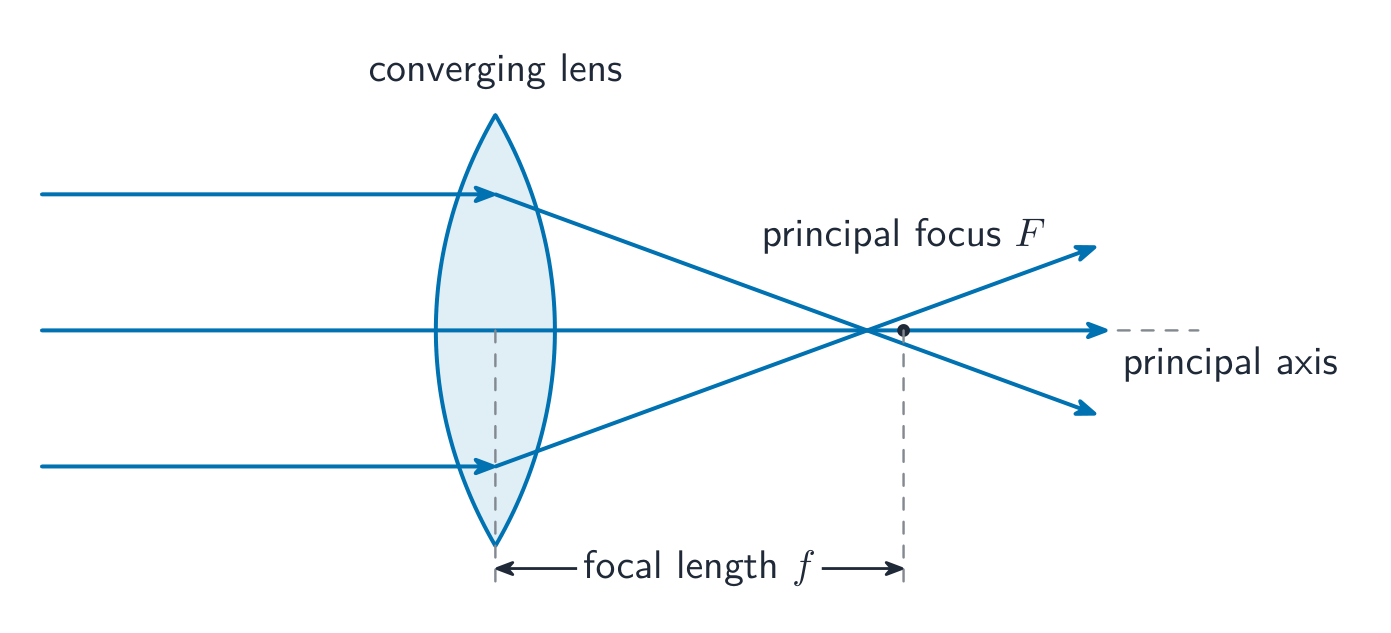
เลนส์รวมแสง汇聚ขนานรังสีไปที่โฟกัสหลัก ตัวอย่างวิธีทำ. วัตถุวางอยู่ $30\ \text{cm}$ จากเลนส์รวมแสงที่มีความยาวโฟกัส $f=10\ \text{cm}$ หาภาพ ที่เกิดจากสมการเลนส์บาง,
$$\frac{1}{d_i}=\frac{1}{f}-\frac{1}{d_o}=\frac{1}{10}-\frac{1}{30}=\frac{2}{30}\;\Rightarrow\;d_i=15\ \text{cm},$$และการขยายคือ $m=-d_i/d_o=-15/30=-0.5$. ภาพนั้นเป็นภาพจริง (ค่า $d_i$ เป็นบวก), คว่ำ (ค่า $m$ เป็นลบ) และมีขนาดครึ่งหนึ่งของวัตถุ – พอดีกับสิ่งที่เลนส์กล้องทำ
เลนส์นูนสร้างภาพจริงคว่ำของฉากไกล ตามที่แผนภาพรังสีทำนายไว้ Explore · สำรวจForm an image with a converging lens · สร้างภาพด้วยเลนส์รวมแสง
A converging lens bends parallel rays to its focal point. Move the object and watch the image change from large and inverted to virtual and upright inside the focal length. · เลนส์รวมแสง หักเหรังสีขนานไปที่จุดโฟกัส เคลื่อนย้ายวัตถุและดูภาพเปลี่ยนจากใหญ่และคว่ำ เป็นภาพเสมือนและตั้งตรงภายในระยะโฟกัส
Vocabulary · คำศัพท์ Train · ฝึกฝนEnglish ไทย converging/kənˈvɜːdʒɪŋ/ การรวมแสง diverging/daɪˈvɜːdʒɪŋ/ การกระจายแสง 13.4
Exam tips · ข้อแนะนำสำหรับการสอบ
English- Measure all angles from the normal, not the surface.
- Light entering a denser medium (larger $n$) bends toward the normal; use Snell's law $n_1\sin\theta_1=n_2\sin\theta_2$.
- Total internal reflection happens only going into a less dense medium, beyond the critical angle ($\sin\theta_c=1/n$).
- For mirrors and lenses use $\tfrac1{d_o}+\tfrac1{d_i}=\tfrac1f$ and $m=-d_i/d_o$: a positive $d_i$ is a real image, negative is virtual.
- $n=c/v$, so a bigger index means a slower speed of light in the material.
ไทย- วัดมุมทั้งหมดจาก แนวตั้งฉาก ไม่ใช่จากผิวหน้า.
- แสงเข้าสู่สื่อที่ หนาแน่นกว่า (ค่า $n$更大) จะบิดเข้าหา แนวตั้งฉาก; ใช้กฎของสนելล์ $n_1\sin\theta_1=n_2\sin\theta_2$.
- การสะท้อนภายในทั้งหมดเกิดขึ้นเฉพาะเมื่อเข้าสู่สื่อที่ หนาแน่นน้อยลง,Beyond the critical angle ($\sin\theta_c=1/n$).
- สำหรับกระจกและเลนส์ใช้ $\tfrac1{d_o}+\tfrac1{d_i}=\tfrac1f$ และ $m=-d_i/d_o$: ค่า $d_i$ เป็นบวกคือภาพจริง, ลบคือภาพลวง
- $n=c/v$, ดังนั้นค่าดัชนีหักเหที่ใหญ่ขึ้นหมายถึงความเร็วแสงที่ช้าลงในวัสดุนั้น
- 13.1.A.1 A light ray is a straight line that is perpendicular to the wavefront of a light wave and points in the direction of travel of the wave.
-
14
Waves, Sound, and Physical Optics · คลื่น เสียง และทัศนศาสตร์ทางกายภาพ
Watch lesson · ดูบทเรียน14.1
Properties of Wave Pulses and Waves · คุณสมบัติของพัลส์คลื่นและคลื่น
Syllabus · หลักสูตร
EnglishLearning Objective 14.1.A: Describe the physical properties of waves and wave pulses.
- 14.1.A.1 Waves transfer energy between two locations without transferring matter between those locations.
- 14.1.A.1.i A wave pulse is a single disturbance that transfers energy without transferring matter between two locations.
- 14.1.A.1.ii A wave is modeled as a continuous, periodic disturbance with well-defined wavelength and frequency.
- 14.1.A.2 Mechanical waves or wave pulses require a medium in which to propagate. Electromagnetic waves or wave pulses do not require a medium in which to propagate.
- 14.1.A.3 The speed at which a wave or wave pulse propagates through a medium depends on the type of wave and the properties of the medium.
- 14.1.A.3.i The speed of all electromagnetic waves in a vacuum is a universal physical constant, $c = 3.00 \times 10^{8}$ m/s.
- 14.1.A.3.ii The speed at which a wave pulse or wave propagates along a string is dependent upon the tension in the string, $F_T$, and the mass per length of the string.
- Equation: $v_{\text{string}} = \sqrt{\dfrac{F_T}{m/\ell}}$
- 14.1.A.3.iii In a given medium, the speed of sound waves increases with the temperature of the medium.
- 14.1.A.4 In a transverse wave, the direction of the disturbance is perpendicular to the direction of propagation of the wave.
- 14.1.A.5 In a longitudinal wave, the direction of the disturbance is parallel to the direction of propagation of the wave.
- 14.1.A.5.i Sound waves are modeled as mechanical longitudinal waves.
- 14.1.A.5.ii The regions of high and low pressure in a sound wave are called compressions and rarefactions, respectively.
- 14.1.A.6 Amplitude is the maximum displacement of a wave from its equilibrium position.
- 14.1.A.6.i The amplitude of a longitudinal pressure wave may be determined by the maximum increase or decrease in pressure from equilibrium pressure.
- 14.1.A.6.ii The loudness of a sound increases with increasing amplitude.
- 14.1.A.6.iii The energy carried by a wave increases with increasing amplitude.
ไทยจุดประสงค์การเรียนรู้ 14.1.A: อธิบายคุณสมบัติทางฟิสิกส์ของคลื่นและพัลส์คลื่น
- 14.1.A.1 คลื่นถ่ายโอนพลังงานระหว่างสองตำแหน่งโดยไม่ถ่ายโอนมวลระหว่างตำแหน่งเหล่านั้น
- 14.1.A.1.i พัลส์คลื่นคือการรบกวนครั้งเดียวที่ถ่ายโอนพลังงานโดยไม่ถ่ายโอนมวลระหว่างสองตำแหน่ง
- 14.1.A.1.ii คลื่นถูกจำลองเป็นการรบกวนต่อเนื่องและแบบรอบ有时间ที่มีช่วงคลื่นและความถี่ที่กำหนดไว้อย่างชัดเจน
- 14.1.A.2 คลื่นกลหรือพัลส์คลื่นต้องการสื่อในการแพร่กระจาย แต่คลื่นแม่เหล็กไฟฟ้าหรือพัลส์คลื่นไม่ต้องการสื่อในการแพร่กระจาย
- 14.1.A.3 ความเร็วที่คลื่นหรือพัลส์คลื่นแพร่กระจายในสสารขึ้นอยู่กับประเภทของคลื่นและคุณสมบัติของสสาร
- 14.1.A.3.i ความเร็วของคลื่นแม่เหล็กไฟฟ้าทั้งหมดในสุญญากาศเป็นค่าคงที่ทางฟิสิกส์สากล $c = 3.00 \times 10^{8}$ m/s
- 14.1.A.3.ii ความเร็วที่พัลส์คลื่นหรือคลื่นแพร่กระจายตามเชือกขึ้นอยู่กับแรงตึงในเชือก $F_T$ และมวลต่อหน่วยความยาวของเชือก
- สมการ: $v_{\text{string}} = \sqrt{\dfrac{F_T}{m/\ell}}$
- 14.1.A.3.iii ในสสารที่กำหนด ความเร็วของคลื่นเสียงจะเพิ่มขึ้นตามอุณหภูมิของสสารนั้น
- 14.1.A.4 ในคลื่นขวาง ทิศทางการรบกวนจะตั้งฉากกับทิศทางการแพร่กระจายของคลื่น
- 14.1.A.5 ในคลื่นยาว ทิศทางการรบกวนจะขนานกับทิศทางการแพร่กระจายของคลื่น
- 14.1.A.5.i คลื่นเสียงถูกจำลองเป็นคลื่นกลแบบยาว
- 14.1.A.5.ii บริเวณที่มีความดันสูงและความดันต่ำในคลื่นเสียงเรียกว่าบริเวณอัดและบริเวณขยาย ตามลำดับ
- 14.1.A.6 แอมพลิจูดคือการกระจัดสูงสุดของคลื่นจากตำแหน่งสมดุล
- 14.1.A.6.i แอมพลิจูดของคลื่นความดันแบบยาวสามารถคำนวณได้จากผลบวกหรือผลต่างสูงสุดของความดันจากความดันสมดุล
- 14.1.A.6.ii ความดังของเสียงจะเพิ่มขึ้นเมื่อแอมพลิจูดเพิ่มขึ้น
- 14.1.A.6.iii พลังงานที่คลื่นพกพาจะเพิ่มขึ้นเมื่อแอมพลิจูดเพิ่มขึ้น
Source: College Board AP Course and Exam Description · แหล่งที่มา: คำอธิบายหลักสูตรและข้อสอบ College Board AP
EnglishA wave 波 carries energy through a medium (or space) without carrying the matter along. A single disturbance is a pulse; a repeating one is a wave. Two types:
- Transverse 横波: the medium moves perpendicular to the wave's travel (a wave on a rope, light).
- Longitudinal 纵波: the medium moves along the direction of travel (sound).
ไทยการรบกวนในถังน้ำ: เส้นทางคลื่นบวกแบบเสริมและทำลายกัน คลื่น นำพา พลังงาน ผ่านสสาร (หรืออวกาศ) โดยไม่ต้องพาสสารไปด้วย การรบกวนครั้งเดียวเรียกว่า พัลส์; การรบกวนซ้ำๆ คือ คลื่น. สองประเภท:
คลื่นขวาง: สสารเคลื่อนที่ในมุมฉากกับการเดินทางของคลื่น - คลื่นขวาง: สสารเคลื่อนที่ตั้งฉากกับการเดินทางของคลื่น (คลื่นบนเชือก, แสง).
- คลื่นยาว: สสารเคลื่อนที่ตามทิศทางการเดินทาง (เสียง).
Vocabulary · คำศัพท์ Train · ฝึกฝนEnglish ไทย wave/weɪv/ คลื่น Transverse/trænsˈvɜːs/ ตามขวาง 14.2
Periodic Waves · คลื่นเชิงรอบคาบ
Syllabus · หลักสูตร
EnglishLearning Objective 14.2.A: Describe the physical properties of a periodic wave.
- 14.2.A.1 Periodic waves have regular repetitions that can be described using period and frequency.
- 14.2.A.1.i The period is the time for one complete oscillation of the wave.
- 14.2.A.1.ii The frequency is the rate at which the wave repeats.
- Equation: $T = \dfrac{1}{f}$
- 14.2.A.1.iii The amplitude of a wave is independent of the period and the frequency of that wave.
- 14.2.A.1.iv The energy of a wave increases with increasing frequency.
- 14.2.A.1.v The frequency of a sound wave is related to its pitch.
- 14.2.A.1.vi Wavelength is the distance between successive corresponding positions (such as peaks or troughs) on a wave.
- 14.2.A.2 A sinusoidal wave can be described by equations for the displacement from equilibrium at a specific location as a function of time. A wave can also be described by an equation for the displacement from equilibrium at a specific time as a function of position.
- Equation: $x(t) = A\cos(\omega t) = A\cos(2\pi f t)$
- Equation: $y(x) = A\cos\left(2\pi \dfrac{x}{\lambda}\right)$
- 14.2.A.3 For a periodic wave, the wavelength is proportional to the wave's speed and inversely proportional to the wave's frequency.
- Equation: $\lambda = \dfrac{v}{f}$
ไทยจุดประสงค์การเรียนรู้ 14.2.A: อธิบายคุณสมบัติทางฟิสิกส์ของคลื่นรอบเวลา
- 14.2.A.1 คลื่นรอบเวลามีการซ้ำอย่างสม่ำเสมอซึ่งสามารถอธิบายได้ด้วยคาบและความถี่
- 14.2.A.1.i คาบคือเวลาสำหรับการสั่นสะเทือนเต็มรอบหนึ่งของคลื่น
- 14.2.A.1.ii ความถี่คืออัตราการที่คลื่นซ้ำขึ้น
- สมการ: $T = \dfrac{1}{f}$
- 14.2.A.1.iii แอมพลิจูดของคลื่นไม่ขึ้นอยู่กับคาบและความถี่ของคลินนั้น
- 14.2.A.1.iv พลังงานของคลื่นจะเพิ่มขึ้นเมื่อความถี่เพิ่มขึ้น
- 14.2.A.1.v ความถี่ของคลื่นเสียงสัมพันธ์กับความสูงของเสียง
- 14.2.A.1.vi ช่วงคลื่นคือระยะห่างระหว่างตำแหน่งที่สอดคล้องกันที่ต่อเนื่องกัน (เช่น ยอดคลื่นหรือหุบคลื่น) บนคลื่น
- 14.2.A.2 คลื่นไซน์สามารถอธิบายได้ด้วยสมการที่แสดงการกระจัดจากตำแหน่งสมดุล ณ ตำแหน่งเฉพาะเมื่อเทียบกับเวลา คลื่นยังสามารถอธิบายได้ด้วยสมการที่แสดงการกระจัดจากตำแหน่งสมดุล ณ เวลาเฉพาะเมื่อเทียบกับตำแหน่ง
- สมการ: $x(t) = A\cos(\omega t) = A\cos(2\pi f t)$
- สมการ: $y(x) = A\cos\left(2\pi \dfrac{x}{\lambda}\right)$
- 14.2.A.3 สำหรับคลื่นแบบเป็นคาบ ความยาวคลื่นแปรผันตรงกับความเร็วของคลื่นและแปรผกผันกับความถี่ของคลื่น
- สมการ: $\lambda = \dfrac{v}{f}$
Source: College Board AP Course and Exam Description · แหล่งที่มา: คำอธิบายหลักสูตรและข้อสอบ College Board AP
EnglishTransverse vs longitudinal waves A repeating wave is described by:
- wavelength 波长 $\lambda$ (distance between repeats),
- frequency 频率 $f$ (cycles per second) and period $T=1/f$,
- amplitude 振幅 $A$ (maximum displacement – related to energy),
- wave speed 波速 $v=f\lambda$, set by the medium, not the source.
Worked example. A musical note has frequency $340\ \text{Hz}$ and the speed of sound is $340\ \text{m/s}$. Its wavelength is $\lambda=v/f=340/340=1.0\ \text{m}$. If the same note travels into water (where sound moves at $\approx 1500\ \text{m/s}$) the frequency stays $340\ \text{Hz}$ but the wavelength stretches to $1500/340\approx 4.4\ \text{m}$ – the source sets the frequency, the medium sets the speed and hence the wavelength.
ไทยคลื่นขวางเทียบกับคลื่นยาว คลื่นที่ทำซ้ำได้อธิบายโดย:
กราฟการกระจัด-ระยะทางแสดงความสูงคลอนและความยาวคลื่น - ความยาวคลื่น $\lambda$ (ระยะห่างระหว่างจุดซ้ำ),
- ความถี่ $f$ (รอบต่อวินาที) และ รอบคาบ $T=1/f$,
- ความสูงคลอน $A$ (การกระจัดสูงสุด – เกี่ยวข้องกับพลังงาน),
- ความเร็วคลื่น $v=f\lambda$, กำหนดโดย สื่อ, ไม่ใช่แหล่งกำเนิด
ตัวอย่างวิธีทำ. เสียงดนตรีมีความถี่ $340\ \text{Hz}$ และความเร็วเสียงคือ $340\ \text{m/s}$. ความยาวคลื่นของมันคือ $\lambda=v/f=340/340=1.0\ \text{m}$. หากเสียงเดียวกันเดินทางเข้าไปในน้ำ (ซึ่งเสียงเดินทางที่ $\approx 1500\ \text{m/s}$) ความถี่จะคงที่ $340\ \text{Hz}$ แต่ความยาวคลื่นจะยืดออกไปเป็น $1500/340\approx 4.4\ \text{m}$ – แหล่งกำเนิดกำหนดความถี่ สื่อกำหนดความเร็วดังนั้นจึงกำหนดความยาวคลื่นด้วย
Explore · สำรวจSend a periodic wave · ส่งคลื่นซ้ำ
A periodic wave carries energy without moving matter. Its speed $v=f\lambda$ links frequency and wavelength; raise the frequency and the wavelength shrinks. · คลื่นซ้ำ พกพาพลังงานโดยไม่เคลื่อนย้ายสสาร ความเร็ว $v=f\lambda$ ของมันเชื่อมโยงความถี่และความยาวคลื่น; เพิ่มความถี่แล้วความยาวคลื่นจะหดตัวลง
Vocabulary · คำศัพท์ Train · ฝึกฝนEnglish ไทย Longitudinal/ˌlɒŋɡɪˈtjuːdɪnl/ แบบติดตามตัว (Longitudinal) 14.3
Boundary Behavior and Polarization · พฤติกรรมที่ขอบเขตและการโพลาไรซ์
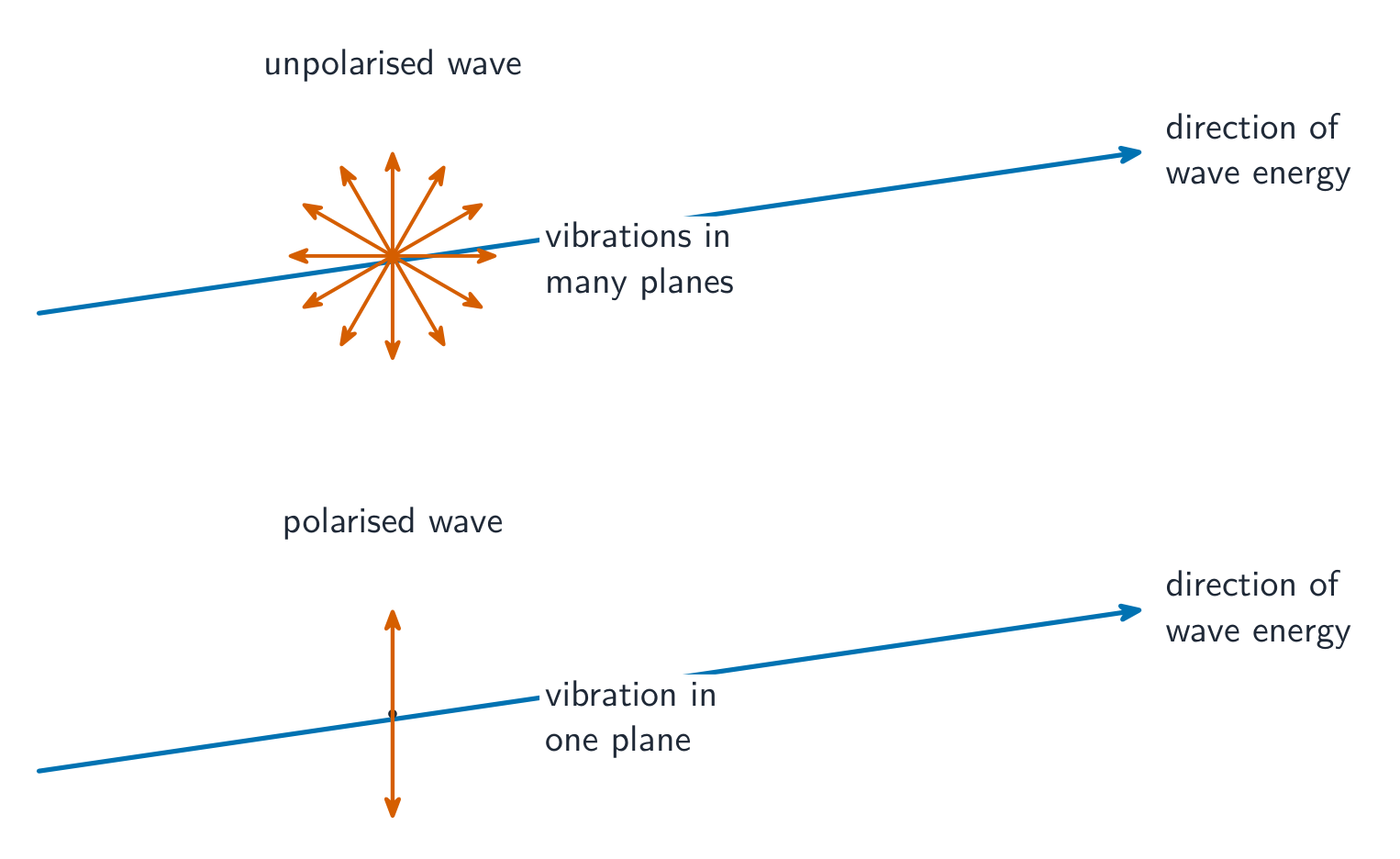
Syllabus · หลักสูตร
EnglishLearning Objective 14.3.A: Describe the interaction between a wave and a boundary.
- 14.3.A.1 A wave that travels from one medium to another can be transmitted or reflected, depending on the properties of the boundary separating the two media.
- 14.3.A.1.i A wave traveling from one medium to another (for example, a wave traveling between low-mass and high-mass strings) will result in reflected and transmitted waves.
- 14.3.A.1.ii A reflected wave is inverted if the transmitted wave travels into a medium in which the speed of the wave decreases.
- 14.3.A.1.iii A reflected wave is not inverted if the transmitted wave travels into a medium in which the speed of the wave increases.
- 14.3.A.1.iv The frequency of a wave does not change when it travels from one medium to another.
- 14.3.A.2 Transverse waves that are reflected from a surface, refracted through a medium, or pass through specific openings may be polarized.
- 14.3.A.2.i Transverse waves can be polarized and oscillate in a single plane.
- 14.3.A.2.ii Longitudinal waves cannot be polarized.
- 14.3.A.3 Polarization of a wave may result in a reduction of the wave's intensity.
- 14.3.A.3.i Intensity is a measure of the amount of power transferred per unit area.
- 14.3.A.3.ii The intensity of a wave is the average power per unit area over one period of the wave.
ไทยวัตถุประสงค์การเรียนรู้ 14.3.A: อธิบายปฏิสัมพันธ์ระหว่างคลื่นกับขอบเขต
- 14.3.A.1 คลื่นที่เคลื่อนที่ผ่านจากสสารหนึ่งไปยังอีกสสารหนึ่ง สามารถส่งผ่านหรือสะท้อนกลับได้ ขึ้นอยู่กับคุณสมบัติของขอบเขตที่แยกสองสสารนั้น
- 14.3.A.1.i คลื่นที่เคลื่อนที่ผ่านจากสสารหนึ่งไปยังอีกสสารหนึ่ง (เช่น คลื่นที่เคลื่อนที่ระหว่างเชือกที่มีมวลน้อยและเชือกที่มีมวลมาก) จะเกิดคลื่นสะท้อนและคลื่นส่งผ่าน
- 14.3.A.1.ii คลื่นสะท้อนจะกลับด้านหากคลื่นส่งผ่านเคลื่อนที่เข้าสู่สสารที่มีความเร็วของคลื่นลดลง
- 14.3.A.1.iii คลื่นสะท้อนจะไม่กลับด้านหากคลื่นส่งผ่านเคลื่อนที่เข้าสู่สสารที่มีความเร็วของคลื่นเพิ่มขึ้น
- 14.3.A.1.iv ความถี่ของคลื่นไม่เปลี่ยนแปลงเมื่อเคลื่อนที่จากสสารหนึ่งไปยังอีกสสารหนึ่ง
- 14.3.A.2 คลื่นขวางที่สะท้อนจากพื้นผิว ย่อเหวี่ยงผ่านสสาร หรือผ่านช่องเปิดบางชนิด อาจเกิดการโพลาไรซ์
- 14.3.A.2.i คลื่นขวางสามารถโพลาไรซ์ได้และสั่นในระนาบเดียว
- 14.3.A.2.ii คลื่นยาวไม่สามารถโพลาไรซ์ได้
- 14.3.A.3 การโพลาไรซ์ของคลื่นอาจทำให้ความเข้มของคลื่นลดลง
- 14.3.A.3.i ความเข้มเป็นค่าวัดปริมาณพลังงานที่ถ่ายโอนต่อหน่วยพื้นที่
- 14.3.A.3.ii ความเข้มของคลื่นคือกำลังเฉลี่ยต่อหน่วยพื้นที่ในช่วงหนึ่งรอบของการสั่นของคลื่น
Source: College Board AP Course and Exam Description · แหล่งที่มา: คำอธิบายหลักสูตรและข้อสอบ College Board AP
EnglishTotal internal reflection At a boundary a wave partly reflects and partly transmits. Reflecting off a denser medium inverts the wave; off a less-dense medium it does not. Polarization 偏振 applies to transverse waves only: a polarizer passes just one direction of oscillation, which is why polarized sunglasses cut glare.
The effect of a polarizer is measured through intensity 强度 - the average power a wave delivers per unit area over one period, in $\text{W m}^{-2}$. Because a polarizer removes the components of the oscillation that are not aligned with it, it reduces the wave's intensity: unpolarized light passing a single ideal polarizer drops to half its intensity, and a second polarizer at an angle cuts it further. Intensity also falls with distance from a source, since the same power spreads over a larger area.
ไทยการสะท้อนภายในทั้งหมด ที่ขอบเขต คลื่นจะ สะท้อน sebagianและ ส่งผ่าน ส่วนหนึ่ง การสะท้อนจากสื่อที่หนาแน่นกว่าทำให้คลื่น คว่ำ; จากสื่อที่หนาแน่นน้อยกว่าจะไม่ โพลาไรซ์ ใช้ได้กับคลื่นขวางเท่านั้น: ตัวกรองโพลาไรซ์ผ่านทิศทางสั่นเพียงทิศทางเดียว นี่คือเหตุผลที่แว่นกันแดดโพลาไรซ์ตัดแสงสะท้อน
ผลของตัวกรองโพลาไรซ์วัดผ่าน ความเข้ม - กำลังเฉลี่ยที่คลื่นส่งมอบ ต่อหน่วยพื้นที่ ตลอดหนึ่งรอบคาบ, ใน $\text{W m}^{-2}$. เนื่องจากตัวกรองโพลาไรซ์กำจัดองค์ประกอบการสั่นที่ไม่ตรงกับมัน มันจึง ลดความเข้มของคลื่น: แสงที่ไม่โพลาไรซ์ผ่านตัวกรองโพลาไรซ์อุดมคติตัวเดียวลดลงเหลือ ครึ่งหนึ่ง ของความเข้ม, และตัวกรองโพลาไรซ์ที่สองที่มุมหนึ่งจะตัดลงอีก ความเข้มยังลดลงตามระยะห่างจากแหล่งกำเนิด เนื่องจากกำลังเท่ากันกระจายอยู่บนพื้นที่ที่ใหญ่ขึ้น
คลื่นไม่โพลาไรซ์สั่นในหลายระนาบ; คลื่นโพลาไรซ์สั่นในระนาบเดียว 14.4
Electromagnetic Waves · คลื่นแม่เหล็กไฟฟ้า
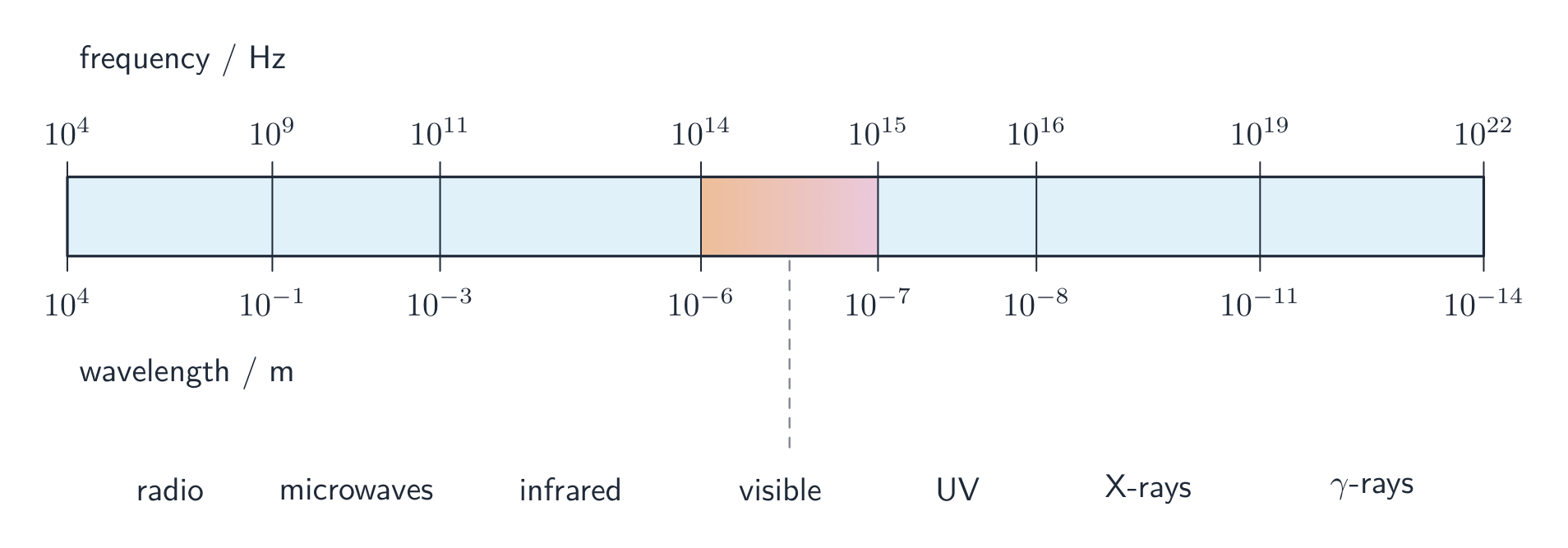
Syllabus · หลักสูตร
EnglishLearning Objective 14.4.A: Describe the properties of an electromagnetic wave.
- 14.4.A.1 Electromagnetic waves consist of oscillating electric and magnetic fields that are mutually perpendicular.
- 14.4.A.1.i Electromagnetic waves are transverse waves because the oscillations of the electric and magnetic fields are perpendicular to the direction of propagation.
- 14.4.A.1.ii Electromagnetic waves are commonly assumed to be plane waves, which are characterized by planar wave fronts.
- 14.4.A.2 Electromagnetic waves do not need a medium through which to propagate.
- 14.4.A.3 Categories of electromagnetic waves are characterized by their wavelengths.
- 14.4.A.3.i Categories of electromagnetic waves include (in order of decreasing wavelength, spanning a range from kilometers to picometers) radio waves, microwaves, infrared, visible, ultraviolet, X-rays, and gamma rays.
- 14.4.A.3.ii Visible electromagnetic waves are further broken into categories of color, including (in order of decreasing wavelength) red, orange, yellow, green, blue, and violet.
- 14.4.A.3.iii Visible electromagnetic waves are also called light. Sometimes, electromagnetic waves of all wavelengths are collectively referred to as light or electromagnetic radiation.
Boundary statement: AP Physics 2 expects students to know the ordering of the electromagnetic spectrum (including visible light). However, students will not be expected to define exact wavelength ranges within the electromagnetic spectrum.
ไทยวัตถุประสงค์การเรียนรู้ 14.4.A: อธิบายคุณสมบัติของคลื่นแม่เหล็กไฟฟ้า
- 14.4.A.1 คลื่นแม่เหล็กไฟฟ้าประกอบด้วยสนามไฟฟ้าและสนามแม่เหล็กที่สั่นซึ่งกันและกันและตั้งฉากต่อกัน
- 14.4.A.1.i คลื่นแม่เหล็กไฟฟ้าเป็นคลื่นขวางเนื่องจากการสั่นของสนามไฟฟ้าและสนามแม่เหล็กตั้งฉากกับทิศทางการแพร่กระจาย
- 14.4.A.1.ii โดยทั่วไปถือว่าคลื่นแม่เหล็กไฟฟ้าเป็นคลื่นระนาบ ซึ่งมีลักษณะเฉพาะด้วยหน้าคลื่นที่เป็นระนาบ
- 14.4.A.2 คลื่นแม่เหล็กไฟฟ้าไม่จำเป็นต้องมีสสารกลางในการแพร่กระจาย
- 14.4.A.3 ประเภทต่างๆ ของคลื่นแม่เหล็กไฟฟ้าถูกจำแนกตามความยาวคลื่น
- 14.4.A.3.i ประเภทของคลื่นแม่เหล็กไฟฟ้า ได้แก่ (เรียงตามลำดับความยาวคลื่นที่ลดลง ครอบคลุมช่วงตั้งแต่กิโลเมตรไปจนถึงพิโกเมตร) คลื่นวิทยุ, คลื่นไมโครเวฟ, อินฟราเรด, แสงที่มองเห็นได้, อัลตราไวโอเลต, รังสีเอกซ์ และรังสีแกมมา
- 14.4.A.3.ii คลื่นแม่เหล็กไฟฟ้าที่มองเห็นได้ถูกแบ่งย่อยออกเป็นประเภทสี ได้แก่ (เรียงตามลำดับความยาวคลื่นที่ลดลง) สีแดง, สีส้ม, สีเหลือง, สีเขียว, สีน้ำเงิน และสีม่วง
- 14.4.A.3.iii คลื่นแม่เหล็กไฟฟ้าที่มองเห็นได้นั้นเรียกกันว่าแสง บางครั้ง คลื่นแม่เหล็กไฟฟ้าทุกความยาวคลื่นถูกเรียกรวมกันว่าแสงหรือรังสีแม่เหล็กไฟฟ้า
ข้อจำกัด: AP Physics 2要求学生知道电磁波谱的排序(包括可见光)。然而,学生不需要定义电磁波谱内确切波长范围。
Source: College Board AP Course and Exam Description · แหล่งที่มา: คำอธิบายหลักสูตรและข้อสอบ College Board AP
EnglishElectromagnetic waves 电磁波 are oscillating electric and magnetic fields that travel through vacuum at the speed of light $c$, needing no medium. They span the spectrum from radio to gamma rays; higher frequency means shorter wavelength and higher photon energy.
ไทยคลื่นแม่เหล็กไฟฟ้า คือสนามไฟฟ้าและสนามแม่เหล็กที่สั่นสะเทือนซึ่งเดินทางผ่านสุญญากาศด้วยความเร็วแสง $c$ โดยไม่ต้องใช้สื่อ它们在 spectrum ครอบคลุมตั้งแต่คลื่นวิทยุไปจนถึงรังสีแกมมา; ความถี่สูงขึ้นหมายถึงความยาวคลื่นสั้นลงและพลังงานโฟตอนสูงขึ้น
สเปกตรัมคลื่นแม่เหล็กไฟฟ้า, จากคลื่นวิทยุถึงรังสีแกมมา 14.5
The Doppler Effect · ผลดอปเปอร์
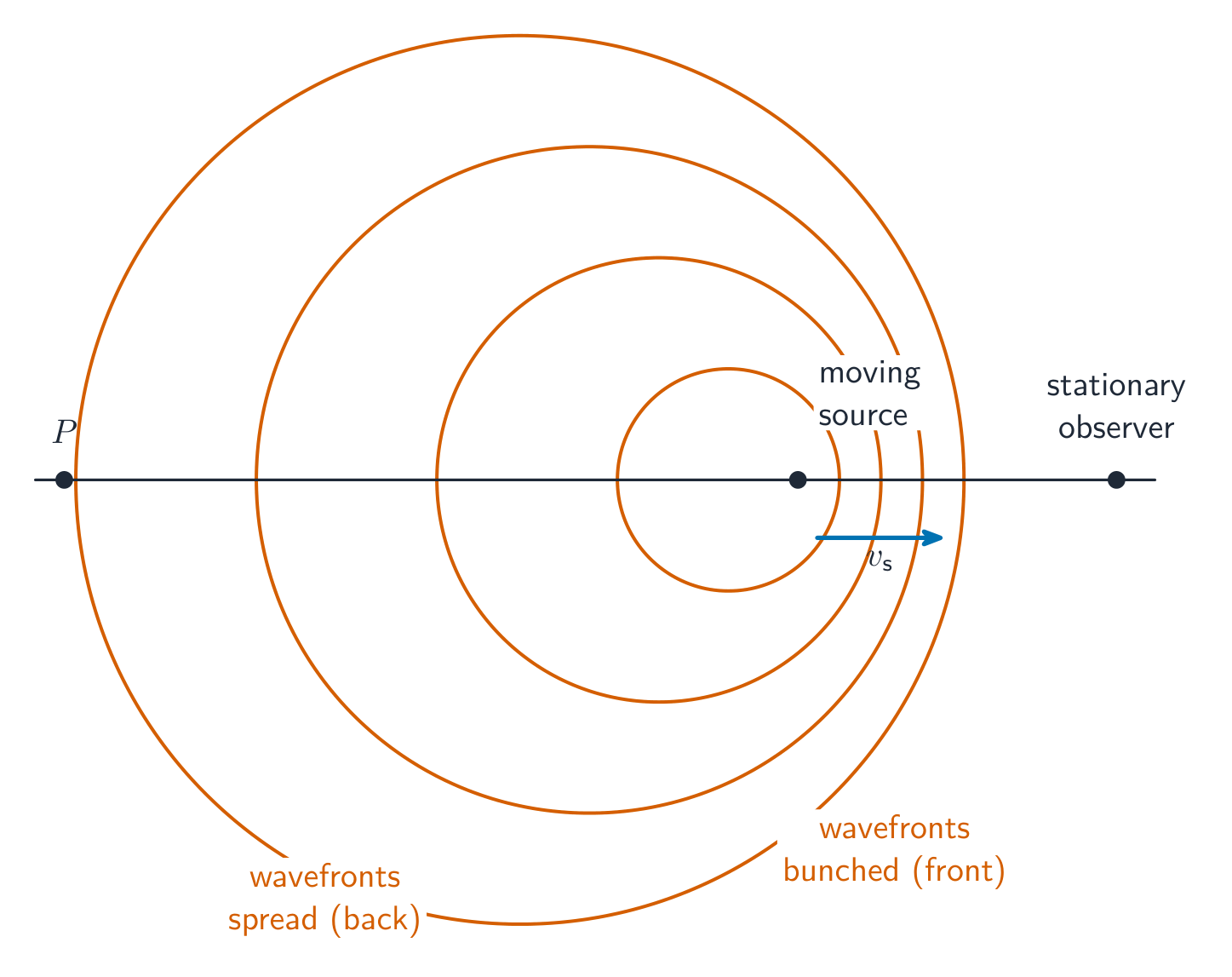
Syllabus · หลักสูตร
EnglishLearning Objective 14.5.A: Describe the properties of a wave based on the relative motion between the source of the wave and the observer of the wave.
- 14.5.A.1 The Doppler effect describes the relationship between the rest frequency of a wave source, the observed frequency of the source, and the relative velocity of the source and the observer.
- 14.5.A.2 A greater relative velocity results in a greater measured difference between the observed and rest frequencies.
- 14.5.A.2.i For a wave source moving at the same velocity as the observer, the observed frequency is equal to the rest frequency.
- 14.5.A.2.ii For a wave source moving toward an observer, the observed frequency is greater than the rest frequency.
- 14.5.A.2.iii For a wave source moving away from an observer, the observed frequency is less than the rest frequency.
Boundary statement: Only qualitative treatments of the Doppler effect are required for AP Physics 2.
ไทยวัตถุประสงค์การเรียนรู้ 14.5.A: อธิบายคุณสมบัติของคลื่นโดยพิจารณาจากการเคลื่อนที่สัมพัทธ์ระหว่างแหล่งกำเนิดคลื่นและผู้สังเกตการณ์
- 14.5.A.1 เอฟเฟกต์โดปเลอร์อธิบายความสัมพันธ์ระหว่างความถี่นิ่งของแหล่งกำเนิดคลื่น, ความถี่ที่สังเกตได้ และความเร็วสัมพัทธ์ระหว่างแหล่งกำเนิดและผู้สังเกตการณ์
- 14.5.A.2 ความเร็วสัมพัทธ์ที่สูงขึ้นจะทำให้มีความแตกต่างที่วัดได้ระหว่างความถี่ที่สังเกตได้และความถี่นิ่งมากขึ้น
- 14.5.A.2.i สำหรับแหล่งกำเนิดคลื่นที่เคลื่อนที่ด้วยความเร็วเท่ากับผู้สังเกตการณ์ ความถี่ที่สังเกตได้จะเท่ากับความถี่นิ่ง
- 14.5.A.2.ii สำหรับแหล่งกำเนิดคลื่นที่เคลื่อนที่เข้าหาผู้สังเกตการณ์ ความถี่ที่สังเกตได้จะมากกว่าความถี่นิ่ง
- 14.5.A.2.iii สำหรับแหล่งกำเนิดคลื่นที่เคลื่อนที่ห่างจากผู้สังเกตการณ์ ความถี่ที่สังเกตได้จะน้อยกว่าความถี่นิ่ง
ข้อจำกัด: ใน AP Physics 2 ต้องการเพียงการอธิบายเอฟเฟกต์โดปเลอร์ในเชิงคุณภาพเท่านั้น
Source: College Board AP Course and Exam Description · แหล่งที่มา: คำอธิบายหลักสูตรและข้อสอบ College Board AP
EnglishThe Doppler effect The Doppler effect 多普勒效应 is the change in observed frequency when a wave source and observer move relative to each other. Approaching $\Rightarrow$ higher frequency (shorter wavelength); receding $\Rightarrow$ lower frequency. It explains a passing siren's drop in pitch and the redshift of receding galaxies.
ไทยปรากฏการณ์ดอปเพลอร์ ผลดอปเปอร์ คือการเปลี่ยนแปลงของความถี่ที่สังเกตได้เมื่อแหล่งกำเนิดคลื่นและผู้สังเกตเคลื่อนที่สัมต่อกัน เข้าหา $\Rightarrow$ ความถี่สูงขึ้น (ความยาวคลื่นสั้นลง); ออกไป $\Rightarrow$ ความถี่ต่ำลง อธิบายเสียงไซเรนที่ผ่านไปและการเลื่อนสีแดงของกาแล็กซีที่ถอยห่าง
แหล่งกำเนิดเคลื่อนที่ยับยั้งหน้าคลื่นด้านหน้า使其ทำให้ความถี่ที่วัดได้สูงขึ้น Explore · สำรวจHear the Doppler shift · ได้ยินการ-shift Doppler
When a source moves, waves bunch up ahead (higher frequency) and stretch behind (lower) — the Doppler effect. Speed it up to exaggerate the shift. · เมื่อแหล่งกำเนิดเคลื่อนที่ คลื่นจะรวมตัวกันด้านหน้า (ความถี่สูงขึ้น) และยืดออกด้านหลัง (ความถี่ต่ำลง) — ปรากฏการณ์โดปเปอร์ เพิ่มความเร็วเพื่อให้เห็นการเปลี่ยนแปลงชัดเจนขึ้น
Vocabulary · คำศัพท์ Train · ฝึกฝนEnglish ไทย Doppler effect/ˈdɒplə ɪˈfekt/ ปรากฏการณ์ดอปพลาร์ 14.6
Wave Interference and Standing Waves · การรบกวนของคลื่นและคลื่นนิ่ง
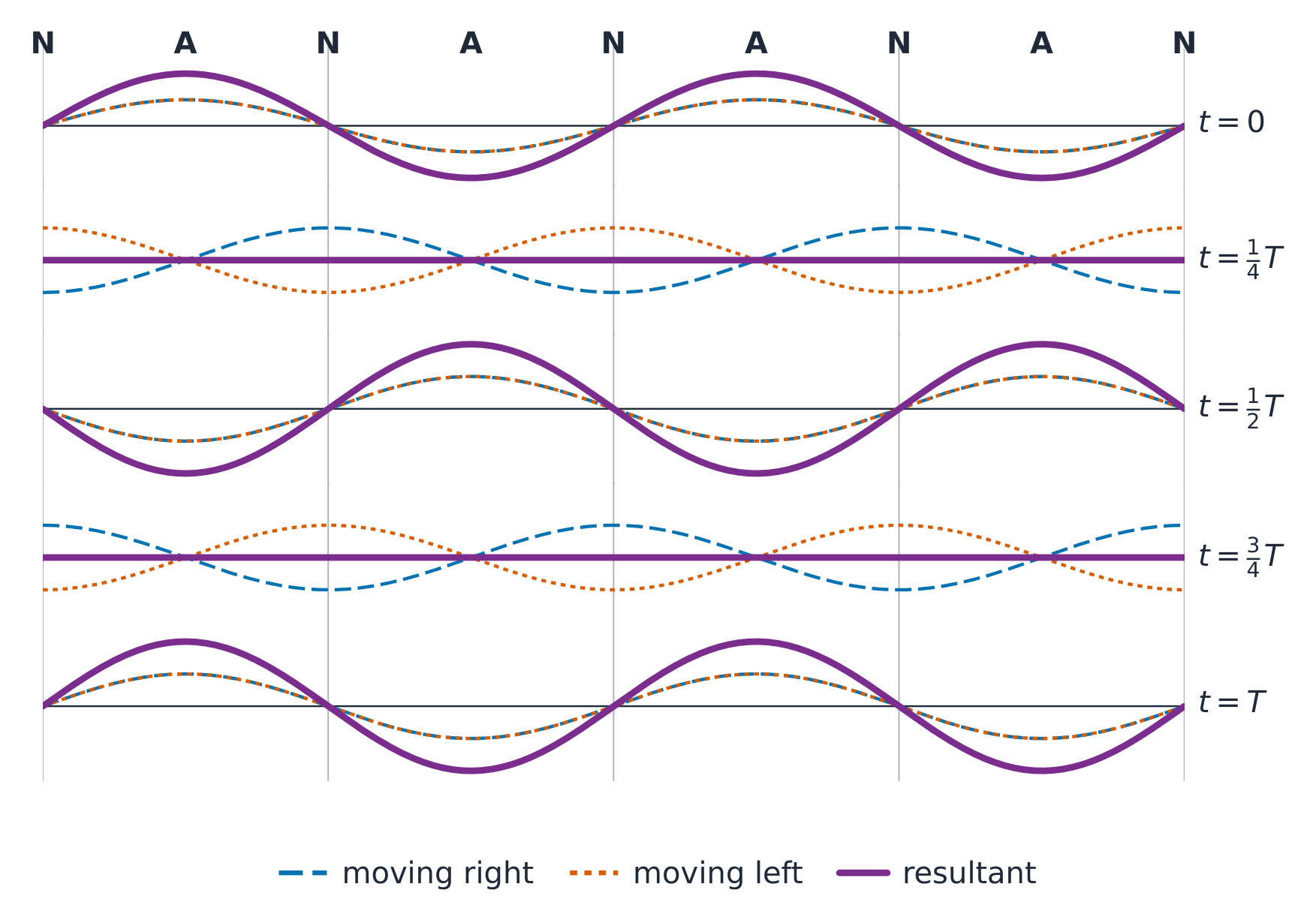
Syllabus · หลักสูตร
EnglishLearning Objective 14.6.A: Describe the net disturbance that occurs when two or more wave pulses or waves overlap.
- 14.6.A.1 Wave interference is the interaction of two or more wave pulses or waves.
- 14.6.A.2 When two or more wave pulses or waves interact with each other, they travel through each other and overlap rather than bouncing off each other.
- 14.6.A.3 When two or more wave pulses or waves overlap, the resulting displacement can be determined by adding the individual displacements. This is called superposition.
- 14.6.A.4 Wave interference may be constructive or destructive.
- 14.6.A.4.i When the displacements of the superposed wave pulses or waves are in the same direction, the interaction is called constructive interference.
- 14.6.A.4.ii When the displacements of the superposed wave pulses or waves are in opposite directions, the interaction is called destructive interference.
- 14.6.A.4.iii Two or more traveling wave pulses or waves can interact in such a way as to produce amplitude variations in the resultant wave pulse or wave.
- 14.6.A.5 Visual representations of wave pulses or waves are useful in determining the result of two interacting wave pulses or waves.
- 14.6.A.6 Beats arise from the addition of two waves of slightly different frequency.
- 14.6.A.6.i Waves with different frequencies are sometimes in phase and sometimes out of phase at locations along the waves, causing periodic amplitude changes in the resultant wave.
- 14.6.A.6.ii The beat frequency is the difference in the frequencies of the two waves.
- Equation: $\left|f_{\text{beat}}\right| = \left|f_1 - f_2\right|$
- 14.6.A.6.iii Tuning forks are devices that are commonly used to demonstrate beat frequencies.
Learning Objective 14.6.B: Describe the properties of a standing wave.
- 14.6.B.1 Standing waves can result from interference between two waves that are confined to a region and traveling in opposite directions.
- 14.6.B.1.i Standing waves have nodes and antinodes. A node is a point on the standing wave where the amplitude is always zero. An antinode is a point on the standing wave where the amplitude is always at maximum.
- 14.6.B.1.ii The possible wavelengths of a standing wave are determined by the size and boundary conditions of the region to which it is confined.
- 14.6.B.1.iii Common regions where standing waves can form include pipes with open or closed ends, as well as strings with fixed or loose ends.
- 14.6.B.2 A standing wave with the longest possible wavelength is called the fundamental or first harmonic. The second-longest wavelength is typically called the second harmonic, the third-longest wavelength is called the third harmonic, and so on. However, for a standing wave with a node at one end and an antinode at the other end, only odd harmonics can be established.
- 14.6.B.3 Visual representations of standing waves are useful in determining the relationships between length of the region, wavelength, frequency, wave speed, and harmonic.
ไทยวัตถุประสงค์การเรียนรู้ 14.6.A: อธิบายการรบกวนสุทธิที่เกิดขึ้นเมื่อพัลส์คลื่นหรือคลื่นสองตัวขึ้นไปซ้อนทับกัน
- 14.6.A.1 การรบกวนของคลื่นคือการมีปฏิสัมพันธ์ระหว่างพัลส์คลื่นหรือคลื่นสองตัวขึ้นไป
- 14.6.A.2 เมื่อพัลส์คลื่นหรือคลื่นสองตัวขึ้นไปมีปฏิสัมพันธ์กัน พวกมันจะเคลื่อนที่ผ่านกันและซ้อนทับกัน แทนที่จะเด้งกลับจากกัน
- 14.6.A.3 เมื่อพัลส์คลื่นหรือคลื่นสองตัวขึ้นไปซ้อนทับกัน การกระจัดที่เกิดขึ้นสามารถหาได้โดยการบวกการกระจัดของแต่ละตัวเข้าด้วยกัน วิธีนี้เรียกว่าการ叠加 (superposition)
- 14.6.A.4 การรบกวนของคลื่นอาจเป็นการเสริมกันหรือหักล้างกัน
- 14.6.A.4.i เมื่อการกระจัดของพัลส์คลื่นหรือคลื่นที่ซ้อนทับกันอยู่ในทิศทางเดียวกัน การมีปฏิสัมพันธ์นี้เรียกว่าการรบกวนแบบเสริมกัน
- 14.6.A.4.ii เมื่อการกระจัดของพัลส์คลื่นหรือคลื่นที่ซ้อนทับกันอยู่ในทิศทางตรงกันข้าม การมีปฏิสัมพันธ์นี้เรียกว่าการรบกวนแบบหักล้างกัน
- 14.6.A.4.iii พัลส์คลื่นหรือคลื่นที่เคลื่อนที่สองตัวขึ้นไปสามารถมีปฏิสัมพันธ์กันในลักษณะที่ทำให้เกิดการเปลี่ยนแปลงของความสูงคลื่นในพัลส์คลื่นหรือคลื่นที่เกิดขึ้นใหม่
- 14.6.A.5 การแสดงภาพคลื่นหรือพัลส์ของคลื่นมีประโยชน์ในการหาผลลัพธ์ของการรวมกันของพัลส์คลื่นหรือคลื่นสองชุด
- 14.6.A.6 คลื่นเบตเกิดจากการบวกคลื่นสองคลื่นที่มีความถี่ต่างกันเล็กน้อยเข้าด้วยกัน
- 14.6.A.6.i คลื่นที่มีความถี่ต่างกันบางครั้งจะอยู่ในเฟสเดียวกันและบางครั้งจะต่างเฟสกันตามตำแหน่งต่างๆ บนคลื่น ทำให้เกิดการเปลี่ยนแปลงความแอมพลิจูดเป็นระยะในคลื่นรวม
- 14.6.A.6.ii ความถี่ของคลื่นเบตคือผลต่างของความถี่ของคลื่นทั้งสอง
- สมการ: $\left|f_{\text{beat}}\right| = \left|f_1 - f_2\right|$
- 14.6.A.6.iii ส้อมเสียงเป็นอุปกรณ์ที่ใช้บ่อยเพื่อสาธิตความถี่ของคลื่นเบต
จุดประสงค์การเรียนรู้ 14.6.B: อธิบายคุณสมบัติของคลื่นนิ่ง
- 14.6.B.1 คลื่นนิ่งสามารถเกิดขึ้นจากการรบกวนระหว่างคลื่นสองคลื่นที่ถูกจำกัดอยู่ในบริเวณหนึ่งและเคลื่อนที่ไปในทิศทางตรงกันข้าม
- 14.6.B.1.i คลื่นนิ่งมีโหนดและแอนติโหนด โหนดคือจุดบนคลื่นนิ่งที่มีความแอมพลิจูดเป็นศูนย์เสมอ แอนติโหนดคือจุดบนคลื่นนิ่งที่มีความแอมพลิจูดสูงสุดเสมอ
- 14.6.B.1.ii ความยาวคลื่นที่เป็นไปได้ของคลื่นนิ่งถูกกำหนดโดยขนาดและเงื่อนไขขอบเขตของบริเวณที่ถูกจำกัดไว้
- 14.6.B.1.iii บริเวณทั่วไปที่คลื่นนิ่งสามารถเกิดขึ้นได้ ได้แก่ ท่อที่มีปลายเปิดหรือปิด และสายที่มีปลายยึดติดหรือหลวม
- 14.6.B.2 คลื่นนิ่งที่มีความยาวคลื่นที่ยาวที่สุดเรียกว่า คลื่นพื้นฐานหรือฮาร์โมนิกที่หนึ่ง ความยาวคลื่นที่ยาวรองลงมามักเรียกว่า ฮาร์โมนิกที่สอง ความยาวคลื่นที่ยาวรองลงมาอีกคือ ฮาร์โมนิกที่สาม เป็นต้นไป อย่างไรก็ตาม สำหรับคลื่นนิ่งที่มีโหนดที่ปลายด้านหนึ่งและแอนติโหนดที่ปลายอีกด้านหนึ่ง จะสามารถเกิดขึ้นได้เฉพาะฮาร์โมนิกคี่เท่านั้น
- 14.6.B.3 การแสดงภาพคลื่นนิ่งมีประโยชน์ในการหาความสัมพันธ์ระหว่างขนาดของบริเวณ ความยาวคลื่น ความถี่ ความเร็วคลื่น และฮาร์โมนิก
Source: College Board AP Course and Exam Description · แหล่งที่มา: คำอธิบายหลักสูตรและข้อสอบ College Board AP
EnglishStanding (stationary) waves When waves overlap they superpose (add). Constructive interference 相长干涉 (crests aligned) gives a bigger wave; destructive interference 相消干涉 (crest on trough) cancels. Two waves travelling opposite ways in a bounded medium form a standing wave 驻波 with fixed nodes 波节 (no motion) and antinodes 波腹 (maximum motion) – the basis of resonance on strings and in pipes.
Worked example. A guitar string $0.65\ \text{m}$ long is fixed at both ends. Its fundamental (first harmonic) fits half a wavelength between the ends, so $\lambda=2L=1.30\ \text{m}$. If waves travel along the string at $260\ \text{m/s}$, the note's frequency is $f=v/\lambda=260/1.30=200\ \text{Hz}$. Shortening the string (a fret) raises the pitch.
When two waves of slightly different frequency overlap, they drift in and out of step, so the combined sound swells loud and soft in a slow throb called beats 拍. The beat frequency 拍频 is simply the difference of the two frequencies:
$$f_{\text{beat}}=|f_1-f_2|.$$Two tuning forks of $256\ \text{Hz}$ and $260\ \text{Hz}$ sounded together give $|260-256|=4$ beats each second; a musician tunes an instrument by slowing these beats towards zero against a reference note.ไทยคลื่นนิ่ง (Standing waves) เมื่อคลื่นซ้อนทับกัน จะเกิด การ叠加 (superpose) (รวมกัน) การแทรกสอดแบบเสริม (constructive interference) (ยอดคลื่นตรงกัน) ทำให้เกิดคลื่นใหญ่ขึ้น; การแทรกสอดแบบหักล้าง (destructive interference) (ยอดคลื่นชนกับ_produk) จะหักล้างกันสองคลื่นที่เคลื่อนที่สวนกันในสื่อที่มีขอบเขตจะสร้าง คลื่นนิ่ง (standing wave) ซึ่งมี โหนด (nodes) ที่ไม่มีการเคลื่อนที่ และ แอนติโหนด (antinodes) ที่มีการเคลื่อนที่สูงสุด – ซึ่งเป็นพื้นฐานของปรากฏการณ์เรโซแนนซ์ในสายและท่อ
คลื่นนิ่งเกิดขึ้นเมื่อคลื่นสองชนิดที่เคลื่อนที่สวนกันซ้อนทับกัน ตัวอย่างฝึกหัด. สายกีตาร์ยาว $0.65\ \text{m}$ ติดตั้งแน่นทั้งสองด้าน โหมดพื้นฐาน (ฮาร์มอนิกแรก) ใช้ครึ่งหนึ่งของความยาวคลื่นระหว่างปลายสาย ดังนั้น $\lambda=2L=1.30\ \text{m}$. หากคลื่นเดินทางตามสายด้วยความเร็ว $260\ \text{m/s}$, ความถี่ของเสียงนั้นคือ $f=v/\lambda=260/1.30=200\ \text{Hz}$. การลดความยาวสาย (การกดเฟรต) จะทำให้เสียงสูงขึ้น
เมื่อคลื่นที่มีความถี่ ต่างกันเล็กน้อย ซ้อนทับกัน จะสลับเข้าและออก相位กัน ทำให้เสียงรวมกันดังและเบาเป็นจังหวะช้าๆ ที่เรียกว่า บีท (beats). ความถี่บีท คือผลต่างของความถี่ทั้งสอง:
$$f_{\text{beat}}=|f_1-f_2|.$$ฟกเสียงสองตัวที่ $256\ \text{Hz}$ และ $260\ \text{Hz}$ เต้นพร้อมกันจะให้ $|260-256|=4$ บีทต่อวินาที; นักดนตรีปรับเครื่องดนตรีโดยลดความเร็วบีทเหล่านี้ให้เข้าใกล้ศูนย์เทียบกับโน้ตอ้างอิงExplore · สำรวจSet up a standing wave · ตั้งค่าคลื่นนิ่ง
Two waves travelling opposite ways interfere into a standing wave with fixed nodes and antinodes. Only certain frequencies fit, giving the harmonics. · คลื่นสองคลื่นเดินทางสวนทางกัน แทรกสอด เป็น คลื่นนิ่ง ที่มีโหนดและแอนติโหนดคงที่ ความถี่บางเพียงพอมัน fits,ให้ harmonic。
Vocabulary · คำศัพท์ Train · ฝึกฝนEnglish ไทย Constructive interference/kənˈstrʌktɪv ˌɪntəˈfɪərəns/ การแทรกสอดแบบเสริมกัน destructive interference/dɪˈstrʌktɪv ˌɪntəˈfɪərəns/ การแทรกสอดแบบหักล้างกัน standing wave/ˈstændɪŋ weɪv/ คลื่นนิ่ง nodes/nəʊdz/ โหนด antinodes/ˌæntɪˈnəʊdz/ ปม standing wave antinodes beats/biːts/ เบต beat frequency/biːt ˈfriːkwənsi/ ความถี่ beat frequency 14.7
Diffraction · การหักเห
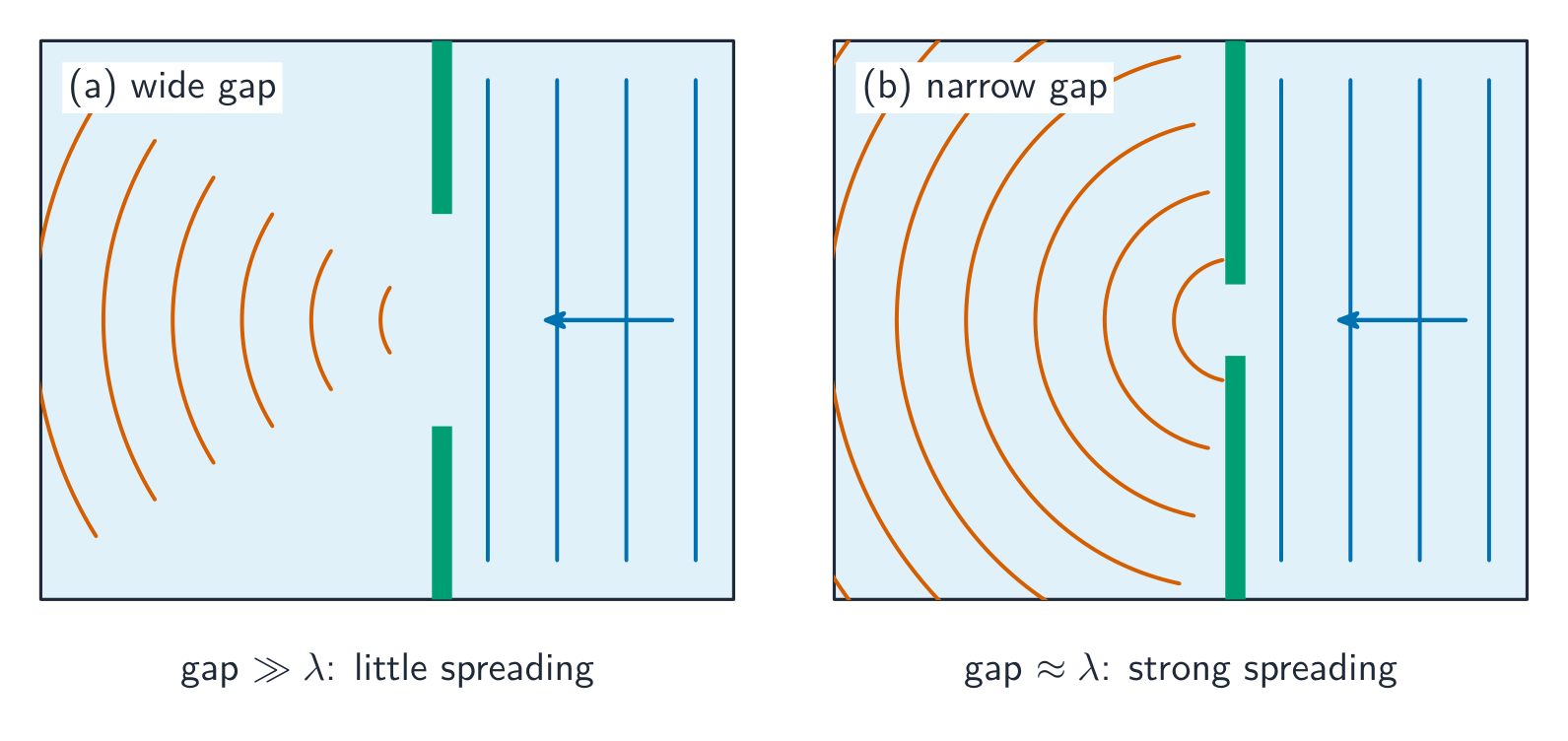
Syllabus · หลักสูตร
EnglishLearning Objective 14.7.A: Describe the behavior of a wave and the diffraction pattern resulting from a wave passing through a single opening.
- 14.7.A.1 Diffraction is the spreading of a wave around the edges of an obstacle or through an opening.
- 14.7.A.2 Diffraction is most pronounced when the size of the opening is comparable to the wavelength of the wave.
- 14.7.A.3 Diffraction of multiple wavefronts through a single opening leads to observable interference patterns.
- 14.7.A.4 Diffraction is commonly demonstrated by monochromatic light of wavelength $\lambda$ incident on a narrow opening of width $a$ that is a distance $L$ from a screen.
- 14.7.A.4.i Constructive and destructive interference of multiple wavefronts originating from the opening will result in bright and dark bands on the screen.
- 14.7.A.4.ii The amount of interference between two wavefronts depends on the path length difference $\Delta D$ of the wavefronts.
- 14.7.A.4.iii The path length difference $\Delta D$ can be described in terms of the opening width $a$ and the angle $\theta$ between the direction of propagation of the wavefront and the normal to the opening by the equation $\Delta D = a\sin\theta$.
- 14.7.A.4.iv For small angles, where $\theta < 10°$, the small angle approximation can be used to relate $\lambda$, $a$, and $L$ to $y_{\min}$, the distance from the middle of the central bright fringe to the $m^{\text{th}}$ order of minimum brightness on the screen.
- Equation: $a\left(\dfrac{y_{\min}}{L}\right) \approx m\lambda$
- 14.7.A.5 The diffraction pattern produced by a wave passing through an opening depends on the shape of the opening.
- 14.7.A.6 Visual representations of single-slit diffraction patterns are useful in determining the physical properties of the slit and the interacting waves.
ไทยจุดประสงค์การเรียนรู้ 14.7.A: อธิบายพฤติกรรมของคลื่นและรูปแบบการหักเหที่เกิดขึ้นเมื่อคลื่นผ่านช่องเปิดเดี่ยว
- 14.7.A.1 การหักเหคือการกระจายตัวของคลื่นรอบขอบของสิ่งกีดขวางหรือผ่านช่องเปิด
- 14.7.A.2 การหักเหจะเห็นชัดที่สุดเมื่อขนาดของช่องเปิดมีขนาดเทียบเท่ากับความยาวคลื่น
- 14.7.A.3 การหักเหของหน้าคลื่นหลายหน้าผ่านช่องเปิดเดียวนำไปสู่รูปแบบการรบกวนที่สังเกตได้
- 14.7.A.4 การหักเหมักสาธิตด้วยแสงสีเดียวที่มีความยาวคลื่น $\lambda$ ที่ตกกระทบช่องแคบมีความกว้าง $a$ ซึ่งอยู่ห่างจากจอ $L$
- 14.7.A.4.i การรบกวนแบบเสริมและการรบกวนแบบหักล้างของหน้าคลื่นหลายหน้าที่เกิดจากช่องเปิดจะทำให้เกิดแถบสว่างและแถบมืดบนจอ
- 14.7.A.4.ii ปริมาณการรบกวนระหว่างหน้าคลื่นสองหน้าขึ้นอยู่กับผลต่างของเส้นทางการเดินทาง $\Delta D$ ของหน้าคลื่นเหล่านั้น
- 14.7.A.4.iii ผลต่างของเส้นทางการเดินทาง $\Delta D$ สามารถอธิบายได้ในเชิงของความกว้างช่องเปิด $a$ และมุม $\theta$ ระหว่างทิศทางการเดินทางของหน้าคลื่นกับแนวตั้งฉากต่อช่องเปิด โดยสมการ $\Delta D = a\sin\theta$
- 14.7.A.4.iv สำหรับมุมเล็ก ๆ ที่ $\theta < 10°$ การประมาณมุมเล็ก small angle approximation สามารถใช้เพื่อเชื่อมโยง $\lambda$, $a$ และ $L$ กับ $y_{\min}$ ซึ่งเป็นระยะห่างจากกึ่งกลางของแถบสว่างกลางไปยัง $m^{\text{th}}$ ลำดับของความมืดบนจอ
- สมการ: $a\left(\dfrac{y_{\min}}{L}\right) \approx m\lambda$
- 14.7.A.5 รูปแบบการหักเหที่เกิดขึ้นจากคลื่นที่ผ่านช่องเปิดขึ้นอยู่กับรูปร่างของช่องเปิดนั้น
- 14.7.A.6 การแสดงภาพรูปแบบการหักเหของช่องเปิดเดี่ยวมีประโยชน์ในการหาคุณสมบัติทางกายภาพของช่องเปิดและคลื่นที่รบกวนกัน
Source: College Board AP Course and Exam Description · แหล่งที่มา: คำอธิบายหลักสูตรและข้อสอบ College Board AP
EnglishDiffraction 衍射 is the bending and spreading of waves around edges or through openings. The spreading is significant when the opening is comparable to the wavelength – so sound (long wavelength) bends around doorways easily, while light (tiny wavelength) needs a very narrow slit.
ไทยการกระจาย (diffraction) คือการโค้งและการแผ่กระจายของคลื่นรอบขอบหรือผ่านช่องเปิด การแผ่กระจายจะมีนัยสำคัญเมื่อขนาดช่องเปิดเทียบเท่ากับความยาวคลื่น – ดังนั้นเสียง (ซึ่งมีความยาวคลื่นยาว) จึงโค้งผ่านประตูได้ง่าย ในขณะที่แสง (ซึ่งมีความยาวคลื่นสั้นมาก) ต้องใช้ช่องแคบมากๆ
คลื่นแผ่กระจาย (diffract) เมื่อผ่านช่องว่าง Vocabulary · คำศัพท์ Train · ฝึกฝนEnglish ไทย Diffraction/dɪˈfrækʃn/ การเลี้ยวเบน 14.8
Double-Slit Interference and Diffraction Gratings · การแทรกสอดแบบช่องคู่และการกระจายแบบเกรตติ้ง
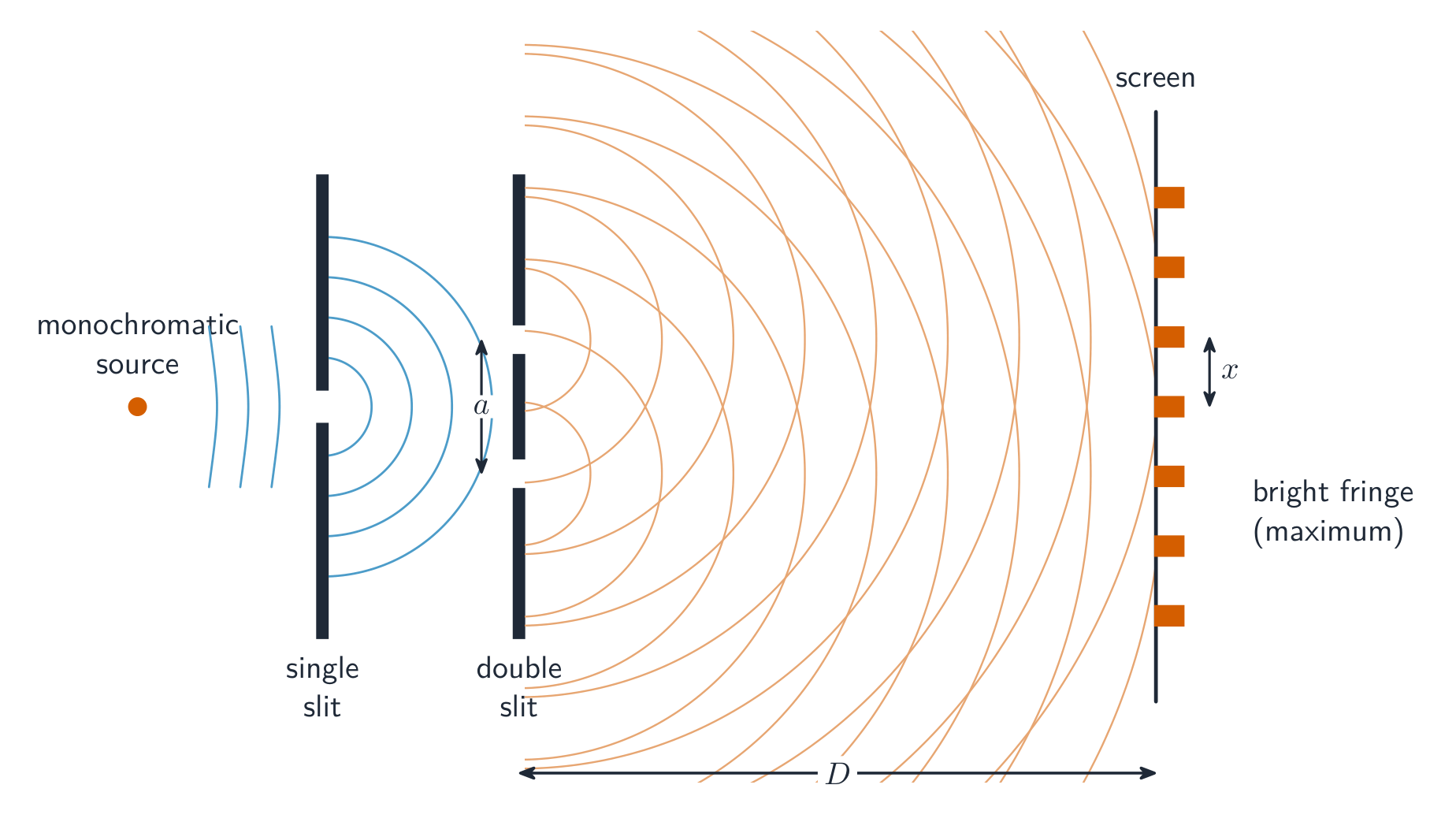
Syllabus · หลักสูตร
EnglishLearning Objective 14.8.A: Describe the behavior of a wave and the diffraction pattern resulting from the wave passing through multiple openings.
- 14.8.A.1 The pattern resulting from monochromatic light of wavelength $\lambda$ incident on two slits a distance $d$ apart is caused by a combination of wave diffraction and wave interference.
- 14.8.A.1.i When only considering wave interference, a double slit creates a pattern of uniformly spaced maxima.
- 14.8.A.1.ii Constructive and destructive interference of the wavefronts originating from each slit will result in bright and dark bands on the screen.
- 14.8.A.1.iii The amount of interference between two wavefronts depends on the path length difference $\Delta D$ of the wavefronts.
- 14.8.A.1.iv The path length difference $\Delta D$ can be described in terms of the slit separation $d$ and the angle $\theta$ between the direction of propagation of the wavefront and the normal to the opening by the equation $\Delta D = d\sin\theta$.
- 14.8.A.1.v For small angles, where $\theta < 10°$, the small angle approximation can be used to relate $\lambda$, $d$, and $L$ to $y_{\max}$, the distance from the middle of the central bright fringe to the $m^{\text{th}}$ order of maximum brightness on the screen.
- Equation: $d\left(\dfrac{y_{\max}}{L}\right) \approx m\lambda$
- 14.8.A.1.vi When considering wave interference and wave diffraction, a double slit creates an interference pattern of maxima and minima superimposed within the envelope created by single-slit diffraction.
- 14.8.A.2 Interference patterns produced by light interacting with a double slit indicate that light has wave properties. The source of this discovery was Young's double-slit experiment.
- 14.8.A.3 Visual representations of double-slit diffraction patterns are useful in determining the physical properties of the slits and the interacting waves.
- 14.8.A.4 A diffraction grating is a collection of evenly spaced parallel slits or openings that produce an interference pattern that is the combination of numerous diffraction patterns superimposed on each other.
- 14.8.A.5 When white light is incident on a diffraction grating, the center maximum is white and the higher-order maxima disperse white light into a rainbow of colors, with the longest-wavelength light (red) appearing farthest from the central maximum.
ไทยจุดประสงค์การเรียนรู้ 14.8.A: อธิบายพฤติกรรมของคลื่นและรูปแบบการหักเหที่เกิดขึ้นเมื่อคลื่นผ่านช่องเปิดหลายช่อง
- 14.8.A.1 รูปแบบที่เกิดขึ้นจากแสงสีเดียวที่มีความยาวคลื่น $\lambda$ ที่ตกกระทบช่องคู่ซึ่งห่างกัน $d$ เกิดจากการรวมกันของการหักเหและการรบกวนของคลื่น
- 14.8.A.1.i เมื่อพิจารณาเพียงการรบกวนของคลื่น ช่องคู่จะสร้างรูปแบบของจุดสูงสุดที่เว้นระยะเท่าๆ กัน
- 14.8.A.1.ii การรบกวนแบบเสริมและการรบกวนแบบหักล้างของหน้าคลื่นที่เกิดจากแต่ละช่องจะทำให้เกิดแถบสว่างและแถบมืดบนจอ
- 14.8.A.1.iii ปริมาณการรบกวนระหว่างหน้าคลื่นสองหน้าขึ้นอยู่กับผลต่างของเส้นทางการเดินทาง $\Delta D$ ของหน้าคลื่นเหล่านั้น
- 14.8.A.1.iv ผลต่างของเส้นทางการเดินทาง $\Delta D$ สามารถอธิบายได้ในเชิงของการแยกช่อง $d$ และมุม $\theta$ ระหว่างทิศทางการเดินทางของหน้าคลื่นกับแนวตั้งฉากต่อช่องเปิด โดยสมการ $\Delta D = d\sin\theta$
- 14.8.A.1.v สำหรับมุมเล็ก ซึ่ง $\theta < 10°$ สามารถใช้การประมาณมุมเล็กเพื่อเชื่อมโยง $\lambda$, $d$ และ $L$ กับ $y_{\max}$ ซึ่งเป็นระยะทางจากกึ่งกลางของแถบสว่างตรงกลางไปยังลำดับที่ $m^{\text{th}}$ ของความเข้มสูงสุดบนจอ
- สมการ: $d\left(\dfrac{y_{\max}}{L}\right) \approx m\lambda$
- 14.8.A.1.vi เมื่อพิจารณาทั้งการรบกวนและการหักเหของคลื่น ช่องคู่จะสร้างรูปแบบการรบกวนของจุดสูงสุดและจุดต่ำสุดที่ซ้อนทับอยู่บนรูปทรงที่สร้างจากการหักเหของช่องเปิดเดี่ยว
- 14.8.A.2 รูปแบบการรบกวนที่เกิดขึ้นจากแสงที่รบกวนกับช่องคู่บ่งชี้ว่าแสงมีสมบัติเป็นคลื่น แหล่งที่มาของการค้นพบนี้คือทดลองช่องคู่ของเยงส์
- 14.8.A.3 การแสดงภาพรูปแบบการหักเหของช่องคู่มีประโยชน์ในการหาคุณสมบัติทางกายภาพของช่องและคลื่นที่รบกวนกัน
- 14.8.A.4 เกรติงการรบกวน (diffraction grating) คือชุดของช่องว่างหรือช่องเปิดแบบขนานกันที่มีระยะห่างเท่ากัน ซึ่งสร้างลวดลายการรบกวนที่เป็นการรวมกันของลวดลายการรบกวนจำนวนมากซ้อนทับกัน
- 14.8.A.5 เมื่อแสงสีขาวตกกระทบเกรติงการรบกวน แสงสว่างสูงสุดที่จุดกึ่งกลางจะเป็นสีขาว และแสงสว่างสูงสุดลำดับสูงกว่าจะกระจายแสงสีขาวออกเป็นสายรุ้ง โดยแสงที่มีความยาวคลื่น longest (สีแดง) จะปรากฏอยู่ไกลจากแสงสว่างสูงสุดที่จุดกึ่งกลางมากที่สุด
Source: College Board AP Course and Exam Description · แหล่งที่มา: คำอธิบายหลักสูตรและข้อสอบ College Board AP
EnglishTwo-source interference Coherent 相干 light through two closely spaced slits produces a pattern of bright and dark fringes. Bright fringes occur where the path difference is a whole number of wavelengths:
$$d\sin\theta=m\lambda.$$A diffraction grating 衍射光栅 has many slits, giving sharp, widely spaced bright lines – useful for separating light into its wavelengths.Worked example. Light of wavelength $600\ \text{nm}$ passes through two slits $0.20\ \text{mm}$ apart. The first bright fringe ($m=1$) sits at
$$\sin\theta=\frac{m\lambda}{d}=\frac{1\times600\times10^{-9}}{0.20\times10^{-3}}=3.0\times10^{-3}\;\Rightarrow\;\theta=0.17^{\circ}.$$The tiny angle is why the slits must be very close together and the screen far away to see the fringes clearly.ไทยการแทรกสอดจากแหล่งกำเนิดคู่ แสงที่เป็น โคฮีเรนต์ (coherent) ผ่านช่องแคบสองช่อง会产生แถบสว่างและมืด แถบสว่าง เกิดขึ้นเมื่อความแตกต่างของระยะทางเป็นจำนวนเต็มของความยาวคลื่น:
$$d\sin\theta=m\lambda.$$เกรตติ้งกระจาย (diffraction grating) มีช่องแคบจำนวนมาก ให้เส้นสว่างที่คมชัดและห่างกัน – มีประโยชน์ในการแยกแสงออกเป็นความยาวคลื่นต่างๆช่องคู่ของYoung ให้ลวดลายการแทรกสอดของแถบสว่างและมืด ตัวอย่างวิธีทำ. แสงที่มีความยาวคลื่น $600\ \text{nm}$ ผ่านช่องแคบสองช่องที่ห่างกัน $0.20\ \text{mm}$. แถบสว่างแรก ($m=1$) อยู่ที่
$$\sin\theta=\frac{m\lambda}{d}=\frac{1\times600\times10^{-9}}{0.20\times10^{-3}}=3.0\times10^{-3}\;\Rightarrow\;\theta=0.17^{\circ}.$$มุมที่เล็กนี้คือเหตุผลว่าทำไมช่องแคบต้องอยู่ใกล้กันมากและจอภาพต้องอยู่ไกลเพื่อให้เห็นแถบชัดเจน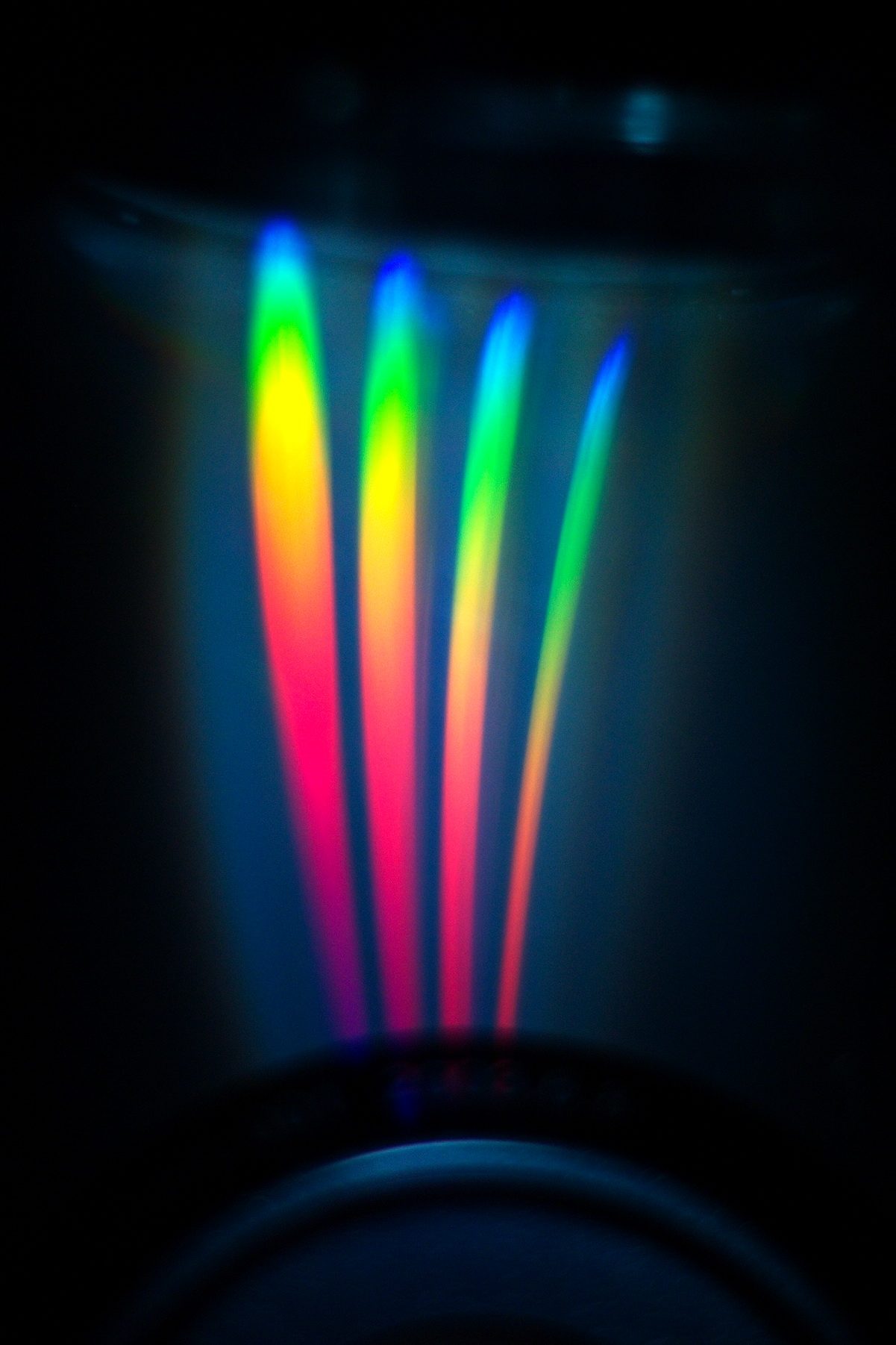
ร่องละเอียดบนซีดีทำหน้าที่เป็นเกรตติ้งกระจาย, แยกแสงขาวออกเป็นสเปกตรัม Explore · สำรวจSuperpose two waves · 叠加สองคลื่น
Where two waves arrive in phase they add (bright fringe); out of phase they cancel (dark fringe). That interference makes the double-slit pattern. · เมื่อสองคลื่นมาถึงพร้อมกันแบบ ในเฟส จะบวกกัน (แถบสว่าง); ต่างเฟส จะหักล้างกัน (แถบมืด) การรบกวนนี้จึงเกิดลวดลายช่องคู่
Vocabulary · คำศัพท์ Train · ฝึกฝนEnglish ไทย Coherent/kəʊˈhɪərənt/ coherence Coherent diffraction grating/dɪˈfrækʃn ˈɡreɪtɪŋ/ เกรตติ้งเลี้ยวเบน thin film/θɪn fɪlm/ ฟิล์มบาง 14.9
Thin-Film Interference · การแทรกสอดในฟิล์มบาง
Syllabus · หลักสูตร
EnglishLearning Objective 14.9.A: Describe the behavior of light that interacts with a thin film.
- 14.9.A.1 When light travels from one medium to another, some of the light is transmitted, some is reflected, and some is absorbed.
- 14.9.A.2 The phase change of a reflected ray depends on the relative indices of refraction of the materials with which the ray interacts.
- 14.9.A.2.i A phase change of 180 degrees occurs when a light ray is reflected from a medium with a greater index of refraction than the medium through which the ray is traveling.
- 14.9.A.2.ii No phase change occurs when a light ray is reflected from a medium with a lower index of refraction than the medium through which the ray is traveling.
- 14.9.A.3 The phase of a wave does not change when it is refracted as it passes from one medium into another.
- 14.9.A.4 Thin-film interference occurs when light interacts with a medium whose thickness is comparable to the light's wavelength.
- 14.9.A.4.i The interactions between the initial reflected light and the light exiting the thin film after being reflected from the second interface exhibit wave interference behavior, resulting in a single wave that is the sum of the two interacting waves.
- 14.9.A.4.ii The amount of constructive or destructive interference between the two reflected waves depends on the relationship between the thickness of the film, the wavelength of light, any phase shifts, and the angle at which the incident light strikes the film.
- 14.9.A.5 Practical examples of thin-film interference include the color variations seen in soap bubbles and oil films, as well as antireflection coatings.
- 14.9.A.5.i The spectrum of colors observed in oil films and soap bubbles arises from differences in the thickness of the film.
- 14.9.A.5.ii Antireflection coatings eliminate reflected light by applying the relationships between indices of refraction, phase shift, and wave interference to create destructive interference of the light reflected from the two surfaces of the coating.
- 14.9.A.5.iii The simplest antireflection coating has a thickness equal to one-quarter of the wavelength of the light in the coating, and the index of refraction of the coating is greater than that of air and less than that of the surface upon which the coating is applied. This assumes incident light is normal to the surface.
Boundary statement: Quantitative analysis of thin-film interference is limited to waves that are normal to the incident surface.
ไทยวัตถุประสงค์การเรียนรู้ 14.9.A: อธิบายพฤติกรรมของแสงที่กระทำกับฟิล์มบาง
- 14.9.A.1 เมื่อแสงเดินทางผ่านตัวกลางหนึ่งไปยังอีกตัวกลางหนึ่ง บางส่วนจะถูกส่งผ่าน บางส่วนจะถูกสะท้อน และบางส่วนจะถูกดูดกลืน
- 14.9.A.2 การเปลี่ยนแปลงเฟสของรังสีที่สะท้อนขึ้นอยู่กับสัมประสิทธิ์หักเหของตัวกลางที่เกี่ยวข้องกับรังสีนั้น
- 14.9.A.2.i เกิดการเปลี่ยนแปลงเฟส 180 องศาเมื่อรังสีแสงถูกสะท้อนจากตัวกลางที่มีค่าสัมประสิทธิ์หักเหมากกว่าตัวกลางที่รังสีกำลังเดินทางอยู่
- 14.9.A.2.ii ไม่มีการเปลี่ยนแปลงเฟสเมื่อรังสีแสงถูกสะท้อนจากตัวกลางที่มีค่าสัมประสิทธิ์หักเหต่ำกว่าตัวกลางที่รังสีกำลังเดินทางอยู่
- 14.9.A.3 เฟสของคลื่นไม่เปลี่ยนแปลงเมื่อเกิดการหักเหขณะเคลื่อนที่ผ่านตัวกลางหนึ่งไปยังอีกตัวกลางหนึ่ง
- 14.9.A.4 การรบกวนของฟิล์มบางเกิดขึ้นเมื่อแสงทำปฏิกิริยากับตัวกลางที่มีความหนาเทียบเคียงกับความยาวคลื่นของแสง
- 14.9.A.4.i ปฏิกิริยาระหว่างแสงที่สะท้อนครั้งแรกและแสงที่ออกมาจากฟิล์มบางหลังจากถูกสะท้อนจากขอบเขตที่สอง แสดงพฤติกรรมการรบกวนของคลื่น ส่งผลให้เกิดคลื่นเดียวที่เป็นผลรวมของคลื่นทั้งสองที่เข้าด้วยกัน
- 14.9.A.4.ii ระดับของการรบกวนแบบเสริมหรือลบระหว่างคลื่นที่สะท้อนทั้งสองขึ้นอยู่กับความสัมพันธ์ระหว่างความหนาของฟิล์ม ความยาวคลื่นของแสง การเลื่อนเฟส และมุมที่แสงตกกระทบฟิล์ม
- 14.9.A.5 ตัวอย่างการใช้งานจริงของการรบกวนของฟิล์มบาง ได้แก่ ความแตกต่างของสีที่เห็นในฟองสบู่และฟิล์มน้ำมัน รวมถึงเคลือบลดการสะท้อนแสง
- 14.9.A.5.i สเปกตรัมสีที่สังเกตได้ในฟิล์มน้ำมันและฟองสบู่เกิดจากความแตกต่างของความหนาของฟิล์ม
- 14.9.A.5.ii เคลือบลดการสะท้อนแสงขจัดแสงสะท้อนโดยการประยุกต์ใช้ความสัมพันธ์ระหว่างสัมประสิทธิ์หักเห การเลื่อนเฟส และการรบกวนของคลื่น เพื่อสร้างการรบกวนแบบลบของแสงที่สะท้อนจากพื้นผิวทั้งสองของเคลือบ
- 14.9.A.5.iii เคลือบลดการสะท้อนแสงที่ง่ายที่สุดมีความหนาเท่ากับหนึ่งในสี่ของความยาวคลื่นของแสงภายในเคลือบ และมีค่าสัมประสิทธิ์หักเหมากกว่าอากาศแต่น้อยกว่าค่าสัมประสิทธิ์หักเหของพื้นผิวที่เคลือบวางอยู่บนนี้ ซึ่งสมมติว่าแสงตกตั้งฉากกับพื้นผิว
คำจำกัดความ: การวิเคราะห์เชิงปริมาณของการรบกวนของฟิล์มบางจำกัดอยู่ที่คลื่นที่ตกตั้งฉากกับพื้นผิวตกกระทบ
Source: College Board AP Course and Exam Description · แหล่งที่มา: คำอธิบายหลักสูตรและข้อสอบ College Board AP
EnglishLight reflecting off the top and bottom of a thin film 薄膜 (soap bubble, oil slick) interferes with itself. Depending on the film's thickness and a possible half-wavelength phase flip on reflection off a denser medium, particular wavelengths interfere constructively – producing the shifting colours you see.
The same physics is put to work in an antireflection coating 增透膜 on camera lenses, glasses, and solar cells: a thin transparent layer whose two reflected waves interfere destructively, so almost no light reflects and more is transmitted. The simplest coating is one quarter of a wavelength thick (measured in the coating), and its refractive index sits between that of air and the glass beneath, so the reflected light cancels itself out.
ไทยแสงที่สะท้อนจากด้านบนและด้านล่างของ ฟิล์มบาง (ฟองสบู่, น้ำมันลอย) จะแทรกสอดกันเอง ขึ้นอยู่กับความหนาของฟิล์มและการพลิกเฟสครึ่งความยาวคลื่น可能的เมื่อสะท้อนจากสื่อที่หนาแน่นกว่า, ความยาวคลื่นเฉพาะบางชนิดจะแทรกสอดแบบเสริม – ทำให้เห็นสีเปลี่ยนไปที่คุณมองเห็น
ฟิสิกส์เดียวกันนี้ถูกนำไปใช้กับ เคลือบลดการสะท้อน (antireflection coating) บนเลนส์กล้อง แว่นตา และเซลล์แสงอาทิตย์: ชั้นโปร่งใสบางwhose สองคลื่นที่สะท้อนจะแทรกสอดแบบ หักล้าง, sehingga fgets almost no light reflects and more is transmitted. การเคลือบที่ง่ายที่สุดคือชั้นที่มีความหนา หนึ่งในสี่ของความยาวคลื่น (วัดในชั้นเคลือบ), และค่าดัชนีหักเหของมันอยู่ ระหว่าง ของอากาศและแก้วด้านล่าง, so the reflected light cancels itself out.
Vocabulary · คำศัพท์ Train · ฝึกฝนEnglish ไทย antireflection coating/ˌæntɪrɪˈflekʃn ˈkəʊtɪŋ/ เคลือบลดการสะท้อนแสง 14.9
Exam tips · ข้อแนะนำสำหรับการสอบ
English- Use $v=f\lambda$; the source sets the frequency, and when a wave enters a new medium the frequency stays fixed while the speed and wavelength change.
- Distinguish transverse (vibration perpendicular, can be polarised) from longitudinal (vibration along the travel, e.g. sound).
- Constructive interference needs a path difference of a whole number of wavelengths; destructive needs a half-odd number.
- On a string fixed at both ends the fundamental fits half a wavelength ($\lambda=2L$).
- Diffraction is significant only when the gap is comparable to the wavelength — sound bends round doorways, light needs a very narrow slit.
- Beats: two waves of slightly different frequency throb at $f_{\text{beat}}=|f_1-f_2|$ (e.g. two tuning forks; tuning to zero beats).
- An antireflection coating is a quarter-wavelength-thick layer (index between air and glass) whose two reflections cancel, cutting the reflected light.
ไทย- ใช้ $v=f\lambda$; แหล่งกำเนิดกำหนดความถี่, และเมื่อคลื่นเข้าสู่สื่อใหม่ ความถี่จะคงที่ในขณะที่ความเร็วและความยาวคลื่นเปลี่ยนแปลง.
- แยก แบบขวาง (transverse, การสั่นตั้งฉาก, สามารถโพลาไรซ์ได้) จาก แบบยาว (longitudinal, การสั่นตามแนวการเดินทาง, เช่น เสียง).
- การแทรกสอดแบบเสริม ต้องการความแตกต่างของระยะทางเป็นจำนวนเต็มของความยาวคลื่น; การแทรกสอดแบบหักล้าง ต้องการจำนวนคี่ครึ่งของความยาวคลื่น.
- ในสายที่ยึดติดทั้งสองด้าน ฮาร์มอนิกพื้นฐานพอดีกับ ครึ่งหนึ่งของความยาวคลื่น ($\lambda=2L$).
- การกระจาย (diffraction) จะมีนัยสำคัญก็ต่อเมื่อช่องว่างเทียบเท่ากับความยาวคลื่น – เสียงโค้งผ่านประตู, แสงต้องใช้ช่องแคบมากๆ
- บีท: คลื่นสองชนิดที่มี ความถี่ต่างกันเล็กน้อย สั่นเป็นจังหวะที่ $f_{\text{beat}}=|f_1-f_2|$ (เช่น ฟกเสียงสองตัว; ปรับเสียงให้เหลือศูนย์บีท).
- เคลือบลดการสะท้อน เป็นชั้นที่มีความหนาหนึ่ง-fourth-of-a-wavelength (diameter between air and glass) whose two reflections cancel, cutting the reflected light.
Vocabulary · คำศัพท์ Train · ฝึกฝนEnglish ไทย wavelength/ˈweɪvleŋθ/ ความยาวคลื่น frequency/ˈfriːkwənsi/ ความถี่ amplitude/ˈæmplɪtjuːd/ แอมพลิจูด wave speed/weɪv spiːd/ ความเร็วคลื่น Polarization/ˌpəʊləraɪˈzeɪʃn/ การโพลาไรซ์ intensity/ɪnˈtensɪti/ ความเข้ม Electromagnetic waves/ɪˌlektrəʊməɡˈnetɪk weɪvz/ คลื่นแม่เหล็กไฟฟ้า - 14.1.A.1 Waves transfer energy between two locations without transferring matter between those locations.
-
15
Modern Physics · ฟิสิกส์สมัยใหม่
Watch lesson · ดูบทเรียน15.1
Quantum Theory and Wave-Particle Duality · ทฤษฎีควอนตัมและความเป็นคลื่น-อนุภาค
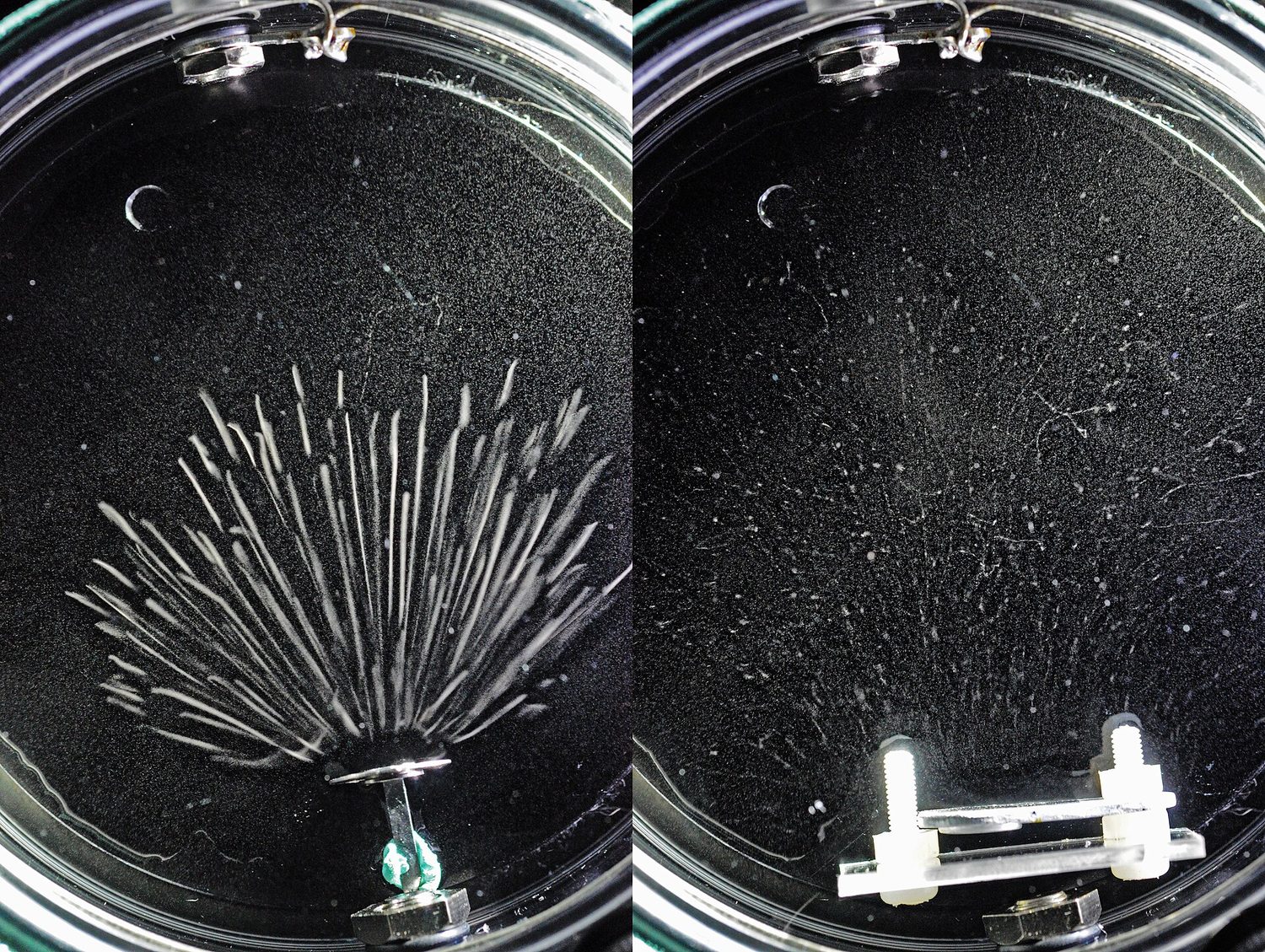
Syllabus · หลักสูตร
EnglishLearning Objective 15.1.A: Describe the properties and behavior of an object that exhibits both particle-like and wave-like behavior.
- 15.1.A.1 Quantum theory was developed to explain observations of matter and energy that could not be explained using classical mechanics. These phenomena include, but are not limited to, atomic spectra, blackbody radiation, and the photoelectric effect.
- 15.1.A.1.i Quantum theory is necessary to describe the properties of matter at atomic and subatomic scales.
- 15.1.A.1.ii In quantum theory, fundamental particles can exhibit both particle-like and wave-like behavior.
- 15.1.A.2 Light can be modeled both as a wave and as discrete particles, called photons.
- 15.1.A.2.i A photon is a massless, electrically neutral particle with energy proportional to the photon's frequency.
- Relevant equations:
- $E = hf$
- $\lambda = \dfrac{c}{f}$
- 15.1.A.2.ii Photons travel in straight lines unless they interact with matter.
- 15.1.A.2.i A photon is a massless, electrically neutral particle with energy proportional to the photon's frequency.
- 15.1.A.3 The speed of a photon depends on the medium through which the photon travels.
- 15.1.A.3.i The speed of all photons in free space is equal to the speed of light, $c = 3.00 \times 10^{8}$ m/s.
- 15.1.A.3.ii In general, the speed of photons through a given medium is inversely proportional to the index of refraction of that medium.
- 15.1.A.4 Particles can demonstrate wave properties, as shown by variations of Young's double-slit experiment.
- 15.1.A.4.i A wave model of matter is quantified by the de Broglie wavelength, which increases as the momentum of a particle decreases.
- Relevant equation:
- $\lambda = \dfrac{h}{p}$
- 15.1.A.4.ii Quantum theory is necessary to describe systems where the de Broglie wavelength is comparable to the size of the system.
- 15.1.A.4.i A wave model of matter is quantified by the de Broglie wavelength, which increases as the momentum of a particle decreases.
- 15.1.A.5 Values of energy and momentum have discrete, or quantized, values for bound systems described by quantum theory.
ไทยวัตถุประสงค์การเรียนรู้ 15.1.A: อธิบายคุณสมบัติและพฤติกรรมของวัตถุที่แสดงทั้งลักษณะคล้ายอนุภาคและคล้ายคลื่น
- 15.1.A.1 ทฤษฎีควอนตัมถูกพัฒนาขึ้นเพื่ออธิบายการสังเกตเรื่องสสารและพลังงานที่ไม่สามารถอธิบายได้ด้วยกลศาสตร์คลาสสิก ปรากฏการณ์เหล่านี้รวมถึง แต่ไม่จำกัดเพียง สเปกตรัมอะตอม การแผ่รังสีของวัตถุดำ และปรากฏการณ์โฟโตอิเล็กทริก
- 15.1.A.1.i ทฤษฎีควอนตัมจำเป็นต่อการอธิบายคุณสมบัติของสสารในระดับอะตอมและระดับย่อยอะตอม
- 15.1.A.1.ii ในทฤษฎีควอนตัม อนุภาคพื้นฐานสามารถแสดงทั้งลักษณะคล้ายอนุภาคและคล้ายคลื่นได้
- 15.1.A.2 แสงสามารถจำลองได้ทั้งในรูปแบบคลื่นและรูปแบบอนุภาคที่แยกส่วนได้ ซึ่งเรียกว่า โฟตอน
- 15.1.A.2.i โฟตอนคืออนุภาคที่ไม่มีมวลและเป็นกลางทางไฟฟ้าที่มีพลังงานแปรผันตามความถี่ของโฟตอน
- สมการที่เกี่ยวข้อง:
- $E = hf$
- $\lambda = \dfrac{c}{f}$
- 15.1.A.2.ii โฟตอนเคลื่อนที่ในเส้นตรงเว้นแต่จะเกิดปฏิกิริยากับสสาร
- 15.1.A.2.i โฟตอนคืออนุภาคที่ไม่มีมวลและเป็นกลางทางไฟฟ้าที่มีพลังงานแปรผันตามความถี่ของโฟตอน
- 15.1.A.3 ความเร็วของโฟตอนขึ้นอยู่กับตัวกลางที่โฟตอนเดินทางผ่าน
- 15.1.A.3.i ความเร็วของโฟตอนทั้งหมดในสุญญากาศมีค่าเท่ากับความเร็วของแสง $c = 3.00 \times 10^{8}$ m/s
- 15.1.A.3.ii โดยทั่วไปแล้ว ความเร็วของโฟตอนผ่านตัวกลางที่กำหนดจะแปรผกผันกับสัมประสิทธิ์หักเหของตัวกลางนั้น
- 15.1.A.4 อนุภาคสามารถแสดงคุณสมบัติของคลื่นได้ ดังที่เห็นจากการทดลองช่องคู่ของYoung
- 15.1.A.4.i โมเดลคลื่นของสสารถูกกำหนดด้วยค่าความยาวคลื่น de Broglie ซึ่งเพิ่มขึ้นเมื่อโมเมนตัมของอนุภาคลดลง
- สมการที่เกี่ยวข้อง:
- $\lambda = \dfrac{h}{p}$
- 15.1.A.4.ii ทฤษฎีควอนตัมจำเป็นสำหรับการอธิบายระบบที่มีความยาวคลื่น de Broglie เทียบเคียงกับขนาดของระบบ
- 15.1.A.4.i โมเดลคลื่นของสสารถูกกำหนดด้วยค่าความยาวคลื่น de Broglie ซึ่งเพิ่มขึ้นเมื่อโมเมนตัมของอนุภาคลดลง
- 15.1.A.5 ค่าของพลังงานและโมเมนตัมจะมีค่าแบบไม่ต่อเนื่อง หรือเป็นค่าที่แยกส่วนได้ สำหรับระบบที่ถูกยึดติดซึ่งอธิบายโดยทฤษฎีควอนตัม
Source: College Board AP Course and Exam Description · แหล่งที่มา: คำอธิบายหลักสูตรและข้อสอบ College Board AP
EnglishAt tiny scales, energy comes in discrete packets called quanta 量子. Light is carried by photons 光子, each with energy set by its frequency:
$$E=hf,$$where $h$ is Planck's constant. Wave–particle duality 波粒二象性: light and matter each show both wave behavior (interference, diffraction) and particle behavior (photons, electrons as localized hits). A particle also has a matter wavelength $\lambda=\dfrac{h}{p}$, and particles genuinely produce interference - a variation of Young's double-slit experiment 双缝实验 done with electrons builds up the same fringe pattern as light.Worked example. Find the energy of a photon of orange light with frequency $5.0\times10^{14}\ \text{Hz}$ ($h=6.63\times10^{-34}\ \text{J s}$): $E=hf=6.63\times10^{-34}\times5.0\times10^{14}=3.3\times10^{-19}\ \text{J}$, which is about $2.1\ \text{eV}$ (dividing by $1.6\times10^{-19}$). Visible-light photons carry a few electronvolts – just right to trigger the chemistry of vision and photosynthesis.
ไทยห้องเมฆ: ฟิสิกส์สมัยใหม่ติดตามอนุภาคที่มีประจุจากการสลายตัวทางรังสี ในระดับขนาดเล็ก, พลังงานมาในรูปแบบแพ็กเก็ตแบบต่อเนื่องที่เรียกว่า ควอนตัม. แสงถูกนำพาโดย โฟตอน, แต่ละตัวมีพลังงานที่กำหนดโดยความถี่ของมัน:
$$E=hf,$$โดยที่ $h$ คือค่าคงที่ของแพลঙ্ก ความเป็นคู่ของคลื่น-อนุภาค: แสงและสสารแสดงทั้งพฤติกรรมแบบคลื่น (การแทรกสอด, การเลี้ยวเบน) และพฤติกรรมแบบอนุภาค (โฟตอน, อิเล็กตรอนเป็นการชนที่เฉพาะเจาะจง) อนุภาคยังมี ความยาวคลื่นของสสาร $\lambda=\dfrac{h}{p}$, และอนุภาคสร้างการแทรกสอดได้จริง – ซึ่งเป็นรูปแบบที่แปรผันจากการทดลอง ช่องแยกคู่ของYoung ทำด้วยอิเล็กตรอนจะสร้างลวดลายแถบ干涉 Same as light.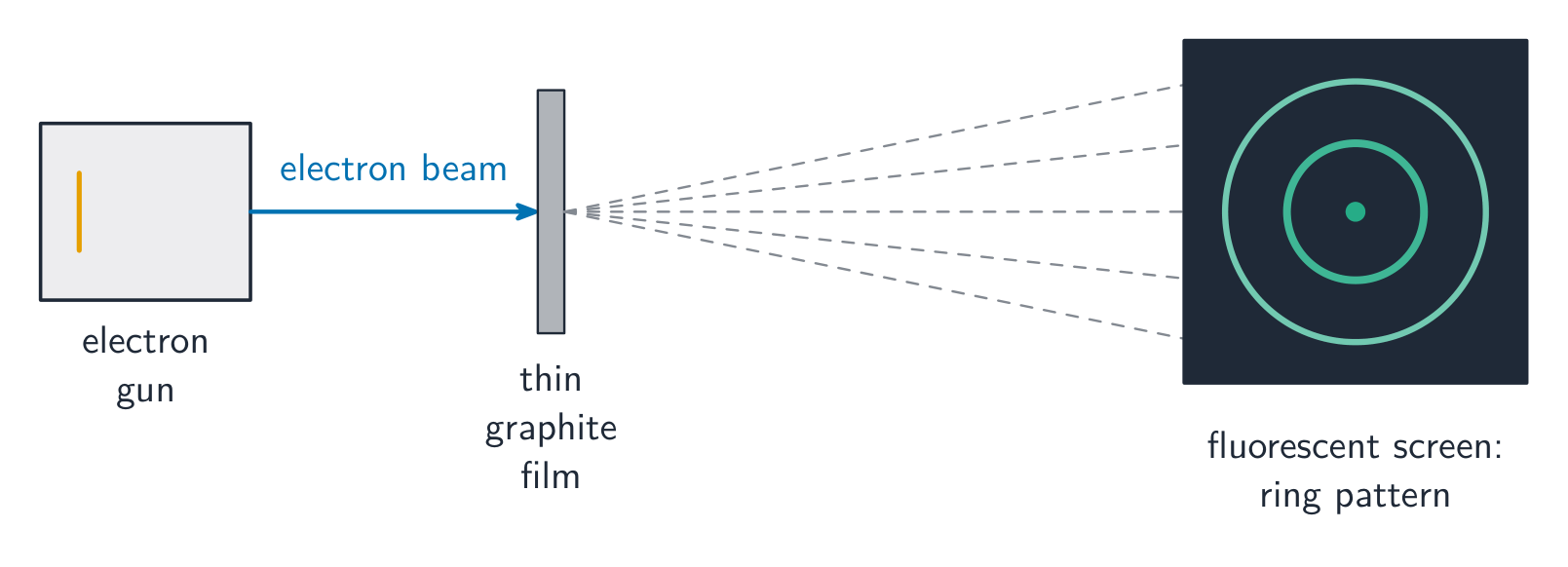
อิเล็กตรอนสร้างลวดลายการกระจาย, แสดงว่าอนุภาคมีธรรมชาติแบบคลื่น ตัวอย่างฝึกหัด. หาพลังงานของโฟตอนแสงสีส้มที่มีความถี่ $5.0\times10^{14}\ \text{Hz}$ ($h=6.63\times10^{-34}\ \text{J s}$): $E=hf=6.63\times10^{-34}\times5.0\times10^{14}=3.3\times10^{-19}\ \text{J}$, ซึ่งประมาณ equals $2.1\ \text{eV}$ (หารด้วย $1.6\times10^{-19}$). โฟตอนแสงที่มองเห็นได้พกพาพลังงานไม่กี่ electronvolts – เหมาะสมพอดีที่จะกระตุ้นปฏิกิริยาเคมีของการมองเห็นและการสังเคราะห์แสง
15.2
The Bohr Model of Atomic Structure · โมเดลโบร์ของโครงสร้างอะตอม
Syllabus · หลักสูตร
EnglishLearning Objective 15.2.A: Describe the properties of an atom.
- 15.2.A.1 Atoms have internal structure.
- 15.2.A.1.i Atoms consist of a small, positively charged nucleus surrounded by one or more negatively charged electrons.
- 15.2.A.1.ii The nucleus of an atom is made up of protons and neutrons.
- 15.2.A.1.iii The number of neutrons and protons in an atom can be represented using nuclear notation.
- 15.2.A.1.iv An ion is an atom with a nonzero net electric charge.
- 15.2.A.2 Each atomic element has a unique number of protons.
- 15.2.A.2.i The number and arrangements of electrons affects how atoms interact.
- 15.2.A.2.ii The total number of neutrons and protons identifies the isotope of an element.
- 15.2.A.2.iii The mass of an atom is dominated by the total mass of the protons and neutrons in its nucleus.
- 15.2.A.3 The Bohr model of the atom is based on classical physics and was the historical representation of the atom that led to the description of the hydrogen atom in terms of discrete energy states.
- 15.2.A.3.i In the Bohr model of the atom, electrons are modeled as moving around the nucleus in circular orbits determined by the electron's charge and mass, as well as the electric force between the electron and the nucleus.
- Relevant equations:
- $F_e = k\dfrac{q_1 q_2}{r^2}$
- $F_{\text{net}} = m\dfrac{v^2}{r}$
- 15.2.A.3.ii The standing wave model of electrons accounts for the existence of specific allowed energy states of an electron in an atom, because the electron orbit's circumference must be an integer multiple of the electron's de Broglie wavelength.
- 15.2.A.3.i In the Bohr model of the atom, electrons are modeled as moving around the nucleus in circular orbits determined by the electron's charge and mass, as well as the electric force between the electron and the nucleus.
Boundary statement: The analysis and description of electron structure is limited to energy levels and will not include such advanced descriptions as orbitals, orbital shapes, or probability functions.
ไทยวัตถุประสงค์การเรียนรู้ 15.2.A: อธิบายคุณสมบัติของอะตอม
- 15.2.A.1 อะตอมมีโครงสร้างภายใน
- 15.2.A.1.i อะตอมประกอบด้วยนิวเคลียสขนาดเล็กที่มีประจุบวก并被环绕着一个或多个带负电荷的电子。
- 15.2.A.1.ii นิวเคลียสของอะตอมประกอบด้วยโปรตอนและนิวตรอน
- 15.2.A.1.iii จำนวนนิวตรอนและโปรตอนในอะตอมสามารถแทนได้ด้วยสัญลักษณ์นิวเคลียร์
- 15.2.A.1.iv ไอออนคืออะตอมที่มีประจุไฟฟ้าสุทธิไม่เป็นศูนย์
- 15.2.A.2 แต่ละธาตุทางเคมีมีจำนวนโปรตอนที่เป็นเอกลักษณ์เฉพาะตัว
- 15.2.A.2.i จำนวนและการจัดเรียงของอิเล็กตรอนส่งผลต่อการมีปฏิสัมพันธ์ของอะตอม
- 15.2.A.2.ii จำนวนรวมของนิวตรอนและโปรตอนระบุไอโซโทปของธาตุ
- 15.2.A.2.iii มวลของอะตอมขึ้นอยู่กับมวลรวมของโปรตอนและนิวตรอนในนิวเคลียส
- 15.2.A.3 โมเดลอะตอมแบบโบร์ตั้งอยู่บนพื้นฐานของฟิสิกส์คลาสสิก และเป็นภาพแสดงทางประวัติศาสตร์ของอะตอมที่นำไปสู่การอธิบายอะตอมของไฮโดรเจนในฐานะสถานะพลังงานที่แยกเป็นช่วงๆ (discrete energy states)
- 15.2.A.3.i ในโมเดลอะตอมแบบโบร์ อิเล็กตรอนถูกจำลองให้เคลื่อนที่รอบนิวเคลียสในวงโคจรแบบวงกลม ซึ่งกำหนดโดยประจุและมวลของอิเล็กตรอน รวมถึงแรงไฟฟ้าระหว่างอิเล็กตรอนกับนิวเคลียส
- สมการที่เกี่ยวข้อง:
- $F_e = k\dfrac{q_1 q_2}{r^2}$
- $F_{\text{net}} = m\dfrac{v^2}{r}$
- 15.2.A.3.ii โมเดลคลื่นนิ่งของอิเล็กตรอนอธิบายถึงการมีอยู่ของสถานะพลังงานที่เป็นไปได้เฉพาะเจาะจงของอิเล็กตรอนในอะตอม เนื่องจากความยาวเส้นรอบวงของวงโคจรอิเล็กตรอนต้องเป็นจำนวนเต็มเท่ากับความยาวคลื่นเด บรอยล์ของอิเล็กตรอน
- 15.2.A.3.i ในโมเดลอะตอมแบบโบร์ อิเล็กตรอนถูกจำลองให้เคลื่อนที่รอบนิวเคลียสในวงโคจรแบบวงกลม ซึ่งกำหนดโดยประจุและมวลของอิเล็กตรอน รวมถึงแรงไฟฟ้าระหว่างอิเล็กตรอนกับนิวเคลียส
ข้อจำกัด: การวิเคราะห์และอธิบายโครงสร้างอิเล็กตรอนจะจำกัดอยู่ที่ระดับพลังงานเท่านั้น และไม่รวมถึงคำอธิบายขั้นสูงเช่น ออร์บิทัล รูปร่างของออร์บิทัล หรือฟังก์ชันความน่าจะเป็น
Source: College Board AP Course and Exam Description · แหล่งที่มา: คำอธิบายหลักสูตรและข้อสอบ College Board AP
EnglishThe Bohr model 玻尔模型 pictures electrons orbiting the nucleus only in certain allowed energy levels 能级. An electron can jump between levels only by absorbing or emitting a photon whose energy exactly matches the gap:
$$E_{\text{photon}}=|E_{\text{final}}-E_{\text{initial}}|.$$Because the levels are discrete, only specific photon energies are allowed.ไทยแบบจำลองของ บอร์ แสดงให้เห็นว่าอิเล็กตรอนโคจรรอบนิวเคลียสได้เฉพาะใน ระดับพลังงาน ที่อนุญาตเท่านั้น อิเล็กตรอนจะกระโดดระหว่างระดับได้โดยการดูดกลืนหรือปล่อยโฟตอนที่มีพลังงานตรงกับช่องว่างนั้นพอดี:
$$E_{\text{photon}}=|E_{\text{final}}-E_{\text{initial}}|.$$เนื่องจากระดับพลังงานเป็นแบบไม่ต่อเนื่อง จึงมีเพียงพลังงานโฟตอนบางชนิดเท่านั้นที่อนุญาตให้เกิดขึ้นได้15.3
Emission and Absorption Spectra · สเปกตรัมการแผ่รังสีและการดูดกลืนแสง
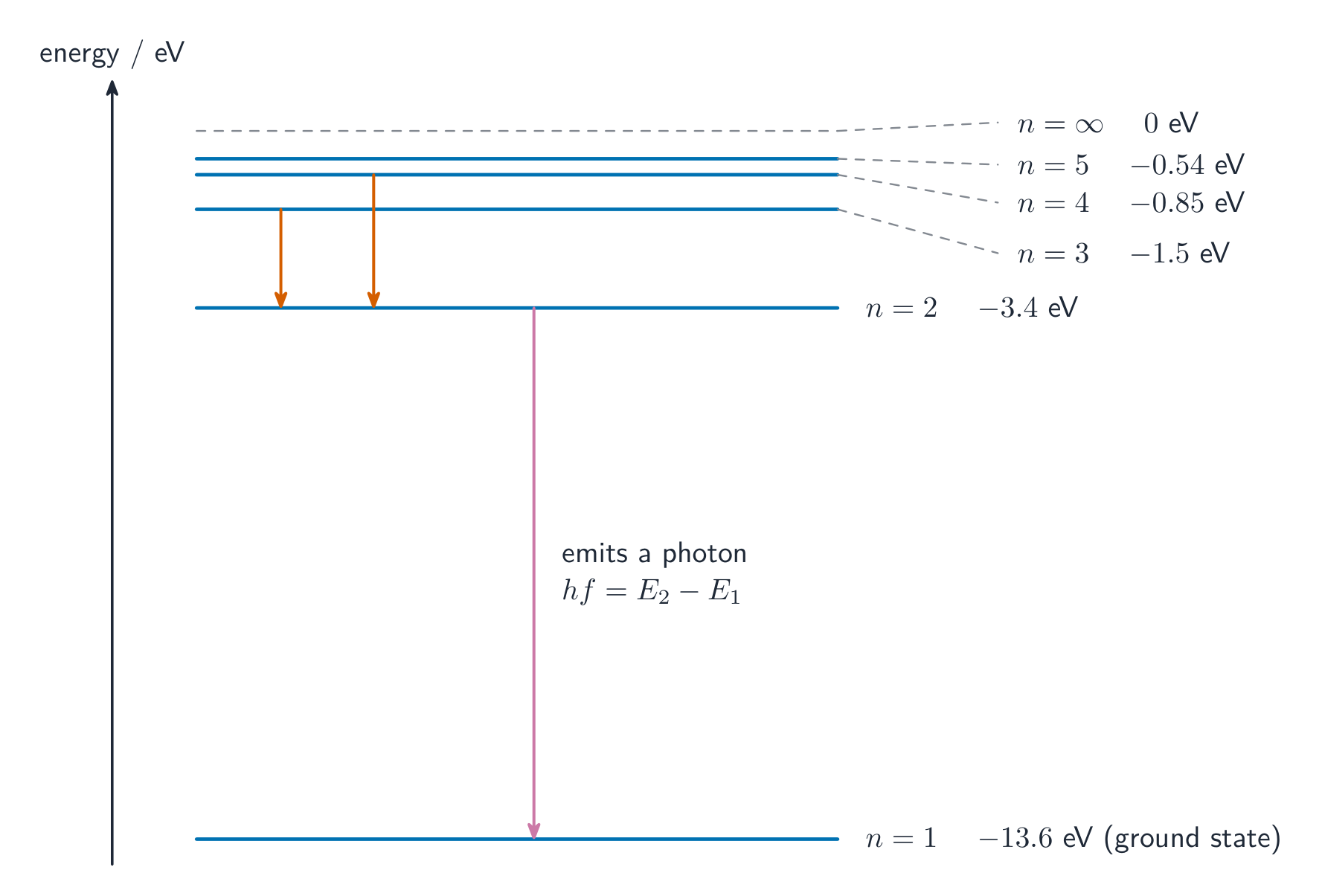
Syllabus · หลักสูตร
EnglishLearning Objective 15.3.A: Describe the emission or absorption of photons by atoms.
- 15.3.A.1 Energy transfer occurs when photons are absorbed or emitted by an atom, which is modeled as a system consisting of a nucleus and an electron.
- 15.3.A.2 Energy can only be absorbed or emitted by an atom if the amount of energy being absorbed or emitted corresponds to the energy difference between two atomic energy states.
- 15.3.A.2.i An atom in a given energy state may absorb a photon of the appropriate energy and transition to a higher energy state.
- 15.3.A.2.ii An atom in an excited energy state may emit a photon of the appropriate energy to spontaneously move to a lower energy state.
- 15.3.A.2.iii Because an atom is modeled as a system consisting of an electron and a nucleus, a change in the energy state of an atom corresponds to a change in the interaction energy between the electron and the nucleus.
- 15.3.A.3 Transitions between two energy states of an atom correspond to the absorption or emission of a photon of a single frequency and, therefore, a single wavelength.
- 15.3.A.4 Atoms of each element have a unique set of allowed energy levels and thereby a unique set of absorption and emission frequencies. The unique set of frequencies determines the element's spectrum.
- 15.3.A.4.i An emission spectrum can be used to determine the elements in a source of light.
- 15.3.A.4.ii An absorption spectrum can be used to determine the elements composing a substance by observing what light the substance has absorbed.
- 15.3.A.4.iii Energy level diagrams are commonly used to visually represent the energy states of an atom.
- 15.3.A.5 Binding energy is the energy required to remove an electron from an atom, causing the atom to become ionized. An atom in the lowest energy level (ground state) will require the greatest amount of energy to remove the electron from the atom.
Boundary statement: In AP Physics 2, only energy level diagrams of single-electron atoms will be considered.
ไทยวัตถุประสงค์การเรียนรู้ 15.3.A: อธิบายการแผ่รังสีหรือการดูดกลืนโฟตอนโดยอะตอม
- 15.3.A.1 การถ่ายโอนพลังงานเกิดขึ้นเมื่อโฟตอนถูกดูดกลืนหรือแผ่ออกมาโดยอะตอม ซึ่งถูกจำลองว่าเป็นระบบที่ประกอบด้วยนิวเคลียสและอิเล็กตรอน
- 15.3.A.2 พลังงานสามารถถูกดูดกลืนหรือแผ่ออกมาจากอะตอมได้ก็ต่อเมื่อปริมาณพลังงานที่ถูกดูดกลืนหรือแผ่ออกมาสอดคล้องกับความต่างของพลังงานระหว่างสองสถานะพลังงานของอะตอมเท่านั้น
- 15.3.A.2.i อะตอมที่อยู่ในสถานะพลังงาน某一个 อาจดูดกลืนโฟตอนที่มีพลังงานเหมาะสมและเปลี่ยนไปยังสถานะพลังงานที่สูงขึ้นได้
- 15.3.A.2.ii อะตอมที่อยู่ในสถานะพลังงานกระตุ้นอาจแผ่ออกโฟตอนที่มีพลังงานเหมาะสมเพื่อเปลี่ยนไปยังสถานะพลังงานที่ต่ำลงอย่างอิสระ (spontaneously)
- 15.3.A.2.iii เนื่องจากอะตอมถูกจำลองว่าเป็นระบบที่ประกอบด้วยอิเล็กตรอนและนิวเคลียส การเปลี่ยนแปลงสถานะพลังงานของอะตอมจึงสอดคล้องกับการเปลี่ยนแปลงพลังงานอันตรกิริยาระหว่างอิเล็กตรอนกับนิวเคลียส
- 15.3.A.3 การเปลี่ยนผ่านระหว่างสองสถานะพลังงานของอะตอมสอดคล้องกับการดูดกลืนหรือการแผ่ออกโฟตอนที่มีความถี่เดียวและดังนั้นมีความยาวคลื่นเดียว
- 15.3.A.4 อะตอมของแต่ละชนิดมีชุดสถานะพลังงานที่เป็นไปได้เฉพาะตัว และดังนั้นจึงมีความถี่ของการดูดกลืนและการแผ่รังสีที่เป็นเอกลักษณ์ ชุดความถี่ที่เป็นเอกลักษณ์นี้决定了สเปกตรัมของธาตุนั้น
- 15.3.A.4.i สเปกตรัมการแผ่รังสีสามารถใช้ระบุธาตุที่มีอยู่ในแหล่งกำเนิดแสงได้
- 15.3.A.4.ii สเปกตรัมการดูดกลืนสามารถใช้ระบุธาตุที่ประกอบขึ้นเป็นสารด้วยการสังเกตว่าสารนั้นดูดกลืนแสง哪些ส่วน
- 15.3.A.4.iii แผนภูมิระดับพลังงานมักถูกใช้เพื่อแสดงสถานะพลังงานของอะตอมในรูปแบบกราฟิก
- 15.3.A.5 พลังงานยึดเหนี่ยวคือพลังงานที่ต้องการในการดึงอิเล็กตรอนออกจากอะตอม ทำให้อะตอมกลายเป็นไอออน อะตอมในระดับพลังงานต่ำสุด (สถานะพื้น) จะต้องใช้พลังงานมากที่สุดในการดึงอิเล็กตรอนออกจากอะตอม
ข้อจำกัด: ใน AP Physics 2 จะพิจารณาเฉพาะแผนภูมิระดับพลังงานของอะตอมที่มีอิเล็กตรอนตัวเดียวเท่านั้น
Source: College Board AP Course and Exam Description · แหล่งที่มา: คำอธิบายหลักสูตรและข้อสอบ College Board AP
English- An emission spectrum 发射光谱 is the set of bright lines given off when electrons drop to lower levels – each line a specific wavelength.
- An absorption spectrum 吸收光谱 is the set of dark lines where those same wavelengths are absorbed from a continuous source.
The line pattern is a fingerprint of the element, since every element has its own energy levels.
ไทย- สเปกตรัมการแผ่รังสี (Emission spectrum) คือชุดของเส้นสว่างที่ emit เมื่ออิเล็กตรอนตกลงสู่ระดับพลังงานต่ำกว่า – แต่ละเส้นแทนความยาวคลื่นเฉพาะ
- สเปกตรัมการดูดกลืนแสง (Absorption spectrum) คือชุดของเส้นมืดที่เกิดจากการดูดกลืนความยาวคลื่นเหล่านั้นจากแหล่งกำเนิดแสงต่อเนื่อง
ระดับพลังงานที่ไม่ต่อเนื่องของไฮโดรเจนสร้างสเปกตรัมเส้น รูปแบบเส้นนี้คือ ลายนิ้วมือ ของธาตุ เนื่องจากแต่ละธาตุมีระดับพลังงานของตัวเอง

สเปกตรัมการแผ่รังสีของไฮโดรเจน: เส้นสว่างแต่ละเส้นคือแสงจากอิเล็กตรอนที่ตกลงระหว่างระดับพลังงานที่กำหนด Explore · สำรวจSee an element's line spectrum · ดูสเปกตรัมเส้นของธาตุหนึ่ง
Electrons jump between fixed energy levels, emitting or absorbing photons of exact wavelengths — a line spectrum that fingerprints the element. · อิเล็กตรอนกระโดดระหว่างระดับพลังงานที่กำหนดไว้并发布หรือดูดกลืนโฟตอนที่มีความยาวคลื่นเฉพาะ — สเปกตรัมเส้น ที่ทำหน้าที่เหมือนลายนิ้วมือของธาตุนั้น
Vocabulary · คำศัพท์ Train · ฝึกฝนEnglish ไทย quanta/ˈkwɒntə/ ควอนตัม photons/ˈfəʊtɒnz/ โฟตอน Wave–particle duality/weɪv ˈpɑːtɪkl djuːˈælɪti/ ความเป็นคู่คลื่น-อนุภาค double-slit experiment/ˈdʌbl slɪt ekˈsperɪmənt/ การทดลองช่องคู่ Young's double-slit experiment Bohr model/ˈbəʊə ˈmɒdl/ โมเดลของบอร์ energy levels/ˈenədʒi ˈlevlz/ ระดับพลังงาน emission spectrum/ɪˈmɪʃn ˈspektrəm/ สเปกตรัมการแผ่รังสี absorption spectrum/əbˈsɔːpʃn ˈspektrəm/ สเปกตรัมการดูดกลืนแสง 15.4
Blackbody Radiation · การแผ่รังสีของวัตถุดำ
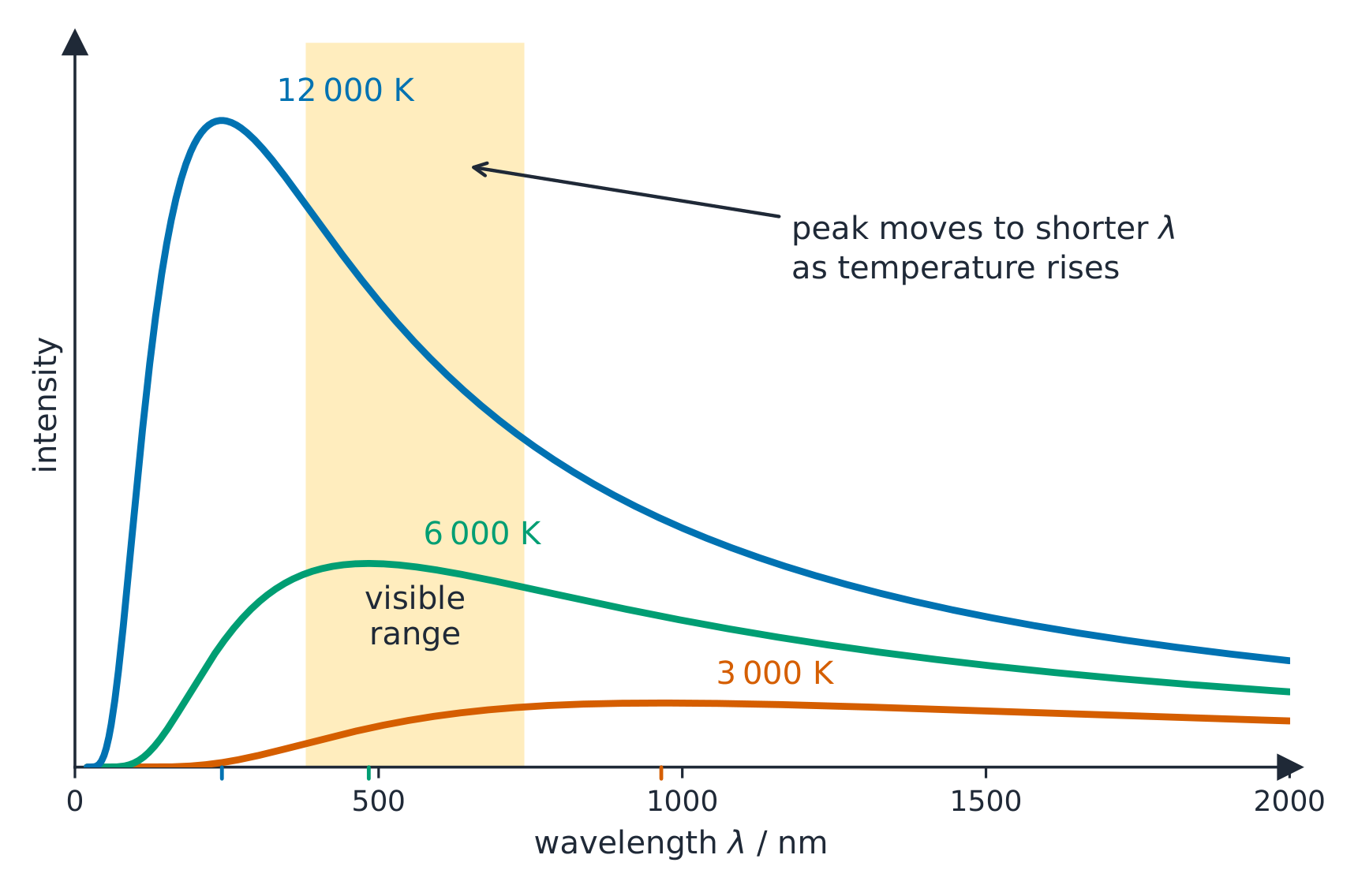
Syllabus · หลักสูตร
EnglishLearning Objective 15.4.A: Describe the electromagnetic radiation emitted by an object due to its temperature.
- 15.4.A.1 Matter will spontaneously convert some of its internal thermal energy into electromagnetic energy.
- 15.4.A.2 A blackbody is an idealized model of matter that absorbs all radiation that falls on the body. If the body is in equilibrium at a constant temperature, then it must in turn emit energy.
- 15.4.A.3 A blackbody will emit a continuous spectrum that only depends on the body's temperature. The radiation emitted by a blackbody is often modeled by plotting intensity per unit wavelength as a function of wavelength.
- 15.4.A.3.i The distribution of the intensity of a blackbody's spectrum as a function of temperature cannot be modeled using only classical physics concepts. A blackbody's spectrum is described by Planck's law, which assumes that the energy of light is quantized.
- 15.4.A.3.ii The peak wavelength emitted by a blackbody (the wavelength at which the blackbody emits the greatest amount of radiation per unit wavelength) decreases with increasing temperature, as described by Wien's law.
- Relevant equation:
- $\lambda_{\max} = \dfrac{b}{T}$
- 15.4.A.3.iii The rate at which energy is emitted (power) by a blackbody is proportional to the surface area of the body and to the temperature of the body raised to the fourth power, as described by the Stefan-Boltzmann law.
- Relevant equation:
- $P = A\sigma T^4$
ไทยวัตถุประสงค์การเรียนรู้ 15.4.A: อธิบายการแผ่รังสีแม่เหล็กไฟฟ้าที่วัตถุแผ่ออกมาเนื่องจากอุณหภูมิ
- 15.4.A.1 วัสดุจะแปลงพลังงานความร้อนภายในบางส่วนออกเป็นพลังงานแม่เหล็กไฟฟ้าโดยธรรมชาติ
- 15.4.A.2 วัตถุดำคือโมเดลในอุดมคติของวัสดุที่ดูดกลืนรังสีทั้งหมดที่ตกกระทบ หากวัตถุอยู่ในสมดุลที่อุณหภูมิคงที่ มันจะต้องแผ่ออกพลังงานกลับออกมาด้วย
- 15.4.A.3 วัตถุดำจะแผ่สเปกตรัมต่อเนื่องซึ่งขึ้นอยู่กับอุณหภูมิจากวัตถุเท่านั้น รังสีที่วัตถุดำแผ่ออกมามักถูกจำลองโดยการพล็อตความเข้มต่อหน่วยความยาวคลื่นเป็นฟังก์ชันของความยาวคลื่น
- 15.4.A.3.i การกระจายตัวของความเข้มของสเปกตรัมวัตถุดำตามอุณหภูมิไม่สามารถจำลองได้ด้วยแนวคิดฟิสิกส์คลาสสิกเพียงอย่างเดียว สเปกตรัมของวัตถุดำถูกอธิบายโดยกฎของแพงค์ ซึ่งสมมติว่าพลังงานของแสงถูกแบ่งเป็นควอนตัม
- 15.4.A.3.ii ความยาวคลื่นสูงสุดที่วัตถุดำแผ่ออกมา (ความยาวคลื่นที่วัตถุดำแผ่รังสีมากที่สุดในหน่วยความยาวคลื่น) จะลดลงเมื่ออุณหภูมิสูงขึ้น ตามที่อธิบายโดยกฎของไว恩
- สมการที่เกี่ยวข้อง:
- $\lambda_{\max} = \dfrac{b}{T}$
- 15.4.A.3.iii อัตราการแผ่ออกพลังงาน (กำลัง) ของวัตถุดำแปรผันตรงกับพื้นที่ผิวของวัตถุและแปรผันตรงกับอุณหภูมิของวัตถุนับกำลังสี่ ตามที่อธิบายโดยกฎของสเตฟาน-โบลต์ซมันน์
- สมการที่เกี่ยวข้อง:
- $P = A\sigma T^4$
Source: College Board AP Course and Exam Description · แหล่งที่มา: คำอธิบายหลักสูตรและข้อสอบ College Board AP
EnglishA blackbody 黑体 emits a continuous spectrum that depends only on its temperature. Hotter objects glow brighter and peak at shorter wavelengths (red-hot to white-hot to blue-hot). Explaining this spectrum required quantized energy – a founding problem of quantum theory.
ไทยวัตถุดำ (Blackbody) จะแผ่สเปกตรัมต่อเนื่องที่ขึ้นอยู่กับอุณหภูมิเพียงอย่างเดียว วัตถุที่ร้อนกว่าจะเรืองแสงสว่างขึ้นและสูงสุดที่ ความยาวคลื่นสั้นลง (แดงจัดไปเป็นขาวจัดไปเป็นน้ำเงินจัด) การอธิบายสเปกตรัมนี้จำเป็นต้องใช้พลังงานแบบควอนไทซ์ – ซึ่งเป็นปัญหาพื้นฐานของทฤษฎีควอนตัม
วัตถุดำที่ร้อนกว่าแผ่รังสีมากขึ้น และจุดสูงสุดเลื่อนไปทางความยาวคลื่นสั้นลง Vocabulary · คำศัพท์ Train · ฝึกฝนEnglish ไทย blackbody/ˈblækbɒdi/ วัตถุดำ photoelectric effect/ˌfəʊtəʊɪˈlektrɪk ɪˈfekt/ ปรากฏการณ์โฟโตอิเล็กทริก 15.5
The Photoelectric Effect · เอฟเฟกต์โฟโตอิเล็กทริก
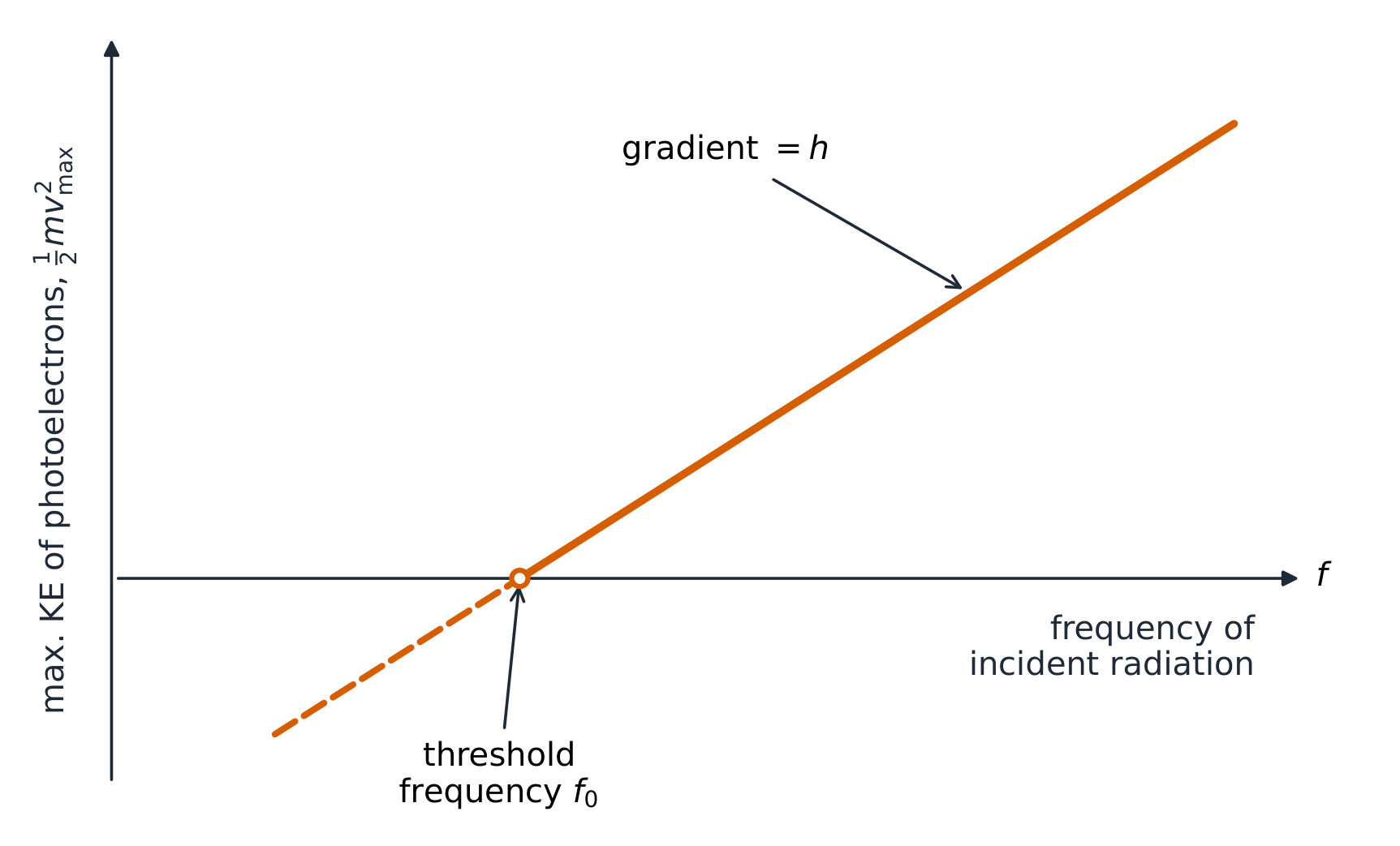
Syllabus · หลักสูตร
EnglishLearning Objective 15.5.A: Describe an interaction between photons and matter using the photoelectric effect.
- 15.5.A.1 The photoelectric effect is the emission of electrons when electromagnetic radiation is incident upon a photoactive material.
- 15.5.A.2 The emission of electrons via the photoelectric effect requires a minimum frequency of incident light, called the threshold frequency.
- 15.5.A.2.i Light that is incident on a material and is at the threshold frequency or higher will induce electron emission, regardless of the number of photons that strike the material.
- 15.5.A.2.ii The energy of the emitted electrons is not dependent on the number of photons that are incident upon the material, which provides evidence that light is a collection of discrete, quantized energy packets called photons.
- 15.5.A.3 The maximum kinetic energy of an emitted electron is related to the frequency of the incident light and the work function of the material, $\phi$.
- 15.5.A.3.i The work function of a material is the minimum energy required to emit an electron from atoms in the material.
- 15.5.A.3.ii The maximum kinetic energy of an emitted electron is given by the equation $K_{\max} = hf - \phi$.
- 15.5.A.3.iii In a typical experimental setup to demonstrate the photoelectric effect and determine the work function of a metal, two metal plates are placed in a vacuum chamber and connected to a variable source of potential difference. One of the plates is illuminated by monochromatic light that causes electrons to be ejected and the potential difference between the plates is adjusted until no current is measured in the circuit.
Boundary statement: Where applicable, work functions for materials will be provided on the exam; students are not expected to know values of work functions or variables of a material that influence the magnitude of its work function.
ไทยวัตถุประสงค์การเรียนรู้ 15.5.A: อธิบายปฏิสัมพันธ์ระหว่างโฟตอนและวัสดุโดยใช้เอฟเฟกต์โฟโตอิเล็กทริก
- 15.5.A.1 เอฟเฟกต์โฟโตอิเล็กทริกคือการปล่อยอิเล็กตรอนเมื่อรังสีแม่เหล็กไฟฟ้าตกกระทบบนวัสดุที่มีคุณสมบัติโฟโต
- 15.5.A.2 การปล่อยอิเล็กตรอนผ่านเอฟเฟกต์โฟโตอิเล็กทริกจำเป็นต้องมีความถี่ขั้นต่ำของแสงตกกระทบ ซึ่งเรียกว่าความถี่ขอบ (threshold frequency)
- 15.5.A.2.i แสงที่ตกกระทบวัสดุด้วยความถี่ที่ขอบหรือสูงกว่าจะ诱发การปล่อยอิเล็กตรอน ไม่ว่าจะมีจำนวนโฟตอน了多少ที่ตกกระทบวัสดุก็ตาม
- 15.5.A.2.ii พลังงานของอิเล็กตรอนที่ถูกปล่อยออกมาไม่ขึ้นอยู่กับจำนวนโฟตอนที่ตกกระทบวัสดุ ซึ่งเป็นหลักฐานที่แสดงว่าแสงเป็นกลุ่มของแพ็กเก็ตพลังงานที่แยกเป็นช่วงๆ ที่เรียกว่าโฟตอน
- 15.5.A.3 พลังงานจลน์สูงสุดของอิเล็กตรอนที่ปล่อยออกมาสัมพันธ์กับความถี่ของแสงตกกระทบและฟังก์ชันงานของวัสดุ $\phi$
- 15.5.A.3.i ฟังก์ชันงานของวัสดุคือพลังงานขั้นต่ำที่จำเป็นในการปล่อยอิเล็กตรอนออกจากอะตอมในวัสดุนั้น
- 15.5.A.3.ii พลังงานจลน์สูงสุดของอิเล็กตรอนที่ปล่อยออกสามารถหาได้จากสมการ $K_{\max} = hf - \phi$
- 15.5.A.3.iii ในการจัดตั้งทดลองทั่วไปเพื่อสาธิตปรากฏการณ์โฟโตอิเล็กทริกและหาค่าฟังก์ชันงานของโลหะ จะวางแผ่นโลหะสองแผ่นในห้องสุญญากาศและเชื่อมต่อกับแหล่งจ่ายแรงต่างศักย์แปรผัน หนึ่งในสองแผ่นถูกส่องด้วยแสงโมโนโครมาติกที่ทำให้เกิดอิเล็กตรอนหลุดออกมา และปรับแรงต่างศักย์ระหว่างแผ่นทั้งสองจนไม่พบกระแสไฟฟ้าในวงจร
ข้อจำกัด: หากเหมาะสม ค่าฟังก์ชันงานของวัสดุจะถูกให้ไว้ในข้อสอบ; นักเรียนไม่จำเป็นต้องจำค่าฟังก์ชันงานหรือตัวแปรของวัสดุที่มีผลต่อขนาดของฟังก์ชันงานได้
Source: College Board AP Course and Exam Description · แหล่งที่มา: คำอธิบายหลักสูตรและข้อสอบ College Board AP
EnglishThe photoelectric effect Shining light on a metal can eject electrons – the photoelectric effect 光电效应. Key facts (which only the photon picture explains): electrons come out only if the photon's frequency exceeds a threshold, no matter how bright a dimmer, lower-frequency light is. Energy conservation gives
$$K_{\max}=hf-\phi,$$where $\phi$ is the metal's work function 逸出功 (the energy to free an electron).Worked example. Light of frequency $8.0\times10^{14}\ \text{Hz}$ falls on a metal with work function $\phi=3.0\times10^{-19}\ \text{J}$. The most energetic electrons come off with
$$K_{\max}=hf-\phi=(6.63\times10^{-34}\times8.0\times10^{14})-3.0\times10^{-19}=5.3\times10^{-19}-3.0\times10^{-19}=2.3\times10^{-19}\ \text{J}.$$Below the threshold frequency $\phi/h$, $K_{\max}$ would be negative – meaning no electrons escape at all, however bright the light.ไทยเอฟเฟกต์โฟโตอิเล็กทริก การส่องแสงบนโลหะสามารถทำให้อิเล็กตรอนหลุดออกมาได้ – นี่คือ เอฟเฟกต์โฟโตอิเล็กทริก ข้อเท็จจริงสำคัญ (ซึ่งภาพโฟตอนเท่านั้นที่อธิบายได้): อิเล็กตรอนจะหลุดออกมาก็ต่อเมื่อความถี่ของโฟตอนสูงกว่าค่าเกณฑ์เท่านั้น ไม่ว่าแสงที่ความถี่ต่ำกว่าจะอ่อนแค่ไหนก็ตาม การอนุรักษ์พลังงานทำให้ได้
$$K_{\max}=hf-\phi,$$โดยที่ $\phi$ คือ ฟังก์ชันงาน (Work function) ของโลหะ (พลังงานที่ใช้ปลดล็อกอิเล็กตรอน)พลังงานจลน์สูงสุดของโฟโตอิเล็กตรอนเพิ่มขึ้นตามความถี่เชิงเส้น ตัวอย่างโจทย์: แสงที่มีความถี่ $8.0\times10^{14}\ \text{Hz}$ ส่องtoBeโลหะที่มีฟังก์ชันงาน $\phi=3.0\times10^{-19}\ \text{J}$ อิเล็กตรอนที่มีพลังงานมากที่สุดจะถูกปล่อยออกมาด้วย
$$K_{\max}=hf-\phi=(6.63\times10^{-34}\times8.0\times10^{14})-3.0\times10^{-19}=5.3\times10^{-19}-3.0\times10^{-19}=2.3\times10^{-19}\ \text{J}.$$หากต่ำกว่าความถี่阈值 $\phi/h$ ค่า $K_{\max}$ จะเป็นลบ – หมายความว่าไม่มีอิเล็กตรอนใดหลุดออกมาเลย ไม่ว่าแสงจะสว่างแค่ไหนก็ตามVocabulary · คำศัพท์ Train · ฝึกฝนEnglish ไทย work function/wɜːk ˈfʌŋkʃn/ work function 15.6
Compton Scattering · การกระเจิงของคอมปตัน
Syllabus · หลักสูตร
EnglishLearning Objective 15.6.A: Describe the interaction between photons and matter using Compton scattering.
- 15.6.A.1 In Compton scattering, a photon interacts with a free electron. The Compton effect is when a photon that emerges from the interaction has a lower energy and longer wavelength than the incoming photon. The magnitude of the change is related to the direction of the photon after the collision.
- 15.6.A.2 Compton scattering provides evidence that light is a collection of discrete, quantized energy packets called photons.
- 15.6.A.2.i Compton scattering can be explained by treating a photon as a particle and applying conservation of energy and conservation of momentum to the collision between the photon and electron.
- 15.6.A.2.ii The transfer of a photon's energy to an electron results in the energy, momentum, frequency, and wavelength of the photon changing.
- Relevant equations:
- $E = hf$
- $\lambda = \dfrac{h}{p}$
- 15.6.A.3 The change in wavelength experienced by a photon after colliding with an electron is related to how much the photon's direction changes.
- Relevant equation:
- $\Delta\lambda = \dfrac{h}{m_e c}(1 - \cos\theta)$
Boundary statement: AP Physics 2 includes full quantitative and qualitative treatments of conservation of momentum in two dimensions.
ไทยจุดประสงค์การเรียนรู้ 15.6.A: อธิบายปฏิสัมพันธ์ระหว่างโฟตอนกับสสาร โดยใช้ปรากฏการณ์การกระเจิงแบบคอมปตัน
- 15.6.A.1 ในการกระเจิงแบบคอมปตัน โฟตอนจะเกิดปฏิกิริยากับอิเล็กตรอนอิสระ ปรากฏการณ์คอมปตันเกิดขึ้นเมื่อโฟตอนที่ออกมาจากการมีปฏิสัมพันธ์มีพลังงานต่ำกว่าและความยาวคลื่นที่ยาวกว่าโฟตอนเดิม ขนาดของการเปลี่ยนแปลงขึ้นอยู่กับทิศทางของโฟตอนหลังการชนกัน
- 15.6.A.2 การกระเจิงแบบคอมปตันเป็นหลักฐานที่แสดงว่าแสงประกอบด้วยแพ็กเก็ตพลังงานที่ไม่ต่อเนื่องและถูกกำหนดปริมาณ ซึ่งเรียกว่าโฟตอน
- 15.6.A.2.i การกระเจิงแบบคอมปตันสามารถอธิบายได้โดยพิจารณาโฟตอนในฐานะอนุภาคและใช้กฎการอนุรักษ์พลังงานและการอนุรักษ์โมเมนตัมกับการชนระหว่างโฟตอนกับอิเล็กตรอน
- 15.6.A.2.ii การถ่ายโอนพลังงานจากโฟตอนไปยังอิเล็กตรอนส่งผลให้พลังงาน โมเมนตัม ความถี่ และความยาวคลื่นของโฟตอนเปลี่ยนไป
- สมการที่เกี่ยวข้อง:
- $E = hf$
- $\lambda = \dfrac{h}{p}$
- 15.6.A.3 การเปลี่ยนแปลงความยาวคลื่นที่โฟตอนประสบหลังจากชนกับอิเล็กตรอนสัมพันธ์กับการเปลี่ยนแปลงทิศทางของโฟตอน
- สมการที่เกี่ยวข้อง:
- $\Delta\lambda = \dfrac{h}{m_e c}(1 - \cos\theta)$
ข้อจำกัด: AP Physics 2 ครอบคลุมทั้งการวิเคราะห์เชิงปริมาณและเชิงคุณภาพเกี่ยวกับการอนุรักษ์โมเมนตัมในสองมิติอย่างครบถ้วน
Source: College Board AP Course and Exam Description · แหล่งที่มา: คำอธิบายหลักสูตรและข้อสอบ College Board AP
EnglishIn Compton scattering 康普顿散射, a photon collides with an electron like two particles, transferring some energy and momentum. The scattered photon comes out with less energy (longer wavelength). This is direct evidence that photons carry momentum and behave as particles.
ไทยในการ กระเจิงของคอมปตัน (Compton scattering) โฟตอนชนกับอิเล็กตรอนเสมือนสองอนุภาค โดยถ่ายโอนพลังงานและโมเมนตัมบางส่วน โฟตอนที่ถูกกระเจิงจะมี พลังงานน้อยลง (ความยาวคลื่นยาวขึ้น) สิ่งนี้เป็นหลักฐานโดยตรงว่าโฟตอนมีโมเมนตัมและ behaving as particles
Vocabulary · คำศัพท์ Train · ฝึกฝนEnglish ไทย Compton scattering/ˈkɒmptn ˈskætərɪŋ/ การกระเจิงของคอมปตัน nucleus/ˈnjuːklɪəs/ นิวเคลียส 15.7
Fission, Fusion, and Nuclear Decay · การแตกตัว, การรวมตัว, และการสลายตัวของนิวเคลียร์
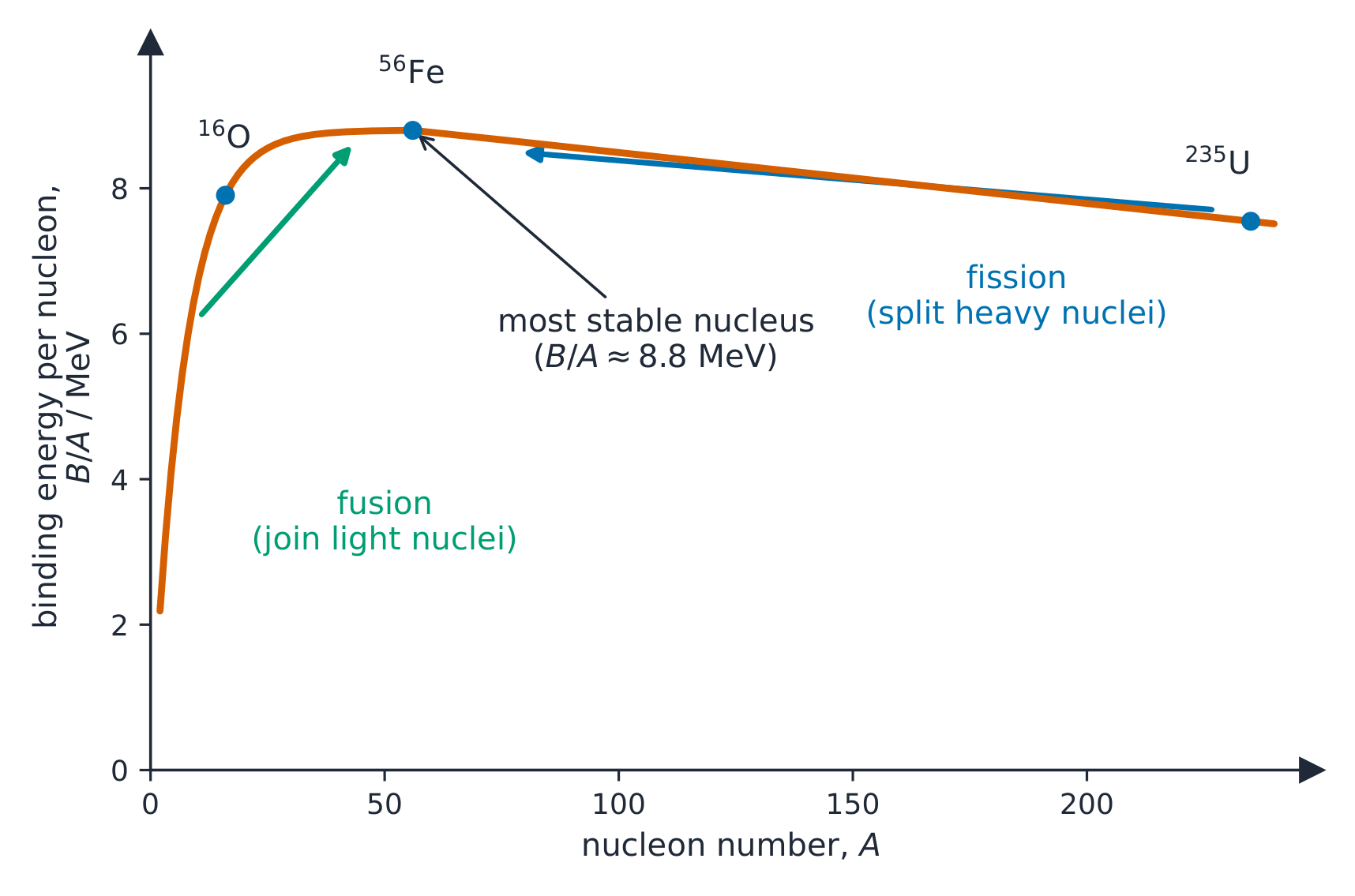
Syllabus · หลักสูตร
EnglishLearning Objective 15.7.A: Describe the physical properties that constrain the behavior of interacting nuclei, subatomic particles, and nucleons.
- 15.7.A.1 The strong force is exerted at nuclear scales and dominates the interactions of nucleons (protons or neutrons).
- 15.7.A.2 Possible nuclear reactions are constrained by the law of conservation of nucleon number.
- 15.7.A.3 The behavior of the constituent particles of a nuclear reaction is constrained by laws of conservation of energy, energy-mass equivalence, and conservation of momentum.
- 15.7.A.4 For all nuclear reactions, mass and energy may be exchanged due to mass-energy equivalence.
- Relevant equation:
- $E = mc^2$
- 15.7.A.5 Energy may be released in nuclear processes in the form of kinetic energy of the products or as photons.
- 15.7.A.6 Nuclear fusion is the process by which two or more smaller nuclei combine to form a larger nucleus, as well as subatomic particles.
- 15.7.A.7 Nuclear fission is the process by which the nucleus of an atom splits into two or more smaller nuclei, as well as subatomic particles.
- 15.7.A.8 Nuclear fission may occur spontaneously or may require an energy input, depending on the binding energy of the nucleus.
Learning Objective 15.7.B: Describe the radioactive decay of a given sample of material consisting of a finite number of nuclei.
- 15.7.B.1 Radioactive decay is the spontaneous transformation of a nucleus into one or more different nuclei.
- 15.7.B.1.i The time at which an individual nucleus undergoes radioactive decay is indeterminable, but decay rates can be described using probability
- 15.7.B.1.ii The half-life, $t_{1/2}$, of a radioactive material is the time it takes for half of the initial number of radioactive nuclei to have spontaneously decayed.
- 15.7.B.1.iii The decay constant $\lambda$ can be related to the half-life of a radioactive material with the equation $\lambda = \dfrac{\ln 2}{t_{1/2}}$.
- 15.7.B.2 A material's decay constant may be used to predict the number of nuclei remaining in a sample after a period of time, or the age of a material if the initial amount of material is known.
- Relevant equation:
- $N = N_0 e^{-\lambda t}$
- Derived equation:
- $\ln\left(\dfrac{N}{N_0}\right) = -\lambda t$
- 15.7.B.3 Different unstable elements and isotopes may have vastly different half-lives, ranging from fractions of a second to billions of years.
ไทยจุดประสงค์การเรียนรู้ 15.7.A: อธิบายคุณสมบัติทางกายภาพที่กำหนดพฤติกรรมของนิวเคลียสที่มีปฏิสัมพันธ์ อนุภาคย่อยอะตอม และนิวคลีออน
- 15.7.A.1 แรงนิวเคลียร์แรงกระทำในระดับนิวเคลียสและเป็นแรงหลักที่ควบคุมปฏิสัมพันธ์ของนิวคลีออน (โปรตอนหรือนิวตรอน)
- 15.7.A.2 ปฏิกิริยาทางนิวเคลียร์ที่เป็นไปได้ต้องอยู่ภายใต้กฎการอนุรักษ์จำนวนนิวคลีออน
- 15.7.A.3 พฤติกรรมของอนุภาคส่วนประกอบในปฏิกิริยานิวเคลียร์ต้องอยู่ภายใต้กฎการอนุรักษ์พลังงาน สมมูลมวล-พลังงาน และการอนุรักษ์โมเมนตัม
- 15.7.A.4 สำหรับปฏิกิริยานิวเคลียร์ทั้งหมด มวลและพลังงานสามารถแลกเปลี่ยนกันได้เนื่องจากสมมูลมวล-พลังงาน
- สมการที่เกี่ยวข้อง:
- $E = mc^2$
- 15.7.A.5 พลังงานอาจถูกปลดปล่อยในกระบวนการทางนิวเคลียร์ในรูปแบบของพลังงานจลน์ของผลิตภัณฑ์หรือในรูปของโฟตอน
- 15.7.A.6 การหลอมรวมนิวเคลียสคือกระบวนการที่นิวเคลียสขนาดเล็กสองตัวขึ้นไปรวมกันเป็นนิวเคลียสที่ใหญ่ขึ้น รวมถึงอนุภาคย่อยอะตอม
- 15.7.A.7 การแตกตัวของนิวเคลียสคือกระบวนการที่นิวเคลียสของอะตอมแตกออกเป็นนิวเคลียสขนาดเล็กสองตัวขึ้นไป รวมถึงอนุภาคย่อยอะตอม
- 15.7.A.8 การแตกตัวของนิวเคลียสอาจเกิดขึ้นเองหรือต้องการพลังงานเข้าเสริม ขึ้นอยู่กับพลังงานยึดเหนี่ยวของนิวเคลียสนั้น
จุดประสงค์การเรียนรู้ 15.7.B: อธิบายการสลายตัวของกัมมันตรังสีของตัวอย่างวัสดุที่กำหนดซึ่งประกอบด้วยจำนวนนิวเคลียสจำกัด
- 15.7.B.1 การสลายตัวของกัมมันตรังสีคือการเปลี่ยนแปลงโดยธรรมชาติของนิวเคลียสกลายเป็นนิวเคลียสอื่นหนึ่งหรือมากกว่านั้น
- 15.7.B.1.i เวลาที่นิวเคลียสแต่ละตัวจะเกิดการสลายตัวของกัมมันตรังสีไม่สามารถระบุล่วงหน้าได้ แต่อัตราการสลายตัวสามารถอธิบายได้ด้วยprobability
- 15.7.B.1.ii ช่วงครึ่งชีวิต, $t_{1/2}$, ของวัสดุกัมมันตรังสีคือระยะเวลาที่จำเป็นสำหรับนิวเคลียสกัมมันตรังสีจำนวนครึ่งหนึ่งของจำนวนเริ่มต้นที่จะสลายตัวไปโดยธรรมชาติ
- 15.7.B.1.iii ค่าคงที่การสลายตัว $\lambda$ สามารถเชื่อมโยงกับช่วงครึ่งชีวิตของวัสดุกัมมันตรังสีได้โดยใช้สมการ $\lambda = \dfrac{\ln 2}{t_{1/2}}$
- 15.7.B.2 ค่าคงที่การสลายตัวของวัสดุสามารถใช้ทำนายจำนวนนิวเคลียสที่เหลืออยู่ในตัวอย่างหลังจากผ่านไปช่วงเวลาหนึ่ง หรือหาอายุของวัสดุหากทราบปริมาณเริ่มต้นของวัสดุนั้น
- สมการที่เกี่ยวข้อง:
- $N = N_0 e^{-\lambda t}$
- สมการที่ได้จากการดัดแปลง:
- $\ln\left(\dfrac{N}{N_0}\right) = -\lambda t$
- 15.7.B.3 ธาตุและไอโซโทปที่ไม่เสถียรที่แตกต่างกันอาจมีช่วงครึ่งชีวิตแตกต่างกันอย่างมาก ตั้งแต่เศษส่วนของวินาทีไปจนถึงหลายพันล้านปี
Source: College Board AP Course and Exam Description · แหล่งที่มา: คำอธิบายหลักสูตรและข้อสอบ College Board AP
EnglishThe nucleus 原子核 stores enormous energy. Fission 裂变 splits a heavy nucleus into lighter ones, releasing energy (nuclear reactors, bombs). Fusion 聚变 joins light nuclei into a heavier one (the Sun's power). Both release energy because the products have slightly less mass, converted by $E=mc^2$.
Worked example. Even a tiny mass converts to a huge energy. If a nuclear reaction loses $1.0\times10^{-3}\ \text{kg}$ of mass, it releases $E=mc^2=1.0\times10^{-3}\times(3.0\times10^{8})^2=9.0\times10^{13}\ \text{J}$ – roughly the energy of $20\,000$ tonnes of TNT.
ไทยนิวเคลียส เก็บพลังงานมหาศาล การแตกตัว (Fission) แบ่งนิวเคลียสหนักออกเป็นนิวเคลียสเบากว่า ปล่อยพลังงาน (เตaN reactors, bombs) การรวมตัว (Fusion) เชื่อมนิวเคลียสเบาเข้าด้วยกันเป็นนิวเคลียสหนัก (พลังงานของดวงอาทิตย์) ทั้งสองกระบวนการปล่อยพลังงานเพราะผลิตภัณฑ์มีมวล น้อยลงเล็กน้อย ซึ่งถูกแปลงเป็นพลังงานโดย $E=mc^2$
พลังงานผูกพันต่อนิวคลีโอออนสูงสุดใกล้กับเหล็ก ทำให้ทั้งการรวมตัวและการแตกตัวสามารถปล่อยพลังงานได้ ตัวอย่างโจทย์: แม้มวลเล็กน้อยก็สามารถแปลงเป็นพลังงานมหาศาลได้ หากปฏิกิริยานิวเคลียร์สูญเสีย $1.0\times10^{-3}\ \text{kg}$ ของมวล มันจะปล่อย $E=mc^2=1.0\times10^{-3}\times(3.0\times10^{8})^2=9.0\times10^{13}\ \text{J}$ – ประมาณเท่ากับพลังงานของ $20\,000$ ตันของ TNT
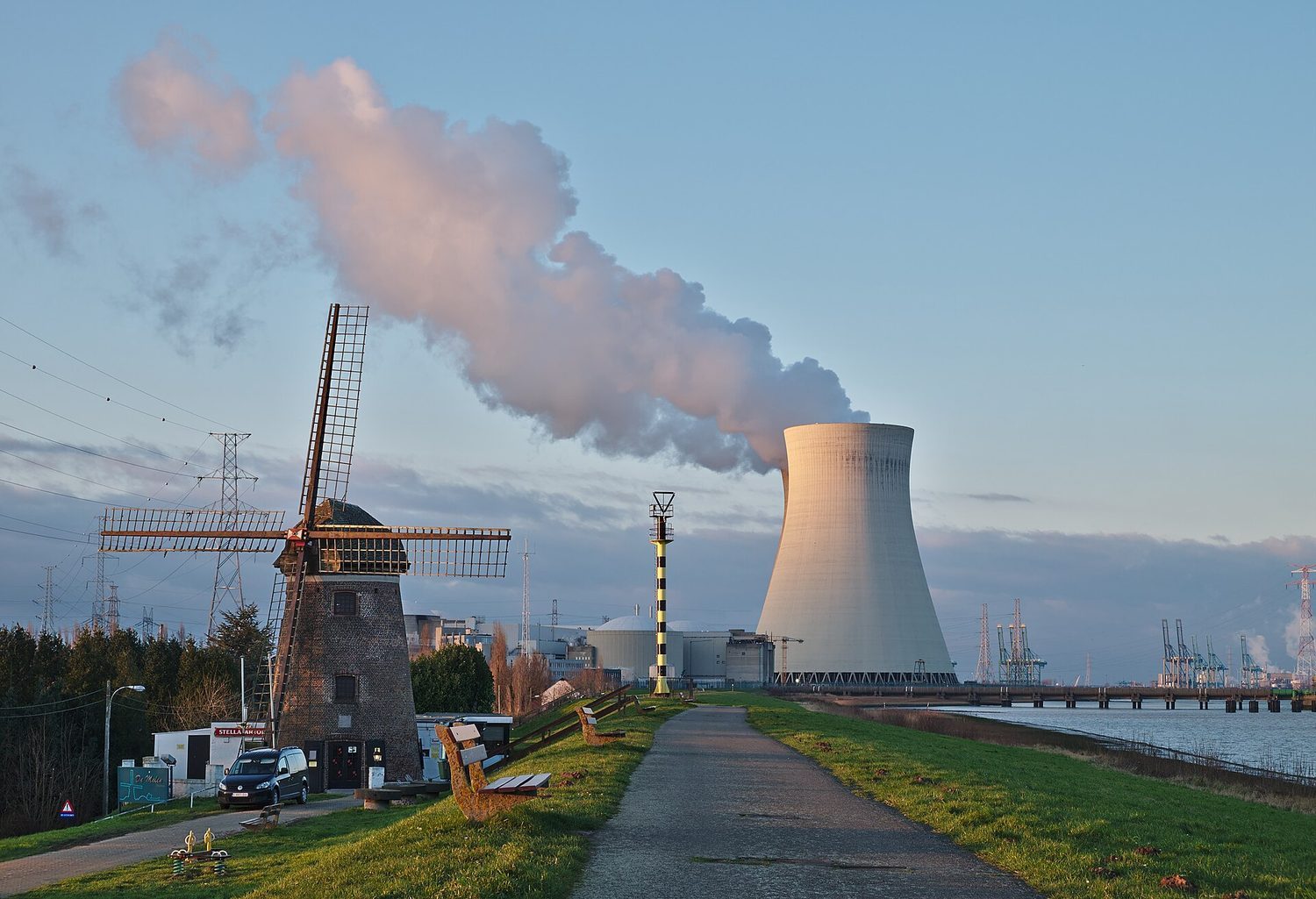
โรงงานผลิตไฟฟ้าพลังนิวเคลียร์: การแตกตัวของนิวเคลียสหนักปล่อยพลังงานที่ขับเคลื่อนโรงงาน Explore · สำรวจBalance a nuclear decay equation · ปรับสมการการสลายตัวทางนิวเคลียร์ให้สมดุล
In alpha, beta and gamma decay, nucleon and charge numbers must balance. Pick a mode and see how the parent turns into the daughter nuclide. · ในการสลายตัวแบบ อัลฟา, เบตา และ แกมมา จำนวนนิวคลีออนและประจุต้องสมดุล เลือกโหมดหนึ่งแล้วดูว่านิวไคลด์แม่เปลี่ยนเป็นนิวไคลด์ลูกได้อย่างไร
Vocabulary · คำศัพท์ Train · ฝึกฝนEnglish ไทย Fission/ˈfɪʃn/ การแตกตัว Fusion/ˈfjuːʒn/ การหลอมรวม 15.8
Types of Radioactive Decay · ประเภทของการสลายตัวทางรังสี
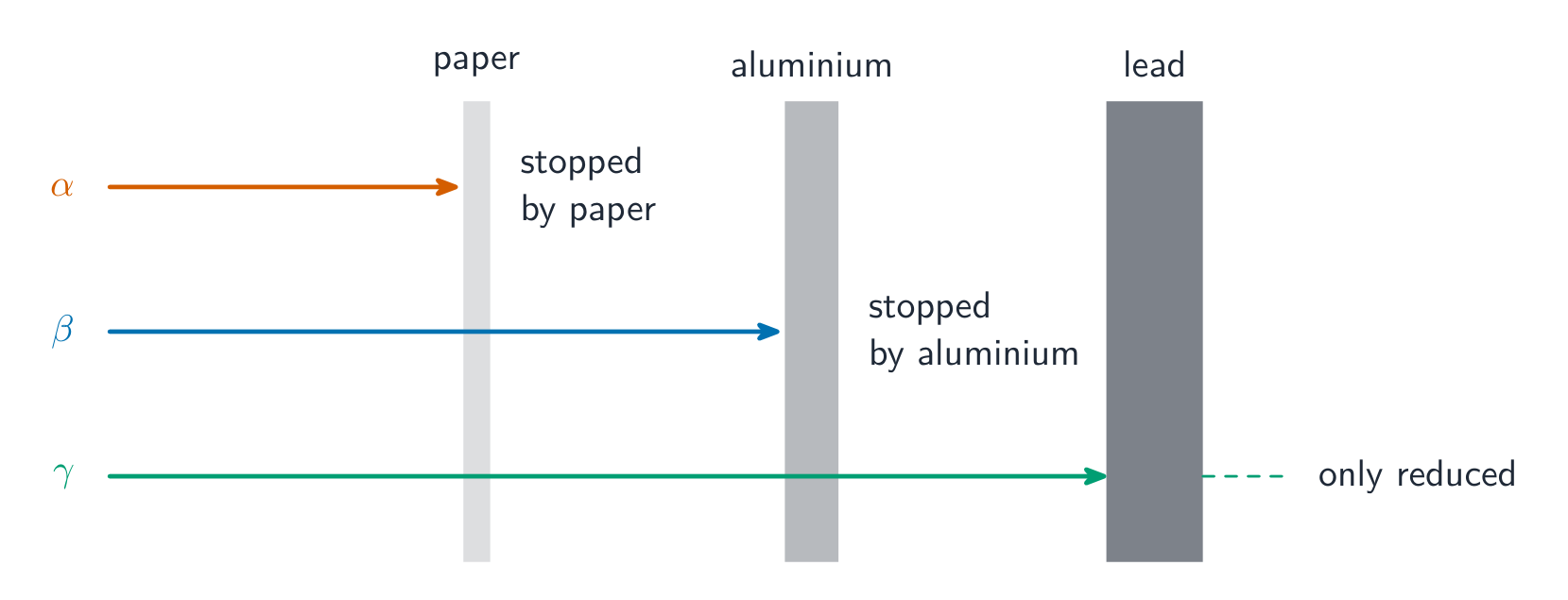
Syllabus · หลักสูตร
Learning Objective Essential Knowledge 15.8.A
Describe the processes by which individual nuclei decay.- 15.8.A.1 Some processes by which nuclei decay emit subatomic particles with unique properties.
- 15.8.A.1.i An alpha particle, or helium nucleus, consists of two neutrons and two protons and is symbolized by $\alpha$ or $\text{He}^{2+}$. (In Physics 2, only He-4 nuclei will be considered.)
- 15.8.A.1.ii Neutrinos and antineutrinos are subatomic particles that have no electrical charge, have negligible mass, and are symbolized by $\nu$ and $\bar{\nu}$, respectively.
- 15.8.A.1.iii Neutrinos and antineutrinos only interact with matter via the weak force and the gravitational force, which results in very little interaction with normal matter.
- 15.8.A.1.iv Positrons, or antielectrons, are subatomic particles that have an electric charge opposite that of an electron, have the same mass as an electron, and are symbolized by $e^+$ or $\beta^+$.
- 15.8.A.2 Nuclei can undergo radioactive decay via alpha decay, beta-minus decay ($\beta^-$), beta-plus decay ($\beta^+$), and gamma decay ($\gamma$).
- 15.8.A.2.i In all nuclear decays, nucleon number (the number of neutrons and protons), lepton number (the number of electrons and neutrinos), and charge are conserved.
- 15.8.A.2.ii Alpha decay occurs when a nucleus ejects an alpha particle.
- 15.8.A.2.iii Beta-minus decay occurs when a neutron changes to a proton by emitting an electron and antineutrino.
- 15.8.A.2.iv Beta-plus decay occurs when a proton changes to a neutron by emitting a positron and neutrino.
- 15.8.A.2.v Gamma decay occurs after a nucleus has undergone alpha or beta decay and the excited nucleus decays to a lower energy state by emitting a photon.
- 15.8.A.3 The type of decay exhibited by a given nucleus is determined by the isotope of the element.
Boundary statement: AP Physics 2 does not expect students to memorize the processes by which specific isotopes decay or the half-lives of specific isotopes. Neutron emission and electron capture are not included in the AP Physics 2 curriculum framework. Additionally, types of neutrinos, the characteristics that distinguish neutrinos and antineutrinos, and an explanation or application of the weak force are not within the scope of this course.
Source: College Board AP Course and Exam Description · แหล่งที่มา: คำอธิบายหลักสูตรและข้อสอบ College Board AP
EnglishRadioactive decay & half-life Unstable nuclei undergo radioactive decay 放射性衰变, emitting:
- Alpha decay 阿尔法衰变 ($\alpha$): a helium nucleus – mass number drops by 4.
- Beta decay 贝塔衰变 ($\beta$) comes in two kinds. In beta-minus ($\beta^-$) a neutron becomes a proton, emitting an electron and an antineutrino 反中微子: $n\rightarrow p+e^-+\bar{\nu}$. In beta-plus ($\beta^+$) a proton becomes a neutron, emitting a positron 正电子 and a neutrino 中微子: $p\rightarrow n+e^++\nu$.
- Gamma decay 伽马衰变 ($\gamma$): a high-energy photon – the nucleus sheds excess energy.
The neutrino and antineutrino (symbols $\nu$, $\bar{\nu}$) are tiny, chargeless, almost-massless particles that carry off energy and keep beta decay balanced. Decay is random, but a sample halves every half-life 半衰期: after each half-life, half of the remaining nuclei have decayed. Every decay equation conserves three quantities: nucleon number (mass number), charge, and lepton number 轻子数 – an electron or neutrino counts as $+1$ lepton, a positron or antineutrino as $-1$, and the totals must match on both sides.
Worked example. A radioactive sample has a half-life of $8.0$ days. What fraction is left after $24$ days? That is $24/8.0=3$ half-lives, so the fraction remaining is $\left(\tfrac12\right)^3=\tfrac18$ – about $12.5\%$. In an alpha decay of uranium-238 ($^{238}_{\ 92}\text{U}$), the daughter has mass number $238-4=234$ and atomic number $92-2=90$: thorium-234.
ไทยการสลายตัวทางรังสี & อายุขัยครึ่งหนึ่ง นิวเคลียสที่ไม่เสถียรจะ undergo การสลายตัวทางรังสี (Radioactive decay) โดย emit:
ความสามารถในการทะลุผ่านของรังสีอัลฟา เบตา และแกมมา - การสลายตัวแบบอัลฟา (Alpha decay) ($\alpha$): นิวเคลียสของฮีเลียม – เลขมวลลดลง 4
- การสลายตัวแบบเบตา (Beta decay) ($\beta$) มีสองชนิด ใน เบตา-create-minus (β⁻) ($\beta^-$) neutron กลายเป็น proton emit อิเล็กตรอนและ แอนตินิวทริโน: $n\rightarrow p+e^-+\bar{\nu}$. ใน เบตา-create-plus (β⁺) ($\beta^+$) proton กลายเป็น neutron emit โพซิตรอน และ นิวทริโน: $p\rightarrow n+e^++\nu$.
- การสลายตัวแบบแกมมา (Gamma decay) ($\gamma$): โฟตอนพลังงานสูง – นิวเคลียส shedding พลังส่วนเกิน
นิวทริโนและแอนตินิวทริโน (สัญลักษณ์ $\nu$, $\bar{\nu}$) เป็นอนุภาคขนาดเล็กมาก ไม่มีประจุ และเกือบไม่มีมวล yang carry off energy และรักษาสมดุลของการสลายตัวแบบเบตา การสลายตัวเป็นแบบสุ่ม แต่ตัวอย่างจะ减半ทุก ครึ่งชีวิต (Half-life): หลังแต่ละครึ่งชีวิต有一半ของนิวเคลียสที่เหลืออยู่จะสลายตัว สมการการสลายตัวแต่ละตัว conserved สามปริมาณ: จำนวนนิวคลีโอออน (เลขมวล), ประจุ, และ จำนวนเลปตัน – อิเล็กตรอนหรือนิวทริโนนับเป็น $+1$ เลปตัน, โพซิตรอนหรือแอนตินิวทริโนนับเป็น $-1$, และผลรวมต้องเท่ากันทั้งสองข้าง
ตัวอย่างโจทย์: ตัวอย่างกัมมันตรังสีมีครึ่งชีวิต $8.0$ วัน ส่วนที่เหลืออยู่หลัง $24$ วันคือเท่าไหร่? นั่นคือ $24/8.0=3$ ครึ่งชีวิต ดังนั้นเศษส่วนที่เหลืออยู่คือ $\left(\tfrac12\right)^3=\tfrac18$ – ประมาณ $12.5\%$. ในการสลายตัวแบบอัลฟาของยูเรเนียม-238 ($^{238}_{\ 92}\text{U}$), ผลิตภัณฑ์ลูกมีเลขมวล $238-4=234$ และเลขอะตอม $92-2=90$: ทอเรียียม-234
Explore · สำรวจWatch a sample decay · สังเกตการสลายตัวของตัวอย่าง
Radioactive nuclei decay randomly with a fixed half-life: each half-life halves the number remaining. Step forward and watch the sample shrink. · นิวเคลียกัมมันตรังสีสลายตัวแบบสุ่มด้วย ครึ่งชีวิต ที่คงที่: ทุกครึ่งชีวิตจำนวนที่เหลือจะลดลงครึ่งหนึ่ง ก้าวไปข้างหน้าและสังเกตว่าตัวอย่างมีขนาดเล็กลง
Vocabulary · คำศัพท์ Train · ฝึกฝนEnglish ไทย radioactive decay/ˌreɪdɪəʊˈæktɪv dɪˈkeɪ/ การสลายตัวของสารกัมมันตรังสี Alpha decay/ˈælfə dɪˈkeɪ/ การสลายตัว Alpha Beta decay/ˈbiːtə dɪˈkeɪ/ การสลายตัว Beta antineutrino/ˌæntɪnjuːˈtriːnəʊ/ แอนตินิวทริโน positron/ˈpɒzɪtrɒn/ โพซิตรอน neutrino/njuːˈtriːnəʊ/ นิวทริโน Gamma decay/ˈɡæmə dɪˈkeɪ/ การสลายตัว Gamma half-life/hɑːf laɪf/ ครึ่งอายุ (half-life) lepton number/ˈleptɒn ˈnʌmbə/ เลขเลปตอน 15.8
Exam tips · ข้อแนะนำสำหรับการสอบ
English- Photon energy is $E=hf$; below the threshold frequency no electrons are emitted however bright the light (the photoelectric effect).
- Use $K_{\max}=hf-\phi$ for the fastest photoelectrons ($\phi$ = work function).
- Electrons jump between discrete energy levels by absorbing/emitting a photon whose energy equals the level gap — the source of line spectra.
- In fission and fusion the small mass lost becomes energy via $E=mc^2$.
- Balance decay equations by conserving mass number, charge, and lepton number (write the antineutrino in $\beta^-$, the neutrino in $\beta^+$), and halve the sample every half-life ($(\tfrac12)^n$ after $n$ half-lives).
ไทย- พลังงานโฟตอนคือ $E=hf$; ต่ำกว่า ความถี่ threshold ไม่มีอิเล็กตรอนถูก emit ไม่ว่าแสงจะสว่างแค่ไหน (Efek photoelectric)
- ใช้ $K_{\max}=hf-\phi$ สำหรับโฟโตอิเล็กตรอนที่เร็วที่สุด ($\phi$ = work function)
- อิเล็กตรอนกระโดดระหว่าง ระดับพลังงานไม่ต่อเนื่อง โดยการดูดกลืน/emit โฟตอน whose energy เท่ากับช่องว่างของระดับ – แหล่งกำเนิดของสเปกตรัมเส้น
- ในการแตกตัวและรวมตัวมวลน้อย มวลที่หายไป เปลี่ยนเป็นพลังงานผ่าน $E=mc^2$
- สมการสลายตัวของสมดุลโดยรักษา มวลเลข, ประจุ และเลปตอนเลข (เขียนแอนทีนิวทริโนใน $\beta^-$, นิวทริโนใน $\beta^+$), และลดจำนวนตัวอย่างลงครึ่งหนึ่งทุก ช่วงครึ่งชีวิต ($(\tfrac12)^n$ หลัง $n$ ช่วงครึ่งชีวิต).
- 15.1.A.1 Quantum theory was developed to explain observations of matter and energy that could not be explained using classical mechanics. These phenomena include, but are not limited to, atomic spectra, blackbody radiation, and the photoelectric effect.