Skip to content · ⁨ข้ามไปยังเนื้อหา⁩

Oscillations · ⁨การสั่นสะเทือน⁩

AP Physics 1 · Topic 7 · ⁨หัวข้อ 7⁩

Video lesson for this topic · ⁨บทเรียนวิดีโอสำหรับหัวข้อนี้⁩ Open the video page · ⁨เปิดหน้าวิดีโอ⁩
7:48

การสั่นสะเทือน

สปริงสองตัวเหมือนกัน มวลสองตัวเหมือนกัน ดึงตัวหนึ่งลงไกลๆ ดึงอีกตัวเพียงเล็กน้อย ปล่อยทั้งสองพร้อมกัน ตัวไหนจะกลับ…

English narration · English + 中文 subtitles burned in · ⁨การบรรยายภาษาอังกฤษ · คำบรรยายภาษาอังกฤษ + 中文 ลอยตัวบนภาพ⁩

7.1

Defining Simple Harmonic Motion · ⁨นิยามการเคลื่อนที่แบบฮาร์มอนิกอย่างง่าย⁩

Syllabus · ⁨หลักสูตร⁩
English

Learning Objective 7.1.A: Describe simple harmonic motion.

  • 7.1.A.1 Simple harmonic motion is a special case of periodic motion.
  • 7.1.A.2 SHM results when the magnitude of the restoring force exerted on an object is proportional to that object's displacement from its equilibrium position.
    • Equation: $ma_x = -k\Delta x$
    • 7.1.A.2.i A restoring force is a force that is exerted in a direction opposite to the object's displacement from an equilibrium position.
    • 7.1.A.2.ii An equilibrium position is a location at which the net force exerted on an object or system is zero.
    • 7.1.A.2.iii The motion of a pendulum with a small angular displacement can be modeled as simple harmonic motion because the restoring torque is proportional to the angular displacement.
ไทย

วัตถุประสงค์การเรียนรู้ 7.1.A: อธิบายการเคลื่อนที่แบบฮาร์มอนิกง่าย

  • 7.1.A.1 การเคลื่อนที่แบบฮาร์มอนิกง่ายเป็นกรณีพิเศษของการเคลื่อนที่แบบซ้ำ周期
  • 7.1.A.2 SHM เกิดขึ้นเมื่อขนาดของแรงคืนกลับที่ทำต่อวัตถุแปรผันตรงกับระยะการกระจัดของวัตถุนั้นจากตำแหน่งสมดุล
    • สมการ: $ma_x = -k\Delta x$
    • 7.1.A.2.i แรงคืนกลับคือแรงที่กระทำในทิศทางตรงข้ามกับระยะการกระจัดของวัตถุจากตำแหน่งสมดุล
    • 7.1.A.2.ii ตำแหน่งสมดุลคือตำแหน่งที่ผลรวมแรงที่ทำต่อวัตถุหรือระบบมีค่าเป็นศูนย์
    • 7.1.A.2.iii การเคลื่อนที่ของลูกตุ้มนาฬิกาที่มีการกระจัดมุมเล็กน้อยสามารถจำลองเป็นการเคลื่อนที่แบบฮาร์มอนิกง่ายได้ เพราะแรงบิดคืนกลับแปรผันตรงกับมุมการกระจัด
Source: College Board AP Course and Exam Description · ⁨แหล่งที่มา: คำอธิบายหลักสูตรและข้อสอบ College Board AP⁩

English
Simple harmonic motion

Simple harmonic motion 简谐运动 (SHM) is a back-and-forth oscillation 振动 caused by a restoring force 回复力 that is proportional to the displacement from equilibrium and always points back toward it: $F=-kx$. A mass on a spring and (for small angles) a pendulum are the standard examples. Because the force grows with displacement, the motion is smooth and repeating, tracing a sine curve in time.

The test for SHM is exactly this: acceleration proportional to displacement and opposite in direction, $a=-\dfrac{k}{m}x$. A pendulum only obeys it for small swings, where $\sin\theta\approx\theta$; large swings are not quite SHM.

ไทย
การเคลื่อนที่แบบฮาร์มอนิกอย่างง่าย

การเคลื่อนที่แบบฮาร์มอนิก (SHM) คือ การสั่นสะเทือนไปมาที่เกิดจาก แรงคืนตัว which เป็นสัดส่วนกับการกระจัดจากจุดสมดุลและชี้กลับเข้าหาจุดเสมอ: $F=-kx$. มวลบนสปริงและ (สำหรับมุมเล็ก) นานพินิดเป็นตัวอย่างมาตรฐาน เนื่องจากแรงเพิ่มขึ้นตามการกระจัด การเคลื่อนที่จึงราบรื่นและซ้ำซาก ทอดเส้นโค้งไซน์ในเชิงเวลา

ในการเคลื่อนที่แบบฮาร์มอนิก ความเร่งจะชี้กลับเข้าหาจุดสมดุลเสมอ ตรงข้ามกับการกระจัด
ในการเคลื่อนที่แบบฮาร์มอนิก ความเร่งจะชี้กลับเข้าหาจุดสมดุล เสมอ ตรงข้ามกับการกระจัด

การทดสอบว่าเป็นการเคลื่อนที่แบบฮาร์มอนิกหรือไม่ มีดังนี้: ความเร่งเป็นสัดส่วนกับการกระจัดและมีทิศทางตรงกันข้าม, $a=-\dfrac{k}{m}x$. นานพินิดจะปฏิบัติตามกฎนี้เฉพาะสำหรับการแกว่ง ขนาดเล็ก เท่านั้น ซึ่ง $\sin\theta\approx\theta$; การแกว่งขนาดใหญ่จะไม่完全是การเคลื่อนที่แบบฮาร์มอนิก.

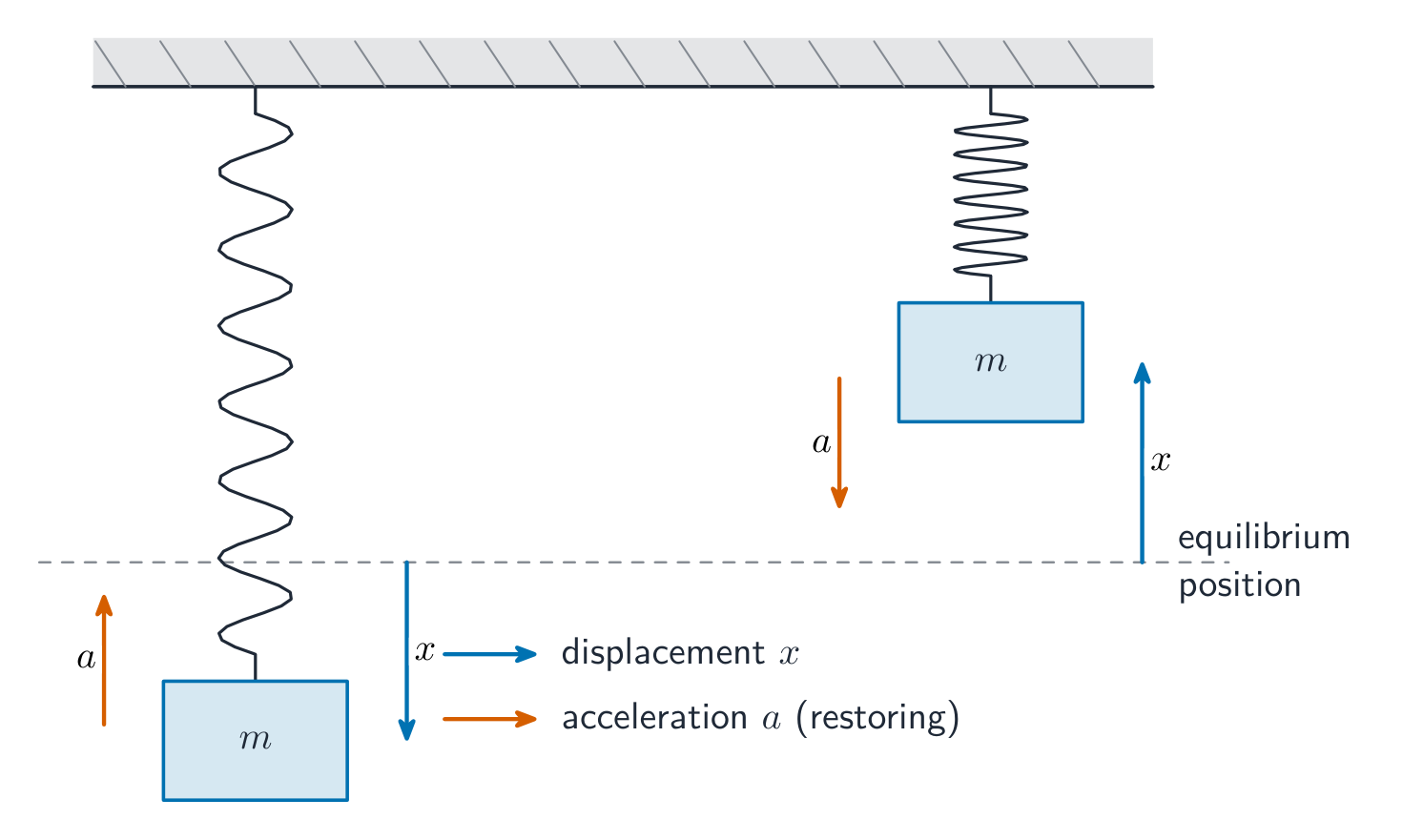
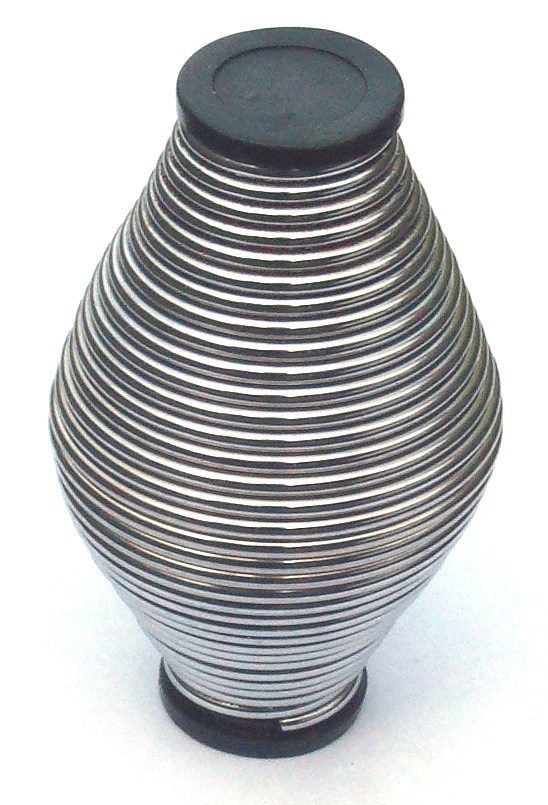
สปริงภายใต้ภาระ: กฎของฮุค F = −kx คือแรงคืนตัวที่ทำให้เกิดการเคลื่อนที่แบบฮาร์มอนิก
7.2

Frequency and Period of SHM · ⁨ความถี่และคาบของการเคลื่อนที่แบบฮาร์มอนิก⁩

Syllabus · ⁨หลักสูตร⁩
English

Learning Objective 7.2.A: Describe the frequency and period of an object exhibiting SHM.

  • 7.2.A.1 The period of SHM is related to the frequency $f$ of the object's motion by the following equation:
    • Equation: $T = \dfrac{1}{f}$
    • 7.2.A.1.i The period of an object–ideal-spring oscillator is given by the equation $T_s = 2\pi\sqrt{\dfrac{m}{k}}$.
    • 7.2.A.1.ii The period of a simple pendulum displaced by a small angle is given by the equation $T_p = 2\pi\sqrt{\dfrac{\ell}{g}}$.
ไทย

วัตถุประสงค์การเรียนรู้ 7.2.A: อธิบายความถี่และคาบของวัตถุที่แสดงการเคลื่อนที่แบบฮาร์มอนิกง่าย

  • 7.2.A.1 คาบของการเคลื่อนที่แบบฮาร์มอนิกง่ายมีความสัมพันธ์กับความถี่ $f$ ของการเคลื่อนที่ของวัตถุด้วยสมการต่อไปนี้:
    • สมการ: $T = \dfrac{1}{f}$
    • 7.2.A.1.i คาบของออสซิลเลเตอร์วัตถุ-สปริงอุดมคติกำหนดโดยสมการ $T_s = 2\pi\sqrt{\dfrac{m}{k}}$
    • 7.2.A.1.ii คาบของลูกตุ้มนาฬิกา简单ที่ถูกกระจัดด้วยมุมเล็กกำหนดโดยสมการ $T_p = 2\pi\sqrt{\dfrac{\ell}{g}}$

Source: College Board AP Course and Exam Description · ⁨แหล่งที่มา: คำอธิบายหลักสูตรและข้อสอบ College Board AP⁩

English
  • The period 周期 $T$ is the time for one full cycle.
  • The frequency 频率 $f=\dfrac{1}{T}$ is cycles per second (hertz).

For SHM these depend only on the system, not on the amplitude:

$$T_{\text{spring}}=2\pi\sqrt{\frac{m}{k}},\qquad T_{\text{pendulum}}=2\pi\sqrt{\frac{L}{g}}.$$
So a stiffer spring or smaller mass oscillates faster; a longer pendulum swings slower.

Worked example. A $0.25\ \text{kg}$ mass hangs on a spring of stiffness $k=100\ \text{N/m}$. Its period is

$$T=2\pi\sqrt{\frac{m}{k}}=2\pi\sqrt{\frac{0.25}{100}}=0.31\ \text{s},\qquad f=\frac{1}{T}=3.2\ \text{Hz}.$$

Worked example. A pendulum clock ticks with a period of exactly $2.0\ \text{s}$. How long is it? Rearranging $T=2\pi\sqrt{L/g}$,

$$L=g\left(\frac{T}{2\pi}\right)^2=9.8\times\left(\frac{2.0}{2\pi}\right)^2=0.99\ \text{m}.$$
Notice the amplitude never entered – a wide or narrow swing keeps the same time, which is what makes pendulums good clocks.

ไทย
  • คาบ $T$ คือเวลาสำหรับหนึ่งรอบเต็ม
  • ความถี่ $f=\dfrac{1}{T}$ คือจำนวนรอบต่อวินาที (เฮิร์ตซ์).

สำหรับการเคลื่อนที่แบบฮาร์มอนิก ค่าเหล่านี้ขึ้นอยู่กับระบบเท่านั้น ไม่ ขึ้นกับแอมพลิจูด:

$$T_{\text{spring}}=2\pi\sqrt{\frac{m}{k}},\qquad T_{\text{pendulum}}=2\pi\sqrt{\frac{L}{g}}.$$
ดังนั้น สปริงที่ยืดหยุ่นกว่าหรือมวลที่เบากว่าจะสั่นเร็วขึ้น; นานพินิดที่ยาวกว่าจะแกว่งช้าลง

ตัวอย่างวิธีทำ. มวล $0.25\ \text{kg}$ แขวนอยู่บนสปริงที่มีความแข็ง $k=100\ \text{N/m}$. คาบของมันคือ

$$T=2\pi\sqrt{\frac{m}{k}}=2\pi\sqrt{\frac{0.25}{100}}=0.31\ \text{s},\qquad f=\frac{1}{T}=3.2\ \text{Hz}.$$

ตัวอย่างวิธีทำ. นาฬิกานานพินิดติ๊กด้วยคาบที่ $2.0\ \text{s}$ พอดี. ยาวเท่าไร? จัดรูป $T=2\pi\sqrt{L/g}$,

$$L=g\left(\frac{T}{2\pi}\right)^2=9.8\times\left(\frac{2.0}{2\pi}\right)^2=0.99\ \text{m}.$$
สังเกตว่าแอมพลิจูดไม่เคยถูกนำมาใช้ – การแกว่งกว้างหรือแคบก็ใช้เวลาเท่าเดิม ซึ่งนี่คือเหตุผลที่ทำให้นานพินิดเหมาะสำหรับการทำนาฬิกา

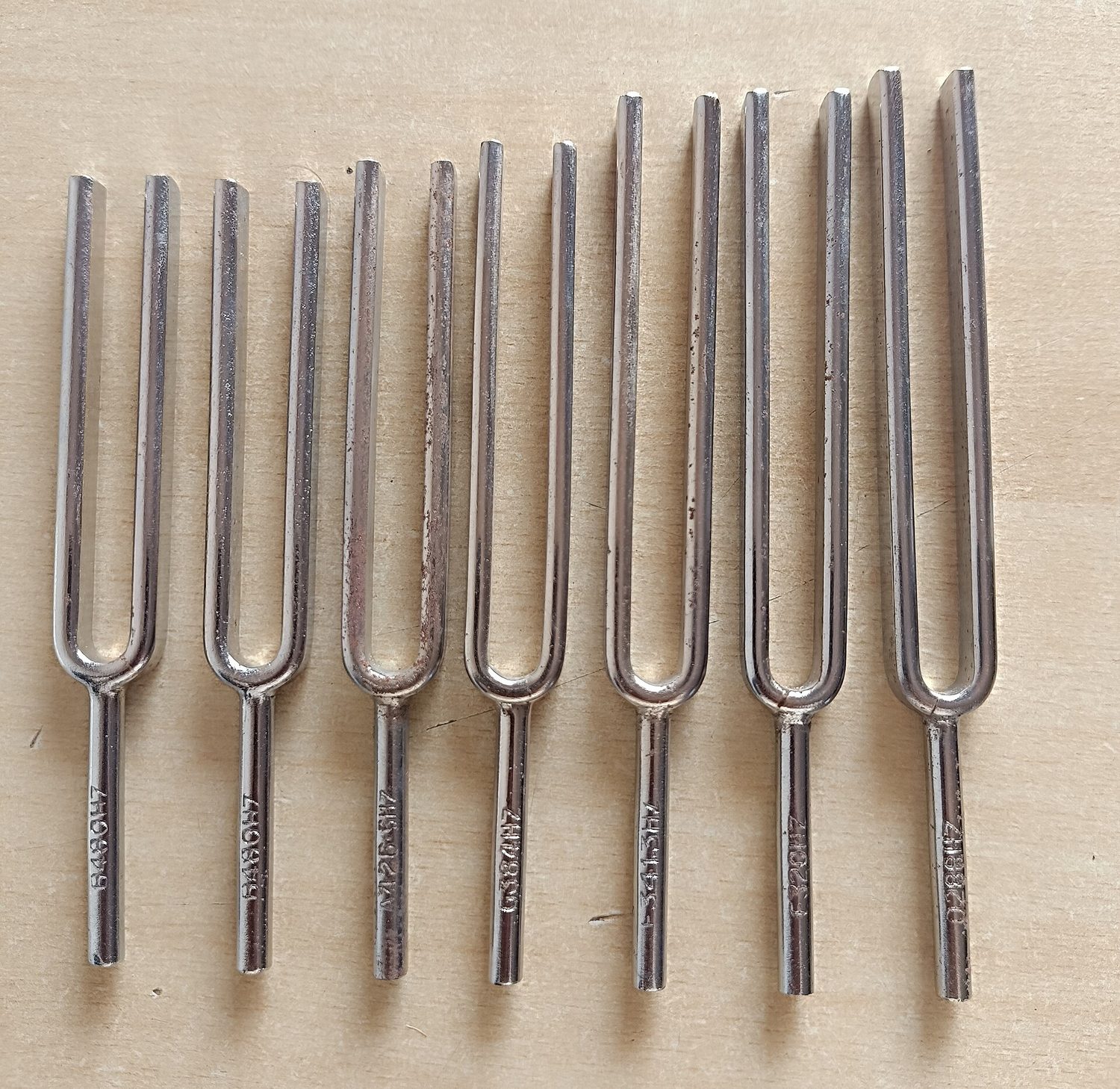
ชุดส้อมปรับเสียงที่มีขนาดต่างกัน
ส้อมปรับเสียง: ส้อมที่ยาวและหนักกว่าจะสั่นช้ากว่า ให้ค่าความถี่ต่ำ
Explore · ⁨สำรวจ⁩

Time a pendulum's swing · ⁨วัดเวลาแกว่งของลูกตุ้มน้ำหนัก⁩

A pendulum's period depends on its length and gravity, not its mass or (small) amplitude: $T=2\pi\sqrt{L/g}$. Lengthen it and each swing takes longer. · ⁨คาบ ของลูกตุ้มน้ำหนักขึ้นอยู่กับความยาวและแรงโน้มถ่วง ไม่ใช่มวลหรือขนาดการแกว่ง (เล็ก): $T=2\pi\sqrt{L/g}$. ยืดความยาวออกแล้วแต่ละรอบจะใช้เวลา lâuขึ้น⁩

7.3

Representing and Analyzing SHM · ⁨การแสดงและการวิเคราะห์การเคลื่อนที่แบบฮาร์มอนิก⁩

Syllabus · ⁨หลักสูตร⁩
English

Learning Objective 7.3.A: Describe the displacement, velocity, and acceleration of an object exhibiting SHM.

  • 7.3.A.1 For an object exhibiting SHM, the displacement of that object measured from its equilibrium position can be represented by the equations $x = A\cos(2\pi ft)$ or $x = A\sin(2\pi ft)$.
    • 7.3.A.1.i Minima, maxima, and zeros of displacement, velocity, and acceleration are features of harmonic motion.
    • 7.3.A.1.ii Recognizing the positions or times at which the displacement, velocity, and acceleration for SHM have extrema or zeros can help in qualitatively describing the behavior of the motion.
  • 7.3.A.2 Changing the amplitude of a system exhibiting SHM will not change the period of that system.
  • 7.3.A.3 Properties of SHM can be determined and analyzed using graphical representations.
ไทย

วัตถุประสงค์การเรียนรู้ 7.3.A: อธิบายการกระจัด ความเร็ว และความเร่งของวัตถุที่แสดงการเคลื่อนที่แบบฮาร์มอนิกง่าย

  • 7.3.A.1 สำหรับวัตถุที่แสดงการเคลื่อนที่แบบฮาร์มอนิกง่าย การกระจัดของวัตถุนั้นวัดจากตำแหน่งสมดุลสามารถแทนได้ด้วยสมการ $x = A\cos(2\pi ft)$ หรือ $x = A\sin(2\pi ft)$
    • 7.3.A.1.i ค่าต่ำสุด ค่าสูงสุด และค่าศูนย์ของการกระจัด ความเร็ว และความเร่งเป็นลักษณะของการเคลื่อนที่แบบฮาร์มอนิก
    • 7.3.A.1.ii การระบุตำแหน่งหรือเวลาที่การกระจัด ความเร็ว และความเร่งสำหรับการเคลื่อนที่แบบฮาร์มอนิกง่ายมีค่าสูงสุดหรือต่ำสุดหรือศูนย์ ช่วยในการอธิบายพฤติกรรมของการเคลื่อนที่เชิงคุณภาพ
  • 7.3.A.2 การเปลี่ยนแอมพลิจูดของระบบที่แสดงการเคลื่อนที่แบบฮาร์มอนิกง่ายจะไม่ทำให้คาบของระบบนั้นเปลี่ยน
  • 7.3.A.3 คุณสมบัติของการเคลื่อนที่แบบฮาร์มอนิกง่ายสามารถระบุและวิเคราะห์ได้โดยใช้กราฟ

Source: College Board AP Course and Exam Description · ⁨แหล่งที่มา: คำอธิบายหลักสูตรและข้อสอบ College Board AP⁩

English

The displacement varies sinusoidally: $x(t)=A\cos(\omega t)$ (or sine), where $A$ is the amplitude 振幅 (maximum displacement) and $\omega=2\pi f$ is the angular frequency 角频率. Reading the motion:

  • At the extremes ($x=\pm A$): displacement and restoring force are maximum, so acceleration is maximum, but velocity is zero.
  • At equilibrium 平衡 ($x=0$): force and acceleration are zero, but speed is maximum.

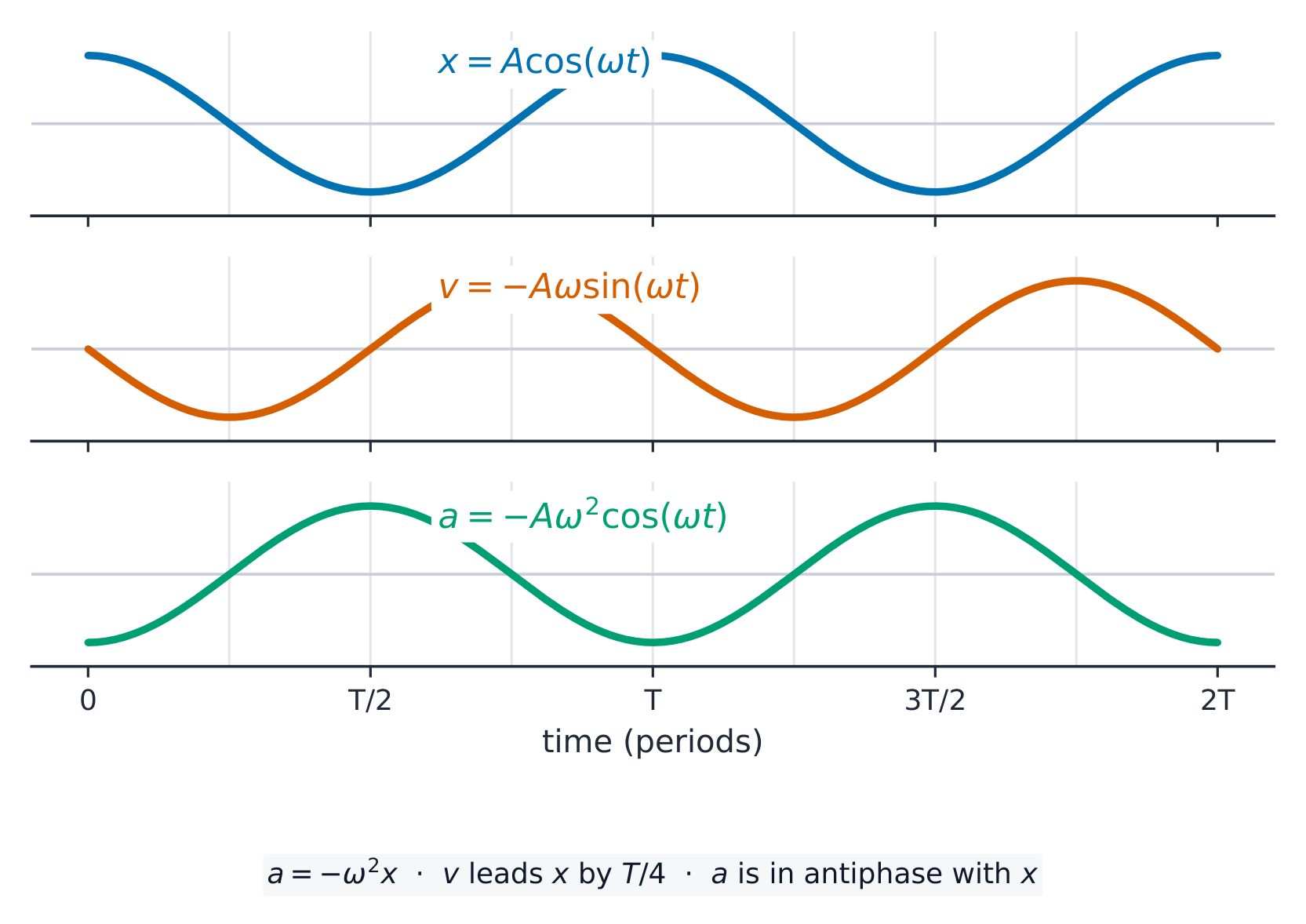
Velocity and acceleration are also sinusoidal, shifted in phase 相位 from the displacement – velocity leads displacement by a quarter cycle, and acceleration is exactly opposite to displacement.

Read the figure as a story: where $x$ is largest (the turning point), $v$ has just fallen to zero and $a$ is at its most negative, hauling the mass back; a quarter-cycle later the mass races through the middle at top speed with zero acceleration.

ไทย

การกระจัดแปรผันตามฟังก์ชันไซน์: $x(t)=A\cos(\omega t)$ (หรือ sine), โดยที่ $A$ คือ แอมพลิจูด (การกระจัดสูงสุด) และ $\omega=2\pi f$ คือ ความถี่เชิงมุม. การอ่านการเคลื่อนที่:

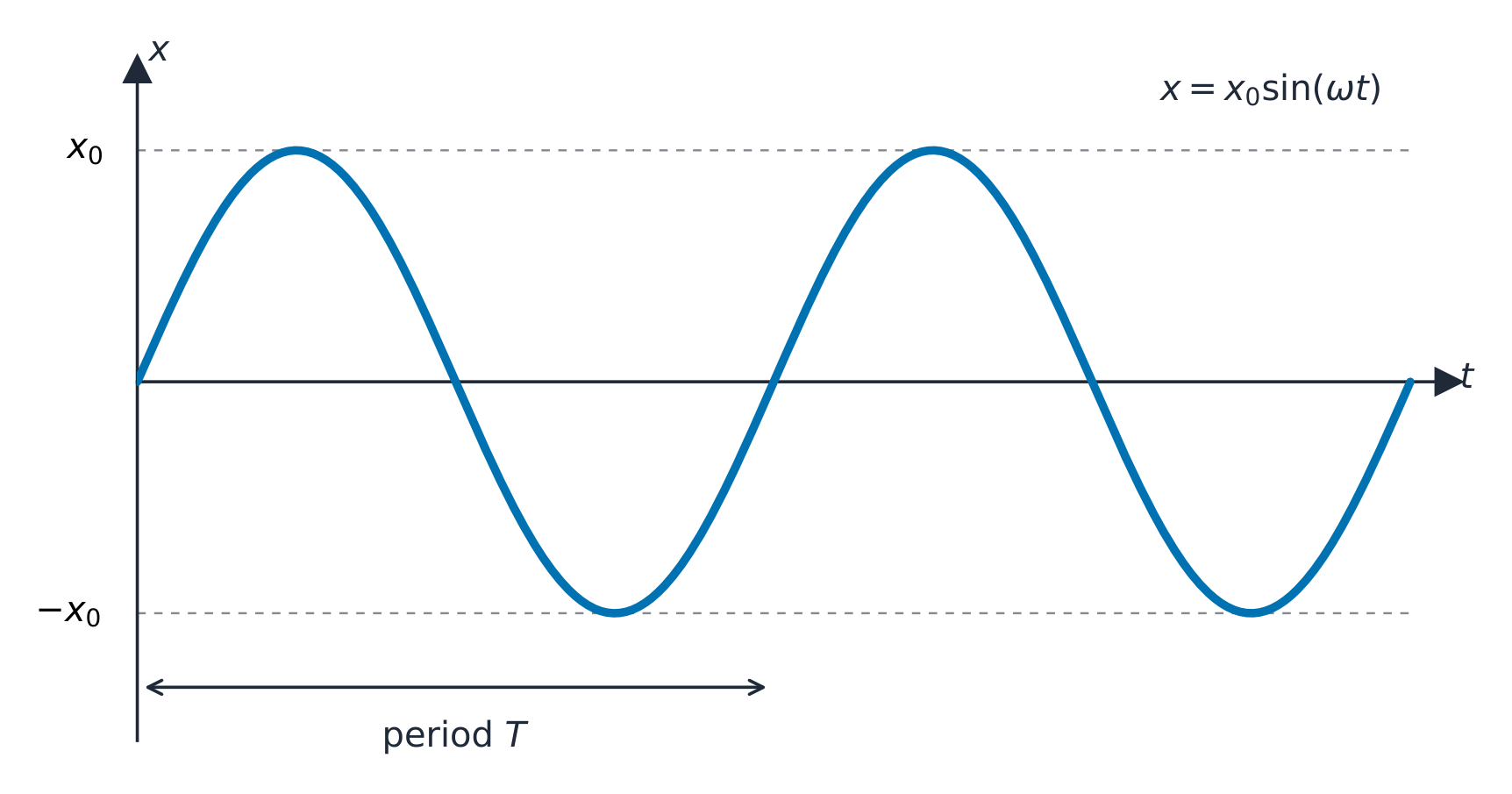
Displacement varies sinusoidally with time in simple harmonic motion
ระยะกระจัดแปรผันตามเวลาแบบไซน์ในกรณีการเคลื่อนที่แบบฮาร์มอนิกเชิงเส้น
  • ที่ จุดสุดขั้ว ($x=\pm A$): การกระจัดและแรงคืนตัวมีค่าสูงสุด ดังนั้นความเร่งจะมีค่าสูงสุด แต่ความเร็วเป็น ศูนย์.
  • ที่ จุดสมดุล ($x=0$): แรงและความเร่งเป็นศูนย์ แต่ ความเร็วมีค่าสูงสุด.

ความเร็วและความเร่งก็เป็นฟังก์ชันไซน์เช่นกัน โดยมีการเลื่อน เฟส จาก การกระจัด – ความเร็วนำหน้าการกระจัดไปหนึ่ง-fourth cycle และความเร่งตรงข้ามกับการกระจัดอย่างสมบูรณ์

การกระจัด ความเร็ว และความเร่งในการเคลื่อนที่แบบฮาร์มอนิก แต่ละตัวห่างกันหนึ่ง-fourth-cycle

อ่านกราฟในฐานะเรื่องราว: เมื่อ $x$ มีค่ามากที่สุด (จุดเปลี่ยนทิศ), $v$ ได้ลดลงเหลือศูนย์แล้ว และ $a$ อยู่ที่ค่าลบที่สุด ดึงมวลกลับ; หลังหนึ่ง-fourth-cycle มวลจะพุ่งผ่านกลางด้วยความเร็วสูงสุดด้วยความเร่งเป็นศูนย์

Vocabulary · ⁨คำศัพท์⁩ Train · ⁨ฝึกฝน⁩
English ไทย
Simple harmonic motion/ˈsɪmpl hɑːˈmɒnɪk ˈməʊʃn/ การเคลื่อนที่แบบฮาร์มอนิกอย่างง่าย
oscillation/ˌɒsɪˈleɪʃn/ การสั่นสะเทือน
restoring force/rɪˈstɔːrɪŋ fɔːs/ แรงฟื้นฟู
period/ˈpɪərɪəd/ รอบ
frequency/ˈfriːkwənsi/ ความถี่
amplitude/ˈæmplɪtjuːd/ แอมพลิจูด
angular frequency/ˈæŋɡjʊlə ˈfriːkwənsi/ ความถี่เชิงมุม
phase/feɪz/ เฟส
equilibrium/ˌiːkwɪˈlɪbrɪəm/ จุดดุลยภาพ
7.4

Energy of Simple Harmonic Oscillators · ⁨พลังงานของเครื่องสั่นแบบฮาร์มอนิก⁩

Syllabus · ⁨หลักสูตร⁩
English

Learning Objective 7.4.A: Describe the mechanical energy of a system exhibiting SHM.

  • 7.4.A.1 The total energy of a system exhibiting SHM is the sum of the system's kinetic and potential energies.
    • Equation: $E_{\text{total}} = U + K$
  • 7.4.A.2 Conservation of energy indicates that the total energy of a system exhibiting SHM is constant.
  • 7.4.A.3 The kinetic energy of a system exhibiting SHM is at a maximum when the system's potential energy is at a minimum.
  • 7.4.A.4 The potential energy of a system exhibiting SHM is at a maximum when the system's kinetic energy is at a minimum.
    • 7.4.A.4.i The minimum kinetic energy of a system exhibiting SHM is zero.
    • 7.4.A.4.ii Changing the amplitude of a system exhibiting SHM will change the maximum potential energy of the system and, therefore, the total energy of the system.
    • Relevant equation for a spring–object system: $E_{\text{total}} = \dfrac{1}{2}kA^2$
ไทย

วัตถุประสงค์การเรียนรู้ 7.4.A: อธิบายพลังงานกลของระบบที่แสดงการเคลื่อนที่แบบฮาร์มอนิกง่าย

  • 7.4.A.1 พลังงานรวมของระบบที่แสดงการเคลื่อนที่แบบฮาร์มอนิกง่ายคือผลบวกของพลังงานจลน์และพลังงานศักย์ของระบบ
    • สมการ: $E_{\text{total}} = U + K$
  • 7.4.A.2 กฎการอนุรักษ์พลังงานบ่งชี้ว่าพลังงานรวมของระบบที่แสดงการเคลื่อนที่แบบฮาร์มอนิกง่ายมีค่าคงที่
  • 7.4.A.3 พลังงานจลน์ของระบบที่แสดงการเคลื่อนที่แบบฮาร์มอนิกง่ายจะมีค่าสูงสุดเมื่อพลังงานศักย์ของระบบมีค่าน้อยที่สุด
  • 7.4.A.4 พลังงานศักย์ของระบบที่แสดงการเคลื่อนที่แบบฮาร์มอนิกอย่างง่าย (SHM) จะมีค่าสูงสุดเมื่อพลังงานจลน์ของระบบมีค่าน้อยที่สุด
    • 7.4.A.4.i พลังงานจลน์ต่ำสุดของระบบที่แสดงการเคลื่อนที่แบบฮาร์มอนิกอย่างง่ายมีค่าเป็นศูนย์
    • 7.4.A.4.ii การเปลี่ยนขนาดแอมพลิจูดของระบบที่แสดงการเคลื่อนที่แบบฮาร์มอนิกอย่างง่ายจะส่งผลต่อพลังงานศักย์สูงสุดของระบบ และดังนั้นก็ส่งผลต่อพลังงานรวมของระบบด้วย
    • สมการที่เกี่ยวข้องสำหรับระบบสปิง–วัตถุ: $E_{\text{total}} = \dfrac{1}{2}kA^2$

Source: College Board AP Course and Exam Description · ⁨แหล่งที่มา: คำอธิบายหลักสูตรและข้อสอบ College Board AP⁩

English
Energy conservation: KE ⇄ PE

Energy sloshes between kinetic and potential while the total stays constant (no friction):

$$E=\tfrac{1}{2}kA^2 = \tfrac{1}{2}kx^2+\tfrac{1}{2}mv^2.$$
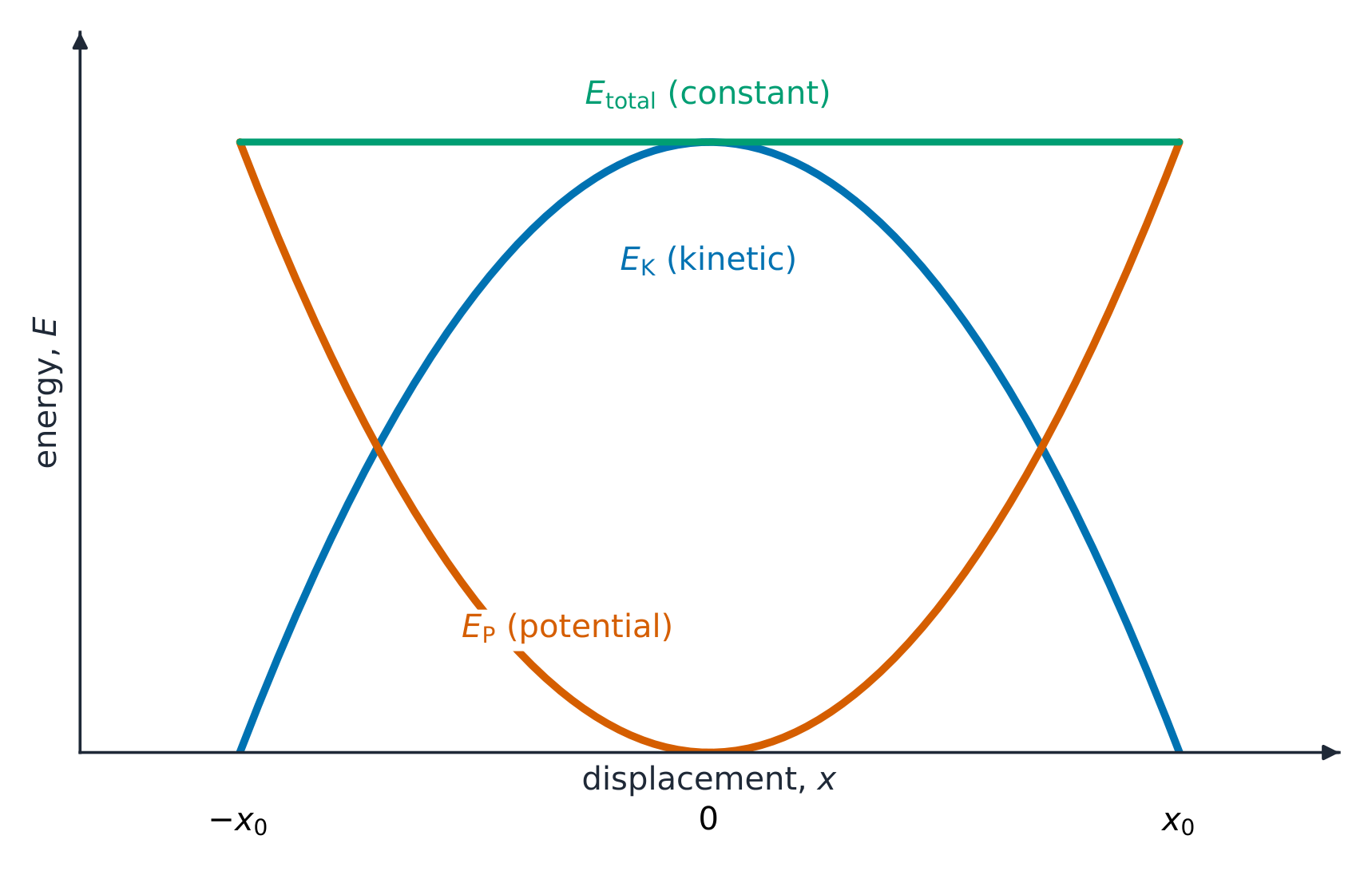
At the extremes it is all potential; at equilibrium it is all kinetic (maximum speed). Because $E\propto A^2$, doubling the amplitude quadruples the energy.

Worked example. A $0.50\ \text{kg}$ mass on a spring of stiffness $k=200\ \text{N/m}$ oscillates with amplitude $A=0.10\ \text{m}$. Find its maximum speed. All the energy is kinetic at the equilibrium point, so $\tfrac12 kA^2=\tfrac12 mv_{\max}^2$:

$$v_{\max}=A\sqrt{\frac{k}{m}}=0.10\times\sqrt{\frac{200}{0.50}}=0.10\times20=2.0\ \text{m/s}.$$
The energy method is faster than tracking the sine functions when you only need the greatest speed.

ไทย
การอนุรักษ์พลังงาน: KE ⇄ PE

พลังงานไหลเวียนระหว่างพลังงานจลน์และศักย์ ในขณะที่ รวม คงที่ (ไม่มีแรงเสียดทาน):

$$E=\tfrac{1}{2}kA^2 = \tfrac{1}{2}kx^2+\tfrac{1}{2}mv^2.$$
ที่จุดสุดขั้วเป็น ศักย์ทั้งหมด; ที่จุดสมดุลเป็น จลน์ทั้งหมด (ความเร็วสูงสุด). เนื่องจาก $E\propto A^2$, การเพิ่มแอมพลิจูดเป็นสองเท่าจะทำให้พลังงานเพิ่มขึ้นสี่เท่า

การแลกเปลี่ยนระหว่างพลังงานจลน์และพลังงานศักย์ตลอดรอบwhileพลังงานรวมคงที่
พลังงานจลนและพลังงานศักย์สลับกันตลอดรอบ mientrasพลังงานรวมคงที่

ตัวอย่างวิธีทำ. มวล $0.50\ \text{kg}$ บนสปริงที่มีความแข็ง $k=200\ \text{N/m}$ สั่นด้วยแอมพลิจูด $A=0.10\ \text{m}$. หาความเร็วสูงสุด. พลังงานทั้งหมดเป็นจลน์ที่จุดสมดุล ดังนั้น $\tfrac12 kA^2=\tfrac12 mv_{\max}^2$:

$$v_{\max}=A\sqrt{\frac{k}{m}}=0.10\times\sqrt{\frac{200}{0.50}}=0.10\times20=2.0\ \text{m/s}.$$
วิธีการทางพลังงานเร็วกว่าการติดตามฟังก์ชันไซน์เมื่อคุณต้องการเพียงความเร็วสูงสุด

Explore · ⁨สำรวจ⁩

Trade kinetic and potential energy in SHM · ⁨แลกเปลี่ยนพลังงานจลน์และศักย์ในการเคลื่อนที่แบบฮาร์มอนิกอย่างง่าย⁩

In simple harmonic motion, energy sloshes between kinetic (fastest at the centre) and potential (greatest at the extremes) while the total stays constant. · ⁨ใน การเคลื่อนที่แบบฮาร์มอนิกอย่างง่าย พลังงานสลับระหว่างพลังงานจลน์ (เร็วที่สุดที่จุดกึ่งกลาง) และศักย์ (มากที่สุดที่จุดสุดขั้ว) ในขณะที่พลังงานรวมคงที่⁩

7.4

Exam tips · ⁨ข้อแนะนำสำหรับการสอบ⁩

English
  • Test for SHM: the acceleration must be proportional to the displacement and directed back toward the middle ($a=-\tfrac{k}{m}x$).
  • The period does not depend on amplitude — use $T=2\pi\sqrt{m/k}$ (spring) or $T=2\pi\sqrt{L/g}$ (pendulum, small angles).
  • Speed is maximum at the middle (all kinetic) and zero at the extremes (all potential); acceleration is largest at the extremes.
  • Use energy ($\tfrac12 kA^2 = \tfrac12 kx^2 + \tfrac12 mv^2$) to find the maximum speed quickly: $v_{\max}=A\sqrt{k/m}$.
  • Total energy $\propto A^2$, so doubling the amplitude quadruples the energy.
ไทย
  • ทดสอบ SHM: ความเร่งต้องเป็นสัดส่วนกับการกระจัดและชี้กลับเข้าสู่กึ่งกลาง ($a=-\tfrac{k}{m}x$).
  • คาบไม่ขึ้นอยู่กับแอมพลิจูด — ใช้ $T=2\pi\sqrt{m/k}$ (สปริง) หรือ $T=2\pi\sqrt{L/g}$ (นานพินิด, มุมเล็ก).
  • ความเร็วมีค่า สูงสุดที่กึ่งกลาง (เป็นจลน์ทั้งหมด) และเป็น ศูนย์ที่จุดสุดขั้ว (เป็นศักย์ทั้งหมด); ความเร่งมีค่ามากที่สุดในจุดสุดขั้ว
  • ใช้พลังงาน ($\tfrac12 kA^2 = \tfrac12 kx^2 + \tfrac12 mv^2$) เพื่อหาความเร็วสูงสุดได้อย่างรวดเร็ว: $v_{\max}=A\sqrt{k/m}$.
  • พลังงานรวม $\propto A^2$, ดังนั้นการเพิ่มแอมพลิจูดเป็นสองเท่าจะทำให้พลังงานเพิ่มขึ้นสี่เท่า

Interactive lessons on this topic · ⁨บทเรียนเชิงโต้ตอบสำหรับหัวข้อนี้⁩

Work through it step by step, with instant-check exercises. · ⁨ทำทีละขั้นตอน พร้อมแบบฝึกหัดตรวจสอบผลทันที⁩

Past Papers · ⁨ข้อสอบย้อนหลัง⁩

More topics in AP Physics 1 · ⁨หัวข้อเพิ่มเติมใน AP Physics 1⁩

Log in or create account · ⁨เข้าสู่ระบบหรือสร้างบัญชี⁩

IGCSE, A-Level & AP