Skip to content · ⁨ข้ามไปยังเนื้อหา⁩

Work, Energy, and Power · ⁨งาน พลังงาน และกำลัง⁩

AP Physics 1 · Topic 3 · ⁨หัวข้อ 3⁩

Video lesson for this topic · ⁨บทเรียนวิดีโอสำหรับหัวข้อนี้⁩ Open the video page · ⁨เปิดหน้าวิดีโอ⁩
8:07

งาน พลังงาน และกำลัง

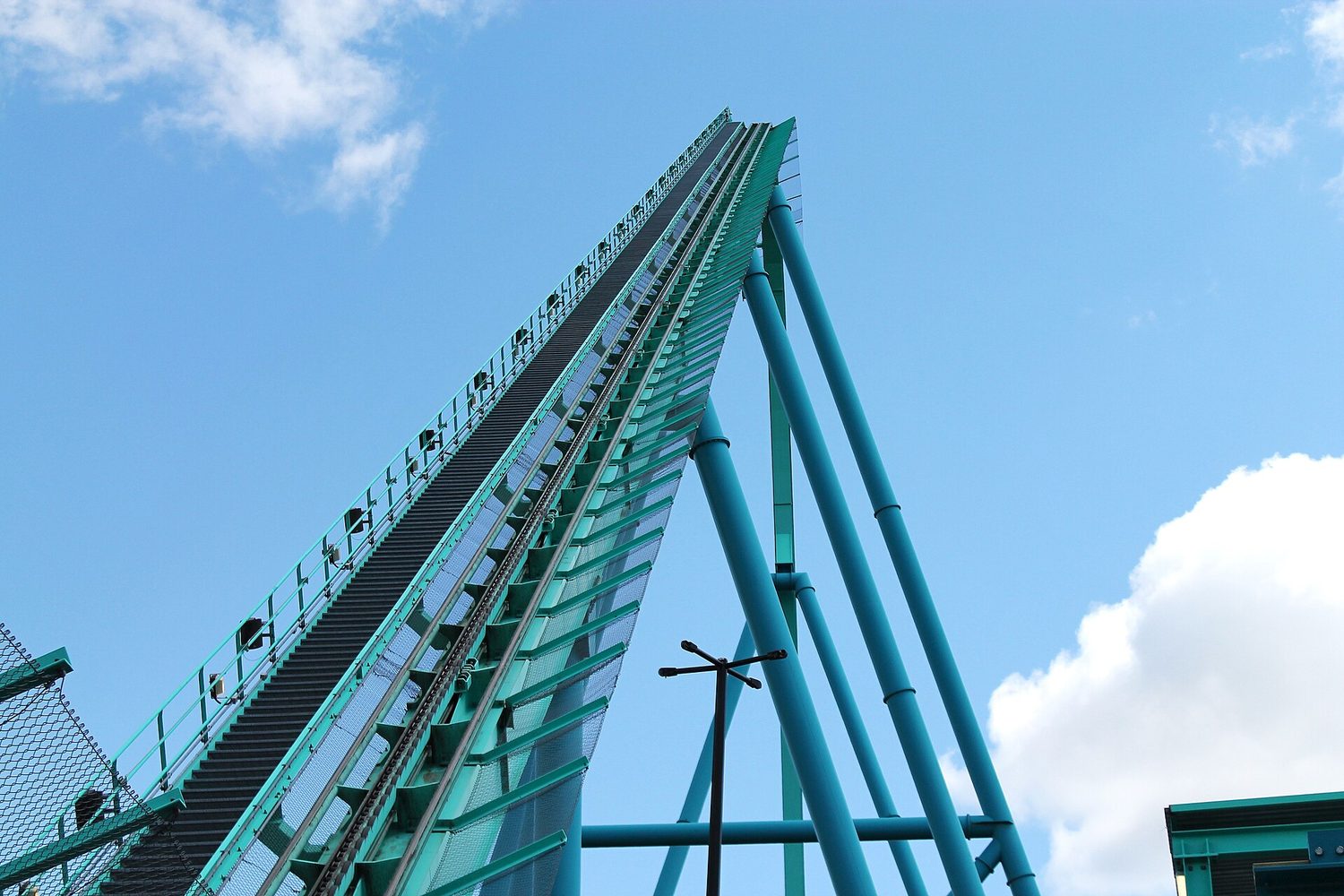
มองขึ้นไปบนเนินเขาแห่งแรกของรถเหวี่ยง (Roller Coaster) โซ่ดึงรถไฟขึ้นสู่ยอดเขา แล้วปล่อยลง ไม่มีเครื่องยนต์บนรถไฟ — ไม่มีอะไรผลักมันอีกครั้งสำหรับ...

English narration · English + 中文 subtitles burned in · ⁨การบรรยายภาษาอังกฤษ · คำบรรยายภาษาอังกฤษ + 中文 ลอยตัวบนภาพ⁩

3.1

Translational Kinetic Energy · ⁨พลังงานจลน์เชิงแปล⁩

Syllabus · ⁨หลักสูตร⁩
English

Learning Objective 3.1.A: Describe the translational kinetic energy of an object in terms of the object's mass and velocity.

  • 3.1.A.1 An object's translational kinetic energy is given by the equation
    • Equation: $K = \dfrac{1}{2}mv^2$
  • 3.1.A.2 Translational kinetic energy is a scalar quantity.
  • 3.1.A.3 Different observers may measure different values of the translational kinetic energy of an object, depending on the observer's frame of reference.
ไทย

วัตถุประสงค์การเรียนรู้ 3.1.A: อธิบายพลังงานจลน์แบบเลื่อนของวัตถุในแง่ของมวลและความเร็วของวัตถุนั้น

  • 3.1.A.1 พลังงานจลน์แบบเลื่อนของวัตถุกำหนดโดยสมการ
    • สมการ: $K = \dfrac{1}{2}mv^2$
  • 3.1.A.2 พลังงานจลน์แบบเลื่อนเป็นปริมาณสเกลาร์
  • 3.1.A.3 ผู้สังเกตที่แตกต่างกันอาจวัดค่าพลังงานจลน์แบบเลื่อนของวัตถุได้แตกต่างกัน ขึ้นอยู่กับกรอบอ้างอิงของผู้สังเกต
Source: College Board AP Course and Exam Description · ⁨แหล่งที่มา: คำอธิบายหลักสูตรและข้อสอบ College Board AP⁩

English

Energy 能量 is the capacity to do work, measured in joules 焦耳 (J). A moving object has kinetic energy 动能:

$$K=\tfrac{1}{2}mv^2.$$
It depends on the square of the speed, so doubling the speed quadruples the kinetic energy. Kinetic energy is a scalar and is never negative.

Worked example. A $1500\ \text{kg}$ car travels at $20\ \text{m/s}$. Its kinetic energy is $K=\tfrac12\times1500\times20^2=3.0\times10^{5}\ \text{J}=300\ \text{kJ}$. If it speeds up to $40\ \text{m/s}$ (double), the kinetic energy becomes $4\times$ larger, $1200\ \text{kJ}$ – which is why stopping distance grows so fast with speed.

ไทย

พลังงาน คือความสามารถในการทำงาน วัดในหน่วย จูล (J). วัตถุที่เคลื่อนที่จะมี พลังงานจลน์:

$$K=\tfrac{1}{2}mv^2.$$
ขึ้นอยู่กับ กำลังสอง ของความเร็ว ดังนั้นการเพิ่มความเร็วเป็นสองเท่าจะทำให้พลังงานจลน์เพิ่มขึ้นเป็น สี่เท่า พลังงานจลน์เป็นสเกลาร์และไม่เคยเป็นลบ

ตัวอย่างวิธีทำ. รถ $1500\ \text{kg}$ ขับเคลื่อนด้วยความเร็ว $20\ \text{m/s}$. พลังงานจลน์ของมันคือ $K=\tfrac12\times1500\times20^2=3.0\times10^{5}\ \text{J}=300\ \text{kJ}$. หากมันเร่งความเร็วเป็น $40\ \text{m/s}$ (สองเท่า) พลังงานจลน์จะเพิ่มขึ้น $4\times$ เท่า, $1200\ \text{kJ}$ – นี่คือเหตุผลที่ระยะทางเบรกเพิ่มขึ้นอย่างรวดเร็วเมื่อความเร็วสูงขึ้น

3.2

Work · ⁨งาน⁩

Syllabus · ⁨หลักสูตร⁩
English

Learning Objective 3.2.A: Describe the work done on an object or system by a given force or collection of forces.

  • 3.2.A.1 Work is the amount of energy transferred into or out of a system by a force exerted on that system over a distance.
    • 3.2.A.1.i The work done by a conservative force exerted on a system is path-independent and only depends on the initial and final configurations of that system.
    • 3.2.A.1.ii The work done by a conservative force on a system—or the change in the potential energy of the system—will be zero if the system returns to its initial configuration.
    • 3.2.A.1.iii Potential energies are associated only with conservative forces.
    • 3.2.A.1.iv The work done by a nonconservative force is path-dependent.
    • 3.2.A.1.v Examples of nonconservative forces are friction and air resistance.
  • 3.2.A.2 Work is a scalar quantity that may be positive, negative, or zero.
  • 3.2.A.3 The amount of work done on a system by a constant force is related to the components of that force and the displacement of the point at which that force is exerted.
    • 3.2.A.3.i Only the component of the force exerted on a system that is parallel to the displacement of the point of application of the force will change the system's total energy.
      • Equation: $W = F_{\parallel}d = Fd\cos\theta$
    • 3.2.A.3.ii The component of the force exerted on a system perpendicular to the direction of the displacement of the system's center of mass can change the direction of the system's motion without changing the system's kinetic energy.
  • 3.2.A.4 The work-energy theorem states that the change in an object's kinetic energy is equal to the sum of the work (net work) being done by all forces exerted on the object.
    • Equation: $\Delta K = \sum_{i} W_i = \sum_{i} F_{\parallel,i}\,d$
    • 3.2.A.4.i An external force may change the configuration of a system. The component of the external force parallel to the displacement times the displacement of the point of application of the force gives the change in kinetic energy of the system.
    • 3.2.A.4.ii If the system's center of mass and the point of application of the force move the same distance when a force is exerted on a system, then the system may be modeled as an object, and only the system's kinetic energy can change.
    • 3.2.A.4.iii The energy dissipated by friction is typically equated to the force of friction times the length of the path over which the force is exerted
      • Equation: $\Delta E_{\text{mech}} = F_f\,d\cos\theta$
  • 3.2.A.5 Work is equal to the area under the curve of a graph of $F_{\parallel}$ as a function of displacement.

Boundary statement: AP Physics 1 only expects students to analyze the transfer of mechanical energy (as defined in Unit 3, Topic 4: Conservation of Energy), although students should be aware that mechanical energy may be dissipated in the form of thermal energy or sound. In AP Physics 2, students will also study how thermal energy can be transferred between systems through heating or cooling.

ไทย

วัตถุประสงค์การเรียนรู้ 3.2.A: อธิบายงานที่ทำต่อวัตถุหรือระบบโดยแรงที่กำหนดหรือกลุ่มแรง

  • 3.2.A.1 งานคือปริมาณพลังงานที่ถูกถ่ายโอนเข้าสู่หรือออกจากระบบโดยแรงที่กระทำต่อระบบนั้นตลอดระยะทาง
    • 3.2.A.1.i งานที่ทำโดยแรงอนุรักษ์ที่กระทำต่อระบบไม่ขึ้นอยู่กับเส้นทางและขึ้นอยู่กับเพียงการจัดวางตัวเริ่มต้นและสุดท้ายของระบบเท่านั้น
    • 3.2.A.1.ii งานที่ทำโดยแรงอนุรักษ์ต่อระบบ—หรือการเปลี่ยนแปลงพลังงานศักย์ของระบบ—จะเป็นศูนย์หากระบบกลับไปยังการจัดวางตัวเริ่มต้น
    • 3.2.A.1.iii พลังงานศักย์เกี่ยวข้องกับเฉพาะแรงอนุรักษ์เท่านั้น
    • 3.2.A.1.iv งานที่ทำโดยแรงที่ไม่ใช่แรงอนุรักษ์ขึ้นอยู่กับเส้นทาง
    • 3.2.A.1.v ตัวอย่างของแรงที่ไม่ใช่แรงอนุรักษ์ ได้แก่ แรงเสียดทานและแรงต้านอากาศ
  • 3.2.A.2 งานเป็นปริมาณสเกลาร์ซึ่งอาจมีค่าเป็นบวก ลบ หรือศูนย์
  • 3.2.A.3 ปริมาณงานที่ทำต่อระบบโดยแรงคงที่สัมพันธ์กับองค์ประกอบของแรงนั้นและการกระจัดของจุดที่แรงถูกกระทำ
    • 3.2.A.3.i เฉพาะองค์ประกอบของแรงที่กระทำต่อระบบที่ขนานกับการกระจัดของจุดประบดแรงเท่านั้นที่จะเปลี่ยนพลังงานรวมของระบบ
      • สมการ: $W = F_{\parallel}d = Fd\cos\theta$
    • 3.2.A.3.ii องค์ประกอบของแรงที่กระทำต่อระบบตั้งฉากกับทิศทางการกระจัดของศูนย์กลางมวลของระบบสามารถเปลี่ยนทิศทางของการเคลื่อนที่ของระบบโดยไม่เปลี่ยนพลังงานจลน์ของระบบ
  • 3.2.A.4 ทฤษฎีบทงาน-พลังงานระบุว่า การเปลี่ยนแปลงพลังงานจลน์ของวัตถุเท่ากับผลรวมของงาน (งานสุทธิ) ที่ทำต่อวัตถุนั้นโดยแรงทั้งหมด
    • สมการ: $\Delta K = \sum_{i} W_i = \sum_{i} F_{\parallel,i}\,d$
    • 3.2.A.4.i แรงภายนอกอาจเปลี่ยนแปลงการจัดวางตัวของระบบ ผลคูณขององค์ประกอบของแรงภายนอกที่ขนานกับการกระจัดกับการกระจัดของจุดประบดแรงให้ค่าการเปลี่ยนแปลงพลังงานจลน์ของระบบ
    • 3.2.A.4.ii หากศูนย์กลางมวลของระบบและจุดประบดแรงเคลื่อนที่ในระยะเท่ากันเมื่อมีแรงกระทำต่อระบบ ระบบสามารถจำลองเป็นวัตถุได้ และการเปลี่ยนแปลงจะเกิดขึ้นเฉพาะพลังงานจลน์ของระบบเท่านั้น
    • 3.2.A.4.iii พลังงานที่สูญเสียจากแรงเสียดทานโดยทั่วไปจะเทียบเท่ากับแรงเสียดทานคูณกับความยาวของเส้นทางที่แรงถูกกระทำ
      • สมการ: $\Delta E_{\text{mech}} = F_f\,d\cos\theta$
  • 3.2.A.5 งานเท่ากับพื้นที่ใต้กราฟของ $F_{\parallel}$ ในฟังก์ชันของการกระจัด

ข้อจำกัด: AP Physics 1 คาดหวังให้นักเรียนวิเคราะห์เฉพาะการถ่ายโอนพลังงานกล (ตามนิยามในหน่วยที่ 3 หัวข้อ 4: กฎการอนุรักษ์พลังงาน) although นักเรียนควรรู้ว่าพลังงานกลอาจถูกกระจาย出去ในรูปแบบของพลังงานความร้อนหรือเสียง ใน AP Physics 2 นักเรียนจะได้ศึกษาเพิ่มเติมว่าการถ่ายโอนพลังงานความร้อนระหว่างระบบสามารถเกิดขึ้นได้ผ่านการให้ความร้อนหรือความเย็น

Source: College Board AP Course and Exam Description · ⁨แหล่งที่มา: คำอธิบายหลักสูตรและข้อสอบ College Board AP⁩

English

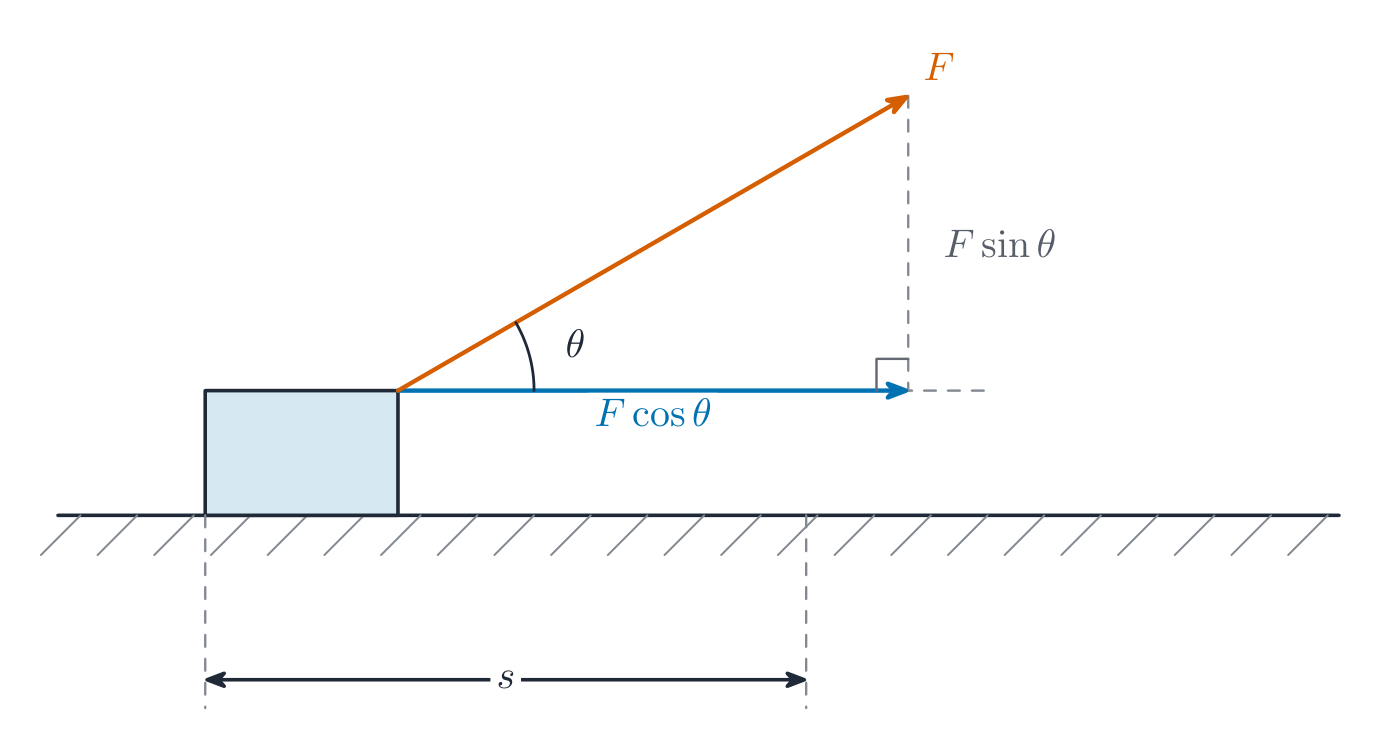
Work 功 is energy transferred by a force acting over a displacement:

$$W=F\,d\cos\theta,$$
where $\theta$ is the angle between the force and the displacement. Work is positive when the force has a component along the motion (adds energy), negative when it opposes the motion (removes energy), and zero when the force is perpendicular. On a force–position graph, work is the area under the curve. The work–energy theorem 动能定理 states that the net work equals the change in kinetic energy: $W_{\text{net}}=\Delta K$.

Worked example. A $2.0\ \text{kg}$ block moving at $3.0\ \text{m/s}$ on a frictionless floor is pushed by a $5.0\ \text{N}$ force over $4.0\ \text{m}$ in the direction of motion. Find its final speed. The net work is $W=Fd=5.0\times4.0=20\ \text{J}$, and by the work–energy theorem $W=\tfrac12 m(v^2-v_0^2)$:

$$20=\tfrac12\times2.0\times(v^2-3.0^2)\;\Rightarrow\;v^2=29\;\Rightarrow\;v=5.4\ \text{m/s}.$$

ไทย

งาน คือพลังงานที่ถูกถ่ายโอนโดยแรงที่กระทำผ่านระยะการกระจัด:

$$W=F\,d\cos\theta,$$
โดยที่ $\theta$ คือมุมระหว่างแรงและการกระจัด งานจะเป็น บวก เมื่อแรงมีองค์ประกอบตามทิศทางการเคลื่อนที่ (เพิ่มพลังงาน), ลบ เมื่อต้านทานการเคลื่อนที่ (ลดพลังงาน), และ ศูนย์ เมื่อแรงตั้งฉาก On a force–position graph, work is the area under the curve. The work–energy theorem states that the net work equals the change in kinetic energy: $W_{\text{net}}=\Delta K$.

มีเพียงองค์ประกอบของแรงตามการกระจัดเท่านั้นที่ทำ功

ตัวอย่างวิธีทำ. บล็อกมวล $2.0\ \text{kg}$ เคลื่อนที่ด้วยความเร็ว $3.0\ \text{m/s}$ บนพื้นไร้แรงเสียดทาน ถูกดันด้วยแรง $5.0\ \text{N}$ ผ่านระยะ $4.0\ \text{m}$ ตามทิศทางการเคลื่อนที่. หาความเร็วสุดท้าย. งานสุทธิคือ $W=Fd=5.0\times4.0=20\ \text{J}$, และโดยทฤษฎีบทงาน-พลังงาน $W=\tfrac12 m(v^2-v_0^2)$:

$$20=\tfrac12\times2.0\times(v^2-3.0^2)\;\Rightarrow\;v^2=29\;\Rightarrow\;v=5.4\ \text{m/s}.$$

Vocabulary · ⁨คำศัพท์⁩ Train · ⁨ฝึกฝน⁩
English ไทย
Energy/ˈenədʒi/ พลังงาน
joules/dʒuːlz/ จูล
kinetic energy/kɪˈnetɪk ˈenədʒi/ พลังงานจลน์
Work/wɜːk/ งาน
work–energy theorem/wɜːk ˈenədʒi ˈθɪərəm/ ทฤษฎีงาน–พลังงาน
Potential energy/pəˈtenʃl ˈenədʒi/ พลังงานศักย์
Gravitational potential energy/ˌɡrævɪˈteɪʃənl pəˈtenʃl ˈenədʒi/ พลังงานศักย์โน้มถ่วง
Elastic potential energy/ɪˈlæstɪk pəˈtenʃl ˈenədʒi/ พลังงานศักย์ยืดหยุ่น
conservative forces/kənˈsɜːvətɪv ˈfɔːsɪz/ แรงอนุรักษ์
total mechanical energy/ˈtəʊtl mɪˈkænɪkl ˈenədʒi/ พลังงานกลทั้งหมด
conserved/kənˈsɜːvd/ คงที่
thermal energy/ˈθɜːml ˈenədʒi/ 热能
3.3

Potential Energy · ⁨พลังงานศักย์⁩

Syllabus · ⁨หลักสูตร⁩
English

Learning Objective 3.3.A: Describe the potential energy of a system.

  • 3.3.A.1 A system composed of two or more objects has potential energy if the objects within that system only interact with each other through conservative forces.
  • 3.3.A.2 Potential energy is a scalar quantity associated with the position of objects within a system.
  • 3.3.A.3 The definition of zero potential energy for a given system is a decision made by the observer considering the situation to simplify or otherwise assist in analysis.
  • 3.3.A.4 The potential energy of common physical systems can be described using the physical properties of that system.
    • 3.3.A.4.i The elastic potential energy of an ideal spring is given by the following equation, where $\Delta x$ is the distance the spring has been stretched or compressed from its equilibrium length.
      • Equation: $U_s = \dfrac{1}{2}k(\Delta x)^2$
    • 3.3.A.4.ii The general form for the gravitational potential energy of a system consisting of two approximately spherical distributions of mass (e.g., moons, planets or stars) is given by the equation
      • Equation: $U_g = -G\dfrac{m_1 m_2}{r}$
    • 3.3.A.4.iii Because the gravitational field near the surface of a planet is nearly constant, the change in gravitational potential energy in a system consisting of an object with mass $m$ and a planet with gravitational field of magnitude $g$ when the object is near the surface of the planet may be approximated by the equation
      • Equation: $\Delta U_g = mg\Delta y$
  • 3.3.A.5 The total potential energy of a system containing more than two objects is the sum of the potential energy of each pair of objects within the system.
ไทย

วัตถุประสงค์การเรียนรู้ 3.3.A: อธิบายพลังงานศักย์ของระบบ

  • 3.3.A.1 ระบบที่ประกอบด้วยวัตถุสองชิ้นขึ้นไปจะมีพลังงานศักย์หากวัตถุภายในระบบ tersebut相互作用กันเฉพาะผ่านแรงอนุรักษ์เท่านั้น
  • 3.3.A.2 พลังงานศักย์เป็นปริมาณสเกลาร์ที่เกี่ยวข้องกับตำแหน่งของวัตถุภายในระบบ
  • 3.3.A.3 การกำหนดจุดศูนย์ของพลังงานศักย์สำหรับระบบหนึ่งเป็นการตัดสินใจของผู้สังเกตพิจารณาจากสถานการณ์เพื่อทำให้การวิเคราะห์ง่ายขึ้นหรือช่วยในการวิเคราะห์อื่นๆ
  • 3.3.A.4 พลังงานศักย์ของระบบทางฟิสิกส์ทั่วไปสามารถอธิบายได้ด้วยคุณสมบัติทางกายภาพของระบบนั้น
    • 3.3.A.4.i พลังงานศักย์ยืดหยุ่นของสปริงอุดมคติกำหนดโดยสมการต่อไปนี้ โดยที่ $\Delta x$ คือระยะทางที่สปริงถูกยืดหรืออัดจากความยาวสมดุล
      • สมการ: $U_s = \dfrac{1}{2}k(\Delta x)^2$
    • 3.3.A.4.ii รูปแบบทั่วไปของพลังงานศักย์โน้มถ่วงของระบบ consisting of two approximately spherical distributions of mass (เช่น ดวงจันทร์ ดาวเคราะห์ หรือดวงดาว) กำหนดโดยสมการ
      • สมการ: $U_g = -G\dfrac{m_1 m_2}{r}$
    • 3.3.A.4.iii เนื่องจากสนามโน้มถ่วงใกล้พื้นผิวของดาวเคราะห์มีค่าเกือบคงที่ การเปลี่ยนแปลงพลังงานศักย์โน้มถ่วงในระบบ consisting of an object with mass $m$ และดาวเคราะห์ที่มีขนาดของสนามโน้มถ่วง $g$ เมื่อวัตถุอยู่ใกล้พื้นผิวดาวเคราะห์สามารถประมาณได้ด้วยสมการ
      • สมการ: $\Delta U_g = mg\Delta y$
  • 3.3.A.5 พลังงานศักย์รวมของระบบที่มีวัตถุมากกว่าสองชิ้นคือผลรวมของพลังงานศักย์ของแต่ละคู่ของวัตถุภายในระบบ

Source: College Board AP Course and Exam Description · ⁨แหล่งที่มา: คำอธิบายหลักสูตรและข้อสอบ College Board AP⁩

English

Potential energy 势能 is stored energy that depends on position or configuration:

  • Gravitational potential energy 重力势能 near the surface: $U_g=mgh$ (height $h$ above a reference level).
  • Elastic potential energy 弹性势能 in a spring: $U_s=\tfrac{1}{2}kx^2$.

Potential energy is defined only for conservative forces 保守力 (gravity, springs), for which the stored energy depends on position, not path. Only changes in potential energy matter, so you may put the zero level wherever is convenient.

The $U_g=mgh$ form only holds near a surface where $g$ is roughly constant. The general form, for two spherical masses a distance $r$ apart, is

$$U_g=-\frac{G m_1 m_2}{r}.$$
It is negative and defined to be zero at infinite separation, so gravitational PE rises toward zero as the masses move apart. $mgh$ is simply its near-surface approximation. (This is the form you need for satellites and escape speed.)

ไทย

พลังงานศักย์ คือพลังงานที่สะสมซึ่งขึ้นอยู่กับตำแหน่งหรือการจัดเรียง:

  • พลังงานศักย์โน้มถ่วง Near the surface: $U_g=mgh$ (ความสูง $h$ เหนือระดับอ้างอิง).
  • พลังงานศักย์ยืดหยุ่น ในสปริง: $U_s=\tfrac{1}{2}kx^2$.

พลังงานศักย์กำหนดไว้สำหรับ แรงอนุรักษ์ (แรงโน้มถ่วง, สปริง) เท่านั้น ซึ่งพลังงานที่สะสมขึ้นอยู่กับตำแหน่ง ไม่ใช่เส้นทาง เพียง การเปลี่ยนแปลง ของพลังงานศักย์ที่สำคัญเท่านั้น ดังนั้นคุณอาจวางระดับศูนย์ได้ทุกที่ที่สะดวก

รูป $U_g=mgh$ นั้นใช้ได้เฉพาะ near a surface where $g$ is roughly constant. The general form, สำหรับมวลทรงกลมสองก้อนที่ห่างกัน $r$, คือ

$$U_g=-\frac{G m_1 m_2}{r}.$$
มันมีค่า ลบ และกำหนดให้เป็น ศูนย์ที่ระยะไกล vô hạn, ดังนั้นพลังงานศักย์โน้มถ่วงจะเพิ่มขึ้นเข้าใกล้ศูนย์เมื่อมวลเคลื่อนที่ออกจากกัน $mgh$ เป็นเพียงการประมาณ near-surface ของมัน (นี่คือรูปแบบที่คุณต้องใช้สำหรับดาวเทียมและความเร็วหลบหนี)

Explore · ⁨สำรวจ⁩

Store elastic potential energy in a spring · ⁨เก็บพลังงานศักย์ยืดหยุ่นในสปริง⁩

Stretching a spring stores elastic potential energy $\tfrac12 kx^2$ — the area under the force-extension line. Release it and that energy becomes kinetic. · ⁨การยืดสปริงจะเก็บ พลังงานศักย์ยืดหยุ่น $\tfrac12 kx^2$ — ซึ่งเท่ากับพื้นที่ใต้เส้นแรง-การต่อ ย่อสปริงแล้ว พลังงานนี้จะเปลี่ยนเป็นพลังงานจลน์⁩

3.4

Conservation of Energy · ⁨กฎการอนุรักษ์พลังงาน⁩

Syllabus · ⁨หลักสูตร⁩
English

Learning Objective 3.4.A: Describe the energies present in a system.

  • 3.4.A.1 A system composed of only a single object can only have kinetic energy.
  • 3.4.A.2 A system that contains objects that interact via conservative forces or that can change its shape reversibly may have both kinetic and potential energies.

Learning Objective 3.4.B: Describe the behavior of a system using conservation of mechanical energy principles.

  • 3.4.B.1 Mechanical energy is the sum of a system's kinetic and potential energies.
  • 3.4.B.2 Any change to a type of energy within a system must be balanced by an equivalent change of other types of energies within the system or by a transfer of energy between the system and its surroundings.
  • 3.4.B.3 A system may be selected so that the total energy of that system is constant.
  • 3.4.B.4 If the total energy of a system changes, that change will be equivalent to the energy transferred into or out of the system.

Learning Objective 3.4.C: Describe how the selection of a system determines whether the energy of that system changes.

  • 3.4.C.1 Energy is conserved in all interactions.
  • 3.4.C.2 If the work done on a selected system is zero and there are no nonconservative interactions within the system, the total mechanical energy of the system is constant.
  • 3.4.C.3 If the work done on a selected system is nonzero, energy is transferred between the system and the environment.

Boundary statement: AP Physics 1 expects students to know that mechanical energy can be dissipated as thermal energy or sound by nonconservative forces.

ไทย

วัตถุประสงค์การเรียนรู้ 3.4.A: อธิบายพลังงานที่มีอยู่ในระบบ

  • 3.4.A.1 ระบบ consisting of only a single object สามารถมีเพียงพลังงานจลน์เท่านั้น
  • 3.4.A.2 ระบบที่มีวัตถุที่相互作用กันผ่านแรงอนุรักษ์หรือสามารถเปลี่ยนรูปร่างได้อย่างย้อนกลับอาจมีทั้งพลังงานจลน์และพลังงานศักย์

วัตถุประสงค์การเรียนรู้ 3.4.B: อธิบายพฤติกรรมของระบบโดยใช้หลักการอนุรักษ์พลังงานกล

  • 3.4.B.1 พลังงานกลคือผลรวมของพลังงานจลน์และพลังงานศักย์ของระบบ
  • 3.4.B.2 การเปลี่ยนแปลง任何形式的พลังงานภายในระบบต้องถูกสมดุลด้วยการเปลี่ยนแปลงของพลังงานประเภทอื่นที่มีค่าเท่ากันภายในระบบ หรือโดยการถ่ายโอนพลังงานระหว่างระบบกับสิ่งแวดล้อมรอบข้าง
  • 3.4.B.3 สามารถเลือกกำหนดระบบได้โดยที่พลังงานรวมของระบบนั้นคงที่
  • 3.4.B.4 หากพลังงานรวมของระบบมีการเปลี่ยนแปลง การเปลี่ยนแปลงนั้นจะมีค่าเท่ากับพลังงานที่ถูกถ่ายโอนเข้าสู่หรือออกจากระบบ

วัตถุประสงค์การเรียนรู้ 3.4.C: อธิบายว่าการกำหนดระบบมีผลต่อการเปลี่ยนแปลงพลังงานของระบบอย่างไร

  • 3.4.C.1 พลังงานถูกอนุรักษ์ในทุกการมีปฏิสัมพันธ์
  • 3.4.C.2 หากงานที่ทำต่อระบบที่กำหนดเป็นศูนย์และไม่มีการมีปฏิสัมพันธ์ที่ไม่ถาวรภายใน ระบบ พลังงานกลรวมของระบบจะคงที่
  • 3.4.C.3 หากงานที่ทำต่อระบบที่กำหนดไม่ใช่ศูนย์ จะมีการถ่ายโอนพลังงานระหว่างระบบกับสิ่งแวดล้อม

ข้อจำกัด: AP Physics 1 คาดหวังให้นักเรียนรู้ว่าพลังงานกลสามารถสูญเสียกลายเป็นพลังงานความร้อนหรือเสียงผ่านแรงที่ไม่ถาวรได้

Source: College Board AP Course and Exam Description · ⁨แหล่งที่มา: คำอธิบายหลักสูตรและข้อสอบ College Board AP⁩

English
Energy conservation: KE ⇄ PE

The total mechanical energy 机械能 is $E=K+U$. When only conservative forces do work, mechanical energy is conserved 守恒:

$$K_1+U_1=K_2+U_2.$$
When friction or other non-conservative forces act, they transfer mechanical energy to thermal energy 热能; then the general statement is that total energy (including thermal) is conserved. Energy bar charts are a good way to track where the energy goes.

Worked example. A ball is released from rest at the top of a frictionless ramp $5.0\ \text{m}$ high. Find its speed at the bottom. All the gravitational potential energy becomes kinetic energy:

$$mgh=\tfrac12 mv^2\;\Rightarrow\;v=\sqrt{2gh}=\sqrt{2\times9.8\times5.0}=9.9\ \text{m/s}.$$
The mass cancels, so every object reaches the same speed – exactly the free-fall result, now got from energy. If instead $30\ \text{J}$ were lost to friction, you would subtract it: $mgh-30=\tfrac12 mv^2$.

ไทย
การอนุรักษ์พลังงาน: KE ⇄ PE
รถเหวี่ยงที่มีวงแหวนสูงสีเขียวน้ำตาลแดงตัดกับท้องฟ้า
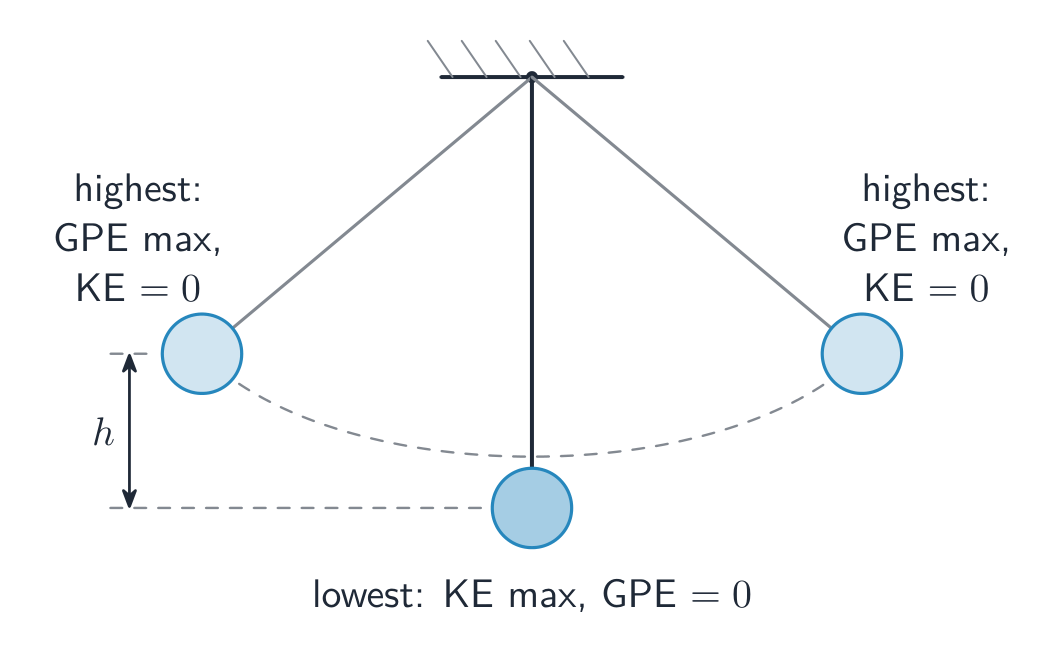
รถเหวี่ยงแลกเปลี่ยนพลังงานไปมา: สูงสุด (พลังงานศักย์มากที่สุด) ที่ยอด และเร็วที่สุด (พลังงานจลน์มากที่สุด) ที่ก้น

พลังงานกลรวม คือ $E=K+U$. เมื่อมีเพียงแรงอนุรักษ์ที่ทำ功, พลังงานกลจะถูก อนุรักษ์:

$$K_1+U_1=K_2+U_2.$$
เมื่อแรงเสียดทานหรือแรงที่ไม่อนุรักษ์อื่นๆ ทำ عمل จะถ่ายโอนพลังงานกลไปเป็น พลังงานความร้อน; ดังนั้นข้อความทั่วไปคือ พลังงานรวม (รวมถึงพลังงานความร้อน) จะถูกอนุรักษ์ กราฟแท่งพลังงานเป็นวิธีที่ดีในการติดตามว่าพลังงาน去向何方

ลูกตุ้มนานาเล็งแลกเปลี่ยนพลังงานศักย์โน้มถ่วงเป็นพลังงานจลน์และกลับคืนมา

ตัวอย่างที่คำนวณแล้ว. ลูกบอลปล่อยจากจุดหยุดนิ่งบนทางลื่น $5.0\ \text{m}$ สูง จงหาความเร็วที่ด้านล่าง พลังงานศักย์โน้มถ่วงทั้งหมดเปลี่ยนเป็นพลังงานจลน์:

$$mgh=\tfrac12 mv^2\;\Rightarrow\;v=\sqrt{2gh}=\sqrt{2\times9.8\times5.0}=9.9\ \text{m/s}.$$
มวลจะตัดกัน ทำให้วัตถุทุกชิ้นถึงความเร็วเท่ากัน – ซึ่งเป็นผลลัพธ์ของการตกอิสระเช่นเดียวกัน แต่ได้มาจากการใช้พลังงาน หากแทนที่จะ $30\ \text{J}$ จะสูญเสียไปกับแรงเสียดทาน คุณต้องลบออก: $mgh-30=\tfrac12 mv^2$.

Explore · ⁨สำรวจ⁩

Watch energy convert as an object falls · ⁨สังเกตการแปลงพลังงานขณะวัตถุตก⁩

With no friction, mechanical energy is conserved: as an object falls, gravitational potential energy turns into kinetic energy while the total stays fixed. · ⁨เมื่อไม่มีแรงเสียดทาน พลังงานกลคงที่: ขณะวัตถุตก พลังงาน ศักย์ ของแรงโน้มถ่วงเปลี่ยนเป็นพลังงาน จลน์ โดยรวมคงที่⁩

3.5

Power · ⁨กำลัง⁩

Syllabus · ⁨หลักสูตร⁩
English

Learning Objective 3.5.A: Describe the transfer of energy into, out of, or within a system in terms of power.

  • 3.5.A.1 Power is the rate at which energy changes with respect to time, either by transfer into or out of a system or by conversion from one type to another within a system.
  • 3.5.A.2 Average power is the amount of energy being transferred or converted, divided by the time it took for that transfer or conversion to occur.
    • Equation: $P_{\text{avg}} = \dfrac{\Delta E}{\Delta t}$
  • 3.5.A.3 Because work is the change in energy of an object or system due to a force, average power is the total work done, divided by the time during which that work was done.
    • Equation: $P_{\text{avg}} = \dfrac{W}{\Delta t}$
  • 3.5.A.4 The instantaneous power delivered to an object by the component of a constant force parallel to the object's velocity can be described with the derived equation.
    • Equation: $P_{\text{inst}} = F_{\parallel}v = Fv\cos\theta$
ไทย

วัตถุประสงค์การเรียนรู้ 3.5.A: อธิบายการถ่ายโอนพลังงานเข้าสู่ ออก หรือภายในระบบในเชิงกำลัง

  • 3.5.A.1 กำลังคืออัตราการเปลี่ยนแปลงพลังงานเทียบกับเวลา โดยอาจเป็นการถ่ายโอนเข้าสู่หรือออกจากระบบ หรือการเปลี่ยนจากพลังงานประเภทหนึ่งไปเป็นอีกประเภทหนึ่งในระบบ
  • 3.5.A.2 กำลังเฉลี่ยคือปริมาณพลังงานที่ถูกถ่ายโอนหรือเปลี่ยน تقด้วยด้วยระยะเวลาที่ใช้ในการถ่ายโอนหรือการเปลี่ยนนั้น
    • สมการ: $P_{\text{avg}} = \dfrac{\Delta E}{\Delta t}$
  • 3.5.A.3 เนื่องจากงานคือการเปลี่ยนแปลงพลังงานของวัตถุหรือระบบเนื่องจากแรง ดังนั้นกำลังเฉลี่ยจึงเท่ากับงานทั้งหมดที่ทำหารด้วยช่วงเวลาที่ทำงานนั้น
    • สมการ: $P_{\text{avg}} = \dfrac{W}{\Delta t}$
  • 3.5.A.4 กำลังทันทีที่ส่งให้วัตถุโดยองค์ประกอบของแรงคงที่ที่ขนานกับความเร็วของวัตถุ สามารถอธิบายได้ด้วยสมการที่ได้จากการวิเคราะห์
    • สมการ: $P_{\text{inst}} = F_{\parallel}v = Fv\cos\theta$

Source: College Board AP Course and Exam Description · ⁨แหล่งที่มา: คำอธิบายหลักสูตรและข้อสอบ College Board AP⁩

English

Power 功率 is the rate of doing work or transferring energy, measured in watts 瓦特 (W):

$$P=\frac{W}{\Delta t}=\frac{\Delta E}{\Delta t},\qquad\text{and instantaneously}\qquad P=Fv.$$
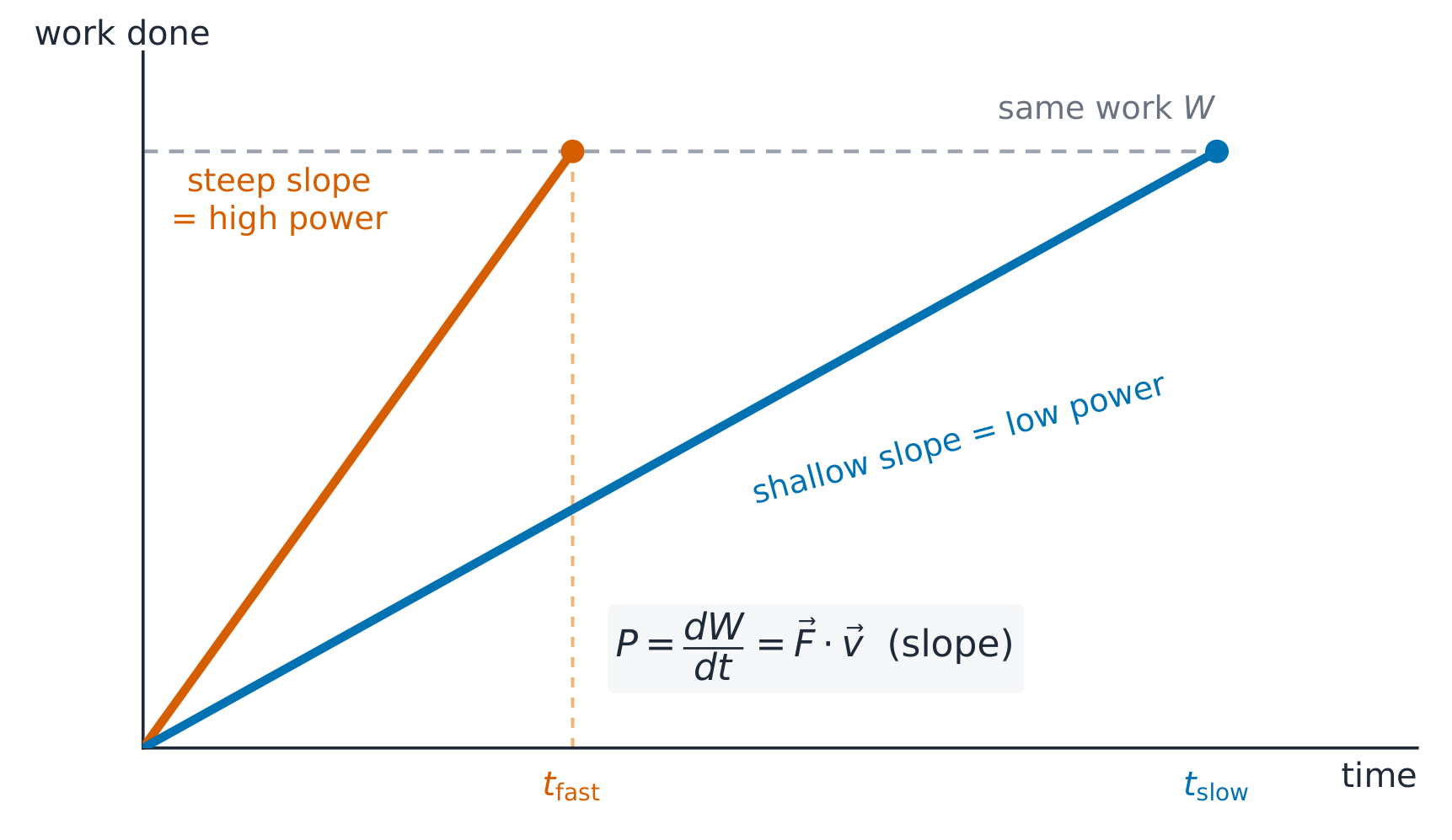
So the same job done faster requires more power. On an energy–time graph, power is the slope.

Worked example. A motor lifts a $50\ \text{kg}$ load at a steady $2.0\ \text{m/s}$. Because it moves at constant speed, the lifting force equals the weight, so

$$P=Fv=mgv=50\times9.8\times2.0=980\ \text{W}.$$

Real machines waste some energy, so we quote efficiency 效率 – useful output power divided by total input power. If this motor draws $1400\ \text{W}$ of electrical power to deliver $980\ \text{W}$ of useful lifting, its efficiency is $980/1400=0.70$, or $70\%$; the other $30\%$ becomes heat and sound.

ไทย

กำลัง คือ อัตรา ของการทำ工作或การถ่ายโอนพลังงาน วัดในหน่วย วัตต์ (W):

$$P=\frac{W}{\Delta t}=\frac{\Delta E}{\Delta t},\qquad\text{and instantaneously}\qquad P=Fv.$$
ดังนั้น งานเดียวกันที่ทำเร็วขึ้นต้องใช้กำลังมากขึ้น บนกราฟพลังงาน–เวลา กำลังคือความชัน

กำลังคือความชันของกราฟงาน–เวลา: งานเท่ากันในเวลาที่น้อยกว่าหมายถึงกำลังมากกว่า

ตัวอย่างที่คำนวณแล้ว. มอเตอร์ยกน้ำหนัก $50\ \text{kg}$ ด้วยความเร็วคงที่ $2.0\ \text{m/s}$ เนื่องจากเคลื่อนที่ด้วยความเร็วคงที่ แรงยกจึงเท่ากับน้ำหนัก ดังนั้น

$$P=Fv=mgv=50\times9.8\times2.0=980\ \text{W}.$$

เครื่องจักรจริงมีการสูญเสียพลังงานบางส่วน เราจึงระบุค่า ประสิทธิภาพ – กำลังใช้งานที่ได้หารด้วยกำลังไฟฟ้าที่ป้อนเข้า หากมอเตอร์นี้ใช้ไฟฟ้า $1400\ \text{W}$ เพื่อสร้างกำลังยกที่มีประโยชน์ $980\ \text{W}$ ประสิทธิภาพของมันคือ $980/1400=0.70$ หรือ $70\%$; ส่วนที่เหลือ $30\%$ กลายเป็นความร้อนและเสียง

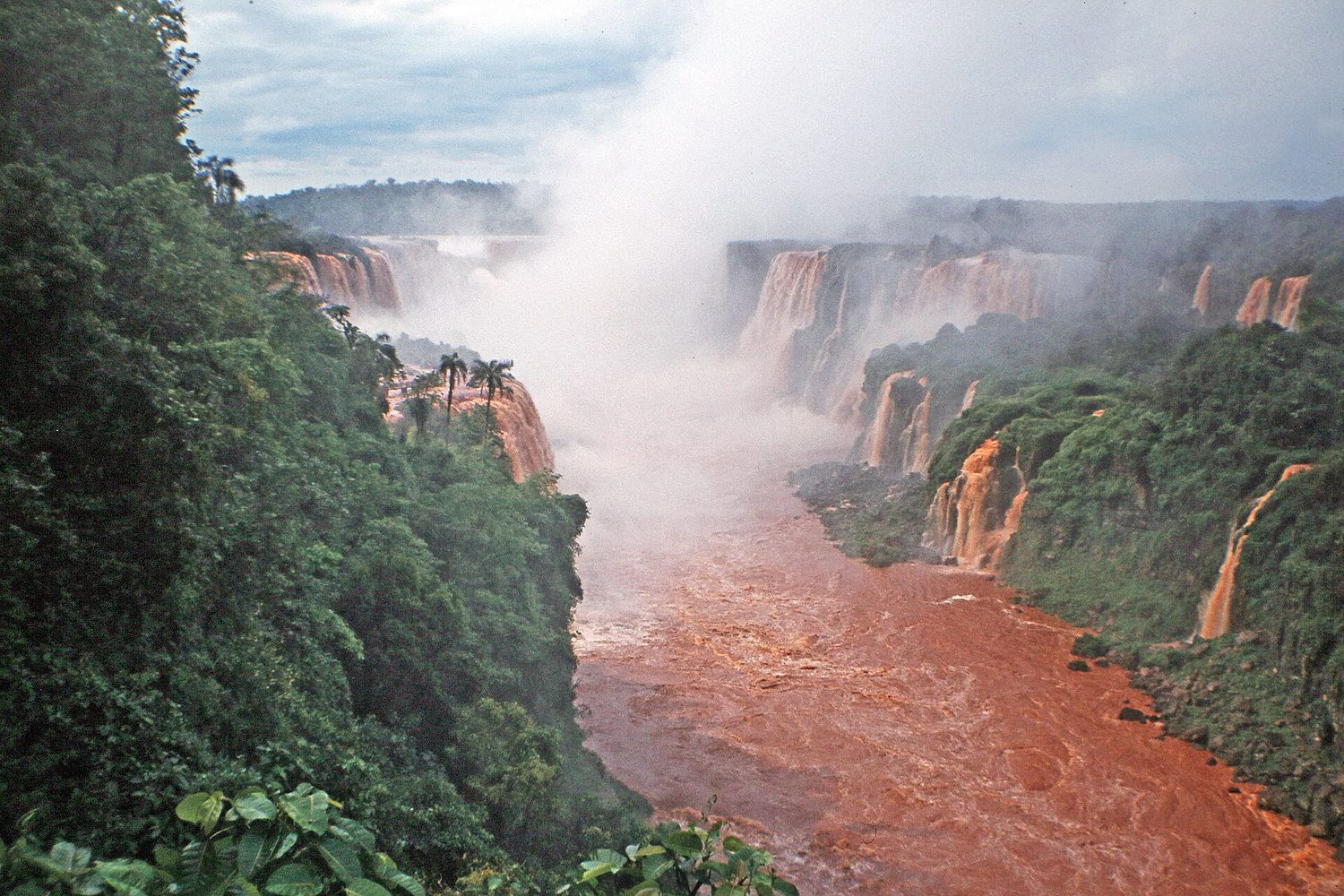
น้ำตก: กำลังคือความเร็วในการถ่ายโอนพลังงาน – การตกสูงเท่ากันในเวลาที่น้อยกว่าหมายถึงกำลังมากกว่า
Vocabulary · ⁨คำศัพท์⁩ Train · ⁨ฝึกฝน⁩
English ไทย
Power/ˈpaʊə/ กำลัง
watts/wɒts/ วัตต์
efficiency/ɪˈfɪʃənsi/ ประสิทธิภาพ
3.5

Exam tips · ⁨ข้อแนะนำสำหรับการสอบ⁩

English
  • Use $W=Fd\cos\theta$: work is zero when the force is perpendicular to the motion, and negative when it opposes it.
  • Reach for the work–energy theorem ($W_{\text{net}}=\Delta K$) or energy conservation ($K_1+U_1=K_2+U_2$) instead of forces whenever the path is complicated.
  • When friction acts, mechanical energy is not conserved — subtract the energy lost to heat.
  • Remember $K\propto v^2$: doubling the speed quadruples the kinetic energy (and the stopping distance).
  • Use $P=Fv$ for power at a steady speed; at constant velocity the net force is zero but the power is not.
ไทย
  • ใช้ $W=Fd\cos\theta$: งานจะเป็นศูนย์เมื่อแรงตั้งฉากกับการเคลื่อนที่ และเป็นลบเมื่อต้านการเคลื่อนที่
  • ใช้อธิบาย ทฤษฎีบทงาน-พลังงาน ($W_{\text{net}}=\Delta K$) หรือ การอนุรักษ์พลังงาน ($K_1+U_1=K_2+U_2$) แทนการใช้แรงเสมอเมื่อเส้นทางซับซ้อน
  • เมื่อมีแรงเสียดทาน พลังงานกลจะ ไม่ ถูกอนุรักษ์ – ให้ลบพลังงานที่สูญเสียไปเป็นความร้อนออก
  • จำ $K\propto v^2$ ได้: การเพิ่มความเร็วเป็นสองเท่าจะทำให้พลังงานจลน์เพิ่มขึ้น สี่เท่า (และระยะเบรกด้วย)
  • ใช้ $P=Fv$ สำหรับกำลังที่ความเร็วคงที่; ที่ความเร็วคงที่ แรงลัพธ์จะเป็นศูนย์แต่กำลังจะ ไม่ เป็นศูนย์

Interactive lessons on this topic · ⁨บทเรียนเชิงโต้ตอบสำหรับหัวข้อนี้⁩

Work through it step by step, with instant-check exercises. · ⁨ทำทีละขั้นตอน พร้อมแบบฝึกหัดตรวจสอบผลทันที⁩

Past Papers · ⁨ข้อสอบย้อนหลัง⁩

More topics in AP Physics 1 · ⁨หัวข้อเพิ่มเติมใน AP Physics 1⁩

Log in or create account · ⁨เข้าสู่ระบบหรือสร้างบัญชี⁩

IGCSE, A-Level & AP