Skip to content · ⁨ข้ามไปยังเนื้อหา⁩

Production, Cost, and the Perfect Competition Model · ⁨การผลิต ต้นทุน และโมเดลการแข่งขันสมบูรณ์⁩

AP Microeconomics · ⁨AP เศรษฐศาสตร์จุลภาค⁩ · Topic 3 · ⁨หัวข้อ 3⁩

Video lesson for this topic · ⁨บทเรียนวิดีโอสำหรับหัวข้อนี้⁩ Open the video page · ⁨เปิดหน้าวิดีโอ⁩
8:56

การผลิต ค่าใช้จ่าย และการแข่งขันแบบสมบูรณ์

จินตนาการถึงร้านเบเกอรี่ขนาดเล็กที่มีครัวเดียวและเตาอบหนึ่งเตา เมื่อจ้างลูกจ้างทำขนมคนแรก คุณจะได้ขนมปังเพิ่มวันละสามสิบก้อน จ้างคนที่สองจะได้เพิ่มอีกยี่สิบหกก้อน A…

English narration · English + 中文 subtitles burned in · ⁨การบรรยายภาษาอังกฤษ · คำบรรยายภาษาอังกฤษ + 中文 ลอยตัวบนภาพ⁩

3.1

The Production Function · ⁨ฟังก์ชันการผลิต⁩

Syllabus · ⁨หลักสูตร⁩
English

Enduring Understanding (PRD-1): Firms' production and cost constraints over different input and output levels shape optimal decisions in the short run and long run.

Learning Objective PRD-1.A: a. Define (using graphs where appropriate) key terms and concepts relating to production and cost. b. Explain (using graphs where appropriate) how production and cost are related in the short run and long run. c. Calculate (using data from a graph or table as appropriate) the various measures of productivity and short-run and long-run costs.

  • PRD-1.A.1 The production function explains the relationship between inputs and outputs both in the short run and the long run.
  • PRD-1.A.2 Marginal product and average product change as input usage changes, and hence, total product changes.
  • PRD-1.A.3 Diminishing marginal returns occur as the firm employs more of one input, holding other inputs constant, to produce a product (output) in the short run.
ไทย

ความเข้าใจที่ยั่งยืน (PRD-1): ข้อจำกัดด้านการผลิตและต้นทุนขององค์กรในระดับอินพุตและเอาท์พุตต่างๆ ส่งผลต่อการตัดสินใจที่เหมาะสมที่สุดในระยะสั้นและระยะยาว

วัตถุประสงค์การเรียนรู้ PRD-1.A: ก. นิยาม (โดยใช้กราฟเมื่อเหมาะสม) คำศัพท์และแนวคิดหลักที่เกี่ยวข้องกับการผลิตและต้นทุน ข. อธิบาย (โดยใช้กราฟเมื่อเหมาะสม) ความสัมพันธ์ระหว่างการผลิตและต้นทุนในระยะสั้นและระยะยาว ค. คำนวณ (โดยใช้ข้อมูลจากกราฟหรือตารางเมื่อเหมาะสม) ตัวชี้วัดต่าง ๆ ของผลผลิต และต้นทุนในระยะสั้นและระยะยาว

  • PRD-1.A.1 ฟังก์ชันการผลิตอธิบายความสัมพันธ์ระหว่างอินพุตและเอาท์พุต ทั้งในระยะสั้นและระยะยาว
  • PRD-1.A.2 ผลผลิตส่วนเพิ่มและผลผลิตเฉลี่ยเปลี่ยนแปลงตามการเปลี่ยนแปลงการใช้อินพุต ดังนั้นผลผลิตรวมจึงเปลี่ยนแปลงด้วย
  • PRD-1.A.3 การลดทอนลงของผลผลิตส่วนเพิ่มเกิดขึ้นเมื่อองค์กรใช้ปัจจัยการผลิตตัวหนึ่งมากขึ้น โดยคงปัจจัยอื่นไว้ เพื่อผลิตสินค้า (เอาท์พุต) ในระยะสั้น

Source: College Board AP Course and Exam Description · ⁨แหล่งที่มา: คำอธิบายหลักสูตรและข้อสอบ College Board AP⁩

English

The production function 生产函数 links inputs to output. In the short run 短期 at least one input (usually capital) is fixed 固定; in the long run 长期 all inputs vary.

  • Total product 总产量 is the total output.
  • Marginal product 边际产量 (MP) is the extra output from one more unit of a variable input (usually labor): $MP=\dfrac{\Delta\ \text{output}}{\Delta\ \text{labor}}$.
  • Average product 平均产量 is output per worker.

As you add workers to fixed capital, MP eventually falls – the law of diminishing marginal returns 边际收益递减法则. This shape of MP is what drives the shape of the cost curves below.

ไทย
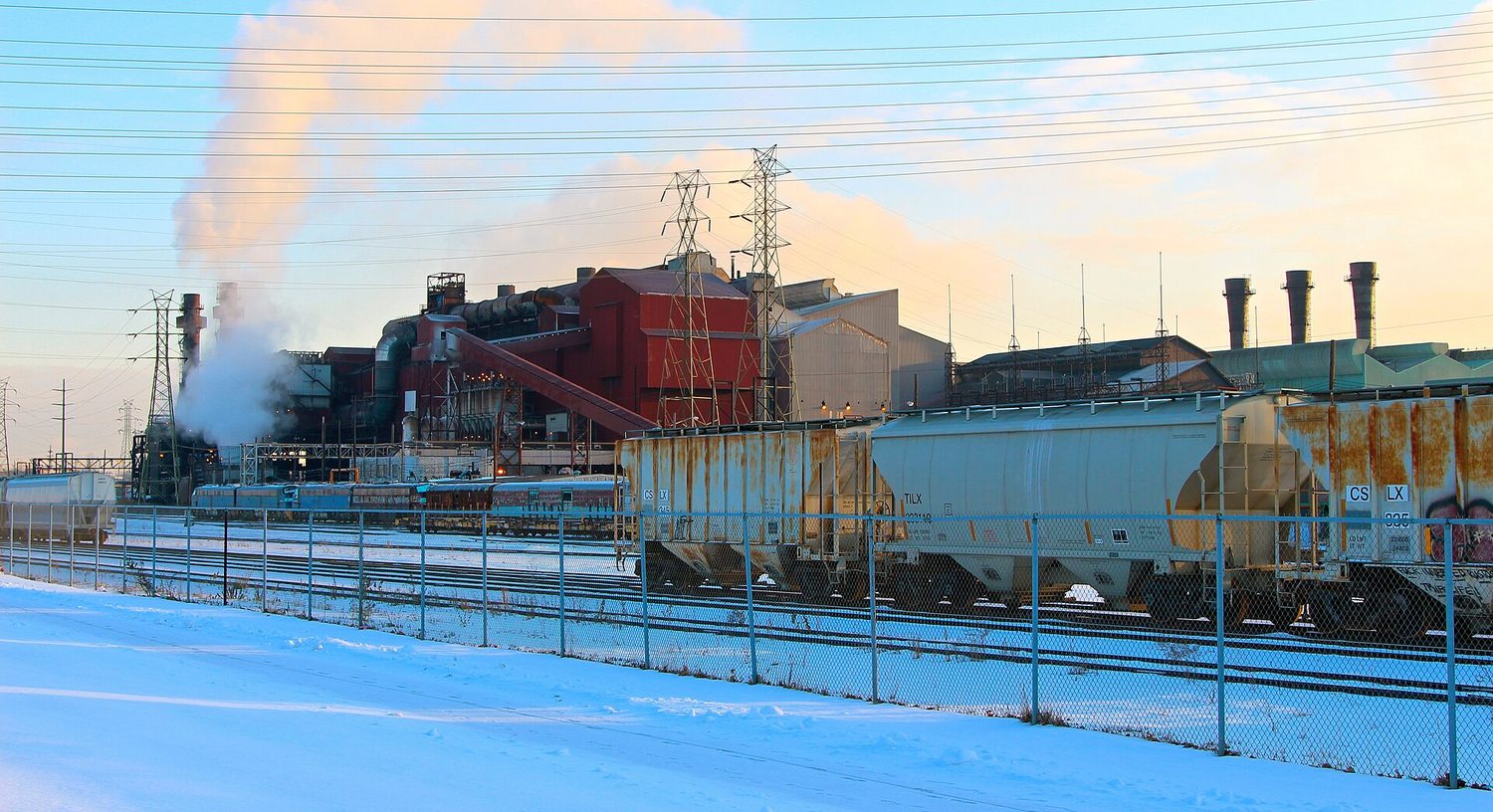
โรงงานเหล็ก: Production functions และ costs กำหนดวิธีการที่ firms จัดหาสินค้า

Production function เชื่อมโยง inputs เข้ากับ outputs. ใน short run อย่างน้อย one input (โดยทั่วไปคือ capital) เป็น fixed; ใน long run ทุก inputs เปลี่ยนแปลงได้

  • Total product คือผลผลิตรวม
  • ผลผลิตส่วนเพิ่ม (MP) คือผลผลิตเพิ่มเติมจากการใช้ตัวแปรการผลิตเพิ่มอีกหนึ่งหน่วย (มักจะเป็นแรงงาน): $MP=\dfrac{\Delta\ \text{output}}{\Delta\ \text{labor}}$
  • Average product คือ output ต่อ worker

เมื่อเพิ่ม workers เข้ากับ fixed capital, MP จะลดลงในที่สุด – law of diminishing marginal returns. รูปแบบของ MP นี้คือสิ่งที่ขับเคลื่อนรูปแบบของ cost curves ด้านล่าง

แขนหุ่นยนต์ทำงานบนสายการผลิตในโรงงาน
ฟังก์ชันการผลิตเปลี่ยนปัจจัยการผลิต — เช่น แรงงานและทุนอย่างหุ่นยนต์นี้ — ให้เป็นผลผลิต
Vocabulary · ⁨คำศัพท์⁩ Train · ⁨ฝึกฝน⁩
English ไทย
production function/prəˈdʌkʃn ˈfʌŋkʃn/ ฟังก์ชันการผลิต
short run/ʃɔːt rʌn/ ระยะสั้น
fixed/fɪkst/ คงที่
long run/lɒŋ rʌn/ ระยะยาว
Total product/ˈtəʊtl ˈprɒdʌkt/ ผลผลิตรวม
Marginal product/ˈmɑːdʒɪnl ˈprɒdʌkt/ ผลผลิตส่วนเพิ่ม
Average product/ˈævrɪdʒ ˈprɒdʌkt/ ผลผลิตเฉลี่ย
law of diminishing marginal returns/lɔː ɒv dɪˈmɪnɪʃɪŋ ˈmɑːdʒɪnl rɪˈtɜːnz/ กฎของการคืนผลส่วนเพิ่มที่ลดลง
Fixed cost/fɪkst kɒst/ ต้นทุนคงที่
Variable cost/ˈveərɪəbl kɒst/ ต้นทุนแปรผัน
3.2

Short-Run Production Costs · ⁨ต้นทุนการผลิตระยะสั้น⁩

Syllabus · ⁨หลักสูตร⁩
English

Enduring Understanding (PRD-1): Firms' production and cost constraints over different input and output levels shape optimal decisions in the short run and long run.

Learning Objective PRD-1.A: a. Define (using graphs where appropriate) key terms and concepts relating to production and cost. b. Explain (using graphs where appropriate) how production and cost are related in the short run and long run. c. Calculate (using data from a graph or table as appropriate) the various measures of productivity and short-run and long-run costs.

  • PRD-1.A.4 Fixed costs and variable costs determine the total cost.
  • PRD-1.A.5 Marginal cost, average (fixed, variable, and total) cost, total cost, and total variable cost change as total output changes, but total fixed cost remains constant at all output levels, including zero output.
  • PRD-1.A.6 Production functions with diminishing marginal returns yield an upward-sloping marginal cost curve.
  • PRD-1.A.7 Specialization and the division of labor reduce marginal costs for firms.
  • PRD-1.A.8 Cost curves can shift in response to changes in input costs and productivity.
ไทย

ความเข้าใจที่ยั่งยืน (PRD-1): ข้อจำกัดด้านการผลิตและต้นทุนขององค์กรในระดับอินพุตและเอาท์พุตต่างๆ ส่งผลต่อการตัดสินใจที่เหมาะสมที่สุดในระยะสั้นและระยะยาว

วัตถุประสงค์การเรียนรู้ PRD-1.A: ก. นิยาม (โดยใช้กราฟเมื่อเหมาะสม) คำศัพท์และแนวคิดหลักที่เกี่ยวข้องกับการผลิตและต้นทุน ข. อธิบาย (โดยใช้กราฟเมื่อเหมาะสม) ความสัมพันธ์ระหว่างการผลิตและต้นทุนในระยะสั้นและระยะยาว ค. คำนวณ (โดยใช้ข้อมูลจากกราฟหรือตารางเมื่อเหมาะสม) ตัวชี้วัดต่าง ๆ ของผลผลิต และต้นทุนในระยะสั้นและระยะยาว

  • PRD-1.A.4 ต้นทุนคงที่และต้นทุนแปรผันกำหนดต้นทุนรวม
  • PRD-1.A.5 ต้นทุนส่วนเพิ่ม ต้นทุนเฉลี่ย (คงที่, แปรผัน, และรวม), ต้นทุนรวม และต้นทุนแปรผันรวม เปลี่ยนแปลงตามการเปลี่ยนแปลงของผลผลิตรวม แต่ต้นทุนคงที่จะคงที่ตลอดทุกระดับของผลผลิต รวมถึงผลผลิตเป็นศูนย์
  • PRD-1.A.6 ฟังก์ชันการผลิตที่มีการลดทอนลงของผลผลิตส่วนเพิ่มจะให้เส้นโค้งต้นทุนส่วนเพิ่มที่มีแนวโน้มเพิ่มขึ้น
  • PRD-1.A.7 ความเชี่ยวชาญและการแบ่งงานช่วยลดต้นทุนส่วนเพิ่มสำหรับองค์กร
  • PRD-1.A.8 เส้นโค้งต้นทุนสามารถเคลื่อนย้ายได้เป็นการตอบสนองต่อการเปลี่ยนแปลงของต้นทุนอินพุตและผลผลิต

Source: College Board AP Course and Exam Description · ⁨แหล่งที่มา: คำอธิบายหลักสูตรและข้อสอบ College Board AP⁩

English
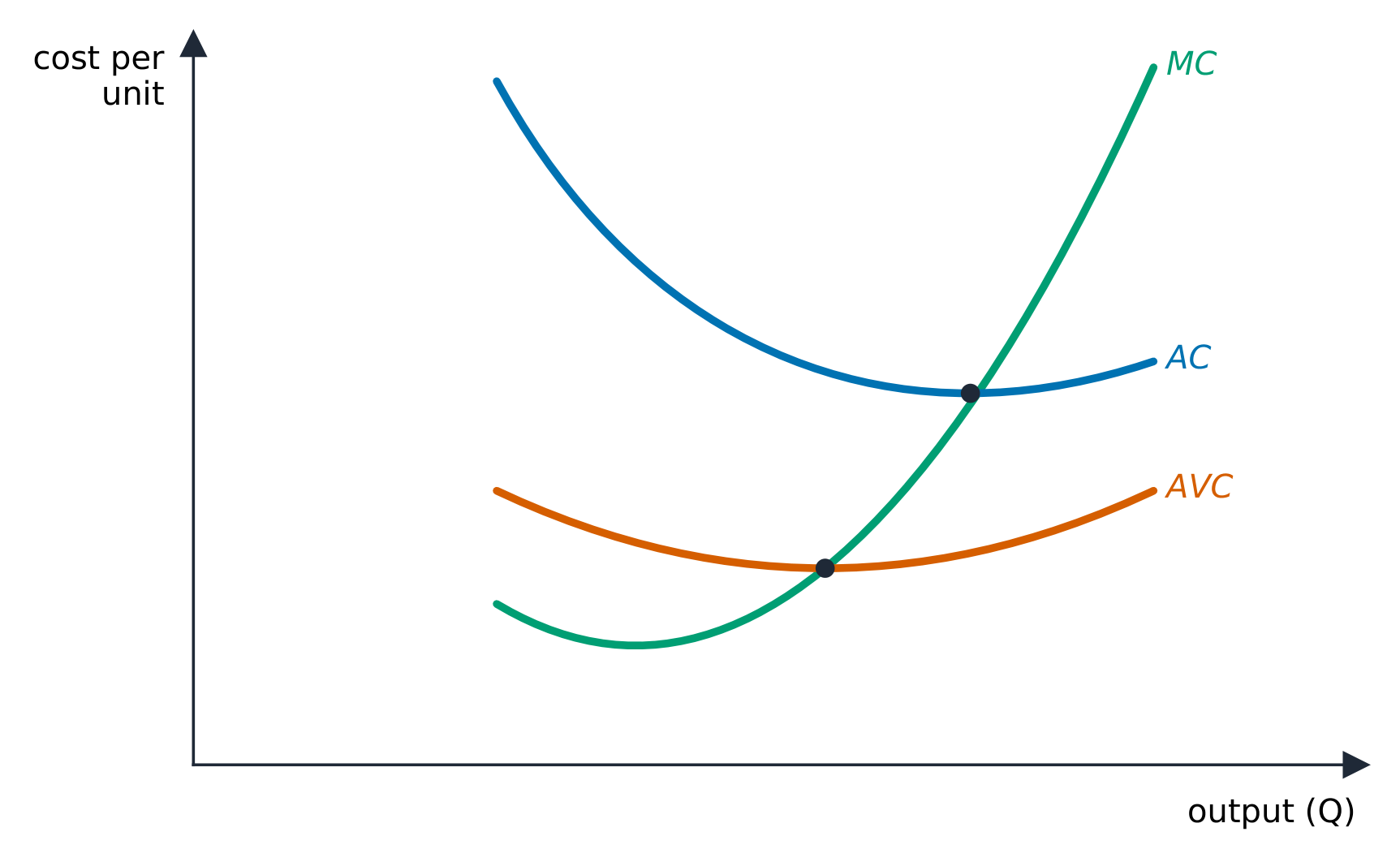
Short-run cost curves (MC, ATC, AVC)

Costs split into fixed and variable:

  • Fixed cost 固定成本 (FC) does not change with output (rent on the factory).
  • Variable cost 可变成本 (VC) rises with output (materials, labor).
  • Total cost 总成本 $TC=FC+VC$.

The per-unit costs matter most:

  • Average fixed cost $AFC=FC/Q$ falls continuously (spreading fixed cost).
  • Average variable cost $AVC=VC/Q$ and average total cost $ATC=TC/Q$ are U-shaped.
  • Marginal cost 边际成本 $MC=\dfrac{\Delta TC}{\Delta Q}$ is the cost of one more unit.

Two key facts: MC is the mirror image of MP (when MP rises, MC falls, and vice versa), and MC cuts both AVC and ATC at their minimum points (when marginal is below average, the average falls; when above, it rises).

Worked example. A firm has fixed cost $FC=\$100$. At $Q=10$ its total cost is $\$300$, so variable cost is $\$200$: then $ATC=\tfrac{300}{10}=\$30$, $AVC=\tfrac{200}{10}=\$20$, and $AFC=\tfrac{100}{10}=\$10$ (note $AFC+AVC=ATC$). If raising output to $Q=11$ pushes total cost to $\$325$, the marginal cost of that $11$th unit is $\dfrac{\Delta TC}{\Delta Q}=\dfrac{325-300}{1}=\$25$.

ไทย
เส้นต้นทุนระยะสั้น (MC, ATC, AVC)

ต้นทุนแบ่งออกเป็น คงที่ และ แปรผัน:

เส้นโค้งต้นทุนส่วนเพิ่ม ต้นทุนเฉลี่ย และต้นทุนแปรผันระยะสั้น
เส้นโค้งต้นทุนรวมส่วนเพิ่ม ส่วนเฉลี่ย และส่วนแปรผันระยะสั้น
  • ต้นทุนคงที่ (FC) ไม่เปลี่ยนแปลงตามปริมาณผลผลิต (ค่าเช่าโรงงาน)
  • ต้นทุนแปรผัน (VC) เพิ่มขึ้นตามปริมาณผลผลิต (วัตถุดิบ, แรงงาน)
  • ต้นทุนรวม $TC=FC+VC$.

ต้นทุนต่อหน่วยมีความสำคัญที่สุด:

  • ต้นทุนคงที่เฉลี่ย $AFC=FC/Q$ ลดลงอย่างต่อเนื่อง (การกระจายต้นทุนคงที่)
  • ต้นทุนแปรผันเฉลี่ย $AVC=VC/Q$ และ ต้นทุนรวมเฉลี่ย $ATC=TC/Q$ มีลักษณะเป็นรูปตัว U
  • ต้นทุนส่วนเพิ่ม $MC=\dfrac{\Delta TC}{\Delta Q}$ คือต้นทุนของหน่วยเพิ่มเติมหนึ่งหน่วย

ข้อเท็จจริงสำคัญสองประการ: MC เป็นภาพสะท้อนของ MP (เมื่อ MP เพิ่มขึ้น MC จะลดลง และในทางกลับกัน) และ MC ตัดทั้ง AVC และ ATC ที่จุดต่ำสุด (เมื่อส่วนเพิ่มอยู่ต่ำกว่าค่าเฉลี่ย ค่าเฉลี่ยจะลดลง; เมื่อสูงกว่า ค่าเฉลี่ยจะเพิ่มขึ้น)

ตัวอย่างวิธีทำ. บริษัทมีต้นทุนคงที่ $FC=\$100$. At $Q=10$ its total cost is $\$300$ ดังนั้นต้นทุนแปรผันคือ $\$200$: then $ATC=\tfrac{300}{10}=\$30$, $AVC=\tfrac{200}{10}=\$20$, and $AFC=\tfrac{100}{10}=\$10$ (สังเกต $AFC+AVC=ATC$). หากเพิ่มผลผลิตไปเป็น $Q=11$ ทำให้ต้นทุนรวมเป็น $\$325$, the marginal cost of that $11$th unit is $\dfrac{\Delta TC}{\Delta Q}=\dfrac{325-300}{1}=\$25$.

Explore · ⁨สำรวจ⁩

Explore the U-shaped cost curves · ⁨สำรวจเส้นโค้งต้นทุนรูปตัว U⁩

As output rises, marginal cost eventually climbs (diminishing returns) and cuts through the U-shaped average cost at its minimum — the most efficient scale. · ⁨เมื่อผลผลิตเพิ่มขึ้น ต้นทุนเชิงพจน์ ในที่สุดก็จะเพิ่มขึ้น (จากผลลดถอย) และตัดผ่าน ต้นทุนเฉลี่ย รูปตัว U ที่จุดต่ำสุด — ซึ่งเป็นขนาดการผลิตที่มีประสิทธิภาพที่สุด⁩

Vocabulary · ⁨คำศัพท์⁩ Train · ⁨ฝึกฝน⁩
English ไทย
Total cost/ˈtəʊtl kɒst/ ต้นทุนรวม
Marginal cost/ˈmɑːdʒɪnl kɒst/ ต้นทุนส่วนเพิ่ม
3.3

Long-Run Production Costs · ⁨ต้นทุนการผลิตระยะยาว⁩

Syllabus · ⁨หลักสูตร⁩
English

Enduring Understanding (PRD-1): Firms' production and cost constraints over different input and output levels shape optimal decisions in the short run and long run.

Learning Objective PRD-1.A: a. Define (using graphs where appropriate) key terms and concepts relating to production and cost. b. Explain (using graphs where appropriate) how production and cost are related in the short run and long run. c. Calculate (using data from a graph or table as appropriate) the various measures of productivity and short-run and long-run costs.

  • PRD-1.A.9 In the long run, firms can adjust all their inputs, and as a result, all costs become variable.
  • PRD-1.A.10 The relationship between inputs and outputs in the long run is described by the scale of production—increasing, decreasing, or constant returns to scale.
  • PRD-1.A.11 The long-run average total cost is characterized by economies of scale, diseconomies of scale, or constant returns to scale (efficient scale).
  • PRD-1.A.12 The minimum efficient scale plays a role in determining the concentration of firms in a market and the market structure.
ไทย

ความเข้าใจที่ยั่งยืน (PRD-1): ข้อจำกัดด้านการผลิตและต้นทุนขององค์กรในระดับอินพุตและเอาท์พุตต่างๆ ส่งผลต่อการตัดสินใจที่เหมาะสมที่สุดในระยะสั้นและระยะยาว

วัตถุประสงค์การเรียนรู้ PRD-1.A: ก. นิยาม (โดยใช้กราฟเมื่อเหมาะสม) คำศัพท์และแนวคิดหลักที่เกี่ยวข้องกับการผลิตและต้นทุน ข. อธิบาย (โดยใช้กราฟเมื่อเหมาะสม) ความสัมพันธ์ระหว่างการผลิตและต้นทุนในระยะสั้นและระยะยาว ค. คำนวณ (โดยใช้ข้อมูลจากกราฟหรือตารางเมื่อเหมาะสม) ตัวชี้วัดต่าง ๆ ของผลผลิต และต้นทุนในระยะสั้นและระยะยาว

  • PRD-1.A.9 ในระยะยาว องค์กรสามารถปรับเปลี่ยนปัจจัยการผลิตทั้งหมดของตนได้ ดังนั้นต้นทุนทั้งหมดจึงกลายเป็นต้นทุนแปรผัน
  • PRD-1.A.10 ความสัมพันธ์ระหว่างอินพุตและเอาท์พุตในระยะยาวอธิบายได้ด้วยขนาดการผลิต—ผลผลิตส่วนเพิ่ม, ผลผลิตลดทอน, หรือผลผลิตคงที่
  • PRD-1.A.11 ต้นทุนเฉลี่ยรวมในระยะยาวมีลักษณะเฉพาะโดย economies of scale, diseconomies of scale, หรือผลผลิตคงที่ (ขนาดที่มีประสิทธิภาพ)
  • PRD-1.A.12 ขนาดที่มีประสิทธิภาพต่ำสุด (minimum efficient scale) มีบทบาทในการกำหนดความเข้มข้นขององค์กรในตลาดและโครงสร้างตลาด

Source: College Board AP Course and Exam Description · ⁨แหล่งที่มา: คำอธิบายหลักสูตรและข้อสอบ College Board AP⁩

English

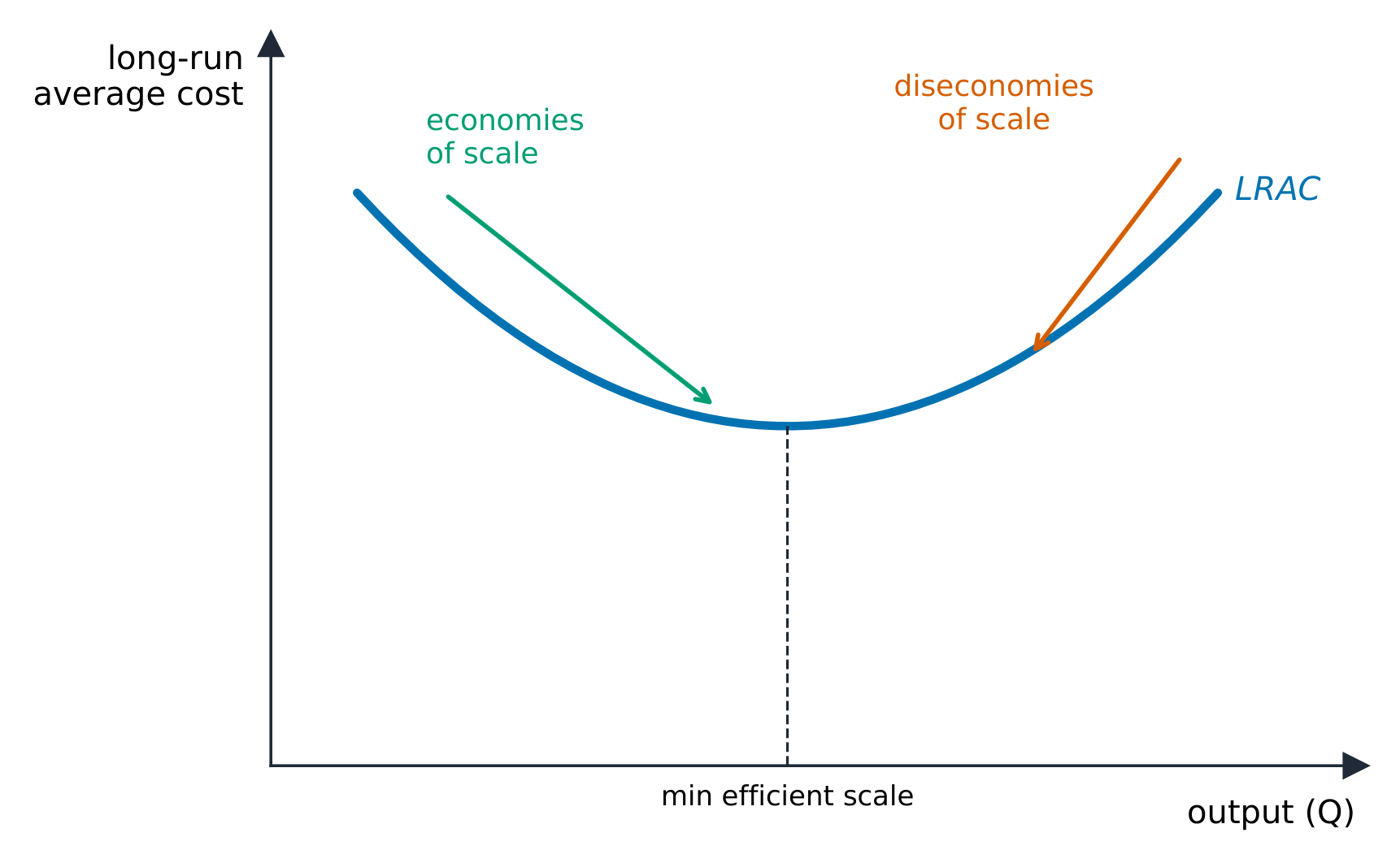
In the long run all inputs – including plant size – can change, so only the long-run average total cost (LRATC) curve matters. Its shape shows returns to scale:

  • Economies of scale 规模经济: LRATC falls as output grows (bulk buying, specialization).
  • Constant returns to scale: LRATC flat.
  • Diseconomies of scale 规模不经济: LRATC rises (a firm too big to manage well).

Exam skill: know that "diminishing returns" is a short-run idea (one fixed input) while "economies of scale" is a long-run idea (all inputs vary) – examiners test the distinction.

ไทย

ในระยะยาว ปัจจัยทั้งหมด – รวมถึงขนาดโรงงาน – สามารถเปลี่ยนแปลงได้ ดังนั้นจึงมีเพียงเส้นโค้ง ต้นทุนรวมเฉลี่ยระยะยาว (LRATC) เท่านั้นที่สำคัญ รูปร่างของมันแสดงถึง ผลตอบแทนต่อขนาดการผลิต:

ประโยชน์และผลเสียจากเศรษฐกิจต่อขนาดการผลิตบนเส้นโค้งต้นทุนเฉลี่ยระยะยาว
  • ประหยัดต่อขนาดการผลิต: LRATC ลดลงเมื่อผลผลิตเพิ่มขึ้น (การซื้อจำนวนมาก, การแบ่งแยกความเชี่ยวชาญ)
  • ผลตอบแทนต่อขนาดการผลิตคงที่: LRATC เป็นเส้นราบ
  • ไม่ประหยัดต่อขนาดการผลิต: LRATC เพิ่มขึ้น (บริษัทที่ใหญ่เกินไปจนบริหารจัดการไม่ดี)

ทักษะในการสอบ: ต้องรู้ว่า "การลดทอนผลตอบแทน" เป็นแนวคิด ระยะสั้น (มีปัจจัยคงที่หนึ่งตัว) ในขณะที่ "ประหยัดต่อขนาดการผลิต" เป็นแนวคิด ระยะยาว (ปัจจัยทั้งหมดแปรผัน) – ผู้สอบจะทดสอบความแตกต่างนี้

Vocabulary · ⁨คำศัพท์⁩ Train · ⁨ฝึกฝน⁩
English ไทย
Economies of scale/ɪˈkɒnəmiz ɒv skeɪl/ เศรษฐกิจของขนาด
Diseconomies of scale/ˌdɪsɪˈkɒnəmiz ɒv skeɪl/ Diseconomies of scale
Explicit costs/ekˈsplɪsɪt kɒsts/ ค่าใช้จ่ายที่เห็นได้ชัด
implicit costs/ɪmˈplɪsɪt kɒsts/ ต้นทุนโดยนัย
Accounting profit/əˈkaʊntɪŋ ˈprɒfɪt/ กำไรทางบัญชี
Economic profit/ˌiːkəˈnɒmɪk ˈprɒfɪt/ กำไรทางเศรษฐศาสตร์
normal profit/ˈnɔːml ˈprɒfɪt/ กำไรปกติ
entry/ˈentri/ เข้าสู่ตลาด
exit/ˈeɡzɪt/ ออกนอกตลาด
perfectly competitive/ˈpɜːfektlɪ kəmˈpetɪtɪv/ การแข่งขันสมบูรณ์
price taker/praɪs ˈteɪkə/ ผู้รับราคา
allocatively efficient/ˈæləkətɪvli ɪˈfɪʃənt/ allocatively efficient
productively efficient/prəˈdʌktɪvli ɪˈfɪʃənt/ ประสิทธิภาพในการผลิต
3.4

Types of Profit · ⁨ประเภทของกำไร⁩

Syllabus · ⁨หลักสูตร⁩
English

Enduring Understanding (CBA-2): To determine the optimal level at which to pursue an activity whose total benefits exceed total cost, rational economic agents compare marginal benefits and marginal costs.

Learning Objective CBA-2.C: a. Define the different types of profit. b. Explain how firms respond to profit opportunities. c. Calculate a firm's profit or loss.

  • CBA-2.C.1 Firms respond to economic profit (loss) rather than accounting profit.
  • CBA-2.C.2 Accounting profit fails to account for implicit costs (such as cost of financial capital, compensation for risk, or an entrepreneur's time), which, if fully compensated, result in normal profit.
ไทย

ความเข้าใจที่ยั่งยืน (CBA-2): เพื่อระบุระดับที่เหมาะสมในการดำเนินกิจกรรมซึ่งผลได้รวมเกินกว่าต้นทุนรวม ตัวแทนทางเศรษฐกิจที่มีเหตุผลจะเปรียบเทียบผลได้ส่วนเพิ่มและต้นทุนส่วนเพิ่ม

วัตถุประสงค์การเรียนรู้ CBA-2.C: ก. นิยามประเภทของกำไรที่แตกต่างกัน ข. อธิบายว่าองค์กรตอบสนองต่อโอกาสทางกำไรได้อย่างไร ค. คำนวณกำไรหรือขาดทุนขององค์กร

  • CBA-2.C.1 องค์กรตอบสนองต่อกำไรทางเศรษฐกิจ (หรือขาดทุน) มากกว่ากำไรทางบัญชี
  • CBA-2.C.2 กำไรทางบัญชีไม่คำนึงถึงต้นทุนนัยยะ (เช่น ต้นทุนของเงินทุน, ค่าตอบแทนความเสี่ยง, หรือเวลาของนักธุรกิจ) ซึ่งหากชดเชยเต็มจำนวนแล้วจะทำให้เกิดกำไรปกติ

Source: College Board AP Course and Exam Description · ⁨แหล่งที่มา: คำอธิบายหลักสูตรและข้อสอบ College Board AP⁩

English

Economists count all opportunity costs, including the owner's:

  • Explicit costs 显性成本 are out-of-pocket payments; implicit costs 隐性成本 are the opportunity costs of owner-supplied resources (forgone salary, forgone interest).
  • Accounting profit 会计利润 $=$ revenue $-$ explicit costs.
  • Economic profit 经济利润 $=$ revenue $-$ explicit $-$ implicit costs.

Because economic profit subtracts more, it is smaller. Zero economic profit (a normal profit 正常利润) still means the owner is earning exactly the opportunity cost of their resources – a perfectly acceptable outcome.

Worked example. A shopkeeper takes in $\$200{,}000$ of revenue and pays $\$120{,}000$ in explicit costs, so accounting profit is $\$80{,}000$. But she gave up a $\$70{,}000$ salary elsewhere and $\$5{,}000$ of interest on the savings she invested – $\$75{,}000$ of implicit costs. Her economic profit is $80{,}000-75{,}000=\$5{,}000$: still positive, so staying in business genuinely beats her next-best alternative.

ไทย

นักเศรษฐศาสตร์นับ ทุก โอกาสLost cost รวมถึงของผู้เจ้าของ:

  • ต้นทุนชัดแจ้ง คือเงินจ่ายออกจริง; ต้นทุนแฝง คือโอกาสLost cost ของทรัพยากรที่เจ้าของจัดเตรียมเอง (เงินเดือนที่พลาดไป, ดอกเบี้ยที่พลาดไป)
  • กำไรบัญชี $=$ รายรับ $-$ ต้นทุนชัดแจ้ง
  • กำไรทางเศรษฐศาสตร์ $=$ รายรับ $-$ ต้นทุนชัดแจ้ง $-$ ต้นทุนแฝง

เนื่องจากกำไรทางเศรษฐศาสตร์หักค่าใช้จ่ายมากกว่า จึงมีค่าน้อยกว่า กำไรทางเศรษฐศาสตร์เป็นศูนย์ (กำไรปกติ) ยังหมายถึงเจ้าของได้รับเท่ากับโอกาสLost cost ของทรัพยากรของตนพอดี – ซึ่งเป็นผลลัพธ์ที่ยอมรับได้อย่างสมบูรณ์แบบ

ตัวอย่างวิธีทำ. เจ้าของร้านรับรายได้ $\$200{,}000$ of revenue and pays $\$120{,}000$ ในต้นทุนชัดแจ้ง ดังนั้น กำไรบัญชี คือ $\$80{,}000$. But she gave up a $\$70{,}000$ เงินเดือนในที่อื่น และ $\$5{,}000$ of interest on the savings she invested – $\$75{,}000$ ของ ต้นทุนแฝง กำไรทางเศรษฐศาสตร์ ของเธอคือ $80{,}000-75{,}000=\$5{,}000$: ยังเป็นบวก ดังนั้นการดำเนินธุรกิจยังคงดีกว่าทางเลือกที่ดีที่สุดถัดของเธออย่างแท้จริง

3.5

Profit Maximization · ⁨การสร้างกำไรสูงสุด⁩

Syllabus · ⁨หลักสูตร⁩
English

Enduring Understanding (CBA-2): To determine the optimal level at which to pursue an activity whose total benefits exceed total cost, rational economic agents compare marginal benefits and marginal costs.

Learning Objective CBA-2.D: a. Define (using graphs or data as appropriate) the profit-maximizing rule. b. Explain (using a graph or data as appropriate) the profit-maximizing level of production.

  • CBA-2.D.1 Firms are assumed to produce output to maximize their profits by comparing marginal revenue and marginal cost.
ไทย

ความเข้าใจที่ยั่งยืน (CBA-2): เพื่อระบุระดับที่เหมาะสมในการดำเนินกิจกรรมซึ่งผลได้รวมเกินกว่าต้นทุนรวม ตัวแทนทางเศรษฐกิจที่มีเหตุผลจะเปรียบเทียบผลได้ส่วนเพิ่มและต้นทุนส่วนเพิ่ม

วัตถุประสงค์การเรียนรู้ CBA-2.D: ก. นิยาม (โดยใช้กราฟหรือข้อมูลเมื่อเหมาะสม) กฎการทำให้กำไรสูงสุด ข. อธิบาย (โดยใช้กราฟหรือข้อมูลเมื่อเหมาะสม) ระดับการผลิตที่ทำให้กำไรสูงสุด

  • CBA-2.D.1 องค์กรถูกสมมติว่าผลิตเอาท์พุตเพื่อทำให้กำไรสูงสุดโดยการเปรียบเทียบรายได้ส่วนเพิ่มกับต้นทุนส่วนเพิ่ม

Source: College Board AP Course and Exam Description · ⁨แหล่งที่มา: คำอธิบายหลักสูตรและข้อสอบ College Board AP⁩

English

Every firm, in every market structure, maximizes profit at the quantity where marginal revenue equals marginal cost:

$$MR=MC.$$
Produce each unit whose MR exceeds its MC; stop when they are equal. Producing less leaves profitable units unmade; producing more adds units that cost more than they earn.

ไทย

บริษัททุกแห่ง ในทุกโครงสร้างตลาด สร้างกำไรสูงสุดที่ปริมาณที่ รายได้ส่วนเพิ่มเท่ากับต้นทุนส่วนเพิ่ม:

$$MR=MC.$$
ผลิตแต่ละหน่วยwhose MR สูงกว่า MC; หยุดเมื่อเท่ากัน การผลิตน้อยกว่าทำให้หน่วยที่มีกำไรไม่ถูกผลิต; การผลิตมากกว่าเพิ่มหน่วยที่成本高กว่าที่มันสร้างรายได้

3.6

Deciding to Produce, Enter, or Exit · ⁨การตัดสินใจผลิต เข้า หรือ ออกจากตลาด⁩

Syllabus · ⁨หลักสูตร⁩
English

Enduring Understanding (PRD-2): Firms' short-run decisions to produce output, and long-run decisions to enter or exit a market, are based on profitability.

Learning Objective PRD-2.A: Explain (using graphs or data where appropriate) firms' short-run decisions to produce positive output levels, or long-run decisions to enter or exit a market in response to profit-making opportunities.

  • PRD-2.A.1 In the short run, firms decide to operate (i.e., produce positive output) or shut down (i.e., produce zero output) by comparing total revenue to total variable cost or price to average variable cost (AVC).
  • PRD-2.A.2 In the absence of barriers to entry or exit, in the long run (i.e., once factors that are fixed in the short run become variable), firms enter a market in which there are profit-making opportunities and exit a market when they anticipate economic losses.
ไทย

ความเข้าใจที่ยั่งยืน (PRD-2): การตัดสินใจในระยะสั้นขององค์กรในการผลิตเอาท์พุต และการตัดสินใจในระยะยาวในการเข้าสู่หรือออกจากตลาด นั้นขึ้นอยู่กับความคุ้มค่าทางกำไร

วัตถุประสงค์การเรียนรู้ PRD-2.A: อธิบาย (โดยใช้กราฟหรือข้อมูลเมื่อเหมาะสม) การตัดสินใจในระยะสั้นขององค์กรในการผลิตระดับเอาท์พุตที่เป็นบวก หรือการตัดสินใจในระยะยาวในการเข้าสู่หรือออกจากตลาด เพื่อตอบสนองต่อโอกาสทางกำไร

  • PRD-2.A.1 ในระยะสั้น องค์กรตัดสินใจดำเนินการ ( tức ผลิตเอาท์พุตที่เป็นบวก ) หรือหยุดผลิต ( tức ผลิตเอาท์พุตเป็นศูนย์ ) โดยการเปรียบเทียบรายได้รวมกับต้นทุนแปรผันรวม หรือราคาเทียบกับต้นทุนแปรผันเฉลี่ย (AVC)
  • PRD-2.A.2 เมื่อไม่มีอุปสรรคต่อการเข้าสู่หรือออกจากตลาด ในระยะยาว (即 เมื่อปัจจัยที่คงที่ในระยะสั้นกลายเป็นแปรผัน) องค์กรจะเข้าสู่ตลาดที่มีโอกาสทำกำไร และออกจากตลาดเมื่อคาดการณ์ว่าจะเกิดขาดทุนทางเศรษฐกิจ

Source: College Board AP Course and Exam Description · ⁨แหล่งที่มา: คำอธิบายหลักสูตรและข้อสอบ College Board AP⁩

English

Even at $MR=MC$, a firm must check whether to operate:

  • Short run – the shutdown rule: keep producing only if price covers average variable cost ($P\geq AVC$). If $P, shut down and lose only fixed cost. So the firm's short-run supply curve is its MC curve above minimum AVC.
  • Profit check: compare $P$ to $ATC$ at the profit-maximizing quantity – $P>ATC$ means economic profit, $P means a loss, $P=ATC$ means break-even.
  • Long run – entry and exit: economic profits attract entry 进入; losses cause exit 退出. This continues until economic profit is zero.
ไทย

แม้ที่ $MR=MC$ บริษัทก็ต้องตรวจสอบว่าควรดำเนินการหรือไม่:

  • ระยะสั้น – กฎการหยุดดำเนินการ: ผลิตต่อก็ต่อเมื่อราคาครอบคลุม ต้นทุนแปรผันเฉลี่ย ($P\geq AVC$). หาก $P ให้หยุดผลิตและขาดทุนเพียงต้นทุนคงที่ ดังนั้นเส้นอุปทานระยะสั้นของบริษัทคือ MC curve ที่อยู่เหนือจุดต่ำสุดของ AVC.
  • ตรวจสอบกำไร: เปรียบเทียบ $P$ กับ $ATC$ ที่ปริมาณสร้างกำไรสูงสุด – $P>ATC$ หมายถึง กำไรทางเศรษฐศาสตร์, $P หมายถึง ขาดทุน, $P=ATC$ หมายถึง.ico break-even.
  • ระยะยาว – การเข้าและออกจากตลาด: กำไรทางเศรษฐศาสตร์ดึงดูด การเข้า; ขาดทุนทำให้ การออก. นี้จะดำเนินต่อไปจนกำไรทางเศรษฐศาสตร์เป็นศูนย์
3.7

Perfect Competition · ⁨ตลาดการแข่งขันสมบูรณ์⁩

Syllabus · ⁨หลักสูตร⁩
English

Enduring Understanding (PRD-3): Even with a common goal of profit-maximization, market structure constrains and influences prices, output, and efficiency.

Learning Objective PRD-3.A: a. Define (using graphs as appropriate) the characteristics of perfectly competitive markets and efficiency. b. Explain (using graphs where appropriate) equilibrium and firm decision making in perfectly competitive markets and how prices in perfectly competitive markets lead to efficient outcomes. c. Calculate (using data from a graph or table as appropriate) economic profit (loss) in perfectly competitive markets.

  • PRD-3.A.1 A perfectly competitive market is efficient. Firms in perfectly competitive markets face no barriers to entry and have no market power.
  • PRD-3.A.2 In perfectly competitive markets, prices communicate to consumers and producers the magnitude of others' marginal costs of production and marginal benefits of consumption and provide incentives to act on that information (i.e., price equals marginal cost in an efficient market).
  • PRD-3.A.3 In perfectly competitive markets, firms can sell all their outputs at a constant price determined by the market.
  • PRD-3.A.4 At a competitive market equilibrium, firms are price takers and select output to maximize profit by producing the level of output where the marginal cost equals marginal revenue (at the price).
  • PRD-3.A.5 At a competitive market equilibrium, the price of a product equals both the private marginal benefit received by the last unit consumed and the private marginal cost incurred to produce the last unit, thus achieving allocative efficiency.
  • PRD-3.A.6 In a short-run competitive equilibrium, price can either be above or below its long-run competitive level resulting in profits or losses, motivating entry or exit of firms and moving prices and quantities toward long-run equilibrium.
  • PRD-3.A.7 In a long-run perfectly competitive equilibrium, productive efficiency implies all operating firms produce at efficient scale, price equals marginal cost and minimum average total cost, and firms earn zero economic profit.
  • PRD-3.A.8 Firms may be in a constant cost, increasing cost, or decreasing cost industry. Long-run prices depend on the portion of the long-run cost curves on which firms operate.
  • PRD-3.A.9 A perfectly competitive market in long-run equilibrium is allocatively and productively efficient.
ไทย

ความเข้าใจที่ยั่งยืน (PRD-3): แม้จะมีเป้าหมายร่วมกันคือการทำให้กำไรสูงสุด โครงสร้างตลาดก็จำกัดและมีอิทธิพลต่อราคา outputs และประสิทธิภาพ

วัตถุประสงค์การเรียนรู้ PRD-3.A: ก. นิยาม (โดยใช้กราฟเมื่อเหมาะสม) ลักษณะของตลาดแข่งขันสมบูรณ์และประสิทธิภาพ ข. อธิบาย (โดยใช้กราฟเมื่อเหมาะสม) สภาวะสมดุลและการตัดสินใจขององค์กรในตลาดแข่งขันสมบูรณ์以及如何使ราคาในตลาดแข่งขันสมบูรณ์นำไปสู่ผลลัพธ์ที่มีประสิทธิภาพ ค. คำนวณ (โดยใช้ข้อมูลจากกราฟหรือตารางเมื่อเหมาะสม) กำไรทางเศรษฐกิจ (หรือขาดทุน) ในตลาดแข่งขันสมบูรณ์

  • PRD-3.A.1 ตลาดแข่งขันสมบูรณ์มีประสิทธิภาพ องค์กรในตลาดแข่งขันสมบูรณ์เผชิญกับอุปสรรคต่อการเข้าไม่มี และไม่มีอำนาจตลาด
  • PRD-3.A.2 ในตลาดแข่งขันสมบูรณ์ ราคาสื่อสารไปยังผู้บริโภคและผู้ผลิตเกี่ยวกับขนาดของต้นทุนส่วนเพิ่มของการผลิตและประโยชน์ส่วนเพิ่มจากการบริโภคของผู้อื่น และให้แรงจูงใจในการกระทำตามข้อมูลนั้น (即 ราคาเท่ากับต้นทุนส่วนเพิ่มในตลาดที่มีประสิทธิภาพ)
  • PRD-3.A.3 ในตลาดแข่งขันสมบูรณ์ องค์กรสามารถขายเอาท์พุตทั้งหมดของตนได้ในราคาที่คงที่ซึ่งกำหนดโดยตลาด
  • PRD-3.A.4 ที่สภาวะสมดุลของตลาดแข่งขัน องค์กรเป็นผู้รับราคาและเลือกเอาท์พุตเพื่อทำให้กำไรสูงสุดโดยการผลิตในระดับเอาท์พุตที่ต้นทุนส่วนเพิ่มเท่ากับรายได้ส่วนเพิ่ม (ที่ราคา)
  • PRD-3.A.5 ในภาวะสมดุลของตลาดที่แข่งขันกัน ราคาของสินค้าจะเท่ากับทั้งประโยชน์ส่วนเพิ่มส่วนบุคคลที่ได้รับจากหน่วยสุดท้ายที่ถูกบริโภค และต้นทุนส่วนเพิ่มส่วนบุคคลที่เกิดขึ้นจากการผลิตหน่วยสุดท้าย ดังนั้นจึงเกิดประสิทธิภาพในการจัดสรรทรัพยากร
  • PRD-3.A.6 ในภาวะสมดุลระยะสั้นของตลาดที่แข่งขันกัน ราคาอาจอยู่สูงกว่าหรือต่ำกว่าระดับสมดุลระยะยาว ทำให้เกิดกำไรหรือขาดทุน ซึ่งกระตุ้นให้บริษัทเข้าหรือออกจากตลาด และทำให้ราคาและปริมาณการผลิตเคลื่อนที่เข้าสู่ภาวะสมดุลระยะยาว
  • PRD-3.A.7 ในภาวะสมดุลการแข่งขันสมบูรณ์ระยะยาว ประสิทธิภาพในการผลิตหมายถึง บริษัททั้งหมดที่ดำเนินธุรกิจผลิตที่ขนาดที่มีประสิทธิภาพ ราคาเท่ากับต้นทุนส่วนเพิ่มและค่าเฉลี่ยรวมต่ำสุดที่สุด และบริษัทได้รับกำไรทางเศรษฐกิจเป็นศูนย์
  • PRD-3.A.8 บริษัทอาจอยู่ในอุตสาหกรรมที่มีต้นทุนคงที่ ต้นทุนเพิ่มขึ้น หรือต้นทุนลดลง ราคาในระยะยาวขึ้นอยู่กับส่วนของเส้นโค้งต้นทุนระยะยาวที่บริษัทดำเนินการ
  • PRD-3.A.9 ตลาดที่แข่งขันสมบูรณ์ในภาวะสมดุลระยะยาวมีประสิทธิภาพทั้งในการจัดสรรทรัพยากรและการผลิต

Source: College Board AP Course and Exam Description · ⁨แหล่งที่มา: คำอธิบายหลักสูตรและข้อสอบ College Board AP⁩

English

A perfectly competitive 完全竞争 market has many small firms, an identical (homogeneous) product, free entry and exit, and perfect information. Each firm is a price taker 价格接受者 – too small to affect the price – so it faces a horizontal demand curve at the market price, and price = marginal revenue = average revenue ($P=MR=AR$).

This is why economists prize perfect competition. In long-run equilibrium it is both allocatively efficient 配置效率 and productively efficient 生产效率. Allocative efficiency holds because the firm produces where $P = MC$: the price (society's marginal benefit from the last unit) equals its marginal cost, so exactly the right amount is made. Productive efficiency holds because free entry drives price down to the minimum of average total cost, so goods are made as cheaply as possible. The market price is itself a signal that communicates everyone's marginal costs and benefits.

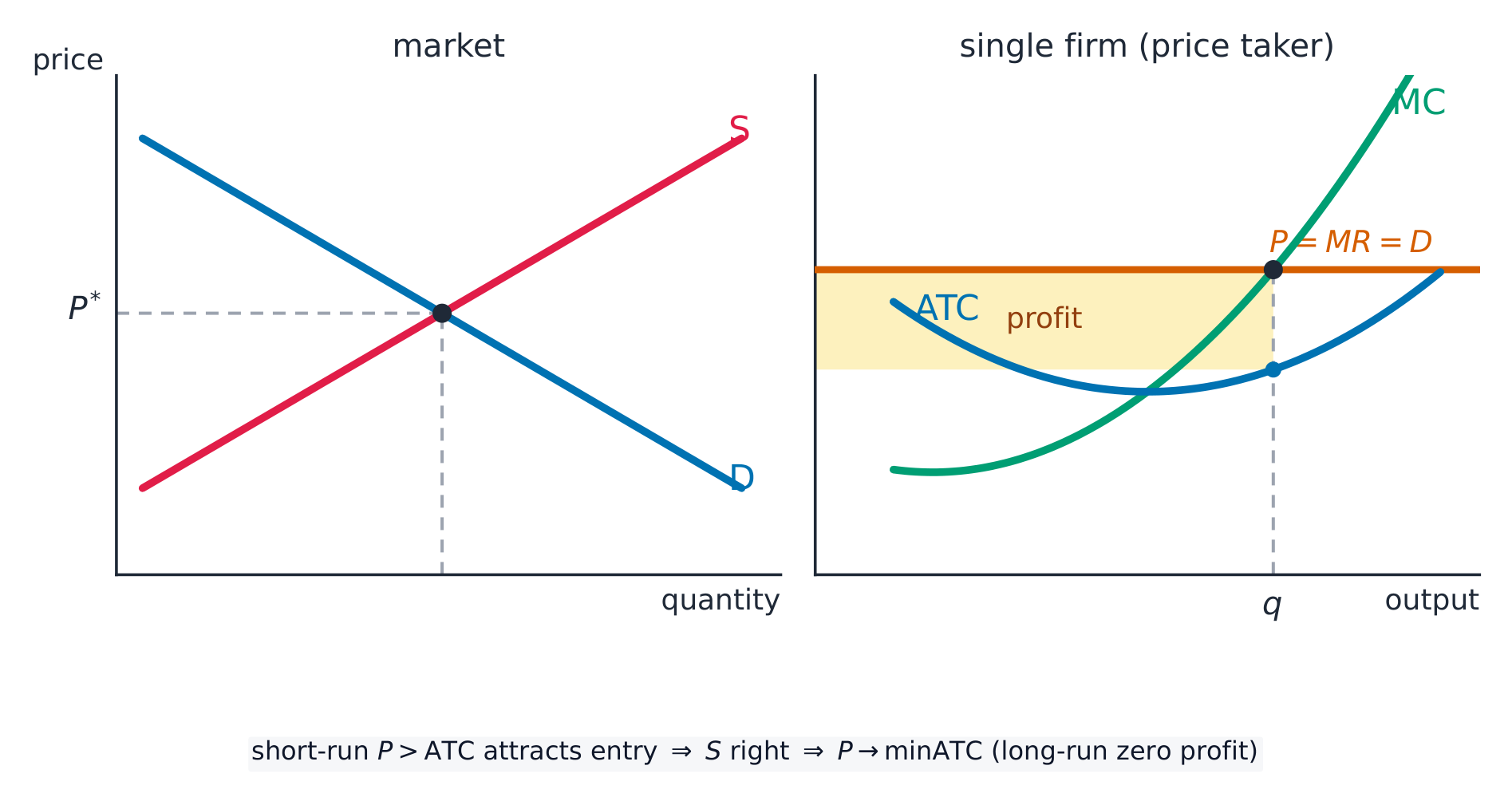
The side-by-side panel is the graph the exam wants: the market (left) fixes the price $P^{*}$; the firm (right) takes it as a horizontal line and produces where $MC=P$. When $P>ATC$ there is a short-run profit (the shaded box); that profit attracts entry, which shifts market supply right and pushes the price down.

  • Short run: the firm can earn profit, break even, or take a loss, producing where $P=MC$.
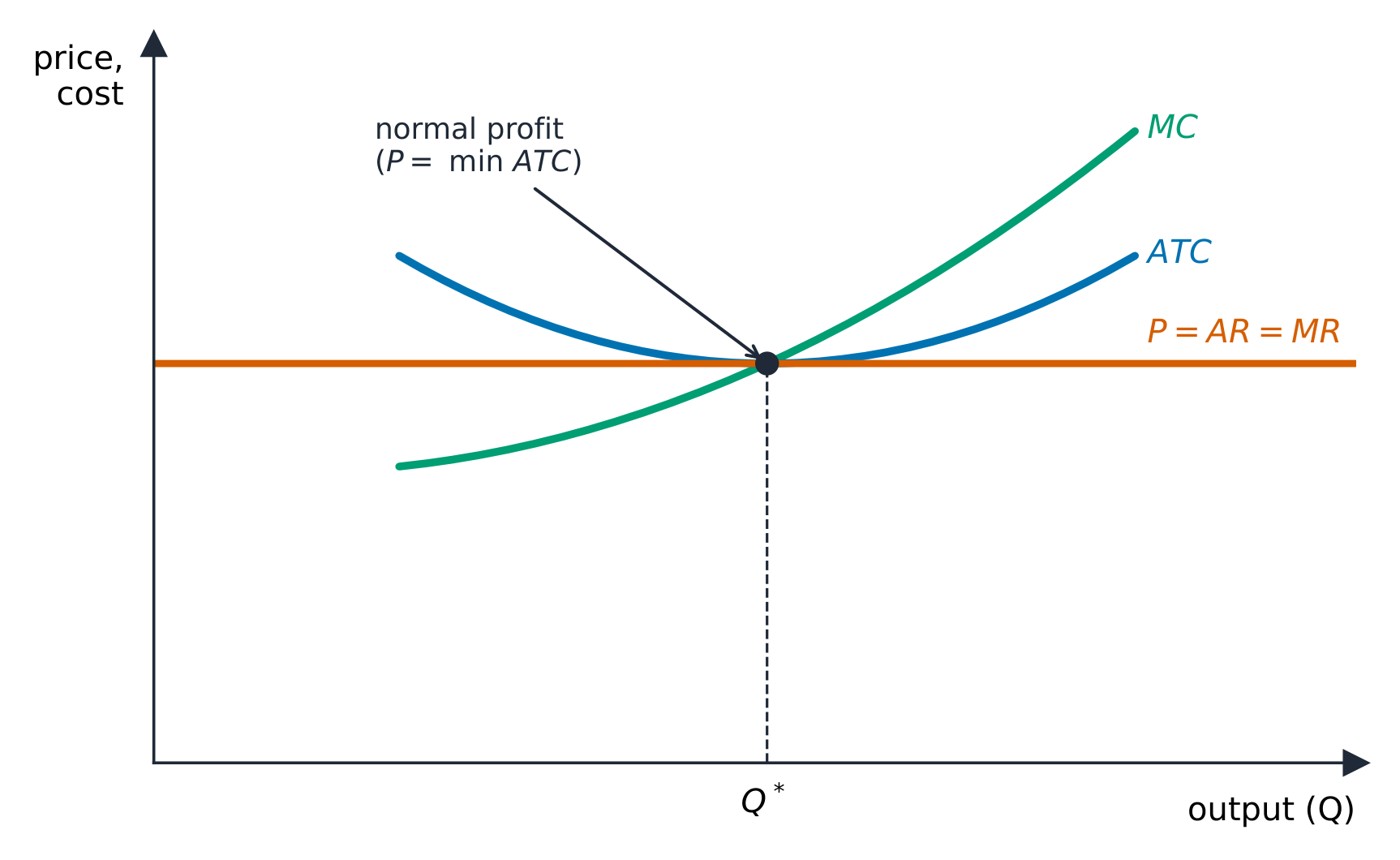
  • Long run: entry and exit drive the firm to zero economic profit, producing where $P=MC=ATC$ at minimum ATC. This double efficiency – productive efficiency (lowest-cost output) and allocative efficiency ($P=MC$, so the last unit's value equals its cost) – is the benchmark against which every other market structure is judged.

Exam skill: be able to draw the side-by-side market and single-firm graphs, show a short-run profit or loss, then show how entry/exit restores long-run equilibrium at minimum ATC.

ไทย

ตลาด แข่งขันสมบูรณ์ มีบริษัทเล็กๆ จำนวนมาก, ผลิตภัณฑ์ที่เหมือนกัน (homogeneous), การเข้าและออกอิสระ, และข้อมูลสมบูรณ์แบบ แต่ละบริษัทเป็น ผู้รับราคา – เล็กเกินไปที่จะส่งผลกระทบต่อราคา – ดังนั้นจึงเผชิญกับเส้น ความต้องการแบบราบ ที่ราคาตลาด, และ ราคา = รายได้ส่วนเพิ่ม = รายได้เฉลี่ย ($P=MR=AR$).

นี่คือเหตุผลที่นักเศรษฐศาสตร์ชื่นชมการแข่งขันสมบูรณ์. ใน สมดุลระยะยาว มันมีประสิทธิภาพทั้งด้าน การจัดสรร และ การผลิต. ประสิทธิภาพการจัดสรรเกิดขึ้นเพราะบริษัทผลิตที่ $P = MC$: ราคา (ผลประโยชน์ส่วนเพิ่มของสังคมจากหน่วยสุดท้าย) เท่ากับต้นทุนส่วนเพิ่มของมัน, ดังนั้นผลิตในปริมาณที่ถูกต้องพอดี. ประสิทธิภาพการผลิตเกิดขึ้นเพราะการเข้าอิสระดันราคาลงสู่จุดต่ำสุดของต้นทุนรวมเฉลี่ย, ดังนั้นสินค้าถูกผลิตด้วยราคาถูกที่สุด. ราคาตลาดเป็น สัญญาณ ที่สื่อสารต้นทุนส่วนเพิ่มและผลประโยชน์ของทุกคน

ตลาดกำหนดราคา; บริษัทผู้รับราคาผลิตที่จุดที่ MC = P, ที่นี่แสดงกำไรในระยะสั้น
ตลาดกำหนดราคา; บริษัทผู้รับราคาผลิตที่ MC = P, ที่นี่มีกำไรระยะสั้น

แผงกราฟคู่ขนานคือกราฟที่ข้อสอบต้องการ: ตลาด (ซ้าย) กำหนดราคา $P^{*}$; บริษัท (ขวา) รับมันเป็นเส้นราบและผลิตที่ $MC=P$. เมื่อ $P>ATC$ จะมีกำไรระยะสั้น (กล่องทึบ); กำไรนี้ดึงดูดการเข้า, ซึ่งเลื่อนเส้น supply ตลาดไปทางขวาและดันราคาลง

บริษัทแข่งขันสมบูรณ์สร้างเพียงกำไรปกติในระยะยาว
บริษัทในสภาพตลาดแข่งขันสมบูรณ์จะกำไรเพียงปกติในระยะยาว
  • ระยะสั้น: บริษัทอาจได้รับกำไร,平衡 (break even), หรือขาดทุน โดยผลิตที่ $P=MC$
  • ระยะยาว: การเข้าและออกของตลาดจะ驱使บริษัทสู่ กำไรทางเศรษฐศาสตร์เป็นศูนย์ โดยผลิตที่ $P=MC=ATC$ ที่ระดับ ATC ต่ำสุด ประสิทธิภาพสองด้านนี้ – ประสิทธิภาพการผลิต (ผลผลิตต้นทุนต่ำสุด) และ ประสิทธิภาพการกระจายทรัพยากร ($P=MC$, ดังนั้นมูลค่าของหน่วยสุดท้ายเท่ากับต้นทุน) – เป็นเกณฑ์มาตรฐานในการตัดสินโครงสร้างตลาดอื่นๆ ทุกประเภท

ทักษะข้อสอบ: สามารถวาดกราฟตลาดและกราฟบริษัทเดี่ยววางคู่กัน แสดงกำไรหรือขาดทุนในระยะสั้น จากนั้นแสดงว่าการเข้า/ออกของตลาด如何去 restore ความสมดุลระยะยาวที่ระดับ ATC ต่ำสุด

Explore · ⁨สำรวจ⁩

A price-taking firm in a competitive market · ⁨บริษัทที่เป็นผู้รับราคาในตลาดแข่งขัน⁩

In perfect competition the market sets the price and each firm is a price-taker. It produces where price equals marginal cost, earning zero economic profit in the long run. · ⁨ใน การแข่งขันสมบูรณ์ ตลาดกำหนดราคาและแต่ละบริษัทเป็น ผู้รับราคา They ผลิตที่จุดที่ราคาเท่ากับต้นทุนเชิงพจน์ โดยได้รับกำไรทางเศรษฐศาสตร์เป็นศูนย์ในระยะยาว⁩

3.7

Exam tips · ⁨ข้อแนะนำสำหรับการสอบ⁩

English
  • Know the cost curves: AFC falls, ATC/AVC are U-shaped, and MC cuts ATC and AVC at their minimums.
  • Every firm maximises profit at MR = MC; check the shutdown rule ($P \ge AVC$ in the short run).
  • Distinguish accounting profit (revenue − explicit costs) from economic profit (also minus implicit/opportunity costs); zero economic profit is normal.
  • "Diminishing returns" is short-run (one fixed input); "economies of scale" is long-run (all inputs vary).
  • In perfect competition $P=MR=AR$; entry/exit drive long-run economic profit to zero at minimum ATC.
ไทย
  • รู้เส้นโค้งต้นทุน: AFC ลดลง, ATC/AVC มีรูปตัว U, และ MC ตัด ATC และ AVC ที่จุดต่ำสุด ของแต่ละเส้น
  • บริษัททุกแห่งเพิ่มกำไรสูงสุดที่ MR = MC; ตรวจสอบกฎปิดกิจการ ($P \ge AVC$ ในระยะสั้น)
  • แยกแยะระหว่าง กำไรทางบัญชี (รายได้ − ต้นทุนชัดเจน) กับ กำไรทางเศรษฐศาสตร์ (ลบต้นทุนอ้อม/โอกาสด้วย); กำไรทางเศรษฐศาสตร์เป็นศูนย์คือกำไรปกติ
  • "ผลตอบแทนลดถอย" (Diminishing returns) เป็นระยะสั้น (มีปัจจัยการผลิตหนึ่งตัวคงที่); " economies of scale " เป็นระยะยาว (ปัจจัยการผลิตทั้งหมดเปลี่ยนแปลง)
  • ในตลาดแข่งขันสมบูรณ์ $P=MR=AR$; การเข้า/ออกของตลาดไปทำให้กำไรทางเศรษฐศาสตร์ระยะยาวเป็นศูนย์ที่ระดับ ATC ต่ำสุด

Interactive lessons on this topic · ⁨บทเรียนเชิงโต้ตอบสำหรับหัวข้อนี้⁩

Work through it step by step, with instant-check exercises. · ⁨ทำทีละขั้นตอน พร้อมแบบฝึกหัดตรวจสอบผลทันที⁩

Past Papers · ⁨ข้อสอบย้อนหลัง⁩

More topics in AP Microeconomics · ⁨AP เศรษฐศาสตร์จุลภาค⁩ · ⁨หัวข้อเพิ่มเติมใน AP Microeconomics · ⁨AP เศรษฐศาสตร์จุลภาค⁩⁩

Log in or create account · ⁨เข้าสู่ระบบหรือสร้างบัญชี⁩

IGCSE, A-Level & AP