Long-Run Production Costs
Introduced| English |
|---|
| no fixed costs/nəʊ fɪkst kɒsts/ |
| long-run average total cost/lɒŋ rʌn ˈævrɪdʒ ˈtəʊtl kɒst/ |
| envelope/ˈenvələʊp/ |
| economies of scale/ɪˈkɒnəmiz ɒv skeɪl/ |
| diseconomies of scale/ˌdɪsɪˈkɒnəmiz ɒv skeɪl/ |
| constant returns to scale/ˈkɒnstənt rɪˈtɜːnz tə skeɪl/ |
| minimum efficient scale/ˈmɪnɪməm ɪˈfɪʃənt skeɪl/ |
| returns to scale/rɪˈtɜːnz tə skeɪl/ |
| diminishing marginal returns/dɪˈmɪnɪʃɪŋ ˈmɑːdʒɪnl rɪˈtɜːnz/ |
No factory is fixed forever
- Given enough time, a firm can rebuild itself at any size.
- A workshop can become a plant; a plant can become a mega-factory.
- With nothing fixed, costs behave in a whole new way.
- Welcome to the long run — where the firm chooses its own scale.
The long-run average cost curve
- In the long run there are no fixed costs 无固定成本 — every input can change.
- Each factory size has its own short-run ATC curve.
- The long-run average total cost 长期平均总成本 (LRATC) curve traces the lowest cost at each output.
- It hugs the bottom of all the short-run curves — an envelope 包络线 of them.
Because the LRATC hugs the bottom of all the short-run curves, it is called their ______.
The LRATC envelope traces the lowest cost at each level of output.
Three regions of scale
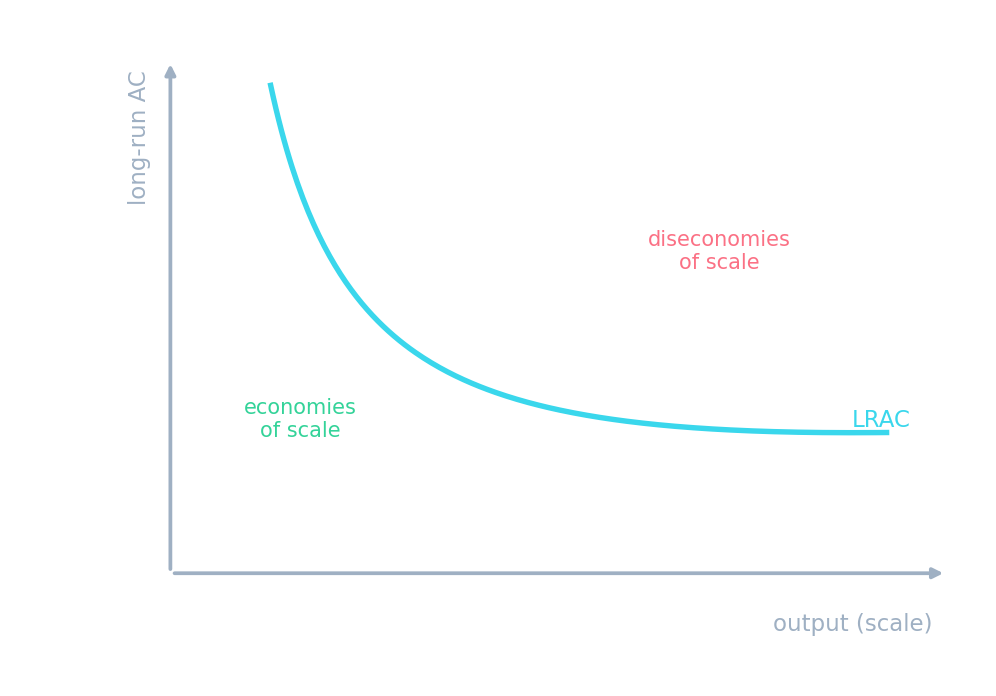
- Economies of scale 规模经济: LRATC falls — bulk buying, specialised machines, division of labour.
- Constant returns to scale 规模报酬不变: LRATC is flat.
- Diseconomies of scale 规模不经济: LRATC rises — a giant firm is hard to manage.
- The minimum efficient scale 最小有效规模 is the smallest output that already reaches the lowest LRATC.
Economies or diseconomies?
As a firm grows, unit cost first falls (economies of scale), may stay flat (constant returns), then rises (diseconomies of scale).
A firm enjoys economies of scale when, as it grows:
Economies of scale = a falling LRATC as the firm gets bigger.
The minimum efficient scale is:
It is the smallest scale that already achieves the minimum cost per unit.
A car maker's LRATC is 20,000 at 100k cars and 14,000 at 300k cars. Between them the firm has:
Cost per car falls from 20,000 to 14,000 as output rises — economies of scale.
Select all that can cause diseconomies of scale.
Management and coordination problems raise unit cost; bulk buying lowers it (an economy).
Don't mix up two ideas
- Returns to scale (long run): change all inputs together — nothing is fixed.
- Diminishing marginal returns (short run): add one variable input while others stay fixed.
These sound alike but differ. Scale is a long-run idea (all inputs move); diminishing returns is a short-run idea (one input moves against a fixed one). Name the run first.
Returns to scale (long run) involves changing all inputs at once, while diminishing marginal returns (short run) adds one input against a fixed one.
Scale is a long-run, all-inputs idea; diminishing returns is short-run, one-input.
The LRATC is the envelope of the short-run curves, with no fixed costs. It falls (economies of scale), flattens (constant returns), then rises (diseconomies of scale); its lowest output is the minimum efficient scale. Don't confuse long-run scale with short-run diminishing returns.