The Production Function
Introduced| English |
|---|
| output/ˈaʊtpʊt/ |
| production function/prəˈdʌkʃn ˈfʌŋkʃn/ |
| short run/ʃɔːt rʌn/ |
| long run/lɒŋ rʌn/ |
| inputs/ˈɪnpʊts/ |
| fixed/fɪkst/ |
| variable/ˈveərɪəbl/ |
| average product/ˈævrɪdʒ ˈprɒdʌkt/ |
| total product/ˈtəʊtl ˈprɒdʌkt/ |
| marginal product/ˈmɑːdʒɪnl ˈprɒdʌkt/ |
| law of diminishing marginal returns/lɔː ɒv dɪˈmɪnɪʃɪŋ ˈmɑːdʒɪnl rɪˈtɜːnz/ |
One oven, more and more bakers
- Put one baker in a kitchen with a single oven — plenty of output.
- Add a second, a third, a fourth... the kitchen gets crowded.
- Each new baker still helps, but adds less than the one before.
- This simple story is the heart of the production function 生产函数.
Short run vs long run
- The production function links inputs 投入 to output 产出 — the most a firm can make.
- In the short run 短期, at least one input is fixed 固定 (usually the factory); only variable 可变 inputs like workers can change.
- In the long run 长期, every input is variable — the firm can resize completely.
Short run or long run?
In the short run at least one input is fixed; only variable inputs can change. In the long run every input is variable.
In the short run, a firm has:
The short run has at least one fixed input; the long run has none.
Select all that are usually variable inputs in the short run.
Labour, materials and utilities flex in the short run; the factory is the fixed input.
Total, marginal, average product
- Total product 总产量 (TP) is all the output from all the workers together.
- Marginal product 边际产量 (MP) is the extra output from one more worker: $MP = \dfrac{\Delta TP}{\Delta L}$.
- Average product 平均产量 (AP) is output per worker: $AP = \dfrac{TP}{L}$.
Marginal product is:
MP = ΔTP/ΔL — the change in total product from adding a worker. (Output per worker is average product.)
A bakery makes 24 loaves with 2 workers and 33 loaves with 3 workers. What is the marginal product of the 3rd worker?
MP of the 3rd worker = 33 − 24 = 9 loaves.
The law of diminishing marginal returns
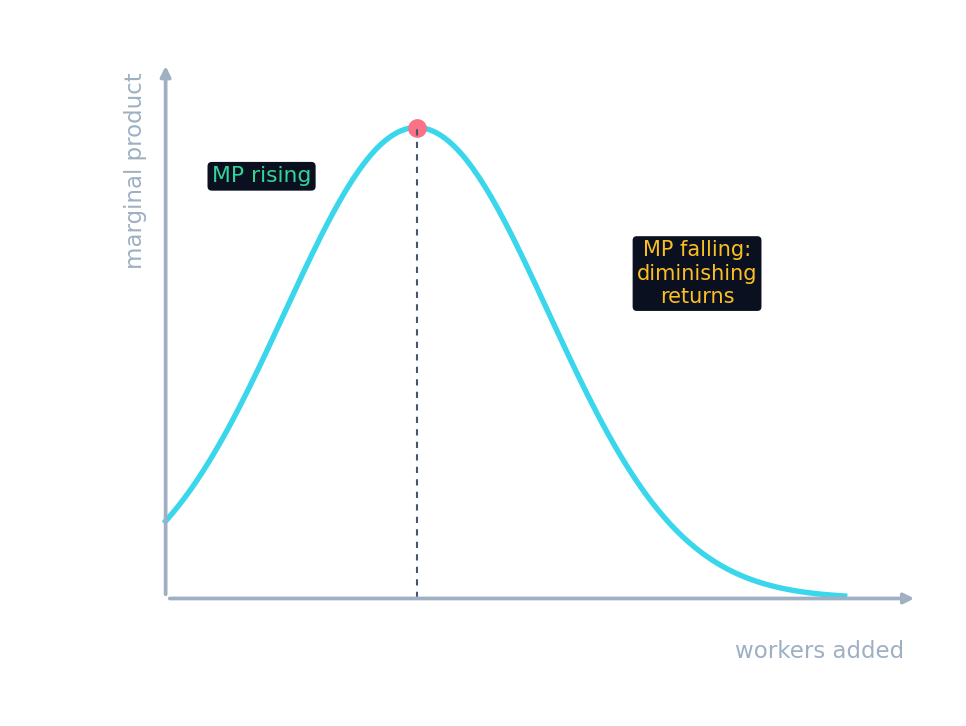
- Keep adding workers to a fixed factory and, past some point, each adds less than the last.
- This is the law of diminishing marginal returns 边际收益递减规律.
- Workers crowd the same machines, so marginal product falls.
- When MP is still positive, TP keeps rising — just more slowly. When MP hits zero, TP is at its peak.
Diminishing marginal returns means each extra worker (added to a fixed factory) eventually adds less output than the one before.
Past some point, crowding the fixed input makes marginal product fall.
Total product is at its maximum when marginal product equals ______.
While MP is positive TP rises; at MP = 0 it peaks; when MP is negative TP falls.
The production function turns inputs into output. In the short run some input is fixed; in the long run all are variable. As you add a variable input to a fixed one, marginal product eventually falls — the law of diminishing marginal returns.