Skip to content · ⁨ข้ามไปยังเนื้อหา⁩
Subjects · ⁨รายวิชา⁩

AP Human Geography · ⁨AP ภูมิศาสตร์มนุษย์⁩

Tips · ⁨เคล็ดลับ⁩

ภูมิศาสตร์มนุษย์ระดับ AP ศึกษาวิธีการที่คน ใช้ จัดระเบียบ และเปลี่ยนแปลงพื้นที่: แผนที่และการคิดเชิงพื้นที่, ประชากรและการอพยพ, วัฒนธรรม, ภูมิศาสตร์การเมือง, เกษตรกรรม, เมือง และ การพัฒนาและอุตสาหกรรม เป็นวิทยาศาสตร์สังคม และการสอบเขียนด้วยภาษาของ แบบจำลองและมาตราส่วน

แบบจำลองคือคำศัพท์: แบบจำลองการเปลี่ยนผ่านทางประชากร, von Thünen, Weber, ทฤษฎีสถานที่ศูนย์กลาง, แบบจำลองการใช้ที่ดินในเมือง คุณต้อง นำไปใช้ กับสถานที่จริง และมักจะต้อง ระบุว่าล้มเหลวตรงไหน

มาตราส่วนคือคำแนะนำที่ปรากฏซ้ำๆ หลายคำถามขอให้ตอบในระดับ ท้องถิ่น ระดับประเทศ หรือระดับโลก และคำตอบที่เขียนในระดับผิดจะไม่ได้รับคะแนน

หมายเหตุครอบคลุมทั้งเจ็ดหน่วยและแสดงแบบจำลองพร้อมสมมติฐาน — von Thünen, การเปลี่ยนผ่านทางประชากร, ทฤษฎีสถานที่ศูนย์กลาง FRQ ที่ออกแล้วมีอยู่ในห้องสมุด การสอบนี้ต้องการ ตัวอย่างจริงที่มีชื่อ สำหรับเกือบทุกแนวคิด ดังนั้นหมายเหตุจึงแนบตัวอย่างไว้ตลอด

  • 1

    Thinking Geographically · ⁨การคิดเชิงภูมิศาสตร์⁩

    Watch lesson · ⁨ดูบทเรียน⁩
    1.1

    Introduction to Maps · ⁨การแนะนำแผนที่⁩

    Syllabus · ⁨หลักสูตร⁩
    English

    Enduring Understanding (IMP-1): Geographers use maps and data to depict relationships of time, space, and scale.

    Learning Objective IMP-1.A: Identify types of maps, the types of information presented in maps, and different kinds of spatial patterns and relationships portrayed in maps.

    • IMP-1.A.1 Types of maps include reference maps and thematic maps.
    • IMP-1.A.2 Types of spatial patterns represented on maps include absolute and relative distance and direction, clustering, dispersal, and elevation.
    • IMP-1.A.3 All maps are selective in information; map projections inevitably distort spatial relationships in shape, area, distance, and direction.
    ไทย

    ความเข้าใจที่ยั่งยืน (IMP-1): นักภูมิศาสตร์ใช้แผนที่และข้อมูลเพื่อแสดงความสัมพันธ์ของเวลา พื้นที่ และสเกล

    วัตถุประสงค์การเรียนรู้ IMP-1.A: ระบุประเภทของแผนที่ ประเภทของข้อมูลที่นำเสนอในแผนที่ และรูปแบบเชิงพื้นที่และความสัมพันธ์ต่างๆ ที่ปรากฏในแผนที่

    • IMP-1.A.1 ประเภทของแผนที่รวมถึงแผนที่อ้างอิงและแผนที่เชิงธีม
    • IMP-1.A.2 รูปแบบเชิงพื้นที่ที่แสดงบนแผนที่รวมถึงระยะทางและทิศทางสัมบูรณ์และสัมพัทธ์ การรวมกลุ่ม การกระจายตัว และความสูงต่ำ
    • IMP-1.A.3 แผนที่ทั้งหมดมีการเลือกข้อมูล; การฉายภาพแผนที่ inevitably ทำให้ความสัมพันธ์เชิงพื้นที่บิดเบือนในรูปแบบ ขนาด พื้นที่ ระยะทาง และทิศทาง
    Source: College Board AP Course and Exam Description · ⁨แหล่งที่มา: คำอธิบายหลักสูตรและข้อสอบ College Board AP⁩

    English

    Geography is the study of where things are and why they are there. Its most basic tool is the map 地图 — a flattened picture of some part of Earth's surface.

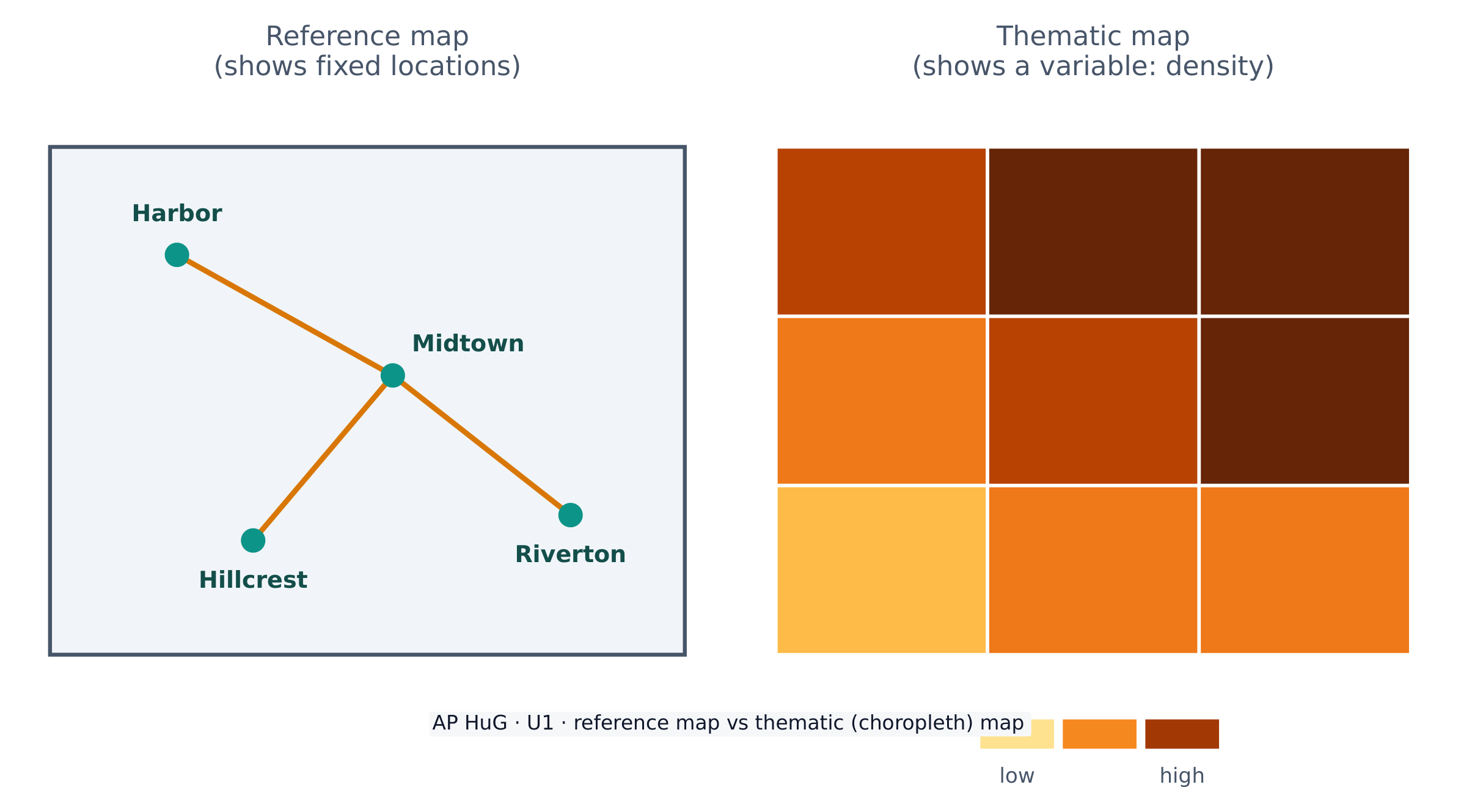
    Maps come in two big families. A reference map 参考地图 shows fixed locations — coastlines, borders, roads, cities (a road atlas or Google Maps). A thematic map 专题地图 shows how one variable changes across space — rainfall, income, or population density. AP Human Geography uses thematic maps constantly.

    Because Earth is a sphere and a map is flat, every map uses a projection 投影 that stretches the globe onto paper. Projections always distort 扭曲 something — shape, area, distance, or direction. The famous Mercator projection keeps direction correct (useful for sailing) but makes high-latitude places like Greenland look far too large. There is no perfect projection; a cartographer chooses one that fits the map's purpose.

    ไทย

    ภูมิศาสตร์คือการศึกษาว่าสิ่งต่างๆ อยู่ ที่ไหน และ ทำไม ถึงอยู่ที่นั่นเครื่องมือพื้นฐานที่สุดของมันคือ map — ภาพแบนของพื้นผิวโลกบางส่วน

    แผนที่มีสองกลุ่มใหญ่ Reference map แสดงตำแหน่งคงที่ — ชายฝั่ง ขอบเขต ถนน เมือง ( атлас roads หรือ Google Maps) Thematic map แสดง how one variable changes across space — rainfall, income, or population density. AP Human Geography uses thematic maps constantly.

    Reference maps show location; thematic maps show how a variable varies over space
    Reference maps show location; thematic maps show how a variable varies over space

    เนื่องจากโลกเป็นทรงกลมและแผนที่แบน ทุกแผนที่ใช้ projection ที่ยืดโลกบนกระดาษ Projections always distort something — shape, area, distance, or direction. The famous Mercator projection keeps direction correct (useful for sailing) but makes high-latitude places like Greenland look far too large. There is no perfect projection; a cartographer chooses one that fits the map's purpose.

    Vocabulary · ⁨คำศัพท์⁩ Train · ⁨ฝึกฝน⁩
    English ไทย
    map/mæp/ map
    reference map/ˈrefrəns mæp/ แผนที่อ้างอิง
    thematic map/θiːˈmætɪk mæp/ แผนที่เฉพาะเรื่อง
    projection/prəˈdʒekʃn/ การฉายภาพ
    distort/dɪˈstɔːt/ บิดเบี้ยว
    1.2

    Geographic Data · ⁨ข้อมูลทางภูมิศาสตร์⁩

    Syllabus · ⁨หลักสูตร⁩
    English

    Enduring Understanding (IMP-1): Geographers use maps and data to depict relationships of time, space, and scale.

    Learning Objective IMP-1.B: Identify different methods of geographic data collection.

    • IMP-1.B.1 Data may be gathered in the field by organizations or by individuals.
    • IMP-1.B.2 Geospatial technologies include geographic information systems (GIS), satellite navigation systems, remote sensing, and online mapping and visualization.
    • IMP-1.B.3 Spatial information can come from written accounts in the form of field observations, media reports, travel narratives, policy documents, personal interviews, landscape analysis, and photographic interpretation.
    ไทย

    ความเข้าใจที่ยั่งยืน (IMP-1): นักภูมิศาสตร์ใช้แผนที่และข้อมูลเพื่อแสดงความสัมพันธ์ของเวลา พื้นที่ และสเกล

    วัตถุประสงค์การเรียนรู้ IMP-1.B: ระบุวิธีการเก็บรวบรวมข้อมูลทางภูมิศาสตร์ที่แตกต่างกัน

    • IMP-1.B.1 ข้อมูลอาจ đượcเก็บรวบรวมในพื้นที่โดยองค์กรหรือบุคคล
    • IMP-1.B.2 เทคโนโลยีเชิงพื้นที่รวมถึงระบบข้อมูลภูมิศาสตร์ (GIS), ระบบนำทางด้วยดาวเทียม, การรับทราบระยะไกล และการทำแผนที่ออนไลน์และการแสดงผล
    • IMP-1.B.3 ข้อมูลเชิงพื้นที่สามารถมาจากบันทึกข้อความในรูปแบบของการสังเกตในพื้นที่, รายงานสื่อ, บันทึกการเดินทาง, เอกสารนโยบาย, การสัมภาษณ์ส่วนตัว, การวิเคราะห์ภูมิทัศน์ และการตีความภาพถ่าย

    Source: College Board AP Course and Exam Description · ⁨แหล่งที่มา: คำอธิบายหลักสูตรและข้อสอบ College Board AP⁩

    English

    Geographic data 地理数据 is any information tied to a location. Geographers collect it in the field (counting, surveying, interviewing) and remotely with technology.

    Key geospatial technologies 地理空间技术 you must know:

    • GIS 地理信息系统 (Geographic Information System) — software that layers many kinds of spatial data so patterns can be compared.
    • GPS (satellite navigation) — pinpoints exact location on Earth.
    • Remote sensing 遥感 — gathers data from satellites or aircraft without touching the ground.

    Data also comes from written sources: field observations, media reports, travel writing, policy documents, interviews, and photographs.

    ไทย
    A dense urban skyline from above: maps and spatial data show how people are distributed on Earth
    A dense urban skyline from above: maps and spatial data show how people are distributed on Earth

    Geographic data คือข้อมูลใดๆ ที่ผูกกับตำแหน่ง Geographers collect it in the field (counting, surveying, interviewing) and remotely with technology.

    Key geospatial technologies you must know:

    • GIS (Geographic Information System) — software that layers many kinds of spatial data so patterns can be compared.
    • GPS (satellite navigation) — pinpoints exact location on Earth.
    • Remote sensing — gathers data from satellites or aircraft without touching the ground.

    Data also comes from written sources: field observations, media reports, travel writing, policy documents, interviews, and photographs.

    Vocabulary · ⁨คำศัพท์⁩ Train · ⁨ฝึกฝน⁩
    English ไทย
    Geographic data/ˌdʒɪəˈɡræfɪk ˈdeɪtə/ ข้อมูลภูมิศาสตร์
    geospatial technologies/ˌdʒiːəʊˈspeɪʃl tekˈnɒlədʒiz/ เทคโนโลยี geospatial
    GIS/ˌdʒiː aɪ ˈes/ ระบบสารสนเทศทางภูมิศาสตร์ (GIS)
    Remote sensing/rɪˈməʊt ˈsensɪŋ/ Remote sensing (การสังเกตระยะไกล)
    1.3

    The Power of Geographic Data · ⁨พลังของข้อมูลทางภูมิศาสตร์⁩

    Syllabus · ⁨หลักสูตร⁩
    English

    Enduring Understanding (IMP-1): Geographers use maps and data to depict relationships of time, space, and scale.

    Learning Objective IMP-1.C: Explain the geographical effects of decisions made using geographical information.

    • IMP-1.C.1 Geospatial and geographical data, including census data and satellite imagery, are used at all scales for personal, business and organizational, and governmental decision- making purposes.
    ไทย

    ความเข้าใจที่ยั่งยืน (IMP-1): นักภูมิศาสตร์ใช้แผนที่และข้อมูลเพื่อแสดงความสัมพันธ์ของเวลา พื้นที่ และสเกล

    วัตถุประสงค์การเรียนรู้ IMP-1.C: อธิบายผลกระทบทางภูมิศาสตร์ของการตัดสินใจโดยใช้ข้อมูลทางภูมิศาสตร์

    • IMP-1.C.1 ข้อมูลเชิงพื้นที่และข้อมูลทางภูมิศาสตร์ รวมถึงข้อมูลสำมะโนประชากรและภาพถ่ายดาวเทียม ถูกใช้ในทุกระดับสำหรับการตัดสินใจส่วนบุคคล ธุรกิจ和组织, และการตัดสินใจของรัฐบาล

    Source: College Board AP Course and Exam Description · ⁨แหล่งที่มา: คำอธิบายหลักสูตรและข้อสอบ College Board AP⁩

    Data is powerful because it drives decisions. Businesses use it to choose store locations, governments use census data to plan schools and roads, and aid agencies use it to send help after a disaster.

    But data is never neutral. Who collects it, which categories they use, and how a map is drawn can all shape the message. A map can inform — or it can mislead — so a good geographer always asks where the data came from and what it leaves out.

    1.4

    Spatial Concepts · ⁨แนวคิดเชิงพื้นที่⁩

    Syllabus · ⁨หลักสูตร⁩
    English

    Enduring Understanding (PSO-1): Geographers analyze relationships among and between places to reveal important spatial patterns.

    Learning Objective PSO-1.A: Define major geographic concepts that illustrate spatial relationships.

    • PSO-1.A.1 Spatial concepts include absolute and relative location, space, place, flows, distance decay, time-space compression, and pattern.
    ไทย

    ความเข้าใจที่ยั่งยืน (PSO-1): นักภูมิศาสตร์วิเคราะห์ความสัมพันธ์ระหว่างและภายในสถานที่เพื่อเปิดเผยรูปแบบเชิงพื้นที่ที่สำคัญ

    วัตถุประสงค์การเรียนรู้ PSO-1.A: นิยามแนวคิดทางภูมิศาสตร์หลักที่อธิบายความสัมพันธ์เชิงพื้นที่

    • PSO-1.A.1 แนวคิดเชิงพื้นที่รวมถึงตำแหน่งสัมบูรณ์และสัมพัทธ์ พื้นที่ สถานที่ กระแสการไหล การลดทอนระยะทางตามเวลา-พื้นที่ การบีบอัดเวลา-พื้นที่ และรูปแบบ

    Source: College Board AP Course and Exam Description · ⁨แหล่งที่มา: คำอธิบายหลักสูตรและข้อสอบ College Board AP⁩

    English
    Distance decay

    Geographers describe location and pattern with a precise vocabulary.

    • Absolute location 绝对位置 is an exact address — latitude and longitude. Relative location 相对位置 describes a place by what is near it ("north of the river").
    • Absolute distance is measured in kilometres; relative distance is measured in time, cost, or effort.
    • Space–time compression 时空压缩 is the shrinking of the felt distance between places as transport and communication improve.
    • Distance decay 距离衰减 means that interaction between two places weakens as the distance between them grows.

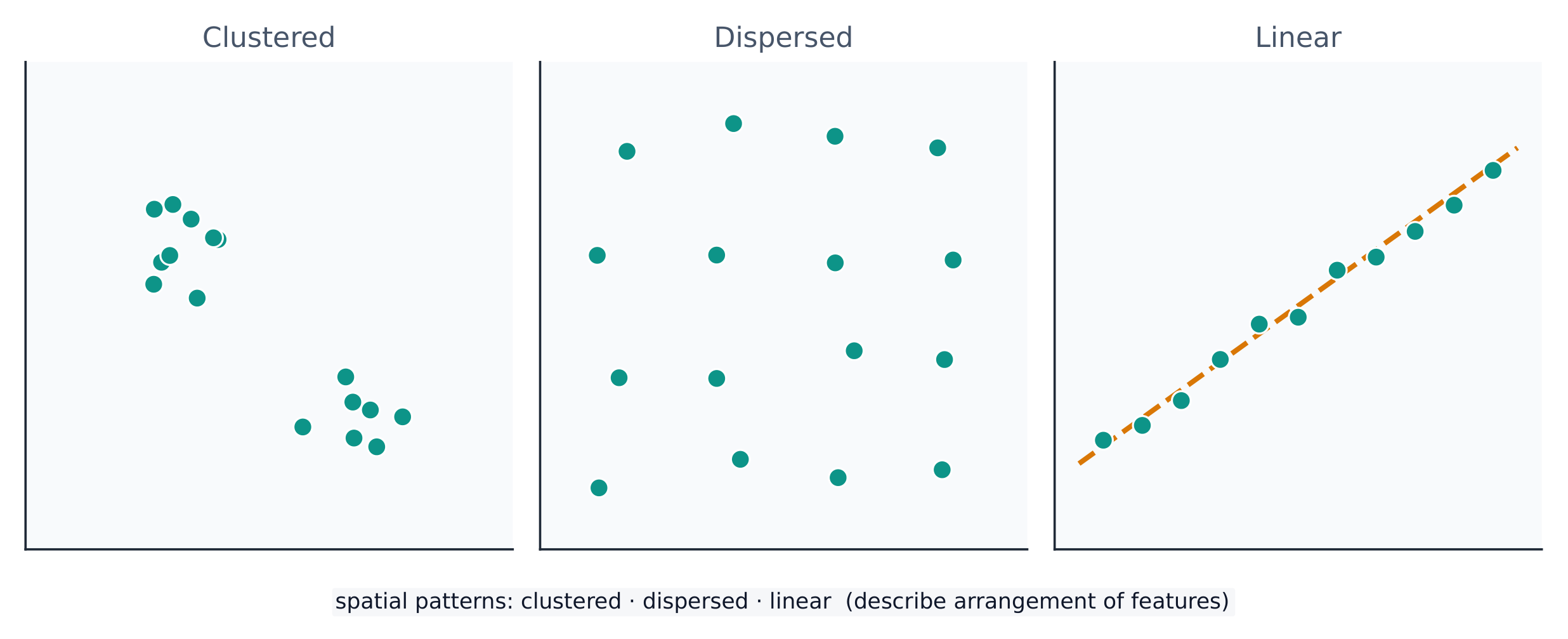
    A spatial pattern 空间格局 is how things are arranged: clustered 聚集 (bunched together), dispersed 分散 (spread apart), or linear (along a line such as a road). Reading the pattern is the first step in explaining why it exists.

    ไทย
    Distance decay

    Geographers describe location and pattern with a precise vocabulary.

    • Absolute location is an exact address — latitude and longitude. Relative location describes a place by what is near it ("north of the river").
    • Absolute distance is measured in kilometres; relative distance is measured in time, cost, or effort.
    • Space–time compression is the shrinking of the felt distance between places as transport and communication improve.
    • Distance decay means that interaction between two places weakens as the distance between them grows.
    จุดบนพื้นดินสามารถจัดกลุ่ม, กระจายตัว, หรือเรียงตามเส้นตรง
    จุดสามารถจัดกลุ่ม, กระจายตัว, หรือเรียงตามเส้นตรง — รูปแบบพื้นที่เป็นข้อมูลในตัวเอง

    รูปแบบพื้นที่ คือการจัดวางสิ่งต่างๆ: แบบกลุ่ม (รวมกันอยู่), แบบกระจาย (แยกห่างกัน), หรือ แบบเส้นตรง (ตามเส้นเช่นถนน) การอ่านรูปแบบนี้เป็นขั้นตอนแรกในการอธิบาย ทำไม รูปแบบถึงเกิดขึ้น

    Vocabulary · ⁨คำศัพท์⁩ Train · ⁨ฝึกฝน⁩
    English ไทย
    Absolute location/ˈæbsəluːt ləʊˈkeɪʃn/ ตำแหน่งสัมบูรณ์
    Relative location/ˈrelətɪv ləʊˈkeɪʃn/ ตำแหน่งสัมพัทธ์
    Space–time compression/speɪs taɪm kəmˈpreʃn/ Time-space compression
    Distance decay/ˈdɪstəns dɪˈkeɪ/ การลดทอนระยะทาง
    spatial pattern/ˈspeɪʃl ˈpætn/ pattern Spatial
    clustered/ˈklʌstəd/ รวมกลุ่ม
    dispersed/dɪˈspɜːst/ กระจาย
    Environmental determinism/enˌvaɪrənˈmentl dɪˈtɜːmɪnɪzəm/ Ẳtism
    Watch lesson · ⁨ดูบทเรียน⁩
    1.5

    Human-Environmental Interaction · ⁨การมีปฏิสัมพันธ์ระหว่างมนุษย์กับสิ่งแวดล้อม⁩

    Syllabus · ⁨หลักสูตร⁩
    English

    Enduring Understanding (PSO-1): Geographers analyze relationships among and between places to reveal important spatial patterns.

    Learning Objective PSO-1.B: Explain how major geographic concepts illustrate spatial relationships.

    • PSO-1.B.1 Concepts of nature and society include sustainability, natural resources, and land use.
    • PSO-1.B.2 Theories regarding the interaction of the natural environment with human societies have evolved from environmental determinism to possibilism.
    ไทย

    ความเข้าใจที่ยั่งยืน (PSO-1): นักภูมิศาสตร์วิเคราะห์ความสัมพันธ์ระหว่างและภายในสถานที่เพื่อเปิดเผยรูปแบบเชิงพื้นที่ที่สำคัญ

    วัตถุประสงค์การเรียนรู้ PSO-1.B: อธิบายว่าแนวคิดทางภูมิศาสตร์หลักอธิบายความสัมพันธ์เชิงพื้นที่อย่างไร

    • PSO-1.B.1 แนวคิดเกี่ยวกับธรรมชาติและสังคมรวมถึงความยั่งยืน ทรัพยากรธรรมชาติ และการใช้ที่ดิน
    • PSO-1.B.2 ทฤษฎีเกี่ยวกับการปฏิสัมพันธ์ระหว่างสิ่งแวดล้อมทางธรรมชาติกับสังคมมนุษย์ได้พัฒนาจากẲ environmental determinism ไปสู่ possibilism

    Source: College Board AP Course and Exam Description · ⁨แหล่งที่มา: คำอธิบายหลักสูตรและข้อสอบ College Board AP⁩

    English

    People and the environment shape each other. Three older ideas describe this:

    • Environmental determinism 环境决定论 — the (now rejected) claim that the physical environment determines how a culture develops.
    • Possibilism 可能论 — the accepted view that the environment sets limits, but people choose how to respond using technology and culture.

    The cultural landscape 文化景观 — farms, cities, and roads built on the land — is the visible result of this interaction. Sustainability asks how people can use natural resources without using them up.

    ไทย
    การขยายตัวของเมืองที่ขอบเขตเมือง: การมีปฏิสัมพันธ์ระหว่างมนุษย์กับสิ่งแวดล้อมเปลี่ยนแปลงภูมิประเทศ
    การขยายตัวของเมืองที่ขอบเขตเมือง: การมีปฏิสัมพันธ์ระหว่างมนุษย์กับสิ่งแวดล้อมเปลี่ยนแปลงภูมิประเทศ

    มนุษย์และสิ่งแวดล้อมสร้างอิทธิพลต่อกันและกัน มีแนวคิดเก่าแก่สามประการที่อธิบายเรื่องนี้:

    • Ẕẅẍẃẋẉẑẙẗẘẏẖẓẋ — locator (ซึ่งถูกปฏิเสธในปัจจุบัน) ที่อ้างว่าสิ่งแวดล้อมทางกายภาพ กำหนด การพัฒนาของวัฒนธรรม
    • Possibilism — มุมมองที่ยอมรับกันว่าสิ่งแวดล้อมกำหนดขอบเขต แต่คน เลือก วิธีตอบสนองโดยใช้เทคโนโลยีและวัฒนธรรม

    ภูมิทัศน์ทางวัฒนธรรม — ไร่ทำนา เมือง และถนนที่สร้างขึ้นบนแผ่นดิน — เป็นผลลัพธ์ที่มองเห็นได้ของการมีปฏิสัมพันธ์นี้ ความยั่งยืนตั้งคำถามว่าผู้คนสามารถใช้ทรัพยากรธรรมชาติโดยไม่ใช้จนหมดสิ้นได้อย่างไร

    Vocabulary · ⁨คำศัพท์⁩ Train · ⁨ฝึกฝน⁩
    English ไทย
    Possibilism/ˈpɒsɪbɪlɪzəm/ Possibilism
    cultural landscape/ˈkʌltʃərəl ˈlændskeɪp/ ภูมิทัศน์ทางวัฒนธรรม (Cultural landscape)
    Scale of analysis/skeɪl ɒv əˈnæləsɪs/ Scale of analysis
    1.6

    Scales of Analysis · ⁨ขอบเขตของการวิเคราะห์⁩

    Syllabus · ⁨หลักสูตร⁩
    English

    Enduring Understanding (PSO-1): Geographers analyze relationships among and between places to reveal important spatial patterns.

    Learning Objective PSO-1.C: Define scales of analysis used by geographers.

    • PSO-1.C.1 Scales of analysis include global, regional, national, and local.

    Learning Objective PSO-1.D: Explain what scales of analysis reveal.

    • PSO-1.D.1 Patterns and processes at different scales reveal variations in, and different interpretations of, data.
    ไทย

    ความเข้าใจที่ยั่งยืน (PSO-1): นักภูมิศาสตร์วิเคราะห์ความสัมพันธ์ระหว่างและภายในสถานที่เพื่อเปิดเผยรูปแบบเชิงพื้นที่ที่สำคัญ

    วัตถุประสงค์การเรียนรู้ PSO-1.C: นิยามสเกลของการวิเคราะห์ที่ใช้โดยนักภูมิศาสตร์

    • PSO-1.C.1 สเกลของการวิเคราะห์รวมถึงระดับโลก ระดับภูมิภาค ระดับชาติ และระดับท้องถิ่น

    วัตถุประสงค์การเรียนรู้ PSO-1.D: อธิบายสิ่งที่สเกลของการวิเคราะห์เปิดเผย

    • PSO-1.D.1 รูปแบบและกระบวนการในระดับต่างๆ แสดงถึงความแตกต่างในการตีความข้อมูล

    Source: College Board AP Course and Exam Description · ⁨แหล่งที่มา: คำอธิบายหลักสูตรและข้อสอบ College Board AP⁩

    English

    Scale of analysis 分析尺度 is the level at which you look at data — global, regional, national, or local. The same pattern can look completely different at different scales.

    For example, a country may look wealthy at the national scale, yet contain very poor neighbourhoods at the local scale. Zooming in or out — changing the scale — reveals patterns that were hidden before. Exam questions often ask you to explain a process "at various scales."

    Worked example (a real AP exam question). "The map focuses on a regional scale. Explain a possible limitation of drawing country-scale conclusions from a regional-scale map." (2025) A full-mark answer: "The map shows only one region, so its pattern may not represent the whole country — other regions could look very different, so a conclusion drawn at the regional scale would be inaccurate at the country scale." The command word Explain asks for reasoning: state the limitation and say why changing the scale changes the pattern. Just writing "the scales are different" does not earn the mark.

    ไทย

    ขอบเขตของการวิเคราะห์ คือระดับที่คุณดูข้อมูล — ระดับโลก, ระดับภูมิภาค, ระดับชาติ, หรือระดับท้องถิ่น รูปแบบเดียวกันอาจดูแตกต่างกันอย่างสิ้นเชิงในระดับที่แตกต่างกัน

    รูปแบบซ้อนทับกัน across scales: global, regional, national, and local
    สถานที่เดียวกันซ้อนอยู่ในขอบเขตที่ใหญ่ขึ้นเรื่อยๆ — ขอบเขตที่คุณเลือกจะเปลี่ยนรูปแบบที่คุณเห็น

    ตัวอย่างเช่น ประเทศอาจดูมั่งคั่งในระดับ แห่งชาติ แต่อาจมีชุมชนยากจนมากในระดับ ท้องถิ่น การซูมเข้าหรือออก — การเปลี่ยนขอบเขต — เผยรูปแบบที่ซ่อนอยู่มาก่อน ข้อสอบมักถามให้คุณอธิบายกระบวนการ "ในระดับต่างๆ"

    ตัวอย่างวิธีทำ (ข้อสอบ AP จริง) "แผนที่เน้นที่ระดับภูมิภาค อธิบายข้อจำกัดที่เป็นไปได้ของการสรุปผลในระดับประเทศจากแผนที่ระดับภูมิภาค" (2025) คำตอบเต็มคะแนน: "แผนที่แสดงเพียงภูมิภาคเดียว ดังนั้นรูปแบบของมันอาจไม่แทนทั้งประเทศ — ภูมิภาคอื่นอาจดูต่างกันมาก ดังนั้นการสรุปผลในระดับภูมิภาคจึงไม่ถูกต้องในระดับประเทศ" คำสั่ง Explain ต้องการเหตุผล: ระบุข้อจำกัด และ บอกว่าทำไมการเปลี่ยนขอบเขตจึงเปลี่ยนรูปแบบ การเขียนแค่ว่า "ขอบเขตต่างกัน" ไม่ได้คะแนน

    Vocabulary · ⁨คำศัพท์⁩ Train · ⁨ฝึกฝน⁩
    English ไทย
    region/ˈriːdʒn/ ภูมิภาค (Region)
    Formal (uniform) region/ˈfɔːml ˈriːdʒn/ พื้นที่ทางการ (พื้นที่สม่ำเสมอ)
    Functional (nodal) region/ˈfʌŋkʃənl ˈriːdʒn/ พื้นที่เชิงฟังก์ชัน (พื้นที่แกน)
    Perceptual (vernacular) region/pəˈseptʃuːəl ˈriːdʒn/ พื้นที่การรับรู้ (พื้นที่ท้องถิ่น)
    1.7

    Regional Analysis · ⁨การวิเคราะห์ระดับภูมิภาค⁩

    Syllabus · ⁨หลักสูตร⁩
    English

    Enduring Understanding (SPS-1): Geographers analyze complex issues and relationships with a distinctively spatial perspective.

    Learning Objective SPS-1.A: Describe different ways that geographers define regions.

    • SPS-1.A.1 Regions are defined on the basis of one or more unifying characteristics or on patterns of activity.
    • SPS-1.A.2 Types of regions include formal, functional, and perceptual/vernacular.
    • SPS-1.A.3 Regional boundaries are transitional and often contested and overlapping.
    • SPS-1.A.4 Geographers apply regional analysis at local, national, and global scales.
    ไทย

    ความเข้าใจที่ยั่งยืน (SPS-1): นักภูมิศาสตร์วิเคราะห์ปัญหาซับซ้อนและความสัมพันธ์ด้วยมุมมองเชิงพื้นที่ที่เป็นเอกลักษณ์

    วัตถุประสงค์การเรียนรู้ SPS-1.A: อธิบายวิธีการต่างๆ ที่นักภูมิศาสตร์ใช้กำหนดภูมิภาค

    • SPS-1.A.1 ภูมิภาคถูกกำหนดโดยลักษณะร่วมหนึ่งหรือมากกว่า หรือโดยรูปแบบกิจกรรม
    • SPS-1.A.2 ประเภทของภูมิภาครวมถึงแบบทางการ แบบฟังก์ชัน และแบบรับรู้/ภาษาถิ่น
    • SPS-1.A.3 ขอบเขตภูมิภาคเป็นการเปลี่ยนแปลงและมักถูก tranh cãiและทับซ้อนกัน
    • SPS-1.A.4 นักภูมิศาสตร์ประยุกต์ใช้การวิเคราะห์ภูมิภาคในระดับท้องถิ่น ระดับชาติ และระดับโลก

    Source: College Board AP Course and Exam Description · ⁨แหล่งที่มา: คำอธิบายหลักสูตรและข้อสอบ College Board AP⁩

    English

    A region 区域 is an area with one or more shared features that make it different from surrounding areas. Geographers use three types:

    • Formal (uniform) region 均质区域 — everyone shares a measurable trait (a country, a wheat-growing belt, a language area).
    • Functional (nodal) region 功能区域 — organised around a central node, like a city and its commuter zone or a pizza shop's delivery area.
    • Perceptual (vernacular) region 感知区域 — defined by people's feelings and beliefs, with fuzzy borders (the "American South", the "Middle East").

    Regions are made by geographers, not found in nature — so their borders can be argued about, which is exactly why they are useful for analysis.

    ไทย

    ภูมิภาค คือพื้นที่ที่มีลักษณะร่วมหนึ่งหรือมากกว่าที่ทำให้แตกต่างจากพื้นที่รอบข้าง นักภูมิศาสตร์ใช้สามประเภท:

    • ภูมิภาคแบบรูปธรรม (Formal/Uniform region) — ทุกคนมีคุณสมบัติวัดได้ร่วมกัน (ประเทศ, เขตปลูกสาลี, พื้นที่ภาษา)
    • ภูมิภาคแบบฟังก์ชัน (Functional/Nodal region) — จัดระเบียบรอบ โหนด กลาง เช่น เมืองและเขตผู้เดินทางมาทำงาน หรือพื้นที่จัดส่งของร้านพิซซ่า
    • ภูมิภาคแบบรับรู้ (Perceptual/Vernacular region) — กำหนดโดยความรู้สึกและความเชื่อของคน มีขอบเขตที่ไม่ชัดเจน ("ภาคใต้ของอเมริกา", "ตะวันออกกลาง")

    ภูมิภาคถูกสร้างโดยนักภูมิศาสตร์ ไม่ใช่พบในธรรมชาติ — ดังนั้นขอบเขตของมันจึงสามารถถกเถียงกันได้ ซึ่งนี่คือเหตุผลที่มันมีประโยชน์สำหรับการวิเคราะห์

    Explore · ⁨สำรวจ⁩

    Sort each example into the right kind of region · ⁨จำแนกตัวอย่างแต่ละข้อลงในประเภทของภูมิภาคที่เหมาะสม⁩

    A formal region shares one measured trait, a functional region is organised around a node, and a perceptual region is defined by people's feelings. · ⁨ภูมิภาคแบบ ทางการ มีลักษณะวัดค่าได้เพียงอย่างหนึ่ง ภูมิภาคแบบ เชิงฟังก์ชัน จัดตั้งขึ้นรอบๆ จุดศูนย์กลาง และภูมิภาคแบบ รับรู้ ถูกกำหนดด้วยความรู้สึกของผู้คน⁩

    1.7

    Exam tips · ⁨ข้อแนะนำสำหรับการสอบ⁩

    English
    • Always name a map projection's trade-off: what it preserves versus distorts (Mercator keeps direction but exaggerates area).
    • State whether data is quantitative or qualitative, and match a source (GIS, GPS, remote sensing, census) to its use.
    • Distinguish absolute from relative location, and use distance decay and time-space compression in any flow answer.
    • Mind the scale of analysis: a national average hides local variation — say so explicitly.
    • Classify every region as formal, functional, or perceptual, and justify it by the defining trait.
    ไทย
    • ระบุเสมอ关于 projection ของแผนที่: ข้อดีเสีย: มันรักษาอะไรไว้ vs บิดเบี้ยวอะไร (Mercator รักษาทิศทางแต่ melebihขนาดพื้นที่)
    • ระบุว่าข้อมูลเป็น ปริมาณ (quantitative) หรือ คุณภาพ (qualitative) และจับคู่แหล่งที่มา (GIS, GPS, remote sensing, สำมะโนประชากร) กับการใช้งาน
    • แยกแยะ ตำแหน่งสัมบูรณ์ จาก ตำแหน่งสัมพัทธ์ และใช้ distance decay และ time-space compression ในคำตอบเกี่ยวกับกระแสการไหล
    • ระวัง ขอบเขตของการวิเคราะห์: ค่าเฉลี่ยระดับชาติบดบังความแปรปรวนระดับท้องถิ่น — ต้องระบุให้ชัดเจน
    • จัดประเภททุกภูมิภาคว่าเป็น formal, functional, หรือ perceptual และให้เหตุผลโดยคุณลักษณะที่กำหนด
  • 2

    Population and Migration Patterns and Processes · ⁨รูปแบบและกระบวนการของประชากรและการอพยพ⁩

    Watch lesson · ⁨ดูบทเรียน⁩
    2.1 2.2

    Population Distribution and Density · ⁨การกระจายตัวและความหนาแน่นของประชากร⁩

    Syllabus · ⁨หลักสูตร⁩
    English

    Enduring Understanding (PSO-2): Understanding where and how people live is essential to understanding global cultural, political, and economic patterns.

    Learning Objective PSO-2.A: Identify the factors that influence the distribution of human populations at different scales.

    • PSO-2.A.1 Physical factors (e.g., climate, landforms, water bodies) and human factors (e.g., culture, economics, history, politics) influence the distribution of population.
    • PSO-2.A.2 Factors that illustrate patterns of population distribution vary according to the scale of analysis.

    Learning Objective PSO-2.B: Define methods geographers use to calculate population density.

    • PSO-2.B.1 The three methods for calculating population density are arithmetic, physiological, and agricultural.

    Learning Objective PSO-2.C: Explain the differences between and the impact of methods used to calculate population density.

    • PSO-2.C.1 The method used to calculate population density reveals different information about the pressure the population exerts on the land.
    ไทย

    ความเข้าใจที่ยั่งยืน (PSO-2): การเข้าใจว่าคนอยู่ที่ไหนและอย่างไร จำเป็นต่อการเข้าใจรูปแบบวัฒนธรรม การเมือง และเศรษฐกิจของโลก

    วัตถุประสงค์การเรียนรู้ PSO-2.A: ระบุปัจจัยที่มีผลต่อการกระจายตัวของประชากรมนุษย์ในระดับต่างๆ

    • PSO-2.A.1 ปัจจัยทางกายภาพ (เช่น สภาพภูมิอากาศ ภูมิประเทศ Bodies of water) และปัจจัยทางมนุษยศาสตร์ (เช่น วัฒนธรรม เศรษฐกิจ ประวัติศาสตร์ การเมือง) มีผลต่อการกระจายตัวของประชากร
    • PSO-2.A.2 ปัจจัยที่อธิบายรูปแบบการกระจายตัวของประชากรแตกต่างกันไปตามสเกลของการวิเคราะห์

    วัตถุประสงค์การเรียนรู้ PSO-2.B: นิยามวิธีการที่นักภูมิศาสตร์ใช้คำนวณความหนาแน่นของประชากร

    • PSO-2.B.1 สามวิธีการคำนวณความหนาแน่นของประชากรคือทางคณิตศาสตร์ ทางสรีรวิทยา และทางการเกษตร

    วัตถุประสงค์การเรียนรู้ PSO-2.C: อธิบายความแตกต่างและผลกระทบของวิธีการที่ใช้คำนวณความหนาแน่นของประชากร

    • PSO-2.C.1 วิธีการที่ใช้คำนวณความหนาแน่นของประชากรเผยข้อมูลที่แตกต่างกันเกี่ยวกับแรงกดดันที่ประชากร exert ต่อที่ดิน
    English

    Enduring Understanding (PSO-2): Understanding where and how people live is essential to understanding global cultural, political, and economic patterns.

    Learning Objective PSO-2.D: Explain how population distribution and density affect society and the environment.

    • PSO-2.D.1 Population distribution and density affect political, economic, and social processes, including the provision of services such as medical care.
    • PSO-2.D.2 Population distribution and density affect the environment and natural resources; this is known as carrying capacity.
    ไทย

    ความเข้าใจที่ยั่งยืน (PSO-2): การเข้าใจว่าคนอยู่ที่ไหนและอย่างไร จำเป็นต่อการเข้าใจรูปแบบวัฒนธรรม การเมือง และเศรษฐกิจของโลก

    วัตถุประสงค์การเรียนรู้ PSO-2.D: อธิบายว่าการกระจายตัวและความหนาแน่นของประชากรส่งผลต่อสังคมและสิ่งแวดล้อมอย่างไร

    • PSO-2.D.1 การกระจายตัวและความหนาแน่นของประชากรส่งผลต่อกระบวนการทางการเมือง เศรษฐกิจ และสังคม รวมถึงการให้บริการ เช่น การดูแลสุขภาพ
    • PSO-2.D.2 การกระจายตัวและความหนาแน่นของประชากรส่งผลต่อสิ่งแวดล้อมและทรัพยากรธรรมชาติ ซึ่งเรียกว่า ความจุในการรองรับ

    Source: College Board AP Course and Exam Description · ⁨แหล่งที่มา: คำอธิบายหลักสูตรและข้อสอบ College Board AP⁩

    English

    People are spread very unevenly across Earth. Population distribution 人口分布 describes where people live; population density 人口密度 measures how crowded a place is. Most people cluster in a few favourable places: mid-latitudes, low-lying land, coasts, and river valleys with water and fertile soil.

    Geographers use three density measures:

    • Arithmetic density 算术密度 — total people ÷ total land area.
    • Physiological density 生理密度 — people ÷ area of arable (farmable) land; a better guide to pressure on food supply.
    • Agricultural density 农业密度 — farmers ÷ arable land; a low value suggests more efficient, mechanised farming.

    Uneven distribution creates consequences: crowded regions strain housing, water, and services, while empty regions may struggle to provide roads and schools.

    ไทย

    คนมีการกระจายตัวไม่สม่ำเสมอไปทั่วโลก การกระจายตัวของประชากร อธิบายว่าคนอาศัยอยู่ที่ไหน; ความหนาแน่นของประชากร วัดความแออัดของสถานที่ ส่วนใหญ่คนจะรวมตัวกันใน的几个 places ที่เอื้ออำนวย: ละติจูดปานกลาง, พื้นที่ต่ำ, ชายฝั่ง, และหุบเขาแม่น้ำที่มีน้ำและดินอุดมสมบูรณ์

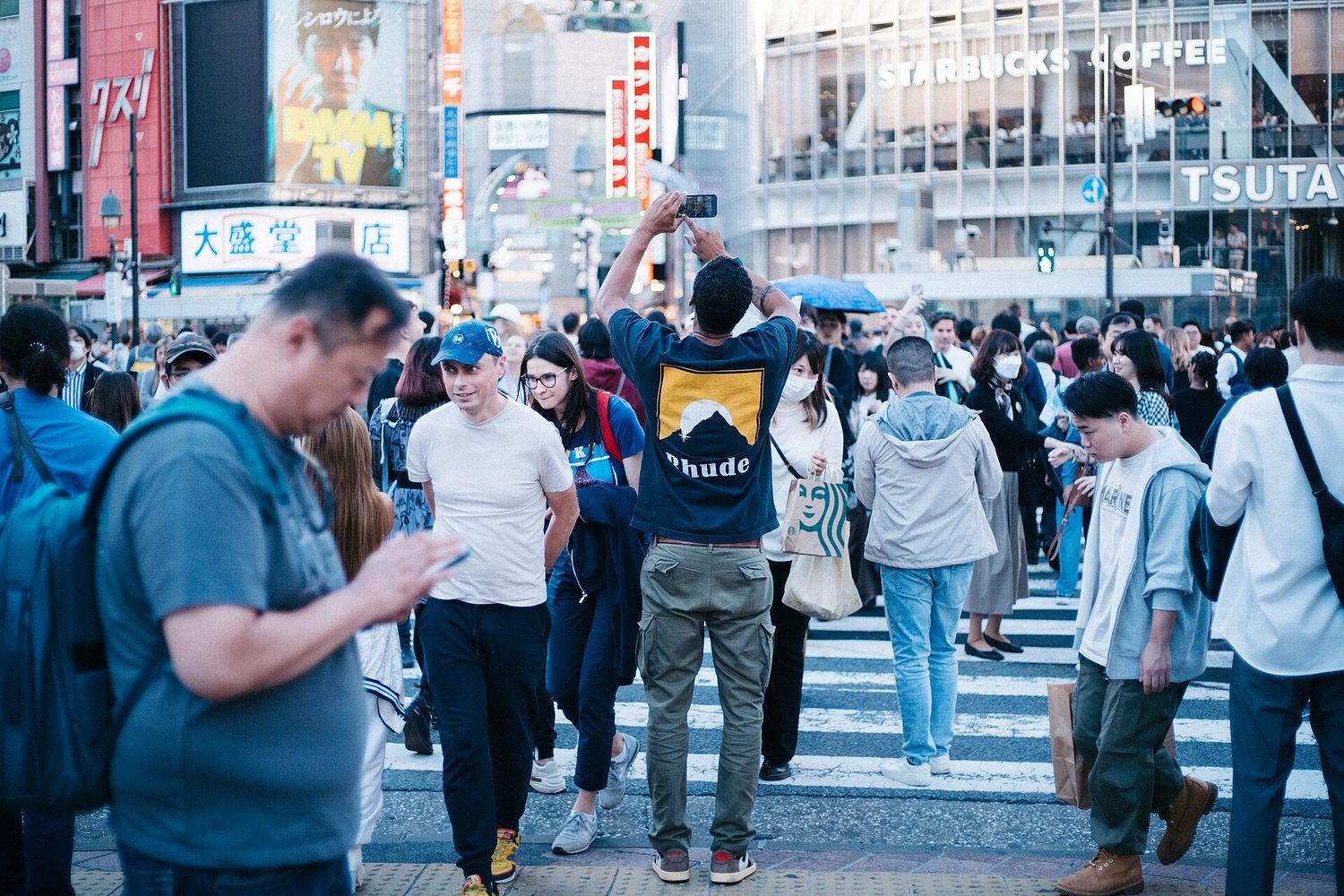
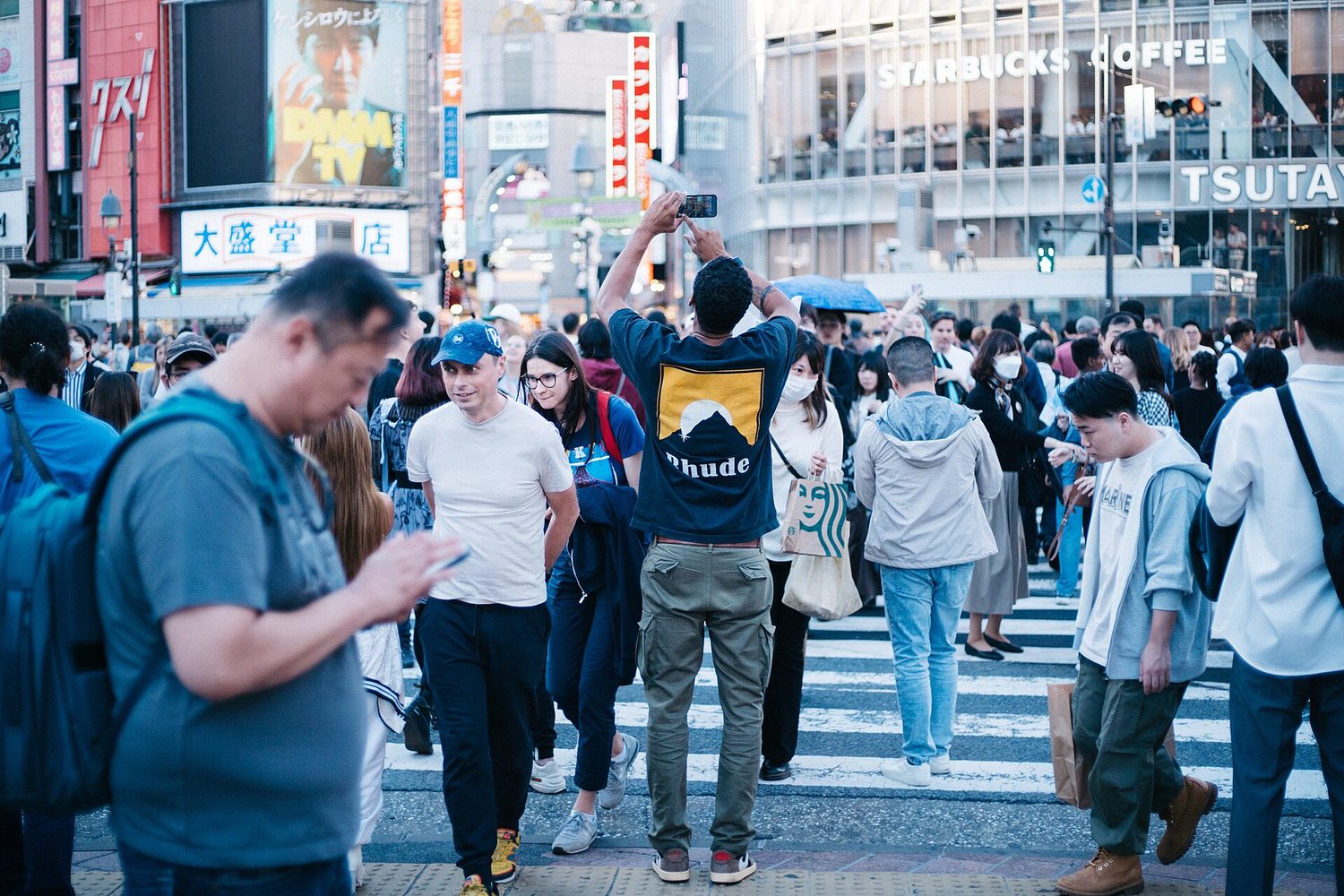
    คนหลายร้อยคนข้ามทางแยกถนนกว้างพร้อมกัน เติมเต็มทุกส่วนของทางแยก
    ทางเท้าที่แน่นขนานในโตเกียว: เมืองดึงคนเข้ามาในพื้นที่เล็กๆ ให้มีความหนาแน่นของประชากรสูงมาก

    นักภูมิศาสตร์ใช้สามมาตรการความหนาแน่น:

    • ความหนาแน่นทางคณิตศาสตร์ (Arithmetic density) — จำนวนคนทั้งหมด ÷ พื้นที่ที่ดินทั้งหมด
    • ความหนาแน่นทางชีวภาพ (Physiological density) — คน ÷ พื้นที่ ดินเกษตรกรรม (可做farmland); ตัวชี้วัดที่ดีกว่าสำหรับแรงกดดันต่ออุปทานอาหาร
    • ความหนาแน่นทางการเกษตร (Agricultural density) — เกษตรกร ÷ ดินเกษตรกรรม; ค่าต่ำบ่งบอกว่าการเกษตรที่มีประสิทธิภาพมากขึ้นและการใช้เครื่องจักรกล

    การกระจายตัวไม่สม่ำเสมอสร้าง ผลกระทบ:的区域แออัดทำให้ที่อยู่อาศัย น้ำ และบริการ strained ในขณะที่พื้นที่ว่างเปล่าอาจมีปัญหาในการจัดหาน้ำและโรงเรียน

    Vocabulary · ⁨คำศัพท์⁩ Train · ⁨ฝึกฝน⁩
    English ไทย
    Population distribution/ˌpɒpjʊˈleɪʃn ˌdɪstrɪˈbjuːʃn/ การกระจายตัวของประชากร
    population density/ˌpɒpjʊˈleɪʃn ˈdensɪti/ ความหนาแน่นของประชากร
    Arithmetic density/əˈrɪθmətɪk ˈdensɪti/ ความหนาแน่นทางคณิตศาสตร์
    Physiological density/ˌfɪzɪəˈlɒdʒɪkl ˈdensɪti/ ความหนาแน่นทางสรีรวิทยา
    Agricultural density/ˌæɡrɪˈkʌltʃərəl ˈdensɪti/ ความหนาแน่นทางการเกษตร
    Population composition/ˌpɒpjʊˈleɪʃn ˌkɒmpəˈzɪʃn/ องค์ประกอบของประชากร
    2.3

    Population Composition · ⁨โครงสร้างประชากร⁩

    Syllabus · ⁨หลักสูตร⁩
    English

    Enduring Understanding (PSO-2): Understanding where and how people live is essential to understanding global cultural, political, and economic patterns.

    Learning Objective PSO-2.E: Describe elements of population composition used by geographers.

    • PSO-2.E.1 Patterns of age structure and sex ratio vary across different regions and may be mapped and analyzed at different scales.

    Learning Objective PSO-2.F: Explain ways that geographers depict and analyze population composition.

    • PSO-2.F.1 Population pyramids are used to assess population growth and decline and to predict markets for goods and services.
    ไทย

    ความเข้าใจที่ยั่งยืน (PSO-2): การเข้าใจว่าคนอยู่ที่ไหนและอย่างไร จำเป็นต่อการเข้าใจรูปแบบวัฒนธรรม การเมือง และเศรษฐกิจของโลก

    วัตถุประสงค์การเรียนรู้ PSO-2.E: อธิบายองค์ประกอบของโครงสร้างประชากรที่นักภูมิศาสตร์ใช้

    • PSO-2.E.1 รูปแบบของโครงสร้างอายุและอัตราส่วนเพศแตกต่างกันในแต่ละภูมิภาคและสามารถทำแผนที่และวิเคราะห์ได้ในหลายระดับ

    วัตถุประสงค์การเรียนรู้ PSO-2.F: อธิบายวิธีการที่นักภูมิศาสตร์แสดงออกและวิเคราะห์โครงสร้างประชากร

    • PSO-2.F.1 กราฟประชากรใช้เพื่อประเมินการเติบโตและลดลงของประชากร sertaคาดการณ์ตลาดสำหรับสินค้าและบริการ

    Source: College Board AP Course and Exam Description · ⁨แหล่งที่มา: คำอธิบายหลักสูตรและข้อสอบ College Board AP⁩

    English
    Reading a population pyramid

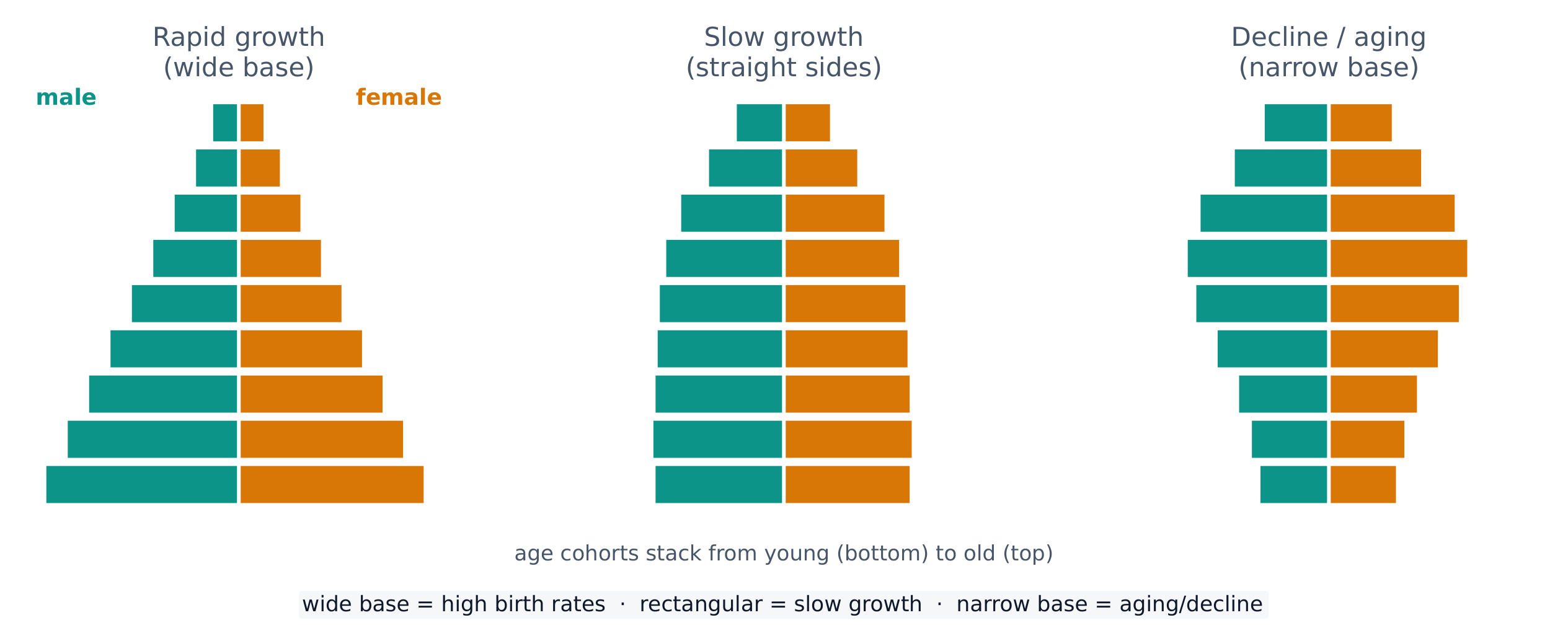
    Population composition 人口构成 is the make-up of a population by age and sex. It is shown on a population pyramid 人口金字塔 — back-to-back bar charts of males and females in five-year age cohorts 年龄组.

    • A wide base means high birth rates and rapid growth (many young people).
    • Straight sides mean slow, stable growth.
    • A narrow base with a wide middle means an aging, shrinking population.

    The dependency ratio 抚养比 compares dependents (under 15 and over 64) to the working-age population — a high ratio strains the workers who support them.

    ไทย

    *การอ่าน piramid of the population

    โครงสร้างประชากร คือองค์ประกอบของประชากรตาม อายุ และ เพศ แสดงบน piramid of the population — แผนภูมิแท่งย้อนกลับกันของผู้ชายและผู้หญิงในกลุ่ม อายุ ห้าปี

    Three population-pyramid shapes: rapid growth, slow growth, and decline
    ฐานกว้างหมายถึงการเติบโตอย่างรวดเร็ว; ข้างตรงหมายถึงการเติบโตช้า; ฐานแคบหมายถึงการลดลง
    • ฐานกว้าง หมายถึงอัตราการเกิดสูงและการเติบโตอย่างรวดเร็ว (มีคนอายุน้อยจำนวนมาก)
    • ข้างตรง意味着การเติบโตช้าและมั่นคง
    • ฐานแคบ พร้อมส่วนกลางกว้างหมายถึงประชากร สูงอายุ ลดจำนวนลง

    อัตราส่วนความขึ้นพ่วง เปรียบเทียบจำนวนผู้พึ่งพา (อายุต่ำกว่า 15 ปีและมากกว่า 64 ปี) กับประชากรวัยทำงาน — อัตราส่วนที่สูงจะสร้างความกดดันต่อแรงงานที่ต้องเลี้ยงดูพวกเขา

    Vocabulary · ⁨คำศัพท์⁩ Train · ⁨ฝึกฝน⁩
    English ไทย
    population pyramid/ˌpɒpjʊˈleɪʃn ˈpɪrəmɪd/ ปิระมิดประชากร
    age cohorts/eɪdʒ ˈkəʊhɔːts/ กลุ่มอายุ
    dependency ratio/dɪˈpendənsi ˈreɪʃɪəʊ/ อัตราส่วนพึ่งพา (Dependency ratio)
    Crude birth rate (CBR)/kruːd bɜːθ reɪt/ อัตราการเกิดสุทธิ (CBR)
    crude death rate (CDR)/kruːd deθ reɪt/ อัตราการตายสุทธิ (CDR)
    Rate of natural increase (RNI)/reɪt ɒv ˈnætʃərəl ˈɪŋkriːs/ อัตราการเพิ่มขึ้นตามธรรมชาติ (RNI)
    Total fertility rate (TFR)/ˈtəʊtl fɜːˈtɪlɪti reɪt/ อัตราส่วนการมีบุตรเฉลี่ย (TFR)
    replacement level/rɪˈpleɪsmənt ˈlevl/ ระดับทดแทน (replacement level)
    doubling time/ˈdʌblɪŋ taɪm/ ระยะเวลาในการเพิ่มเป็นสองเท่า (doubling time)
    Demographic Transition Model (DTM)/ˌdeməˈɡræfɪk trænˈsɪʃn ˈmɒdl/ โมเดลการเปลี่ยนผ่านทางประชากร (DTM)
    epidemiological transition/ˌepɪˌdemɪəˈlɒdʒɪkl trænˈsɪʃn/ epidemiological transition
    exponentially/ˌekspəˈnenʃəli/ แบบเอกซ์โพเนนเชียล
    linearly/ˈlɪnɪəli/ linearly
    2.4

    Population Dynamics · ⁨พลวัตของประชากร⁩

    Syllabus · ⁨หลักสูตร⁩
    English

    Enduring Understanding (IMP-2): Changes in population are due to mortality, fertility, and migration, which are influenced by the interplay of environmental, economic, cultural, and political factors.

    Learning Objective IMP-2.A: Explain factors that account for contemporary and historical trends in population growth and decline.

    • IMP-2.A.1 Demographic factors that determine a population’s growth and decline are fertility, mortality, and migration.
    • IMP-2.A.2 Geographers use the rate of natural increase and population-doubling time to explain population growth and decline.
    • IMP-2.A.3 Social, cultural, political, and economic factors influence fertility, mortality, and migration rates.
    ไทย

    ความเข้าใจที่ยั่งยืน (IMP-2): การเปลี่ยนแปลงของประชากรเกิดจากความตาย อัตราการเกิด และการย้ายถิ่น ซึ่งได้รับอิทธิพลจากการผสมผสานของปัจจัยด้านสิ่งแวดล้อม เศรษฐกิจ วัฒนธรรม และการเมือง

    วัตถุประสงค์การเรียนรู้ IMP-2.A: อธิบายปัจจัยที่อธิบายแนวโน้มการเติบโตและลดลงของประชากรในปัจจุบันและในอดีต

    • IMP-2.A.1 ปัจจัยทางประชากรศาสตร์ที่กำหนดการเติบโตและลดลงของประชากรได้แก่ อัตราการเกิด อัตราการตาย และการอพยพ
    • IMP-2.A.2 นักภูมิศาสตร์ใช้อัตราการเพิ่มขึ้นตามธรรมชาติและระยะเวลาในการเพิ่มประชากรสองเท่าเพื่ออธิบายการเติบโตและลดลงของประชากร
    • IMP-2.A.3 ปัจจัยทางสังคม วัฒนธรรม การเมือง และเศรษฐกิจมีอิทธิพลต่ออัตราการเกิด อัตราการตาย และการอพยพ

    Source: College Board AP Course and Exam Description · ⁨แหล่งที่มา: คำอธิบายหลักสูตรและข้อสอบ College Board AP⁩

    English

    Populations change through births, deaths, and migration. Key rates (per 1,000 people per year):

    • Crude birth rate (CBR) 粗出生率 and crude death rate (CDR) 粗死亡率.
    • Rate of natural increase (RNI) 自然增长率 = (CBR − CDR) ÷ 10, as a percentage — it ignores migration.
    • Total fertility rate (TFR) 总和生育率 — average children per woman; about 2.1 is replacement level 更替水平.

    The doubling time 倍增时间 (years for a population to double) ≈ 70 ÷ RNI%. Small changes in fertility have huge long-run effects.

    Worked example (a real AP exam question). "Explain ONE reason why the rate of natural increase (RNI) in urban areas may vary significantly from RNI in rural areas in the same country." (2023) A full-mark answer: "In cities the cost of living — housing, schooling, childcare — is higher, so urban families tend to have fewer children. Fewer births lower the crude birth rate, so the urban RNI falls below the rural RNI, where children still help with farm work." Notice the shape: the command word Explain wants a cause-and-effect chain, so you must name the reason and follow it all the way to the RNI. A bare fact — "cities are expensive" — earns zero.

    ไทย

    ประชากรเปลี่ยนแปลงจากการเกิด การตาย และการย้ายถิ่น อัตราสำคัญ (ต่อประชากร 1,000 คน ต่อปี):

    • อัตราการเกิดดิบ (CBR) และ อัตราการตายดิบ (CDR)
    • อัตราการเพิ่มขึ้นตามธรรมชาติ (RNI) = (CBR − CDR) ÷ 10, ในรูปเปอร์เซ็นต์ — ไม่รวมการย้ายถิ่น
    • อัตราการมีบุตรเฉลี่ย (TFR) — จำนวนลูกเฉลี่ยต่อหญิงหนึ่งคน; ประมาณ 2.1 คือ ระดับทดแทน

    ระยะเวลาสองเท่า (จำนวนปีที่ประชากรจะเพิ่มเป็นสองเท่า) ≈ 70 ÷ RNI% การเปลี่ยนแปลงเล็กน้อยในอัตราการมีบุตรส่งผลกระทบมหาศาลในระยะยาว

    ตัวอย่างวิธีทำ (ข้อสอบ AP จริง) "อธิบายเหตุผล ONE ที่อัตราการเพิ่มขึ้นตามธรรมชาติ (RNI) ในเขตเมืองอาจแตกต่างอย่างมากจาก RNI ในชนบทของประเทศเดียวกัน" (2023) คำตอบเต็มคะแนน: "ในเมืองค่าครองชีพ — ค่าที่พัก ค่าเรียน ค่าดูแลเด็ก — สูงกว่า ดังนั้นครอบครัวในเมืองจึงมักมีลูกน้อยลง การเกิดที่ลดลงทำให้ CBR ลดลง ทำให้ RNI ของเมืองต่ำกว่า RNI ของชนบท ซึ่งเด็กยังคงช่วยงานเกษตรกรรม" ระวังรูปแบบ: คำสั่ง Explain ต้องการกลไกเหตุและผล คุณต้องระบุเหตุผล และ เชื่อมโยงต่อไปจนถึง RNI ข้อเท็จจริงล้วนๆ เช่น "เมืองแพง" ไม่ได้คะแนนเลย

    2.5

    The Demographic Transition Model · ⁨โมเดลการเปลี่ยนผ่านทางประชากรศาสตร์⁩

    Syllabus · ⁨หลักสูตร⁩
    English

    Enduring Understanding (IMP-2): Changes in population are due to mortality, fertility, and migration, which are influenced by the interplay of environmental, economic, cultural, and political factors.

    Learning Objective IMP-2.B: Explain theories of population growth and decline.

    • IMP-2.B.1 The demographic transition model can be used to explain population change over time.
    • IMP-2.B.2 The epidemiological transition explains causes of changing death rates.
    ไทย

    ความเข้าใจที่ยั่งยืน (IMP-2): การเปลี่ยนแปลงของประชากรเกิดจากความตาย อัตราการเกิด และการย้ายถิ่น ซึ่งได้รับอิทธิพลจากการผสมผสานของปัจจัยด้านสิ่งแวดล้อม เศรษฐกิจ วัฒนธรรม และการเมือง

    วัตถุประสงค์การเรียนรู้ IMP-2.B: อธิบายทฤษฎีเกี่ยวกับการเติบโตและลดลงของประชากร

    • IMP-2.B.1 โมเดลการเปลี่ยนผ่านทางประชากรสามารถใช้เพื่ออธิบายการเปลี่ยนแปลงของประชากรตามเวลา
    • IMP-2.B.2 การเปลี่ยนผ่านทางระบาดวิทยาอธิบายสาเหตุของการเปลี่ยนแปลงอัตราการตาย

    Source: College Board AP Course and Exam Description · ⁨แหล่งที่มา: คำอธิบายหลักสูตรและข้อสอบ College Board AP⁩

    English
    The demographic transition model

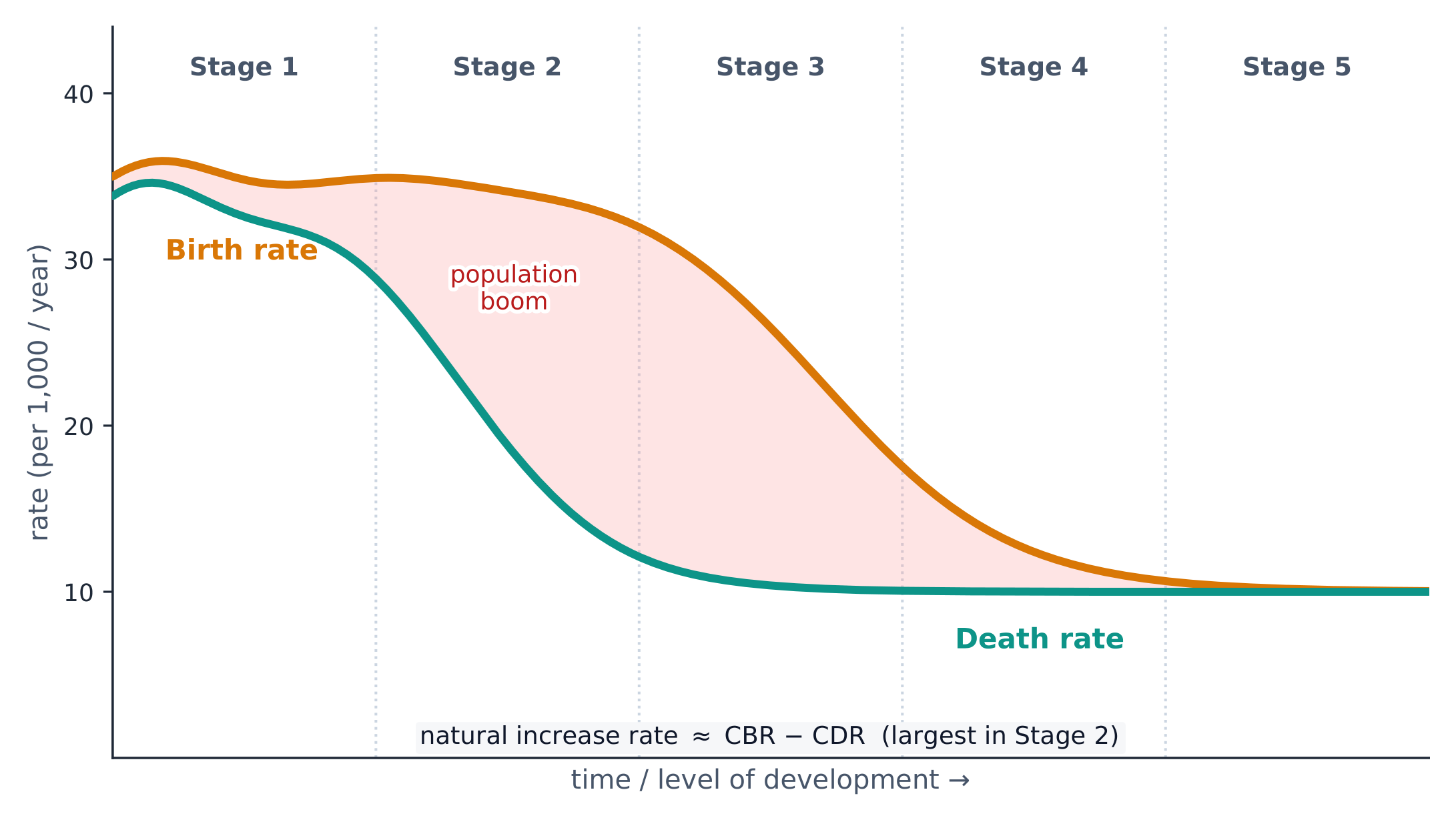
    The Demographic Transition Model (DTM) 人口转变模型 shows how birth and death rates change as a country develops, through five stages.

    1. Stage 1 — high, fluctuating CBR and CDR; slow growth (pre-industrial).
    2. Stage 2 — CDR falls (better food, medicine, sanitation) while CBR stays high; population booms.
    3. Stage 3 — CBR falls (urbanisation, education, women in work); growth slows.
    4. Stage 4 — low CBR and CDR; population stable and large.
    5. Stage 5 — CBR falls below CDR; population declines and ages.

    The linked epidemiological transition 流行病学转变 describes how the main causes of death shift from infectious disease to chronic, degenerative disease as a country moves through the DTM.

    ไทย
    โมเดลการเปลี่ยนผ่านทางประชากรศาสตร์

    โมเดลการเปลี่ยนผ่านทางประชากรศาสตร์ (DTM) แสดงให้เห็นว่าอัตราการเกิดและอัตราการตายเปลี่ยนแปลงอย่างไรเมื่อประเทศพัฒนา ผ่าน ห้าขั้นตอน

    แบบจำลองการเปลี่ยนผ่านทางประชากร: อัตราเกิดและอัตราตายตลอดห้าขั้นตอน
    อัตราการตายลดลงก่อน แล้วจึงลดลงอัตราการเกิด; ช่องว่างระหว่างทั้งสองคือช่วงประชากรพุ่งสูง
    1. ขั้นตอนที่ 1 — CBR และ CDR สูงและผันผวน; การเติบโตช้า (ก่อนยุคอุตสาหกรรม)
    2. ขั้นตอนที่ 2 — CDR ลดลง (อาหารดีขึ้น ยาที่ดีขึ้น สันนิบาตสะอาดขึ้น) ในขณะที่ CBR ยังสูง; ประชากร พุ่งสูง
    3. ขั้นตอนที่ 3 — CBR ลดลง (การเป็นเมือง การศึกษา ผู้หญิงเข้าทำงาน); การเติบโตชะลอตัว
    4. ขั้นตอนที่ 4 — CBR และ CDR ต่ำ; ประชากรคงที่และมีขนาดใหญ่
    5. ขั้นตอนที่ 5 — CBR ลดลง ต่ำกว่า CDR; ประชากรลดลงและเข้าสู่สังคมผู้สูงอายุ

    การเปลี่ยนผ่านด้านระบาดวิทยา ที่เชื่อมโยงกัน อธิบายถึงการเปลี่ยนแปลงสาเหตุหลักของการตายจาก โรคติดเชื้อ เป็น โรคเรื้อรังและเสื่อมสภาพ เมื่อประเทศผ่าน DTM

    2.6

    Malthusian Theory · ⁨ทฤษฎีมาลซัส⁩

    Syllabus · ⁨หลักสูตร⁩
    English

    Enduring Understanding (IMP-2): Changes in population are due to mortality, fertility, and migration, which are influenced by the interplay of environmental, economic, cultural, and political factors.

    Learning Objective IMP-2.B: Explain theories of population growth and decline.

    • IMP-2.B.3 Malthusian theory and its critiques are used to analyze population change and its consequences.
    ไทย

    ความเข้าใจที่ยั่งยืน (IMP-2): การเปลี่ยนแปลงของประชากรเกิดจากความตาย อัตราการเกิด และการย้ายถิ่น ซึ่งได้รับอิทธิพลจากการผสมผสานของปัจจัยด้านสิ่งแวดล้อม เศรษฐกิจ วัฒนธรรม และการเมือง

    วัตถุประสงค์การเรียนรู้ IMP-2.B: อธิบายทฤษฎีเกี่ยวกับการเติบโตและลดลงของประชากร

    • IMP-2.B.3 ทฤษฎีมาลซัสและข้อวิจารณ์ถูกใช้เพื่อวิเคราะห์การเปลี่ยนแปลงของประชากรและผลกระทบของมัน

    Source: College Board AP Course and Exam Description · ⁨แหล่งที่มา: คำอธิบายหลักสูตรและข้อสอบ College Board AP⁩

    English
    Malthusian theory and its critique

    In 1798 Thomas Malthus argued that population grows exponentially 指数式 while food supply grows only linearly 线性, so population would outrun food and be checked by famine, disease, and war.

    Critics say Malthus underestimated technology: the Green Revolution and modern farming raised food output enormously. Neo-Malthusians 新马尔萨斯主义者 update the worry to include water, energy, and other finite resources. The debate is a favourite exam prompt.

    ไทย
    ทฤษฎีมาลซัสและการวิพากษ์วิจารณ์

    ในปี 1798 โทมัส มาลซัส argued ว่าประชากรเพิ่มขึ้นแบบ เลขยกกำลัง ในขณะที่อุปทานอาหารเพิ่มขึ้นเพียงแบบ เชิงเส้น ดังนั้นประชากรจะเกินกว่าอาหารจะถูกควบคุมโดยความอดอยาก โรคภัย และสงคราม

    นักวิจารณ์บอกว่ามาลซัสประเมินต่ำไปเรื่อง เทคโนโลยี:revolution สีเขียวและเกษตรกรรมสมัยใหม่เพิ่มการผลิตอาหารมหาศาล neo-Malthusians อัปเดตความกังวลรวมถึงน้ำ พลังงาน และทรัพยากรจำกัดอื่นๆ การถกเถียงนี้เป็นหัวข้อข้อสอบยอดนิยม

    Vocabulary · ⁨คำศัพท์⁩ Train · ⁨ฝึกฝน⁩
    English ไทย
    Neo-Malthusians/ˈniːəʊ mælˈθjuːzɪənz/ Neo-Malthusians
    2.7

    Population Policies · ⁨นโยบายประชากร⁩

    Syllabus · ⁨หลักสูตร⁩
    English

    Enduring Understanding (SPS-2): Changes in population have long- and short-term effects on a place’s economy, culture, and politics.

    Learning Objective SPS-2.A: Explain the intent and effects of various population and immigration policies on population size and composition.

    • SPS-2.A.1 Types of population policies include those that promote or discourage population growth, such as pronatalist, antinatalist, and immigration policies.
    ไทย

    ความเข้าใจที่ยั่งยืน (SPS-2): การเปลี่ยนแปลงของประชากรมีผลระยะยาวและระยะสั้นต่อเศรษฐกิจ วัฒนธรรม และการเมืองของพื้นที่นั้นๆ

    วัตถุประสงค์การเรียนรู้ SPS-2.A: อธิบายเจตนารมณ์และผลกระทบของนโยบายประชากรและนโยบายการอพยพต่างๆ ที่มีต่อขนาดและโครงสร้างประชากร

    • SPS-2.A.1 ประเภทของนโยบายประชากรได้แก่ นโยบายที่ส่งเสริมหรือยับยั้งการเติบโตของประชากร เช่น นโยบายสนับสนุนการเกิด นโยบายควบคุมการเกิด และนโยบายการอพยพ

    Source: College Board AP Course and Exam Description · ⁨แหล่งที่มา: คำอธิบายหลักสูตรและข้อสอบ College Board AP⁩

    English

    Governments try to influence population growth with policies:

    • Pro-natalist 鼓励生育 policies encourage births (cash bonuses, parental leave, childcare) where populations are aging or shrinking — e.g. France, Japan.
    • Anti-natalist 限制生育 policies discourage births where growth is seen as too fast — e.g. India's family-planning campaigns.

    Policies have unintended consequences: strong anti-natal policies can skew the sex ratio or speed up aging, which later needs a pro-natal response.

    ไทย

    รัฐบาลพยายาม_cpus population growth ด้วยนโยบาย:

    • นโยบายสนับสนุนการเกิด (Pro-natalist) ส่งเสริมการเกิด (เงินโบนัส การลาคลอด การดูแลเด็ก) ในประเทศที่มีประชากรแก่หรือลดจำนวน — เช่น ฝรั่งเศส ญี่ปุ่น
    • นโยบายควบคุมการเกิด (Anti-natalist) ยับยั้งการเกิดในประเทศที่มองว่าการเติบโตเร็วเกินไป — เช่น Campaign การวางแผนครอบครัวของอินเดีย

    นโยบายมี ผลกระทบที่ไม่ตั้งใจ: นโยบายควบคุมการเกิดเข้มงวดอาจทำให้สัดส่วนเพศชายหญิงผิดเพี้ยนหรือเร่งการเข้าสู่สังคมผู้สูงอายุ ซึ่งภายหลังต้องใช้มาตรการสนับสนุนการเกิด来处理

    Vocabulary · ⁨คำศัพท์⁩ Train · ⁨ฝึกฝน⁩
    English ไทย
    Pro-natalist/prəʊ ˈneɪtəlɪst/ สนับสนุนการเกิด
    Anti-natalist/ˈænti ˈneɪtəlɪst/ ต่อต้านการเกิด
    aging populations/ˈeɪdʒɪŋ ˌpɒpjʊˈleɪʃnz/ ประชากรสูงอายุ
    2.8 2.9

    Women, Aging, and Demographic Change · ⁨หญิงผู้สูงอายุ และการเปลี่ยนแปลงทางประชากรศาสตร์⁩

    Syllabus · ⁨หลักสูตร⁩
    English

    Enduring Understanding (SPS-2): Changes in population have long- and short-term effects on a place’s economy, culture, and politics.

    Learning Objective SPS-2.B: Explain how the changing role of females has demographic consequences in different parts of the world.

    • SPS-2.B.1 Changing social values and access to education, employment, health care, and contraception have reduced fertility rates in most parts of the world.
    • SPS-2.B.2 Changing social, economic, and political roles for females have influenced patterns of fertility, mortality, and migration, as illustrated by Ravenstein’s laws of migration.
    ไทย

    ความเข้าใจที่ยั่งยืน (SPS-2): การเปลี่ยนแปลงของประชากรมีผลระยะยาวและระยะสั้นต่อเศรษฐกิจ วัฒนธรรม และการเมืองของพื้นที่นั้นๆ

    วัตถุประสงค์การเรียนรู้ SPS-2.B: อธิบายว่าบทบาทของผู้หญิงที่เปลี่ยนแปลงไปมีผลกระทบทางประชากรศาสตร์ในพื้นที่ต่างๆ ของโลกอย่างไร

    • SPS-2.B.1 ค่านิยมทางสังคมที่เปลี่ยนแปลงและการเข้าถึงการศึกษา การจ้างงาน การดูแลสุขภาพ และการคุมกำเนิด telahลดอัตราการเกิดในส่วนใหญ่ของโลก
    • SPS-2.B.2 บทบาททางสังคม เศรษฐกิจ และการเมืองของผู้หญิงที่เปลี่ยนแปลงไปมีอิทธิพลต่อรูปแบบการเกิด การตาย และการอพยพ ตามที่แสดงโดยกฎการอพยพของ Ravenstein
    English

    Enduring Understanding (SPS-2): Changes in population have long- and short-term effects on a place’s economy, culture, and politics.

    Learning Objective SPS-2.C: Explain the causes and consequences of an aging population.

    • SPS-2.C.1 Population aging is determined by birth and death rates and life expectancy.
    • SPS-2.C.2 An aging population has political, social, and economic consequences, including the dependency ratio.
    ไทย

    ความเข้าใจที่ยั่งยืน (SPS-2): การเปลี่ยนแปลงของประชากรมีผลระยะยาวและระยะสั้นต่อเศรษฐกิจ วัฒนธรรม และการเมืองของพื้นที่นั้นๆ

    วัตถุประสงค์การเรียนรู้ SPS-2.C: อธิบายสาเหตุและผลกระทบของประชากรสูงวัย

    • SPS-2.C.1 การสูงวัยของประชากรกำหนดโดยอัตราการเกิด อัตราการตาย และอายุขัย
    • SPS-2.C.2 ประชากรสูงวัยมีผลกระทบด้านการเมือง สังคม และเศรษฐกิจ รวมถึงอัตราส่วนการพึ่งพา

    Source: College Board AP Course and Exam Description · ⁨แหล่งที่มา: คำอธิบายหลักสูตรและข้อสอบ College Board AP⁩

    English

    The status of women is one of the strongest drivers of fertility. As female education and employment rise, women marry later and have fewer children, so fertility falls — a key reason countries move through the DTM.

    At the other end, aging populations 人口老龄化 (a rising share of over-65s) bring their own challenges: higher pension and healthcare costs, a shrinking workforce, and a rising dependency ratio. Countries respond with later retirement, immigration, or pro-natal policies.

    ไทย

    สถานะของ ผู้หญิง เป็น one of the strongest drivers of fertility. เมื่อ การศึกษา และ การจ้างงาน ของผู้หญิงสูงขึ้น ผู้หญิงแต่งงานช้าลงและมีลูกน้อยลง ทำให้ fertility ลดลง — ซึ่งเป็น one of the key reasons ประเทศผ่าน DTM

    อีกด้านหนึ่ง ประชากรผู้สูงอายุ (สัดส่วนของผู้สูงอายุมากกว่า 65 ปีเพิ่มขึ้น) brought their own challenges: ค่าบำนาญและค่าใช้จ่ายด้านสุขภาพสูงขึ้น แรงงานหดตัว และอัตราส่วนความขึ้นพ่วงสูงขึ้น ประเทศตอบสนองด้วยการ延 retirement การอพยพ หรือนโยบายสนับสนุนการเกิด

    2.10 2.11

    Causes and Types of Migration · ⁨สาเหตุและประเภทของการย้ายถิ่น⁩

    Syllabus · ⁨หลักสูตร⁩
    English

    Enduring Understanding (IMP-2): Changes in population are due to mortality, fertility, and migration, which are influenced by the interplay of environmental, economic, cultural, and political factors.

    Learning Objective IMP-2.C: Explain how different causal factors encourage migration.

    • IMP-2.C.1 Migration is commonly divided into push factors and pull factors.
    • IMP-2.C.2 Push/pull factors and intervening opportunities/obstacles can be cultural, demographic, economic, environmental, or political.
    ไทย

    ความเข้าใจที่ยั่งยืน (IMP-2): การเปลี่ยนแปลงของประชากรเกิดจากความตาย อัตราการเกิด และการย้ายถิ่น ซึ่งได้รับอิทธิพลจากการผสมผสานของปัจจัยด้านสิ่งแวดล้อม เศรษฐกิจ วัฒนธรรม และการเมือง

    วัตถุประสงค์การเรียนรู้ IMP-2.C: อธิบายว่าปัจจัยเชิงสาเหตุต่างๆ ส่งเสริมการอพยพได้อย่างไร

    • IMP-2.C.1 การอพยพมักแบ่งออกเป็นปัจจัยผลัก (push factors) และปัจจัยดึง (pull factors)
    • IMP-2.C.2 ปัจจัยผลัก/ดึงและโอกาสหรืออุปสรรคระหว่างทางอาจเป็นด้านวัฒนธรรม ประชากรศาสตร์ เศรษฐกิจ สิ่งแวดล้อม หรือการเมือง
    English

    Enduring Understanding (IMP-2): Changes in population are due to mortality, fertility, and migration, which are influenced by the interplay of environmental, economic, cultural, and political factors.

    Learning Objective IMP-2.D: Describe types of forced and voluntary migration.

    • IMP-2.D.1 Forced migrations include slavery and events that produce refugees, internally displaced persons, and asylum seekers.
    • IMP-2.D.2 Types of voluntary migrations include transnational, transhumance, internal, chain, step, guest worker, and rural-to-urban.
    ไทย

    ความเข้าใจที่ยั่งยืน (IMP-2): การเปลี่ยนแปลงของประชากรเกิดจากความตาย อัตราการเกิด และการย้ายถิ่น ซึ่งได้รับอิทธิพลจากการผสมผสานของปัจจัยด้านสิ่งแวดล้อม เศรษฐกิจ วัฒนธรรม และการเมือง

    วัตถุประสงค์การเรียนรู้ IMP-2.D: อธิบายประเภทของการอพยพแบบบังคับและแบบสมัครใจ

    • IMP-2.D.1 การอพยพแบบบังคับรวมถึงการเป็นทาสและเหตุการณ์ที่ก่อให้เกิดผู้ลี้ภัย ผู้ถูกย้ายถิ่นภายในประเทศ และผู้ขอ asylums
    • IMP-2.D.2 ประเภทของการอพยพแบบสมัครวิสัยได้แก่ การอพยพข้ามชาติ การอพยพตามฤดูกาล การอพยพภายในประเทศ การอพยพแบบลูกโซ่ การอพยพแบบขั้นบันได การอพยพเพื่อทำงาน และจากการชนบทสู่เมือง

    Source: College Board AP Course and Exam Description · ⁨แหล่งที่มา: คำอธิบายหลักสูตรและข้อสอบ College Board AP⁩

    English

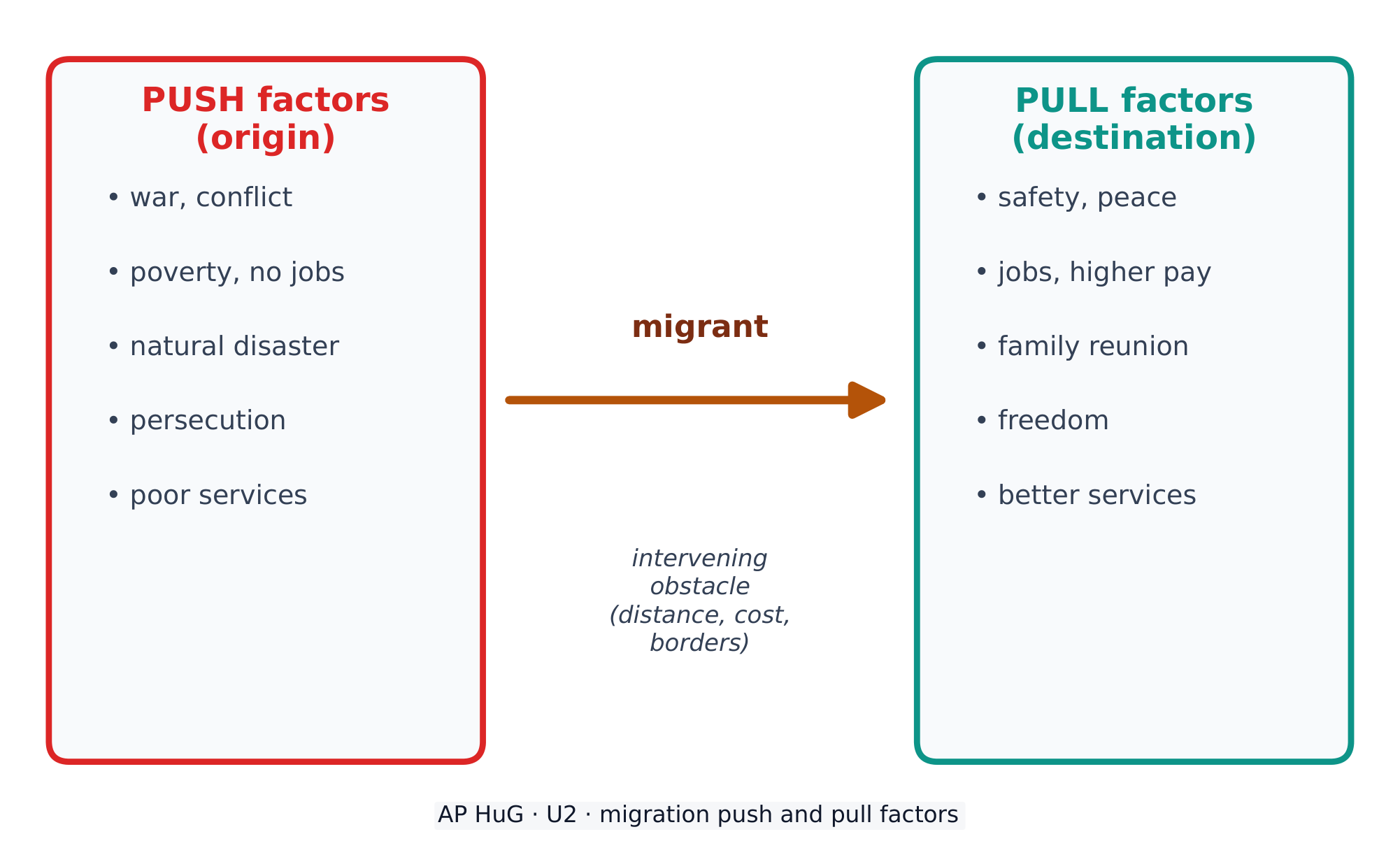
    Migration 迁移 is a permanent move to a new location. It is driven by push factors 推力 (reasons to leave: war, poverty, disaster) and pull factors 拉力 (reasons to arrive: jobs, safety, family).

    • Voluntary migration 自愿迁移 is by choice, usually for economic reasons.
    • Forced migration 强迫迁移 is against a person's will — refugees 难民 fleeing danger, or people displaced by disaster.
    • Ravenstein's laws describe patterns: most migrants move short distances, in steps, and are drawn mainly by economic pull.

    Migration can be international (between countries) or internal (within a country, such as rural-to-urban).

    ไทย

    การย้ายถิ่น คือการเคลื่อนย้ายถาวรไปยังสถานที่ใหม่ ถูกขับเคลื่อนโดย ปัจจัยผลัก (push factors) (เหตุผลที่จะจากไป: สงคราม ความยากจน ภัยพิบัติ) และ ปัจจัยดึง (pull factors) (เหตุผลที่จะเข้ามา: งาน ความปลอดภัย ครอบครัว)

    ปัจจัยผลักดันทำให้คนออกจากบ้านเกิด; ปัจจัยดึงดูดทำให้พวกเขาเดินทางไปยังสถานที่ใหม่
    การตัดสินใจย้ายถิ่นชั่งน้ำหนักปัจจัยผลักเทียบกับปัจจัยดึง Across an intervening obstacle
    • การอพยพโดยสมัครใจ เป็นการย้ายด้วยความ自由选择 โดยทั่วไปมีเหตุผลทางเศรษฐกิจ
    • การย้ายถิ่นบังคับ (Forced migration) เป็น против意愿 — ผู้ลี้ภัย ล่าหนีอันตราย หรือผู้ที่ถูก displaced โดยภัยพิบัติ
    • กฎของ Ravenstein อธิบาย patterns: ส่วนใหญ่ผู้ย้ายถิ่นเคลื่อนย้ายระยะสั้น เป็นขั้นบันได และถูก drawn by economic pull เป็นหลัก

    การย้ายถิ่นสามารถเป็น ระหว่างประเทศ (ระหว่างประเทศ) หรือ ภายในประเทศ (within a country, เช่น จากชนบทสู่เมือง)

    ผู้ย้ายถิ่น arriving ในเมืองใหม่: การย้ายถิ่น redistributed ประชากรและ reshape สถานที่
    ผู้เข้าเมืองมาถึงเมืองใหม่: การย้ายถิ่นกระจายประชากรใหม่และ重塑สถานที่
    Explore · ⁨สำรวจ⁩

    Push factor or pull factor? · ⁨เป็นปัจจัยผลักหรือปัจจัยดึง?⁩

    A push factor drives people away from the origin; a pull factor draws them toward the destination. · ⁨ปัจจัยผลัก ดันให้คนออกจากแหล่งกำเนิด; ปัจจัยดึง ดึงดูดให้ไปสู่ปลายทาง⁩

    Vocabulary · ⁨คำศัพท์⁩ Train · ⁨ฝึกฝน⁩
    English ไทย
    Migration/maɪˈɡreɪʃn/ การย้ายถิ่น
    push factors/pʊʃ ˈfæktəz/ push factors
    pull factors/pʊl ˈfæktəz/ pull factors
    Voluntary migration/ˈvɒləntəri maɪˈɡreɪʃn/ การอพยพแบบสมัครใจ
    Forced migration/fɔːst maɪˈɡreɪʃn/ การอพยพอย่างบังคับ
    refugees/ˈrefjuːdʒiːz/ ผู้ลี้ภัย
    2.12

    Effects of Migration · ⁨ผลกระทบของการย้ายถิ่น⁩

    Syllabus · ⁨หลักสูตร⁩
    English

    Enduring Understanding (IMP-2): Changes in population are due to mortality, fertility, and migration, which are influenced by the interplay of environmental, economic, cultural, and political factors.

    Learning Objective IMP-2.E: Explain historical and contemporary geographic effects of migration.

    • IMP-2.E.1 Migration has political, economic, and cultural effects.
    ไทย

    ความเข้าใจที่ยั่งยืน (IMP-2): การเปลี่ยนแปลงของประชากรเกิดจากความตาย อัตราการเกิด และการย้ายถิ่น ซึ่งได้รับอิทธิพลจากการผสมผสานของปัจจัยด้านสิ่งแวดล้อม เศรษฐกิจ วัฒนธรรม และการเมือง

    วัตถุประสงค์การเรียนรู้ IMP-2.E: อธิบายผลกระทบทางภูมิศาสตร์ในอดีตและปัจจุบันของการอพยพ

    • IMP-2.E.1 การอพยพมีผลกระทบด้านpolitics เศรษฐกิจ และวัฒนธรรม

    Source: College Board AP Course and Exam Description · ⁨แหล่งที่มา: คำอธิบายหลักสูตรและข้อสอบ College Board AP⁩

    English

    Migration reshapes both the origin and the destination.

    • The destination gains workers and cultural diversity but may face pressure on housing and services and social tension.
    • The origin may lose skilled workers (a brain drain 人才外流) but gain remittances 侨汇 — money migrants send home, a major income source for many countries.
    • Migration changes the age and sex structure of both places, because migrants are often young working-age adults.
    ไทย

    การย้ายถิ่น重塑ทั้ง แหล่งกำเนิด และ ปลายทาง

    • ปลายทาง ได้รับแรงงานและความหลากหลายทางวัฒนธรรม แต่อาจเผชิญกับแรงกดดันด้านที่อยู่อาศัยและบริการ และความตึงเครียดทางสังคม
    • แหล่งกำเนิด อาจสูญเสียแรงงานที่มีทักษะ (brain drain) แต่ได้รับ เงินส่งกลับ (remittances) — เงินที่ผู้ย้ายถิ่นส่งกลับบ้าน เป็น one of the major income sources for many countries
    • การย้ายถิ่นเปลี่ยนโครงสร้างอายุและเพศของทั้งสองแห่ง เพราะผู้ย้ายถิ่นมักเป็นผู้ใหญ่วัยทำงาน
    ผู้มาใหม่ reshape เมือง: การย้ายถิ่นเปลี่ยน labor markets, วัฒนธรรม และ demographics ใน destination places
    การเข้ามาของใหม่เปลี่ยนเมือง: การย้ายถิ่นฐานเปลี่ยนแปลงตลาดแรงงาน วัฒนธรรม และประชากรศาสตร์ในพื้นที่ปลายทาง
    Vocabulary · ⁨คำศัพท์⁩ Train · ⁨ฝึกฝน⁩
    English ไทย
    brain drain/breɪn dreɪn/ Brain drain
    remittances/rɪˈmɪtənsɪz/ Remittances
    2.12

    Exam tips · ⁨ข้อแนะนำสำหรับการสอบ⁩

    English
    • Compute RNI = (CBR − CDR) ÷ 10 as a percent, and read doubling time as about 70 ÷ RNI.
    • Link a population pyramid's shape to fertility and the DTM stage — a wide base means Stage 2.
    • Remember the death rate falls before the birth rate; that is why Stage 2 grows fastest.
    • Separate push from pull and forced from voluntary; a refugee crosses a border, an IDP does not.
    • Weigh migration effects: remittances help the origin, but brain drain and aging hurt it.
    ไทย
    • คำนวณ RNI = (CBR − CDR) ÷ 10 เป็นเปอร์เซ็นต์ และอ่านค่าเวลาเพิ่มเป็นสองเท่าโดยประมาณจากสูตร 70 ÷ RNI
    • เชื่อมโยงรูปร่างของ แผนภูมิประชากร กับอัตราการเกิดและระยะของ DTM — ฐานที่กว้างบ่งชี้ถึงระยะที่ 2
    • จำไว้ว่า อัตราตาย ลดลงก่อน อัตราเกิด นั่นคือเหตุผลที่ระยะที่ 2มีการเติบโตเร็วที่สุด
    • แยกแยะระหว่างแรง ผลัก และแรง ดึง รวมถึง บังคับ กับ สมัครใจ; ผู้ลี้ภัย ข้ามพรมแดน แต่ ผู้ลี้ภัยภายในประเทศ (IDP) ไม่ข้าม
    • พิจารณาผลกระทบของการย้ายถิ่น: เงินส่งกลับ ช่วยพื้นที่ต้นทาง แต่ สมองไหลออก และการสูงวัยทำให้มันเสียหาย
  • 3

    Cultural Patterns and Processes · ⁨รูปแบบและกระบวนการทางวัฒนธรรม⁩

    Watch lesson · ⁨ดูบทเรียน⁩
    3.1

    Introduction to Culture · ⁨บทนำเรื่องวัฒนธรรม⁩

    Syllabus · ⁨หลักสูตร⁩
    English

    Enduring Understanding (PSO-3): Cultural practices vary across geographical locations because of physical geography and available resources.

    Learning Objective PSO-3.A: Define the characteristics, attitudes, and traits that influence geographers when they study culture.

    • PSO-3.A.1 Culture comprises the shared practices, technologies, attitudes, and behaviors transmitted by a society.
    • PSO-3.A.2 Cultural traits include such things as food preferences, architecture, and land use.
    • PSO-3.A.3 Cultural relativism and ethnocentrism are different attitudes toward cultural difference.
    ไทย

    ความเข้าใจที่ยั่งยืน (PSO-3): praktikทางวัฒนธรรมแตกต่างกันไปตามตำแหน่งทางภูมิศาสตร์เนื่องจากภูมิประเทศกายภาพและทรัพยากรที่มีอยู่

    วัตถุประสงค์การเรียนรู้ PSO-3.A: นิยามลักษณะทัศนคติและคุณสมบัติที่มีอิทธิพลต่อนักภูมิศาสตร์เมื่อพวกเขาศึกษาวัฒนธรรม

    • PSO-3.A.1 วัฒนธรรมประกอบด้วยประเพณี เทคโนโลยี ทัศนคติ และพฤติกรรมที่ร่วมกันและถ่ายทอดโดยสังคม
    • PSO-3.A.2 คุณสมบัติทางวัฒนธรรมรวมถึงความชอบอาหาร สถาปัตยกรรม และการใช้ที่ดิน
    • PSO-3.A.3 วัฒนธรรมสัมพัทธ์และชาตินิยมทางวัฒนธรรมคือทัศนคติที่แตกต่างกันต่อบทถาวัฒนธรรม

    Source: College Board AP Course and Exam Description · ⁨แหล่งที่มา: คำอธิบายหลักสูตรและข้อสอบ College Board AP⁩

    English

    Culture 文化 is the shared set of beliefs, values, practices, and objects of a group of people. Geographers split it into two parts:

    • Material culture 物质文化 — the things people make and use (clothing, tools, food, buildings, art).
    • Nonmaterial culture 非物质文化 — the ideas people hold (language, religion, values, rules).

    A cultural trait 文化特征 is a single element of culture (using chopsticks); a group of linked traits is a cultural complex. Cultural relativism 文化相对论 is the practice of judging a culture by its own standards rather than your own.

    ไทย

    วัฒนธรรม คือชุดความเชื่อ ค่านิยม กิจกรรม และวัตถุที่กลุ่มคนมีร่วมกัน นักภูมิศาสตร์แบ่งออกเป็นสองส่วน:

    • วัฒนธรรมเชิงวัตถุ — สิ่งที่มนุษย์สร้างและใช้ (เสื้อผ้า เครื่องมือ อาหาร อาคาร ศิลปะ)
    • วัฒนธรรมเชิงนามธรรม — ความคิดที่คนมี (ภาษา ศาสนา ค่านิยม กฎระเบียบ)

    ลักษณะทางวัฒนธรรม คือองค์ประกอบเดียวของวัฒนธรรม (เช่นการใช้ตะเกียบ); กลุ่มของลักษณะที่เชื่อมโยงกันเรียกว่า องค์ประกอบทางวัฒนธรรม ส่วน ความสัมพัทธ์ทางวัฒนธรรม คือการประเมินวัฒนธรรมด้วยมาตรฐานของวัฒนธรรมนั้นเองแทนที่จะใช้มาตรฐานของคุณเอง

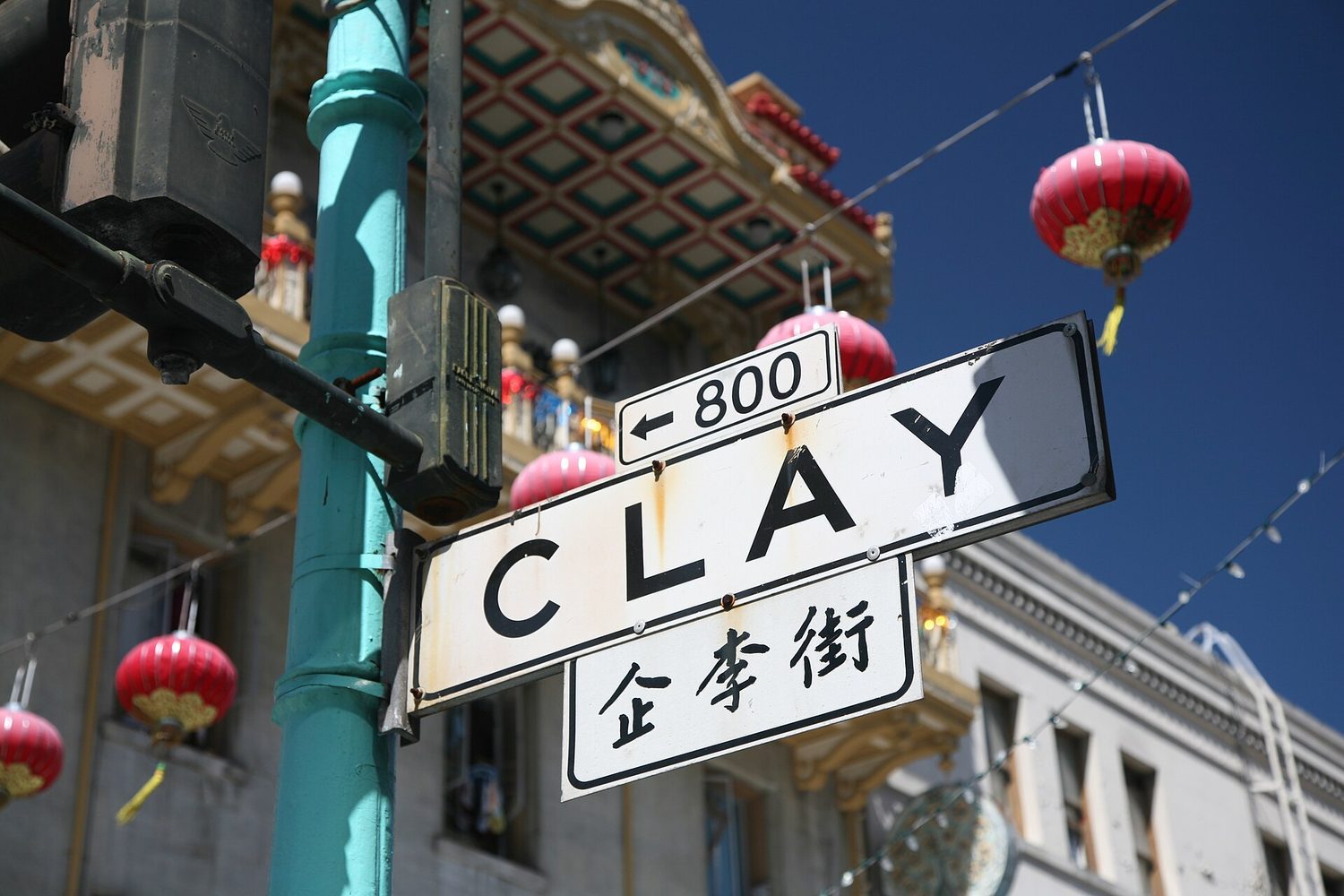
    ป้ายย่านจีน: วัฒนธรรมคือกิจกรรม ค่านิยม และสัญลักษณ์ที่คนเรียนรู้และส่งต่อ
    ป้ายย่านจีน: วัฒนธรรมคือกิจกรรม ค่านิยม และสัญลักษณ์ที่คนเรียนรู้และส่งต่อ
    Vocabulary · ⁨คำศัพท์⁩ Train · ⁨ฝึกฝน⁩
    English ไทย
    Culture/ˈkʌltʃə/ วัฒนธรรม
    Material culture/məˈtɪərɪəl ˈkʌltʃə/ วัฒนธรรมเชิงวัตถุ
    Nonmaterial culture/ˌnɒnməˈtɪərɪəl ˈkʌltʃə/ วัฒนธรรมไม่เชิงวัตถุ
    cultural trait/ˈkʌltʃərəl treɪt/ cultural trait
    Cultural relativism/ˈkʌltʃərəl ˈrelətɪvɪzəm/ Cultural relativism (ความเป็นสัมพัทธ์ทางวัฒนธรรม)
    3.2

    Cultural Landscapes · ⁨ภูมิทัศน์ทางวัฒนธรรม⁩

    Syllabus · ⁨หลักสูตร⁩
    English

    Enduring Understanding (PSO-3): Cultural practices vary across geographical locations because of physical geography and available resources.

    Learning Objective PSO-3.B: Describe the characteristics of cultural landscapes.

    • PSO-3.B.1 Cultural landscapes are combinations of physical features, agricultural and industrial practices, religious and linguistic characteristics, evidence of sequent occupancy, and other expressions of culture including traditional and postmodern architecture and land-use patterns.

    Learning Objective PSO-3.C: Explain how landscape features and land and resource use reflect cultural beliefs and identities.

    • PSO-3.C.1 Attitudes toward ethnicity and gender, including the role of women in the workforce; ethnic neighborhoods; and indigenous communities and lands help shape the use of space in a given society.
    ไทย

    ความเข้าใจที่ยั่งยืน (PSO-3): praktikทางวัฒนธรรมแตกต่างกันไปตามตำแหน่งทางภูมิศาสตร์เนื่องจากภูมิประเทศกายภาพและทรัพยากรที่มีอยู่

    วัตถุประสงค์การเรียนรู้ PSO-3.B: อธิบายลักษณะของภูมิทัศน์ทางวัฒนธรรม

    • PSO-3.B.1 ภูมิทัศน์ทางวัฒนธรรมเป็นการผสมผสานของคุณลักษณะทางกายภาพ πραกติกทางการเกษตรและอุตสาหกรรม ลักษณะทางศาสนาและภาษา หลักฐานของการครอบครองต่อเนื่อง และการแสดงออกของวัฒนธรรมอื่นๆ بماสถาปัตยกรรมแบบดั้งเดิมและสมัยใหม่以及รูปแบบการใช้ที่ดิน

    วัตถุประสงค์การเรียนรู้ PSO-3.C: อธิบายว่าลักษณะภูมิทัศน์และการใช้ที่ดินและทรัพยากรสะท้อนความเชื่อและอัตลักษณ์ทางวัฒนธรรมอย่างไร

    • PSO-3.C.1 มุมมองต่อชาติพันธุ์และเพศ รวมถึงบทบาทของผู้หญิงในตลาดแรงงาน; ชุมชนชาติพันธุ์; และชุมชนพื้นเมืองกับดินแดน ช่วยกำหนดการใช้พื้นที่ในสังคมใดสังคมหนึ่ง

    Source: College Board AP Course and Exam Description · ⁨แหล่งที่มา: คำอธิบายหลักสูตรและข้อสอบ College Board AP⁩

    English

    The cultural landscape 文化景观 is the visible imprint of human activity on the land — buildings, farms, roads, signs, and monuments. It records the values of the people who made it.

    • Sequent occupance 承继占用 is the idea that each group who lives in a place leaves a layer on the landscape, so the landscape shows its whole history.
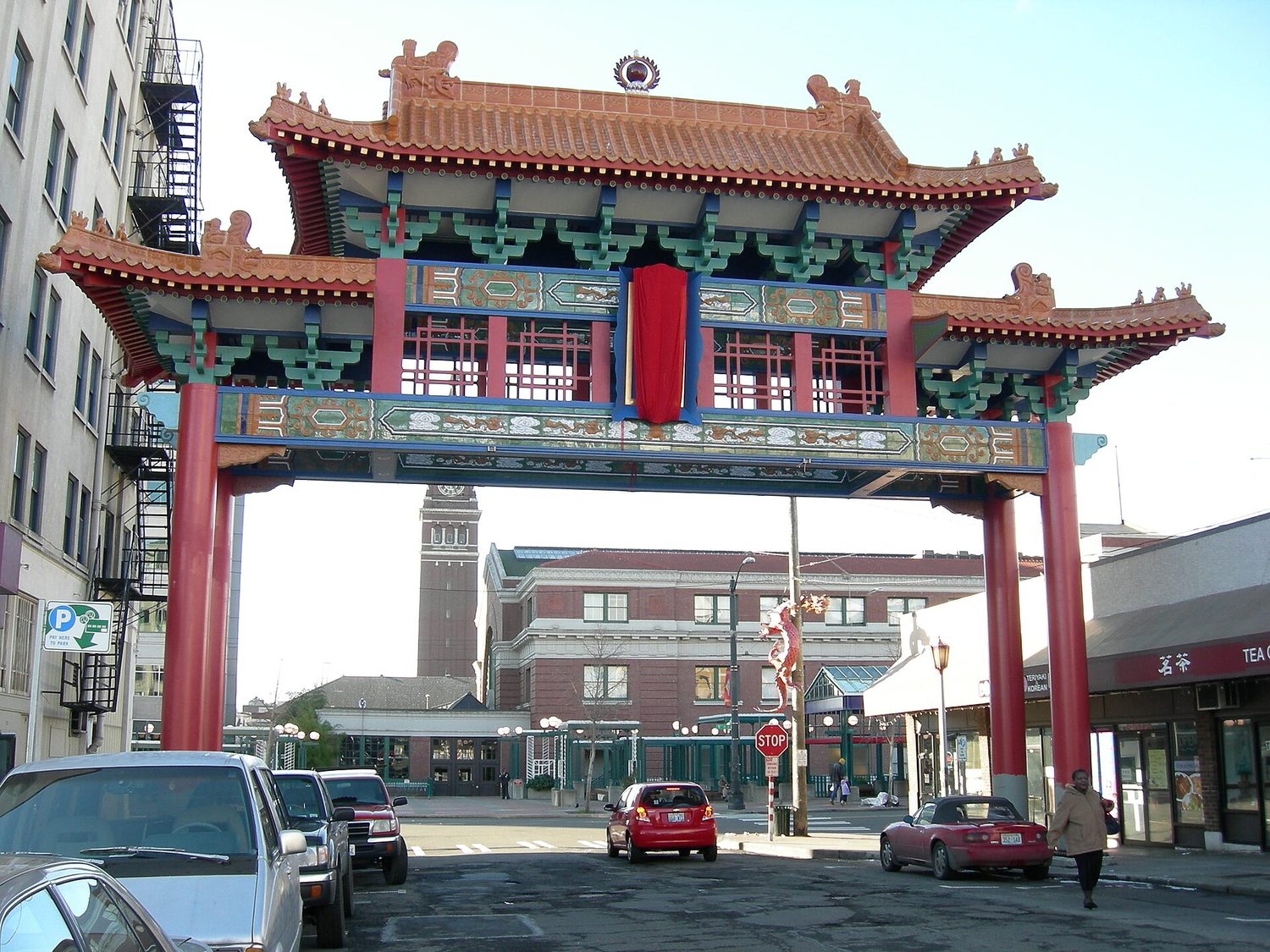
    • Ethnic enclaves 族裔聚居区, religious buildings, and language on signs are all readable clues to who lives there and what they value.
    ไทย

    ภูมิทัศน์ทางวัฒนธรรม คือรอย印ที่เห็นได้ชัดของกิจกรรมมนุษย์บนพื้นดิน — อาคาร życ業 ถนน ป้าย และอนุสรณ์สถาน มันบันทึกค่านิยมของผู้คนที่สร้างขึ้น

    • การครอบครองต่อเนื่อง (Sequent occupance) คือแนวคิดที่ว่าแต่ละกลุ่มที่อาศัยอยู่ในสถานที่จะทิ้งชั้นบางๆ ไว้บนภูมิทัศน์ ทำให้ภูมิทัศน์แสดงประวัติศาสตร์ทั้งหมดของมัน
    • ชุมชนชาติพันธุ์, buildings ศาสนา, และภาษาบนป้าย ล้วนเป็น clues ที่อ่านได้ว่าใครอาศัยอยู่ที่นี่และพวกเขาให้ความสำคัญกับอะไร
    ประตูซุ้มแบบจีนดั้งเดิมขนาดใหญ่ตกแต่งอย่างสวยงามพร้อมหลังคากระเบื้องสีเขียวพาดผ่านถนน ทำหน้าที่เป็นทางเข้าสู่ย่านจีนของซีแอตเทิล
    ประตูซุ้มย่านจีนในซีแอตเทิล: สถาปัตยกรรมและป้ายสองภาษาบ่งบอกถึงชุมชนชาติพันธุ์ ซึ่งเป็นรอย印ที่ชัดเจนของกลุ่มหนึ่งต่อภูมิทัศน์ทางวัฒนธรรม
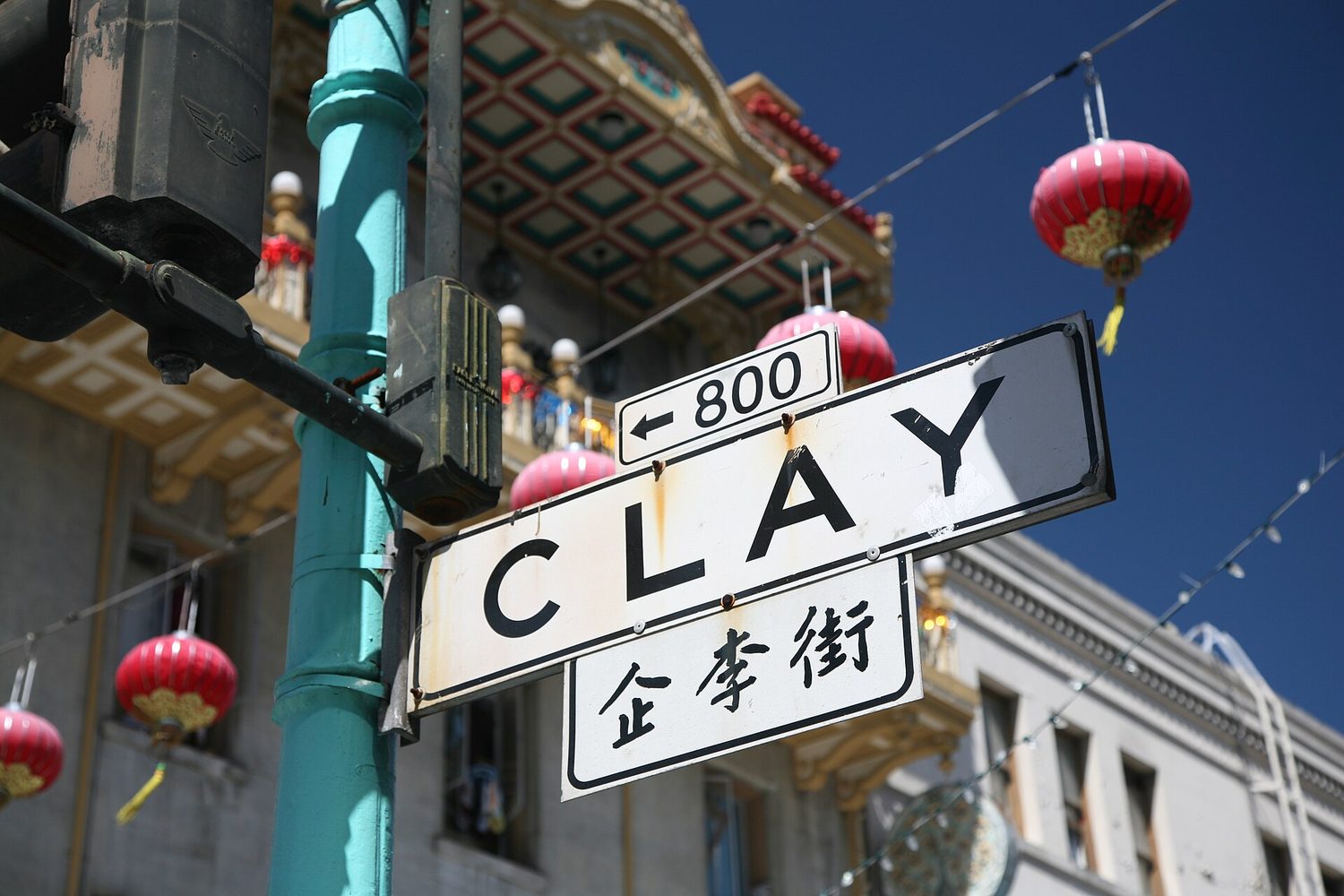
    ป้ายถนนย่านจีน: ภูมิทัศน์ทางวัฒนธรรมและการแพร่กระจายทิ้งรูปแบบที่ยั่งยืนไว้ในเมือง
    ป้ายถนนย่านจีน: ภูมิทัศน์ทางวัฒนธรรมและการแพร่กระจายทิ้งรูปแบบที่ยั่งยืนไว้ในเมือง
    Vocabulary · ⁨คำศัพท์⁩ Train · ⁨ฝึกฝน⁩
    English ไทย
    cultural landscape/ˈkʌltʃərəl ˈlændskeɪp/ ภูมิทัศน์ทางวัฒนธรรม (Cultural landscape)
    Sequent occupance/ˈsiːkwənt ˈɒkjʊpəns/ Sequent occupance
    Ethnic enclaves/ˈeθnɪk ˈeŋkleɪvz/ ชุมชนชาติพันธุ์
    3.3

    Cultural Patterns · ⁨รูปแบบทางวัฒนธรรม⁩

    Syllabus · ⁨หลักสูตร⁩
    English

    Enduring Understanding (PSO-3): Cultural practices vary across geographical locations because of physical geography and available resources.

    Learning Objective PSO-3.D: Explain patterns and landscapes of language, religion, ethnicity, and gender.

    • PSO-3.D.1 Regional patterns of language, religion, and ethnicity contribute to a sense of place, enhance placemaking, and shape the global cultural landscape.
    • PSO-3.D.2 Language, ethnicity, and religion are factors in creating centripetal and centrifugal forces.
    ไทย

    ความเข้าใจที่ยั่งยืน (PSO-3): praktikทางวัฒนธรรมแตกต่างกันไปตามตำแหน่งทางภูมิศาสตร์เนื่องจากภูมิประเทศกายภาพและทรัพยากรที่มีอยู่

    วัตถุประสงค์การเรียนรู้ PSO-3.D: อธิบายรูปแบบและภูมิทัศน์ของภาษา ศาสนา ชาติพันธุ์ และเพศ

    • PSO-3.D.1 รูปแบบระดับภูมิภาคของภาษา ศาสนา และชาติพันธุ์ gópส่วนสร้างความรู้สึกถึงสถานที่ เพิ่มความโดดเด่นในการจัดวางสถานที่ และกำหนดภูมิทัศน์ทางวัฒนธรรมระดับโลก
    • PSO-3.D.2 ภาษา ชาติพันธุ์ และศาสนาเป็นปัจจัยในการสร้างแรงดึงดูดและแรงผลัก

    Source: College Board AP Course and Exam Description · ⁨แหล่งที่มา: คำอธิบายหลักสูตรและข้อสอบ College Board AP⁩

    English

    Cultures spread across space in patterns. Key ideas:

    • Centripetal forces 向心力 pull a group together (a shared language or religion); centrifugal forces 离心力 push it apart.
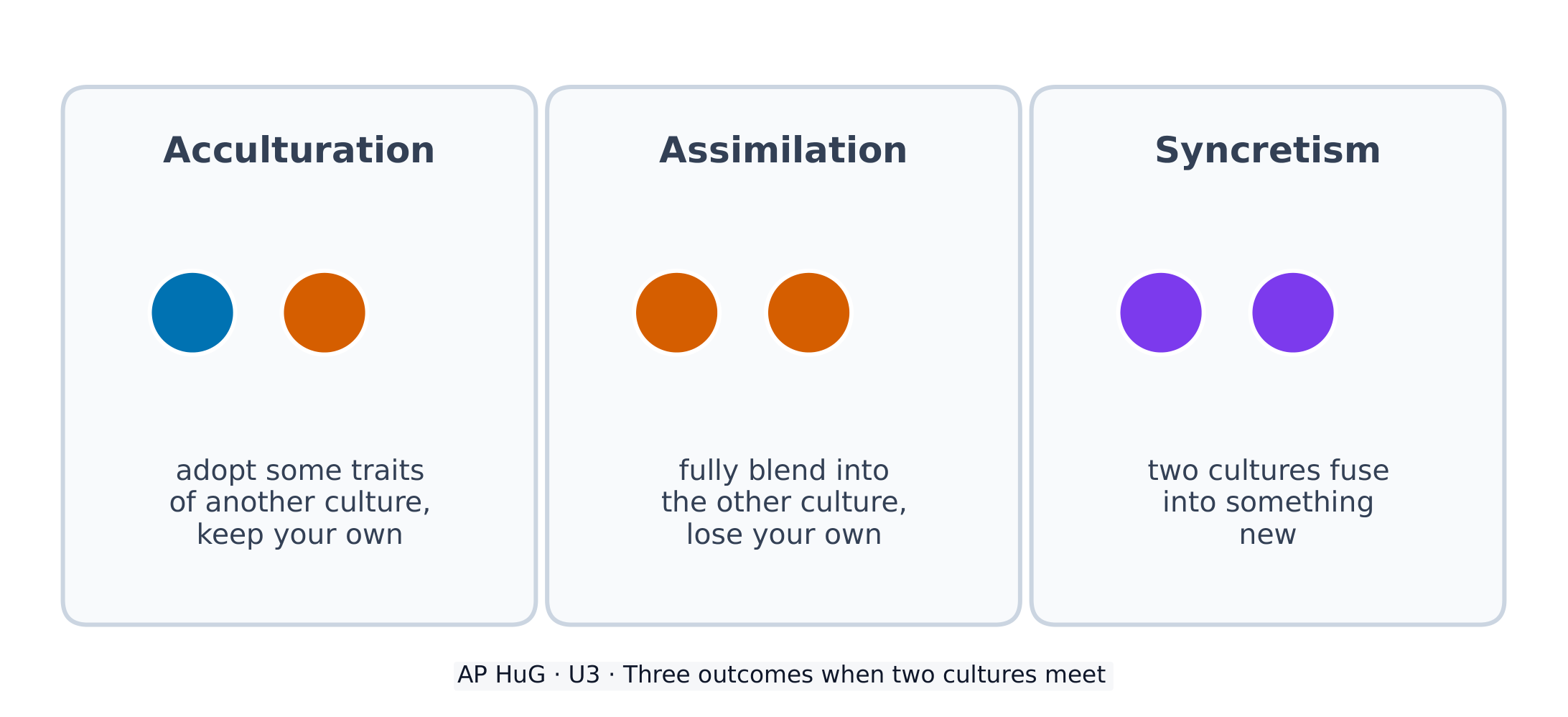
    • Acculturation 文化适应 (adopting some traits of another culture while keeping your own), assimilation 同化 (fully blending into another culture), and syncretism 融合 (two cultures blending into something new) describe how cultures change on contact.
    • A lingua franca 通用语 is a common language used between groups who speak different first languages.

    Worked example (a real AP exam question). "Explain how food preferences can be a culture trait." (2023) A full-mark answer: "Many dishes use ingredients or ways of cooking that are unique to one culture group — for example a national dish — so choosing and eating that food expresses belonging to the group, which is what makes it a culture trait." The command word Explain needs a link, not a definition: connect the food preference to the idea of a shared culture. Simply listing foods earns zero.

    ไทย

    วัฒนธรรมแผ่ขยายข้ามพื้นที่ในรูปแบบต่างๆ แนวคิดสำคัญ:

    • แรงцентриเปตทิก (Centripetal forces) ดึงกลุ่มคนเข้าหากัน (เช่นภาษาร่วมหรือศาสนาเดียวกัน); แรงцентриฟิวจอล (Centrifugal forces) ผลักให้แยกออกจากกัน
    • การปรับตัวทางวัฒนธรรม (Acculturation) (การยอมรับลักษณะบางอย่างจากวัฒนธรรมอื่นwhileรักษาของตัวเอง), การรวมตัว (Assimilation) (การหลอมรวมเข้ากับวัฒนธรรมอื่นอย่างสมบูรณ์), และ การผสมผสาน (Syncretism) (วัฒนธรรมสองอย่างหลอมรวมกันเป็นสิ่งที่ใหม่) อธิบายถึงการเปลี่ยนแปลงของวัฒนธรรมเมื่อมีการสัมผัสกัน
    • ภาษาสากล (lingua franca) คือภาษาที่ใช้ร่วมกันระหว่างกลุ่มคนที่พูดภาษาแม่ต่างกัน
    สามผลลัพธ์เมื่อวัฒนธรรมสองอย่างมาพบกัน
    การปรับตัวทางวัฒนธรรมรักษาวัฒนธรรมตัวเอง, การรวมตัวแทนที่它以, และการผสมผสานหลอมรวมทั้งสองอย่างเป็นสิ่งใหม่

    ตัวอย่างวิธีทำ (คำถามสอบ AP จริง). "อธิบายว่าความชอบอาหารสามารถเป็นลักษณะทางวัฒนธรรมได้อย่างไร" (2023) คำตอบเต็มคะแนน: "หลายเมนูใช้วัตถุดิบหรือวิธีการปรุงที่เป็นเอกลักษณ์ของกลุ่มวัฒนธรรมหนึ่ง — เช่นอาหารประจำชาติ — ดังนั้นการเลือกและทานอาหารนี้เป็นการแสดงความเป็นสมาชิกในกลุ่ม ซึ่งเป็นสิ่งที่ทำให้มันเป็นลักษณะทางวัฒนธรรม" คำสั่ง Explain ต้องการการเชื่อมโยง ไม่ใช่คำนิยาม: เชื่อม连ความชอบอาหาร กับ แนวคิดของวัฒนธรรมร่วมกัน การ列出เพียงรายการอาหารจะได้คะแนนศูนย์

    Vocabulary · ⁨คำศัพท์⁩ Train · ⁨ฝึกฝน⁩
    English ไทย
    Centripetal forces/senˈtrɪpɪtl ˈfɔːsɪz/ แรงรวมศูนย์
    centrifugal forces/ˌsentrɪˈfjuːɡl ˈfɔːsɪz/ แรงผลัก (Centrifugal forces)
    Acculturation/əˌkʌltʃəˈreɪʃn/ Acculturation
    assimilation/əˌsɪmɪˈleɪʃn/ การ InputStreamReader (Assimilation)
    syncretism/ˈsɪŋkrɪtɪzəm/ การผสมผสานทางวัฒนธรรม (Syncretism)
    lingua franca/ˈlɪŋɡjuːə ˈfræŋkə/ ภาษาสากล
    3.4

    Types of Diffusion · ⁨ประเภทของการแพร่กระจาย⁩

    Syllabus · ⁨หลักสูตร⁩
    English

    Enduring Understanding (IMP-3): The interaction of people contributes to the spread of cultural practices.

    Learning Objective IMP-3.A: Define the types of diffusion.

    • IMP-3.A.1 Relocation and expansion—including contagious, hierarchical, and stimulus expansion—are types of diffusion.
    ไทย

    ความเข้าใจที่ยั่งยืน (IMP-3): การมีปฏิสัมพันธ์ระหว่างมนุษย์ส่งผลต่อการแพร่กระจายของวัฒนธรรม

    วัตถุประสงค์การเรียนรู้ IMP-3.A: นิยามประเภทของการแพร่กระจาย

    • IMP-3.A.1 การย้ายถิ่นและการขยายตัว—including การแพร่กระจายแบบติดต่อ, แบบลำดับชั้น และแบบกระตุ้น—are Types of diffusion.

    Source: College Board AP Course and Exam Description · ⁨แหล่งที่มา: คำอธิบายหลักสูตรและข้อสอบ College Board AP⁩

    English
    The four types of diffusion

    Diffusion 扩散 is the spread of a cultural trait from its hearth 源地 (place of origin) to new areas. There are two big families.

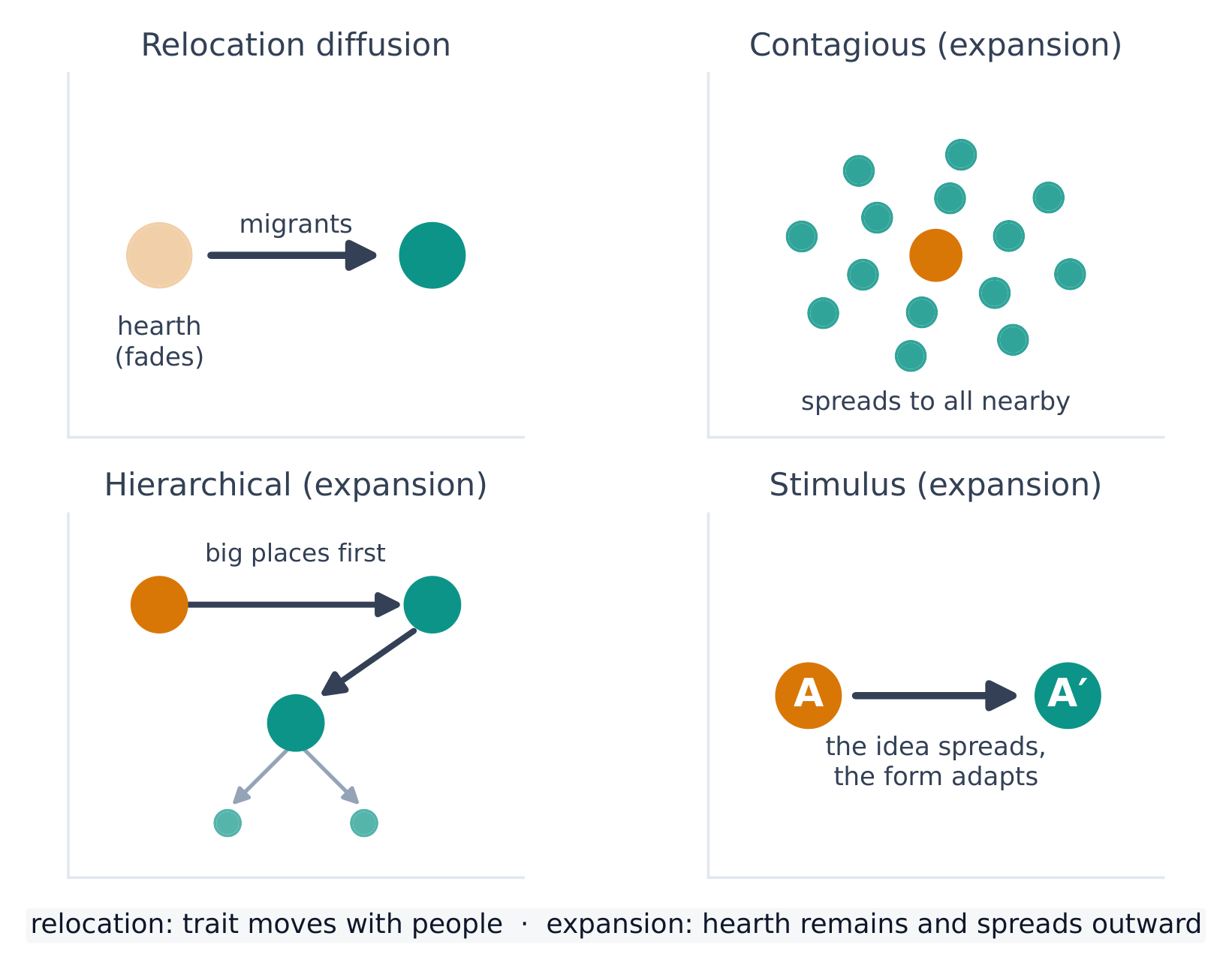
    • Relocation diffusion 迁移扩散 — the trait moves as people migrate, so it appears in the new place but may fade at the source.
    • Expansion diffusion 扩展扩散 — the trait spreads outward while staying strong at the source. It has three types:
      • Contagious 传染扩散 — spreads person-to-person to nearby people (like a viral video).
      • Hierarchical 等级扩散 — jumps from big, important places to other big places first (a fashion from major cities).
      • Stimulus 刺激扩散 — the underlying idea spreads even if the exact trait changes (a global brand adapting its menu locally).
    ไทย
    ประเภทของการแพร่กระจายทั้งสี่ชนิด

    การแพร่กระจาย (Diffusion) คือการแพร่ของลักษณะทางวัฒนธรรมจาก แหล่งกำเนิด (hearth) ไปยังพื้นที่ใหม่ มีสองครอบครัวใหญ่

    การแพร่กระจายด้วยการย้ายถิ่นและการแพร่ขยาย (contagious, hierarchical, stimulus)
    การแพร่กระจายด้วยการย้ายถิ่นเคลื่อนที่ไปกับผู้ย้ายถิ่น; การแพร่กระจายแบบขยายจะpluginออกwhileยังคงอยู่ที่แหล่งกำเนิด
    • การแพร่กระจายด้วยการย้ายถิ่น (Relocation diffusion) — ลักษณะเคลื่อนที่ตาม การย้ายถิ่นของpeople,ดังนั้นมันปรากฏในพื้นที่ใหม่แต่อาจจางหายที่แหล่งกำเนิด
    • การแพร่กระจายแบบขยาย (Expansion diffusion) —ลักษณะpluginออกwhile ยังคงแข็งแรงที่แหล่งกำเนิด它有สามประเภท:
      • แบบติดต่อ (Contagious) —pluginจากperson-to-personไปยังpeopleใกล้เคียง (เช่นวิดีโอไวรัล)
      • แบบลำดับชั้น (Hierarchical) —กระโดดจากbig, important placesไปยังbig places อื่นๆ ก่อน (แฟชั่นจาก cities utama)
      • แบบกระตุ้น (Stimulus) —idea พื้นฐานpluginแม้ว่าลักษณะเฉพาะจะเปลี่ยนไป (brand โลกที่ปรับเมนูเป็นlocal)
    Explore · ⁨สำรวจ⁩

    Which type of diffusion is it? · ⁨เป็นการแพร่กระจายแบบใด?⁩

    Relocation diffusion moves with migrants; contagious spreads to everyone nearby; hierarchical jumps between big places; stimulus spreads the idea while the form changes. · ⁨การแพร่กระจายด้วยการย้ายถิ่น ย้ายตามผู้ย้ายถิ่น; แบบติดต่อ แพร่ไปยังทุกคนโดยรอบ; แบบลำดับชั้น ข้ามระหว่างสถานที่ใหญ่ๆ; แบบกระตุ้น แพร่แนวคิดแต่รูปแบบเปลี่ยนไป⁩

    Vocabulary · ⁨คำศัพท์⁩ Train · ⁨ฝึกฝน⁩
    English ไทย
    Diffusion/dɪˈfjuːʒn/ การแพร่กระจาย (Diffusion)
    hearth/hɑːθ/ แหล่งกำเนิด
    Relocation diffusion/rɪləʊˈkeɪʃn dɪˈfjuːʒn/ การแพร่กระจายด้วยการย้ายถิ่น
    Expansion diffusion/ekˈspænʃn dɪˈfjuːʒn/ การแพร่กระจายแบบขยายตัว
    Contagious/kənˈteɪdʒəs/ การติดต่อ蔓延
    Hierarchical/haɪəˈrɑːkɪkl/ ลำดับชั้น
    Stimulus/ˈstɪmjʊləs/ การกระตุ้น
    colonialism/ˈkɒləʊnɪəlɪzəm/ อาณานิคม (Colonialism)
    3.5 3.6

    Causes of Diffusion · ⁨สาเหตุของการแพร่กระจาย⁩

    Syllabus · ⁨หลักสูตร⁩
    English

    Enduring Understanding (SPS-3): Cultural ideas, practices, and innovations change or disappear over time.

    Learning Objective SPS-3.A: Explain how historical processes impact current cultural patterns.

    • SPS-3.A.1 Interactions between and among cultural traits and larger global forces can lead to new forms of cultural expression; for example, creolization and lingua franca.
    • SPS-3.A.2 Colonialism, imperialism, and trade helped to shape patterns and practices of culture.
    ไทย

    ความเข้าใจที่ยั่งยืน (SPS-3): ความคิด วัฒนธรรม และนวัตกรรมทางวัฒนธรรมเปลี่ยนแปลงหรือหายไปตามกาลเวลา

    วัตถุประสงค์การเรียนรู้ SPS-3.A: อธิบายว่ากระบวนการทางประวัติศาสตร์มีผลต่อรูปแบบทางวัฒนธรรมในปัจจุบันอย่างไร

    • SPS-3.A.1 การมีปฏิสัมพันธ์ระหว่างคุณลักษณะทางวัฒนธรรมและแรงกดดันระดับโลกที่ใหญ่ขึ้นสามารถนำไปสู่รูปแบบการแสดงออกทางวัฒนธรรมใหม่ ตัวอย่างเช่น การผสมผสานทางวัฒนธรรม และการใช้ภาษาสากล
    • SPS-3.A.2 อาณานิคม จักรวรรดิ และการค้า ช่วยกำหนดรูปแบบและแนวปฏิบัติทางวัฒนธรรม
    English

    Enduring Understanding (SPS-3): Cultural ideas, practices, and innovations change or disappear over time.

    Learning Objective SPS-3.A: Explain how historical processes impact current cultural patterns.

    • SPS-3.A.3 Cultural ideas and practices are socially constructed and change through both small-scale and large-scale processes such as urbanization and globalization. These processes come to bear on culture through media, technological change, politics, economics, and social relationships.
    • SPS-3.A.4 Communication technologies, such as the internet and the time-space convergence, are reshaping and accelerating interactions among people; changing cultural practices, as in the increasing use of English and the loss of indigenous languages; and creating cultural convergence and divergence.
    ไทย

    ความเข้าใจที่ยั่งยืน (SPS-3): ความคิด วัฒนธรรม และนวัตกรรมทางวัฒนธรรมเปลี่ยนแปลงหรือหายไปตามกาลเวลา

    วัตถุประสงค์การเรียนรู้ SPS-3.A: อธิบายว่ากระบวนการทางประวัติศาสตร์มีผลต่อรูปแบบทางวัฒนธรรมในปัจจุบันอย่างไร

    • SPS-3.A.3 ความคิดและแนวปฏิบัติทางวัฒนธรรมถูกสร้างขึ้นโดยสังคมและเปลี่ยนแปลงผ่านกระบวนการขนาดเล็กและขนาดใหญ่ เช่น การurbanization และการglobalization กระบวนการเหล่านี้ส่งผลกระทบต่อบรรทัดฐานทางวัฒนธรรมผ่านสื่อ เทคโนโลยี การเมือง เศรษฐกิจ และความสัมพันธ์ทางสังคม
    • SPS-3.A.4 เทคโนโลยีการสื่อสาร เช่น อินเทอร์เน็ต และการรวมตัวของเวลา-พื้นที่ กำลัง重塑และเร่งความเร็วการมีปฏิสัมพันธ์ระหว่างมนุษย์; เปลี่ยนแปลงแนวปฏิบัติทางวัฒนธรรม เช่น การใช้ภาษาอังกฤษที่เพิ่มขึ้นและการสูญเสียภาษาพื้นเมือง; และสร้างความรวมตัวและความแตกต่างทางวัฒนธรรม

    Source: College Board AP Course and Exam Description · ⁨แหล่งที่มา: คำอธิบายหลักสูตรและข้อสอบ College Board AP⁩

    English

    Diffusion has both historical and contemporary causes.

    • Historical: colonialism 殖民主义, imperialism 帝国主义, trade, and the spread of religion carried culture across the world for centuries.
    • Contemporary: globalisation 全球化, the internet, transport, and time–space compression speed diffusion up enormously — a trend can now spread worldwide in hours.

    These forces can spread culture but also threaten local traditions, raising debates about a global culture versus local identity.

    ไทย

    การแพร่กระจายมีทั้งสาเหตุ ทางประวัติศาสตร์ และ **สมัยใหม่

    • ทางประวัติศาสตร์: อาณานิคม, Imperialism, การค้า, และการpluginของศาสนา นำวัฒนธรรมpluginไปทั่วโลกตลอดหลายศตวรรษ
    • สมัยใหม่: Globalisation, Internet, การขนส่ง, และการบีบอัดเวลา–พื้นที่ (time–space compression) เร่งความเร็วการpluginอย่างมาก — เทรนด์หนึ่งpluginทั่วโลกได้ในไม่กี่ชั่วโมง

    แรงเหล่านี้สามารถpluginวัฒนธรรมแต่ก็คุกคามประเพณีท้องถิ่น สร้างข้อถกเถียงเกี่ยวกับวัฒนธรรมโลกเทียบกับอัตลักษณ์ท้องถิ่น

    Vocabulary · ⁨คำศัพท์⁩ Train · ⁨ฝึกฝน⁩
    English ไทย
    imperialism/ɪmˈpɪərɪəlɪzəm/ imperialism
    globalisation/ˌɡləʊbəlaɪˈzeɪʃn/ globalisation
    3.7

    Diffusion of Religion and Language · ⁨การpluginของศาสนาและภาษา⁩

    Syllabus · ⁨หลักสูตร⁩
    English

    Enduring Understanding (IMP-3): The interaction of people contributes to the spread of cultural practices.

    Learning Objective IMP-3.B: Explain what factors lead to the diffusion of universalizing and ethnic religions.

    • IMP-3.B.1 Language families, languages, dialects, world religions, ethnic cultures, and gender roles diffuse from cultural hearths.
    • IMP-3.B.2 Diffusion of language families, including Indo-European, and religious patterns and distributions can be visually represented on maps, in charts and toponyms, and in other representations.
    • IMP-3.B.3 Religions have distinct places of origin from which they diffused to other locations through different processes. Practices and belief systems impacted how widespread the religion diffused.
    • IMP-3.B.4 Universalizing religions, including Christianity, Islam, Buddhism, and Sikhism, are spread through expansion and relocation diffusion.
    • IMP-3.B.5 Ethnic religions, including Hinduism and Judaism, are generally found near the hearth or spread through relocation diffusion.
    ไทย

    ความเข้าใจที่ยั่งยืน (IMP-3): การมีปฏิสัมพันธ์ระหว่างมนุษย์ส่งผลต่อการแพร่กระจายของวัฒนธรรม

    วัตถุประสงค์การเรียนรู้ IMP-3.B: อธิบายปัจจัยที่ทำให้ศาสนาแบบสากลและศาสนาแบบชาติพันธุ์แพร่กระจาย

    • IMP-3.B.1 ครอบครัวภาษา ภาษา DIALECT ศาสนาโลก วัฒนธรรมชาติพันธุ์ และบทบาทเพศ แพร่กระจายจากแหล่งกำเนิดทางวัฒนธรรม
    • IMP-3.B.2 การแพร่กระจายของครอบครัวภาษา รวมถึงภาษาอินโด-ยุโรป และรูปแบบการกระจายของศาสนา สามารถแสดงบนแผนที่ กราฟ และชื่อสถานที่อื่น ๆ ได้อย่างชัดเจน
    • IMP-3.B.3 ศาสนามีแหล่งกำเนิดที่แตกต่างกันซึ่งได้แพร่กระจายไปยังสถานที่อื่นผ่านกระบวนการต่างๆ แนวปฏิบัติและระบบความเชื่อมีผลต่อการแพร่กระจายของศาสนา
    • IMP-3.B.4 ศาสนาแบบสากล ได้แก่ คริสต์ศาสนา อิสลาม พุทธศาสนา และซิกข์ สัมผัสกับการแพร่กระจายแบบขยายตัวและการย้ายถิ่น
    • IMP-3.B.5 ศาสนาแบบชาติพันธุ์ ได้แก่ ฮินดูศาสนาและยูดาย มักพบใกล้แหล่งกำเนิดหรือแพร่กระจายผ่านการย้ายถิ่น

    Source: College Board AP Course and Exam Description · ⁨แหล่งที่มา: คำอธิบายหลักสูตรและข้อสอบ College Board AP⁩

    English

    Religions and languages are the two clearest examples of cultural diffusion.

    • Universalising religions 普世宗教 (Christianity, Islam, Buddhism) actively seek converts and spread widely by expansion and relocation diffusion. Ethnic religions 民族宗教 (Hinduism, Judaism) are tied to one group and spread mainly by relocation.
    • Languages belong to language families 语系; they spread with migration and trade, and can split into dialects 方言 or die out as speakers switch to a dominant language.
    ไทย

    ศาสนาและภาษาเป็นตัวอย่างที่ชัดเจนที่สุดของการpluginทางวัฒนธรรม

    • ศาสนาสากล (Universalising religions) (Christianity, Islam, Buddhism) actively seekers converts และpluginอย่างกว้างขวาง通过对 expansion และ relocation diffusion. ศาสนาชาติพันธุ์ (Ethnic religions) (Hinduism, Judaism) tied to one group และpluginหลัก通过对 relocation
    • ภาษาอยู่ในกลุ่มของ ครอบครัวภาษา; They กระจายตัวผ่านการอพยพและการค้า และสามารถแยกออกเป็น ภาษาถิ่น หรือสูญหายไปเมื่อผู้พูดเปลี่ยนไปใช้ภาษาที่มีอิทธิพลมากขึ้น
    Vocabulary · ⁨คำศัพท์⁩ Train · ⁨ฝึกฝน⁩
    English ไทย
    Universalising religions/ˌjuːnɪˈvɜːsəlaɪzɪŋ rɪˈlɪdʒnz/ ศาสนาสากลนิยม
    Ethnic religions/ˈeθnɪk rɪˈlɪdʒnz/ ศาสนาชาติพันธุ์
    language families/ˈlæŋɡwɪdʒ ˈfæmɪliz/ ภาษา families
    dialects/ˈdaɪəlekts/ dialects
    Cultural convergence/ˈkʌltʃərəl kənˈvɜːdʒəns/ ความกลมกลืนทางวัฒนธรรม
    Cultural divergence/ˈkʌltʃərəl daɪˈvɜːdʒəns/ ความแตกต่างทางวัฒนธรรม
    3.8

    Effects of Diffusion · ⁨ผลกระทบของการแพร่กระจาย⁩

    Syllabus · ⁨หลักสูตร⁩
    English

    Enduring Understanding (SPS-3): Cultural ideas, practices, and innovations change or disappear over time.

    Learning Objective SPS-3.B: Explain how the process of diffusion results in changes to the cultural landscape.

    • SPS-3.B.1 Acculturation, assimilation, syncretism, and multiculturalism are effects of the diffusion of culture.
    ไทย

    ความเข้าใจที่ยั่งยืน (SPS-3): ความคิด วัฒนธรรม และนวัตกรรมทางวัฒนธรรมเปลี่ยนแปลงหรือหายไปตามกาลเวลา

    วัตถุประสงค์การเรียนรู้ SPS-3.B: อธิบายว่ากระบวนการแพร่กระจายส่งผลให้เกิดการเปลี่ยนแปลงในภูมิทัศน์ทางวัฒนธรรมอย่างไร

    • SPS-3.B.1 การปรับตัวทางวัฒนธรรม การ InputStreamReader การผสมผสานทางวัฒนธรรม และความหลากหลายทางวัฒนธรรม เป็นผลจากการแพร่กระจายของวัฒนธรรม

    Source: College Board AP Course and Exam Description · ⁨แหล่งที่มา: คำอธิบายหลักสูตรและข้อสอบ College Board AP⁩

    English

    When cultures spread and meet, several outcomes follow:

    • Cultural convergence 文化趋同 — cultures become more alike as they share traits (global brands, English online).
    • Cultural divergence 文化分化 — a culture becomes more distinct, often to resist outside influence.
    • Diffusion can enrich a place with new food, music, and ideas, but can also erode local languages and traditions — a central tension of a globalising world.
    ไทย

    เมื่อวัฒนธรรมกระจายตัวและมาพบกัน จะเกิดผลลัพธ์หลายอย่าง:

    • ความเข้าหากันทางวัฒนธรรม — วัฒนธรรมมีความคล้ายคลึงกันมากขึ้นเมื่อแบ่งปันลักษณะร่วมกัน (แบรนด์ระดับโลก, ภาษาอังกฤษบนอินเทอร์เน็ต)
    • ความแตกต่างทางวัฒนธรรม — วัฒนธรรมมีความโดดเด่นขึ้น มักเพื่อต่อต้านอิทธิพลจากภายนอก
    • การแพร่กระจายสามารถเติมเต็มพื้นที่ด้วยอาหาร ดนตรี และแนวคิดใหม่ แต่ยังสามารถทำลายภาษาท้องถิ่นและประเพณีได้ — ซึ่งเป็นความขัดแย้งหลักของโลกที่กำลังเป็นโลกาภิวัตน์
    3.8

    Exam tips · ⁨ข้อแนะนำสำหรับการสอบ⁩

    English
    • Distinguish relocation diffusion (people move) from expansion diffusion (the idea spreads and stays at its source).
    • Name the expansion sub-type precisely: contagious, hierarchical, or stimulus.
    • Separate universalizing religions (seek converts) from ethnic religions (spread mainly by birth).
    • Use the cultural landscape — architecture, toponyms, sequent occupance — as evidence of past groups.
    • For effects, keep acculturation, assimilation, and syncretism distinct; they are not the same.
    ไทย
    • แยกแยะระหว่าง การแพร่กระจายด้วยการย้ายถิ่น (คนเคลื่อนย้าย) จาก การแพร่กระจายแบบขยาย (แนวคิดกระจายตัวและยังคงอยู่ที่แหล่งกำเนิด)
    • ชื่อนัยสำคัญย่อยของการแพร่กระจายแบบขยายให้ชัดเจน: แบบติดต่อ, แบบลำดับขั้น, หรือ แบบกระตุ้น
    • แยก ศาสนาที่แพร่หลาย (มองหาผู้ศรัทธา) ออกจาก ศาสนาชาติพันธุ์ (กระจายตัวโดยส่วนใหญ่จากการเกิด)
    • ใช้ ภูมิทัศน์ทางวัฒนธรรม — สถาปัตยกรรม, ชื่อสถานที่, การครอบครองต่อเนื่อง — เป็นหลักฐานของกลุ่มคนในอดีต
    • สำหรับผลกระทบ ให้แยก การปรับตัวทางวัฒนธรรม, การ InputStreamReader-ness, และ การผสมผสาน ออกจากกัน; พวกเขาไม่ใช่สิ่งเดียวกัน
  • 4

    Political Patterns and Processes · ⁨รูปแบบและกระบวนการทางการเมือง⁩

    Watch lesson · ⁨ดูบทเรียน⁩
    4.1

    Introduction to Political Geography · ⁨บทนำทางภูมิศาสตร์การเมือง⁩

    Syllabus · ⁨หลักสูตร⁩
    English

    Enduring Understanding (PSO-4): The political organization of space results from historical and current processes, events, and ideas.

    Learning Objective PSO-4.A: For world political maps: a. Define the different types of political entities. b. Identify a contemporary example of political entities.

    • PSO-4.A.1 Independent states are the primary building blocks of the world political map.
    • PSO-4.A.2 Types of political entities include nations, nation-states, stateless nations, multinational states, multistate nations, and autonomous and semiautonomous regions, such as American Indian reservations.
    ไทย

    ความเข้าใจที่ยั่งยืน (PSO-4): การจัดระเบียบทางการเมืองของพื้นที่เกิดจากกระบวนการ ประวัติศาสตร์ เหตุการณ์ และความคิดในอดีตและปัจจุบัน

    วัตถุประสงค์การเรียนรู้ PSO-4.A: สำหรับแผนที่การเมืองโลก: ก. นิยามชนิดต่างๆ ของหน่วยทางการเมือง ข. ระบุตัวอย่างของหน่วยทางการเมืองในปัจจุบัน

    • PSO-4.A.1 รัฐอิสระคือองค์ประกอบหลักของแผนที่การเมืองโลก
    • PSO-4.A.2 ชนิดของหน่วยทางการเมือง ได้แก่ Nation, nation-state, Stateless nations, Multinational states, Multistate nations และเขตปกครองตนเองหรือกึ่งปกครองตนเอง เช่น เขตสงวนชนเผ่าอเมริกันพื้นเมือง

    Source: College Board AP Course and Exam Description · ⁨แหล่งที่มา: คำอธิบายหลักสูตรและข้อสอบ College Board AP⁩

    English

    Political geography 政治地理学 studies how humans divide and control space. Its key units:

    • A state 国家 (country) is an area with defined borders, a permanent population, a government, and sovereignty 主权 — full control over its own affairs.
    • A nation 民族 is a group of people with a shared culture and identity; a nation-state 民族国家 is a state whose borders match one nation (Japan is close).
    • A multinational state 多民族国家 contains several nations; a stateless nation 无国家民族 (like the Kurds) has no state of its own.

    Worked example (a real AP exam question). "Define the concept of an independent state." (2025) A full-mark answer: "A sovereign country that governs itself and its own territory, is not controlled by any outside power, and is recognised by other states." The command word Define wants a short, precise meaning — one clear sentence is enough. You do not need examples or explanation here; save those for the "Describe" and "Explain" parts.

    ไทย

    ภูมิศาสตร์การเมือง ศึกษาว่ามนุษย์แบ่งและควบคุมพื้นที่อย่างไร หน่วยสำคัญ:

    • รัฐ (ประเทศ) คือพื้นที่ที่มี พรมแดน ที่กำหนดชัดเจน ประชากรถาวร รัฐบาล และ อธิปไตย — ควบคุมกิจการของตนเองได้อย่างเต็มที่
    • ชาติ คือกลุ่มคนที่มีวัฒนธรรมและอัตลักษณ์ร่วมกัน; รัฐชาติ คือรัฐwhose พรมแดนตรงกับชาติหนึ่ง (ญี่ปุ่นใกล้เคียง)
    • รัฐมัลติเนชันแนล มีหลายชาติ; ชาติไร้รัฐ (เช่น คนکرد) ไม่มีรัฐของตัวเอง

    ตัวอย่างวิธีทำ (คำถามสอบ AP จริง) "นิยาม مفهومของรัฐอิสระ" (2025) คำตอบเต็มคะแนน: "ประเทศที่มีอธิปไตยซึ่งปกครองตนเองและดินแดนของตน ไม่ถูกควบคุมโดยอำนาจภายนอกใด ๆ และได้รับการยอมรับจากรัฐอื่น" คำสั่ง นิยาม ต้องการความหมายสั้นและเฉพาะเจาะจง — ประโยคเดียวก็เพียงพอ คุณไม่จำเป็นต้องมีตัวอย่างหรือคำอธิบายที่นี่; เก็บไว้สำหรับส่วน "บรรยาย" และ "อธิบาย"

     Asamblea General de la ONU: soberanía y reconocimiento entre estados
    Asamblea General de la ONU: soberanía y reconocimiento entre estados
    4.2 4.3

    Political Power and Territoriality · ⁨อำนาจทางการเมืองและความเป็นเขตแดน⁩

    Syllabus · ⁨หลักสูตร⁩
    English

    Enduring Understanding (PSO-4): The political organization of space results from historical and current processes, events, and ideas.

    Learning Objective PSO-4.B: Explain the processes that have shaped contemporary political geography.

    • PSO-4.B.1 The concepts of sovereignty, nation- states, and self-determination shape the contemporary world.
    • PSO-4.B.2 Colonialism, imperialism, independence movements, and devolution along national lines have influenced contemporary political boundaries.
    ไทย

    ความเข้าใจที่ยั่งยืน (PSO-4): การจัดระเบียบทางการเมืองของพื้นที่เกิดจากกระบวนการ ประวัติศาสตร์ เหตุการณ์ และความคิดในอดีตและปัจจุบัน

    วัตถุประสงค์การเรียนรู้ PSO-4.B: อธิบายกระบวนการที่มีผลต่อการกำหนดภูมิศาสตร์การเมืองในปัจจุบัน

    • PSO-4.B.1 แนวคิดเรื่องอธิปไตย Nation-states และการกำหนดชะตากรรมเอง กำหนดโลกในปัจจุบัน
    • PSO-4.B.2 อาณานิคม จักรวรรดิ ขบวนการเอกราช และการกระจายอำนาจตามแนวสายเลือดnational lines มีอิทธิพลต่อพรมแดนทางการเมืองในปัจจุบัน
    English

    Enduring Understanding (PSO-4): The political organization of space results from historical and current processes, events, and ideas.

    Learning Objective PSO-4.C: Describe the concepts of political power and territoriality as used by geographers.

    • PSO-4.C.1 Political power is expressed geographically as control over people, land, and resources, as illustrated by neocolonialism, shatterbelts, and choke points.
    • PSO-4.C.2 Territoriality is the connection of people, their culture, and their economic systems to the land.
    ไทย

    ความเข้าใจที่ยั่งยืน (PSO-4): การจัดระเบียบทางการเมืองของพื้นที่เกิดจากกระบวนการ ประวัติศาสตร์ เหตุการณ์ และความคิดในอดีตและปัจจุบัน

    วัตถุประสงค์การเรียนรู้ PSO-4.C: อธิบายแนวคิดเรื่องอำนาจทางการเมืองและการครอบครองดินแดนตามที่นักภูมิศาสตร์ใช้

    • PSO-4.C.1 อำนาจทางการเมืองแสดงออกทางภูมิศาสตร์ด้วยการควบคุมประชากร ดินแดน และทรัพยากร ดังเห็นได้จากNeo-colonialism Shatterbelts และChoke points
    • PSO-4.C.2 การครอบครองดินแดนคือการเชื่อมโยงระหว่างมนุษย์ วัฒนธรรม และระบบเศรษฐกิจ与他们所居住的土地

    Source: College Board AP Course and Exam Description · ⁨แหล่งที่มา: คำอธิบายหลักสูตรและข้อสอบ College Board AP⁩

    English

    Territoriality 领域性 is the attempt by a person or group to control people and things by controlling an area. Power is expressed geographically through control of land, people, and resources.

    • Colonialism and imperialism built empires by taking control of distant territory; neocolonialism 新殖民主义 is continued economic control after formal independence.
    • Choke points 咽喉要道 (narrow passages like the Suez Canal or the Strait of Malacca) and shatterbelts 破碎地带 (regions caught between competing powers) show how geography shapes political power.
    ไทย

    ความเป็นเขตแดน คือความพยายามของผู้หรือกลุ่มในการควบคุมคนและสิ่งของ通过对การควบคุมพื้นที่ อำนาจแสดงออกผ่านภูมิศาสตร์通过对การควบคุมที่ดิน คน และทรัพยากร

    • อาณานิคม และ จักรวรรดิ สร้างจักรวรรดิ通过对การควบคุมดินแดนห่างไกล; neo-colonialism คือการควบคุมทางเศรษฐกิจต่อ послеการเอกราชอย่างเป็นทางการ
    • จุดคอขวด (ช่องแคบ เช่น คลองสุเอซ หรือ ช่องแคบมะละกา) และ shatterbelts (ภูมิภาคที่ถูกกั้นระหว่างอำนาจที่แข่งขันกัน) แสดงให้เห็นว่าภูมิศาสตร์มีผลต่ออำนาจทางการเมือง
    Vocabulary · ⁨คำศัพท์⁩ Train · ⁨ฝึกฝน⁩
    English ไทย
    shatterbelts/ˈʃætəbelts/ shatterbelts (เขตรอยแตก/เขตเปราะบาง)
    boundary/ˈbaʊndəri/ พรมแดน
    4.4 4.5 4.6

    Political Boundaries · ⁨ขอบเขตทางการเมือง⁩

    Syllabus · ⁨หลักสูตร⁩
    English

    Enduring Understanding (IMP-4): Political boundaries and divisions of governance, between states and within them, reflect balances of power that have been negotiated or imposed.

    Learning Objective IMP-4.A: Define types of political boundaries used by geographers.

    • IMP-4.A.1 Types of political boundaries include relic, superimposed, subsequent, antecedent, geometric, and consequent boundaries.
    ไทย

    ความเข้าใจที่ยั่งยืน (IMP-4): ขอบเขตทางการเมืองและการแบ่งแยกการปกครอง ระหว่างรัฐและภายในรัฐ สะท้อนถึงสมดุลของอำนาจที่ถูกเจรจาหรือถูกกำหนดขึ้น

    จุดประสงค์การเรียนรู้ IMP-4.A: นิยามประเภทของขอบเขตทางการเมืองที่นักภูมิศาสตร์ใช้

    • IMP-4.A.1 ประเภทของขอบเขตทางการเมืองรวมถึง ขอบเขตมรดก, ขอบเขตที่แทรกซ้อน, ขอบเขตตามลำดับ, ขอบเขตก่อนหน้า, ขอบเขตเรขาคณิต และขอบเขตตามผล
    English

    Enduring Understanding (IMP-4): Political boundaries and divisions of governance, between states and within them, reflect balances of power that have been negotiated or imposed.

    Learning Objective IMP-4.B: Explain the nature and function of international and internal boundaries.

    • IMP-4.B.1 Boundaries are defined, delimited, demarcated, and administered to establish limits of sovereignty, but they are often contested.
    • IMP-4.B.2 Political boundaries often coincide with cultural, national, or economic divisions. However, some boundaries are created by demilitarized zones or policy, such as the Berlin Conference.
    • IMP-4.B.3 Land and maritime boundaries and international agreements can influence national or regional identity and encourage or discourage international or internal interactions and disputes over resources.
    • IMP-4.B.4 The United Nations Convention on the Law of the Sea defines the rights and responsibilities of nations in the use of international waters, established territorial seas, and exclusive economic zones.
    ไทย

    ความเข้าใจที่ยั่งยืน (IMP-4): ขอบเขตทางการเมืองและการแบ่งแยกการปกครอง ระหว่างรัฐและภายในรัฐ สะท้อนถึงสมดุลของอำนาจที่ถูกเจรจาหรือถูกกำหนดขึ้น

    จุดประสงค์การเรียนรู้ IMP-4.B: อธิบายลักษณะและหน้าที่ของพรมแดนระหว่างประเทศและภายในประเทศ

    • IMP-4.B.1 พรมแดนถูกกำหนด界线, แยกเส้น, ปักหมุด และบริหารจัดการเพื่อกำหนดขอบเขตของอธิปไตย แต่มักจะถูกขัดแย้งกัน
    • IMP-4.B.2 ขอบเขตทางการเมืองมักสอดคล้องกับการแบ่งแยกทางวัฒนธรรม nationally หรือเศรษฐกิจ อย่างไรก็ตาม บางขอบเขตถูกสร้างขึ้นโดยพื้นที่ปลอดอาวุธหรือนโยบาย เช่น การประชุมBerlin
    • IMP-4.B.3 พรมแดนทางบกและทางทะเล beserta international agreements สามารถมีอิทธิพลต่ออัตลักษณ์ระดับชาติหรือภูมิภาค และส่งเสริมหรือยับยั้งการแลกเปลี่ยนและความขัดแย้งระหว่างประเทศหรือภายในประเทศเกี่ยวกับทรัพยากร
    • IMP-4.B.4 ความตกลงสหประชาชาติว่าด้วยกฎหมายทะเล (UNCLOS) กำหนดสิทธิและ responsibilities ของประเทศในการใช้น่านน้ำระหว่างประเทศ, น่านน้ำ territoria และเขตเศรษฐกิจเฉพาะ
    English

    Enduring Understanding (IMP-4): Political boundaries and divisions of governance, between states and within them, reflect balances of power that have been negotiated or imposed.

    Learning Objective IMP-4.B: Explain the nature and function of international and internal boundaries.

    • IMP-4.B.5 Voting districts, redistricting, and gerrymandering affect election results at various scales.
    ไทย

    ความเข้าใจที่ยั่งยืน (IMP-4): ขอบเขตทางการเมืองและการแบ่งแยกการปกครอง ระหว่างรัฐและภายในรัฐ สะท้อนถึงสมดุลของอำนาจที่ถูกเจรจาหรือถูกกำหนดขึ้น

    จุดประสงค์การเรียนรู้ IMP-4.B: อธิบายลักษณะและหน้าที่ของพรมแดนระหว่างประเทศและภายในประเทศ

    • IMP-4.B.5 เขตเลือกตั้ง, การปรับเขต选举 และ Gerrymandering มีผลต่อผลการเลือกตั้งในระดับต่างๆ

    Source: College Board AP Course and Exam Description · ⁨แหล่งที่มา: คำอธิบายหลักสูตรและข้อสอบ College Board AP⁩

    English

    A boundary 边界 is a line that marks the limit of a state's territory. Types by origin:

    • Antecedent 先成边界 (drawn before dense settlement), subsequent 后成边界 (drawn as cultures develop), superimposed 叠加边界 (forced on by an outside power, ignoring local culture), and relic 残余边界 (no longer a border but still visible, like the Berlin Wall).
    • Definition, delimitation, and demarcation are the steps of setting a boundary: agreeing wording, drawing it on a map, then marking it on the ground.
    • At sea, the UN Convention on the Law of the Sea (UNCLOS) 联合国海洋法公约 sets each coastal state's territorial sea and an exclusive economic zone (EEZ) 专属经济区, defining rights to fishing and seabed resources.
    • The shape of a state matters: compact states are easy to govern; elongated, fragmented, perforated, and prorupted shapes create governing challenges.
    ไทย
    Landscape claro: límites políticos y control de la tierra moldean el uso de recursos
    Landscape claro: límites políticos y control de la tierra moldean el uso de recursos

    ขอบเขต คือเส้นที่กำหนดขอบเขตดินแดนของรัฐ ประเภทตามต้นกำเนิด:

    Cómo se forman los límites y las formas que pueden adoptar los estados
    Los estados adoptan diferentes formas; cada forma afecta qué tan fácil es gobernar el estado
    • Antecedent (วาดก่อนการตั้งถิ่นฐานหนาแน่น), subsequent (วาดเมื่อวัฒนธรรมพัฒนา), superimposed (บังคับโดยอำนาจภายนอก โดยไม่คำนึงถึงวัฒนธรรมท้องถิ่น), และ relic (不再是边境但仍可见,如柏林墙).
    • นิยาม, การกำหนดขอบเขต และการระบุตำแหน่ง เป็นขั้นตอนของการวางขอบเขต: ยอมรับข้อความ, วาดบนแผนที่, แล้วระบุบนพื้นดิน
    • ในทะเล, อนุสัญญาสหประชาชาติว่าด้วยกฎหมายทะเล (UNCLOS) กำหนด ทะเล territoriale ของแต่ละรัฐชายฝั่งและ เขตเศรษฐกิจพิเศษ (EEZ), กำหนดสิทธิ์ในการตกปลาและทรัพยากรใต้ทะเล
    • รูปร่างของรัฐ สำคัญ: compact รัฐง่ายต่อการปกครอง; elongated, fragmented, perforated, และ prorupted รูปร่างสร้างความท้าทายในการปกครอง
    Vocabulary · ⁨คำศัพท์⁩ Train · ⁨ฝึกฝน⁩
    English ไทย
    Political geography/pəˈlɪtɪkl dʒɪˈɒɡrəfi/ ภูมิศาสตร์การเมือง
    state/steɪt/ รัฐ (State)
    Antecedent/ˌæntɪˈsiːdənt/ Antecedent (พรมแดนเดิม)
    subsequent/ˈsʌbsɪkwənt/ subsequent
    superimposed/ˌsuːpərɪmˈpəʊzd/ superimposed
    relic/ˈrelɪk/ relic (พรมแดนโบราณ/มรดกตกค้าง)
    UN Convention on the Law of the Sea (UNCLOS) อนุสัญญาสหประชาชาติว่าด้วยกฎหมายทะเล (UNCLOS)
    exclusive economic zone (EEZ)/eksˈkluːsɪv ˌiːkəˈnɒmɪk zəʊn/ เขตเศรษฐกิจเฉพาะ (EEZ)
    unitary state/ˈjuːnɪtəri steɪt/ unitary state
    federal state/ˈfedərəl steɪt/ รัฐ fédéral (Federal state)
    4.7

    Forms of Governance · ⁨รูปแบบการปกครอง⁩

    Syllabus · ⁨หลักสูตร⁩
    English

    Enduring Understanding (IMP-4): Political boundaries and divisions of governance, between states and within them, reflect balances of power that have been negotiated or imposed.

    Learning Objective IMP-4.C: Define federal and unitary states.

    • IMP-4.C.1 Forms of governance include unitary states and federal states.

    Learning Objective IMP-4.D: Explain how federal and unitary states affect spatial organization.

    • IMP-4.D.1 Unitary states tend to have a more top-down, centralized form of governance, while federal states have more locally based, dispersed power centers. SUGGESTED SKILLS Spatial Relationships Describe spatial patterns, networks, and relationships.
    ไทย

    ความเข้าใจที่ยั่งยืน (IMP-4): ขอบเขตทางการเมืองและการแบ่งแยกการปกครอง ระหว่างรัฐและภายในรัฐ สะท้อนถึงสมดุลของอำนาจที่ถูกเจรจาหรือถูกกำหนดขึ้น

    จุดประสงค์การเรียนรู้ IMP-4.C: นิยามรัฐแบบ föderal และ unitary states

    • IMP-4.C.1 รูปแบบการปกครองรวมถึง รัฐแบบ unitary และ federal states

    จุดประสงค์การเรียนรู้ IMP-4.D: อธิบายว่ารัฐแบบ federal และ unitary states ส่งผลต่อการจัดระเบียบเชิงพื้นที่อย่างไร

    • IMP-4.D.1 รัฐแบบ unitary มักมีการปกครองแบบ top-down และรวมศูนย์ ในขณะที่รัฐแบบ federal มีศูนย์กลางอำนาจกระจายตัวและขึ้นอยู่กับท้องถิ่นมากขึ้น SKILLS ที่แนะนำ: ความสัมพันธ์เชิงพื้นที่ อธิบายรูปแบบเครือข่ายและความสัมพันธ์เชิงพื้นที่

    Source: College Board AP Course and Exam Description · ⁨แหล่งที่มา: คำอธิบายหลักสูตรและข้อสอบ College Board AP⁩

    English

    States organise power between the centre and the regions in two main ways:

    • A unitary state 单一制国家 keeps most power in the central government (France). It works best in small or culturally uniform countries.
    • A federal state 联邦制国家 shares power between the centre and regional governments (USA, India). It suits large or diverse countries.
    • Gerrymandering 选区划分不公 is redrawing voting district boundaries to favour one group — a political use of geography.
    ไทย
    Edificio del parlamento: la geografía política estudia cómo se organiza el poder sobre el territorio
    Edificio del parlamento: la geografía política estudia cómo se organiza el poder sobre el territorio

    รัฐจัดระเบียบอำนาจระหว่างศูนย์กลางและภูมิภาคในสองวิธีหลัก:

    Estados unitarios concentran el poder en el centro; los federales lo comparten con las regiones
    Un estado unitario mantiene el poder centralizado; un estado federal comparte el poder con gobiernos regionales
    • รัฐ-unitary รักษาอำนาจส่วนใหญ่ไว้ใน กลาง รัฐบาล (ฝรั่งเศส) ทำงานได้ดีที่สุดในประเทศขนาดเล็กหรือประเทศที่มีวัฒนธรรมสม่ำเสมอ
    • รัฐ-federal แบ่งปันอำนาจระหว่างศูนย์กลางและ ภูมิภาค รัฐบาล (สหรัฐอเมริกา, อินเดีย) เหมาะกับประเทศขนาดใหญ่หรือหลากหลาย
    • Gerrymandering คือการวาดใหม่ขอบเขตเขตเลือกตั้งเพื่อสนับสนุนกลุ่มหนึ่ง — การใช้ภูมิศาสตร์ทางการเมือง
    Vocabulary · ⁨คำศัพท์⁩ Train · ⁨ฝึกฝน⁩
    English ไทย
    Gerrymandering/ˈdʒerɪmændərɪŋ/ Gerrymandering (การตัดเขตเลือกตั้งแบบเอื้อประโยชน์)
    4.8 4.9

    Devolution and Challenges to Sovereignty · ⁨การถ่ายโอนอำนาจและความท้าทายต่ออธิปไตย⁩

    Syllabus · ⁨หลักสูตร⁩
    English

    Enduring Understanding (SPS-4): Political, economic, cultural, or technological changes can challenge state sovereignty.

    Learning Objective SPS-4.A: Define factors that lead to the devolution of states.

    • SPS-4.A.1 Factors that can lead to the devolution of states include the division of groups by physical geography, ethnic separatism, ethnic cleansing, terrorism, economic and social problems, and irredentism.
    ไทย

    ความเข้าใจที่ยั่งยืน (SPS-4): การเปลี่ยนแปลงด้านการเมือง เศรษฐกิจ วัฒนธรรม หรือเทคโนโลยีสามารถท้าทายอธิปไตยของรัฐ

    จุดประสงค์การเรียนรู้ SPS-4.A: นิยามปัจจัยที่ทำให้เกิดการกระจายอำนาจของรัฐ

    • SPS-4.A.1 ปัจจัยที่อาจนำไปสู่การกระจายอำนาจของรัฐ รวมถึง การแบ่งกลุ่มโดยภูมิศาสตร์ทางกายภาพ, การแยกตัวทางชาติพันธุ์, การล้างชาติพันธุ์, การก่อการร้าย, ปัญหาทางเศรษฐกิจและสังคม และการยึดดินแดนเดิม
    English

    Enduring Understanding (SPS-4): Political, economic, cultural, or technological changes can challenge state sovereignty.

    Learning Objective SPS-4.B: Explain how political, economic, cultural, and technological changes challenge state sovereignty.

    • SPS-4.B.1 Devolution occurs when states fragment into autonomous regions; subnational political- territorial units, such as those within Spain, Belgium, Canada, and Nigeria; or when states disintegrate, as happened in Sudan and the former Soviet Union.
    • SPS-4.B.2 Advances in communication technology have facilitated devolution, supranationalism, and democratization.
    • SPS-4.B.3 Global efforts to address transnational and environmental challenges and to create economies of scale, trade agreements, and military alliances help to further supranationalism.
    • SPS-4.B.4 Supranational organizations—including the United Nations (UN), North Atlantic Treaty Organization (NATO), European Union (EU), Association of Southeast Asian Nations (ASEAN), Arctic Council, and African Union— can challenge state sovereignty by limiting the economic or political actions of member states.
    ไทย

    ความเข้าใจที่ยั่งยืน (SPS-4): การเปลี่ยนแปลงด้านการเมือง เศรษฐกิจ วัฒนธรรม หรือเทคโนโลยีสามารถท้าทายอธิปไตยของรัฐ

    จุดประสงค์การเรียนรู้ SPS-4.B: อธิบายว่าการเปลี่ยนแปลงทางการเมือง เศรษฐกิจ วัฒนธรรม และเทคโนโลยีท้าทายอธิปไตยของรัฐอย่างไร

    • SPS-4.B.1 การกระจายอำนาจเกิดขึ้นเมื่อรัฐแตกแยกเป็นภูมิภาคที่มีอำนาจปกครองตนเอง; หน่วยการเมือง- territorial ระดับย่อย เช่น ภายในสเปน เบลเยียม แคนาดา และไนจีเรีย; หรือเมื่อรัฐล่มสลาย ตามที่เกิดขึ้นในซูดาน และสหภาพโซเวียต
    • SPS-4.B.2 ความก้าวหน้าด้านเทคโนโลยีการสื่อสารได้เอื้อต่อการกระจายอำนาจ, การรวมกลุ่มข้ามชาติ และการ_efort democraticization
    • SPS-4.B.3 ความพยายามระดับโลกในการแก้ปัญหาข้ามชาติและสิ่งแวดล้อม และสร้าง economies of scale, trade agreements และ military alliances ช่วยเสริมสร้าง supranationalism
    • SPS-4.B.4 องค์กร supranational—including United Nations (UN), North Atlantic Treaty Organization (NATO), European Union (EU), Association of Southeast Asian Nations (ASEAN), Arctic Council และ African Union—สามารถท้าทายอธิปไตยของรัฐโดยการจำกัดการกระทำทางเศรษฐกิจหรือการเมืองของสมาชิก

    Source: College Board AP Course and Exam Description · ⁨แหล่งที่มา: คำอธิบายหลักสูตรและข้อสอบ College Board AP⁩

    English

    Devolution 权力下放 is the transfer of power from a central government down to regional governments. It is driven by devolutionary factors: ethnic or religious differences, physical geography (islands, mountains), and economic inequality.

    • Strong differences can lead to autonomy 自治 for a region, or even a movement for full independence.
    • Sovereignty is also challenged from outside by supranational organisations 超国家组织 (the EU, UN), by globalisation, and by the internet, which crosses borders freely.
    ไทย

    การถ่ายโอนอำนาจ (Devolution) คือการถ่ายโอนอำนาจจากรัฐบาลกลางลงมายังรัฐบาลระดับภูมิภาค驱动力由 devolutionary factors: ความแตกต่างทางชาติพันธุ์หรือศาสนา ภูมิศาสตร์ทางกายภาพ (เกาะ ภูเขา) และความไม่เท่าเทียมทางเศรษฐกิจ

    • ความแตกต่างที่แข็งแกร่งอาจนำไปสู่ autonomy สำหรับภูมิภาค, หรือแม้แต่การเคลื่อนไหวเพื่อเอกราชเต็มรูปแบบ
    • A sovereignty ก็ถูกท้าทายจากภายนอกโดย supranational organisations (EU, UN), globalisation, และ internet, which crosses borders freely.
    พรมแดนที่เข้มงวดและการควบคุมที่ขัดแย้ง: ความท้าทายด้านอธิปไตยในทางปฏิบัติ
    พรมแดนที่เข้มงวดและการควบคุมที่ขัดแย้ง: ความท้าทายด้านอธิปไตยในทางปฏิบัติ
    Vocabulary · ⁨คำศัพท์⁩ Train · ⁨ฝึกฝน⁩
    English ไทย
    sovereignty/ˈsɒvərɪnti/ อธิปไตย (Sovereignty)
    nation/ˈneɪʃn/ ชาติ (Nation)
    nation-state/ˈneɪʃn steɪt/ รัฐชาติ (Nation-state)
    multinational state/ˌmʌltɪˈnæʃənl steɪt/ multinational state
    stateless nation/ˈsteɪtləs ˈneɪʃn/ ชาติไร้รัฐ (Stateless nation)
    Territoriality/ˌterɪˌtɔːrɪˈælɪti/ การยึดครองดินแดน
    neocolonialism/ˈniːəʊkɒləʊnɪəlɪzəm/ อาณานิคมสมัยใหม่ (Neocolonialism)
    Choke points/tʃəʊk pɔɪnts/ จุดคดเคี้ยว
    Devolution/dɪvəˈluːʃn/ Devolution
    autonomy/ɔːˈtɒnəmi/ อำนาจปกครองตนเอง
    supranational organisations/ˌsuːprəˈnæʃənl ˌɔːɡənaɪˈzeɪʃnz/ องค์กรระหว่างประเทศ
    Centrifugal forces/ˌsentrɪˈfjuːɡl ˈfɔːsɪz/ แรงแยกศูนย์
    failed states/feɪld steɪts/ failed states
    Centripetal forces/senˈtrɪpɪtl ˈfɔːsɪz/ แรงรวมศูนย์
    ethnonationalism/ˌeθnəˈneɪʃənəlɪzəm/ ethnonationalism
    4.10

    Centrifugal and Centripetal Forces · ⁨แรงเหวี่ยงและแรงดูดเข้าหาศูนย์กลาง⁩

    Syllabus · ⁨หลักสูตร⁩
    English

    Enduring Understanding (SPS-4): Political, economic, cultural, or technological changes can challenge state sovereignty.

    Learning Objective SPS-4.C: Explain how the concepts of centrifugal and centripetal forces apply at the state scale.

    • SPS-4.C.1 Centrifugal forces may lead to failed states, uneven development, stateless nations, and ethnic nationalist movements.
    • SPS-4.C.2 Centripetal forces can lead to ethnonationalism, more equitable infrastructure development, and increased cultural cohesion.
    ไทย

    ความเข้าใจที่ยั่งยืน (SPS-4): การเปลี่ยนแปลงด้านการเมือง เศรษฐกิจ วัฒนธรรม หรือเทคโนโลยีสามารถท้าทายอธิปไตยของรัฐ

    วัตถุประสงค์การเรียนรู้ SPS-4.C: อธิบายว่าแนวคิดเรื่องแรงผลักและแรงดูดมีการประยุกต์ใช้ในระดับรัฐอย่างไร

    • SPS-4.C.1 แรงผลักอาจนำไปสู่รัฐล้มเหลว การพัฒนาที่ไม่เท่าเทียม รัฐที่ไม่มีชนชาติ และขบวนการชาตินิยมทางชาติพันธุ์
    • SPS-4.C.2 แรงดูดสามารถนำไปสู่ชาตินิยมทางชาติพันธุ์ การพัฒนาโครงสร้างพื้นฐานที่ยุติธรรมมากขึ้น และความสามัคคีทางวัฒนธรรมที่เพิ่มขึ้น

    Source: College Board AP Course and Exam Description · ⁨แหล่งที่มา: คำอธิบายหลักสูตรและข้อสอบ College Board AP⁩

    English

    Two opposing forces act on every state:

    • Centrifugal forces 离心力 pull a state apart — ethnic conflict, uneven development, and weak identity can lead to failed states 失败国家 and separatist movements.
    • Centripetal forces 向心力 hold a state together — a shared language, national symbols, fair infrastructure, and a strong national identity (ethnonationalism 族裔民族主义 when tied to one ethnic group).

    Governments strengthen centripetal forces (national holidays, a common language) to keep the state unified. Balancing these forces is the central task of political geography.

    ไทย

    มีสองแรงตรงข้ามกระทำต่อรัฐทุกแห่ง:

    • แรงเหวี่ยง ดึงรัฐให้ แตกแยก — ความขัดแย้งทางชาติพันธุ์ การพัฒนาที่ไม่เท่ากัน และอัตลักษณ์ที่อ่อนแอสามารถนำไปสู่ รัฐล้มเหลว และการเคลื่อนไหวเพื่อแยกตัวออกจากประเทศ
    • แรงดูดเข้าหาศูนย์กลาง รัดรัฐให้ อยู่รวมกัน — ภาษาเดียวกัน สัญลักษณ์แห่งชาติ โครงสร้างพื้นฐานที่ยุติธรรม และอัตลักษณ์แห่งชาติที่แข็งแกร่ง (ชาตินิยมทางชาติพันธุ์เมื่อผูกพันกับกลุ่มชาติพันธุ์ใดกลุ่มหนึ่ง)

    รัฐบาลเสริมสร้างแรงดูดเข้าหาศูนย์กลาง (วันหยุดnational, ภาษาร่วม) เพื่อรักษาความสามัคคีของรัฐ การปรับสมดุลระหว่างแรงเหล่านี้เป็นภารกิจหลักของภูมิศาสตร์การเมือง

    เมืองรวมศูนย์อำนาจทางการเมืองและเศรษฐกิจ across territory
    เมืองรวมอำนาจทางการเมืองและเศรษฐกิจทั่วทั้งพื้นที่
    Explore · ⁨สำรวจ⁩

    Centrifugal or centripetal force? · ⁨แรงเหวี่ยงหรือแรงเข้าหา?⁩

    A centrifugal force pulls a state apart; a centripetal force holds it together. · ⁨แรงเหวี่ยงดึงรัฐออกห่างกัน; แรงเข้าหารวมรัฐไว้ด้วยกัน⁩

    4.10

    Exam tips · ⁨ข้อแนะนำสำหรับการสอบ⁩

    English
    • Keep state (territory + sovereignty), nation (a people), and nation-state clearly separate.
    • Classify a boundary by history (antecedent / subsequent / superimposed / relict) and by stage (defined to administered).
    • Name the boundary-dispute type: definitional, locational, operational, or allocational.
    • Compare unitary and federal governance, and link the choice to managing diversity.
    • Explain instability through centrifugal and centripetal forces and devolution; use neutral examples.
    ไทย
    • แยกแยะ รัฐ (ดินแดน + อธิปไตย), ชนชาติ (ประชาชนกลุ่มหนึ่ง), และ รัฐชาติ อย่างชัดเจน
    • จำแนกพรมแดนตามประวัติศาสตร์ (ก่อนเกิด / ตามหลัง / ถูกแทรกซ้อน / เหลือรอด) และตามขั้นตอน (กำหนดไว้แล้ว/บริหารจัดการแล้ว)
    • ชื่อบทบาทการพิพาทพรมแดน: ด้านนิยาม, ด้านตำแหน่ง, ด้านการดำเนินงาน, หรือ ด้านการจัดสรร
    • เปรียบเทียบการบริหารแบบ รวมศูนย์ และ แบ่งเขต, และเชื่อมโยงการเลือกเข้ากับการจัดการความหลากหลาย
    • อธิบายความไม่เสถียรผ่าน แรงเหวี่ยง และ แรงดูดเข้าหาศูนย์กลาง และ การถ่ายโอนอำนาจ; ใช้ตัวอย่างที่เป็นกลาง
  • 5

    Agriculture and Rural Land-Use Patterns and Processes · ⁨รูปแบบและกระบวนการของการเกษตรและการใช้ที่ดินในพื้นที่ชนบท⁩

    Watch lesson · ⁨ดูบทเรียน⁩
    5.1

    Introduction to Agriculture · ⁨บทนำเกี่ยวกับการเกษตร⁩

    Syllabus · ⁨หลักสูตร⁩
    English

    Enduring Understanding (PSO-5): Availability of resources and cultural practices influence agricultural practices and land-use patterns.

    Learning Objective PSO-5.A: Explain the connection between physical geography and agricultural practices.

    • PSO-5.A.1 Agricultural practices are influenced by the physical environment and climatic conditions, such as the Mediterranean climate and tropical climates.
    • PSO-5.A.2 Intensive farming practices include market gardening, plantation agriculture, and mixed crop/livestock systems.
    • PSO-5.A.3 Extensive farming practices include shifting cultivation, nomadic herding, and ranching.
    ไทย

    ความเข้าใจที่ยั่งยืน (PSO-5): ความพร้อมใช้งานของทรัพยากรและแนวปฏิบัติทางวัฒนธรรมส่งผลต่อแนวทางการเกษตรกรรมและรูปแบบการใช้ที่ดิน

    จุดประสงค์การเรียนรู้ PSO-5.A: อธิบายความสัมพันธ์ระหว่างภูมิศาสตร์ทางกายภาพกับแนวทางการเกษตรกรรม

    • PSO-5.A.1 แนวทางการเกษตรกรรมได้รับอิทธิพลจากสภาพแวดล้อมทางกายภาพและสภาวะภูมิอากาศ เช่น ภูมิอากาศเมดิเตอร์เรเนียนและภูมิอากาศเขตร้อน
    • PSO-5.A.2 แนวทางการทำนาแบบ intensive รวมถึง การทำสวนตลาด, การเกษตรบน Plantation และระบบพืช/สัตว์ผสมผสาน
    • PSO-5.A.3 แนวทางการทำนาแบบ extensive รวมถึง การเพาะปลูกแบบเคลื่อนที่, การเลี้ยงสัตว์แบบ nomadic และ Ranching

    Source: College Board AP Course and Exam Description · ⁨แหล่งที่มา: คำอธิบายหลักสูตรและข้อสอบ College Board AP⁩

    English

    Agriculture 农业 is the deliberate growing of crops and raising of animals for food and other products. A first big split:

    • Subsistence agriculture 自给农业 — farming to feed the farmer's own family, common in less-developed regions.
    • Commercial agriculture 商业农业 — farming to sell for profit, common in developed regions and often large-scale and mechanised.

    Farming also varies by intensity: intensive 集约 farming uses a lot of labour or money on a small area (rice paddies, market gardening); extensive 粗放 farming uses little input over a large area (ranching, shifting cultivation).

    The two photos below are the two ends of the first split — one machine feeding a market versus one person feeding a family:

    ไทย

    การเกษตร คือการเพาะปลูกพืชและเลี้ยงสัตว์อย่างตั้งใจเพื่ออาหารและผลิตภัณฑ์อื่นๆ การแบ่งแยกครั้งใหญ่แรก:

    • การเกษตรเพื่อใช้สอยเอง — การทำนาเพื่อเลี้ยงครอบครัวเกษตรกร自身, พบบ่อยในพื้นที่ kurang พัฒนา
    • การเกษตรเชิงพาณิชย์ — การทำนาเพื่อขายทำกำไร, พบบ่อยในพื้นที่พัฒนาแล้ว มักมีขนาดใหญ่และเป็นระบบเครื่องจักรกล

    การทำนาอาจแตกต่างกันไปตาม ความเข้มข้น: การเกษตรเข้มข้น ใช้แรงงานหรือเงินจำนวนมากในพื้นที่เล็ก (นาข้าว, สวนผัก), การเกษตรแบบกว้างขวาง ใช้ปัจจัยการผลิตน้อยในพื้นที่กว้าง (ฟาร์มปศุสัตว์, การทำนาเลื่อนลอย)

    ภาพด้านล่างทั้งสองคือสองขั้วของการแบ่งแยกครั้งแรก — เครื่องจักรหนึ่งเครื่องเลี้ยงตลาด مقابلมนุษย์หนึ่งคนเลี้ยงครอบครัว:

    รถเก็บเกี่ยวขนาดใหญาสีแดงเขียวกำลังตัดแปลงข้าวสาลีสีทอง
    การเกษตรเชิงพาณิชย์: รถเก็บเกี่ยวคันเดียวตัดแปลงข้าวสาลีขนาดใหญ่โดยแทบไม่ต้องใช้แรงงาน ปลูกธัญพืชเพื่อขาย
    เกษตรกรก้มตัวลงทำงานดินในแปลงข้าวโพดขนาดเล็กด้วยพลั่วมือ
    การเกษตรเพื่อใช้สอยเอง: เกษตรกรทำงานในแปลงเล็กๆ ด้วยมือใช้พลั่ว ส่วนใหญ่เพื่อเลี้ยงครอบครัว
    Explore · ⁨สำรวจ⁩

    Intensive or extensive farming? · ⁨การเกษตรแบบเข้มข้นหรือแบบกระจาย?⁩

    Intensive farming puts a lot of labour or money into a small area; extensive farming spreads little input over a large area. · ⁨การเกษตรแบบเข้มข้น ใช้แรงงานหรือเงินทุนจำนวนมากในพื้นที่จำกัด; การเกษตรแบบกระจาย กระจายปัจจัยการผลิตน้อยลงบนพื้นที่กว้างใหญ่⁩

    5.2

    Settlement Patterns and Survey Methods · ⁨รูปแบบการตั้งถิ่นฐานและวิธีการสำรวจ⁩

    Syllabus · ⁨หลักสูตร⁩
    English

    Enduring Understanding (PSO-5): Availability of resources and cultural practices influence agricultural practices and land-use patterns.

    Learning Objective PSO-5.B: Identify different rural settlement patterns and methods of surveying rural settlements.

    • PSO-5.B.1 Specific agricultural practices shape different rural land-use patterns.
    • PSO-5.B.2 Rural settlement patterns are classified as clustered, dispersed, or linear.
    • PSO-5.B.3 Rural survey methods include metes and bounds, township and range, and long lot.
    ไทย

    ความเข้าใจที่ยั่งยืน (PSO-5): ความพร้อมใช้งานของทรัพยากรและแนวปฏิบัติทางวัฒนธรรมส่งผลต่อแนวทางการเกษตรกรรมและรูปแบบการใช้ที่ดิน

    จุดประสงค์การเรียนรู้ PSO-5.B: ระบุรูปแบบการตั้งถิ่นฐานในชนบทและวิธีการสำรวจการตั้งถิ่นฐานในชนบทที่แตกต่างกัน

    • PSO-5.B.1 แนวทางปฏิบัติทางการเกษตรเฉพาะเจาะจงกำหนดรูปแบบการใช้ที่ดินในชนบทที่แตกต่างกัน
    • PSO-5.B.2 รูปแบบการตั้งถิ่นฐานในชนบทถูกแบ่งออกเป็นแบบกลุ่ม, แบบกระจายตัว หรือแบบเส้นตรง
    • PSO-5.B.3 วิธีการสำรวจในชนบทได้แก่ Metes and bounds, Township and range, และ Long lot

    Source: College Board AP Course and Exam Description · ⁨แหล่งที่มา: คำอธิบายหลักสูตรและข้อสอบ College Board AP⁩

    English

    How farmers settle the land leaves a lasting pattern.

    • Clustered (nucleated) 集聚式 settlements group homes together; dispersed 分散 settlements spread them out; linear settlements follow a road or river.
    • Survey methods divide the land: the metes-and-bounds system uses natural features; the township-and-range system uses a grid of squares; the long-lot system gives each farm a thin strip reaching a river or road.
    ไทย

    วิธีการที่เกษตรกรตั้งถิ่นฐานบนดินจะทิ้งร่องรอยรูปแบบที่คงอยู่

    • การตั้งถิ่นฐานแบบ กลุ่มหนาแน่น (nucleated) รวมบ้านเรือนไว้ด้วยกัน; การตั้งถิ่นฐานแบบ กระจาย กางออกไป; การตั้งถิ่นฐานแบบ เส้นตรง ตามถนนหรือแม่น้ำ
    • วิธีการสำรวจ แบ่งที่ดิน: ระบบ เมตส์-แอนด์-บาวন্ดส์ ใช้ลักษณะทางธรรมชาติ; ระบบ ทาวน์ชิป-แอนด์-เรนจ์ ใช้ตารางสี่เหลี่ยม; ระบบ ลอง-ล็อต ให้แต่ละฟาร์มเป็นแถบแคบๆ ที่เข้าถึงแม่น้ำหรือถนน
    5.3 5.4 5.5

    Agricultural Origins and Revolutions · ⁨จุดกำเนิดและการปฏิวัติทางการเกษตร⁩

    Syllabus · ⁨หลักสูตร⁩
    English

    Enduring Understanding (SPS-5): Agriculture has changed over time because of cultural diffusion and advances in technology.

    Learning Objective SPS-5.A: Identify major centers of domestication of plants and animals.

    • SPS-5.A.1 Early hearths of domestication of plants and animals arose in the Fertile Crescent and several other regions of the world, including the Indus River Valley, Southeast Asia, and Central America.

    Learning Objective SPS-5.B: Explain how plants and animals diffused globally.

    • SPS-5.B.1 Patterns of diffusion, such as the Columbian Exchange and the agricultural revolutions, resulted in the global spread of various plants and animals.
    ไทย

    ความเข้าใจที่ยั่งยืน (SPS-5): เกษตรกรรมมีการเปลี่ยนแปลงไปตามเวลาเนื่องจากกระบวนการแพร่กระจายทางวัฒนธรรมและความก้าวหน้าทางเทคโนโลยี

    จุดประสงค์การเรียนรู้ SPS-5.A: ระบุแหล่งกลางหลักของการเพาะพันธุ์พืชและสัตว์

    • SPS-5.A.1 แหล่งกำเนิดแรกของการเพาะพันธุ์พืชและสัตว์เกิดขึ้นในดินอันอุดมสมบูรณ์ (Fertile Crescent) และภูมิภาคอื่นๆ ของโลกหลายแห่ง รวมถึงหุบเขาแม่น้ำอินดัส, เอเชียตะวันออกเฉียงใต้ และอเมริกากลาง

    จุดประสงค์การเรียนรู้ SPS-5.B: อธิบาย cáchพืชและสัตว์ได้แพร่กระจายไปทั่วโลก

    • SPS-5.B.1 รูปแบบการแพร่กระจาย เช่น การแลกเปลี่ยนคูลัมเบีย (Columbian Exchange) และการปฏิวัติทางเกษตรกรรม ส่งผลให้เกิดการแพร่กระจายของพืชและสัตว์ต่างๆ ไปทั่วโลก
    English

    Enduring Understanding (SPS-5): Agriculture has changed over time because of cultural diffusion and advances in technology.

    Learning Objective SPS-5.C: Explain the advances and impacts of the second agricultural revolution.

    • SPS-5.C.1 New technology and increased food production in the second agricultural revolution led to better diets, longer life expectancies, and more people available for work in factories.
    ไทย

    ความเข้าใจที่ยั่งยืน (SPS-5): เกษตรกรรมมีการเปลี่ยนแปลงไปตามเวลาเนื่องจากกระบวนการแพร่กระจายทางวัฒนธรรมและความก้าวหน้าทางเทคโนโลยี

    จุดประสงค์การเรียนรู้ SPS-5.C: อธิบายความก้าวหน้าและผลกระทบของการปฏิวัติทางเกษตรกรรมครั้งที่สอง

    • SPS-5.C.1 เทคโนโลยีใหม่และการผลิตอาหารที่เพิ่มขึ้นในการปฏิวัติทางเกษตรกรรมครั้งที่สอง นำไปสู่การรับประทานอาหารที่ดีขึ้น, อายุขัยที่ยาวนานขึ้น และมีคนมากขึ้นพร้อมทำงานในโรงงาน
    English

    Enduring Understanding (SPS-5): Agriculture has changed over time because of cultural diffusion and advances in technology.

    Learning Objective SPS-5.D: Explain the consequences of the Green Revolution on food supply and the environment in the developing world.

    • SPS-5.D.1 The Green Revolution was characterized in agriculture by the use of high-yield seeds, increased use of chemicals, and mechanized farming.
    • SPS-5.D.2 The Green Revolution had positive and negative consequences for both human populations and the environment.
    ไทย

    ความเข้าใจที่ยั่งยืน (SPS-5): เกษตรกรรมมีการเปลี่ยนแปลงไปตามเวลาเนื่องจากกระบวนการแพร่กระจายทางวัฒนธรรมและความก้าวหน้าทางเทคโนโลยี

    จุดประสงค์การเรียนรู้ SPS-5.D: อธิบายผลกระทบของการปฏิวัติสีเขียวต่ออุปทานอาหารและสิ่งแวดล้อมในประเทศกำลังพัฒนา

    • SPS-5.D.1 การปฏิวัติสีเขียวมีลักษณะเด่นในภาคเกษตรกรรมด้วยการใช้เมล็ดพันธุ์ให้ผลผลิตสูง, การใช้สารเคมีเพิ่มขึ้น และการทำเกษตรด้วยเครื่องจักรกล
    • SPS-5.D.2 การปฏิวัติสีเขียวมีทั้งผลกระทบเชิงบวกและลบต่อประชากรมนุษย์และสิ่งแวดล้อม

    Source: College Board AP Course and Exam Description · ⁨แหล่งที่มา: คำอธิบายหลักสูตรและข้อสอบ College Board AP⁩

    English

    Farming began in a few hearths and spread by diffusion, then was transformed by three revolutions.

    • The First (Neolithic) Agricultural Revolution 新石器农业革命 was the original domestication of plants and animals, letting people settle in one place.
    • The Second Agricultural Revolution 第二次农业革命 used the tools of the Industrial Revolution (machines, better transport, crop rotation) to raise output and feed growing cities.
    • The Green Revolution 绿色革命 (mid-1900s) introduced high-yield seeds, fertilisers, pesticides, and irrigation — hugely increasing food output, though at an environmental and social cost.

    Worked example (a real AP exam question). "Describe the concept of an early hearth of domestication." (2023) A full-mark answer: "A place where people first domesticated a wild plant or animal into a farmed variety, and from which that farming practice then spread to other regions." The command word Describe wants more than a one-word definition — give the key features (where domestication began and that it spread) — but it does not require the cause-and-effect reasoning that "Explain" demands.

    ไทย

    การเกษตรเริ่มขึ้นในจุดกำเนิด few และแพร่กระจายด้วยการแพร่กระจาย จากนั้นถูกเปลี่ยนแปลงด้วยการปฏิวัติสามครั้ง

    • การปฏิวัติเกษตรกรรมครั้งแรก (First/Neolithic Agricultural Revolution) คือการเพาะเลี้ยงพืชและสัตว์เป็นครั้งแรก ทำให้ผู้คนสามารถตั้งถิ่นฐาน在一个 place ได้
    • การปฏิวัติการเกษตรครั้งที่สอง ใช้เครื่องมือของการปฏิวัติอุตสาหกรรม (เครื่องจักร, การขนส่งที่ดีขึ้น, การหมุนเวียนพืชผล) เพื่อเพิ่มผลผลิตและเลี้ยงดูเมืองที่กำลังเติบโต
    • การปฏิวัติสีเขียว (กลางศตวรรษที่ 1900) นำเมล็ดพันธุ์ผลผลิตสูง ปุ๋ย ยาฆ่าแมลง และระบบชลประทานเข้ามา — เพิ่มผลผลิตอาหารอย่างมาก แต่ต้องแลกกับต้นทุนทางสิ่งแวดล้อมและสังคม

    ตัวอย่างคำอธิบาย (worked example) – ข้อสอบ AP จริง "อธิบายแนวคิดของแหล่งกำเนิดการเพาะเลี้ยง初期 (early hearth of domestication)" (2023) คำตอบเต็มคะแนน: "สถานที่ที่มนุษย์เริ่มเพาะเลี้ยงพืชหรือสัตว์ป่าให้เป็นสายพันธุ์สำหรับทำเกษตรกรรม และจากนั้นการปฏิบัติทางการเกษตรนั้นจึงแพร่กระจายไปยังภูมิภาคอื่นๆ" คำสั่ง Describe ต้องการมากกว่าแค่คำจำกัดความหนึ่งคำ — ให้ระบุลักษณะสำคัญ (where domestication began and that it spread) — แต่ไม่จำเป็นต้องให้เหตุผลเชิงสาเหตุและผลที่ "Explain" ต้องการ

    5.6

    Agricultural Production Regions · ⁨พื้นที่การผลิตทางการเกษตร⁩

    Syllabus · ⁨หลักสูตร⁩
    English

    Enduring Understanding (PSO-5): Availability of resources and cultural practices influence agricultural practices and land-use patterns.

    Learning Objective PSO-5.C: Explain how economic forces influence agricultural practices.

    • PSO-5.C.1 Agricultural production regions are defined by the extent to which they reflect subsistence or commercial practices (monocropping or monoculture).
    • PSO-5.C.2 Intensive and extensive farming practices are determined in part by land costs (bid-rent theory).
    ไทย

    ความเข้าใจที่ยั่งยืน (PSO-5): ความพร้อมใช้งานของทรัพยากรและแนวปฏิบัติทางวัฒนธรรมส่งผลต่อแนวทางการเกษตรกรรมและรูปแบบการใช้ที่ดิน

    จุดประสงค์การเรียนรู้ PSO-5.C: อธิบายว่าแรงจูงใจทางเศรษฐศาสตร์ส่งผลต่อแนวทางการเกษตรอย่างไร

    • PSO-5.C.1 เขตการผลิตทางการเกษตรถูกกำหนดโดยระดับที่สะท้อนแนวทางยังชีพหรือเชิงพาณิชย์ ( monocropping หรือ monoculture )
    • PSO-5.C.2 แนวทางปฏิบัติทางการเกษตรแบบเข้มข้นและแบบกว้างๆ ถูกกำหนด جز或部分โดยต้นทุนที่ดิน (ทฤษฎี Bid-rent)

    Source: College Board AP Course and Exam Description · ⁨แหล่งที่มา: คำอธิบายหลักสูตรและข้อสอบ College Board AP⁩

    English

    The type of farming in a place depends on climate and level of development.

    • Tropical regions favour shifting cultivation 迁移农业 (slash-and-burn) and plantation crops; dry regions favour pastoral nomadism 游牧 (herding).
    • Developed regions have mixed crop and livestock, dairying, and large commercial grain farms.
    • Bid-rent theory 竞租理论 explains why land close to a market is used more intensively: it is more expensive, so it must earn more per hectare.
    ไทย

    ประเภทการทำนา在一个地方ขึ้นอยู่กับ สภาพอากาศ และ ระดับการพัฒนา

    • พื้นที่เขตร้อนเอื้อต่อการ เกษตรแบบเคลื่อนที่ (shifting cultivation / slash-and-burn) และพืชสวน; พื้นที่แห้งแล้งเอื้อต่อการ การอพยพตามธรรมชาติเพื่อปศุสัตว์ (pastoral nomadism / herding)
    • พื้นที่พัฒนาแล้วมี เกษตรผสมผสาน (mixed crop and livestock), ฟาร์มโคนม (dairying) และฟาร์ม ข้าวสาลีเชิงพาณิชย์ขนาดใหญ่ (commercial grain farms)
    • ทฤษฎี Bid-rent อธิบายว่าทำไมที่ดินใกล้ตลาดจึงถูกใช้เข้มข้นกว่า: มันแพงกว่า ดังนั้นจึงต้องสร้างรายได้ต่อเฮกตาร์ได้มากกว่า
    แถวต้นชาเขียวเตี้ยเรียงเป็นระเบียบปกคลุมเนินเขา
    สวนชา: พืชเงินสดชนิดเดียวปลูกในแถว整齐บนพื้นที่กว้าง เป็นลักษณะทั่วไปของการเกษตรเชิงพาณิชย์ tropics
    การเกษตรจำแนกตามความเข้มข้นและตามวัตถุประสงค์
    แกนนอนสองแกน — แรงงานและทุนที่ใช้ต่อหน่วยที่ดิน (intensive vs extensive), และอาหารนั้นสำหรับใคร (subsistence vs commercial)
    Vocabulary · ⁨คำศัพท์⁩ Train · ⁨ฝึกฝน⁩
    English ไทย
    Agriculture/ˈæɡrɪkʌltʃə/ Agriculture
    Subsistence agriculture/sʌbˈsɪstəns ˈæɡrɪkʌltʃə/ เกษตรกรรมสำหรับกินเอง
    Commercial agriculture/kəˈmɜːʃl ˈæɡrɪkʌltʃə/ เกษตรกรรมเชิงพาณิชย์
    intensive/ɪnˈtensɪv/ เข้มข้น
    extensive/ekˈstensɪv/ กระจายพื้นที่
    Clustered (nucleated)/ˈklʌstəd/ แบบกลุ่ม (รวมศูนย์)
    dispersed/dɪˈspɜːst/ กระจาย
    First (Neolithic) Agricultural Revolution/fɜːst ˌæɡrɪˈkʌltʃərəl ˌrevəˈluːʃn/ ปฏิวัติเกษตรกรรมครั้งที่หนึ่ง (Neolithic)
    Second Agricultural Revolution/ˈsekənd ˌæɡrɪˈkʌltʃərəl ˌrevəˈluːʃn/ ปฏิวัติการเกษตรครั้งที่สอง
    Green Revolution/ɡriːn ˌrevəˈluːʃn/ ปฏิวัติเขียว
    shifting cultivation/ˈʃɪftɪŋ ˌkʌltɪˈveɪʃn/ การทำนาแบบหมุนเวียน
    pastoral nomadism/ˈpæstərəl ˈnəʊmeɪdɪzəm/ การอพยพแบบ chănสัตว์
    Bid-rent theory/bɪd rent ˈθɪəri/ ทฤษฎีค่าเช่าเสนอสูงสุด
    plantation/plænˈteɪʃn/ ฟาร์มปลูกพืช
    von Thünen model/vɒn ˈθuːnən ˈmɒdl/ von Thünen model
    global supply chain/ˈɡləʊbl səˈplaɪ tʃeɪn/ global supply chain
    Agribusiness/ˈæɡrɪbɪznəs/ ธุรกิจเกษตร
    export commodities/ˈekspɔːt kəˈmɒdɪtiz/ export commodities
    Fair trade/feə treɪd/ การค้าแบบยุติธรรม
    desertification/dɪˌzɜːtɪfɪˈkeɪʃn/ การกลายเป็นทะเลทราย
    food security/fuːd sɪˈkjʊərɪti/ ความมั่นคงทางอาหาร
    GMOs/ˌdʒiː em ˈəʊz/ GMOs
    5.7 5.8

    Spatial Organization and the Von Thünen Model · ⁨การจัดระเบียบพื้นที่และโมเดล Von Thünen⁩

    Syllabus · ⁨หลักสูตร⁩
    English

    Enduring Understanding (PSO-5): Availability of resources and cultural practices influence agricultural practices and land-use patterns.

    Learning Objective PSO-5.C: Explain how economic forces influence agricultural practices.

    • PSO-5.C.3 Large-scale commercial agricultural operations are replacing small family farms.
    • PSO-5.C.4 Complex commodity chains link production and consumption of agricultural products.
    • PSO-5.C.5 Technology has increased economies of scale in the agricultural sector and the carrying capacity of the land.
    ไทย

    ความเข้าใจที่ยั่งยืน (PSO-5): ความพร้อมใช้งานของทรัพยากรและแนวปฏิบัติทางวัฒนธรรมส่งผลต่อแนวทางการเกษตรกรรมและรูปแบบการใช้ที่ดิน

    จุดประสงค์การเรียนรู้ PSO-5.C: อธิบายว่าแรงจูงใจทางเศรษฐศาสตร์ส่งผลต่อแนวทางการเกษตรอย่างไร

    • PSO-5.C.3 การประกอบกิจการเกษตรกรรมเชิงพาณิชย์ขนาดใหญ่กำลังเข้ามาแทนที่ฟาร์มครอบครัวขนาดเล็ก
    • PSO-5.C.4 โซ่อุปทานสินค้าเกษตรที่ซับซ้อนเชื่อมโยงการผลิตและการบริโภคผลิตภัณฑ์ทางการเกษตรเข้าด้วยกัน
    • PSO-5.C.5 เทคโนโลยีได้เพิ่มประสิทธิภาพทางเศรษฐกิจตามขนาดในภาคเกษตรกรรมและความสามารถในการรองรับของที่ดิน
    English

    Enduring Understanding (PSO-5): Availability of resources and cultural practices influence agricultural practices and land-use patterns.

    Learning Objective PSO-5.D: Describe how the von Thünen model is used to explain patterns of agricultural production at various scales.

    • PSO-5.D.1 Von Thünen’s model helps to explain rural land use by emphasizing the importance of transportation costs associated with distance from the market; however, regions of specialty farming do not always conform to von Thünen’s concentric rings.
    ไทย

    ความเข้าใจที่ยั่งยืน (PSO-5): ความพร้อมใช้งานของทรัพยากรและแนวปฏิบัติทางวัฒนธรรมส่งผลต่อแนวทางการเกษตรกรรมและรูปแบบการใช้ที่ดิน

    จุดประสงค์การเรียนรู้ PSO-5.D: อธิบายการใช้โมเดลของ Von Thünen เพื่ออธิบายรูปแบบการผลิตทางการเกษตรในระดับต่างๆ

    • PSO-5.D.1 โมเดลของ Von Thünen ช่วยอธิบายการใช้ที่ดินในชนบทโดยเน้นความสำคัญของค่าขนส่งที่เกี่ยวข้องกับระยะห่างจากตลาด; อย่างไรก็ตาม เขตการทำเกษตรเฉพาะบางแห่งอาจไม่สอดคล้องกับวงกลมซ้อนกันของ Von Thünen

    Source: College Board AP Course and Exam Description · ⁨แหล่งที่มา: คำอธิบายหลักสูตรและข้อสอบ College Board AP⁩

    English
    The Von Thünen model

    The von Thünen model 冯·杜能模型 (1826) explains what farmers grow where, based on transport cost and distance to market.

    • At the centre is the market (a city). Around it, land use forms concentric rings.
    • Ring 1 — market gardening and dairying (perishable, must be near market).
    • Ring 2 — forest (heavy firewood, costly to move, in his day).
    • Ring 3 — field crops and grain (less perishable).
    • Ring 4 — ranching (extensive, low value per hectare, can be far away).

    The model assumes a flat, uniform plain with one market. Real regions bend the rings because of roads, rivers, terrain, and refrigeration — but the core idea, that transport cost shapes land use, still holds.

    ไทย
    โมเดล Von Thünen

    โมเดล von Thünen (1826) อธิบายว่าเกษตรกรปลูกอะไร ที่ไหน, โดยอิงจาก ค่าขนส่ง และ ระยะห่างจากตลาด

    โมเดล von Thünen: การใช้ที่ดินสร้างวงแหวนรอบตลาดกลาง
    สินค้าที่เน่าเสียง่าย น้ำหนักมาก หรือใช้แรงงานหนาแน่นจะตั้งอยู่ใกล้ตลาด; การใช้ที่ดินแบบกระจายตัวจะตั้งอยู่ห่างออกไป
    • ตรงกลางคือ ตลาด (เมือง) รอบๆ มีการจัดสรรการใช้ที่ดินเป็น วงกลมซ้อนกัน
    • วงกลมที่ 1 — การทำสวนผักและฟาร์มปศุสัตว์ (สินค้าเน่าเสียง่าย ต้องอยู่ใกล้ตลาด)
    • วงกลมที่ 2 — ป่าไม้ (ไม้ฟืนที่มีน้ำหนักมาก ค่าขนส่งสูง ในยุคนั้น)
    • วงกลมที่ 3 — พืชไร่และพืชธัญพืช (เน่าเสียยากกว่า)
    • วงกลมที่ 4 — การทำฟาร์มปศุสัตว์แบบเปิดโล่ง (ใช้พื้นที่กว้าง ค่าผลผลิตต่อเฮกตาร์ต่ำ สามารถอยู่ห่างไกลได้)

    โมเดลนี้สมมติว่าพื้นราบเรียบสม่ำเสมอและมีตลาดเพียงแห่งเดียว ในความเป็นจริงภูมิภาคต่างๆ จะทำให้วงกลมบิดเบี้ยวไปเนื่องจากถนน แม่น้ำ ภูมิประเทศ และระบบทำความเย็น แต่แนวคิดหลักที่ว่า ค่าขนส่งกำหนดการใช้ที่ดิน ยังคงเป็นจริง

    5.9

    The Global System of Agriculture · ⁨ระบบเกษตรกรรมระดับโลก⁩

    Syllabus · ⁨หลักสูตร⁩
    English

    Enduring Understanding (PSO-5): Availability of resources and cultural practices influence agricultural practices and land use patterns.

    Learning Objective PSO-5.E: Explain the interdependence among regions of agricultural production and consumption.

    • PSO-5.E.1 Food and other agricultural products are part of a global supply chain.
    • PSO-5.E.2 Some countries have become highly dependent on one or more export commodities.
    • PSO-5.E.3 The main elements of global food distribution networks are affected by political relationships, infrastructure, and patterns of world trade.
    ไทย

    ความเข้าใจที่ยั่งยืน (PSO-5): ความพร้อมของทรัพยากรและแนวปฏิบัติทางวัฒนธรรมมีอิทธิพลต่อแนวทางการเกษตรและรูปแบบการใช้ที่ดิน

    จุดประสงค์การเรียนรู้ PSO-5.E: อธิบายความสัมพันธ์ salingพึ่งพาระหว่างเขตการผลิตและการบริโภคทางการเกษตร

    • PSO-5.E.1 อาหารและผลิตภัณฑ์ทางการเกษตรอื่นๆ เป็นส่วนหนึ่งของโซ่อุปทานระดับโลก
    • PSO-5.E.2 บางประเทศได้กลายเป็นพึ่งพาสินค้าส่งออกชนิดหนึ่งหรือหลายชนิดอย่างมาก
    • PSO-5.E.3 องค์ประกอบหลักของเครือข่ายการจัดจำหน่ายอาหารระดับโลกได้รับผลกระทบจากความสัมพันธ์ทางการเมือง, زیر structure และรูปแบบการค้าโลก

    Source: College Board AP Course and Exam Description · ⁨แหล่งที่มา: คำอธิบายหลักสูตรและข้อสอบ College Board AP⁩

    English

    Modern farming is a global supply chain 全球供应链.

    • Agribusiness 农业综合企业 links farms to seed, machinery, processing, and retail companies.
    • Many countries specialise in a few export commodities 出口商品 (coffee, cocoa, soy), which can make them dependent on world prices.
    • Fair trade 公平贸易 and local-food movements are responses to the inequalities of this global system.
    ไทย

    การเกษตรสมัยใหม่เป็น ห่วงโซ่อุปทานระดับโลก

    • ธุรกิจเกษตร เชื่อมโยงฟาร์มกับบริษัทเมล็ดพันธุ์, เครื่องจักร, ประมวลผล, และขายปลีก
    • หลายประเทศเชี่ยวชาญในสินค้าเกษตรสำหรับส่งออกจำนวนจำกัด (กาแฟ, โกโก้, ถั่วเหลือง) ซึ่งอาจทำให้ประเทศเหล่านั้นขึ้นอยู่กับราคาโลก
    • การค้าที่เป็นธรรมและการเคลื่อนไหวของอาหารท้องถิ่นเป็นการตอบสนองต่อความไม่เท่าเทียมกันในระบบระดับโลกนี้
    5.10 5.11

    Consequences and Challenges of Agriculture · ⁨ผลกระทบและความท้าทายทางการเกษตร⁩

    Syllabus · ⁨หลักสูตร⁩
    English

    Enduring Understanding (IMP-5): Agricultural production and consumption patterns vary in different locations, presenting different environmental, social, economic, and cultural opportunities and challenges.

    Learning Objective IMP-5.A: Explain how agricultural practices have environmental and societal consequences.

    • IMP-5.A.1 Environmental effects of agricultural land use include pollution, land cover change, desertification, soil salinization, and conservation efforts.
    • IMP-5.A.2 Agricultural practices—including slash and burn, terraces, irrigation, deforestation, draining wetlands, shifting cultivation, and pastoral nomadism—alter the landscape.
    • IMP-5.A.3 Societal effects of agricultural practices include changing diets, role of women in agricultural production, and economic purpose.
    ไทย

    ความเข้าใจที่ยั่งยืน (IMP-5): รูปแบบการผลิตและการบริโภคอาหารแตกต่างกันไปในแต่ละสถานที่ นำเสนอโอกาสและความท้าทายด้านสิ่งแวดล้อม สังคม เศรษฐกิจ และวัฒนธรรมที่แตกต่างกัน

    จุดประสงค์การเรียนรู้ IMP-5.A: อธิบายว่าแนวทางการเกษตรกรรมมีผลกระทบทางสิ่งแวดล้อมและสังคมอย่างไร

    • IMP-5.A.1 ผลกระทบทางสิ่งแวดล้อมของการใช้ที่ดินทางการเกษตรรวมถึง มลพิษ, การเปลี่ยนแปลงการปกคลุมดิน, ภาวะทะเลทราย, การเค็มของดิน และความพยายามอนุรักษ์
    • IMP-5.A.2 แนวทางการทำนา—including slash and burn, terraces, irrigation, deforestation, draining wetlands, shifting cultivation และ pastoral nomadism—เปลี่ยน landscape
    • IMP-5.A.3 ผลกระทบทางสังคมของแนวทางการทำนารวมถึง การเปลี่ยนแปลง饮食习惯, บทบาทของผู้หญิงในการผลิตทางการเกษตร และวัตถุประสงค์ทางเศรษฐกิจ
    English

    Enduring Understanding (IMP-5): Agricultural production and consumption patterns vary in different locations, presenting different environmental, social, economic, and cultural opportunities and challenges.

    Learning Objective IMP-5.B: Explain challenges and debates related to the changing nature of contemporary agriculture and food-production practices.

    • IMP-5.B.1 Agricultural innovations such as biotechnology, genetically modified organisms, and aquaculture have been accompanied by debates over sustainability, soil and water usage, reductions in biodiversity, and extensive fertilizer and pesticide use.
    • IMP-5.B.2 Patterns of food production and consumption are influenced by movements relating to individual food choice, such as urban farming, community-supported agriculture (CSA), organic farming, value-added specialty crops, fair trade, local-food movements, and dietary shifts.
    • IMP-5.B.3 Challenges of feeding a global population include lack of food access, as in cases of food insecurity and food deserts; problems with distribution systems; adverse weather; and land use lost to suburbanization.
    • IMP-5.B.4 The location of food-processing facilities and markets, economies of scale, distribution systems, and government policies all have economic effects on food-production practices.
    ไทย

    ความเข้าใจที่ยั่งยืน (IMP-5): รูปแบบการผลิตและการบริโภคอาหารแตกต่างกันไปในแต่ละสถานที่ นำเสนอโอกาสและความท้าทายด้านสิ่งแวดล้อม สังคม เศรษฐกิจ และวัฒนธรรมที่แตกต่างกัน

    จุดประสงค์การเรียนรู้ IMP-5.B: อธิบายความท้าทายและข้อถกเถียงที่เกี่ยวข้องกับการเปลี่ยนแปลงnature ของการเกษตรสมัยใหม่และแนวทางการผลิตอาหาร

    • IMP-5.B.1 นวัตกรรมทางการเกษตรเช่น biotechnology,转基因 organisms และ aquaculture ได้มาพร้อมกับข้อถกเถียงเรื่องความยั่งยืน, การใช้ที่ดินและน้ำ, การลดลงของความหลากหลายทางชีวภาพ และการใช้ปุ๋ยและสารกำจัดศัตรูพืชอย่างกว้างขวาง
    • IMP-5.B.2 รูปแบบการผลิตและการบริโภคอาหารได้รับอิทธิพลจากการเคลื่อนย้ายที่เกี่ยวข้องกับการเลือกอาหารส่วนบุคคล เช่น การทำเกษตรในเขตเมือง, เกษตรที่สนับสนุนโดยชุมชน (CSA), การทำเกษตรอินทรีย์, พืชผลเฉพาะที่มีมูลค่าเพิ่ม, การค้าที่เป็นธรรม, การเคลื่อนไหวของอาหารท้องถิ่น และการเปลี่ยนแปลงการรับประทานอาหาร
    • IMP-5.B.3 ความท้าทายในการเลี้ยงประชากรโลกรวมถึงการขาดแคลนการเข้าถึงอาหาร เช่น ในกรณีของความไม่มั่นคงด้านอาหารและพื้นที่ไร้สารอาหาร; ปัญหาในระบบจัดจำหน่าย; สภาพอากาศที่รุนแรง; และการสูญเสียที่ดินไปกับการขยายตัวของชานเมือง
    • IMP-5.B.4 สถานที่ตั้งของโรงงานแปรรูปอาหารและตลาด, เศรษฐกิจตามขนาด, ระบบจัดจำหน่าย และนโยบายของรัฐบาล ล้วนมีผลกระทบทางเศรษฐกิจต่อแนวทางการผลิตอาหาร

    Source: College Board AP Course and Exam Description · ⁨แหล่งที่มา: คำอธิบายหลักสูตรและข้อสอบ College Board AP⁩

    English

    Modern agriculture feeds billions but creates problems:

    • Environmental: soil erosion, water pollution from fertiliser, loss of biodiversity, desertification 荒漠化, and greenhouse-gas emissions.
    • Economic and social: the loss of small family farms, rural depopulation, and questions about food security 粮食安全 and GMOs 转基因生物.
    • Land use change: suburbanisation and urban growth eat into farmland at the edge of cities.
    ไทย

    การเกษตรสมัยใหม่เลี้ยงดูประชากรนับพันล้านคนแต่ก็สร้างปัญหา:

    • ด้านสิ่งแวดล้อม: การกัดเซาะดิน มลพิษทางน้ำจากปุ๋ย ความหลากหลายทางชีวภาพลดลง การแปรสภาพเป็นทะเลทราย และการปล่อยก๊าซเรือนกระจก
    • ด้านเศรษฐกิจและสังคม: การสูญเสียฟาร์มครอบครัวขนาดเล็ก การลดทอนประชากรในพื้นที่ชนบท และคำถามเกี่ยวกับ ความปลอดภัยทางอาหาร และ จีเอ็มโอ
    • การเปลี่ยนแปลงการใช้ที่ดิน: การขยายตัวของชุมชนชายเมืองและการเติบโตของเมืองกินพื้นที่เกษตรกรรมบริเวณขอบเมือง
    การเกษตรเชิงพาณิชย์แบบเข้มข้น: การปลูกพืชชนิดเดียวเพิ่มผลผลิตแต่สามารถทำลายคุณภาพดินและความหลากหลายทางชีวภาพ
    การเกษตรเชิงพาณิชย์แบบเข้มข้น: การปลูกพืชชนิดเดียวเพิ่มผลผลิตแต่สามารถทำลายคุณภาพดินและความหลากหลายทางชีวภาพ
    5.12

    Women in Agriculture · ⁨ผู้หญิงในการเกษตร⁩

    Syllabus · ⁨หลักสูตร⁩
    English

    Enduring Understanding (IMP-5): Agricultural production and consumption patterns vary in different locations, presenting different environmental, social, economic, and cultural opportunities and challenges.

    Learning Objective IMP-5.C: Explain geographic variations in female roles in food production and consumption.

    • IMP-5.C.1 The role of females in food production, distribution, and consumption varies in many places depending on the type of production involved.
    ไทย

    ความเข้าใจที่ยั่งยืน (IMP-5): รูปแบบการผลิตและการบริโภคอาหารแตกต่างกันไปในแต่ละสถานที่ นำเสนอโอกาสและความท้าทายด้านสิ่งแวดล้อม สังคม เศรษฐกิจ และวัฒนธรรมที่แตกต่างกัน

    จุดประสงค์การเรียนรู้ IMP-5.C: อธิบายความแตกต่างทางภูมิศาสตร์ของบทบาทของผู้หญิงในการผลิตและการบริโภคอาหาร

    • IMP-5.C.1 บทบาทของผู้หญิงในการผลิต การกระจาย และการบริโภคอาหารแตกต่างกันไปในหลายสถานที่ ขึ้นอยู่กับประเภทของการผลิตที่เกี่ยวข้อง

    Source: College Board AP Course and Exam Description · ⁨แหล่งที่มา: คำอธิบายหลักสูตรและข้อสอบ College Board AP⁩

    English

    In much of the developing world, women do the majority of farm labour, especially in subsistence agriculture, yet often own little of the land. Their role is central to family food supply. Improving women's access to land, credit, and education raises farm output and, by lowering fertility, links back to the demographic transition.

    ไทย

    ในหลายส่วนของโลกกำลังพัฒนา ผู้หญิง ทำแรงงานเกษตรส่วนใหญ่ โดยเฉพาะในการเกษตรเพื่อเลี้ยงชีพ แต่มักไม่มีที่ดินเป็นของตนเอง บทบาท theirs central ต่อการจัดหาอาหารของครอบครัว การปรับปรุง women's access ต่อที่ดิน เงินกู้ และการศึกษา จะเพิ่ม output ของฟาร์ม และ通过对การลด fertility เชื่อมโยงกลับ إلى demographic transition

    5.12

    Exam tips · ⁨ข้อแนะนำสำหรับการสอบ⁩

    English
    • Classify farming on two axes at once: subsistence or commercial, and intensive or extensive.
    • Drive every Von Thünen answer with transport cost and the perishability of the product.
    • Weigh the Green Revolution: higher yields against costly inputs, environmental harm, and uneven reach.
    • Name the survey system (long-lot, township-and-range, metes-and-bounds) from the field shape.
    • Connect farming to its consequences: soil degradation, water pollution, and deforestation.
    ไทย
    • จัดประเภทการเกษตรตามสองแกนพร้อมกัน: การเกษตรเพื่อบริโภค หรือ การเกษตรเชิงพาณิชย์, และ แบบเข้มข้น หรือ แบบกระจายตัว
    • ใช้ทุกคำตอบของ Von Thünen โดยอ้างอิงถึง ค่าขนส่ง และความเน่าเสียของผลิตภัณฑ์
    • พิจารณา ปฏิวัติสีเขียว: ผลผลิตที่สูงขึ้น เทียบกับต้นทุนการผลิตที่สูง มลพิษต่อสิ่งแวดล้อม และการเข้าถึงที่ไม่เท่าเทียม
    • ชื่อบรรทัดฐานการสำรวจ (long-lot, township-and-range, metes-and-bounds) จากลักษณะรูปทรงของแปลงนา
    • เชื่อมโยงการเกษตรกับผลกระทบ: การเสื่อมโทรมของดิน, มลพิษทาง น้ำ, และการ ตัดไม้ทำลายป่า
  • 6

    Cities and Urban Land-Use Patterns and Processes · ⁨รูปแบบและกระบวนการของเมืองและการใช้ที่ดินในเมือง⁩

    Watch lesson · ⁨ดูบทเรียน⁩
    6.1 6.2

    Origin and Growth of Cities · ⁨กำเนิดและการเติบโตของเมือง⁩

    Syllabus · ⁨หลักสูตร⁩
    English

    Enduring Understanding (PSO-6): The presence and growth of cities vary across geographical locations because of physical geography and resources.

    Learning Objective PSO-6.A: Explain the processes that initiate and drive urbanization and suburbanization.

    • PSO-6.A.1 Site and situation influence the origin, function, and growth of cities.
    • PSO-6.A.2 Changes in transportation and communication, population growth, migration, economic development, and government policies influence urbanization.
    ไทย

    ความเข้าใจที่ยั่งยืน (PSO-6): การมีอยู่และการเติบโตของเมืองมีความแตกต่างกันในแต่ละตำแหน่งทางภูมิศาสตร์เนื่องจากภูมิประเทศและทรัพยากรธรรมชาติ

    จุดประสงค์การเรียนรู้ PSO-6.A: อธิบายกระบวนการที่เริ่มและขับเคลื่อนการเป็นเมืองและการขยายตัวของชานเมือง

    • PSO-6.A.1 ตำแหน่งที่ตั้งและสภาพแวดล้อมมีอิทธิพลต่อต้นกำเนิด หน้าที่ และการเติบโตของเมือง
    • PSO-6.A.2 การเปลี่ยนแปลงด้านการขนส่งและการสื่อสาร, การเติบโตของประชากร, การอพยพ, การพัฒนาทางเศรษฐกิจ และนโยบายของรัฐบาลมีอิทธิพลต่อการเป็นเมือง
    English

    Enduring Understanding (PSO-6): The presence and growth of cities vary across geographical locations because of physical geography and resources.

    Learning Objective PSO-6.A: Explain the processes that initiate and drive urbanization and suburbanization.

    • PSO-6.A.3 Megacities and metacities are distinct spatial outcomes of urbanization increasingly located in countries of the periphery and semiperiphery.
    • PSO-6.A.4 Processes of suburbanization, sprawl, and decentralization have created new land-use forms—including edge cities, exurbs, and boomburbs—and new challenges.
    ไทย

    ความเข้าใจที่ยั่งยืน (PSO-6): การมีอยู่และการเติบโตของเมืองมีความแตกต่างกันในแต่ละตำแหน่งทางภูมิศาสตร์เนื่องจากภูมิประเทศและทรัพยากรธรรมชาติ

    จุดประสงค์การเรียนรู้ PSO-6.A: อธิบายกระบวนการที่เริ่มและขับเคลื่อนการเป็นเมืองและการขยายตัวของชานเมือง

    • PSO-6.A.3 เมืองเมกะและเมโทรซิตี้เป็นผลลัพธ์เชิงพื้นที่ที่แตกต่างกันจากการurbanization ที่ตั้งอยู่ในประเทศชายแดนและกึ่งชายแดนมากขึ้น
    • PSO-6.A.4 กระบวนการ suburbanization, การขยายตัว และการกระจายอำนาจ ได้สร้างรูปแบบการใช้ที่ดินใหม่—including edge cities, exurbs, และ boomburbs—and new challenges.

    Source: College Board AP Course and Exam Description · ⁨แหล่งที่มา: คำอธิบายหลักสูตรและข้อสอบ College Board AP⁩

    English

    Urbanization 城市化 is the growth in the share of people living in cities. It began with the agricultural surplus that freed some people from farming, and accelerated with the Industrial Revolution.

    • Urbanization rate rises fastest in developing countries today, driven by rural-to-urban migration.
    • A suburb 郊区 is a residential area on the edge of a city; suburbanization 郊区化 and sprawl 城市蔓延 spread cities outward.
    • Site 地点 (the physical features of a place) and situation 区位 (its location relative to other places) explain why a city grew where it did.
    ไทย

    Urbanization คือการเพิ่มขึ้นของสัดส่วนประชากรที่อาศัยอยู่ในเมือง เริ่มต้นจากการ surplus ของการเกษตรที่ทำให้คนบางส่วนออกจากการทำฟาร์ม และเร่งความเร็วด้วย Industrial Revolution

    • อัตราการ Urbanization เพิ่มขึ้นเร็วที่สุดในประเทศกำลังพัฒนาในปัจจุบัน ขับเคลื่อนด้วยการย้ายถิ่นจากชนบทสู่เมือง
    • Suburb เป็นพื้นที่พักอาศัยบนขอบเมือง; Suburbanization และ Sprawl ทำให้เมืองขยายออกไป
    • Site (ลักษณะทางกายภาพของสถานที่) และ Situation (ตำแหน่งสัมพัทธ์เทียบกับสถานที่อื่น) อธิบายเหตุผลที่เมืองเจริญเติบโตในที่นั้น
    Vocabulary · ⁨คำศัพท์⁩ Train · ⁨ฝึกฝน⁩
    English ไทย
    Urbanization/ˌɜːbənaɪˈzeɪʃn/ การเป็นเมือง
    suburb/ˈsʌbɜːb/ ชานเมือง
    suburbanization/səˌbɜːbənaɪˈzeɪʃn/ suburbanization
    sprawl/sprɔːl/ การขยายตัวของเมืองแบบไร้ทิศทาง
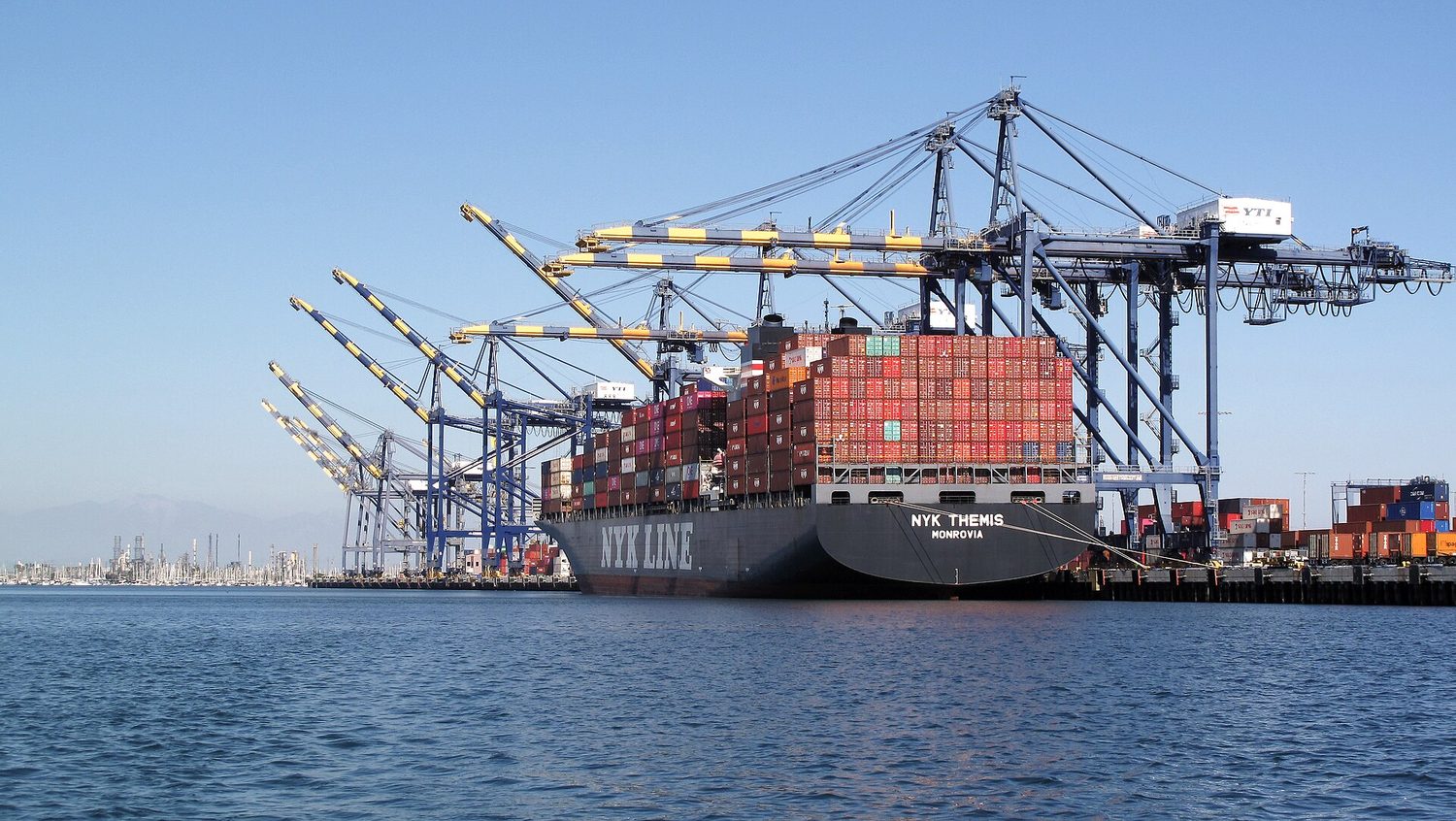
    Site/saɪt/ ตำแหน่งที่ตั้ง
    situation/ˌsɪtʃuːˈeɪʃn/ situation
    6.3

    Cities and Globalization · ⁨เมืองและการเป็นสากล⁩

    Syllabus · ⁨หลักสูตร⁩
    English

    Enduring Understanding (PSO-6): The presence and growth of cities vary across geographical locations because of physical geography and resources.

    Learning Objective PSO-6.B: Explain how cities embody processes of globalization.

    • PSO-6.B.1 World cities function at the top of the world’s urban hierarchy and drive globalization.
    • PSO-6.B.2 Cities are connected globally by networks and linkages and mediate global processes.
    ไทย

    ความเข้าใจที่ยั่งยืน (PSO-6): การมีอยู่และการเติบโตของเมืองมีความแตกต่างกันในแต่ละตำแหน่งทางภูมิศาสตร์เนื่องจากภูมิประเทศและทรัพยากรธรรมชาติ

    จุดประสงค์การเรียนรู้ PSO-6.B: อธิบายว่าเมืองสะท้อนกระบวนการโลกาภิวัตน์อย่างไร

    • PSO-6.B.1 เมืองระดับโลกทำหน้าที่ในระดับสูงสุดของลำดับชั้นเมืองของโลกและขับเคลื่อนโลกาภิวัตน์
    • PSO-6.B.2 เมืองถูกเชื่อมโยงกันทั่วโลกผ่านเครือข่ายและความสัมพันธ์ และ充当全球过程的中介。

    Source: College Board AP Course and Exam Description · ⁨แหล่งที่มา: คำอธิบายหลักสูตรและข้อสอบ College Board AP⁩

    English

    Some cities have influence far beyond their own country.

    • World cities 世界城市 (also called global cities) — such as New York, London, and Tokyo — are command centres of the global economy, finance, and culture.
    • Globalization links cities into networks; a decision in one world city can affect jobs on the other side of the planet.
    ไทย

    บางเมืองมีอิทธิพลกว้างไกลเกินขอบเขตประเทศของตนเอง

    • World cities (หรือเรียกว่า global cities) เช่น New York, London, และ Tokyo เป็นศูนย์บัญชาการของเศรษฐกิจโลก การเงิน และวัฒนธรรม
    • การเป็นสากลเชื่อมโยงเมืองเข้าด้วยกันเป็นเครือข่าย การตัดสินใจในเมืองโลกหนึ่งสามารถส่งผลกระทบต่อ就业机会อีกฝั่งของโลก
    กลุ่มตึกสูงหนาแน่นของ Lower Manhattan มองข้ามแม่น้ำ One World Trade Center อยู่ตรงกลาง
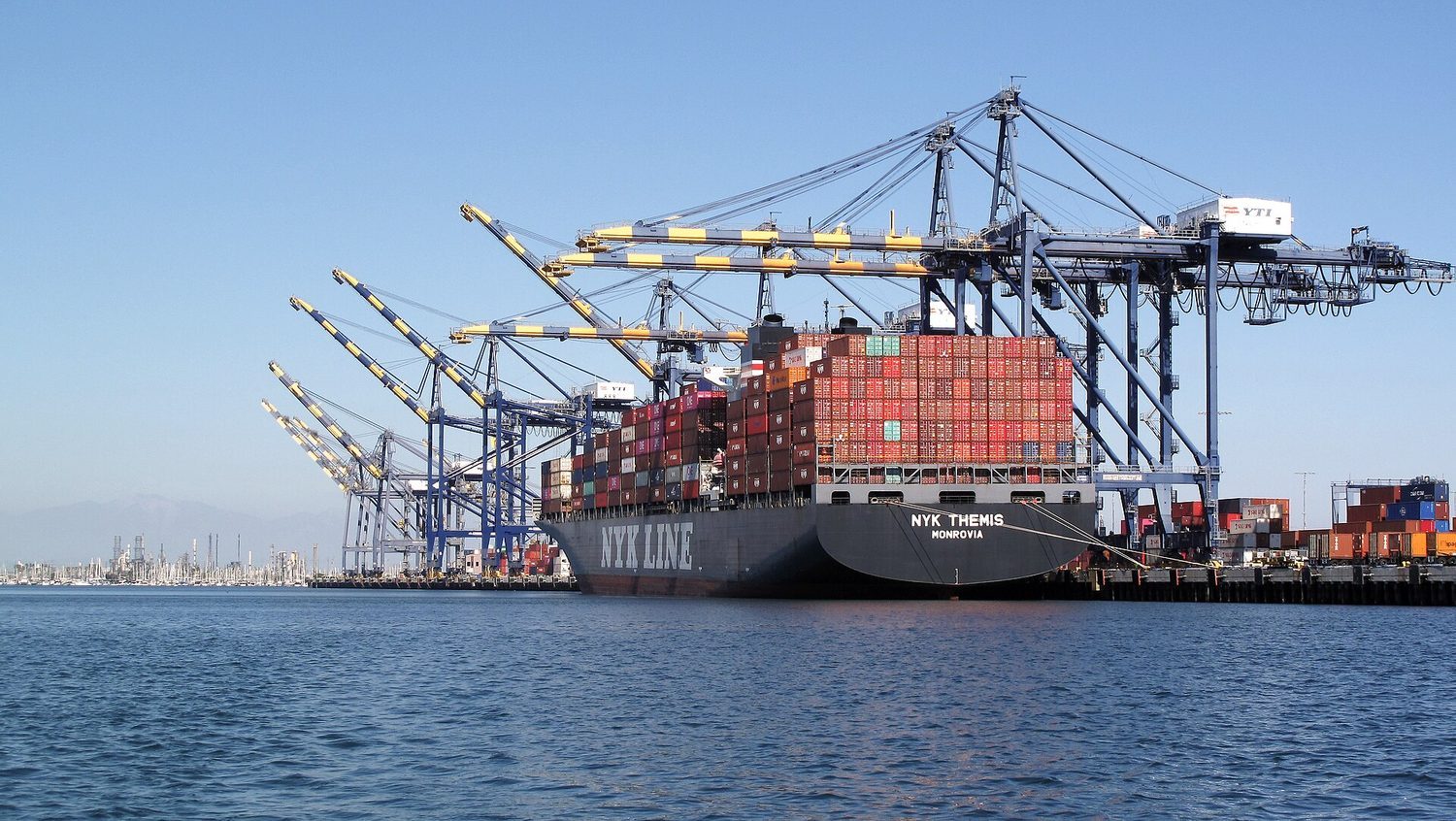
    ทิวทัศน์แมนฮัตตันในนิวยอร์ก เมืองระดับโลก: ธนาคารและสำนักงานใหญ่บริษัทช่วยขับเคลื่อนเศรษฐกิจโลก
    Shibuya Crossing: เมืองโลกรวมผู้คน โครงสร้างพื้นฐาน และเครือข่ายระดับโลกไว้ด้วยกัน
    Shibuya Crossing: เมืองโลกรวมผู้คน โครงสร้างพื้นฐาน และเครือข่ายระดับโลกไว้ด้วยกัน
    Vocabulary · ⁨คำศัพท์⁩ Train · ⁨ฝึกฝน⁩
    English ไทย
    World cities/wɜːld ˈsɪtiz/ เมืองระดับโลก
    6.4

    The Distribution of Cities · ⁨การกระจายตัวของเมือง⁩

    Syllabus · ⁨หลักสูตร⁩
    English

    Enduring Understanding (PSO-6): The presence and growth of cities vary across geographical locations because of physical geography and resources.

    Learning Objective PSO-6.C: Identify the different urban concepts such as hierarchy, interdependence, relative size, and spacing that are useful for explaining the distribution, size, and interaction of cities.

    • PSO-6.C.1 Principles that are useful for explaining the distribution and size of cities include rank-size rule, the primate city, gravity, and Christaller’s central place theory.
    ไทย

    ความเข้าใจที่ยั่งยืน (PSO-6): การมีอยู่และการเติบโตของเมืองมีความแตกต่างกันในแต่ละตำแหน่งทางภูมิศาสตร์เนื่องจากภูมิประเทศและทรัพยากรธรรมชาติ

    จุดประสงค์การเรียนรู้ PSO-6.C: ระบุแนวคิดเมืองต่างๆ เช่น ลำดับชั้น, ความพึ่งพาซึ่งกันและกัน, ขนาดสัมพัทธ์, และการจัดวางที่เป็นประโยชน์ต่อการอธิบายการกระจายขนาดและการมีปฏิสัมพันธ์ของเมือง
    • PSO-6.C.1 หลักการที่ใช้ในการอธิบายการกระจายและขนาดของเมือง ได้แก่ กฎอันดับ-ขนาด, เมืองหลัก, แรงโน้มถ่วง, และทฤษฎีสถานที่กลางของ克里斯塔勒。

    Source: College Board AP Course and Exam Description · ⁨แหล่งที่มา: คำอธิบายหลักสูตรและข้อสอบ College Board AP⁩

    English
    The rank-size rule and the primate city
    Christaller's central place theory

    Cities within a country follow patterns of size and spacing.

    • The rank-size rule 位序规模法则 says the nth-largest city is 1/n the size of the largest (the 2nd city is half the largest, the 3rd a third, and so on).
    • A primate city 首位城市 is far larger than all others (Paris, Bangkok), dominating its country.
    • Central place theory 中心地理论 (Christaller) explains the spacing of settlements: larger centres are fewer and farther apart and offer higher-order goods; their market area is the surrounding region they serve.

    Worked example (a real AP exam question). "Compare the concept of a metacity with the concept of a world city." (2024) A full-mark answer: "A metacity is defined by size — a continuous urban area of more than 20 million people — while a world city is defined by influence, acting as a command centre for the global economy. A city such as Tokyo can be both, but a large metacity in a poorer country may not be a world city." The command word Compare needs an explicit point of difference (size versus influence), not two separate definitions sitting side by side.

    ไทย

    *กฎลำดับขนาดและเมืองหลัก

    *ทฤษฎีสถานที่กลางของ Christaller

    เมืองภายในประเทศปฏิบัติตามรูปแบบของขนาดและระยะห่าง

    • กฎลำดับขนาด บอกว่าเมืองอันดับ nth มีขนาดเท่ากับ 1/n ของเมืองที่ใหญ่ที่สุด (เมืองที่ 2 มีขนาดครึ่งหนึ่งของเมืองที่ใหญ่ที่สุด เมืองที่ 3 มีขนาดหนึ่งในสาม เป็นต้น)
    • Primate city มีขนาดใหญ่กว่าเมืองอื่นๆ มาก (Paris, Bangkok) และครอบงำประเทศ
    • Central place theory (ของ Christaller) อธิบายการจัดวางตัวของ settlements: ศูนย์กลางขนาดใหญ่มีจำนวนน้อยและห่างกันมากขึ้น sertaเสนอสินค้าระดับสูง; market area ของพวกมันคือภูมิภาคโดยรอบที่ให้บริการ

    กฎลำดับขนาดเทียบกับการกระจายตัวของ Primate city *ภายใต้กฎลำดับขนาดเมือง nth จะมีขนาดประมาณ 1/n ของเมืองที่ใหญ่ที่สุด; รูปแบบ Primate มีเมืองหนึ่งเมืองที่ควบคุมและใหญ่กว่าเมืองที่เหลืออย่างชัดเจน

    Worked example (a real AP exam question). "เปรียบเทียบแนวคิดของ Metacity กับแนวคิดของ World city." (2024) คำตอบเต็มคะแนน: "Metacity นิยามตามขนาด — พื้นที่เมืองต่อเนื่องที่มีประชากรมากกว่า 20 ล้านคน — ในขณะที่ World city นิยามตามอิทธิพล ทำหน้าที่เป็นศูนย์บัญชาการของเศรษฐกิจโลก เมืองอย่าง Tokyo อาจเป็นทั้งสองอย่างได้ แต่ Metacity ขนาดใหญ่ในประเทศจนอาจไม่ใช่ World city" คำสั่ง Compare ต้องการจุดแตกต่างที่ชัดเจน (ขนาดเทียบกับอิทธิพล) ไม่ใช่คำนิยามแยกกันสองจุดวางข้างกัน

    Vocabulary · ⁨คำศัพท์⁩ Train · ⁨ฝึกฝน⁩
    English ไทย
    primate city/ˈpraɪmeɪt ˈsɪti/ เมืองหลัก
    Central place theory/ˈsentrəl pleɪs ˈθɪəri/ ทฤษฎีสถานที่กลาง
    6.5

    The Internal Structure of Cities · ⁨โครงสร้างภายในของเมือง⁩

    Syllabus · ⁨หลักสูตร⁩
    English

    Enduring Understanding (PSO-6): The presence and growth of cities vary across geographical locations because of physical geography and resources.

    Learning Objective PSO-6.D: Explain the internal structure of cities using various models and theories.

    • PSO-6.D.1 Models and theories that are useful for explaining internal structures of cities include the Burgess concentric-zone model, the Hoyt sector model, the Harris and Ullman multiple- nuclei model, the galactic city model, bid-rent theory, and urban models drawn from Latin America, Southeast Asia, and Africa.
    ไทย

    ความเข้าใจที่ยั่งยืน (PSO-6): การมีอยู่และการเติบโตของเมืองมีความแตกต่างกันในแต่ละตำแหน่งทางภูมิศาสตร์เนื่องจากภูมิประเทศและทรัพยากรธรรมชาติ

    จุดประสงค์การเรียนรู้ PSO-6.D: อธิบายโครงสร้างภายในของเมืองโดยใช้โมเดลและทฤษฎีต่างๆ

    • PSO-6.D.1 โมเดลและทฤษฎีที่ใช้ในการอธิบายโครงสร้างภายในของเมือง ได้แก่ โมเดลโซนแบบวงกลมของ伯吉斯, โมเดล sektor ของ霍伊特, โมเดลหลายแกนของ哈里斯和厄尔曼, โมเดลเมืองกาแล็กซี, ทฤษฎีค่าเช่า_bid, และโมเดลเมืองที่มาจากอเมริกาใต้, เอเชียตะวันออกเฉียงใต้ และแอฟริกา

    Source: College Board AP Course and Exam Description · ⁨แหล่งที่มา: คำอธิบายหลักสูตรและข้อสอบ College Board AP⁩

    English
    Models of the internal city

    Three classic models describe how North American cities are arranged inside.

    • Concentric zone model 同心圆模型 (Burgess) — rings around the Central Business District (CBD) 中央商务区, from inner-city to commuter suburbs.
    • Sector model 扇形模型 (Hoyt) — land use grows outward in wedges along transport routes.
    • Multiple nuclei model 多核心模型 (Harris–Ullman) — the city has several centres (nodes), not just one CBD, as it grows and specialises.

    Developing-world cities have their own models (e.g. the Latin American, or Griffin–Ford, model with a spine of wealth from the centre).

    ไทย
    โมเดลของเมืองภายใน

    โมเดลคลาสสิกสามแบบอธิบาย how North American cities are arranged inside

    สาม urban models: concentric zone, sector, และ multiple nuclei
    โมเดล concentric-zone, sector, และ multiple-nuclei อธิบาย city land use ต่างกัน
    • โมเดล zonе круговой (Concentric zone model) – Burgess — rings around Central Business District (CBD), จาก inner-city ไปยัง commuter suburbs
    • โมเดล Sector (Sector model) – Hoyt — land use grows outward เป็น wedges ตาม transport routes
    • โมเดลหลายศูนย์กลาง (Harris–Ullman) — เมืองมีศูนย์กลางหลายแห่ง (โหนด) ไม่ใช่เพียงจุดเดียวอย่างเขตธุรกิจกลางเมือง (CBD) เมื่อเมืองขยายตัวและมีความเชี่ยวชาญเฉพาะด้าน

    เมืองในประเทศกำลังพัฒนา มีโมเดลของตนเอง (เช่น โมเดลอเมริกา Latina หรือ Griffin–Ford ที่มีแกนความมั่งคั่งแผ่ขยายจากศูนย์กลาง)

    Explore · ⁨สำรวจ⁩

    Which urban model is it? · ⁨นี่คือแบบจำลองเมืองรูปแบบใด?⁩

    The concentric zone model uses rings around the CBD; the sector model uses wedges along transport routes; the multiple nuclei model has several centres. · ⁨แบบจำลอง ⟦concentric zone⟧ ใช้วงกลมรอบพื้นที่ธุรกิจกลางเมือง (CBD); แบบจำลอง ⟦sector⟧ ใช้รูปทรงสามเหลี่ยมตามเส้นทางขนส่ง; และแบบจำลอง ⟦multiple nuclei⟧ มีศูนย์กลางหลายแห่ง⁩

    Vocabulary · ⁨คำศัพท์⁩ Train · ⁨ฝึกฝน⁩
    English ไทย
    Concentric zone model/kənˈsentrɪk zəʊn ˈmɒdl/ โมเดลโซนวงกลมซ้อนกัน
    Central Business District (CBD)/ˈsentrəl ˈbɪznəs ˈdɪstrɪkt/ เขตธุรกิจกลาง (CBD)
    Sector model/ˈsektə ˈmɒdl/ โมเดลภาคส่วน
    Multiple nuclei model/ˈmʌltɪpl ˈnjuːklɪi ˈmɒdl/ โมเดลแกนกลางหลายแห่ง
    Zoning/ˈzəʊnɪŋ/ Zoning
    Infrastructure/ˈɪnfrəstrʌktʃə/ زیرโครงสร้าง
    informal settlements/ɪnˈfɔːml ˈsetəlmənts/ พื้นที่อยู่อาศัยไม่ทางการ
    Smart-growth/smɑːt ɡrəʊθ/ การพัฒนาอัจฉริยะ
    Greenbelts/ˈɡriːnbelts/ เขตรับรองสีเขียว
    urban renewal/ˈɜːbən rɪˈnjuːəl/ urban renewal
    6.6 6.7

    Density, Land Use, and Infrastructure · ⁨ความหนาแน่น การใช้ที่ดิน และโครงสร้างพื้นฐาน⁩

    Syllabus · ⁨หลักสูตร⁩
    English

    Enduring Understanding (IMP-6): The attitudes and values of a population, as well as the balance of power within that population, are reflected in the built landscape.

    Learning Objective IMP-6.A: Explain how low-, medium-, and high-density housing characteristics represent different patterns of residential land use.

    • IMP-6.A.1 Residential buildings and patterns of land use reflect and shape the city’s culture, technological capabilities, cycles of development, and infilling.
    ไทย

    ความเข้าใจที่ยั่งยืน (IMP-6): ทัศนคติและค่านิยมของประชากร รวมถึงสมดุลของอำนาจภายในประชากรนั้น สะท้อนออกมาในภูมิทัศน์ที่สร้างขึ้น

    จุดประสงค์การเรียนรู้ IMP-6.A: อธิบายว่าลักษณะที่อยู่อาศัยความหนาแน่นต่ำ กลาง และสูง แสดงถึงรูปแบบการใช้ที่ดินเพื่ออยู่อาศัยที่แตกต่างกันอย่างไร

    • IMP-6.A.1 อาคารที่พักอาศัยและรูปแบบการใช้ดินสะท้อนและกำหนดวัฒนธรรมความสามารถทางเทคโนโลยีรอบการพัฒนา และการเติมเต็มของเมือง
    English

    Enduring Understanding (IMP-6): The attitudes and values of a population, as well as the balance of power within that population, are reflected in the built landscape.

    Learning Objective IMP-6.B: Explain how a city’s infrastructure relates to local politics, society, and the environment.

    • IMP-6.B.1 The location and quality of a city’s infrastructure directly affects its spatial patterns of economic and social development.
    ไทย

    ความเข้าใจที่ยั่งยืน (IMP-6): ทัศนคติและค่านิยมของประชากร รวมถึงสมดุลของอำนาจภายในประชากรนั้น สะท้อนออกมาในภูมิทัศน์ที่สร้างขึ้น

    จุดประสงค์การเรียนรู้ IMP-6.B: อธิบายว่าโครงสร้างพื้นฐานของเมืองมีความเกี่ยวข้องกับ politics, society, and environment的地方如何关联。

    • IMP-6.B.1 ตำแหน่งและคุณภาพของโครงสร้างพื้นฐานของเมืองส่งผลโดยตรงต่อรูปแบบเชิงพื้นที่ของการพัฒนาทางเศรษฐกิจและสังคม

    Source: College Board AP Course and Exam Description · ⁨แหล่งที่มา: คำอธิบายหลักสูตรและข้อสอบ College Board AP⁩

    English
    Bid-rent theory

    Inside the city, land use and density change from centre to edge.

    • Density is highest near the CBD (tall buildings, high land prices) and falls outward — the bid-rent curve again.
    • Zoning 分区规划 laws separate land uses (residential, commercial, industrial).
    • Infrastructure 基础设施 — roads, water, power, transit — must grow with the city; where it lags, informal settlements 非正规住区 (slums) may form.
    ไทย
    ทฤษฎีค่าเช่าสูงสุด

    ภายในเมือง การใช้ที่ดินและความหนาแน่นจะเปลี่ยนแปลงจากศูนย์กลางไปยังขอบเขต

    • ความหนาแน่น สูงสุดใกล้กับ CBD (อาคารสูง, ราคาที่ดินแพง) และลดลงเมื่อออกไปข้างนอก — ซึ่งสอดคล้องกับเส้นโค้งของ ค่าเช่าสูงสุด อีกครั้ง
    • กฎหมาย zonning แยกการใช้ที่ดิน (ที่อยู่อาศัย, พาณิชย์, อุตสาหกรรม)
    • โครงสร้างพื้นฐาน — ถนน น้ำ ไฟฟ้า การขนส่ง — ต้องเติบโตไปกับเมือง; หากขาดแคลน จะ可能导致การเกิด ชุมชนไม่เป็นทางการ (สลัม)
    บ้านสร้างเองที่แน่นหนาปกคลุมเนินเขาชันเหนือผิวน้ำในริโอเดจาเนโร
    ชุมชนไม่เป็นทางการ (ฟาวেলা) บนเนินเขาในริโอเดจาเนโร สร้างขึ้นในพื้นที่ที่ที่อยู่อาศัยและบริการตามไม่ทันการเติบโตทางเมืองอย่างรวดเร็ว
    6.8 6.9

    Urban Sustainability and Data · ⁨ความยั่งยืนของเมืองและข้อมูล⁩

    Syllabus · ⁨หลักสูตร⁩
    English

    Enduring Understanding (IMP-6): The attitudes and values of a population, as well as the balance of power within that population, are reflected in the built landscape.

    Learning Objective IMP-6.C: Identify the different urban design initiatives and practices.

    • IMP-6.C.1 Sustainable design initiatives and zoning practices include mixed land use, walkability, transportation-oriented development, and smart-growth policies, including New Urbanism, greenbelts, and slow-growth cities.

    Learning Objective IMP-6.D: Explain the effects of different urban design initiatives and practices.

    • IMP-6.D.1  Praise for urban design initiatives includes the reduction of sprawl, improved walkability and transportation, improved and diverse housing options, improved livability and promotion of sustainable options. Criticisms include increased housing costs, possible de facto segregation, and the potential loss of historical or place character.
    ไทย

    ความเข้าใจที่ยั่งยืน (IMP-6): ทัศนคติและค่านิยมของประชากร รวมถึงสมดุลของอำนาจภายในประชากรนั้น สะท้อนออกมาในภูมิทัศน์ที่สร้างขึ้น

    จุดประสงค์การเรียนรู้ IMP-6.C: ระบุโครงการออกแบบเมืองและแนวปฏิบัติต่างๆ

    • IMP-6.C.1 โครงการออกแบบที่ยั่งยืนและแนวปฏิบัติ zonning รวมถึงการใช้ที่ดินแบบผสม, ความสามารถในการเดินเท้า, การพัฒนาที่เน้นการขนส่ง, และนโยบาย smart-growth รวมถึง New Urbanism, เขียว belt, และเมือง slow-growth

    จุดประสงค์การเรียนรู้ IMP-6.D: อธิบายผลกระทบของโครงการออกแบบเมืองและแนวปฏิบัติต่างๆ

    • IMP-6.D.1 การชื่นชมโครงการออกแบบเมืองรวมถึงการลดการขยายตัว, การเพิ่มความสามารถในการเดินเท้าและการขนส่ง, ตัวเลือกที่อยู่อาศัยที่ดีขึ้นและหลากหลายขึ้น, การเพิ่มความเป็นอยู่ที่ดีและการส่งเสริมตัวเลือกที่ยั่งยืน ข้อวิจารณ์รวมถึงต้นทุนที่อยู่อาศัยที่เพิ่มขึ้น, การแบ่งแยกโดยนัยที่เป็นไปได้, และการสูญเสียลักษณะทางประวัติศาสตร์หรือลักษณะเฉพาะของสถานที่
    English

    Enduring Understanding (IMP-6): The attitudes and values of a population, as well as the balance of power within that population, are reflected in the built landscape.

    Learning Objective IMP-6.E: Explain how qualitative and quantitative data are used to show the causes and effects of geographic change within urban areas.

    • IMP-6.E.1 Quantitative data from census and survey data provide information about changes in population composition and size in urban areas.
    • IMP-6.E.2 Qualitative data from field studies and narratives provide information about individual attitudes toward urban change.
    ไทย

    ความเข้าใจที่ยั่งยืน (IMP-6): ทัศนคติและค่านิยมของประชากร รวมถึงสมดุลของอำนาจภายในประชากรนั้น สะท้อนออกมาในภูมิทัศน์ที่สร้างขึ้น

    จุดประสงค์การเรียนรู้ IMP-6.E: อธิบายว่าข้อมูลเชิงคุณภาพและเชิงปริมาณถูกใช้ในการแสดงสาเหตุและผลกระทบของการเปลี่ยนแปลงทางภูมิศาสตร์ภายในพื้นที่เมืองอย่างไร

    • IMP-6.E.1 ข้อมูลเชิงปริมาณจากสำมะโนประชากรและข้อมูลการสำรวจให้ข้อมูลเกี่ยวกับการเปลี่ยนแปลงองค์ประกอบและขนาดประชากรในพื้นที่เมือง
    • IMP-6.E.2 ข้อมูลเชิงคุณภาพจากการศึกษาภาคสนามและเรื่องราวให้ข้อมูลเกี่ยวกับทัศนคติส่วนบุคคลต่อการเปลี่ยนแปลงในเมือง

    Source: College Board AP Course and Exam Description · ⁨แหล่งที่มา: คำอธิบายหลักสูตรและข้อสอบ College Board AP⁩

    English

    Planners use data and design to make cities work better.

    • Smart-growth 精明增长, mixed-use development, and transit-oriented design fight sprawl and car dependence.
    • Greenbelts 绿带 limit outward growth; urban renewal 城市更新 rebuilds decayed areas, but can cause gentrification 中产阶级化 that displaces poorer residents.
    • Census and geospatial data guide where to put schools, transit, and services.
    ไทย

    นักวางแผนใช้ ข้อมูล และการออกแบบเพื่อให้เมืองทำงานได้ดีขึ้น

    • การพัฒนาแบบ เติบโตอัจฉริยะ, การใช้ประโยชน์ที่ดินผสมผสาน, และการออกแบบที่เน้น การขนส่งสาธารณะ ช่วยต่อต้านการขยายตัวของเมืองและการพึ่งพารถยนต์
    • เขียวกobelts จำกัดการขยายตัวออกไป; การพัฒนาใหม่ในเมือง สร้างพื้นที่เสื่อมโทรมขึ้นใหม่ แต่อาจทำให้เกิด การเปลี่ยนผ่านทางสังคม ที่ผลัก居民ยากจนออกจากพื้นที่
    • ข้อมูล จากสำมะโนประชากรและภูมิศาสตร์นำทางในการกำหนดตำแหน่งโรงเรียน การขนส่ง และบริการต่างๆ
    6.10 6.11

    Challenges of Urban Changes and Sustainability · ⁨ปัญหาของการเปลี่ยนแปลงทางเมืองและความยั่งยืน⁩

    Syllabus · ⁨หลักสูตร⁩
    English

    Enduring Understanding (SPS-6): Urban areas face unique economic, political, cultural, and environmental challenges.

    Learning Objective SPS-6.A: Explain causes and effects of geographic change within urban areas.

    • SPS-6.A.1 As urban populations move within a city, economic and social challenges result, including: issues related to housing and housing discrimination such as redlining, blockbusting, and affordability; access to services; rising crime; environmental injustice; and the growth of disamenity zones or zones of abandonment.
    • SPS-6.A.2 Squatter settlements and conflicts over land tenure within large cities have increased.
    • SPS-6.A.3 Responses to economic and social challenges in urban areas can include inclusionary zoning and local food movements.
    • SPS-6.A.4 Urban renewal and gentrification have both positive and negative consequences.
    • SPS-6.A.5 Functional and geographic fragmentation of governments—the way government agencies and institutions are dispersed between state, county, city, and neighborhood levels—presents challenges in addressing urban issues.
    ไทย

    ความเข้าใจที่ยั่งยืน (SPS-6): พื้นที่เมืองเผชิญกับความท้าทายด้านเศรษฐกิจ, การเมือง, วัฒนธรรม และสิ่งแวดล้อมที่เป็นเอกลักษณ์

    จุดประสงค์การเรียนรู้ SPS-6.A: อธิบายสาเหตุและผลกระทบของการเปลี่ยนแปลงทางภูมิศาสตร์ภายในพื้นที่เมือง

    • SPS-6.A.1 เมื่อประชากรในเมืองเคลื่อนย้ายภายในเมือง จะเกิดปัญหาทางเศรษฐกิจและสังคม เช่น: ปัญหาเกี่ยวกับที่อยู่อาศัยและการเลือกปฏิบัติต่อผู้เช่าเช่น การแบ่งเขตสี (redlining), การสลับกลุ่มบ้าน (blockbusting), และความคุ้มค่าในการเข้าถึง; การเข้าถึงบริการ; อัตราอาชญากรรมที่เพิ่มขึ้น; ความไม่เท่าเทียมด้านสิ่งแวดล้อม; และการขยายตัวของเขตที่มีสิ่งรบกวนหรือเขตที่ถูกทิ้งร้าง
    • SPS-6.A.2 ชุมชนคนไร้ที่พำนักและความขัดแย้งเรื่องสิทธิ์ในที่ดินในเมืองใหญ่ได้เพิ่มขึ้น
    • SPS-6.A.3 การตอบโต้ต่อความท้าทายทางเศรษฐกิจและสังคมในพื้นที่เมืองอาจรวมถึงการกำหนด zonning แบบรวม社会力量 (inclusionary zoning) และการเคลื่อนไหวเพื่ออาหารท้องถิ่น
    • SPS-6.A.4 การปรับปรุงเมืองและการเปลี่ยนแปลงสภาพแวดล้อมมีทั้งผลดีและผลเสีย
    • SPS-6.A.5 การแบ่งแยกหน้าที่และเชิงพื้นที่ของหน่วยงานราชการ—即以政府机构和机构的分散在州、县、市和社区层面—提出了应对城市问题的挑战。
    English

    Enduring Understanding (SPS-6): Urban areas face unique economic, political, cultural, and environmental challenges.

    Learning Objective SPS-6.B: Describe the effectiveness of different attempts to address urban sustainability challenges.

    • SPS-6.B.1 Challenges to urban sustainability include suburban sprawl, sanitation, climate change, air and water quality, the large ecological footprint of cities, and energy use.
    • SPS-6.B.2 Responses to urban sustainability challenges can include regional planning efforts, remediation and redevelopment of brownfields, establishment of urban growth boundaries, and farmland protection policies.
    ไทย

    ความเข้าใจที่ยั่งยืน (SPS-6): พื้นที่เมืองเผชิญกับความท้าทายด้านเศรษฐกิจ, การเมือง, วัฒนธรรม และสิ่งแวดล้อมที่เป็นเอกลักษณ์

    จุดประสงค์การเรียนรู้ SPS-6.B: อธิบายประสิทธิภาพของแนวทางต่างๆ ในการแก้ปัญหาความยั่งยืนในเมือง

    • SPS-6.B.1 ความท้าทายด้านความยั่งยืนในเมือง รวมถึงการขยายตัวของปริมณฑล, ระบบสุขาภิบาล, การเปลี่ยนแปลงสภาพภูมิอากาศ, คุณภาพอากาศและน้ำ, รอยเท้าทางนิเวศวิทยาขนาดใหญ่ของเมือง, และการใช้พลังงาน
    • SPS-6.B.2 การตอบโต้ต่อความท้าทายด้านความยั่งยืนในเมืองอาจรวมถึงความพยายามวางแผนระดับภูมิภาค, การฟื้นฟูและพัฒนาพื้นที่สีน้ำตาล (brownfields), การกำหนดขอบเขตการเติบโตของเมือง, และนโยบายคุ้มครองพื้นที่เกษตรกรรม

    Source: College Board AP Course and Exam Description · ⁨แหล่งที่มา: คำอธิบายหลักสูตรและข้อสอบ College Board AP⁩

    English

    Rapid urban growth brings problems:

    • Social: housing shortages, segregation, and the displacement caused by gentrification.
    • Environmental: air and water pollution, the urban heat island 城市热岛 effect, waste, and heavy resource use.
    • Economic: strained budgets, congestion, and the cost of extending infrastructure to sprawling edges.

    Sustainable cities try to grow up rather than out, invest in public transit, and mix homes with jobs and services.

    ไทย

    การเติบโตทางเมืองอย่างรวดเร็วนำมาซึ่งปัญหา:

    • ด้านสังคม: ขาดแคลนที่อยู่อาศัย, การแยกกลุ่มทางสังคม, และการถูก displaced โดยกระบวนการ gentrification
    • ด้านสิ่งแวดล้อม: มลพิษทางอากาศและน้ำ,ปรากฏการณ์ เกาะความร้อนในเมือง, ขยะ, และการใช้ทรัพยากรจำนวนมาก
    • ด้านเศรษฐกิจ: งบประมาณตึงเครียด, การจราจรติดขัด, และค่าใช้จ่ายในการขยายโครงสร้างพื้นฐานไปยังขอบเขตที่กระจายตัว

    เมืองที่ยั่งยืนพยายามพัฒนา ขึ้น แทนที่จะ ขยายออก, ลงทุนในระบบขนส่งสาธารณะ และผสมผสานที่พักอาศัย เข้ากับสถานที่ทำงานและบริการ

    Vocabulary · ⁨คำศัพท์⁩ Train · ⁨ฝึกฝน⁩
    English ไทย
    gentrification/ˌdʒentrɪfɪˈkeɪʃn/ gentrification
    urban heat island/ˈɜːbən hiːt ˈaɪlənd/ เกาะความร้อนในเมือง (urban heat island)
    6.10 6.11

    Exam tips · ⁨ข้อแนะนำสำหรับการสอบ⁩

    English
    • Separate a city's site (physical setting) from its situation (position relative to others).
    • Apply the rank-size rule (the nth city is about 1/n of the largest) and spot a primate city.
    • Match a city description to the right model: concentric zone, sector, or multiple nuclei.
    • Link land value to density — costly central land is used by building upward.
    • Discuss change with suburbanization, sprawl, and gentrification, and smart-growth responses.
    ไทย
    • แยกแยะระหว่าง ที่ตั้งทางกายภาพ (physical setting) กับ ตำแหน่งสัมพัทธ์ (situation) ของเมือง
    • ใช้ กฎลำดับขนาด (rank-size rule) ซึ่งเมืองที่ ⟦n⟧ มีขนาดประมาณ 1/n ของเมืองที่ใหญ่ที่สุด และระบุ เมืองหลัก (primate city)
    • จับคู่คำอธิบายเมืองเข้ากับแบบจำลองที่เหมาะสม: เขตวงกลมซ้อน, โซนรูปพัด, หรือ แก่นกลางหลายแห่ง
    • เชื่อมโยง มูลค่าที่ดิน กับความหนาแน่น — ที่ดินศูนย์กลางที่มีราคาสูงมักถูกใช้โดยการสร้างตึกสูงขึ้น
    • อภิปรายถึงการเปลี่ยนแปลงจาก การขยายตัวชานเมือง, การกระจายตัวของเมือง, และ การปรับปรุงสภาพพื้นที่, พร้อมกับการตอบสนองด้วย การพัฒนาอย่างชาญฉลาด
    Vocabulary · ⁨คำศัพท์⁩ Train · ⁨ฝึกฝน⁩
    English ไทย
    rank-size rule/ræŋk saɪz ruːl/ กฎขนาด-อันดับ
  • 7

    Industrial and Economic Development Patterns and Processes · ⁨รูปแบบและกระบวนการของการพัฒนาอุตสาหกรรมและเศรษฐกิจ⁩

    Watch lesson · ⁨ดูบทเรียน⁩
    7.1

    The Industrial Revolution

    Syllabus · ⁨หลักสูตร⁩
    English

    Enduring Understanding (SPS-7): Industrialization, past and present, has facilitated improvements in standards of living, but it has also contributed to geographically uneven development.

    Learning Objective SPS-7.A: Explain how the Industrial Revolution facilitated the growth and diffusion of industrialization.

    • SPS-7.A.1 Industrialization began as a result of new technologies and was facilitated by the availability of natural resources.
    • SPS-7.A.2 As industrialization spread it caused food supplies to increase and populations to grow; it allowed workers to seek new industrial jobs in the cities and changed class structures.
    • SPS-7.A.3 Investors in industry sought out more raw materials and new markets, a factor that contributed to the rise of colonialism and imperialism.
    ไทย

    ความเข้าใจที่ยั่งยืน (SPS-7): การอุตสาหกรรม化无论是过去还是现在,都促进了生活水平的提高,但也导致了地理发展不平衡。

    จุดประสงค์การเรียนรู้ SPS-7.A: อธิบายว่าการปฏิวัติอุตสาหกรรมช่วยสนับสนุนการเติบโตและการแพร่กระจายของการอุตสาหกรรม化ได้อย่างไร

    • SPS-7.A.1 การอุตสาหกรรมเริ่มขึ้นเนื่องจากเทคโนโลยีใหม่ และได้รับแรงหนุนจากการมีทรัพยากรธรรมชาติเพียงพอ
    • SPS-7.A.2 เมื่อการอุตสาหกรรมขยายตัว ทำให้ปริมาณอาหารเพิ่มขึ้นและประชากรเพิ่มมากขึ้น ส่งผลให้แรงงานสามารถหางานในภาคอุตสาหกรรมในเมืองได้ และเปลี่ยนแปลงโครงสร้างชั้นสังคม
    • SPS-7.A.3 นักลงทุนในภาคอุตสาหกรรมมองหาวัตถุดิบเพิ่มเติมและตลาดใหม่ ซึ่งเป็นปัจจัยที่สนับสนุนการเกิดขึ้นของลัทธิอาณานิคมและลัทธิจักรวรรดินิยม

    Source: College Board AP Course and Exam Description · ⁨แหล่งที่มา: คำอธิบายหลักสูตรและข้อสอบ College Board AP⁩

    The Industrial Revolution 工业革命 (from the 1700s) shifted production from hand tools in homes to machines in factories, first in Britain and then worldwide. It transformed geography:

    • Industry clustered where resources (coal, iron) and transport (rivers, ports, railways) came together.
    • It powered urbanization as workers moved to factory cities, and it began the huge, uneven spread of wealth between world regions.
    • Break-of-bulk points 转运点 (ports, rail hubs where cargo changes transport) became key industrial locations.
    A huge container ship being unloaded by tall gantry cranes at a busy port
    A container port: ships, cranes, and rail meet here, so goods change transport. Such break-of-bulk points became major industrial locations
    Vocabulary · ⁨คำศัพท์⁩ Train · ⁨ฝึกฝน⁩
    English ไทย
    Industrial Revolution/ɪnˈdʌstrɪəl ˌrevəˈluːʃn/ ปฏิวัติอุตสาหกรรม
    Break-of-bulk points/breɪk ɒv bʌlk pɔɪnts/ จุดเปลี่ยนผ่านสินค้า
    7.2

    Economic Sectors and Patterns

    Syllabus · ⁨หลักสูตร⁩
    English

    Enduring Understanding (SPS-7): Industrialization, past and present, has facilitated improvements in standards of living, but it has also contributed to geographically uneven development.

    Learning Objective SPS-7.B: Explain the spatial patterns of industrial production and development.

    • SPS-7.B.1 The different economic sectors—including primary, secondary, tertiary, quaternary, and quinary—are characterized by distinct development patterns.
    • SPS-7.B.2 Labor, transportation (including shipping containers), the break-of-bulk point, least cost theory, markets, and resources influence the location of manufacturing such as core, semiperiphery, and periphery locations.
    ไทย

    ความเข้าใจที่ยั่งยืน (SPS-7): การอุตสาหกรรม化无论是过去还是现在,都促进了生活水平的提高,但也导致了地理发展不平衡。

    จุดประสงค์การเรียนรู้ SPS-7.B: อธิบายรูปแบบเชิงพื้นที่ของการผลิตและการพัฒนาอุตสาหกรรม

    • SPS-7.B.1 ภาคเศรษฐกิจต่างๆ—including sector, including primary, secondary, tertiary, quaternary, and quinary—are characterized by distinct development patterns.
    • SPS-7.B.2 แรงงาน, การขนส่ง (รวมถึงตู้คอนเทนเนอร์), จุดเปลี่ยนถ่ายสินค้า, ทฤษฎีต้นทุนต่ำสุด, ตลาด, และทรัพยากร มีอิทธิพลต่อการตั้งโรงงาน เช่น พื้นที่ศูนย์กลาง, กึ่งรอบนอก, และรอบนอก

    Source: College Board AP Course and Exam Description · ⁨แหล่งที่มา: คำอธิบายหลักสูตรและข้อสอบ College Board AP⁩

    Weber's least cost theory

    An economy's jobs fall into sectors, and the mix shifts as a country develops.

    Employment shifts from primary to secondary to tertiary as a country develops
    As development rises, workers move from primary (farming) to secondary (industry) to tertiary and quaternary (services)
    • Primary sector 第一产业 — extracting raw materials (farming, mining, fishing).
    • Secondary sector 第二产业 — manufacturing raw materials into goods.
    Several bright yellow robotic arms welding metal parts on an automated production line
    Robots welding on a factory line: the secondary sector turns raw materials into finished goods, increasingly with automation
    • Tertiary sector 第三产业 — services (retail, transport, healthcare).
    • Quaternary 第四产业 and quinary sectors — information, research, and top decision-making.

    Poorer economies lean on the primary sector; richer ones on the tertiary and quaternary. Weber's least-cost theory 韦伯最小成本理论 explains where factories locate, balancing the cost of transport, labour, and agglomeration.

    Worked example (a real AP exam question). "Explain how deindustrialization has affected the economy of core countries." (2025) A full-mark answer: "As factories closed or moved abroad, core-country economies shifted away from manufacturing toward services and high-technology work, so many manufacturing workers lost their jobs while new tertiary and quaternary jobs grew." The command word Explain wants the mechanism: name the change (loss of manufacturing) and carry it through to its economic effect. A one-word answer like "unemployment" is not enough.

    Explore · ⁨สำรวจ⁩

    Which economic sector? · ⁨ภาคเศรษฐกิจใด?⁩

    The primary sector extracts raw materials; the secondary sector manufactures goods; the tertiary sector provides services; the quaternary sector handles information and research. · ⁨ภาค ⟦primary⟧ ทำการสกัดวัตถุดิบ; ภาค ⟦secondary⟧ ผลิตสินค้า; ภาค ⟦tertiary⟧ ให้บริการ; และภาค ⟦quaternary⟧ จัดการกับข้อมูลและการวิจัย⁩

    Vocabulary · ⁨คำศัพท์⁩ Train · ⁨ฝึกฝน⁩
    English ไทย
    Primary sector/ˈpraɪməri ˈsektə/ ภาคต้นน้ำ
    Secondary sector/ˈsekəndəri ˈsektə/ ภาคกลางน้ำ
    Tertiary sector/ˈtɜːʃjəri ˈsektə/ ภาคปลายน้ำ
    Quaternary/kwəˈtɜːnəri/ ขั้น quaternary
    Weber's least-cost theory/ˈwebəz liːst kɒst ˈθɪəri/ Weber's least-cost theory
    7.3

    Measures of Development

    Syllabus · ⁨หลักสูตร⁩
    English

    Enduring Understanding (SPS-7): Industrialization, past and present, has facilitated improvements in standards of living, but it has also contributed to geographically uneven development.

    Learning Objective SPS-7.C: Describe social and economic measures of development.

    • SPS-7.C.1 Measures of social and economic development include Gross Domestic Product (GDP); Gross National Product (GNP); and Gross National Income (GNI) per capita; sectoral structure of an economy, both formal and informal; income distribution; fertility rates; infant mortality rates; access to health care; use of fossil fuels and renewable energy; and literacy rates.
    • SPS-7.C.2 Measures of gender inequality, such as the Gender Inequality Index (GII), include reproductive health, indices of empowerment, and labor-market participation.
    • SPS-7.C.3 The Human Development Index (HDI) is a composite measure used to show spatial variation among states in levels of development.
    ไทย

    ความเข้าใจที่ยั่งยืน (SPS-7): การอุตสาหกรรม化无论是过去还是现在,都促进了生活水平的提高,但也导致了地理发展不平衡。

    จุดประสงค์การเรียนรู้ SPS-7.C: อธิบายตัวชี้วัดด้านสังคมและเศรษฐกิจของการพัฒนา

    • SPS-7.C.1 ตัวชี้วัดการพัฒนาทางสังคมและเศรษฐกิจ ได้แก่ Produk Domestik Bruto (GDP); Produk Nasional Kotor (GNP); และ Pendapatan Nasional Kotor (GNI) ต่อหัว; โครงสร้างภาคเศรษฐกิจ ทั้งภาคเป็นทางการและไม่เป็นทางการ; การกระจายรายได้; อัตราการเกิด; อัตราความตายในทารก; การเข้าถึงบริการสุขภาพ; การใช้เชื้อเพลิงฟอสซิลและพลังงานหมุนเวียน; และอัตราการศึกษาออกเสียง
    • SPS-7.C.2 ตัวชี้วัดความไม่เท่าเทียมกันระหว่างเพศ เช่น ดัชนีความไม่เท่าเทียมกันระหว่างเพศ (GII) ประกอบด้วย สุขภาพการเจริญพันธุ์, ดัชนีการมีอำนาจ, และการมีส่วนร่วมในตลาดแรงงาน
    • SPS-7.C.3 ดัชนีการพัฒนามนุษย์ (HDI) เป็นตัวชี้วัดรวมที่ใช้แสดงความแตกต่างเชิงพื้นที่ในระดับการพัฒนาของรัฐต่างๆ

    Source: College Board AP Course and Exam Description · ⁨แหล่งที่มา: คำอธิบายหลักสูตรและข้อสอบ College Board AP⁩

    Development 发展 is the process of improving people's economic and social well-being. It is measured in several ways:

    • Gross Domestic Product (GDP) per capita 人均国内生产总值 — economic output per person; a common but incomplete measure.
    • The Human Development Index (HDI) 人类发展指数 combines income, education (years of schooling), and health (life expectancy) into one score from 0 to 1 — a fuller picture than money alone.
    • The Gender Inequality Index (GII) 性别不平等指数 and the Gini coefficient 基尼系数 (income inequality) add social detail.
    Vocabulary · ⁨คำศัพท์⁩ Train · ⁨ฝึกฝน⁩
    English ไทย
    Development/dɪˈveləpmənt/ Development
    Gross Domestic Product (GDP) per capita/ɡrəʊs dəˈmestɪk ˈprɒdʌkt pɜː ˈkæpɪtə/ ผลิตภัณฑ์มวลรวมต่อหัว (GDP per capita)
    Human Development Index (HDI)/ˈhjuːmən dɪˈveləpmənt ˈɪndeks/ ดัชนีการพัฒนามนุษย์ (HDI)
    Gender Inequality Index (GII)/ˈdʒendə ɪniːˈkwɒlɪti ˈɪndeks/ ดัชนีความไม่เท่าเทียมด้านเพศ (GII)
    Gini coefficient/ˈdʒiːni ˌkəʊɪˈfɪʃənt/ สัมประสิทธิ์ Gini
    7.4

    Women and Economic Development

    Syllabus · ⁨หลักสูตร⁩
    English

    Enduring Understanding (SPS-7): Industrialization, past and present, has facilitated improvements in standards of living, but it has also contributed to geographically uneven development.

    Learning Objective SPS-7.D: Explain how and to what extent changes in economic development have contributed to gender parity.

    • SPS-7.D.1 The roles of women change as countries develop economically.
    • SPS-7.D.2 Although there are more women in the workforce, they do not have equity in wages or employment opportunities.
    • SPS-7.D.3 Microloans have provided opportunities for women to create small local businesses, which have improved standards of living.
    ไทย

    ความเข้าใจที่ยั่งยืน (SPS-7): การอุตสาหกรรม化无论是过去还是现在,都促进了生活水平的提高,但也导致了地理发展不平衡。

    จุดประสงค์การเรียนรู้ SPS-7.D: อธิบายว่าและ的程度ใดที่การเปลี่ยนแปลงในการพัฒนาทางเศรษฐกิจได้ contribute to gender parity.

    • SPS-7.D.1 บทบาทของผู้หญิงเปลี่ยนแปลงไปเมื่อประเทศพัฒนาทางเศรษฐกิจ
    • SPS-7.D.2 แม้จะมีผู้หญิงในกำลังแรงงานมากขึ้น แต่他们也ไม่ได้มีความเสมอภาคในด้านค่าจ้างหรือโอกาสการจ้างงาน
    • SPS-7.D.3 สินเชื่อบุคคล/small loans have provided opportunities for women to create small local businesses, which have improved standards of living.

    Source: College Board AP Course and Exam Description · ⁨แหล่งที่มา: คำอธิบายหลักสูตรและข้อสอบ College Board AP⁩

    The role of women is both a cause and a measure of development.

    • As economies develop, more women enter paid work and education, which raises household income and lowers fertility (linking back to the demographic transition).
    • Microfinance 小额信贷 — small loans, often to women — helps start businesses in poorer regions.
    • Gender gaps in pay, land ownership, and schooling hold development back; closing them is one of the UN's key goals.
    Vocabulary · ⁨คำศัพท์⁩ Train · ⁨ฝึกฝน⁩
    English ไทย
    Microfinance/ˌmaɪkrəʊfaɪˈnæns/ Microfinance
    7.5

    Theories of Development

    Syllabus · ⁨หลักสูตร⁩
    English

    Enduring Understanding (SPS-7): Industrialization, past and present, has facilitated improvements in standards of living, but it has also contributed to geographically uneven development.

    Learning Objective SPS-7.E: Explain different theories of economic and social development.

    • SPS-7.E.1 Different theories, such as Rostow’s Stages of Economic Growth, Wallerstein’s World System Theory, dependency theory, and commodity dependence, help explain spatial variations in development.
    ไทย

    ความเข้าใจที่ยั่งยืน (SPS-7): การอุตสาหกรรม化无论是过去还是现在,都促进了生活水平的提高,但也导致了地理发展不平衡。

    จุดประสงค์การเรียนรู้ SPS-7.E: อธิบายทฤษฎีต่างๆ ของการพัฒนาทางเศรษฐกิจและสังคม

    • SPS-7.E.1 ทฤษฎีต่างๆ เช่น ระยะการเติบโตทางเศรษฐกิจของ Rostow, ทฤษฎีระบบโลกของ Wallerstein, ทฤษฎีการพึ่งพา, และการพึ่งพาสินค้า ช่วยอธิบายความแตกต่างเชิงพื้นที่ในการพัฒนา

    Source: College Board AP Course and Exam Description · ⁨แหล่งที่มา: คำอธิบายหลักสูตรและข้อสอบ College Board AP⁩

    Wallerstein's world-systems theory
    Rostow's stages of economic growth

    Two famous theories explain why some regions are rich and others poor.

    Rostow's five stages of economic growth
    Rostow sees development as a climb through five stages; critics say it ignores global inequalities
    • Rostow's stages of growth 罗斯托发展阶段 — every country climbs through five stages: traditional society, preconditions for take-off, take-off, drive to maturity, and age of mass consumption. It is optimistic but assumes all countries can follow the same path.
    • Wallerstein's world-systems theory 沃勒斯坦世界体系理论 divides the world into a wealthy core 核心, a poorer periphery 边缘, and a middle semi-periphery 半边缘. The core stays rich partly by using the periphery's cheap labour and resources — a dependency 依附 view that challenges Rostow.
    Vocabulary · ⁨คำศัพท์⁩ Train · ⁨ฝึกฝน⁩
    English ไทย
    Rostow's stages of growth/ˈrɒstəʊz ˈsteɪdʒɪz ɒv ɡrəʊθ/ Rostow's stages of growth
    Wallerstein's world-systems theory/ˈwɒləstaɪnz wɜːld ˈsɪstəmz ˈθɪəri/ ทฤษฎีระบบโลกของ Wallerstein
    core/kɔː/ core
    periphery/pəˈrɪfəri/ periphery
    semi-periphery/ˈsemi pəˈrɪfəri/ semi-periphery
    dependency/dɪˈpendənsi/ การพึ่งพา
    7.6 7.7

    Trade and the World Economy

    Syllabus · ⁨หลักสูตร⁩
    English

    Enduring Understanding (PSO-7): Economic and social development happen at different times and rates in different places.

    Learning Objective PSO-7.A: Explain causes and geographic consequences of recent economic changes such as the increase in international trade, deindustrialization, and growing interdependence in the world economy.

    • PSO-7.A.1 Complementarity and comparative advantage establish the basis for trade.
    • PSO-7.A.2 Neoliberal policies, including free trade agreements, have created new organizations, spatial connections, and trade relationships, such as the EU, World Trade Organization (WTO), Mercosur, and OPEC, that foster greater globalization.
    • PSO-7.A.3 Government initiatives at all scales may affect economic development, including tariffs.
    • PSO-7.A.4 Global financial crises (e.g., debt crises), international lending agencies (e.g., the International Monetary Fund), and strategies of development (e.g., microlending) demonstrate how different economies have become more closely connected, even interdependent.
    ไทย

    ความเข้าใจที่ยั่งยืน (PSO-7): การพัฒนาทางเศรษฐกิจและสังคมเกิดขึ้นในช่วงเวลาและอัตราที่แตกต่างกันในแต่ละพื้นที่

    จุดประสงค์การเรียนรู้ PSO-7.A: อธิบายสาเหตุและผลกระทบทางภูมิศาสตร์ของการเปลี่ยนแปลงทางเศรษฐกิจล่าสุด เช่น การเพิ่มขึ้นของการค้าระหว่างประเทศ, การลดบทบาทอุตสาหกรรม, และความเชื่อมโยงที่เพิ่มขึ้นในเศรษฐกิจโลก

    • PSO-7.A.1 ความต้องการที่ต่างกันและข้อได้เปรียบเชิงเปรียบเทียบกำหนดพื้นฐานของการค้า
    • PSO-7.A.2 นโยบาย neoliberals, รวมถึงข้อตกลงการค้าเสรี, ได้สร้างองค์กรใหม่, ความเชื่อมโยงเชิงพื้นที่, และความสัมพันธ์ทางการค้า เช่น EU, องค์การการค้าโลก (WTO), Mercosur, และ OPEC, ซึ่งส่งเสริมการเป็นโลกาภิวัตน์มากขึ้น
    • PSO-7.A.3 แนวคิดของรัฐบาลในระดับต่างๆ อาจส่งผลต่อการพัฒนาทางเศรษฐกิจ รวมถึงภาษีศุลกากร
    • PSO-7.A.4 วิกฤตการเงินโลก (เช่น วิกฤตหนี้สิน), หน่วยงานให้กู้ยืมระหว่างประเทศ (เช่น ธนาคารโลก), และกลยุทธ์การพัฒนา (เช่น การให้สินเชื่อขนาดเล็ก) แสดงให้เห็นว่าเศรษฐกิจต่างๆ ได้กลายเป็น connected, even interdependent.
    English

    Enduring Understanding (PSO-7): Economic and social development happen at different times and rates in different places.

    Learning Objective PSO-7.A: Explain causes and geographic consequences of recent economic changes such as the increase in international trade, deindustrialization, and growing interdependence in the world economy.

    • PSO-7.A.5 Outsourcing and economic restructuring have led to a decline in jobs in core regions and an increase in jobs in newly industrialized countries.
    • PSO-7.A.6 In countries outside the core, the growth of industry has resulted in the creation of new manufacturing zones—including special economic zones, free-trade zones, and export- processing zones—and the emergence of an international division of labor in which developing countries have lower-paying jobs.
    • PSO-7.A.7 The contemporary economic landscape has been transformed by post-Fordist methods of production, multiplier effects, economies of scale, agglomeration, just-in-time delivery, the emergence of service sectors, high technology industries, and growth poles.
    ไทย

    ความเข้าใจที่ยั่งยืน (PSO-7): การพัฒนาทางเศรษฐกิจและสังคมเกิดขึ้นในช่วงเวลาและอัตราที่แตกต่างกันในแต่ละพื้นที่

    จุดประสงค์การเรียนรู้ PSO-7.A: อธิบายสาเหตุและผลกระทบทางภูมิศาสตร์ของการเปลี่ยนแปลงทางเศรษฐกิจล่าสุด เช่น การเพิ่มขึ้นของการค้าระหว่างประเทศ, การลดบทบาทอุตสาหกรรม, และความเชื่อมโยงที่เพิ่มขึ้นในเศรษฐกิจโลก

    • PSO-7.A.5 การ Outsourcing และการปรับโครงสร้างทางเศรษฐกิจนำไปสู่การลดลงของตำแหน่งงานในพื้นที่ศูนย์กลางและเพิ่มขึ้นในประเทศที่กำลังพัฒนาอย่างรวดเร็ว
    • PSO-7.A.6 ในประเทศที่ไม่ใช่พื้นที่ศูนย์กลาง การเติบโตของอุตสาหกรรมนำไปสู่การสร้างเขตการผลิตใหม่—including special economic zones, free-trade zones, and export-processing zones—and the emergence of an international division of labor in which developing countries have lower-paying jobs.
    • PSO-7.A.7 ภูมิทัศน์ทางเศรษฐกิจสมัยใหม่ถูก transform oleh post-Fordist methods of production, multiplier effects, economies of scale, agglomeration, just-in-time delivery, the emergence of service sectors, high technology industries, and growth poles.

    Source: College Board AP Course and Exam Description · ⁨แหล่งที่มา: คำอธิบายหลักสูตรและข้อสอบ College Board AP⁩

    Countries are linked by trade, which reshapes development.

    • Comparative advantage 比较优势 means each country gains by specialising in what it makes most efficiently and trading for the rest.
    • Complementarity and neoliberal free-trade policies, plus organisations like the WTO and trade blocs (EU, USMCA), have deepened globalization.
    • Outsourcing 外包 and global supply chains move manufacturing to lower-cost countries, changing where — and by whom — the world's goods are made. Special economic zones 经济特区 attract this investment with tax breaks.
    Container ports link global trade: goods, capital and ideas move through the world economy
    Container ports link global trade: goods, capital and ideas move through the world economy
    Vocabulary · ⁨คำศัพท์⁩ Train · ⁨ฝึกฝน⁩
    English ไทย
    Comparative advantage/kəmˈpærətɪv ədˈvæntɪdʒ/ Comparative advantage
    Outsourcing/aʊtˈsɔːsɪŋ/ Outsourcing
    Special economic zones/ˈspeʃl ˌiːkəˈnɒmɪk zəʊnz/ เขตเศรษฐกิจพิเศษ
    7.8

    Sustainable Development

    Syllabus · ⁨หลักสูตร⁩
    English

    Enduring Understanding (IMP-7): Environmental problems stemming from industrialization may be remedied through sustainable development strategies.

    Learning Objective IMP-7.A: Explain how sustainability principles relate to and impact industrialization and spatial development.

    • IMP-7.A.1 Sustainable development policies attempt to remedy problems stemming from natural-resource depletion, mass consumption, the effects of pollution, and the impact of climate change.
    • IMP-7.A.2 Ecotourism is tourism based in natural environments—often environments that are threatened by looming industrialization or development—that frequently helps to protect the environment in question while also providing jobs for the local population.
    • IMP-7.A.3 The UN’s Sustainable Development Goals help measure progress in development, such as small-scale finance and public transportation projects.
    ไทย

    ความเข้าใจที่ยั่งยืน (IMP-7): ปัญหาสิ่งแวดล้อมที่เกิดจากการอุตสาหกรรมอาจ được remedied through sustainable development strategies.

    จุดประสงค์การเรียนรู้ IMP-7.A: อธิบายว่าหลักการความยั่งยืนเกี่ยวข้องกับและมีผลต่อ industrialization and spatial development.

    • IMP-7.A.1 นโยบายการพัฒนาที่ยั่งยืนพยายามแก้ไขปัญหาที่เกิดจากการใช้ทรัพยากรธรรมชาติหมดสิ้น, การบริโภคจำนวนมาก, ผลกระทบของมลพิษ, และผลกระทบของการเปลี่ยนแปลงสภาพภูมิอากาศ
    • IMP-7.A.2 การท่องเที่ยวเชิงนิเวศคือการท่องเที่ยวที่ based in natural environments—often environments that are threatened by looming industrialization or development—that frequently helps to protect the environment in question while also providing jobs for the local population.
    • IMP-7.A.3 เป้าหมายการพัฒนาที่ยั่งยืนของ UN ช่วยวัดความก้าวหน้าในการพัฒนา, เช่น projects related to small-scale finance and public transportation.

    Source: College Board AP Course and Exam Description · ⁨แหล่งที่มา: คำอธิบายหลักสูตรและข้อสอบ College Board AP⁩

    Sustainable development 可持续发展 meets present needs without harming the ability of future generations to meet theirs.

    • It tries to balance economic growth, social fairness, and environmental protection — the "three pillars".
    • Ecotourism 生态旅游 and small-scale, renewable projects can develop an economy while protecting the environment.
    • The UN's Sustainable Development Goals (SDGs) 可持续发展目标 set shared targets for poverty, health, education, and climate — a common way to measure progress today.
    A solar farm: sustainable development balances growth with long-term environmental capacity
    A solar farm: sustainable development balances growth with long-term environmental capacity
    Vocabulary · ⁨คำศัพท์⁩ Train · ⁨ฝึกฝน⁩
    English ไทย
    Sustainable development/səˈsteɪnəbl dɪˈveləpmənt/ การพัฒนาที่ยั่งยืน
    Ecotourism/ˈekətʊərɪzəm/ Ecotourism
    Sustainable Development Goals (SDGs)/səˈsteɪnəbl dɪˈveləpmənt ɡəʊlz/ เป้าหมายการพัฒนาที่ยั่งยืน (SDGs)
    7.8

    Exam tips

    • Classify jobs by sector (primary through quinary) and tie the mix to the development level.
    • Prefer the HDI over GDP per capita — it adds education and life expectancy.
    • Contrast Rostow's stages with world-systems (core and periphery) and dependency theory.
    • Use comparative advantage and the effect of tariffs in any trade answer.
    • Bring in sustainable development and the ecological footprint for evaluation marks.

Log in or create account · ⁨เข้าสู่ระบบหรือสร้างบัญชี⁩

IGCSE, A-Level & AP