Skip to content · ⁨ข้ามไปยังเนื้อหา⁩

Qualifying Arguments, Syntax, and Conventions · ⁨การจำกัดข้อโต้แย้ง ไวยากรณ์ และธรรมเนียมปฏิบัติ⁩

AP English Language and Composition · ⁨AP ภาษาอังกฤษเพื่อการสื่อสารและการเขียน⁩ · Topic 7 · ⁨หัวข้อ 7⁩

Video lesson for this topic · ⁨บทเรียนวิดีโอสำหรับหัวข้อนี้⁩ Open the video page · ⁨เปิดหน้าวิดีโอ⁩
6:19

หน่วยที่ 7: การให้เงื่อนไขข้อโต้แย้ง โครงสร้างประโยค และระเบียบวิธี

นักเรียนส่วนใหญ่สันนิษฐานว่าข้ออ้างที่ดูหนักแน่นกว่าจะได้คะแนนดีกว่า แต่ในความเป็นจริงแล้วเป็นตรงกันข้าม และเห็นได้ชัดว่าทำไม ข้ออ้างที่ไม่มีการให้เงื่อนไขจึงถูก反驳ได้ง่ายด้วยเพียง...

English narration · English + 中文 subtitles burned in · ⁨การบรรยายภาษาอังกฤษ · คำบรรยายภาษาอังกฤษ + 中文 ลอยตัวบนภาพ⁩

7.1

Introductions and Conclusions Revisited · ⁨บทนำและบทสรุปที่ทบทวนอีกครั้ง⁩

Syllabus · ⁨หลักสูตร⁩
English

Enduring Understanding (RHS-1): Individuals write within a particular situation and make strategic writing choices based on that situation.

Learning Objective 1.A: Reading – Identify and describe components of the rhetorical situation: the exigence, audience, writer, purpose, context, and message.

  • RHS-1.I The introduction of an argument introduces the subject and/ or writer of the argument to the audience. An introduction may present the argument’s thesis. An introduction may orient, engage, and/or focus the audience by presenting quotations, intriguing statements, anecdotes, questions, statistics, data, contextualized information, or a scenario.
  • RHS-1.J The conclusion of an argument brings the argument to a unified end. A conclusion may present the argument’s thesis. It may engage and/or focus the audience by explaining the significance of the argument within a broader context, making connections, calling the audience to act, suggesting a change in behavior or attitude, proposing a solution, leaving the audience with a compelling image, explaining implications, summarizing the argument, or connecting to the introduction.
ไทย

ความเข้าใจที่ยั่งยืน (RHS-1): บุคคลเขียนภายในสถานการณ์เฉพาะและเลือกการเขียนเชิงกลยุทธ์โดยอาศัยสถานการณ์นั้น

วัตถุประสงค์การเรียนรู้ 1.A: การอ่าน – ระบุและอธิบายองค์ประกอบของสถานการณ์เชิงวาท拉克: exigence, ผู้ฟัง, ผู้เขียน, วัตถุประสงค์, บริบท, และข้อความ

  • RHS-1.I ส่วนนำของข้อโต้แย้งจะแนะนำหัวข้อและ/หรือนักเขียนต่อผู้ฟัง ส่วนนำอาจนำเสนอ论点 (thesis) ของข้อโต้แย้ง ส่วนนำอาจช่วยกำหนดทิศทาง ดึงดูดความสนใจ และ/หรือโฟกัสผู้ฟังโดยการนำเสนอคำquoted, statements ที่น่าสงสัย, เรื่องสั้น, คำถาม, สถิติ, ข้อมูล, ข้อมูลที่มีบริบท, หรือสถานการณ์จำลอง
  • RHS-1.J ส่วนสรุปของข้อโต้แย้งจะนำข้อโต้แย้งไปสู่จุดสิ้นสุดอย่างเป็นหนึ่งเดียว ส่วนสรุปอาจนำเสนอ论点 (thesis) ของข้อโต้แย้ง อาจดึงดูดและ/หรือโฟกัสผู้ฟังโดยการอธิบายนัยสำคัญของข้อโต้แย้งในบริบทที่กว้างขึ้น, การเชื่อมโยง, การเรียกร้องให้ผู้กระทำกิจกรรม, การ sugerating การเปลี่ยนแปลงพฤติกรรมหรือทัศนคติ, การเสนอทางออก, การทิ้งภาพที่ทรงพลังไว้ในใจผู้ฟัง, การอธิบายผลกระทบ, การสรุปข้อโต้แย้ง, หรือการเชื่อมโยงกลับเข้าสู่ส่วนนำ
Source: College Board AP Course and Exam Description · ⁨แหล่งที่มา: คำอธิบายหลักสูตรและข้อสอบ College Board AP⁩

English

Unit 7 returns to introductions and conclusions with more experience behind you, then moves to the two things that most separate competent writing from strong writing: qualification 限定 and sentence structure.

On introductions and conclusions, the CED's statements are unchanged - the introduction introduces subject and writer to the audience; the conclusion brings the argument to a unified end and may present the thesis, explain its significance, or situate the argument in a broader context.

ไทย

หน่วยที่ 7 กลับมาที่บทนำและบทสรุปพร้อมประสบการณ์ที่มากขึ้น แล้วก้าวไปสู่สองสิ่งที่แยกการเขียนที่มีประสิทธิภาพออกจากการเขียนที่แข็งแกร่งที่สุด: การจำกัดขอบเขต 限定 และ โครงสร้างประโยค

เกี่ยวกับบทนำและบทสรุป คำกล่าวของ CED ไม่เปลี่ยนแปลง — บทนำแนะนำหัวข้อและผู้เขียนต่อผู้อ่าน; บทสรุปนำArgumentไปสู่ จุดสิ้นสุดที่เป็นหนึ่งเดียว และอาจนำเสนอ论点 อธิบายความสำคัญ หรือวางArgumentไว้ในบริบทที่กว้างขึ้น

7.2

Writing Introductions and Conclusions · ⁨การเขียนบทนำและบทสรุป⁩

Syllabus · ⁨หลักสูตร⁩
English

Enduring Understanding (RHS-1): Individuals write within a particular situation and make strategic writing choices based on that situation.

Learning Objective 2.A: Writing – Write introductions and conclusions appropriate to the purpose and context of the rhetorical situation.

  • RHS-1.I The introduction of an argument introduces the subject and/ or writer of the argument to the audience. An introduction may present the argument’s thesis. An introduction may orient, engage, and/or focus the audience by presenting quotations, intriguing statements, anecdotes, questions, statistics, data, contextualized information, or a scenario.
  • RHS-1.J The conclusion of an argument brings the argument to a unified end. A conclusion may present the argument’s thesis. It may engage and/or focus the audience by explaining the significance of the argument within a broader context, making connections, calling the audience to act, suggesting a change in behavior or attitude, proposing a solution, leaving the audience with a compelling image, explaining implications, summarizing the argument, or connecting to the introduction.
ไทย

ความเข้าใจที่ยั่งยืน (RHS-1): บุคคลเขียนภายในสถานการณ์เฉพาะและเลือกการเขียนเชิงกลยุทธ์โดยอาศัยสถานการณ์นั้น

วัตถุประสงค์การเรียนรู้ 2.A: การเขียน – เขียนส่วนนำและส่วนสรุปที่เหมาะสมกับวัตถุประสงค์และบริบทของสถานการณ์ทาง retorics

  • RHS-1.I ส่วนนำของข้อโต้แย้งจะแนะนำหัวข้อและ/หรือนักเขียนต่อผู้ฟัง ส่วนนำอาจนำเสนอ论点 (thesis) ของข้อโต้แย้ง ส่วนนำอาจช่วยกำหนดทิศทาง ดึงดูดความสนใจ และ/หรือโฟกัสผู้ฟังโดยการนำเสนอคำquoted, statements ที่น่าสงสัย, เรื่องสั้น, คำถาม, สถิติ, ข้อมูล, ข้อมูลที่มีบริบท, หรือสถานการณ์จำลอง
  • RHS-1.J ส่วนสรุปของข้อโต้แย้งจะนำข้อโต้แย้งไปสู่จุดสิ้นสุดอย่างเป็นหนึ่งเดียว ส่วนสรุปอาจนำเสนอ论点 (thesis) ของข้อโต้แย้ง อาจดึงดูดและ/หรือโฟกัสผู้ฟังโดยการอธิบายนัยสำคัญของข้อโต้แย้งในบริบทที่กว้างขึ้น, การเชื่อมโยง, การเรียกร้องให้ผู้กระทำกิจกรรม, การ sugerating การเปลี่ยนแปลงพฤติกรรมหรือทัศนคติ, การเสนอทางออก, การทิ้งภาพที่ทรงพลังไว้ในใจผู้ฟัง, การอธิบายผลกระทบ, การสรุปข้อโต้แย้ง, หรือการเชื่อมโยงกลับเข้าสู่ส่วนนำ
Source: College Board AP Course and Exam Description · ⁨แหล่งที่มา: คำอธิบายหลักสูตรและข้อสอบ College Board AP⁩

English

At this stage the useful upgrade is to make the conclusion do the work the CED permits. A conclusion may:

  • Explain the significance of the argument - why it matters that this is true;
  • Situate it in a broader context - what larger question it belongs to;
  • Present the thesis in its final, now-earned form.

The third is the strongest under exam conditions: restate the thesis in language you could not have used in the introduction, because the argument had not yet been made.

ไทย

ในระดับนี้ การอัปเกรดที่มีประโยชน์คือการทำให้บทสรุปทำหน้าที่ตามที่ CED อนุญาต: บทสรุปสามารถ:

  • อธิบายความสำคัญของ Argument — ทำไมความจริงนี้ถึงสำคัญ;
  • วางมันในบริบทที่กว้างขึ้น — มันเกี่ยวข้องกับคำถามที่ใหญ่กว่าอย่างไร;
  • นำเสนอ论点 ในรูปแบบสุดท้ายที่ کسبมาได้แล้ว

อันที่สามคือแบบที่แข็งแกร่งที่สุดในสภาวะข้อสอบ: ทบทวน论点ด้วยภาษาที่คุณไม่สามารถใช้ได้ในบทนำ เพราะArgumentยังไม่ถูกนำเสนอ

7.3

How Claims Are Qualified · ⁨วิธีการจำกัดขอบเขตข้ออ้าง⁩

Syllabus · ⁨หลักสูตร⁩
English

Enduring Understanding (CLE-1): Writers make claims about subjects, rely on evidence that supports the reasoning that justifies the claim, and often acknowledge or respond to other, possibly opposing, arguments.

Learning Objective 3.C: Reading – Explain ways claims are qualified through modifiers, counterarguments, and alternative perspectives.

  • CLE-1.V A lack of understanding of the complexities of a subject or an issue can lead to oversimplification or generalizations.
  • CLE-1.W Because arguments are usually part of ongoing discourse, effective arguments often avoid expressing claims, reasoning, and evidence in absolute terms.
  • CLE-1.X Writers may strategically use words, phrases, and clauses as modifiers to qualify or limit the scope of an argument.
ไทย

ความเข้าใจที่ยั่งยืน (CLE-1): นักเขียนทำข้ออ้างเกี่ยวกับหัวข้อ อิงกับหลักฐานที่สนับสนุนเหตุผลที่ใช้เพื่อพิสูจน์ข้ออ้าง tersebut และมักยอมรับหรือตอบโต้ข้อโต้แย้งอื่น ๆ ซึ่งอาจเป็นฝ่ายตรงข้าม

จุดประสงค์การเรียนรู้ 3.C: การอ่าน – อธิบายวิธีการปรับลดข้ออ้างโดยใช้คำขยาย ข้อโต้แย้งทางเลือก และมุมมองทางเลือก

  • CLE-1.V ความไม่เข้าใจในความซับซ้อนของเรื่องหรือประเด็นสามารถนำไปสู่การสรุปแบบง่ายเกินไปหรือการ generalize
  • CLE-1.W เนื่องจากข้อโต้แย้งมักเป็นส่วนหนึ่งของการสนทนาอย่างต่อเนื่อง ข้อโต้แย้งที่มีประสิทธิภาพจึงมักหลีกเลี่ยงการแสดงข้ออ้าง การใช้เหตุผล และหลักฐานในรูปแบบเด็ดขาด
  • CLE-1.X ผู้เขียนอาจใช้คำวลี และประโยคย่อยเป็นคำขยายอย่างมีกลยุทธ์เพื่อปรับลดหรือจำกัดขอบเขตของข้อโต้แย้ง

Source: College Board AP Course and Exam Description · ⁨แหล่งที่มา: คำอธิบายหลักสูตรและข้อสอบ College Board AP⁩

English
  • A lack of understanding of the complexities of a subject can lead to oversimplification or generalisation 过度简化与以偏概全.
  • Because arguments are usually part of an ongoing discourse, effective arguments often avoid expressing claims in absolute terms.
  • Writers may strategically use words, phrases, and clauses as modifiers to qualify or limit the scope of an argument.

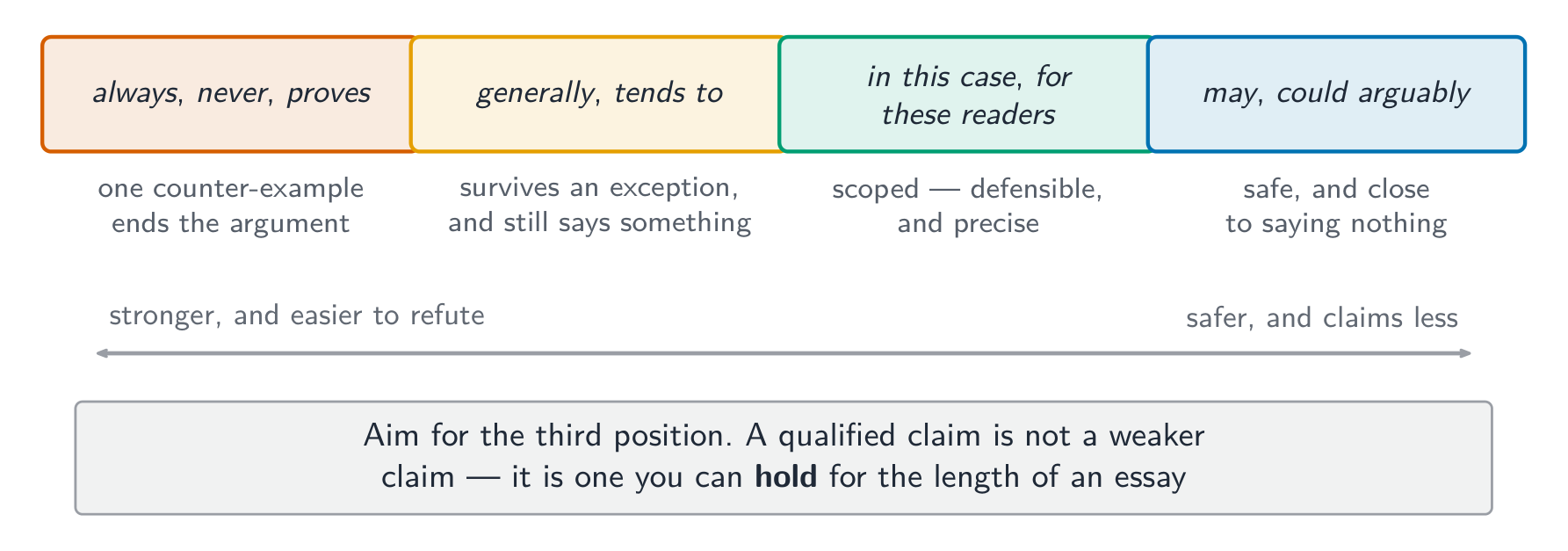
This is counter-intuitive for many students, who assume that a stronger-sounding claim scores better. The opposite is true: an unqualified claim is easy to defeat with one counter-example, while a qualified claim survives it. Schools should ban phones invites a single exception. Schools should restrict phone use during instructional time, where the cost to attention is measurable does not.

ไทย
  • ความเข้าใจที่ไม่เพียงพอถึงความซับซ้อน ของหัวข้อสามารถนำไปสู่ การลดทอนหรือการสรุปโดยทั่วไป 过度简化与以偏概全.
  • เนื่องจากArgumentมักเป็นส่วนหนึ่งของ บทสนทนาที่ยังคงดำเนินอยู่ Argumentที่มีประสิทธิภาพมัก หลีกเลี่ยงการแสดงข้ออ้างในรูปแบบเด็ดขาด
  • ผู้เขียนอาจใช้ คำวลีและประโยคย่อย อย่างมีกลยุทธ์เพื่อ กำหนดขอบเขตหรือจำกัด Argument

สิ่งนี้ขัดกับสัญชาตญาณของนักเรียนหลายคนซึ่งเชื่อว่าข้ออ้างที่ดูแข็งกร้าว有更好的分数。但事实恰恰相反:未加限定的主张很容易用一个反例推翻,而有限定的主张则能经受住它。学校应该禁止手机 会招致一个例外。学校应在教学时段限制手机使用,因为此时注意力损失是可衡量的 则不会。

7.4

Qualifying a Claim · ⁨การกำหนดขอบเขตข้ออ้าง⁩

Syllabus · ⁨หลักสูตร⁩
English

Enduring Understanding (CLE-1): Writers make claims about subjects, rely on evidence that supports the reasoning that justifies the claim, and often acknowledge or respond to other, possibly opposing, arguments.

Learning Objective 4.C: Writing – Qualify a claim using modifiers, counterarguments, or alternative perspectives.

  • CLE-1.V A lack of understanding of the complexities of a subject or an issue can lead to oversimplification or generalizations.
  • CLE-1.W Because arguments are usually part of ongoing discourse, effective arguments often avoid expressing claims, reasoning, and evidence in absolute terms.
  • CLE-1.X Writers may strategically use words, phrases, and clauses as modifiers to qualify or limit the scope of an argument.
ไทย

ความเข้าใจที่ยั่งยืน (CLE-1): นักเขียนทำข้ออ้างเกี่ยวกับหัวข้อ อิงกับหลักฐานที่สนับสนุนเหตุผลที่ใช้เพื่อพิสูจน์ข้ออ้าง tersebut และมักยอมรับหรือตอบโต้ข้อโต้แย้งอื่น ๆ ซึ่งอาจเป็นฝ่ายตรงข้าม

จุดประสงค์การเรียนรู้ 4.C: การเขียน – ปรับลดข้ออ้างโดยใช้คำขยาย ข้อโต้แย้งทางเลือก หรือมุมมองทางเลือก

  • CLE-1.V ความไม่เข้าใจในความซับซ้อนของเรื่องหรือประเด็นสามารถนำไปสู่การสรุปแบบง่ายเกินไปหรือการ generalize
  • CLE-1.W เนื่องจากข้อโต้แย้งมักเป็นส่วนหนึ่งของการสนทนาอย่างต่อเนื่อง ข้อโต้แย้งที่มีประสิทธิภาพจึงมักหลีกเลี่ยงการแสดงข้ออ้าง การใช้เหตุผล และหลักฐานในรูปแบบเด็ดขาด
  • CLE-1.X ผู้เขียนอาจใช้คำวลี และประโยคย่อยเป็นคำขยายอย่างมีกลยุทธ์เพื่อปรับลดหรือจำกัดขอบเขตของข้อโต้แย้ง

Source: College Board AP Course and Exam Description · ⁨แหล่งที่มา: คำอธิบายหลักสูตรและข้อสอบ College Board AP⁩

English

The tools are ordinary words used deliberately: in most cases, where X holds, for this population, unless, to the extent that. Each narrows the claim to the ground the evidence actually covers.

Qualification is also what the sophistication point most often rewards. A student who states a position, then shows they know its limits and defends it anyway, has demonstrated exactly the control the rubric is looking for.

ไทย

เครื่องมือคือคำธรรมดาที่ใช้อย่างตั้งใจ: ในกรณีส่วนใหญ่, เมื่อ X มีผล, สำหรับประชากรนี้, เว้นแต่, 的程度ที่。แต่ละคำ.comments narrowing down the claim to what the evidence actually covers.

การกำหนดขอบเขตยังเป็นสิ่งที่ จุดความลึกซึ้ง มามักให้รางวัล最常。学生表明立场后,展示其局限性但仍为其辩护,正是评分标准所寻找的掌控力的体现。

ข้ออ้างที่กำหนดขอบเขตไม่ใช่ข้ออ้างที่อ่อนแอกว่า — แต่มันคือข้ออ้างที่คุณสามารถถือไว้ตลอดทั้งessay
Explore · ⁨สำรวจ⁩

Place each claim on the qualification scale · ⁨วางข้ออ้างแต่ละข้อบนสเกลการปรับเงื่อนไข⁩

Each step left is stronger and easier to refute; each step right is safer and worth less. Aim for the scoped position. · ⁨ทุกขั้นตอนไปทางซ้ายแรงขึ้นและ反驳ได้ง่ายขึ้น; ทุกขั้นตอนไปทางขวาปลอดภัยขึ้นแต่มีค่าน้อยลง เป้าหมายคือตำแหน่งที่จำกัดขอบเขต⁩

Vocabulary · ⁨คำศัพท์⁩ Train · ⁨ฝึกฝน⁩
English ไทย
qualification/ˌkwɒlɪfɪˈkeɪʃn/ การกำหนดเงื่อนไข
oversimplification or generalisation/ˌəʊvəˌsɪmplɪfɪˈkeɪʃn ɔː ˌdʒenərəlaɪˈzeɪʃn/ การสรุปอย่างง่ายเกินไปหรือการ generalize
7.5

Clauses and Relationships Between Ideas · ⁨ประโยคย่อยและความสัมพันธ์ระหว่างความคิด⁩

Syllabus · ⁨หลักสูตร⁩
English

Enduring Understanding (STL-1): The rhetorical situation informs the strategic stylistic choices that writers make.

Learning Objective 7.B: Reading – Explain how writers create, combine, and place independent and dependent clauses to show relationships between and among ideas. (Note: Students should be able to read and analyze these complexities but are not expected to write with them on timed essays.)

  • STL-1.G Writers express ideas in sentences. Sentences are made up of clauses, at least one of which must be independent.
  • STL-1.H The arrangement of sentences in a text can emphasize particular ideas.
  • STL-1.I Subordination and coordination are used to express the intended relationship between ideas in a sentence.
  • STL-1.J Writers frequently use coordination to illustrate a balance or equality between ideas.
  • STL-1.K Writers frequently use subordination to illustrate an imbalance or inequality between ideas.
  • STL-1.L The arrangement of clauses, phrases, and words in a sentence can emphasize ideas.
ไทย

ความเข้าใจที่ยั่งยืน (STL-1): สถานการณ์ทาง retorics informing การเลือก stylistic แบบกลยุทธ์ที่นักเขียนทำ

จุดประสงค์การเรียนรู้ 7.B: การอ่าน – อธิบายว่าผู้เขียนสร้าง ผสมผสาน และวางประโยคอิสระและประโยค subordinate อย่างไรเพื่อแสดงความสัมพันธ์ระหว่างและภายในความคิด (หมายเหตุ: นักเรียนควรจะสามารถอ่านและวิเคราะห์ความซับซ้อนเหล่านี้ได้แต่ไม่คาดหวังว่าจะเขียนด้วยโครงสร้างเหล่านี้ในบทความทดสอบเวลา)

  • STL-1.G ผู้เขียนแสดงความคิดเห็นในรูปประโยค ประโยคประกอบด้วยประโยคย่อย อย่างน้อยหนึ่งประโยคต้องเป็นประโยคอิสระ
  • STL-1.H การจัดเรียงประโยคในข้อความสามารถเน้นย้ำความคิด tertentuได้
  • STL-1.I การทำประโยค subordinate และการจัดเรียงประโยคแบบ parallel ถูกใช้เพื่อแสดงความสัมพันธ์ที่ต้องการระหว่างความคิดในประโยค
  • STL-1.J ผู้เขียนมักใช้การจัดเรียงประโยคแบบ parallel เพื่อแสดงความสมดุลหรือความเท่าเทียมกันระหว่างความคิด
  • STL-1.K ผู้เขียนมักใช้การทำประโยค subordinate เพื่อแสดงความไม่สมดุลหรือความไม่เท่าเทียมกันระหว่างความคิด
  • STL-1.L การจัดเรียงประโยคย่อย วาจา และคำในประโยคสามารถเน้นย้ำความคิดได้

Source: College Board AP Course and Exam Description · ⁨แหล่งที่มา: คำอธิบายหลักสูตรและข้อสอบ College Board AP⁩

English
  • Writers express ideas in sentences, made up of clauses, at least one of which must be independent 独立分句.
  • The arrangement of sentences in a text can emphasise particular ideas.
  • Subordination and coordination 从属与并列 express the intended relationship between ideas in a sentence.
  • Writers use coordination to illustrate balance or equality between ideas.
  • Writers use subordination to illustrate imbalance or inequality between ideas.
  • The arrangement of clauses, phrases, and words within a sentence can emphasise ideas.

Those two middle statements make sentence structure analysable rather than decorative. The measure was expensive, and it worked treats cost and effect as equals. Although the measure was expensive, it worked subordinates the cost - it is still true, but it has been ranked below the result. Same facts, different argument.

ไทย
สองวิธีการเชื่อมความคิด และความหมายต่างกัน
CED ชัดเจน: การประสานงานแสดงความสมดุล, การขึ้นต้นประโยคแสดงความไม่สมดุล
  • ผู้เขียนแสดงความคิดผ่าน ประโยค ซึ่งประกอบด้วย ประโยคย่อย อย่างน้อยหนึ่งส่วนต้องเป็น ประโยคอิสระ 独立分句。
  • การจัดเรียงประโยค ในข้อความสามารถ เน้นย้ำความคิด tertentu
  • การขึ้นต้นประโยคและการประสานงาน 从属与并列 แสดงความสัมพันธ์ที่ต้องการระหว่างความคิดในประโยค
  • ผู้เขียนใช้ การประสานงานเพื่อแสดงความสมดุลหรือความเท่าเทียม ระหว่างความคิด
  • ผู้เขียนใช้ การขึ้นต้นประโยคเพื่อแสดงความไม่สมดุลหรือไม่เท่าเทียม ระหว่างความคิด
  • การจัดเรียงประโยคย่อย วลี และคำภายในประโยคสามารถ เน้นย้ำความคิด

สอง statement กลาง那两个使句子结构可分析而非装饰性。The measure was expensive, and it worked treating cost and effect as equals. Although the measure was expensive, it worked subordinating the cost - it is still true, but it has been ranked below the result. Same facts, different argument.

7.6

Writing Clear Sentences · ⁨การเขียนประโยคที่ชัดเจน⁩

Syllabus · ⁨หลักสูตร⁩
English

Enduring Understanding (STL-1): The rhetorical situation informs the strategic stylistic choices that writers make.

Learning Objective 8.B: Writing – Write sentences that clearly convey ideas and arguments.

  • STL-1.G Writers express ideas in sentences. Sentences are made up of clauses, at least one of which must be independent.
  • STL-1.H The arrangement of sentences in a text can emphasize particular ideas.
  • STL-1.I Subordination and coordination are used to express the intended relationship between ideas in a sentence.
  • STL-1.J Writers frequently use coordination to illustrate a balance or equality between ideas.
  • STL-1.K Writers frequently use subordination to illustrate an imbalance or inequality between ideas.
  • STL-1.L The arrangement of clauses, phrases, and words in a sentence can emphasize ideas.
ไทย

ความเข้าใจที่ยั่งยืน (STL-1): สถานการณ์ทาง retorics informing การเลือก stylistic แบบกลยุทธ์ที่นักเขียนทำ

จุดประสงค์การเรียนรู้ 8.B: การเขียน – เขียนประโยคที่สื่อสารความคิดและข้อโต้แย้งได้อย่างชัดเจน

  • STL-1.G ผู้เขียนแสดงความคิดเห็นในรูปประโยค ประโยคประกอบด้วยประโยคย่อย อย่างน้อยหนึ่งประโยคต้องเป็นประโยคอิสระ
  • STL-1.H การจัดเรียงประโยคในข้อความสามารถเน้นย้ำความคิด tertentuได้
  • STL-1.I การทำประโยค subordinate และการจัดเรียงประโยคแบบ parallel ถูกใช้เพื่อแสดงความสัมพันธ์ที่ต้องการระหว่างความคิดในประโยค
  • STL-1.J ผู้เขียนมักใช้การจัดเรียงประโยคแบบ parallel เพื่อแสดงความสมดุลหรือความเท่าเทียมกันระหว่างความคิด
  • STL-1.K ผู้เขียนมักใช้การทำประโยค subordinate เพื่อแสดงความไม่สมดุลหรือความไม่เท่าเทียมกันระหว่างความคิด
  • STL-1.L การจัดเรียงประโยคย่อย วาจา และคำในประโยคสามารถเน้นย้ำความคิดได้

Source: College Board AP Course and Exam Description · ⁨แหล่งที่มา: คำอธิบายหลักสูตรและข้อสอบ College Board AP⁩

English

For your own writing: decide the relationship first, then choose the structure that expresses it. If two ideas genuinely carry equal weight, coordinate them. If one is a concession and the other your point, subordinate the concession - and put your point in the independent clause, where the emphasis falls.

ไทย

สำหรับการเขียนของคุณเอง: ตัดสินใจความสัมพันธ์ก่อน แล้วเลือกโครงสร้างที่แสดงออก ถ้าสอง想法 genuinely carry equal weight, coordinate them. If one is a concession and the other your point, subordinate the concession - and put your point in the independent clause, where the emphasis falls.

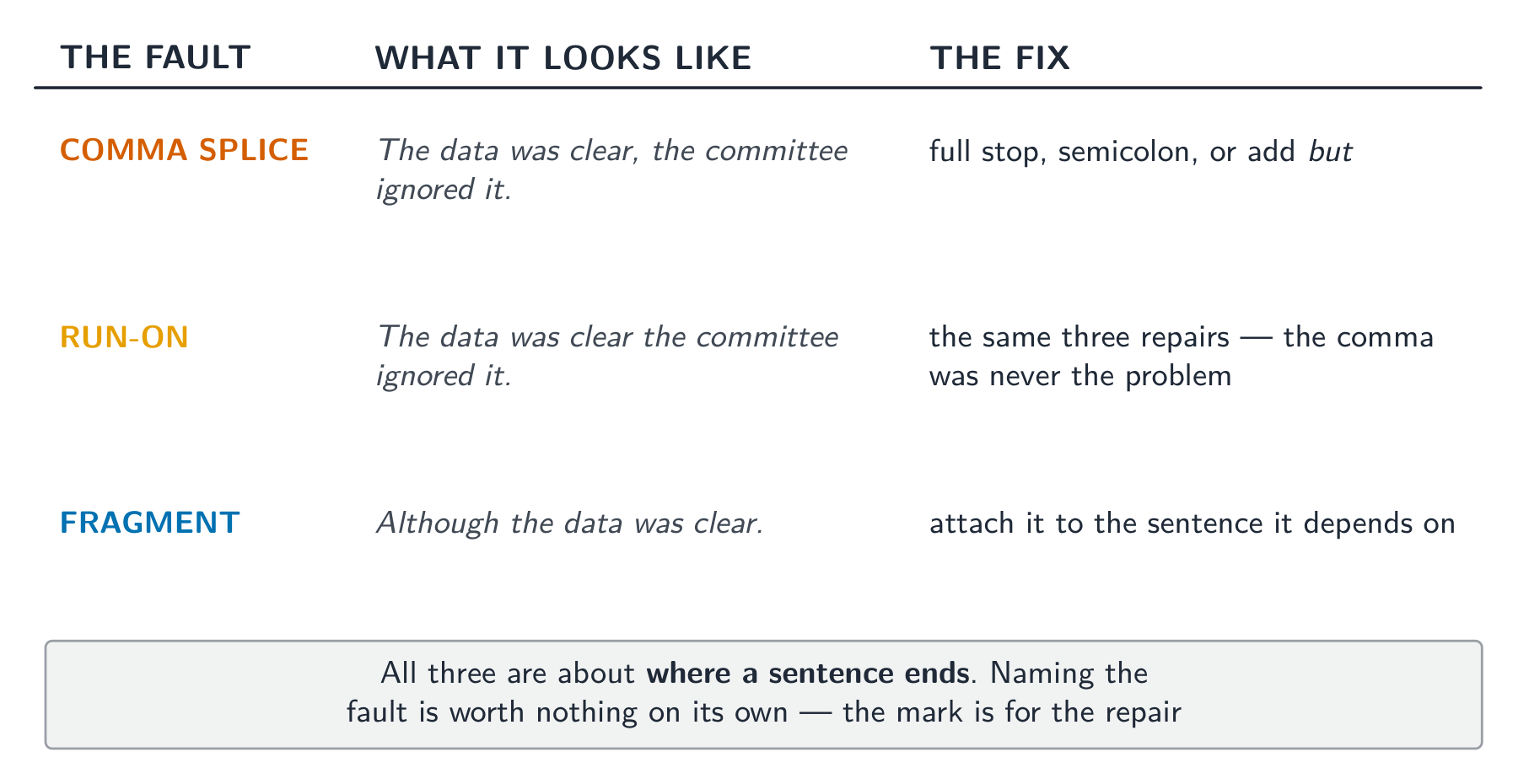
ความผิดพลาดทั้งสาม是关于句子结尾的位置——重点在于修复
Explore · ⁨สำรวจ⁩

Identify the sentence fault, then the repair · ⁨ระบุข้อบกพร่องของประโยค จากนั้นระบุการแก้ไข⁩

All three faults are about where a sentence ends. Naming one is worth nothing — the mark is for the repair. · ⁨ข้อบกพร่องทั้งหมดสามข้อ是关于句子的结尾位置。提及一个毫无意义 — คะแนนมาจากการแก้ไขเท่านั้น⁩

Vocabulary · ⁨คำศัพท์⁩ Train · ⁨ฝึกฝน⁩
English ไทย
independent/ˌɪndɪˈpendənt/ เป็นอิสระต่อกัน
Subordination and coordination/ˌsʌbɔːdɪˈneɪʃn ænd kəʊˈɔːdɪneɪʃn/ การขึ้นบรรทัดและการจัดกลุ่ม
7.7

Grammar, Mechanics, and Clarity · ⁨ไวยากรณ์ เครื่องมือการพิมพ์ และความชัดเจน⁩

Syllabus · ⁨หลักสูตร⁩
English

Enduring Understanding (STL-1): The rhetorical situation informs the strategic stylistic choices that writers make.

Learning Objective 7.C: Reading – Explain how grammar and mechanics contribute to the clarity and effectiveness of an argument.

  • STL-1.M Grammar and mechanics that follow established conventions of language enable clear communication.
  • STL-1.N Writers use punctuation strategically to demonstrate the relationships among ideas in a sentence.
  • STL-1.O Punctuation (commas, colons, semicolons, dashes, hyphens, parentheses, quotation marks, or end marks) advances a writer’s purpose by clarifying, organizing, emphasizing, indicating purpose, supplementing information, or contributing to tone.
  • STL-1.P Some design features, such as italics or boldface, create emphasis.
ไทย

ความเข้าใจที่ยั่งยืน (STL-1): สถานการณ์ทาง retorics informing การเลือก stylistic แบบกลยุทธ์ที่นักเขียนทำ

จุดประสงค์การเรียนรู้ 7.C: การอ่าน – อธิบายว่าไวยากรณ์และกากเพชรมีส่วนร่วมอย่างไรกับความชัดเจนและประสิทธิภาพของข้อโต้แย้ง

  • STL-1.M ไวยากรณ์และกากเพชรที่เป็นไปตามระเบียบวิธีภาษาที่ยอมรับแล้วช่วยให้การสื่อสารมีความชัดเจน
  • STL-1.N ผู้เขียนใช้เครื่องหมายวรรคตอนอย่างมีกลยุทธ์เพื่อแสดงความสัมพันธ์ระหว่างความคิดในประโยค
  • STL-1.O เครื่องหมายวรรคตอน (ลูกน้ำ จุดสองจุด จุดกึ่งคั่นกลาง เส้นขีดขีด เส้นขีดสั้น วงเล็บเครื่องหมายอรรถยุกต์ หรือเครื่องหมายจบประโยค) ช่วยสนับสนุนวัตถุประสงค์ของผู้เขียนโดยการทำให้ชัดเจน จัดระเบียบ เน้นย้ำ บ่งชี้วัตถุประสงค์ เติมเต็มข้อมูล หรือมีส่วนร่วมในอารมณ์
  • STL-1.P คุณสมบัติการออกแบบบางอย่าง เช่น ตัวเอียงหรือตัวหนา สร้างความเน้นย้ำ

Source: College Board AP Course and Exam Description · ⁨แหล่งที่มา: คำอธิบายหลักสูตรและข้อสอบ College Board AP⁩

English
  • Grammar and mechanics that follow established conventions enable clear communication.
  • Writers use punctuation strategically to demonstrate relationships among ideas.
  • Punctuation - commas, colons, semicolons, dashes, hyphens, parentheses, quotation marks, end marks - advances the argument.
  • Design features such as italics or boldface create emphasis.
ไทย
  • ไวยากรณ์และเครื่องมือการพิมพ์ ที่ปฏิบัติตามกฎระเบียบ established conventions ช่วยให้สื่อสารได้อย่างชัดเจน
  • ผู้เขียนใช้ เครื่องหมายวรรคตอนอย่างมีกลยุทธ์ เพื่อแสดงความสัมพันธ์ระหว่าง ideas
  • เครื่องหมายวรรคตอน -逗号, 冒号, 分号, 破折号, 连字符, 括号,引号, 结束标点— **ช่วย推进argument
  • ลักษณะการออกแบบ เช่น ตัวเอียงหรือตัวหนา ช่วยสร้างจุดเน้น
7.8

Conventions of Grammar and Mechanics · ⁨ระเบียบวิธีทางไวยากรณ์และกลไกการเขียน⁩

Syllabus · ⁨หลักสูตร⁩
English

Enduring Understanding (STL-1): The rhetorical situation informs the strategic stylistic choices that writers make.

Learning Objective 8.C: Use established conventions of grammar and mechanics to communicate clearly and effectively.

  • STL-1.M Grammar and mechanics that follow established conventions of language enable clear communication.
  • STL-1.N Writers use punctuation strategically to demonstrate the relationships among ideas in a sentence.
  • STL-1.O Punctuation (commas, colons, semicolons, dashes, hyphens, parentheses, quotation marks, or end marks) advances a writer’s purpose by clarifying, organizing, emphasizing, indicating purpose, supplementing information, or contributing to tone.
  • STL-1.P Some design features, such as italics or boldface, create emphasis.
ไทย

ความเข้าใจที่ยั่งยืน (STL-1): สถานการณ์ทาง retorics informing การเลือก stylistic แบบกลยุทธ์ที่นักเขียนทำ

จุดประสงค์การเรียนรู้ 8.C: ใช้ระเบียบวิธีของไวยากรณ์และกากเพชรที่ยอมรับแล้วเพื่อสื่อสารได้อย่างชัดเจนและมีประสิทธิภาพ

  • STL-1.M ไวยากรณ์และกากเพชรที่เป็นไปตามระเบียบวิธีภาษาที่ยอมรับแล้วช่วยให้การสื่อสารมีความชัดเจน
  • STL-1.N ผู้เขียนใช้เครื่องหมายวรรคตอนอย่างมีกลยุทธ์เพื่อแสดงความสัมพันธ์ระหว่างความคิดในประโยค
  • STL-1.O เครื่องหมายวรรคตอน (ลูกน้ำ จุดสองจุด จุดกึ่งคั่นกลาง เส้นขีดขีด เส้นขีดสั้น วงเล็บเครื่องหมายอรรถยุกต์ หรือเครื่องหมายจบประโยค) ช่วยสนับสนุนวัตถุประสงค์ของผู้เขียนโดยการทำให้ชัดเจน จัดระเบียบ เน้นย้ำ บ่งชี้วัตถุประสงค์ เติมเต็มข้อมูล หรือมีส่วนร่วมในอารมณ์
  • STL-1.P คุณสมบัติการออกแบบบางอย่าง เช่น ตัวเอียงหรือตัวหนา สร้างความเน้นย้ำ

Source: College Board AP Course and Exam Description · ⁨แหล่งที่มา: คำอธิบายหลักสูตรและข้อสอบ College Board AP⁩

English

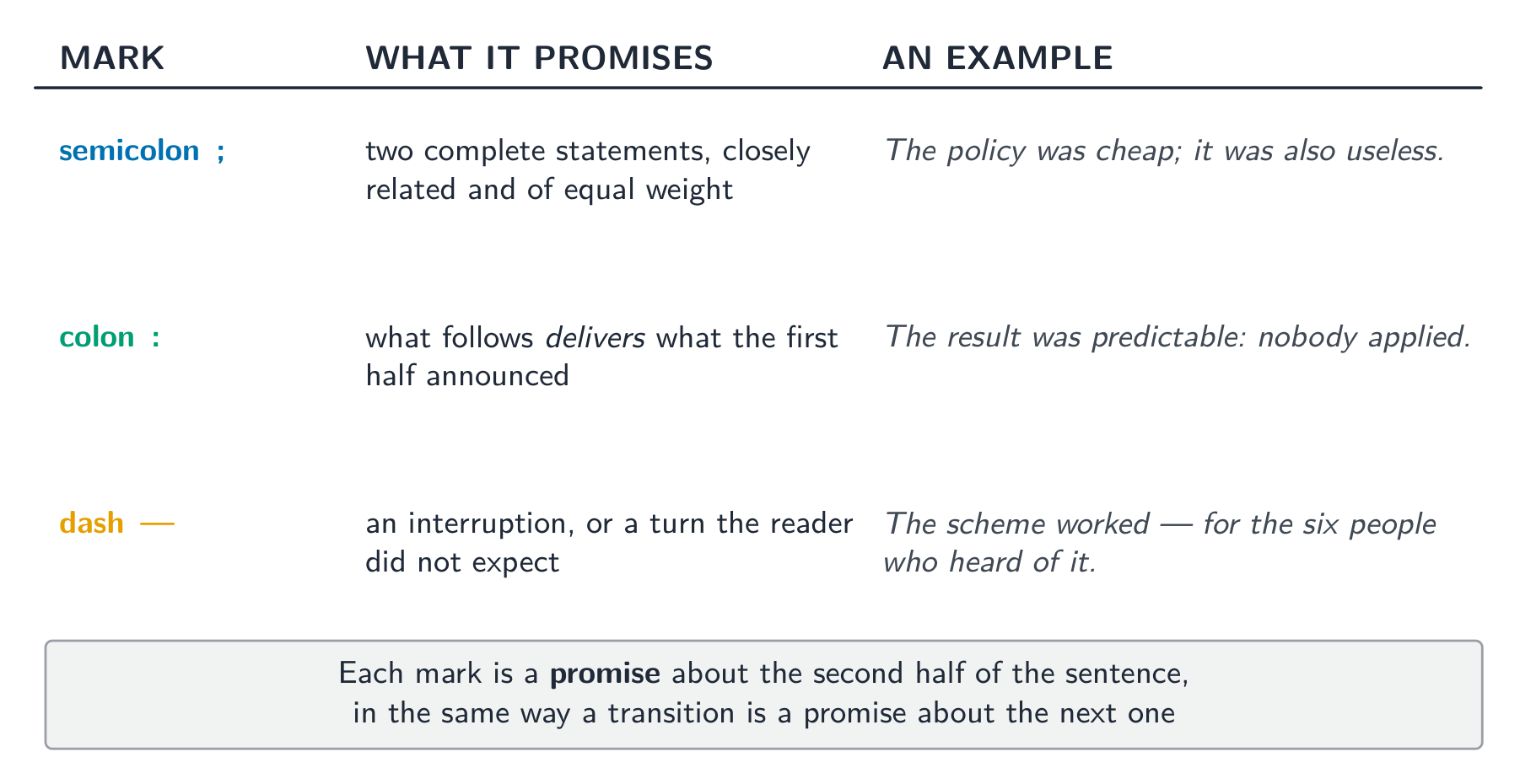
The examinable framing is that punctuation is argumentative, not merely correct. A colon promises that what follows explains what preceded. A semicolon asserts that two independent statements belong together. A dash interrupts, and the interruption is the point.

Worked example (a real AP exam task). A rhetorical-analysis passage reads: "The programme was popular; it was also, by every measure the department itself proposed, ineffective." A low answer notes "the writer uses a semicolon". A scoring answer explains the structure: "The semicolon presents the two facts as equal and simultaneous rather than as a contrast, so the reader cannot dismiss the failure as an objection to popularity - both are simply true at once. The parenthetical 'by every measure the department itself proposed' then removes the department's escape route before the word 'ineffective' arrives." That is syntax analysed as argument.

ไทย

กรอบการทดสอบที่ผู้สอบต้องเข้าใจคือเครื่องหมายวรรคตอนมีบทบาทในการ นำเสนอข้อโต้แย้ง ไม่ใช่แค่ความถูกต้องตามหลักภาษา คอลอน (colon) บ่งบอกว่าสิ่งที่ตามมาจะอธิบายสิ่งที่มาก่อน คอลอน (semicolon) แสดงว่าประโยคอิสระสองประโยคมีสัมพันธ์กันเป็นหนึ่งเดียว จุดขีด (dash) ใช้เพื่อขัดจังหวะ และการขัดจังหวะนั้นเองคือจุดประสงค์ของการใช้

ตัวอย่างวิธีทำ (โจทย์จริงจากการสอบ AP) ข้อความสำหรับการวิเคราะห์เชิง retorics อ่านว่า: "โครงการนี้เป็นที่นิยม; และด้วยทุกเกณฑ์ที่ฝ่ายบริหารเสนอเอง ก็ไม่มีความมีประสิทธิภาพ" คำตอบระดับต่ำจะระบุว่า "ผู้เขียนใช้คอลอน" แต่คำตอบที่ได้คะแนนสูงจะอธิบายโครงสร้างว่า: "คอลอนนำเสนอความจริงทั้งสองอย่างในตำแหน่งที่เท่าเทียมและเกิดขึ้นพร้อมกัน แทนที่จะเป็นการเปรียบเทียบขั้วตรงข้าม ทำให้ผู้อ่านไม่สามารถปฏิเสธความล้มเหลวโดยอ้างว่าเป็นข้อ反对ต่อความนิยม - ทั้งสองสิ่งเป็นเพียงความจริงที่เกิดขึ้นพร้อมกัน การใส่ข้อมูลเสริม '(ด้วยทุกเกณฑ์ที่ฝ่ายบริหารเสนอเอง)' ทำลายช่องว่างของฝ่ายบริหารก่อนที่คำว่า 'ไม่มีประสิทธิภาพ' จะปรากฏขึ้น" นี่คือการใช้ไวยากรณ์เพื่อวิเคราะห์เชิงArgument

ทุกเครื่องหมายคือคำสัญญาเกี่ยวกับครึ่งหลังของประโยค
7.8

Exam tips · ⁨ข้อแนะนำสำหรับการสอบ⁩

English
  • Qualify your claims. An absolute claim is defeated by one counter-example; a qualified one is not.
  • Qualification is the most reliable route to the sophistication point.
  • Coordination = balance. Subordination = imbalance. The CED says so, and it makes syntax analysable.
  • Put your point in the independent clause. Concessions belong in the subordinate one.
  • Punctuation advances the argument. A colon explains, a semicolon joins as equals, a dash interrupts.
  • Never write "the writer uses a semicolon" without saying what relationship it asserts.
ไทย
  • กำหนดขอบเขตคำกล่าวของคุณ คำกล่าวที่เด็ดขาดสามารถถูกทลายได้โดยตัวอย่าง反驳เพียงหนึ่งข้อ แต่คำกล่าวที่มีเงื่อนไขจะไม่ถูกทลายง่ายขนาดนั้น
  • การกำหนดขอบเขตคำกล่าวคือเส้นทางที่เชื่อถือได้ที่สุดสำหรับการได้ คะแนนความลึกซึ้ง
  • การเชื่อม = ความสมดุล การขึ้นต้น/ต่อยอด = ความไม่สมดุล CED อธิบายไว้ demikian และทำให้การวิเคราะห์โครงสร้างประโยคทำได้ชัดเจน
  • วางประเด็นสำคัญของคุณใน ประโยคอิสระ ส่วนการยอมรับข้อ反驳ควรอยู่ในประโยคที่ไม่อิสระ
  • เครื่องหมายวรรคตอนช่วย ขับเคลื่อนข้อโต้แย้ง คอลอนใช้อธิบาย คอลอนใช้เชื่อมเท่ากัน จุดขีดใช้ขัดจังหวะ
  • ห้ามเขียนว่า "ผู้เขียนใช้คอลอน" โดยไม่ระบุถึง **ความสัมพันธ์ที่มันแสดงออก

Interactive lessons on this topic · ⁨บทเรียนเชิงโต้ตอบสำหรับหัวข้อนี้⁩

Work through it step by step, with instant-check exercises. · ⁨ทำทีละขั้นตอน พร้อมแบบฝึกหัดตรวจสอบผลทันที⁩

Past Papers · ⁨ข้อสอบย้อนหลัง⁩

More topics in AP English Language and Composition · ⁨AP ภาษาอังกฤษเพื่อการสื่อสารและการเขียน⁩ · ⁨หัวข้อเพิ่มเติมใน AP English Language and Composition · ⁨AP ภาษาอังกฤษเพื่อการสื่อสารและการเขียน⁩⁩

Log in or create account · ⁨เข้าสู่ระบบหรือสร้างบัญชี⁩

IGCSE, A-Level & AP