Skip to content · ⁨ข้ามไปยังเนื้อหา⁩

Organization, Coherence, and Style · ⁨การจัดระเบียบ ความสอดคล้องกัน และสไตล์⁩

AP English Language and Composition · ⁨AP ภาษาอังกฤษเพื่อการสื่อสารและการเขียน⁩ · Topic 5 · ⁨หัวข้อ 5⁩

Video lesson for this topic · ⁨บทเรียนวิดีโอสำหรับหัวข้อนี้⁩ Open the video page · ⁨เปิดหน้าวิดีโอ⁩
5:41

หน่วยที่ 5: การจัดระเบียบ ความสอดคล้อง และสไตล์

statement of CED regarding the body paragraph is exact and worth memorizing. The body paragraphs of a written argument make claims, support them with evidence, and...

English narration · English + 中文 subtitles burned in · ⁨การบรรยายภาษาอังกฤษ · คำบรรยายภาษาอังกฤษ + 中文 ลอยตัวบนภาพ⁩

5.1

Describing the Line of Reasoning · ⁨การอธิบายเส้นทางการคิด⁩

Syllabus · ⁨หลักสูตร⁩
English

Enduring Understanding (REO-1): Writers guide understanding of a text’s lines of reasoning and claims through that text’s organization and integration of evidence.

Learning Objective 5.A: Reading – Describe the line of reasoning and explain whether it supports an argument’s overarching thesis.

  • REO-1.M The body paragraphs of a written argument make claims, support them with evidence, and provide commentary that explains how the paragraph contributes to the reasoning of the argument.
ไทย

ความเข้าใจที่ยั่งยืน (REO-1): นักเขียนนำความเข้าใจในเส้นทางการคิดและข้ออ้างของข้อความผ่านการจัดระเบียบและการบูรณาการหลักฐานของข้อความนั้น

เป้าหมายการเรียนรู้ 5.A: การอ่าน – อธิบายเส้นทางการคิดและอธิบายว่ามันสนับสนุน论点หลักของข้อโต้แย้งหรือไม่

  • REO-1.M ย่อหน้าเนื้อหาหลักของข้อโต้แย้งที่เขียนขึ้นจะ提出了 claims, รองรับ them ด้วย evidence, และให้ commentary ที่อธิบายว่าย่อหน้านั้นมีส่วนร่วมอย่างไรต่อการคิดของข้อโต้แย้ง

Source: College Board AP Course and Exam Description · ⁨แหล่งที่มา: คำอธิบายหลักสูตรและข้อสอบ College Board AP⁩

English

Unit 5 turns from what an argument contains to how it holds together. It has two subjects: coherence 连贯 and the beginnings of style 文体.

The CED's statement of the body paragraph is exact and worth memorising: the body paragraphs of a written argument make claims, support them with evidence, and provide commentary that explains the relationship of the evidence to the claim.

Three parts, in that order, in every body paragraph. When an AP essay loses evidence-and-commentary points, it is almost always because the third part is missing from paragraphs that have the first two.

ไทย

Unit 5 เปลี่ยนจาก what一个argument.has إلى how it holds together.它有 two subjects: coherence 连贯 and the beginnings of style 文体.

The CED's statement of the body paragraph is exact and worth memorising: the body paragraphs of a written argument make claims, support them with evidence, and provide commentary that explains the relationship of the evidence to the claim.

Three parts, in that order, in every body paragraph. When an AP essay loses evidence-and-commentary points, it is almost always because the third part is missing from paragraphs that have the first two.

Vocabulary · ⁨คำศัพท์⁩ Train · ⁨ฝึกฝน⁩
English ไทย
coherence/kəʊˈhɪərəns/ coherence
style/staɪl/ style
5.2

Developing a Line of Reasoning and Commentary · ⁨การพัฒนาเส้นทางการคิดและคำอธิบายประกอบ⁩

Syllabus · ⁨หลักสูตร⁩
English

Enduring Understanding (REO-1): Writers guide understanding of a text’s lines of reasoning and claims through that text’s organization and integration of evidence.

Learning Objective 6.A: Writing – Develop a line of reasoning and commentary that explains it throughout an argument.

  • REO-1.M The body paragraphs of a written argument make claims, support them with evidence, and provide commentary that explains how the paragraph contributes to the reasoning of the argument.
ไทย

ความเข้าใจที่ยั่งยืน (REO-1): นักเขียนนำความเข้าใจในเส้นทางการคิดและข้ออ้างของข้อความผ่านการจัดระเบียบและการบูรณาการหลักฐานของข้อความนั้น

วัตถุประสงค์การเรียนรู้ 6.A: การเขียน – พัฒนาเส้นทางการคิดและการวิเคราะห์แสดงความคิดเห็นที่อธิบายตลอดทั้งข้อโต้แย้ง

  • REO-1.M ย่อหน้าเนื้อหาหลักของข้อโต้แย้งที่เขียนขึ้นจะ提出了 claims, รองรับ them ด้วย evidence, และให้ commentary ที่อธิบายว่าย่อหน้านั้นมีส่วนร่วมอย่างไรต่อการคิดของข้อโต้แย้ง
Source: College Board AP Course and Exam Description · ⁨แหล่งที่มา: คำอธิบายหลักสูตรและข้อสอบ College Board AP⁩

Applied to your own writing: draft the claims first, as a list, before writing any paragraph. You then have the line of reasoning in front of you and can check that it moves.

Then, for each claim, write the paragraph in its three parts deliberately. A useful habit under exam conditions is to make the commentary sentence begin with a word that forces a relationship - because, which means, so, the effect of this is - because those words cannot be followed by a restatement.

5.3

Organization, Unity, and Coherence

Syllabus · ⁨หลักสูตร⁩
English

Enduring Understanding (REO-1): Writers guide understanding of a text’s lines of reasoning and claims through that text’s organization and integration of evidence.

Learning Objective 5.B: Reading – Explain how the organization of a text creates unity and coherence and reflects a line of reasoning.

  • REO-1.N Coherence occurs at different levels in a piece of writing. In a sentence, the idea in one clause logically links to an idea in the next. In a paragraph, the idea in one sentence logically links to an idea in the next. In a text, the ideas in one paragraph logically link to the ideas in the next.
  • REO-1.O Repetition, synonyms, pronoun references, and parallel structure may indicate or develop a relationship between elements of a text.
  • REO-1.P Transitional elements are words or other elements (phrases, clauses, sentences, or paragraphs) that assist in creating coherence among sentences, paragraphs, or sections in a text by showing relationships among ideas.
  • REO-1.Q Transitional elements can be used to introduce evidence or to indicate its relationship to other ideas or evidence in that paragraph or in the text as a whole.
ไทย

ความเข้าใจที่ยั่งยืน (REO-1): นักเขียนนำความเข้าใจในเส้นทางการคิดและข้ออ้างของข้อความผ่านการจัดระเบียบและการบูรณาการหลักฐานของข้อความนั้น

วัตถุประสงค์การเรียนรู้ 5.B: การอ่าน – อธิบายว่าการจัดเรียงของข้อความสร้างความเป็นเอกภาพและความต่อเนื่องอย่างไรและสะท้อนเส้นทางการคิด

  • REO-1.N ความต่อเนื่องเกิดขึ้นในระดับต่างๆ ในงานเขียน ในระดับประโยค, ความคิดใน clause หนึ่งเชื่อมโยงกันอย่างมีเหตุผลกับความคิดในอีก clause หนึ่ง ในระดับย่อหน้า, ความคิดในประโยคหนึ่งเชื่อมโยงกันอย่างมีเหตุผลกับความคิดในอีกประโยคหนึ่ง ในระดับข้อความ, ความคิดในย่อหน้าหนึ่งเชื่อมโยงกันอย่างมีเหตุผลกับความคิดในย่อหน้าถัดไป
  • REO-1.O การซ้ำ, คำPLATFORM, การอ้างอิง代词, และโครงสร้างขนานกัน อาจบ่งชี้หรือพัฒนาความสัมพันธ์ระหว่างองค์ประกอบของข้อความ
  • REO-1.P องค์ประกอบเชื่อม (Transitional elements) คือคำหรือองค์ประกอบอื่นๆ (phrases, clauses, sentences, หรือ paragraphs) ที่ช่วยสร้างความต่อเนื่องระหว่างประโยค, ย่อหน้า, หรือส่วนต่างๆ ของข้อความโดยแสดงความสัมพันธ์ระหว่างความคิด
  • REO-1.Q องค์ประกอบเชื่อมสามารถใช้เพื่อแนะนำ evidence หรือเพื่อแสดงความสัมพันธ์其与 ideas อื่นๆ หรือ evidence นั้นในย่อหน้าหรือข้อความโดยรวม

Source: College Board AP Course and Exam Description · ⁨แหล่งที่มา: คำอธิบายหลักสูตรและข้อสอบ College Board AP⁩

Coherence is built at three levels, and by five named devices
The devices are examinable by name - and they are what a "structure" question is actually asking about

Coherence occurs at different levels in a piece of writing:

  • In a sentence, the idea in one clause logically links to the idea in another.
  • In a paragraph, each sentence builds on the one before it.
  • Across the whole text, each paragraph relates to the line of reasoning.

The CED then names the devices that create those links:

  • Repetition 重复, synonyms 同义词, pronoun references 代词指代, and parallel structure 平行结构 may indicate or develop a relationship between ideas.
  • Transitional elements 过渡成分 are words or other elements - phrases, clauses, sentences, or whole paragraphs - that assist in creating coherence.
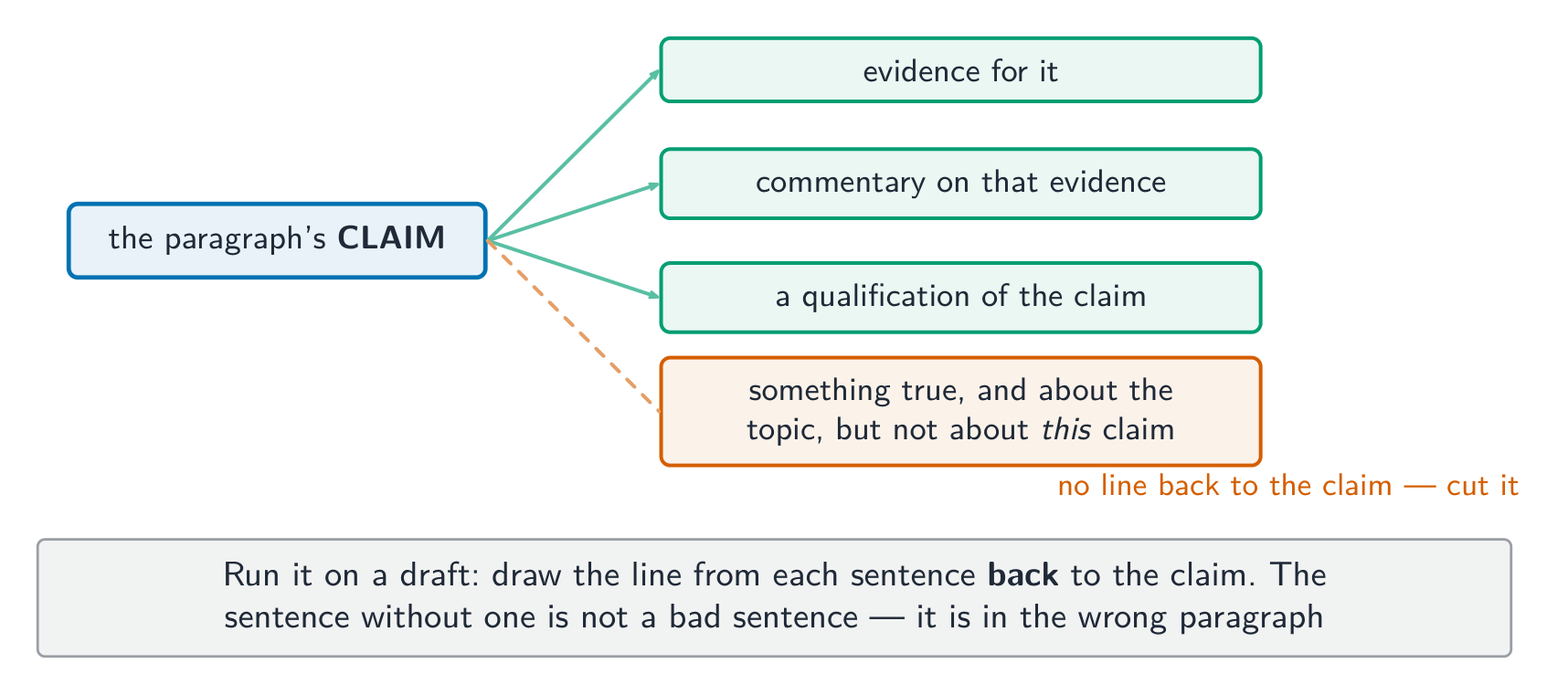
The unity test: draw a line from each sentence back to the claim
Vocabulary · ⁨คำศัพท์⁩ Train · ⁨ฝึกฝน⁩
English ไทย
Repetition/ˌrepəˈtɪʃn/ การซ้ำ
synonyms/ˈsɪnənɪmz/ คำพ้องความหมาย
pronoun references/ˈprəʊnaʊn ˈrefrənsɪz/ คำสรรพนามอ้างอิง
parallel structure/ˈpærəlel ˈstrʌktʃə/ โครงสร้างขนาน
Transitional elements/trænˈsɪʃənl ˈelɪmənts/ องค์ประกอบเชื่อมต่อ
5.4

Using Transitional Elements

Syllabus · ⁨หลักสูตร⁩
English

Enduring Understanding (REO-1): Writers guide understanding of a text’s lines of reasoning and claims through that text’s organization and integration of evidence.

Learning Objective 6.B: Writing – Use transitional elements to guide the reader through the line of reasoning of an argument.

  • REO-1.N Coherence occurs at different levels in a piece of writing. In a sentence, the idea in one clause logically links to an idea in the next. In a paragraph, the idea in one sentence logically links to an idea in the next. In a text, the ideas in one paragraph logically link to the ideas in the next.
  • REO-1.O Repetition, synonyms, pronoun references, and parallel structure may indicate or develop a relationship between elements of a text.
  • REO-1.P Transitional elements are words or other elements (phrases, clauses, sentences, or paragraphs) that assist in creating coherence among sentences, paragraphs, or sections in a text by showing relationships among ideas.
  • REO-1.Q Transitional elements can be used to introduce evidence or to indicate its relationship to other ideas or evidence in that paragraph or in the text as a whole.
ไทย

ความเข้าใจที่ยั่งยืน (REO-1): นักเขียนนำความเข้าใจในเส้นทางการคิดและข้ออ้างของข้อความผ่านการจัดระเบียบและการบูรณาการหลักฐานของข้อความนั้น

วัตถุประสงค์การเรียนรู้ 6.B: การเขียน – ใช้องค์ประกอบเชื่อมเพื่อแนะนำผู้อ่านผ่านเส้นทางการคิดของข้อโต้แย้ง

  • REO-1.N ความต่อเนื่องเกิดขึ้นในระดับต่างๆ ในงานเขียน ในระดับประโยค, ความคิดใน clause หนึ่งเชื่อมโยงกันอย่างมีเหตุผลกับความคิดในอีก clause หนึ่ง ในระดับย่อหน้า, ความคิดในประโยคหนึ่งเชื่อมโยงกันอย่างมีเหตุผลกับความคิดในอีกประโยคหนึ่ง ในระดับข้อความ, ความคิดในย่อหน้าหนึ่งเชื่อมโยงกันอย่างมีเหตุผลกับความคิดในย่อหน้าถัดไป
  • REO-1.O การซ้ำ, คำPLATFORM, การอ้างอิง代词, และโครงสร้างขนานกัน อาจบ่งชี้หรือพัฒนาความสัมพันธ์ระหว่างองค์ประกอบของข้อความ
  • REO-1.P องค์ประกอบเชื่อม (Transitional elements) คือคำหรือองค์ประกอบอื่นๆ (phrases, clauses, sentences, หรือ paragraphs) ที่ช่วยสร้างความต่อเนื่องระหว่างประโยค, ย่อหน้า, หรือส่วนต่างๆ ของข้อความโดยแสดงความสัมพันธ์ระหว่างความคิด
  • REO-1.Q องค์ประกอบเชื่อมสามารถใช้เพื่อแนะนำ evidence หรือเพื่อแสดงความสัมพันธ์其与 ideas อื่นๆ หรือ evidence นั้นในย่อหน้าหรือข้อความโดยรวม

Source: College Board AP Course and Exam Description · ⁨แหล่งที่มา: คำอธิบายหลักสูตรและข้อสอบ College Board AP⁩

Transitions have a second job the CED names explicitly: they introduce evidence or indicate its relationship to other ideas or evidence.

That is the difference between decorative and functional transitions. Furthermore adds nothing - it says only "here is another sentence". Even in the cases where the effect is smallest tells the reader what relationship is coming. Choose transitions that carry information about the relationship, not ones that merely mark a boundary.

Note also that a transitional element may be a whole paragraph. In a long argument, a short paragraph whose only job is to turn the reasoning is legitimate and often elegant.

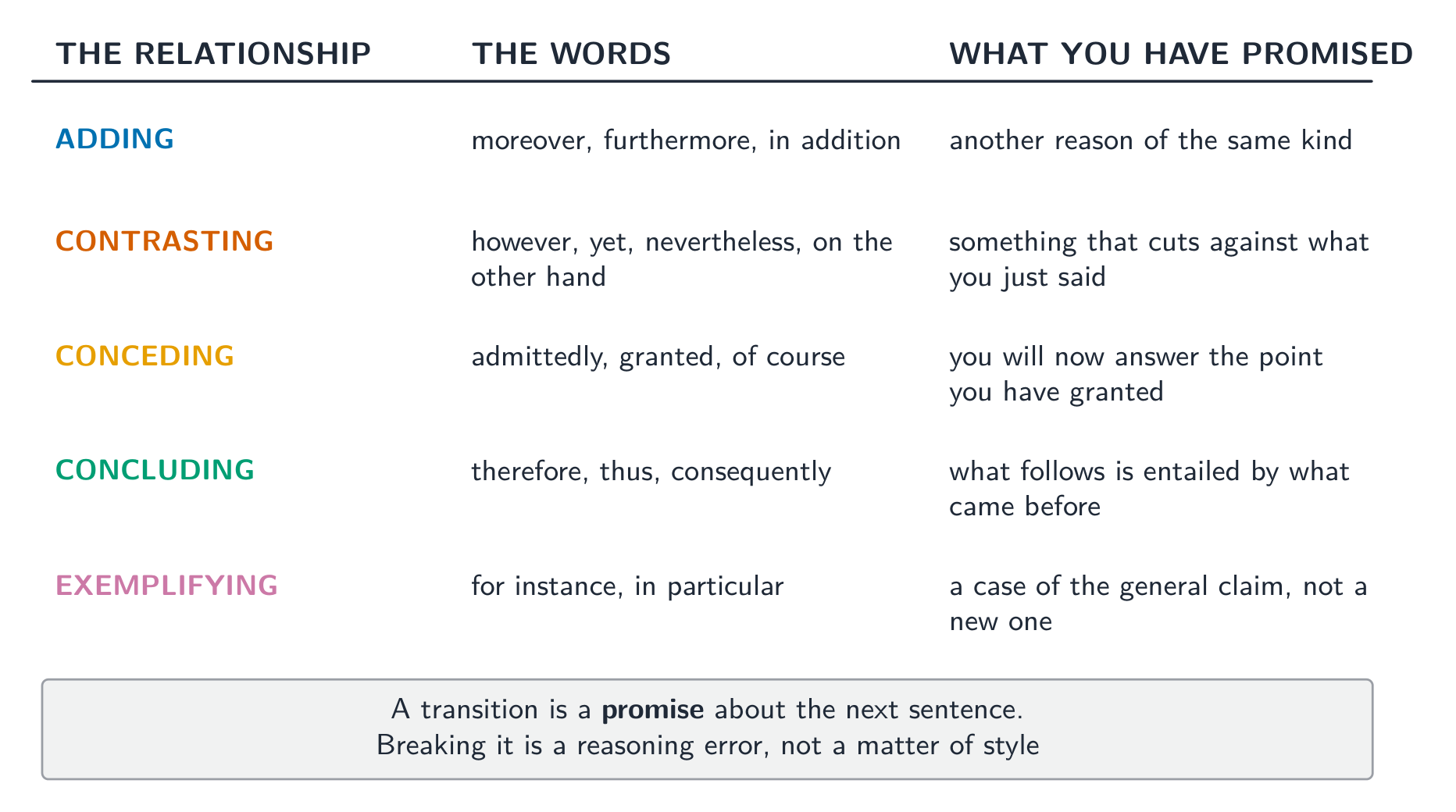
A transition is a promise about the next sentence - breaking it is a reasoning error
Explore · ⁨สำรวจ⁩

Match each transition to the promise it makes · ⁨จับคู่คำเชื่อมแต่ละตัวกับสัญญาที่มันมอบหมาย⁩

A transition is a claim about how two ideas stand to each other. Breaking that promise is a reasoning error, not a style problem. · ⁨คำเชื่อมคือการอ้างถึงความสัมพันธ์ระหว่างสองความคิด การละเมิดสัญญานี้คือความผิดพลาดทางเหตุผล ไม่ใช่ปัญหาเรื่องสไตล์⁩

5.5

Word Choice, Comparisons, and Syntax

Syllabus · ⁨หลักสูตร⁩
English

Enduring Understanding (STL-1): The rhetorical situation informs the strategic stylistic choices that writers make.

Learning Objective 7.A: Reading – Explain how word choice, comparisons, and syntax contribute to the specific tone or style of a text.

  • STL-1.A Words have both connotative and denotative meanings.
  • STL-1.B Descriptive words, such as adjectives and adverbs, not only qualify or modify the things they describe but also convey a perspective toward those things.
  • STL-1.C Precise word choice reduces confusion and may help the audience perceive the writer’s perspective.
ไทย

ความเข้าใจที่ยั่งยืน (STL-1): สถานการณ์ทาง retorics informing การเลือก stylistic แบบกลยุทธ์ที่นักเขียนทำ

วัตถุประสงค์การเรียนรู้ 7.A: การอ่าน – อธิบายว่าการเลือกคำ, การเปรียบเทียบ, และไวยากรณ์มีผลต่อ tone หรือ style เฉพาะของข้อความอย่างไร

  • STL-1.A คำมีทั้งความหมายเชิงนัย (connotative) และความหมายตรงตัว (denotative)
  • STL-1.B คำบรรยาย เช่น adjectives และ adverbs ไม่ได้เพียงแต่ qualify หรือ modify things ที่ they describe เท่านั้น แต่ยัง convey perspective ต่อสิ่งเหล่านั้นด้วย
  • STL-1.C การเลือกคำที่แม่นยำลดความสับสนและอาจช่วยให้ผู้ฟังรับรู้ perspective ของนักเขียน

Source: College Board AP Course and Exam Description · ⁨แหล่งที่มา: คำอธิบายหลักสูตรและข้อสอบ College Board AP⁩

English

Unit 5 opens the course's treatment of style with three claims about diction:

  • Words have both connotative and denotative meanings 内涵义与外延义. Denotation is what a word refers to; connotation is what it carries.
  • Descriptive words - adjectives and adverbs - not only qualify or modify what they describe but convey a perspective toward it.
  • Precise word choice reduces confusion and helps the audience perceive the writer's perspective.

The second is the analytically useful one. When a rhetorical-analysis passage calls a policy ambitious rather than expensive, no fact has changed and the reader's disposition has. That is a rhetorical choice, and it is exactly what the question asks you to explain.

ไทย

Unit 5 opens the course's treatment of style with three claims about diction:

  • Words have both connotative and denotative meanings 内涵义与外延义. Denotation is what a word refers to; connotation is what it carries.
  • Descriptive words - adjectives and adverbs - not only qualify or modify what they describe but convey a perspective toward it.
  • Precise word choice reduces confusion and helps the audience perceive the writer's perspective.

ข้อที่สองนี้มีความเป็นประโยชน์ต่อการวิเคราะห์ เมื่อการเขียนเชิงวิพากษ์วิจารณ์ระบุถึงนโยบายหนึ่งว่าเป็น * ambitious* แทนที่จะ说是 expensive ความจริงไม่ได้เปลี่ยนไป แต่ทัศนคติของผู้อ่านก็เปลี่ยนตาม นั่นคือการเลือกทางวาทศิลป์ และนี่คือสิ่งที่คำถามต้องการให้คุณอธิบาย

Vocabulary · ⁨คำศัพท์⁩ Train · ⁨ฝึกฝน⁩
English ไทย
connotative and denotative meanings/kɒnəˈtætɪv ænd dɪˈnəʊtətɪv ˈmiːnɪŋz/ ความหมายเชิงนัยและนัยแท้
5.6

Using Words and Syntax for Tone and Style · ⁨การใช้คำและไวยากรณ์เพื่อสร้างอารมณ์และสไตล์⁩

Syllabus · ⁨หลักสูตร⁩
English

Enduring Understanding (STL-1): The rhetorical situation informs the strategic stylistic choices that writers make.

Learning Objective 8.A: Writing – Strategically use words, comparisons, and syntax to convey a specific tone or style in an argument.

  • STL-1.A Words have both connotative and denotative meanings.
  • STL-1.B Descriptive words, such as adjectives and adverbs, not only qualify or modify the things they describe but also convey a perspective toward those things.
  • STL-1.C Precise word choice reduces confusion and may help the audience perceive the writer’s perspective.
ไทย

ความเข้าใจที่ยั่งยืน (STL-1): สถานการณ์ทาง retorics informing การเลือก stylistic แบบกลยุทธ์ที่นักเขียนทำ

จุดประสงค์การเรียนรู้ 8.A: การเขียน – ใช้คำ เปรียบเทียบ และโครงสร้างประโยคอย่างมีกลยุทธ์เพื่อบอกอารมณ์หรือสไตล์เฉพาะในบทวิพากษ์วิจารณ์

  • STL-1.A คำมีทั้งความหมายเชิงนัย (connotative) และความหมายตรงตัว (denotative)
  • STL-1.B คำบรรยาย เช่น adjectives และ adverbs ไม่ได้เพียงแต่ qualify หรือ modify things ที่ they describe เท่านั้น แต่ยัง convey perspective ต่อสิ่งเหล่านั้นด้วย
  • STL-1.C การเลือกคำที่แม่นยำลดความสับสนและอาจช่วยให้ผู้ฟังรับรู้ perspective ของนักเขียน

Source: College Board AP Course and Exam Description · ⁨แหล่งที่มา: คำอธิบายหลักสูตรและข้อสอบ College Board AP⁩

English

For your own writing, precision is worth more than range. A concrete rule: prefer the word that is exactly right to the word that is impressive. Examiners reward control, and an inflated word used slightly wrongly reads as loss of control.

Worked example (a real AP exam task). In a rhetorical-analysis passage a writer describes a proposal's supporters as "determined" in one paragraph and "unyielding" in the next. A low-scoring answer notes that the writer uses "strong diction". A scoring answer explains the shift: "Both words denote persistence, but 'determined' carries approval and 'unyielding' carries obstruction. By moving from one to the other without changing the facts described, the writer withdraws sympathy from the supporters while appearing only to continue describing them - so the audience's judgement shifts before any counter-argument is made." That is connotation, tone, and effect on audience in one move.

ไทย

สำหรับการเขียนของคุณเอง ความแม่นยำมีค่ามากกว่าความหลากหลาย กฎที่ชัดเจน: เลือกใช้คำที่ตรงประเด็นที่สุดแทนคำที่ดูน่าประทับใจ ผู้สอบจะให้คะแนน与控制力, และคำที่ดูฟุ่มเฟือยแต่ใช้ผิดเพี้ยนเล็กน้อย จะถูกตีความว่าขาดการควบคุม

ตัวอย่างฝึกปฏิบัติ (โจทย์จริงจากข้อสอบ AP). ในการเขียนเชิงวิพากษ์วิจารณ์ นักเขียนอธิบายผู้สนับสนุนข้อเสนอหนึ่งในย่อหน้าว่า "determined" และในย่อหน้าถัดไปว่า "unyielding" คำตอบที่ได้คะแนนต่ำจะระบุว่านักเขียนใช้ "diction ที่เข้มแข็ง" คำตอบที่ได้คะแนนสูงจะอธิบายถึงการเปลี่ยนแปลงนี้: "ทั้งสองคำสื่อถึงความมุ่งมั่น แต่ 'determined' นำความยอมรับมาด้วย ในขณะที่ 'unyielding' นำความขัดขวางมาด้วย การที่นักเขียนเปลี่ยนจากคำหนึ่งไปอีกคำหนึ่งโดยไม่เปลี่ยนความจริงที่ถูกบรรยาย ทำให้ผู้เขียนถอยห่างจากความเห็นอกเห็นใจที่มีต่อผู้สนับสนุน ขณะที่ยังคงดูเหมือนกำลังบรรยายเกี่ยวกับพวกเขาอยู่ - ดังนั้นการตัดสินของผู้อ่านจึงเปลี่ยนไปก่อนที่จะมีการโต้แย้งใด ๆ" นั้นคือความหมายแฝง อารมณ์ และผลกระทบต่อดูแลในขั้นตอนเดียว

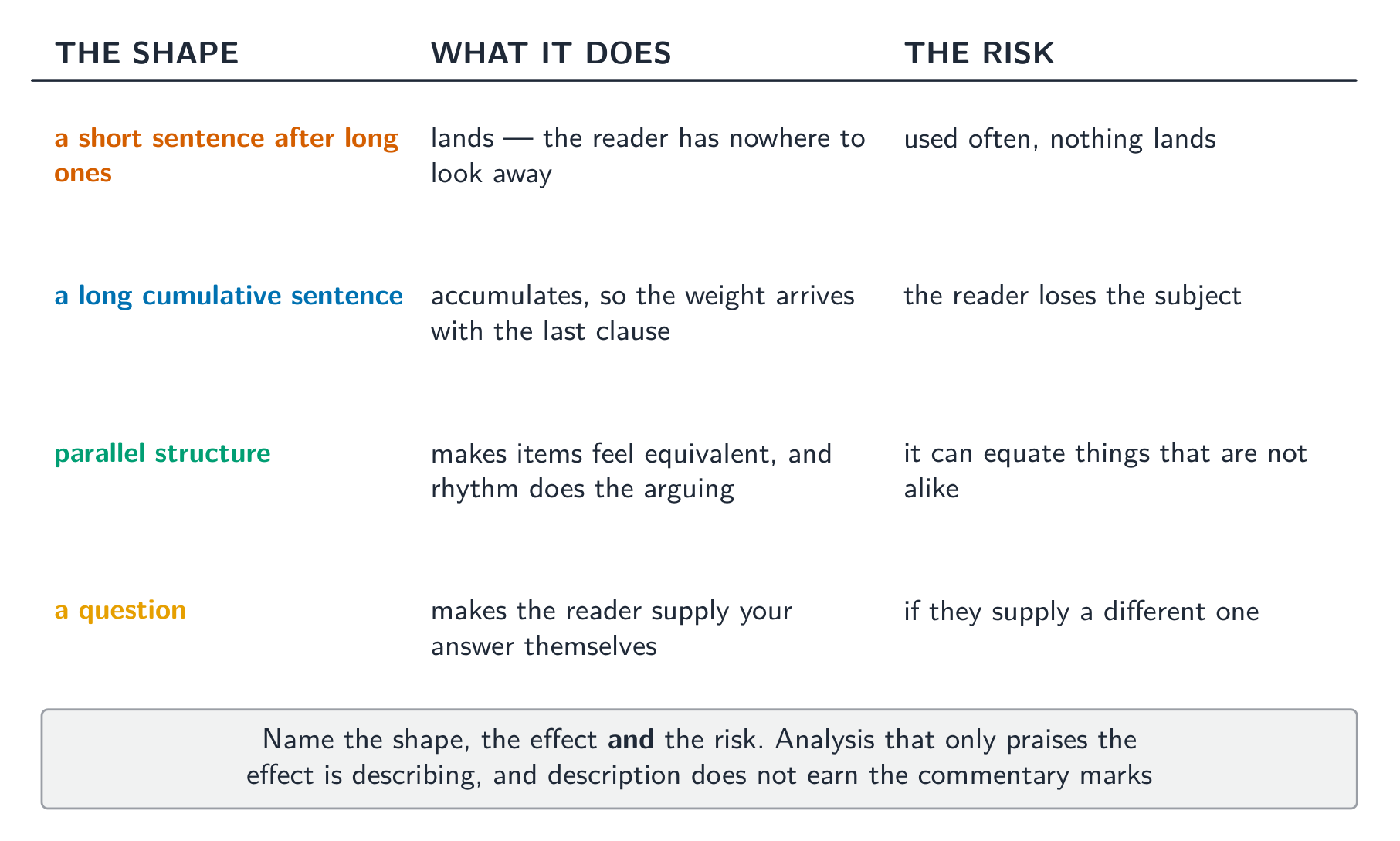
ชื่อรูปทรง ผลกระทบ และความเสี่ยง - การชมเชยเพียงอย่างเดียวคือการบรรยาย
Explore · ⁨สำรวจ⁩

Name the shape, the effect and the risk · ⁨ระบุรูปร่าง ผลกระทบ และความเสี่ยง⁩

Analysis that only praises the effect is describing — and description does not earn commentary marks. · ⁨การวิเคราะห์ที่ชมเพียงผลกระทบคือการบรรยาย — และการบรรยายไม่ได้ทำให้ได้คะแนนความคิดเห็น⁩

5.6

Exam tips · ⁨ข้อแนะนำสำหรับการสอบ⁩

English
  • Every body paragraph: claim, evidence, commentary. Lost points are nearly always the third.
  • Draft your claims as a list first. It is the only way to see whether the reasoning moves.
  • Begin commentary with because, which means, so - words that cannot be followed by a restatement.
  • Know the coherence devices by name: repetition, synonyms, pronoun reference, parallel structure, transitions.
  • A transition should carry the relationship, not just mark a boundary. Furthermore usually carries nothing.
  • Connotation is where diction analysis lives. Same denotation, different disposition, is a rhetorical choice worth explaining.
ไทย
  • ทุกย่อหน้าหลัก: ข้ออ้าง หลักฐาน การแสดงความคิดเห็น คะแนนที่หายไปเกือบทั้งหมดมักจะเป็นส่วนที่สาม
  • ร่าง ข้ออ้างของคุณเป็นรายการก่อน นี่คือวิธีเดียวที่จะตรวจสอบได้ว่าเหตุผลนั้นเคลื่อนตัวได้หรือไม่
  • เริ่มการแสดงความคิดเห็นด้วย because, which means, so - คำที่ไม่สามารถตามด้วยการทวนข้อความได้
  • รู้จักเครื่องมือความเชื่อมโยงกัน ตามชื่อ: การซ้ำคำ, คำPLATFORM, การอ้างอิงด้วยคำสรรพนาม, โครงสร้างขนาน, คำเชื่อม
  • คำเชื่อมควร นำความสัมพันธ์มาด้วย ไม่ใช่แค่ทำเครื่องหมายขอบเขต Furthermore มักจะไม่สื่ออะไรเลย
  • ความหมายแฝง (Connotation) คือพื้นที่ของการวิเคราะห์การใช้คำ ความหมายพื้นฐานเดียวกันแต่ทัศนคติต่างกัน เป็นการเลือกทางวาทศิลป์ที่มีค่าที่จะอธิบาย

Interactive lessons on this topic · ⁨บทเรียนเชิงโต้ตอบสำหรับหัวข้อนี้⁩

Work through it step by step, with instant-check exercises. · ⁨ทำทีละขั้นตอน พร้อมแบบฝึกหัดตรวจสอบผลทันที⁩

Past Papers · ⁨ข้อสอบย้อนหลัง⁩

More topics in AP English Language and Composition · ⁨AP ภาษาอังกฤษเพื่อการสื่อสารและการเขียน⁩ · ⁨หัวข้อเพิ่มเติมใน AP English Language and Composition · ⁨AP ภาษาอังกฤษเพื่อการสื่อสารและการเขียน⁩⁩

Log in or create account · ⁨เข้าสู่ระบบหรือสร้างบัญชี⁩

IGCSE, A-Level & AP