Skip to content · ⁨ข้ามไปยังเนื้อหา⁩

Audience, Thesis, and Supporting Evidence · ⁨กลุ่มผู้ฟัง, Thesis และหลักฐานสนับสนุน⁩

AP English Language and Composition · ⁨AP ภาษาอังกฤษเพื่อการสื่อสารและการเขียน⁩ · Topic 2 · ⁨หัวข้อ 2⁩

Video lesson for this topic · ⁨บทเรียนวิดีโอสำหรับหัวข้อนี้⁩ Open the video page · ⁨เปิดหน้าวิดีโอ⁩
5:54

หน่วยที่ 2: กลุ่มเป้าหมาย Thesis และหลักฐานสนับสนุน

นี่คือการทดสอบที่คุณสามารถทำได้เองในร่างต้นฉบับของคุณภายในสิบวินาที อ่านย่อหน้าหนึ่งและถาม: ถ้ากลุ่มเป้าหมาย完全不同完全不同的จะอ่านเหมือนกันไหม?

English narration · English + 中文 subtitles burned in · ⁨การบรรยายภาษาอังกฤษ · คำบรรยายภาษาอังกฤษ + 中文 ลอยตัวบนภาพ⁩

2.1

Understanding an Audience's Beliefs and Needs · ⁨เข้าใจความเชื่อและความต้องการของกลุ่มผู้ฟัง⁩

Syllabus · ⁨หลักสูตร⁩
English

Enduring Understanding (RHS-1): Individuals write within a particular situation and make strategic writing choices based on that situation.

Learning Objective 1.B: Reading – Explain how an argument demonstrates understanding of an audience’s beliefs, values, or needs.

  • RHS-1.F Writers’ perceptions of an audience’s values, beliefs, needs, and background guide the choices they make.
  • RHS-1.G To achieve a purpose, writers make choices in an attempt to relate to an intended audience’s emotions and values.
  • RHS-1.H Arguments seek to persuade or motivate action through appeals—the modes of persuasion.
ไทย

ความเข้าใจที่ยั่งยืน (RHS-1): บุคคลเขียนภายในสถานการณ์เฉพาะและเลือกการเขียนเชิงกลยุทธ์โดยอาศัยสถานการณ์นั้น

เป้าหมายการเรียนรู้ 1.B: การอ่าน – อธิบายว่าข้อโต้แย้งแสดงถึงการเข้าใจความเชื่อ ค่านิยม หรือความต้องการของกลุ่มผู้อ่านอย่างไร

  • RHS-1.F มุมมองของนักเขียนต่อค่านิยม ความเชื่อ ความต้องการ และพื้นหลังของกลุ่มผู้อ่านจะนำไปสู่การตัดสินใจเลือกสิ่งต่างๆ ของพวกเขา
  • RHS-1.G เพื่อให้บรรลุวัตถุประสงค์ นักเขียนจะทำการเลือกโดยพยายามเชื่อมโยงกับอารมณ์และค่านิยมของกลุ่มผู้อ่านเป้าหมาย
  • RHS-1.H ข้อโต้แย้งมุ่งหวังที่จะโน้มน้าวใจหรือกระตุ้นให้เกิดการกระทำผ่านการเรียกร้อง (appeals) ซึ่งเป็นรูปแบบของการโน้มน้าวใจ
Source: College Board AP Course and Exam Description · ⁨แหล่งที่มา: คำอธิบายหลักสูตรและข้อสอบ College Board AP⁩

English

Unit 1 established that a text has an audience. Unit 2 makes that audience the engine of every choice a writer makes.

  • Writers' perceptions of an audience's values, beliefs, needs, and background guide the choices they make. Note the word perceptions: what steers the writing is the writer's picture of the audience, which may be accurate or not.
  • To achieve a purpose, writers make choices in an attempt to relate to an intended audience's emotions and values.
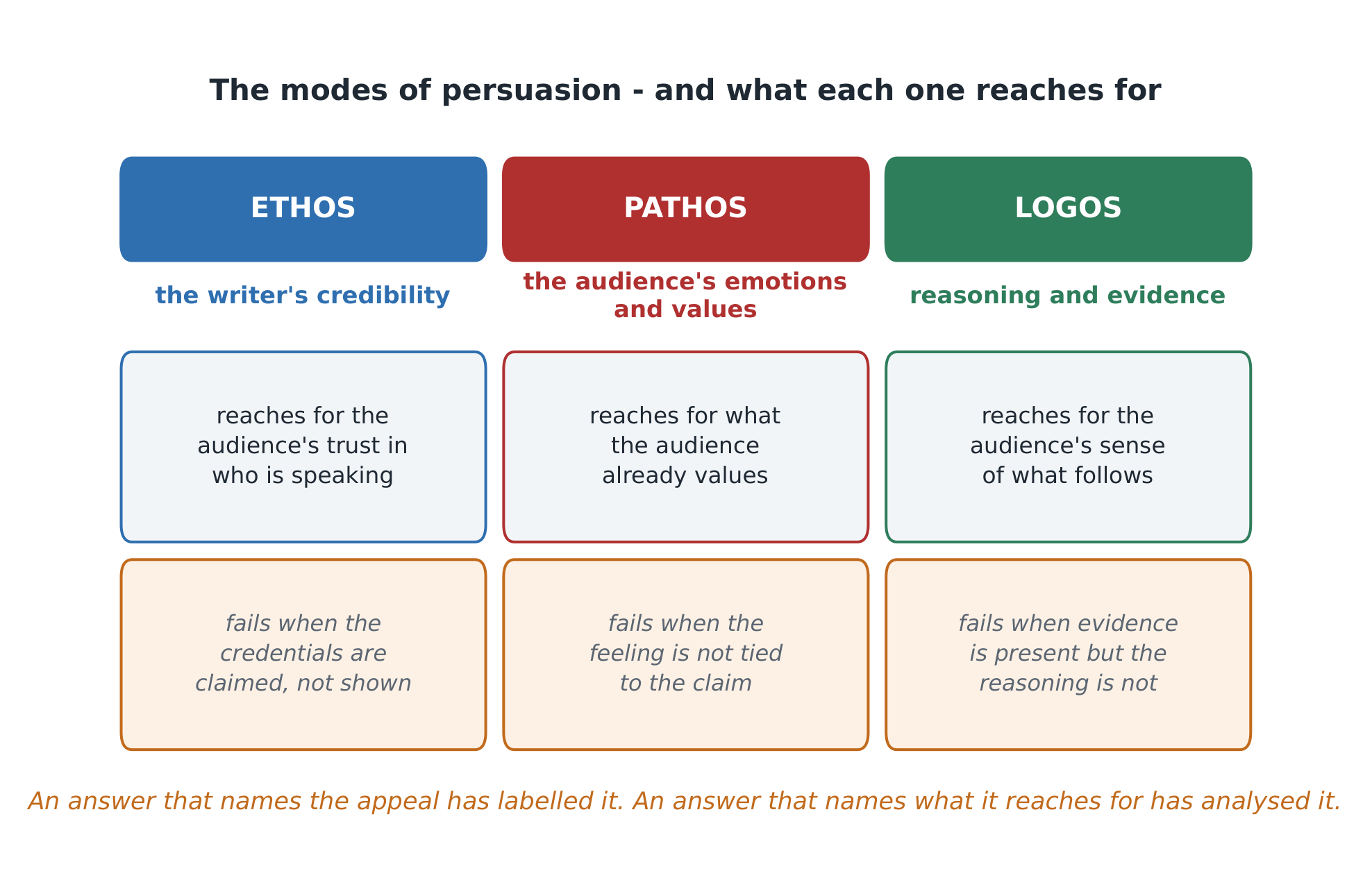
  • Arguments seek to persuade or motivate action through appeals 诉求 - the modes of persuasion 说服方式.
ไทย

Unit 1 กำหนดว่าข้อความมีกลุ่มผู้ฟัง Unit 2 ทำให้กลุ่มผู้ฟังนี้เป็นเครื่องยนต์ของการเลือกทุกอย่างที่ผู้เขียนทำ

  • การรับรู้ของผู้เขียนเกี่ยวกับค่านิยม ความเชื่อ ความต้องการ และพื้นฐานของกลุ่มผู้ฟัง จะนำไปสู่ทางเลือกที่พวกเขาทำ. ระวังคำว่า perceptions: สิ่งที่ควบคุมการเขียนคือภาพของผู้เขียนเกี่ยวกับกลุ่มผู้ฟัง ซึ่งอาจถูกต้องหรือไม่ก็ได้นะ
  • เพื่อให้บรรลุเป้าหมาย ผู้เขียนจะเลือกทางเลือกเพื่อพยายาม เชื่อมโยงกับอารมณ์และค่านิยมของกลุ่มผู้ฟังเป้าหมาย
  • Arguments试图 persuades or motivate action through appeals诉求- modes of persuasion说服方式.

Each appeal reaches for something different in the audience - and each can fail in its own way *การตั้งชื่อ appealing is worth nothing on its own; naming what it reaches for is the analysis

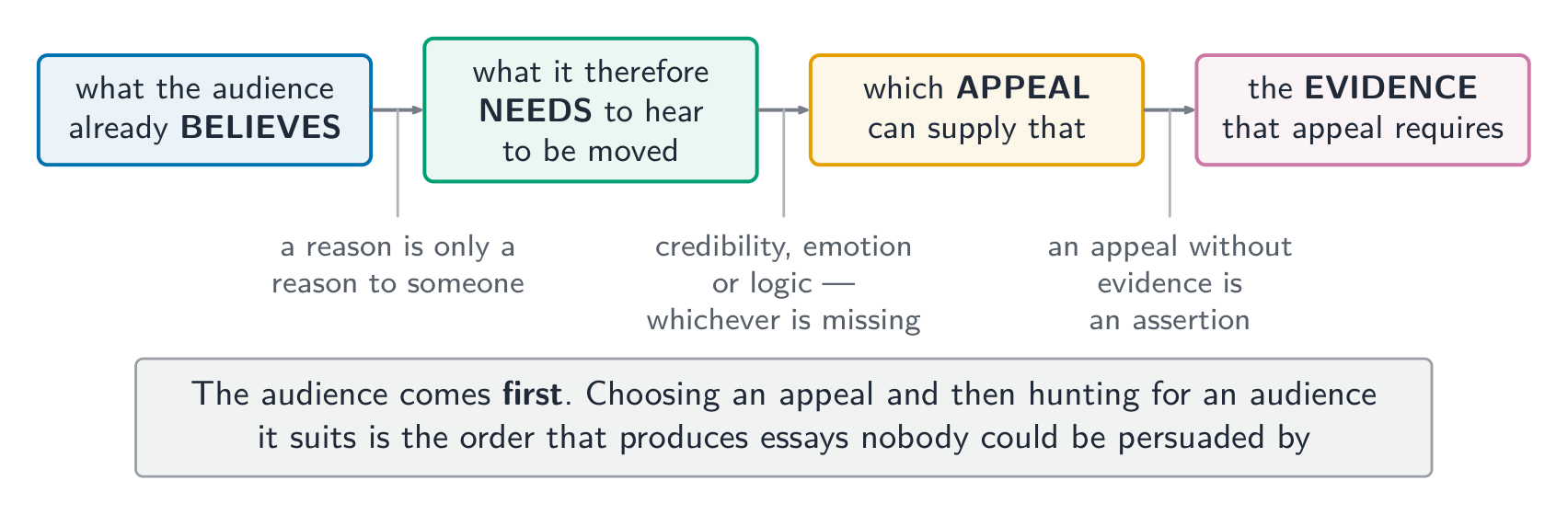
The audience comes first: what it believes determines what will count as a reason
Explore · ⁨สำรวจ⁩

Start from the audience, not the appeal · ⁨เริ่มต้นจากผู้ฟัง ไม่ใช่การอวดอ้าง⁩

What the audience already believes determines what will count as a reason to them. · ⁨สิ่งที่ผู้ฟังเชื่ออยู่แล้วกำหนดว่าอะไรจะถือเป็นเหตุผลสำหรับพวกเขา⁩

Vocabulary · ⁨คำศัพท์⁩ Train · ⁨ฝึกฝน⁩
English ไทย
appeals/əˈpiːlz/ การโน้มน้าวใจ
modes of persuasion/məʊdz ɒv pəˈsweɪʒn/ รูปแบบการโน้มน้าวใจ
2.2

Writing for an Audience's Beliefs and Needs · ⁨เขียนเพื่อตอบสนองความเชื่อและความต้องการของกลุ่มผู้ฟัง⁩

Syllabus · ⁨หลักสูตร⁩
English

Enduring Understanding (RHS-1): Individuals write within a particular situation and make strategic writing choices based on that situation.

Learning Objective 2.B: Writing – Demonstrate an understanding of an audience’s beliefs, values, or needs.

  • RHS-1.F Writers’ perceptions of an audience’s values, beliefs, needs, and background guide the choices they make.
  • RHS-1.G To achieve a purpose, writers make choices in an attempt to relate to an intended audience’s emotions and values.
  • RHS-1.H Arguments seek to persuade or motivate action through appeals—the modes of persuasion.
ไทย

ความเข้าใจที่ยั่งยืน (RHS-1): บุคคลเขียนภายในสถานการณ์เฉพาะและเลือกการเขียนเชิงกลยุทธ์โดยอาศัยสถานการณ์นั้น

เป้าหมายการเรียนรู้ 2.B: การเขียน – แสดงให้เห็นถึงความรู้ความเข้าใจในความเชื่อ ค่านิยม หรือความต้องการของกลุ่มผู้อ่าน

  • RHS-1.F มุมมองของนักเขียนต่อค่านิยม ความเชื่อ ความต้องการ และพื้นหลังของกลุ่มผู้อ่านจะนำไปสู่การตัดสินใจเลือกสิ่งต่างๆ ของพวกเขา
  • RHS-1.G เพื่อให้บรรลุวัตถุประสงค์ นักเขียนจะทำการเลือกโดยพยายามเชื่อมโยงกับอารมณ์และค่านิยมของกลุ่มผู้อ่านเป้าหมาย
  • RHS-1.H ข้อโต้แย้งมุ่งหวังที่จะโน้มน้าวใจหรือกระตุ้นให้เกิดการกระทำผ่านการเรียกร้อง (appeals) ซึ่งเป็นรูปแบบของการโน้มน้าวใจ
Source: College Board AP Course and Exam Description · ⁨แหล่งที่มา: คำอธิบายหลักสูตรและข้อสอบ College Board AP⁩

English

The same three statements now become a writing instruction. Before drafting, decide:

  • What does this audience already believe about the subject?
  • What do they need - information, reassurance, a reason to act?
  • What do they value, and which of those values can honestly be connected to my position?

An argument that ignores these produces writing addressed to nobody. And the CED's framing gives you a useful test for your own drafts: if this paragraph would read identically to a completely different audience, it has not been shaped by one.

ไทย

สามประโยคเดิมตอนนี้กลายเป็นคำแนะนำในการเขียน ก่อนร่างเนื้อหา ต้องตัดสินใจ:

  • กลุ่มผู้ฟังนี้ เชื่อ อะไรเกี่ยวกับ subject แล้ว?
  • พวกเขา ต้องการอะไร - ข้อมูล, ความมั่นใจ, หรือเหตุผลที่จะกระทำ?
  • พวกเขา ให้ความสำคัญกับอะไร และค่า nàoจากนั้นที่สามารถเชื่อมต่อกับตำแหน่งของคุณได้อย่างตรงไปตรงมา?

Argument yang mengabaikan hal ini menghasilkan tulisan yang ditujukan kepada siapa pun. Dan kerangka kerja CED memberikan Anda tes berguna untuk draft Anda sendiri: jika paragraf ini akan dibaca sama persis oleh audiens yang sama sekali berbeda, maka itu tidak dibentuk oleh satu.

2.3

Identifying Claims and Evidence · ⁨การระบุข้ออ้างและหลักฐาน⁩

Syllabus · ⁨หลักสูตร⁩
English

Enduring Understanding (CLE-1): Writers make claims about subjects, rely on evidence that supports the reasoning that justifies the claim, and often acknowledge or respond to other, possibly opposing, arguments.

Learning Objective 3.A: Reading – Identify and explain claims and evidence within an argument.

  • CLE-1.F Writers use evidence strategically and purposefully to illustrate, clarify, set a mood, exemplify, associate, or amplify a point.
  • CLE-1.G Strategically selected evidence strengthens the validity and reasoning of the argument, relates to an audience’s emotions and values, and increases a writer’s credibility.
  • CLE-1.H An effective argument contains sufficient evidence; evidence is sufficient when its quantity and quality provide apt support for the argument.
ไทย

ความเข้าใจที่ยั่งยืน (CLE-1): นักเขียนทำข้ออ้างเกี่ยวกับหัวข้อ อิงกับหลักฐานที่สนับสนุนเหตุผลที่ใช้เพื่อพิสูจน์ข้ออ้าง tersebut และมักยอมรับหรือตอบโต้ข้อโต้แย้งอื่น ๆ ซึ่งอาจเป็นฝ่ายตรงข้าม

เป้าหมายการเรียนรู้ 3.A: การอ่าน – ระบุและอธิบายข้ออ้างและหลักฐานภายในข้อโต้แย้ง

  • CLE-1.F นักเขียนใช้หลักฐานอย่างมีกลยุทธ์และมีจุดประสงค์เพื่อแสดงตัวอย่าง อธิบาย ให้บรรยากาศ สร้างตัวอย่าง เชื่อมโยง หรือขยายความประเด็นใดประเด็นหนึ่ง
  • CLE-1.G การเลือกหลักฐานอย่างมีกลยุทธ์ช่วยเสริมสร้างความน่าเชื่อถือและเหตุผลของข้อโต้แย้ง เชื่อมโยงกับอารมณ์และค่านิยมของกลุ่มผู้อ่าน และเพิ่มเครดิตของนักเขียน
  • CLE-1.H ข้อโต้แย้งที่มีประสิทธิภาพควรมีหลักฐานเพียงพอ; หลักฐานจะถือว่าเพียงพอเมื่อปริมาณและคุณภาพของมันให้การสนับสนุนที่เหมาะสมแก่ข้อโต้แย้ง

Source: College Board AP Course and Exam Description · ⁨แหล่งที่มา: คำอธิบายหลักสูตรและข้อสอบ College Board AP⁩

English

Unit 2 deepens Unit 1's treatment of evidence with three claims about how evidence works:

  • Writers use evidence strategically and purposefully to illustrate, clarify, set a mood, exemplify, associate, or amplify. Evidence does a job, and naming that job is analysis.
  • Strategically selected evidence strengthens the validity and reasoning of the argument, relates to an audience's emotions and values, and helps establish the writer's credibility 可信度.
  • An effective argument contains sufficient evidence 充分的证据 - sufficient when its quantity and quality provide apt support for the line of reasoning.

That third point is often misread as "more is better". Sufficiency is quantity and quality together: three well-chosen pieces of evidence that bear directly on the claim beat six that only touch it.

ไทย

Unit 2 memperdalam perlakuan Unit 1 tentang bukti dengan tiga klaim tentang bagaimana bukti bekerja:

  • Penulis menggunakan bukti secara strategis dan terarah untuk mengilustrasikan, menjelaskan, menetapkan suasana, memberi contoh, menghubungkan, atau memperkuat. Bukti melakukan pekerjaan, dan menyebut pekerjaan itu adalah analisis.
  • Bukti yang dipilih secara strategis memperkuat validitas dan penalaran argumen, berkaitan dengan emosi dan nilai audiens, dan membantu membangun kredibilitas penulis.
  • Argumen yang efektif mengandung bukti yang memadai - memadai ketika jumlah dan kualitasnya memberikan dukungan yang tepat untuk garis penalaran.

Poin ketiga sering disalahartikan sebagai "lebih banyak lebih baik". Kecukupan adalah jumlah dan kualitas bersama-sama: tiga potongan bukti yang dipilih dengan baik yang langsung terkait dengan klaim mengalahkan enam yang hanya menyentuhnya.

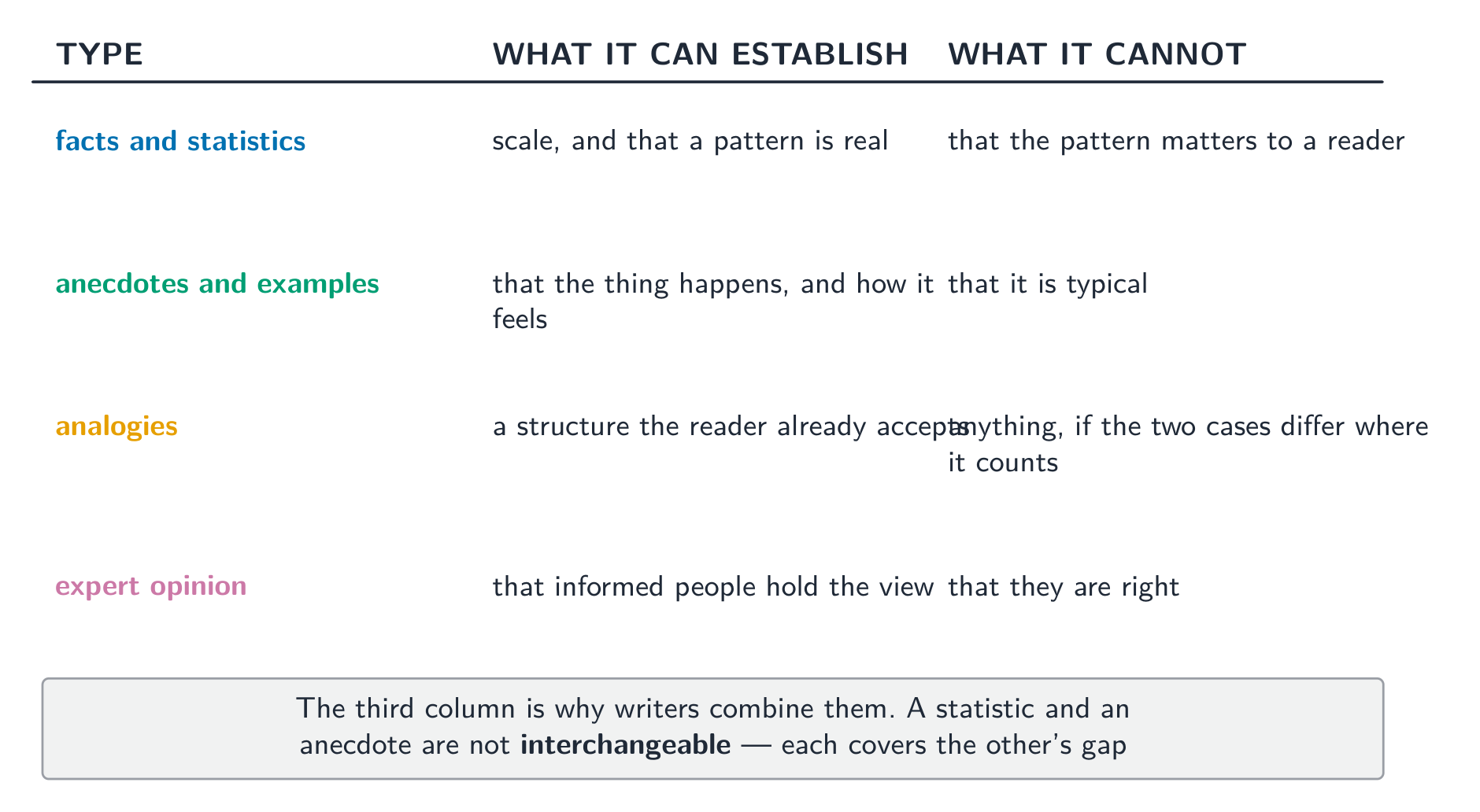
Evidence types sorted by what each can and cannot establish
Explore · ⁨สำรวจ⁩

Match each evidence type to what it cannot prove · ⁨จับคู่ประเภทหลักฐานกับสิ่งที่มันไม่สามารถพิสูจน์ได้⁩

A statistic and an anecdote are not interchangeable — each covers the other's gap. · ⁨สถิติและเรื่องเล่าไม่สามารถสลับกันได้ — แต่ละอย่างเติมเต็มช่องว่างของอีกฝ่าย⁩

2.4

Developing a Paragraph with Claim and Evidence · ⁨การพัฒนาย่อหน้าด้วยข้ออ้างและหลักฐาน⁩

Syllabus · ⁨หลักสูตร⁩
English

Enduring Understanding (CLE-1): Writers make claims about subjects, rely on evidence that supports the reasoning that justifies the claim, and often acknowledge or respond to other, possibly opposing, arguments.

Learning Objective 4.A: Writing – Develop a paragraph that includes a claim and evidence supporting the claim.

  • CLE-1.F Writers use evidence strategically and purposefully to illustrate, clarify, set a mood, exemplify, associate, or amplify a point.
  • CLE-1.G Strategically selected evidence strengthens the validity and reasoning of the argument, relates to an audience’s emotions and values, and increases a writer’s credibility.
  • CLE-1.H An effective argument contains sufficient evidence; evidence is sufficient when its quantity and quality provide apt support for the argument.
ไทย

ความเข้าใจที่ยั่งยืน (CLE-1): นักเขียนทำข้ออ้างเกี่ยวกับหัวข้อ อิงกับหลักฐานที่สนับสนุนเหตุผลที่ใช้เพื่อพิสูจน์ข้ออ้าง tersebut และมักยอมรับหรือตอบโต้ข้อโต้แย้งอื่น ๆ ซึ่งอาจเป็นฝ่ายตรงข้าม

เป้าหมายการเรียนรู้ 4.A: การเขียน – พัฒนาย่อหน้าที่ประกอบด้วยข้ออ้างและหลักฐานที่สนับสนุนข้ออ้างนั้น

  • CLE-1.F นักเขียนใช้หลักฐานอย่างมีกลยุทธ์และมีจุดประสงค์เพื่อแสดงตัวอย่าง อธิบาย ให้บรรยากาศ สร้างตัวอย่าง เชื่อมโยง หรือขยายความประเด็นใดประเด็นหนึ่ง
  • CLE-1.G การเลือกหลักฐานอย่างมีกลยุทธ์ช่วยเสริมสร้างความน่าเชื่อถือและเหตุผลของข้อโต้แย้ง เชื่อมโยงกับอารมณ์และค่านิยมของกลุ่มผู้อ่าน และเพิ่มเครดิตของนักเขียน
  • CLE-1.H ข้อโต้แย้งที่มีประสิทธิภาพควรมีหลักฐานเพียงพอ; หลักฐานจะถือว่าเพียงพอเมื่อปริมาณและคุณภาพของมันให้การสนับสนุนที่เหมาะสมแก่ข้อโต้แย้ง

Source: College Board AP Course and Exam Description · ⁨แหล่งที่มา: คำอธิบายหลักสูตรและข้อสอบ College Board AP⁩

English

Applying the above to your own writing, choose each piece of evidence for a stated reason. In practice this means being able to finish the sentence: I am using this piece because it ...

  • ... illustrates a claim that would otherwise stay abstract;
  • ... establishes my credibility on a subject where readers may doubt it;
  • ... connects my position to a value the audience already holds.

Evidence chosen this way produces commentary almost automatically, because you already know what the evidence is doing. Evidence chosen because it was available produces the blank space where commentary should be.

ไทย

Menerapkan poin di atas ke dalam penulisan Anda sendiri, pilih setiap bagian bukti karena alasan yang dinyatakan. Dalam praktiknya ini berarti mampu menyelesaikan kalimat: Saya menggunakan bagian ini karena ...

  • ... mengilustrasikan klaim yang jika tidak akan tetap abstrak;
  • ... establishes my credibility on a subject where readers may doubt it;
  • ... connects my position to a value the audience already holds.

การเลือกหลักฐานด้วยวิธีนี้จะสร้างคำอธิบายประกอบได้เกือบอัตโนมัติ เพราะคุณรู้แล้วว่าหลักฐานนั้นทำหน้าที่อะไร การเลือกหลักฐานเพราะมีอยู่จริงจะสร้างความว่างเปล่าแทนที่คำอธิบายประกอบ

Vocabulary · ⁨คำศัพท์⁩ Train · ⁨ฝึกฝน⁩
English ไทย
credibility/ˌkredɪˈbɪlɪti/ ความน่าเชื่อถือ
sufficient evidence/səˈfɪʃənt ˈevɪdəns/ หลักฐานที่เพียงพอ
2.5

Identifying the Overarching Thesis · ⁨การระบุข้อโต้แย้งหลัก⁩

Syllabus · ⁨หลักสูตร⁩
English

Enduring Understanding (CLE-1): Writers make claims about subjects, rely on evidence that supports the reasoning that justifies the claim, and often acknowledge or respond to other, possibly opposing, arguments.

Learning Objective 3.B: Reading – Identify and describe the overarching thesis of an argument, and any indication it provides of the argument’s structure.

  • CLE-1.I A thesis is the main, overarching claim a writer is seeking to defend or prove by using reasoning supported by evidence.
  • CLE-1.J A writer’s thesis is not necessarily a single sentence or an explicit statement and may require a thorough reading of the text to identify, but when a thesis is directly expressed, it is called a thesis statement. [Note: While the texts you assign your students to analyze may not always contain obvious thesis statements, they should each have a thesis. It can be good practice for students to write a thesis statement for such texts. On the AP Exam, a clear communication of the thesis is required in students’ essays.]
ไทย

ความเข้าใจที่ยั่งยืน (CLE-1): นักเขียนทำข้ออ้างเกี่ยวกับหัวข้อ อิงกับหลักฐานที่สนับสนุนเหตุผลที่ใช้เพื่อพิสูจน์ข้ออ้าง tersebut และมักยอมรับหรือตอบโต้ข้อโต้แย้งอื่น ๆ ซึ่งอาจเป็นฝ่ายตรงข้าม

เป้าหมายการเรียนรู้ 3.B: การอ่าน – ระบุและอธิบาย论点หลักของข้อโต้แย้ง และบ่งชี้โครงสร้างของข้อโต้แย้งใดๆ ที่论点หลักนั้นให้ไว้

  • CLE-1.I论点หลักคือข้ออ้างหลักและ overarching claim ที่นักเขียนกำลังพยายามปกป้องหรือพิสูจน์โดยใช้เหตุผลที่รองรับด้วยหลักฐาน
  • CLE-1.J论点หลักของนักเขียนไม่จำเป็นต้องเป็นประโยคเดียวหรือคำกล่าวที่ชัดเจนเสมอไปและอาจต้องอ่านข้อความอย่างละเอียดเพื่อระบุ แต่เมื่อ论点หลักถูกแสดงออกโดยตรง จะเรียกว่า论点 statement。 [หมายเหตุ: แม้ข้อความที่คุณมอบหมายให้นักเรียนวิเคราะห์อาจไม่มี论点 statement ที่ชัดเจนเสมอไป แต่แต่ละเรื่องควรมี论点หลัก การฝึกให้นักเรียนเขียน论点 statement สำหรับข้อความประเภทนี้ถือเป็นสิ่งที่ดี ในการสอบ AP ต้องมีการสื่อสาร论点หลักอย่างชัดเจนในบทความเขียนของนักเรียน]

Source: College Board AP Course and Exam Description · ⁨แหล่งที่มา: คำอธิบายหลักสูตรและข้อสอบ College Board AP⁩

English
  • A thesis 论点 is the main, overarching claim a writer seeks to defend or prove by using reasoning supported by evidence.
  • A writer's thesis is not necessarily a single sentence or an explicit statement, and may require a thorough reading to identify.

That second point matters for the reading side of the exam. On a rhetorical-analysis passage, the thesis may be distributed across the text or implied by its structure. Do not assume the first sentence of the second paragraph is the thesis because that is where you would put yours.

ไทย
  • ข้อโต้แย้ง论点 คือ ข้ออ้างหลักและครอบคลุม ที่ผู้เขียนพยายามปกป้องหรือพิสูจน์โดยใช้เหตุผลที่มีหลักฐานรองรับ
  • ข้อโต้แย้งของผู้เขียน ไม่จำเป็นต้องเป็นประโยคเดียวหรือข้อความที่ระบุชัดเจน และอาจต้องอ่านให้ละเอียดเพื่อระบุได้

จุดที่สองนี้มีความสำคัญสำหรับส่วนการอ่านของข้อสอบ ในบทความการวิเคราะห์เชิง retorics ข้อโต้แย้งอาจกระจายอยู่ในข้อความทั้งหมดหรือถูกสื่อโดยโครงสร้างของข้อความ อย่าสันนิษฐานว่าประโยคแรกในย่อหน้าที่สองคือข้อโต้แย้ง เพียงเพราะนั่นคือตำแหน่งที่คุณน่าจะทำให้มันเอง

2.6

Writing a Thesis Statement · ⁨การเขียนประโยคข้อโต้แย้ง⁩

Syllabus · ⁨หลักสูตร⁩
English

Enduring Understanding (CLE-1): Writers make claims about subjects, rely on evidence that supports the reasoning that justifies the claim, and often acknowledge or respond to other, possibly opposing, arguments.

Learning Objective 4.B: Writing – Write a thesis statement that requires proof or defense and that may preview the structure of the argument.

  • CLE-1.I A thesis is the main, overarching claim a writer is seeking to defend or prove by using reasoning supported by evidence.
  • CLE-1.J A writer’s thesis is not necessarily a single sentence or an explicit statement and may require a thorough reading of the text to identify, but when a thesis is directly expressed, it is called a thesis statement. [Note: While the texts you assign your students to analyze may not always contain obvious thesis statements, they should each have a thesis. It can be good practice for students to write a thesis statement for such texts. On the AP Exam, a clear communication of the thesis is required in students’ essays.]
ไทย

ความเข้าใจที่ยั่งยืน (CLE-1): นักเขียนทำข้ออ้างเกี่ยวกับหัวข้อ อิงกับหลักฐานที่สนับสนุนเหตุผลที่ใช้เพื่อพิสูจน์ข้ออ้าง tersebut และมักยอมรับหรือตอบโต้ข้อโต้แย้งอื่น ๆ ซึ่งอาจเป็นฝ่ายตรงข้าม

เป้าหมายการเรียนรู้ 4.B: การเขียน – เขียน论点 statement ที่ต้องการการพิสูจน์หรือปกป้อง และอาจแนะนำโครงสร้างของข้อโต้แย้ง

  • CLE-1.I论点หลักคือข้ออ้างหลักและ overarching claim ที่นักเขียนกำลังพยายามปกป้องหรือพิสูจน์โดยใช้เหตุผลที่รองรับด้วยหลักฐาน
  • CLE-1.J论点หลักของนักเขียนไม่จำเป็นต้องเป็นประโยคเดียวหรือคำกล่าวที่ชัดเจนเสมอไปและอาจต้องอ่านข้อความอย่างละเอียดเพื่อระบุ แต่เมื่อ论点หลักถูกแสดงออกโดยตรง จะเรียกว่า论点 statement。 [หมายเหตุ: แม้ข้อความที่คุณมอบหมายให้นักเรียนวิเคราะห์อาจไม่มี论点 statement ที่ชัดเจนเสมอไป แต่แต่ละเรื่องควรมี论点หลัก การฝึกให้นักเรียนเขียน论点 statement สำหรับข้อความประเภทนี้ถือเป็นสิ่งที่ดี ในการสอบ AP ต้องมีการสื่อสาร论点หลักอย่างชัดเจนในบทความเขียนของนักเรียน]

Source: College Board AP Course and Exam Description · ⁨แหล่งที่มา: คำอธิบายหลักสูตรและข้อสอบ College Board AP⁩

English

The writing objective is precise: write a thesis statement that requires proof or defence and that may preview the structure of the argument.

Two independent requirements sit in that sentence:

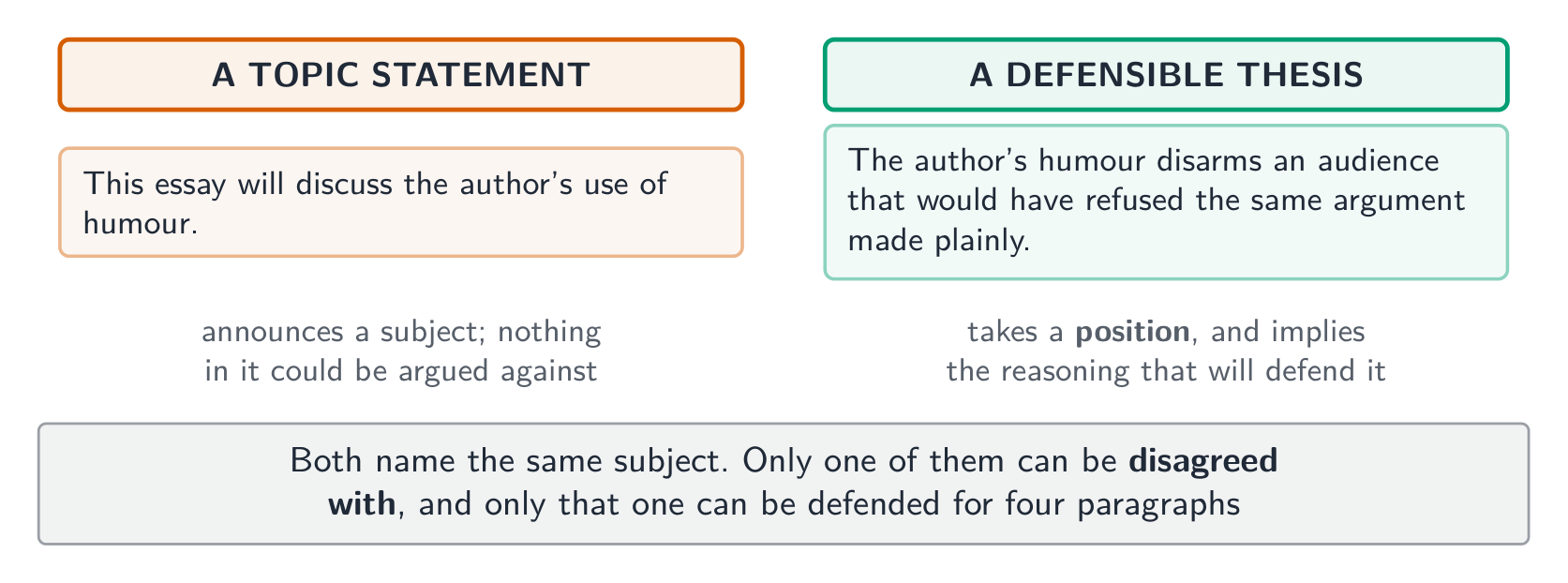
  • It must require defence. Apply the Unit 1 test again: could a reasonable person disagree? A thesis that states a fact cannot be defended, only repeated.
  • It may preview the structure - optional, but useful, because a thesis that names the lines of reasoning it will pursue gives the essay its shape.

On the exam, the thesis point is one of six and it is the cheapest point on the rubric: a defensible thesis in response to the prompt earns it. A restatement of the prompt does not.

Worked example (a real AP exam task). For a Question 3 argument prompt asking you to take a position on the value of a proposed practice, compare two openings. "There are many arguments both for and against this practice." - that earns nothing, because nobody could disagree with it. "Because the practice rewards visible effort rather than actual improvement, it produces the appearance of progress while removing the incentive to seek it." - that earns the point: it is arguable, specific, and it previews the reasoning the essay will develop.

ไทย

วัตถุประสงค์ในการเขียนคือความแม่นยำ: เขียนประโยคข้อโต้แย้งที่ต้องมีการพิสูจน์หรือปกป้อง และสามารถชี้นำโครงสร้างของข้อโต้แย้งได้

สองข้อกำหนดที่เป็นอิสระอยู่ในประโยคนั้น:

  • มันต้อง ต้องการการปกป้อง ใช้การทดสอบหน่วยที่ 1 อีกครั้ง: คนทั่วไปสามารถเห็นต่างได้หรือไม่? ข้อโต้แย้งที่บอกเพียงข้อเท็จจริงไม่สามารถปกป้องได้ มีแต่จะซ้ำซ้อน
  • มัน อาจชี้นำโครงสร้าง - เป็นทางเลือกแต่มีประโยชน์ เพราะข้อโต้แย้งที่ระบุเส้นทางการคิดที่จะนำไปใช้ จะกำหนดรูปร่างให้กับบทความ

ในข้อสอบ คะแนนข้อโต้แย้งเป็นหนึ่งในหก และเป็นคะแนนที่ง่ายที่สุดตามเกณฑ์การให้คะแนน: ข้อโต้แย้งที่ยืนยันได้ซึ่งตอบสนองต่อโจทย์จะรับคะแนนได้ แต่การทวนโจทย์จะไม่ได้รับ

ตัวอย่างแบบฝึกหัด (โจทย์ข้อสอบ AP จริง) สำหรับโจทย์ข้อ 3 ที่ให้แสดงทัศนะเกี่ยวกับคุณค่าของแนวปฏิบัติที่เสนอ เปรียบเทียบการเปิดเรื่องสองแบบ "มีทั้งข้อดีและข้อเสียมากมายสำหรับแนวทางปฏิบัตินี้" - ไม่ได้คะแนนเลย เพราะไม่มีใครเห็นต่างกับมันได้ "เนื่องจากแนวทางปฏิบัตินี้ให้รางวัลแก่ความพยายามที่มองเห็นได้มากกว่าการพัฒนาที่แท้จริง มันจึงสร้างภาพลวงตาของความก้าวหน้าในขณะที่กำจัดแรงจูงใจในการค้นหาสิ่งนั้น" - ได้คะแนน: เป็นสิ่งที่ถกเถียงได้ เฉพาะเจาะจง และชี้นำเหตุผลที่บทความจะพัฒนาต่อไป

หัวข้อเดียวกัน และมีเพียงอย่างใดอย่างหนึ่งที่สามารถเห็นต่างได้
Vocabulary · ⁨คำศัพท์⁩ Train · ⁨ฝึกฝน⁩
English ไทย
thesis/ˈθiːsɪs/ thesis
2.6

Exam tips · ⁨ข้อแนะนำสำหรับการสอบ⁩

English
  • The audience drives everything. If a paragraph would read the same to any audience, it has not been shaped for one.
  • Name what evidence does - illustrate, clarify, associate, amplify. That is analysis; listing evidence is not.
  • Sufficiency is quantity and quality, not volume. Three apt pieces beat six loose ones.
  • A thesis in a passage may be implied or distributed. Read the whole text before deciding.
  • Your own thesis must be arguable. Restating the prompt earns zero of the six points.
  • Previewing your line of reasoning in the thesis is optional but makes the rest of the essay easier to organise.
ไทย
  • ผู้ฟังขับเคลื่อนทุกอย่าง หากย่อหน้าหนึ่งอ่านเหมือนเดิม对所有ผู้ฟัง แสดงว่าไม่ได้ปรับแต่ง为谁
  • ระบุ ว่าหลักฐานทำอะไร - อธิบาย, ชี้แจง, เชื่อมโยง, ขยายความ นั่นคือการวิเคราะห์; การรายการหลักฐานไม่ใช่
  • ความเพียงพอคือปริมาณและคุณภาพ ไม่ใช่จำนวนสามชิ้นที่เหมาะสมดีกว่าหกชิ้นที่ไม่เหมาะสม
  • ข้อโต้แย้งในบทความอาจ ถูกสื่อหรือกระจาย อ่านข้อความทั้งหมดก่อนตัดสินใจ
  • ข้อโต้แย้งของคุณเองต้อง ถกเถียงได้ การทวนโจทย์จะได้ศูนย์จากหกคะแนน
  • การชี้นำเส้นทางการคิดของคุณในข้อโต้แย้งเป็นเรื่องตัวเลือกแต่ทำให้การจัดระเบียบส่วนที่เหลือของบทความง่ายขึ้น

Interactive lessons on this topic · ⁨บทเรียนเชิงโต้ตอบสำหรับหัวข้อนี้⁩

Work through it step by step, with instant-check exercises. · ⁨ทำทีละขั้นตอน พร้อมแบบฝึกหัดตรวจสอบผลทันที⁩

Past Papers · ⁨ข้อสอบย้อนหลัง⁩

More topics in AP English Language and Composition · ⁨AP ภาษาอังกฤษเพื่อการสื่อสารและการเขียน⁩ · ⁨หัวข้อเพิ่มเติมใน AP English Language and Composition · ⁨AP ภาษาอังกฤษเพื่อการสื่อสารและการเขียน⁩⁩

Log in or create account · ⁨เข้าสู่ระบบหรือสร้างบัญชี⁩

IGCSE, A-Level & AP