| Enduring Understanding | Learning Objective | Essential Knowledge |
|---|---|---|
CHA-3 | CHA-3.G |
|
Parametric Equations, Polar Coordinates, and Vector-Valued Functions · สมการพารามิเตอร์ พิกัดขั้ว และฟังก์ชันที่มีค่าเวกเตอร์
AP Calculus BC · Topic 9 · หัวข้อ 9
 6:06
6:06
พารามิเตอร์, เว็กเตอร์ & โพลาร์
บางเส้นโค้งไม่สามารถเขียนเป็น y เท่ากับฟังก์ชันของ x ได้ จินตนาการอนุภาคที่หมุนวน หรือเส้นทางที่ตัดตัวเอง — สำหรับ x หนึ่งค่า จะมี y สอง…
English narration · English + 中文 subtitles burned in · การบรรยายภาษาอังกฤษ · คำบรรยายภาษาอังกฤษ + 中文 ลอยตัวบนภาพ
9.1
Defining and Differentiating Parametric Equations · การกำหนดและหาอนุพันธ์ของสมการพารามิเตอร์
Syllabus · หลักสูตร
Source: College Board AP Course and Exam Description · แหล่งที่มา: คำอธิบายหลักสูตรและข้อสอบ College Board AP
English
Parametric equations 参数方程 give $x$ and $y$ each as functions of a parameter $t$ (often time): $x=x(t)$, $y=y(t)$. They trace a curve that need not be a function of $x$. The slope of the curve is found with the chain rule:
$$\frac{dy}{dx}=\frac{dy/dt}{dx/dt}\qquad(dx/dt\neq0).$$
Worked example. For $x=t^2$, $y=t^3-t$, find the slope at $t=2$. Here $\dfrac{dx}{dt}=2t$ and $\dfrac{dy}{dt}=3t^2-1$, so $\dfrac{dy}{dx}=\dfrac{3t^2-1}{2t}$; at $t=2$ this is $\dfrac{11}{4}$.
ไทย
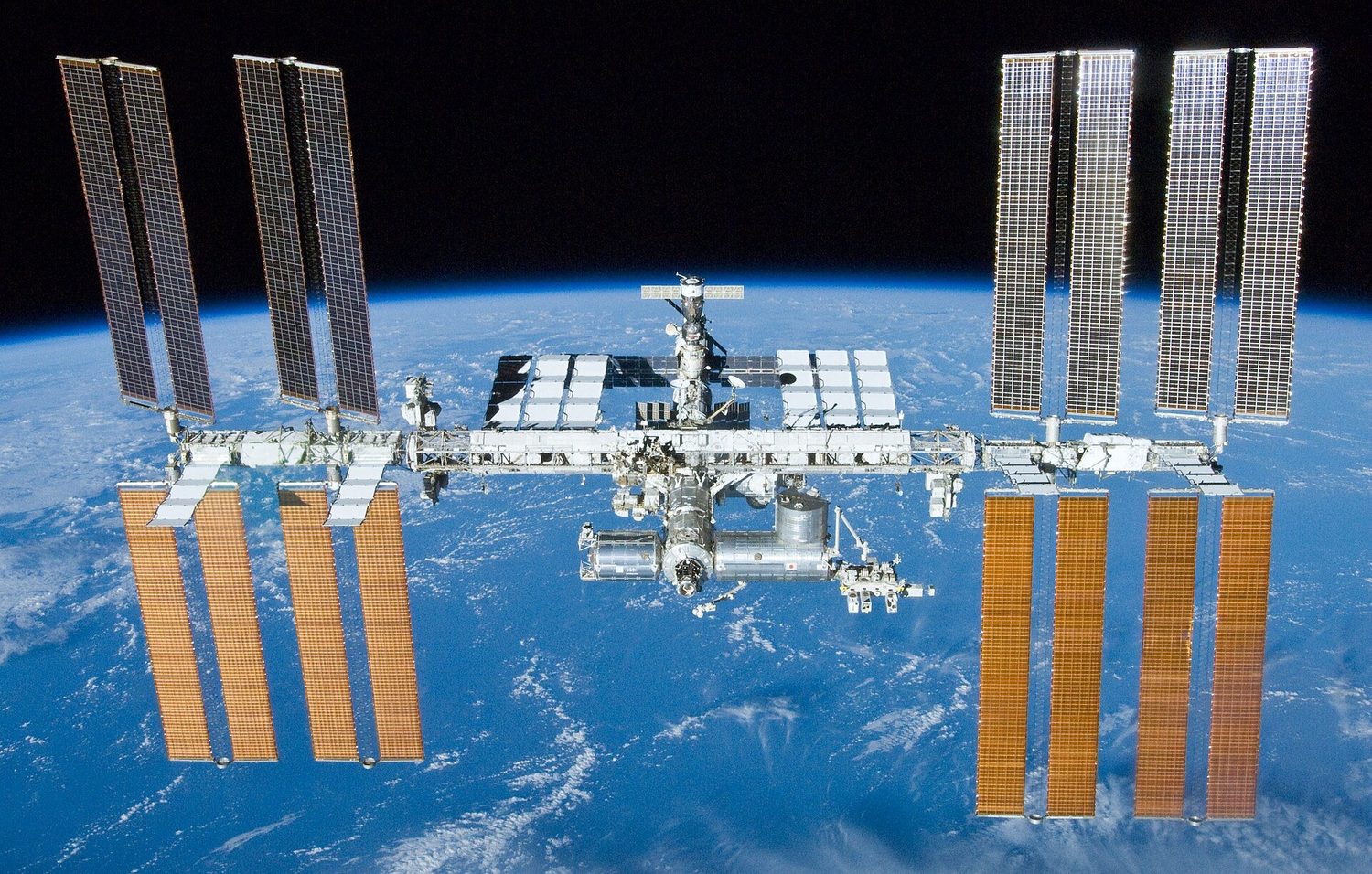
*ISS ในวงโคจร: สมการพารามิเตอร์อธิบายตำแหน่งในฐานะฟังก์ชันของเวลา
สมการพารามิเตอร์ ให้ $x$ และ $y$ แต่ละตัวในฐานะฟังก์ชันของ พารามิเตอร์ $t$ (มักเป็นเวลา): $x=x(t)$, $y=y(t)$. พวกมันวาดเส้นโค้งซึ่งอาจไม่ใช่ฟังก์ชันของ $x$. ความชันของเส้นโค้งหาได้จากกฎโซ่:
$$\frac{dy}{dx}=\frac{dy/dt}{dx/dt}\qquad(dx/dt\neq0).$$
ตัวอย่างที่คำนวณแล้ว. สำหรับ $x=t^2$, $y=t^3-t$, หาความชันที่ $t=2$. ที่นี่ $\dfrac{dx}{dt}=2t$ และ $\dfrac{dy}{dt}=3t^2-1$, ดังนั้น $\dfrac{dy}{dx}=\dfrac{3t^2-1}{2t}$; ที่ $t=2$ ค่านี้คือ $\dfrac{11}{4}$.
Vocabulary · คำศัพท์
Train · ฝึกฝน
| English | ไทย |
|---|---|
| Parametric equations/ˌpærəˈmetrɪk ɪˈkweɪʒnz/ | สมการพารามิเตอร์ |
| vector-valued function/ˈvektə ˈvæljuːd ˈfʌŋkʃn/ | ฟังก์ชันที่มีค่าเป็นเวกเตอร์ |
| Polar coordinates/ˈpəʊlə kəʊˈɔːdɪnəts/ | พิกัดขั้ว |
9.2
Second Derivatives of Parametric Equations · เปรียบเทียบอันดับสองของสมการพารามิเตอร์
Syllabus · หลักสูตร
English
Enduring Understanding (CHA-3): Derivatives allow us to solve real-world problems involving rates of change.
Learning Objective CHA-3.G: Calculate derivatives of parametric functions. BC ONLY
- CHA-3.G.3 $\dfrac{d^2 y}{dx^2}$ can be calculated by dividing $\dfrac{d}{dt}\left(\dfrac{dy}{dx}\right)$ by $\dfrac{dx}{dt}$. BC ONLY
ไทย
ความเข้าใจที่ยั่งยืน (CHA-3): อนุพันธ์ช่วยให้เราแก้ปัญหาจริงที่เกี่ยวข้องกับอัตราการเปลี่ยนแปลง
วัตถุประสงค์การเรียนรู้ CHA-3.G: คำนวณอนุพันธ์ของฟังก์ชันพารามิเตอร์ BC ONLY
- CHA-3.G.3 $\dfrac{d^2 y}{dx^2}$ สามารถคำนวณได้โดยการหาร $\dfrac{d}{dt}\left(\dfrac{dy}{dx}\right)$ ด้วย $\dfrac{dx}{dt}$ เฉพาะ BC เท่านั้น
Source: College Board AP Course and Exam Description · แหล่งที่มา: คำอธิบายหลักสูตรและข้อสอบ College Board AP
English
The second derivative is not $\dfrac{d^2y/dt^2}{d^2x/dt^2}$. Instead, differentiate the first derivative with respect to $t$, then divide by $dx/dt$ again:
$$\frac{d^2y}{dx^2}=\frac{\dfrac{d}{dt}\!\left(\dfrac{dy}{dx}\right)}{dx/dt}.$$
Use it to test concavity of a parametric curve.
ไทย
เปรียบเทียบอันดับสอง ไม่ใช่ $\dfrac{d^2y/dt^2}{d^2x/dt^2}$. แทนที่จะทำนั้น ให้หาอนุพันธ์ของเปรียบเทียบอันดับแรกเทียบกับ $t$ แล้วหารด้วย $dx/dt$ อีกครั้ง:
$$\frac{d^2y}{dx^2}=\frac{\dfrac{d}{dt}\!\left(\dfrac{dy}{dx}\right)}{dx/dt}.$$
ใช้มันเพื่อทดสอบความโค้งเว้าของ curve แบบพารามิเตอร์.
9.3
Finding Arc Lengths of Curves Given by Parametric Equations · การหาความยาวส่วนโค้งของ curves ที่กำหนดโดยสมการพารามิเตอร์
Syllabus · หลักสูตร
English
Enduring Understanding (CHA-6): Definite integrals allow us to solve problems involving the accumulation of change in length over an interval.
Learning Objective CHA-6.B: Determine the length of a curve in the plane defined by parametric functions, using a definite integral. BC ONLY
- CHA-6.B.1 The length of a parametrically defined curve can be calculated using a definite integral. BC ONLY
ไทย
ความเข้าใจที่ยั่งยืน (CHA-6): อินทิกรัลจำกัดจำนวนช่วยให้เราแก้ปัญหาที่เกี่ยวข้องกับการสะสมของการเปลี่ยนแปลงของความยาวในช่วงหนึ่งได้
วัตถุประสงค์การเรียนรู้ CHA-6.B: หาความยาวของเส้นโค้งในระนาบที่กำหนดโดยฟังก์ชันพารามิเตอร์ โดยใช้อินทิกรัลจำกัดจำนวน BC ONLY
- CHA-6.B.1 ความยาวของเส้นโค้งที่กำหนดด้วยพารามิเตอร์สามารถคำนวณได้ด้วยอินทิกรัลจำกัดจำนวน BC ONLY
Source: College Board AP Course and Exam Description · แหล่งที่มา: คำอธิบายหลักสูตรและข้อสอบ College Board AP
English
The length of a parametric curve for $t$ from $a$ to $b$ is
$$L=\int_a^b\sqrt{\left(\frac{dx}{dt}\right)^2+\left(\frac{dy}{dt}\right)^2}\,dt.$$
This is the parametric version of arc length – summing tiny hypotenuses $\sqrt{dx^2+dy^2}$ over the parameter.
ไทย
ความยาวของ curve แบบพารามิเตอร์สำหรับ $t$ จาก $a$ ถึง $b$ คือ
$$L=\int_a^b\sqrt{\left(\frac{dx}{dt}\right)^2+\left(\frac{dy}{dt}\right)^2}\,dt.$$
นี่คือเวอร์ชันแบบพารามิเตอร์ของความยาวส่วนโค้ง – การรวม hypotenuses เล็กน้อย $\sqrt{dx^2+dy^2}$ ตลอดพารามิเตอร์.
9.4
Defining and Differentiating Vector-Valued Functions · การนิยามและหาอนุพันธ์ของฟังก์ชันที่มีค่าเป็นเวกเตอร์
Syllabus · หลักสูตร
English
Enduring Understanding (CHA-3): Derivatives allow us to solve real-world problems involving rates of change.
Learning Objective CHA-3.H: Calculate derivatives of vector-valued functions. BC ONLY
- CHA-3.H.1 Methods for calculating derivatives of real-valued functions can be extended to vector-valued functions. BC ONLY
ไทย
ความเข้าใจที่ยั่งยืน (CHA-3): อนุพันธ์ช่วยให้เราแก้ปัญหาจริงที่เกี่ยวข้องกับอัตราการเปลี่ยนแปลง
วัตถุประสงค์การเรียนรู้ CHA-3.H: คำนวณอนุพันธ์ของฟังก์ชันที่มีค่าเป็นเวกเตอร์ BC ONLY
- CHA-3.H.1 วิธีการหาอนุพันธ์ของฟังก์ชันค่าจริงสามารถขยาย应用到ฟังก์ชันที่มีค่าเป็นเวกเตอร์ได้ BC ONLY
Source: College Board AP Course and Exam Description · แหล่งที่มา: คำอธิบายหลักสูตรและข้อสอบ College Board AP
English
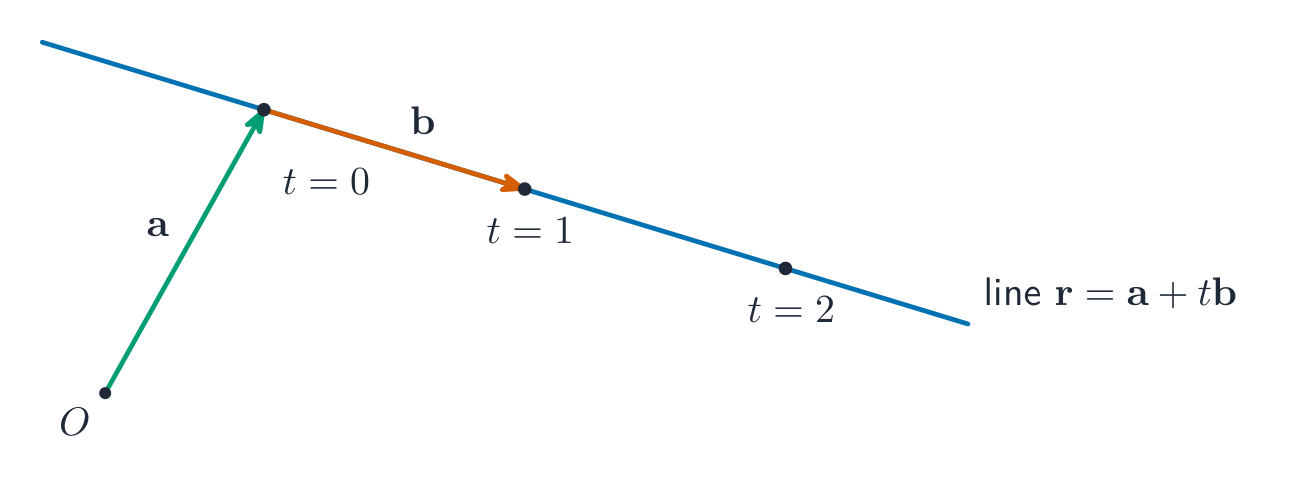
A vector-valued function 向量值函数 $\vec{r}(t)=\langle x(t),\,y(t)\rangle$ gives a position vector for each $t$. Differentiate component-wise: the velocity is $\vec{v}(t)=\langle x'(t),\,y'(t)\rangle$ and the acceleration is $\vec{a}(t)=\langle x''(t),\,y''(t)\rangle$. The speed is the magnitude $|\vec{v}|=\sqrt{x'^2+y'^2}$.
ไทย
ฟังก์ชันที่มีค่าเป็นเวกเตอร์ $\vec{r}(t)=\langle x(t),\,y(t)\rangle$ ให้ position vector สำหรับแต่ละ $t$. หาอนุพันธ์ ตามองค์ประกอบ: ความเร็วคือ $\vec{v}(t)=\langle x'(t),\,y'(t)\rangle$ และ ความเร่งคือ $\vec{a}(t)=\langle x''(t),\,y''(t)\rangle$. ความเร็ว (speed) คือขนาด $|\vec{v}|=\sqrt{x'^2+y'^2}$.
Explore · สำรวจ
Add vector-valued components · เพิ่มองค์ประกอบเวกเตอร์
A vector-valued function packs an $x(t)$ and $y(t)$ into one vector. Differentiating each component gives the velocity vector, tangent to the path. · ฟังก์ชันเวกเตอร์บรรจุ ⟨$x(t)$⟩ และ ⟨$y(t)$⟩ เข้าในเวกเตอร์เดียว การหาอนุพันธ์ของแต่ละองค์ประกอบจะได้เวกเตอร์ความเร็ว ซึ่งสัมผัสกับเส้นทาง
9.5
Integrating Vector-Valued Functions · การอินทิเกรตฟังก์ชันที่มีค่าเป็นเวกเตอร์
Syllabus · หลักสูตร
English
Enduring Understanding (FUN-8): Solving an initial value problem allows us to determine an expression for the position of a particle moving in the plane.
Learning Objective FUN-8.A: Determine a particular solution given a rate vector and initial conditions. BC ONLY
- FUN-8.A.1 Methods for calculating integrals of real-valued functions can be extended to parametric or vector-valued functions. BC ONLY
ไทย
ความเข้าใจที่ยั่งยืน (FUN-8): การแก้ปัญหาค่าเริ่มต้นช่วยให้เราหาสมการสำหรับตำแหน่งของอนุภาคที่เคลื่อนที่ในระนาบได้
วัตถุประสงค์การเรียนรู้ FUN-8.A: หาคำตอบเฉพาะเมื่อกำหนดให้มีความเร็วเป็นเวกเตอร์และเงื่อนไขเริ่มต้น BC ONLY
- FUN-8.A.1 วิธีการหาอินทิกรัลของฟังก์ชันค่าจริงสามารถขยาย应用到ฟังก์ชันพารามิเตอร์หรือฟังก์ชันที่มีค่าเป็นเวกเตอร์ได้ BC ONLY
Source: College Board AP Course and Exam Description · แหล่งที่มา: คำอธิบายหลักสูตรและข้อสอบ College Board AP
English
Integrate a vector function component by component. Given acceleration or velocity plus an initial condition, integrate each component and use the condition to find the constants – recovering velocity from acceleration, or position from velocity.
ไทย
อินทิเกรตฟังก์ชันเวกเตอร์ ทีละองค์ประกอบ. กำหนดความเร่งหรือความเร็วพร้อมเงื่อนไขเริ่มต้น, อินทิเกรตแต่ละองค์ประกอบและใช้เงื่อนไขเพื่อหาค่าคงที่ – สืบคืนความเร็วจากความเร่ง, หรือตำแหน่งจากความเร็ว.
9.6
Solving Motion Problems Using Parametric and Vector-Valued Functions · แก้โจทย์การเคลื่อนที่โดยใช้สมการพารามิเตอร์และฟังก์ชันที่มีค่าเป็นเวกเตอร์
Syllabus · หลักสูตร
English
Enduring Understanding (FUN-8): Solving an initial value problem allows us to determine an expression for the position of a particle moving in the plane.
Learning Objective FUN-8.B: Determine values for positions and rates of change in problems involving planar motion. BC ONLY
- FUN-8.B.1 Derivatives can be used to determine velocity, speed, and acceleration for a particle moving along a curve in the plane defined using parametric or vector-valued functions. BC ONLY
- FUN-8.B.2 For a particle in planar motion over an interval of time, the definite integral of the velocity vector represents the particle's displacement (net change in position) over the interval of time, from which we might determine its position. The definite integral of speed represents the particle's total distance traveled over the interval of time. BC ONLY
ไทย
ความเข้าใจที่ยั่งยืน (FUN-8): การแก้ปัญหาค่าเริ่มต้นช่วยให้เราหาสมการสำหรับตำแหน่งของอนุภาคที่เคลื่อนที่ในระนาบได้
วัตถุประสงค์การเรียนรู้ FUN-8.B: หาค่าสำหรับตำแหน่งและอัตราการเปลี่ยนแปลงในปัญหาเกี่ยวกับการเคลื่อนที่ในระนาบ BC ONLY
- FUN-8.B.1 อนุพันธ์สามารถใช้หาความเร็ว ความเร็วสัมบูรณ์ และความเร่งสำหรับอนุภาคที่เคลื่อนที่ตามเส้นโค้งในระนาบที่กำหนดโดยฟังก์ชันพารามิเตอร์หรือฟังก์ชันที่มีค่าเป็นเวกเตอร์ได้ BC ONLY
- FUN-8.B.2 สำหรับอนุภาคที่เคลื่อนที่ในระนาบในช่วงเวลาหนึ่ง อินทิกรัลจำกัดจำนวนของเวกเตอร์ความเร็วแทนการกระจัดของอนุภาค (การเปลี่ยนแปลงตำแหน่งสุทธิ) ในช่วงเวลานั้น ซึ่งเราสามารถนำไปใช้หาตำแหน่งได้ อินทิกรัลจำกัดจำนวนของความเร็วสัมบูรณ์แทนระยะทางทั้งหมดที่อนุภาคเดินทางในช่วงเวลานั้น BC ONLY
Source: College Board AP Course and Exam Description · แหล่งที่มา: คำอธิบายหลักสูตรและข้อสอบ College Board AP
English
For a particle moving in a plane: position is $\langle x(t),y(t)\rangle$, velocity and acceleration are its derivatives, speed is $|\vec v|$, and the distance traveled over $[a,b]$ is
$$\int_a^b\sqrt{x'(t)^2+y'(t)^2}\,dt.$$
Exam skill: these plane-motion problems appear on the BC free-response nearly every year – be fluent finding speed, the position at a later time (initial point plus the integral of velocity), and total distance.
Worked example. A particle has position $\langle t^2,\ t^3-t\rangle$. Its velocity is $\langle 2t,\ 3t^2-1\rangle$, so at $t=1$ the velocity is $\langle 2,\ 2\rangle$ and the speed is $\sqrt{2^2+2^2}=2\sqrt{2}$. Its position at $t=2$ is $\langle 4,\ 6\rangle$.
ไทย
สำหรับอนุภาคที่เคลื่อนที่ในระนาบ: ตำแหน่งคือ $\langle x(t),y(t)\rangle$, ความเร็วและความเร่งคืออนุพันธ์ของมัน, ความเร็วคือ $|\vec v|$, และ ระยะทางที่เดินทางตลอด $[a,b]$ คือ
$$\int_a^b\sqrt{x'(t)^2+y'(t)^2}\,dt.$$
ทักษะการสอบ: โจทย์การเคลื่อนที่ในระนาบเหล่านี้ปรากฏในข้อ free-response ของ BC เกือบทุกปี – ต้องคล่องในการหาความเร็ว, ตำแหน่ง ณ เวลาถัดไป (จุดเริ่มต้นบวกอินทิกรัลของความเร็ว), และระยะทางทั้งหมด.
ตัวอย่างที่คำนวณแล้ว. อนุภาคมีตำแหน่ง $\langle t^2,\ t^3-t\rangle$. ความเร็วของมันคือ $\langle 2t,\ 3t^2-1\rangle$, ดังนั้นที่ $t=1$ ความเร็วคือ $\langle 2,\ 2\rangle$ และความเร็วคือ $\sqrt{2^2+2^2}=2\sqrt{2}$. ตำแหน่งของมันที่ $t=2$ คือ $\langle 4,\ 6\rangle$.
9.7
Defining Polar Coordinates and Differentiating in Polar Form · การนิยามพิกัดขั้วและการหาอนุพันธ์ในรูปแบบขั้ว
Syllabus · หลักสูตร
English
Enduring Understanding (FUN-3): Recognizing opportunities to apply derivative rules can simplify differentiation.
Learning Objective FUN-3.G: Calculate derivatives of functions written in polar coordinates. BC ONLY
- FUN-3.G.1 Methods for calculating derivatives of real-valued functions can be extended to functions in polar coordinates. BC ONLY
- FUN-3.G.2 For a curve given by a polar equation $r = f(\theta)$, derivatives of $r$, $x$, and $y$ with respect to $\theta$, and first and second derivatives of $y$ with respect to $x$ can provide information about the curve. BC ONLY
ไทย
ความเข้าใจที่ยั่งยืน (FUN-3): การตระหนักถึงโอกาสในการใช้กฎอนุพันธ์สามารถทำให้การหาอนุพันธ์ง่ายขึ้น
วัตถุประสงค์การเรียนรู้ FUN-3.G: คำนวณอนุพันธ์ของฟังก์ชันที่เขียนในพิกัดขั้ว BC ONLY
- FUN-3.G.1 วิธีการหาอนุพันธ์ของฟังก์ชันค่าจริงสามารถขยาย应用到ฟังก์ชันในพิกัดขั้วได้ BC ONLY
- FUN-3.G.2 สำหรับเส้นโค้งที่กำหนดโดยสมการขั้ว $r = f(\theta)$, อนุพันธ์ของ $r$, $x$ และ $y$ เทียบกับ $\theta$, และอนุพันธ์อันดับหนึ่งและอันดับสองของ $y$ เทียบกับ $x$ สามารถให้ข้อมูลเกี่ยวกับเส้นโค้งได้ BC ONLY
Source: College Board AP Course and Exam Description · แหล่งที่มา: คำอธิบายหลักสูตรและข้อสอบ College Board AP
English
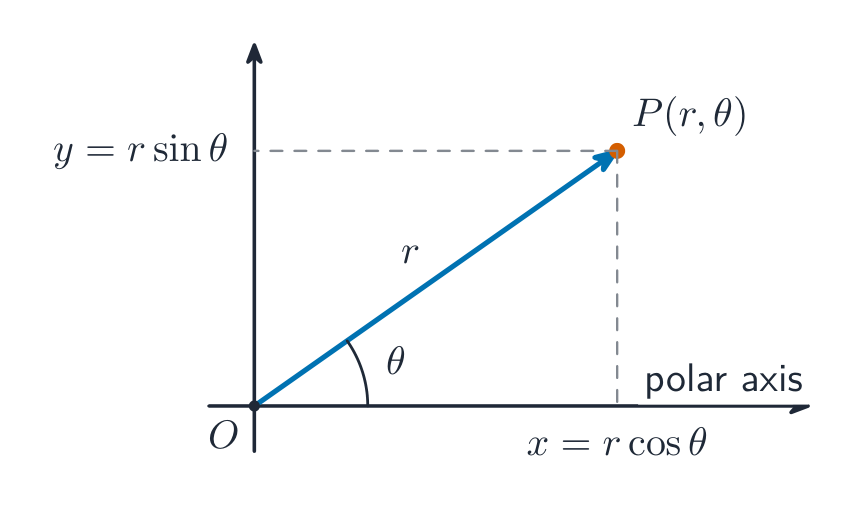
Polar coordinates 极坐标 locate a point by its distance $r$ from the origin and angle $\theta$: convert with $x=r\cos\theta$, $y=r\sin\theta$. A polar curve $r=f(\theta)$ is a parametric curve in $\theta$, so its slope is
$$\frac{dy}{dx}=\frac{dy/d\theta}{dx/d\theta},\quad\text{with } x=r\cos\theta,\ y=r\sin\theta.$$
ไทย
พิกัดขั้ว ตั้งตำแหน่งจุดโดยระยะ $r$ จากจุดกำเนิดและมุม $\theta$: แปลงด้วย $x=r\cos\theta$, $y=r\sin\theta$. Curve ขั้ว $r=f(\theta)$ เป็น curve แบบพารามิเตอร์ใน $\theta$, ดังนั้นความชันของมันคือ
$$\frac{dy}{dx}=\frac{dy/d\theta}{dx/d\theta},\quad\text{with } x=r\cos\theta,\ y=r\sin\theta.$$
Explore · สำรวจ
Plot a polar curve · พล็อตเส้นโค้งขั้ว
In polar coordinates a point is a distance $r$ at angle $\theta$. Letting $r$ depend on $\theta$ traces curves like this cardioid. · ในพิกัด ขั้ว จุดหนึ่งคือระยะ $r$ ที่มุม $\theta$ การให้ $r$ ขึ้นอยู่กับ $\theta$ จะพล็อตเส้นโค้งเช่นคาร์ดิอยด์นี้
9.8
Finding the Area of a Polar Region · การหาพื้นที่ของบริเวณขั้ว
Syllabus · หลักสูตร
English
Enduring Understanding (CHA-5): Definite integrals allow us to solve problems involving the accumulation of change in area or volume over an interval.
Learning Objective CHA-5.D: Calculate areas of regions defined by polar curves using definite integrals. BC ONLY
- CHA-5.D.1 The concept of calculating areas in rectangular coordinates can be extended to polar coordinates. BC ONLY
ไทย
ความเข้าใจที่ยั่งยืน (CHA-5): อินทิกรัลจำกัดช่วยให้เราแก้ปัญหาเกี่ยวกับการสะสมของการเปลี่ยนแปลงในพื้นที่หรือปริมาตรในช่วงหนึ่งได้
วัตถุประสงค์การเรียนรู้ CHA-5.D: คำนวณพื้นที่ของภูมิภาคที่กำหนดโดยเส้นโค้งขั้วโดยใช้อินทิกรัลจำกัดจำนวน BC ONLY
- CHA-5.D.1 แนวคิดในการคำนวณพื้นที่ในพิกัดฉากสามารถขยาย应用到พิกัดขั้วได้ BC ONLY
Source: College Board AP Course and Exam Description · แหล่งที่มา: คำอธิบายหลักสูตรและข้อสอบ College Board AP
English
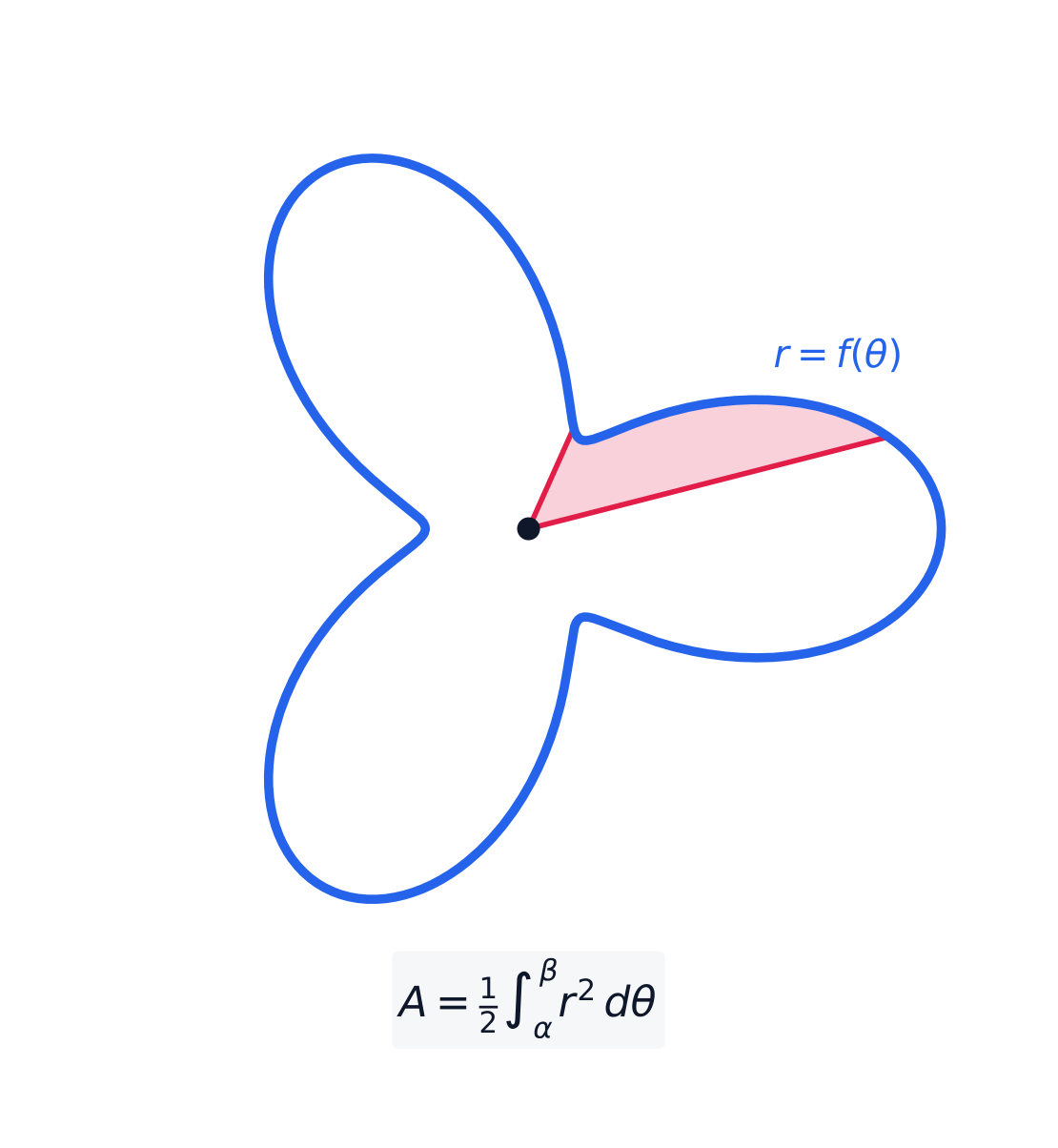
The area swept out by a polar curve $r=f(\theta)$ from $\alpha$ to $\beta$ is
$$A=\frac12\int_\alpha^\beta \big(f(\theta)\big)^2\,d\theta.$$
The region is a "fan" of thin triangular sectors; choosing the correct $\theta$-limits (where the curve starts and finishes tracing the region) is the main challenge.
Worked example. Find the area of one petal of the rose $r=2\sin(2\theta)$ (traced for $\theta$ from $0$ to $\tfrac{\pi}{2}$). Using $\sin^2 u=\tfrac12(1-\cos 2u)$,
$$A=\frac12\int_0^{\pi/2}(2\sin 2\theta)^2\,d\theta=\int_0^{\pi/2}(1-\cos 4\theta)\,d\theta=\left[\theta-\tfrac{\sin 4\theta}{4}\right]_0^{\pi/2}=\frac{\pi}{2}.$$
ไทย
พื้นที่ที่ swept out โดย curve ขั้ว $r=f(\theta)$ จาก $\alpha$ ถึง $\beta$ คือ
$$A=\frac12\int_\alpha^\beta \big(f(\theta)\big)^2\,d\theta.$$
บริเวณนี้เป็น "พัด" ของ sectors สามเหลี่ยมบางๆ; การเลือก $\theta$-limits ที่ถูกต้อง (ที่ curve เริ่มต้นและจบการ tracing บริเวณ) เป็นความท้าทายหลัก.
ตัวอย่างแสดงวิธีทำ. หาพื้นที่ของกลีบหนึ่งดอกกุหลาบ $r=2\sin(2\theta)$ (วาดสำหรับ $\theta$ จาก $0$ ถึง $\tfrac{\pi}{2}$). ใช้ $\sin^2 u=\tfrac12(1-\cos 2u)$,
$$A=\frac12\int_0^{\pi/2}(2\sin 2\theta)^2\,d\theta=\int_0^{\pi/2}(1-\cos 4\theta)\,d\theta=\left[\theta-\tfrac{\sin 4\theta}{4}\right]_0^{\pi/2}=\frac{\pi}{2}.$$
9.9
Finding the Area of the Region Bounded by Two Polar Curves · การหาพื้นที่ของบริเวณที่จำกัดโดย curve ขั้วสองเส้น
Syllabus · หลักสูตร
English
Enduring Understanding (CHA-5): Definite integrals allow us to solve problems involving the accumulation of change in area or volume over an interval.
Learning Objective CHA-5.D: Calculate areas of regions defined by polar curves using definite integrals. BC ONLY
- CHA-5.D.2 Areas of regions bounded by polar curves can be calculated with definite integrals. BC ONLY
ไทย
ความเข้าใจที่ยั่งยืน (CHA-5): อินทิกรัลจำกัดช่วยให้เราแก้ปัญหาเกี่ยวกับการสะสมของการเปลี่ยนแปลงในพื้นที่หรือปริมาตรในช่วงหนึ่งได้
วัตถุประสงค์การเรียนรู้ CHA-5.D: คำนวณพื้นที่ของภูมิภาคที่กำหนดโดยเส้นโค้งขั้วโดยใช้อินทิกรัลจำกัดจำนวน BC ONLY
- CHA-5.D.2 พื้นที่ของบริเวณที่จำกัดด้วยเส้นโค้งขั้วสามารถคำนวณได้โดยใช้อินทิกรัล_examples_ เฉพาะ BC เท่านั้น
Source: College Board AP Course and Exam Description · แหล่งที่มา: คำอธิบายหลักสูตรและข้อสอบ College Board AP
English
For the area between an outer curve $r_1$ and an inner curve $r_2$, subtract the sectors:
$$A=\frac12\int_\alpha^\beta\big(r_1^2-r_2^2\big)\,d\theta.$$
Find the intersection angles first (set $r_1=r_2$), and be careful which curve is outer over each interval – they can swap.
ไทย
สำหรับพื้นที่ระหว่าง curve ภายนอก $r_1$ และ curve ภายใน $r_2$, ลบ sectors ออก:
$$A=\frac12\int_\alpha^\beta\big(r_1^2-r_2^2\big)\,d\theta.$$
หา มุมตัดกัน ก่อน (ตั้ง $r_1=r_2$), และระวังว่า curve کدامเป็นภายนอกเหนือแต่ละช่วง – พวกมันสามารถสลับกันได้.
9.9
Exam tips · ข้อแนะนำสำหรับการสอบ
English
- For parametric curves, $\tfrac{dy}{dx}=\tfrac{dy/dt}{dx/dt}$; speed is $\sqrt{(dx/dt)^2+(dy/dt)^2}$.
- A vector-valued function carries the same information — differentiate/integrate it component by component.
- In polar, convert with $x=r\cos\theta$, $y=r\sin\theta$; area swept is $\tfrac12\int r^2\,d\theta$.
- Watch the direction of tracing (the sign of $dx/dt$) and set correct $\theta$-limits for polar area.
- Eliminate the parameter to recover the ordinary $y$-vs-$x$ shape when it helps.
ไทย
- สำหรับ curve แบบพารามิเตอร์, $\tfrac{dy}{dx}=\tfrac{dy/dt}{dx/dt}$; ความเร็วคือ $\sqrt{(dx/dt)^2+(dy/dt)^2}$.
- ฟังก์ชันที่มีค่าเป็นเวกเตอร์ นำข้อมูลเดียวกันมา – หาอนุพันธ์/อินทิเกรตมันทีละองค์ประกอบ.
- ใน ขั้ว, แปลงด้วย $x=r\cos\theta$, $y=r\sin\theta$; พื้นที่ที่ swept out คือ $\tfrac12\int r^2\,d\theta$.
- ระวังทิศทางของการ tracing (เครื่องหมายของ $dx/dt$) และตั้ง $\theta$-limits ที่ถูกต้องสำหรับพื้นที่ขั้ว.
- กำจัดพารามิเตอร์เพื่อ recovery รูปทรง $y$-vs-$x$ ปกติเมื่อมันช่วยได้.
Interactive lessons on this topic · บทเรียนเชิงโต้ตอบสำหรับหัวข้อนี้
Work through it step by step, with instant-check exercises. · ทำทีละขั้นตอน พร้อมแบบฝึกหัดตรวจสอบผลทันที
- Defining and Differentiating Parametric Equations · การกำหนดและหาอนุพันธ์ของสมการพารามิเตอร์
- Second Derivatives of Parametric Equations · อนุพันธ์อันดับสองของสมการพารามิเตอร์
- Finding Arc Lengths of Curves Given by Parametric Equations · การหาความยาวส่วนโค้งของเส้นโค้งที่กำหนดโดยสมการพารามิเตอร์
- Defining and Differentiating Vector-Valued Functions · การนิยามและการหาอนุพันธ์ฟังก์ชันที่มีค่าเป็นเวกเตอร์
- Integrating Vector-Valued Functions · การอินทิเกรลฟังก์ชันที่มีค่าเป็นเวกเตอร์
- Solving Motion Problems Using Parametric and Vector-Valued Functions · การแก้ปัญหาการเคลื่อนที่โดยใช้สมการพารามิเตอร์และฟังก์ชันที่มีค่าเป็นเวกเตอร์
- Defining Polar Coordinates and Differentiating in Polar Form · การนิยามพิกัดขั้วและการหาอนุพันธ์ในรูปขั้ว
- Find the Area of a Polar Region or the Area Bounded by a Single Polar Curve · การหาพื้นที่ของบริเวณขั้วหรือพื้นที่ที่จำกัดด้วยเส้นโค้งขั้วเดียว
- Finding the Area of the Region Bounded by Two Polar Curves · การหาพื้นที่ของบริเวณที่จำกัดด้วยเส้นโค้งเชิงขั้วสองเส้น
Past Papers · ข้อสอบย้อนหลัง
More topics in AP Calculus BC · หัวข้อเพิ่มเติมใน AP Calculus BC
- Limits and Continuity · ลิมิตและความต่อเนื่อง
- Differentiation: Definition and Fundamental Properties · ดิฟเฟอเรนเชียชัน: นิยามและคุณสมบัติพื้นฐาน
- Differentiation: Composite, Implicit, and Inverse Functions · ดิฟเฟอเรนเชียชัน: ฟังก์ชันผสม ฟังก์ชันโดยนัย และฟังก์ชันผกผัน
- Contextual Applications of Differentiation · การใช้งานบริบทของดิฟเฟอเรนเชียชัน
- Analytical Applications of Differentiation · การใช้งานเชิงวิเคราะห์ของดิฟเฟอเรนเชียชัน
- Integration and Accumulation of Change · อินทิเกรชันและการสะสมของการเปลี่ยนแปลง