Skip to content · ⁨ข้ามไปยังเนื้อหา⁩

Particle physics · ⁨ฟิสิกส์อนุภาค⁩

A-Level Physics · ⁨Physics A-Level⁩ · Topic 11 · ⁨หัวข้อ 11⁩

Video lesson for this topic · ⁨บทเรียนวิดีโอสำหรับหัวข้อนี้⁩ Open the video page · ⁨เปิดหน้าวิดีโอ⁩
19:01

อะตอมแบบนิวเคลียส

เมื่อร้อยกว่าปีก่อน นักฟิสิกส์ได้ยิงอนุภาคอัลฟาขนาดเล็กลงบนแผ่นฟอยล์ทองคำซึ่งบางกว่ากระดาษ พวกเขาคาดหวังว่าอนุภาคเหล่านี้จะทะลุผ่านไปในแนวตรง…

English narration · English + 中文 subtitles burned in · ⁨การบรรยายภาษาอังกฤษ · คำบรรยายภาษาอังกฤษ + 中文 ลอยตัวบนภาพ⁩

11.1

The nuclear atom

Syllabus · ⁨หลักสูตร⁩
English
  1. infer from the results of the $\alpha$-particle scattering experiment the existence and small size of the nucleus
  2. describe a simple model for the nuclear atom to include protons, neutrons and orbital electrons
  3. distinguish between nucleon number and proton number
  4. understand that isotopes are forms of the same element with different numbers of neutrons in their nuclei
  5. understand and use the notation $_Z^A\text{X}$ for the representation of nuclides
  6. understand that nucleon number and charge are conserved in nuclear processes
  7. describe the composition, mass and charge of $\alpha$-, $\beta$- and $\gamma$-radiations (both $\beta^-$ (electrons) and $\beta^+$ (positrons) are included)
  8. understand that an antiparticle has the same mass but opposite charge to the corresponding particle, and that a positron is the antiparticle of an electron
  9. state that (electron) antineutrinos are produced during $\beta^-$ decay and (electron) neutrinos are produced during $\beta^+$ decay
  10. understand that $\alpha$-particles have discrete energies but that $\beta$-particles have a continuous range of energies because (anti)neutrinos are emitted in $\beta$-decay
  11. represent $\alpha$- and $\beta$-decay by a radioactive decay equation of the form $^{238}_{92}\text{U} \rightarrow ^{234}_{90}\text{Th} + ^4_2\alpha$
  12. use the unified atomic mass unit (u) as a unit of mass
ไทย
  1. สรุปจากการทดลองการกระเจิงอนุภาค $\alpha$ ว่ามี นิวเคลียส อยู่และมีขนาดเล็กมาก
  2. อธิบายแบบจำลองอย่างง่ายของ อะตอมแบบนิวเคลียส โดยรวมถึง โปรตอน, นิวตรอน และ อิเล็กตรอนในวงโคจร
  3. แยกแยะระหว่าง เลขมวล กับ เลขอะตอม
  4. เข้าใจว่า ไอโซโทป คือรูปทรงของธาตุเดียวกันที่มีจำนวนนิวตรอนต่างกันภายในนิวเคลียส
  5. เข้าใจและใช้สัญลักษณ์ $_Z^A\text{X}$ ในการแสดง นิวไคลด์
  6. เข้าใจว่าเลขมวลและประจุมีค่าคงที่ในปฏิกิริยานิวเคลียร์
  7. อธิบายองค์ประกอบ มวล และประจุของรังสี $\alpha$-, $\beta$- และ $\gamma$- (รวมถึง $\beta^-$ (อิเล็กตรอน) และ $\beta^+$ (โพซิตรอน) ด้วย)
  8. เข้าใจว่า อนุภาคปฏิสัมพันธ์ มีมวลเท่าเดิมแต่มีประจุตรงข้ามกับอนุภาคที่เกี่ยวข้อง และ โพซิตรอนคืออนุภาคปฏิสัมพันธ์ของอิเล็กตรอน
  9. ระบุว่า (อิเล็กตรอน)แอนตินิวทริโน ถูกสร้างในระหว่างการสลายตัว $\beta^-$ และ (อิเล็กตรอน)นิวทริโน ถูกสร้างในระหว่างการสลายตัว $\beta^+$
  10. เข้าใจว่าอนุภาค $\alpha$ มี พลังงานแบบไม่ต่อเนื่อง แต่อนุภาค $\beta$ มี ช่วงพลังงานต่อเนื่อง เนื่องจากมีการปล่อย (แอนติ)นิวทริโน ออกมาในการสลายตัว $\beta$
  11. แสดงการสลายตัว $\alpha$ และ $\beta$ โดยใช้ สมการการสลายตัวของสารกัมมันต์ รูปแบบ $^{238}_{92}\text{U} \rightarrow ^{234}_{90}\text{Th} + ^4_2\alpha$
  12. ใช้ หน่วยมวลอะตอมรวม (u) เป็นหน่วยของมวล

Source: Cambridge International syllabus · ⁨แหล่งที่มา: หลักสูตร Cambridge International⁩

English

Geiger–Marsden α-particle scattering

Alpha particles α粒子 fired at a thin gold foil were seen to:

  • mostly pass straight through, with very little deflection 偏转,
  • sometimes deflect through small angles,
  • rarely (about $1$ in $8000$) deflect through angles greater than $90°$.

From this Rutherford worked out:

  • the atom is mostly empty space (most α-particles pass straight through),
  • there is a tiny, dense, positively charged nucleus 原子核 at the centre (the rare large deflections need a concentrated charge to push the α away),
  • almost all of the atom's mass is in this nucleus.

Order of magnitude: atom diameter $\sim 10^{-10}\ \text{m}$, nucleus diameter $\sim 10^{-15}\ \text{m}$ — the nucleus is about $10^{5}$ times smaller than the atom.

The three results and what each proves — the mark scheme pairs them exactly like this:

Observation Conclusion
the vast majority pass straight through with little or no deflection most of the atom is empty space
a small number are deflected through small angles there is a concentrated positive charge (the nucleus) that repels the positive α-particles
a very small minority (about 1 in 8000) are deflected through more than 90°, some straight back the nucleus is very small compared with the atom, and contains almost all of the atom's mass

Three details of the experiment are also asked: the foil is thin so that each α-particle meets at most one nucleus (and is not absorbed); the chamber is a vacuum so the α-particles are not stopped or scattered by air; gold is used because it can be beaten into a very thin sheet and has a heavy, highly charged nucleus.

Worked example. Explain why a very small minority of the α-particles are scattered through angles greater than 90°.

Only an α-particle that approaches a nucleus almost head-on is turned back. The nucleus and the α-particle are both positive, so the electrostatic 静电 repulsion is very large at small separation, and the nucleus is much more massive than the α-particle, so it is the α-particle that is turned round. Because the nucleus is tiny, very few α-particles get that close — hence the small minority. As the α-particle approaches, its kinetic energy is converted to electric potential energy; at the point of closest approach it is momentarily at rest and all of its kinetic energy has become potential energy.

The deflection depends on how close the path passes to the nucleus: the smaller the distance, the larger the angle, and the paths are symmetrical about the line through the nucleus.

Simple nuclear model

An atom has:

  • a central nucleus of protons 质子 (positive, charge $+e$) and neutrons 中子 (no charge),
  • electrons 电子 (charge $-e$) around the nucleus.

The proton and neutron have almost the same mass ($\approx 1\ \text{u}$); the electron is about $\tfrac{1}{1836}$ of the proton's mass.

Worked example. Describe the structure of an atom of uranium-238, $^{238}_{92}\text{U}$.

A nucleus containing 92 protons and $238 - 92 = 146$ neutrons, with 92 electrons in orbit around it. "Orbital electrons" is the syllabus phrase — the electrons are outside the nucleus, and the neutral atom has as many electrons as protons.

Notation and key numbers

For a nuclide 核素 written $^{A}_{Z}\text{X}$:

  • proton number 质子数 $Z$ (also the atomic number): the number of protons. It fixes the element.
  • nucleon number 核子数 $A$ (also the mass number): the total number of nucleons 核子 (protons + neutrons).
  • number of neutrons $N = A - Z$.

A neutral atom has the same number of electrons as protons.

Isotopes

Isotopes 同位素 are atoms of the same element (same $Z$) with different numbers of neutrons (different $A$). They behave the same chemically but differently in the nucleus. Example: $^{12}_{6}\text{C}$ and $^{14}_{6}\text{C}$ are isotopes of carbon.

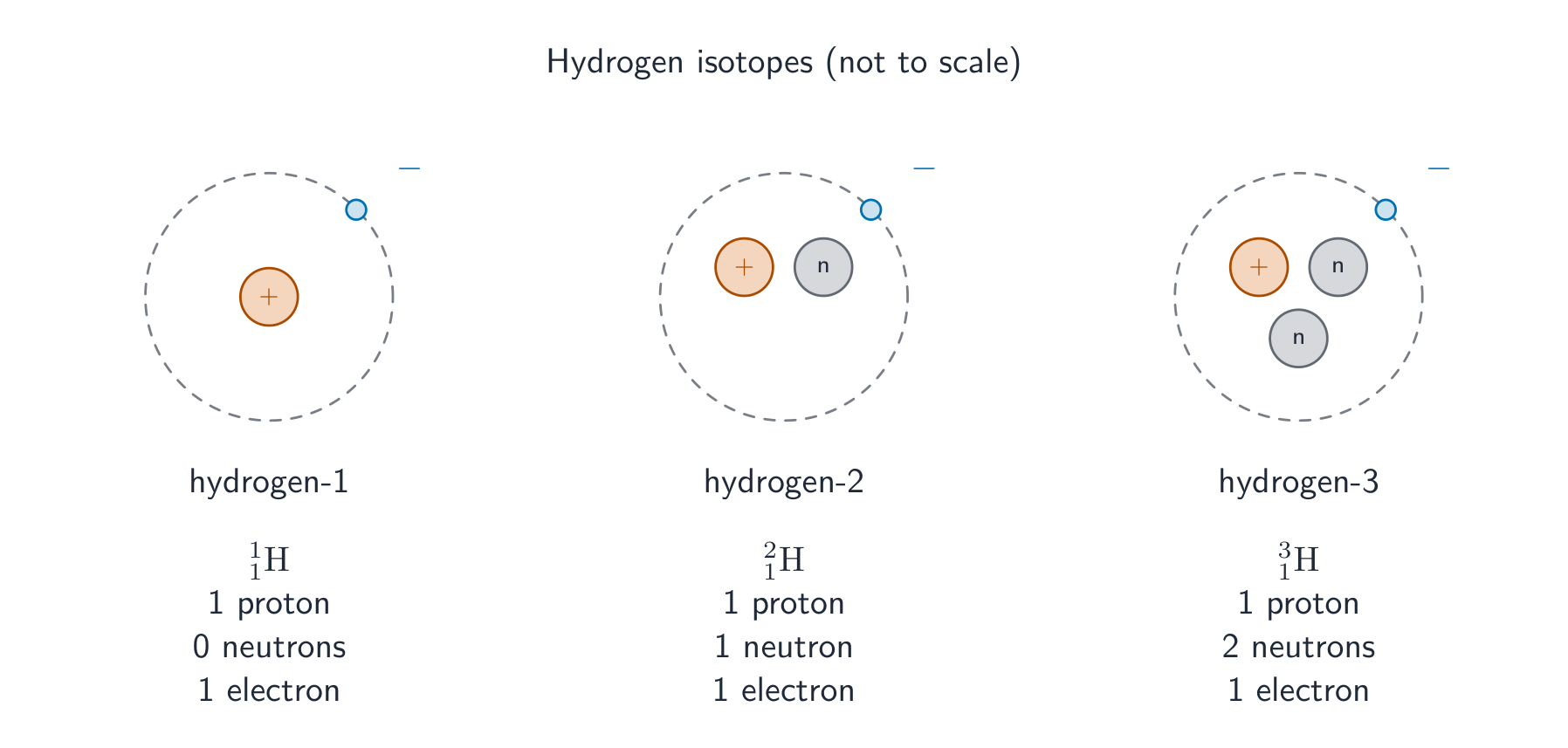
The examiner's wording: isotopes are nuclei (or atoms) with the same number of protons but different numbers of neutrons — equivalently the same proton number $Z$ and different nucleon numbers $A$. Hydrogen has three:

Worked example. Tritium, $^{3}_{1}\text{H}$, is an isotope of hydrogen. State the numbers of protons, neutrons and electrons in a neutral tritium atom, and give the quark composition of its nucleus.

$Z = 1$ proton; $A - Z = 3 - 1 = 2$ neutrons; 1 electron (neutral, so electrons $=$ protons). The nucleus is one proton (uud) and two neutrons (udd, udd): 4 up quarks and 5 down quarks. Charge check: $4 \times \tfrac{2}{3} - 5 \times \tfrac{1}{3} = +1$, the proton number. A "labelled diagram" of the atom is the nucleus (1 p, 2 n) with one electron orbiting outside it.

Conservation laws in nuclear processes

In any nuclear process:

  • nucleon number $A$ is conserved (total $A$ before $=$ total $A$ after),
  • charge is conserved (this is conservation of charge 电荷守恒).

These two rules let you balance decay and reaction equations.

Unified atomic mass unit

The unified atomic mass unit 统一原子质量单位, symbol $\text{u}$, is set so that an atom of $^{12}_{6}\text{C}$ has mass exactly $12\ \text{u}$. Numerically,

$$1\ \text{u} = 1.661 \times 10^{-27}\ \text{kg}.$$

A proton has mass $\approx 1.007\ \text{u}$; a neutron $\approx 1.009\ \text{u}$; an electron $\approx 5.5 \times 10^{-4}\ \text{u}$.

Worked example. A nucleus X has 14 nucleons and $p$ protons. Its charge-to-mass ratio is $4.1 \times 10^{7}\ \text{C kg}^{-1}$. Find $p$ and identify X.

Charge $= pe$; mass $\approx 14\ \text{u}$. So $\dfrac{pe}{14\text{u}} = 4.1 \times 10^{7}$, giving $p = \dfrac{4.1 \times 10^{7} \times 14 \times 1.66 \times 10^{-27}}{1.60 \times 10^{-19}} = 5.96 \approx 6$. Six protons and 14 nucleons: X is carbon-14, $^{14}_{6}\text{C}$. Keep every figure until the end, then round to the nearest whole number of protons.

ไทย

Geiger–Marsden α-particle scattering

อนุภาคอัลฟา α ที่ยิงเข้าหาแผ่นทองคำบางถูกสังเกตว่า:

  • ส่วนใหญ่พุ่งผ่านตรงไปโดยมีการเบี่ยงเบนน้อยมาก,
  • บางครั้งเบี่ยงเบนด้วยมุมเล็ก,
  • น้อยมาก (ประมาณ $1$ ใน $8000$) จะเบี่ยงเบนด้วยมุมมากกว่า $90°$.

จากข้อนี้ รัทเทอร์ฟอร์ดได้สรุปได้ว่า:

  • อะตอมเป็น พื้นที่ว่างส่วนใหญ่ (อนุภาค α绝大部分พุ่งผ่านตรงไป),
  • มี นิวเคลียส ขนาดเล็กหนาแน่นและมีประจุบวกอยู่ตรงกลาง (การเบี่ยงเบนมุมใหญ่ที่หายากจำเป็นต้องมีประจุรวมตัวกันเพื่อผลักอนุภาค α ออกไป),
  • มวลเกือบทั้งหมดของอะตอมจะอยู่ในนิวเคลียสนี้.

Order of magnitude: เส้นผ่านศูนย์กลางอะตอม $\sim 10^{-10}\ \text{m}$, เส้นผ่านศูนย์กลางนิวเคลียส $\sim 10^{-15}\ \text{m}$ — นิวเคลียสมีขนาดเล็กกว่าอะตอมประมาณ $10^{5}$ เท่า

ผลจากการทดลองทั้งสามและสิ่งที่พิสูจน์ได้ — แผนการให้คะแนนจับคู่กันตามนี้:

การสังเกต บทสรุป
ส่วนใหญ่พุ่งผ่านตรงไปโดยไม่มีการเบี่ยงเบนหรือเบี่ยงเบนเล็กน้อย ส่วนใหญ่ของอะตอมเป็นพื้นที่ว่าง
จำนวนเล็กน้อยถูกเบี่ยงเบนด้วยมุมเล็ก มีประจุบวกที่รวมตัวกัน (นิวเคลียส) ซึ่งผลักอนุภาค α ที่มีประจุบวก
กลุ่มน้อยมาก (ประมาณ 1 ใน 8000) ถูกเบี่ยงเบนมากกว่า 90° บางส่วนสะท้อนกลับ นิวเคลียสมีขนาดเล็กเมื่อเทียบกับอะตอม และมีมวลเกือบทั้งหมดของอะตอม

รายละเอียดของการทดลอง还包括:แผ่นทองคำต้อง บาง เพื่อให้แต่ละอนุภาค α เจอนิวเคลียสเพียงหนึ่งตัวเท่านั้น (และไม่ถูกดูดกลืน); ห้องทดลองเป็น สุญญากาศ เพื่อไม่ให้อนุภาค α ถูกหยุดหรือกระจัดกระจายโดยอากาศ; ใช้ทองคำเพราะสามารถบดอัดให้เป็นแผ่นบางมากและมีนิวเคลียสที่มีมวลสูงและมีประจุมาก

ตัวอย่างวิธีทำ. อธิบายว่าทำไมกลุ่มน้อยมากของอนุภาค α จึงถูกกระจัดกระจายด้วยมุมมากกว่า 90°.

เฉพาะอนุภาค α ที่พุ่งเข้าใกล้นิวเคลียสแบบ ชนตรง เท่านั้นที่จะถูกสะท้อนกลับ นิวเคลียสและอนุภาค α มีประจุบวกทั้งคู่ ดังนั้นแรงผลักรังสีไฟฟ้าจึงมีค่ามหาศาลเมื่อระยะห่างใกล้ และนิวเคลียสมีมวลมากกว่าอนุภาค α มาก ดังนั้นจึงเป็นอนุภาค α ที่ถูกเปลี่ยนทิศทาง เมื่ออนุภาค α เข้าใกล้ พลังงานจลน์จะถูกแปลงเป็นพลังงานศักย์ไฟฟ้า; ณ จุดที่ใกล้ที่สุด它会 momentarily at rest and all of its kinetic energy has become potential energy.

การเบี่ยงเบนขึ้นอยู่กับความใกล้เคียงของเส้นทางกับนิวเคลียส: ระยะทางยิ่งน้อย มุมยิ่งมาก และเส้นทางจะสมมาตรรอบเส้นที่ผ่านนิวเคลียส

อุปกรณ์การกระเจิงแอลฟา: แหล่งกำเนิดแอลฟาและแผ่นทองคำบางภายในห้องสุญญากาศ พร้อมเครื่องตรวจจับสังกะสีซัลไฟด์บนกล้องจุลทรรศน์ที่สามารถเคลื่อนที่ได้เพื่อวัดที่มุมต่างๆ
การทดลองการกระเจิง $\alpha$ — อนุภาค $\alpha$ ชนแผ่นทองคำบางในสุญญากาศ
เส้นทางของอนุภาคแอลฟาใกล้กับนิวเคลียสขนาดเล็กหนาแน่น: ส่วนใหญ่พุ่งผ่านเกือบตรงไป บางส่วนเบี่ยงเบนด้วยมุมเล็ก และหายากที่部份ที่พุ่งเข้าชนตรงจะถูกกระจัดกระจายกลับที่จุดใกล้ที่สุด
อนุภาค $\alpha$ ส่วนใหญ่พุ่งผ่านเกือบตรงไป; บางส่วนเบี่ยงเบนอย่างรุนแรงโดยนิวเคลียสขนาดเล็ก

โมเดลนิวเคลียสอย่างง่าย

อะตอมประกอบด้วย:

  • นิวเคลียสตรงกลางของ โปรตอน (ประจุบวก, ประจุ $+e$) และ นิวตรอน (ไม่มีประจุ),
  • อิเล็กตรอน (ประจุ $-e$) ล้อมรอบนิวเคลียส

โปรตอนและนิวตรอนมีมวลเกือบเท่ากัน ($\approx 1\ \text{u}$); อิเล็กตรอนมีมวลประมาณ $\tfrac{1}{1836}$ ของมวลโปรตอน

โมเดลอะตอมสองแบบ: ก) อะตอมฮีเลียมที่มีโปรตอน 2 ตัวและนิวตรอน 2 ตัวในนิวเคลียสและอิเล็กตรอน 2 ตัวบนชั้นเดียว, ข) อะตอมลิเธียมที่มีโปรตอน 3 ตัวและนิวตรอน 4 ตัวและอิเล็กตรอนอยู่บนสองชั้น (สองชั้นใน, ชั้นนอกหนึ่งชั้น)
โมเดลเรียบง่ายของอะตอมฮีเลียมและลิเธียม (ไม่ใช่มาตราส่วน)

ตัวอย่างวิธีทำ. อธิบายโครงสร้างของอะตอมยูเรเนียม-238, $^{238}_{92}\text{U}$.

นิวเคลียสที่มีโปรตอน 92 ตัวและ $238 - 92 = 146$ นิวตรอน, พร้อมอิเล็กตรอน 92 ตัวโคจรอยู่รอบๆ. “อิเล็กตรอนโคจร” เป็นคำศัพท์ในหลักสูตร — อิเล็กตรอนอยู่ภายนอกนิวเคลียส และอะตอมที่เป็นกลางจะมีจำนวนอิเล็กตรอนเท่ากับจำนวนโปรตอน

สัญลักษณ์และตัวเลขสำคัญ

สำหรับ นิวคลีด ที่เขียนว่า $^{A}_{Z}\text{X}$:

สัญลักษณ์นิวคลีด: ตัวเลขด้านบนคือเลขมวล A, ตัวเลขด้านล่างคือเลขอะตอม Z
สัญลักษณ์นิวคลีด: เลขมวลด้านบน เลขอะตอมด้านล่าง
  • เลขอะตอม $Z$ (หรือเลขอะตอม): จำนวนโปรตอน ซึ่งกำหนดชนิดของธาตุ
  • เลขมวล $A$ (หรือเลขนิวคลีด): จำนวนรวมของ นิวคลีออน (โปรตอน + นิวตรอน).
  • จำนวนนิวตรอน $N = A - Z$.

อะตอมที่เป็นกลางมีจำนวนอิเล็กตรอนเท่ากับจำนวนโปรตอน

ไอโซโทป

ไอโซโทป คืออะตอมของธาตุเดียวกัน (มี $Z$ เดียวกัน) แต่มีจำนวนนิวตรอนต่างกัน ($A$ ต่างกัน) They behave the same chemically but differently in the nucleus. ตัวอย่าง: $^{12}_{6}\text{C}$ และ $^{14}_{6}\text{C}$ เป็นไอโซโทปของคาร์บอน

คำพูดของผู้สอบ: ไอโซโทปคือนิวเคลียส (หรืออะตอม) ที่มี จำนวนโปรตอนเท่ากัน แต่ จำนวนนิวตรอนต่างกัน — หรือก็คือเลขอะตอมเท่ากัน $Z$ และเลขมวลต่างกัน $A$. ไฮโดรเจนมีสามชนิด:

ไอโซโทปของไฮโดรเจนสามชนิดวาดเป็นอะตอมง่ายๆ: ไฮโดรเจน-1 ที่มีโปรตอน 1 ตัวและอิเล็กตรอนโคจร 1 ตัว, ไฮโดรเจน-2 (ดีิวเทอเรียม) ที่มีโปรตอน 1 ตัวและนิวตรอน 1 ตัว, ไฮโดรเจน-3 (ไตรเทียม) ที่มีโปรตอน 1 ตัวและนิวตรอน 2 ตัว; ทั้งหมดมีอิเล็กตรอน 1 ตัว
ไอโซโทปของไฮโดรเจนสามชนิด: โปรตอนตัวเดียวกัน จำนวนนิวตรอนต่างกัน

ตัวอย่างวิธีทำ. ไตรเทียม, $^{3}_{1}\text{H}$, เป็นไอโซโทปของไฮโดรเจน ระบุจำนวนโปรตอน นิวตรอน และอิเล็กตรอนในอะตอมไตรเทียมที่เป็นกลาง และให้องค์ประกอบควาร์กของนิวเคลียส

$Z = 1$ โปรตอน; $A - Z = 3 - 1 = 2$ นิวตรอน; 1 อิเล็กตรอน (เป็นกลาง ดังนั้นอิเล็กตรอน $=$ โปรตอน) นิวเคลียสประกอบด้วยโปรตอน 1 ตัว (uud) และนิวตรอน 2 ตัว (udd, udd): ควาร์กขึ้น 4 ตัว และควาร์กล่าง 5 ตัว ตรวจสอบประจุ: $4 \times \tfrac{2}{3} - 5 \times \tfrac{1}{3} = +1$, ซึ่งเป็นเลขอะตอม แผนภาพที่มีฉลากของอะตอมคือนิวเคลียส (1 p, 2 n) ที่มีอิเล็กตรอน 1 ตัวโคจรรอบอยู่ภายนอก

กฎการอนุรักษ์ในปฏิกิริยานิวเคลียร์

在任何核反应中:

  • จำนวนนิวคลีออน $A$ ถูกอนุรักษ์ (ผลรวม $A$ ก่อน $=$ ผลรวม $A$ หลัง),
  • ประจุ ถูกอนุรักษ์ (นี่คือ กฎการอนุรักษ์ประจุ).

กฎทั้งสองนี้ช่วยให้คุณสามารถปรับสมดุลสมการการสลายตัวและปฏิกิริยาได้

หน่วยมวลอะตอมรวม

หน่วยมวลอะตอมรวม, สัญลักษณ์ $\text{u}$, ถูกกำหนดให้ อะตอมของ $^{12}_{6}\text{C}$ มีมวลเท่ากับ $12\ \text{u}$ พอดี ในเชิงตัวเลข,

$$1\ \text{u} = 1.661 \times 10^{-27}\ \text{kg}$$

โปรตอนมีมวล $\approx 1.007\ \text{u}$; นิวตรอน $\approx 1.009\ \text{u}$; อิเล็กตรอน $\approx 5.5 \times 10^{-4}\ \text{u}$.

ตัวอย่างที่คำนวณแล้ว. นิวเคลียส X มี 14 นิวคลีออน และมี $p$ โปรตอน อัตราส่วนประจุต่อมวลของมันคือ $4.1 \times 10^{7}\ \text{C kg}^{-1}$. หา $p$ และระบุชนิดของ X

ประจุ $= pe$; มวล $\approx 14\ \text{u}$. ดังนั้น $\dfrac{pe}{14\text{u}} = 4.1 \times 10^{7}$, ซึ่งให้ค่า $p = \dfrac{4.1 \times 10^{7} \times 14 \times 1.66 \times 10^{-27}}{1.60 \times 10^{-19}} = 5.96 \approx 6$. มีโปรตอน 6 ตัว และนิวคลีออน 14 ตัว: X คือคาร์บอน-14, $^{14}_{6}\text{C}$. รักษาค่าทุกตำแหน่งจนจบ แล้วจึงปัดเศษให้เป็นจำนวนเต็ม terdekatของโปรตอน

Explore · ⁨สำรวจ⁩

Nuclear atom evidence lab · ⁨ห้องปฏิบัติการหลักฐานอะตอมนิวเคลียร์⁩

Connect observations to the nuclear model of the atom. · ⁨เชื่อมโยงการสังเกตเข้ากับโมเดลนิวเคลียสของอะตอม⁩

Explore · ⁨สำรวจ⁩

Radioactive decay · ⁨การสลายตัวของสารกัมมันตรังสี⁩

A = A₀·bᵗ

Activity decays exponentially — set the base b below 1. · ⁨กิจกรรม ลดลง แบบเอ็กซ์โพเนนเชียล — ตั้งค่าฐาน b ต่ำกว่า 1.⁩

Vocabulary · ⁨คำศัพท์⁩ Train · ⁨ฝึกฝน⁩
English ไทย
alpha particle/ˈælfə ˈpɑːtɪkl/ อนุภาคอัลฟา
deflection/dɪˈflekʃn/ การเบี่ยงเบน
nucleus/ˈnjuːklɪəs/ นิวเคลียส
electrostatic/ɪˌlektrəʊˈstætɪk/ สถิตไฟฟ้า
energy/ˈenədʒi/ พลังงาน
nuclide/ˈnjuːklaɪd/ นิวไคลด์
nucleon number/ˈnjuːklɪən ˈnʌmbə/ เลขนิวคลีออน
nucleon/ˈnjuːklɪən/ นิวคลีออน (nucleon)
proton number/ˈprəʊtɒn ˈnʌmbə/ เลขอะตอม
isotope/ˈaɪsətəʊp/ ไอโซโทป
11.1

Radioactive emissions · ⁨การแผ่รังสีจากสารกัมมันตรังสี⁩

English

An unstable nucleus rearranges itself and gives out one of three kinds of radiation 辐射. This is radioactive 放射性 decay. Each kind has its own properties.

α-radiation

  • Made of: a helium-4 nucleus, $^{4}_{2}\alpha$ (two protons + two neutrons).
  • Mass: $\approx 4\ \text{u}$.
  • Charge: $+2e$.
  • Range in air: a few cm. Stopped by a sheet of paper.
  • Ionising power: strong — it is good at ionising 电离.
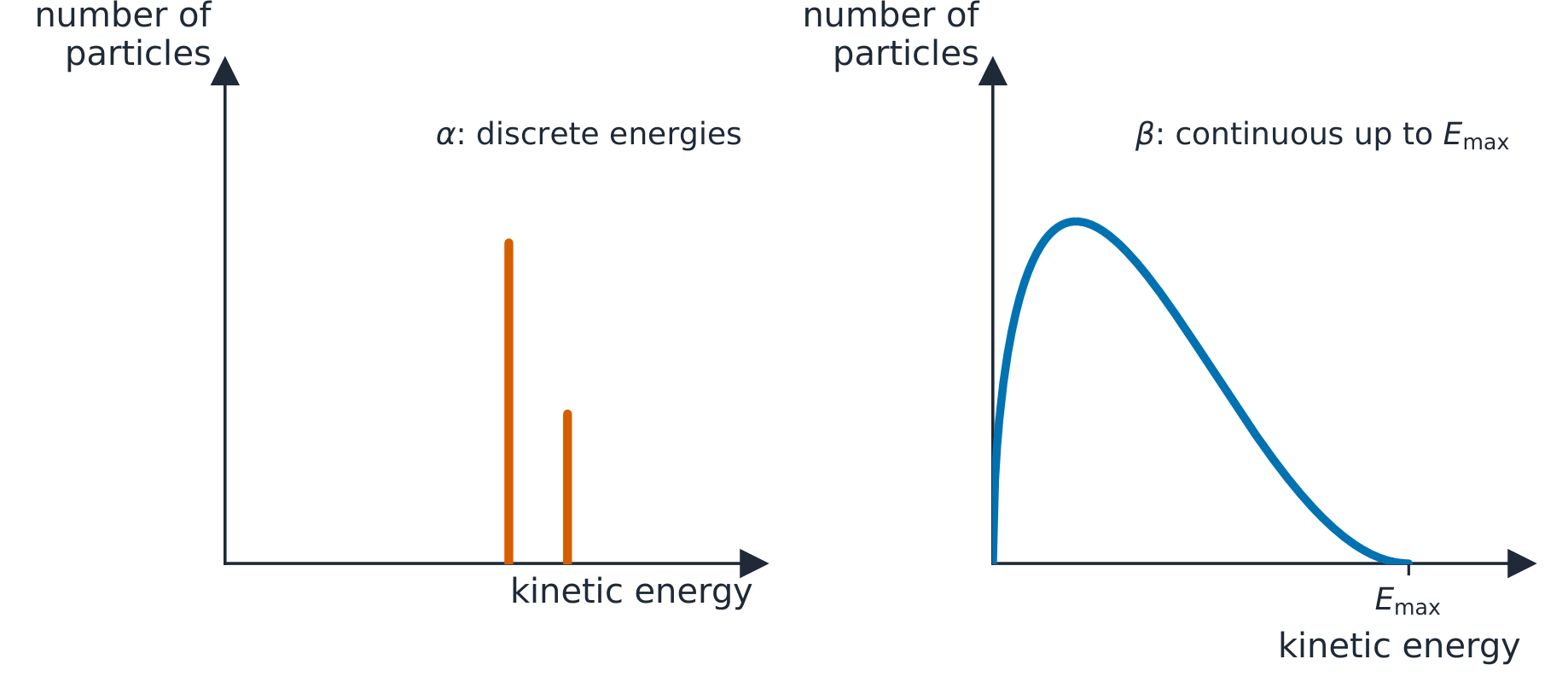
  • Energy spectrum: discrete 分立 (one decay gives α-particles at one or a few sharp energies).

A cloud chamber 云室 makes the tracks visible: each α-particle leaves a short, straight, thick trail of tiny droplets as it ionises the air. The short equal lengths show the α-particles all carry about the same energy.

β-radiation

Two types of beta particle β粒子:

  • $\beta^{-}$: a fast electron, given out when a neutron turns into a proton.
  • $\beta^{+}$: a positron 正电子 (the electron's antiparticle), given out when a proton in a proton-rich nucleus turns into a neutron.

Properties (both types):

  • Mass: $\approx 1/1836\ \text{u}$ (much less than α).
  • Charge: $-e$ for $\beta^{-}$, $+e$ for $\beta^{+}$.
  • Range in air: about $1\ \text{m}$. Stopped by a few mm of aluminium.
  • Energy spectrum: continuous 连续 up to a maximum (see below).

γ-radiation

  • Made of: a high-energy photon 光子 — part of the electromagnetic spectrum 电磁波谱.
  • Mass: zero (rest mass).
  • Charge: zero.
  • Range in air: large (follows the inverse-square law). Strongly attenuated 衰减 by several cm of lead or about a metre of concrete.
  • Ionising power: weakest.
  • Energy spectrum: discrete (a gamma ray γ射线 is given out as the nucleus drops between two nuclear energy levels).

A nucleus often gives out a γ-photon as a "tidy-up" step after an α or β decay leaves the daughter nucleus 子核 in an excited state 激发态.

Mass and charge, side by side — a table question asks for exactly these, in units of $\text{u}$ and $e$:

Particle Mass Charge
proton $1\ \text{u}$ (1.007 u) $+e$
neutron $1\ \text{u}$ (1.009 u) $0$
electron, $\beta^{-}$ $\tfrac{1}{1836}\ \text{u}$ ($5.5 \times 10^{-4}\ \text{u}$) $-e$
positron, $\beta^{+}$ $\tfrac{1}{1836}\ \text{u}$ $+e$
$\alpha$-particle $4\ \text{u}$ $+2e$
$\gamma$-photon $0$ $0$
neutrino, antineutrino almost zero $0$

Worked example. Compare an α-particle with a $\beta^{+}$ particle in terms of their masses and charges (3 marks).

Both are positively charged, but the α-particle's charge ($+2e$) is twice that of the $\beta^{+}$ ($+e$). The α-particle's mass ($4\ \text{u}$) is about $7300$ times the mass of the $\beta^{+}$ ($5.5 \times 10^{-4}\ \text{u}$). Give a ratio, not just "heavier": twice the charge and about 7000 times the mass are the marking points.

Because they carry charge, α- and β-particles are deflected by electric and magnetic fields — in opposite directions for opposite signs, the light β far more than the heavy α — while γ-rays, being uncharged, pass straight through.

Antiparticles, neutrinos and antineutrinos

Every particle has an antiparticle 反粒子 with the same mass but opposite charge. The positron is the antiparticle of the electron.

In β-decay, a third particle is always given out as well:

  • $\beta^{-}$ decay: an antineutrino 反中微子 $\bar{\nu}_{\text{e}}$.
  • $\beta^{+}$ decay: a neutrino 中微子 $\nu_{\text{e}}$.

Neutrinos and antineutrinos have zero charge, very small mass, and barely interact — they are very hard to detect, but they must be there to balance energy, momentum 动量 and other conserved quantities in β-decay.

Why β has a continuous spectrum (and α does not)

In α-decay the energy 能量 released is shared between just two particles (the daughter nucleus and the α). Conservation of momentum and energy then fixes the α's energy to one value (discrete).

In β-decay the energy is shared between three particles (the daughter nucleus, the β, and the (anti)neutrino). The β can take any share from zero up to a maximum, so its energy spectrum is continuous.

Worked example. The energy spectrum of the $\beta^{-}$ particles from a source is continuous, from zero up to a maximum. Explain why (3 marks).

Each decay releases a fixed amount of energy. That energy is shared between the $\beta^{-}$ particle, the antineutrino and the recoiling daughter nucleus. The antineutrino can take any share, so the $\beta^{-}$ particle is left with any energy from zero up to the maximum — the maximum being when the antineutrino carries away almost none. (For an α-particle there are only two bodies, so momentum conservation fixes the share and the energy is discrete.)

Writing decay equations

A general α-decay:

$$^{A}_{Z}\text{X} \to {}^{A-4}_{Z-2}\text{Y} + {}^{4}_{2}\alpha$$

(check: $A = (A-4) + 4$, $Z = (Z-2) + 2$.)

A general $\beta^{-}$ decay:

$$^{A}_{Z}\text{X} \to {}^{A}_{Z+1}\text{Y} + {}^{0}_{-1}\beta + \bar{\nu}_{\text{e}}.$$

A general $\beta^{+}$ decay:

$$^{A}_{Z}\text{X} \to {}^{A}_{Z-1}\text{Y} + {}^{0}_{+1}\beta + \nu_{\text{e}}.$$

Worked example. Uranium-238, $^{238}_{92}\text{U}$, decays by α-emission; carbon-14, $^{14}_{6}\text{C}$, decays by $\beta^{-}$-emission. Find each daughter nuclide.

α-decay lowers $A$ by 4 and $Z$ by 2; $\beta^{-}$-decay leaves $A$ unchanged and raises $Z$ by 1:

$$^{238}_{92}\text{U} \to {}^{234}_{90}\text{Th} + {}^{4}_{2}\alpha, \qquad {}^{14}_{6}\text{C} \to {}^{14}_{7}\text{N} + {}^{0}_{-1}\beta + \bar{\nu}_{\text{e}}.$$

Determine quantitatively the changes. α-emission: $A$ decreases by 4, $Z$ decreases by 2. $\beta^{-}$-emission: $A$ unchanged, $Z$ increases by 1. $\beta^{+}$-emission: $A$ unchanged, $Z$ decreases by 1. γ-emission: no change in either. A decay chain that ends at a known nuclide is solved from these: the number of α-decays is $(A_{\text{start}} - A_{\text{end}})/4$, and then the number of $\beta^{-}$-decays makes $Z$ come out right.

Worked example. Thorium-230, $^{230}_{90}\text{Th}$, decays in stages, by α- and $\beta^{-}$-emission, to lead-206, $^{206}_{82}\text{Pb}$. Find the number of each kind of decay.

α-decays: $(230 - 206)/4 = 6$. Six α-decays alone would lower $Z$ by 12, to 78; the final $Z$ is 82, so there are $82 - 78 = 4$ $\beta^{-}$-decays.

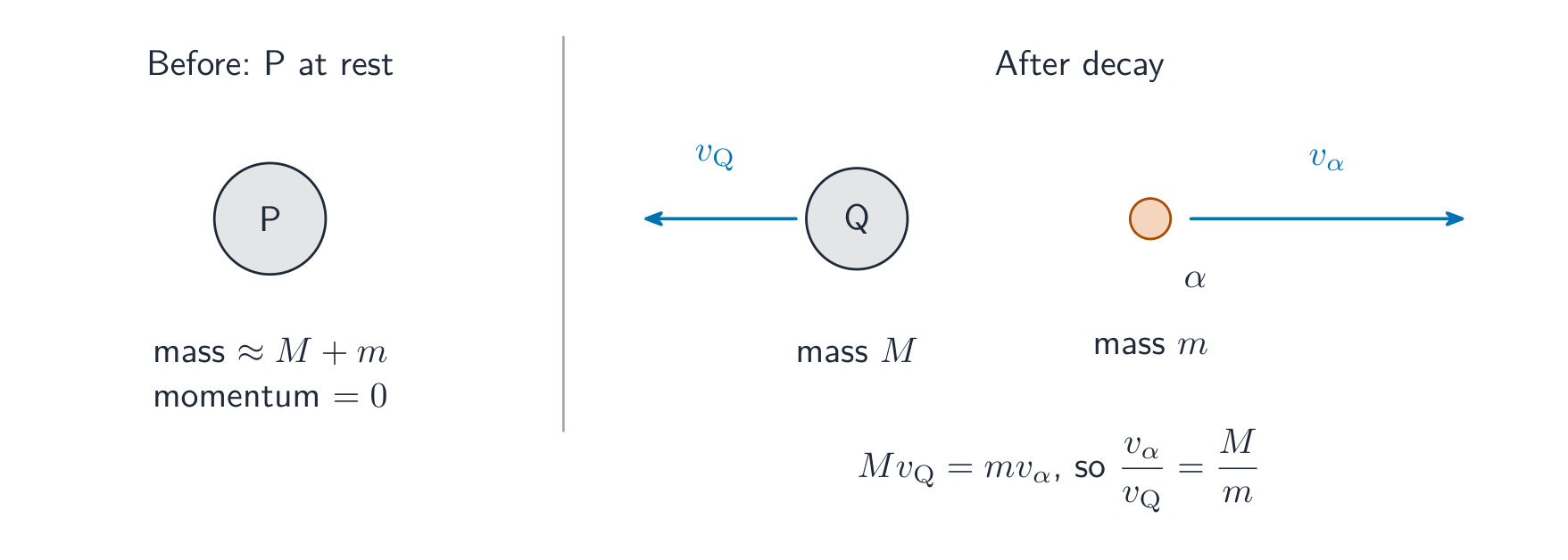
A nucleus at rest recoils. When a stationary nucleus emits an α-particle, momentum is conserved: the daughter nucleus and the α-particle move off in opposite directions with momenta of equal magnitude. Since $p = mv$, the lighter α-particle moves much faster, and since $E_{\text{k}} = p^{2}/2m$ it also takes most of the kinetic energy — the shares are in inverse proportion to the masses.

Worked example. A stationary nucleus P of mass $243\ \text{u}$ emits an α-particle of mass $4\ \text{u}$ at $1.5 \times 10^{7}\ \text{m s}^{-1}$. Find the speed of the daughter nucleus Q and the ratio of the kinetic energy of the α-particle to that of Q.

Q has mass $243 - 4 = 239\ \text{u}$. Momentum: $239 v_{\text{Q}} = 4 \times 1.5 \times 10^{7}$, so $v_{\text{Q}} = 2.5 \times 10^{5}\ \text{m s}^{-1}$, in the opposite direction to the α-particle. Kinetic energies: $\dfrac{E_{\alpha}}{E_{\text{Q}}} = \dfrac{p^{2}/2m_{\alpha}}{p^{2}/2m_{\text{Q}}} = \dfrac{m_{\text{Q}}}{m_{\alpha}} = \dfrac{239}{4} \approx 60$. The α-particle takes about 98% of the energy released.

ไทย

นิวเคลียสที่ไม่เสถียรจะจัดเรียงตัวเองใหม่และปล่อย รังสี ออกมาหนึ่งจากสามชนิด นี่คือ การสลายตัวของสารกัมมันตรังสี แต่ละชนิดมีคุณสมบัติเฉพาะตัว

รังสีอัลฟา (α-radiation)

  • ประกอบด้วย: นิวเคลียสของฮีเลียม-4, $^{4}_{2}\alpha$ (โปรตอน 2 ตัว + นิวตรอน 2 ตัว).
  • มวล: $\approx 4\ \text{u}$.
  • ประจุ: $+2e$.
  • ระยะทางในอากาศ: เพียงไม่กี่เซนติเมตร. ถูกกั้นด้วยกระดาษแผ่นเดียว
  • อำนาจในการไอออไนซ์: สูง — มัน擅长做 การไอออไนซ์
  • สเปกตรัมพลังงาน: แยกเป็นช่วงๆ (การสลายตัวหนึ่งครั้งให้อนุภาค α ที่พลังงานจำเพาะหนึ่งหรือสองสามค่า)

ห้องเมฆ (cloud chamber) ทำให้เห็นร่องรอย: อนุภาค α แต่ละตัวทิ้งร่องสั้นๆ ตรงๆ หนา ของหยดน้ำเล็กๆ เมื่อมันทำไอออไนซ์อากาศ ความยาวที่เท่ากันและสั้นแสดงว่าอนุภาค α ทั้งหมดมีพลังงานใกล้เคียงกันมาก

.Reflection of a cloud chamber: short, straight, thick white trails of vapour fan out from a small radioactive source, marking the paths of alpha particles through the cold gas
ร่องอนุภาค阿尔法 (Alpha-particle tracks) ในห้องเมฆ กระจายออกจากแหล่ง americium-241

รังสีเบตา (β-radiation)

อนุภาคเบตา (beta particle) β มีสองประเภท:

  • $\beta^{-}$: อิเล็กตรอนความเร็วสูง, ปล่อยออกมาเมื่อนิวตรอนเปลี่ยนเป็นโปรตอน
  • $\beta^{+}$: โพซิตรอน (อนุภาคปฏิสัณฐานของอิเล็กตรอน), ปล่อยออกมาเมื่อโปรตอนในนิวเคลียสที่มีโปรตอนมากเกินไปเปลี่ยนเป็นนิวตรอน

คุณสมบัติ (ทั้งสองประเภท):

  • มวล: $\approx 1/1836\ \text{u}$ (น้อยกว่า α มาก)
  • ประจุ: $-e$ สำหรับ $\beta^{-}$, $+e$ สำหรับ $\beta^{+}$.
  • ระยะทางในอากาศ: ประมาณ $1\ \text{m}$. ถูกกั้นด้วยอลูมิเนียมบางๆ若干มิลลิเมตร
  • สเปกตรัมพลังงาน: ต่อเนื่อง ถึงค่าสูงสุด (ดูด้านล่าง)

รังสีแกมมา (γ-radiation)

  • ประกอบด้วย: โฟตอนพลังงานสูง — เป็นส่วนหนึ่งของ สเปกตรัมคลื่นแม่เหล็กไฟฟ้า
  • มวล: ศูนย์ (มวลหยุดนิ่ง)
  • ประจุ: ศูนย์
  • ระยะทางในอากาศ: มาก (ปฏิบัติตามกฎกำลังสองผกผัน). ถูกลดทอน อย่างมากโดยตะกั่วหลายเซนติเมตรหรือคอนกรีตประมาณหนึ่งเมตร
  • อำนาจในการไอออไนซ์: อ่อนที่สุด
  • สเปกตรัมพลังงาน: แยกเป็นช่วงๆ (รังสีแกมมา γ ปล่อยออกมาเมื่อนิวเคลียสตกลงระหว่างสองระดับพลังงานนิวเคลียร์)

นิวเคลียสมักจะปล่อยโฟตอน γ เป็นขั้นตอน "จัดระเบียบ" หลังจากการสลายตัว α หรือ β ทิ้ง นิวเคลียสลูก ไว้ใน สถานะกระตุ้น

Power of penetration: an alpha beam is stopped by paper, a beta beam by a few mm of aluminium, and a gamma beam is only attenuated by thick lead
พลังทะลุทะลวง: $\alpha$ ถูกกั้นด้วยกระดาษ, $\beta$ ด้วยอลูมิเนียม, $\gamma$ ถูกลดทอนเพียงโดยตะกั่ว

มวลและประจุ เปรียบเทียบข้างกัน — คำถามแบบตารางขอค่าเหล่านี้โดยเฉพาะ, ในหน่วยของ $\text{u}$ และ $e$:

อนุภาค มวล ประจุ
โปรตอน $1\ \text{u}$ (1.007 u) $+e$
นิวตรอน $1\ \text{u}$ (1.009 u) $0$
อิเล็กตรอน, $\beta^{-}$ $\tfrac{1}{1836}\ \text{u}$ ($5.5 \times 10^{-4}\ \text{u}$) $-e$
โพซิตรอน, $\beta^{+}$ $\tfrac{1}{1836}\ \text{u}$ $+e$
อนุภาค $\alpha$-alpha $4\ \text{u}$ $+2e$
โฟตอน $\gamma$-gamma $0$ $0$
นิวทริโน, แอนตินิวทริโน เกือบศูนย์ $0$

ตัวอย่างที่คำนวณแล้ว. เปรียบเทียบอนุภาค α กับอนุภาค $\beta^{+}$ ในแง่ของมวลและประจุ (3 คะแนน)

ทั้งสองมีประจุบวก แต่ประจุของอนุภาค α ($+2e$) เป็นสองเท่าของ $\beta^{+}$ ($+e$). มวลของอนุภาค α ($4\ \text{u}$) เป็นประมาณ $7300$ เท่าของมวลของ $\beta^{+}$ ($5.5 \times 10^{-4}\ \text{u}$). ให้เป็นอัตราส่วน ไม่ใช่แค่ "หนักกว่า": ประจุสองเท่า และ มวลหนักกว่าประมาณ 7000 เท่า คือจุดให้คะแนน

เนื่องจากพวกมันมีประจุ อนุภาค α และ β จึงเบี่ยงเบนจากสนามไฟฟ้าและสนามแม่เหล็ก — ในทิศทางตรงข้ามสำหรับสัญญาณตรงข้าม, อนุภาค β ที่เบาเบี่ยงเบนมากกว่าอนุภาค α ที่หนักมาก — ในขณะที่รังสี γ ซึ่งไม่มีประจุ จะวิ่งผ่านตรงๆ

อนุภาคปฏิสัณฐาน, นิวทริโน และแอนตินิวทริโน

ทุกอนุภาคมี อนุภาคปฏิสัณฐาน ที่มี มวลเท่ากัน แต่ ประจุตรงข้าม. โพซิตรอนคืออนุภาคปฏิสัณฐานของอิเล็กตรอน

ในการสลายตัว β, อนุภาคที่สามจะถูกปล่อยออกมาเสมอด้วย:

  • การสลายตัว $\beta^{-}$: แอนตินิวทริโน $\bar{\nu}_{\text{e}}$.
  • การสลายตัว $\beta^{+}$: นิวทริโน $\nu_{\text{e}}$.

นิวทริโนและแอนตินิวทริโนมีประจุศูนย์ มวลน้อยมาก และไม่เข้ากัน — พวกมันตรวจจับยากมาก แต่ต้องอยู่เพื่อปรับสมดุลพลังงาน, โมเมนตัม และปริมาณอื่นๆ ที่ถูกอนุรักษ์ในการสลายตัว β

ทำไม β ถึงมีสเปกตรัมต่อเนื่อง (และ α ไม่)

ในการสลายตัวแบบ α พลังงานที่ปล่อยออกจะถูกแบ่งระหว่างอนุภาคเพียงสองชนิดเท่านั้น (นิวเคลียสลูกและอนุภาค α) การอนุรักษ์โมเมนตัมและพลังงานจึงกำหนดให้พลังงานของ α มีค่าเฉพาะค่าหนึ่งเดียว (เป็นค่าไม่ต่อเนื่อง)

ในการสลายตัวแบบ β พลังงานจะถูกแบ่งระหว่าง สาม อนุภาค (นิวเคลียสลูก, อนุภาค β และ (แอนติ)นิวทริโน) อนุภาค β สามารถรับพลังงานได้ตั้งแต่ศูนย์จนถึงค่าสูงสุด ดังนั้นสเปกตรัมพลังงานของ β จึงเป็นแบบต่อเนื่อง

กราฟจำนวนอนุภาคเทียบกับพลังงานจลน์: สำหรับอนุภาค alpha แสดงเส้นแหลมคมที่พลังงานคงที่; สำหรับอนุภาค beta แสดงเส้นโค้งต่อเนื่องเรียบจากศูนย์ถึงพลังงานสูงสุด
อนุภาค α จากหนึ่งการสลายตัวมีพลังงานคงที่ (ไม่ต่อเนื่อง); อนุภาค β แบ่งพลังงานกับ (แอนติ)นิวทริโน ทำให้สเปกตรัมพลังงานเป็นแบบต่อเนื่องจนถึงค่าสูงสุด

ตัวอย่างวิธีทำ สเปกตรัมพลังงานของ $\beta^{-}$ อนุภาคจากแหล่งกำเนิดมีความต่อเนื่อง ตั้งแต่ศูนย์ไปจนถึงค่าสูงสุด อธิบายเหตุผล (3 คะแนน).

การสลายตัวแต่ละครั้งปล่อยพลังงานในปริมาณคงที่ พลังงานนี้ถูกแบ่งระหว่าง $\beta^{-}$ อนุภาค, แอนตินิวทริโน และนิวเคลียสลูกที่ถอยกลับ แอนตินิวทริโนสามารถรับพลังงานได้的任何值 ดังนั้น $\beta^{-}$ อนุภาคจึงเหลือพลังงานได้ตั้งแต่ศูนย์จนถึงค่าสูงสุด — โดยค่าสูงสุดจะเกิดขึ้นเมื่อแอนตินิวทริโนพาพลังงานออกไปเกือบไม่มีเลย (สำหรับอนุภาค α จะมีเพียงสองวัตถุ ดังนั้นการอนุรักษ์โมเมนตัมจึงกำหนดสัดส่วนและพลังงานจะเป็นค่าไม่ต่อเนื่อง)

การเขียนสมการการสลายตัว

สมการการสลายตัวแบบ α ทั่วไป:

$$^{A}_{Z}\text{X} \to {}^{A-4}_{Z-2}\text{Y} + {}^{4}_{2}\alpha$$

(ตรวจสอบ: $A = (A-4) + 4$, $Z = (Z-2) + 2$.)

สมการการสลายตัว $\beta^{-}$ ทั่วไป:

$$^{A}_{Z}\text{X} \to {}^{A}_{Z+1}\text{Y} + {}^{0}_{-1}\beta + \bar{\nu}_{\text{e}}.$$

สมการการสลายตัว $\beta^{+}$ ทั่วไป:

$$^{A}_{Z}\text{X} \to {}^{A}_{Z-1}\text{Y} + {}^{0}_{+1}\beta + ν_{\text{e}}.$$

ตัวอย่างวิธีทำ ยูเรเนียม-238, $^{238}_{92}\text{U}$, สลายตัวด้วยการปล่อย α; คาร์บอน-14, $^{14}_{6}\text{C}$, สลายตัวด้วยการปล่อย $\beta^{-}$. จงหาสารตั้งต้นลูกของแต่ละกรณี.

การสลายตัวแบบ α ลด $A$ ลง 4 และลด $Z$ ลง 2; การสลายตัว $\beta^{-}$ ทำให้ $A$ ไม่เปลี่ยนแปลงและเพิ่ม $Z$ ขึ้น 1:

$$^{238}_{92}\text{U} \to {}^{234}_{90}\text{Th} + {}^{4}_{2}\alpha, \qquad {}^{14}_{6}\text{C} \to {}^{14}_{7}\text{N} + {}^{0}_{-1}\beta + \bar{\nu}_{\text{e}}.$$

คำนวณการเปลี่ยนแปลงเชิงปริมาณ การปล่อย α: $A$ ลดลง 4, $Z$ ลดลง 2. การปล่อย $\beta^{-}$: $A$ ไม่เปลี่ยนแปลง, $Z$ เพิ่มขึ้น 1. การปล่อย $\beta^{+}$: $A$ ไม่เปลี่ยนแปลง, $Z$ ลดลง 1. การปล่อย γ: ไม่มีการเปลี่ยนแปลงทั้งสองอย่าง. ลำดับการสลายตัวที่สิ้นสุดที่สารตั้งต้นที่ทราบแล้วแก้ได้จากข้อมูลเหล่านี้: จำนวนการสลายตัวแบบ α คือ $(A_{\text{start}} - A_{\text{end}})/4$, และจากนั้นจำนวนการสลายตัว $\beta^{-}$ จะทำให้ $Z$ ออกมาถูกต้อง.

ตัวอย่างวิธีทำ ทอเรียม-230, $^{230}_{90}\text{Th}$, สลายตัวเป็นขั้นตอนด้วยการปล่อย α และ $\beta^{-}$, ไปจนถึงพลวง-206, $^{206}_{82}\text{Pb}$. จงหาจำนวนการสลายตัวแต่ละประเภท.

การสลายตัวแบบ α: $(230 - 206)/4 = 6$. หากใช้การสลายตัวแบบ α เพียง 6 ครั้ง จะทำให้ $Z$ ลดลง 12 เหลือ 78; แต่ค่าสุดท้ายของ $Z$ คือ 82 ดังนั้นจึงมีการสลายตัว $82 - 78 = 4$ ครั้งของการสลายตัว $\beta^{-}$.

นิวเคลียสที่หยุดนิ่งจะถอยกลับ เมื่อนิวเคลียสที่หยุดนิ่งปล่อยอนุภาค α โมเมนตัมจะอนุรักษ์อยู่: นิวเคลียสลูกและอนุภาค α จะเคลื่อนที่ไปใน ทิศทางตรงกันข้าม โดยมีขนาดโมเมนตัม เท่ากัน เนื่องจาก $p = mv$, อนุภาค α ที่มีมวลน้อยกว่า จะเคลื่อนที่เร็วมาก และเนื่องจาก $E_{\text{k}} = p^{2}/2m$ มันจึงรับพลังงานจลน์ส่วนใหญ่ไป — สัดส่วนจะแปรผกผันกับมวล

การสลายตัวของอัลฟาของนิวเคลียสที่หยุดนิ่ง: ก่อน, แม่ P อยู่กับที่; หลัง, ลูก Q เคลื่อนที่ไปทางหนึ่งและอนุภาคอัลฟาอีกทางหนึ่ง โดยมีโมเมนตัมเท่ากันทำให้อัลฟาซึ่งมีมวลน้อยกว่าเคลื่อนที่เร็วขึ้น
นิวเคลียสที่หยุดนิ่งสลายตัว: ลูกจะถอยกลับด้วยโมเมนตัมที่มีขนาดเท่ากันแต่ทิศทางตรงข้ามกับอนุภาค α

ตัวอย่างวิธีทำ นิวเคลียส P ที่หยุดนิ่งมีมวล $243\ \text{u}$ ปล่อยอนุภาค α ที่มีมวล $4\ \text{u}$ ที่ความเร็ว $1.5 \times 10^{7}\ \text{m s}^{-1}$. จงหาความเร็วของนิวเคลียสลูก Q และอัตราส่วนระหว่างพลังงานจลน์ของอนุภาค α กับของ Q.

Q มีมวล $243 - 4 = 239\ \text{u}$. โมเมนตัม: $239 v_{\text{Q}} = 4 \times 1.5 \times 10^{7}$, ดังนั้น $v_{\text{Q}} = 2.5 \times 10^{5}\ \text{m s}^{-1}$, ในทิศทางตรงข้ามกับอนุภาค α. พลังงานจลน์: $\dfrac{E_{\alpha}}{E_{\text{Q}}} = \dfrac{p^{2}/2m_{\alpha}}{p^{2}/2m_{\text{Q}}} = \dfrac{m_{\text{Q}}}{m_{\alpha}} = \dfrac{239}{4} \approx 60$. อนุภาค α รับประมาณ 98% ของพลังงานที่ปล่อยออกมา.

Vocabulary · ⁨คำศัพท์⁩ Train · ⁨ฝึกฝน⁩
English ไทย
radioactive/ˌreɪdɪəʊˈæktɪv/ กัมมันตรังสี
radiation/ˌreɪdɪˈeɪʃn/ รังสี
ionising/ˈaɪənaɪzɪŋ/ การไอออไนซ์
discrete/dɪˈskriːt/ แบบไม่ต่อเนื่อง
cloud chamber/klaʊd ˈtʃeɪmbə/ ห้องเมฆ
beta particle/ˈbiːtə ˈpɑːtɪkl/ อนุภาคเบตา
positron/ˈpɒzɪtrɒn/ โพซิตรอน
antiparticle/ˌæntɪˈpɑːtɪkl/ อนุภาคปฏิสสาร
continuous/kənˈtɪnjuːəs/ 连续的
photon/ˈfəʊtɒn/ โฟตอน
electromagnetic spectrum/ɪˌlektrəʊməɡˈnetɪk ˈspektrəm/ สเปกตรัมคลื่นแม่เหล็กไฟฟ้า
attenuated/əˈtenjuːeɪtɪd/ ลดทอนลง
gamma ray/ˈɡæmə reɪ/ รังสีแกมมา
daughter nucleus/ˈdɔːtə ˈnjuːklɪəs/ นิวเคลียสลูก
excited state/ekˈsaɪtɪd steɪt/ สถานะกระตุ้น
11.2

Fundamental particles · ⁨อนุภาคพื้นฐาน⁩

Syllabus · ⁨หลักสูตร⁩
English
  1. understand that a quark is a fundamental particle and that there are six flavours (types) of quark: up, down, strange, charm, top and bottom
  2. recall and use the charge of each flavour of quark and understand that its respective antiquark has the opposite charge (no knowledge of any other properties of quarks is required)
  3. recall that protons and neutrons are not fundamental particles and describe protons and neutrons in terms of their quark composition
  4. understand that a hadron may be either a baryon (consisting of three quarks) or a meson (consisting of one quark and one antiquark)
  5. describe the changes to quark composition that take place during $\beta^-$ and $\beta^+$ decay
  6. recall that electrons and neutrinos are fundamental particles called leptons
ไทย
  1. เข้าใจว่า ควาร์ก เป็น อนุภาคพื้นฐาน และมี六种รสชาติ (ประเภท) ของควาร์ก: อัพ, ดาวน์, สเตรนจ์, ชาร์ม, ท็อป และ บอททม
  2. จำและใช้ประจุของแต่ละรสชาติของควาร์ก และเข้าใจว่าแอนติควาร์กที่เกี่ยวข้องจะมีประจุตรงข้าม (ไม่จำเป็นต้องรู้คุณสมบัติอื่นใดของควาร์ก)
  3. จำได้ว่า โปรตอน และ นิวตรอน ไม่ใช่อนุภาคพื้นฐาน และอธิบายโปรตอนและนิวตรอนในแง่ของ องค์ประกอบควาร์ก ของพวกมัน
  4. เข้าใจว่า ฮาดรอน อาจเป็น บาเรียน (ประกอบด้วยควาร์กสามตัว) หรือ เมซอน (ประกอบด้วยควาร์กหนึ่งตัวและแอนติควาร์กหนึ่งตัว)
  5. อธิบายการเปลี่ยนแปลงในองค์ประกอบควาร์กที่เกิดขึ้นระหว่างการสลายตัว $\beta^-$ และ $\beta^+$
  6. จำได้ว่าอิเล็กตรอนและนิวทริโนเป็นอนุภาคพื้นฐานที่เรียกว่า เลปตอน

Source: Cambridge International syllabus · ⁨แหล่งที่มา: หลักสูตร Cambridge International⁩

English

Some particles are fundamental particles 基本粒子 (point-like, with no smaller parts as far as we know); others are built from fundamental ones.

The one-mark definition: a fundamental particle is one that cannot be broken down into smaller particles (it has no internal structure). Electrons, neutrinos and quarks are fundamental; protons and neutrons are not.

Quarks

A quark 夸克 is a fundamental particle. There are six flavours 味:

  • up (u), charge $+\tfrac{2}{3}e$,
  • down (d), charge $-\tfrac{1}{3}e$,
  • charm (c), charge $+\tfrac{2}{3}e$,
  • strange (s), charge $-\tfrac{1}{3}e$,
  • top (t), charge $+\tfrac{2}{3}e$,
  • bottom (b), charge $-\tfrac{1}{3}e$.

Each quark has an antiquark 反夸克 with the same size of charge but the opposite sign: $\bar{u}$ (charge $-\tfrac{2}{3}e$), $\bar{d}$ (charge $+\tfrac{1}{3}e$). No other quark property is tested.

Written as the table a question asks you to complete:

Quark Charge Antiquark Charge
up (u), charm (c), top (t) $+\tfrac{2}{3}e$ $\bar{\text{u}}$, $\bar{\text{c}}$, $\bar{\text{t}}$ $-\tfrac{2}{3}e$
down (d), strange (s), bottom (b) $-\tfrac{1}{3}e$ $\bar{\text{d}}$, $\bar{\text{s}}$, $\bar{\text{b}}$ $+\tfrac{1}{3}e$

Worked example. By reference to quark composition, show that the charge of a proton is $+1.6 \times 10^{-19}\ \text{C}$.

A proton is uud: charge $= \tfrac{2}{3}e + \tfrac{2}{3}e - \tfrac{1}{3}e = +e = +1.6 \times 10^{-19}\ \text{C}$. Write the three fractions and their sum — the mark is for the arithmetic, not the answer.

Hadrons: baryons and mesons

Particles built from quarks are hadrons 强子. Two types:

  • baryons 重子 — three quarks. Examples: proton (u u d), neutron (u d d). Charge check: $\tfrac{2}{3} + \tfrac{2}{3} - \tfrac{1}{3} = +1$ for the proton; $\tfrac{2}{3} - \tfrac{1}{3} - \tfrac{1}{3} = 0$ for the neutron.
  • mesons 介子 — one quark and one antiquark (for example $\pi^{+}$ is u$\bar{\text{d}}$).

Protons and neutrons are not fundamental — they are baryons made of quarks.

"Compare baryons and mesons in terms of their constituent particles" (2 marks): both are hadrons made of quarks; a baryon is three quarks (or three antiquarks, for an antibaryon), a meson is one quark and one antiquark. Any charge you are given must come out of the quark charges:

Worked example. (a) A meson has charge $-1e$. Give a possible quark composition. (b) A meson Q has charge 0. Give a possible composition. (c) A baryon is made of three quarks of different flavours, u, d and s. Find its charge. (d) Give the quark composition of an antineutron and its charge.

(a) d$\bar{\text{u}}$: $-\tfrac{1}{3} - \tfrac{2}{3} = -1$ (s$\bar{\text{u}}$ also works). (b) u$\bar{\text{u}}$: $+\tfrac{2}{3} - \tfrac{2}{3} = 0$ (or d$\bar{\text{d}}$). (c) uds: $\tfrac{2}{3} - \tfrac{1}{3} - \tfrac{1}{3} = 0$. (d) The antineutron is the antiparticle of udd, so it is $\bar{\text{u}}\bar{\text{d}}\bar{\text{d}}$: $-\tfrac{2}{3} + \tfrac{1}{3} + \tfrac{1}{3} = 0$ — the same mass and charge as the neutron, since both have charge zero.

Quark changes in β-decay

In $\beta^{-}$ decay a neutron turns into a proton; in quark terms, one down quark turns into an up quark:

$$\text{d} \to \text{u} + \beta^{-} + \bar{\nu}_{\text{e}}.$$

In $\beta^{+}$ decay a proton turns into a neutron; one up quark turns into a down quark:

$$\text{u} \to \text{d} + \beta^{+} + \nu_{\text{e}}.$$

"Describe $\beta^{+}$ decay in terms of the fundamental particles involved" (2 marks): an up quark in a proton changes into a down quark, so the proton becomes a neutron, and a positron and an electron neutrino are emitted — $\text{u} \to \text{d} + \beta^{+} + \nu_{\text{e}}$. For $\beta^{-}$ decay swap the roles: a down quark becomes an up quark, emitting an electron and an electron antineutrino. Name the (anti)neutrino: it is the "other lepton" the question asks for, and it is what makes the β energy continuous.

Leptons

Leptons 轻子 are fundamental particles that are not made of quarks. The leptons you need are the electron and the electron neutrino, with their antiparticles the positron and the electron antineutrino. (Heavier leptons — the muon and tau — exist but are not tested.) Asked for "two different leptons", give electron and neutrino.

Classifying particles

To answer "which are fundamental?": quarks and leptons (electrons, positrons, neutrinos, antineutrinos) are fundamental; protons, neutrons, baryons, mesons and hadrons are not — they are built from quarks.

Worked example. In the list — antineutrino, $\beta^{+}$ particle, neutron, positron, proton — underline the hadrons.

Neutron and proton (three quarks each). The antineutrino and the positron are leptons; the $\beta^{+}$ particle is a positron. The same list asked as "which are not fundamental?" has the same answer: neutron and proton.

Antimatter. Every particle has an antiparticle of the same mass and opposite charge; a positron and an electron are alike in mass (and in the size of their charge) and differ in the sign of their charge. An antihydrogen atom is an antiproton (charge $-e$, made of $\bar{\text{u}}\bar{\text{u}}\bar{\text{d}}$) with a positron in orbit.

ไทย
เส้นทางของอนุภาคในห้องฟองอากาศ
ห้องฟองอากาศเผยให้เห็นร่องโค้งของอนุภาคที่มีประจุไฟฟ้า.
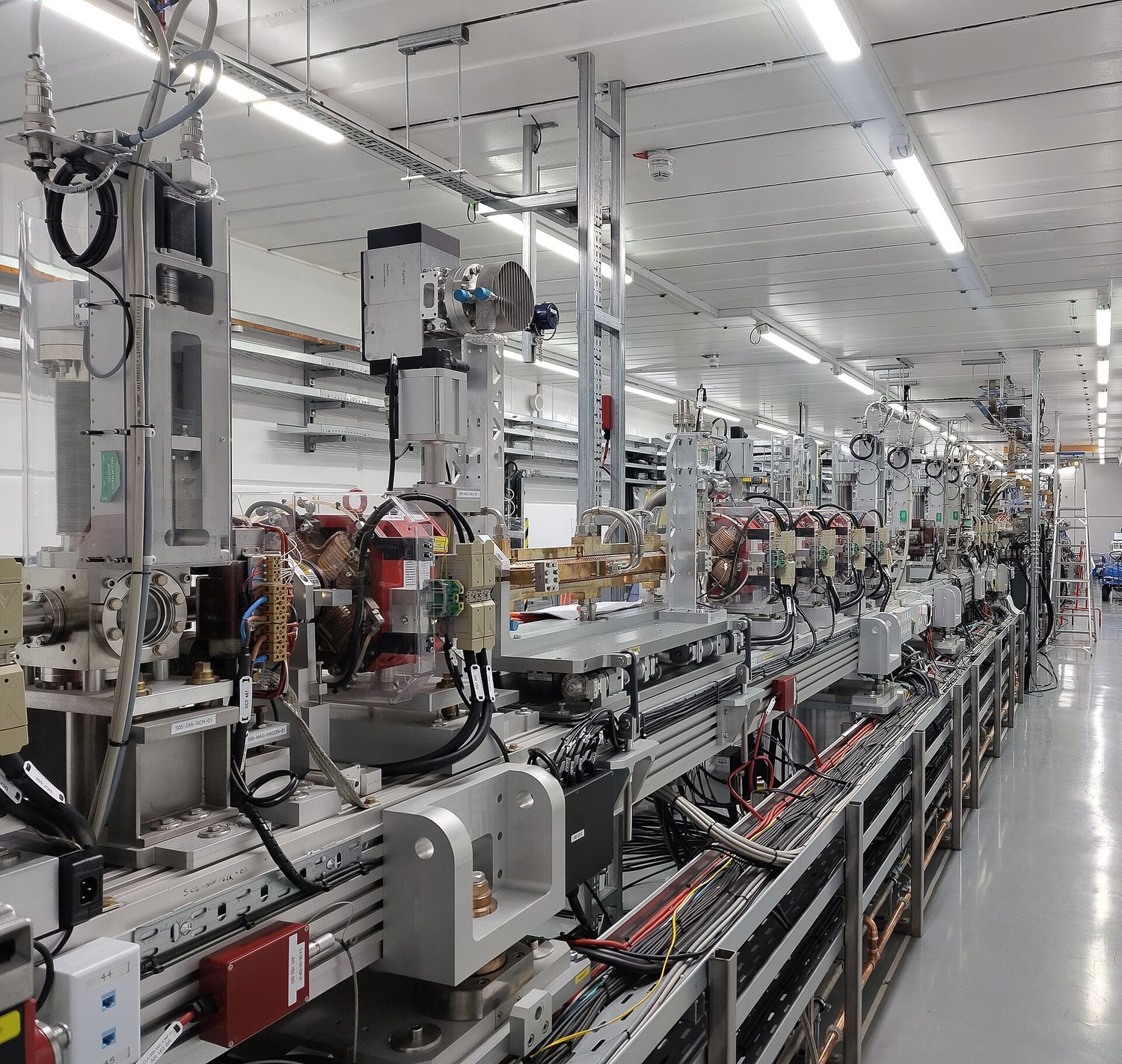
ห้องเครื่องเร่งอนุภาคแบบเส้นตรง: ลำดับของช่องเร่งและท่อลำยาวเรียงกันไปจนสุดห้อง
แหล่งที่มาของอนุภาค: เครื่องเร่งอนุภาคแบบเส้นตรงใช้สนามไฟฟ้าขับเคลื่อนอนุภาคที่มีประจุไฟฟ้าให้เร็วพอที่จะสำรวจภายในนิวเคลียส

บางอนุภาคเป็น อนุภาคพื้นฐาน (เป็นจุด ไม่มีองค์ประกอบย่อยกว่านั้นตามที่เรารู้); ส่วนอื่น ๆ สร้างมาจากอนุภาคพื้นฐาน

นิยาม 1 คะแนน: อนุภาคพื้นฐานคืออนุภาคที่ไม่สามารถแยกย่อยออกเป็นอนุภาคที่เล็กกว่าได้อีก (ไม่มีโครงสร้างภายใน) อิเล็กตรอน นิวทริโน และควาร์กเป็นอนุภาคพื้นฐาน; โปรตอนและนิวตรอนไม่ใช่

ควาร์ก

ควาร์ก เป็นอนุภาคพื้นฐาน มี รส (flavours) ทั้งหมด 6 ชนิด:

  • อัพ (u), ประจุ $+\tfrac{2}{3}e$,
  • ดาวน์ (d), ประจุ $-\tfrac{1}{3}e$,
  • ชาร์ม (c), ประจุ $+\tfrac{2}{3}e$,
  • สเตรนจ์ (s), ประจุ $-\tfrac{1}{3}e$,
  • ท็อป (t), ประจุ $+\tfrac{2}{3}e$,
  • บอททอม (b), ประจุ $-\tfrac{1}{3}e$.

ควาร์กแต่ละชนิดมี แอนติควาร์ก ที่มีขนาดประจุเท่ากันแต่เครื่องหมายตรงกันข้าม: $\bar{u}$ (ประจุ $-\tfrac{2}{3}e$), $\bar{d}$ (ประจุ $+\tfrac{1}{3}e$). ไม่มีคุณสมบัติควาร์กอื่นใดที่สอบ

รสชาติควาร์กทั้งหกตามประจุ: อัพ ชาร์ม และท็อป แต่ละชนิดมีประจุ +2/3 e; ดาวน์ สเตรนจ์ และบอทตอมแต่ละชนิดมีประจุ -1/3 e; แอนติควาร์กแต่ละชนิดมีประจุตรงข้าม
ควาร์กทั้งหกชนิด: อัพ/ชาร์ม/ท็อป มี $+\tfrac23 e$, ดาวน์/สเตรนจ์/บอททอม มี $-\tfrac13 e$

เขียนในรูปแบบตารางที่โจทย์ถามให้เติมเต็ม:

Quark Charge Antiquark Charge
up (u), charm (c), top (t) $+\tfrac{2}{3}e$ $\bar{\text{u}}$, $\bar{\text{c}}$, $\bar{\text{t}}$ $-\tfrac{2}{3}e$
down (d), strange (s), bottom (b) $-\tfrac{1}{3}e$ $\bar{\text{d}}$, $\bar{\text{s}}$, $\bar{\text{b}}$ $+\tfrac{1}{3}e$

ตัวอย่างวิธีทำ โดยอ้างอิงจากองค์ประกอบของควาร์ก แสดงให้เห็นว่าประจุของโปรตอนคือ $+1.6 \times 10^{-19}\ \text{C}$

โปรตอนคือ uud: ประจุ $= \tfrac{2}{3}e + \tfrac{2}{3}e - \tfrac{1}{3}e = +e = +1.6 \times 10^{-19}\ \text{C}$ เขียนเศษส่วนทั้งสามและผลรวม — คะแนนอยู่ที่การคำนวณ ไม่ใช่คำตอบ

ฮาดรอน: บาเรียนและเมซอน

อนุภาคที่สร้างจากควาร์กเรียกว่า ฮาดรอน มีสองประเภท:

  • บาเรียน — ควาร์กสามตัว ตัวอย่าง: โปรตอน (u u d), นิวตรอน (u d d) ตรวจสอบประจุ: $\tfrac{2}{3} + \tfrac{2}{3} - \tfrac{1}{3} = +1$ สำหรับโปรตอน; $\tfrac{2}{3} - \tfrac{1}{3} - \tfrac{1}{3} = 0$ สำหรับนิวตรอน
  • เมซอน — ควาร์กหนึ่งตัวและแอนติควาร์กหนึ่งตัว (เช่น $\pi^{+}$ คือ u$\bar{\text{d}}$)

โปรตอนและนิวตรอนเป็น ไม่ใช่ อนุภาคพื้นฐาน—they are巴aryons made of quarks.

"เปรียบเทียบบาเรียนและเมซอนในแง่ของอนุภาคส่วนประกอบ" (2 คะแนน): ทั้งคู่เป็นฮาดรอนที่สร้างจากควาร์ก; บาเรียนคือควาร์กสามตัว (หรือแอนติควาร์กสามตัวสำหรับแอนติบาเรียน), เมซอนคือควาร์กหนึ่งตัวและแอนติควาร์กหนึ่งตัว ประจุที่คุณได้รับต้องเกิดจากประจุของควาร์กทั้งหมด:

ตัวอย่างวิธีทำ (ก) เมซอนมีประจุ $-1e$ ให้องค์ประกอบของควาร์กที่เป็นไปได้ (ข) เมซอน Q มีประจุ 0 ให้องค์ประกอบที่เป็นไปได้ (ค) บาเรียนสร้างจากควาร์กสามชนิดที่แตกต่างกัน u, d และ s จงหาประจุของมัน (ง) ให้องค์ประกอบของควาร์กของแอนตินิวตรอนและประจุของมัน

(ก) d$\bar{\text{u}}$: $-\tfrac{1}{3} - \tfrac{2}{3} = -1$ (s$\bar{\text{u}}$ ก็ใช้ได้) (ข) u$\bar{\text{u}}$: $+\tfrac{2}{3} - \tfrac{2}{3} = 0$ (หรือ d$\bar{\text{d}}$) (ค) uds: $\tfrac{2}{3} - \tfrac{1}{3} - \tfrac{1}{3} = 0$ (ง) แอนตินิวตรอนเป็นแอนติพาร์ทิเคิลของ udd ดังนั้นจึงเป็น $\bar{\text{u}}\bar{\text{d}}\bar{\text{d}}$: $-\tfrac{2}{3} + \tfrac{1}{3} + \tfrac{1}{3} = 0$ — มีมวลและประจุเท่ากันกับนิวตรอน เนื่องจากทั้งสองมีประจุเป็นศูนย์

การเปลี่ยนแปลงควาร์กในการสลายตัวแบบเบตา

ในการสลายตัว $\beta^{-}$ นิวตรอนจะเปลี่ยนเป็นโปรตอน; ในเชิงควาร์ก ควาร์กดาวน์หนึ่งตัวจะเปลี่ยนเป็นควาร์กอัพ:

$$\text{d} \to \text{u} + \beta^{-} + \bar{\nu}_{\text{e}}$$

ในการสลายตัว $\beta^{+}$ โปรตอนจะเปลี่ยนเป็นนิวตรอน; ควาร์กอัพหนึ่งตัวจะเปลี่ยนเป็นควาร์กดาวน์:

$$\text{u} \to \text{d} + \beta^{+} + \nu_{\text{e}}$$
Beta-minus decay at the quark level: a neutron (u d d) becomes a proton (u u d) as one down quark turns into an up quark, emitting a beta-minus particle and an electron antineutrino
การสลายตัวเบตามินัส: ควาร์กดาวน์หนึ่งตัวกลายเป็นควาร์กอัพ เปลี่ยนนิวตรอนให้เป็นโปรตอน

"อธิบายการสลายตัว $\beta^{+}$ ในเชิงอนุภาคพื้นฐานที่เกี่ยวข้อง" (2 คะแนน): ควาร์กอัพในโปรตอนเปลี่ยนเป็นควาร์กดาวน์ ทำให้โปรตอนกลายเป็นนิวตรอน และมีโพซิตรอนและอิเล็กตรอนนิวทริโนถูกปล่อยออกมา — $\text{u} \to \text{d} + \beta^{+} + \nu_{\text{e}}$. สำหรับการสลายตัว $\beta^{-}$ สลับบทบาท: ควาร์กดาวน์กลายเป็นควาร์กอัพ ปล่อยอิเล็กตรอนและแอนติอิเล็กตรอนนิวทริโน ชื่อ (แอนติ)นิวทริโน: มันคือ "เลปตอนอีกตัว" ที่คำถามต้องการ และเป็นสิ่งที่ทำให้พลังงาน β เป็นต่อเนื่อง

เลปตอน

เลปตอน เป็นอนุภาคพื้นฐานที่ไม่ได้สร้างจากควาร์ก เลปตอนที่คุณจำเป็นต้องรู้คือ อิเล็กตรอน และ อิเล็กตรอนนิวทริโน พร้อมแอนติพาร์ทิเคิลของพวกมันคือ โพซิตรอน และ แอนติอิเล็กตรอนนิวทริโน (เลปตอนที่มีมวลมากกว่า — มิวออนและเทา — มีอยู่แต่ไม่ออกสอบ) เมื่อถามหา "เลปตอนสองชนิดที่แตกต่างกัน" ให้ตอบ อิเล็กตรอน และ นิวทริโน

การจัดจำแนกอนุภาค

เพื่อตอบคำถาม "อันไหนเป็นอนุภาคพื้นฐาน?": ควาร์ก และ เลปตอน (อิเล็กตรอน, โพซิตรอน, นิวทริโน, แอนตินิวทริโน) เป็นอนุภาคพื้นฐาน; โปรตอน, นิวตรอน, บาเรียน, เมซอน และฮาดรอนเป็น ไม่ใช่—they are built from quarks.

A tree classifying particles into fundamental ones (quarks and leptons such as the electron and neutrino) and hadrons made of quarks (baryons like the proton and neutron, and mesons)
อนุภาคพื้นฐาน (ควาร์ก, เลปตอน) เทียบกับฮาดรอน (บาเรียน, เมซอน)

ตัวอย่างวิธีทำ ในรายการ — แอนตินิวทริโน, $\beta^{+}$ พาร์ทิเคิล, นิวตรอน, โพซิตรอน, โปรตอน — ใต้เส้นคำที่เป็นฮาดรอน

นิวตรอนและโปรตอน (ควาร์กสามตัวแต่ละตัว) แอนตินิวทริโนและโพซิตรอนเป็นเลปตอน; $\beta^{+}$ พาร์ทิเคิล คือ โพซิตรอน รายการเดียวกันเมื่อถามว่า "อันไหนไม่เป็นอนุภาคพื้นฐาน?" จะมีคำตอบเหมือนกันคือ นิวตรอนและโปรตอน

สสารต้านทาน อนุภาคทุกตัวมีแอนติพาร์ทิเคิลที่มีมวลเท่ากันและประจุตรงข้าม; โพซิตรอนและอิเล็กตรอนมีมวลเท่ากัน (และขนาดของประจุเท่ากัน) แต่ต่างกันที่เครื่องหมายของประจุ อะตอม แอนติไฮโดรเจน คือแอนติโปรตอน (ประจุ $-e$, สร้างจาก $\bar{\text{u}}\bar{\text{u}}\bar{\text{d}}$) ที่มีโพซิตรอนโคจรรอบ

Explore · ⁨สำรวจ⁩

Fundamental particle lab · ⁨ห้องปฏิบัติการอนุภาคพื้นฐาน⁩

Sort particles by the family or interaction that defines them. · ⁨จัดกลุ่มอนุภาคตามครอบครัวหรือแรงที่กำหนดมัน⁩

Vocabulary · ⁨คำศัพท์⁩ Train · ⁨ฝึกฝน⁩
English ไทย
proton/ˈprəʊtɒn/ โปรตอน
neutron/ˈnjuːtrɒn/ นิวตรอน
electron/ɪˈlektrɒn/ อิเล็กตรอน
quark/kwɑːk/ ควาร์ก
conservation of charge/ˌkɒnsəˈveɪʃn ɒv tʃɑːdʒ/ การอนุรักษ์ประจุไฟฟ้า
unified atomic mass unit/ˈjuːnɪfaɪd əˈtɒmɪk mæs ˈjuːnɪt/ หน่วยมวลอะตอมรวม
neutrino/njuːˈtriːnəʊ/ นิวทริโน
antineutrino/ˌæntɪnjuːˈtriːnəʊ/ แอนตินิวทริโน
momentum/məʊˈmentəm/ โมเมนตัม
fundamental particles/ˌfʌndəˈmentl ˈpɑːtɪklz/ อนุภาคพื้นฐาน
fundamental/ˌfʌndəˈmentl/ พื้นฐาน
flavours/ˈfleɪvəz/ รสชาติ
antiquark/ˈæntɪkwɑːk/ แอนติควาร์ก
hadrons/ˈhædrɒnz/ แฮดรอน
baryons/ˈbæriɒnz/ แบริออน
mesons/ˈmiːzɒnz/ เมซอน
leptons/ˈleptɒnz/ เลปตอน
Watch lesson · ⁨ดูบทเรียน⁩
11.2

Definitions the examiner accepts · ⁨คำนิยามที่ผู้สอบยอมรับ⁩

English

A definition question is marked against fixed wording. Learn these exactly, and give one answer only.

Term Definition
proton number $Z$ the number of protons in a nucleus
nucleon number $A$ the total number of protons and neutrons in a nucleus
isotopes nuclei of the same element (same number of protons) with different numbers of neutrons
nuclide a nucleus with a particular number of protons and a particular number of neutrons
unified atomic mass unit one twelfth of the mass of an atom of carbon-12
antiparticle a particle with the same mass as the corresponding particle but the opposite charge
fundamental particle a particle that cannot be broken down into smaller particles
hadron a particle made of quarks: a baryon (three quarks) or a meson (a quark and an antiquark)
lepton a fundamental particle that is not made of quarks, such as the electron or the neutrino
α-particle a helium-4 nucleus: two protons and two neutrons, charge $+2e$, mass $4\ \text{u}$
$\beta^{-}$ / $\beta^{+}$ particle an electron / a positron emitted from a nucleus when a neutron becomes a proton / a proton becomes a neutron
ไทย

คำถามคำนิยามจะให้คะแนนตามข้อความที่กำหนดไว้你必须 exact. เรียนรู้ให้ถูกต้องและตอบเพียงคำตอบเดียวเท่านั้น

พจน์ นิยาม
จำนวนโปรตอน $Z$ จำนวนโปรตอนในนิวเคลียส
จำนวนนิวคลีออน $A$ จำนวนรวมของโปรตอนและนิวตรอนในนิวเคลียส
ไอโซโทป นิวเคลียสของธาตุเดียวกัน (จำนวนโปรตอนเท่ากัน) ที่มีจำนวนนิวตรอนต่างกัน
นิวไคลด์ นิวเคลียสที่มีจำนวนโปรตอนเฉพาะและจำนวนนิวตรอนเฉพาะ
หน่วยมวลอะตอมรวม หนึ่งสิบสองส่วนหนึ่งของมวลของอะตอมคาร์บอน-12
แอนติพาร์ทิเคิล อนุภาคที่มีมวลเท่ากับอนุภาคที่เกี่ยวข้องแต่มีประจุตรงข้าม
อนุภาคพื้นฐาน อนุภาคที่ไม่สามารถแยกย่อยออกเป็นอนุภาคที่เล็กกว่าได้
ฮาดรอน อนุภาคที่สร้างจากควาร์ก: บาเรียน (ควาร์กสามตัว) หรือเมซอน (ควาร์กหนึ่งตัวและแอนติควาร์กหนึ่งตัว)
เลปตอน อนุภาคพื้นฐานที่ไม่ได้สร้างจากควาร์ก เช่น อิเล็กตรอนหรือนิวทริโน
พาร์ทิเคิล α นิวเคลียสฮีเลียม-4: สองโปรตอนและสองนิวตรอน, ประจุ $+2e$, มวล $4\ \text{u}$
$\beta^{-}$ / $\beta^{+}$ พาร์ทิเคิล อิเล็กตรอน / โพซิตรอนที่ถูกปล่อยออกจากนิวเคลียสเมื่อนิวตรอนกลายเป็นโปรตอน / โปรตอนกลายเป็นนิวตรอน
11.2

Exam tips · ⁨ข้อแนะนำสำหรับการสอบ⁩

English
  • Describe the nuclear atom (a small, dense, positive nucleus) using the alpha-scattering evidence — pair each observation with its conclusion.
  • Compare $\alpha$, $\beta$ and $\gamma$ by charge, mass, ionising power and penetration; when asked to compare two particles, give the ratio ("twice the charge", "about 7000 times the mass").
  • Use quark composition (proton $uud$, neutron $udd$) and check that charge and nucleon number balance in every equation you write.
  • In $\beta^-$ decay a neutron becomes a proton, an electron and an antineutrino; in $\beta^{+}$ decay a proton becomes a neutron, a positron and a neutrino. Name the (anti)neutrino every time.
  • A nucleus at rest that decays gives its two products equal and opposite momentum, so the lighter one is faster and carries most of the kinetic energy.
  • For a decay chain, count the α-decays from the change in $A$ first, then fix $Z$ with $\beta$-decays.

Common mistakes

  • Concluding "the nucleus is positive" from the straight-through result. That result shows empty space; the large-angle deflections show the concentrated positive charge.
  • Defining isotopes by "different mass" only. The mark needs same number of protons, different number of neutrons.
  • Writing $^{0}_{-1}\beta$ for $\beta^{+}$ decay. A positron is $^{0}_{+1}\beta$, and $Z$ goes down by one.
  • Forgetting the (anti)neutrino in a β-decay equation, or putting a neutrino with $\beta^{-}$. $\beta^{-}$ goes with the antineutrino, $\beta^{+}$ with the neutrino.
  • Saying protons or neutrons are fundamental. Only quarks and leptons are.
  • Giving a meson as "two quarks". It is a quark and an antiquark.
  • Treating an antiquark's charge as the same sign as the quark's. $\bar{\text{u}}$ is $-\tfrac{2}{3}e$, $\bar{\text{d}}$ is $+\tfrac{1}{3}e$.
ไทย
  • อธิบาย อะตอมนิวเคลียส (นิวเคลียสขนาดเล็ก หนาแน่น และบวก) โดยใช้หลักฐานจากการกระเจิงอัลฟา — จับคู่ข้อสังเกตแต่ละข้อกับข้อสรุป
  • เปรียบเทียบ $\alpha$, $\beta$ และ $\gamma$ โดยดูจาก ประจุ มวล กำลังทำไอออไนซ์ และการทะลุทะลวง; เมื่อถูกถามให้เปรียบเทียบอนุภาคสองชนิด ให้ให้ค่าสัมพัทธ์ (เช่น "ประจุ gấpสองเท่า", "มวลประมาณ 7000 เท่า")
  • ใช้การประกอบควาร์ก (โปรตอน $uud$, นิวตรอน $udd$) และตรวจสอบให้แน่ใจว่า ประจุและเลขนิวคลีโอ้นสมดุล ในสมการที่คุณเขียนทุกสมการ
  • ในการสลายตัว $\beta^-$ นิวตรอนจะกลายเป็นโปรตอน อิเล็กตรอน และแอนตินิวตริโน; ในการสลายตัว $\beta^{+}$ โปรตอนจะกลายเป็นนิวตรอน โพซิตรอน และนิวตริโน ให้ระบุชื่อ (แอนติ)นิวตริโนทุกครั้ง
  • นิวเคลียสที่อยู่นิ่งซึ่งสลายตัวจะส่งมอบโมเมนตัมที่มี ขนาดเท่ากันแต่ทิศทางตรงข้าม ให้กับผลิตภัณฑ์ทั้งสอง ดังนั้นวัตถุที่มีมวลน้อยกว่าจะมีความเร็วมากกว่าและพกพาพลังงานจลน์ส่วนใหญ่
  • สำหรับลำดับการสลายตัว นับจำนวนการสลายตัว α จากความเปลี่ยนแปลงใน $A$ ก่อน แล้วปรับ $Z$ ด้วยการสลายตัว $\beta$

ข้อผิดพลาดที่พบบ่อย

  • สรุปว่า "นิวเคลียสมีประจุบวก" จากผลการทดลอง ผ่านตรง ผลลัพธ์นี้แสดงถึงพื้นที่ว่าง การเบี่ยงเบนมุมใหญ่แสดงถึงประจุบวกที่รวมตัวอยู่
  • นิยามไอโซโทปโดย "มวลต่างกัน" เพียงอย่างเดียว คะแนนต้องได้คือ มีจำนวนโปรตอนเท่าเดิม แต่มีจำนวนนิวตรอนต่างกัน
  • เขียน $^{0}_{-1}\beta$ แทน $\beta^{+}$ การสลายตัว โพซิตรอนคือ $^{0}_{+1}\beta$ และ $Z$ จะ ลดลง หนึ่งหน่วย
  • ลืม (แอนติ)นิวตริโนในสมการ β-decay หรือใส่ นิวตริโน เข้ากับ $\beta^{-}$ $\beta^{-}$ ต้องคู่กับ แอนตินิวตริโน, $\beta^{+}$ คู่กับ นิวตริโน
  • บอกว่าโปรตอนหรือนิวตรอนเป็นอนุภาคพื้นฐาน มีเพียงควาร์กและเลปตันเท่านั้นที่เป็นอนุภาคพื้นฐาน
  • บอกเมซอนว่าเป็น "ควาร์กสองตัว" มันคือ ควาร์ก และแอนติควาร์ก
  • พิจารณาประจุของแอนติควาร์กว่ามีเครื่องหมายเดียวกับควาร์ก $\bar{\text{u}}$ คือ $-\tfrac{2}{3}e$, $\bar{\text{d}}$ คือ $+\tfrac{1}{3}e$

Interactive lessons on this topic · ⁨บทเรียนเชิงโต้ตอบสำหรับหัวข้อนี้⁩

Work through it step by step, with instant-check exercises. · ⁨ทำทีละขั้นตอน พร้อมแบบฝึกหัดตรวจสอบผลทันที⁩

Past Papers · ⁨ข้อสอบย้อนหลัง⁩

More topics in A-Level Physics · ⁨Physics A-Level⁩ · ⁨หัวข้อเพิ่มเติมใน A-Level Physics · ⁨Physics A-Level⁩⁩

Log in or create account · ⁨เข้าสู่ระบบหรือสร้างบัญชี⁩

IGCSE, A-Level & AP