English narration · English + 中文 subtitles burned in · การบรรยายภาษาอังกฤษ · คำบรรยายภาษาอังกฤษ + 中文 ลอยตัวบนภาพ
9.1
Physical properties across Period 3 · คุณสมบัติทางกายภาพตลอดช่วงที่ 3
Syllabus · หลักสูตร
English
describe qualitatively (and indicate the periodicity in) the variations in atomic radius, ionic radius, melting point and electrical conductivity of the elements
explain the variation in melting point and electrical conductivity in terms of the structure and bonding of the elements
Source: Cambridge International syllabus · แหล่งที่มา: หลักสูตร Cambridge International
English
Periodicity 周期性 means that properties repeat in a regular pattern as you go across each period 周期 of the Periodic Table. Period 3 (Na to Ar) is the standard example.
Property
Trend across Period 3
atomic radius 原子半径
gets smaller (more nuclear charge pulls the same shell in)
ionic radius 离子半径
positive ions are small; from $\text{P}^{3-}$ onwards the negative ions are larger
melting point 熔点
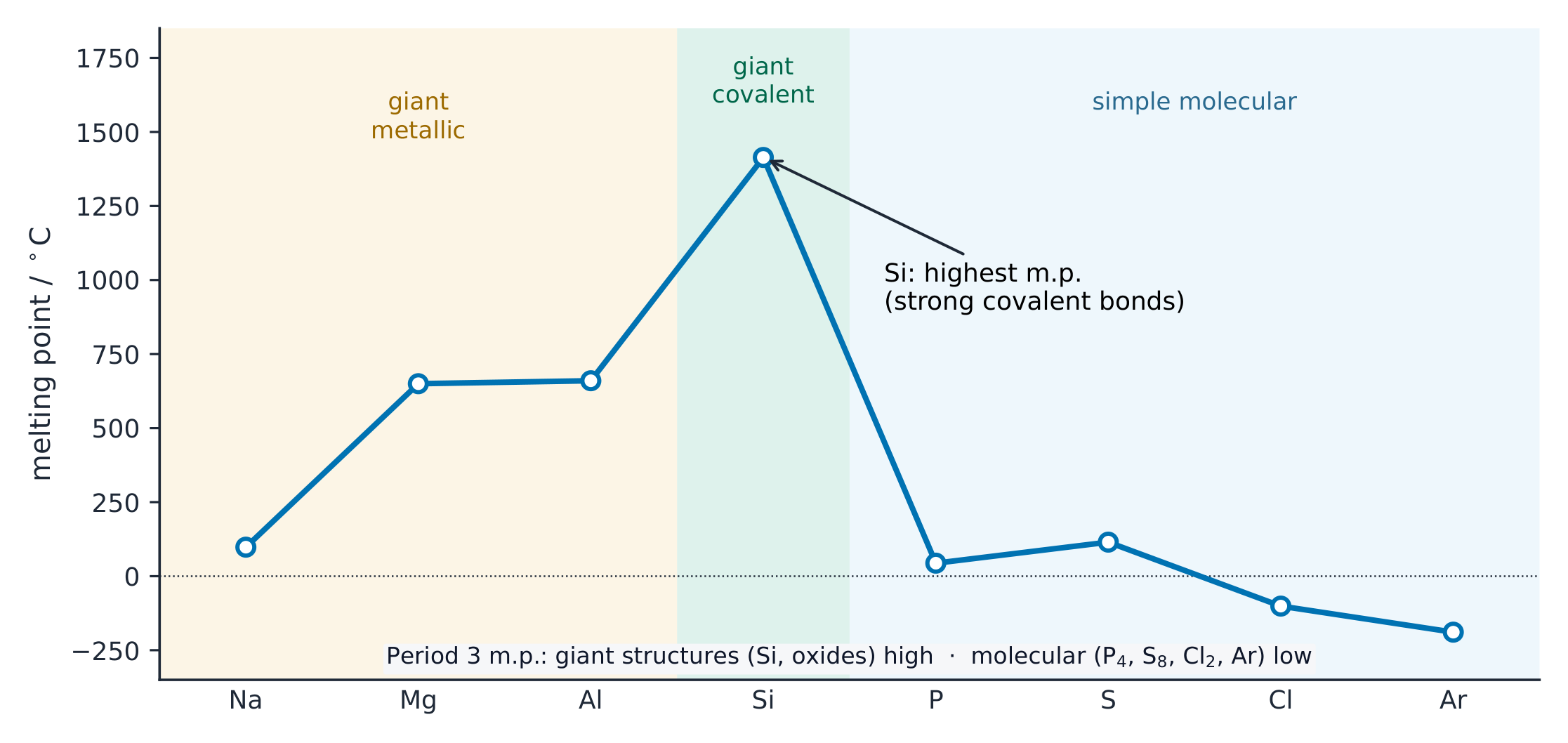
rises to a peak at silicon, then falls sharply
electrical conductivity 导电性
high for Na, Mg, Al; almost zero from Si onwards
The melting point and conductivity follow from the structure and bonding:
Na, Mg, Al are giant metallic 金属晶体. Melting points rise (Na → Al) because each atom gives more delocalised electrons and the ions get smaller, so the bonding is stronger. They conduct well.
Si is giant molecular 原子晶体 (giant covalent). It has the highest melting point, because strong covalent bonds must be broken. It barely conducts.
P, S, Cl, Ar are simple molecular 分子晶体 (or single atoms). Their melting points are low, because the only forces that break are the weak van der Waals' forces 范德华力between the molecules - the strong covalent bonds inside each molecule are never broken at all. They do not conduct.
Name van der Waals' forces when you explain that drop: it is the marking point, and "the covalent bonds are weak" is the error that loses it. Melting $\text{S}_8$ pulls whole molecules apart from each other; it does not touch a single $\text{S–S}$ bond. Their sizes still follow the molecule: $\text{S}_8$ melts higher than $\text{P}_4$ because it is bigger, with more electrons and so stronger van der Waals' forces, while $\text{Ar}$ (a single atom) is lowest of all.
สูงสำหรับ Na, Mg, Al; เกือบศูนย์ตั้งแต่ Si เป็นต้นไป
จุดหลอมเหลวและการนำไฟฟ้าเกิดจากโครงสร้างและพันธะ:
Na, Mg, Al เป็น โลหะขนาดใหญ่ (giant metallic). จุดหลอมเหลวเพิ่มขึ้น (Na → Al) เพราะแต่ละอะตอมให้ อิเล็กตรอนอิสระมากขึ้น และไอออนมีขนาดเล็กลง ทำให้พันธะแข็งแรงขึ้น—they conduct well. They conduct well.
Si เป็น โครงสร้างโคเวเลนต์ขนาดใหญ่ (giant covalent) มีจุดหลอมเหลวสูงสุด เนื่องจากต้องทำลายพันธะโคเวเลนต์ที่แข็งแรง มันนำไฟฟ้าได้ยากมาก.
P, S, Cl, Ar เป็น โมเลกุล đơn giản (simple molecular) หรือเป็นอะตอมเดี่ยว จุดหลอมเหลวต่ำเพราะแรงที่แตกหักคือ แรงแวนเดอร์วาลส์ (van der Waals' forces) ที่อ่อนแอ ระหว่าง โมเลกุล — พันธะโคเวเลนต์ที่แข็งแรง ภายใน แต่ละโมเลกุลไม่ได้แตกหักเลย—they do not conduct. They do not conduct.
จุดหลอมเหลวตลอดช่วงที่ 3 ยอดอยู่ที่ซิลิคอน (covalent ขนาดใหญ่); สูงสำหรับโลหะและต่ำสำหรับธาตุโมเลกุล简单/simple molecular elements
Explore · สำรวจ
Trends across Period 3 · แนวโน้มในคาบ 3
Switch between atomic radius, ionisation energy and melting point, and step across Period 3 to see each periodic trend. · สลับระหว่างรัศมีอะตอม พลังงานไอออนไนเซชัน และจุดหลอมเหลว แล้วเคลื่อนที่ข้ามคาบ 3 เพื่อดู แนวโน้มตามคาบ ของแต่ละอย่าง
Chemical properties across Period 3 · คุณสมบัติทางเคมีตลอดช่วงที่ 3
Syllabus · หลักสูตร
English
describe, and write equations for, the reactions of the elements with oxygen (to give $\text{Na}_2\text{O}$, $\text{MgO}$, $\text{Al}_2\text{O}_3$, $\text{P}_4\text{O}_{10}$, $\text{SO}_2$), chlorine (to give $\text{NaCl}$, $\text{MgCl}_2$, $\text{AlCl}_3$, $\text{SiCl}_4$, $\text{PCl}_5$) and water ($\text{Na}$ and $\text{Mg}$ only)
state and explain the variation in the oxidation number of the oxides ($\text{Na}_2\text{O}$, $\text{MgO}$, $\text{Al}_2\text{O}_3$, $\text{P}_4\text{O}_{10}$, $\text{SO}_2$ and $\text{SO}_3$ only) and chlorides ($\text{NaCl}$, $\text{MgCl}_2$, $\text{AlCl}_3$, $\text{SiCl}_4$, $\text{PCl}_5$ only) in terms of their outer shell (valence shell) electrons
describe, and write equations for, the reactions, if any, of the oxides $\text{Na}_2\text{O}$, $\text{MgO}$, $\text{Al}_2\text{O}_3$, $\text{SiO}_2$, $\text{P}_4\text{O}_{10}$, $\text{SO}_2$ and $\text{SO}_3$ with water including the likely pHs of the solutions obtained
describe, explain, and write equations for, the acid/base behaviour of the oxides $\text{Na}_2\text{O}$, $\text{MgO}$, $\text{Al}_2\text{O}_3$, $\text{P}_4\text{O}_{10}$, $\text{SO}_2$ and $\text{SO}_3$ and the hydroxides $\text{NaOH}$, $\text{Mg(OH)}_2$ and $\text{Al(OH)}_3$ including, where relevant, amphoteric behaviour in reactions with acids and bases (sodium hydroxide only)
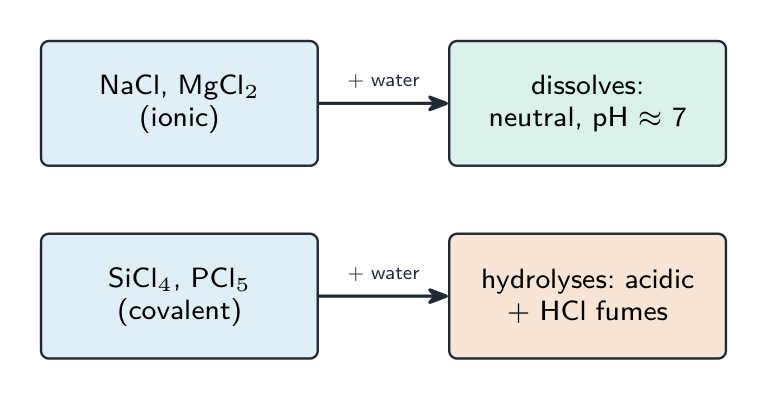
describe, explain, and write equations for, the reactions of the chlorides $\text{NaCl}$, $\text{MgCl}_2$, $\text{AlCl}_3$, $\text{SiCl}_4$, $\text{PCl}_5$ with water including the likely pHs of the solutions obtained
explain the variations and trends in 9.2.2, 9.2.3, 9.2.4 and 9.2.5 in terms of bonding and electronegativity
suggest the types of chemical bonding present in the chlorides and oxides from observations of their chemical and physical properties
Sodium reacts fast; magnesium reacts only very slowly with cold water.
Oxidation number of the oxides and chlorides
The oxidation number 氧化数 of the Period 3 element in its oxide or chloride rises across the period, because it equals the number of outer-shell (valence shell 价层) electrons 电子 the atom uses in bonding:
Oxides
$\text{Na}_2\text{O}$
$\text{MgO}$
$\text{Al}_2\text{O}_3$
$\text{P}_4\text{O}_{10}$
$\text{SO}_2$ / $\text{SO}_3$
oxidation number
$+1$
$+2$
$+3$
$+5$
$+4$ / $+6$
The chlorides $\text{NaCl}$, $\text{MgCl}_2$, $\text{AlCl}_3$, $\text{SiCl}_4$, $\text{PCl}_5$ show oxidation numbers $+1$ to $+5$ in the same way.
Oxides with water, and acid–base behaviour
Across the period the oxides 氧化物 change from basic to acidic:
Metal oxides (left) are basic; non-metal oxides (right) are acidic. $\text{Al}_2\text{O}_3$ and its hydroxide 氢氧化物$\text{Al(OH)}_3$ are amphoteric — they react with both acids and bases:
These trends follow from the change in bonding and electronegativity 电负性. On the left, the elements are metals with low electronegativity, so their oxides and chlorides are ionic and basic (or neutral). On the right, the elements are non-metals with high electronegativity, so their oxides and chlorides are covalent and acidic. You can use a chloride's or oxide's properties (melting point, conductivity, effect on water) to suggest whether its bonding is ionic or covalent.
Worked example. Predict the pH when $\text{Na}_2\text{O}$, $\text{Al}_2\text{O}_3$ and $\text{SO}_3$ are each added to water. Acid-base character follows the metal to non-metal change across Period 3. $\text{Na}_2\text{O}$ is ionic and basic: it dissolves to give $\text{NaOH}$, so the pH is about 13. $\text{SO}_3$ is covalent and acidic: it reacts to give $\text{H}_2\text{SO}_4$, so the pH is about 1. $\text{Al}_2\text{O}_3$ sits at the changeover - it is amphoteric and essentially insoluble in water, so the pH stays about 7. The trap is that last one: amphoteric does not mean neutral, it means the oxide reacts with acids and with alkalis - it simply does not react with water.
Periodicity of other elements · ความซ้ำซ้อนของธาตุอื่นๆ
Syllabus · หลักสูตร
English
predict the characteristic properties of an element in a given group by using knowledge of chemical periodicity
deduce the nature, possible position in the Periodic Table and identity of unknown elements from given information about physical and chemical properties
Step across Period 3 to see a property rise or fall, then repeat in the next period — that recurring pattern is periodicity. · ข้ามคาบที่ 3 เพื่อดูคุณสมบัติที่เพิ่มขึ้นหรือลดลง แล้วซ้ำในคาบถัดไป — รูปแบบที่ซ้ำนี้คือ คาบ
Pick one and the site follows you — notes, papers, videos and practice all open on it. · เลือกหนึ่งตัว และเว็บจะติดตามคุณ — หมายเหตุ, ใบงาน, วิดีโอ และการฝึกฝนจะเปิดอยู่ที่นั้น
Type to search notes, lessons, code, vocabulary and past-paper questions across every subject. · พิมพ์เพื่อค้นหาบันทึก, บทเรียน, โค้ด, คำศัพท์ และคำถามข้อสอบเก่าในทุกวิชา