Skip to content · ⁨ข้ามไปยังเนื้อหา⁩

Analytical techniques · ⁨เทคนิคการวิเคราะห์⁩

A-Level Chemistry · ⁨Chemistry A-Level⁩ · Topic 37 · ⁨หัวข้อ 37⁩

Video lesson for this topic · ⁨บทเรียนวิดีโอสำหรับหัวข้อนี้⁩ Open the video page · ⁨เปิดหน้าวิดีโอ⁩
8:06

เทคนิคการวิเคราะห์ (A2): NMR

นี่คือโมเลกุลที่แตกต่างกันเจ็ดตัว ทุกตัวมีคาร์บอนห้าอะตอม ไฮโดรเจนสิบอะตอม และออกซิเจนหนึ่งอะตอม รวมถึงทุกตัวมีหมู่คาร์บอนิล เมื่อชั่งน้ำหนัก它们在 mass spectrometer …

English narration · English + 中文 subtitles burned in · ⁨การบรรยายภาษาอังกฤษ · คำบรรยายภาษาอังกฤษ + 中文 ลอยตัวบนภาพ⁩

37.1

Thin-layer chromatography · ⁨โครมาโตกราฟีชั้นบาง⁩

Syllabus · ⁨หลักสูตร⁩
English
  1. describe and understand the terms (a) stationary phase, for example aluminium oxide (on a solid support) (b) mobile phase; a polar or non-polar solvent (c) $R_{\text{f}}$ value (d) solvent front and baseline
  2. interpret $R_{\text{f}}$ values
  3. explain the differences in $R_{\text{f}}$ values in terms of interaction with the stationary phase and of relative solubility in the mobile phase
ไทย
  1. อธิบายและเข้าใจศัพท์ดังนี้ (a) เฟสคงที่ เช่น อะลูมิเนียมออกไซด์ (บนตัวรองรับที่เป็นของแข็ง) (b) เฟสเคลื่อนที่; สารละลายที่มีขั้วหรือไม่มีขั้ว (c) ค่า $R_{\text{f}}$ (d) เส้นหน้าสารละลายและเส้นฐาน
  2. ตีความค่า $R_{\text{f}}$
  3. อธิบายความแตกต่างของค่า $R_{\text{f}}$ ในแง่ของการเกิดปฏิสัมพันธ์กับเฟสคงที่และความสามารถในการละลายสัมพัทธ์ในเฟสเคลื่อนที่

Source: Cambridge International syllabus · ⁨แหล่งที่มา: หลักสูตร Cambridge International⁩

English

Chromatography 色谱 separates a mixture using two "phases" — one that stays still and one that moves. In thin-layer chromatography 薄层色谱 (TLC):

  • the stationary phase 固定相 stays still (for example aluminium oxide on a plate).
  • the mobile phase 流动相 moves (a polar or non-polar solvent that travels up the plate).
  • the baseline 基线 is the starting line where the spots are placed; the solvent front 溶剂前沿 is the highest level the solvent reaches.

The $R_{\text{f}}$ value compares how far a spot moves with how far the solvent moves:

$$R_{\text{f}} = \frac{\text{distance moved by the spot}}{\text{distance moved by the solvent front}}$$

It is always between 0 and 1. A substance that sticks more strongly to the stationary phase, or is less soluble in the mobile phase, moves less and has a smaller $R_{\text{f}}$.

ไทย

โครมาโตกราฟี แยกส่วนผสมโดยใช้ "เฟส" สองอย่าง — อย่างที่นิ่งอยู่และอย่างที่เคลื่อนที่ ใน โครมาโตกราฟีชั้นบาง (TLC):

  • เฟสนิ่ง นิ่งอยู่ (เช่น อลูมิเนียมออกไซด์บนแผ่น)
  • เฟสเคลื่อนที่ เคลื่อนที่ (ตัวทำละลายขั้วหรือไม่ขั้วที่เคลื่อนที่ขึ้นบนแผ่น)
  • เส้นฐาน คือจุดเริ่มต้นที่วางจุดตัวอย่าง; หน้าผาตัวทำละลาย คือระดับสูงสุดที่ตัวทำละลายไปถึง

ค่า $R_{\text{f}}$ เปรียบเทียบระยะทางที่จุดเคลื่อนที่กับระยะทางที่ตัวทำละลายเคลื่อนที่:

$$R_{\text{f}} = \frac{\text{distance moved by the spot}}{\text{distance moved by the solvent front}}$$

มันอยู่ระหว่าง 0 ถึง 1 เสมอ สารที่ยึดติดกับเฟสนิ่งมากกว่า หรือละลายในเฟสเคลื่อนที่ได้น้อยกว่า จะเคลื่อนที่น้อยลงและมีค่า $R_{\text{f}}$ เล็กกว่า

แผ่น TLC ที่มีเส้นฐาน หน้าผาตัวทำละลาย และจุดที่เคลื่อนที่ขึ้นไปครึ่งทาง โดยมีการระบุระยะของจุดและระยะของตัวทำละลาย
โครมาโตกราฟีชั้นบาง: ค่า $R_\text{f}$ คือระยะที่จุดเคลื่อนที่หารด้วยระยะที่หน้าผาตัวทำละลายเคลื่อนที่

แผ่น TLC ที่พัฒนาแล้วเรืองแสงภายใต้แสงยูวี *แผ่น TLC จริงภายใต้แสง UV: แต่ละจุดเรืองแสงคือองค์ประกอบที่แยกออกจากกันของส่วนผสม
Explore · ⁨สำรวจ⁩

TLC route

Follow a spot up a plate and use Rf to identify substances. · ⁨ติดตามจุดขึ้นบนแผ่น板和ใช้ Rf เพื่อระบุสาร⁩

Vocabulary · ⁨คำศัพท์⁩ Train · ⁨ฝึกฝน⁩
English ไทย
chromatography/krəʊməˈtɒɡrəfi/ ครอมาโทกราฟ
thin-layer chromatography/θɪn ˈleɪə krəʊməˈtɒɡrəfi/ โครมาโทกราฟแบบชั้นบาง (TLC)
stationary phase/ˈsteɪʃənəri feɪz/ ระยะคงที่
mobile phase/ˈməʊbaɪl feɪz/ เฟสเคลื่อนที่
baseline/ˈbeɪslaɪn/ baseline
solvent front/ˈsɒlvənt frʌnt/ หน้าผาตัวทำละลาย
gas/liquid chromatography/ɡæs ˈlɪkwɪd krəʊməˈtɒɡrəfi/ โครมาโตกราฟีแก๊ส/ของเหลว
retention time/rɪˈtenʃn taɪm/ เวลาตกค้าง
37.2

Gas/liquid chromatography · ⁨โครมาโตกราฟีแก๊ส/ของเหลว⁩

Syllabus · ⁨หลักสูตร⁩
English
  1. describe and understand the terms (a) stationary phase; a high boiling point non-polar liquid (on a solid support) (b) mobile phase; an unreactive gas (c) retention time
  2. interpret gas/liquid chromatograms in terms of the percentage composition of a mixture
  3. explain retention times in terms of interaction with the stationary phase
ไทย
  1. อธิบายและเข้าใจศัพท์ดังนี้ (a) เฟสคงที่; ของเหลวไม่มีขั้วที่มีจุดเดือดสูง (บนตัวรองรับที่เป็นของแข็ง) (b) เฟสเคลื่อนที่; ก๊าซที่ไม่ทำปฏิกิริยา (c) เวลาคง留 (retention time)
  2. ตีความโครมาโตแกรมแก๊ส/ของเหลวในแง่ขององค์ประกอบเป็นเปอร์เซ็นต์ของส่วนผสม
  3. อธิบายเวลาคง留ในแง่ของการเกิดปฏิสัมพันธ์กับเฟสคงที่

Source: Cambridge International syllabus · ⁨แหล่งที่มา: หลักสูตร Cambridge International⁩

English

In gas/liquid chromatography 气液色谱 (GLC):

  • the stationary phase is a high-boiling-point non-polar liquid on a solid support.
  • the mobile phase is an unreactive carrier gas.
  • the retention time 保留时间 is how long a component takes to pass through.

The area of each peak gives the percentage of that component in the mixture. A component that interacts more with the stationary phase has a longer retention time.

ไทย

ใน โครมาโตกราฟีแก๊ส/ของเหลว (GLC):

  • เฟสนิ่งคือของเหลวไม่ขั้วที่มีจุดเดือดสูงบนตัวรองรับของแข็ง
  • เฟสเคลื่อนที่คือแก๊สพาที่ไม่ทำปฏิกิริยา
  • เวลาเก็บรักษา คือระยะเวลาที่องค์ประกอบหนึ่งใช้ในการผ่านระบบ

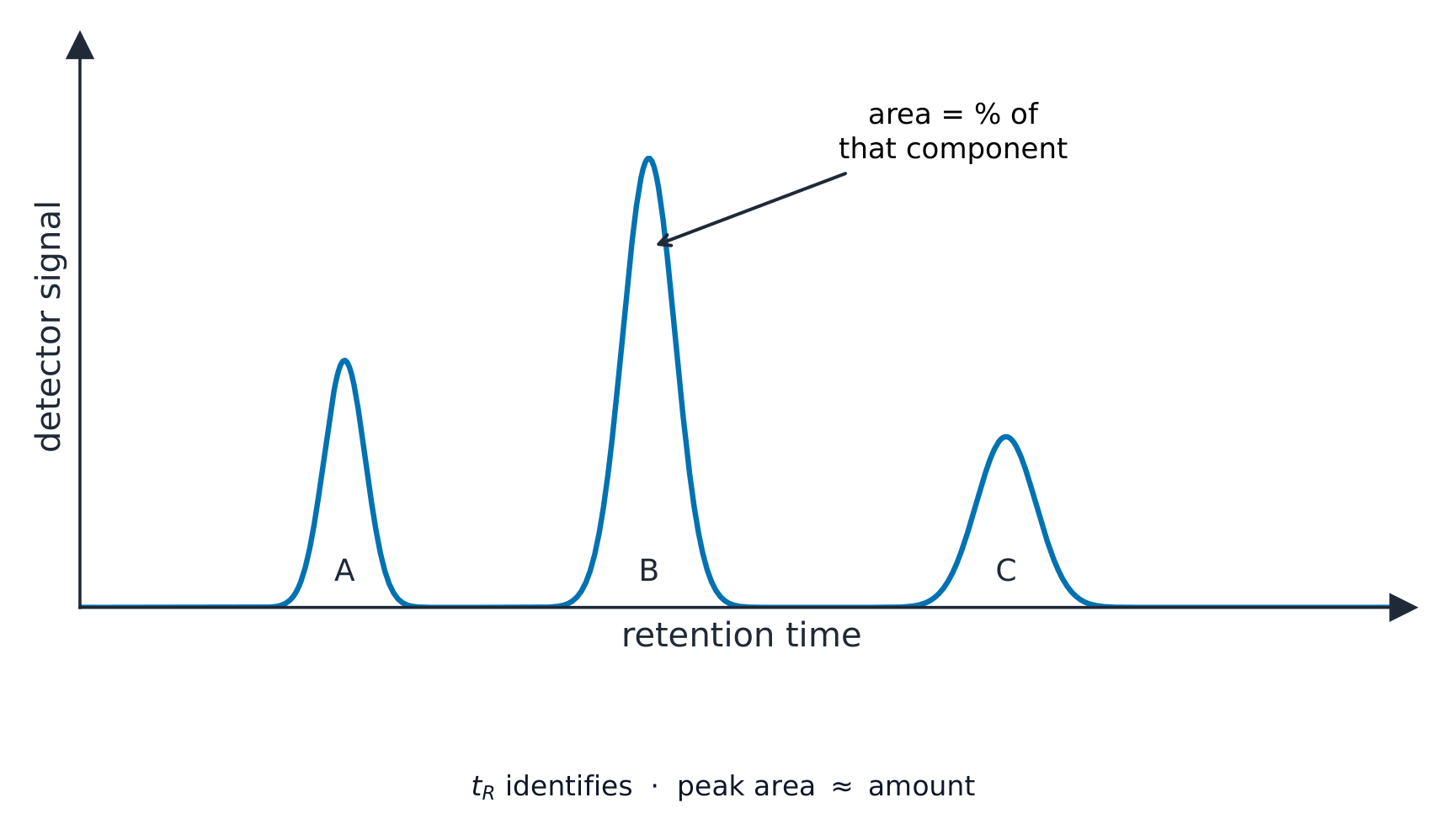
พื้นที่ของแต่ละพีคให้เปอร์เซ็นต์ขององค์ประกอบนั้นในส่วนผสม องค์ประกอบที่ปฏิสัมพันธ์กับเฟสนิ่งมากกว่าจะมีเวลาตกค้างยาวนานกว่า

กราฟโครมาโตกราฟีนที่มีสามพีคที่เวลาตกค้างต่างกัน พื้นที่พีคให้เปอร์เซ็นต์ของแต่ละองค์ประกอบ *กราฟโครมาโตกราฟีแก๊ส-ของเหลว: แต่ละองค์ประกอบให้พีคที่เวลาตกค้างของมันเอง และพื้นที่พีคคือเปอร์เซ็นต์ของมันในส่วนผสม

Explore · ⁨สำรวจ⁩

Gas/liquid chromatography route · ⁨เส้นทางโครมาโทกราฟแก๊ส/ของเหลว⁩

Follow a volatile sample through column separation to a chromatogram. · ⁨ติดตามตัวอย่างระเหยผ่านคอลัมน์แยกเพื่อสร้างกราฟโครมาโทแกรม⁩

37.3

Carbon-13 NMR spectroscopy · ⁨สเปกโทรสโกปี NMR คาร์บอน-13⁩

Syllabus · ⁨หลักสูตร⁩
English
  1. analyse and interpret a carbon-13 NMR spectrum of a simple molecule to deduce: (a) the different environments of the carbon atoms present (b) the possible structures for the molecule
  2. predict or explain the number of peaks in a carbon-13 NMR spectrum for a given molecule
ไทย
  1. วิเคราะห์และตีความสเปกตรัม คาร์บอน-13 NMR ของโมเลกุลอย่างง่าย เพื่อดัดแปลงข้อมูล: (a) สภาพแวดล้อมที่แตกต่างกันของอะตอมคาร์บอนที่มีอยู่ (b) โครงสร้างที่เป็นไปได้ของโมเลกุลนั้น
  2. ทำนายหรืออธิบายจำนวนพีคในสเปกตรัมคาร์บอน-13 NMR สำหรับโมเลกุลที่กำหนดให้

Source: Cambridge International syllabus · ⁨แหล่งที่มา: หลักสูตร Cambridge International⁩

English

NMR 核磁共振 (nuclear magnetic resonance) studies how certain nuclei behave in a strong magnetic field.

In carbon-13 NMR, each different chemical environment 化学环境 of carbon gives one peak. So:

  • the number of peaks tells you how many different carbon environments there are (equivalent carbons share a peak).
  • the position of each peak (its chemical shift) suggests the type of carbon, which helps you deduce possible structures.
ไทย

NMR (เรโซแนนซ์แม่เหล็กนิวเคลียร์) ศึกษาพฤติกรรมของนิวเคลียส์บางชนิดในสนามแม่เหล็กที่แรง

เครื่องสเปกโทรสโกปี NMR ทรงกระบอกสูงตั้งอยู่ในห้องปฏิบัติการ มีเครื่องหมายเตือนสนามแม่เหล็กแรง *เครื่องสเปกโทรสโกปี NMR: กระบอกใหญ่เก็บแม่เหล็กซูเปอร์คอนดักติงที่ทำให้เกิดสนามแม่เหล็กที่แรงมากซึ่งเทคนิคนี้ต้องการ

ใน NMR คาร์บอน-13 แต่ละ สภาพแวดล้อมทางเคมี ของคาร์บอนให้พีคหนึ่ง ดังนั้น:

  • จำนวนพีค บอกว่าคุณมีสภาพแวดล้อมของคาร์บอนกี่แบบ (คาร์บอนที่เท่าเทียมกันแบ่งปันพีคเดียวกัน)
  • ตำแหน่งของแต่ละพีค (chemical shift ของมัน) ชี้บอกรูปแบบของคาร์บอน ซึ่งช่วยให้คุณอนุมานโครงสร้างที่เป็นไปได้
Explore · ⁨สำรวจ⁩

Carbon-13 NMR lab · ⁨ห้องปฏิบัติการ NMR คาร์บอน-13⁩

Match carbon environments to C-13 NMR evidence. · ⁨จับคู่สภาพแวดล้อมคาร์บอนกับหลักฐาน C-13 NMR⁩

Vocabulary · ⁨คำศัพท์⁩ Train · ⁨ฝึกฝน⁩
English ไทย
NMR/ˌen em ˈɑː/ เอ็นเอ็มอาร์
chemical environment/ˈkemɪkl enˈvaɪrənmənt/ สภาพแวดล้อมทางเคมี
chemical shift/ˈkemɪkl ʃɪft/ การเลื่อนทางเคมี
37.4

Proton (¹H) NMR spectroscopy · ⁨สเปกโทรสโกปีโปรตอน (¹H) NMR⁩

Syllabus · ⁨หลักสูตร⁩
English
  1. analyse and interpret a proton ($^1\text{H}$) NMR spectrum of a simple molecule to deduce: (a) the different environments of proton present using chemical shift values (b) the relative numbers of each type of proton present from relative peak areas (c) the number of equivalent protons on the carbon atom adjacent to the one to which the given proton is attached from the splitting pattern, using the $n + 1$ rule (limited to singlet, doublet, triplet, quartet and multiplet) (d) the possible structures for the molecule
  2. predict the chemical shifts and splitting patterns of the protons in a given molecule
  3. describe the use of tetramethylsilane, TMS, as the standard for chemical shift measurements
  4. state the need for deuterated solvents, e.g. $\text{CDCl}_3$, when obtaining a proton NMR spectrum
  5. describe the identification of O–H and N–H protons by proton exchange using $\text{D}_2\text{O}$
ไทย
  1. วิเคราะห์และตีความสเปกตรัมโปรตอน ($^1\text{H}$) NMR ของโมเลกุลอย่างง่าย เพื่อดัดแปลงข้อมูล: (a) สภาพแวดล้อมที่แตกต่างกันของโปรตอนโดยใช้ค่า chemical shift (b) จำนวนสัมพัทธ์ของแต่ละประเภทของโปรตอนที่มีอยู่จากพื้นที่พีคสัมพัทธ์ (c) จำนวนโปรตอนที่สมมูลกันบนอะตอมคาร์บอนที่อยู่ติดกับคาร์บอนที่โปรตอนที่กำหนดติดอยู่ จาก รูปแบบการแตกหัก (splitting pattern) โดยใช้ $n + 1$ rule (จำกัดเฉพาะ singlet, doublet, triplet, quartet และ multiplet) (d) โครงสร้างที่เป็นไปได้ของโมเลกุลนั้น
  2. ทำนาย chemical shift และรูปแบบการแตกหักของโปรตอนในโมเลกุลที่กำหนดให้
  3. อธิบายการใช้ tetramethylsilane, TMS, เป็นมาตรฐานสำหรับการวัด chemical shift
  4. ระบุถึงความจำเป็นของตัวทำละลายที่มีดิวเทอเรียม เช่น $\text{CDCl}_3$, เมื่อได้รับสเปกตรัมโปรตอน NMR
  5. อธิบายการระบุโปรตอน O–H และ N–H โดยการแลกเปลี่ยนโปรตอนโดยใช้ $\text{D}_2\text{O}$

Source: Cambridge International syllabus · ⁨แหล่งที่มา: หลักสูตร Cambridge International⁩

English

Proton NMR looks at the hydrogen atoms (proton 质子 nuclei). From the spectrum you read off:

  • chemical environments: protons in different environments appear at different chemical shift 化学位移 values.
  • relative numbers: the relative peak areas give the ratio of each type of proton.
  • splitting 裂分: a peak is split by the protons on the neighbouring carbon, following the $n+1$ rule — $n$ equivalent neighbours split a peak into $n+1$ lines:
Neighbours ($n$) Pattern
0 singlet 单峰
1 doublet 双峰
2 triplet 三峰
3 quartet 四峰
many multiplet 多重峰

Practical points

  • tetramethylsilane 四甲基硅烷 (TMS) is the standard, set at a chemical shift of $0$.
  • a deuterated solvent 氘代溶剂 (such as $\text{CDCl}_3$) is used so that the solvent itself gives no proton signal.
  • shaking the sample with $\text{D}_2\text{O}$ makes the O–H and N–H peaks disappear (their hydrogen is swapped for deuterium), which identifies those protons.

Worked example. A compound $\text{C}_4\text{H}_8\text{O}_2$ gives three proton NMR peaks: a triplet at $\delta\ 1.2$ (area 3), a quartet at $\delta\ 4.1$ (area 2), and a singlet at $\delta\ 2.0$ (area 3). Deduce the structure. Read the areas first, then the splitting. Areas $3:2:3$ give three proton environments holding 3, 2 and 3 hydrogens. Apply the $n+1$ rule in reverse: a triplet (area 3) is a $\text{CH}_3$ with 2 neighbours, and a quartet (area 2) is a $\text{CH}_2$ with 3 neighbours - each splitting the other, which is the classic ethyl group, $\text{CH}_3\text{CH}_2-$. That $\text{CH}_2$ lies far downfield at $\delta\ 4.1$, so it is attached to an oxygen. The remaining singlet (area 3) is a $\text{CH}_3$ with no neighbours at $\delta\ 2.0$, so it sits next to the C=O. Together: $\text{CH}_3\text{COOCH}_2\text{CH}_3$, ethyl ethanoate. A triplet-and-quartet pair is almost always an ethyl group - spot it first and the rest follows.

ไทย

Proton NMR พิจารณาอะตอมไฮโดรเจน (นิวเคลียส โปรตอน) จากสเปกตรัมที่คุณอ่าน-info出的:

  • สภาพแวดล้อมทางเคมี: โปรตอนในสภาพแวดล้อมที่ต่าง nhau ปรากฏที่ค่า chemical shift ที่ต่างกัน
  • จำนวนสัมพัทธ์: พื้นที่พีคสัมพัทธ์ให้สัดส่วนของแต่ละประเภทของโปรตอน
  • การแตกตัว: พีคถูกแตกโดยโปรตอนบนคาร์บอนเพื่อนบ้าน ตาม $n+1$ rule — $n$ เพื่อนบ้านที่เท่าเทียมกันแตกพีคออกเป็น $n+1$ เส้น:
数目 ($n$) รูปแบบ
0 ซิงเกเลท
1 ดับเบเลท
2 ไตรเปเลท
3 ควอเตท
หลาย มัลติเพลท
รูปแบบพีค NMR สี่แบบ: เส้นเดียว สองเส้น สามเส้น และสี่เส้น ติดป้ายว่า ซิงเกเลท ดับเบเลท ไตรเปเลท และควอเตท
กฎ $n+1$: $n$ โปรตอนเพื่อนบ้านที่เทียบเท่ากันจะแบ่งพีคให้เป็น $n+1$ เส้น (ซิงเกต, ดับเบต, ไตรเพลต, ควอร์เตต)
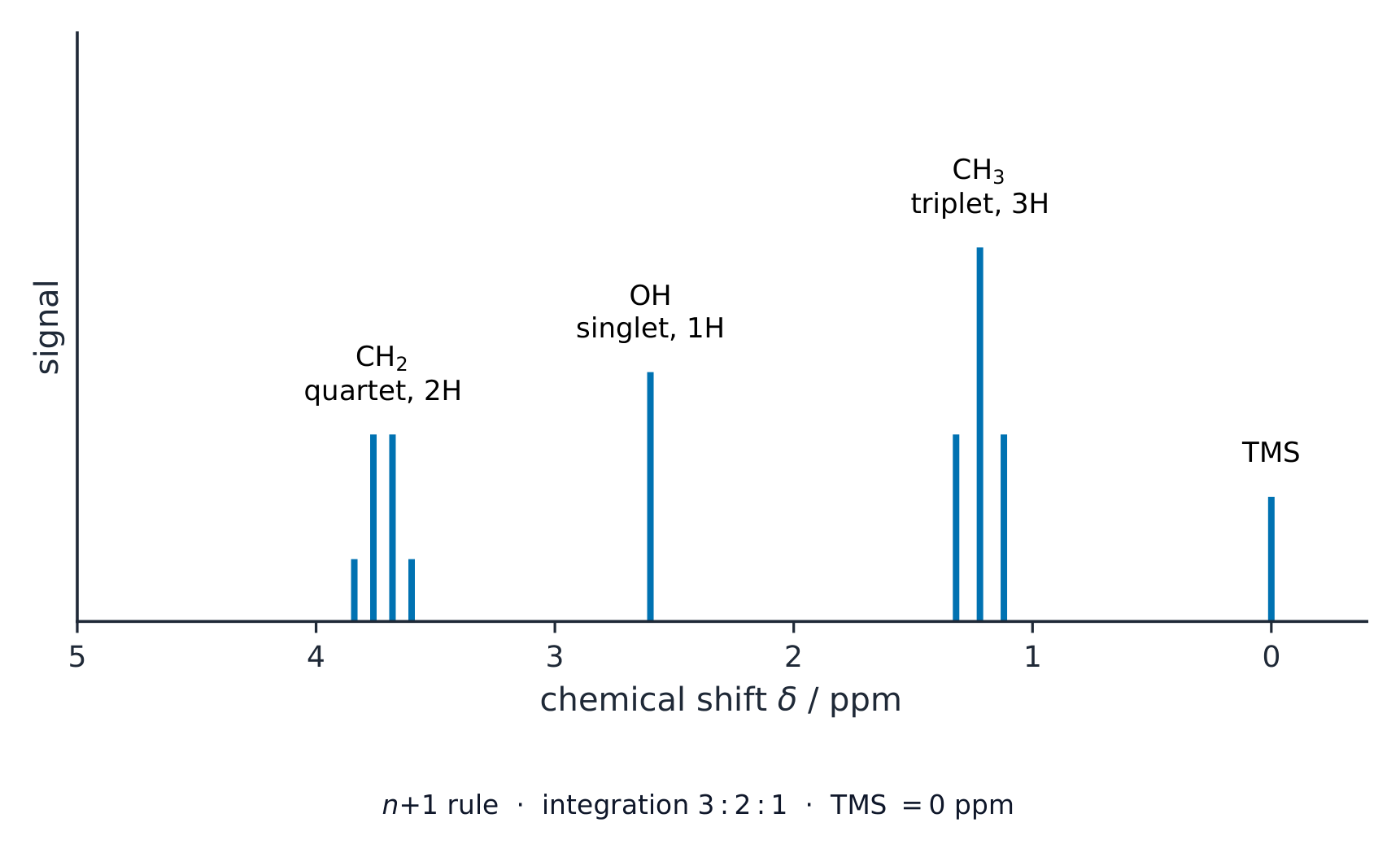
สเปกตรัม NMR ของโปรตอนของเอทานอลที่มีสามกลุ่มของพีค: Triplet ของ CH3, Quartet ของ CH2 และ Singlet ของ OH รวมถึง TMS ที่จุดศูนย์
NMR ของโปรตอนในเอทานอล: สามสภาพแวดล้อมให้ Triplet ของ CH$_3$, Quartet ของ CH$_2$ และ Singlet ของ OH โดยพื้นที่มีอัตราส่วน $3:2:1$

ข้อควรระวังในการปฏิบัติ

  • เททราเมทิลซิลาน (TMS) เป็นมาตรฐาน ตั้งค่าไว้ที่ Chemical shift ที่ $0$
  • ใช้ ตัวทำละลายที่มีดิวเทอเรียม (เช่น $\text{CDCl}_3$) เพื่อให้ตัวทำละลายเองไม่เกิดสัญญาณโปรตอน
  • การเขย่าตัวอย่างกับ $\text{D}_2\text{O}$ ทำให้พีค O–H และ N–H หายไป (ไฮโดรเจนถูกแลกเปลี่ยนเป็นดิวเทอเรียม) ซึ่งช่วยระบุตำแหน่งโปรตอนเหล่านั้น

ตัวอย่างวิธีทำ. สารประกอบ $\text{C}_4\text{H}_8\text{O}_2$ ให้พีค NMR ของโปรตอนสามเส้น: Triplet ที่ $\delta\ 1.2$ (พื้นที่ 3), Quartet ที่ $\delta\ 4.1$ (พื้นที่ 2) และ Singlet ที่ $\delta\ 2.0$ (พื้นที่ 3) จงหาโครงสร้าง อ่านจากพื้นที่ก่อน แล้วจึงดูการแยกสเปกตรัม พื้นที่ $3:2:3$ บ่งบอกถึงสามสภาพแวดล้อมของโปรตอนที่มีไฮโดรเจน 3, 2 และ 3 อะตอม ใช้กฎ $n+1$ ย้อนกลับ: Triplet (พื้นที่ 3) คือ $\text{CH}_3$ ที่มี 2 เพื่อนบ้าน และ Quartet (พื้นที่ 2) คือ $\text{CH}_2$ ที่มี 3 เพื่อนบ้าน - แต่ละกลุ่มแยกสเปกตรัมอีกกลุ่มหนึ่ง ซึ่งเป็น หมู่เอทิล แบบคลาสสิก $\text{CH}_3\text{CH}_2-$. ส่วน That $\text{CH}_2$ อยู่ทางขวาสุดที่ $\delta\ 4.1$ แสดงว่าเชื่อมกับ ออกซิเจน. ส่วน Singlet เหลืออยู่ (พื้นที่ 3) คือ $\text{CH}_3$ ที่มี ไม่มี เพื่อนบ้านที่ $\delta\ 2.0$ จึงอยู่ติดกับ C=O. รวมกันแล้วได้: $\text{CH}_3\text{COOCH}_2\text{CH}_3$, เอทิลเอทานอยเอ斯特. คู่ Triplet และ Quartate มักจะเป็นหมู่เอทิลเสมอ - มองเห็นมันก่อน ส่วนที่เหลือก็ตาม afterwards.

Explore · ⁨สำรวจ⁩

Proton NMR lab · ⁨ห้องปฏิบัติการ Proton NMR⁩

Match proton evidence to chemical environment and neighbours. · ⁨จับคู่หลักฐานโปรตอนกับสภาพแวดล้อมและเพื่อนบ้าน⁩

Vocabulary · ⁨คำศัพท์⁩ Train · ⁨ฝึกฝน⁩
English ไทย
proton/ˈprəʊtɒn/ โปรตอน
splitting/ˈsplɪtɪŋ/ การแยกสัญญาณ
singlet/ˈsɪŋɡlɪt/ singlet
doublet/ˈdʌblət/ doublet
triplet/ˈtrɪplɪt/ triplet
quartet/kwɔːˈtet/ quartet
multiplet/ˈmʌltɪplɪt/ มัลติเพลต
tetramethylsilane/ˈtetrəmiːθɪlsɪleɪn/ เททราเมทิลซิลาน
deuterated solvent/ˈdjuːtəreɪtɪd ˈsɒlvənt/ ตัวทำละลายที่มีดิวเทอเรียม
37.4

Exam tips · ⁨ข้อแนะนำสำหรับการสอบ⁩

English
  • In $^{13}\text{C}$ NMR the number of peaks equals the number of carbon environments — use symmetry to count them.
  • In $^1\text{H}$ NMR use chemical shift (data booklet), integration (ratio of H's) and splitting (the $n+1$ rule): a triplet + quartet means an ethyl group.
  • TMS is the reference ($\delta = 0$); a $\text{D}_2\text{O}$ shake removes O-H and N-H peaks.
  • Combine IR, mass spectrum and NMR to deduce a structure, stating which evidence gives which feature.
ไทย
  • ใน $^{13}\text{C}$ NMR จำนวนพีคเท่ากับจำนวน สภาพแวดล้อมของคาร์บอน — ใช้สมมาตรในการนับ
  • ใน $^1\text{H}$ NMR ใช้ Chemical shift (คู่มือข้อมูล), Integration (อัตราส่วนของ H) และ Splitting (กฎ $n+1$): Triplet + Quartet หมายถึงหมู่เอทิล
  • TMS เป็นค่าอ้างอิง ($\delta = 0$); การ $\text{D}_2\text{O}$ shake จะลบพีค O-H และ N-H ออก
  • รวม IR, สเปกตรัมมวลและ NMR เพื่อหาโครงสร้าง โดยระบุว่าหลักฐานแต่ละอย่างบ่งชี้ถึงคุณลักษณะใด

Interactive lessons on this topic · ⁨บทเรียนเชิงโต้ตอบสำหรับหัวข้อนี้⁩

Work through it step by step, with instant-check exercises. · ⁨ทำทีละขั้นตอน พร้อมแบบฝึกหัดตรวจสอบผลทันที⁩

Past Papers · ⁨ข้อสอบย้อนหลัง⁩

More topics in A-Level Chemistry · ⁨Chemistry A-Level⁩ · ⁨หัวข้อเพิ่มเติมใน A-Level Chemistry · ⁨Chemistry A-Level⁩⁩

Log in or create account · ⁨เข้าสู่ระบบหรือสร้างบัญชี⁩

IGCSE, A-Level & AP