Proton NMR
Introduced| English | Meaning |
|---|---|
| chemical shift/ˈkemɪkl ʃɪft/ | The position of an NMR signal relative to a reference, reflecting the chemical environment of the nucleus. |
| splitting/ˈsplɪtɪŋ/ | The division of an NMR peak by neighbouring protons: n neighbours give n+1 peaks. |
| deuterated/ˈdjuːtəreɪtɪd/ | deuterated |
| integration/ˌɪntɪˈɡreɪʃn/ | Measuring the area under an NMR signal to determine the relative number of nuclei producing it. |
Proton (¹H) NMR
- Proton NMR looks at the hydrogen atoms in a molecule.
- The spectrum gives three kinds of information.
- A few practical tricks make it readable.
Proton NMR lab
Match proton evidence to chemical environment and neighbours.
In proton NMR, the area under each peak is proportional to the number of ______ in that environment.
Difficulty 1/5 · 100 coins + a small bonus on first completion today
Integration gives the ratio of protons.
What you read off
- chemical environments: protons in different environments appear at different chemical shifts 化学位移 (number of peak groups = number of environments).
- relative numbers: the peak areas give the ratio of each type of proton.
- splitting 裂分: a peak is split by the protons on the neighbouring carbon — the $n+1$ rule.
| Neighbours ($n$) | Pattern |
|---|---|
| 0 | singlet |
| 1 | doublet |
| 2 | triplet |
| 3 | quartet |
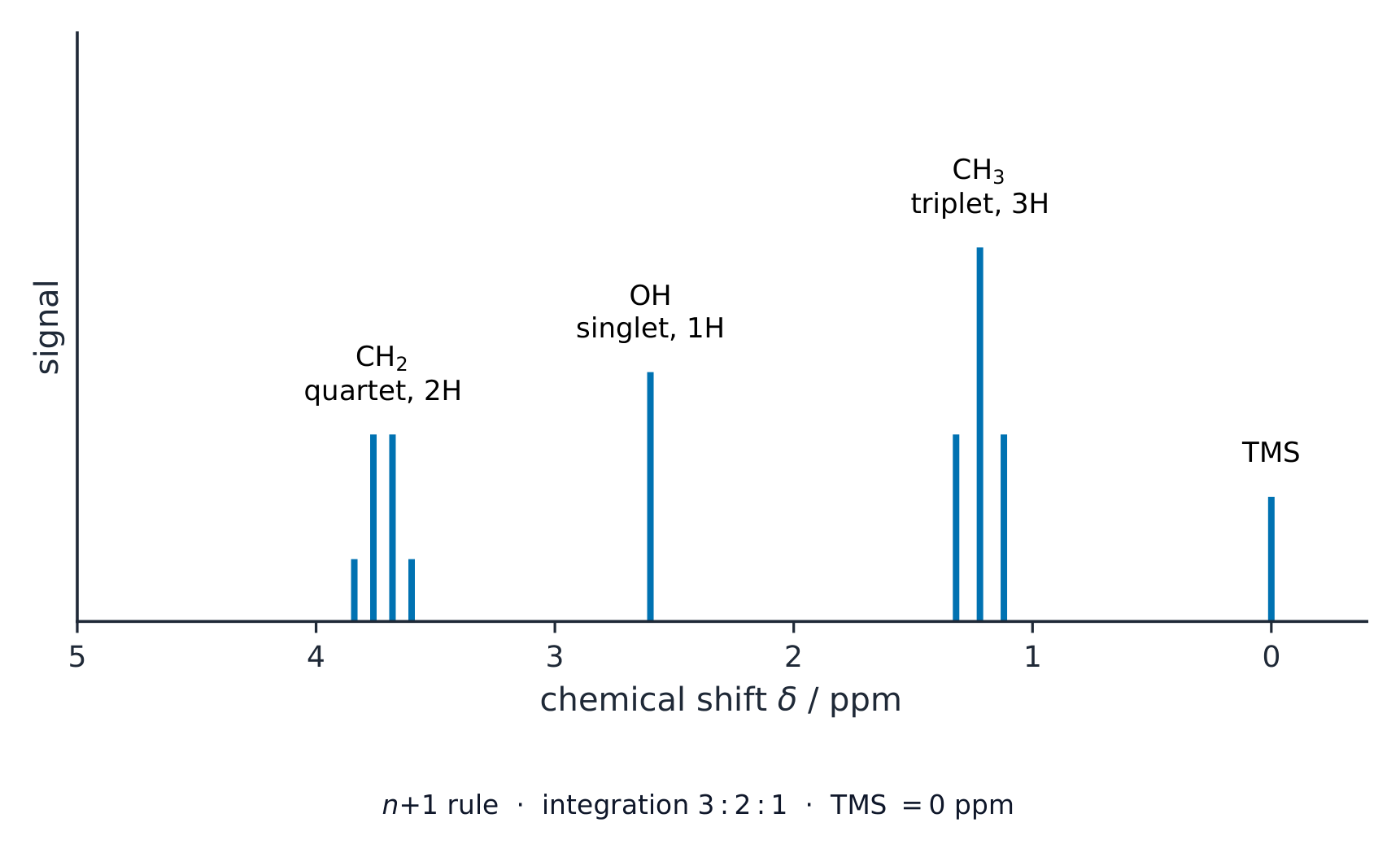
A proton NMR spectrum of ethanol
In proton NMR, the number of groups of peaks tells you:
Difficulty 1/5 · 100 coins + a small bonus on first completion today
Protons in different environments give peaks at different chemical shifts.
The relative areas of the peaks give:
Difficulty 1/5 · 100 coins + a small bonus on first completion today
Peak area is proportional to how many protons of that type there are (e.g. 3:2:1 for ethanol).
By the n+1 rule, a CH₃ group next to a CH₂ group appears as a:
Difficulty 1/5 · 100 coins + a small bonus on first completion today
The CH₃ has 2 neighbouring protons (on the CH₂), so n+1 = 3 lines — a triplet.
Match each term to its meaning.
Difficulty 2/5 · 140 coins + a small bonus on first completion today
Each item links the term to its correct meaning.
Practical points
- TMS (tetramethylsilane) is the standard, set at chemical shift 0.
- a deuterated 氘代 solvent (e.g. $\text{CDCl}_3$) gives no proton signal of its own.
- shaking with D₂O makes O–H and N–H peaks disappear (their H is swapped for D), identifying those protons.
Shaking a sample with D₂O makes which peaks disappear?
Difficulty 1/5 · 100 coins + a small bonus on first completion today
The exchangeable O–H and N–H hydrogens swap for deuterium, so their peaks vanish — identifying them.
What proton NMR tells you
- The number of peaks = different hydrogen environments; integration 积分 = ratio of protons.
- Splitting (n+1 rule) shows how many hydrogens are on neighbouring carbons.
You've got it
- ¹H NMR: number of peak groups = proton environments; areas = ratio of protons
- splitting: the $n+1$ rule ($n$ neighbours → $n+1$ lines): 0→singlet, 1→doublet, 2→triplet, 3→quartet
- TMS = reference (shift 0); a deuterated solvent is silent; D₂O removes O–H/N–H peaks