English narration · English + 中文 subtitles burned in · การบรรยายภาษาอังกฤษ · คำบรรยายภาษาอังกฤษ + 中文 ลอยตัวบนภาพ
36.1
Organic synthesis · 有机合成
Syllabus · หลักสูตร
English
for an organic molecule containing several functional groups: (a) identify organic functional groups using the reactions in the syllabus (b) predict properties and reactions
devise multi-step synthetic routes for preparing organic molecules using the reactions in the syllabus
analyse a given synthetic route in terms of type of reaction and reagents used for each step of it, and possible by-products
Source: Cambridge International syllabus · แหล่งที่มา: หลักสูตร Cambridge International
English
Like the AS synthesis topic, this asks you to join up known reactions to build a target molecule. Now you also have the A Level reactions of arenes, phenol, amines, amides and acyl chlorides.
Identifying functional groups
A molecule may carry several functional group 官能团 types. Use the test reactions to spot each one, then predict its behaviour. For example:
decolourises bromine water with no catalyst, giving a white precipitate → a phenol or a phenylamine (the ring is activated).
reacts violently with cold water, giving fumes of $\text{HCl}$ → an acyl chloride 酰氯.
gives a purple colour with neutral $\text{FeCl}_3$ → a phenol 苯酚.
$\text{Sn}$ / conc $\text{HCl}$, then $\text{NaOH}$ (reduction 还原)
phenylamine
phenylamine
$\text{HNO}_2$, below $10\,°\text{C}$
a diazonium salt
diazonium salt
warm water
phenol; or couple with phenol → azo dye
methylbenzene
hot $\text{KMnO}_4$ (oxidation 氧化)
benzoic acid
carboxylic acid 羧酸
$\text{SOCl}_2$ or $\text{PCl}_5$
acyl chloride
acyl chloride
alcohol / phenol
an ester 酯
acyl chloride
ammonia / amine 胺
an amide 酰胺
amide or nitrile 腈
$\text{LiAlH}_4$
an amine
halogenoalkane
$\text{KCN}$
a nitrile (adds one carbon)
Planning and analysing a route
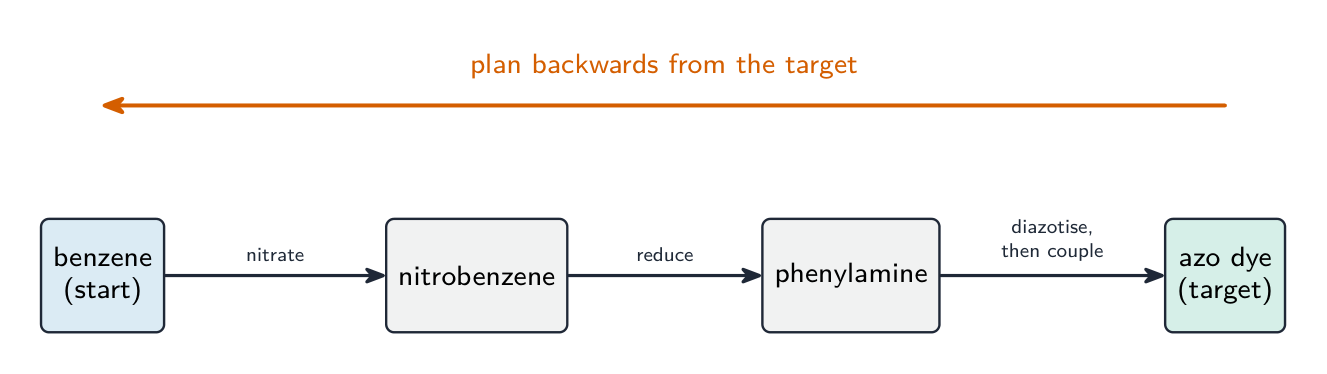
To devise a synthetic route 合成路线, work backwards from the target: which single reaction makes it, and from what? Repeat until you reach the starting material, then write each step with its reagent 试剂 and conditions.
When you analyse a route, state the type of reaction for each step (for example electrophilic substitution, addition–elimination 加成消去, oxidation or reduction) and watch for likely by-products 副产物 — for example, making an amine from a halogenoalkane also gives over-substituted amines, lowering the yield.
Worked example. Devise a route from benzene to phenylamine, $\text{C}_6\text{H}_5\text{NH}_2$. Work backwards: phenylamine comes from reducing nitrobenzene, and nitrobenzene comes from nitrating benzene - so the route is two steps. Step 1: benzene with concentrated $\text{HNO}_3$ and concentrated $\text{H}_2\text{SO}_4$ at $55\ °\text{C}$; electrophilic substitution gives nitrobenzene (keep below $55\ °\text{C}$, or further substitution follows). Step 2: reduce the nitrobenzene with tin and concentrated $\text{HCl}$, then add $\text{NaOH}$ to free the amine from its salt. There is no direct route - you cannot put an $\text{–NH}_2$ straight onto a ring, which is exactly why this nitrate-then-reduce pair is worth knowing by heart.
ไทย
เหมือนหัวข้อการสังเคราะห์ AS หัวข้อนี้ต้องการให้คุณ เชื่อมโยง ปฏิกิริยาที่รู้เข้าด้วยกันเพื่อสร้างโมเลกุลเป้าหมาย ตอนนี้คุณยังมีปฏิกิริยา A Level ของอารีน,_specs, เอมิน, แอมิด และแอซีลคลอไรด์
Pick one and the site follows you — notes, papers, videos and practice all open on it. · เลือกหนึ่งตัว และเว็บจะติดตามคุณ — หมายเหตุ, ใบงาน, วิดีโอ และการฝึกฝนจะเปิดอยู่ที่นั้น
Type to search notes, lessons, code, vocabulary and past-paper questions across every subject. · พิมพ์เพื่อค้นหาบันทึก, บทเรียน, โค้ด, คำศัพท์ และคำถามข้อสอบเก่าในทุกวิชา