Skip to content · ⁨ข้ามไปยังเนื้อหา⁩

Equilibria · ⁨สมดุลทางเคมี⁩

A-Level Chemistry · ⁨Chemistry A-Level⁩ · Topic 25 · ⁨หัวข้อ 25⁩

Video lesson for this topic · ⁨บทเรียนวิดีโอสำหรับหัวข้อนี้⁩ Open the video page · ⁨เปิดหน้าวิดีโอ⁩
7:56

สมดุล (A2)

เลือดของคุณถูกรักษาไว้ที่ pH เจ็ดจุดสี่ เลื่อนไปทางใดทางหนึ่งเพียงไม่กี่สิบส่วนแล้วคุณจะเข้าโรงพยาบาล แต่ตลอดทั้งวัน กรดไหลเข้ามา — จากอาหารของคุณ และจาก…

English narration · English + 中文 subtitles burned in · ⁨การบรรยายภาษาอังกฤษ · คำบรรยายภาษาอังกฤษ + 中文 ลอยตัวบนภาพ⁩

25.1

Conjugate acids and bases · ⁨กรดและเบสคู่ควบ⁩

Syllabus · ⁨หลักสูตร⁩
English
  1. understand and use the terms conjugate acid and conjugate base
  2. define conjugate acid–base pairs, identifying such pairs in reactions
  3. define mathematically the terms pH, $K_a$, $\text{p}K_a$ and $K_w$ and use them in calculations ($K_b$ and the equation $K_w = K_a \times K_b$ will not be tested)
  4. calculate $[\text{H}^+(\text{aq})]$ and pH values for: (a) strong acids (b) strong alkalis (c) weak acids
  5. (a) define a buffer solution (b) explain how a buffer solution can be made (c) explain how buffer solutions control pH; use chemical equations in these explanations (d) describe and explain the uses of buffer solutions, including the role of $\text{HCO}_3^-$ in controlling pH in blood
  6. calculate the pH of buffer solutions, given appropriate data
  7. understand and use the term solubility product, $K_{\text{sp}}$
  8. write an expression for $K_{\text{sp}}$
  9. calculate $K_{\text{sp}}$ from concentrations and vice versa
  10. (a) understand and use the common ion effect to explain the different solubility of a compound in a solution containing a common ion (b) perform calculations using $K_{\text{sp}}$ values and concentration of a common ion
ไทย
  1. เข้าใจและใช้คำว่า กรดคู่ควบ และ เบสคู่ควบ
  2. นิยาม คู่กรด-เบสคู่ควบ และระบุคู่ดังกล่าวในปฏิกิริยา
  3. นิยามทางคณิตศาสตร์ของคำศัพท์ pH, $K_a$, $\text{p}K_a$ และ $K_w$ และนำไปใช้ในการคำนวณ ($K_b$ และสมการ $K_w = K_a \times K_b$ จะไม่มีการทดสอบ)
  4. คำนวณค่า $[\text{H}^+(\text{aq})]$ และ pH สำหรับ: (a) กรดแรง (b) เบสแรง (c) กรดอ่อน
  5. (a) นิยาม สารละลายบัฟเฟอร์ (b) อธิบายวิธีการเตรียมสารละลายบัฟเฟอร์ (c) อธิบายวิธีที่สารละลายบัฟเฟอร์ควบคุมค่า pH; ใช้สมการเคมีในการอธิบายเหล่านี้ (d) อธิบายและอธิบายการใช้งานของสารละลายบัฟเฟอร์ รวมถึงบทบาทของ $\text{HCO}_3^-$ ในการควบคุมค่า pH ในเลือด
  6. คำนวณค่า pH ของสารละลายบัฟเฟอร์ จากข้อมูลที่กำหนดให้
  7. เข้าใจและใช้คำว่า ผลคูณความละลาย, $K_{\text{sp}}$
  8. เขียนนิพจน์สำหรับ $K_{\text{sp}}$
  9. คำนวณ $K_{\text{sp}}$ จากความเข้มข้นและในทางกลับกัน
  10. (ก) เข้าใจและใช้ ผลของไอออนร่วม เพื่ออธิบายความแตกต่างของความละลายของสารประกอบในสารละลายที่มีไอออนร่วม (ข) ทำการคำนวณโดยใช้ค่า $K_{\text{sp}}$ และความเข้มข้นของไอออนร่วม

Source: Cambridge International syllabus · ⁨แหล่งที่มา: หลักสูตร Cambridge International⁩

English
Titration curve and equivalence point

When a Brønsted acid loses an $\text{H}^+$, what is left is its conjugate base 共轭碱. When a base gains an $\text{H}^+$, it becomes its conjugate acid 共轭酸. The two species that differ by just one $\text{H}^+$ form a conjugate acid–base pair 共轭酸碱对.

For example, in $\text{CH}_3\text{COOH} \rightleftharpoons \text{CH}_3\text{COO}^- + \text{H}^+$, the pair is $\text{CH}_3\text{COOH}$ (acid) and $\text{CH}_3\text{COO}^-$ (its conjugate base).

ไทย
กราฟการไทเทรชันและจุดเสมอภาค

เมื่อกรดของบรอนสเตดloses一个 $\text{H}^+$, สิ่งที่เหลืออยู่คือ เบสคู่ควบ ของมัน เมื่อเบสรับ一个 $\text{H}^+$, มันจะกลายเป็น กรดคู่ควบ ของมัน สปีชีส์ทั้งสองที่ต่างกันเพียงหนึ่ง $\text{H}^+$ เท่านั้น จะสร้าง คู่กรด-เบสคู่ควบ

เช่น为例, ใน $\text{CH}_3\text{COOH} \rightleftharpoons \text{CH}_3\text{COO}^- + \text{H}^+$, คู่คือ $\text{CH}_3\text{COOH}$ (กรด) และ $\text{CH}_3\text{COO}^-$ (เบสคู่ควบของมัน)

กรดเอทานอยด์เสียโปรตอนไปเป็นเบสคู่ควบ, และแอมโมเนียรับโปรตอนไปเป็นกรดคู่ควบ, พร้อมวงเล็บจับคู่กรด-เบสคู่ควบ
คู่คู่ควบแตกต่างกันเพียงโปรตอนเดียว: กรดเสีย H$^+$ เพื่อสร้างเบสคู่ควบ; เบสรับ H$^+$ เพื่อสร้างกรดคู่ควบ
Explore · ⁨สำรวจ⁩

pH and H⁺ concentration · ⁨pH และความเข้มข้น H⁺⁩

pH = −log[H⁺]: slide it and watch [H⁺] change tenfold per unit. A conjugate acid–base pair differ by a single proton. · ⁨pH = −log[H⁺]: ลากดูการเปลี่ยนแปลง [H⁺] ที่เปลี่ยนไปสิบเท่าต่อหนึ่งหน่วย คู่กรด-เบสคู่ควบแตกต่างกันด้วยโปรตอนเพียงตัวเดียว⁩

25.1

pH and the equilibrium constants · ⁨pH และค่าคงที่สมดุล⁩

English
  • pH measures acidity: $\text{pH} = -\log[\text{H}^+]$, so $[\text{H}^+] = 10^{-\text{pH}}$.
  • the acid dissociation constant 酸解离常数 of a weak acid $\text{HA}$ is $K_a = \dfrac{[\text{H}^+][\text{A}^-]}{[\text{HA}]}$, and $\text{p}K_a = -\log K_a$. A larger $K_a$ (smaller $\text{p}K_a$) means a stronger acid.
  • the ionic product of water 水的离子积 is $K_w = [\text{H}^+][\text{OH}^-] = 1.0 \times 10^{-14}$ at $298\ \text{K}$.

Calculating pH

  • strong acid 强酸: fully ionised, so $[\text{H}^+]$ equals the acid concentration; then take $-\log$.
  • strong alkali 强碱: find $[\text{OH}^-]$ from the concentration, then use $[\text{H}^+] = K_w / [\text{OH}^-]$.
  • weak acid 弱酸: only partly ionised, so use $[\text{H}^+] = \sqrt{K_a \times [\text{HA}]}$.

Worked example. Find the pH of $0.050\ \text{mol dm}^{-3}$ hydrochloric acid (a strong acid).

It is fully ionised, so $[\text{H}^+] = 0.050\ \text{mol dm}^{-3}$, giving $\text{pH} = -\log(0.050) = 1.30$.

Worked example. Find the pH of $0.10\ \text{mol dm}^{-3}$ sodium hydroxide (a strong base). ($K_w = 1.0 \times 10^{-14}$.)

$[\text{OH}^-] = 0.10$, so $[\text{H}^+] = K_w/[\text{OH}^-] = (1.0 \times 10^{-14})/0.10 = 1.0 \times 10^{-13}$, giving $\text{pH} = 13.0$.

Worked example. Find the pH of $0.10\ \text{mol dm}^{-3}$ ethanoic acid (a weak acid). ($K_a = 1.8 \times 10^{-5}$.)

$$[\text{H}^+] = \sqrt{K_a \times [\text{HA}]} = \sqrt{(1.8 \times 10^{-5})(0.10)} = 1.3 \times 10^{-3}, \qquad \text{pH} = -\log(1.3 \times 10^{-3}) = 2.87.$$
ไทย
  • pH วัดความเป็นกรด: $\text{pH} = -\log[\text{H}^+]$, ดังนั้น $[\text{H}^+] = 10^{-\text{pH}}$
  • ค่าคงที่การแตกตัวของกรด ของกรดอ่อน $\text{HA}$ คือ $K_a = \dfrac{[\text{H}^+][\text{A}^-]}{[\text{HA}]}$, และ $\text{p}K_a = -\log K_a$. ค่า $K_a$ ที่ใหญ่ขึ้น (ค่า $\text{p}K_a$ ที่เล็กลง) หมายความว่ากรดมีกำลังแรงขึ้น
  • ผลคูณไอออนของน้ำ คือ $K_w = [\text{H}^+][\text{OH}^-] = 1.0 \times 10^{-14}$ ที่ $298\ \text{K}$
มาตราส่วน pH RUNNING จากกรด ผ่านกลาง เป็นเบส, โดยที่ pH = -log ของความเข้มข้นของไฮโดรเจนไอออน
มาตราส่วน pH: pH = -log ของความเข้มข้นของไฮโดรเจนไอออน

กระดาษวัด pH อยู่ข้างแผนภูมิสี *กระดาษวัด pH ประมาณค่า pH ของสารละลายจากสีที่เปลี่ยนไป
การคำนวณ pH

  • กรดแรง: แตกตัวเป็นไอออนทั้งหมด, ดังนั้น $[\text{H}^+]$ เท่ากับความเข้มข้นของกรด; แล้วนำ $-\log$
  • เบสแรง: หา $[\text{OH}^-]$ จากความเข้มข้น, แล้วใช้ $[\text{H}^+] = K_w / [\text{OH}^-]$
  • กรดอ่อน: แตกตัวเป็นไอออนไม่หมด, ดังนั้นใช้ $[\text{H}^+] = \sqrt{K_a \times [\text{HA}]}$

ตัวอย่างคำนวณ. หา pH ของ $0.050\ \text{mol dm}^{-3}$ กรดไฮโดรคลอริก (เป็นกรดแรง)

มันแตกตัวเป็นไอออนทั้งหมด, ดังนั้น $[\text{H}^+] = 0.050\ \text{mol dm}^{-3}$, ให้ $\text{pH} = -\log(0.050) = 1.30$

ตัวอย่างคำนวณ. หา pH ของ $0.10\ \text{mol dm}^{-3}$ โซเดียมไฮดรอกไซด์ (เป็นเบสแรง). ($K_w = 1.0 \times 10^{-14}$.)

$[\text{OH}^-] = 0.10$, ดังนั้น $[\text{H}^+] = K_w/[\text{OH}^-] = (1.0 \times 10^{-14})/0.10 = 1.0 \times 10^{-13}$, ให้ $\text{pH} = 13.0$

ตัวอย่างคำนวณ. หา pH ของ $0.10\ \text{mol dm}^{-3}$ กรดเอทานอยด์ (เป็นกรดอ่อน). ($K_a = 1.8 \times 10^{-5}$.)

$$[\text{H}^+] = \sqrt{K_a \times [\text{HA}]} = \sqrt{(1.8 \times 10^{-5})(0.10)} = 1.3 \times 10^{-3}, \qquad \text{pH} = -\log(1.3 \times 10^{-3}) = 2.87.$$
25.1

Buffer solutions · ⁨สารละลายบัฟเฟอร์⁩

English

A buffer solution 缓冲溶液 resists a change in pH when a small amount of acid or alkali is added. You make one from a weak acid and its conjugate base (for example ethanoic acid and sodium ethanoate).

It works because the mixture holds a store of both partners:

  • added $\text{H}^+$ is removed by the conjugate base: $\text{CH}_3\text{COO}^- + \text{H}^+ \rightarrow \text{CH}_3\text{COOH}$.
  • added $\text{OH}^-$ is removed by the weak acid: $\text{CH}_3\text{COOH} + \text{OH}^- \rightarrow \text{CH}_3\text{COO}^- + \text{H}_2\text{O}$.

To find the pH, put the concentrations of the acid and its salt into the $K_a$ expression. Buffers are important in living things — for example, $\text{HCO}_3^-$ keeps the pH of blood close to $7.4$.

ไทย

สารละลายบัฟเฟอร์ ทนต่อการเปลี่ยนแปลง pH เมื่อเพิ่มกรดหรือเบสเล็กน้อย เราทำขึ้นได้จากกรดอ่อนและเบสคู่ควบของมัน (เช่น กรดเอทานอยด์และโซเดียมเอทานอยเตต)

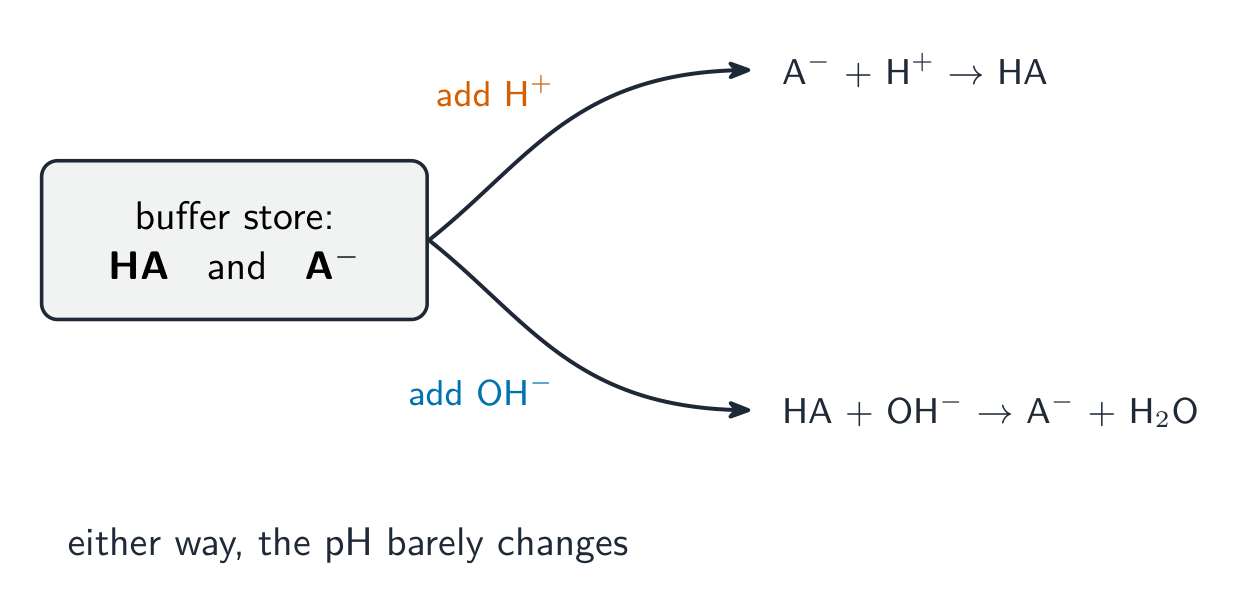
มันทำงานได้เพราะส่วนผสมมีสต็อกของทั้งคู่:

  • $\text{H}^+$ ที่เติมเข้ามาจะถูกกำจัดโดยเบสคู่ควบ: $\text{CH}_3\text{COO}^- + \text{H}^+ \rightarrow \text{CH}_3\text{COOH}$
  • $\text{OH}^-$ ที่เติมเข้ามาจะถูกกำจัดโดยกรดอ่อน: $\text{CH}_3\text{COOH} + \text{OH}^- \rightarrow \text{CH}_3\text{COO}^- + \text{H}_2\text{O}$
สต็อกบัฟเฟอร์ของ HA และ A-, กับ H+ ที่เพิ่มเข้ามาถูก A- กำจัด และ OH- ที่เพิ่มเข้ามาถูก HA กำจัด
บัฟเฟอร์มีสต็อกของกรดอ่อนและเบสคู่ควบ: H$^+$ ที่เพิ่มเข้ามาถูก A$^-$ ดูดซับ และ OH$^-$ ที่เพิ่มเข้ามาถูก HA ดูดซับ, ดังนั้น pH เปลี่ยนแปลงน้อยมาก

ในการหา pH ใส่อะไรลงไป $K_a$ ความเข้มข้นของกรดและเกลือของมัน. บัฟเฟอร์มีความสำคัญในชีวิตสิ่งมีชีวิต — เช่น为例, $\text{HCO}_3^-$ รักษา pH ของเลือดให้อยู่ใกล้กับ $7.4$

Explore · ⁨สำรวจ⁩

Buffers and the titration curve · ⁨缓冲溶液和滴定曲线⁩

Add alkali to acid: the flat part is where a buffer resists pH change, and the steep jump is the equivalence point. · ⁨向酸中加入碱:平坦部分是 buffer 抵抗pH变化的地方,陡峭跳跃是等当点。⁩

25.1

Solubility product · ⁨ผลคูณความละลาย⁩

English

For a salt that barely dissolves, the solubility product 溶度积 ($K_{\text{sp}}$) is the product of the ion concentrations in a saturated solution, each raised to the power of its number in the formula:

$$K_{\text{sp}} = [\text{Ag}^+][\text{Cl}^-] \qquad K_{\text{sp}} = [\text{Ca}^{2+}][\text{F}^-]^2$$

You can find $K_{\text{sp}}$ from the solubility, or the solubility from $K_{\text{sp}}$.

The common ion effect

The common ion effect 同离子效应 is the way a salt becomes less soluble in a solution that already contains one of its ions. The extra ion pushes the dissolving equilibrium back (Le Chatelier), so less salt dissolves. You can calculate the new solubility using $K_{\text{sp}}$ and the concentration of the common ion.

ไทย

สำหรับเกลือที่ละลายได้ยาก, ผลคูณความละลาย ($K_{\text{sp}}$) คือผลคูณของความเข้มข้นไอออนในสารละลายอิ่มตัว, แต่ละตัวยกกำลังเท่ากับจำนวนในสูตร:

$$K_{\text{sp}} = [\text{Ag}^+][\text{Cl}^-] \qquad K_{\text{sp}} = [\text{Ca}^{2+}][\text{F}^-]^2$$

คุณสามารถหา $K_{\text{sp}}$ จากความละลาย, หรือหาความละลายจาก $K_{\text{sp}}$

หินงอกจากรูปทรงกระบอกบนเพดานถ้ำ *หินงอกเติบโตเมื่อแคลเซียมคาร์บอเนตที่ละลายแล้วค่อยๆ กลับมาตกตะกอนออกจากสารละลาย — สมดุลความละลายจริง

อิทธิพลของไอออนร่วม

ผลของไอออนร่วม คือวิธีที่เกลือกลายเป็น น้อยลง ในสารละลายที่มีไอออน之一的อยู่แล้ว. ไอออนเพิ่มดันสมดุลการละลายกลับ (Le Chatelier), ทำให้เกลือละลายน้อยลง. คุณสามารถคำนวณความละลายใหม่โดยใช้ $K_{\text{sp}}$ และความเข้มข้นของไอออนร่วม.

Explore · ⁨สำรวจ⁩

Solubility product lab · ⁨ห้องปฏิบัติการผลคูณความละลาย⁩

ionic product compared with Ksp · ⁨ผลคูณไอออนเทียบกับ Ksp⁩

Increase ion concentration and see when precipitation becomes likely. · ⁨เพิ่มความเข้มข้นไอออนเพื่อดูว่า何时เริ่มเกิดการตกตะกอน⁩

25.2

Partition coefficients · ⁨ค่าสัมประสิทธิ์การแบ่งปัน⁩

Syllabus · ⁨หลักสูตร⁩
English
  1. state what is meant by the term partition coefficient, $K_{\text{pc}}$
  2. calculate and use a partition coefficient for a system in which the solute is in the same physical state in the two solvents
  3. understand the factors affecting the numerical value of a partition coefficient in terms of the polarities of the solute and the solvents used
ไทย
  1. ระบุความหมายของศัพท์ว่า ค่าสัมประสิทธิ์การแบ่งส่วน, $K_{\text{pc}}$
  2. คำนวณและใช้ค่าสัมประสิทธิ์การแบ่งส่วนสำหรับระบบที่ตัวละลายอยู่ในสถานะทางกายภาพเดียวกันในตัวทำละลายทั้งสอง
  3. เข้าใจปัจจัยที่มีผลต่อค่าตัวเลขของค่าสัมประสิทธิ์การแบ่งส่วน โดยพิจารณาจากขั้วไฟฟ้าของตัวละลายและตัวทำละลายที่ใช้

Source: Cambridge International syllabus · ⁨แหล่งที่มา: หลักสูตร Cambridge International⁩

English

When a solute is shaken with two solvents that do not mix, it spreads between them. The partition coefficient 分配系数 ($K_{\text{pc}}$) is the ratio of its concentrations in the two layers (at constant temperature):

$$K_{\text{pc}} = \frac{[\text{solute in solvent 1}]}{[\text{solute in solvent 2}]}$$

This works when the solute 溶质 is in the same physical state in both solvents. The value depends on the polarity 极性 of the solute and of each solvent 溶剂: a non-polar solute dissolves more in the non-polar solvent, while a polar solute prefers the polar solvent.

ไทย

เมื่อสารละลายถูกเขย่ากับตัวทำละลายสองชนิดที่ไม่ผสมกัน, มันจะกระจายระหว่างสองตัวทำละลายนั้น ค่าสัมประสิทธิ์การแบ่งปัน ($K_{\text{pc}}$) เป็นอัตราส่วนของความเข้มข้น它们在สองชั้น (ที่อุณหภูมิคงที่):

$$K_{\text{pc}} = \frac{[\text{solute in solvent 1}]}{[\text{solute in solvent 2}]}$$

นี่ทำงานได้เมื่อ สารละลาย อยู่ในสถานะทางกายภาพเดียวกันในทั้งสองตัวทำละลาย ค่าขึ้นอยู่กับ ขั้วไฟฟ้า ของสารละลายและของแต่ละ ตัวทำละลาย: สารละลายที่ไม่มีขั้วไฟฟ้าจะละลายได้ดีกว่าในตัวทำละลายที่ไม่มีขั้วไฟฟ้า, ในขณะที่สารละลายที่มีขั้วไฟฟ้าชอบตัวทำละลายที่มีขั้วไฟฟ้า

สองชั้นตัวทำละลายที่ไม่ผสมกันกับสารละลายที่กระจายระหว่างพวกมัน, มากขึ้นในชั้นบนที่ไม่มีขั้วไฟฟ้ามากกว่าน้ำด้านล่าง *สารละลายที่ถูกเขย่ากับตัวทำละลายสองชนิดที่ไม่ผสมกันจะกระจายระหว่างพวกมัน; ค่าสัมประสิทธิ์การแบ่งปันคืออัตราของความเข้มข้น它们在สองชั้น

Explore · ⁨สำรวจ⁩

Partition coefficient lab · ⁨ห้องปฏิบัติการค่าสัมประสิทธิ์การแบ่งส่วน⁩

Kpc = concentration organic / concentration aqueous · ⁨Kpc = ความเข้มข้นอินทรีย์ / ความเข้มข้นน้ำ⁩

Change organic-layer concentration and see the partition ratio. · ⁨เปลี่ยนความเข้มข้นในชั้นอินทรีย์และดูอัตราส่วนการแบ่งส่วน⁩

Vocabulary · ⁨คำศัพท์⁩ Train · ⁨ฝึกฝน⁩
English ไทย
conjugate base/ˈkɒndʒuːɡeɪt beɪs/ เบสคู่ควบ
conjugate acid/ˈkɒndʒuːɡeɪt ˈæsɪd/ กรดคอนจูเกต
conjugate acid–base pair/ˈkɒndʒuːɡeɪt ˈæsɪd beɪs peə/ คู่กรด-เบสคอนจูเกต
acid dissociation constant/ˈæsɪd dɪˌsəʊsɪˈeɪʃn ˈkɒnstənt/ ค่าคงที่การแยกตัวของกรด
ionic product of water/aɪˈɒnɪk ˈprɒdʌkt ɒv ˈwɔːtə/ ผลคูณไอออนของน้ำ
strong acid/strɒŋ ˈæsɪd/ กรดแก่
strong alkali/strɒŋ ˈælkəlaɪ/ เบสแก่
weak acid/wiːk ˈæsɪd/ กรดอ่อน
buffer solution/ˈbʌfə səˈluːʃn/ สารบัฟเฟอร์
solubility product/ˌsɒljuːˈbɪlɪti ˈprɒdʌkt/ ผลคูณความละลาย
common ion effect/ˈkɒmən ˈaɪɒn ɪˈfekt/ ผลของไอออนร่วม
partition coefficient/pɑːˈtɪʃn ˌkəʊɪˈfɪʃənt/ ค่าสัมประสิทธิ์การแบ่ง
solute/ˈsɒljuːt/ ตัวละลาย
polarity/pəʊˈlærɪti/ ขั้วไฟฟ้า
solvent/ˈsɒlvənt/ ตัวทำละลาย
25.2

Exam tips · ⁨ข้อแนะนำสำหรับการสอบ⁩

English
  • $\text{pH} = -\log[\text{H}^+]$; for a strong acid $[\text{H}^+]$ = concentration, for a weak acid use $[\text{H}^+] = \sqrt{K_a[\text{HA}]}$.
  • For a base, get $[\text{H}^+]$ from $K_w = [\text{H}^+][\text{OH}^-] = 1.0 \times 10^{-14}$.
  • For a buffer use $[\text{H}^+] = K_a \times [\text{acid}]/[\text{salt}]$ and explain how it removes added $\text{H}^+$/$\text{OH}^-$.
  • Write the $K_{sp}$ expression with the correct powers; the number of decimal places in a pH equals the significant figures of $[\text{H}^+]$.
ไทย
  • $\text{pH} = -\log[\text{H}^+]$; สำหรับ กรดแรง $[\text{H}^+]$ = ความเข้มข้น, สำหรับ กรดอ่อน ใช้ $[\text{H}^+] = \sqrt{K_a[\text{HA}]}$
  • สำหรับเบส, หา $[\text{H}^+]$ จาก $K_w = [\text{H}^+][\text{OH}^-] = 1.0 \times 10^{-14}$
  • สำหรับ บัฟเฟอร์ ใช้ $[\text{H}^+] = K_a \times [\text{acid}]/[\text{salt}]$ และอธิบายว่ามันกำจัด $\text{H}^+$/$\text{OH}^-$ ที่เพิ่มเข้ามาอย่างไร
  • เขียน $K_{sp}$-expression ด้วยเลขชี้กำลังที่ถูกต้อง; จำนวนหลักทศนิยมในค่า pH เท่ากับจำนวนหลัก有意义的ของ $[\text{H}^+]$

Interactive lessons on this topic · ⁨บทเรียนเชิงโต้ตอบสำหรับหัวข้อนี้⁩

Work through it step by step, with instant-check exercises. · ⁨ทำทีละขั้นตอน พร้อมแบบฝึกหัดตรวจสอบผลทันที⁩

Past Papers · ⁨ข้อสอบย้อนหลัง⁩

More topics in A-Level Chemistry · ⁨Chemistry A-Level⁩ · ⁨หัวข้อเพิ่มเติมใน A-Level Chemistry · ⁨Chemistry A-Level⁩⁩

Log in or create account · ⁨เข้าสู่ระบบหรือสร้างบัญชี⁩

IGCSE, A-Level & AP