English
- recall the reactions (reagents and conditions) by which halogenoalkanes can be produced: (a) the free-radical substitution of alkanes by $\text{Cl}_2$ or $\text{Br}_2$ in the presence of ultraviolet light, as exemplified by the reactions of ethane (b) electrophilic addition of an alkene with a halogen, $\text{X}_2$, or hydrogen halide, $\text{HX(g)}$, at room temperature (c) substitution of an alcohol, e.g. by reaction with $\text{HX(g)}$; or with $\text{KCl}$ and concentrated $\text{H}_2\text{SO}_4$ or concentrated $\text{H}_3\text{PO}_4$; or with $\text{PCl}_3$ and heat; or with $\text{PCl}_5$; or with $\text{SOCl}_2$
- classify halogenoalkanes into primary, secondary and tertiary
- describe the following nucleophilic substitution reactions: (a) the reaction with $\text{NaOH(aq)}$ and heat to produce an alcohol (b) the reaction with $\text{KCN}$ in ethanol and heat to produce a nitrile (c) the reaction with $\text{NH}_3$ in ethanol heated under pressure to produce an amine (d) the reaction with aqueous silver nitrate in ethanol as a method of identifying the halogen present as exemplified by bromoethane
- describe the elimination reaction with $\text{NaOH}$ in ethanol and heat to produce an alkene as exemplified by bromoethane
- describe the $\text{S}_\text{N}1$ and $\text{S}_\text{N}2$ mechanisms of nucleophilic substitution in halogenoalkanes including the inductive effects of alkyl groups
- recall that primary halogenoalkanes tend to react via the $\text{S}_\text{N}2$ mechanism; tertiary halogenoalkanes via the $\text{S}_\text{N}1$ mechanism; and secondary halogenoalkanes by a mixture of the two, depending on structure
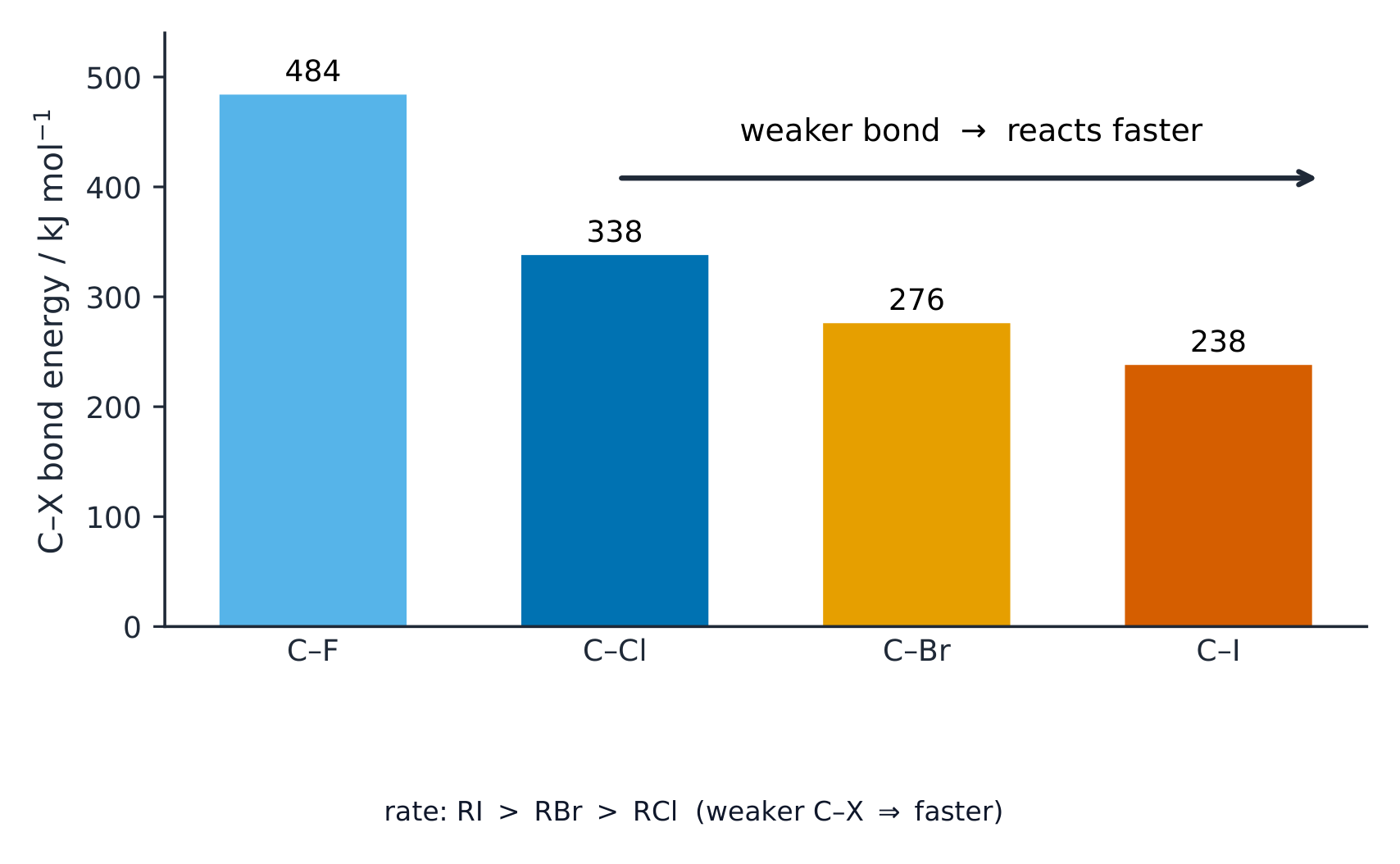
- describe and explain the different reactivities of halogenoalkanes (with particular reference to the relative strengths of the C–X bonds as exemplified by the reactions of halogenoalkanes with aqueous silver nitrates)
ไทย
- ทบทวนปฏิกิริยา (สารตั้งต้นและสภาวะ) ที่สามารถผลิตฮาโลเจนอัลเคนได้: (a) การแทนที่แบบ radikal อิสระของแอลเคนด้วย $\text{Cl}_2$ หรือ $\text{Br}_2$ ในpresence ของแสงยูวี โดยตัวอย่างจากปฏิกิริยาของเอทาน (b) การเพิ่มอิเล็กโทรฟิลิกของอัลซีนกับฮาโลเจน, $\text{X}_2$, หรือไฮโดรเจนฮาไลด์, $\text{HX(g)}$ ที่อุณหภูมิห้อง (c) การแทนที่ของแอลกอฮอล์ เช่น bằngปฏิกิริยากับ $\text{HX(g)}$; หรือกับ $\text{KCl}$ และ $\text{H}_2\text{SO}_4$ แบบเข้มข้น หรือ $\text{H}_3\text{PO}_4$ แบบเข้มข้น; หรือกับ $\text{PCl}_3$ และความร้อน; หรือกับ $\text{PCl}_5$; หรือกับ $\text{SOCl}_2$
- จัดประเภทฮาโลเจนอัลเคนเป็น ปฐม, ทุติยภูมิ และ ตติยภูมิ
- อธิบายปฏิกิริยา การแทนที่แบบนิวคลีโอฟิลิก ดังนี้: (a) ปฏิกิริยากับ $\text{NaOH(aq)}$ และความร้อนเพื่อผลิตแอลกอฮอล์ (b) ปฏิกิริยากับ $\text{KCN}$ ในเอทานอลและความร้อนเพื่อผลิตไนไตรล์ (c) ปฏิกิริยากับ $\text{NH}_3$ ในเอทานอลให้ความร้อนภายใต้ความดันเพื่อผลิตเอมีน (d) ปฏิกิริยากับdatetime silver nitrate ในเอทานอลเพื่อใช้ระบุฮาโลเจนที่มีอยู่ ตัวอย่างเช่น bromoethane
- อธิบายปฏิกิริยา การกำจัด (elimination) กับ $\text{NaOH}$ ในเอทานอลและความร้อนเพื่อผลิตอัลซีน ตัวอย่างเช่น bromoethane
- อธิบายกลไก $\text{S}_\text{N}1$ และ $\text{S}_\text{N}2$ ของการแทนที่แบบนิวคลีโอฟิลิกในฮาโลเจนอัลเคน รวมถึงผลเชิงประจุ (inductive effects) ของกลุ่มแอลคิล
- ทบทวนว่าฮาโลเจนอัลเคนปฐมมักเกิดปฏิกิริยาผ่านกลไก $\text{S}_\text{N}2$; ฮาโลเจนอัลเคนตติยภูมิผ่านกลไก $\text{S}_\text{N}1$; และฮาโลเจนอัลเคนทุติยภูมิโดยผสมผสานทั้งสองอย่าง ขึ้นอยู่กับโครงสร้าง
- อธิบายและอธิบายความแตกต่างของปฏิกิริยาของฮาโลเจนอัลเคน (โดยเน้นไปที่ความแข็งแรงสัมพัทธ์ของพันธะ C–X ตัวอย่างเช่นจากปฏิกิริยาของฮาโลเจนอัลเคนกับdatetime silver nitrates)