Elimination and SN1/SN2 mechanisms
Introduced| English | Meaning |
|---|---|
| elimination/ɪˌlɪmɪˈneɪʃn/ | A reaction in which atoms or groups are removed from a molecule, usually forming a multiple bond. |
| transition state/trænˈsɪʃn steɪt/ | A high-energy arrangement of atoms at the energy barrier along a reaction pathway. |
| carbocation/ˌkɑːbəˈkeɪʃn/ | An organic ion in which a carbon atom carries a positive charge. |
| bond energy/bɒnd ˈenədʒi/ | The energy required to break one mole of a specified covalent bond in gaseous molecules. |
Elimination 消去 and the SN1/SN2 mechanisms
- The same halogenoalkane can substitute or eliminate.
- Nucleophilic substitution follows one of two mechanisms.
- And the C–X bond strength sets the reactivity.
An SN1 mechanism goes via a carbocation intermediate.
Difficulty 1/5 · 100 coins + a small bonus on first completion today
SN2 is a one-step concerted mechanism.
Substitution vs elimination
- $\text{NaOH}$ in water → nucleophilic substitution → an alcohol.
- $\text{NaOH}$ in ethanol, heated → elimination → an alkene:
$$\text{C}_2\text{H}_5\text{Br} + \text{NaOH} \rightarrow \text{C}_2\text{H}_4 + \text{NaBr} + \text{H}_2\text{O}$$

SN2 is one step through a transition state 过渡态; SN1 is two steps via a carbocation 碳正离子
The SN2 mechanism, step by step
Step through nucleophilic substitution. The nucleophile attacks from behind as the halide leaves — all in one smooth step, flipping the molecule inside-out.
Heating a halogenoalkane with NaOH dissolved in ethanol gives:
Difficulty 1/5 · 100 coins + a small bonus on first completion today
NaOH in ethanol with heat favours elimination of HX to form an alkene; NaOH in water favours substitution.
Match each mechanism to its description.
Difficulty 2/5 · 140 coins + a small bonus on first completion today
Each item links the term to its correct meaning.
SN1 and SN2
- SN2: one step — the nucleophile attacks as the halogen leaves, through a crowded transition state. Rate depends on both reactants.
- SN1: two steps — the C–X bond breaks to a carbocation first, then the nucleophile attacks. Rate depends only on the halogenoalkane.
- Primary → mostly SN2; tertiary → mostly SN1 (its carbocation is well stabilised); secondary uses both.
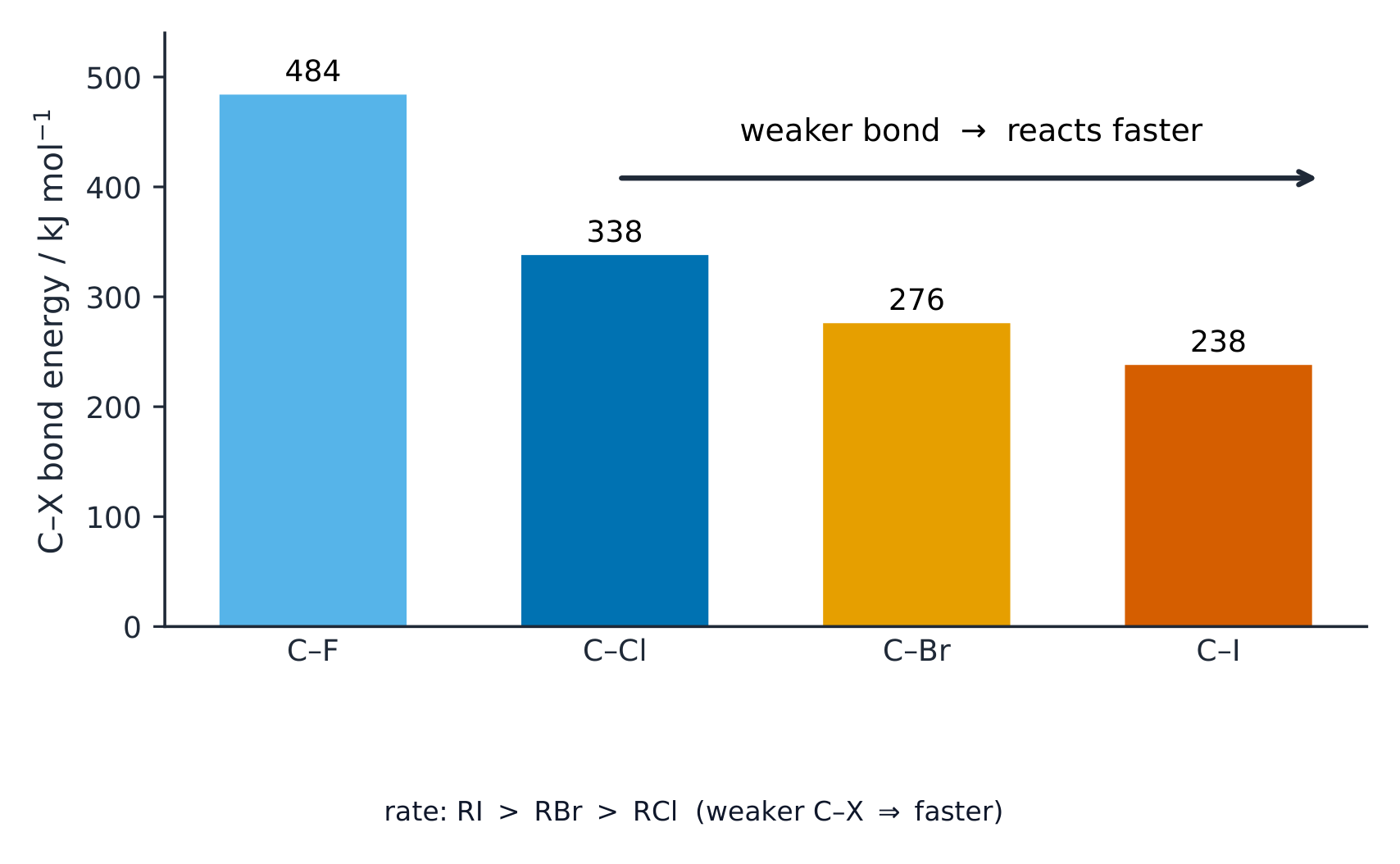
The weaker the C-X bond, the faster the halogenoalkane reacts
The SN1 mechanism:
Difficulty 1/5 · 100 coins + a small bonus on first completion today
SN1: C–X breaks first to a carbocation, then the nucleophile attacks; tertiary halogenoalkanes favour it.
The SN2 mechanism:
Difficulty 1/5 · 100 coins + a small bonus on first completion today
SN2 is a single concerted step; primary halogenoalkanes favour it and its rate depends on both species.
Reactivity and the C–X bond
- Reactivity depends on the C–X bond strength (bond energy 键能).
- C–I is weakest → iodoalkanes react fastest; C–Cl is strongest → chloroalkanes slowest.
Which halogenoalkane reacts fastest?
Difficulty 1/5 · 100 coins + a small bonus on first completion today
The weaker the C–X bond, the faster the reaction, so C–I (weakest) reacts fastest and C–Cl slowest.
You've got it
- NaOH in water → substitution (alcohol); NaOH in ethanol + heat → elimination (alkene)
- SN2 = one step, rate depends on both; SN1 = two steps via a carbocation, rate depends on the halogenoalkane only
- primary → SN2, tertiary → SN1; iodoalkanes react fastest (weakest C–X bond)