Skip to content · ⁨ข้ามไปยังเนื้อหา⁩

Enzymes · ⁨เอนไซม์⁩

A-Level Biology · ⁨Biology A-Level⁩ · Topic 3 · ⁨หัวข้อ 3⁩

Video lesson for this topic · ⁨บทเรียนวิดีโอสำหรับหัวข้อนี้⁩ Open the video page · ⁨เปิดหน้าวิดีโอ⁩
13:51

เอนไซม์

ภายในเซลล์ทุกชนิด มีปฏิกิริยาเคมีนับพันเกิดขึ้นทุกวินาที — เร็วกว่ามากเมื่อเกิดเองโดยไม่มีตัวเร่ง ปฏิกิริยาเหล่านี้ใช้โปรตีนชนิดพิเศษ…

English narration · English + 中文 subtitles burned in · ⁨การบรรยายภาษาอังกฤษ · คำบรรยายภาษาอังกฤษ + 中文 ลอยตัวบนภาพ⁩

3.1

What enzymes are · ⁨เอนไซม์คืออะไร⁩

Syllabus · ⁨หลักสูตร⁩
English
  1. state that enzymes are globular proteins that catalyse reactions inside cells (intracellular enzymes) or are secreted to catalyse reactions outside cells (extracellular enzymes)
  2. explain the mode of action of enzymes in terms of an active site, enzyme–substrate complex, lowering of activation energy and enzyme specificity, including the lock-and-key hypothesis and the induced-fit hypothesis
  3. investigate the progress of enzyme-catalysed reactions by measuring rates of formation of products using catalase and rates of disappearance of substrate using amylase
  4. outline the use of a colorimeter for measuring the progress of enzyme-catalysed reactions that involve colour changes
ไทย
  1. ระบุว่า เอนไซม์ เป็นโปรตีนทรงกลมที่ทำหน้าที่เร่งปฏิกิริยาภายในเซลล์ (เอนไซม์ภายในเซลล์) หรือถูกหลั่งออกมาเพื่อเร่งปฏิกิริยาภายนอกเซลล์ (เอนไซม์ภายนอกเซลล์)
  2. อธิบายรูปแบบการทำงานของเอนไซม์ในเชิงของ ตำแหน่งทำงาน, คอมเพล็กซ์เอนไซม์-สารตั้งต้น, การลด พลังงานกระตุ้น และ ความจำเพาะของเอนไซม์ ซึ่งรวมถึง สมมติฐานกุญแจและล็อค และ สมมติฐานการปรับให้เข้ากัน
  3. ตรวจสอบความก้าวหน้าของปฏิกิริยาที่เร่งด้วยเอนไซม์โดยการวัดอัตราการเกิดผลิตภัณฑ์โดยใช้ แคตาเลส และอัตราการหายไปของสารตั้งต้นโดยใช้ แอมิลเลส
  4. สรุปการใช้ สีมิเตอร์ ในการตรวจสอบความก้าวหน้าของปฏิกิริยาที่เร่งด้วยเอนไซม์ซึ่งมีการเปลี่ยนแปลงสี

Source: Cambridge International syllabus · ⁨แหล่งที่มา: หลักสูตร Cambridge International⁩

English
Enzyme action: lock and key

Enzymes 酶 are globular proteins 球状蛋白质 — a type of protein 蛋白质 with a rounded, soluble shape. They are biological catalysts: they catalyse 催化 (speed up) the chemical reactions in living things, and they are not used up, so each enzyme works again and again.

Enzymes work in two places:

  • intracellular 细胞内 enzymes work inside the cell 细胞 that made them. An example is catalase 过氧化氢酶, which breaks down harmful hydrogen peroxide.
  • extracellular 细胞外 enzymes are secreted 分泌 (sent out) to work outside the cell. An example is amylase 淀粉酶, which is released into the gut to digest 消化 starch 淀粉.
ไทย

*การทำงานของเอนไซม์: กุญแจและล็อค

เอนไซม์ เป็น โปรตีนทรงกลม — ประเภทหนึ่งของ โปรตีน ที่มีรูปร่างกลมและละลายได้它们是生物催化剂:它们催化(加速)生物体内的化学反应,并且不会被消耗掉,因此每个酶可以反复工作。

เอนไซม์ทำงานได้ในสองสถานที่:

  • เอนไซม์ภายในเซลล์ (intracellular enzymes) ทำงานภายใน เซลล์ ที่ผลิตมัน ตัวอย่างเช่น แคทาลาเส ทำลายไฮโดรเจนเปอร์ออกไซด์ที่เป็นอันตราย
  • เอนไซม์ภายนอกเซลล์ (extracellular enzymes) ถูก หลั่งออกมา เพื่อทำงานนอกเซลล์ ตัวอย่างเช่น แอมิลาส ถูกปล่อยเข้าไปในลำไส้เพื่อ ย่อย แป้ง

ยีสต์ที่กำลังหมักอย่างกระฉับกระเฉงและมีฟองอากาศ ปล่อยก๊าซคาร์บอนไดออกไซด์ *เอนไซม์ของยีสต์หมักน้ำตาล ปล่อยฟองก๊าซคาร์บอนไดออกไซด์ออกมา

Vocabulary · ⁨คำศัพท์⁩ Train · ⁨ฝึกฝน⁩
English ไทย
enzyme/ˈenzaɪm/ เอนไซม์
globular protein/ˈɡlɒbjʊlə ˈprəʊtiːn/ โปรตีนทรงกลม
protein/ˈprəʊtiːn/ โปรตีน
catalyse/ˈkætəlaɪz/ เร่งปฏิกิริยา (catalyse)
intracellular/ˌɪntrəˈseljʊlə/ intracellular
cell/sel/ เซลล์
catalase/ˈkætəleɪz/ catalase
extracellular/ˌekstrəˈseljʊlə/ extracellular
secrete/sɪˈkriːt/ หลั่ง
amylase/ˈæmɪleɪz/ amylase
digest/ˈdaɪdʒest/ ไดเจสต์
starch/stɑːtʃ/ แป้งข้าวโพด
3.1

How enzymes work · ⁨เอนไซม์ทำงานอย่างไร⁩

English

Each enzyme has a special pocket called the active site 活性位点. The molecule it acts on is its substrate 底物. The substrate fits into the active site to form an enzyme–substrate complex 酶底物复合物. The reaction then happens, and the products 产物 leave, freeing the active site for the next substrate.

Specificity

An enzyme is specific: it usually works on only one substrate. This is because the shape of the active site is complementary 互补 to (fits) the shape of that substrate and no other. We call this specificity 专一性.

Two ideas explain how the substrate fits:

  • the lock-and-key hypothesis 锁钥学说 — the active site is a fixed shape, and only a substrate with the matching shape fits, like a key in a lock.
  • the induced-fit hypothesis 诱导契合学说 — the active site is not quite the right shape at first. When the substrate binds, the active site changes shape a little to wrap around it tightly. This idea fits the evidence better.

Lowering activation energy

Every reaction needs a small "push" of energy to start, called the activation energy 活化能. An enzyme lowers the activation energy. This lets the reaction go quickly at the cell's normal temperature 温度, instead of needing high heat.

ไทย

เอนไซม์แต่ละชนิดมีช่องว่างพิเศษที่เรียกว่า ตำแหน่งออกฤทธิ์ (active site) โมเลกุลที่เอนไซม์ทำปฏิกิริยากับมันคือ สารตั้งต้น (substrate) สารตั้งต้นจะเข้าจับกับตำแหน่งออกฤทธิ์เพื่อสร้าง คอมเพล็กซ์ของเอนไซม์และสารตั้งต้น (enzyme–substrate complex) จากนั้นปฏิกิริยาก็เกิดขึ้น และ ผลิตภัณฑ์ (products) จะแยกตัวออกไป ทำให้ตำแหน่งออกฤทธิ์ว่างพร้อมสำหรับสารตั้งต้นตัวถัดไป

ความจำเพาะ

เอนไซม์มีความ จำเพาะ: โดยทั่วไปจะทำปฏิกิริยากับสารตั้งต้นเพียงชนิดเดียวเท่านั้น เนื่องจากรูปร่างของตำแหน่งออกฤทธิ์เป็น รูปทรงที่สอดคล้องกัน (complementary) กับรูปร่างของสารตั้งต้นนั้นโดยเฉพาะและไม่ตรงกับสารอื่น เราเรียกว่าสิ่งนี้ว่า ความจำเพาะ (specificity)

มีแนวคิดสองอย่างที่อธิบายการเข้าจับของสารตั้งต้น:

  • สมมติฐานกุญแจและล็อค (lock-and-key hypothesis) — ตำแหน่งออกฤทธิ์มีรูปร่างตายตัว และมีเพียงสารตั้งต้นที่มีรูปร่างตรงกันเท่านั้นที่จะเข้าได้ เหมือนกุญแจที่ใส่เข้าล็อค
  • สมมติฐานการปรับรูปทรง (induced-fit hypothesis) — ตำแหน่งออกฤทธิ์ไม่ได้มีรูปร่างที่ถูกต้องที่สุดตั้งแต่แรก เมื่อสารตั้งต้นเข้าจับ ตำแหน่งออกฤทธิ์จะเปลี่ยนรูปร่างเล็กน้อยเพื่อโอบล้อมสารตั้งต้นให้แน่นขึ้น แนวคิดนี้สอดคล้องกับหลักฐานทางวิทยาศาสตร์มากกว่า
แผนภาพสองแบบ: แบบกุญแจและล็อคแสดงสารตั้งต้นสามเหลี่ยมเข้าในร่องแข็ง; แบบการปรับรูปทรงแสดงเอนไซม์โอบล้อมสารตั้งต้นทรงกลม
กุญแจและล็อค: ตำแหน่งออกฤทธิ์คงที่ การปรับรูปทรง: ตำแหน่งออกฤทธิ์เปลี่ยนรูปร่างเพื่อยึดจับสารตั้งต้น

การลดพลังงานกระตุ้น

ทุกปฏิกิริยาต้องการพลังงาน "ผลัก" เล็กน้อยเพื่อเริ่มต้น ซึ่งเรียกว่า พลังงานกระตุ้น (activation energy) เอนไซม์ช่วยลดพลังงานกระตุ้นลง สิ่งนี้ช่วยให้ปฏิกิริยาเกิดขึ้นได้รวดเร็วที่ อุณหภูมิ ปกติของเซลล์ แทนที่ต้องใช้ความร้อนสูง

กราฟพลังงานที่มียอดสองลูก: ยอดสูงเมื่อไม่มีเอนไซม์ และยอดต่ำเมื่อมีเอนไซม์ โดยทั้งสองจุดเชื่อมต่อสารตั้งต้นและผลิตภัณฑ์เดียวกัน *เส้นทางของเอนไซม์มีพลังงานกระตุ้นต่ำกว่า ($E_A$) จึงมีโมเลกุลสามารถเกิดปฏิกิริยาได้มากขึ้น

Explore · ⁨สำรวจ⁩

The catalytic cycle · ⁨วงจรการเร่งปฏิกิริยา⁩

Step through the cycle. The enzyme binds its substrate, the reaction happens, the products leave — and the same enzyme is free to go again. · ⁨ผ่านขั้นตอนของวงจร เอนไซม์จับกับสารตั้งต้น发生反应,产物离开 — และ same เอนไซม์อิสระที่จะไปอีกครั้ง⁩

Vocabulary · ⁨คำศัพท์⁩ Train · ⁨ฝึกฝน⁩
English ไทย
active site/ˈæktɪv saɪt/ ตำแหน่งที่ทำงานของเอนไซม์
substrate/ˈsʌbstreɪt/ สารตั้งต้น
enzyme–substrate complex/ˈenzaɪm ˈsʌbstreɪt ˈkɒmpleks/ คอมเพล็กซ์เอนไซม์–สารตั้งต้น
product/ˈprɒdʌkt/ ผลิตภัณฑ์
complementary/ˌkɒmplɪˈmentəri/ สีคู่เสริม
specificity/ˌspesɪˈfɪsɪti/ ความจำเพาะ
lock-and-key hypothesis/lɒk ænd kiː haɪˈpɒθəsɪs/ สมมติฐานกุญแจและล็อค
induced-fit hypothesis/ɪnˈdjuːst fɪt haɪˈpɒθəsɪs/ สมมติฐานการจับแบบปรับตัว (induced-fit hypothesis)
activation energy/ˌæktɪˈveɪʃn ˈenədʒi/ พลังงานก่อกวน (activation energy)
3.1

Measuring the rate of a reaction · ⁨การวัดอัตราการเกิดปฏิกิริยา⁩

English

You can follow an enzyme reaction in two ways:

  • measure how fast product is made. With catalase, oxygen gas is a product, so you collect the gas and measure its volume over time.
  • measure how fast substrate disappears. With amylase, you remove samples and use the iodine test; the blue-black colour fades as the starch is used up.

A colorimeter 比色计 makes this exact. It shines light through the tube and measures how much light is absorbed, so a colour change becomes a number you can plot.

The rate of reaction 反应速率 is steepest at the start (most substrate present), so the initial rate (the slope at time zero) is the fairest value to compare.

Worked example. In the first $20$ seconds of a catalase reaction, $16\ \text{cm}^3$ of oxygen is collected. Estimate the rate of reaction.

$$\text{rate} = \frac{\text{volume of product}}{\text{time}} = \frac{16}{20} = 0.8\ \text{cm}^3\,\text{s}^{-1}.$$

Because the reaction is fastest at the start, measuring over this short early interval gives a value close to the initial rate; averaging over a longer time would include the slower later stages and underestimate it.

ไทย

คุณสามารถติดตามปฏิกิริยาของเอนไซม์ได้สองวิธี:

  • วัดความเร็วในการสร้าง ผลิตภัณฑ์ ในกรณีของคาตาเลซ ออกซิเจนแก๊สคือผลิตภัณฑ์ ดังนั้นเราจึงเก็บแก๊สและวัดปริมาตรตามเวลา
  • วัดความเร็วที่สารตั้งต้นหายไป ในกรณีของแอมิเลส เราจะเก็บตัวอย่างและทดสอบด้วยไอโอดีน สีน้ำเงิน-ดำจะจางลงเมื่อแป้งถูกใช้หมด

เครื่องวัดสี (colorimeter) ช่วยทำให้การวัดนี้แม่นยำ โดยส่องแสงผ่านหลอดทดลองและวัดปริมาณแสงที่ถูกดูดซับ ทำให้การเปลี่ยนแปลงสีกลายเป็นตัวเลขที่สามารถนำไปพล็อตกราฟได้

อัตราการเกิดปฏิกิริยา มีความชันมากที่สุดในช่วงต้น (เมื่อมีสารตั้งต้นมากที่สุด) ดังนั้น อัตราเริ่มต้น (initial rate) (ซึ่งคือความชันที่เวลา 0) จึงเป็นค่าที่เหมาะสมที่สุดสำหรับการเปรียบเทียบ

กราฟของผลผลิตเทียบกับเวลาที่มีความชันมากที่สุดที่จุดเริ่มต้นและราบลง; เส้นสัมผัสประ breaks ที่เวลาศูนย์แสดงอัตราการเริ่มต้น *ผลิตภัณฑ์สะสมเร็วที่สุดในช่วงต้น; อัตราเริ่มต้นคือความชันของเส้นสัมผัสที่เวลา 0 — ซึ่งเป็นค่าที่เหมาะสมที่สุดสำหรับการเปรียบเทียบ

ตัวอย่างคำอธิบาย. ในช่วง $20$ วินาทีแรกของปฏิกิริยาคาตาเลซ ได้แก๊สออกซิเจนมา $16\ \text{cm}^3$ ให้ประมาณการอัตราการเกิดปฏิกิริยา

$$\text{rate} = \frac{\text{volume of product}}{\text{time}} = \frac{16}{20} = 0.8\ \text{cm}^3\,\text{s}^{-1}.$$

เนื่องจากปฏิกิริยาเกิดขึ้นเร็วที่สุดในช่วงต้น การวัดในช่วงสั้นๆ แรกนี้จะให้ค่าใกล้เคียงกับอัตราเริ่มต้นมากที่สุด; หากเฉลี่ยในช่วงเวลาที่นานกว่าจะรวมถึงขั้นตอนที่ช้าลงในระยะหลังและทำให้ค่า underestimate

Vocabulary · ⁨คำศัพท์⁩ Train · ⁨ฝึกฝน⁩
English ไทย
colorimeter/ˌkʌləˈrɪmɪtə/ colorimeter
rate of reaction/reɪt ɒv rɪˈækʃn/ อัตราของปฏิกิริยา
3.2

Factors that affect enzyme activity · ⁨ปัจจัยที่มีผลต่อกิจกรรมของเอนไซม์⁩

Syllabus · ⁨หลักสูตร⁩
English
  1. investigate and explain the effects of the following factors on the rate of enzyme-catalysed reactions: • temperature • pH (using buffer solutions) • enzyme concentration • substrate concentration • inhibitor concentration
  2. explain that the maximum rate of reaction ($V_{\text{max}}$) is used to derive the Michaelis–Menten constant ($K_{\text{m}}$), which is used to compare the affinity of different enzymes for their substrates
  3. explain the effects of reversible inhibitors, both competitive and non-competitive, on enzyme activity
  4. investigate the difference in activity between an enzyme immobilised in alginate and the same enzyme free in solution, and state the advantages of using immobilised enzymes
ไทย
  1. ตรวจสอบและอธิบายผลกระทบของปัจจัยต่อไปนี้ต่ออัตราการเร่งปฏิกิริยาของเอนไซม์: • อุณหภูมิ • pH (ใช้สารละลายบัฟเฟอร์) • ความเข้มข้นของเอนไซม์ • ความเข้มข้นของสารตั้งต้น • ความเข้มข้นของสารยับยั้ง
  2. อธิบายว่า อัตราสูงสุดของปฏิกิริยา ($V_{\text{max}}$) ถูกนำมาใช้เพื่อหา ค่าคงที่ไมเคิลิส-เมนเทน ($K_{\text{m}}$) ซึ่งถูกนำไปใช้เปรียบเทียบ ความ.sql ของเอนไซม์ต่างๆ กับสารตั้งต้น
  3. อธิบายผลกระทบของ สารยับยั้งแบบย้อนกลับ ทั้งแบบ แข่งขัน และ ไม่แข่งขัน ต่อกิจกรรมของเอนไซม์
  4. ตรวจสอบความแตกต่างของกิจกรรมระหว่างเอนไซม์ที่ ติดกัก ใน อัลจิเนต กับเอนไซม์เดียวกันที่ลอยตัวในสารละลาย และระบุข้อดีของการใช้ เอนไซม์ที่ติดกัก

Source: Cambridge International syllabus · ⁨แหล่งที่มา: หลักสูตร Cambridge International⁩

English

Temperature

As temperature rises, molecules gain more kinetic energy 动能 and collide 碰撞 more often, so the rate rises. But above the optimum temperature 最适温度 the enzyme begins to denature 变性: the heat breaks the bonds holding its shape, so the active site changes and no longer fits the substrate. The rate then falls quickly.

pH

Each enzyme has an optimum pH. If the pH moves too far from it, the enzyme denatures and the rate drops. To study pH fairly, you keep it steady with a buffer solution 缓冲液.

Enzyme concentration

With plenty of substrate, more enzyme means more active sites, so the rate goes up in proportion to enzyme concentration.

Substrate concentration

At first, adding more substrate speeds the reaction. But once every active site is busy, adding more makes no difference — the rate levels off at a maximum.

Inhibitor concentration

An inhibitor 抑制剂 is a molecule that slows an enzyme. The more inhibitor present, the lower the rate.

ไทย

อุณหภูมิ

เมื่ออุณหภูมิสูงขึ้น โมเลกุลจะมี พลังงานจลน์ (kinetic energy) มากขึ้นและ ชนกัน (collide) บ่อยขึ้น ทำให้อัตราเพิ่มขึ้น แต่เกิน อุณหภูมิที่เหมาะสม (optimum temperature) เอนไซม์จะเริ่ม เสียสภาพ (denature): ความร้อนทำลายพันธะที่ยึดรักษารูปร่างไว้ ทำให้ตำแหน่งออกฤทธิ์เปลี่ยนไปและไม่เข้ากับสารตั้งต้นอีกต่อไป อัตราจึงลดลงอย่างรวดเร็ว

กราฟแสดงความสัมพันธ์ระหว่างอัตราปฏิกิริยากับอุณหภูมิ ที่เพิ่มขึ้นถึงจุดสูงสุดที่อุณหภูมิที่เหมาะสม แล้วลดลงอย่างรวดเร็วเมื่อเอนไซม์เสียสภาพ *อัตราเพิ่มขึ้นสู่จุดที่เหมาะสม แล้วลดลงอย่างรวดเร็วเมื่อเอนไซม์เสียสภาพ

ค่า pH

เอนไซม์แต่ละชนิดมีค่า pH ที่เหมาะสม หากค่า pH เบี่ยงเบนจากจุดนี้มากเกินไป เอนไซม์จะเสียสภาพและอัตราจะลดลง เพื่อการศึกษาค่า pH อย่างยุติธรรม ควรคงค่าให้คงที่โดยใช้ สารละลายบัฟเฟอร์ (buffer solution)

กราฟรูปกระดิ่งแสดงความสัมพันธ์ระหว่างอัตราปฏิกิริยากับค่า pH ที่พุ่งสูงขึ้นถึงจุดสูงสุดที่ค่า pH最合适 แล้วลดลงทั้งสองด้าน *อัตราพุ่งสูงสุดที่ค่า pH ที่เหมาะสมและลดลงทั้งสองข้าง
ความเข้มข้นของเอนไซม์

เมื่อมีสารตั้งต้นเพียงพอ การเพิ่มเอนไซม์จะทำให้มีตำแหน่งออกฤทธิ์มากขึ้น อัตราจึงเพิ่มขึ้นตามสัดส่วนกับความเข้มข้นของเอนไซม์

ความเข้มข้นของสารตั้งต้น

ในช่วงแรก การเพิ่มสารตั้งต้นจะเร่งปฏิกิริยา แต่เมื่อบริเวณออกฤทธิ์ทั้งหมดถูกใช้งานหมด การเพิ่มสารตั้งต้นเพิ่มเติมจะไม่มีการเปลี่ยนแปลง — อัตราจะราบเรียบที่ระดับสูงสุด

ความเข้มข้นของตัวยับยั้ง

ตัวยับยั้ง (inhibitor) คือโมเลกุลที่ชะลอการทำงานของเอนไซม์ ยิ่งมีตัวยับยั้งมาก อัตราจะยิ่งต่ำ

Explore · ⁨สำรวจ⁩

How temperature changes enzyme activity · ⁨温度如何改变酶活性⁩

Drag the temperature slider. Activity rises to an optimum, then crashes as the enzyme denatures and its active site loses shape. · ⁨拖动温度滑块。活性上升至最适点,随后因酶变性导致活性位点失去形状而骤降。⁩

Vocabulary · ⁨คำศัพท์⁩ Train · ⁨ฝึกฝน⁩
English ไทย
temperature/ˈtemprɪtʃə/ อุณหภูมิ
kinetic energy/kɪˈnetɪk ˈenədʒi/ พลังงานจลน์
collide/kəˈlaɪd/ ชนกัน
optimum temperature/ˈɒptɪməm ˈtemprɪtʃə/ อุณหภูมิที่เหมาะสม
denature/ˈdenətʃə/ denature
buffer solution/ˈbʌfə səˈluːʃn/ สารบัฟเฟอร์
inhibitor/ɪnˈhɪbɪtə/ inhibitor
Michaelis–Menten constant/ˈmaɪkəliz ˈmentn ˈkɒnstənt/ Michaelis–Menten constant
Watch lesson · ⁨ดูบทเรียน⁩
3.2

V_max and the Michaelis–Menten constant · ⁨V_max และค่าคงที่ Michaelis–Menten⁩

English

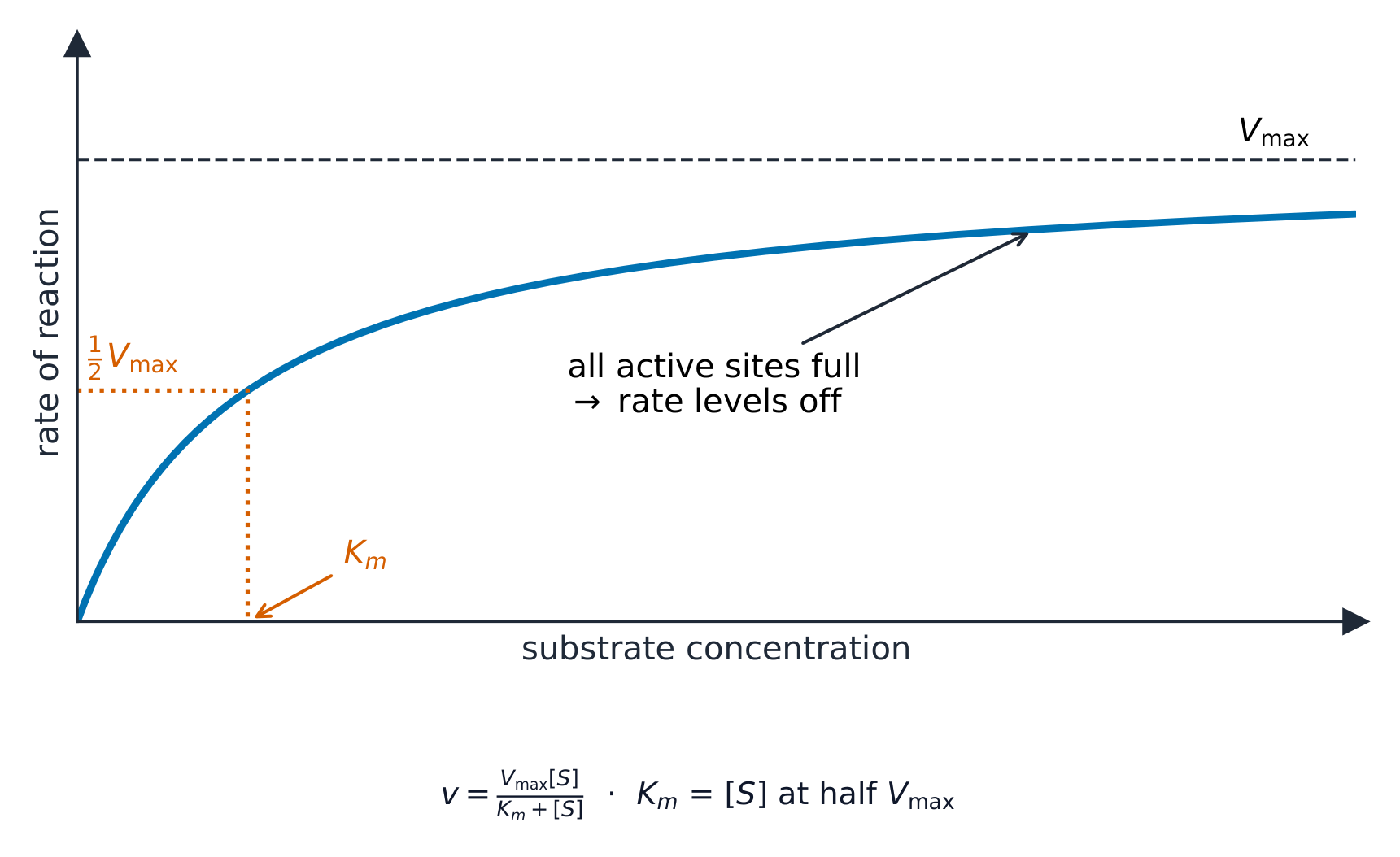
The levelling-off rate, when all active sites are full, is the maximum rate, written $V_{\text{max}}$.

The Michaelis–Menten constant 米氏常数 ($K_{\text{m}}$) is the substrate concentration that gives half of $V_{\text{max}}$. It tells you about the enzyme's affinity 亲和力 (pulling power) for its substrate:

  • a low $K_{\text{m}}$ means the enzyme reaches half-speed at a low substrate concentration, so it has a high affinity.
  • a high $K_{\text{m}}$ means a low affinity.

So $K_{\text{m}}$ lets you compare how strongly different enzymes hold their substrates.

ไทย

อัตราที่ราบเรียบเมื่อตำแหน่งออกฤทธิ์ทั้งหมดเต็มคืออัตราสูงสุด เขียนว่า $V_{\text{max}}$

ค่าคงที่ Michaelis–Menten ($K_{\text{m}}$) คือความเข้มข้นของสารตั้งต้นที่ให้ ครึ่งหนึ่ง ของ $V_{\text{max}}$ มันบอกเกี่ยวกับ ความผูกพัน (affinity) (แรงดึง) ของเอนไซม์ต่อสารตั้งต้นของคุณ:

  • ค่าต่ำ ของ $K_{\text{m}}$ หมายความว่าเอนไซม์ถึงครึ่งความเร็วที่ความเข้มข้นสารตั้งต้นต่ำ แสดงว่ามี ความผูกพันสูง (high affinity)
  • ค่าสูง ของ $K_{\text{m}}$ หมายความว่ามีความผูกพัน ต่ำ (low affinity)

ดังนั้น $K_{\text{m}}$ จึงช่วยให้คุณเปรียบเทียบได้ว่าเอนไซม์ต่างชนิดกันยึดจับสารตั้งต้นต่างกันอย่างไร

กราฟแสดงความสัมพันธ์ระหว่างอัตราปฏิกิริยากับความเข้มข้นของสารตั้งต้น ที่เพิ่มขึ้นจนเข้าสู่ภาวะคงที่ที่ Vmax โดยมีจุดครึ่งหนึ่งของ Vmax และ Km ที่สอดคล้องกันระบุไว้ *อัตราพุ่งขึ้นสู่ $V_{\text{max}}$ เมื่อตำแหน่งออกฤทธิ์ทั้งหมดเต็ม; $K_{\text{m}}$ คือความเข้มข้นของสารตั้งต้นที่ให้ครึ่งหนึ่งของ $V_{\text{max}}$

Explore · ⁨สำรวจ⁩

Substrate concentration and Vmax · ⁨底物浓度与Vmax⁩

Add more substrate: the rate climbs, then plateaus at $V_{max}$ once every active site is busy. $K_m$ is the substrate concentration that gives half of $V_{max}$. · ⁨增加更多底物:速率上升,当所有活性位点都被占用后达到平台期$V_{max}$。$K_m$是产生$V_{max}$一半速率所需的底物浓度。⁩

Vocabulary · ⁨คำศัพท์⁩ Train · ⁨ฝึกฝน⁩
English ไทย
affinity/əˈfɪnɪti/ affinity
3.2

Reversible inhibitors · ⁨ตัวยับยั้งที่ย้อนกลับได้⁩

English

Some inhibitors are reversible 可逆: they can leave the enzyme again. There are two types.

Type Where it binds Effect of adding more substrate Effect on $V_{\text{max}}$ and $K_{\text{m}}$
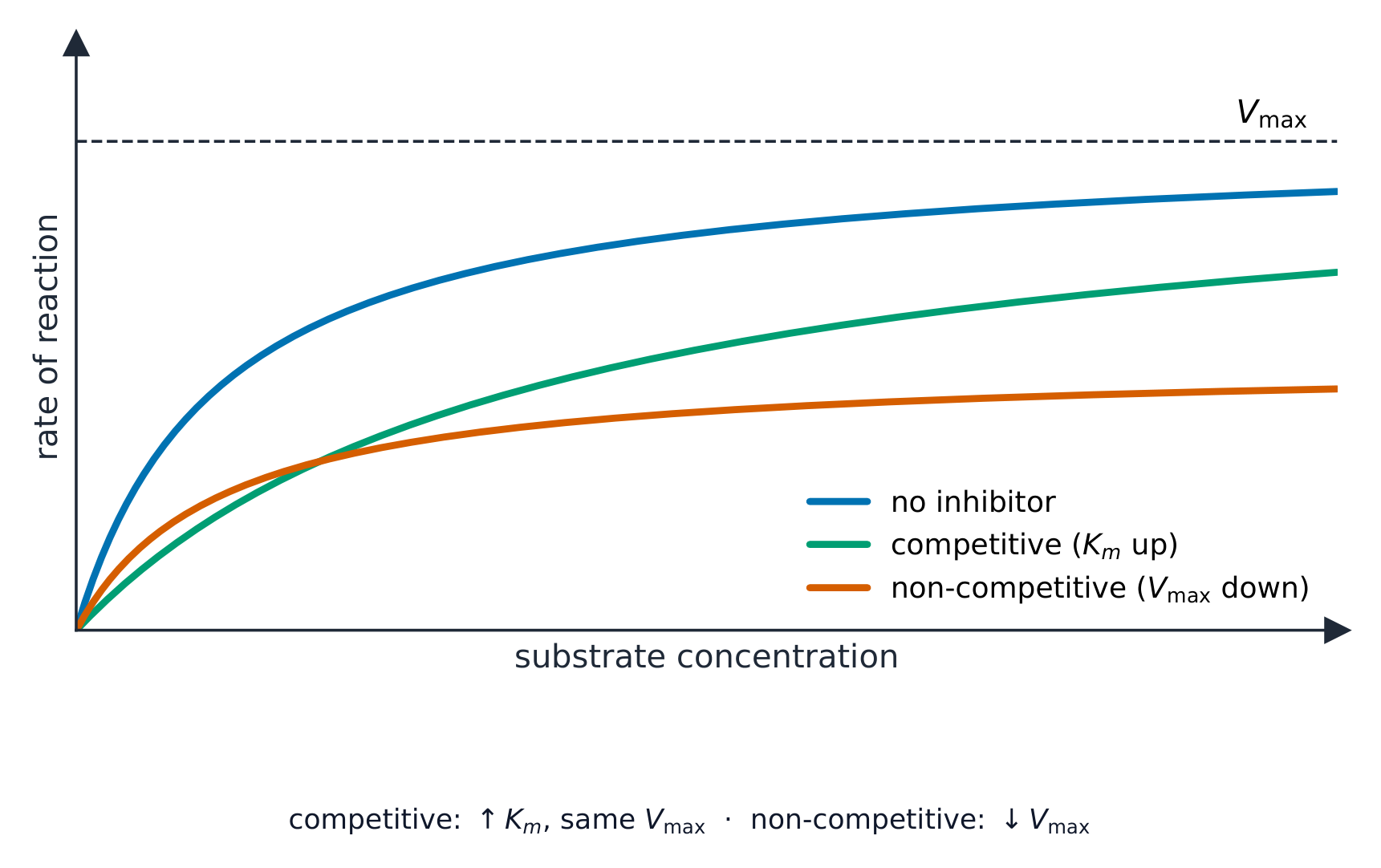
competitive inhibitor 竞争性抑制剂 in the active site (it has a similar shape to the substrate) more substrate out-competes it, so its effect is reduced $V_{\text{max}}$ unchanged; $K_{\text{m}}$ rises
non-competitive inhibitor 非竞争性抑制剂 at another site, changing the active site's shape adding more substrate does not help $V_{\text{max}}$ falls; $K_{\text{m}}$ unchanged
ไทย

บางชนิดของตัวยับยั้งเป็น ย้อนกลับได้ (reversible): สามารถหลุดออกจากเอนไซม์ได้อีก มีสองประเภท

ประเภท สถานที่จับ ผลของการเพิ่มสารตั้งต้นมากขึ้น ผลต่อ $V_{\text{max}}$ และ $K_{\text{m}}$
ตัวยับยั้งแบบแข่งขัน ในตำแหน่งกัมมันต์ (มีรูปร่างคล้ายกับสารตั้งต้น) เพิ่มสารตั้งต้นมากพอจะแย่งตำแหน่งได้ ผลกระทบจึงลดลง $V_{\text{max}}$ ไม่เปลี่ยน; $K_{\text{m}}$ เพิ่มขึ้น
ตัวยับยั้งไม่แข่งขัน ที่ตำแหน่งอื่น เปลี่ยนรูปร่างของตำแหน่งกัมมันต์ การเพิ่มสารตั้งต้นไม่ได้ช่วยเพิ่มอัตราการเกิดปฏิกิริยา $V_{\text{max}}$ ลดลง; $K_{\text{m}}$ ไม่เปลี่ยน
กราฟอัตราปฏิกิริยาสี่เส้นเทียบกับความเข้มข้นสารตั้งต้น: ไม่มีตัวยับยั้งถึง Vmax, แบบแข่งขันถึง Vmax เดิมแต่ช้ากว่า, แบบไม่แข่งขัน plateau ที่ Vmax ต่ำกว่า
ตัวยับยั้งแบบแข่งขันทำให้ $K_{\text{m}}$ เพิ่มขึ้น (สารตั้งต้นที่มากขึ้นเอาชนะการยับยั้งได้); ตัวยับยั้งแบบไม่แข่งขันทำให้ $V_{\text{max}}$ ลดลง
Vocabulary · ⁨คำศัพท์⁩ Train · ⁨ฝึกฝน⁩
English ไทย
reversible/rɪˈvɜːsɪbl/ ผันกลับได้
competitive inhibitor/kəmˈpetɪtɪv ɪnˈhɪbɪtə/ สารยับยั้งแบบแข่งขัน
non-competitive inhibitor/nɒn kəmˈpetɪtɪv ɪnˈhɪbɪtə/ สารยับยั้งไม่แข่งขัน
3.2

Immobilised enzymes · ⁨เอนไซม์ติดตัว⁩

English

An immobilised enzyme 固定化酶 is fixed in place — for example, trapped inside small beads of alginate 海藻酸盐 — instead of floating free in solution. The substrate solution flows past the beads.

A free enzyme usually works a little faster, because the substrate can reach it easily. But immobilised enzymes have big practical advantages:

  • the enzyme is not washed away, so it can be used again and again.
  • the product is pure — it is not mixed with enzyme.
  • the enzyme is more stable, so it survives changes in temperature and pH better.
  • the process can run continuously, with substrate flowing in and product flowing out.
ไทย

เอนไซม์ติดตัว คือเอนไซม์ที่ถูกตรึงไว้ที่จุดหนึ่ง — เช่น ถูกกักขังอยู่ในเม็ดเล็กๆ ของ อัลจิเนต — แทนที่จะลอยตัวอิสระในสารละลาย สารละลายของสารตั้งต้นจะไหลผ่านเม็ดเหล่านี้

เม็ดเอนไซม์ที่มีสารตั้งต้นไหลเข้าด้านหนึ่งและผลิตภัณฑ์ไหลออกอีกด้านหนึ่ง โดยเอนไซม์ถูกกักขังอยู่ภายใน
เอนไซม์ถูกกักขังอยู่ในเม็ดในขณะที่สารตั้งต้นไหลเข้าและผลิตภัณฑ์ไหลออก — ดังนั้นเอนไซม์จะไม่ถูกล้างหายไป

เอนไซม์อิสระมักทำงานได้เร็วขึ้นเล็กน้อย เพราะสารตั้งต้นเข้าถึงได้ง่าย แต่เอนไซม์ติดตัวมีข้อดีทางปฏิบัติที่สำคัญ:

  • เอนไซม์ไม่ถูกล้างไป สามารถนำไปใช้ซ้ำได้หลายครั้ง
  • ผลิตภัณฑ์มีความบริสุทธิ์ ไม่ปนเปื้อนด้วยเอนไซม์
  • เอนไซม์มีความเสถียรกว่า ทนต่อการเปลี่ยนแปลงของอุณหภูมิและ pH ได้ดีกว่า
  • กระบวนการสามารถดำเนินต่อได้ต่อเนื่อง โดยมีการไหลเข้าของสารตั้งต้นและการไหลออกของผลิตภัณฑ์
ช้อนผงซักฟอกชีวภาพสีขาว
ผงซักฟอกชีวภาพประกอบด้วยเอนไซม์ที่ย่อยคราบน้ำมันอาหารและเลือดที่อุณหภูมิต่ำ
Vocabulary · ⁨คำศัพท์⁩ Train · ⁨ฝึกฝน⁩
English ไทย
immobilised enzyme/ɪˈməʊbəlaɪzd ˈenzaɪm/ immobilised enzyme
alginate/ˈældʒɪneɪt/ อัลจิเนต
3.2

Exam tips · ⁨ข้อแนะนำสำหรับการสอบ⁩

English
  • Explain enzyme action with the induced-fit model (the active site moulds around the substrate) — now preferred to lock-and-key.
  • Above the optimum the enzyme denatures (hydrogen bonds and tertiary structure break) — write "denatures", never "dies" or "is killed".
  • Distinguish inhibitors: competitive binds the active site (overcome by more substrate, same $V_{max}$); non-competitive binds elsewhere (lower $V_{max}$).
  • Compare rates using the initial rate (tangent at time zero) — the fairest measure, before substrate becomes limiting.
ไทย
  • อธิบายการทำงานของเอนไซม์ด้วยโมเดล การปรับให้เข้ากัน (induced-fit) (ตำแหน่งกัมมันต形態ปรับตัวห่อหุ้มสารตั้งต้น) ซึ่งปัจจุบันนิยมใช้มากกว่าโมเดลกุญแจและล็อค
  • เหนือจุดที่เหมาะสม เอนไซม์จะ เสียสภาพ (denatures) (พันธะไฮโดรเจนและโครงสร้างระดับสามสลาย) ให้เขียนว่า "เสียสภาพ" อย่าเขียนว่า "ตาย" หรือ "ถูกฆ่า"
  • แยกแยะตัวยับยั้ง: แบบแข่งขัน จับที่ตำแหน่งกัมมันต์ (เอาชนะได้ด้วยสารตั้งต้นเพิ่มขึ้น, $V_{max}$ เดิม); แบบไม่แข่งขัน จับที่ตำแหน่งอื่น (ลด $V_{max}$)
  • เปรียบเทียบอัตราโดยใช้ อัตราเริ่มต้น (initial rate) (เส้นสัมผัสที่เวลาศูนย์) ซึ่งเป็นค่าวัดที่ยุติที่สุด ก่อนที่สารตั้งต้นจะกลายเป็นปัจจัยจำกัด

Interactive lessons on this topic · ⁨บทเรียนเชิงโต้ตอบสำหรับหัวข้อนี้⁩

Work through it step by step, with instant-check exercises. · ⁨ทำทีละขั้นตอน พร้อมแบบฝึกหัดตรวจสอบผลทันที⁩

Past Papers · ⁨ข้อสอบย้อนหลัง⁩

More topics in A-Level Biology · ⁨Biology A-Level⁩ · ⁨หัวข้อเพิ่มเติมใน A-Level Biology · ⁨Biology A-Level⁩⁩

Log in or create account · ⁨เข้าสู่ระบบหรือสร้างบัญชี⁩

IGCSE, A-Level & AP