| Learning Objective | Essential Knowledge |
|---|---|
1.1.A |
|
原子结构与性质
AP 化学 · 第 1 主题
 9:19
9:19
Atomic Structure and Properties
A chemical equation counts particles. Two of this react with one of that. But atoms are far too small to count, and there is no instrument that will hand you a…
英文讲解 · 内嵌中英文字幕
1.1
摩尔与摩尔质量
大纲
来源:美国大学理事会 AP 课程与考试说明
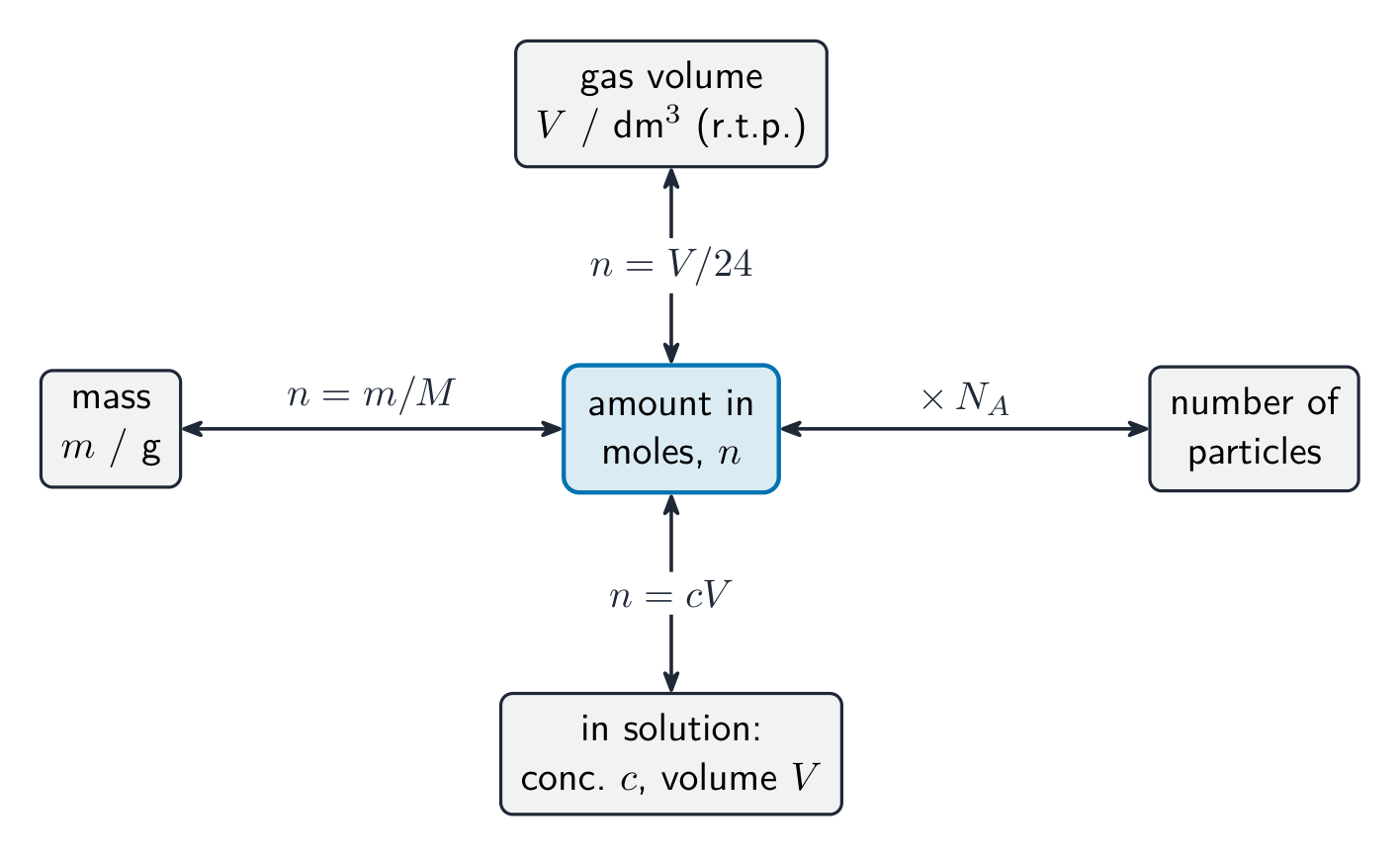
因为原子太小无法计数,化学家以摩尔(moles)计数。一摩尔是阿伏伽德罗常数(Avogadro's number)个粒子,$N_A=6.022\times10^{23}$。摩尔质量(molar mass)(每摩尔的克数,从周期表读出)在质量和摩尔之间转换:
$$n=\frac{m}{M}.$$
摩尔是实验室(你称的克)和方程(反应的粒子)之间的桥梁。
Worked example. $36.0\ \text{g}$ 的水($M=18.0\ \text{g/mol}$)里有多少摩尔,以及多少分子?
$$n=\frac{m}{M}=\frac{36.0}{18.0}=2.0\ \text{mol},\qquad N=n\,N_A=2.0\times6.022\times10^{23}=1.2\times10^{24}\ \text{molecules}.$$
探索
Link mass, moles and molar mass
Molar mass $M$ is the bridge between the mass you weigh and the number of moles: $m = M \times n$. Because $M$ is fixed for a substance, mass is proportional to moles — double the moles, double the mass.
词汇表
训练
| 英文 | 中文 | 拼音 |
|---|---|---|
| moles | 摩尔 | mó ěr |
| Avogadro's number | 阿伏伽德罗常数 | ā fú gā dé luó cháng shù |
| molar mass | 摩尔质量 | mó ěr zhì liàng |
1.2
元素的质谱
大纲
| Learning Objective | Essential Knowledge |
|---|---|
1.2.A |
|
来源:美国大学理事会 AP 课程与考试说明
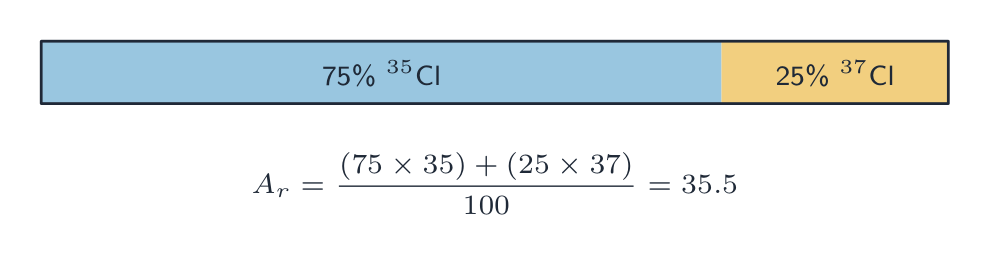
一台质谱仪(mass spectrometer)按质量分开原子,给出一个质谱(mass spectrum):在每个同位素(isotope)(相同元素,不同中子数)处有峰,峰高显示它们的相对丰度(relative abundance)。元素的平均原子质量是它同位素质量的丰度加权平均。
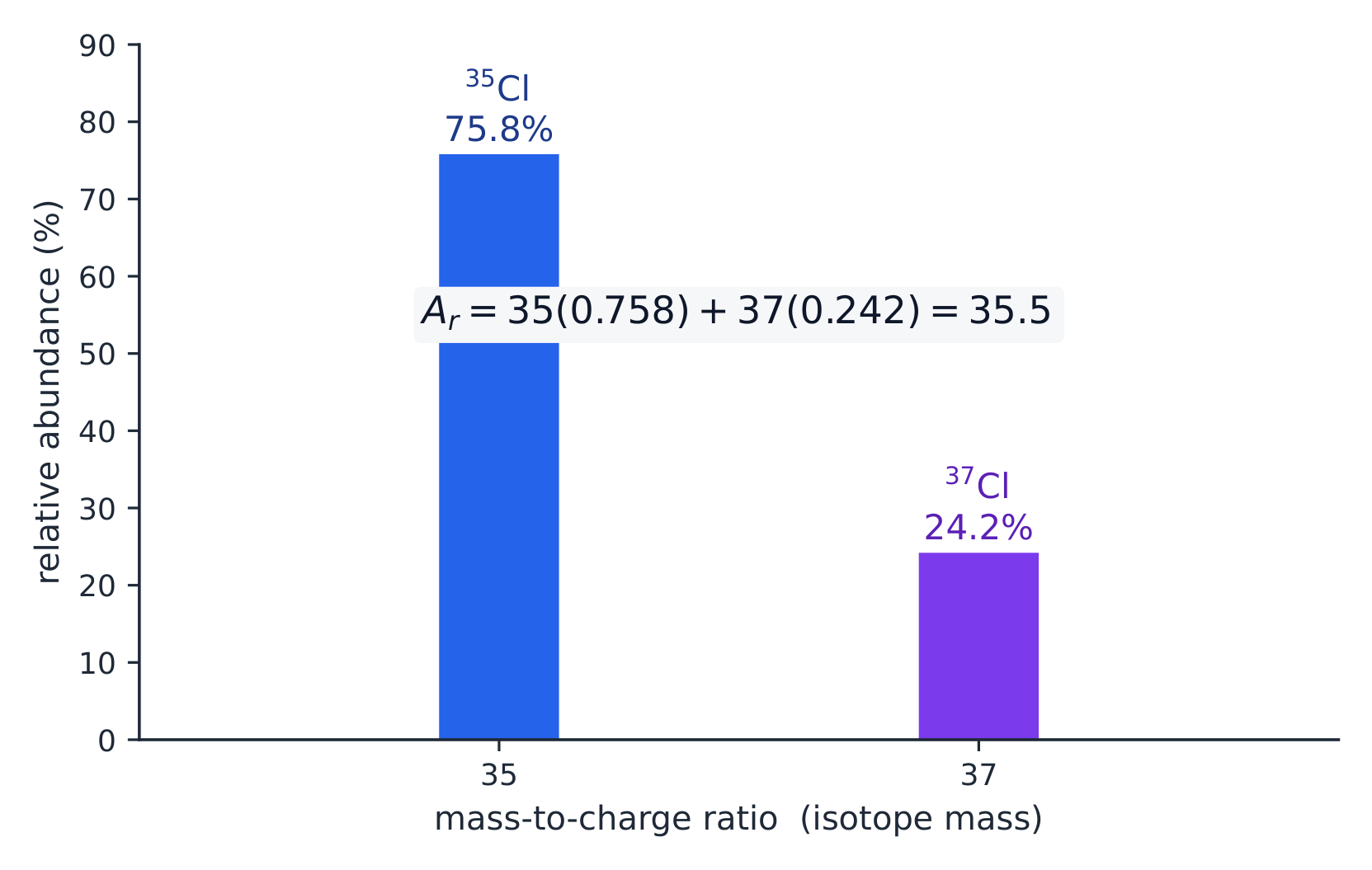
Worked example. 氯是 $75.8\%$ 氯-35 和 $24.2\%$ 氯-37。它的平均原子质量是
$$A_r=(35)(0.758)+(37)(0.242)=26.5+8.95=35.5.$$
平均值更接近 $35$,因为那个同位素更丰富——这就是为什么周期表值是 $35.5$,不是一个整数。
探索
Explore isotopes — same element, different mass
Keep the protons fixed but change the neutrons to build the two chlorine isotopes ($^{35}$Cl and $^{37}$Cl). Same element, different mass — exactly the peaks a mass spectrum shows.
词汇表
训练
| 英文 | 中文 | 拼音 |
|---|---|---|
| mass spectrometer | 质谱仪 | zhì pǔ yí |
| mass spectrum | 质谱 | zhì pǔ |
| isotope | 同位素 | tóng wèi sù |
| relative abundance | 相对丰度 | xiāng duì fēng dù |
1.3
纯净物的元素组成
大纲
| Learning Objective | Essential Knowledge |
|---|---|
1.3.A |
|
来源:美国大学理事会 AP 课程与考试说明
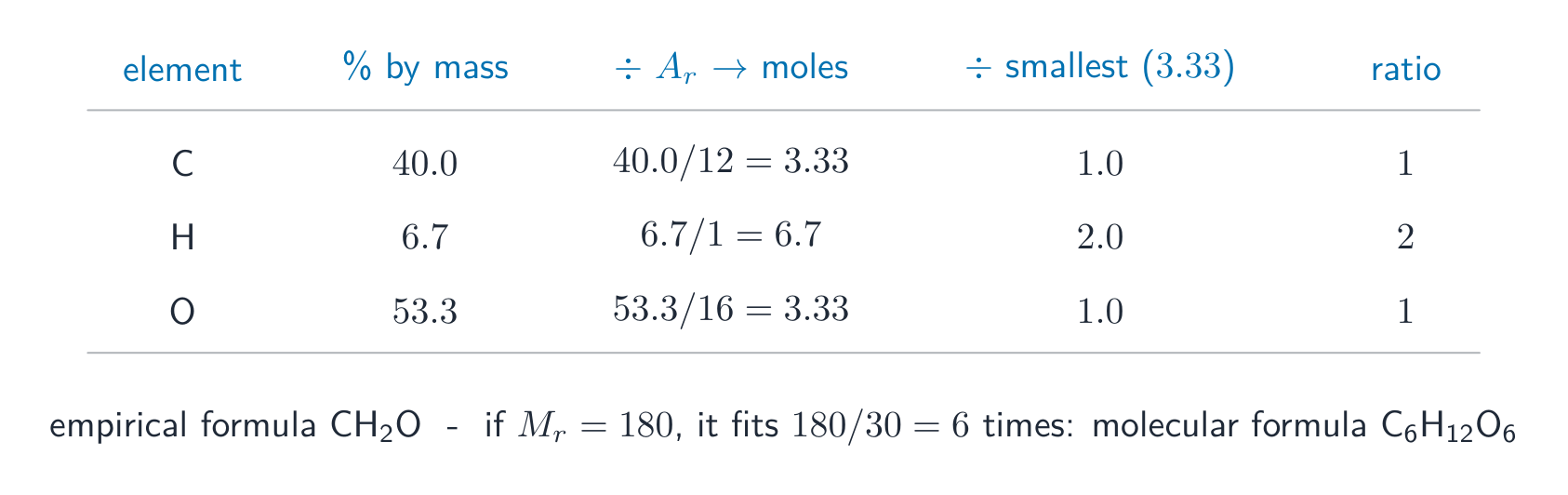
一个化合物的百分组成(percent composition)是每个元素的质量分数。从它你通过把每个元素的质量转换成摩尔并除以最小的来求实验式(empirical formula)(原子的最简整数比)。分子式(molecular formula)是实验式的一个整数倍,从摩尔质量求出。
Worked example. 一个化合物按质量是 $40.0\%$ C、$6.7\%$ H 和 $53.3\%$ O。假设 $100\ \text{g}$,把每个质量转换成摩尔并除以最小的:
$$\text{C}:\frac{40.0}{12}=3.33,\quad \text{H}:\frac{6.7}{1}=6.7,\quad \text{O}:\frac{53.3}{16}=3.33 \;\xrightarrow{\div 3.33}\; 1:2:1,$$
所以实验式是 $\text{CH}_2\text{O}$。若摩尔质量是 $180\ \text{g/mol}$($=6\times30$),分子式会是 $\text{C}_6\text{H}_{12}\text{O}_6$ ——葡萄糖。
词汇表
训练
| 英文 | 中文 | 拼音 |
|---|---|---|
| percent composition | 百分组成 | bǎi fēn zǔ chéng |
| empirical formula | 实验式 | shí yàn shì |
| molecular formula | 分子式 | fēn zǐ shì |
1.4
混合物的组成
大纲
| Learning Objective | Essential Knowledge |
|---|---|
1.4.A |
|
来源:美国大学理事会 AP 课程与考试说明
与一个纯化合物不同,一个混合物(mixture)有可变的组成——它的各部分保持它们自己的身份。用每个组分的质量或摩尔分数来描述一个混合物;这些不遵循一个固定的公式。光谱学(像 PES 或吸收)能测量每个组分存在多少。
词汇表
训练
| 英文 | 中文 | 拼音 |
|---|---|---|
| mixture | 混合物 | hùn hé wù |
1.5
原子结构与电子排布
大纲
| Learning Objective | Essential Knowledge |
|---|---|
1.5.A |
|
来源:美国大学理事会 AP 课程与考试说明
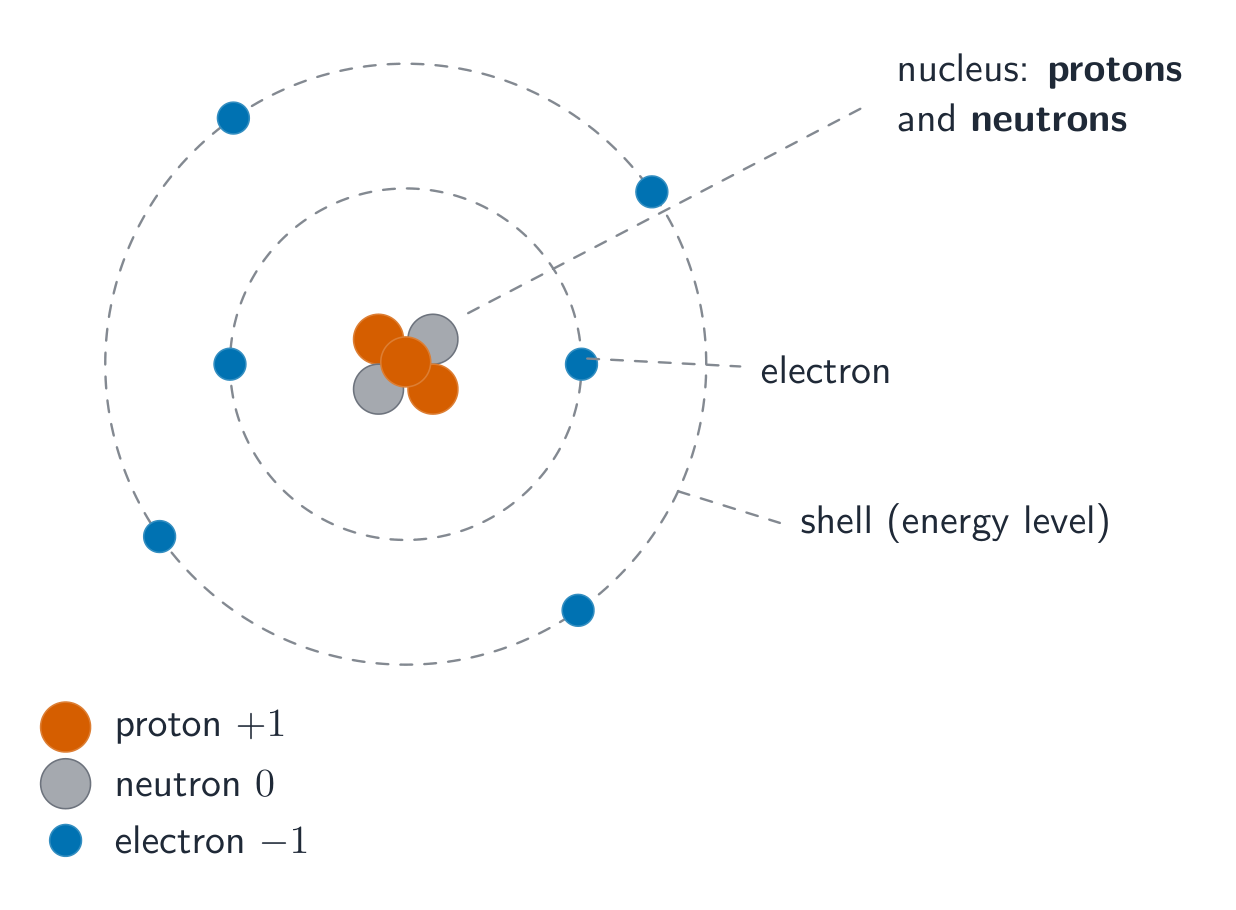
一个原子是一个微小的原子核(nucleus)(质子和中子),被在壳层(shells)和亚层(subshells)(s、p、d、f)里的电子围绕。电子排布(electron configuration)列出电子如何填充这些,最低能量优先(例如 $1s^2\,2s^2\,2p^6$)。最外层、最高能量的电子——价电子(valence electrons)——控制化学。库仑定律(Coulomb's law)解释它们的能量:更接近原子核、被更少屏蔽的电子被更紧地束缚。
Worked example. 写硫($Z=16$)的电子排布。按顺序填充亚层直到 $16$ 个电子被放置:$1s^2\,2s^2\,2p^6\,3s^2\,3p^4$。$3s$ 和 $3p$ 电子(总共六个)是价电子,所以硫倾向于获得两个电子来完成它的八隅体。
探索
Explore how electrons fill the shells
Change the atomic number $Z$ and watch the electrons fill the shells lowest-energy-first (the Aufbau principle 构造原理). The outermost electrons are the valence electrons that drive bonding.
词汇表
训练
| 英文 | 中文 | 拼音 |
|---|---|---|
| nucleus | 原子核 | yuán zǐ hé |
| electron configuration | 电子排布 | diàn zi pái bù |
| valence electrons | 价电子 | jià diàn zi |
1.6
光电子能谱
大纲
| Learning Objective | Essential Knowledge |
|---|---|
1.6.A |
|
来源:美国大学理事会 AP 课程与考试说明
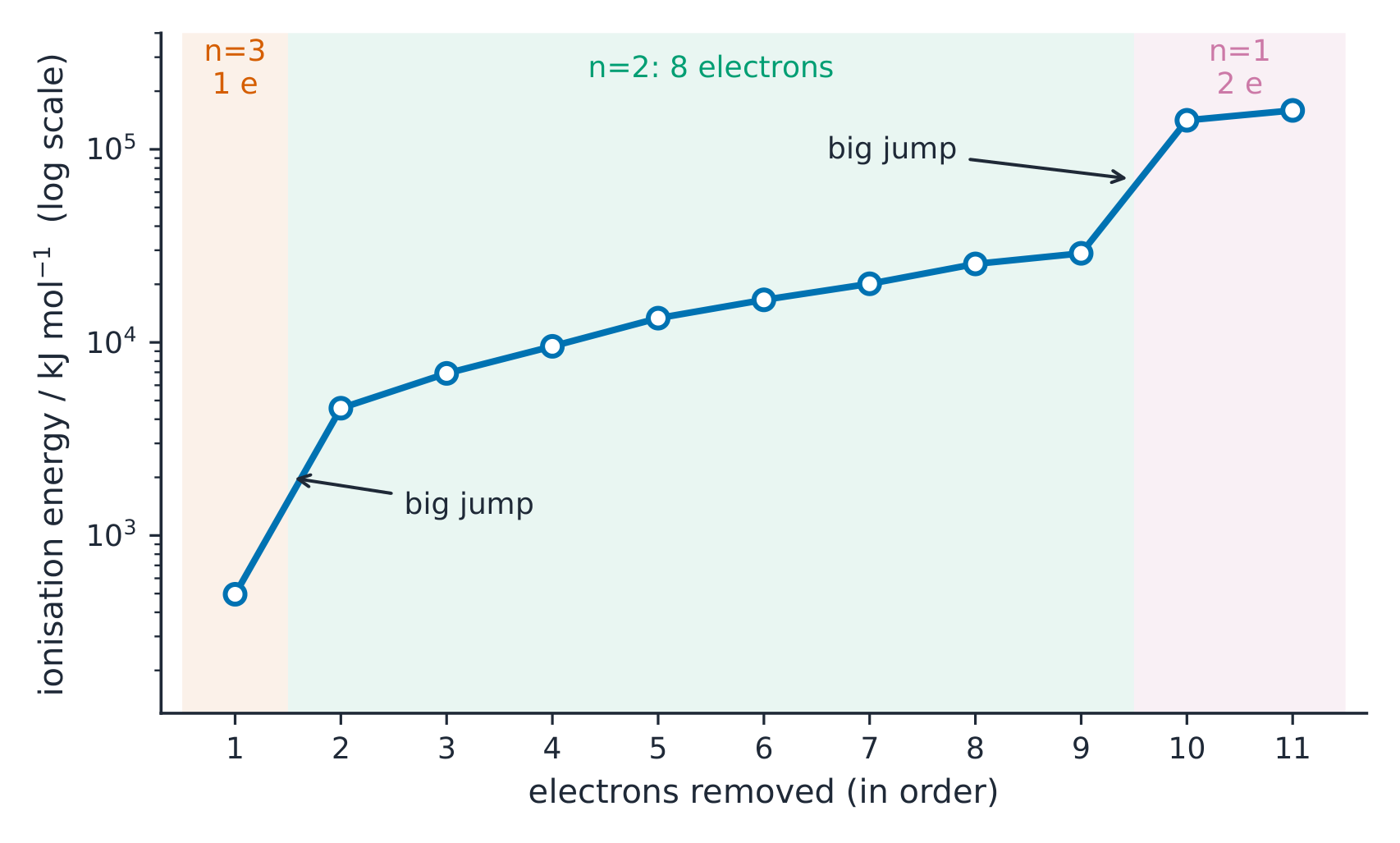
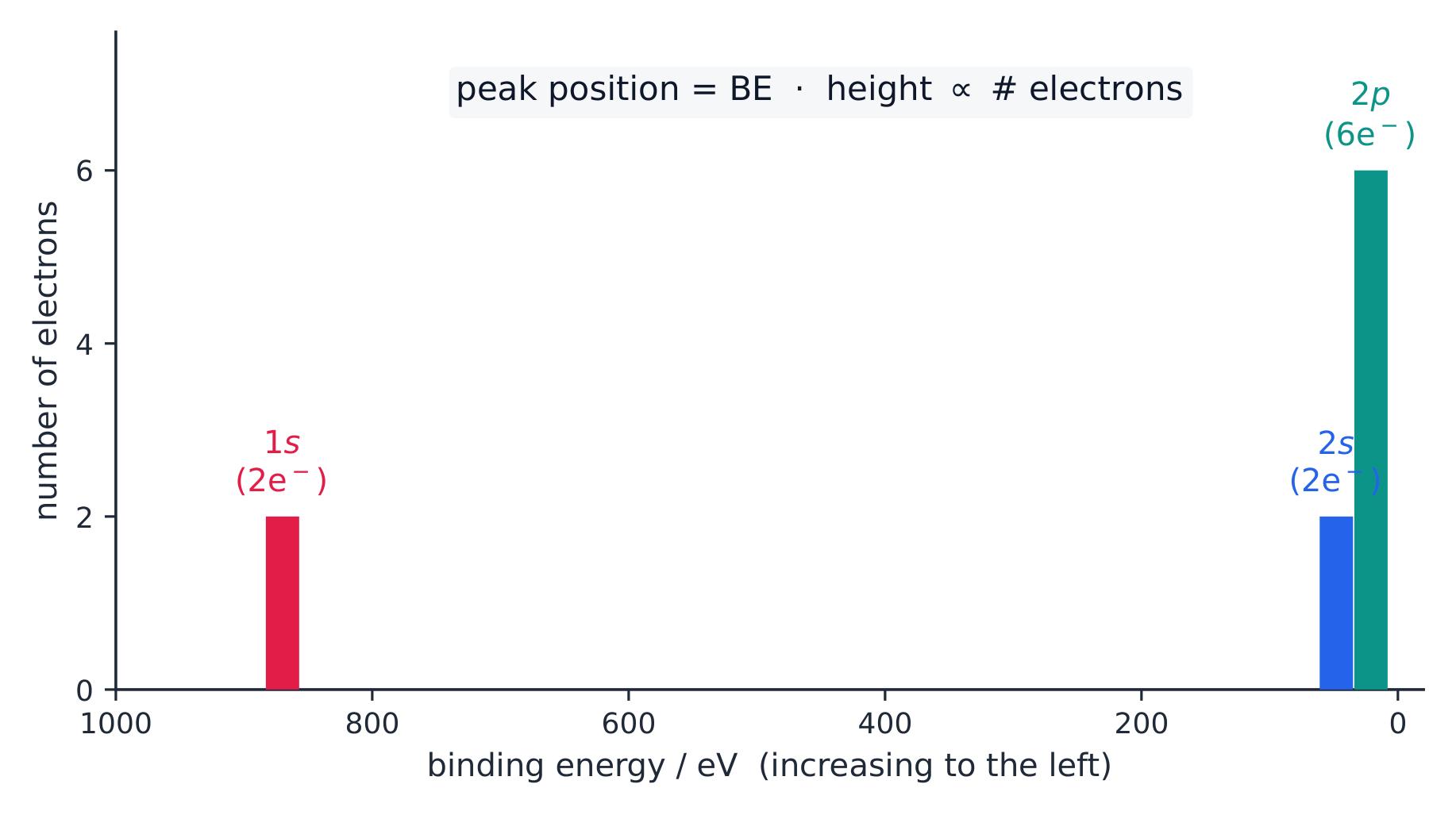
光电子能谱(photoelectron spectroscopy)(PES)测量从每个亚层移除电子所需的能量。每个峰是一个亚层:它的位置给出结合能(束缚得多紧)而它的高度给出其中电子的数量。PES 数据让你直接读一个元素的电子排布并确认壳层结构。
词汇表
训练
| 英文 | 中文 | 拼音 |
|---|---|---|
| Photoelectron spectroscopy | 光电子能谱 | guāng diàn zi néng pǔ |
1.7
周期性变化趋势
大纲
| Learning Objective | Essential Knowledge |
|---|---|
1.7.A |
|
来源:美国大学理事会 AP 课程与考试说明
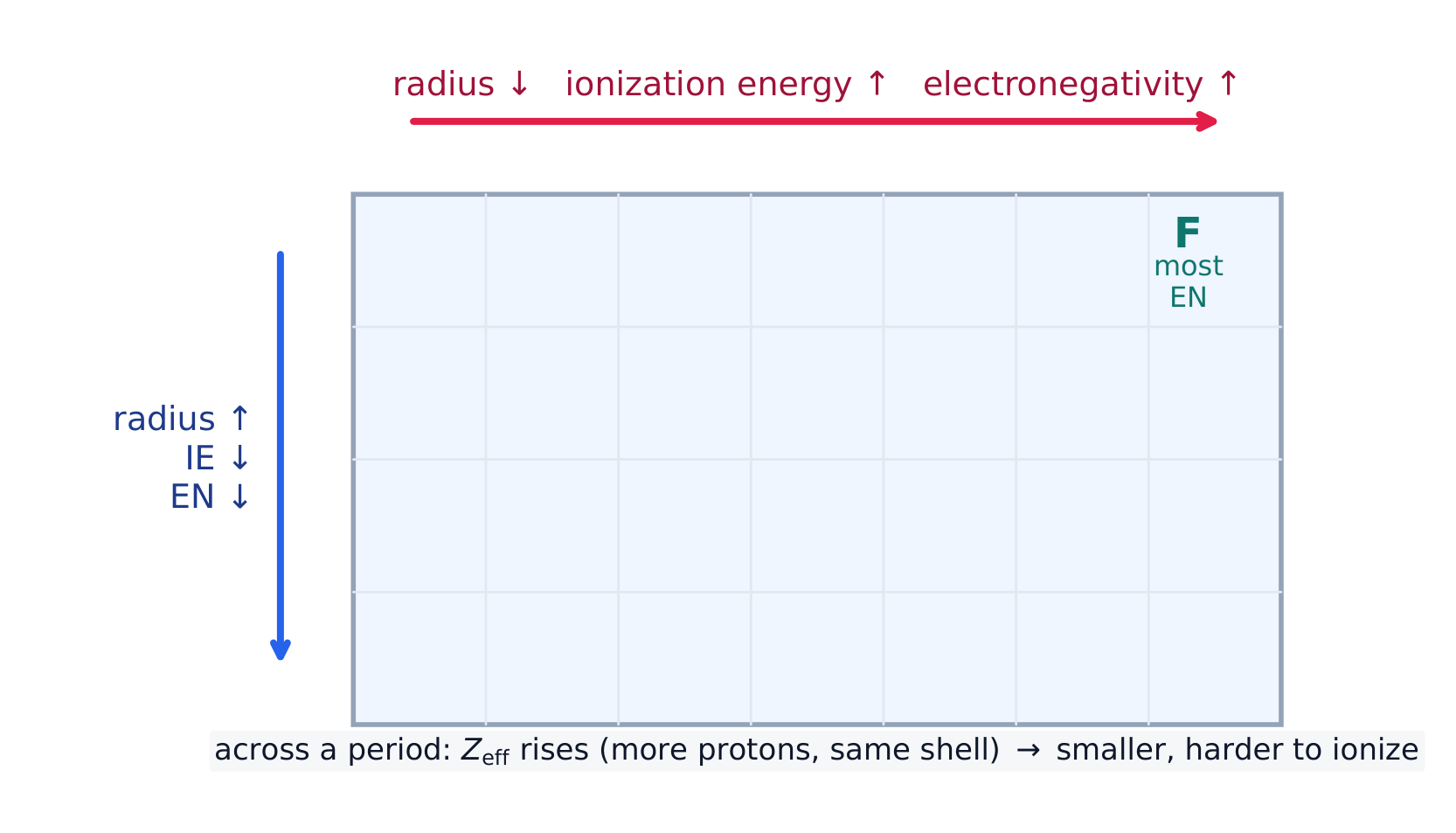
周期表上的趋势由核电荷(nuclear charge)和屏蔽(shielding)决定:
- 原子半径(atomic radius)在一个周期上减小(更强的拉力)而在一个族上增大(更多壳层)。
- 电离能(ionization energy)(移除一个电子的能量)横向增大、向下减小——与半径相反。
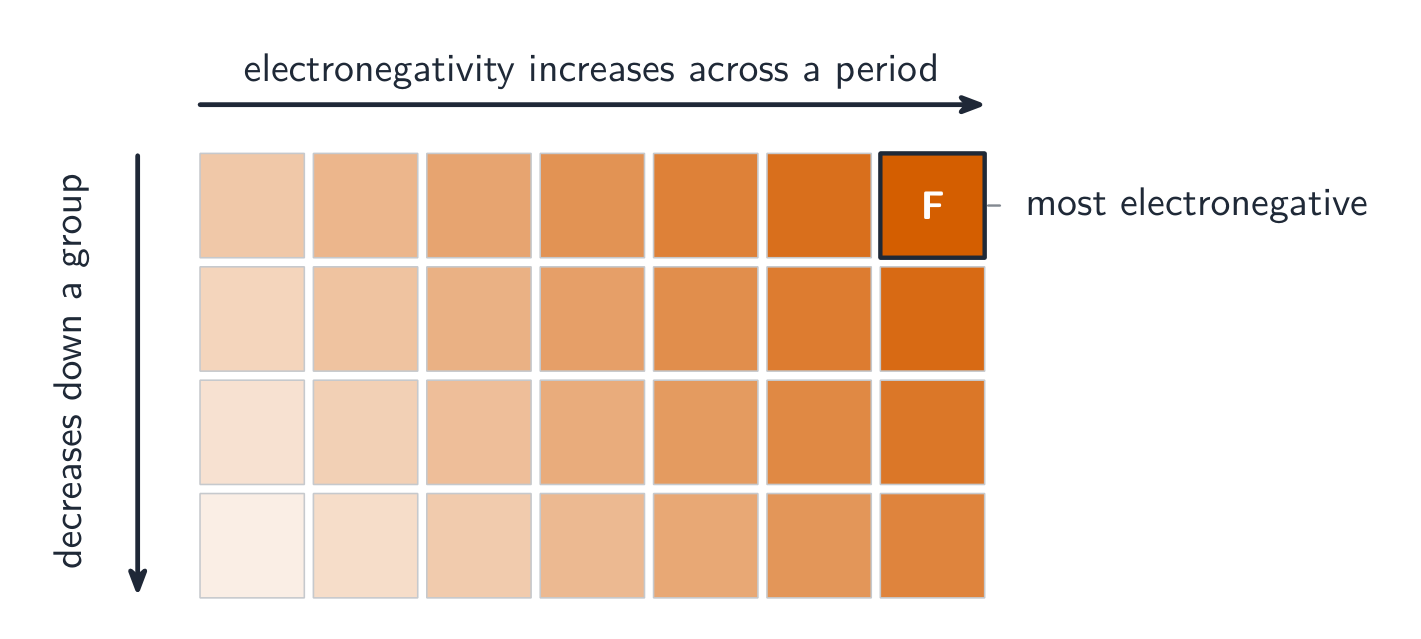
- 电负性(electronegativity)(对共享电子的拉力)横向和向上增大,朝向氟。
探索
Explore atomic radius across a period
Step across Period 3 and watch the atomic radius shrink — each added proton raises the effective nuclear charge and pulls the same shell in tighter.
词汇表
训练
| 英文 | 中文 | 拼音 |
|---|---|---|
| Atomic radius | 原子半径 | yuán zi bàn jìng |
| Ionization energy | 电离能 | diàn lí néng |
| Electronegativity | 电负性 | diàn fù xìng |
1.8
价电子与离子化合物
大纲
| Learning Objective | Essential Knowledge |
|---|---|
1.8.A |
|
来源:美国大学理事会 AP 课程与考试说明
原子获得、失去或共享价电子以达到稳定的排布。金属(低电离能)失去电子形成阳离子(cations);非金属获得电子形成阴离子(anions)。带相反电荷的离子吸引成一个离子化合物(ionic compound),它的公式平衡电荷使整体呈中性。例如,铝($3+$)和氧化物($2-$)结合成 $\text{Al}_2\text{O}_3$,所以 $+6$ 和 $-6$ 抵消。
探索
Watch an ionic bond form by electron transfer
A metal gives up its valence electron(s) and a non-metal takes them, so both reach a full shell. The atoms become oppositely charged ions that attract — that electrostatic pull is the ionic bond.
词汇表
训练
| 英文 | 中文 | 拼音 |
|---|---|---|
| cations | 阳离子 | yáng lí zi |
| anions | 阴离子 | yīn lí zi |
| ionic compound | 离子化合物 | lí zi huà hé wù |
1.8
考试技巧
- 用摩尔作为枢纽:用 $n=m/M$ 转换克↔摩尔,用阿伏伽德罗常数转换摩尔↔粒子。
- 相对原子质量是同位素的丰度加权平均——它更接近更丰富的那个,不是中间。
- 对于一个实验式,把每个元素的质量变成摩尔并除以最小的;放大到整数。
- 从核电荷和屏蔽读周期趋势:原子半径在一个周期上减小、电离能和电负性横向(和向上)增大。
- 按能量顺序填充电子排布;外层价电子控制化学。
本主题的互动课程
逐步学习,并即时检测练习。