Skip to content · ⁨Перейти к содержанию⁩
Subjects · ⁨Предметы⁩

English Grammar · A2 · ⁨Англійська граматика · A2⁩

  • 1 Present simple
    1.1

    Привычки и факты (Habits & facts)

    English

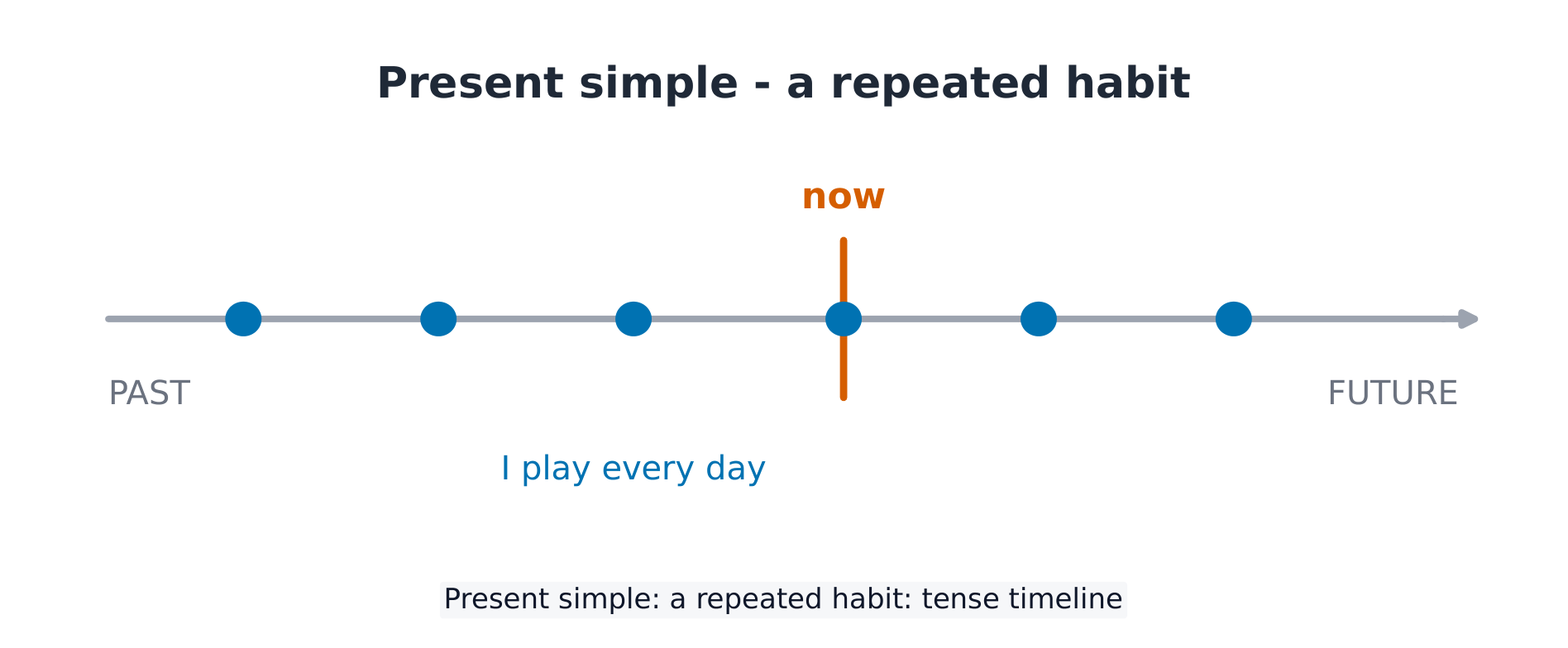
    The present simple tense is used to talk about things that happen regularly and facts that are always true: daily habits, schedules, scientific facts.

    Structure: 主语 + 动词原形

    我I 喝drink 咖啡coffee 每every 早上morning.

    I drink coffee every morning.

    我们We 住live 在in 上海Shanghai.

    We live in Shanghai.

    Scientific facts also use the present simple:

    水Water 沸腾boils 在at 一one 百hundred 度degrees.

    Water boils at one hundred degrees Celsius.

    It is often used with adverbs of frequency: always, usually, often, sometimes, never.

    她She 总是always 乘坐takes (冠词)the 公交车bus.

    She always takes the bus.

    Note

    • When talking about current habits, do not add a be verb: ~~I am drink coffee~~ ✗ → I drink coffee ✓.
    • Adverbs of frequency usually go before the main verb, but after the be verb: She is often late.
    Русский
    Настоящее простое: повторяющиеся привычки

    Present Simple используется для谈论经常发生的事和一直为真的事实:每天的习惯、时间表、科学常识。常和频率副词一起用:always(总是)、usually(通常)、often(经常)、sometimes(有时)、never(从不)。谈论现在的习惯,不要加 be 动词:~~I am drink coffee~~ ✗ → I drink coffee ✓。频率副词通常放在主要动词前,但放在 be 动词后:She is often late.(她经常迟到。)

    Структура: 主语 + 动词原形

    我I 喝drink 咖啡coffee 每every 早上morning.

    Я пью кофе каждое утро.

    我们We 住live 在in 上海Shanghai.

    Мы живём в Шанхае.

    Научные факты также выражаются настоящим простым временем:

    水Water 沸腾boils 在at 一one 百hundred 度degrees.

    Вода кипит при ста градусах.

    常和频率副词 (adverbs of frequency) 一起用:always(总是)、usually(通常)、often(经常)、sometimes(有时)、never(从不)。

    她She 总是always 乘坐takes (冠词)the 公交车bus.

    Она всегда ездит на автобусе.

    Обратите внимание

    • 谈论现在的习惯,不要加 be 动词:~~I am drink coffee~~ ✗ → I drink coffee ✓。
    • 频率副词通常放在主要动词前,但放在 be 动词后:She is often late.(她经常迟到。)
    1.2

    Третье лицо единственного числа -s (Third person -s)

    English

    When the subject is he / she / it (third person singular), the verb takes -s or -es.

    Structure: He / She / It + 动词 + -s

    他He 工作works 在in 一家a 银行bank.

    He works at a bank.

    我的My 姐姐sister 喜欢likes 音乐music.

    My sister likes music.

    Spelling rules:

    • Generally add -s directly: work → works, play → plays.
    • Ends in -s / -sh / -ch / -x / -o, add -es: watch → watches, go → goes.
    • Consonant letter + -y ending, change y to i and add -es: study → studies, fly → flies.

    她She 看watches 电视TV 在at 晚上night.

    She watches TV at night.

    Note

    • Only he / she / it takes -s; I / you / we / they do not take it: ~~They likes~~ ✗ → They like ✓.
    • have is special: he / she / it uses has (not ~~haves~~).
    Русский

    Когда подлежаемое — he / she / it(третье лицо единственного числа), к глаголу добавляется -s или -es。

    Структура: He / She / It + 动词 + -s

    他He 工作works 在in 一家a 银行bank.

    Он работает в банке.

    我的My 姐姐sister 喜欢likes 音乐music.

    Моя сестра любит музыку.

    Правила правописания:

    • Обычно просто добавляется -s:work → works, play → plays。
    • Слова, оканчивающиеся на -s / -sh / -ch / -x / -o, получают -es:watch → watches, go → goes。
    • Сочетание согласной буквы + -y на конце: y меняется на i, затем добавляется -es:study → studies, fly → flies。

    她She 看watches 电视TV 在at 晚上night.

    Она смотрит телевизор вечером.

    Обратите внимание

    • Только he / she / it получает -s; I / you / we / they не получают:~~They likes~~ ✗ → They like ✓。
    • have очень特殊:he / she / it использует has(а не ~~haves~~)。
    1.3

    Отрицания и вопросы (Negatives & questions)

    English

    For negative and interrogative forms in the Present Simple, use the auxiliary verb do / does. Use does for he / she / it, and do for other subjects.

    Negative structure: 主语 + don't / doesn't + 动词原形

    我I 不don't 吃eat 肉meat.

    I don't eat meat.

    他He 不doesn't 喜欢like 咖啡coffee.

    He doesn't like coffee.

    Interrogative structure: Do / Does + 主语 + 动词原形 ?

    (助动词)Do 你you 说speak 英语English?

    Do you speak English?

    (助动词)Does 她she 工作work 这里here?

    Does she work here?

    Short answers: Yes, I do. / No, he doesn't.

    Note

    • After using do / does, the verb returns to its base form (no longer adds -s): ~~He doesn't likes~~ ✗ → He doesn't like ✓.
    • Don't forget the auxiliary verb: in formal contexts say Do you…?, not just ~~You speak English?~~.

    Common Errors

    • ❌ ~~She don't like it.~~ → ✓ She doesn't like it. — For third-person singular negatives, use doesn't, not don't.
    • ❌ ~~Does he has a car?~~ → ✓ Does he have a car? — When using does, even has reverts to the base form have.
    • ❌ ~~Everyone know the answer.~~ → ✓ Everyone knows the answer. — everyone / everybody / nobody are treated as singular, so add -s to the verb.
    • ❌ ~~I am usually going to school by bike.~~ → ✓ I usually go to school by bike. — Repeated habits use the Present Simple, not the continuous tense.
    Русский

    Отрицания и вопросы в Present Simple требуют вспомогательного глагола do / does。he / she / it использует does, остальные подлежащие используют do。

    Отрицательная структура: 主语 + don't / doesn't + 动词原形

    我I 不don't 吃eat 肉meat.

    Я не ем мясо.

    他He 不doesn't 喜欢like 咖啡coffee.

    Ему не нравится кофе.

    Вопросительная структура: Do / Does + 主语 + 动词原形 ?

    (助动词)Do 你you 说speak 英语English?

    Ты говоришь по-английски?

    (助动词)Does 她she 工作work 这里here?

    Она работает здесь?

    Краткие ответы:Yes, I do. / No, he doesn't.

    Обратите внимание

    • После использования do / does глагол возвращается в начальную форму(больше не добавляется -s):~~He doesn't likes~~ → He doesn't like ✓。
    • Не забывайте о вспомогательном глаголе:в официальной речи говорят Do you…?, а не только ~~You speak English?~~

    Частые ошибки

    • ❌ ~~She don't like it.~~ → ✓ She doesn't like it. — Отрицание для третьего лица единственного числа строится через doesn't, а не don't。
    • ❌ ~~Does he has a car?~~ → ✓ Does he have a car? — После использования does, even has должен вернуться в начальную форму have。
    • ❌ ~~Everyone know the answer.~~ → ✓ Everyone knows the answer. — everyone / everybody / nobody рассматриваются как единственное число, к глаголу добавляется -s。
    • ❌ ~~I am usually going to school by bike.~~ → ✓ I usually go to school by bike. — Повторяющаяся привычка выражается через Present Simple, а не Continuous。
  • 2 Present continuous
    2.1

    Структура (be + V-ing)

    English

    The Present Continuous tense describes actions that are happening right now.

    Structure: 主语 + am / is / are + 动词-ing(I → am; he / she / it → is; you / we / they → are)

    我I 正在am 读reading 一本a 书book.

    I am reading a book.

    他们They 正在are 踢playing 足球football.

    They are playing football.

    Spelling of -ing:

    • Generally add -ing directly: read → reading.
    • End in silent -e, drop e and add -ing: make → making, write → writing.
    • Stressed closed syllable (consonant + vowel + consonant), double the final consonant: run → running, sit → sitting.

    她She 正在is 写writing 一封an 电子邮件email.

    She is writing an email.

    Note

    • Don't forget the be verb: ~~I reading~~ ✗ → I am reading ✓.
    • State verbs (like, know, want, have = possess) generally do not use the continuous tense: ~~I am knowing~~ ✗ → I know ✓.
    Русский
    She is reading a book — an action happening right now.

    Present Continuous обозначает действие, происходящее прямо сейчас。

    Структура: 主语 + am / is / are + 动词-ing(I → am; he / she / it → is; you / we / they → are)

    我I 正在am 读reading 一本a 书book.

    Я читаю книгу прямо сейчас.

    他们They 正在are 踢playing 足球football.

    Они играют в футбол прямо сейчас.

    Написание -ing:

    • Обычно просто добавляется -ing: read → reading。
    • Слова, оканчивающиеся на немую -e, убирают e и добавляют -ing: make → making, write → writing。
    • Ударный закрытый слог (согласная + гласная + согласная): удваивают последнюю согласную: run → running, sit → sitting。

    她She 正在is 写writing 一封an 电子邮件email.

    Она пишет электронное письмо прямо сейчас.

    Обратите внимание

    • Не забывайте глагол be: ~~I reading~~ ✗ → I am reading ✓。
    • Глаголы состояния (like, know, want, have = иметь) обычно не используются в Continuous: ~~I am knowing~~ ✗ → I know ✓。
    2.2

    Present Continuous vs Present Simple

    English

    Both tenses relate to "now," but their meanings differ:

    • Present Simple: Habits or repeated actions.
    • Present Continuous: Actions happening at this very moment.

    他He 通常usually 步行walks 去to 上班work.

    He usually walks to work. (Habit → Present Simple)

    今天Today 他he 正在is 乘坐taking (冠词)the 公交车bus.

    He is taking the bus today. (Right now → Present Continuous)

    Time expressions help distinguish them:

    • Present Simple: every day, usually, often, always.
    • Present Continuous: now, right now, at the moment, today.

    Note

    • Temporary situations use the continuous tense: She is living with her aunt this month. (She is temporarily staying with her aunt this month.)
    • Long-term facts use the Present Simple: She lives in Beijing. (She lives in Beijing.)

    Common Errors

    • ❌ ~~They are play football now.~~ → ✓ They are playing football now. — With be, the verb must also take -ing; both elements are required.
    • ❌ ~~She is cooking every day.~~ → ✓ She cooks every day. — every day signals a habit, so use the Present Simple.
    • ❌ ~~Where is Tom? — He plays football.~~ → ✓ He is playing football. — To answer "what is he doing right now?", use the continuous tense.
    • ❌ ~~He is writeing a letter.~~ → ✓ He is writing a letter. — Verbs ending in a silent -e drop the e before adding -ing.
    Русский

    Оба времени связаны с «настоящим», но имеют разный смысл:

    • Настоящее простое: привычки, повторяющиеся действия.
    • Настоящее продолженное: действие, происходящее в данный момент.

    他He 通常usually 步行walks 去to 上班work.

    Обычно он ходит на работу пешком. (привычка → настоящее простое)

    今天Today 他he 正在is 乘坐taking (冠词)the 公交车bus.

    Сегодня он едет на автобусе. (моментально → настоящее продолженное)

    Слова времени помогают определить время:

    • Present Simple: every day, usually, often, always。
    • Present Continuous: now, right now, at the moment, today。

    Обратите внимание

    • Временные ситуации выражаются через Continuous: She is living with her aunt this month.(Этот месяц она временно живет у тети。)
    • Долгосрочные факты выражаются через Present Simple: She lives in Beijing.(Она живет в Пекине。)

    Частые ошибки

    • ❌ ~~They are play football now.~~ → ✓ They are playing football now. — При наличии be глагол также должен получить -ing, оба элемента обязательны。
    • ❌ ~~She is cooking every day.~~ → ✓ She cooks every day. — every day является сигналом привычки, используется Present Simple。
    • ❌ ~~Where is Tom? — He plays football.~~ → ✓ He is playing football. — Ответ на вопрос «что он делает прямо сейчас» требует Continuous。
    • ~~He is writeing a letter.~~ → ✓ He is writing a letter. — Слова, оканчивающиеся на немую -e, убирают e и добавляют -ing。
  • 3 Past simple
    3.1

    Правильные глаголы (-ed)

    English

    The Past Simple tense describes actions or states that were completed in the past. Regular verbs add -ed to the end.

    Structure: 主语 + 动词-ed(same for all persons)

    我I 看watched 一部a 电影film 昨天yesterday.

    I watched a movie yesterday.

    我们We 打played 篮球basketball 上last 周week.

    We played basketball last week.

    Spelling of -ed:

    • Generally add -ed directly: work → worked, play → played.
    • End in -e, only add -d: like → liked, live → lived.
    • Consonant + -y ending, change y to i and add -ed: study → studied, try → tried.
    • Stressed closed syllable, double the final consonant: stop → stopped, plan → planned.

    Note

    • The past tense form does not change based on person: I worked, she worked (no -s).
    • Often used with past time markers: yesterday, last week, in 2019, two days ago.
    Русский
    Прошедшее простое: завершенные действия

    Простое прошедшее время (past simple) обозначает действие или состояние, завершившиеся в прошлом. Правильные глаголы образуются путем добавления окончания -ed.

    Структура: 主语 + 动词-ed(для всех лиц одинаково)

    我I 看watched 一部a 电影film 昨天yesterday.

    Я вчера посмотрел фильм.

    我们We 打played 篮球basketball 上last 周week.

    Мы играли в баскетбол на прошлой неделе.

    Правописание -ed:

    • Просто добавьте -ed: work → worked, play → played.
    • Если слово заканчивается на -e, добавьте только -d: like → liked, live → lived.
    • Если слово заканчивается на согласную + y, замените y на i и добавьте -ed: study → studied, try → tried.
    • В ударном закрытом слоге удвойте последнюю согласную: stop → stopped, plan → planned.

    Обратите внимание

    • Форма глагола в прошедшем времени не меняется по лицам: I worked, she worked (без -s).
    • Часто используется с маркерами прошлого времени: yesterday, last week, in 2019, two days ago.
    3.2

    Неправильные глаголы

    English

    Many common verbs are irregular; their past forms must be memorized individually without adding -ed.

    我I 去went (介词)to 北京Beijing 上last 月month.

    I went to Beijing last month.

    她She 看见saw 她的her 朋友friends.

    She met her friend.

    High-frequency irregular verbs you must memorize:

    • go → went, have → had, do → did, make → made.
    • see → saw, come → came, get → got, take → took.
    • eat → ate, buy → bought, think → thought, say → said.

    我们We (吃了)had 一顿a 丰盛的big 晚餐dinner.

    We had a big dinner.

    Note these follow no pattern; practice reading and memorizing them frequently.

    Русский

    Многие частоупотребляемые глаголы являются неправильными, их формы прошедшего времени нужно запоминать отдельно, без добавления -ed.

    我I 去went (介词)to 北京Beijing 上last 月month.

    Я ездил в Пекин в прошлом месяце.

    她She 看见saw 她的her 朋友friends.

    Она встретила своего друга.

    Обязательно выучите高频的неправильные глаголы:

    • go → went, have → had, do → did, make → made.
    • see → saw, come → came, get → got, take → took.
    • eat → ate, buy → bought, think → thought, say → said.

    我们We (吃了)had 一顿a 丰盛的big 晚餐dinner.

    Мы поели сытный ужин.

    Обратите внимание, что они не подчиняются правилам, их нужно много читать и запоминать.

    3.3

    Отрицание и вопросы (did)

    English

    For negative and interrogative forms in the Past Simple, use the auxiliary did (past form). The following verb returns to its base form.

    Negative structure: 主语 + didn't + 动词原形

    我I 没有didn't 去go (介词)to 上学school.

    I didn't go to school.

    Interrogative structure: Did + 主语 + 动词原形 ?

    (助动词)Did 你you 看见see (冠词)the 电影film?

    Did you see that movie?

    Short answers: Yes, I did. / No, I didn't.

    Note

    • After using did / didn't, the verb must be in the base form: ~~I didn't went~~ ✗ → I didn't go ✓.
    • The past tense of the be verb (was / were) does not use did: Were you tired? (Were you tired?)

    Common Errors

    • ❌ ~~I go to Beijing last month.~~ → ✓ I went to Beijing last month. — Chinese verbs do not change form, but in English, once a past time marker is present, you must switch to the past tense. This is the most common error.
    • ❌ ~~She buyed a new phone.~~ → ✓ She bought a new phone. — Irregular verbs cannot simply add -ed.
    • ❌ ~~I didn't was hungry.~~ → ✓ I wasn't hungry. — For negative sentences with the verb 'be', use wasn't / weren't directly, not didn't.
    • ❌ ~~yesterday night~~ → ✓ last night — Fixed expression: 'last night' is used for last evening, not 'yesterday night' (though 'yesterday morning/afternoon' is correct).
    Русский

    Для отрицания и вопросов в простом прошедшем времени используется вспомогательный глагол did (прошедшая форма). Основной глагол после него возвращается к начальной форме.

    Отрицательная структура: 主语 + didn't + 动词原形

    我I 没有didn't 去go (介词)to 上学school.

    Я не пошел в школу.

    Вопросительная структура: Did + 主语 + 动词原形 ?

    (助动词)Did 你you 看见see (冠词)the 电影film?

    Ты видел тот фильм?

    Краткие ответы: Yes, I did. / No, I didn't.

    Обратите внимание

    • При использовании did / didn't основной глагол обязательно должен быть в начальной форме: ~~I didn't went~~ ✗ → I didn't go ✓.
    • Глагол be (was / were) в прошедшем времени не использует did: Were you tired? (Ты был уставшим?)

    Частые ошибки

    • ❌ ~~I go to Beijing last month.~~ → ✓ I went to Beijing last month. — В русском языке глагол не меняется, но в английском при указании на прошлое необходимо использовать прошедшую форму; это самая частая ошибка.
    • ❌ ~~She buyed a new phone.~~ → ✓ She bought a new phone. — Неправильные глаголы нельзя просто добавить -ed.
    • ❌ ~~I didn't was hungry.~~ → ✓ I wasn't hungry. — Отрицание для глагола be строится через wasn't / weren't, без did.
    • ❌ ~~yesterday night~~ → ✓ last night — Устойчивое выражение: «вчера вечером» будет last night, а не yesterday night (при этом yesterday morning / afternoon — верно).
  • 4 Past continuous
    4.1

    Структура (was / were + V-ing)

    English

    The past continuous tense describes an action in progress at a specific moment in the past.

    Structure: 主语 + was / were + 动词-ing(I / he / she / it → was; you / we / they → were)

    在At 八点eight 我I (过去进行)was 做饭cooking.

    I was cooking at eight o'clock.

    他们They (过去进行)were 看watching 电视TV.

    They were watching TV at that time.

    Note

    • Don't mix up was and were: Use was for I / he / she / it; use were for you / we / they.
    • Negative: wasn't / weren't + V-ing. Question: Was / Were + subject + V-ing?
    Русский
    Прошедшее продолженное время: was / were + V-ing

    Прошедшее продолженное время (past continuous) обозначает действие, которое находилось в процессе в определенный момент в прошлом.

    Структура: 主语 + was / were + 动词-ing(I / he / she / it → was; you / we / they → were)

    在At 八点eight 我I (过去进行)was 做饭cooking.

    В восемь часов я готовил еду.

    他们They (过去进行)were 看watching 电视TV.

    Они тогда смотрели телевизор.

    Обратите внимание

    • Не путайте was и were: для I / he / she / it используйте was; для you / we / they используйте were.
    • Отрицание: wasn't / weren't + V-ing. Вопрос: Was / Were + подлежащее + V-ing?
    4.2

    when и while

    English

    The past continuous is often used with the simple past to describe "an ongoing action interrupted by another event".

    • while + past continuous (the longer background action).
    • when + simple past (the sudden, short action).

    当...时While 我I (过去进行)was 睡觉sleeping (冠词), the 电话phone 响了rang.

    The phone rang while I was sleeping.

    她She (过去进行)was 做饭cooking 当...时when 我I 到达arrived.

    When I arrived, she was cooking.

    Compare the two tenses:

    • The ongoing background action → Past continuous (was cooking).
    • The short action that interrupts it → Simple past (arrived).

    Note

    • Two long actions happening simultaneously both use the past continuous: While I was reading, she was writing (I was reading, and she was writing).
    • 'when' can also be followed by the past continuous, but the meaning changes. Beginners should first memorize the common collocations mentioned above.

    Common Errors

    • ❌ ~~I was watch TV when he called.~~ → ✓ I was watching TV when he called. — After was / were, you must use the -ing form.
    • ❌ ~~They was playing games.~~ → ✓ They were playing games. — Use were for you / we / they.
    • ❌ ~~When I was arriving, she was cooking.~~ → ✓ When I arrived, she was cooking. — Arriving is a brief, instantaneous action, so use the simple past; only the longer background action uses the continuous form.
    • ❌ ~~I was knowing the answer.~~ → ✓ I knew the answer. — Stative verbs (know, like, want) are also generally not used in the continuous form in the past tense.
    Русский

    Прошедшее продолженное часто используется вместе с прошедшим простым для описания «одно действие происходит, пока другое уже идет».

    • while + Past Continuous (длительное фоновое действие).
    • when + Past Simple (внезапное короткое действие).

    当...时While 我I (过去进行)was 睡觉sleeping (冠词), the 电话phone 响了rang.

    Когда я спал, позвонил телефон.

    她She (过去进行)was 做饭cooking 当...时when 我I 到达arrived.

    Когда я пришел, она готовила еду.

    Сравнение двух времен:

    • Длительный фон → Past Continuous (was cooking).
    • Короткое действие, прерывающее его → Past Simple (arrived).

    Обратите внимание

    • Два длительных действия, происходящих одновременно, оба используют Past Continuous: While I was reading, she was writing. (Я читал, она писала).
    • После when также можно использовать Past Continuous, но смысл изменится; новичкам лучше сначала запомнить приведенные выше типичные сочетания.

    Частые ошибки

    • ❌ ~~I was watch TV when he called.~~ → ✓ I was watching TV when he called. — После was / were обязательно нужна форма на -ing.
    • ❌ ~~They was playing games.~~ → ✓ They were playing games. — Для you / we / they используется were.
    • ❌ ~~When I was arriving, she was cooking.~~ → ✓ When I arrived, she was cooking. — Прибытие — это мгновенное короткое действие, поэтому используется Past Simple; длительным фоновым действиям соответствует Continuous.
    • ❌ ~~I was knowing the answer.~~ → ✓ I knew the answer. — Глаголы состояния (know, like, want) в прошедшем времени также не используются в форме Continuous.
  • 5 Present perfect
    5.1

    Структура (have / has + причастие прошедшего времени)

    English

    The present perfect tense connects the past and the present: a past action has an effect on the present now, or it refers to life experience.

    Structure: 主语 + have / has + 过去分词(he / she / it → has)

    我I (完成时)have 完成finished 我的my 作业homework.

    I have finished my homework. (So I am free now)

    她She (完成时)has 丢失lost 她的her 钥匙keys.

    She has lost her keys. (She hasn't found them yet)

    Past Participle:

    • Regular verbs = -ed: work → worked, finish → finished.
    • Irregular verbs must be memorized: go → gone, see → seen, do → done, be → been, eat → eaten.

    Note: Present perfect usually does not specify exact times. If you mention a specific past time (yesterday, in 2019), use the simple past instead.

    Русский
    Настоящее совершенное: связь прошлого и настоящего

    Настоящее совершенное время (present perfect) связывает прошлое с настоящим: действие в прошлом влияет на настоящее или является жизненным опытом.

    Структура: 主语 + have / has + 过去分词(he / she / it → has)

    我I (完成时)have 完成finished 我的my 作业homework.

    Я уже сделал домашнее задание. (поэтому у меня сейчас свободно)

    她She (完成时)has 丢失lost 她的her 钥匙keys.

    Она потеряла ключи. (до сих пор не найдены)

    Причастие прошедшего времени (past participle):

    • Правильные глаголы = -ed: work → worked, finish → finished.
    • Неправильные нужно учить: go → gone, see → seen, do → done, be → been, eat → eaten.

    Важно: В Present Perfect обычно не указываются конкретные временные рамки; если нужно назвать конкретное время в прошлом (yesterday, in 2019), используется Past Simple.

    5.2

    ever / never / just / already / yet

    English

    These words are frequently used with the present perfect tense:

    • ever: Used in questions to mean "at any time." never: "not ever."
    • just: "just now." already: "already." yet: Used at the end of negative or interrogative sentences to mean "not yet."

    (完成时)Have 你you 曾经ever 去过been (介词)to 伦敦London?

    Have you ever been to London?

    我I (完成时)have 刚刚just 吃过eaten 午饭lunch.

    I have just had lunch.

    他He 还没hasn't 完成finished (句末"还没")yet.

    He hasn't finished yet.

    Русский

    Эти слова часто используются с настоящим совершенным временем:

    • ever: в вопросительных предложениях означает «когда-либо». never: «никогда».
    • just: «только что». already: «уже». yet: ставится в конце отрицательных/вопросительных предложений, означает «еще (не)».

    (完成时)Have 你you 曾经ever 去过been (介词)to 伦敦London?

    Ты был в Лондоне?

    我I (完成时)have 刚刚just 吃过eaten 午饭lunch.

    Я только что пообедал.

    他He 还没hasn't 完成finished (句末"还没")yet.

    Он еще не закончил.

    5.3

    for и since

    English

    To say how long something has "continued," use for or since:

    • for + a period of time: for three years, for a week.
    • since + starting point: since 2020 (from the year 2020), since Monday (from Monday).

    我I (完成时)have 住lived 这里here (持续)for 五five 年years.

    I have lived here for five years. (And I still live here)

    我们We (完成时)have 认识known 彼此each other 自从since 2018年2018.

    We have known each other since 2018.

    Note: Use 'for' with duration and 'since' with a starting point; don't mix them up: ~~for 2018~~ ✗ → since 2018 ✓.

    Common Errors

    • ❌ ~~I have seen him yesterday.~~ → ✓ I saw him yesterday. — Once a specific past time is mentioned (yesterday, last week, in 2019), switch to the simple past.
    • ❌ ~~I live here for ten years.~~ → ✓ I have lived here for ten years. — "Lived here for ten years and still live here" requires the present perfect. Chinese lacks this distinction, making it easy to overlook.
    • ❌ ~~She has go home.~~ → ✓ She has gone home. — After have / has, use the past participle, not the base form.
    • ❌ ~~Have you ever went to Beijing?~~ → ✓ Have you ever been to Beijing? — Use have been to for "visited a place."
    • Distinguish gone and been: He has gone to Beijing. (He went there and hasn't returned yet) vs He has been to Beijing. (He visited there and has come back).
    Русский

    Чтобы сказать, как долго длилось действие, используйте for или since:

    • for + период времени: for three years (три года), for a week (неделю).
    • since + точка отсчета: since 2020 (с 2020 года), since Monday (с понедельника).

    我I (完成时)have 住lived 这里here (持续)for 五five 年years.

    Я живу здесь уже пять лет. (живу до сих пор)

    我们We (完成时)have 认识known 彼此each other 自从since 2018年2018.

    Мы знакомы с 2018 года.

    Важно: for отвечает на вопрос «как долго?», since — «с какого времени?»; не смешивайте их: ~~for 2018~~ ✗ → since 2018 ✓.

    Частые ошибки

    • ❌ ~~I have seen him yesterday.~~ → ✓ I saw him yesterday. — Как только названо конкретное время в прошлом (yesterday, last week, in 2019), переключайтесь на Past Simple.
    • ❌ ~~I live here for ten years.~~ → ✓ I have lived here for ten years. — «Жил здесь десять лет и все еще живу» требует Present Perfect; в русском языке этого различия нет, поэтому эту ошибку легко допустить.
    • ❌ ~~She has go home.~~ → ✓ She has gone home. — После have / has должно идти причастие прошедшего времени, а не начальная форма.
    • ❌ ~~Have you ever went to Beijing?~~ → ✓ Have you ever been to Beijing? — «Бывать в каком-то месте» строится через have been to.
    • Разница между gone и been: He has gone to Beijing. (Уехал, еще не вернулся) vs He has been to Beijing. (Ездил туда, уже вернулся).
  • 6 Talking about the future · ⁨Говоря о будущем⁩
    6.1

    will

    English

    will is used to talk about the future, especially spontaneous decisions, predictions, and promises.

    Structure: 主语 + will + 动词原形(Same for all persons; will not = won't)

    我I 将will 打电话call (给你)you 今晚tonight.

    I will call you tonight.

    (天气it)It 将will 下雨rain 明天tomorrow.

    It will rain tomorrow.

    Note

    • Use the base form of the verb after will: ~~will to go~~ ✗ → will go ✓.
    • Negative uses won't: I won't be late. (I will not be late.)
    Русский
    Будущее: will / going to

    will используется для谈论将来, особенно для спонтанных решений, прогнозов и обещаний.

    Структура: 主语 + will + 动词原形(для всех лиц одинаково; will not = won't)

    我I 将will 打电话call (给你)you 今晚tonight.

    Я позвоню тебе сегодня вечером.

    (天气it)It 将will 下雨rain 明天tomorrow.

    Завтра будет дождь.

    Обратите внимание

    • После will используется начальная форма глагола: ~~will to go~~ ✗ → will go ✓.
    • Отрицание через won't: I won't be late. (Я не опоздаю).
    6.2

    be going to

    English

    be going to is used to talk about plans and predictions based on current evidence.

    Structure: 主语 + am / is / are + going to + 动词原形

    我们We (be)are 打算going to 拜访visit 我们的our 奶奶grandma.

    We are going to visit Grandma. (A plan already made)

    看Look (介词)at (冠词)the 云clouds (天气it)! It (be)is 将要going to 下雨rain.

    Look at those clouds! It's going to rain. (Based on current signs)

    will or going to?

    • Spontaneous decision → will: The phone is ringing. I'll get it. (Phone rings, I decide now to answer.)
    • Pre-planned intention → going to: I'm going to study tonight. (I have planned to study tonight.)
    Русский

    be going to используется для谈论计划 (планов) и прогнозов, основанных на текущей ситуации.

    Структура: 主语 + am / is / are + going to + 动词原形

    我们We (be)are 打算going to 拜访visit 我们的our 奶奶grandma.

    Мы собираемся навестить бабушку. (уже есть план)

    看Look (介词)at (冠词)the 云clouds (天气it)! It (be)is 将要going to 下雨rain.

    Посмотри на эти облака! Идет дождь. (есть основания в настоящем)

    will 还是 going to?

    • 当场决定 → will:The phone is ringing. I'll get it.(电话响了,我去接。)
    • 早就计划好 → going to:I'm going to study tonight.(我今晚打算学习。)
    6.3

    Настоящее продолженное как выражение будущего плана

    English

    The present continuous can also express scheduled future events (especially when there is a definite time or place).

    Structure: 主语 + am / is / are + 动词-ing + 将来时间

    我I (be)am 见面meeting 汤姆Tom 明天tomorrow.

    I am meeting Tom tomorrow. (An appointment has been set)

    我们We (be)are 飞flying 去to 东京Tokyo 在on 周五Friday.

    We are flying to Tokyo on Friday. (Tickets are booked)

    Note: This usage emphasizes that something is "already arranged," which is similar to 'be going to'; the key factor is having a definite future time.

    Common Errors

    • ❌ ~~I go to Shanghai tomorrow.~~ → ✓ I am going to Shanghai tomorrow. / I will go… — The Chinese "I go to Shanghai tomorrow" lacks a future marker; English requires adding (will / going to / present continuous).
    • ❌ ~~We will going to visit grandma.~~ → ✓ We are going to visit… / We will visit… — will and be going to are separate structures and cannot be combined.
    • ❌ ~~She will comes tomorrow.~~ → ✓ She will come tomorrow. — After will, use the base form of the verb; no -s is added for any person.
    • Exception: Timetables (trains, flights, classes) can use the simple present to express the future: The train leaves at 9. (The train leaves at nine o'clock.)
    Русский

    Настоящее продолженное также может обозначать запланированное будущее (особенно при наличии четкого времени / места).

    Структура: 主语 + am / is / are + 动词-ing + 将来时间

    我I (be)am 见面meeting 汤姆Tom 明天tomorrow.

    Я встречаюсь с Томом завтра. (уже договорились)

    我们We (be)are 飞flying 去to 东京Tokyo 在on 周五Friday.

    Мы летим в Токио в пятницу. (билеты куплены)

    注意 这种用法强调“已经安排好”,和 be going to 很接近;关键是有确定的将来时间。

    Частые ошибки

    • ❌ ~~I go to Shanghai tomorrow.~~ → ✓ I am going to Shanghai tomorrow. / I will go… — 中文“我明天去上海”没有将来标记,英语必须加 (will / going to / 进行时)。
    • ❌ ~~We will going to visit grandma.~~ → ✓ We are going to visit… / We will visit… — will 和 be going to 是两套,不能叠在一起。
    • ❌ ~~She will comes tomorrow.~~ → ✓ She will come tomorrow. — will 后面用原形,任何人称都不加 -s。
    • 例外:时刻表(火车、航班、课程)可以用一般现在时表将来:The train leaves at 9.(火车九点开。)
  • 7 Comparatives and superlatives
    7.1

    比较级 (Comparatives)

    English

    Comparatives are used to compare two things, often used with than (compared to).

    Short adjectives + -er; long adjectives use more + adjective.

    我的My 包bag 是is 更大bigger 比than 你的yours.

    My bag is bigger than yours.

    这This 书book 是is 更more 有趣interesting 比than 那本that one.

    This book is more interesting than that one.

    Formation Rules:

    • Monosyllabic: add -er → tall → taller, fast → faster.
    • Ending in consonant + y: change y to i and add -er → happy → happier, easy → easier.
    • Two or more syllables: use more → expensive → more expensive.
    • Irregular: good → better, bad → worse, far → further.

    Note: Avoid "double comparison": ~~more bigger~~ ✗ → bigger ✓.

    Русский
    Сравнительная степень → Превосходная степень

    比较级用来比较两样东西,常和 than(比)连用。

    短形容词 + -er;长形容词 用 more + 形容词。

    我的My 包bag 是is 更大bigger 比than 你的yours.

    Моя сумка больше, чем твоя.

    这This 书book 是is 更more 有趣interesting 比than 那本that one.

    Эта книга интереснее, чем та.

    Правила образования:

    • 单音节:加 -er → tall → taller, fast → faster。
    • 以辅音 + y 结尾:y 变 i 加 -er → happy → happier, easy → easier。
    • 两个及以上音节:用 more → expensive → more expensive。
    • 不规则:good → better, bad → worse, far → further。

    注意 不要“双重比较”:~~more bigger~~ ✗ → bigger ✓。

    7.2

    最高级 (Superlatives)

    English

    Superlatives indicate "the most …" (three or more), preceded by the.

    Short adjectives + -est; long adjectives use the most + adjective.

    他He 是is (冠词)the 最高tallest 在in (冠词)the 班级class.

    He is the tallest in the class.

    这This 是is (冠词)the 最most 贵expensive 手机phone.

    This is the most expensive phone.

    Formation Rules:

    • Monosyllabic: the + -est → fast → the fastest.
    • Long adjectives: the most → the most beautiful.
    • Irregular: good → the best, bad → the worst.

    Note: Do not forget the before superlatives: ~~he is tallest~~ → he is the tallest.

    Русский

    最高级表示“最……”(三者或以上),前面加 the。

    短形容词 + -est;长形容词 用 the most + 形容词。

    他He 是is (冠词)the 最高tallest 在in (冠词)the 班级class.

    Он самый высокий в классе.

    这This 是is (冠词)the 最most 贵expensive 手机phone.

    Это самый дорогой телефон.

    Правила образования:

    • 单音节:the + -est → fast → the fastest。
    • 长形容词:the most → the most beautiful。
    • 不规则:good → the best, bad → the worst。

    注意 最高级前别忘了 the:~~he is tallest~~ → he is the tallest。

    7.3

    as ... as

    English

    as + adjective + as means "as … as …".

    她She 是is 和as 高tall 一样as 她her 妈妈mother.

    She is as tall as her mother.

    Negative not as ... as means "not as … as …":

    今天Today (是)is 不not 像as 热hot 一样as 昨天yesterday.

    It is not as hot today as yesterday.

    Note: Place the base form of the adjective (not the comparative) in the middle: ~~as taller as~~ ✗ → as tall as ✓.

    Common Errors

    • ❌ ~~It is more cheap.~~ → ✓ It is cheaper. — Use -er for monosyllabic adjectives, not more.
    • ❌ ~~He is taller than me a lot.~~ → ✓ He is much taller than me. — "A lot" translates to much, which goes before the comparative.
    • ❌ ~~My bag is bigger than your.~~ → ✓ …bigger than yours. — Use yours / mine / hers (nominal possessive pronouns) after than.
    • ❌ ~~Beijing is bigger than any city in China.~~ → ✓ …than any other city in China. — Do not forget other, otherwise it implies comparing itself to itself.
    Русский

    as + 形容词 + as 表示“和……一样……”。

    她She 是is 和as 高tall 一样as 她her 妈妈mother.

    Она такого же роста, как и её мама.

    否定 not as ... as 表示“不如……”:

    今天Today (是)is 不not 像as 热hot 一样as 昨天yesterday.

    Сегодня не так жарко, как вчера.

    注意 中间放形容词原级(不是比较级):~~as taller as~~ ✗ → as tall as ✓。

    Частые ошибки

    • ❌ ~~It is more cheap.~~ → ✓ It is cheaper. — 单音节形容词用 -er,不用 more。
    • ❌ ~~He is taller than me a lot.~~ → ✓ He is much taller than me. — “高很多”的“很多”是 much,放在比较级前面。
    • ❌ ~~My bag is bigger than your.~~ → ✓ …bigger than yours. — than 后面用 yours / mine / hers(名词性物主代词)。
    • ❌ ~~Beijing is bigger than any city in China.~~ → ✓ …than any other city in China. — 别忘 other,否则就变成“和自己比”了。
  • 8 Articles · ⁨Артикли⁩
    8.1

    a / an

    English

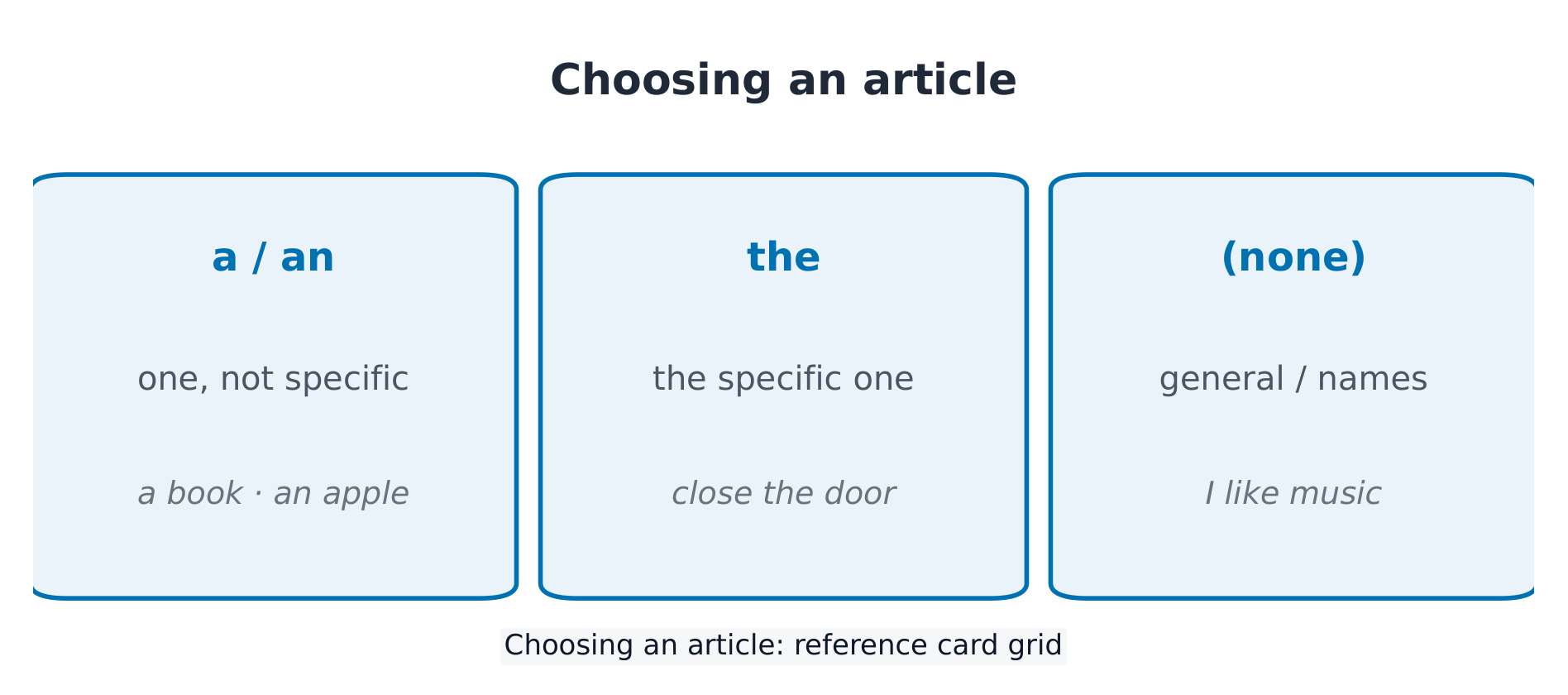
    a and an are indefinite articles, used before singular countable nouns to mean "one (non-specific)".

    • a is used before consonant sounds: a book, a car, a university (pronounced /j/ sound).
    • an is used before vowel sounds: an apple, an hour (h is silent).

    我I 有have 一个a 问题question.

    I have a question.

    她She 是is 一名an 工程师engineer.

    She is an engineer.

    Note: Look at the pronunciation, not the letter: an hour (h is silent → an), a university (pronounced /j/ → a).

    Русский
    选择冠词:a/an · the · 零冠词

    a 和 an 是不定冠词,用在单数可数名词前,表示“一个(不特指)”。

    • a 用在辅音音前:a book, a car, a university(发 /j/ 音)。
    • an 用在元音音前:an apple, an hour(h 不发音)。

    我I 有have 一个a 问题question.

    У меня есть вопрос.

    她She 是is 一名an 工程师engineer.

    Она инженер.

    注意 看读音而不是字母:an hour(h 不发音 → an), a university(发 /j/ → a)。

    8.2

    the

    English

    the is the definite article, indicating specificity — both speaker and listener know exactly which one.

    请Please 关close (这扇)the 门door.

    Please close (this) door.

    Common uses of the:

    • When mentioned previously or referred to again: I saw a cat. The cat was black. (I saw a cat. That cat was black.)
    • For unique things in the world: the sun, the moon.
    • Before superlatives: the best, the tallest.

    (那个)The 太阳sun 是is 非常very 明亮bright 今天today.

    The sun is very bright today.

    Русский

    the 是定冠词,表示特指——说话双方都知道是哪一个。

    请Please 关close (这扇)the 门door.

    Пожалуйста, закрой(те) дверь.

    常用 the 的情况:

    • 前面提过、再次提到时:I saw a cat. The cat was black.(我看见一只猫,那只猫是黑的。)
    • 世界上独一无二的:the sun(太阳), the moon(月亮)。
    • 最高级前:the best, the tallest。

    (那个)The 太阳sun 是is 非常very 明亮bright 今天today.

    Сегодня очень солнечно.

    8.3

    零冠词 (Zero article)

    English

    Sometimes no article (zero article) is placed before a noun:

    • Plural / uncountable nouns expressing generalization: I like music. (I like music.) Cats are cute. (Cats are cute.)
    • Proper nouns: names, most countries, cities: China, Tom, Beijing.
    • Some fixed phrases: go to school / bed / work (indicating purpose, without the).

    我I 去go (介词)to 上学school 乘by 自行车bike.

    I go to school by bike.

    水Water 是is 重要important.

    Water is important.

    Note: Do not use the when plural / uncountable nouns express generalization: ~~I like the music~~ (general sense) ✗ → I like music ✓.

    Common Errors

    • ❌ ~~I want to be teacher.~~ → ✓ I want to be a teacher. — Add a / an before professions; direct translation of Chinese "to be a teacher" often omits this.
    • ❌ ~~I went to home.~~ → ✓ I went home. — home is used as an adverb here: go home, get home; do not use to or the before it.
    • ❌ ~~He plays the football.~~ → ✓ He plays football. — No the before sports; but add the for instruments: play the piano / violin.
    • Distinguish: go to school (attend school, purpose) vs go to the school (go to the school building, e.g., parents attending a meeting). Same logic applies to bed / hospital / work.
    Русский

    Иногда перед существительным артикль не ставится (нулевой артикль):

    • 复数 / 不可数名词表示泛指:I like music.(我喜欢音乐。)Cats are cute.(猫很可爱。)
    • 专有名词:人名、大多数国家、城市:China, Tom, Beijing。
    • 一些固定搭配:go to school / bed / work(表示目的,不加 the)。

    我I 去go (介词)to 上学school 乘by 自行车bike.

    Я езжу в школу на велосипеде.

    水Water 是is 重要important.

    Вода важна.

    注意 泛指复数 / 不可数名词时不加 the:~~I like the music~~(泛指时)✗ → I like music ✓。

    Частые ошибки

    • ❌ ~~I want to be teacher.~~ → ✓ I want to be a teacher. — 职业前要加 a / an,中文“当老师”直译最容易丢。
    • ❌ ~~I went to home.~~ → ✓ I went home. — home 是副词用法:go home、get home,前面不加 to,也不加 the。
    • ❌ ~~He plays the football.~~ → ✓ He plays football. — 运动前不加 the;但乐器要加:play the piano / violin。
    • 区分:go to school(上学,目的)vs go to the school(去学校这栋楼,比如家长开会)。bed / hospital / work 同理。
  • 9 Countable and uncountable nouns · ⁨Исчисляемые и неисчисляемые существительные⁩
    9.1

    可数与不可数 (Countable vs uncountable)

    English

    English nouns are divided into two categories:

    • Countable nouns: can be counted, have singular and plural forms. a book → two books.
    • Uncountable nouns: cannot be directly counted, have no plural form. water, music, money, information.

    我I 买了bought 三three 苹果apples.

    I bought three apples. (Countable)

    我I 需要need 一些some 水water.

    I need some water. (Uncountable, no ~~waters~~)

    Note

    • Uncountable nouns take a singular verb: The news is good. (The news is good.)
    • To count uncountable nouns, use measure words: a glass of water, a piece of information.
    Русский
    可数 vs 不可数名词

    Английские существительные делятся на два типа:

    • 可数名词(countable):能数,有单复数。a book → two books。
    • 不可数名词(uncountable):不能直接数,没有复数。water, music, money, information。

    我I 买了bought 三three 苹果apples.

    Я купил три яблока. (исчисляемое)

    我I 需要need 一些some 水water.

    我需要一些水。(不可数,没有 ~~waters~~)

    Обратите внимание

    • 不可数名词用单数动词:The news is good.(消息是好的。)
    • 想数不可数名词,要借助单位:a glass of water, a piece of information。
    9.2

    some 与 any

    English

    some and any mean "some", used before plurals or uncountable nouns:

    • some: used in affirmative sentences (also used in polite requests / invitations).
    • any: used in negative sentences and interrogative sentences.

    (有)There 有are 一些some 鸡蛋eggs 在in (冠词)the 冰箱里fridge.

    There are some eggs in the fridge.

    (有)There 没有isn't 任何any 牛奶milk.

    There is no milk left.

    (助动词)Do 你you 有have 任何any 问题questions?

    Do you have any questions?

    Note: When offering drinks to others, some is commonly used to sound polite: Would you like some tea?

    Русский
    Исчисляемые существительные: фрукты можно посчитать поштучно.

    some 和 any 表示“一些”,用在复数或不可数名词前:

    • some:用于肯定句(也用于客气的请求 / 邀请)。
    • any:用于否定句和疑问句。

    (有)There 有are 一些some 鸡蛋eggs 在in (冠词)the 冰箱里fridge.

    В холодильнике есть яйца.

    (有)There 没有isn't 任何any 牛奶milk.

    Молока нет.

    (助动词)Do 你you 有have 任何any 问题questions?

    У тебя есть какие-нибудь вопросы?

    注意 请别人喝东西时,常用 some 表示客气:Would you like some tea?(要喝点茶吗?)

    9.3

    much / many / a lot of

    English

    Used to express "a lot":

    • many + countable plural: many books.
    • much + uncountable: much water (mostly used in negative sentences / questions).
    • a lot of + both types (most common in positive sentences).

    (有)There 有are 许多many 人people 这里here.

    There are many people here.

    我们We 没有don't 有have 多少much 时间time.

    We don't have much time left.

    她She 有has 许多a lot of 朋友friends.

    She has a lot of friends.

    Note: In positive sentences, much is rarely used; instead use a lot of: ~~I have much money~~ → I have a lot of money.

    Common Errors

    • ❌ ~~informations / advices / homeworks / furnitures~~ → ✓ information / advice / homework / furniture — These words are uncountable in English (although Chinese can say "several pieces of advice" or "pieces of furniture"). They never take a plural form.
    • ❌ ~~a bread / a paper~~ → ✓ a piece of bread / a piece of paper — Uncountable nouns require measure words to be counted.
    • ❌ ~~How much apples do you want?~~ → ✓ How many apples…? — Use many for countable plurals and much only for uncountable nouns.
    • ❌ ~~There aren't some eggs.~~ → ✓ There aren't any eggs — Replace some with any in negative sentences.
    Русский

    Обозначает «много»:

    • many + 可数复数:many books。
    • much + 不可数:much water(多用于否定 / 疑问)。
    • a lot of + 两者都行(肯定句最常用)。

    (有)There 有are 许多many 人people 这里here.

    Здесь много людей.

    我们We 没有don't 有have 多少much 时间time.

    У нас осталось мало времени.

    她She 有has 许多a lot of 朋友friends.

    У неё много друзей.

    Внимание В утвердительных предложениях much используется редко, вместо него чаще говорят a lot of: ~~I have much money~~ → I have a lot of money.

    Частые ошибки

    • ❌ ~~informations / advices / homeworks / furnitures~~ → ✓ information / advice / homework / furniture — эти слова в английском языке неисчисляемые (хотя по-русски можно сказать «несколько советов», «несколько предметов мебели»), они никогда не имеют формы множественного числа.
    • ❌ ~~a bread / a paper~~ → ✓ a piece of bread / a piece of paper — неисчисляемые существительные нужно измерять с помощью слов меры.
    • ❌ ~~How much apples do you want?~~ → ✓ How many apples…? — для исчисляемых существительных во множественном числе используют many, а much — только для неисчисляемых.
    • ❌ ~~There aren't some eggs.~~ → ✓ There aren't any eggs. — в отрицательных предложениях some заменяется на any.
  • 10 Modal verbs · ⁨Модальные глаголы⁩
    10.1

    can и could (способность, просьба)

    English

    can expresses ability or possibility; could is the past tense of can, and is also used for more polite requests. All modal verbs are followed by the base form of the verb.

    我I 会can 游泳swim.

    I can swim.

    她She 会could 读read 在at 四岁four.

    She could read at the age of four. (Past ability)

    能Could 你you 帮help 我me 请, please?

    Could you please help me? (Polite request)

    Note

    • After a modal verb, use the base form: ~~can to swim~~ ✗ → can swim ✓.
    • Negative: cannot / can't, could not / couldn't.
    Русский
    Модальные глаголы: способность/совет/обязанность

    can обозначает способность или возможность; could — это прошедшее время от can, также используется для более вежливой просьбы. После модальных глаголов всегда ставится инфинитив без частицы to.

    我I 会can 游泳swim.

    Я умею плавать.

    她She 会could 读read 在at 四岁four.

    Она умела читать в четыре года. (Способность в прошлом)

    能Could 你you 帮help 我me 请, please?

    Не могли бы вы мне помочь? (Вежливая просьба)

    Обратите внимание

    • После модального глагола используется инфинитив без to: ~~can to swim~~ ✗ → can swim ✓.
    • Отрицание: cannot / can't, could not / couldn't.
    10.2

    should (совет)

    English

    should expresses advice or "should".

    你You 应该should 看see 一位a 医生doctor.

    You should see a doctor.

    我们We 不应该shouldn't 浪费waste 水water.

    We shouldn't waste water.

    Note: should gives advice and is less forceful than must; it is also followed by the base form of the verb.

    Русский

    should означает совет или «следовало бы».

    你You 应该should 看see 一位a 医生doctor.

    Вам следует обратиться к врачу.

    我们We 不应该shouldn't 浪费waste 水water.

    Мы не должны тратить воду.

    Внимание should дает совет, звучит мягче, чем must; после него также ставится инфинитив без to.

    10.3

    must и have to (обязанность)

    English

    Both express "must":

    • must: Often indicates something the speaker considers important, or a rule.
    • have to: Often indicates an external requirement (regulation, objective necessity).

    你You 必须must 系wear (冠词)a 安全带seatbelt.

    You must wear a seatbelt.

    我I 不得不have to 起床get up 早early.

    I have to get up early.

    Note

    • mustn't = "prohibited": You mustn't smoke here. (Smoking is prohibited here.)
    • don't have to = "not necessary": You don't have to come. (You don't need to come.)
    • Note that their meanings are completely different: one means "forbidden," the other means "not necessary."

    Common Errors

    • ❌ ~~You must to wear a helmet.~~ → ✓ You must wear a helmet — All modal verbs (can / could / should / must) are followed directly by the base form and never take to.
    • ❌ ~~She musts study harder.~~ → ✓ She must study harder — Modal verbs do not take a third-person singular -s.
    • ❌ Wanting to say "you don't need to come" but saying ~~You mustn't come.~~ → ✓ You don't have to come — mustn't means "forbidden," while don't have to means "not necessary." Their meanings are exactly opposite.
    • ❌ ~~Yesterday I must work late.~~ → ✓ Yesterday I had to work late — must has no past tense; use had to for past obligations.
    Русский

    Оба выражают «должен» / «обязательно»:

    • must: обычно выражает мнение говорящего о том, что это важно, или правило.
    • have to: обычно выражает внешнее требование (правило, объективная необходимость).

    你You 必须must 系wear (冠词)a 安全带seatbelt.

    Вы обязаны пристегнуть ремень безопасности.

    我I 不得不have to 起床get up 早early.

    Мне нужно рано вставать.

    Обратите внимание

    • mustn't = «запрещено»: You mustn't smoke here. (Здесь курить запрещено.)
    • don't have to = «нет необходимости»: You don't have to come. (Тебе не обязательно приходить.)
    • Обратите внимание: значения совершенно разные: одно означает «запрет», другое — «нет необходимости».

    Частые ошибки

    • ❌ ~~You must to wear a helmet.~~ → ✓ You must wear a helmet. — после всех модальных глаголов (can / could / should / must) сразу ставится инфинитив, частица to никогда не добавляется.
    • ❌ ~~She musts study harder.~~ → ✓ She must study harder. — у модальных глаголов нет окончания -s для третьего лица единственного числа.
    • ❌ Чтобы сказать «тебе не обязательно приходить», нельзя говорить ~~You mustn't come.~~ → ✓ You don't have to come. — mustn't означает «запрещено», а don't have to — «нет необходимости», смысл прямо противоположный.
    • ❌ ~~Yesterday I must work late.~~ → ✓ Yesterday I had to work late. — у must нет формы прошедшего времени; для выражения обязанности в прошлом используется had to.
  • 11 Prepositions · ⁨Предлоги⁩
    11.1

    Предлоги времени (at / in / on)

    English

    When indicating time, at / in / on each have specific uses:

    • at + specific time / point: at 7 o'clock, at night, at the weekend.
    • on + specific day / date: on Monday, on May 1st, on my birthday.
    • in + longer period: in the morning, in July, in 2020, in winter.

    (冠词)The 课class 开始starts 在at 九点nine.

    This class starts at nine o'clock.

    我们We 见面met 在on 周五Friday.

    We met on Friday.

    我的My 生日birthday 在is 在in 五月May.

    My birthday is in May.

    Note: The scope increases from small to large: at (point) → on (day) → in (month / year / period).

    Русский
    Предлоги времени: at / on / in

    Для обозначения времени у at / in / on разные функции:

    • at + конкретное время / момент: at 7 o'clock, at night, at the weekend.
    • on + конкретный день / дата: on Monday, on May 1st, on my birthday.
    • in + длительный период: in the morning, in July, in 2020, in winter.

    (冠词)The 课class 开始starts 在at 九点nine.

    Урок начинается в девять часов.

    我们We 见面met 在on 周五Friday.

    Мы встретились в пятницу.

    我的My 生日birthday 在is 在in 五月May.

    Мой день рождения в мае.

    Внимание диапазон увеличивается от малого к большому: at (точка) → on (день) → in (месяц / год / период).

    11.2

    Предлоги места (at / in / on)

    English

    When indicating location:

    • at + a specific point / place: at the bus stop, at home, at school.
    • in + interior space: in the room, in China, in a box.
    • on + surface / line: on the table, on the wall, on the second floor.

    她She 在is (在)at 家home.

    She is at home.

    (冠词)The 书book 在is 在on (冠词)the 桌子上table.

    The book is on the table.

    (有)There 有are 鱼fish 在in (冠词)the 河里river.

    There are fish in the river.

    Русский

    Для указания местоположения:

    • at + определенная точка / место: at the bus stop, at home, at school.
    • in + пространство внутри: in the room, in China, in a box.
    • on + поверхность / линия: on the table, on the wall, on the second floor.

    她She 在is (在)at 家home.

    Она дома.

    (冠词)The 书book 在is 在on (冠词)the 桌子上table.

    Книга на столе.

    (有)There 有are 鱼fish 在in (冠词)the 河里river.

    В реке есть рыбы.

    11.3

    Предлоги движения (Prepositions of movement)

    English

    Indicating direction / movement:

    • to: Towards a place. into: Entering inside. out of: Coming out from inside.
    • up (upward) / down (downward) / across (cross over) / through (pass through the interior).

    我I 去go 去to 上班work 乘by 公交车bus.

    I go to work by bus.

    (冠词)The 猫cat 跳jumped 进入into (冠词)the 箱子box.

    The cat jumped into the box.

    Note: to indicates "going somewhere," so do not confuse it with at (being somewhere): go to school (go to school) vs be at school (be at school).

    Common Errors

    • ❌ ~~in Monday~~ → ✓ on Monday; ❌ ~~at July~~ → ✓ in July — Use on for specific days and in for months / years.
    • ❌ ~~in the morning of Monday~~ → ✓ on Monday morning — When referring to the morning / evening of a specific day, the preposition upgrades to on.
    • ❌ ~~I arrived to Beijing.~~ → ✓ I arrived in Beijing. / I arrived at the station — arrive does not take to; use in for large places and at for small locations.
    • ❌ ~~listen music / look the picture / wait him~~ → ✓ listen to music / look at the picture / wait for him — Although these verbs may not take prepositions in Chinese, the corresponding prepositions in English cannot be omitted.
    Русский

    Для указания направления / движения:

    • to: направление к месту. into: внутрь. out of: изнутри наружу.
    • up (вверх) / down (вниз) / across (через/насквозь) / through (сквозь/внутри).

    我I 去go 去to 上班work 乘by 公交车bus.

    Я езжу на работу на автобусе.

    (冠词)The 猫cat 跳jumped 进入into (冠词)the 箱子box.

    Кошка запрыгнула в коробку.

    Внимание to означает «идти куда-то», не путайте с at («находиться где-то»): go to school (идти в школу) vs be at school (быть в школе).

    Частые ошибки

    • ❌ ~~in Monday~~ → ✓ on Monday; ❌ ~~at July~~ → ✓ in July — для конкретного дня используется on, для месяца / года — in.
    • ❌ ~~in the morning of Monday~~ → ✓ on Monday morning — когда речь идет об утреннем / вечернем времени конкретного дня, предлог меняется на on.
    • ❌ ~~I arrived to Beijing.~~ → ✓ I arrived in Beijing. / I arrived at the station. — arrive не употребляется с to; для крупных мест используется in, для малых точек — at.
    • ❌ ~~listen music / look the picture / wait him~~ → ✓ listen to music / look at the picture / wait for him — по-русски эти глаголы не требуют предлога, но в английском предлог опускать нельзя.
  • 12 Connecting ideas · ⁨Связывание идей⁩
    12.1

    and / but / or / so / because

    English

    Conjunctions link two ideas together:

    • and (and): Parallel, additive. but (but): Contrast, opposite.
    • or (or): Choice. so (so): Result. because (because): Reason.

    我I (过去)was 累tired 所以, so 我I 去went (介词)to 睡觉bed.

    I was tired, so I went to bed.

    她She 留在stayed 家home 因为because (天气it)it (过去)was 下雨raining.

    She stayed at home because it was raining.

    Note: so introduces a result, while because introduces a reason; do not mix them up: Tired → so go to sleep; Slept → because tired.

    Русский
    Союзы: соединение идей

    Союзы связывают две идеи:

    • and (и): перечисление, сложение. but (но): противоречие, противопоставление.
    • or (или): выбор. so (поэтому): результат. because (потому что): причина.

    我I (过去)was 累tired 所以, so 我I 去went (介词)to 睡觉bed.

    Я устал, поэтому пошел спать.

    她She 留在stayed 家home 因为because (天气it)it (过去)was 下雨raining.

    Она осталась дома, потому что шел дождь.

    Внимание so вводит результат, а because — причину; не перепутайте: устал → so пойти спать; пошел спать → because устал.

    12.2

    Нулевой и Первый условные предложения

    English

    Conditional sentences express "if... then...":

    • Zero Conditional (universal facts): If + 一般现在时, 一般现在时.
    • First Conditional (future possibilities): If + 一般现在时, will + 动词原形.

    如果If 你you 加热heat 冰ice (它), it 融化melts.

    If you heat ice, it melts. (Universal fact → Zero Conditional)

    如果If (天气it)it 下雨rains 我们, we 将will 留stay 家home.

    If it rains, we will stay at home. (Future possibility → First Conditional)

    Note: In clauses introduced by if, use the present simple even when referring to the future: ~~If it will rain~~ ✗ → If it rains ✓.

    Русский

    Условные предложения строятся по схеме «если... то...»:

    • Нулевое условие (общий факт): If + 一般现在时, 一般现在时.
    • Первое условие (возможное будущее): If + 一般现在时, will + 动词原形.

    如果If 你you 加热heat 冰ice (它), it 融化melts.

    Если нагреть лед, он растает. (Общий факт → нулевое условие)

    如果If (天气it)it 下雨rains 我们, we 将will 留stay 家home.

    Если пойдет дождь, мы останемся дома. (Возможное будущее → первое условие)

    Внимание в придаточных предложениях с if используется настоящее простое время, даже если говорится о будущем: ~~If it will rain~~ ✗ → If it rains ✓.

    12.3

    Наречия частотности (Adverbs of frequency)

    English

    Adverbs of frequency indicate "how often": always (100%) > usually > often > sometimes > rarely > never (0%).

    Position Rules:

    • Place them before the main verb.
    • But place them after the be verb.

    我I 总是always 刷brush 我的my 牙teeth.

    I always brush my teeth. (Before a lexical verb)

    他He (be)is 从不never 迟到late.

    He is never late. (After a be verb)

    Note: Adverbs of frequency go before lexical verbs and after be verbs: I often read; She is often busy.

    Common Errors

    • ❌ ~~Because it was raining, so we stayed home.~~ → ✓ Because it was raining, we stayed home. / It was raining, so we stayed home. — In Chinese, "because... so..." appears as a pair, but in English, you can only keep one of because or so.
    • ❌ ~~Although he is rich, but he is not happy.~~ → ✓ Although he is rich, he is not happy. — Similarly, in the Chinese structure "although... but...", you can only choose one of although or but.
    • ❌ ~~I like apples and I like bananas and I like oranges.~~ → ✓ I like apples, bananas and oranges. — When listing multiple items, separate them with commas and use and only before the final item.
    • ❌ ~~I play sometimes football.~~ → ✓ I sometimes play football. / I play football sometimes. — An adverb cannot be placed between a verb and its object.
    Русский

    Наречия частотности указывают, как часто происходит действие: always (100%) > usually > often > sometimes > rarely > never (0%).

    Правило расположения:

    • Ставится перед основным глаголом.
    • Но они ставятся после глагола be.

    我I 总是always 刷brush 我的my 牙teeth.

    Я всегда чешу зубы. (Перед смысловым глаголом)

    他He (be)is 从不never 迟到late.

    Он никогда не опаздывает. (после глагола be)

    Внимание наречия частотности ставятся перед смысловым глаголом и после глагола be: I often read; She is often busy.

    Частые ошибки

    • ❌ ~~Because it was raining, so we stayed home.~~ → ✓ Because it was raining, we stayed home. / It was raining, so we stayed home. — по-китайски «потому что... поэтому...» используются парами, а в английском because и so можно использовать только один.
    • ❌ ~~Although he is rich, but he is not happy.~~ → ✓ Although he is rich, he is not happy. — аналогично, в конструкции «хотя... но...» although и but можно выбрать только один.
    • ❌ ~~I like apples and I like bananas and I like oranges.~~ → ✓ I like apples, bananas and oranges. — при перечислении нескольких элементов разделяют запятыми, союз and ставится только перед последним элементом.
    • ❌ ~~I play sometimes football.~~ → ✓ I sometimes play football. / I play football sometimes. — наречие не может стоять между глаголом и дополнением.

Log in or create account · ⁨Войти или создать аккаунт⁩

IGCSE, A-Level & AP