| Базовый | Дополнительно |
|---|---|
| 1 Укажите функции ксилемы и флоэмы: (a) ксилема – транспорт воды и минеральных ионов, а также опора (b) флоэма – транспорт сахарозы и аминокислот | 3 Сопоставьте строение ксилемных сосудов с их функцией в пределах: (a) толстые стенки с лигнином (детали лигнификации не требуются) (b) отсутствие клеточного содержимого (c) клетки соединены торец к торцу без поперечных перегородок, образуя длинную непрерывную трубку |
| 2 Определяйте по схемам и изображениям расположение ксилемы и флоэмы на срезах корней, стеблей и листьев небревнистых двудольных растений |
Транспорт веществ в растениях
 5:54
Транспорт веществ у растений
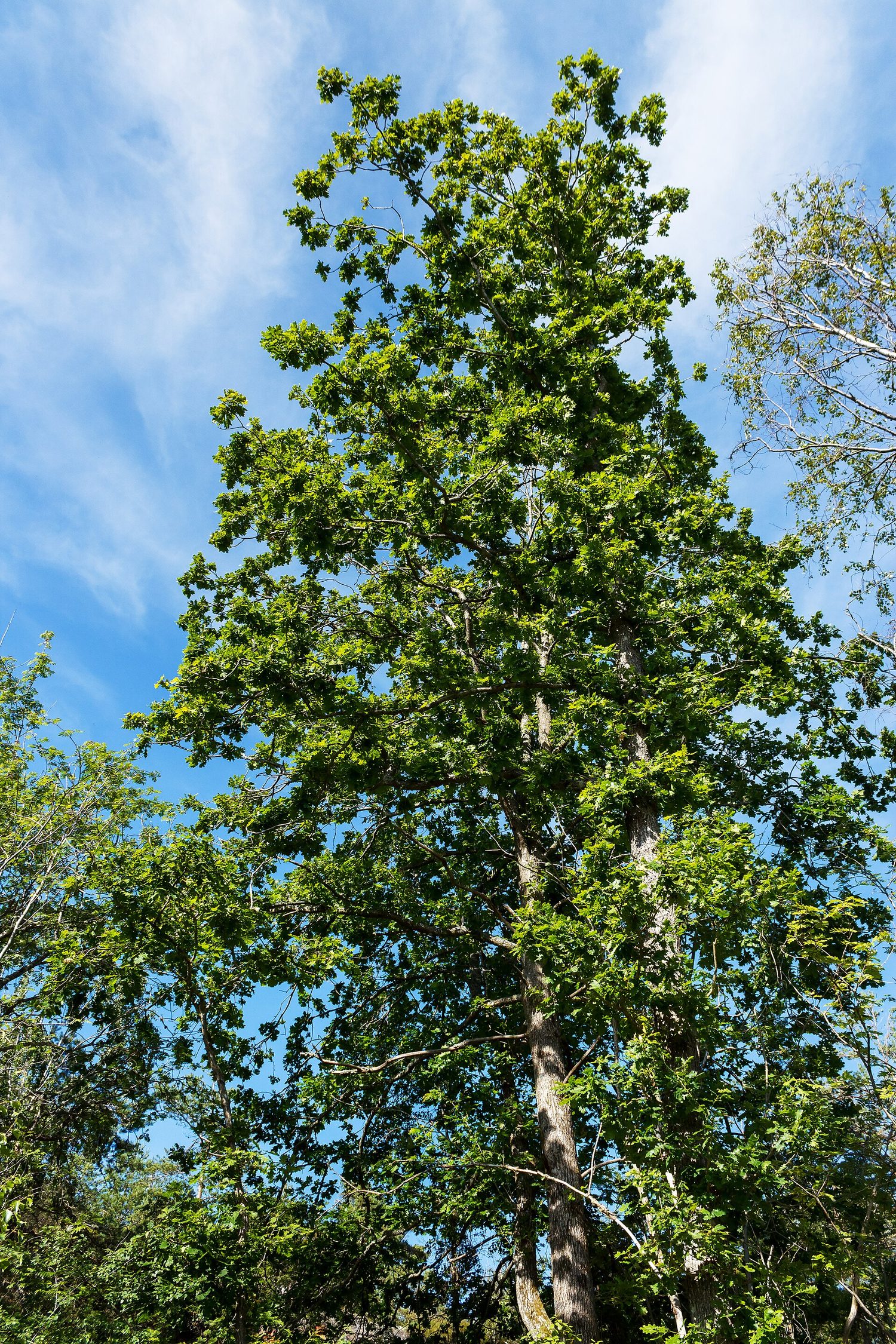
Высокое дерево поднимает воду на сто метров в воздух каждый день без насоса и движущихся частей. Оно делает это, используя только испарение из листьев…
Озвучивание на английском · переключаемые субтитры на английском и китайском языках
8.1
Ксилема и флоэма
Программа
Источник: Программа Cambridge International
English
Plants have two transport tissues that run through the roots, stems and leaves:
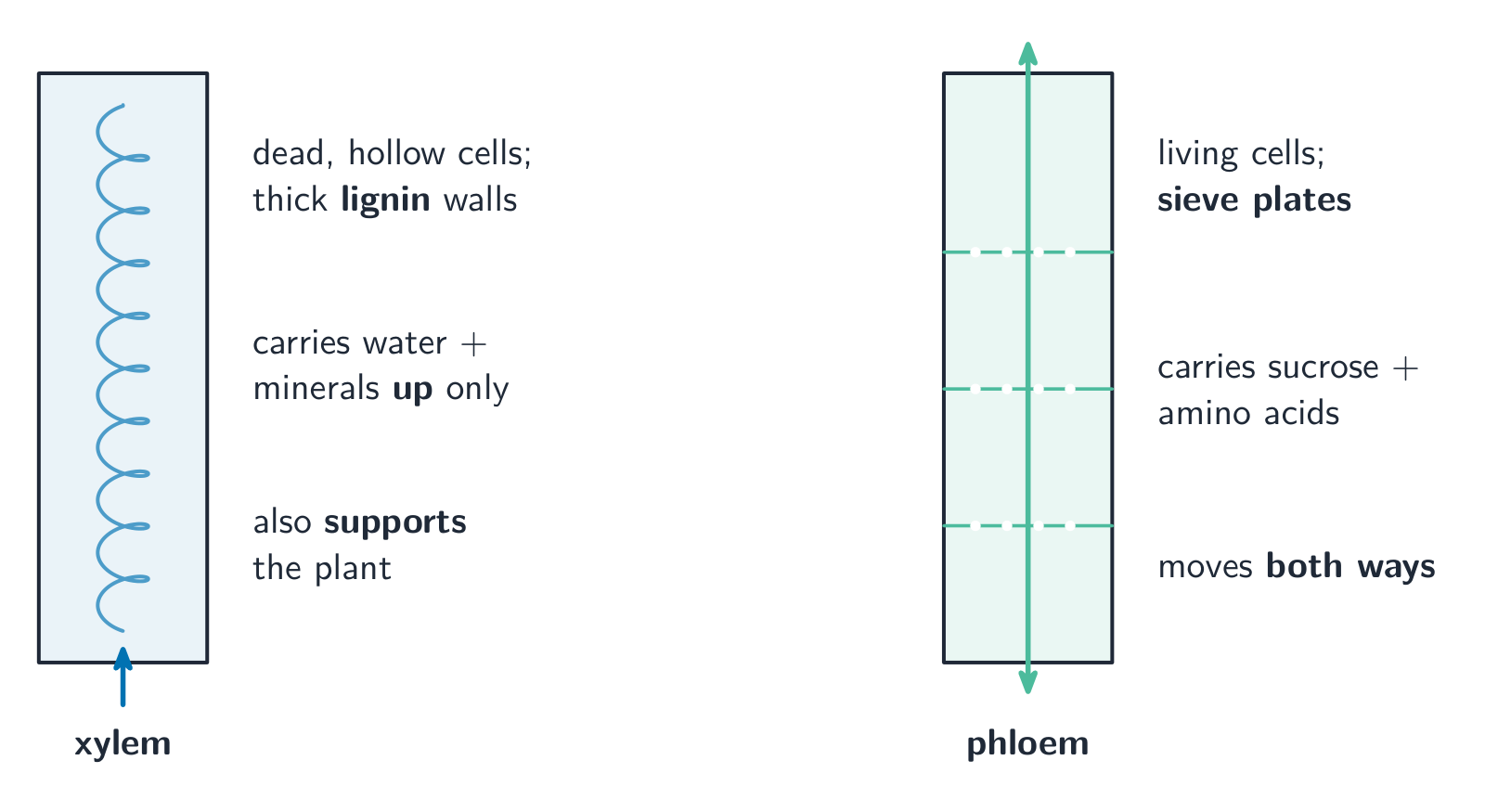
- xylem 木质部 — carries water and mineral ions 矿物质离子 up from the roots, and gives the plant support 支撑.
- phloem 韧皮部 — carries sucrose 蔗糖 and amino acids 氨基酸 to wherever they are needed.
In a root, stem or leaf, the xylem and phloem lie side by side in vascular bundles 维管束.
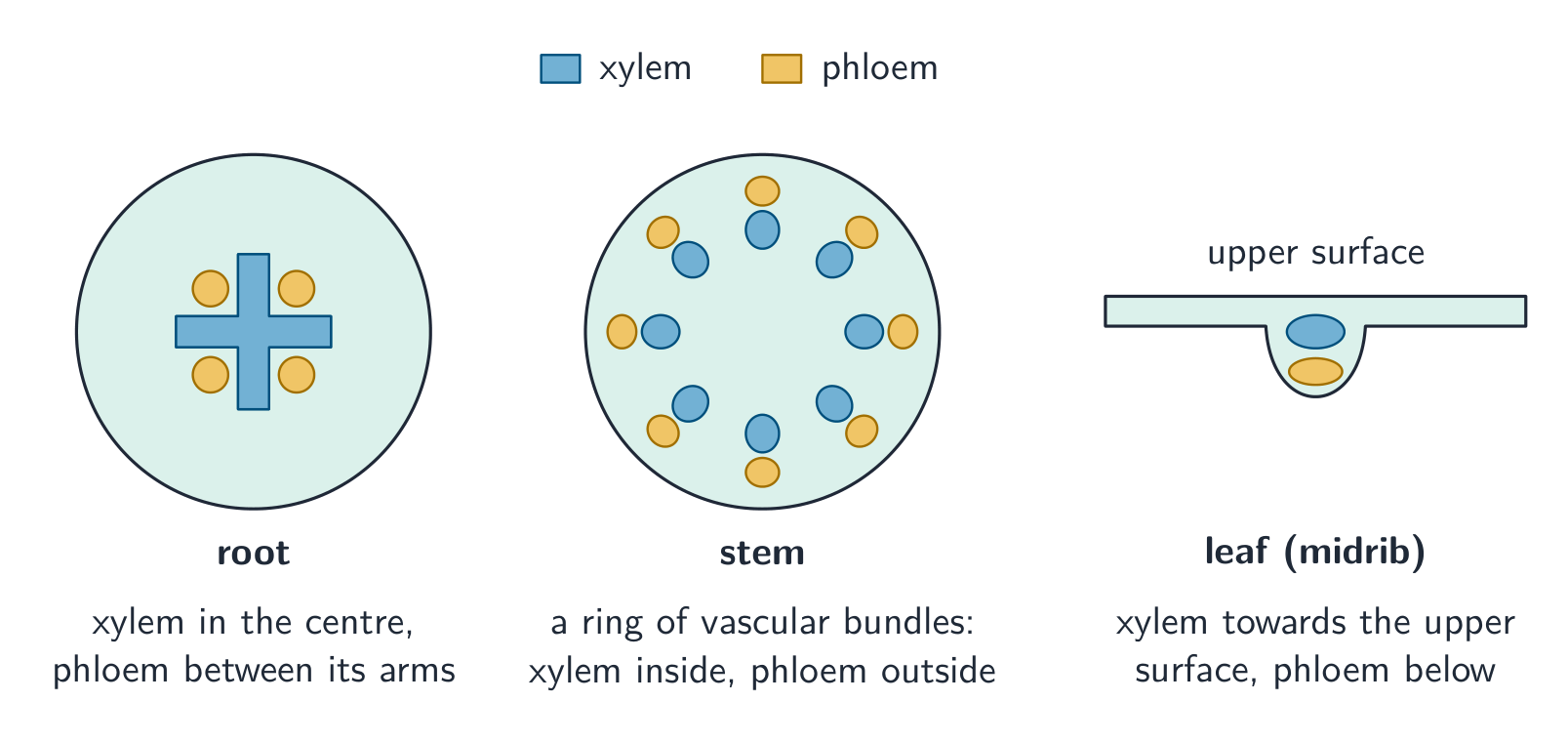
Exams show a section through a root, stem or leaf and ask you to identify the xylem and the phloem. Learn where each one lies:
- root: the xylem is in the centre, often in an X or star shape; the phloem lies in the gaps between its arms. A central core resists the pulling force as the root anchors the plant.
- stem: the vascular bundles form a ring near the outside; in each bundle the xylem is on the inside (towards the centre) and the phloem on the outside. This ring helps the stem resist bending.
- leaf: in the midrib and veins, the xylem is towards the upper surface and the phloem towards the lower surface.
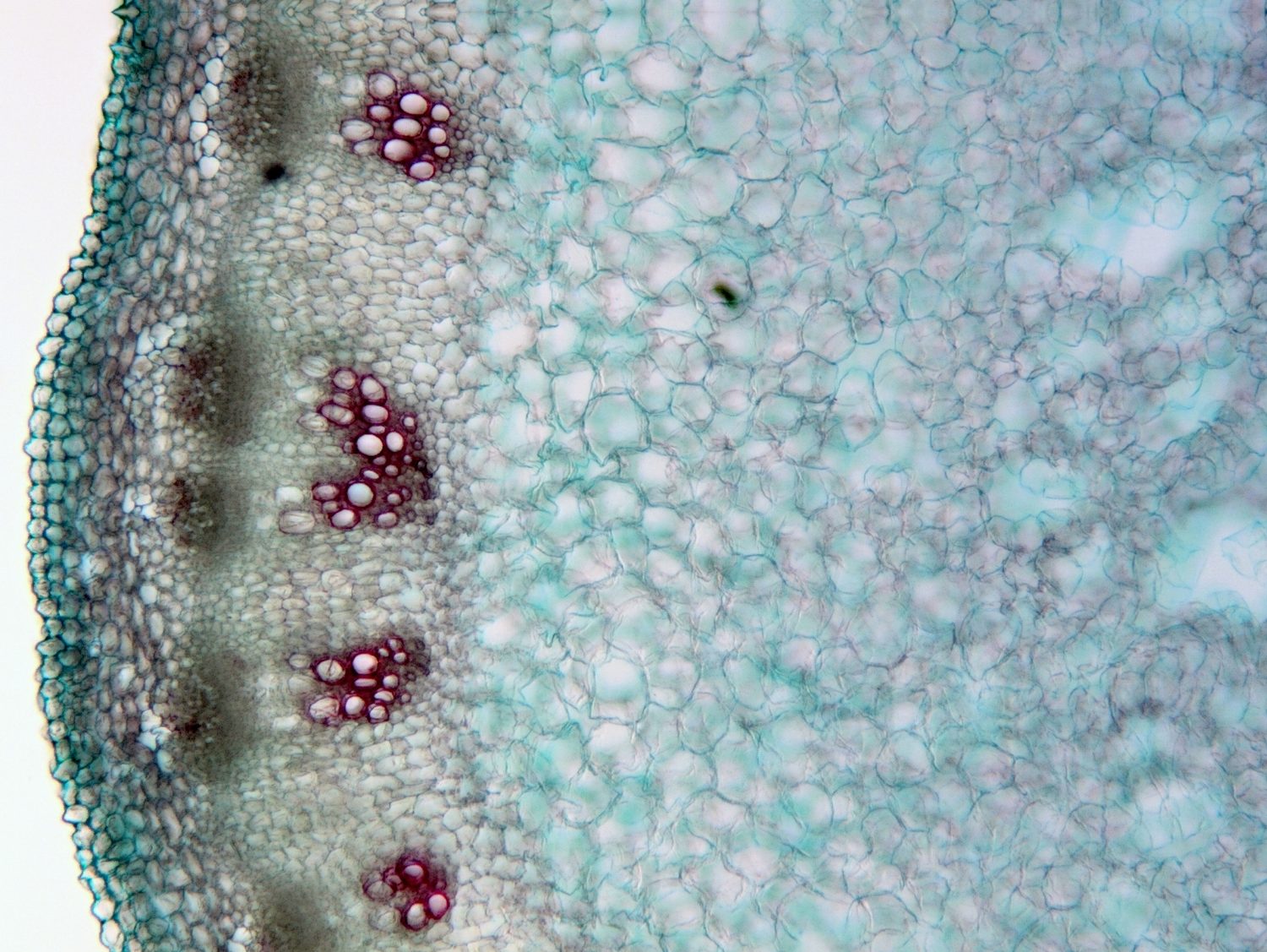
In a photograph, the xylem vessels are the cells with the widest openings and the thickest walls; stains such as the red in the stem section below colour the lignin in their walls.
Xylem structure (Supplement)
Xylem is made of long tubes called vessels 导管, well suited to carrying water:
- their walls are thick and strengthened with lignin 木质素, which also helps support the plant.
- the cells are dead and empty (they have no cell contents), so water flows through freely.
- the cells are joined end to end with no walls across the tube, making one long, continuous pipe.
Исследовать
Транспортная система ксилемы и флоэмы
Наблюдайте, как вода и сахар перемещаются через различные проводящие ткани растений.
Словарь
Тренировать
| English | Русский |
|---|---|
| xylem/ˈzaɪləm/ | ксилема |
| mineral ions/ˈmɪnərəl ˈaɪɒnz/ | минеральные ионы |
| support/səˈpɔːt/ | опора |
| phloem/ˈfləʊɪm/ | флоэма |
| sucrose/ˈsuːkrəʊs/ | сахароза |
| amino acids/əˈmiːnəʊ ˈæsɪdz/ | аминокислоты |
| vascular bundles/ˈvæskjʊlə ˈbʌndlz/ | сосудистые пучки |
| vessels/ˈveslz/ | сосуды |
| lignin/ˈlɪɡnɪn/ | лигнин |
8.2
Поглощение воды
Программа
| Базовый | Дополнительно |
|---|---|
| 1 Определяйте по схемам и изображениям клетки корневого волоска и укажите их функции | |
| 2 Укажите, что большая площадь поверхности корневых волосков увеличивает поглощение воды и минеральных ионов | |
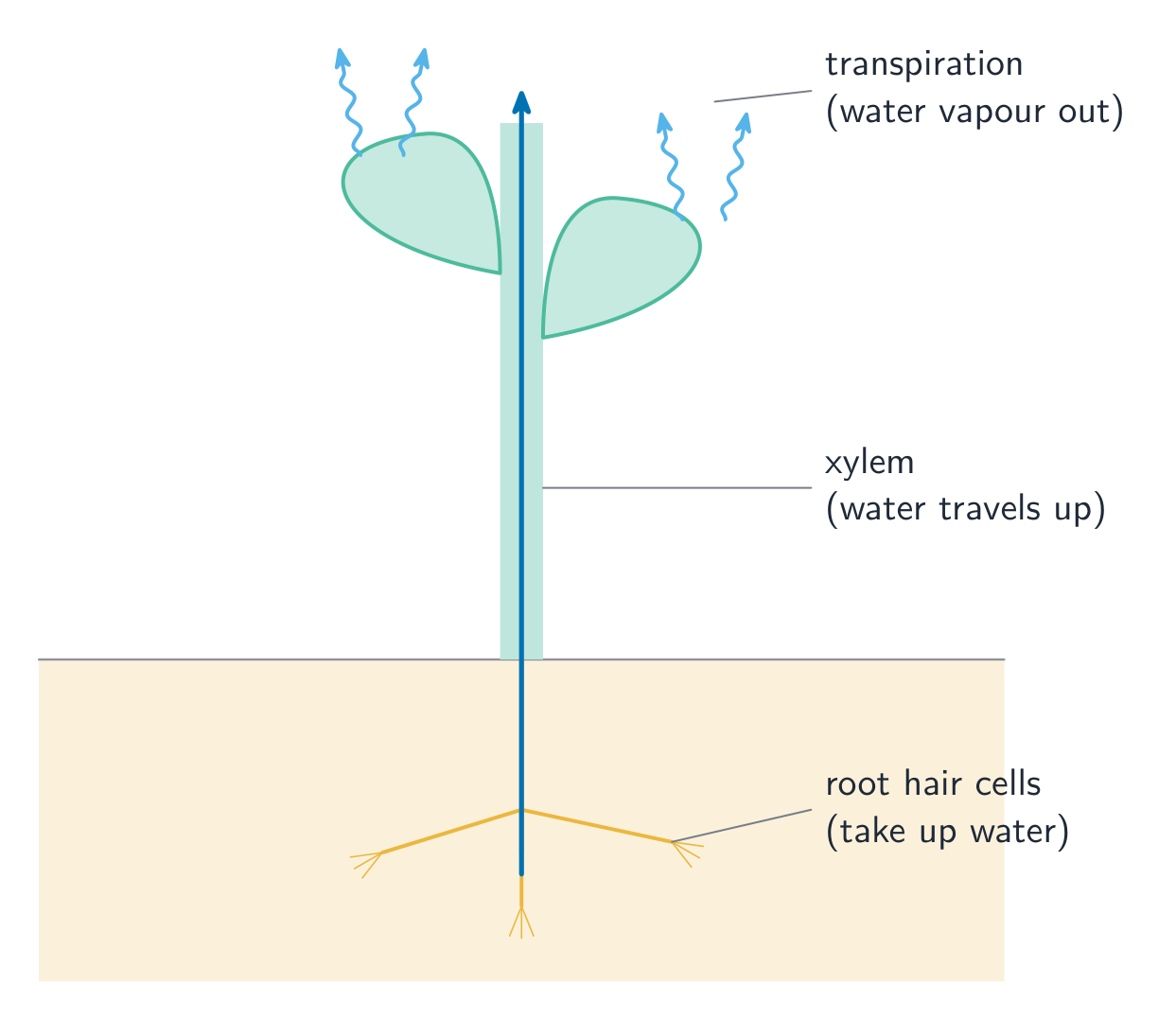
| 3 Кратко изложите путь, по которому проходит вода через корень, стебель и лист: клетки корневого волоска → клетки коркового слоя корня → ксилема → клетки мезофилла | |
| 4 Исследуйте с помощью подходящего красителя путь прохождения воды через надземные части растения |
Источник: Программа Cambridge International
English
Water and mineral ions enter the plant through root hair cells 根毛细胞. The huge number of root hairs 根毛 gives a very large surface area 表面积, which speeds up the uptake of water and mineral ions.
The water then follows this pathway:
root hair cells → root cortex 皮层 cells → xylem → mesophyll 叶肉 cells in the leaf.
You can show this pathway by standing a plant or a white flower in water that contains a coloured stain 染色剂. The stain is carried up the xylem and colours the veins.
Investigating the pathway. Stand a celery stalk with leaves in water containing a dye (such as food colouring or eosin) for a few hours, in a warm, bright place so that transpiration is fast. Cut thin slices across the stalk and look at them with a hand lens: only small dots near the edge, the xylem in the vascular bundles, are coloured. The leaf veins also become coloured. This shows that water travels up the stem in the xylem and out into the leaves.
Исследовать
Поглощение воды корневыми волосками
Клетки корневых волосков поглощают воду путём осмоса — вода движется из разбавленного почвенного раствора в более концентрированную клетку.
Словарь
Тренировать
| English | Русский |
|---|---|
| root hair cells/ruːt heə selz/ | корневые волоски |
| root hairs/ruːt heəz/ | корневые волоски |
| surface area/ˈsɜːfɪs ˈeərɪə/ | Площадь поверхности |
| cortex/ˈkɔːteks/ | корковое вещество |
| mesophyll/ˈmesəfɪl/ | мезофилл |
| stain/steɪn/ | окраситель |
8.3
Транспирация
Программа
| Базовый | Дополнительно |
|---|---|
| 1 Опишите транспирацию как испарение водяного пара с листьев | |
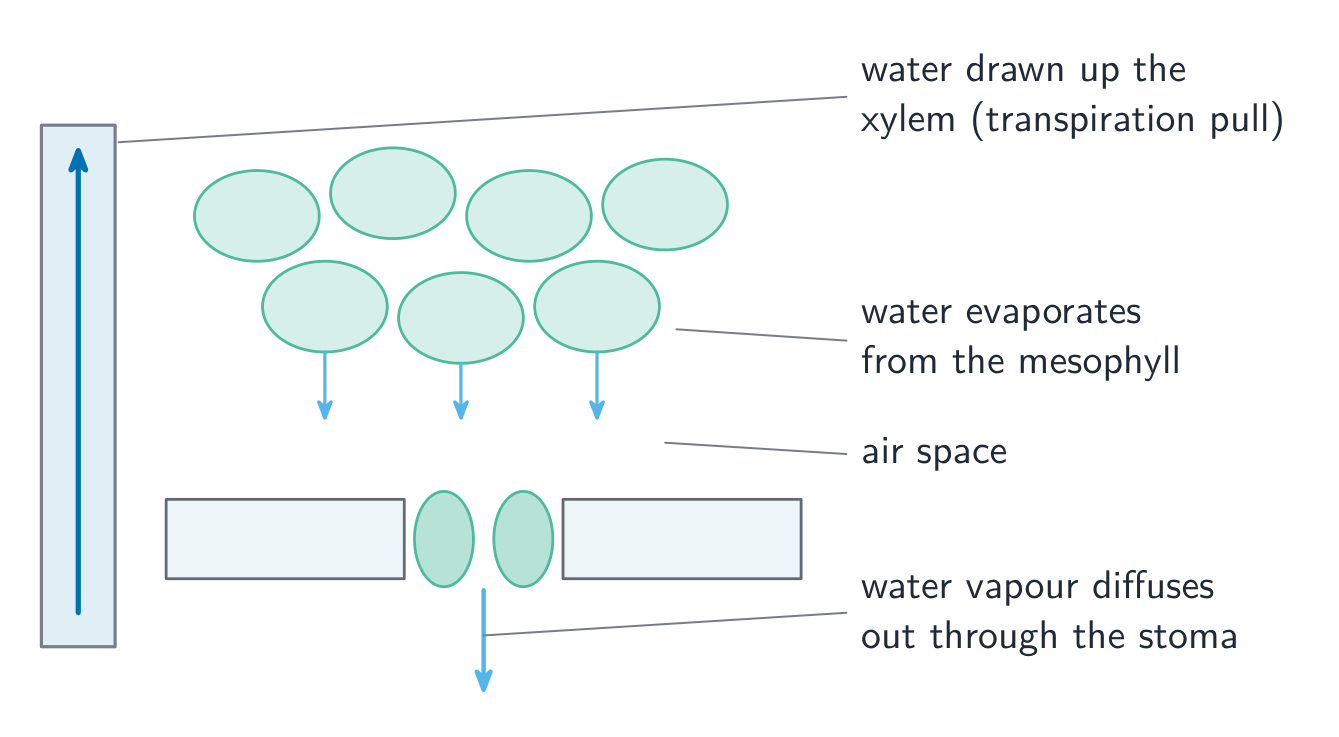
| 2 Укажите, что вода испаряется с поверхностей клеток мезофилла в воздушные пространства, а затем диффундирует наружу из листьев в виде водяного пара через устьица | |
| 4 Объясните, как потеря водяного пара связана с: большой внутренней площадью поверхности, создаваемой соединенными между собой воздушными пространствами между клетками мезофилла, и размером и количеством устьиц | |
| 5 Объясните механизм, по которому вода движется вверх по ксилеме в терминах транспирационного тяги, которая поднимает столбик молекул воды, удерживаемый вместе силами притяжения между молекулами воды | |
| 3 Исследуйте и опишите влияние изменений температуры и скорости ветра на скорость транспирации | 6 Объясните влияние на скорость транспирации следующих факторов: температура, скорость ветра и влажность |
| 7 Объясните, как и почему возникает увядание |
Источник: Программа Cambridge International
English
Transpiration 蒸腾作用 is the loss of water vapour 水蒸气 from the leaves.
- Water evaporates 蒸发 from the wet surfaces of the mesophyll cells into the air spaces 气腔 inside the leaf.
- The water vapour then diffuses 扩散 out of the leaf through the stomata 气孔.
(Supplement) The structure of the leaf makes this loss large. The mesophyll cells are surrounded by interconnecting air spaces, which give a very large internal surface area for water to evaporate from. The more stomata there are, and the wider they are open, the faster water vapour diffuses out. Most stomata are on the lower surface, which is cooler and shaded, and the stomata close at night or when the plant is short of water, which cuts water loss.
What changes the rate of transpiration
| Factor | Transpiration is faster when… | Why |
|---|---|---|
| temperature 温度 | it is hotter | water evaporates faster |
| wind speed 风速 | it is windier | wind carries the water vapour away |
| humidity 湿度 (Supplement) | the air is drier | a bigger difference makes water diffuse out faster |
(Supplement) Explaining the factors. Give the full reason:
- temperature: water molecules have more kinetic energy, so more water evaporates from the mesophyll cells and the vapour diffuses out faster.
- wind speed: the wind carries away the water vapour just outside the stomata, so the concentration gradient 浓度梯度 of water vapour between the air spaces and the outside air stays steep.
- humidity: humid air already holds a lot of water vapour, so the concentration gradient between the inside and the outside of the leaf is smaller and diffusion is slower.
Investigating temperature and wind speed. Use a potometer (below). Measure how far the bubble moves in a fixed time, for example 5 minutes, then change one factor: place the shoot at different distances from a fan (or use the fan at different speeds) for wind speed, or put it in rooms or by a heater at different temperatures, checked with a thermometer. Keep the other factors constant: the same shoot, light intensity and humidity. Repeat each reading and find a mean. Reset the bubble each time using the reservoir.
A potometer 蒸腾计 measures how fast a leafy shoot takes up water. The shoot is sealed into a tube full of water; as the leaves lose water by transpiration, the shoot draws water along a thin capillary tube, and an air bubble in the tube moves towards the shoot. The distance the bubble moves in a measured time gives the rate.
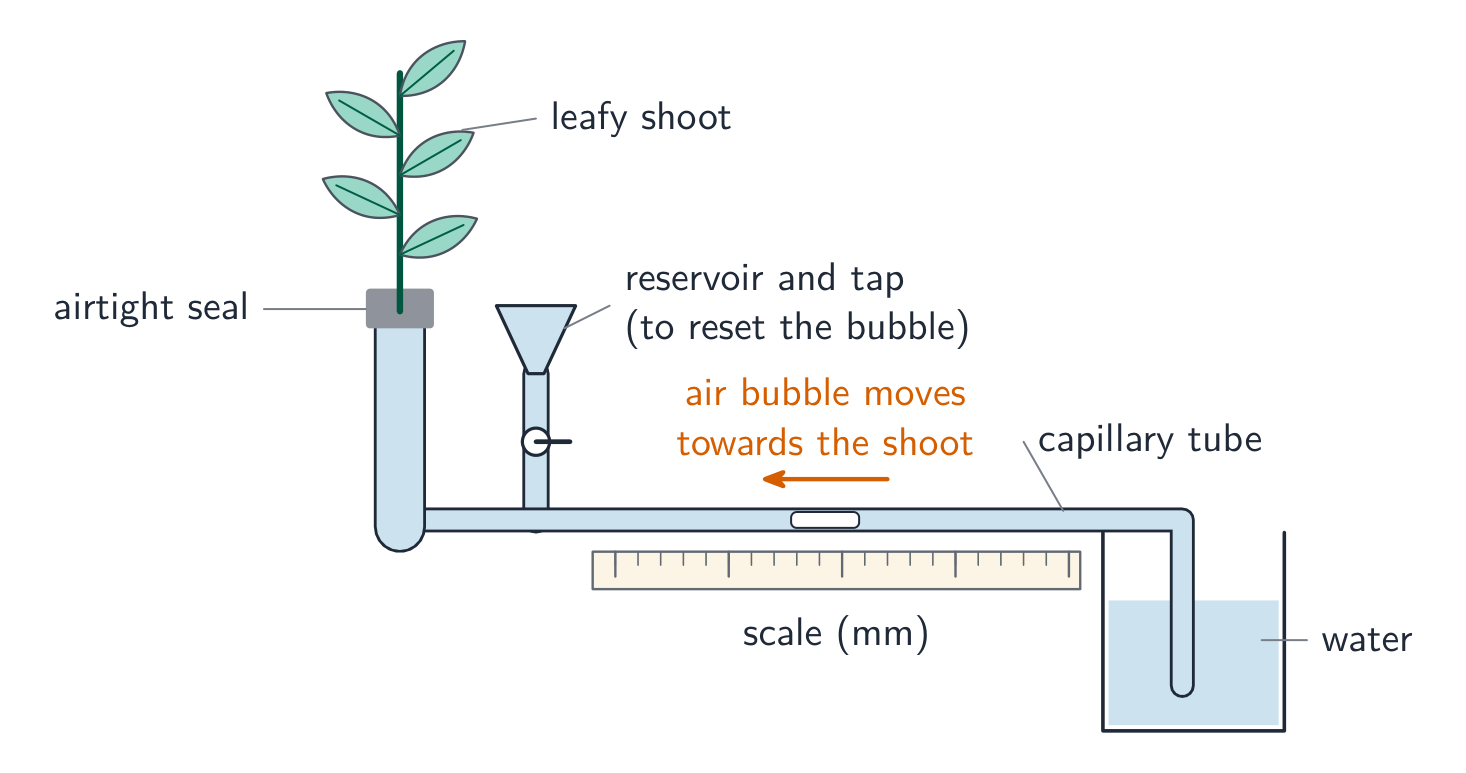
Worked example. In a potometer the air bubble moves 60 mm in 5 minutes. Find the rate of water uptake, and say what happens when a fan is switched on. Rate = distance ÷ time = 60 ÷ 5 = 12 mm per minute. Always give a rate its full unit, "mm per minute", not just "12". A fan raises the wind speed, which carries water vapour away from the leaf, so transpiration speeds up and the bubble moves further in the same 5 minutes.
How water rises up the xylem (Supplement)
As water vapour leaves the leaf, it pulls more water up behind it. This pull is called the transpiration pull 蒸腾拉力. The water molecules stick to one another by forces of attraction 吸引力, so they are drawn up the xylem together as one long column 水柱 of water.
Wilting (Supplement)
If a plant loses water faster than it can take it up, its cells become soft and the plant wilts 萎蔫 — the leaves and stem droop. This often happens on a hot, dry, windy day.
The reason is turgor 膨压. Normally the vacuoles are full of water, which pushes the cytoplasm and cell membrane outwards against the cell wall; the cells are turgid 膨胀 (firm), and they press against each other and hold the plant upright. When more water is lost by transpiration than enters the roots, water leaves the cells by osmosis. The vacuoles shrink, the cells become flaccid 松软 (soft) and no longer support the leaves and stem, so the plant wilts. Wilting also helps the plant: the drooping leaves expose less surface to the sun, and the stomata close, so less water is lost. Watering the plant, or a cool night, lets the cells take up water again and become turgid.
Исследовать
Транспирационный ток
Вода поднимается по растению непрерывным потоком от корней к листьям, где она испаряется.
Словарь
Тренировать
| English | Русский |
|---|---|
| transpiration/trænspəˈreɪʃn/ | транспирация |
| water vapour/ˈwɔːtə ˈveɪpə/ | водяной пар |
| evaporates/ɪˈvæpəreɪts/ | испаряется |
| air spaces/eə ˈspeɪsɪz/ | воздушные пространства |
| diffuses/dɪˈfjuːzɪz/ | диффундирует |
| stomata/ˈstəʊmətə/ | устички |
| temperature/ˈtemprɪtʃə/ | температура |
| wind speed/wɪnd spiːd/ | Скорость ветра |
| humidity/hjuːˈmɪdɪti/ | влажность |
| concentration gradient/ˌkɒnsənˈtreɪʃn ˈɡreɪdɪənt/ | A change in a substance's concentration across a distance or between regions. |
| potometer/pəˈtɒmɪtə/ | потометр |
| transpiration pull/trænspəˈreɪʃn pʊl/ | Транспирационное тяжение |
| forces of attraction/ˈfɔːsɪz ɒv əˈtrækʃn/ | Силы притяжения |
| column/ˈkɒlʌm/ | Водный столб |
| wilts/wɪlts/ | увядший |
| turgor/ˈtɜːɡə/ | Pressure exerted by a cell's contents against its cell wall after water enters the cell. |
| turgid/ˈtɜːdʒɪd/ | Describing a plant cell swollen and firm because water entering by osmosis produces pressure against its cell wall. |
| flaccid/ˈflæsɪd/ | Describes a plant cell or plant that has lost water and gone soft. |
8.4
Translocation (Supplement)
Программа
| Базовый | Дополнительно |
|---|---|
| 1 Опишите транслокацию как движение сахарозы и аминокислот по флоэме от источников к стокам | |
| 2 Опишите: (a) источники как части растения, выделяющие сахарозу или аминокислоты (b) стоки как части растения, использующие или накапливающие сахарозу или аминокислоты | |
| 3 Объясните, почему некоторые части растения могут действовать как источник и сток в разное время |
Источник: Программа Cambridge International
English
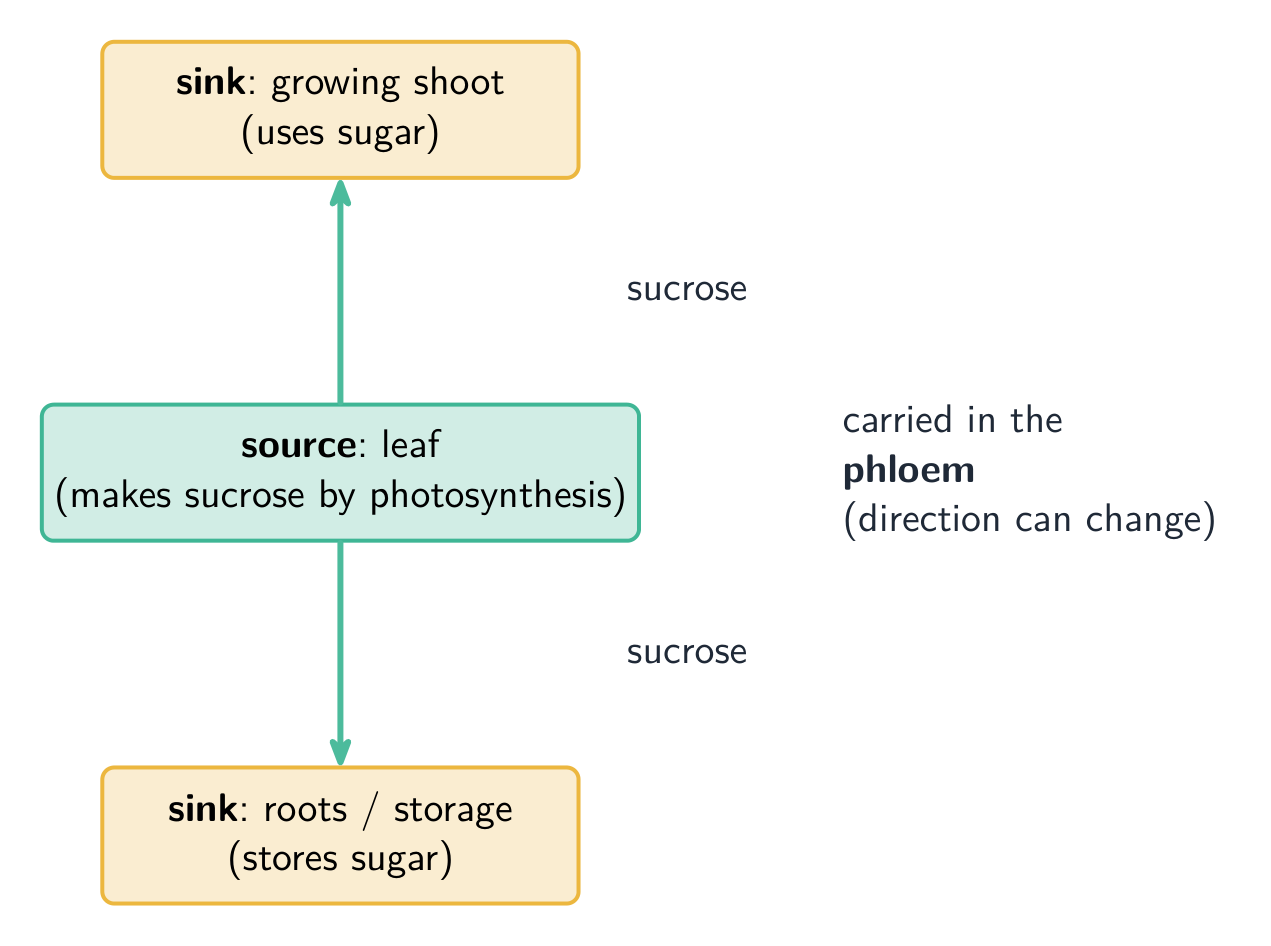
Translocation 转运 is the movement of sucrose and amino acids in the phloem, from sources 源 to sinks 库.
- sources are the parts that release sucrose or amino acids — for example the leaves, which make sugar by photosynthesis.
- sinks are the parts that use or store them — for example growing roots, or a storage organ.
The same part of a plant can be a sink at one time and a source at another. A potato tuber is a sink in summer, when sucrose arrives from the leaves and is stored as starch. In spring, before the new shoots have leaves, the starch is broken down to sucrose and sent to the growing shoots: now the tuber is a source. In the same way, a young leaf is a sink while it grows, and becomes a source once it is photosynthesising more than it needs. This is why phloem can carry sucrose upwards or downwards, unlike xylem.
Common mistakes.
- Saying transpiration is the loss of water through the stomata. Be exact: water evaporates from the mesophyll cell surfaces into the air spaces, and then water vapour diffuses out through the stomata.
- Saying root hairs take up water by active transport 主动运输. Water enters by osmosis 渗透; only mineral ions can need active transport.
- Saying humid air speeds up transpiration. More humid air means a smaller difference in water vapour between the leaf and the air, so transpiration is slower.
- Saying a potometer measures transpiration directly. It measures water uptake; a little of the water taken up is used in the plant (for example in photosynthesis), so uptake is only close to the transpiration rate.
- Saying xylem carries sugar, or that phloem carries water up from the roots. Xylem: water and mineral ions, upward. Phloem: sucrose and amino acids, from source to sink, up or down.
- Giving a rate as a bare number. A bubble that moves 60 mm in 5 minutes gives 12 mm per minute, not "12".
Исследовать
Транслокация во флоэме
Флоэма переносит растворенные сахара от мест их образования (источник) к местам использования или хранения (потребитель).
Словарь
Тренировать
| English | Русский |
|---|---|
| translocation/trænsləʊˈkeɪʃn/ | транслокация |
| sources/ˈsɔːsɪz/ | источники |
| sinks/sɪŋks/ | приёмники |
| active transport/ˈæktɪv ˈtrænspɔːt/ | активный транспорт |
| osmosis/ɒzˈməʊsɪs/ | Осмос |
8.4
Советы для экзамена
English
- Xylem: water and mineral ions, upward only, plus support — its cells are dead, with thick lignin walls. Phloem: sucrose and amino acids, in living cells.
- Learn the water pathway: root hair cell → cortex → xylem → mesophyll.
- Transpiration = evaporation from the mesophyll, then diffusion out of the stomata. It is faster when hotter, windier or drier.
- Water rises by the transpiration pull; the water molecules hold together as a column.
- Translocation goes from a source (where sugar is made or stored) to a sink (where it is used). The direction can change with the season.
- To identify the tissues in a section: root — xylem in the centre; stem — bundles in a ring, xylem inside and phloem outside; leaf — xylem above, phloem below.
- (Supplement) Explain wilting with osmosis and turgor: water leaves the cells, they become flaccid, and they stop supporting the plant.
Это было полезно?
Что пошло не так? Это увидит только команда сайта.
Интерактивные уроки по этой теме
Пройдите его шаг за шагом с упражнениями мгновенной проверки.