This handout covers Topic 1: Pure Mathematics 纯数学 1. It is the algebra 代数 and calculus 微积分 core of the course. Each ## section is one syllabus subtopic.
Tips · Советы
A-Level Mathematics (9709) is built from components, not taught as one block: Pure 1, 2 and 3, Mechanics, and Probability & Statistics 1 and 2. Which you sit depends on your school's entry — check that before you plan revision. There is no point grinding Mechanics if you are entered for Statistics.
Pure is the spine. Everything else assumes you can differentiate, integrate and handle algebra without thinking. Weakness there shows up as lost marks in Mechanics and Statistics, not in Pure.
Method marks are generous, and they are awarded for what you wrote down. Showing every line is the highest-return habit in this subject.
-
1
Pure Mathematics 1 · Чистая математика 1
Watch lesson · Смотреть урок1.1
Quadratics

Syllabus · Программа
EnglishCandidates should be able to: Notes and examples carry out the process of completing the square for a quadratic polynomial $ax^2 + bx + c$ and use a completed square form e.g. to locate the vertex of the graph of $y = ax^2 + bx + c$ or to sketch the graph find the discriminant of a quadratic polynomial $ax^2 + bx + c$ and use the discriminant e.g. to determine the number of real roots of the equation $ax^2 + bx + c = 0$. Knowledge of the term ‘repeated root’ is included. solve quadratic equations, and quadratic inequalities, in one unknown By factorising, completing the square and using the formula. solve by substitution a pair of simultaneous equations of which one is linear and one is quadratic e.g. $x + y + 1 = 0$ and $x^2 + y^2 = 25$, $2x + 3y = 7$ and $3x^2 = 4 + 4xy$. recognise and solve equations in $x$ which are quadratic in some function of $x$. e.g. $x^4 - 5x^2 + 4 = 0$, $6x + \sqrt{x} - 1 = 0$, $\tan^2 x = 1 + \tan x$. РусскийКандидаты должны уметь: Примечания и примеры выполнять процесс выделения полного квадрата для квадратичного многочлена $ax^2 + bx + c$ и использовать формулу полного квадрата например, для нахождения вершины графика функции $y = ax^2 + bx + c$ или для построения эскиза графика находить дискриминант квадратичного многочлена $ax^2 + bx + c$ и использовать дискриминант например, для определения количества действительных корней уравнения $ax^2 + bx + c = 0$. Знание термина «повторный корень» включено. решать квадратные уравнения и квадратные неравенства с одной переменной Методами разложения на множители, выделения полного квадрата и использования формулы. решать методом подстановки пару систем уравнений, одно из которых линейное, а другое квадратное например, $x + y + 1 = 0$ и $x^2 + y^2 = 25$, $2x + 3y = 7$ и $3x^2 = 4 + 4xy$. распознавать и решать уравнения относительно $x$, которые являются квадратными относительно некоторой функции от $x$. например, $x^4 - 5x^2 + 4 = 0$, $6x + \sqrt{x} - 1 = 0$, $\tan^2 x = 1 + \tan x$. Source: Cambridge International syllabus · Источник: Программа Cambridge International
Completing the square finds the vertex A suspension bridge: the main cable hangs in a parabola. A quadratic 二次式 is an expression of the form $ax^2 + bx + c$, where $a \neq 0$. The letters $a$, $b$, $c$ are the coefficients 系数 (the fixed numbers). Much of this section is about solving the equation $ax^2 + bx + c = 0$.
Completing the square
To complete the square 配方 means to write the quadratic in the form
$$a(x + p)^2 + q.$$This form is useful: it shows the vertex 顶点 (turning point) of the curve at $(-p,\ q)$, and it gives a quick way to solve the equation.Worked example. Write $9x^2 - 36x + 8$ in the form $p(x + q)^2 + r$.
Take the factor $9$ out of the first two terms, then complete the square inside:
$$\begin{aligned} 9x^2 - 36x + 8 &= 9\left(x^2 - 4x\right) + 8 \\ &= 9\left((x - 2)^2 - 4\right) + 8 \\ &= 9(x - 2)^2 - 36 + 8 = 9(x - 2)^2 - 28. \end{aligned}$$So $p = 9$, $q = -2$, $r = -28$.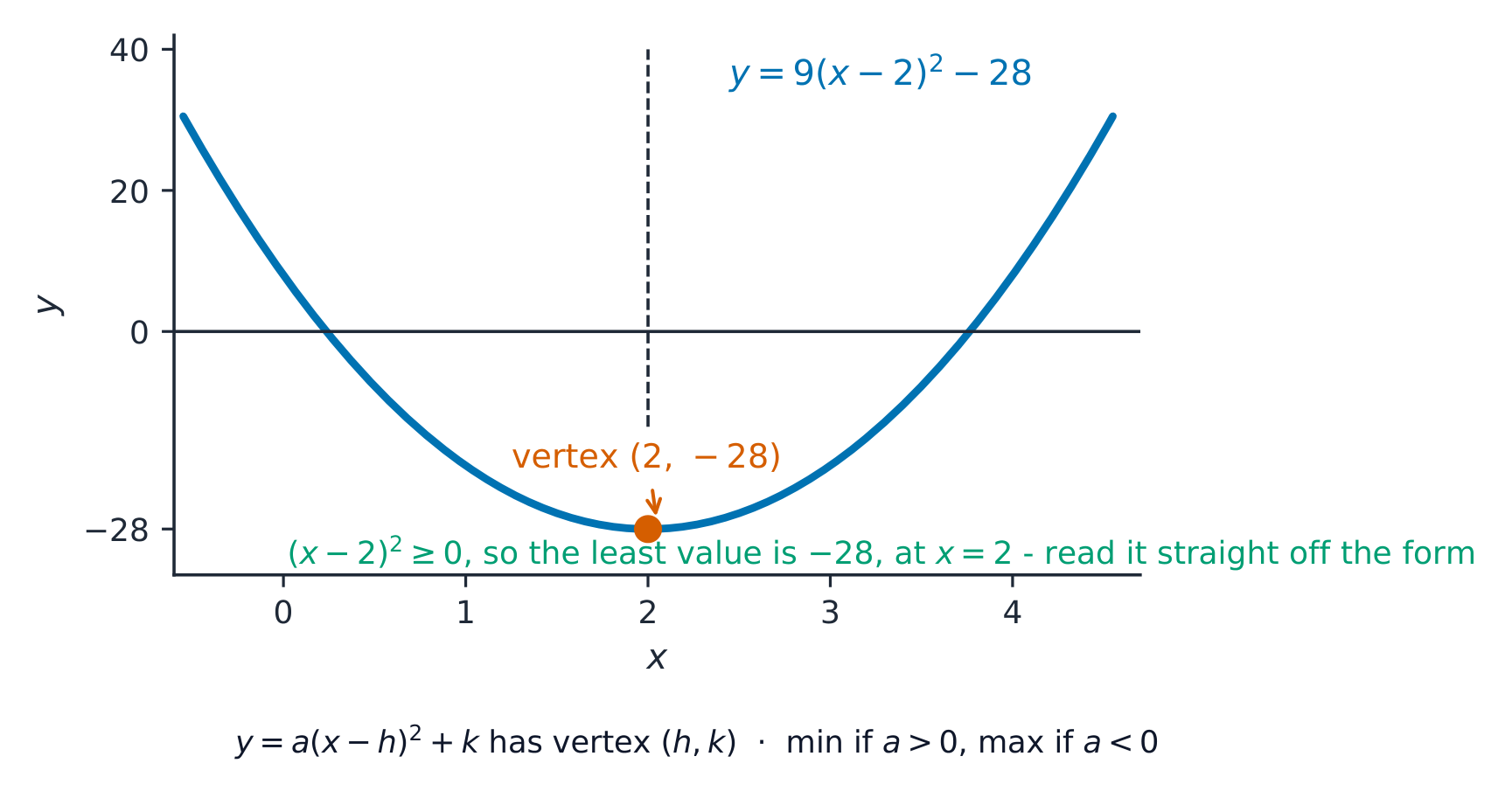
The completed square hands you the vertex: least value -28 at x equals 2 The discriminant
The discriminant 判别式 of $ax^2 + bx + c$ is
$$\Delta = b^2 - 4ac.$$It tells you how many real roots 实根 (real solutions) the equation $ax^2 + bx + c = 0$ has:Discriminant Roots $b^2 - 4ac > 0$ two distinct 相异 real roots $b^2 - 4ac = 0$ one repeated real root $b^2 - 4ac < 0$ no real roots 
The sign of $b^2-4ac$ decides how many times the parabola meets the $x$-axis. Worked example. Find the values of the constant $k$ for which $3kx^2 + (k + 8)x + 3 = 0$ has two distinct real roots.
Here $a = 3k$, $b = k + 8$, $c = 3$. For two distinct real roots you need $b^2 - 4ac > 0$:
$$(k + 8)^2 - 4(3k)(3) > 0 \;\Rightarrow\; k^2 + 16k + 64 - 36k > 0 \;\Rightarrow\; k^2 - 20k + 64 > 0.$$Factorise: $(k - 4)(k - 16) > 0$, so $k < 4$ or $k > 16$. You also need $a \neq 0$, so $k \neq 0$.Quadratic equations and inequalities
To solve a quadratic equation 二次方程, factorise, complete the square, or use the formula
$$x = \frac{-b \pm \sqrt{b^2 - 4ac}}{2a}.$$To solve a quadratic inequality 二次不等式 such as $(k - 4)(k - 16) > 0$, find the two roots, then decide which side of each root makes the statement true. A sketch of the parabola 抛物线 helps: the curve is above the $x$-axis (positive) outside the roots and below it (negative) between them.Simultaneous equations
To solve a pair of simultaneous equations 联立方程 where one is linear and one is quadratic, use substitution 代入: rearrange the linear equation for one letter, then put that into the quadratic. This gives a single quadratic to solve.
Equations that are quadratic in disguise
Some equations are quadratic in some function of $x$. For example $x^4 - 5x^2 + 4 = 0$ is quadratic in $x^2$: let $u = x^2$, solve $u^2 - 5u + 4 = 0$, then go back to $x$. You will use this idea again in trigonometry.
Explore · ИсследоватьThe shape of a quadratic · Форма квадратичной функции
y = ax² + bx + c
Drag a, b and c. Watch the vertex, the line of symmetry and the roots (where it cuts the x-axis) move as the coefficients change. · Перетащите a, b и c. Наблюдайте за движением вершины, оси симметрии и корней (точек пересечения с осью x) при изменении коэффициентов.
Vocabulary · Словарь Train · ТренироватьEnglish Русский Pure Mathematics/pjʊə ˌmæθɪˈmætɪks/ Чистая математика (Pure Mathematics) quadratic/kwɒˈdrætɪk/ квадратичной complete the square/kəmˈpliːt ðə skweə/ выделение полного квадрата vertex/ˈvɜːteks/ вершина discriminant/dɪˈskrɪmɪnənt/ дискриминант real roots/rɪəl ruːts/ действительные корни distinct/dɪˈstɪŋkt/ различные quadratic equation/kwɒˈdrætɪk ɪˈkweɪʒn/ квадратное уравнение quadratic inequality/kwɒˈdrætɪk ɪniːˈkwɒlɪti/ квадратное неравенство simultaneous equations/ˌsɪməlˈteɪnɪəs ɪˈkweɪʒnz/ система уравнений substitution/ˌsʌbstɪˈtjuːʃn/ замещение coefficient/ˌkəʊɪˈfɪʃənt/ коэффициент parabola/pəˈræbələ/ параболу 1.2
Functions
Syllabus · Программа
EnglishCandidates should be able to: Notes and examples understand the terms function, domain, range, one-one function, inverse function and composition of functions identify the range of a given function in simple cases, and find the composition of two given functions e.g. range of $f : x \mapsto \frac{1}{x}$ for $x \geqslant 1$ and range of $g : x \mapsto x^2 + 1$ for $x \in \mathbb{R}$. Including the condition that a composite function $gf$ can only be formed when the range of $f$ is within the domain of $g$. determine whether or not a given function is one-one, and find the inverse of a one-one function in simple cases e.g. finding the inverse of $h : x \mapsto (2x + 3)^2 - 4$ for $x < -\frac{3}{2}$. illustrate in graphical terms the relation between a one-one function and its inverse Sketches should include an indication of the mirror line $y = x$. understand and use the transformations of the graph of $y = f(x)$ given by $y = f(x) + a$, $y = f(x + a)$, $y = af(x)$, $y = f(ax)$ and simple combinations of these. Including use of the terms ‘translation’, ‘reflection’ and ‘stretch’ in describing transformations. Questions may involve algebraic or trigonometric functions, or other graphs with given features. РусскийКандидаты должны уметь: Примечания и примеры понимать термины функция, область определения, множество значений, взаимооднозначная функция, обратная функция и композиция функций определять множество значений данной функции в простых случаях и находить композицию двух заданных функций например, множество значений функции $f : x \mapsto \frac{1}{x}$ при $x \geqslant 1$ и множество значений функции $g : x \mapsto x^2 + 1$ при $x \in \mathbb{R}$. Включается условие, что композиция функций $gf$ может быть образована только тогда, когда множество значений функции $f$ содержится в области определения функции $g$. определять, является ли данная функция взаимооднозначной, и находить обратную функцию для взаимооднозначной функции в простых случаях например, нахождение обратной функции для $h : x \mapsto (2x + 3)^2 - 4$ при $x < -\frac{3}{2}$. иллюстрировать графически соотношение между взаимооднозначной функцией и её обратной функцией На эскизах должно быть указано направление линии отражения $y = x$. понимать и использовать преобразования графика функции $y = f(x)$, задаваемые выражениями $y = f(x) + a$, $y = f(x + a)$, $y = af(x)$, $y = f(ax)$ и простыми комбинациями этих преобразований. Включая использование терминов «сдвиг», «отражение» и «растяжение» при описании преобразований. Задания могут касаться алгебраических или тригонометрических функций, либо других графиков с заданными характеристиками. Source: Cambridge International syllabus · Источник: Программа Cambridge International
Transforming graphs: shift and stretch A function 函数 is a rule that sends each input to exactly one output. Write it as $f(x)$. The composition of functions 复合函数 $fg(x)$ means apply $g$ first, then apply $f$ to the result.
- The domain 定义域 is the set of allowed inputs $x$.
- The range 值域 is the set of outputs the function actually produces.
A function is one-one 一一对应 if different inputs always give different outputs. (No output is repeated.) Only a one-one function has an inverse function 反函数 $f^{-1}$, which reverses the rule.
The composition 复合 of two functions means doing one after the other. $fg(x)$ means "do $g$ first, then $f$": $fg(x) = f(g(x))$. The composite function $fg$ exists only when the range of $g$ lies inside the domain of $f$.
Finding an inverse
To find $f^{-1}$: write $y = f(x)$, make $x$ the subject, then swap letters.
Worked example. The function $f(x) = (x + 3)^2 - 12$ is defined for $x \geqslant 0$. Find $f^{-1}(x)$.
Write $y = (x + 3)^2 - 12$ and solve for $x$:
$$(x + 3)^2 = y + 12 \;\Rightarrow\; x + 3 = \sqrt{y + 12} \;\Rightarrow\; x = \sqrt{y + 12} - 3.$$You take the positive square root because $x \geqslant 0$ means $x + 3 \geqslant 3 > 0$. So$$f^{-1}(x) = \sqrt{x + 12} - 3.$$Graphs of inverses and transformations
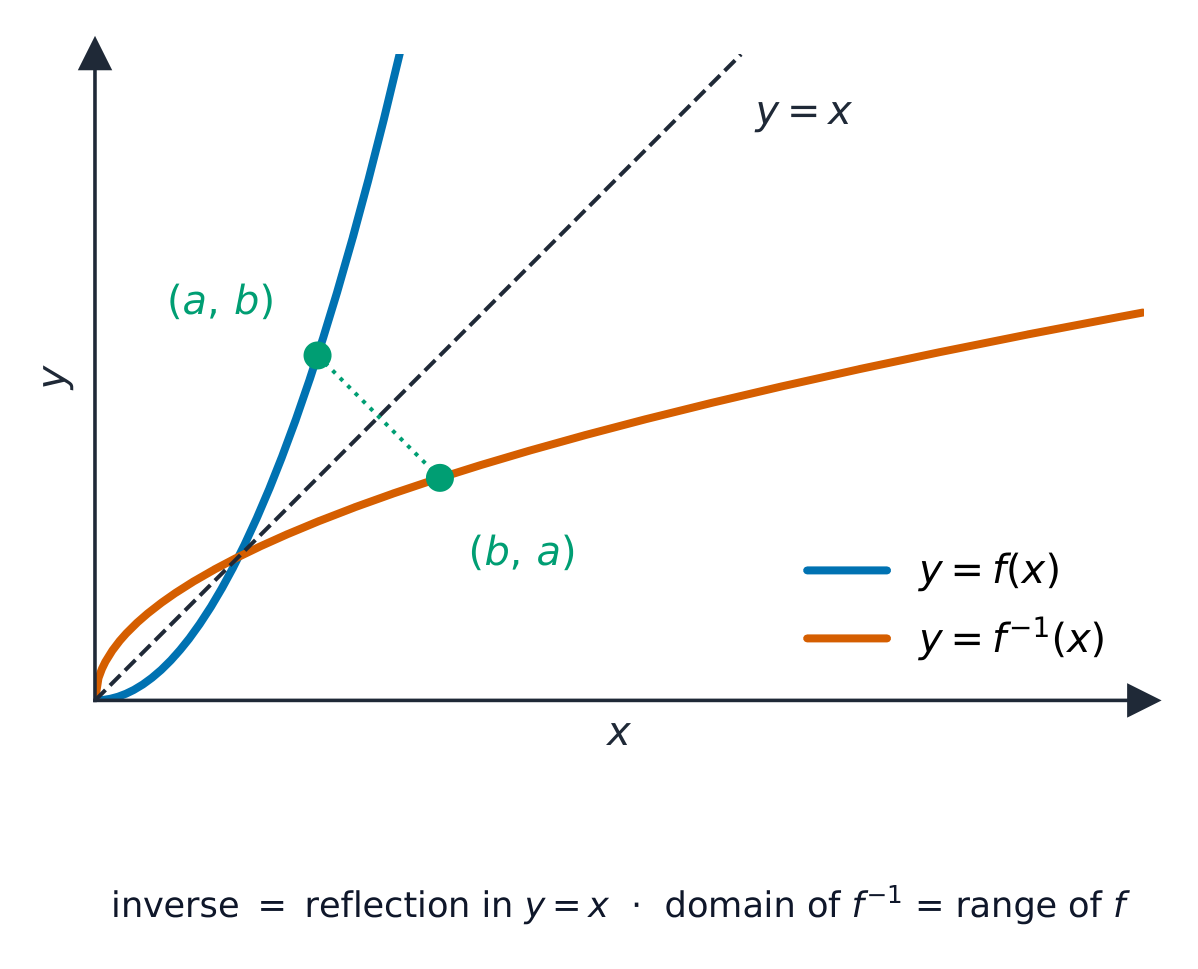
The graph of $y = f^{-1}(x)$ is the reflection 反射 of $y = f(x)$ in the line $y = x$.
Reflecting $y=f(x)$ in the line $y=x$ gives its inverse; a point $(a,b)$ becomes $(b,a)$. You should know these transformations 变换 of $y = f(x)$:
New equation Effect on the graph $y = f(x) + a$ translation 平移 up by $a$ $y = f(x + a)$ translation left by $a$ $y = a\,f(x)$ stretch 伸缩 in the $y$-direction, scale factor $a$ $y = f(ax)$ stretch in the $x$-direction, scale factor $\tfrac{1}{a}$ When two transformations are combined, the order can matter. State each one fully (type, direction, and amount).

Adding to the output or input slides the curve; a multiplier stretches it. Explore · ИсследоватьExplore a function · Исследовать функцию
y = ax³ + bx² + cx + d
A function turns each input into exactly one output — drag the coefficients and watch where the curve rises and falls. · Функция преобразует каждый вход ровно в один выход — перетаскивайте коэффициенты и смотрите, где кривая возрастает и убывает.
Vocabulary · Словарь Train · ТренироватьEnglish Русский function/ˈfʌŋkʃn/ функцией composition of functions/ˌkɒmpəˈzɪʃn ɒv ˈfʌŋkʃnz/ композиция функций domain/dəˈmeɪn/ области определения range/reɪndʒ/ область значений one-one/wʌn wʌn/ однозначное отображение inverse function/ɪnˈvɜːs ˈfʌŋkʃn/ обратная функция composition/ˌkɒmpəˈzɪʃn/ композиция reflection/rɪˈflekʃn/ отражения transformations/trænsfɔːˈmeɪʃnz/ преобразования translation/trænˈsleɪʃn/ трансляция stretch/stretʃ/ растяжением 1.3
Coordinate geometry

Syllabus · Программа
EnglishCandidates should be able to: Notes and examples find the equation of a straight line given sufficient information e.g. given two points, or one point and the gradient. interpret and use any of the forms $y = mx + c$, $y - y_1 = m(x - x_1)$, $ax + by + c = 0$ in solving problems Including calculations of distances, gradients, midpoints, points of intersection and use of the relationship between the gradients of parallel and perpendicular lines. understand that the equation $(x - a)^2 + (y - b)^2 = r^2$ represents the circle with centre $(a, b)$ and radius $r$ Including use of the expanded form $x^2 + y^2 + 2gx + 2fy + c = 0$. use algebraic methods to solve problems involving lines and circles Including use of elementary geometrical properties of circles, e.g. tangent perpendicular to radius, angle in a semicircle, symmetry. Implicit differentiation is not included. understand the relationship between a graph and its associated algebraic equation, and use the relationship between points of intersection of graphs and solutions of equations. e.g. to determine the set of values of $k$ for which the line $y = x + k$ intersects, touches or does not meet a quadratic curve. РусскийКандидаты должны уметь: Примечания и примеры находить уравнение прямой при наличии достаточной информации например, заданы две точки, или одна точка и угловой коэффициент. интерпретировать и использовать любую из форм записи $y = mx + c$, $y - y_1 = m(x - x_1)$, $ax + by + c = 0$ при решении задач Включая вычисление расстояний, угловых коэффициентов, середины отрезка, точек пересечения и использование соотношения между угловыми коэффициентами параллельных и перпендикулярных прямых. понимать, что уравнение $(x - a)^2 + (y - b)^2 = r^2$ представляет собой окружность с центром в точке $(a, b)$ и радиусом $r$ Включая использование развёрнутой формы записи $x^2 + y^2 + 2gx + 2fy + c = 0$. использовать алгебраические методы для решения задач, связанных с прямыми и окружностями Включая использование элементарных геометрических свойств окружности, например: касательная перпендикулярна радиусу, угол в полуокружности, симметрия. Неполное дифференцирование не включено. понимать связь между графиком и связанным с ним алгебраическим уравнением, а также использовать связь между точками пересечения графиков и решениями уравнений. Например, для определения множества значений параметра $k$, при которых прямая $y = x + k$ пересекает, касается или не пересекает квадратичную кривую. Source: Cambridge International syllabus · Источник: Программа Cambridge International
Coordinate geometry 坐标几何 studies lines and circles using their equations.
Straight lines
The gradient 斜率 (steepness) of the line joining $(x_1, y_1)$ and $(x_2, y_2)$ is
$$m = \frac{y_2 - y_1}{x_2 - x_1}.$$You can write the equation of a straight line 直线方程 in any of these forms:$$y = mx + c, \qquad y - y_1 = m(x - x_1), \qquad ax + by + c = 0.$$Two lines are parallel 平行 when their gradients are equal, and perpendicular 垂直 (at right angles) when the product of their gradients is $-1$.Circles
The circle 圆 with centre 圆心 $(a, b)$ and radius 半径 $r$ has equation
$$(x - a)^2 + (y - b)^2 = r^2.$$An expanded form like $x^2 + y^2 - 6x + 10y - 27 = 0$ is the same circle: complete the square in $x$ and in $y$ to find the centre and radius.A tangent 切线 to a circle touches it at one point and is perpendicular to the radius at that point. This right-angle fact solves most circle problems.
A tangent touches the circle once and meets the radius at a right angle. Worked example. The points $P(1, 1)$ and $Q(7, 11)$ are the ends of a diameter 直径 of a circle. Find the equation of the circle.
The centre is the midpoint of $PQ$:
$$\left(\frac{1 + 7}{2},\ \frac{1 + 11}{2}\right) = (4, 6).$$The radius is half the length of $PQ$:$$r = \tfrac12\sqrt{(7 - 1)^2 + (11 - 1)^2} = \tfrac12\sqrt{36 + 100} = \tfrac12\sqrt{136} = \sqrt{34}.$$So the circle is $(x - 4)^2 + (y - 6)^2 = 34$.Explore · ИсследоватьThe straight line · Прямая линия
y = ax + b
The gradient a tilts the line; the intercept b slides it up and down. · Угловой коэффициент a наклоняет линию; отрезок b смещает её вверх и вниз.
Vocabulary · Словарь Train · ТренироватьEnglish Русский Coordinate geometry/kəʊˈɔːdɪnət dʒiˈɒmətri/ Координатная геометрия gradient/ˈɡreɪdɪənt/ наклона (градиента) equation of a straight line/ɪˈkweɪʒn əvə streɪt laɪn/ уравнение прямой parallel/ˈpærəlel/ параллельно perpendicular/ˌpɜːpənˈdɪkjʊlə/ перпендикулярны circle/ˈsɜːkl/ окружность centre/ˈsentə/ центре radius/ˈreɪdɪəs/ радиусу tangent/ˈtændʒənt/ касательную diameter/daɪˈæmɪtə/ диаметру 1.4
Circular measure

Syllabus · Программа
EnglishCandidates should be able to: Notes and examples understand the definition of a radian, and use the relationship between radians and degrees use the formulae $s = r\theta$ and $A = \frac{1}{2}r^2\theta$ in solving problems concerning the arc length and sector area of a circle. Including calculation of lengths and angles in triangles and areas of triangles. РусскийКандидаты должны уметь: Примечания и примеры понимать определение радиана и использовать соотношение между радианами и градусами использовать формулы $s = r\theta$ и $A = \frac{1}{2}r^2\theta$ при решении задач, связанных с длиной дуги и площадью сектора круга. Включая вычисление длин и углов в треугольниках, а также площадей треугольников. Source: Cambridge International syllabus · Источник: Программа Cambridge International
What is a radian? Radians
A radian 弧度 is another way to measure angles. One radian is the angle at the centre of a circle that cuts off an arc 弧 equal in length to the radius. The link between radians and degrees 度 is
$$\pi \text{ radians} = 180^\circ.$$So to change degrees to radians, multiply by $\dfrac{\pi}{180}$; to change radians to degrees, multiply by $\dfrac{180}{\pi}$.One radian: the angle whose arc equals the radius Arc length and sector area
For a sector 扇形 with radius $r$ and angle $\theta$ in radians:
$$\text{arc length} = s = r\theta, \qquad \text{sector area} = A = \tfrac12 r^2 \theta.$$A chord 弦 cuts the sector into a triangle and a segment 弓形. The segment area is the sector minus the triangle:$$\text{segment} = \tfrac12 r^2 \theta - \tfrac12 r^2 \sin\theta = \tfrac12 r^2(\theta - \sin\theta).$$
The shaded segment is the part of the sector between the chord and the arc. Worked example. A sector has centre $O$ and the angle at $O$ is $\tfrac{2}{3}\pi$ radians. Show that the segment cut off by the chord has area about $0.614 r^2$.
$$\text{segment} = \tfrac12 r^2\left(\tfrac{2}{3}\pi - \sin\tfrac{2}{3}\pi\right) = \tfrac12 r^2(2.0944 - 0.8660) = \tfrac12 r^2(1.2284) \approx 0.614 r^2.$$Explore · ИсследоватьRadians, arcs and sectors · Радианы, дуги и секторы
Change the angle (in radians) and radius. See the arc length $s = r\theta$ and the sector area $\tfrac12 r^2\theta$ update. · Измените угол (в радианах) и радиус. Видите, как обновляются длина дуги $s = r\theta$ и площадь сектора $\tfrac12 r^2\theta$.
Vocabulary · Словарь Train · ТренироватьEnglish Русский radian/ˈreɪdɪən/ радиан arc/ɑːk/ дуга degrees/dɪˈɡriːz/ градусах sector/ˈsektə/ сектора chord/kɔːd/ хорда segment/ˈseɡmənt/ сегмент 1.5
Trigonometry

Syllabus · Программа
EnglishCandidates should be able to: Notes and examples sketch and use graphs of the sine, cosine and tangent functions (for angles of any size, and using either degrees or radians) Including e.g. $y = 3 \sin x$, $y = 1 - \cos 2x$, $y = \tan(x + \frac{1}{4}\pi)$. use the exact values of the sine, cosine and tangent of $30^\circ$, $45^\circ$, $60^\circ$, and related angles e.g. $\cos 150^\circ = -\frac{1}{2}\sqrt{3}$, $\sin \frac{3}{4}\pi = \frac{1}{\sqrt{2}}$. use the notations $\sin^{-1} x$, $\cos^{-1} x$, $\tan^{-1} x$ to denote the principal values of the inverse trigonometric relations No specialised knowledge of these functions is required, but understanding of them as examples of inverse functions is expected. use the identities $\frac{\sin \theta}{\cos \theta} \equiv \tan \theta$ and $\sin^2 \theta + \cos^2 \theta \equiv 1$ e.g. in proving identities, simplifying expressions and solving equations. find all the solutions of simple trigonometrical equations lying in a specified interval (general forms of solution are not included). e.g. solve $3 \sin 2x + 1 = 0$ for $-\pi < x < \pi$, $3 \sin^2 \theta - 5 \cos \theta - 1 = 0$ for $0^\circ \leqslant \theta \leqslant 360^\circ$. РусскийКандидаты должны уметь: Примечания и примеры Строить эскизы и использовать графики функций синуса, косинуса и тангенса (для углов любого размера и используя либо градусы, либо радианы) Включая, например, $y = 3 \sin x$, $y = 1 - \cos 2x$, $y = \tan(x + \frac{1}{4}\pi)$. использовать точные значения синуса, косинуса и тангенса для углов $30^\circ$, $45^\circ$, $60^\circ$ и смежных с ними углов Например, $\cos 150^\circ = -\frac{1}{2}\sqrt{3}$, $\sin \frac{3}{4}\pi = \frac{1}{\sqrt{2}}$. использовать обозначения $\sin^{-1} x$, $\cos^{-1} x$, $\tan^{-1} x$ для обозначения главных значений обратных тригонометрических соотношений Специальные знания этих функций не требуются, но ожидается понимание их как примеров обратных функций. использовать тождества $\frac{\sin \theta}{\cos \theta} \equiv \tan \theta$ и $\sin^2 \theta + \cos^2 \theta \equiv 1$ Например, при доказательстве тождеств, упрощении выражений и решении уравнений. находить все решения простых тригонометрических уравнений, лежащие в заданном интервале (общие формы решений не включены). Например, решить $3 \sin 2x + 1 = 0$ для $-\pi < x < \pi$, $3 \sin^2 \theta - 5 \cos \theta - 1 = 0$ для $0^\circ \leqslant \theta \leqslant 360^\circ$. Source: Cambridge International syllabus · Источник: Программа Cambridge International
Amplitude, period and midline of a sine curve The unit circle draws the sine curve A Ferris wheel: a point on the rim rises and falls like a sine curve. Graphs and exact values
You must know the shape of the graphs of the sine 正弦, cosine 余弦 and tangent function 正切 (written $\sin$, $\cos$, $\tan$). The sine and cosine graphs wave between $-1$ and $1$ and repeat every $360^\circ$ ($2\pi$). Learn these exact values:
$\theta$ $30^\circ$ $45^\circ$ $60^\circ$ $\sin\theta$ $\tfrac12$ $\tfrac{1}{\sqrt2}$ $\tfrac{\sqrt3}{2}$ $\cos\theta$ $\tfrac{\sqrt3}{2}$ $\tfrac{1}{\sqrt2}$ $\tfrac12$ $\tan\theta$ $\tfrac{1}{\sqrt3}$ $1$ $\sqrt3$ 
Over one turn $\sin$ and $\cos$ stay between $-1$ and $1$; $\tan$ shoots off at $90^\circ$ and $270^\circ$. The notations $\sin^{-1}x$, $\cos^{-1}x$, $\tan^{-1}x$ mean the inverse angle (the principal value 主值).
Identities
An identity 恒等式 is true for every value of the angle. The two you must know are
$$\tan\theta \equiv \frac{\sin\theta}{\cos\theta}, \qquad \sin^2\theta + \cos^2\theta \equiv 1.$$Use them to rewrite an equation so it contains only one trig function.Solving trigonometric equations
To solve a trigonometric equation 三角方程, first reduce it to one function, then find every solution in the given interval.
Worked example. Solve $6\sin\theta = 1 + \dfrac{2}{\sin\theta}$ for $-180^\circ < \theta < 180^\circ$.
Multiply through by $\sin\theta$ to clear the fraction. This makes a quadratic in $\sin\theta$:
$$6\sin^2\theta - \sin\theta - 2 = 0 \;\Rightarrow\; (3\sin\theta - 2)(2\sin\theta + 1) = 0.$$So $\sin\theta = \tfrac23$ or $\sin\theta = -\tfrac12$.- $\sin\theta = \tfrac23$: $\theta = 41.8^\circ$ or $\theta = 180^\circ - 41.8^\circ = 138.2^\circ$.
- $\sin\theta = -\tfrac12$: $\theta = -30^\circ$ or $\theta = -150^\circ$.
The four solutions are $\theta = -150^\circ,\ -30^\circ,\ 41.8^\circ,\ 138.2^\circ$.
Explore · ИсследоватьSine & cosine graphs · Графики синуса и косинуса
Drag the amplitude, period and shifts of y = a·sin(bx + c) + d and watch the curve change against the base wave. · Перетаскивайте амплитуду, период и сдвиги y = a·sin(bx + c) + d и наблюдайте, как меняется кривая относительно базовой волны.
Explore · ИсследоватьSine and cosine on the unit circle · Синус и косинус на единичной окружности
Drag the angle round the unit circle. The height is $\sin\theta$, the across-distance is $\cos\theta$ — that's where the graphs come from. · Перетащите угол вокруг единичной окружности. Высота соответствует $\sin\theta$, горизонтальное расстояние — $\cos\theta$ — именно отсюда берутся графики.
Vocabulary · Словарь Train · ТренироватьEnglish Русский sine/saɪn/ синусоида cosine/ˈkəʊsaɪn/ косинус tangent function/ˈtændʒənt ˈfʌŋkʃn/ функция тангенс principal value/ˈprɪnsɪpl ˈvæljuː/ главное значение identity/aɪˈdentɪti/ идентичность trigonometric equation/ˌtrɪɡənəʊˈmetrɪk ɪˈkweɪʒn/ тригонометрическое уравнение 1.6
Series

Syllabus · Программа
EnglishCandidates should be able to: Notes and examples use the expansion of $(a + b)^n$, where $n$ is a positive integer Including the notations $\begin{pmatrix} n \\ r \end{pmatrix}$ and $n!$ Knowledge of the greatest term and properties of the coefficients are not required. recognise arithmetic and geometric progressions use the formulae for the $n$th term and for the sum of the first $n$ terms to solve problems involving arithmetic or geometric progressions Including knowledge that numbers $a$, $b$, $c$ are 'in arithmetic progression' if $2b = a + c$ (or equivalent) and are 'in geometric progression' if $b^2 = ac$ (or equivalent). Questions may involve more than one progression. use the condition for the convergence of a geometric progression, and the formula for the sum to infinity of a convergent geometric progression. РусскийКандидаты должны уметь: Примечания и примеры использовать разложение $(a + b)^n$, где $n$ — положительное целое число Включая обозначения $\begin{pmatrix} n \\ r \end{pmatrix}$ и $n!$. Знание наибольшего члена и свойств коэффициентов не требуется. распознавать арифметические и геометрические прогрессии использовать формулы для $n$-го члена и суммы первых $n$ членов для решения задач, связанных с арифметическими или геометрическими прогрессиями Включая знание того, что числа $a$, $b$, $c$ «находятся в арифметической прогрессии», если $2b = a + c$ (или эквивалентно), и «находятся в геометрической прогрессии», если $b^2 = ac$ (или эквивалентно). Вопросы могут касаться более чем одной прогрессии. использовать условие сходимости геометрической прогрессии и формулу для суммы до бесконечности сходящейся геометрической прогрессии. Source: Cambridge International syllabus · Источник: Программа Cambridge International
Pascal's triangle gives the coefficients Sum to infinity fills the square The binomial expansion
For a positive integer $n$, the binomial expansion 二项展开式 is
$$(a + b)^n = a^n + \binom{n}{1}a^{n-1}b + \binom{n}{2}a^{n-2}b^2 + \cdots + b^n,$$where $\binom{n}{r} = \dfrac{n!}{r!\,(n - r)!}$ is a binomial coefficient 二项式系数.Worked example. Find the first three terms, in ascending powers of $x$, of $(2 - px)^5$.
$$(2 - px)^5 = 2^5 + \binom{5}{1}2^4(-px) + \binom{5}{2}2^3(-px)^2 + \cdots = 32 - 80px + 80p^2x^2 + \cdots$$Arithmetic and geometric progressions
A progression 数列 (sequence) is a list of terms following a rule.
- An arithmetic progression 等差数列 (AP) adds a fixed common difference 公差 $d$ each step. The $n$th term 项 is $u_n = a + (n - 1)d$, and the sum of the first $n$ terms is $S_n = \tfrac{n}{2}\big(2a + (n - 1)d\big)$.
- A geometric progression 等比数列 (GP) multiplies by a fixed common ratio 公比 $r$ each step. The $n$th term is $u_n = ar^{\,n-1}$, and $S_n = \dfrac{a(1 - r^n)}{1 - r}$.
An AP climbs in equal steps; a GP's steps grow by the same ratio A GP is convergent — it converges 收敛 (settles to a limit) — when $|r| < 1$. Then it has a sum to infinity 无穷和
$$S_\infty = \frac{a}{1 - r}.$$Worked example. The third term of a GP is $18$ and the sum of the first three terms is $26$. The common ratio is negative. Find the sum to infinity.
From $ar^2 = 18$ you get $a = \dfrac{18}{r^2}$. Put this into $a(1 + r + r^2) = 26$:
$$18(1 + r + r^2) = 26r^2 \;\Rightarrow\; 8r^2 - 18r - 18 = 0 \;\Rightarrow\; (4r + 3)(r - 3) = 0.$$The ratio is negative, so $r = -\tfrac34$ and $a = \dfrac{18}{(3/4)^2} = 32$. Then$$S_\infty = \frac{32}{1 - (-\tfrac34)} = \frac{32}{\tfrac74} = \frac{128}{7}.$$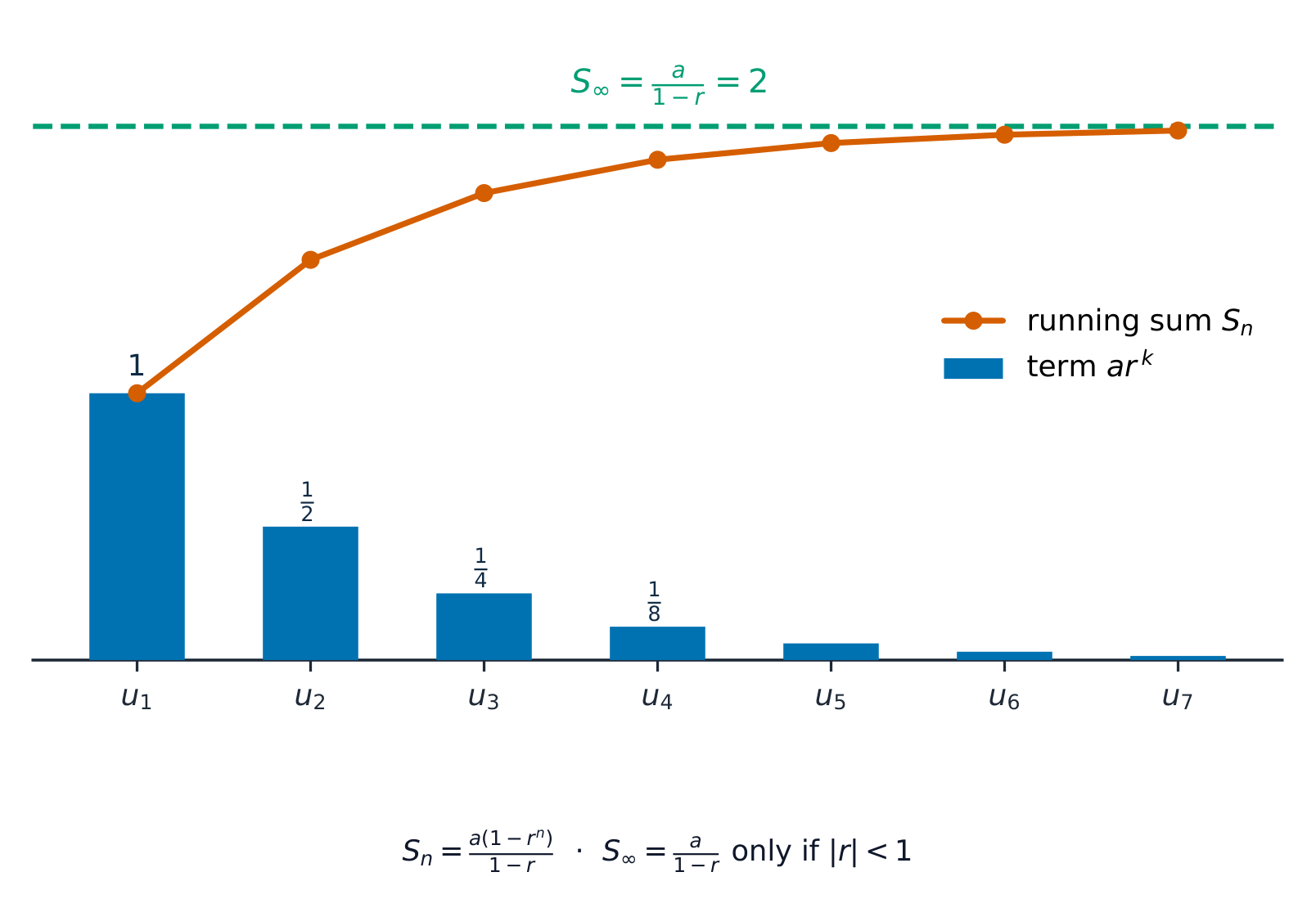
Convergent GP: bars shrink toward zero while the running sum approaches S infinity = a/(1-r) Explore · ИсследоватьArithmetic and geometric sequences · Арифметические и геометрические прогрессии
Switch between an arithmetic (add d) and a geometric (multiply by r) sequence and watch the terms and their sum build up. · Переключайтесь между арифметической (прибавить d) и геометрической (умножить на r) прогрессиями и наблюдайте, как накапливаются члены и их сумма.
Vocabulary · Словарь Train · ТренироватьEnglish Русский binomial expansion/baɪˈnəʊmɪəl ekˈspænʃn/ биномиальное разложение binomial coefficient/baɪˈnəʊmɪəl ˌkəʊɪˈfɪʃənt/ биномиальный коэффициент progression/prəˈɡreʃn/ прогрессия arithmetic progression/əˈrɪθmətɪk prəˈɡreʃn/ арифметическая прогрессия common difference/ˈkɒmən ˈdɪfrəns/ общая разность term/tɜːm/ член (последовательности) geometric progression/ˌdʒiːəʊˈmetrɪk prəˈɡreʃn/ геометрическая прогрессия common ratio/ˈkɒmən ˈreɪʃɪəʊ/ общий знаменатель converges/kənˈvɜːdʒɪz/ сходится sum to infinity/sʌm tʊ ɪnˈfɪnɪti/ сумма бесконечного ряда 1.7
Differentiation
Syllabus · Программа
EnglishCandidates should be able to: Notes and examples understand the gradient of a curve at a point as the limit of the gradients of a suitable sequence of chords, and use the notations $f'(x)$, $f''(x)$, $\frac{\text{d}y}{\text{d}x}$, and $\frac{\text{d}^2y}{\text{d}x^2}$ for first and second derivatives Only an informal understanding of the idea of a limit is expected. e.g. includes consideration of the gradient of the chord joining the points with $x$ coordinates $2$ and $(2 + h)$ on the curve $y = x^3$. Formal use of the general method of differentiation from first principles is not required. use the derivative of $x^n$ (for any rational $n$), together with constant multiples, sums and differences of functions, and of composite functions using the chain rule e.g. find $\frac{\text{d}y}{\text{d}x}$, given $y = \sqrt{2x^3 + 5}$. apply differentiation to gradients, tangents and normals, increasing and decreasing functions and rates of change Including connected rates of change, e.g. given the rate of increase of the radius of a circle, find the rate of increase of the area for a specific value of one of the variables. locate stationary points and determine their nature, and use information about stationary points in sketching graphs. Including use of the second derivative for identifying maxima and minima; alternatives may be used in questions where no method is specified. Knowledge of points of inflexion is not included. РусскийКандидаты должны уметь: Примечания и примеры понимать наклон кривой в точке как предел наклонов подходящей последовательности хорд, и использовать обозначения $f'(x)$, $f''(x)$, $\frac{\text{d}y}{\text{d}x}$ и $\frac{\text{d}^2y}{\text{d}x^2}$ для первой и второй производных Ожидается лишь неформальное понимание идеи предела. Например, включает рассмотрение наклона хорды, соединяющей точки с координатами $x$ $2$ и $(2 + h)$ на кривой $y = x^3$. Формальное использование общего метода дифференцирования из первичных принципов не требуется. использовать производную функции $x^n$ (для любого рационального $n$), а также постоянные множители, суммы и разности функций, а также составных функций с использованием правила дифференцирования сложной функции например, найти $\frac{\text{d}y}{\text{d}x}$, зная, что $y = \sqrt{2x^3 + 5}$. применять дифференцирование к наклонам, касательным и нормалям, возрастанию и убыванию функций, а также к скоростям изменения Включая связанные скорости изменения, например, зная скорость увеличения радиуса окружности, найти скорость увеличения площади для конкретного значения одной из переменных. определять стационарные точки и устанавливать их характер, а также использовать информацию о стационарных точках при построении эскизов графиков. Включая использование второй производной для определения максимумов и минимумов; в вопросах, где метод не указан, могут использоваться альтернативные методы. Знание точек перегиба не включено. Source: Cambridge International syllabus · Источник: Программа Cambridge International
Differentiation from first principles Differentiation 微分 finds the gradient of a curve 曲线斜率 at each point. The gradient is the limit 极限 of the gradients of shorter and shorter chords, called the derivative 导数.
The rules
Write the derivative as $f'(x)$ or $\dfrac{dy}{dx}$. The basic rule is
$$\frac{d}{dx}\left(x^n\right) = n x^{n-1} \quad \text{for any rational } n.$$Differentiate sums term by term, and use the chain rule 链式法则 for a function inside a function:$$\frac{d}{dx}\,f(g(x)) = f'(g(x)) \cdot g'(x).$$Differentiating again gives the second derivative 二阶导数 $f''(x)$ or $\dfrac{d^2y}{dx^2}$.Using the derivative
- Tangent and normal. The gradient of the curve at a point is the gradient of the tangent there. The normal 法线 is perpendicular to the tangent, so its gradient is $-\dfrac{1}{\text{(tangent gradient)}}$.
- Increasing or decreasing. The function is an increasing function 增函数 where $\dfrac{dy}{dx} > 0$, and a decreasing function 减函数 where $\dfrac{dy}{dx} < 0$.
- Rate of change. A derivative is a rate of change 变化率. Linked rates use the chain rule, e.g. $\dfrac{dy}{dt} = \dfrac{dy}{dx}\cdot\dfrac{dx}{dt}$.
Stationary points
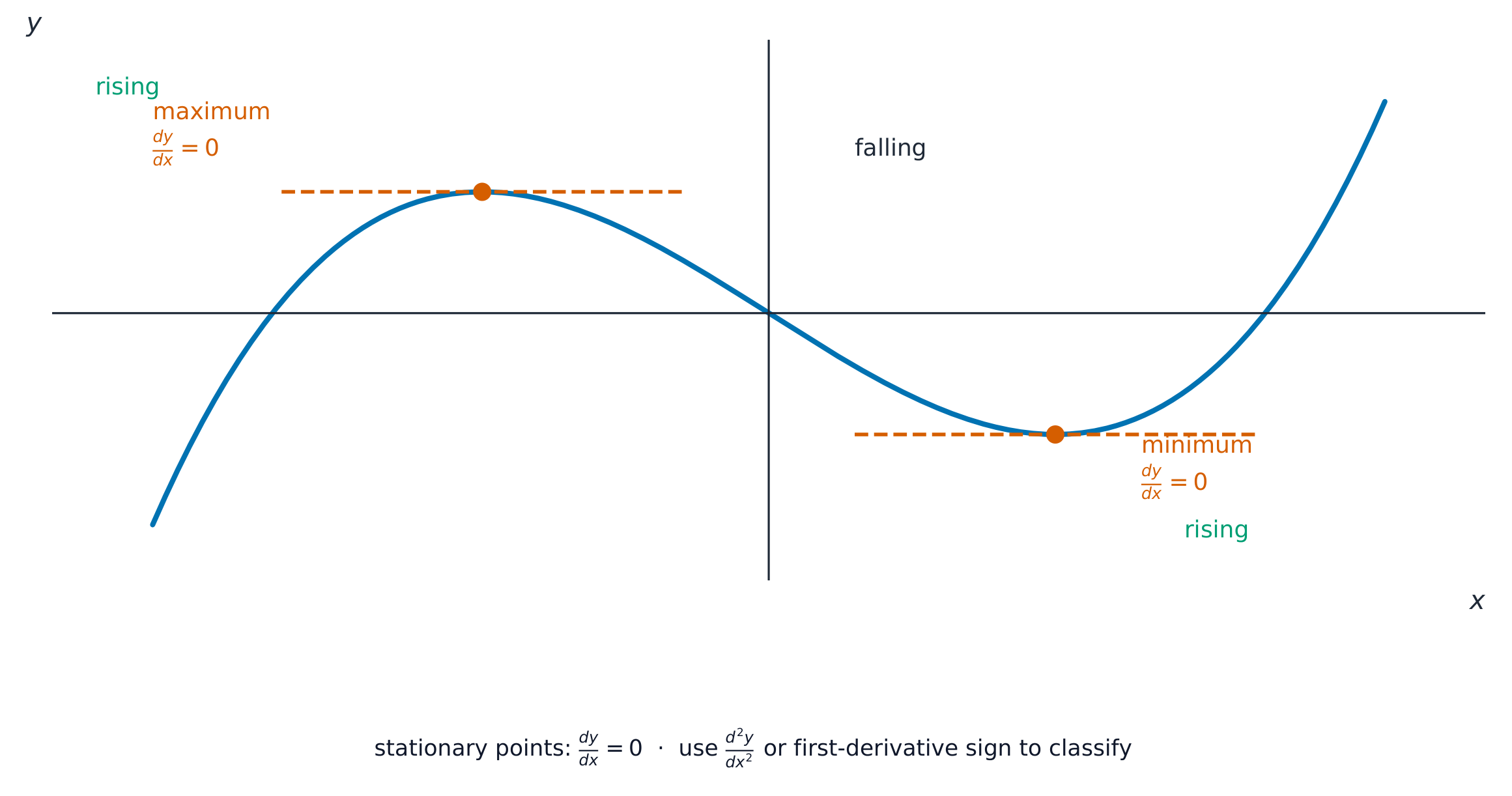
A stationary point 驻点 is where $\dfrac{dy}{dx} = 0$. Test its nature with the second derivative: $f''(x) > 0$ gives a minimum point 极小值点, and $f''(x) < 0$ gives a maximum point 极大值点. When $f''(x) = 0$ the test is inconclusive: the point may be a point of inflexion 拐点, where the curve changes concavity (the way it bends) – check the sign of $\dfrac{dy}{dx}$ just before and after to decide.
At a maximum or a minimum the tangent is flat, so $\frac{dy}{dx}=0$. Worked example. The curve $y = 4x^{1/2} - x$ has a maximum point at $x = a$. Find $a$.
$$\frac{dy}{dx} = 2x^{-1/2} - 1 = 0 \;\Rightarrow\; \frac{2}{\sqrt{x}} = 1 \;\Rightarrow\; \sqrt{x} = 2 \;\Rightarrow\; x = 4.$$So $a = 4$.Explore · ИсследоватьThe gradient at a point · Наклон касательной в точке
y = ax³ + bx² + cx + d
Slide the point along the curve. The tangent shows the gradient $\frac{dy}{dx}$ there — steeper where the curve bends more. · Проведите точку вдоль кривой. Касательная показывает наклон $\frac{dy}{dx}$ в этой точке — он круче там, где кривая сильнее изгибается.
Vocabulary · Словарь Train · ТренироватьEnglish Русский Differentiation/ˌdɪfəˌrenʃɪˈeɪʃn/ Дифференцирование gradient of a curve/ˈɡreɪdɪənt əvə kɜːv/ градиент кривой limit/ˈlɪmɪt/ предел derivative/dɪˈrɪvətɪv/ производной chain rule/tʃeɪn ruːl/ цепное правило second derivative/ˈsekənd dɪˈrɪvətɪv/ вторую производную normal/ˈnɔːml/ нормаль increasing function/ɪnˈkriːsɪŋ ˈfʌŋkʃn/ возрастающая функция decreasing function/ˈdiːkriːsɪŋ ˈfʌŋkʃn/ убывающая функция rate of change/reɪt ɒv tʃeɪndʒ/ скорость изменения stationary point/ˈsteɪʃənəri pɔɪnt/ стационарная точка minimum point/ˈmɪnɪməm pɔɪnt/ точка минимума maximum point/ˈmæksɪməm pɔɪnt/ точка максимума point of inflexion/pɔɪnt ɒv ɪnˈflekʃn/ точка перегиба 1.8
Integration
Syllabus · Программа
EnglishCandidates should be able to: Notes and examples understand integration as the reverse process of differentiation, and integrate $(ax + b)^n$ (for any rational $n$ except $-1$), together with constant multiples, sums and differences e.g. $\int (2x^3 - 5x + 1) \text{d}x$, $\int \frac{1}{(2x + 3)^2} \text{d}x$. solve problems involving the evaluation of a constant of integration e.g. to find the equation of the curve through $(1, -2)$ for which $\frac{\text{d}y}{\text{d}x} = \sqrt{2x + 1}$. evaluate definite integrals Including simple cases of 'improper' integrals, such as $\int_{0}^{1} x^{-\frac{1}{2}} \text{d}x$ and $\int_{1}^{\infty} x^{-2} \text{d}x$. use definite integration to find: - the area of a region bounded by a curve and lines parallel to the axes, or between a curve and a line or between two curves - a volume of revolution about one of the axes. A volume of revolution may involve a region not bounded by the axis of rotation, e.g. the region between $y = 9 - x^2$ and $y = 5$ rotated about the $x$-axis. РусскийКандидаты должны уметь: Примечания и примеры понимать интегрирование как процесс, обратный дифференцированию, и интегрировать $(ax + b)^n$ (для любого рационального $n$, кроме $-1$), вместе с постоянными множителями, суммами и разностями Например, $\int (2x^3 - 5x + 1) \text{d}x$, $\int \frac{1}{(2x + 3)^2} \text{d}x$. решать задачи, связанные с определением постоянной интегрирования Например, чтобы найти уравнение кривой, проходящей через $(1, -2)$, для которой $\frac{\text{d}y}{\text{d}x} = \sqrt{2x + 1}$. вычислять определенные интегралы Включая простые случаи «несобственных» интегралов, таких как $\int_{0}^{1} x^{-\frac{1}{2}} \text{d}x$ и $\int_{1}^{\infty} x^{-2} \text{d}x$. использовать определенное интегрирование для нахождения: - площади области, ограниченной кривой и прямыми, параллельными осям, или между кривой и прямой, или между двумя кривыми - объема тела вращения относительно одной из осей. Объем тела вращения может включать область, не ограниченную осью вращения, например, область между $y = 9 - x^2$ и $y = 5$, вращаемую вокруг оси $x$. Source: Cambridge International syllabus · Источник: Программа Cambridge International
Integration as area: Riemann rectangles Integration 积分 is the reverse of differentiation. Reversing the power rule gives
$$\int (ax + b)^n \, dx = \frac{(ax + b)^{n+1}}{a(n + 1)} + C \quad (n \neq -1).$$The $+\,C$ is the constant of integration 积分常数. If you know one point on the curve, substitute it to find $C$.Definite integrals and area
A definite integral 定积分 has limits and gives a number:
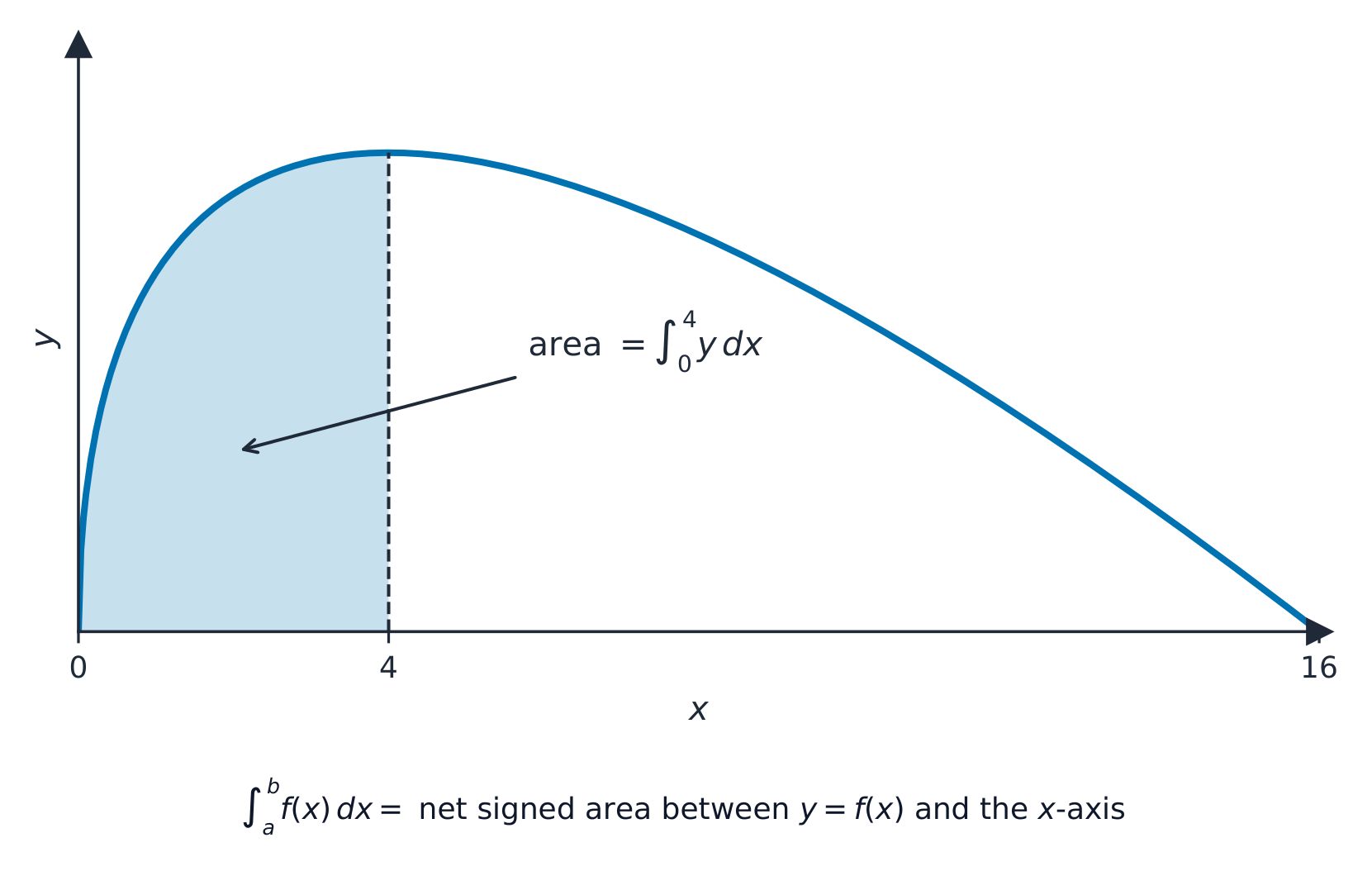
$$\int_p^q f(x)\, dx = \big[F(x)\big]_p^q = F(q) - F(p).$$The area of the region 区域 between a curve and the $x$-axis, from $x = p$ to $x = q$, is $\displaystyle\int_p^q y \, dx$. For the area between two curves, integrate (top curve $-$ bottom curve).The definite integral $\int_0^4 y\,dx$ is the shaded area under the curve. Worked example. The curve $y = 4x^{1/2} - x$ meets the $x$-axis again at $x = 16$. Find the area between the curve and the $x$-axis from $x = 0$ to $x = 4$.
$$\int_0^4 \left(4x^{1/2} - x\right) dx = \left[\frac{8}{3}x^{3/2} - \frac{x^2}{2}\right]_0^4 = \frac{8}{3}(8) - \frac{16}{2} = \frac{64}{3} - 8 = \frac{40}{3}.$$An improper integral 广义积分 has an infinite limit or an endpoint where the integrand is undefined; evaluate it as a limit. For example,
$$\int_1^{\infty}x^{-2}\, dx=\lim_{b\to\infty}\left[-\frac1x\right]_1^{b}=\lim_{b\to\infty}\left(1-\frac1b\right)=1,$$and $\displaystyle\int_0^{1}x^{-1/2}\, dx=\left[2x^{1/2}\right]_0^{1}=2$, which is finite even though the integrand blows up at $x=0$.Volume of revolution
When a region is turned all the way around an axis it sweeps out a solid. The volume of revolution 旋转体体积 about the $x$-axis is
$$V = \pi \int_p^q y^2 \, dx,$$and about the $y$-axis it is $V = \pi \displaystyle\int x^2 \, dy$. For example, the region under $y = \sqrt{x}$ from $x = 0$ to $x = 4$, turned about the $x$-axis, has volume $\pi\displaystyle\int_0^4 x\, dx = \pi\big[\tfrac{x^2}{2}\big]_0^4 = 8\pi$.
Rotating the region under a curve around the $x$-axis sweeps out a solid; each thin slice is a disc of area $\pi y^2$, so $V = \pi\int y^2\,dx$ Explore · ИсследоватьArea under a curve · Площадь под кривой
y = ax³ + bx² + cx + d
Drag the limits. The definite integral is the shaded area between the curve and the x-axis. · Перетащите пределы. Определенный интеграл — это заштрихованная область между кривой и осью x.
Vocabulary · Словарь Train · ТренироватьEnglish Русский Integration/ˌɪntɪˈɡreɪʃn/ Интеграция constant of integration/ˈkɒnstənt ɒv ˌɪntɪˈɡreɪʃn/ постоянная интегрирования definite integral/ˈdefɪnət ˈɪntɪɡrəl/ определенный интеграл region/ˈriːdʒn/ регион improper integral/ɪmˈprɒpə ˈɪntɪɡrəl/ несобственный интеграл volume of revolution/ˈvɒljuːm ɒv ˌrevəˈluːʃn/ объем тела вращения 1.8
Exam tips
- Show every line of algebra — method marks are lost by jumping steps; use the discriminant $b^2 - 4ac$ to decide the number of real roots.
- Work in radians for circular measure (arc $= r\theta$, sector area $= \frac{1}{2}r^2\theta$) and for calculus of trig functions.
- For differentiation, set $\frac{dy}{dx} = 0$ for stationary points and use the second derivative to classify them.
- For integration, add $+ c$ to an indefinite integral and use limits for area; an area below the axis gives a negative integral.
Vocabulary · Словарь Train · ТренироватьEnglish Русский algebra/ˈældʒɪbrə/ алгебра calculus/ˈkælkjʊləs/ математический анализ -
2
Pure Mathematics 2 · Чистая математика 2
Watch lesson · Смотреть урокEnglishThis handout covers Topic 2: Pure Mathematics 纯数学 2. It adds the modulus and polynomial algebra, logarithms 对数 and the exponential function 指数函数, more trigonometry, and new ways to differentiate and integrate.
РусскийЭти материалы охватывают Раздел 2: Чистая математика 2. Здесь добавлены модуль и многочлены, логарифмы и показательная функция, дополнительная тригонометрия, а также новые методы дифференцирования и интегрирования.
2.1
Algebra · Алгебра
Syllabus · Программа
EnglishCandidates should be able to: Notes and examples understand the meaning of $|x|$, sketch the graph of $y = |ax + b|$ and use relations such as $|a| = |b| \iff a^2 = b^2$ and $|x - a| < b \iff a - b < x < a + b$ when solving equations and inequalities Graphs of $y = |f(x)|$ and $y = f(|x|)$ for non-linear functions $f$ are not included. e.g. $|3x - 2| = |2x + 7|$, $2x + 5 < |x + 1|$ divide a polynomial, of degree not exceeding 4, by a linear or quadratic polynomial, and identify the quotient and remainder (which may be zero) use the factor theorem and the remainder theorem. e.g. to find factors and remainders, solve polynomial equations or evaluate unknown coefficients. Including factors of the form $(ax + b)$ in which the coefficient of $x$ is not unity, and including calculation of remainders. РусскийКандидаты должны уметь: Примечания и примеры Понимать смысл $|x|$, строить график функции $y = |ax + b|$ и использовать соотношения, такие как $|a| = |b| \iff a^2 = b^2$ и $|x - a| < b \iff a - b < x < a + b$, при решении уравнений и неравенств Графики $y = |f(x)|$ и $y = f(|x|)$ для нелинейных функций $f$ не включены. Например, $|3x - 2| = |2x + 7|$, $2x + 5 < |x + 1|$ делить многочлен степени не выше 4 на линейный или квадратный многочлен и определять частное и остаток (которые могут быть равны нулю) использовать теорему о корнях и теорему об остатке. Например, для нахождения множителей и остатков, решения многочленных уравнений или вычисления неизвестных коэффициентов. Включая множители вида $(ax + b)$, в которых коэффициент при $x$ не равен единице, а также вычисление остатков. Source: Cambridge International syllabus · Источник: Программа Cambridge International
EnglishThe modulus
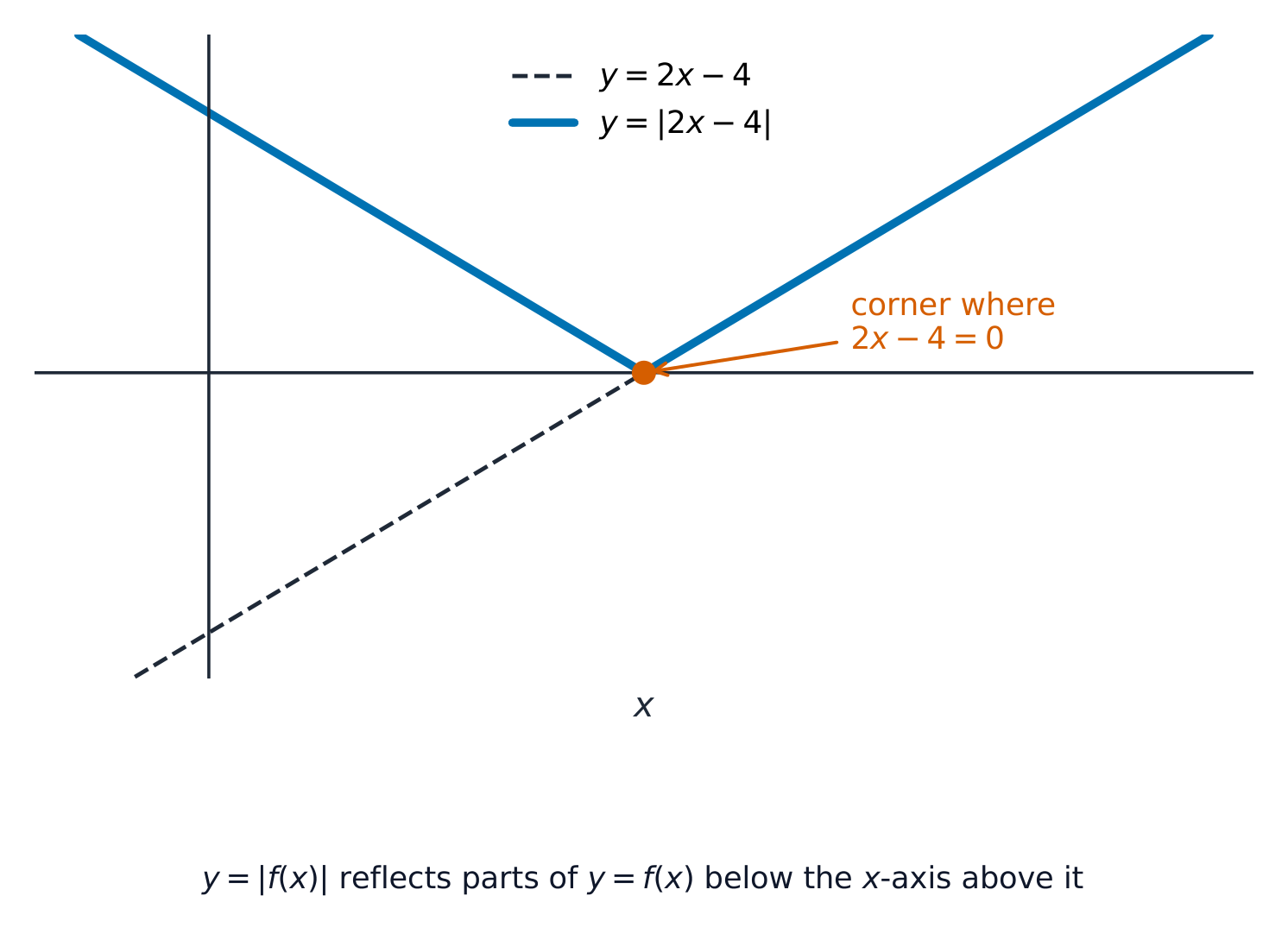
The modulus 绝对值 $|x|$ is the size of a number with its sign removed, so $|x| \geqslant 0$ always. The graph of $y = |ax + b|$ is a "V" shape that bounces off the $x$-axis. Two useful rules for solving equations and inequalities are
$$|a| = |b| \;\Leftrightarrow\; a^2 = b^2, \qquad |x - a| < b \;\Leftrightarrow\; a - b < x < a + b.$$Worked example. Solve $|3x + 8| < 9$.
Using the second rule with the inequality written as $-9 < 3x + 8 < 9$:
$$-9 < 3x + 8 < 9 \;\Rightarrow\; -17 < 3x < 1 \;\Rightarrow\; -\tfrac{17}{3} < x < \tfrac13.$$Polynomial division and the factor and remainder theorems
A polynomial 多项式 is a sum of powers of $x$, such as $2x^4 + 3x^2 - 5$. Its degree 次数 is the highest power. When you divide one polynomial by another you get a quotient 商 and a remainder 余数.
- Remainder theorem 余数定理: the remainder when $p(x)$ is divided by $(x - a)$ is $p(a)$.
- Factor theorem 因式定理: $(x - a)$ is a factor of $p(x)$ exactly when $p(a) = 0$.
Worked example. The polynomial $p(x) = 2x^4 + kx^3 + kx^2 + 17x + 18$ has factor $(x + 2)$. Find $k$.
By the factor theorem $p(-2) = 0$:
$$2(16) + k(-8) + k(4) + 17(-2) + 18 = 0 \;\Rightarrow\; 16 - 4k = 0 \;\Rightarrow\; k = 4.$$РусскийМодуль
Модуль $|x|$ — это число без учёта его знака, поэтому $|x| \geqslant 0$ всегда положительно. График функции $y = |ax + b|$ имеет форму «V», отражаясь от оси $x$. Два полезных правила для решения уравнений и неравенств:
$$|a| = |b| \;\Leftrightarrow\; a^2 = b^2, \qquad |x - a| < b \;\Leftrightarrow\; a - b < x < a + b.$$Взятие модуля складывает часть линии, расположенную ниже оси, вверх, образуя форму V. Разобранный пример. Решите уравнение $|3x + 8| < 9$.
Используя второе правило с неравенством в виде $-9 < 3x + 8 < 9$:
$$-9 < 3x + 8 < 9 \;\Rightarrow\; -17 < 3x < 1 \;\Rightarrow\; -\tfrac{17}{3} < x < \tfrac13.$$Деление многочленов и теоремы о делителе и остатке
Многочлен — это сумма степеней $x$, например $2x^4 + 3x^2 - 5$. Его степень равна наибольшей из показателей степени. При делении одного многочлена на другой получаются частное и остаток.
- Теорема об остатке: остаток при делении $p(x)$ на $(x - a)$ равен $p(a)$.
- Теорема о делителе: $(x - a)$ является делителем $p(x)$ тогда и только тогда, когда $p(a) = 0$.
Разобранный пример. Многочлен $p(x) = 2x^4 + kx^3 + kx^2 + 17x + 18$ имеет делитель $(x + 2)$. Найдите $k$.
Согласно теореме о делителе для $p(-2) = 0$:
$$2(16) + k(-8) + k(4) + 17(-2) + 18 = 0 \;\Rightarrow\; 16 - 4k = 0 \;\Rightarrow\; k = 4.$$Explore · ИсследоватьThe modulus function · Модульная функция
y = a|x − b| + c
The modulus makes a V-shape. Move its vertex with b and c; change how steep the arms are with a. · Модуль создает форму буквы V. Перемещайте ее вершину с помощью b и c; меняйте крутизну ветвей с помощью a.
Vocabulary · Словарь Train · ТренироватьEnglish Русский Pure Mathematics/pjʊə ˌmæθɪˈmætɪks/ Чистая математика (Pure Mathematics) logarithms/ˈlɒɡərɪθəmz/ логарифмы exponential function/ˌekspəˈnenʃl ˈfʌŋkʃn/ показательная функция modulus/ˈmɒdjʊləs/ модуль polynomial/ˌpɒlɪˈnəʊmɪəl/ полиномом degree/dɪˈɡriː/ степени quotient/ˈkwəʊʃənt/ частное remainder/rɪˈmeɪndə/ остаток remainder theorem/rɪˈmeɪndə ˈθɪərəm/ теорема о остатке factor theorem/ˈfæktə ˈθɪərəm/ теорема о делителе indices/ˈɪndɪsiːz/ показатели степени laws of logarithms/lɔːz ɒv ˈlɒɡərɪθəmz/ свойства логарифмов natural logarithm/ˈnætʃərəl ˈlɒɡərɪθəm/ натуральный логарифм linear form/ˈlɪnɪə fɔːm/ линейная форма 2.2
Logarithmic and exponential functions · Логарифмические и показательные функции

Syllabus · Программа
EnglishCandidates should be able to: Notes and examples understand the relationship between logarithms and indices, and use the laws of logarithms (excluding change of base) understand the definition and properties of $e^x$ and $\ln x$, including their relationship as inverse functions and their graphs Including knowledge of the graph of $y = e^{kx}$ for both positive and negative values of $k$. use logarithms to solve equations and inequalities in which the unknown appears in indices e.g. $2^x < 5$, $3 \times 2^{3x-1} < 5$, $3^{x+1} = 4^{2x-1}$ use logarithms to transform a given relationship to linear form, and hence determine unknown constants by considering the gradient and/or intercept. e.g. $y = kx^n$ gives $\ln y = \ln k + n \ln x$ which is linear in $\ln x$ and $\ln y$ $y = k(a^x)$ gives $\ln y = \ln k + x \ln a$ which is linear in $x$ and $\ln y$. РусскийКандидаты должны уметь: Примечания и примеры понимать связь между логарифмами и показателями и использовать законы логарифмов (за исключением смены основания) понимать определение и свойства $e^x$ и $\ln x$, включая их связь как обратных функций и их графики Включая знание графика $y = e^{kx}$ как для положительных, так и для отрицательных значений $k$. использовать логарифмы для решения уравнений и неравенств, в которых неизвестное встречается в показателях Например, $2^x < 5$, $3 \times 2^{3x-1} < 5$, $3^{x+1} = 4^{2x-1}$ использовать логарифмы для преобразования заданной зависимости к линейному виду и, следовательно, определять неизвестные константы, рассматривая наклон и/или пересечение с осью. например, $y = kx^n$ приводит к $\ln y = \ln k + n \ln x$, которое является линейным относительно $\ln x$ и $\ln y$. $y = k(a^x)$ приводит к $\ln y = \ln k + x \ln a$, которое является линейным относительно $x$ и $\ln y$. Source: Cambridge International syllabus · Источник: Программа Cambridge International
EnglishA logarithm answers the question "what power?". If $a^x = y$ then $x = \log_a y$. Logarithms and indices 指数 (powers) are reverse ideas. The laws of logarithms 对数定律 are
$$\log(mn) = \log m + \log n, \qquad \log\!\frac{m}{n} = \log m - \log n, \qquad \log(m^k) = k\log m.$$The exponential function $e^x$ and the natural logarithm 自然对数 $\ln x$ are inverse functions, so $\ln(e^x) = x$ and $e^{\ln x} = x$. When the unknown is in the power, take logs of both sides.
Worked example. Solve $4^x < 0.05$.
$$4^x < 0.05 \;\Rightarrow\; x\ln 4 < \ln 0.05 \;\Rightarrow\; x < \frac{\ln 0.05}{\ln 4} = -2.16 \ (\text{3 s.f.}).$$Linear form 线性形式: a relationship like $y = Ax^n$ becomes a straight line if you take logs: $\ln y = \ln A + n\ln x$. Plotting $\ln y$ against $\ln x$ gives a line with gradient $n$ and intercept $\ln A$, so you can find the unknown constants.
РусскийМощность землетрясений измеряется по логарифмической шкале Рихтера. 
Численность населения может расти экспоненциально при наличии ресурсов. Логарифм отвечает на вопрос «в какую степень?». Если $a^x = y$, то $x = \log_a y$. Логарифмы и показатели (степени) — взаимно обратные понятия. Законы логарифмов следующие:
$$\log(mn) = \log m + \log n, \qquad \log\!\frac{m}{n} = \log m - \log n, \qquad \log(m^k) = k\log m.$$Показательная функция $e^x$ и натуральный логарифм $\ln x$ являются обратными функциями, поэтому $\ln(e^x) = x$ и $e^{\ln x} = x$. Когда неизвестное находится в показателе степени, возьмите логарифм от обеих частей.
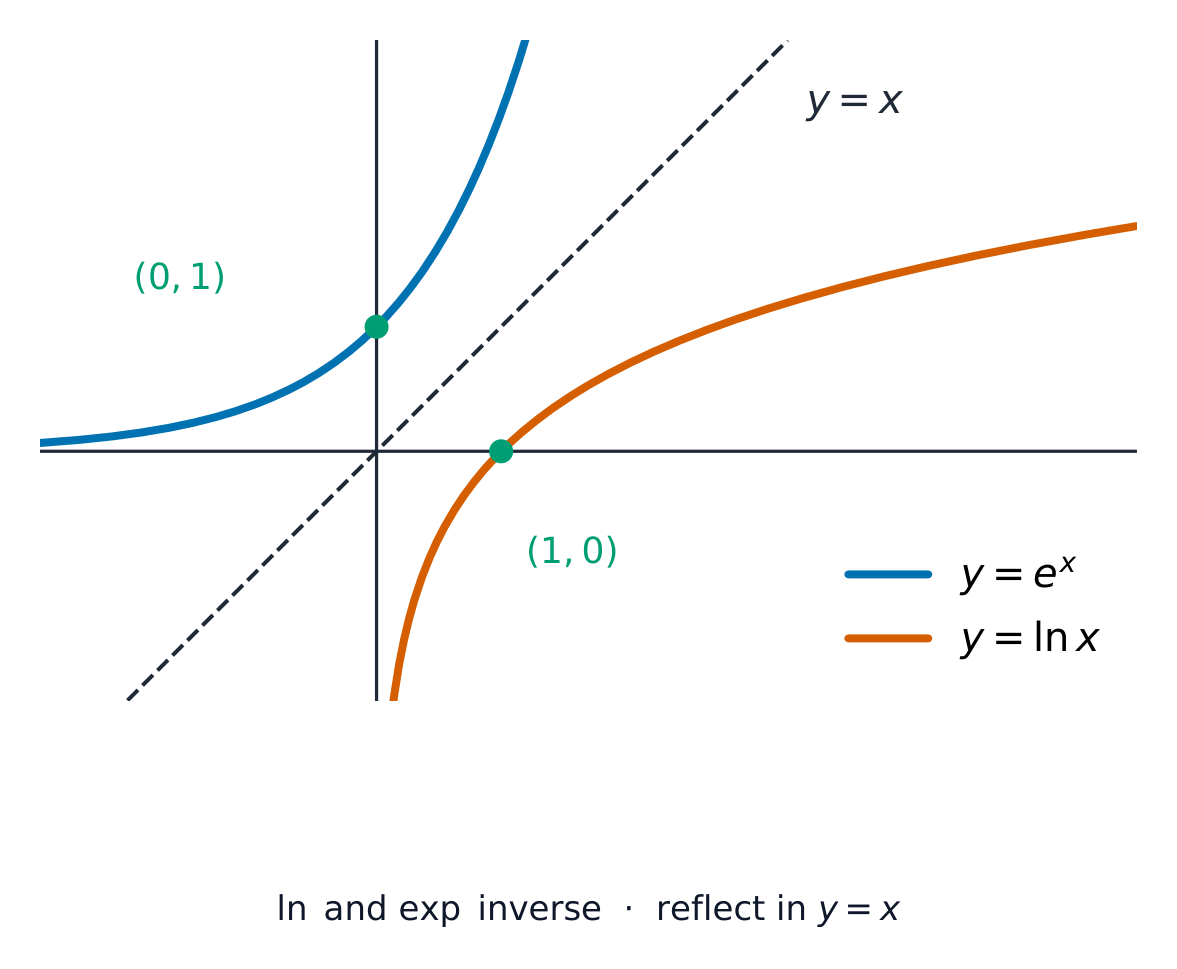
$e^x$ и $\ln x$ взаимно уничтожают друг друга, поэтому каждая из них является отражением другой относительно $y=x$. Разобранный пример. Решите уравнение $4^x < 0.05$.
$$4^x < 0.05 \;\Rightarrow\; x\ln 4 < \ln 0.05 \;\Rightarrow\; x < \frac{\ln 0.05}{\ln 4} = -2.16 \ (\text{3 знач. цифр}).$$Линейная форма: зависимость вида $y = Ax^n$ становится прямой линией после логарифмирования: $\ln y = \ln A + n\ln x$. Построение графика зависимости $\ln y$ от $\ln x$ дает прямую с угловым коэффициентом $n$ и пересечением с осью $\ln A$, что позволяет найти неизвестные константы.
Explore · ИсследоватьExponential growth · Показательный рост
y = a·bˣ
Change the base b: when b > 1 the curve grows, when 0 < b < 1 it decays — and it always passes through (0, a). · Измените основание b: когда b > 1 кривая растет, когда 0 < b < 1 она убывает — и она всегда проходит через точку (0, a).
2.3
Trigonometry · Тригонометрия

Syllabus · Программа
Candidates should be able to: Notes and examples understand the relationship of the secant, cosecant and cotangent functions to cosine, sine and tangent, and use properties and graphs of all six trigonometric functions for angles of any magnitude use trigonometrical identities for the simplification and exact evaluation of expressions, and in the course of solving equations, and select an identity or identities appropriate to the context, showing familiarity in particular with the use of: – $\sec^2 \theta \equiv 1 + \tan^2 \theta$ and $\csc^2 \theta \equiv 1 + \cot^2 \theta$ – the expansions of $\sin(A \pm B)$, $\cos(A \pm B)$ and $\tan(A \pm B)$ – the formulae for $\sin 2A$, $\cos 2A$ and $\tan 2A$ – the expression of $a \sin \theta + b \cos \theta$ in the forms $R \sin(\theta \pm \alpha)$ and $R \cos(\theta \pm \alpha)$. e.g. simplifying $\cos(x - 30^\circ) - 3 \sin(x - 60^\circ)$. e.g. solving $\tan \theta + \cot \theta = 4$, $2 \sec^2 \theta - \tan \theta = 5$, $3 \cos \theta + 2 \sin \theta = 1$. Source: Cambridge International syllabus · Источник: Программа Cambridge International
EnglishThere are three more functions, each the reciprocal of one you know: the secant 正割 $\sec\theta = \dfrac{1}{\cos\theta}$, the cosecant 余割 $\csc\theta = \dfrac{1}{\sin\theta}$, and the cotangent 余切 $\cot\theta = \dfrac{1}{\tan\theta}$.
You must know these trigonometric identities 三角恒等式 and choose the right one for each problem:
$$\sec^2\theta \equiv 1 + \tan^2\theta, \qquad \csc^2\theta \equiv 1 + \cot^2\theta.$$You also use the compound angle 复合角 formulae for $\sin(A \pm B)$, $\cos(A \pm B)$, $\tan(A \pm B)$, the double angle 二倍角 formulae$$\sin 2A = 2\sin A\cos A, \quad \cos 2A = 2\cos^2 A - 1, \quad \tan 2A = \frac{2\tan A}{1 - \tan^2 A},$$and the R-formula 辅助角公式 $a\sin\theta + b\cos\theta = R\sin(\theta + \alpha)$, where $R = \sqrt{a^2 + b^2}$ and $\tan\alpha = \dfrac{b}{a}$.Worked example. Solve $2\tan^2\theta + 3\sec\theta = 18$ for $-180^\circ < \theta < 180^\circ$.
Replace $\tan^2\theta$ with $\sec^2\theta - 1$ to get one function:
$$2(\sec^2\theta - 1) + 3\sec\theta = 18 \;\Rightarrow\; 2\sec^2\theta + 3\sec\theta - 20 = 0 \;\Rightarrow\; (2\sec\theta - 5)(\sec\theta + 4) = 0.$$So $\sec\theta = \tfrac52$ or $\sec\theta = -4$, giving $\cos\theta = \tfrac25$ or $\cos\theta = -\tfrac14$. The solutions are $\theta = \pm 66.4^\circ$ and $\theta = \pm 104.5^\circ$.РусскийЕсть еще три функции, являющиеся обратными к известным вам: секанс $\sec\theta = \dfrac{1}{\cos\theta}$, косеканс $\csc\theta = \dfrac{1}{\sin\theta}$ и котангенс $\cot\theta = \dfrac{1}{\tan\theta}$.
$\sec\theta=1/\cos\theta$ возрастает до асимптоты везде, где $\cos\theta=0$. Вы должны знать эти тригонометрические тождества и выбирать правильное для каждой задачи:
$$\sec^2\theta \equiv 1 + \tan^2\theta, \qquad \csc^2\theta \equiv 1 + \cot^2\theta.$$Также используются формулы суммы углов для $\sin(A \pm B)$, $\cos(A \pm B)$, $\tan(A \pm B)$, формулы удвоения угла$$\sin 2A = 2\sin A\cos A, \quad \cos 2A = 2\cos^2 A - 1, \quad \tan 2A = \frac{2\tan A}{1 - \tan^2 A},$$и R-формула $a\sin\theta + b\cos\theta = R\sin(\theta + \alpha)$, где $R = \sqrt{a^2 + b^2}$ и $\tan\alpha = \dfrac{b}{a}$.Разобранное решение. Решите $2\tan^2\theta + 3\sec\theta = 18$ относительно $-180^\circ < \theta < 180^\circ$.
Замените $\tan^2\theta$ на $\sec^2\theta - 1$, чтобы получить одну функцию:
$$2(\sec^2\theta - 1) + 3\sec\theta = 18 \;\Rightarrow\; 2\sec^2\theta + 3\sec\theta - 20 = 0 \;\Rightarrow\; (2\sec\theta - 5)(\sec\theta + 4) = 0.$$Следовательно, $\sec\theta = \tfrac52$ или $\sec\theta = -4$, откуда следует $\cos\theta = \tfrac25$ или $\cos\theta = -\tfrac14$. Решениями являются $\theta = \pm 66.4^\circ$ и $\theta = \pm 104.5^\circ$.Explore · ИсследоватьThe unit circle · Единичная окружность
Drag the angle to see how $\sin$, $\cos$ and $\tan$ relate — the key to solving trig equations. · Перетащите угол, чтобы увидеть, как связаны между собой $\sin$, $\cos$ и $\tan$ — ключ к решению тригонометрических уравнений.
Vocabulary · Словарь Train · ТренироватьEnglish Русский secant/ˈsiːkənt/ секающую cosecant/ˈkəʊsekənt/ косеканс cotangent/ˈkəʊtændʒənt/ котангенс trigonometric identities/ˌtrɪɡənəʊˈmetrɪk aɪˈdentɪtiz/ тригонометрические тождества compound angle/ˈkɒmpaʊnd ˈæŋɡl/ суммарный угол double angle/ˈdʌbl ˈæŋɡl/ двойной угол R-formula/ɑː ˈfɔːmjʊlə/ формула R product rule/ˈprɒdʌkt ruːl/ правило произведения quotient rule/ˈkwəʊʃənt ruːl/ правило частного parametric equations/ˌpærəˈmetrɪk ɪˈkweɪʒnz/ параметрические уравнения implicitly/ɪmˈplɪsɪtli/ неявно 2.4
Differentiation · Дифференцирование
Syllabus · Программа
EnglishCandidates should be able to: Notes and examples use the derivatives of $e^x$, $\ln x$, $\sin x$, $\cos x$, $\tan x$, together with constant multiples, sums, differences and composites differentiate products and quotients e.g. $\frac{2x - 4}{3x + 2}$, $x^2 \ln x$, $x e^{1 - x^2}$. find and use the first derivative of a function which is defined parametrically or implicitly. e.g. $x = t - e^{2t}$, $y = t + e^{2t}$. e.g. $x^2 + y^2 = xy + 7$. Including use in problems involving tangents and normals. РусскийКандидаты должны уметь: Примечания и примеры использовать производные от $e^x$, $\ln x$, $\sin x$, $\cos x$, $\tan x$, вместе с постоянными множителями, суммами, разностями и композициями дифференцировать произведения и дроби например, $\frac{2x - 4}{3x + 2}$, $x^2 \ln x$, $x e^{1 - x^2}$. находить и использовать первую производную функции, заданной параметрически или неявно. например, $x = t - e^{2t}$, $y = t + e^{2t}$. например, $x^2 + y^2 = xy + 7$. Включая применение в задачах, связанных с касательными и нормлями. Source: Cambridge International syllabus · Источник: Программа Cambridge International
EnglishLearn these standard derivatives:
$$\frac{d}{dx}e^x = e^x, \quad \frac{d}{dx}\ln x = \frac{1}{x}, \quad \frac{d}{dx}\sin x = \cos x, \quad \frac{d}{dx}\cos x = -\sin x, \quad \frac{d}{dx}\tan x = \sec^2 x.$$For a product or a quotient of two functions, use:
- the product rule 乘积法则: $(uv)' = u'v + uv'$;
- the quotient rule 商法则: $\left(\dfrac{u}{v}\right)' = \dfrac{u'v - uv'}{v^2}$.
When a curve is given by parametric equations 参数方程 $x = x(t)$, $y = y(t)$, the gradient is $\dfrac{dy}{dx} = \dfrac{dy/dt}{dx/dt}$. When $y$ is defined implicitly 隐式 (not made the subject), differentiate every term with respect to $x$, using the chain rule on the $y$ terms, then solve for $\dfrac{dy}{dx}$.
Worked example. Given $y = 6x\cos(x^2 + 1)$, find $\dfrac{dy}{dx}$.
Use the product rule with $u = 6x$ and $v = \cos(x^2 + 1)$ (and the chain rule for $v$):
$$\frac{dy}{dx} = 6\cos(x^2 + 1) + 6x\cdot\big(-2x\sin(x^2 + 1)\big) = 6\cos(x^2 + 1) - 12x^2\sin(x^2 + 1).$$РусскийВыучите эти стандартные производные:
$$\frac{d}{dx}e^x = e^x, \quad \frac{d}{dx}\ln x = \frac{1}{x}, \quad \frac{d}{dx}\sin x = \cos x, \quad \frac{d}{dx}\cos x = -\sin x, \quad \frac{d}{dx}\tan x = \sec^2 x.$$Для произведения или частного двух функций используйте:
- правило произведения: $(uv)' = u'v + uv'$;
- правило частного: $\left(\dfrac{u}{v}\right)' = \dfrac{u'v - uv'}{v^2}$.
Когда кривая задана параметрическими уравнениями $x = x(t)$, $y = y(t)$, угловой коэффициент равен $\dfrac{dy}{dx} = \dfrac{dy/dt}{dx/dt}$. Когда $y$ задано неявно (не выражено явно), продифференцируйте каждое слагаемое по переменной $x$, применяя правило сложной функции к членам со $y$, затем решите относительно $\dfrac{dy}{dx}$.
Разобранный пример. Дано $y = 6x\cos(x^2 + 1)$, найдите $\dfrac{dy}{dx}$.
Используйте правило произведения для $u = 6x$ и $v = \cos(x^2 + 1)$ (и правило сложной функции для $v$):
$$\frac{dy}{dx} = 6\cos(x^2 + 1) + 6x\cdot\big(-2x\sin(x^2 + 1)\big) = 6\cos(x^2 + 1) - 12x^2\sin(x^2 + 1).$$Explore · ИсследоватьTangent and gradient · Касательная и наклон
y = ax³ + bx² + cx + d
Move the point: the tangent line is the derivative at that x. Where the curve turns, the gradient is zero. · Перемещайте точку: касательная линия представляет производную в данной точке x. Там, где кривая меняет направление, наклон равен нулю.
2.5
Integration · Интегрирование
Syllabus · Программа
EnglishCandidates should be able to: Notes and examples • extend the idea of ‘reverse differentiation’ to include the integration of $e^{ax + b}$, $\frac{1}{ax + b}$, $\sin(ax + b)$, $\cos(ax + b)$ and $\sec^2(ax + b)$ Knowledge of the general method of integration by substitution is not required. • use trigonometrical relationships in carrying out integration e.g. use of double-angle formulae to integrate $\sin^2 x$ or $\cos^2(2x)$. • understand and use the trapezium rule to estimate the value of a definite integral. Including use of sketch graphs in simple cases to determine whether the trapezium rule gives an over-estimate or an under-estimate. РусскийКандидаты должны уметь: Примечания и примеры • расширить понятие «обратного дифференцирования» на интегрирование $e^{ax + b}$, $\frac{1}{ax + b}$, $\sin(ax + b)$, $\cos(ax + b)$ и $\sec^2(ax + b)$ Знание общего метода интегрирования заменой переменной не требуется. • использовать тригонометрические соотношения при выполнении интегрирования например, использование формул двойного угла для интегрирования $\sin^2 x$ или $\cos^2(2x)$. • понимать и применять правило трапеции для оценки значения определенного интеграла. Включая использование эскизных графиков в простых случаях для определения того, дает ли правило трапеции завышенную или заниженную оценку. Source: Cambridge International syllabus · Источник: Программа Cambridge International
EnglishIntegration is reverse differentiation — reverse each new derivative; harder integrals may need integration by substitution 换元积分 (developed in Pure 3). For a linear inside function $(ax + b)$:
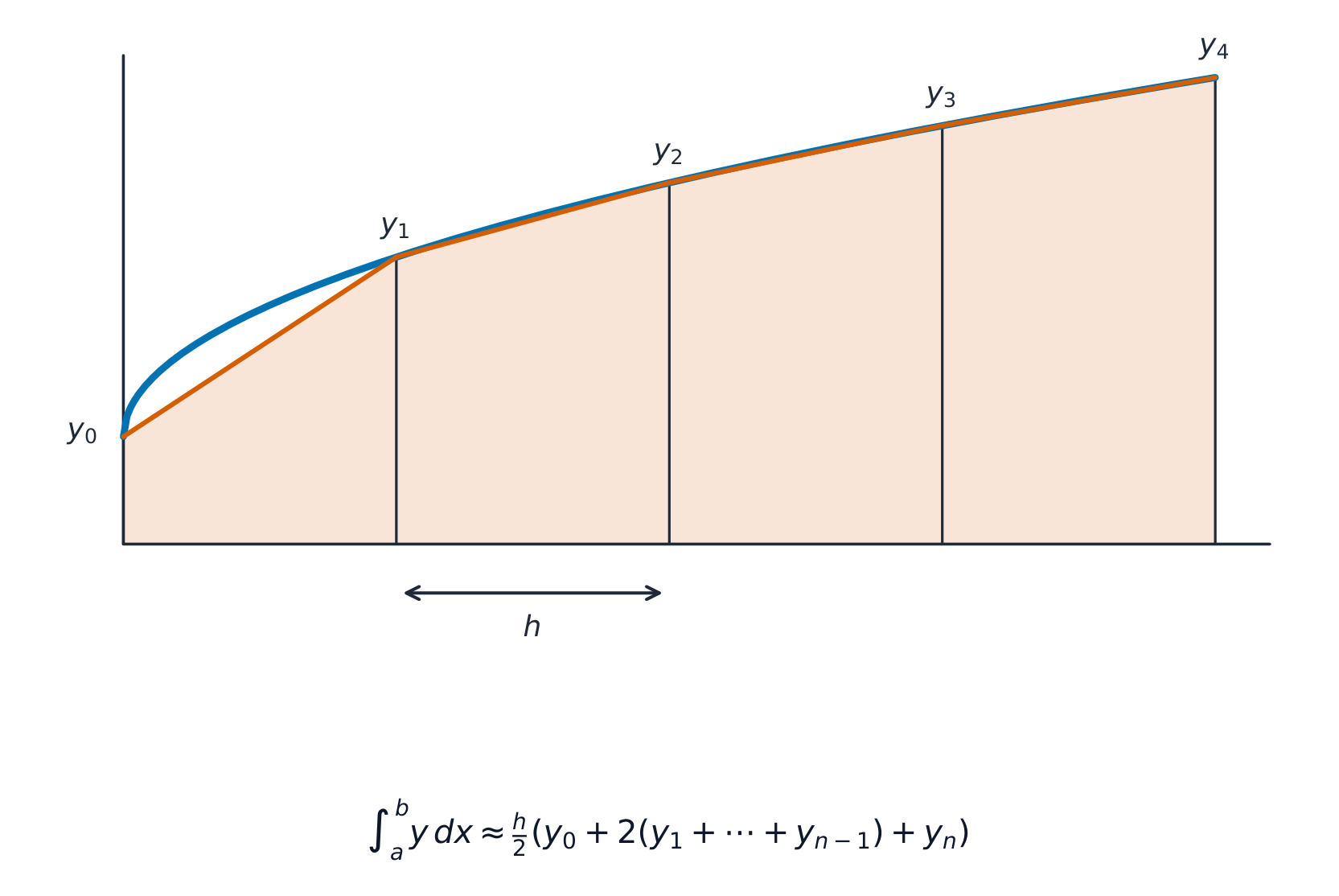
$$\int e^{ax+b}\,dx = \frac{1}{a}e^{ax+b} + C, \qquad \int \frac{1}{ax+b}\,dx = \frac{1}{a}\ln|ax + b| + C,$$$$\int \sin(ax+b)\,dx = -\frac{1}{a}\cos(ax+b) + C, \qquad \int \cos(ax+b)\,dx = \frac{1}{a}\sin(ax+b) + C, \qquad \int \sec^2(ax+b)\,dx = \frac{1}{a}\tan(ax+b) + C.$$To integrate a power of $\sin$ or $\cos$, first use an identity to remove the power. When you cannot integrate exactly, the trapezium rule 梯形法则 estimates a definite integral:$$\int_a^b y\,dx \approx \tfrac{h}{2}\big[y_0 + y_n + 2(y_1 + y_2 + \cdots + y_{n-1})\big].$$Worked example. Find $\displaystyle\int 6\sin^2 x\,dx$.
Use $\sin^2 x = \tfrac12(1 - \cos 2x)$:
$$\int 6\sin^2 x\,dx = \int (3 - 3\cos 2x)\,dx = 3x - \tfrac32\sin 2x + C.$$РусскийИнтегрирование — это обратное дифференцированию; берите обратную операцию для каждого нового производного; сложные интегралы могут потребовать замены переменной (изучается в Чистой математике 3). Для линейной внутренней функции $(ax + b)$:
$$\int e^{ax+b}\,dx = \frac{1}{a}e^{ax+b} + C, \qquad \int \frac{1}{ax+b}\,dx = \frac{1}{a}\ln|ax + b| + C,$$$$\int \sin(ax+b)\,dx = -\frac{1}{a}\cos(ax+b) + C, \qquad \int \cos(ax+b)\,dx = \frac{1}{a}\sin(ax+b) + C, \qquad \int \sec^2(ax+b)\,dx = \frac{1}{a}\tan(ax+b) + C.$$Чтобы проинтегрировать степень $\sin$ или $\cos$, сначала используйте тождество, чтобы убрать степень. Когда точное интегрирование невозможно, метод трапеции оценивает определенный интеграл:$$\int_a^b y\,dx \approx \tfrac{h}{2}\big[y_0 + y_n + 2(y_1 + y_2 + \cdots + y_{n-1})\big].$$Каждая полоса шириной $h$ является трапецией; их площади в сумме дают оценку интеграла. Разобранный пример. Найдите $\displaystyle\int 6\sin^2 x\,dx$.
Используйте $\sin^2 x = \tfrac12(1 - \cos 2x)$:
$$\int 6\sin^2 x\,dx = \int (3 - 3\cos 2x)\,dx = 3x - \tfrac32\sin 2x + C.$$Explore · ИсследоватьThe area under the curve · Площадь под кривой
area = ∫ f(x) dx · площадь = ∫ f(x) dx
The integral still measures area — drag a and b to total the strip under the curve. · Интеграл всё ещё измеряет площадь — перетащите a и b, чтобы суммировать полосы под кривой.
Vocabulary · Словарь Train · ТренироватьEnglish Русский trapezium rule/trəˈpiːzɪəm ruːl/ правило трапеций root/ruːt/ корнем 2.6
Numerical solution of equations · Численное решение уравнений
Syllabus · Программа
EnglishCandidates should be able to: Notes and examples • locate approximately a root of an equation, by means of graphical considerations and/or searching for a sign change e.g. finding a pair of consecutive integers between which a root lies. • understand the idea of, and use the notation for, a sequence of approximations which converges to a root of an equation • understand how a given simple iterative formula of the form $x_{n + 1} = \text{F}(x_n)$ relates to the equation being solved, and use a given iteration, or an iteration based on a given rearrangement of an equation, to determine a root to a prescribed degree of accuracy. Knowledge of the condition for convergence is not included, but an understanding that an iteration may fail to converge is expected. РусскийКандидаты должны уметь: Примечания и примеры • приблизительно найти корень уравнения, используя графические соображения и/или поиск смены знака например, нахождение пары последовательных целых чисел, между которыми находится корень. • понимать идею и использовать обозначение для последовательности приближений, сходящейся к корню уравнения • понимать, как данное простое итерационное соотношение вида $x_{n + 1} = \text{F}(x_n)$ связано с решаемым уравнением, и использовать заданную итерацию или итерацию, основанную на данном преобразовании уравнения, чтобы определить корень с заданной степенью точности. Знание условия сходимости не включено, но ожидается понимание того, что итерация может не сойтись. Source: Cambridge International syllabus · Источник: Программа Cambridge International
EnglishIterating to a root: ride the tangent Many equations cannot be solved exactly. Two ideas help you find a root 根 (a solution).
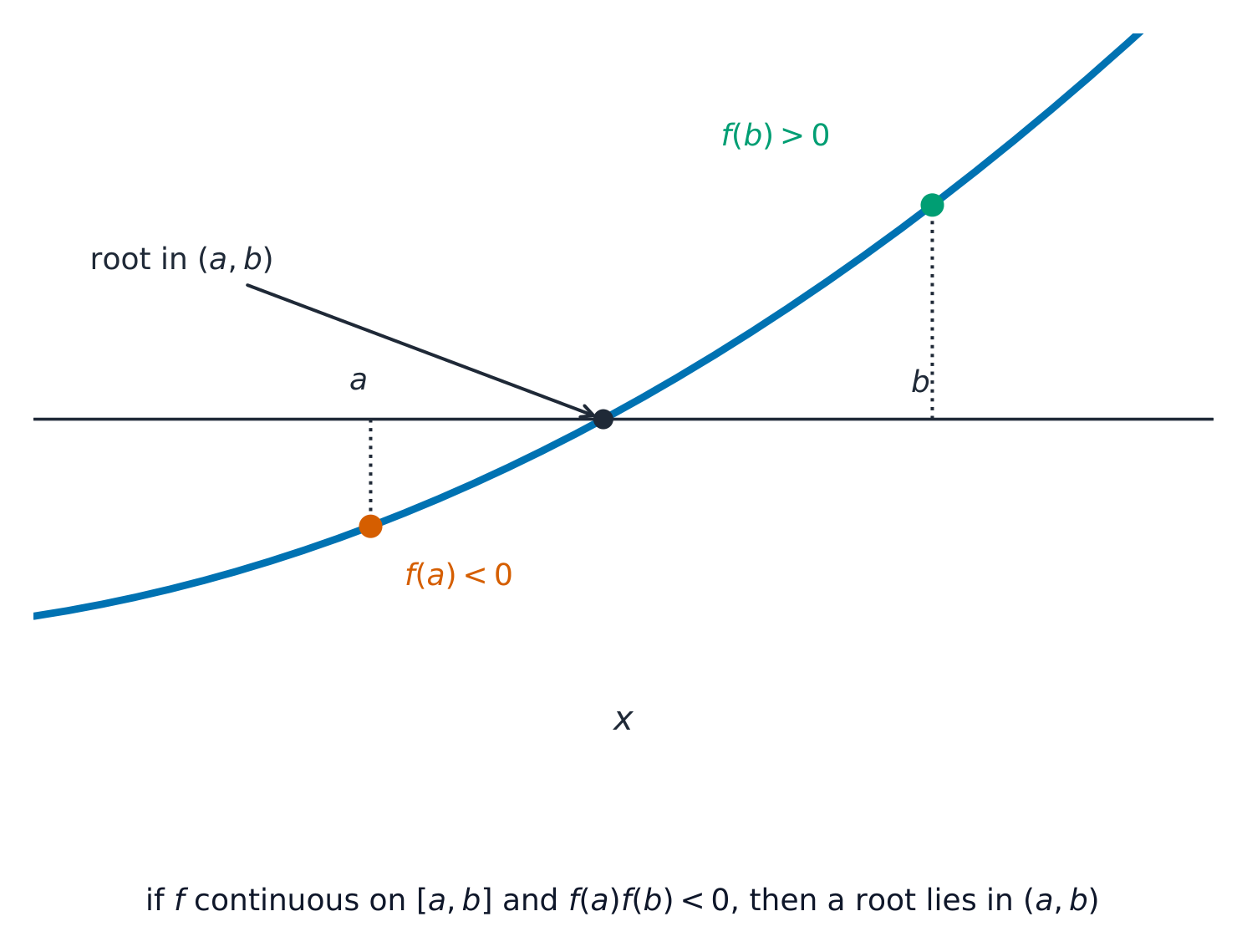
- Sign change 变号: if $f(a)$ and $f(b)$ have opposite signs (and the graph has no break between them), a root lies between $a$ and $b$.
- Iteration 迭代: rearrange the equation into the form $x = F(x)$, then use the iterative formula 迭代公式 $x_{n+1} = F(x_n)$. Start from a first guess $x_0$ and repeat. If the values are convergent they settle down and converge 收敛 to a root. Keep going until the answer is steady to the accuracy asked for.
Worked example. A root $\beta$ of an equation satisfies $x = \sqrt[3]{-2x - 4.5}$, and $-1.4 < \beta < -1.0$. Use the iteration $x_{n+1} = \sqrt[3]{-2x_n - 4.5}$ with $x_0 = -1.2$.
$$x_1 = \sqrt[3]{-2(-1.2) - 4.5} = \sqrt[3]{-2.1} = -1.281, \qquad x_2 = \sqrt[3]{-2(-1.281) - 4.5} = -1.247, \quad \ldots$$The values settle near $-1.26$, so $\beta = -1.26$ (3 s.f.).РусскийИтерации к корню: езда по касательной Многие уравнения нельзя решить точно. Две идеи помогают найти корень (решение).
- Смена знака: если $f(a)$ и $f(b)$ имеют противоположные знаки (и график не имеет разрыва между ними), корень находится между $a$ и $b$.
- Итерация: перестройте уравнение в вид $x = F(x)$, затем используйте итерационную формулу $x_{n+1} = F(x_n)$. Начните с первой догадки $x_0$ и повторяйте. Если значения сходятся, они стабилизируются и сходятся к корню. Продолжайте, пока ответ не станет устойчивым с требуемой точностью.
$f(a)$ и $f(b)$ имеют противоположные знаки, поэтому корень заперт между $a$ и $b$. 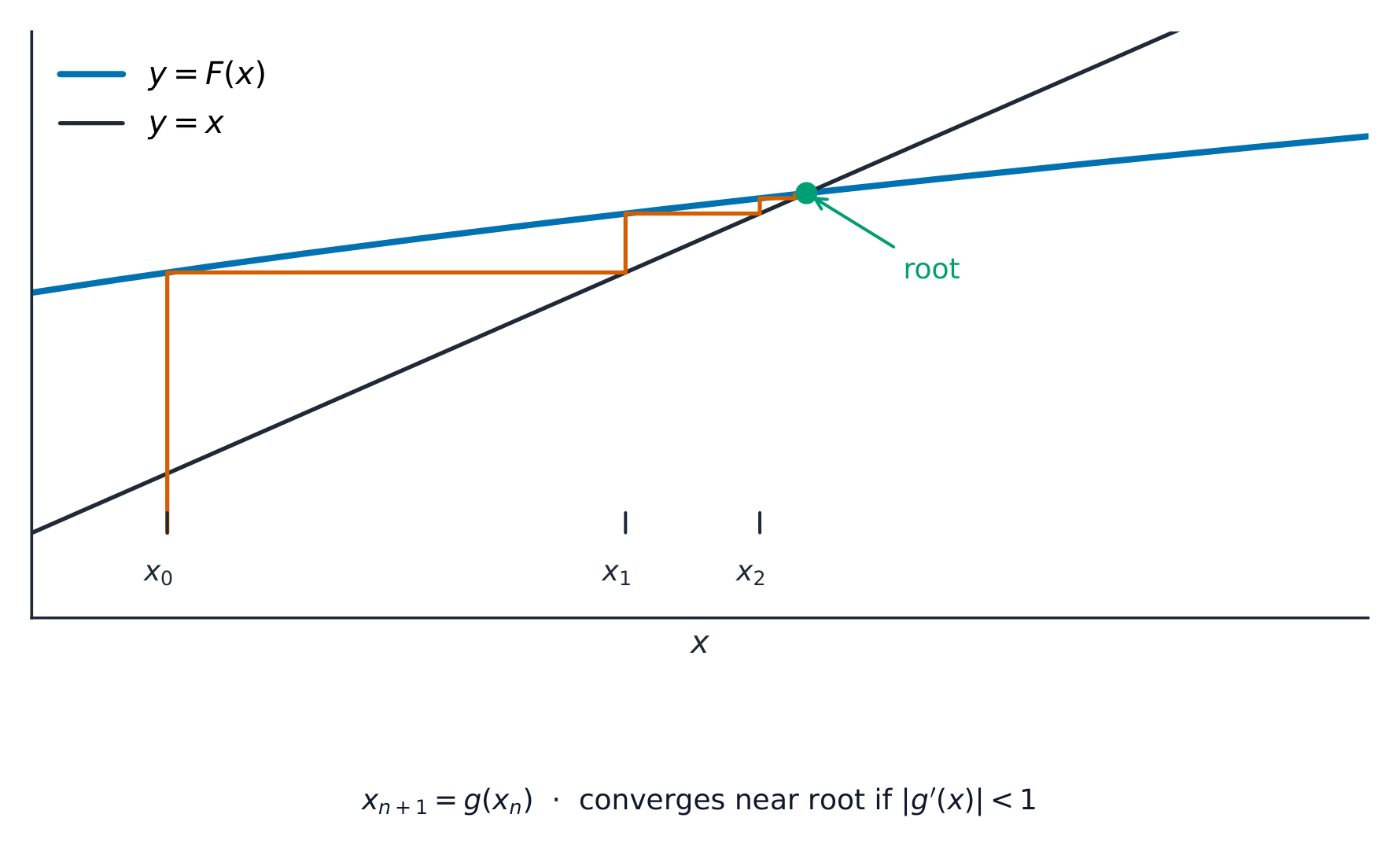
Каждый шаг идет вверх до $y=F(x)$, затем вбок до $y=x$; лестница сходится к корню. Разобранный пример. Корень $\beta$ уравнения удовлетворяет $x = \sqrt[3]{-2x - 4.5}$ и $-1.4 < \beta < -1.0$. Используйте итерацию $x_{n+1} = \sqrt[3]{-2x_n - 4.5}$ с $x_0 = -1.2$.
$$x_1 = \sqrt[3]{-2(-1.2) - 4.5} = \sqrt[3]{-2.1} = -1.281, \qquad x_2 = \sqrt[3]{-2(-1.281) - 4.5} = -1.247, \quad \ldots$$Значения сходятся к $-1.26$, поэтому $\beta = -1.26$ (3 значащих цифры).Explore · ИсследоватьWhere is the root? · Где находится корень?
y = ax³ + bx² + cx + d
A root is where the curve crosses zero. A sign change in f(x) traps a root between two x-values. · Корень — это точка, где кривая пересекает ноль. Изменение знака f(x) указывает на наличие корня между двумя значениями x.
Vocabulary · Словарь Train · ТренироватьEnglish Русский sign change/saɪn tʃeɪndʒ/ смена знака iteration/ˌɪtəˈreɪʃn/ итерации iterative formula/ˈɪtərətɪv ˈfɔːmjʊlə/ итерационная формула converge/kənˈvɜːdʒ/ стремиться к пределу (сходиться) integration by substitution/ˌɪntɪˈɡreɪʃn baɪ ˌsʌbstɪˈtjuːʃn/ замена переменной в интеграле 2.6
Exam tips · Советы для экзамена
English- Use the laws of logarithms to solve equations; remember $\ln$ and $e^x$ are inverses.
- For numerical methods, show a sign change to locate a root, set out the iteration clearly, and give the answer to the stated accuracy.
- Learn the chain, product and quotient rules and identify which the function needs.
- Solve modulus equations $|f(x)| = g(x)$ by considering both the positive and negative cases, and sketch to check.
Русский- Используйте законы логарифмов для решения уравнений; помните, что $\ln$ и $e^x$ являются взаимно обратными функциями.
- Для численных методов покажите смену знака, чтобы найти корень, четко оформите итерацию и дайте ответ с указанной точностью.
- Выучите правила сложной функции, произведения и частного и определите, какое правило нужно данной функции.
- Решайте модульные уравнения $|f(x)| = g(x)$, рассматривая как положительный, так и отрицательный случаи, и делайте набросок для проверки.
-
3
Pure Mathematics 3 · Чистая математика 3
Watch lesson · Смотреть урокThis handout covers Topic 3: Pure Mathematics 纯数学 3. Subtopics 3.1–3.6 build on the algebra, logarithms, trigonometry, differentiation, integration and numerical methods of Pure Mathematics 2, so this handout explains what is new in Pure 3 and then covers the three big new areas: vectors, differential equations and complex numbers.
3.1
Algebra
Syllabus · Программа
Candidates should be able to: Notes and examples • understand the meaning of $|x|$, sketch the graph of $y = |ax + b|$ and use relations such as $|a| = |b| \iff a^2 = b^2$ and $|x - a| < b \iff a - b < x < a + b$ when solving equations and inequalities Graphs of $y = |\text{f}(x)|$ and $y = \text{f}(|x|)$ for non-linear functions $\text{f}$ are not included. e.g. $|3x - 2| = |2x + 7|$, $2x + 5 < |x + 1|$. • divide a polynomial, of degree not exceeding 4, by a linear or quadratic polynomial, and identify the quotient and remainder (which may be zero) • use the factor theorem and the remainder theorem e.g. to find factors and remainders, solve polynomial equations or evaluate unknown coefficients. Including factors of the form $(ax + b)$ in which the coefficient of $x$ is not unity, and including calculation of remainders. • recall an appropriate form for expressing rational functions in partial fractions, and carry out the decomposition, in cases where the denominator is no more complicated than – $(ax + b)(cx + d)(ex + f)$ – $(ax + b)(cx + d)^2$ – $(ax + b)(cx^2 + d)$ Excluding cases where the degree of the numerator exceeds that of the denominator • use the expansion of $(1 + x)^n$, where $n$ is a rational number and $|x| < 1$. Finding the general term in an expansion is not included. Adapting the standard series to expand e.g. $(2 - \frac{1}{2}x)^{-1}$ is included, and determining the set of values of $x$ for which the expansion is valid in such cases is also included. Source: Cambridge International syllabus · Источник: Программа Cambridge International
Two new tools join the algebra from Pure 2.
Partial fractions
A single fraction with a factorised bottom can be split into a sum of simpler fractions. This is called writing it in partial fractions 部分分式, and it makes a rational function 有理函数 (a fraction of polynomials) easy to integrate or expand. Match the form to the bottom:
First check the top is lower degree than the bottom. If it is not ("top-heavy"), divide the polynomial first: dividing gives a quotient 商 plus a remainder 余数 over the original bottom, and you split only that remaining proper fraction.
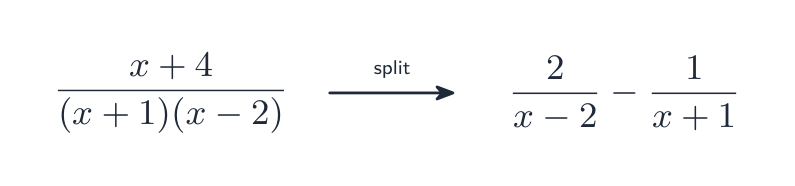
One fraction with a factorised bottom splits into a sum of simpler fractions.
$$\frac{1}{(ax+b)(cx+d)} = \frac{A}{ax+b} + \frac{B}{cx+d}, \qquad \frac{1}{(ax+b)(cx+d)^2} = \frac{A}{ax+b} + \frac{B}{cx+d} + \frac{C}{(cx+d)^2}.$$Worked example. Express $\dfrac{x+4}{(x+1)(x-2)}$ in partial fractions.
Write $\dfrac{x+4}{(x+1)(x-2)} = \dfrac{A}{x+1} + \dfrac{B}{x-2}$, so $x + 4 = A(x-2) + B(x+1)$. Put $x = 2$: $6 = 3B$, so $B = 2$. Put $x = -1$: $3 = -3A$, so $A = -1$. Hence
$$\frac{x+4}{(x+1)(x-2)} = \frac{2}{x-2} - \frac{1}{x+1}.$$The binomial expansion for a rational power
The binomial expansion 二项展开式 also works when the power is a fraction or is negative, as long as $|x| < 1$:
$$(1 + x)^n = 1 + nx + \frac{n(n-1)}{2!}x^2 + \frac{n(n-1)(n-2)}{3!}x^3 + \cdots$$For example $(1 + x)^{1/2} = 1 + \tfrac12 x - \tfrac18 x^2 + \cdots$ for $|x| < 1$.Explore · ИсследоватьReciprocal curves · Обратные кривые
y = a/(x − b) + c
Partial fractions split a hard fraction into simple reciprocal pieces — each with a vertical and a horizontal asymptote. · Разложение на простейшие дроби разбивает сложную дробь на простые обратные части — каждая с вертикальной и горизонтальной асимптотой.
Vocabulary · Словарь Train · ТренироватьEnglish Русский Pure Mathematics/pjʊə ˌmæθɪˈmætɪks/ Чистая математика (Pure Mathematics) partial fractions/ˈpɑːʃl ˈfrækʃnz/ разложения на простейшие дроби rational function/ˈræʃənl ˈfʌŋkʃn/ рациональная функция quotient/ˈkwəʊʃənt/ частное remainder/rɪˈmeɪndə/ остаток binomial expansion/baɪˈnəʊmɪəl ekˈspænʃn/ биномиальное разложение 3.2 3.3 3.6
Logarithms, trigonometry and numerical methods (from Pure 2)
Syllabus · Программа
EnglishCandidates should be able to: Notes and examples understand the relationship between logarithms and indices, and use the laws of logarithms (excluding change of base) understand the definition and properties of $e^x$ and $\ln x$, including their relationship as inverse functions and their graphs Including knowledge of the graph of $y = e^{kx}$ for both positive and negative values of $k$. use logarithms to solve equations and inequalities in which the unknown appears in indices e.g. $2^x < 5$, $3 \times 2^{3x-1} < 5$, $3^{x+1} = 4^{2x-1}$. use logarithms to transform a given relationship to linear form, and hence determine unknown constants by considering the gradient and/or intercept. e.g. $y = kx^n$ gives $\ln y = \ln k + n \ln x$ which is linear in $\ln x$ and $\ln y$. $y = k(a^x)$ gives $\ln y = \ln k + x \ln a$ which is linear in $x$ and $\ln y$. РусскийКандидаты должны уметь: Примечания и примеры понимать связь между логарифмами и показателями (степенями), а также использовать законы логарифмов (за исключением смены основания) понимать определение и свойства $e^x$ и $\ln x$, включая их связь как обратных функций и их графики Включая знание графика $y = e^{kx}$ как для положительных, так и для отрицательных значений $k$. использовать логарифмы для решения уравнений и неравенств, в которых неизвестное встречается в показателе например, $2^x < 5$, $3 \times 2^{3x-1} < 5$, $3^{x+1} = 4^{2x-1}$. использовать логарифмы для преобразования заданной зависимости к линейному виду и, следовательно, определять неизвестные константы, рассматривая наклон и/или пересечение с осью. например, $y = kx^n$ приводит к $\ln y = \ln k + n \ln x$, которое является линейным относительно $\ln x$ и $\ln y$. $y = k(a^x)$ приводит к $\ln y = \ln k + x \ln a$, которое является линейным относительно $x$ и $\ln y$. Candidates should be able to: Notes and examples understand the relationship of the secant, cosecant and cotangent functions to cosine, sine and tangent, and use properties and graphs of all six trigonometric functions for angles of any magnitude use trigonometrical identities for the simplification and exact evaluation of expressions, and in the course of solving equations, and select an identity or identities appropriate to the context, showing familiarity in particular with the use of: – $\sec^2 \theta \equiv 1 + \tan^2 \theta$ and $\cosec^2 \theta \equiv 1 + \cot^2 \theta$ – the expansions of $\sin(A \pm B)$, $\cos(A \pm B)$ and $\tan(A \pm B)$ – the formulae for $\sin 2A$, $\cos 2A$ and $\tan 2A$ – the expression of $a \sin \theta + b \cos \theta$ in the forms $R \sin(\theta \pm \alpha)$ and $R \cos(\theta \pm \alpha)$. e.g. simplifying $\cos(x - 30^\circ) - 3 \sin(x - 60^\circ)$. e.g. solving $\tan \theta + \cot \theta = 4$, $2 \sec^2 \theta - \tan \theta = 5$, $3 \cos \theta + 2 \sin \theta = 1$. EnglishCandidates should be able to: Notes and examples • locate approximately a root of an equation, by means of graphical considerations and/or searching for a sign change e.g. finding a pair of consecutive integers between which a root lies. • understand the idea of, and use the notation for, a sequence of approximations which converges to a root of an equation • understand how a given simple iterative formula of the form $x_{n+1} = \text{F}(x_n)$ relates to the equation being solved, and use a given iteration, or an iteration based on a given rearrangement of an equation, to determine a root to a prescribed degree of accuracy. Knowledge of the condition for convergence is not included, but an understanding that an iteration may fail to converge is expected. РусскийКандидаты должны уметь: Примечания и примеры • приблизительно находить корень уравнения, используя графические соображения и/или поиск смены знака например, нахождение пары последовательных целых чисел, между которыми лежит корень. • понимать идею и знать обозначение для последовательности приближений, которая сходится к корню уравнения • понимать, как заданная простая итерационная формула вида $x_{n+1} = \text{F}(x_n)$ связана с решаемым уравнением, и использовать заданную итерацию или итерацию, основанную на заданном преобразовании уравнения, чтобы найти корень с требуемой точностью. Знание условия сходимости не требуется, но ожидается понимание того, что итерация может не сходиться. Source: Cambridge International syllabus · Источник: Программа Cambridge International
Iterating to a root: ride the tangent Subtopics 3.2, 3.3 and 3.6 are the same skills you met in Pure 2: the laws of logarithms with $e^x$ and $\ln x$; the identities $\sec^2\theta \equiv 1 + \tan^2\theta$ and $\csc^2\theta \equiv 1 + \cot^2\theta$, the compound- and double-angle formulae, and the $R$-form of $a\sin\theta + b\cos\theta$; and solving an equation numerically by a sign change 变号 and an iterative formula 迭代公式 $x_{n+1} = F(x_n)$. Use them exactly as before.
The three new trig functions are the reciprocals 倒数 of the familiar ones: the secant 正割 $\sec\theta = \dfrac{1}{\cos\theta}$, the cosecant 余割 $\csc\theta = \dfrac{1}{\sin\theta}$, and the cotangent 余切 $\cot\theta = \dfrac{1}{\tan\theta} = \dfrac{\cos\theta}{\sin\theta}$. (Memory aid: match the third letter — sec goes with cosine.) The two Pythagorean identities above come straight from dividing $\sin^2\theta + \cos^2\theta \equiv 1$ by $\cos^2\theta$ or $\sin^2\theta$. For a numerical method, an iteration $x_{n+1}=F(x_n)$ converges 收敛 to the root when successive values get closer together.
Explore · ИсследоватьThe unit circle · Единичная окружность
(cos θ, sin θ)
The R-formula rewrites a sin θ + b cos θ as one wave — and it all lives on this circle. · Формула R переписывает a sin θ + b cos θ как одну волну — и всё это resides на этой окружности.
Vocabulary · Словарь Train · ТренироватьEnglish Русский sign change/saɪn tʃeɪndʒ/ смена знака iterative formula/ˈɪtərətɪv ˈfɔːmjʊlə/ итерационная формула reciprocals/rɪˈsɪprəklz/ обратными величинами secant/ˈsiːkənt/ секающую cosecant/ˈkəʊsekənt/ косеканс cotangent/ˈkəʊtændʒənt/ котангенс converges/kənˈvɜːdʒɪz/ сходится 3.4
Differentiation
Syllabus · Программа
EnglishCandidates should be able to: Notes and examples use the derivatives of $e^x$, $\ln x$, $\sin x$, $\cos x$, $\tan x$, $\tan^{-1} x$, together with constant multiples, sums, differences and composites Derivatives of $\sin^{-1} x$ and $\cos^{-1} x$ are not required. differentiate products and quotients e.g. $\frac{2x - 4}{3x + 2}$, $x^2 \ln x$, $x e^{1-x^2}$. find and use the first derivative of a function which is defined parametrically or implicitly. e.g. $x = t - e^{2t}$, $y = t + e^{2t}$. e.g. $x^2 + y^2 = xy + 7$. Including use in problems involving tangents and normals. РусскийКандидаты должны уметь: Примечания и примеры использовать производные от $e^x$, $\ln x$, $\sin x$, $\cos x$, $\tan x$, $\tan^{-1} x$, вместе с постоянными множителями, суммами, разностями и композициями Производные от $\sin^{-1} x$ и $\cos^{-1} x$ не требуются. дифференцировать произведения и дроби например, $\frac{2x - 4}{3x + 2}$, $x^2 \ln x$, $x e^{1-x^2}$. находить и использовать первую производную функции, заданной параметрически или неявно. например, $x = t - e^{2t}$, $y = t + e^{2t}$. например, $x^2 + y^2 = xy + 7$. Включая применение в задачах, связанных с касательными и нормлями. Source: Cambridge International syllabus · Источник: Программа Cambridge International
The methods are those of Pure 2 (the product, quotient and chain rules, with parametric and implicit curves). One derivative is added — the inverse tangent 反正切:
$$\frac{d}{dx}\tan^{-1} x = \frac{1}{1 + x^2}.$$Worked example. Differentiate $y = \tan^{-1}(3x)$.
Use the chain rule with the result above: $\dfrac{dy}{dx} = \dfrac{1}{1 + (3x)^2} \times 3 = \dfrac{3}{1 + 9x^2}.$
Explore · ИсследоватьThe gradient at a point · Наклон касательной в точке
gradient = dy/dx · наклон = dy/dx
Implicit or not, the derivative is still the slope of the tangent — slide the point to see it. · Независимо от того, явное оно или неявное, производная — это всё ещё наклон касательной — перетащите точку, чтобы увидеть это.
Vocabulary · Словарь Train · ТренироватьEnglish Русский inverse tangent/ɪnˈvɜːs ˈtændʒənt/ арктангенс 3.5
Integration
Syllabus · Программа
EnglishCandidates should be able to: Notes and examples extend the idea of 'reverse differentiation' to include the integration of $e^{ax + b}$, $\frac{1}{ax + b}$, $\sin(ax + b)$, $\cos(ax + b)$, $\sec^2(ax + b)$ and $\frac{1}{x^2 + a^2}$ Including examples such as $\frac{1}{2 + 3x^2}$. use trigonometrical relationships in carrying out integration e.g. use of double-angle formulae to integrate $\sin^2 x$ or $\cos^2(2x)$. integrate rational functions by means of decomposition into partial fractions Restricted to types of partial fractions as specified in topic 3.1 above. recognise an integrand of the form $\frac{k f'(x)}{f(x)}$, and integrate such functions e.g. integration of $\frac{x}{x^2 + 1}$, $\tan x$. recognise when an integrand can usefully be regarded as a product, and use integration by parts e.g. integration of $x \sin 2x$, $x^2 e^{-x}$, $\ln x$, $x \tan^{-1} x$. use a given substitution to simplify and evaluate either a definite or an indefinite integral. e.g. to integrate $\sin^2 2x \cos x$ using the substitution $u = \sin x$. РусскийКандидаты должны уметь: Примечания и примеры расширить понятие «обратного дифференцирования» для включения интегрирования $e^{ax + b}$, $\frac{1}{ax + b}$, $\sin(ax + b)$, $\cos(ax + b)$, $\sec^2(ax + b)$ и $\frac{1}{x^2 + a^2}$ Включая примеры, такие как $\frac{1}{2 + 3x^2}$. использовать тригонометрические соотношения при выполнении интегрирования например, использование формул двойного угла для интегрирования $\sin^2 x$ или $\cos^2(2x)$. интегрировать рациональные функции с помощью разложения на простые дроби Ограничивается типами простых дробей, указанными в теме 3.1 выше. распознавать подынтегральную функцию вида $\frac{k f'(x)}{f(x)}$ и интегрировать такие функции например, интегрирование $\frac{x}{x^2 + 1}$, $\tan x$. распознавать случаи, когда подынтегральную функцию целесообразно рассматривать как произведение, и использовать интегрирование по частям например, интегрирование $x \sin 2x$, $x^2 e^{-x}$, $\ln x$, $x \tan^{-1} x$. использовать заданную замену переменной для упрощения и вычисления определенного или неопределенного интеграла. например, интегрирование $\sin^2 2x \cos x$ с помощью замены $u = \sin x$. Source: Cambridge International syllabus · Источник: Программа Cambridge International
Pure 3 adds several powerful methods.
- A new standard integral: $\displaystyle\int \frac{1}{x^2 + a^2}\,dx = \frac{1}{a}\tan^{-1}\frac{x}{a} + C$.
- Partial fractions: split a rational function first, then integrate each piece as a logarithm.
- The pattern $\dfrac{k\,f'(x)}{f(x)}$: this integrates to $k\ln|f(x)| + C$. For example $\displaystyle\int \frac{2x}{x^2 + 1}\,dx = \ln(x^2 + 1) + C$.
- Integration by parts 分部积分, used for a product: $\displaystyle\int u\,\frac{dv}{dx}\,dx = uv - \int v\,\frac{du}{dx}\,dx$.
- Integration by substitution 换元积分: a given change of variable turns a hard integral into an easy one.
Worked example. Find $\displaystyle\int x\cos x\,dx$.
Use integration by parts with $u = x$ and $\dfrac{dv}{dx} = \cos x$, so $\dfrac{du}{dx} = 1$ and $v = \sin x$:
$$\int x\cos x\,dx = x\sin x - \int \sin x\,dx = x\sin x + \cos x + C.$$Explore · ИсследоватьThe area under the curve · Площадь под кривой
area = ∫ f(x) dx · площадь = ∫ f(x) dx
Every integration method just measures this area — drag the limits to total it. · Любой метод интегрирования просто измеряет эту площадь — перетащите пределы, чтобы получить итоговое значение.
Vocabulary · Словарь Train · ТренироватьEnglish Русский Integration by parts/ˌɪntɪˈɡreɪʃn baɪ pɑːts/ Интегрирование по частям Integration by substitution/ˌɪntɪˈɡreɪʃn baɪ ˌsʌbstɪˈtjuːʃn/ Интегрирование заменой 3.7
Vectors

Syllabus · Программа
EnglishCandidates should be able to: Notes and examples • use standard notations for vectors, i.e. $\begin{pmatrix} x \\ y \end{pmatrix}$, $x\mathbf{i} + y\mathbf{j}$, $\begin{pmatrix} x \\ y \\ z \end{pmatrix}$, $x\mathbf{i} + y\mathbf{j} + z\mathbf{k}$, $\overrightarrow{AB}$, $\mathbf{a}$ • carry out addition and subtraction of vectors and multiplication of a vector by a scalar, and interpret these operations in geometrical terms e.g. ‘$OABC$ is a parallelogram’ is equivalent to $\overrightarrow{OB} = \overrightarrow{OA} + \overrightarrow{OC}$. The general form of the ratio theorem is not included, but understanding that the midpoint of $AB$ has position vector $\frac{1}{2}(\overrightarrow{OA} + \overrightarrow{OB})$ is expected. • calculate the magnitude of a vector, and use unit vectors, displacement vectors and position vectors In 2 or 3 dimensions. • understand the significance of all the symbols used when the equation of a straight line is expressed in the form $\mathbf{r} = \mathbf{a} + t\mathbf{b}$, and find the equation of a line, given sufficient information e.g. finding the equation of a line given the position vector of a point on the line and a direction vector, or the position vectors of two points on the line. • determine whether two lines are parallel, intersect or are skew, and find the point of intersection of two lines when it exists Calculation of the shortest distance between two skew lines is not required. Finding the equation of the common perpendicular to two skew lines is also not required. • use formulae to calculate the scalar product of two vectors, and use scalar products in problems involving lines and points. e.g. finding the angle between two lines, and finding the foot of the perpendicular from a point to a line; questions may involve 3D objects such as cuboids, tetrahedra (pyramids), etc. Knowledge of the vector product is not required. РусскийКандидаты должны уметь: Примечания и примеры • использовать стандартные обозначения для векторов, т.е. $\begin{pmatrix} x \\ y \end{pmatrix}$, $x\mathbf{i} + y\mathbf{j}$, $\begin{pmatrix} x \\ y \\ z \end{pmatrix}$, $x\mathbf{i} + y\mathbf{j} + z\mathbf{k}$, $\overrightarrow{AB}$, $\mathbf{a}$ • выполнять сложение и вычитание векторов, а также умножение вектора на скаляр, и интерпретировать эти операции геометрически например, утверждение «$OABC$ является параллелограммом» эквивалентно $\overrightarrow{OB} = \overrightarrow{OA} + \overrightarrow{OC}$. Общий вид теоремы о делении отрезка в заданном отношении не включается, но ожидается понимание того, что середина отрезка $AB$ имеет радиус-вектор $\frac{1}{2}(\overrightarrow{OA} + \overrightarrow{OB})$. • вычислять модуль вектора и использовать единичные векторы, векторы перемещения и радиус-векторы В измерениях 2 или 3. • понимать значение всех символов при записи уравнения прямой в виде $\mathbf{r} = \mathbf{a} + t\mathbf{b}$ и находить уравнение прямой, з достаточное количество информации например, нахождение уравнения прямой, если известен радиус-вектор точки на прямой и направляющий вектор, или радиус-векторы двух точек на прямой. • определять, являются ли две прямые параллельными, пересекаются они или являются скрещивающимися, и находить точку пересечения двух прямых, если она существует Вычисление кратчайшего расстояния между двумя скрещивающимися прямыми не требуется. Нахождение уравнения общего перпендикуляра к двум скрещивающимся прямым также не требуется. • использовать формулы для вычисления скалярного произведения двух векторов и применять скалярные произведения в задачах, связанных с прямыми и точками. Например, нахождение угла между двумя прямыми и нахождение основания перпендикуляра из точки на прямую; вопросы могут включать задачи с 3D-объектами, такими как прямоугольные параллелепипеды, тетраэдры (пирамиды) и т.д. Знание векторного произведения не требуется. Source: Cambridge International syllabus · Источник: Программа Cambridge International
Forces like wind and water are vectors — they have both size and direction. A vector 向量 has both size and direction. Write it as a column, or as $x\mathbf{i} + y\mathbf{j} + z\mathbf{k}$, or as $\overrightarrow{AB}$.
- The magnitude 模长 (length) of $\mathbf{v} = x\mathbf{i} + y\mathbf{j} + z\mathbf{k}$ is $|\mathbf{v}| = \sqrt{x^2 + y^2 + z^2}$.
- A unit vector 单位向量 has magnitude $1$; divide a vector by its magnitude to make one.
- A position vector 位置向量 gives a point's place from the origin; a displacement vector 位移向量 $\overrightarrow{AB} = \mathbf{b} - \mathbf{a}$ goes from one point to another. Multiplying by a scalar 标量 (a plain number) stretches a vector.
Lines and the scalar product
A straight line through point $\mathbf{a}$ in direction $\mathbf{b}$ has vector equation $\mathbf{r} = \mathbf{a} + t\mathbf{b}$. Two lines may be parallel 平行, may intersect 相交 at a point, or may be skew lines 异面直线 (not parallel and never meeting).

Start at the point $\mathbf{a}$, then add $t$ copies of the direction $\mathbf{b}$ to reach any point on the line. The scalar product 数量积 (dot product) of $\mathbf{a}$ and $\mathbf{b}$ is
$$\mathbf{a}\cdot\mathbf{b} = a_1 b_1 + a_2 b_2 + a_3 b_3 = |\mathbf{a}|\,|\mathbf{b}|\cos\theta,$$where $\theta$ is the angle between them. So $\mathbf{a}\cdot\mathbf{b} = 0$ means the vectors are perpendicular.
The scalar product picks out $|\mathbf{b}|\cos\theta$, how far $\mathbf{b}$ reaches along $\mathbf{a}$. Worked example. Find the angle between $\mathbf{a} = \mathbf{i} + 2\mathbf{j} + 2\mathbf{k}$ and $\mathbf{b} = 2\mathbf{i} + 2\mathbf{j} + \mathbf{k}$.
$$\mathbf{a}\cdot\mathbf{b} = (1)(2) + (2)(2) + (2)(1) = 8, \qquad |\mathbf{a}| = |\mathbf{b}| = 3.$$So $\cos\theta = \dfrac{8}{3\times 3} = \dfrac{8}{9}$, giving $\theta = 27.3^\circ$.Explore · ИсследоватьAdding vectors and the dot product · Сложение векторов и скалярное произведение
Drag the two vectors. See the resultant (tip-to-tail) and the dot product, which is zero when they are perpendicular. · Перетащите два вектора. Видите равнодействующий (конец к началу) и скалярное произведение, которое равно нулю, когда они перпендикулярны.
Vocabulary · Словарь Train · ТренироватьEnglish Русский vector/ˈvektə/ векторное magnitude/ˈmæɡnɪtjuːd/ величина unit vector/ˈjuːnɪt ˈvektə/ единичный вектор position vector/pəˈzɪʃn ˈvektə/ вектор положения displacement vector/dɪˈspleɪsmənt ˈvektə/ вектор перемещения scalar/ˈskeɪlə/ скаляр parallel/ˈpærəlel/ параллельно intersect/ˌɪntəˈsekt/ пересекаться skew lines/skjuː laɪnz/ скрещивающиеся прямые scalar product/ˈskeɪlə ˈprɒdʌkt/ скалярное произведение 3.8
Differential equations

Syllabus · Программа
EnglishCandidates should be able to: Notes and examples formulate a simple statement involving a rate of change as a differential equation The introduction and evaluation of a constant of proportionality, where necessary, is included. find by integration a general form of solution for a first order differential equation in which the variables are separable Including any of the integration techniques from topic 3.5 above. use an initial condition to find a particular solution interpret the solution of a differential equation in the context of a problem being modelled by the equation. Where a differential equation is used to model a 'real-life' situation, no specialised knowledge of the context will be required. РусскийКандидаты должны уметь: Примечания и примеры составлять простое выражение, содержащее скорость изменения, в виде дифференциального уравнения Введение и вычисление константы пропорциональности там, где это необходимо, включено. методом интегрирования находить общий вид решения для дифференциального уравнения первого порядка с разделяющимися переменными Включая любые методы интегрирования из темы 3.5 выше. использовать начальное условие для нахождения частного решения интерпретировать решение дифференциального уравнения в контексте задачи, моделируемой данным уравнением. Если дифференциальное уравнение используется для моделирования реальной ситуации, специальная knowledge контекста не потребуется. Source: Cambridge International syllabus · Источник: Программа Cambridge International
A differential equation 微分方程 links a quantity to its rate of change. To solve a first-order equation whose variables are separable 可分离变量, put all the $y$ terms on one side and all the $x$ terms on the other, then integrate both sides. This gives the general solution 通解, which contains a constant. An initial condition 初始条件 (a known value) fixes the constant and gives the particular solution 特解.
Worked example. Solve $\dfrac{dy}{dx} = xy$, given that $y = 1$ when $x = 0$.
Separate the variables and integrate:
$$\int \frac{1}{y}\,dy = \int x\,dx \;\Rightarrow\; \ln y = \tfrac12 x^2 + c \;\Rightarrow\; y = A e^{x^2/2}.$$Using $y = 1$ at $x = 0$ gives $A = 1$, so $y = e^{x^2/2}$.The constant $A$ gives a whole family of curves; the condition $y=1$ at $x=0$ selects $y=e^{x^2/2}$. Explore · ИсследоватьA slope field · Поле направлений
Each little line shows the gradient $\frac{dy}{dx}$ there. A solution curve follows the arrows — change the starting point to see a different one. · Каждая маленькая линия показывает наклон $\frac{dy}{dx}$ в этой точке. Решающая кривая следует стрелкам — измените начальную точку, чтобы увидеть другую.
Vocabulary · Словарь Train · ТренироватьEnglish Русский differential equation/ˌdɪfəˈrenʃl ɪˈkweɪʒn/ дифференциальное уравнение separable/ˈsepərəbl/ разделяемое general solution/ˈdʒenərəl səˈluːʃn/ общее решение initial condition/ɪˈnɪʃl kənˈdɪʃn/ начальное условие particular solution/pəˈtɪkjʊlə səˈluːʃn/ частное решение 3.9
Complex numbers

Syllabus · Программа
EnglishCandidates should be able to: Notes and examples understand the idea of a complex number, recall the meaning of the terms real part, imaginary part, modulus, argument, conjugate, and use the fact that two complex numbers are equal if and only if both real and imaginary parts are equal Notations $\text{Re } z$, $\text{Im } z$, $|z|$, $\arg z$, $z^*$ should be known. The argument of a complex number will usually refer to an angle $\theta$ such that $-\pi < \theta \leqslant \pi$, but in some cases the interval $0 \leqslant \theta < 2\pi$ may be more convenient. Answers may use either interval unless the question specifies otherwise. carry out operations of addition, subtraction, multiplication and division of two complex numbers expressed in Cartesian form $x + \text{i}y$ For calculations involving multiplication or division, full details of the working should be shown. use the result that, for a polynomial equation with real coefficients, any non-real roots occur in conjugate pairs e.g. in solving a cubic or quartic equation where one complex root is given. represent complex numbers geometrically by means of an Argand diagram carry out operations of multiplication and division of two complex numbers expressed in polar form $r(\cos \theta + \text{i}\sin \theta) \equiv r\text{e}^{\text{i}\theta}$ Including the results $|z_1 z_2| = |z_1||z_2|$ and $\arg(z_1 z_2) = \arg(z_1) + \arg(z_2)$, and corresponding results for division. find the two square roots of a complex number e.g. the square roots of $5 + 12\text{i}$ in exact Cartesian form. Full details of the working should be shown. understand in simple terms the geometrical effects of conjugating a complex number and of adding, subtracting, multiplying and dividing two complex numbers illustrate simple equations and inequalities involving complex numbers by means of loci in an Argand diagram e.g. $|z - a| < k$, $|z - a| = |z - b|$, $\arg(z - a) = \alpha$. РусскийКандидаты должны уметь: Примечания и примеры понимать понятие комплексного числа, вспомнить значения терминов действительная часть, мнимая часть, модуль, аргумент, сопряженное число и использовать тот факт, что два комплексных числа равны тогда и только тогда, когда равны их действительные и мнимые части Обозначения $\text{Re } z$, $\text{Im } z$, $|z|$, $\arg z$, $z^*$ должны быть известны. Аргумент комплексного числа обычно относится к углу $\theta$, такому что $-\pi < \theta \leqslant \pi$, но в некоторых случаях интервал $0 \leqslant \theta < 2\pi$ может быть удобнее. Ответы могут использовать любой из интервалов, если вопрос не указывает иное. выполнять действия сложения, вычитания, умножения и деления двух комплексных чисел, заданных в декартовой форме $x + \text{i}y$ Для вычислений, включающих умножение или деление, следует приводить полные детали вычислений. использовать результат о том, что для многочленного уравнения с вещественными коэффициентами любые немнимые корни встречаются парами сопряженных чисел Например, при решении кубического или четвертой степени уравнения, где дан один комплексный корень. геометрически представлять комплексные числа с помощью диаграммы Арганда выполнять действия умножения и деления двух комплексных чисел, заданных в полярной форме $r(\cos \theta + \text{i}\sin \theta) \equiv r\text{e}^{\text{i}\theta}$ Включая результаты $|z_1 z_2| = |z_1||z_2|$ и $\arg(z_1 z_2) = \arg(z_1) + \arg(z_2)$, а также соответствующие результаты для деления. находить два квадратных корня комплексного числа например, квадратные корни из $5 + 12\text{i}$ в точной декартовой форме. Должны быть приведены полные детали вычислений. в простых терминах понимать геометрические эффекты сопряжения комплексного числа, а также сложения, вычитания, умножения и деления двух комплексных чисел иллюстрировать простые уравнения и неравенства, содержащие комплексные числа, с помощью множеств точек на диаграмме Арганда Например, $|z - a| < k$, $|z - a| = |z - b|$, $\arg(z - a) = \alpha$. Source: Cambridge International syllabus · Источник: Программа Cambridge International
Multiplying complex numbers: lengths multiply, angles add Multiplying by i is a rotation Self-similar patterns like Romanesco arise from iterating functions in the complex plane. A complex number 复数 has the form $z = x + iy$, where $i^2 = -1$. Here $x$ is the real part 实部 and $y$ is the imaginary part 虚部. This $x + iy$ is the Cartesian form 直角坐标形式. Two complex numbers are equal only when their real parts match and their imaginary parts match.
- The conjugate 共轭 of $z = x + iy$ is $z^* = x - iy$. For a polynomial with real coefficients, any non-real roots come in conjugate pairs.
- The modulus 模 is $|z| = \sqrt{x^2 + y^2}$ (its distance from the origin) and the argument 辐角 is the angle the point makes, measured from the positive real axis.
- You can plot $z$ as a point on an Argand diagram 阿干图 (the complex plane).
- The polar form 极坐标形式 is $z = r(\cos\theta + i\sin\theta) = re^{i\theta}$, where $r = |z|$ and $\theta$ is the argument. Multiplying multiplies the moduli and adds the arguments.
- The loci of points satisfying a condition on $z$ are drawn on the Argand diagram — e.g. $|z - a| = r$ is a circle, $|z - a| = |z - b|$ a perpendicular bisector, and $\arg(z - a) = \theta$ a half-line. The square roots of a complex number come from solving $w^2 = z$.

On the Argand diagram $|z|$ is the distance from $O$, $\arg z$ the angle, and $z^{*}$ the reflection in the real axis. To divide, multiply top and bottom by the conjugate of the bottom.
Worked example. Write $\dfrac{3 + i}{1 - i}$ in the form $x + iy$.
$$\frac{3 + i}{1 - i} = \frac{(3 + i)(1 + i)}{(1 - i)(1 + i)} = \frac{3 + 3i + i + i^2}{1 + 1} = \frac{2 + 4i}{2} = 1 + 2i.$$An equation or inequality in $z$ describes a locus 轨迹 (a path or region) on the Argand diagram. For example $|z - a| = r$ is a circle of radius $r$ centred at $a$.

$|z-a|=r$ is the set of points a fixed distance $r$ from $a$ — a circle. Explore · ИсследоватьThe Argand diagram · Диаграмма Арганда
Drag the point. A complex number $a + bi$ is a point on the plane; its modulus is the distance from the origin and its argument is the angle. · Перетащите точку. Комплексное число $a + bi$ — это точка на плоскости; его модуль — расстояние от начала координат, а аргумент — угол.
Vocabulary · Словарь Train · ТренироватьEnglish Русский complex number/ˈkɒmpleks ˈnʌmbə/ комплексное число real part/rɪəl pɑːt/ действительная часть imaginary part/ɪˈmædʒɪnəri pɑːt/ мнимая часть Cartesian form/kɑːˈtiːzɪən fɔːm/ декартова форма conjugate/ˈkɒndʒuːɡeɪt/ сопряженный modulus/ˈmɒdjʊləs/ модуль argument/ˈɑːɡjuːmənt/ аргумент Argand diagram/ˈɑːɡænd ˈdaɪəɡræm/ диаграмма Арганда polar form/ˈpəʊlə fɔːm/ полярная форма locus/ˈləʊkəs/ локус 3.9
Exam tips
- Split a rational function into partial fractions before integrating or expanding.
- Choose the right integration technique (substitution, by parts, or partial fractions) from the form of the integrand.
- Use the scalar (dot) product for the angle between vectors and to test for perpendicularity; write a line as $\mathbf{r} = \mathbf{a} + t\mathbf{b}$.
- Give complex numbers in the form asked for (Cartesian or modulus-argument) and show them on an Argand diagram.
-
4
Mechanics · Механика
Watch lesson · Смотреть урокEnglishThis handout covers Topic 4: Mechanics 力学. It studies how forces make objects move. Throughout this topic, take the acceleration of free fall as $g = 10\ \text{m s}^{-2}$.
РусскийЭтот материал охватывает Раздел 4: Механика. Он изучает, как силы заставляют объекты двигаться. На протяжении всего раздела принимайте ускорение свободного падения равным $g = 10\ \text{m s}^{-2}$.
4.1
Forces and equilibrium · Силы и равновесие
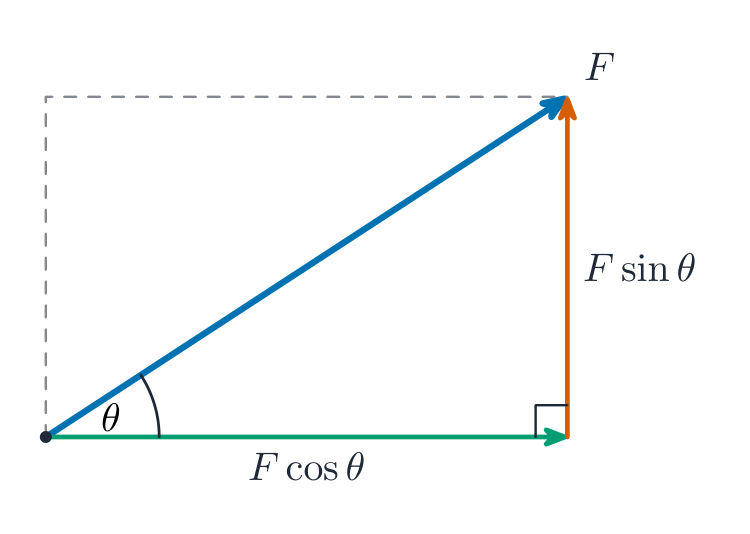
Syllabus · Программа
EnglishCandidates should be able to: Notes and examples identify the forces acting in a given situation e.g. by drawing a force diagram. understand the vector nature of force, and find and use components and resultants Calculations are always required, not approximate solutions by scale drawing. use the principle that, when a particle is in equilibrium, the vector sum of the forces acting is zero, or equivalently, that the sum of the components in any direction is zero Solutions by resolving are usually expected, but equivalent methods (e.g. triangle of forces, Lami's Theorem, where suitable) are also acceptable; these other methods are not required knowledge, and will not be referred to in questions. understand that a contact force between two surfaces can be represented by two components, the normal component and the frictional component use the model of a 'smooth' contact, and understand the limitations of this model understand the concepts of limiting friction and limiting equilibrium, recall the definition of coefficient of friction, and use the relationship $F = \mu R$ or $F \leqslant \mu R$, as appropriate Terminology such as 'about to slip' may be used to mean 'in limiting equilibrium' in questions. use Newton's third law. e.g. the force exerted by a particle on the ground is equal and opposite to the force exerted by the ground on the particle. РусскийКандидаты должны уметь: Примечания и примеры идентифицировать силы, действующие в данной ситуации Например, с помощью рисунка сил. понимать векторную природу силы, находить и использовать компоненты и равнодействующую Вычисления всегда обязательны; приближенные решения с помощью построения по масштабу не допускаются. использовать принцип: если частица находится в равновесии, векторная сумма действующих на нее сил равна нулю, или эквивалентно — сумма компонент в любом направлении равна нулю Обычно требуется решение методом разложения сил, но допустимы и эквивалентные методы (например, правило треугольника сил, теорема Лами при соответствующих условиях); эти другие методы не являются обязательными для заучивания и не будут упоминаться в вопросах. понимать, что сила контакта между двумя поверхностями может быть представлена двумя компонентами: нормальной составляющей и силой трения использовать модель «гладкого» контакта и понимать ограничения этой модели понимать концепции предельного трения и предельного равновесия, знать определение коэффициента трения и использовать соотношение $F = \mu R$ или $F \leqslant \mu R$ в зависимости от ситуации В вопросах термины вроде «вот-вот скользнуть» могут использоваться как синонимы «предельное равновесие». использовать третий закон Ньютона. Например: сила, с которой частица действует на поверхность, равна по модулю и противоположна по направлению силе, с которой поверхность действует на частицу. Source: Cambridge International syllabus · Источник: Программа Cambridge International
EnglishA force 力 is a push or a pull. It is a vector, so it has size and direction. Because it is a vector, you can split a force into components 分量 (usually horizontal and vertical), and you can add several forces into one resultant 合力.
A particle is in equilibrium 平衡 when the forces are balanced: the vector sum of the forces is zero. In practice this means the components in any direction add to zero.
Friction
When two surfaces touch, the contact force 接触力 between them has two parts: the normal reaction 法向反作用力 $R$, at right angles to the surface, and the friction 摩擦力 $F$, along the surface, which opposes sliding. A "smooth" surface is a model with no friction.
Friction can only grow up to a maximum. At that maximum the body is in limiting equilibrium 极限平衡, about to slip, and the friction is limiting friction 最大静摩擦力. The maximum is set by the coefficient of friction 摩擦系数 $\mu$:
$$F \leqslant \mu R, \qquad \text{with } F = \mu R \text{ at the point of slipping}.$$By Newton's third law 牛顿第三定律, the two surfaces push on each other with equal and opposite forces.
Worked example. A block of weight $20\text{ N}$ rests on a rough horizontal table with coefficient of friction $\mu = 0.4$. Find the largest horizontal force that can be applied before the block slides.
The table's normal reaction balances the weight, so $R = 20\text{ N}$. The block is on the point of slipping when friction reaches its maximum $F = \mu R = 0.4 \times 20 = 8\text{ N}$. In equilibrium the applied force equals the friction, so the largest force it can resist is $8\text{ N}$.
РусскийСила — это толчок или тяга. Это вектор, поэтому она имеет величину и направление. Поскольку сила является вектором, ее можно разложить на компоненты (обычно горизонтальные и вертикальные), а несколько сил можно сложить в одну равнодействующую.
Сила под углом $\theta$ имеет горизонтальную составляющую $F\cos\theta$ и вертикальную составляющую $F\sin\theta$. Частица находится в равновесии, когда силы скомпенсированы: векторная сумма сил равна нулю. На практике это означает, что компоненты в любом направлении в сумме дают ноль.

Каждая задача по механике представляет собой подобную схему. На скалолаза действуют три силы — вес прямо вниз, натяжение веревки вдоль троса и толчок со стороны скалы — и поскольку они скомпенсированы, скалолаз висит неподвижно в состоянии равновесия. Разложение каждой силы на горизонтальные и вертикальные составляющие превращает схему в уравнения Трение
Когда две поверхности касаются друг друга, контактная сила между ними состоит из двух составляющих: нормальной реакции $R$, перпендикулярной поверхности, и трения $F$, направленной вдоль поверхности, которое препятствует скольжению. «Гладкая» поверхность — это модель без трения.
Трение может возрастать только до определённого максимума. При этом максимуме тело находится в предельном равновесии, готовом скользить, а трение называется граничным трением. Максимальное значение определяется коэффициентом трения $\mu$:
$$F \leqslant \mu R, \qquad \text{with } F = \mu R \text{ at the point of slipping}.$$
На шероховатой поверхности контактная сила разлагается на нормальную реакцию $R$ и трение $F$ (не более $\mu R$). Согласно третьему закону Ньютона, две поверхности действуют друг на друга с силами, равными по модулю и противоположными по направлению.
Разобранный пример. Брусок весом $20\text{ N}$ покоится на шероховатом горизонтальном столе с коэффициентом трения $\mu = 0.4$. Найдите максимальную горизонтальную силу, которую можно приложить до того, как брусок начнёт скользить.
Нормальная реакция стола компенсирует вес, поэтому $R = 20\text{ N}$. Брурок вот-вот соскользнет, когда трение достигнет своего максимума $F = \mu R = 0.4 \times 20 = 8\text{ N}$. В состоянии равновесия приложенная сила равна силе трения, поэтому максимально возможная сила сопротивления составляет $8\text{ N}$.
Explore · ИсследоватьAdding forces · Сложение сил
resultant = a + b · равнодействующая = a + b
Forces add tip-to-tail. They are in equilibrium when the resultant is zero. · Силы складываются конец к концу. Они находятся в равновесии, когда равнодействующая равна нулю.
Vocabulary · Словарь Train · ТренироватьEnglish Русский Mechanics/mɪˈkænɪks/ Механика force/fɔːs/ сила components/kəmˈpəʊnənts/ компоненты resultant/rɪˈzʌltənt/ результирующая equilibrium/ˌiːkwɪˈlɪbrɪəm/ равновесные contact force/ˈkɒntækt fɔːs/ контактная сила normal reaction/ˈnɔːml rɪˈækʃn/ реакция опоры friction/ˈfrɪkʃn/ трение limiting friction/ˈlɪmɪtɪŋ ˈfrɪkʃn/ трение покоя coefficient of friction/ˌkəʊɪˈfɪʃənt ɒv ˈfrɪkʃn/ коэффициент трения Newton's third law/ˈnjuːtnz θɜːd lɔː/ третьего закона Ньютона distance/ˈdɪstəns/ расстояние speed/spiːd/ скорости движения displacement/dɪˈspleɪsmənt/ перемещение 4.2
Kinematics of motion in a straight line · Кинематика прямолинейного движения

Syllabus · Программа
EnglishCandidates should be able to: Notes and examples understand the concepts of distance and speed as scalar quantities, and of displacement, velocity and acceleration as vector quantities Restricted to motion in one dimension only. The term 'deceleration' may sometimes be used in the context of decreasing speed. sketch and interpret displacement–time graphs and velocity–time graphs, and in particular appreciate that – the area under a velocity–time graph represents displacement, – the gradient of a displacement–time graph represents velocity, – the gradient of a velocity–time graph represents acceleration use differentiation and integration with respect to time to solve simple problems concerning displacement, velocity and acceleration Calculus required is restricted to techniques from the content for Paper 1: Pure Mathematics 1. use appropriate formulae for motion with constant acceleration in a straight line. Questions may involve setting up more than one equation, using information about the motion of different particles. РусскийКандидаты должны уметь: Примечания и примеры понимать понятия расстояние и скорость как скалярные величины, а также перемещения, скорости и ускорения как векторные величины Ограничивается движением только в одном измерении. Термин «замедление» иногда используется в контексте уменьшения скорости. строить и интерпретировать графики перемещения от времени и графики скорости от времени, а также особенно учитывать следующее: – площадь под графиком скорости от времени представляет собой перемещение, – наклон графика перемещения от времени представляет собой скорость, – наклон графика скорости от времени представляет собой ускорение использовать дифференцирование и интегрирование по времени для решения простых задач о перемещении, скорости и ускорении Необходимые методы математического анализа ограничиваются техниками из содержания раздела Paper 1: Чистая математика 1. использовать соответствующие формулы для движения с постоянным ускорением по прямой. Вопросы могут требовать составления более одного уравнения с использованием информации о движении различных частиц. Source: Cambridge International syllabus · Источник: Программа Cambridge International
EnglishDistance 距离 and speed 速率 are scalars (size only). Displacement 位移, velocity 速度 and acceleration 加速度 are vectors (size and direction).
On a velocity-time graph 速度时间图, the area under the graph is the displacement and the gradient is the acceleration (a negative acceleration is a deceleration 减速度). On a displacement-time graph, the gradient is the velocity. More generally, differentiate with respect to time to go from displacement to velocity to acceleration, and integrate to go back.
For motion with constant acceleration 匀加速, use these formulae (the "suvat" equations):
$$v = u + at, \qquad s = ut + \tfrac12 at^2, \qquad v^2 = u^2 + 2as, \qquad s = \tfrac12(u + v)t.$$Worked example. A car starts from rest and accelerates at $2.5\ \text{m s}^{-2}$ for $4\ \text{s}$. Find its speed and the distance travelled.
$$v = 0 + 2.5\times 4 = 10\ \text{m s}^{-1}, \qquad s = 0 + \tfrac12(2.5)(4^2) = 20\ \text{m}.$$РусскийПройденный путь и скорость — скалярные величины (только величина). Перемещение, скорость и ускорение — векторные (величина и направление).
На графике зависимости скорости от времени площадь под кривой равна перемещению, а наклон градиента — ускорению (отрицательное ускорение — это замедление). На графике зависимости перемещения от времени наклон равен скорости. В общем случае дифференцирование по времени позволяет перейти от перемещения к скорости, а затем к ускорению; интегрирование — обратно.
Заштрихованная область дает пройденный путь; наклон линии дает ускорение. Для движения с постоянным ускорением используйте эти формулы (уравнения «суват»):
$$v = u + at, \qquad s = ut + \tfrac12 at^2, \qquad v^2 = u^2 + 2as, \qquad s = \tfrac12(u + v)t.$$Разобранный пример. Автомобиль начинает движение из состояния покоя и движется с ускорением $2.5\ \text{m s}^{-2}$ в течение $4\ \text{s}$. Найдите его скорость и пройденный путь.
$$v = 0 + 2.5\times 4 = 10\ \text{m s}^{-1}, \qquad s = 0 + \tfrac12(2.5)(4^2) = 20\ \text{m}.$$Explore · ИсследоватьVelocity–time graph · График зависимости скорости от времени
Change the start velocity and acceleration. The gradient is the acceleration; the area under the line is the displacement. · Измените начальную скорость и ускорение. Наклон — это ускорение; площадь под линией — это перемещение.
Vocabulary · Словарь Train · ТренироватьEnglish Русский velocity/vəˈlɒsɪti/ скорость acceleration/əkˌseləˈreɪʃn/ ускорения velocity-time graph/vəˈlɒsɪti taɪm ɡræf/ графика зависимости скорости от времени constant acceleration/ˈkɒnstənt əkˌseləˈreɪʃn/ постоянное ускорение 4.3
Momentum · Импульс

Syllabus · Программа
EnglishCandidates should be able to: Notes and examples use the definition of linear momentum and show understanding of its vector nature For motion in one dimension only. use conservation of linear momentum to solve problems that may be modelled as the direct impact of two bodies. Including direct impact of two bodies where the bodies coalesce on impact. Knowledge of impulse and the coefficient of restitution is not required. РусскийКандидаты должны уметь: Примечания и примеры использовать определение линейного импульса и демонстрировать понимание его векторной природы Только для движения в одном измерении. использовать закон сохранения линейного импульса для решения задач, которые можно смоделировать как прямое столкновение двух тел. Включает прямое столкновение двух тел, где тела сливаются при ударе. Знание импульса силы и коэффициента восстановления не требуется. Source: Cambridge International syllabus · Источник: Программа Cambridge International
EnglishThe linear momentum 动量 of a body is $\text{mass} \times \text{velocity}$. It is a vector. In a direct collision of two bodies, the total momentum is unchanged. This is the conservation of linear momentum 动量守恒:
$$m_1 u_1 + m_2 u_2 = m_1 v_1 + m_2 v_2.$$Worked example. A body of mass $2\ \text{kg}$ moving at $3\ \text{m s}^{-1}$ hits a stationary body of mass $1\ \text{kg}$, and they stick together. Find their common speed afterwards.
$$2(3) + 1(0) = (2 + 1)v \;\Rightarrow\; v = \frac{6}{3} = 2\ \text{m s}^{-1}.$$РусскийМаятник Ньютона демонстрирует закон сохранения импульса при столкновениях. Линейный импульс тела равен $\text{mass} \times \text{velocity}$. Это векторная величина. При прямом столкновении двух тел суммарный импульс сохраняется. Это закон сохранения линейного импульса:
$$m_1 u_1 + m_2 u_2 = m_1 v_1 + m_2 v_2.$$
Суммарный импульс одинаков до и после столкновения. Разобранный пример. Тело массой $2\ \text{kg}$, движущееся со скоростью $3\ \text{m s}^{-1}$, ударяет о неподвижное тело массой $1\ \text{kg}$, и они слипаются. Найдите их общую скорость afterwards.
$$2(3) + 1(0) = (2 + 1)v \;\Rightarrow\; v = \frac{6}{3} = 2\ \text{m s}^{-1}.$$Explore · ИсследоватьA collision · Столкновение
Set each mass and speed and collide them. Total momentum stays the same before and after. · Установите массу и скорость каждого объекта и столкните их. Общий импульс остается прежним до и после столкновения.
Vocabulary · Словарь Train · ТренироватьEnglish Русский momentum/məʊˈmentəm/ импульс conservation of momentum/ˌkɒnsəˈveɪʃn ɒv məʊˈmentəm/ сохранения импульса Newton's laws of motion/ˈnjuːtnz lɔːz ɒv ˈməʊʃn/ Законы Ньютона о движении mass/mæs/ масса weight/weɪt/ вес tension/ˈtenʃn/ натяжение 4.4
Newton's laws of motion · Законы Ньютона

Syllabus · Программа
EnglishCandidates should be able to: Notes and examples • apply Newton’s laws of motion to the linear motion of a particle of constant mass moving under the action of constant forces, which may include friction, tension in an inextensible string and thrust in a connecting rod If any other forces resisting motion are to be considered (e.g. air resistance) this will be indicated in the question. • use the relationship between mass and weight $W = mg$. In this component, questions are mainly numerical, and use of the approximate numerical value $10\text{ (ms}^{-2}\text{)}$ for $g$ is expected. • solve simple problems which may be modelled as the motion of a particle moving vertically or on an inclined plane with constant acceleration Including, for example, motion of a particle on a rough plane where the acceleration while moving up the plane is different from the acceleration while moving down the plane. • solve simple problems which may be modelled as the motion of connected particles. e.g. particles connected by a light inextensible string passing over a smooth pulley, or a car towing a trailer by means of either a light rope or a light rigid tow-bar. РусскийКандидаты должны уметь: Примечания и примеры • применять законы Ньютона к линейному движению частицы постоянной массы под действием постоянных сил, которые могут включать трение, натяжение невесомой нерастяжимой нити и тягу соединительного стержня Если необходимо учесть любые другие силы, препятствующие движению (например, сопротивление воздуха), это будет указано в условии задачи. • использовать соотношение между массой и весом $W = mg$. В этом разделе вопросы преимущественно численные, ожидается использование приближенного числового значения $10\text{ (ms}^{-2}\text{)}$ для $g$. • решать простые задачи, которые можно смоделировать как движение частицы вертикально или по наклонной плоскости с постоянным ускорением Например, движение частицы по шероховатой плоскости, где ускорение при движении вверх по плоскости отличается от ускорения при движении вниз. • решать простые задачи, которые можно смоделировать как движение связанных частиц. Например: частицы, соединенные легкой невесомой нерастяжимой нитью через гладкий блок, или автомобиль, буксирующий прицеп с помощью легкой веревки или легкого жесткого тягового бруса. Source: Cambridge International syllabus · Источник: Программа Cambridge International
EnglishNewton's laws of motion 牛顿运动定律 connect force and acceleration. The key one is: resultant force $=$ mass 质量 $\times$ acceleration,
$$F = ma.$$The weight 重力 of a body is the force of gravity on it: $W = mg$. Forces in a problem may include weight, friction, tension 张力 in a string, the thrust 推力 (push) in a rod, and air resistance 空气阻力.For motion on an inclined plane 斜面, split each force into a part along the slope and a part at right angles to it, then apply $F = ma$ along the slope. For connected particles 连接质点 (joined by a string), apply $F = ma$ to each body, or to the whole system.
Worked example. A block of mass $12\ \text{kg}$ is pulled up a rough plane by a rope parallel to the slope. The plane is at $20^\circ$ to the horizontal, the coefficient of friction is $0.4$, and the acceleration is $2\ \text{m s}^{-2}$. Find the tension in the rope.
The normal reaction is $R = mg\cos 20^\circ = 120\cos 20^\circ = 112.8\ \text{N}$, so the friction is $F = \mu R = 0.4 \times 112.8 = 45.1\ \text{N}$. Along the slope, $T - mg\sin 20^\circ - F = ma$:
$$T = ma + mg\sin 20^\circ + F = 12(2) + 120\sin 20^\circ + 45.1 = 24 + 41.0 + 45.1 = 110\ \text{N (3 s.f.)}.$$РусскийЗаконы Ньютона связывают силу и ускорение. Ключевой закон гласит: результирующая сила $=$ масса $\times$ ускорение,
$$F = ma.$$Вес тела — это сила тяжести, действующая на него: $W = mg$. Силы в задаче могут включать вес, трение, натяжение нити, тягу (толкание) стержня и сопротивление воздуха.Для движения на наклонной плоскости разложите каждую силу на составляющую вдоль ската и перпендикулярную ей, затем примените $F = ma$ вдоль ската. Для связанных тел (соединенных нитью) применяйте $F = ma$ к каждому телу или ко всей системе.
На склоне раскладывайте силы вдоль наклона и перпендикулярно ему. Разобранный пример. Брусок массой $12\ \text{kg}$ тянут вверх по шероховатой плоскости веревкой, параллельной скату. Плоскость расположена под углом $20^\circ$ к горизонту, коэффициент трения равен $0.4$, а ускорение составляет $2\ \text{m s}^{-2}$. Найдите натяжение веревки.
Нормальная реакция равна $R = mg\cos 20^\circ = 120\cos 20^\circ = 112.8\ \text{N}$, значит трение равно $F = \mu R = 0.4 \times 112.8 = 45.1\ \text{N}$. Вдоль склона: $T - mg\sin 20^\circ - F = ma$:
$$T = ma + mg\sin 20^\circ + F = 12(2) + 120\sin 20^\circ + 45.1 = 24 + 41.0 + 45.1 = 110\ \text{N (3 s.f.)}.$$Explore · ИсследоватьResultant force · Результирующая сила
F = ma
The resultant force sets the acceleration. Balanced forces ⇒ no acceleration. · Результирующая сила задает ускорение. Сбалансированные силы ⇒ нет ускорения.
Vocabulary · Словарь Train · ТренироватьEnglish Русский inclined plane/ɪnˈklaɪnd pleɪn/ наклонная плоскость connected particles/kəˈnektɪd ˈpɑːtɪklz/ связанные тела work done/wɜːk dʌn/ совершенная работа kinetic energy/kɪˈnetɪk ˈenədʒi/ кинетическую энергию gravitational potential energy/ˌɡrævɪˈteɪʃənl pəˈtenʃl ˈenədʒi/ гравитационная потенциальная энергия conservation of energy/ˌkɒnsəˈveɪʃn ɒv ˈenədʒi/ закон сохранения энергии power/ˈpaʊə/ мощность limiting equilibrium/ˈlɪmɪtɪŋ ˌiːkwɪˈlɪbrɪəm/ предельное равновесие deceleration/dɪˌseləˈreɪʃn/ замедление thrust/θrʌst/ тяга air resistance/eə rɪˈzɪstəns/ сопротивление воздуха 4.5
Energy, work and power · Энергия, работа и мощность

Syllabus · Программа
EnglishCandidates should be able to: Notes and examples • understand the concept of the work done by a force, and calculate the work done by a constant force when its point of application undergoes a displacement not necessarily parallel to the force $W = Fd \cos \theta$; Use of the scalar product is not required. • understand the concepts of gravitational potential energy and kinetic energy, and use appropriate formulae • understand and use the relationship between the change in energy of a system and the work done by the external forces, and use in appropriate cases the principle of conservation of energy Including cases where the motion may not be linear (e.g. a child on a smooth curved ‘slide’), where only overall energy changes need to be considered. • use the definition of power as the rate at which a force does work, and use the relationship between power, force and velocity for a force acting in the direction of motion Including calculation of (average) power as $$\frac{\text{Work done}}{\text{Time taken}}$$$P = Fv$.• solve problems involving, for example, the instantaneous acceleration of a car moving on a hill against a resistance. РусскийКандидаты должны уметь: Примечания и примеры • понять понятие работы, совершаемой силой, и вычислять работу постоянной силы, когда точка ее приложения претерпевает перемещение, не обязательно параллельное самой силе $W = Fd \cos \theta$; Использование скалярного произведения не требуется. • понять концепции потенциальной энергии гравитации и кинетической энергии, а также использовать соответствующие формулы понимать и использовать связь между изменением энергии системы и работой внешних сил, а также в подходящих случаях применять принцип сохранения энергии Включая случаи, когда движение может быть нелинейным (например, ребенок на гладкой изогнутой «горке»), где учитываются только общие изменения энергии. использовать определение мощности как скорости совершения работы силой, а также соотношение между мощностью, силой и скоростью для силы, действующей вдоль направления движения Включая вычисление (средней) мощности как $$\frac{\text{Work done}}{\text{Time taken}}$$$P = Fv$.решать задачи,涉及的例如汽车在爬坡时受到阻力作用的瞬时加速度. Source: Cambridge International syllabus · Источник: Программа Cambridge International
EnglishThe work done 功 by a constant force is the scalar product of force and displacement — the force times the distance moved in the direction of the force: $W = Fd\cos\theta$, where $\theta$ is the angle between the force and the motion. Work is measured in joules (J).
Energy comes in forms you can calculate:
- Kinetic energy 动能 (energy of movement): $\text{KE} = \tfrac12 mv^2$.
- Gravitational potential energy 重力势能 (energy of height): $\text{PE} = mgh$.
The work done by the outside forces equals the change in the total energy. When no friction acts, the total energy stays the same — the conservation of energy 能量守恒.
Power 功率 is the rate of doing work. For a force pulling in the direction of motion, $P = Fv$ (power $=$ force $\times$ velocity). Power is measured in watts (W).
Worked example. A car engine works at $12\ \text{kW}$ while the car moves at $20\ \text{m s}^{-1}$ on a level road. Find the driving force.
$$P = Fv \;\Rightarrow\; F = \frac{P}{v} = \frac{12000}{20} = 600\ \text{N}.$$РусскийАттракцион обменивается потенциальной энергией на кинетическую при подъеме и спуске. Работа, совершаемая постоянной силой, равна скалярному произведению силы и перемещения — силе, умноженной на расстояние, пройденное в направлении силы: $W = Fd\cos\theta$, где $\theta$ — угол между силой и движением. Работа измеряется в джоулях (Дж).
Энергия существует в формах, которые можно рассчитать:
- Кинетическая энергия (энергия движения): $\text{KE} = \tfrac12 mv^2$.
- Гравитационная потенциальная энергия (энергия высоты): $\text{PE} = mgh$.
Работа внешних сил равна изменению полной энергии. Когда трение отсутствует, полная энергия сохраняется — это закон сохранения энергии.
Мощность — это скорость совершения работы. Для силы, тянущей в направлении движения, $P = Fv$ (мощность $=$ сила $\times$ скорость). Мощность измеряется в ваттах (Вт).
Разобранный пример. Двигатель автомобиля развивает мощность $12\ \text{kW}$, пока автомобиль движется со скоростью $20\ \text{m s}^{-1}$ по горизонтальной дороге. Найдите движущую силу.
$$P = Fv \;\Rightarrow\; F = \frac{P}{v} = \frac{12000}{20} = 600\ \text{N}.$$Explore · ИсследоватьConservation of energy · Закон сохранения энергии
Drop the object and watch energy change form. With no friction, GPE + KE stays constant the whole way down. · Отпустите объект и наблюдайте за изменением формы энергии. Без трения потенциальная + кинетическая энергия остаются неизменными на всем пути вниз.
4.5
Exam tips · Советы для экзамена
English- Draw a clear force diagram and resolve into perpendicular components; for equilibrium, each direction sums to zero.
- Use SUVAT only for constant acceleration and keep a consistent positive direction.
- Apply $F = ma$ along the direction of motion, including friction ($F = \mu R$) on a rough surface.
- State your assumptions (light inextensible string, smooth pulley, particle) — they are often worth a mark.
Русский- Нарисуйте четкую схему сил и разложите их на перпендикулярные компоненты; для равновесия сумма сил в каждом направлении равна нулю.
- Используйте формулы SUVAT только для постоянного ускорения и сохраняйте согласованное положительное направление.
- Применяйте $F = ma$ вдоль направления движения, учитывая трение ($F = \mu R$) на шероховатой поверхности.
- Укажите ваши допущения (легкая нерастяжимая нить, гладкий блок, материальная точка) — за них часто дают балл.
-
5
Probability & Statistics 1 · Теория вероятностей и статистика 1
Watch lesson · Смотреть урокEnglishThis handout covers Topic 5: Probability & Statistics 概率统计 1. It is about describing data, counting choices, and working out the chance of events.
РусскийЭтот раздаточный материал охватывает тему 5: Вероятность и статистика. 1. Он посвящен описанию данных, подсчету вариантов выбора и вычислению вероятности событий.
5.1
Representation of data · Представление данных

Syllabus · Программа
EnglishCandidates should be able to: Notes and examples • select a suitable way of presenting raw statistical data, and discuss advantages and/or disadvantages that particular representations may have • draw and interpret stem-and-leaf diagrams, box-and-whisker plots, histograms and cumulative frequency graphs Including back-to-back stem-and-leaf diagrams. • understand and use different measures of central tendency (mean, median, mode) and variation (range, interquartile range, standard deviation) e.g. in comparing and contrasting sets of data. • use a cumulative frequency graph e.g. to estimate medians, quartiles, percentiles, the proportion of a distribution above (or below) a given value, or between two values. • calculate and use the mean and standard deviation of a set of data (including grouped data) either from the data itself or from given totals $\Sigma x$ and $\Sigma x^2$, or coded totals $\Sigma(x - a)$ and $\Sigma(x - a)^2$, and use such totals in solving problems which may involve up to two data sets. РусскийКандидаты должны уметь: Примечания и примеры • выбрать подходящий способ представления исходных статистических данных и обсудить преимущества и/или недостатки конкретных способов представления строить и интерпретировать диаграммы «ствол-лист», коробчатые диаграммы с усиками, гистограммы и графики накопленной частоты Включая диаграммы «ствол-лист» с обратной стороны. понимать и использовать различные меры центрального тренда (среднее, медиана, мода) и вариабельности (размах, межквартильный размах, стандартное отклонение) Например, при сравнении и сопоставлении наборов данных. • использовать график накопленной частоты напр., для оценки медианы, квартилей, перцентиля, доли распределения выше (или ниже) заданного значения или между двумя значениями. • вычислять и использовать среднее арифметическое и стандартное отклонение набора данных (включая сгруппированные данные), как непосредственно из самих данных, так и по заданным суммам $\Sigma x$ и $\Sigma x^2$, или кодированным суммам $\Sigma(x - a)$ и $\Sigma(x - a)^2$, и применять эти суммы при решении задач, которые могут включать до двух наборов данных. Source: Cambridge International syllabus · Источник: Программа Cambridge International
EnglishChoose a diagram that suits the data. You should be able to draw and read:
- a stem-and-leaf diagram 茎叶图 (keeps the original values and shows the shape); two data sets are compared with a back-to-back 背靠背 version – a shared central stem, one set's leaves increasing to the left and the other's to the right, so you can compare their medians and spreads at a glance;
- a box-and-whisker plot 箱线图 (shows the lowest value, the three quartiles, and the highest value);
- a histogram 直方图 (for grouped data, where the area of each bar shows the frequency);
- a cumulative frequency 累积频数 graph (running totals, used to estimate the median and quartiles).
Averages and spread
A measure of central tendency 集中趋势 is a single "middle" value:
- the mean 平均数 $\bar{x} = \dfrac{\sum x}{n}$ (the average);
- the median 中位数 (the middle value when the data is in order);
- the mode 众数 (the most common value).
A measure of variation 离散程度 shows how spread out the data is:
- the range (of data) 极差 (highest $-$ lowest);
- the interquartile range 四分位距 (upper quartile $-$ lower quartile);
- the standard deviation 标准差 $\sigma = \sqrt{\dfrac{\sum x^2}{n} - \bar{x}^2}$.
You often work from the totals $\sum x$ and $\sum x^2$. The square of the standard deviation is the variance 方差.
Worked example. For $10$ values, $\sum x = 50$ and $\sum x^2 = 300$. Find the mean and standard deviation.
$$\bar{x} = \frac{50}{10} = 5, \qquad \sigma = \sqrt{\frac{300}{10} - 5^2} = \sqrt{30 - 25} = \sqrt{5} = 2.24.$$Coding 编码 makes big numbers easier. Replace each value by $t=x-a$ for a convenient assumed mean 假定平均数 $a$. Then $\bar{x}=a+\bar{t}$, while the standard deviation is unchanged (shifting every value does not spread the data). So from the coded totals $\sum(x-a)$ and $\sum(x-a)^2$ you get $\bar x$ and $\sigma$ directly, and two data sets can be compared through their coded totals.
РусскийВыберите диаграмму, подходящую для ваших данных. Вы должны уметь рисовать и читать:
- диаграмму «стебель-листья» (сохраняет исходные значения и показывает форму); два набора данных сравниваются с помощью обратной версии – общего центрального стебля, листья одного набора увеличиваются влево, а другого вправо, что позволяет сразу сравнить их медианы и разброс;
- бокс-плот (показывает минимальное значение, три квартили и максимальное значение);
- гистограмму (для сгруппированных данных, где площадь каждого столбца отображает частоту);
- график кумулятивной частоты (накопленные суммы, используемые для оценки медианы и квартилей).
Кривая кумулятивной частоты имеет S-образную форму; медиана определяется по горизонтальной линии от отметки половины общей частоты, а квартили — от отметок одной четверти и трех четвертей 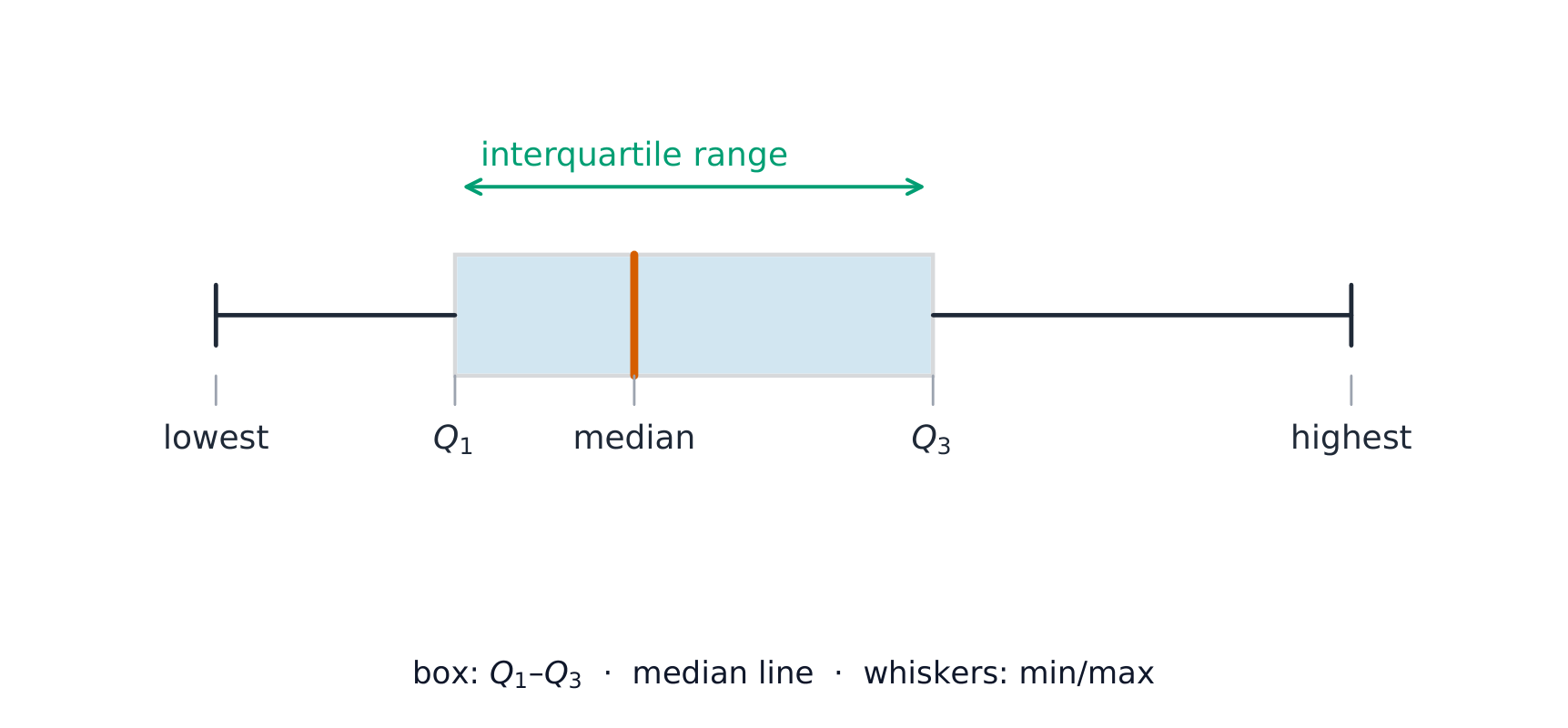
Прямоугольник простирается от квартили $Q_1$ до $Q_3$; усики достигают минимального и максимального значений. Средние значения и разброс
Мера центральности — это одно «среднее» значение:
- среднее арифметическое $\bar{x} = \dfrac{\sum x}{n}$ (среднее значение);
- медиана (среднее значение, когда данные упорядочены);
- мода (наиболее часто встречающееся значение).
Мера вариабельности показывает, насколько рассеяны данные:
- размах (данных) (максимум $-$ минимум);
- межквартильный размах (верхняя квартиль $-$ нижняя квартиль);
- стандартное отклонение $\sigma = \sqrt{\dfrac{\sum x^2}{n} - \bar{x}^2}$.
Часто вы работаете с суммами $\sum x$ и $\sum x^2$. Квадрат стандартного отклонения называется дисперсией.
Разобранный пример. Для $10$ значений, $\sum x = 50$ и $\sum x^2 = 300$. Найдите среднее арифметическое и стандартное отклонение.
$$\bar{x} = \frac{50}{10} = 5, \qquad \sigma = \sqrt{\frac{300}{10} - 5^2} = \sqrt{30 - 25} = \sqrt{5} = 2.24.$$Кодирование облегчает работу с большими числами. Замените каждое значение на $t=x-a$ для удобного предположительного среднего $a$. Тогда $\bar{x}=a+\bar{t}$, а стандартное отклонение остается неизменным (сдвиг всех значений не влияет на разброс данных). Таким образом, из закодированных сумм $\sum(x-a)$ и $\sum(x-a)^2$ вы получаете $\bar x$ и $\sigma$ напрямую, а два набора данных можно сравнить через их закодированные суммы.
Explore · ИсследоватьSpread and the bell · Разброс и колокол
P(−k < Z < k)
Spread is measured in standard deviations — about 68% of data lies within 1 sd, 95% within 2. · Разброс измеряется в стандартных отклонениях — около 68% данных лежат в пределах 1 σ, 95% в пределах 2 σ.
Vocabulary · Словарь Train · ТренироватьEnglish Русский stem-and-leaf diagram/stem ænd liːf ˈdaɪəɡræm/ стебель-лист диаграмма back-to-back/bæk tə bæk/ диаграмма «назад-назад» box-and-whisker plot/bɒks ænd ˈwɪskə plɒt/ ящик с усами (box-and-whisker plot) histogram/ˈhɪstəɡræm/ гистограмма cumulative frequency/ˈkjuːmjʊlətɪv ˈfriːkwənsi/ накопительная частота measure of central tendency/ˈmeʒə ɒv ˈsentrəl ˈtendənsi/ мера центрального тренда mean/miːn/ среднее значение median/ˈmiːdiːən/ медианой mode/məʊd/ модой variation/ˌveərɪˈeɪʃn/ вариация 5.2
Permutations and combinations · Перестановки и сочетания

Syllabus · Программа
EnglishCandidates should be able to: Notes and examples • understand the terms permutation and combination, and solve simple problems involving selections • solve problems about arrangements of objects in a line, including those involving – repetition (e.g. the number of ways of arranging the letters of the word ‘NEEDLESS’) – restriction (e.g. the number of ways several people can stand in a line if two particular people must, or must not, stand next to each other). Questions may include cases such as people sitting in two (or more) rows. Questions about objects arranged in a circle will not be included. РусскийКандидаты должны уметь: Примечания и примеры • понимать термины перестановка и сочетание, а также решать простые задачи на выборку • решать задачи о расположении объектов в ряд, включая случаи – повторения (например, количество способов расставить буквы слова ‘NEEDLESS’) – ограничения (например, количество способов, которыми несколько человек могут встать в ряд, если два определенных человека должны или не должны стоять рядом). Вопросы могут включать случаи, когда люди сидят в двух (или более) рядах. Вопросы о размещении объектов по кругу не будут включены. Source: Cambridge International syllabus · Источник: Программа Cambridge International
EnglishA permutation 排列 is an arrangement where order matters; a combination 组合 is a selection where order does not matter. The numbers are
$${}^nP_r = \frac{n!}{(n-r)!}, \qquad {}^nC_r = \binom{n}{r} = \frac{n!}{r!\,(n-r)!}.$$To arrange objects in a line when some are repeated, divide by the factorial of each repeat count.Worked example. How many different arrangements are there of the letters of the word NEEDLESS?
There are $8$ letters, with E repeated $3$ times and S repeated $2$ times:
$$\frac{8!}{3!\,2!} = \frac{40320}{6 \times 2} = 3360.$$РусскийПерестановка — это расположение, где порядок важен; сочетание — это выбор, где порядок не важен. Числа равны
$${}^nP_r = \frac{n!}{(n-r)!}, \qquad {}^nC_r = \binom{n}{r} = \frac{n!}{r!\,(n-r)!}.$$Чтобы разместить объекты в ряд, если некоторые из них повторяются, разделите на факториал каждого количества повторений.Для перестановки порядок имеет значение, но не для сочетания Разобранный пример. Сколько различных перестановок существует в словах NEEDLESS?
В слове $8$ букв, E повторяется $3$ раз, а S повторяется $2$ раза:
$$\frac{8!}{3!\,2!} = \frac{40320}{6 \times 2} = 3360.$$
nPr = n!/(n−r)!; nCr = nPr/r! Explore · ИсследоватьPermutation or combination lab · Лабораторная работа по перестановкам и сочетаниям
Choose whether order matters in a counting problem. · Определите, имеет ли значение порядок в задаче на подсчет.
Vocabulary · Словарь Train · ТренироватьEnglish Русский range (of data)/reɪndʒ/ размах (данных) interquartile range/ˌɪntəˈkwɔːtaɪl reɪndʒ/ межквартильный размах standard deviation/ˈstændəd ˌdiːvɪˈeɪʃn/ стандартное отклонение variance/ˈveərɪəns/ дисперсией Coding/ˈkəʊdɪŋ/ Написание кода assumed mean/əˈsjuːmd miːn/ предполагаемое среднее значение permutation/ˌpɜːmjuːˈteɪʃn/ перестановка combination/ˌkɒmbɪˈneɪʃn/ комбинации mutually exclusive events/ˈmjuːtʃuːəli eksˈkluːsɪv ɪˈvents/ взаимоисключающие события independent events/ˌɪndɪˈpendənt ɪˈvents/ независимые события conditional probability/kənˈdɪʃənl ˌprɒbəˈbɪlɪti/ условная вероятность discrete random variable/dɪˈskriːt ˈrændəm ˈveərɪəbl/ дискретная случайная величина probability distribution table/ˌprɒbəˈbɪlɪti ˌdɪstrɪˈbjuːʃn ˈteɪbl/ таблица распределения вероятностей expectation/ekspɪkˈteɪʃn/ математическое ожидание binomial distribution/baɪˈnəʊmɪəl ˌdɪstrɪˈbjuːʃn/ биномиального распределения geometric distribution/ˌdʒiːəʊˈmetrɪk ˌdɪstrɪˈbjuːʃn/ геометрическое распределение 5.3
Probability · Вероятность

Syllabus · Программа
EnglishCandidates should be able to: Notes and examples evaluate probabilities in simple cases by means of enumeration of equiprobable elementary events, or by calculation using permutations or combinations e.g. the total score when two fair dice are thrown. e.g. drawing balls at random from a bag containing balls of different colours. use addition and multiplication of probabilities, as appropriate, in simple cases Explicit use of the general formula $\text{P}(A \cup B) = \text{P}(A) + \text{P}(B) - \text{P}(A \cap B)$ is not required. understand the meaning of exclusive and independent events, including determination of whether events $A$ and $B$ are independent by comparing the values of $\text{P}(A \cap B)$ and $\text{P}(A) \times \text{P}(B)$ calculate and use conditional probabilities in simple cases. e.g. situations that can be represented by a sample space of equiprobable elementary events, or a tree diagram. The use of $\text{P}(A|B) = \frac{\text{P}(A \cap B)}{\text{P}(B)}$ may be required in simple cases. РусскийКандидаты должны уметь: Примечания и примеры оценивать вероятности в простых случаях путем перечисления равновероятных элементарных исходов или вычислением с использованием перестановок или сочетаний напр., общая сумма при бросании двух честных игральных костей. напр., вытягивание шаров наугад из мешка, содержащего шары разных цветов. использовать сложение и умножение вероятностей по мере необходимости в простых случаях Явное использование общей формулы $\text{P}(A \cup B) = \text{P}(A) + \text{P}(B) - \text{P}(A \cap B)$ не требуется. понимать значение взаимоисключающих и независимых событий, включая определение того, являются ли события $A$ и $B$ независимыми, сравнивая значения $\text{P}(A \cap B)$ и $\text{P}(A) \times \text{P}(B)$ вычислять и использовать условные вероятности в простых случаях. напр., ситуации, которые можно представить с помощью пространства элементарных исходов равновероятных элементарных событий или дерева вероятностей. Использование формулы $\text{P}(A|B) = \frac{\text{P}(A \cap B)}{\text{P}(B)}$ может потребоваться в простых случаях. Source: Cambridge International syllabus · Источник: Программа Cambridge International
EnglishFind a probability by counting equally likely outcomes, or by using permutations and combinations. Combine probabilities with these rules:
- addition for "or": $P(A \cup B) = P(A) + P(B) - P(A \cap B)$;
- multiplication for "and" when events are independent: $P(A \cap B) = P(A)\,P(B)$.
Two events are mutually exclusive events 互斥事件 if they cannot both happen, and independent events 独立事件 if one happening does not change the chance of the other. To test independence, check whether $P(A \cap B) = P(A)\times P(B)$. A conditional probability 条件概率 is the chance of $A$ given that $B$ has happened: $P(A \mid B) = \dfrac{P(A \cap B)}{P(B)}$.
Worked example. Events have $P(A) = 0.5$, $P(B) = 0.4$ and $P(A \cap B) = 0.2$. Are $A$ and $B$ independent?
Test: $P(A)\times P(B) = 0.5 \times 0.4 = 0.2 = P(A \cap B)$. The values are equal, so $A$ and $B$ are independent.
РусскийКубики: знакомый старт для изучения вероятности. Найдите вероятность, подсчитав равновероятные исходы или используя перестановки и сочетания. Комбинируйте вероятности по этим правилам:
- сложение для «или»: $P(A \cup B) = P(A) + P(B) - P(A \cap B)$;
- умножение для союза «и», когда события независимы: $P(A \cap B) = P(A)\,P(B)$.

Пересечение двух кругов — это $A\cap B$; правило сложения вычитает его один раз, чтобы не посчитать дважды. Два события называются взаимоисключающими, если они не могут произойти одновременно, и независимыми, если наступление одного не изменяет вероятность другого. Чтобы проверить независимость, убедитесь, что $P(A \cap B) = P(A)\times P(B)$. Условная вероятность — это вероятность $A$ при условии, что произошло $B$: $P(A \mid B) = \dfrac{P(A \cap B)}{P(B)}$.
Разобранный пример. У событий есть $P(A) = 0.5$, $P(B) = 0.4$ и $P(A \cap B) = 0.2$. Являются ли $A$ и $B$ независимыми?
Проверка: $P(A)\times P(B) = 0.5 \times 0.4 = 0.2 = P(A \cap B)$. Значения равны, поэтому $A$ и $B$ являются независимыми.
Explore · ИсследоватьConditional probability · Условная вероятность
Change the probabilities and read the tree. This is how P(A and B) and conditional probability fit together. · Измените вероятности и прочитайте дерево. Так P(A и B) и условная вероятность сочетаются вместе.
5.4
Discrete random variables · Дискретные случайные величины
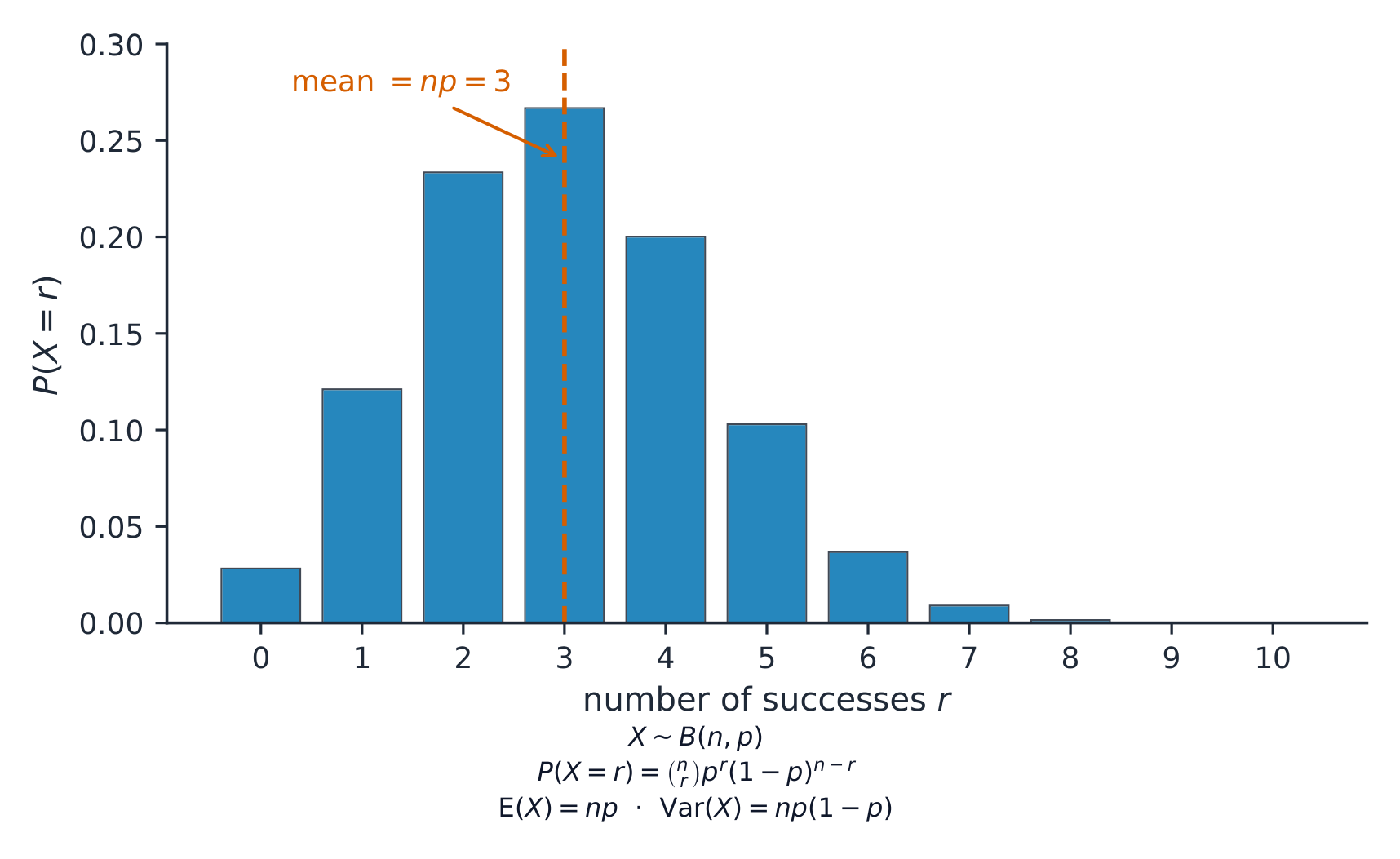
Syllabus · Программа
EnglishCandidates should be able to: Notes and examples draw up a probability distribution table relating to a given situation involving a discrete random variable $X$, and calculate $\text{E}(X)$ and $\text{Var}(X)$ use formulae for probabilities for the binomial and geometric distributions, and recognise practical situations where these distributions are suitable models Including the notations $\text{B}(n, p)$ and $\text{Geo}(p)$. $\text{Geo}(p)$ denotes the distribution in which $p_r = p(1 - p)^{r-1}$ for $r = 1, 2, 3, \dots$. use formulae for the expectation and variance of the binomial distribution and for the expectation of the geometric distribution. Proofs of formulae are not required. РусскийКандидаты должны уметь: Примечания и примеры составлять таблицу распределения вероятностей, относящуюся к данной ситуации, связанной со случайной дискретной величиной $X$, и вычислять $\text{E}(X)$ и $\text{Var}(X)$ использовать формулы вероятностей для биномиального и геометрического распределений и распознавать практические ситуации, где эти распределения подходят в качестве моделей Включая обозначения $\text{B}(n, p)$ и $\text{Geo}(p)$. $\text{Geo}(p)$ обозначает распределение, в котором $p_r = p(1 - p)^{r-1}$ для $r = 1, 2, 3, \dots$. использовать формулы для математического ожидания и дисперсии биномиального распределения и для математического ожидания геометрического распределения. Доказательства формул не требуются. Source: Cambridge International syllabus · Источник: Программа Cambridge International
EnglishA discrete random variable 离散型随机变量 $X$ takes separate values, each with a probability. List them in a probability distribution table 概率分布表; the probabilities must add to $1$. Then the expectation 期望 (mean) and variance are
$$E(X) = \sum x\,P(X = x), \qquad \mathrm{Var}(X) = \sum x^2\,P(X = x) - \big(E(X)\big)^2.$$Two special models:
- the binomial distribution 二项分布 $X \sim B(n, p)$, for the number of successes in $n$ independent trials: $P(X = r) = \binom{n}{r}p^r(1-p)^{n-r}$, with $E(X) = np$ and $\mathrm{Var}(X) = np(1-p)$;
- the geometric distribution 几何分布, for the trial on which the first success happens: $P(X = r) = (1-p)^{r-1}p$, with $E(X) = \dfrac{1}{p}$.
Worked example. $X \sim B(10, 0.3)$. Find $P(X = 2)$ and $E(X)$.
$$P(X = 2) = \binom{10}{2}(0.3)^2(0.7)^8 = 45 \times 0.09 \times 0.05765 = 0.233, \qquad E(X) = 10 \times 0.3 = 3.$$РусскийДискретная случайная величина $X$ принимает отдельные значения, каждое со своей вероятностью. Запишите их в таблицу распределения вероятностей; вероятности должны суммироваться до $1$. Затем математическое ожидание (среднее) и дисперсия равны
$$E(X) = \sum x\,P(X = x), \qquad \mathrm{Var}(X) = \sum x^2\,P(X = x) - \big(E(X)\big)^2.$$Два специальных модели:
- биномиальное распределение $X \sim B(n, p)$, для числа успехов в $n$ независимых испытаниях: $P(X = r) = \binom{n}{r}p^r(1-p)^{n-r}$, с параметрами $E(X) = np$ и $\mathrm{Var}(X) = np(1-p)$;
- геометрическое распределение, для испытания, на котором происходит первый успех: $P(X = r) = (1-p)^{r-1}p$, с параметром $E(X) = \dfrac{1}{p}$.
Разобранный пример. $X \sim B(10, 0.3)$. Найдите $P(X = 2)$ и $E(X)$.
$$P(X = 2) = \binom{10}{2}(0.3)^2(0.7)^8 = 45 \times 0.09 \times 0.05765 = 0.233, \qquad E(X) = 10 \times 0.3 = 3.$$Распределение $B(10,0.3)$: каждый столбец соответствует $P(X=r)$, сгруппирован вокруг среднего значения $np=3$. Explore · ИсследоватьA discrete distribution · Дискретное распределение
Change n and p for a binomial distribution and watch the bars — the probability of each number of successes. · Измените n и p для биномиального распределения и наблюдайте за столбцами — вероятностью каждого числа успехов.
5.5
The normal distribution · Нормальное распределение

Syllabus · Программа
EnglishCandidates should be able to: Notes and examples understand the use of a normal distribution to model a continuous random variable, and use normal distribution tables Sketches of normal curves to illustrate distributions or probabilities may be required. solve problems concerning a variable $X$, where $X \sim N(\mu, \sigma^2)$, including: – finding the value of $P(X > x_1)$, or a related probability, given the values of $x_1$, $\mu$, $\sigma$. – finding a relationship between $x_1$, $\mu$ and $\sigma$ given the value of $P(X > x_1)$ or a related probability For calculations involving standardisation, full details of the working should be shown. e.g. $Z = \frac{(X - \mu)}{\sigma}$ recall conditions under which the normal distribution can be used as an approximation to the binomial distribution, and use this approximation, with a continuity correction, in solving problems. $n$ sufficiently large to ensure that both $np > 5$ and $nq > 5$. РусскийКандидаты должны уметь: Примечания и примеры понимать применение нормального распределения для моделирования непрерывной случайной величины и пользоваться таблицами нормального распределения Могут потребоваться схематические рисунки нормальных кривых для иллюстрации распределений или вероятностей. решать задачи относительно переменной $X$, где $X \sim N(\mu, \sigma^2)$, включая: – нахождение значения $P(X > x_1)$ или связанной с ним вероятности, зная значения $x_1$, $\mu$, $\sigma$. – нахождение связи между $x_1$, $\mu$ и $\sigma$, зная значение $P(X > x_1)$ или связанную с ним вероятность Для вычислений, связанных со стандартизацией, необходимо приводить полные детали хода решения. напр. $Z = \frac{(X - \mu)}{\sigma}$ вспоминать условия, при которых нормальное распределение может использоваться как приближение к биномиальному распределению, и применять это приближение с поправкой на непрерывность при решении задач. $n$ достаточно велико, чтобы обеспечить оба $np > 5$ и $nq > 5$. Source: Cambridge International syllabus · Источник: Программа Cambridge International
EnglishThe 68-95-99.7 rule The normal distribution 正态分布 models a continuous random variable 连续型随机变量 with a symmetric bell shape. Write $X \sim N(\mu, \sigma^2)$, where $\mu$ is the mean and $\sigma$ is the standard deviation. To use the tables, by standardisation 标准化 convert to the variable $Z \sim N(0, 1)$:
$$Z = \frac{X - \mu}{\sigma}.$$Then $P(X < x) = P\!\left(Z < \dfrac{x - \mu}{\sigma}\right)$, which you read from the normal table $\Phi$.
The normal distribution is also a good approximation 近似 to the binomial when $n$ is large. Because you replace a discrete variable by a continuous one, apply a continuity correction 连续性校正 (adjust by $0.5$).
Worked example. Bags of rice have mass $X \sim N(\mu, 0.14^2)$. Given that $P(X < 1.48) = 0.22$, find $\mu$.
From the table, $P(Z < z) = 0.22$ gives $z = -0.772$. So
$$\frac{1.48 - \mu}{0.14} = -0.772 \;\Rightarrow\; \mu = 1.48 + 0.772 \times 0.14 = 1.59\ \text{kg (3 s.f.)}.$$РусскийПравило 68-95-99,7 Доска Гальтона: падающие шары через штырьки складываются в колоколообразное нормальное распределение. Нормальное распределение моделирует непрерывную случайную величину с симметричной колоколообразной формой. Обозначьте $X \sim N(\mu, \sigma^2)$, где $\mu$ — среднее значение, а $\sigma$ — стандартное отклонение. Для использования таблиц с помощью стандартизации преобразуйте переменную в $Z \sim N(0, 1)$:
$$Z = \frac{X - \mu}{\sigma}.$$Тогда $P(X < x) = P\!\left(Z < \dfrac{x - \mu}{\sigma}\right)$, которое вы находите по таблице нормального распределения $\Phi$.

Нормальная вероятность — это площадь под колоколообразной кривой; стандартизация перескалировывает её до $Z\sim N(0,1)$. Нормальное распределение также является хорошей аппроксимацией биномиального, когда $n$ велико. Поскольку вы заменяете дискретную переменную непрерывной, примените поправку на непрерывность (скорректируйте на $0.5$).
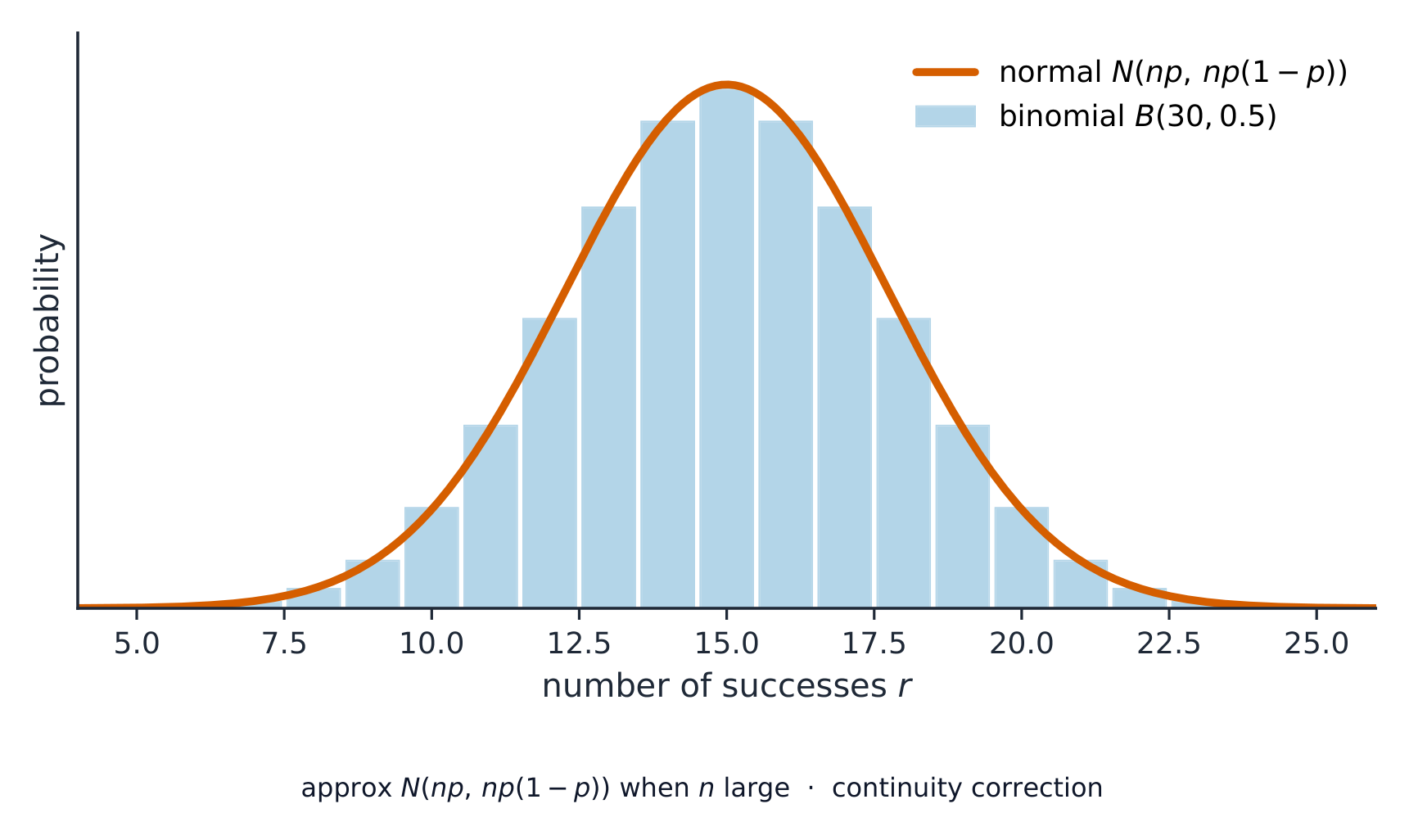
Когда $n$ велико, столбцы биномиального распределения следуют нормальной кривой с тем же средним и дисперсией. Разобранный пример. Мешки с рисом имеют массу $X \sim N(\mu, 0.14^2)$. При условии, что $P(X < 1.48) = 0.22$, найдите $\mu$.
Из таблицы $P(Z < z) = 0.22$ дает $z = -0.772$. Следовательно,
$$\frac{1.48 - \mu}{0.14} = -0.772 \;\Rightarrow\; \mu = 1.48 + 0.772 \times 0.14 = 1.59\ \text{kg (3 s.f.)}.$$Explore · ИсследоватьThe normal distribution · Нормальное распределение
Shade the area to find a probability. A z-value measures how many standard deviations a point is from the mean. · Заштрихуйте область, чтобы найти вероятность. z-значение измеряет, на сколько стандартных отклонений точка удалена от среднего.
Vocabulary · Словарь Train · ТренироватьEnglish Русский normal distribution/ˈnɔːml ˌdɪstrɪˈbjuːʃn/ нормального распределения continuous random variable/kənˈtɪnjuːəs ˈrændəm ˈveərɪəbl/ непрерывная случайная величина standardisation/ˌstændədaɪˈzeɪʃn/ стандартизация approximation/əˌprɒksɪˈmeɪʃn/ приближение continuity correction/kɒntɪˈnjuːɪti kəˈrekʃn/ поправка на непрерывность Probability & Statistics/ˌprɒbəˈbɪlɪti ænd stəˈtɪstɪks/ Теория вероятностей и статистика central tendency/ˈsentrəl ˈtendənsi/ центральный тренд 5.5
Exam tips · Советы для экзамена
English- Decide whether order matters: permutations ($^nP_r$) when it does, combinations ($^nC_r$) when it does not.
- For a discrete random variable, check the probabilities sum to $1$ and use $E(X) = \sum x\,P(X=x)$.
- For the normal distribution, standardise with $z = (x - \mu)/\sigma$, sketch and shade, then read the table.
- Apply a continuity correction when approximating a discrete variable by the normal.
Русский- Определите, важен ли порядок: перестановки ($^nP_r$), если важен, сочетания ($^nC_r$), если не важен.
- Для дискретной случайной величины проверьте, что вероятности суммируются до $1$, и используйте $E(X) = \sum x\,P(X=x)$.
- Для нормального распределения стандартизируйте с помощью $z = (x - \mu)/\sigma$, нарисуйте и заштрихуйте, затем прочитайте таблицу.
- Примените поправку на непрерывность при аппроксимации дискретной переменной нормальной.
-
6
Probability & Statistics 2 · Теория вероятностей и статистика 2
Watch lesson · Смотреть урокEnglishThis handout covers Topic 6: Probability & Statistics 概率统计 2. It adds the Poisson model, combining random variables, continuous distributions, and the ideas of estimation and testing.
РусскийЭтот раздаточный материал охватывает тему 6: Вероятность и статистика 2. Он добавляет пуассоновскую модель, комбинирование случайных величин, непрерывные распределения, а также идеи оценки и проверки гипотез.
6.1
The Poisson distribution · Распределение Пуассона

Syllabus · Программа
Candidates should be able to: Notes and examples • use formulae to calculate probabilities for the distribution $\text{Po}(\lambda)$ • use the fact that if $X \sim \text{Po}(\lambda)$ then the mean and variance of $X$ are each equal to $\lambda$ Proofs are not required. • understand the relevance of the Poisson distribution to the distribution of random events, and use the Poisson distribution as a model • use the Poisson distribution as an approximation to the binomial distribution where appropriate The conditions that $n$ is large and $p$ is small should be known; $n > 50$ and $np < 5$, approximately. • use the normal distribution, with continuity correction, as an approximation to the Poisson distribution where appropriate. The condition that $\lambda$ is large should be known; $\lambda > 15$, approximately. Source: Cambridge International syllabus · Источник: Программа Cambridge International
EnglishThe Poisson distribution 泊松分布 $X \sim \mathrm{Po}(\lambda)$ models the number of random events in a fixed interval, when events happen at a steady average rate $\lambda$:
$$P(X = r) = e^{-\lambda}\frac{\lambda^r}{r!}.$$For a Poisson variable the mean and the variance are both equal to $\lambda$. The Poisson distribution is a good approximation 近似 to the binomial distribution when $n$ is large and $p$ is small. The normal distribution (with continuity correction) approximates the Poisson when $\lambda$ is large.Worked example. $X \sim \mathrm{Po}(3)$. Find $P(X = 2)$.
$$P(X = 2) = e^{-3}\frac{3^2}{2!} = e^{-3}\times 4.5 = 0.224.$$РусскийПриходящие случайно в очередь люди подчиняются распределению Пуассона. Распределение Пуассона $X \sim \mathrm{Po}(\lambda)$ моделирует количество случайных событий за фиксированный интервал, когда события происходят со стабильной средней скоростью $\lambda$:
$$P(X = r) = e^{-\lambda}\frac{\lambda^r}{r!}.$$Для переменной Пуассона среднее и дисперсия равны $\lambda$. Распределение Пуассона является хорошей аппроксимацией для биномиального распределения, когда $n$ велико, а $p$ мало. Нормальное распределение (с поправкой на непрерывность) аппроксимирует распределение Пуассона, когда $\lambda$ велико.Разобранный пример. $X \sim \mathrm{Po}(3)$. Найдите $P(X = 2)$.
$$P(X = 2) = e^{-3}\frac{3^2}{2!} = e^{-3}\times 4.5 = 0.224.$$
Распределение Пуассона $\mathrm{Po}(3)$: для переменной Пуассона среднее и дисперсия равны $\lambda$. Explore · ИсследоватьThe Poisson distribution · Распределение Пуассона
Change the mean λ. Poisson models the number of random events in a fixed interval — rare events give a skewed shape. · Измените среднее λ. Распределение Пуассона моделирует количество случайных событий в фиксированном интервале — редкие события дают скошенную форму.
6.2
Linear combinations of random variables · Линейные комбинации случайных величин
Syllabus · Программа
EnglishCandidates should be able to: Notes and examples • use, when solving problems, the results that – $\text{E}(aX + b) = a\text{E}(X) + b$ and $\text{Var}(aX + b) = a^2\text{Var}(X)$ – $\text{E}(aX + bY) = a\text{E}(X) + b\text{E}(Y)$ – $\text{Var}(aX + bY) = a^2\text{Var}(X) + b^2\text{Var}(Y)$ for independent $X$ and $Y$ – if $X$ has a normal distribution then so does $aX + b$ – if $X$ and $Y$ have independent normal distributions then $aX + bY$ has a normal distribution – if $X$ and $Y$ have independent Poisson distributions then $X + Y$ has a Poisson distribution. Proofs of these results are not required. РусскийКандидаты должны уметь: Примечания и примеры • использовать при решении задач следующие результаты – $\text{E}(aX + b) = a\text{E}(X) + b$ и $\text{Var}(aX + b) = a^2\text{Var}(X)$ – $\text{E}(aX + bY) = a\text{E}(X) + b\text{E}(Y)$ – $\text{Var}(aX + bY) = a^2\text{Var}(X) + b^2\text{Var}(Y)$ для независимых $X$ и $Y$ – если $X$ имеет нормальное распределение, то и $aX + b$ – если $X$ и $Y$ имеют независимые нормальные распределения, то $aX + bY$ имеет нормальное распределение – если $X$ и $Y$ имеют независимые распределения Пуассона, то $X + Y$ имеет распределение Пуассона. Доказательства этих результатов не требуются. Source: Cambridge International syllabus · Источник: Программа Cambridge International
EnglishWhen you change a variable by a linear rule, the expectation 期望 (mean) and variance 方差 follow these rules:
$$E(aX + b) = aE(X) + b, \qquad \mathrm{Var}(aX + b) = a^2\,\mathrm{Var}(X).$$For two independent variables $X$ and $Y$:$$E(aX + bY) = aE(X) + bE(Y), \qquad \mathrm{Var}(aX + bY) = a^2\,\mathrm{Var}(X) + b^2\,\mathrm{Var}(Y).$$Two useful facts: if $X$ has a normal distribution 正态分布 then so does $aX + b$; and the sum of independent Poisson variables is again Poisson.Worked example. $X$ has mean $5$ and variance $4$. Find $E(3X - 1)$ and $\mathrm{Var}(3X - 1)$.
$$E(3X - 1) = 3(5) - 1 = 14, \qquad \mathrm{Var}(3X - 1) = 3^2 \times 4 = 36.$$РусскийПри изменении переменной по линейному правилу математическое ожидание (среднее) и дисперсия следуют этим правилам:
$$E(aX + b) = aE(X) + b, \qquad \mathrm{Var}(aX + b) = a^2\,\mathrm{Var}(X).$$Для двух независимых переменных $X$ и $Y$:$$E(aX + bY) = aE(X) + bE(Y), \qquad \mathrm{Var}(aX + bY) = a^2\,\mathrm{Var}(X) + b^2\,\mathrm{Var}(Y).$$Два полезных факта: если $X$ имеет нормальное распределение, то и $aX + b$ имеет; а сумма независимых переменных Пуассона снова подчиняется распределению Пуассона.Разобранный пример. $X$ имеет среднее $5$ и дисперсию $4$. Найдите $E(3X - 1)$ и $\mathrm{Var}(3X - 1)$.
$$E(3X - 1) = 3(5) - 1 = 14, \qquad \mathrm{Var}(3X - 1) = 3^2 \times 4 = 36.$$Explore · ИсследоватьLinear combination lab · Лабораторная работа по линейным комбинациям
E(aX + b) = aE(X) + b
Change a scaling factor and see how the expected value scales. · Измените множитель масштабирования и посмотрите, как масштабируется математическое ожидание.
6.3
Continuous random variables · Непрерывные случайные величины
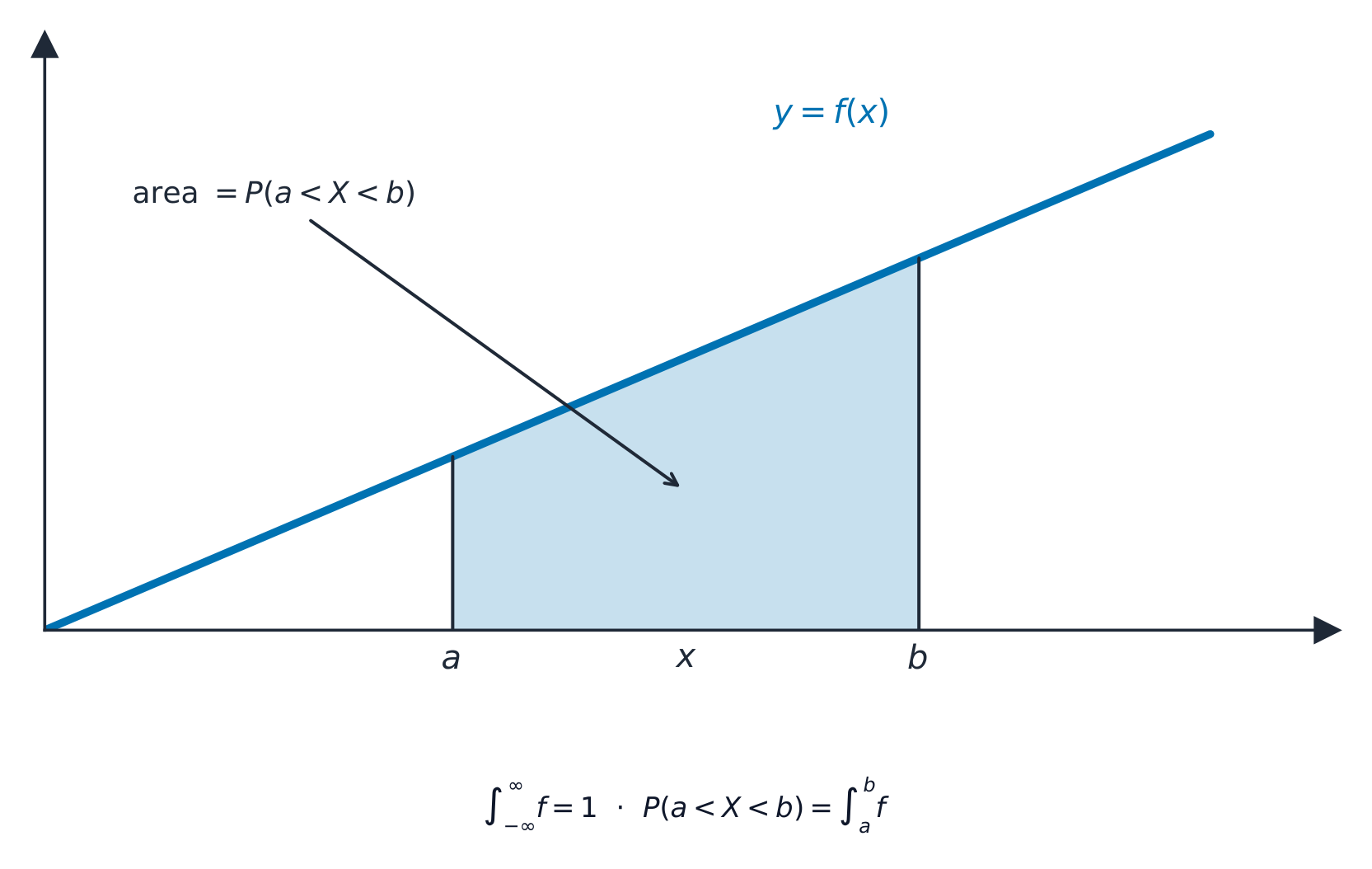
Syllabus · Программа
EnglishCandidates should be able to: Notes and examples • understand the concept of a continuous random variable, and recall and use properties of a probability density function For density functions defined over a single interval only; the domain may be infinite, e.g. $\frac{3}{x^4}$ for $x \geqslant 1$. • use a probability density function to solve problems involving probabilities, and to calculate the mean and variance of a distribution. Including location of the median or other percentiles of a distribution by direct consideration of an area using the density function. Explicit knowledge of the cumulative distribution function is not included. РусскийКандидаты должны уметь: Примечания и примеры • понимать концепцию непрерывной случайной величины и вспоминать и использовать свойства функции плотности вероятности Только для функций плотности, определенных на одном интервале; область определения может быть бесконечной, напр. $\frac{3}{x^4}$ для $x \geqslant 1$. • использовать функцию плотности вероятности для решения задач, связанных с вероятностями, а также для вычисления среднего арифметического и дисперсии распределения. Включая определение медианы или других перцентилей распределения прямым рассмотрением площади с использованием функции плотности. Явное знание функции распределения не входит в программу. Source: Cambridge International syllabus · Источник: Программа Cambridge International
EnglishA continuous random variable 连续型随机变量 can take any value in a range. Its probabilities come from a probability density function 概率密度函数 $f(x)$, with two key properties:
$$f(x) \geqslant 0, \qquad \int_{-\infty}^{\infty} f(x)\,dx = 1.$$A probability is the area under $f$, and the mean is found by integration:$$P(a < X < b) = \int_a^b f(x)\,dx, \qquad E(X) = \int_{-\infty}^{\infty} x\,f(x)\,dx.$$The cumulative distribution function 累积分布函数 is $F(x) = P(X \leqslant x) = \int_{-\infty}^{x} f(t)\,dt$; the median 中位数 solves $F(m) = 0.5$, and other percentiles 百分位数 solve $F(x) = p$.
Worked example. A continuous variable has $f(x) = \tfrac12 x$ for $0 \leqslant x \leqslant 2$ (and $0$ elsewhere). Find $E(X)$.
$$E(X) = \int_0^2 x\cdot\tfrac12 x\,dx = \int_0^2 \tfrac12 x^2\,dx = \left[\tfrac{x^3}{6}\right]_0^2 = \frac{8}{6} = \frac{4}{3}.$$The variance uses the same idea, $\mathrm{Var}(X)=\displaystyle\int_{-\infty}^{\infty}x^2 f(x)\,dx-\big(E(X)\big)^2$. For the same $f(x)=\tfrac12 x$ on $[0,2]$: $\displaystyle\int_0^2 x^2\cdot\tfrac12 x\,dx=\left[\tfrac{x^4}{8}\right]_0^2=2$, so $\mathrm{Var}(X)=2-\left(\tfrac43\right)^2=2-\tfrac{16}{9}=\tfrac{2}{9}$.
РусскийНепрерывная случайная величина может принимать любое значение в диапазоне. Ее вероятности определяются функцией плотности вероятности $f(x)$, которая обладает двумя ключевыми свойствами:
$$f(x) \geqslant 0, \qquad \int_{-\infty}^{\infty} f(x)\,dx = 1.$$Вероятность — это площадь под $f$, а среднее находится путем интегрирования:$$P(a < X < b) = \int_a^b f(x)\,dx, \qquad E(X) = \int_{-\infty}^{\infty} x\,f(x)\,dx.$$Функция распределения есть $F(x) = P(X \leqslant x) = \int_{-\infty}^{x} f(t)\,dt$; медиана решает уравнение $F(m) = 0.5$, а другие процентили решают уравнение $F(x) = p$.
Для непрерывной переменной вероятность $P(a Разбор примера. Непрерывная переменная имеет $f(x) = \tfrac12 x$ для $0 \leqslant x \leqslant 2$ (и $0$ в остальных случаях). Найти $E(X)$.
$$E(X) = \int_0^2 x\cdot\tfrac12 x\,dx = \int_0^2 \tfrac12 x^2\,dx = \left[\tfrac{x^3}{6}\right]_0^2 = \frac{8}{6} = \frac{4}{3}.$$Дисперсия использует ту же идею, $\mathrm{Var}(X)=\displaystyle\int_{-\infty}^{\infty}x^2 f(x)\,dx-\big(E(X)\big)^2$. Для той же $f(x)=\tfrac12 x$ на $[0,2]$: $\displaystyle\int_0^2 x^2\cdot\tfrac12 x\,dx=\left[\tfrac{x^4}{8}\right]_0^2=2$, следовательно $\mathrm{Var}(X)=2-\left(\tfrac43\right)^2=2-\tfrac{16}{9}=\tfrac{2}{9}$.
Explore · ИсследоватьArea = probability · Площадь = вероятность
P(a < X < b) = ∫ f(x) dx
For a continuous variable, probability is the area under the density curve between two values. · Для непрерывной случайной величины вероятность — это площадь под кривой плотности между двумя значениями.
6.4
Sampling and estimation · Выборка и оценка

Syllabus · Программа
EnglishCandidates should be able to: Notes and examples • understand the distinction between a sample and a population, and appreciate the necessity for randomness in choosing samples • explain in simple terms why a given sampling method may be unsatisfactory Including an elementary understanding of the use of random numbers in producing random samples. Knowledge of particular sampling methods, such as quota or stratified sampling, is not required. • recognise that a sample mean can be regarded as a random variable, and use the facts that $\text{E}(\overline{X}) = \mu$ and that $\text{Var}(\overline{X}) = \frac{\sigma^2}{n}$ • use the fact that $\overline{X}$ has a normal distribution if $X$ has a normal distribution • use the Central Limit Theorem where appropriate Only an informal understanding of the Central Limit Theorem (CLT) is required; for large sample sizes, the distribution of a sample mean is approximately normal. • calculate unbiased estimates of the population mean and variance from a sample, using either raw or summarised data Only a simple understanding of the term 'unbiased' is required, e.g. that although individual estimates will vary the process gives an accurate result 'on average'. • determine and interpret a confidence interval for a population mean in cases where the population is normally distributed with known variance or where a large sample is used • determine, from a large sample, an approximate confidence interval for a population proportion. РусскийКандидаты должны уметь: Примечания и примеры • понимать различие между выборкой и генеральной совокупностью, а также необходимость случайности при отборе выборки • объяснять простыми словами, почему данный метод выборки может быть неудовлетворительным Включая элементарное понимание использования случайных чисел для получения случайных выборок. Знание конкретных методов выборки, таких как квотная или стратифицированная выборка, не требуется. • распознавать, что среднее значение выборки можно рассматривать как случайную величину, и использовать факты, что $\text{E}(\overline{X}) = \mu$ и что $\text{Var}(\overline{X}) = \frac{\sigma^2}{n}$ • использовать тот факт, что $\overline{X}$ имеет нормальное распределение, если $X$ имеет нормальное распределение • применять центральную предельную теорему там, где это уместно Требуется только неформальное понимание центральной предельной теоремы (ЦПТ); для больших объемов выборки распределение среднего значения выборки приблизительно является нормальным. • вычислять несмещенные оценки генерального среднего и дисперсии по выборке, используя либо сырые, либо сводные данные Требуется лишь простое понимание термина «несмещенность», например, того, что хотя отдельные оценки будут варьироваться, процесс дает точный результат «в среднем». определять и интерпретировать доверительный интервал для среднего значения генеральной совокупности в случаях, когда генеральная совокупность нормально распределена с известной дисперсией или используется большая выборка определять по большой выборке приблизительный доверительный интервал для доли генеральной совокупности. Source: Cambridge International syllabus · Источник: Программа Cambridge International
EnglishA sample 样本 is a small group chosen from the whole population 总体. A random sample needs randomness 随机性, so that every member has a fair chance of being chosen.
Some methods are unsatisfactory because they are biased 有偏: sampling only volunteers, or the first 20 people to arrive, over-represents certain kinds of people. A genuinely random sample uses random numbers – number every member of the population, then draw numbers (from a table or a generator) to decide who is in the sample.
The sample mean $\bar{X}$ is itself a random variable, with
$$E(\bar{X}) = \mu, \qquad \mathrm{Var}(\bar{X}) = \frac{\sigma^2}{n}.$$By the Central Limit Theorem 中心极限定理, for a large sample $\bar{X}$ is approximately normal, whatever the shape of the population.From a sample you can find unbiased estimates 无偏估计 of the population mean and variance. A confidence interval 置信区间 gives a range that probably contains the true mean. When the population is normal with known $\sigma$ (or the sample is large), a $95\%$ interval is
$$\bar{x} \pm 1.96\,\frac{\sigma}{\sqrt{n}}.$$You can also find a confidence interval for a population proportion 总体比例 from a large sample.
Worked example. A sample of $n = 64$ has mean $\bar{x} = 50$, from a population with $\sigma = 8$. Find a $95\%$ confidence interval for the population mean.
$$50 \pm 1.96\times\frac{8}{\sqrt{64}} = 50 \pm 1.96 \;\Rightarrow\; (48.0,\ 52.0).$$РусскийСтатистика изучает выборку, чтобы узнать о всей генеральной совокупности. Выборка — небольшая группа, выбранная из всей генеральной совокупности. Случайная выборка требует случайности, чтобы каждый член имел справедливый шанс быть выбранным.
Некоторые методы являются неудовлетворительными, потому что они смещены: опрос только добровольцев или первых 20 прибывших людей дает чрезмерное представительство определенных типов людей. Истинно случайная выборка использует случайные числа — пронумеруйте каждого члена совокупности, затем выберите номера (из таблицы или генератора), чтобы решить, кто попадет в выборку.
Среднее выборки $\bar{X}$ само по себе является случайной величиной, имеющей
$$E(\bar{X}) = \mu, \qquad \mathrm{Var}(\bar{X}) = \frac{\sigma^2}{n}.$$Согласно Центральной предельной теореме, для большой выборки $\bar{X}$ приблизительно нормально распределено, независимо от формы генеральной совокупности.
Независимо от формы совокупности, среднее выборки $\bar{X}$ имеет узкое, близкое к нормальному распределение, центрированное на $\mu$. По выборке можно найти несмещенные оценки среднего и дисперсии генеральной совокупности. Доверительный интервал дает диапазон, который, вероятно, содержит истинное среднее. Когда генеральная совокупность нормальна с известным $\sigma$ (или выборка велика), доверительный интервал $95\%$ равен
$$\bar{x} \pm 1.96\,\frac{\sigma}{\sqrt{n}}.$$
Доверительный интервал $95\%$ простирается на $1.96$ стандартных ошибок в каждую сторону от среднего выборки. Также можно найти доверительный интервал для доли генеральной совокупности по большой выборке.
Разобранный пример. Выборка из $n = 64$ имеет среднее $\bar{x} = 50$, из совокупности с $\sigma = 8$. Найдите доверительный интервал $95\%$ для среднего генеральной совокупности.
$$50 \pm 1.96\times\frac{8}{\sqrt{64}} = 50 \pm 1.96 \;\Rightarrow\; (48.0,\ 52.0).$$Explore · ИсследоватьThe sampling distribution · Выборочное распределение
X̄ ~ N(μ, σ²/n)
By the Central Limit Theorem, sample means follow a normal curve — narrower for bigger samples. · Согласно Центральной предельной теореме, выборочные средние следуют нормальному закону — более узкому для больших выборок.
Vocabulary · Словарь Train · ТренироватьEnglish Русский Poisson distribution/ˈpɔɪsn ˌdɪstrɪˈbjuːʃn/ распределение Пуассона approximation/əˌprɒksɪˈmeɪʃn/ приближение expectation/ekspɪkˈteɪʃn/ математическое ожидание variance/ˈveərɪəns/ дисперсией normal distribution/ˈnɔːml ˌdɪstrɪˈbjuːʃn/ нормального распределения continuous random variable/kənˈtɪnjuːəs ˈrændəm ˈveərɪəbl/ непрерывная случайная величина probability density function/ˌprɒbəˈbɪlɪti ˈdensɪti ˈfʌŋkʃn/ функция плотности вероятности cumulative distribution function/ˈkjuːmjʊlətɪv ˌdɪstrɪˈbjuːʃn ˈfʌŋkʃn/ функция распределения median/ˈmiːdiːən/ медианой percentiles/pəˈsentaɪlz/ перцентилей sample/ˈsæmpl/ выборка population/ˌpɒpjʊˈleɪʃn/ населением randomness/ˈrændəmnəs/ случайность biased/ˈbaɪəst/ предвзяту Central Limit Theorem/ˈsentrəl ˈlɪmɪt ˈθɪərəm/ Центральная предельная теорема unbiased estimates/ʌnˈbaɪəst ˈestɪməts/ несмещённые оценки confidence interval/ˈkɒnfɪdəns ˈɪntəvl/ доверительный интервал population proportion/ˌpɒpjʊˈleɪʃn prəˈpɔːʃn/ доля генеральной совокупности 6.5
Hypothesis tests · Проверка гипотез

Syllabus · Программа
EnglishCandidates should be able to: Notes and examples • understand the nature of a hypothesis test, the difference between one-tailed and two-tailed tests, and the terms null hypothesis, alternative hypothesis, significance level, rejection region (or critical region), acceptance region and test statistic Outcomes of hypothesis tests are expected to be interpreted in terms of the contexts in which questions are set. • formulate hypotheses and carry out a hypothesis test in the context of a single observation from a population which has a binomial or Poisson distribution, using – direct evaluation of probabilities – a normal approximation to the binomial or the Poisson distribution, where appropriate • formulate hypotheses and carry out a hypothesis test concerning the population mean in cases where the population is normally distributed with known variance or where a large sample is used • understand the terms Type I error and Type II error in relation to hypothesis tests • calculate the probabilities of making Type I and Type II errors in specific situations involving tests based on a normal distribution or direct evaluation of binomial or Poisson probabilities. РусскийКандидаты должны уметь: Примечания и примеры • понимать суть статистической гипотезы, различие между однонаправленными и двухнаправленными тестами, а также термины нулевая гипотеза, альтернативная гипотеза, уровень значимости, область отклонения (или критическая область), область принятия и тестовая статистика Ожидаются результаты статистических гипотез, которые должны интерпретироваться с учетом контекста поставленных вопросов. • формулировать гипотезы и проводить статистическую гипотезу в контексте одиночного наблюдения из генеральной совокупности, имеющей биномиальное или распределение Пуассона, используя – прямую оценку вероятностей – нормальное приближение биномиального или распределения Пуассона, где это уместно • формулировать гипотезы и проводить статистическую гипотезу относительно среднего значения генеральной совокупности в случаях, когда генеральная совокупность нормально распределена с известной дисперсией или используется большая выборка • понимать термины ошибка I рода и ошибка II рода в отношении статистических гипотез • вычислять вероятности совершения ошибок I и II рода в конкретных ситуациях, связанных с тестами, основанными на нормальном распределении или прямой оценке биномиальных или пуассоновских вероятностей. Source: Cambridge International syllabus · Источник: Программа Cambridge International
EnglishA hypothesis test 假设检验 uses sample data to judge a claim. You set up two statements: the null hypothesis 原假设 $H_0$ (the claim being tested, usually "no change") and the alternative hypothesis 备择假设 $H_1$ (what you suspect instead). The test is one-tailed 单尾 if $H_1$ points one way (e.g. $\mu > 50$) and two-tailed 双尾 if it allows both ways ($\mu \neq 50$).
You fix a significance level 显著性水平 (often $5\%$), work out a test statistic 检验统计量 from the data, and see whether it lands in the rejection region 拒绝域 (also called the critical region); if it does you reject $H_0$, otherwise the statistic is in the acceptance region.
Two mistakes are possible: a Type I error 第一类错误 is rejecting $H_0$ when it is actually true; a Type II error 第二类错误 is accepting $H_0$ when it is actually false. You can find their probabilities from the rejection region: $P(\text{Type I})=P(\text{statistic in the rejection region}\mid H_0)$ – this equals the significance level – and $P(\text{Type II})=P(\text{statistic in the acceptance region}\mid H_1$ true for a stated value$)$, computed from the binomial, Poisson, or normal distribution.
Worked example. A population is claimed to have mean $50$, with $\sigma = 8$. A sample of $n = 64$ gives $\bar{x} = 52$. Test at the $5\%$ level whether the mean has changed.
$H_0\!: \mu = 50$ and $H_1\!: \mu \neq 50$ (two-tailed). The test statistic is
$$z = \frac{\bar{x} - \mu}{\sigma/\sqrt{n}} = \frac{52 - 50}{8/8} = 2.$$The critical value at $5\%$ (two-tailed) is $1.96$. Since $2 > 1.96$, you reject $H_0$: there is evidence the mean has changed.Worked example (a binomial test). A coin is claimed fair but suspected of landing heads too rarely: $H_0\!:p=0.5$, $H_1\!:p<0.5$. In $n=30$ tosses you see $X=9$ heads. Under $H_0$, $X\sim B(30,0.5)$, so the one-tailed tail probability is
$$P(X\leqslant 9)=\sum_{k=0}^{9}\binom{30}{k}(0.5)^{30}\approx 0.021.$$Since $0.021<0.05$, reject $H_0$: the coin does seem biased against heads. (For large $n$ the binomial is approximated by a normal; a Poisson test works the same way for rare events. And here, if the rule is "reject when $X\leqslant 9$", then $P(\text{Type I})=P(X\leqslant 9\mid p=0.5)\approx0.021$.)РусскийПроверка гипотезы использует данные выборки для оценки утверждения. Вы устанавливаете два высказывания: нулевая гипотеза $H_0$ (проверяемое утверждение, обычно «нет изменений») и альтернативная гипотеза $H_1$ (то, что вы подозреваете вместо этого). Тест является односторонним, если $H_1$ указывает в одну сторону (например, $\mu > 50$), и двусторонним, если он допускает оба направления ($\mu \neq 50$).
Вы устанавливаете уровень значимости (часто $5\%$), вычисляете тестовую статистику по данным и смотрите, попадает ли она в область отклонения (также называемую критической областью); если да, вы отвергаете $H_0$, иначе статистика находится в области принятия.
Двусторонний тест при $5\%$ отвергает $H_0$ только тогда, когда тестовая статистика попадает в закрашенный хвост за пределами $\pm1.96$. Возможны две ошибки: Ошибка I рода — это отвержение $H_0$, когда оно на самом деле истинно; Ошибка II рода — это принятие $H_0$, когда оно на самом деле ложно. Вы можете найти их вероятности из области отклонения: $P(\text{Type I})=P(\text{statistic in the rejection region}\mid H_0)$ — это уровень значимости — и $P(\text{Type II})=P(\text{statistic in the acceptance region}\mid H_1$ для указанного значения$)$, вычисленного по биномиальному, пуассоновскому или нормальному распределению.
Разобранный пример. Утверждается, что среднее значение генеральной совокупности равно $50$, при $\sigma = 8$. Выборка объемом $n = 64$ дает результат $\bar{x} = 52$. Проведите тест на уровне $5\%$, чтобы проверить, изменилось ли среднее значение.
$H_0\!: \mu = 50$ и $H_1\!: \mu \neq 50$ (двусторонний). Тестовая статистика равна
$$z = \frac{\bar{x} - \mu}{\sigma/\sqrt{n}} = \frac{52 - 50}{8/8} = 2.$$Критическое значение при $5\%$ (двусторонний) равно $1.96$. Поскольку $2 > 1.96$, мы отвергаем $H_0$: есть доказательства того, что среднее значение изменилось.Разобранный пример (биномиальный тест). Монета считается честной, но подозревается, что она слишком редко выпадает орлом: $H_0\!:p=0.5$, $H_1\!:p<0.5$. При $n=30$ бросках вы观察到 $X=9$ орлов. При $H_0$, $X\sim B(30,0.5)$, поэтому односторонняя вероятность хвоста составляет
$$P(X\leqslant 9)=\sum_{k=0}^{9}\binom{30}{k}(0.5)^{30}\approx 0.021.$$Поскольку $0.021<0.05$, отвергаем $H_0$: монета действительно склонна к выпадению решки. (Для больших $n$ биномиальное распределение аппроксимируется нормальным; пуассоновский тест работает так же для редких событий. И здесь, если правило гласит «отвергать, когда $X\leqslant 9$», то $P(\text{Type I})=P(X\leqslant 9\mid p=0.5)\approx0.021$.)Explore · ИсследоватьThe rejection region · Критическая область
reject H₀ if z < −z* · отклонить H₀ если z < −z*
The shaded tail is the rejection region — if the test statistic lands there, reject H₀. · Заштрихованный хвост — это критическая область — если статистика критерия попадает туда, отклоните H₀.
Vocabulary · Словарь Train · ТренироватьEnglish Русский hypothesis test/haɪˈpɒθəsɪs test/ статистическая гипотеза null hypothesis/nʌl haɪˈpɒθəsɪs/ нулевая гипотеза alternative hypothesis/ɔːlˈtɜːnətɪv haɪˈpɒθəsɪs/ альтернативная гипотеза one-tailed/wʌn teɪld/ односторонним two-tailed/tuː teɪld/ двусторонним significance level/sɪɡˈnɪfɪkəns ˈlevl/ уровень значимости test statistic/test stəˈtɪstɪk/ статистика теста rejection region/rɪˈdʒekʃn ˈriːdʒn/ область отвержения Type I error/taɪp aɪ ˈerə/ ошибка I рода Type II error/taɪp ˈtuː ˈerə/ ошибка II рода Probability & Statistics/ˌprɒbəˈbɪlɪti ænd stəˈtɪstɪks/ Теория вероятностей и статистика 6.5
Exam tips · Советы для экзамена
English- Use the Poisson distribution for rare, random, independent events; its mean equals its variance ($= \lambda$).
- When combining independent random variables, variances add (they never subtract).
- For a hypothesis test, state $H_0$ and $H_1$, the significance level, the test statistic, and a conclusion in context.
- For a confidence interval, use the correct $z$ (or $t$) value and interpret it in words.
Русский- Используйте распределение Пуассона для редких, случайных, независимых событий; его среднее значение равно дисперсии ($= \lambda$).
- При суммировании независимых случайных величин дисперсии складываются (они никогда не вычитаются).
- Для гипотетического теста укажите $H_0$ и $H_1$, уровень значимости, тестовую статистику и заключение в контексте задачи.
- Для доверительного интервала используйте правильное значение $z$ (или $t$) и интерпретируйте его словами.