Skip to content · ⁨본문 바로가기⁩
Subjects · ⁨과목⁩
  • 1 The verb to be · ⁨be 동사⁩
    1.1

    am / is / are

    English

    The verb "to be" means "is / am / are." It changes according to the subject and has three forms:

    • I → am
    • he / she / it → is
    • you / we / they → are

    我I 是am 一名a 学生student.

    I am a student.

    她She 是is 开心happy.

    She is happy.

    他们They (是)are 来自from 中国China.

    They are from China.

    Note: Common spoken contractions: I'm, you're, he's, she's, it's, we're, they're.

    한국어
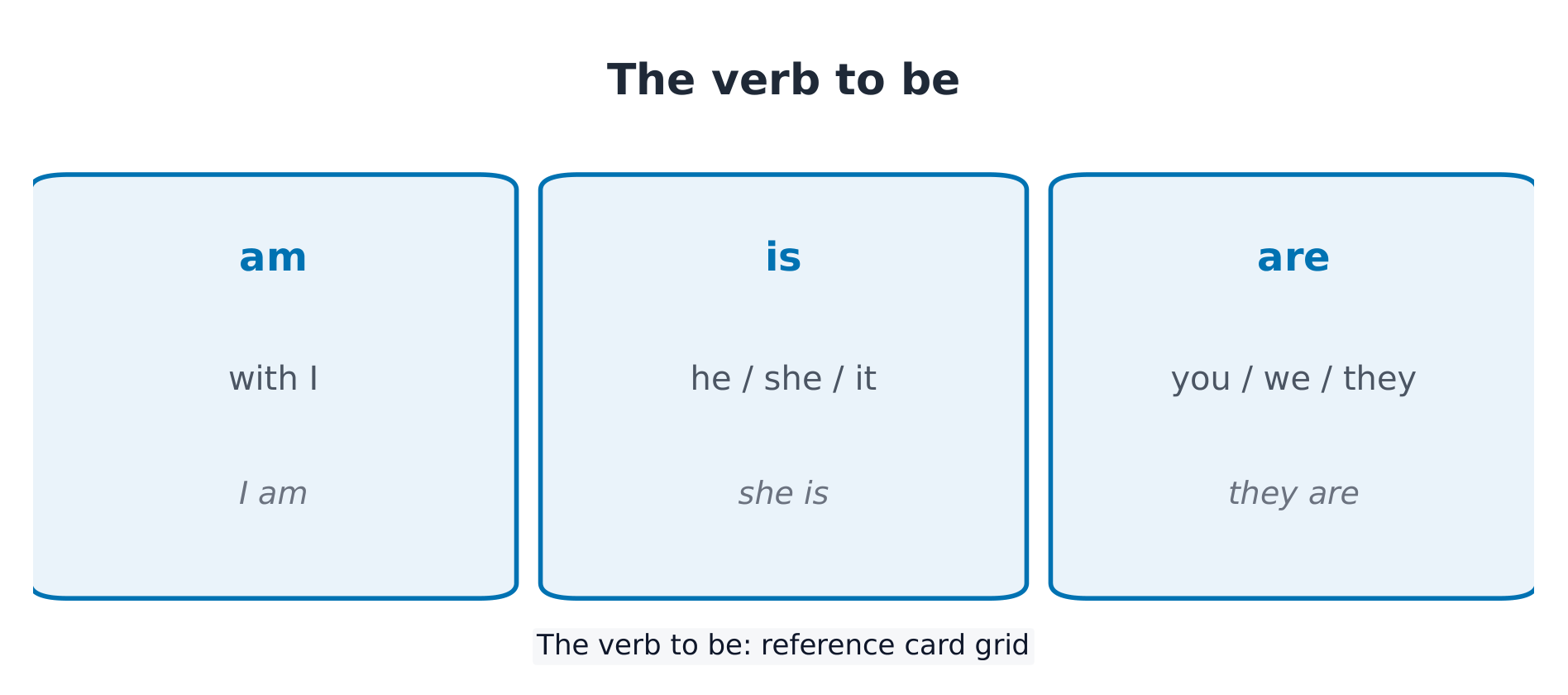
    be 동사: am / is / are는 주어에 따라 변화함

    be 동사(the verb to be)는 '이다/있다'를 나타냅니다. 주어에 따라 세 가지 형태로 변합니다:

    • I → am
    • he / she / it → is
    • you / we / they → are

    我I 是am 一名a 学生student.

    나는 학생입니다.

    她She 是is 开心happy.

    그녀는 매우 기쁩니다.

    他们They (是)are 来自from 中国China.

    그들은 중국에서 왔습니다.

    주의 구어에서는 약형을 자주 사용합니다: I'm, you're, he's, she's, it's, we're, they're.
    1.2

    부정 및 의문형

    English

    Negation: Add not after the be verb (often contracted).

    他He 不是is not 一名a 老师teacher.

    He is not a teacher. (= He isn't a teacher.)

    Interrogative: Place the be verb before the subject.

    (是吗)Are 你you 准备好ready?

    Are you ready?

    Short answers: Yes, I am. / No, I'm not.

    Note: Negative contractions: is not → isn't, are not → aren't; but am not is only contracted to I'm not (there is no ~~amn't~~).

    Common Errors

    • ❌ ~~He busy.~~ → ✓ He is busy. — In Chinese, "He is very busy" can exist without a verb, but an English sentence must have a verb. Use be to link when the predicative is an adjective or noun and there are no other verbs in the sentence (He is busy); do not add be if the sentence already contains an ordinary verb (I go to school).
    • ❌ ~~I am go to school.~~ → ✓ I go to school. — Do not use be and ordinary verbs together; "go" alone suffices for "to go."
    • ❌ ~~They is my friends.~~ → ✓ They are my friends. — Plural subjects (you / we / they) take are.
    • ❌ ~~I am agree.~~ → ✓ I agree. — agree is itself a verb; do not add am before it.
    • ❌ ~~Are you ready? — Yes, I'm.~~ → ✓ Yes, I am. — Contractions cannot be used at the end of affirmative short answers (say Yes, I am); however, negative short answers typically end with a negative contraction (No, he isn't / No, I can't; first person is No, I'm not, as there is no amn't).
    한국어

    부정: be 동사 뒤에 not(주로 약형)을 붙입니다.

    他He 不是is not 一名a 老师teacher.

    그는 선생님이 아닙니다. (= He isn't a teacher.)

    의문: be 동사를 주어 앞에 배치합니다.

    (是吗)Are 你you 准备好ready?

    준비되었습니까?

    간단한 답변:Yes, I am. / No, I'm not.

    주의 부정 약형: is not → isn't, are not → aren't; 그러나 am not은 I'm not으로만 약형되며 ~~amn't~~는 사용하지 않습니다.

    자주 하는 실수

    • ❌ ~~He busy.~~ → ✓ He is busy. — 중국어에서 "他很忙"은 동사가 없어도 되지만, 영어 문장에는 반드시 동사가 필요합니다. 서술어가 형용사나 명사이고 다른 동사가 없는 경우에만 be 동사를 사용하여 연결합니다(He is busy); 문장에 이미 일반 동사가 있는 경우에는 be 동사를 추가하지 않습니다(I go to school)。
    • ❌ ~~I am go to school.~~ → ✓ I go to school. — be 동사와 일반 동사는 함께 사용할 수 없습니다; "가다"는 go만 사용합니다。
    • ❌ ~~They is my friends.~~ → ✓ They are my friends. — 복수 주语(you / we / they)에는 are를 사용합니다。
    • ❌ ~~I am agree.~~ → ✓ I agree. — agree(동의하다) 자체는 동사이므로, 앞에 am을 붙이지 않습니다。
    • ❌ ~~Are you ready? — Yes, I'm.~~ → ✓ Yes, I am. —肯定简短回答的末尾不能用缩写(说 Yes, I am);但否定简短回答通常以否定缩写结尾(No, he isn't / No, I can't;第一人称是 No, I'm not,因为没有 amn't)。
  • 2 Subject pronouns · ⁨주격 대명사⁩
    2.1

    I, you, he, she, it, we, they

    English

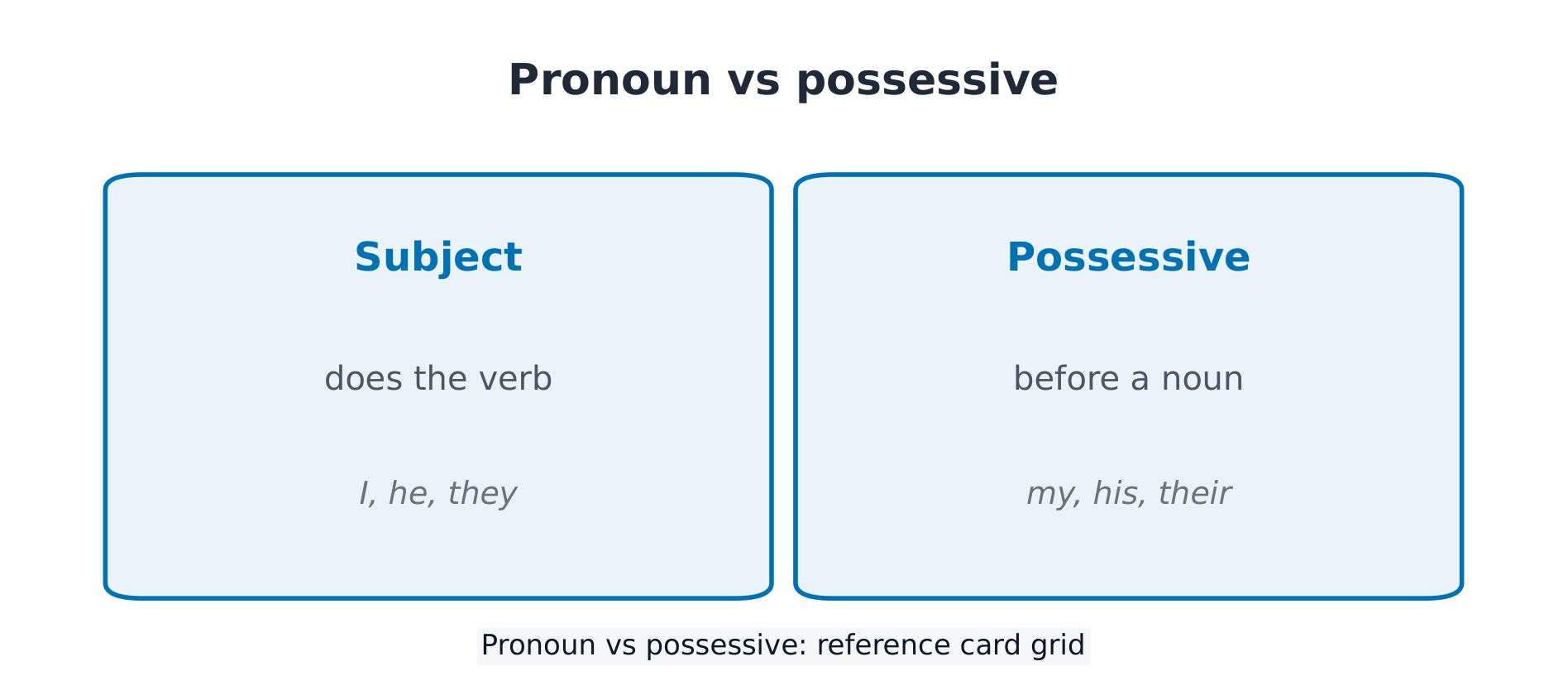
    Subject pronouns replace the subject and are placed before the verb:

    • I(I), you(you), he(he), she(she)
    • it(it), we(we), they(they)

    他He 是is 我的my 哥哥brother.

    He is my brother.

    我们We 喜欢like 音乐music.

    We like music.

    Key Usage Points:

    • I is always capitalized, regardless of its position in the sentence.
    • Things and animals commonly use it: This is my bag. It is new.(This is my bag. It is new.)*
    • Plural people or things both use they: The books are here. They are mine.(The books are here. They are mine.)*

    Note: Subject pronouns are followed by verbs; do not confuse them with object pronouns (me, him, her...) which will be learned later.

    Common Errors

    • ❌ ~~My mother is a doctor. He is very kind.~~ → ✓ She is very kind. — In colloquial Chinese, "he/she" sounds identical, but in English, he and she must be clearly distinguished.
    • ❌ ~~Me am a student.~~ → ✓ I am a student. — Use I for the subject, not me.
    • ❌ ~~My friend he is tall.~~ → ✓ My friend is tall. — The subject needs to be mentioned only once; avoid repeating "noun + pronoun" (the Chinese habit of saying "my friend he..." does not apply in English).
    • ❌ ~~Is raining.~~ → ✓ It is raining. — English sentences must have a subject; weather, time, and dates begin with it.
    한국어
    주어 대명사 및 소유격

    주어 인칭 대명사 (subject pronouns)는 주어를 대신하여 동사 앞에 놓습니다:

    • I(나), you(너/너희), he(그), she(그녀)
    • it(그것/그녀/그), we(우리가), they(그들/그들 것들)

    他He 是is 我的my 哥哥brother.

    그는 나의 형제입니다.

    我们We 喜欢like 音乐music.

    우리는 음악을 좋아합니다.

    사용법 포인트:

    • I는 문장의 어디에 있든 항상 대문자로 시작합니다.
    • 사물, 동물에는 보통 it을 사용함:This is my bag. It is new.(이것은 내 가방이다. 그것은 새 것이다。)
    • 복수의 사람이나 사물에는 모두 they를 사용함:The books are here. They are mine.(책들은 여기에 있다. 그것들은 내 것이다。)

    주의 주어 대명사 뒤에는 동사가 따라야 합니다. 나중에 배울 목적어 대명사(me, him, her…)와 혼동하지 마십시오。

    자주 하는 실수

    • ❌ ~~My mother is a doctor. He is very kind.~~ → ✓ She is very kind. — 중국어 구어체에서 "他/她"는 발음이 같지만, 영어에서는 he와 she를 반드시 구분해야 합니다。
    • ❌ ~~Me am a student.~~ → ✓ I am a student. — 주어로 사용할 때는 I를 쓰고, me를 사용하지 않습니다。
    • ❌ ~~My friend he is tall.~~ → ✓ My friend is tall. — 주어를 한 번만 언급하면 충분하므로, "명사 + 대명사"로 반복해서 쓸 필요는 없습니다(중국어 "我朋友他……"의 습관은 영어로 가져올 수 없습니다)。
    • ❌ ~~Is raining.~~ → ✓ It is raining. — 영어 문장에는 반드시 주어가 있어야 합니다; 날씨, 시간, 날짜는 it으로 시작합니다。
  • 3 Possessive adjectives · ⁨소유격 관형사⁩
    3.1

    my, your, his, her, our, their

    English

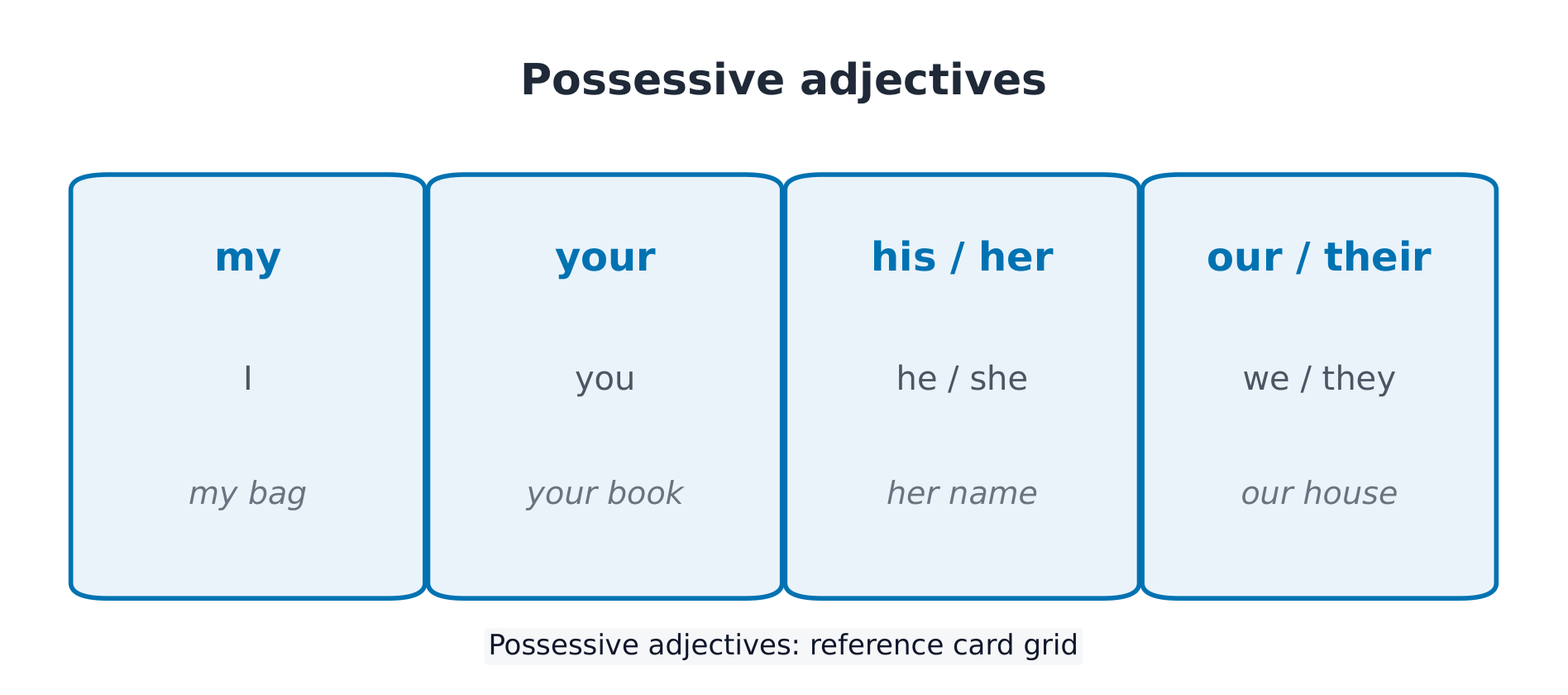
    Possessive adjectives indicate "whose" and are placed before the noun:

    • I → my(my), you → your(your), he → his(his)
    • she → her(her), it → its(its), we → our(our), they → their(their)

    这This 是is 我的my 包bag.

    This is my bag.

    她的Her 名字name 是is 露西Lucy.

    Her name is Lucy.

    Key Usage Points:

    • Possessive adjectives are always followed by a noun: my book, their house.
    • They do not change with noun number: my book, my books(my remains unchanged).

    Note: Be careful to distinguish its (its, no apostrophe) and it's (= it is). For example: The dog wags its tail.(The dog wags its tail.)*

    Common Errors

    • ❌ ~~This is she book.~~ → ✓ This is her book. — A possessive form must precede a noun: he → his, she → her.
    • ❌ ~~He is me friend.~~ → ✓ He is my friend. — The possessive form of I is my.
    • ❌ ~~The dog wags it's tail.~~ → ✓ …wags its tail. — it's = it is; "its" (possessive) has no apostrophe.
    • ❌ ~~Their is a park near here.~~ → ✓ There is a park near here. — their (their) and there (there/here) sound identical; do not mix them up in writing.
    한국어
    소유격 관형사:my / your / his / her

    소유격 관형사 (possessive adjectives)는 "누구의"를 나타내며, 명사 앞에 놓습니다:

    • I → my(나의), you → your(너의/너희의), he → his(그의)
    • she → her(그녀의), it → its(그것의), we → our(우리의), they → their(그들의)

    这This 是is 我的my 包bag.

    이것은 나의 가방입니다.

    她的Her 名字name 是is 露西Lucy.

    그녀의 이름은 루시입니다.

    사용법 포인트:

    • 소유격 관형사 뒤에는 반드시 명사가 따라야 함:my book, their house。
    • 명사의 단복수에 따라 변화하지 않음:my book, my books(my는 변하지 않음)。

    주의 its(그것의, 부호 없음)와 it's(= it is)를 주의하여 구분하십시오. 예시:The dog wags its tail.(개는 꼬리를 흔든다。)

    자주 하는 실수

    • ❌ ~~This is she book.~~ → ✓ This is her book. — 명사 앞에는 소유격 형태를 써야 함:he → his, she → her。
    • ❌ ~~He is me friend.~~ → ✓ He is my friend. — I의 소유격 형태는 my입니다。
    • ❌ ~~The dog wags it's tail.~~ → ✓ …wags its tail. — it's = it is; "그것의"는 its이며, 부호가 없습니다。
    • ~~Their is a park near here.~~ → ✓ There is a park near here. — their(그들의)과 there(there is/there are 또는那里)는 발음이 동일하므로, 쓸 때 혼동하지 마십시오。
  • 4 this, that, these, those
    4.1

    this와 that

    English

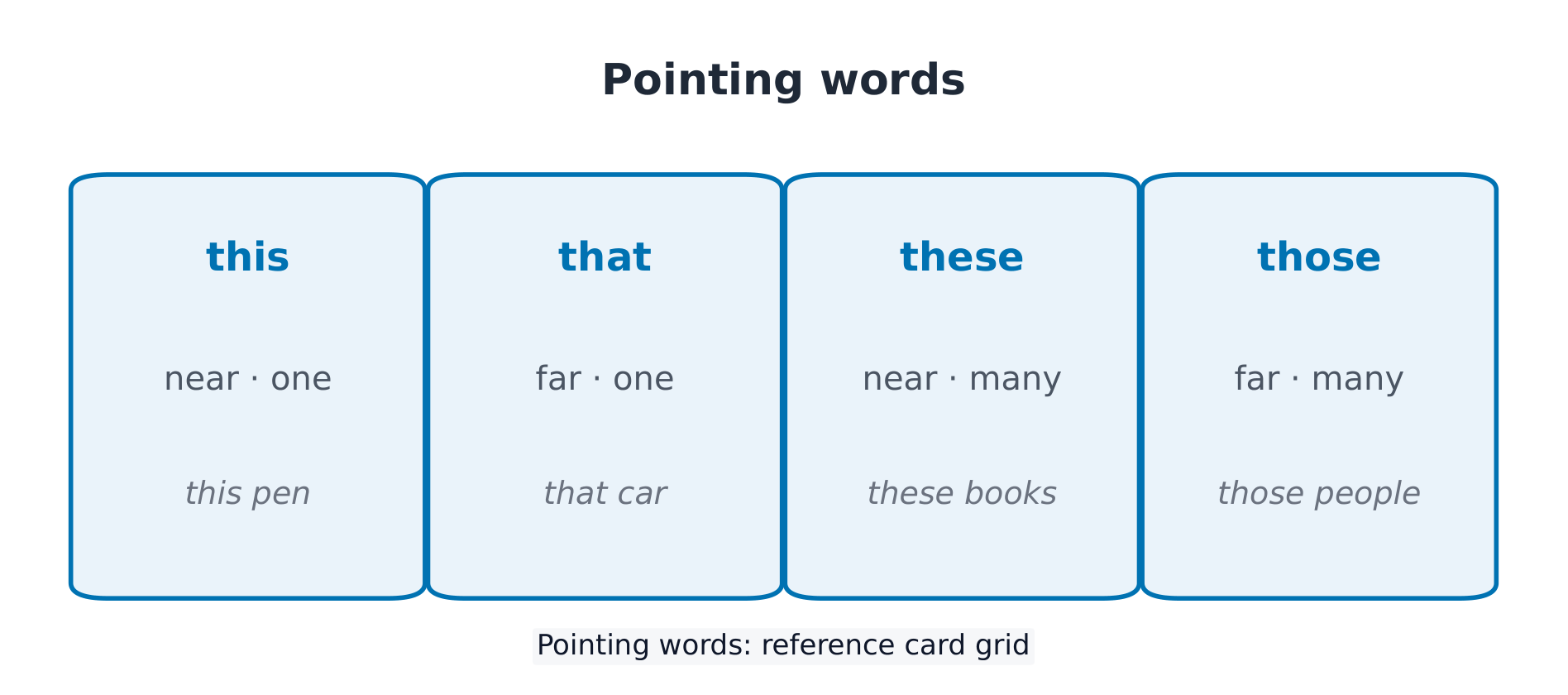
    Demonstratives point out "which one." Use this and that for singular:

    • this(this): Close to the speaker.
    • that(that): Far from the speaker.

    这This 是is 我的my 手机phone.

    This is my phone. (Close)

    那That 是is 你的your 车car.

    That is your car. (Far)

    한국어
    근거/원거 × 단수/복수:this / that / these / those

    지시대명사 (demonstratives)는 "哪一个"를 가리킵니다. 단수에는 this와 that를 사용합니다:

    • this(이것): 화자에게 가깝습니다。
    • that(저것): 화자에게 **멀어집니다。

    这This 是is 我的my 手机phone.

    이것은 나의 휴대폰입니다.(가까움)

    那That 是is 你的your 车car.

    저것은 당신의 차입니다.(멀음)

    4.2

    these와 those

    English

    Use these and those for plural:

    • these(these): Close. those(those): Far.

    这些These 是are 我的my 书books.

    These are my books.

    那些Those 是are 她的her 朋友friends.

    Those are her friends.

    Contrastive Memory:

    • Near → this (singular) / these (plural).
    • Far → that (singular) / those (plural).

    Note: These / those are followed by plural nouns: these books, not ~~these book~~.

    Common Errors

    • ❌ ~~these book~~ → ✓ these books — Plural nouns must follow these / those.
    • ❌ ~~This books are mine.~~ → ✓ These books are mine. — If the noun is plural, the demonstrative must also be plural.
    • ❌ When introducing yourself on the phone, say ~~I am Tom.~~ → ✓ This is Tom. — In English, introduce yourself on the phone using this is.
    • Remember pairs: Near this / these are often used with here; far that / those are often used with there.
    한국어

    복수에는 these와 those를 사용합니다:

    • these(이들): 가까움。those(저들): 멀음。

    这些These 是are 我的my 书books.

    이것들은 나의 책들입니다.

    那些Those 是are 她的her 朋友friends.

    저것들은 그녀의 친구들입니다.

    대조 기억:

    • 가까움 → this(단수)/ these(복수)。
    • 멀음 → that(단수)/ those(복수)。

    주의 these / those 뒤에는 복수 명사가 따라야 함:these books, ~~these book~~이 아닌。

    자주 하는 실수

    • ❌ ~~these book~~ → ✓ these books — these / those 뒤에는 반드시 복수 명사를 붙여야 합니다。
    • ❌ ~~This books are mine.~~ → ✓ These books are mine. — 명사가 복수이면, 지시대명사도 복수 형태로 사용해야 합니다。
    • ❌ 전화할 때 ~~I am Tom.~~ → ✓ This is Tom. — 영어에서는 전화를 걸 때 자기를 소개할 때 this is를 사용합니다。
    • 을 기억하십시오: 가까운 this / these는 보통 here와 함께 사용하고, 먼 that / those는 보통 there와 함께 사용합니다。
  • 5 a, an and plurals · ⁨a, an 및 복수형⁩
    5.1

    a와 an

    English

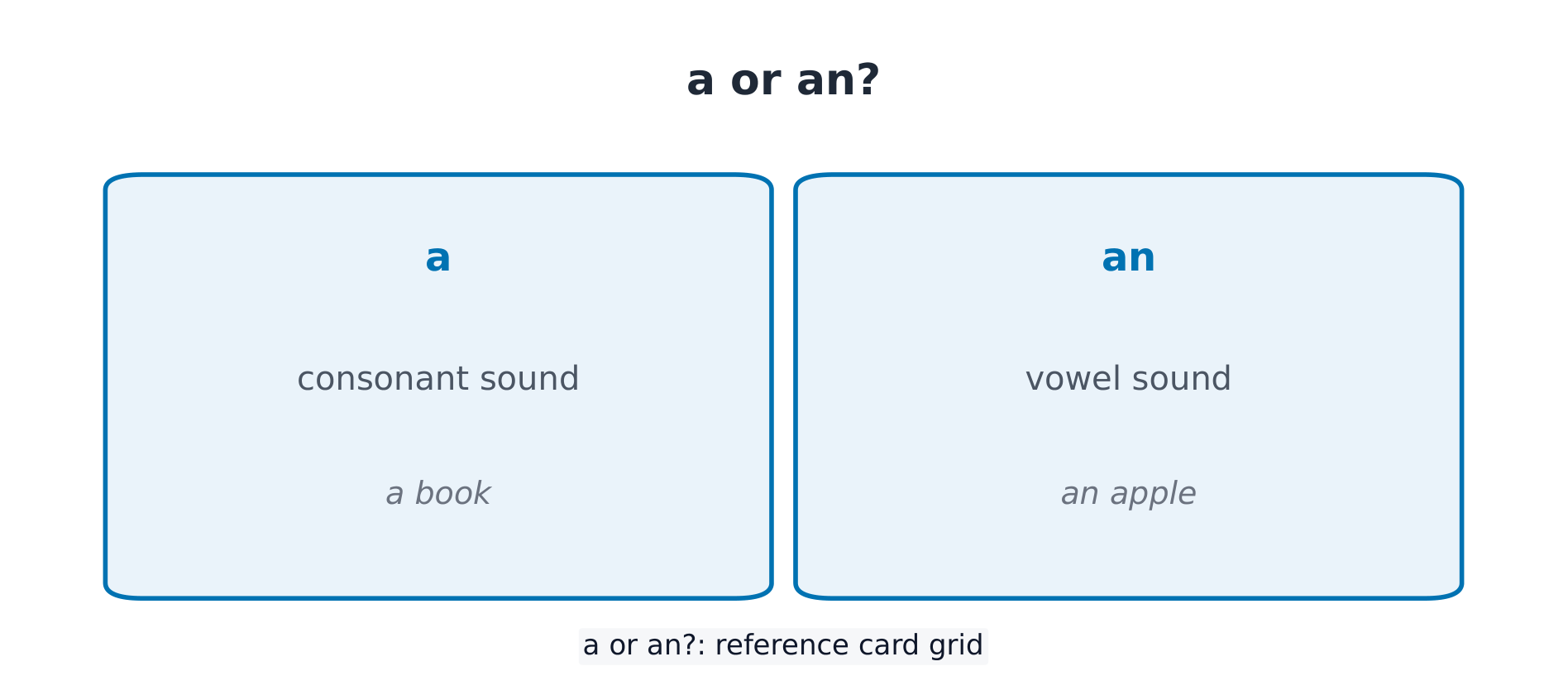
    a and an mean "one" and are used before singular countable nouns. How to choose depends on pronunciation:

    • a + consonant sound: a book, a dog, a cat.
    • an + vowel sound: an apple, an egg, an orange.

    我I 有have 一个a 笔pen.

    I have a pen.

    她She 吃eats 一个an 苹果apple.

    She eats an apple.

    Note: Look at the sound, not the letter: an hour (h is silent), a university (pronounced "yu-").

    한국어
    a / an: 발음을 보라(자음 vs 모음)

    a와 an은 "하나"를 의미하며, 단수 가산명사 앞에 사용합니다. 어떻게 선택할지는 발음을 보세요:

    • a + 자음음: a book, a dog, a cat。
    • an + 모음음: an apple, an egg, an orange。

    我I 有have 一个a 笔pen.

    나는 펜을 하나 가지고 있습니다.

    她She 吃eats 一个an 苹果apple.

    그녀는 사과를 하나 먹습니다.

    주의 글자가 아니라 소리에 집중하십시오: an hour(h는 발음하지 않음), a university("yu-"라고 읽음)。

    5.2

    명사 복수형

    English

    To indicate "more than one," use the plural form of the noun, usually adding -s:

    • Generally add -s: book → books, car → cars.
    • Words ending in -s / -sh / -ch / -x add -es: bus → buses, box → boxes.
    • Consonant + y ending: change y to i and add -es: baby → babies, city → cities.

    我I 有have 两two 猫cats.

    I have two cats.

    Irregular plurals (must memorize):

    • man → men, woman → women, child → children.
    • foot → feet, tooth → teeth, person → people.

    Note: Do not use a / an before plural nouns: ~~a books~~ ✗ → books / two books ✓.

    Common Errors

    • ❌ ~~I have dog.~~ → ✓ I have a dog. — In Chinese you can say "I have dogs," but singular countable nouns in English must have a / an (or my, the, etc.) before them.
    • ❌ ~~an university~~ → ✓ a university; ❌ ~~a hour~~ → ✓ an hour — Look at pronunciation, not spelling: university starts with a consonant sound /j/, and h is silent in hour.
    • ❌ ~~two book~~ → ✓ two books — Chinese nouns do not change for plurality, but nouns after numbers in English require -s; this is easily forgotten.
    • ❌ ~~three childs~~ → ✓ three children — Irregular plurals must be memorized separately: men, women, children, feet, teeth, people.
    • ❌ ~~a people~~ → ✓ a person (one person) / people (many people) — people is inherently plural.
    한국어

    "하나 이상"을 나타낼 때 명사는 복수형으로, 일반적으로 -s를 붙입니다:

    • 일반적으로 -s를 더함: book → books, car → cars。
    • -s / -sh / -ch / -x로 끝나는 경우, -es를 더함: bus → buses, box → boxes。
    • 자음 + y로 끝나는 경우, y를 i로 바꾸고 -es를 더함: baby → babies, city → cities。

    我I 有have 两two 猫cats.

    나는 고양이 두 마리를 가지고 있습니다.

    불규칙 복수(암기 필수):

    • man → men, woman → women, child → children。
    • foot → feet, tooth → teeth, person → people。

    주의 복수 명사 앞에는 a/an을 붙이지 않음: ~~a books~~ ✗ → books / two books ✓。

    자주 하는 실수

    • ❌ ~~I have dog.~~ → ✓ I have a dog. — 중국어로는 "我有狗"라고 말할 수 있지만, 영어에서는 단수 가산명사 앞에 반드시 a/an(또는 my, the 등)이 필요합니다。
    • ❌ ~~an university~~ → ✓ a university; ❌ ~~a hour~~ → ✓ an hour — 발음을 보고 글자를 보지 마십시오: university는 자음 /j/로 시작하고, hour의 h는 발음하지 않습니다。
    • ❌ ~~two book~~ → ✓ two books — 중국어 명사는 복수 변화가 없지만, 영어 숫자后面的名詞는 -s를 붙여야 하므로 가장 쉽게 잊히게 됩니다。
    • ❌ ~~three childs~~ → ✓ three children — 불규칙 복수는 따로 외워야 함: men, women, children, feet, teeth, people。
    • ❌ ~~a people~~ → ✓ a person(한 사람)/ people(많은 사람들) — people 자체는 복수입니다。
  • 6 there is and there are · ⁨there is와 there are⁩
    6.1

    단수형 및 복수형

    English

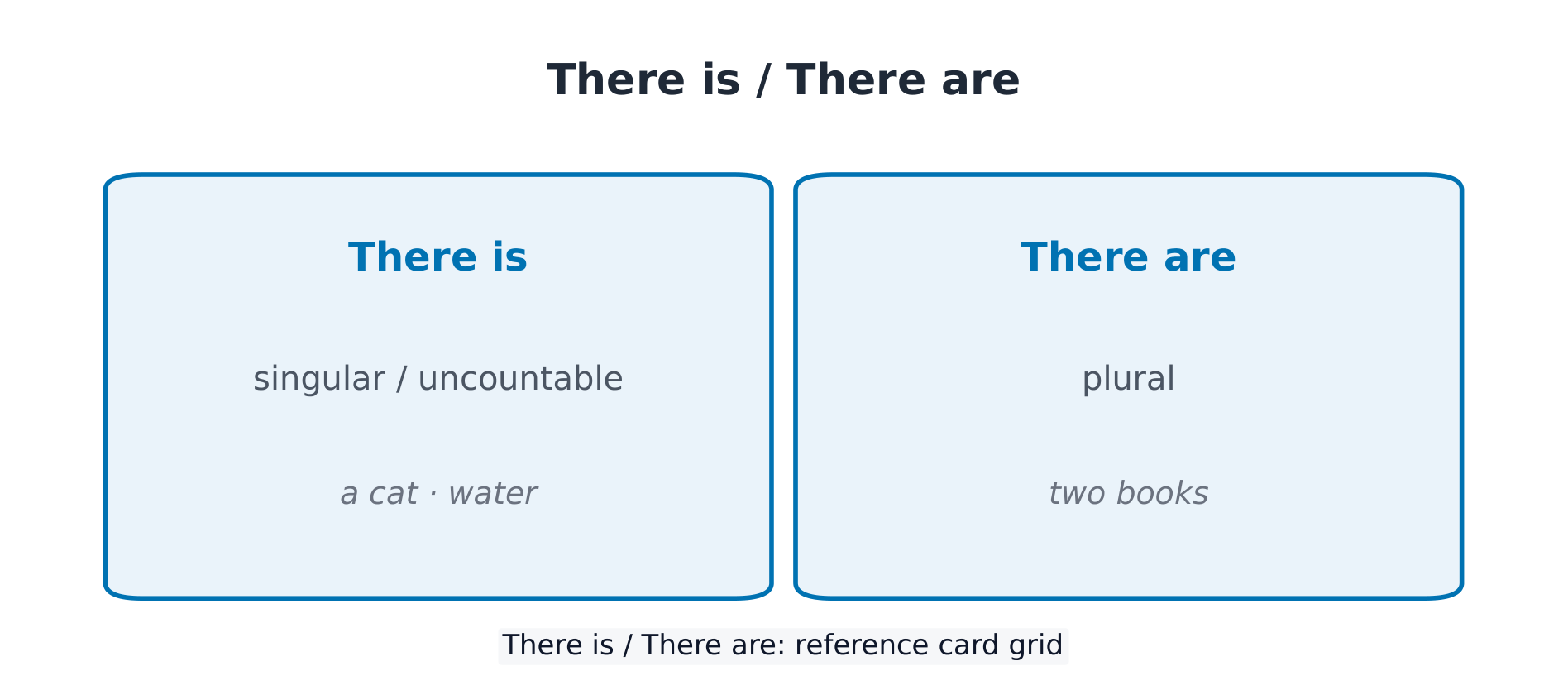
    there is / there are means "there exists" (something exists somewhere).

    • There is + singular / uncountable noun: There is a book.
    • There are + plural noun: There are two books.

    (有)There 有is 一只a 猫cat 在on (冠词)the 沙发上sofa.

    There is a cat on the sofa.

    (有)There 有are 三three 书books 在on (冠词)the 桌上desk.

    There are three books on the table.

    Note: In spoken English, there is is often contracted to there's: There's a problem.

    한국어
    There is(단수)/ There are(复数)

    there is / there are는 '있다(어딘가에 어떤 것이 존재한다)'를 나타냅니다.

    • There is + 단수/불가산 명사: There is a book.
    • There are + 복수 명사: There are two books.

    (有)There 有is 一只a 猫cat 在on (冠词)the 沙发上sofa.

    소파 위에 고양이 한 마리가 있습니다.

    (有)There 有are 三three 书books 在on (冠词)the 桌上desk.

    책상 위에 책 세 권이 있습니다.

    주의 구어에서 there is은 종종 there's로 줄여 쓰입니다: There's a problem.

    6.2

    부정 및 의문형

    English

    Negative: there is not / there are not (contracted as there isn't / there aren't).

    (有)There 没有isn't 任何any 牛奶milk.

    There is no milk left.

    Question: Move is / are to the front of there.

    (有吗)Is (有)there 一家a 银行bank 附近near 这里here?

    Is there a bank nearby?

    Short answer: Yes, there is. / No, there isn't.

    Note: Use any frequently in negative / question sentences: Is there any water? (Is there any water?)

    Common Errors

    • ❌ ~~Here has many people.~~ → ✓ There are many people here. — The "have" in the Chinese "There are many people here" indicates existence; use there is / there are in English, do not translate literally as have.
    • ❌ ~~There have a book on the desk.~~ → ✓ There is a book on the desk. — Use is / are after there; there have does not exist.
    • ❌ ~~There is two cats.~~ → ✓ There are two cats. — If the following noun is plural, use are.
    • ❌ ~~There are a milk.~~ → ✓ There is some milk. — milk is uncountable: use there is + some, do not use a.
    한국어

    부정문: there is not / there are not(줄임형: there isn't / there aren't).

    (有)There 没有isn't 任何any 牛奶milk.

    우유가 없습니다.

    의문문: is / are를 there 앞에 둡니다.

    (有吗)Is (有)there 一家a 银行bank 附近near 这里here?

    여기에 은행이 있습니까?

    간단한 답변: Yes, there is. / No, there isn't.

    주의 부정문 및 의문문에서는 any를 자주 사용합니다: Is there any water?(물이 있나요?)

    자주 하는 실수

    • ❌ ~~Here has many people.~~ → ✓ There are many people here. — 중국어의 '这里有很多人'의 '有'는 존재를 의미하므로 영어에서는 there is / there are를 사용해야 하며, have로 직역해서는 안 됩니다.
    • ❌ ~~There have a book on the desk.~~ → ✓ There is a book on the desk. — there 뒤에는 is / are를 사용하며, there have라는 표현은 없습니다.
    • ❌ ~~There is two cats.~~ → ✓ There are two cats. — 뒤의 명사가 복수이므로 are를 사용합니다.
    • ❌ ~~There are a milk.~~ → ✓ There is some milk. — milk는 불가산 명사이므로: there is + some를 사용하고, a는 사용할 수 없습니다.
  • 7 have got
    7.1

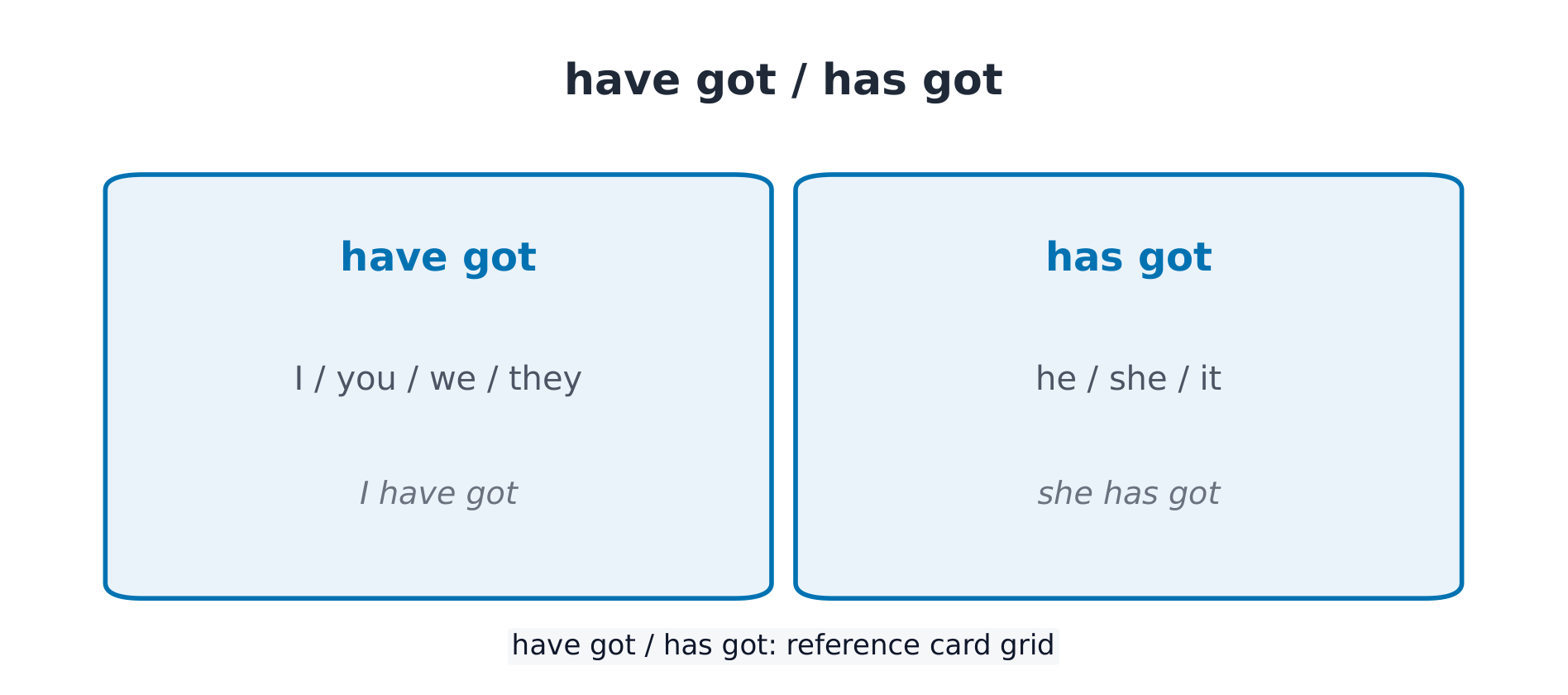
    have got / has got

    English

    have got means "to possess" (= have), common in British English.

    • I / you / we / they → have got
    • he / she / it → has got

    我I 有have got 一个a 兄弟brother.

    I have a brother. (= I have a brother.)

    她She 有has got 蓝色blue 眼睛eyes.

    She has blue eyes.

    Note: Often contracted in spoken language: I've got, she's got, they've got. Same meaning as have / has.

    한국어
    have got / has got

    have got은 '소유하다'(= have)를 의미하며, 영식 영어에서 매우 흔하게 사용됩니다.

    • I / you / we / they → have got
    • he / she / it → has got

    我I 有have got 一个a 兄弟brother.

    나는 형제가 있다. (= I have a brother.)

    她She 有has got 蓝色blue 眼睛eyes.

    그녀는 파란 눈을 두 개 가지고 있습니다.

    주의 구어에서는 주로 줄여 씁니다: I've got, she's got, they've got. 뜻은 have / has와 같습니다.

    7.2

    부정 및 의문형

    English

    Negative: haven't got / hasn't got.

    他He 没有hasn't got 一辆a 车car.

    He doesn't have a car.

    Question: Move Have / Has to the front of the subject.

    (有吗)Have 你you 有got 一支a 笔pen?

    Do you have a pen?

    Short answer: Yes, I have. / No, I haven't.

    Note: have got is mostly used for current possession; for past or habits, use regular have / had.

    Common Errors

    • ❌ ~~She have got long hair.~~ → ✓ She has got long hair. — Use has got for he / she / it.
    • ❌ ~~I have got not a car.~~ → ✓ I haven't got a car. — Place not after have / has, then contract.
    • ❌ ~~Do you have got a pen?~~ → ✓ Have you got a pen? / Do you have a pen? — Both question forms are correct, but never mix them.
    • ❌ ~~Yes, I have got.~~ → ✓ Yes, I have. — Short answers end at have / has, without got.
    한국어

    부정문: haven't got / hasn't got.

    他He 没有hasn't got 一辆a 车car.

    그는 차가 없습니다.

    의문문: Have / Has를 주어 앞에 둡니다.

    (有吗)Have 你you 有got 一支a 笔pen?

    당신은 펜이 있습니까?

    간단한 답변: Yes, I have. / No, I haven't.

    주의 have got은 보통 '소유하는' 이 순간의 상태를 나타낼 때 사용합니다. 과거나 습관에 대해서는普通的 have / had를 사용해야 합니다.

    자주 하는 실수

    • ❌ ~~She have got long hair.~~ → ✓ She has got long hair. — he / she / it에는 has got을 사용합니다.
    • ❌ ~~I have got not a car.~~ → ✓ I haven't got a car. — not을 have / has 뒤에 붙인 후 줄입니다.
    • ❌ ~~Do you have got a pen?~~ → ✓ Have you got a pen? / Do you have a pen? — 두 가지 모두 맞지만, 한 문장에 섞어서는 안 됩니다.
    • ❌ ~~Yes, I have got.~~ → ✓ Yes, I have. — 간단한 답변은 have / has까지만 하고, got은 더 이상 붙이지 않습니다.
  • 8 Present simple · ⁨현재 단순법⁩
    8.1

    Habits and Third Person -s

    English

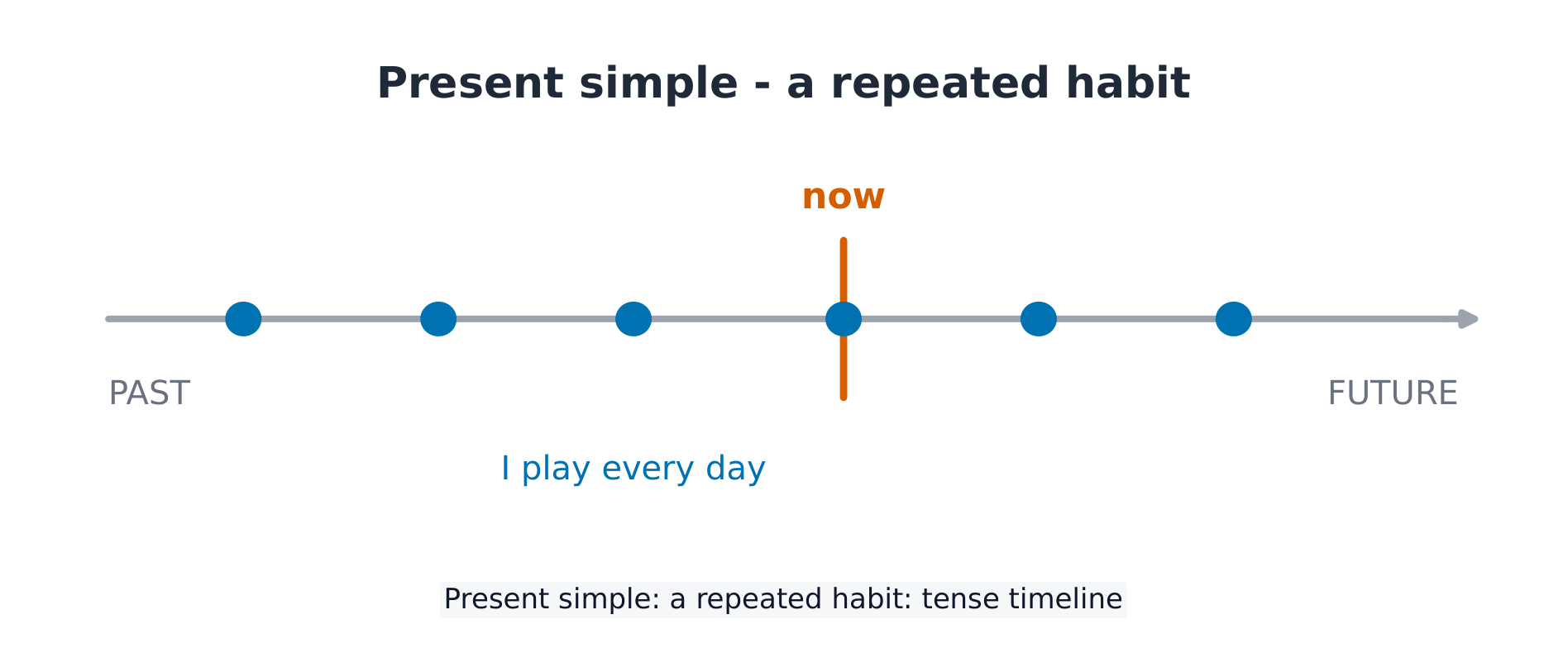
    Present simple (present simple) describes habits and facts. The base form is the infinitive (base verb).

    我I 喜欢like 茶tea.

    I like tea.

    When the subject is he / she / it, add -s to the verb:

    他He 踢plays 足球football.

    He plays football.

    Spelling rules:

    • Generally add -s: like → likes.
    • Words ending in -s / -sh / -ch / -x / -o add -es: go → goes, watch → watches.
    • Consonant + y ending: change y to i and add -es: study → studies.

    Note: Only he / she / it take -s; I / you / we / they use the base form: They like tea.

    한국어
    Present Simple: Repeated habits

    Present simple (present simple) describes habits and facts. The base form is the infinitive (base verb).

    我I 喜欢like 茶tea.

    I like tea.

    When the subject is he / she / it, add -s to the verb:

    他He 踢plays 足球football.

    He plays football.

    Spelling rules:

    • Generally add -s: like → likes.
    • Words ending in -s / -sh / -ch / -x / -o add -es: go → goes, watch → watches.
    • Consonant + y ending: change y to i and add -es: study → studies.

    Note: Only he / she / it take -s; I / you / we / they use the base form: They like tea.

    8.2

    Negation and Interrogative

    English

    For negatives and questions, use auxiliary verbs do / does (does for he / she / it).

    Negative: Subject + don't / doesn't + base verb.

    我I 不don't 喜欢like 咖啡coffee.

    I don't like coffee.

    Question: Do / Does + Subject + base verb ?

    (助动词)Does 她she 住live 这里here?

    Does she live here?

    Note: When using do / does, the verb returns to its base form (no -s): ~~Does she lives~~ ✗ → Does she live ✓.

    Common Errors

    • ❌ ~~He go to school by bus.~~ → ✓ He goes to school by bus. — Forgetting to add -s in third person singular is the most frequent error; check your work afterwards.
    • ❌ ~~She doesn't likes coffee.~~ → ✓ She doesn't like coffee. — When using does / doesn't, the verb returns to its base form.
    • ❌ ~~I very like English.~~ → ✓ I like English very much. — "Very much" in Chinese cannot be translated literally; very cannot directly modify a verb.
    • ❌ ~~You like tea?~~ → ✓ Do you like tea? — Questions must start with do / does; rising intonation alone is insufficient.
    한국어
    Daily routine: I have breakfast every morning.

    For negatives and questions, use auxiliary verbs do / does (does for he / she / it).

    Negative: Subject + don't / doesn't + base verb.

    我I 不don't 喜欢like 咖啡coffee.

    I don't like coffee.

    Question: Do / Does + Subject + base verb ?

    (助动词)Does 她she 住live 这里here?

    Does she live here?

    Note: When using do / does, the verb returns to its base form (no -s): ~~Does she lives~~ ✗ → Does she live ✓.

    Common Errors

    • ❌ ~~He go to school by bus.~~ → ✓ He goes to school by bus. — Forgetting to add -s in third person singular is the most frequent error; check your work afterwards.
    • ❌ ~~She doesn't likes coffee.~~ → ✓ She doesn't like coffee. — When using does / doesn't, the verb returns to its base form.
    • ❌ ~~I very like English.~~ → ✓ I like English very much. — "Very much" in Chinese cannot be translated literally; very cannot directly modify a verb.
    • ❌ ~~You like tea?~~ → ✓ Do you like tea? — Questions must start with do / does; rising intonation alone is insufficient.
  • 9 can
    9.1

    능력 및 요청

    English

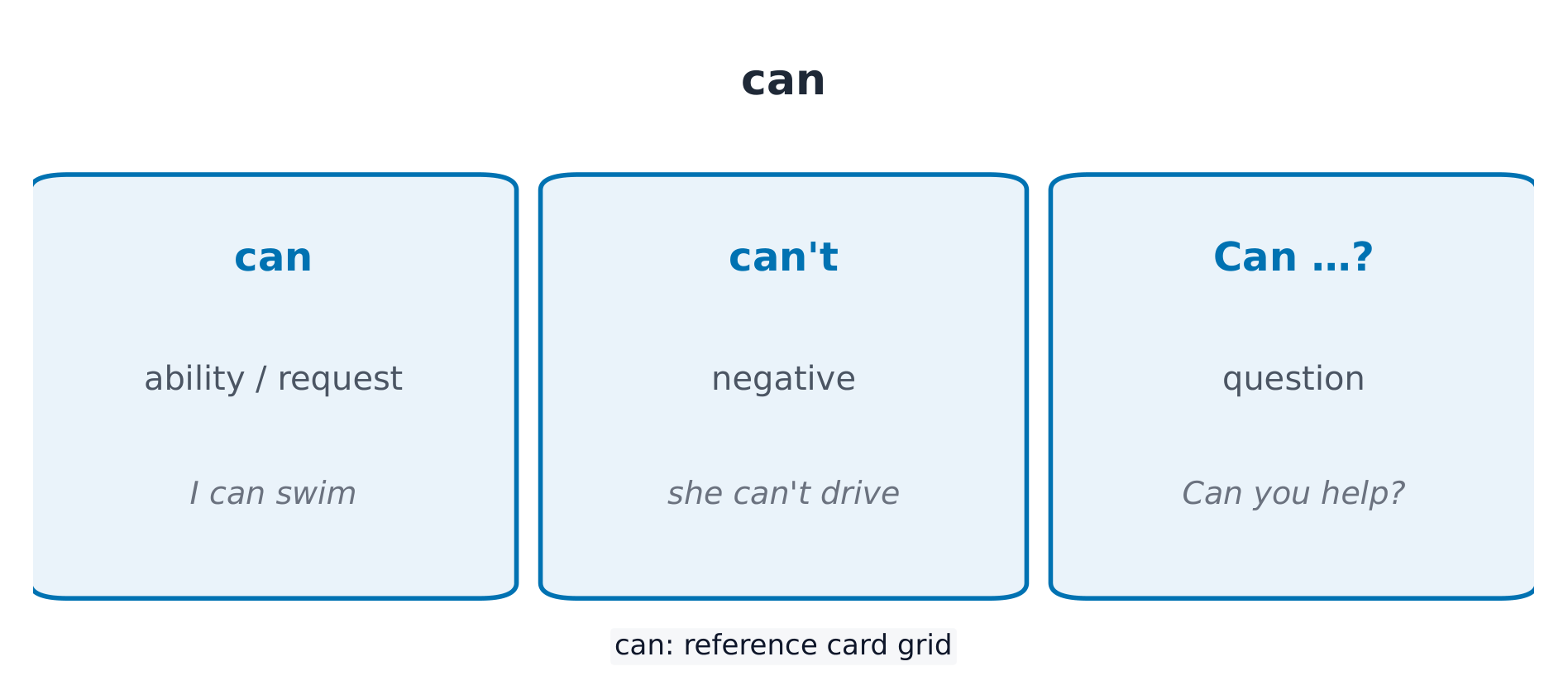
    can expresses ability ("know how to / be able to") or is used for requests. It is followed by the base form of the verb, and remains the same for all persons.

    我I 会can 游泳swim.

    I can swim.

    能Can 你you 帮help 我me?

    Can you help me?

    Note: Use the base form after can: ~~can to swim~~ ✗, ~~can swims~~ ✗ → can swim ✓.

    한국어
    can: 능력, 부정, 의문

    can은 능력('할 수 있다 / 할 수 있음')을 나타내거나 요청에 사용됩니다.其后接动词原形,所有人称形式相同。后面跟动词原形,所有人称都一样。

    我I 会can 游泳swim.

    나는 수영할 수 있습니다.

    能Can 你you 帮help 我me?

    도와주실 수 있으십니까?

    주의 can后面用原形: ~~can to swim~~ ✗、~~can swims~~ ✗ → can swim ✓.

    9.2

    부정 및 의문형

    English

    Negative: cannot (abbreviation can't) + base form of the verb.

    她She 不会can't 开车drive.

    She cannot drive.

    Question: Place Can before the subject.

    能Can 他he 做饭cook?

    Can he cook?

    Short answer: Yes, I can. / No, I can't.

    Note: can has no -s and does not use do/does: ask directly with Can he…?, not ~~Does he can…?~~

    Common Errors

    • ❌ ~~She cans drive.~~ → ✓ She can drive. — can has no third-person singular -s; it is the same for all persons.
    • ❌ ~~I don't can swim.~~ → ✓ I can't swim. — The negative of can is formed directly with not (can't), without using don't.
    • ❌ ~~He can sings very good.~~ → ✓ He can sing very well. — Use the base form of the verb after can; use the adverb well to modify a verb, not good.
    • ❌ ~~You can help me?~~ → ✓ Can you help me? — When making a request, place can before the subject.
    한국어

    부정문: cannot(줄임형 can't) + 동사 원형.

    她She 不会can't 开车drive.

    그녀는 운전할 수 없습니다.

    의문문: Can을 주어 앞에 둡니다.

    能Can 他he 做饭cook?

    그는 요리를 할 수 있습니까?

    간단한 답변: Yes, I can. / No, I can't.

    주의 can은 -s도 없고, do / does도 없습니다: 의문문은直接用 Can he…?,而不是 ~~Does he can…?~~

    자주 하는 실수

    • ❌ ~~She cans drive.~~ → ✓ She can drive. — can 没有第三人称 -s,所有人称同形。
    • ❌ ~~I don't can swim.~~ → ✓ I can't swim. — can의 부정문은直接加 not(can't),不用 don't。
    • ❌ ~~He can sings very good.~~ → ✓ He can sing very well. — can后接动词原形;修饰动词用副词 well,不用 good。
    • ❌ ~~You can help me?~~ → ✓ Can you help me? — 타인을 요청할 때는 can을 주어 앞으로 당깁니다.
  • 10 Imperatives · ⁨명령법⁩
    10.1

    명령 및 지시

    English

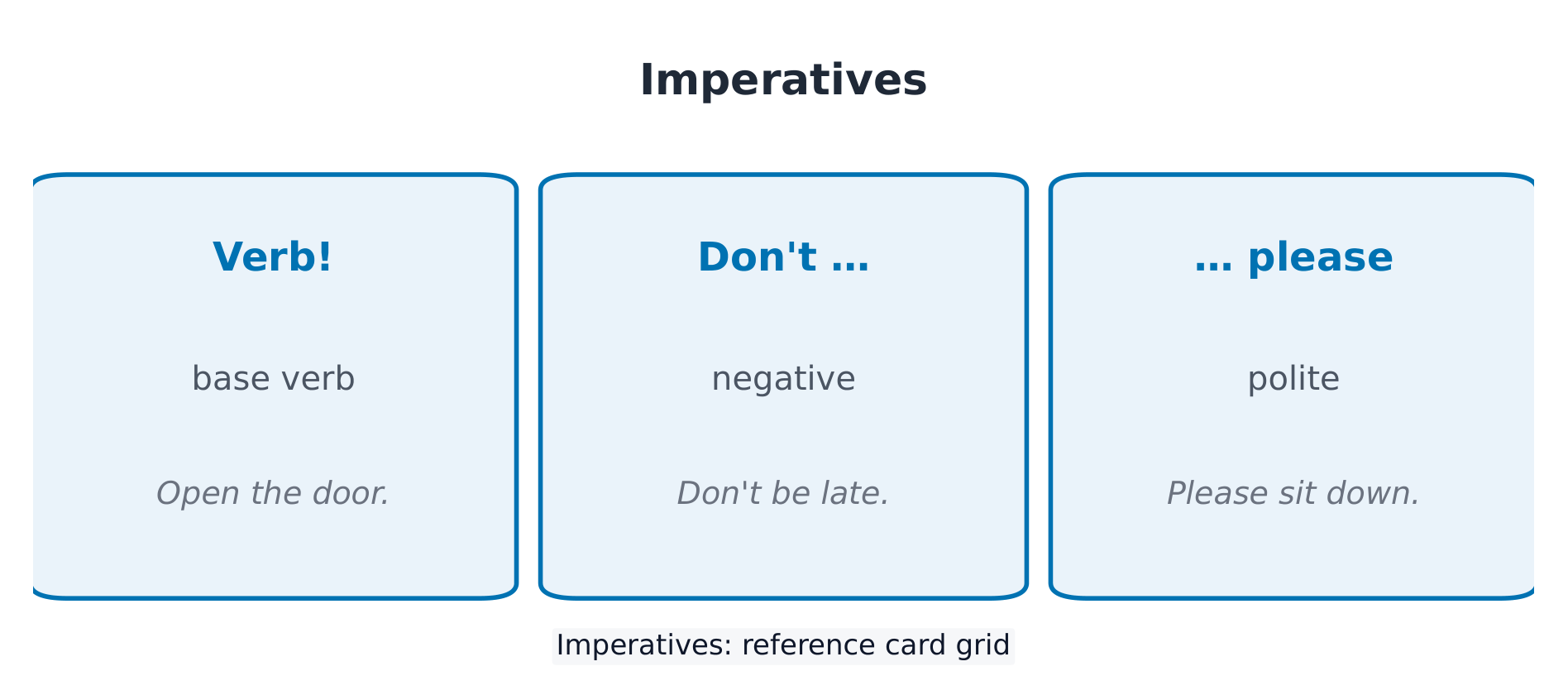
    Imperatives are used to give commands, provide instructions, or make requests. Start directly with the base form of the verb, without a subject.

    打开Open (冠词)the 门door 请, please.

    Please open the door.

    坐Sit 下down.

    Sit down.

    Negative: Add Don't at the beginning.

    不要Don't (是)be 迟到late.

    Don't be late.

    Key Usage Points:

    • Add please to be more polite: Please come in.
    • Also used for directions and instructions: Turn left. Mix the eggs.

    Note: Do not write a subject in imperatives: ~~You open the door~~ (for a command) → Open the door.

    Common Errors

    • ❌ ~~Please open door.~~ → ✓ Please open the door. — Articles must still be included in imperatives.
    • ❌ ~~Don't to touch it.~~ → ✓ Don't touch it. — Follow don't directly with the base form of the verb; do not add to.
    • ❌ ~~No talk in class!~~ → ✓ Don't talk in class! / No talking! — To prohibit an action, use don't + base form; after no, use -ing or a noun.
    • ❌ ~~You sit down!~~ → ✓ Sit down, please. — Adding you to a command sounds angry; add please for politeness, or change to Can you…?
    한국어
    명령문: 명령, 부정, 요청

    명령법 (imperatives)은 명령을 내리거나 지시를 하거나 요청을 할 때 사용합니다. 동사 원형으로 시작하고, 주어를 넣지 않습니다.

    打开Open (冠词)the 门door 请, please.

    문을 열어주세요.

    坐Sit 下down.

    앉으세요.

    부정문: 앞에 Don't를 붙입니다.

    不要Don't (是)be 迟到late.

    지각하지 마세요.

    사용법 포인트:

    • please를 추가하면 더 정중합니다: Please come in.(들어오세요.)
    • 또한 경로 안내, 설명에도 사용됩니다: Turn left.(왼쪽으로 돌기.) Mix the eggs.(계란을 섞으세요.)

    주의 명령법은 주어를 쓰지 않습니다: ~~You open the door~~(명령 시)→ Open the door.

    자주 하는 실수

    • ❌ ~~Please open door.~~ → ✓ Please open the door. — 명령법에서도 관사는 여전히 빼놓을 수 없습니다.
    • ❌ ~~Don't to touch it.~~ → ✓ Don't touch it. — don't 뒤에는 directly动词原形,不加to。
    • ❌ ~~No talk in class!~~ → ✓ Don't talk in class! / No talking! —某事禁止使用 don't + 原形;no后面要用 -ing 或名词。
    • ~~You sit down!~~ → ✓ Sit down, please. — you를 추가한 명령문은 화가 난 듯 들립니다. 정중하게 하려면 please를 추가하거나 Can you…?로 바꾸세요.
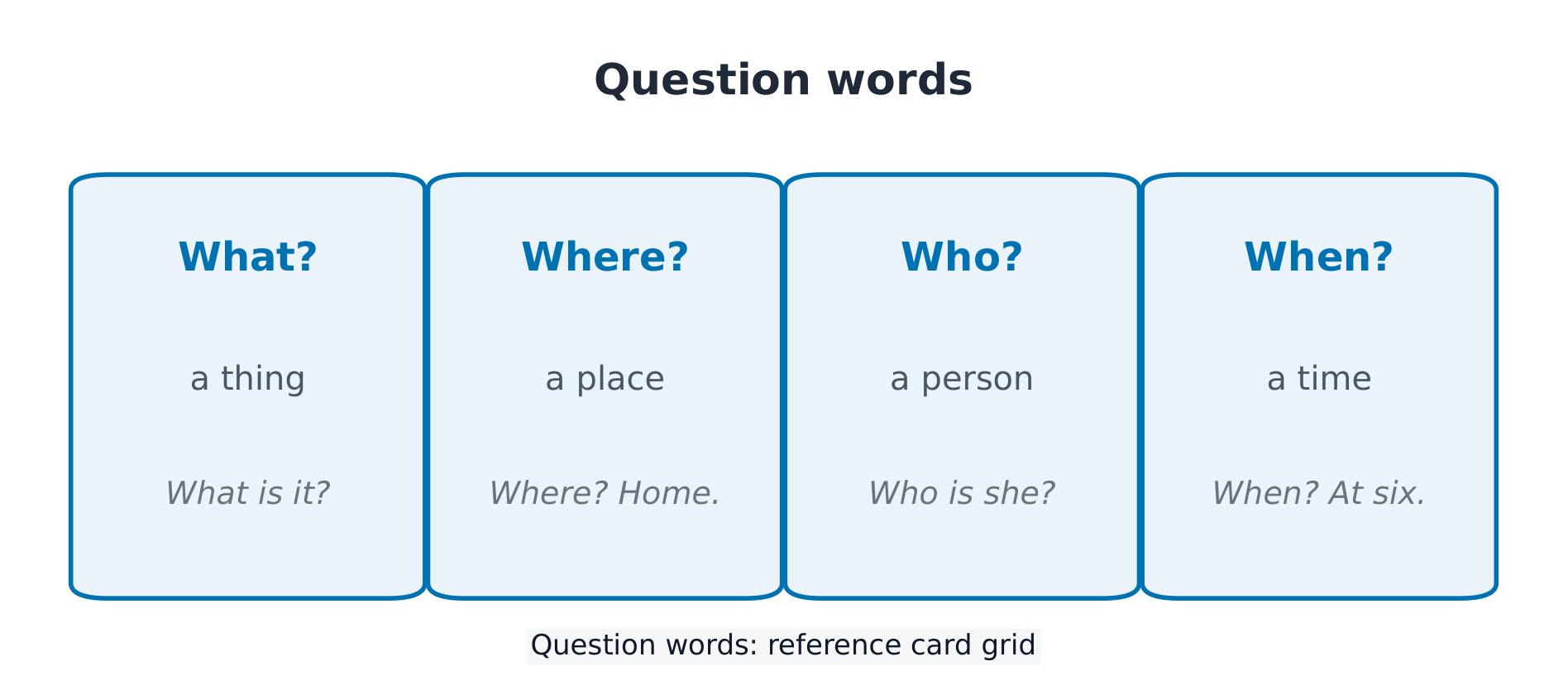
  • 11 Question words · ⁨의문사⁩
    11.1

    what, where, who

    English

    Question words are placed at the beginning of a question to ask for specific information.

    • what (what), where (where), who (who)

    什么What 是is 你的your 名字name?

    What's your name?

    哪里Where (助动词)do 你you 住live?

    Where do you live?

    谁Who 是is 那个that 男人man?

    Who is that man?

    Note: A be verb or auxiliary do/does often follows the question word: Where do you work?

    한국어
    의문사: 사물/장소/사람/시간 묻기

    의문사 (question words)는 의문문 开头에 위치하여 구체적인 정보를 묻습니다.

    • what(무엇), where(어디), who(누구)

    什么What 是is 你的your 名字name?

    이름이 무엇입니까?

    哪里Where (助动词)do 你you 住live?

    어디에 삽니까?

    谁Who 是is 那个that 男人man?

    그 남자는谁입니까?

    注意 疑问词后面常跟 be 动词或助动词 do / does:Where do you work?

    11.2

    when, why, how

    English
    • when (when), why (why), how (how / in what way)

    什么时候When 是is (冠词)the 派对party?

    When is the party?

    为什么Why (是)are 你you 难过sad?

    Why are you sad?

    怎么How (助动词)do 你you 拼写spell 它it?

    How do you spell this?

    Note: how can also combine with adjectives to ask about degree: How old are you? How much is it?

    Common Errors

    • ❌ ~~Where you live?~~ → ✓ Where do you live? — After the question word, you still need do/does or be; you cannot follow directly with the subject.
    • ❌ ~~What means this word?~~ → ✓ What does this word mean? — mean is an ordinary verb: question word + does + subject + base form.
    • ❌ ~~Why you are late?~~ → ✓ Why are you late? — When there is a be verb in the sentence, move be before the subject.
    • ❌ ~~How to spell it?~~ → ✓ How do you spell it? — A literal translation of "How to spell?" loses the subject and auxiliary verb; these must be added.
    한국어
    • when(什么时候)、why(为什么)、how(怎样 / 如何)

    什么时候When 是is (冠词)the 派对party?

    파티는 언제입니까?

    为什么Why (是)are 你you 难过sad?

    왜 슬프십니까?

    怎么How (助动词)do 你you 拼写spell 它it?

    이것 어떻게 발음하십니까?

    注意 how还能和形容词搭配问程度:How old are you?(你多大?)How much is it?(多少钱?)

    자주 하는 실수

    • ❌ ~~Where you live?~~ → ✓ Where do you live? — 疑问词后面还需要 do / does 或 be,不能直接跟主语。
    • ❌ ~~What means this word?~~ → ✓ What does this word mean? — mean 是普通动词:疑问词 + does + 主语 + 原形。
    • ❌ ~~Why you are late?~~ → ✓ Why are you late? — 句子里有 be 动词时,把 be 提到主语前面。
    • ❌ ~~How to spell it?~~ → ✓ How do you spell it? — 中文"怎么拼?"直译会丢掉主语和助动词,要补全。
  • 12 Prepositions of place · ⁨장소 전치사⁩
    12.1

    in, on, under

    English

    Prepositions of place indicate where something is located.

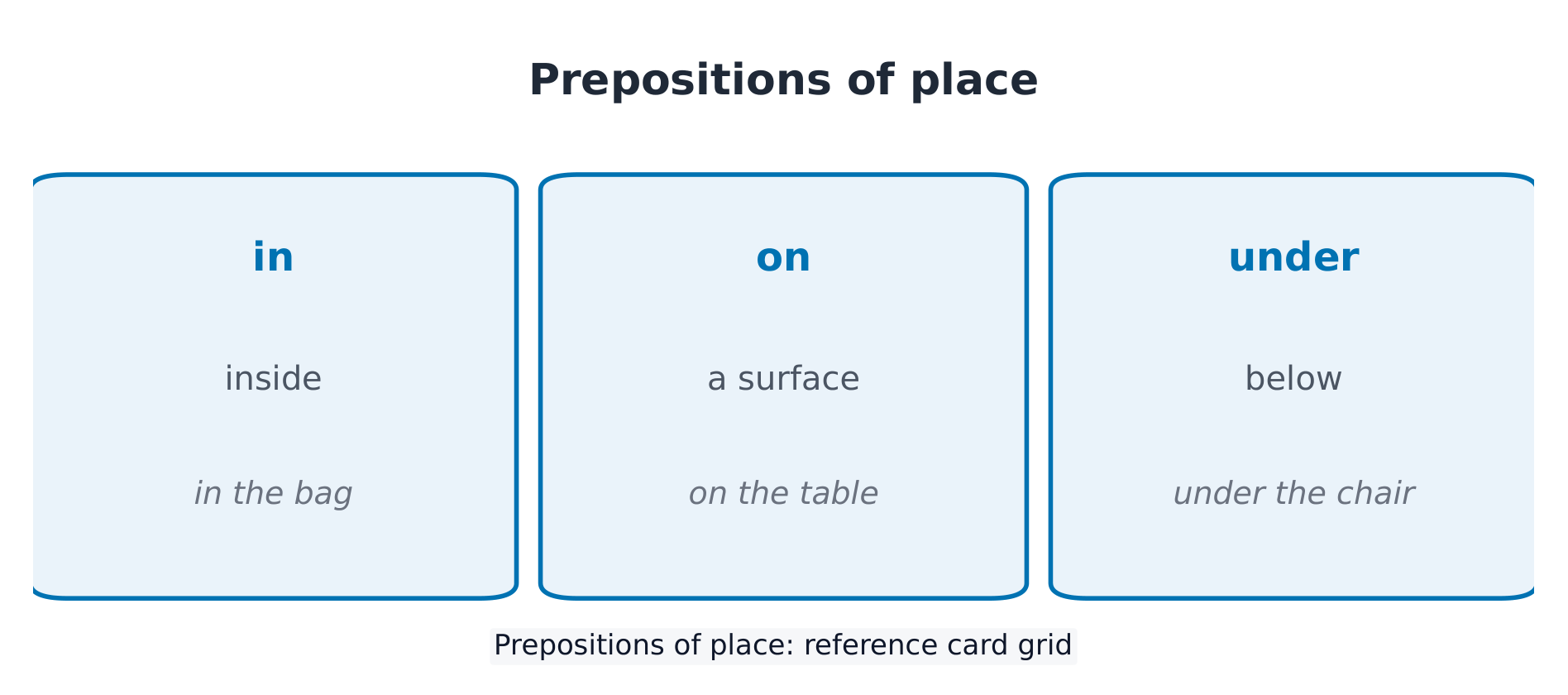
    • in (inside...), on (on top of... / surface), under (below...)

    (冠词)The 钥匙keys 在are 在...里in (冠词)the 包里bag.

    The key is in the bag.

    (冠词)The 书book 在is 在...上on (冠词)the 桌上table.

    The book is on the table.

    (冠词)The 猫cat 在is 在...下under (冠词)the 椅子下chair.

    The cat is under the chair.

    한국어
    地点介词:in / on / under

    地点介词 (prepositions of place) 说明东西在哪里。

    • in(在……里面)、on(在……上面 / 表面)、under(在……下面)

    (冠词)The 钥匙keys 在are 在...里in (冠词)the 包里bag.

    열쇠는 가방 안에 있습니다.

    (冠词)The 书book 在is 在...上on (冠词)the 桌上table.

    책은 책상 위에 있습니다.

    (冠词)The 猫cat 在is 在...下under (冠词)the 椅子下chair.

    고양이는 의자 아래에 있습니다.

    12.2

    next to, between, behind

    English
    • next to (beside...), between (between...), behind (behind...), in front of (in front of...)

    (冠词)The 商店shop 在is 旁边next to (冠词)the 银行bank.

    The shop is next to the bank.

    她She 坐sits 之间between 汤姆Tom 和and 萨姆Sam.

    She sits between Tom and Sam.

    Note: between means "between two," and is usually followed by A and B: between the door and the window.

    Common Errors

    • ❌ ~~The picture is in the wall.~~ → ✓ The picture is on the wall. — Hanging "on" the wall involves surface contact, so use on.
    • ❌ ~~I read it on the book.~~ → ✓ ...in the book. — Content "inside" a book uses in; people in photos also use in the photo.
    • ❌ ~~The shop is next the bank.~~ → ✓ next to the bank — next to is two words; to cannot be omitted.
    • ❌ ~~between the door with the window~~ → ✓ between the door and the window — between takes the fixed collocation A and B.
    한국어
    • next to(…… 옆에), between(…… 사이에서), behind(…… 뒤에서), in front of(…… 앞에)

    (冠词)The 商店shop 在is 旁边next to (冠词)the 银行bank.

    상점은 은행 옆에 있습니다.

    她She 坐sits 之间between 汤姆Tom 和and 萨姆Sam.

    그녀는 톰과 샘 사이에 앉아 있습니다.

    주의 between은 '두 사물 사이'를 의미하므로, 뒤에 보통 A and B가 따라옵니다: between the door and the window(문과 창문 사이).

    자주 하는 실수

    • ❌ ~~The picture is in the wall.~~ → ✓ The picture is on the wall. — 벽에 걸리는 것은 표면에 닿으므로 on을 사용합니다.
    • ❌ ~~I read it on the book.~~ → ✓ …in the book. — 책의 '안'에는 content인内容进行用 in; 사진 속 사람도 in the photo로 표현합니다.
    • ❌ ~~The shop is next the bank.~~ → ✓ next to the bank — next to는 두 단어로 이루어진 어구이므로, to를 생략할 수 없습니다.
    • ❌ ~~between the door with the window~~ → ✓ between the door and the window — between은 A and B와 고정적으로 함께 사용됩니다.

Log in or create account · ⁨로그인 또는 계정 만들기⁩

IGCSE, A-Level & AP