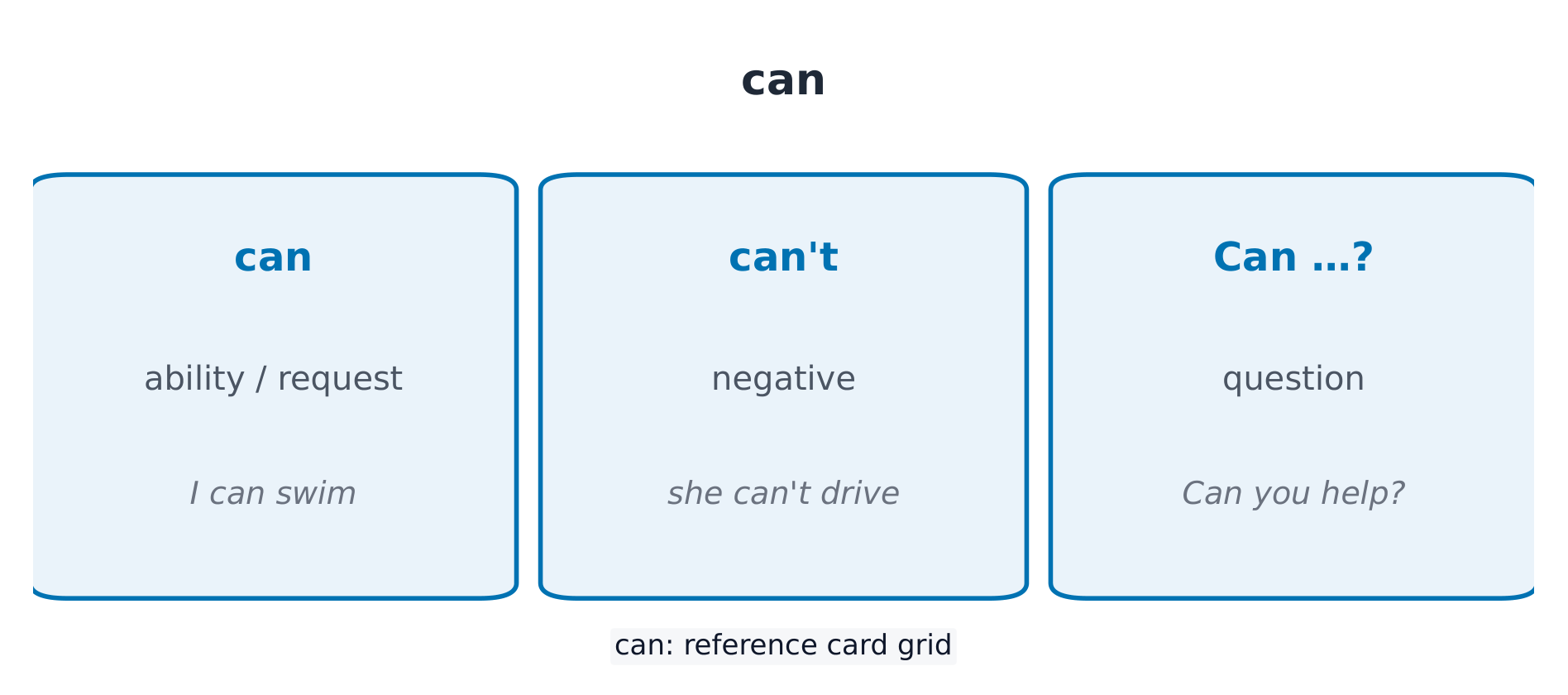
Negative: cannot (abbreviation can't) + base form of the verb.
她She 不会can't 开车drive.
She cannot drive.
Question: Place Can before the subject.
能Can 他he 做饭cook?
Can he cook?
Short answer: Yes, I can. / No, I can't.
Note: can has no -s and does not use do/does: ask directly with Can he…?, not ~~Does he can…?~~
Common Errors
- ❌ ~~She cans drive.~~ → ✓ She can drive. — can has no third-person singular -s; it is the same for all persons.
- ❌ ~~I don't can swim.~~ → ✓ I can't swim. — The negative of can is formed directly with not (can't), without using don't.
- ❌ ~~He can sings very good.~~ → ✓ He can sing very well. — Use the base form of the verb after can; use the adverb well to modify a verb, not good.
- ❌ ~~You can help me?~~ → ✓ Can you help me? — When making a request, place can before the subject.