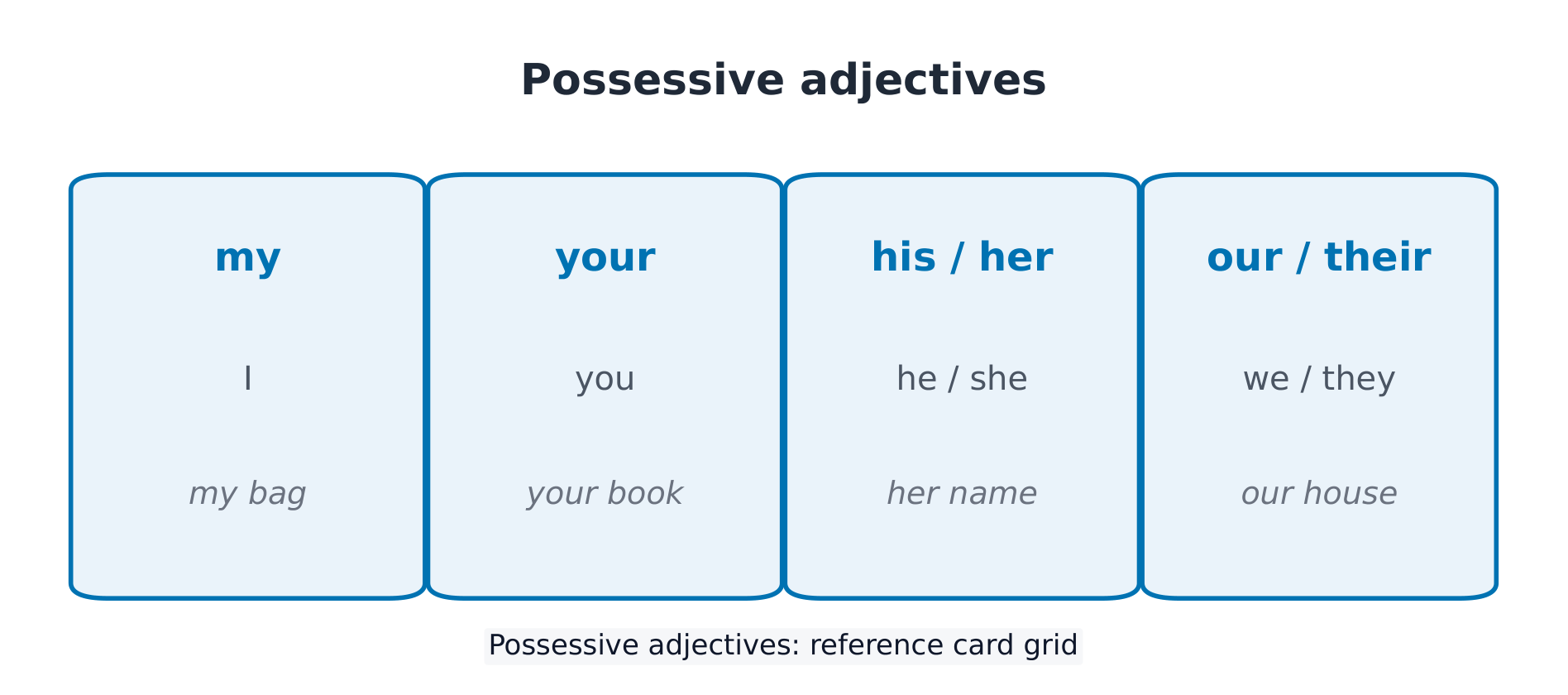
Possessive adjectives indicate "whose" and are placed before the noun:
- I → my(my), you → your(your), he → his(his)
- she → her(her), it → its(its), we → our(our), they → their(their)
这This 是is 我的my 包bag.
This is my bag.
她的Her 名字name 是is 露西Lucy.
Her name is Lucy.
Key Usage Points:
- Possessive adjectives are always followed by a noun: my book, their house.
- They do not change with noun number: my book, my books(my remains unchanged).
Note: Be careful to distinguish its (its, no apostrophe) and it's (= it is). For example: The dog wags its tail.(The dog wags its tail.)*
Common Errors
- ❌ ~~This is she book.~~ → ✓ This is her book. — A possessive form must precede a noun: he → his, she → her.
- ❌ ~~He is me friend.~~ → ✓ He is my friend. — The possessive form of I is my.
- ❌ ~~The dog wags it's tail.~~ → ✓ …wags its tail. — it's = it is; "its" (possessive) has no apostrophe.
- ❌ ~~Their is a park near here.~~ → ✓ There is a park near here. — their (their) and there (there/here) sound identical; do not mix them up in writing.