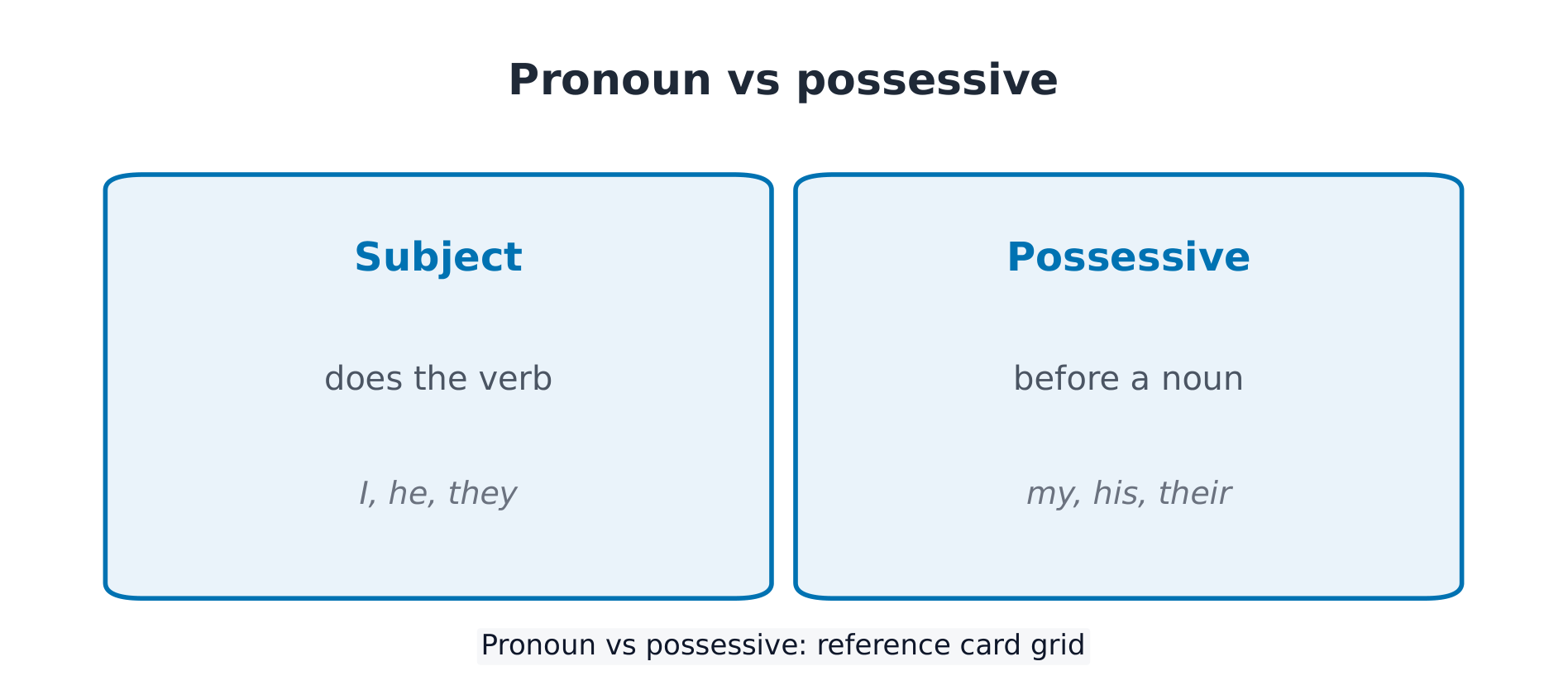
Subject pronouns replace the subject and are placed before the verb:
- I(I), you(you), he(he), she(she)
- it(it), we(we), they(they)
他He 是is 我的my 哥哥brother.
He is my brother.
我们We 喜欢like 音乐music.
We like music.
Key Usage Points:
- I is always capitalized, regardless of its position in the sentence.
- Things and animals commonly use it: This is my bag. It is new.(This is my bag. It is new.)*
- Plural people or things both use they: The books are here. They are mine.(The books are here. They are mine.)*
Note: Subject pronouns are followed by verbs; do not confuse them with object pronouns (me, him, her...) which will be learned later.
Common Errors
- ❌ ~~My mother is a doctor. He is very kind.~~ → ✓ She is very kind. — In colloquial Chinese, "he/she" sounds identical, but in English, he and she must be clearly distinguished.
- ❌ ~~Me am a student.~~ → ✓ I am a student. — Use I for the subject, not me.
- ❌ ~~My friend he is tall.~~ → ✓ My friend is tall. — The subject needs to be mentioned only once; avoid repeating "noun + pronoun" (the Chinese habit of saying "my friend he..." does not apply in English).
- ❌ ~~Is raining.~~ → ✓ It is raining. — English sentences must have a subject; weather, time, and dates begin with it.