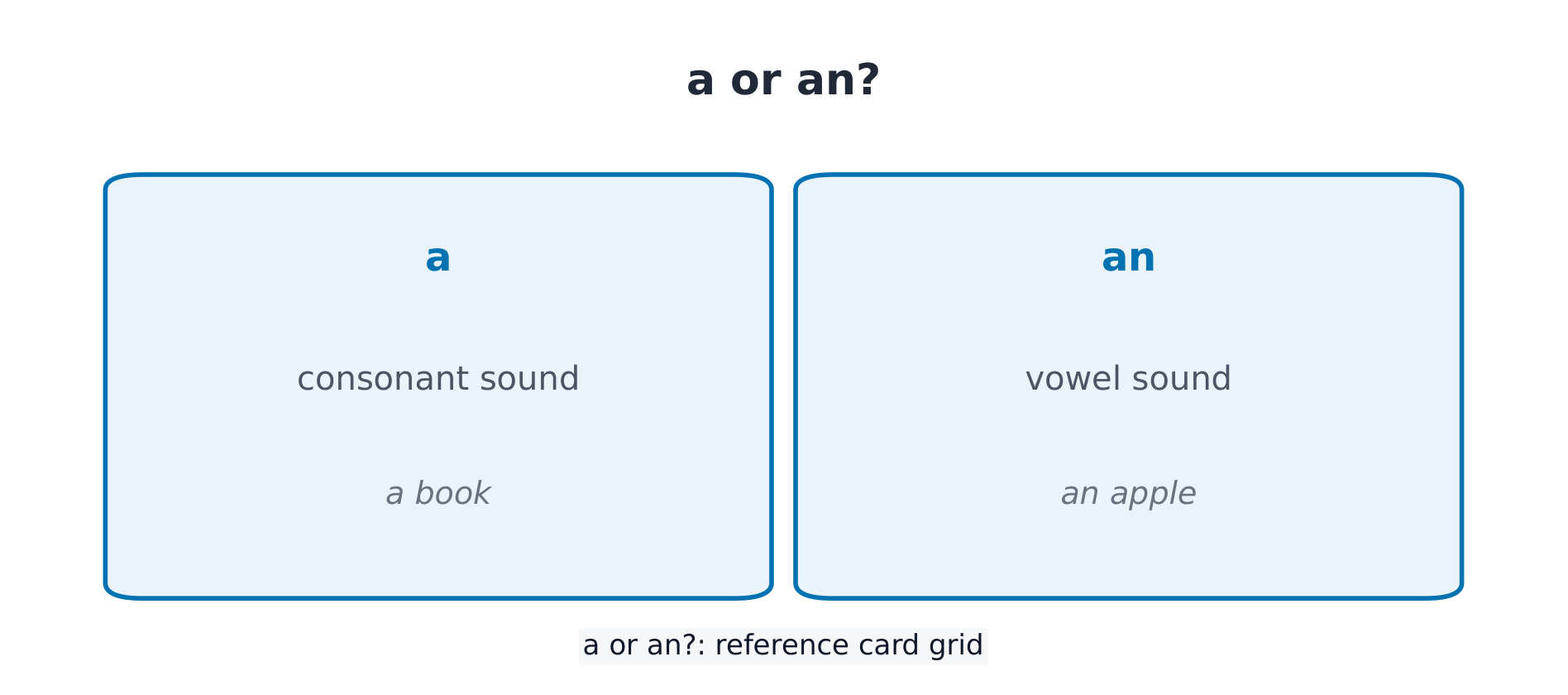
To indicate "more than one," use the plural form of the noun, usually adding -s:
- Generally add -s: book → books, car → cars.
- Words ending in -s / -sh / -ch / -x add -es: bus → buses, box → boxes.
- Consonant + y ending: change y to i and add -es: baby → babies, city → cities.
我I 有have 两two 猫cats.
I have two cats.
Irregular plurals (must memorize):
- man → men, woman → women, child → children.
- foot → feet, tooth → teeth, person → people.
Note: Do not use a / an before plural nouns: ~~a books~~ ✗ → books / two books ✓.
Common Errors
- ❌ ~~I have dog.~~ → ✓ I have a dog. — In Chinese you can say "I have dogs," but singular countable nouns in English must have a / an (or my, the, etc.) before them.
- ❌ ~~an university~~ → ✓ a university; ❌ ~~a hour~~ → ✓ an hour — Look at pronunciation, not spelling: university starts with a consonant sound /j/, and h is silent in hour.
- ❌ ~~two book~~ → ✓ two books — Chinese nouns do not change for plurality, but nouns after numbers in English require -s; this is easily forgotten.
- ❌ ~~three childs~~ → ✓ three children — Irregular plurals must be memorized separately: men, women, children, feet, teeth, people.
- ❌ ~~a people~~ → ✓ a person (one person) / people (many people) — people is inherently plural.