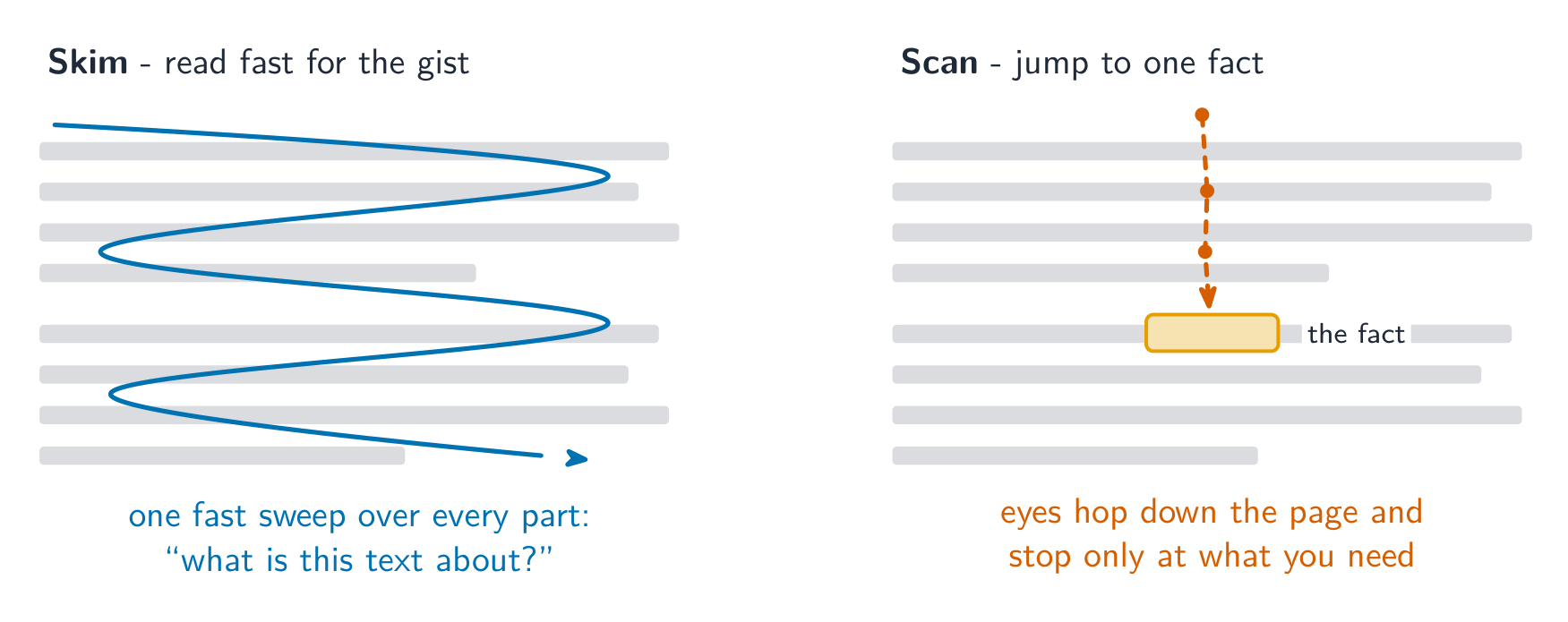
IGCSE English as a Second Language (0510) is assessed on four skills: reading, writing, listening and speaking. The writing topics here are organised by the text type the exam asks for — informal email, formal letter, report, article, review, essay — because each has its own conventions and is marked against them.
For a second-language candidate, marks are rarely lost on ideas. They are lost on register (an informal email written formally), structure (an article with no headline or paragraphs), and accuracy in a few repeated patterns — articles, tenses, prepositions.
Fixing your own five recurring errors is worth more than learning new vocabulary.
Connecting ideas across a text · 텍스트를 가로막아 아이디어 연결하기
Syllabus
English
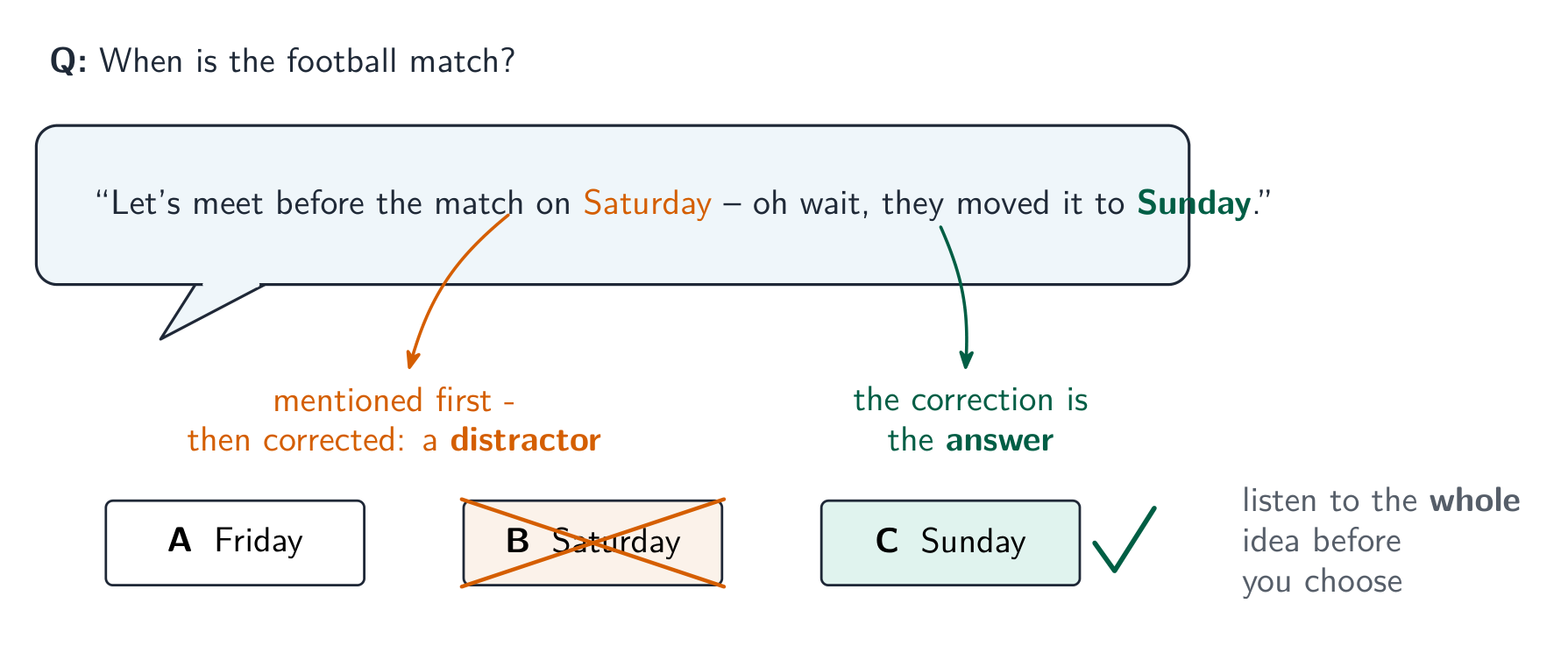
follow how ideas, opinions and attitudes in a text connect to one another
match each question to the section or short text that contains the relevant idea (multiple matching)
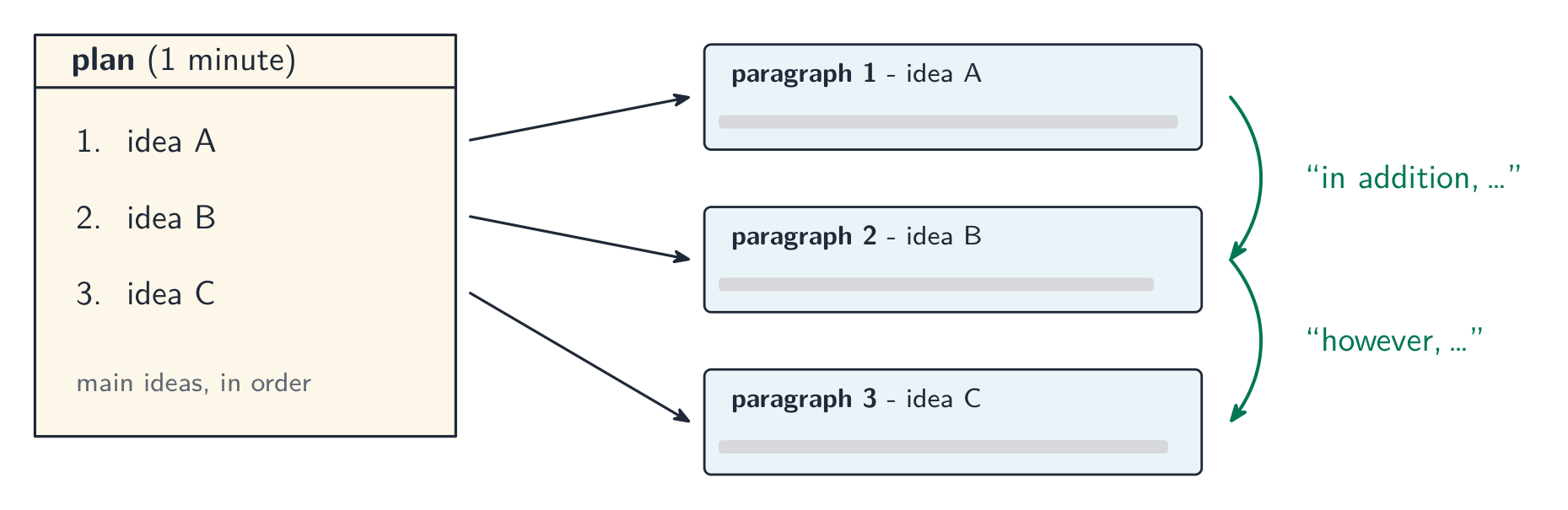
recognise words and phrases that signal time, cause and effect, addition and contrast
한국어
텍스트 내의 아이디어, 의견 및 태도가 서로 어떻게 연결되는지 파악하기
각 질문을 해당 relevant 개념을 포함하는 섹션 또는 짧은 텍스트와 매칭한다(다중 매칭).
시간, 인과관계, 추가 및 대비를 나타내는 단어와 구를 식별한다.
Source: Cambridge International syllabus · 출처: Cambridge International syllabus
English
A long text is not just a list of facts. The ideas link to each other, and you must follow how.
Multiple matching
In a multiple matching 多项匹配 task you read several short texts, or several parts of one text.
Each question describes an idea. You choose the text or part that matches it.
The words in the question are usually different from the words in the text. Look for the same meaning, not the same words. This is called a paraphrase 改写.
Signal words
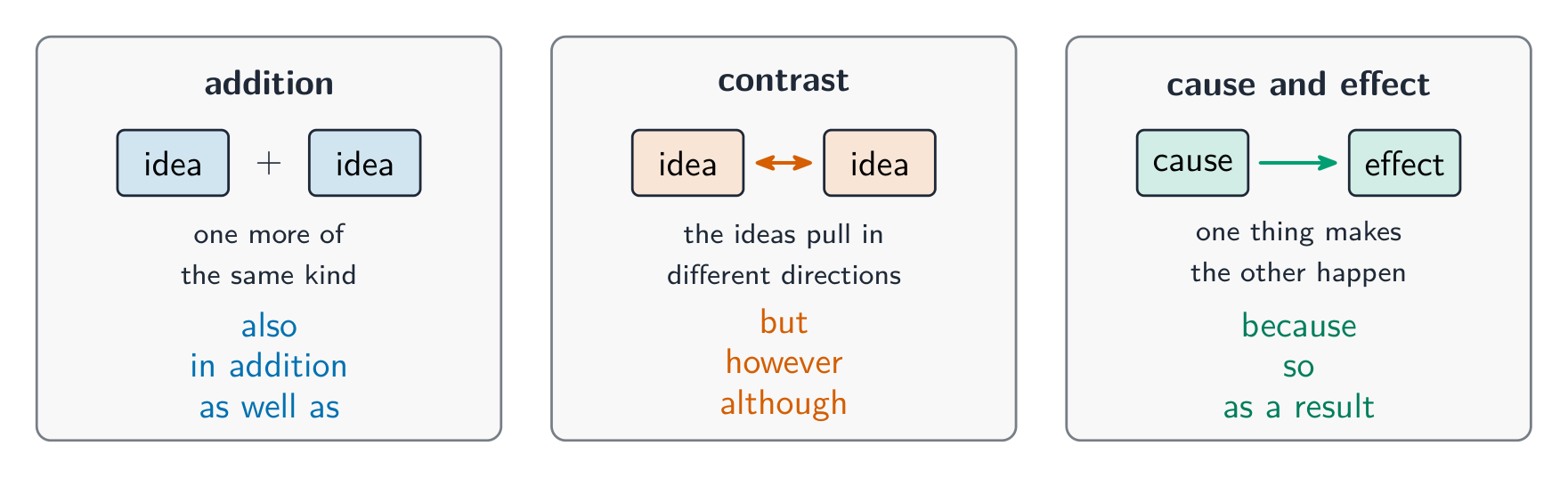
Writers use small words to show how ideas connect. These are signal words 信号词.
Some show addition 递进 (also, in addition, as well as). Some show contrast 对比 (but, however, although). Some show cause and effect 因果 (because, so, as a result).
When you notice these words, you can see how the writer's ideas fit together.
한국어
긴 텍스트는 단순히 사실의 나열이 아니다. 아이디어들이 서로 연결되어 있으며, 그 연결 방식을 따라가야 한다.
다중 매칭
다중 매칭 task에서 여러 개의 짧은 텍스트, 또는 하나의 텍스트의 여러 부분을 읽는다.
각 질문은 하나의 아이디어를 설명한다. 그에 해당하는 텍스트나 부분을 선택하라.
질문의 단어들은 보통 텍스트의 단어들과 다르다. 같은 단어를 찾기보다 같은 의미를 찾아라. 이를 의역이라고 한다.
신호어
작가들은 아이디어가 어떻게 연결되는지를 보여주는 작은 단어를 사용한다. 이들은 신호어이다.
일부는 추가 (also, in addition, as well as)를 나타낸다. 일부는 반대 (but, however, although)를 나타낸다. 일부는 인과 관계 (because, so, as a result)를 나타낸다.
recognise that an informal email is written to a friend or relative
respond to all of the prompts given in the task
use a friendly, personal tone that suits the reader
한국어
비공식 이메일이 친구나 친족에게 쓰임을 인지한다
과제에서给出的 모든 프롬프트에 응답한다
독자에게 적합한 친밀하고 개인적인 톤을 사용한다
Source: Cambridge International syllabus · 출처: Cambridge International syllabus
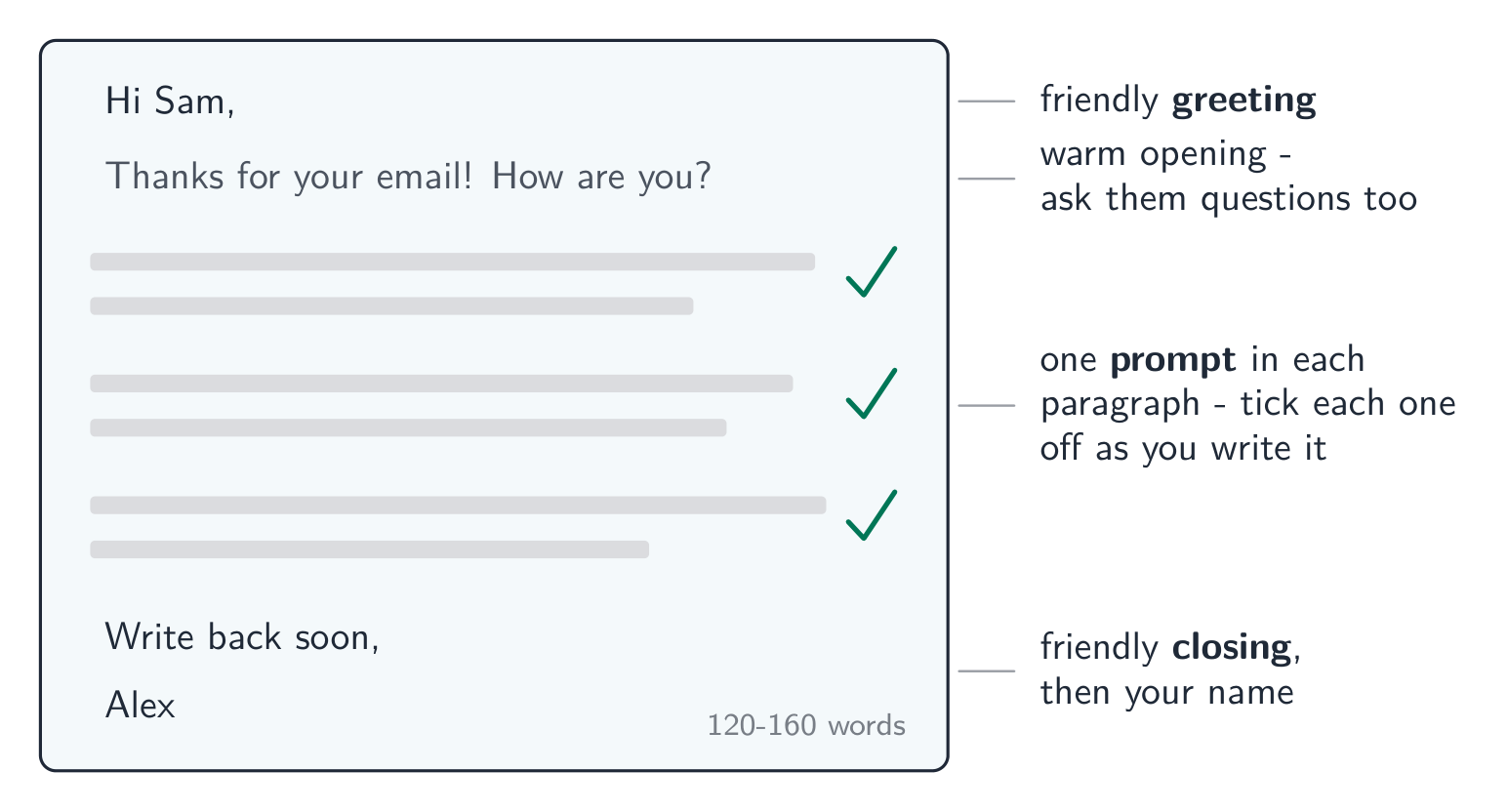
The first writing task asks you to write an informal email 非正式电子邮件 to a friend or a family member.
Cover every prompt
The task gives you some prompts 提示 — short points you must write about.
You must cover every prompt. If you miss one, you lose content marks.
Tick each prompt as you write it, so you do not forget one.
Use a friendly tone
An email to a friend is informal 非正式. Use a warm, friendly tone 语气.
Write as if you are talking to the person. Ask them questions too.
This is who the email is for: someone who already knows you, so write the way you would talk to themWriting on a laptop: informal emails still need a clear purpose, order and friendly tone
develop each idea with a reason, example or detail rather than just listing points
vary your sentence openings and link ideas smoothly
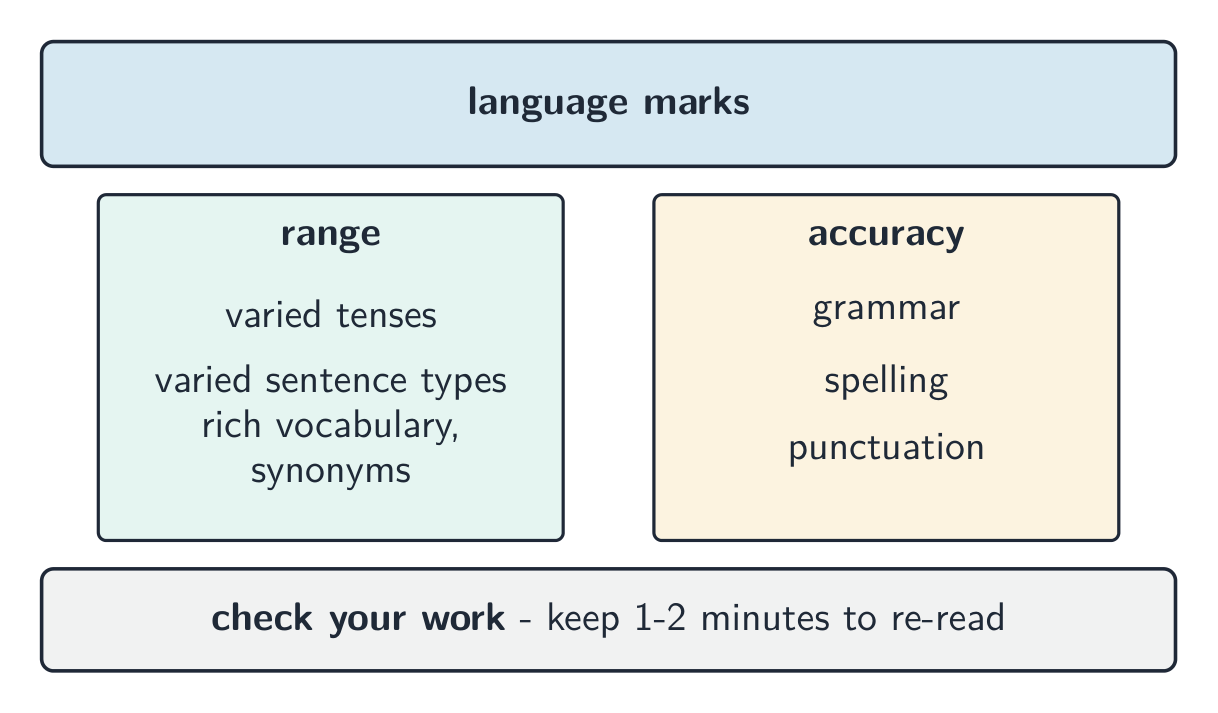
check the length (120–160 words), the tone and the accuracy before finishing
한국어
단순히 나열하는 것이 아니라 각 아이디어를 이유, 예시 또는 디테일로 발전시킨다
문장 시작을 다양하게 하고 아이디어를 매끄럽게 연결한다
완성 전에 글자 수(120–160 단어), 어조 및 정확성을 확인하십시오.
Source: Cambridge International syllabus · 출처: Cambridge International syllabus
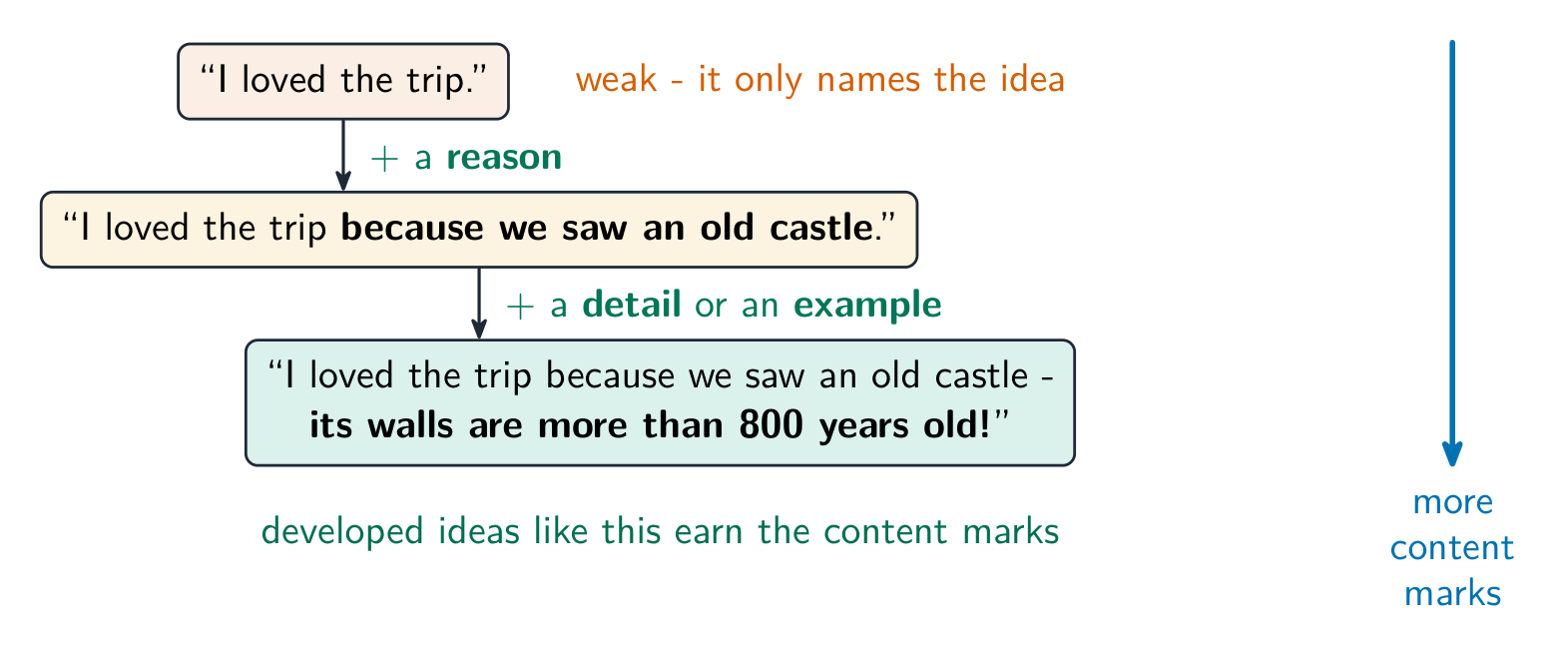
Content marks reward developed 展开的 ideas, not a list.
Develop your ideas
Do not just name an idea. Add a reason 原因, an example 例子, or a detail 细节.
"I loved the trip" is weak. "I loved the trip because we saw an old castle" is much better.
Each extra reason or detail makes the idea stronger
Check before you finish
Count your words: aim for 120 to 160 words.
Check the tone is friendly, then fix small grammar and spelling mistakes.
A model email
See how the friendly tone and developed ideas work together.
Hi Sam,
Guess what — I finally visited the new science museum you told me about! I loved it, especially the space room, because you can sit in a real rocket seat and feel it shake. I went with my cousin, and we stayed until it closed.
How about you? Have you been yet? We really should go together in the summer.
Write back soon,
Lin
Notice the warm greeting, one developed idea with a reason, a question back to Sam, and a friendly closing. It reads like a real message to a friend — and it covers every prompt.
Building a formal letter or email · 공식적 편지나 이메일 구성하기
Syllabus
English
open and close a formal letter or email appropriately (for example: Dear … / Yours sincerely …)
organise your points into clear paragraphs with a beginning, middle and end
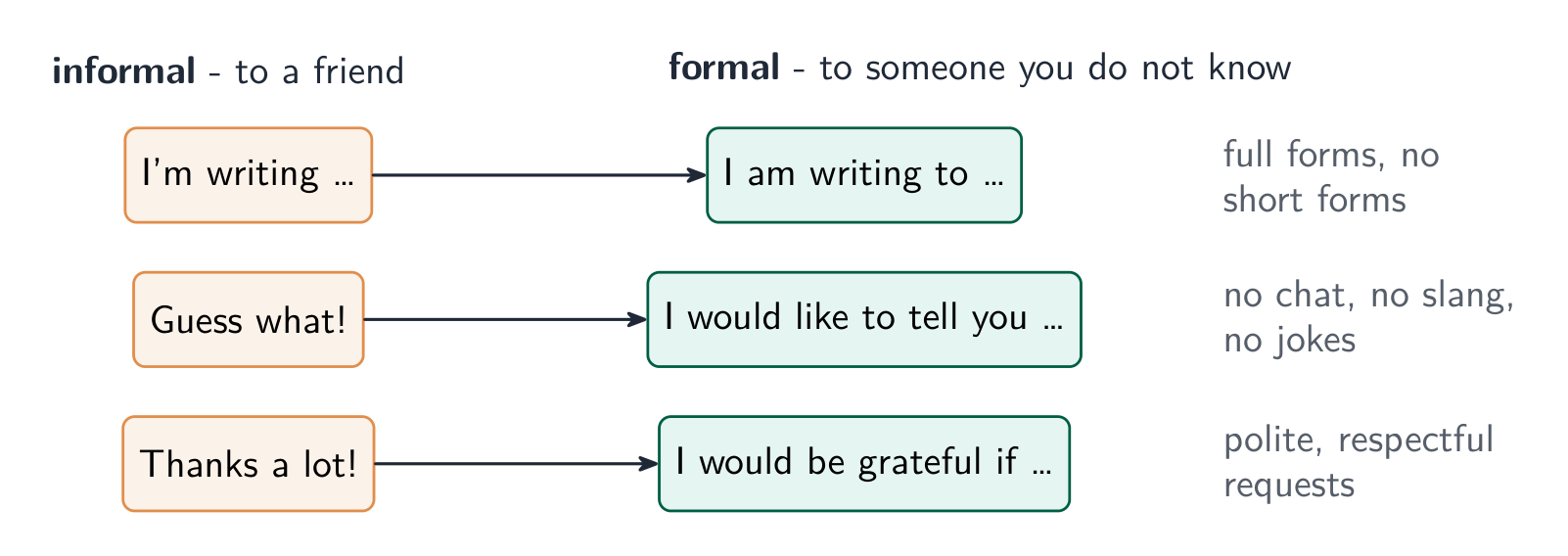
use formal language and avoid contractions and slang
한국어
공식 서한이나 이메일의 시작과 끝을 적절하게 처리합니다(예:Dear … / Yours sincerely …).
내용 요점을 명확한 단락으로 구성하여开头, 중간,结尾을 갖추게 합니다.
공식적 언어를 사용하고 약칭 및 구어체를 피합니다.
Source: Cambridge International syllabus · 출처: Cambridge International syllabus
English
A formal letter follows a clear order.
Opening and closing
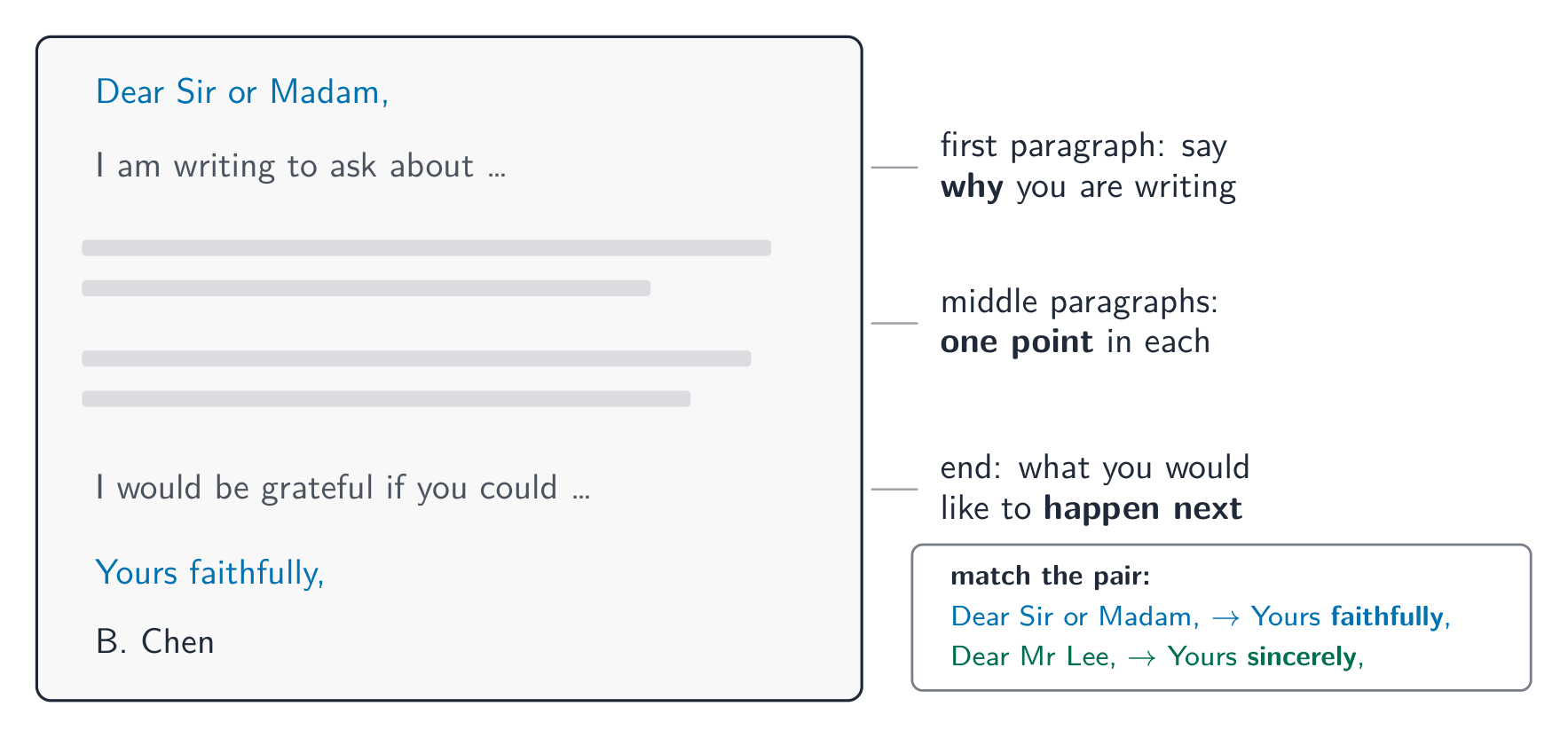
Open with Dear Sir/Madam, or Dear Mr Lee,
If you start with a name, close with Yours sincerely,. If you start with Sir/Madam, close with Yours faithfully,.
Clear paragraphs
First paragraph: say why you are writing.
Middle paragraphs: give your points, one idea in each.
Last paragraph: say what you would like to happen next.
Formal language
Use formal phrases: I would like to…, I am writing to…, I would be grateful 感激 if…
Keep sentences clear and complete. Check your grammar and spelling.
A model formal letter
See how a polite, complete opening sets the right tone.
Dear Sir or Madam,
I am writing to suggest an improvement to the town library. At present it closes at five o'clock, which is too early for students who finish school at four. I would be grateful if the council could consider opening it until seven in the evening on weekdays.
Thank you for taking the time to read my letter.
Yours faithfully,
J. Chen
Notice the Dear Sir or Madam / Yours faithfully pair, the clear first line stating the purpose, the polite request, and the complete sentences with no short forms.
격식 있는 표현을 사용하세요: I would like to…, I am writing to…, I would be grateful if… 등.
문장을 명확하고 완전하게 작성하세요. 문법과 철자법을 확인하세요.
공식 서신 모범 예시
정중하고 완전한 서두가 올바른 어조를 설정하는 방법을 확인해 보십시오.
Dear Sir or Madam,
I am writing to suggest an improvement to the town library. At present it closes at five o'clock, which is too early for students who finish school at four. I would be grateful if the council could consider opening it until seven in the evening on weekdays.
Thank you for taking the time to read my letter.
Yours faithfully,
J. Chen
Dear Sir or Madam / Yours faithfully의 짝 매칭, 목적을 명시한 명확한 첫 줄, 정중한 요청, 그리고 단축형 없이 완전한 문장들을 유의해 보세요.
recognise that a report is written for a superior or a group about an event, experience or situation
give factual information clearly and add suggestions or recommendations
use a neutral, factual tone
한국어
보고서가 상급자나 특정 집단을 대상으로 한 사건, 경험 또는 상황에 대해 작성됨을 인식합니다.
사실적 정보를 명확히 제시하고 제언이나 조언을 추가합니다.
중립적이고 사실적인 어조를 사용합니다.
Source: Cambridge International syllabus · 출처: Cambridge International syllabus
English
A report 报告 gives information to a person in charge — a teacher, a manager, or a club leader. They will act 行动 on what you write, so be clear and honest.
Purpose and reader
A report describes an event 事件, an experience, or a situation 情况.
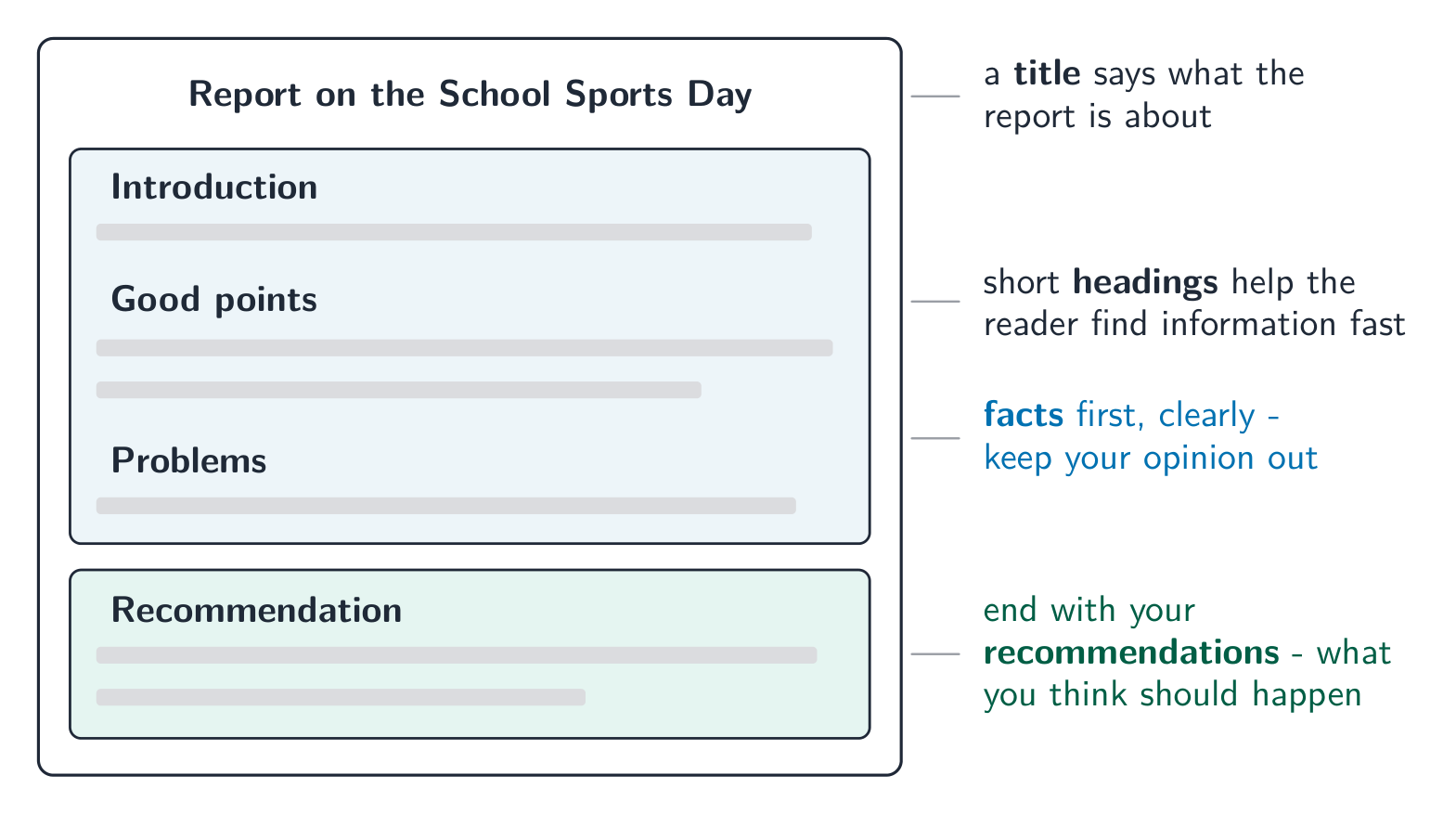
It gives facts 事实 clearly, then adds suggestions.
The reader wants useful information, not a story. Keep the tone factual 事实性的 and clear.
Format
A report is usually semi-formal or formal.
A title at the top tells the reader what the report is about.
한국어
보고서는 담당자(교사, 관리자 또는 동아리 리더)에게 정보를 제공합니다. 작성한 내용에 대해 조치할 것이므로 명확하고 진정성 있게 작성해야 합니다.
목적과 독자
보고서는 이벤트, 경험 또는 상황을 서술합니다.
사실을 명확하게 제시한 후 제안을 추가합니다.
독자는 이야기를 원하는 것이 아니라 유용한 정보를 원합니다. 어조는 사실적이고 명확하게 유지하세요.
리포트는 독자가 활용할 수 있는 사실 제공, 서사가 아님
형식
보고서는 일반적으로 반공식 또는 공식입니다.
상단에 있는 제목은 독자에게 보고서의 주제를 알려줍니다.
공식적인 논의: 보고서는 의사결정자가 조치할 수 있도록 명확한 사실을 제공함보고서는 명확한 목적과 특정 독자를 위해 사실을 정리함
organise the article into an introduction, development and conclusion
use lively, varied language and a consistent tone
address the reader directly where it suits the topic
한국어
기사를 서론, 본론, 결론으로 구성한다
생생하고 다채로운 어휘를 사용하고 일관된 톤을 유지한다
주제에 맞게 독자를 직접적으로 언급한다
Source: Cambridge International syllabus · 출처: Cambridge International syllabus
English
An article should sound interesting, not flat.
Structure
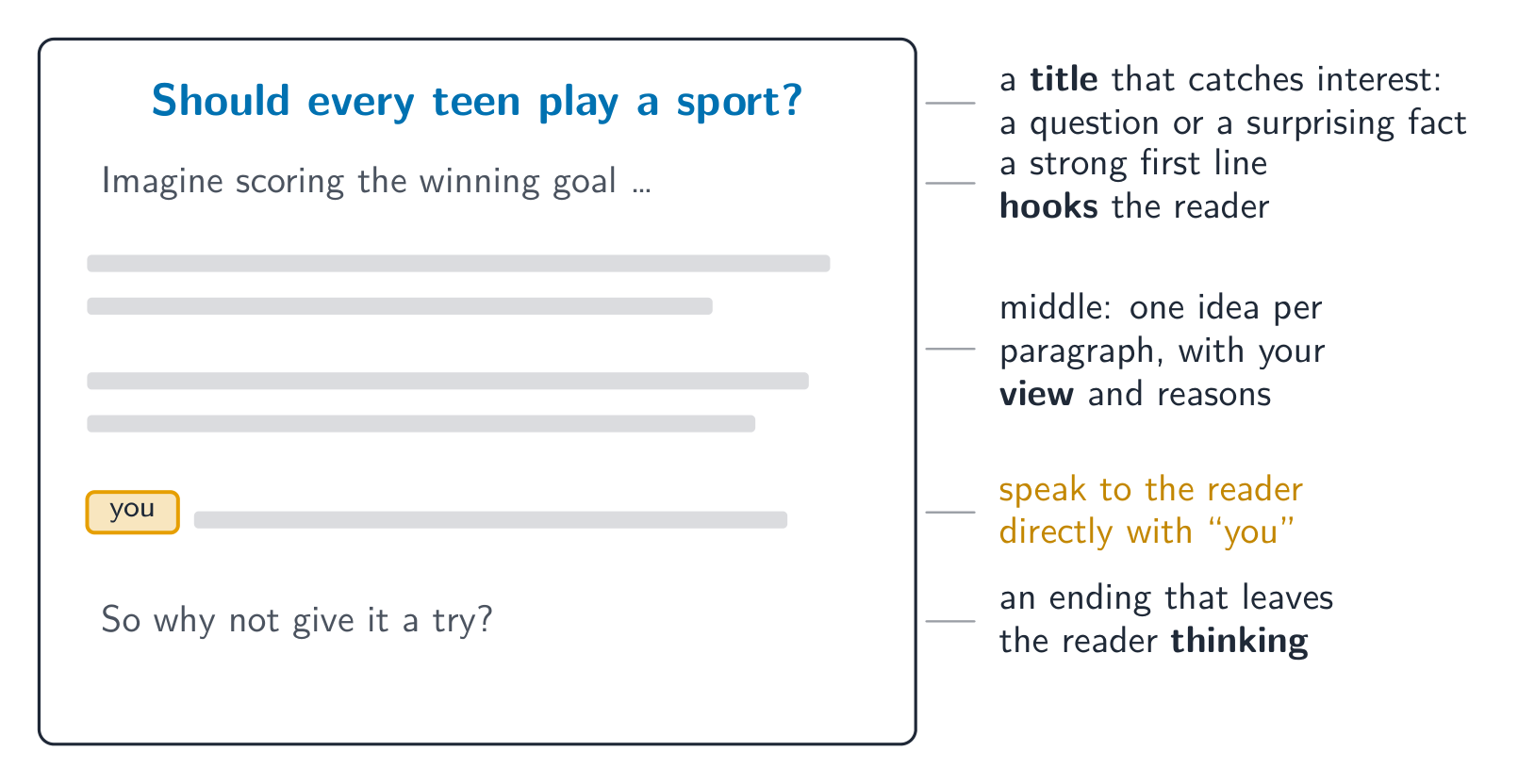
Begin with an introduction 引言 that names the topic.
Develop your points in the middle, one idea in each paragraph.
End with a short conclusion 结论 that leaves the reader thinking.
Lively language
Use varied 多样的 words and sentence lengths to keep the energy up.
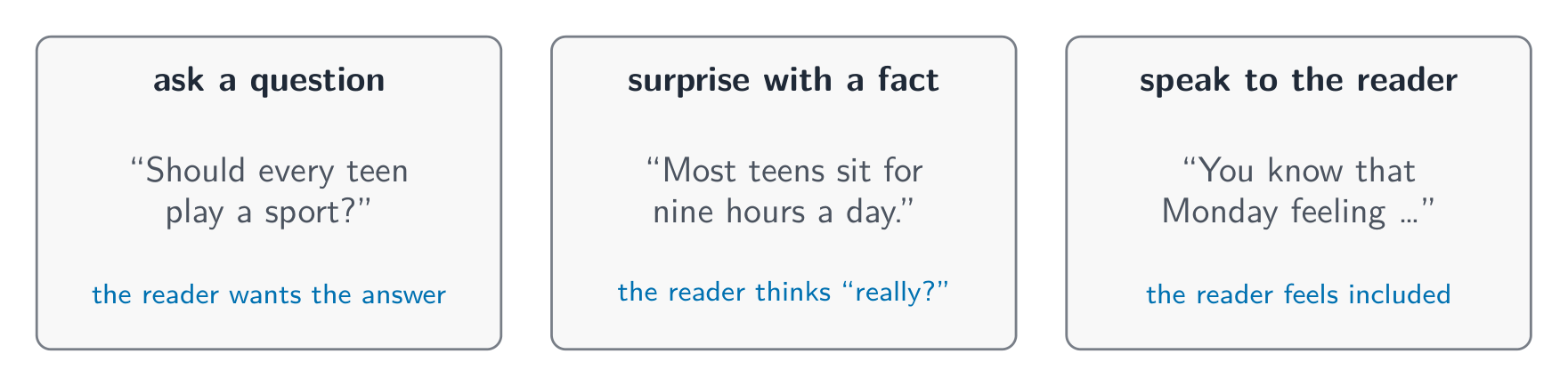
You can speak to the reader directly with "you".
Keep the tone friendly, but not too casual.
Useful language
A few flexible phrases 短语 let you hook the reader and glide between ideas.
To open with energy:Have you ever…? / Imagine you… / Last week, something odd happened to me.
To move between ideas:What's more… / On the other hand… / The truth is…
To speak to the reader:You might think… / We all know that… / Be honest —…
To end memorably:So next time you… / Perhaps the real question is…
Vary how you open sentences. Ten sentences that all begin "I think" feel flat 平淡; mixing your openings keeps the reader awake.
A model opening
See how one opening hooks the reader, then points forward.
Have you ever tried to sleep with a phone glowing beside your pillow? Most of us have — and most of us wake up tired. This article asks a simple question: could a good night's sleep be the cheapest way to feel happier?
The question pulls the reader in, the honest detail keeps them, and the last line promises where the article is going. That is a lot of work for three sentences.
한국어
기고문은 흥미롭고 단조롭지 않아야 합니다.
생동감 있는 기사의 구조: 독자를 Grab하고, 유지하며, 생각하게 남김
구조
주제를 명시하는 서론 引言으로 시작하세요.
본론에서는 각 문단에 하나의 아이디어를 담아 논리를 전개하세요.
독자가 생각하게 만드는 짧은 결론 结论으로 마무리하세요.
생동감 있는 어휘
에너지가 지속되도록 다양한 多样的 단어와 문장 길이를 사용하세요.
"you"를 사용하여 독자와 직접 대화할 수 있습니다.
조명은 친근하되 지나치게 캐주얼하지 않게 유지한다.
유용한 표현
유연한 표현 몇 개를 사용하면 독자의 관심을 끌고 사색을 자연스럽게 연결할 수 있습니다.
시작을 활기차게 하기:당신은 pernah…? / 당신이…라고 상상해 보세요 / 지난주, 나에게 이상한 일이 생겼습니다.
사색을 이어가기:더불어서… / 반면에… / 사실은…
독자와 대화하기:당신은 생각할지도 모릅니다… / 우리가 모두 아는 사실입니다… / 솔직히 말해서 —…
마지막까지 기억에 남게 하기:이제 다음에는… / 아마도 진짜 질문은…
문장 시작方式来 다양하게 하십시오. 모든 문장이 "I think"로 시작하면 단조롭습니다(平淡); 시작 방식을 바꾸면 독자가 집중할 수 있습니다.
모델 서론
어떤 서론이 독자를 끌어당기고, 앞으로의 내용을 예고하는지 확인하십시오.
Phone을 베개 옆에서 빛나게 하고 잠들려 한 적이 있습니까? 대부분의 사람은 그랬을 것입니다—대부분의 사람이 피곤하게 깨어납니다. 이 기사는 간단한 질문을 던집니다: 좋은 밤잠이 가장 저렴한 행복의 방법일까요?
질문이 독자를 끌어들이고, 솔직한 디테일이留住하고, 마지막 줄이 기사가 어디로 갈지를 약속합니다. 이는 세 문장에 많은 노력이 필요합니다.
recognise that a review describes something you have experienced (a film, place or product) and gives your opinion
balance description with personal opinion and reasons
write for a general audience, for example of a magazine or website
한국어
리뷰가 자신이 경험한 것(영화, 장소 또는 제품)을 서술하고 자신의 의견을 나타낸다는 점을 인지한다
서술과 개인적인 의견 및 이유를 균형 있게 배치한다
잡지나 웹사이트 등 일반 대중을 위한 글로 작성한다
Source: Cambridge International syllabus · 출처: Cambridge International syllabus
English
A review 评论 tells readers about something you have tried — a film, a book, a restaurant, or a place. A good review helps the reader decide 决定 whether to try it too.
Describe and judge
A review does two things: it describes 描述 the thing, and it gives your opinion 观点 of it.
Balance the two. Do not only describe, and do not only give opinions.
Describing answers "What is it like?" Judging answers "Is it any good?" Move between the two, sentence by sentence.
Support your opinions
Give reasons for what you think. Say why it was good or bad.
Use examples 例子 from your experience to make your view believable 可信.
A weak review says "The food was nice." A strong review says "The soup was rich and warming, though the rice arrived cold." The detail is what convinces the reader.
Useful language
Learn a few phrases 短语 for each job. Then you never stare at a blank page.
To describe:It is set in… / The story follows… / The dish combines… / What stands out is…
To praise:The best part is… / I was impressed by… / It really succeeds in…
To criticise 批评(gently): The one weakness is… / It could have been better if… / At times it feels slow.
To recommend:I would recommend it to… / It is well worth… / Don't miss…
Mix praise and criticism so the review sounds fair 公正. A review that is all praise, or all complaint, is hard to trust.
한국어
리뷰 评论는 당신이 시도해 본 것——영화, 책, 레스토랑, 장소——에 대해 독자에게 알려줍니다. 좋은 리뷰는 독자가 시도를 할지 결정 决定하도록 돕습니다.
묘사하고 판단하기
리뷰는 두 가지 일을 합니다: 그것을 묘사 描述하고, 그에 대한 당신의 견해 观点를 줍니다.
두 가지를 균형 잡으십시오. 묘사만 하거나 견해만 주지 마십시오.
묘사는 "What is it like?"에 답하고, 판단은 "Is it any good?"에 답합니다. 문장마다 그 사이를 오가십시오.
의견은 근거와 예시 위에 세워집니다
견해를 지지하십시오
생각에 대한 이유를 주십시오. 그것이 좋았거나 나빴던 이유 说why를 말하십시오.
경험에서 온 예시 例子를 사용하여 본인의 견해를 신뢰할 수 있게 可信하게 만드십시오.
약한 리뷰는 "The food was nice."라고 말합니다. 강한 리뷰는 "The soup was rich and warming, though the rice arrived cold."라고 말합니다. 디테일이 독자를 설득합니다.
유용한 표현
각 역할에 몇 가지 구절 phrases 短语를 배우십시오. 그러면 빈 페이지를 바라볼 일이 없습니다.
묘사하기:It is set in… / The story follows… / The dish combines… / What stands out is…
칭찬하기:The best part is… / I was impressed by… / It really succeeds in…
비평하기 批评(부드럽게): The one weakness is… / It could have been better if… / At times it feels slow.
추천하기:I would recommend it to… / It is well worth… / Don't miss…
칭찬과 비평을 섞어서 리뷰가 공정 公正하게 들리게 하십시오. 칭찬만 하거나 불만만 있는 리뷰는 신뢰하기 어렵습니다.
introduce what is being reviewed, then describe and evaluate it
support your opinions with specific details and examples
end with a clear recommendation to the reader
한국어
리뷰 대상이 무엇인지 소개한 뒤 서술하고 평가한다
구체적인 사실과 예시를 들어 자신의 의견을 뒷받침한다
독자에게 명확한 추천 사항을 마지막에 제시한다
Source: Cambridge International syllabus · 출처: Cambridge International syllabus
English
Readers want a clear, helpful review.
Structure
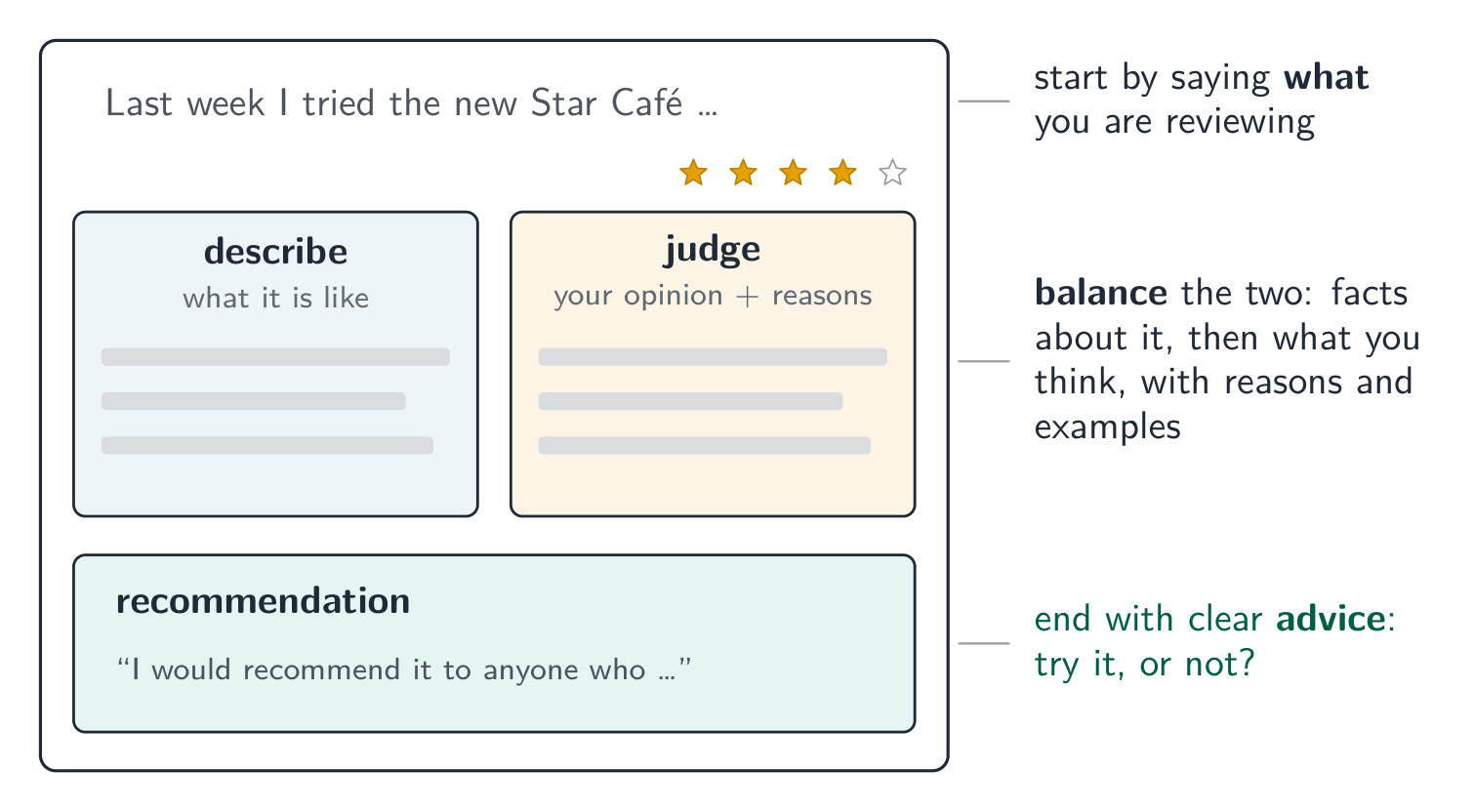
Start by saying what you are reviewing, and give the reader the basic facts.
In the middle, describe it and evaluate 评价 it — the good points and the weak points.
Write for a general reader, in a friendly but clear tone 语气.
End with a recommendation
Finish with a recommendation 建议: do you advise the reader to try it or not?
Make your advice clear, for example: "I would recommend this film to anyone who likes adventure."
You can add a condition: "…as long as you don't mind a slow start." This sounds honest and grown-up.
A model review
Read this short review of a film. Notice how each sentence either describes or judges.
Skyward is an adventure film about a girl who builds her own aircraft. The story is simple, but the flying scenes are breathtaking 惊人 and the young lead acts with real warmth. The middle drags a little, and a few jokes fall flat. Even so, it left the whole cinema smiling. I would recommend Skyward to any family looking for a bright, hopeful evening — just be ready for a slow first ten minutes.
Count the moves: it names the film, describes it, praises it, admits two faults, and ends with a clear, honest recommendation. That is a complete review in five sentences.
한국어
독자는 명확하고 유용한 리뷰를 원합니다.
리뷰는 설명과 평가를 거쳐 명확한 조언으로 마무리됩니다
구조
리뷰하는 대상을 말하고, 독자에게 기본 사실을 제공하십시오.
중간에 묘사하고 평가 评价하십시오——좋은 점과 약점을 말입니다.
일반 독자를 위해, 친근하지만 명확한 톤 语气로 쓰십시오.
추천으로 마무리하기
추천 建议으로 마무리하십시오: 독자에게 시道할지 권장하십니까?
조언을 명확히 하십시오. 예를 들어: *"I would recommend this film to anyone who likes adventure."
조건을 추가할 수 있습니다: "…as long as you don't mind a slow start." 이는 솔직하고 성숙하게 들립니다.
모델 리뷰
이 영화의 짧은 리뷰를 읽으십시오. 각 문장이 묘사인지 판단인지 주의하십시오.
Skyward는 소녀가 직접 비행기를 만드는 어드벤처 영화입니다. 스토리는 간단하지만, 비행 장면들은 놀랍다 惊人하고, 주인공이 진정한 따뜻함으로 연기했습니다. 중반부가 조금 지루하고, 몇몇 유머가 잘 안 통합니다. 그럼에도 불구하고, 전체 극장이 미소를 띠었습니다. Skyward를 밝고 희망적인 저녁을 찾는 가족에게 추천합니다——단, 첫 10분이 느릴 준비를 하십시오.
동작을 세어보십시오: 영화를 이름하고, 묘사하고, 칭찬하고, 두 가지 결함을 인정하고, 명확하고 솔직한 추천으로 끝냅니다. 이는 5문장으로 완성된 리뷰입니다.
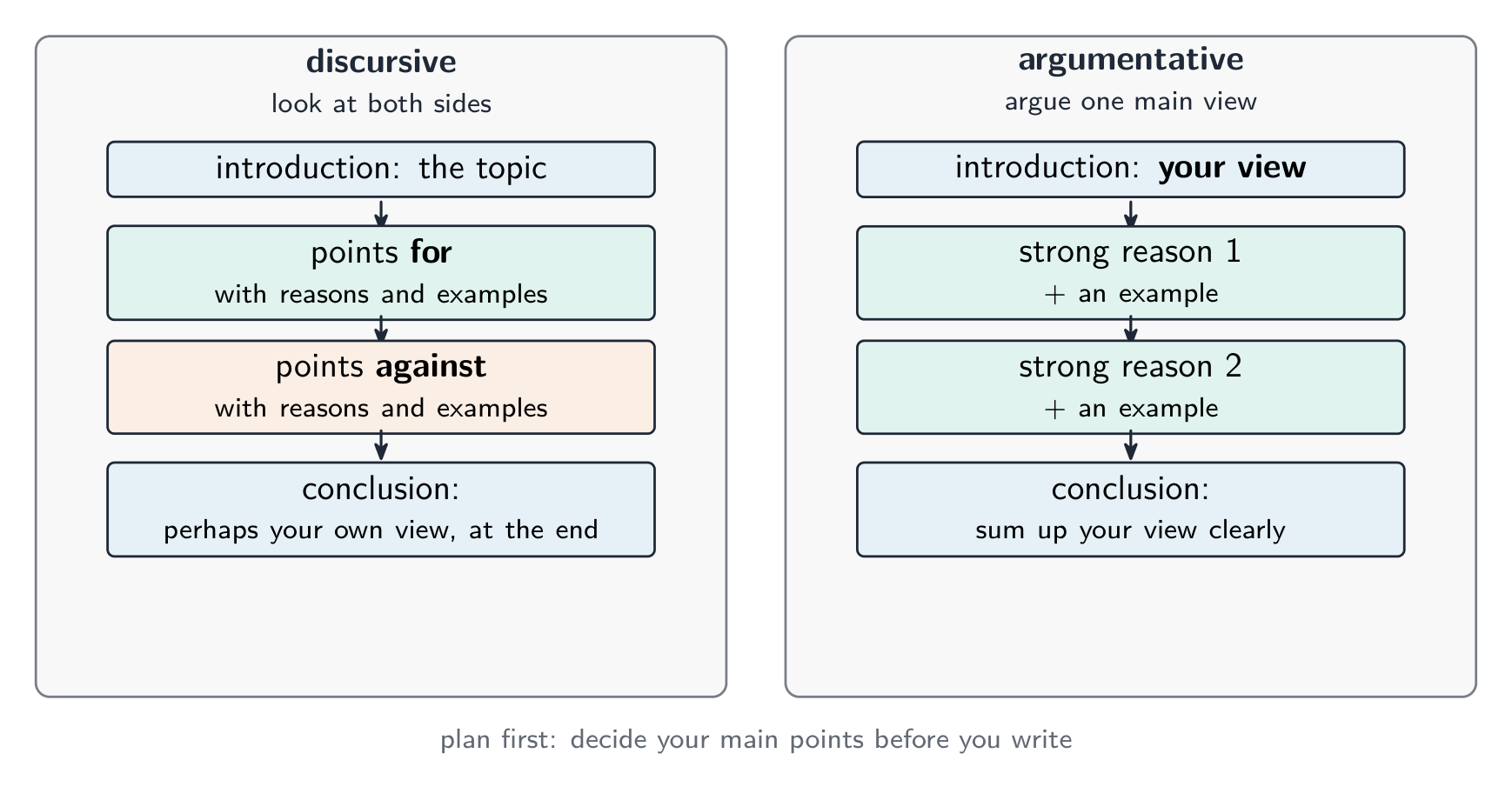
introduce the topic and your approach in the introduction
develop one main idea per paragraph in the body, with reasons and examples
draw the ideas together in a clear conclusion
한국어
서론에서 주제를 소개하고 접근 방식을 명시한다
본론의 각 문단마다 하나의 주요 아이디어를 전개하며, 이유와 예시를 포함한다
결론에서 아이디어들을 명확하게 정리한다
Source: Cambridge International syllabus · 출처: Cambridge International syllabus
English
A clear shape makes your argument easy to follow.
Introduction
The introduction 引言 names the topic and says how you will approach it.
Keep it short — two or three sentences.
Body paragraphs
Put one main idea in each body 主体 paragraph.
Start the paragraph with the idea, then add reasons and examples.
Conclusion
The conclusion 结论 brings your ideas together.
Do not add a new point here. Sum up your view clearly.
Useful language
Linking words 衔接词 signal your reader where the argument turns. They are the road signs of an essay.
To add a point:Firstly… / In addition… / Another reason is…
To show the other side:However… / On the other hand… / Some people argue that…
To give an example:For example… / For instance… / such as…
To conclude:In conclusion… / Overall… / Weighing both sides…
Use them at the start of a sentence, and do not overuse one. Two or three well-placed links are enough for a paragraph.
A model body paragraph
Watch the three moves: idea, then reason, then example.
Firstly, homework teaches students to work alone. In class, a teacher is always nearby to help. At home, a student must solve the problem by themselves — and that is where real learning happens. For example, a maths question that felt easy in the lesson can teach far more when you meet it again, alone, at your desk.
The first sentence is the idea. The next two explain why. The last one makes it real with an example. Every body paragraph can follow this simple shape.
한국어
명확한 형태가 있다면 논리를 따르기 쉽습니다.
서론
서론 引言은 주제를 명시하고 접근 방식을 설명합니다.
간결하게 하십시오. 두 세 문장으로 작성하세요.
본론 문단
각 본론 主体 문단에 하나의 주요 아이디어를 담으십시오.
문단은 아이디어로 시작하여, 그 뒤로 근거와 예시를 추가하십시오.
본론 문단: 아이디어 먼저, 다음 근거, 그리고 예시
결론
결론 结论은 모든 아이디어를 종합합니다.
여기에 새로운 내용을 추가하지 마십시오. 본인의 견해를 명확히 요약하십시오.
유용한 표현
연결어 衔接词는 독자에게 논리의 전환 지점을 알립니다. 이는 에세이의 길표지판과 같습니다.
의견 추가:Firstly… / In addition… / Another reason is…
반대 의견 제시:However… / On the other hand… / Some people argue that…
예시 제시:For example… / For instance… / such as…
결론:In conclusion… / Overall… / Weighing both sides…
이 표현들은 문장 처음에 사용하고, 특정 표현을 과도하게 남용하지 마십시오. 문단 하나에 두세 개의 적절한 연결어가 충분히 유효합니다.
본론 문단 모범 사례
세 가지 흐름을 관찰하십시오: 아이디어, سپس 근거, 마지막으로 예시.
Firstly, homework teaches students to work alone. In class, a teacher is always nearby to help. At home, a student must solve the problem by themselves — and that is where real learning happens. For example, a maths question that felt easy in the lesson can teach far more when you meet it again, alone, at your desk.
첫 문장은 아이디어입니다. 다음 두 문장은 왜인지 설명합니다. 마지막 문장은 예시를 들어 구체화합니다. 모든 본론 문단은 이 단순한 형태를 따를 수 있습니다.
give a short talk that describes an event or explains and justifies an opinion
expand your answers by giving examples, justifying, comparing and speculating
speak with control of vocabulary, grammar, pronunciation and intonation
한국어
사건을 설명하거나 의견에 대한 논거와 정당성을 포함하여 짧은 발표를 하기
예시 제시, 논증, 비교 및 추측을 통해 답변을 확장하기
어휘, 문법, 발음 및 억양에 제어를 가져가며 말하기
Source: Cambridge International syllabus · 출처: Cambridge International syllabus
You may be asked to talk about a topic for a short time.
Develop your ideas
Do not just list points. Develop 展开 each one with a reason or an example.
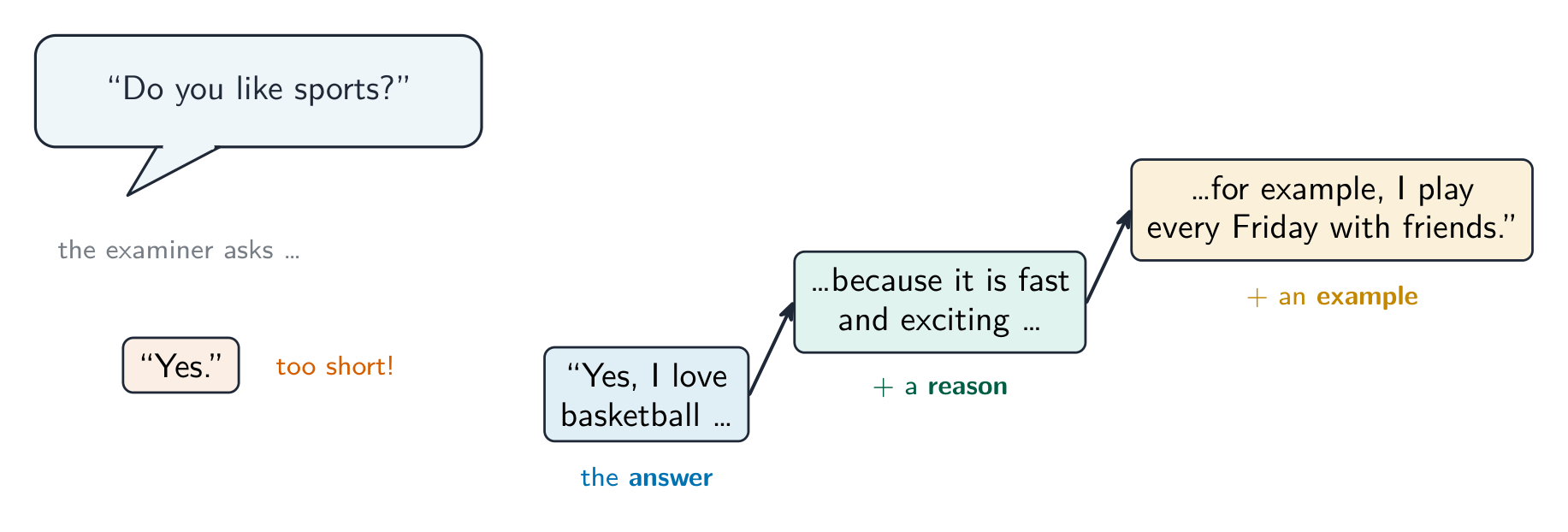
Use phrases like "for example", "that is why" and "I suppose" to extend your answers.
Speak clearly
Speak with good pronunciation 发音 and natural intonation 语调.
Do not rush. It is better to speak clearly than quickly.
If you forget a word, say it another way. This is called paraphrasing 释义.
Useful language
Memorise a few phrases 短语 for each move. They keep you talking when your mind goes blank.
To give an opinion:In my opinion… / I'd say… / For me,…
To add detail:for example… / that's why… / what I mean is…
To buy thinking time:That's a good question… / Well, let me think… / I suppose…
To agree or disagree politely 礼貌: That's true, but… / I see what you mean, though…
A short pause with "Let me think…" sounds far better than silence. It shows control, not panic.
A model turn
See how one student turns a plain question into a full, natural answer.
Examiner: Do you enjoy studying at home?
Student: In my opinion, home is better for some subjects. For example, I revise 复习 maths well at home because it is quiet and nobody interrupts 打断 me. But I suppose group work is easier at school, where I can ask my friends straight away. So really, it depends on the task.
The student gives an opinion, backs it with an example, admits the other side, and finishes with a neat conclusion. That is a top-mark turn — and anyone can build it with these phrases.
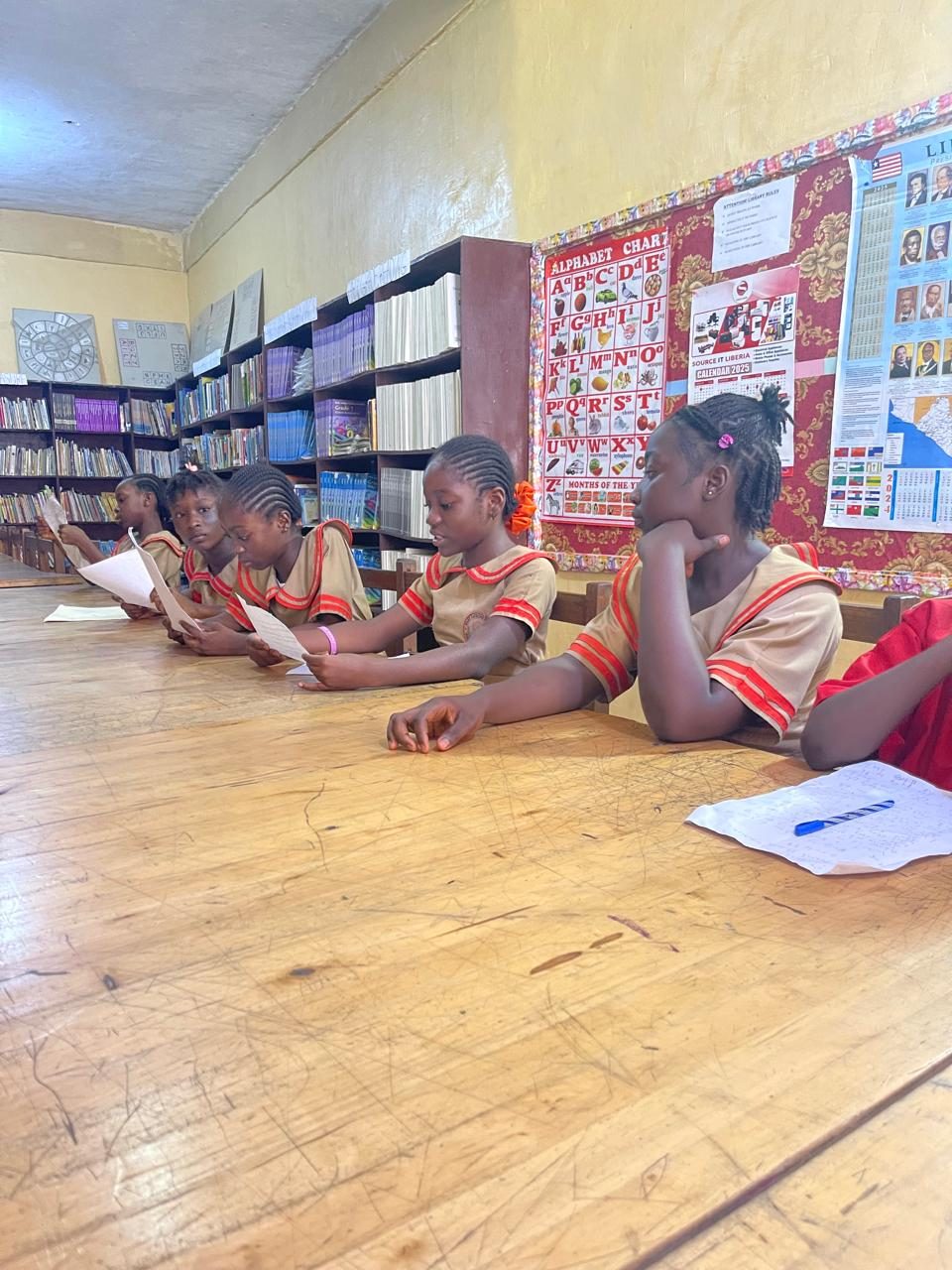
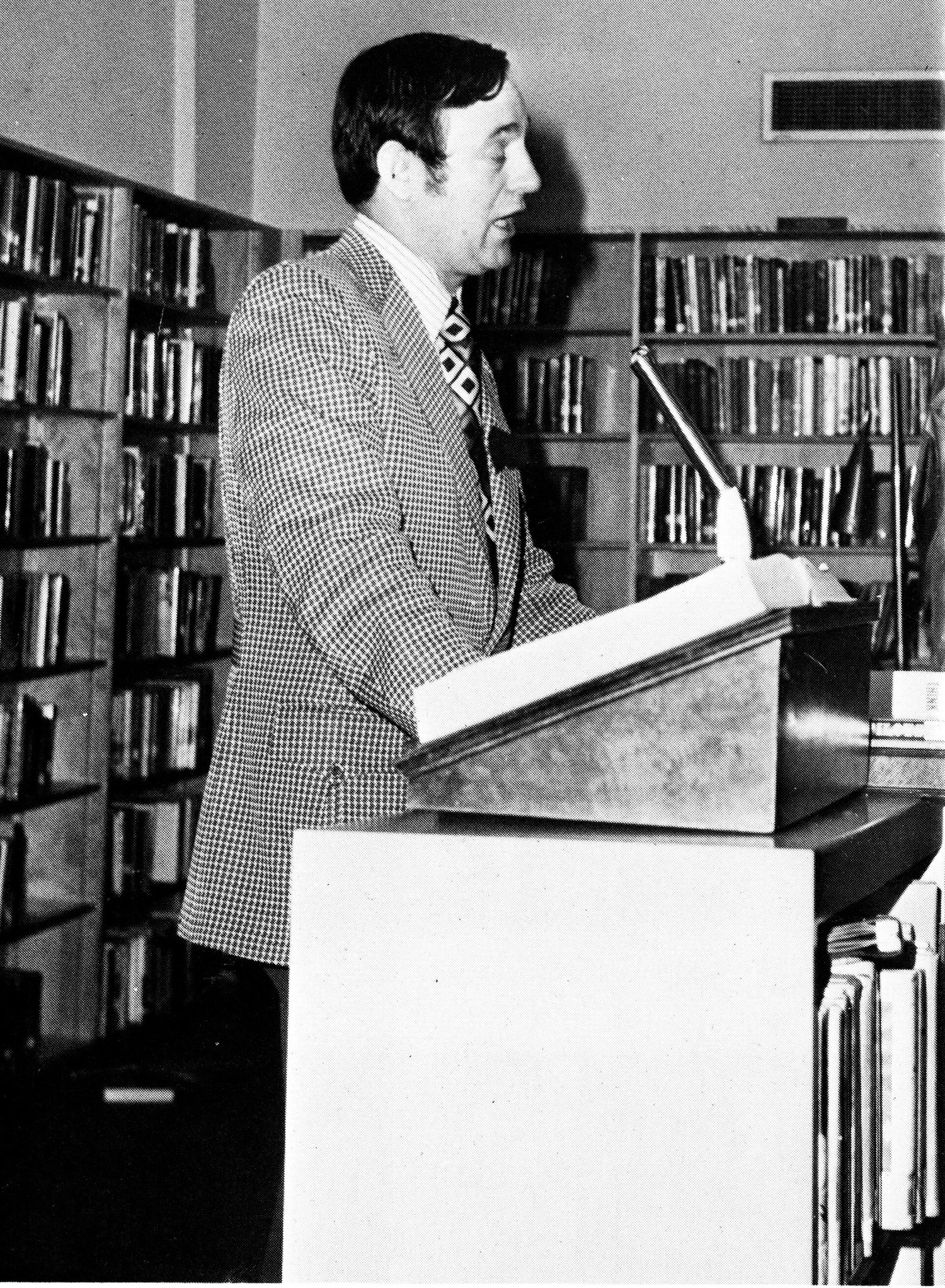
A short talk to a room: plan clear points, speak naturally, and answer follow-up questions
recognise common text types: article, blog, email, essay, report, review, notice, leaflet and interview
know the purpose and audience of each text type
match the right style and format to each text type
한국어
일반적인 텍스트 유형 식별: 기사, 블로그, 이메일, 에세이, 보고서, 리뷰, 공지, 전단 및 인터뷰
각 텍스트 유형의 목적과 타겟 독자를 알기
각 텍스트 유형에 맞는 적절한 스타일과 형식을 매칭하기
Source: Cambridge International syllabus · 출처: Cambridge International syllabus
Each writing task is a text type 文本类型 with its own rules.
Common text types
An email is a message to one person; an article 文章 is for many readers; a report 报告 gives facts to a person in charge.
A blog 博客 is a personal, informal online post – like an article but more personal and casual, so it sits near the informal end of the formality scale.
A review 评论 gives an opinion about something you tried; an essay 议论文 argues a point of view.
A notice 通知 and a leaflet 传单 give short, clear information.
Match style to type
Each text type has its own purpose, reader and tone.
Before you write, ask: what is this text type, and what style does it need?
Every text type sits somewhere on the line from informal to formal
A vocabulary routine
Turn new words into words you truly own with four steps:
Meet it — when you find a new word, write it down with one example sentence.
File it — put it in your notebook under a topic group (travel, health, school).
Test it — cover the meaning and try to recall it the next day, then again a week later. This spaced review 间隔复习 fixes words in your memory far better than reading a list once.
Use it — put the word into your own writing or speaking within a few days, before you forget it.
Five words learned this way each day is over a thousand a year.