Skip to content · ⁨본문 바로가기⁩

Writing an essay · ⁨에세이 쓰기⁩

IGCSE English · ⁨IGCSE 영어⁩ · Topic 8 · ⁨주제 8⁩

Video lesson for this topic · ⁨이 주제용 영상 수업⁩ Open the video page · ⁨영상 페이지 열기⁩
7:56

에세이 쓰기

두 명의 학생이 동일한 에세이 주제(학생들은 숙제를 받아야 하는가?)에 답합니다. 첫 번째의 답안입니다. 숙제는 좋습니다. 학습에 도움이 됩니다. 또한 일부 학생들은…

English narration · English + 中文 subtitles burned in · ⁨영어 내레이션 · 영어 + 중국어 자막 burned-in⁩

8.1

Two kinds of essay · ⁨두 종류의 에세이⁩

Syllabus
English
  1. tell the difference between a discursive essay (balanced, both sides) and an argumentative essay (one main view)
  2. plan the main points and the reasons or evidence for each
  3. keep a formal, organised style
한국어
  1. 논증적 essay(양측을 균형 있게 다루는 것)과 논리 essay(주요 관점 하나를 주장하는 것)의 차이를 구별한다
  2. 주요 내용과 각 내용에 대한 이유 또는 증거를 계획한다
  3. 격식 있고 체계적인 스타일을 유지한다

Source: Cambridge International syllabus · ⁨출처: Cambridge International syllabus⁩

English

An essay 议论文 gives your ideas about a topic in an organised way.

Discursive essays

  • A discursive 论述的 essay looks at both sides of a topic.
  • You give the points for and against, and perhaps your own view at the end.

Argumentative essays

  • An argumentative 议论的 essay argues for one main view.
  • You give strong reasons and examples to support your opinion.

Plan first

  • Decide your main points and the reasons for each, before you write.
  • A short plan keeps your essay organised.
한국어

에세이 议论文은 주제에 대한 당신의 생각을 체계적으로 제시합니다.

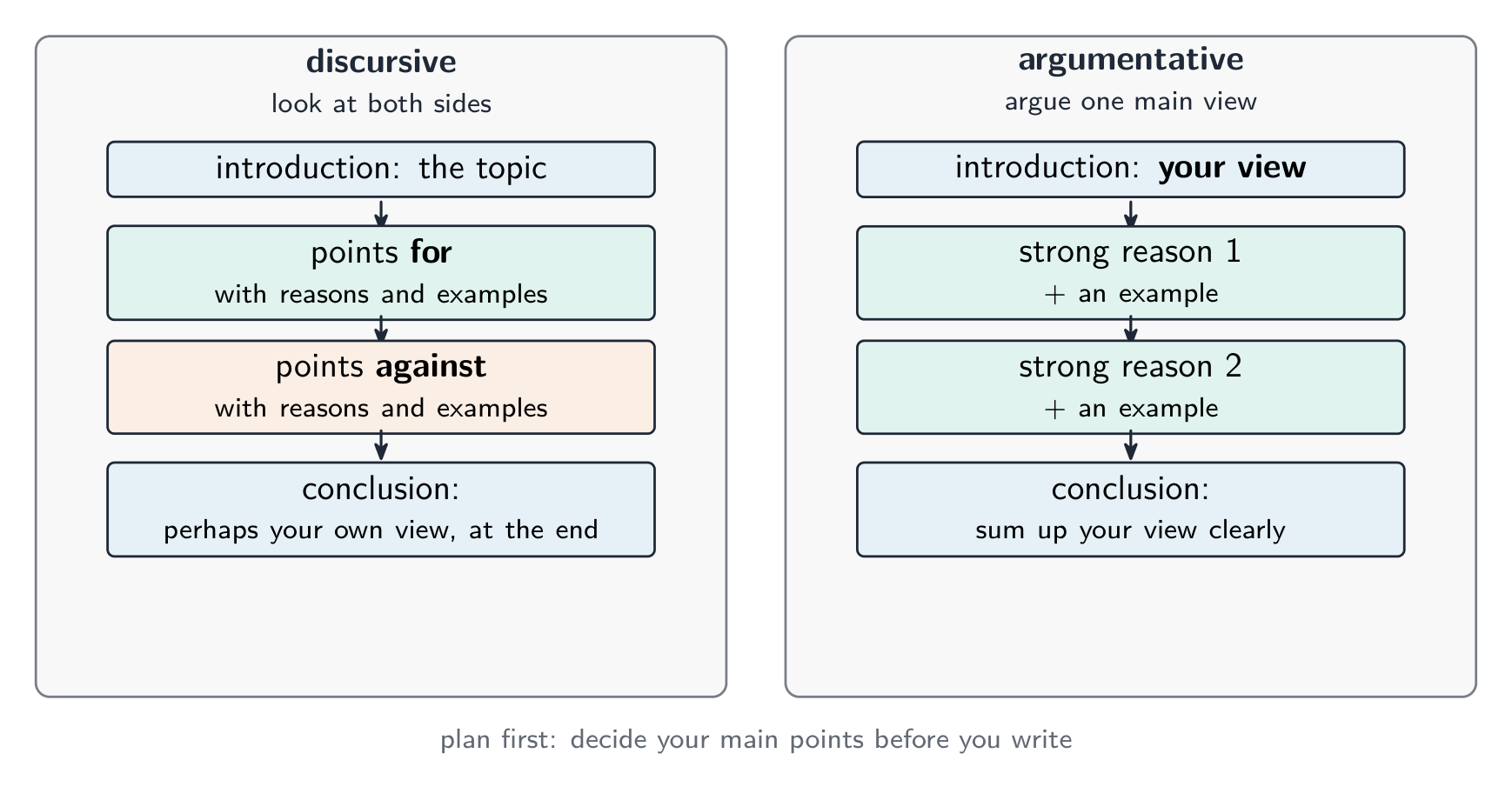
두 에세이 골격이 나란히: 논증적 에세이는 서론부터 찬반 의견, 그리고 possibly your view를 포함하는 결론으로 이동합니다; 논쟁적 에세이는 서론에서 your view를 명시하고, 예시가 있는 두 가지 강력한 이유를 제시하며, 결론에서 your view를 요약합니다
두 가지 에세이 형태: 논설은 양측을权衡; 주장형은 하나의 견해를 주장합니다

논증적 에세이

  • 논증적 论述的 에세이는 주제에 대한 양측을 모두 검토합니다.
  • 지지와 반대의 의견을 제시하고, 마지막에 본인의 견해를 덧붙일 수 있습니다.

설득적 에세이

  • 설득적 议论的 에세이는 하나의 주요 견해만을 주장합니다.
  • 본인의 견해를 뒷받침하기 위해 강력한 근거와 예시를 제시합니다.

먼저 계획 수립하기

  • 쓰기 전에 주요 내용과 각 내용에 대한 근거를 결정하십시오.
  • 짧은 계획은 에세이를 체계적으로 유지하는 데 도움이 됩니다.
책으로 가득한 독서실: 에세이는 정교한 독서, 계획 수립 및 구조화된 논증이 필요합니다
Vocabulary · ⁨어휘⁩ Train · ⁨연습하기⁩
English 한국어
essay/ˈeseɪ/ 论文(essay)
discursive/dɪˈskɜːsɪv/ 서술적
argumentative/ˌɑːɡjuːˈmentətɪv/ 논증적
introduction/ˌɪntrəˈdʌkʃn/ 도입기
8.2

How to structure an essay · ⁨에세이 구성 방법⁩

Syllabus
English
  1. introduce the topic and your approach in the introduction
  2. develop one main idea per paragraph in the body, with reasons and examples
  3. draw the ideas together in a clear conclusion
한국어
  1. 서론에서 주제를 소개하고 접근 방식을 명시한다
  2. 본론의 각 문단마다 하나의 주요 아이디어를 전개하며, 이유와 예시를 포함한다
  3. 결론에서 아이디어들을 명확하게 정리한다

Source: Cambridge International syllabus · ⁨출처: Cambridge International syllabus⁩

English

A clear shape makes your argument easy to follow.

Introduction

  • The introduction 引言 names the topic and says how you will approach it.
  • Keep it short — two or three sentences.

Body paragraphs

  • Put one main idea in each body 主体 paragraph.
  • Start the paragraph with the idea, then add reasons and examples.

Conclusion

  • The conclusion 结论 brings your ideas together.
  • Do not add a new point here. Sum up your view clearly.

Useful language

Linking words 衔接词 signal your reader where the argument turns. They are the road signs of an essay.

  • To add a point: Firstly… / In addition… / Another reason is…
  • To show the other side: However… / On the other hand… / Some people argue that…
  • To give an example: For example… / For instance… / such as…
  • To conclude: In conclusion… / Overall… / Weighing both sides…

Use them at the start of a sentence, and do not overuse one. Two or three well-placed links are enough for a paragraph.

A model body paragraph

Watch the three moves: idea, then reason, then example.

Firstly, homework teaches students to work alone. In class, a teacher is always nearby to help. At home, a student must solve the problem by themselves — and that is where real learning happens. For example, a maths question that felt easy in the lesson can teach far more when you meet it again, alone, at your desk.

The first sentence is the idea. The next two explain why. The last one makes it real with an example. Every body paragraph can follow this simple shape.

한국어

명확한 형태가 있다면 논리를 따르기 쉽습니다.

서론

  • 서론 引言은 주제를 명시하고 접근 방식을 설명합니다.
  • 간결하게 하십시오. 두 세 문장으로 작성하세요.

본론 문단

  • 각 본론 主体 문단에 하나의 주요 아이디어를 담으십시오.
  • 문단은 아이디어로 시작하여, 그 뒤로 근거와 예시를 추가하십시오.
본론 문단이 세 부분으로 나뉜 모습: 주제문으로 제시된 주요 아이디어, 그에 대한 근거, 그리고 구체화되는 예시
본론 문단: 아이디어 먼저, 다음 근거, 그리고 예시

결론

  • 결론 结论은 모든 아이디어를 종합합니다.
  • 여기에 새로운 내용을 추가하지 마십시오. 본인의 견해를 명확히 요약하십시오.

유용한 표현

연결어 衔接词는 독자에게 논리의 전환 지점을 알립니다. 이는 에세이의 길표지판과 같습니다.

  • 의견 추가: Firstly… / In addition… / Another reason is…
  • 반대 의견 제시: However… / On the other hand… / Some people argue that…
  • 예시 제시: For example… / For instance… / such as…
  • 결론: In conclusion… / Overall… / Weighing both sides…

이 표현들은 문장 처음에 사용하고, 특정 표현을 과도하게 남용하지 마십시오. 문단 하나에 두세 개의 적절한 연결어가 충분히 유효합니다.

본론 문단 모범 사례

세 가지 흐름을 관찰하십시오: 아이디어, سپس 근거, 마지막으로 예시.

Firstly, homework teaches students to work alone. In class, a teacher is always nearby to help. At home, a student must solve the problem by themselves — and that is where real learning happens. For example, a maths question that felt easy in the lesson can teach far more when you meet it again, alone, at your desk.

첫 문장은 아이디어입니다. 다음 두 문장은 왜인지 설명합니다. 마지막 문장은 예시를 들어 구체화합니다. 모든 본론 문단은 이 단순한 형태를 따를 수 있습니다.

먼저 계획 수립: 명확한 내용, 예시, 그리고 단단한 결론
Vocabulary · ⁨어휘⁩ Train · ⁨연습하기⁩
English 한국어
body/ˈbɒdi/ 본체
conclusion/kənˈkluːʒn/ 결론
linking words/ˈlɪŋkɪŋ wɜːdz/ 연결어
Watch lesson · ⁨수업 보기⁩
8.2

Exam tips · ⁨시험 팁⁩

English
  • Plan for three minutes before you write: your view, two reasons, one opposite view.
  • First paragraph introduces the question; each middle paragraph carries exactly one argument.
  • Signpost with linking words: First of all, However, On the other hand, In conclusion.
  • Give the other side one fair paragraph, then answer it. Balance shows thinking and earns marks.
  • The final paragraph states your opinion clearly. Do not sit on the fence.
한국어
  • 쓰기 전 3분간 계획하십시오: 본인의 견해, 두 가지 근거, 하나의 반대 견해.
  • 첫 문단은 질문을 소개하고, 중간 문단마다 정확히 하나의 논지를 담습니다.
  • 연결어를 사용하여 방향을 표시하십시오: First of all, However, On the other hand, In conclusion.
  • 반대편에 대한 공정한 문단을 하나 제공한 후对它进行反驳하십시오. 균형 잡힌 사고는 점수를 얻는 요소입니다.
  • 마지막 문단은 본인의 의견을 명확히 밝히십시오. 중립을 지키거나 유보하지 마십시오.

Interactive lessons on this topic · ⁨이 주제에 대한 인터랙티브 수업⁩

Work through it step by step, with instant-check exercises. · ⁨즉시 체크 기능 exercises를 통해 단계별로 진행하세요.⁩

Past Papers · ⁨과거 시험지⁩

More topics in IGCSE English · ⁨IGCSE 영어⁩ · ⁨IGCSE English · ⁨IGCSE 영어⁩ 내 추가 주제⁩

Log in or create account · ⁨로그인 또는 계정 만들기⁩

IGCSE, A-Level & AP