오전 세 시의 온실 imagine 해 보십시오. 그곳에는 아무도 없습니다. 공기가 조금 따뜻해지고 창문이 스스로 열립니다. 한 시간 후 다시 닫힙니다…
English narration · English + 中文 subtitles burned in · 영어 내레이션 · 영어 + 중국어 자막 burned-in
6.1
Automated systems · 자동화 시스템
Syllabus
English
Candidates should be able to:
Notes and guidance
1 Describe how sensors, microprocessors and actuators can be used in collaboration to create automated systems
2 Describe the advantages and disadvantages of an automated system used for a given scenario
• Including scenarios from: – industry – transport – agriculture – weather – gaming – lighting – science
한국어
응시자가 다음을 수행할 수 있어야 함:
참고 사항 및 가이드라인
1 센서, 마이크로프로세서 및 액추에이터가 협력하여 자동화 시스템을 만드는 방법을 설명
2 특정 시나리오에서 사용되는 자동화 시스템의 장단점을 설명
• 다음 시나리오 포함: – 산업, – 교통, – 농업, – 기상, – 게임, – 조명, – 과학
Source: Cambridge International syllabus · 출처: Cambridge International syllabus
English
An automated system 自动化系统 is a mix of software and hardware that senses and responds to data in its environment 环境, with no need for human intervention 人工干预. In other words, it works on its own.
Examples of automated systems:
a central heating 中央供暖 system;
a chemical process 化学过程 in a factory;
a greenhouse 温室 (for growing plants);
a car park barrier 停车场道闸.
Sensors, microprocessors and actuators
Three parts work together in an automated system.
Part
Job
sensor 传感器
measures a physical quantity (such as temperature or light) and sends the data
microprocessor 微处理器
compares the data with stored values and makes decisions
actuator 执行器
receives a signal and causes movement or action (such as opening a valve)
The cycle works like this:
The sensor sends data to the microprocessor.
The microprocessor compares this data with stored values 存储值 and makes a decision.
The microprocessor sends signals to the actuators to take action.
For example, in a greenhouse: a temperature sensor reads the heat; the microprocessor compares it with the wanted value; if it is too hot, the microprocessor signals an actuator to open a window.
The syllabus names many sensor types 传感器类型, each reading one physical quantity – for example an accelerometer 加速度计 (movement or tilt), a humidity 湿度 sensor (water in the air), and a proximity 接近 sensor (a nearby object):
Sensor
Measures
Typical use
temperature
heat
ovens, greenhouses, heating
light
brightness
automatic lights, cameras
pressure
force on a surface
alarm floor mats, touchscreens
infra-red / proximity
a nearby object
automatic doors, parking sensors
acoustic (sound)
sound level
noise monitors
humidity / moisture
water in air or soil
greenhouses, irrigation
gas
a gas being present
smoke and CO alarms
pH
acidity
pools, fish tanks
accelerometer
movement or tilt
phones, airbag triggers
magnetic field
magnetism
door contacts, compasses
flow / level
fluid flow or depth
pipes, tanks
To pick a sensor for a scenario, choose the one that reads the right physical quantity: a fish tank needs pH and temperature sensors; an automatic door needs an infra-red / proximity sensor.
Advantages and disadvantages
Automated systems are used in many situations, such as industry, transport, agriculture 农业 (farming), weather (gathering data), gaming and lighting.
Advantages
Disadvantages
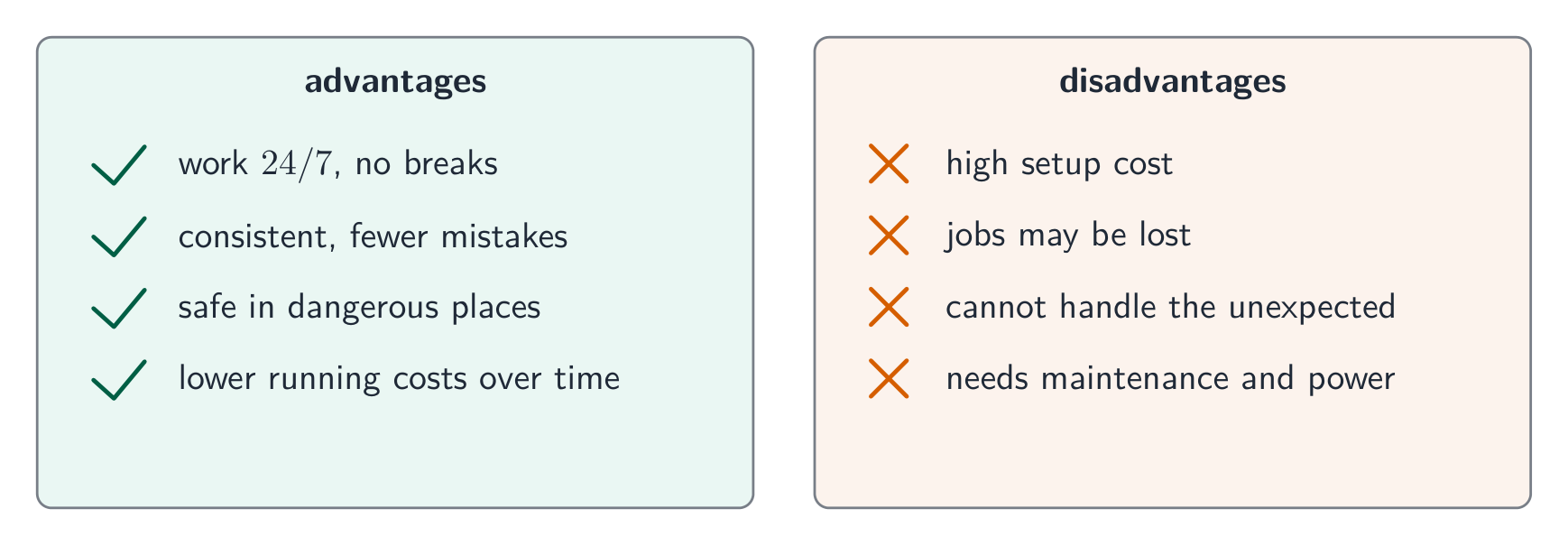
work all day and night, without rest
cost a lot to buy and set up
faster and more consistent 一致的 than people
can break down and need expert repair
can work in places unsafe for people
may replace people's jobs
fewer human mistakes
cannot easily react to a situation they were not built for
Worked example. Describe how an automatic greenhouse holds the temperature at 25 °C. A temperature sensor continuously measures the temperature and sends its reading, converted to digital by an ADC, to the microprocessor. The microprocessor compares the reading with the stored value of 25 °C. If the temperature is above it, the microprocessor signals an actuator to open a window or switch on a fan; if it is below, it switches on a heater. The whole loop then repeats continuously. Two marks nearly always sit on the words "compares with a stored (pre-set) value" and "the process repeats" - a description that stops at "the sensor tells the computer" leaves them behind.
한국어
자동화 시스템은 소프트웨어와 하드웨어의 결합으로, 환경 내 데이터를 감지하고 반응하며 사람의 개입 없이 작동합니다. 즉, 스스로 작동합니다.
자동화 시스템의 예:
중앙 난방 시스템;
공장의 화학 공정;
온실(식물 재배용);
주차장 바리어.
센서, 마이크로프로세서 및 액추에이터
자동화 시스템에서는 세 가지 부분이 함께 작동합니다.
부위
역할
센서
물리적 양(예: 온도 또는 빛)을 측정하여 데이터를 전송함
마이크로프로세서
데이터를 저장된 값과 비교하고 결정을 내림
액추에이터
신호를 받아 운동이나 작용(예: 밸브 열기)을 유발함
이 순환은 다음과 같이 작동합니다:
센서가 마이크로프로세서에 데이터를 전송합니다.
마이크로프로세서는 이 데이터를 저장된 값과 비교하여 결정을 내립니다.
마이크로프로세서는 액추에이터에 신호를 보내 조치를 취하게 합니다.
예를 들어, 온실에서는 온도 센서가 열을 감지하고, 마이크로프로세서는 이를 원하는 값과 비교하며, 너무 뜨거우면 액추에이터에 창문을 여는 신호를 보냅니다.
센서가 마이크로프로세서에 데이터를 전달하면, 마이크로프로세서는 읽은 값을 저장된 값과 비교하여 액추에이터에 신호를 보내고, 이 순환이 반복됩니다
교수요서는 여러 가지 센서 유형을 언급하며, 각각 하나의 물리량을 측정합니다. 예를 들어 가속도계(운동 또는 기울기), 습도 센서(공중의 수분), 근접 센서(인접한 물체) 등이 있습니다:
센서
측정 대상
일반 용도
온도
열
오븐, 온실, 난방
빛
밝기
자동 조명, 카메라
압력
표면에 가해지는 힘
알람 바닥 매트, 터치스크린
적외선 / 근접
인접한 물체
자동 문, 주차 센서
음향 (소리)
소리 세기
소음 모니터링
습도 / 수분
공기나 토양의 수분
온실, 관개
가스
가스의 존재
연소 및 CO 경보기
pH
산도
수영장, 수족관
가속도계
운동 또는 기울기
스마트폰, 에어백 작동 장치
자기장
자성
도어 접점, 나침반
유량 / 수위
액체의 흐름 또는 깊이
배관, 탱크
특정 시나리오에合适的 센서를 선택하려면, 올바른 물리량을 읽을 수 있는 것을 선택해야 합니다. 수족관에는 pH와 온도 센서가 필요하며, 자동 문에는 적외선/근접 센서가 필요합니다.
장단점
자동화 시스템은 산업, 운송, 농업(재배), 기상(데이터 수집), 게임 및 조명 등 다양한 분야에서 사용됩니다.
자동화 시스템의 장단점카메라 드론: 지정된 경로를 따라 스스로 비행하여 데이터를 수집함
장점
단점
낮밤 가리지 않고 작업 가능
구매 및 설정 비용이 높음
사람보다 빠르고 일관적임
고장날 수 있으며 전문가 수리가 필요함
사람이 위험할 수 있는 장소에서 작업 가능
사람의 일자리를 대체할 수 있음
인간의 실수 발생 빈도가 낮음
설계되지 않은 상황에 대해 쉽게 대응하지 못함
worked example. 자동 온실이 25 °C의 온도를 어떻게 유지하는지 설명하십시오. 온도 센서가 온도를 지속적으로 측정하여 ADC에 의해 디지털로 변환된 읽기 값을 마이크로프로세서에 전송합니다. 마이크로프로세서는 읽은 값을 25 °C의 저장된 값과 비교합니다. 온도가 이 값보다 높으면 마이크로프로세서는 액추에이터에 창문을 열거나 팬을 켜라는 신호를 보내며, 낮으면 히터를 켭니다. 그 후 전체 루프가 지속적으로 반복됩니다. '저장된(사전 설정) 값과 비교한다'와 '작업이 반복된다'는 표현에 거의 항상 2점이 부여되므로, 단순히 '센서가 컴퓨터에 알려준다'로 설명을 멈추면 점수를 잃게 됩니다.
Explore · 탐색하기
An automated control loop · 자동 제어 루프
Tap round the loop. An automated system senses, compares against a target, then acts — and because the action changes what it senses, it keeps correcting itself with no human needed. · 루프 주변을 두드려보십시오. 자동화 시스템은 감지하고, 목표값과 비교한 후 작동합니다. 그리고 이 작동이 감지되는内容进行 변경하므로,人間の 개입 없이 스스로를 계속 수정해 나갑니다.
lack of independent decision-making/læk ɒv ˌɪndɪˈpendənt dɪˈsɪʒn ˈmeɪkɪŋ/
독립적 의사결정 부재(lack of independent decision-making)
Artificial intelligence/ˌɑːtɪˈfɪʃl ɪnˈtelɪdʒəns/
인공지능
simulation/ˌsɪmjʊˈleɪʃn/
시뮬레이션(simulation)
rules/ruːlz/
배제하다/규율하다
reason/ˈriːzn/
이유
draw conclusions/drɔː kənˈkluːʒnz/
결론 도출(draw conclusions)
approximate/əˈprɒksɪmət/
근사하다
definite/ˈdefɪnət/
확실한
learn/lɜːn/
학습(learn)
adapt/əˈdæpt/
적응(Adapt)
expert systems/ˈekspɜːt ˈsɪstəmz/
전문가 시스템
natural language processing/ˈnætʃərəl ˈlæŋɡwɪdʒ ˈprəʊsesɪŋ/
자연어 처리
self-driving cars/self ˈdraɪvɪŋ kɑːz/
자율 주행 자동차(self-driving cars)
knowledge base/ˈnɒlɪdʒ beɪs/
지식 기반(knowledge base)
rule base/ruːl beɪs/
규칙 기반(rule base)
inference engine/ˈɪnfərəns ˈendʒɪn/
추론 엔진(inference engine)
user interface/ˈjuːzə ˈɪntəfeɪs/
사용자 인터페이스(user interface)
Machine learning/məˈʃiːn ˈlɜːnɪŋ/
머신러닝
narrow AI/ˈnærəʊ ˌeɪ ˈaɪ/
구부사 인공지능(Narrow AI)
general AI/ˈdʒenərəl ˌeɪ ˈaɪ/
범용 인공지능(General AI)
strong AI/strɒŋ ˌeɪ ˈaɪ/
강력人工智能(Strong AI)
central heating/ˈsentrəl ˈhiːtɪŋ/
중앙 난방(central heating)
chemical process/ˈkemɪkl ˈprəʊses/
화학 공정(chemical process)
agriculture/ˈæɡrɪkʌltʃə/
농업
mechanical/mɪˈkænɪkl/
기계적
6.2
Robotics · 로봇공학
Syllabus
English
Candidates should be able to:
Notes and guidance
1 Understand what is meant by robotics
• Robotics is a branch of computer science that incorporates the design, construction and operation of robots • Examples include factory equipment, domestic robots and drones
2 Describe the characteristics of a robot
• Including: – a mechanical structure or framework – electrical components, such as sensors, microprocessors and actuators – programmable
3 Understand the roles that robots can perform and describe the advantages and disadvantages of their use
• Robots can be used in areas including: – industry – transport – agriculture – medicine – domestic settings – entertainment
한국어
응시자가 다음을 수행할 수 있어야 함:
참고 사항 및 가이드라인
1 로봇공학의 의미를 이해하기
• 로봇공학은 로봇의 설계, 제작 및 운영을 통합하는 컴퓨터 과학의 한 분야이다. • 예로는 공장 장비, 가정용 로봇 및 드론이 포함된다.
2 로봇의 특성을 서술하기
• 다음을 포함: – 기계적 구조 또는 프레임워크 – 센서, 마이크로프로세서, 액추에이터와 같은 전기 부품 – 프로그래밍 가능
3 로봇이 수행할 수 있는 역할과 사용 시의 장점 및 단점을 설명하기
• 로봇은 다음과 같은 분야에서 활용될 수 있다: – 산업 – 교통 – 농업 – 의학 – 가정 환경 – 엔터테인먼트
Source: Cambridge International syllabus · 출처: Cambridge International syllabus
English
Robotics 机器人技术 is the branch of technology that deals with the design, building and operation of robots 机器人.
A robot has these characteristics:
a physical structure 物理结构 (a mechanical 机械的 body, such as arms);
electrical components 电子元件 (motors, sensors and wiring);
programmable instructions 可编程指令 — it follows a program that can be changed.
What robots do
Robots can perform many roles, for example:
factory equipment 工厂设备 — building cars, welding, moving heavy parts;
domestic appliances 家用电器 — such as a robotic vacuum cleaner 吸尘器.
Advantages
Disadvantages
do dull or dangerous jobs
expensive to buy and maintain
work quickly and accurately
can replace human workers
do not get tired or bored
a robot has a lack of independent decision-making 缺乏独立决策 — it only does what it is programmed to do
A key limit of a robot is that it cannot think for itself. It cannot make its own choices when something unexpected happens.
한국어
로봇공학은 로봇의 설계, 제작 및 작동을 다루는 기술 분야입니다.
로봇에는 이러한 특징이 있습니다:
물리적 구조(팔과 같은 기계적 몸체);
전기 부품(모터, 센서 및 배선);
프로그래밍 가능한 지시사항—변경 가능한 프로그램을 따릅니다.
로봇의 역할
로봇은 다음과 같은 다양한 역할을 수행할 수 있습니다. 예를 들어:
공장 장비—자동차 제조, 용접, 무거운 부품 이동;
가전제품—로봇 청소기와 같은 제품.
산업용 로봇 팔. 프로그램을 따라 수행하며, 새로운 작업에 대해 재프로그래밍할 수 있습니다.로봇 청소기: 바닥을 청소하기 위해 스스로 이동하는 가정용 로봇
장점
단점
지루하거나 위험한imately tasks를 수행 가능
구매 및 유지보수 비용이 높음
빠르고 정확히 작업 가능
인간 노동자를 대체할 수 있음
피로나 지루함이 없음
로봇은 독자적 의사결정 능력 부족—프로그램된 것만 수행함
로봇의 핵심적인 한계는 스스로 생각할 수 없다는 점입니다. 예상치 못한 상황이 발생할 때 자체적으로 선택을 내릴 수 없습니다.
Explore · 탐색하기
Computing concept lab · 컴퓨팅 개념 실험실
Classify concrete examples by the computing idea they demonstrate. · 구체적인 예시를 그들이 시연하는 컴퓨팅 개념에 따라 분류하십시오.
1 Understand what is meant by artificial intelligence (AI)
• AI is a branch of computer science dealing with the simulation of intelligent behaviours by computers
2 Describe the main characteristics of AI as the collection of data and the rules for using that data, the ability to reason, and it can include the ability to learn and adapt
3 Explain the basic operation and components of AI systems to simulate intelligent behaviour
• Limited to: – expert systems – machine learning • Expert systems have a knowledge base, a rule base, an inference engine and an interface • Machine learning is when a program has the ability to automatically adapt its own processes and/or data
한국어
응시자가 다음을 수행할 수 있어야 함:
참고 사항 및 가이드라인
1 **인공지능(AI)**의 의미를 이해하기
• AI는 컴퓨터가 지능적인 행위를 시뮬레이션하는 것과 관련된 컴퓨터 과학의 한 분야이다.
2 데이터를 수집하고 해당 데이터를 사용하는 규칙으로 정의되는 AI의 주요 특성, 추론 능력, 그리고 학습 및 적응 능력을 포함함을 서술하기
3 지능적 행위를 시뮬레이션하는 AI 시스템의 기본 작동 방식과 구성 요소를 설명하기
• 다음으로 제한: – 전문가 시스템 – 머신러닝 • 전문가 시스템에는 지식 베이스, 규칙 베이스, 추론 엔진 및 인터페이스가 있다. • 머신러닝은 프로그램이 자신의 프로세스 및/또는 데이터를 자동으로 적응시키는 능력을 가지는 것이다.
Source: Cambridge International syllabus · 출처: Cambridge International syllabus
English
Artificial intelligence 人工智能 (AI) is the simulation 模拟 of human intelligence by computer systems. This means a computer doing tasks that normally need human thinking.
Characteristics of AI
AI systems usually have these features:
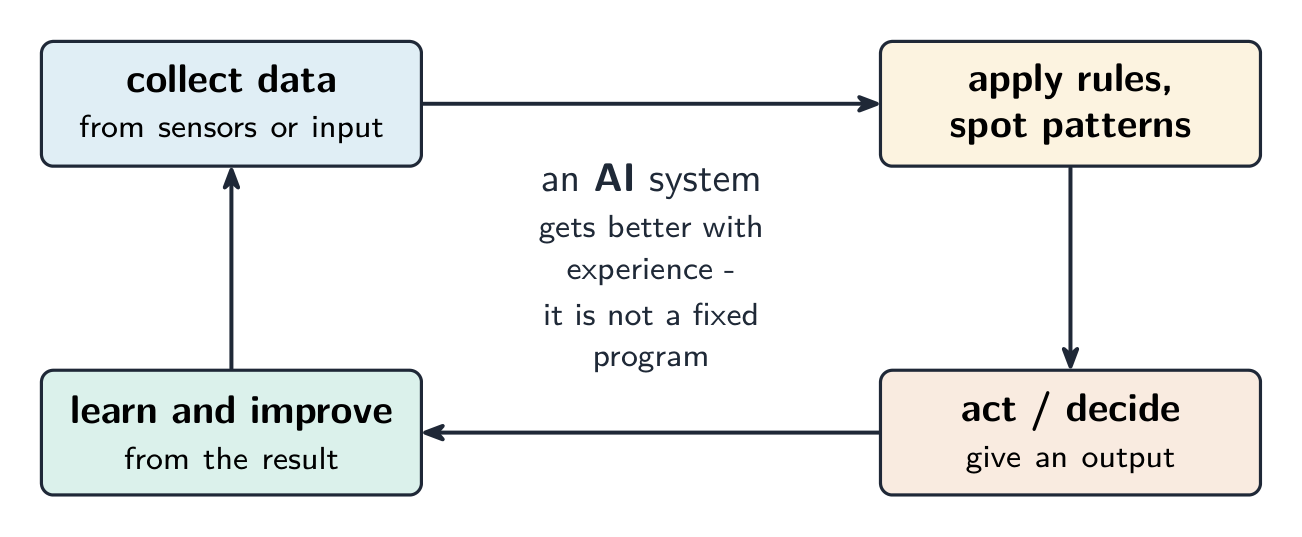
they collect data and the rules 规则 for using that data;
they have the ability to reason 推理 (work things out using the rules);
they have the ability to draw conclusions 得出结论, which may be approximate 近似的 (a best guess) or definite 确定的 (certain);
they have the ability to learn 学习 from data;
they have the ability to adapt 适应 — to change their behaviour as they get new data.
Examples of AI
expert systems 专家系统 — software that gives advice like a human expert (for example, helping a doctor with a diagnosis);
natural language processing 自然语言处理 — understanding human speech or text;
self-driving cars 自动驾驶汽车.
Inside an expert system
An expert system stores human expertise and reasons from it. It has four parts:
a knowledge base 知识库 – the stored facts about the subject;
a rule base 规则库 – the "if… then…" rules a human expert would apply;
an inference engine 推理引擎 – applies the rules to the facts to reach a conclusion;
a user interface 用户界面 – asks the user questions and shows the result.
The interface collects facts from the user; the inference engine runs the rule base against the knowledge base; and the system outputs a diagnosis or a probability – as used to help a doctor diagnose an illness or to find a car fault.
Machine learning
Machine learning 机器学习 is a program that improves its own performance from experience, without being explicitly reprogrammed. It finds patterns in data and adapts: a search engine gets better at ranking results, a voice assistant recognises spoken commands more accurately, and a robot vacuum gradually learns the layout of a room.
Narrow, general and strong AI
Type
What it means
narrow AI 弱人工智能
can do only one task or a small set of tasks (for example, a chess program). All AI today is narrow AI.
general AI 通用人工智能
could do any task a human can do, switching between many different tasks.
strong AI 强人工智能
would think and be aware like a real human mind. This does not exist yet.
한국어
인공지능(AI)은 컴퓨터 시스템에 의한 인간 지능의 모사입니다. 즉, 일반적으로 인간 사고가 필요한 작업을 컴퓨터가 수행한다는 의미입니다.
AI의 특징
AI 시스템은 일반적으로 다음과 같은 기능을 가집니다:
데이터와 해당 데이터를 사용하는 규칙을 수집합니다;
추론(규칙을 사용하여 문제 해결) 능력을 가집니다;
결론을 도출할 수 있으며, 이는 대략적(최선의 추측)이거나 확실한(확실한) 결과일 수 있습니다;
데이터로부터 학습할 수 있는 능력을 가집니다;
적응(새로운 데이터를 받으며 행동 변경) 능력을 가집니다.
AI 시스템은 데이터를 수집하고 규칙을 적용하며 행동한 뒤, 학습하고 개선함
AI의 예시
전문가 시스템—인간 전문가처럼 조언을 제공하는 소프트웨어(예: 의사의 진단 지원)
자연어 처리 — 인간의 음성이나 텍스트를 이해하는 것;
자율주행 자동차.
자율 주행 자동차: 차량의 센서를 통해 컴퓨터가 운전자 없이 조종합니다
전문가 시스템 내부
전문가 시스템은人間の 전문 지식을 저장하고 이를 바탕으로 추론합니다. 네 가지 부분으로 구성됩니다:
지식베이스 – 주제에 대한 저장된 사실들;
규칙베이스 – 전문가가 적용할 "만약…이라면…" 규칙들;
추론 엔진 – 규칙을 사실에 적용하여 결론에 도달함;
사용자 인터페이스 – 사용자에게 질문하고 결과를 표시함.
인터페이스는 사용자로부터 사실을 수집하고, 추론 엔진은 지식베이스에 대해 규칙베이스를 실행하며, 시스템은 진단이나 확률을 출력합니다. 이는 의사가 병을 진단하거나 자동차 고장을 찾아내는 데 사용됩니다.
머신러닝
머신러닝은 명시적으로 재프로그래밍되지 않고도 경험을 통해 자체 성능을 향상시키는 프로그램입니다. 데이터에서 패턴을 찾아 적응합니다: 검색 엔진이 결과 순위를 더 잘 매기게 되고, 음성 비서가 발화 명령을 더 정확하게 인식하게 되며, 로봇 청소기가 방의 구조를 점진적으로 배우게 됩니다.
협소 AI, 일반 AI 및 강력 AI
협소 AI는 한 가지 작업만 수행함(현재 모든 AI); 일반 AI는 인간이 할 수 있는 모든 작업을 수행 가능함; 강력 AI는 자아를 갖게 됨—아직none 존재하지 않음
유형
의미
협소 AI
하나의 작업 또는 소수의 작업 세트를 수행할 수 있음(예: 체스 프로그램). 현재 모든 AI는 협소 AI이다.
일반 AI
인간이 할 수 있는 어떤 작업이라도 수행 가능하며, 여러 다른 작업 사이를 전환할 수 있다.
강력 AI
실제 인간 뇌처럼 생각하고 자아를 가질 것이다. 아직 존재하지 않는다.
Explore · 탐색하기
Computing concept lab · 컴퓨팅 개념 실험실
Classify concrete examples by the computing idea they demonstrate. · 구체적인 예시를 그들이 시연하는 컴퓨팅 개념에 따라 분류하십시오.
Learn the control loop: a sensor measures a quantity → the microprocessor compares it with a stored value → an actuator takes action; then the loop repeats.
Do not confuse the parts: a sensor sends data in; an actuator causes movement out.
A robot follows programmable instructions and cannot make its own decisions when something unexpected happens.
AI simulates human thinking: it collects data and rules, reasons, draws conclusions, and can learn and adapt.
Know the AI levels: narrow (one task; all AI today), general (any human task), strong (self-aware; does not exist yet).
한국어
제어 루프를 학습한다: 센서가 수치를 측정 → 마이크로프로세서가 이를 저장된 값과 비교 → 액추에터가 조치를 취함; 그 후 루프가 반복된다.
부품들을 혼동하지 말라: 센서는 데이터를 안으로 보내고, 액추에터는 움직임을 밖으로 유발한다.
로봇은 프로그래머블指令를 따르며, 예상치 못한 일이发生时에는 자체 결정을 내릴 수 없다.
AI는 인간 사고를 시뮬레이션한다: 데이터를收集和规则을收集하고, 추론하고, 결론을 도출하며, 학습하고 적응할 수 있다.
AI 수준을 알라: 협소(한 가지 작업; 현재 모든 AI), 일반(모든 인간 작업), 강력(자아 인식; 아직 존재하지 않음).
Interactive lessons on this topic · 이 주제에 대한 인터랙티브 수업
Work through it step by step, with instant-check exercises. · 즉시 체크 기능 exercises를 통해 단계별로 진행하세요.